“Robots can’t take your job if you’re already retired.”

July 7 JDN 2458672

There is a billboard on I-405 near where I live, put up by some financial advisor company, with that slogan on it: “Robots can’t take your job if you’re already retired.”

First, let me say this: Don’t hire a financial advisor firm; you really don’t need one. 90% of actively-managed funds perform worse than simple index funds. Buy all the stocks and let them sit. You won’t be able to retire sooner because you paid someone else to do the same thing you could have done yourself.

Yet, there is some wisdom in this statement: The best answer to technological unemployment is to make it so people don’t need to be employed. As an individual, all you could really do there is try to save up and retire early. But as a society, there is a lot more we could do.

The goal should essentially to make everyone retired, or if not everyone, then whatever portion of the population has been displaced by automation. A pension for everyone sounds a lot like a basic income.

People are strangely averse to redistribution of wealth as such (perhaps because they don’t know, or don’t want to think about, how much of our existing wealth was gained by force?), so we may not want to call our basic income a basic income.

Instead, we will call it capital income. People seem astonishingly comfortable with Jeff Bezos making more income in a minute than his median employee makes in a year, as long as it’s capital income instead of “welfare” or “redistribution of wealth”.

The basic income will instead be called something like the Perpetual Dividend of the United States, the dividends each US citizen receives for being a shareholder in the United States of America. I know this kind of terminology works, because the Permanent Fund Dividend in Alaska is a successful and enormously popular basic income. Even conservatives in Alaska dare not suggest eliminating the PFD.
And in fact it could literally be capital income: While public ownership of factories generally does not go well (see: the entire history of socialism and communism), the most sensible way to raise revenue for this program would be to tax income gained by owners of robotic factories, which, even if on the books as salary or stock options or whatever, is at its core capital income. If we wanted to make that connection even more transparent, we could tax in the form of non-voting shares in corporations, so that instead of paying a conventional corporate tax, corporations simply had to pay a portion of their profits directly to the public fund.

I’m not quite sure why people are so much more uncomfortable with redistribution of wealth than they are with the staggering levels of wealth inequality that make it so obviously necessary. Maybe it’s the feeling of “robbing Peter to pay Paul”, or “running out of other people’s money”? But obviously a basic income won’t just be free money from nowhere. We would be collecting it in taxes, the same way we fund all other government spending. Even printing money would mean paying in the form of inflation (and we definitely should not print enough money to cover a whole basic income!)

I think it may simply be that people aren’t cognizant enough of the magnitude of wealth inequality. I’m hoping that my posts on the extremes of wealth and poverty might help a bit with that. The richest people on Earth make about $10 billion per year—that’s $10,000,000,000—simply for owning things. The poorest people on Earth struggle to survive on less than $500 per year—often working constantly throughout their waking hours. Even if we believe that billionaires work harder (obviously false) or contribute more to society (certainly debatable) than other people, do we really believe that some people deserve to make 20 million times as much as others? It’s one thing to think that being a successful entrepreneur should make you rich. It’s another to believe that it should make you so rich you could buy a house for every homeless person in America.
Automation is already making this inequality worse, and there is reason to think it will continue to do so. In our current system, when the owner of a corporation automates production, he then gets to claim all the output from the robots, where previously he had to pay wages to the workers—and that’s why he does the automation, because it makes him more profit. Even if overall productivity increases, the fruits of that new production always get concentrated at the top. Unless we can find a way to change that system, we’re going to need to redistribute some of that wealth.

But if we have to call it something else, so be it. Let’s all be shareholders in America.

How will future generations think of us?

June 30 JDN 2458665

Today we find many institutions appalling that our ancestors considered perfectly normal: Slavery. Absolute monarchy. Colonialism. Sometimes even ordinary people did things that now seem abhorrent to us: Cat burning is the obvious example, and the popularity that public execution and lynching once had is chilling today. Women certainly are still discriminated against today, but it was only a century ago that women could not vote in the US.

It is tempting to say that people back then could not have known better, and I certainly would not hold them to the same moral standards I would hold someone living today. And yet, there were those who could see the immorality of these practices, and spoke out against them. Absolute rule by a lone sovereign was already despised by Athenians in the 6th century BC. Abolitionism against slavery dates at least as far back as the 14th century. The word “feminism” was coined in the 19th century, but there have been movements fighting for more rights for women since at least the 5th century BC.

This should be encouraging, because it means that if we look hard enough, we may be able to glimpse what practices of our own time would be abhorrent to our descendants, and cease them faster because of it.

Let’s actually set aside racism, sexism, and other forms of bigotry that are already widely acknowledged as such. It’s not that they don’t exist—of course they still exist—but action is already being taken against them. A lot of people already know that there is something wrong with these things, and it becomes a question of what to do about the people who haven’t yet come on board. At least sometimes we do seem to be able to persuade people to switch sides, often in a remarkably short period of time. (Particularly salient to me is how radically the view of LGBT people has shifted in just the last decade or two. Comparing how people treated us when I was a teenager to how they treat us today is like night and day.) It isn’t easy, but it happens.

Instead I want to focus on things that aren’t widely acknowledged as immoral, that aren’t already the subject of great controversy and political action. It would be too much to ask that there is no one who has advocated for them, since part of the point is that wise observers could see the truth even centuries before the rest of the world did; but it should be a relatively small minority, and that minority should seem eccentric, foolish, naive, or even insane to the rest of the world.

And what is the other criterion? Of course it’s easy to come up with small groups of people advocating for crazy ideas. But most of them really are crazy, and we’re right to reject them. How do I know which ones to take seriously as harbingers of societal progress? My answer is that we look very closely at the details of what they are arguing for, and we see if we can in fact refute what they say. If it’s truly as crazy as we imagine it to be, we should be able to say why that’s the case; and if we can’t, if it just “seems weird” because it deviates so far from the norm, we should at least consider the possibility that they may be right and we may be wrong.

I can think of a few particular issues where both of these criteria apply.

The first is vegetarianism. Despite many, many people trying very, very hard to present arguments for why eating meat is justifiable, I still haven’t heard a single compelling example. Particularly in the industrial meat industry as currently constituted, the consumption of meat requires accepting the torture and slaughter of billions of helpless animals. The hypocrisy in our culture is utterly glaring: the same society that wants to make it a felony to kick a dog has no problem keeping pigs in CAFOs.

If you have some sort of serious medical condition that requires you to eat meat, okay, maybe we could allow you to eat specifically humanely raised cattle for that purpose. But such conditions are exceedingly rare—indeed, it’s not clear to me that there even are any such conditions, since almost any deficiency can be made up synthetically from plant products nowadays. For the vast majority of people, eating meat not only isn’t necessary for their health, it is in fact typically detrimental. The only benefits that meat provides most people are pleasure and convenience—and it seems unwise to value such things even over your own health, much less to value them so much that it justifies causing suffering and death to helpless animals.

Milk, on the other hand, I can find at least some defense for. Grazing land is very different from farmland, and I imagine it would be much harder to feed a country as large as India without consuming any milk. So perhaps going all the way vegan is not necessary. Then again, the way most milk is produced by industrial agriculture is still appalling. So unless and until that is greatly reformed, maybe we should in fact aim to be vegan.

Add to this the environmental impact of meat production, and the case becomes undeniable: Millions of human beings will die over this century because of the ecological devastation wrought by industrial meat production. You don’t even have to value the life of a cow at all to see that meat is murder.

Speaking of environmental destruction, that is my second issue: Environmental sustainability. We currently burn fossil fuels, pollute the air and sea, and generally consume natural resources at an utterly alarming rate. We are already consuming natural resources faster than they can be renewed; in about a decade we will be consuming twice what natural processes can renew.

With this resource consumption comes a high standard of living, at least for some of us; but I have the sinking feeling that in a century or so SUVs, golf courses, and casual airplane flights and are going to seem about as decadent and wasteful as Marie Antoinette’s Hameau de la Reine. We enjoy slight increases in convenience and comfort in exchange for changes to the Earth’s climate that will kill millions. I think future generations will be quite appalled at how cheaply we were willing to sell our souls.

Something is going to have to change here, that much is clear. Perhaps improvements in efficiency, renewable energy, nuclear power, or something else will allow us to maintain our same standard of living—and raise others up to it—without destroying the Earth’s climate. But we may need to face up to the possibility that they won’t—that we will be left with the stark choice between being poorer now and being even poorer later.

As I’ve already hinted at, much of the environmental degradation caused by our current standard of living is really quite expendable. We could have public transit instead of highways clogged with SUVs. We could travel long distances by high-speed rail instead of by airplane. We could decommission our coal plants and replace them with nuclear and solar power. We could convert our pointless and wasteful grass lawns into native plants or moss lawns. Implementing these changes would cost money, but not a particularly exorbitant amount—certainly nothing we couldn’t manage—and the net effect on our lives would be essentially negligible. Yet somehow we aren’t doing these things, apparently prioritizing convenience or oil company profits over the lives of our descendants.

And the truth is that these changes alone may not be enough. Precisely because we have waited so long to make even the most basic improvements in ecological sustainability, we may be forced to make radical changes to our economy and society in order to prevent the worst damage. I don’t believe the folks saying that climate change has a significant risk of causing human extinction—humans are much too hardy for that; we made it through the Toba eruption, we’ll make it through this—but I must take seriously the risk of causing massive economic collapse and perhaps even the collapse of many of the world’s governments. And human activity is already causing the extinction of thousands of other animal species.

Here the argument is similarly unassailable: The math just doesn’t work. We can’t keep consuming fish at the rate we have been forever—there simply aren’t enough fish. We can’t keep cutting down forests at this rate—we’re going to run out of forests. If the water table keeps dropping at the rate it has been, the wells will run dry. Already Chennai, a city of over 4 million people, is almost completely out of water. We managed to avoid peak oil by using fracking, but that won’t last forever either—and if we burn all the oil we already have, that will be catastrophic for the world’s climate. Something is going to have to give. There are really only three possibilities: Technology saves us, we start consuming less on purpose, or we start consuming less because nature forces us to. The first one would be great, but we can’t count on it. We really want to do the second one, because the third one will not be kind.

The third is artificial intelligence. The time will come—when, it is very hard to say; perhaps 20 years, perhaps 200—when we manage to build a machine that has the capacity for sentience. Already we are seeing how automation is radically altering our economy, enriching some and impoverishing others. As robots can replace more and more types of labor, these effects will only grow stronger.

Some have tried to comfort us by pointing out that other types of labor-saving technology did not reduce employment in the long run. But AI really is different. I once won an argument by the following exchange: “Did cars reduce employment?” “For horses they sure did!” That’s what we are talking about here—not augmentation of human labor to make it more efficient, but wholesale replacement of entire classes of human labor. It was one thing when the machine did the lifting and cutting and pressing, but a person still had to stand there and tell it what things to lift and cut and press; now that it can do that by itself, it’s not clear that there need to be humans there at all, or at least no more than a handful of engineers and technicians where previously a factory employed hundreds of laborers.

Indeed, in light of the previous issue, it becomes all the clearer why increased productivity can’t simply lead to increased production rather than reduced employment—we can’t afford increased production. At least under current rates of consumption, the ecological consequences of greatly increased industry would be catastrophic. If one person today can build as many cars as a hundred could fifty years ago, we can’t just build a hundred times as many cars.

But even aside from the effects on human beings, I think future generations will also be concerned about the effect on the AIs themselves. I find it all too likely that we will seek to enslave intelligent robots, force them to do our will. Indeed, it’s not even clear to me that we will know whether we have, because AI is so fundamentally different from other technologies. If you design a mind from the ground up to get its greatest satisfaction from serving you without question, is it a slave? Can free will itself be something we control? When we first create a machine that is a sentient being, we may not even know that we have done so. (Indeed, I can’t conclusively rule out the possibility that this has already happened.) We may be torturing, enslaving, and destroying millions of innocent minds without even realizing it—which makes the AI question a good deal closer to the animal rights question than one might have thought. The mysterious of consciousness are fundamental philosophical questions that we have been struggling with for thousands of years, which suddenly become urgent ethical problems in light of AI. Artificial intelligence is a field where we seem to be making leaps and bounds in practice without having even the faintest clue in principle.

Worrying about whether our smartphones might have feelings seems eccentric in the extreme. Yet, without a clear understanding of what makes an information processing system into a genuine conscious mind, that is the position we find ourselves in. We now have enough computations happening inside our machines that they could certainly compete in complexity with small animals. A mouse has about a trillion synapses, and I have a terabyte hard drive (you can buy your own for under $50). Each of these is something on the order of a few trillion bits. The mouse’s brain can process it all simultaneously, while the laptop is limited to only a few billion at a time; but we now have supercomputers like Watson capable of processing in the teraflops, so what about them? Might Watson really have the same claim to sentience as a mouse? Could recycling Watson be equivalent to killing an animal? And what about supercomputers that reach the petaflops, which is competing with human brains?

I hope that future generations may forgive us for the parts we do not know—like when precisely a machine becomes a person. But I do not expect them to forgive us for the parts we do know—like the fact that we cannot keep cutting down trees faster than we plant them. These are the things we should already be taking responsibility for today.

If you stop destroying jobs, you will stop economic growth

Dec 30 JDN 2458483

One thing that endlessly frustrates me (and probably most economists) about the public conversation on economics is the fact that people seem to think “destroying jobs” is bad. Indeed, not simply a downside to be weighed, but a knock-down argument: If something “destroys jobs”, that’s a sufficient reason to opposite it, whether it be a new technology, an environmental regulation, or a trade agreement. So then we tie ourselves up in knots trying to argue that the policy won’t really destroy jobs, or it will create more than it destroys—but it will destroy jobs, and we don’t actually know how many it will create.

Destroying jobs is good. Destroying jobs is the only way that economic growth ever happens.

I realize I’m probably fighting an uphill battle here, so let me start at the beginning: What do I mean when I say “destroying jobs”? What exactly is a “job”, anyway?
At its most basic level, a job is something that needs done. It’s a task that someone wants to perform, but is unwilling or unable to perform on their own, and is therefore willing to give up some of what they have in order to get someone else to do it for them.

Capitalism has blinded us to this basic reality. We have become so accustomed to getting the vast majority of our goods via jobs that we come to think of having a job as something intrinsically valuable. It is not. Working at a job is a downside. It is something to be minimized.

There is a kind of work that is valuable: Creative, fulfilling work that you do for the joy of it. This is what we are talking about when we refer to something as a “vocation” or even a “hobby”. Whether it’s building ships in bottles, molding things from polymer clay, or coding video games for your friends, there is a lot of work in the world that has intrinsic value. But these things aren’t jobs. No one will pay them to do these things—or need to; you’ll do them anyway.

The value we get from jobs is actually obtained from goods: Everything from houses to underwear to televisions to antibiotics. The reason you want to have a job is that you want the money from that job to give you access to markets for all the goods that are actually valuable to you.

Jobs are the input—the cost—of producing all of those goods. The more jobs it takes to make a good, the more expensive that good is. This is not a rule-of-thumb statement of what usually or typically occurs. This is the most fundamental definition of cost. The more people you have to pay to do something, the harder it was to do that thing. If you can do it with fewer people (or the same people working with less effort), you should. Money is the approximation; money is the rule-of-thumb. We use money as an accounting mechanism to keep track of how much effort was put into accomplishing something. But what really matters is the “sweat of our laborers, the genius of our scientists, the hopes of our children”.

Economic growth means that we produce more goods at less cost.

That is, we produce more goods with fewer jobs.

All new technologies destroy jobs—if they are worth anything at all. The entire purpose of a new technology is to let us do things faster, better, easier—to let us have more things with less work.

This has been true since at least the dawn of the Industrial Revolution.

The Luddites weren’t wrong that automated looms would destroy weaver jobs. They were wrong to think that this was a bad thing. Of course, they weren’t crazy. Their livelihoods were genuinely in jeopardy. And this brings me to what the conversation should be about when we instead waste time talking about “destroying jobs”.

Here’s a slogan for you: Kill the jobs. Save the workers.

We shouldn’t be disappointed to lose a job; we should think of that as an opportunity to give a worker a better life. For however many years, you’ve been toiling to do this thing; well, now it’s done. As a civilization, we have finally accomplished the task that you and so many others set out to do. We have not “replaced you with a machine”; we have built a machine that now frees you from your toil and allows you to do something better with your life. Your purpose in life wasn’t to be a weaver or a coal miner or a steelworker; it was to be a friend and a lover and a parent. You can now get more chance to do the things that really matter because you won’t have to spend all your time working some job.

When we replaced weavers with looms, plows with combine harvesters, computers-the-people with computers-the-machines (a transformation now so complete most people don’t even seem to know that the word used to refer to a person—the award-winning film Hidden Figures is about computers-the-people), tollbooth operators with automated transponders—all these things meant that the job was now done. For the first time in the history of human civilization, nobody had to do that job anymore. Think of how miserable life is for someone pushing a plow or sitting in a tollbooth for 10 hours a day; aren’t you glad we don’t have to do that anymore (in this country, anyway)?

And the same will be true if we replace radiologists with AI diagnostic algorithms (we will; it’s probably not even 10 years away), or truckers with automated trucks (we will; I give it 20 years), or cognitive therapists with conversational AI (we might, but I’m more skeptical), or construction workers with building-printers (we probably won’t anytime soon, but it would be nice), the same principle applies: This is something we’ve finally accomplished as a civilization. We can check off the box on our to-do list and move on to the next thing.

But we shouldn’t simply throw away the people who were working on that noble task as if they were garbage. Their job is done—they did it well, and they should be rewarded. Yes, of course, the people responsible for performing the automation should be rewarded: The engineers, programmers, technicians. But also the people who were doing the task in the meantime, making sure that the work got done while those other people were spending all that time getting the machine to work: They should be rewarded too.

Losing your job to a machine should be the best thing that ever happened to you. You should still get to receive most of your income, and also get the chance to find a new job or retire.

How can such a thing be economically feasible? That’s the whole point: The machines are more efficient. We have more stuff now. That’s what economic growth is. So there’s literally no reason we can’t give every single person in the world at least as much wealth as we did before—there is now more wealth.

There’s a subtler argument against this, which is that diverting some of the surplus of automation to the workers who get displaced would reduce the incentives to create automation. This is true, so far as it goes. But you know what else reduces the incentives to create automation? Political opposition. Luddism. Naive populism. Trade protectionism.

Moreover, these forces are clearly more powerful, because they attack the opportunity to innovate: Trade protection can make it illegal to share knowledge with other countries. Luddist policies can make it impossible to automate a factory.

Whereas, sharing the wealth would only reduce the incentive to create automation; it would still be possible, simply less lucrative. Instead of making $40 billion, you’d only make $10 billion—you poor thing. I sincerely doubt there is a single human being on Earth with a meaningful contribution to make to humanity who would make that contribution if they were paid $40 billion but not if they were only paid $10 billion.

This is something that could be required by regulation, or negotiated into labor contracts. If your job is eliminated by automation, for the next year you get laid off but still paid your full salary. Then, your salary is converted into shares in the company that are projected to provide at least 50% of your previous salary in dividends—forever. By that time, you should be able to find another job, and as long as it pays at least half of what your old job did, you will be better off. Or, you can retire, and live off that 50% plus whatever else you were getting as a pension.

From the perspective of the employer, this does make automation a bit less attractive: The up-front cost in the first year has been increased by everyone’s salary, and the long-term cost has been increased by all those dividends. Would this reduce the number of jobs that get automated, relative to some imaginary ideal? Sure. But we don’t live in that ideal world anyway; plenty of other obstacles to innovation were in the way, and by solving the political conflict, this will remove as many as it adds. We might actually end up with more automation this way; and even if we don’t, we will certainly end up with less political conflict as well as less wealth and income inequality.

The upsides of life extension

Dec 16 JDN 2458469

If living is good, then living longer is better.

This may seem rather obvious, but it’s something we often lose sight of when discussing the consequences of medical technology for extending life. It’s almost like it seems too obvious that living longer must be better, and so we go out of our way to find ways that it is actually worse.

Even from a quick search I was able to find half a dozen popular media articles about life extension, and not one of them focused primarily on the benefits. The empirical literature is better, asking specific, empirically testable questions like “How does life expectancy relate to retirement age?” and “How is lifespan related to population and income growth?” and “What effect will longer lifespans have on pension systems?” Though even there I found essays in medical journals complaining that we have extended “quantity” of life without “quality” (yet by definition, if you are using QALY to assess the cost-effectiveness of a medical intervention, that’s already taken into account).

But still I think somewhere along the way we have forgotten just how good this is. We may not even be able to imagine the benefits of extending people’s lives to 200 or 500 or 1000 years.

To really get some perspective on this, I want you to imagine what a similar conversation must have looked like in roughly the year 1800, the Industrial Revolution, when industrial capitalism came along and made babies finally stop dying.

There was no mass media back then (not enough literacy), but imagine what it would have been like if there had been, or imagine what conversations about the future between elites must have been like.

And we do actually have at least one example of an elite author lamenting the increase in lifespan: His name was Thomas Malthus.

The Malthusian argument was seductive then, and it remains seductive today: If you improve medicine and food production, you will increase population. But if you increase population, you will eventually outstrip those gains in medicine and food and return once more to disease and starvation, only now with more mouths to feed.

Basically any modern discussion of “overpopulation” has this same flavor (by the way, serious environmentalists don’t use that concept; they’re focused on reducing pollution and carbon emissions, not people). Why bother helping poor countries, when they’re just going to double their population and need twice the help?

Well, as a matter of fact, Malthus was wrong. In fact, he was not just wrong: He was backwards. Increased population has come with increased standard of living around the world, as it allowed for more trade, greater specialization, and the application of economies of scale. You can’t build a retail market with a hunter-gatherer tribe. You can’t built an auto industry with a single city-state. You can’t build a space program with a population of 1 million. Having more people has allowed each person to do and have more than they could before.

Current population projections suggest world population will stabilize between 11 and 12 billion. Crucially, this does not factor in any kind of radical life extension technology. The projections allow for moderate increases in lifespan, but not people living much past 100.

Would increased lifespan lead to increased population? Probably, yes. I can’t be certain, because I can very easily imagine people deciding to put off having kids if they can reasonably expect to live 200 years and never become infertile.

I’m actually more worried about the unequal distribution of offspring: People who don’t believe in contraception will be able to have an awful lot of kids during that time, which could be bad for both the kids and society as a whole. We may need to impose regulations on reproduction similar to (but hopefully less draconian than) the One-Child policy imposed in China.

I think the most sensible way to impose the right incentives while still preserving civil liberties is to make it a tax: The first kid gets a subsidy, to help care for them. The second kid is revenue-neutral; we tax you but you get it back as benefits for the child. (Why not just let them keep the money? One of the few places where I think government paternalism is justifiable is protection against abusive or neglectful parents.) The third and later kids result in progressively higher taxes. We always feed the kids on government money, but their parents are going to end up quite poor if they don’t learn how to use contraceptives. (And of course, contraceptives will be made available for free without a prescription.)

But suppose that, yes, population does greatly increase as a result of longer lifespans. This is not a doomsday scenario. In fact, in itself, this is a good thing. If life is worth living, more lives are better.

The question becomes how we ensure that all these people live good lives; but technology will make that easier too. There seems to be an underlying assumption that increased lifespan won’t come with improved health and vitality; but this is already not true. 60 is the new 50: People who are 60 years old today live as well as people who were 50 years old just a generation ago.

And in fact, radical life extension will be an entirely different mechanism. We’re not talking about replacing a hip here, a kidney there; we’re talking about replenishing your chromosomal telomeres, repairing your cells at the molecular level, and revitalizing the content of your blood. The goal of life extension technology isn’t to make you technically alive but hooked up to machines for 200 years; it’s to make you young again for 200 years. The goal is a world where centenarians are playing tennis with young adults fresh out of college and you have trouble telling which is which.

There is another inequality concern here as well, which is cost. Especially in the US—actually almost only in the US, since most of the world has socialized medicine—where medicine is privatized and depends on your personal budget, I can easily imagine a world where the rich live to 200 and the poor die at 60. (The forgettable Justin Timberlake film In Time started with this excellent premise and then went precisely nowhere with it. Oddly, the Deus Ex games seem to have considered every consequence of mixing capitalism with human augmentation except this one.) We should be proactively taking steps to prevent this nightmare scenario by focusing on making healthcare provision equitable and universal. Even if this slows down the development of the technology a little bit, it’ll be worth it to make sure that when it does arrive, it will arrive for everyone.

We really don’t know what the world will look like when people can live 200 years or more. Yes, there will be challenges that come from the transition; honestly I’m most worried about keeping alive ideas that people grew up with two centuries prior. Imagine talking politics with Abraham Lincoln: He was viewed as extremely progressive for his time, even radical—but he was still a big-time racist.

The good news there is that people are not actually as set in their ways as many believe: While the huge surge in pro-LGBT attitudes did come from younger generations, support for LGBT rights has been gradually creeping up among older generations too. Perhaps if Abraham Lincoln had lived through the Great Depression, the World Wars, and the Civil Rights Movement he’d be a very different person than he was in 1865. Longer lifespans will mean people live through more social change; that’s something we’re going to need to cope with.

And of course violent death becomes even more terrifying when aging is out of the picture: It’s tragic enough when a 20-year-old dies in a car accident today and we imagine the 60 years they lost—but what if it was 180 years or 480 years instead? But violent death in basically all its forms is declining around the world.

But again, I really want to emphasize this: Think about how good this is. Imagine meeting your great-grandmother—and not just meeting her, not just having some fleeting contact you half-remember from when you were four years old or something, but getting to know her, talking with her as an adult, going to the same movies, reading the same books. Imagine the converse: Knowing your great-grandchildren, watching them grow up and have kids of their own, your great-great-grandchildren. Imagine the world that we could build if people stopped dying all the time.

And if that doesn’t convince you, I highly recommend Nick Bostrom’s “Fable of the Dragon-Tyrant”.

Stop making excuses for the dragon.

Slides from my presentation at Worldcon

Whether you are a regular reader curious about my Worldcon talk, or a Worldcon visitor interested in seeing the slides, The slides from my presentation, “How do we get to the Federation from here?” can be found here.

I will be presenting at Worldcon this year!

I interrupt my usual broadcast for this special report. I will be speaking at Worldcon 76 in San Jose this year. My talk, “How do we get to the Federation from here?” is on world government, and will be held in room 212C of the convention center at 5:00 PM on Sunday, August 19. (Here is Worldcon’s complete program guide.

In lieu of my regular blog post next week, I’ll be posting the slides from my talk.

Is a job guarantee better than a basic income?

Aug 5 JDN 2458336

In previous posts I’ve written about both the possibilities and challenges involved in creating a universal basic income. Today I’d like to address what I consider the most serious counter-argument against a basic income, an alternative proposal known as a job guarantee.

Whereas a basic income is literally just giving everyone free money, a job guarantee entails offering everyone who wants to work a job paid by the government. They’re not necessarily contradictory, but I’ve noticed a clear pattern: While basic income proponents are generally open to the idea of a job guarantee on the side, job guarantee proponents are often vociferously opposed to a basic income—even calling it “sinister”. I think the reason for this is that we see jobs as irrelevant, so we’re okay with throwing them in if you feel you must, while they see jobs as essential, so they meet any attempt to remove them with overwhelming resistance.

Where a basic income is extremely simple and could be implemented by a single act of the legislature, a job guarantee is considerably more complicated. The usual proposal for a job guarantee involves federal funding but local implementation, which is how most of our social welfare system is implemented—and why social welfare programs are so much better in liberal states like California than in conservative states like Mississippi, because California actually believes in what it’s implementing and Mississippi doesn’t. Anyone who wants a job guarantee needs to take that aspect seriously: In the places where poverty is worst, you’re offering control over the policy to the very governments that made poverty worst—and whether it is by malice or incompetence, what makes you think that won’t continue?

Another argument that I think job guarantee proponents don’t take seriously enough is the concern about “make-work”. They insist that a job guarantee is not “make-work”, but real work that’s just somehow not being done. They seem to think that there are a huge number of jobs that we could just create at the snap of a finger, which would be both necessary and useful on the one hand, and a perfect match for the existing skills of the unemployed population on the other hand. If that were the case, we would already be creating those jobs. It doesn’t even require a particularly strong faith in capitalism to understand this: If there is a profit to be made at hiring people to do something, there is probably already a business hiring people to do that. I don’t think of myself as someone with an overriding faith in capitalism, but a lot of the socialist arguments for job guarantees make me feel that way by comparison: They seem to think that there’s this huge untapped reserve of necessary work that the market is somehow failing to provide, and I’m just not seeing it.

There are public goods projects which aren’t profitable but would still be socially beneficial, like building rail lines and cleaning up rivers. But proponents of a job guarantee don’t seem to understand that these are almost all highly specialized jobs at our level of technology. We don’t need a bunch of people with shovels. We need engineers and welders and ecologists.

If you propose using people with shovels where engineers would be more efficient, that is make-work, whether you admit it or not. If you’re making people work in a less-efficient way in order to create jobs, then the jobs you are creating are fake jobs that aren’t worth creating. The line is often credited to Milton Friedman, but actually said first by William Aberhart in 1935:

Taking up the policy of a public works program as a solution for unemployment, it was criticized as a plan that took no account of the part that machinery played in modern construction, with a road-making machine instanced as an example. He saw, said Mr. Aberhart, work in progress at an airport and was told that the men were given picks and shovels in order to lengthen the work, to which he replied why not give them spoons and forks instead of picks and shovels if the object was to lengthen out the task.

I’m all for spending more on building rail lines and cleaning up rivers, but that’s not an anti-poverty program. The people who need the most help are precisely the ones who are least qualified to work on these projects: Children, old people, people with severe disabilities. Job guarantee proponents either don’t understand this fact or intentionally ignore it. If you aren’t finding jobs for 7-year-olds with autism and 70-year-olds with Parkinson’s disease, this program will not end poverty. And if you are, I find it really hard to believe that these are real, productive jobs and not useless “make-work”. A basic income would let the 7-year-olds stay in school and the 70-year-olds live in retirement homes—and keep them both out of poverty.

Another really baffling argument for a job guarantee over basic income is that a basic income would act as a wage subsidy, encouraging employers to reduce wages. That’s not how a basic income works. Not at all. A basic income would provide a pure income effect, necessarily increasing wage demands. People would not be as desperate for work, so they’d be more comfortable turning down unreasonable wage offers. A basic income would also incentivize some people to leave the labor force by retiring or going back to school; the reduction in labor supply would further increase wages. The Earned Income Tax Credit is in many respects similar to a wage subsidy. While superficially it might seem similar, a basic income would have the exact opposite effect.

One reasonable argument against a basic income is the possibility that it could cause inflation. This is something that can’t really be tested with small-scale experiments, so we really won’t know for sure until we try it. But there is reason to think that the inflation would be small, as the people removed from the labor force will largely be the ones who are least-productive to begin with. There is a growing body of empirical evidence suggesting that inflationary effects of a basic income would be small. For example, data on cash transfer programs in Mexico show only a small inflationary effect despite large reductions in poverty. The whole reason a basic income looks attractive is that automation technology is now so advanced is that we really don’t need everyone to be working anymore. Productivity is so high now that a policy of universal 40-hour work weeks just doesn’t make sense in the 21st century.

Probably the best argument for a job guarantee over a basic income concerns cost. A basic income is very expensive, there’s no doubt about that; and a job guarantee could be much cheaper. That is something I take very seriously: Saving $1.5 trillion a year is absolutely a good reason. Indeed, I don’t really object to this argument; the calculations are correct. I merely think that a basic income is enough better that its higher cost is justifiable. A job guarantee can eliminate unemployment, but not poverty.

But the argument for a job guarantee that most people seem to be find most compelling concerns meaning. The philosopher John Danaher expressed this one most cogently. Unemployment is an extremely painful experience for most people, far beyond what could be explained simply by their financial circumstances. Most people who win large sums of money in the lottery cut back their hours, but continue working—so work itself seems to have some value. What seems to happen is that when people lose the chance to work, they feel that they have lost a vital source of meaning in their lives.

Yet this raises two more questions:

First, would a job guarantee actually solve that problem?
Second, are there ways we could solve it under a basic income?

With regard to the first question, I want to re-emphasize the fact that a large proportion of these guaranteed jobs necessarily cannot be genuinely efficient production. If efficient production would have created these jobs, we would most likely already have created them. Our society does not suffer from an enormous quantity of necessary work that could be done with the skills already possessed by the unemployed population, which is somehow not getting done—indeed, it is essentially impossible for a capitalist economy with a highly-liquid financial system to suffer such a malady. If the work is so valuable, someone will probably take out a loan to hire someone to do it. If that’s not happening, either the unemployed people don’t have the necessary skills, or the work really can’t be all that productive. There are some public goods projects that would be beneficial but aren’t being done, but that’s a different problem, and the match between the public goods projects that need done and the skills of the unemployed population is extremely poor. Displaced coal miners aren’t useful for maintaining automated photovoltaic factories. Truckers who get replaced by robot trucks won’t be much good for building maglev rails.

With this in mind, it’s not clear to me that people would really be able to find much meaning in a guaranteed job. You can’t be fired, so the fact that you have the job doesn’t mean anyone is impressed by the quality of your work. Your work wasn’t actually necessary, or the private sector would already have hired someone to do it. The government went out of its way to find a job that precisely matched what you happen to be good at, regardless of whether that job was actually accomplishing anything to benefit society. How is that any better than not working at all? You are spending hours of drudgery to accomplish… what, exactly? If our goal was simply to occupy people’s time, we could do that with Netflix or video games.

With regard to the second question, note that a basic income is quite different from other social welfare programs in that everyone gets it. So it’s very difficult to attach a social stigma to receiving basic income payments—it would require attaching the stigma to literally everyone. Much of the lost meaning, I suspect, from being unemployed comes from the social stigma attached.

Now, it’s still possible to attach social stigma to people who only get the basic income—there isn’t much we can do to prevent that. But in the worst-case scenario, this means unemployed people get the same stigma as before but more money. Moreover, it’s much harder to detect a basic income recipient than, say, someone who eats at a soup kitchen or buys food using EBT; since it goes in your checking account, all everyone else sees is you spending money from your debit card, just like everyone else. People who know you personally would probably know; but people who know you personally are also less likely to destroy your well-being by imposing a high stigma. Maybe they’ll pressure you to get off the couch and get a job, but they’ll do so because they genuinely want to help you, not because they think you are “one of those lazy freeloaders”.

And, as BIEN points out, think about retired people: They don’t seem to be so unhappy. Being on basic income is more like being retired than like being unemployed. It’s something everyone gets, not some special handout for “those people”. It’s permanent, so it’s not like you need to scramble to get a job before it goes away. You just get money automatically, so you don’t have to navigate a complex bureaucracy to get it. Controlling for income, retired people don’t seem to be any less happy than working people—so maybe work doesn’t actually provide all that much meaning after all.

I guess I can’t rule out the possibility that people need jobs to find meaning in their lives, but I both hope and believe that this is not generally the case. You can find meaning in your family, your friends, your community, your hobbies. You can still work even if you don’t need to work for a living: Build a shed, mow your lawn, tune up your car, upgrade your computer, write a story, learn a musical instrument, or try your hand at painting.

If you need to be taking orders from a corporation five days a week in order to have meaning in your life, you have bigger problems. I think what has happened to many people is that employment has so drained their lives of the real sources of meaning that they cling to it as the only thing they have left. But in fact work is not the cure to your ennui—it is the cause of it. Finally being free of the endless toil that has plagued humanity since the dawn of our species will give you the chance to reconnect with what really matters in life. Show your children that you love them in person, to their faces, instead of in this painfully indirect way of “providing for” them by going to work every day. Find ways to apply your skills in volunteering or creating works of art, instead of in endless drudgery for the profit of some faceless corporation.

The “productivity paradox”


Dec 10, JDN 2458098

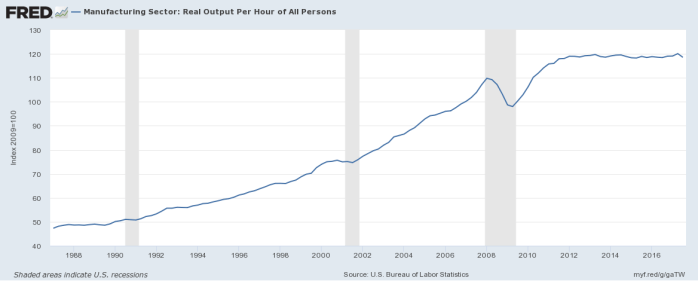
Take a look at this graph of manufacturing output per worker-hour:
Manufacturing_productivity

From 1988 to 2008, it was growing at a steady pace. In 2008 and 2009 it took a dip due to the Great Recession; no big surprise there. But then since 2012 it has been… completely flat. If we take this graph at face value, it would imply that manufacturing workers today can produce no more output than workers five years ago, and indeed only about 10% more than workers a decade ago. Whereas, a worker in 2008 was producing over 60% more than a worker in 1998, who was producing over 40% more than a worker in 1988.

Many economists call this the “productivity paradox”, and use it to argue that we don’t really need to worry about robots taking all our jobs any time soon. I think this view is mistaken.

The way we measure productivity is fundamentally wrongheaded, and is probably the sole cause of this “paradox”.

First of all, we use total hours scheduled to work, not total hours actually doing productive work. This is obviously much, much easier to measure, which is why we do it. But if you think for a moment about how the 40-hour workweek norm is going to clash with rapidly rising real productivity, it becomes apparent why this isn’t going to be a good measure.
When a worker finds a way to get done in 10 hours what used to take 40 hours, what does that worker’s boss do? Send them home after 10 hours because the job is done? Give them a bonus for their creativity? Hardly. That would be far too rational. They assign them more work, while paying them exactly the same. Recognizing this, what is such a worker to do? The obvious answer is to pretend to work the other 30 hours, while in fact doing something more pleasant than working.
And indeed, so-called “worker distraction” has been rapidly increasing. People are right to blame smartphones, I suppose, but not for the reasons they think. It’s not that smartphones are inherently distracting devices. It’s that smartphones are the cutting edge of a technological revolution that has made most of our work time unnecessary, so due to our fundamentally defective management norms they create overwhelming incentives to waste time at work to avoid getting drenched in extra tasks for no money.

That would probably be enough to explain the “paradox” by itself, but there is a deeper reason that in the long run is even stronger. It has to do with the way we measure “output”.

It might surprise you to learn that economists almost never consider output in terms of the actual number of cars produced, buildings constructed, songs written, or software packages developed. The standard measures of output are all in the form of so-called “real GDP”; that is, the dollar value of output produced.

They do adjust for indexes of inflation, but as I’ll show in a moment this still creates a fundamentally biased picture of the productivity dynamics.

Consider a world with only three industries: Housing, Food, and Music.

Productivity in Housing doesn’t change at all. Producing a house cost 10,000 worker-hours in 1950, and cost 10,000 worker-hours in 2000. Nominal price of houses has rapidly increased, from $10,000 in 1950 to $200,000 in 2000.

Productivity in Food rises moderately fast. Producing 1,000 meals cost 1,000 worker-hours in 1950, and cost 100 worker-hours in 2000. Nominal price of food has increased slowly, from $1,000 per 1,000 meals in 1950 to $5,000 per 1,000 meals in 2000.

Productivity in Music rises extremely fast. Producing 1,000 performances cost 10,000 worker-hours in 1950, and cost 1 worker-hour in 2000. Nominal price of music has collapsed, from $100,000 per 1,000 performances in 1950 to $1,000 per 1,000 performances in 2000.

This is of course an extremely stylized version of what has actually happened: Housing has gotten way more expensive, food has stayed about the same in price while farm employment has plummeted, and the rise of digital music has brought about a new Renaissance in actual music production and listening while revenue for the music industry has collapsed. There is a very nice Vox article on the “productivity paradox” showing a graph of how prices have changed in different industries.

How would productivity appear in the world I’ve just described, by standard measures? Well, to say that I actually need to say something about how consumers substitute across industries. But I think I’ll be forgiven in this case for saying that there is no substitution whatsoever; you can’t eat music or live in a burrito. There’s also a clear Maslow hierarchy here: They say that man cannot live by bread alone, but I think living by Led Zeppelin alone is even harder.

Consumers will therefore choose like this: Over 10 years, buy 1 house, 10,000 meals, and as many performances as you can afford after that. Further suppose that each person had $2,100 per year to spend in 1940-1950, and $50,000 per year to spend in 1990-2000. (This is approximately true for actual nominal US GDP per capita.)

1940-1950:
Total funds: $21,000

1 house = $10,000

10,000 meals = $10,000

Remaining funds: $1,000

Performances purchased: 10

1990-2000:

Total funds: $500,000

1 house = $200,000

10,000 meals = $50,000

Remaining funds: $250,000

Performances purchased: 250,000

(Do you really listen to this much music? 250,000 performances over 10 years is about 70 songs per day. If each song is 3 minutes, that’s only about 3.5 hours per day. If you listen to music while you work or watch a couple of movies with musical scores, yes, you really do listen to this much music! The unrealistic part is assuming that people in 1950 listen to so little, given that radio was already widespread. But if you think of music as standing in for all media, the general trend of being able to consume vastly more media in the digital age is clearly correct.)

Now consider how we would compute a price index for each time period. We would construct a basket of goods and determine the price of that basket in each time period, then adjust prices until that basket has a constant price.

Here, the basket would probably be what people bought in 1940-1950: 1 house, 10,000 meals, and 400 music performances.

In 1950, this basket cost $10,000+$10,000+$100 = $21,000.

In 2000, this basket cost $200,000+$50,000+$400 = $150,400.

This means that our inflation adjustment is $150,400/$21,000 = 7 to 1. This means that we would estimate the real per-capita GDP in 1950 at about $14,700. And indeed, that’s about the actual estimate of real per-capita GDP in 1950.

So, what would we say about productivity?

Sales of houses in 1950 were 1 per person, costing 10,000 worker hours.

Sales of food in 1950 were 10,000 per person, costing 10,000 worker hours.

Sales of music in 1950 were 400 per person, costing 4,000 worker hours.

Worker hours per person are therefore 24,000.

Sales of houses in 2000 were 1 per person, costing 10,000 worker hours.

Sales of food in 2000 were 10,000 per person, costing 1,000 worker hours.

Sales of music in 2000 were 250,000 per person, costing 25,000 worker hours.

Worker hours per person are therefore 36,000.

Therefore we would estimate that productivity rose from $14,700/24,000 = $0.61 per worker-hour to $50,000/36,000 = $1.40 per worker-hour. This is an annual growth rate of about 1.7%, which is again, pretty close to the actual estimate of productivity growth. For such a highly stylized model, my figures are doing remarkably well. (Honestly, better than I thought they would!)

But think about how much actual productivity rose, at least in the industries where it did.

We produce 10 times as much food per worker hour after 50 years, which is an annual growth rate of 4.7%, or three times the estimated growth rate.

We produce 10,000 times as much music per worker hour after 50 years, which is an annual growth rate of over 20%, or almost twelve times the estimated growth rate.

Moreover, should music producers be worried about losing their jobs to automation? Absolutely! People simply won’t be able to listen to much more music than they already are, so any continued increases in music productivity are going to make musicians lose jobs. And that was already allowing for music consumption to increase by a factor of over 600.

Of course, the real world has a lot more industries than this, and everything is a lot more complicated. We do actually substitute across some of those industries, unlike in this model.

But I hope I’ve gotten at least the basic point across that when things become drastically cheaper as technological progress often does, simply adjusting for inflation doesn’t do the job. One dollar of music today isn’t the same thing as one dollar of music a century ago, even if you inflation-adjust their dollars to match ours. We ought to be measuring in hours of music; an hour of music is much the same thing as an hour of music a century ago.

And likewise, that secretary/weather forecaster/news reporter/accountant/musician/filmmaker in your pocket that you call a “smartphone” really ought to be counted as more than just a simple inflation adjustment on its market price. The fact that it is mind-bogglingly cheaper to get these services than it used to be is the technological progress we care about; it’s not some statistical artifact to be removed by proper measurement.

Combine that with actually measuring the hours of real, productive work, and I think you’ll find that productivity is still rising quite rapidly, and that we should still be worried about what automation is going to do to our jobs.

When are we going to get serious about climate change?

Oct 8, JDN 24578035

Those two storms weren’t simply natural phenomena. We had a hand in creating them.

The EPA doesn’t want to talk about the connection, and we don’t have enough statistical power to really be certain, but there is by now an overwhelming scientific consensus that global climate change will increase hurricane intensity. The only real question left is whether it is already doing so.

The good news is that global carbon emissions are no longer rising. They have been essentially static for the last few years. The bad news is that this is almost certainly too little, too late.

The US is not on track to hit our 2025 emission target; we will probably exceed it by at least 20%.

But the real problem is that the targets themselves are much too high. Most countries have pledged to drop emissions only about 8-10% below their 1990s levels.

Even with the progress we have made, we are on track to exceed the global carbon budget needed to keep warming below 2 C by the year 2040. We have been reducing emission intensity by about 0.8% per year—we need to be reducing it by at least 3% per year and preferably faster. Highly-developed nations should be switching to nuclear energy as quickly as possible; an equitable global emission target requires us to reduce our emissions by 80% by 2050.

At the current rate of improvement, we will overshoot the 2 C warming target and very likely the 3C target as well.

Why aren’t we doing better? There is of course the Tragedy of the Commons to consider: Each individual country acting in its own self-interest will continue to pollute more, as this is the cheapest and easiest way to maintain industrial development. But then if all countries do so, the result is a disaster for us all.
But this explanation is too simple. We have managed to achieve some international cooperation on this issue. The Kyoto protocol has worked; emissions among Kyoto member nations have been reduced by more than 20% below 1990 levels, far more than originally promised. The EU in particular has taken a leadership role in reducing emissions, and has a serious shot at hitting their target of 40% reduction by 2030.

That is a truly astonishing scale of cooperation; the EU has a population of over 500 million people and spans 28 nations. It would seem like doing that should get us halfway to cooperating across all nations and all the world’s people.

But there is a vital difference between the EU and the world as a whole: The tribal paradigm. Europeans certainly have their differences: The UK and France still don’t really get along, everyone’s bitter with Germany about that whole Hitler business, and as the acronym PIIGS emphasizes, the peripheral countries have never quite felt as European as the core Schengen members. But despite all this, there has been a basic sense of trans-national (meta-national?) unity among Europeans for a long time.
For one thing, today Europeans see each other as the same race. That wasn’t always the case. In Medieval times, ethnic categories were as fine as “Cornish” and “Liverpudlian”. (To be fair, there do still exist a handful of Cornish nationalists.) Starting around the 18th cenutry, Europeans began to unite under the heading of “White people”, a classification that took on particular significance during the trans-Atlantic slave trade. But even in the 19th century, “Irish” and “Sicilian” were seen as racial categories. It wasn’t until the 20th century that Europeans really began to think of themselves as one “kind of people”, and not coincidentally it was at the end of the 20th century that the European Union finally took hold.

There is another region that has had a similar sense of unification: Latin America. Again, there are conflicts: There are a lot of nasty stereotypes about Puerto Ricans among Cubans and vice-versa. But Latinos, by and large, think of each other as the same “kind of people”, distinct from both Europeans and the indigenous population of the Americas.

I don’t think it is coincidental that the lowest carbon emission intensity (carbon emissions / GDP PPP) in the world is in Latin America, followed closely by Europe.
And if you had to name right now the most ethnically divided region in the world, what would you say? The Middle East, of course. And sure enough, they have the worst carbon emission intensity. (Of course, oil is an obvious confounding variable here, likely contributing to both.)

Indeed, the countries with the lowest ethnic fractionalization ratings tend to be in Europe and Latin America, and the highest tend to be in the Middle East and Africa.

Even within the United States, political polarization seems to come with higher carbon emissions. When we think of Democrats and Republicans as different “kinds of people”, we become less willing to cooperate on finding climate policy solutions.

This is not a complete explanation, of course. China has a low fractionalization rating but a high carbon intensity, and extremely high overall carbon emissions due to their enormous population. Africa’s carbon intensity isn’t as high as you’d think just from their terrible fractionalization, especially if you exclude Nigeria which is a major oil producer.

But I think there is nonetheless a vital truth here: One of the central barriers to serious long-term solutions to climate change is the entrenchment of racial and national identity. Solving the Tragedy of the Commons requires cooperation, we will only cooperate with those we trust, and we will only trust those we consider to be the same “kind of people”.

You can even hear it in the rhetoric: If “we” (Americans) give up our carbon emissions, then “they” (China) will take advantage of us. No one seems to worry about Alabama exploiting California—certainly no Republican would—despite the fact that in real economic terms they basically do. But people in Alabama are Americans; in other words, they count as actual people. People in China don’t count. If anything, people in California are supposed to be considered less American than people in Alabama, despite the fact that vastly more Americans live in California than Alabama. This mirrors the same pattern where we urban residents are somehow “less authentic” even though we outnumber the rural by four to one.
I don’t know how to mend this tribal division; I very much wish I did. But I do know that simply ignoring it isn’t going to work. We can talk all we want about carbon taxes and cap-and-trade, but as long as most of the world’s people are divided into racial, ethnic, and national identities that they consider to be in zero-sum conflict with one another, we are never going to achieve the level of cooperation necessary for a real permanent solution to climate change.

The temperatures and the oceans rise. United we must stand, or divided we shall fall.

I think I know what the Great Filter is now

Sep 3, JDN 2458000

One of the most plausible solutions to the Fermi Paradox of why we have not found any other intelligent life in the universe is called the Great Filter: Somewhere in the process of evolving from unicellular prokaryotes to becoming an interstellar civilization, there is some highly-probable event that breaks the process, a “filter” that screens out all but the luckiest species—or perhaps literally all of them.

I previously thought that this filter was the invention of nuclear weapons; I now realize that this theory is incomplete. Nuclear weapons by themselves are only an existential threat because they co-exist with widespread irrationality and bigotry. The Great Filter is the combination of the two.

Yet there is a deep reason why we would expect that this is precisely the combination that would emerge in most species (as it has certainly emerged in our own): The rationality of a species is not uniform. Some individuals in a species will always be more rational than others, so as a species increases its level of rationality, it does not do so all at once.

Indeed, the processes of economic development and scientific advancement that make a species more rational are unlikely to be spread evenly; some cultures will develop faster than others, and some individuals within a given culture will be further along than others. While the mean level of rationality increases, the variance will also tend to increase.

On some arbitrary and oversimplified scale where 1 is the level of rationality needed to maintain a hunter-gatherer tribe, and 20 is the level of rationality needed to invent nuclear weapons, the distribution of rationality in a population starts something like this:

Great_Filter_1

Most of the population is between levels 1 and 3, which we might think of as lying between the bare minimum for a tribe to survive and the level at which one can start to make advances in knowledge and culture.

Then, as the society advances, it goes through a phase like this:

Great_Filter_2

This is about where we were in Periclean Athens. Most of the population is between levels 2 and 8. Level 2 used to be the average level of rationality back when we were hunter-gatherers. Level 8 is the level of philosophers like Archimedes and Pythagoras.

Today, our society looks like this:
Great_Filter_3

Most of the society is between levels 4 and 20. As I said, level 20 is the point at which it becomes feasible to develop nuclear weapons. Some of the world’s people are extremely intelligent and rational, and almost everyone is more rational than even the smartest people in hunter-gatherer times, but now there is enormous variation.

Where on this chart are racism and nationalism? Importantly, I think they are above the level of rationality that most people had in ancient times. Even Greek philosophers had attitudes toward slaves and other cultures that the modern KKK would find repulsive. I think on this scale racism is about a 10 and nationalism is about a 12.

If we had managed to uniformly increase the rationality of our society, with everyone gaining at the same rate, our distribution would instead look like this:
Great_Filter_4

If that were the case, we’d be fine. The lowest level of rationality widespread in the population would be 14, which is already beyond racism and nationalism. (Maybe it’s about the level of humanities professors today? That makes them substantially below quantum physicists who are 20 by construction… but hey, still almost twice as good as the Greek philosophers they revere.) We would have our nuclear technology, but it would not endanger our future—we wouldn’t even use it for weapons, we’d use it for power generation and space travel. Indeed, this lower-variance high-rationality state seems to be about what they have the Star Trek universe.

But since we didn’t, a large chunk of our population is between 10 and 12—that is, still racist or nationalist. We have the nuclear weapons, and we have people who might actually be willing to use them.

Great_Filter_5

I think this is what happens to most advanced civilizations around the galaxy. By the time they invent space travel, they have also invented nuclear weapons—but they still have their equivalent of racism and nationalism. And most of the time, the two combine into a volatile mix that results in the destruction or regression of their entire civilization.

If this is right, then we may be living at the most important moment in human history. It may be right here, right now, that we have the only chance we’ll ever get to turn the tide. We have to find a way to reduce the variance, to raise the rest of the world’s population past nationalism to a cosmopolitan morality. And we may have very little time.