What we can be thankful for

Nov 24 JDN 2458812

Thanksgiving is upon us, yet as more and more evidence is revealed implicating President Trump in grievous crimes, as US carbon emissions that had been declining are now trending upward again, as our air quality deteriorates for the first time in decades, it may be hard to see what we should be thankful for.

But these are exceptions to a broader trend: The world is getting better, in almost every way, remarkably quickly. Homicide rates in the US are lower than they’ve been since the 1960s. Worldwide, the homicide rate has fallen 20% since 1990.

While world carbon emissions are still increasing, on a per capita basis they are actually starting to decline, and on an efficiency basis (kilograms of carbon-equivalent per dollar of GDP) they are at their lowest ever. This trend is likely to continue: The price of solar power has rapidly declined to the point where it is now the cheapest form of electric power.
The number—not just proportion, absolute number—of people in extreme poverty has declined by almost two-thirds within my own lifetime. The proportion is the lowest it has ever been in human history. World life expectancy is at its highest ever. Death rates from infectious disease fell by over 85% over the 20th century, and are now at their lowest ever.

I wouldn’t usually cite Reason as a source, but they’re right on this one: Defeat appears imminent for all four Horsemen of the Apocalypse. Pestilence, Famine, War, and even Death are all on the decline. We have a great deal to be grateful for: We are living in a golden age.

This is not to say that we should let ourselves become complacent and stop trying to make the world better: On the contrary, it proves that the world can be made better, which gives us every reason to redouble our efforts to do so.

Is Singularitarianism a religion?


Nov 17 JDN 2458805

I said in last week’s post that Pascal’s Mugging provides some deep insights into both Singularitarianism and religion. In particular, it explains why Singularitarianism seems so much like a religion.

This has been previously remarked, of course. I think Eric Steinhart makes the best case for Singularitarianism as a religion:

I think singularitarianism is a new religious movement. I might add that I think Clifford Geertz had a pretty nice (though very abstract) definition of religion. And I think singularitarianism fits Geertz’s definition (but that’s for another time).

My main interest is this: if singularitarianism is a new religious movement, then what should we make of it? Will it mainly be a good thing? A kind of enlightenment religion? It might be an excellent alternative to old-fashioned Abrahamic religion. Or would it degenerate into the well-known tragic pattern of coercive authority? Time will tell; but I think it’s worth thinking about this in much more detail.

To be clear: Singularitarianism is probably not a religion. It is certainly not a cult, as it has been even worse accused; the behaviors it prescribes are largely normative, pro-social behaviors, and therefore it would at worst be a mainstream religion. Really, if every religion only inspired people to do things like donate to famine relief and work on AI research (as opposed to, say, beheading gay people), I wouldn’t have much of a problem with religion.

In fact, Singularitarianism has one vital advantage over religion: Evidence. While the evidence in favor of it is not overwhelming, there is enough evidential support to lend plausibility to at least a broad concept of Singularitarianism: Technology will continue rapidly advancing, achieving accomplishments currently only in our wildest imaginings; artificial intelligence surpassing human intelligence will arise, sooner than many people think; human beings will change ourselves into something new and broadly superior; these posthumans will go on to colonize the galaxy and build a grander civilization than we can imagine. I don’t know that these things are true, but I hope they are, and I think it’s at least reasonably likely. All I’m really doing is extrapolating based on what human civilization has done so far and what we are currently trying to do now. Of course, we could well blow ourselves up before then, or regress to a lower level of technology, or be wiped out by some external force. But there’s at least a decent chance that we will continue to thrive for another million years to come.

But yes, Singularitarianism does in many ways resemble a religion: It offers a rich, emotionally fulfilling ontology combined with ethical prescriptions that require particular behaviors. It promises us a chance at immortality. It inspires us to work toward something much larger than ourselves. More importantly, it makes us special—we are among the unique few (millions?) who have the power to influence the direction of human and posthuman civilization for a million years. The stronger forms of Singularitarianism even have a flavor of apocalypse: When the AI comes, sooner than you think, it will immediately reshape everything at effectively infinite speed, so that from one year—or even one moment—to the next, our whole civilization will be changed. (These forms of Singularitarianism are substantially less plausible than the broader concept I outlined above.)

It’s this sense of specialness that Pascal’s Mugging provides some insight into. When it is suggested that we are so special, we should be inherently skeptical, not least because it feels good to hear that. (As Less Wrong would put it, we need to avoid a Happy Death Spiral.) Human beings like to feel special; we want to feel special. Our brains are configured to seek out evidence that we are special and reject evidence that we are not. This is true even to the point of absurdity: One cannot be mathematically coherent without admitting that the compliment “You’re one in a million.” is equivalent to the statement “There are seven thousand people as good or better than you.”—and yet, the latter seems much worse, because it does not make us sound special.

Indeed, the connection between Pascal’s Mugging and Pascal’s Wager is quite deep: Each argument takes a tiny probability and multiplies it by a huge impact in order to get a large expected utility. This often seems to be the way that religions defend themselves: Well, yes, the probability is small; but can you take the chance? Can you afford to take that bet if it’s really your immortal soul on the line?

And Singularitarianism has a similar case to make, even aside from the paradox of Pascal’s Mugging itself. The chief argument for why we should be focusing all of our time and energy on existential risk is that the potential payoff is just so huge that even a tiny probability of making a difference is enough to make it the only thing that matters. We should be especially suspicious of that; anything that says it is the only thing that matters is to be doubted with utmost care. The really dangerous religion has always been the fanatical kind that says it is the only thing that matters. That’s the kind of religion that makes you crash airliners into buildings.

I think some people may well have become Singularitarians because it made them feel special. It is exhilarating to be one of these lone few—and in the scheme of things, even a few million is a small fraction of all past and future humanity—with the power to effect some shift, however small, in the probability of a far grander, far brighter future.

Yet, in fact this is very likely the circumstance in which we are. We could have been born in the Neolithic, struggling to survive, utterly unaware of what would come a few millennia hence; we could have been born in the posthuman era, one of a trillion other artist/gamer/philosophers living in a world where all the hard work that needed to be done is already done. In the long S-curve of human development, we could have been born in the flat part on the left or the flat part on the right—and by all probability, we should have been; most people were. But instead we happened to be born in that tiny middle slice, where the curve slopes upward at its fastest. I suppose somebody had to be, and it might as well be us.

Sigmoid curve labeled

A priori, we should doubt that we were born so special. And when forming our beliefs, we should compensate for the fact that we want to believe we are special. But we do in fact have evidence, lots of evidence. We live in a time of astonishing scientific and technological progress.

My lifetime has included the progression from Deep Thought first beating David Levy to the creation of a computer one millimeter across that runs on a few nanowatts and nevertheless has ten times as much computing power as the 80-pound computer that ran the Saturn V. (The human brain runs on about 100 watts, and has a processing power of about 1 petaflop, so we can say that our energy efficiency is about 10 TFLOPS/W. The M3 runs on about 10 nanowatts and has a processing power of about 0.1 megaflops, so its energy efficiency is also about 10 TFLOPS/W. We did it! We finally made a computer as energy-efficient as the human brain! But we have still not matched the brain in terms of space-efficiency: The volume of the human brain is about 1000 cm^3, so our space efficiency is about 1 TFLOPS/cm^3. The volume of the M3 is about 1 mm^3, so its space efficiency is only about 100 MFLOPS/cm^3. The brain still wins by a factor of 10,000.)

My mother saw us go from the first jet airliners to landing on the Moon to the International Space Station and robots on Mars. She grew up before the polio vaccine and is still alive to see the first 3D-printed human heart. When I was a child, smartphones didn’t even exist; now more people have smartphones than have toilets. I may yet live to see the first human beings set foot on Mars. The pace of change is utterly staggering.

Without a doubt, this is sufficient evidence to believe that we, as a civilization, are living in a very special time. The real question is: Are we, as individuals, special enough to make a difference? And if we are, what weight of responsibility does this put upon us?

If you are reading this, odds are the answer to the first question is yes: You are definitely literate, and most likely educated, probably middle- or upper-middle-class in a First World country. Countries are something I can track, and I do get some readers from non-First-World countries; and of course I don’t observe your education or socioeconomic status. But at an educated guess, this is surely my primary reading demographic. Even if you don’t have the faintest idea what I’m talking about when I use Bayesian logic or calculus, you’re already quite exceptional. (And if you do? All the more so.)

That means the second question must apply: What do we owe these future generations who may come to exist if we play our cards right? What can we, as individuals, hope to do to bring about this brighter future?

The Singularitarian community will generally tell you that the best thing to do with your time is to work on AI research, or, failing that, the best thing to do with your money is to give it to people working on artificial intelligence research. I’m not going to tell you not to work on AI research or donate to AI research, as I do think it is among the most important things humanity needs to be doing right now, but I’m also not going to tell you that it is the one single thing you must be doing.

You should almost certainly be donating somewhere, but I’m not so sure it should be to AI research. Maybe it should be famine relief, or malaria prevention, or medical research, or human rights, or environmental sustainability. If you’re in the United States (as I know most of you are), the best thing to do with your money may well be to support political campaigns, because US political, economic, and military hegemony means that as goes America, so goes the world. Stop and think for a moment how different the prospects of global warming might have been—how many millions of lives might have been saved!—if Al Gore had become President in 2001. For lack of a few million dollars in Tampa twenty years ago, Miami may be gone in fifty. If you’re not sure which cause is most important, just pick one; or better yet, donate to a diversified portfolio of charities and political campaigns. Diversified investment isn’t just about monetary return.

And you should think carefully about what you’re doing with the rest of your life. This can be hard to do; we can easily get so caught up in just getting through the day, getting through the week, just getting by, that we lose sight of having a broader mission in life. Of course, I don’t know what your situation is; it’s possible things really are so desperate for you that you have no choice but to keep your head down and muddle through. But you should also consider the possibility that this is not the case: You may not be as desperate as you feel. You may have more options than you know. Most “starving artists” don’t actually starve. More people regret staying in their dead-end jobs than regret quitting to follow their dreams. I guess if you stay in a high-paying job in order to earn to give, that might really be ethically optimal; but I doubt it will make you happy. And in fact some of the most important fields are constrained by a lack of good people doing good work, and not by a simple lack of funding.

I see this especially in economics: As a field, economics is really not focused on the right kind of questions. There’s far too much prestige for incrementally adjusting some overcomplicated unfalsifiable mess of macroeconomic algebra, and not nearly enough for trying to figure out how to mitigate global warming, how to turn back the tide of rising wealth inequality, or what happens to human society once robots take all the middle-class jobs. Good work is being done in devising measures to fight poverty directly, but not in devising means to undermine the authoritarian regimes that are responsible for maintaining poverty. Formal mathematical sophistication is prized, and deep thought about hard questions is eschewed. We are carefully arranging the pebbles on our sandcastle in front of the oncoming tidal wave. I won’t tell you that it’s easy to change this—it certainly hasn’t been easy for me—but I have to imagine it’d be easier with more of us trying rather than with fewer. Nobody needs to donate money to economics departments, but we definitely do need better economists running those departments.

You should ask yourself what it is that you are really good at, what you—you yourself, not anyone else—might do to make a mark on the world. This is not an easy question: I have not quite answered for myself whether I would make more difference as an academic researcher, a policy analyst, a nonfiction author, or even a science fiction author. (If you scoff at the latter: Who would have any concept of AI, space colonization, or transhumanism, if not for science fiction authors? The people who most tilted the dial of human civilization toward this brighter future may well be Clarke, Roddenberry, and Asimov.) It is not impossible to be some combination or even all of these, but the more I try to take on the more difficult my life becomes.

Your own path will look different than mine, different, indeed, than anyone else’s. But you must choose it wisely. For we are very special individuals, living in a very special time.

Pascal’s Mugging

Nov 10 JDN 2458798

In the Singularitarian community there is a paradox known as “Pascal’s Mugging”. The name is an intentional reference to Pascal’s Wager (and the link is quite apt, for reasons I’ll discuss in a later post.)

There are a few different versions of the argument; Yudkowsky’s original argument in which he came up with the name “Pascal’s Mugging” relies upon the concept of the universe as a simulation and an understanding of esoteric mathematical notation. So here is a more intuitive version:

A strange man in a dark hood comes up to you on the street. “Give me five dollars,” he says, “or I will destroy an entire planet filled with ten billion innocent people. I cannot prove to you that I have this power, but how much is an innocent life worth to you? Even if it is as little as $5,000, are you really willing to bet on ten trillion to one odds that I am lying?”

Do you give him the five dollars? I suspect that you do not. Indeed, I suspect that you’d be less likely to give him the five dollars than if he had merely said he was homeless and asked for five dollars to help pay for food. (Also, you may have objected that you value innocent lives, even faraway strangers you’ll never meet, at more than $5,000 each—but if that’s the case, you should probably be donating more, because the world’s best charities can save a live for about $3,000.)

But therein lies the paradox: Are you really willing to bet on ten trillion to one odds?

This argument gives me much the same feeling as the Ontological Argument; as Russell said of the latter, “it is much easier to be persuaded that ontological arguments are no good than it is to say exactly what is wrong with them.” It wasn’t until I read this post on GiveWell that I could really formulate the answer clearly enough to explain it.

The apparent force of Pascal’s Mugging comes from the idea of expected utility: Even if the probability of an event is very small, if it has a sufficiently great impact, the expected utility can still be large.

The problem with this argument is that extraordinary claims require extraordinary evidence. If a man held a gun to your head and said he’d shoot you if you didn’t give him five dollars, you’d give him five dollars. This is a plausible claim and he has provided ample evidence. If he were instead wearing a bomb vest (or even just really puffy clothing that could conceal a bomb vest), and he threatened to blow up a building unless you gave him five dollars, you’d probably do the same. This is less plausible (what kind of terrorist only demands five dollars?), but it’s not worth taking the chance.

But when he claims to have a Death Star parked in orbit of some distant planet, primed to make another Alderaan, you are right to be extremely skeptical. And if he claims to be a being from beyond our universe, primed to destroy so many lives that we couldn’t even write the number down with all the atoms in our universe (which was actually Yudkowsky’s original argument), to say that you are extremely skeptical seems a grievous understatement.

That GiveWell post provides a way to make this intuition mathematically precise in terms of Bayesian logic. If you have a normal prior with mean 0 and standard deviation 1, and you are presented with a likelihood with mean X and standard deviation X, what should you make your posterior distribution?

Normal priors are quite convenient; they conjugate nicely. The precision (inverse variance) of the posterior distribution is the sum of the two precisions, and the mean is a weighted average of the two means, weighted by their precision.

So the posterior variance is 1/(1 + 1/X^2).

The posterior mean is 1/(1+1/X^2)*(0) + (1/X^2)/(1+1/X^2)*(X) = X/(X^2+1).

That is, the mean of the posterior distribution is just barely higher than zero—and in fact, it is decreasing in X, if X > 1.

For those who don’t speak Bayesian: If someone says he’s going to have an effect of magnitude X, you should be less likely to believe him the larger that X is. And indeed this is precisely what our intuition said before: If he says he’s going to kill one person, believe him. If he says he’s going to destroy a planet, don’t believe him, unless he provides some really extraordinary evidence.

What sort of extraordinary evidence? To his credit, Yudkowsky imagined the sort of evidence that might actually be convincing:

If a poorly-dressed street person offers to save 10(10^100) lives (googolplex lives) for $5 using their Matrix Lord powers, and you claim to assign this scenario less than 10-(10^100) probability, then apparently you should continue to believe absolutely that their offer is bogus even after they snap their fingers and cause a giant silhouette of themselves to appear in the sky.

This post he called “Pascal’s Muggle”, after the term from the Harry Potter series, since some of the solutions that had been proposed for dealing with Pascal’s Mugging had resulted in a situation almost as absurd, in which the mugger could exhibit powers beyond our imagining and yet nevertheless we’d never have sufficient evidence to believe him.

So, let me go on record as saying this: Yes, if someone snaps his fingers and causes the sky to rip open and reveal a silhouette of himself, I’ll do whatever that person says. The odds are still higher that I’m dreaming or hallucinating than that this is really a being from beyond our universe, but if I’m dreaming, it makes no difference, and if someone can make me hallucinate that vividly he can probably cajole the money out of me in other ways. And there might be just enough chance that this could be real that I’m willing to give up that five bucks.

These seem like really strange thought experiments, because they are. But like many good thought experiments, they can provide us with some important insights. In this case, I think they are telling us something about the way human reasoning can fail when faced with impacts beyond our normal experience: We are in danger of both over-estimating and under-estimating their effects, because our brains aren’t equipped to deal with magnitudes and probabilities on that scale. This has made me realize something rather important about both Singularitarianism and religion, but I’ll save that for next week’s post.

What if the charitable deduction were larger?

Nov 3 JDN 2458791

Right now, the charitable tax deduction is really not all that significant. It makes donating to charity cheaper, but you still always end up with less money after donating than you had before. It might cause you to donate more than you otherwise would have, but you’ll still only give to a charity you already care about.

This is because the tax deduction applies to your income, rather than your taxes directly. So if you make $100,000 and donate $10,000, you pay taxes as if your income were $90,000. Say your tax rate is 25%; then you go from paying $25,000 and keeping $75,000 to paying $22,500 and keeping $67,500. The more you donate, the less money you will have to keep.

Many people don’t seem to understand this; they seem to think that rich people can actually get richer by donating to charity. That can’t be done in our current tax system, or at least not legally. (There are fraudulent ways to do so; but there are fraudulent ways to do lots of things.) Part of the confusion may be related to the fact that people don’t seem to understand how tax brackets work; they worry about being “pushed into a higher tax bracket” as though this could somehow reduce their after-tax income, but that doesn’t happen. That isn’t how tax brackets work.

Some welfare programs work that way—for instance, seeing your income rise high enough to lose Medicaid eligibility can be bad enough that you would prefer to have less income—but taxes themselves do not.

The graph below shows the actual average tax rate (red) and marginal tax rate (purple) of the current US federal income tax:

Average_tax_rate
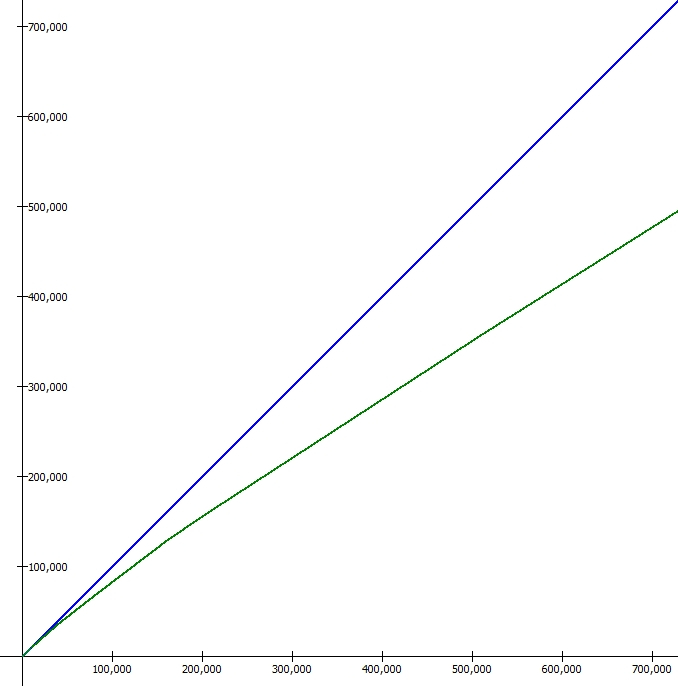
From that graph alone, you might think that going to a higher tax bracket could result in lower after-tax income. But the next graph, of before-tax (blue) and after-tax (green) income shows otherwise:

After_tax_income

All that tax deductions can do is reduce your taxable income. Thus the tax deduction benefits you if you were already donating, but never leaves you richer than you would have been without donating at all.

For example, if you have an income of $700,000, you would pay $223,000 in taxes and keep $477,000 in after-tax income. If you instead donate $100,000, your adjusted gross income will be reduced to $600,000, you will only pay $186,000 in taxes, and you will keep $414,000 in after-tax income. If there were no tax deduction, you would still have to pay $223,000 in taxes, and your after-tax income would be only $377,000. So you do benefit from the tax deduction; but there is no amount of donation which will actually increase your after-tax income to above $477,000.

But we wouldn’t have to do it this way. We could instead apply the deduction as a tax credit, which would make the effect of the deduction far larger.

Several years back, Miles Kimball (an economist who formerly worked at Michigan, now at UC Boulder) proposed a quite clever change to the tax system:

My proposal is to raise marginal tax rates above about $75,000 per person–or $150,000 per couple–by 10% (a dime on every extra dollar), but offer a 100% tax credit for public contributions up to the entire amount of the tax surcharge.

Kimball’s argument for the policy is mainly that this would make a tax increase more palatable, by giving people more control over where their money goes. This is surely true, and a worthwhile endeavor.

But the even larger benefit might come from the increased charitable donations. If we limited the tax credit to particularly high-impact charities, we would increase the donations to those charities. Whereas in the current system you get the same deduction regardless of where you give your money, even though we know that some charities are literally hundreds of times as cost-effective as others.

In fact, we might not even want to limit the tax credit to that 10% surcharge. If people want to donate more than 10% of their income to high-impact charities, perhaps we should let them. This would mean that the federal deficit could actually increase under this policy, but if so, there would have to be so much money donated that we’d most likely end world hunger. That’s a tradeoff I’m quite willing to make.

In principle, we could even introduce a tax credit that is greater than 100%—say for instance you get a 120% donation for the top-rated charities. This is not mathematically inconsistent, though it is surely a very bad idea. In that case, it absolutely would be possible to end up with more money than you started with, and the richer you are, the more you could get. There would effectively be a positive return on charitable donations, with the money paid for from the government budget. Bill Gates for instance could pay $10 billion a year to charity and the government would not only pay for it, but also have to give him an extra $2 billion. So even for the best charities—which probably are actually a good deal more cost-effective than the US government—we should cap the tax credit at 100%.

Obvious choices for high-impact charities include UNICEF, the Red Cross, GiveDirectly, and the Malaria Consortium. We would need some sort of criteria to decide which charities should get the benefits; I’m thinking we could have some sort of panel of experts who rate charities based on their cost-effectiveness.

It wouldn’t have to be all-or-nothing, either; charities with good but not top ratings could get an increased deduction but not a 100% deduction. The expert panel could rate charities on a scale from 0 to 10, and then anything above 5 gets an (X-5)*10% tax credit.

In effect, the current policy says, “If you give to charity, you don’t have to pay taxes on the money you gave; but all of your other taxes still apply.” The new policy would say, “You can give to a top-impact charity instead of paying taxes.”

Americans hate taxes and already give a lot to charity, but most of those donations are to relatively ineffective charities. This policy could incentivize people to give more or at least give to better places, probably without hurting the government budget—and if it does hurt the government budget, the benefits will be well worth the cost.

Revealed preference: Does the fact that I did it mean I preferred it?

Post 312 Oct 27 JDN 2458784

One of the most basic axioms of neoclassical economics is revealed preference: Because we cannot observe preferences directly, we infer them from actions. Whatever you chose must be what you preferred.

Stated so badly, this is obviously not true: We often make decisions that we later come to regret. We may choose under duress, or confusion; we may lack necessary information. We change our minds.

And there really do seem to be economists who use it in this bald way: From the fact that a particular outcome occurred in a free market, they will infer that it must be optimally efficient. (“Freshwater” economists who are dubious of any intervention into markets seem to be most guilty of this.) In the most extreme form, this account would have us believe that people who trip and fall do so on purpose.

I doubt anyone believes that particular version—but there do seem to be people who believe that unemployment is the result of people voluntarily choosing not to work, and revealed preference has also led economists down some strange paths when trying to explain what sure looks like irrational behavior—such as “rational addiction” theory, positing that someone can absolutely become addicted to alcohol or heroin and end up ruining their life all based on completely rational, forward-thinking decision planning.

The theory can be adapted to deal with these issues, by specifying that it’s only choices made with full information and all of our faculties intact that count as revealing our preferences.

But when are we ever in such circumstances? When do we ever really have all the information we need in order to make a rational decision? Just what constitutes intact faculties? No one is perfectly rational—so how rational must we be in order for our decisions to count as revealing our preferences?

Revealed preference theory also quickly becomes tautologous: Why do we choose to do things? Because we prefer them. What do we prefer? What we choose to do. Without some independent account of what our preferences are, we can’t really predict behavior this way.

A standard counter-argument to this is that revealed preference theory imposes certain constraints of consistency and transitivity, so it is not utterly vacuous. The problem with this answer is that human beings don’t obey those constraints. The Allais Paradox, the Ellsberg Paradox, the sunk cost fallacy. It’s even possible to use these inconsistencies to create “money pumps” that will cause people to systematically give you money; this has been done in experiments. While real-world violations seem to be small, they’re definitely present. So insofar as your theory is testable, it’s false.

The good news is that we really don’t need revealed preference theory. We already have ways of telling what human beings prefer that are considerably richer than simply observing what they choose in various scenarios. One very simple but surprisingly powerful method is to ask. In general, if you ask people what they want and they have no reason to distrust you, they will in fact tell you what they want.

We also have our own introspection, as well as our knowledge about millions of years of evolutionary history that shaped our brains. We don’t expect a lot of people to prefer suffering, for instance (even masochists, who might be said to ‘prefer pain’, seem to be experiencing that pain rather differently than the rest of us would). We generally expect that people will prefer to stay alive rather than die. Some may prefer chocolate, others vanilla; but few prefer motor oil. Our preferences may vary, but they do follow consistent patterns; they are not utterly arbitrary and inscrutable.

There is a deeper problem that any account of human desires must face, however: Sometimes we are actually wrong about our own desires. Affective forecasting, the prediction of our own future mental states, is astonishingly unreliable. People often wildly overestimate the emotional effects of both positive and negative outcomes. (Interestingly, people with depression tend not to do this—those with severe depression often underestimate the emotional effects of positive outcomes, while those with mild depression seem to be some of the most accurate forecasters, an example of the depressive realism effect.)

There may be no simple solution to this problem. Human existence is complicated; we spend large portions of our lives trying to figure out what it is we really want.
This means that we should not simply trust that whatever it is happens is what everyone—or even necessarily anyone—wants to happen. People make mistakes, even large, systematic, repeated mistakes. Sometimes what happens is just bad, and we should be trying to change it. Indeed, sometimes people need to be protected from their own bad decisions.

Unsolved problems

Oct 20 JDN 2458777

The beauty and clearness of the dynamical theory, which asserts heat and light to be modes of motion, is at present obscured by two clouds. The first came into existence with the undulatory theory of light, and was dealt with by Fresnel and Dr. Thomas Young; it involved the question, how could the earth move through an elastic solid, such as essentially is the luminiferous ether? The second is the Maxwell-Boltzmann doctrine regarding the partition of energy.


~ Lord Kelvin, April 27, 1900

The above quote is part of a speech where Kelvin basically says that physics is a completed field, with just these two little problems to clear up, “two clouds” in a vast clear horizon. Those “two clouds” Kelvin talked about, regarding the ‘luminiferous ether’ and the ‘partition of energy’? They are, respectively, relativity and quantum mechanics. Almost 120 years later we still haven’t managed to really solve them, at least not in a way that works consistently as part of one broader theory.

But I’ll give Kelvin this: He knew where the problems were. He vastly underestimated how complex and difficult those problems would be, but he knew where they were.

I’m not sure I can say the same about economists. We don’t seem to have even reached the point where we agree where the problems are. Consider another quotation:

For a long while after the explosion of macroeconomics in the 1970s, the field looked like a battlefield. Over time however, largely because facts do not go away, a largely shared vision both of fluctuations and of methodology has emerged. Not everything is fine. Like all revolutions, this one has come with the destruction of some knowledge, and suffers from extremism and herding. None of this deadly however. The state of macro is good.


~ Oliver Blanchard, 2008

The timing of Blanchard’s remark is particularly ominous: It is much like the turkey who declares, the day before Thanksgiving, that his life is better than ever.

But the content is also important: Blanchard didn’t say that microeconomics is in good shape (which I think one could make a better case for). He didn’t even say that economics, in general, is in good shape. He specifically said, right before the greatest economic collapse since the Great Depression, that macroeconomics was in good shape. He didn’t merely underestimate the difficulty of the problem; he didn’t even see where the problem was.

If you search the Web, you can find a few lists of unsolved problems in economics. Wikipedia has such a list that I find particularly bad; Mike Moffatt offers a better list that still has significant blind spots.

Wikipedia’s list is full of esoteric problems that require deeply faulty assumptions to even exist, like the ‘American option problem’ which assumes that the Black-Scholes model is even remotely an accurate description of how option prices work, or the ‘tatonnement problem’ which ignores the fact that there may be many equilibria and we might never reach one at all, or the problem they list under ‘revealed preferences’ which doesn’t address any of the fundamental reasons why the entire concept of revealed preferences may fail once we apply a realistic account of cognitive science. (I could go pretty far afield with that last one—and perhaps I will in a later post—but for now, suffice it to say that human beings often freely choose to do things that we later go on to regret.) I think the only one that Wikipedia’s list really gets right is Unified models of human biases’. The ‘home bias in trade’ and ‘Feldstein-Horioka Puzzle’ problems are sort of edging toward genuine problems, but they’re bound up in too many false assumptions to really get at the right question, which is actually something like “How do we deal with nationalism?” Referring to the ‘Feldstein-Horioka Puzzle’ misses the forest for the trees. Likewise, the ‘PPP Puzzle’ and the ‘Exchange rate disconnect puzzle’ (and to some extent the ‘equity premium puzzle’ as well) are really side effects of a much deeper problem, which is that financial markets in general are ludicrously volatile and inefficient and we have no idea why.

And Wikipedia’s list doesn’t have some of the largest, most important problems in economics. Moffatt’s list does better, including good choices like “What Caused the Industrial Revolution?”, “What Is the Proper Size and Scope of Government?”, and “What Truly Caused the Great Depression?”, but it also includes some of the more esoteric problems like the ‘equity premium puzzle’ and the ‘endogeneity of money’. The way he states the problem “What Causes the Variation of Income Among Ethnic Groups?” suggests that he doesn’t quite understand what’s going on there either. More importantly, Moffatt still leaves out very obviously important questions like “How do we achieve economic development in poor countries?” (Or as I sometimes put it, “What did South Korea do from 1950 to 2000, and how can we do it again?”), “How do we fix shortages of housing and other necessities?”, “What is causing the global rise of income and wealth inequality?”, “How altruistic are human beings, to whom, and under what conditions?” and “What makes financial markets so unstable?” Ironically, ‘Unified models of human biases’, the one problem that Wikipedia got right, is missing from Moffatt’s list.

And I’m also humble enough to realize that some of the deepest problems in economics may be ones that we don’t even quite know how to formulate yet. We like to pretend that economics is a mature science, almost on the coattails of physics; but it’s really a very young science, more like psychology. We go through these ‘cargo cult science‘ rituals of p-values and econometric hypothesis tests, but there are deep, basic forces we don’t understand. We have precisely prepared all the apparatus for the detection of the phlogiston, and by God, we’ll get that 0.05 however we have to. (Think I’m being too harsh? “Real Business Cycle” theory essentially posits that the Great Depression was caused by everyone deciding that they weren’t going to work for a few years, and as whole countries fell into the abyss from failing financial markets, most economists still clung to the Efficient Market Hypothesis.) Our whole discipline requires major injections of intellectual humility: We not only don’t have all the answers; we’re not even sure we have all the questions.

I think the esoteric nature of questions like ‘the equity premium puzzle’ and the ‘tatonnement problem‘ is precisely the source of their appeal: It’s the sort of thing you can say you’re working on and sound very smart, because the person you’re talking to likely has no idea what you’re talking about. (Or else they are a fellow economist, and thus in on the con.) If you said that you’re trying to explain why poor countries are poor and why rich countries are rich—and if economics isn’t doing that, then what in the world are we doing?you’d have to admit that we honestly have only the faintest idea, and that millions of people have suffered from bad advice economists gave their governments based on ideas that turned out to be wrong.

It’s really quite problematic how closely economists are tied to policymaking (except when we do really know what we’re talking about?). We’re trying to do engineering without even knowing physics. Maybe there’s no way around it: We have to make some sort of economic policy, and it makes more sense to do it based on half-proven ideas than on completely unfounded ideas. (Engineering without physics worked pretty well for the Romans, after all.) But it seems to me that we could be relying more, at least for the time being, on the experiences and intuitions of the people who have worked on the ground, rather than on sophisticated theoretical models that often turn out to be utterly false. We could eschew ‘shock therapy‘ approaches that try to make large interventions in an economy all at once, in favor of smaller, subtler adjustments whose consequences are more predictable. We could endeavor to focus on the cases where we do have relatively clear knowledge (like rent control) and avoid those where the uncertainty is greatest (like economic development).

At the very least, we could admit what we don’t know, and admit that there is probably a great deal we don’t know that we don’t know.

Mental illness is different from physical illness.

Post 311 Oct 13 JDN 2458770

There’s something I have heard a lot of people say about mental illness that is obviously well-intentioned, but ultimately misguided: “Mental illness is just like physical illness.”

Sometimes they say it explicitly in those terms. Other times they make analogies, like “If you wouldn’t shame someone with diabetes for using insulin, why shame someone with depression for using SSRIs?”

Yet I don’t think this line of argument will ever meaningfully reduce the stigma surrounding mental illness, because, well, it’s obviously not true.

There are some characteristics of mental illness that are analogous to physical illness—but there are some that really are quite different. And these are not just superficial differences, the way that pancreatic disease is different from liver disease. No one would say that liver cancer is exactly the same as pancreatic cancer; but they’re both obviously of the same basic category. There are differences between physical and mental illness which are both obvious, and fundamental.

Here’s the biggest one: Talk therapy works on mental illness.

You can’t talk yourself out of diabetes. You can’t talk yourself out of myocardial infarct. You can’t even talk yourself out of migraine (though I’ll get back to that one in a little bit). But you can, in a very important sense, talk yourself out of depression.

In fact, talk therapy is one of the most effective treatments for most mental disorders. Cognitive behavioral therapy for depression is on its own as effective as most antidepressants (with far fewer harmful side effects), and the two combined are clearly more effective than either alone. Talk therapy is as effective as medication on bipolar disorder, and considerably better on social anxiety disorder.

To be clear: Talk therapy is not just people telling you to cheer up, or saying it’s “all in your head”, or suggesting that you get more exercise or eat some chocolate. Nor does it consist of you ruminating by yourself and trying to talk yourself out of your disorder. Cognitive behavioral therapy is a very complex, sophisticated series of techniques that require years of expert training to master. Yet, at its core, cognitive therapy really is just a very sophisticated form of talking.

The fact that mental disorders can be so strongly affected by talk therapy shows that there really is an important sense in which mental disorders are “all in your head”, and not just the trivial way that an axe wound or even a migraine is all in your head. It isn’t just the fact that it is physically located in your brain that makes a mental disorder different; it’s something deeper than that.

Here’s the best analogy I can come up with: Physical illness is hardware. Mental illness is software.

If a computer breaks after being dropped on the floor, that’s like an axe wound: An obvious, traumatic source of physical damage that is an unambiguous cause of the failure.

If a computer’s CPU starts overheating, that’s like a physical illness, like diabetes: There may be no particular traumatic cause, or even any clear cause at all, but there is obviously something physically wrong that needs physical intervention to correct.

But if a computer is suffering glitches and showing error messages when it tries to run particular programs, that is like mental illness: Something is wrong not on the low-level hardware, but on the high-level software.

These different types of problem require different types of solutions. If your CPU is overheating, you might want to see about replacing your cooling fan or your heat sink. But if your software is glitching while your CPU is otherwise running fine, there’s no point in replacing your fan or heat sink. You need to get a programmer in there to look at the code and find out where it’s going wrong. A talk therapist is like a programmer: The words they say to you are like code scripts they’re trying to get your processor to run correctly.

Of course, our understanding of computers is vastly better than our understanding of human brains, and as a result, programmers tend to get a lot better results than psychotherapists. (Interestingly they do actually get paid about the same, though! Programmers make about 10% more on average than psychotherapists, and both are solidly within the realm of average upper-middle-class service jobs.) But the basic process is the same: Using your expert knowledge of the system, find the right set of inputs that will fix the underlying code and solve the problem. At no point do you physically intervene on the system; you could do it remotely without ever touching it—and indeed, remote talk therapy is a thing.

What about other neurological illnesses, like migraine or fibromyalgia? Well, I think these are somewhere in between. They’re definitely more physical in some sense than a mental disorder like depression. There isn’t any cognitive content to a migraine the way there is to a depressive episode. When I feel depressed or anxious, I feel depressed or anxious about something. But there’s nothing a migraine is about. To use the technical term in cognitive science, neurological disorders lack the intentionality that mental disorders generally have. “What are you depressed about?” is a question you usually can answer. “What are you migrained about?” generally isn’t.

But like mental disorders, neurological disorders are directly linked to the functioning of the brain, and often seem to operate at a higher level of functional abstraction. The brain doesn’t have pain receptors on itself the way most of your body does; getting a migraine behind your left eye doesn’t actually mean that that specific lobe of your brain is what’s malfunctioning. It’s more like a general alert your brain is sending out that something is wrong, somewhere. And fibromyalgia often feels like it’s taking place in your entire body at once. Moreover, most neurological disorders are strongly correlated with mental disorders—indeed, the comorbidity of depression with migraine and fibromyalgia in particular is extremely high.

Which disorder causes the other? That’s a surprisingly difficult question. Intuitively we might expect the “more physical” disorder to be the primary cause, but that’s not always clear. Successful treatment for depression often improves symptoms of migraine and fibromyalgia as well (though the converse is also true). They seem to be mutually reinforcing one another, and it’s not at all clear which came first. I suppose if I had to venture a guess, I’d say the pain disorders probably have causal precedence over the mood disorders, but I don’t actually know that for a fact.

To stretch my analogy a little, it may be like a software problem that ends up causing a hardware problem, or a hardware problem that ends up causing a software problem. There actually have been a few examples of this, like games with graphics so demanding that they caused GPUs to overheat.

The human brain is a lot more complicated than a computer, and the distinction between software and hardware is fuzzier; we don’t actually have “code” that runs on a “processor”. We have synapses that continually fire on and off and rewire each other. The closest thing we have to code that gets processed in sequence would be our genome, and that is several orders of magnitude less complex than the structure of our brains. Aside from simply physically copying the entire brain down to every synapse, it’s not clear that you could ever “download” a mind, science fiction notwithstanding.

Indeed, anything that changes your mind necessarily also changes your brain; the effects of talking are generally subtler than the effects of a drug (and certainly subtler than the effects of an axe wound!), but they are nevertheless real, physical changes. (This is why it is so idiotic whenever the popular science press comes out with: “New study finds that X actually changes your brain!” where X might be anything from drinking coffee to reading romance novels. Of course it does! If it has an effect on your mind, it did so by having an effect on your brain. That’s the Basic Fact of Cognitive Science.) This is not so different from computers, however: Any change in software is also a physical change, in the form of some sequence of electrical charges that were moved from one place to another. Actual physical electrons are a few microns away from where they otherwise would have been because of what was typed into that code.

Of course I want to reduce the stigma surrounding mental illness. (For both selfish and altruistic reasons, really.) But blatantly false assertions don’t seem terribly productive toward that goal. Mental illness is different from physical illness; we can’t treat it the same.

Trump is finally being impeached

Post 310 Oct 6 JDN 2458763

Given that there have been efforts to impeach Trump since before he took office (which is totally unprecedented, by the way; while several others have committed crimes and been impeached while in office, no other US President has gone into office with widespread suspicion of mass criminal activity), it seems odd that it has taken this long to finally actually start formal impeachment hearings.

Why did it take so long? We needed two things to happen: One, absolutely overwhelming evidence of absolutely flagrant crimes, and two, a Democratic majority in the House of Representatives.

This is how divided America has become. If the Republicans were really a mainstream center-right party as they purport to be, they would have supported impeachment just as much as the Democrats, we would have impeached Trump in 2017, and he would have been removed from office by 2018. But in fact they are nothing of the sort. The Republicans no longer believe in democracy. The Democrats are a mainstream center-right party, and the Republicans are far-right White-nationalist crypto-fascists (and less ‘crypto-‘ all the time). After seeing how they reacted to his tax evasion, foreign bribes, national security leaks, human rights violations, obstruction of justice, and overall ubiquitous corruption and incompetence, by this point it’s clear that there is almost nothing that Trump could do which would make either the voter base or the politicians of the Republican Party turn against him—he may literally be correct that he could commit a murder in broad daylight on Fifth Avenue. Maybe if he raised taxes on billionaires or expressed support for Roe v. Wade they would finally revolt.

Even as it stands, there is good reason to fear that the Republican-majority Senate will not confirm the impeachment and remove Trump from office. The political fallout from such a failed impeachment is highly uncertain. So far, markets are taking it in stride; it may even turn out to be good for the economy. (Then again, a good economy may be good for Trump in 2020!) But at this point the evidence is so damning that if we don’t impeach now, we may never impeach again; if this isn’t enough, nothing is. (The Washington Examiner said that months ago, and may already have been right; but the case is even stronger now.)

So, the most likely scenario is that the impeachment goes through the House, but fails in the Senate. The good news is that if the Republicans do block the impeachment, they’ll be publicly admitting that even charges this serious and this substantiated mean nothing to them. Anyone watching who is still on the fence about them will see how corrupt they have become.

After that, this is probably what will happen: The impeachment will be big news for a month or two, then be largely ignored. Trump will probably try to make himself a martyr, talking even louder about ‘witch hunts’. He will lose popularity with a few voters, but his base will continue to support him through thick and thin. (Astonishingly, almost nothing really seems to move his overall approval rating.) The economy will be largely unaffected, or maybe slightly improve. And then we’ll find out in the 2020 election whether the Democrats can mobilize enough opposition to Trump, and—just as importantly—enough support for whoever wins the primaries, to actually win this time around.

If by some miracle enough Republicans find a moral conscience and vote to remove Trump from office, this means that until 2020 we will have President Mike Pence. In a sane world, that in itself would sound like a worst-case scenario; he’s basically a less-sleazy Ted Cruz. He is misogynistic, homophobic, and fanatically religious. He is also a partisan ideologue who toes the party line on basically every issue. Some have even argued that Pence is worse than Trump, because he represents the same ideology but with more subtlety and competence.

But subtlety and competence are important. Indeed, I would much rather have an intelligent, rational, competent ideologue managing our government, leading our military, and controlling our nuclear launch codes than an idiotic, narcissistic, impulsive one. Pence at least can be trusted to be consistent in his actions and diplomatic in his words—two things which Trump has absolutely never been.

Indeed, Pence’s ideological consistency has benefits; unlike Trump, he reliably supports free trade and his fiscal conservatism actually seems genuine for once. Consistency in itself has value: Life is much easier, and the economy is much stronger, when the rules of the game remain the same rather than randomly lurching from one extreme to another.

Pence is also not the pathological liar that Trump is. Yes, Pence has lied many times (only 22% of his statements were evaluated by PolitiFact as “Mostly True” or “True”, and 30% were “False” or “Pants on Fire”). But Trump lies constantly. A mere 14% of Trump’s statements were evaluated by Trump as “Mostly True” or “True”, while 48% were “False” or “Pants on Fire”. For Bernie Sanders, 49% were “Mostly True” or better, and only 11% were “False”, with no “Pants on Fire” at all; for Hillary Clinton, 49% were “Mostly True” or better, and only 10% were “False”, with 3% “Pants on Fire”. People have tried to keep running tallies of Trump’s lies, but it’s a tall order: The Washington Post records over 12,000 lies since he took office less than three years ago. Four thousand lies a year. More than ten every single day. Most people commit lies of omission or say ‘white lies’ several times per day (depending on who you ask, I’ve seen everything from an average of 2 times per day to an average of 100 times per day), but that’s not what we’re talking about here. These are consequential, outright statements of fact that aren’t true. And these are not literally everything he has said that wasn’t true; they are only public lies with relevance to policy or his own personal record. Indeed, Trump lies recklessly, stupidly, pointlessly, nonsensically. He seems like a pathological liar, or someone with dementia who is confabulating to try to fill gaps in his memory. (Indeed, a lot of his behavior is consistent with dementia, and similar to how Reagan acted in the early days of his Alzheimer’s.) At least if Pence takes office, we’ll be able to believe some of what he says.

Of course, Pence won’t be much better on some of the most important issues, such as climate change. When asked how important he thinks climate change is and what should be done about it, Pence always gives mealy-mouthed, evasive responses—but at least he doesn’t make up stories about windmills getting special permits to kill endangered birds.

I admit, choosing Pence over Trump feels like choosing to get shot in the leg instead of the face—but that’s really not a difficult choice, is it?

Migration holds together the American Dream

Sep 29 JDN 2458757

The United States is an exceptional country in many ways, some good (highest income), some bad (highest incarceration rate), and some mixed (largest military). But as you compare the US to other countries, one thing that will immediately strike you is how we are a nation of migrants.

I don’t just mean immigrants, people who moved to the country after being born here—though we certainly are also a country of immigrants. About 99% of the US population descends from immigrants, mostly European—there aren’t a lot of countries that can even say the majority of their population migrated from another continent. Over 45 million Americans are foreign-born, which is not only the highest in the world; it is almost one-fifth of all the immigrants in the world. We experience a net inflow of immigrants averaging over 1 million people per year, by far the highest in the world. Almost half of the increase in our workforce over the last decade was due to immigrants.

But the US is full of migration in another way, which may in fact be even more important: Internal migration, from country to city, from one city to another, or from one state to another. Every year, about 12.5% of Americans move somewhere; about 10% move to a different state. No other country even comes close to this level of internal migration. According to the US census, about two-thirds of moves are within the same county, and yet each year there are ten times as many Americans who moved to a different county as there are immigrants to the United States. There are more cross-state migrants to California and Texas alone than there are immigrants to the entire country. There are about as many people who move each year within the United States as there are foreign-born individuals total.

This internal migration is central to the high productivity of the American economy. Internal migration is central to the process of urbanization, which drives a great deal of economic development. It is not a coincidence that the United States is one of the world’s most urbanized countries as well as one of the richest, nor that the ranking of US states by urbanization and the ranking of US states by per-capita income look very much alike.

Income_Urbanization

On average, increasing a state’s urbanization by 1 percentage point increases its average per-capita income by $270 per year (in chained 2009 dollars); since most of that increase is going to the people who actually moved, this means that the average income increase as a result of moving from the country to the city is likely over $20,000 per year. To put it another way, if Maine could become as urbanized as California, we would expect its per-capita income to increase from about $39,000 per year to about $54,000 per year—which is just about California’s per-capita income.

Indeed, migration is probably the one thing holding up our otherwise dismal level of income mobility, which still trails behind most other First World countries (and far behind Denmark and Norway, because #ScandinaviaIsBetter). Canada also does extremely well in terms of income mobility, and Canada also has a high rate of internal migration, with almost 1% of Canadians moving to a new province in any given year. Canada is probably what the US would look like with a European-style social safety net; our high internal migration rate might actually get us better income mobility than is currently achieved by say France or Germany.

Indeed, migration may be the main reason there is still some vestige of an American Dream. It’s not what it used to be, but it isn’t yet dead either. Two-thirds of American adults have more real (inflation-adjusted) income than their parents. Intergenerational income mobility in the US grew quickly in the 1940s and 1950s, grew more slowly in the 1960s and 1970s, and has been stagnant ever since. While the odds of moving to a different income bracket have remained stable, income inequality has increased over the last 40 years, which means that the differences between those brackets have become larger.

Why will no one listen to economists on rent control?

Sep 22 JDN 2458750

I am on the verge of planting my face into my desk, because California just implemented a statewide program of rent control. I understand the good intentions here; it is absolutely the case that housing in California is too expensive. There are castles in Spain cheaper than condos in California. But this is not the right solution. Indeed, it will almost certainly make the problem worse. Maybe housing prices won’t be too high; instead there simply won’t be enough homes and more people will live on the street. (It’s not a coincidence that the Bay Area has both some of the world’s tightest housing regulations and one of the highest rates of homelessness.)

There is some evidence that rent control can help keep tenants in their homes—but at the cost of reducing the overall housing supply. Most of the benefits of rent control actually fall upon the upper-middle-class, not the poor.

Price controls are in general a terrible way of intervening in the economy. Price controls are basically what destroyed Venezuela. In this case the ECON 101 argument is right: Put a cap on the price of something, and you will create a shortage of that thing. Always.

California makes this worse by including all sorts of additional regulations on housing construction. Some regulations are necessary—homes need to be safe to live in—but did we really need a “right to sunlight”? How important is “the feel of the city” compared to homelessness? Not every building needs its own parking! (That, at least, the state government seems to be beginning to understand.) And yes, we should be investing heavily in solar power, and rooftops are a decent place to put those solar panels; but you should be subsidizing solar panels, not mandating them and thereby adding the cost of solar panels to the price of every new building.

Of course, we can’t simply do nothing; we need to fix this housing crisis. But there are much better ways of doing so. Again the answer is to subsidize rather than regulate.

Here are some policy options for making housing more affordable:

  1. Give every person below a certain income threshold a one-time cash payment to help them pay for a down payment or first month’s rent. Gradually phase out the payment as their income increases in the same way as the Earned Income Tax Credit.
  2. Provide a subsidy for new housing construction, with larger subsidies for buildings with smaller, more affordable apartments.
  3. Directly pay for the construction of new public housing.
  4. Relax zoning regulations to make construction less expensive.
  5. Redistribute income from the rich to the poor using progressive taxes and transfer payments. Housing crises are always and everywhere a problem of inequality.

Some of these would cost money, yes; we would probably need to raise taxes to pay for them. But rent control has costs too. We are already paying these costs, but instead of paying them in the form of taxes that can be concentrated on the rich, we pay them in the form of a housing crisis that hurts the poor most of all.

The weirdest thing about all this is that any economist would agree.

Economists can be a contentious bunch: It has been said that if you ask five economists a question, you’ll get five answers—six if one is from Harvard. Yet the consensus among economists against rent control is absolutely overwhelming. Analyses of journal articles and polls of eminent economists suggest that over 90% of economists, regardless of their other views or their political leanings, agree that rent control is a bad idea.

This is a staggering result: There are economists who think that almost all taxes and regulations are fundamentally evil and should all be removed, and economists who think that we need radical, immediate government intervention to prevent a global climate catastrophe. But they all agree that rent control is a bad idea.

Economists differ in their views about legacy college admissions, corporate antitrust, wealth taxes, corporate social responsibility, equal pay for women, income taxes, ranked-choice voting, the distributional effects of monetary policy, the relation between health and economic growth, minimum wage, and healthcare spending. They disagree about whether Christmas is a good thing! But they all agree that rent control is a bad idea.

We’re not likely to ever get a consensus much better than this in any social science. The economic case against rent control is absolutely overwhelming. Why aren’t policymakers listening to us?

I really would like to know. It’s not that economists have ignored the problem of housing affordability. We have suggested a variety of other solutions that would obviously be better than rent control—in fact, I just did, earlier in this post. Many of them would require tax money, yes—do you want to fix this problem, or not?

Maybe that’s it: Maybe policymakers don’t really care about making housing affordable. If they did, they’d be willing to bear the cost of raising taxes on millionaires in order to build more apartments and keep people from being homeless. But they want to seem like they care about making housing affordable, because they know their constituents care. So they use a policy that seems to make housing more affordable, even though it doesn’t actually work, because that policy also doesn’t affect the government budget (at least not obviously or directly—of course it still does indirectly). They want the political support of the poor, who think this will help them; and they also want the political support of the rich, who refuse to pay a cent more in taxes.

But it really makes me wonder what we as economists are even really doing: If the evidence is this clear and the consensus is this overwhelming, and policymakers still ignore us—then why even bother?