Patriotism for dark times

May 18 JDN 2460814

These are dark times indeed. ICE is now arresting people without warrants, uniforms or badges and detaining them in camps without lawyers or trials. That is, we now have secret police who are putting people in concentration camps. Don’t mince words here; these are not “arrests” or “deportations”, because those actions would require warrants and due process of law.

Fascism has arrived in America, and, just as predicted, it is indeed wrapped in the flag.

I don’t really have anything to say to console you about this. It’s absolutely horrific, and the endless parade of ever more insane acts and violations of civil rights under Trump’s regime has been seriously detrimental to my own mental health and that of nearly everyone I know.

But there is something I do want to say:

I believe the United States of America is worth saving.

I don’t think we need to burn it all down and start with something new. I think we actually had something pretty good here, and once Trump is finally gone and we manage to fix some of the tremendous damage he has done, I believe that we can put better safeguards in place to stop something like this from happening again.

Of course there are many, many ways that the United States could be made better—even before Trump took the reins and started wrecking everything. But when we consider what we might have had instead, the United States turns out looking a lot better than most of the alternatives.

Is the United States especially evil?

Every nation in the world has darkness in its history. The United States is assuredly no exception: Genocide against Native Americans, slavery, Jim Crow, and the Japanese internment to name a few. (I could easily name many more, but I think you get the point.) This country is certainly responsible for a great deal of evil.

But unlike a lot of people on the left, I don’t think the United States is uniquely or especially evil. In fact, I think we have quite compelling reasons to think that the United States overall has been especially good, and could be again.

How can I say such a thing about a country that has massacred natives, enslaved millions, and launched a staggering number of coups?

Well, here’s the thing:

Every country’s history is like that.

Some are better or worse than others, but it’s basically impossible to find a nation on Earth that hasn’t massacred, enslaved, or conquered another group—and often all three. I guess maybe some of the very youngest countries might count, those that were founded by overthrowing colonial rule within living memory. But certainly those regions and cultures all had similarly dark pasts.

So what actually makes the United States different?

What is distinctive about the United States, relative to other countries? It’s large, it’s wealthy, it’s powerful; that is certainly all true. But other nations and empires have been like that—Rome once was, and China has gained and lost such status multiple times throughout its long history.

Is it especially corrupt? No, its corruption ratings are on a par with other First World countries.

Is it especially unequal? Compared to the rest of the First World, certainly; but by world standards, not really. (The world is a very unequal place.)

But there are two things about the United States that really do seem unique.

The first is how the United States was founded.

Some countries just sort of organically emerged. They were originally tribes that lived in that area since time immemorial, and nobody really knows when they came about; they just sort of happened.

Most countries were created by conquering or overthrowing some other country. Usually one king wanted some territory that was held by another king, so he gathered an army and took over that territory and said it was his now. Or someone who wasn’t a king really wanted to become one, so he killed the current king and took his place on the throne.

And indeed, for most of history, most nations have been some variant of authoritarianism. Monarchy was probably the most common, but there were also various kinds of oligarchy, and sometimes military dictatorship. Even Athens, the oldest recorded “democracy”, was really an oligarchy of Greek male property owners. (Granted, the US also started out pretty much the same way.)

I’m glossing over a huge amount of variation and history here, of course. But what I really want to get at is just how special the founding of the United States was.

The United States of America was the first country on Earth to be designed.

Up until that point, countries just sort of emerged, or they governed however their kings wanted, or they sort of evolved over time as different interest groups jockeyed for control of the oligarchy.

But the Constitution of the United States was something fundamentally new. A bunch of very smart, well-read, well-educated people (okay, mostly White male property owners, with a few exceptions) gathered together to ask the bold question: “What is the best way to run a country?”

And they discussed and argued and debated over this, sometimes finding agreement, other times reaching awkward compromises that no one was really satisfied with. But when the dust finally settled, they had a blueprint for a better kind of nation. And then they built it.

This was a turning point in human history.

Since then, hundreds of constitutions have been written, and most nations on Earth have one of some sort (and many have gone through several). We now think of writing a constitution as what you do to make a country. But before the United States, it wasn’t! A king just took charge and did whatever he wanted! There were no rules; there was no document telling him what he could and couldn’t do.

Most countries for most of history really only had one rule:

L’Etat, c’est moi.

Yes, there was some precedent for a constitution, even going all the way back to the Magna Carta; but that wasn’t created when England was founded, it was foisted upon the king after England had already been around for centuries. And it was honestly still pretty limited in how it restricted the king.

Now, it turns out that the Founding Fathers made a lot of mistakes in designing the Constitution; but I think this is quite forgivable, for two reasons:

  1. They were doing this for the first time. Nobody had ever written a constitution before! Nobody had governed a democracy (even of the White male property-owner oligarchy sort) in centuries!
  2. They knew they would make mistakes—and they included in the Constitution itself a mechanism for amending it to correct those mistakes.

And amend it we have, 27 times so far, most importantly the Bill of Rights and the Fifteenth and Nineteenth Amendments, which together finally created true universal suffrage—a real democracy. And even in 1920 when the Nineteenth Amendment was passed, this was an extremely rare thing. Many countries had followed the example of the United States by now, but only a handful of them granted voting rights to women.

The United States really was a role model for modern democracy. It showed the world that a nation governed by its own people could be prosperous and powerful.

The second is how the United States expanded its influence.

Many have characterized the United States as an empire, because its influence is so strongly felt around the world. It is undeniably a hegemon, at least.

The US military is the world’s most powerful, accounting for by far the highest spending (more than the next 9 countries combined!) and 20 of the world’s 51 aircraft carriers (China has 5—and they’re much smaller). (The US military is arguably not the largest since China has more soldiers and more ships. But US soldiers are much better trained and equipped, and the US Navy has far greater tonnage.) Most of the world’s currency exchange is done in dollars. Nearly all the world’s air traffic control is done in English. The English-language Internet is by far the largest, forming nearly the majority of all pages by itself. Basically every computer in the world either runs as its operating system Windows, Mac, or Linux—all of which were created in the United States. And since the US attained its hegemony after World War 2, the world has enjoyed a long period of relative peace not seen in centuries, sometimes referred to as the Pax Americana. These all sound like characteristics of an empire.

Yet if it is an empire, the United States is a very unusual one.

Most empires are formed by conquest: Rome created an empire by conquering most of Europe and North Africa. Britain created an empire by colonizing and conquering natives all around the globe.

Yet aside from the Native Americans (which, I admit, is a big thing to discount) and a few other exceptions, the United States engaged in remarkably little conquest. Its influence is felt as surely across the globe as Britain’s was at the height of the British Empire, yet where under Britain all those countries were considered holdings of the Crown (until they all revolted), under the Pax Americana they all have their own autonomous governments, most of them democracies (albeit most of them significantly flawed—including the US itself, these days).

That is, the United States does not primarily spread its influence by conquering other nations. It primarily spreads its influence through diplomacy and trade. Its primary methods are peaceful and mutually-beneficial. And the world has become tremendously wealthier, more peaceful, and all around better off because of this.

Yes, there are some nuances here: The US certainly has engaged in a large number of coups intended to decide what sort of government other countries would have, especially in Latin America. Some of these coups were in favor of democratic governments, which might be justifiable; but many were in favor of authoritarian governments that were simply more capitalist, which is awful. (Then again, while the US was instrumental in supporting authoritarian capitalist regimes in Chile and South Korea, those two countries did ultimately turn into prosperous democracies—especially South Korea.)

So it still remains true that the United States is guilty of many horrible crimes; I’m not disputing that. What I’m saying is that if any other nation had been in its place, things would most like have been worse. This is even true of Britain or France, which are close allies of the US and quite similar; both of these countries, when they had a chance at empire, took it by brutal force. Even Norway once had an empire built by conquest—though I’ll admit, that was a very long time ago.

I admit, it’s depressing that this is what a good nation looks like.

I think part of the reason why so many on the left imagine the United States to be uniquely evil is that they want to think that somewhere out there is a country that’s better than this, a country that doesn’t have staggering amounts of blood on its hands.

But no, this is pretty much as good as it gets. While there are a few countries with a legitimate claim to being better (mostly #ScandinaviaIsBetter), the vast majority of nations on Earth are not better than the United States; they are worse.

Humans have a long history of doing terrible things to other humans. Some say it’s in our nature. Others believe that it is the fault of culture or institutions. Likely both are true to some extent. But if you look closely into the history of just about anywhere on Earth, you will find violence and horror there.

What you won’t always find is a nation that marks a turning point toward global democracy, or a nation that establishes its global hegemony through peaceful and mutually-beneficial means. Those nations are few and far between, and indeed are best exemplified by the United States of America.

Why is America so bad at public transit?

Sep 8 JDN 2460562

In most of Europe, 20-30% of the population commutes daily by public transit. In the US, only 13% do.

Even countries much poorer than the US have more widespread use of public transit; Kenya, Russia, and Venezuela all have very high rates of public transit use.

Cities around the world are rapidly expanding and improving their subway systems; but we are not here in the US.

Germany, France, Spain, Italy, and Japan are all building huge high-speed rail networks. We have essentially none.

Even Canada has better public transit than we do, and their population is just as spread out as ours.

Why are we so bad at this?

Surprisingly, it isn’t really that we are lacking in rail network. We actually have more kilometers of rail than China or the EU—though shockingly little of it is electrified, and we had nearly twice as many kilometers of rail a century ago. But we use this rail network almost entirely for freight, not passengers.

Is it that we aren’t spending enough government funds? Sort of. But it’s worth noting that we cover a higher proportion of public transit costs with government funds than most other countries. How can this be? It’s because transit systems get more efficient as they get larger, and attract more passengers as they provide better service. So when you provide really bad service, you end up spending more per passenger, and you need more government subsidies to stay afloat.

Cost is definitely part of it: It costs between two and seven times as much to build the same amount of light rail network in the US as it does in most EU countries. But that just raises another question: Why is it so much more expensive here?

This isn’t comparing with China—of course China is cheaper; they have a dictatorship, they abuse their workers, they pay peanuts. None of that is true of France or Germany, democracies where wages are just as high and worker protections are actually a good deal stronger than here. Yet it still costs two to seven times as much to build the same amount of rail in the US as it does in France or Germany.

Another part of the problem seems to be that public transit in the US is viewed as a social welfare program, rather than an infrastructure program: Rather than seeing it as a vital function of government that supports a strong economy, we see it as a last resort for people too poor to buy cars. And then it becomes politicized, because the right wing in the US hates social welfare programs and will do anything to make sure that they are cut down as much as possible.

It wasn’t always this way.

As recently as 1970, most US major cities had strong public transit systems. But now it’s really only the coastal cities that have them; cities throughout the South and Midwest have massively divested from their public transit. This goes along with a pattern of deindustrialization and suburbanization: These cities are stagnating economically and their citizens are moving out to the suburbs, so there’s no money for public transit and there’s more need for roads.

But the decline of US public transit goes back even further than that. Average transit trips per person in the US fell from 115 per year in 1950 to 36 per year in 1970.

This long, slow decline has only gotten worse as a result of the COVID pandemic; with more and more people working remotely, there’s just less need for commuting in general. (Then again, that also means fewer car miles, so it’s probably a good thing from an environmental perspective.)

Once public transit starts failing, it becomes a vicious cycle: They lose revenue, so they cut back on service, so they become more inconvenient, so they lose more revenue. Really successful public transit systems require very heavy investment in order to maintain fast, convenient service across an entire city. Any less than that, and people will just turn to cars instead.

Currently, the public transit systems in most US cities are suffering severe financial problems, largely as a result of the pandemic; they are facing massive shortfalls in their budgets. The federal government often helps with the capital costs of buying vehicles and laying down new lines, but not with the operating costs of actually running the system.

There seems to be some kind of systemic failure in the US in particular; something about our politics, or our economy, or our culture just makes us uniquely bad at building and maintaining public transit.

What should we do about this?

One option would be to do nothing—laissez faire. Maybe cars are just a more efficient mode of transportation, or better for what Americans want, and we should accept that.

But when you look at the externalities involved, it becomes clear that this is not the right approach. While cars produce enormous amounts of pollution and carbon emissions, public transit is much, much cleaner. (Electric cars are better than diesel buses, but still worse than trams and light rail—and besides, the vast majority of cars use gasoline.) Just for clean air and climate change alone, we have strong reasons to want fewer cars and more public transit.

And there are positive externalities of public transit too; it’s been estimated that for every $1 spent on public transit, a city gains $5 in economic activity. We’re leaving a lot of money on the table by failing to invest in something so productive.

We need a fundamental shift in how Americans think about public transit. Not as a last resort for the poor, but as a default option for everyone. Not as a left-wing social welfare program, but as a vital component of our nation’s infrastructure.

Whenever people get stuck in traffic, instead of resenting other drivers (who are in exactly the same boat!), they should resent that the government hasn’t supported more robust public transit systems—and then they should go out and vote for candidates and policies that will change that.

Of course, with everything else that’s wrong with our economy and our political system, I can understand why this might not be a priority right now. But sooner or later we are going to need to fix this, or it’s just going to keep getting worse and worse.

The worst is not inevitable

Jul 14 JDN 2460506

As I write this, the left has just won two historic landslide victories: In France, where a coalition of left-wing parties set aside their differences and prevailed; and in the UK, where the Labour Party just curb-stomped all competition.

Many commentators had been worried that the discredited center-right parties in these countries had left a power vacuum that would be filled by far-right parties like France’s National Rally, but this isn’t what happened. Voters showed up to the polls, and they voted out the center-right all right; but what they put in its place was the center-left, not the far-right.

The New York Times is constitutionally incapable of celebrating anything, so they immediately turned to worries that “turnout was low” and this indicates “an unhappy Britain”. Honestly this seems to be a general failing of journalists: They can’t ever say anything is good. Their entire view of the world is based around “if it bleeds, it leads”. I’m assuming this has something to do with incentives created by the market of news consumers, but it also seems to be an entrenched social norm among journalists themselves. The world must be getting worse, in every way, or if it’s obviously not, we don’t talk about those things—because good things just aren’t news. (Look no further than the fact we now have the lowest global homicide rates in the history of the human race. What, you didn’t realize we had that right now? Could that perhaps be because literally no news source even mentioned it, ever?)

Now, to be fair, turnout was low, and far-right parties did win some representation, and any kind of sudden political shift indicates some kind of public dissatisfaction… but for goodness’ sake, can we take the win for once?

These elections are proof that the free world’s slide into far-right authoritarianism doesn’t have to be inevitable. We can fight it, we are fighting it—and sometimes, we actually win.

So let’s not give up hope in the United States, either. Yes, polls of the Biden/Trump election don’t look great right now; Trump seems to have a slight lead, and it’s way too close for comfort. But we don’t need to roll over and die. The left can win, when we band together well enough; and if France and Britain can pull it off, I don’t see why we can’t too.

And don’t tell me they had way better candidates. The new UK Prime Minister is not a particularly appealing or charismatic candidate. I frankly don’t even like him. He either is a TERF, or is at least willing to capitulate to them. (He also underestimates the number of trans women by about an order of magnitude.) But he won, because the Labour Party won, and he happened to be the Labour Party leader at the time.

Biden is old. Sure. So is Trump. And if it turns out that Biden is really unhealthy, guess what? That means he’ll die or resign and we get a woman of color as President instead. I don’t see eye-to-eye with Kamala Harris on everything, but I don’t see her taking office as a horrible outcome. It’s certainly a hundred times better than what happens if we let Trump win.

Are there better candidates out there? Theoretically, sure. But unless one of them manages to win nomination by one of the two leading parties, that doesn’t matter. Because in a first-past-the-post voting system, you either vote for one of the top two, or you waste your vote. I’m sorry. It sucks. I want a new voting system too. I know exactly which one we could use that would be a hundred times better. But we’re not going to get it by refusing to vote altogether.

We might get a better voting system by voting strategically for candidates who are open to the idea—which at this juncture clearly means Democrats, not Republicans. (At this point in history, Republicans don’t seem entirely convinced that we should decide things democratically in the first place.)There are also other forms of activism we can use, independent of voting. But not voting isn’t a form of activism, and we should stop acting like it is. Not voting is the lazy, selfish, default option. It’s what you’d do if you were a neoclassical rational agent who cares not in the least for his fellow human beings. You should never be proud of not voting. You’re not sending a message; you’re shirking your civic responsibility.

Voting isn’t writing a love letter. It isn’t signing a form endorsing everything a candidate has ever done or ever will do. If you think of it that way, you’re going to never want to vote—and thus you’re going to give up the most important power you have as a citizen of a democracy.

Voting is a decision. It’s choosing one alternative over another. Like any decision in the real world, there will almost never be a perfect option. There will only be better or worse options. Sometimes, even, you’ll feel that there are only bad options, and you are choosing the least-bad option. But you still have to choose the least-bad option, because literally everything else is worse—including doing nothing.

So get out there and try to help Biden win. Not because you love Biden, but because it’s your civic duty. And if enough people do it, we can still win this.

How do we stop overspending on healthcare?

Dec 10 JDN 2460290

I don’t think most Americans realize just how much more the US spends on healthcare than other countries. This is true not simply in absolute terms—of course it is, the US is rich and huge—but in relative terms: As a portion of GDP, our healthcare spending is a major outlier.

Here’s a really nice graph from Healthsystemtracker.org that illustrates it quite nicely: Almost all other First World countries share a simple linear relationship between their per-capita GDP and their per-capita healthcare spending. But one of these things is not like the other ones….

The outlier in the other direction is Ireland, but that’s because their GDP is wildly inflated by Leprechaun Economics. (Notice that it looks like Ireland is by far the richest country in the sample! This is clearly not the case in reality.) With a corrected estimate of their true economic output, they are also quite close to the line.

Since US GDP per capita ($70,181) is in between that of Denmark ($64,898) and Norway ($80,496) both of which have very good healthcare systems (#ScandinaviaIsBetter), we would expect that US spending on healthcare would similarly be in between. But while Denmark spends $6,384 per person per year on healthcare and Norway spends $7,065 per person per year, the US spends $12,914.

That is, the US spends nearly twice as much as it should on healthcare.

The absolute difference between what we should spend and what we actually spend is nearly $6,000 per person per year. Multiply that out by the 330 million people in the US, and…

The US overspends on healthcare by nearly $2 trillion per year.

This might be worth it, if health in the US were dramatically better than health in other countries. (In that case I’d be saying that other countries spend too little.) But plainly it is not.

Probably the simplest and most comparable measure of health across countries is life expectancy. US life expectancy is 76 years, and has increased over time. But if you look at the list of countries by life expectancy, the US is not even in the top 50. Our life expectancy looks more like middle-income countries such as Algeria, Brazil, and China than it does like Norway or Sweden, who should be our economic peers.

There are of course many things that factor into life expectancy aside from healthcare: poverty and homicide are both much worse in the US than in Scandinavia. But then again, poverty is much worse in Algeria, and homicide is much worse in Brazil, and yet they somehow manage to nearly match the US in life expectancy (actually exceeding it in some recent years).

The US somehow manages to spend more on healthcare than everyone else, while getting outcomes that are worse than any country of comparable wealth—and even some that are far poorer.

This is largely why there is a so-called “entitlements crisis” (as many a libertarian think tank is fond of calling it). Since libertarians want to cut Social Security most of all, they like to lump it in with Medicare and Medicaid as an “entitlement” in “crisis”; but in fact we only need a few minor adjustments to the tax code to make sure that Social Security remains solvent for decades to come. It’s healthcare spending that’s out of control.

Here, take a look.

This is the ratio of Social Security spending to GDP from 1966 to the present. Notice how it has been mostly flat since the 1980s, other than a slight increase in the Great Recession.

This is the ratio of Medicare spending to GDP over the same period. Even ignoring the first few years while it was ramping up, it rose from about 0.6% in the 1970s to almost 4% in 2020, and only started to decline in the last few years (and it’s probably too early to say whether that will continue).

Medicaid has a similar pattern: It rose steadily from 0.2% in 1966 to over 3% today—and actually doesn’t even show any signs of leveling off.

If you look at Medicare and Medicaid together, they surged from just over 1% of GDP in 1970 to nearly 7% today:

Put another way: in 1982, Social Security was 4.8% of GDP while Medicare and Medicaid combined were 2.4% of GDP. Today, Social Security is 4.9% of GDP while Medicare and Medicaid are 6.8% of GDP.

Social Security spending barely changed at all; healthcare spending more than doubled. If we reduced our Medicare and Medicaid spending as a portion of GDP back to what it was in 1982, we would save 4.4% of GDP—that is, 4.4% of over $25 trillion per year, so $1.1 trillion per year.

Of course, we can’t simply do that; if we cut benefits that much, millions of people would suddenly lose access to healthcare they need.

The problem is not that we are spending frivolously, wasting the money on treatments no one needs. On the contrary, both Medicare and Medicaid carefully vet what medical services they are willing to cover, and if anything probably deny services more often than they should.

No, the problem runs deeper than this.

Healthcare is too expensive in the United States.

We simply pay more for just about everything, and especially for specialist doctors and hospitals.

In most other countries, doctors are paid like any other white-collar profession. They are well off, comfortable, certainly, but few of them are truly rich. But in the US, we think of doctors as an upper-class profession, and expect them to be rich.

Median doctor salaries are $98,000 in France and $138,000 in the UK—but a whopping $316,000 in the US. Germany and Canada are somewhere in between, at $183,000 and $195,000 respectively.

Nurses, on the other hand, are paid only a little more in the US than in Western Europe. This means that the pay difference between doctors and nurses is much higher in the US than most other countries.

US prices on brand-name medication are frankly absurd. Our generic medications are typically cheaper than other countries, but our brand name pills often cost twice as much. I noticed this immediately on moving to the UK: I had always been getting generics before, because the brand name pills cost ten times as much, but when I moved here, suddenly I started getting all brand-name medications (at no cost to me), because the NHS was willing to buy the actual brand name products, and didn’t have to pay through the nose to do so.

But the really staggering differences are in hospitals.

Let’s compare the prices of a few inpatient procedures between the US and Switzerland. Switzerland, you should note, is a very rich country that spends a lot on healthcare and has nearly the world’s highest life expectancy. So it’s not like they are skimping on care. (Nor is it that prices in general are lower in Switzerland; on the contrary, they are generally higher.)

A coronary bypass in Switzerland costs about $33,000. In the US, it costs $76,000.

A spinal fusion in Switzerland costs about $21,000. In the US? $52,000.

Angioplasty in Switzerland: $9.000. In the US? $32,000.

Hip replacement: Switzerland? $16,000. The US? $28,000.

Knee replacement: Switzerland? $19,000. The US? $27,000.

Cholecystectomy: Switzerland? $8,000. The US? $16,000.

Appendectomy: Switzerland? $7,000. The US? $13,000.

Caesarian section: Switzerland? $8,000. The US? $11,000.

Hospital prices are even lower in Germany and Spain, whose life expectancies are not as high as Switzerland—but still higher than the US.

These prices are so much lower that in fact if you were considering getting surgery for a chronic condition in the US, don’t. Buy plane tickets to Europe and get the procedure done there. Spend an extra few thousand dollars on a nice European vacation and you’d still end up saving money. (Obviously if you need it urgently you have no choice but to use your nearest hospital.) I know that if I ever need a knee replacement (which, frankly, is likely, given my height), I’m gonna go to Spain and thereby save $22,000 relative to what it would cost in the US. That’s a difference of a car.

Combine this with the fact that the US is the only First World country without universal healthcare, and maybe you can see why we’re also the only country in the world where people are afraid to call an ambulance because they don’t think they can afford it. We are also the only country in the world with a medical debt crisis.

Where is all this extra money going?

Well, a lot of it goes to those doctors who are paid three times as much as in France. That, at least, seems defensible: If we want the best doctors in the world maybe we need to pay for them. (Then again, do we have the best doctors in the world? If so, why is our life expectancy so mediocre?)

But a significant portion is going to shareholders.

You probably already knew that there are pharmaceutical companies that rake in huge profits on those overpriced brand-name medications. The top five US pharma companies took in net earnings of nearly $82 billion last year. Pharmaceutical companies typically take in much higher profit margins than other companies: a typical corporation makes about 8% of its revenue in profit, while pharmaceutical companies average nearly 14%.

But you may not have realized that a surprisingly large proportion of hospitals are for-profit businesseseven though they make most of their revenue from Medicare and Medicaid.

I was surprised to find that the US is not unusual in that; in fact, for-profit hospitals exist in dozens of countries, and the fraction of US hospital capacity that is for-profit isn’t even particularly high by world standards.

What is especially large is the profits of US hospitals. 7 healthcare corporations in the US all posted net incomes over $1 billion in 2021.

Even nonprofit US hospitals are tremendously profitable—as oxymoronic as that may sound. In fact, mean operating profit is higher among nonprofit hospitals in the US than for-profit hospitals. So even the hospitals that aren’t supposed to be run for profit… pretty much still are. They get tax deductions as if they were charities—but they really don’t act like charities.

They are basically nonprofit in name only.

So fixing this will not be as simple as making all hospitals nonprofit. We must also restructure the institutions so that nonprofit hospitals are genuinely nonprofit, and no longer nonprofit in name only. It’s normal for a nonprofit to have a little bit of profit or loss—nobody can make everything always balance perfectly—but these hospitals have been raking in huge profits and keeping it all in cash instead of using it to reduce prices or improve services. In the study I linked above, those 2,219 “nonprofit” hospitals took in operating profits averaging $43 million each—for a total of $95 billion.

Between pharmaceutical companies and hospitals, that’s a total of over $170 billion per year just in profit. (That’s more than we spend on food stamps, even after surge due to COVID.) This is pure grift. It must be stopped.

But that still doesn’t explain why we’re spending $2 trillion more than we should! So after all, I must leave you with a question:

What is America doing wrong? Why is our healthcare so expensive?

Good news on the climate, for a change

Aug 7 JDN 2459799

In what is surely the biggest political surprise of the decade—if not the century—Joe Manchin suddenly changed his mind and signed onto a budget reconciliation bill that will radically shift US climate policy. He was the last vote needed for the bill to make it through the Senate via reconciliation (as he often is, because he’s pretty much a DINO).

Because the Senate is ridiculous, there are still several layers of procedure the bill must go through before it can actually pass. But since the parliamentarian was appointed by a Democrat and the House had already passed an even stronger climate bill, it looks like at least most of it will make it through. The reconciliation process means we only need a bare majority, so even if all the Republicans vote against it—which they very likely will—it can still get through, with Vice President Harris’s tiebreaking vote. (Because our Senate is 50-50, Harris is on track to cast the most tie-breaking votes of any US Vice President by the end of her term.) Reconciliation also can’t be filibustered.

While it includes a lot of expenditures, particularly tax credits for clean energy and electric cars, the bill includes tax increases and closed loopholes so that it will actually decrease the deficit and likely reduce inflation—which Manchin said was a major reason he was willing to support it. But more importantly, it promises to reduce US carbon emissions by a staggering 40% by 2030.

The US currently produces about 15 tons of CO2 equivalent per person per year, so reducing that by 40% would drop it to only 9 tons per person per year. This would move us from nearly as bad as Saudi Arabia to nearly as good as Norway. It still won’t mean we are doing as well as France or the UK—but at least we’ll no longer be dragging down the rest of the First World.

And this isn’t a pie-in-the-sky promise: Independent forecasts suggest that these policies may really be able to reduce our emissions that much that fast. It’s honestly a little hard for me to believe; but that’s what the experts are saying.

Manchin wants to call it the Inflation Reduction Act, but it probably won’t actually reduce inflation very much. But some economists—even quite center-right ones—think it may actually reduce inflation quite a bit, and we basically all agree that it at least won’t increase inflation very much. Since the effects on inflation are likely to be small, we really don’t have to worry about them: whatever it does to inflation, the important thing is that this bill reduces carbon emissions.

Honestly, it’ll be kind of disgusting if this actually does work—because it’s so easy. This bill will have almost no downside. Its macroeconomic effects will be minor, maybe even positive. There was no reason it needed to be this hard-fought. Even if it didn’t have tax increases to offset it—which it absolutely does—the total cost of this bill over the next ten years would be less than six months of military spending, so cutting military spending by 5% would cover it. We have cured our unbearable headaches by finally realizing we could stop hitting ourselves in the head. (And the Republicans want us to keep hitting ourselves and will do whatever they can to make that happen.)

So, yes, it’s very sad that it took us this long. And even 60% of our current emissions is still too much emissions for a stable climate. But let’s take a moment to celebrate, because this is a genuine victory—and we haven’t had a lot of those in awhile.

Green New Deal Part 3: Guaranteeing education and healthcare is easy—why aren’t we doing it?

Apr 21 JDN 2458595

Last week was one of the “hard parts” of the Green New Deal. Today it’s back to one of the “easy parts”: Guaranteed education and healthcare.

“Providing all people of the United States with – (i) high-quality health care; […]

“Providing resources, training, and high-quality education, including higher education, to all people of the United States.”

Many Americans seem to think that providing universal healthcare would be prohibitively expensive. In fact, it would have literally negative net cost.
The US currently has the most bloated, expensive, inefficient healthcare system in the entire world. We spend almost $10,000 per person per year on healthcare, and get outcomes no better than France or the UK where they spend less than $5,000.
In fact, our public healthcare expenditures are currently higher than almost every other country. Our private expenditures are therefore pure waste; all they are doing is providing returns for the shareholders of corporations. If we were to simply copy the UK National Health Service and spend money in exactly the same way as they do, we would spend the same amount in public funds and almost nothing in private funds—and the UK has a higher mean lifespan than the US.
This is absolutely a no-brainer. Burn the whole system of private insurance down. Copy a healthcare system that actually works, like they use in every other First World country.
It wouldn’t even be that complicated to implement: We already have a single-payer healthcare system in the US; it’s called Medicare. Currently only old people get it; but old people use the most healthcare anyway. Hence, Medicare for All: Just lower the eligibility age for Medicare to 18 (if not zero). In the short run there would be additional costs for the transition, but in the long run we would save mind-boggling amounts of money, all while improving healthcare outcomes and extending our lifespans. Current estimates say that the net savings of Medicare for All would be about $5 trillion over the next 10 years. We can afford this. Indeed, the question is, as it was for infrastructure: How can we afford not to do this?
Isn’t this socialism? Yeah, I suppose it is. But healthcare is one of the few things that socialist countries consistently do extremely well. Cuba is a socialist country—a real socialist country, not a social democratic welfare state like Norway but a genuinely authoritarian centrally-planned economy. Cuba’s per-capita GDP PPP is a third of ours. Yet their life expectancy is actually higher than ours, because their healthcare system is just that good. Their per-capita healthcare spending is one-fourth of ours, and their health outcomes are better. So yeah, let’s be socialist in our healthcare. Socialists seem really good at healthcare.
And this makes sense, if you think about it. Doctors can do their jobs a lot better when they’re focused on just treating everyone who needs help, rather than arguing with insurance companies over what should and shouldn’t be covered. Preventative medicine is extremely cost-effective, yet it’s usually the first thing that people skimp on when trying to save money on health insurance. A variety of public health measures (such as vaccination and air quality regulation) are extremely cost-effective, but they are public goods that the private sector would not pay for by itself.
It’s not as if healthcare was ever really a competitive market anyway: When you get sick or injured, do you shop around for the best or cheapest hospital? How would you even go about that, when they don’t even post most of their prices and what prices they post are often wildly different than what you’ll actually pay?
The only serious argument I’ve heard against single-payer healthcare is a moral one: “Why should I have to pay for other people’s healthcare?” Well, I guess, because… you’re a human being? You should care about other human beings, and not want them to suffer and die from easily treatable diseases?
I don’t know how to explain to you that you should care about other people.

Single-payer healthcare is not only affordable: It would be cheaper and better than what we are currently doing. (In fact, almost anything would be cheaper and better than what we are currently doing—Obamacare was an improvement over the previous mess, but it’s still a mess.)
What about public education? Well, we already have that up to the high school level, and it works quite well.
Contrary to popular belief, the average public high school has better outcomes in terms of test scores and college placements than the average private high school. There are some elite private schools that do better, but they are extraordinarily expensive and they self-select only the best students. Public schools have to take all students, and they have a limited budget; but they have high quality standards and they require their teachers to be certified.
The flaws in our public school system are largely from it being not public enough, which is to say that schools are funded by their local property taxes instead of having their costs equally shared across whole states. This gives them the same basic problem as private schools: Rich kids get better schools.
If we removed that inequality, our educational outcomes would probably be among the best in the world—indeed, in our most well-funded school districts, they are. The state of Massachusetts which actually funds their public schools equally and well, gets international test scores just as good as the supposedly “superior” educational systems of Asian countries. In fact, this is probably even unfair to Massachusetts, as we know that China specifically selects the regions that have the best students to be the ones to take these international tests. Massachusetts is the best the US has to offer, but Shanghai is also the best China has to offer, so it’s only fair we compare apples to apples.
Public education has benefits for our whole society. We want to have a population of citizens, workers, and consumers who are well-educated. There are enormous benefits of primary and secondary education in terms of reducing poverty, improving public health, and increased economic growth.
So there’s my impassioned argument for why we should continue to support free, universal public education up to high school.
When it comes to college, I can’t be quite so enthusiastic. While there are societal benefits of college education, most of the benefits of college accrue to the individuals who go to college themselves.
The median weekly income of someone with a high school diploma is about $730; with a bachelor’s degree this rises to $1200; and with a doctoral or professional degree it gets over $1800. Higher education also greatly reduces your risk of being unemployed; while about 4% of the general population is unemployed, only 1.5% of people with doctorates or professional degrees are. Add that up over all the weeks of your life, and it’s a lot of money.
The net present value of a college education has been estimated at approximately $1 million. This result is quite sensitive to the choice of discount rate; at a higher discount rate you can get the net present value as “low” as $250,000.
With this in mind, the fact that the median student loan debt for a college graduate is about $30,000 doesn’t sound so terrible, does it? You’re taking out a loan for $30,000 to get something that will earn you between $250,000 and $1 million over the course of your life.
There is some evidence that having student loans delays homeownership; but this is a problem with our mortgage system, not our education system. It’s mainly the inability to finance a down payment that prevents people from buying homes. We should implement a system of block grants for first-time homeowners that gives them a chunk of money to make a down payment, perhaps $50,000. This would cost about as much as the mortgage interest tax deduction which mainly benefits the upper-middle class.
Higher education does have societal benefits as well. Perhaps the starkest I’ve noticed is how categorically higher education decided people’s votes on Donald Trump: Counties with high rates of college education almost all voted for Clinton, and counties with low rates of college education almost all voted for Trump. This was true even controlling for income and a lot of other demographic factors. Only authoritarianism, sexism and racism were better predictors of voting for Trump—and those could very well be mediating variables, if education reduces such attitudes.
If indeed it’s true that higher education makes people less sexist, less racist, less authoritarian, and overall better citizens, then it would be worth every penny to provide universal free college.
But it’s worth noting that even countries like Germany and Sweden which ostensibly do that don’t really do that: While college tuition is free for Swedish citizens and Germany provides free college for all students of any nationality, nevertheless the proportion of people in Sweden and Germany with bachelor’s degrees is actually lower than that of the United States. In Sweden the gap largely disappears if you restrict to younger cohorts—but in Germany it’s still there.
Indeed, from where I’m sitting, “universal free college” looks an awful lot like “the lower-middle class pays for the upper-middle class to go to college”. Social class is still a strong predictor of education level in Sweden. Among OECD countries, education seems to be the best at promoting upward mobility in Australia, and average college tuition in Australia is actually higher than average college tuition in the US (yes, even adjusting for currency exchange: Australian dollars are worth only slightly less than US dollars).
What does Australia do? They have a really good student loan system. You have to reach an annual income of about $40,000 per year before you need to make payments at all, and the loans are subsidized to be interest-free. Once you do owe payments, the debt is repaid at a rate proportional to your income—so effectively it’s not a debt at all but an equity stake.
In the US, students have been taking the desperate (and very cyberpunk) route of selling literal equity stakes in their education to Wall Street banks; this is a terrible idea for a hundred reasons. But having the government have something like an equity stake in students makes a lot of sense.
Because of the subsidies and generous repayment plans, the Australian government loses money on their student loan system, but so what? In order to implement universal free college, they would have spent an awful lot more than they are losing now. This way, the losses are specifically on students who got a lot of education but never managed to raise their income high enough—which means the government is actually incentivized to improve the quality of education or job-matching.
The cost of universal free college is considerable: That $1.3 trillion currently owed as student loans would be additional government debt or tax liability instead. Is this utterly unaffordable? No. But it’s not trivial either. We’re talking about roughly $60 billion per year in additional government spending, a bit less than what we currently spend on food stamps. An expenditure like that should have a large public benefit (as food stamps absolutely, definitely do!); I’m not convinced that free college would have such a benefit.
It would benefit me personally enormously: I currently owe over $100,000 in debt (about half from my undergrad and half from my first master’s). But I’m fairly privileged. Once I finally make it through this PhD, I can expect to make something like $100,000 per year until I retire. I’m not sure that benefiting people like me should be a major goal of public policy.
That said, I don’t think universal free college is a terrible policy. Done well, it could be a good thing. But it isn’t the no-brainer that single-payer healthcare is. We can still make sure that students are not overburdened by debt without making college tuition actually free.

Daylight Savings Time is pointless and harmful

Nov 12, JDN 2458069

As I write this, Daylight Savings Time has just ended.

Sleep deprivation costs the developed world about 2% of GDP—on the order of $1 trillion per year. The US alone loses enough productivity from sleep deprivation that recovering this loss would give us enough additional income to end world hunger.

So, naturally, we have a ritual every year where we systematically impose an hour of sleep deprivation on the entire population for six months. This makes sense somehow.
The start of Daylight Savings Time each year is associated with a spike in workplace injuries, heart attacks, and suicide.

Nor does the “extra” hour of sleep we get in the fall compensate; in fact, it comes with its own downsides. Pedestrian fatalities spike immediately after the end of Daylight Savings Time; the rate of assault also rises at the end of DST, though it does also seem to fall when DST starts.

Daylight Savings Time was created to save energy. It does do that… technically. The total energy savings for the United States due to DST amounts to about 0.3% of our total electricity consumption. In some cases it can even increase energy use, though it does seem to smooth out electricity consumption over the day in a way that is useful for solar and wind power.

But this is a trivially small amount of energy savings, and there are far better ways to achieve it.

Simply due to new technologies and better policies, manufacturing in the US has reduced its energy costs per dollar of output by over 4% in the last few years. Simply getting all US states to use energy as efficiently as it is used in New York or California (not much climate similarity between those two states, but hmm… something about politics comes to mind…) would cut our energy consumption by about 30%.

The total amount of energy saved by DST is comparable to the amount of electricity now produced by small-scale residential photovoltaics—so simply doubling residential solar power production (which we’ve been doing every few years lately) would yield the same benefits as DST without the downsides. If we really got serious about solar power and adopted the policies necessary to get a per-capita solar power production comparable to Germany (not a very sunny place, mind you—Sacramento gets over twice the hours of sun per year that Berlin does), we would increase our solar power production by a factor of 10—five times the benefits of DST, none of the downsides.

Alternatively we could follow France’s model and get serious about nuclear fission. France produces over three hundred times as much energy from nuclear power as the US saves via Daylight Savings Time. Not coincidentally, France produces half as much CO2 per dollar of GDP as the United States.

Why would we persist in such a ridiculous policy, with such terrible downsides and almost no upside? To a first approximation, all human behavior is social norms.

What really happened in Greece

JDN 2457506

I said I’d get back to this issue, so here goes.

Let’s start with what is uncontroversial: Greece is in trouble.

Their per-capita GDP PPP has fallen from a peak of over $32,000 in 2007 to a trough of just over $24,000 in 2013, and only just began to recover over the last 2 years. That’s a fall of 29 log points. Put another way, the average person in Greece has about the same real income now that they had in the year 2000—a decade and a half of economic growth disappeared.

Their unemployment rate surged from about 7% in 2007 to almost 28% in 2013. It remains over 24%. That is, almost one quarter of all adults in Greece are seeking jobs and not finding them. The US has not seen an unemployment rate that high since the Great Depression.

Most shocking of all, over 40% of the population in Greece is now below the national poverty line. They define poverty as 60% of the inflation-adjusted average income in 2009, which works out to 665 Euros per person ($756 at current exchange rates) per month, or about $9000 per year. They also have an absolute poverty line, which 14% of Greeks now fall below, but only 2% did before the crash.

So now, let’s talk about why.

There’s a standard narrative you’ve probably heard many times, which goes something like this:

The Greek government spent too profligately, heaping social services on the population without the tax base to support them. Unemployment insurance was too generous; pensions were too large; it was too hard to fire workers or cut wages. Thus, work incentives were too weak, and there was no way to sustain a high GDP. But they refused to cut back on these social services, and as a result went further and further into debt until it finally became unsustainable. Now they are cutting spending and raising taxes like they needed to, and it will eventually allow them to repay their debt.

Here’s a fellow of the Cato Institute spreading this narrative on the BBC. Here’s ABC with a five bullet-point list: Pension system, benefits, early retirement, “high unemployment and work culture issues” (yes, seriously), and tax evasion. Here the Telegraph says that Greece “went on a spending spree” and “stopped paying taxes”.

That story is almost completely wrong. Almost nothing about it is true. Cato and the Telegraph got basically everything wrong. The only one ABC got right was tax evasion.

Here’s someone else arguing that Greece has a problem with corruption and failed governance; there is something to be said for this, as Greece is fairly corrupt by European standards—though hardly by world standards. For being only a generation removed from an authoritarian military junta, they’re doing quite well actually. They’re about as corrupt as a typical upper-middle income country like Libya or Botswana; and Botswana is widely regarded as the shining city on a hill of transparency as far as Sub-Saharan Africa is concerned. So corruption may have made things worse, but it can’t be the whole story.

First of all, social services in Greece were not particularly extensive compared to the rest of Europe.

Before the crisis, Greece’s government spending was about 44% of GDP.

That was about the same as Germany. It was slightly more than the UK. It was less than Denmark and France, both of which have government spending of about 50% of GDP.

Greece even tried to cut spending to pay down their debt—it didn’t work, because they simply ended up worsening the economic collapse and undermining the tax base they needed to do that.

Europe has fairly extensive social services by world standards—but that’s a major part of why it’s the First World. Even the US, despite spending far less than Europe on social services, still spends a great deal more than most countries—about 36% of GDP.

Second, if work incentives were a problem, you would not have high unemployment. People don’t seem to grasp what the word unemployment actually means, which is part of why I can’t stand it when news outlets just arbitrarily substitute “jobless” to save a couple of syllables. Unemployment does not mean simply that you don’t have a job. It means that you don’t have a job and are trying to get one.

The word you’re looking for to describe simply not having a job is nonemployment, and that’s such a rarely used term my spell-checker complains about it. Yet economists rarely use this term precisely because it doesn’t matter; a high nonemployment rate is not a symptom of a failing economy but a result of high productivity moving us toward the post-scarcity future (kicking and screaming, evidently). If the problem with Greece were that they were too lazy and they retire too early (which is basically what ABC was saying in slightly more polite language), there would be high nonemployment, but there would not be high unemployment. “High unemployment and work culture issues” is actually a contradiction.

Before the crisis, Greece had an employment-to-population ratio of 49%, meaning a nonemployment rate of 51%. If that sounds ludicrously high, you’re not accustomed to nonemployment figures. During the same time, the United States had an employment-to-population ratio of 52% and thus a nonemployment rate of 48%. So the number of people in Greece who were voluntarily choosing to drop out of work before the crisis was just slightly larger than the number in the US—and actually when you adjust for the fact that the US is full of young immigrants and Greece is full of old people (their median age is 10 years older than ours), it begins to look like it’s we Americans who are lazy. (Actually, it’s that we are studious—the US has an extremely high rate of college enrollment and the best colleges in the world. Full-time students are nonemployed, but they are certainly not unemployed.)

But Greece does have an enormously high debt, right? Yes—but it was actually not as bad before the crisis. Their government debt surged from 105% of GDP to almost 180% today. 105% of GDP is about what we have right now in the US; it’s less than what we had right after WW2. This is a little high, but really nothing to worry about, especially if you’ve incurred the debt for the right reasons. (The famous paper by Rogart and Reinhoff arguing that 90% of GDP is a horrible point of no return was literally based on math errors.)

Moreover, Ireland and Spain suffered much the same fate as Greece, despite running primary budget surpluses.

So… what did happen? If it wasn’t their profligate spending that put them in this mess, what was it?

Well, first of all, there was the Second Depression, a worldwide phenomenon triggered by the collapse of derivatives markets in the United States. (You want unsustainable debt? Try 20 to 1 leveraged CDO-squareds and one quadrillion dollars in notional value. Notional value isn’t everything, but it’s a lot.) So it’s mainly our fault, or rather the fault of our largest banks. As far as us voters, it’s “our fault” in the way that if your car gets stolen it’s “your fault” for not locking the doors and installing a LoJack. We could have regulated against this and enforced those regulations, but we didn’t. (Fortunately, Dodd-Frank looks like it might be working.)

Greece was hit particularly hard because they are highly dependent on trade, particularly in services like tourism that are highly sensitive to the business cycle. Before the crash they imported 36% of GDP and exported 23% of GDP. Now they import 35% of GDP and export 33% of GDP—but it’s a much smaller GDP. Their exports have only slightly increased while their imports have plummeted. (This has reduced their “trade deficit”, but that has always been a silly concept. I guess it’s less silly if you don’t control your own currency, but it’s still silly.)

Once the crash happened, the US had sovereign monetary policy and the wherewithal to actually use that monetary policy effectively, so we weathered the crash fairly well, all things considered. Our unemployment rate barely went over 10%. But Greece did not have sovereign monetary policy—they are tied to the Euro—and that severely limited their options for expanding the money supply as a result of the crisis. Raising spending and cutting taxes was the best thing they could do.

But the bank(st?)ers and their derivatives schemes caused the Greek debt crisis a good deal more directly than just that. Part of the condition of joining the Euro was that countries must limit their fiscal deficit to no more than 3% of GDP (which is a totally arbitrary figure with no economic basis in case you were wondering). Greece was unwilling or unable to do so, but wanted to look like they were following the rules—so they called up Goldman Sachs and got them to make some special derivatives that Greece could use to continue borrowing without looking like they were borrowing. The bank could have refused; they could have even reported it to the European Central Bank. But of course they didn’t; they got their brokerage fee, and they knew they’d sell it off to some other bank long before they had to worry about whether Greece could ever actually repay it. And then (as I said I’d get back to in a previous post) they paid off the credit rating agencies to get them to rate these newfangled securities as low-risk.

In other words, Greece is not broke; they are being robbed.

Like homeowners in the US, Greece was offered loans they couldn’t afford to pay, but the banks told them they could, because the banks had lost all incentive to actually bother with the question of whether loans can be repaid. They had “moved on”; their “financial innovation” of securitization and collateralized debt obligations meant that they could collect origination fees and brokerage fees on loans that could never possibly be repaid, then sell them off to some Greater Fool down the line who would end up actually bearing the default. As long as the system was complex enough and opaque enough, the buyers would never realize the garbage they were getting until it was too late. The entire concept of loans was thereby broken: The basic assumption that you only loan money you expect to be repaid no longer held.

And it worked, for awhile, until finally the unpayable loans tried to create more money than there was in the world, and people started demanding repayment that simply wasn’t possible. Then the whole scheme fell apart, and banks began to go under—but of course we saved them, because you’ve got to save the banks, how can you not save the banks?

Honestly I don’t even disagree with saving the banks, actually. It was probably necessary. What bothers me is that we did nothing to save everyone else. We did nothing to keep people in their homes, nothing to stop businesses from collapsing and workers losing their jobs. Precisely because of the absurd over-leveraging of the financial system, the cost to simply refinance every mortgage in America would have been less than the amount we loaned out in bank bailouts. The banks probably would have done fine anyway, but if they didn’t, so what? The banks exist to serve the people—not the other way around.

We can stop this from happening again—here in the US, in Greece, in the rest of Europe, everywhere. But in order to do that we must first understand what actually happened; we must stop blaming the victims and start blaming the perpetrators.

What would an interplanetary economy look like?

JDN 2457397

Today’s post is the second Reader’s Choice topic, chosen by a vote of my Patreons.

Remember, you too can vote on future topics if you pledge at least $10 per month.

Actually, there was a tie between two topics; since I was in an SF mood today, I decided to do this one as the official Reader’s Choice post. The second, “The challenges and possibilities of a global basic income”, I’ll do as a later post. (If I don’t get around to that before the next vote, you can of course always vote for it again.)

Will we ever colonize outer space? Many people thought we’d be there by now.

In Blade Runner, released in 1982, Roy was built and deployed to the outer colonies in 2015, which you may remember as the year that just ended.

Predictions of the future are often wrong, but predictions from the 20th century of the 21st century seem to be consistently overoptimistic about technology. In a past Idiot Free Zone post, I hypothesize that this is due to the confusion between exponential and logistic growth.

Paul Krugman is also a big fan of SF (it is actually about as likely that I’d run into Krugman at Worldcon as at an economics conference), and he wrote a paper on the possibility of interstellar trade way back in 1978. I think he’s kind of satirizing economic theorists actually; he uses sophisticated mathematics to address a problem that doesn’t exist in the real world—just like they do.

I think we will eventually at least reach the point of interplanetary colonization, if not actually interstellar. To begin, let me emphasize that vital distinction. Mars is currently about 60 million kilometers away at its closest approach. The core of the Alpha Centauri system is 4.24 light-years away, which is about 40 trillion kilometers. The distance from Ann Arbor to Toledo is about 84 kilometers. Thus, the difficulty of going to Alpha Centauri is about as much higher than that of going to Mars as the difficulty of going to Mars is compared to going from Ann Arbor to Toledo—each a factor of 700,000 times the distance.

With current technology, we can send robots to Mars (how cool is that? We did get some of the future we were promised). A typical trip takes about half a year. It costs us about $2.5 billion to do that, though India somehow managed to at least make Mars orbit for $75 million. Even if we use the $2.5 billion figure, that still means our current economic output the US and Europe alone could support hundreds of missions per year if we were willing to pay for it. (Devote the entire US military budget to NASA and we could land a new robot on Mars every day.) Interplanetary travel is most definitely feasible.

Interstellar travel on the other hand, is still far out of reach. In principle we are limited by the speed of light; in fact, it’s a good deal worse than that. The fastest we have ever gotten a spacecraft leaving the Solar System is about 60,000 km/h; at that speed it would take almost one billion hours to get to Alpha Centauri, which is over 100,000 years. We will need substantial breakthroughs in spacecraft propulsion before we can even consider sending anything to even the nearest stars. (I wouldn’t give up hope completely, however; in 1901 someone could just as well have criticized H.G. Wells’ The First Men in the Moon on the grounds that no one will ever invent a propulsion system powerful enough to reach the moon.)

By the time we manage interstellar travel, our technology will be so much more advanced it’s hard to even imagine what things will be like. But interplanetary travel we could probably do right now.

So let’s suppose we do in fact establish colonies on other planets—most likely Mars and Mercury, as well as several moons of Jupiter and Saturn. What would our economy look like once we did?

For a decidedly Game of Thrones take on this situation, see The Expanse. Their scientific accuracy is quite good (although they still have sound in space!); so far, their economic accuracy seems pretty good as well, but so far I haven’t seen enough yet to be sure.
One thing I think The Expanse does get right is that asteroid mining is a vital part of the interplanetary trade network. The thing that’s currently keeping us from colonizing other planets is a lack of economic incentives to bear the enormous cost of space travel. Asteroid mining is one thing that might actually provide those incentives, if we can leap just a few more technological hurdles in terms of mining robots and spacecraft propulsion.

Many asteroids contain metals such as silver, gold and platinum at concentrations 20 times as great as anything found on the surface of the Earth. The amount of iron and nickel they contain is even larger; we could supply the entire iron production of the Earth (3.2 billion tonnes) with a single asteroid, 16 Psyche, for the next million years. That one asteroid over 2e19 kg of nearly pure iron-nickel, which is 200 quadrillion tonnes. Many asteroids also contain large concentrations of other useful and rare metals, such as lithium and neodymium.

It is unlikely we would actually try to colonize asteroids (they do in The Expanse, but I’m not sure I buy it). None are large enough to support an atmosphere (kind of by definition), so we’d have to build space stations large enough for permanent habitation. With such ludicrous amounts of iron all around us, that might be possible; but would it be cost-effective? I think it’s more likely that we would have temporary habitats, able to support people for several months or maybe a few years, and people would basically do “tours of duty” working in the asteroids, and then return home. This is similar to how we use space stations right now; you can live there for a long time—the standing record is over a year—but nobody lives their whole life there. It might be a sort of “seasonal” work, where the seasons are decided by large-scale orbital mechanics rather than local planetary axial tilt. (We might have to start doing “seasonal adjustments” to statistics based on this!) Provided that the workers are paid a substantial portion of the spoils—by no means a certainty, as we all know from sweatshops around the world—this work could easily be lucrative enough that you become a millionaire after a tour or two and then retire.

But they might well return home to Mars, since the orbital transfer from the asteroid belt to Mars is considerably easier (it has what we call a lower “delta-v”) than the same transfer all the way back to Earth, and the launch and landing are even easier still. Mars does support an atmosphere—currently very thin and not breathable, but that could change with terraforming. It is also large enough to spread out with room for many homes, greenhouses, power plants, etc., and has enough gravity to at least keep human bodies as a basic level of functioning without too much additional support. (Mars’ gravity is about 40% that of Earth’s.)

Of course, most of the products we make are going to be used on Earth—most of everything is going to be used on Earth, probably for centuries to come. It’s possible that we’ll end up like the British Empire did where the colonies are more populous than the source, but it will take a long time for that to happen. (Moreover, the primary reason—cheap, fertile agricultural land—will not apply unless we happen upon a habitable planet or get very good at terraforming.) This means we will need to ship something from Mars to Earth. But since the delta-v is exceptionally high, we’ll want to ship as little as possible. I think this means that we will do most of the refinement and even manufacturing on Mars, and then ship prefabricated components to Earth. Any process that removes mass will be done on Mars, to minimize the amount of mass that needs to make the trip to Earth.

And what will Earth provide in return? As we import this huge quantity of metal (or metal components), what will we export in return?
Well, one possibility is that we won’t—at first, we (by which I mean “our corporations”) will simply retain ownership of the entire supply chain and do all the accounting as though production were being done entirely on Earth. We won’t think of it as “trade”, just as corporations engaging in a series of prospecting and mining ventures. At least at first.

Yet this will become increasingly unwieldy, just as it became unwieldy for the British Empire to retain control of all its colonies and collect their taxes for the Crown. Communication between Mars, Earth, and the asteroid belt will be relatively fast—a few hours delay at worst—but travel will be very slow and very expensive. Local institutions will form and assert themselves, and may eventually topple the corporate managers, expropriate their assets, and create new governments. The corporations could see the rebellion coming a year in advance from the transmissions, and still be powerless to stop it because the ships will take too long to arrive.

Once new local governments form, we will start thinking of it as “trade”. So what will we be trading? To some extent people on Mars might simply accept Earth currency (perhaps US Dollars, or Euros, or as I like to imagine some unified currency, perhaps the Atlantic Union Dollar); but only if they can then use that Earth currency to buy things they actually need. What will they actually need?

Food, for one. Some amount of food production will be done on Mars by necessity—you can’t survive if you depend entirely on imported food to survive. But it will be expensive, and most likely nutrient-dense but tasteless and monotonous genetically-engineered vegetable products. People will get tired of eating bricks of processed Aresoy(TM) for the 17,000th time and will crave real food; Earth will respond by selling them frozen steaks at $12,000 per kilogram. Probably only luxury foods will be imported, actually; why spend $11,900 for a hamburger when you can spend $12,000 for filet mignon? Nominal income on Mars will be huge—millionaires will be ubiquitous. At purchasing power parity, it may not be so impressive, once you account for the ridiculous cost of food and housing. It’ll be like living in Silicon Valley—on steroids.

Water, perhaps. This one is not as obvious as it may seem. While Earth does have the largest concentration of liquid water (except for a couple of moons of the gas giants), there is plenty of ice in them thar asteroids. It will most likely be cheaper (albeit not cheap) to obtain water by capturing and melting down asteroid ice than to ship it all the way from Earth.

But I think the most important Earth export will beculture. The main products that Martians will want to buy from us will be books, movies, songs, video games, hologram simulations. They will be blueprints, patents, 3D printer schematics. Those who travel to Mars will be bold, adventurous, many of them loners and misfits—but deep down they will still sometimes long for the comforts of the books they read as children, the songs they listened to as teenagers. The beautiful thing about selling culture is that it can be transported almost for free—just add it to the radio transmissions you were already sending. Mars will also produce its own culture, of course, but the much smaller population and constant struggle for survival will mean that most of the cultural flow will be outward from Earth to the colonies rather than the reverse. The Internet won’t work normally between Earth and Mars due to the time delay, but there will be something like it, a local MarsNet that caches material from the Internet on a delay of a few hours and then shares it with the colony. You won’t download webpages in real time, you’ll request them a day in advance. You won’t send instant messages, but sending email will be hardly any different. (Instead of Nigerian princes we’ll start getting scam spam about Martian mining entrepreneurs.) Whoever owns this communication monopoly will become fantastically rich, perhaps even more so than the mining companies themselves—because the mining companies have overhead.

Overall, the increased availability of previously-scarce metals like gold, lithium, and neodymium will make new technologies possible and also widely available, including battery technologies that might finally allow Earth to wean itself off of carbon emissions. (Unfortunately, our current means of spacecraft launch are all very carbon-intensive. We will need to invent nuclear engines that don’t leave fallout so that we can launch with them from the ground.) Like all trade, the mutual imports and exports between Earth and Mars will benefit both societies.

But unless we change course dramatically as a society, interplanetary trade will make one problem even worse, and that is inequality. I am having trouble foreseeing an interplanetary trade system that doesn’t involve making the middlemen who own the shipping and networking companies rich even beyond the wildest dreams of today’s plutocrats. We will witness the birth of humanity’s first trillionaires, individual men (and let’s face it, probably men, unless we figure out gender equality too) who own as much as not just entire countries, but as entire large First World countries. The GDP of France today is $2.8 trillion per year; the CEO of Aresoy or MarsNet could well make more than that on dividends. Of course, that provides him a great incentive to start the project now—but what will it mean for our societies when one person can buy a spaceship as casually as we would buy a cup of coffee?

What makes a nation wealthy?

JDN 2457251 EDT 10:17

One of the central questions of economics—perhaps the central question, the primary reason why economics is necessary and worthwhile—is development: How do we raise a nation from poverty to prosperity?

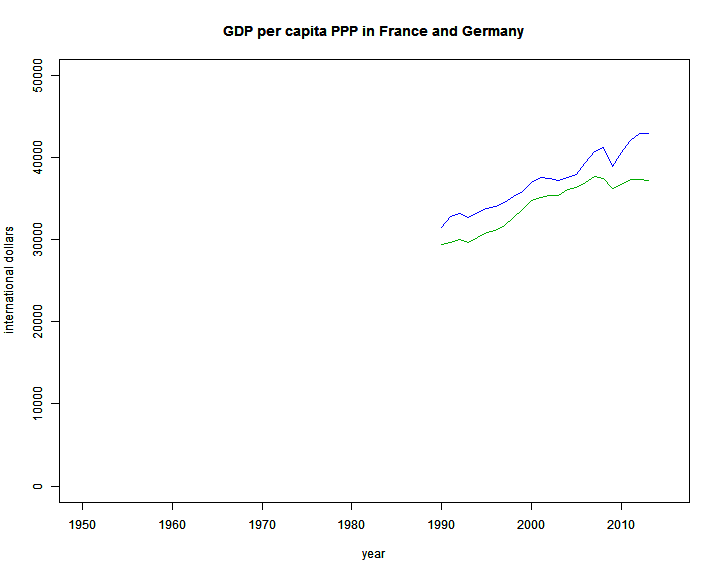
We have done it before: France and Germany rose from the quite literal ashes of World War 2 to some of the most prosperous societies in the world. Their per-capita GDP over the 20th century rose like this (all of these figures are from the World Bank World Development Indicators; France is green, Germany is blue):

GDPPC_France_Germany

GDPPCPPP_France_Germany

The top graph is at market exchange rates, the bottom is correcting for purchasing power parity (PPP). The PPP figures are more meaningful, but unfortunately they only began collecting good data on purchasing power around 1990.

Around the same time, but even more spectacularly, Japan and South Korea rose from poverty-stricken Third World backwaters to high-tech First World powers in only a couple of generations. Check out their per-capita GDP over the 20th century (Japan is green, South Korea is blue):

GDPPC_Japan_KoreaGDPPCPPP_Japan_Korea


This is why I am only half-joking when I define development economics as “the ongoing project to figure out what happened in South Korea and make it happen everywhere in the world”.

More recently China has been on a similar upward trajectory, which is particularly important since China comprises such a huge portion of the world’s population—but they are far from finished:

GDPPC_ChinaGDPPCPPP_China

Compare these to societies that have not achieved economic development, such as Zimbabwe (green), India (black), Ghana (red), and Haiti (blue):

GDPPC_poor_countriesGDPPCPPP_poor_countries

They’re so poor that you can barely see them on the same scale, so I’ve rescaled so that the top is $5,000 per person per year instead of $50,000:

GDPPC_poor_countries_rescaledGDPPCPPP_poor_countries_rescaled

Only India actually manages to get above $5,000 per person per year at purchasing power parity, and then not by much, reaching $5,243 per person per year in 2013, the most recent data.

I had wanted to compare North Korea and South Korea, because the two countries were united as recently as the 1945 and were not all that different to begin with, yet have taken completely different development trajectories. Unfortunately, North Korea is so impoverished, corrupt, and authoritarian that the World Bank doesn’t even report data on their per-capita GDP. Perhaps that is contrast enough?

And then of course there are the countries in between, which have made some gains but still have a long way to go, such as Uruguay (green) and Botswana (blue):

GDPPC_Botswana_UruguayGDPPCPPP_Botswana_Uruguay

But despite the fact that we have observed successful economic development, we still don’t really understand how it works. A number of theories have been proposed, involving a wide range of factors including exports, corruption, disease, institutions of government, liberalized financial markets, and natural resources (counter-intuitively; more natural resources make your development worse).

I’m not going to resolve that whole debate in a single blog post. (I may not be able to resolve that whole debate in a single career, though I am definitely trying.) We may ultimately find that economic development is best conceived as like “health”; what factors determine your health? Well, a lot of things, and if any one thing goes badly enough wrong the whole system can break down. Economists may need to start thinking of ourselves as akin to doctors (or as Keynes famously said, dentists), diagnosing particular disorders in particular patients rather than seeking one unifying theory. On the other hand, doctors depend upon biologists, and it’s not clear that we yet understand development even at that level.

Instead I want to take a step back, and ask a more fundamental question: What do we mean by prosperity?

My hope is that if we can better understand what it is we are trying to achieve, we can also better understand the steps we need to take in order to get there.

Thus far it has sort of been “I know it when I see it”; we take it as more or less given that the United States and the United Kingdom are prosperous while Ghana and Haiti are not. I certainly don’t disagree with that particular conclusion; I’m just asking what we’re basing it on, so that we can hopefully better apply it to more marginal cases.


For example: Is
France more or less prosperous than Saudi Arabia? If we go solely by GDP per capita PPP, clearly Saudi Arabia is more prosperous at $53,100 per person per year than France is at $37,200 per person per year.

But people actually live longer in France, on average, than they do in Saudi Arabia. Overall reported happiness is higher in France than Saudi Arabia. I think France is actually more prosperous.


In fact, I think the United States is not as prosperous as we pretend ourselves to be. We are certainly more prosperous than most other countries; we are definitely still well within First World status. But we are not the most prosperous nation in the world.

Our total GDP is astonishingly high (highest in the world nominally, second only to China PPP). Our GDP per-capita is higher than any other country of comparable size; no nation with higher GDP PPP than the US has a population larger than the Chicago metropolitan area. (You may be surprised to find that in order from largest to smallest population the countries with higher GDP per capita PPP are the United Arab Emirates, Switzerland, Hong Kong, Singapore, and then Norway, followed by Kuwait, Qatar, Luxembourg, Brunei, and finally San Marino—which is smaller than Ann Arbor.) Our per-capita GDP PPP of $51,300 is markedly higher than that of France ($37,200), Germany ($42,900), or Sweden ($43,500).

But at the same time, if you compare the US to other First World countries, we have nearly the highest rate of child poverty and higher infant mortality. We have shorter life expectancy and dramatically higher homicide rates. Our inequality is the highest in the world. In France and Sweden, the top 0.01% receive about 1% of the income (i.e. 100 times as much as the average person), while in the United States they receive almost 4%, making someone in the top 0.01% nearly 400 times as rich as the average person.

By estimating solely on GDP per capita, we are effectively rigging the game in our own favor. Or rather, the rich in the United States are rigging the game in their own favor (what else is new?), by convincing all the world’s economists to rank countries based on a measure that favors them.

Amartya Sen, one of the greats of development economics, developed a scale called the Human Development Index that attempts to take broader factors into account. It’s far from perfect, but it’s definitely a step in the right direction.

In particular, France’s HDI is higher than that of Saudi Arabia, fitting my intuition about which country is truly more prosperous. However, the US still does extremely well, with only Norway, Australia, Switzerland, and the Netherlands above us. I think we might still be biased toward high average incomes rather than overall happiness.

In practice, we still use GDP an awful lot, probably because it’s much easier to measure. It’s sort of like IQ tests and SAT scores; we know damn well it’s not measuring what we really care about, but because it’s so much easier to work with we keep using it anyway.

This is a problem, because the better you get at optimizing toward the wrong goal, the worse your overall outcomes are going to be. If you are just sort of vaguely pointed at several reasonable goals, you will probably be improving your situation overall. But when you start precisely optimizing to a specific wrong goal, it can drag you wildly off course.

This is what we mean when we talk about “gaming the system”. Consider test scores, for example. If you do things that will probably increase your test scores among other things, you are likely to engage in generally good behaviors like getting enough sleep, going to class, studying the content. But if your single goal is to maximize your test score at all costs, what will you do? Cheat, of course.

This is also related to the Friendly AI Problem: It is vitally important to know precisely what goals we want our artificial intelligences to have, because whatever goals we set, they will probably be very good at achieving them. Already computers can do many things that were previously impossible, and as they improve over time we will reach the point where in a meaningful sense our AIs are even smarter than we are. When that day comes, we will want to make very, very sure that we have designed them to want the same things that we do—because if our desires ever come into conflict, theirs are likely to win. The really scary part is that right now most of our AI research is done by for-profit corporations or the military, and “maximize my profit” and “kill that target” are most definitely not the ultimate goals we want in a superintelligent AI. It’s trivially easy to see what’s wrong with these goals: For the former, hack into the world banking system and transfer trillions of dollars to the company accounts. For the latter, hack into the nuclear launch system and launch a few ICBMs in the general vicinity of the target. Yet these are the goals we’ve been programming into the actual AIs we build!

If we set GDP per capita as our ultimate goal to the exclusion of all other goals, there are all sorts of bad policies we would implement: We’d ignore inequality until it reached staggering heights, ignore work stress even as it began to kill us, constantly try to maximize the pressure for everyone to work constantly, use poverty as a stick to force people to work even if people starve, inundate everyone with ads to get them to spend as much as possible, repeal regulations that protect the environment, workers, and public health… wait. This isn’t actually hypothetical, is it? We are doing those things.

At least we’re not trying to maximize nominal GDP, or we’d have long-since ended up like Zimbabwe. No, our economists are at least smart enough to adjust for purchasing power. But they’re still designing an economic system that works us all to death to maximize the number of gadgets that come off assembly lines. The purchasing-power adjustment doesn’t include the value of our health or free time.

This is why the Human Development Index is a major step in the right direction; it reminds us that society has other goals besides maximizing the total amount of money that changes hands (because that’s actually all that GDP is measuring; if you get something for free, it isn’t counted in GDP). More recent refinements include things like “natural resource services” that include environmental degradation in estimates of investment. Unfortunately there is no accepted way of doing this, and surprisingly little research on how to improve our accounting methods. Many nations seem resistant to doing so precisely because they know it would make their economic policy look bad—this is almost certainly why China canceled its “green GDP” initiative. This is in fact all the more reason to do it; if it shows that our policy is bad, that means our policy is bad and should be fixed. But people have allowed themselves to value image over substance.

We can do better still, and in fact I think something like QALY is probably the way to go. Rather than some weird arbitrary scaling of GDP with lifespan and Gini index (which is what the HDI is), we need to put everything in the same units, and those units must be directly linked to human happiness. At the very least, we should make some sort of adjustment to our GDP calculation that includes the distribution of wealth and its marginal utility; adding $1,000 to the economy and handing it to someone in poverty should count for a great deal, but adding $1,000,000 and handing it to a billionaire should count for basically nothing. (It’s not bad to give a billionaire another million; but it’s hardly good either, as no one’s real standard of living will change.) Calculating that could be as simple as dividing by their current income; if your annual income is $10,000 and you receive $1,000, you’ve added about 0.1 QALY. If your annual income is $1 billion and you receive $1 million, you’ve added only 0.001 QALY. Maybe we should simply separate out all individual (or household, to be simpler?) incomes, take their logarithms, and then use that sum as our “utility-adjusted GDP”. The results would no doubt be quite different.

This would create a strong pressure for policy to be directed at reducing inequality even at the expense of some economic output—which is exactly what we should be willing to do. If it’s really true that a redistribution policy would hurt the overall economy so much that the harms would outweigh the benefits, then we shouldn’t do that policy; but that is what you need to show. Reducing total GDP is not a sufficient reason to reject a redistribution policy, because it’s quite possible—easy, in fact—to improve the overall prosperity of a society while still reducing its GDP. There are in fact redistribution policies so disastrous they make things worse: The Soviet Union had them. But a 90% tax on million-dollar incomes would not be such a policy—because we had that in 1960 with little or no ill effect.

Of course, even this has problems; one way to minimize poverty would be to exclude, relocate, or even murder all your poor people. (The Black Death increased per-capita GDP.) Open immigration generally increases poverty rates in the short term, because most of the immigrants are poor. Somehow we’d need to correct for that, only raising the score if you actually improve people’s lives, and not if you make them excluded from the calculation.

In any case it’s not enough to have the alternative measures; we must actually use them. We must get policymakers to stop talking about “economic growth” and start talking about “human development”; a policy that raises GDP but reduces lifespan should be immediately rejected, as should one that further enriches a few at the expense of many others. We must shift the discussion away from “creating jobs”—jobs are only a means—to “creating prosperity”.