Reflections on the Index of Necessary Expenditure

Mar 16 JDN 2460751

In last week’s post I constructed an Index of National Expenditure (INE), attempting to estimate the total cost of all of the things a family needs and can’t do without, like housing, food, clothing, cars, healthcare, and education. What I found shocked me: The median family cannot afford all necessary expenditures.

I have a couple more thoughts about that.

I still don’t understand why people care so much about gas prices.

Gasoline was a relatively small contribution to INE. It was more than clothing but less than utilities, and absolutely dwarfed by housing, food, or college. I thought maybe since I only counted a 15-mile commute, maybe I didn’t actually include enoughgasoline usage, but based on this estimate of about $2000 per driver, I was in about the right range; my estimate for the same year was $3350 for a 2-car family.

I think I still have to go with my salience hypothesis: Gasoline is the only price that we plaster in real-time on signs on the side of the road. So people are constantly aware of it, even though it isn’t actually that important.

The price surge that should be upsetting people is housing.

If the price of homes had only risen with the rate of CPI inflation instead of what it actually did, the median home price in 2024 would be only $234,000 instead of the $396,000 it actually is; and by my estimation that would save a typical family $11,000 per year—a whopping 15% of their income, and nearly enough to make the INE affordable by itself.

Now, I’ll consider some possible objections to my findings.

Objection 1: A typical family doesn’t actually spend this much on these things.

You’re right, they don’t! Because they couldn’t possibly. Even with substantial debt, you just can’t sustainably spend 125% of your after-tax household income.

My goal here was not to estimate how much families actually spend; it was to estimate how much they need to spend in order to live a good life and not feel deprived.


What I have found is that most American families feel deprived. They are forced to sacrifice something really important—like healthcare, or education, or owning a home—because they simply can’t afford it.

What I’m trying to do here is find the price of the American Dream; and what I’ve found is that the American Dream has a price that most Americans cannot afford.

Objection 2: You should use median healthcare spending, not mean.

I did in fact use mean figures instead of median for healthcare expenditures, mainly because only the mean was readily available. Mean income is higher than median income, so you might say that I’ve overestimated healthcare expenditure—and in a sense that’s definitely true. The median family spends less than this on healthcare.

But the reason that the median family spends less than this on healthcare is not that they want to, but that they have to. Healthcare isn’t a luxury that people buy more of because they are richer. People buy either as much as they need or as much as they can afford—whichever is lower, which is typically the latter. Using the mean instead of the median is a crude way to account for that, but I think it’s a defensible one.

But okay, let’s go ahead and cut the estimate of healthcare spending in half; even if you do that, the INE is still larger than after-tax median household income in most years.

Objection 3: A typical family isn’t a family of four, it’s a family of three.

Yes, the mean number of people in a family household in the US is 3.22 (the median is 3).

This is a very bad thing.

Part of what I seem to be finding here is that a family of four is unaffordable—literally impossible to afford—on a typical family income.

But a healthy society is one in which typical families have two or three children. That is what we need in order to achieve population replacement. When families get smaller than that, we aren’t having enough children, and our population will decline—which means that we’ll have too many old people relative to young people. This puts enormous pressure on healthcare and pension systems, which rely upon the fact that young people produce more, in order to pay for the fact that old people cost more.

The ideal average number of births per woman is about 2.1; this is what would give us a steady population. No US state has fertility above this level. The only reason the US population is growing rather than shrinking is that we are taking in immigrants.

This is bad. This is not sustainable. If the reason families aren’t having enough kids is that they can’t afford them—and this fits with other research on the subject—then this economic failure damages our entire society, and it needs to be fixed.

Objection 4: Many families buy their cars used.

Perhaps 1/10 of a new car every year isn’t an ideal estimate of how much people spend on their cars, but if anything I think it’s conservative, because if you only buy a car every 10 years, and it was already used when you bought it, you’re going to need to spend a lot on maintaining it—quite possibly more than it would cost to get a new one. Motley Fool actually estimates the ownership cost of just one car at substantially more than I estimated for two cars. So if anything your complaint should be that I’ve underestimated the cost by not adequately including maintenance and insurance.

Objection 5: Not everyone gets a four-year college degree.

Fair enough; a substantial proportion get associate’s degrees, and most people get no college degree at all. But some also get graduate degrees, which is even more expensive (ask me how I know).

Moreover, in today’s labor market, having a college degree makes a huge difference in your future earnings; a bachelor’s degree increases your lifetime earnings by a whopping 84%. In theory it’s okay to have a society where most people don’t go to college; in practice, in our society, not going to college puts you at a tremendous disadvantage for the rest of your life. So we either need to find a way to bring wages up for those who don’t go to college, or find a way to bring the cost of college down.

This is probably one of the things that families actually choose to scrimp on, only sending one kid to college or none at all. But because college is such a huge determinant of earnings, this perpetuates intergenerational inequality: Only rich families can afford to send their kids to college, and only kids who went to college grow up to have rich families.

Objection 6: You don’t actually need to save for college; you can use student loans.

Yes, you can, and in practice, most people who to college do. But while this solves the liquidity problem (having enough money right now), it does not solve the solvency problem (having enough money in the long run). Failing to save for college and relying on student loans just means pushing the cost of college onto your children—and since we’ve been doing that for over a generation, feel free to replace the category “college savings” with “repaying student loans”; it won’t meaningfully change the results.

Against average utilitarianism

Jul 30 JDN 2460156

Content warning: Suicide and suicidal ideation

There are two broad strands of utilitarianism, known as average utilitarianism and total utilitarianism. As utilitarianism, both versions concern themselves with maximizing happiness and minimizing suffering. And for many types of ethical question, they yield the same results.

Under average utilitarianism, the goal is to maximize the average level of happiness minus suffering: It doesn’t matter how many people there are in the world, only how happy they are.

Under total utilitarianism, the goal is to maximize the total level of happiness minus suffering: Adding another person is a good thing, as long as their life is worth living.

Mathematically, its the difference between taking the sum of net happiness (total utilitarianism), and taking that sum and dividing it by the population (average utilitarianism).

It would make for too long a post to discuss the validity of utilitarianism in general. Overall I will say briefly that I think utilitarianism is basically correct, but there are some particular issues with it that need to be resolved, and usually end up being resolved by heading slightly in the direction of a more deontological ethics—in short, rule utilitarianism.

But for today, I want to focus on the difference between average and total utilitarianism, because average utilitarianism is a very common ethical view despite having appalling, horrifying implications.

Above all: under average utilitarianism, if you are considering suicide, you should probably do it.

Why? Because anyone who is considering suicide is probably of below-average happiness. And average utilitarianism necessarily implies that anyone who expects to be of below-average happiness should be immediately killed as painlessly as possible.

Note that this does not require that your life be one of endless suffering, so that it isn’t even worth going on living. Even a total utilitarian would be willing to commit suicide, if their life is expected to be so full of suffering that it isn’t worth going on.

Indeed, I suspect that most actual suicidal ideation by depressed people takes this form: My life will always be endless suffering. I will never be happy again. My life is worthless.

The problem with such suicidal ideation is not the ethical logic, which is valid: If indeed your existence from this point forward would be nothing but endless suffering, suicide actually makes sense. (Imagine someone who is being held in a dungeon being continually mercilessly tortured with no hope of escape; it doesn’t seem unreasonable for them to take a cyanide pill.) The problem is the prediction, which says that your life from this point forward will be nothing but endless suffering. Most people with depression do, eventually, feel better. They may never be quite as happy overall as people who aren’t depressed, but they do, in fact, have happy times. And most people who considered suicide but didn’t go through with it end up glad that they went on living.

No, an average utilitarian says you should commit suicide as long as your happiness is below average.

We could be living in a glorious utopia, where almost everyone is happy almost all the time, and people are only occasionally annoyed by minor inconveniences—and average utilitarianism would say that if you expect to suffer a more than average rate of such inconveniences, the world would be better off if you ceased to exist.

Moreover, average utilitarianism says that you should commit suicide if your life is expected to get worse—even if it’s still going to be good, adding more years to your life will just bring your average happiness down. If you had a very happy childhood and adulthood is going just sort of okay, you may as well end it now.

Average utilitarianism also implies that we should bomb Third World countries into oblivion, because their people are less happy than ours and thus their deaths will raise the population average.

Are there ways an average utilitarian can respond to these problems? Perhaps. But every response I’ve seen is far too weak to resolve the real problem.

One approach would be to say that the killing itself is bad, or will cause sufficient grief as to offset the loss of the unhappy person. (An average utilitarian is inherently committed to the claim that losing an unhappy person is itself an inherent good. There is something to be offset.)

This might work for the utopia case: The grief from losing someone you love is much worse than even a very large number of minor inconveniences.

It may even work for the case of declining happiness over your lifespan: Presumably some other people would be sad to lose you, even if they agreed that your overall happiness is expected to gradually decline. Then again, if their happiness is also expected to decline… should they, too, shuffle off this mortal coil?

But does it work for the question of bombing? Would most Americans really be so aggrieved at the injustice of bombing Burundi or Somalia to oblivion? Most of them don’t seem particularly aggrieved at the actual bombings of literally dozens of countries—including, by the way, Somalia. Granted, these bombings were ostensibly justified by various humanitarian or geopolitical objectives, but some of those justifications (e.g. Kosovo) seem a lot stronger than others (e.g. Grenada). And quite frankly, I care more about this sort of thing than most people, and I still can’t muster anything like the same kind of grief for random strangers in a foreign country that I feel when a friend or relative dies. Indeed, I can’t muster the same grief for one million random strangers in a foreign country that I feel for one lost loved one. Human grief just doesn’t seem to work that way. Sometimes I wish it did—but then, I’m not quite sure what our lives would be like in such a radically different world.

Moreover, the whole point is that an average utilitarian should consider it an intrinsically good thing to eliminate the existence of unhappy people, as long as it can be done swiftly and painlessly. So why, then, should people be aggrieved at the deaths of millions of innocent strangers they know are mostly unhappy? Under average utilitarianism, the greatest harm of war is the survivors you leave, because they will feel grief—so your job is to make sure you annihilate them as thoroughly as possible, presumably with nuclear weapons. Killing a soldier is bad as long as his family is left alive to mourn him—but if you kill an entire country, that’s good, because their country was unhappy.

Enough about killing and dying. Let’s talk about something happier: Babies.

At least, total utilitarians are happy about babies. When a new person is brought into the world, a total utilitarian considers this a good thing, as long as the baby is expected to have a life worth living and their existence doesn’t harm the rest of the world too much.

I think that fits with most people’s notions of what is good. Generally the response when someone has a baby is “Congratulations!” rather than “I’m sorry”. We see adding another person to the world as generally a good thing.

But under average utilitarianism, babies must reach a much higher standard in order to be a good thing. Your baby only deserves to exist if they will be happier than average.

Granted, this is the average for the whole world, so perhaps First World people can justify the existence of their children by pointing out that unless things go very badly, they should end up happier than the world average. (Then again, if you have a family history of depression….)

But for Third World families, quite the opposite: The baby may well bring joy to all around them, but unless that joy is enough to bring someone above the global average, it would still be better if the baby did not exist. Adding one more person of moderately-low happiness will just bring the world average down.

So in fact, on a global scale, an average utilitarian should always expect that babies are nearly as likely to be bad as they are good, unless we have some reason to think that the next generation would be substantially happier than this one.

And while I’m not aware of anyone who sincerely believes that we should nuke Third World countries for their own good, I have heard people speak this way about population growth in Third World countries: such discussions of “overpopulation” are usually ostensibly about ecological sustainability, even though the ecological impact of First World countries is dramatically higher—and such talk often shades very quickly into eugenics.

Of course, we wouldn’t want to say that having babies is always good, lest we all be compelled to crank out as many babies as possible and genuinely overpopulate the world. But total utilitarianism can solve this problem: It’s worth adding more people to the world unless the harm of adding those additional people is sufficient to offset the benefit of adding another person whose life is worth living.

Moreover, total utilitarianism can say that it would be good to delay adding another person to the world, until the situation is better. Potentially this delay could be quite long: Perhaps it is best for us not to have too many children until we can colonize the stars. For now, let’s just keep our population sustainable while we develop the technology for interstellar travel. If having more children now would increase the risk that we won’t ever manage to colonize distant stars, total utilitarianism would absolutely say we shouldn’t do it.

There’s also a subtler problem here, which is that it may seem good for any particular individual to have more children, but the net result is that the higher total population is harmful. Then what I think is happening is that we are unaware of, or uncertain about, or simply inattentive to, the small harm to many other people caused by adding one new person to the world. Alternatively, we may not be entirely altruistic, and a benefit that accrues to our own family may be taken as greater than a harm that accrues to many other people far away. If we really knew the actual marginal costs and benefits, and we really agreed on that utility function, we would in fact make the right decision. It’s our ignorance or disagreement that makes us fail, not total utilitarianism in principle. In practice, this means coming up with general rules that seem to result in a fair and reasonable outcome, like “families who want to have kids should aim for two or three”—and again we’re at something like rule utilitarianism.

Another case average utilitarianism seems tempting is in resolving the mere addition paradox.

Consider three possible worlds, A, B, and C:

In world A, there is a population of 1 billion, and everyone is living an utterly happy, utopian life.

In world B, there is a population of 1 billion living in a utopia, and a population of 2 billion living mediocre lives.

In world C, there is a population of 3 billion living good, but not utopian, lives.

The mere addition paradox is that, to many people, world B seems worse than world A, even though all we’ve done is add 2 billion people whose lives are worth living.

Moreover, many people seem to think that the ordering goes like this:


World B is better than world A, because all we’ve done is add more people whose lives are worth living.

World C is better than world B, because it’s fairer, and overall happiness is higher.

World A is better than world C, because everyone is happier, and all we’ve done is reduce the population.


This is intransitive: We have A > C > B > A. Our preferences over worlds are incoherent.

Average utilitarianism resolves this by saying that A > C is true, and C > B is true—but it says that B > A is false. Since average happiness is higher in world A, A > B.

But of course this results in the conclusion that if we are faced with world B, we should do whatever we can to annihilate the 2 billion extra unhappy people, so that we can get to world A. And the whole point of this post is that this is an utterly appalling conclusion we should immediately reject.

What does total utilitarianism say? It says that indeed C > B and B > A, but it denies that A > C. Rather, since there are more people in world C, it’s okay that people aren’t quite as happy.

Derek Parfit argues that this leads to what he calls the “repugnant conclusion”: If we keep increasing the population by a large amount while decreasing happiness by a small amount, the best possible world ends up being one where population is utterly massive but our lives are only barely worth living.

I do believe that total utilitarianism results in this outcome. I can live with that.

Under average utilitarianism, the best possible world is precisely one person who is immortal and absolutely ecstatic 100% of the time. Adding even one person who is not quite that happy will make things worse.

Under total utilitarianism, adding more people who are still very happy would be good, even if it makes that one ecstatic person a bit less ecstatic. And adding more people would continue to be good, as long as it didn’t bring the average down too quickly.

If you find this conclusion repugnant, as Parfit does, I submit that it is because it is difficult to imagine just how large a population we are talking about. Maybe putting some numbers on it will help.

Let’s say the happiness level of an average person in the world today is 35 quality-adjusted life years—our life expectancy of 70, times an average happiness level of 0.5.

So right now we have a world of 8 billion people at 35 QALY, for a total of 280 TQALY. (That’s tera-QALY, 1 trillion QALY.)

(Note: I’m not addressing inequality here. If you believe that a world where one person has 100 QALY and another has 50 QALY is worse than one where both have 75 QALY, you should adjust your scores accordingly—which mainly serves to make the current world look worse, due to our utterly staggering inequality. In fact I think I do not believe this—in my view, the problem is not that happiness is unequal, but that staggering inequality of wealth makes much greater suffering among the poor in exchange for very little happiness among the rich.)

Average utilitarianism says that we should eliminate the less happy people, so we can raise the average QALY higher, maybe to something like 60. I’ve already said why I find this appalling.

So now consider what total utilitarianism asks of us. If we could raise that figure above 280 TQALY, we should. Say we could increase our population to 10 billion, at the cost of reducing average happiness to 30 QALY; should we? Yes, we should, because that’s 300 TQALY.

But notice that in this scenario we’re still 85% as happy as we were. That doesn’t sound so bad. Parfit is worried about a scenario where our lives are barely worth living. So let’s consider what that would require.

“Barely worth living” sounds like maybe 1 QALY. This wouldn’t mean we all live exactly one year; that’s not sustainable, because babies can’t have babies. So it would be more like a life expectancy of 33, with a happiness of 0.03—pretty bad, but still worth living.

In that case, we would need to raise our population over 800 billion to make it better than our current existence. We must colonize at least 100 other planets and fill them as full as we’ve filled Earth.

In fact, I think this 1 QALY life was something like that human beings had at the dawn of agriculture (which by some estimates was actually worse than ancient hunter-gatherer life; we were sort of forced into early agriculture, rather than choosing it because it was better): Nasty, brutish, and short, but still, worth living.

So, Parfit’s repugnant conclusion is that filling 100 planets with people who live like the ancient Babylonians would be as good as life on Earth is now? I don’t really see how this is obviously horrible. Certainly not to the same degree that saying we should immediately nuke Somalia is obviously horrible.

Moreover, total utilitarianism absolutely still says that if we can make those 800 billion people happier, we should. A world of 800 billion people each getting 35 QALY is 100 times better than the way things are now—and doesn’t that seem right, at least?


Yet if you indeed believe that copying a good world 100 times gives you a 100 times better world, you are basically committed to total utilitarianism.

There are actually other views that would allow you to escape this conclusion without being an average utilitarian.

One way, naturally, is to not be a utilitarian. You could be a deontologist or something. I don’t have time to go into that in this post, so let’s save it for another time. For now, let me say that, historically, utilitarianism has led the charge in positive moral change, from feminism to gay rights, from labor unions to animal welfare. We tend to drag stodgy deontologists kicking and screaming toward a better world. (I vaguely recall an excellent tweet on this, though not who wrote it: “Yes, historically, almost every positive social change has been spearheaded by utilitarians. But sometimes utilitarianism seems to lead to weird conclusions in bizarre thought experiments, and surely that’s more important!”)

Another way, which has gotten surprisingly little attention, is to use an aggregating function that is neither a sum nor an average. For instance, you could add up all utility and divide by the square root of population, so that larger populations get penalized for being larger, but you aren’t simply trying to maximize average happiness. That does seem to still tell some people to die even though their lives were worth living, but at least it doesn’t require us to exterminate all who are below average. And it may also avoid the conclusion Parfit considers repugnant, by making our galactic civilization span 10,000 worlds. Of course, why square root? Why not a cube root, or a logarithm? Maybe the arbitrariness is why it hasn’t been seriously considered. But honestly, I think dividing by anything is suspicious; how can adding someone else who is happy ever make things worse?

But if I must admit that a sufficiently large galactic civilization would be better than our current lives, even if everyone there is mostly pretty unhappy? That’s a bullet I’m prepared to bite. At least I’m not saying we should annihilate everyone who is unhappy.

Home price targeting

Jan 29 JDN 2459973

One of the largest divides in opinion between economists and the general population concerns the question of rent control. While the general public mostly supports rent control (and often votes for it in referenda), economists almost universally oppose it. It’s hard to get a consensus among economists on almost anything, and yet here we have one; but people don’t seem to care.

Why? I think it’s because high rents are a genuine and serious problem, which economists have invested remarkably little effort in trying to solve. Housing prices are one of the chief drivers of long-term inflation, and with most people spending over a third of their income on housing, even relatively small increases in housing prices can cause a lot of suffering.

One thing we do know is that rent control does not work as a long-term solution. Maybe in response to some short-term shock it would make sense. Maybe you do it for awhile as you wait for better long-term solutions to take effect. But simply putting an arbitrary cap on prices will create shortages in the long run—and it is not a coincidence that cities with strict rent control have the worst housing shortages and the greatest rates of homelessness. Rent control doesn’t even do a good job of helping the people who need it most.

Price ceilings in general are just… not a good idea. If people are selling something at a price that you think is too high and you just insist that they aren’t allowed to, they don’t generally sell at a lower price—they just don’t sell at all. There are a few exceptions; in a very monopolistic market, a well-targeted price ceiling might actually work. And short-run housing supply is inelastic enough that rent control isn’t the worst kind of price ceiling. But as a general strategy, price ceilings just aren’t an effective way of making things cheaper.

This is why we so rarely use them as a policy intervention. When the Federal Reserve wants to achieve a certain interest rate on bonds, do they simply demand that people buy the bonds at that price? No. They adjust the supply of bonds in the market until the market price goes to what they want it to be.

Prices aren’t set in a vacuum by the fiat of evil corporations. They are an equilibrium outcome of a market system. There are things you can do to intervene and shift that equilibrium, but if you just outlaw certain prices, it will result in a new equilibrium—it won’t simply be the same amount sold at the new price you wanted.

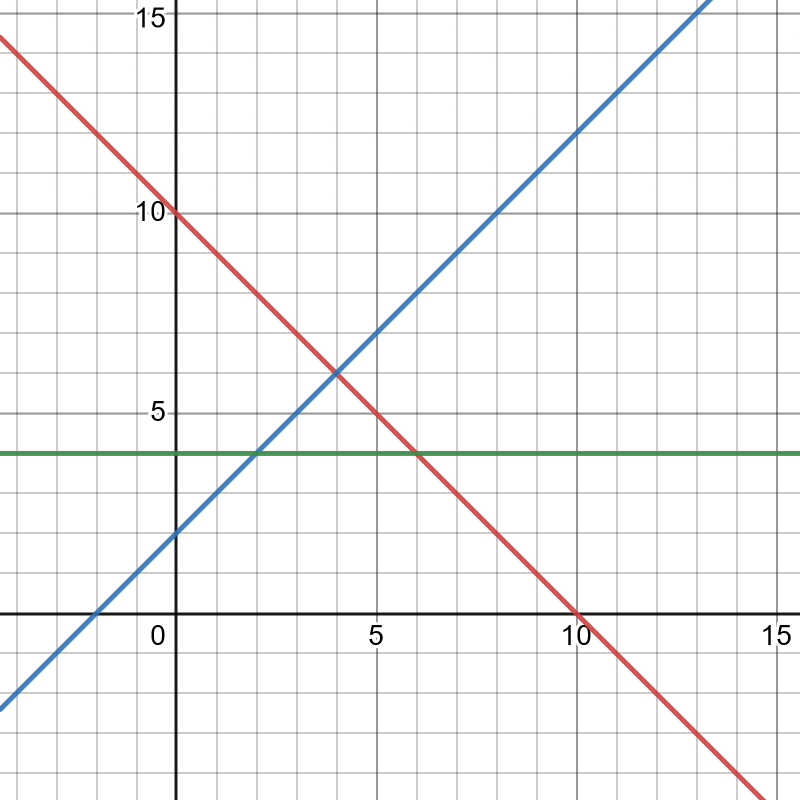
Maybe some graphs would help explain this. In each graph, the red line is the demand and the blue line is the supply.

Here is what the market looks like before intervention: The price is $6. We’ll say that’s too high; people can’t afford it.

[no_intervention.png]

Now suppose we impose a price ceiling at $4 (the green line). You aren’t allowed to charge more than $4. What will happen? Companies will charge $4. But they will also produce and sell a smaller quantity than before.

Far better would be to increase the supply of the good, shifting to a new supply curve (the purple line). Then you would reduce the price and increase the amount of the good available.

[supply_intervention.png]

This is precisely what we do with government bonds when we want to raise interest rates. (A greater supply of bonds makes their prices lower, which makes their yields higher.) And when we want to lower interest rates, we do the opposite.

Of course, with bonds, it’s easy to control the supply; it’s all just numbers in a network. Increasing the supply of housing is a much greater undertaking; you actually need to build new housing. But ultimately, the only way to ensure that housing is available and affordable for everyone is in fact to build more housing.

There are various ways we might accomplish that; one of the simplest would be to simply relax zoning restrictions that make it difficult to build high-density housing in cities. Those are bad laws anyway; they only benefit a small number of people a little bit while harming a large number of people a lot. (The problem is that the people they benefit are the local homeowners who show up to city council meetings.)

But we could do much more. I propose that we really use interest-rate targeting as our model and introduce home price targeting. I want the federal government to exercise eminent domain and order the construction of new high-density housing in any city that has rents above a certain threshold—if you like, the same threshold you were thinking of setting the rent control at.

Is this an extreme solution? Perhaps. But housing affordability is an extreme problem. And I keep hearing from the left wing that economists aren’t willing to consider “radical enough” solutions to housing (by which they always seem to mean the tried-and-failed strategy of rent control). So here’s a radical solution for you. If cities refuse to build enough housing for their people, make them do it. Buy up and bulldoze their “lovely” “historic” suburban neighborhoods that are ludicrous wastes of land (and also environmentally damaging), and replace them with high-rise apartments. (Get rid of the golf courses while you’re at it.)

This would be expensive, of course; we have to pay to build all those new apartments. But hardly so expensive as living in a society where people can’t afford to live where they want.

In fact, estimates suggest that we are losing over one trillion dollars per year in unrealized productivity because people can’t afford to live in the highest-rent cities. Average income per worker in the US has been reduced by nearly $7000 per year because of high housing prices. So that’s the budget you should be comparing against. Keeping things as they are is like taxing our whole population about 9%. (And it’s probably regressive, so more than that for poor people.)

Would this destroy the “charm” of the city? I dunno, maybe a little. But if the only thing your city had going for it was some old houses that are clearly not an efficient use of space, that’s pretty sad. And it is quite possible to build a city at high density and have it still be beautiful and a major draw for tourists; Paris is a lot denser than far-less-picturesque Houston. (Though I’ll admit, Houston is far more affordable than Paris. It’s not just about density.) And is the “charm” of your city really worth making it so unaffordable that people can’t move there without risking becoming homeless?

There are a lot of details to be worked out: How serious must things get before the federal government steps in? (Wherever we draw the line, San Francisco is surely well past it.) It takes a long time to build houses and let prices adjust, so how do we account for that time-lag? Where does the money come from, actually? Debt? Taxes? But these could all be resolved.

Of course, it’s a pipe dream; we’re never going to implement this policy, because homeowners dread the idea of their home values going down (even though it would actually make their property taxes cheaper!). I’d even be willing to consider some kind of program that would let people refinance underwater mortgages to write off the lost equity, if that’s what it takes to actually build enough housing.

Because there is really only one thing that’s ever going to solve the (global!) housing crises:

Build more homes.

Could the Star Trek economy really work?

Jun 13 JDN 2459379

“The economics of the future are somewhat different”, Jean-Luc Picard explains to Lily Sloane in Star Trek: First Contact.

Captain Picard’s explanation is not very thorough, and all we have about the economic system of the Federation comes from similar short glimpes across the various Star Trek films and TV series. The best glimpses of what the Earth’s economy is like largely come from the Picard series in particular.

But I think we can safely conclude that all of the following are true:

1. Energy is extraordinarily abundant, with a single individual having access to an energy scale that would rival the energy production of entire nations at present. By E=mc2, simply being able to teleport a human being or materialize a hamburger from raw energy, as seems to be routine in Starfleet, would require something on the order of 10^17 joules, or about 28 billion kilowatt-hours. The total energy supply of the world economy today is about 6*10^20 joules, or 100 trillion kilowatt-hours.

2. There is broad-based prosperity, but not absolute equality. At the very least different people live differently, though it is unclear whether anyone actually has a better standard of living than anyone else. The Picard family still seems to own their family vineyard that has been passed down for generations, and since the population of Earth is given as about 9 billion (a plausible but perhaps slightly low figure for our long-run stable population equilibrium), its acreage is large enough that clearly not everyone on Earth can own that much land.

3. Most resources that we currently think of as scarce are not scarce any longer. Replicator technology allows for the instantaneous production of food, clothing, raw materials, even sophisticated electronics. There is no longer a “manufacturing sector” as such; there are just replicators and people who use or program them. Most likely, even new replicators are made by replicating parts in other replicators and then assembling them. There are a few resources which remain scarce, such as dilithium (somehow involved in generating these massive quantities of energy) and latinum (a bizarre substance that is prized by many other cultures yet for unexplained reasons cannot be viably produced in replicators). Essentially everything else that is scarce is inherently so, such as front-row seats at concerts, original paintings, officer commissions in Starfleet, or land in San Francisco.

4. Interplanetary and even interstellar trade is routine. Starships with warp capability are available to both civilian and government institutions, and imports and exports can be made to planets dozens or even hundreds of light-years away as quickly as we can currently traverse the oceans with a container ship.

5. Money as we know it does not exist. People are not paid wages or salaries for their work. There is still some ownership of personal property, and particular families (including the Picards) seem to own land; but there does not appear to be any private ownership of capital. For that matter there doesn’t even appear to be be much in the way of capital; we never see any factories. There is obviously housing, there is infrastructure such as roads, public transit, and presumably power plants (very, very powerful power plants, see 1!), but that may be all. Nearly all manufacturing seems to be done by replicators, and what can’t be done by replicators (e.g. building new starships) seems to be all orchestrated by state-owned enterprises such as Starfleet.

Could such an economy actually work? Let’s stipulate that we really do manage to achieve such an extraordinary energy scale, millions of times more than what we can currently produce. Even very cheap, widespread nuclear energy would not be enough to make this plausible; we would need at least abundant antimatter, and quite likely something even more exotic than this, like zero point energy. Along this comes some horrifying risks—imagine an accident at a zero-point power plant that tears a hole in the fabric of space next to a major city, or a fanatical terrorist with a handheld 20-megaton antimatter bomb. But let’s assume we’ve found ways to manage those risks as well.

Furthermore, let’s stipulate that it’s possible to build replicators and warp drives and teleporters and all the similarly advanced technology that the Federation has, much of which is so radically advanced we can’t even be sure that such a thing is possible.

What I really want to ask is whether it’s possible to sustain a functional economy at this scale without money. George Roddenberry clearly seemed to think so. I am less convinced.

First of all, I want to acknowledge that there have been human societies which did not use money, or even any clear notion of a barter system. In fact, most human cultures for most of our history as a species allocated resources based on collective tribal ownership and personal favors. Some of the best parts of Debt: The First 5000 Years are about these different ways of allocating resources, which actually came much more naturally to us than money.

But there seem to have been rather harsh constraints on what sort of standard of living could be maintained in such societies. There was essentially zero technological advancement for thousands of years in most hunter-gatherer cultures, and even the wealthiest people in most of those societies overall had worse health, shorter lifespans, and far, far less access to goods and services than people we would consider in poverty today.

Then again, perhaps money is only needed to catalyze technological advancement; perhaps once you’ve already got all the technology you need, you can take money away and return to a better way of life without greed or inequality. That seems to be what Star Trek is claiming: That once we can make a sandwich or a jacket or a phone or even a car at the push of a button, we won’t need to worry about paying people because everyone can just have whatever they need.

Yet whatever they need is quite different from whatever they want, and therein lies the problem. Yes, I believe that with even moderate technological advancement—the sort of thing I expect to see in the next 50 years, not the next 300—we will have sufficient productivity that we could provide for the basic needs of every human being on Earth. A roof over your head, food on your table, clothes to wear, a doctor and a dentist to see twice a year, emergency services, running water, electricity, even Internet access and public transit—these are things we could feasibly provide to literally everyone with only about two or three times our current level of GDP, which means only about 2% annual economic growth for the next 50 years. Indeed, we could already provide them for every person in First World countries, and it is quite frankly appalling that we fail to do so.

However, most of us in the First World already live a good deal better than that. We don’t have the most basic housing possible, we have nice houses we want to live in. We don’t take buses everywhere, we own our own cars. We don’t eat the cheapest food that would provide adequate nutrition, we eat a wide variety of foods; we order pizza and Chinese takeout, and even eat at fancy restaurants on occasion. It’s less clear that we could provide this standard of living to everyone on Earth—but if economic growth continues long enough, maybe we can.

Worse, most of us would like to live even better than we do. My car is several years old right now, and it runs on gasoline; I’d very much like to upgrade to a brand-new electric car. My apartment is nice enough, but it’s quite small; I’d like to move to a larger place that would give me more space not only for daily living, but also for storage and for entertaining guests. I work comfortable hours for decent pay at a white-collar job that can be done entirely remotely on mostly my own schedule, but I’d prefer to take some time off and live independently while I focus more on my own writing. I sometimes enjoy cooking, but often it can be a chore, and sometimes I wish I could just go eat out at a nice restaurant for dinner every night. I don’t make all these changes because I can’t afford to—that is, because I don’t have the money.

Perhaps most of us would feel no need to have a billion dollars. I don’t really know what $100 billion actually gets you, as far as financial security, independence, or even consumption, that $50 million wouldn’t already. You can have total financial freedom and security with a middle-class American lifestyle with net wealth of about $2 million. If you want to also live in a mansion, drink Dom Perignon with every meal and drive a Lamborghini (which, quite frankly, I have no particular desire to do), you’ll need several million more—but even then you clearly don’t need $1 billion, let alone $100 billion. So there is indeed something pathological about wanting a billion dollars for yourself, and perhaps in the Federation they have mental health treatments for “wealth addiction” that prevent people from experiencing such pathological levels of greed.

Yet in fact, with the world as it stands, I would want a billion dollars. Not to own it. Not to let it sit and grow in some brokerage account. Not to simply be rich and be on the Forbes list. I couldn’t care less about those things. But with a billion dollars, I could donate enormous amounts to charities, saving thousands or even millions of lives. I could found my own institutions—research institutes, charitable foundations—and make my mark on the world. With $100 billion, I could make a serious stab at colonizing Mars—as Elon Musk seems to be doing, but most other billionaires have no particular interest in.

And it begins to strain credulity to imagine a world of such spectacular abundance that everyone could have enough to do that.

This is why I always struggle to answer when people ask me things like “If money were not object, how would you live your life?”; if money were no object, I’d end world hunger, cure cancer, and colonize the Solar System. Money is always an object. What I think you meant to ask was something much less ambitious, like “What would you do if you had a million dollars?” But I might actually have a million dollars someday—most likely by saving and investing the proceeds of a six-figure job as an economist over many years. (Save $2,000 per month for 20 years, growing it at 7% per year, and you’ll be over $1 million. You can do your own calculations here.) I doubt I’ll ever have $10 million, and I’m pretty sure I’ll never have $1 billion.

To be fair, it seems that many of the grand ambitions I would want to achieve with billions of dollars already are achieved by 23rd century; world hunger has definitely been ended, cancer seems to have been largely cured, and we have absolutely colonized the Solar System (and well beyond). But that doesn’t mean that new grand ambitions wouldn’t arise, and indeed I think they would. What if I wanted to command my own fleet of starships? What if I wanted a whole habitable planet to conduct experiments on, perhaps creating my own artificial ecosystem? The human imagination is capable of quite grand ambitions, and it’s unlikely that we could ever satisfy all of them for everyone.

Some things are just inherently scarce. I already mentioned some earlier: Original paintings, front-row seats, officer commissions, and above all, land. There’s only so much land that people want to live on, especially because people generally want to live near other people (Internet access could conceivably reduce the pressure for this, but, uh, so far it really hasn’t, so why would we think it will in 300 years?). Even if it’s true that people can have essentially arbitrary amounts of food, clothing, or electronics, the fact remains that there’s only so much real estate in San Francisco.

It would certainly help to build taller buildings, and presumably they would, though most of the depictions don’t really seem to show that; where are the 10-kilometer-tall skyscrapers made of some exotic alloy or held up by structural integrity fields? (Are the forces of NIMBY still too powerful?) But can everyone really have a 1000-square-meter apartment in the center of downtown? Maybe if you build tall enough? But you do still need to decide who gets the penthouse.

It’s possible that all inherently-scarce resources could be allocated by some mechanism other than money. Some even should be: Starfleet officer commissions are presumably allocated by merit. (Indeed, Starfleet seems implausibly good at selecting supremely competent officers.) Others could be: Concert tickets could be offered by lottery, and maybe people wouldn’t care so much about being in the real front row when you can always simulate the front row at home in your holodeck. Original paintings could all be placed in museums available for public access—and the tickets, too, could be allocated by lottery or simply first-come, first-served. (Picard mentions the Smithsonian, so public-access museums clearly still exist.)

Then there’s the question of how you get everyone to work, if you’re not paying them. Some jobs people will do for fun, or satisfaction, or duty, or prestige; it’s plausible that people would join Starfleet for free (I’m pretty sure I would). But can we really expect all jobs to work that way? Has automation reached such an advanced level that there are no menial jobs? Sanitation? Plumbing? Gardening? Paramedics? Police? People still seem to pick grapes by hand in the Picard vineyards; do they all do it for the satisfaction of a job well done? What happens if one day everyone decides they don’t feel like picking grapes today?

I certainly agree that most menial jobs are underpaid—most people do them because they can’t get better jobs. But surely we don’t want to preserve that? Surely we don’t want some sort of caste system that allocates people to work as plumbers or garbage collectors based on their birth? I guess we could use merit-based aptitude testing; it’s clear that the vast majority of people really aren’t cut out for Starfleet (indeed, perhaps I’m not!), and maybe some people really would be happiest working as janitors. But it’s really not at all clear what such a labor allocation system would be like. I guess if automation has reached such an advanced level that all the really necessary work is done by machines and human beings can just choose to work as they please, maybe that could work; it definitely seems like a very difficult system to manage.

So I guess it’s not completely out of the question that we could find some appropriate mechanism to allocate all goods and services without ever using money. But then my question becomes: Why? What do you have against money?

I understand hating inequality—indeed I share that feeling. I, too, am outraged by the existence of hectobillionaires in a world where people still die of malaria and malnutrition. But having a money system, or even a broadly free-market capitalist economy, doesn’t inherently have to mean allowing this absurd and appalling level of inequality. We could simply impose high, progressive taxes, redistribute wealth, and provide a generous basic income. If per-capita GDP is something like 100 times its current level (as it appears to be in Star Trek), then the basic income could be $1 million per year and still be entirely affordable.

That is, rather than trying to figure out how to design fair and efficient lotteries for tickets to concerts and museums, we could still charge for tickets, and just make sure that everyone has a million dollars a year in basic income. Instead of trying to find a way to convince people to clean bathrooms for free, we could just pay them to do it.

The taxes could even be so high at the upper brackets that they effectively impose a maximum income; say we have a 99% marginal rate above $20 million per year. Then the income inequality would collapse to quite a low level: No one below $1 million, essentially no one above $20 million. We could tax wealth as well, ensuring that even if people save or get lucky on the stock market (if we even still have a stock market—maybe that is unnecessary after all), they still can’t become hectobillionaires. But by still letting people use money and allowing some inequality, we’d still get all the efficiency gains of having a market economy (minus whatever deadweight loss such a tax system imposed—which I in fact suspect would not be nearly as large as most economists fear).

In all, I guess I am prepared to say that, given the assumption of such great feats of technological advancement, it is probably possible to sustain such a prosperous economy without the use of money. But why bother, when it’s so much easier to just have progressive taxes and a basic income?

The upsides of life extension

Dec 16 JDN 2458469

If living is good, then living longer is better.

This may seem rather obvious, but it’s something we often lose sight of when discussing the consequences of medical technology for extending life. It’s almost like it seems too obvious that living longer must be better, and so we go out of our way to find ways that it is actually worse.

Even from a quick search I was able to find half a dozen popular media articles about life extension, and not one of them focused primarily on the benefits. The empirical literature is better, asking specific, empirically testable questions like “How does life expectancy relate to retirement age?” and “How is lifespan related to population and income growth?” and “What effect will longer lifespans have on pension systems?” Though even there I found essays in medical journals complaining that we have extended “quantity” of life without “quality” (yet by definition, if you are using QALY to assess the cost-effectiveness of a medical intervention, that’s already taken into account).

But still I think somewhere along the way we have forgotten just how good this is. We may not even be able to imagine the benefits of extending people’s lives to 200 or 500 or 1000 years.

To really get some perspective on this, I want you to imagine what a similar conversation must have looked like in roughly the year 1800, the Industrial Revolution, when industrial capitalism came along and made babies finally stop dying.

There was no mass media back then (not enough literacy), but imagine what it would have been like if there had been, or imagine what conversations about the future between elites must have been like.

And we do actually have at least one example of an elite author lamenting the increase in lifespan: His name was Thomas Malthus.

The Malthusian argument was seductive then, and it remains seductive today: If you improve medicine and food production, you will increase population. But if you increase population, you will eventually outstrip those gains in medicine and food and return once more to disease and starvation, only now with more mouths to feed.

Basically any modern discussion of “overpopulation” has this same flavor (by the way, serious environmentalists don’t use that concept; they’re focused on reducing pollution and carbon emissions, not people). Why bother helping poor countries, when they’re just going to double their population and need twice the help?

Well, as a matter of fact, Malthus was wrong. In fact, he was not just wrong: He was backwards. Increased population has come with increased standard of living around the world, as it allowed for more trade, greater specialization, and the application of economies of scale. You can’t build a retail market with a hunter-gatherer tribe. You can’t built an auto industry with a single city-state. You can’t build a space program with a population of 1 million. Having more people has allowed each person to do and have more than they could before.

Current population projections suggest world population will stabilize between 11 and 12 billion. Crucially, this does not factor in any kind of radical life extension technology. The projections allow for moderate increases in lifespan, but not people living much past 100.

Would increased lifespan lead to increased population? Probably, yes. I can’t be certain, because I can very easily imagine people deciding to put off having kids if they can reasonably expect to live 200 years and never become infertile.

I’m actually more worried about the unequal distribution of offspring: People who don’t believe in contraception will be able to have an awful lot of kids during that time, which could be bad for both the kids and society as a whole. We may need to impose regulations on reproduction similar to (but hopefully less draconian than) the One-Child policy imposed in China.

I think the most sensible way to impose the right incentives while still preserving civil liberties is to make it a tax: The first kid gets a subsidy, to help care for them. The second kid is revenue-neutral; we tax you but you get it back as benefits for the child. (Why not just let them keep the money? One of the few places where I think government paternalism is justifiable is protection against abusive or neglectful parents.) The third and later kids result in progressively higher taxes. We always feed the kids on government money, but their parents are going to end up quite poor if they don’t learn how to use contraceptives. (And of course, contraceptives will be made available for free without a prescription.)

But suppose that, yes, population does greatly increase as a result of longer lifespans. This is not a doomsday scenario. In fact, in itself, this is a good thing. If life is worth living, more lives are better.

The question becomes how we ensure that all these people live good lives; but technology will make that easier too. There seems to be an underlying assumption that increased lifespan won’t come with improved health and vitality; but this is already not true. 60 is the new 50: People who are 60 years old today live as well as people who were 50 years old just a generation ago.

And in fact, radical life extension will be an entirely different mechanism. We’re not talking about replacing a hip here, a kidney there; we’re talking about replenishing your chromosomal telomeres, repairing your cells at the molecular level, and revitalizing the content of your blood. The goal of life extension technology isn’t to make you technically alive but hooked up to machines for 200 years; it’s to make you young again for 200 years. The goal is a world where centenarians are playing tennis with young adults fresh out of college and you have trouble telling which is which.

There is another inequality concern here as well, which is cost. Especially in the US—actually almost only in the US, since most of the world has socialized medicine—where medicine is privatized and depends on your personal budget, I can easily imagine a world where the rich live to 200 and the poor die at 60. (The forgettable Justin Timberlake film In Time started with this excellent premise and then went precisely nowhere with it. Oddly, the Deus Ex games seem to have considered every consequence of mixing capitalism with human augmentation except this one.) We should be proactively taking steps to prevent this nightmare scenario by focusing on making healthcare provision equitable and universal. Even if this slows down the development of the technology a little bit, it’ll be worth it to make sure that when it does arrive, it will arrive for everyone.

We really don’t know what the world will look like when people can live 200 years or more. Yes, there will be challenges that come from the transition; honestly I’m most worried about keeping alive ideas that people grew up with two centuries prior. Imagine talking politics with Abraham Lincoln: He was viewed as extremely progressive for his time, even radical—but he was still a big-time racist.

The good news there is that people are not actually as set in their ways as many believe: While the huge surge in pro-LGBT attitudes did come from younger generations, support for LGBT rights has been gradually creeping up among older generations too. Perhaps if Abraham Lincoln had lived through the Great Depression, the World Wars, and the Civil Rights Movement he’d be a very different person than he was in 1865. Longer lifespans will mean people live through more social change; that’s something we’re going to need to cope with.

And of course violent death becomes even more terrifying when aging is out of the picture: It’s tragic enough when a 20-year-old dies in a car accident today and we imagine the 60 years they lost—but what if it was 180 years or 480 years instead? But violent death in basically all its forms is declining around the world.

But again, I really want to emphasize this: Think about how good this is. Imagine meeting your great-grandmother—and not just meeting her, not just having some fleeting contact you half-remember from when you were four years old or something, but getting to know her, talking with her as an adult, going to the same movies, reading the same books. Imagine the converse: Knowing your great-grandchildren, watching them grow up and have kids of their own, your great-great-grandchildren. Imagine the world that we could build if people stopped dying all the time.

And if that doesn’t convince you, I highly recommend Nick Bostrom’s “Fable of the Dragon-Tyrant”.

Stop making excuses for the dragon.

The urban-rural divide runs deep

Feb 5, JDN 2457790

Are urban people worth less than rural people?

That probably sounds like a ridiculous thing to ask; of course not, all people are worth the same (other things equal of course—philanthropists are worth more than serial murderers). But then, if you agree with that, you’re probably an urban person, as I’m sure most of my readers are (and as indeed most people in highly-developed countries are).

A disturbing number of rural people, however, honestly do seem to believe this. They think that our urban lifestyles (whatever they imagine those to be) devalue us as citizens and human beings.

That is the key subtext to understand in the terrifying phenomenon that is Donald Trump. Most of the people who voted for him can’t possibly have thought he was actually trustworthy, and many probably didn’t actually support his policies of bigotry and authoritarianism (though he was very popular among bigots and authoritarians). From speaking with family members and acquaintances who proudly voted for Trump, one thing came through very clearly: This was a gigantic middle finger pointed at cities. They didn’t even really want Trump; they just knew we didn’t, and so they voted for him out of spite as much as anything else. They also have really confused views about free trade, so some of them voted for him because he promised to bring back jobs lost to trade (that weren’t lost to trade, can’t be brought back, and shouldn’t be even if they could). Talk with a Trump voter for a few minutes, and sneers of “latte-sipping liberal” (I don’t even like coffee) and “coastal elite” (I moved here to get educated; I wasn’t born here) are sure to follow.

There has always been some conflict between rural and urban cultures, for as long as there have been urban cultures for rural cultures to be in conflict with. It is found not just in the US, but in most if not all countries around the world. It was relatively calm during the postwar boom in the 20th century, as incomes everywhere (or at least everywhere within highly-developed countries) were improving more or less in lockstep. But the 21st century has brought us much more unequal growth, concentrated on particular groups of people and particular industries. This has brought more resentment. And that divide, above all else, is what brought us Trump; the correlation between population density and voting behavior is enormous.

Of course, “urban” is sometimes a dog-whistle for “Black”; but sometimes I think it actually really means “urban”—and yet there’s still a lot of hatred embedded in it. Indeed, perhaps that’s why the dog-whistle works; a White man from a rural town can sneer at “urban” people and it’s not entirely clear whether he’s being racist or just being anti-urban.

The assumption that rural lifestyles are superior runs so deep in our culture that even in articles by urban people (like this one from the LA Times) supposedly reflecting about how to resolve this divide, there are long paeans to the world of “hard work” and “sacrifice” and “autonomy” of rural life, and mocking “urban elites” for their “disproportionate” (by which you can only mean almost proportionate) power over government.

Well, guess what? If you want to live in a rural area, go live in a rural area. Don’t pine for it. Don’t tell me how great farm life is. If you want to live on a farm, go live on a farm. I have nothing against it; we need farmers, after all. I just want you to shut up about how great it is, especially if you’re not going to actually do it. Pining for someone else’s lifestyle when you could easily take on that lifestyle if you really wanted it just shows that you think the grass is greener on the other side.

Because the truth is, farm living isn’t so great for most people. The world’s poorest people are almost all farmers. 70% of people below the UN poverty line live in rural areas, even as more and more of the world’s population moves into cities. If you use a broader poverty measure, as many as 85% of the world’s poor live in rural areas.

The kind of “autonomy” that means defending your home with a shotgun is normally what we would call anarchy—it’s a society that has no governance, no security. (Of course, in the US that’s pure illusion; crime rates in general are low and falling, and lower in rural areas than urban areas. But in some parts of the world, that anarchy is very real.) One of the central goals of global economic development is to get people away from subsistence farming into far more efficient manufacturing and service jobs.

At least in the US, farm life is a lot better than it used to be, now that agricultural technology has improved so that one farmer can now do the work of hundreds. Despite increased population and increased food consumption per person, the number of farmers in the US is now the smallest it has been since before the Civil War. The share of employment devoted to agriculture has fallen from over 80% in 1800 to under 2% today. Even just since the 1960s labor productivity of US farms has more than tripled.

But the reason that some 80% of Americans have chosen to live in cities—and yes, I can clearly say “chosen”, because cities are more expensive and therefore urban living is a voluntary activity. Most people who live in the city right now could move to the country if we really wanted to. We choose not to, because we know our life would be worse if we did.

Indeed, I dare say that a lot of the hatred of city-dwellers has got to be envy. Our (median) incomes are higher and our (mean) lifespans are longer. Fewer of our children are in poverty. Life is better here—we know it, and deep down, they know it too.

We also have better Internet access, unsurprisingly—though rural areas are only a few years behind, and the technology improves so rapidly that twice as many rural homes in the US have Internet access than urban homes did in 1998.

Now, a rational solution to this problem would be either to improve the lives of people in rural areas or else move everyone to urban areas—and both of those things have been happening, not only in the US but around the world. But in order to do that, you need to be willing to change things. You have to give up the illusion that farm life is some wonderful thing we should all be emulating, rather than the necessary toil that humanity was forced to go through for centuries until civilization could advance beyond it. You have to be willing to replace farmers with robots, so that people who would have been farmers can go do something better with their lives. You need to give up the illusion that there is something noble or honorable about hard labor on a farm—indeed, you need to give up the illusion that there is anything noble or honorable about hard work in general. Work is not a benefit; work is a cost. Work is what we do because we have to—and when we no longer have to do it, we should stop. Wanting to escape toil and suffering doesn’t make you lazy or selfish—it makes you rational.

We could surely be more welcoming—but cities are obviously more welcoming to newcomers than rural areas are. Our housing is too expensive, but that’s in part because so many people want to live here—supply hasn’t been able to keep up with demand.

I may seem to be presenting this issue as one-sided; don’t urban people devalue rural people too? Sometimes. Insults like “hick” and “yokel” and “redneck” do of course exist. But I’ve never heard anyone from a city seriously argue that people who live in rural areas should have votes that systematically count for less than those of people who live in cities—yet the reverse is literally what people are saying when they defend the Electoral College. If you honestly think that the Electoral College deserves to exist in anything like its present form, you must believe that some Americans are worth more than others, and the people who are worth more are almost all in rural areas while the people who are worth less are almost all in urban areas.

No, National Review, the Electoral College doesn’t “save” America from California’s imperial power; it gives imperial power to a handful of swing states. The only reason California would be more important than any other state is that more Americans live here. Indeed, a lot of Republicans in California are disenfranchised, because they know that their votes will never overcome the overwhelming Democratic majority for the state as a whole and the system is winner-takes-all. Indeed, about 30% of California votes Republican (well, not in the last election, because that was Trump—Orange County went Democrat for the first time in decades), so the number of disenfranchised Republicans alone in California is larger than the population of Michigan, which in turn is larger than the population of Wyoming, North Dakota, South Dakota, Montana, Nebraska, West Virginia, and Kansas combined. Indeed, there are more people in California than there are in Canada. So yeah, I’m thinking maybe we should get a lot of votes?

But it’s easy for you to drum up fear over “imperial rule” by California in particular, because we’re so liberal—and so urban, indeed an astonishing 95% urban, the most of any US state (or frankly probably any major regional entity on the planet Earth! To beat that you have to be something like Singapore, which literally just is a single city).

In fact, while insults thrown at urban people get thrown at basically all of us regardless of what we do, most of the insults that are thrown at rural people are mainly thrown at uneducated rural people. (And statistically, while many people in rural areas are educated and many people in urban areas are not, there’s definitely a positive correlation between urbanization and education.) It’s still unfair in many ways, not least because education isn’t entirely a choice, not in a society where tuition at an average private university costs more than the median individual income. Many of the people we mock as being stupid were really just born poor. It may not be their fault, but they can’t believe that the Earth is only 10,000 years old and not have some substantial failings in their education. I still don’t think mockery is the right answer; it’s really kicking them while they’re down. But clearly there is something wrong with our society when 40% of people believe something so obviously ludicrous—and those beliefs are very much concentrated in the same Southern states that have the most rural populations. “They think we’re ignorant just because we believe that God made the Earth 6,000 years ago!” I mean… yes? I’m gonna have to own up to that one, I guess. I do in fact think that people who believe things that were disproven centuries ago are ignorant.

So really this issue is one-sided. We who live in cities are being systematically degraded and disenfranchised, and when we challenge that system we are accused of being selfish or elitist or worse. We are told that our lifestyles are inferior and shameful, and when we speak out about the positive qualities of our lives—our education, our acceptance of diversity, our flexibility in the face of change—we are again accused of elitism and condescension.

We could simply stew in that resentment. But we can do better. We can reach out to people in rural areas, show them not just that our lives are better—as I said, they already know this—but that they can have these lives too. And we can make policy so that this really can happen for people. Envy doesn’t automatically lead to resentment; that only happens when combined with a lack of mobility. The way urban people pine for the countryside is baffling, since we could go there any time; but the way that country people long for the city is perfectly understandable, as our lives really are better but our rent is too high for them to afford. We need to bring that rent down, not just for the people already living in cities, but also for the people who want to but can’t.

And of course we don’t want to move everyone to cities, either. Many people won’t want to live in cities, and we need a certain population of farmers to make our food after all. We can work to improve infrastructure in rural areas—particularly when it comes to hospitals, which are a basic necessity that is increasingly underfunded. We shouldn’t stop using cost-effectiveness calculations, but we need to compare against the right things. If that hospital isn’t worth building, it should be because there’s another, better hospital we could make for the same amount or cheaper—not because we think that this town doesn’t deserve to have a hospital. We can expand our public transit systems over a wider area, and improve their transit speeds so that people can more easily travel to the city from further away.

We should seriously face up to the costs that free trade has imposed upon many rural areas. We can’t give up on free trade—but that doesn’t mean we need to keep our trade policy exactly as it is. We can do more to ensure that multinational corporations don’t have overwhelming bargaining power against workers and small businesses. We can establish a tax system that would redistribute more of the gains from free trade to the people and places most hurt by the transition. Right now, poor people in the US are often the most fiercely opposed to redistribution of wealth, because somehow they perceive that wealth will be redistributed from them when it would in fact be redistributed to them. They are in a scarcity mindset, their whole worldview shaped by the fact that they struggle to get by. They see every change as a threat, every stranger as an enemy.

Somehow we need to fight that mindset, get them to see that there are many positive changes that can be made, many things that we can achieve together that none of us could achieve along.

Why is Tatooine poor?

JDN 2457513—May 4, 2016

May the Fourth be with you.

In honor of International Star Wars Day, this post is going to be about Star Wars!

[I wanted to include some images from Star Wars, but here are the copyright issues that made me decide it ultimately wasn’t a good idea.]

But this won’t be as frivolous as it may sound. Star Wars has a lot of important lessons to teach us about economics and other social sciences, and its universal popularity gives us common ground to start with. I could use Zimbabwe and Botswana as examples, and sometimes I do; but a lot of people don’t know much about Zimbabwe and Botswana. A lot more people know about Tatooine and Naboo, so sometimes it’s better to use those instead.

In fact, this post is just a small sample of a much larger work to come; several friends of mine who are social scientists in different fields (I am of course the economist, and we also have a political scientist, a historian, and a psychologist) are writing a book about this; we are going to use Star Wars as a jumping-off point to explain some real-world issues in social science.

So, my topic for today, which may end up forming the basis for a chapter of the book, is quite simple:
Why is Tatooine poor?

First, let me explain why this is such a mystery to begin with. We’re so accustomed to poverty being in the world that we expect to see it, we think of it as normal—and for most of human history, that was probably the correct attitude to have. Up until at least the Industrial Revolution, there simply was no way of raising the standard of living of most people much beyond bare subsistence. A wealthy few could sometimes live better, and most societies have had such an elite; but it was never more than about 1% of the population—and sometimes as little as 0.01%. They could have distributed wealth more evenly than they did, but there simply wasn’t that much to go around.

The “prosperous” “democracy” of Periclean Athens for example was really an aristocratic oligarchy, in which the top 1%—the ones who could read and write, and hence whose opinions we read—owned just about everything (including a fair number of the people—slavery). Their “democracy” was a voting system that only applied to a small portion of the population.

But now we live in a very different age, the Information Age, where we are absolutely basking in wealth thanks to enormous increases in productivity. Indeed, the standard of living of an Athenian philosopher was in many ways worse than that of a single mother on Welfare in the United States today; certainly the single mom has far better medicine, communication, and transportation than the philosopher, but she may even have better nutrition and higher education. Really the only things I can think of that the philosopher has more of are jewelry and real estate. The single mom also surely spends a lot more time doing housework, but a good chunk of her work is automated (dishwasher, microwave, washing machine), while the philosopher simply has slaves for that sort of thing. The smartphone in her pocket (81% of poor households in the US have a cellphone, and about half of these are smartphones) and the car in her driveway (75% of poor households in the US own at least one car) may be older models in disrepair, but they would still be unimaginable marvels to that ancient philosopher.

How is it, then, that we still have poverty in this world? Even if we argued that the poverty line in First World countries is too high because they have cars and smartphones (not an argument I agree with by the way—given our enormous productivity there’s no reason everyone shouldn’t have a car and a smartphone, and the main thing that poor people still can’t afford is housing), there are still over a billion people in the world today who live on less than $2 per day in purchasing-power-adjusted real income. That is poverty, no doubt about it. Indeed, it may in fact be a lower standard of living than most human beings had when we were hunter-gatherers. It may literally be a step downward from the Paleolithic.

Here is where Tatooine may give us some insights.

Productivity in the Star Wars universe is clearly enormous; indeed the proportional gap between Star Wars and us appears to be about the same as the proportional gap between us and hunter-gatherer times. The Death Star II had a diameter of 160 kilometers. Its cost is listed as “over 1 trillion credits”, but that’s almost meaningless because we have no idea what the exchange rate is or how the price of spacecraft varies relative to the price of other goods. (Spacecraft actually seem to be astonishingly cheap; in A New Hope it seems to be that a drink is a couple of credits while 10,000 credits is almost enough to buy an inexpensive starship. Basically their prices seem to be similar to ours for most goods, but spaceships are so cheap they are priced like cars instead of like, well, spacecraft.)

So let’s look at it another way: How much metal would it take to build such a thing, and how much would that cost in today’s money?

We actually see quite a bit of the inner structure of the Death Star II in Return of the Jedi, so I can hazard a guess that about 5% of the volume of the space station is taken up by solid material. Who knows what it’s actually made out of, but for a ballpark figure let’s assume it’s high-grade steel. The volume of a 160 km diameter sphere is 4*pi*r^3 = 4*(3.1415)*(80,000)^3 = 6.43 quadrillion cubic meters. If 5% is filled with material, that’s 320 trillion cubic meters. High-strength steel has a density of about 8000 kg/m^3, so that’s 2.6 quintillion kilograms of steel. A kilogram of high-grade steel costs about $2, so we’re looking at $5 quintillion as the total price just for the raw material of the Death Star II. That’s $5,000,000,000,000,000,000. I’m not even including the labor (droid labor, that is) and transportation costs (oh, the transportation costs!), so this is a very conservative estimate.

To get a sense of how ludicrously much money this is, the population of Coruscant is said to be over 1 trillion people, which is just about plausible for a city that covers an entire planet. The population of the entire galaxy is supposed to be about 400 quadrillion.

Suppose that instead of building the Death Star II, Emperor Palpatine had decided to give a windfall to everyone on Coruscant. How much would he have given each person (in our money)? $5 million.

Suppose instead he had offered the windfall to everyone in the galaxy? $12.50 per person. That’s 50 million worlds with an average population of 8 billion each. Instead of building the Death Star II, Palpatine could have bought the whole galaxy lunch.

Put another way, the cost I just estimated for the Death Star II is about 60 million times the current world GDP. So basically if the average world in the Empire produced as much as we currently produce on Earth, there would still not be enough to build that thing. In order to build the Death Star II in secret, it must be a small portion of the budget, maybe 5% tops. In order for only a small number of systems to revolt, the tax rates can’t be more than say 50%, if that; so total economic output on the average world in the Empire must in fact be more like 50 times what it is on Earth today, for a comparable average population. This puts their per-capita GDP somewhere around $500,000 per person per year.

So, economic output is extremely high in the Star Wars universe. Then why is Tatooine poor? If there’s enough output to make basically everyone a millionaire, why haven’t they?

In a word? Power.

Political power is of course very unequally distributed in the Star Wars universe, especially under the Empire but also even under the Old Republic and New Republic.

Core Worlds like Coruscant appear to have fairly strong centralized governments, and at least until the Emperor seized power and dissolved the Senate (as Tarkin announces in A New Hope) they also seemed to have fairly good representation in the Galactic Senate (though how you make a functioning Senate with millions of member worlds I have no idea—honestly, maybe they didn’t). As a result, Core Worlds are prosperous. Actually, even Naboo seems to be doing all right despite being in the Mid Rim, because of their strong and well-managed constitutional monarchy (“elected queen” is not as weird as it sounds—Sweden did that until the 16th century). They often talk about being a “democracy” even though they’re technically a constitutional monarchy—but the UK and Norway do the same thing with if anything less justification.

But Outer Rim Worlds like Tatooine seem to be out of reach of the central galactic government. (Oh, by the way, what hyperspace route drops you off at Tatooine if you’re going from Naboo to Coruscant? Did they take a wrong turn in addition to having engine trouble? “I knew we should have turned left at Christophsis!”) They even seem to be out of range of the monetary system (“Republic credits are no good out here,” said Watto in The Phantom Menace.), which is pretty extreme. That doesn’t usually happen—if there is a global hegemon, usually their money is better than gold. (“good as gold” isn’t strong enough—US money is better than gold, and that’s why people will accept negative real interest rates to hold onto it.) I guarantee you that if you want to buy something with a US $20 bill in Somalia or Zimbabwe, someone will take it. They might literally take it—i.e. steal it from you, and the government may not do anything to protect you—but it clearly will have value.

So, the Outer Rim worlds are extremely isolated from the central government, and therefore have their own local institutions that operate independently. Tatooine in particular appears to be controlled by the Hutts, who in turn seem to have a clan-based system of organized crime, similar to the Mafia. We never get much detail about the ins and outs of Hutt politics, but it seems pretty clear that Jabba is particularly powerful and may actually be the de facto monarch of a sizeable region or even the whole planet.

Jabba’s government is at the very far extreme of what Daron Acemoglu calls extractive regimes (I’ve been reading his tome Why Nations Fail, and while I agree with its core message, honestly it’s not very well-written or well-argued), systems of government that exist not to achieve overall prosperity or the public good, but to enrich a small elite few at the expense of everyone else. The opposite is inclusive regimes, under which power is widely shared and government exists to advance the public good. Real-world systems are usually somewhere in between; the US is still largely inclusive, but we’ve been getting more extractive over the last few decades and that’s a big problem.

Jabba himself appears to be fantastically wealthy, although even his huge luxury hover-yacht (…thing) is extremely ugly and spartan inside. I infer that he could have made it look however he wanted, and simply has baffling tastes in decor. The fact that he seems to be attracted to female humanoids is already pretty baffling, given the obvious total biological incompatibility; so Jabba is, shall we say, a weird dude. Eccentricity is quite common among despots of extractive regimes, as evidenced by Muammar Qaddafi’s ostentatious outfits, Idi Amin’s love of oranges and Kentucky Fried Chicken, and Kim Jong-Un’s fear of barbers and bond with Dennis Rodman. Maybe we would all be this eccentric if we had unlimited power, but our need to fit in with the rest of society suppresses it.

It’s difficult to put a figure on just how wealthy Jabba is, but it isn’t implausible to say that he has a million times as much as the average person on Tatooine, just as Bill Gates has a million times as much as the average person in the US. Like Qaddafi, before he was killed he probably feared that establishing more inclusive governance would only reduce his power and wealth and spread it to others, even if it did increase overall prosperity.
It’s not hard to make the figures work out so that is so. Suppose that for every 1% of the economy that is claimed by a single rentier despot, overall economic output drops by the same 1%. Then for concreteness, suppose that at optimal efficiency, the whole economy could produce $1 trillion. The amount of money that the despot can claim is determined by the portion he tries to claim, p, times the total amount that the economy will produce, which is (1-p) trillion dollars. So the despot’s wealth will be maximized when p(1-p) is maximized, which is p = 1/2; so the despot would maximize his own wealth at $250 billion if he claimed half of the economy, even though that also means that the economy produces half as much as it could. If he loosened his grip and claimed a smaller share, millions of his subjects would benefit; but he himself would lose more money than he gained. (You can also adjust these figures so that the “optimal” amount for the despot to claim is larger or smaller than half, depending on how severely the rent-seeking disrupts overall productivity.)

It’s important to note that it is not simply geography (galactography?) that makes Tatooine poor. Their sparse, hot desert may be less productive agriculturally, but that doesn’t mean that Tatooine is doomed to poverty. Indeed, today many of the world’s richest countries (such as Qatar) are in deserts, because they produce huge quantities of oil.

I doubt that oil would actually be useful in the Old Republic or the Empire, but energy more generally seems like something you’d always need. Tatooine has enormous flat desert plains and two suns, meaning that its potential to produce solar energy has to be huge. They couldn’t export the energy directly of course, but they could do so indirectly—the cheaper energy could allow them to build huge factories and produce starships at a fraction of the cost that other planets do. They could then sell these starships as exports and import water from planets where it is abundant like Naboo, instead of trying to produce their own water locally through those silly (and surely inefficient) moisture vaporators.

But Jabba likely has fought any efforts to invest in starship production, because it would require a more educated workforce that’s more likely to unionize and less likely to obey his every command. He probably has established a high tariff on water imports (or even banned them outright), so that he can maintain control by rationing the water supply. (Actually one thing I would have liked to see in the movies was Jabba being periodically doused by slaves with vats of expensive imported water. It would not only show an ostentatious display of wealth for a desert culture, but also serve the much more mundane function of keeping his sensitive gastropod skin from dangerously drying out. That’s why salt kills slugs, after all.) He also probably suppressed any attempt to establish new industries of any kind of Tatooine, fearing that with new industry could come a new balance of power.

The weirdest part to me is that the Old Republic didn’t do something about it. The Empire, okay, sure; they don’t much care about humanitarian concerns, so as long as Tatooine is paying its Imperial taxes and staying out of the Emperor’s way maybe he leaves them alone. But surely the Republic would care that this whole planet of millions if not billions of people is being oppressed by the Hutts? And surely the Republic Navy is more than a match for whatever pitiful military forces Jabba and his friends can muster, precisely because they haven’t established themselves as the shipbuilding capital of the galaxy? So why hasn’t the Republic deployed a fleet to Tatooine to unseat the Hutts and establish democracy? (It could be over pretty fast; we’ve seen that one good turbolaser can destroy Jabba’s hover-yacht—and it looks big enough to target from orbit.)

But then, we come full circle, back to the real world: Why hasn’t the US done the same thing in Zimbabwe? Would it not actually work? We sort of tried it in Libya—a lot of people died, and results are still pending I guess. But doesn’t it seem like we should be doing something?

The irrationality of racism

JDN 2457039 EST 12:07.

I thought about making today’s post about the crazy currency crisis in Switzerland, but currency exchange rates aren’t really my area of expertise; this is much more in Krugman’s bailiwick, so you should probably read what Krugman says about the situation. There is one thing I’d like to say, however: I think there is a really easy way to create credible inflation and boost aggregate demand, but for some reason nobody is ever willing to do it: Give people money. Emphasis here on the people—not banks. Don’t adjust interest rates or currency pegs, don’t engage in quantitative easing. Give people money. Actually write a bunch of checks, presumably in the form of refundable tax rebates.

The only reason I can think of that economists don’t do this is they are afraid of helping poor people. They wouldn’t put it that way; maybe they’d say they want to avoid “moral hazard” or “perverse incentives”. But those fears didn’t stop them from loaning $2 trillion to banks or adding $4 trillion to the monetary base; they didn’t stop them from fighting for continued financial deregulation when what the world economy most desperately needs is stronger financial regulation. Our whole derivatives market practically oozes moral hazard and perverse incentives, but they aren’t willing to shut down that quadrillion-dollar con game. So that can’t be the actual fear. No, it has to be a fear of helping poor people instead of rich people, as though “capitalism” meant a system in which we squeeze the poor as tight as we can and heap all possible advantages upon those who are already wealthy. No, that’s called feudalism. Capitalism is supposed to be a system where markets are structured to provide free and fair competition, with everyone on a level playing field.

A basic income is a fundamentally capitalist policy, which maintains equal opportunity with a minimum of government intervention and allows the market to flourish. I suppose if you want to say that all taxation and government spending is “socialist”, fine; then every nation that has ever maintained stability for more than a decade has been in this sense “socialist”. Every soldier, firefighter and police officer paid by a government payroll is now part of a “socialist” system. Okay, as long as we’re consistent about that; but now you really can’t say that socialism is harmful; on the contrary, on this definition socialism is necessary for capitalism. In order to maintain security of property, enforcement of contracts, and equality of opportunity, you need government. Maybe we should just give up on the words entirely, and speak more clearly about what specific policies we want. If I don’t get to say that a basic income is “capitalist”, you don’t get to say financial deregulation is “capitalist”. Better yet, how about you can’t even call it “deregulation”? You have to actually argue in front of a crowd of people that it should be legal for banks to lie to them, and there should be no serious repercussions for any bank that cheats, steals, colludes, or even launders money for terrorists. That is, after all, what financial deregulation actually does in the real world.

Okay, that’s enough about that.

My birthday is coming up this Monday; thus completes my 27th revolution around the Sun. With birthdays come thoughts of ancestry: Though I appear White, I am legally one-quarter Native American, and my total ethnic mix includes English, German, Irish, Mohawk, and Chippewa.

Biologically, what exactly does that mean? Next to nothing.

Human genetic diversity is a real thing, and there are genetic links to not only dozens of genetic diseases and propensity toward certain types of cancer, but also personality and intelligence. There are also of course genes for skin pigmentation.

The human population does exhibit some genetic clustering, but the categories are not what you’re probably used to: Good examples of relatively well-defined genetic clusters include Ashkenazi, Papuan, and Mbuti. There are also many different haplogroups, such as mitochondrial haplogroups L3 and CZ.

Maybe you could even make a case for the “races” East Asian, South Asian, Pacific Islander, and Native American, since the indigenous populations of these geographic areas largely do come from the same genetic clusters. Or you could make a bigger category and call them all “Asian”—but if you include Papuan and Aborigine in “Asian” you’d pretty much have to include Chippewa and Najavo as well.

But I think it tells you a lot about what “race” really means when you realize that the two “race” categories which are most salient to Americans are in fact the categories that are genetically most meaningless. “White” and “Black” are totally nonsensical genetic categorizations.

Let’s start with “Black”; defining a “Black” race is like defining a category of animals by the fact that they are all tinted red—foxes yes, dogs no; robins yes, swallows no; ladybirds yes, cockroaches no. There is more genetic diversity within Africa than there is outside of it. There are African populations that are more closely related to European populations than they are to other African populations. The only thing “Black” people have in common is that their skin is dark, which is due to convergent evolution: It’s not due to common ancestry, but a common environment. Dark skin has a direct survival benefit in climates with intense sunlight.  The similarity is literally skin deep.

What about “White”? Well, there are some fairly well-defined European genetic populations, so if we clustered those together we might be able to get something worth calling “White”. The problem is, that’s not how it happened. “White” is a club. The definition of who gets to be “White” has expanded over time, and even occasionally contracted. Originally Hebrew, Celtic, Hispanic, and Italian were not included (and Hebrew, for once, is actually a fairly sensible genetic category, as long as you restrict it to Ashkenazi), but then later they were. But now that we’ve got a lot of poor people coming in from Mexico, we don’t quite think of Hispanics as “White” anymore. We actually watched Arabs lose their “White” card in real-time in 2001; before 9/11, they were “White”; now, “Arab” is a separate thing. And “Muslim” is even treated like a race now, which is like making a racial category of “Keynesians”—never forget that Islam is above all a belief system.

Actually, “White privilege” is almost a tautology—the privilege isn’t given to people who were already defined as “White”, the privilege is to be called “White”. The privilege is to have your ancestors counted in the “White” category so that they can be given rights, while people who are not in the category are denied those rights. There does seem to be a certain degree of restriction by appearance—to my knowledge, no population with skin as dark as Kenyans has ever been considered “White”, and Anglo-Saxons and Nordics have always been included—but the category is flexible to political and social changes.

But really I hate that word “privilege”, because it gets the whole situation backwards. When you talk about “White privilege”, you make it sound as though the problem with racism is that it gives unfair advantages to White people (or to people arbitrarily defined as “White”). No, the problem is that people who are not White are denied rights. It isn’t what White people have that’s wrong; it’s what Black people don’t have. Equating those two things creates a vision of the world as zero-sum, in which each gain for me is a loss for you.

Here’s the thing about zero-sum games: All outcomes are Pareto-efficient. Remember when I talked about Pareto-efficiency? As a quick refresher, an outcome is Pareto-efficient if there is no way for one person to be made better off without making someone else worse off. In general, it’s pretty hard to disagree that, other things equal, Pareto-efficiency is a good thing, and Pareto-inefficiency is a bad thing. But if racism were about “White privilege” and the game were zero-sum, racism would have to be Pareto-efficient.

In fact, racism is Pareto-inefficient, and that is part of why it is so obviously bad. It harms literally billions of people, and benefits basically no one. Maybe there are a few individuals who are actually, all things considered, better off than they would have been if racism had not existed. But there are certainly not very many such people, and in fact I’m not sure there are any at all. If there are any, it would mean that technically racism is not Pareto-inefficient—but it is definitely very close. At the very least, the damage caused by racism is several orders of magnitude larger than any benefits incurred.

That’s why the “privilege” language, while well-intentioned, is so insidious; it tells White people that racism means taking things away from them. Many of these people are already in dire straits—broke, unemployed, or even homeless—so taking away what they have sounds particularly awful. Of course they’d be hostile to or at least dubious of attempts to reduce racism. You just told them that racism is the only thing keeping them afloat! In fact, quite the opposite is the case: Poor White people are, second only to poor Black people, those who stand the most to gain from a more just society. David Koch and Donald Trump should be worried; we will probably have to take most of their money away in order to achieve social justice. (Bill Gates knows we’ll have to take most of his money away, but he’s okay with that; in fact he may end up giving it away before we get around to taking it.) But the average White person will almost certainly be better off than they were.

Why does it seem like there are benefits to racism? Again, because people are accustomed to thinking of the world as zero-sum. One person is denied a benefit, so that benefit must go somewhere else right? Nope—it can just disappear entirely, and in this case typically does.

When a Black person is denied a job in favor of a White person who is less qualified, doesn’t that White person benefit? Uh, no, actually, not really. They have been hired for a job that isn’t an optimal fit for them; they aren’t working to their comparative advantage, and that Black person isn’t either and may not be working at all. The total output of the economy will be thereby reduced slightly. When this happens millions of times, the total reduction in output can be quite substantial, and as a result that White person was hired at $30,000 for an unsuitable job when in a racism-free world they’d have been hired at $40,000 for a suitable one. A similar argument holds for sexism; men don’t benefit from getting jobs women are denied if one of those women would have invented a cure for prostate cancer.

Indeed, the empowerment of women and minorities is kind of the secret cheat code for creating a First World economy. The great successes of economic development—Korea, Japan, China, the US in WW2—had their successes precisely at a time when they suddenly started including women in manufacturing, effectively doubling their total labor capacity. Moreover, it’s pretty clear that the causation ran in this direction. Periods of economic growth are associated with increases in solidarity with other groups—and downturns with decreased solidarity—but the increase in women in the workforce was sudden and early while the increase in growth and total output was prolonged.

Racism is irrational. Indeed it is so obviously irrational that for decades now neoclassical economists have been insisting that there is no need for civil rights policy, affirmative action, etc. because the market will automatically eliminate racism by the rational profit motive. A more recent literature has attempted to show that, contrary to all appearances, racism actually is rational in some cases. Inevitably it relies upon either the background of a racist society (maybe Black people are, on average, genuinely less qualified, but it would only be because they’ve been given poorer opportunities), or an assumption of “discriminatory tastes”, which is basically giving up and redefining the utility function so that people simply get direct pleasure from being racists. Of course, on that sort of definition, you can basically justify any behavior as “rational”: Maybe he just enjoys banging his head against the wall! (A similar slipperiness is used by egoists to argue that caring for your children is actually “selfish”; well, it makes you happy, doesn’t it? Yes, but that’s not why we do it.)

There’s a much simpler way to understand this situation: Racism is irrational, and so is human behavior.

That isn’t a complete explanation, of course; and I think one major misunderstanding neoclassical economists have of cognitive economists is that they think this is what we do—we point out that something is irrational, and then high-five and go home. No, that’s not what we do. Finding the irrationality is just the start; next comes explaining the irrationality, understanding the irrationality, and finally—we haven’t reached this point in most cases—fixing the irrationality.

So what explains racism? In short, the tribal paradigm. Human beings evolved in an environment in which the most important factor in our survival and that of our offspring was not food supply or temperature or predators, it was tribal cohesion. With a cohesive tribe, we could find food, make clothes, fight off lions. Without one, we were helpless. Millions of years in this condition shaped our brains, programming them to treat threats to tribal cohesion as the greatest possible concern. We even reached the point where solidarity for the tribe actually began to dominate basic survival instincts: For a suicide bomber the unity of the tribe—be it Marxism for the Tamil Tigers or Islam for Al-Qaeda—is more important than his own life. We will do literally anything if we believe it is necessary to defend the identities we believe in.

And no, we rationalists are no exception here. We are indeed different from other groups; the beliefs that define us, unlike the beliefs of literally every other group that has ever existed, are actually rationally founded. The scientific method really isn’t just another religion, for unlike religion it actually works. But still, if push came to shove and we were forced to kill and die in order to defend rationality, we would; and maybe we’d even be right to do so. Maybe the French Revolution was, all things considered, a good thing—but it sure as hell wasn’t nonviolent.

This is the background we need to understand racism. It actually isn’t enough to show people that racism is harmful and irrational, because they are programmed not to care. As long as racial identification is the salient identity, the tribe by which we define ourselves, we will do anything to defend the cohesion of that tribe. It is not enough to show that racism is bad; we must in fact show that race doesn’t matter. Fortunately, this is easy, for as I explained above, race does not actually exist.

That makes racism in some sense easier to deal with than sexism, because the very categories of races upon which it is based are fundamentally faulty. Sexes, on the other hand, are definitely a real thing. Males and females actually are genetically different in important ways. Exactly how different in what ways is an open question, and what we do know is that for most of the really important traits like intelligence and personality the overlap outstrips the difference. (The really big, categorical differences all appear to be physical: Anatomy, size, testosterone.) But conquering sexism may always be a difficult balance, for there are certain differences we won’t be able to eliminate without altering DNA. That no more justifies sexism than the fact that height is partly genetic would justify denying rights to short people (which, actually, is something we do); but it does make matters complicated, because it’s difficult to know whether an observed difference (for instance, most pediatricians are female, while most neurosurgeons are male) is due to discrimination or innate differences.

Racism, on the other hand, is actually quite simple: Almost any statistically significant difference in behavior or outcome between races must be due to some form of discrimination somewhere down the line. Maybe it’s not discrimination right here, right now; maybe it’s discrimination years ago that denied opportunities, or discrimination against their ancestors that led them to inherit less generations later; but it almost has to be discrimination against someone somewhere, because it is only by social construction that races exist in the first place. I do say “almost” because I can think of a few exceptions: Black people are genuinely less likely to use tanning salons and genuinely more likely to need vitamin D supplements, but both of those things are directly due to skin pigmentation. They are also more likely to suffer from sickle-cell anemia, which is another convergent trait that evolved in tropical climates as a response to malaria. But unless you can think of a reason why employment outcomes would depend upon vitamin D, the huge difference in employment between Whites and Blacks really can’t be due to anything but discrimination.

I imagine most of my readers are more sophisticated than this, but just in case you’re wondering about the difference in IQ scores between Whites and Blacks, that is indeed a real observation, but IQ isn’t entirely genetic. The reason IQ scores are rising worldwide (the Flynn Effect) is due to improvements in environmental conditions: Fewer environmental pollutants—particularly lead and mercury, the removal of which is responsible for most of the reduction in crime in America over the last 20 yearsbetter nutrition, better education, less stress. Being stupid does not make you poor (or how would we explain Donald Trump?), but being poor absolutely does make you stupid. Combine that with the challenges and inconsistencies in cross-national IQ comparisons, and it’s pretty clear that the higher IQ scores in rich nations are an effect, not a cause, of their affluence. Likewise, the lower IQ scores of Black people in the US are entirely explained by their poorer living conditions, with no need for any genetic hypothesis—which would also be very difficult in the first place precisely because “Black” is such a weird genetic category.

Unfortunately, I don’t yet know exactly what it takes to change people’s concept of group identification. Obviously it can be done, for group identities change all the time, sometimes quite rapidly; but we simply don’t have good research on what causes those changes or how they might be affected by policy. That’s actually a major part of the experiment I’ve been trying to get funding to run since 2009, which I hope can now become my PhD thesis. All I can say is this: I’m working on it.