Productivity by itself does not eliminate poverty

Jan 25 JDN 2461066

Scott Alexander has a techno-utopian vision:

Between the vast ocean of total annihilation and the vast continent of infinite post-scarcity, there is, I admit, a tiny shoreline of possibilities that end in oligarch capture. Even if you end up there, you’ll be fine. Dario Amodei has taken the Giving What We Can Pledge (#43 here) to give 10% of his wealth to the less fortunate; your worst-case scenario is owning a terraformed moon in one of his galaxies. Now you can stop worrying about the permanent underclass and focus on more important things.

I agree that total annihilation is a very serious risk, though fortunately I believe it is not the most likely outcome. But it seems pretty weird to me to posit that the most likely outcome is “infinite post-scarcity” when oligarch capture is what we already have.

(Regarding Alexander’s specific example: Dario Amidei has $3.7 billion. If he were to give away 10% of that, it would be $370 million, which would be good, but hardly usher in a radical utopia. The assumption seems to be that he would be one of the prevailing trillionaire oligarchs, and I don’t see how we can know that would be the case. Even if AI succeeds in general, that doesn’t mean that every company that makes AI succeeds. (Video games succeeded, but who buys Atari anymore?) Also, it seems especially wide-eyed to imagine that one man would ever own entire galaxies. We probably won’t even ever be able to reach other galaxies!)

People with this sort of utopian vision seem to imagine that all we need to do is make more stuff, and then magically it will all be distributed in such a way that everyone gets to have enough.

If Alexander were writing 200 years ago, I could even understand why he’d think that; there genuinely wasn’t enough stuff to go around, and it would have made sense to think that all we needed to do was solve that problem, and then the other problems would be easy.

But we no longer live in that world.

There is enough stuff to go around—at the very least this is true of all highly-developed countries, and it’s honestly pretty much true of the world as a whole. The problem is very much that it isn’t going around.

Elon Musk’s net wealth is now estimated at over $780 billion. Seven hundred and eighty billion dollars. He could give $90 to every person in the world (all 8.3 billion of us). He could buy a home (median price $400,000—way higher than it was just a few years ago) for every homeless person in America (about 750,000 people) and still have half his wealth left over. He could give $900 to every single person of the 831 million people who live below the world extreme poverty threshold—thus eliminating extreme poverty in the world for a year. (And quite possibly longer, as all those people are likely to be more productive now that they are well-fed.) He has chosen to do none of these things, because he wants to see number go up.

That’s just one man. If you add up all the wealth of all the world’s billionaires—just billionaires, so we’re not even counting people with $50 million or $100 million or $500 million—it totals over $16 trillion. This is enough to not simply end extreme poverty for a year, but to establish a fund that would end it forever.

And don’t tell me that they can’t really do this because it’s all tied up in stocks and not liquid. UNICEF happily accepts donations in stock. Giving UNICEF $10 trillion in stocks absolutely would permanently end extreme poverty worldwide. And they could donate those stocks today. They are choosing not to.

I still think that AI is a bubble that’s going to burst and trigger a financial crisis. But there is some chance that AI actually does become a revolutionary new technology that radically increases productivity. (In fact, I think this will happen, eventually. I just think we’re a paradigm or two away from that, and LLMs are largely a dead end.)

But even if that happens, unless we have had radical changes in our economy and society, it will not usher in a new utopian era of plenty for all.

How do I know this? Because if that were what the powers that be wanted to happen, they would have already started doing it. The super-rich are now so absurdly wealthy that they could easily effect great reductions in poverty at home and abroad while costing themselves basically nothing in terms of real standard of living, but they are choosing not to do that. And our governments could be taxing them more and using those funds to help people, and they are by and large choosing not to do that either.

The notion seems to be similar to “trickle-down economics”: Once the rich get rich enough, they’ll finally realize that money can’t buy happiness and start giving away their vast wealth to help people. But if that didn’t happen at $100 million, or $1 billion, or $10 billion, or $100 billion, I see no reason to think that it will happen at $1 trillion or $10 trillion or even $100 trillion.

A new theoretical model of co-ops

Mar 30 JDN 2460765

A lot of economists seem puzzled by the fact that co-ops are just as efficient as corporate firms, since they have this idea that profit-sharing inevitably results in lower efficiency due to perverse incentives.

I think they’ve been modeling co-ops wrong. Here I present a new model, a very simple one, with linear supply and demand curves. Of course one could make a more sophisticated model, but this should be enough to make the point (and this is just a blog post, not a research paper, after all).

Demand curve is p = a – b q

Marginal cost is f q

There are n workers, who would hold equal shares of the co-op.

Competitive market

First, let’s start with the traditional corporate firm in a competitive market.

Since the market is competitive, price would equal marginal cost would equal wage:

a – b q = d q

q = a/(b+f)

w = d (a/(b+f)) = (a d)/(b+f)

Total profit will be

(p – w)q = 0.

Monopoly firm

In a monopoly, marginal revenue would equal marginal cost:
d[pq]/dq = a – 2 b q

If they are also a monopsonist in the labor market, this marginal cost would be marginal cost of labor, not wage:

d[d q2]/dq = 2 f q

a – 2 b q = 2 f q

q = a/(2b + 2f)

p = a – b q = a (1 – b/(2b + 2f)) = (a (b + 2f))/(2b + 2f)

w = d q = (a f)/(2b + 2f)

Total profit will be

(p – w) q = ((a (b + 2f))/(2b + 2f) – (a f)/(2b + 2f))a/(2b + 2f) = a2/(4b + 2f)

Now consider the co-op.

First, suppose that instead of working for a wage, I work for profit sharing.

If our product market is competitive, we’ll be price-takers, and we will produce until price equals marginal cost:

p = f q

a – b q = f q

q = a/(a+b)

But will we, really? I only get 1/n share of the profits. So let’s see here. My marginal cost of production is still f q, but the marginal benefit I get from more sales may only be p/n.

In that case I would work until:

p/n = f q

(a – b q)/n = fq

a – b q = n f q

q = (a/(b+nf))

Thus I would under-produce. This is the usual argument against co-ops and similar shared ownership.

Co-ops with wages

But that’s not actually how co-ops work. They pay wages. Why do they do that? Well, consider what happens if I am offered a wage as a worker-owner of the co-op.

Is there any reason for the co-op to vote on a wage that is less than the competitive market? No, because owners are workers, so any additional profit from a lower wage would simply be taken from their own wages.

If there any reason for the co-op to vote on a wage that is more than the competitive market? No, because workers are owners, and any surplus lost by paying higher wages would simply be taken from their own profits.

So if the product market is competitive, the co-op will produce the same amount and charge the same price as a firm in perfect competition, even if they have market power over their own wages.

Monopoly co-ops

The argument above doesn’t assume that the co-op has no market power in the labor market. Thus if they are a monopoly in the product market and a monopsony in the labor market, they still pay a competitive wage.

Thus they would set marginal revenue equal to marginal cost:

a – 2 b q = f q

q = a/(2b + f)

The co-op will produce more than the monopoly firm..

This is the new price:

p = a – b q = a(1 – b/(2b+f)) = a(b+f)/(2b + f)

It’s not obvious that this is lower than the price charged by the monopoly firm, but it is.

(a (b + 2f))/(2b + 2f) – a(b+f)/(2b + f) = (a (2b + f)(b + 2f) – 2 a(b+f)2)/(2(b+f)(2b+f))

This is proportional to:

(2b + f)(b + 2f) – 2(b+f)2

2b2 + 5bf + 2f2 – (2b2 + 4bf + 2f2) = bf

So it’s not a large difference, but it’s there. In the presence of market power in the labor market, the co-op is better for consumers, because they get more goods and pay a lower price.

Thus, there is actually no lost efficiency from being a co-op. There is simply much lower inequality, and potentially higher efficiency.

But that’s just in theory.

What do we see in practice?

Exactly that.

Co-ops have the same productivity and efficiency as corporate firms, but they pay higher wages, provide better benefits, and offer collateral benefits to their communities. In fact, they are sometimes more efficient than corporate firms.

Since they’re just as efficient—if not more so—and produce much lower inequality, switching more firms over to co-ops would clearly be a good thing.

Why, then, aren’t co-ops more common?

Because the people who have the money don’t like them.

The biggest barrier facing co-ops is their inability to get financing, because they don’t pay shareholders (so no IPOs) and banks don’t like to lend to them. They tend to make less profit than corporate firms, which offers investors a lower return—instead that money goes to the worker-owners. This lower return isn’t due to inefficiency; it’s just a different distribution of income, more to labor and less to capital.

We will need new financial institutions to support co-ops, such as the Cooperative Fund of New England. And general redistribution of wealth would also help, because if middle class people had more wealth they could afford to finance co-ops. (It would also be good for many other reasons, of course.)

Why does everyone work full-time?

Jun 30 JDN 2460492

Over 70% of US workers work “full-time”, that is, at least 40 hours a week. The average number of hours worked per week is 33.8, and the average number of overtime hours is only 3.6. So basically, about 2/3 of workers work almost exactly 40 hours per week.

We’re accustomed to this situation, so it may not seem strange to you. But stop and think for a moment: What are the odds that across every industry, exactly 40 hours per week is the most efficient arrangement?

Indeed, there is mounting evidence that in many industries, 40 hours is too much, and something like 5 or even 30 would actually be more efficient. Yet we continue to work 40-hour weeks.

This looks like a corner solution: Rather than choosing an optimal amount, we’re all up against some kind of constraint.


What’s the constraint? Well, the government requires (for most workers) that anything above 40 hours per week must be paid as overtime, that is, at a higher wage rate. So it looks like we would all be working more than 40 hours per week, but we hit the upper limit due to these regulations.

Does this mean we would be better off without the regulations? Clearly not. As I just pointed out, the evidence is mounting that 40 hours is too much, not too little. But why, then, would we all be trying to work so many hours?

I believe this is yet another example of hyper-competition, where competition drives us to an inefficient outcome.

Employers value employees who work a lot of hours. Indeed, I contend that they do so far more than makes any rational sense; they seem to care more about how many hours you work than about the actual quality or quantity of your output. Maybe this is because hours worked is easier to measure, or because it seems like a fairer estimate of your effort; but for whatever reason, employers really seem to reward employees who work a lot of hours, regardless of almost everything else.

In the absence of a limit on hours worked, then, employers are going to heap rewards on whoever works the most hours, and so people will be pressured to work more and more hours. Then we would all work ourselves to death, and it’s not even clear that this would be good for GDP.

Indeed, this seems to be what happened, before the 40-hour work week became the standard. In the 1800s, the average American worked over 60 hours per week. It wasn’t until the 1940s that 40-hour weeks became the norm.

But speaking of norms, that also seems to be a big factor here. The truth is, overtime isn’t really that expensive, and employers could be smarter about rewarding good work rather than more hours. But once a norm establishes itself in a society, it can be very hard to change. And right now, the norm is that 40 hours is a “normal” “standard” “full” work week—any more is above and beyond, and any less is inferior.

This is a problem, because a lot of people can’t work 40-hour weeks. Our standard for what makes someone “disabled” isn’t that you can’t work at all; it’s that you can’t work as much as society expects. I wonder how many people are currently living on disability who could have been working part-time, but there just weren’t enough part-time jobs available. The employment rate among people with a disability is only 41%, compared to 77% of the general population.

And it’s not that we need to work this much. Our productivity is now staggeringly high: We produce more than five times as much wealth per hour of work than we did as recently as the 1940s. So in theory, we should be able to live just as well while working one-fifth as much… but that’s clearly not what happened.

Keynes accurately predicted our high level of productivity; but he wrongly predicted that we would work less, when instead we just kept right on working almost as hard as before.

Indeed, it doesn’t even seem like we live five times as well while working just as much. Many things are better now—healthcare, entertainment, and of course electronics—but somehow, we really don’t feel like we are living better lives than our ancestors.

The Economic Policy Institute offers an explanation for this phenomenon: Our pay hasn’t kept up with our productivity.


Up until about 1980, productivity and pay rose in lockstep. But then they started to diverge, and they never again converged. Productivity continued to soar, while real wages only barely increased. The result is that since then, productivity has grown by 64%, and hourly pay has only grown 15%.

This is definitely part of the problem, but I think there’s more to it as well. Housing and healthcare have become so utterly unaffordable in this country that it really doesn’t matter that our cars are nice and our phones are dirt cheap. We are theoretically wealthier now, but most of that extra wealth goes into simply staying healthy and having a home. Our consumption has been necessitized.

If we can solve these problems, maybe people won’t feel a need to work so many hours. Or, maybe competition will continue to pressure them to work those hours… but at least we’ll actually feel richer when we do it.

Time and How to Use It

Nov 5 JDN 2460254

A review of Four Thousand Weeks by Oliver Burkeman

The central message of Four Thousand Weeks: Time and How to Use It seems so obvious in hindsight it’s difficult to understand why it feels so new and unfamiliar. It’s a much-needed reaction to the obsessive culture of “efficiency” and “productivity” that dominates the self-help genre. Its core message is remarkable simple:

You don’t have time to do everything you want, so stop trying.

I actually think Burkeman understands the problem incorrectly. He argues repeatedly that it is our mortality which makes our lives precious—that it is because we only get four thousand weeks of life that we must use our time well. But this strikes me as just yet more making excuses for the dragon.

Our lives would not be less precious if we lived a thousand years or a million. Indeed, our time would hardly be any less scarce! You still can’t read every book ever written if you live a million years—for every one of those million years, another 500,000 books will be published. You could visit every one of the 10,000 cities in the world, surely; but if you spend a week in each one, by the time you get back to Paris for a second visit, centuries will have passed—I must imagine you’ll have missed quite a bit of change in that time. (And this assumes that our population remains the same—do we really think it would, if humans could live a million years?)

Even a truly immortal being that will live until the end of time needs to decide where to be at 7 PM this Saturday.

Yet Burkeman does grasp—and I fear that too many of us do not—that our time is precious, and when we try to do everything that seems worth doing, we end up failing to prioritize what really matters most.

What do most of us spend most of our lives doing? Whatever our bosses tell us to do. Aside from sleeping, the activity that human beings spend the largest chunk of their lives on is working.

This has made us tremendously, mind-bogglingly productive—our real GDP per capita is four times what it was in just 1950, and about eight times what it was in the 1920s. Projecting back further than that is a bit dicier, but assuming even 1% annual growth, it should be about twenty times what it was at the dawn of the Industrial Revolution. We could surely live better than medieval peasants did by working only a few hours per week; yet in fact on average we work more hours than they did—by some estimates, nearly twice as much. Rather than getting the same wealth for 5% of the work, or twice the wealth for 10%, we chose to get 40 times the wealth for twice the work.

It would be one thing if all this wealth and productivity actually seemed to make us happy. But does it?

Our physical health is excellent: We are tall, we live long lives—we are smarter, even, than people of the not-so-distant past. We have largely conquered disease as the ancients knew it. Even a ‘catastrophic’ global pandemic today kills a smaller share of the population than would die in a typical year from disease in ancient times. Even many of our most common physical ailments, such as obesity, heart disease, and diabetes, are more symptoms of abundance than poverty. Our higher rates of dementia and cancer are largely consequences of living longer lives—most medieval peasants simply didn’t make it long enough to get Alzheimer’s. I wonder sometimes how ancient people dealt with other common ailments such as migraine and sleep apnea; but my guess is that they basically just didn’t—since treatment was impossible, they learned to live with it. Maybe they consoled themselves with whatever placebo treatments the healers of their local culture offered.

Yet our mental health seems to be no better than ever—and depending on how you measure it, may actually be getting worse over time. Some of the measured increase is surely due to more sensitive diagnosis; but some of it may be a genuine increase—especially as a result of the COVID pandemic. I wasn’t able to find any good estimates of rates of depression or anxiety disorders in ancient or medieval times, so I guess I really can’t say whether this is a problem that’s getting worse. But it sure doesn’t seem to be getting better. We clearly have not solved the problem of depression the way we have solved the problem of infectious disease.

Burkeman doesn’t tell us to all quit our jobs and stop working. But he does suggest that if you are particularly unhappy at your current job (as I am), you may want to quit it and begin searching for something else (as I have). He reminds us that we often get stuck in a particular pattern and underestimate the possibilities that may be available to us.

And he has advice for those who want to stay in their current jobs, too: Do less. Don’t take on everything that is asked of you. Don’t work yourself to the bone. The rewards for working harder are far smaller than our society will tell you, and the costs of burning out are far higher. Do the work that is genuinely most important, and let the rest go.

Unlike most self-help books, Four Thousand Weeks offers very little in the way of practical advice. It’s more like a philosophical treatise, exhorting you to adopt a whole new outlook on time and how you use it. But he does offer a little bit of advice, near the end of the book, in “Ten Tools for Embracing Your Finitude” and “Five Questions”.

The ten tools are as follows:


Adopt a ‘fixed volume’ approach to productivity. Limit the number of tasks on your to-do list. Set aside a particular amount of time for productive work, and work only during that time.

I am relatively good at this one; I work only during certain hours on weekdays, and I resist the urge to work other times.

Serialize, serialize, serialize. Do one major project at a time.

I am terrible at this one; I constantly flit between different projects, leaving most of them unfinished indefinitely. But I’m not entirely convinced I’d do better trying to focus on one in particular. I switch projects because I get stalled on the current one, not because I’m anxious about not doing the others. Unless I can find a better way to break those stalls, switching projects still gets more done than staying stuck on the same one.

Decide in advance what to fail at. Prioritize your life and accept that some things will fail.

We all, inevitably, fail to achieve everything we want to. What Burkeman is telling us to do is choose in advance which achievements we will fail at. Ask yourself: How much do you really care about keeping the kitchen clean and the lawn mowed? If you’re doing these things to satisfy other people’s expectations but you don’t truly care about them yourself, maybe you should just accept that people will frown upon you for your messy kitchen and overgrown lawn.

Focus on what you’ve already completed, not just on what’s left to complete. Make a ‘done list’ of tasks you have completed today—even small ones like “brushed teeth” and “made breakfast”—to remind yourself that you do in fact accomplish things.

I may try this one for awhile. It feels a bit hokey to congratulate yourself on making breakfast—but when you are severely depressed, even small tasks like that can in fact feel like an ordeal.

Consolidate your caring. Be generous and kind, but pick your battles.

I’m not very good at this one either. Spending less time on social media has helped; I am no longer bombarded quite so constantly by worthy causes and global crises. Yet I still have a vague sense that I am not doing enough, that I should be giving more of myself to help others. For me this is partly colored by a feeling that I have failed to build a career that would have both allowed me to have direct impact on some issues and also made enough money to afford large donations.

Embrace boring and single-purpose technology. Downgrade your technology to reduce distraction.

I don’t do this one, but I also don’t see it as particularly good advice. Maybe taking Facebook and (the-platform-formerly-known-as-) Twitter off your phone home screen is a good idea. But the reason you go to social media isn’t that they are so easy to access. It’s that you are expected to, and that you try to use them to fill some kind of need in your life—though it’s unclear they ever actually fill it.

Seek out novelty in the mundane. Cultivate awareness and appreciation of the ordinary things around you.

This one is basically a stripped-down meditation technique. It does work, but it’s also a lot harder to do than most people seem to think. It is especially hard to do when you are severely depressed. One technique I’ve learned from therapy that is surprisingly helpful is to replace “I have to” with “I get to” whenever you can: You don’t have to scoop cat litter, you get to because you have an adorable cat. You don’t have to catch the bus to work, you get to because you have a job. You don’t have to make breakfast for your family, you get to because you have a loving family.

Be a ‘researcher’ in relationships. Cultivate curiosity rather than anxiety or judgment.

Human beings are tremendously varied and often unpredictable. If you worry about whether or not people will do what you want, you’ll be constantly worried. And I have certainly been there. It can help to try to take a stance of detachment, where you concern yourself less with getting the right outcome and more with learning about the people you are with. I think this can be taken too far—you can become totally detached from relationships, or you could put yourself in danger by failing to pass judgment on obviously harmful behaviors—but in moderation, it’s surprisingly powerful. The first time I ever enjoyed going to a nightclub, (at my therapist’s suggestion) I went as a social scientist, tasked with observing and cataloguing the behavior around me. I still didn’t feel fully integrated into the environment (and the music was still too damn loud!), but for once, I wasn’t anxious and miserable.

Cultivate instantaneous generosity. If you feel like doing something good for someone, just do it.

I’m honestly not sure whether this one is good advice. I used to follow it much more than I do now. Interacting with the Effective Altruism community taught me to temper these impulses, and instead of giving to every random charity or homeless person that asks for money, instead concentrate my donations into a few highly cost-effective charities. Objectively, concentrating donations in this way produces a larger positive impact on the world. But subjectively, it doesn’t feel as good, it makes people sad, and sometimes it can make you feel like a very callous person. Maybe there’s a balance to be had here: Give a little when the impulse strikes, but save up most of it for the really important donations.

Practice doing nothing.

This one is perhaps the most subversive, the most opposed to all standard self-help advice. Do nothing? Just rest? How can you say such a thing, when you just reminded us that we have only four thousand weeks to live? Yet this is in fact the advice most of us need to hear. We burn ourselves out because we forget how to rest.

I am also terrible at this one. I tend to get most anxious when I have between 15 and 45 minutes of free time before an activity, because 45 minutes doesn’t feel long enough to do anything, and 15 minutes feels too long to do nothing. Logically this doesn’t really make sense: Either you have time to do something, or you don’t. But it can be hard to find good ways to fill that sort of interval, because it requires the emotional overhead of starting and stopping a task.

Then, there are the five questions:

Where in your life or work are you currently pursuing comfort, when what’s called for is a little discomfort?

It seems odd to recommend discomfort as a goal, but I think what Burkeman is getting at is that we tend to get stuck in the comfortable and familiar, even when we would be better off reaching out and exploring into the unknown. I know that for me, finally deciding to quit this job was very uncomfortable; it required taking a big risk and going outside the familiar and expected. But I am now convinced it was the right decision.

Are you holding yourself to, and judging yourself by, standards of productivity or performance that are impossible to meet?

In a word? Yes. I’m sure I am. But this one is also slipperier than it may seem—for how do we really know what’s possible? And possible for whom? If you see someone else who seems to be living the life you think you want, is it just an illusion? Are they really suffering as badly as you? Or do they perhaps have advantages you don’t, which made it possible for them, but not for you? When people say they work 60 hours per week and you can barely manage 20, are they lying? Are you truly not investing enough effort? Or do you suffer from ailments they don’t, which make it impossible for you to commit those same hours?

In what ways have you yet to accept the fact that you are who you are, not the person you think you ought to be?

I think most of us have a lot of ways that we fail to accept ourselves: physically, socially, psychologically. We are never the perfect beings we aspire to be. And constantly aspiring to an impossible ideal will surely drain you. But I also fear that self-acceptance could be a dangerous thing: What if it makes us stop striving to improve? What if we could be better than we are, but we don’t bother? Would you want a murderous psychopath to practice self-acceptance? (Then again, do they already, whether we want them to or not?) How are we to know which flaws in ourselves should be accepted, and which repaired?

In which areas of your life are you still holding back until you feel like you know what you’re doing?

This one cut me very deep. I have several areas of my life where this accusation would be apt, and one in particular where I am plainly guilty as charged: Parenting. In a same-sex marriage, offspring don’t emerge automatically without intervention. If we want to have kids, we must do a great deal of work to secure adoption. And it has been much easier—safer, more comfortable—to simply put off that work, avoid the risk. I told myself we’d adopt once I finished grad school; but then I only got a temporary job, so I put it off again, saying we’d adopt once I found stability in my career. But what if I never find that stability? What if the rest of my career is always this precarious? What if I can always find some excuse to delay? The pain of never fulfilling that lifelong dream of parenthood might continue to gnaw at me forever.

How would you spend your days differently if you didn’t care so much about seeing your actions reach fruition?

This one is frankly useless. I hate it. It’s like when people say “What would you do if you knew you’d die tomorrow?” Obviously, you wouldn’t go to work, you wouldn’t pay your bills, you wouldn’t clean your bathroom. You might devote yourself single-mindedly to a single creative task you hoped to make a legacy, or gather your family and friends to share one last day of love, or throw yourself into meaningless hedonistic pleasure. Those might even be things worth doing, on occasion. But you can’t do them every day. If you knew you were about to die, you absolutely would not live in any kind of sustainable way.

Similarly, if I didn’t care about seeing my actions reach fruition, I would continue to write stories and never worry about publishing them. I would make little stabs at research when I got curious, then once it starts getting difficult or boring, give up and never bother writing the paper. I would continue flitting between a dozen random projects at once and never finish any of them. I might well feel happier—at least until it all came crashing down—but I would get absolutely nothing done.

Above all, I would never apply for any jobs, because applying for jobs is absolutely not about enjoying the journey. If you know for a fact that you won’t get an offer, you’re an idiot to bother applying. That is a task that is only worth doing if I believe that it will yield results—and indeed, a big part of why it’s so hard to bring myself to do it is that I have a hard time maintaining that belief.

If you read the surrounding context, Burkeman actually seems to intend something quite different than the actual question he wrote. He suggests devoting more time to big, long-term projects that require whole communities to complete. He likens this to laying bricks in a cathedral that we will never see finished.

I do think there is wisdom in this. But it isn’t a simple matter of not caring about results. Indeed, if you don’t care at all about whether the cathedral will stand, you won’t bother laying the bricks correctly. In some sense Burkeman is actually asking us to do the opposite: To care more about results, but specifically results that we may never live to see. Maybe he really intends to emphasize the word see—you care about your actions reaching fruition, but not whether or not you’ll ever see it.

Yet this, I am quite certain, is not my problem. When a psychiatrist once asked me, “What do you really want most in life?” I gave a very thoughtful answer: “To be remembered in a thousand years for my contribution to humanity.” (His response was glib: “You can’t control that.”) I still stand by that answer: If I could have whatever I want, no limits at all, three wishes from an all-powerful genie, two of them would be to solve some of the world’s greatest problems, and the third would be for the chance to live my life in a way that I knew would be forever remembered.

But I am slowly coming to realize that maybe I should abandon that answer. That psychiatrist’s answer was far too glib (he was in fact not a very good fit for me; I quickly switched to a different psychiatrist), but maybe it wasn’t fundamentally wrong. It may be impossible to predict, let alone control, whether our lives have that kind of lasting impact—and, almost by construction, most lives can’t.

Perhaps, indeed, I am too worried about whether the cathedral will stand. I only have a few bricks to lay myself, and while I can lay them the best I can, that ultimately will not be what decides the fate of the cathedral. A fire, or an earthquake, or simply some other bricklayer’s incompetence, could bring about its destruction—and there is nothing at all I can do to prevent that.

This post is already getting too long, so I should try to bring it to a close.

As the adage goes, perhaps if I had more time, I’d make it shorter.
Productivity can cope with laziness, but not greed

Oct 8 JDN 2460226

At least since Star Trek, it has been a popular vision of utopia: post-scarcity, an economy where goods are so abundant that there is no need for money or any kind of incentive to work, and people can just do what they want and have whatever they want.

It certainly does sound nice. But is it actually feasible? I’ve written about this before.

I’ve been reading some more books set in post-scarcity utopias, including Ursula K. Le Guin (who is a legend) and Cory Doctorow (who is merely pretty good). And it struck me that while there is one major problem of post-scarcity that they seem to have good solutions for, there is another one that they really don’t. (To their credit, neither author totally ignores it; they just don’t seem to see it as an insurmountable obstacle.)

The first major problem is laziness.

A lot of people assume that the reason we couldn’t achieve a post-scarcity utopia is that once your standard of living is no longer tied to your work, people would just stop working. I think this assumption rests on both an overly cynical view of human nature and an overly pessimistic view of technological progress.

Let’s do a thought experiment. If you didn’t get paid, and just had the choice to work or not, for whatever hours you wished, motivated only by the esteem of your peers, your contribution to society, and the joy of a job well done, how much would you work?

I contend it’s not zero. At least for most people, work does provide some intrinsic satisfaction. It’s also probably not as much as you are currently working; otherwise you wouldn’t insist on getting paid. Those are our lower and upper bounds.

Is it 80% of your current work? Perhaps not. What about 50%? Still too high? 20% seems plausible, but maybe you think that’s still too high. Surely it’s at least 10%. Surely you would be willing to work at least a few hours per week at a job you’re good at that you find personally fulfilling. My guess is that it would actually be more than that, because once people were free of the stress and pressure of working for a living, they would be more likely to find careers that truly brought them deep satisfaction and joy.

But okay, to be conservative, let’s estimate that people are only willing to work 10% as much under a system where labor is fully optional and there is no such thing as a wage. What kind of standard of living could we achieve?

Well, at the current level of technology and capital in the United States, per-capita GDP at purchasing power parity is about $80,000. 10% of that is $8,000. This may not sound like a lot, but it’s about how people currently live in Venezuela. India is slightly better, Ghana is slightly worse. This would feel poor to most Americans today, but it’s objectively a better standard of living than most humans have had throughout history, and not much worse than the world average today.

If per-capita GDP growth continues at its current rate of about 1.5% per year for another century, that $80,000 would become $320,000, 10% of which is $32,000—that would put us at the standard of living of present-day Bulgaria, or what the United States was like in the distant past of [checks notes] 1980. That wouldn’t even feel poor. In fact if literally everyone had this standard of living, nearly as many Americans today would be richer as would be poorer, since the current median personal income is only a bit higher than that.

Thus, the utopian authors are right about this one: Laziness is a solvable problem. We may not quite have it solved yet, but it’s on the ropes; a few more major breakthroughs in productivity-enhancing technology and we’ll basically be there.

In fact, on a small scale, this sort of utopian communist anarchy already works, and has for centuries. There are little places, all around the world, where people gather together and live and work in a sustainable, basically self-sufficient way without being motivated by wages or salaries, indeed often without owning any private property at all.

We call these places monasteries.

Granted, life in a monastery clearly isn’t for everyone: I certainly wouldn’t want to live a life of celibacy and constant religious observance. But the long-standing traditions of monastic life in several very different world religions does prove that it’s possible for human beings to live and even flourish in the absence of a profit motive.

Yet the fact that monastic life is so strict turns out to be no coincidence: In a sense, it had to be for the whole scheme to work. I’ll get back to that in a moment.

The second major problem with a post-scarcity utopia is greed.

This is the one that I think is the real barrier. It may not be totally insurmountable, but thus far I have yet to hear any good proposals that would seriously tackle it.

The issue with laziness is that we don’t really want to work as much as we do. But since we do actually want to work a little bit, the question is simply how to make as much as we currently do while working only as much as we want to. Hence, to deal with laziness, all we need to do is be more efficient. That’s something we are shockingly good at; the overall productivity of our labor is now something like 100 times what it was at the dawn of the Industrial Revolution, and still growing all the time.

Greed is different. The issue with greed is that, no matter how much we have, we always want more.

Some people are clearly greedier than others. In fact, I’m even willing to bet that most people’s greed could be kept in check by a society that provided for everyone’s basic needs for free. Yeah, maybe sometimes you’d fantasize about living in a gigantic mansion or going into outer space; but most of the time, most of us could actually be pretty happy as long as we had a roof over our heads and food on our tables. I know that in my own case, my grandest ambitions largely involve fighting global poverty—so if that became a solved problem, my life’s ambition would be basically fulfilled, and I wouldn’t mind so much retiring to a life of simple comfort.

But is everyone like that? This is what anarchists don’t seem to understand. In order for anarchy to work, you need everyone to fit into that society. Most of us or even nearly all of us just won’t cut it.

Ammon Hennecy famously declared: “An anarchist is someone who doesn’t need a cop to make him behave.” But this is wrong. An anarchist is someone who thinks that no one needs a cop to make him behave. And while I am the former, I am not the latter.

Perhaps the problem is that anarchists don’t realize that not everyone is as good as they are. They implicitly apply their own mentality to everyone else, and assume that the only reason anyone ever cheats, steals, or kills is because their circumstances are desperate.

Don’t get me wrong: A lot of crime—perhaps even most crime—is committed by people who are desperate. Improving overall economic circumstances does in fact greatly reduce crime. But there is also a substantial proportion of crime—especially the most serious crimes—which is committed by people who aren’t particularly desperate, they are simply psychopaths. They aren’t victims of circumstance. They’re just evil. And society needs a way to deal with them.

If you set up a society so that anyone can just take whatever they want, there will be some people who take much more than their share. If you have no system of enforcement whatsoever, there’s nothing to stop a psychopath from just taking everything he can get his hands on. And then it really doesn’t matter how productive or efficient you are; whatever you make will simply get taken by whoever is greediest—or whoever is strongest.

In order to avoid that, you need to either set up a system that stops people from taking more than their share, or you need to find a way to exclude people like that from your society entirely.

This brings us back to monasteries. Why are they so strict? Why are the only places where utopian anarchism seems to flourish also places where people have to wear a uniform, swear vows, carry out complex rituals, and continually pledge their fealty to an authority? (Note, by the way, that I’ve also just described life in the military, which also has a lot in common with life in a monastery—and for much the same reasons.)

It’s a selection mechanism. Probably no one consciously thinks of it this way—indeed, it seems to be important to how monasteries work that people are not consciously weighing the costs and benefits of all these rituals. This is probably something that memetically evolved over centuries, rather than anything that was consciously designed. But functionally, that’s what it does: You only get to be part of a monastic community if you are willing to pay the enormous cost of following all these strict rules.

That makes it a form of costly signaling. Psychopaths are, in general, more prone to impulsiveness and short-term thinking. They are therefore less willing than others to bear the immediate cost of donning a uniform and following a ritual in order to get the long-term gains of living in a utopian community. This excludes psychopaths from ever entering the community, and thus protects against their predation.

Even celibacy may be a feature rather than a bug: Psychopaths are also prone to promiscuity. (And indeed, utopian communes that practice free love seem to have a much worse track record of being hijacked by psychopaths than monasteries that require celibacy!)

Of course, lots of people who aren’t psychopaths aren’t willing to pay those costs either—like I said, I’m not. So the selection mechanism is in a sense overly strict: It excludes people who would support the community just fine, but aren’t willing to pay the cost. But in the long run, this turns out to be less harmful than being too permissive and letting your community get hijacked and destroyed by psychopaths.

Yet if our goal is to make a whole society that achieves post-scarcity utopia, we can’t afford to be so strict. We already know that most people aren’t willing to become monks or nuns.

That means that we need a selection mechanism which is more reliable—more precisely, one with higher specificity.

I mentioned this in a previous post in the context of testing for viruses, but it bears repeating. Sensitivity and specificity are two complementary measures of a test’s accuracy. The sensitivity of a test is how likely it is to show positive if the truth is positive. The specificity of a test is how likely it is to show negative if the truth is negative.

As a test of psychopathy, monastic strictness has very high sensitivity: If you are a psychopath, there’s a very high chance it will weed you out. But it has quite low specificity: Even if you’re not a psychopath, there’s still a very high chance you won’t want to become a monk.

For a utopian society to work, we need something that’s more specific, something that won’t exclude a lot of people who don’t deserve to be excluded. But it still needs to have much the same sensitivity, because letting psychopaths into your utopia is a very easy way to let that utopia destroy itself. We do not yet have such a test, nor any clear idea how we might create one.

And that, my friends, is why we can’t have nice things. At least, not yet.

The inequality of factor mobility

Sep 24 JDN 2460212

I’ve written before about how free trade has brought great benefits, but also great costs. It occurred to me this week that there is a fairly simple reason why free trade has never been as good for the world as the models would suggest: Some factors of production are harder to move than others.

To some extent this is due to policy, especially immigration policy. But it isn’t just that.There are certain inherent limitations that render some kinds of inputs more mobile than others.

Broadly speaking, there are five kinds of inputs to production: Land, labor, capital, goods, and—oft forgotten—ideas.

You can of course parse them differently: Some would subdivide different types of labor or capital, and some things are hard to categorize this way. The same product, such as an oven or a car, can be a good or capital depending on how it’s used. (Or, consider livestock: is that labor, or capital? Or perhaps it’s a good? Oddly, it’s often discussed as land, which just seems absurd.) Maybe ideas can be considered a form of capital. There is a whole literature on human capital, which I increasingly find distasteful, because it seems to imply that economists couldn’t figure out how to value human beings except by treating them as a machine or a financial asset.

But this four-way categorization is particularly useful for what I want to talk about today. Because the rate at which those things move is very different.

Ideas move instantly. It takes literally milliseconds to transmit an idea anywhere in the world. This wasn’t always true; in ancient times ideas didn’t move much faster than people, and it wasn’t until the invention of the telegraph that their transit really became instantaneous. But it is certainly true now; once this post is published, it can be read in a hundred different countries in seconds.

Goods move in hours. Air shipping can take a product just about anywhere in less than a day. Sea shipping is a bit slower, but not radically so. It’s never been easier to move goods all around the world, and this has been the great success of free trade.

Capital moves in weeks. Here it might be useful to subdivide different types of capital: It’s surely faster to move an oven or even a car (the more good-ish sort of capital) than it is to move an entire factory (capital par excellence). But all in all, we can move stuff pretty fast these days. If you want to move your factory to China or Indonesia, you can probably get it done in a matter of weeks or at most months.

Labor moves in months. This one is a bit ironic, since it is surely easier to carry a single human person—or even a hundred human people—than all the equipment necessary to run an entire factory. But moving labor isn’t just a matter of physically carrying people from one place to another. It’s not like tourism, where you just pack and go. Moving labor requires uprooting people from where they used to live and letting them settle in a new place. It takes a surprisingly long time to establish yourself in a new environment—frankly even after two years in Edinburgh I’m not sure I quite managed it. And all the additional restrictions we’ve added involving border crossings and immigration laws and visas only make it that much slower.

Land moves never. This one seems perfectly obvious, but is also often neglected. You can’t pick up a mountain, a lake, a forest, or even a corn field and carry it across the border. (Yes, eventually plate tectonics will move our land around—but that’ll be millions of years.) Basically, land stays put—and so do all the natural environments and ecosystems on that land. Land isn’t as important for production as it once was; before industrialization, we were dependent on the land for almost everything. But we absolutely still are dependent on the land! If all the topsoil in the world suddenly disappeared, the economy wouldn’t simply collapse: the human race would face extinction. Moreover, a lot of fixed infrastructure, while technically capital, is no more mobile than land. We couldn’t much more easily move the Interstate Highway System to China than we could move Denali.

So far I have said nothing particularly novel. Yeah, clearly it’s much easier to move a mathematical theorem (if such a thing can even be said to “move”) than it is to move a factory, and much easier to move a factory than to move a forest. So what?

But now let’s consider the impact this has on free trade.

Ideas can move instantly, so free trade in ideas would allow all the world to instantaneously share all ideas. This isn’t quite what happens—but in the Internet age, we’re remarkably close to it. If anything, the world’s governments seem to be doing their best to stop this from happening: One of our most strictly-enforced trade agreements, the TRIPS Accord, is about stopping ideas from spreading too easily. And as far as I can tell, region-coding on media goes against everything free trade stands for, yet here we are. (Why, it’s almost as if these policies are more about corporate profits than they ever were about freedom!)

Goods and capital can move quickly. This is where we have really felt the biggest effects of free trade: Everything in the US says “made in China” because the capital is moved to China and then the goods are moved back to the US.

But it would honestly have made more sense to move all those workers instead. For all their obvious flaws, US institutions and US infrastructure are clearly superior to those in China. (Indeed, consider this: We may be so aware of the flaws because the US is especially transparent.) So, the most absolutely efficient way to produce all those goods would be to leave the factories in the US, and move the workers from China instead. If free trade were to achieve its greatest promises, this is the sort of thing we would be doing.


Of course that is not what we did. There are various reasons for this: A lot of the people in China would rather not have to leave. The Chinese government would not want them to leave. A lot of people in the US would not want them to come. The US government might not want them to come.

Most of these reasons are ultimately political: People don’t want to live around people who are from a different nation and culture. They don’t consider those people to be deserving of the same rights and status as those of their own country.

It may sound harsh to say it that way, but it’s clearly the truth. If the average American person valued a random Chinese person exactly the same as they valued a random other American person, our immigration policy would look radically different. US immigration is relatively permissive by world standards, and that is a great part of American success. Yet even here there is a very stark divide between the citizen and the immigrant.

There are morally and economically legitimate reasons to regulate immigration. There may even be morally and economically legitimate reasons to value those in your own nation above those in other nations (though I suspect they would not justify the degree that most people do). But the fact remains that in terms of pure efficiency, the best thing to do would obviously be to move all the people to the place where productivity is highest and do everything there.

But wouldn’t moving people there reduce the productivity? Yes. Somewhat. If you actually tried to concentrate the entire world’s population into the US, productivity in the US would surely go down. So, okay, fine; stop moving people to a more productive place when it has ceased to be more productive. What this should do is average out all the world’s labor productivity to the same level—but a much higher level than the current world average, and frankly probably quite close to its current maximum.

Once you consider that moving people and things does have real costs, maybe fully equaling productivity wouldn’t make sense. But it would be close. The differences in productivity across countries would be small.

They are not small.

Labor productivity worldwide varies tremendously. I don’t count Ireland, because that’s Leprechaun Economics (this is really US GDP with accounting tricks, not Irish GDP). So the prize for highest productivity goes to Norway, at $100 per worker hour (#ScandinaviaIsBetter). The US is doing the best among large countries, at an impressive $73 per hour. And at the very bottom of the list, we have places like Bangladesh at $4.79 per hour and Cambodia at $3.43 per hour. So, roughly speaking, there is about a 20-to-1 ratio between the most productive and least productive countries.

I could believe that it’s not worth it to move US production at $73 per hour to Norway to get it up to $100 per hour. (For one thing, where would we fit it all?) But I find it far more dubious that it wouldn’t make sense to move most of Cambodia’s labor to the US. (Even all 16 million people is less than what the US added between 2010 and 2020.) Even given the fact that these Cambodian workers are less healthy and less educated than American workers, they would almost certainly be more productive on the other side of the Pacific, quite likely ten times as productive as they are now. Yet we haven’t moved them, and have no plans to.

That leaves the question of whether we will move our capital to them. We have been doing so in China, and it worked (to a point). Before that, we did it in Korea and Japan, and it worked. Cambodia will probably come along sooner or later. For now, that seems to be the best we can do.

But I still can’t shake the thought that the world is leaving trillions of dollars on the table by refusing to move people. The inequality of factor mobility seems to be a big part of the world’s inequality, period.

Low-skill jobs

Dec 5 JDN 2459554

I’ve seen this claim going around social media for awhile now: “Low-skill jobs are a classist myth created to justify poverty wages.”

I can understand why people would say things like this. I even appreciate that many low-skill jobs are underpaid and unfairly stigmatized. But it’s going a bit too far to claim that there is no such thing as a low-skill job.

Suppose all the world’s physicists and all the world’s truckers suddenly had to trade jobs for a month. Who would have a harder time?

If a mathematician were asked to do the work of a janitor, they’d be annoyed. If a janitor were asked to do the work of a mathematician, they’d be completely nonplussed.

I could keep going: Compare robotics engineers to dockworkers or software developers to fruit pickers.

Higher pay does not automatically equate to higher skills: welders are clearly more skilled than stock traders. Give any welder a million-dollar account and a few days of training, and they could do just as well as the average stock trader (which is to say, worse than the S&P 500). Give any stock trader welding equipment and a similar amount of training, and they’d be lucky to not burn their fingers off, much less actually usefully weld anything.

This is not to say that any random person off the street could do just as well as a janitor or dockworker as someone who has years of experience at that job. It is simply to say that they could do better—and pick up the necessary skills faster—than a random person trying to work as a physicist or software developer.

Moreover, this does justify some difference in pay. If some jobs are easier than others, in the sense that more people are qualified to do them, then the harder jobs will need to pay more in order to attract good talent—if they didn’t, they’d risk their high-skill workers going and working at the low-skill jobs instead.

This is of course assuming all else equal, which is clearly not the case. No two jobs are the same, and there are plenty of other considerations that go into choosing someone’s wage: For one, not simply what skills are required, but also the effort and unpleasantness involved in doing the work. I’m entirely prepared to believe that being a dockworker is less fun than being a physicist, and this should reduce the differential in pay between them. Indeed, it may have: Dockworkers are paid relatively well as far as low-skill jobs go—though nowhere near what physicists are paid. Then again, productivity is also a vital consideration, and there is a general tendency that high-skill jobs tend to be objectively more productive: A handful of robotics engineers can do what was once the work of hundreds of factory laborers.

There are also ways for a worker to be profitable without being particularly productive—that is, to be very good at rent-seeking. This is arguably the case for lawyers and real estate agents, and undeniably the case for derivatives traders and stockbrokers. Corporate executives aren’t stupid; they wouldn’t pay these workers astronomical salaries if they weren’t making money doing so. But it’s quite possible to make lots of money without actually producing anything of particular value for human society.

But that doesn’t mean that wages are always fair. Indeed, I dare say they typically are not. One of the most important determinants of wages is bargaining power. Unions don’t increase skill and probably don’t increase productivity—but they certainly increase wages, because they increase bargaining power.

And this is also something that’s correlated with lower levels of skill, because the more people there are who know how to do what you do, the harder it is for you to make yourself irreplaceable. A mathematician who works on the frontiers of conformal geometry or Teichmueller theory may literally be one of ten people in the world who can do what they do (quite frankly, even the number of people who know what they do is considerably constrained, though probably still at least in the millions). A dockworker, even one who is particularly good at loading cargo skillfully and safely, is still competing with millions of other people with similar skills. The easier a worker is to replace, the less bargaining power they have—in much the same way that a monopoly has higher profits than an oligopoly, which has higher profits that a competitive market.

This is why I support unions. I’m also a fan of co-ops, and an ardent supporter of progressive taxation and safety regulations. So don’t get me wrong: Plenty of low-skill workers are mistreated and underpaid, and they deserve better.

But that doesn’t change the fact that it’s a lot easier to be a janitor than a physicist.

Economic Possibilities for Ourselves

May 2 JDN 2459335

In 1930, John Maynard Keynes wrote one of the greatest essays ever written on economics, “Economic Possibilities for our Grandchildren.” You can read it here.


In that essay he wrote:

“I would predict that the standard of life in progressive countries one hundred years hence will be between four and eight times as high as it is.”

US population in 1930: 122 million; US real GDP in 1930: $1.1 trillion. Per-capita GDP: $9,000

US population in 2020: 329 million; US real GDP in 2020: $18.4 trillion. Per-capita GDP: $56,000

That’s a factor of 6. Keynes said 4 to 8; that makes his estimate almost perfect. We aren’t just inside his error bar, we’re in the center of it. If anything he was under-confident. Of course we still have 10 years left before a full century has passed: At a growth rate of 1% in per-capita GDP, that will make the ratio closer to 7—still well within his confidence interval.

I’d like to take a moment to marvel at how good this estimate is. Keynes predicted the growth rate of the entire US economy one hundred years in the future to within plus or minus 30%, and got it right.

With this in mind, it’s quite astonishing what Keynes got wrong in his essay.


The point of the essay is that what Keynes calls “the economic problem” will soon be solved. By “the economic problem”, he means the scarcity of resources that makes it impossible for everyone in the world to make a decent living. Keynes predicts that by 2030—so just a few years from now—humanity will have effectively solved this problem, and we will live in a world where everyone can live comfortably with adequate basic necessities like shelter, food, water, clothing, and medicine.

He laments that with the dramatically higher productivity that technological advancement brings, we will be thrust into a life of leisure that we are unprepared to handle. Evolved for a world of scarcity, we built our culture around scarcity, and we may not know what to do with ourselves in a world of abundance.

Keynes sounds his most naive when he imagines that we would spread out our work over more workers each with fewer hours:

“For many ages to come the old Adam will be so strong in us that everybody will need to do some work if he is to be contented. We shall do more things for ourselves than is usual with the rich today, only too glad to have small duties and tasks and routines. But beyond this, we shall endeavour to spread the bread thin on the butter-to make what work there is still to be done to be as widely shared as possible. Three-hour shifts or a fifteen-hour week may put off the problem for a great while. For three hours a day is quite enough to satisfy the old Adam in most of us!”

Plainly that is nothing like what happened. Americans do on average work fewer hours today than we did in the past, but not by anything like this much: average annual hours fell from about 1,900 in 1950 to about 1,700 today. Where Keynes was predicting a drop of 60%, the actual drop was only about 10%.

Here’s another change Keynes predicted that I wish we’d made, but we certainly haven’t:

“When the accumulation of wealth is no longer of high social importance, there will be great changes in the code of morals. We shall be able to rid ourselves of many of the pseudo-moral principles which have hag-ridden us for two hundred years, by which we have exalted some of the most distasteful of human qualities into the position of the highest virtues. We shall be able to afford to dare to assess the money-motive at its true value. The love of money as a possession—as distinguished from the love of money as a means to the enjoyments and realities of life—will be recognised for what it is, a somewhat disgusting morbidity, one of those semicriminal, semi-pathological propensities which one hands over with a shudder to the specialists in mental disease.”

Sadly, people still idolize Jeff Bezos and Elon Musk just as much their forebears idolized Henry Ford or Andrew Carnegie. And really there’s nothing semi- about it: The acquisition of billions of dollars by exploiting others is clearly indicative of narcissism if not psychopathy.

It’s not that we couldn’t have made the world that Keynes imagined. There’s plenty of stuff—his forecast for our per-capita GDP was impeccable. But when we automated away all of the most important work, Keynes thought we would turn to lives of leisure, exploring art, music, literature, film, games, sports. But instead we did something he did not anticipate: We invented new kinds of work.

This would be fine if the new work we invented is genuinely productive; and some of it is, no doubt. Keynes could not have anticipated the emergence of 3D graphics designers, smartphone engineers, or web developers, but these jobs do genuinely productive and beneficial work that makes use of our extraordinary new technologies.

But think for a moment about Facebook and Google, now two of the world’s largest and most powerful corporations. What do they sell? Think carefully! Facebook doesn’t sell social media. Google doesn’t sell search algorithms. Those are services they provide as platforms for what they actually sell: Advertising.

That is, some of the most profitable, powerful corporations in the world today make all of their revenue entirely from trying to persuade people to buy things they don’t actually need. The actual benefits they provide to humanity are sort of incidental; they exist to provide an incentive to look at the ads.

Paul Krugman often talks about Solow’s famous remark that “computers showed up everywhere but the productivity statistics”; aggregate productivity growth has, if anything, been slower in the last 40 years than in the previous 40.

But this aggregate is a very foolish measure. It’s averaging together all sorts of work into one big lump.

If you look specifically at manufacturing output per workerthe sort of thing you’d actually expect to increase due to automation—it has in fact increased, at breakneck speed: The average American worker produced four times as much output per hour in 2000 as in 1950.

The problem is that instead of splitting up the manufacturing work to give people free time, we moved them all into services—which have not meaningfully increased their productivity in the same period. The average growth rate in multifactor productivity in the service industries since the 1970s has been a measly 0.2% per year, meaning that our total output per worker in service industries is only 10% higher than it was in 1970.

While our population is more than double what it was in 1950, our total manufacturing employment is now less than it was in 1950. Our employment in services is four times what it was in 1950. We moved everyone out of the sector that actually got more productive and stuffed them into the sector that didn’t.

This is why the productivity statistics are misleading. Suppose we had 100 workers, and 2 industries.

Initially, in manufacturing, each worker can produce goods worth $20 per hour. In services, each worker can only produce services worth $10 per hour. 50 workers work in each industry, so average productivity is (50*$20+50*$10)/100 = $15 per hour.

Then, after new technological advances, productivity in manufacturing increases to $80 per hour, but people don’t actually want to spend that much on manufactured good. So 30 workers from manufacturing move over to services, which still only produce $10 per hour. Now total productivity is (20*$80+80*$10)/100 = $24 per hour.

Overall productivity now appears to only have risen 60% over that time period (in 50 years this would be 0.9% per year), but in fact it rose 300% in manufacturing (2.2% per year) but 0% in services. What looks like anemic growth in productivity is actually a shift of workers out of the productive sectors into the unproductive sectors.

Keynes imagined that once we had made manufacturing so efficient that everyone could have whatever appliances they like, we’d give them the chance to live their lives without having to work. Instead, we found jobs for them—in large part, jobs that didn’t need doing.

Advertising is the clearest example: It’s almost pure rent-seeking, and if it were suddenly deleted from the universe almost everyone would actually be better off.

But there are plenty of other jobs, what the late David Graeber called “bullshit jobs”, that have the same character: Sales, consulting, brokering, lobbying, public relations, and most of what goes on in management, law and finance. Graeber had a silly theory that we did this on purpose either to make the rich feel important or to keep people working so they wouldn’t question the existing system. The real explanation is much simpler: These jobs are rent-seeking. They do make profits for the corporations that employ them, but they contribute little or nothing to human society as a whole.

I’m not sure how surprised Keynes would be by this outcome. In parts of the essay he acknowledges that the attitude which considers work a virtue and idleness a vice is well-entrenched in our society, and seems to recognize that the transition to a world where most people work very little is one that would be widely resisted. But his vision of what the world would be like in the early 21st century does now seem to be overly optimistic, not in its forecasts of our productivity and output—which, I really cannot stress enough, were absolutely spot on—but in its predictions of how society would adapt to that abundance.

It seems that most people still aren’t quite ready to give up on a world built around jobs. Most people still think of a job as the primary purpose of an adult’s life, that someone who isn’t working for an employer is somehow wasting their life and free-riding on everyone else.

In some sense this is perhaps true; but why is it more true of someone living on unemployment than of someone who works in marketing, or stock brokering, or lobbying, or corporate law? At least people living on unemployment aren’t actively making the world worse. And since unemployment pays less than all but the lowest-paying jobs, the amount of resources that are taken up by people on unemployment is considerably less than the rents which are appropriated by industries like consulting and finance.

Indeed, whenever you encounter a billionaire, there’s one thing you know for certain: They are very good at rent-seeking. Whether by monopoly power, or exploitation, or outright corruption, all the ways it’s possible to make a billion dollars are forms of rent-seeking. And this is for a very simple and obvious reason: No one can possibly work so hard and be so productive as to actually earn a billion dollars. No one’s real opportunity cost is actually that high—and the difference between income and real opportunity cost is by definition economic rent.

If we’re truly concerned about free-riding on other people’s work, we should really be thinking in terms of the generations of scientists and engineers before us who made all of this technology possible, as well as the institutions and infrastructure that have bequeathed us a secure stock of capital. You didn’t build that applies to all of us: Even if all the necessary raw materials were present, none of us could build a smartphone by hand alone on a desert island. Most of us couldn’t even sew a pair of pants or build a house—though that is at least the sort of thing that it’s possible to do by hand.

But in fact I think free-riding on our forebears is a perfectly acceptable activity. I am glad we do it, and I hope our descendants do it to us. I want to build a future where life is better than it is now; I want to leave the world better than we found it. If there were some way to inter-temporally transfer income back to the past, I suppose maybe we ought to do so—but as far as we know, there isn’t. Nothing can change the fact that most people were desperately poor for most of human history.

What we now have the power to decide is what will happen to people in the future: Will we continue to maintain this system where our wealth is decided by our willingness to work for corporations, at jobs that may be utterly unnecessary or even actively detrimental? Or will we build a new system, one where everyone gets the chance to share in the abundance that our ancestors have given us and each person gets the chance to live their life in the way that they find most meaningful?

Keynes imagined a bright future for the generation of his grandchildren. We now live in that generation, and we have precisely the abundance of resources he predicted we would. Can we now find a way to build that bright future?

“Harder-working” countries are not richer

July 28 JDN 2458693

American culture is obsessed with work. We define ourselves by our professions. We are one of only a handful of countries in the world that don’t guarantee vacations for their workers. Over 50 million Americans suffer from chronic sleep deprivation, mostly due to work. Then again, we are also an extremely rich country; perhaps our obsession with work is what made us so rich?

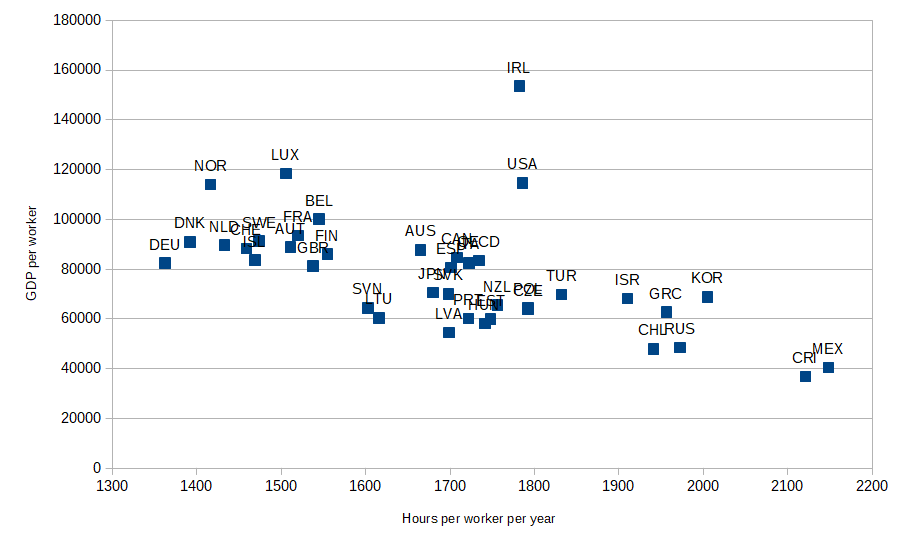
Well… not really. Take a look at this graph, which I compiled from OECD data:


Worker_productivity

The X-axis shows the average number of hours per worker per year. I think this is the best measure of a country’s “work obsession”, as it includes both length of work week, proportion of full-time work, and amount of vacation time. The At 1,786 hours per worker per year, the US is not actually the highest: That title goes to Mexico, at an astonishing 2,148 hours per worker per year. The lowest is Germany at only 1,363 hours per worker per year. Converted into standard 40-hour work weeks, this means that on average Americans work 44 weeks per year, Germans work on average 34 weeks per year, and Mexicans work 54 weeks per year—that is, they work more than full-time every week of the year.

The Y-axis shows GDP per worker per year. I calculated this by multiplying GDP per work hour (a standard measure of labor productivity) by average number of work hours per worker per year. At first glance, these figures may seem too large; for instance they are $114,000 in the US and $154,000 in Ireland. But keep in mind that this is per worker, not per person; the usual GDP per capita figure divides by everyone in the population, while this is only dividing by the number of people who are actively working. Unemployed people are not included, and neither are children or retired people.

There is an obvious negative trend line here. While Ireland is an outlier with exceptionally high labor productivity, the general pattern is clear: the countries with the most GDP per worker actually work the fewest hours. Once again #ScandinaviaIsBetter: Norway and Denmark are near the bottom for work hours and near the top for GDP per worker. The countries that work the most hours, like Mexico and Costa Rica, have the lowest GDP per worker.

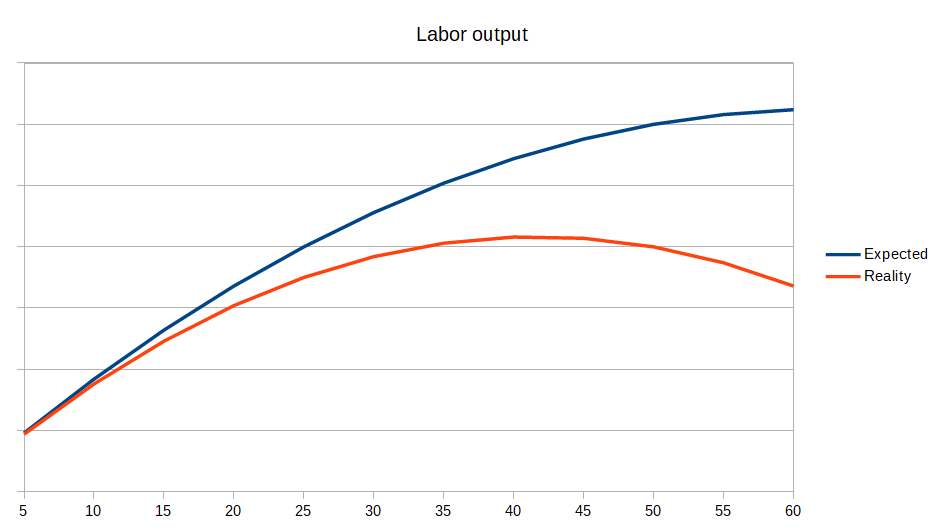
This is actually quite remarkable. We would expect that productivity per hour decreases as work hours increase; that’s not surprising at all. But productivity per worker decreasing means that these extra hours are actually resulting in less total output. We are so overworked, overstressed, and underslept that we actually produce less than our counterparts in Germany or Denmark who spend less time working.

Where we would expect the graph of output as a function of hours to look like the blue line below, it actually looks more like the orange line:

Labor_output

Rather than merely increasing at a decreasing rate, output per worker actually decreases as we put in more hours—and does so over most of the range in which countries actually work. It wouldn’t be so surprising if this sort of effect occurred above say 2000 hours per year, when you start running out of time to do anything else; but in fact it seems to be happening somewhere around 1400 hours per year, which is less than most countries work.

Only a handful of countries—mostly Scandinavian—actually seem to be working the right amount; everyone else is working too much and producing less as a result.

And note that this is not restricted to white-collar or creative jobs where we would expect sleep deprivation and stress to have a particularly high impact. This includes all jobs. Our obsession with work is actually making us poorer!

The “productivity paradox”


Dec 10, JDN 2458098

Take a look at this graph of manufacturing output per worker-hour:

Manufacturing_productivity

From 1988 to 2008, it was growing at a steady pace. In 2008 and 2009 it took a dip due to the Great Recession; no big surprise there. But then since 2012 it has been… completely flat. If we take this graph at face value, it would imply that manufacturing workers today can produce no more output than workers five years ago, and indeed only about 10% more than workers a decade ago. Whereas, a worker in 2008 was producing over 60% more than a worker in 1998, who was producing over 40% more than a worker in 1988.

Many economists call this the “productivity paradox”, and use it to argue that we don’t really need to worry about robots taking all our jobs any time soon. I think this view is mistaken.

The way we measure productivity is fundamentally wrongheaded, and is probably the sole cause of this “paradox”.

First of all, we use total hours scheduled to work, not total hours actually doing productive work. This is obviously much, much easier to measure, which is why we do it. But if you think for a moment about how the 40-hour workweek norm is going to clash with rapidly rising real productivity, it becomes apparent why this isn’t going to be a good measure.
When a worker finds a way to get done in 10 hours what used to take 40 hours, what does that worker’s boss do? Send them home after 10 hours because the job is done? Give them a bonus for their creativity? Hardly. That would be far too rational. They assign them more work, while paying them exactly the same. Recognizing this, what is such a worker to do? The obvious answer is to pretend to work the other 30 hours, while in fact doing something more pleasant than working.
And indeed, so-called “worker distraction” has been rapidly increasing. People are right to blame smartphones, I suppose, but not for the reasons they think. It’s not that smartphones are inherently distracting devices. It’s that smartphones are the cutting edge of a technological revolution that has made most of our work time unnecessary, so due to our fundamentally defective management norms they create overwhelming incentives to waste time at work to avoid getting drenched in extra tasks for no money.

That would probably be enough to explain the “paradox” by itself, but there is a deeper reason that in the long run is even stronger. It has to do with the way we measure “output”.

It might surprise you to learn that economists almost never consider output in terms of the actual number of cars produced, buildings constructed, songs written, or software packages developed. The standard measures of output are all in the form of so-called “real GDP”; that is, the dollar value of output produced.

They do adjust for indexes of inflation, but as I’ll show in a moment this still creates a fundamentally biased picture of the productivity dynamics.

Consider a world with only three industries: Housing, Food, and Music.

Productivity in Housing doesn’t change at all. Producing a house cost 10,000 worker-hours in 1950, and cost 10,000 worker-hours in 2000. Nominal price of houses has rapidly increased, from $10,000 in 1950 to $200,000 in 2000.

Productivity in Food rises moderately fast. Producing 1,000 meals cost 1,000 worker-hours in 1950, and cost 100 worker-hours in 2000. Nominal price of food has increased slowly, from $1,000 per 1,000 meals in 1950 to $5,000 per 1,000 meals in 2000.

Productivity in Music rises extremely fast. Producing 1,000 performances cost 10,000 worker-hours in 1950, and cost 1 worker-hour in 2000. Nominal price of music has collapsed, from $100,000 per 1,000 performances in 1950 to $1,000 per 1,000 performances in 2000.

This is of course an extremely stylized version of what has actually happened: Housing has gotten way more expensive, food has stayed about the same in price while farm employment has plummeted, and the rise of digital music has brought about a new Renaissance in actual music production and listening while revenue for the music industry has collapsed. There is a very nice Vox article on the “productivity paradox” showing a graph of how prices have changed in different industries.

How would productivity appear in the world I’ve just described, by standard measures? Well, to say that I actually need to say something about how consumers substitute across industries. But I think I’ll be forgiven in this case for saying that there is no substitution whatsoever; you can’t eat music or live in a burrito. There’s also a clear Maslow hierarchy here: They say that man cannot live by bread alone, but I think living by Led Zeppelin alone is even harder.

Consumers will therefore choose like this: Over 10 years, buy 1 house, 10,000 meals, and as many performances as you can afford after that. Further suppose that each person had $2,100 per year to spend in 1940-1950, and $50,000 per year to spend in 1990-2000. (This is approximately true for actual nominal US GDP per capita.)

1940-1950:
Total funds: $21,000

1 house = $10,000

10,000 meals = $10,000

Remaining funds: $1,000

Performances purchased: 10

1990-2000:

Total funds: $500,000

1 house = $200,000

10,000 meals = $50,000

Remaining funds: $250,000

Performances purchased: 250,000

(Do you really listen to this much music? 250,000 performances over 10 years is about 70 songs per day. If each song is 3 minutes, that’s only about 3.5 hours per day. If you listen to music while you work or watch a couple of movies with musical scores, yes, you really do listen to this much music! The unrealistic part is assuming that people in 1950 listen to so little, given that radio was already widespread. But if you think of music as standing in for all media, the general trend of being able to consume vastly more media in the digital age is clearly correct.)

Now consider how we would compute a price index for each time period. We would construct a basket of goods and determine the price of that basket in each time period, then adjust prices until that basket has a constant price.

Here, the basket would probably be what people bought in 1940-1950: 1 house, 10,000 meals, and 400 music performances.

In 1950, this basket cost $10,000+$10,000+$100 = $21,000.

In 2000, this basket cost $200,000+$50,000+$400 = $150,400.

This means that our inflation adjustment is $150,400/$21,000 = 7 to 1. This means that we would estimate the real per-capita GDP in 1950 at about $14,700. And indeed, that’s about the actual estimate of real per-capita GDP in 1950.

So, what would we say about productivity?

Sales of houses in 1950 were 1 per person, costing 10,000 worker hours.

Sales of food in 1950 were 10,000 per person, costing 10,000 worker hours.

Sales of music in 1950 were 400 per person, costing 4,000 worker hours.

Worker hours per person are therefore 24,000.

Sales of houses in 2000 were 1 per person, costing 10,000 worker hours.

Sales of food in 2000 were 10,000 per person, costing 1,000 worker hours.

Sales of music in 2000 were 250,000 per person, costing 25,000 worker hours.

Worker hours per person are therefore 36,000.

Therefore we would estimate that productivity rose from $14,700/24,000 = $0.61 per worker-hour to $50,000/36,000 = $1.40 per worker-hour. This is an annual growth rate of about 1.7%, which is again, pretty close to the actual estimate of productivity growth. For such a highly stylized model, my figures are doing remarkably well. (Honestly, better than I thought they would!)

But think about how much actual productivity rose, at least in the industries where it did.

We produce 10 times as much food per worker hour after 50 years, which is an annual growth rate of 4.7%, or three times the estimated growth rate.

We produce 10,000 times as much music per worker hour after 50 years, which is an annual growth rate of over 20%, or almost twelve times the estimated growth rate.

Moreover, should music producers be worried about losing their jobs to automation? Absolutely! People simply won’t be able to listen to much more music than they already are, so any continued increases in music productivity are going to make musicians lose jobs. And that was already allowing for music consumption to increase by a factor of over 600.

Of course, the real world has a lot more industries than this, and everything is a lot more complicated. We do actually substitute across some of those industries, unlike in this model.

But I hope I’ve gotten at least the basic point across that when things become drastically cheaper as technological progress often does, simply adjusting for inflation doesn’t do the job. One dollar of music today isn’t the same thing as one dollar of music a century ago, even if you inflation-adjust their dollars to match ours. We ought to be measuring in hours of music; an hour of music is much the same thing as an hour of music a century ago.

And likewise, that secretary/weather forecaster/news reporter/accountant/musician/filmmaker in your pocket that you call a “smartphone” really ought to be counted as more than just a simple inflation adjustment on its market price. The fact that it is mind-bogglingly cheaper to get these services than it used to be is the technological progress we care about; it’s not some statistical artifact to be removed by proper measurement.

Combine that with actually measuring the hours of real, productive work, and I think you’ll find that productivity is still rising quite rapidly, and that we should still be worried about what automation is going to do to our jobs.