I can’t not talk about tariffs right now

Apr 13 JDN 2460779

On the one hand, I’m sure every economics blog on the Internet is already talking about this, including Paul Krugman who knows the subject way better than I ever will (and literally won a Nobel Prize for his work on it). And I have other things I’d rather be writing about, like the Index of Necessary Expenditure. But on the other hand, when something this big happens in economics, it just feels like there’s really no alternative: I have to talk about tariffs right now.

What is a tariff, anyway?

This feels like a really basic question, but it also seems like a lot of people don’t really understand tariffs, or didn’t when they voted for Trump.

A tariff, quite simply, is an import tax. It’s a tax that you impose on imported goods (either a particular kind, or from a particular country, or just across the board). On paper, it is generally paid by the company importing the goods, but as I wrote about in my sequence on tax incidence, that doesn’t matter. What matters is how prices change in response to the tax, and this means that in real terms, prices will go up.

In fact, in some sense that’s the goal of a protectionist tariff, because you’re trying to fix the fact that local producers can’t compete on the global market. So you compensate by making international firms pay higher taxes, so that the local producers can charge higher prices and still compete. So anyone who is saying that tariffs won’t raise prices is either ignorant or lying: Raising prices is what tariffs do.

Why are people so surprised?

The thing that surprises me about all this, (a bit ironically) is how surprised people seem to be. Trump ran his whole campaign promising two things: Deport all the immigrants, and massive tariffs on all trade. Most of his messaging was bizarre and incoherent, but on those two topics he was very consistent. So why in the world are people—including stock traders, who are supposedly savvy on these things—so utterly shocked that he has actually done precisely what he promised he would do?

What did people think Trump meant when he said these things? Did they assume he was bluffing? Did they think cooler heads in his administration would prevail (if so, whose?)?

But I will admit that even I am surprised at just how big the tariffs are. I knew they would be big, but I did not expect them to be this big.

How big?

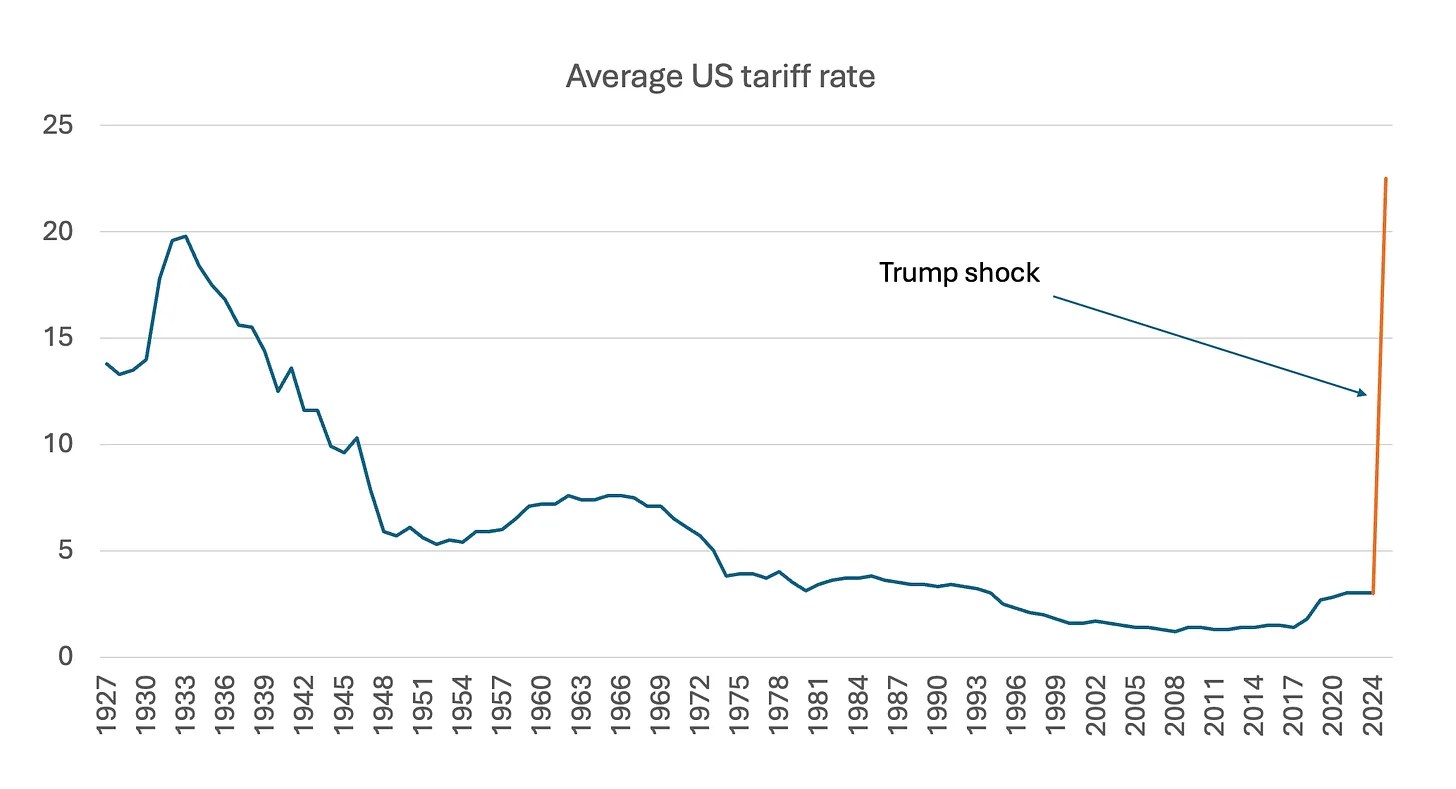
Well, take a look at this graph:

The average tariff rate on US imports will now be higher than it was at the peak in 1930 with the Smoot-Hawley Act. Moreover, Smoot-Hawley was passed during a time when protectionist tariffs were already in place, while Trump’s tariffs come at a time when tariffs had previously been near zero—so the change is dramatically more sudden.

This is worse than Smoot-Hawley.

For the uninitiated, Smoot-Hawley was a disaster. Several countries retaliated with their own tariffs, and the resulting trade war clearly exacerbated the Great Depression, not only in the US but around the world. World trade dropped by an astonishing 66% over the next few years. It’s still debated as to how much of the depression was caused by the tariffs; most economists believe that the gold standard was the bigger culprit. But it definitely made it worse.

Politically, the aftermath cost the Republicans (including Smoot and Hawley themselves) several seats in Congress. (I guess maybe the silver lining here is we can hope this will do the same?)

And I would now like to remind you that these tariffs are bigger than Smoot-Hawley’s and were implemented more suddenly.

Unlike in 1930, we are not currently in a depression—though nor is our economy as hunky-dory as a lot of pundits seem to think, once we consider things like the Index of Necessary Expenditure. But stock markets do seem to be crashing, and if trade drops as much as it did in the 1930s—and why wouldn’t it?—we may very well end up in another depression.

And it’s not as if we didn’t warn you all. Economists across the political spectrum have been speaking out against Trump’s tariffs from the beginning, and nobody listened to us.

So basically the mood of all economists right now is:

Wrongful beneficence

Jun 9 JDN 2460471

One of the best papers I’ve ever read—one that in fact was formative in making me want to be an economist—is Wrongful Beneficence by Chris Meyers.

This paper opened my eyes to a whole new class of unethical behavior: Acts that unambiguously make everyone better off, but nevertheless are morally wrong. Hence, wrongful beneficence.

A lot of economists don’t even seem to believe in such things. They seem convinced that as long as no one is made worse off by a transaction, that transaction must be ethically defensible.

Chris Meyers convinced me that they are wrong.

The key insight here is that it’s still possible to exploit someone even if you make them better off. This happens when they are in a desperate situation and you take advantage of that to get an unfair payoff.


Here one of the cases Meyers offers to demonstrate this:

Suppose Carole is driving across the desert on a desolate road when her car breaks down. After two days and two nights without seeing a single car pass by, she runs out of water and feels rather certain that she will perish if not rescued soon. Now suppose that Jason happens to drive down this road and finds Carole. He sees that her situation is rather desperate and that she needs (or strongly desires) to get to the nearest town as soon as possible. So Jason offers her a ride but only on the condition that […] [she gives him] her entire net worth, the title to her house and car, all of her money in the bank, and half of her earnings for the next ten years.

Carole obviously is better off than she would be if Jason hadn’t shown up—she might even have died. She freely consented to this transaction—again, because if she didn’t, she might die. Yet it seems absurd to say that Jason has done nothing wrong by making such an exorbitant demand. If he had asked her to pay for gas, or even to compensate him for his time at a reasonable rate, we’d have no objection. But to ask for her life savings, all her assets, and half her earnings for ten years? Obviously unfair—and obviously unethical. Jason is making Carole (a little) better off while making himself (a lot) better off, so everyone is benefited; but what he’s doing is obviously wrong.

Once you recognize that such behavior can exist, you start to see it all over the place, particularly in markets, where corporations are quite content to gouge their customers with high prices and exploit their workers with low wages—but still, technically, we’re better off than we would be with no products and no jobs at all.

Indeed, the central message of Wrongful Beneficence is actually about sweatshop labor: It’s not that the workers are worse off than they would have been (in general, they aren’t); it’s that they are so desperate that corporations can get away with exploiting them with obviously unfair wages and working conditions.

Maybe it would be easier just to move manufacturing back to First World countries?

Right-wingers are fond of making outlandish claims that making products at First World wages would be utterly infeasible; here’s one claiming that an iPhone would need to cost $30,000 if it were made in the US. In fact, the truth is that it would only need to cost about $40 more—because hardly any of its cost is actually going to labor. Most of its price is pure monopoly profit for Apple; most of the rest is components and raw materials. (Of course, if those also had to come from the US, the price would go up more; but even so, we’re talking something like double its original price, not thirty times. Workers in the US are indeed paid a lot more than workers in China; they are also more productive.)

It’s true that actually moving manufacturing from other countries back to the US would be a substantial undertaking, requiring retooling factories, retraining engineers, and so on; but it’s not like we’ve never done that sort of thing before. I’m sure it could not be done overnight; but of course it could be done. We do this sort of thing all the time.

Ironically, this sort of right-wing nonsense actually seems to feed the far left as well, supporting their conviction that all this prosperity around us is nothing more than an illusion, that all our wealth only exists because we steal it from others. But this could scarcely be further from the truth; our wealth comes from technology, not theft. If we offered a fairer bargain to poorer countries, we’d be a bit less rich, but they would be much less poor—the overall wealth in the world would in fact probably increase.

A better argument for not moving manufacturing back to the First World is that many Third World economies would collapse if they stopped manufacturing things for other countries, and that would be disastrous for millions of people.

And free trade really does increase efficiency and prosperity for all.

So, yes; let’s keep on manufacturing goods wherever it is cheapest to do so. But when we decide what’s cheapest, let’s evaluate that based on genuinely fair wages and working conditions, not the absolute cheapest that corporations think they can get away with.

Sometimes they may even decide that it’s not really cheaper to manufacture in poorer countries, because they need advanced technology and highly-skilled workers that are easier to come by in First World countries. In that case, bringing production back here is the right thing to do.

Of course, this raises the question:

What would be fair wages and working conditions?

That’s not so easy to answer. Since workers in Third World countries are less educated than workers in First World countries, and have access to less capital and worse technology, we should in fact expect them to be less productive and therefore get paid less. That may be unfair in some cosmic sense, but it’s not anyone’s fault, and it’s not any particular corporation’s responsibility to fix it.

But when there are products for which less than 1% of the sales price of the product goes to the workers who actually made the product, something is wrong. When the profit margin is often wildly larger than the total amount spent on labor, something is wrong.

It may be that we will never have precise thresholds we can set to decide what definitely is or is not exploitative; but that doesn’t mean we can’t ever recognize it when we see it. There are various institutional mechanisms we could use to enforce better wages and working conditions without ever making such a sharp threshold.

One of the simplest, in fact, is Fair Trade.

Fair Trade is by no means a flawless system; in fact there’s a lot of research debating how effective it is at achieving its goals. But it does seem to be accomplishing something. And it’s a system that we already have in place, operating successfully in many countries; it simply needs to be scaled up (and hopefully improved along the way).

One of the clearest pieces of evidence that it’s helping, in fact, is that farmers are willing to participate in it. That shows that it is beneficent.

Of course, that doesn’t mean that it’s genuinely fair! This could just be another kind of wrongful beneficence. Perhaps Fair Trade is really just less exploitative than all the available alternatives.

If so, then we need something even better still, some new system that will reliably pass on the increased cost for customers all the way down to increased wages for workers.

Fair Trade shows us something else, too: A lot of customers clearly are willing to pay a bit more in order to see workers treated better. Even if they weren’t, maybe they should be forced to. But the fact is, they are! Even those who are most adamantly opposed to Fair Trade can’t deny that people really are willing to pay more to help other people. (Yet another example of obvious altruism that neoclassical economists somehow manage to ignore.) They simply deny that it’s actually helping, which is an empirical matter.

But if this isn’t helping enough, fine; let’s find something else that does.

The inequality of factor mobility

Sep 24 JDN 2460212

I’ve written before about how free trade has brought great benefits, but also great costs. It occurred to me this week that there is a fairly simple reason why free trade has never been as good for the world as the models would suggest: Some factors of production are harder to move than others.

To some extent this is due to policy, especially immigration policy. But it isn’t just that.There are certain inherent limitations that render some kinds of inputs more mobile than others.

Broadly speaking, there are five kinds of inputs to production: Land, labor, capital, goods, and—oft forgotten—ideas.

You can of course parse them differently: Some would subdivide different types of labor or capital, and some things are hard to categorize this way. The same product, such as an oven or a car, can be a good or capital depending on how it’s used. (Or, consider livestock: is that labor, or capital? Or perhaps it’s a good? Oddly, it’s often discussed as land, which just seems absurd.) Maybe ideas can be considered a form of capital. There is a whole literature on human capital, which I increasingly find distasteful, because it seems to imply that economists couldn’t figure out how to value human beings except by treating them as a machine or a financial asset.

But this four-way categorization is particularly useful for what I want to talk about today. Because the rate at which those things move is very different.

Ideas move instantly. It takes literally milliseconds to transmit an idea anywhere in the world. This wasn’t always true; in ancient times ideas didn’t move much faster than people, and it wasn’t until the invention of the telegraph that their transit really became instantaneous. But it is certainly true now; once this post is published, it can be read in a hundred different countries in seconds.

Goods move in hours. Air shipping can take a product just about anywhere in less than a day. Sea shipping is a bit slower, but not radically so. It’s never been easier to move goods all around the world, and this has been the great success of free trade.

Capital moves in weeks. Here it might be useful to subdivide different types of capital: It’s surely faster to move an oven or even a car (the more good-ish sort of capital) than it is to move an entire factory (capital par excellence). But all in all, we can move stuff pretty fast these days. If you want to move your factory to China or Indonesia, you can probably get it done in a matter of weeks or at most months.

Labor moves in months. This one is a bit ironic, since it is surely easier to carry a single human person—or even a hundred human people—than all the equipment necessary to run an entire factory. But moving labor isn’t just a matter of physically carrying people from one place to another. It’s not like tourism, where you just pack and go. Moving labor requires uprooting people from where they used to live and letting them settle in a new place. It takes a surprisingly long time to establish yourself in a new environment—frankly even after two years in Edinburgh I’m not sure I quite managed it. And all the additional restrictions we’ve added involving border crossings and immigration laws and visas only make it that much slower.

Land moves never. This one seems perfectly obvious, but is also often neglected. You can’t pick up a mountain, a lake, a forest, or even a corn field and carry it across the border. (Yes, eventually plate tectonics will move our land around—but that’ll be millions of years.) Basically, land stays put—and so do all the natural environments and ecosystems on that land. Land isn’t as important for production as it once was; before industrialization, we were dependent on the land for almost everything. But we absolutely still are dependent on the land! If all the topsoil in the world suddenly disappeared, the economy wouldn’t simply collapse: the human race would face extinction. Moreover, a lot of fixed infrastructure, while technically capital, is no more mobile than land. We couldn’t much more easily move the Interstate Highway System to China than we could move Denali.

So far I have said nothing particularly novel. Yeah, clearly it’s much easier to move a mathematical theorem (if such a thing can even be said to “move”) than it is to move a factory, and much easier to move a factory than to move a forest. So what?

But now let’s consider the impact this has on free trade.

Ideas can move instantly, so free trade in ideas would allow all the world to instantaneously share all ideas. This isn’t quite what happens—but in the Internet age, we’re remarkably close to it. If anything, the world’s governments seem to be doing their best to stop this from happening: One of our most strictly-enforced trade agreements, the TRIPS Accord, is about stopping ideas from spreading too easily. And as far as I can tell, region-coding on media goes against everything free trade stands for, yet here we are. (Why, it’s almost as if these policies are more about corporate profits than they ever were about freedom!)

Goods and capital can move quickly. This is where we have really felt the biggest effects of free trade: Everything in the US says “made in China” because the capital is moved to China and then the goods are moved back to the US.

But it would honestly have made more sense to move all those workers instead. For all their obvious flaws, US institutions and US infrastructure are clearly superior to those in China. (Indeed, consider this: We may be so aware of the flaws because the US is especially transparent.) So, the most absolutely efficient way to produce all those goods would be to leave the factories in the US, and move the workers from China instead. If free trade were to achieve its greatest promises, this is the sort of thing we would be doing.


Of course that is not what we did. There are various reasons for this: A lot of the people in China would rather not have to leave. The Chinese government would not want them to leave. A lot of people in the US would not want them to come. The US government might not want them to come.

Most of these reasons are ultimately political: People don’t want to live around people who are from a different nation and culture. They don’t consider those people to be deserving of the same rights and status as those of their own country.

It may sound harsh to say it that way, but it’s clearly the truth. If the average American person valued a random Chinese person exactly the same as they valued a random other American person, our immigration policy would look radically different. US immigration is relatively permissive by world standards, and that is a great part of American success. Yet even here there is a very stark divide between the citizen and the immigrant.

There are morally and economically legitimate reasons to regulate immigration. There may even be morally and economically legitimate reasons to value those in your own nation above those in other nations (though I suspect they would not justify the degree that most people do). But the fact remains that in terms of pure efficiency, the best thing to do would obviously be to move all the people to the place where productivity is highest and do everything there.

But wouldn’t moving people there reduce the productivity? Yes. Somewhat. If you actually tried to concentrate the entire world’s population into the US, productivity in the US would surely go down. So, okay, fine; stop moving people to a more productive place when it has ceased to be more productive. What this should do is average out all the world’s labor productivity to the same level—but a much higher level than the current world average, and frankly probably quite close to its current maximum.

Once you consider that moving people and things does have real costs, maybe fully equaling productivity wouldn’t make sense. But it would be close. The differences in productivity across countries would be small.

They are not small.

Labor productivity worldwide varies tremendously. I don’t count Ireland, because that’s Leprechaun Economics (this is really US GDP with accounting tricks, not Irish GDP). So the prize for highest productivity goes to Norway, at $100 per worker hour (#ScandinaviaIsBetter). The US is doing the best among large countries, at an impressive $73 per hour. And at the very bottom of the list, we have places like Bangladesh at $4.79 per hour and Cambodia at $3.43 per hour. So, roughly speaking, there is about a 20-to-1 ratio between the most productive and least productive countries.

I could believe that it’s not worth it to move US production at $73 per hour to Norway to get it up to $100 per hour. (For one thing, where would we fit it all?) But I find it far more dubious that it wouldn’t make sense to move most of Cambodia’s labor to the US. (Even all 16 million people is less than what the US added between 2010 and 2020.) Even given the fact that these Cambodian workers are less healthy and less educated than American workers, they would almost certainly be more productive on the other side of the Pacific, quite likely ten times as productive as they are now. Yet we haven’t moved them, and have no plans to.

That leaves the question of whether we will move our capital to them. We have been doing so in China, and it worked (to a point). Before that, we did it in Korea and Japan, and it worked. Cambodia will probably come along sooner or later. For now, that seems to be the best we can do.

But I still can’t shake the thought that the world is leaving trillions of dollars on the table by refusing to move people. The inequality of factor mobility seems to be a big part of the world’s inequality, period.

Reversals in progress against poverty

Jan 16 JDN 2459606

I don’t need to tell you that the COVID pandemic has been very bad for the world. Yet perhaps the worst outcome of the pandemic is one that most people don’t recognize: It has reversed years of progress against global poverty.

Estimates of the number of people who will be thrown into extreme poverty as a result of the pandemic are consistently around 100 million, though some forecasts have predicted this will rise to 150 million, or, in the most pessimistic scenarios, even as high as 500 million.

Pre-COVID projections showed the global poverty rate falling steadily from 8.4% in 2019 to 6.3% by 2030. But COVID resulted in the first upward surge in global poverty in decades, and updated models now suggest that the global poverty rate in 2030 will be as high as 7.0%. That difference is 0.7% of a forecasted population of 8.5 billion—so that’s a difference of 59 million people.

This is a terrible reversal of fortune, and a global tragedy. Ten or perhaps even hundreds of millions of people will suffer the pain of poverty because of this global pandemic and the numerous missteps by many of the world’s governments—not least the United States—in response to it.

Yet it’s important to keep in mind that this is a short-term reversal in a long-term trend toward reduced poverty. Yes, the most optimistic predictions are turning out to be wrong—but the general pattern of dramatic reductions in global poverty over the late 20th and early 21st century are still holding up.

That post-COVID estimate of a global poverty rate of 7.0% needs to be compared against the fact that as recently as 1980 the global poverty rate at the same income level (adjust for inflation and purchasing power of course) income level was a whopping 44%.

This pattern makes me feel deeply ambivalent about the effects of globalization on inequality. While it now seems clear that globalization has exacerbated inequality within First World countries—and triggered a terrible backlash of right-wing populism as a result—it also seems clear that globalization was a major reason for the dramatic reductions in global poverty in the past few decades.

I think the best answer I’ve been able to come up with is that globalization is overall a good thing, and we must continue it—but we also need to be much more mindful of its costs, and we must make policy that mitigates those costs. Expanded trade has winners and losers, and we should be taxing the winners to compensate the losers. To make good economic policy, it simply isn’t enough to increase aggregate GDP; you actually have to make life better for everyone (or at least as many people as you can).

Unfortunately, knowing what policies to make is only half the battle. We must actually implement those policies, which means winning elections, which means restoring the public’s faith in the authority of economic experts.

Some of the people voting for Donald Trump were just what Hillary Clinton correctly (if tone-deafly) referred to as “deplorables“: racists, misogynists, xenophobes. But I think that many others weren’t voting for Trump but against Clinton; they weren’t embracing far-right populism but rather rejecting center-left technocratic globalization. They were tired of being told what to do by experts who didn’t seem to care about them or their interests.

And the thing is, they were right about that. Not about voting for Trump—that’s unforgivable—but about the fact that expert elites had been ignoring their interests and needed a wake-up call. There were a hundred better ways of making that wake-up call that didn’t involve putting a narcissistic, incompetent maniac in charge of the world’s largest economy, military and nuclear arsenal, and millions of people should be ashamed of themselves for not taking those better options. Yet the fact remains: The wake-up call was necessary, and we should be responding to it.

We expert elites (I think I can officially carry that card, now that I have a PhD and a faculty position at a leading research university) need to do a much better job of two things: First, articulating the case for our policy recommendations in a way that ordinary people can understand, so that they feel justified and not simply rammed down people’s throats; and second, recognizing the costs and downsides of these policies and taking action to mitigate them whenever possible.

For instance: Yes, we need to destroy all the coal jobs. They are killing workers and the planet. Coal companies need to be transitioned to new industries or else shut down. This is not optional. It must be done. But we also need to explain to those coal miners why it’s necessary to move on from coal to solar and nuclear, and we need to be implementing various policies to help those workers move on to better, safer jobs that pay as well and don’t involve filling their lungs with soot and the atmosphere with carbon dioxide. We need to articulate, emphasize—and loudly repeat—that this isn’t about hurting coal miners to help everyone else, but about helping everyone, coal miners included, and that if anyone gets hurt it will only be a handful of psychopathic billionaires who already have more money than any human being could possibly need or deserve.

Another example: We cannot stop trading with India and China. Hundreds of millions of innocent people would suddenly be thrown out of work and into poverty if we did. We need the products they make for us, and they need the money we pay for those products. But we must also acknowledge that trading with poor countries does put downward pressure on wages back home, and take action to help First World workers who are now forced to compete with global labor markets. Maybe this takes the form of better unemployment benefits, or job-matching programs, or government-sponsored job training. But we cannot simply shrug and let people lose their jobs and their homes because the factories they worked in were moved to China.

The economics of interstellar travel

Dec 19 JDN 2459568

Since these are rather dark times—the Omicron strain means that COVID is still very much with us, after nearly two years—I thought we could all use something a bit more light-hearted and optimistic.

In 1978 Paul Krugman wrote a paper entitled “The Theory of Interstellar Trade”, which has what is surely one of the greatest abstracts of all time:

This paper extends interplanetary trade theory to an interstellar setting. It is chiefly concerned with the following question: how should interest charges on goods in transit be computed when the goods travel at close to the speed of light? This is a problem because the time taken in transit will appear less to an observer travelling with the goods than to a stationary observer. A solution is derived from economic theory, and two useless but true theorems are proved.

The rest of the paper is equally delightful, and well worth a read. Of particular note are these two sentences, which should give you a feel: “The rest of the paper is, will be, or has been, depending on the reader’s inertial frame, divided into three sections.” and “This extension is left as an exercise for interested readers because the author does not understand general relativity, and therefore cannot do it himself.”

As someone with training in both economics and relativistic physics, I can tell you that Krugman’s analysis is entirely valid, given its assumptions. (Really, this is unsurprising: He’s a Nobel Laureate. One could imagine he got his physics wrong, but he didn’t—and of course he didn’t get his economics wrong.) But, like much high-falutin economic theory, it relies upon assumptions that are unlikely to be true.

Set aside the assumptions of perfect competition and unlimited arbitrage that yield Krugman’s key result of equalized interest rates. These are indeed implausible, but they’re also so standard in economics as to be pedestrian.

No, what really concerns me is this: Why bother with interstellar trade at all?

Don’t get me wrong: I’m all in favor of interstellar travel and interstellar colonization. I want humanity to expand and explore the galaxy (or rather, I want that to be done by whatever humanity becomes, likely some kind of cybernetically and biogenetically enhanced transhumans in endless varieties we can scarcely imagine). But once we’ve gone through all the effort to spread ourselves to distant stars, it’s not clear to me that we’d ever have much reason to trade across interstellar distances.

If we ever manage to invent efficient, reliable, affordable faster-than-light (FTL) travel ala Star Trek, sure. In that case, there’s no fundamental difference between interstellar trade and any other kind of trade. But that’s not what Krugman’s paper is about, as its key theorems are actually about interest rates and prices in different inertial reference frames, which is only relevant if you’re limited to relativistic—that is, slower-than-light—velocities.

Moreover, as far as we can tell, that’s impossible. Yes, there are still some vague slivers of hope left with the Alcubierre Drive, wormholes, etc.; but by far the most likely scenario is that FTL travel is simply impossible and always will be.

FTL communication is much more plausible, as it merely requires the exploitation of nonlocal quantum entanglement outside quantum equilibrium; if the Bohm Interpretation is correct (as I strongly believe it is), then this is a technological problem rather than a theoretical one. At best this might one day lead to some form of nonlocal teleportation—but definitely not FTL starships. Since our souls are made of software, sending information can, in principle, send a person; but we almost surely won’t be sending mass faster than light.

So let’s assume, as Krugman did, that we will be limited to travel close to, but less than, the speed of light. (I recently picked up a term for this from Ursula K. Le Guin: “NAFAL”, “nearly-as-fast-as-light”.)

This means that any transfer of material from one star system to another will take, at minimum, years. It could even be decades or centuries, depending on how close to the speed of light we are able to get.

Assuming we have abundant antimatter or some similarly extremely energy-dense propulsion, it would reasonable to expect that we could build interstellar spacecraft that would be capable of accelerating at approximately Earth gravity (i.e. 1 g) for several years at a time. This would be quite comfortable for the crew of the ship—it would just feel like standing on Earth. And it turns out that this is sufficient to attain velocities quite close to the speed of light over the distances to nearby stars.

I will spare you the complicated derivation, but there are well-known equations which allow us to convert from proper acceleration (the acceleration felt on a spacecraft, i.e. 1 g in this case) to maximum velocity and total travel time, and they imply that a vessel which was constantly accelerating at 1 g (speeding up for the first half, then slowing down for the second half) could reach most nearby stars within about 50 to 100 years Earth time, or as little as 10 to 20 years ship time.

With higher levels of acceleration, you can shorten the trip; but that would require designing ships (or engineering crews?) in such a way as to sustain these high levels of acceleration for years at a time. Humans can sustain 3 g’s for hours, but not for years.

Even with only 1-g acceleration, the fuel costs for such a trip are staggering: Even with antimatter fuel you need dozens or hundreds of times as much mass in fuel as you have in payload—and with anything less than antimatter it’s basically just not possible. Yet there is nothing in the laws of physics saying you can’t do it, and I believe that someday we will.

Yet I sincerely doubt we would want to make such trips often. It’s one thing to send occasional waves of colonists, perhaps one each generation. It’s quite another to establish real two-way trade in goods.

Imagine placing an order for something—anything—and not receiving it for another 50 years. Even if, as I hope and believe, our descendants have attained far longer lifespans than we have, asymptotically approaching immortality, it seems unlikely that they’d be willing to wait decades for their shipments to arrive. In the same amount of time you could establish an entire industry in your own star system, built from the ground up, fully scaled to service entire planets.

In order to justify such a transit, you need to be carrying something truly impossible to produce locally. And there just won’t be very many such things.

People, yes. Definitely in the first wave of colonization, but likely in later waves as well, people will want to move themselves and their families across star systems, and will be willing to wait (especially since the time they experience on the ship won’t be nearly as daunting).

And there will be knowledge and experiences that are unique to particular star systems—but we’ll be sending that by radio signal and it will only take as many years as there are light-years between us; or we may even manage to figure out FTL ansibles and send it even faster than that.

It’s difficult for me to imagine what sort of goods could ever be so precious, so irreplaceable, that it would actually make sense to trade them across an interstellar distance. All habitable planets are likely to be made of essentially the same elements, in approximately the same proportions; whatever you may want, it’s almost certainly going to be easier to get it locally than it would be to buy it from another star system.

This is also why I think alien invasion is unlikely: There’s nothing they would particularly want from us that they couldn’t get more easily. Their most likely reason for invading would be specifically to conquer and rule us.

Certainly if you want gold or neodymium or deuterium, it’ll be thousands of times easier to get it at home. But even if you want something hard to make, like antimatter, or something organic and unique, like oregano, building up the industry to manufacture a product or the agriculture to grow a living organism is almost certainly going to be faster and easier than buying it from another solar system.

This is why I believe that for the first generation of interstellar colonists, imports will be textbooks, blueprints, and schematics to help build, and films, games, and songs to stay entertained and tied to home; exports will consist of of scientific data about the new planet as well as artistic depictions of life on an alien world. For later generations, it won’t be so lopsided: The colonies will have new ideas in science and engineering as well as new art forms to share. Billions of people on Earth and thousands or millions on each colony world will await each new transmission of knowledge and art with bated breath.

Long-distance trade historically was mainly conducted via precious metals such as gold; but if interstellar travel is feasible, gold is going to be dirt cheap. Any civilization capable of even sending a small intrepid crew of colonists to Epsilon Eridani is going to consider mining asteroids an utterly trivial task.

Will such transactions involve money? Will we sell these ideas, or simply give them away? Unlike my previous post where I focused on the local economy, here I find myself agreeing with Star Trek: Money isn’t going to make sense for interstellar travel. Unless we have very fast communication, the time lag between paying money out and then seeing it circulate back will be so long that the money returned to you will be basically worthless. And that’s assuming you figure out a way to make transactions clear that doesn’t require real-time authentication—because you won’t have it.

Consider Epsilon Eridani, a plausible choice for one of the first star systems we will colonize. That’s 10.5 light-years away, so a round-trip signal will take 21 years. If inflation is a steady 2%, that means that $100 today will need to come back as $151 to have the same value by the time you hear back from your transaction. If you had the option to invest in a 5% bond instead, you’d have $279 by then. And this is a nearby star.

It would be much easier to simply trade data for data, maybe just gigabyte for gigabyte or maybe by some more sophisticated notion of relative prices. You don’t need to worry about what your dollar will be worth 20 years from now; you know how much effort went into designing that blueprint for an antimatter processor and you know how much you’ll appreciate seeing that VR documentary on the rings of Aegir. You may even have in mind how much it cost you to pay people to design prototypes and how much you can sell the documentary for; but those monetary transactions will be conducted within your own star system, independently of whatever monetary system prevails on other stars.

Indeed, it’s likely that we wouldn’t even bother trying to negotiate how much to send—because that itself would have such overhead and face the same time-lags—and would instead simply make a habit of sending everything we possibly can. Such interchanges could be managed by governments at each end, supported by public endowments. “This year’s content from Epsilon Eridani, brought to you by the Smithsonian Institution.”

We probably won’t ever have—or need, or want—huge freighter ships carrying containers of goods from star to star. But with any luck, we will one day have art and ideas from across the galaxy shared by all of the endless variety of beings humanity has become.
Realistic open borders

Sep 5 JDN 2459463

In an earlier post I lamented the tight restrictions on border crossings that prevail even between allied First World countries. (On a personal note, you’ll be happy to know that our visas have cleared and we are now moved into Edinburgh, cat and all, though we are still in temporary housing and our official biometric residence permits haven’t yet arrived.)

In this post I’d like to speculate on how we might get from our current regime to something more like open borders.

Obviously we can’t simply remove all border restrictions immediately. That would be a political non-starter, and even ethically or economically it wouldn’t make very much sense. There are sensible reasons behind some of our border regulations—just not most of them.

Instead we would want to remove a few restrictions at a time, starting with the most onerous or ridiculous ones.

High on my list in the UK in particular would be the requirement that pets must fly as cargo. I literally can’t think of a good reason for this; it seems practically designed to cost travelers more money and traumatize as many pets as possible. If it’s intended to support airlines somehow, please simply subsidize airlines. (But really, why are you doing that? You should be taxing airlines because of their high carbon emissions. Subsidize boats and trains.) If it’s intended to somehow prevent the spread of rabies, it’s obviously unnecessary, since every pet moved to the UK already has to document a recent rabies vaccine. But this particular rule seems to be a quirk of the UK in particular, hence not very generalizable.

But here’s one that actually seems quite common: Financial requirements for visas. Even tourist visas in most countries cost money, in amounts that seem to vary according to some sort of occult ritual. I can see no sensible economic reason why a visa would be $130 in Vietnam but only $20 in neighboring Cambodia, or why Kazakhstan can be visited for $25 but Azerbaijan costs $100, or why Myanmar costs only $30 but Bhutan will run you over $200.

Work visas are considerably more demanding still.

Financial requirements in the UK are especially onerous; you have to make above a certain salary and have a certain amount of savings in the bank, based on your family size. This was no problem for me personally, but it damn well shouldn’t be; I have a PhD in economics. My salary is now twice what it was as a grad student, and honestly that’s a good deal less than I was hoping for (and would have gotten on the tenure track at an R1 university).

All the countries in the Schengen Area have their own requirements for “financial subsistence” for visa applications, ranging from a trivial €3 in Hungary (not per day, just total; why do they even bother?) or manageable €14 per day in Latvia, through the more demanding amounts of €45 per day in Germany and Italy, to €92 per day in Switzerland and Liechtenstein, all the way up to the utterly unreasonable €120 per day in France. That would be €43,800 per year, or $51,700. Apparently you must be at least middle class to enter France.

Canada has a similar requirement known as “proof of funds”, but it’s considerably more reasonable, since you can substitute proof of employment and there are no wage minimums for such employment. Even if you don’t already have a job you can still apply and the minimum requirement is actually lower than the poverty line in Canada.

The United States doesn’t require financial requirements for most visas, but it does have a $160 visa fee. And the H1-B visa in particular (the nearest equivalent to the Skilled Worker visa I’ve got in the UK) requires that your wage or salary be at least the “prevailing wage” in your industry—meaning it is nearly impossible for a company to save money by hiring people on H1-B visas and hence they have very little incentive to hire H1-B workers. If you are of above-average talent and being paid only average wages, I guess they can save some money that way. But this is not how trade is supposed to work—nobody requires that you pay US prices for goods shipped from China, and if they did, nobody would ever buy anything from China. This is blatant, naked protectionism—but we’re apparently okay with it as long as it’s trade in labor instead of goods.

I wasn’t able to quickly find whether there are similar financial requirements in other countries. Perhaps there aren’t; these are the countries most people actually want to move to anyway. Permanent migration is overwhelminginly toward OECD (read: First World) countries, and is actually helping us sustain our populations in the face of low birth rates.

I must admit, I can see some fiscal benefits for a country not allowing poor people in, but this practice raises some very deep ethical problems: What right do we have to do this?

If someone is born poor in Laredo, Texas, we take responsibility for them as a US citizen. Maybe we don’t treat them particularly well (that is Texas, after all), but we do give them access to certain basic services, such as emergency services, Medicaid, TANF and SNAP. They are allowed to vote, own property, and even hold office in the United States. But if that same person were born in Nuevo Laredo, Tamaulipas—literally less than a mile away, right across the river—they would receive none of these benefits. They would not even be allowed to cross the river without a passport and a visa.

In some ways the contrast is even more dire if we consider a more liberal US state. A poor person born in Chula Vista, California has access to the full array of California services; Medi-Cal is honestly something close to a single-payer healthcare system, though the full morass of privatized US healthcare is layered on top of us. Then there is CalWORKS, CalFresh, and so on. But the same person born in Tijuana, Baja California would get none of these benefits.

They could be the same person. They could look the same and have essentially the same culture—even the same language, given how many Californians speak Spanish and how many Mexicans speak English. But if they were born on the other side of a river (in Texas) or even an arbitrary line (in California), we treat them completely differently. And then to add insult to injury, we won’t even let them across, not in spite, but because of how poor and desperate they are. If they were rich and educated, we’d let them come across—but then why would they need to?

“Give me your tired, your poor, your huddled masses yearning to breathe free”?

Some restrictions may apply.

Economists talk often of “trade barriers”, but in real terms we have basically removed all trade barriers in goods. Yes, there are still some small tariffs, and the occasional quota here and there—and these should go away too, especially the quotas, because they don’t even raise revenue—but in general we have an extremely globalized economy in terms of goods. The same complex product, like a car or a smartphone, is often made of parts from a dozen countries.

But when it comes to labor, we are still living in a protectionist world. Crossing borders to work is difficult, time-consuming, and above all, expensive. This dramatically reduces opportunities for workers to move where their labor is most valued—which hurts not only them, but also anyone who would employ them or buy products made by them. The poorest people are those who stand to gain the most from crossing borders, and they are precisely the ones that we work hardest to forbid.

So let’s start with that, shall we? We can keep all this nonsense about passports, visas, background checks, and customs inspections. It’s probably all unnecessary and wasteful and unfair, but politically it’s clearly too popular to remove. Let’s just remove this: No more financial requirements or fees for work visas. If you want to come to another country to work, you have to go through an application and all that; fine. But you shouldn’t have to prove you aren’t poor. Poor people have just as much right to live here as anybody else—and if we let them do so, they’d be a lot less poor.

Why are borders so strict?

Aug 15 JDN 2459442

Most of us don’t cross borders all that often, and when we do it’s generally only for brief visits; so we don’t often experience just how absurdly difficult it is to move to another country. I have received a crash course in the subject for the past couple of months, in trying to arrange my move to Edinburgh.

Certain portions of the move would be inherently difficult: Moving a literal ton of stuff across an entire ocean is no mean feat, and really the impressive thing is that our civilization has reached the point where we can do it so quickly and reliably. (I do mean a literal ton: We estimated we have about 350 cubic feet and 2300 pounds of items, or 10 cubic meters and 1040 kilograms.)

But most of the real headaches have been the results of institutional policies.

First of all, there’s the fact that the university gave me so little notice. This is not entirely their fault; my understanding is that the position opened up during the spring, and they scrambled to fill it as fast as they could for the fall. Still, this has made everything that much more difficult.

More importantly, there is the matter of moving across borders.

In order to get visas to live in the UK, my fiance and I had to complete an application documenting basically our whole lives (I had to track down three parking tickets and a speeding ticket from as far back as 2011), maintain bank balances of a sufficient amount for at least 30 days (evidently poor people need not apply), and pay exorbitant fees (over $5000 in all for the two of us, which, gratefully, the university is supposed to reimburse me for). We had to upload not only our passports, but also financial documents as well as housing records to prove our relationship (in lieu of a marriage license, since we had to delay the wedding to this year due to the pandemic). But this was not enough; we had to pay even more fees to get expedited processing, and then travel to a US government office in the LA area to get our fingerprints done, and then mail our passports to another office in New York for further processing. We started this process the first week of August; we still haven’t heard back on our final approval.

Then there is the matter of moving our cat, Tootsie. UK regulations for importing a cat require an ISO-compliant microchip and certain vaccinations; this is perfectly reasonable. But they also require that you bring the cat with you when you move (within at most 5 days of your arrival), or else the cat will be legally considered livestock and subject to a tariff of over $1000.

This would be inconvenient enough, but then there is the fact that current regulations do not allow cats to be transported into the UK in the cabin of an aircraft. If they are to be flown in, they must be brought in the cargo hold. Since we did not want to subject our cat to several hours alone in a cargo hold on a transatlantic flight, we will instead be flying to Amsterdam, because the Netherlands has more lenient regulations. But then of course we still need to get her to Edinburgh; our current plan involves taking a ferry from Amsterdam to Newcastle and then a train from there to Edinburgh. In all the whole process will take at least a day longer (and cost a few hundred dollars more) than it would have without the utterly pointless rule forbidding cats from flying into the UK in the cabin.

All of this for, and I really cannot emphasize this enough, a routine move between two NATO allied First World countries.

The alliance between the US and the UK is one of the most tightly-knit in the world, and dates back generations. Our trade networks are thoroughly interconnected, and we even share most of our media and culture back and forth. There’s honestly no particular reason we couldn’t simply be the same country. (Indeed the one thing we did fight with them about in the last 250 years was over precisely that.)

There is probably less difference culturally and economically between New York and London than there is between New York and rural Texas or between London and rural Scotland. Yet a move within each country requires basically none of this extra hassle and paperwork—you basically just physically move yourself, register your car, maybe a few other minor things. You certainly don’t need to get a passport, apply for a visa, or pay exorbitant fees.

What purpose does all of this extra regulation serve? Are we safer, or richer, or healthier, because we make it so difficult to move across borders?

I can understand the need to hve some sort of security at border crossings: We want to make sure people aren’t smuggling contraband or planning acts of terrorism. (There is, by the way, a series of questions on the UK visa application asking things like this:”Have you ever committed terrorism?” “Have you ever been implicated in genocide?” One wonders if anyone has ever answered “yes”.) It even makes sense to have some kind of registration process and background check for people who plan to move permanently. But what we actually do goes far, far beyond these sensible requirements; the goal seems to be to ensure that only the finest upstanding citizens may be allowed to move to a country, while anyone who is born on the opposite side of that line need not meet any standard whatsoever in order to remain.

In my view, the most sensible standard would be this: You should only exclude someone from entering your country for actions that you’d be willing to imprison them for if they were already there. Clearly, smuggling and terrorism qualify. Indeed, any felony would do. But would you lock someone in prison for not having enough money in their bank account? Or for failing to disclose a parking ticket from ten years ago? Or for filling out paperwork incorrectly? Yet visas are denied for this sort of reason all the time.

I think most economists would agree with me: The free movement of people across borders is one of the most vital principles of free trade—and the one that the world has least lived up to so far.

Yet it seems we are in the minority. Most people seem to think it’s perfectly sensible to have completely different rules for moving from Detroit to Toledo than from Detroit to Windsor.

The reason for this is apparent enough: Once again, the tribal paradigm looms large. Human beings divide themselves into groups, and form their identities around those groups. Those inside the group are good, while those outside are bad. Actions which benefit our own group are right, while actions which benefit other groups are wrong. The group you belong to is an inherent part of who you are, and can never be changed.

We have defined these groups in many different ways throughout human history, and our scale of group identification has gradually expanded over time. First, it was families and tribes. For centuries, it was feudal kingdoms. Now, it is nation-states. Perhaps, someday, it will enlarge to encompass all of humanity.

But until that day comes, people are going to make it as hard as possible to cross from one group to another.

The Race to the Bottom is not inevitable

Jul 19 JDN 2459050

The race to the bottom is a common result of competition, between firms, between states, or even between countries. One firm finds a way to cut corners and reduce costs, then lowers their price to undercut others; then soon every firm is cutting those same corners. Or one country decides to weaken their regulations in order to attraction more business; then soon every other country has to weaken their regulations as well.

Let’s first consider individual firms. Suppose that you run a business, and you are an upstanding, ethical person. You want to treat your employees, your customers, and your community well. You have high labor standards, you exceed the requirements of environmental regulations, and you make a high-quality product at a reasonable price for a moderate profit.

Then, a competitor appears. The owner of this company is not so ethical. They exploit their workers, perhaps even stealing their wages. They flaunt environmental regulations. They make shoddy products. All of this allows them to make their products for a lower price than yours.

Suppose that most customers can’t tell the difference between your product and theirs. What will happen? They will stop buying yours, because it’s more expensive. What do you do then?

You could simply go out of business. But that doesn’t really solve anything. Probably you’ll be forced to lower your standards. You’ll treat your workers worse, pollute more, reduce product quality. You may not do so as much as the other company, but you’ll have to do it some in order to get the price down low enough to still compete. And your profits will be lower than theirs as a result.

Far better would be for the government to step in and punish that other business for breaking the rules—or if what they’re doing is technically legal, change the rules so that it’s not anymore. Then you could continue to produce high-quality products with fair labor standards and good environmental sustainability.

But there are some problems with this. First, consider this from the point of view of a regulator, who is being lobbied by both companies. Your company asks for higher standards to improve product quality while protecting workers and the environment. But theirs claims that these higher standards will push them out of business. Who will they believe?

In fact, it may be worse than that: Suppose we’ve already settled into an equilibrium where all the firms have low standards. In that case, all the lobbyists will be saying that regulations need to be kept weak, lest the whole industry fail.

But in fact there’s no reason to think that stricter regulations would actually destroy the whole industry. Firm owners are used to thinking in terms of fixed competitors: They act in response to what competitors do. And in many cases it’s actually true that if just one firm tried to raise their standards, they would be outcompeted and go out of business. This does not mean that if all firms were forced to raise their standards, the industry would collapse. In fact, it’s much more likely that stricter regulations would only moderately reduce output and profits, if imposed consistently across the whole industry.

To see why, let’s consider a very simple model, a Bertrand competition game. There are two firms, A and B. Each can either use process H, producing a product of high quality with high labor standards and good sustainability, or use process L, producing a product of low quality with low labor standards and poor sustainability. Process H costs $100 per unit, process L costs $50 per unit. Customers can’t tell the difference, so they will buy whichever product is offered at the lowest price. Let’s say you are in charge of firm A. You choose which process to use, and set your price. At the same time, firm B chooses a process and sets their price.

Suppose choose to use process H. The lowest possible price you could charge to still make a profit would be a price of $101 (ignoring cents; let’s say customers also ignore them, which might be true!).

But firm B could choose process L, and then set a price of $100. They can charge just one dollar less than you charge for their product, but their cost is only $50, so now they are making a large profit—and you get nothing.

So you are forced to lower your standards, in order to match their price. You could try to undercut them at a price of $100, but in the long run that’s a bad idea, since eventually you’ll both be driven to charging a price of 51 and making only a very small profit. And there’s a way to stop them from undercutting you, which is to offer a price-matching guarantee; you can tell your customers that if they see a lower price from firm B than what you’re offering, you’ll match it for them. Then firm B has no incentive to try to undercut you, and you can maintain a stable equilibrium at a price of $100. You have been forced to used process L even though you know it is worse, because any attempt to unilaterally deviate from that industry norm would result in your company going bankrupt.

But now suppose the government comes in and mandates that all firms use process H, and they really enforce this rule so that no firm wants to try to break it. Then you’d want to raise the price, but you wouldn’t necessarily have to raise it all that much. Even $101 would be enough to ensure some profit, and you could even maintain your current profits by raising the price up to $150. In reality the result would probably be somewhere in between those two, depending on the elasticity of demand; so perhaps you end up charging $125 and make half the profit you did before.

Even though the new regulation raised costs all the way up to the current price, they did not result in collapsing the industry; because the rule was enforced uniformly, all firms were able to raise their standards and also raise their prices. This is what we should typically expect to happen; so any time someone claims that a new regulation will “destroy the industry” we should be very skeptical of that claim. (It’s not impossible; for instance, a regulation mandating that all fast food workers be paid $200 per hour would surely collapse the fast food industry. But it’s very unlikely that anyone would seriously propose a regulation like that.)

So as long as you have a strong government in place, you can escape the race to the bottom. But then we must consider international competition: What if other countries have weaker regulations, and so firms want to move their production to those other countries?

Well, a small country may actually be forced to lower their standards in order to compete. I’m not sure there’s much that Taiwan or Singapore could do to enforce higher labor standards. If Taiwan decided to tighten all their labor regulations, firms might just move their production to Indonesia or Vietnam. Then again, monthly incomes in Taiwan, once adjusted for currency exchange rates, are considerably higher than those in Vietnam. Indeed, wages in Taiwan aren’t much lower than wages in the US. So apparently Taiwan has some power to control their own labor standards—perhaps due to their highly educated population and strong industrial infrastructure.

However, a large country like the US or China absolutely has more power than that. If the US wants to enforce stricter labor standards, they can simply impose tariffs on countries that don’t. Actually there are many free-trade rules in place precisely to reduce that power, because it can be easily abused in the service of protectionism.

Perhaps these rules go too far; while I agree with the concern about protectionism, I definitely think we should be doing more to enforce penalties for forced labor, for instance. But this is not the result of too little international governance—if anything it is the result of too much. Our free trade agreements are astonishingly binding, even on the most powerful countries (China has successfully sued the United States under WTO rules!). I wish only that our human rights charters were anywhere near as well enforced.

This means that the race to the bottom is not the inevitable result of competition between firms or even between countries. When it occurs, it is the result of particular policy regimes nationally or internationally. We can make better rules.

The first step may be to stop listening to the people who say that any change will “destroy the industry” because they are unable (or unwilling?) to understand how uniformly-imposed rules differ from unilateral deviations from industry norms.

Fighting the zero-sum paradigm

Dec 2 JDN 2458455

It should be obvious at this point that there are deep, perhaps even fundamental, divides between the attitudes and beliefs of different political factions. It can be very difficult to even understand, much less sympathize, with the concerns of people who are racist, misogynistic, homophobic, xenophobic, and authoritarian.
But at the end of the day we still have to live in the same country as these people, so we’d better try to understand how they think. And maybe, just maybe, that understanding will help us to change them.

There is one fundamental belief system that I believe underlies almost all forms of extremism. Right now right-wing extremism is the major threat to global democracy, but left-wing extremism subscribes to the same core paradigm (consistent with Horseshoe Theory).

I think the best term for this is the zero-sum paradigm. The idea is quite simple: There is a certain amount of valuable “stuff” (money, goods, land, status, happiness) in the world, and the only political question is who gets how much.

Thus, any improvement in anyone’s life must, necessarily, come at someone else’s expense. If I become richer, you become poorer. If I become stronger, you become weaker. Any improvement in my standard of living is a threat to your status.

If this belief were true, it would justify, or at least rationalize, all sorts of destructive behavior: Any harm I can inflict upon someone else will yield a benefit for me, by some fundamental conservation law of the universe.

Viewed in this light, beliefs like patriarchy and White supremacy suddenly become much more comprehensible: Why would you want to spend so much effort hurting women and Black people? Because, by the fundamental law of zero-sum, any harm to women is a benefit to men, and any harm to Black people is a benefit to White people. The world is made of “teams”, and you are fighting for your own against all the others.

And I can even see why such an attitude is seductive: It’s simple and easy to understand. And there are many circumstances where it can be approximately true.
When you are bargaining with your boss over a wage, one dollar more for you is one dollar less for your boss.
When your factory outsources production to China, one more job for China is one less job for you.

When we vote for President, one more vote for the Democrats is one less vote for the Republicans.

But of course the world is not actually zero-sum. Both you and your boss would be worse off if your job were to disappear; they need your work and you need their money. For every job that is outsourced to China, another job is created in the United States. And democracy itself is such a profound public good that it basically overwhelms all others.

In fact, it is precisely when a system is running well that the zero-sum paradigm becomes closest to true. In the space of all possible allocations, it is the efficient ones that behave in something like a zero-sum way, because when the system is efficient, we are already producing as much as we can.

This may be part of why populist extremism always seems to assert itself during periods of global prosperity, as in the 1920s and today: It is precisely when the world is running at its full capacity that it feels most like someone else’s gain must come at your loss.

Yet if we live according to the zero-sum paradigm, we will rapidly destroy the prosperity that made that paradigm seem plausible. A trade war between the US and China would put millions out of work in both countries. A real war with conventional weapons would kill millions. A nuclear war would kill billions.

This is what we must convey: We must show people just how good things are right now.

This is not an easy task; when people want to believe the world is falling apart, they can very easily find excuses to do so. You can point to the statistics showing a global decline in homicide, but one dramatic shooting on the TV news will wipe that all away. You can show the worldwide rise in real incomes across the board, but that won’t console someone who just lost their job and blames outsourcing or immigrants.

Indeed, many people will be offended by the attempt—the mere suggestion that the world is actually in very good shape and overall getting better will be perceived as an attempt to deny or dismiss the problems and injustices that still exist.

I encounter this especially from the left: Simply pointing out the objective fact that the wealth gap between White and Black households is slowly closing is often taken as a claim that racism no longer exists or doesn’t matter. Congratulating the meteoric rise in women’s empowerment around the world is often paradoxically viewed as dismissing feminism instead of lauding it.

I think the best case against progress can be made with regard to global climate change: Carbon emissions are not falling nearly fast enough, and the world is getting closer to the brink of truly catastrophic ecological damage. Yet even here the zero-sum paradigm is clearly holding us back; workers in fossil-fuel industries think that the only way to reduce carbon emissions is to make their families suffer, but that’s simply not true. We can make them better off too.

Talking about injustice feels righteous. Talking about progress doesn’t. Yet I think what the world needs most right now—the one thing that might actually pull us back from the brink of fascism or even war—is people talking about progress.

If people think that the world is full of failure and suffering and injustice, they will want to tear down the whole system and start over with something else. In a world that is largely democratic, that very likely means switching to authoritarianism. If people think that this is as bad as it gets, they will be willing to accept or even instigate violence in order to change to almost anything else.

But if people realize that in fact the world is full of success and prosperity and progress, that things are right now quite literally better in almost every way for almost every person in almost every country than they were a hundred—or even fifty—years ago, they will not be so eager to tear the system down and start anew. Centrism is often mocked (partly because it is confused with false equivalence), but in a world where life is improving this quickly for this many people, “stay the course” sounds awfully attractive to me.
That doesn’t mean we should ignore the real problems and injustices that still exist, of course. There is still a great deal of progress left to be made.  But I believe we are more likely to make progress if we acknowledge and seek to continue the progress we have already made, than if we allow ourselves to fall into despair as if that progress did not exist.

Most trade barriers are not tariffs

Jul 8 JDN 2458309

When we talk about “protectionism” or “trade barriers”, what usually comes to mind is tariffs: taxes imposed on imports or exports. But especially now that international trade organizations have successfully reduced tariffs around the world, most trade barriers are not of this form at all.

Especially in highly-developed countries, but really almost everywhere, the most common trade barriers are what is simply but inelegantly called non-tariff barriers to trade: this includes licenses, quotas, subsidies, bailout guarantees, labeling requirements, and even some environmental regulations.

Non-tariff barriers are much more complicated to deal with, for at least three reasons.

First, with the exception of quotas and subsidies, non-tariff barriers are not easily quantifiable. We can easily put a number on the value of a tariff (though its impact is somewhat subtler than that), but this is not so easy for the effect of a bailout guarantee or a labeling requirement.

Second, non-tariff barriers are often much harder to detect. It’s obvious enough that imposing a tax on imported steel will reduce our imports of steel; but it requires a deeper understanding of the trade system to understand why bailing out domestic banks would distort financial flows, interest rates and exchange rates (even though the impact of this may actually be larger—the effect on global trade of US bank bailouts was between $35 billion and $110 billion).

Third, some trade barriers are either justifiable or simply inevitable. Simply having customs screening at the border is a non-tariff barrier, but it is widely regarded as a justifiable security measure (and I agree, by the way, even though I am generally in favor of much more open borders). Requiring strict labor and environmental standards on the production of products both domestic and imported is highly beneficial, but also imposes a trade barrier. In a broader sense, differences in language and culture could even be regarded as trade barriers (they certainly increase the real cost of trade), but it’s not clear that we could eliminate such things even if we wanted to.

This requires us to look very closely at almost every major government policy, to see how it might be distorting world trade. Some policies won’t meaningfully distort trade at all; these are not trade barriers. Others will distort trade, but are beneficial enough in other ways that they are still worth it; these are justifiable trade barriers. Still others will distort trade so much that they cannot be justified despite their other benefits. Finally, some policies will be put in place more or less explicitly to distort trade, usually in the form of protectionism to prop up domestic industries.

Protectionist policies are of course the first things to get rid of. Honestly, it baffles me that people even want to impose them in the first place. For some reason they think of exports as the benefit and imports as the cost, when it’s really the other way around; when we impose protectionism, we go out of our way to make it harder to get cars and iPhones so that we can stop other countries from taking our green paper. This seems to be tied to the fact that people think of jobs as something desirable, when really it’s wealth that’s desirable, and jobs are just one way of getting wealth—in some sense the most expensive way. Our macroeconomic policy obsesses over inflation, which is almost literally meaningless (as long as it is not too unpredictable, really nothing would change if inflation were raised from 2% to 4% or even 10%) and unemployment, which is at best an imperfect indicator of what we really should care about, namely the welfare of our people. A world of full employment with poverty wages is much worse than a world of high unemployment where a basic income provides for everyone’s needs. It is true that in our current system, unemployment is closely tied to a lot of very bad outcomes—but I maintain that this is largely because unemployment entails losing your income and your healthcare.

Some regulations that appear benign may actually be harmful because of their effects on trade. Yet I should also point out that it’s possible to go too far the other direction, and start tearing down all regulations in the name of reducing trade barriers. We particularly seem to do this in the financial industry, where “deregulation” seems to be on everyone’s lips until it causes a crisis, then we impose some regulations that fix the worst problems, things look good for awhile—and then we go back around and everyone starts talking about “deregulation” again. Meanwhile, the same people who talk about “freedom” as an excuse for removing financial safeguards are the ones who lock up children at the border. I think this is something that needs to be reframed: Which regulations are you removing? Just what, exactly, are you making legal that wasn’t before? Legalizing murder would be “deregulation”.

Trade policy, therefore, is a very delicate balance, between removing distortions and protecting legitimate public interests, between the needs of your own country and the world as a whole. This is why we need this whole apparatus of international trade institutions; it’s not a simple matter.

But I will say this: It would probably help if people educated themselves a bit more about how trade actually works before voting in politicians who promise to “save their jobs” from foreign competition.