Why does everyone work full-time?

Jun 30 JDN 2460492

Over 70% of US workers work “full-time”, that is, at least 40 hours a week. The average number of hours worked per week is 33.8, and the average number of overtime hours is only 3.6. So basically, about 2/3 of workers work almost exactly 40 hours per week.

We’re accustomed to this situation, so it may not seem strange to you. But stop and think for a moment: What are the odds that across every industry, exactly 40 hours per week is the most efficient arrangement?

Indeed, there is mounting evidence that in many industries, 40 hours is too much, and something like 5 or even 30 would actually be more efficient. Yet we continue to work 40-hour weeks.

This looks like a corner solution: Rather than choosing an optimal amount, we’re all up against some kind of constraint.


What’s the constraint? Well, the government requires (for most workers) that anything above 40 hours per week must be paid as overtime, that is, at a higher wage rate. So it looks like we would all be working more than 40 hours per week, but we hit the upper limit due to these regulations.

Does this mean we would be better off without the regulations? Clearly not. As I just pointed out, the evidence is mounting that 40 hours is too much, not too little. But why, then, would we all be trying to work so many hours?

I believe this is yet another example of hyper-competition, where competition drives us to an inefficient outcome.

Employers value employees who work a lot of hours. Indeed, I contend that they do so far more than makes any rational sense; they seem to care more about how many hours you work than about the actual quality or quantity of your output. Maybe this is because hours worked is easier to measure, or because it seems like a fairer estimate of your effort; but for whatever reason, employers really seem to reward employees who work a lot of hours, regardless of almost everything else.

In the absence of a limit on hours worked, then, employers are going to heap rewards on whoever works the most hours, and so people will be pressured to work more and more hours. Then we would all work ourselves to death, and it’s not even clear that this would be good for GDP.

Indeed, this seems to be what happened, before the 40-hour work week became the standard. In the 1800s, the average American worked over 60 hours per week. It wasn’t until the 1940s that 40-hour weeks became the norm.

But speaking of norms, that also seems to be a big factor here. The truth is, overtime isn’t really that expensive, and employers could be smarter about rewarding good work rather than more hours. But once a norm establishes itself in a society, it can be very hard to change. And right now, the norm is that 40 hours is a “normal” “standard” “full” work week—any more is above and beyond, and any less is inferior.

This is a problem, because a lot of people can’t work 40-hour weeks. Our standard for what makes someone “disabled” isn’t that you can’t work at all; it’s that you can’t work as much as society expects. I wonder how many people are currently living on disability who could have been working part-time, but there just weren’t enough part-time jobs available. The employment rate among people with a disability is only 41%, compared to 77% of the general population.

And it’s not that we need to work this much. Our productivity is now staggeringly high: We produce more than five times as much wealth per hour of work than we did as recently as the 1940s. So in theory, we should be able to live just as well while working one-fifth as much… but that’s clearly not what happened.

Keynes accurately predicted our high level of productivity; but he wrongly predicted that we would work less, when instead we just kept right on working almost as hard as before.

Indeed, it doesn’t even seem like we live five times as well while working just as much. Many things are better now—healthcare, entertainment, and of course electronics—but somehow, we really don’t feel like we are living better lives than our ancestors.

The Economic Policy Institute offers an explanation for this phenomenon: Our pay hasn’t kept up with our productivity.


Up until about 1980, productivity and pay rose in lockstep. But then they started to diverge, and they never again converged. Productivity continued to soar, while real wages only barely increased. The result is that since then, productivity has grown by 64%, and hourly pay has only grown 15%.

This is definitely part of the problem, but I think there’s more to it as well. Housing and healthcare have become so utterly unaffordable in this country that it really doesn’t matter that our cars are nice and our phones are dirt cheap. We are theoretically wealthier now, but most of that extra wealth goes into simply staying healthy and having a home. Our consumption has been necessitized.

If we can solve these problems, maybe people won’t feel a need to work so many hours. Or, maybe competition will continue to pressure them to work those hours… but at least we’ll actually feel richer when we do it.

A new direction

Dec 31 JDN 2460311

CW: Spiders [it’ll make sense in context]

My time at the University of Edinburgh is officially over. For me it was a surprisingly gradual transition: Because of the holiday break, I had already turned in my laptop and ID badge over a week ago, and because my medical leave, I hadn’t really done much actual work for quite some time. But this is still a momentous final deadline; it’s really, truly, finally over.

I now know with some certainty that leaving Edinburgh early was the right choice, and if anything I should have left sooner or never taken the job in the first place. (It seems I am like Randall Munroe after all.) But what I don’t know is where to go next.

We won’t be starving or homeless. My husband still has his freelance work, and my mother has graciously offered to let us stay in her spare room for awhile. We have some savings to draw upon. Our income will be low enough that payments on my student loans will be frozen. We’ll be able to get by, even if I can’t find work for awhile. But I certainly don’t want to live like that forever.

I’ve been trying to come up with ideas for new career paths, including ones I would never have considered before. Right now I am considering: Back into academia (but much choosier about what sort of school and position), into government or an international aid agency, re-training to work in software development, doing my own freelance writing (then I must decide: fiction or nonfiction? Commercial publishing, or self-published?), publishing our own tabletop games (we have one almost ready for crowdfunding, and another that I could probably finish relatively quickly), opening a game shop or escape room, or even just being a stay-at-home parent (surely the hardest to achieve financially; and while on the one hand it seems like an awful waste of a PhD, on the other hand it would really prove once and for all that I do understand the sunk cost fallacy, and therefore be a sign of my ultimate devotion to behavioral economics). The one mainstream option for an econ PhD that I’m not seriously considering is the private sector: If academia was this soul-sucking, I’m not sure I could survive corporate America.

Maybe none of these are yet the right answer. Or maybe some combination is.

What I’m really feeling right now is a deep uncertainty.

Also, fear. Fear of the unknown. Fear of failure. Fear of rejection. Almost any path I could take involves rejection—though of different kinds, and surely some more than others.

I’ve always been deeply and intensely affected by rejection. Some of it comes from formative experiences I had as a child and a teenager; some of it may simply be innate, the rejection-sensitive dysphoria that often comes with ADHD (which I now believe I have, perhaps mildly). (Come to think of it, even those formative experiences may have hit so hard because of my innate predisposition.)

But wherever it comes from, my intense fear of rejection is probably my greatest career obstacle. In today’s economy, just applying for a job—any job—requires bearing dozens of rejections. Openings get hundreds of applicants, so even being fully qualified is no guarantee of anything.

This makes it far more debilitating than most other kinds of irrational fear. I am also hematophobic, but that doesn’t really get in my way all that much; in the normal course of life, one generally tries to avoid bleeding anyway. (Now that MSM can donate blood, it does prevent me from doing that; and I do feel a little bad about that, since there have been blood shortages recently.)

But rejection phobia basically feels like this:

Imagine you are severely arachnophobic, just absolutely terrified of spiders. You are afraid to touch them, afraid to look at them, afraid to be near them, afraid to even think about them too much. (Given how common it is, you may not even have to imagine.)

Now, imagine (perhaps not too vividly, if you are genuinely arachnophobic!) that every job, every job, in every industry, regardless of what skills are required or what the work entails, requires you to first walk through a long hallway which is covered from floor to ceiling in live spiders. This is simply a condition of employment in our society: Everyone must be able to walk through the hallway full of spiders. Some jobs have longer hallways than others, some have more or less aggressive spiders, and almost none of the spiders are genuinely dangerous; but every job, everywhere, requires passing through a hallway of spiders.

That’s basically how I feel right now.

Freelance writing is the most obvious example—we could say this is an especially long hallway with especially large and aggressive spiders. To succeed as a freelance writer requires continually submitting work you have put your heart and soul into, and receiving in response curtly-worded form rejection letters over and over and over, every single time. And even once your work is successful, there will always be critics to deal with.

Yet even a more conventional job, say in academia or government, requires submitting dozens of applications and getting rejected dozens of times. Sometimes it’s also a curt form letter; other times, you make it all the way through multiple rounds of in-depth interviews and still get turned down. The latter honestly stings a lot more than the former, even though it’s in some sense a sign of your competence: they wouldn’t have taken you that far if you were unqualified; they just think they found someone better. (Did they actually? Who knows?) But investing all that effort for zero reward feels devastating.

The other extreme might be becoming a stay-at-home parent. There aren’t as many spiders in this hallway. While biological children aren’t really an option for us, foster agencies really can’t afford to be choosy. Since we don’t have any obvious major red flags, we will probably be able to adopt if we choose to—there will be bureaucratic red tape, no doubt, but not repeated rejections. But there is one very big rejection—one single, genuinely dangerous spider that lurks in a dark corner of the hallway: What if I am rejected by the child? What if they don’t want me as their parent?

Another alternative is starting a business—such as selling our own games, or opening an escape room. Even self-publishing has more of this character than traditional freelance writing. The only direct, explicit sort of rejection we’d have to worry about there is small business loans; and actually with my PhD and our good credit, we could reasonably expect to get accepted sooner or later. But there is a subtler kind of rejection: What if the market doesn’t want us? What if the sort of games or books (or escape experiences, or whatever) we have to offer just aren’t what the world seems to want? Most startup businesses fail quickly; why should ours be any different? (I wonder if I’d be able to get a small business loan on the grounds that I forecasted only a 50% chance of failing in the first year, instead of the baseline 80%. Somehow, I suspect not.)

I keep searching for a career option with no threat of rejection, and it just… doesn’t seem to exist. The best I can come up with is going off the grid and living as hermits in the woods somewhere. (This sounds pretty miserable for totally different reasons—as well as being an awful, frankly unconscionable waste of my talents.) As long as I continue to live within human society and try to contribute to the world, rejection will rear its ugly head.

Ultimately, I think my only real option is to find a way to cope with rejection—or certain forms of rejection. The hallways full of spiders aren’t going away. I have to find a way to walk through them.

Time and How to Use It

Nov 5 JDN 2460254

A review of Four Thousand Weeks by Oliver Burkeman

The central message of Four Thousand Weeks: Time and How to Use It seems so obvious in hindsight it’s difficult to understand why it feels so new and unfamiliar. It’s a much-needed reaction to the obsessive culture of “efficiency” and “productivity” that dominates the self-help genre. Its core message is remarkable simple:

You don’t have time to do everything you want, so stop trying.

I actually think Burkeman understands the problem incorrectly. He argues repeatedly that it is our mortality which makes our lives precious—that it is because we only get four thousand weeks of life that we must use our time well. But this strikes me as just yet more making excuses for the dragon.

Our lives would not be less precious if we lived a thousand years or a million. Indeed, our time would hardly be any less scarce! You still can’t read every book ever written if you live a million years—for every one of those million years, another 500,000 books will be published. You could visit every one of the 10,000 cities in the world, surely; but if you spend a week in each one, by the time you get back to Paris for a second visit, centuries will have passed—I must imagine you’ll have missed quite a bit of change in that time. (And this assumes that our population remains the same—do we really think it would, if humans could live a million years?)

Even a truly immortal being that will live until the end of time needs to decide where to be at 7 PM this Saturday.

Yet Burkeman does grasp—and I fear that too many of us do not—that our time is precious, and when we try to do everything that seems worth doing, we end up failing to prioritize what really matters most.

What do most of us spend most of our lives doing? Whatever our bosses tell us to do. Aside from sleeping, the activity that human beings spend the largest chunk of their lives on is working.

This has made us tremendously, mind-bogglingly productive—our real GDP per capita is four times what it was in just 1950, and about eight times what it was in the 1920s. Projecting back further than that is a bit dicier, but assuming even 1% annual growth, it should be about twenty times what it was at the dawn of the Industrial Revolution. We could surely live better than medieval peasants did by working only a few hours per week; yet in fact on average we work more hours than they did—by some estimates, nearly twice as much. Rather than getting the same wealth for 5% of the work, or twice the wealth for 10%, we chose to get 40 times the wealth for twice the work.

It would be one thing if all this wealth and productivity actually seemed to make us happy. But does it?

Our physical health is excellent: We are tall, we live long lives—we are smarter, even, than people of the not-so-distant past. We have largely conquered disease as the ancients knew it. Even a ‘catastrophic’ global pandemic today kills a smaller share of the population than would die in a typical year from disease in ancient times. Even many of our most common physical ailments, such as obesity, heart disease, and diabetes, are more symptoms of abundance than poverty. Our higher rates of dementia and cancer are largely consequences of living longer lives—most medieval peasants simply didn’t make it long enough to get Alzheimer’s. I wonder sometimes how ancient people dealt with other common ailments such as migraine and sleep apnea; but my guess is that they basically just didn’t—since treatment was impossible, they learned to live with it. Maybe they consoled themselves with whatever placebo treatments the healers of their local culture offered.

Yet our mental health seems to be no better than ever—and depending on how you measure it, may actually be getting worse over time. Some of the measured increase is surely due to more sensitive diagnosis; but some of it may be a genuine increase—especially as a result of the COVID pandemic. I wasn’t able to find any good estimates of rates of depression or anxiety disorders in ancient or medieval times, so I guess I really can’t say whether this is a problem that’s getting worse. But it sure doesn’t seem to be getting better. We clearly have not solved the problem of depression the way we have solved the problem of infectious disease.

Burkeman doesn’t tell us to all quit our jobs and stop working. But he does suggest that if you are particularly unhappy at your current job (as I am), you may want to quit it and begin searching for something else (as I have). He reminds us that we often get stuck in a particular pattern and underestimate the possibilities that may be available to us.

And he has advice for those who want to stay in their current jobs, too: Do less. Don’t take on everything that is asked of you. Don’t work yourself to the bone. The rewards for working harder are far smaller than our society will tell you, and the costs of burning out are far higher. Do the work that is genuinely most important, and let the rest go.

Unlike most self-help books, Four Thousand Weeks offers very little in the way of practical advice. It’s more like a philosophical treatise, exhorting you to adopt a whole new outlook on time and how you use it. But he does offer a little bit of advice, near the end of the book, in “Ten Tools for Embracing Your Finitude” and “Five Questions”.

The ten tools are as follows:


Adopt a ‘fixed volume’ approach to productivity. Limit the number of tasks on your to-do list. Set aside a particular amount of time for productive work, and work only during that time.

I am relatively good at this one; I work only during certain hours on weekdays, and I resist the urge to work other times.

Serialize, serialize, serialize. Do one major project at a time.

I am terrible at this one; I constantly flit between different projects, leaving most of them unfinished indefinitely. But I’m not entirely convinced I’d do better trying to focus on one in particular. I switch projects because I get stalled on the current one, not because I’m anxious about not doing the others. Unless I can find a better way to break those stalls, switching projects still gets more done than staying stuck on the same one.

Decide in advance what to fail at. Prioritize your life and accept that some things will fail.

We all, inevitably, fail to achieve everything we want to. What Burkeman is telling us to do is choose in advance which achievements we will fail at. Ask yourself: How much do you really care about keeping the kitchen clean and the lawn mowed? If you’re doing these things to satisfy other people’s expectations but you don’t truly care about them yourself, maybe you should just accept that people will frown upon you for your messy kitchen and overgrown lawn.

Focus on what you’ve already completed, not just on what’s left to complete. Make a ‘done list’ of tasks you have completed today—even small ones like “brushed teeth” and “made breakfast”—to remind yourself that you do in fact accomplish things.

I may try this one for awhile. It feels a bit hokey to congratulate yourself on making breakfast—but when you are severely depressed, even small tasks like that can in fact feel like an ordeal.

Consolidate your caring. Be generous and kind, but pick your battles.

I’m not very good at this one either. Spending less time on social media has helped; I am no longer bombarded quite so constantly by worthy causes and global crises. Yet I still have a vague sense that I am not doing enough, that I should be giving more of myself to help others. For me this is partly colored by a feeling that I have failed to build a career that would have both allowed me to have direct impact on some issues and also made enough money to afford large donations.

Embrace boring and single-purpose technology. Downgrade your technology to reduce distraction.

I don’t do this one, but I also don’t see it as particularly good advice. Maybe taking Facebook and (the-platform-formerly-known-as-) Twitter off your phone home screen is a good idea. But the reason you go to social media isn’t that they are so easy to access. It’s that you are expected to, and that you try to use them to fill some kind of need in your life—though it’s unclear they ever actually fill it.

Seek out novelty in the mundane. Cultivate awareness and appreciation of the ordinary things around you.

This one is basically a stripped-down meditation technique. It does work, but it’s also a lot harder to do than most people seem to think. It is especially hard to do when you are severely depressed. One technique I’ve learned from therapy that is surprisingly helpful is to replace “I have to” with “I get to” whenever you can: You don’t have to scoop cat litter, you get to because you have an adorable cat. You don’t have to catch the bus to work, you get to because you have a job. You don’t have to make breakfast for your family, you get to because you have a loving family.

Be a ‘researcher’ in relationships. Cultivate curiosity rather than anxiety or judgment.

Human beings are tremendously varied and often unpredictable. If you worry about whether or not people will do what you want, you’ll be constantly worried. And I have certainly been there. It can help to try to take a stance of detachment, where you concern yourself less with getting the right outcome and more with learning about the people you are with. I think this can be taken too far—you can become totally detached from relationships, or you could put yourself in danger by failing to pass judgment on obviously harmful behaviors—but in moderation, it’s surprisingly powerful. The first time I ever enjoyed going to a nightclub, (at my therapist’s suggestion) I went as a social scientist, tasked with observing and cataloguing the behavior around me. I still didn’t feel fully integrated into the environment (and the music was still too damn loud!), but for once, I wasn’t anxious and miserable.

Cultivate instantaneous generosity. If you feel like doing something good for someone, just do it.

I’m honestly not sure whether this one is good advice. I used to follow it much more than I do now. Interacting with the Effective Altruism community taught me to temper these impulses, and instead of giving to every random charity or homeless person that asks for money, instead concentrate my donations into a few highly cost-effective charities. Objectively, concentrating donations in this way produces a larger positive impact on the world. But subjectively, it doesn’t feel as good, it makes people sad, and sometimes it can make you feel like a very callous person. Maybe there’s a balance to be had here: Give a little when the impulse strikes, but save up most of it for the really important donations.

Practice doing nothing.

This one is perhaps the most subversive, the most opposed to all standard self-help advice. Do nothing? Just rest? How can you say such a thing, when you just reminded us that we have only four thousand weeks to live? Yet this is in fact the advice most of us need to hear. We burn ourselves out because we forget how to rest.

I am also terrible at this one. I tend to get most anxious when I have between 15 and 45 minutes of free time before an activity, because 45 minutes doesn’t feel long enough to do anything, and 15 minutes feels too long to do nothing. Logically this doesn’t really make sense: Either you have time to do something, or you don’t. But it can be hard to find good ways to fill that sort of interval, because it requires the emotional overhead of starting and stopping a task.

Then, there are the five questions:

Where in your life or work are you currently pursuing comfort, when what’s called for is a little discomfort?

It seems odd to recommend discomfort as a goal, but I think what Burkeman is getting at is that we tend to get stuck in the comfortable and familiar, even when we would be better off reaching out and exploring into the unknown. I know that for me, finally deciding to quit this job was very uncomfortable; it required taking a big risk and going outside the familiar and expected. But I am now convinced it was the right decision.

Are you holding yourself to, and judging yourself by, standards of productivity or performance that are impossible to meet?

In a word? Yes. I’m sure I am. But this one is also slipperier than it may seem—for how do we really know what’s possible? And possible for whom? If you see someone else who seems to be living the life you think you want, is it just an illusion? Are they really suffering as badly as you? Or do they perhaps have advantages you don’t, which made it possible for them, but not for you? When people say they work 60 hours per week and you can barely manage 20, are they lying? Are you truly not investing enough effort? Or do you suffer from ailments they don’t, which make it impossible for you to commit those same hours?

In what ways have you yet to accept the fact that you are who you are, not the person you think you ought to be?

I think most of us have a lot of ways that we fail to accept ourselves: physically, socially, psychologically. We are never the perfect beings we aspire to be. And constantly aspiring to an impossible ideal will surely drain you. But I also fear that self-acceptance could be a dangerous thing: What if it makes us stop striving to improve? What if we could be better than we are, but we don’t bother? Would you want a murderous psychopath to practice self-acceptance? (Then again, do they already, whether we want them to or not?) How are we to know which flaws in ourselves should be accepted, and which repaired?

In which areas of your life are you still holding back until you feel like you know what you’re doing?

This one cut me very deep. I have several areas of my life where this accusation would be apt, and one in particular where I am plainly guilty as charged: Parenting. In a same-sex marriage, offspring don’t emerge automatically without intervention. If we want to have kids, we must do a great deal of work to secure adoption. And it has been much easier—safer, more comfortable—to simply put off that work, avoid the risk. I told myself we’d adopt once I finished grad school; but then I only got a temporary job, so I put it off again, saying we’d adopt once I found stability in my career. But what if I never find that stability? What if the rest of my career is always this precarious? What if I can always find some excuse to delay? The pain of never fulfilling that lifelong dream of parenthood might continue to gnaw at me forever.

How would you spend your days differently if you didn’t care so much about seeing your actions reach fruition?

This one is frankly useless. I hate it. It’s like when people say “What would you do if you knew you’d die tomorrow?” Obviously, you wouldn’t go to work, you wouldn’t pay your bills, you wouldn’t clean your bathroom. You might devote yourself single-mindedly to a single creative task you hoped to make a legacy, or gather your family and friends to share one last day of love, or throw yourself into meaningless hedonistic pleasure. Those might even be things worth doing, on occasion. But you can’t do them every day. If you knew you were about to die, you absolutely would not live in any kind of sustainable way.

Similarly, if I didn’t care about seeing my actions reach fruition, I would continue to write stories and never worry about publishing them. I would make little stabs at research when I got curious, then once it starts getting difficult or boring, give up and never bother writing the paper. I would continue flitting between a dozen random projects at once and never finish any of them. I might well feel happier—at least until it all came crashing down—but I would get absolutely nothing done.

Above all, I would never apply for any jobs, because applying for jobs is absolutely not about enjoying the journey. If you know for a fact that you won’t get an offer, you’re an idiot to bother applying. That is a task that is only worth doing if I believe that it will yield results—and indeed, a big part of why it’s so hard to bring myself to do it is that I have a hard time maintaining that belief.

If you read the surrounding context, Burkeman actually seems to intend something quite different than the actual question he wrote. He suggests devoting more time to big, long-term projects that require whole communities to complete. He likens this to laying bricks in a cathedral that we will never see finished.

I do think there is wisdom in this. But it isn’t a simple matter of not caring about results. Indeed, if you don’t care at all about whether the cathedral will stand, you won’t bother laying the bricks correctly. In some sense Burkeman is actually asking us to do the opposite: To care more about results, but specifically results that we may never live to see. Maybe he really intends to emphasize the word see—you care about your actions reaching fruition, but not whether or not you’ll ever see it.

Yet this, I am quite certain, is not my problem. When a psychiatrist once asked me, “What do you really want most in life?” I gave a very thoughtful answer: “To be remembered in a thousand years for my contribution to humanity.” (His response was glib: “You can’t control that.”) I still stand by that answer: If I could have whatever I want, no limits at all, three wishes from an all-powerful genie, two of them would be to solve some of the world’s greatest problems, and the third would be for the chance to live my life in a way that I knew would be forever remembered.

But I am slowly coming to realize that maybe I should abandon that answer. That psychiatrist’s answer was far too glib (he was in fact not a very good fit for me; I quickly switched to a different psychiatrist), but maybe it wasn’t fundamentally wrong. It may be impossible to predict, let alone control, whether our lives have that kind of lasting impact—and, almost by construction, most lives can’t.

Perhaps, indeed, I am too worried about whether the cathedral will stand. I only have a few bricks to lay myself, and while I can lay them the best I can, that ultimately will not be what decides the fate of the cathedral. A fire, or an earthquake, or simply some other bricklayer’s incompetence, could bring about its destruction—and there is nothing at all I can do to prevent that.

This post is already getting too long, so I should try to bring it to a close.

As the adage goes, perhaps if I had more time, I’d make it shorter.

Age, ambition, and social comparison

Jul 2 JDN 2460128

The day I turned 35 years old was one of the worst days of my life, as I wrote about at the time. I think the only times I have felt more depressed than that day were when my father died, when I was hospitalized by an allergic reaction to lamotrigine, and when I was rejected after interviewing for jobs at GiveWell and Wizards of the Coast.

This is notable because… nothing particularly bad happened to me on my 35th birthday. It was basically an ordinary day for me. I felt horrible simply because I was turning 35 and hadn’t accomplished so many of the things I thought I would have by that point in my life. I felt my dreams shattering as the clock ticked away what chance I thought I’d have at achieving my life’s ambitions.

I am slowly coming to realize just how pathological that attitude truly is. It was ingrained in me very deeply from the very youngest age, not least because I was such a gifted child.

While studying quantum physics in college, I was warned that great physicists do all their best work before they are 30 (some even said 25). Einstein himself said as much (so it must be true, right?). It turns out that was simply untrue. It may have been largely true in the 18th and 19th centuries, and seems to have seen some resurgence during the early years of quantum theory, but today the median age at which a Nobel laureate physicist did their prize-winning work is 48. Less than 20% of eminent scientists made their great discoveries before the age of 40.

Alexander Fleming was 47 when he discovered penicillin—just about average for an eminent scientist of today. Darwin was 22 when he set sail on the Beagle, but didn’t publish On the Origin of Species until he was 50. Andre-Marie Ampere started his work in electromagnetism in his forties.

In creative arts, age seems to be no barrier at all. Julia Child published her first cookbook at 50. Stan Lee sold his first successful Marvel comic at 40. Toni Morrison was 39 when she published her first novel, and 62 when she won her Nobel. Peter Mark Roget was 73 when he published his famous thesaurus. Tolkein didn’t publish The Hobbit until he was 45.

Alan Rickman didn’t start drama school until he was 26 and didn’t have a major Hollywood role until he was 42. Samuel L. Jackson is now the third-highest-grossing actor of all time (mostly because of the Avengers movies), but he didn’t have any major movie roles until his forties. Anna Moses didn’t start painting until she was 78.

We think of entrepreneurship as a young man’s game, but Ray Kroc didn’t buy McDonalds until he was 59. Harland Sanders didn’t franchise KFC until he was 62. Eric Yuan wasn’t a vice president until the age of 37 and didn’t become a billionaire until Zoom took off in 2019—he was 49. Sam Walton didn’t found Walmart until he was 44.

Great humanitarian achievements actually seem to be more likely later in life: Gandhi did not see India achieve independence until he was 78. Nelson Mandela was 76 when he became President of South Africa.

It has taken me far too long to realize this, and in fact I don’t think I have yet fully internalized it: Life is not a race. You do not “fall behind” when others achieve things younger than you did. In fact, most child prodigies grow up no more successful as adults than children who were merely gifted or even above-average. (There is another common belief that prodigies grow up miserable and stunted; that, fortunately, isn’t true either.)

Then there is queer timethe fact that, in a hostile heteronormative world, queer people often find ourselves growing up in a very different way than straight people—and crip timethe ways that coping with a disability changes your relationship with time and often forces you to manage your time in ways that others don’t. As someone who came out fairly young and is now married, queer time doesn’t seem to have affected me all that much. But I feel crip time very acutely: I have to very carefully manage when I go to bed and when I wake up, every single day, making sure I get not only enough sleep—much more sleep than most people get or most employers respect—but also that it aligns properly with my circadian rhythm. Failure to do so risks triggering severe, agonizing pain. Factoring that in, I have lost at least a few years of my life to migraines and depression, and will probably lose several more in the future.

But more importantly, we all need to learn to stop measuring ourselves against other people’s timelines. There is no prize in life for being faster. And while there are prizes for particular accomplishments (Oscars, Nobels, and so on), much of what determines whether you win such prizes is entirely beyond your control. Even people who ultimately made eminent contributions to society didn’t know in advance that they were going to, and didn’t behave all that much differently from others who tried but failed.

I do not want to make this sound easy. It is incredibly hard. I believe that I personally am especially terrible at it. Our society seems to be optimized to make us compare ourselves to others in as many ways as possible as often as possible in as biased a manner as possible.

Capitalism has many important upsides, but one of its deepest flaws is that it makes our standard of living directly dependent on what is happening in the rest of a global market we can neither understand nor control. A subsistence farmer is subject to the whims of nature; but in a supermarket, you are subject to the whims of an entire global economy.

And there is reason to think that the harm of social comparison is getting worse rather than better. If some mad villain set out to devise a system that would maximize harmful social comparison and the emotional damage it causes, he would most likely create something resembling social media.

The villain might also tack on some TV news for good measure: Here are some random terrifying events, which we’ll make it sound like could hit you at any moment (even though their actual risk is declining); then our ‘good news’ will be a litany of amazing accomplishments, far beyond anything you could reasonably hope for, which have been achieved by a cherry-picked sample of unimaginably fortunate people you have never met (yet you somehow still form parasocial bonds with because we keep showing them to you). We will make a point not to talk about the actual problems in the world (such as inequality and climate change), certainly not in any way you might be able to constructively learn from; nor will we mention any actual good news which might be relevant to an ordinary person such as yourself (such as economic growth, improved health, or reduced poverty). We will focus entirely on rare, extreme events that by construction aren’t likely to ever happen to you and are not relevant to how you should live your life.

I do not have some simple formula I can give you that will make social comparison disappear. I do not know how to shake the decades of indoctrination into a societal milieu that prizes richer and faster over all other concepts of worth. But perhaps at least recognizing the problem will weaken its power over us.

Working from home is the new normal—sort of

Aug 28 JDN 2459820

Among people with jobs that can be done remotely, a large majority did in fact switch to doing their jobs remotely: By the end of 2020, over 70% of Americans with jobs that could be done remotely were working from home—and most of them said they didn’t want to go back.

This is actually what a lot of employers expected to happen—just not quite like this. In 2014, a third of employers predicted that the majority of their workforce would be working remotely by 2020; given the timeframe there, it required a major shock to make that happen so fast, and yet a major shock was what we had.

Working from home has carried its own challenges, but overall productivity seems to be higher working remotely (that meeting really could have been an email!). This may actually explain why output per work hour actually rose rapidly in 2020 and fell in 2022.

The COVID pandemic now isn’t so much over as becoming permanent; COVID is now being treated as an endemic infection like influenza that we don’t expect to be able to eradicate in the foreseeable future.

And likewise, remote work seems to be here to stay—sort of.

First of all, we don’t seem to be giving up office work entirely. As of the first quarter 2022, almost as many firms have partially remote work as have fully remote work, and this seems to be trending upward. A lot of firms seem to be transitioning into a “hybrid” model where employees show up to work two or three days a week. This seems to be preferred by large majorities of both workers and firms.

There is a significant downside of this: It means that the hope that remote working might finally ease the upward pressure on housing prices in major cities is largely a false one. If we were transitioning to a fully remote system, then people could live wherever they want (or can afford) and there would be no reason to move to overpriced city centers. But if you have to show up to work even one day a week, that means you need to live close enough to the office to manage that commute.

Likewise, if workers never came to the office, you could sell the office building and convert it into more housing. But if they show up even once in awhile, you need a physical place for them to go. Some firms may shrink their office space (indeed, many have—and unlike this New York Times journalist, I have a really hard time feeling bad for landlords of office buildings); but they aren’t giving it up entirely. It’s possible that firms could start trading off—you get the building on Mondays, we get it on Tuesdays—but so far this seems to be rare, and it does raise a lot of legitimate logistical and security concerns. So our global problem of office buildings that are empty, wasted space most of the time is going to get worse, not better. Manhattan will still empty out every night; it just won’t fill up as much during the day. This is honestly a major drain on our entire civilization—building and maintaining all those structures that are only used at most 1/3 of 5/7 of the time, and soon, less—and we really should stop ignoring it. No wonder our real estate is so expensive, when half of it is only used 20% of the time!

Moreover, not everyone gets to work remotely. Your job must be something that can be done remotely—something that involves dealing with information, not physical objects. That includes a wide and ever-growing range of jobs, from artists and authors to engineers and software developers—but it doesn’t include everyone. It basically means what we call “white-collar” work.

Indeed, it is largely limited to the upper-middle class. The rich never really worked anyway, though sometimes they pretend to, convincing themselves that managing a stock portfolio (that would actually grow faster if they let it sit) constitutes “work”. And the working class? By and large, they didn’t get the chance to work remotely. While 73% of workers with salaries above $200,000 worked remotely in 2020, only 12% of workers with salaries under $25,000 did, and there is a smooth trend where, across the board, the more money you make, the more likely you have been able to work remotely.

This will only intensify the divide between white-collar and blue-collar workers. They already think we don’t do “real work”; now we don’t even go to work. And while blue-collar workers are constantly complaining about contempt from white-collar elites, I think the shoe is really on the other foot. I have met very few white-collar workers who express contempt for blue-collar workers—and I have met very few blue-collar workers who don’t express anger and resentment toward white-collar workers. I keep hearing blue-collar people say that we think that they are worthless and incompetent, when they are literally the only ones ever saying that. I can’t stop saying things that I never said.

The rich and powerful may look down on them, but they look down on everyone. (Maybe they look down on blue-collar workers more? I’m not even sure about that.) I think politicians sometimes express contempt for blue-collar workers, but I don’t think this reflects what most white-collar workers feel.

And the highly-educated may express some vague sense of pity or disappointment in people who didn’t get college degrees, and sometimes even anger (especially when they do things like vote for Donald Trump), but the really vitriolic hatred is clearly in the opposite direction (indeed, I have no better explanation for how otherwise-sane people could vote for Donald Trump). And I certainly wouldn’t say that everyone needs a college degree (though I became tempted to, when so many people without college degrees voted for Donald Trump).

This really isn’t us treating them with contempt: This is them having a really severe inferiority complex. And as information technology (that white-collar work created) gives us—but not them—the privilege of staying home, that is only going to get worse.

It’s not their fault: Our culture of meritocracy puts a little bit of inferiority complex in all of us. It tells us that success and failure are our own doing, and so billionaires deserve to have everything and the poor deserve to have nothing. And blue-collar workers have absolutely internalized these attitudes: Most of them believe that poor people choose to stay on welfare forever rather than get jobs (when welfare has time limits and work requirements, so this is simply not an option—and you would know this from the Wikipedia page on TANF).

I think that what they experience as “contempt by white-collar elites” is really the pain of living in an illusory meritocracy. They were told—and they came to believe—that working hard would bring success, and they have worked very hard, and watched other people be much more successful. They assume that the rich and powerful are white-collar workers, when really they are non-workers; they are people the world was handed to on a silver platter. (What, you think George W. Bush earned his admission to Yale?)

And thus, we can shout until we are blue in the face that plumbers, bricklayers and welders are the backbone of civilization—and they are, and I absolutely mean that; our civilization would, in an almost literal sense, collapse without them—but it won’t make any difference. They’ll still feel the pain of living in a society that gave them very little and tells them that people get what they deserve.

I don’t know what to say to such people, though. When your political attitudes are based on beliefs that are objectively false, that you could know are objectively false if you simply bothered to look them up… what exactly am I supposed to say to you? How can we have a useful political conversation when half the country doesn’t even believe in fact-checking?

Honestly I wish someone had explained to them that even the most ideal meritocratic capitalism wouldn’t reward hard work. Work is a cost, not a benefit, and the whole point of technological advancement is to allow us to accomplish more with less work. The ideal capitalism would reward talent—you would succeed by accomplishing things, regardless of how much effort you put into them. People would be rich mainly because they are brilliant, not because they are hard-working. The closest thing we have to ideal capitalism right now is probably professional sports. And no amount of effort could ever possibly make me into Steph Curry.

If that isn’t the world we want to live in, so be it; let’s do something else. I did nothing to earn either my high IQ or my chronic migraines, so it really does feel unfair that the former increases my income while the latter decreases it. But the labor theory of value has always been wrong; taking more sweat or more hours to do the same thing is worse, not better. The dignity of labor consists in its accomplishment, not its effort. Sisyphus is not happy, because his work is pointless.

Honestly at this point I think our best bet is just to replace all blue-collar work with automation, thus rendering it all moot. And then maybe we can all work remotely, just pushing code patches to the robots that do everything. (And no doubt this will prove my “contempt”: I want to replace you! No, I want to replace the grueling work that you have been forced to do to make a living. I want you—the human being—to be able to do something more fun with your life, even if that’s just watching television and hanging out with friends.)

Escaping the wrong side of the Yerkes-Dodson curve

Jul 25 JDN 2459421

I’ve been under a great deal of stress lately. Somehow I ended up needing to finish my dissertation, get married, and move overseas to start a new job all during the same few months—during a global pandemic.

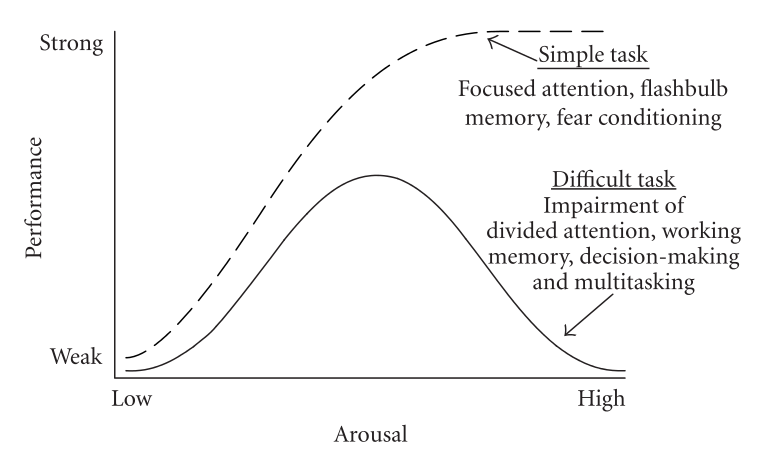
A little bit of stress is useful, but too much can be very harmful. On complicated tasks (basically anything that involves planning or careful thought), increased stress will increase performance up to a point, and then decrease it after that point. This phenomenon is known as the Yerkes-Dodson law.

The Yerkes-Dodson curve very closely resembles the Laffer curve, which shows that since extremely low tax rates raise little revenue (obviously), and extremely high tax rates also raise very little revenue (because they cause so much damage to the economy), the tax rate that maximizes government revenue is actually somewhere in the middle. There is a revenue-maximizing tax rate (usually estimated to be about 70%).

Instead of a revenue-maximizing tax rate, the Yerkes-Dodson law says that there is a performance-maximizing stress level. You don’t want to have zero stress, because that means you don’t care and won’t put in any effort. But if your stress level gets too high, you lose your ability to focus and your performance suffers.

Since stress (like taxes) comes with a cost, you may not even want to be at the maximum point. Performance isn’t everything; you might be happier choosing a lower level of performance in order to reduce your own stress.

But once thing is certain: You do not want to be to the right of that maximum. Then you are paying the cost of not only increased stress, but also reduced performance.

And yet I think many of us spent a great deal of our time on the wrong side of the Yerkes-Dodson curve. I certainly feel like I’ve been there for quite awhile now—most of grad school, really, and definitely this past month when suddenly I found out I’d gotten an offer to work in Edinburgh.

My current circumstances are rather exceptional, but I think the general pattern of being on the wrong side of the Yerkes-Dodson curve is not.

Over 80% of Americans report work-related stress, and the US economy loses about half a trillion dollars a year in costs related to stress.

The World Health Organization lists “work-related stress” as one of its top concerns. Over 70% of people in a cross-section of countries report physical symptoms related to stress, a rate which has significantly increased since before the pandemic.

The pandemic is clearly a contributing factor here, but even without it, there seems to be an awful lot of stress in the world. Even back in 2018, over half of Americans were reporting high levels of stress. Why?

For once, I think it’s actually fair to blame capitalism.

One thing capitalism is exceptionally good at is providing strong incentives for work. This is often a good thing: It means we get a lot of work done, so employment is high, productivity is high, GDP is high. But it comes with some important downsides, and an excessive level of stress is one of them.

But this can’t be the whole story, because if markets were incentivizing us to produce as much as possible, that ought to put us near the maximum of the Yerkes-Dodson curve—but it shouldn’t put us beyond it. Maximizing productivity might not be what makes us happiest—but many of us are currently so stressed that we aren’t even maximizing productivity.

I think the problem is that competition itself is stressful. In a capitalist economy, we aren’t simply incentivized to do things well—we are incentivized to do them better than everyone else. Often quite small differences in performance can lead to large differences in outcome, much like how a few seconds can make the difference between an Olympic gold medal and an Olympic “also ran”.

An optimally productive economy would be one that incentivizes you to perform at whatever level maximizes your own long-term capability. It wouldn’t be based on competition, because competition depends too much on what other people are capable of. If you are not especially talented, competition will cause you great stress as you try to compete with people more talented than you. If you happen to be exceptionally talented, competition won’t provide enough incentive!

Here’s a very simple model for you. Your total performance p is a function of two components, your innate ability aand your effort e. In fact let’s just say it’s a sum of the two: p = a + e

People are randomly assigned their level of capability from some probability distribution, and then they choose their effort. For the very simplest case, let’s just say there are two people, and it turns out that person 1 has less innate ability than person 2, so a1 < a2.

There is also a certain amount of inherent luck in any competition. As it says in Ecclesiastes (by far the best book of the Old Testament), “The race is not to the swift or the battle to the strong, nor does food come to the wise or wealth to the brilliant or favor to the learned; but time and chance happen to them all.” So as usual I’ll model this as a contest function, where your probability of winning depends on your total performance, but it’s not a sure thing.

Let’s assume that the value of winning and cost of effort are the same across different people. (It would be simple to remove this assumption, but it wouldn’t change much in the results.) The value of winning I’ll call y, and I will normalize the cost of effort to 1.


Then this is each person’s expected payoff ui:

ui = (ai + ei)/(a1+e1+a2 + e2) V – ei

You choose effort, not ability, so maximize in terms of ei:

(a2 + e2) V = (a1 +e1+a2 + e2)2 = (a1 + e1) V

a1 + e1 = a2 + e2

p1 = p2

In equilibrium, both people will produce exactly the same level of performance—but one of them will be contributing more effort to compensate for their lesser innate ability.

I’ve definitely had this experience in both directions: Effortlessly acing math tests that I knew other people barely passed despite hours of studying, and running until I could barely breathe to keep up with other people who barely seemed winded. Clearly I had too little incentive in math class and too much in gym class—and competition was obviously the culprit.

If you vary the cost of effort between people, or make it not linear, you can make the two not exactly equal; but the overall pattern will remain that the person who has more ability will put in less effort because they can win anyway.

Yet presumably the amount of effort we want to incentivize isn’t less for those who are more talented. If anything, it may be more: Since an hour of work produces more when done by the more talented person, if the cost to them is the same, then the net benefit of that hour of work is higher than the same hour of work by someone less talented.

In a large population, there are almost certainly many people whose talents are similar to your own—but there are also almost certainly many below you and many above you as well. Unless you are properly matched with those of similar talent, competition will systematically lead to some people being pressured to work too hard and others not pressured enough.

But if we’re all stressed, where are the people not pressured enough? We see them on TV. They are celebrities and athletes and billionaires—people who got lucky enough, either genetically (actors who were born pretty, athletes who were born with more efficient muscles) or environmentally (inherited wealth and prestige), to not have to work as hard as the rest of us in order to succeed. Indeed, we are constantly bombarded with images of these fantastically lucky people, and by the availability heuristic our brains come to assume that they are far more plentiful than they actually are.

This dramatically exacerbates the harms of competition, because we come to feel that we are competing specifically with the people who were handed the world on a silver platter. Born without the innate advantages of beauty or endurance or inheritance, there’s basically no chance we could ever measure up; and thus we feel utterly inadequate unless we are constantly working as hard as we possibly can, trying to catch up in a race in which we always fall further and further behind.

How can we break out of this terrible cycle? Well, we could try to replace capitalism with something like the automated luxury communism of Star Trek; but this seems like a very difficult and long-term solution. Indeed it might well take us a few hundred years as Roddenberry predicted.

In the shorter term, we may not be able to fix the economic problem, but there is much we can do to fix the psychological problem.

By reflecting on the full breadth of human experience, not only here and now, but throughout history and around the world, you can come to realize that you—yes, you, if you’re reading this—are in fact among the relatively fortunate. If you have a roof over your head, food on your table, clean water from your tap, and ibuprofen in your medicine cabinet, you are far more fortunate than the average person in Senegal today; your television, car, computer, and smartphone are things that would be the envy even of kings just a few centuries ago. (Though ironically enough that person in Senegal likely has a smartphone, or at least a cell phone!)

Likewise, you can reflect upon the fact that while you are likely not among the world’s most very most talented individuals in any particular field, there is probably something you are much better at than most people. (A Fermi estimate suggests I’m probably in the top 250 behavioral economists in the world. That’s probably not enough for a Nobel, but it does seem to be enough to get a job at the University of Edinburgh.) There are certainly many people who are less good at many things than you are, and if you must think of yourself as competing, consider that you’re also competing with them.

Yet perhaps the best psychological solution is to learn not to think of yourself as competing at all. So much as you can afford to do so, try to live your life as if you were already living in a world that rewards you for making the best of your own capabilities. Try to live your life doing what you really think is the best use of your time—not your corporate overlords. Yes, of course, we must do what we need to in order to survive, and not just survive, but indeed remain physically and mentally healthy—but this is far less than most First World people realize. Though many may try to threaten you with homelessness or even starvation in order to exploit you and make you work harder, the truth is that very few people in First World countries actually end up that way (it couldbe brought to zero, if our public policy were better), and you’re not likely to be among them. “Starving artists” are typically a good deal happier than the general population—because they’re not actually starving, they’ve just removed themselves from the soul-crushing treadmill of trying to impress the neighbors with manicured lawns and fancy SUVs.

“Harder-working” countries are not richer

July 28 JDN 2458693

American culture is obsessed with work. We define ourselves by our professions. We are one of only a handful of countries in the world that don’t guarantee vacations for their workers. Over 50 million Americans suffer from chronic sleep deprivation, mostly due to work. Then again, we are also an extremely rich country; perhaps our obsession with work is what made us so rich?

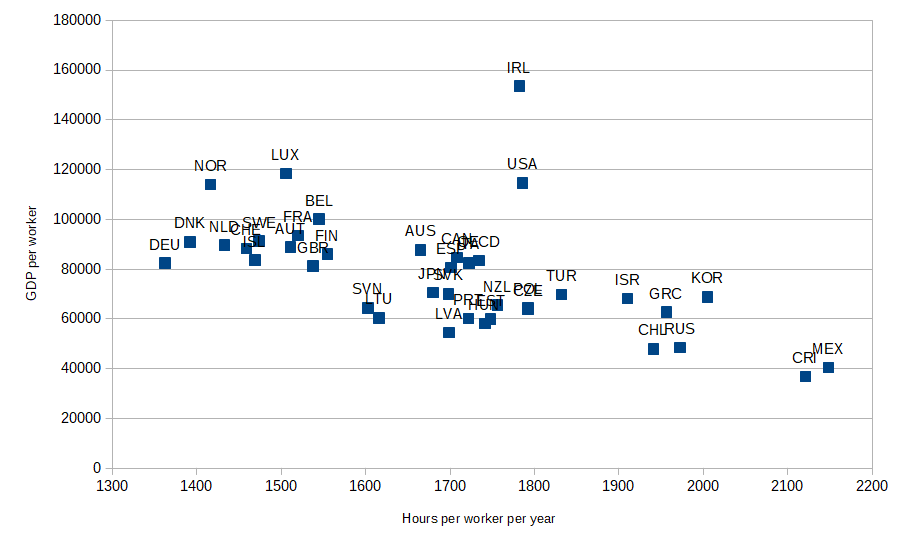
Well… not really. Take a look at this graph, which I compiled from OECD data:


Worker_productivity

The X-axis shows the average number of hours per worker per year. I think this is the best measure of a country’s “work obsession”, as it includes both length of work week, proportion of full-time work, and amount of vacation time. The At 1,786 hours per worker per year, the US is not actually the highest: That title goes to Mexico, at an astonishing 2,148 hours per worker per year. The lowest is Germany at only 1,363 hours per worker per year. Converted into standard 40-hour work weeks, this means that on average Americans work 44 weeks per year, Germans work on average 34 weeks per year, and Mexicans work 54 weeks per year—that is, they work more than full-time every week of the year.

The Y-axis shows GDP per worker per year. I calculated this by multiplying GDP per work hour (a standard measure of labor productivity) by average number of work hours per worker per year. At first glance, these figures may seem too large; for instance they are $114,000 in the US and $154,000 in Ireland. But keep in mind that this is per worker, not per person; the usual GDP per capita figure divides by everyone in the population, while this is only dividing by the number of people who are actively working. Unemployed people are not included, and neither are children or retired people.

There is an obvious negative trend line here. While Ireland is an outlier with exceptionally high labor productivity, the general pattern is clear: the countries with the most GDP per worker actually work the fewest hours. Once again #ScandinaviaIsBetter: Norway and Denmark are near the bottom for work hours and near the top for GDP per worker. The countries that work the most hours, like Mexico and Costa Rica, have the lowest GDP per worker.

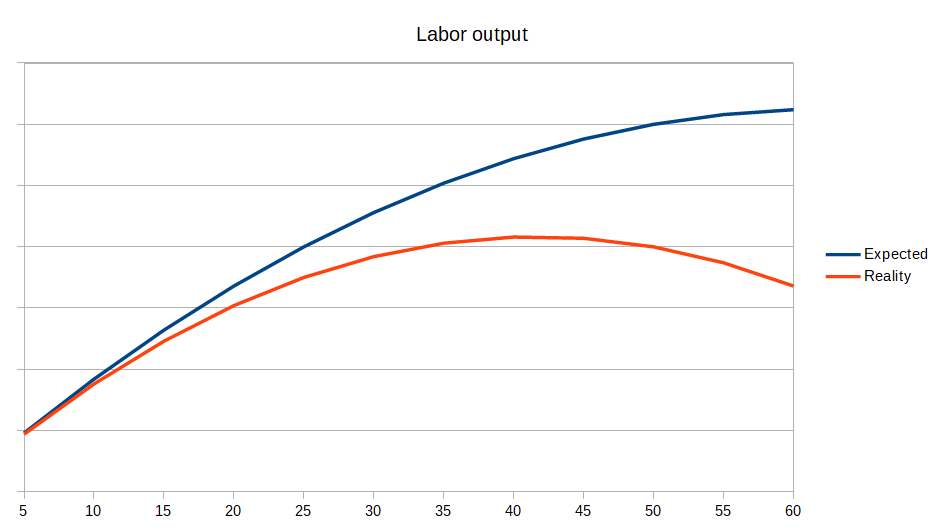
This is actually quite remarkable. We would expect that productivity per hour decreases as work hours increase; that’s not surprising at all. But productivity per worker decreasing means that these extra hours are actually resulting in less total output. We are so overworked, overstressed, and underslept that we actually produce less than our counterparts in Germany or Denmark who spend less time working.

Where we would expect the graph of output as a function of hours to look like the blue line below, it actually looks more like the orange line:

Labor_output

Rather than merely increasing at a decreasing rate, output per worker actually decreases as we put in more hours—and does so over most of the range in which countries actually work. It wouldn’t be so surprising if this sort of effect occurred above say 2000 hours per year, when you start running out of time to do anything else; but in fact it seems to be happening somewhere around 1400 hours per year, which is less than most countries work.

Only a handful of countries—mostly Scandinavian—actually seem to be working the right amount; everyone else is working too much and producing less as a result.

And note that this is not restricted to white-collar or creative jobs where we would expect sleep deprivation and stress to have a particularly high impact. This includes all jobs. Our obsession with work is actually making us poorer!

Unpaid work and the double burden

Apr 16, JDN 2457860

When we say the word “work”, what leaps to mind is usually paid work in the formal sector—the work people do for employers. When you “go to work” each morning, you are going to do your paid work in the formal sector.

But a large quantity of the world’s labor does not take this form. First, there is the informal sectorwork done for cash “under the table”, where there is no formal employment structure and often no reporting or payment of taxes. Many economists estimate that the majority of the world’s workers are employed in the informal sector. The ILO found that informal employment comprises as much as 70% of employment in some countries. However, it depends how you count: A lot of self-employment could be considered either formal or informal. If you base it on whether you do any work outside an employer-employee relationship, informal sector work is highly prevalent around the world. If you base it on not reporting to the government to avoid taxes, informal sector work is less common. If it must be your primary source of income, whether or not you pay taxes, informal sector work is uncommon. And if you only include informal sector work when it is your primary income source and not reported to the government, informal sector work is relatively rare and largely restricted to underdeveloped countries.

But that’s not really my focus for today, because you at least get paid in the informal sector. Nor am I talking about forced laborthat is, slavery, essentially—which is a serious human rights violation that sadly still goes on in many countries.

No, the unpaid work I want to talk about today is work that people willingly do for free.

I’m also excluding internships and student work, where (at least in theory) the idea is that instead of getting paid you are doing the work in order to acquire skills and experience that will be valuable to you later on. I’m talking about work that you do for its own sake.

Such work can be divided into three major categories.
First there is vocation—the artist who would paint even if she never sold a single canvas; the author who is compelled to write day and night and would give the books away for free. Vocation is work that you do for fun, or because it is fulfilling. It doesn’t even feel like “work” in quite the same sense. For me, writing and research are vocation, at least in part; even if I had $5 million in stocks I would still do at least some writing and research as part of what gives my life meaning.

Second there is volunteering—the soup kitchen, the animal shelter, the protest march. Volunteering is work done out of altruism, to help other people or work toward some greater public goal. You don’t do it for yourself, you do it for others.

Third, and really my main focus for this post, is domestic labor—vacuuming the rug, mopping the floor, washing the dishes, fixing the broken faucet, changing the baby’s diapers. This is generally not work that anyone finds particularly meaningful or fulfilling, nor is it done out of any great sense of altruism (perhaps toward your own family, but that’s about the extent of it). But you also don’t get paid to do it. You do it because it must be done.

There is also considerable overlap, of course: Many people find meaning in their activism or charitable work, and part of what motivates artists and authors is a desire to change the world.

Vocation is ultimately what I would like to see the world move towards. One of the great promises of a basic income is that it might finally free us from the grind of conventional employment that has gripped us ever since we first managed to escape the limitations of subsistence farming—which in turn gripped us ever since we escaped the desperation of hunter-gatherer survival. The fourth great stage in human prosperity might finally be a world where we can work not for food or for pay, but for meaning. A world of musicians and painters, of authors and playwrights, of sculptors and woodcutters, yes; but also a world of cinematographers and video remixers, of 3D modelers and holographers, of VR designers and video game modders. If you ever fret that no work would be done without the constant pressure of the wage incentive, spend some time on Stack Overflow or the Steam Workshop. People will spend hundreds of person-hours at extremely high-skill tasks—I’m talking AI programming and 3D modeling here—not for money but for fun.

Volunteering is frankly kind of overrated; as the Effective Altruism community will eagerly explain to you any chance they get, it’s usually more efficient for you to give money rather than time, because money is fungible while giving your time only makes sense if your skills are actually the ones that the project needs. If this criticism of so much well-intentioned work sounds petty, note that literally thousands of lives would be saved each year if instead of volunteering people donated an equivalent amount of money so that charities could hire qualified workers instead. Unskilled volunteers and donations of useless goods after a disaster typically cause what aid professionals call the “second disaster”. Still, people do find meaning in volunteering, and there is value in that; and also there are times when you really are the best one to do it, particularly when it comes to local politics.

But what should we do with domestic labor?

Some of it can and will be automated away—the Parable of the Dishwasher with literal dishwashers. But it will be awhile before it all can, and right now it’s still a bit expensive. Maybe instead of vacuuming I should buy a Roomba—but $500 feels like a lot of money right now.

Much domestic labor we could hire out to someone else, but we simply choose not to. I could always hire someone to fix my computer, unclog my bathtub, or even mop my floors; I just don’t because it seems too expensive.
From the perspective of an economist, it’s actually a bit odd that it seems too expensive. I might have a comparative advantage in fixing my computer—it’s mine, after all, so I know its ins and outs, and while I’m no hotshot Google admin I am a reasonably competent programmer and debugger in my own right. And while for many people auto repair is a household chore, I do actually hire auto mechanics; I don’t even change my own oil, though partly that’s because my little Smart has an extremely compact design that makes it hard to work on. But I surely have no such comparative advantage in cleaning my floors or unclogging my pipes; so why doesn’t it seem worth it to hire someone else to do that?

Maybe I’m being irrational; hiring a cleaning service isn’t that expensive after all. I could hire a cleaning service to do my whole apartment for something like $80, and if I scheduled a regular maid it would probably be something like that per month. That’s what I would charge for two hours of tutoring, so maybe it would behoove me to hire a maid and spend that extra time tutoring or studying.

Or maybe it’s this grad student budget of mine; money is pretty tight at the moment, as I go through this strange societal ritual where young adults go through a period of near-poverty, overwhelming workload and constant anxiety not in spite but because we are so intelligent and hard-working. Perhaps if and when I get that $70,000 job as a professional economist my marginal utility of wealth will decrease and I will feel more inclined to hire maid services.

There are also transaction costs I save on by doing the work myself. A maid would have to commute here, first of all, reducing the efficiency gains from their comparative advantage in the work; but more than that, there’s a lot of effort I’d have to put in just to prepare for the maid and deal with any problems that might arise. There are scheduling issues, and the work probably wouldn’t get done as quickly unless I were to spend enough to hire a maid on a regular basis. There’s also a psychological cost in comfort and privacy to dealing with a stranger in one’s home, and a small but nontrivial risk that the maid might damage or steal something important.

But honestly it might be as simple as social norms (remember: to a first approximation, all human behavior is social norms). Regardless of whether or not it is affordable, it feels strange to hire a maid. That’s the sort of thing only rich, decadent people do. A responsible middle-class adult is supposed to mop their own floors and do their own laundry. Indeed, while hiring a plumber or an auto mechanic feels like paying for a service, hiring a maid crosses a line and feels like hiring a servant. (I honestly always feel a little awkward around the gardeners hired by our housing development for that reason. I’m only paying them indirectly, but there’s still this vague sense that they are somehow subservient—and surely, we are of quite distinct socioeconomic classes. Maybe it would help if I brushed up on my Spanish and got to know them better?)

And then there’s the gender factor. Being in a same-sex couple household changes the domestic labor dynamic quite a bit relative to the conventional opposite-sex couple household. Even in ostensibly liberal, feminist, egalitarian households, and even when both partners are employed full-time, it usually ends up being the woman who does most of the housework. This is true in the US; it is true in the UK; it is true in Europe; indeed it’s true in most if not all countries around the world, and, unsurprisingly, it is worst in India, where women spend a whopping five hours per day more on housework than men. (I was not surprised by the fact that Japan and China also do poorly, given their overall gender norms; but I’m a bit shocked at how badly Ireland and Italy do on this front.) And yes, while #ScandinaviaIsBetter, still in Sweden and Norway women spend half an hour to an hour more on housework on an average day than men.

Which, of course, supports the social norm theory. Any time you see both an overwhelming global trend against women and considerable cross-country variation within that trend, your first hypothesis should be sexism. Without the cross-country variation, maybe it could be biology—the sex differences in height and upper-body strength, for example, are pretty constant across countries. But women doing half an hour more in Norway but five hours more in India looks an awful lot like sexism.

This is called the double burden: To meet the social norms of being responsible middle-class adults, men are merely expected to work full-time at a high-paying job, but women are expected to do both the full effort of maintaining a household and the full effort of working at a full-time job. This is surely an improvement over the time when women were excluded from the formal workforce, not least because of the financial freedom that full-time work affords many women; but it would be very nice if we could also find a way to share some of that domestic burden as well. There has been some trend toward a less unequal share of housework as more women enter the workforce, but it still has a long way to go, even in highly-developed countries.

So, we can start by trying to shift the social norm that housework is gendered: Women clean the floors and change the diapers, while men fix the car and paint the walls. Childcare in particular is something that should be done equally by all parents, and while it’s plausible that one person may be better or worse at mopping or painting, it strains credulity to think that it’s always the woman who is better at mopping and the man who is better at painting.

Yet perhaps this is a good reason to try to shift away from another social norm as well, the one where only rich people hire maids and maids are servants. Unfortunately, it’s likely that most maids will continue to be women for the foreseeable future—cleaning services are gendered in much the same way that nursing and childcare are gendered. But at least by getting paid to clean, one can fulfill the “job” norm and the “housekeeping” norm in one fell swoop; and then women who are in other professions can carry only one burden instead of two. And if we can begin to think of cleaning services as more like plumbing and auto repair—buying a service, not hiring a servant—this is likely to improve the condition and social status of a great many maids. I doubt we’d ever get to the point where mopping floors is as prestigious as performing neurosurgery, but maybe we can at least get to the point where being a maid is as respectable as being a plumber. Cleaning needs done; it shouldn’t be shameful to be someone who is very good at doing it and gets paid to do so. (That is perhaps the most pernicious aspect of socioeconomic class, this idea that some jobs are “shameful” because they are done by workers with less education or involve more physical labor.)
This also makes good sense in terms of economic efficiency: Your comparative advantage is probably not in cleaning services, or if it is then perhaps you should do that as a career. So by selling your labor at whatever you are good at and then buying the services of someone who is especially good at cleaning, you should, at least in theory, be able to get the same cleaning done and maintain the same standard of living for yourself while also accomplishing more at whatever it is you do in your profession and providing income for whomever you hire to do the cleaning.

So, should I go hire a cleaning service after all? I don’t know, that still sounds pretty expensive.

The urban-rural divide runs deep

Feb 5, JDN 2457790

Are urban people worth less than rural people?

That probably sounds like a ridiculous thing to ask; of course not, all people are worth the same (other things equal of course—philanthropists are worth more than serial murderers). But then, if you agree with that, you’re probably an urban person, as I’m sure most of my readers are (and as indeed most people in highly-developed countries are).

A disturbing number of rural people, however, honestly do seem to believe this. They think that our urban lifestyles (whatever they imagine those to be) devalue us as citizens and human beings.

That is the key subtext to understand in the terrifying phenomenon that is Donald Trump. Most of the people who voted for him can’t possibly have thought he was actually trustworthy, and many probably didn’t actually support his policies of bigotry and authoritarianism (though he was very popular among bigots and authoritarians). From speaking with family members and acquaintances who proudly voted for Trump, one thing came through very clearly: This was a gigantic middle finger pointed at cities. They didn’t even really want Trump; they just knew we didn’t, and so they voted for him out of spite as much as anything else. They also have really confused views about free trade, so some of them voted for him because he promised to bring back jobs lost to trade (that weren’t lost to trade, can’t be brought back, and shouldn’t be even if they could). Talk with a Trump voter for a few minutes, and sneers of “latte-sipping liberal” (I don’t even like coffee) and “coastal elite” (I moved here to get educated; I wasn’t born here) are sure to follow.

There has always been some conflict between rural and urban cultures, for as long as there have been urban cultures for rural cultures to be in conflict with. It is found not just in the US, but in most if not all countries around the world. It was relatively calm during the postwar boom in the 20th century, as incomes everywhere (or at least everywhere within highly-developed countries) were improving more or less in lockstep. But the 21st century has brought us much more unequal growth, concentrated on particular groups of people and particular industries. This has brought more resentment. And that divide, above all else, is what brought us Trump; the correlation between population density and voting behavior is enormous.

Of course, “urban” is sometimes a dog-whistle for “Black”; but sometimes I think it actually really means “urban”—and yet there’s still a lot of hatred embedded in it. Indeed, perhaps that’s why the dog-whistle works; a White man from a rural town can sneer at “urban” people and it’s not entirely clear whether he’s being racist or just being anti-urban.

The assumption that rural lifestyles are superior runs so deep in our culture that even in articles by urban people (like this one from the LA Times) supposedly reflecting about how to resolve this divide, there are long paeans to the world of “hard work” and “sacrifice” and “autonomy” of rural life, and mocking “urban elites” for their “disproportionate” (by which you can only mean almost proportionate) power over government.

Well, guess what? If you want to live in a rural area, go live in a rural area. Don’t pine for it. Don’t tell me how great farm life is. If you want to live on a farm, go live on a farm. I have nothing against it; we need farmers, after all. I just want you to shut up about how great it is, especially if you’re not going to actually do it. Pining for someone else’s lifestyle when you could easily take on that lifestyle if you really wanted it just shows that you think the grass is greener on the other side.

Because the truth is, farm living isn’t so great for most people. The world’s poorest people are almost all farmers. 70% of people below the UN poverty line live in rural areas, even as more and more of the world’s population moves into cities. If you use a broader poverty measure, as many as 85% of the world’s poor live in rural areas.

The kind of “autonomy” that means defending your home with a shotgun is normally what we would call anarchy—it’s a society that has no governance, no security. (Of course, in the US that’s pure illusion; crime rates in general are low and falling, and lower in rural areas than urban areas. But in some parts of the world, that anarchy is very real.) One of the central goals of global economic development is to get people away from subsistence farming into far more efficient manufacturing and service jobs.

At least in the US, farm life is a lot better than it used to be, now that agricultural technology has improved so that one farmer can now do the work of hundreds. Despite increased population and increased food consumption per person, the number of farmers in the US is now the smallest it has been since before the Civil War. The share of employment devoted to agriculture has fallen from over 80% in 1800 to under 2% today. Even just since the 1960s labor productivity of US farms has more than tripled.

But the reason that some 80% of Americans have chosen to live in cities—and yes, I can clearly say “chosen”, because cities are more expensive and therefore urban living is a voluntary activity. Most people who live in the city right now could move to the country if we really wanted to. We choose not to, because we know our life would be worse if we did.

Indeed, I dare say that a lot of the hatred of city-dwellers has got to be envy. Our (median) incomes are higher and our (mean) lifespans are longer. Fewer of our children are in poverty. Life is better here—we know it, and deep down, they know it too.

We also have better Internet access, unsurprisingly—though rural areas are only a few years behind, and the technology improves so rapidly that twice as many rural homes in the US have Internet access than urban homes did in 1998.

Now, a rational solution to this problem would be either to improve the lives of people in rural areas or else move everyone to urban areas—and both of those things have been happening, not only in the US but around the world. But in order to do that, you need to be willing to change things. You have to give up the illusion that farm life is some wonderful thing we should all be emulating, rather than the necessary toil that humanity was forced to go through for centuries until civilization could advance beyond it. You have to be willing to replace farmers with robots, so that people who would have been farmers can go do something better with their lives. You need to give up the illusion that there is something noble or honorable about hard labor on a farm—indeed, you need to give up the illusion that there is anything noble or honorable about hard work in general. Work is not a benefit; work is a cost. Work is what we do because we have to—and when we no longer have to do it, we should stop. Wanting to escape toil and suffering doesn’t make you lazy or selfish—it makes you rational.

We could surely be more welcoming—but cities are obviously more welcoming to newcomers than rural areas are. Our housing is too expensive, but that’s in part because so many people want to live here—supply hasn’t been able to keep up with demand.

I may seem to be presenting this issue as one-sided; don’t urban people devalue rural people too? Sometimes. Insults like “hick” and “yokel” and “redneck” do of course exist. But I’ve never heard anyone from a city seriously argue that people who live in rural areas should have votes that systematically count for less than those of people who live in cities—yet the reverse is literally what people are saying when they defend the Electoral College. If you honestly think that the Electoral College deserves to exist in anything like its present form, you must believe that some Americans are worth more than others, and the people who are worth more are almost all in rural areas while the people who are worth less are almost all in urban areas.

No, National Review, the Electoral College doesn’t “save” America from California’s imperial power; it gives imperial power to a handful of swing states. The only reason California would be more important than any other state is that more Americans live here. Indeed, a lot of Republicans in California are disenfranchised, because they know that their votes will never overcome the overwhelming Democratic majority for the state as a whole and the system is winner-takes-all. Indeed, about 30% of California votes Republican (well, not in the last election, because that was Trump—Orange County went Democrat for the first time in decades), so the number of disenfranchised Republicans alone in California is larger than the population of Michigan, which in turn is larger than the population of Wyoming, North Dakota, South Dakota, Montana, Nebraska, West Virginia, and Kansas combined. Indeed, there are more people in California than there are in Canada. So yeah, I’m thinking maybe we should get a lot of votes?

But it’s easy for you to drum up fear over “imperial rule” by California in particular, because we’re so liberal—and so urban, indeed an astonishing 95% urban, the most of any US state (or frankly probably any major regional entity on the planet Earth! To beat that you have to be something like Singapore, which literally just is a single city).

In fact, while insults thrown at urban people get thrown at basically all of us regardless of what we do, most of the insults that are thrown at rural people are mainly thrown at uneducated rural people. (And statistically, while many people in rural areas are educated and many people in urban areas are not, there’s definitely a positive correlation between urbanization and education.) It’s still unfair in many ways, not least because education isn’t entirely a choice, not in a society where tuition at an average private university costs more than the median individual income. Many of the people we mock as being stupid were really just born poor. It may not be their fault, but they can’t believe that the Earth is only 10,000 years old and not have some substantial failings in their education. I still don’t think mockery is the right answer; it’s really kicking them while they’re down. But clearly there is something wrong with our society when 40% of people believe something so obviously ludicrous—and those beliefs are very much concentrated in the same Southern states that have the most rural populations. “They think we’re ignorant just because we believe that God made the Earth 6,000 years ago!” I mean… yes? I’m gonna have to own up to that one, I guess. I do in fact think that people who believe things that were disproven centuries ago are ignorant.

So really this issue is one-sided. We who live in cities are being systematically degraded and disenfranchised, and when we challenge that system we are accused of being selfish or elitist or worse. We are told that our lifestyles are inferior and shameful, and when we speak out about the positive qualities of our lives—our education, our acceptance of diversity, our flexibility in the face of change—we are again accused of elitism and condescension.

We could simply stew in that resentment. But we can do better. We can reach out to people in rural areas, show them not just that our lives are better—as I said, they already know this—but that they can have these lives too. And we can make policy so that this really can happen for people. Envy doesn’t automatically lead to resentment; that only happens when combined with a lack of mobility. The way urban people pine for the countryside is baffling, since we could go there any time; but the way that country people long for the city is perfectly understandable, as our lives really are better but our rent is too high for them to afford. We need to bring that rent down, not just for the people already living in cities, but also for the people who want to but can’t.

And of course we don’t want to move everyone to cities, either. Many people won’t want to live in cities, and we need a certain population of farmers to make our food after all. We can work to improve infrastructure in rural areas—particularly when it comes to hospitals, which are a basic necessity that is increasingly underfunded. We shouldn’t stop using cost-effectiveness calculations, but we need to compare against the right things. If that hospital isn’t worth building, it should be because there’s another, better hospital we could make for the same amount or cheaper—not because we think that this town doesn’t deserve to have a hospital. We can expand our public transit systems over a wider area, and improve their transit speeds so that people can more easily travel to the city from further away.

We should seriously face up to the costs that free trade has imposed upon many rural areas. We can’t give up on free trade—but that doesn’t mean we need to keep our trade policy exactly as it is. We can do more to ensure that multinational corporations don’t have overwhelming bargaining power against workers and small businesses. We can establish a tax system that would redistribute more of the gains from free trade to the people and places most hurt by the transition. Right now, poor people in the US are often the most fiercely opposed to redistribution of wealth, because somehow they perceive that wealth will be redistributed from them when it would in fact be redistributed to them. They are in a scarcity mindset, their whole worldview shaped by the fact that they struggle to get by. They see every change as a threat, every stranger as an enemy.

Somehow we need to fight that mindset, get them to see that there are many positive changes that can be made, many things that we can achieve together that none of us could achieve along.

The Parable of the Dishwasher

JDN 2456478

Much like free trade, technological unemployment is an issue where the consensus opinion among economists diverges quite sharply from that of the general population.

Enough people think that “robots taking our jobs” is something bad that I’ve seen a fair number of memes like this:

EVERY TIME you use the Self Checkout you are ELIMINATING JOBS!

But like almost all economists, I think that self-checkouts, robots, and automation in general are a pretty good thing. They do have a few downsides, chiefly in terms of forcing us to make transitions that are costly and painful; but in general I want more robots, not fewer.

To help turn you toward this view, I offer a parable.

Suppose we have a family, the (stereo)typical American family with a father, a mother, and two kids, a boy named Joe and a girl named Sue.

The kids do chores for their allowance, and split them as follows: Joe always does the dishes, and Sue always vacuums the carpet. They both spend about 1 hour per week and they both get paid $10 a week.

But one day, Dad decides to buy a dishwasher. This dramatically cuts down the time it takes Joe to do the dishes; where he used to spend 1 hour washing dishes, now he can load the dishwasher and get it done in 5 minutes.

  1. Mom suggests they just sell back the dishwasher to get rid of the problem.
  2. Dad says that Joe should now only be paid for the 5 minutes he works each week, so he would now be paid $0.83 per week. (He’s not buying a lot of video games on that allowance.)
  3. Joe protests that he gets the same amount of work done, so he should be paid the same $10 for doing it.
  4. Sue says it would be unfair for her to have to work so much more than Joe, and has a different solution: They’ll trade off the two sets of chores each week, and they should of course get paid the same amount of money for getting the same amount of work done—$10 per kid per week, for an average of 32.5 minutes of work each.

Which of those solutions sounds the most sensible to you?

Mom’s solution is clearly the worst, right? It’s the Luddite solution, the one that throws away technological progress and makes everything less efficient. Yet that is the solution being offered by people who say “Don’t use the self-checkout machine!” Indeed, anyone who speaks of the virtues of “hard work” is really speaking Mom’s language here; they should be talking about the virtues of getting things done. The purpose of washing dishes is to have clean dishes, not to “work hard”. And likewise, when we construct bridges or make cars or write books or solve equations, our goal should be to get that thing done—not to fulfill some sense of moral obligation to prove our worthiness through hard work.

Joe’s solution is what neoclassical economics says should happen—higher productivity should yield higher wages, so the same amount of production should yield the same pay. This seems like it could work, but empirically it rarely happens. There’s also something vaguely unfair about it; if productivity increases in your industry but not in someone else’s, you get to cut your work hours dramatically while they are stuck working just as hard as before.

Dad’s “solution” is clearly terrible, and makes no sense at all. Yet this is what we actually tend to observe—capital owners appropriate all (or nearly all) the benefits of the new technology, and workers get displaced or get ever-smaller wages. (I talked about that in a recent post.)

It’s Sue’s solution that really seems to make the most sense, isn’t it? When one type of work becomes more efficient, people should shift into different types of labor so that people can work fewer hours—and wages should rise enough that incomes remain the same. “Baumol’s disease” is not a disease—it is the primary means by which capitalism raises human welfare. (That’s why I prefer to use the term “Baumol Effect” instead.)

One problem with this in practice is that sometimes people can’t switch into other industries. That’s a little hard to imagine in this case, but let’s stipulate that for some reason Joe can’t do the vacuuming. Maybe he has some sort of injury that makes it painful to use the vacuum cleaner, but doesn’t impair his ability to wash dishes. Or maybe he has a severe dust allergy, so bad that the dust thrown up by the vacuum cleaner sends him into fits of coughing.

In that case I think we’re back to Joe’s solution; he should get paid the same for getting the same amount of work done. I’m actually tempted to say that Sue should get paid more, to compensate her for the unfairness; but in the real world there is a pretty harsh budget constraint there, so we need to essentially pretend that Dad only has $20 per week to give out in allowances. A possible compromise would be to raise Sue up to $12 and cut Joe down to $8; Joe will probably still be better off than he was, because he has that extra 55 minutes of free time each week for which he only had to “pay” $2. This also makes the incentives work out better—Joe doesn’t have a reason to malinger and exaggerate his dust allergy just to get out of doing the vacuuming, since he would actually get paid more if he were willing to do the vacuuming; but if his allergy really is that bad, he can still do okay otherwise. (There’s a lesson here for the proper structure of Social Security Disability, methinks.)

But you know what really seems like the best solution? Buy a Roomba.

Buy a Roomba, make it Sue’s job to spend 5 minutes a week keeping the Roomba working at vacuuming the carpet, and continue paying both kids $10 per week. Give them both 55 minutes more per week to hang out with their friends or play video games. Whether you think of this $10 as a “higher wage” for higher productivity or simply an allowance they get anyway—a basic income—ultimately doesn’t matter all that much. The point is that everyone gets enough money and nobody has to work very much, because the robots do everything.

And now, hopefully you see why I think we need more robots, not fewer.

Of course, like any simple analogy, this isn’t perfect; it may be difficult to reduce the hours in some jobs or move more people into them. There are a lot of additional frictions and complications that go into the real-world problem of achieving equitable labor markets. But I hope I’ve gotten across the basic idea that robots are not the problem, and could in fact be the solution–not just to our current labor market woes, but to the very problem of wage labor itself.

My ultimate goal is a world where “work” itself is fundamentally redefined—so that it always means the creative sense “This painting is some of my best work.” and not the menial sense “Sweeping this floor is so much work!”; so that human beings do things because we want to do them, because they are worth doing, and not because some employer is holding our food and housing hostage if we don’t.

But that will require our whole society to rethink a lot of our core assumptions about work, jobs, and economics in general. We’re so invested in this idea that “hard work” is inherently virtuous that we forgot the purpose of an economy was to get things done. Work is not a benefit; work is a cost. Costs are to be reduced. Puritanical sexual norms have been extremely damaging to American society, but time will tell if Puritanical work ethic actually does more damage to our long-term future.