Bayesian updating with irrational belief change

Jul 27 JDN 2460884

For the last few weeks I’ve been working at a golf course. (It’s a bit of an odd situation: I’m not actually employed by the golf course; I’m contracted by a nonprofit to be a “job coach” for a group of youths who are part of a work program that involves them working at the golf course.)

I hate golf. I have always hated golf. I find it boring and pointless—which, to be fair, is my reaction to most sports—and also an enormous waste of land and water. A golf course is also a great place for oligarchs to arrange collusion.

But I noticed something about being on the golf course every day, seeing people playing and working there: I feel like I hate it a bit less now.

This is almost certainly a mere-exposure effect: Simply being exposed to something many times makes it feel familiar, and that tends to make you like it more, or at least dislike it less. (There are some exceptions: repeated exposure to trauma can actually make you more sensitive to it, hating it even more.)

I kinda thought this would happen. I didn’t really want it to happen, but I thought it would.

This is very interesting from the perspective of Bayesian reasoning, because it is a theorem (though I cannot seem to find anyone naming the theorem; it’s like a folk theorem, I guess?) of Bayesian logic that the following is true:

The prior expectation of the posterior is the expectation of the prior.

The prior is what you believe before observing the evidence; the posterior is what you believe afterward. This theorem describes a relationship that holds between them.

This theorem means that, if I am being optimally rational, I should take into account all expected future evidence, not just evidence I have already seen. I should not expect to encounter evidence that will change my beliefs—if I did expect to see such evidence, I should change my beliefs right now!

This might be easier to grasp with an example.

Suppose I am trying to predict whether it will rain at 5:00 pm tomorrow, and I currently estimate that the probability of rain is 30%. This is my prior probability.

What will actually happen tomorrow is that it will rain or it won’t; so my posterior probability will either be 100% (if it rains) or 0% (if it doesn’t). But I had better assign a 30% chance to the event that will make me 100% certain it rains (namely, I see rain), and a 70% chance to the event that will make me 100% certain it doesn’t rain (namely, I see no rain); if I were to assign any other probabilities, then I must not really think the probability of rain at 5:00 pm tomorrow is 30%.

(The keen Bayesian will notice that the expected variance of my posterior need not be the variance of my prior: My initial variance is relatively high (it’s actually 0.3*0.7 = 0.21, because this is a Bernoulli distribution), because I don’t know whether it will rain or not; but my posterior variance will be 0, because I’ll know the answer once it rains or doesn’t.)

It’s a bit trickier to analyze, but this also works even if the evidence won’t make me certain. Suppose I am trying to determine the probability that some hypothesis is true. If I expect to see any evidence that might change my beliefs at all, then I should, on average, expect to see just as much evidence making me believe the hypothesis more as I see evidence that will make me believe the hypothesis less. If that is not what I expect, I should really change how much I believe the hypothesis right now!

So what does this mean for the golf example?

Was I wrong to hate golf quite so much before, because I knew that spending time on a golf course might make me hate it less?

I don’t think so.

See, the thing is: I know I’m not perfectly rational.

If I were indeed perfectly rational, then anything I expect to change my beliefs is a rational Bayesian update, and I should indeed factor it into my prior beliefs.

But if I know for a fact that I am not perfectly rational, that there are things which will change my beliefs in ways that make them deviate from rational Bayesian updating, then in fact I should not take those expected belief changes into account in my prior beliefs—since I expect to be wrong later, updating on that would just make me wrong now as well. I should only update on the expected belief changes that I believe will be rational.

This is something that a boundedly-rational person should do that neither a perfectly-rational nor perfectly-irrational person would ever do!

But maybe you don’t find the golf example convincing. Maybe you think I shouldn’t hate golf so much, and it’s not irrational for me to change my beliefs in that direction.


Very well. Let me give you a thought experiment which provides a very clear example of a time when you definitely would think your belief change was irrational.


To be clear, I’m not suggesting the two situations are in any way comparable; the golf thing is pretty minor, and for the thought experiment I’m intentionally choosing something quite extreme.

Here’s the thought experiment.

A mad scientist offers you a deal: Take this pill and you will receive $50 million. Naturally, you ask what the catch is. The catch, he explains, is that taking the pill will make you staunchly believe that the Holocaust didn’t happen. Take this pill, and you’ll be rich, but you’ll become a Holocaust denier. (I have no idea if making such a pill is even possible, but it’s a thought experiment, so bear with me. It’s certainly far less implausible than Swampman.)

I will assume that you are not, and do not want to become, a Holocaust denier. (If not, I really don’t know what else to say to you right now. It happened.) So if you take this pill, your beliefs will change in a clearly irrational way.

But I still think it’s probably justifiable to take the pill. This is absolutely life-changing money, for one thing, and being a random person who is a Holocaust denier isn’t that bad in the scheme of things. (Maybe it would be worse if you were in a position to have some kind of major impact on policy.) In fact, before taking the pill, you could write out a contract with a trusted friend that will force you to donate some of the $50 million to high-impact charities—and perhaps some of it to organizations that specifically fight Holocaust denial—thus ensuring that the net benefit to humanity is positive. Once you take the pill, you may be mad about the contract, but you’ll still have to follow it, and the net benefit to humanity will still be positive as reckoned by your prior, more correct, self.

It’s certainly not irrational to take the pill. There are perfectly-reasonable preferences you could have (indeed, likely dohave) that would say that getting $50 million is more important than having incorrect beliefs about a major historical event.

And if it’s rational to take the pill, and you intend to take the pill, then of course it’s rational to believe that in the future, you will have taken the pill and you will become a Holocaust denier.

But it would be absolutely irrational for you to become a Holocaust denier right now because of that. The pill isn’t going to provide evidence that the Holocaust didn’t happen (for no such evidence exists); it’s just going to alter your brain chemistry in such a way as to make you believe that the Holocaust didn’t happen.

So here we have a clear example where you expect to be more wrong in the future.

Of course, if this really only happens in weird thought experiments about mad scientists, then it doesn’t really matter very much. But I contend it happens in reality all the time:

  • You know that by hanging around people with an extremist ideology, you’re likely to adopt some of that ideology, even if you really didn’t want to.
  • You know that if you experience a traumatic event, it is likely to make you anxious and fearful in the future, even when you have little reason to be.
  • You know that if you have a mental illness, you’re likely to form harmful, irrational beliefs about yourself and others whenever you have an episode of that mental illness.

Now, all of these belief changes are things you would likely try to guard against: If you are a researcher studying extremists, you might make a point of taking frequent vacations to talk with regular people and help yourself re-calibrate your beliefs back to normal. Nobody wants to experience trauma, and if you do, you’ll likely seek out therapy or other support to help heal yourself from that trauma. And one of the most important things they teach you in cognitive-behavioral therapy is how to challenge and modify harmful, irrational beliefs when they are triggered by your mental illness.

But these guarding actions only make sense precisely because the anticipated belief change is irrational. If you anticipate a rational change in your beliefs, you shouldn’t try to guard against it; you should factor it into what you already believe.

This also gives me a little more sympathy for Evangelical Christians who try to keep their children from being exposed to secular viewpoints. I think we both agree that having more contact with atheists will make their children more likely to become atheists—but we view this expected outcome differently.

From my perspective, this is a rational change, and it’s a good thing, and I wish they’d factor it into their current beliefs already. (Like hey, maybe if talking to a bunch of smart people and reading a bunch of books on science and philosophy makes you think there’s no God… that might be because… there’s no God?)

But I think, from their perspective, this is an irrational change, it’s a bad thing, the children have been “tempted by Satan” or something, and thus it is their duty to protect their children from this harmful change.

Of course, I am not a subjectivist. I believe there’s a right answer here, and in this case I’m pretty sure it’s mine. (Wouldn’t I always say that? No, not necessarily; there are lots of matters for which I believe that there are experts who know better than I do—that’s what experts are for, really—and thus if I find myself disagreeing with those experts, I try to educate myself more and update my beliefs toward theirs, rather than just assuming they’re wrong. I will admit, however, that a lot of people don’t seem to do this!)

But this does change how I might tend to approach the situation of exposing their children to secular viewpoints. I now understand better why they would see that exposure as a harmful thing, and thus be resistant to actions that otherwise seem obviously beneficial, like teaching kids science and encouraging them to read books. In order to get them to stop “protecting” their kids from the free exchange of ideas, I might first need to persuade them that introducing some doubt into their children’s minds about God isn’t such a terrible thing. That sounds really hard, but it at least clearly explains why they are willing to fight so hard against things that, from my perspective, seem good. (I could also try to convince them that exposure to secular viewpoints won’t make their kids doubt God, but the thing is… that isn’t true. I’d be lying.)

That is, Evangelical Christians are not simply incomprehensibly evil authoritarians who hate truth and knowledge; they quite reasonably want to protect their children from things that will harm them, and they firmly believe that being taught about evolution and the Big Bang will make their children more likely to suffer great harm—indeed, the greatest harm imaginable, the horror of an eternity in Hell. Convincing them that this is not the case—indeed, ideally, that there is no such place as Hell—sounds like a very tall order; but I can at least more keenly grasp the equilibrium they’ve found themselves in, where they believe that anything that challenges their current beliefs poses a literally existential threat. (Honestly, as a memetic adaptation, this is brilliant. Like a turtle, the meme has grown itself a nigh-impenetrable shell. No wonder it has managed to spread throughout the world.)

Wage-matching and the collusion under our noses

Jul 20 JDN 2460877

It was a minor epiphany for me when I learned, over the course of studying economics, that price-matching policies, while they seem like they benefit consumers, actually are a brilliant strategy for maintaining tacit collusion.

Consider a (Bertrand) market, with some small number n of firms in it.

Each firm announces a price, and then customers buy from whichever firm charges the lowest price. Firms can produce as much as they need to in order to meet this demand. (This makes the most sense for a service industry rather than as literal manufactured goods.)

In Nash equilibrium, all firms will charge the same price, because anyone who charged more would sell nothing. But what will that price be?

In the absence of price-matching, it will be just above the marginal cost of the service. Otherwise, it would be advantageous to undercut all the other firms by charging slightly less, and you could still make a profit. So the equilibrium price is basically the same as it would be in a perfectly-competitive market.

But now consider what happens if the firms can announce a price-matching policy.

If you were already planning on buying from firm 1 at price P1, and firm 2 announces that you can buy from them at some lower price P2, then you still have no reason to switch to firm 2, because you can still get price P2 from firm 1 as long as you show them the ad from the other firm. Under the very reasonable assumption that switching firms carries some cost (if nothing else, the effort of driving to a different store), people won’t switch—which means that any undercut strategy will fail.

Now, firms don’t need to set such low prices! They can set a much higher price, confident that if any other firm tries to undercut them, it won’t actually work—and thus, no one will try to undercut them. The new Nash equilibrium is now for the firms to charge the monopoly price.

In the real world, it’s a bit more complicated than that; for various reasons they may not actually be able to sustain collusion at the monopoly price. But there is considerable evidence that price-matching schemes do allow firms to charge a higher price than they would in perfect competition. (Though the literature is not completely unanimous; there are a few who argue that price-matching doesn’t actually facilitate collusion—but they are a distinct minority.)

Thus, a policy that on its face seems like it’s helping consumers by giving them lower prices actually ends up hurting them by giving them higher prices.

Now I want to turn things around and consider the labor market.

What would price-matching look like in the labor market?

It would mean that whenever you are offered a higher wage at a different firm, you can point this out to the firm you are currently working at, and they will offer you a raise to that new wage, to keep you from leaving.

That sounds like a thing that happens a lot.

Indeed, pretty much the best way to get a raise, almost anywhere you may happen to work, is to show your employer that you have a better offer elsewhere. It’s not the only way to get a raise, and it doesn’t always work—but it’s by far the most reliable way, because it usually works.

This for me was another minor epiphany:

The entire labor market is full of tacit collusion.

The very fact that firms can afford to give you a raise when you have an offer elsewhere basically proves that they weren’t previously paying you all that you were worth. If they had actually been paying you your value of marginal product as they should in a competitive labor market, then when you showed them a better offer, they would say: “Sorry, I can’t afford to pay you any more; good luck in your new job!”

This is not a monopoly price but a monopsonyprice (or at least something closer to it); people are being systematically underpaid so that their employers can make higher profits.

And since the phenomenon of wage-matching is so ubiquitous, it looks like this is happening just about everywhere.

This simple model doesn’t tell us how much higher wages would be in perfect competition. It could be a small difference, or a large one. (It likely varies by industry, in fact.) But the simple fact that nearly every employer engages in wage-matching implies that nearly every employer is in fact colluding on the labor market.

This also helps explain another phenomenon that has sometimes puzzled economists: Why doesn’t raising the minimum wage increase unemployment? Well, it absolutely wouldn’t, if all the firms paying minimum wage are colluding in the labor market! And we already knew that most labor markets were shockingly concentrated.

What should be done about this?

Now there we have a thornier problem.

I actually think we could implement a law against price-matching on product and service markets relatively easily, since these are generally applied to advertised prices.

But a law against wage-matching would be quite tricky indeed. Wages are generally not advertised—a problem unto itself—and we certainly don’t want to ban raises in general.

Maybe what we should actually do is something like this: Offer a cash bonus (refundable tax credit?) to anyone who changes jobs in order to get a higher wage. Make this bonus large enough to offset the costs of switching jobs—which are clearly substantial. Then, the “undercut” (“overcut”?) strategy will become more effective; employers will have an easier time poaching workers from each other, and a harder time sustaining collusive wages.

Businesses would of course hate this policy, and lobby heavily against it. This is precisely the reaction we should expect if they are relying upon collusion to sustain their profits.

A knockdown proof of social preferences

Apr 27 JDN 2460793

In economics jargon, social preferences basically just means that people care about what happens to people other than themselves.

If you are not an economist, it should be utterly obvious that social preferences exist:

People generally care the most about their friends and family, less but still a lot about their neighbors and acquaintances, less but still moderately about other groups they belong to such as those delineated by race, gender, religion, and nationality (or for that matter alma mater), and less still but not zero about any randomly-selected human being. Most of us even care about the welfare of other animals, though we can be curiously selective about this: Abuse that would horrify most people if done to cats or dogs passes more or less ignored when it is committed against cows, pigs, and chickens.

For some people, there are also groups for which there seem to be negative social preferences, sometimes called “spiteful preferences”, but that doesn’t really seem to capture it: I think we need a stronger word like hatredfor whatever emotion human beings feel when they are willing and eager to participate in genocide. Yet even that is still a social preference: If you want someone to suffer or die, you do care about what happens to them.

But if you are an economist, you’ll know that the very idea of social preferences remains controversial, even after it has been clearly and explictly demonstrated by numerous randomized controlled experiments. (I will never forget the professor who put “altruism” in scare quotes in an email reply he sent me.)

Indeed, I have realized that the experimental evidence is so clear, so obvious, that it surprises me that I haven’t seen anyone present the really overwhelming knockdown evidence that ought to convince any reasonable skeptic. So that is what I have decided to do today.

Consider the following four economics experiments:

Dictator 1Participant 1 chooses an allocation of $20, dividing it between themself and Participant 2. Whatever allocation Participant 1 chooses, Participant 2 must accept. Both participants get their allocated amounts.
Dictator 2Participant 1 chooses an allocation of $20, choosing how much they get. Participant 1 gets their allocated amount. The rest of the money is burned.
Ultimatum 1Participant 1 chooses an allocation of $20, dividing it between themself and Participant 2. Participant 2 may choose to accept or reject this allocation; if they accept, both participants get their allocated amounts. If they reject, both participants get nothing.
Ultimatum 2Participant 1 chooses an allocation of $20, dividing it between themself and Participant 2. Participant 2 may choose to accept or reject this allocation; if they accept, both participants get their allocated amounts. If they reject, Participant 2 gets nothing, but Participant 1 still gets the allocated amount.

Dictator 1 and Ultimatum 1 are the standard forms of the Dictator Game and Ultimatum Game, which are experiments that have been conducted dozens if not hundreds of times and are the subject of a huge number of papers in experimental economics.

These experiments clearly demonstrate the existence of social preferences. But I think even most behavioral economists don’t quite seem to grasp just how compelling that evidence is.

This is because they have generally failed to compare against my other two experiments, Dictator 2 and Ultimatum 2.

If social preferences did not exist, Participant 1 would be completely indifferent about what happened to the money that they themself did not receive.

In that case, Dictator 1 and Dictator 2 should show the same result: Participant 1 chooses to get $20.

Likewise, Ultimatum 1 and Ultimatum 2 should show the same result: Participant 1 chooses to get $19, offering only $1 to Participant 2, and Participant 2 accepts. This is the outcome that is “rational” in the hyper-selfish neoclassical sense.

Much ink has already been spilled over the fact that these are not the typical outcomes of Dictator 1 and Ultimatum 1. Far more likely is that Participant 1 offers something close to $10, or even $10 exactly, in both games; and in Ultimatum 1, in the unlikely event that Participant 1 should offer only $1 or $2, Participant 2 will typically reject.

But what I’d like to point out today is that the “rational” neoclassical outcome is what would happen in Dictator 2 and Ultimatum 2, and that this is so obvious we probably don’t even need to run the experiments (but we might as well, just to be sure).

In Dictator 1, the money that Participant 1 doesn’t keep goes to Participant 2, and so they are deciding how to weigh their own interests against those of another. But in Dictator 2, Participant 1 is literally just deciding how much free money they will receive. The other money doesn’t go to anyone—not even back to the university conducting the experiment. It’s just burned. It provides benefit to no one. So the rational choice is in fact obvious: Take all of the free money. (Technically, burning money and thereby reducing the money supply would have a miniscule effect of reducing future inflation across the entire economy. But even the full $20 would be several orders of magnitude too small for anyone to notice—and even a much larger amount like $10 billion would probably end up being compensated by the actions of the Federal Reserve.)

Likewise, in both Ultimatum 1 and Ultimatum 2, the money that Participant 1 doesn’t keep will go to Participant 2. Their offer will thus probably be close to $10. But what I really want to focus in on is Participant 2’s choice: If they are offered only $1 or $2, will they accept? Neoclassical theory says that the “rational” choice is to accept it. But in Ultimatum 1, most people will reject it. Are they being irrational?

If they were simply being irrational—failing to maximize their own payoff—then they should reject just as often in Ultimatum 2. But I contend that they would in fact accept far more offers in Ultimatum 2 than they did in Ultimatum 1. Why? Because rejection doesn’t stop Participant 1 from getting what they demanded. There is no way to punish Participant 1 for an unfair offer in Ultimatum 2: It is literally just a question of whether you get $1 or $0.

Like I said, I haven’t actually run these experiments. I’m not sure anyone has. But these results seem very obvious, and I would be deeply shocked if they did not turn out the way I expect. (Perhaps as shocked as so many neoclassical economists were when they first saw the results of experiments on Dictator 1 and Ultimatum 1!)

Thus, Dictator 2 and Ultimatum 2 should have outcomes much more like what neoclassical economics predicts than Dictator 1 and Ultimatum 1.

Yet the only difference—the only difference—between Dictator 1 and Dictator 2, and between Ultimatum 1 and Ultimatum 2, is what happens to someone else’s payoff when you make your decision. Your own payoff is exactly identical.

Thus, behavior changes when we change only the effects on the payoffs of other people; therefore people care about the payoffs of others; therefore social preferences exist.

QED.

Of course this still leaves the question of what sort of social preferences people have, and why:

  • Why are some people more generous than others? Why are people sometimes spiteful—or even hateful?
  • Is it genetic? Is it evolutionary? Is it learned? Is it cultural? Likely all of the above.
  • Are people implicitly thinking of themselves as playing in a broader indefinitely iterated game called “life” and using that to influence their decisions? Quite possibly.
  • Is maintaining a reputation of being a good person important to people? In general, I’m sure it is, but I don’t think it can explain the results of these economic experiments by itself—especially in versions where everything is completely anonymous.

But given the stark differences between Dictator 1 versus Dictator 2 and Ultimatum 1 versus Ultimatum 2 (and really, feel free to run the experiments!), I don’t think anyone can reasonably doubt that social preferences do, in fact, exist.

If you ever find someone who does doubt social preferences, point them to this post.

Extrapolating the INE

Apr 6 JDN 2460772

I was only able to find sufficient data to calculate the Index of Necessary Expenditure back to 1990. But I found a fairly consistent pattern that the INE grew at a rate about 20% faster than the CPI over that period, so I decided to take a look at what longer-term income growth looks like if we extrapolate that pattern back further in time.

The result is this graph:

Using the CPI, real per-capita GDP in the US (in 2024 dollars) has grown from $25,760 in 1950 to $85,779 today—increasing by a factor of 3.33. Even accounting for increased inequality and the fact that more families have two income earners, that’s still a substantial increase.

But using the extrapolated INE, real per-capita GDP has only grown from $43,622 in 1950 to $85,779 today—increasing by only a factor of 1.97. This is a much smaller increase, especially when we adjusted for increased inequality and increased employment for women.

Even without the extrapolation, it’s still clear that real INE-adjusted incomes have were basically stagnant in the 2000s, increased rather slowly in the 2020s, and then actually dropped in 2022 after a bunch of government assistance ended. What looked, under the CPI, like steadily increasing real income was actually more like treading water.

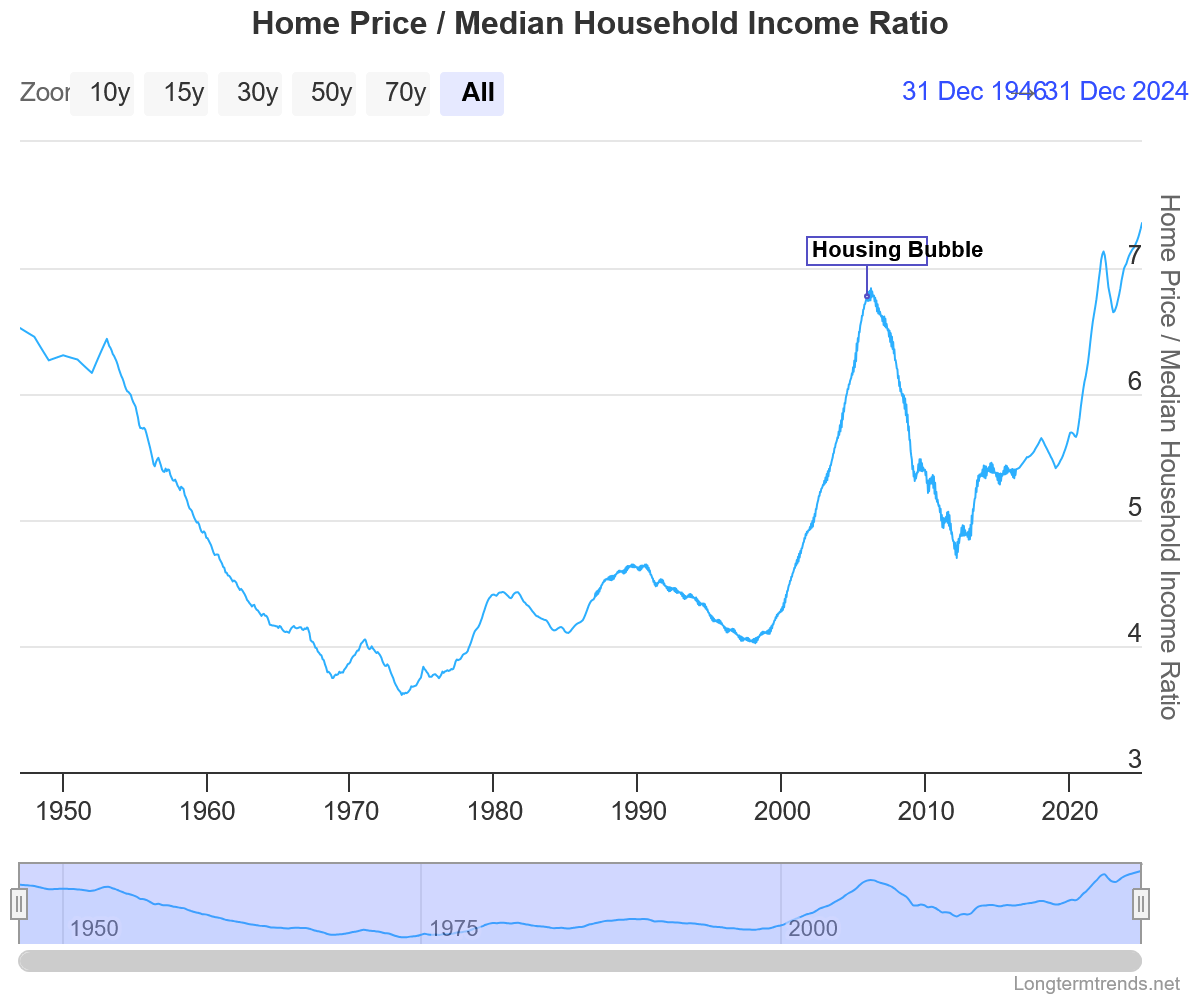
Should we trust this extrapolation? It’s a pretty simplistic approach, I admit. But I think it is plausible when we consider this graph of the ratio between median income and median housing price:

This ratio was around 6 in the 1950s, then began to fall until in the 1970s it stabilized around 4. It began to slowly creep back up, but then absolutely skyrocketed in the 2000s before the 2008 crash. Now it has been rising again, and is now above 7, the highest it has been since the Second World War. (Does this mean we’re due for another crash? I’d bet as much.)

What does this mean? It means that a typical family used to be able to afford a typical house with only four years of their total income—and now would require seven. In that sense, homes are now 75% more expensive today than they were in the 1970s.

Similar arguments can be made for the rising costs of education and healthcare; while many prices have not grown much (gasoline) or even fallen (jewelry and technology), these necessities have continued to grow more and more expensive, not simply in nominal terms, but even compared to the median income.

This is further evidence that our standard measures of “inflation” and “real income” are fundamentally inadequate. They simply aren’t accurately reflecting the real cost of living for most American families. Even in many times when it seemed “inflation” was low and “real income” was growing, in fact it was growing harder and harder to afford vital necessities such as housing, education, and healthcare.

This economic malaise may have been what contributed to the widespread low opinion of Biden’s economy. While the official figures looked good, people’s lives weren’t actually getting better.

Yet this is still no excuse for those who voted for Trump; even the policies he proudly announced he would do—like tariffs and deportations—have clearly made these problems worse, and this was not only foreseeable but actually foreseen by the vast majority of the world’s economists. Then there are all the things he didn’t even say he would do but is now doing, like cozying up to Putin, alienating our closest allies, and discussing “methods” for achieving an unconstitutional third term.

Indeed, it honestly feels quite futile to even reflect upon what was wrong with our economy even when things seemed to be running smoothly, because now things are rapidly getting worse, and showing no sign of getting better in any way any time soon.

A new theoretical model of co-ops

Mar 30 JDN 2460765

A lot of economists seem puzzled by the fact that co-ops are just as efficient as corporate firms, since they have this idea that profit-sharing inevitably results in lower efficiency due to perverse incentives.

I think they’ve been modeling co-ops wrong. Here I present a new model, a very simple one, with linear supply and demand curves. Of course one could make a more sophisticated model, but this should be enough to make the point (and this is just a blog post, not a research paper, after all).

Demand curve is p = a – b q

Marginal cost is f q

There are n workers, who would hold equal shares of the co-op.

Competitive market

First, let’s start with the traditional corporate firm in a competitive market.

Since the market is competitive, price would equal marginal cost would equal wage:

a – b q = d q

q = a/(b+f)

w = d (a/(b+f)) = (a d)/(b+f)

Total profit will be

(p – w)q = 0.

Monopoly firm

In a monopoly, marginal revenue would equal marginal cost:
d[pq]/dq = a – 2 b q

If they are also a monopsonist in the labor market, this marginal cost would be marginal cost of labor, not wage:

d[d q2]/dq = 2 f q

a – 2 b q = 2 f q

q = a/(2b + 2f)

p = a – b q = a (1 – b/(2b + 2f)) = (a (b + 2f))/(2b + 2f)

w = d q = (a f)/(2b + 2f)

Total profit will be

(p – w) q = ((a (b + 2f))/(2b + 2f) – (a f)/(2b + 2f))a/(2b + 2f) = a2/(4b + 2f)

Now consider the co-op.

First, suppose that instead of working for a wage, I work for profit sharing.

If our product market is competitive, we’ll be price-takers, and we will produce until price equals marginal cost:

p = f q

a – b q = f q

q = a/(a+b)

But will we, really? I only get 1/n share of the profits. So let’s see here. My marginal cost of production is still f q, but the marginal benefit I get from more sales may only be p/n.

In that case I would work until:

p/n = f q

(a – b q)/n = fq

a – b q = n f q

q = (a/(b+nf))

Thus I would under-produce. This is the usual argument against co-ops and similar shared ownership.

Co-ops with wages

But that’s not actually how co-ops work. They pay wages. Why do they do that? Well, consider what happens if I am offered a wage as a worker-owner of the co-op.

Is there any reason for the co-op to vote on a wage that is less than the competitive market? No, because owners are workers, so any additional profit from a lower wage would simply be taken from their own wages.

If there any reason for the co-op to vote on a wage that is more than the competitive market? No, because workers are owners, and any surplus lost by paying higher wages would simply be taken from their own profits.

So if the product market is competitive, the co-op will produce the same amount and charge the same price as a firm in perfect competition, even if they have market power over their own wages.

Monopoly co-ops

The argument above doesn’t assume that the co-op has no market power in the labor market. Thus if they are a monopoly in the product market and a monopsony in the labor market, they still pay a competitive wage.

Thus they would set marginal revenue equal to marginal cost:

a – 2 b q = f q

q = a/(2b + f)

The co-op will produce more than the monopoly firm..

This is the new price:

p = a – b q = a(1 – b/(2b+f)) = a(b+f)/(2b + f)

It’s not obvious that this is lower than the price charged by the monopoly firm, but it is.

(a (b + 2f))/(2b + 2f) – a(b+f)/(2b + f) = (a (2b + f)(b + 2f) – 2 a(b+f)2)/(2(b+f)(2b+f))

This is proportional to:

(2b + f)(b + 2f) – 2(b+f)2

2b2 + 5bf + 2f2 – (2b2 + 4bf + 2f2) = bf

So it’s not a large difference, but it’s there. In the presence of market power in the labor market, the co-op is better for consumers, because they get more goods and pay a lower price.

Thus, there is actually no lost efficiency from being a co-op. There is simply much lower inequality, and potentially higher efficiency.

But that’s just in theory.

What do we see in practice?

Exactly that.

Co-ops have the same productivity and efficiency as corporate firms, but they pay higher wages, provide better benefits, and offer collateral benefits to their communities. In fact, they are sometimes more efficient than corporate firms.

Since they’re just as efficient—if not more so—and produce much lower inequality, switching more firms over to co-ops would clearly be a good thing.

Why, then, aren’t co-ops more common?

Because the people who have the money don’t like them.

The biggest barrier facing co-ops is their inability to get financing, because they don’t pay shareholders (so no IPOs) and banks don’t like to lend to them. They tend to make less profit than corporate firms, which offers investors a lower return—instead that money goes to the worker-owners. This lower return isn’t due to inefficiency; it’s just a different distribution of income, more to labor and less to capital.

We will need new financial institutions to support co-ops, such as the Cooperative Fund of New England. And general redistribution of wealth would also help, because if middle class people had more wealth they could afford to finance co-ops. (It would also be good for many other reasons, of course.)

The Index of Necessary Expenditure

Mar 16 JDN 2460751

I’m still reeling from the fact that Donald Trump was re-elected President. He seemed obviously horrible at the time, and he still seems horrible now, for many of the same reasons as before (we all knew the tariffs were coming, and I think deep down we knew he would sell out Ukraine because he loves Putin), as well as some brand new ones (I did not predict DOGE would gain access to all the government payment systems, nor that Trump would want to start a “crypto fund”). Kamala Harris was not an ideal candidate, but she was a good candidate, and the comparison between the two could not have been starker.

Now that the dust has cleared and we have good data on voting patterns, I am now less convinced than I was that racism and sexism were decisive against Harris. I think they probably hurt her some, but given that she actually lost the most ground among men of color, racism seems like it really couldn’t have been a big factor. Sexism seems more likely to be a significant factor, but the fact that Harris greatly underperformed Hillary Clinton among Latina women at least complicates that view.

A lot of voters insisted that they voted on “inflation” or “the economy”. Setting aside for a moment how absurd it was—even at the time—to think that Trump (he of the tariffs and mass deportations!) was going to do anything beneficial for the economy, I would like to better understand how people could be so insistent that the economy was bad even though standard statistical measures said it was doing fine.

Krugman believes it was a “vibecession”, where people thought the economy was bad even though it wasn’t. I think there may be some truth to this.


But today I’d like to evaluate another possibility, that what people were really reacting against was not inflation per se but necessitization.

I first wrote about necessitization in 2020; as far as I know, the term is my own coinage. The basic notion is that while prices overall may not have risen all that much, prices of necessities have risen much faster, and the result is that people feel squeezed by the economy even as CPI growth remains low.

In this post I’d like to more directly evaluate that notion, by constructing an index of necessary expenditure (INE).

The core idea here is this:

What would you continue to buy, in roughly the same amounts, even if it doubled in price, because you simply can’t do without it?

For example, this is clearly true of housing: You can rent or you can own, but can’t not have a house. And nor are most families going to buy multiple houses—and they can’t buy partial houses.

It’s also true of healthcare: You need whatever healthcare you need. Yes, depending on your conditions, you maybe could go without, but not without suffering, potentially greatly. Nor are you going to go out and buy a bunch of extra healthcare just because it’s cheap. You need what you need.

I think it’s largely true of education as well: You want your kids to go to college. If college gets more expensive, you might—of necessity—send them to a worse school or not allow them to complete their degree, but this would feel like a great hardship for your family. And in today’s economy you can’t not send your kids to college.

But this is not true of technology: While there is a case to be made that in today’s society you need a laptop in the house, the fact is that people didn’t used to have those not that long ago, and if they suddenly got a lot cheaper you very well might buy another one.

Well, it just so happens that housing, healthcare, and education have all gotten radically more expensive over time, while technology has gotten radically cheaper. So prima facie, this is looking pretty plausible.

But I wanted to get more precise about it. So here is the index I have constructed. I consider a family of four, two adults, two kids, making the median household income.

To get the median income, I’ll use this FRED series for median household income, then use this table of median federal tax burden to get an after-tax wage. (State taxes vary too much for me to usefully include them.) Since the tax table ends in 2020 which was anomalous, I’m going to extrapolate that 2021-2024 should be about the same as 2019.

I assume the kids go to public school, but the parents are saving up for college; to make the math simple, I’ll assume the family is saving enough for each kid to graduate from with a four-year degree from a public university, and that saving is spread over 16 years of the child’s life. 2*4/16 = 0.5; this means that each year the family needs to come up with 0.5 years of cost of attendance. (I had to get the last few years from here, but the numbers are comparable.)

I assume the family owns two cars—both working full time, they kinda have to—which I amortize over 10 year lifetimes; 2*1/10 = 0.2, so each year the family pays 0.2 times the value of an average midsize car. (The current average new car price is $33226; I then use the CPI for cars to figure out what it was in previous years.)

I assume they pay a 30-year mortgage on the median home; they would pay interest on this mortgage, so I need to factor that in. I’ll assume they pay the average mortgage rate in that year, but I don’t want to have to do a full mortgage calculation (including PMI, points, down payment etc.) for each year, so I’ll say that they amount they pay is (1/30 + 0.5 (interest rate))*(home value) per year, which seems to be a reasonable approximation over the relevant range.

I assume that both adults have a 15-mile commute (this seems roughly commensurate with the current mean commute time of 26 minutes), both adults work 5 days per week, 50 weeks per year, and their cars get the median level of gas mileage. This means that they consume 2*15*2*5*50/(median MPG) = 15000/(median MPG) gallons of gasoline per year. I’ll use this BTS data for gas mileage. I’m intentionally not using median gasoline consumption, because when gas is cheap, people might take more road trips, which is consumption that could be avoided without great hardship when gas gets expensive. I will also assume that the kids take the bus to school, so that doesn’t contribute to the gasoline cost.

That I will multiply by the average price of gasoline in June of that year, which I have from the EIA since 1993. (I’ll extrapolate 1990-1992 as the same as 1993, which is conservative.)

I will assume that the family owns 2 cell phones, 1 computer, and 1 television. This is tricky, because the quality of these tech items has dramatically increased over time.

If you try to measure with equivalent buying power (e.g. a 1 MHz computer, a 20-inch CRT TV), then you’ll find that these items have gotten radically cheaper; $1000 in 1950 would only buy as much TV as $7 today, and a $50 Raspberry Pi‘s 2.4 GHz processor is 150 times faster than the 16 MHz offered by an Apple Powerbook in 1991—despite the latter selling for $2500 nominally. So in dollars per gigahertz, the price of computers has fallen by an astonishing 7,500 times just since 1990.

But I think that’s an unrealistic comparison. The standards for what was considered necessary have also increased over time. I actually think it’s quite fair to assume that people have spent a roughly constant nominal amount on these items: about $500 for a TV, $1000 for a computer, and $500 for a cell phone. I’ll also assume that the TV and phones are good for 5 years while the computer is good for 2 years, which makes the total annual expenditure for 2 phones, a TV, and a computer equal to 2/5*500 + 1/5*500 + 1/2*1000 = 800. This is about what a family must spend every year to feel like they have an adequate amount of digital technology.

I will also assume that the family buys clothes with this equivalent purchasing power, with an index that goes from 166 in 1990 to 177 in 2024—also nearly constant in nominal terms. I’ll multiply that index by $10 because the average annual household spending on clothes is about $1700 today.

I will assume that the family buys the equivalent of five months of infant care per year; they surely spend more than this (in either time or money) when they have actual infants, but less as the kids grow. This amounts to about $5000 today, but was only $1600 in 1990—a 214% increase, or 3.42% per year.

For food expenditure, I’m going to use the USDA’s thrifty plan for June of that year. I’ll use the figures assuming that one child is 6 and the other is 9. I don’t have data before 1994, so I’ll extrapolate that with the average growth rate of 3.2%.

Food expenditures have been at a fairly consistent 11% of disposable income since 1990; so I’m going to include them as 2*11%*40*50*(after-tax median wage) = 440*(after-tax median wage).

The figures I had the hardest time getting were for utilities. It’s also difficult to know what to include: Is Internet access a necessity? Probably, nowadays—but not in 1990. Should I separate electric and natural gas, even though they are partial substitutes? But using these figures I estimate that utility costs rise at about 0.8% per year in CPI-adjusted terms, so what I’ll do is benchmark to $3800 in 2016 and assume that utility costs have risen by (0.8% + inflation rate) per year each year.

Healthcare is also a tough one; pardon the heteronormativity, but for simplicity I’m going to use the mean personal healthcare expenditures for one man and woman (aged 19-44) and one boy and one girl (aged 0-18). Unfortunately I was only able to find that for two-year intervals in the range from 2002 to 2020, so I interpolated and extrapolated both directions assuming the same average growth rate of 3.5%.

So let’s summarize what all is included here:

  • Estimated payment on a mortgage
  • 0.5 years of college tuition
  • amortized cost of 2 cars
  • 7500/(median MPG) gallons of gasoline
  • amortized cost of 2 phones, 1 computer, and 1 television
  • average spending on clothes
  • 11% of income on food
  • Estimated utilities spending
  • Estimated childcare equivalent to five months of infant care
  • Healthcare for one man, one woman, one boy, one girl

There are obviously many criticisms you could make of these choices. If I were writing a proper paper, I would search harder for better data and run robustness checks over the various estimation and extrapolation assumptions. But for these purposes I really just want a ballpark figure, something that will give me a sense of what rising cost of living feels like to most people.

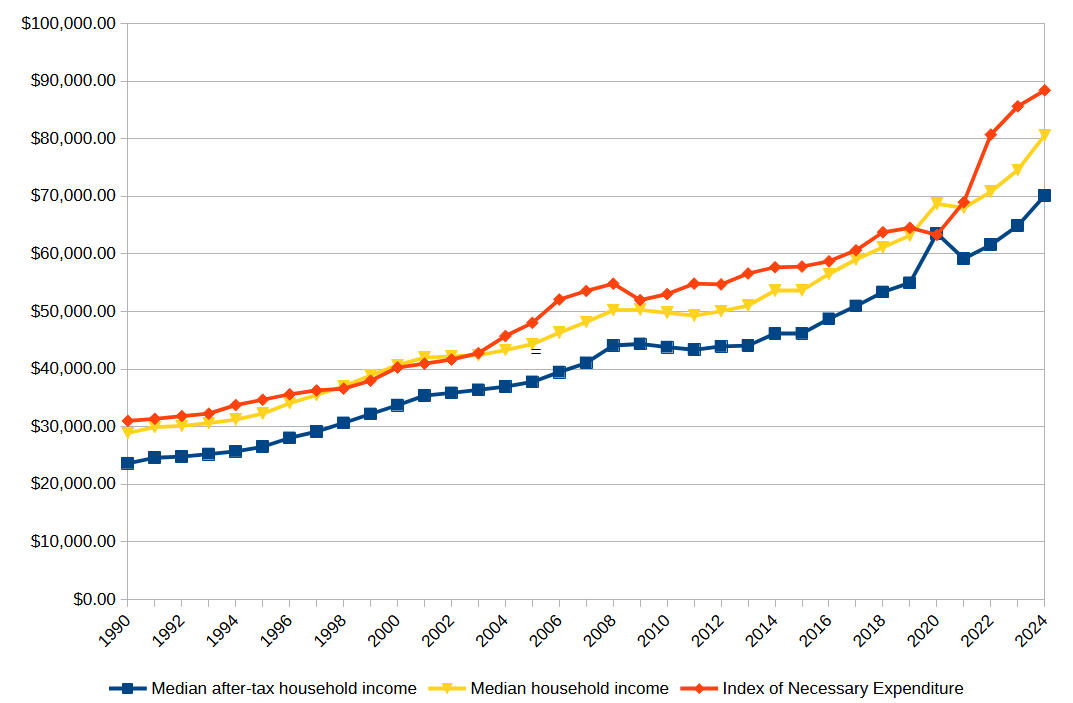
What I found absolutely floored me. Over the range from 1990 to 2024:

  1. The Index of Necessary Expenditure rose by an average of 3.45% per year, almost a full percentage point higher than the average CPI inflation of 2.62% per year.
  2. Over the same period, after-tax income rose at a rate of 3.31%, faster than CPI inflation, but slightly slower than the growth rate of INE.
  3. The Index of Necessary Expenditure was over 100% of median after-tax household income every year except 2020.
  4. Since 2021, the Index of Necessary Expenditure has risen at an average rate of 5.74%, compared to CPI inflation of only 2.66%. In that same time, after-tax income has only grown at a rate of 4.94%.

Point 3 is the one that really stunned me. The only time in the last 34 years that a family of four has been able to actually pay for all necessities—just necessities—on a typical household income was during the COVID pandemic, and that in turn was only because the federal tax burden had been radically reduced in response to the crisis. This means that every single year, a typical American family has been either going further and further into debt, or scrimping on something really important—like healthcare or education.

No wonder people feel like the economy is failing them! It is!

In fact, I can even make sense now of how Trump could convince people with “Are you better off than you were four years ago?” in 2024 looking back at 2020—while the pandemic was horrific and the disruption to the economy was massive, thanks to the US government finally actually being generous to its citizens for once, people could just about actually make ends meet. That one year. In my entire life.

This is why people felt betrayed by Biden’s economy. For the first time most of us could remember, we actually had this brief moment when we could pay for everything we needed and still have money left over. And then, when things went back to “normal”, it was taken away from us. We were back to no longer making ends meet.

When I went into this, I expected to see that the INE had risen faster than both inflation and income, which was indeed the case. But I expected to find that INE was a large but manageable proportion of household income—maybe 70% or 80%—and slowly growing. Instead, I found that INE was greater than 100% of income in every year but one.

And the truth is, I’m not sure I’ve adequately covered all necessary spending! My figures for childcare and utilities are the most uncertain; those could easily go up or down by quite a bit. But even if I exclude them completely, the reduced INE is still greater than income in most years.

Suddenly the way people feel about the economy makes a lot more sense to me.

Why does everyone work full-time?

Jun 30 JDN 2460492

Over 70% of US workers work “full-time”, that is, at least 40 hours a week. The average number of hours worked per week is 33.8, and the average number of overtime hours is only 3.6. So basically, about 2/3 of workers work almost exactly 40 hours per week.

We’re accustomed to this situation, so it may not seem strange to you. But stop and think for a moment: What are the odds that across every industry, exactly 40 hours per week is the most efficient arrangement?

Indeed, there is mounting evidence that in many industries, 40 hours is too much, and something like 5 or even 30 would actually be more efficient. Yet we continue to work 40-hour weeks.

This looks like a corner solution: Rather than choosing an optimal amount, we’re all up against some kind of constraint.


What’s the constraint? Well, the government requires (for most workers) that anything above 40 hours per week must be paid as overtime, that is, at a higher wage rate. So it looks like we would all be working more than 40 hours per week, but we hit the upper limit due to these regulations.

Does this mean we would be better off without the regulations? Clearly not. As I just pointed out, the evidence is mounting that 40 hours is too much, not too little. But why, then, would we all be trying to work so many hours?

I believe this is yet another example of hyper-competition, where competition drives us to an inefficient outcome.

Employers value employees who work a lot of hours. Indeed, I contend that they do so far more than makes any rational sense; they seem to care more about how many hours you work than about the actual quality or quantity of your output. Maybe this is because hours worked is easier to measure, or because it seems like a fairer estimate of your effort; but for whatever reason, employers really seem to reward employees who work a lot of hours, regardless of almost everything else.

In the absence of a limit on hours worked, then, employers are going to heap rewards on whoever works the most hours, and so people will be pressured to work more and more hours. Then we would all work ourselves to death, and it’s not even clear that this would be good for GDP.

Indeed, this seems to be what happened, before the 40-hour work week became the standard. In the 1800s, the average American worked over 60 hours per week. It wasn’t until the 1940s that 40-hour weeks became the norm.

But speaking of norms, that also seems to be a big factor here. The truth is, overtime isn’t really that expensive, and employers could be smarter about rewarding good work rather than more hours. But once a norm establishes itself in a society, it can be very hard to change. And right now, the norm is that 40 hours is a “normal” “standard” “full” work week—any more is above and beyond, and any less is inferior.

This is a problem, because a lot of people can’t work 40-hour weeks. Our standard for what makes someone “disabled” isn’t that you can’t work at all; it’s that you can’t work as much as society expects. I wonder how many people are currently living on disability who could have been working part-time, but there just weren’t enough part-time jobs available. The employment rate among people with a disability is only 41%, compared to 77% of the general population.

And it’s not that we need to work this much. Our productivity is now staggeringly high: We produce more than five times as much wealth per hour of work than we did as recently as the 1940s. So in theory, we should be able to live just as well while working one-fifth as much… but that’s clearly not what happened.

Keynes accurately predicted our high level of productivity; but he wrongly predicted that we would work less, when instead we just kept right on working almost as hard as before.

Indeed, it doesn’t even seem like we live five times as well while working just as much. Many things are better now—healthcare, entertainment, and of course electronics—but somehow, we really don’t feel like we are living better lives than our ancestors.

The Economic Policy Institute offers an explanation for this phenomenon: Our pay hasn’t kept up with our productivity.


Up until about 1980, productivity and pay rose in lockstep. But then they started to diverge, and they never again converged. Productivity continued to soar, while real wages only barely increased. The result is that since then, productivity has grown by 64%, and hourly pay has only grown 15%.

This is definitely part of the problem, but I think there’s more to it as well. Housing and healthcare have become so utterly unaffordable in this country that it really doesn’t matter that our cars are nice and our phones are dirt cheap. We are theoretically wealthier now, but most of that extra wealth goes into simply staying healthy and having a home. Our consumption has been necessitized.

If we can solve these problems, maybe people won’t feel a need to work so many hours. Or, maybe competition will continue to pressure them to work those hours… but at least we’ll actually feel richer when we do it.

Wrongful beneficence

Jun 9 JDN 2460471

One of the best papers I’ve ever read—one that in fact was formative in making me want to be an economist—is Wrongful Beneficence by Chris Meyers.

This paper opened my eyes to a whole new class of unethical behavior: Acts that unambiguously make everyone better off, but nevertheless are morally wrong. Hence, wrongful beneficence.

A lot of economists don’t even seem to believe in such things. They seem convinced that as long as no one is made worse off by a transaction, that transaction must be ethically defensible.

Chris Meyers convinced me that they are wrong.

The key insight here is that it’s still possible to exploit someone even if you make them better off. This happens when they are in a desperate situation and you take advantage of that to get an unfair payoff.


Here one of the cases Meyers offers to demonstrate this:

Suppose Carole is driving across the desert on a desolate road when her car breaks down. After two days and two nights without seeing a single car pass by, she runs out of water and feels rather certain that she will perish if not rescued soon. Now suppose that Jason happens to drive down this road and finds Carole. He sees that her situation is rather desperate and that she needs (or strongly desires) to get to the nearest town as soon as possible. So Jason offers her a ride but only on the condition that […] [she gives him] her entire net worth, the title to her house and car, all of her money in the bank, and half of her earnings for the next ten years.

Carole obviously is better off than she would be if Jason hadn’t shown up—she might even have died. She freely consented to this transaction—again, because if she didn’t, she might die. Yet it seems absurd to say that Jason has done nothing wrong by making such an exorbitant demand. If he had asked her to pay for gas, or even to compensate him for his time at a reasonable rate, we’d have no objection. But to ask for her life savings, all her assets, and half her earnings for ten years? Obviously unfair—and obviously unethical. Jason is making Carole (a little) better off while making himself (a lot) better off, so everyone is benefited; but what he’s doing is obviously wrong.

Once you recognize that such behavior can exist, you start to see it all over the place, particularly in markets, where corporations are quite content to gouge their customers with high prices and exploit their workers with low wages—but still, technically, we’re better off than we would be with no products and no jobs at all.

Indeed, the central message of Wrongful Beneficence is actually about sweatshop labor: It’s not that the workers are worse off than they would have been (in general, they aren’t); it’s that they are so desperate that corporations can get away with exploiting them with obviously unfair wages and working conditions.

Maybe it would be easier just to move manufacturing back to First World countries?

Right-wingers are fond of making outlandish claims that making products at First World wages would be utterly infeasible; here’s one claiming that an iPhone would need to cost $30,000 if it were made in the US. In fact, the truth is that it would only need to cost about $40 more—because hardly any of its cost is actually going to labor. Most of its price is pure monopoly profit for Apple; most of the rest is components and raw materials. (Of course, if those also had to come from the US, the price would go up more; but even so, we’re talking something like double its original price, not thirty times. Workers in the US are indeed paid a lot more than workers in China; they are also more productive.)

It’s true that actually moving manufacturing from other countries back to the US would be a substantial undertaking, requiring retooling factories, retraining engineers, and so on; but it’s not like we’ve never done that sort of thing before. I’m sure it could not be done overnight; but of course it could be done. We do this sort of thing all the time.

Ironically, this sort of right-wing nonsense actually seems to feed the far left as well, supporting their conviction that all this prosperity around us is nothing more than an illusion, that all our wealth only exists because we steal it from others. But this could scarcely be further from the truth; our wealth comes from technology, not theft. If we offered a fairer bargain to poorer countries, we’d be a bit less rich, but they would be much less poor—the overall wealth in the world would in fact probably increase.

A better argument for not moving manufacturing back to the First World is that many Third World economies would collapse if they stopped manufacturing things for other countries, and that would be disastrous for millions of people.

And free trade really does increase efficiency and prosperity for all.

So, yes; let’s keep on manufacturing goods wherever it is cheapest to do so. But when we decide what’s cheapest, let’s evaluate that based on genuinely fair wages and working conditions, not the absolute cheapest that corporations think they can get away with.

Sometimes they may even decide that it’s not really cheaper to manufacture in poorer countries, because they need advanced technology and highly-skilled workers that are easier to come by in First World countries. In that case, bringing production back here is the right thing to do.

Of course, this raises the question:

What would be fair wages and working conditions?

That’s not so easy to answer. Since workers in Third World countries are less educated than workers in First World countries, and have access to less capital and worse technology, we should in fact expect them to be less productive and therefore get paid less. That may be unfair in some cosmic sense, but it’s not anyone’s fault, and it’s not any particular corporation’s responsibility to fix it.

But when there are products for which less than 1% of the sales price of the product goes to the workers who actually made the product, something is wrong. When the profit margin is often wildly larger than the total amount spent on labor, something is wrong.

It may be that we will never have precise thresholds we can set to decide what definitely is or is not exploitative; but that doesn’t mean we can’t ever recognize it when we see it. There are various institutional mechanisms we could use to enforce better wages and working conditions without ever making such a sharp threshold.

One of the simplest, in fact, is Fair Trade.

Fair Trade is by no means a flawless system; in fact there’s a lot of research debating how effective it is at achieving its goals. But it does seem to be accomplishing something. And it’s a system that we already have in place, operating successfully in many countries; it simply needs to be scaled up (and hopefully improved along the way).

One of the clearest pieces of evidence that it’s helping, in fact, is that farmers are willing to participate in it. That shows that it is beneficent.

Of course, that doesn’t mean that it’s genuinely fair! This could just be another kind of wrongful beneficence. Perhaps Fair Trade is really just less exploitative than all the available alternatives.

If so, then we need something even better still, some new system that will reliably pass on the increased cost for customers all the way down to increased wages for workers.

Fair Trade shows us something else, too: A lot of customers clearly are willing to pay a bit more in order to see workers treated better. Even if they weren’t, maybe they should be forced to. But the fact is, they are! Even those who are most adamantly opposed to Fair Trade can’t deny that people really are willing to pay more to help other people. (Yet another example of obvious altruism that neoclassical economists somehow manage to ignore.) They simply deny that it’s actually helping, which is an empirical matter.

But if this isn’t helping enough, fine; let’s find something else that does.

Surviving in an ad-supported world

Apr 21 JDN 2460423

Advertising is as old as money—perhaps even older. Scams have likewise been a part of human society since time immemorial.

But I think it’s fair to say that recently, since the dawn of the Internet at least, both advertising and scams have been proliferating, far beyond what they used to be.

We live in an ad-supported world.

News sites are full of ads. Search engines are full of ads. Even shopping sites are full of ads now; we literally came here planning to buy something, but that wasn’t good enough for you; you want us to also buy something else. Most of the ads are for legitimate products; but some are for scams. (And then there’s multi-level marketing, which is somewhere in between: technically not a scam.)

We’re so accustomed to getting spam emails, phone calls, and texts full of ads and scams that we just accept it as a part of our lives. But these are not something people had to live with even 50 years ago. This is a new, fresh Hell we have wrought for ourselves as a civilization.

AI promises to make this problem even worse. AI still isn’t very good at doing anything particularly useful; you can’t actually trust it to drive a truck or diagnose an X-ray. (There are people working on this sort of thing, but they haven’t yet succeeded.) But it’s already pretty good at making spam texts and phone calls. It’s already pretty good at catfishing people. AI isn’t smart enough to really help us, but it is smart enough to hurt us, especially those of us who are most vulnerable.

I think that this causes a great deal more damage to our society than is commonly understood.

It’s not just that ads are annoying (though they are), or that they undermine our attention span (though they do), or that they exploit the vulnerable (though they do).

I believe that an ad-supported world is a world where trust goes to die.

When the vast majority of your interactions with other people involve those people trying to get your money, some of them by outright fraud—but none of them really honestly—you have no choice but to ratchet down your sense of trust. It begins to feel as this financial transactions are the only form of interaction there is in the world.

But in fact most people can be trusted, and should be trusted—you are missing out on a great deal of what makes life worth living if you do not know how to trust.

The question is whom you trust. You should trust people you know, people you interact with personally and directly. Even strangers are more trustworthy than any corporation will ever be. And never are corporations more dishonest than when they are sending out ads.


The more the world fills with ads, the less room it has for trust.

Is there any way to stem this tide? Or are we simply doomed to live in the cyberpunk dystopia our forebears warned about, where everything is for sale and all available real estate is used for advertising?

Ads and scams only exist because they are profitable; so our goal should be to make them no longer profitable.

Here is one very simple piece of financial advice that will help protect you. Indeed, I believe it can protect so well, that if everyone followed it consistently, we would stem the tide.

Only give money to people you have sought out yourself.

Only buy things you already knew you wanted.

Yes, of course you must buy things. We live in a capitalist society. You can’t survive without buying things. But this is how buying things should work:

You check your fridge and see you are out of milk. So you put “milk” on your grocery list, you go to the grocery store, you find some milk that looks good, and you buy it.

Or, your car is getting old and expensive to maintain, and you decide you need a new one. You run the numbers on your income and expenses, and come up with a budget for a new car. You go to the dealership, they help you pick out a car that fits your needs and your budget, and you buy it.

Your tennis shoes are getting frayed, and it’s time to replace them. You go online and search for “tennis shoes”, looking up sizes and styles until you find a pair that suits you. You order that pair.

You should be the one to decide that you need a thing, and then you should go out looking for it.

It’s okay to get help searching, or even listen to some sales pitches, as long as the whole thing was your idea from the start.

But if someone calls you, texts you, or emails you, asking for your money for something?

Don’t give them a cent.

Just don’t. Don’t do it. Even if it sounds like a good product. Even if it is a good product. If the product they are selling sounds so great that you decide you actually want to buy it, go look for it on your own. Shop around. If you can, go out of your way to buy it from a competing company.

Your attention is valuable. Don’t reward them for stealing it.

This applies to donations, too. Donation asks aren’t as awful as ads, let alone scams, but they are pretty obnoxious, and they only send those things out because people respond to them. If we all stopped responding, they’d stop sending.

Yes, you absolutely should give money to charity. But you should seek out the charities to donate to. You should use trusted sources (like GiveWell and Charity Navigator) to vet them for their reliability, transparency, and cost-effectiveness.

If you just receive junk mail asking you for donations, feel free to take out any little gifts they gave you (it’s often return address labels, for some reason), and then recycle the rest.

Don’t give to the ones who ask for it. Give to the ones who will use it the best.

Reward the charities that do good, not the charities that advertise well.

This is the rule to follow:

If someone contacts you—if they initiate the contact—refuse to give them any money. Ever.

Does this rule seem too strict? It is quite strict, in fact. It requires you to pass up many seemingly-appealing opportunities, and the more ads there are, the more opportunities you’ll need to pass up.

There may even be a few exceptions; no great harm befalls us if we buy Girl Scout cookies or donate to the ASPCA because the former knocked on our doors and the latter showed us TV ads. (Then again, you could just donate to feminist and animal rights charities without any ads or sales pitches.)

But in general, we live in a society that is absolutely inundated with people accosting us and trying to take our money, and they’re only ever going to stop trying to get our money if we stop giving it to them. They will not stop it out of the goodness of their hearts—no, not even the charities, who at least do have some goodness in their hearts. (And certainly not the scammers, who have none.)

They will only stop if it stops working.

So we need to make it stop working. We need to draw this line.

Trust the people around you, who have earned it. Do not trust anyone who seeks you out asking for money.

Telemarketing calls? Hang up. Spam emails? Delete. Junk mail? Recycle. TV ads? Mute and ignore.

And then, perhaps, future generations won’t have to live in an ad-supported world.

How is the economy doing this well?

Apr 14 JDN 2460416

We are living in a very weird time, economically. The COVID pandemic created huge disruptions throughout our economy, from retail shops closing to shortages in shipping containers. The result was a severe recession with the worst unemployment since the Great Depression.

Now, a few years later, we have fully recovered.

Here’s a graph from FRED showing our unemployment and inflation rates since 1990 [technical note: I’m using the urban CPI; there are a few other inflation measures you could use instead, but they look much the same]:

Inflation fluctuates pretty quickly, while unemployment moves much slower.

There are a lot of things we can learn from this graph:

  1. Before COVID, we had pretty low inflation; from 1990 to 2019, inflation averaged about 2.4%, just over the Fed’s 2% target.
  2. Before COVID, we had moderate to high unemployment; it rarely went below 5% and and for several years after the 2008 crash it was over 7%—which is why we called it the Great Recession.
  3. The only times we actually had negative inflation—deflationwere during recessions, and coincided with high unemployment; so, no, we really don’t want prices to come down.
  4. During COVID, we had a massive spike in unemployment up to almost 15%, but then it came back down much more rapidly than it had in the Great Recession.
  5. After COVID, there was a surge in inflation, peaking at almost 10%.
  6. That inflation surge was short-lived; by the end of 2022 inflation was back down to 4%.
  7. Unemployment now stands at 3.8% while inflation is at 2.7%.

What I really want to emphasize right now is point 7, so let me repeat it:

Unemployment now stands at 3.8% while inflation is at 2.7%.

Yes, technically, 2.7% is above our inflation target. But honestly, I’m not sure it should be. I don’t see any particular reason to think that 2% is optimal, and based on what we’ve learned from the Great Recession, I actually think 3% or even 4% would be perfectly reasonable inflation targets. No, we don’t want to be going into double-digits (and we certainly don’t want true hyperinflation); but 4% inflation really isn’t a disaster, and we should stop treating it like it is.

2.7% inflation is actually pretty close to the 2.4% inflation we’d been averaging from 1990 to 2019. So I think it’s fair to say that inflation is back to normal.

But the really wild thing is that unemployment isn’t back to normal: It’s much better than that.

To get some more perspective on this, let’s extend our graph backward all the way to 1950:

Inflation has been much higher than it is now. In the late 1970s, it was consistently as high as it got during the post-COVID surge. But it has never been substantially lower than it is now; a little above the 2% target really seems to be what stable, normal inflation looks like in the United States.

On the other hand, unemployment is almost never this low. It was for a few years in the early 1950s and the late 1960s; but otherwise, it has always been higher—and sometimes much higher. It did not dip below 5% for the entire period from 1971 to 1994.

They hammer into us in our intro macroeconomics courses the Phillips Curve, which supposedly says that unemployment is inversely related to inflation, so that it’s impossible to have both low inflation and low unemployment.

But we’re looking at it, right now. It’s here, right in front of us. What wasn’t supposed to be possible has now been achieved. E pur si muove.

There was supposed to be this terrible trade-off between inflation and unemployment, leaving our government with the stark dilemma of either letting prices surge or letting millions remain out of work. I had always been on the “inflation” side: I thought that rising prices were far less of a problem than poeple out of work.

But we just learned that the entire premise was wrong.

You can have both. You don’t have to choose.

Right here, right now, we have both. All we need to do is keep doing whatever we’re doing.

One response might be: what if we can’t? What if this is unsustainable? (Then again, conservatives never seemed terribly concerned about sustainability before….)

It’s worth considering. One thing that doesn’t look so great now is the federal deficit. It got extremely high during COVID, and it’s still pretty high now. But as a proportion of GDP, it isn’t anywhere near as high as it was during WW2, and we certainly made it through that all right:

So, yeah, we should probably see if we can bring the budget back to balanced—probably by raising taxes. But this isn’t an urgent problem. We have time to sort it out. 15% unemployment was an urgent problem—and we fixed it.

In fact in some ways the economy is even doing better now than it looks. Unemployment for Black people has never been this low, since we’ve been keeping track of it:

Black people had basically learned to live with 8% or 9% unemployment as if it were normal; but now, for the first time ever—ever—their unemployment rate is down to only 5%.

This isn’t because people are dropping out of the labor force. Broad unemployment, which includes people marginally attached to the labor force, people employed part-time not by choice, and people who gave up looking for work, is also at historic lows, despite surging to almost 23% during COVID:

In fact, overall employment among people 25-54 years old (considered “prime age”—old enough to not be students, young enough to not be retired) is nearly the highest it has ever been, and radically higher than it was before the 1980s (because women entered the workforce):

So this is not an illusion: More Americans really are working now. And employment has become more inclusive of women and minorities.

I really don’t understand why President Biden isn’t more popular. Biden inherited the worst unemployment since the Great Depression, and turned it around into an economic situation so good that most economists thought it was impossible. A 39% approval rating does not seem consistent with that kind of staggering economic improvement.

And yes, there are a lot of other factors involved aside from the President; but for once I think he really does deserve a lot of the credit here. Programs he enacted to respond to COVID brought us back to work quicker than many thought possible. Then, the Inflation Reduction Act made historic progress at fighting climate change—and also, lo and behold, reduced inflation.

He’s not a particularly charismatic figure. He is getting pretty old for this job (or any job, really). But Biden’s economic policy has been amazing, and deserves more credit for that.