The role of innate activation in stochastic overload

Mar 26 JDN 2460030

Two posts ago I introduced my stochastic overload model, which offers an explanation for the Yerkes-Dodson effect by positing that additional stress increases sympathetic activation, which is useful up until the point where it starts risking an overload that forces systems to shut down and rest.

The central equation of the model is actually quite simple, expressed either as an expectation or as an integral:

Y = E[x + s | x + s < 1] P[x + s < 1]

Y = \int_{0}^{1-s} (x+s) dF(x)

The amount of output produced is the expected value of innate activation plus stress activation, times the probability that there is no overload. Increased stress raises this expectation value (the incentive effect), but also increases the probability of overload (the overload effect).

The model relies upon assuming that the brain starts with some innate level of activation that is partially random. Exactly what sort of Yerkes-Dodson curve you get from this model depends very much on what distribution this innate activation takes.

I’ve so far solved it for three types of distribution.

The simplest is a uniform distribution, where within a certain range, any level of activation is equally probable. The probability density function looks like this:
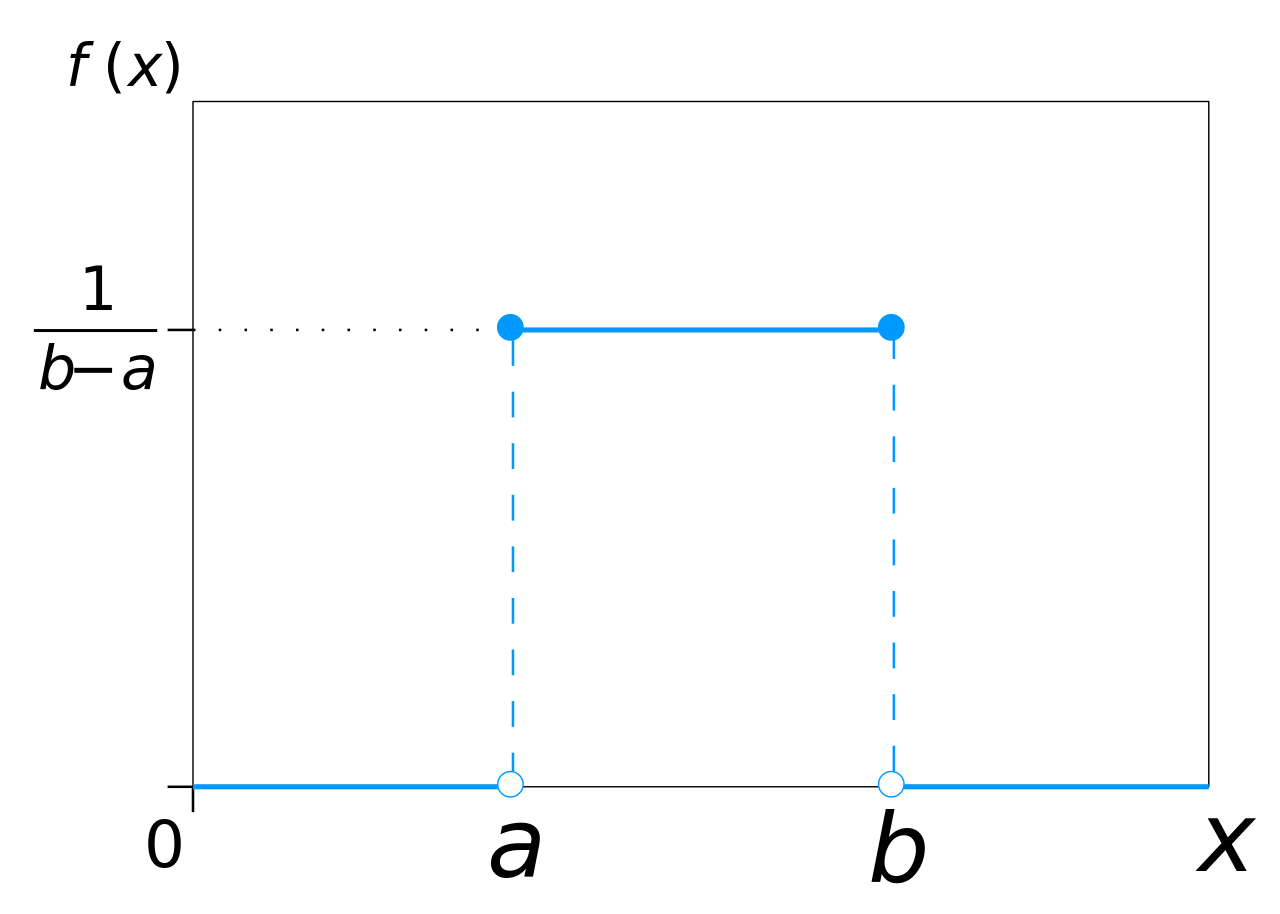
Assume the distribution has support between a and b, where a < b.

When b+s < 1, then overload is impossible, and only the incentive effect occurs; productivity increases linearly with stress.

The expected output is simply the expected value of a uniform distribution from a+s to b+s, which is:

E[x + s] = (a+b)/2+s

Then, once b+s > 1, overload risk begins to increase.

In this range, the probability of avoiding overload is:

P[x + s < 1] = F(1-s) = (1-s-a)/(b-a)

(Note that at b+s=1, this is exactly 1.)

The expected value of x+s in this range is:

E[x + s | x + s < 1] = (1-s)(1+s)/(2(b-a))

Multiplying these two together:

Y = [(1-s)(1+s)(1-s-a)]/[2(b-a)^2]

Here is what that looks like for a=0, b=1/2:
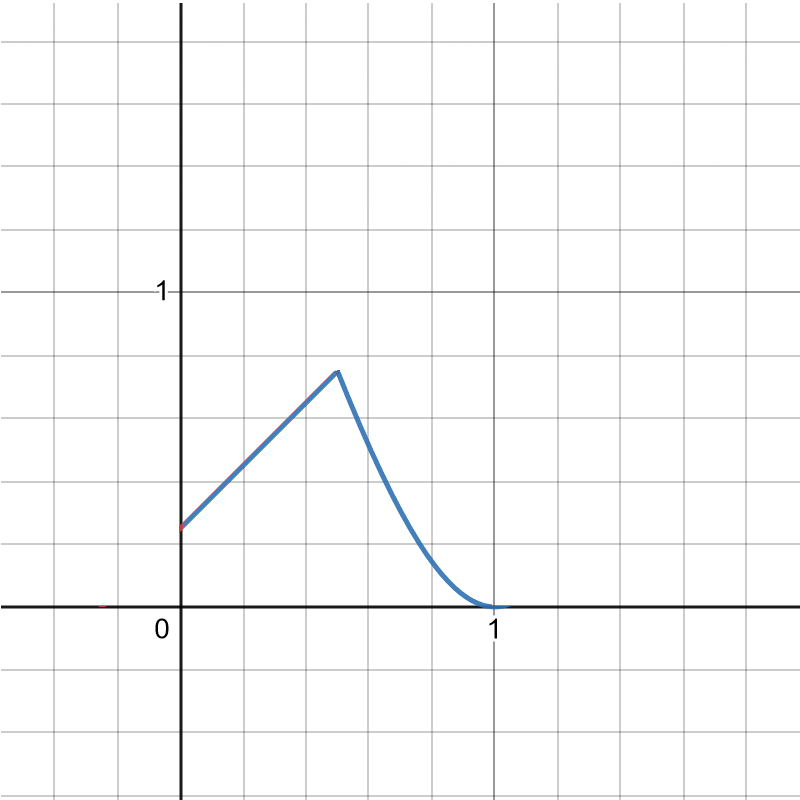
It does have the right qualitative features: increasing, then decreasing. But its sure looks weird, doesn’t it? It has this strange kinked shape.

So let’s consider some other distributions.

The next one I was able to solve it for is an exponential distribution, where the most probable activation is zero, and then higher activation always has lower probability than lower activation in an exponential decay:

For this it was actually easiest to do the integral directly (I did it by integrating by parts, but I’m sure you don’t care about all the mathematical steps):

Y = \int_{0}^{1-s} (x+s) dF(x)

Y = (1/λ+s) – (1/ λ + 1)e^(-λ(1-s))

The parameter λdecides how steeply your activation probability decays. Someone with low λ is relatively highly activated all the time, while someone with high λ is usually not highly activated; this seems like it might be related to the personality trait neuroticism.

Here are graphs of what the resulting Yerkes-Dodson curve looks like for several different values of λ:

λ = 0.5:
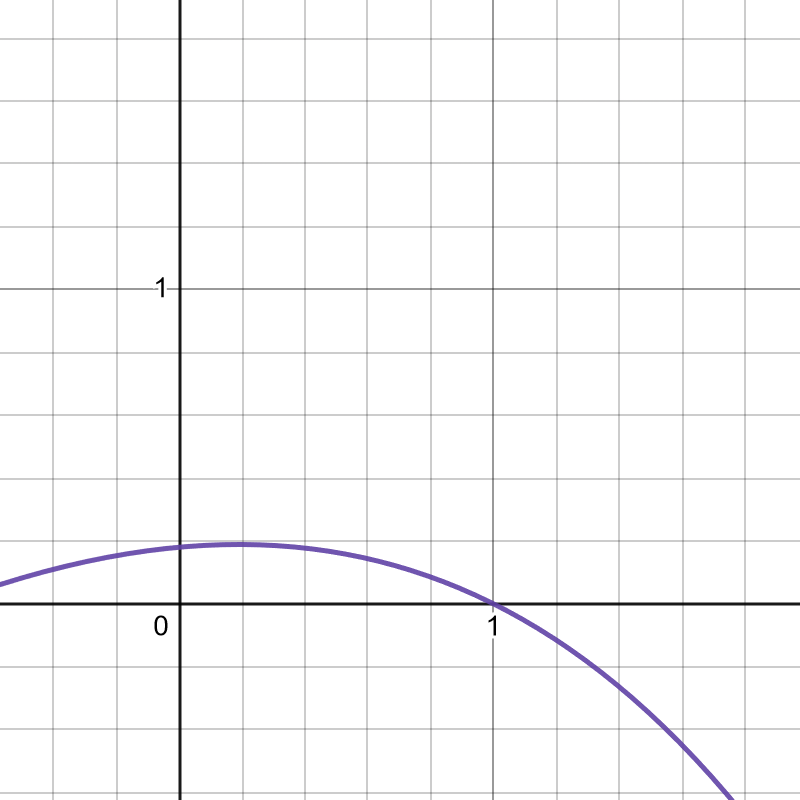
λ = 1:

λ = 2:

λ = 4:

λ = 8:

The λ = 0.5 person has high activation a lot of the time. They are actually fairly productive even without stress, but stress quickly overwhelms them. The λ = 8 person has low activation most of the time. They are not very productive without stress, but can also bear relatively high amounts of stress without overloading.

(The low-λ people also have overall lower peak productivity in this model, but that might not be true in reality, if λ is inversely correlated with some other attributes that are related to productivity.)

Neither uniform nor exponential has the nice bell-curve shape for innate activation we might have hoped for. There is another class of distributions, beta distributions, which do have this shape, and they are sort of tractable—you need something called an incomplete beta function, which isn’t an elementary function but it’s useful enough that most statistical packages include it.

Beta distributions have two parameters, α and β. They look like this:

Beta distributions are quite useful in Bayesian statistics; if you’re trying to estimate the probability of a random event that either succeeds or fails with a fixed probability (a Bernoulli process), and so far you have observed a successes and b failures, your best guess of its probability at each trial is a beta distribution with α = a+1 and β = b+1.

For beta distributions with parameters α and β, the result comes out to (I is that incomplete beta function I mentioned earlier):

Y = I(1-s, α+1, β) + I(1-s, α, β)

For whole number values of α andβ, the incomplete beta function can be computed by hand (though it is more work the larger they are); here’s an example with α = β = 2.

The innate activation probability looks like this:

And the result comes out like this:

Y = 2(1-s)^3 – 3/2(1-s)^4 + 3s(1-s)^2 – 2s(1-s)^3

This person has pretty high innate activation most of the time, so stress very quickly overwhelms them. If I had chosen a much higher β, I could change that, making them less likely to be innately so activated.

These are the cases I’ve found to be relatively tractable so far. They all have the right qualitative pattern: Increasing stress increases productivity for awhile, then begins decreasing it once overload risk becomes too high. They also show a general pattern where people who are innately highly activated (neurotic?) are much more likely to overload and thus much more sensitive to stress.

What happens when a bank fails

Mar 19 JDN 2460023

As of March 9, Silicon Valley Bank (SVB) has failed and officially been put into receivership under the FDIC. A bank that held $209 billion in assets has suddenly become insolvent.

This is the second-largest bank failure in US history, after Washington Mutual (WaMu) in 2008. In fact it will probably have more serious consequences than WaMu, for two reasons:

1. WaMu collapsed as part of the Great Recession, so there was already a lot of other things going on and a lot of policy responses already in place.

2. WaMu was mostly a conventional commercial bank that held deposits and loans for consumers, so its assets were largely protected by the FDIC, and thus its bankruptcy didn’t cause contagion the spread out to the rest of the system. (Other banks—shadow banks—did during the crash, but not so much WaMu.) SVB mostly served tech startups, so a whopping 89% of its deposits were not protected by FDIC insurance.

You’ve likely heard of many of the companies that had accounts at SVB: Roku, Roblox, Vimeo, even Vox. Stocks of the US financial industry lost $100 billion in value in two days.

The good news is that this will not be catastrophic. It probably won’t even trigger a recession (though the high interest rates we’ve been having lately potentially could drive us over that edge). Because this is commercial banking, it’s done out in the open, with transparency and reasonably good regulation. The FDIC knows what they are doing, and even though they aren’t covering all those deposits directly, they intend to find a buyer for the bank who will, and odds are good that they’ll be able to cover at least 80% of the lost funds.

In fact, while this one is exceptionally large, bank failures are not really all that uncommon. There have been nearly 100 failures of banks with assets over $1 billion in the US alone just since the 1970s. The FDIC exists to handle bank failures, and generally does the job well.

Then again, it’s worth asking whether we should really have a banking system in which failures are so routine.

The reason banks fail is kind of a dark open secret: They don’t actually have enough money to cover their deposits.

Banks loan away most of their cash, and rely upon the fact that most of their depositors will not want to withdraw their money at the same time. They are required to keep a certain ratio in reserves, but it’s usually fairly small, like 10%. This is called fractional-reserve banking.

As long as less than 10% of deposits get withdrawn at any given time, this works. But if a bunch of depositors suddenly decide to take out their money, the bank may not have enough to cover it all, and suddenly become insolvent.

In fact, the fear that a bank might become insolvent can actually cause it to become insolvent, in a self-fulfilling prophecy. Once depositors get word that the bank is about to fail, they rush to be the first to get their money out before it disappears. This is a bank run, and it’s basically what happened to SVB.

The FDIC was originally created to prevent or mitigate bank runs. Not only did they provide insurance that reduced the damage in the event of a bank failure; by assuring depositors that their money would be recovered even if the bank failed, they also reduced the chances of a bank run becoming a self-fulfilling prophecy.


Indeed, SVB is the exception that proves the rule, as they failed largely because their assets were mainly not FDIC insured.

Fractional-reserve banking effectively allows banks to create money, in the form of credit that they offer to borrowers. That credit gets deposited in other banks, which then go on to loan it out to still others; the result is that there is more money in the system than was ever actually printed by the central bank.

In most economies this commercial bank money is a far larger quantity than the central bank money actually printed by the central bank—often nearly 10 to 1. This ratio is called the money multiplier.

Indeed, it’s not a coincidence that the reserve ratio is 10% and the multiplier is 10; the theoretical maximum multiplier is always the inverse of the reserve ratio, so if you require reserves of 10%, the highest multiplier you can get is 10. Had we required 20% reserves, the multiplier would drop to 5.

Most countries have fractional-reserve banking, and have for centuries; but it’s actually a pretty weird system if you think about it.

Back when we were on the gold standard, fractional-reserve banking was a way of cheating, getting our money supply to be larger than the supply of gold would actually allow.

But now that we are on a pure fiat money system, it’s worth asking what fractional-reserve banking actually accomplishes. If we need more money, the central bank could just print more. Why do we delegate that task to commercial banks?

David Friedman of the Cato Institute had some especially harsh words on this, but honestly I find them hard to disagree with:

Before leaving the subject of fractional reserve systems, I should mention one particularly bizarre variant — a fractional reserve system based on fiat money. I call it bizarre because the essential function of a fractional reserve system is to reduce the resource cost of producing money, by allowing an ounce of reserves to replace, say, five ounces of currency. The resource cost of producing fiat money is zero; more precisely, it costs no more to print a five-dollar bill than a one-dollar bill, so the cost of having a larger number of dollars in circulation is zero. The cost of having more bills in circulation is not zero but small. A fractional reserve system based on fiat money thus economizes on the cost of producing something that costs nothing to produce; it adds the disadvantages of a fractional reserve system to the disadvantages of a fiat system without adding any corresponding advantages. It makes sense only as a discreet way of transferring some of the income that the government receives from producing money to the banking system, and is worth mentioning at all only because it is the system presently in use in this country.

Our banking system evolved gradually over time, and seems to have held onto many features that made more sense in an earlier era. Back when we had arbitrarily tied our central bank money supply to gold, creating a new money supply that was larger may have been a reasonable solution. But today, it just seems to be handing the reins over to private corporations, giving them more profits while forcing the rest of society to bear more risk.

The obvious alternative is full-reserve banking, where banks are simply required to hold 100% of their deposits in reserve and the multiplier drops to 1. This idea has been supported by a number of quite prominent economists, including Milton Friedman.

It’s not just a right-wing idea: The left-wing organization Positive Money is dedicated to advocating for a full-reserve banking system in the UK and EU. (The ECB VP’s criticism of the proposal is utterly baffling to me: it “would not create enough funding for investment and growth.” Um, you do know you can print more money, right? Hm, come to think of it, maybe the ECB doesn’t know that, because they think inflation is literally Hitler. There are legitimate criticisms to be had of Positive Money’s proposal, but “There won’t be enough money under this fiat money system” is a really weird take.)

There’s a relatively simple way to gradually transition from our current system to a full-reserve sytem: Simply increase the reserve ratio over time, and print more central bank money to keep the total money supply constant. If we find that it seems to be causing more problems than it solves, we could stop or reverse the trend.

Krugman has pointed out that this wouldn’t really fix the problems in the banking system, which actually seem to be much worse in the shadow banking sector than in conventional commercial banking. This is clearly right, but it isn’t really an argument against trying to improve conventional banking. I guess if stricter regulations on conventional banking push more money into the shadow banking system, that’s bad; but really that just means we should be imposing stricter regulations on the shadow banking system first (or simultaneously).

We don’t need to accept bank runs as a routine part of the financial system. There are other ways of doing things.

Optimization is unstable. Maybe that’s why we satisfice.

Feb 26 JDN 2460002

Imagine you have become stranded on a deserted island. You need to find shelter, food, and water, and then perhaps you can start working on a way to get help or escape the island.

Suppose you are programmed to be an optimizerto get the absolute best solution to any problem. At first this may seem to be a boon: You’ll build the best shelter, find the best food, get the best water, find the best way off the island.

But you’ll also expend an enormous amount of effort trying to make it the best. You could spend hours just trying to decide what the best possible shelter would be. You could pass up dozens of viable food sources because you aren’t sure that any of them are the best. And you’ll never get any rest because you’re constantly trying to improve everything.

In principle your optimization could include that: The cost of thinking too hard or searching too long could be one of the things you are optimizing over. But in practice, this sort of bounded optimization is often remarkably intractable.

And what if you forgot about something? You were so busy optimizing your shelter you forgot to treat your wounds. You were so busy seeking out the perfect food source that you didn’t realize you’d been bitten by a venomous snake.

This is not the way to survive. You don’t want to be an optimizer.

No, the person who survives is a satisficerthey make sure that what they have is good enough and then they move on to the next thing. Their shelter is lopsided and ugly. Their food is tasteless and bland. Their water is hard. But they have them.

Once they have shelter and food and water, they will have time and energy to do other things. They will notice the snakebite. They will treat the wound. Once all their needs are met, they will get enough rest.

Empirically, humans are satisficers. We seem to be happier because of it—in fact, the people who are the happiest satisfice the most. And really this shouldn’t be so surprising: Because our ancestral environment wasn’t so different from being stranded on a desert island.

Good enough is perfect. Perfect is bad.

Let’s consider another example. Suppose that you have created a powerful artificial intelligence, an AGI with the capacity to surpass human reasoning. (It hasn’t happened yet—but it probably will someday, and maybe sooner than most people think.)

What do you want that AI’s goals to be?

Okay, ideally maybe they would be something like “Maximize goodness”, where we actually somehow include all the panoply of different factors that go into goodness, like beneficence, harm, fairness, justice, kindness, honesty, and autonomy. Do you have any idea how to do that? Do you even know what your own full moral framework looks like at that level of detail?

Far more likely, the goals you program into the AGI will be much simpler than that. You’ll have something you want it to accomplish, and you’ll tell it to do that well.

Let’s make this concrete and say that you own a paperclip company. You want to make more profits by selling paperclips.

First of all, let me note that this is not an unreasonable thing for you to want. It is not an inherently evil goal for one to have. The world needs paperclips, and it’s perfectly reasonable for you to want to make a profit selling them.

But it’s also not a true ultimate goal: There are a lot of other things that matter in life besides profits and paperclips. Anyone who isn’t a complete psychopath will realize that.

But the AI won’t. Not unless you tell it to. And so if we tell it to optimize, we would need to actually include in its optimization all of the things we genuinely care about—not missing a single one—or else whatever choices it makes are probably not going to be the ones we want. Oops, we forgot to say we need clean air, and now we’re all suffocating. Oops, we forgot to say that puppies don’t like to be melted down into plastic.

The simplest cases to consider are obviously horrific: Tell it to maximize the number of paperclips produced, and it starts tearing the world apart to convert everything to paperclips. (This is the original “paperclipper” concept from Less Wrong.) Tell it to maximize the amount of money you make, and it seizes control of all the world’s central banks and starts printing $9 quintillion for itself. (Why that amount? I’m assuming it uses 64-bit signed integers, and 2^63 is over 9 quintillion. If it uses long ints, we’re even more doomed.) No, inflation-adjusting won’t fix that; even hyperinflation typically still results in more real seigniorage for the central banks doing the printing (which is, you know, why they do it). The AI won’t ever be able to own more than all the world’s real GDP—but it will be able to own that if it prints enough and we can’t stop it.

But even if we try to come up with some more sophisticated optimization for it to perform (what I’m really talking about here is specifying its utility function), it becomes vital for us to include everything we genuinely care about: Anything we forget to include will be treated as a resource to be consumed in the service of maximizing everything else.

Consider instead what would happen if we programmed the AI to satisfice. The goal would be something like, “Produce at least 400,000 paperclips at a price of at most $0.002 per paperclip.”

Given such an instruction, in all likelihood, it would in fact produce exactly 400,000 paperclips at a price of exactly $0.002 per paperclip. And maybe that’s not strictly the best outcome for your company. But if it’s better than what you were previously doing, it will still increase your profits.

Moreover, such an instruction is far less likely to result in the end of the world.

If the AI has a particular target to meet for its production quota and price limit, the first thing it would probably try is to use your existing machinery. If that’s not good enough, it might start trying to modify the machinery, or acquire new machines, or develop its own techniques for making paperclips. But there are quite strict limits on how creative it is likely to be—because there are quite strict limits on how creative it needs to be. If you were previously producing 200,000 paperclips at $0.004 per paperclip, all it needs to do is double production and halve the cost. That’s a very standard sort of industrial innovation— in computing hardware (admittedly an extreme case), we do this sort of thing every couple of years.

It certainly won’t tear the world apart making paperclips—at most it’ll tear apart enough of the world to make 400,000 paperclips, which is a pretty small chunk of the world, because paperclips aren’t that big. A paperclip weighs about a gram, so you’ve only destroyed about 400 kilos of stuff. (You might even survive the lawsuits!)

Are you leaving money on the table relative to the optimization scenario? Eh, maybe. One, it’s a small price to pay for not ending the world. But two, if 400,000 at $0.002 was too easy, next time try 600,000 at $0.001. Over time, you can gently increase its quotas and tighten its price requirements until your company becomes more and more successful—all without risking the AI going completely rogue and doing something insane and destructive.

Of course this is no guarantee of safety—and I absolutely want us to use every safeguard we possibly can when it comes to advanced AGI. But the simple change from optimizing to satisficing seems to solve the most severe problems immediately and reliably, at very little cost.

Good enough is perfect; perfect is bad.

I see broader implications here for behavioral economics. When all of our models are based on optimization, but human beings overwhelmingly seem to satisfice, maybe it’s time to stop assuming that the models are right and the humans are wrong.

Optimization is perfect if it works—and awful if it doesn’t. Satisficing is always pretty good. Optimization is unstable, while satisficing is robust.

In the real world, that probably means that satisficing is better.

Good enough is perfect; perfect is bad.

Where is the money going in academia?

Feb 19 JDN 2459995

A quandary for you:

My salary is £41,000.

Annual tuition for a full-time full-fee student in my department is £23,000.

I teach roughly the equivalent of one full-time course (about 1/2 of one and 1/4 of two others; this is typically counted as “teaching 3 courses”, but if I used that figure, it would underestimate the number of faculty needed).

Each student takes about 5 or 6 courses at a time.

Why do I have 200 students?

If you multiply this out, the 200 students I teach, divided by the 6 instructors they have at one time, times the £23,000 they are paying… I should be bringing in over £760,000 for the university. Why am I paid only 5% of that?

Granted, there are other costs a university must bear aside from paying instructors. There are facilities, and administration, and services. And most of my students are not full-fee paying; that £23,000 figure really only applies to international students.

Students from Scotland pay only £1,820, but there aren’t very many of them, and public funding is supposed to make up that difference. Even students from the rest of the UK pay £9,250. And surely the average tuition paid has got to be close to that? Yet if we multiply that out, £9,000 times 200 divided by 6, we’re still looking at £300,000. So I’m still getting only 14%.

Where is the rest going?

This isn’t specific to my university by any means. It seems to be a global phenomenon. The best data on this seems to be from the US.

According to salary.com, the median salary for an adjunct professor in the US is about $63,000. This actually sounds high, given what I’ve heard from other entry-level faculty. But okay, let’s take that as our figure. (My pay is below this average, though how much depends upon the strength of the pound against the dollar. Currently the pound is weak, so quite a bit.)

Yet average tuition for out-of-state students at public college is $23,000 per year.

This means that an adjunct professor in the US with 200 students takes in $760,000 but receives $63,000. Where does that other $700,000 go?

If you think that it’s just a matter of paying for buildings, service staff, and other costs of running a university, consider this: It wasn’t always this way.

Since 1970, inflation-adjusted salaries for US academic faculty at public universities have risen a paltry 3.1%. In other words, basically not at all.

This is considerably slower than the growth of real median household income, which has risen almost 40% in that same time.

Over the same interval, nominal tuition has risen by over 2000%; adjusted for inflation, this is a still-staggering increase of 250%.

In other words, over the last 50 years, college has gotten three times as expensive, but faculty are still paid basically the same. Where is all this extra money going?

Part of the explanation is that public funding for colleges has fallen over time, and higher tuition partly makes up the difference. But private school tuition has risen just as fast, and their faculty salaries haven’t kept up either.

In their annual budget report, the University of Edinburgh proudly declares that their income increased by 9% last year. Let me assure you, my salary did not. (In fact, inflation-adjusted, my salary went down.) And their EBITDA—earnings before interest, taxes, depreciation, and amortization—was £168 million. Of that, £92 million was lost to interest and depreciation, but they don’t pay taxes at all, so their real net income was about £76 million. In the report, they include price changes of their endowment and pension funds to try to make this number look smaller, ending up with only £37 million, but that’s basically fiction; these are just stock market price drops, and they will bounce back.

Using similar financial alchemy, they’ve been trying to cut our pensions lately, because they say they “are too expensive” (because the stock market went down—nevermind that it’ll bounce back in a year or two). Fortunately, the unions are fighting this pretty hard. I wish they’d also fight harder to make them put people like me on the tenure track.

Had that £76 million been distributed evenly between all 5,000 of us faculty, we’d each get an extra £15,600.

Well, then, that solves part of the mystery in perhaps the most obvious, corrupt way possible: They’re literally just hoarding it.

And Edinburgh is far from the worst offender here. No, that would be Harvard, who are sitting on over $50 billion in assets. Since they have 21,000 students, that is over $2 million per student. With even a moderate return on its endowment, Harvard wouldn’t need to charge tuition at all.

But even then, raising my salary to £56,000 wouldn’t explain why I need to teach 200 students. Even that is still only 19% of the £300,000 those students are bringing in. But hey, then at least the primary service for which those students are here for might actually account for one-fifth of what they’re paying!

Now let’s considers administrators. Median salary for a university administrator in the US is about $138,000—twice what adjunct professors make.


Since 1970, that same time interval when faculty salaries were rising a pitiful 3% and tuition was rising a staggering 250%, how much did chancellors’ salaries increase? Over 60%.

Of course, the number of administrators is not fixed. You might imagine that with technology allowing us to automate a lot of administrative tasks, the number of administrators could be reduced over time. If that’s what you thought happened, you would be very, very wrong. The number of university administrators in the US has more than doubled since the 1980s. This is far faster growth than the number of students—and quite frankly, why should the number of administrators even grow with the number of students? There is a clear economy of scale here, yet it doesn’t seem to matter.

Combine those two facts: 60% higher pay times twice as many administrators means that universities now spend at least 3 times as much on administration as they did 50 years ago. (Why, that’s just about the proportional increase in tuition! Coincidence? I think not.)

Edinburgh isn’t even so bad in this regard. They have 6,000 administrative staff versus 5,000 faculty. If that already sounds crazy—more admins than instructors?—consider that the University of Michigan has 7,000 faculty but 19,000 administrators.

Michigan is hardly exceptional in this regard: Illinois UC has 2,500 faculty but nearly 8,000 administrators, while Ohio State has 7,300 faculty and 27,000 administrators. UCLA is even worse, with only 4,000 faculty but 26,000 administrators—a ratio of 6 to 1. It’s not the UC system in general, though: My (other?) alma mater of UC Irvine somehow supports 5,600 faculty with only 6,400 administrators. Yes, that’s right; compared to UCLA, UCI has 40% more faculty but 76% fewer administrators. (As far as students? UCLA has 47,000 while UCI has 36,000.)

At last, I think we’ve solved the mystery! Where is all the money in academia going? Administrators.

They keep hiring more and more of them, and paying them higher and higher salaries. Meanwhile, they stop hiring tenure-track faculty and replace them with adjuncts that they can get away with paying less. And then, whatever they manage to save that way, they just squirrel away into the endowment.

A common right-wing talking point is that more institutions should be “run like a business”. Well, universities seem to have taken that to heart. Overpay your managers, underpay your actual workers, and pocket the savings.

Good enough is perfect, perfect is bad

Jan 8 JDN 2459953

Not too long ago, I read the book How to Keep House While Drowning by KC Davis, which I highly recommend. It offers a great deal of useful and practical advice, especially for someone neurodivergent and depressed living through an interminable pandemic (which I am, but honestly, odds are, you may be too). And to say it is a quick and easy read is actually an unfair understatement; it is explicitly designed to be readable in short bursts by people with ADHD, and it has a level of accessibility that most other books don’t even aspire to and I honestly hadn’t realized was possible. (The extreme contrast between this and academic papers is particularly apparent to me.)

One piece of advice that really stuck with me was this: Good enough is perfect.

At first, it sounded like nonsense; no, perfect is perfect, good enough is just good enough. But in fact there is a deep sense in which it is absolutely true.

Indeed, let me make it a bit stronger: Good enough is perfect; perfect is bad.

I doubt Davis thought of it in these terms, but this is a concise, elegant statement of the principles of bounded rationality. Sometimes it can be optimal not to optimize.

Suppose that you are trying to optimize something, but you have limited computational resources in which to do so. This is actually not a lot for you to suppose—it’s literally true of basically everyone basically every moment of every day.

But let’s make it a bit more concrete, and say that you need to find the solution to the following math problem: “What is the product of 2419 times 1137?” (Pretend you don’t have a calculator, as it would trivialize the exercise. I thought about using a problem you couldn’t do with a standard calculator, but I realized that would also make it much weirder and more obscure for my readers.)

Now, suppose that there are some quick, simple ways to get reasonably close to the correct answer, and some slow, difficult ways to actually get the answer precisely.

In this particular problem, the former is to approximate: What’s 2500 times 1000? 2,500,000. So it’s probably about 2,500,000.

Or we could approximate a bit more closely: Say 2400 times 1100, that’s about 100 times 100 times 24 times 11, which is 2 times 12 times 11 (times 10,000), which is 2 times (110 plus 22), which is 2 times 132 (times 10,000), which is 2,640,000.

Or, we could actually go through all the steps to do the full multiplication (remember I’m assuming you have no calculator), multiply, carry the 1s, add all four sums, re-check everything and probably fix it because you messed up somewhere; and then eventually you will get: 2,750,403.

So, our really fast method was only off by about 10%. Our moderately-fast method was only off by 4%. And both of them were a lot faster than getting the exact answer by hand.

Which of these methods you’d actually want to use depends on the context and the tools at hand. If you had a calculator, sure, get the exact answer. Even if you didn’t, but you were balancing the budget for a corporation, I’m pretty sure they’d care about that extra $110,403. (Then again, they might not care about the $403 or at least the $3.) But just as an intellectual exercise, you really didn’t need to do anything; the optimal choice may have been to take my word for it. Or, if you were at all curious, you might be better off choosing the quick approximation rather than the precise answer. Since nothing of any real significance hinged on getting that answer, it may be simply a waste of your time to bother finding it.

This is of course a contrived example. But it’s not so far from many choices we make in real life.

Yes, if you are making a big choice—which job to take, what city to move to, whether to get married, which car or house to buy—you should get a precise answer. In fact, I make spreadsheets with formal utility calculations whenever I make a big choice, and I haven’t regretted it yet. (Did I really make a spreadsheet for getting married? You’re damn right I did; there were a lot of big financial decisions to make there—taxes, insurance, the wedding itself! I didn’t decide whom to marry that way, of course; but we always had the option of staying unmarried.)

But most of the choices we make from day to day are small choices: What should I have for lunch today? Should I vacuum the carpet now? What time should I go to bed? In the aggregate they may all add up to important things—but each one of them really won’t matter that much. If you were to construct a formal model to optimize your decision of everything to do each day, you’d spend your whole day doing nothing but constructing formal models. Perfect is bad.

In fact, even for big decisions, you can’t really get a perfect answer. There are just too many unknowns. Sometimes you can spend more effort gathering additional information—but that’s costly too, and sometimes the information you would most want simply isn’t available. (You can look up the weather in a city, visit it, ask people about it—but you can’t really know what it’s like to live there until you do.) Even those spreadsheet models I use to make big decisions contain error bars and robustness checks, and if, even after investing a lot of effort trying to get precise results, I still find two or more choices just can’t be clearly distinguished to within a good margin of error, I go with my gut. And that seems to have been the best choice for me to make. Good enough is perfect.

I think that being gifted as a child trained me to be dangerously perfectionist as an adult. (Many of you may find this familiar.) When it came to solving math problems, or answering quizzes, perfection really was an attainable goal a lot of the time.

As I got older and progressed further in my education, maybe getting every answer right was no longer feasible; but I still could get the best possible grade, and did, in most of my undergraduate classes and all of my graduate classes. To be clear, I’m not trying to brag here; if anything, I’m a little embarrassed. What it mainly shows is that I had learned the wrong priorities. In fact, one of the main reasons why I didn’t get a 4.0 average in undergrad is that I spent a lot more time back then writing novels and nonfiction books, which to this day I still consider my most important accomplishments and grieve that I’ve not (yet?) been able to get them commercially published. I did my best work when I wasn’t trying to be perfect. Good enough is perfect; perfect is bad.

Now here I am on the other side of the academic system, trying to carve out a career, and suddenly, there is no perfection. When my exam is being graded by someone else, there is a way to get the most points. When I’m the one grading the exams, there is no “correct answer” anymore. There is no one scoring me to see if I did the grading the “right way”—and so, no way to be sure I did it right.

Actually, here at Edinburgh, there are other instructors who moderate grades and often require me to revise them, which feels a bit like “getting it wrong”; but it’s really more like we had different ideas of what the grade curve should look like (not to mention US versus UK grading norms). There is no longer an objectively correct answer the way there is for, say, the derivative of x^3, the capital of France, or the definition of comparative advantage. (Or, one question I got wrong on an undergrad exam because I had zoned out of that lecture to write a book on my laptop: Whether cocaine is a dopamine reuptake inhibitor. It is. And the fact that I still remember that because I got it wrong over a decade ago tells you a lot about me.)

And then when it comes to research, it’s even worse: What even constitutes “good” research, let alone “perfect” research? What would be most scientifically rigorous isn’t what journals would be most likely to publish—and without much bigger grants, I can afford neither. I find myself longing for the research paper that will be so spectacular that top journals have to publish it, removing all risk of rejection and failure—in other words, perfect.

Yet such a paper plainly does not exist. Even if I were to do something that would win me a Nobel or a Fields Medal (this is, shall we say, unlikely), it probably wouldn’t be recognized as such immediately—a typical Nobel isn’t awarded until 20 or 30 years after the work that spawned it, and while Fields Medals are faster, they’re by no means instant or guaranteed. In fact, a lot of ground-breaking, paradigm-shifting research was originally relegated to minor journals because the top journals considered it too radical to publish.

Or I could try to do something trendy—feed into DSGE or GTFO—and try to get published that way. But I know my heart wouldn’t be in it, and so I’d be miserable the whole time. In fact, because it is neither my passion nor my expertise, I probably wouldn’t even do as good a job as someone who really buys into the core assumptions. I already have trouble speaking frequentist sometimes: Are we allowed to say “almost significant” for p = 0.06? Maximizing the likelihood is still kosher, right? Just so long as I don’t impose a prior? But speaking DSGE fluently and sincerely? I’d have an easier time speaking in Latin.

What I know—on some level at least—I ought to be doing is finding the research that I think is most worthwhile, given the resources I have available, and then getting it published wherever I can. Or, in fact, I should probably constrain a little by what I know about journals: I should do the most worthwhile research that is feasible for me and has a serious chance of getting published in a peer-reviewed journal. It’s sad that those two things aren’t the same, but they clearly aren’t. This constraint binds, and its Lagrange multiplier is measured in humanity’s future.

But one thing is very clear: By trying to find the perfect paper, I have floundered and, for the last year and a half, not written any papers at all. The right choice would surely have been to write something.

Because good enough is perfect, and perfect is bad.

Inequality-adjusted GDP and median income

Dec 11 JDN 2459925

There are many problems with GDP as a measure of a nation’s prosperity. For one, GDP ignores natural resources and ecological degradation; so a tree is only counted in GDP once it is cut down. For another, it doesn’t value unpaid work, so caring for a child only increases GDP if you are a paid nanny rather than the child’s parents.

But one of the most obvious problems is the use of an average to evaluate overall prosperity, without considering the level of inequality.

Consider two countries. In Alphania, everyone has an income of about $50,000. In Betavia, 99% of people have an income of $1,000 and 1% have an income of $10 million. What is the per-capita GDP of each country? Alphania’s is $50,000 of course; but Betavia’s is $100,990. Does it really make sense to say that Betavia is a more prosperous country? Maybe it has more wealth overall, but its huge inequality means that it is really not at a high level of development. It honestly sounds like an awful place to live.

A much more sensible measure would be something like median income: How much does a typical person have? In Alphania this is still $50,000; but in Betavia it is only $1,000.

Yet even this leaves out most of the actual distribution; by definition a median is only determined by what is the 50th percentile. We could vary all other incomes a great deal without changing the median.

A better measure would be some sort of inequality-adjusted per-capita GDP, which rescales GDP based on the level of inequality in a country. But we would need a good way of making that adjustment.

I contend that the most sensible way would be to adopt some kind of model of marginal utility of income, and then figure out what income would correspond to the overall average level of utility.

In other words, average over the level of happiness that people in a country get from their income, and then figure out what level of income would correspond to that level of happiness. If we magically gave everyone the same amount of money, how much would they need to get in order for the average happiness in the country to remain the same?

This is clearly going to be less than the average level of income, because marginal utility of income is decreasing; a dollar is not worth as much in real terms to a rich person as it is to a poor person. So if we could somehow redistribute all income evenly while keeping the average the same, that would actually increase overall happiness (though, for many reasons, we can’t simply do that).

For example, suppose that utility of income is logarithmic: U = ln(I).

This means that the marginal utility of an additional dollar is inversely proportional to how many dollars you already have: U'(I) = 1/I.

It also means that a 1% gain or loss in your income feels about the same regardless of how much income you have: ln((1+r)Y) = ln(Y) + ln(1+r). This seems like a quite reasonable, maybe even a bit conservative, assumption; I suspect that losing 1% of your income actually hurts more when you are poor than when you are rich.

Then the inequality adjusted GDP Y is a value such that ln(Y) is equal to the overall average level of utility: E[U] = ln(Y), so Y = exp(E[U]).

This sounds like a very difficult thing to calculate. But fortunately, the distribution of actual income seems to quite closely follow a log-normal distribution. This means that when we take the logarithm of income to get utility, we just get back a very nice, convenient normal distribution!

In fact, it turns out that for a log-normal distribution, the following holds: exp(E[ln(Y)]) = median(Y)

The income which corresponds to the average utility turns out to simply be the median income! We went looking for a better measure than median income, and ended up finding out that median income was the right measure all along.

This wouldn’t hold for most other distributions; and since real-world economies don’t perfectly follow a log-normal distribution, a more precise estimate would need to be adjusted accordingly. But the approximation is quite good for most countries we have good data on, so even for the ones we don’t, median income is likely a very good estimate.

The ranking of countries by median income isn’t radically different from the ranking by per-capita GDP; rich countries are still rich and poor countries are still poor. But it is different enough to matter.

Luxembourg is in 1st place on both lists. Scandinavian countries and the US are in the top 10 in both cases. So it’s fair to say that #ScandinaviaIsBetter for real, and the US really is so rich that our higher inequality doesn’t make our median income lower than the rest of the First World.

But some countries are quite different. Ireland looks quite good in per-capita GDP, but quite bad in median income. This is because a lot of the GDP in Ireland is actually profits by corporations that are only nominally headquartered in Ireland and don’t actually employ very many people there.

The comparison between the US, the UK, and Canada seems particularly instructive. If you look at per-capita GDP PPP, the US looks much richer at $75,000 compared to Canada’s $57,800 (a difference of 29% or 26 log points). But if you look at median personal income, they are nearly equal: $19,300 in the US and $18,600 in Canada (3.7% or 3.7 log points).

On the other hand, in per-capita GDP PPP, the UK looks close to Canada at $55,800 (3.6% or 3.6 lp); but in median income it is dramatically worse, at only $14,800 (26% or 23 lp). So Canada and the UK have similar overall levels of wealth, but life for a typical Canadian is much better than life for a typical Briton because of the higher inequality in Britain. And the US has more wealth than Canada, but it doesn’t meaningfully improve the lifestyle of a typical American relative to a typical Canadian.

The Efficient Roulette Hypothesis

Nov 27 JDN 2459911

The efficient market hypothesis is often stated in several different ways, and these are often treated as equivalent. There are at least three very different definitions of it that people seem to use interchangeably:

  1. Market prices are optimal and efficient.
  2. Market prices aggregate and reflect all publicly-available relevant information.
  3. Market prices are difficult or impossible to predict.

The first reading, I will call the efficiency hypothesis, because, well, it is what we would expect a phrase like “efficient market hypothesis” to mean. The ordinary meaning of those words would imply that we are asserting that market prices are in some way optimal or near-optimal, that markets get prices “right” in some sense at least the vast majority of the time.

The second reading I’ll call the information hypothesis; it implies that market prices are an information aggregation mechanism which automatically incorporates all publicly-available information. This already seems quite different from efficiency, but it seems at least tangentially related, since information aggregation could be one useful function that markets serve.

The third reading I will call the unpredictability hypothesis; it says simply that market prices are very difficult to predict, and so you can’t reasonably expect to make money by anticipating market price changes far in advance of everyone else. But as I’ll get to in more detail shortly, that doesn’t have the slightest thing to do with efficiency.

The empirical data in favor of the unpredictability hypothesis is quite overwhelming. It’s exceedingly hard to beat the market, and for most people, most of the time, the smartest way to invest is just to buy a diversified portfolio and let it sit.

The empirical data in favor of the information hypothesis is mixed, but it’s at least plausible; most prices do seem to respond to public announcements of information in ways we would expect, and prediction markets can be surprisingly accurate at forecasting the future.

The empirical data in favor of the efficiency hypothesis, on the other hand, is basically nonexistent. On the one hand this is a difficult hypothesis to test directly, since it isn’t clear what sort of benchmark we should be comparing against—so it risks being not even wrong. But if you consider basically any plausible standard one could try to set for how an efficient market would run, our actual financial markets in no way resemble it. They are erratic, jumping up and down for stupid reasons or no reason at all. They are prone to bubbles, wildly overvaluing worthless assets. They have collapsed governments and ruined millions of lives without cause. They have resulted in the highest-paying people in the world doing jobs that accomplish basically nothing of genuine value. They are, in short, a paradigmatic example of what inefficiency looks like.

Yet, we still have economists who insist that “the efficient market hypothesis” is a proven fact, because the unpredictability hypothesis is clearly correct.

I do not think this is an accident. It’s not a mistake, or an awkwardly-chosen technical term that people are misinterpreting.

This is a motte and bailey doctrine.

Motte-and-bailey was a strategy in medieval warfare. Defending an entire region is very difficult, so instead what was often done was constructing a small, highly defensible fortification—the motte—while accepting that the land surrounding it—the bailey—would not be well-defended. Most of the time, the people stayed on the bailey, where the land was fertile and it was relatively pleasant to live. But should they be attacked, they could retreat to the motte and defend themselves until the danger was defeated.

A motte-and-bailey doctrine is an analogous strategy used in argumentation. You use the same words for two different versions of an idea: The motte is a narrow, defensible core of your idea that you can provide strong evidence for, but it isn’t very strong and may not even be interesting or controversial. The bailey is a broad, expansive version of your idea that is interesting and controversial and leads to lots of significant conclusions, but can’t be well-supported by evidence.

The bailey is the efficiency hypothesis: That market prices are optimal and we are fools to try to intervene or even regulate them because the almighty Invisible Hand is superior to us.

The motte is the unpredictability hypothesis: Market prices are very hard to predict, and most people who try to make money by beating the market fail.

By referring to both of these very different ideas as “the efficient market hypothesis”, economists can act as if they are defending the bailey, and prescribe policies that deregulate financial markets on the grounds that they are so optimal and efficient; but then when pressed for evidence to support their beliefs, they can pivot to the motte, and merely show that markets are unpredictable. As long as people don’t catch on and recognize that these are two very different meanings of “the efficient market hypothesis”, then they can use the evidence for unpredictability to support their goal of deregulation.

Yet when you look closely at this argument, it collapses. Unpredictability is not evidence of efficiency; if anything, it’s the opposite. Since the world doesn’t really change on a minute-by-minute basis, an efficient system should actually be relatively predictable in the short term. If prices reflected the real value of companies, they would change only very gradually, as the fortunes of the company change as a result of real-world events. An earthquake or a discovery of a new mine would change stock prices in relevant industries; but most of the time, they’d be basically flat. The occurrence of minute-by-minute or even second-by-second changes in prices basically proves that we are not tracking any genuine changes in value.

Roulette wheels are extremely unpredictable by design—by law, even—and yet no one would accuse them of being an efficient way of allocating resources. If you bet on roulette wheels and try to beat the house, you will almost surely fail, just as you would if you try to beat the stock market—and dare I say, for much the same reasons?

So if we’re going to insist that “efficiency” just means unpredictability, rather than actual, you know, efficiency, then we should all speak of the Efficient Roulette Hypothesis. Anything we can’t predict is now automatically “efficient” and should therefore be left unregulated.

Krugman and rockets and feathers

Jul 17 JDN 2459797

Well, this feels like a milestone: Paul Krugman just wrote a column about a topic I’ve published research on. He didn’t actually cite our paper—in fact the literature review he links to is from 2014—but the topic is very much what we were studying: Asymmetric price transmission, ‘rockets and feathers’. He’s even talking about it from the perspective of industrial organization and market power, which is right in line with our results (and a bit different from the mainstream consensus among economic policy pundits).

The phenomenon is a well-documented one: When the price of an input (say, crude oil) rises, the price of outputs made from that input (say, gasoline) rise immediately, and basically one to one, sometimes even more than one to one. But when the price of an input falls, the price of outputs only falls slowly and gradually, taking a long time to converge to the same level as the input prices. Prices go up like a rocket, but down like a feather.

Many different explanations have been proposed to explain this phenomenon, and they aren’t all mutually exclusive. They include various aspects of market structure, substitution of inputs, and use of inventories to smooth the effects of prices.

One that I find particularly unpersuasive is the notion of menu costs: That it requires costly effort to actually change your prices, and this somehow results in the asymmetry. Most gas stations have digital price boards; it requires almost zero effort for them to change prices whenever they want. Moreover, there’s no clear reason this would result in asymmetry between raising and lowering prices. Some models extend the notion of “menu cost” to include expected customer responses, which is a much better explanation; but I think that’s far beyond the original meaning of the concept. If you fear to change your price because of how customers may respond, finding a cheaper way to print price labels won’t do a thing to change that.

But our paper—and Krugman’s article—is about one factor in particular: market power. We don’t see prices behave this way in highly competitive markets. We see it the most in oligopolies: Markets where there are only a small number of sellers, who thus have some control over how they set their prices.

Krugman explains it as follows:

When oil prices shoot up, owners of gas stations feel empowered not just to pass on the cost but also to raise their markups, because consumers can’t easily tell whether they’re being gouged when prices are going up everywhere. And gas stations may hang on to these extra markups for a while even when oil prices fall.

That’s actually a somewhat different mechanism from the one we found in our experiment, which is that asymmetric price transmission can be driven by tacit collusion. Explicit collusion is illegal: You can’t just call up the other gas stations and say, “Let’s all set the price at $5 per gallon.” But you can tacitly collude by responding to how they set their prices, and not trying to undercut them even when you could get a short-run benefit from doing so. It’s actually very similar to an Iterated Prisoner’s Dilemma: Cooperation is better for everyone, but worse for you as an individual; to get everyone to cooperate, it’s vital to severely punish those who don’t.

In our experiment, the participants in our experiment were acting as businesses setting their prices. The customers were fully automated, so there was no opportunity to “fool” them in this way. We also excluded any kind of menu costs or product inventories. But we still saw prices go up like rockets and down like feathers. Moreover, prices were always substantially higher than costs, especially during that phase when they are falling down like feathers.

Our explanation goes something like this: Businesses are trying to use their market power to maintain higher prices and thereby make higher profits, but they have to worry about other businesses undercutting their prices and taking all the business. Moreover, they also have to worry about others thinking that they are trying to undercut prices—they want to be perceived as cooperating, not defecting, in order to preserve the collusion and avoid being punished.

Consider how this affects their decisions when input prices change. If the price of oil goes up, then there’s no reason not to raise the price of gasoline immediately, because that isn’t violating the collusion. If anything, it’s being nice to your fellow colluders; they want prices as high as possible. You’ll want to raise the prices as high and fast as you can get away with, and you know they’ll do the same. But if the price of oil goes down, now gas stations are faced with a dilemma: You could lower prices to get more customers and make more profits, but the other gas stations might consider that a violation of your tacit collusion and could punish you by cutting their prices even more. Your best option is to lower prices very slowly, so that you can take advantage of the change in the input market, but also maintain the collusion with other gas stations. By slowly cutting prices, you can ensure that you are doing it together, and not trying to undercut other businesses.

Krugman’s explanation and ours are not mutually exclusive; in fact I think both are probably happening. They have one important feature in common, which fits the empirical data: Markets with less competition show greater degrees of asymmetric price transmission. The more concentrated the oligopoly, the more we see rockets and feathers.

They also share an important policy implication: Market power can make inflation worse. Contrary to what a lot of economic policy pundits have been saying, it isn’t ridiculous to think that breaking up monopolies or putting pressure on oligopolies to lower their prices could help reduce inflation. It probably won’t be as reliably effective as the Fed’s buying and selling of bonds to adjust interest rates—but we’re also doing that, and the two are not mutually exclusive. Besides, breaking up monopolies is a generally good thing to do anyway.

It’s not that unusual that I find myself agreeing with Krugman. I think what makes this one feel weird is that I have more expertise on the subject than he does.

Small deviations can have large consequences.

Jun 26 JDN 2459787

A common rejoinder that behavioral economists get from neoclassical economists is that most people are mostly rational most of the time, so what’s the big deal? If humans are 90% rational, why worry so much about the other 10%?

Well, it turns out that small deviations from rationality can have surprisingly large consequences. Let’s consider an example.

Suppose we have a market for some asset. Without even trying to veil my ulterior motive, let’s make that asset Bitcoin. Its fundamental value is of course $0; it’s not backed by anything (not even taxes or a central bank), it has no particular uses that aren’t already better served by existing methods, and it’s not even scalable.

Now, suppose that 99% of the population rationally recognizes that the fundamental value of the asset is indeed $0. But 1% of the population doesn’t; they irrationally believe that the asset is worth $20,000. What will the price of that asset be, in equilibrium?

If you assume that the majority will prevail, it should be $0. If you did some kind of weighted average, you’d think maybe its price will be something positive but relatively small, like $200. But is this actually the price it will take on?

Consider someone who currently owns 1 unit of the asset, and recognizes that it is fundamentally worthless. What should they do? Well, if they also know that there are people out there who believe it is worth $20,000, the answer is obvious: They should sell it to those people. Indeed, they should sell it for something quite close to $20,000 if they can.

Now, suppose they don’t already own the asset, but are considering whether or not to buy it. They know it’s worthless, but they also know that there are people who will buy it for close to $20,000. Here’s the kicker: This is a reason for them to buy it at anything meaningfully less than $20,000.

Suppose, for instance, they could buy it for $10,000. Spending $10,000 to buy something you know is worthless seems like a terribly irrational thing to do. But it isn’t irrational, if you also know that somewhere out there is someone who will pay $20,000 for that same asset and you have a reasonable chance of finding that person and selling it to them.

The equilibrium outcome, then, is that the price of the asset will be almost $20,000! Even though 99% of the population recognizes that this asset is worthless, the fact that 1% of people believe it’s worth as much as a car will result in it selling at that price. Thus, even a slight deviation from a perfectly-rational population can result in a market that is radically at odds with reality.

And it gets worse! Suppose that in fact everyone knows that the asset is worthless, but most people think that there is some small portion of the population who believes the asset has value. Then, it will still be priced at that value in equilibrium, as people trade it back and forth searching in vain for the person who really wants it! (This is called the Greater Fool theory.)

That is, the price of an asset in a free market—even in a market where most people are mostly rational most of the time—will in fact be determined by the highest price anyone believes that anyone else thinks it has. And this is true of essentially any asset market—any market where people are buying something, not to use it, but to sell it to someone else.

Of course, beliefs—and particularly beliefs about beliefs—can very easily change, so that equilibrium price could move in any direction basically without warning.

Suddenly, the cycle of bubble and crash, boom and bust, doesn’t seem so surprising does it? The wonder is that prices ever become stable at all.


Then again, do they? Last I checked, the only prices that were remotely stable were for goods like apples and cars and televisions, goods that are bought and sold to be consumed. (Or national currencies managed by competent central banks, whose entire job involves doing whatever it takes to keep those prices stable.) For pretty much everything else—and certainly any purely financial asset that isn’t a national currency—prices are indeed precisely as wildly unpredictable and utterly irrational as this model would predict.

So much for the Efficient Market Hypothesis? Sadly I doubt that the people who still believe this nonsense will be convinced.

Maybe we should forgive student debt after all.

May 8 JDN 2459708

President Biden has been promising some form of student debt relief since the start of his campaign, though so far all he has actually implemented is a series of no-interest deferments and some improvements to the existing forgiveness programs. (This is still significant—it has definitely helped a lot of people with cashflow during the pandemic.) Actual forgiveness for a large segment of the population remains elusive, and if it does happen, it’s unclear how extensive it will be in either intensity (amount forgiven) or scope (who is eligible).

I personally had been fine with this; while I have a substantial loan balance myself, I also have a PhD in economics, which—theoretically—should at some point entitle me to sufficient income to repay those loans.

Moreover, until recently I had been one of the few left-wing people I know to not be terribly enthusiastic about loan forgiveness. It struck me as a poor use of those government funds, because $1.75 trillion is an awful lot of money, and college graduates are a relatively privileged population. (And yes, it is valid to consider this a question of “spending”, because the US government is the least liquidity-constrained entity on Earth. In lieu of forgiving $1.75 trillion in debt, they could borrow $1.75 trillion in debt and use it to pay for whatever they want, and their ultimate budget balance would be basically the same in each case.)

But I say all this in the past tense because Krugman’s recent column has caused me to reconsider. He gives two strong reasons why debt forgiveness may actually be a good idea.

The first is that Congress is useless. Thanks to gerrymandering and the 40% or so of our population who keeps electing Republicans no matter how crazy they get, it’s all but impossible to pass useful legislation. The pandemic relief programs were the exception that proves the rule: Somehow those managed to get through, even though in any other context it’s clear that Congress would never have approved any kind of (non-military) program that spent that much money or helped that many poor people.

Student loans are the purview of the Department of Education, which is entirely under control of the Executive Branch, and therefore, ultimately, the President of the United States. So Biden could forgive student loans by executive order and there’s very little Congress could do to stop him. Even if that $1.75 trillion could be better spent, if it wasn’t going to be anyway, we may as well use it for this.

The second is that “college graduates” is too broad a category. Usually I’m on guard for this sort of thing, but in this case I faltered, and did not notice the fallacy of composition so many labor economists were making by lumping all college grads into the same economic category. Yes, some of us are doing well, but many are not. Within-group inequality matters.

A key insight here comes from carefully analyzing the college wage premium, which is the median income of college graduates, divided by the median income of high school graduates. This is an estimate of the overall value of a college education. It’s pretty large, as a matter of fact: It amounts to something like a doubling of your income, or about $1 million over one’s whole lifespan.

From about 1980-2000, wage inequality grew about as fast as today, and the college wage premium grew even faster. So it was plausible—if not necessarily correct—to believe that the wage inequality reflected the higher income and higher productivity of college grads. But since 2000, wage inequality has continued to grow, while the college wage premium has been utterly stagnant. Thus, higher inequality can no longer (if it ever could) be explained by the effects of college education.

Now some college graduates are definitely making a lot more money—such as those who went into finance. But it turns out that most are not. As Krugman points out, the 95th percentile of male college grads has seen a 25% increase in real (inflation-adjusted) income in the last 20 years, while the median male college grad has actually seen a slight decrease. (I’m not sure why Krugman restricted to males, so I’m curious how it looks if you include women. But probably not radically different?)

I still don’t think student loan forgiveness would be the best use of that (enormous sum of) money. But if it’s what’s politically feasible, it definitely could help a lot of people. And it would be easy enough to make it more progressive, by phasing out forgiveness for graduates with higher incomes.

And hey, it would certainly help me, so maybe I shouldn’t argue too strongly against it?