Why are humans so bad with probability?

Apr 29 JDN 2458238

In previous posts on deviations from expected utility and cumulative prospect theory, I’ve detailed some of the myriad ways in which human beings deviate from optimal rational behavior when it comes to probability.

This post is going to be a bit different: Yes, we behave irrationally when it comes to probability. Why?

Why aren’t we optimal expected utility maximizers?
This question is not as simple as it sounds. Some of the ways that human beings deviate from neoclassical behavior are simply because neoclassical theory requires levels of knowledge and intelligence far beyond what human beings are capable of; basically anything requiring “perfect information” qualifies, as does any game theory prediction that involves solving extensive-form games with infinite strategy spaces by backward induction. (Don’t feel bad if you have no idea what that means; that’s kind of my point. Solving infinite extensive-form games by backward induction is an unsolved problem in game theory; just this past week I saw a new paper presented that offered a partial potential solutionand yet we expect people to do it optimally every time?)

I’m also not going to include questions of fundamental uncertainty, like “Will Apple stock rise or fall tomorrow?” or “Will the US go to war with North Korea in the next ten years?” where it isn’t even clear how we would assign a probability. (Though I will get back to them, for reasons that will become clear.)

No, let’s just look at the absolute simplest cases, where the probabilities are all well-defined and completely transparent: Lotteries and casino games. Why are we so bad at that?

Lotteries are not a computationally complex problem. You figure out how much the prize is worth to you, multiply it by the probability of winning—which is clearly spelled out for you—and compare that to how much the ticket price is worth to you. The most challenging part lies in specifying your marginal utility of wealth—the “how much it’s worth to you” part—but that’s something you basically had to do anyway, to make any kind of trade-offs on how to spend your time and money. Maybe you didn’t need to compute it quite so precisely over that particular range of parameters, but you need at least some idea how much $1 versus $10,000 is worth to you in order to get by in a market economy.

Casino games are a bit more complicated, but not much, and most of the work has been done for you; you can look on the Internet and find tables of probability calculations for poker, blackjack, roulette, craps and more. Memorizing all those probabilities might take some doing, but human memory is astonishingly capacious, and part of being an expert card player, especially in blackjack, seems to involve memorizing a lot of those probabilities.

Furthermore, by any plausible expected utility calculation, lotteries and casino games are a bad deal. Unless you’re an expert poker player or blackjack card-counter, your expected income from playing at a casino is always negative—and the casino set it up that way on purpose.

Why, then, can lotteries and casinos stay in business? Why are we so bad at such a simple problem?

Clearly we are using some sort of heuristic judgment in order to save computing power, and the people who make lotteries and casinos have designed formal models that can exploit those heuristics to pump money from us. (Shame on them, really; I don’t fully understand why this sort of thing is legal.)

In another previous post I proposed what I call “categorical prospect theory”, which I think is a decently accurate description of the heuristics people use when assessing probability (though I’ve not yet had the chance to test it experimentally).

But why use this particular heuristic? Indeed, why use a heuristic at all for such a simple problem?

I think it’s helpful to keep in mind that these simple problems are weird; they are absolutely not the sort of thing a tribe of hunter-gatherers is likely to encounter on the savannah. It doesn’t make sense for our brains to be optimized to solve poker or roulette.

The sort of problems that our ancestors encountered—indeed, the sort of problems that we encounter, most of the time—were not problems of calculable probability risk; they were problems of fundamental uncertainty. And they were frequently matters of life or death (which is why we’d expect them to be highly evolutionarily optimized): “Was that sound a lion, or just the wind?” “Is this mushroom safe to eat?” “Is that meat spoiled?”

In fact, many of the uncertainties most important to our ancestors are still important today: “Will these new strangers be friendly, or dangerous?” “Is that person attracted to me, or am I just projecting my own feelings?” “Can I trust you to keep your promise?” These sorts of social uncertainties are even deeper; it’s not clear that any finite being could ever totally resolve its uncertainty surrounding the behavior of other beings with the same level of intelligence, as the cognitive arms race continues indefinitely. The better I understand you, the better you understand me—and if you’re trying to deceive me, as I get better at detecting deception, you’ll get better at deceiving.

Personally, I think that it was precisely this sort of feedback loop that resulting in human beings getting such ridiculously huge brains in the first place. Chimpanzees are pretty good at dealing with the natural environment, maybe even better than we are; but even young children can outsmart them in social tasks any day. And once you start evolving for social cognition, it’s very hard to stop; basically you need to be constrained by something very fundamental, like, say, maximum caloric intake or the shape of the birth canal. Where chimpanzees look like their brains were what we call an “interior solution”, where evolution optimized toward a particular balance between cost and benefit, human brains look more like a “corner solution”, where the evolutionary pressure was entirely in one direction until we hit up against a hard constraint. That’s exactly what one would expect to happen if we were caught in a cognitive arms race.

What sort of heuristic makes sense for dealing with fundamental uncertainty—as opposed to precisely calculable probability? Well, you don’t want to compute a utility function and multiply by it, because that adds all sorts of extra computation and you have no idea what probability to assign. But you’ve got to do something like that in some sense, because that really is the optimal way to respond.

So here’s a heuristic you might try: Separate events into some broad categories based on how frequently they seem to occur, and what sort of response would be necessary.

Some things, like the sun rising each morning, seem to always happen. So you should act as if those things are going to happen pretty much always, because they do happen… pretty much always.

Other things, like rain, seem to happen frequently but not always. So you should look for signs that those things might happen, and prepare for them when the signs point in that direction.

Still other things, like being attacked by lions, happen very rarely, but are a really big deal when they do. You can’t go around expecting those to happen all the time, that would be crazy; but you need to be vigilant, and if you see any sign that they might be happening, even if you’re pretty sure they’re not, you may need to respond as if they were actually happening, just in case. The cost of a false positive is much lower than the cost of a false negative.

And still other things, like people sprouting wings and flying, never seem to happen. So you should act as if those things are never going to happen, and you don’t have to worry about them.

This heuristic is quite simple to apply once set up: It can simply slot in memories of when things did and didn’t happen in order to decide which category they go in—i.e. availability heuristic. If you can remember a lot of examples of “almost never”, maybe you should move it to “unlikely” instead. If you get a really big number of examples, you might even want to move it all the way to “likely”.

Another large advantage of this heuristic is that by combining utility and probability into one metric—we might call it “importance”, though Bayesian econometricians might complain about that—we can save on memory space and computing power. I don’t need to separately compute a utility and a probability; I just need to figure out how much effort I should put into dealing with this situation. A high probability of a small cost and a low probability of a large cost may be equally worth my time.

How might these heuristics go wrong? Well, if your environment changes sufficiently, the probabilities could shift and what seemed certain no longer is. For most of human history, “people walking on the Moon” would seem about as plausible as sprouting wings and flying away, and yet it has happened. Being attacked by lions is now exceedingly rare except in very specific places, but we still harbor a certain awe and fear before lions. And of course availability heuristic can be greatly distorted by mass media, which makes people feel like terrorist attacks and nuclear meltdowns are common and deaths by car accidents and influenza are rare—when exactly the opposite is true.

How many categories should you set, and what frequencies should they be associated with? This part I’m still struggling with, and it’s an important piece of the puzzle I will need before I can take this theory to experiment. There is probably a trade-off between more categories giving you more precision in tailoring your optimal behavior, but costing more cognitive resources to maintain. Is the optimal number 3? 4? 7? 10? I really don’t know. Even I could specify the number of categories, I’d still need to figure out precisely what categories to assign.

Reasonableness and public goods games

Apr 1 JDN 2458210

There’s a very common economics experiment called a public goods game, often used to study cooperation and altruistic behavior. I’m actually planning on running a variant of such an experiment for my second-year paper.

The game is quite simple, which is part of why it is used so frequently: You are placed into a group of people (usually about four), and given a little bit of money (say $10). Then you are offered a choice: You can keep the money, or you can donate some of it to a group fund. Money in the group fund will be multiplied by some factor (usually about two) and then redistributed evenly to everyone in the group. So for example if you donate $5, that will become $10, split four ways, so you’ll get back $2.50.

Donating more to the group will benefit everyone else, but at a cost to yourself. The game is usually set up so that the best outcome for everyone is if everyone donates the maximum amount, but the best outcome for you, holding everyone else’s choices constant, is to donate nothing and keep it all.

Yet it is a very robust finding that most people do neither of those things. There’s still a good deal of uncertainty surrounding what motivates people to donate what they do, but certain patterns that have emerged:

  1. Most people donate something, but hardly anyone donates everything.
  2. Increasing the multiplier tends to smoothly increase how much people donate.
  3. The number of people in the group isn’t very important, though very small groups (e.g. 2) behave differently from very large groups (e.g. 50).
  4. Letting people talk to each other tends to increase the rate of donations.
  5. Repetition of the game, or experience from previous games, tends to result in decreasing donation over time.
  6. Economists donate less than other people.

Number 6 is unfortunate, but easy to explain: Indoctrination into game theory and neoclassical economics has taught economists that selfish behavior is efficient and optimal, so they behave selfishly.

Number 3 is also fairly easy to explain: Very small groups allow opportunities for punishment and coordination that don’t exist in large groups. Think about how you would respond when faced with 2 defectors in a group of 4 as opposed to 10 defectors in a group of 50. You could punish the 2 by giving less next round; but punishing the 10 would end up punishing 40 others who had contributed like they were supposed to.

Number 4 is a very interesting finding. Game theory says that communication shouldn’t matter, because there is a unique Nash equilibrium: Donate nothing. All the promises in the world can’t change what is the optimal response in the game. But in fact, human beings don’t like to break their promises, and so when you get a bunch of people together and they all agree to donate, most of them will carry through on that agreement most of the time.

Number 5 is on the frontier of research right now. There are various theoretical accounts for why it might occur, but none of the models proposed so far have much predictive power.

But my focus today will be on findings 1 and 2.

If you’re not familiar with the underlying game theory, finding 2 may seem obvious to you: Well, of course if you increase the payoff for donating, people will donate more! It’s precisely that sense of obviousness which I am going to appeal to in a moment.

In fact, the game theory makes a very sharp prediction: For N players, if the multiplier is less than N, you should always contribute nothing. Only if the multiplier becomes larger than N should you donate—and at that point you should donate everything. The game theory prediction is not a smooth increase; it’s all-or-nothing. The only time game theory predicts intermediate amounts is on the knife-edge at exactly equal to N, where each player would be indifferent between donating and not donating.

But it feels reasonable that increasing the multiplier should increase donation, doesn’t it? It’s a “safer bet” in some sense to donate $1 if the payoff to everyone is $3 and the payoff to yourself is $0.75 than if the payoff to everyone is $1.04 and the payoff to yourself is $0.26. The cost-benefit analysis comes out better: In the former case, you can gain up to $2 if everyone donates, but would only lose $0.25 if you donate alone; but in the latter case, you would only gain $0.04 if everyone donates, and would lose $0.74 if you donate alone.

I think this notion of “reasonableness” is a deep principle that underlies a great deal of human thought. This is something that is sorely lacking from artificial intelligence: The same AI that tells you the precise width of the English Channel to the nearest foot may also tell you that the Earth is 14 feet in diameter, because the former was in its database and the latter wasn’t. Yes, WATSON may have won on Jeopardy, but it (he?) also made a nonsensical response to the Final Jeopardy question.

Human beings like to “sanity-check” our results against prior knowledge, making sure that everything fits together. And, of particular note for public goods games, human beings like to “hedge our bets”; we don’t like to over-commit to a single belief in the face of uncertainty.

I think this is what best explains findings 1 and 2. We don’t donate everything, because that requires committing totally to the belief that contributing is always better. We also don’t donate nothing, because that requires committing totally to the belief that contributing is always worse.

And of course we donate more as the payoffs to donating more increase; that also just seems reasonable. If something is better, you do more of it!

These choices could be modeled formally by assigning some sort of probability distribution over other’s choices, but in a rather unconventional way. We can’t simply assume that other people will randomly choose some decision and then optimize accordingly—that just gives you back the game theory prediction. We have to assume that our behavior and the behavior of others is in some sense correlated; if we decide to donate, we reason that others are more likely to donate as well.

Stated like that, this sounds irrational; some economists have taken to calling it “magical thinking”. Yet, as I always like to point out to such economists: On average, people who do that make more money in the games. Economists playing other economists always make very little money in these games, because they turn on each other immediately. So who is “irrational” now?

Indeed, if you ask people to predict how others will behave in these games, they generally do better than the game theory prediction: They say, correctly, that some people will give nothing, most will give something, and hardly any will give everything. The same “reasonableness” that they use to motivate their own decisions, they also accurately apply to forecasting the decisions of others.

Of course, to say that something is “reasonable” may be ultimately to say that it conforms to our heuristics well. To really have a theory, I need to specify exactly what those heuristics are.

“Don’t put all your eggs in one basket” seems to be one, but it’s probably not the only one that matters; my guess is that there are circumstances in which people would actually choose all-or-nothing, like if we said that the multiplier was 0.5 (so everyone giving to the group would make everyone worse off) or 10 (so that giving to the group makes you and everyone else way better off).

“Higher payoffs are better” is probably one as well, but precisely formulating that is actually surprisingly difficult. Higher payoffs for you? For the group? Conditional on what? Do you hold others’ behavior constant, or assume it is somehow affected by your own choices?

And of course, the theory wouldn’t be much good if it only worked on public goods games (though even that would be a substantial advance at this point). We want a theory that explains a broad class of human behavior; we can start with simple economics experiments, but ultimately we want to extend it to real-world choices.

Hyperbolic discounting: Why we procrastinate

Mar 25 JDN 2458203

Lately I’ve been so occupied by Trump and politics and various ideas from environmentalists that I haven’t really written much about the cognitive economics that was originally planned to be the core of this blog. So, I thought that this week I would take a step out of the political fray and go back to those core topics.

Why do we procrastinate? Why do we overeat? Why do we fail to exercise? It’s quite mysterious, from the perspective of neoclassical economic theory. We know these things are bad for us in the long run, and yet we do them anyway.

The reason has to do with the way our brains deal with time. We value the future less than the present—but that’s not actually the problem. The problem is that we do so inconsistently.

A perfectly-rational neoclassical agent would use time-consistent discounting; what this means is that the effect of a given time interval won’t change or vary based on the stakes. If having $100 in 2019 is as good as having $110 in 2020, then having $1000 in 2019 is as good as having $1100 in 2020; and if I ask you in 2019, you’ll still agree that having $100 in 2019 is as good as having $1100 in 2020. A perfectly-rational individual would have a certain discount rate (in this case, 10% per year), and would apply it consistently at all times on all things.

This is of course not how human beings behave at all.

A much more likely pattern is that you would agree, in 2018, that having $100 in 2019 is as good as having $110 in 2020 (a discount rate of 10%). But then if I wait until 2019, and then offer you the choice between $100 immediately and $120 in a year, you’ll probably take the $100 immediately—even though a year ago, you told me you wouldn’t. Your discount rate rose from 10% to at least 20% in the intervening time.

The leading model in cognitive economics right now to explain this is called hyperbolic discounting. The precise functional form of a hyperbola has been called into question by recent research, but the general pattern is definitely right: We act as though time matters a great deal when discussing time intervals that are close to us, but treat time as unimportant when discussing time intervals that are far away.

How does this explain procrastination and other failures of self-control over time? Let’s try an example.

Let’s say that you have a project you need to finish by the end of the day Friday, which has a benefit to you, received on Saturday, that I will arbitrarily scale at 1000 utilons.

Then, let’s say it’s Monday. You have five days to work on it, and each day of work costs you 100 utilons. If you work all five days, the project will get done.

If you skip a day of work, you will need to work so much harder that one of the following days your cost of work will be 300 utilons instead of 100. If you skip two days, you’ll have to pay 300 utilons twice. And if you skip three or more days, the project will not be finished and it will all be for naught.

If you don’t discount time at all (which, over a week, is probably close to optimal), the answer is obvious: Work all five days. Pay 100+100+100+100+100 = 500, receive 1000. Net benefit: 500.

But even if you discount time, as long as you do so consistently, you still wouldn’t procrastinate.

Let’s say your discount rate is extremely high (maybe you’re dying or something), so that each day is only worth 80% as much as the previous. Benefit that’s worth 1 on Monday is worth 0.8 if it comes on Tuesday, 0.64 if it comes on Wednesday, 0.512 if it comes on Thursday, 0.4096 if it comes on Friday,a and 0.32768 if it comes on Saturday. Then instead of paying 100+100+100+100+100 to get 1000, you’re paying 100+80+64+51+41=336 to get 328. It’s not worth doing the project; you should just enjoy your last few days on Earth. That’s not procrastinating; that’s rationally choosing not to undertake a project that isn’t worthwhile under your circumstances.

Procrastinating would look more like this: You skip the first two days, then work 100 the third day, then work 300 each of the last two days, finishing the project. If you didn’t discount at all, you would pay 100+300+300=700 to get 1000, so your net benefit has been reduced to 300.

There’s no consistent discount rate that would make this rational. If it was worth giving up 200 on Thursday and Friday to get 100 on Monday and Tuesday, you must be discounting at least 26% per day. But if you’re discounting that much, you shouldn’t bother with the project at all.

There is however an inconsistent discounting by which it makes perfect sense. Suppose that instead of consistently discounting some percentage each day, psychologically it feels like this: The value is the inverse of the length of time (that’s what it means to be hyperbolic). So the same amount of benefit on Monday which is worth 1 is only worth 1/2 if it comes on Tuesday, 1/3 if on Wednesday, 1/4 if on Thursday, and 1/5 if on Friday.

So, when thinking about your weekly schedule, you realize that by pushing back Monday’s work to Thursday, you can gain 100 today at a cost of only 200/4 = 50, since Thursday is 4 days away. And by pushing back Tuesday’s work to Friday, you can gain 100/2=50 today at a cost of only 200/5=40. So now it makes perfect sense to have fun on Monday and Tuesday, start working on Wednesday, and cram the biggest work into Thursday and Friday. And yes, it still makes sense to do the project, because 1000/6 = 166 is more than the 100/3+200/4+200/5 = 123 it will cost to do the work.

But now think about what happens when you come to Wednesday. The work today costs 100. The work on Thursday costs 200/2 = 100. The work on Friday costs 200/3 = 66. The benefit of completing the project will be 1000/4 = 250. So you are paying 100+100+66=266 to get a benefit of only 250. It’s not worth it anymore! You’ve changed your mind. So you don’t work Wednesday.

At that point, it’s too late, so you don’t work Thursday, you don’t work Friday, and the project doesn’t get done. You have procrastinated away the benefits you could have gotten from doing this project. If only you could have done the work on Monday and Tuesday, then on Wednesday it would have been worthwhile to continue: 100/1+100/2+100/3 = 183 is less than the benefit of 250.

What went wrong? The key event was the preference reversal: While on Monday you preferred having fun on Monday and working on Thursday to working on both days, when the time came you changed your mind. Someone with time-consistent discounting would never do that; they would either prefer one or the other, and never change their mind.

One way to think about this is to imagine future versions of yourself as different people, who agree with you on most things, but not on everything. They’re like friends or family; you want the best for them, but you don’t always see eye-to-eye.

Generally we find that our future selves are less rational about choices than we are. To be clear, this doesn’t mean that we’re all declining in rationality over time. Rather, it comes from the fact that future decisions are inherently closer to our future selves than they are to our current selves, and the closer a decision gets the more likely we are to use irrational time discounting.

This is why it’s useful to plan and make commitments. If starting on Monday you committed yourself to working every single day, you’d get the project done on time and everything would work out fine. Better yet, if you committed yourself last week to starting work on Monday, you wouldn’t even feel conflicted; you would be entirely willing to pay a cost of 100/8+100/9+100/10+100/11+100/12=51 to get a benefit of 1000/13=77. So you could set up some sort of scheme where you tell your friends ahead of time that you can’t go out that week, or you turn off access to social media sites (there are apps that will do this for you), or you set up a donation to an “anti-charity” you don’t like that will trigger if you fail to complete the project on time (there are websites to do that for you).

There is even a simpler way: Make a promise to yourself. This one can be tricky to follow through on, but if you can train yourself to do it, it is extraordinarily powerful and doesn’t come with the additional costs that a lot of other commitment devices involve. If you can really make yourself feel as bad about breaking a promise to yourself as you would about breaking a promise to someone else, then you can dramatically increase your own self-control with very little cost. The challenge lies in actually cultivating that sort of attitude, and then in following through with making only promises you can keep and actually keeping them. This, too, can be a delicate balance; it is dangerous to over-commit to promises to yourself and feel too much pain when you fail to meet them.
But given the strong correlations between self-control and long-term success, trying to train yourself to be a little better at it can provide enormous benefits.
If you ever get around to it, that is.

“DSGE or GTFO”: Macroeconomics took a wrong turn somewhere

Dec 31, JDN 2458119

The state of macro is good,” wrote Oliver Blanchard—in August 2008. This is rather like the turkey who is so pleased with how the farmer has been feeding him lately, the day before Thanksgiving.

It’s not easy to say exactly where macroeconomics went wrong, but I think Paul Romer is right when he makes the analogy between DSGE (dynamic stochastic general equilbrium) models and string theory. They are mathematically complex and difficult to understand, and people can make their careers by being the only ones who grasp them; therefore they must be right! Nevermind if they have no empirical support whatsoever.

To be fair, DSGE models are at least a little better than string theory; they can at least be fit to real-world data, which is better than string theory can say. But being fit to data and actually predicting data are fundamentally different things, and DSGE models typically forecast no better than far simpler models without their bold assumptions. You don’t need to assume all this stuff about a “representative agent” maximizing a well-defined utility function, or an Euler equation (that doesn’t even fit the data), or this ever-proliferating list of “random shocks” that end up taking up all the degrees of freedom your model was supposed to explain. Just regressing the variables on a few years of previous values of each other (a “vector autoregression” or VAR) generally gives you an equally-good forecast. The fact that these models can be made to fit the data well if you add enough degrees of freedom doesn’t actually make them good models. As Von Neumann warned us, with enough free parameters, you can fit an elephant.

But really what bothers me is not the DSGE but the GTFO (“get the [expletive] out”); it’s not that DSGE models are used, but that it’s almost impossible to get published as a macroeconomic theorist using anything else. Defenders of DSGE typically don’t even argue anymore that it is good; they argue that there are no credible alternatives. They characterize their opponents as “dilettantes” who aren’t opposing DSGE because we disagree with it; no, it must be because we don’t understand it. (Also, regarding that post, I’d just like to note that I now officially satisfy the Athreya Axiom of Absolute Arrogance: I have passed my qualifying exams in a top-50 economics PhD program. Yet my enmity toward DSGE has, if anything, only intensified.)

Of course, that argument only makes sense if you haven’t been actively suppressing all attempts to formulate an alternative, which is precisely what DSGE macroeconomists have been doing for the last two or three decades. And yet despite this suppression, there are alternatives emerging, particularly from the empirical side. There are now empirical approaches to macroeconomics that don’t use DSGE models. Regression discontinuity methods and other “natural experiment” designs—not to mention actual experiments—are quickly rising in popularity as economists realize that these methods allow us to actually empirically test our models instead of just adding more and more mathematical complexity to them.

But there still seems to be a lingering attitude that there is no other way to do macro theory. This is very frustrating for me personally, because deep down I think what I would like to do as a career is macro theory: By temperament I have always viewed the world through a very abstract, theoretical lens, and the issues I care most about—particularly inequality, development, and unemployment—are all fundamentally “macro” issues. I left physics when I realized I would be expected to do string theory. I don’t want to leave economics now that I’m expected to do DSGE. But I also definitely don’t want to do DSGE.

Fortunately with economics I have a backup plan: I can always be an “applied micreconomist” (rather the opposite of a theoretical macroeconomist I suppose), directly attached to the data in the form of empirical analyses or even direct, randomized controlled experiments. And there certainly is plenty of work to be done along the lines of Akerlof and Roth and Shiller and Kahneman and Thaler in cognitive and behavioral economics, which is also generally considered applied micro. I was never going to be an experimental physicist, but I can be an experimental economist. And I do get to use at least some theory: In particular, there’s an awful lot of game theory in experimental economics these days. Some of the most exciting stuff is actually in showing how human beings don’t behave the way classical game theory predicts (particularly in the Ultimatum Game and the Prisoner’s Dilemma), and trying to extend game theory into something that would fit our actual behavior. Cognitive science suggests that the result is going to end up looking quite different from game theory as we know it, and with my cognitive science background I may be particularly well-positioned to lead that charge.

Still, I don’t think I’ll be entirely satisfied if I can’t somehow bring my career back around to macroeconomic issues, and particularly the great elephant in the room of all economics, which is inequality. Underlying everything from Marxism to Trumpism, from the surging rents in Silicon Valley and the crushing poverty of Burkina Faso, to the Great Recession itself, is inequality. It is, in my view, the central question of economics: Who gets what, and why?

That is a fundamentally macro question, but you can’t even talk about that issue in DSGE as we know it; a “representative agent” inherently smooths over all inequality in the economy as though total GDP were all that mattered. A fundamentally new approach to macroeconomics is needed. Hopefully I can be part of that, but from my current position I don’t feel much empowered to fight this status quo. Maybe I need to spend at least a few more years doing something else, making a name for myself, and then I’ll be able to come back to this fight with a stronger position.

In the meantime, I guess there’s plenty of work to be done on cognitive biases and deviations from game theory.

The “productivity paradox”


Dec 10, JDN 2458098

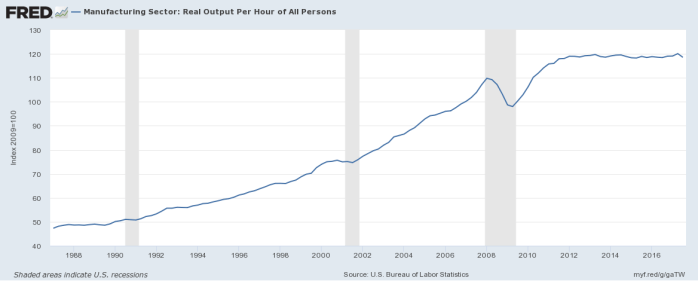
Take a look at this graph of manufacturing output per worker-hour:

Manufacturing_productivity

From 1988 to 2008, it was growing at a steady pace. In 2008 and 2009 it took a dip due to the Great Recession; no big surprise there. But then since 2012 it has been… completely flat. If we take this graph at face value, it would imply that manufacturing workers today can produce no more output than workers five years ago, and indeed only about 10% more than workers a decade ago. Whereas, a worker in 2008 was producing over 60% more than a worker in 1998, who was producing over 40% more than a worker in 1988.

Many economists call this the “productivity paradox”, and use it to argue that we don’t really need to worry about robots taking all our jobs any time soon. I think this view is mistaken.

The way we measure productivity is fundamentally wrongheaded, and is probably the sole cause of this “paradox”.

First of all, we use total hours scheduled to work, not total hours actually doing productive work. This is obviously much, much easier to measure, which is why we do it. But if you think for a moment about how the 40-hour workweek norm is going to clash with rapidly rising real productivity, it becomes apparent why this isn’t going to be a good measure.
When a worker finds a way to get done in 10 hours what used to take 40 hours, what does that worker’s boss do? Send them home after 10 hours because the job is done? Give them a bonus for their creativity? Hardly. That would be far too rational. They assign them more work, while paying them exactly the same. Recognizing this, what is such a worker to do? The obvious answer is to pretend to work the other 30 hours, while in fact doing something more pleasant than working.
And indeed, so-called “worker distraction” has been rapidly increasing. People are right to blame smartphones, I suppose, but not for the reasons they think. It’s not that smartphones are inherently distracting devices. It’s that smartphones are the cutting edge of a technological revolution that has made most of our work time unnecessary, so due to our fundamentally defective management norms they create overwhelming incentives to waste time at work to avoid getting drenched in extra tasks for no money.

That would probably be enough to explain the “paradox” by itself, but there is a deeper reason that in the long run is even stronger. It has to do with the way we measure “output”.

It might surprise you to learn that economists almost never consider output in terms of the actual number of cars produced, buildings constructed, songs written, or software packages developed. The standard measures of output are all in the form of so-called “real GDP”; that is, the dollar value of output produced.

They do adjust for indexes of inflation, but as I’ll show in a moment this still creates a fundamentally biased picture of the productivity dynamics.

Consider a world with only three industries: Housing, Food, and Music.

Productivity in Housing doesn’t change at all. Producing a house cost 10,000 worker-hours in 1950, and cost 10,000 worker-hours in 2000. Nominal price of houses has rapidly increased, from $10,000 in 1950 to $200,000 in 2000.

Productivity in Food rises moderately fast. Producing 1,000 meals cost 1,000 worker-hours in 1950, and cost 100 worker-hours in 2000. Nominal price of food has increased slowly, from $1,000 per 1,000 meals in 1950 to $5,000 per 1,000 meals in 2000.

Productivity in Music rises extremely fast. Producing 1,000 performances cost 10,000 worker-hours in 1950, and cost 1 worker-hour in 2000. Nominal price of music has collapsed, from $100,000 per 1,000 performances in 1950 to $1,000 per 1,000 performances in 2000.

This is of course an extremely stylized version of what has actually happened: Housing has gotten way more expensive, food has stayed about the same in price while farm employment has plummeted, and the rise of digital music has brought about a new Renaissance in actual music production and listening while revenue for the music industry has collapsed. There is a very nice Vox article on the “productivity paradox” showing a graph of how prices have changed in different industries.

How would productivity appear in the world I’ve just described, by standard measures? Well, to say that I actually need to say something about how consumers substitute across industries. But I think I’ll be forgiven in this case for saying that there is no substitution whatsoever; you can’t eat music or live in a burrito. There’s also a clear Maslow hierarchy here: They say that man cannot live by bread alone, but I think living by Led Zeppelin alone is even harder.

Consumers will therefore choose like this: Over 10 years, buy 1 house, 10,000 meals, and as many performances as you can afford after that. Further suppose that each person had $2,100 per year to spend in 1940-1950, and $50,000 per year to spend in 1990-2000. (This is approximately true for actual nominal US GDP per capita.)

1940-1950:
Total funds: $21,000

1 house = $10,000

10,000 meals = $10,000

Remaining funds: $1,000

Performances purchased: 10

1990-2000:

Total funds: $500,000

1 house = $200,000

10,000 meals = $50,000

Remaining funds: $250,000

Performances purchased: 250,000

(Do you really listen to this much music? 250,000 performances over 10 years is about 70 songs per day. If each song is 3 minutes, that’s only about 3.5 hours per day. If you listen to music while you work or watch a couple of movies with musical scores, yes, you really do listen to this much music! The unrealistic part is assuming that people in 1950 listen to so little, given that radio was already widespread. But if you think of music as standing in for all media, the general trend of being able to consume vastly more media in the digital age is clearly correct.)

Now consider how we would compute a price index for each time period. We would construct a basket of goods and determine the price of that basket in each time period, then adjust prices until that basket has a constant price.

Here, the basket would probably be what people bought in 1940-1950: 1 house, 10,000 meals, and 400 music performances.

In 1950, this basket cost $10,000+$10,000+$100 = $21,000.

In 2000, this basket cost $200,000+$50,000+$400 = $150,400.

This means that our inflation adjustment is $150,400/$21,000 = 7 to 1. This means that we would estimate the real per-capita GDP in 1950 at about $14,700. And indeed, that’s about the actual estimate of real per-capita GDP in 1950.

So, what would we say about productivity?

Sales of houses in 1950 were 1 per person, costing 10,000 worker hours.

Sales of food in 1950 were 10,000 per person, costing 10,000 worker hours.

Sales of music in 1950 were 400 per person, costing 4,000 worker hours.

Worker hours per person are therefore 24,000.

Sales of houses in 2000 were 1 per person, costing 10,000 worker hours.

Sales of food in 2000 were 10,000 per person, costing 1,000 worker hours.

Sales of music in 2000 were 250,000 per person, costing 25,000 worker hours.

Worker hours per person are therefore 36,000.

Therefore we would estimate that productivity rose from $14,700/24,000 = $0.61 per worker-hour to $50,000/36,000 = $1.40 per worker-hour. This is an annual growth rate of about 1.7%, which is again, pretty close to the actual estimate of productivity growth. For such a highly stylized model, my figures are doing remarkably well. (Honestly, better than I thought they would!)

But think about how much actual productivity rose, at least in the industries where it did.

We produce 10 times as much food per worker hour after 50 years, which is an annual growth rate of 4.7%, or three times the estimated growth rate.

We produce 10,000 times as much music per worker hour after 50 years, which is an annual growth rate of over 20%, or almost twelve times the estimated growth rate.

Moreover, should music producers be worried about losing their jobs to automation? Absolutely! People simply won’t be able to listen to much more music than they already are, so any continued increases in music productivity are going to make musicians lose jobs. And that was already allowing for music consumption to increase by a factor of over 600.

Of course, the real world has a lot more industries than this, and everything is a lot more complicated. We do actually substitute across some of those industries, unlike in this model.

But I hope I’ve gotten at least the basic point across that when things become drastically cheaper as technological progress often does, simply adjusting for inflation doesn’t do the job. One dollar of music today isn’t the same thing as one dollar of music a century ago, even if you inflation-adjust their dollars to match ours. We ought to be measuring in hours of music; an hour of music is much the same thing as an hour of music a century ago.

And likewise, that secretary/weather forecaster/news reporter/accountant/musician/filmmaker in your pocket that you call a “smartphone” really ought to be counted as more than just a simple inflation adjustment on its market price. The fact that it is mind-bogglingly cheaper to get these services than it used to be is the technological progress we care about; it’s not some statistical artifact to be removed by proper measurement.

Combine that with actually measuring the hours of real, productive work, and I think you’ll find that productivity is still rising quite rapidly, and that we should still be worried about what automation is going to do to our jobs.

What we lose by aggregating

Jun 25, JDN 2457930

One of the central premises of current neoclassical macroeconomics is the representative agent: Rather than trying to keep track of all the thousands of firms, millions of people, and billions of goods and in a national economy, we aggregate everything up into a single worker/consumer and a single firm producing and consuming a single commodity.

This sometimes goes under the baffling misnomer of microfoundations, which would seem to suggest that it carries detailed information about the microeconomic behavior underlying it; in fact what this means is that the large-scale behavior is determined by some sort of (perfectly) rational optimization process as if there were just one person running the entire economy optimally.

First of all, let me say that some degree of aggregation is obviously necessary. Literally keeping track of every single transaction by every single person in an entire economy would require absurd amounts of data and calculation. We might have enough computing power to theoretically try this nowadays, but then again we might not—and in any case such a model would very rapidly lose sight of the forest for the trees.

But it is also clearly possible to aggregate too much, and most economists don’t seem to appreciate this. They cite a couple of famous theorems (like the Gorman Aggregation Theorem) involving perfectly-competitive firms and perfectly-rational identical consumers that offer a thin veneer of justification for aggregating everything into one, and then go on with their work as if this meant everything were fine.

What’s wrong with such an approach?

Well, first of all, a representative agent model can’t talk about inequality at all. It’s not even that a representative agent model says inequality is good, or not a problem; it lacks the capacity to even formulate the concept. Trying to talk about income or wealth inequality in a representative agent model would be like trying to decide whether your left hand is richer than your right hand.

It’s also nearly impossible to talk about poverty in a representative agent model; the best you can do is talk about a country’s overall level of development, and assume (not without reason) that a country with a per-capita GDP of $1,000 probably has a lot more poverty than a country with a per-capita GDP of $50,000. But two countries with the same per-capita GDP can have very different poverty rates—and indeed, the cynic in me wonders if the reason we’re reluctant to use inequality-adjusted measures of development is precisely that many American economists fear where this might put the US in the rankings. The Human Development Index was a step in the right direction because it includes things other than money (and as a result Saudi Arabia looks much worse and Cuba much better), but it still aggregates and averages everything, so as long as your rich people are doing well enough they can compensate for how badly your poor people are doing.

Nor can you talk about oligopoly in a representative agent model, as there is always only one firm, which for some reason chooses to act as if it were facing competition instead of rationally behaving as a monopoly. (This is not quite as nonsensical as it sounds, as the aggregation actually does kind of work if there truly are so many firms that they are all forced down to zero profit by fierce competition—but then again, what market is actually like that?) There is no market share, no market power; all are at the mercy of the One True Price.

You can still talk about externalities, sort of; but in order to do so you have to set up this weird doublethink phenomenon where the representative consumer keeps polluting their backyard and then can’t figure out why their backyard is so darn polluted. (I suppose humans do seem to behave like that sometimes; but wait, I thought you believed people were rational?) I think this probably confuses many an undergrad, in fact; the models we teach them about externalities generally use this baffling assumption that people consider one set of costs when making their decisions and then bear a different set of costs from the outcome. If you can conceptualize the idea that we’re aggregating across people and thinking “as if” there were a representative agent, you can ultimately make sense of this; but I think a lot of students get really confused by it.

Indeed, what can you talk about with a representative agent model? Economic growth and business cycles. That’s… about it. These are not minor issues, of course; indeed, as Robert Lucas famously said:

The consequences for human welfare involved in questions like these [on economic growth] are simply staggering: once one starts to think about them, it is hard to think about anything else.

I certainly do think that studying economic growth and business cycles should be among the top priorities of macroeconomics. But then, I also think that poverty and inequality should be among the top priorities, and they haven’t been—perhaps because the obsession with representative agent models make that basically impossible.

I want to be constructive here; I appreciate that aggregating makes things much easier. So what could we do to include some heterogeneity without too much cost in complexity?

Here’s one: How about we have p firms, making q types of goods, sold to n consumers? If you want you can start by setting all these numbers equal to 2; simply going from 1 to 2 has an enormous effect, as it allows you to at least say something about inequality. Getting them as high as 100 or even 1000 still shouldn’t be a problem for computing the model on an ordinary laptop. (There are “econophysicists” who like to use these sorts of agent-based models, but so far very few economists take them seriously. Partly that is justified by their lack of foundational knowledge in economics—the arrogance of physicists taking on a new field is legendary—but partly it is also interdepartmental turf war, as economists don’t like the idea of physicists treading on their sacred ground.) One thing that really baffles me about this is that economists routinely use computers to solve models that can’t be calculated by hand, but it never seems to occur to them that they could have started at the beginning planning to make the model solvable only by computer, and that would spare them from making the sort of heroic assumptions they are accustomed to making—assumptions that only made sense when they were used to make a model solvable that otherwise wouldn’t be.

You could also assign a probability distribution over incomes; that can get messy quickly, but we actually are fortunate that the constant relative risk aversion utility function and the Pareto distribution over incomes seem to fit the data quite well—as the product of those two things is integrable by hand. As long as you can model how your policy affects this distribution without making that integral impossible (which is surprisingly tricky), you can aggregate over utility instead of over income, which is a lot more reasonable as a measure of welfare.

And really I’m only scratching the surface here. There are a vast array of possible new approaches that would allow us to extend macroeconomic models to cover heterogeneity; the real problem is an apparent lack of will in the community to make such an attempt. Most economists still seem very happy with representative agent models, and reluctant to consider anything else—often arguing, in fact, that anything else would make the model less microfounded when plainly the opposite is the case.


Financial fraud is everywhere

Jun 4, JDN 2457909
When most people think of “crime”, they probably imagine petty thieves, pickpockets, drug dealers, street thugs. In short, we think of crime as something poor people do. And certainly, that kind of crime is more visible, and typically easier to investigate and prosecute. It may be more traumatic to be victimized by it (though I’ll get back to that in a moment).

The statistics on this matter are some of the fuzziest I’ve ever come across, so estimates could be off by as much as an order of magnitude. But there is some reason to believe that, within most highly-developed countries, financial fraud may actually be more common than any other type of crime. It is definitely among the most common, and the only serious contenders for exceeding it are other forms of property crime such as petty theft and robbery.

It also appears that financial fraud is the one type of crime that isn’t falling over time. Violent crime and property crime are both at record lows; the average American’s probability of being victimized by a thief or a robber in any given year has fallen from 35% to 11% in the last 25 years. But the rate of financial fraud appears to be roughly constant, and the rate of high-tech fraud in particular is definitely rising. (This isn’t too surprising, given that the technology required is becoming cheaper and more widely available.)

In the UK, the rate of credit card fraud rose during the Great Recession, fell a little during the recovery, and has been holding steady since 2010; it is estimated that about 5% of people in the UK suffer credit card fraud in any given year.

About 1% of US car loans are estimated to contain fraudulent information (such as overestimated income or assets). As there are over $1 trillion in outstanding US car loans, that amounts to about $5 billion in fraud losses every year.

Using DOJ data, Statistic Brain found that over 12 million Americans suffer credit card fraud any given year; based on the UK data, this is probably an underestimate. They also found that higher household income had only a slight effect of increasing the probability of suffering such fraud.

The Office for Victims of Crime estimates that total US losses due to financial fraud are between $40 billion and $50 billion per year—which is to say, the GDP of Honduras or the military budget of Japan. The National Center for Victims of Crime estimated that over 10% of Americans suffer some form of financial fraud in any given year.

Why is fraud so common? Well, first of all, it’s profitable. Indeed, it appears to be the only type of crime that is. Most drug dealers live near the poverty line. Most bank robberies make off with less than $10,000.

But Bernie Madoff made over $50 billion before he was caught. Of course he was an exceptional case; the median Ponzi scheme only makes off with… $2.1 million. That’s over 200 times the median bank robbery.

Second, I think financial fraud allows the perpetrator a certain psychological distance from their victims. Just as it’s much easier to push a button telling a drone to launch a missile than to stab someone to death, it’s much easier to move some numbers between accounts than to point a gun at someone’s head and demand their wallet. Construal level theory is all about how making something seem psychologically more “distant” can change our attitudes toward it; toward things we perceive as “distant”, we think more abstractly, we accept more risks, and we are more willing to engage in violence to advance a cause. (It also makes us care less about outcomes, which may be a contributing factor in the collective apathy toward climate change.)

Perhaps related to this psychological distance, we also generally have a sense that fraud is not as bad as violent crime. Even judges and juries often act as though white-collar criminals aren’t real criminals. Often the argument seems to be that the behavior involved in committing financial fraud is not so different, after all, from the behavior of for-profit business in general; are we not all out to make an easy buck?

But no, it is not the same. (And if it were, this would be more an indictment of capitalism than it is a justification for fraud. So this sort of argument makes a lot more sense coming from socialists than it does from capitalists.)

One of the central justifications for free markets lies in the assumption that all parties involved are free, autonomous individuals acting under conditions of informed consent. Under those conditions, it is indeed hard to see why we have a right to interfere, as long as no one else is being harmed. Even if I am acting entirely out of my own self-interest, as long as I represent myself honestly, it is hard to see what I could be doing that is morally wrong. But take that away, as fraud does, and the edifice collapses; there is no such thing as a “right to be deceived”. (Indeed, it is quite common for Libertarians to say they allow any activity “except by force or fraud”, never quite seeming to realize that without the force of government we would all be surrounded by unending and unstoppable fraud.)

Indeed, I would like to present to you for consideration the possibility that large-scale financial fraud is worse than most other forms of crime, that someone like Bernie Madoff should be viewed as on a par with a rapist or a murderer. (To its credit, our justice system agrees—Madoff was given the maximum sentence of 150 years in maximum security prison.)

Suppose you were given the following terrible choice: Either you will be physically assaulted and beaten until several bones are broken and you fall unconscious—or you will lose your home and all the money you put into it. If the choice were between death and losing your home, obviously, you’d lose your home. But when it is a question of injury, that decision isn’t so obvious to me. If there is a risk of being permanently disabled in some fashion—particularly mentally disabled, as I find that especially terrifying—then perhaps I accept losing my home. But if it’s just going to hurt a lot and I’ll eventually recover, I think I prefer the beating. (Of course, if you don’t have health insurance, recovering from a concussion and several broken bones might also mean losing your home—so in that case, the dilemma is a no-brainer.) So when someone commits financial fraud on the scale of hundreds of thousands of dollars, we should consider them as having done something morally comparable to beating someone until they have broken bones.

But now let’s scale things up. What if terrorist attacks, or acts of war by a foreign power, had destroyed over one million homes, killed tens of thousands of Americans by one way or another, and cut the wealth of the median American family in half? Would we not count that as one of the greatest acts of violence in our nation’s history? Would we not feel compelled to take some overwhelming response—even be tempted toward acts of brutal vengeance? Yet that is the scale of the damage done by the Great Recession—much, if not all, preventable if our regulatory agencies had not been asleep at the wheel, lulled into a false sense of security by the unending refrain of laissez-faire. Most of the harm was done by actions that weren’t illegal, yes; but some of actually was illegal (20% of direct losses are attributable to fraud), and most of the rest should have been illegal but wasn’t. The repackaging and selling of worthless toxic assets as AAA bonds may not legally have been “fraud”, but morally I don’t see how it was different. With this in mind, the actions of our largest banks are not even comparable to murder—they are comparable to invasion or terrorism. No mere individual shooting here; this is mass murder.

I plan to make this a bit of a continuing series. I hope that by now I’ve at least convinced you that the problem of financial fraud is a large and important one; in later posts I’ll go into more detail about how it is done, who is doing it, and what perhaps can be done to stop them.

Why “marginal productivity” is no excuse for inequality

May 28, JDN 2457902

In most neoclassical models, workers are paid according to their marginal productivity—the additional (market) value of goods that a firm is able to produce by hiring that worker. This is often used as an excuse for inequality: If someone can produce more, why shouldn’t they be paid more?

The most extreme example of this is people like Maura Pennington writing for Forbes about how poor people just need to get off their butts and “do something”; but there is a whole literature in mainstream economics, particularly “optimal tax theory”, arguing based on marginal productivity that we should tax the very richest people the least and never tax capital income. The Chamley-Judd Theorem famously “shows” (by making heroic assumptions) that taxing capital just makes everyone worse off because it reduces everyone’s productivity.

The biggest reason this is wrong is that there are many, many reasons why someone would have a higher income without being any more productive. They could inherit wealth from their ancestors and get a return on that wealth; they could have a monopoly or some other form of market power; they could use bribery and corruption to tilt government policy in their favor. Indeed, most of the top 0.01% do literally all of these things.

But even if you assume that pay is related to productivity in competitive markets, the argument is not nearly as strong as it may at first appear. Here I have a simple little model to illustrate this.

Suppose there are 10 firms and 10 workers. Suppose that firm 1 has 1 unit of effective capital (capital adjusted for productivity), firm 2 has 2 units, and so on up to firm 10 which has 10 units. And suppose that worker 1 has 1 unit of so-called “human capital”, representing their overall level of skills and education, worker 2 has 2 units, and so on up to worker 10 with 10 units. Suppose each firm only needs one worker, so this is a matching problem.

Furthermore, suppose that productivity is equal to capital times human capital: That is, if firm 2 hired worker 7, they would make 2*7 = $14 of output.

What will happen in this market if it converges to equilibrium?

Well, first of all, the most productive firm is going to hire the most productive worker—so firm 10 will hire worker 10 and produce $100 of output. What wage will they pay? Well, they need a wage that is high enough to keep worker 10 from trying to go elsewhere. They should therefore pay a wage of $90—the next-highest firm productivity times the worker’s productivity. That’s the highest wage any other firm could credibly offer; so if they pay this wage, worker 10 will not have any reason to leave.

Now the problem has been reduced to matching 9 firms to 9 workers. Firm 9 will hire worker 9, making $81 of output, and paying $72 in wages.

And so on, until worker 1 at firm 1 produces $1 and receives… $0. Because there is no way for worker 1 to threaten to leave, in this model they actually get nothing. If I assume there’s some sort of social welfare system providing say $0.50, then at least worker 1 can get that $0.50 by threatening to leave and go on welfare. (This, by the way, is probably the real reason firms hate social welfare spending; it gives their workers more bargaining power and raises wages.) Or maybe they have to pay that $0.50 just to keep the worker from starving to death.

What does inequality look like in this society?
Well, the most-productive firm only has 10 times as much capital as the least-productive firm, and the most-educated worker only has 10 times as much skill as the least-educated worker, so we might think that incomes would vary only by a factor of 10.

But in fact they vary by a factor of over 100.

The richest worker makes $90, while the poorest worker makes $0.50. That’s a ratio of 180. (Still lower than the ratio of the average CEO to their average employee in the US, by the way.) The worker is 10 times as productive, but they receive 180 times as much income.

The firm profits vary along a more reasonable scale in this case; firm 1 makes a profit of $0.50 while firm 10 makes a profit of $10. Indeed, except for firm 1, firm n always makes a profit of $n. So that’s very nearly a linear scaling in productivity.

Where did this result come from? Why is it so different from the usual assumptions? All I did was change one thing: I allowed for increasing returns to scale.

If you make the usual assumption of constant returns to scale, this result can’t happen. Multiplying all the inputs by 10 should just multiply the output by 10, by assumption—since that is the definition of constant returns to scale.

But if you look at the structure of real-world incomes, it’s pretty obvious that we don’t have constant returns to scale.

If we had constant returns to scale, we should expect that wages for the same person should only vary slightly if that person were to work in different places. In particular, to have a 2-fold increase in wage for the same worker you’d need more than a 2-fold increase in capital.

This is a bit counter-intuitive, so let me explain a bit further. If a 2-fold increase in capital results in a 2-fold increase in wage for a given worker, that’s increasing returns to scale—indeed, it’s precisely the production function I assumed above.
If you had constant returns to scale, a 2-fold increase in wage would require something like an 8-fold increase in capital. This is because you should get a 2-fold increase in total production by doubling everything—capital, labor, human capital, whatever else. So doubling capital by itself should produce a much weaker effect. For technical reasons I’d rather not get into at the moment, usually it’s assumed that production is approximately proportional to capital to the one-third power—so to double production you need to multiply capital by 2^3 = 8.

I wasn’t able to quickly find really good data on wages for the same workers across different countries, but this should at least give a rough idea. In Mumbai, the minimum monthly wage for a full-time worker is about $80. In Shanghai, it is about $250. If you multiply out the US federal minimum wage of $7.25 per hour by 40 hours by 4 weeks, that comes to $1160 per month.

Of course, these are not the same workers. Even an “unskilled” worker in the US has a lot more education and training than a minimum-wage worker in India or China. But it’s not that much more. Maybe if we normalize India to 1, China is 3 and the US is 10.

Likewise, these are not the same jobs. Even a minimum wage job in the US is much more capital-intensive and uses much higher technology than most jobs in India or China. But it’s not that much more. Again let’s say India is 1, China is 3 and the US is 10.

If we had constant returns to scale, what should the wages be? Well, for India at productivity 1, the wage is $80. So for China at productivity 3, the wage should be $240—it’s actually $250, close enough for this rough approximation. But the US wage should be $800—and it is in fact $1160, 45% larger than we would expect by constant returns to scale.

Let’s try comparing within a particular industry, where the differences in skill and technology should be far smaller. The median salary for a software engineer in India is about 430,000 INR, which comes to about $6,700. If that sounds rather low for a software engineer, you’re probably more accustomed to the figure for US software engineers, which is $74,000. That is a factor of 11 to 1. For the same job. Maybe US software engineers are better than Indian software engineers—but are they that much better? Yes, you can adjust for purchasing power and shrink the gap: Prices in the US are about 4 times as high as those in India, so the real gap might be 3 to 1. But these huge price differences themselves need to be explained somehow, and even 3 to 1 for the same job in the same industry is still probably too large to explain by differences in either capital or education, unless you allow for increasing returns to scale.

In most industries, we probably don’t have quite as much increasing returns to scale as I assumed in my simple model. Workers in the US don’t make 100 times as much as workers in India, despite plausibly having both 10 times as much physical capital and 10 times as much human capital.

But in some industries, this model might not even be enough! The most successful authors and filmmakers, for example, make literally thousands of times as much money as the average author or filmmaker in their own country. J.K. Rowling has almost $1 billion from writing the Harry Potter series; this is despite having literally the same amount of physical capital and probably not much more human capital than the average author in the UK who makes only about 11,000 GBP—which is about $14,000. Harry Potter and the Philosopher’s Stone is now almost exactly 20 years old, which means that Rowling made an average of $50 million per year, some 3500 times as much as the average British author. Is she better than the average British author? Sure. Is she three thousand times better? I don’t think so. And we can’t even make the argument that she has more capital and technology to work with, because she doesn’t! They’re typing on the same laptops and using the same printing presses. Either the return on human capital for British authors is astronomical, or something other than marginal productivity is at work here—and either way, we don’t have anything close to constant returns to scale.

What can we take away from this? Well, if we don’t have constant returns to scale, then even if wage rates are proportional to marginal productivity, they aren’t proportional to the component of marginal productivity that you yourself bring. The same software developer makes more at Microsoft than at some Indian software company, the same doctor makes more at a US hospital than a hospital in China, the same college professor makes more at Harvard than at a community college, and J.K. Rowling makes three thousand times as much as the average British author—therefore we can’t speak of marginal productivity as inhering in you as an individual. It is an emergent property of a production process that includes you as a part. So even if you’re entirely being paid according to “your” productivity, it’s not really your productivity—it’s the productivity of the production process you’re involved in. A myriad of other factors had to snap into place to make your productivity what it is, most of which you had no control over. So in what sense, then, can we say you earned your higher pay?

Moreover, this problem becomes most acute precisely when incomes diverge the most. The differential in wages between two welders at the same auto plant may well be largely due to their relative skill at welding. But there’s absolutely no way that the top athletes, authors, filmmakers, CEOs, or hedge fund managers could possibly make the incomes they do by being individually that much more productive.

Argumentum ab scientia is not argumentum baculo: The difference between authority and expertise

May 7, JDN 2457881

Americans are, on the whole, suspicious of authority. This is a very good thing; it shields us against authoritarianism. But it comes with a major downside, which is a tendency to forget the distinction between authority and expertise.

Argument from authority is an informal fallacy, argumentum baculo. The fact that something was said by the Pope, or the President, or the General Secretary of the UN, doesn’t make it true. (Aside: You’re probably more familiar with the phrase argumentum ad baculum, which is terrible Latin. That would mean “argument toward a stick”, when clearly the intended meaning was “argument by means of a stick”, which is argumentum baculo.)

But argument from expertise, argumentum ab scientia, is something quite different. The world is much too complicated for any one person to know everything about everything, so we have no choice but to specialize our knowledge, each of us becoming an expert in only a few things. So if you are not an expert in a subject, when someone who is an expert in that subject tells you something about that subject, you should probably believe them.

You should especially be prepared to believe them when the entire community of experts is in consensus or near-consensus on a topic. The scientific consensus on climate change is absolutely overwhelming. Is this a reason to believe in climate change? You’re damn right it is. Unless you have years of education and experience in understanding climate models and atmospheric data, you have no basis for challenging the expert consensus on this issue.

This confusion has created a deep current of anti-intellectualism in our culture, as Isaac Asimov famously recognized:

There is a cult of ignorance in the United States, and there always has been. The strain of anti-intellectualism has been a constant thread winding its way through our political and cultural life, nurtured by the false notion that democracy means that “my ignorance is just as good as your knowledge.”

This is also important to understand if you have heterodox views on any scientific topic. The fact that the whole field disagrees with you does not prove that you are wrong—but it does make it quite likely that you are wrong. Cranks often want to compare themselves to Galileo or Einstein, but here’s the thing: Galileo and Einstein didn’t act like cranks. They didn’t expect the scientific community to respect their ideas before they had gathered compelling evidence in their favor.

When behavioral economists found that neoclassical models of human behavior didn’t stand up to scrutiny, did they shout from the rooftops that economics is all a lie? No, they published their research in peer-reviewed journals, and talked with economists about the implications of their results. There may have been times when they felt ignored or disrespected by the mainstream, but they pressed on, because the data was on their side. And ultimately, the mainstream gave in: Daniel Kahneman won the Nobel Prize in Economics.

Experts are not always right, that is true. But they are usually right, and if you think they are wrong you’d better have a good reason to think so. The best reasons are the sort that come about when you yourself have spent the time and effort to become an expert, able to challenge the consensus on its own terms.

Admittedly, that is a very difficult thing to do—and more difficult than it should be. I have seen firsthand how difficult and painful the slow grind toward a PhD can be, and how many obstacles will get thrown in your way, ranging from nepotism and interdepartmental politics, to discrimination against women and minorities, to mismatches of interest between students and faculty, all the way to illness, mental health problems, and the slings and arrows of outrageous fortune in general. If you have particularly heterodox ideas, you may face particularly harsh barriers, and sometimes it behooves you to hold your tongue and toe the lie awhile.

But this is no excuse not to gain expertise. Even if academia itself is not available to you, we live in an age of unprecedented availability of information—it’s not called the Information Age for nothing. A sufficiently talented and dedicated autodidact can challenge the mainstream, if their ideas are truly good enough. (Perhaps the best example of this is the mathematician savant Srinivasa Ramanujan. But he’s… something else. I think he is about as far from the average genius as the average genius is from the average person.) No, that won’t be easy either. But if you are really serious about advancing human understanding rather than just rooting for your political team (read: tribe), you should be prepared to either take up the academic route or attack it as an autodidact from the outside.

In fact, most scientific fields are actually quite good about admitting what they don’t know. A total consensus that turns out to be wrong is actually a very rare phenomenon; much more common is a clash of multiple competing paradigms where one ultimately wins out, or they end up replaced by a totally new paradigm or some sort of synthesis. In almost all cases, the new paradigm wins not because it becomes fashionable or the ancien regime dies out (as Planck cynically claimed) but because overwhelming evidence is observed in its favor, often in the form of explaining some phenomenon that was previously impossible to understand. If your heterodox theory doesn’t do that, then it probably won’t win, because it doesn’t deserve to.

(Right now you might think of challenging me: Does my heterodox theory do that? Does the tribal paradigm explain things that either total selfishness or total altruism cannot? I think it’s pretty obvious that it does. I mean, you are familiar with a little thing called “racism”, aren’t you? There is no explanation for racism in neoclassical economics; to understand it at all you have to just impose it as an arbitrary term on the utility function. But at that point, why not throw in whatever you please? Maybe some people enjoy bashing their heads against walls, and other people take great pleasure in the taste of arsenic. Why would this particular self- (not to mention other-) destroying behavior be universal to all human societies?)

In practice, I think most people who challenge the mainstream consensus aren’t genuinely interested in finding out the truth—certainly not enough to actually go through the work of doing it. It’s a pattern you can see in a wide range of fringe views: Anti-vaxxers, 9/11 truthers, climate denialists, they all think the same way. The mainstream disagrees with my preconceived ideology, therefore the mainstream is some kind of global conspiracy to deceive us. The overwhelming evidence that vaccination is safe and (wildly) cost-effective, 9/11 was indeed perpetrated by Al Qaeda and neither planned nor anticipated by anyone in the US government , and the global climate is being changed by human greenhouse gas emissions—these things simply don’t matter to them, because it was never really about the truth. They knew the answer before they asked the question. Because their identity is wrapped up in that political ideology, they know it couldn’t possibly be otherwise, and no amount of evidence will change their mind.

How do we reach such people? That, I don’t know. I wish I did. But I can say this much: We can stop taking them seriously when they say that the overwhelming scientific consensus against them is just another “appeal to authority”. It’s not. It never was. It’s an argument from expertise—there are people who know this a lot better than you, and they think you’re wrong, so you’re probably wrong.

What is the point of democracy?

Apr 9, JDN 2457853

[This topic was chosen by Patreon vote.]

“Democracy” is the sort of word that often becomes just an Applause Light (indeed it was the original example Less Wrong used). Like “freedom” and “liberty” (and for much the same reasons), it’s a good thing, that much we know; but it’s often unclear what is even meant by the word, much less why it should be so important to us.

From another angle, it is strangely common for economists and political scientists to argue that democracy is not all that important; they at least tend to use a precise formal definition of “democracy”, but are oddly quick to dismiss it as pointless or even harmful when it doesn’t line up precisely with their models of an efficient economy or society. I think the best example of this is the so-called “Downs paradox”, where political scientists were so steeped in the tradition of defining all rationality as psychopathic self-interest that they couldn’t even explain why it would occur to anyone to vote. (And indeed, rumor has it that most economists don’t bother to vote, much less campaign politically—which perhaps begins to explain why our economic policy is so terrible.)

Yet especially for Americans in the Trump era, I think it is vital to understand what “democracy” is supposed to mean, and why it is so important.

So, first of all, what is democracy? It is nothing more or less than government by popular vote.

This comes in degrees, of course: The purest direct democracy would have the entire population vote on even the most mundane policies and decisions. You could actually manage something like a monastery or a social club in such a fashion, but this is clearly unworkable on any large scale. Even once you get to hundreds of people, much less thousands or millions, it becomes unviable. The closest example I’ve seen is Switzerland, where there are always numerous popular referenda on ballots that are voted on by entire regions or the entire country—and even then, Switzerland does have representatives that make many of the day-to-day decisions.

So in practice all large-scale democratic systems are some degree of representative democracy, or republic, where some especially decisions may be made by popular vote, but most policies are made by elected representatives, staff appointed by those representatives, or even career civil servants who are appointed in a nominally apolitical process not so different from private-sector hiring. In the most extreme cases such civil servants can become so powerful that you get a deep state, where career bureaucrats exercise more power than elected officials—at that point I think you have actually lost the right to really call yourself a “democracy” and have become something more like a technocracy.
Yet of course a country can get even more undemocratic than that, and many are, governed by an aristocracy or oligarchy that vests power in a small number of wealthy and powerful individuals, or monarchy or autocracy that gives near-absolute power to a single individual.

Thus, there is a continuum of most to least democratic, with popular vote at one end, followed by elected representatives, followed by appointed civil servants, followed by a handful of oligarchs, and ultimately the most undemocratic system is an autocracy controlled by a single individual.

I also think it’s worth mentioning that constitutional monarchies with strong parliamentary systems, like the United Kingdom and Norway, are also “democracies” in the sense I intend. Yes, technically they have these hereditary monarchs—but in practice, the vast majority of the state’s power is vested in the votes of its people. Indeed, if we separate out parliamentary constitutional monarchy from presidential majoritarian democracy and compare them, the former might actually turn out to be better. Certainly, some of the world’s most prosperous nations are governed that way.

As I’ve already acknowledge, the very far extreme of pure direct democracy is unfeasible. But why would we want to get closer to that end? Why be like Switzerland or Denmark rather than like Turkey or Russia—or for that matter why be like California rather than like Mississippi?
Well, if you know anything about the overall welfare of these states, it almost seems obvious—Switzerland and Denmark are richer, happier, safer, healthier, more peaceful, and overall better in almost every way than Turkey and Russia. The gap between California and Mississippi is not as large, but it is larger than most people realize. Median household income in California is $64,500; in Mississippi it is only $40,593. Both are still well within the normal range of a highly-developed country, but that effectively makes California richer than Luxembourg but Mississippi poorer than South Korea. But perhaps the really stark comparison to make is life expectancy: Life expectancy at birth in California is almost 81 years, while in Mississippi it’s only 75.

Of course, there are a lot of other differences between states besides how much of their governance is done by popular referendum. Simply making Mississippi decide more things by popular vote would not turn it into California—much less would making Turkey more democratic turn it into Switzerland. So we shouldn’t attribute these comparisons entirely to differences in democracy. Indeed, a pair of two-way comparisons is only in the barest sense a statistical argument; we should be looking at dozens if not hundreds of comparisons if we really want to see the effects of democracy. And we should of course be trying to control for other factors, adjust for country fixed-effects, and preferably use natural experiments or instrumental variables to tease out causality.

Yet such studies have in fact been done. Stronger degrees of democracy appear to improve long-run economic growth, as well as reduce corruption, increase free trade, protect peace, and even improve air quality.

Subtler analyses have compared majoritarian versus proportional systems (where proportional seems, to me, at least, more democratic), as well as different republican systems with stronger or weaker checks and balances (stronger is clearly better, though whether that is “more democratic” is at least debatable). The effects of democracy on income distribution are more complicated, probably because there have been some highly undemocratic socialist regimes.

So, the common belief that democracy is good seems to be pretty well supported by the data. But why is democracy good? Is it just a practical matter of happening to get better overall results? Could it one day be overturned by some superior system such as technocracy or a benevolent autocratic AI?

Well, I don’t want to rule out the possibility of improving upon existing systems of government. Clearly new systems of government have in fact emerged over the course of history—Greek “democracy” and Roman “republic” were both really aristocracy, and anything close to universal suffrage didn’t really emerge on a large scale until the 20th century. So the 21st (or 22nd) century could well devise a superior form of government we haven’t yet imagined.
However, I do think there is good reason to believe that any new system of government that actually manages to improve upon democracy will still resemble democracy, because there are three key features democracy has that other systems of government simply can’t match. It is these three features that make democracy so important and so worth fighting for.

1. Everyone’s interests are equally represented.

Perhaps no real system actually manages to represent everyone’s interests equally, but the more democratic a system is, the better it will conform to this ideal. A well-designed voting system can aggregate the interests of an entire population and choose the course of action that creates the greatest overall benefit.

Markets can also be a good system for allocating resources, but while markets represent everyone’s interests, they do so highly unequally. Rich people are quite literally weighted more heavily in the sum.

Most systems of government do even worse, by completely silencing the voices of the majority of the population. The notion of a “benevolent autocracy” is really a conceit; what makes you think you could possibly keep the autocrat benevolent?

This is also why any form of disenfranchisement is dangerous and a direct attack upon democracy. Even if people are voting irrationally, against their own interests and yours, by silencing their voice you are undermining the most fundamental tenet of democracy itself. All voices must be heard, no exceptions. That is democracy’s fundamental strength.

2. The system is self-correcting.

This may more accurately describe a constitutional republican system with strong checks and balances, but that is what most well-functioning democracies have and it is what I recommend. If you conceive of “more democracy” as meaning that people can vote their way into fascism by electing a sufficiently charismatic totalitarian, then I do not want us to have “more democracy”. But just as contracts and regulations that protect you can make you in real terms more free because you can now safely do things you otherwise couldn’t risk, I consider strong checks and balances that maintain the stability of a republic against charismatic fascists to be in a deeper sense more democratic. This is ultimately semantic; I think I’ve made it clear enough that I want strong checks and balances.

With such checks and balances in place, democracies may move slower than autocracies; they may spend more time in deliberation or even bitter, polarized conflict. But this also means that their policies do not lurch from one emperor’s whim to another, and they are stable against being overtaken by corruption or fascism. Their policies are stable and predictable; their institutions are strong and resilient.

No other system of government yet devised by humans has this kind of stability, which may be why democracies are gradually taking over the world. Charismatic fascism fails when the charismatic leader dies; hereditary monarchy collapses when the great-grandson of the great king is incompetent; even oligarchy and aristocracy, which have at least some staying power, ultimately fall apart when the downtrodden peasants ultimately revolt. But democracy abides, for where monarchy and aristocracy are made of families and autocracy and fascism are made of a single man, democracy is made of principles and institutions. Democracy is evolutionarily stable, and thus in Darwinian terms we can predict it will eventually prevail.

3. The coercion that government requires is justified.

All government is inherently coercive. Libertarians are not wrong about this. Taxation is coercive. Regulation is coercive. Law is coercive. (The ones who go on to say that all government is “death threats” or “slavery” are bonkers, mind you. But it is in fact coercive.)

The coercion of government is particularly terrible if that coercion is coming from a system like an autocracy, where the will of the people is minimally if at all represented in the decisions of policymakers. Then that is a coercion imposed from outside, a coercion in the fullest sense, one person who imposes their will upon another.

But when government coercion comes from a democracy, it takes on a fundamentally different meaning. Then it is not they who coerce us—it is we who coerce ourselves. Now, why in the world would you coerce yourself? It seems ridiculous, doesn’t it?

Not if you know any game theory. There are in fall all sorts of reasons why one might want to coerce oneself, and two in particular become particularly important for the justification of democratic government.

The first and most important is collective action: There are many situations in which people all working together to accomplish a goal can be beneficial to everyone, but nonetheless any individual person who found a way to shirk their duty and not contribute could benefit even more. Anyone who has done a group project in school with a couple of lazy students in it will know this experience: You end up doing all the work, but they still get a good grade at the end. If everyone had taken the rational, self-interested action of slacking off, everyone in the group would have failed the project.

Now imagine that the group project we’re trying to achieve is, say, defending against an attack by Imperial Japan. We can’t exactly afford to risk that project falling through. So maybe we should actually force people to support it—in the form of taxes, or even perhaps a draft (as ultimately we did in WW2). Then it is no longer rational to try to shirk your duty, so everyone does their duty, the project gets done, and we’re all better off. How do we decide which projects are important enough to justify such coercion? We vote, of course. This is the most fundamental justification of democratic government.

The second that is relevant for government is commitment. There are many circumstances in which we want to accomplish something in the future, and from a long-run perspective it makes sense to achieve that goal—but then when the time comes to take action, we are tempted to procrastinate or change our minds. How can we resolve such a dilemma? Well, one way is to tie our own hands—to coerce ourselves into carrying out the necessary task we are tempted to avoid or delay.

This applies to many types of civil and criminal law, particularly regarding property ownership. Murder is a crime that most people would not commit even if it were completely legal. But shoplifting? I think if most people knew there would be no penalty for petty theft and retail fraud they would be tempted into doing it at least on occasion. I doubt it would be frequent enough to collapse our entire economic system, but it would introduce a lot of inefficiency, and make almost everything more expensive. By having laws in place that punish us for such behavior, we have a way of defusing such temptations, at least for most people most of the time. This is not as important for the basic functioning of government as is collective action, but I think it is still important enough to be worthy of mention.

Of course, there will always be someone who disagrees with any given law, regardless of how sensible and well-founded that law may be. And while in some sense “we all” agreed to pay these taxes, when the IRS actually demands that specific dollar amount from you, it may well be an amount that you would not have chosen if you’d been able to set our entire tax system yourself. But this is a problem of aggregation that I think may be completely intractable; there’s no way to govern by consensus, because human beings just can’t achieve consensus on the scale of millions of people. Governing by popular vote and representation is the best alternative we’ve been able to come up with. If and when someone devises a system of government that solves that problem and represents the public will even better than voting, then we will have a superior alternative to democracy.

Until then, it is as Churchill said: “Democracy is the worst form of government, except for all the others.”