Why do poor people dislike inflation?

Jun 5 JDN 2459736

The United States and United Kingdom are both very unaccustomed to inflation. Neither has seen double-digit inflation since the 1980s.

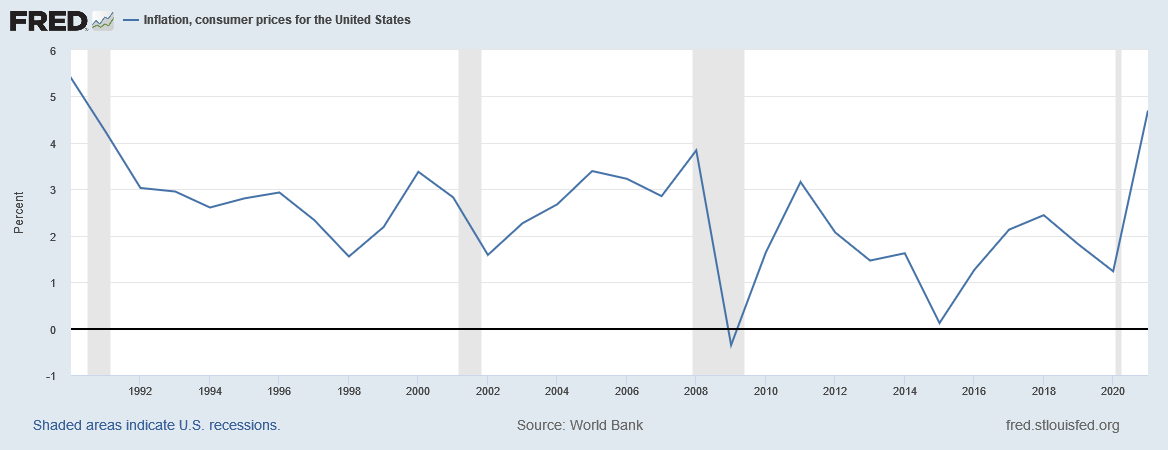
Here’s US inflation since 1990:

And here is the same graph for the UK:

While a return to double-digits remains possible, at this point it likely won’t happen, and if it does, it will occur only briefly.

This is no doubt a major reason why the dollar and the pound are widely used as reserve currencies (especially the dollar), and is likely due to the fact that they are managed by the world’s most competent central banks. Brexit would almost have made sense if the UK had been pressured to join the Euro; but they weren’t, because everyone knew the pound was better managed.

The Euro also doesn’t have much inflation, but if anything they err on the side of too low, mainly because Germany appears to believe that inflation is literally Hitler. In fact, the rise of the Nazis didn’t have much to do with the Weimar hyperinflation. The Great Depression was by far a greater factor—unemployment is much, much worse than inflation. (By the way, it’s weird that you can put that graph back to the 1980s. It, uh, wasn’t the Euro then. Euros didn’t start circulating until 1999. Is that an aggregate of the franc and the deutsche mark and whatever else? The Euro itself has never had double-digit inflation—ever.)

But it’s always a little surreal for me to see how panicked people in the US and UK get when our inflation rises a couple of percentage points. There seems to be an entire subgenre of economics news that basically consists of rich people saying the sky is falling because inflation has risen—or will, or may rise—by two points. (Hey, anybody got any ideas how we can get them to panic like this over rises in sea level or aggregate temperature?)

Compare this to some other countries thathave real inflation: In Brazil, 10% inflation is a pretty typical year. In Argentina, 10% is a really good year—they’re currently pushing 60%. Kenya’s inflation is pretty well under control now, but it went over 30% during the crisis in 2008. Botswana was doing a nice job of bringing down their inflation until the COVID pandemic threw them out of whack, and now they’re hitting double-digits too. And of course there’s always Zimbabwe, which seemed to look at Weimar Germany and think, “We can beat that.” (80,000,000,000% in one month!? Any time you find yourself talking about billion percent, something has gone terribly, terribly wrong.)

Hyperinflation is a real problem—it isn’t what put Hitler into power, but it has led to real crises in Germany, Zimbabwe, and elsewhere. Once you start getting over 100% per year, and especially when it starts rapidly accelerating, that’s a genuine crisis. Moreover, even though they clearly don’t constitute hyperinflation, I can see why people might legitimately worry about price increases of 20% or 30% per year. (Let alone 60% like Argentina is dealing with right now.) But why is going from 2% to 6% any cause for alarm? Yet alarmed we seem to be.

I can even understand why rich people would be upset about inflation (though the magnitudeof their concern does still seem disproportionate). Inflation erodes the value of financial assets, because most bonds, options, etc. are denominated in nominal, not inflation-adjusted terms. (Though there are such things as inflation-indexed bonds.) So high inflation can in fact make rich people slightly less rich.

But why in the world are so many poor people upset about inflation?

Inflation doesn’t just erode the value of financial assets; it also erodes the value of financial debts. And most poor people have more debts than they have assets—indeed, it’s not uncommon for poor people to have substantial debt and no financial assets to speak of (what little wealth they have being non-financial, e.g. a car or a home). Thus, their net wealth position improves as prices rise.

The interest rate response can compensate for this to some extent, but most people’s debts are fixed-rate. Moreover, if it’s the higher interest rates you’re worried about, you should want the Federal Reserve and the Bank of England not to fight inflation too hard, because the way they fight it is chiefly by raising interest rates.

In surveys, almost everyone thinks that inflation is very bad: 92% think that controlling inflation should be a high priority, and 90% think that if inflation gets too high, something very bad will happen. This is greater agreement among Americans than is found for statements like “I like apple pie” or “kittens are nice”, and comparable to “fair elections are important”!

I admit, I question the survey design here: I would answer ‘yes’ to both questions if we’re talking about a theoretical 10,000% hyperinflation, but ‘no’ if we’re talking about a realistic 10% inflation. So I would like to see, but could not find, a survey asking people what level of inflation is sufficient cause for concern. But since most of these people seemed concerned about actual, realistic inflation (85% reported anger at seeing actual, higher prices), it still suggests a lot of strong feelings that even mild inflation is bad.

So it does seem to be the case that a lot of poor and middle-class people really strongly dislike inflation even in the actual, mild levels in which it occurs in the US and UK.

The main fear seems to be that inflation will erode people’s purchasing power—that as the price of gasoline and groceries rise, people won’t be able to eat as well or drive as much. And that, indeed, would be a real loss of utility worth worrying about.

But in fact this makes very little sense: Most forms of income—particularly labor income, which is the only real income for some 80%-90% of the population—actually increases with inflation, more or less one-to-one. Yes, there’s some delay—you won’t get your annual cost-of-living raise immediately, but several months down the road. But this could have at most a small effect on your real consumption.

To see this, suppose that inflation has risen from 2% to 6%. (Really, you need not suppose; it has.) Now consider your cost-of-living raise, which nearly everyone gets. It will presumably rise the same way: So if it was 3% before, it will now be 7%. Now consider how much your purchasing power is affected over the course of the year.

For concreteness, let’s say your initial income was $3,000 per month at the start of the year (a fairly typical amount for a middle-class American, indeed almost exactly the median personal income). Let’s compare the case of no inflation with a 1% raise, 2% inflation with a 3% raise, and 5% inflation with a 6% raise.

If there was no inflation, your real income would remain simply $3,000 per month, until the end of the year when it would become $3,030 per month. That’s the baseline to compare against.

If inflation is 2%, your real income would gradually fall, by about 0.16% per month, before being bumped up 3% at the end of the year. So in January you’d have $3,000, in February $2,995, in March $2,990. Come December, your real income has fallen to $2,941. But then next January it will immediately be bumped up 3% to $3,029, almost the same as it would have been with no inflation at all. The total lost income over the entire year is about $380, or about 1% of your total income.

If inflation instead rises to 6%, your real income will fall by 0.49% per month, reaching a minimum of $2,830 in December before being bumped back up to $3,028 next January. Your total loss for the whole year will be about $1110, or about 3% of your total income.

Indeed, it’s a pretty good heuristic to say that for an inflation rate of x% with annual cost-of-living raises, your loss of real income relative to having no inflation at all is about (x/2)%. (This breaks down for really high levels of inflation, at which point it becomes a wild over-estimate, since even 200% inflation doesn’t make your real income go to zero.)

This isn’t nothing, of course. You’d feel it. Going from 2% to 6% inflation at an income of $3000 per month is like losing $700 over the course of a year, which could be a month of groceries for a family of four. (Not that anyone can really raise a family of four on a single middle-class income these days. When did The Simpsons begin to seem aspirational?)

But this isn’t the whole story. Suppose that this same family of four had a mortgage payment of $1000 per month; that is also decreasing in real value by the same proportion. And let’s assume it’s a fixed-rate mortgage, as most are, so we don’t have to factor in any changes in interest rates.

With no inflation, their mortgage payment remains $1000. It’s 33.3% of their income this year, and it will be 33.0% of their income next year after they get that 1% raise.

With 2% inflation, their mortgage payment will also fall by 0.16% per month; $998 in February, $996 in March, and so on, down to $980 in December. This amounts to an increase in real income of about $130—taking away a third of the loss that was introduced by the inflation.

With 6% inflation, their mortgage payment will also fall by 0.49% per month; $995 in February, $990 in March, and so on, until it’s only $943 in December. This amounts to an increase in real income of over $370—again taking away a third of the loss.

Indeed, it’s no coincidence that it’s one third; the proportion of lost real income you’ll get back by cheaper mortgage payments is precisely the proportion of your income that was spent on mortgage payments at the start—so if, like too many Americans, they are paying more than a third of their income on mortgage, their real loss of income from inflation will be even lower.

And what if they are renting instead? They’re probably on an annual lease, so that payment won’t increase in nominal terms either—and hence will decrease in real terms, in just the same way as a mortgage payment. Likewise car payments, credit card payments, any debt that has a fixed interest rate. If they’re still paying back student loans, their financial situation is almost certainly improved by inflation.

This means that the real loss from an increase of inflation from 2% to 6% is something like 1.5% of total income, or about $500 for a typical American adult. That’s clearly not nearly as bad as a similar increase in unemployment, which would translate one-to-one into lost income on average; moreover, this loss would be concentrated among people who lost their jobs, so it’s actually worse than that once you account for risk aversion. It’s clearly better to lose 1% of your income than to have a 1% chance of losing nearly all your income—and inflation is the former while unemployment is the latter.

Indeed, the only reason you lost purchasing power at all was that your cost-of-living increases didn’t occur often enough. If instead you had a labor contract that instituted cost-of-living raises every month, or even every paycheck, instead of every year, you would get all the benefits of a cheaper mortgage and virtually none of the costs of a weaker paycheck. Convince your employer to make this adjustment, and you will actually benefit from higher inflation.

So if poor and middle-class people are upset about eroding purchasing power, they should be mad at their employers for not implementing more frequent cost-of-living adjustments; the inflation itself really isn’t the problem.

Maybe we should forgive student debt after all.

May 8 JDN 2459708

President Biden has been promising some form of student debt relief since the start of his campaign, though so far all he has actually implemented is a series of no-interest deferments and some improvements to the existing forgiveness programs. (This is still significant—it has definitely helped a lot of people with cashflow during the pandemic.) Actual forgiveness for a large segment of the population remains elusive, and if it does happen, it’s unclear how extensive it will be in either intensity (amount forgiven) or scope (who is eligible).

I personally had been fine with this; while I have a substantial loan balance myself, I also have a PhD in economics, which—theoretically—should at some point entitle me to sufficient income to repay those loans.

Moreover, until recently I had been one of the few left-wing people I know to not be terribly enthusiastic about loan forgiveness. It struck me as a poor use of those government funds, because $1.75 trillion is an awful lot of money, and college graduates are a relatively privileged population. (And yes, it is valid to consider this a question of “spending”, because the US government is the least liquidity-constrained entity on Earth. In lieu of forgiving $1.75 trillion in debt, they could borrow $1.75 trillion in debt and use it to pay for whatever they want, and their ultimate budget balance would be basically the same in each case.)

But I say all this in the past tense because Krugman’s recent column has caused me to reconsider. He gives two strong reasons why debt forgiveness may actually be a good idea.

The first is that Congress is useless. Thanks to gerrymandering and the 40% or so of our population who keeps electing Republicans no matter how crazy they get, it’s all but impossible to pass useful legislation. The pandemic relief programs were the exception that proves the rule: Somehow those managed to get through, even though in any other context it’s clear that Congress would never have approved any kind of (non-military) program that spent that much money or helped that many poor people.

Student loans are the purview of the Department of Education, which is entirely under control of the Executive Branch, and therefore, ultimately, the President of the United States. So Biden could forgive student loans by executive order and there’s very little Congress could do to stop him. Even if that $1.75 trillion could be better spent, if it wasn’t going to be anyway, we may as well use it for this.

The second is that “college graduates” is too broad a category. Usually I’m on guard for this sort of thing, but in this case I faltered, and did not notice the fallacy of composition so many labor economists were making by lumping all college grads into the same economic category. Yes, some of us are doing well, but many are not. Within-group inequality matters.

A key insight here comes from carefully analyzing the college wage premium, which is the median income of college graduates, divided by the median income of high school graduates. This is an estimate of the overall value of a college education. It’s pretty large, as a matter of fact: It amounts to something like a doubling of your income, or about $1 million over one’s whole lifespan.

From about 1980-2000, wage inequality grew about as fast as today, and the college wage premium grew even faster. So it was plausible—if not necessarily correct—to believe that the wage inequality reflected the higher income and higher productivity of college grads. But since 2000, wage inequality has continued to grow, while the college wage premium has been utterly stagnant. Thus, higher inequality can no longer (if it ever could) be explained by the effects of college education.

Now some college graduates are definitely making a lot more money—such as those who went into finance. But it turns out that most are not. As Krugman points out, the 95th percentile of male college grads has seen a 25% increase in real (inflation-adjusted) income in the last 20 years, while the median male college grad has actually seen a slight decrease. (I’m not sure why Krugman restricted to males, so I’m curious how it looks if you include women. But probably not radically different?)

I still don’t think student loan forgiveness would be the best use of that (enormous sum of) money. But if it’s what’s politically feasible, it definitely could help a lot of people. And it would be easy enough to make it more progressive, by phasing out forgiveness for graduates with higher incomes.

And hey, it would certainly help me, so maybe I shouldn’t argue too strongly against it?

Welp, I have COVID.

May 1 JDN 2459701

Tuesday night I had a fever. Wednesday morning, I tested positive.

Given how the pandemic has been going, I suppose it was more or less inevitable that this day would come. From almost the beginning, the refrain was “flatten the curve”, not “wait for a cure”. It was expected that almost all of us would get the virus eventually, and just a question of how long we could draw that out. In my case, apparently two years. For that whole time I had been scrupulous about precautions, but I did not sustain all of them all of the time, and indeed as Scotland loosened restrictions I think I became too complacent.

The good news is that I am young and reasonably healthy (migraines notwithstanding), and I had three doses of the Moderna vaccine. As a result my symptoms are relatively mild; I feel like I have a bad cold or perhaps a mild flu. Aside from the fever, which I’ve been able to keep down with NSAIDs, pretty much all my symptoms are in my sinuses. So far, I haven’t even lost my sense of taste.

It hasn’t even really interfered with my work, because my migraines were already doing a bang-up job of that. (My accent remains consistently “American broadcast standard”, but as you can see, I am gradually picking up some Britishisms, such as “bang-up job” and “sorted” with no “out”, as well as learning to put the “u” in “labour” and “behaviour”. I doubt I’ll ever start saying “aye” and “nae” though.) I am in fact even less productive than I was without COVID, but the marginal difference is relatively small. The main activity it has kept me from doing is moving and unpacking boxes (now that our shipment from California has finally arrived).

So, all things considered, if I was going to get infected with a pandemic and potentially life-threatening virus, it could have been a lot worse.

Centrism is dying in America.

Apr 24 JDN 2459694

Four years ago—back when (shudder) Trump was President—I wrote a post about the true meaning of centrism, the kind of centrism worth defending.

I think it’s worth repeating now: Centrism isn’t saying “both sides are the same” when they aren’t. It’s recognizing that the norms of democracy themselves are worth defending—and more worth defending than almost any specific policy goal.

I wanted to say any specific policy goal, but I do think you can construct extreme counterexamples, like “establish a 100% tax on all income” (causing an immediate, total economic collapse), or “start a war with France” (our staunchest ally for the past 250 years who also has nuclear weapons). But barring anything that extreme, just about any policy is less important than defending democracy itself.

Or at least I think so. It seems that most Americans disagree. On both the left and the right—but especially on the right—a large majority of American voters are still willing to vote for a candidate who flouts basic democratic norms as long as they promise the right policies.

I guess on the right this fact should have been obvious: Trump. But things aren’t much better on the left, and should some actual radical authoritarian communist run for office (as opposed to, you know, literally every left-wing politician who is accused of being a radical authoritarian communist), this suggests that a lot of leftist voters might actually vote for them, which is nearly as terrifying.

My hope today is that I might tip the balance a little bit the other direction, remind people why democracy is worth defending, even at the cost of our preferred healthcare systems and marginal tax rates.

This is, above all, that democracy is self-correcting. If a bad policy gets put in place while democratic norms are still strong, then that policy can be removed and replaced with something better later on. Authoritarianism lacks this self-correction mechanism; get someone terrible in power and they stay in power, doing basically whatever they want, unless they are violently overthrown.

For the right wing, that’s basically it. You need to stop making excuses for authoritarianism. Basically none of your policies are so important that they would justify even moderate violations of democratic norms—much less than Trump already committed, let alone what he might do if re-elected and unleashed. I don’t care how economically efficient lower taxes or privatized healthcare might be (and I know that there are in fact many economists who would agree with you on that, though I don’t), it isn’t worth undermining democracy. And while I do understand why you consider abortion to be such a vital issue, you really need to ask yourself whether banning abortion is worth living under a fascist government, because that’s the direction you’re headed. Let me note that banning abortion doesn’t even seem to reduce it very much, so there’s that. While the claim that abortion bans do nothing is false, even a total overturn of Roe v. Wade would most likely reduce US abortions by about 15%—much less than the 25% decrease between 2008 and 2014, which was also part of a long-term trend of decreasing abortion rates which are now roughly half what they were in 1980. We don’t need to ban abortion in order to reduce it—and indeed many of the things that work are things like free healthcare and easy access to contraception that right-wing governments typically resist. So even if you consider abortion to be a human rights violation, which I know many of you do, is that relatively small reduction in abortion rates worth risking the slide into fascism?

But for the left wing, things are actually a bit more complicated. Some right-wing policies—particularly social policies—are inherently anti-democratic and violations of human rights. I gave abortion the benefit of the doubt above; I can at least see why someone would think it’s a human rights violation (though I do not). Here I’m thinking particularly of immigration policies that lock up children at the border and laws that actively discriminate against LGBT people. I can understand why people would be unwilling to “hold their nose” and vote for someone who wants to enact that kind of policy—though if it’s really the only way to avoid authoritarianism, I think we might still have to do it. Democracy is too high a price to pay; give it up now and there is nothing to stop that new authoritarian leftist government from turning into a terrible nightmare (that may not even remain leftist, by the way!). If we vote in someone who is pro-democratic but otherwise willing to commit these sorts of human rights violations, hopefully we can change things by civic engagement or vote them out of office later on (and over the long run, we do, in fact, have a track record of doing that). But if we vote in someone who will tear apart democracy even when they seem to have the high ground on human rights, then once democracy is undermined, the new authoritarian government can oppress us in all sorts of ways (even ways they specifically promised not to!), and we will have very little recourse.

Above all, even if they promise to give us everything we want, once you put an authoritarian in power, they can do whatever they want. They have no reason to keep their promises (whereas, contrary to popular belief, democratic politicians actually typically do), for we have no recourse if they don’t. Our only option to remove them from power is violent revolution—which usually fails, and even if it succeeds, would have an enormous cost in human lives.

Why is this a minority view? Why don’t more Americans agree with this?

I can think of a few possible reasons.

One is that they may not believe that these violations of democratic norms are really all that severe or worrisome. Overriding a judge with an executive order isn’t such a big deal, is it? Gerrymandering has been going on for decades, why should we worry about it now?

If that is indeed your view, let me remind you that in January 2021, armed insurrectionists stormed the Capitol building. That is not something we can just take lying down. This is a direct attack upon the foundations of democracy, and while it failed (miserably, and to be honest, hilariously), it wasn’t punished nearly severely enough—most of the people involved were not arrested on any charges, and several are now running for office. This lack of punishment means that it could very well happen again, and this time be better organized and more successful.

A second possibility is that people do not know that democracy is being undermined; they are somehow unaware that this is happening. If that’s the case, all I can tell you is that you really need to go to the Associated Press or New York Times website and read some news. You would have to be catastrophically ignorant of our political situation, and you frankly don’t deserve to be voting if that is the case.

But I suspect that for most people, a third reason applies: They see that democracy is being undermined, but they blame the other side. We aren’t the ones doing it—it’s them.

Such a view is tempting, at least from the left side of the aisle. No Democratic Party politician can hold a candle to Trump as far as authoritarianism (or narcissism). But we should still be cognizant of ways that our actions may also undermine democratic norms: Maybe we shouldn’t be considering packing the Supreme Court, unless we can figure out a way to ensure that it will genuinely lead to a more democratic and fair court long into the future. (For the latter sort of reform, suppose each federal district elected its own justice? Or we set up a mandatory retirement cycle such that every President would always appoint at least one justice?)

But for those of you on the right… How can you possibly think this? Where do you get your information from? How can you look at Donald Trump and think, “This man will defend our democracy from those left-wing radicals”? Right now you may be thinking, “oh, look, he suggested the New York Times; see his liberal bias”; that is a newspaper of record in the United States. While their editors are a bit left of center, they are held to the highest standards of factual accuracy. But okay, if you prefer the Wall Street Journal (also a newspaper of record, but whose editors are a bit more right of center), be my guest; their factual claims won’t disagree, because truth is truth. I also suggested the Associated Press, widely regarded worldwide as one of the most credible news sources. (I considered adding Al Jazeera, which has a similar reputation, but figured you wouldn’t go for that.)

If you think that the attack on the Capitol was even remotely acceptable, you must think that their claims of a stolen election were valid, or at least plausible. But every credible major news source, the US Justice Department, and dozens of law courts agree that they were not. Any large election is going to have a few cases of fraud, but there were literally only hundreds of fradulent votes—in an election in which over 150 million votes were cast, Biden won the popular vote by over 7 million votes, and no state was won by less than 10,000 votes. This means that 99.999% of votes were valid, and even if every single fradulent vote had been for Biden and in Georgia (obviously not the case), it wouldn’t have been enough to tip even that state.

I’m not going to say that left-wing politicians never try to undermine democratic norms—there’s certainly plenty of gerrymandering, and I just said, court-packing is at least problematic. Nor would I say that the right wing is always worse about this. But it should be pretty obvious to anyone with access to basic factual information—read: everyone with Internet access—that right now, the problem is much worse on the right. You on the right need to face up to that fact, and start voting out Republicans who refuse to uphold democracy, even if it means you have to wait a bit longer for lower taxes or more (let me remind you, not very effective) abortion bans.

In the long run, I would of course like to see changes in the whole political system, so that we are no longer dominated by two parties and have a wider variety of realistic options. (The best way to do that would of couse be range voting.) But for now, let’s start by ensuring that democracy continues to exist in America.

Russia has invaded Ukraine.

Mar 6 JDN 2459645

Russia has invaded Ukraine. No doubt you have heard it by now, as it’s all over the news now in dozens of outlets, from CNN to NBC to The Guardian to Al-Jazeera. And as well it should be, as this is the first time in history that a nuclear power has annexed another country. Yes, nuclear powers have fought wars before—the US just got out of one in Afghanistan as you may recall. They have even started wars and led invasions—the US did that in Iraq. And certainly, countries have been annexing and conquering other countries for millennia. But never before—never before, in human historyhas a nuclear-armed state invaded another country simply to claim it as part of itself. (Trump said he thought the US should have done something like that, and the world was rightly horrified.)

Ukraine is not a nuclear power—not anymore. The Soviet Union built up a great deal of its nuclear production in Ukraine, and in 1991 when Ukraine became independent it still had a sizable nuclear arsenal. But starting in 1994 Ukraine began disarming that arsenal, and now it is gone. Now that Russia has invaded them, the government of Ukraine has begun publicly reconsidering their agreements to disarm their nuclear arsenal.

Russia’s invasion of Ukraine has just disproved the most optimistic models of international relations, which basically said that major power wars for territory were over at the end of WW2. Some thought it was nuclear weapons, others the United Nations, still others a general improvement in trade integration and living standards around the world. But they’ve all turned out to be wrong; maybe such wars are rarer, but they can clearly still happen, because one just did.

I would say that only two major theories of the Long Peace are still left standing in light of this invasion, and that is nuclear deterrence and the democratic peace. Ukraine gave up its nuclear arsenal and later got attacked—that’s consistent with nuclear deterrence. Russia under Putin is nearly as authoritarian as the Soviet Union, and Ukraine is a “hybrid regime” (let’s call it a solid D), so there’s no reason the democratic peace would stop this invasion. But any model which posits that trade or the UN prevent war is pretty much off the table now, as Ukraine had very extensive trade with both Russia and the EU and the UN has been utterly toothless so far. (Maybe we could say the UN prevents wars except those led by permanent Security Council members.)

Well, then, what if the nuclear deterrence theory is right? What would have happened if Ukraine had kept its nuclear weapons? Would that have made this situation better, or worse? It could have made it better, if it acted as a deterrent against Russian aggression. But it could also have made it much, much worse, if it resulted in a nuclear exchange between Russia and Ukraine.

This is the problem with nukes. They are not a guarantee of safety. They are a guarantee of fat tails. To explain what I mean by that, let’s take a brief detour into statistics.

A fat-tailed distribution is one for which very extreme events have non-negligible probability. For some distributions, like a uniform distribution, events are clearly contained within a certain interval and nothing outside is even possible. For others, like a normal distribution or lognormal distribution, extreme events are theoretically possible, but so vanishingly improbable they aren’t worth worrying about. But for fat-tailed distributions like a Cauchy distribution or a Pareto distribution, extreme events are not so improbable. They may be unlikely, but they are not so unlikely they can simply be ignored. Indeed, they can actually dominate the average—most of what happens, happens in a handful of extreme events.

Deaths in war seem to be fat-tailed, even in conventional warfare. They seem to follow a Pareto distribution. There are lots of tiny skirmishes, relatively frequent regional conflicts, occasional major wars, and a handful of super-deadly global wars. This kind of pattern tends to emerge when a phenomenon is self-reinforcing by positive feedback—hence why we also see it in distributions of income and wildfire intensity.

Fat-tailed distributions typically (though not always—it’s easy to construct counterexamples, like the Cauchy distribution with low values truncated off) have another property as well, which is that minor events are common. More common, in fact, than they would be under a normal distribution. What seems to happen is that the probability mass moves away from the moderate outcomes and shifts to both the extreme outcomes and the minor ones.

Nuclear weapons fit this pattern perfectly. They may in fact reduce the probability of moderate, regional conflicts, in favor of increasing the probability of tiny skirmishes or peaceful negotiations. But they also increase the probability of utterly catastrophic outcomes—a full-scale nuclear war could kill billions of people. It probably wouldn’t wipe out all of humanity, and more recent analyses suggest that a catastrophic “nuclear winter” is unlikely. But even 2 billion people dead would be literally the worst thing that has ever happened, and nukes could make it happen in hours when such a death toll by conventional weapons would take years.

If we could somehow guarantee that such an outcome would never occur, then the lower rate of moderate conflicts nuclear weapons provide would justify their existence. But we can’t. It hasn’t happened yet, but it doesn’t have to happen often to be terrible. Really, just once would be bad enough.

Let us hope, then, that the democratic peace turns out to be the theory that’s right. Because a more democratic world would clearly be better—while a more nuclearized world could be better, but could also be much, much worse.

Who still uses cash?

Feb 27 JDN 2459638

If you had to guess, what is the most common denomination of US dollar bills? You might check your wallet: $1? $20?

No, it’s actually $100. There are 13.1 billion $1 bills, 11.7 billion $20 bills, and 16.4 billion $100 bills. And since $100 bills are worth more, the vast majority of US dollar value in circulation is in those $100 bills—indeed, $1.64 trillion of the total $2.05 trillion cash supply.

This is… odd, to say the least. When’s the last time you spent a $100 bill? Then again, when’s the last time you spent… cash? In a typical week, 30% of Americans use no cash at all.

In the United States, cash is used for 26% of transactions, compared to 28% for debit card and 23% for credit cards. The US is actually a relatively cash-heavy country by First World standards. In the Netherlands and Scandinavia, cash is almost unheard of. When I last visited Amsterdam a couple of months ago, businesses were more likely to take US credit cards than they were to take cash euros.

A list of countries most reliant on cash shows mostly very poor countries, like Chad, Angola, and Burkina Faso. But even in Sub-Saharan Africa, mobile money is dominant in Botswana, Kenya and Uganda.

And yet the cash money supply is still quite large: $2.05 trillion is only a third of the US monetary base, but it’s still a huge amount of money. If most people aren’t using it, who is? And why is so much of it in the form of $100 bills?

It turns out that the answer to the second question can provide an answer to the first. $100 bills are not widely used for consumer purchases—indeed, most businesses won’t even accept them. (Honestly that has always bothered me: What exactly does “legal tender” mean, if you’re allowed to categorically refuse $100 bills? It’d be one thing to say “we can’t accept payment when we can’t make change”, and obviously nobody seriously expects you to accept $10,000 bills; but what if you have a $97 purchase?) When people spend cash, it’s mainly ones, fives, and twenties.

Who uses $100 bills? People who want to store money in a way that is anonymous, easily transportable—including across borders—and stable against market fluctuations. Drug dealers leap to mind (and indeed the money-laundering that HSBC did for drug cartels was largely in the form of thick stacks of $100 bills). Of course it isn’t just drug dealers, or even just illegal transactions, but it is mostly people who want to cross borders. 80% of US $100 bills are in circulation outside the United States. Since 80% of US cash is in the form of $100 bills, this means that nearly two-thirds of all US dollars are outside the US.

Knowing this, I have to wonder: Why does the Federal Reserve continue printing so many $100 bills? Okay, once they’re out there, it may be hard to get them back. But they do wear out eventually. (In fact, US dollars wear out faster than most currencies, because they are made of linen instead of plastic. Surprisingly, this actually makes them less eco-friendly despite being more biodegradable. Of course, the most eco-friendly method of payment is mobile payments, since their marginal environmental impact is basically zero.) So they could simply stop printing them, and eventually the global supply would dwindle.

They clearly haven’t done this—indeed, there were more $100 bills printed last year than any previous year, increasing the global supply by 2 billion bills, or $200 billion. Why not? Are they trying to keep money flowing for drug dealers? Even if the goal is to substitute for failing currencies in other countries (a somewhat odd, if altruistic, objective), wouldn’t that be more effective with $1 and $5 bills? $100 is a lot of money for people in Chad or Angola! Chad’s per-capita GDP is a staggeringly low $600 per year; that means that a $100 bill to a typical person in Chad would be like me holding onto a $10,000 bill (those exist, technically). Surely they’d prefer $1 bills—which would still feel to them like $100 bills feel to me. Even in middle-income countries, $100 is quite a bit; Ecuador actually uses the US dollar as its main currency, but their per-capita GDP is only $5,600, so $100 to them feels like $1000 to us.

If you want to usefully increase the money supply to stimulate consumer spending, print $20 bills—or just increase some numbers in bank reserve accounts. Printing $100 bills is honestly baffling to me. It seems at best inept, and at worst possibly corrupt—maybe they do want to support drug cartels?

Cryptocurrency and its failures

Jan 30 JDN 2459620

It started out as a neat idea, though very much a solution in search of a problem. Using encryption, could we decentralize currency and eliminate the need for a central bank?

Well, it’s been a few years now, and we have now seen how well that went. Bitcoin recently crashed, but it has always been astonishingly volatile. As a speculative asset, such volatility is often tolerable—for many, even profitable. But as a currency, it is completely unbearable. People need to know that their money will be a store of value and a medium of exchange—and something that changes price one minute to the next is neither.

Some of cryptocurrency’s failures have been hilarious, like the ill-fated island called [yes, really] “Cryptoland”, which crashed and burned when they couldn’t find any investors to help them buy the island.

Others have been darkly comic, but tragic in their human consequences. Chief among these was the failed attempt by El Salvador to make Bitcoin an official currency.

At the time, President Bukele justified it by an economically baffling argument: Total value of all Bitcoin in the world is $680 billion, therefore if even 1% gets invested in El Salvador, GDP will increase by $6.8 billion, which is 25%!

First of all, that would only happen if 1% of all Bitcoin were invested in El Salvador each year—otherwise you’re looking at a one-time injection of money, not an increase in GDP.

But more importantly, this is like saying that the total US dollar supply is $6 trillion, (that’s physically cash; the actual money supply is considerably larger) so maybe by dollarizing your economy you can get 1% of that—$60 billion, baby! No, that’s not how any of this works. Dollarizing could still be a good idea (though it didn’t go all that well in El Salvador), but it won’t give you some kind of share in the US economy. You can’t collect dividends on US GDP.

It’s actually good how El Salvador’s experiment in bitcoin failed: Nobody bought into it in the first place. They couldn’t convince people to buy government assets that were backed by Bitcoin (perhaps because the assets were a strictly worse deal than just, er, buying Bitcoin). So the human cost of this idiotic experiment should be relatively minimal: It’s not like people are losing their homes over this.

That is, unless President Bukele doubles down, which he now appears to be doing. Even people who are big fans of cryptocurrency are unimpressed with El Salvador’s approach to it.

It would be one thing if there were some stable cryptocurrency that one could try pegging one’s national currency to, but there isn’t. Even so-called stablecoins are generally pegged to… regular currencies, typically the US dollar but also sometimes the Euro or a few other currencies. (I’ve seen the Australian Dollar and the Swiss Franc, but oddly enough, not the Pound Sterling.)

Or a country could try issuing its own cryptocurrency, as an all-digital currency instead of one that is partly paper. It’s not totally clear to me what advantages this would have over the current system (in which most of the money supply is bank deposits, i.e. already digital), but it would at least preserve the key advantage of having a central bank that can regulate your money supply.

But no, President Bukele decided to take an already-existing cryptocurrency, backed by nothing but the whims of the market, and make it legal tender. Somehow he missed the fact that a currency which rises and falls by 10% in a single day is generally considered bad.

Why? Is he just an idiot? I mean, maybe, though Bukele’s approval rating is astonishingly high. (And El Salvador is… mostly democratic. Unlike, say, Putin’s, I think these approval ratings are basically real.) But that’s not the only reason. My guess is that he was gripped by the same FOMO that has gripped everyone else who evangelizes for Bitcoin. The allure of easy money is often irresistible.

Consider President Bukele’s position. You’re governing a poor, war-torn country which has had economic problems of various types since its founding. When the national currency collapsed a generation ago, the country was put on the US dollar, but that didn’t solve the problem. So you’re looking for a better solution to the monetary doldrums your country has been in for decades.

You hear about a fancy new monetary technology, “cryptocurrency”, which has all the tech people really excited and seems to be making tons of money. You don’t understand a thing about it—hardly anyone seems to, in fact—but you know that people with a lot of insider knowledge of technology and finance are really invested in it, so it seems like there must be something good here. So, you decide to launch a program that will convert your country’s currency from the US dollar to one of these new cryptocurrencies—and you pick the most famous one, which is also extremely valuable, Bitcoin.

Could cryptocurrencies be the future of money, you wonder? Could this be the way to save your country’s economy?

Despite all the evidence that had already accumulated that cryptocurrency wasn’t working, I can understand why Bukele would be tempted by that dream. Just as we’d all like to get free money without having to work, he wanted to save his country’s economy without having to implement costly and unpopular reforms.

But there is no easy money. Not really. Some people get lucky; but they ultimately benefit from other people’s hard work.

The lesson here is deeper than cryptocurrency. Yes, clearly, it was a dumb idea to try to make Bitcoin a national currency, and it will get even dumber if Bukele really does double down on it. But more than that, we must all resist the lure of easy money. If it sounds too good to be true, it probably is.

Keynesian economics: It works, bitches

Jan 23 JDN 2459613

(I couldn’t resist; for the uninitiated, my slightly off-color title is referencing this XKCD comic.)

When faced with a bad recession, Keynesian economics prescribes the following response: Expand the money supply. Cut interest rates. Increase government spending, but decrease taxes. The bigger the recession, the more we should do all these things—especially increasing spending, because interest rates will often get pushed to zero, creating what’s called a liquidity trap.

Take a look at these two FRED graphs, both since the 1950s.
The first is interest rates (specifically the Fed funds effective rate):

The second is the US federal deficit as a proportion of GDP:

Interest rates were pushed to zero right after the 2008 recession, and didn’t start coming back up until 2016. Then as soon as we hit the COVID recession, they were dropped back to zero.

The deficit looks even more remarkable. At the 2009 trough of the recession, the deficit was large, nearly 10% of GDP; but then it was quickly reduced back to normal, to between 2% and 4% of GDP. And that initial surge is as much explained by GDP and tax receipts falling as by spending increasing.

Yet in 2020 we saw something quite different: The deficit became huge. Literally off the chart, nearly 15% of GDP. A staggering $2.8 trillion. We’ve not had a deficit that large as a proportion of GDP since WW2. We’ve never had a deficit that large in real billions of dollars.

Deficit hawks came out of the woodwork to complain about this, and for once I was worried they might actually be right. Their most credible complaint was that it would trigger inflation, and they weren’t wrong about that: Inflation became a serious concern for the first time in decades.

But these recessions were very large, and when you actually run the numbers, this deficit was the correct magnitude for what Keynesian models tell us to do. I wouldn’t have thought our government had the will and courage to actually do it, but I am very glad to have been wrong about that, for one very simple reason:

It worked.

In 2009, we didn’t actually fix the recession. We blunted it; we stopped it from getting worse. But we never really restored GDP, we just let it get back to its normal growth rate after it had plummeted, and eventually caught back up to where we had been.

2021 went completely differently. With a much larger deficit, we fixed this recession. We didn’t just stop the fall; we reversed it. We aren’t just back to normal growth rates—we are back to the same level of GDP, as if the recession had never happened.

This contrast is quite obvious from the GDP of US GDP:

In 2008 and 2009, GDP slumps downward, and then just… resumes its previous trend. It’s like we didn’t do anything to fix the recession, and just allowed the overall strong growth of our economy to carry us through.

The pattern in 2020 is completely different. GDP plummets downward—much further, much faster than in the Great Recession. But then it immediately surges back upward. By the end of 2021, it was above its pre-recession level, and looks to be back on its growth trend. With a recession this deep, if we’d just waited like we did last time, it would have taken four or five years to reach this point—we actually did it in less than one.

I wrote earlier about how this is a weird recession, one that actually seems to fit Real Business Cycle theory. Well, it was weird in another way as well: We fixed it. We actually had the courage to do what Keynes told us to do in 1936, and it worked exactly as it was supposed to.

Indeed, to go from unemployment almost 15% in April of 2020 to under 4% in December of 2021 is fast enough I feel like I’m getting whiplash. We have never seen unemployment drop that fast. Krugman is fond of comparing this to “morning in America”, but that’s really an understatement. Pitch black one moment, shining bright the next: this isn’t a sunrise, it’s pulling open a blackout curtain.

And all of this while the pandemic is still going on! The omicron variant has brought case numbers to their highest levels ever, though fortunately death rates so far are still below last year’s peak.

I’m not sure I have the words to express what a staggering achievement of economic policy it is to so rapidly and totally repair the economic damage caused by a pandemic while that pandemic is still happening. It’s the equivalent of repairing an airplane that is not only still in flight, but still taking anti-aircraft fire.

Why, it seems that Keynes fellow may have been onto something, eh?

Reversals in progress against poverty

Jan 16 JDN 2459606

I don’t need to tell you that the COVID pandemic has been very bad for the world. Yet perhaps the worst outcome of the pandemic is one that most people don’t recognize: It has reversed years of progress against global poverty.

Estimates of the number of people who will be thrown into extreme poverty as a result of the pandemic are consistently around 100 million, though some forecasts have predicted this will rise to 150 million, or, in the most pessimistic scenarios, even as high as 500 million.

Pre-COVID projections showed the global poverty rate falling steadily from 8.4% in 2019 to 6.3% by 2030. But COVID resulted in the first upward surge in global poverty in decades, and updated models now suggest that the global poverty rate in 2030 will be as high as 7.0%. That difference is 0.7% of a forecasted population of 8.5 billion—so that’s a difference of 59 million people.

This is a terrible reversal of fortune, and a global tragedy. Ten or perhaps even hundreds of millions of people will suffer the pain of poverty because of this global pandemic and the numerous missteps by many of the world’s governments—not least the United States—in response to it.

Yet it’s important to keep in mind that this is a short-term reversal in a long-term trend toward reduced poverty. Yes, the most optimistic predictions are turning out to be wrong—but the general pattern of dramatic reductions in global poverty over the late 20th and early 21st century are still holding up.

That post-COVID estimate of a global poverty rate of 7.0% needs to be compared against the fact that as recently as 1980 the global poverty rate at the same income level (adjust for inflation and purchasing power of course) income level was a whopping 44%.

This pattern makes me feel deeply ambivalent about the effects of globalization on inequality. While it now seems clear that globalization has exacerbated inequality within First World countries—and triggered a terrible backlash of right-wing populism as a result—it also seems clear that globalization was a major reason for the dramatic reductions in global poverty in the past few decades.

I think the best answer I’ve been able to come up with is that globalization is overall a good thing, and we must continue it—but we also need to be much more mindful of its costs, and we must make policy that mitigates those costs. Expanded trade has winners and losers, and we should be taxing the winners to compensate the losers. To make good economic policy, it simply isn’t enough to increase aggregate GDP; you actually have to make life better for everyone (or at least as many people as you can).

Unfortunately, knowing what policies to make is only half the battle. We must actually implement those policies, which means winning elections, which means restoring the public’s faith in the authority of economic experts.

Some of the people voting for Donald Trump were just what Hillary Clinton correctly (if tone-deafly) referred to as “deplorables“: racists, misogynists, xenophobes. But I think that many others weren’t voting for Trump but against Clinton; they weren’t embracing far-right populism but rather rejecting center-left technocratic globalization. They were tired of being told what to do by experts who didn’t seem to care about them or their interests.

And the thing is, they were right about that. Not about voting for Trump—that’s unforgivable—but about the fact that expert elites had been ignoring their interests and needed a wake-up call. There were a hundred better ways of making that wake-up call that didn’t involve putting a narcissistic, incompetent maniac in charge of the world’s largest economy, military and nuclear arsenal, and millions of people should be ashamed of themselves for not taking those better options. Yet the fact remains: The wake-up call was necessary, and we should be responding to it.

We expert elites (I think I can officially carry that card, now that I have a PhD and a faculty position at a leading research university) need to do a much better job of two things: First, articulating the case for our policy recommendations in a way that ordinary people can understand, so that they feel justified and not simply rammed down people’s throats; and second, recognizing the costs and downsides of these policies and taking action to mitigate them whenever possible.

For instance: Yes, we need to destroy all the coal jobs. They are killing workers and the planet. Coal companies need to be transitioned to new industries or else shut down. This is not optional. It must be done. But we also need to explain to those coal miners why it’s necessary to move on from coal to solar and nuclear, and we need to be implementing various policies to help those workers move on to better, safer jobs that pay as well and don’t involve filling their lungs with soot and the atmosphere with carbon dioxide. We need to articulate, emphasize—and loudly repeat—that this isn’t about hurting coal miners to help everyone else, but about helping everyone, coal miners included, and that if anyone gets hurt it will only be a handful of psychopathic billionaires who already have more money than any human being could possibly need or deserve.

Another example: We cannot stop trading with India and China. Hundreds of millions of innocent people would suddenly be thrown out of work and into poverty if we did. We need the products they make for us, and they need the money we pay for those products. But we must also acknowledge that trading with poor countries does put downward pressure on wages back home, and take action to help First World workers who are now forced to compete with global labor markets. Maybe this takes the form of better unemployment benefits, or job-matching programs, or government-sponsored job training. But we cannot simply shrug and let people lose their jobs and their homes because the factories they worked in were moved to China.

Strange times for the labor market

Jan 9 JDN 2459589

Labor markets have been behaving quite strangely lately, due to COVID and its consequences. As I said in an earlier post, the COVID recession was the one recession I can think of that actually seemed to follow Real Business Cycle theory—where it was labor supply, not demand, that drove employment.

I dare say that for the first time in decades, the US government actually followed Keynesian policy. US federal government spending surged from $4.8 trillion to $6.8 trillion in a single year:

That is a staggering amount of additional spending; I don’t think any country in history has ever increased their spending by that large an amount in a single year, even inflation-adjusted. Yet in response to a recession that severe, this is exactly what Keynesian models prescribed—and for once, we listened. Instead of balking at the big numbers, we went ahead and spent the money.

And apparently it worked, because unemployment spiked to the worst levels seen since the Great Depression, then suddenly plummeted back to normal almost immediately:

Nor was this just the result of people giving up on finding work. U-6, the broader unemployment measure that includes people who are underemployed or have given up looking for work, shows the same unprecedented pattern:

The oddest part is that people are now quitting their jobs at the highest rate seen in over 20 years:

[FRED_quits.png]

This phenomenon has been dubbed the Great Resignation, and while its causes are still unclear, it is clearly the most important change in the labor market in decades.

In a previous post I hypothesized that this surge in strikes and quits was a coordination effect: The sudden, consistent shock to all labor markets at once gave people a focal point to coordinate their decision to strike.

But it’s also quite possible that it was the Keynesian stimulus that did it: The relief payments made it safe for people to leave jobs they had long hated, and they leapt at the opportunity.

When that huge surge in government spending was proposed, the usual voices came out of the woodwork to warn of terrible inflation. It’s true, inflation has been higher lately than usual, nearly 7% last year. But we still haven’t hit the double-digit inflation rates we had in the late 1970s and early 1980s:

Indeed, most of the inflation we’ve had can be explained by the shortages created by the supply chain crisis, along with a very interesting substitution effect created by the pandemic. As services shut down, people bought goods instead: Home gyms instead of gym memberships, wifi upgrades instead of restaurant meals.

As a result, the price of durable goods actually rose, when it had previously been falling for decades. That broader pattern is worth emphasizing: As technology advances, services like healthcare and education get more expensive, durable goods like phones and washing machines get cheaper, and nondurable goods like food and gasoline fluctuate but ultimately stay about the same. But in the last year or so, durable goods have gotten more expensive too, because people want to buy more while supply chains are able to deliver less.

This suggests that the inflation we are seeing is likely to go away in a few years, once the pandemic is better under control (or else reduced to a new influenza where the virus is always there but we learn to live with it).

But I don’t think the effects on the labor market will be so transitory. The strikes and quits we’ve been seeing lately really are at a historic level, and they are likely to have a long-lasting effect on how work is organized. Employers are panicking about having to raise wages and whining about how “no one wants to work” (meaning, of course, no one wants to work at the current wage and conditions on offer). The correct response is the one from Goodfellas [language warning].

For the first time in decades, there are actually more job vacancies than unemployed workers:

This means that the tables have turned. The bargaining power is suddenly in the hands of workers again, after being in the hands of employers for as long as I’ve been alive. Of course it’s impossible to know whether some other shock could yield another reversal; but for now, it looks like we are finally on the verge of major changes in how labor markets operate—and I for one think it’s about time.