Just how rich is rich?

May 26 JDN 2458630

I think if there is one single thing I would like more people to know about economics, it is the sheer magnitude of global inequality. Most people seem to have no idea just how rich some people are—and how poor so many others are. They have a vision in their head of what “rich” and “poor” are, and their “rich” is a low-level Wall Street trader making $400,000 a year (the kind of people Gordon Gekko mocks in the film), and “poor” is someone who lives under a bridge in New York City. (They’re both New Yorkers, I guess. New Yorkers seem to be the iconic Americans, which is honestly more representative than you might think—80% of Americans live in urban or suburban areas.)

If we take a global perspective, this is not what “rich” and “poor” truly mean.

In next week’s post I’ll talk about what “poor” means. It’s really appallingly bad. We have to leave the First World in order to find it; many people here are poor, but not that poor. It’s so bad that I think once you really understand it, it can’t but change your whole outlook on the world. But I’m saving that for next week.

This week, I’ll talk about what “rich” really means in today’s world. We needn’t leave the United States, for the top 3 and 6 of the top 10 richest people in the world live here. And they are all White men, by the way, though Carlos Slim and Amancio Ortega are at least Latino.

Going down the list of billionaires ranked by wealth, you have to get down to 15th place before encountering a woman, and it’s really worse than that, because Francoise Bettencourt (15), Alice Walton (17), Jacqueline Mars (33), Yang Huiyan (42), Susan Klatton (46), Laurena Powell-Jobs (54), Abigail Johnson (71), and Iris Fontbona (74) are all heirs. The richest living woman who didn’t simply inherit from her father or husband is actually Gina Rinehart, the 75th richest person in the world. (And note that, while also in some sense an heir, Queen Elizabeth is not on that list; in fact, she’s nowhere near the richest people in the world. She’s not in the top 500.)

You have to get to 20th place before encountering someone non-White (Ma Huateng), and all the way down to 65th before encountering someone not White or East Asian (the Hinduja brothers). Not one of the top 100 richest people is Black.

Just how rich are these people? Well, there’s a meme going around saying that Jeff Bezos could afford to buy every homeless person in the world a house at median market price and still, with just what’s left over, be a multi-billionaire among the top 100 richest people in the world.

And that meme is completely correct. The math checks out.

There are about 554,000 homeless people in the US at any given time.

The median sale price of a currently existing house in the US is about $253,000.

Multiply those two numbers together, and you get $140 billion.

And Jeff Bezos has net wealth of $157 billion.

This means that he would still have $17 billion left after buying all those houses. The 100th richest person in the world has $13 billion, so Jeff Bezos would still be higher than that.

Even $17 billion is enough to spend over $2 million every single day—over $20 per second—and never run out of money as long as the dividends keep paying out.

Jeff Bezos in fact made so much in dividends and capital gains this past quarter that he was taking in as much money as the median Amazon employee’s annual salary—which is more than what I make as a grad student, and only slightly less than the median US individual incomeevery nine seconds. Yes, you read that correctly: Nine (9) seconds. In the time it took you to read this paragraph, Jeff Bezos probably received more in capital gains than you will make this whole year. And if not (because you’re relatively rich or you read quickly), I’m sure he will have in the time it takes you to read this whole post.

When Mitt Romney ran for President, a great deal was made of his net wealth of over $250 million. This is indeed very rich, richer than anyone really needs or probably deserves. But compared to the world’s richest, this is pocket change. Jeff Bezos gets that much in dividends and capital gains every day. Bill Gates could give away that much every day for a year and still not run out of money. (He doesn’t quite give that much, but he does give a lot.)

I grew up in Ann Arbor, Michigan. Ann Arbor is a medium-sized city of about 120,000 people (230th in the US by population), and relatively well-off (median household income about 16% higher than the US median). Nevertheless, if Jeff Bezos wanted to, he could give every single person in Ann Arbor the equivalent of 30 years of their income—over a million dollars each—and still have enough money left to be among the world’s 100 richest people.

Or suppose instead that all the world’s 500 richest people decided to give away all the money they have above $1 billion—so they’d all still be billionaires, but only barely. That $8.7 trillion they have together, minus the $500 billion they’re keeping, would be $8.2 trillion. In fact, let’s say they keep a little more, just to make sure they all have the same ordering: Give each one an extra $1 million for each point they are in the ranking, so that Jeff Bezos would stay on top at $1 B + 500 ($0.001 B) = $1.5 billion, while Bill Gates in second place would have $1 million less, and so on. That would leave us with still over $8 trillion to give away.

How far could that $8 trillion go? Well, suppose we divided it evenly between all 328 million people in the United States. How much would each person receive? Oh, just about $24,000—basically my annual income.

Or suppose instead we spread it out over the entire world: Every single man, woman, and child on the planet Earth gets an equal share. There are 7.7 billion people in the world, so by spreading out $8 trillion between them, each one would get over $1000. For you or I that’s a big enough windfall to feel. For the world’s poorest people, it’s more than they make in several years. It would be life-changing for them. (Actually that’s about what GiveDirectly gives each family—and it is life-changing.)

And let me remind you: This would be leaving them billionaires. They’re just not as much billionaires as before—they only have $1 billion instead of $20 billion or $50 billion or $100 billion. And even $1 billion is obviously enough to live however you want, wherever you want, for the rest of your life, never working another day if you don’t want to. With $1 billion, you can fly in jets (a good one will set you back $20 million), sail in yachts (even a massive 200-footer wouldn’t run much above $200 million), and eat filet mignon at every meal (in fact, at $25 per pound, you can serve it to yourself and a hundred of your friends without breaking a sweat). You can decorate your bedroom with original Jackson Pollock paintings (at $200 million, his most expensive painting is only 20% of your wealth) and bathe in bottles of Dom Perignon (at $400 per liter, a 200-liter bath would cost you about $80,000—even every day that’s only $30 million a year, or maybe half to a third of your capital income). Remember, this is all feasible at just $1 billion—and Jeff Bezos has over a hundred times that. There is no real lifestyle improvement that happens between $1 billion and $157 billion; it’s purely a matter of status and power.

Taking enough to make them mere millionaires would give us another $0.5 trillion to spend (about the GDP of Sweden, one-fourth the GDP of Canada, or 70% of the US military budget).

Do you think maybe these people have too much money?

I’m not saying that we should confiscate all private property. I’m not saying that we should collectivize all industry. I believe in free markets and private enterprise. People should be able to get rich by inventing things and starting businesses.

But should they be able to get that rich? So rich that one man could pay off every mortgage in a whole major city? So rich that the CEO of a company makes what his employees make in a year in less than a minute? So rich that 500 people—enough to fill a large lecture hall—own enough wealth that if it were spread out evenly they could give $1000 to every single person in the world?

If Jeff Bezos had $1.5 million, I’d say he absolutely earned it. Some high-level programmers at Amazon have that much, and they absolutely earned it. If he had $15 million, I’d think maybe he could deserve that, given his contribution to the world. If he had $150 million, I’d find it hard to believe that anyone could really deserve that much, but if it’s part of what we need to make capitalism work, I could live with that.

But Jeff Bezos doesn’t have $1.5 million. He doesn’t have $15 million. He doesn’t have $150 million. He doesn’t have $1.5 billion. He doesn’t even have $15 billion. He has $150 billion. He has over a thousand times the level of wealth at which I was already having to doubt whether any human being could possibly deserve so much money—and once it gets that big, it basically just keeps growing. A stock market crash might drop it down temporarily, but it would come back in a few years.

And it’s not like there’s nothing we could do to spread this wealth around. Some fairly simple changes in how we tax dividends and capital gains would be enough to get a lot of it, and a wealth tax like the one Elizabeth Warren has proposed would help a great deal as well. At the rates people have seriously proposed, these taxes would only really stop their wealth from growing; it wouldn’t meaningfully shrink it.

That could be combined with policy changes about compensation for corporate executives, particularly with regard to stock options, to make it harder to extract such a large proportion of a huge multinational corporation’s wealth into a single individual. We could impose a cap on the ratio between median employee salary (including the entire supply chain!) and total executive compensation (including dividends and capital gains!), say 100 to 1. (Making in 9 seconds what his employees make in a year, Jeff Bezos is currently operating at a ratio of over 3 million to 1.) If you exceed the cap, the remainder is taxed at 100%. This would mean that as a CEO you can still make $100 million a year, but only if your median employee makes $1 million. If your median employee makes $30,000, you’d better keep your own compensation under $3 million, because we’re gonna take the rest.

Is this socialism? I guess maybe it’s democratic socialism, the high-tax, high-spend #ScandinaviaIsBetter welfare state. But it would not be an end to free markets or free enterprise. We’re not collectivizing any industries, let alone putting anyone in guillotines. You could still start a business and make millions or even hundreds of millions of dollars; you’d simply be expected to share that wealth with your employees and our society as a whole, instead of hoarding it all for yourself.
Green New Deal Part 3: Guaranteeing education and healthcare is easy—why aren’t we doing it?

Apr 21 JDN 2458595

Last week was one of the “hard parts” of the Green New Deal. Today it’s back to one of the “easy parts”: Guaranteed education and healthcare.

“Providing all people of the United States with – (i) high-quality health care; […]

“Providing resources, training, and high-quality education, including higher education, to all people of the United States.”

Many Americans seem to think that providing universal healthcare would be prohibitively expensive. In fact, it would have literally negative net cost.
The US currently has the most bloated, expensive, inefficient healthcare system in the entire world. We spend almost $10,000 per person per year on healthcare, and get outcomes no better than France or the UK where they spend less than $5,000.
In fact, our public healthcare expenditures are currently higher than almost every other country. Our private expenditures are therefore pure waste; all they are doing is providing returns for the shareholders of corporations. If we were to simply copy the UK National Health Service and spend money in exactly the same way as they do, we would spend the same amount in public funds and almost nothing in private funds—and the UK has a higher mean lifespan than the US.
This is absolutely a no-brainer. Burn the whole system of private insurance down. Copy a healthcare system that actually works, like they use in every other First World country.
It wouldn’t even be that complicated to implement: We already have a single-payer healthcare system in the US; it’s called Medicare. Currently only old people get it; but old people use the most healthcare anyway. Hence, Medicare for All: Just lower the eligibility age for Medicare to 18 (if not zero). In the short run there would be additional costs for the transition, but in the long run we would save mind-boggling amounts of money, all while improving healthcare outcomes and extending our lifespans. Current estimates say that the net savings of Medicare for All would be about $5 trillion over the next 10 years. We can afford this. Indeed, the question is, as it was for infrastructure: How can we afford not to do this?
Isn’t this socialism? Yeah, I suppose it is. But healthcare is one of the few things that socialist countries consistently do extremely well. Cuba is a socialist country—a real socialist country, not a social democratic welfare state like Norway but a genuinely authoritarian centrally-planned economy. Cuba’s per-capita GDP PPP is a third of ours. Yet their life expectancy is actually higher than ours, because their healthcare system is just that good. Their per-capita healthcare spending is one-fourth of ours, and their health outcomes are better. So yeah, let’s be socialist in our healthcare. Socialists seem really good at healthcare.
And this makes sense, if you think about it. Doctors can do their jobs a lot better when they’re focused on just treating everyone who needs help, rather than arguing with insurance companies over what should and shouldn’t be covered. Preventative medicine is extremely cost-effective, yet it’s usually the first thing that people skimp on when trying to save money on health insurance. A variety of public health measures (such as vaccination and air quality regulation) are extremely cost-effective, but they are public goods that the private sector would not pay for by itself.
It’s not as if healthcare was ever really a competitive market anyway: When you get sick or injured, do you shop around for the best or cheapest hospital? How would you even go about that, when they don’t even post most of their prices and what prices they post are often wildly different than what you’ll actually pay?
The only serious argument I’ve heard against single-payer healthcare is a moral one: “Why should I have to pay for other people’s healthcare?” Well, I guess, because… you’re a human being? You should care about other human beings, and not want them to suffer and die from easily treatable diseases?
I don’t know how to explain to you that you should care about other people.

Single-payer healthcare is not only affordable: It would be cheaper and better than what we are currently doing. (In fact, almost anything would be cheaper and better than what we are currently doing—Obamacare was an improvement over the previous mess, but it’s still a mess.)
What about public education? Well, we already have that up to the high school level, and it works quite well.
Contrary to popular belief, the average public high school has better outcomes in terms of test scores and college placements than the average private high school. There are some elite private schools that do better, but they are extraordinarily expensive and they self-select only the best students. Public schools have to take all students, and they have a limited budget; but they have high quality standards and they require their teachers to be certified.
The flaws in our public school system are largely from it being not public enough, which is to say that schools are funded by their local property taxes instead of having their costs equally shared across whole states. This gives them the same basic problem as private schools: Rich kids get better schools.
If we removed that inequality, our educational outcomes would probably be among the best in the world—indeed, in our most well-funded school districts, they are. The state of Massachusetts which actually funds their public schools equally and well, gets international test scores just as good as the supposedly “superior” educational systems of Asian countries. In fact, this is probably even unfair to Massachusetts, as we know that China specifically selects the regions that have the best students to be the ones to take these international tests. Massachusetts is the best the US has to offer, but Shanghai is also the best China has to offer, so it’s only fair we compare apples to apples.
Public education has benefits for our whole society. We want to have a population of citizens, workers, and consumers who are well-educated. There are enormous benefits of primary and secondary education in terms of reducing poverty, improving public health, and increased economic growth.
So there’s my impassioned argument for why we should continue to support free, universal public education up to high school.
When it comes to college, I can’t be quite so enthusiastic. While there are societal benefits of college education, most of the benefits of college accrue to the individuals who go to college themselves.
The median weekly income of someone with a high school diploma is about $730; with a bachelor’s degree this rises to $1200; and with a doctoral or professional degree it gets over $1800. Higher education also greatly reduces your risk of being unemployed; while about 4% of the general population is unemployed, only 1.5% of people with doctorates or professional degrees are. Add that up over all the weeks of your life, and it’s a lot of money.
The net present value of a college education has been estimated at approximately $1 million. This result is quite sensitive to the choice of discount rate; at a higher discount rate you can get the net present value as “low” as $250,000.
With this in mind, the fact that the median student loan debt for a college graduate is about $30,000 doesn’t sound so terrible, does it? You’re taking out a loan for $30,000 to get something that will earn you between $250,000 and $1 million over the course of your life.
There is some evidence that having student loans delays homeownership; but this is a problem with our mortgage system, not our education system. It’s mainly the inability to finance a down payment that prevents people from buying homes. We should implement a system of block grants for first-time homeowners that gives them a chunk of money to make a down payment, perhaps $50,000. This would cost about as much as the mortgage interest tax deduction which mainly benefits the upper-middle class.
Higher education does have societal benefits as well. Perhaps the starkest I’ve noticed is how categorically higher education decided people’s votes on Donald Trump: Counties with high rates of college education almost all voted for Clinton, and counties with low rates of college education almost all voted for Trump. This was true even controlling for income and a lot of other demographic factors. Only authoritarianism, sexism and racism were better predictors of voting for Trump—and those could very well be mediating variables, if education reduces such attitudes.
If indeed it’s true that higher education makes people less sexist, less racist, less authoritarian, and overall better citizens, then it would be worth every penny to provide universal free college.
But it’s worth noting that even countries like Germany and Sweden which ostensibly do that don’t really do that: While college tuition is free for Swedish citizens and Germany provides free college for all students of any nationality, nevertheless the proportion of people in Sweden and Germany with bachelor’s degrees is actually lower than that of the United States. In Sweden the gap largely disappears if you restrict to younger cohorts—but in Germany it’s still there.
Indeed, from where I’m sitting, “universal free college” looks an awful lot like “the lower-middle class pays for the upper-middle class to go to college”. Social class is still a strong predictor of education level in Sweden. Among OECD countries, education seems to be the best at promoting upward mobility in Australia, and average college tuition in Australia is actually higher than average college tuition in the US (yes, even adjusting for currency exchange: Australian dollars are worth only slightly less than US dollars).
What does Australia do? They have a really good student loan system. You have to reach an annual income of about $40,000 per year before you need to make payments at all, and the loans are subsidized to be interest-free. Once you do owe payments, the debt is repaid at a rate proportional to your income—so effectively it’s not a debt at all but an equity stake.
In the US, students have been taking the desperate (and very cyberpunk) route of selling literal equity stakes in their education to Wall Street banks; this is a terrible idea for a hundred reasons. But having the government have something like an equity stake in students makes a lot of sense.
Because of the subsidies and generous repayment plans, the Australian government loses money on their student loan system, but so what? In order to implement universal free college, they would have spent an awful lot more than they are losing now. This way, the losses are specifically on students who got a lot of education but never managed to raise their income high enough—which means the government is actually incentivized to improve the quality of education or job-matching.
The cost of universal free college is considerable: That $1.3 trillion currently owed as student loans would be additional government debt or tax liability instead. Is this utterly unaffordable? No. But it’s not trivial either. We’re talking about roughly $60 billion per year in additional government spending, a bit less than what we currently spend on food stamps. An expenditure like that should have a large public benefit (as food stamps absolutely, definitely do!); I’m not convinced that free college would have such a benefit.
It would benefit me personally enormously: I currently owe over $100,000 in debt (about half from my undergrad and half from my first master’s). But I’m fairly privileged. Once I finally make it through this PhD, I can expect to make something like $100,000 per year until I retire. I’m not sure that benefiting people like me should be a major goal of public policy.
That said, I don’t think universal free college is a terrible policy. Done well, it could be a good thing. But it isn’t the no-brainer that single-payer healthcare is. We can still make sure that students are not overburdened by debt without making college tuition actually free.

What’s going on in Venezuela?

Feb 3 JDN 2458518

As you may know, Venezuela is currently in a state of political crisis. Juan Guaido has declared himself President and been recognized by the United States as such, while Nicolas Maduro claims that he remains President as he has been for the last six years—during most of which time has has “ruled by decree”, which is to say that he has been effectively a dictator.

Maduro claims that this is a US-backed coup. I’ve seen a lot of people on the left buy into this claim.

I’m not saying this is impossible: The US has backed coups several times before, and has a particular track record of doing so against socialist regimes in Latin America.

But there are some reasons to be skeptical of it.

Unrest in Venezuela is nothing new, and looks to be quite grassroots. There have been widespread protests against Maduro—and severe crackdowns against those protests—for several years now. Guaido himself got his start in politics by organizing protests against Chavez and then Maduro, starting when he was a college student.

While Chavez, Maduro’s predecessor, remains extremely popular, most of the support for Maduro in Venezuela seems to come from the military and other elites. This is looking a lot like the Lenin/Stalin pattern: A charismatic and popular authoritarian socialist revolutionary opens the door for a murderous psychopathic authoritarian socialist who rules with an iron fist and causes millions of deaths. (In China, Mao managed to play both roles by himself.)

Guaido himself rejects all claims that he’s working for the US (but I suppose he would in either case).

And so far, no US troops have been deployed to Venezuela, and at the moment, Trump is currently only threatening for more sanctions or an embargo, not a military intervention. (He’s Trump, so who knows? And he did talk about invading them a year or two ago.)

The best evidence I’ve seen that it could be a US-orchestrated coup is a leaked report about a meeting discussing the possibility of such a coup a few months ago. But at least by the most reliable accounts we have, the US decided not to support that coup. I guess that could be part of the cover-up? (It feels weird when the crazy-sounding conspiracy theorists actually have a point. There totally have been US coups against Latin American governments that were covered up for decades.)

Even if it is actually a coup, I’m not entirely convinced that’s a bad thing.

The American and French Revolutions were coups, after all. When you are faced with a strong authoritarian government, a coup may be your only option for achieving freedom.
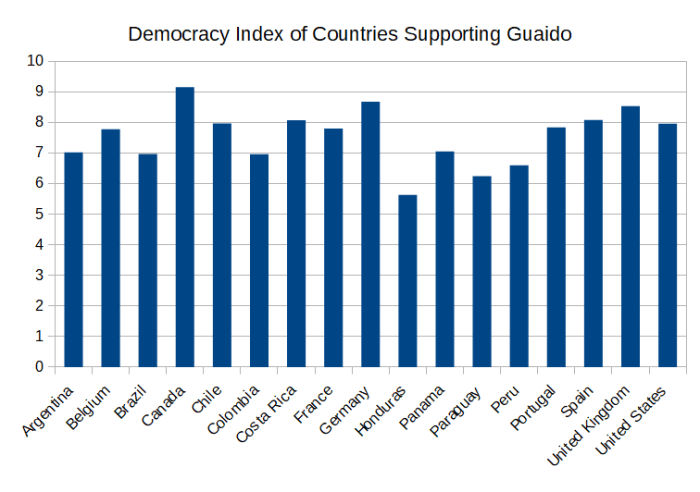
Here’s a bit of evidence that this is indeed what’s happening: the countries that support Guaido are a lot more democratic than the countries that support Maduro.

Guaido has already been recognized by most of Europe and Latin America, including Argentina, Brazil, Chile, Colombia, Costa Rica, Guatemala, Honduras, Panama, Paraguay, and Peru. Among those supporting Maduro are China, Russia, Iran, and Turkey—not exactly bastions of liberal democracy. Within Latin America, only Bolivia, Cuba, Mexico, and Uruguay support Maduro. Of those, only Mexico and Uruguay are recognizably democratic.

The average Democracy Index of countries that support Guaido is 7.5, which would be a “flawed democracy”. The average Democracy Index of countries that support Maduro is only 4.4, a “hybrid regime”.

Here is a plot of the Democracy Index by country supporting Guaido:democracy_index_guaido

Here is a plot of the Democracy Index by country supporting Maduro:

democracy_index_maduro

Since the entire EU recognizes Guaido, I could have shown each European country separately and biased the numbers even further, but I decided to specifically stick to major European powers with explicitly stated positions on Venezuela.

And we know that Maduro was a ruthless and autocratic dictator. So this is looking an awful lot like a democratic uprising against authoritarianism. It’s hard for me to be upset about that.

Second, Venezuela was in terrible shape, and largely due to Maduro’s administration.

After Maduro was elected (we’re still not sure how legitimate that election really was), Maduro underwent a total economic meltdown. Depression, hyperinflation, famine, a resurgence of malaria, and a huge exodus of refugees all followed. Millions of people are now starving in a country that was once quite rich. Nearly 90% of the population now lives in poverty. The story of Venezuela’s economy is one of total self-destruction.

Due to the bizarre system of subsidies and price controls in place, oil is now 100 times cheaper in Venezuela than water. Venezuela’s oil production has plummeted under Maduroto its lowest levels in decades, which might be good for climate change but is very bad for a country so dependent upon oil export revenue. It’s pretty much a classic cautionary tale for the Resource Curse.

Maduro, like any good socialist dictator, has blamed US sanctions for all his country’s economic failings. But there have not been strict US sanctions against Venezuela, and we remain their chief purchaser of oil by a wide margin. If you’ve ever bought gasoline at a Citgo station, you have paid for Venezuelan oil. Moreover, if your socialist country is that heavily dependent on exporting to capitalist countries… that really doesn’t say much in favor of socialism as an economic system, does it?

I don’t know what will happen. Maybe Maduro will successfully regain power. Maybe Guaido will retain control but turn out to be just as bad (there’s a long track record of coups against awful dictators resulting in equally awful dictators—Idi Amin is a classic example). Maybe Trump will do something stupid or crazy and we’ll end up in yet another decades-long military quagmire.

But there’s also a chance of something much better: Maybe Guaido can actually maintain power and build a genuinely democratic regime in Venezuela, and turn their economy back from the brink of devastation toward more sustainable growth. When the devil you know is this bad, sometimes you really do want to bet on the devil you don’t.

I don’t care what happened in that video

Jan 27 JDN 2458511

Right now there is an ongoing controversy over a viral video of a confrontation between young protesters wearing MAGA hats and an elderly Native American man. Various sources are purporting to show “a fuller picture” and “casting new light” and showing “a different side”. Others are saying it’s exactly as bad as it looks.

I think it probably is as bad as it looks, but the truth is: I don’t care. This is a distraction.

If you think litigating the precise events of this video is important, you are suffering from a severe case of scope neglect. You are looking at a single event between a handful of people when you should be looking at the overall trends of a country of over 300 million people.

First of all: The government shutdown only just ended. There are still going to be a lot of pieces to pick up. That’s what we should be talking about. That’s what we should be posting about. That’s what we should be calling Senators about. This is a national emergency. The longer this lasts, the worse it is going to get. People will die because of this shutdown—from tainted food and polluted water and denied food stamps. Our national security is being jeopardized—particularly with regard to cybersecurity.

The shutdown was also a completely unforced error. Government shutdowns shouldn’t even exist, and now that this one is over, we need to change the budget process so that this can never happen again.

And if you want to talk about the racist, sexist, and authoritarian leanings of Trump supporters, that’s quite important too. But it doesn’t hinge upon one person or one confrontation. I’m sure there are Trump supporters who aren’t racist; and I’m sure there are Obama supporters who are. But the overall statistical trend there is extremely strong.

I understand that most people suffer from severe scope neglect, and we have to live in a world filled with such people; so maybe there’s some symbolic value in finding one particularly egregious case that you can put a face on and share with the world. But if you’re going to do that, there’s two things I’d ask of you:

1. Make absolutely sure that this case is genuine. Nothing will destroy your persuasiveness faster than holding up an ambiguous case as if it were definitive.
2. After you’ve gotten their attention with the single example, show the statistics. There are truths, whole truths, and statistics. If you really want to know something, you use statistics.

The statistics are what this is really about. One person, even a hundred people—that really doesn’t matter. We need to keep our eyes on the millions of people, the directions of entire nations. For a lot of people, looking at numbers is boring; but there are people behind those numbers, and numbers are what tell us what’s really going on in the world.

For example: Trump really does seem to have brought bigotry out in the open. Hate crimes in the US increased for the third year in a row last year.

Then there are his direct policy actions which are human rights violations: The number of children detained at the border has skyrocketed to almost 13,000.

On the other hand, the economy is doing quite well: Unemployment stands at about 4%, and median income is increasing and poverty is decreasing.
Global extreme poverty continues its preciptious decline, but global climate change is getting worse, and already past the point where some serious consequences are going to be unavoidable.

Some indicators are more ambiguous: Corporate profits are near their all-time high, even in inflation-adjusted terms. That could be a sign of an overall good economy—but it also clearly has something to do with redistribution of income toward the wealthy.

Of course, all of those things were true yesterday, and will be true tomorrow. They were true last week, and will be true next week. They don’t lend themselves to a rapid-fire news cycle.

But maybe that means we don’t need a rapid-fire news cycle? Maybe that’s not the best way to understand what’s going on in the world?

If you stop destroying jobs, you will stop economic growth

Dec 30 JDN 2458483

One thing that endlessly frustrates me (and probably most economists) about the public conversation on economics is the fact that people seem to think “destroying jobs” is bad. Indeed, not simply a downside to be weighed, but a knock-down argument: If something “destroys jobs”, that’s a sufficient reason to opposite it, whether it be a new technology, an environmental regulation, or a trade agreement. So then we tie ourselves up in knots trying to argue that the policy won’t really destroy jobs, or it will create more than it destroys—but it will destroy jobs, and we don’t actually know how many it will create.

Destroying jobs is good. Destroying jobs is the only way that economic growth ever happens.

I realize I’m probably fighting an uphill battle here, so let me start at the beginning: What do I mean when I say “destroying jobs”? What exactly is a “job”, anyway?
At its most basic level, a job is something that needs done. It’s a task that someone wants to perform, but is unwilling or unable to perform on their own, and is therefore willing to give up some of what they have in order to get someone else to do it for them.

Capitalism has blinded us to this basic reality. We have become so accustomed to getting the vast majority of our goods via jobs that we come to think of having a job as something intrinsically valuable. It is not. Working at a job is a downside. It is something to be minimized.

There is a kind of work that is valuable: Creative, fulfilling work that you do for the joy of it. This is what we are talking about when we refer to something as a “vocation” or even a “hobby”. Whether it’s building ships in bottles, molding things from polymer clay, or coding video games for your friends, there is a lot of work in the world that has intrinsic value. But these things aren’t jobs. No one will pay them to do these things—or need to; you’ll do them anyway.

The value we get from jobs is actually obtained from goods: Everything from houses to underwear to televisions to antibiotics. The reason you want to have a job is that you want the money from that job to give you access to markets for all the goods that are actually valuable to you.

Jobs are the input—the cost—of producing all of those goods. The more jobs it takes to make a good, the more expensive that good is. This is not a rule-of-thumb statement of what usually or typically occurs. This is the most fundamental definition of cost. The more people you have to pay to do something, the harder it was to do that thing. If you can do it with fewer people (or the same people working with less effort), you should. Money is the approximation; money is the rule-of-thumb. We use money as an accounting mechanism to keep track of how much effort was put into accomplishing something. But what really matters is the “sweat of our laborers, the genius of our scientists, the hopes of our children”.

Economic growth means that we produce more goods at less cost.

That is, we produce more goods with fewer jobs.

All new technologies destroy jobs—if they are worth anything at all. The entire purpose of a new technology is to let us do things faster, better, easier—to let us have more things with less work.

This has been true since at least the dawn of the Industrial Revolution.

The Luddites weren’t wrong that automated looms would destroy weaver jobs. They were wrong to think that this was a bad thing. Of course, they weren’t crazy. Their livelihoods were genuinely in jeopardy. And this brings me to what the conversation should be about when we instead waste time talking about “destroying jobs”.

Here’s a slogan for you: Kill the jobs. Save the workers.

We shouldn’t be disappointed to lose a job; we should think of that as an opportunity to give a worker a better life. For however many years, you’ve been toiling to do this thing; well, now it’s done. As a civilization, we have finally accomplished the task that you and so many others set out to do. We have not “replaced you with a machine”; we have built a machine that now frees you from your toil and allows you to do something better with your life. Your purpose in life wasn’t to be a weaver or a coal miner or a steelworker; it was to be a friend and a lover and a parent. You can now get more chance to do the things that really matter because you won’t have to spend all your time working some job.

When we replaced weavers with looms, plows with combine harvesters, computers-the-people with computers-the-machines (a transformation now so complete most people don’t even seem to know that the word used to refer to a person—the award-winning film Hidden Figures is about computers-the-people), tollbooth operators with automated transponders—all these things meant that the job was now done. For the first time in the history of human civilization, nobody had to do that job anymore. Think of how miserable life is for someone pushing a plow or sitting in a tollbooth for 10 hours a day; aren’t you glad we don’t have to do that anymore (in this country, anyway)?

And the same will be true if we replace radiologists with AI diagnostic algorithms (we will; it’s probably not even 10 years away), or truckers with automated trucks (we will; I give it 20 years), or cognitive therapists with conversational AI (we might, but I’m more skeptical), or construction workers with building-printers (we probably won’t anytime soon, but it would be nice), the same principle applies: This is something we’ve finally accomplished as a civilization. We can check off the box on our to-do list and move on to the next thing.

But we shouldn’t simply throw away the people who were working on that noble task as if they were garbage. Their job is done—they did it well, and they should be rewarded. Yes, of course, the people responsible for performing the automation should be rewarded: The engineers, programmers, technicians. But also the people who were doing the task in the meantime, making sure that the work got done while those other people were spending all that time getting the machine to work: They should be rewarded too.

Losing your job to a machine should be the best thing that ever happened to you. You should still get to receive most of your income, and also get the chance to find a new job or retire.

How can such a thing be economically feasible? That’s the whole point: The machines are more efficient. We have more stuff now. That’s what economic growth is. So there’s literally no reason we can’t give every single person in the world at least as much wealth as we did before—there is now more wealth.

There’s a subtler argument against this, which is that diverting some of the surplus of automation to the workers who get displaced would reduce the incentives to create automation. This is true, so far as it goes. But you know what else reduces the incentives to create automation? Political opposition. Luddism. Naive populism. Trade protectionism.

Moreover, these forces are clearly more powerful, because they attack the opportunity to innovate: Trade protection can make it illegal to share knowledge with other countries. Luddist policies can make it impossible to automate a factory.

Whereas, sharing the wealth would only reduce the incentive to create automation; it would still be possible, simply less lucrative. Instead of making $40 billion, you’d only make $10 billion—you poor thing. I sincerely doubt there is a single human being on Earth with a meaningful contribution to make to humanity who would make that contribution if they were paid $40 billion but not if they were only paid $10 billion.

This is something that could be required by regulation, or negotiated into labor contracts. If your job is eliminated by automation, for the next year you get laid off but still paid your full salary. Then, your salary is converted into shares in the company that are projected to provide at least 50% of your previous salary in dividends—forever. By that time, you should be able to find another job, and as long as it pays at least half of what your old job did, you will be better off. Or, you can retire, and live off that 50% plus whatever else you were getting as a pension.

From the perspective of the employer, this does make automation a bit less attractive: The up-front cost in the first year has been increased by everyone’s salary, and the long-term cost has been increased by all those dividends. Would this reduce the number of jobs that get automated, relative to some imaginary ideal? Sure. But we don’t live in that ideal world anyway; plenty of other obstacles to innovation were in the way, and by solving the political conflict, this will remove as many as it adds. We might actually end up with more automation this way; and even if we don’t, we will certainly end up with less political conflict as well as less wealth and income inequality.

The best thing we can do to help them is let them in


Dec 23 JDN 2458476

This is a Christmas post, but not like most of my other Christmas posts. It’s not going to be an upbeat post about the effects of holidays on the economy, or the psychology of gift-giving, or the game theory that underlies the whole concept of a “holiday”.

No, today is about an urgent moral crisis. This post isn’t about Christmas as a weird but delightful syncretic solstice celebration. This post is about the so-called “spirit of Christmas”, a spirit of compassion and generosity that our country is clearly not living up to.

At the time of writing, the story had just come out: Jakelin Maquin, a 7-year-old girl from Guatemala died in the custody of US border agents.

Even if it’s true that the Border Patrol did everything they could to help her once they found out she was dying (and the reports coming out suggest that this is in fact the case), this death was still entirely preventable.

The first question we should ask is very basic: Why are there little girls in custody of border agents?
The next question is even more fundamental than that: Why are there border agents?

There are now 15,000 children being held by US Border Patrol. There should not be even one. The very concept of imprisoning children for crossing the border, under any circumstances, is a human rights violation. And yes, this is new, and it is specific to Donald Trump: Bush and Obama never separated children from their families this way. And while two-thirds of Americans oppose this policy, a majority of Republicans support it—this child’s blood is on their hands too.

Yet despite the gulf between the two major parties, the majority of Americans do support the idea of restricting immigration in general. And what I want to know is: Why? What gives us that right?

Let’s be absolutely clear about what “restricting immigration” means. It means that when someone decides they want to come to our country, either to escape oppression, work toward a better life, or simply to live with their family who came here before, men with guns come and lock them up.

We don’t politely ask them to leave. We don’t even fine them or tax them for entering. We lock them in detention camps, or force them to return to the country they came from which may be ruled by a dictator or a drug cartel.

Honestly, even the level of border security US citizens are subjected to is appalling: We’ve somehow come to think of it as normal that whenever you get on an airplane, you are first run through a body scanner, while all your belongings are inspected and scanned, and if you are found carrying any contraband—or if you even say the wrong thing—you can be summarily detained. This is literally Orwellian. “Papers, please” is the refrain of a tyrannical regime, not a liberal democracy.

If we truly believe in the spirit of compassion and generosity, we must let these people in. We don’t even have to do anything; we just need to stop violently resisting them. Stop pointing guns at them, stop locking them away. How is “Stop pointing guns at children” controversial?

I could write an entire post about the benefits for Americans of more open immigration. But honestly, we shouldn’t even care. It doesn’t matter whether immigration creates jobs, or destroys jobs, or decreases crime, or increases crime. We should not be locking up children in camps.

If we really believe in the spirit of compassion and generosity, the only thing we should care about is whether immigration is good for the immigrants. And it obviously is, or they wouldn’t be willing to go to such lengths to accomplish it. But I don’t think most people realize just how large the benefits of immigration are.

I’m going to focus on Guatemala, because that’s where Jakelin Maqin was from.

Guatemala’s life expectancy at birth is 73 years. The life expectancy for recent Hispanic immigrants to the US is 82 years. Crossing that border can give you nine years of life.

And what about income? GDP per capita PPP in the US is almost $60,000 per year. In Guatemala? Just over $8,000. Of course, that’s not accounting for the fact that Guatemalans are less educated; but even the exact same worker emigrating from there to here can greatly increase their income. The minimum wage in Guatemala is 90 GTQ per day, which is about $11.64. For a typical 8-hour workday, the US minimum wage of $7.25 per hour comes to $58 per day. That same exact worker can quintuple their income just by getting a job on the other side of the border.

Almost 60 percent of Guatemalans live in poverty. Over 20% live below the UN extreme poverty line. A full 11% of Guatemala’s GDP is remittances: Money that immigrants pay to help their families back home. A further 7% is exports to the US. This means that almost a fifth of Guatemala’s economy is dependent on the United States.

For comparison, less than 0.5% of Americans live in extreme poverty. (The UN recently claimed almost 6%; the Trump administration has claimed only 0.1% which is even more dubious. Both methodologies are deeply flawed; in particular, the UN report looks at income, not consumption—and consumption is what matters.) The overall poverty rate in the US is about 12%.

These figures are still appallingly high for a country as rich as the US; our extreme poverty rate should be strictly zero, a policy decision which could be implemented immediately and permanently in the form of a basic income of $700 per person per year, at a total expenditure of only $224 billion per year—about a third of the military budget. The net cost would in fact be far smaller than that, because we’d immediately turn around and spend that money. In fact, had this been done at the trough of the Great Recession, it would almost certainly have saved the government money.

Making our overall poverty rate strictly zero would be more challenging, but not obviously infeasible; since the poverty line is about $12,000 per person per year, it would take a basic income of that much to eliminate poverty, which would cost about $3.8 trillion per year. This is a huge expenditure, comparable as a proportion of GDP to the First World War (though still less than the Second). On the other hand, it would end poverty in America immediately and forever.

But even as things currently stand, the contrast between Guatemala and the US could hardly be starker: Immigrants are moving from a country with 60% poverty and 20% extreme poverty to one with 12% poverty and 0.5% extreme poverty.

Guatemala is a particularly extreme example; things are not as bad in Mexico or Cuba, for example. But the general pattern is a very consistent one: Immigrants come to the United States because things are very bad where they come from and their chances of living a better life here are much higher.

The best way to help these people, at Christmas and all year round, literally couldn’t be easier:

Let them in.

What would a new macroeconomics look like?

Dec 9 JDN 2458462

In previous posts I have extensively criticized the current paradigm of macroeconomics. But it’s always easier to tear the old edifice down than to build a better one in its place. So in this post I thought I’d try to be more constructive: What sort of new directions could macroeconomics take?

The most important change we need to make is to abandon the assumption of dynamic optimization. This will be a very hard sell, as most macroeconomists have become convinced that the Lucas Critique means we need to always base everything on the dynamic optimization of a single representative agent. I don’t think this was actually what Lucas meant (though maybe we should ask him; he’s still at Chicago), and I certainly don’t think it is what he should have meant. He had a legitimate point about the way macroeconomics was operating at that time: It was ignoring the feedback loops that occur when we start trying to change policies.

Goodhart’s Law is probably a better formulation: Once you make an indicator into a target, you make it less effective as an indicator. So while inflation does seem to be negatively correlated with unemployment, that doesn’t mean we should try to increase inflation to extreme levels in order to get rid of unemployment; sooner or later the economy is going to adapt and we’ll just have both inflation and unemployment at the same time. (Campbell’s Law provides a specific example that I wish more people in the US understood: Test scores would be a good measure of education if we didn’t use them to target educational resources.)

The reason we must get rid of dynamic optimization is quite simple: No one behaves that way.

It’s often computationally intractable even in our wildly oversimplified models that experts spend years working onnow you’re imagining that everyone does this constantly?

The most fundamental part of almost every DSGE model is the Euler equation; this equation comes directly from the dynamic optimization. It’s supposed to predict how people will choose to spend and save based upon their plans for an infinite sequence of future income and spending—and if this sounds utterly impossible, that’s because it is. Euler equations don’t fit the data at all, and even extreme attempts to save them by adding a proliferation of additional terms have failed. (It reminds me very much of the epicycles that astronomers used to add to the geocentric model of the universe to try to squeeze in weird results like Mars, before they had the heliocentric model.)

We should instead start over: How do people actually choose their spending? Well, first of all, it’s not completely rational. But it’s also not totally random. People spend on necessities before luxuries; they try to live within their means; they shop for bargains. There is a great deal of data from behavioral economics that could be brought to bear on understanding the actual heuristics people use in deciding how to spend and save. There have already been successful policy interventions using this knowledge, like Save More Tomorrow.

The best thing about this is that it should make our models simpler. We’re no longer asking each agent in the model to solve an impossible problem. However people actually make these decisions, we know it can be done, because it is being done. Most people don’t really think that hard, even when they probably should; so the heuristics really can’t be that complicated. My guess is that you can get a good fit—certainly better than an Euler equation—just by assuming that people set a target for how much they’re going to save (which is also probably pretty small for most people), and then spend the rest.

The second most important thing we need to add is inequality. Some people are much richer than others; this is a very important fact about economics that we need to understand. Yet it has taken the economics profession decades to figure this out, and even now I’m only aware of one class of macroeconomic models that seriously involves inequality, the Heterogeneous Agent New Keynesian (HANK) models which didn’t emerge until the last few years (the earliest publication I can find is 2016!). And these models are monsters; they are almost always computationally intractable and have a huge number of parameters to estimate.

Understanding inequality will require more parameters, that much is true. But if we abandon dynamic optimization, we won’t need as many as the HANK models have, and most of the new parameters are actually things we can observe, like the distribution of wages and years of schooling.

Observability of parameters is a big deal. Another problem with the way the Lucas Critique has been used is that we’ve been told we need to be using “deep structural parameters” like the temporal elasticity of substitution and the coefficient of relative risk aversion—but we have no idea what those actually are. We can’t observe them, and all of our attempts to measure them indirectly have yielded inconclusive or even inconsistent results. This is probably because these parameters are based on assumptions about human rationality that are simply not realistic. Most people probably don’t have a well-defined temporal elasticity of substitution, because their day-to-day decisions simply aren’t consistent enough over time for that to make sense. Sometimes they eat salad and exercise; sometimes they loaf on the couch and drink milkshakes. Likewise with risk aversion: many moons ago I wrote about how people will buy both insurance and lottery tickets, which no one with a consistent coefficient of relative risk aversion would ever do.

So if we are interested in deep structural parameters, we need to base those parameters on behavioral experiments so that we can understand actual human behavior. And frankly I don’t think we need deep structural parameters; I think this is a form of greedy reductionism, where we assume that the way to understand something is always to look at smaller pieces. Sometimes the whole is more than the sum of its parts. Economists obviously feel a lot of envy for physics; but they don’t seem to understand that aerodynamics would never have (ahem) gotten off the ground if we had first waited for an exact quantum mechanical solution of the oxygen atom (which we still don’t have, by the way). Macroeconomics may not actually need “microfoundations” in the strong sense that most economists intend; it needs to be consistent with small-scale behavior, but it doesn’t need to be derived from small-scale behavior.

This means that the new paradigm in macroeconomics does not need to be computationally intractable. Using heuristics instead of dynamic optimization and worrying less about microfoundations will make the models simpler; adding inequality need not make them so much more complicated.

Fighting the zero-sum paradigm

Dec 2 JDN 2458455

It should be obvious at this point that there are deep, perhaps even fundamental, divides between the attitudes and beliefs of different political factions. It can be very difficult to even understand, much less sympathize, with the concerns of people who are racist, misogynistic, homophobic, xenophobic, and authoritarian.
But at the end of the day we still have to live in the same country as these people, so we’d better try to understand how they think. And maybe, just maybe, that understanding will help us to change them.

There is one fundamental belief system that I believe underlies almost all forms of extremism. Right now right-wing extremism is the major threat to global democracy, but left-wing extremism subscribes to the same core paradigm (consistent with Horseshoe Theory).

I think the best term for this is the zero-sum paradigm. The idea is quite simple: There is a certain amount of valuable “stuff” (money, goods, land, status, happiness) in the world, and the only political question is who gets how much.

Thus, any improvement in anyone’s life must, necessarily, come at someone else’s expense. If I become richer, you become poorer. If I become stronger, you become weaker. Any improvement in my standard of living is a threat to your status.

If this belief were true, it would justify, or at least rationalize, all sorts of destructive behavior: Any harm I can inflict upon someone else will yield a benefit for me, by some fundamental conservation law of the universe.

Viewed in this light, beliefs like patriarchy and White supremacy suddenly become much more comprehensible: Why would you want to spend so much effort hurting women and Black people? Because, by the fundamental law of zero-sum, any harm to women is a benefit to men, and any harm to Black people is a benefit to White people. The world is made of “teams”, and you are fighting for your own against all the others.

And I can even see why such an attitude is seductive: It’s simple and easy to understand. And there are many circumstances where it can be approximately true.
When you are bargaining with your boss over a wage, one dollar more for you is one dollar less for your boss.
When your factory outsources production to China, one more job for China is one less job for you.

When we vote for President, one more vote for the Democrats is one less vote for the Republicans.

But of course the world is not actually zero-sum. Both you and your boss would be worse off if your job were to disappear; they need your work and you need their money. For every job that is outsourced to China, another job is created in the United States. And democracy itself is such a profound public good that it basically overwhelms all others.

In fact, it is precisely when a system is running well that the zero-sum paradigm becomes closest to true. In the space of all possible allocations, it is the efficient ones that behave in something like a zero-sum way, because when the system is efficient, we are already producing as much as we can.

This may be part of why populist extremism always seems to assert itself during periods of global prosperity, as in the 1920s and today: It is precisely when the world is running at its full capacity that it feels most like someone else’s gain must come at your loss.

Yet if we live according to the zero-sum paradigm, we will rapidly destroy the prosperity that made that paradigm seem plausible. A trade war between the US and China would put millions out of work in both countries. A real war with conventional weapons would kill millions. A nuclear war would kill billions.

This is what we must convey: We must show people just how good things are right now.

This is not an easy task; when people want to believe the world is falling apart, they can very easily find excuses to do so. You can point to the statistics showing a global decline in homicide, but one dramatic shooting on the TV news will wipe that all away. You can show the worldwide rise in real incomes across the board, but that won’t console someone who just lost their job and blames outsourcing or immigrants.

Indeed, many people will be offended by the attempt—the mere suggestion that the world is actually in very good shape and overall getting better will be perceived as an attempt to deny or dismiss the problems and injustices that still exist.

I encounter this especially from the left: Simply pointing out the objective fact that the wealth gap between White and Black households is slowly closing is often taken as a claim that racism no longer exists or doesn’t matter. Congratulating the meteoric rise in women’s empowerment around the world is often paradoxically viewed as dismissing feminism instead of lauding it.

I think the best case against progress can be made with regard to global climate change: Carbon emissions are not falling nearly fast enough, and the world is getting closer to the brink of truly catastrophic ecological damage. Yet even here the zero-sum paradigm is clearly holding us back; workers in fossil-fuel industries think that the only way to reduce carbon emissions is to make their families suffer, but that’s simply not true. We can make them better off too.

Talking about injustice feels righteous. Talking about progress doesn’t. Yet I think what the world needs most right now—the one thing that might actually pull us back from the brink of fascism or even war—is people talking about progress.

If people think that the world is full of failure and suffering and injustice, they will want to tear down the whole system and start over with something else. In a world that is largely democratic, that very likely means switching to authoritarianism. If people think that this is as bad as it gets, they will be willing to accept or even instigate violence in order to change to almost anything else.

But if people realize that in fact the world is full of success and prosperity and progress, that things are right now quite literally better in almost every way for almost every person in almost every country than they were a hundred—or even fifty—years ago, they will not be so eager to tear the system down and start anew. Centrism is often mocked (partly because it is confused with false equivalence), but in a world where life is improving this quickly for this many people, “stay the course” sounds awfully attractive to me.
That doesn’t mean we should ignore the real problems and injustices that still exist, of course. There is still a great deal of progress left to be made.  But I believe we are more likely to make progress if we acknowledge and seek to continue the progress we have already made, than if we allow ourselves to fall into despair as if that progress did not exist.

How much should we give?

Nov 4 JDN 2458427

How much should we give of ourselves to others?

I’ve previously struggled with this basic question when it comes to donating money; I have written multiple posts on it now, some philosophical, some empirical, and some purely mathematical.

But the question is broader than this: We don’t simply give money. We also give effort. We also give emotion. Above all, we also give time. How much should we be volunteering? How many protest marches should we join? How many Senators should we call?

It’s easy to convince yourself that you aren’t doing enough. You can always point to some hour when you weren’t doing anything particularly important, and think about all the millions of lives that hang in the balance on issues like poverty and climate change, and then feel a wave of guilt for spending that hour watching Netflix or playing video games instead of doing one more march. This, however, is clearly unhealthy: You won’t actually make yourself into a more effective activist, you’ll just destroy yourself psychologically and become no use to anybody.

I previously argued for a sort of Kantian notion that we should commit to giving our fair share, defined as the amount we would have to give if everyone gave that amount. This is quite appealing, and if I can indeed get anyone to donate 1% of their income as a result, I will be quite glad. (If I can get 100 people to do so, that’s better than I could ever have done myself—a good example of highly cost-effective slacktivism.)

Lately I have come to believe that this is probably inadequate. We know that not everyone will take this advice, which means that by construction it won’t be good enough to actually solve global problems.

This means I must make a slightly greater demand: Define your fair share as the amount you would have to give if everyone among people who are likely to give gave that amount.

Unfortunately, this question is considerably harder. It may not even have a unique answer. The number of people willing to give an amount n is obviously dependent upon the amount x itself, and we are nowhere close to knowing what that function n(x) looks like.

So let me instead put some mathematical constraints on it, by choosing an elasticity. Instead of an elasticity of demand or elasticity of supply, we could call this an elasticity of contribution.

Presumably the elasticity is negative: The more you ask of people, the fewer people you’ll get to contribute.

Suppose that the elasticity is something like -0.5, where contribution is relatively inelastic. This means that if you increase the amount you ask for by 2%, you’ll only decrease the number of contributors by 1%. In that case, you should be like Peter Singer and ask for everything. At that point, you’re basically counting on Bill Gates to save us, because nobody else is giving anything. The total amount contributed n(x) * x is increasing in x.

On the other hand, suppose that elasticity is something like 2, where contribution is relatively elastic. This means that if you increase the amount you ask for by 2%, you will decrease the number of contributors by 4%. In that case, you should ask for very little. You’re asking everyone in the world to give 1% of their income, as I did earlier. The total amount contributed n(x) * x is now decreasing in x.

But there is also a third option: What if the elasticity is exactly -1, unit elastic? Then if you increase the amount you ask for by 2%, you’ll decrease the number of contributors by 2%. Then it doesn’t matter how much you ask for: The total amount contributed n(x) * x is constant.

Of course, there’s no guarantee that the elasticity is constant over all possible choices of x—indeed, it would be quite surprising if it were. A quite likely scenario is that contribution is inelastic for small amounts, then passes through a regime where it is nearly unit elastic, and finally it becomes elastic as you start asking for really large amounts of money.

The simplest way to model that is to just assume that n(x) is linear in x, something like n = N – k x.

There is a parameter N that sets the maximum number of people who will ever donate, and a parameter k that sets how rapidly the number of contributors drops off as the amount asked for increases.

The first-order condition for maximizing n(x) * x is then quite simple: x = N/(2k)

This actually turns out to be the precisely the point at which the elasticity of contribution is -1.

The total amount you can get under that condition is N2/(4k)

Of course, I have no idea what N and k are in real life, so this isn’t terribly helpful. But what I really want to know is whether we should be asking for more money from each person, or asking for less money and trying to get more people on board.

In real life we can sometimes do both: Ask each person to give more than they are presently giving, whatever they are presently giving. (Just be sure to run your slogans by a diverse committee, so you don’t end up with “I’ve upped my standards. Now, up yours!”) But since we’re trying to find a benchmark level to demand of ourselves, let’s ignore that for now.

About 25% of American adults volunteer some of their time, averaging 140 hours of volunteer work per year. This is about 1.6% of all the hours in a year, or 2.4% of all waking hours. Total monetary contributions in the US reached $400 billion for the first time this year; this is about 2.0% of GDP. So the balance between volunteer hours and donations is actually pretty even. It would probably be better to tilt it a bit more toward donations, but it’s really not bad. About 60% of US households made some sort of charitable contribution, though only half of these received the charitable tax deduction.

This suggests to me that the quantity of people who give is probably about as high as it’s going to get—and therefore we need to start talking more about the amount of money. We may be in the inelastic regime, where the way to increase total contributions is to demand more from each individual.

Our goal is to increase the total contribution to poverty eradication by about 1% of GDP in both the US and Europe. So if 60% of people give, and currently total contributions are about 2.0% of GDP, this means that the average contribution is about 3.3% of the contributor’s gross income. Therefore I should tell them to donate 4.3%, right? Not quite; some of them might drop out entirely, and the rest will have to give more to compensate.
Without knowing the exact form of the function n(x), I can’t say precisely what the optimal value is. But it is most likely somewhat larger than 4.3%; 5% would be a nice round number in the right general range. This would raise contributions in the US to 2.6% of GDP, or about $500 billion. That’s a 20% increase over the current level, which is large, but feasible.

Accomplishing a similar increase in Europe would then give us a total of $200 billion per year in additional funds to fight global poverty; this might not quite be enough to end world hunger (depending on which estimate you use), but it would definitely have a large impact.

I asked you before to give 1%. I am afraid I must now ask for more. Set a target of 5%. You don’t have to reach it this year; you can gradually increase your donations each year for several years (I call this “Save More Lives Tomorrow”, after Thaler’s highly successful program “Save More Tomorrow”). This is in some sense more than your fair share; I’m relying on the assumption that half the population won’t actually give anything. But ultimately this isn’t about what’s fair to us. It’s about solving global problems.

How we can actually solve the housing shortage

Sep 16 JDN 2458378

In previous posts I’ve talked about the housing crisis facing most of the world’s major cities. (Even many cities in Africa are now facing a housing crisis!) In this post, I’m going to look at the empirical data to see if we can find a way to solve this crisis.

Most of the answer, it turns out, is really not that complicated: Build more housing.

There is a little bit more to it than that, but only a little bit. The basic problem is simply that there are more households than there are houses to hold them.

One of the biggest hurdles to fixing the housing crisis comes ironically from the left, in resistance to so-called “gentrification”. Local resistance to new construction is one of the greatest obstacles to keeping housing affordable. State and federal regulations are generally quite sensible: No industrial waste near the playgrounds. It’s the local regulations that make new housing so difficult.

I can understand why people fight “gentrification”: They see new housing going in as housing prices increase, and naturally assume that new houses cause higher prices. But it’s really the other way around: High prices cause new construction, which brings prices down. By its nature, new housing is almost always more expensive than existing housing. Building new housing still brings down the overall price of housing, even when the new housing is expensive. Building luxury condos does make existing apartments more affordable—and not building anything most certainly does not.

California’s housing crisis is particularly severe: California has been building less than half the units needed to sustain its current population trend since the crash in 2008. It’s worst of all in the Bay Area, where 500,000 jobs were added since 2009—and only 50,000 homes. California also has a big problem with delays in the permit process: Typically it takes as long as three or four years between approval and actual breaking ground.

We are seeing this in Oakland currently: The government has approved an actually reasonable amount of housing for once (vastly more than what they usually do), and as a result they may have a chance at keeping Oakland affordable even as it grows its population and economy. And yet we still get serious journalists saying utter nonsense like The building boom and resulting gentrification are squeezing the city’s most vulnerable.” Building booms don’t cause gentrification. Building booms are the best response to gentrification. When you say things like that, you sound to an economist like you’re saying “Pizza is so expensive; we need to stop people from making pizza!”

Homeowners who want to increase their property values may actually be rational—if incredibly selfish and monopolistic—in trying to block new construction. But activists who oppose “gentrification” need to stop shooting themselves in the foot by fighting the very same development that would have made housing cheaper.

The simplest thing we can do is make it easier to build housing. Streamline the permit process, provide subsidies, remove unnecessary regulations. Housing is one of the few markets where I can actually see a lot of unnecessary regulations. We don’t need to require parking; we should provide better public transit instead. And while requiring solar panels (as the whole state is now doing) sounds nice, it makes everything a lot more expensive—and by only requiring it on new housing, you are effectively saying you don’t want any new housing. I love solar panels, but what you should be doing is subsidizing solar panels, not requiring them. Does that cost the state budget more? Yes. Raise taxes on something else (a particularly good idea: electricity consumption) if you have to. But by mandating solar panels without any subsidies to support them, you are effectively putting a tax on new housing—which is exactly what California does not need.

It’s still a good idea to create incentives to build not simply housing, but affordable housing. There are ways to do this as well. Denver did an excellent job in creating an Affordable Housing Fund that they immediately spent in converting vacant apartments into affordable housing units.

There are also good reasons to try to fight foreign ownership of housing (and really, speculative ownership of housing in general). There is a strong correlation between current account deficits and housing appreciation, which makes sense if foreign investors are buying up our housing and making it more expensive. If Trump could actually reduce our trade deficit, that would drive down our current account deficit and quite likely make our housing more affordable. Of course, he has absolutely no idea how to do that.

Victor Duggan has a pretty good plan for lowering housing prices in Ireland which includes a land tax (as I’ve discussed previously) and a tax on foreign ownership of real estate. I disagree with him about the “Help-to-Buy” program, however; I actually think that was a fine idea, since the goal is not simply to keep housing cheap but to get people into houses. That wealth transfer is going to raise prices at the producer side—increasing production—but not at the consumer side—because people get compensated by the tax rebate. The net result should be more housing without more cost for buyers. You could have done the same thing by subsidizing construction, but I actually like the idea of putting the money directly in the pockets of homeowners. The tax incidence shouldn’t be much different in the long run, but it makes for a much more appealing and popular program.