What would a new macroeconomics look like?

Dec 9 JDN 2458462

In previous posts I have extensively criticized the current paradigm of macroeconomics. But it’s always easier to tear the old edifice down than to build a better one in its place. So in this post I thought I’d try to be more constructive: What sort of new directions could macroeconomics take?

The most important change we need to make is to abandon the assumption of dynamic optimization. This will be a very hard sell, as most macroeconomists have become convinced that the Lucas Critique means we need to always base everything on the dynamic optimization of a single representative agent. I don’t think this was actually what Lucas meant (though maybe we should ask him; he’s still at Chicago), and I certainly don’t think it is what he should have meant. He had a legitimate point about the way macroeconomics was operating at that time: It was ignoring the feedback loops that occur when we start trying to change policies.

Goodhart’s Law is probably a better formulation: Once you make an indicator into a target, you make it less effective as an indicator. So while inflation does seem to be negatively correlated with unemployment, that doesn’t mean we should try to increase inflation to extreme levels in order to get rid of unemployment; sooner or later the economy is going to adapt and we’ll just have both inflation and unemployment at the same time. (Campbell’s Law provides a specific example that I wish more people in the US understood: Test scores would be a good measure of education if we didn’t use them to target educational resources.)

The reason we must get rid of dynamic optimization is quite simple: No one behaves that way.

It’s often computationally intractable even in our wildly oversimplified models that experts spend years working onnow you’re imagining that everyone does this constantly?

The most fundamental part of almost every DSGE model is the Euler equation; this equation comes directly from the dynamic optimization. It’s supposed to predict how people will choose to spend and save based upon their plans for an infinite sequence of future income and spending—and if this sounds utterly impossible, that’s because it is. Euler equations don’t fit the data at all, and even extreme attempts to save them by adding a proliferation of additional terms have failed. (It reminds me very much of the epicycles that astronomers used to add to the geocentric model of the universe to try to squeeze in weird results like Mars, before they had the heliocentric model.)

We should instead start over: How do people actually choose their spending? Well, first of all, it’s not completely rational. But it’s also not totally random. People spend on necessities before luxuries; they try to live within their means; they shop for bargains. There is a great deal of data from behavioral economics that could be brought to bear on understanding the actual heuristics people use in deciding how to spend and save. There have already been successful policy interventions using this knowledge, like Save More Tomorrow.

The best thing about this is that it should make our models simpler. We’re no longer asking each agent in the model to solve an impossible problem. However people actually make these decisions, we know it can be done, because it is being done. Most people don’t really think that hard, even when they probably should; so the heuristics really can’t be that complicated. My guess is that you can get a good fit—certainly better than an Euler equation—just by assuming that people set a target for how much they’re going to save (which is also probably pretty small for most people), and then spend the rest.

The second most important thing we need to add is inequality. Some people are much richer than others; this is a very important fact about economics that we need to understand. Yet it has taken the economics profession decades to figure this out, and even now I’m only aware of one class of macroeconomic models that seriously involves inequality, the Heterogeneous Agent New Keynesian (HANK) models which didn’t emerge until the last few years (the earliest publication I can find is 2016!). And these models are monsters; they are almost always computationally intractable and have a huge number of parameters to estimate.

Understanding inequality will require more parameters, that much is true. But if we abandon dynamic optimization, we won’t need as many as the HANK models have, and most of the new parameters are actually things we can observe, like the distribution of wages and years of schooling.

Observability of parameters is a big deal. Another problem with the way the Lucas Critique has been used is that we’ve been told we need to be using “deep structural parameters” like the temporal elasticity of substitution and the coefficient of relative risk aversion—but we have no idea what those actually are. We can’t observe them, and all of our attempts to measure them indirectly have yielded inconclusive or even inconsistent results. This is probably because these parameters are based on assumptions about human rationality that are simply not realistic. Most people probably don’t have a well-defined temporal elasticity of substitution, because their day-to-day decisions simply aren’t consistent enough over time for that to make sense. Sometimes they eat salad and exercise; sometimes they loaf on the couch and drink milkshakes. Likewise with risk aversion: many moons ago I wrote about how people will buy both insurance and lottery tickets, which no one with a consistent coefficient of relative risk aversion would ever do.

So if we are interested in deep structural parameters, we need to base those parameters on behavioral experiments so that we can understand actual human behavior. And frankly I don’t think we need deep structural parameters; I think this is a form of greedy reductionism, where we assume that the way to understand something is always to look at smaller pieces. Sometimes the whole is more than the sum of its parts. Economists obviously feel a lot of envy for physics; but they don’t seem to understand that aerodynamics would never have (ahem) gotten off the ground if we had first waited for an exact quantum mechanical solution of the oxygen atom (which we still don’t have, by the way). Macroeconomics may not actually need “microfoundations” in the strong sense that most economists intend; it needs to be consistent with small-scale behavior, but it doesn’t need to be derived from small-scale behavior.

This means that the new paradigm in macroeconomics does not need to be computationally intractable. Using heuristics instead of dynamic optimization and worrying less about microfoundations will make the models simpler; adding inequality need not make them so much more complicated.

What does a central bank actually do?

Aug 26 JDN 2458357

Though central banks are a cornerstone of the modern financial system, I don’t think most people have a clear understanding of how they actually function. (I think this may be by design; there are many ways we could make central banking more transparent, but policymakers seem reluctant to show their hand.)

I’ve even seen famous economists make really severe errors in their understanding of monetary policy, as John Taylor did when he characterized low-interest-rate policy as a “price ceiling”.

Central banks “print money” and “set interest rates”. But how exactly do they do these things, and what on Earth do they have to do with each other?

The first thing to understand is that most central banks don’t actually print money. In the US, cash is actually printed by the Department of the Treasury. But cash is only a small part of the money in circulation. The monetary base consists of cash in vaults and in circulation; the US monetary base is about $3.6 trillion. The money supply can be measured a few different ways, but the standard way is to include checking accounts, traveler’s checks, savings accounts, money market accounts, short-term certified deposits, and basically anything that can be easily withdrawn and spent as money. This is called the M2 money supply, and in the US it is currently over $14.1 trillion. That means that only 25% of our money supply is in actual, physical cash—the rest is all digital. This is actually a relatively high proportion for actual cash, as the monetary base was greatly increased in response to the Great Recession. When we say that the Fed “prints money”, what we really mean is that they are increasing the money supply—but typically they do so in a way that involves little if any actual printing of cash.

The second thing to understand is that central banks don’t exactly set interest rates either. They target interest rates. What’s the difference, you ask?

Well, setting interest rates would mean that they made a law or something saying you have to charge exactly 2.7%, and you get fined or something if you don’t do that.

Targeting interest rates is a subtler art. The Federal Reserve decides what interest rates they want banks to charge, and then they engage in what are called open-market operations to try to make that happen. Banks hold reservesmoney that they are required to keep as collateral for their loans. Since we are in a fractional-reserve system, they are allowed to keep only a certain proportion (usually about 10%). In open-market operations, the Fed buys and sells assets (usually US Treasury bonds) in order to either increase or decrease the amount of reserves available to banks, to try to get them to lend to each other at the targeted interest rates.

Why not simply set the interest rate by law? Because then it wouldn’t be the market-clearing interest rate. There would be shortages or gluts of assets.

It might be easier to grasp this if we step away from money for a moment and just think about the market for some other good, like televisions.

Suppose that the government wants to set the price of a television in the market to a particular value, say $500. (Why? Who knows. Let’s just run with it for a minute.)

If they simply declared by law that the price of a television must be $500, here’s what would happen: Either that would be too low, in which case there would be a shortage of televisions as demand exceeded supply; or that would be too high, in which case there would be a glut of televisions as supply exceeded demand. Only if they got spectacularly lucky and the market price already was $500 per television would they not have to worry about such things (and then, why bother?).

But suppose the government had the power to create and destroy televisions virtually at will with minimal cost.
Now, they have a better way; they can target the price of a television, and buy and sell televisions as needed to bring the market price to that target. If the price is too low, the government can buy and destroy a lot of televisions, to bring the price up. If the price is too high, the government can make and sell a lot of televisions, to bring the price down.

Now, let’s go back to money. This power to create and destroy at will is hard to believe for televisions, but absolutely true for money. The government can create and destroy almost any amount of money at will—they are limited only by the very inflation and deflation the central bank is trying to affect.

This allows central banks to intervene in the market without creating shortages or gluts; even though they are effectively controlling the interest rate, they are doing so in a way that avoids having a lot of banks wanting to take loans they can’t get or wanting to give loans they can’t find anyone to take.

The goal of all this manipulation is ultimately to reduce inflation and unemployment. Unfortunately it’s basically impossible to eliminate both simultaneously; the Phillips curve describes the relationship generally found that decreased inflation usually comes with increased unemployment and vice-versa. But the basic idea is that we set reasonable targets for each (usually about 2% inflation and 5% unemployment; frankly I’d prefer we swap the two, which was more or less what we did in the 1950s), and then if inflation is too high we raise interest rate targets, while if unemployment is too high we lower interest rate targets.

What if they’re both too high? Then we’re in trouble. This has happened; it is called stagflation. The money supply isn’t the other thing affecting inflation and unemployment, and sometimes we get hit with a bad shock that makes both of them high at once. In that situation, there isn’t much that monetary policy can do; we need to find other solutions.

But how does targeting interest rates lead to inflation? To be quite honest, we don’t actually know.

The basic idea is that lower interest rates should lead to more borrowing, which leads to more spending, which leads to more inflation. But beyond that, we don’t actually understand how interest rates translate into prices—this is the so-called transmission mechanism, which remains an unsolved problem in macroeconomics. Based on the empirical data, I lean toward the view that the mechanism is primarily via housing prices; lower interest rates lead to more mortgages, which raises the price of real estate, which raises the price of everything else. This also makes sense theoretically, as real estate consists of large, illiquid assets for which the long-term interest rate is very important. Your decision to buy an apple or even a television is probably not greatly affected by interest rates—but your decision to buy a house surely is.

If that is indeed the case, it’s worth thinking about whether this is really the right way to intervene on inflation and unemployment. High housing prices are an international crisis; maybe we need to be looking at ways to decrease unemployment without affecting housing prices. But that is a tale for another time.

What would a game with realistic markets look like?

Aug 12 JDN 2458343

From Pokemon to Dungeons & Dragons, Final Fantasy to Mass Effect, almost all role-playing games have some sort of market: Typically, you buy and sell equipment, and often can buy services such as sleeping at inns. Yet the way those markets work is extremely rigid and unrealistic.

(I’m of course excluding games like EVE Online that actually create real markets between players; those markets are so realistic I actually think they would provide a good opportunity for genuine controlled experiments in macroeconomics.)

The weirdest thing about in-game markets is the fact that items almost always come with a fixed price. Sometimes there is some opportunity for haggling, or some randomization between different merchants; but the notion always persists that the item has a “true price” that is being adjusted upward or downward. This is more or less the opposite of how prices actually work in real markets.

There is no “true price” of a car or a pizza. Prices are whatever buyers and sellers make them. There is a true value—the amount of real benefit that can be obtained from a good—but even this is something that varies between individuals and also changes based on the other goods being consumed. The value of a pizza is considerably higher for someone who hasn’t eaten in days than to someone who just finished eating another pizza.

There is also what is called “The Law of One Price”, but like all laws of economics, it’s like the Pirate Code, more what you’d call a “guideline”, and it only applies to a particular good in a particular market at a particular time. The Law of One Price doesn’t even say that a pizza should have the same price tomorrow as it does today, or that the same pizza can’t be sold to two different customers at two different prices; it only says that the same pizza shouldn’t have two different prices in the same place at the same time for the same customer. (It seems almost tautological, right? And yet it still fails empirically, and does so again and again. I have seen offers for the same book in the same condition posted on the same website that differed by as much as 50%.)

In well-developed capitalist markets in large First World countries, we can lull ourselves into the illusion that there is only one price for a good, because markets are highly liquid and either highly competitive or controlled by a strong and stable oligopoly that enforces a particular price across places and times. The McDonald’s Dollar Menu is a policy choice by a massive multinational corporation; it’s not what would occur naturally if those items were sold on a competitive market.

Even then, this illusion can be broken when we are faced with a large economic shock, such as the OPEC price shock in 1973 or a natural disaster like Hurricane Katrina. It also tends to be broken for illiquid goods such as real estate.

If we consider the environment in which most role-playing games take place, it’s usually a sort of quasi-medieval or quasi-Renaissance feudal society, where a given government controls only a small region and traveling between towns is difficult and dangerous. Not only should the prices of goods differ substantially between towns, the currency used should frequently differ as well. Yes, most places would accept gold and silver; but a kingdom with a stable government will generally have a currency of significant seignorage, with coins worth considerably more than the gold used to mint them—yet the value of that seignorage will drop off as you move further away from that kingdom and its sphere of influence.

Moreover, prices should be inconsistent even between traders in the same town, and extremely volatile. When a town is mostly self-sufficient and trade is only a small part of its economy, even a small shock such as a bad thunderstorm or a brief drought can yield massive shifts in prices. Shortages and gluts will be frequent, as both supply and demand are small and ever-changing.

This wouldn’t be that difficult to implement. The simplest way would just be to institute random shocks to prices that vary by place and time. A more sophisticated method would be to actually simulate supply and demand for different goods, and then have prices respond to realistic shocks (e.g. a drought makes wheat more expensive, and the price of swords suddenly skyrockets after news of an impending dragon attack). Experiments have shown that competitive market outcomes can be achieved by simulating even a dozen or so traders using very simple heuristics like “don’t pay more than you can afford” and “don’t charge less than it cost you”.

Why don’t game designers implement this? I think there are two reasons.

The first is simply that it would be more complicated. This is a legitimate concern in many cases; I particularly think Pokemon can justify using a simple economy, given its target audience. I particularly agree that having more than a handful of currencies would be too much for players to keep track of; though perhaps having two or three (one for each major faction?) is still more interesting than only having one.

Also, tabletop games are inherently more limited in the amount of computation they can use, compared to video games. But for a game as complicated as say Skyrim, this really isn’t much of a defense. Skyrim actually simulated the daily routines of over a hundred different non-player characters; it could have been simulating markets in the background as well—in fact, it could have simply had those same non-player characters buy and sell goods with each other in a double-auction market that would automatically generate the prices that players face.

The more important reason, I think, is that game designers have a paralyzing fear of arbitrage.

I find it particularly aggravating how frequently games will set it up so that the price at which you buy and the price at which you sell are constrained so that the buying price is always higher, often as much as twice as high. This is not at all how markets work in the real world; frankly it’s only even close to true for goods like cars that rapidly depreciate. It make senses that a given merchant will not sell you a good for less than what they would pay to buy it from you; but that only requires each individual merchant to have a well-defined willingness-to-pay and willingness-to-accept. It certainly does not require the arbitrary constraint that you can never sell something for more than what you bought it for.

In fact, I would probably even allow players who specialize in social skills to short-change and bamboozle merchants for profit, as this is absolutely something that happens in the real world, and was likely especially common under the very low levels of literacy and numeracy that prevailed in the Middle Ages.

To many game designers (and gamers), the ability to buy a good in one place, travel to another place, and sell that good for a higher price seems like cheating. But this practice is call being a merchant. That is literally what the entire retail industry does. The rules of your game should allow you to profit from activities that are in fact genuinely profitable real economic services in the real world.

I remember a similar complaint being raised against Skyrim shortly after its release, that one could acquire a pickaxe, collect iron ore, smelt it into steel, forge weapons out of it, and then sell the weapons for a sizeable profit. To some people, this sounded like cheating. To me, it sounds like being a blacksmith. This is especially true because Skyrim’s skill system allowed you to improve the quality of your smithed items over time, just like learning a trade through practice (though it ramped up too fast, as it didn’t take long to make yourself clearly the best blacksmith in all of Skyrim). Frankly, this makes far more sense than being able to acquire gold by adventuring through the countryside and slaughtering monsters or collecting lost items from caves. Blacksmiths were a large part of the medieval economy; spelunking adventurers were not. Indeed, it bothers me that there weren’t more opportunities like this; you couldn’t make your wealth by being a farmer, a vintner, or a carpenter, for instance.

Even if you managed to pull off pure arbitrage, providing no real services, such as by buying and selling between two merchants in the same town, or the same merchant on two consecutive days, that is also a highly profitable industry. Most of our financial system is built around it, frankly. If you manage to make your wealth selling wheat futures instead of slaying dragons, I say more power to you. After all, there were an awful lot of wheat-future traders in the Middle Ages, and to my knowledge no actually successful dragon-slayers.

Of course, if your game is about slaying dragons, it should include some slaying of dragons. And if you really don’t care about making a realistic market in your game, so be it. But I think that more realistic markets could actually offer a great deal of richness and immersion into a world without greatly increasing the difficulty or complexity of the game. A world where prices change in response to the events of the story just feels more real, more alive.

The ability to profit without violence might actually draw whole new modes of play to the game (as has indeed occurred with Skyrim, where a small but significant proportion of players have chosen to live out peaceful lives as traders or blacksmiths). I would also enrich the experience of more conventional players and helping them recover from setbacks (if the only way to make money is to fight monsters and you keep getting killed by monsters, there isn’t much you can do; but if you have the option of working as a trader or a carpenter for awhile, you could save up for better equipment and try the fighting later).

And hey, game designers: If any of you are having trouble figuring out how to implement such a thing, my consulting fees are quite affordable.

Is a job guarantee better than a basic income?

Aug 5 JDN 2458336

In previous posts I’ve written about both the possibilities and challenges involved in creating a universal basic income. Today I’d like to address what I consider the most serious counter-argument against a basic income, an alternative proposal known as a job guarantee.

Whereas a basic income is literally just giving everyone free money, a job guarantee entails offering everyone who wants to work a job paid by the government. They’re not necessarily contradictory, but I’ve noticed a clear pattern: While basic income proponents are generally open to the idea of a job guarantee on the side, job guarantee proponents are often vociferously opposed to a basic income—even calling it “sinister”. I think the reason for this is that we see jobs as irrelevant, so we’re okay with throwing them in if you feel you must, while they see jobs as essential, so they meet any attempt to remove them with overwhelming resistance.

Where a basic income is extremely simple and could be implemented by a single act of the legislature, a job guarantee is considerably more complicated. The usual proposal for a job guarantee involves federal funding but local implementation, which is how most of our social welfare system is implemented—and why social welfare programs are so much better in liberal states like California than in conservative states like Mississippi, because California actually believes in what it’s implementing and Mississippi doesn’t. Anyone who wants a job guarantee needs to take that aspect seriously: In the places where poverty is worst, you’re offering control over the policy to the very governments that made poverty worst—and whether it is by malice or incompetence, what makes you think that won’t continue?

Another argument that I think job guarantee proponents don’t take seriously enough is the concern about “make-work”. They insist that a job guarantee is not “make-work”, but real work that’s just somehow not being done. They seem to think that there are a huge number of jobs that we could just create at the snap of a finger, which would be both necessary and useful on the one hand, and a perfect match for the existing skills of the unemployed population on the other hand. If that were the case, we would already be creating those jobs. It doesn’t even require a particularly strong faith in capitalism to understand this: If there is a profit to be made at hiring people to do something, there is probably already a business hiring people to do that. I don’t think of myself as someone with an overriding faith in capitalism, but a lot of the socialist arguments for job guarantees make me feel that way by comparison: They seem to think that there’s this huge untapped reserve of necessary work that the market is somehow failing to provide, and I’m just not seeing it.

There are public goods projects which aren’t profitable but would still be socially beneficial, like building rail lines and cleaning up rivers. But proponents of a job guarantee don’t seem to understand that these are almost all highly specialized jobs at our level of technology. We don’t need a bunch of people with shovels. We need engineers and welders and ecologists.

If you propose using people with shovels where engineers would be more efficient, that is make-work, whether you admit it or not. If you’re making people work in a less-efficient way in order to create jobs, then the jobs you are creating are fake jobs that aren’t worth creating. The line is often credited to Milton Friedman, but actually said first by William Aberhart in 1935:

Taking up the policy of a public works program as a solution for unemployment, it was criticized as a plan that took no account of the part that machinery played in modern construction, with a road-making machine instanced as an example. He saw, said Mr. Aberhart, work in progress at an airport and was told that the men were given picks and shovels in order to lengthen the work, to which he replied why not give them spoons and forks instead of picks and shovels if the object was to lengthen out the task.

I’m all for spending more on building rail lines and cleaning up rivers, but that’s not an anti-poverty program. The people who need the most help are precisely the ones who are least qualified to work on these projects: Children, old people, people with severe disabilities. Job guarantee proponents either don’t understand this fact or intentionally ignore it. If you aren’t finding jobs for 7-year-olds with autism and 70-year-olds with Parkinson’s disease, this program will not end poverty. And if you are, I find it really hard to believe that these are real, productive jobs and not useless “make-work”. A basic income would let the 7-year-olds stay in school and the 70-year-olds live in retirement homes—and keep them both out of poverty.

Another really baffling argument for a job guarantee over basic income is that a basic income would act as a wage subsidy, encouraging employers to reduce wages. That’s not how a basic income works. Not at all. A basic income would provide a pure income effect, necessarily increasing wage demands. People would not be as desperate for work, so they’d be more comfortable turning down unreasonable wage offers. A basic income would also incentivize some people to leave the labor force by retiring or going back to school; the reduction in labor supply would further increase wages. The Earned Income Tax Credit is in many respects similar to a wage subsidy. While superficially it might seem similar, a basic income would have the exact opposite effect.

One reasonable argument against a basic income is the possibility that it could cause inflation. This is something that can’t really be tested with small-scale experiments, so we really won’t know for sure until we try it. But there is reason to think that the inflation would be small, as the people removed from the labor force will largely be the ones who are least-productive to begin with. There is a growing body of empirical evidence suggesting that inflationary effects of a basic income would be small. For example, data on cash transfer programs in Mexico show only a small inflationary effect despite large reductions in poverty. The whole reason a basic income looks attractive is that automation technology is now so advanced is that we really don’t need everyone to be working anymore. Productivity is so high now that a policy of universal 40-hour work weeks just doesn’t make sense in the 21st century.

Probably the best argument for a job guarantee over a basic income concerns cost. A basic income is very expensive, there’s no doubt about that; and a job guarantee could be much cheaper. That is something I take very seriously: Saving $1.5 trillion a year is absolutely a good reason. Indeed, I don’t really object to this argument; the calculations are correct. I merely think that a basic income is enough better that its higher cost is justifiable. A job guarantee can eliminate unemployment, but not poverty.

But the argument for a job guarantee that most people seem to be find most compelling concerns meaning. The philosopher John Danaher expressed this one most cogently. Unemployment is an extremely painful experience for most people, far beyond what could be explained simply by their financial circumstances. Most people who win large sums of money in the lottery cut back their hours, but continue working—so work itself seems to have some value. What seems to happen is that when people lose the chance to work, they feel that they have lost a vital source of meaning in their lives.

Yet this raises two more questions:

First, would a job guarantee actually solve that problem?
Second, are there ways we could solve it under a basic income?

With regard to the first question, I want to re-emphasize the fact that a large proportion of these guaranteed jobs necessarily cannot be genuinely efficient production. If efficient production would have created these jobs, we would most likely already have created them. Our society does not suffer from an enormous quantity of necessary work that could be done with the skills already possessed by the unemployed population, which is somehow not getting done—indeed, it is essentially impossible for a capitalist economy with a highly-liquid financial system to suffer such a malady. If the work is so valuable, someone will probably take out a loan to hire someone to do it. If that’s not happening, either the unemployed people don’t have the necessary skills, or the work really can’t be all that productive. There are some public goods projects that would be beneficial but aren’t being done, but that’s a different problem, and the match between the public goods projects that need done and the skills of the unemployed population is extremely poor. Displaced coal miners aren’t useful for maintaining automated photovoltaic factories. Truckers who get replaced by robot trucks won’t be much good for building maglev rails.

With this in mind, it’s not clear to me that people would really be able to find much meaning in a guaranteed job. You can’t be fired, so the fact that you have the job doesn’t mean anyone is impressed by the quality of your work. Your work wasn’t actually necessary, or the private sector would already have hired someone to do it. The government went out of its way to find a job that precisely matched what you happen to be good at, regardless of whether that job was actually accomplishing anything to benefit society. How is that any better than not working at all? You are spending hours of drudgery to accomplish… what, exactly? If our goal was simply to occupy people’s time, we could do that with Netflix or video games.

With regard to the second question, note that a basic income is quite different from other social welfare programs in that everyone gets it. So it’s very difficult to attach a social stigma to receiving basic income payments—it would require attaching the stigma to literally everyone. Much of the lost meaning, I suspect, from being unemployed comes from the social stigma attached.

Now, it’s still possible to attach social stigma to people who only get the basic income—there isn’t much we can do to prevent that. But in the worst-case scenario, this means unemployed people get the same stigma as before but more money. Moreover, it’s much harder to detect a basic income recipient than, say, someone who eats at a soup kitchen or buys food using EBT; since it goes in your checking account, all everyone else sees is you spending money from your debit card, just like everyone else. People who know you personally would probably know; but people who know you personally are also less likely to destroy your well-being by imposing a high stigma. Maybe they’ll pressure you to get off the couch and get a job, but they’ll do so because they genuinely want to help you, not because they think you are “one of those lazy freeloaders”.

And, as BIEN points out, think about retired people: They don’t seem to be so unhappy. Being on basic income is more like being retired than like being unemployed. It’s something everyone gets, not some special handout for “those people”. It’s permanent, so it’s not like you need to scramble to get a job before it goes away. You just get money automatically, so you don’t have to navigate a complex bureaucracy to get it. Controlling for income, retired people don’t seem to be any less happy than working people—so maybe work doesn’t actually provide all that much meaning after all.

I guess I can’t rule out the possibility that people need jobs to find meaning in their lives, but I both hope and believe that this is not generally the case. You can find meaning in your family, your friends, your community, your hobbies. You can still work even if you don’t need to work for a living: Build a shed, mow your lawn, tune up your car, upgrade your computer, write a story, learn a musical instrument, or try your hand at painting.

If you need to be taking orders from a corporation five days a week in order to have meaning in your life, you have bigger problems. I think what has happened to many people is that employment has so drained their lives of the real sources of meaning that they cling to it as the only thing they have left. But in fact work is not the cure to your ennui—it is the cause of it. Finally being free of the endless toil that has plagued humanity since the dawn of our species will give you the chance to reconnect with what really matters in life. Show your children that you love them in person, to their faces, instead of in this painfully indirect way of “providing for” them by going to work every day. Find ways to apply your skills in volunteering or creating works of art, instead of in endless drudgery for the profit of some faceless corporation.

Most trade barriers are not tariffs

Jul 8 JDN 2458309

When we talk about “protectionism” or “trade barriers”, what usually comes to mind is tariffs: taxes imposed on imports or exports. But especially now that international trade organizations have successfully reduced tariffs around the world, most trade barriers are not of this form at all.

Especially in highly-developed countries, but really almost everywhere, the most common trade barriers are what is simply but inelegantly called non-tariff barriers to trade: this includes licenses, quotas, subsidies, bailout guarantees, labeling requirements, and even some environmental regulations.

Non-tariff barriers are much more complicated to deal with, for at least three reasons.

First, with the exception of quotas and subsidies, non-tariff barriers are not easily quantifiable. We can easily put a number on the value of a tariff (though its impact is somewhat subtler than that), but this is not so easy for the effect of a bailout guarantee or a labeling requirement.

Second, non-tariff barriers are often much harder to detect. It’s obvious enough that imposing a tax on imported steel will reduce our imports of steel; but it requires a deeper understanding of the trade system to understand why bailing out domestic banks would distort financial flows, interest rates and exchange rates (even though the impact of this may actually be larger—the effect on global trade of US bank bailouts was between $35 billion and $110 billion).

Third, some trade barriers are either justifiable or simply inevitable. Simply having customs screening at the border is a non-tariff barrier, but it is widely regarded as a justifiable security measure (and I agree, by the way, even though I am generally in favor of much more open borders). Requiring strict labor and environmental standards on the production of products both domestic and imported is highly beneficial, but also imposes a trade barrier. In a broader sense, differences in language and culture could even be regarded as trade barriers (they certainly increase the real cost of trade), but it’s not clear that we could eliminate such things even if we wanted to.

This requires us to look very closely at almost every major government policy, to see how it might be distorting world trade. Some policies won’t meaningfully distort trade at all; these are not trade barriers. Others will distort trade, but are beneficial enough in other ways that they are still worth it; these are justifiable trade barriers. Still others will distort trade so much that they cannot be justified despite their other benefits. Finally, some policies will be put in place more or less explicitly to distort trade, usually in the form of protectionism to prop up domestic industries.

Protectionist policies are of course the first things to get rid of. Honestly, it baffles me that people even want to impose them in the first place. For some reason they think of exports as the benefit and imports as the cost, when it’s really the other way around; when we impose protectionism, we go out of our way to make it harder to get cars and iPhones so that we can stop other countries from taking our green paper. This seems to be tied to the fact that people think of jobs as something desirable, when really it’s wealth that’s desirable, and jobs are just one way of getting wealth—in some sense the most expensive way. Our macroeconomic policy obsesses over inflation, which is almost literally meaningless (as long as it is not too unpredictable, really nothing would change if inflation were raised from 2% to 4% or even 10%) and unemployment, which is at best an imperfect indicator of what we really should care about, namely the welfare of our people. A world of full employment with poverty wages is much worse than a world of high unemployment where a basic income provides for everyone’s needs. It is true that in our current system, unemployment is closely tied to a lot of very bad outcomes—but I maintain that this is largely because unemployment entails losing your income and your healthcare.

Some regulations that appear benign may actually be harmful because of their effects on trade. Yet I should also point out that it’s possible to go too far the other direction, and start tearing down all regulations in the name of reducing trade barriers. We particularly seem to do this in the financial industry, where “deregulation” seems to be on everyone’s lips until it causes a crisis, then we impose some regulations that fix the worst problems, things look good for awhile—and then we go back around and everyone starts talking about “deregulation” again. Meanwhile, the same people who talk about “freedom” as an excuse for removing financial safeguards are the ones who lock up children at the border. I think this is something that needs to be reframed: Which regulations are you removing? Just what, exactly, are you making legal that wasn’t before? Legalizing murder would be “deregulation”.

Trade policy, therefore, is a very delicate balance, between removing distortions and protecting legitimate public interests, between the needs of your own country and the world as a whole. This is why we need this whole apparatus of international trade institutions; it’s not a simple matter.

But I will say this: It would probably help if people educated themselves a bit more about how trade actually works before voting in politicians who promise to “save their jobs” from foreign competition.

“DSGE or GTFO”: Macroeconomics took a wrong turn somewhere

Dec 31, JDN 2458119

The state of macro is good,” wrote Oliver Blanchard—in August 2008. This is rather like the turkey who is so pleased with how the farmer has been feeding him lately, the day before Thanksgiving.

It’s not easy to say exactly where macroeconomics went wrong, but I think Paul Romer is right when he makes the analogy between DSGE (dynamic stochastic general equilbrium) models and string theory. They are mathematically complex and difficult to understand, and people can make their careers by being the only ones who grasp them; therefore they must be right! Nevermind if they have no empirical support whatsoever.

To be fair, DSGE models are at least a little better than string theory; they can at least be fit to real-world data, which is better than string theory can say. But being fit to data and actually predicting data are fundamentally different things, and DSGE models typically forecast no better than far simpler models without their bold assumptions. You don’t need to assume all this stuff about a “representative agent” maximizing a well-defined utility function, or an Euler equation (that doesn’t even fit the data), or this ever-proliferating list of “random shocks” that end up taking up all the degrees of freedom your model was supposed to explain. Just regressing the variables on a few years of previous values of each other (a “vector autoregression” or VAR) generally gives you an equally-good forecast. The fact that these models can be made to fit the data well if you add enough degrees of freedom doesn’t actually make them good models. As Von Neumann warned us, with enough free parameters, you can fit an elephant.

But really what bothers me is not the DSGE but the GTFO (“get the [expletive] out”); it’s not that DSGE models are used, but that it’s almost impossible to get published as a macroeconomic theorist using anything else. Defenders of DSGE typically don’t even argue anymore that it is good; they argue that there are no credible alternatives. They characterize their opponents as “dilettantes” who aren’t opposing DSGE because we disagree with it; no, it must be because we don’t understand it. (Also, regarding that post, I’d just like to note that I now officially satisfy the Athreya Axiom of Absolute Arrogance: I have passed my qualifying exams in a top-50 economics PhD program. Yet my enmity toward DSGE has, if anything, only intensified.)

Of course, that argument only makes sense if you haven’t been actively suppressing all attempts to formulate an alternative, which is precisely what DSGE macroeconomists have been doing for the last two or three decades. And yet despite this suppression, there are alternatives emerging, particularly from the empirical side. There are now empirical approaches to macroeconomics that don’t use DSGE models. Regression discontinuity methods and other “natural experiment” designs—not to mention actual experiments—are quickly rising in popularity as economists realize that these methods allow us to actually empirically test our models instead of just adding more and more mathematical complexity to them.

But there still seems to be a lingering attitude that there is no other way to do macro theory. This is very frustrating for me personally, because deep down I think what I would like to do as a career is macro theory: By temperament I have always viewed the world through a very abstract, theoretical lens, and the issues I care most about—particularly inequality, development, and unemployment—are all fundamentally “macro” issues. I left physics when I realized I would be expected to do string theory. I don’t want to leave economics now that I’m expected to do DSGE. But I also definitely don’t want to do DSGE.

Fortunately with economics I have a backup plan: I can always be an “applied micreconomist” (rather the opposite of a theoretical macroeconomist I suppose), directly attached to the data in the form of empirical analyses or even direct, randomized controlled experiments. And there certainly is plenty of work to be done along the lines of Akerlof and Roth and Shiller and Kahneman and Thaler in cognitive and behavioral economics, which is also generally considered applied micro. I was never going to be an experimental physicist, but I can be an experimental economist. And I do get to use at least some theory: In particular, there’s an awful lot of game theory in experimental economics these days. Some of the most exciting stuff is actually in showing how human beings don’t behave the way classical game theory predicts (particularly in the Ultimatum Game and the Prisoner’s Dilemma), and trying to extend game theory into something that would fit our actual behavior. Cognitive science suggests that the result is going to end up looking quite different from game theory as we know it, and with my cognitive science background I may be particularly well-positioned to lead that charge.

Still, I don’t think I’ll be entirely satisfied if I can’t somehow bring my career back around to macroeconomic issues, and particularly the great elephant in the room of all economics, which is inequality. Underlying everything from Marxism to Trumpism, from the surging rents in Silicon Valley and the crushing poverty of Burkina Faso, to the Great Recession itself, is inequality. It is, in my view, the central question of economics: Who gets what, and why?

That is a fundamentally macro question, but you can’t even talk about that issue in DSGE as we know it; a “representative agent” inherently smooths over all inequality in the economy as though total GDP were all that mattered. A fundamentally new approach to macroeconomics is needed. Hopefully I can be part of that, but from my current position I don’t feel much empowered to fight this status quo. Maybe I need to spend at least a few more years doing something else, making a name for myself, and then I’ll be able to come back to this fight with a stronger position.

In the meantime, I guess there’s plenty of work to be done on cognitive biases and deviations from game theory.

What we lose by aggregating

Jun 25, JDN 2457930

One of the central premises of current neoclassical macroeconomics is the representative agent: Rather than trying to keep track of all the thousands of firms, millions of people, and billions of goods and in a national economy, we aggregate everything up into a single worker/consumer and a single firm producing and consuming a single commodity.

This sometimes goes under the baffling misnomer of microfoundations, which would seem to suggest that it carries detailed information about the microeconomic behavior underlying it; in fact what this means is that the large-scale behavior is determined by some sort of (perfectly) rational optimization process as if there were just one person running the entire economy optimally.

First of all, let me say that some degree of aggregation is obviously necessary. Literally keeping track of every single transaction by every single person in an entire economy would require absurd amounts of data and calculation. We might have enough computing power to theoretically try this nowadays, but then again we might not—and in any case such a model would very rapidly lose sight of the forest for the trees.

But it is also clearly possible to aggregate too much, and most economists don’t seem to appreciate this. They cite a couple of famous theorems (like the Gorman Aggregation Theorem) involving perfectly-competitive firms and perfectly-rational identical consumers that offer a thin veneer of justification for aggregating everything into one, and then go on with their work as if this meant everything were fine.

What’s wrong with such an approach?

Well, first of all, a representative agent model can’t talk about inequality at all. It’s not even that a representative agent model says inequality is good, or not a problem; it lacks the capacity to even formulate the concept. Trying to talk about income or wealth inequality in a representative agent model would be like trying to decide whether your left hand is richer than your right hand.

It’s also nearly impossible to talk about poverty in a representative agent model; the best you can do is talk about a country’s overall level of development, and assume (not without reason) that a country with a per-capita GDP of $1,000 probably has a lot more poverty than a country with a per-capita GDP of $50,000. But two countries with the same per-capita GDP can have very different poverty rates—and indeed, the cynic in me wonders if the reason we’re reluctant to use inequality-adjusted measures of development is precisely that many American economists fear where this might put the US in the rankings. The Human Development Index was a step in the right direction because it includes things other than money (and as a result Saudi Arabia looks much worse and Cuba much better), but it still aggregates and averages everything, so as long as your rich people are doing well enough they can compensate for how badly your poor people are doing.

Nor can you talk about oligopoly in a representative agent model, as there is always only one firm, which for some reason chooses to act as if it were facing competition instead of rationally behaving as a monopoly. (This is not quite as nonsensical as it sounds, as the aggregation actually does kind of work if there truly are so many firms that they are all forced down to zero profit by fierce competition—but then again, what market is actually like that?) There is no market share, no market power; all are at the mercy of the One True Price.

You can still talk about externalities, sort of; but in order to do so you have to set up this weird doublethink phenomenon where the representative consumer keeps polluting their backyard and then can’t figure out why their backyard is so darn polluted. (I suppose humans do seem to behave like that sometimes; but wait, I thought you believed people were rational?) I think this probably confuses many an undergrad, in fact; the models we teach them about externalities generally use this baffling assumption that people consider one set of costs when making their decisions and then bear a different set of costs from the outcome. If you can conceptualize the idea that we’re aggregating across people and thinking “as if” there were a representative agent, you can ultimately make sense of this; but I think a lot of students get really confused by it.

Indeed, what can you talk about with a representative agent model? Economic growth and business cycles. That’s… about it. These are not minor issues, of course; indeed, as Robert Lucas famously said:

The consequences for human welfare involved in questions like these [on economic growth] are simply staggering: once one starts to think about them, it is hard to think about anything else.

I certainly do think that studying economic growth and business cycles should be among the top priorities of macroeconomics. But then, I also think that poverty and inequality should be among the top priorities, and they haven’t been—perhaps because the obsession with representative agent models make that basically impossible.

I want to be constructive here; I appreciate that aggregating makes things much easier. So what could we do to include some heterogeneity without too much cost in complexity?

Here’s one: How about we have p firms, making q types of goods, sold to n consumers? If you want you can start by setting all these numbers equal to 2; simply going from 1 to 2 has an enormous effect, as it allows you to at least say something about inequality. Getting them as high as 100 or even 1000 still shouldn’t be a problem for computing the model on an ordinary laptop. (There are “econophysicists” who like to use these sorts of agent-based models, but so far very few economists take them seriously. Partly that is justified by their lack of foundational knowledge in economics—the arrogance of physicists taking on a new field is legendary—but partly it is also interdepartmental turf war, as economists don’t like the idea of physicists treading on their sacred ground.) One thing that really baffles me about this is that economists routinely use computers to solve models that can’t be calculated by hand, but it never seems to occur to them that they could have started at the beginning planning to make the model solvable only by computer, and that would spare them from making the sort of heroic assumptions they are accustomed to making—assumptions that only made sense when they were used to make a model solvable that otherwise wouldn’t be.

You could also assign a probability distribution over incomes; that can get messy quickly, but we actually are fortunate that the constant relative risk aversion utility function and the Pareto distribution over incomes seem to fit the data quite well—as the product of those two things is integrable by hand. As long as you can model how your policy affects this distribution without making that integral impossible (which is surprisingly tricky), you can aggregate over utility instead of over income, which is a lot more reasonable as a measure of welfare.

And really I’m only scratching the surface here. There are a vast array of possible new approaches that would allow us to extend macroeconomic models to cover heterogeneity; the real problem is an apparent lack of will in the community to make such an attempt. Most economists still seem very happy with representative agent models, and reluctant to consider anything else—often arguing, in fact, that anything else would make the model less microfounded when plainly the opposite is the case.


Games as economic simulations—and education tools

Mar 5, JDN 2457818 [Sun]

Moore’s Law is a truly astonishing phenomenon. Now as we are well into the 21st century (I’ve lived more of my life in the 21st century than the 20th now!) it may finally be slowing down a little bit, but it has had quite a run, and even this could be a temporary slowdown due to economic conditions or the lull before a new paradigm (quantum computing?) matures. Since at least 1975, the computing power of an individual processor has doubled approximately every year and a half; that means it has doubled over 25 times—or in other words that it has increased by a factor of over 30 million. I now have in my pocket a smartphone with several thousand times the processing speed of the guidance computer of the Saturn V that landed on the Moon.

This meteoric increase in computing power has had an enormous impact on the way science is done, including economics. Simple theoretical models that could be solved by hand are now being replaced by enormous simulation models that have to be processed by computers. It is now commonplace to devise models with systems of dozens of nonlinear equations that are literally impossible to solve analytically, and just solve them iteratively with computer software.

But one application of this technology that I believe is currently underutilized is video games.

As a culture, we still have the impression that video games are for children; even games like Dragon Age and Grand Theft Auto that are explicitly for adults (and really quite inappropriate for children!) are viewed as in some sense “childish”—that no serious adult would be involved with such frivolities. The same cultural critics who treat Shakespeare’s vagina jokes as the highest form of art are liable to dismiss the poignant critique of war in Call of Duty: Black Ops or the reflections on cultural diversity in Skyrim as mere puerility.

But video games are an art form with a fundamentally greater potential than any other. Now that graphics are almost photorealistic, there is really nothing you can do in a play or a film that you can’t do in a video game—and there is so, so much more that you can only do in a game.
In what other medium can we witness the spontaneous emergence and costly aftermath of a war? Yet EVE Online has this sort of event every year or so—just today there was a surprise attack involving hundreds of players that destroyed thousands of hours’—and dollars’—worth of starships, something that has more or less become an annual tradition. A few years ago there was a massive three-faction war that destroyed over $300,000 in ships and has now been commemorated as “the Bloodbath of B-R5RB”.
Indeed, the immersion and interactivity of games present an opportunity to do nothing less than experimental macroeconomics. For generations it has been impossible, or at least absurdly unethical, to ever experimentally manipulate an entire macroeconomy. But in a video game like EVE Online or Second Life, we can now do so easily, cheaply, and with little or no long-term harm to the participants—and we can literally control everything in the experiment. Forget the natural resource constraints and currency exchange rates—we can change the laws of physics if we want. (Indeed, EVE‘s whole trade network is built around FTL jump points, and in Second Life it’s a basic part of the interface that everyone can fly like Superman.)

This provides untold potential for economic research. With sufficient funding, we could build a game that would allow us to directly test hypotheses about the most fundamental questions of economics: How do governments emerge and maintain security? How is the rule of law sustained, and when can it be broken? What controls the value of money and the rate of inflation? What is the fundamental cause of unemployment, and how can it be corrected? What influences the rate of technological development? How can we maximize the rate of economic growth? What effect does redistribution of wealth have on employment and output? I envision a future where we can directly simulate these questions with thousands of eager participants, varying the subtlest of parameters and carrying out events over any timescale we like from seconds to centuries.

Nor is the potential of games in economics limited to research; it also has enormous untapped potential in education. I’ve already seen in my classes how tabletop-style games with poker chips can teach a concept better in a few minutes than hours of writing algebra derivations on the board; but custom-built video games could be made that would teach economics far better still, and to a much wider audience. In a well-designed game, people could really feel the effects of free trade or protectionism, not just on themselves as individuals but on entire nations that they control—watch their GDP numbers go down as they scramble to produce in autarky what they could have bought for half the price if not for the tariffs. They could see, in real time, how in the absence of environmental regulations and Pigovian taxes the actions of millions of individuals could despoil our planet for everyone.

Of course, games are fundamentally works of fiction, subject to the Fictional Evidence Fallacy and only as reliable as their authors make them. But so it is with all forms of art. I have no illusions about the fact that we will never get the majority of the population to regularly read peer-reviewed empirical papers. But perhaps if we are clever enough in the games we offer them to play, we can still convey some of the knowledge that those papers contain. We could also update and expand the games as new information comes in. Instead of complaining that our students are spending time playing games on their phones and tablets, we could actually make education into games that are as interesting and entertaining as the ones they would have been playing. We could work with the technology instead of against it. And in a world where more people have access to a smartphone than to a toilet, we could finally bring high-quality education to the underdeveloped world quickly and cheaply.

Rapid growth in computing power has given us a gift of great potential. But soon our capacity will widen even further. Even if Moore’s Law slows down, computing power will continue to increase for awhile yet. Soon enough, virtual reality will finally take off and we’ll have even greater depth of immersion available. The future is bright—if we can avoid this corporatist cyberpunk dystopia we seem to be hurtling toward, of course.

What good are macroeconomic models? How could they be better?

Dec 11, JDN 2457734

One thing that I don’t think most people know, but which immediately obvious to any student of economics at the college level or above, is that there is a veritable cornucopia of different macroeconomic models. There are growth models (the Solow model, the Harrod-Domar model, the Ramsey model), monetary policy models (IS-LM, aggregate demand-aggregate supply), trade models (the Mundell-Fleming model, the Heckscher-Ohlin model), large-scale computational models (dynamic stochastic general equilibrium, agent-based computational economics), and I could go on.

This immediately raises the question: What are all these models for? What good are they?

A cynical view might be that they aren’t useful at all, that this is all false mathematical precision which makes economics persuasive without making it accurate or useful. And with such a proliferation of models and contradictory conclusions, I can see why such a view would be tempting.

But many of these models are useful, at least in certain circumstances. They aren’t completely arbitrary. Indeed, one of the litmus tests of the last decade has been how well the models held up against the events of the Great Recession and following Second Depression. The Keynesian and cognitive/behavioral models did rather well, albeit with significant gaps and flaws. The Monetarist, Real Business Cycle, and most other neoclassical models failed miserably, as did Austrian and Marxist notions so fluid and ill-defined that I’m not sure they deserve to even be called “models”. So there is at least some empirical basis for deciding what assumptions we should be willing to use in our models. Yet even if we restrict ourselves to Keynesian and cognitive/behavioral models, there are still a great many to choose from, which often yield inconsistent results.

So let’s compare with a science that is uncontroversially successful: Physics. How do mathematical models in physics compare with mathematical models in economics?

Well, there are still a lot of models, first of all. There’s the Bohr model, the Schrodinger equation, the Dirac equation, Newtonian mechanics, Lagrangian mechanics, Bohmian mechanics, Maxwell’s equations, Faraday’s law, Coulomb’s law, the Einstein field equations, the Minkowsky metric, the Schwarzschild metric, the Rindler metric, Feynman-Wheeler theory, the Navier-Stokes equations, and so on. So a cornucopia of models is not inherently a bad thing.

Yet, there is something about physics models that makes them more reliable than economics models.

Partly it is that the systems physicists study are literally two dozen orders of magnitude or more smaller and simpler than the systems economists study. Their task is inherently easier than ours.

But it’s not just that; their models aren’t just simpler—actually they often aren’t. The Navier-Stokes equations are a lot more complicated than the Solow model. They’re also clearly a lot more accurate.

The feature that models in physics seem to have that models in economics do not is something we might call nesting, or maybe consistency. Models in physics don’t come out of nowhere; you can’t just make up your own new model based on whatever assumptions you like and then start using it—which you very much can do in economics. Models in physics are required to fit consistently with one another, and usually inside one another, in the following sense:

The Dirac equation strictly generalizes the Schrodinger equation, which strictly generalizes the Bohr model. Bohmian mechanics is consistent with quantum mechanics, which strictly generalizes Lagrangian mechanics, which generalizes Newtonian mechanics. The Einstein field equations are consistent with Maxwell’s equations and strictly generalize the Minkowsky, Schwarzschild, and Rindler metrics. Maxwell’s equations strictly generalize Faraday’s law and Coulomb’s law.
In other words, there are a small number of canonical models—the Dirac equation, Maxwell’s equations and the Einstein field equation, essentially—inside which all other models are nested. The simpler models like Coulomb’s law and Newtonian mechanics are not contradictory with these canonical models; they are contained within them, subject to certain constraints (such as macroscopic systems far below the speed of light).

This is something I wish more people understood (I blame Kuhn for confusing everyone about what paradigm shifts really entail); Einstein did not overturn Newton’s laws, he extended them to domains where they previously had failed to apply.

This is why it is sensible to say that certain theories in physics are true; they are the canonical models that underlie all known phenomena. Other models can be useful, but not because we are relativists about truth or anything like that; Newtonian physics is a very good approximation of the Einstein field equations at the scale of many phenomena we care about, and is also much more mathematically tractable. If we ever find ourselves in situations where Newton’s equations no longer apply—near a black hole, traveling near the speed of light—then we know we can fall back on the more complex canonical model; but when the simpler model works, there’s no reason not to use it.

There are still very serious gaps in the knowledge of physics; in particular, there is a fundamental gulf between quantum mechanics and the Einstein field equations that has been unresolved for decades. A solution to this “quantum gravity problem” would be essentially a guaranteed Nobel Prize. So even a canonical model can be flawed, and can be extended or improved upon; the result is then a new canonical model which we now regard as our best approximation to truth.

Yet the contrast with economics is still quite clear. We don’t have one or two or even ten canonical models to refer back to. We can’t say that the Solow model is an approximation of some greater canonical model that works for these purposes—because we don’t have that greater canonical model. We can’t say that agent-based computational economics is approximately right, because we have nothing to approximate it to.

I went into economics thinking that neoclassical economics needed a new paradigm. I have now realized something much more alarming: Neoclassical economics doesn’t really have a paradigm. Or if it does, it’s a very informal paradigm, one that is expressed by the arbitrary judgments of journal editors, not one that can be written down as a series of equations. We assume perfect rationality, except when we don’t. We assume constant returns to scale, except when that doesn’t work. We assume perfect competition, except when that doesn’t get the results we wanted. The agents in our models are infinite identical psychopaths, and they are exactly as rational as needed for the conclusion I want.

This is quite likely why there is so much disagreement within economics. When you can permute the parameters however you like with no regard to a canonical model, you can more or less draw whatever conclusion you want, especially if you aren’t tightly bound to empirical evidence. I know a great many economists who are sure that raising minimum wage results in large disemployment effects, because the models they believe in say that it must, even though the empirical evidence has been quite clear that these effects are small if they are present at all. If we had a canonical model of employment that we could calibrate to the empirical evidence, that couldn’t happen anymore; there would be a coefficient I could point to that would refute their argument. But when every new paper comes with a new model, there’s no way to do that; one set of assumptions is as good as another.

Indeed, as I mentioned in an earlier post, a remarkable number of economists seem to embrace this relativism. “There is no true model.” they say; “We do what is useful.” Recently I encountered a book by the eminent economist Deirdre McCloskey which, though I confess I haven’t read it in its entirety, appears to be trying to argue that economics is just a meaningless language game that doesn’t have or need to have any connection with actual reality. (If any of you have read it and think I’m misunderstanding it, please explain. As it is I haven’t bought it for a reason any economist should respect: I am disinclined to incentivize such writing.)

Creating such a canonical model would no doubt be extremely difficult. Indeed, it is a task that would require the combined efforts of hundreds of researchers and could take generations to achieve. The true equations that underlie the economy could be totally intractable even for our best computers. But quantum mechanics wasn’t built in a day, either. The key challenge here lies in convincing economists that this is something worth doing—that if we really want to be taken seriously as scientists we need to start acting like them. Scientists believe in truth, and they are trying to find it out. While not immune to tribalism or ideology or other human limitations, they resist them as fiercely as possible, always turning back to the evidence above all else. And in their combined strivings, they attempt to build a grand edifice, a universal theory to stand the test of time—a canonical model.

Sometimes people have to lose their jobs. This isn’t a bad thing.

Oct 8, JDN 2457670

Eleizer Yudkowsky (founder of the excellent blog forum Less Wrong) has a term he likes to use to distinguish his economic policy views from either liberal, conservative, or even libertarian: “econoliterate”, meaning the sort of economic policy ideas one comes up with when one actually knows a good deal about economics.

In general I think Yudkowsky overestimates this effect; I’ve known some very knowledgeable economists who disagree quite strongly over economic policy, and often following the conventional political lines of liberal versus conservative: Liberal economists want more progressive taxation and more Keynesian monetary and fiscal policy, while conservative economists want to reduce taxes on capital and remove regulations. Theoretically you can want all these things—as Miles Kimball does—but it’s rare. Conservative economists hate minimum wage, and lean on the theory that says it should be harmful to employment; liberal economists are ambivalent about minimum wage, and lean on the empirical data that shows it has almost no effect on employment. Which is more reliable? The empirical data, obviously—and until more economists start thinking that way, economics is never truly going to be a science as it should be.

But there are a few issues where Yudkowsky’s “econoliterate” concept really does seem to make sense, where there is one view held by most people, and another held by economists, regardless of who is liberal or conservative. One such example is free trade, which almost all economists believe in. A recent poll of prominent economists by the University of Chicago found literally zero who agreed with protectionist tariffs.

Another example is my topic for today: People losing their jobs.

Not unemployment, which both economists and almost everyone else agree is bad; but people losing their jobs. The general consensus among the public seems to be that people losing jobs is always bad, while economists generally consider it a sign of an economy that is run smoothly and efficiently.

To be clear, of course losing your job is bad for you; I don’t mean to imply that if you lose your job you shouldn’t be sad or frustrated or anxious about that, particularly not in our current system. Rather, I mean to say that policy which tries to keep people in their jobs is almost always a bad idea.

I think the problem is that most people don’t quite grasp that losing your job and not having a job are not the same thing. People not having jobs who want to have jobs—unemployment—is a bad thing. But losing your job doesn’t mean you have to stay unemployed; it could simply mean you get a new job. And indeed, that is what it should mean, if the economy is running properly.

Check out this graph, from FRED:
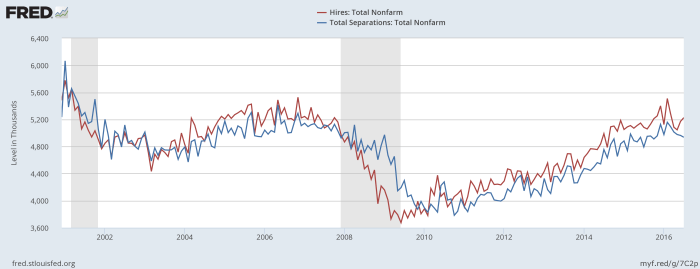
hires_separations

The red line shows hires—people getting jobs. The blue line shows separations—people losing jobs or leaving jobs. During a recession (the most recent two are shown on this graph), people don’t actually leave their jobs faster than usual; if anything, slightly less. Instead what happens is that hiring rates drop dramatically. When the economy is doing well (as it is right now, more or less), both hires and separations are at very high rates.

Why is this? Well, think about what a job is, really: It’s something that needs done, that no one wants to do for free, so someone pays someone else to do it. Once that thing gets done, what should happen? The job should end. It’s done. The purpose of the job was not to provide for your standard of living; it was to achieve the task at hand. Once it doesn’t need done, why keep doing it?

We tend to lose sight of this, for a couple of reasons. First, we don’t have a basic income, and our social welfare system is very minimal; so a job usually is the only way people have to provide for their standard of living, and they come to think of this as the purpose of the job. Second, many jobs don’t really “get done” in any clear sense; individual tasks are completed, but new ones always arise. After every email sent is another received; after every patient treated is another who falls ill.

But even that is really only true in the short run. In the long run, almost all jobs do actually get done, in the sense that no one has to do them anymore. The job of cleaning up after horses is done (with rare exceptions). The job of manufacturing vacuum tubes for computers is done. Indeed, the job of being a computer—that used to be a profession, young women toiling away with slide rules—is very much done. There are no court jesters anymore, no town criers, and very few artisans (and even then, they’re really more like hobbyists). There are more writers now than ever, and occasional stenographers, but there are no scribes—no one powerful but illiterate pays others just to write things down, because no one powerful is illiterate (and even few who are not powerful, and fewer all the time).

When a job “gets done” in this long-run sense, we usually say that it is obsolete, and again think of this as somehow a bad thing, like we are somehow losing the ability to do something. No, we are gaining the ability to do something better. Jobs don’t become obsolete because we can’t do them anymore; they become obsolete because we don’t need to do them anymore. Instead of computers being a profession that toils with slide rules, they are thinking machines that fit in our pockets; and there are plenty of jobs now for software engineers, web developers, network administrators, hardware designers, and so on as a result.

Soon, there will be no coal miners, and very few oil drillers—or at least I hope so, for the sake of our planet’s climate. There will be far fewer auto workers (robots have already done most of that already), but far more construction workers who install rail lines. There will be more nuclear engineers, more photovoltaic researchers, even more miners and roofers, because we need to mine uranium and install solar panels on rooftops.

Yet even by saying that I am falling into the trap: I am making it sound like the benefit of new technology is that it opens up more new jobs. Typically it does do that, but that isn’t what it’s for. The purpose of technology is to get things done.

Remember my parable of the dishwasher. The goal of our economy is not to make people work; it is to provide people with goods and services. If we could invent a machine today that would do the job of everyone in the world and thereby put us all out of work, most people think that would be terrible—but in fact it would be wonderful.

Or at least it could be, if we did it right. See, the problem right now is that while poor people think that the purpose of a job is to provide for their needs, rich people think that the purpose of poor people is to do jobs. If there are no jobs to be done, why bother with them? At that point, they’re just in the way! (Think I’m exaggerating? Why else would anyone put a work requirement on TANF and SNAP? To do that, you must literally think that poor people do not deserve to eat or have homes if they aren’t, right now, working for an employer. You can couch that in cold economic jargon as “maximizing work incentives”, but that’s what you’re doing—you’re threatening people with starvation if they can’t or won’t find jobs.)

What would happen if we tried to stop people from losing their jobs? Typically, inefficiency. When you aren’t allowed to lay people off when they are no longer doing useful work, we end up in a situation where a large segment of the population is being paid but isn’t doing useful work—and unlike the situation with a basic income, those people would lose their income, at least temporarily, if they quit and tried to do something more useful. There is still considerable uncertainty within the empirical literature on just how much “employment protection” (laws that make it hard to lay people off) actually creates inefficiency and reduces productivity and employment, so it could be that this effect is small—but even so, likewise it does not seem to have the desired effect of reducing unemployment either. It may be like minimum wage, where the effect just isn’t all that large. But it’s probably not saving people from being unemployed; it may simply be shifting the distribution of unemployment so that people with protected jobs are almost never unemployed and people without it are unemployed much more frequently. (This doesn’t have to be based in law, either; while it is made by custom rather than law, it’s quite clear that tenure for university professors makes tenured professors vastly more secure, but at the cost of making employment tenuous and underpaid for adjuncts.)

There are other policies we could make that are better than employment protection, active labor market policies like those in Denmark that would make it easier to find a good job. Yet even then, we’re assuming that everyone needs jobs–and increasingly, that just isn’t true.

So, when we invent a new technology that replaces workers, workers are laid off from their jobs—and that is as it should be. What happens next is what we do wrong, and it’s not even anybody in particular; this is something our whole society does wrong: All those displaced workers get nothing. The extra profit from the more efficient production goes entirely to the shareholders of the corporation—and those shareholders are almost entirely members of the top 0.01%. So the poor get poorer and the rich get richer.

The real problem here is not that people lose their jobs; it’s that capital ownership is distributed so unequally. And boy, is it ever! Here are some graphs I made of the distribution of net wealth in the US, using from the US Census.

Here are the quintiles of the population as a whole:
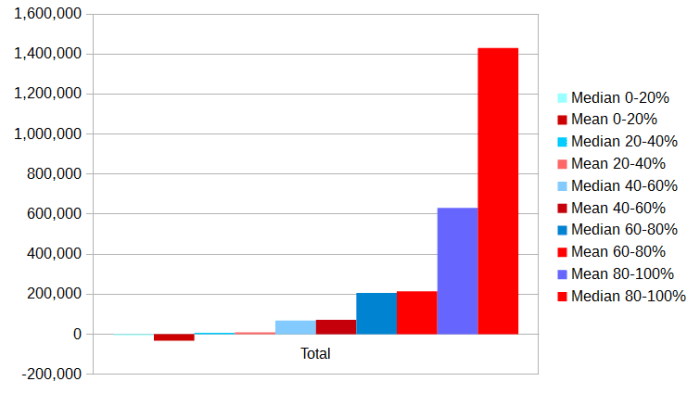
net_wealth_us

And here are the medians by race:

net_wealth_race

Medians by age:

net_wealth_age

Medians by education:

net_wealth_education

And, perhaps most instructively, here are the quintiles of people who own their homes versus renting (The rent is too damn high!)

net_wealth_rent

All that is just within the US, and already they are ranging from the mean net wealth of the lowest quintile of people under 35 (-$45,000, yes negative—student loans) to the mean net wealth of the highest quintile of people with graduate degrees ($3.8 million). All but the top quintile of renters are poorer than all but the bottom quintile of homeowners. And the median Black or Hispanic person has less than one-tenth the wealth of the median White or Asian person.

If we look worldwide, wealth inequality is even starker. Based on UN University figures, 40% of world wealth is owned by the top 1%; 70% by the top 5%; and 80% by the top 10%. There is less total wealth in the bottom 80% than in the 80-90% decile alone. According to Oxfam, the richest 85 individuals own as much net wealth as the poorest 3.7 billion. They are the 0.000,001%.

If we had an equal distribution of capital ownership, people would be happy when their jobs became obsolete, because it would free them up to do other things (either new jobs, or simply leisure time), while not decreasing their income—because they would be the shareholders receiving those extra profits from higher efficiency. People would be excited to hear about new technologies that might displace their work, especially if those technologies would displace the tedious and difficult parts and leave the creative and fun parts. Losing your job could be the best thing that ever happened to you.

The business cycle would still be a problem; we have good reason not to let recessions happen. But stopping the churn of hiring and firing wouldn’t actually make our society better off; it would keep people in jobs where they don’t belong and prevent us from using our time and labor for its best use.

Perhaps the reason most people don’t even think of this solution is precisely because of the extreme inequality of capital distribution—and the fact that it has more or less always been this way since the dawn of civilization. It doesn’t seem to even occur to most people that capital income is a thing that exists, because they are so far removed from actually having any amount of capital sufficient to generate meaningful income. Perhaps when a robot takes their job, on some level they imagine that the robot is getting paid, when of course it’s the shareholders of the corporations that made the robot and the corporations that are using the robot in place of workers. Or perhaps they imagine that those shareholders actually did so much hard work they deserve to get paid that money for all the hours they spent.

Because pay is for work, isn’t it? The reason you get money is because you’ve earned it by your hard work?

No. This is a lie, told to you by the rich and powerful in order to control you. They know full well that income doesn’t just come from wages—most of their income doesn’t come from wages! Yet this is even built into our language; we say “net worth” and “earnings” rather than “net wealth” and “income”. (Parade magazine has a regular segment called “What People Earn”; it should be called “What People Receive”.) Money is not your just reward for your hard work—at least, not always.

The reason you get money is that this is a useful means of allocating resources in our society. (Remember, money was created by governments for the purpose of facilitating economic transactions. It is not something that occurs in nature.) Wages are one way to do that, but they are far from the only way; they are not even the only way currently in use. As technology advances, we should expect a larger proportion of our income to go to capital—but what we’ve been doing wrong is setting it up so that only a handful of people actually own any capital.

Fix that, and maybe people will finally be able to see that losing your job isn’t such a bad thing; it could even be satisfying, the fulfillment of finally getting something done.