Why is redistribution of wealth so difficult to achieve in the US?

Jan 28 JDN 2458147

Income and wealth in equality is much higher in the US than in other First World countries. Within the OECD, only Mexico, Turkey, and Chile have higher income inequality than we do. Over 60% of Americans agree that the distribution of wealth in the US is unfair. Furthermore, the majority of Americans support the use of taxes and transfers to directly redistribute wealth from the rich to the poor.

Why, then, is it so hard to actually get any meaningful wealth redistribution in the United States?

Part of it is surely partisan differences: While about 70% of Democrats favor redistributive taxes, about 70% of Republicans oppose them. So one would not expect a move toward redistribution when Republicans control all three branches of government, and indeed we have seen quite the opposite. (Then again, one would also not expect a government shutdown under one-party rule, and yet that is what we have.)

But even most Republicans say they would like to see a much more equal distribution of wealth than the one we actually have. In fact, when I as an inequality economist look at the distribution of wealth people say they want, it looks a little too equal! Even Denmark and Sweden aren’t that egalitarian! I know more or less how to get from here to Denmark; but from here to “Equalden” looks like an awful long way. So if this is really the distribution of wealth people want, we need to be doing a huge amount of wealth redistribution—but we’re hardly doing any at all.

Indeed, we didn’t actually see all that much redistribution of wealth when Democrats more or less controlled all three branches in the period from 2008-2010. We may have seen a little bit shortly thereafter, and tax policy typically does come with a delay of a year or two. But as you can see in this graph, the Great Recession did more to reduce the top 1% income share than any tax policy changes:
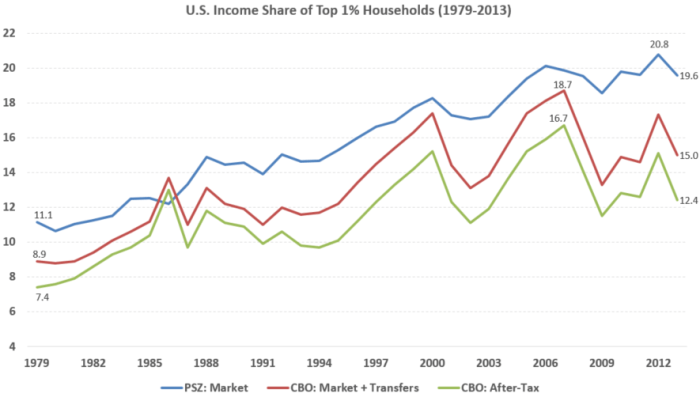
US_top_income_share_1pct

The biggest changes made to our tax code under Obama were actually the handling of capital gains; the increase of the top rate on capital gains from 15% to 20%, plus the 3.8% capital surtax from the Affordable Care Act raised the tax bill for the top 0.1% by tens of billions of dollars. Surprisingly, Trump’s tax cuts don’t actually remove these provisions, though they did dramatically cut the corporate tax rate, which will probably have a similar effect on the income distribution.

To be honest, I’m not as disappointed with Trump’s tax cuts as I thought I would be. Some genuinely good ideas (like the reduction of the mortgage interest deduction, tighter restrictions on carried interest, and increase of the personal standard deduction) and some reasonable but debatable ideas (like cuts to the corporate tax rate, switching to a territorial corporate tax system, limits to deductions on corporate debt payments, removal of the deduction of state taxes, and extensions of 529 savings plans to private primary and secondary schools) were mixed in with the absolutely ludicrous and terrible ideas (like eliminating the Obamacare mandate, doubling the estate tax threshold, cutting the alcohol tax, and allowing offshore drilling in Alaska [One of these things is not like the other ones….]). Some of the terrible ideas, like ending the deduction of student loan interest and tuition waivers, were actually removed in the final version of the bill. Of course, you won’t be surprised when I tell you that the overall US tax system became a lot less progressive as a result of this bill. And even if cutting the corporate tax while raising the capital gains tax is probably a good idea (as I and many economists believe), cutting the corporate tax without raising the capital gains tax probably isn’t.

(An aside: For how much they claim to be “tough on crime”, it’s always kind of baffling to see how often Republicans like to cut alcohol taxes and pollution regulations, which are pretty much the only things that have ever been empirically shown to actually reduce crime. There is some evidence that maybe more policing also helps, but if so, it does so in a far less cost-effective way—indeed, the direct cost of alcohol taxes and pollution taxes is negative. Even if they didn’t work at all, they’d still be worth it just because they raise revenue. I begin to suspect that Republicans don’t actually want to reduce crime, because they know they can use the fear of crime to win votes; they simply want to appear tough on crime, and so they press as hard as they can for more policing and incarceration in the country that already has the highest incarceration rate in the world. This may be a more general phenomenon: While Democrats want to actually solve problems, Republicans want to appear to solve problems while actually exacerbating them, thus insuring their own job security. Compare how Bush kept talking about Osama bin laden while invading Iraq, and Obama actually killed Osama bin Laden. Is this too cynical? Can anything be too cynical in the era of Trump? There were 50,000 Russian bots on Twitter trying to tilt our election! Mueller’s FBI investigation is already implicating several of Trump’s top officials! Everything that seemed like paranoia or cynicism just a few years ago is turning out to be entirely true.)

This is what seems to happen: Year after year, we raise some taxes, then we cut some taxes. Then when raise some taxes, then we cut some taxes. The tax system gets a little more progressive for a few years and inequality begins to fall, and then those changes are removed and inequality begins to rise again. Back and forth and round and round we go.

Is there some way to lock in these tax changes for a longer period of time? The only way I can see would be a change in voter behavior: Keep voting in Democrats to all branches of government consistently for 20 years, and then maybe we would see a serious reduction in income and wealth inequality. Or at least stop voting in Republicans; aside from the Democrats, there are some third parties that would also support redistribution, like the Green Party. And yes, it really is about voting behavior: As prevalent as gerrymandering has become, as terrible as the Electoral College is, as widespread as voter suppression has gotten, Trump only won because 63 million Americans voted for him. Even after everything he’s done, Trumps’ approval rating is still about 39%. As long as there are enough people in this country whose partisan loyalty so strongly outweighs any rational assessment of policy, we are going to continue to see such travesties continue.

It would certainly help if our voting system were fairer, so that third parties had a better chance at taking seats. But it’s also difficult to see how that could happen any time soon. For now, the best I can come up with is trying to show people two things:

First, most Americans favor redistribution of wealth. You’re not alone in wanting that. It’s not some fringe opinion.

Second, there is a real difference between Democrats and Republicans on this issue. The canard “The two parties are the same” is the most untrue it has been in at least twenty years.

I would even understand if there are other issues you consider more important than wealth redistribution. Ecological sustainability is the most defensible—you can’t eat GNP—though that would push you even harder toward the left. Among things that might push you right, I can understand being concerned about higher taxes hurting economic growth, and while I think the view that abortion is murder is ludicrous, given that as your belief I can understand why you would want to prioritize fighting abortion. (If I thought we were murdering millions of babies every year, I’d be pretty mad too! Of course, you should be glad, then, that the US abortion rate has been falling. Right? You know about that, right?)

What I don’t get, however, is people who thought that voting for Donald Trump would help working people. I don’t understand how you can see someone who epitomizes everything that is wrong with the billionaire rentier class and think, “Yeah, he seems like he’s definitely a populist. That guy who was born insanely rich and made even more mind-boggling amounts of money by lying and screwing people over is definitely going to look out for folks like me.”

If I understood that, maybe I would know where to go from here. But people’s political beliefs can be astonishingly intransigent to evidence. Politics is the mind-killer.
Did the World Bank modify its ratings to manipulate the outcome of an election in Chile?

Jan 21 JDN 2458140

(By the way, my birthday is January 19. I can’t believe I’m turning 30.)

This is a fairly obscure news item, so you may have missed it. It should be bigger news than it is.
I can’t fault the New York Times for having its front page focus mainly on the false missile alert that was issued to some people in Hawaii; a false alarm of nuclear attack definitely is the most important thing that could be going on in the world, short of course of actual nuclear war.

CNN, on the other hand, is focused entirely on Trump. When I first wrote this post, they were also focused on Trump, mainly interested in asking whether Trump’s comments about “immigrants from shithole countries” was racist. My answer: Yes, but not because he said the countries were “shitholes”. That was crude, yes, but not altogether inaccurate. Countries like Syria, Afghanistan, and Sudan are, by any objective measure, terrible places. His comments were racist because they attributed that awfulness to the people leaving these countries. But in fact we have a word for immigrants who flee terrible places seeking help and shelter elsewhere: Refugees. We call those people refugees. There are over 10 million refugees in the world today, most of them from Syria.

So anyway, here’s the news item you should have heard about but probably didn’t: The Chief Economist of the World Bank (Paul Romer, who coincidentally I mentioned in my post about DSGE models) has opened an investigation into the possibility that the World Bank’s ratings of economic freedom were intentionally manipulated in order to tilt a Presidential election in Chile.

The worst part is, it may have worked: Chile’s “Doing Business” rating consistently fell under President Michelle Bachelet and rose under President Sebastian Piñera, and Piñera won the most recent election. Was that the reason he won? Who knows? I’m still not entirely clear on how we ended up with President Trump. But it very likely contributed.

The World Bank is supposed to be an impartial institution representing the interests of global economic development. I’m not naive; I recognize that no human institution is perfect, and there will always be competing political and economic interests within any complex institution. Development economists are subject to cognitive biases just like anyone else. If this was the work of a handful of economic analysts (or if Romer turns out to be wrong and the changes in statistical methodology were totally reasonable), so be it; let’s make sure that the bias is corrected and the analysts involved are punished.

But I fear that the rot may run deeper than this. The World Bank is effectively a form of unelected international government. It has been accused of inherent pro-capitalist (or even racist) bias due to the fact that Western governments are overrepresented in its governance, but I actually consider that accusation unfair: There are very good reasons to make sure that your international institutions are managed by liberal democracies, and turns out that most of the world’s liberal democracies are Western. The fact that the US, France, Germany, and the UK make most of the decisions is entirely sensible: Those are in fact the countries we should want making global decisions.

China is not underrepresented, because China is not a democracy and doesn’t deserve to be represented. They are already more represented in the World Bank than they should be, because representing the PRC is not actually representing the interests of the people of China. Russia and Saudi Arabia are undeniably overrepresented. India is underrepresented; they should be complaining. Some African democracies, such as Namibia and Botswana, would also have a legitimate claim to underrepresentation. But I don’t lose any sleep over the fact that Zimbabwe and Iran aren’t getting votes in the World Bank. If and when those countries actually start representing their people, then we can talk about giving them representation in world government. I don’t see how refusing to give international authority to dictators and theocrats constitutes racism or pro-capitalist bias.

That said, there are other reasons to think that the World Bank might actually have some sort of pro-capitalist bias. The World Bank was instrumental in forming the Washington Consensus, which opened free trade and increase economic growth worldwide, but also exposed many poor countries to risk from deregulated financial markets and undermined social safety nets through fiscal austerity programs. They weren’t wrong to want more free trade, and many of their reforms did make sense; but they were at best wildly overconfident in their policy prescriptions, and at worst willing to sacrifice people in poor countries at the altar of bank profits. World poverty has in fact fallen by about half since 1990, and the World Bank has a lot to do with that. But things may have gone faster and smoother if they hadn’t insisted on removing so many financial regulations so quickly without clear forecasts of what would happen. I don’t share Jason Hickel’s pessimistic view that the World Bank’s failures were intentional acts toward an ulterior agenda, but I can see how it begins to look that way when they keep failing the same ways over and over again. (I instead invoke Hanlon’s razor: “Never attribute to malice that which is adequately explained by stupidity.”)

There are also reports of people facing retaliation for criticizing World Bank projects, including those within the World Bank who raise ethical concerns. If this was politically-motivated data manipulation, there may have been people who saw it happening, but were afraid to say anything for fear of being fired or worse.

And Chile in particular has reason to be suspicious. The World Bank suddenly started giving loans to Chile when Augusto Pinochet took power (the CIA denies supporting the coup, by the way—though, given the source, I can understand why one would take that with a grain of salt), and did so under the explicit reasoning that an authoritarian capitalist regime was somehow “more trustworthy” than a democratic socialist regime. Even in the narrow sense of financial creditworthiness that seems difficult to defend; the World Bank knew almost nothing about what kind of government Pinochet was going to create, and in fact despite the so-called “Miracle of Chile”, rapid economic growth in Chile didn’t really happen until the 1990s, after Chile became a democratic capitalist regime.

What I’m really getting at here is that the World Bank has a lot to answer for. I am prepared to believe that most of these actions were honest mistakes or ideological blinders, rather than corruption or cruelty; but even so, when millions of lives are at stake, even honest mistakes aren’t so forgivable. They should be looking for ways to improve their internal governance to make sure that mistakes are caught and corrected quickly. They should be constantly vigilant for biases—either intentional or otherwise—that might seep into their research. Error should be met with immediate correction and public apology; malfeasance should be met with severe punishment.

Perhaps Romer’s investigation actually signals a shift toward such a policy. If so, this is a very good thing. If only we had done this, say, thirty years ago.

What about a tax on political contributions?

Jan 7, JDN 2458126

In my previous post, I argued that an advertising tax could reduce advertising, raise revenue, and produce almost no real economic distortion. Now I’m going to generalize this idea to an even bolder proposal: What if we tax political contributions?

Donations to political campaigns are very similar to advertising. A contest function framework also makes a lot of sense: Increased spending improves your odds of winning, but it doesn’t actually produce any real goods.

Suppose there’s some benefit B that I get if a given politician wins an election. That benefit could include direct benefits to me, as well as altruistic benefits to other citizens I care about, or even my concern for the world as a whole. But presumably, I do benefit in some fashion from my favored politician winning—otherwise, why are they my favored politician?

In this very simple model, let’s assume that there are only two parties and two donors (obviously in the real world there are more parties and vastly more donors; but it doesn’t fundamentally change the argument). Say I will donate x and the other side will donate y.

Assuming that donations are all that matter, the probability my party will win the election is x/(x+y).

Fortunately that isn’t the case. A lot of things matter, some that should (policy platforms, experience, qualifications, character) and some that shouldn’t (race, gender, age, heightpart of why Trump won may in fact be that he is tall; he’s about 6’1”.). So let’s put all the other factors that affect elections into a package and call that F.

The probability that my candidate wins is then x/(x+y) + F, where F can be positive or negative. If F is positive, it means that my candidate is more likely to win, while if it’s negative, it means my candidate is less likely to win. (If you want to be pedantic, the probability of winning has to be capped at 0 and 1, but this doesn’t fundamentally change the argument, and only matters for candidates that are obvious winners or obvious losers regardless of how much anyone donates.)

The donation costs me money, x. The cost in utility of that money depends on my utility function, so for now I’ll just call it a cost function C(x).
Then my net benefit is:
B*[x/(x+y)+F] – C(x)

I can maximize this by a first-order condition. Notice how the F just drops out. I like F to be large, but it doesn’t affect my choice of x.

B*y/(x+y)^2 = C'(x)

Turning that into an exact value requires knowing my cost function and my opponent’s cost function (which need not be the same, in general; unlike the advertising case, it’s not a matter of splitting fungible profits between us), but it’s actually possible to stop here. We can already tell that there is a well-defined solution: There’s a certain amount of donation x that maximizes my expected utility, given the amount y that the other side has donated. Moreover, with a little bit of calculus you can show that the optimal amount of x is strictly increasing in y, which makes intuitive sense: The more they give, the more you need to give in order to keep up. Since x is increasing in y and y is increasing in x, there is a Nash equilibrium: At some amount x and y we each are giving the optimal amount from our perspective.

We can get a precise answer if we assume that the amount of the donations is small compared to my overall wealth, so I will be approximately risk-neutral; then we can just say C(x) = x, and C'(x) = 1:

B*y/(x+y)^2 = 1
Then we get essentially the same result we did for the advertising:

x = y = B/4

According to this, I should be willing to donate up to one-fourth the benefit I’d get from my candidate winning in donations. This actually sounds quite high; I think once you take into account the fact that lots of other people are donating and political contributions aren’t that effective at winning elections, the optimal donation is actually quite a bit smaller—though perhaps still larger than most people give.

If we impose a tax rate r on political contributions, nothing changes. The cost to me of donating is still the same, and as long as the tax is proportional, the ratio x/(x+y) and the probability x/(x+y) + F will remain exactly the same as before. Therefore, I will continue to donate the same amount, as will my opponent, and each candidate will have the same probability of winning as before. The only difference is that some of the money (r of the money, to be precise) will go to the government instead of the politicians.

The total amount of donations will not change. The probability of each candidate winning will not change. All that will happen is money will be transferred from politicians to the government. If this tax revenue is earmarked for some socially beneficial function, this will obviously be an improvement in welfare.

The revenue gained is not nearly as large an amount of money as is spent on advertising (which tells you something about American society), but it’s still quite a bit: Since we currently spend about $5 billion per year on federal elections, a tax rate of 50% could raise about $2.5 billion.

But in fact this seriously under-estimates the benefits of such a tax. This simple model assumes that political contributions only change which candidate wins; but that’s actually not the main concern. (If F is large enough, it can offset any possible donations.)
The real concern is how political contributions affect the choices politicians make once they get into office. While outright quid-pro-quo bribery is illegal, it’s well-known that many corporations and wealthy individuals will give campaign donations with the reasonable expectation of influencing what sort of policies will be made.

You don’t think Goldman Sachs gives millions of dollars each election out of the goodness of their hearts, do you? And they give to both major parties, which really only makes sense if their goal is not to make a particular candidate win, but to make sure that whoever wins feels indebted to Goldman Sachs. (I guess it could also be to prevent third parties from winning—but they hardly ever win anyway, so that wouldn’t be a smart investment from the bank’s perspective.)

Lynda Powell at the University of Rochester has documented the many subtle but significant ways that these donations have influenced policy. Campaign donations aren’t as important as party platforms, but a lot of subtle changes across a wide variety of policies add up to large differences in outcomes.

A political contribution tax would reduce these influences. If politicians’ sole goal were to win, the tax would have no effect. But it seems quite likely that politicians enjoy various personal benefits from lobbying and campaign contributions: Fine dinners, luxurious vacations, and so on. And insofar as that is influencing politicians’ behavior, it is both obviously corrupt and clearly reduced by a political contribution tax. How large an effect this would be is difficult to say; but the direction of the effect is clearly the one we want.

Taxing donations would also allow us to protect the right to give to campaigns (which does seem to be a limited kind of civil liberty, even though the precise interpretation “money is speech” is Orwellian), while reducing corruption and allowing us to keep close track on donations that are made. Taxing a money stream, even a small amount, is often one of the best ways to incentivize close monitoring of that money stream.

With a subtle change, the tax could even be made to bias in favor of populism: All you need to do is exempt small donations from the tax. If say the first $1000 per person per year is exempt from taxation, then the imposition of the tax will reduce the effectiveness of million-dollar contributions from Goldman Sachs and the Koch brothers without having any effect on $50 donations from people like you and me. That would technically be “distorting” elections—but it seems like it might be a distortion worth making.

Of course, this is probably even less likely to happen than the advertising tax.

The potential of an advertising tax

Jan 7, JDN 2458126

Advertising is everywhere in our society. You may see some on this very page (though if I hit my next Patreon target I’m going to pay to get rid of those). Ad-blockers can help when you’re on the Web, and premium channels like HBO will save you from ads when watching TV, but what are you supposed to do about ads on billboards as you drive down the highway, ads on buses as you walk down the street, ads on the walls of the subway train?

And Banksy isn’t entirely wrong; this stuff can be quite damaging. Based on decades of research, the American Psychological Association has issued official statements condemning the use of advertising to children for its harmful psychological effects. Medical research has shown that advertisements for food can cause overeating—and thus, the correlated rise of advertising and obesity may be no coincidence.

Worst of all, political advertising distorts our view of the world. Though we may not be able to blame advertising per se for Trump; most of his publicity was gained for free by irresponsible media coverage.

And yet, advertising is almost pure rent-seeking. It costs resources, but it doesn’t produce anything. In most cases it doesn’t even raise awareness about something or find new customers. The primary goal of most advertising is to get you to choose that brand instead of a different brand. A secondary goal (especially for food ads) is to increase your overall consumption of that good, but since the means employed typically involve psychological manipulation, this increase in consumption is probably harmful to social welfare.

A general principle of economics that has almost universal consensus is the Pigou Principle: If you want less of something, you should put a tax on it. So, what would happen if we put a tax on advertising?

The amazing thing is that in this case, we would probably not actually reduce advertising spending, but we would reduce advertising, which is what we actually care about. Moreover, we would be able to raise an enormous amount of revenue with zero social cost. Like the other big Pigovian tax (the carbon tax), this a rare example of a tax that will give you a huge amount of revenue while actually yielding a benefit to society.

This is far from obvious, so I think it is worth explaining where it comes from.

The key point is that advertising doesn’t typically increase the overall size of the market (though in some cases it does; I’ll get back to that in a moment). Rather that a conventional production function like we would have for most types of expenditure, advertising is better modeled by what is called a contest function (something that our own Stergios Skaperdas at UCI is actually a world-class expert in). In a production function, inputs increase the total amount of output. But in a contest function, inputs only redistribute output from one place to another. Contest functions thus provide a good model of rent-seeking, which is what most advertising is.

Suppose there’s a total market M for some good, where M is the total profits that can be gained from capturing that entire market.
Then, to keep it simple, let’s suppose there are only two major firms in the market, a duopoly like Coke and Pepsi or Boeing and Airbus.

Let’s say Coke decides to spend an amount x on advertising, and Pepsi decides to spend an amount y.

For now, let’s assume that total beverage consumption won’t change; so the total profits to be had from the market are always M.

What advertising does is it changes the share of that market which each firm will get. Specifically, let’s use the simplest model, where the share of the market is equal to the share of advertising spending.

Then the net profit for Coke is the following:

The share they get, x/(x+y), times the size of the whole market, M, minus the advertising spending x.

max M*x/(x+y) – x

We can maximize this with the usual first-order condition:

y/(x+y)^2 M – 1 = 0

(x+y)^2 = My

Since the game is symmetric, in a Nash equilibrium, Pepsi will use the same reasoning:

(x+y)^2 = Mx

Thus we have:

x = y

(2x)^2 = Mx

x = M/4

In this very simple model, each firm will spend one-fourth of the market’s value, and the total advertising spending will be equal to half the size of the market. Then, each company’s net income will be equal to its advertising spending. This is a pretty good estimate for Coca-Cola in real life, which spends about $3.3 billion on advertising and receives about $2.8 billion in net income each year.

What would happen if we introduce a tax? Let’s say we introduce a proportional tax r on all advertising spending. That is, for every dollar you spend on advertising, you must pay the government $r in tax. The really remarkable thing is that companies who advertise shouldn’t care what we make the tax; the only ones who will care are the advertising companies themselves.

If Coke pays x, the actual amount of advertising they receive is x – r x = x(1-r).

Likewise, Pepsi’s actual advertising received is y(1-r).

But notice that the share of total advertising spending is completely unchanged!

(x(1-r))/(x(1-r) + y(1-r)) = x/(x+y)

Since the payoff for Coke only depends on how much Coke spends and what market share they get, it is also unchanged. Since the same is true for Pepsi, nothing will change in how the two companies behave. They will spend the same amount on advertising, and they will receive the same amount of net income when all is said and done.

The total quantity of advertising will be reduced, from x+y to (x+y)(1-r). That means fewer billboards, fewer posters in subway stations, fewer TV commercials. That will hurt advertising companies, but benefit everyone else.

How much revenue will we get for the government? r x + r y = r(x+y).

Since the goal is to substantially reduce advertising output, and it won’t distort other industries in any way, we should set this tax quite high. A reasonable value for r would be 50%. We might even want to consider something as high as 90%; but for now let’s look at what 50% would do.

Total advertising spending in the US is over $200 billion per year. Since an advertising tax would not change total advertising spending, we can expect that a tax rate of 50% would simply capture 50% of this spending as revenue, which is to say $100 billion per year. That would be enough to pay for the entire Federal education budget, or the foreign aid and environment budgets combined.
Another great aspect of how an advertising tax is actually better than a carbon tax is that countries will want to compete to have the highest advertising taxes. If say Canada imposes a carbon tax but the US doesn’t, industries will move production to the US where it is cheaper, which hurts Canada. Yet the total amount of pollution will remain about the same, and Canada will be just as affected by climate change as they would have been anyway. So we need to coordinate across countries so that the carbon taxes are all the same (or at least close), to prevent industries from moving around; and each country has an incentive to cheat by imposing a lower carbon tax.

But advertising taxes aren’t like that. If Canada imposes an advertising tax and the US doesn’t, companies won’t shift production to the US; they will shift advertising to the US. And having your country suddenly flooded with advertisements is bad. That provides a strong incentive for you to impose your own equal or even higher advertising tax to stem the tide. And pretty soon, everyone will have imposed an advertising tax at the same rate.

Of course, in all the above I’ve assumed a pure contest function, meaning that advertisements are completely unproductive. What if they are at least a little bit productive? Then we wouldn’t want to set the tax too high, but the basic conclusions would be unchanged.

Suppose, for instance, that the advertising spending adds half its value to the value of the market. This is a pretty high estimate of the benefits of advertising.

Under this assumption, in place of M we have M+(x+y)/2. Everything else is unchanged.

We can maximize as before:

max (M+(x+y)/2)*x/(x+y) – x

The math is a bit trickier, but we can still solve by a first-order condition, which simplifies to:

(x+y)^2 = 2My

By the same symmetry reasoning as before:

(2x)^2 = 2Mx

x = M/2

Now, total advertising spending would equal the size of the market without advertising, and net income for each firm after advertising would be:

2M(1/2) – M/2 = M/2

That is, advertising spending would equal net income, as before. (A surprisingly robust result!)

What if we imposed a tax? Now the algebra gets even nastier:

max (M+(x+y)(1-r)/2)*x/(x+y) – x

But the ultimate outcome is still quite similar:

(1+r)(x+y)^2 = 2My

(1+r)(2x)^2 = 2Mx

x = M/2*1/(1+r)

Advertising spending will be reduced by a factor of 1/(1+r). Even if r is 50%, that still means we’ll have 2/3 of the advertising spending we had before.

Total tax revenue will then be M*r/(1+r), which for r of 50% would be M/3.

Total advertising will be M(1-r)/(1+r), which would be M/3. So we managed to reduce advertising by 2/3, while reducing advertising spending by only 1/3. Then we would receive half of that spending as revenue. Thus, instead of getting $100 billion per year, we would get $67 billion, which is still just about enough to pay for food stamps.

What’s the downside of this tax? Unlike most taxes, there really isn’t one. Yes, it would hurt advertising companies, which I suppose counts as a downside. But that was mostly waste anyway; anyone employed in advertising would be better employed almost anywhere else. Millions of minds are being wasted coming up with better ways to sell Viagra instead of better treatments for cancer. Any unemployment introduced by an advertising tax would be temporary and easily rectified by monetary policy, and most of it would hit highly educated white-collar professionals who have high incomes to begin with and can more easily find jobs when displaced.

The real question is why we aren’t doing this already. And that, I suppose, has to come down to politics.

Influenza vaccination, herd immunity, and the Tragedy of the Commons

Dec 24, JDN 2458112

Usually around this time of year I do a sort of “Christmas special” blog post, something about holidays or gifts. But this year I have a rather different seasonal idea in mind. It’s not just the holiday season; it’s also flu season.

Each year, influenza kills over 56,000 people in the US, and between 300,000 and 600,000 people worldwide, mostly in the winter months. And yet, in any given year, only about 40% of adults and 60% of children get the flu vaccine.

The reason for this should be obvious to any student of economics: It’s a Tragedy of the Commons. If enough people got vaccinated that we attained reliable herd immunity (which would take about 90%), then almost nobody would get influenza, and the death rate would plummet. But for any given individual, the vaccine is actually not all that effective. Your risk of getting the flu only drops by about half if you receive the vaccine. The effectiveness is particularly low among the elderly, who are also at the highest risk for serious complications due to influenza.

Thus, for any given individual, the incentive to get vaccinated isn’t all that strong, even though society as a whole would be much better off if we all got vaccinated. Your probability of suffering serious complications from influenza is quite low, and wouldn’t be reduced all that much if you got the vaccine; so even though flu vaccines aren’t that costly in terms of time, money, discomfort, and inconvenience, the cost is just high enough that a lot of us don’t bother to get the shot each year.

On an individual level, my advice is simple: Go get a flu shot. Don’t do it just for yourself; do it for everyone around you. You are protecting the most vulnerable people in our society.

But if we really want everyone to get vaccinated, we need a policy response. I can think of two policies that might work, which can be broadly called a “stick” and a “carrot”.

The “stick” approach would be to make vaccination mandatory, as it already is for many childhood vaccines. Some sort of penalty would have to be introduced, but that’s not the real challenge. The real challenge would be how to actually enforce that penalty: How do we tell who is vaccinated and who isn’t?

When schools make vaccination mandatory, they require vaccination records for admission. It would be simple enough to add annual flu vaccines to the list of required shots for high schools and colleges (though no doubt the anti-vax crowd would make a ruckus). But can you make vaccination mandatory for work? That seems like a much larger violation of civil liberties. Alternatively, we could require that people submit medical records with their tax returns to avoid a tax penalty—but the privacy violations there are quite substantial as well.

Hence, I would favor the “carrot” approach: Use government subsidies to provide a positive incentive for vaccination. Don’t simply make vaccination free; actually pay people to get vaccinated. Make the subsidy larger than the actual cost of the shots, and require that the doctors and pharmacies administering them remit the extra to the customers. Something like $20 per shot ought to do it; since the cost of the shots is also around $20, then vaccinating the full 300 million people of the United States every year would cost about $12 billion; this is less than the estimated economic cost of influenza, so it would essentially pay for itself.

$20 isn’t a lot of money for most people; but then, like I said, the time and inconvenience of a flu shot aren’t that large either. There have been moderately successful (but expensive) programs incentivizing doctors to perform vaccinations, but that’s stupid; frankly I’m amazed it worked at all. It’s patients who need incentivized. Doctors will give you a flu shot if you ask them. The problem is that most people don’t ask.

Do this, and we could potentially save tens of thousands of lives every year, for essentially zero net cost. And that sounds to me like a Christmas wish worth making.

The Irvine Company needs some serious antitrust enforcement

Dec 17, JDN 2458105

I probably wouldn’t even have known about this issue if I hadn’t ended up living in Irvine.

The wealthiest real estate magnate in the United States is Donald Bren, sole owner of the Irvine Company. His net wealth is estimated at $15 billion, which puts him behind the likes of Jeff Bezos or Bill Gates, but well above Donald Trump even at his most optimistic estimates.

Where did he get all this wealth?

The Irvine Company isn’t even particularly shy about its history, though of course they put a positive spin on it. Right there on their own website they talk about how it used to be a series of ranches farmed by immigrants. Look a bit deeper into their complaints about “squatters” and it becomes apparent that the main reason they were able to get so rich is that the immigrant tenant farmers whose land they owned were disallowed by law from owning real estate. (Not to mention how it was originally taken from Native American tribes, as most of the land in the US was.) Then of course the land has increased in price and been passed down from generation to generation.

This isn’t capitalism. Capitalism requires a competitive market with low barriers of entry and trade in real physical capital—machines, vehicles, factories. The ownership of land by a single family that passes down its title through generations while extracting wealth from tenant farmers who aren’t allowed to own anything has another name. We call it feudalism.

The Irvine Company is privately-held, and thus not required to publish its finances the way a publicly-traded company would be, so I can’t tell you exactly what assets its owns or how much profit it makes. But I can tell you that it owns over 57,000 housing units—and there are only 96,000 housing units in the city of Irvine, so that means they literally own 60% of the city. They don’t just own houses either; they also own most of the commercial districts, parks, and streets.

As a proportion of all the housing in the United States, that isn’t so much. Even compared to Southern California (the most densely populated region in North America), it may not seem all that extravagant. But within the city of Irvine itself, this is getting dangerously close to a monopoly. Housing is expensive all over California, so they can’t be entirely blamed—but is it really that hard to believe that letting one company own 60% of your city is going to increase rents?

This is sort of thing that calls for a bold and unequivocal policy response. The Irvine Company should be forced to subdivide itself into multiple companies—perhaps Irvine Residential, Irvine Commercial, and Irvine Civic—and then those companies should be made publicly-traded, and a majority of their shares immediately distributed to the residents of the city. Unlike most land reform proposals, selecting who gets shares is actually quite straightforward: Anyone who pays rent on an Irvine Company property receives a share.

Land reform has a checkered history to say the least, which is probably why policymakers are reluctant to take this sort of approach. But this is a land reform that could be handled swiftly, by a very simple mechanism, with very clear rules. Moreover, it is entirely within the rule of law, as the Irvine Company is obviously at this point an illegitimate monopoly in violation of the Sherman Antitrust Act, Clayton Antitrust Act, and Federal Trade Commission Act. The Herfindahl-Hirschman Index for real estate in the city of Irvine would be at least 3600, well over the standard threshold of 2500 that FTC guidelines consider prima facie evidence of an antitrust violation in the market. Formally, the land reform could be accomplished by collecting damages in an amount necessary to purchase the shares at the (mandatory) IPO, then the beneficiaries of the damages paid in shares would be the residents of Irvine. The FTC is also empowered to bring criminal charges if necessary.

Oddly, most of the talk about the Irvine Company among residents of Irvine centers around their detailed policy decisions, whether expanding road X was a good idea, how you feel about the fact that they built complex Y. (There’s also a bizarre reverence for the Irvine Master Plan; people speak of it as if it were the US Constitution, when it’s actually more like Amazon.com’s five-year revenue targets. This is a for-profit company. Their plan is about taking your money.) This is rather like debating whether or not you have a good king; even if you do, you’re still a feudal subject. No single individual or corporation should have that kind of power over the population of an entire city. This is not a small city, either; Irvine has about three-quarters of the population of Iceland, or a third the population of Boston. Take half of Donald Bren’s $15 billion, divide it evenly over the 250,000 people of the city, and each one gets $30,000. That’s a conservative estimate of how much monopolistic rent the Irvine Company has extracted from the people of Irvine.

By itself, redistributing the assets of the Irvine Company wouldn’t solve the problem of high rents in Southern California. But I think it would help, and I’m honestly having trouble seeing the downsides. The only people who seem to be harmed are billionaires who inherited wealth that was originally extracted from serfs. Like I said, this is within the law, and wouldn’t require new legislation. We would only need to aggressively enforce laws that have been on the books for a century. It doesn’t even seem like it should be politically unpopular, as you’re basically giving a check for tens of thousands of dollars to each voting resident in the city.

Of course, it won’t happen. As usual, I’m imagining more justice in the world than there actually has ever been.

The “productivity paradox”


Dec 10, JDN 2458098

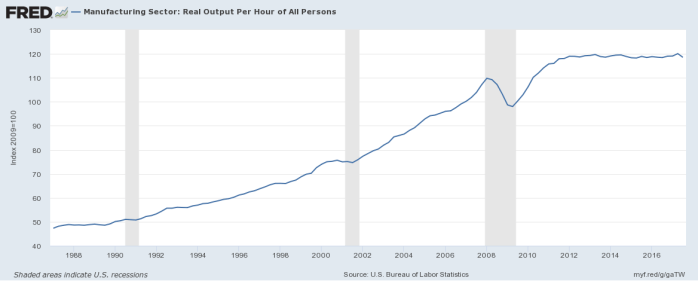
Take a look at this graph of manufacturing output per worker-hour:

Manufacturing_productivity

From 1988 to 2008, it was growing at a steady pace. In 2008 and 2009 it took a dip due to the Great Recession; no big surprise there. But then since 2012 it has been… completely flat. If we take this graph at face value, it would imply that manufacturing workers today can produce no more output than workers five years ago, and indeed only about 10% more than workers a decade ago. Whereas, a worker in 2008 was producing over 60% more than a worker in 1998, who was producing over 40% more than a worker in 1988.

Many economists call this the “productivity paradox”, and use it to argue that we don’t really need to worry about robots taking all our jobs any time soon. I think this view is mistaken.

The way we measure productivity is fundamentally wrongheaded, and is probably the sole cause of this “paradox”.

First of all, we use total hours scheduled to work, not total hours actually doing productive work. This is obviously much, much easier to measure, which is why we do it. But if you think for a moment about how the 40-hour workweek norm is going to clash with rapidly rising real productivity, it becomes apparent why this isn’t going to be a good measure.
When a worker finds a way to get done in 10 hours what used to take 40 hours, what does that worker’s boss do? Send them home after 10 hours because the job is done? Give them a bonus for their creativity? Hardly. That would be far too rational. They assign them more work, while paying them exactly the same. Recognizing this, what is such a worker to do? The obvious answer is to pretend to work the other 30 hours, while in fact doing something more pleasant than working.
And indeed, so-called “worker distraction” has been rapidly increasing. People are right to blame smartphones, I suppose, but not for the reasons they think. It’s not that smartphones are inherently distracting devices. It’s that smartphones are the cutting edge of a technological revolution that has made most of our work time unnecessary, so due to our fundamentally defective management norms they create overwhelming incentives to waste time at work to avoid getting drenched in extra tasks for no money.

That would probably be enough to explain the “paradox” by itself, but there is a deeper reason that in the long run is even stronger. It has to do with the way we measure “output”.

It might surprise you to learn that economists almost never consider output in terms of the actual number of cars produced, buildings constructed, songs written, or software packages developed. The standard measures of output are all in the form of so-called “real GDP”; that is, the dollar value of output produced.

They do adjust for indexes of inflation, but as I’ll show in a moment this still creates a fundamentally biased picture of the productivity dynamics.

Consider a world with only three industries: Housing, Food, and Music.

Productivity in Housing doesn’t change at all. Producing a house cost 10,000 worker-hours in 1950, and cost 10,000 worker-hours in 2000. Nominal price of houses has rapidly increased, from $10,000 in 1950 to $200,000 in 2000.

Productivity in Food rises moderately fast. Producing 1,000 meals cost 1,000 worker-hours in 1950, and cost 100 worker-hours in 2000. Nominal price of food has increased slowly, from $1,000 per 1,000 meals in 1950 to $5,000 per 1,000 meals in 2000.

Productivity in Music rises extremely fast. Producing 1,000 performances cost 10,000 worker-hours in 1950, and cost 1 worker-hour in 2000. Nominal price of music has collapsed, from $100,000 per 1,000 performances in 1950 to $1,000 per 1,000 performances in 2000.

This is of course an extremely stylized version of what has actually happened: Housing has gotten way more expensive, food has stayed about the same in price while farm employment has plummeted, and the rise of digital music has brought about a new Renaissance in actual music production and listening while revenue for the music industry has collapsed. There is a very nice Vox article on the “productivity paradox” showing a graph of how prices have changed in different industries.

How would productivity appear in the world I’ve just described, by standard measures? Well, to say that I actually need to say something about how consumers substitute across industries. But I think I’ll be forgiven in this case for saying that there is no substitution whatsoever; you can’t eat music or live in a burrito. There’s also a clear Maslow hierarchy here: They say that man cannot live by bread alone, but I think living by Led Zeppelin alone is even harder.

Consumers will therefore choose like this: Over 10 years, buy 1 house, 10,000 meals, and as many performances as you can afford after that. Further suppose that each person had $2,100 per year to spend in 1940-1950, and $50,000 per year to spend in 1990-2000. (This is approximately true for actual nominal US GDP per capita.)

1940-1950:
Total funds: $21,000

1 house = $10,000

10,000 meals = $10,000

Remaining funds: $1,000

Performances purchased: 10

1990-2000:

Total funds: $500,000

1 house = $200,000

10,000 meals = $50,000

Remaining funds: $250,000

Performances purchased: 250,000

(Do you really listen to this much music? 250,000 performances over 10 years is about 70 songs per day. If each song is 3 minutes, that’s only about 3.5 hours per day. If you listen to music while you work or watch a couple of movies with musical scores, yes, you really do listen to this much music! The unrealistic part is assuming that people in 1950 listen to so little, given that radio was already widespread. But if you think of music as standing in for all media, the general trend of being able to consume vastly more media in the digital age is clearly correct.)

Now consider how we would compute a price index for each time period. We would construct a basket of goods and determine the price of that basket in each time period, then adjust prices until that basket has a constant price.

Here, the basket would probably be what people bought in 1940-1950: 1 house, 10,000 meals, and 400 music performances.

In 1950, this basket cost $10,000+$10,000+$100 = $21,000.

In 2000, this basket cost $200,000+$50,000+$400 = $150,400.

This means that our inflation adjustment is $150,400/$21,000 = 7 to 1. This means that we would estimate the real per-capita GDP in 1950 at about $14,700. And indeed, that’s about the actual estimate of real per-capita GDP in 1950.

So, what would we say about productivity?

Sales of houses in 1950 were 1 per person, costing 10,000 worker hours.

Sales of food in 1950 were 10,000 per person, costing 10,000 worker hours.

Sales of music in 1950 were 400 per person, costing 4,000 worker hours.

Worker hours per person are therefore 24,000.

Sales of houses in 2000 were 1 per person, costing 10,000 worker hours.

Sales of food in 2000 were 10,000 per person, costing 1,000 worker hours.

Sales of music in 2000 were 250,000 per person, costing 25,000 worker hours.

Worker hours per person are therefore 36,000.

Therefore we would estimate that productivity rose from $14,700/24,000 = $0.61 per worker-hour to $50,000/36,000 = $1.40 per worker-hour. This is an annual growth rate of about 1.7%, which is again, pretty close to the actual estimate of productivity growth. For such a highly stylized model, my figures are doing remarkably well. (Honestly, better than I thought they would!)

But think about how much actual productivity rose, at least in the industries where it did.

We produce 10 times as much food per worker hour after 50 years, which is an annual growth rate of 4.7%, or three times the estimated growth rate.

We produce 10,000 times as much music per worker hour after 50 years, which is an annual growth rate of over 20%, or almost twelve times the estimated growth rate.

Moreover, should music producers be worried about losing their jobs to automation? Absolutely! People simply won’t be able to listen to much more music than they already are, so any continued increases in music productivity are going to make musicians lose jobs. And that was already allowing for music consumption to increase by a factor of over 600.

Of course, the real world has a lot more industries than this, and everything is a lot more complicated. We do actually substitute across some of those industries, unlike in this model.

But I hope I’ve gotten at least the basic point across that when things become drastically cheaper as technological progress often does, simply adjusting for inflation doesn’t do the job. One dollar of music today isn’t the same thing as one dollar of music a century ago, even if you inflation-adjust their dollars to match ours. We ought to be measuring in hours of music; an hour of music is much the same thing as an hour of music a century ago.

And likewise, that secretary/weather forecaster/news reporter/accountant/musician/filmmaker in your pocket that you call a “smartphone” really ought to be counted as more than just a simple inflation adjustment on its market price. The fact that it is mind-bogglingly cheaper to get these services than it used to be is the technological progress we care about; it’s not some statistical artifact to be removed by proper measurement.

Combine that with actually measuring the hours of real, productive work, and I think you’ll find that productivity is still rising quite rapidly, and that we should still be worried about what automation is going to do to our jobs.

What exactly is “gentrification”? How should we deal with it?

Nov 26, JDN 2458083

“Gentrification” is a word that is used in a variety of mutually-inconsistent ways. If you compare the way social scientists use it to the way journalists use it, for example, they are almost completely orthogonal.

The word “gentrification” is meant to invoke the concept of a feudal gentry—a hereditary landed class that extracts rents from the rest of the population while contributing little or nothing themselves.

If indeed that is what we are talking about, then obviously this is bad. Moreover, it’s not an entirely unfounded fear; there are some remarkably strong vestiges of feudalism in the developed world, even in the United States where we never formally had a tradition of feudal titles. There really is a significant portion of the world’s wealth held by a handful of billionaire landowner families.

But usually when people say “gentrification” they mean something much broader. Almost any kind of increase in urban real estate prices gets characterized as “gentrification” by at least somebody, and herein lies the problem.

In fact, the kind of change that is most likely to get characterized as “gentrification” isn’t even the rising real estate prices we should be most worried about. People aren’t concerned when the prices of suburban homes double in 20 years. You might think that things that are already too expensive getting more expensive would be the main concern, but on the contrary, people are most likely to cry “gentrification” when housing prices rise in poor areas where housing is cheap.

One of the most common fears about gentrification is that it will displace local residents. In fact, the best quasi-experimental studies show little or no displacement effect. It’s actually mainly middle-class urbanites who get displaced by rising rents. Poor people typically own their homes, and actually benefit from rising housing prices. Young upwardly-mobile middle-class people move to cities to rent apartments near where they work, and tend to assume that’s how everyone lives, but it’s not. Rising rents in a city are far more likely to push out its grad students than they are poor families that have lived there for generations. Part of why displacement does not occur may be because of policies specifically implemented to fight it, such as subsidized housing and rent control. If that’s so, let’s keep on subsidizing housing (though rent control will always be a bad idea).

Nor is gentrification actually a very widespread phenomenon. The majority of poor neighborhoods remain poor indefinitely. In most studies, only about 30% of neighborhoods classified as “gentrifiable” actually end up “gentrifying”. Less than 10% of the neighborhoods that had high poverty rates in 1970 had low poverty rates in 2010.

Most people think gentrification reduces crime, but in the short run the opposite is the case. Robbery and larceny are higher in gentrifying neighborhoods. Criminals are already there, and suddenly they get much more valuable targets to steal from, so they do.

There is also a general perception that gentrification involves White people pushing Black people out, but this is also an overly simplistic view. First of all, a lot of gentrification is led by upwardly-mobile Black and Latino people. Black people who live in gentrified neighborhoods seem to be better off than Black people who live in non-gentrified neighborhoods; though selection bias may contribute to this effect, it can’t be all that strong, or we’d observe a much stronger displacement effect. Moreover, some studies have found that gentrification actually tends to increase the racial diversity of neighborhoods, and may actually help fight urban self-segregation, though it does also tend to increase racial polarization by forcing racial mixing.

What should we conclude from all this? I think the right conclusion is we are asking the wrong question.

Rising housing prices in poor areas aren’t inherently good or inherently bad, and policies designed specifically to increase or decrease housing prices are likely to have harmful side effects. What we need to be focusing on is not houses or neighborhoods but people. Poverty is definitely a problem, for sure. Therefore we should be fighting poverty, not “gentrification”. Directly transfer wealth from the rich to the poor, and then let the housing market fall where it may.

There is still some role for government in urban planning more generally, regarding things like disaster preparedness, infrastructure development, and transit systems. It may even be worthwhile to design regulations or incentives that directly combat racial segregation at the neighborhood level, for, as the Schelling Segregation Model shows, it doesn’t take a large amount of discriminatory preference to have a large impact on socioeconomic outcomes. But don’t waste effort fighting “gentrification”; directly design policies that will incentivize desegregation.

Rising rent as a proportion of housing prices is still bad, and the fundamental distortions in our mortgage system that prevent people from buying houses are a huge problem. But rising housing prices are most likely to be harmful in rich neighborhoods, where housing is already overpriced; in poor neighborhoods where housing is cheap, rising prices might well be a good thing.
In fact, I have a proposal to rapidly raise homeownership across the United States, which is almost guaranteed to work, directly corrects an enormous distortion in financial markets, and would cost about as much as the mortgage interest deduction (which should probably be eliminated, as most economists agree). Give each US adult a one-time grant voucher which gives them $40,000 that can only be spent as a down payment on purchasing a home. Each time someone turns 18, they get a voucher. You only get one over your lifetime, so use it wisely (otherwise the policy could become extremely expensive); but this is an immediate direct transfer of wealth that also reduces your credit constraint. I know I for one would be house-hunting right now if I were offered such a voucher. The mortgage interest deduction means nothing to me, because I can’t afford a down payment. Where the mortgage interest deduction is regressive, benefiting the rich more than the poor, this policy gives everyone the same amount, like a basic income.

In the short run, this policy would probably be expensive, as we’d have to pay out a large number of vouchers at once; but with our current long-run demographic trends, the amortized cost is basically the same as the mortgage interest deduction. And the US government especially should care about the long-run amortized cost, as it is an institution that has lasted over 200 years without ever missing a payment and can currently borrow at negative real interest rates.

Why risking nuclear war should be a war crime

Nov 19, JDN 2458078

“What is the value of a human life?” is a notoriously difficult question, probably because people keep trying to answer it in terms of dollars, and it rightfully offends our moral sensibilities to do so. We shouldn’t be valuing people in terms of dollars—we should be valuing dollars in terms of their benefits to people.

So let me ask a simpler question: Does the value of an individual human life increase, decrease, or stay the same, as we increase the number of people in the world?

A case can be made that it should stay the same: Why should my value as a person depend upon how many other people there are? Everything that I am, I still am, whether there are a billion other people or a thousand.

But in fact I think the correct answer is that it decreases. This is for two reasons: First, anything that I can do is less valuable if there are other people who can do it better. This is true whether we’re talking about writing blog posts or ending world hunger. Second, and most importantly, if the number of humans in the world gets small enough, we begin to face danger of total permanent extinction.

If the value of a human life is constant, then 1,000 deaths is equally bad whether it happens in a population of 10,000 or a population of 10 billion. That doesn’t seem right, does it? It seems more reasonable to say that losing ten percent should have a roughly constant effect; in that case losing 1,000 people in a population of 10,000 is equally bad as losing 1 billion in a population of 10 billion. If that seems too strong, we could choose some value in between, and say perhaps that losing 1,000 out of 10,000 is equally bad as losing 1 million out of 1 billion. This would mean that the value of 1 person’s life today is about 1/1,000 of what it was immediately after the Toba Event.

Of course, with such uncertainty, perhaps it’s safest to assume constant value. This seems the fairest, and it is certainly a reasonable approximation.

In any case, I think it should be obvious that the inherent value of a human life does not increase as you add more human lives. Losing 1,000 people out of a population of 7 billion is not worse than losing 1,000 people out of a population of 10,000. That way lies nonsense.

Yet if we agree that the value of a human life is not increasing, this has a very important counter-intuitive consequence: It means that increasing the risk of a global catastrophe is at least as bad as causing a proportional number of deaths. Specifically, it implies that a 1% risk of global nuclear war is worse than killing 10 million people outright.

The calculation is simple: If the value of a human life is a constant V, then the expected utility (admittedly, expected utility theory has its flaws) from killing 10 million people is -10 million V. But the expected utility from a 1% risk of global nuclear war is 1% times -V times the expected number of deaths from such a nuclear war—and I think even 2 billion is a conservative estimate. (0.01)(-2 billion) V = -20 million V.

This probably sounds too abstract, or even cold, so let me put it another way. Suppose we had the choice between two worlds, and these were the only worlds we could choose from. In world A, there are 100 leaders who each make choices that result in 10 million deaths. In world B, there are 100 leaders who each make choices that result in a 1% chance of nuclear war. Which world should we choose?

The choice is a terrible one, to be sure.

In world A, 1 billion people die.

Yet what happens in world B?

If the risks are independent, we can’t just multiply by 100 to get a guarantee of nuclear war. The actual probability is 1-(1-0.01)^100 = 63%. Yet even so, (0.63)(2 billion) = 1.26 billion. The expected number of deaths is higher in world B. Indeed, the most likely scenario is that 2 billion people die.

Yet this is probably too conservative. The risks are most likely positively correlated; two world leaders who each take a 1% chance of nuclear war probably do so in response to one another. Therefore maybe adding up the chances isn’t actually so unreasonable—for all practical intents and purposes, we may be best off considering nuclear war in world B as guaranteed to happen. In that case, world B is even worse.

And that is all assuming that the nuclear war is relatively contained. Major cities are hit, then a peace treaty is signed, and we manage to rebuild human civilization more or less as it was. This is what most experts on the issue believe would happen; but I for one am not so sure. The nuclear winter and total collapse of institutions and infrastructure could result in a global apocalypse that would result in human extinctionnot 2 billion deaths but 7 billion, and an end to all of humanity’s projects once and forever This is the kind of outcome we should be prepared to do almost anything to prevent.

What does this imply for global policy? It means that we should be far more aggressive in punishing any action that seems to bring the world closer to nuclear war. Even tiny increases in risk, of the sort that would ordinarily be considered negligible, are as bad as murder. A measurably large increase is as bad as genocide.

Of course, in practice, we have to be able to measure something in order to punish it. We can’t have politicians imprisoned over 0.000001% chances of nuclear war, because such a chance is so tiny that there would be no way to attain even reasonable certainty that such a change had even occurred, much less who was responsible.

Even for very large chances—and in this context, 1% is very large—it would be highly problematic to directly penalize increasing the probability, as we have no consistent, fair, objective measure of that probability.

Therefore in practice what I think we must do is severely and mercilessly penalize certain types of actions that would be reasonably expected to increase the probability of catastrophic nuclear war.

If we had the chance to start over from the Manhattan Project, maybe simply building a nuclear weapon should be considered a war crime. But at this point, nuclear proliferation has already proceeded far enough that this is no longer a viable option. At least the US and Russia for the time being seem poised to maintain their nuclear arsenals, and in fact it’s probably better for them to keep maintaining and updating them rather than leaving decades-old ICBMs to rot.

What can we do instead?

First, we probably need to penalize speech that would tend to incite war between nuclear powers. Normally I am fiercely opposed to restrictions on speech, but this is nuclear war we’re talking about. We can’t take any chances on this one. If there is even a slight chance that a leader’s rhetoric might trigger a nuclear conflict, they should be censored, punished, and probably even imprisoned. Making even a veiled threat of nuclear war is like pointing a gun at someone’s head and threatening to shoot them—only the gun is pointed at everyone’s head simultaneously. This isn’t just yelling “fire” in a crowded theater; it’s literally threatening to burn down every theater in the world at once.

Such a regulation must be designed to allow speech that is necessary for diplomatic negotiations, as conflicts will invariably arise between any two countries. We need to find a way to draw the line so that it’s possible for a US President to criticize Russia’s intervention in the Ukraine or for a Chinese President to challenge US trade policy, without being accused of inciting war between nuclear powers. But one thing is quite clear: Wherever we draw that line, President Trump’s statement about “fire and fury” definitely crosses it. This is a direct threat of nuclear war, and it should be considered a war crime. That reason by itself—let alone his web of Russian entanglements and violations of the Emoluments Clause—should be sufficient to not only have Trump removed from office, but to have him tried at the Hague. Impulsiveness and incompetence are no excuse when weapons of mass destruction are involved.

Second, any nuclear policy that would tend to increase first-strike capability rather than second-strike capability should be considered a violation of international law. In case you are unfamiliar with such terms: First-strike capability consists of weapons such as ICBMs that are only viable to use as the opening salvo of an attack, because their launch sites can be easily located and targeted. Second-strike capability consists of weapons such as submarines that are more concealable, so it’s much more likely that they could wait for an attack to happen, confirm who was responsible and how much damage was done, and then retaliate afterward.
Even that retaliation would be difficult to justify: It’s effectively answering genocide with genocide, the ultimate expression of “an eye for an eye” writ large upon humanity’s future. I’ve previously written about my Credible Targeted Conventional Response strategy that makes it both more ethical and more credible to respond to a nuclear attack with a non-nuclear retaliation. But at least second-strike weapons are not inherently only functional at starting a nuclear war. A first-strike weapon can theoretically be fired in response to a surprise attack, but only before the attack hits you—which gives you literally minutes to decide the fate of the world, most likely with only the sketchiest of information upon which to base your decision. Second-strike weapons allow deliberation. They give us a chance to think carefully for a moment before we unleash irrevocable devastation.

All the launch codes should of course be randomized onetime pads for utmost security. But in addition to the launch codes themselves, I believe that anyone who wants to launch a nuclear weapon should be required to type, letter by letter (no copy-pasting), and then have the machine read aloud, Oppenheimer’s line about Shiva, “Now I am become Death, the destroyer of worlds.” Perhaps the passphrase should conclude with something like “I hereby sentence millions of innocent children to death by fire, and millions more to death by cancer.” I want it to be as salient as possible in the heads of every single soldier and technician just exactly how many innocent people they are killing. And if that means they won’t turn the key—so be it. (Indeed, I wouldn’t mind if every Hellfire missile required a passphrase of “By the authority vested in me by the United States of America, I hereby sentence you to death or dismemberment.” Somehow I think our drone strike numbers might go down. And don’t tell me they couldn’t; this isn’t like shooting a rifle in a firefight. These strikes are planned days in advance and specifically designed to be unpredictable by their targets.)

If everyone is going to have guns pointed at each other, at least in a second-strike world they’re wearing body armor and the first one to pull the trigger won’t automatically be the last one left standing.

Third, nuclear non-proliferation treaties need to be strengthened into disarmament treaties, with rapid but achievable timelines for disarmament of all nuclear weapons, starting with the nations that have the largest arsenals. Random inspections of the disarmament should be performed without warning on a frequent schedule. Any nation that is so much as a day late on their disarmament deadlines needs to have its leaders likewise hauled off to the Hague. If there is any doubt at all in your mind whether your government will meet its deadlines, you need to double your disarmament budget. And if your government is too corrupt or too bureaucratic to meet its deadlines even if they try, well, you’d better shape up fast. We’ll keep removing and imprisoning your leaders until you do. Once again, nothing can be left to chance.

We might want to maintain some small nuclear arsenal for the sole purpose of deflecting asteroids from colliding with the Earth. If so, that arsenal should be jointly owned and frequently inspected by both the United States and Russia—not just the nuclear superpowers, but also the only two nations with sufficient rocket launch capability in any case. The launch of the deflection missiles should require joint authorization from the presidents of both nations. But in fact nuclear weapons are probably not necessary for such a deflection; nuclear rockets would probably be a better option. Vaporizing the asteroid wouldn’t accomplish much, even if you could do it; what you actually want to do is impart as much sideways momentum as possible.

What I’m saying probably sounds extreme. It may even seem unjust or irrational. But look at those numbers again. Think carefully about the value of a human life. When we are talking about a risk of total human extinction, this is what rationality looks like. Zero tolerance for drug abuse or even terrorism is a ridiculous policy that does more harm than good. Zero tolerance for risk of nuclear war may be the only hope for humanity’s ongoing survival.

Throughout the vastness of the universe, there are probably billions of civilizations—I need only assume one civilization for every hundred galaxies. Of the civilizations that were unwilling to adopt zero tolerance policies on weapons of mass destruction and bear any cost, however unthinkable, to prevent their own extinction, there is almost boundless diversity, but they all have one thing in common: None of them will exist much longer. The only civilizations that last are the ones that refuse to tolerate weapons of mass destruction.

Daylight Savings Time is pointless and harmful

Nov 12, JDN 2458069

As I write this, Daylight Savings Time has just ended.

Sleep deprivation costs the developed world about 2% of GDP—on the order of $1 trillion per year. The US alone loses enough productivity from sleep deprivation that recovering this loss would give us enough additional income to end world hunger.

So, naturally, we have a ritual every year where we systematically impose an hour of sleep deprivation on the entire population for six months. This makes sense somehow.
The start of Daylight Savings Time each year is associated with a spike in workplace injuries, heart attacks, and suicide.

Nor does the “extra” hour of sleep we get in the fall compensate; in fact, it comes with its own downsides. Pedestrian fatalities spike immediately after the end of Daylight Savings Time; the rate of assault also rises at the end of DST, though it does also seem to fall when DST starts.

Daylight Savings Time was created to save energy. It does do that… technically. The total energy savings for the United States due to DST amounts to about 0.3% of our total electricity consumption. In some cases it can even increase energy use, though it does seem to smooth out electricity consumption over the day in a way that is useful for solar and wind power.

But this is a trivially small amount of energy savings, and there are far better ways to achieve it.

Simply due to new technologies and better policies, manufacturing in the US has reduced its energy costs per dollar of output by over 4% in the last few years. Simply getting all US states to use energy as efficiently as it is used in New York or California (not much climate similarity between those two states, but hmm… something about politics comes to mind…) would cut our energy consumption by about 30%.

The total amount of energy saved by DST is comparable to the amount of electricity now produced by small-scale residential photovoltaics—so simply doubling residential solar power production (which we’ve been doing every few years lately) would yield the same benefits as DST without the downsides. If we really got serious about solar power and adopted the policies necessary to get a per-capita solar power production comparable to Germany (not a very sunny place, mind you—Sacramento gets over twice the hours of sun per year that Berlin does), we would increase our solar power production by a factor of 10—five times the benefits of DST, none of the downsides.

Alternatively we could follow France’s model and get serious about nuclear fission. France produces over three hundred times as much energy from nuclear power as the US saves via Daylight Savings Time. Not coincidentally, France produces half as much CO2 per dollar of GDP as the United States.

Why would we persist in such a ridiculous policy, with such terrible downsides and almost no upside? To a first approximation, all human behavior is social norms.