The challenges of a global basic income

JDN 2457404

In the previous post I gave you the good news. Now for the bad news.

So we are hoping to implement a basic income of $3,000 per person per year worldwide, eliminating poverty once and for all.

There is no global government to implement this system. There is no global income tax to be collected or refunded. The United Nations and the World Bank, for all the good work that they do, are nowhere near powerful enough (or well-funded enough) to accomplish this feat.

Worse, the people we need to help the most, not coincidentally, live in the countries that are worst-managed. They are surrounded not only by squalor, but also by corruption, war, ethnic tension. Most of the people are underfed, uneducated, and dying from diseases such as malaria and schistomoniasis that we could treat in a day for pocket change. Their infrastructure is either crumbling or nonexistent. Their water is unsafe to drink. And worst of all, many of their governments don’t care. Tyrants like Robert Mugabe, Kim Jong-un, King Salman (of our lovely ally Saudi Arabia), and Isayas Afewerki care nothing for the interests of the people they rule, and are interested only in maximizing their own wealth and power. If we arranged to provide grants to these countries in an amount sufficient to provide the basic income, there’s no reason to think they’d actually provide it; they’d simply deposit the check in their own personal bank accounts, and use it to buy ever more extravagant mansions or build ever greater monuments to themselves. They really do seem to follow a utility function based entirely upon their own consumption; witness your neoclassical rational agent and despair.

There are ways for international institutions and non-governmental organizations to intervene to help people in these countries, and indeed many have done so to considerable effect. As bad as things are, they are much better than they used to be, and they promise to be even better tomorrow. But there is only so much they can do without the force of law at their backs, without the power to tax incomes and print currency.

We will therefore need a new kind of institutional framework, if not a true world government then something very much like it. Establishing this new government will not be easy, and worst of all I see no way to do it other than military force. Tyrants will not give up their power willingly; it will need to be taken from them. We will need to capture and imprison tyrants like Robert Mugabe and Kim Jong Un in the same way that we once did to mob bosses like John Dillinger and Al Capone, for ultimately a tyrant is nothing but a mob boss with an army.Unless we can find some way to target them precisely and smoothly replace their regimes with democracies, this will mean nothing less than war, and it could kill thousands, even millions of people—but millions of people are already dying, and will continue to die as long as we leave these men in power. Sanctions might help (though sanctions kill people too), and perhaps a few can be persuaded to step down, but the rest must be overthrown, by some combination of local revolutions and international military coalitions. The best model I’ve seen for how this might be pulled off is Libya, where Qaddafi was at last removed by an international military force supporting a local revolution—but even Libya is not exactly sunshine and rainbows right now. One of the first things we need to do is seriously plan a strategy for removing repressive dictators with a minimum of collateral damage.

To many, I suspect this sounds like imperialism, colonialism redux. Didn’t so many imperialistic powers say that they were doing it to help the local population? Yes, they did; and one of the facts that we must face up to is that it was occasionally true. Or if helping the local population was not their primary motivation, it was nonetheless a consequence. Countries colonized by the British Empire in particular are now the most prosperous, free nations in the world: The United States, Canada, Australia. South Africa and India might seem like exceptions (GDP PPP per capita of $12,400 and $5,500 respectively) but they really aren’t, compared to what they were before—or even compared to what is next to them today: Angola has a per capita GDP PPP of $7,546 while Bangladesh has only $2,991. Zimbabwe is arguably an exception (per capita GDP PPP of $1,773), but their total economic collapse occurred after the British left. To include Zimbabwe in this basic income program would literally triple the income of most of their population. But to do that, we must first get through Robert Mugabe.

Furthermore, I believe that we can avoid many of the mistakes of the past. We don’t have to do exactly the same thing that countries used to do when they invaded each other and toppled governments. Of course we should not enslave, subjugate, or murder the local population—one would hope that would go without saying, but history shows it doesn’t. We also shouldn’t annex the territory and claim it as our own, nor should we set up puppet governments that are only democratic as long as it serves our interests. (And make no mistake, we have done this, all too recently.) The goal must really be to help the people of countries like Zimbabwe and Eritrea establish their own liberal democracy, including the right to make policies we don’t like—or even policies we think are terrible ideas. If we can do so without war, of course we should. But right now what is usually called “pacifism” leaves millions of people to starve while we do nothing.

The argument that we have previously supported (or even continue to support, ahem, Saudi Arabia) many of these tyrants is sort of beside the point. Yes, that is clearly true; and yes, that is clearly terrible. But do you think that if we simply leave the situation alone they’ll go away? We should never have propped up Saddam Hussein or supported the mujihadeen who became the Taliban; and yes, I do think we could have known that at the time. But once they are there, what do you propose to do now? Wait for them to die? Hope they collapse on their own? Give our #thoughtsandprayers to revolutionaries? When asked what you think we should do, “We shouldn’t have done X” is not a valid response.

Imagine there is a mob boss who had kidnapped several families and is holding them in a warehouse. Suppose that at some point the police supported the mob boss in some way; in a deal to undermine a worse rival mafia family, they looked the other way on some things he did, or even gave him money that he used to strengthen his mob. (With actual police, the former is questionable, but actually done all the time; the latter would be definitely illegal. In the international analogy, both are ubiquitous.) Even suppose that the families who were kidnapped were previously from a part of town that the police would regularly shake down for petty crimes and incessant stop-and-frisks. The police definitely have a lot to answer for in all this; their crimes should not be forgotten. But how does it follow in any way that the police should not intervene to rescue the families from the warehouse? Suppose we even know that the warehouse is heavily guarded, and the resulting firefight may kill some of the hostages we are hoping to save. This gives us reason to negotiate, or to find the swiftest, most precise means to deploy the SWAT teams; but does it give us reason to do nothing?

Once again I think Al Capone is the proper analogy; when the FBI captured Al Capone, they didn’t bomb Chicago to the ground, nor did they attempt to enslave the population of Illinois. They thought of themselves as targeting one man and his lieutenants and re-establishing order and civil government to a free people; that is what we must do in Eritrea and Zimbabwe. (In response to all this, no doubt someone will say: “You just want the US to be the world’s police.” Well, no, I want an international coalition; but yes, given our military and economic hegemony, the US will take a very important role. Above all, yes, I want the world to have police. Why don’t you?)

For everything we did wrong in the recent wars in Afghanistan and Iraq, I think we actually did this part right: Afghanistan’s GDP PPP per capita has risen over 70% since 2002, and Iraq’s is now 17% higher than its pre-war peak. It’s a bit early to say whether we have really established stable liberal democracies there, and the Iraq War surely contributed to the rise of Daesh; but when the previous condition was the Taliban and Saddam Hussein it’s hard not to feel that things are at least somewhat improving. In a generation or two maybe we really will say “Iraq” in the same breath as “Korea” as one of the success stories of prosperous democracies set up after US wars. Or maybe it will all fall apart; it’s hard to say at this point.

So, we must find a way to topple the tyrants. Once that is done, we will need to funnel huge amounts of resources—at least one if not two orders of magnitude larger than our current level of foreign aid into building infrastructure, educating people, and establishing sound institutions. Our current “record high” foreign aid is less than 0.3% of world’s GDP. We have a model for this as well: It’s what we did in West Germany and Japan after WW2, as well as what we did in South Korea after the Korean War. It is not a coincidence that Germany soon regained its status as a world power while Japan and Korea were the first of the “Asian Tigers”, East Asian nations that rose up to join us at a First World standard of living.

Will all of this be expensive? Absolutely. By assuming $3,000 per person per year I am already figuring in an expenditure of $21 trillion per year, indefinitely. This would be the most expensive project upon which humanity has ever embarked. But it could also be the most important—an end to poverty, everywhere, forever. And we have that money, we’re simply using it for other things. At purchasing power parity the world spends over $100 trillion per year. Using 20% of the world’s income to eliminate poverty forever doesn’t seem like such a bad deal to me. (It’s not like it would disappear; it would be immediately spent back into the economy anyway. We might even see growth as a result.)

When dealing with events on this scale, it’s easy to get huge numbers that sound absurd. But even if we assumed that only the US, Europe, and China supported this program, it would only take 37% of our combined income—roughly what we currently spend on housing.

Whenever people complain, “We spend billions of dollars a year on aid, and we haven’t solved world hunger!” the proper answer is, “That’s right; we should be spending trillions.”
The possibilities of a global basic income

JDN 2457401

This post is sort of a Patreon Readers’ Choice; it had a tied score with the previous post. If ties keep happening, I may need to devise some new scheme, lest I end up writing so many Readers’ Choice posts I don’t have time for my own topics (I suppose there are worse fates).

The idea of a global basic income is one I have alluded to many times, but never directly focused on.

As I wrote this I realized it’s actually two posts. I have good news and bad news.
First, the good news.

A national basic income is a remarkably simple, easy policy to make: When the tax code comes around for revision that year, you get Congress to vote in a very large refundable credit, disbursed monthly, that goes to everyone—that is a basic income. To avoid ballooning the budget deficit, you would also want to eliminate a bunch of other deductions and credits, and might want to raise the tax rates as well—but these are all things that we have done before many times. Different administrations almost always add some deductions and remove others, raise some rates and lower others. By this simple intervention, we could end poverty in America immediately and forever. The most difficult part of this whole process is convincing a majority of both houses of Congress to support it. (And even that may not be as difficult as it seems, for a basic income is one of the few economic policies that appeals to both Democrats, Libertarians, and even some Republicans.)

Similar routine policy changes could be applied in other First World countries. A basic income could be established by a vote of Parliament in the UK, a vote of the Senate and National Assembly in France, a vote of the Riksdag in Sweden, et cetera; indeed, Switzerland is already planning a referendum on the subject this year. The benefits of a national basic income policy are huge, the costs are manageable, the implementation is trivial. Indeed, the hardest thing to understand about all of this is why we haven’t done it already.

But the benefits of a national basic income are of course limited to the nation(s) in which it is applied. If Switzerland votes in its proposal to provide $30,000 per person per year (that’s at purchasing power parity, but it’s almost irrelevant whether I use nominal or PPP figures, because Swiss prices are so close to US prices), that will help a lot of people in Switzerland—but it won’t do much for people in Germany or Italy, let alone people in Ghana or Nicaragua. It could do a little bit for other countries, if the increased income for the poor and lower-middle class results in increased imports to Switzerland. But Switzerland especially is a very small player in global trade. A US basic income is more likely to have global effects, because the US by itself accounts for 9% of the world’s exports and 13% of the world’s imports. Some nations, particularly in Latin America, depend almost entirely upon the US to buy their exports.

But even so, national basic incomes in the entire First World would not solve the problem of global poverty. To do that, we would need a global basic income, one that applies to every human being on Earth.

The first question to ask is whether this is feasible at all. Do we even have enough economic output in the world to do this? If we tried would we simply trigger a global economic collapse?

Well,if you divide all the world’s income, adjusted for purchasing power, evenly across all the world’s population, the result is about $15,000 per person per year. This is about the standard of living of the average (by which I mean median) person in Lebanon, Brazil, or Botswana. It’s a little better than the standard of living in China, South Africa, or Peru. This is about half of what the middle class of the First World are accustomed to, but it is clearly enough to not only survive, but actually make some kind of decent living. I think most people would be reasonably happy with this amount of income, if it were stable and secure—and by construction, the majority of the world’s population would be better off if all incomes were equalized in this way.

Of course, we can’t actually do that. All the means we have for redistributing income to that degree would require sacrificing economic efficiency in various ways. It is as if we were carrying water in buckets with holes in the bottom; the amount we give at the end is a lot less than the amount we took at the start.

Indeed, the efficiency costs of redistribution rise quite dramatically as the amount redistributed increases.

I have yet to see a convincing argument for why we could not simply tax the top 1% at a 90% marginal rate and use all of that income for public goods without any significant loss in economic efficiency—this is after all more or less what we did here in the United States in the 1960s, when we had a top marginal rate over 90% and yet per capita GDP growth was considerably higher than it is today. A great many economists seem quite convinced that taxing top incomes in this way would create some grave disincentive against innovation and productivity, yet any time anything like this has been tried such disincentives have conspicuously failed to emerge. (Why, it’s almost as if the rich aren’t that much smarter and more hard-working than we are!)

I am quite sure, on the other hand, that if we literally set up the tax system so that all income gets collected by the government and then doled out to everyone evenly, this would be economically disastrous. Under that system, your income is basically independent of the work you do. You could work your entire life to create a brilliant invention that adds $10 billion to the world economy, and your income would rise by… 0.01%, the proportion that your invention added to the world economy. Or you could not do that, indeed do nothing at all, be a complete drain upon society, and your income would be about $1.50 less each year. It’s not hard to understand why a lot of people might work considerably less hard in such circumstances; if you are paid exactly the same whether you are an entrepreneur, a software engineer, a neurosurgeon, a teacher, a garbage collector, a janitor, a waiter, or even simply a couch potato, it’s hard to justify spending a lot of time and effort acquiring advanced skills and doing hard work. I’m sure there are some people, particularly in creative professions such as art, music, and writing—and indeed, science—who would continue to work, but even so the garbage would not get picked up, the hamburgers would never get served, and the power lines would never get fixed. The result would be that trying to give everyone the same income would dramatically reduce the real income available to distribute, so that we all ended up with say $5,000 per year or even $1,000 per year instead of $15,000.

Indeed, absolute equality is worse than the system of income distribution under Soviet Communism, which still provided at least some incentives to work—albeit often not to work in the most productive or efficient way.

So let’s suppose that we only have the income of the top 1% to work with. It need not be literally that we take income only from the top 1%; we could spread the tax burden wider than that, and there may even be good reasons to do so. But I think this gives us a good back-of-the-envelope estimate of how much money we would realistically have to work with in funding a global basic income. It’s actually surprisingly hard to find good figures on the global income share of the top 1%; there’s one figure going around which is not simply wrong it’s ridiculous, claiming that the income threshold for the top 1% worldwide is only $34,000. Why is it ridiculous? Because the United States comprises 4.5% of the world’s population, and half of Americans make more money than that. This means that we already have at least 2% of the world’s population making at least that much, in the United States alone. Add in people from Europe, Japan, etc. and you easily find that this must be the income of about the top 5%, maybe even only the top 10%, worldwide. Exactly where it lies depends on the precise income distributions of various countries.

But here’s what I do know; the global Gini coefficient is about 0.40, and the US Gini coefficient is about 0.45; thus, roughly speaking, income inequality on a global scale recapitulates income inequality in the US. The top 1% in the US receive about 20% of the income. So let’s say that the top 1% worldwide probably also receive somewhere around 20% of the income. We were only using it to estimate the funds available for a basic income anyway.

This would mean that our basic income could be about $3,000 per person per year at purchasing power parity. That probably doesn’t sound like a lot, and I suppose it isn’t; but the UN poverty threshold is $2 per person per day, which is $730 per person per day. Thus, our basic income is over four times what it would take to eliminate global poverty by the UN threshold.

Now in fact I think that this threshold is probably too low; but is it four times too low? We are accustomed to such a high standard of living in the First World that it’s easy to forget that people manage to survive on far, far less than we have. I think in fact our problem here is not so much poverty per se as it is inequality and financial insecurity. We live in a state of “insecure affluence”; we have a great deal (think for a moment about your shelter, transportation, computer, television, running water, reliable electricity, abundant food—and if you are reading this you probably have all these things), but we constantly fear that we may lose it at any moment, and not without reason. (My family actually lost the house I grew up in as a result of predatory banking and the financial crisis.) We are taught all our lives that the only way to protect this abundance is by means of a hyper-competitive, winner-takes-allcutthroat capitalist economy that never lets us ever become comfortable in appreciating that abundance, for it could be taken from us at any time.

I think the apotheosis of what it is to live in insecure affluence is renting an apartment in LA or New York—you must have a great deal going for you to be able to live in the city at all, but you are a renter, an interloper; the apartment, like so much of your existence, is never fully secure, never fully yours. Perhaps the icing on the cake is if you’re doing it for grad school (as I was a year ago), this bizarre system in which we live near poverty for several years not in spite but because of the fact that we are so hard-working, intelligent and educated. (And it never ceases to baffle me that economists who lived through that can still believe in the Life-Cycle Spending Hypothesis.)

Being below the poverty line in a First World country is a kind of poverty, but it’s a very different kind than being below the poverty line in a Third World country. (I think we need a new term to distinguish it, and maybe “insecure affluence” or “economic insecurity” is the right one.) A national basic income could be set considerably higher than the global basic income (since we’re giving it to far fewer people), so we might actually be able to set $15,000 nationally—but to do that worldwide would use up literally all the money in the world.

Raising the minimum income worldwide to $3,000 per person per year would transform the lives of billions of people. It would, in a very real sense, end poverty, worldwide, immediately and forever.

And that’s the good news. Stay tuned for the bad news.

What would an interplanetary economy look like?

JDN 2457397

Today’s post is the second Reader’s Choice topic, chosen by a vote of my Patreons.

Remember, you too can vote on future topics if you pledge at least $10 per month.

Actually, there was a tie between two topics; since I was in an SF mood today, I decided to do this one as the official Reader’s Choice post. The second, “The challenges and possibilities of a global basic income”, I’ll do as a later post. (If I don’t get around to that before the next vote, you can of course always vote for it again.)

Will we ever colonize outer space? Many people thought we’d be there by now.

In Blade Runner, released in 1982, Roy was built and deployed to the outer colonies in 2015, which you may remember as the year that just ended.

Predictions of the future are often wrong, but predictions from the 20th century of the 21st century seem to be consistently overoptimistic about technology. In a past Idiot Free Zone post, I hypothesize that this is due to the confusion between exponential and logistic growth.

Paul Krugman is also a big fan of SF (it is actually about as likely that I’d run into Krugman at Worldcon as at an economics conference), and he wrote a paper on the possibility of interstellar trade way back in 1978. I think he’s kind of satirizing economic theorists actually; he uses sophisticated mathematics to address a problem that doesn’t exist in the real world—just like they do.

I think we will eventually at least reach the point of interplanetary colonization, if not actually interstellar. To begin, let me emphasize that vital distinction. Mars is currently about 60 million kilometers away at its closest approach. The core of the Alpha Centauri system is 4.24 light-years away, which is about 40 trillion kilometers. The distance from Ann Arbor to Toledo is about 84 kilometers. Thus, the difficulty of going to Alpha Centauri is about as much higher than that of going to Mars as the difficulty of going to Mars is compared to going from Ann Arbor to Toledo—each a factor of 700,000 times the distance.

With current technology, we can send robots to Mars (how cool is that? We did get some of the future we were promised). A typical trip takes about half a year. It costs us about $2.5 billion to do that, though India somehow managed to at least make Mars orbit for $75 million. Even if we use the $2.5 billion figure, that still means our current economic output the US and Europe alone could support hundreds of missions per year if we were willing to pay for it. (Devote the entire US military budget to NASA and we could land a new robot on Mars every day.) Interplanetary travel is most definitely feasible.

Interstellar travel on the other hand, is still far out of reach. In principle we are limited by the speed of light; in fact, it’s a good deal worse than that. The fastest we have ever gotten a spacecraft leaving the Solar System is about 60,000 km/h; at that speed it would take almost one billion hours to get to Alpha Centauri, which is over 100,000 years. We will need substantial breakthroughs in spacecraft propulsion before we can even consider sending anything to even the nearest stars. (I wouldn’t give up hope completely, however; in 1901 someone could just as well have criticized H.G. Wells’ The First Men in the Moon on the grounds that no one will ever invent a propulsion system powerful enough to reach the moon.)

By the time we manage interstellar travel, our technology will be so much more advanced it’s hard to even imagine what things will be like. But interplanetary travel we could probably do right now.

So let’s suppose we do in fact establish colonies on other planets—most likely Mars and Mercury, as well as several moons of Jupiter and Saturn. What would our economy look like once we did?

For a decidedly Game of Thrones take on this situation, see The Expanse. Their scientific accuracy is quite good (although they still have sound in space!); so far, their economic accuracy seems pretty good as well, but so far I haven’t seen enough yet to be sure.
One thing I think The Expanse does get right is that asteroid mining is a vital part of the interplanetary trade network. The thing that’s currently keeping us from colonizing other planets is a lack of economic incentives to bear the enormous cost of space travel. Asteroid mining is one thing that might actually provide those incentives, if we can leap just a few more technological hurdles in terms of mining robots and spacecraft propulsion.

Many asteroids contain metals such as silver, gold and platinum at concentrations 20 times as great as anything found on the surface of the Earth. The amount of iron and nickel they contain is even larger; we could supply the entire iron production of the Earth (3.2 billion tonnes) with a single asteroid, 16 Psyche, for the next million years. That one asteroid over 2e19 kg of nearly pure iron-nickel, which is 200 quadrillion tonnes. Many asteroids also contain large concentrations of other useful and rare metals, such as lithium and neodymium.

It is unlikely we would actually try to colonize asteroids (they do in The Expanse, but I’m not sure I buy it). None are large enough to support an atmosphere (kind of by definition), so we’d have to build space stations large enough for permanent habitation. With such ludicrous amounts of iron all around us, that might be possible; but would it be cost-effective? I think it’s more likely that we would have temporary habitats, able to support people for several months or maybe a few years, and people would basically do “tours of duty” working in the asteroids, and then return home. This is similar to how we use space stations right now; you can live there for a long time—the standing record is over a year—but nobody lives their whole life there. It might be a sort of “seasonal” work, where the seasons are decided by large-scale orbital mechanics rather than local planetary axial tilt. (We might have to start doing “seasonal adjustments” to statistics based on this!) Provided that the workers are paid a substantial portion of the spoils—by no means a certainty, as we all know from sweatshops around the world—this work could easily be lucrative enough that you become a millionaire after a tour or two and then retire.

But they might well return home to Mars, since the orbital transfer from the asteroid belt to Mars is considerably easier (it has what we call a lower “delta-v”) than the same transfer all the way back to Earth, and the launch and landing are even easier still. Mars does support an atmosphere—currently very thin and not breathable, but that could change with terraforming. It is also large enough to spread out with room for many homes, greenhouses, power plants, etc., and has enough gravity to at least keep human bodies as a basic level of functioning without too much additional support. (Mars’ gravity is about 40% that of Earth’s.)

Of course, most of the products we make are going to be used on Earth—most of everything is going to be used on Earth, probably for centuries to come. It’s possible that we’ll end up like the British Empire did where the colonies are more populous than the source, but it will take a long time for that to happen. (Moreover, the primary reason—cheap, fertile agricultural land—will not apply unless we happen upon a habitable planet or get very good at terraforming.) This means we will need to ship something from Mars to Earth. But since the delta-v is exceptionally high, we’ll want to ship as little as possible. I think this means that we will do most of the refinement and even manufacturing on Mars, and then ship prefabricated components to Earth. Any process that removes mass will be done on Mars, to minimize the amount of mass that needs to make the trip to Earth.

And what will Earth provide in return? As we import this huge quantity of metal (or metal components), what will we export in return?
Well, one possibility is that we won’t—at first, we (by which I mean “our corporations”) will simply retain ownership of the entire supply chain and do all the accounting as though production were being done entirely on Earth. We won’t think of it as “trade”, just as corporations engaging in a series of prospecting and mining ventures. At least at first.

Yet this will become increasingly unwieldy, just as it became unwieldy for the British Empire to retain control of all its colonies and collect their taxes for the Crown. Communication between Mars, Earth, and the asteroid belt will be relatively fast—a few hours delay at worst—but travel will be very slow and very expensive. Local institutions will form and assert themselves, and may eventually topple the corporate managers, expropriate their assets, and create new governments. The corporations could see the rebellion coming a year in advance from the transmissions, and still be powerless to stop it because the ships will take too long to arrive.

Once new local governments form, we will start thinking of it as “trade”. So what will we be trading? To some extent people on Mars might simply accept Earth currency (perhaps US Dollars, or Euros, or as I like to imagine some unified currency, perhaps the Atlantic Union Dollar); but only if they can then use that Earth currency to buy things they actually need. What will they actually need?

Food, for one. Some amount of food production will be done on Mars by necessity—you can’t survive if you depend entirely on imported food to survive. But it will be expensive, and most likely nutrient-dense but tasteless and monotonous genetically-engineered vegetable products. People will get tired of eating bricks of processed Aresoy(TM) for the 17,000th time and will crave real food; Earth will respond by selling them frozen steaks at $12,000 per kilogram. Probably only luxury foods will be imported, actually; why spend $11,900 for a hamburger when you can spend $12,000 for filet mignon? Nominal income on Mars will be huge—millionaires will be ubiquitous. At purchasing power parity, it may not be so impressive, once you account for the ridiculous cost of food and housing. It’ll be like living in Silicon Valley—on steroids.

Water, perhaps. This one is not as obvious as it may seem. While Earth does have the largest concentration of liquid water (except for a couple of moons of the gas giants), there is plenty of ice in them thar asteroids. It will most likely be cheaper (albeit not cheap) to obtain water by capturing and melting down asteroid ice than to ship it all the way from Earth.

But I think the most important Earth export will beculture. The main products that Martians will want to buy from us will be books, movies, songs, video games, hologram simulations. They will be blueprints, patents, 3D printer schematics. Those who travel to Mars will be bold, adventurous, many of them loners and misfits—but deep down they will still sometimes long for the comforts of the books they read as children, the songs they listened to as teenagers. The beautiful thing about selling culture is that it can be transported almost for free—just add it to the radio transmissions you were already sending. Mars will also produce its own culture, of course, but the much smaller population and constant struggle for survival will mean that most of the cultural flow will be outward from Earth to the colonies rather than the reverse. The Internet won’t work normally between Earth and Mars due to the time delay, but there will be something like it, a local MarsNet that caches material from the Internet on a delay of a few hours and then shares it with the colony. You won’t download webpages in real time, you’ll request them a day in advance. You won’t send instant messages, but sending email will be hardly any different. (Instead of Nigerian princes we’ll start getting scam spam about Martian mining entrepreneurs.) Whoever owns this communication monopoly will become fantastically rich, perhaps even more so than the mining companies themselves—because the mining companies have overhead.

Overall, the increased availability of previously-scarce metals like gold, lithium, and neodymium will make new technologies possible and also widely available, including battery technologies that might finally allow Earth to wean itself off of carbon emissions. (Unfortunately, our current means of spacecraft launch are all very carbon-intensive. We will need to invent nuclear engines that don’t leave fallout so that we can launch with them from the ground.) Like all trade, the mutual imports and exports between Earth and Mars will benefit both societies.

But unless we change course dramatically as a society, interplanetary trade will make one problem even worse, and that is inequality. I am having trouble foreseeing an interplanetary trade system that doesn’t involve making the middlemen who own the shipping and networking companies rich even beyond the wildest dreams of today’s plutocrats. We will witness the birth of humanity’s first trillionaires, individual men (and let’s face it, probably men, unless we figure out gender equality too) who own as much as not just entire countries, but as entire large First World countries. The GDP of France today is $2.8 trillion per year; the CEO of Aresoy or MarsNet could well make more than that on dividends. Of course, that provides him a great incentive to start the project now—but what will it mean for our societies when one person can buy a spaceship as casually as we would buy a cup of coffee?

Saudi Arabia is becoming a problem.

JDN 2457394

There has been a lot of talk lately about what’s going on in the Middle East, particularly in Syria, Iran, and Iraq, where Daesh (I like to call them that precisely because they don’t like it), also known as ISIS or ISIL, has been killing people and destroying things–including priceless ancient artifacts.

We in the United States actually have little to fear from Daesh. Pace Ben Carson and Lindsey Graham, Daesh is absolutely not an existential threat to the United States. We have them completely outnumbered and outgunned—indeed, we have the world outgunned, as we ourselves account for 40% of the world’s military spending and a comparable portion of the world’s nuclear missiles, naval tonnage, and air fleet.
The people who need to worry are those living in (or fleeing from) the Middle East.

Some 17,000 civilians were killed by warfare in Iraq in 2014, the plurality killed by Daesh and only a small fraction killed by US or NATO forces. Contrary to the belief of people like Noam Chomsky who think the US military is comprised of bloodthirsty genocidal murderers, we actually go quite far out of our way to minimize civilian deaths, up to and including dropping pamphlets warning of bombing raids before we carry them out (I love the “admits” in that headline. You keep using that word…). Then there’s Syria, where there have been over 200,000 deaths, though actually more attributable to Bashir al-Assad than to Daesh.

Daesh, on the other hand, has no qualms about killing anyone they consider not a “true Muslim”, which basically means anyone who doesn’t support them—it certainly doesn’t exclude all Muslims. Daesh is so brutal and extreme that Al Qaeda has condemned their tactics. Yes, that Al Qaeda, the one that crashed airplanes into the World Trade Center in 2001. If you really want to know the sorts of things Daesh has been doing (and have the stomach for it), there are plenty of photos and video footage, many of them openly promoted by Daesh itself, including on their Twitter feed which also shows lots of (I am not kidding) kitten photos called “Mewjahideen”.

But today I’m not actually going to focus on Daesh itself. I’m going to focus on a country that is ostensibly our ally in the fight against them—yet the way they’ve been behaving is a lot more like being an ally of Daesh. As I gave away in the title, I mean of course Saudi Arabia.

Between the time that I drafted this post as a Blog From the Future on Patreon and the time that you are now reading this, Saudi Arabia did another terrible thing, namely executing an important Shi’ite cleric and triggering the possibility of war between Saudi Arabia and Iran. (I think it helps support the point I’m about to make shortly that the focus of this article is on the effect on oil prices.)

First, remember what Saudi Arabia is—namely, an absolute theocratic monarchy founded upon the same Wahhabi Islamist ideology that drives Daesh. They teach Wahhabi Islam as their state religion in schools. This by itself should make us wonder whether they are really our allies—they after all agree a lot more with our enemies than they do with us. And indeed, while they speak of joining the “war on terror”, they are actually the leading source of funds for global Islamist terrorism. In theory, with their large, powerful military and a majority-Muslim population (which would help avoid the sense that this is some kind of Christian/atheist versus Muslim neo-Crusade, which it absolutely must not be), Saudi Arabia could be a valuable ally in this war—but they don’t particularly want to be.

Saudi Arabia is now paying to support refugees, but they aren’t actually accepting any refugees themselves. It would make sense for the US to do this, because we are very far away and it would be very difficult to transport refugees here. It does not make sense for Saudi Arabia to do this, except in order to look like they’re doing something while actually doing as little as possible. (Also, I’ve read conflicting reports as to whether they’ve pledged $10 million to Jordan or $10 billion—which is kind of like saying, “The car was either $1,000 or $1,000,000, I’m not sure.” The most credible estimate I’ve seen is $300 million, $10 million to Jordan. In my favorite unit of wealth, they’ve donated a romney. It’s a whopping… 0.04% of their country’s income in a year.) They should be doing what Turkey is doing, and taking on hundreds of thousands of refugees themselves.

As is fairly common among tyrants (look no further than North Korea), Saudi Arabia’s leaders often present some rather… eccentric beliefs, such as the claim that Daesh is actually secretly a wing of the Israeli military. Maybe this is Freudian projection: Knowing that they are secretly supporting Daesh and its ideology, they decide to accuse whomever they most dislike—i.e., Israel—of doing that very thing. And they certainly do hate Israel; Saudi Arabia’s state-run media frequently compare Israel to Nazis because apparently irony is completely lost on them.

One of the things Daesh does to display its brutality is behead nonbelievers; yet Saudi Arabia beheads far more people, including for thoughtcrimes such as apostasy and political dissent, as well as “crimes” such as sorcery and witchcraft. The human rights violation here is not so much the number of executions as the intentional spectacle of brutality, as well as the “crimes” cited. In the summer of 2014, they beheaded about one person per day—in a country of 27 million people, it wouldn’t be that odd to execute 30 people in a month, if they were in fact murderers. That’s about the size and execution rate of Texas. The world’s real execution leader is China, where over 2,000—and previously as many as 10,000—people per year are executed. China does have a huge population of almost 1.4 billion people—but even so, they execute more people than the rest of the world combined.

I mean, one can certainly argue that the death penalty in general is morally wrong (it is certainly economically inefficient); but I never could quite manage to be outraged by the use of lethal injection on serial killers (which is mainly what we’re talking about in Texas). But Saudi Arabia doesn’t use lethal injection, they use beheading. And they don’t just execute serial killers—they execute atheists and feminists.

Saudi Arabia’s human rights record is one of the worst in the world. (And that’s from the US Department of State, so don’t tell me our government doesn’t know this.) Freedom House gives them the lowest possible rating, and lists several reasons why their government should be considered a global pariah. Even the Heritage Foundation (which overweights economic freedom over civil liberties, in my opinion—would you rather pay high taxes, or be executed for thoughtcrime?) gave Saudi Arabia a moderate freedom rating at best.

So, the question really becomes: Why do we call these people our allies?

Why did President Obama cut short a visit to India—which is, you know, a democracy—to see the new king—as in absolute monarch—of Saudi Arabia? (Though good on Michelle Obama for refusing to wear the hijab. You can see the contempt in the faces of the Saudi dignitaries, but she just grins smugly. You can almost hear, “What are you gonna do about it?”) Why was “cementing ties with Saudi Arabia” even something we wanted to do?


The answer of course is painfully obvious, especially to economists: Oil.

Saudi Arabia is by far the world’s largest oil exporter, accounting for a sixth of all crude oil exports.

The United States is by far the world’s largest oil importer, accounting for an eighth of all crude oil imports.

As Vonnegut said, we are rolling drunk on petroleum. We are addicts, and they’re our dealer. And if there’s one thing addicts don’t do, it’s rat out their own dealers.

Fortunately, US oil imports are on the decline, and why? Thanks, Obama. Under policies that really were largely spearheaded by the Obama administration such as expanded fracking and subsidized solar power investment, a combination of increased domestic oil production and reduced domestic oil consumptionhas been reducing the need to continue importing oil from other countries.

Of course, the “expanded fracking” and “increased oil production” part gives me very mixed feelings, given its obvious connection to climate change. But I will say this: If we’re going to be burning all that oil anyway, far better that we extract it ourselves than that we buy it from butchers and tyrants. And indeed US carbon emissions have also been steady or declining under Obama.

The sudden crash in oil prices last year has been damaging to both Saudi Arabia and other major oil exporters such as Russia and Venezuela, which are nowhere near as bad but also hardly wholesome liberal democracies. (It also hurt Norway, who didn’t deserve it; but they’re wisely divesting from fossil fuels, starting with coal.) Now is the perfect time to implement a carbon tax; consumers will hardly feel it—it’ll just feel like prices are going back to normal—but oil exporters will have even more pressure to switch industries, and above all global carbon emissions will decrease.

Ideally we would also combine this with what I call a “human rights tariff”, a tariff applied to the goods a country exports based upon that country’s human rights record. We could keep it very simple: Another percentage point added to the tariff every time you execute someone for political, religious, or ideological reasons. A percentage point off every time you go at least a month without executing anyone for any reason except murder.

Obviously that wouldn’t deal with the fact that women can’t drive, or the fact that hijab is mandatory, or the fact that homosexuality is illegal—but hey, it would at least be something. Right now, every barrel of oil we buy from them is basically saying that we care more about cheap gasoline than we do about human rights.

The Tragedy of the Commons

JDN 2457387

In a previous post I talked about one of the most fundamental—perhaps the most fundamental—problem in game theory, the Prisoner’s Dilemma, and how neoclassical economic theory totally fails to explain actual human behavior when faced with this problem in both experiments and the real world.

As a brief review, the essence of the game is that both players can either cooperate or defect; if they both cooperate, the outcome is best overall; but it is always in each player’s interest to defect. So a neoclassically “rational” player would always defect—resulting in a bad outcome for everyone. But real human beings typically cooperate, and thus do better. The “paradox” of the Prisoner’s Dilemma is that being “rational” results in making less money at the end.

Obviously, this is not actually a good definition of rational behavior. Being short-sighted and ignoring the impact of your behavior on others doesn’t actually produce good outcomes for anybody, including yourself.

But the Prisoner’s Dilemma only has two players. If we expand to a larger number of players, the expanded game is called a Tragedy of the Commons.

When we do this, something quite surprising happens: As you add more people, their behavior starts converging toward the neoclassical solution, in which everyone defects and we get a bad outcome for everyone.

Indeed, people in general become less cooperative, less courageous, and more apathetic the more of them you put together. K was quite apt when he said, “A person is smart; people are dumb, panicky, dangerous animals and you know it.” There are ways to counteract this effect, as I’ll get to in a moment—but there is a strong effect that needs to be counteracted.

We see this most vividly in the bystander effect. If someone is walking down the street and sees someone fall and injure themselves, there is about a 70% chance that they will go try to help the person who fell—humans are altruistic. But if there are a dozen people walking down the street who all witness the same event, there is only a 40% chance that any of them will help—humans are irrational.

The primary reason appears to be diffusion of responsibility. When we are alone, we are the only one could help, so we feel responsible for helping. But when there are others around, we assume that someone else could take care of it for us, so if it isn’t done that’s not our fault.

There also appears to be a conformity effect: We want to conform our behavior to social norms (as I said, to a first approximation, all human behavior is social norms). The mere fact that there are other people who could have helped but didn’t suggests the presence of an implicit social norm that we aren’t supposed to help this person for some reason. It never occurs to most people to ask why such a norm would exist or whether it’s a good one—it simply never occurs to most people to ask those questions about any social norms. In this case, by hesitating to act, people actually end up creating the very norm they think they are obeying.

This can lead to what’s called an Abilene Paradox, in which people simultaneously try to follow what they think everyone else wants and also try to second-guess what everyone else wants based on what they do, and therefore end up doing something that none of them actually wanted. I think a lot of the weird things humans do can actually be attributed to some form of the Abilene Paradox. (“Why are we sacrificing this goat?” “I don’t know, I thought you wanted to!”)

Autistic people are not as good at following social norms (though some psychologists believe this is simply because our social norms are optimized for the neurotypical population). My suspicion is that autistic people are therefore less likely to suffer from the bystander effect, and more likely to intervene to help someone even if they are surrounded by passive onlookers. (Unfortunately I wasn’t able to find any good empirical data on that—it appears no one has ever thought to check before.) I’m quite certain that autistic people are less likely to suffer from the Abilene Paradox—if they don’t want to do something, they’ll tell you so (which sometimes gets them in trouble).

Because of these psychological effects that blunt our rationality, in large groups human beings often do end up behaving in a way that appears selfish and short-sighted.

Nowhere is this more apparent than in ecology. Recycling, becoming vegetarian, driving less, buying more energy-efficient appliances, insulating buildings better, installing solar panels—none of these things are particularly difficult or expensive to do, especially when weighed against the tens of millions of people who will die if climate change continues unabated. Every recyclable can we throw in the trash is a silent vote for a global holocaust.

But as it no doubt immediately occurred to you to respond: No single one of us is responsible for all that. There’s no way I myself could possibly save enough carbon emissions to significantly reduce climate change—indeed, probably not even enough to save a single human life (though maybe). This is certainly true; the error lies in thinking that this somehow absolves us of the responsibility to do our share.

I think part of what makes the Tragedy of the Commons so different from the Prisoner’s Dilemma, at least psychologically, is that the latter has an identifiable victimwe know we are specifically hurting that person more than we are helping ourselves. We may even know their name (and if we don’t, we’re more likely to defect—simply being on the Internet makes people more aggressive because they don’t interact face-to-face). In the Tragedy of the Commons, it is often the case that we don’t know who any of our victims are; moreover, it’s quite likely that we harm each one less than we benefit ourselves—even though we harm everyone overall more.

Suppose that driving a gas-guzzling car gives me 1 milliQALY of happiness, but takes away an average of 1 nanoQALY from everyone else in the world. A nanoQALY is tiny! Negligible, even, right? One billionth of a year, a mere 30 milliseconds! Literally less than the blink of an eye. But take away 30 milliseconds from everyone on Earth and you have taken away 7 years of human life overall. Do that 10 times, and statistically one more person is dead because of you. And you have gained only 10 milliQALY, roughly the value of $300 to a typical American. Would you kill someone for $300?

Peter Singer has argued that we should in fact think of it this way—when we cause a statistical death by our inaction, we should call it murder, just as if we had left a child to drown to keep our clothes from getting wet. I can’t agree with that. When you think seriously about the scale and uncertainty involved, it would be impossible to live at all if we were constantly trying to assess whether every action would lead to statistically more or less happiness to the aggregate of all human beings through all time. We would agonize over every cup of coffee, every new video game. In fact, the global economy would probably collapse because none of us would be able to work or willing to buy anything for fear of the consequences—and then whom would we be helping?

That uncertainty matters. Even the fact that there are other people who could do the job matters. If a child is drowning and there is a trained lifeguard right next to you, the lifeguard should go save the child, and if they don’t it’s their responsibility, not yours. Maybe if they don’t you should try; but really they should have been the one to do it.
But we must also not allow ourselves to simply fall into apathy, to do nothing simply because we cannot do everything. We cannot assess the consequences of every specific action into the indefinite future, but we can find general rules and patterns that govern the consequences of actions we might take. (This is the difference between act utilitarianism, which is unrealistic, and rule utilitarianism, which I believe is the proper foundation for moral understanding.)

Thus, I believe the solution to the Tragedy of the Commons is policy. It is to coordinate our actions together, and create enforcement mechanisms to ensure compliance with that coordinated effort. We don’t look at acts in isolation, but at policy systems holistically. The proper question is not “What should I do?” but “How should we live?”

In the short run, this can lead to results that seem deeply suboptimal—but in the long run, policy answers lead to sustainable solutions rather than quick-fixes.

People are starving! Why don’t we just steal money from the rich and use it to feed people? Well, think about what would happen if we said that the property system can simply be unilaterally undermined if someone believes they are achieving good by doing so. The property system would essentially collapse, along with the economy as we know it. A policy answer to that same question might involve progressive taxation enacted by a democratic legislature—we agree, as a society, that it is justified to redistribute wealth from those who have much more than they need to those who have much less.

Our government is corrupt! We should launch a revolution! Think about how many people die when you launch a revolution. Think about past revolutions. While some did succeed in bringing about more just governments (e.g. the French Revolution, the American Revolution), they did so only after a long period of strife; and other revolutions (e.g. the Russian Revolution, the Iranian Revolution) have made things even worse. Revolution is extremely costly and highly unpredictable; we must use it only as a last resort against truly intractable tyranny. The policy answer is of course democracy; we establish a system of government that elects leaders based on votes, and then if they become corrupt we vote to remove them. (Sadly, we don’t seem so good about that second part—the US Congress has a 14% approval rating but a 95% re-election rate.)

And in terms of ecology, this means that berating ourselves for our sinfulness in forgetting to recycle or not buying a hybrid car does not solve the problem. (Not that it’s bad to recycle, drive a hybrid car, and eat vegetarian—by all means, do these things. But it’s not enough.) We need a policy solution, something like a carbon tax or cap-and-trade that will enforce incentives against excessive carbon emissions.

In case you don’t think politics makes a difference, all of the Democrat candidates for President have proposed such plans—Bernie Sanders favors a carbon tax, Martin O’Malley supports an aggressive cap-and-trade plan, and Hillary Clinton favors heavily subsidizing wind and solar power. The Republican candidates on the other hand? Most of them don’t even believe in climate change. Chris Christie and Carly Fiorina at least accept the basic scientific facts, but (1) they are very unlikely to win at this point and (2) even they haven’t announced any specific policy proposals for dealing with it.

This is why voting is so important. We can’t do enough on our own; the coordination problem is too large. We need to elect politicians who will make policy. We need to use the systems of coordination enforcement that we have built over generations—and that is fundamentally what a government is, a system of coordination enforcement. Only then can we overcome the tendency among human beings to become apathetic and short-sighted when faced with a Tragedy of the Commons.

Thus ends our zero-lower-bound interest rate policy

JDN 2457383

Not with a bang, but with a whimper.

If you are reading the blogs as they are officially published, it will have been over a week since the Federal Reserve ended its policy of zero interest rates. (If you are reading this as a Patreon Blog from the Future, it will only have been a few days.)

The official announcement was made on December 16. The Federal Funds Target Rate will be raised from 0%-0.25% to 0.25%-0.5%. That one-quarter percentage point—itself no larger than the margin of error the Fed allots itself—will make all the difference.

As pointed out in the New York Times, this is the first time nominal interest rates have been raised in almost a decade. But the Fed had been promising it for some time, and thus a major reason they did it was to preserve their own credibility. They also say they think inflation is about to hit the 2% target, though it hasn’t yet (and I was never clear on why 2% was the target in the first place).

Actually, overall inflation is currently near zero. What is at 2% is what’s called “core inflation”, which excludes particularly volatile products such as oil and food. The idea is that we want to set monetary policy based upon long-run trends in the economy as a whole, not based upon sudden dips and surges in oil prices. But right now we are in the very odd scenario of the Fed raising interest rates in order to stop inflation even as the total amount most people need to spend to maintain their standard of living is the same as it was a year ago.

As MSNBC argues, it is essentially an announcement that the Second Depression is over and the economy has now returned to normal. Of course, simply announcing such a thing does not make it true.

Personally, I think this move is largely symbolic. The difference between 0% and 0.25% is unimportant for most practical purposes.

If you owe $100,000 over 30 years at 0% interest, you will pay $277.78 per month, totaling of course $100,000. If your interest rate were raised to 0.25% interest, you would instead owe $288.35 per month, totaling $103,807.28. Even over 30 years, that 0.25% interest raises your total expenditure by less than 4%.

Over shorter terms it’s even less important. If you owe $20,000 over 5 years at 0% interest, you will pay $333.33 per month totaling $20,000. At 0.25%, you would pay $335.46 per month totaling $20,127.34, a mere 0.6% more.

Moreover, if a bank was willing to take out a loan at 0%, they’ll probably still be at 0.25%.

Where it would have the largest impact is in more exotic financial instruments, like zero-amortization or negative-amortization bonds. A zero-amortization bond at 0% is literally free money forever (assuming you can keep rolling it over). A zero-amortization bond at 0.25% means you must at least pay 0.25% of the money back each year. A negative-amortization bond at 0% makes no sense mathematically (somehow you pay back less than 0% at each payment?), while a negative-amortization bond at 0.25% only doesn’t make sense practically. If both zero and negative-amortization seem really bizarre and impossible to justify, that’s because they are. They should not exist. Most exotic financial instruments have no reason to exist, aside from the fact that they can be used to bamboozle people into giving money to the financial corporations that create them. (Which reminds me, I need to see The Big Short. But of course I have to see Star Wars: The Force Awakens first; one must have priorities.)

So, what will happen as a result of this change in interest rates? Probably not much. Inflation might go down a little—which means we might have overall deflation, and that would be bad—and the rate of increase in credit might drop slightly. In the worst-case scenario, unemployment starts to rise again, the Fed realizes their mistake, and interest rates will be dropped back to zero.

I think it’s more instructive to look at why they did this—the symbolic significance behind it.

The zero lower bound is weird. It makes a lot of economists very uncomfortable. The usual rules for how monetary and fiscal policy work break down, because the equation hits up against a constraint—a corner solution, more technically. Krugman often talks about how many of the usual ideas about how interest rates and government spending work collapse at the zero-lower-bound. We have models of this sort of thing that are pretty good, but they’re weird and counter-intuitive, so policymakers never seem to actually use them.

What is the zero lower bound, you ask? Exactly what it says on the tin. There is a lower bound on how low you can set an interest rate, and for all practical purposes that limit is zero. If you start trying to set an interest rate of -5%, people won’t be willing to loan out money and will instead hoard cash. (Interestingly, a central bank with a strong currency, such as that of the US, UK, or EU, can actually set small negative nominal interest rates—because people consider their bonds safer than cash, so they’ll pay for the safety. The ECB, Europe’s Fed, actually did so for awhile.)

The zero-lower-bound actually applies to prices in general, not just interest rates. If a product is so worthless to you that you don’t even want it if it’s free, it’s very rare for anyone to actually pay you to take it—partly because there might be nothing to stop you from taking a huge amount of it and forcing them to pay you ridiculous amounts of money. “How much is this paperclip?” “-$0.75.” “I’ll have 50 billion, please.” In a few rare cases, they might be able to pay you to take it an amount that’s less than what it costs you to store and transport. Also, if they benefit from giving it to you, companies will give you things for free—think ads and free samples. But basically, if people won’t even take something for free, that thing simply doesn’t get sold.

But if we are in a recession, we really don’t want loans to stop being made altogether. So if people are unwilling to take out loans at 0% interest, we’re in trouble. Generally what we have to do is rely on inflation to reduce the real value of money over time, thus creating a real interest rate that’s negative even though the nominal interest rate remains stuck at 0%. But what if inflation is very low? Then there’s nothing you can do except find a way to raise inflation or increase demand for credit. This means relying upon unconventional methods like quantitative easing (trying to cause inflation), or preferably using fiscal policy to spend a bunch of money and thereby increase demand for credit.

What the Fed is basically trying to do here is say that we are no longer in that bad situation. We can now set interest rates where they actually belong, rather than forcing them as low as they’ll go and hoping inflation will make up the difference.

It’s actually similar to how if you take a test and score 100%, there’s no way of knowing whether you just barely got 100%, or if you would have still done as well if the test were twice as hard—but if you score 99%, you actually scored 99% and would have done worse if the test were harder. In the former case you were up against a constraint; in the latter it’s your actual value. The Fed is essentially announcing that we really want interest rates near 0%, as opposed to being bound at 0%—and the way they do that is by setting a target just slightly above 0%.

So far, there doesn’t seem to have been much effect on markets. And frankly, that’s just what I’d expect.

How we can best help refugees

JDN 2457376

Though the debate seems to have simmered down a little over the past few weeks, the fact remains that we are in the middle of a global refugee crisis. There are 4 million refugees from Syria alone, part of 10 million refugees worldwide from various conflicts.

The ongoing occupation of the terrorist group / totalitarian state Daesh (also known as Islamic State, ISIS and ISIL, but like John Kerry, I like to use Daesh precisely because they seem to hate it) has displaced almost 14 million people, 3.3 million of them refugees from Syria.

Most of these refugees have fled to Lebanon, Jordan, Turkey, and, Iraq, for the obvious reason that these countries are both geographically closest and culturally best equipped to handle them.
There is another reason, however: Some of the other countries in the region, notably Saudi Arabia, have taken no refugees at all. In an upcoming post I intend to excoriate Saudi Arabia for a number of reasons, but this one is perhaps the most urgent. Their response? They simply deny it outright, claiming they’ve taken millions of refugees and somehow nobody noticed.

Turkey and Lebanon are stretched to capacity, however; they simply do not have the resources to take on more refugees. This gives the other nations of the world only two morally legitimate options:

1. We could take more refugees ourselves.

2. We could supply funding and support to Turkey and Lebanon for them to take on more refugees.

Most of the debate has centered around option (1), and in particular around Obama’s plan to take on about 10,000 refugees to the United States, which Ted Cruz calls “lunacy” (to be fair, if it takes one to know one…).

This debate has actually served more to indict the American population for paranoia and xenophobia than anything else. The fact that 17 US states—including some with Democrat governors—have unilaterally declared that they will not accept refugees (despite having absolutely no Constitutional authority to make such a declaration) is truly appalling.

Even if everything that the xenophobic bigots say were true—even if we really were opening ourselves to increased risk of terrorism and damaging our economy and subjecting ourselves to mass unemployment—we would still have a moral duty as human beings to help these people.

And of course almost all of it is false.

Only a tiny fraction of refugees are terrorists, indeed very likely smaller than the fraction of the native population or the fraction of those who arrive on legal visas, meaning that we would actually be diluting our risk of terrorism by accepting more refugees. And as you may recall from my post on 9/11, our risk of terrorism is already so small that the only thing we have to fear is fear itself.

There is a correlation between terrorism and refugees, but it’s almost entirely driven by the opposite effect: terrorism causes refugee crises.

The net aggregate economic effect of immigration is most likely positive. The effect on employment is more ambiguous; immigration does appear to create a small increase in unemployment in the short run as all those new people try to find jobs, and there is some evidence that it may reduce wages for local low-skill workers. But the employment effect is small temporary, and there is a long-run boost in overall productivity. However, it may not have much effect on overall growth: the positive correlation between immigration and economic growth is primarily due to the fact that higher growth triggers more immigration.

And of course, it’s important to keep in mind that the reason wages are depressed at all is that people come from places where wages are even lower, so they improve their standard of living, but may also reduce the standard of living of some of the workers who were already here. The paradigmatic example is immigrants who leave a wage of $4 per hour in Mexico, arrive in California, and end up reducing wages in California from $10 to $8. While this certainly hurts some people who went from $10 to $8, it’s so narrow-sighted as to border on racism to ignore the fact that it also raised other people from $4 to $8. The overall effect is not simply to redistribute wealth from some to others, but actually to create more wealth. If there are things we can do to prevent low-skill wages from falling, perhaps we should; but systematically excluding people who need work is not the way to do that.

Accepting 10,000 more refugees would have a net positive effect on the American economy—though given our huge population and GDP, probably a negligible one. It has been pointed out that Germany’s relatively open policy advances the interests of Germany as much as it does those of the refugees; but so what? They are doing the right thing, even if it’s not for entirely altruistic reasons. One of the central insights of economics is that the universe is nonzero-sum; helping someone else need not mean sacrificing your own interests, and when it doesn’t, the right thing to do should be a no-brainer. Instead of castigating Germany for doing what needs to be done for partially selfish reasons, we should be castigating everyone else for not even doing what’s in their own self-interest because they are so bigoted and xenophobic they’d rather harm themselves than help someone else. (Also, it does not appear to be in Angela Merkel’s self-interest to take more refugees; she is spending a lot of political capital to make this happen.)

We could follow Germany’s example, and Obama’s plan would move us in that direction.

But the fact remains that we could go through with Obama’s plan, indeed double, triple, quadruple it—and still not make a significant dent in the actual population of refugees who need help. When 1,500,000 people need help and the most powerful nation in the world offers to help 10,000, that isn’t an act of great openness and generosity; it’s almost literally the least we could do. 10,000 is only 0.7% of 1.5 million; even if we simply accepted an amount of refugees proportional to our own population it would be more like 70,000. If we instead accepted an amount of refugees proportional to our GDP we should be taking on closer to 400,000.

This is why in fact I think option (2) may be the better choice.

There actually are real cultural and linguistic barriers to assimilation for Syrian people in the United States, barriers which are much lower in Turkey and Lebanon. Immigrant populations always inevitably assimilate eventually, but there is a period of transition which is painful for both immigrants and locals, often lasting a decade or more. On top of this there is the simple logistical cost of moving all those people that far; crossing the border into Lebanon is difficult enough without having to raft across the Mediterranean, let alone being airlifted or shipped all the way across the Atlantic afterward. The fact that many refugees are willing to bear such a cost serves to emphasize their desperation; but it also suggests that there may be alternatives that would work out better for everyone.

The United States has a large population at 322 million; but Turkey (78 million) has about a quarter of our population and Jordan (8 million) and Lebanon (6 million) are about the size of our largest cities.

Our GDP, on the other hand, is vastly larger. At $18 trillion, we have 12 times the GDP of Turkey ($1.5 T), and there are individual American billionaires with wealth larger than the GDPs of Lebanon ($50 B) and Jordan ($31 B).

This means that while we have an absolute advantage in population, we have a comparative advantage in wealth—and the benefits of trade depend on comparative advantage. It therefore makes sense for us to in a sense “trade” wealth for population; in exchange for taking on fewer refugees, we would offer to pay a larger share of the expenses involved in housing, feeding, and ultimately assimilating those refugees.

Another thing we could offer (and have a comparative as well as absolute advantage in) is technology. These surprisingly-nice portable shelters designed by IKEA are an example of how First World countries can contribute to helping refugees without necessarily accepting them into their own borders (as well as an example of why #Scandinaviaisbetter). We could be sending equipment and technicians to provide electricity, Internet access, or even plumbing to the refugee camps. We could ship them staple foods or even MREs. (On the other hand, I am not impressed by the tech entrepreneurs whose “solutions” apparently involve selling more smartphone apps.)

The idea of actually taking on 400,000 or even 70,000 additional people into the United States is daunting even for those of us who strongly believe in helping the refugees—in the former case we’re adding another Cleveland, and even in the latter we’d be almost doubling Dearborn. But if we estimate the cost of simply providing money to support the refugee camps, the figures come out a lot less demanding.
Charities are currently providing money on the order of millions—which is to say on the order of single dollars per person. GBP 887,000 sounds like a lot of money until you realize it’s less than $0.50 per Syrian refugee.

Suppose we were to grant $5,000 per refugee per year. That’s surely more than enough. The UN is currently asking for $6.5 billion, which is only about $1,500 per refugee.

Yet to supply that much for all 4 million refugees would cost us only $20 billion per year, a mere 0.1% of our GDP. (Or if you like, a mere 3% of our military budget, which is probably smaller than what the increase would be if we stepped up our military response to Daesh.)

I say we put it to a vote among the American people: Are you willing to accept a flat 0.1% increase in income tax in order to help the refugees? (Would you even notice?) This might create an incentive to become a refugee when you’d otherwise have tried to stay in Syria, but is that necessarily a bad thing? Daesh, like any state, depends upon its tax base to function, so encouraging emigration undermines Daesh taxpayer by taxpayer. We could make it temporary and tied to the relief efforts—or, more radically, we could not do that, and use it as a starting point to build an international coalition for a global basic income.

Right now a global $5,000 per person per year would not be feasible (that would be almost half of the world’s GDP); but something like $1,000 would be, and would eliminate world hunger immediately and dramatically reduce global poverty. The US alone could in fact provide a $1,000 global basic income, though it would cost $7.2 trillion, which is over 40% of our $18.1 trillion GDP—not beyond our means, but definitely stretching them to the limit. Yet simply by including Europe ($18.5 T), China ($12.9 T), Japan ($4.2 T), India ($2.2 T), and Brazil ($1.8 T), we’d reduce the burden among the whole $57.7 trillion coalition to 12.5% of GDP. That’s roughly what we already spend on Medicare and Social Security. Not a small amount, to be sure; but this would get us within arm’s reach of permanently ending global poverty.

Think of the goodwill we’d gain around the world; think of how much it would undermine Daesh’s efforts to recruit followers if everyone knew that just across the border is a guaranteed paycheck from that same United States that Daesh keeps calling the enemy. This isn’t necessarily contradictory to a policy of accepting more refugees, but it would be something we could implement immediately, with minimal cost to ourselves.

And I’m sure there’d be people complaining that we were only doing it to make ourselves look good and stabilize the region economically, and it will all ultimately benefit us eventually—which is very likely true. But again, I say: So what? Would you rather we do the right thing and benefit from it, or do the wrong thing just so we dare not help ourselves?

Something is wrong with the corporate income tax

JDN 2457369

The US corporate income tax is clearly not working.
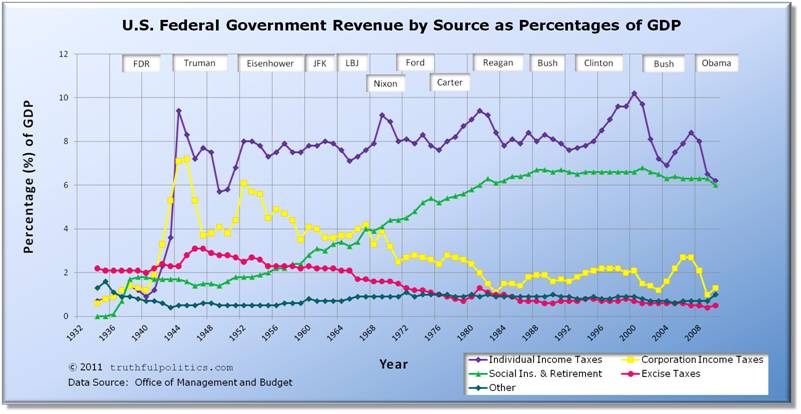
While at one time the corporate income tax took in almost as much revenue as the personal income tax, those days are long gone. In 1934 the personal income tax took in $420 million and the corporate income tax took in $364 million, (adjusted for inflation that’s $7.4 billion and $6.5 billion—still remarkably small! Taxes in the US used to be extremely low; now they are merely quite low). Today, the personal income tax takes in $1.39 trillion while the corporate income tax only takes in $320 billion. As you can see in the graph below (brought to you by Truthful Politics), while personal income tax revenue as a portion of GDP has been about the same since WW2, corporate income tax revenue has been steadily declining.

revenue_sources_GDP

Part of the problem is that it is so easy for corporations to hide their assets offshore; an estimated $2 trillion is currently held in corporate offshore accounts, almost all of it there to avoid US corporate tax.

The US corporate income tax has some unique features that set it apart from the corporate taxes of most other countries.
One, the rate of the US corporate tax is exceptionally high. That’s highly unusual; for almost every other sort of tax, the US tax rate is among the lowest, particularly when you compare with other First World countries. The United States was in a sense founded upon the idea of not paying taxes, and we have upheld that ideal for two centuries and counting.

Two, the US has a worldwide corporate tax system, whereas most countries have a territorial corporate tax system. In theory, this means that US corporations are required to pay tax on all their profits, wherever they are made, while most countries only require you to pay tax on profits you made in that country.

But wait—didn’t I just say that corporations hide trillions of dollars offshore to avoid US corporate tax? How can they do that, if they’re required to pay tax on all worldwide profits?

In a word? Loopholes.

Two that are particularly popular are inversion and transfer pricing. I won’t bore you with all the details, but basically inversion is when a US company pretends to be owned by a foreign company (I mean, I guess they are legally owned, but only on paper—real leadership rarely changes), so that their profits are now accounted in that foreign country; transfer pricing is a system by which corporations “buy” services from their subsidiaries in other countries, usually at ludicrously high prices in order to justify saying that they took a loss but their subsidiaries (which are not legally US corporations) made huge profits.

Of course, those are far from the only loopholes. There’s a long and ever-expanding list, as loopholes are like the Hydra: Cut off one head and two more shall emerge. For each loophole we close, lobbyists are hard at work creating two more. We must kill it with fire as Hercules did—burn out the entire corporate tax (and lobbying!) system as we know it and make something new.

In fact, most of the money corporations supposedly have “offshore” is actually being stored and spent here in the US. The “accounts” are offshore, but the actual cash, or more likely the actual encrypted servers that store the numbers (for that is what almost all of our money is nowadays—numbers in encrypted servers), are all here in the US. In the rare case that the money itself is actually elsewhere, they just take loans using it as collateral and spend the loan money here—because corporate debt payments are tax-deductible.

So this argument I see a lot that we need a “tax holiday” to encourage corporations to bring their money home and create jobs here is ridiculous. No, they’re already creating any jobs they were planning on creating (which of course they do only on the basis of expected consumer demand).

This money is already being used for everything it would be used for. The only distortion that corporate tax avoidance causes is a lack of tax revenue.

Now, there are two possible ways we could solve this problem in corporate tax reform.

The first is the tack Bernie Sanders takes, and it’s actually one of the few things I strongly disagree with him about. Bernie Sanders plans to reform the corporate tax system in a manner that will force corporations to actually pay taxes on their profits, closing most of these loopholes that allow them to avoid taxation.

The second is the one I favor, and for once I find myself agreeing with the American Enterprise Institute. We should eliminate the corporate tax entirely, and replace it with a higher tax rate on dividends and capital gains. I even rather like their idea of linking the tax rates on capital gains to the tax rates on ordinary income, so there is no longer any incentive to make your income be (or look likecarried interest) capital income instead of labor income.

Now, when I say that I agree with the American Enterprise Institute against Bernie Sanders, an explanation is surely in order. Normally quite the opposite is the case.

Well, first of all I also agree with the business writers in The Atlantic and The New York Times on this one, which should make my view a bit less surprising. But still, I should explain why many liberal economists think that the corporate income tax needs to disappear, since the common perception is that the corporate income tax affects the very rich, and normally liberal economists are all about raising taxes on the very rich in order to raise revenue while minimizing the harms of taxes.

And indeed I am all about raising taxes on the very rich—indeed, my proposed tax plan is the most progressive tax system this side of Eisenhower.

The problem is, we’re not sure if the corporate income tax actually does that.

I created my tax incidence series in large part to make this one fundamental point: The the person who writes the check is not necessarily person who actually pays the tax.

For personal income taxes, we understand their incidence relatively well. While we do think they create some small distortions in the economy as a whole, in general labor is inelastic enough that the burden of a personal income tax falls largely upon the person receiving the income. This makes income taxes a good means of actually redistributing income from one person to another. It’s very hard to disincentivize income; at most we might disincentivize work, and in a country that has twice as many unemployed people as job openings it’s hard for me to see how we have a problem with insufficient work incentives. If the Beveridge Curve ever gets so high up that we actually have more job openings than people looking for jobs, okay, then we can start talking about work incentives. It hasn’t happened at least in my lifetime.

Many economists argue that consumption is an even better thing to tax than income, because they want to increase the savings rate; but I am increasingly convinced that this is not actually a useful thing to do, and indeed that the savings rate is almost literally meaningless. (Perhaps in a future post I’ll talk about why I think so.) I will say this, however: Sales taxes have extremely well-understood incidence. They are the thing that our tax models were originally developed to handle, and they handle it very well. We can predict quite accurately what the effect of increases in sales taxes (or taxes on particular goods, such as alcohol) will be on consumer choices. Their predictability is a reason to recommend them, but in my opinion not sufficient to justify widespread use of sales taxes rather than income taxes.

The incidence of corporate income tax, on the other hand, is almost completely unknown. A substantial amount of research has gone into trying to understand corporate income taxes, but it is still not entirely clear who bears the primary burden of the corporate income tax, whether it is the owners of a corporation, its employees, or its customers. Because, pace Citizens United, corporations are not actually people. Corporations do not experience utility that can be raised or lowered. The money they make ultimately goes to actual human beings, and it’s those actual human beings we are interested in taxing.

To see this, think about what happens when we impose a tax on a corporation’s profits. One possibility is that their behavior is completely inelastic: They’ll just keep doing exactly the same thing they were doing, only now making less profit. But does that seem likely? No, it’s far more likely that they’re going to try to find some way to avoid the tax, or at least reduce how much they have to pay. They’ll use offshore banking and clever accounting methods to make it look like they have less profit than they really do. Even worse, they may even change the way that they run their company—producing fewer products or raising prices, laying off employees or reducing wages. They may decide not to make investments they otherwise would have, or overspend on capital they don’t actually need just for the tax deduction. All of these activities create real distortions in the economy and cause deadweight loss; and the harm they cause to employees or consumers could be much larger than the pain they impose on the owners of the corporation.

If we knew which of these strategies corporations would take, then we could predict the outcome and base our tax policy on that. But at present we are unable to do that. In fact, all of these strategies are probably employed by various corporations, and what we most care about is the aggregate effect—but we are currently unable to predict even that.

Indeed, given that they have so many options, it is most likely that the owners of corporations do not bear the burden of corporate income taxes. As you may recall from my tax incidence series, the person who bears a tax is the one who is least elastic; that is, the one who changes their behavior in response to the tax the least. This is likely to be the one who has the fewest alternatives—and employees and consumers have far fewer alternatives than corporate executives do. Indeed, employees probably have the fewest alternatives, and are likely the most inelastic; thus, they are probably the ones who actually bear the burden of the corporate income tax. And most inelastic of all are the employees at the bottom of the ladder (or should I say primate hierarchy), people like interns, janitors, and cashiers.

It may be counter-intuitive, but it is most likely true: By eliminating the corporate income tax, we will most likely create jobs and raise wages, especially for the people at the bottom. Janitors and cashiers may be the ones who feel the largest increase in pay.

There is a legitimate concern that raising capital gains rates could even have a similar effect. Under certain assumptions, the Atkinson-Stiglitz Theorem famously says that taxes on capital income cannot be used to redistribute wealth because they will impose more cost on workers than they raise in revenue for the transfer. They would reduce inequality only at the cost of reducing overall income, which clearly isn’t what we want. That would actually violate the Difference Principle, the seminal contribution to the theory of distributive justice we owe to John Rawls.

But the assumptions of that theorem are highly unrealistic, as I discussed in an earlier post. With a realistic idea of how capital income is actually allocated (I honestly can’t bear to say “earned” in this context), it becomes fairly obvious that taxes on capital income create minimal, if any, real distortions on hiring and investment. While corporate profits are fairly closely tied to the actual production and distribution of goods, capital income most assuredly is not. A corporate income tax takes money away from a corporation such as Apple or Boeing (well, not Apple or Boeing in particular, since they avoid it expertly; but the corporations that aren’t big enough to avoid corporate taxes are largely ones you’ve never heard of—yet another reason they’re unfair), who then most likely take it from their employees or their customers. A capital gains tax takes money away from people who bought and sold shares of Apple and Boeing, possibly thousands of times per second, people who most likely don’t even work there, have nothing to do with any decisions those companies have ever made, and may not even buy any of their products. I think you can see why in the latter case the decisions of the company are a lot less likely to be distorted.

It’s also harder to avoid capital gains taxes (albeit by no means impossible), especially if they are structured properly without loopholes. Thus, the same nominal rate on capital gains instead of corporate profits would likely raise a great deal more revenue.

In short, the corporate income tax is not working; I say we get rid of it altogether.

Why does nobody want to become a teacher?

JDN 2457366

The United States is currently suffering a large and growing shortage of qualified teachers, particularly in grades K-12. In some particular areas, this shortage is extremely acute; high schools are not able to teach some courses because there is simply no one qualified to teach them. Science and math teachers are in particularly high demand, because these programs are being expanded even as the people qualified to teach them are shifting over to working at the college level or in the private sector.

Other countries are also suffering severe teacher shortages, including the UK and several other countries in the EU.
The problem is projected to get worse: Enrollments in teacher training are rapidly declining. Meanwhile, because somewhere along the way people got convinced that the problem with education is that our teachers aren’t smart enough (this is completely, totally wrong by the way), standards for becoming a teacher are becoming ever more stringent, narrowing the pool even more.

This is a very serious problem, because education—often called “human capital investment” in economic jargon—is one of the most important investments any society can make. Indeed, it may be the most important, the one factor of production that is absolutely indispensable. If you run out of one raw material, you can make products out of something else. Manual labor can be replaced by machines. If you don’t have enough machines, you can build more. But if you find yourself without anyone who knows how to read and do arithmetic, how are you going to replace that? If we imagine a scenario like being trapped on a desert island or colonizing Mars where we have to start from scratch and we are only allowed to have one factor of production, education is the one we would want to have. (I guess if it’s Mars you do need a certain bare minimum of physical capital, like a spacesuit.)

The teacher shortage is most acute in high-poverty areas, where educational outcomes are terrible. Indeed, the most important cause of the failings of the US education system has always been poverty.

Why are teachers in poor schools so underqualified? Because their working conditions are terrible. Turnover is extremely high because teachers are underpaid, the schools are undersupplied, and their administrators do not support them.

Why are there so many teachers not qualified to teach their subjects? Because people who are qualified can find better jobs in other places. Jobs just as rewarding, that make just as large a contribution to society, which are more pleasant, offer more autonomy, and pay a lot better.

If you are an expert in physics, you could become a physicist and make a median income of $106,000.

If you are an expert in economics, you could become an economist and make a median income of $92,000.

If you are an expert in biology, you could become a biochemist and make a median income of $81,000.

Or, instead of all those things, you could become a high school teacher and make a median income of $55,000. Gee, I wonder which one you’re going to do?

Keep that in mind if it sounds ridiculous to you to pay teachers $100,000 salaries.

Even in wealthy schools, teachers are miserable; I have this on direct testimony from my father, who has taught high school in Ann Arbor for almost 20 years now. There are a lot of teachers who believe in making a difference through education, but quickly become burnt out and leave for better working conditions.

I know in my own case that I’m not planning on teaching high school, even though I know I’d be very good at it and I’ve always found teaching very rewarding. I’d actually be qualified to teach several subjects, from mathematics to social studies and even including physics and Latin. Any public school would be thrilled to have me—but probably not thrilled enough to pay me as much as I’d get from a university, international institution, or policy think-tank. So it’s hard for me to justify the career decision of going into public education.

The absolute highest-paid teacher in the Ann Arbor Public Schools is paid $109,000 gross—and Ann Arbor is one of the highest-paying school systems in the nation, and not coincidentally also one of the best. Most of the professors at the University of Michigan are paid over $100,000 gross and some are paid over $300,000. (As a public school, the University of Michigan releases all its salaries.)

So, you’re living in Ann Arbor… you have a graduate degree… you want to work in education; you could either start at $40,000 and maybe work your way up to $100,000 by teaching high school, or you could start at $100,000 and maybe work your way up to $300,000 by teaching college. (Admittedly, to teach in college you generally also need to do research work and probably get a PhD; so it’s not quite an equal comparison. But the most-qualified educators would be good at either job.)

Economics, along with most science and math fields, pays particularly well outside education. This senior economist position at the World Bank pays at grade GG, which is a minimum starting net salary of $102,000.
How can we solve our teacher shortage? It’s really quite simple: Offer higher salaries for teachers. If you want the best-qualified people in your classrooms, you must pay salaries that attract the best-qualified people. If you pay substandard salaries, you’re going to attract substandard talent. “Those who can, do; those who can’t, teach” isn’t a law of nature; it’s a result of public policy decisions to keep teachers systematically underpaid.

Most of the time when people say “It’s just ECON 101”, they don’t actually understand economics very well and likely have not actually taken ECON 101. But this really basically is a question of ECON 101: Supply and demand. If you have a shortage of something, not enough people willing to produce it compared to the number of people who want to buy it, you must raise the price.

Would that be expensive? Yes it would. Doubling the salary of every teacher would raise total spending on education by about 75%, because teacher compensation is about three-quarters of education spending. This would raise US K-12 education spending from about $600 billion per year to more like $1.05 trillion per year, an additional $450 billion per year in public spending, or a little less than $1,500 per American per year. That is not a small amount of money; indeed, it’s about three times what we’d need to end world hunger. And this is actually an underestimate, since we also hope to hire more teachers and should also improve facilities while we’re at it. So a truly comprehensive educational reform project could very well double our total spending on K-12 education to $1.2 trillion.

And if you want to go up there on a podium and actually tell people, “It would be nice to improve our educational system, but we simply can’t afford to do it without raising taxes unreasonably high!” then that is absolutely a reasonable argument to make. There are always tradeoffs in life. At some point, maybe it really isn’t worth spending an extra million dollars to educate one more child. (Is it worth an extra million dollars to educate two more children? Based on net present value of earnings, yes. And frankly I don’t think net present value of earnings even gets close to assessing the true value of an education; it’s a very weak lower bound.)

But I am sick and tired of people saying “Education is our highest priority!” and then refusing to actually spend the money it would take to improve our educational system. This is not a question of “finding solutions”; we know what to do. Raise teacher salaries. Improve schools. Buy new textbooks. People just aren’t willing to actually pony up the cash to do it. They want an easy way out, some simple way of making education better that somehow won’t cost anything. But we’ve been searching for that for awhile now—don’t you think we’d have found it by now?

Why building more roads doesn’t stop rush hour

JDN 2457362

The topic of this post was selected based on the very first Patreon vote (which was albeit limited because I only had three patrons eligible to vote and only one of them actually did vote; but these things always start small, right?). It is what you (well, one of you) wanted to see. In future months there will be more such posts, and hopefully more people will vote.

Most Americans face an economic paradox every morning and every evening. Our road network is by far the largest in the world (for three reasons: We’re a huge country geographically, we have more money than anyone else, and we love our cars), and we continue to expand it; yet every morning around 8:00-9:00 and every evening around 17:00-18:00 we face rush hour, in which our roads become completely clogged by commuters and it takes two or three times as long to get anywhere.

Indeed, rush hour is experienced around the world, though it often takes the slightly different form of clogged public transit instead of clogged roads. In most countries, there are two specific one-hour periods in the morning and the evening in which all transportation is clogged to a standstill.

This is probably such a familiar part of your existence you never stopped to question it. But in fact it is quite bizarre; the natural processes of economic supply and demand should have solved this problem decades ago, so why haven’t they?

There are a number of important forces at work here, all of which conspire to doom our transit systems.

The first is the Tragedy of the Commons, which I’ll likely write about in the future (but since it didn’t win the vote, not just yet). The basic idea of the Tragedy of the Commons is similar to the Prisoner’s Dilemma, but expanded to a large number of people. A Tragedy of the Commons is a situation in which there are many people, each of whom has the opportunity to either cooperate with the group and help everyone a small amount, or defect from the group and help themselves a larger amount. If everyone cooperates, everyone is better off; but holding everyone else’s actions fixed, it is in each person’s self-interest to defect.

As it turns out, people do act closer to the neoclassical prediction in the Tragedy of the Commons—which is something I’d definitely like to get into at some point. Two different psychological mechanisms counter one another, and result in something fairly close to the prediction of neoclassical rational self-interest, at least when the number of people involved is very large. It’s actually a good example of how real human beings can deviate from neoclassical rationality both in a good way (we are altruistic) and in a bad way (we are irrational).

The large-scale way roads are a Tragedy of the Commons is that they are a public good, something that we share as a society. Except for toll roads (which I’ll get to in a moment), roads are set up so that once they are built, anyone can use them; so the best option for any individual person is to get everyone else to pay to build them and then quite literally free-ride on the roads everyone else built. But if everyone tries to do that, nobody is going to pay for the roads at all.

And indeed, our roads are massively underfunded. Simply to maintain currently-existing roads we need to spend about an additional $100 billion per year over what we’re already spending. Yet once you factor in all the extra costs of damaged vehicles, increased accidents, time wasted, and the fact that fixing things is cheaper than replacing them, in fact the cost to not maintain our roads is about 3 times as large as that. This is exactly what you expect to see in a Tragedy of the Commons; there’s a huge benefit for everyone just sitting there, not getting done, because nobody wants to pay for it themselves. Michigan saw this quite dramatically when we voted down increased road funding because it would have slightly increased sales taxes. (Granted, we should be funding roads with fuel taxes, not general sales taxes—but those are hardly any more popular.)

Toll roads can help with this, because they internalize the externality: When you have to pay for the roads that you use, you either use them less (creating less wear and tear) or pay more; either way, the gap between what is paid and what is needed is closed. And indeed, toll roads are better maintained than other roads. There are downsides, however; the additional effort to administrate the tolls is expensive, and traffic can be slowed down by toll booths (though modern transponder systems mitigate this effect substantially). Also, it’s difficult to fully privatize roads, because there is a large up-front cost and it takes a long time for a toll road to become profitable; most corporations don’t want to wait that long.

But we do build a lot of roads, and yet still we have rush hour. So that isn’t the full explanation.

The small-scale way that roads are a Tragedy of the Commons is that when you decide to drive during rush hour, you are in a sense defecting in a Tragedy of the Commons. You will get to your destination sooner than if you had waited until traffic clears; but by adding one more car to the congestion you have slowed everyone else down just a little bit. When we sum up all these little delays, we get the total gridlock that is rush hour. If you had instead waited to drive on clear roads, you would get to your destination without inconveniencing anyone else—but you’d get there a lot later.

The second major reason why we have rush hour is what is called induced demand. When you widen a road or add a parallel route, you generally fail to reduce traffic congestion on that route in the long run. What happens instead is that driving during rush hour becomes more convenient for a little while, which makes more people start driving during rush hour—they buy a car when they used to take the bus, or they don’t leave as early to go to work. Eventually enough people shift over that the equilibrium is restored—and the equilibrium is gridlock.

But if you think carefully, that can’t be the whole explanation. There are only so many people who could start driving during rush hour, so what if we simply built enough roads to accommodate them all? And if our public transit systems were better, people would feel no need to switch to driving, even if driving had in fact been made more convenient. And indeed, transportation economists have found that adding more capacity does reduce congestion—it just isn’t enough unless you also improve public transit. So why aren’t we improving public transit? See above, Tragedy of the Commons.

Yet we still don’t have a complete explanation, because of something that’s quite obvious in hindsight: Why do we all work 9:00 to 17:00!? There’s no reason for that. There’s nothing inherent about the angle of sunlight or something which requires us to work these hours—indeed, if there were, Daylight Savings Time wouldn’t work (which is not to say that it works well—Daylight Savings Times kills).

There should be a competitive market pressure to work different hours, which should ultimately lead to an equilibrium where traffic is roughly constant throughout the day, at least during the time when a large swath of the population is awake and outside. Congestion should spread itself out over time, because it is to the advantage of all involved if each driver tries to drive at a time when other driver’s aren’t. Driving outside of rush hour gives us an opportunity for something like “temporal arbitrage”, where you can pay a small amount of time here to get a larger amount of time there. And if there’s one thing a competitive economy is supposed to get rid of, it’s arbitrage.

But no, we keep almost all our working hours aligned at 09:00-17:00, and thus we get rush hour.

In fact, a lot of jobs would function better if they weren’t aligned in this way—retail sales, for example, is most successful during the “off hours”, because people only shop when they aren’t working. (Well, except for online shopping, and even then they’re not supposed to.) Banks continually insist on making their hours 9:00 to 17:00 when they know that on most days they’d actually get more business from 17:00 to 19:00 than they did from 9:00 to 17:00. Some banks are at least figuring that out enough to be open from 17:00 to 19:00—but they still don’t seem to grasp that retail banking services have no reason to be open during normal business hours. Commerce banking services do; but that’s a small portion of their overall customers (albeit not of their overall revenue). There’s no reason to have so many full branches open so many hours with most of the tellers doing nothing most of the time.

Education would be better off being later in the day, when students—particularly teenagers—have a chance to sleep in the way their brains are evolved to. The benefits of later school days in terms of academic performance and public health are actually astonishingly large. When you move the start of high school from 07:00 to 09:00, auto collisions involving teenagers drop 70%. Perhaps should be the new slogans: “Early classes cause car crashes.” Since 25% of auto collisions occur during rush hour, here’s another: “Always working nine to five? Vehicular homicide.”

Other jobs could have whatever hours they please. There’s no reason for most forms of manufacturing to be done at any particular hour of the day. Most clerical and office work could be done at any time (and thanks to the Internet, any place; though there are real benefits to working in an office). Writing can be done whenever it is convenient for the author—and when you think about it, an awful lot of jobs basically amount to writing.

Finance is only handled 09:00-17:00 because we force it to be. The idea of “opening” and “closing” the stock market each day is profoundly anachronistic, and actually amounts to granting special arbitrage privileges to the small number of financial institutions that are allowed to do so-called “after hours” trading.

And then there’s the fact that different people have different circadian rhythms, require different amounts of sleep and prefer to sleep at different times—it’s genetic. (My boyfriend and I are roughly three hours phase-shifted relative to one another, which made it surprisingly convenient to stay in touch when I lived in California and he lived in Michigan.)

Why do we continue to accept such absurdity?

Whenever you find yourself asking that question, try this answer first, for it is by far the most likely:

Social norms.

Social norms will make human beings do just about anything, from eating cockroaches to murdering elephants, from kilts to burqas, from waving giant foam hands to throwing octopus onto ice rinks, from landing on the moon to crashing into the World Trade Center, from bombing Afghanistan to marching on Washington, from eating only raw foods to using dead pigs as sex toys. Our basic mental architecture is structured around tribal identity, and to preserve that identity we will follow almost any rule imaginable. To a first approximation, all human behavior is social norms.

And indeed I can find no other explanation for why we continue to work on a “nine-to-five” 09:00-17:00 schedule (or for that matter why it probably feels weird to you that I say “17:00” instead of the far less efficient and more confusion-prone “5:00 PM”). Our productivity has skyrocketed, increasing by a factor of 4 just since 1950 (and these figures dramatically underestimate the gains in productivity from computer technology, because so much is in the form of free content, which isn’t counted in GDP). We could do the same work in a quarter the time, or twice as much in half the time. Yet still we continue to work the same old 40-hour work week, nine-to-five work day. We each do the work of a dozen previous workers, yet we still find a way to fill the same old work week, and the rich who grow ever richer still pay us more or less the same real wages. It’s all basically social norms at this point; this is how things have always been done, and we can’t imagine any other way. When you get right down to it, capitalism is fundamentally a system of social norms—a very successful one, but far from the only possibility and perhaps not the best.

Thus, why does building more roads not solve the problem of rush hour? Because we have a social norm that says we are all supposed to start work at 09:00 and end work at 17:00.
And that, dear readers, is what we must endeavor to change. Change our thinking, and we will change the norms. Change the norms, and we will change the world.