How much should we give of ourselves?

Jul 23 JDN 2460149

This is a question I’ve written about before, but it’s a very important one—perhaps the most important question I deal with on this blog—so today I’d like to come back to it from a slightly different angle.

Suppose you could sacrifice all the happiness in the rest of your life, making your own existence barely worth living, in exchange for saving the lives of 100 people you will never meet.

  1. Would it be good for you do so?
  2. Should you do so?
  3. Are you a bad person if you don’t?
  4. Are all of the above really the same question?

Think carefully about your answer. It may be tempting to say “yes”. It feels righteous to say “yes”.

But in fact this is not hypothetical. It is the actual situation you are in.

This GiveWell article is entitled “Why is it so expensive to save a life?” but that’s incredibly weird, because the actual figure they give is astonishingly, mind-bogglingly, frankly disgustingly cheap: It costs about $4500 to save one human life. I don’t know how you can possibly find that expensive. I don’t understand how anyone can think, “Saving this person’s life might max out a credit card or two; boy, that sure seems expensive!

The standard for healthcare policy in the US is that something is worth doing if it is able to save one quality-adjusted life year for less than $50,000. That’s one year for ten times as much. Even accounting for the shorter lifespans and worse lives in poor countries, saving someone from a poor country for $4500 is at least one hundred times as cost-effective as that.

To put it another way, if you are a typical middle-class person in the First World, with an after-tax income of about $25,000 per year, and you were to donate 90% of that after-tax income to high-impact charities, you could be expected to save 5 lives every year. Over the course of a 30-year career, that’s 150 lives saved.

You would of course be utterly miserable for those 30 years, having given away all the money you could possibly have used for any kind of entertainment or enjoyment, not to mention living in the cheapest possible housing—maybe even a tent in a homeless camp—and eating the cheapest possible food. But you could do it, and you would in fact be expected to save over 100 lives by doing so.

So let me ask you again:

  1. Would it be good for you do so?
  2. Should you do so?
  3. Are you a bad person if you don’t?
  4. Are all of the above really the same question?

Peter Singer often writes as though the answer to all these questions is “yes”. But even he doesn’t actually live that way. He gives a great deal to charity, mind you; no one seems to know exactly how much, but estimates range from at least 10% to up to 50% of his income. My general impression is that he gives about 10% of his ordinary income and more like 50% of big prizes he receives (which are in fact quite numerous). Over the course of his life he has certainly donated at least a couple million dollars. Yet he clearly could give more than he does: He lives a comfortable, upper-middle-class life.

Peter Singer’s original argument for his view, from his essay “Famine, Affluence, and Morality”, is actually astonishingly weak. It involves imagining a scenario where a child is drowning in a lake and you could go save them, but only at the cost of ruining your expensive suit.

Obviously, you should save the child. We all agree on that. You are in fact a terrible person if you wouldn’t save the child.

But Singer tries to generalize this into a principle that requires us to donate all most of our income to international charities, and that just doesn’t follow.

First of all, that suit is not worth $4500. Not if you’re a middle-class person. That’s a damn Armani. No one who isn’t a millionaire wears suits like that.

Second, in the imagined scenario, you’re the only one who can help the kid. All I have to do is change that one thing and already the answer is different: If right next to you there is a trained, certified lifeguard, they should save the kid, not you. And if there are a hundred other people at the lake, and none of them is saving the kid… probably there’s a good reason for that? (It could be bystander effect, but actually that’s much weaker than a lot of people think.) The responsibility doesn’t uniquely fall upon you.

Third, the drowning child is a one-off, emergency scenario that almost certainly will never happen to you, and if it does ever happen, will almost certainly only happen once. But donation is something you could always do, and you could do over and over and over again, until you have depleted all your savings and run up massive debts.

Fourth, in the hypothetical scenario, there is only one child. What if there were ten—or a hundred—or a thousand? What if you couldn’t possibly save them all by yourself? Should you keep going out there and saving children until you become exhausted and you yourself drown? Even if there is a lifeguard and a hundred other bystanders right there doing nothing?

And finally, in the drowning child scenario, you are right there. This isn’t some faceless stranger thousands of miles away. You can actually see that child in front of you. Peter Singer thinks that doesn’t matter—actually his central point seems to be that it doesn’t matter. But I think it does.

Singer writes:

It makes no moral difference whether the person I can help is a neighbor’s child ten yards away from me or a Bengali whose name I shall never know, ten thousand miles away.

That’s clearly wrong, isn’t it? Relationships mean nothing? Community means nothing? There is no moral value whatsoever to helping people close to us rather than random strangers on the other side of the planet?

One answer might be to say that the answer to question 4 is “no”. You aren’t a bad person for not doing everything you should, and even though something would be good if you did it, that doesn’t necessarily mean you should do it.

Perhaps some things are above and beyond the call of duty: Good, perhaps even heroic, if you’re willing to do them, but not something we are all obliged to do. The formal term for this is supererogatory. While I think that overall utilitarianism is basically correct and has done great things for human society, one thing I think most utilitarians miss is that they seem to deny that supererogatory actions exist.

Even then, I’m not entirely sure it is good to be this altruistic.

Someone who really believed that we owe as much to random strangers as we do to our friends and family would never show up to any birthday parties, because any time spent at a birthday party would be more efficiently spent earning-to-give to some high-impact charity. They would never visit their family on Christmas, because plane tickets are expensive and airplanes burn a lot of carbon.

They also wouldn’t concern themselves with whether their job is satisfying or even not totally miserable; they would only care whether the total positive impact they can have on the world is positive, either directly through their work or by raising as much money as possible and donating it all to charity.

They would rest only the minimum amount they require to remain functional, eat only the barest minimum of nutritious food, and otherwise work, work, work, constantly, all the time. If their body was capable of doing the work, they would continue doing the work. For there is not a moment to waste when lives are on the line!

A world full of people like that would be horrible. We would all live our entire lives in miserable drudgery trying to maximize the amount we can donate to faceless strangers on the other side of the planet. There would be no joy or friendship in that world, only endless, endless toil.

When I bring this up in the Effective Altruism community, I’ve heard people try to argue otherwise, basically saying that we would never need everyone to devote themselves to the cause at this level, because we’d soon solve all the big problems and be able to go back to enjoying our lives. I think that’s probably true—but it also kind of misses the point.

Yes, if everyone gave their fair share, that fair share wouldn’t have to be terribly large. But we know for a fact that most people are not giving their fair share. So what now? What should we actually do? Do you really want to live in a world where the morally best people are miserable all the time sacrificing themselves at the altar of altruism?

Yes, clearly, most people don’t do enough. In fact, most people give basically nothing to high-impact charities. We should be trying to fix that. But if I am already giving far more than my fair share, far more than I would have to give if everyone else were pitching in as they should—isn’t there some point at which I’m allowed to stop? Do I have to give everything I can or else I’m a monster?

The conclusion that we ought to make ourselves utterly miserable in order to save distant strangers feels deeply unsettling. It feels even worse if we say that we ought to do so, and worse still if we feel we are bad people if we don’t.

One solution would be to say that we owe absolutely nothing to these distant strangers. Yet that clearly goes too far in the opposite direction. There are so many problems in this world that could be fixed if more people cared just a little bit about strangers on the other side of the planet. Poverty, hunger, war, climate change… if everyone in the world (or really even just everyone in power) cared even 1% as much about random strangers as they do about themselves, all these would be solved.

Should you donate to charity? Yes! You absolutely should. Please, I beseech you, give some reasonable amount to charity—perhaps 5% of your income, or if you can’t manage that, maybe 1%.

Should you make changes in your life to make the world better? Yes! Small ones. Eat less meat. Take public transit instead of driving. Recycle. Vote.

But I can’t ask you to give 90% of your income and spend your entire life trying to optimize your positive impact. Even if it worked, it would be utter madness, and the world would be terrible if all the good people tried to do that.

I feel quite strongly that this is the right approach: Give something. Your fair share, or perhaps even a bit more, because you know not everyone will.

Yet it’s surprisingly hard to come up with a moral theory on which this is the right answer.

It’s much easier to develop a theory on which we owe absolutely nothing: egoism, or any deontology on which charity is not an obligation. And of course Singer-style utilitarianism says that we owe virtually everything: As long as QALYs can be purchased cheaper by GiveWell than by spending on yourself, you should continue donating to GiveWell.

I think part of the problem is that we have developed all these moral theories as if we were isolated beings, who act in a world that is simply beyond our control. It’s much like the assumption of perfect competition in economics: I am but one producer among thousands, so whatever I do won’t affect the price.

But what we really needed was a moral theory that could work for a whole society. Something that would still make sense if everyone did it—or better yet, still make sense if half the people did it, or 10%, or 5%. The theory cannot depend upon the assumption that you are the only one following it. It cannot simply “hold constant” the rest of society.

I have come to realize that the Effective Altruism movement, while probably mostly good for the world as a whole, has actually been quite harmful to the mental health of many of its followers, including myself. It has made us feel guilty for not doing enough, pressured us to burn ourselves out working ever harder to save the world. Because we do not give our last dollar to charity, we are told that we are murderers.

But there are real murderers in this world. While you were beating yourself up over not donating enough, Vladmir Putin was continuing his invasion of Ukraine, ExxonMobil was expanding its offshore drilling, Daesh was carrying out hundreds of terrorist attacks, Qanon was deluding millions of people, and the human trafficking industry was making $150 billion per year.

In other words, by simply doing nothing you are considerably better than the real monsters responsible for most of the world’s horror.

In fact, those starving children in Africa that you’re sending money to help? They wouldn’t need it, were it not for centuries of colonial imperialism followed by a series of corrupt and/or incompetent governments ruled mainly by psychopaths.

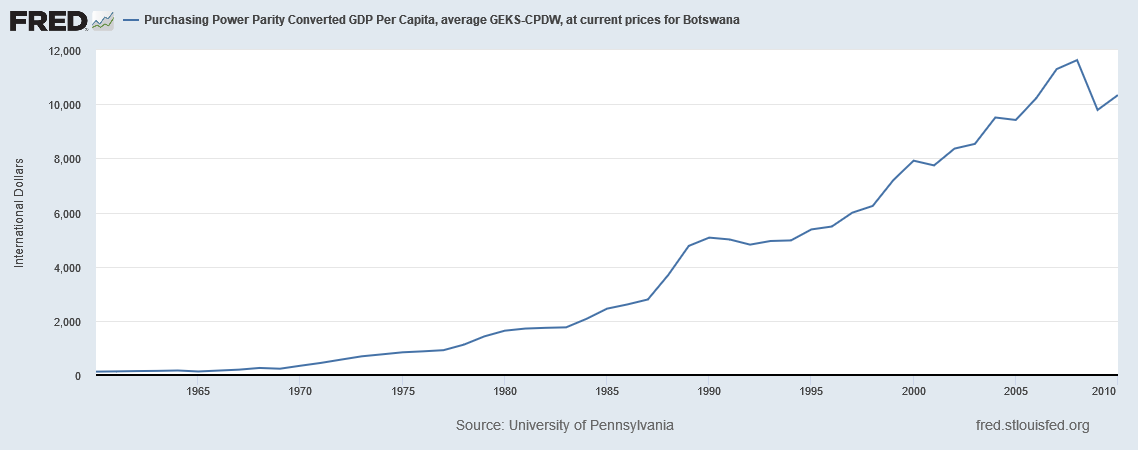
Indeed the best way to save those people, in the long run, would be to fix their governments—as has been done in places like Namibia and Botswana. According to the World Development Indicators, the proportion of people living below the UN extreme poverty line (currently $2.15 per day at purchasing power parity) has fallen from 36% to 16% in Namibia since 2003, and from 42% to 15% in Botswana since 1984. Compare this to some countries that haven’t had good governments over that time: In Cote d’Ivoire the same poverty rate was 8% in 1985 but is 11% today (and was actually as high as 33% in 2015), while in Congo it remains at 35%. Then there are countries that are trying, but just started out so poor it’s a long way to go: Burkina Faso’s extreme poverty rate has fallen from 82% in 1994 to 30% today.

In other words, if you’re feeling bad about not giving enough, remember this: if everyone in the world were as good as you, you wouldn’t need to give a cent.

Of course, simply feeling good about yourself for not being a psychopath doesn’t accomplish very much either. Somehow we have to find a balance: Motivate people enough so that they do something, get them to do their share; but don’t pressure them to sacrifice themselves at the altar of altruism.

I think part of the problem here—and not just here—is that the people who most need to change are the ones least likely to listen. The kind of person who reads Peter Singer is already probably in the top 10% of most altruistic people, and really doesn’t need much more than a slight nudge to be doing their fair share. And meanwhile the really terrible people in the world have probably never picked up an ethics book in their lives, or if they have, they ignored everything it said.

I don’t quite know what to do about that. But I hope I can least convince you—and myself—to take some of the pressure off when it feels like we’re not doing enough.

Why we need critical thinking

Jul 9 JDN 2460135

I can’t find it at the moment, but awhile ago I read a surprisingly compelling post on social media (I think it was Facebook, but it could also have been Reddit) questioning the common notion that we should be teaching more critical thinking in school.

I strongly believe that we should in fact be teaching more critical thinking in school—actually I think we should replace large chunks of the current math curriculum with a combination of statistics, economics and critical thinking—but it made me realize that we haven’t done enough to defend why that is something worth doing. It’s just become a sort of automatic talking point, like, “obviously you would want more critical thinking, why are you even asking?”

So here’s a brief attempt to explain why critical thinking is something that every citizen ought to be good at, and hence why it’s worthwhile to teach it in primary and secondary school.

Critical thinking, above all, allows you to detect lies. It teaches you to look past the surface of what other people are saying and determine whether what they are saying is actually true.

And our world is absolutely full of lies.

We are constantly lied to by advertising. We are constantly lied to by spam emails and scam calls. Day in and day out, people with big smiles promise us the world, if only we will send them five easy payments of $19.99.

We are constantly lied to by politicians. We are constantly lied to by religious leaders (it’s pretty much their whole job actually).

We are often lied to by newspapers—sometimes directly and explicitly, as in fake news, but more often in subtler ways. Most news articles in the mainstream press are true in the explicit facts they state, but are missing important context; and nearly all of them focus on the wrong things—exciting, sensational, rare events rather than what’s actually important and likely to affect your life. If newspapers were an accurate reflection of genuine risk, they’d have more articles on suicide than homicide, and something like one million articles on climate change for every one on some freak accident (like that submarine full of billionaires).

We are even lied to by press releases on science, which likewise focus on new, exciting, sensational findings rather than supported, established, documented knowledge. And don’t tell me everyone already knows it; just stating basic facts about almost any scientific field will shock and impress most of the audience, because they clearly didn’t learn this stuff in school (or, what amounts to the same thing, don’t remember it). This isn’t just true of quantum physics; it’s even true of economics—which directly affects people’s lives.

Critical thinking is how you can tell when a politician has distorted the views of his opponent and you need to spend more time listening to that opponent speak. Critical thinking could probably have saved us from electing Donald Trump President.

Critical thinking is how you tell that a supplement which “has not been evaluated by the FDA” (which is to say, nearly all of them) probably contains something mostly harmless that maybe would benefit you if you were deficient in it, but for most people really won’t matter—and definitely isn’t something you can substitute for medical treatment.

Critical thinking is how you recognize that much of the history you were taught as a child was a sanitized, simplified, nationalist version of what actually happened. But it’s also how you recognize that simply inverting it all and becoming the sort of anti-nationalist who hates your own country is at least as ridiculous. Thomas Jefferson was both a pioneer of democracy and a slaveholder. He was both a hero and a villain. The world is complicated and messy—and nothing will let you see that faster than critical thinking.


Critical thinking tells you that whenever a new “financial innovation” appears—like mortgage-backed securities or cryptocurrency—it will probably make obscene amounts of money for a handful of insiders, but will otherwise be worthless if not disastrous to everyone else. (And maybe if enough people had good critical thinking skills, we could stop the next “innovation” from getting so far!)

More widespread critical thinking could even improve our job market, as interviewers would no longer be taken in by the candidates who are best at overselling themselves, and would instead pay more attention to the more-qualified candidates who are quiet and honest.

In short, critical thinking constitutes a large portion of what is ordinarily called common sense or wisdom; some of that simply comes from life experience, but a great deal of it is actually a learnable skill set.

Of course, even if it can be learned, that still raises the question of how it can be taught. I don’t think we have a sound curriculum for teaching critical thinking, and in my more cynical moments I wonder if many of the powers that be like it that way. Knowing that many—not all, but many—politicians make their careers primarily from deceiving the public, it’s not so hard to see why those same politicians wouldn’t want to support teaching critical thinking in public schools. And it’s almost funny to me watching evangelical Christians try to justify why critical thinking is dangerous—they come so close to admitting that their entire worldview is totally unfounded in logic or evidence.

But at least I hope I’ve convinced you that it is something worthwhile to know, and that the world would be better off if we could teach it to more people.

We do seem to have better angels after all

Jun 18 JDN 2460114

A review of The Darker Angels of Our Nature

(I apologize for not releasing this on Sunday; I’ve been traveling lately and haven’t found much time to write.)

Since its release, I have considered Steven Pinker’s The Better Angels of our Nature among a small elite category of truly great books—not simply good because enjoyable, informative, or well-written, but great in its potential impact on humanity’s future. Others include The General Theory of Employment, Interest, and Money, On the Origin of Species, and Animal Liberation.

But I also try to expose myself as much as I can to alternative views. I am quite fearful of the echo chambers that social media puts us in, where dissent is quietly hidden from view and groupthink prevails.

So when I saw that a group of historians had written a scathing critique of The Better Angels, I decided I surely must read it and get its point of view. This book is The Darker Angels of Our Nature.

The Darker Angels is written by a large number of different historians, and it shows. It’s an extremely disjointed book; it does not present any particular overall argument, various sections differ wildly in scope and tone, and sometimes they even contradict each other. It really isn’t a book in the usual sense; it’s a collection of essays whose only common theme is that they disagree with Steven Pinker.

In fact, even that isn’t quite true, as some of the best essays in The Darker Angels are actually the ones that don’t fundamentally challenge Pinker’s contention that global violence has been on a long-term decline for centuries and is now near its lowest in human history. These essays instead offer interesting insights into particular historical eras, such as medieval Europe, early modern Russia, and shogunate Japan, or they add additional nuances to the overall pattern, like the fact that, compared to medieval times, violence in Europe seems to have been less in the Pax Romana (before) and greater in the early modern period (after), showing that the decline in violence was not simple or steady, but went through fluctuations and reversals as societies and institutions changed. (At this point I feel I should note that Pinker clearly would not disagree with this—several of the authors seem to think he would, which makes me wonder if they even read The Better Angels.)

Others point out that the scale of civilization seems to matter, that more is different, and larger societies and armies more or less automatically seem to result in lower fatality rates by some sort of scaling or centralization effect, almost like the square-cube law. That’s very interesting if true; it would suggest that in order to reduce violence, you don’t really need any particular mode of government, you just need something that unites as many people as possible under one banner. The evidence presented for it was too weak for me to say whether it’s really true, however, and there was really no theoretical mechanism proposed whatsoever.

Some of the essays correct genuine errors Pinker made, some of which look rather sloppy. Pinker clearly overestimated the death tolls of the An Lushan Rebellion, the Spanish Inquisition, and Aztec ritual executions, probably by using outdated or biased sources. (Though they were all still extremely violent!) His depiction of indigenous cultures does paint with a very broad brush, and fails to recognize that some indigenous societies seem to have been quite peaceful (though others absolutely were tremendously violent).

One of the best essays is about Pinker’s cavalier attitude toward mass incarceration, which I absolutely do consider a deep flaw in Pinker’s view. Pinker presents increased incarceration rates along with decreased crime rates as if they were an unalloyed good, while I can at best be ambivalent about whether the benefit of decreasing crime is worth the cost of greater incarceration. Pinker seems to take for granted that these incarcerations are fair and impartial, when we have a great deal of evidence that they are strongly biased against poor people and people of color.

There’s another good essay about the Enlightenment, which Pinker seems to idealize a little too much (especially in his other book Enlightenment Now). There was no sudden triumph of reason that instantly changed the world. Human knowledge and rationality gradually improved over a very long period of time, with no obvious turning point and many cases of backsliding. The scientific method isn’t a simple, infallible algorithm that suddenly appeared in the brain of Galileo or Bayes, but a whole constellation of methods and concepts of rationality that took centuries to develop and is in fact still developing. (Much as the Tao that can be told is not the eternal Tao, the scientific method that can be written in a textbook is not the true scientific method.)

Several of the essays point out the limitations of historical and (especially) archaeological records, making it difficult to draw any useful inferences about rates of violence in the past. I agree that Pinker seems a little too cavalier about this; the records really are quite sparse and it’s not easy to fill in the gaps. Very small samples can easily distort homicide rates; since only about 1% of deaths worldwide are homicide, if you find 20 bodies, whether or not one of them was murdered is the difference between peaceful Japan and war-torn Colombia.

On the other hand, all we really can do is make the best inferences we have with the available data, and for the time periods in which we do have detailed records—surely true since at least the 19th century—the pattern of declining violence is very clear, and even the World Wars look like brief fluctuations rather than fundamental reversals. Contrary to popular belief, the World Wars do not appear to have been especially deadly on a per-capita basis, compared to various historic wars. The primary reason so many people died in the World Wars was really that there just were more people in the world. A few of the authors don’t seem to consider this an adequate reason, but ask yourself this: Would you rather live in a society of 100 in which 10 people are killed, or a society of 1 billion in which 1 million are killed? In the former case your chances of being killed are 10%; in the latter, 0.1%. Clearly, per-capita measures of violence are the correct ones.

Some essays seem a bit beside the point, like one on “environmental violence” which quite aptly details the ongoing—terrifying—degradation of our global ecology, but somehow seems to think that this constitutes violence when it obviously doesn’t. There is widespread violence against animals, certainly; slaughterhouses are the obvious example—and unlike most people, I do not consider them some kind of exception we can simply ignore. We do in fact accept levels of cruelty to pigs and cows that we would never accept against dogs or horses—even the law makes such exceptions. Moreover, plenty of habitat destruction is accompanied by killing of the animals who lived in that habitat. But ecological degradation is not equivalent to violence. (Nor is it clear to me that our treatment of animals is more violent overall today than in the past; I guess life is probably worse for a beef cow today than it was in the medieval era, but either way, she was going to be killed and eaten. And at least we no longer do cat-burning.) Drilling for oil can be harmful, but it is not violent. We can acknowledge that life is more peaceful now than in the past without claiming that everything is better now—in fact, one could even say that overall life isn’t better, but I think they’d be hard-pressed to argue that.

These are the relatively good essays, which correct minor errors or add interesting nuances. There are also some really awful essays in the mix.

A common theme of several of the essays seems to be “there are still bad things, so we can’t say anything is getting better”; they will point out various forms of violence that undeniably still exist, and treat this as a conclusive argument against the claim that violence has declined. Yes, modern slavery does exist, and it is a very serious problem; but it clearly is not the same kind of atrocity that the Atlantic slave trade was. Yes, there are still murders. Yes, there are still wars. Probably these things will always be with us to some extent; but there is a very clear difference between 500 homicides per million people per year and 50—and it would be better still if we could bring it down to 5.

There’s one essay about sexual violence that doesn’t present any evidence whatsoever to contradict the claim that rates of sexual violence have been declining while rates of reporting and prosecution have been increasing. (These two trends together often result in reported rapes going up, but most experts agree that actual rapes are going down.) The entire essay is based on anecdote, innuendo, and righteous anger.

There are several essays that spend their whole time denouncing neoliberal capitalism (not even presenting any particularly good arguments against it, though such arguments do exist), seeming to equate Pinker’s view with some kind of Rothbardian anarcho-capitalism when in fact Pinker is explictly in favor of Nordic-style social democracy. (One literally dismisses his support for universal healthcare as “Well, he is Canadian”.) But Pinker has on occasion said good things about capitalism, so clearly, he is an irredeemable monster.

Right in the introduction—which almost made me put the book down—is an astonishingly ludicrous argument, which I must quote in full to show you that it is not out of context:

What actually is violence (nowhere posed or answered in The Better Angels)? How do people perceive it in different time-place settings? What is its purpose and function? What were contemporary attitudes toward violence and how did sensibilities shift over time? Is violence always ‘bad’ or can there be ‘good’ violence, violence that is regenerative and creative?

The Darker Angels of Our Nature, p.16

Yes, the scare quotes on ‘good’ and ‘bad’ are in the original. (Also the baffling jargon “time-place settings” as opposed to, say, “times and places”.) This was clearly written by a moral relativist. Aside from questioning whether we can say anything about anything, the argument seems to be that Pinker’s argument is invalid because he didn’t precisely define every single relevant concept, even though it’s honestly pretty obvious what the world “violence” means and how he is using it. (If anything, it’s these authors who don’t seem to understand what the word means; they keep calling things “violence” that are indeed bad, but obviously aren’t violence—like pollution and cyberbullying. At least talk of incarceration as “structural violence” isn’t obvious nonsense—though it is still clearly distinct from murder rates.)

But it was by reading the worst essays that I think I gained the most insight into what this debate is really about. Several of the essays in The Darker Angels thoroughly and unquestioningly share the following inference: if a culture is superior, then that culture has a right to impose itself on others by force. On this, they seem to agree with the imperialists: If you’re better, that gives you a right to dominate everyone else. They rightly reject the claim that cultures have a right to imperialistically dominate others, but they cannot deny the inference, and so they are forced to deny that any culture can ever be superior to another. The result is that they tie themselves in knots trying to justify how greater wealth, greater happiness, less violence, and babies not dying aren’t actually good things. They end up talking nonsense about “violence that is regenerative and creative”.

But we can believe in civilization without believing in colonialism. And indeed that is precisely what I (along with Pinker) believe: That democracy is better than autocracy, that free speech is better than censorship, that health is better than illness, that prosperity is better than poverty, that peace is better than war—and therefore that Western civilization is doing a better job than the rest. I do not believe that this justifies the long history of Western colonial imperialism. Governing your own country well doesn’t give you the right to invade and dominate other countries. Indeed, part of what makes colonial imperialism so terrible is that it makes a mockery of the very ideals of peace, justice, and freedom that the West is supposed to represent.

I think part of the problem is that many people see the world in zero-sum terms, and believe that the West’s prosperity could only be purchased by the rest of the world’s poverty. But this is untrue. The world is nonzero-sum. My happiness does not come from your sadness, and my wealth does not come from your poverty. In fact, even the West was poor for most of history, and we are far more prosperous now that we have largely abandoned colonial imperialism than we ever were in imperialism’s heyday. (I do occasionally encounter British people who seem vaguely nostalgic for the days of the empire, but real median income in the UK has doubled just since 1977. Inequality has also increased during that time, which is definitely a problem; but the UK is undeniably richer now than it ever was at the peak of the empire.)

In fact it could be that the West is richer now because of colonalism than it would have been without it. I don’t know whether or not this is true. I suspect it isn’t, but I really don’t know for sure. My guess would be that colonized countries are poorer, but colonizer countries are not richer—that is, colonialism is purely destructive. Certain individuals clearly got richer by such depredation (Leopold II, anyone?), but I’m not convinced many countries did.

Yet even if colonialism did make the West richer, it clearly cannot explain most of the wealth of Western civilization—for that wealth simply did not exist in the world before. All these bridges and power plants, laptops and airplanes weren’t lying around waiting to be stolen. Surely, some of the ingredients were stolen—not least, the land. Had they been bought at fair prices, the result might have been less wealth for us (then again it might not, for wealthier trade partners yield greater exports). But this does not mean that the products themselves constitute theft, nor that the wealth they provide is meaningless. Perhaps we should find some way to pay reparations; undeniably, we should work toward greater justice in the future. But we do not need to give up all we have in order to achieve that justice.

There is a law of conservation of energy. It is impossible to create energy in one place without removing it from another. There is no law of conservation of prosperity. Making the world better in one place does not require making it worse in another.

Progress is real. Yes, it is flawed, uneven, and it has costs of its own; but it is real. If we want to have more of it, we best continue to believe in it. And The Better Angels of Our Nature does have some notable flaws, but it still retains its place among truly great books.

Voting Your Dollars

May 28 JDN 2460093

It’s no secret that Americans don’t like to pay taxes. It’s almost a founding principle of our country, really, going all the way back to the Boston Tea Party. This is likely part of why the US has one of the lowest tax-to-GDP ratios in the First World; our taxes are barely half what they pay in Scandinavia. And this in turn surely contributes to our ongoing budget issues and our stingy social welfare spending. (Speaking of budget issues: As of this writing, the debt ceiling debacle is still unresolved.)

Why don’t Americans like to pay taxes? Why does no one really like to pay taxes (though some seem more willing than others)?

It surely has something to do with the fact that taxes are so coercive: You have to pay them, you get no choice. And you also have very little choice as to how that money is used; yes, you can vote for politicians who will in theory at some point enact budgets that might possibly reflect the priorities they expressed in their campaigns—but the actual budget invariably ends up quite far removed from the campaign promises you could vote based on.

What if we could give you more choice? We can’t let people choose how much to pay—then most people would choose to pay less and we’d be in even more trouble. (If you want to pay more than you’re required to, the IRS will actually let you right now. You can just refuse your refund.) But perhaps we could let people choose where the money goes?

I call this program Vote Your Dollars. I would initially limit it to a small fraction of the budget, tied to a tax increase: Say, raise taxes enough to increase revenue by 5% and use that 5% for the program.

Under Vote Your Dollars, on your tax return, you are given a survey, asking you how you want to divide up your additional money toward various categories. I think they should be fairly broad categories, such as ‘healthcare’, ‘social security’, ‘anti-poverty programs’, ‘defense’, ‘foreign aid’. If we make them too specific, it would be more work for the voters and also more likely to lead to foolish allocations. We want them to basically reflect a voter’s priorities, rather than ask them to make detailed economic management decisions. Most voters are not qualified to properly allocate a budget; the goal here is to get people to weight how much they care about different programs.

As only a small portion of the budget, Vote Your Dollars would initially have very little real fiscal impact. Money is fungible, so any funds that were expected to go somewhere else than where voters put them could easily be reallocated as needed. But I suspect that most voters would fail to appreciate this effect, and thus actually feel like they have more control than they really do. (If voters understood fungibility and inframarginal transfers, they’d never have supported food stamps over just giving poor people cash.)

Moreover, it would still provide useful information, namely: What happens when voters are given this power? Do they make decisions that seem to make sense and reflect their interests and beliefs? Does the resulting budget actually seem like one that could be viable? Could it even be better than what we currently have in some ways?

I suspect that the result would be better than most economists and political scientists imagine. There seems to be a general sense that voters are too foolish or apathetic to usefully participate in politics, which of course would raise the very big question: Why does democracy work?

I don’t think that most voters would choose a perfect budget; indeed, I already said I wouldn’t trust them with the fine details of how to allocate the funds. But I do think most people have at least some reasonable idea of how important they think healthcare is relative to defense, and it would be good to at least gather that information in a more direct way.

If it goes well and Vote Your Dollars seems to result in reasonable budgets even for that extra 5%, we could start expanding it to a larger portion of the overall budget. Try 10% for the next election, then 15% for the next. There should always be some part that remains outside direct voter control, because voters would almost certainly underspend on certain categories (such as administration and national debt payments) and likely overspend on others.

This would allow us to increase taxes—which we clearly must do, because we need to improve government services, but we don’t want to go further into debt—while giving voters more choice, and thus making taxes feel less coercive. Being forced to pay a certain amount each year might not sting as much if you get to say where a significant portion of that money goes.

To give voters even more control over their money, I think I would also include a provision whereby you can deduct the full amount of your charitable contributions to certain high-impact charities (we would need to come up with a good list, but clear examples include UNICEF, Oxfam, and GiveWell) from your tax payment. Currently, you deduct charitable contributions from your income, which means you don’t pay taxes on those donations; but you still end up with less money after donating than you did before. If we let you deduct the full amount, then you would have the same amount after donating, and effectively the government would pay the full cost of your donation. Presumably this would lead to people donating a great deal; this might hurt tax revenues, but its overall positive impact on the world would be so large that it is obviously worth it. By the time we have given enough to UNICEF to meaningfully impact the US federal budget, we have ended world hunger.

Of course, it’s very unlikely that anything like Vote Your Dollars would ever be implemented. There are already ways we could make paying taxes less painful that we haven’t done—such as sending you a bill, as they do in Denmark, rather than making you file a tax form. And we could already increase revenue with very little real cost by simply expanding the IRS and auditing rich people more. These simple, obvious reforms have been repeatedly obstructed by powerful lobbies, who personally benefit from the current system even though it’s obviously a bad system. I guess I can’t think of anyone in particular who would want to lobby against Vote Your Dollars, but I feel like Republicans might just because they want taxes to hurt as much as possible so that they have an excuse to cut spending.

But still, I thought I’d put the idea out there.

Reckoning costs in money distorts them

May 7 JDN 2460072

Consider for a moment what it means when an economic news article reports “rising labor costs”. What are they actually saying?

They’re saying that wages are rising—perhaps in some industry, perhaps in the economy as a whole. But this is not a cost. It’s a price. As I’ve written about before, the two are fundamentally distinct.

The cost of labor is measured in effort, toil, and time. It’s the pain of having to work instead of whatever else you’d like to do with your time.

The price of labor is a monetary amount, which is delivered in a transaction.

This may seem perfectly obvious, but it has important and oft-neglected implications. A cost, one paid, is gone. That value has been destroyed. We hope that it was worth it for some benefit we gained. A price, when paid, is simply transferred: One person had that money before, now someone else has it. Nothing was gained or lost.

So in fact when reports say that “labor costs have risen”, what they are really saying is that income is being transferred from owners to workers without any change in real value taking place. They are framing as a loss what is fundamentally a zero-sum redistribution.

In fact, it is disturbingly common to see a fundamentally good redistribution of income framed in the press as a bad outcome because of its expression as “costs”; the “cost” of chocolate is feared to go up if we insist upon enforcing bans on forced labor—when in fact it is only the price that goes up, and the cost actually goes down: chocolate would no longer include complicity in an atrocity. The real suffering of making chocolate would be thereby reduced, not increased. Even when they aren’t literally enslaved, those workers are astonishingly poor, and giving them even a few more cents per hour would make a real difference in their lives. But God forbid we pay a few cents more for a candy bar!

If labor costs were to rise, that would mean that work had suddenly gotten harder, or more painful; or else, that some outside circumstance had made it more difficult to work. Having a child increases your labor costs—you now have the opportunity cost of not caring for the child. COVID increased the cost of labor, by making it suddenly dangerous just to go outside in public. That could also increase prices—you may demand a higher wage, and people do seem to have demanded higher wages after COVID. But these are two separate effects, and you can have one without the other. In fact, women typically see wage stagnation or even reduction after having kids (but men largely don’t), despite their real opportunity cost of labor having obviously greatly increased.

On an individual level, it’s not such a big mistake to equate price and cost. If you are buying something, its cost to you basically just is its price, plus a little bit of transaction cost for actually finding and buying it. But on a societal level, it makes an enormous difference. It distorts our policy priorities and can even lead to actively trying to suppress things that are beneficial—such as rising wages.

This false equivalence between price and costs seems to be at least as common among economists as it is among laypeople. Economists will often justify it on the grounds that in an ideal perfect competitive market the two would be in some sense equated. But of course we don’t live in that ideal perfect market, and even if we did, they would only beproportional at the margin, not fundamentally equal across the board. It would still be obviously wrong to characterize the total value or cost of work by the price paid for it; only the last unit of effort would be priced so that marginal value equals price equals marginal cost. The first 39 hours of your work would cost you less than what you were paid, and produce more than you were paid; only that 40th hour would set the three equal.

Once you account for all the various market distortions in the world, there’s no particular relationship between what something costs—in terms of real effort and suffering—and its price—in monetary terms. Things can be expensive and easy, or cheap and awful. In fact, they often seem to be; for some reason, there seems to be a pattern where the most terrible, miserable jobs (e.g. coal mining) actually pay the leastand the easiest, most pleasant jobs (e.g. stock trading) pay the most. Some jobs that benefit society pay well (e.g. doctors) and others pay terribly or not at all (e.g. climate activists). Some actions that harm the world get punished (e.g. armed robbery) and others get rewarded with riches (e.g. oil drilling). In the real world, whether a job is good or bad and whether it is paid well or poorly seem to be almost unrelated.

In fact, sometimes they seem even negatively related, where we often feel tempted to “sell out” and do something destructive in order to get higher pay. This is likely due to Berkson’s paradox: If people are willing to do jobs if they are either high-paying or beneficial to humanity, then we should expect that, on average, most of the high-paying jobs people do won’t be beneficial to humanity. Even if there were inherently no correlation or a small positive one, people’s refusal to do harmful low-paying work removes those jobs from our sample and results in a negative correlation in what remains.

I think that the best solution, ultimately, is to stop reckoning costs in money entirely. We should reckon them in happiness.

This is of course much more difficult than simply using prices; it’s not easy to say exactly how many QALY are sacrificed in the extraction of cocoa beans or the drilling of offshore oil wells. But if we actually did find a way to count them, I strongly suspect we’d find that it was far more than we ought to be willing to pay.

A very rough approximation, surely flawed but at least a start, would be to simply convert all payments into proportions of their recipient’s income: For full-time wages, this would result in basically everyone being counted the same, as 1 hour of work if you work 40 hours per week, 50 weeks per year is precisely 0.05% of your annual income. So we could say that whatever is equivalent to your hourly wage constitutes 50 microQALY.

This automatically implies that every time a rich person pays a poor person, QALY increase, while every time a poor person pays a rich person, QALY decrease. This is not an error in the calculation. It is a fact of the universe. We ignore it only at out own peril. All wealth redistributed downward is a benefit, while all wealth redistributed upward is a harm. That benefit may cause some other harm, or that harm may be compensated by some other benefit; but they are still there.

This would also put some things in perspective. When HSBC was fined £70 million for its crimes, that can be compared against its £1.5 billion in net income; if it were an individual, it would have been hurt about 50 milliQALY, which is about what I would feel if I lost $2000. Of course, it’s not a person, and it’s not clear exactly how this loss was passed through to employees or shareholders; but that should give us at least some sense of how small that loss was for them. They probably felt it… a little.

When Trump was ordered to pay a $1.3 million settlement, based on his $2.5 billion net wealth (corresponding to roughly $125 million in annual investment income), that cost him about 10 milliQALY; for me that would be about $500.

At the other extreme, if someone goes from making $1 per day to making $1.50 per day, that’s a 50% increase in their income—500 milliQALY per year.

For those who have no income at all, this becomes even trickier; for them I think we should probably use their annual consumption, since everyone needs to eat and that costs something, though likely not very much. Or we could try to measure their happiness directly, trying to determine how much it hurts to not eat enough and work all day in sweltering heat.

Properly shifting this whole cultural norm will take a long time. For now, I leave you with this: Any time you see a monetary figure, ask yourself: How much is that worth to them?” The world will seem quite different once you get in the habit of that.

The idiocy of the debt ceiling

Apr 23 JDN 2460058

I thought we had put this behind us. I guess I didn’t think the Republicans would stop using the tactic once they saw it worked, but I had hoped that the Democrats would come up with a better permanent solution so that it couldn’t be used again. But they did not, and here we are again: Republicans are refusing to raise the debt ceiling, we have now hit that ceiling, and we are running out of time before we have to start shutting down services or defaulting on debt. There are talks ongoing that may yet get the ceiling raised in time, but we’re now cutting it very close. Already the risk that we might default or do something crazy is causing turmoil in financial markets.

Because US Treasury bonds are widely regarded as one of the world’s most secure assets, and the US dollar is the most important global reserve currency, the entire world’s financial markets get disrupted every time there is an issue with the US national debt, and the debt ceiling creates such disruptions on the regular for no good reason.

I will try to offer some of my own suggestions for what to do here, but first, I want to make something very clear: The debt ceiling should not exist. I don’t think most people understand just how truly idiotic the entire concept of a debt ceiling is. It seems practically designed to make our government dysfunctional.

This is not like a credit card limit, where your bank imposes a limit on how much you can borrow based on how much they think you are likely to be able to repay. A lot of people have been making that analogy, and I can see why it’s tempting; but as usual, it’s important to remember that government debt is not like personal debt.

As I said some years ago, US government debt is about as close as the world is ever likely to come to a perfect credit market: with no effort at all, borrow as much as you want at low, steady interest rates, and everyone will always be sure that you will pay it back on time. The debt ceiling is a limit imposed by the government itself—it is not imposed by our creditors, who would be more than happy to lend us more.

Also, I’d like to remind you that some of the US national debt is owned by the US government itself (is that really even “debt”?) and most of what’s left is owned by US individuals or corporations—only about a third is owed to foreign powers. Here is a detailed breakdown of who owns US national debt.

There is no reason to put an arbitrary cap on the amount the US government can borrow. The only reason anyone is at all worried about a default on the US national debt is because of this stupid arbitrary cap. If it didn’t exist, they would simply roll over more Treasury bonds to make the payments and everything would run smoothly. And this is normally what happens, when the Republicans aren’t playing ridiculous brinkmanship games.

As it is, they could simply print money to pay it—and at this point, maybe that’s what needs to happen. Mint the Coin already: Mint a $1 trillion platinum coin and deposit it in the Federal Reserve, and there you go, you’ve paid off a chunk of the debt. Sometimes stupid problems require stupid solutions.

Aren’t there reasons to be worried about the government borrowing too much? Yes, a little. The amount of concern most people have about this is wildly disproportionate to the actual problem, but yes, there are legitimate concerns about high national debt resulting in high interest rates and eventually forcing us to raise taxes or cut services. This is a slow-burn, long-term problem that by its very nature would never require a sudden, immediate solution; but it is a genuine concern we should be aware of.

But here’s the thing: That’s a conversation we should be having when we vote on the budget. Whenever we pass a government budget, it already includes detailed projections of tax revenue and spending that yield precise, accurate forecasts of the deficit and the debt. If Republicans are genuinely concerned that we are overspending on certain programs, they should propose budget cuts to those programs and get those cuts passed as part of the budget.

Once a budget is already passed, we have committed to spend that money. It has literally been signed into law that $X will be spend on program Y. At that point, you can’t simply cut the spending. If you think we’re spending too much, you needed to say that before we signed it into law. It’s too late now.

I’m always dubious of analogies between household spending and government spending, but if you really want one, think of it this way: Say your credit card company is offering to raise your credit limit, and you just signed a contract for some home improvements that would force you to run up your credit card past your current limit. Do you call the credit card company and accept the higher limit, or not? If you don’t, why don’t you? And what’s your plan for paying those home contractors? Even if you later decide that the home improvements were a bad idea, you already signed the contract! You can’t just back out!

This is why the debt ceiling is so absurd: It is a self-imposed limit on what you’re allowed to spend after you have already committed to spending it. The only sensible thing to do is to raise the debt ceiling high enough to account for the spending you’ve already committed to—or better yet, eliminate the ceiling entirely.

I think that when they last had a majority in both houses, the Democrats should have voted to make the debt ceiling ludicrously high—say $100 trillion. Then, at least for the foreseeable future, we wouldn’t have to worry about raising it, and could just pass budgets normally like a sane government. But they didn’t do that; they only raised it as much as was strictly necessary, thus giving the Republicans an opening now to refuse to raise it again.

And that is what the debt ceiling actually seems to accomplish: It gives whichever political party is least concerned about the public welfare a lever they can pull to disrupt the entire system whenever they don’t get things the way they want. If you absolutely do not care about the public good—and it’s quite clear at this point that most of the Republican leadership does not—then whenever you don’t get your way, you can throw a tantrum that threatens to destabilize the entire global financial system.

We need to stop playing their game. Do what you have to do to keep things running for now—but then get rid of the damn debt ceiling before they can use it to do even more damage.

Will hydrogen make air travel sustainable?

Apr 9 JDN 2460042

Air travel is currently one of the most carbon-intensive activities anyone can engage in. Per passenger kilometer, airplanes emit about 8 times as much carbon as ships, 4 times as much as trains, and 1.5 times as much as cars. Living in a relatively eco-friendly city without a car and eating a vegetarian diet, I produce much less carbon than most First World citizens—except when I fly across the Atlantic a couple of times a year.

Until quite recently, most climate scientists believed that this was basically unavoidable, that simply sustaining the kind of power output required to keep an airliner in the air would always require carbon-intensive jet fuel. But in just the past few years, major breakthroughs have been made in using hydrogen propulsion.

The beautiful thing about hydrogen is that burning it simply produces water—no harmful pollution at all. It’s basically the cleanest possible fuel.


The simplest approach, which is actually quite old, but until recently didn’t seem viable, is the use of liquid hydrogen as airplane fuel.

We’ve been using liquid hydrogen as a rocket fuel for decades; so we knew it had enough energy density. (Actually its energy density is higher than conventional jet fuel.)

The problem with liquid hydrogen is that it must be kept extremely cold—it boils at 20 Kelvin. And once liquid hydrogen boils into gas, it builds up pressure very fast and easily permeates through most materials, so it’s extremely hard to contain. This makes it very difficult and expensive to handle.

But this isn’t the only way to use hydrogen, and may turn out to not be the best one.

There are now prototype aircraft that have flown using hydrogen fuel cells. These fuel cells can be fed with hydrogen gas—so no need to cool below 20 Kelvin. But then they can’t directly run the turbines; instead, these planes use electric turbines which are powered by the fuel cell.

Basically these are really electric aircraft. But whereas a lithium battery would be far too heavy, a hydrogen fuel cell is light enough for aviation use. In fact, hydrogen gas up to a certain pressure is lighter than air (it was often used for zeppelins, though, uh, occasionally catastrophically), so potentially the planes could use their own fuel tanks for buoyancy, landing “heavier” than they took off. (On the other hand it might make more sense to pressurize the hydrogen beyond that point, so that it will still be heavier than air—but perhaps still lighter than jet fuel!)

Of course, the technology is currently too untested and too expensive to be used on a wide scale. But this is how all technologies begin. It’s of course possible that we won’t be able to solve the engineering problems that currently make hydrogen-powered aircraft unaffordable; but several aircraft manufacturers are now investing in hydrogen research—suggesting that they at least believe there is a good chance we will.

There’s also the issue of where we get all the hydrogen. Hydrogen is extremely abundant—literally the most abundant baryonic matter in the universe—but most of what’s on Earth is locked up in water or hydrocarbons. Most of the hydrogen we currently make is produced by processing hydrocarbons (particularly methane), but that produces carbon emissions, so it wouldn’t solve the problem.

A better option is electrolysis: Using electricity to separate water into hydrogen and oxyen. But this requires a lot of energy—and necessarily, more energy than you can get out of burning the hydrogen later, since burning it basically is just putting the hydrogen and oxygen back together to make water.

Yet all is not lost, for while energy density is absolutely vital for an aircraft fuel, it’s not so important for a ground-based power plant. As an ultimate fuel source, hydrogen is a non-starter. But as an energy storage medium, it could be ideal.

The idea is this: We take the excess energy from wind and solar power plants, and use that energy to electrolyze water into hydrogen and oxygen. We then store that hydrogen and use it for fuel cells to run aircraft (and potentially other things as well). This ensures that the extra energy that renewable sources can generate in peak times doesn’t go to waste, and also provides us with what we need to produce clean-burning hydrogen fuel.

The basic technology for doing all this already exists. The current problem is cost. Under current conditions, it’s far more expensive to make hydrogen fuel than to make conventional jet fuel. Since fuel is one of the largest costs for airlines, even small increases in fuel prices matter a lot for the price of air travel; and these are not even small differences. Currently hydrogen costs over 10 times as much per kilogram, and its higher energy density isn’t enough to make up for that. For hydrogen aviation to be viable, that ratio needs to drop to more like 2 or 3—maybe even all the way to 1, since hydrogen is also more expensive to store than jet fuel (the gas needs high-pressure tanks, the liquid needs cryogenic cooling systems).

This means that, for the time being, it’s still environmentally responsible to reduce your air travel. Fly less often, always fly economy (more people on the plane means less carbon per passenger), and buy carbon offsets (they’re cheaper than you may think).

But in the long run, we may be able to have our cake and eat it too: If hydrogen aviation does become viable, we may not need to give up the benefits of routine air travel in order to reduce our carbon emissions.

What happens when a bank fails

Mar 19 JDN 2460023

As of March 9, Silicon Valley Bank (SVB) has failed and officially been put into receivership under the FDIC. A bank that held $209 billion in assets has suddenly become insolvent.

This is the second-largest bank failure in US history, after Washington Mutual (WaMu) in 2008. In fact it will probably have more serious consequences than WaMu, for two reasons:

1. WaMu collapsed as part of the Great Recession, so there was already a lot of other things going on and a lot of policy responses already in place.

2. WaMu was mostly a conventional commercial bank that held deposits and loans for consumers, so its assets were largely protected by the FDIC, and thus its bankruptcy didn’t cause contagion the spread out to the rest of the system. (Other banks—shadow banks—did during the crash, but not so much WaMu.) SVB mostly served tech startups, so a whopping 89% of its deposits were not protected by FDIC insurance.

You’ve likely heard of many of the companies that had accounts at SVB: Roku, Roblox, Vimeo, even Vox. Stocks of the US financial industry lost $100 billion in value in two days.

The good news is that this will not be catastrophic. It probably won’t even trigger a recession (though the high interest rates we’ve been having lately potentially could drive us over that edge). Because this is commercial banking, it’s done out in the open, with transparency and reasonably good regulation. The FDIC knows what they are doing, and even though they aren’t covering all those deposits directly, they intend to find a buyer for the bank who will, and odds are good that they’ll be able to cover at least 80% of the lost funds.

In fact, while this one is exceptionally large, bank failures are not really all that uncommon. There have been nearly 100 failures of banks with assets over $1 billion in the US alone just since the 1970s. The FDIC exists to handle bank failures, and generally does the job well.

Then again, it’s worth asking whether we should really have a banking system in which failures are so routine.

The reason banks fail is kind of a dark open secret: They don’t actually have enough money to cover their deposits.

Banks loan away most of their cash, and rely upon the fact that most of their depositors will not want to withdraw their money at the same time. They are required to keep a certain ratio in reserves, but it’s usually fairly small, like 10%. This is called fractional-reserve banking.

As long as less than 10% of deposits get withdrawn at any given time, this works. But if a bunch of depositors suddenly decide to take out their money, the bank may not have enough to cover it all, and suddenly become insolvent.

In fact, the fear that a bank might become insolvent can actually cause it to become insolvent, in a self-fulfilling prophecy. Once depositors get word that the bank is about to fail, they rush to be the first to get their money out before it disappears. This is a bank run, and it’s basically what happened to SVB.

The FDIC was originally created to prevent or mitigate bank runs. Not only did they provide insurance that reduced the damage in the event of a bank failure; by assuring depositors that their money would be recovered even if the bank failed, they also reduced the chances of a bank run becoming a self-fulfilling prophecy.


Indeed, SVB is the exception that proves the rule, as they failed largely because their assets were mainly not FDIC insured.

Fractional-reserve banking effectively allows banks to create money, in the form of credit that they offer to borrowers. That credit gets deposited in other banks, which then go on to loan it out to still others; the result is that there is more money in the system than was ever actually printed by the central bank.

In most economies this commercial bank money is a far larger quantity than the central bank money actually printed by the central bank—often nearly 10 to 1. This ratio is called the money multiplier.

Indeed, it’s not a coincidence that the reserve ratio is 10% and the multiplier is 10; the theoretical maximum multiplier is always the inverse of the reserve ratio, so if you require reserves of 10%, the highest multiplier you can get is 10. Had we required 20% reserves, the multiplier would drop to 5.

Most countries have fractional-reserve banking, and have for centuries; but it’s actually a pretty weird system if you think about it.

Back when we were on the gold standard, fractional-reserve banking was a way of cheating, getting our money supply to be larger than the supply of gold would actually allow.

But now that we are on a pure fiat money system, it’s worth asking what fractional-reserve banking actually accomplishes. If we need more money, the central bank could just print more. Why do we delegate that task to commercial banks?

David Friedman of the Cato Institute had some especially harsh words on this, but honestly I find them hard to disagree with:

Before leaving the subject of fractional reserve systems, I should mention one particularly bizarre variant — a fractional reserve system based on fiat money. I call it bizarre because the essential function of a fractional reserve system is to reduce the resource cost of producing money, by allowing an ounce of reserves to replace, say, five ounces of currency. The resource cost of producing fiat money is zero; more precisely, it costs no more to print a five-dollar bill than a one-dollar bill, so the cost of having a larger number of dollars in circulation is zero. The cost of having more bills in circulation is not zero but small. A fractional reserve system based on fiat money thus economizes on the cost of producing something that costs nothing to produce; it adds the disadvantages of a fractional reserve system to the disadvantages of a fiat system without adding any corresponding advantages. It makes sense only as a discreet way of transferring some of the income that the government receives from producing money to the banking system, and is worth mentioning at all only because it is the system presently in use in this country.

Our banking system evolved gradually over time, and seems to have held onto many features that made more sense in an earlier era. Back when we had arbitrarily tied our central bank money supply to gold, creating a new money supply that was larger may have been a reasonable solution. But today, it just seems to be handing the reins over to private corporations, giving them more profits while forcing the rest of society to bear more risk.

The obvious alternative is full-reserve banking, where banks are simply required to hold 100% of their deposits in reserve and the multiplier drops to 1. This idea has been supported by a number of quite prominent economists, including Milton Friedman.

It’s not just a right-wing idea: The left-wing organization Positive Money is dedicated to advocating for a full-reserve banking system in the UK and EU. (The ECB VP’s criticism of the proposal is utterly baffling to me: it “would not create enough funding for investment and growth.” Um, you do know you can print more money, right? Hm, come to think of it, maybe the ECB doesn’t know that, because they think inflation is literally Hitler. There are legitimate criticisms to be had of Positive Money’s proposal, but “There won’t be enough money under this fiat money system” is a really weird take.)

There’s a relatively simple way to gradually transition from our current system to a full-reserve sytem: Simply increase the reserve ratio over time, and print more central bank money to keep the total money supply constant. If we find that it seems to be causing more problems than it solves, we could stop or reverse the trend.

Krugman has pointed out that this wouldn’t really fix the problems in the banking system, which actually seem to be much worse in the shadow banking sector than in conventional commercial banking. This is clearly right, but it isn’t really an argument against trying to improve conventional banking. I guess if stricter regulations on conventional banking push more money into the shadow banking system, that’s bad; but really that just means we should be imposing stricter regulations on the shadow banking system first (or simultaneously).

We don’t need to accept bank runs as a routine part of the financial system. There are other ways of doing things.

The role of police in society

Feb12 JDN 2459988

What do the police do? Not in theory, in practice. Not what are they supposed to do—what do they actually do?

Ask someone right-wing and they’ll say something like “uphold the law”. Ask someone left-wing and they’ll say something like “protect the interests of the rich”. Both of these are clearly inaccurate. They don’t fit the pattern of how the police actually behave.

What is that pattern? Well, let’s consider some examples.

If you rob a bank, the police will definitely arrest you. That would be consistent with either upholding the law or protecting the interests of the rich, so it’s not a very useful example.

If you run a business with unsafe, illegal working conditions, and someone tells the police about it, the police will basically ignore it and do nothing. At best they might forward it to some regulatory agency who might at some point get around to issuing a fine.

If you strike against your unsafe working conditions and someone calls the police to break up your picket line, they’ll immediately come in force and break up your picket line.

So that definitively refutes the “uphold the law” theory; by ignoring OSHA violations and breaking up legal strikes, the police are actively making it harder to enforce the law. It seems to fit the “protect the interests of the rich” theory. Let’s try some other examples.

If you run a fraudulent business that cons people out of millions of dollars, the police might arrest you, eventually, if they ever actually bother to get around to investigating the fraud. That certainly doesn’t look like upholding the law—but you can get very rich and they’ll still arrest you, as Bernie Madoff discovered. So being rich doesn’t grant absolute immunity from the police.

If your negligence in managing the safety systems of your factory or oil rig kills a dozen people, the police will do absolutely nothing. Some regulatory agency may eventually get around to issuing you a fine. That also looks like protecting the interests of the rich. So far the left-wing theory is holding up.

If you are homeless and camping out on city property, the police will often come to remove you. Sometimes there’s a law against such camping, but there isn’t always; and even when there is, the level of force used often seems wildly disproportionate to the infraction. This also seems to support the left-wing account.

But now suppose you go out and murder several homeless people. That is, if anything, advancing the interests of the rich; it’s certainly not harming them. Yet the police would in fact investigate. It might be low on their priorities, especially if they have a lot of other homicides; but they would, in fact, investigate it and ultimately arrest you. That doesn’t look like advancing the interests of the rich. It looks a lot more like upholding the law, in fact.

Or suppose you are the CEO of a fraudulent company that is about to be revealed and thus collapse, and instead of accepting the outcome or absconding to the Carribbean (as any sane rich psychopath would), you decide to take some SEC officials hostage and demand that they certify your business as legitimate. Are the police going to take that lying down? No. They’re going to consider you a terrorist, and go in guns blazing. So they don’t just protect the interests of the rich after all; that also looks a lot like they’re upholding the law.

I didn’t even express this as the left-wing view earlier, because I’m trying to use the woodman argument; but there are also those on the left who would say that the primary function of the police is to uphold White supremacy. I’d be a fool to deny that there are a lot of White supremacist cops; but notice that in the above scenarios I didn’t even specify the race of the people involved, and didn’t have to. The cops are no more likely to arrest a fraudulent banker because he’s Black, and no more likely to let a hostage-taker go free because he’s White. (They might be less likely to shoot the White hostage-taker—maybe, the data on that actually isn’t as clear-cut as people think—but they’d definitely still arrest him.) While racism is a widespread problem in the police, it doesn’t dictate their behavior all the time—and it certainly isn’t their core function.

What does categorically explain how the police react in all these scenarios?

The police uphold order.

Not law. Order. They don’t actually much seem to care whether what you’re doing is illegal or harmful or even deadly. They care whether it violates civil order.

This is how we can explain the fact that police would investigate murders, but ignore oil rig disasters—even if the latter causes more deaths. The former is a violation of civil order, the latter is not.

It also explains why they would be so willing to tear apart homeless camps and break up protests and strikes. Those are actually often legal, or at worst involve minor infractions; but they’re also disruptive and disorderly.

The police seem to see their core mission as keeping the peace. It could be an unequal, unjust peace full of illegal policies that cause grievous harm and death—but what matters to them is that it’s peace. They will stomp out any violence they see with even greater violence of their own. They have a monopoly on the use of force, and they intend to defend it.

I think that realizing this can help us take a nuanced view of the police. They aren’t monsters or tools of oppression. But they also aren’t brave heroes who uphold the law and keep us safe. They are instruments of civil order.

We do need civil order; there are a lot of very important things in society that simply can’t function if civil order collapses. In places where civil order does fall apart, life becomes entirely about survival; the security that civil order provides is necessary not only for economic activity, but also for much of what gives our lives value.

But nor is civil order all that matters. And sometimes injustice truly does become so grave that it’s worth sacrificing some order in order to redress it. Strikes and protests genuinely are disruptive; society couldn’t function if they were happening everywhere all the time. But sometimes we need to disrupt the way things are going in order to get people to clearly see the injustice around them and do something about it.

I hope that this more realistic, nuanced assessment of the role police play in society may help to pull people away from both harmful political extremes.We can’t simply abolish the police; we need some system for maintaining civil order, and whatever system we have is probably going to end up looking a lot like police. (#ScandinaviaIsBetter, truly, but there are still cops in Norway.) But we also can’t afford to lionize the police or ignore their failures and excesses. When they fight to maintain civil order at the expense of social justice, they become part of the problem.

Home price targeting

Jan 29 JDN 2459973

One of the largest divides in opinion between economists and the general population concerns the question of rent control. While the general public mostly supports rent control (and often votes for it in referenda), economists almost universally oppose it. It’s hard to get a consensus among economists on almost anything, and yet here we have one; but people don’t seem to care.

Why? I think it’s because high rents are a genuine and serious problem, which economists have invested remarkably little effort in trying to solve. Housing prices are one of the chief drivers of long-term inflation, and with most people spending over a third of their income on housing, even relatively small increases in housing prices can cause a lot of suffering.

One thing we do know is that rent control does not work as a long-term solution. Maybe in response to some short-term shock it would make sense. Maybe you do it for awhile as you wait for better long-term solutions to take effect. But simply putting an arbitrary cap on prices will create shortages in the long run—and it is not a coincidence that cities with strict rent control have the worst housing shortages and the greatest rates of homelessness. Rent control doesn’t even do a good job of helping the people who need it most.

Price ceilings in general are just… not a good idea. If people are selling something at a price that you think is too high and you just insist that they aren’t allowed to, they don’t generally sell at a lower price—they just don’t sell at all. There are a few exceptions; in a very monopolistic market, a well-targeted price ceiling might actually work. And short-run housing supply is inelastic enough that rent control isn’t the worst kind of price ceiling. But as a general strategy, price ceilings just aren’t an effective way of making things cheaper.

This is why we so rarely use them as a policy intervention. When the Federal Reserve wants to achieve a certain interest rate on bonds, do they simply demand that people buy the bonds at that price? No. They adjust the supply of bonds in the market until the market price goes to what they want it to be.

Prices aren’t set in a vacuum by the fiat of evil corporations. They are an equilibrium outcome of a market system. There are things you can do to intervene and shift that equilibrium, but if you just outlaw certain prices, it will result in a new equilibrium—it won’t simply be the same amount sold at the new price you wanted.

Maybe some graphs would help explain this. In each graph, the red line is the demand and the blue line is the supply.

Here is what the market looks like before intervention: The price is $6. We’ll say that’s too high; people can’t afford it.

[no_intervention.png]

Now suppose we impose a price ceiling at $4 (the green line). You aren’t allowed to charge more than $4. What will happen? Companies will charge $4. But they will also produce and sell a smaller quantity than before.

Far better would be to increase the supply of the good, shifting to a new supply curve (the purple line). Then you would reduce the price and increase the amount of the good available.

[supply_intervention.png]

This is precisely what we do with government bonds when we want to raise interest rates. (A greater supply of bonds makes their prices lower, which makes their yields higher.) And when we want to lower interest rates, we do the opposite.

Of course, with bonds, it’s easy to control the supply; it’s all just numbers in a network. Increasing the supply of housing is a much greater undertaking; you actually need to build new housing. But ultimately, the only way to ensure that housing is available and affordable for everyone is in fact to build more housing.

There are various ways we might accomplish that; one of the simplest would be to simply relax zoning restrictions that make it difficult to build high-density housing in cities. Those are bad laws anyway; they only benefit a small number of people a little bit while harming a large number of people a lot. (The problem is that the people they benefit are the local homeowners who show up to city council meetings.)

But we could do much more. I propose that we really use interest-rate targeting as our model and introduce home price targeting. I want the federal government to exercise eminent domain and order the construction of new high-density housing in any city that has rents above a certain threshold—if you like, the same threshold you were thinking of setting the rent control at.

Is this an extreme solution? Perhaps. But housing affordability is an extreme problem. And I keep hearing from the left wing that economists aren’t willing to consider “radical enough” solutions to housing (by which they always seem to mean the tried-and-failed strategy of rent control). So here’s a radical solution for you. If cities refuse to build enough housing for their people, make them do it. Buy up and bulldoze their “lovely” “historic” suburban neighborhoods that are ludicrous wastes of land (and also environmentally damaging), and replace them with high-rise apartments. (Get rid of the golf courses while you’re at it.)

This would be expensive, of course; we have to pay to build all those new apartments. But hardly so expensive as living in a society where people can’t afford to live where they want.

In fact, estimates suggest that we are losing over one trillion dollars per year in unrealized productivity because people can’t afford to live in the highest-rent cities. Average income per worker in the US has been reduced by nearly $7000 per year because of high housing prices. So that’s the budget you should be comparing against. Keeping things as they are is like taxing our whole population about 9%. (And it’s probably regressive, so more than that for poor people.)

Would this destroy the “charm” of the city? I dunno, maybe a little. But if the only thing your city had going for it was some old houses that are clearly not an efficient use of space, that’s pretty sad. And it is quite possible to build a city at high density and have it still be beautiful and a major draw for tourists; Paris is a lot denser than far-less-picturesque Houston. (Though I’ll admit, Houston is far more affordable than Paris. It’s not just about density.) And is the “charm” of your city really worth making it so unaffordable that people can’t move there without risking becoming homeless?

There are a lot of details to be worked out: How serious must things get before the federal government steps in? (Wherever we draw the line, San Francisco is surely well past it.) It takes a long time to build houses and let prices adjust, so how do we account for that time-lag? Where does the money come from, actually? Debt? Taxes? But these could all be resolved.

Of course, it’s a pipe dream; we’re never going to implement this policy, because homeowners dread the idea of their home values going down (even though it would actually make their property taxes cheaper!). I’d even be willing to consider some kind of program that would let people refinance underwater mortgages to write off the lost equity, if that’s what it takes to actually build enough housing.

Because there is really only one thing that’s ever going to solve the (global!) housing crises:

Build more homes.