Now is the time for CTCR

Nov 6 JDN 2459890

We live in a terrifying time. As Ukraine gains ground in its war with Russia, thanks in part to the deployment of high-tech weapons from NATO, Vladimir Putin has begun to make thinly-veiled threats of deploying his nuclear arsenal in response. No one can be sure how serious he is about this. Most analysts believe that he was referring to the possible use of small-scale tactical nuclear weapons, not a full-scale apocalyptic assault. Many think he’s just bluffing and wouldn’t resort to any nukes at all. Putin has bluffed in the past, and could be doing so again. Honestly, “this is not a bluff” is exactly the sort of thing you say when you’re bluffing—people who aren’t bluffing have better ways of showing it. (It’s like whenever Trump would say “Trust me”, and you’d know immediately that this was an especially good time not to. Of course, any time is a good time not to trust Trump.)

(By the way, financial news is a really weird thing: I actually found this article discussing how a nuclear strike would be disastrous for the economy. Dude, if there’s a nuclear strike, we’ve got much bigger things to worry about than the economy. It reminds me of this XKCD.)

But if Russia did launch nuclear weapons, and NATO responded with its own, it could trigger a nuclear war that would kill millions in a matter of hours. So we need to be prepared, and think very carefully about the best way to respond.

The current debate seems to be over whether to use economic sanctions, conventional military retaliation, or our own nuclear weapons. Well, we already have economic sanctions, and they aren’t making Russia back down. (Though they probably are hurting its war effort, so I’m all for keeping them in place.) And if we were to use our own nuclear weapons, that would only further undermine the global taboo against nuclear weapons and could quite possibly trigger that catastrophic nuclear war. Right now, NATO seems to be going for a bluff of our own: We’ll threaten an overwhelming nuclear response, but then we obviously won’t actually carry it out because that would be murder-suicide on a global scale.

That leaves conventional military retaliation. What sort of retaliation? Several years ago I came up with a very specific method of conventional retaliation I call credible targeted conventional response (CTCR, which you can pronounce “cut-core”). I believe that now would be an excellent time to carry it out.

The basic principle of CTCR is really quite simple: Don’t try to threaten entire nations. A nation is an abstract entity. Threaten people. Decisions are made by people. The response to Vladimir Putin launching nuclear weapons shouldn’t be to kill millions of innocent people in Russia that probably mean even less to Putin than they do to us. It should be to kill Vladimir Putin.

How exactly to carry this out is a matter for military strategists to decide. There are a variety of weapons at our disposal, ranging from the prosaic (covert agents) to the exotic (precision strikes from high-altitude stealth drones). Indeed, I think we should leave it purposefully vague, so that Putin can’t try to defend himself against some particular mode of attack. The whole gamut of conventional military responses should be considered on the table, from a single missile strike to a full-scale invasion.

But the basic goal is quite simple: Launching a nuclear weapon is one of the worst possible war crimes, and it must be met with an absolute commitment to bring the perpetrator to justice. We should be willing to accept some collateral damage, even a lot of collateral damage; carpet-bombing a city shouldn’t be considered out of the question. (If that sounds extreme, consider that we’ve done it before for much weaker reasons.) The only thing that we should absolutely refuse to do is deploy nuclear weapons ourselves.

The great advantage of this strategy—even aside from being obviously more humane than nuclear retaliation—is that it is more credible. It sounds more like something we’d actually be willing to do. And in fact we likely could even get help from insiders in Russia, because there are surely many people in the Russian government who aren’t so loyal to Putin that they’d want him to get away with mass murder. It might not just be an assassination; it might end up turning into a coup. (Also something we’ve done for far weaker reasons.)


This is how we preserve the taboo on nuclear weapons: We refuse to use them, but otherwise stop at nothing to kill anyone who does use them.

I therefore call upon the world to make this threat:

Launch a nuclear weapon, Vladimir Putin, and we will kill you. Not your armies, not your generals—you. It could be a Tomahawk missile at the Kremlin. It could be a car bomb in your limousine, or a Stinger missile at Aircraft One. It could be a sniper at one of your speeches. Or perhaps we’ll poison your drink with polonium, like you do to your enemies. You won’t know when or where. You will live the rest of your short and miserable life in terror. There will be nowhere for you to hide. We will stop at nothing. We will deploy every available resource around the world, and it will be our top priority. And you will die.

That’s how you threaten a psychopath. And it’s what we must do in order to keep the world safe from nuclear war.

The United Kingdom in transition

Oct 30 JDN 2459883

When I first decided to move to Edinburgh, I certainly did not expect it to be such a historic time. The pandemic was already in full swing, but I thought that would be all. But this year I was living in the UK when its leadership changed in two historic ways:

First, there was the death of Queen Elizabeth II, and the coronation of King Charles III.

Second, there was the resignation of Boris Johnson, the appointment of Elizabeth Truss, and then, so rapidly I feel like I have whiplash, the resignation of Elizabeth Truss.

In other words, I have seen the end of the longest-reigning monarch and the rise and fall of the shortest-reigning prime minister in the history of the United Kingdom. The three hundred-year history of the United Kingdom.

The prior probability of such a 300-year-historic event happening during my own 3-year term in the UK is approximately 1%. Yet, here we are. A new king, one of a handful of genuine First World monarchs to be coronated in the 21st century. The others are the Netherlands, Belgium, Spain, Monaco, Andorra, and Luxembourg; none of these have even a third the population of the UK, and if we include every Commonwealth Realm (believe it or not, “realm” is in fact still the official term), Charles III is now king of a supranational union with a population of over 150 million people—half the size of the United States. (Yes, he’s your king too, Canada!) Note that Charles III is not king of the entire Commonwealth of Nations, which includes now-independent nations such as India, Pakistan, and South Africa; that successor to the British Empire contains 54 nations and has a population of over 2 billion.

I still can’t quite wrap my mind around this idea of having a king. It feels even more ancient and anachronistic than the 400-year-old university I work at. Of course I knew that we had a queen before, and that she was old and would presumably die at some point and probably be replaced; but that wasn’t really salient information to me until she actually did die and then there was a ten-mile-long queue to see her body and now next spring they will be swearing in this new guy as the monarch of the fourteen realms. It now feels like I’m living in one of those gritty satirical fractured fairy tales. Maybe it’s an urban fantasy setting; it feels a lot like Shrek, to be honest.

Yet other than feeling surreal, none of this has affected my life all that much. I haven’t even really felt the effects of inflation: Groceries and restaurant meals seem a bit more expensive than they were when we arrived, but it’s well within what our budget can absorb; we don’t have a car here, so we don’t care about petrol prices; and we haven’t even been paying more than usual in natural gas because of the subsidy programs. Actually it’s probably been good for our household finances that the pound is so weak and the dollar is so strong. I have been much more directly affected by the university union strikes: being temporary contract junior faculty (read: expendable), I am ineligible to strike and hence had to cross a picket line at one point.

Perhaps this is what history has always felt like for most people: The kings and queens come and go, but life doesn’t really change. But I honestly felt more directly affected by Trump living in the US than I did by Truss living in the UK.

This may be in part because Elizabeth Truss was a very unusual politician; she combined crazy far-right economic policy with generally fairly progressive liberal social policy. A right-wing libertarian, one might say. (As Krugman notes, such people are astonishingly rare in the electorate.) Her socially-liberal stance meant that she wasn’t trying to implement horrific hateful policies against racial minorities or LGBT people the way that Trump was, and for once her horrible economic policies were recognized immediately as such and quickly rescinded. Unlike Trump, Truss did not get the chance to appoint any supreme court justices who could go on to repeal abortion rights.

Then again, Truss couldn’t have appointed any judges if she’d wanted to. The UK Supreme Court is really complicated, and I honestly don’t understand how it works; but from what I do understand, the Prime Minister appoints the Lord Chancellor, the Lord Chancellor forms a commission to appoint the President of the Supreme Court, and the President of the Supreme Court forms a commission to appoint new Supreme Court judges. But I think the monarch is considered the ultimate authority and can veto any appointment along the way. (Or something. Sometimes I get the impression that no one truly understands the UK system, and they just sort of go with doing things as they’ve always been done.) This convoluted arrangement seems to grant the court considerably more political independence than its American counterpart; also, unlike the US Supreme Court, the UK Supreme Court is not allowed to explicitly overturn primary legislation. (Fun fact: The Lord Chancellor is also the Keeper of the Great Seal of the Realm, because Great Britain hasn’t quite figured out that the 13th century ended yet.)

It’s sad and ironic that it was precisely by not being bigoted and racist that Truss ensured she would not have sufficient public support for her absurd economic policies. There’s a large segment of the population of both the US and UK—aptly, if ill-advisedly, referred to by Clinton as “deplorables”—who will accept any terrible policy as long as it hurts the right people. But Truss failed to appeal to that crucial demographic, and so could find no one to support her. Hence, her approval rating fell to a dismal 10%, and she was outlasted by a head of lettuce.

At the time of writing, the new prime minister has not yet been announced, but the smart money is on Rishi Sunak. (I mean that quite literally; he’s leading in prediction markets.) He’s also socially liberal but fiscally conservative, but unlike Truss he seems to have at least some vague understanding of how economics works. Sunak is also popular in a way Truss never was (though that popularity has been declining recently). So I think we can expect to get new policies which are in the same general direction as what Truss wanted—lower taxes on the rich, more privatization, less spent on social services—but at least Sunak is likely to do so in a way that makes the math(s?) actually add up.

All of this is unfortunate, but largely par for the course for the last few decades. It compares quite favorably to the situation in the US, where somehow a large chunk of Americans either don’t believe that an insurrection attempt occurred, are fine with it, or blame the other side, and as the guardrails of democracy continue breaking, somehow gasoline prices appear to be one of the most important issues in the midterm election.

You know what? Living through history sucks. I don’t want to live in “interesting times” anymore.

The era of the eurodollar is upon us

Oct 16 JDN 2459869

I happen to be one of those weirdos who liked the game Cyberpunk 2077. It was hardly flawless, and had many unforced errors (like letting you choose your gender, but not making voice type independent from pronouns? That has to be, like, three lines of code to make your game significantly more inclusive). But overall I thought it did a good job of representing a compelling cyberpunk world that is dystopian but not totally hopeless, and had rich, compelling characters, along with reasonably good gameplay. The high level of character customization sets a new standard (aforementioned errors notwithstanding), and I for one appreciate how they pushed the envelope for sexuality in a AAA game.

It’s still not explicit—though I’m sure there are mods for that—but at least you can in fact get naked, and people talk about sex in a realistic way. It’s still weird to me that showing a bare breast or a penis is seen as ‘adult’ in the same way as showing someone’s head blown off (Remind me: Which of the three will nearly everyone have seen from the time they were a baby? Which will at least 50% of children see from birth, guaranteed, and virtually 100% of adults sooner or later? Which can you see on Venus de Milo and David?), but it’s at least some progress in our society toward a healthier relationship with sex.

A few things about the game’s world still struck me as odd, though. Chiefly it has to be the weird alternate history where apparently we have experimental AI and mind-uploading in the 2020s, but… those things are still experimental in the 2070s? So our technological progress was through the roof for the early 2000s, and then just completely plateaued? They should have had Johnny Silverhand’s story take place in something like 2050, not 2023. (You could leave essentially everything else unchanged! V could still have grown up hearing tales of Silverhand’s legendary exploits, because 2050 was 27 years ago in 2077; canonically, V is 28 years old when the game begins. Honestly it makes more sense in other ways: Rogue looks like she’s in her 60s, not her 80s.)

Another weird thing is the currency they use: They call it the “eurodollar”, and the symbol is, as you might expect, €$. When the game first came out, that seemed especially ridiculous, since euros were clearly worth more than dollars and basically always had been.

Well, they aren’t anymore. In fact, euros and dollars are now trading almost exactly at parity, and have been for weeks. CD Projekt Red was right: In the 2020s, the era of the eurodollar is upon us after all.

Of course, we’re unlike to actually merge the two currencies any time soon. (Can you imagine how Republicans would react if such a thing were proposed?) But the weird thing is that we could! It almost is like the two currencies are interchangeable—for the first time in history.

It isn’t so much that the euro is weak; it’s that the dollar is strong. When I first moved to the UK, the pound was trading at about $1.40. It is now trading at $1.10! If it continues dropping as it has, it could even reach parity as well! We might have, for the first time in history, the dollar, the pound, and the euro functioning as one currency. Get the Canadian dollar too (currently much too weak), and we’ll have the Atlantic Union dollar I use in some of my science fiction (I imagine the AU as an expansion of NATO into an economic union that gradually becomes its own government).Then again, the pound is especially weak right now because it plunged after the new prime minister announced an utterly idiotic economic plan. (Conservatives refusing to do basic math and promising that tax cuts would fix everything? Why, it felt like being home again! In all the worst ways.)

This is largely a bad thing. A strong dollar means that the US trade deficit will increase, and also that other countries will have trouble buying our exports. Conversely, with their stronger dollars, Americans will buy more imports from other countries. The combination of these two effects will make inflation worse in other countries (though it could reduce it in the US).

It’s not so bad for me personally, as my husband’s income is largely in dollars while our expenses are in pounds. (My income is in pounds and thus unaffected.) So a strong dollar and a weak pound means our real household income is about £4,000 than it would otherwise have been—which is not a small difference!

In general, the level of currency exchange rates isn’t very important. It’s changes in exchange rates that matter. The changes in relative prices will shift around a lot of economic activity, causing friction both in the US and in its (many) trading partners. Eventually all those changes should result in the exchange rates converging to a new, stable equilibrium; but that can take a long time, and exchange rates can fluctuate remarkably fast. In the meantime, such large shifts in exchange rates are going to cause even more chaos in a world already shaken by the COVID pandemic and the war in Ukraine.

Housing prices are out of control

Oct 2 JDN 2459855

This is a topic I could have done for quite awhile now, and will surely address again in the future; it’s a slow-burn crisis that has covered most of the world for a generation.

In most of the world’s cities, housing prices are now the highest they have ever been, even adjusted for inflation. The pandemic made this worse, but it was already bad.

This is of course very important, because housing is usually the largest expenditure for most families.

Changes in housing prices are directly felt in people’s lifestyles, especially when they are renting. Homeownership rates vary a lot between countries, so the impact of this is quite different in different places.

There’s also an important redistributive effect: When housing prices go up, people who own homes get richer, while people who rent homes get poorer. Since people who own homes tend to be richer to begin with (and landlordsare typically richest of all), rising housing prices directly increase wealth inequality.

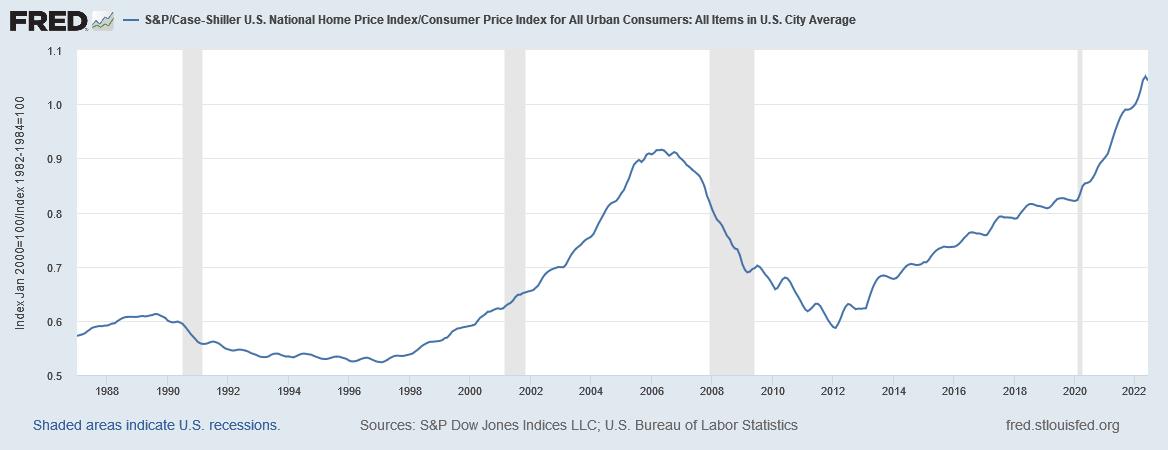
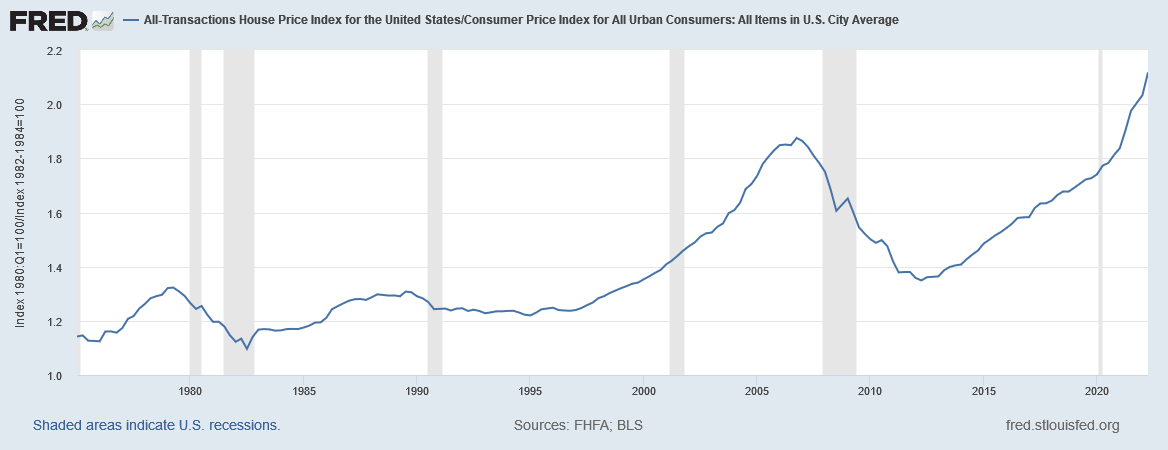
The median price of a house in the US, even adjusted for inflation, is nearly twice what it was in 1993.

This wasn’t a slow and steady climb; housing prices moved with inflation for most of the 1980s and 1990s, and then surged upward just before the 2008 crash. Then they plummeted for a few years, before reversing course and surging even higher than they were at their 2007 peak:

https://fred.stlouisfed.org/series/CSUSHPINSA

[housing_prices_US_2.png]

https://fred.stlouisfed.org/series/USSTHPI

This is not a uniquely American problem. The UK shows almost the same pattern:

https://fred.stlouisfed.org/series/HPIUKA

But it’s also not the same pattern everywhere. In China, housing prices have been rising steadily, and didn’t crash in 2008:

https://fred.stlouisfed.org/series/QCNN628BIS

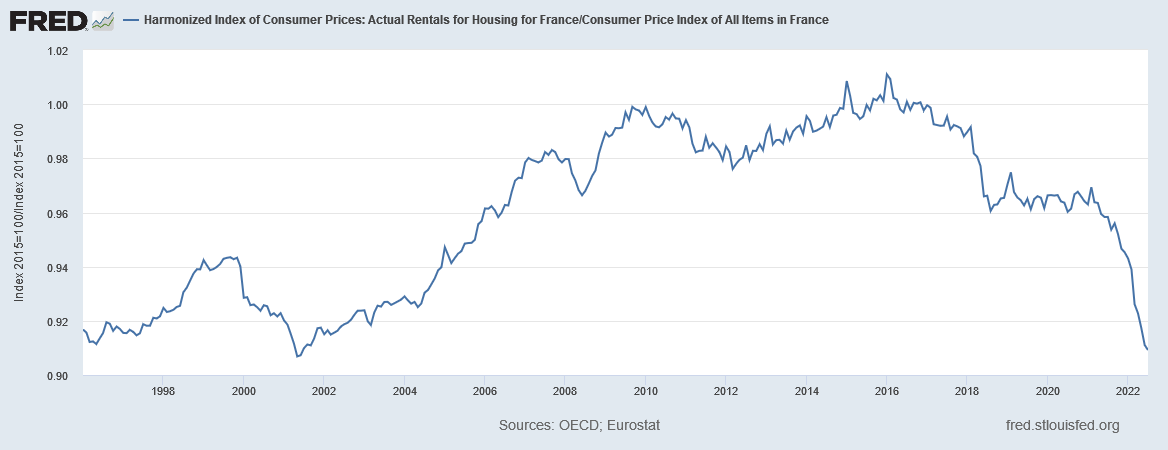
In France, housing prices have been relatively stable, and are no higher now than they were in the 1990s:

https://fred.stlouisfed.org/series/CP0410FRM086NEST

Meanwhile, in Japan, housing prices surged in the 1970s, 1980s, and 1990s, ending up four times what they had been in the 1960s; then they suddenly leveled off and haven’t changed since:

https://fred.stlouisfed.org/series/JPNCPIHOUMINMEI

It’s also worse in some cities than others. In San Francisco, housing now costs three times what it did in the 1990s, even adjusting for inflation:

https://fred.stlouisfed.org/series/SFXRSA

Meanwhile, in Detroit, housing is only about 25% more expensive now than it was in the 1990s:

https://fred.stlouisfed.org/series/ATNHPIUS19804Q

This variation tells me that policy matters. This isn’t some inevitable result of population growth or technological change. Those could still be important factors, but they can’t explain the strong varation between countries or even between cities within the same country. (Yes, San Francisco has seen more population growth than Detroit—but not that much more.)

Part of the problem, I think, is that most policymakers don’t actually want housing to be more affordable. They might say they do, they might occasionally feel some sympathy for people who get evicted or live on the streets; but in general, they want housing prices to be higher, because that gives them more property tax revenue. The wealthy benefit from rising housing prices, while the poor are harmed. Since the interests of the wealthy are wildly overrepresented in policy, policy is made to increase housing prices, not decrease them. This is likely especially true in housing, because even the upper-middle class mostly benefits from rising housing prices. It’s only the poor and lower-middle class who are typically harmed.

This is why I don’t really want to get into suggesting policies that could fix this. We know what would fix this: Build more housing. Lots of it. Everywhere. Increase supply, and the price will go down. And we should keep doing it until housing is not just back where it was, but cheaper—much cheaper. Buying a house shouldn’t be a luxury afforded only to the upper-middle class; it should be something everyone does several times in their life and doesn’t have to worry too much about. Buying a house should be like buying a car; not cheap, exactly, but you don’t have to be rich to do it. Because everyone needs housing. So everyone should have housing.

But that isn’t going to happen, because the people who make the decisions about this don’t want it to happen.

So the real question becomes: What do we do about that?

Europe is paying the price for relying on Russian natural gas

Sep 18 JDN 2459841

For far too long, Europe has relied upon importing cheap natural gas from Russia to supply a large proportion of its energy needs. Now that the war in Ukraine has led to mutual sanctions, they are paying the price—literally, as the price of natural gas has absolutely ballooned. Dutch natural gas futures have soared from about €15 per megawatt-hour in 2020 to over €200 today.

Natural gas prices are rising worldwide, but not nearly as much: Henry Hub natural gas prices (a standard metric for natural gas prices in the US) have risen from under $2 per million BTU in 2020 to nearly $9 today. This substantial divide in prices can only be sustained because transporting natural gas is expensive and requires substantial infrastructure. (1 megawatt-hour is about 3.4 million BTU, and the euro is trading at parity with the dollar (!), so effectively US prices rose from €7 per MWh to €31 per MWh—as opposed to €200.)

As a result, a lot of people in Europe are suddenly finding their utility bills unaffordable. (I’m fortunate that my flat is relatively well-insulated and my income is reasonably high, so I’m not among them; the higher prices will be annoying, but not beyond my means.) What should we do about this?

There are some economists who would say we should do nothing at all: Laissez-faire. Markets are efficient, right? So just let people freeze! Fortunately, Europe is not governed by such people nearly as much as the US is.

But while most economists would agree that we should do something, it’s much harder to get them to agree on exactly what.

Rising prices of natural gas are sort of a good thing, from an environmental perspective; they’ll provide an incentive to reduce carbon emissions. So it’s tempting to say that we should just let the prices rise and then compensate by raising taxes and paying transfers to poor families. But that probably isn’t politically viable; all three parts—letting prices rise, raising taxes, and increasing transfers—are all going to make enemies, and we really must have all three for such a plan to work.

The current approach seems to be based on price controls: Don’t let the prices rise so much. The UK has such a policy in place: Natural gas prices for consumers are capped by regulations. The cap has been increased in response to the crisis (itself an unpopular, but clearly necessary, move), but even so 31 gas companies have already gone under across the UK since the start of 2021. It really seems to be the case that for many gas companies, especially the smaller ones with less economy of scale, it’s simply not possible to continue providing natural gas to homes with input prices so high and output prices capped so low.

Or, we could let prices rise that high for producers, but subsidize consumers so that they don’t feel it; several European countries are already doing this. That at least won’t result in gas companies failing, but it will cost a lot of government funds. Greece in particular is spending over 3% of their GDP on it! (For comparison, the US military budget is about 4% of GDP.) I think this might actually be the best option, though all that spending will mean more government debt or higher taxes.

European governments have also been building up strategic reserves of natural gas, which may help us get through the winter—but it also makes the current price increases even worse.

We could also ration energy use, as we’ve often done during wartime. (Is this wartime? Kind of? Not really? It certainly is starting to feel like Cold War II.) Indeed, the President of the European Commission basically said that this should happen. That, at least, would reap some of the environmental benefits of reduced natural gas consumption. Rationing also feels fair to most people in a way that simply letting market prices rise does not; there is a sense of shared sacrifice. What worries me, however, is that the rations won’t be well-designed enough to account for energy usage that isn’t in a family’s immediate control. If you’re renting a flat that is poorly insulated, you can’t immediately fix that. You can try to pressure the landlord into buying better insulation, but in the meantime you’re the one paying the energy bills—or getting cold when the natural gas ration isn’t enough.

Actually I strongly suspect that most household usage of natural gas is of this kind; people don’t generally heat their homes more than necessary just because gas is cheap. Maybe they can set the thermostat a degree or two lower when gas is expensive, or maybe they use the gas oven less often and the microwave more; but the vast majority of their gas consumption is a function of the climate they live in and the insulation of their home, not their day-to-day choices. So if we’re trying to incentivize more efficient energy usage, that’s a question of long-term investment in construction and retrofitting, not something that sudden price spikes will really help with.

In the long run, what we really need to do is wean ourselves off of natural gas. Currently natural gas provides 33% of energy and nearly 40% of heating in Europe. (US figures are comparable.) Switching to electric heat pumps and powering them with solar and wind power isn’t something we can do overnight—but it is something we surely must do.

I think ultimately what is going to happen is all of the above: Different countries will adopt different policy mixes, all of them will involve difficult compromises, none of them will be particularly well-designed, and we’ll all sort of muddle through as best we can.

The War on Terror has been a total failure.

Sep 11 JDN 2459834

Since today happens to be September 11, I thought I’d spend this week’s post reflecting on the last 21 years (!) of the War on Terror.

At this point, I can safely say that the War on Terror has been a complete, total, utter failure. It has cost over $8 trillion and nearly a million lives, and not only didn’t reduce terrorism, it actually appears to have substantially increased it.

Take a look at this graph from Our World in Data:

Up until the the 1980s, terrorism worldwide was a slow smoldering, killing rarely more than a few hundred people each year. Obviously it’s terrible if you or one of your loved ones happen to be among those few hundred, but in terms of its overall chance of killing you or your children, terrorism used to be less dangerous than kiddie pools.

Then terrorism began to rise, until it was killing several thousand people a year. I was surprised to learn that most of these were not in the Middle East, but in fact spread all over the world, with the highest concentrations actually being in South Asia and Sub-Saharan Africa.

Notably, almost none of these deaths were in First World countries, and as a result most First World governments largely ignored them. Terrorism was something that happened “over there”, to other people.

Then of course came 2001, and 9/11/2001, in which nearly 3,000 Americans were killed in a single day. And suddenly the First World took notice, and decided to respond with overwhelming force.

We have been at war basically ever since. All this war has accomplished… approximately nothing.

The deadliest year of terrorism in the 21st century was not 2001; it was 2014, after the US had invaded both Afghanistan and Iraq, and in fact withdrawn from Iraq (but not yet Afghanistan). This was largely the result of the rise of Daesh (which is what you should call them by the way), which seems to be the most fanatical and violent Islamist terrorist organization the world has seen in decades if not centuries.

Even First World terrorism is no better today than it was in the 1990s—though also no worse. It’s back to a slow smolder, and once again First World societies can feel that terrorism is something that happens to someone else. But terrorism in the Middle East is the worst it has been in decades.

Would Daesh not have appeared if the US had never invaded Afghanistan and Iraq? It’s difficult to say. Maybe their rise was inevitable. Or maybe having a strong, relatively secular government in the region under Saddam Hussein would have prevented them from becoming so powerful. We can at least say this: Since the US withdrew from Afghanistan and the Taliban retook control, the Taliban and Daesh have been fighting each other quite heavily. Presumably that would have been happening all along if the US had not intervened to suppress the Taliban.

Don’t get me wrong: The Taliban were, and are, a terrible regime, and Saddam Hussein was a terrible dictator. But Daesh is clearly worse than either, and sometimes in geopolitics you have to accept the lesser evil.

If we’d actually had a way to take over Afghanistan and Iraq and rebuild them as secular liberal democracies as the US government intended, that would have been a good thing, and might even have been worth all that blood and treasure. But that project utterly failed, and we should have expected it to fail, as never in history has anyone successfully imposed liberal democracy by outside force like that.

When democracy spreads, it usually does so slowly, through the cultural influence of trade and media. Sometimes it springs up in violent revolution—as we hoped it would in the Arab Spring but were sadly disappointed. But there are really no clear examples of a democratic country invading an undemocratic country and rapidly turning it democratic.

British colonialism was spread by the sword (and especially the machine gun), and did sometimes ultimately lead to democratic outcomes, as in the US, Australia, and Canada, and more recently in India, South Africa, and Botswana. But that process was never fast, never smooth, and rarely without bloodshed—and only succeeded when the local population was willing to fight for it. Britain didn’t simply take over countries and convert them to liberal democracies in a generation. No one has ever done that, and trying to was always wishful thinking.

I don’t know, maybe in the very long run, we’ll look back on all this as the first, bloody step toward something better for the Middle East. Maybe the generation of women who got a taste of freedom and education in Afghanistan under US occupation will decide to rise up and refuse to relinquish those rights under the new Taliban. Daesh will surely die sooner or later; fanaticism can rarely sustain organizations in the long term.

But it’s been 20 years now, and things look no better than they did at the start. Maybe it’s time to cut our losses?

Working from home is the new normal—sort of

Aug 28 JDN 2459820

Among people with jobs that can be done remotely, a large majority did in fact switch to doing their jobs remotely: By the end of 2020, over 70% of Americans with jobs that could be done remotely were working from home—and most of them said they didn’t want to go back.

This is actually what a lot of employers expected to happen—just not quite like this. In 2014, a third of employers predicted that the majority of their workforce would be working remotely by 2020; given the timeframe there, it required a major shock to make that happen so fast, and yet a major shock was what we had.

Working from home has carried its own challenges, but overall productivity seems to be higher working remotely (that meeting really could have been an email!). This may actually explain why output per work hour actually rose rapidly in 2020 and fell in 2022.

The COVID pandemic now isn’t so much over as becoming permanent; COVID is now being treated as an endemic infection like influenza that we don’t expect to be able to eradicate in the foreseeable future.

And likewise, remote work seems to be here to stay—sort of.

First of all, we don’t seem to be giving up office work entirely. As of the first quarter 2022, almost as many firms have partially remote work as have fully remote work, and this seems to be trending upward. A lot of firms seem to be transitioning into a “hybrid” model where employees show up to work two or three days a week. This seems to be preferred by large majorities of both workers and firms.

There is a significant downside of this: It means that the hope that remote working might finally ease the upward pressure on housing prices in major cities is largely a false one. If we were transitioning to a fully remote system, then people could live wherever they want (or can afford) and there would be no reason to move to overpriced city centers. But if you have to show up to work even one day a week, that means you need to live close enough to the office to manage that commute.

Likewise, if workers never came to the office, you could sell the office building and convert it into more housing. But if they show up even once in awhile, you need a physical place for them to go. Some firms may shrink their office space (indeed, many have—and unlike this New York Times journalist, I have a really hard time feeling bad for landlords of office buildings); but they aren’t giving it up entirely. It’s possible that firms could start trading off—you get the building on Mondays, we get it on Tuesdays—but so far this seems to be rare, and it does raise a lot of legitimate logistical and security concerns. So our global problem of office buildings that are empty, wasted space most of the time is going to get worse, not better. Manhattan will still empty out every night; it just won’t fill up as much during the day. This is honestly a major drain on our entire civilization—building and maintaining all those structures that are only used at most 1/3 of 5/7 of the time, and soon, less—and we really should stop ignoring it. No wonder our real estate is so expensive, when half of it is only used 20% of the time!

Moreover, not everyone gets to work remotely. Your job must be something that can be done remotely—something that involves dealing with information, not physical objects. That includes a wide and ever-growing range of jobs, from artists and authors to engineers and software developers—but it doesn’t include everyone. It basically means what we call “white-collar” work.

Indeed, it is largely limited to the upper-middle class. The rich never really worked anyway, though sometimes they pretend to, convincing themselves that managing a stock portfolio (that would actually grow faster if they let it sit) constitutes “work”. And the working class? By and large, they didn’t get the chance to work remotely. While 73% of workers with salaries above $200,000 worked remotely in 2020, only 12% of workers with salaries under $25,000 did, and there is a smooth trend where, across the board, the more money you make, the more likely you have been able to work remotely.

This will only intensify the divide between white-collar and blue-collar workers. They already think we don’t do “real work”; now we don’t even go to work. And while blue-collar workers are constantly complaining about contempt from white-collar elites, I think the shoe is really on the other foot. I have met very few white-collar workers who express contempt for blue-collar workers—and I have met very few blue-collar workers who don’t express anger and resentment toward white-collar workers. I keep hearing blue-collar people say that we think that they are worthless and incompetent, when they are literally the only ones ever saying that. I can’t stop saying things that I never said.

The rich and powerful may look down on them, but they look down on everyone. (Maybe they look down on blue-collar workers more? I’m not even sure about that.) I think politicians sometimes express contempt for blue-collar workers, but I don’t think this reflects what most white-collar workers feel.

And the highly-educated may express some vague sense of pity or disappointment in people who didn’t get college degrees, and sometimes even anger (especially when they do things like vote for Donald Trump), but the really vitriolic hatred is clearly in the opposite direction (indeed, I have no better explanation for how otherwise-sane people could vote for Donald Trump). And I certainly wouldn’t say that everyone needs a college degree (though I became tempted to, when so many people without college degrees voted for Donald Trump).

This really isn’t us treating them with contempt: This is them having a really severe inferiority complex. And as information technology (that white-collar work created) gives us—but not them—the privilege of staying home, that is only going to get worse.

It’s not their fault: Our culture of meritocracy puts a little bit of inferiority complex in all of us. It tells us that success and failure are our own doing, and so billionaires deserve to have everything and the poor deserve to have nothing. And blue-collar workers have absolutely internalized these attitudes: Most of them believe that poor people choose to stay on welfare forever rather than get jobs (when welfare has time limits and work requirements, so this is simply not an option—and you would know this from the Wikipedia page on TANF).

I think that what they experience as “contempt by white-collar elites” is really the pain of living in an illusory meritocracy. They were told—and they came to believe—that working hard would bring success, and they have worked very hard, and watched other people be much more successful. They assume that the rich and powerful are white-collar workers, when really they are non-workers; they are people the world was handed to on a silver platter. (What, you think George W. Bush earned his admission to Yale?)

And thus, we can shout until we are blue in the face that plumbers, bricklayers and welders are the backbone of civilization—and they are, and I absolutely mean that; our civilization would, in an almost literal sense, collapse without them—but it won’t make any difference. They’ll still feel the pain of living in a society that gave them very little and tells them that people get what they deserve.

I don’t know what to say to such people, though. When your political attitudes are based on beliefs that are objectively false, that you could know are objectively false if you simply bothered to look them up… what exactly am I supposed to say to you? How can we have a useful political conversation when half the country doesn’t even believe in fact-checking?

Honestly I wish someone had explained to them that even the most ideal meritocratic capitalism wouldn’t reward hard work. Work is a cost, not a benefit, and the whole point of technological advancement is to allow us to accomplish more with less work. The ideal capitalism would reward talent—you would succeed by accomplishing things, regardless of how much effort you put into them. People would be rich mainly because they are brilliant, not because they are hard-working. The closest thing we have to ideal capitalism right now is probably professional sports. And no amount of effort could ever possibly make me into Steph Curry.

If that isn’t the world we want to live in, so be it; let’s do something else. I did nothing to earn either my high IQ or my chronic migraines, so it really does feel unfair that the former increases my income while the latter decreases it. But the labor theory of value has always been wrong; taking more sweat or more hours to do the same thing is worse, not better. The dignity of labor consists in its accomplishment, not its effort. Sisyphus is not happy, because his work is pointless.

Honestly at this point I think our best bet is just to replace all blue-collar work with automation, thus rendering it all moot. And then maybe we can all work remotely, just pushing code patches to the robots that do everything. (And no doubt this will prove my “contempt”: I want to replace you! No, I want to replace the grueling work that you have been forced to do to make a living. I want you—the human being—to be able to do something more fun with your life, even if that’s just watching television and hanging out with friends.)

Good news on the climate, for a change

Aug 7 JDN 2459799

In what is surely the biggest political surprise of the decade—if not the century—Joe Manchin suddenly changed his mind and signed onto a budget reconciliation bill that will radically shift US climate policy. He was the last vote needed for the bill to make it through the Senate via reconciliation (as he often is, because he’s pretty much a DINO).

Because the Senate is ridiculous, there are still several layers of procedure the bill must go through before it can actually pass. But since the parliamentarian was appointed by a Democrat and the House had already passed an even stronger climate bill, it looks like at least most of it will make it through. The reconciliation process means we only need a bare majority, so even if all the Republicans vote against it—which they very likely will—it can still get through, with Vice President Harris’s tiebreaking vote. (Because our Senate is 50-50, Harris is on track to cast the most tie-breaking votes of any US Vice President by the end of her term.) Reconciliation also can’t be filibustered.

While it includes a lot of expenditures, particularly tax credits for clean energy and electric cars, the bill includes tax increases and closed loopholes so that it will actually decrease the deficit and likely reduce inflation—which Manchin said was a major reason he was willing to support it. But more importantly, it promises to reduce US carbon emissions by a staggering 40% by 2030.

The US currently produces about 15 tons of CO2 equivalent per person per year, so reducing that by 40% would drop it to only 9 tons per person per year. This would move us from nearly as bad as Saudi Arabia to nearly as good as Norway. It still won’t mean we are doing as well as France or the UK—but at least we’ll no longer be dragging down the rest of the First World.

And this isn’t a pie-in-the-sky promise: Independent forecasts suggest that these policies may really be able to reduce our emissions that much that fast. It’s honestly a little hard for me to believe; but that’s what the experts are saying.

Manchin wants to call it the Inflation Reduction Act, but it probably won’t actually reduce inflation very much. But some economists—even quite center-right ones—think it may actually reduce inflation quite a bit, and we basically all agree that it at least won’t increase inflation very much. Since the effects on inflation are likely to be small, we really don’t have to worry about them: whatever it does to inflation, the important thing is that this bill reduces carbon emissions.

Honestly, it’ll be kind of disgusting if this actually does work—because it’s so easy. This bill will have almost no downside. Its macroeconomic effects will be minor, maybe even positive. There was no reason it needed to be this hard-fought. Even if it didn’t have tax increases to offset it—which it absolutely does—the total cost of this bill over the next ten years would be less than six months of military spending, so cutting military spending by 5% would cover it. We have cured our unbearable headaches by finally realizing we could stop hitting ourselves in the head. (And the Republicans want us to keep hitting ourselves and will do whatever they can to make that happen.)

So, yes, it’s very sad that it took us this long. And even 60% of our current emissions is still too much emissions for a stable climate. But let’s take a moment to celebrate, because this is a genuine victory—and we haven’t had a lot of those in awhile.

Krugman and rockets and feathers

Jul 17 JDN 2459797

Well, this feels like a milestone: Paul Krugman just wrote a column about a topic I’ve published research on. He didn’t actually cite our paper—in fact the literature review he links to is from 2014—but the topic is very much what we were studying: Asymmetric price transmission, ‘rockets and feathers’. He’s even talking about it from the perspective of industrial organization and market power, which is right in line with our results (and a bit different from the mainstream consensus among economic policy pundits).

The phenomenon is a well-documented one: When the price of an input (say, crude oil) rises, the price of outputs made from that input (say, gasoline) rise immediately, and basically one to one, sometimes even more than one to one. But when the price of an input falls, the price of outputs only falls slowly and gradually, taking a long time to converge to the same level as the input prices. Prices go up like a rocket, but down like a feather.

Many different explanations have been proposed to explain this phenomenon, and they aren’t all mutually exclusive. They include various aspects of market structure, substitution of inputs, and use of inventories to smooth the effects of prices.

One that I find particularly unpersuasive is the notion of menu costs: That it requires costly effort to actually change your prices, and this somehow results in the asymmetry. Most gas stations have digital price boards; it requires almost zero effort for them to change prices whenever they want. Moreover, there’s no clear reason this would result in asymmetry between raising and lowering prices. Some models extend the notion of “menu cost” to include expected customer responses, which is a much better explanation; but I think that’s far beyond the original meaning of the concept. If you fear to change your price because of how customers may respond, finding a cheaper way to print price labels won’t do a thing to change that.

But our paper—and Krugman’s article—is about one factor in particular: market power. We don’t see prices behave this way in highly competitive markets. We see it the most in oligopolies: Markets where there are only a small number of sellers, who thus have some control over how they set their prices.

Krugman explains it as follows:

When oil prices shoot up, owners of gas stations feel empowered not just to pass on the cost but also to raise their markups, because consumers can’t easily tell whether they’re being gouged when prices are going up everywhere. And gas stations may hang on to these extra markups for a while even when oil prices fall.

That’s actually a somewhat different mechanism from the one we found in our experiment, which is that asymmetric price transmission can be driven by tacit collusion. Explicit collusion is illegal: You can’t just call up the other gas stations and say, “Let’s all set the price at $5 per gallon.” But you can tacitly collude by responding to how they set their prices, and not trying to undercut them even when you could get a short-run benefit from doing so. It’s actually very similar to an Iterated Prisoner’s Dilemma: Cooperation is better for everyone, but worse for you as an individual; to get everyone to cooperate, it’s vital to severely punish those who don’t.

In our experiment, the participants in our experiment were acting as businesses setting their prices. The customers were fully automated, so there was no opportunity to “fool” them in this way. We also excluded any kind of menu costs or product inventories. But we still saw prices go up like rockets and down like feathers. Moreover, prices were always substantially higher than costs, especially during that phase when they are falling down like feathers.

Our explanation goes something like this: Businesses are trying to use their market power to maintain higher prices and thereby make higher profits, but they have to worry about other businesses undercutting their prices and taking all the business. Moreover, they also have to worry about others thinking that they are trying to undercut prices—they want to be perceived as cooperating, not defecting, in order to preserve the collusion and avoid being punished.

Consider how this affects their decisions when input prices change. If the price of oil goes up, then there’s no reason not to raise the price of gasoline immediately, because that isn’t violating the collusion. If anything, it’s being nice to your fellow colluders; they want prices as high as possible. You’ll want to raise the prices as high and fast as you can get away with, and you know they’ll do the same. But if the price of oil goes down, now gas stations are faced with a dilemma: You could lower prices to get more customers and make more profits, but the other gas stations might consider that a violation of your tacit collusion and could punish you by cutting their prices even more. Your best option is to lower prices very slowly, so that you can take advantage of the change in the input market, but also maintain the collusion with other gas stations. By slowly cutting prices, you can ensure that you are doing it together, and not trying to undercut other businesses.

Krugman’s explanation and ours are not mutually exclusive; in fact I think both are probably happening. They have one important feature in common, which fits the empirical data: Markets with less competition show greater degrees of asymmetric price transmission. The more concentrated the oligopoly, the more we see rockets and feathers.

They also share an important policy implication: Market power can make inflation worse. Contrary to what a lot of economic policy pundits have been saying, it isn’t ridiculous to think that breaking up monopolies or putting pressure on oligopolies to lower their prices could help reduce inflation. It probably won’t be as reliably effective as the Fed’s buying and selling of bonds to adjust interest rates—but we’re also doing that, and the two are not mutually exclusive. Besides, breaking up monopolies is a generally good thing to do anyway.

It’s not that unusual that I find myself agreeing with Krugman. I think what makes this one feel weird is that I have more expertise on the subject than he does.

How to pack the court

Jul 10 JDN 2459790

By now you have no doubt heard the news that Roe v. Wade was overturned. The New York Times has an annotated version of the full opinion.

My own views on abortion are like those of about 2/3 of Americans: More nuanced than can be neatly expressed by ‘pro-choice’ or ‘pro-life’, much more comfortable with first-trimester abortion (which is what 90% of abortions are, by the way) than later, and opposed to overturning Roe v. Wade in its entirety. I also find great appeal in Clinton’s motto on the issue: “safe, legal, and rare”.Several years ago I moderated an online discussion group that reached what we called the Twelve Week Compromise: Abortion would be legal for any reason up to 12 weeks of pregnancy, after which it would only be legal for extenuating circumstances including rape, incest, fetal nonviability, and severe health risk to the mother. This would render the vast majority of abortions legal without simply saying that it should be permitted without question. Roe v. Wade was actually slightly more permissive than this, but it was itself a very sound compromise.

But even if you didn’t like Roe v. Wade, you should be outraged at the manner in which it was overturned. If the Supreme Court can simply change its mind on rights that have been established for nearly 50 years, then none of our rights are safe. And in chilling comments, Clarence Thomas has declared that this is his precise intention: “In future cases, we should reconsider all of this Court’s substantive due process precedents, including Griswold, Lawrence, and Obergefell.” That is to say, Thomas wants to remove our rights to use contraception and have same-sex relationships. (If Lawrence were overturned, sodomy could be criminalized in several states!)

The good news here is that even the other conservative justices seem much less inclined to overturn these other precedents. Kavanaugh’s concurrent opinion explicitly states he has no intention of overturning “Griswold v. Connecticut, 381 U. S. 479 (1965); Eisenstadt v. Baird, 405 U. S. 438 (1972); Loving v. Virginia, 388 U. S. 1 (1967); and Obergefell v. Hodges, 576 U. S. 644 (2015)”. It seems quite notable that Thomas did not mention Loving v. Virginia, seeing as it was made around the same time as Roe v. Wade, based on very similar principles—and it affects him personally. And even if these precedents are unlikely to be overturned immediately, this ruling shows that the security of all of our rights can depend on the particular inclinations of individual justices.

The Supreme Court is honestly a terrible institution. Courts should not be more powerful than legislatures, lifetime appointments reek of monarchism, and the claim of being ‘apolitical’ that was dubious from the start is now obviously ludicrous. But precisely because it is so powerful, reforming it will be extremely difficult.

The first step is to pack the court. The question is no longer whether we should pack the court, but how, and why we didn’t do it sooner.

What does it mean to pack the court? Increase the number of justices, appointing new ones who are better than the current ones. (Since almost any randomly-selected American would be better than Clarence Thomas, Samuel Alito, or Brent Kavanaugh, this wouldn’t be hard.) This is 100% Constitutional, as the Constitution does not in any way restrict the number of justices. It can simply be done by an act of Congress.

But of course we can’t stop there. President Biden could appoint four more justices, and then whoever comes after him could appoint another three, and before we know it the Supreme Court has twenty-seven justices and each new President is expected to add a few more.

No, we need to fix the number of justices so that it can’t be increased any further. Ideally this would be done by Constitutional Amendment, though the odds of getting such a thing passed seem rather slim. But there is in fact a sensible way to add new justices now and then justify not adding any more later, and that is to tie justices to federal circuits.

There are currently 13 US federal circuit courts. If we added 4 more Supreme Court justices, there would be 13 Supreme Court justices. Each could even be assigned to be the nominal head of that federal circuit, and responsible for being the first to read appeals coming from that circuit.

Which justice goes where? Well, what if we let the circuits themselves choose? The selection could be made by a popular vote among the people who live there. Make the federal circuit a federal popular vote. The justice responsible for the federal circuit can also be the Chief Justice.

That would also require a Constitutional Amendment, but it would, at a stroke, fundamentally reform what the Supreme Court is and how its justices are chosen. For now, we could simply add three new justices, making the current number 13. Then they could decide amongst themselves who will get what circuit until we implement the full system to let circuits choose their justices.

I’m well aware that electing judges is problematic—but at this point I don’t think we have a choice. (I would also prefer to re-arrange the circuits: it’s weird that DC gets its own circuit instead of being part of circuit 4, and circuit 9 has way more people than circuit 1.) We can’t simply trust each new President to appoint a new justice whenever one happens to retire or die and then leave that justice in place for decades to come. Not in a world where someone like Donald Trump can be elected President.

A lot of centrist people are uncomfortable with such a move, seeing it as ‘playing dirty’. But it’s not. It’s playing hardball—taking seriously the threat that the current Republican Party poses to the future of American government and society, and taking substantive steps to fight that threat. (After its authoritarian shift that started in the mid 2000s but really took off under Trump, the Republican Party now has more in common with far-right extremist parties like Fidesz in Hungary than with mainstream center-right parties like the Tories.) But there is absolutely nothing un-Constitutional about this plan. It’s doing everything possible within the law.

We should have done this before they started overturning landmark precedents. But it’s not too late to do it before they overturn any more.