Toward a positive vision of the future

Jun 22 JDN 2460849

Things look pretty bleak right now. Wildfires rage across Canada, polluting the air across North America. Russia is still at war with Ukraine, and Israel seems to be trying to start a war with Iran. ICE continues sending agents without badges to kidnap people in unmarked vehicles and sending them to undisclosed locations. Climate change is getting worse, and US policy is pivoting from subsidizing renewables back to subsidizing fossil fuels. And Trump, now revealed to be a literal fascist, is still President.

But things can get better.

I can’t guarantee that they will, nor can I say when; but there is still hope that a better future is possible.

It has been very difficult to assemble a strong coalition against the increasingly extreme far-right in this country (epitomized by Trump). This seems odd, when most Americans hold relatively centrist views. Yes, more Americans identify as conservative than as liberal, but Trump isn’t a conservative; he’s a radical far-right fascist. Trump recently gave a speech endorsing ethnic cleansing, for goodness’ sake! I’m liberal, but I’d definitely vote for a conservative like Mitt Romney rather than a Stalinist! So why are “conservatives” voting for a fascist?

But setting aside the question of why people voted for Trump, we still have the question of why the left has not been able to assemble a strong coalition against him.

I think part of the problem is that the left really has two coalitions within it: The center left, who were relatively happy with the status quo before Trump and want to go back to that; and the far left, who were utterly unhappy with that status quo and want radical change. So while we all agree that Trump is awful, we don’t really agree on what he’s supposed to be replaced with.

It’s of course possible to be in between, and indeed I would say that I am. While clearly things were better under Obama and Biden than they have been under Trump, there were still a lot of major problems in this country that should have been priorities for national policy but weren’t:

  1. Above all, climate change—the Democrats at least try to do something against it, but not nearly enough. Our carbon emissions are declining, but it’s very unclear if we’ll actually hit our targets. The way we have been going, we’re in for a lot more hurricanes and wildfires and droughts.
  2. Housing affordability is still an absolute crisis; half of renters spend more than the targeted 30% of their income on housing, and a fourth spend more than 50%.Homelessness is now at a record high.
  3. Healthcare is still far too expensive in this country; we continue to spend far more than other First World countries without getting meaningfully better care.
  4. While rights and protections for LGB people have substantially improved in the last 30 years, rights and protections for trans people continue to lag behind.
  5. Racial segregation in housing remains the de facto norm, even though it is de jure illegal.
  6. Livestock remain exempted from the Animal Welfare Act and in 2002 laboratory rats and mice were excluded as well, meaning that cruel or negligent treatment which would be illegal for cats and dogs is still allowed on livestock and lab rats.
  7. Income and wealth inequality in this country remains staggeringly high, and the super-rich continue to gain wealth at a terrifying rate.
  8. Our voting system is terrible—literally the worst possible system that can technically still be considered democracy.

This list is by no means exhaustive, but these are the issues that seem most salient to me.

2 and 3 both clearly showed up in my Index of Necessary Expenditure; these costs were the primary reason why raising a family of 4 was unaffordable on a median household income.

So it isn’t right to say that I was completely happy with how things were going before. But I still think of myself as center left, because I don’t believe we need to tear everything down and start over.

I have relatively simple recommendations that would go a long way toward solving all 8 of these problems:

Climate change could be greatly mitigated if we’d just tax carbon already, or implement a cap-and-trade system like California’s nationwide. If that’s too politically unpalatable, subsidize nuclear power, fusion research, and renewables instead. That’s way worse from a budget perspective, but for some reason Americans are just fanatically opposed to higher gas prices.

Housing affordability is politically thorny, but economically quite simple: Build more housing. Whatever we have to do to make that happen, we should do it. Maybe this involves changes to zoning or other regulations. Maybe it involves subsidies to developers. Maybe it involves deploying eminent domain to build public housing. Maybe it involves using government funds to build housing and then offering it for sale on the market. But whatever we do, we need more housing.

Healthcare costs are a trickier one; Obamacare helped, but wasn’t enough. I think what I would like to see next is an option to buy into Medicare; before you are old enough to get it for free, you can pay a premium to be covered by it. Because Medicare is much more efficient than private insurance, you could pay a lower premium and get better coverage, so a lot of people would likely switch (which is of course exactly why insurance companies would fight the policy at every turn). Even putting everyone on Medicare might not be enough; to really bring costs down, we may need to seriously address the fact that US doctors, particularly specialists, are just radically higher-paid than any other doctors in the world. Is an American doctor who gets $269,000 per year really 88% better than a French doctor who gets $143,000?

The policies we need for LGBT rights are mostly no-brainers.

Okay, I can admit to some reasonable nuance when it comes to trans women in pro sports (the statistical advantages they have over cis women are not as clear-cut as many people think, but they do seem to exist; average athletic performance for trans women seems to be somewhere in between the average for cis men and the average for cis women), but that’s really not a very important issue. Like, seriously, why do we care so much about pro sports? Either let people play sports according to their self-identified gender, or make the two options “cis women” and “other” and let trans people play the latter. And you can do the same thing with school sports, or you can eliminate them entirely because they are a stupid waste of academic resources; but either way this should not be considered a top priority policy question. (If parents want their kids to play sports, they can form their own leagues; the school shouldn’t be paying for it. Winning games is not one of the goals of an academic institution. If you want kids to get more exercise, give them more recess and reform the physical education system so it isn’t so miserable for the kids who need it most.)

But there is absolutely no reason not to let people use whatever pronouns and bathrooms they want; indeed, there doesn’t really seem to be a compelling reason to gender-segregate bathrooms in the first place, and removing that segregation would most benefit women, who often have to wait much longer in line for the bathroom. (The argument that this somehow protects women never made sense to me; if a man wants to assault women in the bathroom, what’s to stop him from just going into the women’s bathroom? It’s not like there’s a magic field that prevents men from entering. He’s already planning on committing a crime, so it doesn’t seem like he’s very liable to held back by social norms. It’s worthwhile to try to find ways to prevent sexual assault, but segregating bathrooms does little or nothing toward that goal—and indeed, trans-inclusive bathrooms do not statistically correlate with higher rates of sexual assault.) But okay, fine, if you insist on having the segregation, at least require gender-neutral bathrooms as well. This is really not that difficult; it’s pretty clearly bigotry driving this, not serious policy concerns.

Not exempting any vertebrate animals from anti-cruelty legislation is an incredibly simple thing to do, obviously morally better, and the only reason we’re not doing it is that it would hurt agribusinesses and make meat more expensive. There is literally zero question what the morally right thing to do here is; the question is only how to get people to actually do that morally right thing.

Finally, how do we fix income inequality? Some people—including some economists—treat this as a very complicated, difficult question, but I don’t think it is. I think the really simple, obvious answer is actually the correct one: Tax rich people more, and use the proceeds to help poor people. We should be taxing the rich a lot more; I want something like the revenue-maximizing rate, estimated at about 70%. (And an even higher rate like the 90% we had in the 1950s is not out of the question.) These funds could either provide services like education and healthcare, or they could simply be direct cash transfers. But one way or another, the simplest, most effective way to reduce inequality is to tax the rich and help the poor. A lot of economists fear that this would hurt the overall economy, but particularly if these rates are really targeted at the super-rich (the top 0.01%), I don’t see how they could, because all those billions of dollars are very clearly monopoly rents rather than genuine productivity. If anything, making it harder to amass monopoly rents should make the economy more efficient. And taking say 90% of the roughly 10% return just the top 400 billionaires make on their staggering wealth would give us an additional $480 billion per year.

Fixing our voting system is also quite straightforward. Ranked-choice voting would be a huge improvement, and has already been implemented successfully in several states. Even better would be range voting, but so far very few places have been bold enough to actually try it. But even ranked-choice voting would remove most of the terrible incentives that plurality voting creates, and likely allow us to move beyond the two-party system into a much more representative multiparty system.

None of this requires overthrowing the entire system or dismantling capitalism.

That is, we can have a positive vision of the future that doesn’t require revolution or radical change.

Unfortunately, there’s still a very good chance we’ll do none of it.

Extrapolating the INE

Apr 6 JDN 2460772

I was only able to find sufficient data to calculate the Index of Necessary Expenditure back to 1990. But I found a fairly consistent pattern that the INE grew at a rate about 20% faster than the CPI over that period, so I decided to take a look at what longer-term income growth looks like if we extrapolate that pattern back further in time.

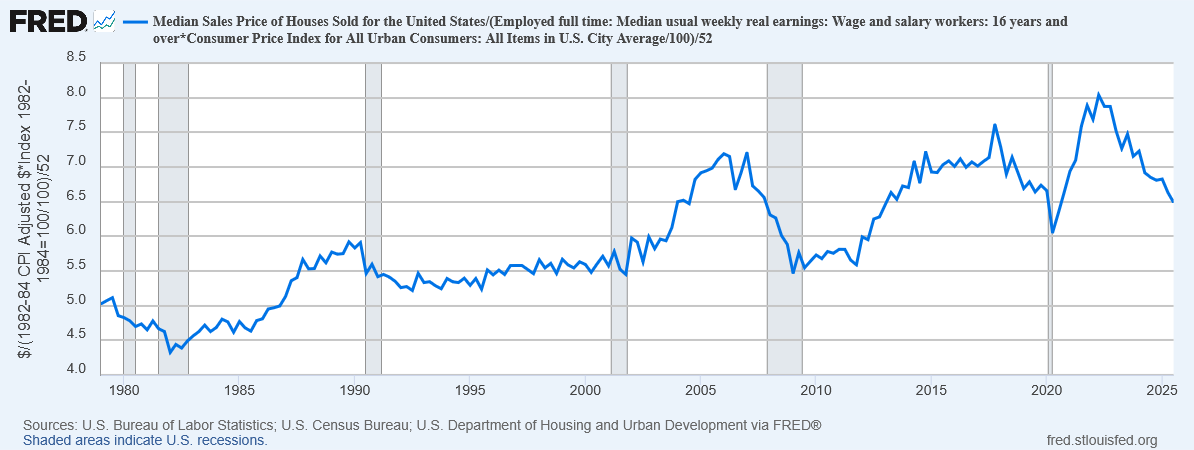
The result is this graph:

Using the CPI, real per-capita GDP in the US (in 2024 dollars) has grown from $25,760 in 1950 to $85,779 today—increasing by a factor of 3.33. Even accounting for increased inequality and the fact that more families have two income earners, that’s still a substantial increase.

But using the extrapolated INE, real per-capita GDP has only grown from $43,622 in 1950 to $85,779 today—increasing by only a factor of 1.97. This is a much smaller increase, especially when we adjusted for increased inequality and increased employment for women.

Even without the extrapolation, it’s still clear that real INE-adjusted incomes have were basically stagnant in the 2000s, increased rather slowly in the 2020s, and then actually dropped in 2022 after a bunch of government assistance ended. What looked, under the CPI, like steadily increasing real income was actually more like treading water.

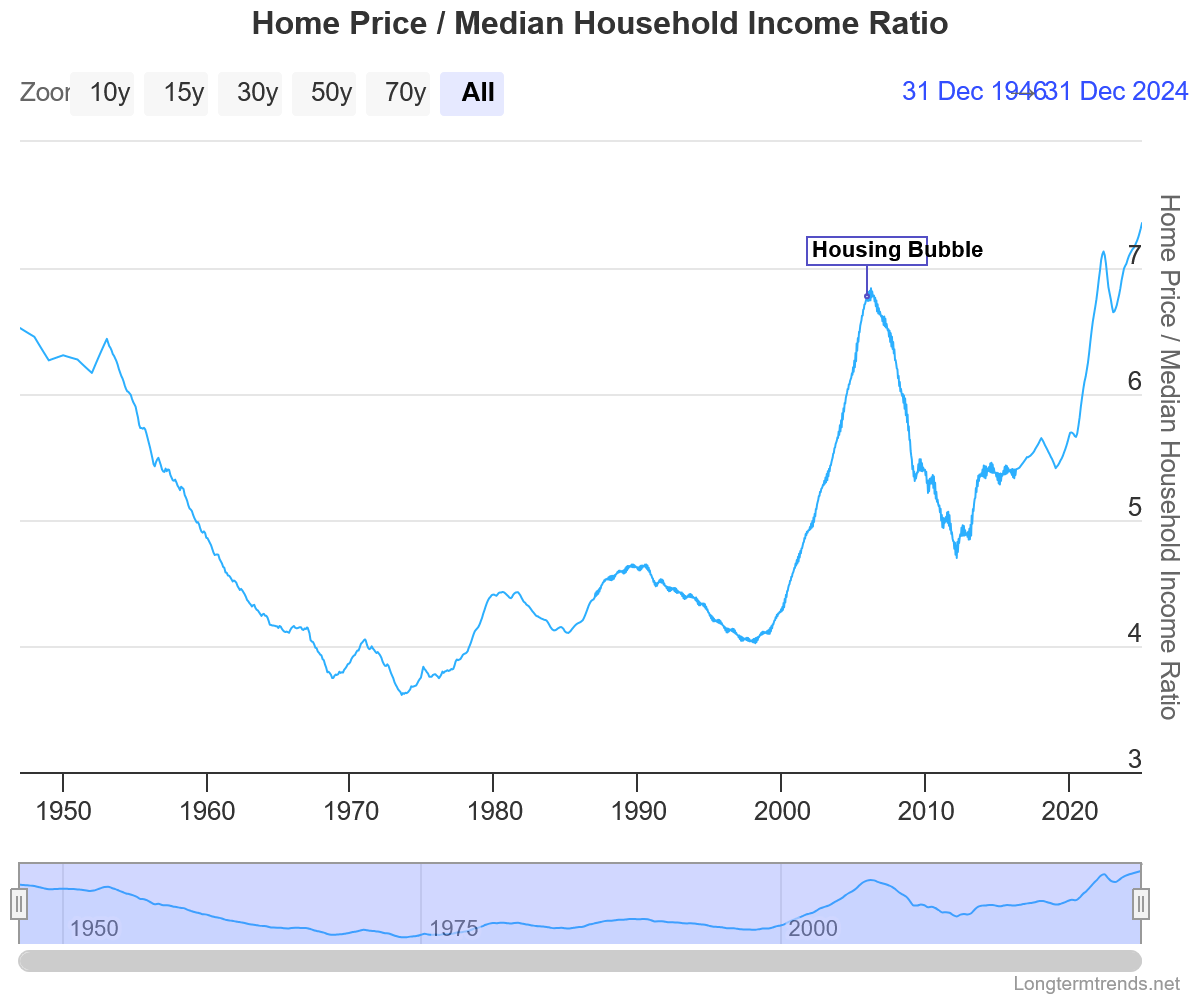
Should we trust this extrapolation? It’s a pretty simplistic approach, I admit. But I think it is plausible when we consider this graph of the ratio between median income and median housing price:

This ratio was around 6 in the 1950s, then began to fall until in the 1970s it stabilized around 4. It began to slowly creep back up, but then absolutely skyrocketed in the 2000s before the 2008 crash. Now it has been rising again, and is now above 7, the highest it has been since the Second World War. (Does this mean we’re due for another crash? I’d bet as much.)

What does this mean? It means that a typical family used to be able to afford a typical house with only four years of their total income—and now would require seven. In that sense, homes are now 75% more expensive today than they were in the 1970s.

Similar arguments can be made for the rising costs of education and healthcare; while many prices have not grown much (gasoline) or even fallen (jewelry and technology), these necessities have continued to grow more and more expensive, not simply in nominal terms, but even compared to the median income.

This is further evidence that our standard measures of “inflation” and “real income” are fundamentally inadequate. They simply aren’t accurately reflecting the real cost of living for most American families. Even in many times when it seemed “inflation” was low and “real income” was growing, in fact it was growing harder and harder to afford vital necessities such as housing, education, and healthcare.

This economic malaise may have been what contributed to the widespread low opinion of Biden’s economy. While the official figures looked good, people’s lives weren’t actually getting better.

Yet this is still no excuse for those who voted for Trump; even the policies he proudly announced he would do—like tariffs and deportations—have clearly made these problems worse, and this was not only foreseeable but actually foreseen by the vast majority of the world’s economists. Then there are all the things he didn’t even say he would do but is now doing, like cozying up to Putin, alienating our closest allies, and discussing “methods” for achieving an unconstitutional third term.

Indeed, it honestly feels quite futile to even reflect upon what was wrong with our economy even when things seemed to be running smoothly, because now things are rapidly getting worse, and showing no sign of getting better in any way any time soon.

Reflections on the Index of Necessary Expenditure

Mar 16 JDN 2460751

In last week’s post I constructed an Index of National Expenditure (INE), attempting to estimate the total cost of all of the things a family needs and can’t do without, like housing, food, clothing, cars, healthcare, and education. What I found shocked me: The median family cannot afford all necessary expenditures.

I have a couple more thoughts about that.

I still don’t understand why people care so much about gas prices.

Gasoline was a relatively small contribution to INE. It was more than clothing but less than utilities, and absolutely dwarfed by housing, food, or college. I thought maybe since I only counted a 15-mile commute, maybe I didn’t actually include enoughgasoline usage, but based on this estimate of about $2000 per driver, I was in about the right range; my estimate for the same year was $3350 for a 2-car family.

I think I still have to go with my salience hypothesis: Gasoline is the only price that we plaster in real-time on signs on the side of the road. So people are constantly aware of it, even though it isn’t actually that important.

The price surge that should be upsetting people is housing.

If the price of homes had only risen with the rate of CPI inflation instead of what it actually did, the median home price in 2024 would be only $234,000 instead of the $396,000 it actually is; and by my estimation that would save a typical family $11,000 per year—a whopping 15% of their income, and nearly enough to make the INE affordable by itself.

Now, I’ll consider some possible objections to my findings.

Objection 1: A typical family doesn’t actually spend this much on these things.

You’re right, they don’t! Because they couldn’t possibly. Even with substantial debt, you just can’t sustainably spend 125% of your after-tax household income.

My goal here was not to estimate how much families actually spend; it was to estimate how much they need to spend in order to live a good life and not feel deprived.


What I have found is that most American families feel deprived. They are forced to sacrifice something really important—like healthcare, or education, or owning a home—because they simply can’t afford it.

What I’m trying to do here is find the price of the American Dream; and what I’ve found is that the American Dream has a price that most Americans cannot afford.

Objection 2: You should use median healthcare spending, not mean.

I did in fact use mean figures instead of median for healthcare expenditures, mainly because only the mean was readily available. Mean income is higher than median income, so you might say that I’ve overestimated healthcare expenditure—and in a sense that’s definitely true. The median family spends less than this on healthcare.

But the reason that the median family spends less than this on healthcare is not that they want to, but that they have to. Healthcare isn’t a luxury that people buy more of because they are richer. People buy either as much as they need or as much as they can afford—whichever is lower, which is typically the latter. Using the mean instead of the median is a crude way to account for that, but I think it’s a defensible one.

But okay, let’s go ahead and cut the estimate of healthcare spending in half; even if you do that, the INE is still larger than after-tax median household income in most years.

Objection 3: A typical family isn’t a family of four, it’s a family of three.

Yes, the mean number of people in a family household in the US is 3.22 (the median is 3).

This is a very bad thing.

Part of what I seem to be finding here is that a family of four is unaffordable—literally impossible to afford—on a typical family income.

But a healthy society is one in which typical families have two or three children. That is what we need in order to achieve population replacement. When families get smaller than that, we aren’t having enough children, and our population will decline—which means that we’ll have too many old people relative to young people. This puts enormous pressure on healthcare and pension systems, which rely upon the fact that young people produce more, in order to pay for the fact that old people cost more.

The ideal average number of births per woman is about 2.1; this is what would give us a steady population. No US state has fertility above this level. The only reason the US population is growing rather than shrinking is that we are taking in immigrants.

This is bad. This is not sustainable. If the reason families aren’t having enough kids is that they can’t afford them—and this fits with other research on the subject—then this economic failure damages our entire society, and it needs to be fixed.

Objection 4: Many families buy their cars used.

Perhaps 1/10 of a new car every year isn’t an ideal estimate of how much people spend on their cars, but if anything I think it’s conservative, because if you only buy a car every 10 years, and it was already used when you bought it, you’re going to need to spend a lot on maintaining it—quite possibly more than it would cost to get a new one. Motley Fool actually estimates the ownership cost of just one car at substantially more than I estimated for two cars. So if anything your complaint should be that I’ve underestimated the cost by not adequately including maintenance and insurance.

Objection 5: Not everyone gets a four-year college degree.

Fair enough; a substantial proportion get associate’s degrees, and most people get no college degree at all. But some also get graduate degrees, which is even more expensive (ask me how I know).

Moreover, in today’s labor market, having a college degree makes a huge difference in your future earnings; a bachelor’s degree increases your lifetime earnings by a whopping 84%. In theory it’s okay to have a society where most people don’t go to college; in practice, in our society, not going to college puts you at a tremendous disadvantage for the rest of your life. So we either need to find a way to bring wages up for those who don’t go to college, or find a way to bring the cost of college down.

This is probably one of the things that families actually choose to scrimp on, only sending one kid to college or none at all. But because college is such a huge determinant of earnings, this perpetuates intergenerational inequality: Only rich families can afford to send their kids to college, and only kids who went to college grow up to have rich families.

Objection 6: You don’t actually need to save for college; you can use student loans.

Yes, you can, and in practice, most people who to college do. But while this solves the liquidity problem (having enough money right now), it does not solve the solvency problem (having enough money in the long run). Failing to save for college and relying on student loans just means pushing the cost of college onto your children—and since we’ve been doing that for over a generation, feel free to replace the category “college savings” with “repaying student loans”; it won’t meaningfully change the results.

Housing should be cheap

Sep 1 JDN 2460555

We are of two minds about housing in our society. On the one hand, we recognize that shelter is a necessity, and we want it to be affordable for all. On the other hand, we see real estate as an asset, and we want it to appreciate in value and thereby provide a store of wealth. So on the one hand we want it to be cheap, but on the other hand we want it to be expensive. And of course it can’t be both.

This is not a uniquely American phenomenon. As Noah Smith points out, it seems to be how things are done in almost every country in the world. It may be foolish for me to try to turn such a tide. But I’m going to try anyway.

Housing should be cheap.

For some reason, inflation is seen as a bad thing for every other good, necessity and luxury alike; but when it comes to housing in particular—the single biggest expense for almost everyone—suddenly we are conflicted about it, and think that maybe inflation is a good thing actually.

This is because owning a home that appreciates in value provides the illusion of increasing wealth.

Yes, I said illusion. In some particular circumstances it can sometimes increase real wealth, but when housing is getting more expensive everywhere at once (which is basically true), it doesn’t actually increase real wealth—because you still need to have a home. So while you’d get more money if you sold your current home, you’d have to go buy another home that would be just as expensive. That extra wealth is largely imaginary.

In fact, what isn’t an illusion is your increased property tax bill. If you aren’t planning on selling your home any time soon, you should really see its appreciation as a bad thing; now you suddenly owe more in taxes.

Home equity lines of credit complicate this a bit; for some reason we let people collateralize part of the home—even though the whole home is already collateralized with a mortgage to someone else—and thereby turn that largely-imaginary wealth into actual liquid cash. This is just one more way that our financial system is broken; we shouldn’t be offering these lines of credit, just as we shouldn’t be creating mortgage-backed securities. Cleverness is not a virtue in finance; banking should be boring.

But you’re probably still not convinced. So I’d like you to consider a simple thought experiment, where we take either view to the extreme: Make housing 100 times cheaper or 100 times more expensive.

Currently, houses cost about $400,000. So in Cheap World, houses cost $4,000. In Expensive World, they cost $40 million.

In Cheap World, there is no homelessness. Seriously, zero. It would make no sense at all for the government not to simply buy everyone a house. If you want to also buy your own house—or a dozen—go ahead, that’s fine; but you get one for free, paid for by tax dollars, because that’s cheaper than a year of schooling for a high-school student; it’s in fact not much more than what we’d currently spend to house someone in a homeless shelter for a year. So given the choice of offering someone two years at a shelter versus never homeless ever again, it’s pretty obvious we should choose the latter. Thus, in Cheap World, we all have a roof over our heads. And instead of storing their wealth in their homes in Cheap World, people store their wealth in stocks and bonds, which have better returns anyway.

In Expensive World, the top 1% are multi-millionaires who own homes, maybe the top 10% can afford rent, and the remaining 89% of the population are homeless. There’s simply no way to allocate the wealth of our society such that a typical middle class household has $40 million. We’re just not that rich. We probably never will be that rich. It may not even be possible to make a society that rich. In Expensive World, most people live in tents on the streets, because housing has been priced out of reach for all but the richest families.

Cheap World sounds like an amazing place to live. Expensive World is a horrific dystopia. The only thing I changed was the price of housing.


Yes, I changed it a lot; but that was to make the example as clear as possible, and it’s not even as extreme as it probably sounds. At 10% annual growth, 100 times more expensive only takes 49 years. At the current growth rate of housing prices of about 5% per year, it would take 95 years. A century from now, if we don’t fix our housing market, we will live in Expensive World. (Yes, we’ll most likely be richer then too; but will we be that much richer? Median income has not been rising nearly as fast as median housing price. If current trends continue, median income will be 5 times bigger and housing prices will be 100 times bigger—that’s still terrible.)

We’re already seeing something that feels a lot like Expensive World in some of our most expensive cities. San Francisco has ludicrously expensive housing and also a massive homelessness crisis—this is not a coincidence. Homelessness does still exist in more affordable cities, but clearly not at the same crisis level.

I think part of the problem is that people don’t really understand what wealth is. They see the number go up, and they think that means there is more wealth. Real wealth consists in goods, not in prices. The wealth we have is made of real things, not monetary prices. Prices merely decide how wealth is allocated.

A home is wealth, yes. But it’s the same amount of real wealth regardless of what price it has, because what matters is what it’s good for. If you become genuinely richer by selling an appreciated home, you gained that extra wealth from somewhere else; it was not contained within your home. You have appropriated wealth that someone else used to have. You haven’t created wealth; you’ve merely obtained it.

For you as an individual, that may not make a difference; you still get richer. But as a society, it makes all the difference: Moving wealth around doesn’t make our society richer, and all higher prices can do is move wealth around.

This means that rising housing prices simply cannot make our whole society richer. Better houses could do that. More houses could do that. But simply raising the price tag isn’t making our society richer. If it makes anyone richer—which, again, typically it does not—it does so by moving wealth from somewhere else. And since homeowners are generally richer than non-homeowners (even aside from their housing wealth!), more expensive homes means moving wealth from poorer people to richer people—increased inequality.

We used to have affordable housing, just a couple of generations ago. But we may never have truly affordable housing again, because people really don’t like to see that number go down, and they vote for policies accordingly—especially at the local level. Our best hope right now seems to be to keep it from going up faster than the growth rate of income, so that homes don’t become any more unaffordable than they already are.

But frankly I’m not optimistic. I think part of the cyberpunk dystopia we’re careening towards is Expensive World.

Home price targeting

Jan 29 JDN 2459973

One of the largest divides in opinion between economists and the general population concerns the question of rent control. While the general public mostly supports rent control (and often votes for it in referenda), economists almost universally oppose it. It’s hard to get a consensus among economists on almost anything, and yet here we have one; but people don’t seem to care.

Why? I think it’s because high rents are a genuine and serious problem, which economists have invested remarkably little effort in trying to solve. Housing prices are one of the chief drivers of long-term inflation, and with most people spending over a third of their income on housing, even relatively small increases in housing prices can cause a lot of suffering.

One thing we do know is that rent control does not work as a long-term solution. Maybe in response to some short-term shock it would make sense. Maybe you do it for awhile as you wait for better long-term solutions to take effect. But simply putting an arbitrary cap on prices will create shortages in the long run—and it is not a coincidence that cities with strict rent control have the worst housing shortages and the greatest rates of homelessness. Rent control doesn’t even do a good job of helping the people who need it most.

Price ceilings in general are just… not a good idea. If people are selling something at a price that you think is too high and you just insist that they aren’t allowed to, they don’t generally sell at a lower price—they just don’t sell at all. There are a few exceptions; in a very monopolistic market, a well-targeted price ceiling might actually work. And short-run housing supply is inelastic enough that rent control isn’t the worst kind of price ceiling. But as a general strategy, price ceilings just aren’t an effective way of making things cheaper.

This is why we so rarely use them as a policy intervention. When the Federal Reserve wants to achieve a certain interest rate on bonds, do they simply demand that people buy the bonds at that price? No. They adjust the supply of bonds in the market until the market price goes to what they want it to be.

Prices aren’t set in a vacuum by the fiat of evil corporations. They are an equilibrium outcome of a market system. There are things you can do to intervene and shift that equilibrium, but if you just outlaw certain prices, it will result in a new equilibrium—it won’t simply be the same amount sold at the new price you wanted.

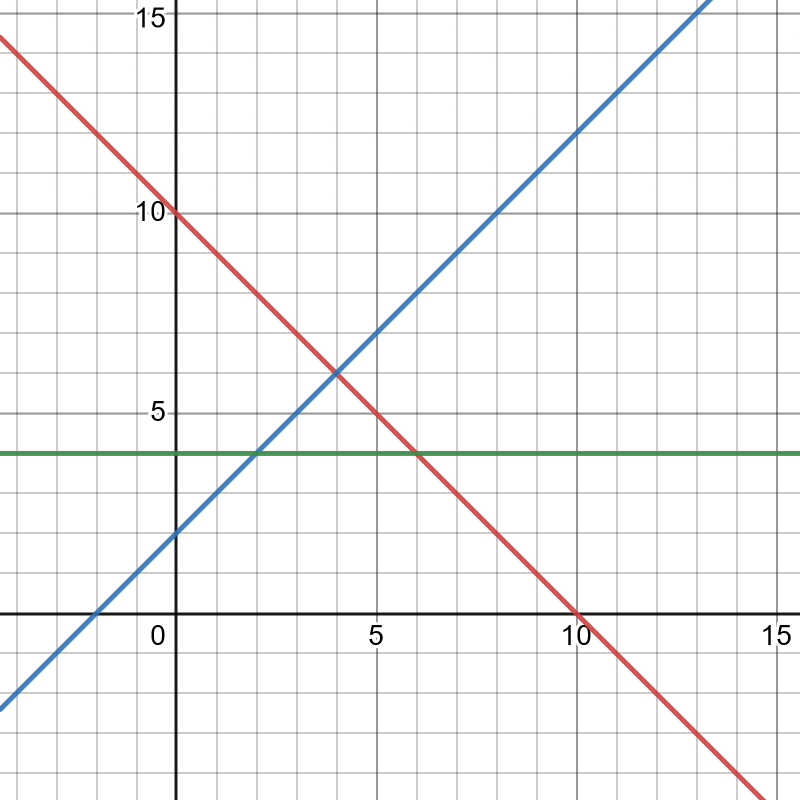
Maybe some graphs would help explain this. In each graph, the red line is the demand and the blue line is the supply.

Here is what the market looks like before intervention: The price is $6. We’ll say that’s too high; people can’t afford it.

[no_intervention.png]

Now suppose we impose a price ceiling at $4 (the green line). You aren’t allowed to charge more than $4. What will happen? Companies will charge $4. But they will also produce and sell a smaller quantity than before.

Far better would be to increase the supply of the good, shifting to a new supply curve (the purple line). Then you would reduce the price and increase the amount of the good available.

[supply_intervention.png]

This is precisely what we do with government bonds when we want to raise interest rates. (A greater supply of bonds makes their prices lower, which makes their yields higher.) And when we want to lower interest rates, we do the opposite.

Of course, with bonds, it’s easy to control the supply; it’s all just numbers in a network. Increasing the supply of housing is a much greater undertaking; you actually need to build new housing. But ultimately, the only way to ensure that housing is available and affordable for everyone is in fact to build more housing.

There are various ways we might accomplish that; one of the simplest would be to simply relax zoning restrictions that make it difficult to build high-density housing in cities. Those are bad laws anyway; they only benefit a small number of people a little bit while harming a large number of people a lot. (The problem is that the people they benefit are the local homeowners who show up to city council meetings.)

But we could do much more. I propose that we really use interest-rate targeting as our model and introduce home price targeting. I want the federal government to exercise eminent domain and order the construction of new high-density housing in any city that has rents above a certain threshold—if you like, the same threshold you were thinking of setting the rent control at.

Is this an extreme solution? Perhaps. But housing affordability is an extreme problem. And I keep hearing from the left wing that economists aren’t willing to consider “radical enough” solutions to housing (by which they always seem to mean the tried-and-failed strategy of rent control). So here’s a radical solution for you. If cities refuse to build enough housing for their people, make them do it. Buy up and bulldoze their “lovely” “historic” suburban neighborhoods that are ludicrous wastes of land (and also environmentally damaging), and replace them with high-rise apartments. (Get rid of the golf courses while you’re at it.)

This would be expensive, of course; we have to pay to build all those new apartments. But hardly so expensive as living in a society where people can’t afford to live where they want.

In fact, estimates suggest that we are losing over one trillion dollars per year in unrealized productivity because people can’t afford to live in the highest-rent cities. Average income per worker in the US has been reduced by nearly $7000 per year because of high housing prices. So that’s the budget you should be comparing against. Keeping things as they are is like taxing our whole population about 9%. (And it’s probably regressive, so more than that for poor people.)

Would this destroy the “charm” of the city? I dunno, maybe a little. But if the only thing your city had going for it was some old houses that are clearly not an efficient use of space, that’s pretty sad. And it is quite possible to build a city at high density and have it still be beautiful and a major draw for tourists; Paris is a lot denser than far-less-picturesque Houston. (Though I’ll admit, Houston is far more affordable than Paris. It’s not just about density.) And is the “charm” of your city really worth making it so unaffordable that people can’t move there without risking becoming homeless?

There are a lot of details to be worked out: How serious must things get before the federal government steps in? (Wherever we draw the line, San Francisco is surely well past it.) It takes a long time to build houses and let prices adjust, so how do we account for that time-lag? Where does the money come from, actually? Debt? Taxes? But these could all be resolved.

Of course, it’s a pipe dream; we’re never going to implement this policy, because homeowners dread the idea of their home values going down (even though it would actually make their property taxes cheaper!). I’d even be willing to consider some kind of program that would let people refinance underwater mortgages to write off the lost equity, if that’s what it takes to actually build enough housing.

Because there is really only one thing that’s ever going to solve the (global!) housing crises:

Build more homes.

Housing prices are out of control

Oct 2 JDN 2459855

This is a topic I could have done for quite awhile now, and will surely address again in the future; it’s a slow-burn crisis that has covered most of the world for a generation.

In most of the world’s cities, housing prices are now the highest they have ever been, even adjusted for inflation. The pandemic made this worse, but it was already bad.

This is of course very important, because housing is usually the largest expenditure for most families.

Changes in housing prices are directly felt in people’s lifestyles, especially when they are renting. Homeownership rates vary a lot between countries, so the impact of this is quite different in different places.

There’s also an important redistributive effect: When housing prices go up, people who own homes get richer, while people who rent homes get poorer. Since people who own homes tend to be richer to begin with (and landlordsare typically richest of all), rising housing prices directly increase wealth inequality.

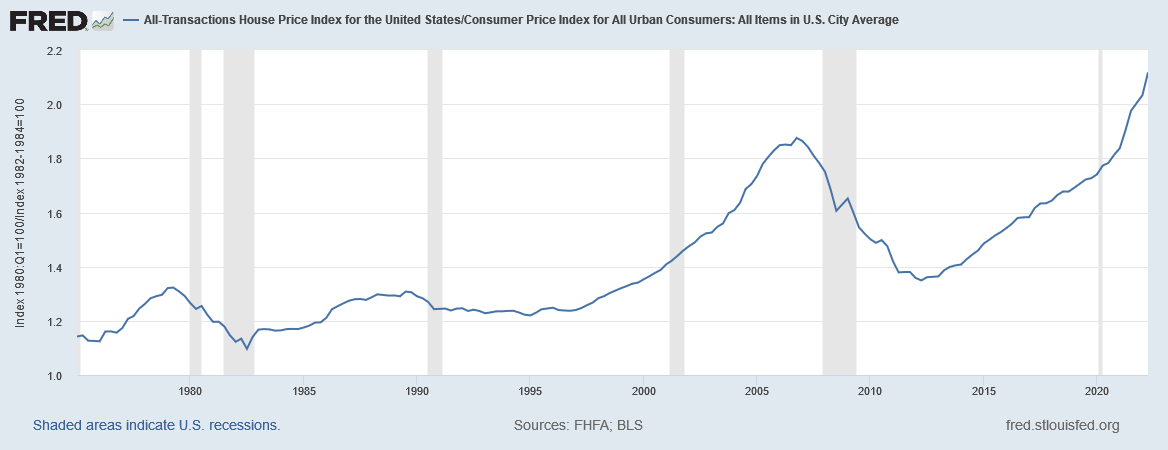
The median price of a house in the US, even adjusted for inflation, is nearly twice what it was in 1993.

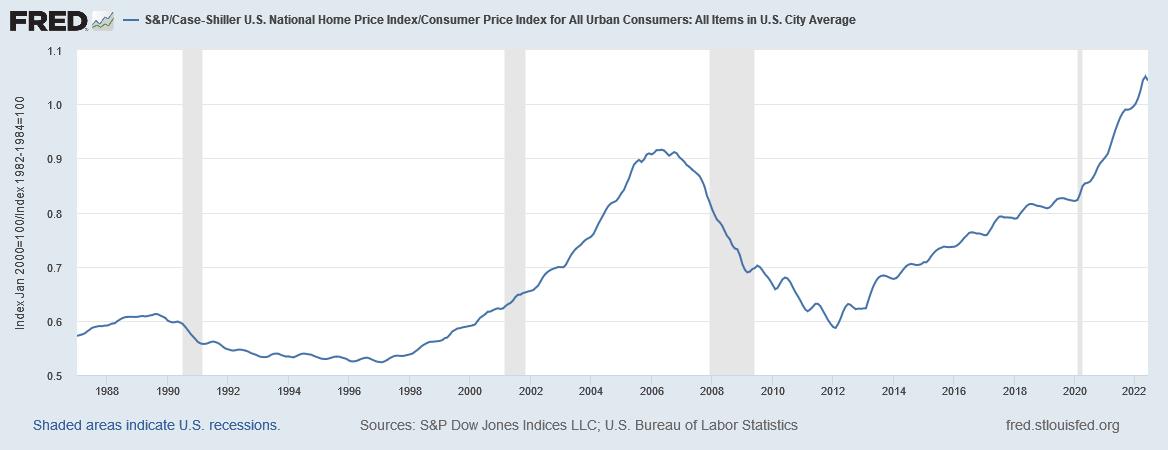
This wasn’t a slow and steady climb; housing prices moved with inflation for most of the 1980s and 1990s, and then surged upward just before the 2008 crash. Then they plummeted for a few years, before reversing course and surging even higher than they were at their 2007 peak:

https://fred.stlouisfed.org/series/CSUSHPINSA

[housing_prices_US_2.png]

https://fred.stlouisfed.org/series/USSTHPI

This is not a uniquely American problem. The UK shows almost the same pattern:

https://fred.stlouisfed.org/series/HPIUKA

But it’s also not the same pattern everywhere. In China, housing prices have been rising steadily, and didn’t crash in 2008:

https://fred.stlouisfed.org/series/QCNN628BIS

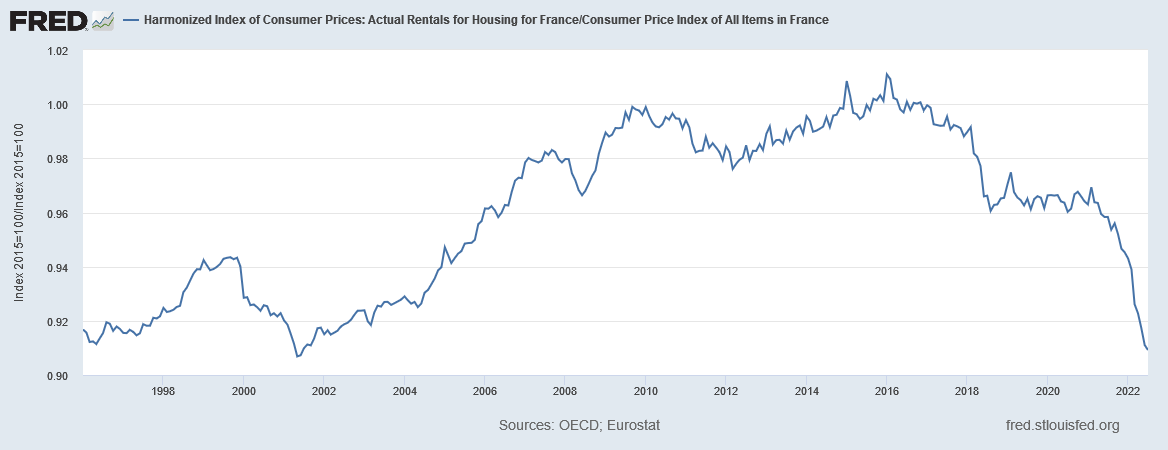
In France, housing prices have been relatively stable, and are no higher now than they were in the 1990s:

https://fred.stlouisfed.org/series/CP0410FRM086NEST

Meanwhile, in Japan, housing prices surged in the 1970s, 1980s, and 1990s, ending up four times what they had been in the 1960s; then they suddenly leveled off and haven’t changed since:

https://fred.stlouisfed.org/series/JPNCPIHOUMINMEI

It’s also worse in some cities than others. In San Francisco, housing now costs three times what it did in the 1990s, even adjusting for inflation:

https://fred.stlouisfed.org/series/SFXRSA

Meanwhile, in Detroit, housing is only about 25% more expensive now than it was in the 1990s:

https://fred.stlouisfed.org/series/ATNHPIUS19804Q

This variation tells me that policy matters. This isn’t some inevitable result of population growth or technological change. Those could still be important factors, but they can’t explain the strong varation between countries or even between cities within the same country. (Yes, San Francisco has seen more population growth than Detroit—but not that much more.)

Part of the problem, I think, is that most policymakers don’t actually want housing to be more affordable. They might say they do, they might occasionally feel some sympathy for people who get evicted or live on the streets; but in general, they want housing prices to be higher, because that gives them more property tax revenue. The wealthy benefit from rising housing prices, while the poor are harmed. Since the interests of the wealthy are wildly overrepresented in policy, policy is made to increase housing prices, not decrease them. This is likely especially true in housing, because even the upper-middle class mostly benefits from rising housing prices. It’s only the poor and lower-middle class who are typically harmed.

This is why I don’t really want to get into suggesting policies that could fix this. We know what would fix this: Build more housing. Lots of it. Everywhere. Increase supply, and the price will go down. And we should keep doing it until housing is not just back where it was, but cheaper—much cheaper. Buying a house shouldn’t be a luxury afforded only to the upper-middle class; it should be something everyone does several times in their life and doesn’t have to worry too much about. Buying a house should be like buying a car; not cheap, exactly, but you don’t have to be rich to do it. Because everyone needs housing. So everyone should have housing.

But that isn’t going to happen, because the people who make the decisions about this don’t want it to happen.

So the real question becomes: What do we do about that?

If I had a trillion dollars…

May 29 JDN 2459729

(To the tune of “If I had a million dollars” by Barenaked Ladies; by the way, he does now)

[Inspired by the book How to Spend a Trillion Dollars]

If I had a trillion dollars… if I had a trillion dollars!

I’d buy everyone a house—and yes, I mean, every homeless American.

[500,000 homeless households * $300,000 median home price = $150 billion]

If I had a trillion dollars… if I had a trillion dollars!

I’d give to the extreme poor—and then there would be no extreme poor!

[Global poverty gap: $160 billion]

If I had a trillion dollars… if I had a trillion dollars!

I’d send people to Mars—hey, maybe we’d find some alien life!

[Estimated cost of manned Mars mission: $100 billion]

If I had a trillion dollars… if I had a trillion dollars!

I’d build us a Moon base—haven’t you always wanted a Moon base?

[Estimated cost of a permanent Lunar base: $35 billion. NASA is bad at forecasting cost, so let’s allow cost overruns to take us to $100 billion.]

If I had a trillion dollars… if I had a trillion dollars!

I’d build a new particle accelerator—let’s finally figure out dark matter!

[Cost of planned new accelerator at CERN: $24 billion. Let’s do 4 times bigger and make it $100 billion.]

If I had a trillion dollars… if I had a trillion dollars!

I’d save the Amazon—pay all the ranchers to do something else!

[Brazil, where 90% of Amazon cattle ranching is, produces about 10 million tons of beef per year, which at an average price of $5000 per ton is $50 billion. So I could pay all the farmers two years of revenue to protect the Amazon instead of destroying it for $100 billion.]

If I had a trillion dollars…

We wouldn’t have to drive anymore!

If I had a trillion dollars…

We’d build high-speed rail—it won’t cost more!

[Cost of proposed high-speed rail system: $240 billion]

If I had a trillion dollars… if I had trillion dollars!

Hey wait, I could get it from a carbon tax!

[Even a moderate carbon tax could raise $1 trillion in 10 years.]

If I had a trillion dollars… I’d save the world….

All of the above really could be done for under $1 trillion. (Some of them would need to be repeated, so we could call it $1 trillion per year.)

I, of course, do not, and will almost certainly never have, anything approaching $1 trillion.

But here’s the thing: There are people who do.

Elon Musk and Jeff Bezos together have a staggering $350 billion. That’s two people with enough money to end world hunger. And don’t give me that old excuse that it’s not in cash: UNICEF gladly accepts donations in stock. They could, right now, give their stocks to UNICEF and thereby end world hunger. They are choosing not to do that. In fact, the goodwill generated by giving, say, half their stocks to UNICEF might actually result in enough people buying into their companies that their stock prices would rise enough to make up the difference—thus costing them literally nothing.

The total net wealth of all the world’s billionaires is a mind-boggling $12.7 trillion. That’s more than half a year of US GDP. Held by just over 2600 people—a small town.

The US government spends $4 trillion in a normal year—and $5 trillion the last couple of years due to the pandemic. Nearly $1 trillion of that is military spending, which could be cut in half and still be the highest in the world. After seeing how pathetic Russia’s army actually is in battle (they paint Zs on their tanks because apparently their IFF system is useless!), are we really still scared of them? Do we really need eleven carrier battle groups?

Yes, the total cost of mitigating climate change is probably in the tens of trillions—but the cost of not mitigating climate change could be over $100 trillion. And it’s not as if the world can’t come up with tens of trillions; we already do. World GDP is now over $100 trillion per year; just 2% of that for 10 years is $20 trillion.

Do these sound like good ideas to you? Would you want to do them? I think most people would want most of them. So now the question becomes: Why aren’t we doing them?

What I think “gentrification” ought to mean

Mar7 JDN 2459281

A few years back I asked the question: “What is gentrification?”

The term evokes the notion of a gentrya landed upper class who hoards wealth and keeps the rest of the population in penury and de facto servitude. Yet the usual meaning of the term really just seems to mean “rich people buying houses in poor areas”. Where did we get the idea that rich people buying houses in poor areas constitutes the formation of a landed gentry?

In that previous post I argued that the concept of “gentrification” as usually applied is not a useful one, and we should instead be focusing directly on the issues of poverty and housing affordability. I still think that’s right.

But it occurs to me that there is something “gentrification” could be used to mean, that would actually capture some of the original intended meaning. It doesn’t seem to be used this way often, but unlike the usual meaning, this one actually has some genuine connection with the original concept of a gentry.

Here goes: Gentrification is the purchasing of housing for the purpose of renting it out.

Why this definition in particular? Well, it actually does have an effect similar in direction (though hardly in magnitude) to the formation of a landed gentry: It concentrates land ownership and makes people into tenants instead of homeowners. It converts what should have been a one-time transfer of wealth from one owner to another into a permanent passive income stream that typically involves the poor indefinitely paying to the rich.

Because houses aren’t very fungible, the housing market is one of monopolistic competition: Each house is its own unique commodity, only partially substitutable with others, and this gives market power to the owners of houses. When it’s a permanent sale, that market power will be reflected in the price, but it will also effectively transfer to the new owner. When it’s a rental, that market power remains firmly in the hands of the landlord. The more a landlord owns, the more market power they can amass: A large landholding corporation like the Irvine Company can amass an enormous amount of market power, effectively monopolizing an entire city. (Now that feels like a landed gentry! Bend the knee before the great and noble House Irvine.)

Compare this to two other activities that are often called “gentrification”: Rich people buying houses in poor areas for the purpose of living in them, and developers building apartment buildings and renting them out.

When rich people buy houses for the purpose of living in them, they are not concentrating land ownership. They aren’t generating a passive income stream. They are simply doing the same thing that other people do—buying houses to live in them—but they have more money with which to do so. This is utterly unproblematic, and I think people need to stop complaining about it. There is absolutely nothing wrong with buying a house because you want to live in it, and if it’s a really expensive house—like Jeff Bezos’ $165 million mansion—then the problem isn’t rich people buying houses, it’s the massive concentration of wealth that made anyone that rich in the first place. No one should be made to feel guilty for spending their own money on their own house. Every time “gentrification” is used to describe this process, it just makes it seem like “gentrification” is nothing to worry about—or maybe even something to celebrate.

What about developers who build apartments to rent them out? Aren’t they setting up a passive income stream from the poor to the rich? Don’t they have monopolistic market power? Yes, that’s all true. But they’re also doing something else that buying houses in order to rent them doesn’t: They are increasing the supply of housing.

What are the two most important factors determining the price of housing? The same two factors as anything else: Supply and demand. If prices are too high, the best way to fix that is to increase supply. Developers do that.

Conversely, buying up a house in order to rent it is actually reducing the supply of housing—or at least the supply of permanent owner-occupied housing. Whereas developers buy land that has less housing and build more housing on it, gentrifiers (as I’m defining them) buy housing that already exists and rent it out to others.

Indeed, it’s really not clear to me that rent is a thing that needs to exist. Obviously people need housing. And it certainly makes sense to have things like hotels for very short-term stays and dorms for students who are living in an area for a fixed number of years.

But it’s not clear to me that we really needed to have a system where people would own other people’s houses and charge them for the privilege of living in them. I think the best argument for it is a libertarian one: If people want to do that, why not let them?

Yet I think the downsides of renting are clear enough: People get evicted and displaced, and in many cases landlords consistently fail to provide the additional services that they are supposed to provide. (I wasn’t able to quickly find good statistics on how common it is for landlords to evade their responsibilities like this, but anecdotal evidence would suggest that it’s not uncommon.)

The clearest upside is that security deposits are generally cheaper than down payments, so it’s generally easier to rent a home than to buy one. But why does this have to be the case? Indeed, why do banks insist on such large down payments in the first place? It seems to be only social norms that set the rate of down payments; I’m not aware of any actual economic arguments for why a particular percentage of the home’s value needs to be paid in cash up front. It’s commonly thought that large down payments somehow reduce the risk of defaulting on a mortgage; but I’m not aware of much actual evidence of this. Here’s a theoretical model saying that down payments should matter, but it’s purely theoretical. Here’s an empirical paper showing that lower down payments are associated with higher interest rates—but it may be the higher interest rates that account for the higher defaults, not the lower down payments. There is also a selection bias, where buyers with worse credit get worse loan terms (which can be a self-fulfilling prophecy).

The best empirical work I could find on the subject was a HUD study suggesting that yes, lower down payments are associated with higher default risk—but their effect is much smaller than lots of other things. In particular, one percentage point of down payment was equivalent to about 5 points of credit score. So someone with a credit score of 750 and a down payment of 0% is no more likely to default than someone with a credit score of 650 and a down payment of 20%. Or, to use an example they specifically state in the paper: “For example, to have the same probability of default as a prime loan, a B or C [subprime] loan needs to have a CLTV [combined loan-to-value ratio] that is 11.9 percentage points lower than the CLTV of an otherwise identical prime loan.” A combined loan-to-value ratio 12 percentage points lower is essentially the same thing as a down payment that is 12 percentage points larger—and 12% of the median US home price of $300,000 is $36,000, not an amount of money most middle-class families can easily come up with.

I also found a quasi-experimental study showing that support from nonprofit housing organizations was much more effective at reducing default rates than higher down payments. So even if larger down payments do reduce defaults, there are better ways of doing so.

The biggest determinant of whether you will default on your mortgage is the obvious one: whether you have steady income large enough to afford the mortgage payment. Typically when people default it’s because their adjustable interest rate surged or they lost their job. When housing prices decline and you end up “underwater” (owing more than the house’s current price), strategic default can theoretically increase your wealth; but in fact it’s relatively rare to take advantage of this, because it’s devastating to your credit rating. Only about 20% of all mortgage defaults in the crisis were strategic—the other 80% were people who actually couldn’t afford to pay.

Another potential upside is that it may be easier to move from one place to another if you rent your home, since selling a home can take a considerable amount of time. But I think this benefit is overstated: Most home leases are 12 months long, while selling a house generally takes 60-90 days. So unless you are already near the end of your lease term when you decide to move, you may actually find that you could move faster if you sold your home than if you waited for your lease to end—and if you end your lease early, the penalties are often substantial. Your best-case scenario is a flat early termination fee; your worst-case scenario is being on the hook for all the remaining rent (at which point, why bother?). Some landlords instead require you to cover rent until a new tenant is found—which you may recognize as almost exactly equivalent to selling your own home.

I think the main reason that people rent instead of buying is simply that they can’t come up with a down payment. If it seems too heavy-handed or risky to simply cap down payments, how about we offer government-subsidized loans (or even grants!) to first-time home buyers to cover their down payments? This would be expensive, but no more so than the mortgage interest deduction—and far less regressive.

For now, we can continue to let people rent out homes. When developers do this, I think the benefits generally outweigh the harms: Above all, they are increasing the supply of housing. A case could be made for policies that incentivize the construction of condos rather than rentals, but above all, policy should be focusing on incentivizing construction.

However, when someone buys an existing house and then rents it out, they are doing something harmful. It probably shouldn’t be illegal, and in some cases there may be no good alternatives to simply letting people do it. But it’s a harmful activity nonetheless, and where legal enforcement is too strict, social stigma can be useful. And for that reason, I think it might actually be fair to call them gentrifiers.

Reasons to like Joe Biden

Sep 6 JDN 2459099

Maybe it’s because I follow too many radical leftists on social media (this is at least a biased sample, no doubt), but I’ve seen an awful lot of posts basically making this argument: “Joe Biden is terrible, but we have to elect him, because Donald Trump is worse.”

And make no mistake: Whatever else you think about this election, the fact that Donald Trump is a fascist and Joe Biden is not is indeed a fully sufficient reason to vote for Biden. You shouldn’t need any more than that.

But in fact Joe Biden is not terrible. Yes, there are some things worth criticizing about his record and his platform—particularly with regard to civil liberties and war (both of those links are to my own posts making such criticisms of the Obama administration). I don’t want to sweep these significant flaws under the rug.

Yet, there are also a great many things that are good about Biden and his platform, and it’s worthwhile to talk about them. You shouldn’t feel like you are holding your nose and voting for the lesser of two evils; Biden is going to make a very good President.

First and foremost, there is his plan to invest in clean energy and combat climate change. For the first time in decades, we have a Presidential candidate who is explicitly pro-nuclear and has a detailed, realistic plan for achieving net-zero carbon emissions within a generation. We should have done this 30 years ago; but far better to start now than to wait even longer.

Then there is Biden’s plan for affordable housing. He wants to copy California’s Homeowner Bill of Rights at the federal level, fight redlining, expand Section 8, and nationalize the credit rating system. Above all, he wants to create a new First Down Payment Tax Credit that will provide first-time home buyers with $15,000 toward a down payment on a home. That is how you increase homeownership. The primary reason why people rent instead of owning is that they can’t afford the down payment.

Biden is also serious about LGBT rights, and wants to pass the Equality Act, which would finally make all discrimination based on sexual orientation or gender identity illegal at the federal level. He has plans to extend and aggressively enforce federal rules protecting people with disabilities. His plans for advancing racial equality seem to be thoroughly baked into all of his proposals, from small business funding to housing reform—likely part of why he’s so popular among Black voters.

His plan for education reform includes measures to equalize funding between rich and poor districts and between White and non-White districts.

Biden’s healthcare plan isn’t quite Medicare For All, but it’s actually remarkably close to that. He wants to provide a public healthcare option available to everyone, and also lower the Medicare eligibility age to 60 instead of 65. This means that anyone who wants Medicare will be able to buy into it, and also sets a precedent of lowering the eligibility age—remember, all we really need to do to get Medicare For All is lower that age to 18. Moreover, it avoids forcing people off private insurance that they like, which is the main reason why Medicare For All still does not have majority support.

While many on the left have complained that Biden believes in “tough on crime”, his plan for criminal justice reform actually strikes a very good balance between maintaining low crime rates and reducing incarceration and police brutality. The focus is on crime prevention instead of punishment, and it includes the elimination of all federal use of privatized prisons.

Most people would give lip service to being against domestic violence, but Biden has a detailed plan for actually protecting survivors and punishing abusers—including ratifying the Equal Rights Amendment and ending the rape kit backlog. The latter is an utter no-brainer. If we need to, we can pull the money from just about any other form of law enforcement (okay, I guess not homicide); those rape kits need to be tested and those rapists need to be charged.

Biden also has a sensible plan for gun control, which is consistent with the Second Amendment and Supreme Court precedent but still could provide substantial protections by reinstating the ban on assault weapons and high-capacity magazines, requiring universal background checks, and adding other sensible restrictions on who can be licensed to own firearms. It won’t do much about handguns or crimes of passion, but it should at least reduce mass shootings.

Biden doesn’t want to implement free four-year college—then again, neither do I—but he does have a plan for free community college and vocational schooling.

He also has a very ambitious plan for campaign finance reform, including a Constitutional Amendment that would ban all private campaign donations. Honestly if anything the plan sounds too ambitious; I doubt we can really implement all of these things any time soon. But if even half of them get through, our democracy will be in much better shape.

His immigration policy, while far from truly open borders, would reverse Trump’s appalling child-separation policy, expand access to asylum, eliminate long-term detention in favor of a probation system, and streamline the path to citizenship.

Biden’s platform is the first one I’ve seen that gives detailed plans for foreign aid and international development projects; he is particularly focused on Latin America.

I’ve seen many on the left complain that Biden was partly responsible for the current bankruptcy system that makes it nearly impossible to discharge student loans; well, his current platform includes a series of reforms developed by Elizabeth Warren designed to reverse that.

I do think Biden is too hawkish on war and not serious enough about protecting civil liberties—and I said the same thing about Obama years ago. But Biden isn’t just better than Trump (almost anyone would be better than Trump); he’s actually a genuinely good candidate with a strong, progressive platform.

You should already have been voting for Biden anyway. But hopefully now you can actually do it with some enthusiasm.

The real cost of high rent

Jan 26 JDN 2458875

The average daily commute time in the United States is about 26 minutes each way—for a total of 52 minutes every weekday. Public transit commute times are substantially longer in most states than driving commute times: In California, the average driving commute is 28 minutes each way, while the average public transit commute is 51 minutes each way. Adding this up over 5 workdays per week, working 50 weeks per year, means that on average Americans spend over 216 hours each year commuting.

Median annual income in the US is about $33,000. Assuming about 2000 hours of work per year for a full-time job, that’s a wage of $16.50 per hour. This makes the total cost of commute time in the United States over $3500 per worker per year. Multiplied by a labor force of 205 million, this makes the total cost of commute time over $730 billion per year. That’s not even counting the additional carbon emissions and road fatalities. This is all pure waste. The optimal commute time is zero minutes; the closer we can get to that, the better. Telecommuting might finally make this a reality, at least for a large swath of workers. Already over 40% of US workers telecommute at least some of the time.

Let me remind you that it would cost about $200 billion per year to end world hunger. We could end world hunger three times over with the effort we currently waste in commute time.

Where is this cost coming from? Why are commutes so long? The answer is obvious: The rent is too damn high. People have long commutes because they can’t afford to live closer to where they work.

Almost half of all renter households in the US pay more than 30% of their income in rent—and 25% pay more than half of their income. The average household rent in the US is over $1400 per month, almost $17,000 per year—more than the per-capita GDP of China.

Not that buying a home solves the problem: In many US cities the price-to-rent ratio of homes is over 20 to 1, and in Manhattan and San Francisco it’s as high as 50 to 1. If you already bought your home years ago, this is great for you; for the rest of us, not so much. Interestingly, high rents seem to correlate with higher price-to-rent ratios, so it seems like purchase prices are responding even more to whatever economic pressure is driving up rents.

Overall about a third of all US consumer spending is on housing; out of our total consumption spending of $13 trillion, this means we are spending over $4 trillion per year on housing, about the GDP of Germany. Of course, some of this is actually worth spending: Housing costs a lot to build, and provides many valuable benefits.

What should we be spending on housing, if the housing market were competitive and efficient?

I think Chicago’s housing market looks fairly healthy. Homes there go for about $250,000, with prices that are relatively stable; and the price-to-rent ratio is about 20 to 1. Chicago is a large city with a population density of about 6,000 people per square kilometer, so it’s not as if I’m using a tiny rural town as my comparison. If the entire population of the United States were concentrated at the same density as the city of Chicago, we’d all fit in only 55,000 square kilometers—less than the area of West Virginia.
Compare this to the median housing price in California ($550,000), New York ($330,000), or Washington, D.C. ($630,000). There are metro areas with housing prices far above even this: In San Jose the median home price is $1.1 million. I find it very hard to believe that it is literally four times as hard to build homes in San Jose as it is in Chicago. Something is distorting that price—maybe it’s over-regulation, maybe it’s monopoly power, maybe it’s speculation—I’m not sure what exactly, but there’s definitely something out of whack here.

This suggests that a more efficient housing market would probably cut prices in California by 50% and prices in New York by 25%. Since about 40% of all spending in California is on housing, this price change would effectively free up 20% of California’s GDP—and 20% of $3 trillion is $600 billion per year. The additional 8% of New York’s GDP gets us another $130 billion, and we’re already at that $730 billion I calculated for the total cost of commuting, only considering New York and California alone.

This means that the total amount of waste—including both time and money—due to housing being too expensive probably exceeds $1.5 trillion per year. This is an enormous sum of money: We’re spending an Australia here. We could just about pay for a single-payer healthcare system with this.