“The cake is a lie”: The fundamental distortions of inequality

July 13, JDN 2457583

Inequality of wealth and income, especially when it is very large, fundamentally and radically distorts outcomes in a capitalist market. I’ve already alluded to this matter in previous posts on externalities and marginal utility of wealth, but it is so important I think it deserves to have its own post. In many ways this marks a paradigm shift: You can’t think about economics the same way once you realize it is true.

To motivate what I’m getting at, I’ll expand upon an example from a previous post.

Suppose there are only two goods in the world; let’s call them “cake” (K) and “money” (M). Then suppose there are three people, Baker, who makes cakes, Richie, who is very rich, and Hungry, who is very poor. Furthermore, suppose that Baker, Richie and Hungry all have exactly the same utility function, which exhibits diminishing marginal utility in cake and money. To make it more concrete, let’s suppose that this utility function is logarithmic, specifically: U = 10*ln(K+1) + ln(M+1)

The only difference between them is in their initial endowments: Baker starts with 10 cakes, Richie starts with $100,000, and Hungry starts with $10.

Therefore their starting utilities are:

U(B) = 10*ln(10+1)= 23.98

U(R) = ln(100,000+1) = 11.51

U(H) = ln(10+1) = 2.40

Thus, the total happiness is the sum of these: U = 37.89

Now let’s ask two very simple questions:

1. What redistribution would maximize overall happiness?
2. What redistribution will actually occur if the three agents trade rationally?

If multiple agents have the same diminishing marginal utility function, it’s actually a simple and deep theorem that the total will be maximized if they split the wealth exactly evenly. In the following blockquote I’ll prove the simplest case, which is two agents and one good; it’s an incredibly elegant proof:

Given: for all x, f(x) > 0, f'(x) > 0, f”(x) < 0.

Maximize: f(x) + f(A-x) for fixed A

f'(x) – f'(A – x) = 0

f'(x) = f'(A – x)

Since f”(x) < 0, this is a maximum.

Since f'(x) > 0, f is monotonic; therefore f is injective.

x = A – x

QED

This can be generalized to any number of agents, and for multiple goods. Thus, in this case overall happiness is maximized if the cakes and money are both evenly distributed, so that each person gets 3 1/3 cakes and $33,336.66.

The total utility in that case is:

3 * (10 ln(10/3+1) + ln(33,336.66+1)) = 3 * (14.66 + 10.414) = 3 (25.074) =75.22

That’s considerably better than our initial distribution (almost twice as good). Now, how close do we get by rational trade?

Each person is willing to trade up until the point where their marginal utility of cake is equal to their marginal utility of money. The price of cake will be set by the respective marginal utilities.

In particular, let’s look at the trade that will occur between Baker and Richie. They will trade until their marginal rate of substitution is the same.

The actual algebra involved is obnoxious (if you’re really curious, here are some solved exercises of similar trade problems), so let’s just skip to the end. (I rushed through, so I’m not actually totally sure I got it right, but to make my point the precise numbers aren’t important.)
Basically what happens is that Richie pays an exorbitant price of $10,000 per cake, buying half the cakes with half of his money.

Baker’s new utility and Richie’s new utility are thus the same:
U(R) = U(B) = 10*ln(5+1) + ln(50,000+1) = 17.92 + 10.82 = 28.74
What about Hungry? Yeah, well, he doesn’t have $10,000. If cakes are infinitely divisible, he can buy up to 1/1000 of a cake. But it turns out that even that isn’t worth doing (it would cost too much for what he gains from it), so he may as well buy nothing, and his utility remains 2.40.

Hungry wanted cake just as much as Richie, and because Richie has so much more Hungry would have gotten more happiness from each new bite. Neoclassical economists promised him that markets were efficient and optimal, and so he thought he’d get the cake he needs—but the cake is a lie.

The total utility is therefore:

U = U(B) + U(R) + U(H)

U = 28.74 + 28.74 + 2.40

U = 59.88

Note three things about this result: First, it is more than where we started at 37.89—trade increases utility. Second, both Richie and Baker are better off than they were—trade is Pareto-improving. Third, the total is less than the optimal value of 75.22—trade is not utility-maximizing in the presence of inequality. This is a general theorem that I could prove formally, if I wanted to bore and confuse all my readers. (Perhaps someday I will try to publish a paper doing that.)

This result is incredibly radical—it basically goes against the core of neoclassical welfare theory, or at least of all its applications to real-world policy—so let me be absolutely clear about what I’m saying, and what assumptions I had to make to get there.

I am saying that if people start with different amounts of wealth, the trades they would willfully engage in, acting purely under their own self interest, would not maximize the total happiness of the population. Redistribution of wealth toward equality would increase total happiness.

First, I had to assume that we could simply redistribute goods however we like without affecting the total amount of goods. This is wildly unrealistic, which is why I’m not actually saying we should reduce inequality to zero (as would follow if you took this result completely literally). Ironically, this is an assumption that most neoclassical welfare theory agrees with—the Second Welfare Theorem only makes any sense in a world where wealth can be magically redistributed between people without any harmful economic effects. If you weaken this assumption, what you find is basically that we should redistribute wealth toward equality, but beware of the tradeoff between too much redistribution and too little.

Second, I had to assume that there’s such a thing as “utility”—specifically, interpersonally comparable cardinal utility. In other words, I had to assume that there’s some way of measuring how much happiness each person has, and meaningfully comparing them so that I can say whether taking something from one person and giving it to someone else is good or bad in any given circumstance.

This is the assumption neoclassical welfare theory generally does not accept; instead they use ordinal utility, on which we can only say whether things are better or worse, but never by how much. Thus, their only way of determining whether a situation is better or worse is Pareto efficiency, which I discussed in a post a couple years ago. The change from the situation where Baker and Richie trade and Hungry is left in the lurch to the situation where all share cake and money equally in socialist utopia is not a Pareto-improvement. Richie and Baker are slightly worse off with 25.07 utilons in the latter scenario, while they had 28.74 utilons in the former.

Third, I had to assume selfishness—which is again fairly unrealistic, but again not something neoclassical theory disagrees with. If you weaken this assumption and say that people are at least partially altruistic, you can get the result where instead of buying things for themselves, people donate money to help others out, and eventually the whole system achieves optimal utility by willful actions. (It depends just how altruistic people are, as well as how unequal the initial endowments are.) This actually is basically what I’m trying to make happen in the real world—I want to show people that markets won’t do it on their own, but we have the chance to do it ourselves. But even then, it would go a lot faster if we used the power of government instead of waiting on private donations.

Also, I’m ignoring externalities, which are a different type of market failure which in no way conflicts with this type of failure. Indeed, there are three basic functions of government in my view: One is to maintain security. The second is to cancel externalities. The third is to redistribute wealth. The DOD, the EPA, and the SSA, basically. One could also add macroeconomic stability as a fourth core function—the Fed.

One way to escape my theorem would be to deny interpersonally comparable utility, but this makes measuring welfare in any way (including the usual methods of consumer surplus and GDP) meaningless, and furthermore results in the ridiculous claim that we have no way of being sure whether Bill Gates is happier than a child starving and dying of malaria in Burkina Faso, because they are two different people and we can’t compare different people. Far more reasonable is not to believe in cardinal utility, meaning that we can say an extra dollar makes you better off, but we can’t put a number on how much.

And indeed, the difficulty of even finding a unit of measure for utility would seem to support this view: Should I use QALY? DALY? A Likert scale from 0 to 10? There is no known measure of utility that is without serious flaws and limitations.

But it’s important to understand just how strong your denial of cardinal utility needs to be in order for this theorem to fail. It’s not enough that we can’t measure precisely; it’s not even enough that we can’t measure with current knowledge and technology. It must be fundamentally impossible to measure. It must be literally meaningless to say that taking a dollar from Bill Gates and giving it to the starving Burkinabe would do more good than harm, as if you were asserting that triangles are greener than schadenfreude.

Indeed, the whole project of welfare theory doesn’t make a whole lot of sense if all you have to work with is ordinal utility. Yes, in principle there are policy changes that could make absolutely everyone better off, or make some better off while harming absolutely no one; and the Pareto criterion can indeed tell you that those would be good things to do.

But in reality, such policies almost never exist. In the real world, almost anything you do is going to harm someone. The Nuremburg trials harmed Nazi war criminals. The invention of the automobile harmed horse trainers. The discovery of scientific medicine took jobs away from witch doctors. Inversely, almost any policy is going to benefit someone. The Great Leap Forward was a pretty good deal for Mao. The purges advanced the self-interest of Stalin. Slavery was profitable for plantation owners. So if you can only evaluate policy outcomes based on the Pareto criterion, you are literally committed to saying that there is no difference in welfare between the Great Leap Forward and the invention of the polio vaccine.

One way around it (that might actually be a good kludge for now, until we get better at measuring utility) is to broaden the Pareto criterion: We could use a majoritarian criterion, where you care about the number of people benefited versus harmed, without worrying about magnitudes—but this can lead to Tyranny of the Majority. Or you could use the Difference Principle developed by Rawls: find an ordering where we can say that some people are better or worse off than others, and then make the system so that the worst-off people are benefited as much as possible. I can think of a few cases where I wouldn’t want to apply this criterion (essentially they are circumstances where autonomy and consent are vital), but in general it’s a very good approach.

Neither of these depends upon cardinal utility, so have you escaped my theorem? Well, no, actually. You’ve weakened it, to be sure—it is no longer a statement about the fundamental impossibility of welfare-maximizing markets. But applied to the real world, people in Third World poverty are obviously the worst off, and therefore worthy of our help by the Difference Principle; and there are an awful lot of them and very few billionaires, so majority rule says take from the billionaires. The basic conclusion that it is a moral imperative to dramatically reduce global inequality remains—as does the realization that the “efficiency” and “optimality” of unregulated capitalism is a chimera.

Believing in civilization without believing in colonialism

JDN 2457541

In a post last week I presented some of the overwhelming evidence that society has been getting better over time, particularly since the start of the Industrial Revolution. I focused mainly on infant mortality rates—babies not dying—but there are lots of other measures you could use as well. Despite popular belief, poverty is rapidly declining, and is now the lowest it’s ever been. War is rapidly declining. Crime is rapidly declining in First World countries, and to the best of our knowledge crime rates are stable worldwide. Public health is rapidly improving. Lifespans are getting longer. And so on, and so on. It’s not quite true to say that every indicator of human progress is on an upward trend, but the vast majority of really important indicators are.

Moreover, there is every reason to believe that this great progress is largely the result of what we call “civilization”, even Western civilization: Stable, centralized governments, strong national defense, representative democracy, free markets, openness to global trade, investment in infrastructure, science and technology, secularism, a culture that values innovation, and freedom of speech and the press. We did not get here by Marxism, nor agragrian socialism, nor primitivism, nor anarcho-capitalism. We did not get here by fascism, nor theocracy, nor monarchy. This progress was built by the center-left welfare state, “social democracy”, “modified capitalism”, the system where free, open markets are coupled with a strong democratic government to protect and steer them.

This fact is basically beyond dispute; the evidence is overwhelming. The serious debate in development economics is over which parts of the Western welfare state are most conducive to raising human well-being, and which parts of the package are more optional. And even then, some things are fairly obvious: Stable government is clearly necessary, while speaking English is clearly optional.

Yet many people are resistant to this conclusion, or even offended by it, and I think I know why: They are confusing the results of civilization with the methods by which it was established.

The results of civilization are indisputably positive: Everything I just named above, especially babies not dying.

But the methods by which civilization was established are not; indeed, some of the greatest atrocities in human history are attributable at least in part to attempts to “spread civilization” to “primitive” or “savage” people.
It is therefore vital to distinguish between the result, civilization, and the processes by which it was effected, such as colonialism and imperialism.

First, it’s important not to overstate the link between civilization and colonialism.

We tend to associate colonialism and imperialism with White people from Western European cultures conquering other people in other cultures; but in fact colonialism and imperialism are basically universal to any human culture that attains sufficient size and centralization. India engaged in colonialism, Persia engaged in imperialism, China engaged in imperialism, the Mongols were of course major imperialists, and don’t forget the Ottoman Empire; and did you realize that Tibet and Mali were at one time imperialists as well? And of course there are a whole bunch of empires you’ve probably never heard of, like the Parthians and the Ghaznavids and the Ummayyads. Even many of the people we’re accustoming to thinking of as innocent victims of colonialism were themselves imperialists—the Aztecs certainly were (they even sold people into slavery and used them for human sacrifice!), as were the Pequot, and the Iroquois may not have outright conquered anyone but were definitely at least “soft imperialists” the way that the US is today, spreading their influence around and using economic and sometimes military pressure to absorb other cultures into their own.

Of course, those were all civilizations, at least in the broadest sense of the word; but before that, it’s not that there wasn’t violence, it just wasn’t organized enough to be worthy of being called “imperialism”. The more general concept of intertribal warfare is a human universal, and some hunter-gatherer tribes actually engage in an essentially constant state of warfare we call “endemic warfare”. People have been grouping together to kill other people they perceived as different for at least as long as there have been people to do so.

This is of course not to excuse what European colonial powers did when they set up bases on other continents and exploited, enslaved, or even murdered the indigenous population. And the absolute numbers of people enslaved or killed are typically larger under European colonialism, mainly because European cultures became so powerful and conquered almost the entire world. Even if European societies were not uniquely predisposed to be violent (and I see no evidence to say that they were—humans are pretty much humans), they were more successful in their violent conquering, and so more people suffered and died. It’s also a first-mover effect: If the Ming Dynasty had supported Zheng He more in his colonial ambitions, I’d probably be writing this post in Mandarin and reflecting on why Asian cultures have engaged in so much colonial oppression.

While there is a deeply condescending paternalism (and often post-hoc rationalization of your own self-interested exploitation) involved in saying that you are conquering other people in order to civilize them, humans are also perfectly capable of committing atrocities for far less noble-sounding motives. There are holy wars such as the Crusades and ethnic genocides like in Rwanda, and the Arab slave trade was purely for profit and didn’t even have the pretense of civilizing people (not that the Atlantic slave trade was ever really about that anyway).

Indeed, I think it’s important to distinguish between colonialists who really did make some effort at civilizing the populations they conquered (like Britain, and also the Mongols actually) and those that clearly were just using that as an excuse to rape and pillage (like Spain and Portugal). This is similar to but not quite the same thing as the distinction between settler colonialism, where you send colonists to live there and build up the country, and exploitation colonialism, where you send military forces to take control of the existing population and exploit them to get their resources. Countries that experienced settler colonialism (such as the US and Australia) have fared a lot better in the long run than countries that experienced exploitation colonialism (such as Haiti and Zimbabwe).

The worst consequences of colonialism weren’t even really anyone’s fault, actually. The reason something like 98% of all Native Americans died as a result of European colonization was not that Europeans killed them—they did kill thousands of course, and I hope it goes without saying that that’s terrible, but it was a small fraction of the total deaths. The reason such a huge number died and whole cultures were depopulated was disease, and the inability of medical technology in any culture at that time to handle such a catastrophic plague. The primary cause was therefore accidental, and not really foreseeable given the state of scientific knowledge at the time. (I therefore think it’s wrong to consider it genocide—maybe democide.) Indeed, what really would have saved these people would be if Europe had advanced even faster into industrial capitalism and modern science, or else waited to colonize until they had; and then they could have distributed vaccines and antibiotics when they arrived. (Of course, there is evidence that a few European colonists used the diseases intentionally as biological weapons, which no amount of vaccine technology would prevent—and that is indeed genocide. But again, this was a small fraction of the total deaths.)

However, even with all those caveats, I hope we can all agree that colonialism and imperialism were morally wrong. No nation has the right to invade and conquer other nations; no one has the right to enslave people; no one has the right to kill people based on their culture or ethnicity.

My point is that it is entirely possible to recognize that and still appreciate that Western civilization has dramatically improved the standard of human life over the last few centuries. It simply doesn’t follow from the fact that British government and culture were more advanced and pluralistic that British soldiers can just go around taking over other people’s countries and planting their own flag (follow the link if you need some comic relief from this dark topic). That was the moral failing of colonialism; not that they thought their society was better—for in many ways it was—but that they thought that gave them the right to terrorize, slaughter, enslave, and conquer people.

Indeed, the “justification” of colonialism is a lot like that bizarre pseudo-utilitarianism I mentioned in my post on torture, where the mere presence of some benefit is taken to justify any possible action toward achieving that benefit. No, that’s not how morality works. You can’t justify unlimited evil by any good—it has to be a greater good, as in actually greater.

So let’s suppose that you do find yourself encountering another culture which is clearly more primitive than yours; their inferior technology results in them living in poverty and having very high rates of disease and death, especially among infants and children. What, if anything, are you justified in doing to intervene to improve their condition?

One idea would be to hold to the Prime Directive: No intervention, no sir, not ever. This is clearly what Gene Roddenberry thought of imperialism, hence why he built it into the Federation’s core principles.

But does that really make sense? Even as Star Trek shows progressed, the writers kept coming up with situations where the Prime Directive really seemed like it should have an exception, and sometimes decided that the honorable crew of Enterprise or Voyager really should intervene in this more primitive society to save them from some terrible fate. And I hope I’m not committing a Fictional Evidence Fallacy when I say that if your fictional universe specifically designed not to let that happen makes that happen, well… maybe it’s something we should be considering.

What if people are dying of a terrible disease that you could easily cure? Should you really deny them access to your medicine to avoid intervening in their society?

What if the primitive culture is ruled by a horrible tyrant that you could easily depose with little or no bloodshed? Should you let him continue to rule with an iron fist?

What if the natives are engaged in slavery, or even their own brand of imperialism against other indigenous cultures? Can you fight imperialism with imperialism?

And then we have to ask, does it really matter whether their babies are being murdered by the tyrant or simply dying from malnutrition and infection? The babies are just as dead, aren’t they? Even if we say that being murdered by a tyrant is worse than dying of malnutrition, it can’t be that much worse, can it? Surely 10 babies dying of malnutrition is at least as bad as 1 baby being murdered?

But then it begins to seem like we have a duty to intervene, and moreover a duty that applies in almost every circumstance! If you are on opposite sides of the technology threshold where infant mortality drops from 30% to 1%, how can you justify not intervening?

I think the best answer here is to keep in mind the very large costs of intervention as well as the potentially large benefits. The answer sounds simple, but is actually perhaps the hardest possible answer to apply in practice: You must do a cost-benefit analysis. Furthermore, you must do it well. We can’t demand perfection, but it must actually be a serious good-faith effort to predict the consequences of different intervention policies.

We know that people tend to resist most outside interventions, especially if you have the intention of toppling their leaders (even if they are indeed tyrannical). Even the simple act of offering people vaccines could be met with resistance, as the native people might think you are poisoning them or somehow trying to control them. But in general, opening contact with with gifts and trade is almost certainly going to trigger less hostility and therefore be more effective than going in guns blazing.

If you do use military force, it must be targeted at the particular leaders who are most harmful, and it must be designed to achieve swift, decisive victory with minimal collateral damage. (Basically I’m talking about just war theory.) If you really have such an advanced civilization, show it by exhibiting total technological dominance and minimizing the number of innocent people you kill. The NATO interventions in Kosovo and Libya mostly got this right. The Vietnam War and Iraq War got it totally wrong.

As you change their society, you should be prepared to bear most of the cost of transition; you are, after all, much richer than they are, and also the ones responsible for effecting the transition. You should not expect to see short-term gains for your own civilization, only long-term gains once their culture has advanced to a level near your own. You can’t bear all the costs of course—transition is just painful, no matter what you do—but at least the fungible economic costs should be borne by you, not by the native population. Examples of doing this wrong include basically all the standard examples of exploitation colonialism: Africa, the Caribbean, South America. Examples of doing this right include West Germany and Japan after WW2, and South Korea after the Korean War—which is to say, the greatest economic successes in the history of the human race. This was us winning development, humanity. Do this again everywhere and we will have not only ended world hunger, but achieved global prosperity.

What happens if we apply these principles to real-world colonialism? It does not fare well. Nor should it, as we’ve already established that most if not all real-world colonialism was morally wrong.

15th and 16th century colonialism fail immediately; they offer no benefit to speak of. Europe’s technological superiority was enough to give them gunpowder but not enough to drop their infant mortality rate. Maybe life was better in 16th century Spain than it was in the Aztec Empire, but honestly not by all that much; and life in the Iroquois Confederacy was in many ways better than life in 15th century England. (Though maybe that justifies some Iroquois imperialism, at least their “soft imperialism”?)

If these principles did justify any real-world imperialism—and I am not convinced that it does—it would only be much later imperialism, like the British Empire in the 19th and 20th century. And even then, it’s not clear that the talk of “civilizing” people and “the White Man’s Burden” was much more than rationalization, an attempt to give a humanitarian justification for what were really acts of self-interested economic exploitation. Even though India and South Africa are probably better off now than they were when the British first took them over, it’s not at all clear that this was really the goal of the British government so much as a side effect, and there are a lot of things the British could have done differently that would obviously have made them better off still—you know, like not implementing the precursors to apartheid, or making India a parliamentary democracy immediately instead of starting with the Raj and only conceding to democracy after decades of protest. What actually happened doesn’t exactly look like Britain cared nothing for actually improving the lives of people in India and South Africa (they did build a lot of schools and railroads, and sought to undermine slavery and the caste system), but it also doesn’t look like that was their only goal; it was more like one goal among several which also included the strategic and economic interests of Britain. It isn’t enough that Britain was a better society or even that they made South Africa and India better societies than they were; if the goal wasn’t really about making people’s lives better where you are intervening, it’s clearly not justified intervention.

And that’s the relatively beneficent imperialism; the really horrific imperialists throughout history made only the barest pretense of spreading civilization and were clearly interested in nothing more than maximizing their own wealth and power. This is probably why we get things like the Prime Directive; we saw how bad it can get, and overreacted a little by saying that intervening in other cultures is always, always wrong, no matter what. It was only a slight overreaction—intervening in other cultures is usually wrong, and almost all historical examples of it were wrong—but it is still an overreaction. There are exceptional cases where intervening in another culture can be not only morally right but obligatory.

Indeed, one underappreciated consequence of colonialism and imperialism is that they have triggered a backlash against real good-faith efforts toward economic development. People in Africa, Asia, and Latin America see economists from the US and the UK (and most of the world’s top economists are in fact educated in the US or the UK) come in and tell them that they need to do this and that to restructure their society for greater prosperity, and they understandably ask: “Why should I trust you this time?” The last two or four or seven batches of people coming from the US and Europe to intervene in their countries exploited them or worse, so why is this time any different?

It is different, of course; UNDP is not the East India Company, not by a longshot. Even for all their faults, the IMF isn’t the East India Company either. Indeed, while these people largely come from the same places as the imperialists, and may be descended from them, they are in fact completely different people, and moral responsibility does not inherit across generations. While the suspicion is understandable, it is ultimately unjustified; whatever happened hundreds of years ago, this time most of us really are trying to help—and it’s working.

Actually, our economic growth has been fairly ecologically sustainable lately!

JDN 2457538

Environmentalists have a reputation for being pessimists, and it is not entirely undeserved. While as Paul Samuelson said, all Street indexes have predicted nine out of the last five recessions, environmentalists have predicted more like twenty out of the last zero ecological collapses.

Some fairly serious scientists have endorsed predictions of imminent collapse that haven’t panned out, and many continue to do so. This Guardian article should be hilarious to statisticians, as it literally takes trends that are going one direction, maps them onto a theory that arbitrarily decides they’ll suddenly reverse, and then says “the theory fits the data”. This should be taught in statistics courses as a lesson in how not to fit models. More data distortion occurs in this Scientific American article, which contains the phrase “food per capita is decreasing”; well, that’s true if you just look at the last couple of years, but according to FAOSTAT, food production per capita in 2012 (the most recent data in FAOSTAT) was higher than literally every other year on record except 2011. So if you allow for even the slightest amount of random fluctuation, it’s very clear that food per capita is increasing, not decreasing.

global_food.png

So many people predicting imminent collapse of human civilization. And yet, for some reason, all the people predicting this go about their lives as if it weren’t happening! Why, it’s almost as if they don’t really believe it, and just say it to get attention. Nobody gets on the news by saying “Civilization is doing fine; things are mostly getting better.”

There’s a long history of these sorts of gloom and doom predictions; perhaps the paradigm example is Thomas Malthus in 1779 predicting the imminent destruction of civilization by inevitable famine—just in time for global infant mortality rates to start plummeting and economic output to surge beyond anyone’s wildest dreams.

Still, when I sat down to study this it was remarkable to me just how good the outlook is for future sustainability. The Index of Sustainable Economic Welfare was created essentially in an attempt to show how our economic growth is largely an illusion driven by our rapacious natural resource consumption, but it has since been discontinued, perhaps because it didn’t show that. Using the US as an example, I reconstructed the index as best I could from World Bank data, and here’s what came out for the period since 1990:

ISEW

The top line is US GDP as normally measured. The bottom line is the ISEW. The gap between those lines expands on a linear scale, but not on a logarithmic scale; that is to say, GDP and ISEW grow at almost exactly the same rate, so ISEW is always a constant (and large) proportion of GDP. By construction it is necessarily smaller (it basically takes GDP and subtracts out from it), but the fact that it is growing at the same rate shows that our economic growth is not being driven by depletion of natural resources or the military-industrial complex; it’s being driven by real improvements in education and technology.

The Human Development Index has grown in almost every country (albeit at quite different rates) since 1990. Global poverty is the lowest it has ever been. We are living in a golden age of prosperity. This is such a golden age for our civilization, our happiness rating maxed out and now we’re getting +20% production and extra gold from every source. (Sorry, gamer in-joke.)

Now, it is said that pride cometh before a fall; so perhaps our current mind-boggling improvements in human welfare have only been purchased on borrowed time as we further drain our natural resources.

There is some cause for alarm: We’re literally running out of fish, and groundwater tables are falling rapidly. Due to poor land use deserts are expanding. Huge quantities of garbage now float in our oceans. And of course, climate change is poised to kill millions of people. Arctic ice will melt every summer starting in the next few years.

And yet, global carbon emissions have not been increasing the last few years, despite strong global economic growth. We need to be reducing emissions, not just keeping them flat (in a previous post I talked about some policies to do that); but even keeping them flat while still raising standard of living is something a lot of environmentalists kept telling us we couldn’t possibly do. Despite constant talk of “overpopulation” and a “population bomb”, population growth rates are declining and world population is projected to level off around 9 billion. Total solar power production in the US expanded by a factor of 40 in just the last 10 years.

Of course, I don’t deny that there are serious environmental problems, and we need to make policies to combat them; but we are doing that. Humanity is not mindlessly plunging headlong into an abyss; we are taking steps to improve our future.

And in fact I think environmentalists deserve a lot of credit for that! Raising awareness of environmental problems has made most Americans recognize that climate change is a serious problem. Further pressure might make them realize it should be one of our top priorities (presently most Americans do not).

And who knows, maybe the extremist doomsayers are necessary to set the Overton Window for the rest of us. I think we of the center-left (toward which reality has a well-known bias) often underestimate how much we rely upon the radical left to pull the discussion away from the radical right and make us seem more reasonable by comparison. It could well be that “climate change will kill tens of millions of people unless we act now to institute a carbon tax and build hundreds of nuclear power plants” is easier to swallow after hearing “climate change will destroy humanity unless we act now to transform global capitalism to agrarian anarcho-socialism.” Ultimately I wish people could be persuaded simply by the overwhelming scientific evidence in favor of the carbon tax/nuclear power argument, but alas, humans are simply not rational enough for that; and you must go to policy with the public you have. So maybe irrational levels of pessimism are a worthwhile corrective to the irrational levels of optimism coming from the other side, like the execrable sophistry of “in praise of fossil fuels” (yes, we know our economy was built on coal and oil—that’s the problem. We’re “rolling drunk on petroleum”; when we’re trying to quit drinking, reminding us how much we enjoy drinking is not helpful.).

But I worry that this sort of irrational pessimism carries its own risks. First there is the risk of simply giving up, succumbing to learned helplessness and deciding there’s nothing we can possibly do to save ourselves. Second is the risk that we will do something needlessly drastic (like the a radical socialist revolution) that impoverishes or even kills millions of people for no reason. The extreme fear that we are on the verge of ecological collapse could lead people to take a “by any means necessary” stance and end up with a cure worse than the disease. So far the word “ecoterrorism” has mainly been applied to what was really ecovandalism; but if we were in fact on the verge of total civilizational collapse, I can understand why someone would think quite literal terrorism was justified (actually the main reason I don’t is that I just don’t see how it could actually help). Just about anything is worth it to save humanity from destruction.

What is progress? How far have we really come?

JDN 2457534

It is a controversy that has lasted throughout the ages: Is the world getting better? Is it getting worse? Or is it more or less staying the same, changing in ways that don’t really constitute improvements or detriments?

The most obvious and indisputable change in human society over the course of history has been the advancement of technology. At one extreme there are techno-utopians, who believe that technology will solve all the world’s problems and bring about a glorious future; at the other extreme are anarcho-primitivists, who maintain that civilization, technology, and industrialization were all grave mistakes, removing us from our natural state of peace and harmony.

I am not a techno-utopian—I do not believe that technology will solve all our problems—but I am much closer to that end of the scale. Technology has solved a lot of our problems, and will continue to solve a lot more. My aim in this post is to convince you that progress is real, that things really are, on the whole, getting better.

One of the more baffling arguments against progress comes from none other than Jared Diamond, the social scientist most famous for Guns, Germs and Steel (which oddly enough is mainly about horses and goats). About seven months before I was born, Diamond wrote an essay for Discover magazine arguing quite literally that agriculture—and by extension, civilization—was a mistake.

Diamond fortunately avoids the usual argument based solely on modern hunter-gatherers, which is a selection bias if ever I heard one. Instead his main argument seems to be that paleontological evidence shows an overall decrease in health around the same time as agriculture emerged. But that’s still an endogeneity problem, albeit a subtler one. Maybe agriculture emerged as a response to famine and disease. Or maybe they were both triggered by rising populations; higher populations increase disease risk, and are also basically impossible to sustain without agriculture.

I am similarly dubious of the claim that hunter-gatherers are always peaceful and egalitarian. It does seem to be the case that herders are more violent than other cultures, as they tend to form honor cultures that punish all sleights with overwhelming violence. Even after the Industrial Revolution there were herder honor cultures—the Wild West. Yet as Steven Pinker keeps trying to tell people, the death rates due to homicide in all human cultures appear to have steadily declined for thousands of years.

I read an article just a few days ago on the Scientific American blog which included the following claim so astonishingly nonsensical it makes me wonder if the authors can even do arithmetic or read statistical tables correctly:

I keep reminding readers (see Further Reading), the evidence is overwhelming that war is a relatively recent cultural invention. War emerged toward the end of the Paleolithic era, and then only sporadically. A new study by Japanese researchers published in the Royal Society journal Biology Letters corroborates this view.

Six Japanese scholars led by Hisashi Nakao examined the remains of 2,582 hunter-gatherers who lived 12,000 to 2,800 years ago, during Japan’s so-called Jomon Period. The researchers found bashed-in skulls and other marks consistent with violent death on 23 skeletons, for a mortality rate of 0.89 percent.

That is supposed to be evidence that ancient hunter-gatherers were peaceful? The global homicide rate today is 62 homicides per million people per year. Using the worldwide life expectancy of 71 years (which is biasing against modern civilization because our life expectancy is longer), that means that the worldwide lifetime homicide rate is 4,400 homicides per million people, or 0.44%—that’s less than half the homicide rate of these “peaceful” hunter-gatherers. If you compare just against First World countries, the difference is even starker; let’s use the US, which has the highest homicide rate in the First World. Our homicide rate is 38 homicides per million people per year, which at our life expectancy of 79 years is 3,000 homicides per million people, or an overall homicide rate of 0.3%, slightly more than a third of this “peaceful” ancient culture. The most peaceful societies today—notably Japan, where these remains were found—have homicide rates as low as 3 per million people per year, which is a lifetime homicide rate of 0.02%, forty times smaller than their supposedly utopian ancestors. (Yes, all of Japan has fewer total homicides than Chicago. I’m sure it has nothing to do with their extremely strict gun control laws.) Indeed, to get a modern homicide rate as high as these hunter-gatherers, you need to go to a country like Congo, Myanmar, or the Central African Republic. To get a substantially higher homicide rate, you essentially have to be in Latin America. Honduras, the murder capital of the world, has a lifetime homicide rate of about 6.7%.

Again, how did I figure these things out? By reading basic information from publicly-available statistical tables and then doing some simple arithmetic. Apparently these paleoanthropologists couldn’t be bothered to do that, or didn’t know how to do it correctly, before they started proclaiming that human nature is peaceful and civilization is the source of violence. After an oversight as egregious as that, it feels almost petty to note that a sample size of a few thousand people from one particular region and culture isn’t sufficient data to draw such sweeping judgments or speak of “overwhelming” evidence.

Of course, in order to decide whether progress is a real phenomenon, we need a clearer idea of what we mean by progress. It would be presumptuous to use per-capita GDP, though there can be absolutely no doubt that technology and capitalism do in fact raise per-capita GDP. If we measure by inequality, modern society clearly fares much worse (our top 1% share and Gini coefficient may be higher than Classical Rome!), but that is clearly biased in the opposite direction, because the main way we have raised inequality is by raising the ceiling, not lowering the floor. Most of our really good measures (like the Human Development Index) only exist for the last few decades and can barely even be extrapolated back through the 20th century.

How about babies not dying? This is my preferred measure of a society’s value. It seems like something that should be totally uncontroversial: Babies dying is bad. All other things equal, a society is better if fewer babies die.

I suppose it doesn’t immediately follow that all things considered a society is better if fewer babies die; maybe the dying babies could be offset by some greater good. Perhaps a totalitarian society where no babies die is in fact worse than a free society in which a few babies die, or perhaps we should be prepared to accept some small amount of babies dying in order to save adults from poverty, or something like that. But without some really powerful overriding reason, babies not dying probably means your society is doing something right. (And since most ancient societies were in a state of universal poverty and quite frequently tyranny, these exceptions would only strengthen my case.)

Well, get ready for some high-yield truth bombs about infant mortality rates.

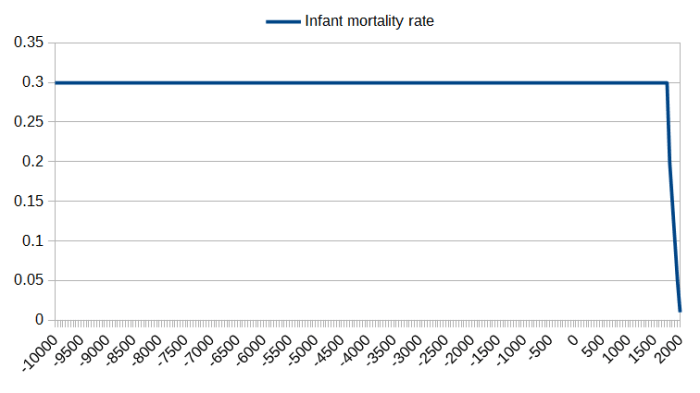
It’s hard to get good data for prehistoric cultures, but the best data we have says that infant mortality in ancient hunter-gatherer cultures was about 20-50%, with a best estimate around 30%. This is statistically indistinguishable from early agricultural societies.

Indeed, 30% seems to be the figure humanity had for most of history. Just shy of a third of all babies died for most of history.

In Medieval times, infant mortality was about 30%.

This same rate (fluctuating based on various plagues) persisted into the Enlightenment—Sweden has the best records, and their infant mortality rate in 1750 was about 30%.

The decline in infant mortality began slowly: During the Industrial Era, infant mortality was about 15% in isolated villages, but still as high as 40% in major cities due to high population densities with poor sanitation.

Even as recently as 1900, there were US cities with infant mortality rates as high as 30%, though the overall rate was more like 10%.

Most of the decline was recent and rapid: Just within the US since WW2, infant mortality fell from about 5.5% to 0.7%, though there remains a substantial disparity between White and Black people.

Globally, the infant mortality rate fell from 6.3% to 3.2% within my lifetime, and in Africa today, the region where it is worst, it is about 5.5%—or what it was in the US in the 1940s.

This precipitous decline in babies dying is the main reason ancient societies have such low life expectancies; actually once they reached adulthood they lived to be about 70 years old, not much worse than we do today. So my multiplying everything by 71 actually isn’t too far off even for ancient societies.

Let me make a graph for you here, of the approximate rate of babies dying over time from 10,000 BC to today:

Infant_mortality.png

Let’s zoom in on the last 250 years, where the data is much more solid:

Infant_mortality_recent.png

I think you may notice something in these graphs. There is quite literally a turning point for humanity, a kink in the curve where we suddenly begin a rapid decline from an otherwise constant mortality rate.

That point occurs around or shortly before 1800—that is, it occurs at industrial capitalism. Adam Smith (not to mention Thomas Jefferson) was writing at just about the point in time when humanity made a sudden and unprecedented shift toward saving the lives of millions of babies.

So now, think about that the next time you are tempted to say that capitalism is an evil system that destroys the world; the evidence points to capitalism quite literally saving babies from dying.

How would it do so? Well, there’s that rising per-capita GDP we previously ignored, for one thing. But more important seems to be the way that industrialization and free markets support technological innovation, and in this case especially medical innovation—antibiotics and vaccines. Our higher rates of literacy and better communication, also a result of raised standard of living and improved technology, surely didn’t hurt. I’m not often in agreement with the Cato Institute, but they’re right about this one: Industrial capitalism is the chief source of human progress.

Billions of babies would have died but we saved them. So yes, I’m going to call that progress. Civilization, and in particular industrialization and free markets, have dramatically improved human life over the last few hundred years.

In a future post I’ll address one of the common retorts to this basically indisputable fact: “You’re making excuses for colonialism and imperialism!” No, I’m not. Saying that modern capitalism is a better system (not least because it saves babies) is not at all the same thing as saying that our ancestors were justified in using murder, slavery, and tyranny to force people into it.

Why is Tatooine poor?

JDN 2457513—May 4, 2016

May the Fourth be with you.

In honor of International Star Wars Day, this post is going to be about Star Wars!

[I wanted to include some images from Star Wars, but here are the copyright issues that made me decide it ultimately wasn’t a good idea.]

But this won’t be as frivolous as it may sound. Star Wars has a lot of important lessons to teach us about economics and other social sciences, and its universal popularity gives us common ground to start with. I could use Zimbabwe and Botswana as examples, and sometimes I do; but a lot of people don’t know much about Zimbabwe and Botswana. A lot more people know about Tatooine and Naboo, so sometimes it’s better to use those instead.

In fact, this post is just a small sample of a much larger work to come; several friends of mine who are social scientists in different fields (I am of course the economist, and we also have a political scientist, a historian, and a psychologist) are writing a book about this; we are going to use Star Wars as a jumping-off point to explain some real-world issues in social science.

So, my topic for today, which may end up forming the basis for a chapter of the book, is quite simple:
Why is Tatooine poor?

First, let me explain why this is such a mystery to begin with. We’re so accustomed to poverty being in the world that we expect to see it, we think of it as normal—and for most of human history, that was probably the correct attitude to have. Up until at least the Industrial Revolution, there simply was no way of raising the standard of living of most people much beyond bare subsistence. A wealthy few could sometimes live better, and most societies have had such an elite; but it was never more than about 1% of the population—and sometimes as little as 0.01%. They could have distributed wealth more evenly than they did, but there simply wasn’t that much to go around.

The “prosperous” “democracy” of Periclean Athens for example was really an aristocratic oligarchy, in which the top 1%—the ones who could read and write, and hence whose opinions we read—owned just about everything (including a fair number of the people—slavery). Their “democracy” was a voting system that only applied to a small portion of the population.

But now we live in a very different age, the Information Age, where we are absolutely basking in wealth thanks to enormous increases in productivity. Indeed, the standard of living of an Athenian philosopher was in many ways worse than that of a single mother on Welfare in the United States today; certainly the single mom has far better medicine, communication, and transportation than the philosopher, but she may even have better nutrition and higher education. Really the only things I can think of that the philosopher has more of are jewelry and real estate. The single mom also surely spends a lot more time doing housework, but a good chunk of her work is automated (dishwasher, microwave, washing machine), while the philosopher simply has slaves for that sort of thing. The smartphone in her pocket (81% of poor households in the US have a cellphone, and about half of these are smartphones) and the car in her driveway (75% of poor households in the US own at least one car) may be older models in disrepair, but they would still be unimaginable marvels to that ancient philosopher.

How is it, then, that we still have poverty in this world? Even if we argued that the poverty line in First World countries is too high because they have cars and smartphones (not an argument I agree with by the way—given our enormous productivity there’s no reason everyone shouldn’t have a car and a smartphone, and the main thing that poor people still can’t afford is housing), there are still over a billion people in the world today who live on less than $2 per day in purchasing-power-adjusted real income. That is poverty, no doubt about it. Indeed, it may in fact be a lower standard of living than most human beings had when we were hunter-gatherers. It may literally be a step downward from the Paleolithic.

Here is where Tatooine may give us some insights.

Productivity in the Star Wars universe is clearly enormous; indeed the proportional gap between Star Wars and us appears to be about the same as the proportional gap between us and hunter-gatherer times. The Death Star II had a diameter of 160 kilometers. Its cost is listed as “over 1 trillion credits”, but that’s almost meaningless because we have no idea what the exchange rate is or how the price of spacecraft varies relative to the price of other goods. (Spacecraft actually seem to be astonishingly cheap; in A New Hope it seems to be that a drink is a couple of credits while 10,000 credits is almost enough to buy an inexpensive starship. Basically their prices seem to be similar to ours for most goods, but spaceships are so cheap they are priced like cars instead of like, well, spacecraft.)

So let’s look at it another way: How much metal would it take to build such a thing, and how much would that cost in today’s money?

We actually see quite a bit of the inner structure of the Death Star II in Return of the Jedi, so I can hazard a guess that about 5% of the volume of the space station is taken up by solid material. Who knows what it’s actually made out of, but for a ballpark figure let’s assume it’s high-grade steel. The volume of a 160 km diameter sphere is 4*pi*r^3 = 4*(3.1415)*(80,000)^3 = 6.43 quadrillion cubic meters. If 5% is filled with material, that’s 320 trillion cubic meters. High-strength steel has a density of about 8000 kg/m^3, so that’s 2.6 quintillion kilograms of steel. A kilogram of high-grade steel costs about $2, so we’re looking at $5 quintillion as the total price just for the raw material of the Death Star II. That’s $5,000,000,000,000,000,000. I’m not even including the labor (droid labor, that is) and transportation costs (oh, the transportation costs!), so this is a very conservative estimate.

To get a sense of how ludicrously much money this is, the population of Coruscant is said to be over 1 trillion people, which is just about plausible for a city that covers an entire planet. The population of the entire galaxy is supposed to be about 400 quadrillion.

Suppose that instead of building the Death Star II, Emperor Palpatine had decided to give a windfall to everyone on Coruscant. How much would he have given each person (in our money)? $5 million.

Suppose instead he had offered the windfall to everyone in the galaxy? $12.50 per person. That’s 50 million worlds with an average population of 8 billion each. Instead of building the Death Star II, Palpatine could have bought the whole galaxy lunch.

Put another way, the cost I just estimated for the Death Star II is about 60 million times the current world GDP. So basically if the average world in the Empire produced as much as we currently produce on Earth, there would still not be enough to build that thing. In order to build the Death Star II in secret, it must be a small portion of the budget, maybe 5% tops. In order for only a small number of systems to revolt, the tax rates can’t be more than say 50%, if that; so total economic output on the average world in the Empire must in fact be more like 50 times what it is on Earth today, for a comparable average population. This puts their per-capita GDP somewhere around $500,000 per person per year.

So, economic output is extremely high in the Star Wars universe. Then why is Tatooine poor? If there’s enough output to make basically everyone a millionaire, why haven’t they?

In a word? Power.

Political power is of course very unequally distributed in the Star Wars universe, especially under the Empire but also even under the Old Republic and New Republic.

Core Worlds like Coruscant appear to have fairly strong centralized governments, and at least until the Emperor seized power and dissolved the Senate (as Tarkin announces in A New Hope) they also seemed to have fairly good representation in the Galactic Senate (though how you make a functioning Senate with millions of member worlds I have no idea—honestly, maybe they didn’t). As a result, Core Worlds are prosperous. Actually, even Naboo seems to be doing all right despite being in the Mid Rim, because of their strong and well-managed constitutional monarchy (“elected queen” is not as weird as it sounds—Sweden did that until the 16th century). They often talk about being a “democracy” even though they’re technically a constitutional monarchy—but the UK and Norway do the same thing with if anything less justification.

But Outer Rim Worlds like Tatooine seem to be out of reach of the central galactic government. (Oh, by the way, what hyperspace route drops you off at Tatooine if you’re going from Naboo to Coruscant? Did they take a wrong turn in addition to having engine trouble? “I knew we should have turned left at Christophsis!”) They even seem to be out of range of the monetary system (“Republic credits are no good out here,” said Watto in The Phantom Menace.), which is pretty extreme. That doesn’t usually happen—if there is a global hegemon, usually their money is better than gold. (“good as gold” isn’t strong enough—US money is better than gold, and that’s why people will accept negative real interest rates to hold onto it.) I guarantee you that if you want to buy something with a US $20 bill in Somalia or Zimbabwe, someone will take it. They might literally take it—i.e. steal it from you, and the government may not do anything to protect you—but it clearly will have value.

So, the Outer Rim worlds are extremely isolated from the central government, and therefore have their own local institutions that operate independently. Tatooine in particular appears to be controlled by the Hutts, who in turn seem to have a clan-based system of organized crime, similar to the Mafia. We never get much detail about the ins and outs of Hutt politics, but it seems pretty clear that Jabba is particularly powerful and may actually be the de facto monarch of a sizeable region or even the whole planet.

Jabba’s government is at the very far extreme of what Daron Acemoglu calls extractive regimes (I’ve been reading his tome Why Nations Fail, and while I agree with its core message, honestly it’s not very well-written or well-argued), systems of government that exist not to achieve overall prosperity or the public good, but to enrich a small elite few at the expense of everyone else. The opposite is inclusive regimes, under which power is widely shared and government exists to advance the public good. Real-world systems are usually somewhere in between; the US is still largely inclusive, but we’ve been getting more extractive over the last few decades and that’s a big problem.

Jabba himself appears to be fantastically wealthy, although even his huge luxury hover-yacht (…thing) is extremely ugly and spartan inside. I infer that he could have made it look however he wanted, and simply has baffling tastes in decor. The fact that he seems to be attracted to female humanoids is already pretty baffling, given the obvious total biological incompatibility; so Jabba is, shall we say, a weird dude. Eccentricity is quite common among despots of extractive regimes, as evidenced by Muammar Qaddafi’s ostentatious outfits, Idi Amin’s love of oranges and Kentucky Fried Chicken, and Kim Jong-Un’s fear of barbers and bond with Dennis Rodman. Maybe we would all be this eccentric if we had unlimited power, but our need to fit in with the rest of society suppresses it.

It’s difficult to put a figure on just how wealthy Jabba is, but it isn’t implausible to say that he has a million times as much as the average person on Tatooine, just as Bill Gates has a million times as much as the average person in the US. Like Qaddafi, before he was killed he probably feared that establishing more inclusive governance would only reduce his power and wealth and spread it to others, even if it did increase overall prosperity.
It’s not hard to make the figures work out so that is so. Suppose that for every 1% of the economy that is claimed by a single rentier despot, overall economic output drops by the same 1%. Then for concreteness, suppose that at optimal efficiency, the whole economy could produce $1 trillion. The amount of money that the despot can claim is determined by the portion he tries to claim, p, times the total amount that the economy will produce, which is (1-p) trillion dollars. So the despot’s wealth will be maximized when p(1-p) is maximized, which is p = 1/2; so the despot would maximize his own wealth at $250 billion if he claimed half of the economy, even though that also means that the economy produces half as much as it could. If he loosened his grip and claimed a smaller share, millions of his subjects would benefit; but he himself would lose more money than he gained. (You can also adjust these figures so that the “optimal” amount for the despot to claim is larger or smaller than half, depending on how severely the rent-seeking disrupts overall productivity.)

It’s important to note that it is not simply geography (galactography?) that makes Tatooine poor. Their sparse, hot desert may be less productive agriculturally, but that doesn’t mean that Tatooine is doomed to poverty. Indeed, today many of the world’s richest countries (such as Qatar) are in deserts, because they produce huge quantities of oil.

I doubt that oil would actually be useful in the Old Republic or the Empire, but energy more generally seems like something you’d always need. Tatooine has enormous flat desert plains and two suns, meaning that its potential to produce solar energy has to be huge. They couldn’t export the energy directly of course, but they could do so indirectly—the cheaper energy could allow them to build huge factories and produce starships at a fraction of the cost that other planets do. They could then sell these starships as exports and import water from planets where it is abundant like Naboo, instead of trying to produce their own water locally through those silly (and surely inefficient) moisture vaporators.

But Jabba likely has fought any efforts to invest in starship production, because it would require a more educated workforce that’s more likely to unionize and less likely to obey his every command. He probably has established a high tariff on water imports (or even banned them outright), so that he can maintain control by rationing the water supply. (Actually one thing I would have liked to see in the movies was Jabba being periodically doused by slaves with vats of expensive imported water. It would not only show an ostentatious display of wealth for a desert culture, but also serve the much more mundane function of keeping his sensitive gastropod skin from dangerously drying out. That’s why salt kills slugs, after all.) He also probably suppressed any attempt to establish new industries of any kind of Tatooine, fearing that with new industry could come a new balance of power.

The weirdest part to me is that the Old Republic didn’t do something about it. The Empire, okay, sure; they don’t much care about humanitarian concerns, so as long as Tatooine is paying its Imperial taxes and staying out of the Emperor’s way maybe he leaves them alone. But surely the Republic would care that this whole planet of millions if not billions of people is being oppressed by the Hutts? And surely the Republic Navy is more than a match for whatever pitiful military forces Jabba and his friends can muster, precisely because they haven’t established themselves as the shipbuilding capital of the galaxy? So why hasn’t the Republic deployed a fleet to Tatooine to unseat the Hutts and establish democracy? (It could be over pretty fast; we’ve seen that one good turbolaser can destroy Jabba’s hover-yacht—and it looks big enough to target from orbit.)

But then, we come full circle, back to the real world: Why hasn’t the US done the same thing in Zimbabwe? Would it not actually work? We sort of tried it in Libya—a lot of people died, and results are still pending I guess. But doesn’t it seem like we should be doing something?

What really happened in Greece

JDN 2457506

I said I’d get back to this issue, so here goes.

Let’s start with what is uncontroversial: Greece is in trouble.

Their per-capita GDP PPP has fallen from a peak of over $32,000 in 2007 to a trough of just over $24,000 in 2013, and only just began to recover over the last 2 years. That’s a fall of 29 log points. Put another way, the average person in Greece has about the same real income now that they had in the year 2000—a decade and a half of economic growth disappeared.

Their unemployment rate surged from about 7% in 2007 to almost 28% in 2013. It remains over 24%. That is, almost one quarter of all adults in Greece are seeking jobs and not finding them. The US has not seen an unemployment rate that high since the Great Depression.

Most shocking of all, over 40% of the population in Greece is now below the national poverty line. They define poverty as 60% of the inflation-adjusted average income in 2009, which works out to 665 Euros per person ($756 at current exchange rates) per month, or about $9000 per year. They also have an absolute poverty line, which 14% of Greeks now fall below, but only 2% did before the crash.

So now, let’s talk about why.

There’s a standard narrative you’ve probably heard many times, which goes something like this:

The Greek government spent too profligately, heaping social services on the population without the tax base to support them. Unemployment insurance was too generous; pensions were too large; it was too hard to fire workers or cut wages. Thus, work incentives were too weak, and there was no way to sustain a high GDP. But they refused to cut back on these social services, and as a result went further and further into debt until it finally became unsustainable. Now they are cutting spending and raising taxes like they needed to, and it will eventually allow them to repay their debt.

Here’s a fellow of the Cato Institute spreading this narrative on the BBC. Here’s ABC with a five bullet-point list: Pension system, benefits, early retirement, “high unemployment and work culture issues” (yes, seriously), and tax evasion. Here the Telegraph says that Greece “went on a spending spree” and “stopped paying taxes”.

That story is almost completely wrong. Almost nothing about it is true. Cato and the Telegraph got basically everything wrong. The only one ABC got right was tax evasion.

Here’s someone else arguing that Greece has a problem with corruption and failed governance; there is something to be said for this, as Greece is fairly corrupt by European standards—though hardly by world standards. For being only a generation removed from an authoritarian military junta, they’re doing quite well actually. They’re about as corrupt as a typical upper-middle income country like Libya or Botswana; and Botswana is widely regarded as the shining city on a hill of transparency as far as Sub-Saharan Africa is concerned. So corruption may have made things worse, but it can’t be the whole story.

First of all, social services in Greece were not particularly extensive compared to the rest of Europe.

Before the crisis, Greece’s government spending was about 44% of GDP.

That was about the same as Germany. It was slightly more than the UK. It was less than Denmark and France, both of which have government spending of about 50% of GDP.

Greece even tried to cut spending to pay down their debt—it didn’t work, because they simply ended up worsening the economic collapse and undermining the tax base they needed to do that.

Europe has fairly extensive social services by world standards—but that’s a major part of why it’s the First World. Even the US, despite spending far less than Europe on social services, still spends a great deal more than most countries—about 36% of GDP.

Second, if work incentives were a problem, you would not have high unemployment. People don’t seem to grasp what the word unemployment actually means, which is part of why I can’t stand it when news outlets just arbitrarily substitute “jobless” to save a couple of syllables. Unemployment does not mean simply that you don’t have a job. It means that you don’t have a job and are trying to get one.

The word you’re looking for to describe simply not having a job is nonemployment, and that’s such a rarely used term my spell-checker complains about it. Yet economists rarely use this term precisely because it doesn’t matter; a high nonemployment rate is not a symptom of a failing economy but a result of high productivity moving us toward the post-scarcity future (kicking and screaming, evidently). If the problem with Greece were that they were too lazy and they retire too early (which is basically what ABC was saying in slightly more polite language), there would be high nonemployment, but there would not be high unemployment. “High unemployment and work culture issues” is actually a contradiction.

Before the crisis, Greece had an employment-to-population ratio of 49%, meaning a nonemployment rate of 51%. If that sounds ludicrously high, you’re not accustomed to nonemployment figures. During the same time, the United States had an employment-to-population ratio of 52% and thus a nonemployment rate of 48%. So the number of people in Greece who were voluntarily choosing to drop out of work before the crisis was just slightly larger than the number in the US—and actually when you adjust for the fact that the US is full of young immigrants and Greece is full of old people (their median age is 10 years older than ours), it begins to look like it’s we Americans who are lazy. (Actually, it’s that we are studious—the US has an extremely high rate of college enrollment and the best colleges in the world. Full-time students are nonemployed, but they are certainly not unemployed.)

But Greece does have an enormously high debt, right? Yes—but it was actually not as bad before the crisis. Their government debt surged from 105% of GDP to almost 180% today. 105% of GDP is about what we have right now in the US; it’s less than what we had right after WW2. This is a little high, but really nothing to worry about, especially if you’ve incurred the debt for the right reasons. (The famous paper by Rogart and Reinhoff arguing that 90% of GDP is a horrible point of no return was literally based on math errors.)

Moreover, Ireland and Spain suffered much the same fate as Greece, despite running primary budget surpluses.

So… what did happen? If it wasn’t their profligate spending that put them in this mess, what was it?

Well, first of all, there was the Second Depression, a worldwide phenomenon triggered by the collapse of derivatives markets in the United States. (You want unsustainable debt? Try 20 to 1 leveraged CDO-squareds and one quadrillion dollars in notional value. Notional value isn’t everything, but it’s a lot.) So it’s mainly our fault, or rather the fault of our largest banks. As far as us voters, it’s “our fault” in the way that if your car gets stolen it’s “your fault” for not locking the doors and installing a LoJack. We could have regulated against this and enforced those regulations, but we didn’t. (Fortunately, Dodd-Frank looks like it might be working.)

Greece was hit particularly hard because they are highly dependent on trade, particularly in services like tourism that are highly sensitive to the business cycle. Before the crash they imported 36% of GDP and exported 23% of GDP. Now they import 35% of GDP and export 33% of GDP—but it’s a much smaller GDP. Their exports have only slightly increased while their imports have plummeted. (This has reduced their “trade deficit”, but that has always been a silly concept. I guess it’s less silly if you don’t control your own currency, but it’s still silly.)

Once the crash happened, the US had sovereign monetary policy and the wherewithal to actually use that monetary policy effectively, so we weathered the crash fairly well, all things considered. Our unemployment rate barely went over 10%. But Greece did not have sovereign monetary policy—they are tied to the Euro—and that severely limited their options for expanding the money supply as a result of the crisis. Raising spending and cutting taxes was the best thing they could do.

But the bank(st?)ers and their derivatives schemes caused the Greek debt crisis a good deal more directly than just that. Part of the condition of joining the Euro was that countries must limit their fiscal deficit to no more than 3% of GDP (which is a totally arbitrary figure with no economic basis in case you were wondering). Greece was unwilling or unable to do so, but wanted to look like they were following the rules—so they called up Goldman Sachs and got them to make some special derivatives that Greece could use to continue borrowing without looking like they were borrowing. The bank could have refused; they could have even reported it to the European Central Bank. But of course they didn’t; they got their brokerage fee, and they knew they’d sell it off to some other bank long before they had to worry about whether Greece could ever actually repay it. And then (as I said I’d get back to in a previous post) they paid off the credit rating agencies to get them to rate these newfangled securities as low-risk.

In other words, Greece is not broke; they are being robbed.

Like homeowners in the US, Greece was offered loans they couldn’t afford to pay, but the banks told them they could, because the banks had lost all incentive to actually bother with the question of whether loans can be repaid. They had “moved on”; their “financial innovation” of securitization and collateralized debt obligations meant that they could collect origination fees and brokerage fees on loans that could never possibly be repaid, then sell them off to some Greater Fool down the line who would end up actually bearing the default. As long as the system was complex enough and opaque enough, the buyers would never realize the garbage they were getting until it was too late. The entire concept of loans was thereby broken: The basic assumption that you only loan money you expect to be repaid no longer held.

And it worked, for awhile, until finally the unpayable loans tried to create more money than there was in the world, and people started demanding repayment that simply wasn’t possible. Then the whole scheme fell apart, and banks began to go under—but of course we saved them, because you’ve got to save the banks, how can you not save the banks?

Honestly I don’t even disagree with saving the banks, actually. It was probably necessary. What bothers me is that we did nothing to save everyone else. We did nothing to keep people in their homes, nothing to stop businesses from collapsing and workers losing their jobs. Precisely because of the absurd over-leveraging of the financial system, the cost to simply refinance every mortgage in America would have been less than the amount we loaned out in bank bailouts. The banks probably would have done fine anyway, but if they didn’t, so what? The banks exist to serve the people—not the other way around.

We can stop this from happening again—here in the US, in Greece, in the rest of Europe, everywhere. But in order to do that we must first understand what actually happened; we must stop blaming the victims and start blaming the perpetrators.

The Expanse gets the science right—including the economics

JDN 2457502

Despite constantly working on half a dozen projects at once (literally—preparing to start my PhD, writing this blog, working at my day job, editing a novel, preparing to submit a nonfiction book, writing another nonfiction book with three of my friends as co-authors, and creating a card game—that’s seven actually), I do occasionally find time to do things for fun. One I’ve been doing lately is catching up on The Expanse on DVR (I’m about halfway through the first season so far).

If you’re not familiar with The Expanse, it has been fairly aptly described as Battlestar Galactica meets Game of Thrones, though I think that particular comparison misrepresents the tone and attitudes of the series, because both BG and GoT are so dark and cynical (“It’s a nice day… for a… red wedding!”). I think “Star Trek meets Game of Thrones” might be better actually—the extreme idealism of Star Trek would cancel out the extreme cynicism of Game of Thrones, with the result being a complex mix of idealism and cynicism that more accurately reflects the real world (a world where Mahatma Gandhi and Adolf Hitler lived at the same time). That complex, nuanced world (or should I say worlds?) is where The Expanse takes place. ST is also more geopolitical than BG and The Expanse is nothing if not geopolitical.

But The Expanse is not just psychologically realistic—it is also scientifically and economically realistic. It may in fact be the hardest science fiction I have ever encountered, and is definitely the hardest science fiction I’ve seen in a television show. (There are a few books that might be slightly harder, as well as some movies based on them.)

The only major scientific inaccuracy I’ve been able to find so far is the use of sound effects in space, and actually even these can be interpreted as reflecting an omniscient narrator perspective that would hear any sounds that anyone would hear, regardless of what planet or ship they might be on. The sounds the audience hears all seem to be sounds that someone would hear—there’s simply no particular person who would hear all of them. When people are actually thrown into hard vacuum, we don’t hear them make any noise.

Like Firefly (and for once I think The Expanse might actually be good enough to deserve that comparison), there is no FTL, no aliens, no superhuman AI. Human beings are bound within our own solar system, and travel between planets takes weeks or months depending on your energy budget. They actually show holograms projecting the trajectory of various spacecraft and the trajectories actually make good sense in terms of orbital mechanics. Finally screenwriters had the courage to give us the terrifying suspense and inevitability of an incoming nuclear missile rounding a nearby asteroid and intercepting your trajectory, where you have minutes to think about it but not nearly enough delta-v to get out of its blast radius. That is what space combat will be like, if we ever have space combat (as awesome as it is to watch, I strongly hope that we will not ever actually do it). Unlike what Star Trek would have you believe, space is not a 19th century ocean.

They do have stealth in space—but it requires technology that even to them is highly advanced. Moreover it appears to only work for relatively short periods and seems most effective against civilian vessels that would likely lack state-of-the-art sensors, both of which make it a lot more plausible.

Computers are more advanced in the 2200s then they were in the 2000s, but not radically so, at most a million times faster, about what we gained since the 1980s. I’m guessing a smartphone in The Expanse runs at a few petaflops. Essentially they’re banking on Moore’s Law finally dying sometime in the mid 21st century, but then, so am I. Perhaps a bit harder to swallow is that no one has figured out good enough heuristics to match human cognition; but then, human cognition is very tightly optimized.

Spacecraft don’t have artificial gravity except for the thrust of their engines, and people float around as they should when ships are freefalling. They actually deal with the fact that Mars and Ceres have lower gravity than Earth, and the kinds of health problems that result from this. (One thing I do wish they’d done is had the Martian cruiser set a cruising acceleration of Mars-g—about 38% Earth-g—that would feel awkward and dizzying to their Earther captives. Instead they basically seem to assume that Martians still like to use Earth-g for space transit, but that does make some sense in terms of both human health and simply transit time.) It doesn’t seem like people move around quite awkwardly enough in the very low gravity of Ceres—which should be only about 3% Earth-g—but they do establish that electromagnetic boots are ubiquitous and that could account for most of this.

They fight primarily with nuclear missiles and kinetic weapons, and the damage done by nuclear missiles is appropriately reduced by the fact that vacuum doesn’t transmit shockwaves. (Nuclear missiles would still be quite damaging in space by releasing large amounts of wide-spectrum radiation; but they wouldn’t cause the total devastation they do within atmosphere.) Oddly they decided not to go with laser weapons as far as I can tell, which actually seems to me like they’ve underestimated advancement; laser weapons have a number of advantages that would be particularly useful in space, once we can actually make them affordable and reliable enough for widespread deployment. There could also be a three-tier system, where missiles are used at long range, railguns at medium range, and lasers at short range. (Yes, short range—the increased speed of lasers would be only slight compared to a good railgun, and would be more than offset by the effect of diffraction. At orbital distances, a laser is a shotgun.) Then again, it could well work out that railguns are just better—depending on how vessels are structured, puncturing their hulls with kinetic rounds could well be more useful than burning them up with infrared lasers.

But I think what really struck me about the realism of The Expanse is how it even makes the society realistic (in a way that, say, Firefly really doesn’t—we wanted a Western and we got a Western!).

The only major offworld colonies are Mars and Ceres, both of which seem to be fairly well-established, probably originally colonized as much as a century ago. Different societies have formed on each world; Earth has largely united under the United Nations (one of the lead characters is an undersecretary for the UN), but meanwhile Mars has split off into its own independent nation (“Martian” is now an ethnicity like “German” rather than meaning “extraterrestrial”), and the asteroid belt colonists, while formally still under Earth’s government, think of themselves as a different culture (“Belters”) and are seeking independence. There are some fairly obvious—but deftly managed rather than heavy-handed—parallels between the Belter independence movement and real-world independence movements, particularly Palestine (it’s hard not to think of the PLO when they talk about the OPA). Both Mars and the Belt have their own languages, while Earth’s languages have largely coalesced around English as the language of politics and commerce. (If the latter seems implausible, I remind you that the majority of the Internet and all international air traffic control are in English.) English is the world’s lingua franca (which is a really bizarre turn of phrase because it’s the Latin for French).

There is some of the conniving and murdering of Game of Thrones, but it is at a much more subdued level, and all of the major factions display both merits and flaws. There is no clear hero and no clear villain, just conflict and misunderstanding between a variety of human beings each with their own good and bad qualities. There does seem to be a sense that the most idealistic characters suffer for their idealism much as the Starks often do, but unlike the Starks they usually survive and learn from the experience. Indeed, some of the most cynical also seem to suffer for their cynicism—in the episode I just finished, the grizzled UN Colonel assumed the worst of his adversary and ended up branded “the butcher of Anderson Station”.

Cost of living on Ceres is extraordinarily high because of the limited living space (the apartments look a lot like the tiny studios of New York or San Francisco), and above all the need to constantly import air and water from Earth. A central plot point in the first episode is that a ship carrying comet ice—i.e., water—to Ceres is lost in a surprise attack by unknown adversaries with advanced technology, and the result is a deepening of an already dire water shortage, exacerbating the Belter’s craving for rebellion.

Air and water are recyclable, so it wouldn’t be that literally every drink and every breath needs to be supplied from outside—indeed that would clearly be cost-prohibitive. But recycling is never perfect, and Ceres also appears to have a growing population, both of which would require a constant input of new resources to sustain. It makes perfect sense that the most powerful people on Ceres are billionaire tycoons who own water and air transport corporations.

The police on Ceres (of which another lead character is a detective) are well-intentioned but understaffed, underfunded and moderately corrupt, similar to what we seem to find in large inner-city police departments like the NYPD and LAPD. It felt completely right when they responded to an attempt to kill a police officer with absolutely overwhelming force and little regard for due process and procedure—for this is what real-world police departments almost always do.

But why colonize the asteroid belt at all? Mars is a whole planet, there is plenty there—and in The Expanse they are undergoing terraforming at a very plausible rate (there’s a moving scene where a Martian says to an Earther, “We’re trying to finish building our garden before you finish paving over yours.”). Mars has as much land as Earth, and it has water, abundant metals, and CO2 you could use to make air.Even just the frontier ambition could be enough to bring us to Mars.

But why go to Ceres? The explanation The Expanse offers is a very sensible one: Mining, particularly so-called “rare earth metals”. Gold and platinum might have been profitable to mine at first, but once they became plentiful the market would probably collapse or at least drop off to a level where they aren’t particularly expensive or interesting—because they aren’t useful for very much. But neodymium, scandium, and prometheum are all going to be in extremely high demand in a high-tech future based on nuclear-powered spacecraft, and given that we’re already running out of easily accessible deposits on Earth, by the 2200s there will probably be basically none left. The asteroid belt, however, will have plenty for centuries to come.

As a result Ceres is organized like a mining town, or perhaps an extractive petrostate (metallostate?); but due to lightspeed interplanetary communication—very important in the series—and some modicum of free speech it doesn’t appear to have attained more than a moderate level of corruption. This also seems realistic; the “end-of-history” thesis is often overstated, but the basic idea that some form of democracy and welfare-state capitalism is fast becoming the only viable model of governance does seem to be true, and that is almost certainly the model of governance we would export to other planets. In such a system corruption can only get so bad before it is shown on the mass media and people won’t take it anymore.

The show doesn’t deal much with absolute dollar (or whatever currency) numbers, which is probably wise; but nominal incomes on Ceres are likely extremely high even though the standard of living is quite poor, because the tiny living space and need to import air and water would make prices (literally?) astronomical. Most people on Ceres seem to have grown up there, but the initial attraction could have been something like the California Gold Rush, where rumors of spectacularly high incomes clashed with similarly spectacular expenses incurred upon arrival. “Become a millionaire!” “Oh, by the way, your utility bill this month is $112,000.”

Indeed, even the poor on Ceres don’t seem that poor, which is a very nice turn toward realism that a lot of other science fiction shows seem unprepared to make. In Firefly, the poor are poor—they can barely afford food and clothing, and have no modern conveniences whatsoever. (“Jaynestown”, perhaps my favorite episode, depicts this vividly.) But even the poor in the US today are rarely that poor; our minimalistic and half-hearted welfare state has a number of cracks one can fall through, but as long as you get the benefits you’re supposed to get you should be able to avoid starvation and homelessness. Similarly I find it hard to believe that any society with high enough productivity to routinely build interstellar spacecraft the way we build container ships would not have at least the kind of welfare state that provides for the most basic needs. Chronic dehydration is probably still a problem for Belters, because water would be too expensive to subsidize in this way; but they all seem to have fairly nice clothes, home appliances, and smartphones, and that seems right to me. At one point a character loses his arm, and the “cheap” solution is a cybernetic prosthetic—the “expensive” one would be to grow him a new arm. As today but perhaps even more so, poverty in The Expanse is really about inequality—the enormous power granted to those who have millions of times as much as others. (Another show that does this quite well, though is considerably softer as far as the physics, is Continuum. If I recall correctly, Alec Sadler in 2079 is literally a trillionaire.)

Mars also appears to be a democracy, and actually quite a thriving one. In many ways Mars appears to be surpassing Earth economically and technologically. This suggests that Mars was colonized with our best and brightest, but not necessarily; Australians have done quite well for themselves despite being founded as a penal colony. Mars colonization would also have a way of justifying their frontier idealism that no previous frontiers have granted: No indigenous people to displace, no local ecology to despoil, and no gifts from the surrounding environment. You really are working entirely out of your own hard work and know-how (and technology and funding from Earth of course) to establish a truly new world on the open and unspoiled frontier. You’re not naive or a hypocrite, it’s the real truth. That kind of realistic idealism could make the Martian Dream a success in ways even the American Dream never quite was.

In all it is a very compelling series, and should appeal to people like me who crave geopolitical nuance in fiction. But it also has its moments of huge space battles with exploding star cruisers, so there’s that.

So what can we actually do about sweatshops?

JDN 2457489

(The topic of this post was chosen by a vote of my Patreons.) There seem to be two major camps on most political issues: One camp says “This is not a problem, stop worrying about it.” The other says “This is a huge problem, it must be fixed right away, and here’s the easy solution.” Typically neither of these things is true, and the correct answer is actually “This is a huge problem, well worth fixing—but we need to do a lot of work to figure out exactly how.”

Sweatshop labor is a very good example of this phenomenon.

Camp A is represented here by the American Enterprise Institute, which even goes as far as to defend child labor on the grounds that “we used to do it before”. (Note that we also used to do slavery before. Also protectionism, but of course AEI doesn’t think that was good. Who needs logical consistency when you have ideological purity?) The College Conservative uses ECON 101 to defend sweatshops, perhaps not realizing that economics courses continue past ECON 101.

Camp B is represented here by Buycott, telling us to buy “made in the USA” products and boycott all companies that use sweatshops. Other commonly listed strategies include buying used clothes (I mean, there may be some ecological benefits to this, but clearly not all clothes can be used clothes) and “buy union-made” which is next to impossible for most products. Also in this camp is LaborVoices, a Silicon Valley tech company that seems convinced they can somehow solve the problem of sweatshops by means of smartphone apps, because apparently Silicon Valley people believe that smartphones are magical and not, say, one type of product that performs services similar to many other pre-existing products but somewhat more efficiently. (This would also explain how Uber can say with a straight face that they are “revolutionary” when all they actually do is mediate unlicensed taxi services, and Airbnb is “innovative” because it makes it slightly more convenient to rent out rooms in your home.)

Of course I am in that third camp, people who realize that sweatshops—and exploitative labor practices in general—are a serious problem, but a very complex and challenging one that does not have any easy, obvious solutions.

One thing we absolutely cannot do is return to protectionism or get American consumers to only buy from American companies (a sort of “soft protectionism” by social construction). This would not only be inefficient for us—it would be devastating for people in Third World countries. Sweatshops typically provide substantially better living conditions than the alternatives available to their workers.

Yet this does not mean that sweatshops are morally acceptable or should simply be left alone, contrary to the assertions of many economists—most famously Benjamin Powell. Anyone who doubts this must immediately read “Wrongful Beneficence” by Chris Meyers; the mere fact that an act benefits someone –or even everyone—does not prove that the act was morally acceptable. If someone is starving to death and you offer them bread in exchange for doing whatever you want them to do for the next year, you are benefiting them, surely—but what you are doing is morally wrong. And this is basically what sweatshops are; they provide survival in exchange for exploitation.

It can be remarkably difficult to even tell which companies are using sweatshops—and this is by design. While in response to public pressure corporations often try to create the image of improving their labor standards, they seem quite averse to actually improving labor standards, and even more averse to establishing systems of enforcement to make those labor standards followed consistently. Almost no sweatshops are directly owned by the retailers whose products they make; instead there is a chain of outsourced vendors and distributors, a chain that creates diffusion of responsibility and plausible deniability. When international labor organizations do get the chance to investigate the labor conditions of factories operated by multinational corporations, they invariably find that regulations are more honored in the breach than the observance.

So, what would a long-run solution to sweatshops look like? In a word: Development. The only sustainable solution to oppressive labor conditions is a world where everyone is healthy enough, educated enough, and provided with enough resources that their productivity is at a First World level; furthermore it is a world where workers have enough bargaining power that they are actually paid according to that productivity. (The US has lately been finding out what happens if you do the former but not the latter—the result is that you generate an enormous amount of wealth, but it all ends up in the hands of the top 0.1%. Yet it is quite possible to do the latter, as Denmark has figured out, #ScandinaviaIsBetter.)

To achieve this, we need more factories in Third World countries, not fewer—more investment, not less. We need to buy more of China’s exports, hire more factory workers in Bangladesh.

But it’s not enough to provide incentives to build factories—we must also provide incentives to give workers at those factories more bargaining power.

To see how we can pull this off, I offer a case study of a (qualified) success: Nike.

In the 1990s, Nike’s subcontractors had some of the worst labor conditions in the shoe industry. Today, they actually have some of the best. How did that happen?

It began with people noticing a problem—activists and investigative journalists documented the abuses in Nike’s factories. They drew public attention, which undermined Nike’s efforts at mass advertising (which was basically their entire business model—their shoes aren’t actually especially good). They tried to clean up their image with obviously biased reports, which triggered a backlash. Finally Nike decides to actually do something about the problem, and actually becomes a founding member of the Fair Labor Association. They establish new labor standards, and they audit regularly to ensure that those standards are being complied with. Today they publish an annual corporate social responsibility report that actually appears to be quite transparent and accurate, showing both the substantial improvements that have been made and the remaining problems. Activist campaigns turned Nike around almost completely.

In short, consumer pressure led to private regulation. Many development economists are increasingly convinced that this is what we need—we must put pressure on corporations to regulate themselves.

The pressure is a key part of this process; Willem Buiter wasn’t wrong when he quipped that “self-regulation stands in relation to regulation the way self-importance stands in relation to importance and self-righteousness to righteousness.” For any regulation to work, it must have an enforcement mechanism; for private regulation to work, that enforcement mechanism comes from the consumers.

Yet even this is not enough, because there are too many incentives for corporations to lie and cheat if they only have to be responsive to consumers. It’s unreasonable to expect every consumer to take the time—let alone have the expertise—to perform extensive research on the supply chain of every corporation they buy a product from. I also think it’s unreasonable to expect most people to engage in community organizing or shareholder activism as Green America suggests, though it certainly wouldn’t hurt if some did. But there are just too many corporations to keep track of! Like it or not, we live in a globalized capitalist economy where you almost certainly buy from a hundred different corporations over the course of a year.

Instead we need governments to step up—and the obvious choice is the government of the United States, which remains the world’s economic and military hegemon. We should be pressuring our legislators to make new regulations on international trade that will raise labor standards around the globe.

Note that this undermines the most basic argument corporations use against improving their labor standards: “If we raise wages, we won’t be able to compete.” Not if we force everyone to raise wages, around the globe. “If it’s cheaper to build a factory in Indonesia, why shouldn’t we?” It won’t be cheaper, unless Indonesia actually has a real comparative advantage in producing that product. You won’t be able to artificially hold down your expenses by exploiting your workers—you’ll have to actually be more efficient in order to be more profitable, which is how capitalism is supposed to work.

There’s another argument we often hear that is more legitimate, which is that raising wages would also force corporations to raise prices. But as I discussed in a previous post on this subject, the amount by which prices would need to rise is remarkably small, and nowhere near large enough to justify panic about dangerous global inflation. Paying 10% or even 20% more for our products is well worth it to reduce the corruption and exploitation that abuses millions of people—a remarkable number of them children—around the globe. Also, it doesn’t take a mathematical savant to realize that if increasing wages by a factor of 10 only increases prices by 20%, workers will in fact be better off.

Where would all that extra money come from? Now we come to the real reason why corporations don’t want to raise their labor standards: It would come from profits. Right now profits are extraordinarily large, much larger than they have any right to be in a fair market. It was recently estimated that 74% of billionaire wealth comes from economic rent—that is to say, from deception, exploitation, and market manipulation, rather than actual productivity. (There’s a lot of uncertainty in this estimate; the true figure is probably somewhere between 50% and 90%—it’s almost certainly a majority, and could be the vast majority.) In fact, I really shouldn’t say “money”, which we can just print; what we really want to know is where the extra wealth would come from to give that money value. But by paying workers more, improving their standard of living, and creating more consumer demand, we would in fact dramatically increase the amount of real wealth in the world.

So, we need regulations to improve global labor standards. But we must first be clear: What should these regulations say?

First, we must rule out protectionist regulations that would give unfair advantages to companies that produce locally. These would only result in economic inefficiency at best, and trade wars throwing millions back into poverty at worst. (Some advantage makes sense to internalize the externalities of shipping, but really that should be created by a carbon tax, not by trade tariffs. It’s a lot more expensive and carbon-intensive to ship from Detroit to LA than from Detroit to Windsor, but the latter is the “international” trade.)

Second, we should not naively assume that every country should have the same minimum wage. (I am similarly skeptical of Hillary Clinton’s proposal to include people with severe mental or physical disabilities in the US federal minimum wage; I too am concerned about people with disabilities being exploited, but the fact is many people with severe disabilities really aren’t as productive, and it makes sense for wages to reflect that.) If we’re going to have minimum wages at all—basic income and wage subsidies both make a good deal more sense than a hard price floor; see also my earlier post on minimum wage—they should reflect the productivity and prices of the region. I applaud California and New York for adopting $15 minimum wages, but I’d be a bit skeptical of doing the same in Mississippi, and adamantly opposed to doing so in Bangladesh.

It may not even be reasonable to expect all countries to have the same safety standards; workers who are less skilled and in more dire poverty may rationally be willing to accept more risk to remain employed, rather than laid off because their employer could not afford to meet safety standards and still pay them a sufficient wage. For some safety standards this is ridiculous; making sufficiently many exits with doors that swing outward and maintaining smoke detectors are not expensive things to do. (And yet factories in Bangladesh often fail to meet such basic requirements, which kills hundreds of workers each year.) But other safety standards may be justifiably relaxed; OSHA compliance in the US costs about $70 billion per year, about $200 per person, which many countries simply couldn’t afford. (On the other hand, OSHA saves thousands of lives, does not increase unemployment, and may actually benefit employers when compared with the high cost of private injury lawsuits.) We should have expert economists perform careful cost-benefit analyses of proposed safety regulations to determine which ones are cost-effective at protecting workers and which ones are too expensive to be viable.

While we’re at it, these regulations should include environmental standards, or a global carbon tax that’s used to fund climate change mitigation efforts around the world. Here there isn’t much excuse for not being strict; pollution and environmental degradation harms the poor the most. Yes, we do need to consider the benefits of production that is polluting; but we have plenty of profit incentives for that already. Right now the balance is clearly tipped far too much in favor of more pollution than the optimum rather than less. Even relatively heavy-handed policies like total bans on offshore drilling and mountaintop removal might be in order; in general I’d prefer to tax rather than ban, but these activities are so enormously damaging that if the choice is between a ban and doing nothing, I’ll take the ban. (I’m less convinced of this with regard to fracking; yes, earthquakes and polluted groundwater are bad—but are they Saudi Arabia bad? Because buying more oil from Saudi Arabia is our leading alternative.)

It should go without saying (but unfortunately it doesn’t seem to) that our regulations must include an absolute zero-tolerance policy for forced labor. If we find out that a company is employing forced labor, they should have to not only free every single enslaved worker, but pay each one a million dollars (PPP 2005 chained CPI of course). If they can’t do that and they go bankrupt, good riddance; remind me to play them the world’s saddest song on the world’s tiniest violin. Of course, first we need to find out, which brings me to the most important point.

Above all, these regulations must be enforced. We could start with enforceable multilateral trade agreements, where tariff reductions are tied to human rights and labor standards. This is something the President of the United States could do, right now, as an addendum to the Trans-Pacific Partnership. (What he should have done is made the TPP contingent on this, but it’s too late for that.) Future trade agreements should include these as a matter of course.If countries want to reap the benefits of free trade, they must be held accountable for sharing those benefits equitably with their people.

But ultimately we should not depend upon multilateral agreements between nations—we need truly international standards with global enforcement. We should empower the International Labor Organization to enact sanctions and inspections (right now it mostly enacts suggestions which are promptly and dutifully ignored), and possibly even to arrest executives for trial at the International Criminal Court. We should double if not triple or quadruple their funding—and if member nations will not pay this voluntarily, we should make them—the United Nations should be empowered to collect taxes in support of global development, which should be progressive with per-capita GDP. Coercion, you say? National sovereignty, you say? Millions of starving little girls is my reply.

Right now, the ability of multinational corporations to move between countries to find the ones that let them pay the least have created a race to the floor; it’s time for us to raise that floor.

What can you yourself do, assuming you’re not a head of state? (If you are, I’m honored. Also, any openings on your staff?) Well, you can vote—and you can use that vote to put pressure on your legislators to support these kinds of polices. There are also some other direct actions you can take that I discussed in a previous post; but mainly what we need is policy. Consumer pressure and philanthropy are good, and by all means, don’t stop; but to really achieve global justice we will need nothing short of global governance.

We do not benefit from economic injustice.

JDN 2457461

Recently I think I figured out why so many middle-class White Americans express so much guilt about global injustice: A lot of people seem to think that we actually benefit from it. Thus, they feel caught between a rock and a hard place; conquering injustice would mean undermining their own already precarious standard of living, while leaving it in place is unconscionable.

The compromise, is apparently to feel really, really guilty about it, constantly tell people to “check their privilege” in this bizarre form of trendy autoflagellation, and then… never really get around to doing anything about the injustice.

(I guess that’s better than the conservative interpretation, which seems to be that since we benefit from this, we should keep doing it, and make sure we elect big, strong leaders who will make that happen.)

So let me tell you in no uncertain words: You do not benefit from this.

If anyone does—and as I’ll get to in a moment, that is not even necessarily true—then it is the billionaires who own the multinational corporations that orchestrate these abuses. Billionaires and billionaires only stand to gain from the exploitation of workers in the US, China, and everywhere else.

How do I know this with such certainty? Allow me to explain.

First of all, it is a common perception that prices of goods would be unattainably high if they were not produced on the backs of sweatshop workers. This perception is mistaken. The primary effect of the exploitation is simply to raise the profits of the corporation; there is a secondary effect of raising the price a moderate amount; and even this would be overwhelmed by the long-run dynamic effect of the increased consumer spending if workers were paid fairly.

Let’s take an iPad, for example. The price of iPads varies around the world in a combination of purchasing power parity and outright price discrimination; but the top model almost never sells for less than $500. The raw material expenditure involved in producing one is about $370—and the labor expenditure? Just $11. Not $110; $11. If it had been $110, the price could still be kept under $500 and turn a profit; it would simply be much smaller. That is, even if prices are really so elastic that Americans would refuse to buy an iPad at any more than $500 that would still mean Apple could still afford to raise the wages they pay (or rather, their subcontractors pay) workers by an order of magnitude. A worker who currently works 50 hours a week for $10 per day could now make $10 per hour. And the price would not have to change; Apple would simply lose profit, which is why they don’t do this. In the absence of pressure to the contrary, corporations will do whatever they can to maximize profits.

Now, in fact, the price probably would go up, because Apple fans are among the most inelastic technology consumers in the world. But suppose it went up to $600, which would mean a 1:1 absorption of these higher labor expenditures into price. Does that really sound like “Americans could never afford this”? A few people right on the edge might decide they couldn’t buy it at that price, but it wouldn’t be very many—indeed, like any well-managed monopoly, Apple knows to stop raising the price at the point where they start losing more revenue than they gain.

Similarly, half the price of an iPhone is pure profit for Apple, and only 2% goes into labor. Once again, wages could be raised by an order of magnitude and the price would not need to change.

Apple is a particularly obvious example, but it’s quite simple to see why exploitative labor cannot be the source of improved economic efficiency. Paying workers less does not make them do better work. Treating people more harshly does not improve their performance. Quite the opposite: People work much harder when they are treated well. In addition, at the levels of income we’re talking about, small improvements in wages would result in substantial improvements in worker health, further improving performance. Finally, substitution effect dominates income effect at low incomes. At very high incomes, income effect can dominate substitution effect, so higher wages might result in less work—but it is precisely when we’re talking about poor people that it makes the least sense to say they would work less if you paid them more and treated them better.

At most, paying higher wages can redistribute existing wealth, if we assume that the total amount of wealth does not increase. So it’s theoretically possible that paying higher wages to sweatshop workers would result in them getting some of the stuff that we currently have (essentially by a price mechanism where the things we want get more expensive, but our own wages don’t go up). But in fact our wages are most likely too low as well—wages in the US have become unlinked from productivity, around the time of Reagan—so there’s reason to think that a more just system would improve our standard of living also. Where would all the extra wealth come from? Well, there’s an awful lot of room at the top.

The top 1% in the US own 35% of net wealth, about as much as the bottom 95%. The 400 billionaires of the Forbes list have more wealth than the entire African-American population combined. (We’re double-counting Oprah—but that’s it, she’s the only African-American billionaire in the US.) So even assuming that the total amount of wealth remains constant (which is too conservative, as I’ll get to in a moment), improving global labor standards wouldn’t need to pull any wealth from the middle class; it could get plenty just from the top 0.01%.

In surveys, most Americans are willing to pay more for goods in order to improve labor standards—and the amounts that people are willing to pay, while they may seem small (on the order of 10% to 20% more), are in fact clearly enough that they could substantially increase the wages of sweatshop workers. The biggest problem is that corporations are so good at covering their tracks that it’s difficult to know whether you are really supporting higher labor standards. The multiple layers of international subcontractors make things even more complicated; the people who directly decide the wages are not the people who ultimately profit from them, because subcontractors are competitive while the multinationals that control them are monopsonists.

But for now I’m not going to deal with the thorny question of how we can actually regulate multinational corporations to stop them from using sweatshops. Right now, I just really want to get everyone on the same page and be absolutely clear about cui bono. If there is a benefit at all, it’s not going to you and me.

Why do I keep saying “if”? As so many people will ask me: “Isn’t it obvious that if one person gets less money, someone else must get more?” If you’ve been following my blog at all, you know that the answer is no.

On a single transaction, with everything else held constant, that is true. But we’re not talking about a single transaction. We’re talking about a system of global markets. Indeed, we’re not really talking about money at all; we’re talking about wealth.

By paying their workers so little that those workers can barely survive, corporations are making it impossible for those workers to go out and buy things of their own. Since the costs of higher wages are concentrated in one corporation while the benefits of higher wages are spread out across society, there is a Tragedy of the Commons where each corporation acting in its own self-interest undermines the consumer base that would have benefited all corporations (not to mention people who don’t own corporations). It does depend on some parameters we haven’t measured very precisely, but under a wide range of plausible values, it works out that literally everyone is worse off under this system than they would have been under a system of fair wages.

This is not simply theoretical. We have empirical data about what happened when companies (in the US at least) stopped using an even more extreme form of labor exploitation: slavery.

Because we were on the classical gold standard, GDP growth in the US in the 19th century was extremely erratic, jumping up and down as high as 10 lp and as low as -5 lp. But if you try to smooth out this roller-coaster business cycle, you can see that our growth rate did not appear tobe slowed by the ending of slavery:

US_GDP_growth_1800s


Looking at the level of real per capita GDP (on a log scale) shows a continuous growth trend as if nothing had changed at all:

US_GDP_per_capita_1800s

In fact, if you average the growth rates (in log points, averaging makes sense) from 1800 to 1860 as antebellum and from 1865 to 1900 as postbellum, you find that the antebellum growth rate averaged 1.04 lp, while the postbellum growth rate averaged 1.77 lp. Over a period of 50 years, that’s the difference between growing by a factor of 1.7 and growing by a factor of 2.4. Of course, there were a lot of other factors involved besides the end of slavery—but at the very least it seems clear that ending slavery did not reduce economic growth, which it would have if slavery were actually an efficient economic system.

This is a different question from whether slaveowners were irrational in continuing to own slaves. Purely on the basis of individual profit, it was most likely rational to own slaves. But the broader effects on the economic system as a whole were strongly negative. I think that part of why the debate on whether slavery is economically inefficient has never been settled is a confusion between these two questions. One side says “Slavery damaged overall economic growth.” The other says “But owning slaves produced a rate of return for investors as high as manufacturing!” Yeah, those… aren’t answering the same question. They are in fact probably both true. Something can be highly profitable for individuals while still being tremendously damaging to society.

I don’t mean to imply that sweatshops are as bad as slavery; they are not. (Though there is still slavery in the world, and some sweatshops tread a fine line.) What I’m saying is that showing that sweatshops are profitable (no doubt there) or even that they are better than most of the alternatives for their workers (probably true in most cases) does not show that they are economically efficient. Sweatshops are beneficent exploitationthey make workers better off, but in an obviously unjust way. And they only make workers better off compared to the current alternatives; if they were replaced with industries paying fair wages, workers would obviously be much better off still.

And my point is, so would we. While the prices of goods would increase slightly in the short run, in the long run the increased consumer spending by people in Third World countries—which soon would cease to be Third World countries, as happened in Korea and Japan—would result in additional trade with us that would raise our standard of living, not lower it. The only people it is even plausible to think would be harmed are the billionaires who own our multinational corporations; and yet even they might stand to benefit from the improved efficiency of the global economy.

No, you do not benefit from sweatshops. So stop feeling guilty, stop worrying so much about “checking your privilege”—and let’s get out there and do something about it.

The possibilities of a global basic income

JDN 2457401

This post is sort of a Patreon Readers’ Choice; it had a tied score with the previous post. If ties keep happening, I may need to devise some new scheme, lest I end up writing so many Readers’ Choice posts I don’t have time for my own topics (I suppose there are worse fates).

The idea of a global basic income is one I have alluded to many times, but never directly focused on.

As I wrote this I realized it’s actually two posts. I have good news and bad news.
First, the good news.

A national basic income is a remarkably simple, easy policy to make: When the tax code comes around for revision that year, you get Congress to vote in a very large refundable credit, disbursed monthly, that goes to everyone—that is a basic income. To avoid ballooning the budget deficit, you would also want to eliminate a bunch of other deductions and credits, and might want to raise the tax rates as well—but these are all things that we have done before many times. Different administrations almost always add some deductions and remove others, raise some rates and lower others. By this simple intervention, we could end poverty in America immediately and forever. The most difficult part of this whole process is convincing a majority of both houses of Congress to support it. (And even that may not be as difficult as it seems, for a basic income is one of the few economic policies that appeals to both Democrats, Libertarians, and even some Republicans.)

Similar routine policy changes could be applied in other First World countries. A basic income could be established by a vote of Parliament in the UK, a vote of the Senate and National Assembly in France, a vote of the Riksdag in Sweden, et cetera; indeed, Switzerland is already planning a referendum on the subject this year. The benefits of a national basic income policy are huge, the costs are manageable, the implementation is trivial. Indeed, the hardest thing to understand about all of this is why we haven’t done it already.

But the benefits of a national basic income are of course limited to the nation(s) in which it is applied. If Switzerland votes in its proposal to provide $30,000 per person per year (that’s at purchasing power parity, but it’s almost irrelevant whether I use nominal or PPP figures, because Swiss prices are so close to US prices), that will help a lot of people in Switzerland—but it won’t do much for people in Germany or Italy, let alone people in Ghana or Nicaragua. It could do a little bit for other countries, if the increased income for the poor and lower-middle class results in increased imports to Switzerland. But Switzerland especially is a very small player in global trade. A US basic income is more likely to have global effects, because the US by itself accounts for 9% of the world’s exports and 13% of the world’s imports. Some nations, particularly in Latin America, depend almost entirely upon the US to buy their exports.

But even so, national basic incomes in the entire First World would not solve the problem of global poverty. To do that, we would need a global basic income, one that applies to every human being on Earth.

The first question to ask is whether this is feasible at all. Do we even have enough economic output in the world to do this? If we tried would we simply trigger a global economic collapse?

Well,if you divide all the world’s income, adjusted for purchasing power, evenly across all the world’s population, the result is about $15,000 per person per year. This is about the standard of living of the average (by which I mean median) person in Lebanon, Brazil, or Botswana. It’s a little better than the standard of living in China, South Africa, or Peru. This is about half of what the middle class of the First World are accustomed to, but it is clearly enough to not only survive, but actually make some kind of decent living. I think most people would be reasonably happy with this amount of income, if it were stable and secure—and by construction, the majority of the world’s population would be better off if all incomes were equalized in this way.

Of course, we can’t actually do that. All the means we have for redistributing income to that degree would require sacrificing economic efficiency in various ways. It is as if we were carrying water in buckets with holes in the bottom; the amount we give at the end is a lot less than the amount we took at the start.

Indeed, the efficiency costs of redistribution rise quite dramatically as the amount redistributed increases.

I have yet to see a convincing argument for why we could not simply tax the top 1% at a 90% marginal rate and use all of that income for public goods without any significant loss in economic efficiency—this is after all more or less what we did here in the United States in the 1960s, when we had a top marginal rate over 90% and yet per capita GDP growth was considerably higher than it is today. A great many economists seem quite convinced that taxing top incomes in this way would create some grave disincentive against innovation and productivity, yet any time anything like this has been tried such disincentives have conspicuously failed to emerge. (Why, it’s almost as if the rich aren’t that much smarter and more hard-working than we are!)

I am quite sure, on the other hand, that if we literally set up the tax system so that all income gets collected by the government and then doled out to everyone evenly, this would be economically disastrous. Under that system, your income is basically independent of the work you do. You could work your entire life to create a brilliant invention that adds $10 billion to the world economy, and your income would rise by… 0.01%, the proportion that your invention added to the world economy. Or you could not do that, indeed do nothing at all, be a complete drain upon society, and your income would be about $1.50 less each year. It’s not hard to understand why a lot of people might work considerably less hard in such circumstances; if you are paid exactly the same whether you are an entrepreneur, a software engineer, a neurosurgeon, a teacher, a garbage collector, a janitor, a waiter, or even simply a couch potato, it’s hard to justify spending a lot of time and effort acquiring advanced skills and doing hard work. I’m sure there are some people, particularly in creative professions such as art, music, and writing—and indeed, science—who would continue to work, but even so the garbage would not get picked up, the hamburgers would never get served, and the power lines would never get fixed. The result would be that trying to give everyone the same income would dramatically reduce the real income available to distribute, so that we all ended up with say $5,000 per year or even $1,000 per year instead of $15,000.

Indeed, absolute equality is worse than the system of income distribution under Soviet Communism, which still provided at least some incentives to work—albeit often not to work in the most productive or efficient way.

So let’s suppose that we only have the income of the top 1% to work with. It need not be literally that we take income only from the top 1%; we could spread the tax burden wider than that, and there may even be good reasons to do so. But I think this gives us a good back-of-the-envelope estimate of how much money we would realistically have to work with in funding a global basic income. It’s actually surprisingly hard to find good figures on the global income share of the top 1%; there’s one figure going around which is not simply wrong it’s ridiculous, claiming that the income threshold for the top 1% worldwide is only $34,000. Why is it ridiculous? Because the United States comprises 4.5% of the world’s population, and half of Americans make more money than that. This means that we already have at least 2% of the world’s population making at least that much, in the United States alone. Add in people from Europe, Japan, etc. and you easily find that this must be the income of about the top 5%, maybe even only the top 10%, worldwide. Exactly where it lies depends on the precise income distributions of various countries.

But here’s what I do know; the global Gini coefficient is about 0.40, and the US Gini coefficient is about 0.45; thus, roughly speaking, income inequality on a global scale recapitulates income inequality in the US. The top 1% in the US receive about 20% of the income. So let’s say that the top 1% worldwide probably also receive somewhere around 20% of the income. We were only using it to estimate the funds available for a basic income anyway.

This would mean that our basic income could be about $3,000 per person per year at purchasing power parity. That probably doesn’t sound like a lot, and I suppose it isn’t; but the UN poverty threshold is $2 per person per day, which is $730 per person per day. Thus, our basic income is over four times what it would take to eliminate global poverty by the UN threshold.

Now in fact I think that this threshold is probably too low; but is it four times too low? We are accustomed to such a high standard of living in the First World that it’s easy to forget that people manage to survive on far, far less than we have. I think in fact our problem here is not so much poverty per se as it is inequality and financial insecurity. We live in a state of “insecure affluence”; we have a great deal (think for a moment about your shelter, transportation, computer, television, running water, reliable electricity, abundant food—and if you are reading this you probably have all these things), but we constantly fear that we may lose it at any moment, and not without reason. (My family actually lost the house I grew up in as a result of predatory banking and the financial crisis.) We are taught all our lives that the only way to protect this abundance is by means of a hyper-competitive, winner-takes-allcutthroat capitalist economy that never lets us ever become comfortable in appreciating that abundance, for it could be taken from us at any time.

I think the apotheosis of what it is to live in insecure affluence is renting an apartment in LA or New York—you must have a great deal going for you to be able to live in the city at all, but you are a renter, an interloper; the apartment, like so much of your existence, is never fully secure, never fully yours. Perhaps the icing on the cake is if you’re doing it for grad school (as I was a year ago), this bizarre system in which we live near poverty for several years not in spite but because of the fact that we are so hard-working, intelligent and educated. (And it never ceases to baffle me that economists who lived through that can still believe in the Life-Cycle Spending Hypothesis.)

Being below the poverty line in a First World country is a kind of poverty, but it’s a very different kind than being below the poverty line in a Third World country. (I think we need a new term to distinguish it, and maybe “insecure affluence” or “economic insecurity” is the right one.) A national basic income could be set considerably higher than the global basic income (since we’re giving it to far fewer people), so we might actually be able to set $15,000 nationally—but to do that worldwide would use up literally all the money in the world.

Raising the minimum income worldwide to $3,000 per person per year would transform the lives of billions of people. It would, in a very real sense, end poverty, worldwide, immediately and forever.

And that’s the good news. Stay tuned for the bad news.