Reflections at the crossroads

Jan 21 JDN 2460332

When this post goes live, I will have just passed my 36th birthday. (That means I’ve lived for about 1.1 billion seconds, so in order to be as rich as Elon Musk, I’d need to have made, on average, since birth, $200 per second—$720,000 per hour.)

I certainly feel a lot better turning 36 than I did 35. I don’t have any particular additional accomplishments to point to, but my life has already changed quite a bit, in just that one year: Most importantly, I quit my job at the University of Edinburgh, and I am currently in the process of moving out of the UK and back home to Michigan. (We moved the cat over Christmas, and the movers have already come and taken most of our things away; it’s really just us and our luggage now.)

But I still don’t know how to field the question that people have been asking me since I announced my decision to do this months ago:

“What’s next?”

I’m at a crossroads now, trying to determine which path to take. Actually maybe it’s more like a roundabout; it has a whole bunch of different paths, surely not just two or three. The road straight ahead is labeled “stay in academia”; the others at the roundabout are things like “freelance writing”, “software programming”, “consulting”, and “tabletop game publishing”. There’s one well-paved and superficially enticing road that I’m fairly sure I don’t want to take, labeled “corporate finance”.

Right now, I’m just kind of driving around in circles.

Most people don’t seem to quit their jobs without a clear plan for where they will go next. Often they wait until they have another offer in hand that they intend to take. But when I realized just how miserable that job was making me, I made the—perhaps bold, perhaps courageous, perhaps foolish—decision to get out as soon as I possibly could.

It’s still hard for me to fully understand why working at Edinburgh made me so miserable. Many features of an academic career are very appealing to me. I love teaching, I like doing research; I like the relatively flexible hours (and kinda need them, because of my migraines).

I often construct formal decision models to help me make big choices—generally it’s a linear model, where I simply rate each option by its relative quality in a particular dimension, then try different weightings of all the different dimensions. I’ve used this successfully to pick out cars, laptops, even universities. I’m not entrusting my decisions to an algorithm; I often find myself tweaking the parameters to try to get a particular result—but that in itself tells me what I really want, deep down. (Don’t do that in research—people do, and it’s bad—but if the goal is to make yourself happy, your gut feelings are important too.)

My decision models consistently rank university teaching quite high. It generally only gets beaten by freelance writing—which means that maybe I should give freelance writing another try after all.

And yet, my actual experience at Edinburgh was miserable.

What went wrong?

Well, first of all, I should acknowledge that when I separate out the job “university professor” into teaching and research as separate jobs in my decision model, and include all that goes into both jobs—not just the actual teaching, but the grading and administrative tasks; not just doing the research, but also trying to fund and publish it—they both drop lower on the list, and research drops down a lot.

Also, I would rate them both even lower now, having more direct experience of just how awful the exam-grading, grant-writing and journal-submitting can be.

Designing and then grading an exam was tremendously stressful: I knew that many of my students’ futures rested on how they did on exams like this (especially in the UK system, where exams are absurdly overweighted! In most of my classes, the final exam was at least 60% of the grade!). I struggled mightily to make the exam as fair as I could, all the while knowing that it would never really feel fair and I didn’t even have the time to make it the best it could be. You really can’t assess how well someone understands an entire subject in a multiple-choice exam designed to take 90 minutes. It’s impossible.

The worst part of research for me was the rejection.

I mentioned in a previous post how I am hypersensitive to rejection; applying for grants and submitting to journals was clearly the worst feelings of rejection I’ve felt in any job. It felt like they were evaluting not only the value of my work, but my worth as a scientist. Failure felt like being told that my entire career was a waste of time.

It was even worse than the feeling of rejection in freelance writing (which is one of the few things that my model tells me is bad about freelancing as a career for me, along with relatively low and uncertain income). I think the difference is that a book publisher is saying “We don’t think we can sell it.”—’we’ and ‘sell’ being vital. They aren’t saying “this is a bad book; it shouldn’t exist; writing it was a waste of time.”; they’re just saying “It’s not a subgenre we generally work with.” or “We don’t think it’s what the market wants right now.” or even “I personally don’t care for it.”. They acknowledge their own subjective perspective and the fact that it’s ultimately dependent on forecasting the whims of an extremely fickle marketplace. They aren’t really judging my book, and they certainly aren’t judging me.

But in research publishing, it was different. Yes, it’s all in very polite language, thoroughly spiced with sophisticated jargon (though some reviewers are more tactful than others). But when your grant application gets rejected by a funding agency or your paper gets rejected by a journal, the sense really basically is “This project is not worth doing.”; “This isn’t good science.”; “It was/would be a waste of time and money.”; “This (theory or experiment you’ve spent years working on) isn’t interesting or important.” Nobody ever came out and said those things, nor did they come out and say “You’re a bad economist and you should feel bad.”; but honestly a couple of the reviews did kinda read to me like they wanted to say that. They thought that the whole idea that human beings care about each other is fundamentally stupid and naive and not worth talking about, much less running experiments on.

It isn’t so much that I believed them that my work was bad science. I did make some mistakes along the way (but nothing vital; I’ve seen far worse errors by Nobel Laureates). I didn’t have very large samples (because every person I add to the experiment is money I have to pay, and therefore funding I have to come up with). But overall I do believe that my work is sufficiently rigorous to be worth publishing in scientific journals.

It’s more that I came to feel that my work is considered bad, that the kind of work I wanted to do would forever be an uphill battle against an implacable enemy. I already feel exhausted by that battle, and it had only barely begun. I had thought that behavioral economics was a more successful paradigm by now, that it had largely displaced the neoclassical assumptions that came before it; but I was wrong. Except specifically in journals dedicated to experimental and behavioral economics (of which prestigious journals are few—I quickly exhausted them), it really felt like a lot of the feedback I was getting amounted to, “I refuse to believe your paradigm.”.

Part of the problem, also, was that there simply aren’t that many prestigious journals, and they don’t take that many papers. The top 5 journals—which, for whatever reason, command far more respect than any other journals among economists—each accept only about 5-10% of their submissions. Surely more than that are worth publishing; and, to be fair, much of what they reject probably gets published later somewhere else. But it makes a shockingly large difference in your career how many “top 5s” you have; other publications almost don’t matter at all. So once you don’t get into any of those (which of course I didn’t), should you even bother trying to publish somewhere else?

And what else almost doesn’t matter? Your teaching. As long as you show up to class and grade your exams on time (and don’t, like, break the law or something), research universities basically don’t seem to care how good a teacher you are. That was certainly my experience at Edinburgh. (Honestly even their responses to professors sexually abusing their students are pretty unimpressive.)

Some of the other faculty cared, I could tell; there were even some attempts to build a community of colleagues to support each other in improving teaching. But the administration seemed almost actively opposed to it; they didn’t offer any funding to support the program—they wouldn’t even buy us pizza at the meetings, the sort of thing I had as an undergrad for my activist groups—and they wanted to take the time we spent in such pedagogy meetings out of our grading time (probably because if they didn’t, they’d either have to give us less grading, or some of us would be over our allotted hours and they’d owe us compensation).

And honestly, it is teaching that I consider the higher calling.

The difference between 0 people knowing something and 1 knowing it is called research; the difference between 1 person knowing it and 8 billion knowing it is called education.

Yes, of course, research is important. But if all the research suddenly stopped, our civilization would stagnate at its current level of technology, but otherwise continue unimpaired. (Frankly it might spare us the cyberpunk dystopia/AI apocalypse we seem to be hurtling rapidly toward.) Whereas if all education suddenly stopped, our civilization would slowly decline until it ultimately collapsed into the Stone Age. (Actually it might even be worse than that; even Stone Age cultures pass on knowledge to their children, just not through formal teaching. If you include all the ways parents teach their children, it may be literally true that humans cannot survive without education.)

Yet research universities seem to get all of their prestige from their research, not their teaching, and prestige is the thing they absolutely value above all else, so they devote the vast majority of their energy toward valuing and supporting research rather than teaching. In many ways, the administrators seem to see teaching as an obligation, as something they have to do in order to make money that they can spend on what they really care about, which is research.

As such, they are always making classes bigger and bigger, trying to squeeze out more tuition dollars (well, in this case, pounds) from the same number of faculty contact hours. It becomes impossible to get to know all of your students, much less give them all sufficient individual attention. At Edinburgh they even had the gall to refer to their seminars as “tutorials” when they typically had 20+ students. (That is not tutoring!)And then of course there were the lectures, which often had over 200 students.

I suppose it could be worse: It could be athletics they spend all their money on, like most Big Ten universities. (The University of Michigan actually seems to strike a pretty good balance: they are certainly not hurting for athletic funding, but they also devote sizeable chunks of their budget to research, medicine, and yes, even teaching. And unlike virtually all other varsity athletic programs, University of Michigan athletics turns a profit!)

If all the varsity athletics in the world suddenly disappeared… I’m not convinced we’d be any worse off, actually. We’d lose a source of entertainment, but it could probably be easily replaced by, say, Netflix. And universities could re-focus their efforts on academics, instead of acting like a free training and selection system for the pro leagues. The University of California, Irvine certainly seemed no worse off for its lack of varsity football. (Though I admit it felt a bit strange, even to a consummate nerd like me, to have a varsity League of Legends team.)

They keep making the experience of teaching worse and worse, even as they cut faculty salaries and make our jobs more and more precarious.

That might be what really made me most miserable, knowing how expendable I was to the university. If I hadn’t quit when I did, I would have been out after another semester anyway, and going through this same process a bit later. It wasn’t even that I was denied tenure; it was never on the table in the first place. And perhaps because they knew I wouldn’t stay anyway, they didn’t invest anything in mentoring or supporting me. Ostensibly I was supposed to be assigned a faculty mentor immediately; I know the first semester was crazy because of COVID, but after two and a half years I still didn’t have one. (I had a small research budget, which they reduced in the second year; that was about all the support I got. I used it—once.)

So if I do continue on that “academia” road, I’m going to need to do a lot of things differently. I’m not going to put up with a lot of things that I did. I’ll demand a long-term position—if not tenure-track, at least renewable indefinitely, like a lecturer position (as it is in the US, where the tenure-track position is called “assistant professor” and “lecturer” is permanent but not tenured; in the UK, “lecturers” are tenure-track—except at Oxford, and as of 2021, Cambridge—just to confuse you). Above all, I’ll only be applying to schools that actually have some track record for valuing teaching and supporting their faculty.

And if I can’t find any such positions? Then I just won’t apply at all. I’m not going in with the “I’ll take what I can get” mentality I had last time. Our household finances are stable enough that I can afford to wait awhile.

But maybe I won’t even do that. Maybe I’ll take a different path entirely.

For now, I just don’t know.
The mental health crisis in academia

Apr 30 JDN 2460065

Why are so many academics anxious and depressed?

Depression and anxiety are much more prevalent among both students and faculty than they are in the general population. Unsurprisingly, women seem to have it a bit worse than men, and trans people have it worst of all.

Is this the result of systemic failings of the academic system? Before deciding that, one thing we should consider is that very smart people do seem to have a higher risk of depression.

There is a complex relationship between genes linked to depression and genes linked to intelligence, and some evidence that people of especially high IQ are more prone to depression; nearly 27% of Mensa members report mood disorders, compared to 10% of the general population.

(Incidentally, the stereotype of the weird, sickly nerd has a kernel of truth: the correlations between intelligence and autism, ADHD, allergies, and autoimmune disorders are absolutely real—and not at all well understood. It may be a general pattern of neural hyper-activation, not unlike what I posit in my stochastic overload model. The stereotypical nerd wears glasses, and, yes, indeed, myopia is also correlated with intelligence—and this seems to be mostly driven by genetics.)

Most of these figures are at least a few years old. If anything things are only worse now, as COVID triggered a surge in depression for just about everyone, academics included. It remains to be seen how much of this large increase will abate as things gradually return to normal, and how much will continue to have long-term effects—this may depend in part on how well we manage to genuinely restore a normal way of life and how well we can deal with long COVID.

If we assume that academics are a similar population to Mensa members (admittedly a strong assumption), then this could potentially explain why 26% of academic faculty are depressed—but not why nearly 40% of junior faculty are. At the very least, we junior faculty are about 50% more likely to be depressed than would be explained by our intelligence alone. And grad students have it even worse: Nearly 40% of graduate students report anxiety or depression, and nearly 50% of PhD students meet the criteria for depression. At the very least this sounds like a dual effect of being both high in intelligence and low in status—it’s those of us who have very little power or job security in academia who are the most depressed.

This suggests that, yes, there really is something wrong with academia. It may not be entirely the fault of the system—perhaps even a well-designed academic system would result in more depression than the general population because we are genetically predisposed. But it really does seem like there is a substantial environmental contribution that academic institutions bear some responsibility for.

I think the most obvious explanation is constant evaluation: From the time we are students at least up until we (maybe, hopefully, someday) get tenure, academics are constantly being evaluated on our performance. We know that this sort of evaluation contributes to anxiety and depression.

Don’t other jobs evaluate performance? Sure. But not constantly the way that academia does. This is especially obvious as a student, where everything you do is graded; but it largely continues once you are faculty as well.

For most jobs, you are concerned about doing well enough to keep your job or maybe get a raise. But academia has this continuous forward pressure: if you are a grad student or junior faculty, you can’t possibly keep your job; you must either move upward to the next stage or drop out. And academia has become so hyper-competitive that if you want to continue moving upward—and someday getting that tenure—you must publish in top-ranked journals, which have utterly opaque criteria and ever-declining acceptance rates. And since there are so few jobs available compared to the number of applicants, good enough is never good enough; you must be exceptional, or you will fail. Two thirds of PhD graduates seek a career in academia—but only 30% are actually in one three years later. (And honestly, three years is pretty short; there are plenty of cracks left to fall through between that and a genuinely stable tenured faculty position.)

Moreover, our skills are so hyper-specialized that it’s very hard to imagine finding work anywhere else. This grants academic institutions tremendous monopsony power over us, letting them get away with lower pay and worse working conditions. Even with an economics PhD—relatively transferable, all things considered—I find myself wondering who would actually want to hire me outside this ivory tower, and my feeble attempts at actually seeking out such employment have thus far met with no success.

I also find academia painfully isolating. I’m not an especially extraverted person; I tend to score somewhere near the middle range of extraversion (sometimes called an “ambivert”). But I still find myself craving more meaningful contact with my colleagues. We all seem to work in complete isolation from one another, even when sharing the same office (which is awkward for other reasons). There are very few consistent gatherings or good common spaces. And whenever faculty do try to arrange some sort of purely social event, it always seems to involve drinking at a pub and nobody is interested in providing any serious emotional or professional support.

Some of this may be particular to this university, or to the UK; or perhaps it has more to do with being at a certain stage of my career. In any case I didn’t feel nearly so isolated in graduate school; I had other students in my cohort and adjacent cohorts who were going through the same things. But I’ve been here two years now and so far have been unable to establish any similarly supportive relationships with colleagues.

There may be some opportunities I’m not taking advantage of: I’ve skipped a lot of research seminars, and I stopped going to those pub gatherings. But it wasn’t that I didn’t try them at all; it was that I tried them a few times and quickly found that they were not filling that need. At seminars, people only talked about the particular research project being presented. At the pub, people talked about almost nothing of serious significance—and certainly nothing requiring emotional vulnerability. The closest I think I got to this kind of support from colleagues was a series of lunch meetings designed to improve instruction in “tutorials” (what here in the UK we call discussion sections); there, at least, we could commiserate about feeling overworked and dealing with administrative bureaucracy.

There seem to be deep, structural problems with how academia is run. This whole process of universities outsourcing their hiring decisions to the capricious whims of high-ranked journals basically decides the entire course of our careers. And once you get to the point I have, now so disheartened with the process of publishing research that I can’t even engage with it, it’s not at all clear how it’s even possible to recover. I see no way forward, no one to turn to. No one seems to care how well I teach, if I’m not publishing research.

And I’m clearly not the only one who feels this way.

The role of innate activation in stochastic overload

Mar 26 JDN 2460030

Two posts ago I introduced my stochastic overload model, which offers an explanation for the Yerkes-Dodson effect by positing that additional stress increases sympathetic activation, which is useful up until the point where it starts risking an overload that forces systems to shut down and rest.

The central equation of the model is actually quite simple, expressed either as an expectation or as an integral:

Y = E[x + s | x + s < 1] P[x + s < 1]

Y = \int_{0}^{1-s} (x+s) dF(x)

The amount of output produced is the expected value of innate activation plus stress activation, times the probability that there is no overload. Increased stress raises this expectation value (the incentive effect), but also increases the probability of overload (the overload effect).

The model relies upon assuming that the brain starts with some innate level of activation that is partially random. Exactly what sort of Yerkes-Dodson curve you get from this model depends very much on what distribution this innate activation takes.

I’ve so far solved it for three types of distribution.

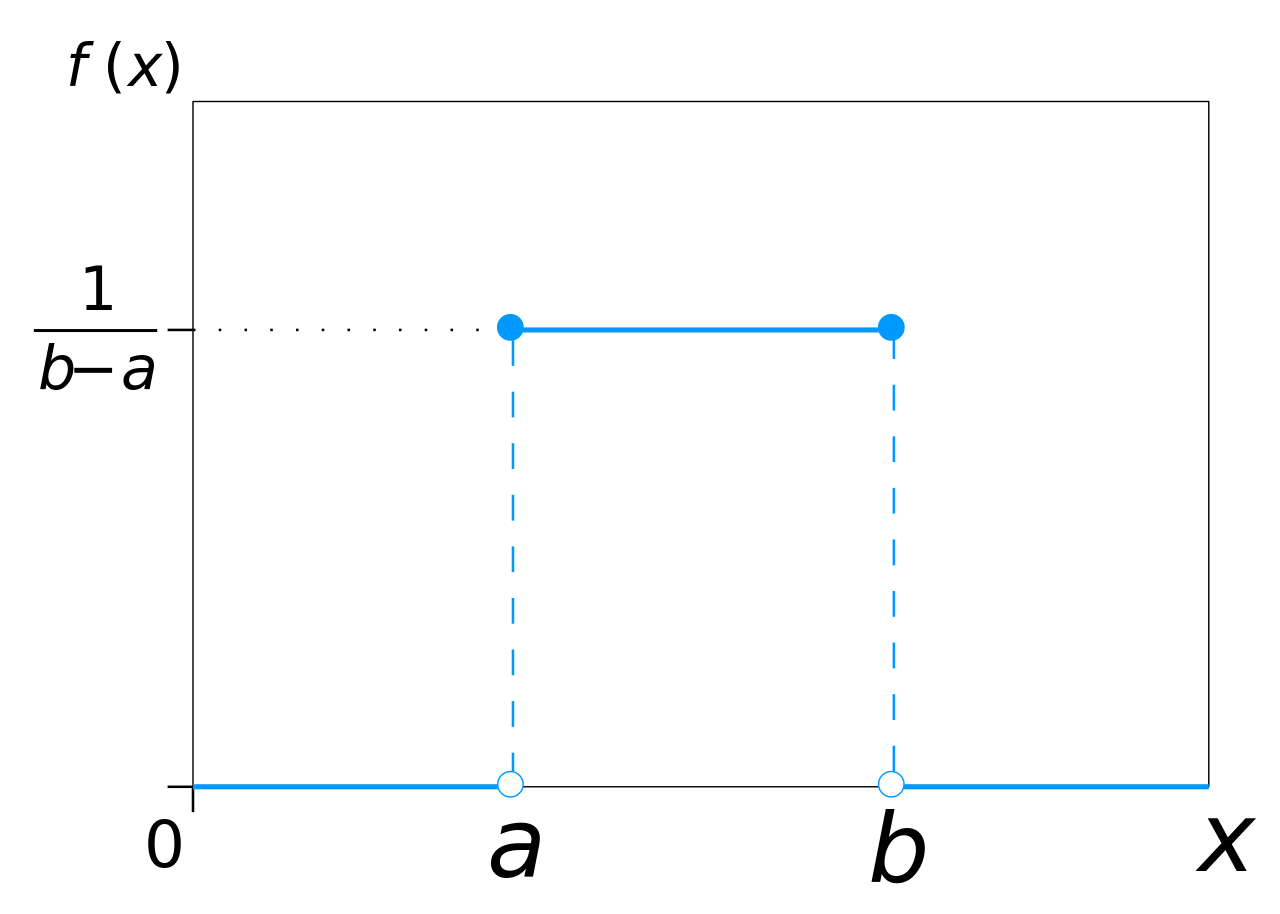
The simplest is a uniform distribution, where within a certain range, any level of activation is equally probable. The probability density function looks like this:

Assume the distribution has support between a and b, where a < b.

When b+s < 1, then overload is impossible, and only the incentive effect occurs; productivity increases linearly with stress.

The expected output is simply the expected value of a uniform distribution from a+s to b+s, which is:

E[x + s] = (a+b)/2+s

Then, once b+s > 1, overload risk begins to increase.

In this range, the probability of avoiding overload is:

P[x + s < 1] = F(1-s) = (1-s-a)/(b-a)

(Note that at b+s=1, this is exactly 1.)

The expected value of x+s in this range is:

E[x + s | x + s < 1] = (1-s)(1+s)/(2(b-a))

Multiplying these two together:

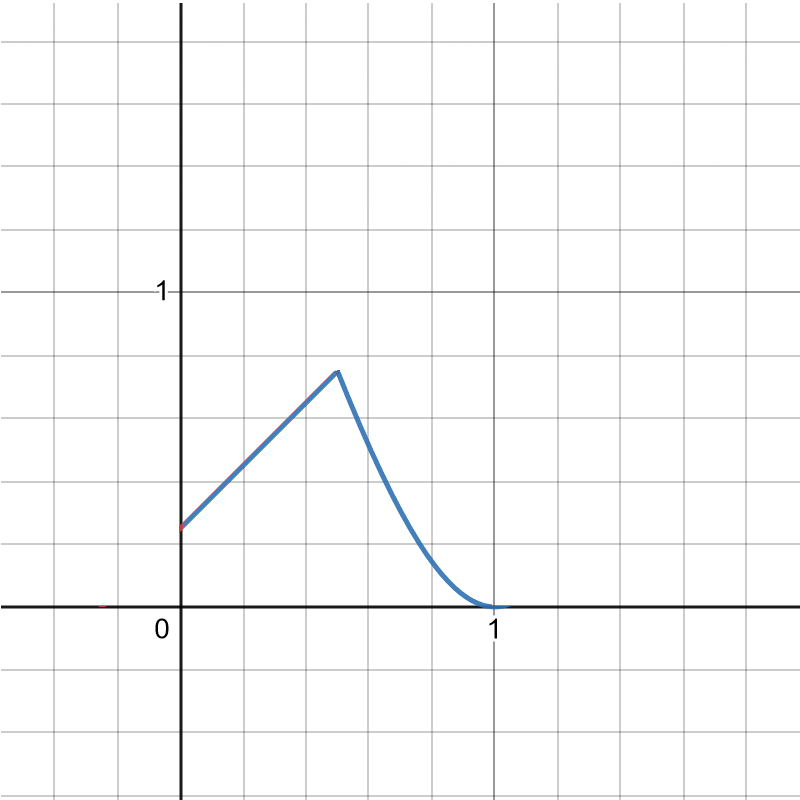
Y = [(1-s)(1+s)(1-s-a)]/[2(b-a)^2]

Here is what that looks like for a=0, b=1/2:

It does have the right qualitative features: increasing, then decreasing. But its sure looks weird, doesn’t it? It has this strange kinked shape.

So let’s consider some other distributions.

The next one I was able to solve it for is an exponential distribution, where the most probable activation is zero, and then higher activation always has lower probability than lower activation in an exponential decay:

For this it was actually easiest to do the integral directly (I did it by integrating by parts, but I’m sure you don’t care about all the mathematical steps):

Y = \int_{0}^{1-s} (x+s) dF(x)

Y = (1/λ+s) – (1/ λ + 1)e^(-λ(1-s))

The parameter λdecides how steeply your activation probability decays. Someone with low λ is relatively highly activated all the time, while someone with high λ is usually not highly activated; this seems like it might be related to the personality trait neuroticism.

Here are graphs of what the resulting Yerkes-Dodson curve looks like for several different values of λ:

λ = 0.5:

λ = 1:

λ = 2:

λ = 4:

λ = 8:

The λ = 0.5 person has high activation a lot of the time. They are actually fairly productive even without stress, but stress quickly overwhelms them. The λ = 8 person has low activation most of the time. They are not very productive without stress, but can also bear relatively high amounts of stress without overloading.

(The low-λ people also have overall lower peak productivity in this model, but that might not be true in reality, if λ is inversely correlated with some other attributes that are related to productivity.)

Neither uniform nor exponential has the nice bell-curve shape for innate activation we might have hoped for. There is another class of distributions, beta distributions, which do have this shape, and they are sort of tractable—you need something called an incomplete beta function, which isn’t an elementary function but it’s useful enough that most statistical packages include it.

Beta distributions have two parameters, α and β. They look like this:

Beta distributions are quite useful in Bayesian statistics; if you’re trying to estimate the probability of a random event that either succeeds or fails with a fixed probability (a Bernoulli process), and so far you have observed a successes and b failures, your best guess of its probability at each trial is a beta distribution with α = a+1 and β = b+1.

For beta distributions with parameters α and β, the result comes out to (I is that incomplete beta function I mentioned earlier):

Y = I(1-s, α+1, β) + I(1-s, α, β)

For whole number values of α andβ, the incomplete beta function can be computed by hand (though it is more work the larger they are); here’s an example with α = β = 2.

The innate activation probability looks like this:

And the result comes out like this:

Y = 2(1-s)^3 – 3/2(1-s)^4 + 3s(1-s)^2 – 2s(1-s)^3

This person has pretty high innate activation most of the time, so stress very quickly overwhelms them. If I had chosen a much higher β, I could change that, making them less likely to be innately so activated.

These are the cases I’ve found to be relatively tractable so far. They all have the right qualitative pattern: Increasing stress increases productivity for awhile, then begins decreasing it once overload risk becomes too high. They also show a general pattern where people who are innately highly activated (neurotic?) are much more likely to overload and thus much more sensitive to stress.

What is it with EA and AI?

Jan 1 JDN 2459946

Surprisingly, most Effective Altruism (EA) leaders don’t seem to think that poverty alleviation should be our top priority. Most of them seem especially concerned about long-term existential risk, such as artificial intelligence (AI) safety and biosecurity. I’m not going to say that these things aren’t important—they certainly are important—but here are a few reasons I’m skeptical that they are really the most important the way that so many EA leaders seem to think.

1. We don’t actually know how to make much progress at them, and there’s only so much we can learn by investing heavily in basic research on them. Whereas, with poverty, the easy, obvious answer turns out empirically to be extremely effective: Give them money.

2. While it’s easy to multiply out huge numbers of potential future people in your calculations of existential risk (and this is precisely what people do when arguing that AI safety should be a top priority), this clearly isn’t actually a good way to make real-world decisions. We simply don’t know enough about the distant future of humanity to be able to make any kind of good judgments about what will or won’t increase their odds of survival. You’re basically just making up numbers. You’re taking tiny probabilities of things you know nothing about and multiplying them by ludicrously huge payoffs; it’s basically the secular rationalist equivalent of Pascal’s Wager.

2. AI and biosecurity are high-tech, futuristic topics, which seem targeted to appeal to the sensibilities of a movement that is still very dominated by intelligent, nerdy, mildly autistic, rich young White men. (Note that I say this as someone who very much fits this stereotype. I’m queer, not extremely rich and not entirely White, but otherwise, yes.) Somehow I suspect that if we asked a lot of poor Black women how important it is to slightly improve our understanding of AI versus giving money to feed children in Africa, we might get a different answer.

3. Poverty eradication is often characterized as a “short term” project, contrasted with AI safety as a “long term” project. This is (ironically) very short-sighted. Eradication of poverty isn’t just about feeding children today. It’s about making a world where those children grow up to be leaders and entrepreneurs and researchers themselves. The positive externalities of economic development are staggering. It is really not much of an exaggeration to say that fascism is a consequence of poverty and unemployment.

4. Currently the main thing that most Effective Altruism organizations say they need most is “talent”; how many millions of person-hours of talent are we leaving on the table by letting children starve or die of malaria?

5. Above all, existential risk can’t really be what’s motivating people here. The obvious solutions to AI safety and biosecurity are not being pursued, because they don’t fit with the vision that intelligent, nerdy, young White men have of how things should be. Namely: Ban them. If you truly believe that the most important thing to do right now is reduce the existential risk of AI and biotechnology, you should support a worldwide ban on research in artificial intelligence and biotechnology. You should want people to take all necessary action to attack and destroy institutions—especially for-profit corporations—that engage in this kind of research, because you believe that they are threatening to destroy the entire world and this is the most important thing, more important than saving people from starvation and disease. I think this is really the knock-down argument; when people say they think that AI safety is the most important thing but they don’t want Google and Facebook to be immediately shut down, they are either confused or lying. Honestly I think maybe Google and Facebook should be immediately shut down for AI safety reasons (as well as privacy and antitrust reasons!), and I don’t think AI safety is yet the most important thing.

Why aren’t people doing that? Because they aren’t actually trying to reduce existential risk. They just think AI and biotechnology are really interesting, fascinating topics and they want to do research on them. And I agree with that, actually—but then they need stop telling people that they’re fighting to save the world, because they obviously aren’t. If the danger were anything like what they say it is, we should be halting all research on these topics immediately, except perhaps for a very select few people who are entrusted with keeping these forbidden secrets and trying to find ways to protect us from them. This may sound radical and extreme, but it is not unprecedented: This is how we handle nuclear weapons, which are universally recognized as a global existential risk. If AI is really as dangerous as nukes, we should be regulating it like nukes. I think that in principle it could be that dangerous, and may be that dangerous someday—but it isn’t yet. And if we don’t want it to get that dangerous, we don’t need more AI researchers, we need more regulations that stop people from doing harmful AI research! If you are doing AI research and it isn’t directly involved specifically in AI safety, you aren’t saving the world—you’re one of the people dragging us closer to the cliff! Anything that could make AI smarter but doesn’t also make it safer is dangerous. And this is clearly true of the vast majority of AI research, and frankly to me seems to also be true of the vast majority of research at AI safety institutes like the Machine Intelligence Research Institute.

Seriously, look through MIRI’s research agenda: It’s mostly incredibly abstract and seems completely beside the point when it comes to preventing AI from taking control of weapons or governments. It’s all about formalizing Bayesian induction. Thanks to you, Skynet can have a formally computable approximation to logical induction! Truly we are saved. Only two of their papers, on “Corrigibility” and “AI Ethics”, actually struck me as at all relevant to making AI safer. The rest is largely abstract mathematics that is almost literally navel-gazing—it’s all about self-reference. Eliezer Yudkowsky finds self-reference fascinating and has somehow convinced an entire community that it’s the most important thing in the world. (I actually find some of it fascinating too, especially the paper on “Functional Decision Theory”, which I think gets at some deep insights into things like why we have emotions. But I don’t see how it’s going to save the world from AI.)

Don’t get me wrong: AI also has enormous potential benefits, and this is a reason we may not want to ban it. But if you really believe that there is a 10% chance that AI will wipe out humanity by 2100, then get out your pitchforks and your EMP generators, because it’s time for the Butlerian Jihad. A 10% chance of destroying all humanity is an utterly unacceptable risk for any conceivable benefit. Better that we consign ourselves to living as we did in the Neolithic than risk something like that. (And a globally-enforced ban on AI isn’t even that; it’s more like “We must live as we did in the 1950s.” How would we survive!?) If you don’t want AI banned, maybe ask yourself whether you really believe the risk is that high—or are human brains just really bad at dealing with small probabilities?

I think what’s really happening here is that we have a bunch of guys (and yes, the EA and especially AI EA-AI community is overwhelmingly male) who are really good at math and want to save the world, and have thus convinced themselves that being really good at math is how you save the world. But it isn’t. The world is much messier than that. In fact, there may not be much that most of us can do to contribute to saving the world; our best options may in fact be to donate money, vote well, and advocate for good causes.

Let me speak Bayesian for a moment: The prior probability that you—yes, you, out of all the billions of people in the world—are uniquely positioned to save it by being so smart is extremely small. It’s far more likely that the world will be saved—or doomed—by people who have power. If you are not the head of state of a large country or the CEO of a major multinational corporation, I’m sorry; you probably just aren’t in a position to save the world from AI.

But you can give some money to GiveWell, so maybe do that instead?

How to fix economics publishing

Aug 7 JDN 2459806

The current system of academic publishing in economics is absolutely horrible. It seems practically designed to undermine the mental health of junior faculty.

1. Tenure decisions, and even most hiring decisions, are almost entirely based upon publication in five (5) specific journals.

2. One of those “top five” journals is owned by Elsevier, a corrupt monopoly that has no basis for its legitimacy yet somehow controls nearly one-fifth of all scientific publishing.

3. Acceptance rates in all of these journals are between 5% and 10%—greatly decreased from what they were a generation or two ago. Given a typical career span, the senior faculty evaluating you on whether you were published in these journals had about a three times better chance to get their own papers published there than you do.

4. Submissions are only single-blinded, so while you have no idea who is reading your papers, they know exactly who you are and can base their decision on whether you are well-known in the profession—or simply whether they like you.

5. Simultaneous submissions are forbidden, so when submitting to journals you must go one at a time, waiting to hear back from one before trying the next.

6. Peer reviewers are typically unpaid and generally uninterested, and so procrastinate as long as possible on doing their reviews.

7. As a result, review times for a paper are often measured in months, for every single cycle.

So, a highly successful paper goes like this: You submit it to a top journal, wait three months, it gets rejected. You submit it to another one, wait another four months, it gets rejected. You submit it to a third one, wait another two months, and you are told to revise and resubmit. You revise and resubmit, wait another three months, and then finally get accepted.

You have now spent an entire year getting one paper published. And this was a success.

Now consider a paper that doesn’t make it into a top journal. You submit, wait three months, rejected; you submit again, wait four months, rejected; you submit again, wait two months, rejected. You submit again, wait another five months, rejected; you submit to the fifth and final top-five, wait another four months, and get rejected again.

Now, after a year and a half, you can turn to other journals. You submit to a sixth journal, wait three months, rejected. You submit to a seventh journal, wait four months, get told to revise and resubmit. You revise and resubmit, wait another two months, and finally—finally, after two years—actually get accepted, but not to a top-five journal. So it may not even help you get tenure, unless maybe a lot of people cite it or something.

And what if you submit to a seventh, an eighth, a ninth journal, and still keep getting rejected? At what point do you simply give up on that paper and try to move on with your life?

That’s a trick question: Because what really happens, at least to me, is I can’t move on with my life. I get so disheartened from all the rejections of that paper that I can’t bear to look at it anymore, much less go through the work of submitting it to yet another journal that will no doubt reject it again. But worse than that, I become so depressed about my academic work in general that I become unable to move on to any other research either. And maybe it’s me, but it isn’t just me: 28% of academic faculty suffer from severe depression, and 38% from severe anxiety. And that’s across all faculty—if you look just at junior faculty it’s even worse: 43% of junior academic faculty suffer from severe depression. When a problem is that prevalent, at some point we have to look at the system that’s making us this way.

I can blame the challenges of moving across the Atlantic during a pandemic, and the fact that my chronic migraines have been the most frequent and severe they have been in years, but the fact remains: I have accomplished basically nothing towards the goal of producing publishable research in the past year. I have two years left at this job; if I started right now, I might be able to get something published before my contract is done. Assuming that the project went smoothly, I could start submitting it as soon as it was done, and it didn’t get rejected as many times as the last one.

I just can’t find the motivation to do it. When the pain is so immediate and so intense, and the rewards are so distant and so uncertain, I just can’t bring myself to do the work. I had hoped that talking about this with my colleagues would help me cope, but it hasn’t; in fact it only makes me seem to feel worse, because so few of them seem to understand how I feel. Maybe I’m talking to the wrong people; maybe the ones who understand are themselves suffering too much to reach out to help me. I don’t know.

But it doesn’t have to be this way. Here are some simple changes that could make the entire process of academic publishing in economics go better:

1. Boycott Elsevier and all for-profit scientific journal publishers. Stop reading their journals. Stop submitting to their journals. Stop basing tenure decisions on their journals. Act as though they don’t exist, because they shouldn’t—and then hopefully soon they won’t.

2. Peer reviewers should be paid for their time, and in return required to respond promptly—no more than a few weeks. A lack of response should be considered a positive vote on that paper.

3. Allow simultaneous submissions; if multiple journals accept, let the author choose between them. This is already how it works in fiction publishing, which you’ll note has not collapsed.

4. Increase acceptance rates. You are not actually limited by paper constraints anymore; everything is digital now. Most of the work—even in the publishing process—already has to be done just to go through peer review, so you may as well publish it. Moreover, most papers that are submitted are actually worthy of publishing, and this whole process is really just an idiotic status hierarchy. If the prestige of your journal decreases because you accept more papers, we are measuring prestige wrong. Papers should be accepted something like 50% of the time, not 5-10%.

5. Double blind submissions, and insist on ethical standards that maintain that blinding. No reviewer should know whether they are reading the work of a grad student or a Nobel Laureate. Reputation should mean nothing; scientific rigor should mean everything.

And, most radical of all, what I really need in my life right now:

6. Faculty should not have to submit their own papers. Each university department should have administrative staff whose job it is to receive papers from their faculty, format them appropriately, and submit them to journals. They should deal with all rejections, and only report to the faculty member when they have received an acceptance or a request to revise and resubmit. Faculty should simply do the research, write the papers, and then fire and forget them. We have highly specialized skills, and our valuable time is being wasted on the clerical tasks of formatting and submitting papers, which many other people could do as well or better. Worse, we are uniquely vulnerable to the emotional impact of the rejection—seeing someone else’s paper rejected is an entirely different feeling from having your own rejected.

Do all that, and I think I could be happy to work in academia. As it is, I am seriously considering leaving and never coming back.

Do I want to stay in academia?

Apr 5 JDN 2458945

This is a very personal post. You’re not going to learn any new content today; but this is what I needed to write about right now.

I am now nearly finished with my dissertation. It only requires three papers (which, quite honestly, have very little to do with one another). I just got my second paper signed off on, and my third is far enough along that I can probably finish it in a couple of months.

I feel like I ought to be more excited than I am. Mostly what I feel right now is dread.

Yes, some of that dread is the ongoing pandemic—though I am pleased to report that the global number of cases of COVID-19 has substantially undershot the estimates I made last week, suggesting that at least most places are getting the virus under control. The number of cases and number of deaths has about doubled in the past week, which is a lot better than doubling every two days as it was at the start of the pandemic. And that’s all I want to say about COVID-19 today, because I’m sure you’re as tired of the wall-to-wall coverage of it as I am.

But most of the dread is about my own life, mainly my career path. More and more I’m finding that the world of academic research just isn’t working for me. The actual research part I like, and I’m good at it; but then it comes time to publish, and the journal system is so fundamentally broken, so agonizingly capricious, and has such ludicrous power over the careers of young academics that I’m really not sure I want to stay in this line of work. I honestly think I’d prefer they just flip a coin when you graduate and you get a tenure-track job if you get heads. Or maybe journals could roll a 20-sided die for each paper submitted and publish the papers that get 19 or 20. At least then the powers that be couldn’t convince themselves that their totally arbitrary and fundamentally unjust selection process was actually based on deep wisdom and selecting the most qualified individuals.

In any case I’m fairly sure at this point that I won’t have any publications in peer-reviewed journals by the time I graduate. It’s possible I still could—I actually still have decent odds with two co-authored papers, at least—but I certainly do not expect to. My chances of getting into a top journal at this point are basically negligible.

If I weren’t trying to get into academia, that fact would be basically irrelevant. I think most private businesses and government agencies are fairly well aware of the deep defects in the academic publishing system, and really don’t put a whole lot of weight on its conclusions. But in academia, publication is everything. Specifically, publication in top journals.

For this reason, I am now seriously considering leaving academia once I graduate. The more contact I have with the academic publishing system the more miserable I feel. The idea of spending another six or seven years desperately trying to get published in order to satisfy a tenure committee sounds about as appealing right now as having my fingernails pulled out one by one.

This would mean giving up on a lifelong dream. It would mean wondering why I even bothered with the PhD, when the first MA—let alone the second—would probably have been enough for most government or industry careers. And it means trying to fit myself into a new mold that I may find I hate just as much for different reasons: A steady 9-to-5 work schedule is a lot harder to sustain when waking up before 10 AM consistently gives you migraines. (In theory, there are ways to get special accommodations for that sort of thing; in practice, I’m sure most employers would drag their feet as much as possible, because in our culture a phase-delayed circadian rhythm is tantamount to being lazy and therefore worthless.)

Or perhaps I should aim for a lecturer position, perhaps at a smaller college, that isn’t so obsessed with research publication. This would still dull my dream, but would not require abandoning it entirely.

I was asked a few months ago what my dream job is, and I realized: It is almost what I actually have. It is so tantalizingly close to what I am actually headed for that it is painful. The reality is a twisted mirror of the dream.

I want to teach. I want to do research. I want to write. And I get to do those things, yes. But I want to them without the layers of bureaucracy, without the tiers of arbitrary social status called ‘prestige’, without the hyper-competitive and capricious system of journal publication. Honestly I want to do them without grading or dealing with publishers at all—though I can at least understand why some mechanisms for evaluating student progress and disseminating research are useful, even if our current systems for doing so are fundamentally defective.

It feels as though I have been running a marathon, but was only given a vague notion of the route beforehand. There were a series of flags to follow: This way to the bachelor’s, this way to the master’s, that way to advance to candidacy. Then when I come to the last set of flags, the finish line now visible at the horizon, I see that there is an obstacle course placed in my way, with obstacles I was never warned about, much less trained for. A whole new set of skills, maybe even a whole different personality, is necessary to surpass these new obstacles, and I feel utterly unprepared.

It is as if the last mile of my marathon must bedone on horseback, and I’ve never learned to ride a horse—no one ever told me I would need to ride a horse. (Or maybe they did and I didn’t listen?) And now every time I try to mount one, I fall off immediately; and the injuries I sustain seem to be worse every time. The bruises I thought would heal only get worse. The horses I must ride are research journals, and the injuries when I fall are psychological—but no less real, all too real. With each attempt I keep hoping that my fear will fade, but instead it only intensifies.

It’s the same pain, the same fear, that pulled me away from fiction writing. I want to go back, I hope to go back—but I am not strong enough now, and cannot be sure I ever will be. I was told that working in a creative profession meant working hard and producing good output; it turns out it doesn’t mean that at all. A successful career in a creative field actually means satisfying the arbitrary desires of a handful of inscrutable gatekeepers. It means rolling the dice over, and over, and over again, each time a little more painful than the last. And it turns out that this just isn’t something I’m good at. It’s not what I’m cut out for. And maybe it never will be.

An incompetent narcissist would surely fare better than I, willing to re-submit whatever refuse they produce a thousand times because they are certain they deserve to succeed. For, deep down, I never feel that I deserve it. Others tell me I do, and I try to believe them; but the only validation that feels like it will be enough is the kind that comes directly from those gatekeepers, the kind that I can never get. And truth be told, maybe if I do finally get that, it still won’t be enough. Maybe nothing ever will be.

If I knew that it would get easier one day, that the pain would, if not go away, at least retreat to a dull roar I could push aside, then maybe I could stay on this path. But this cannot be the rest of my life. If this is really what it means to have an academic career, maybe I don’t want one after all.

Or maybe it’s not academia that’s broken. Maybe it’s just me.

A Socratic open letter to transphobes everywhere

Feb 23 JDN 2458903

This post is a bit different than usual. This is an open letter to those who doubt that trans people actually exist, or insist on using the wrong pronouns; above all it is an open letter to those who want to discriminate against trans people, denying trans people civil rights or the dignity to use public bathrooms in peace. Most of my readers are probably not such people, but I think you’ll still benefit from reading it—perhaps you can use some of its arguments when you inevitably encounter someone who is.

Content warning: Because of how sex and gender are tied up together in transphobes’ minds, I’m going to need to talk a little bit about sexual anatomy and genital surgery. If such topics make you uncomfortable, feel free to skip this post.

Dear Transphobe:

First of all, I’m going to assume you are a man. Statistically you probably are, in which case that works. If by chance you’re not, well, now you know what it feels like for people to assume your gender and never correct themselves. You’re almost certainly politically right-wing, so that’s an even safer assumption on my part.

You probably think that gender and sex are interchangeable things, that the idea of a woman born with a penis or a man born without one is utter nonsense. I’m here to hopefully make you question this notion.

Let’s start by thinking about your own identity. You are a man. I presume that you have a penis. I am not going to make the standard insult many on the left would and say that it’s probably a small penis. In fact I have no particular reason to believe that, and in any case the real problem is that we as a society have so thoroughly equated penis size with masculinity with value as a human being. Right-wing attitudes of the sort that lead to discriminating against LGBT people are strongly correlated with aggressive behaviors to assert one’s masculinity. Even if I had good reason—which I assuredly do not—to do so, attacking your masculinity would be inherently counterproductive, causing you to double down on the same aggressive, masculinity-signaling behaviors. If it so happens that you are insecure in your masculinity, I certainly don’t want to make that worse, as masculine insecurity was one of the strongest predictors of voting for Donald Trump. You are a man, and I make no challenges to your masculinity whatsoever. I’m even prepared to concede that you are more manly than I am, whatever you may take that to mean.

Let us consider a thought experiment. Suppose that you were to lose your penis in some tragic accident. Don’t try to imagine the details; I’m sure the mere fact of it is terrifying enough. Suppose a terrible day were to arrive where you wake up in a hospital and find you no longer have a penis.

I have a question for you now: Should such a terrible day arrive, would you cease to be a man?

I contend that you would remain a man. I think that you, upon reflection, would also contend the same. There are a few thousand men in the world who have undergone penectomy, typically as a treatment for genital cancer. You wouldn’t even know unless you saw them naked or they told you. As far as anyone else can tell, they look and act as men, just as they did before their surgery. They are still men, just as they were before.

In fact, it’s quite likely that you would experience a phantom limb effect—where here the limb that is in your self-image but no longer attached to your body is your penis. You would sometimes feel “as if” your penis was still there, because your brain continues to have the neural connections that generate such sensations.

An even larger number of men have undergone castration for various reasons, and while they do often find that their thoughts and behavior change due to the changes in hormone balances, they still consider themselves men, and are generally considered men by others as well. We do not even consider them transgender men; we simply consider them men.

But does this not mean, then, that there is something more to being a man than simply having male anatomy?

Perhaps it has to do with other body parts, or some totality of the male body? Let’s consider another thought experiment then. Suppose that by some bizarre event you were transported into a female body. The mechanism isn’t important: Perhaps it was a mad scientist, or aliens, or magic. But just suppose that somehow or other, while you slept, your brain in its current state was transported into an entirely female body, complete with breasts, vulva, wide hips, narrow shoulders—the whole package. When you awaken, your body is female.

Such a transition would no doubt be distressing and disorienting. People would probably begin to see you as a woman when they looked at you. You would be denied access to men’s spaces you had previously used, and suddenly granted access to women’s spaces you had never before been allowed into. And who knows what sort of effect the hormonal changes would have on your mind?

Particularly if you are sexually attracted to women, you might imagine that you would enjoy this transformation: Now you get to play with female body parts whenever you want! But think about this matter carefully, now: While there might be some upsides, would you really want this change to happen? You have to now wear women’s clothing, use women’s restrooms, cope with a menstrual cycle. Everyone will see you as a woman and treat you as a woman. (How do you treat women, by the way? Is this something you’ve thought carefully about?)

And if you still think that being a woman isn’t so bad, maybe it isn’t—if your mind and body are in agreement. But remember that you’ve still got the mind of a man; you still feel that mental attachment to body parts that are no longer present, and these new body parts you have don’t feel like they are properly your own.

But throughout this harrowing experience, would you still be a man?

Once again I contend that you would. You would now feel a deep conflict between your mind and your body—dare I call it gender dysphoria?—and you would probably long to change your body back to what it was, or at least back to a body that is male.

You would once again experience phantom limb effects—but now all over, everywhere your new body deviated from your original form. In your brain there is a kind of map of where your body parts are supposed to be: Your shoulders are supposed to end here, your legs are supposed to end there, and down here there is supposed to be a penis, not vulva. This map is deeply ingrained into your mind, its billions of strands almost literally woven into the fabric of your brain.

We are presumably born with such a map: By some mindbogglingly complex mix of genetic and environmental factors our brains organize themselves into specific patterns, telling us what kind of body we’re supposed to have. Some of this structuring may go on before birth, some while we are growing up. But surely by the time we are adults the process is complete.

This mental map does allow for some flexibility: When we were young and growing, it allowed us to adjust to our ever-increasing height. Now that we are older, it allows us to adjust to gaining or losing weight. But this flexibility is quite limited: it might take years, or perhaps we could never adjust at all, to finding that we had suddenly grown a tail—or suddenly changed from male to female.

Now imagine that this transformation didn’t happen by some sudden event when you were an adult, but by some quirk of ontogeny while you were still in the womb. Suppose that you were born this way: in a body that is female, but with a mind that is male.

In such a state, surely something is wrong, in the same way that being born with sickle-cell anemia or spina bifida is wrong. There are more ambiguous cases: Is polydactyly a disorder? Sometimes? But surely there are some ways to be born that are worth correcting, and “female body, male mind” seems like one of them.

And yet, this is often precisely how trans people describe their experience. Not always—humans are nothing if not diverse, and trans people are no exception—but quite frequently, they will say that they feel like “a man in a woman’s body” or the reverse. By all accounts, they seem to have precisely this hypothetical condition: The gender of their mind does not match the sex of their body. And since this mismatch causes great suffering, we ought to correct it.

But then the question becomes: Correct it how?

Broadly speaking, it seems we’ve only two options: Change the body, or change the mind. If you were in this predicament, which would you want?

In the case of being transferred into a new body as an adult, I’m quite sure you’d prefer to change your body, and keep your mind as it is. You don’t belong in this new body, and you want your old one back.

Yet perhaps you think that if you were born with this mismatch, things might be different: Perhaps in such a case you think it would make more sense to change the mind to match the body. But I ask you this: Which is more fundamental to who you are? If you are still an infant, we can’t ask your opinion; but what do you suppose you’d say if we could?

Or suppose that you notice the mismatch later, as a child, or even as a teenager. Before that, something felt off somehow, but you couldn’t quite put your finger on it. But now you realize where the problem lies: You were born in a body of the wrong sex. Now that you’ve had years to build up your identity, would you still say that the mind is the right thing to change? Once you can speak, now we can ask you—and we do ask such children, and their answers are nigh-unanimous: They want to change their bodies, not their minds. David Reimer was raised as a girl for years, and yet he always still knew he was a boy and tried to act like one.

In fact, we don’t even know how to change the gender of a mind. Despite literally millennia of civilization trying at great expense to enforce particular gender norms on everyone’s minds, we still get a large proportion of the population deviating substantially from them—if you include mild enough deviations, probably a strict majority. If I seem a soft “soy boy” to you (and, I admit, I am both bisexual and vegetarian—though I already knew I was the former before I became the latter), ask yourself this: Why would I continue to deviate from your so ferociously-enforced gender norms, if it were easy to conform?

Whereas, we do have some idea how to change a body. We have hormonal and surgical treatments that allow people to change their bodies substantially—trans women can grow breasts, trans men can grow beards. Often this is enough to make people feel much more comfortable in their own bodies, and also present themselves in a way that leads others to recognize them as their desired gender.

Sex reassignment surgery is not as reliable, especially for trans men: While building artificial vulva works relatively well, building a good artificial penis still largely eludes us. Yet technological process in this area continues, and we’ve improved our ability to change the sex of bodies substantially in just the last few decades—while, let me repeat, we have not meaningfully improved our ability to change the gender of minds in the last millennium.

If we could reliably change the gender of minds, perhaps that would be an option worth considering. But ought implies can: We cannot be ethically expected to do that which we are simply incapable.

At present, this means that our only real options are two: We can accept the gender of the mind, change the sex of the body, and treat this person as the gender they identify themselves as; or we can demand that they repress and conceal their mental gender in favor of conforming to the standards we have imposed upon them based on their body. The option you may most prefer—accept the body, change the mind—simply is not feasible with any current or foreseeable technology.

We have tried repressing transgender identity for centuries: It has brought endless suffering, depression, suicide.

But now that we are trying to affirm transgender identity the outlook seems much better: Simply having one adult in their life who accepts their gender identity reduces the risk of a transgender child attempting suicide by 40%. Meta-analysis of research on the subject shows that gender transition, while surely no panacea, does overall improve outcomes for transgender people—including reducing risk of depression and suicide. (That site is actually refreshingly nuanced; it does not simply accept either the left-wing or right-wing ideology on the subject, instead delving deeply into the often quite ambiguous evidence.)

Above all, ask yourself: If you ever found yourself in the wrong sort of body, what would you want us to do?

Why do we need “publish or perish”?

June 23 JDN 2458658

This question may seem a bit self-serving, coming from a grad student who is struggling to get his first paper published in a peer-reviewed journal. But given the deep structural flaws in the academic publishing system, I think it’s worth taking a step back to ask just what peer-reviewed journals are supposed to be accomplishing.

The argument is often made that research journals are a way of sharing knowledge. If this is their goal, they have utterly and totally failed. Most papers are read by only a handful of people. When scientists want to learn about the research their colleagues are doing, they don’t read papers; they go to conferences to listen to presentations and look at posters. The way papers are written, they are often all but incomprehensible to anyone outside a very narrow subfield. When published by proprietary journals, papers are often hidden behind paywalls and accessible only through universities. As a knowledge-sharing mechanism, the peer-reviewed journal is a complete failure.

But academic publishing serves another function, which in practice is its only real function: Peer-reviewed publications are a method of evaluation. They are a way of deciding which researchers are good enough to be hired, get tenure, and receive grants. Having peer-reviewed publications—particularly in “top journals”, however that is defined within a given field—is a key metric that universities and grant agencies use to decide which researchers are worth spending on. Indeed, in some cases it seems to be utterly decisive.

We should be honest about this: This is an absolutely necessary function. It is uncomfortable to think about the fact that we must exclude a large proportion of competent, qualified people from being hired or getting tenure in academia, but given the large number of candidates and the small amounts of funding available, this is inevitable. We can’t hire everyone who would probably be good enough. We can only hire a few, and it makes sense to want those few to be the best. (Also, don’t fret too much: Even if you don’t make it into academia, getting a PhD is still a profitable investment. Economists and natural scientists do the best, unsurprisingly; but even humanities PhDs are still generally worth it. Median annual earnings of $77,000 is nothing to sneeze at: US median household income is only about $60,000. Humanities graduates only seem poor in relation to STEM or professional graduates; they’re still rich compared to everyone else.)

But I think it’s worth asking whether the peer review system is actually selecting the best researchers, or even the best research. Note that these are not the same question: The best research done in graduate school might not necessarily reflect the best long-run career trajectory for a researcher. A lot of very important, very difficult questions in science are just not the sort of thing you can get a convincing answer to in a couple of years, and so someone who wants to work on the really big problems may actually have a harder time getting published in graduate school or as a junior faculty member, even though ultimately work on the big problems is what’s most important for society. But I’m sure there’s a positive correlation overall: The kind of person who is going to do better research later is probably, other things equal, going to do better research right now.

Yet even accepting the fact that all we have to go on in assessing what you’ll eventually do is what you have already done, it’s not clear that the process of publishing in a peer-reviewed journal is a particularly good method of assessing the quality of research. Some really terrible research has gotten published in journals—I’m gonna pick on Daryl Bem, because he’s the worst—and a lot of really good research never made it into journals and is languishing on old computer hard drives. (The term “file drawer problem” is about 40 years obsolete; though to be fair, it was in fact coined about 40 years ago.)

That by itself doesn’t actually prove that journals are a bad mechanism. Even a good mechanism, applied to a difficult problem, is going to make some errors. But there are a lot of things about academic publishing, at least as currently constituted, that obviously don’t seem like a good mechanism, such as for-profit publishers, unpaid reviewiers, lack of double-blinded review, and above all, the obsession with “statistical significance” that leads to p-hacking.

Each of these problems I’ve listed has a simple fix (though whether the powers that be actually are willing to implement it is a different question: Questions of policy are often much easier to solve than problems of politics). But maybe we should ask whether the system is even worth fixing, or if it should simply be replaced entirely.

While we’re at it, let’s talk about the academic tenure system, because the peer-review system is largely an evaluation mechanism for the academic tenure system. Publishing in top journals is what decides whether you get tenure. The problem with “Publish or perish” isn’t the “publish”; it’s the perish”. Do we even need an academic tenure system?

The usual argument for academic tenure concerns academic freedom: Tenured professors have job security, so they can afford to say things that may be controversial or embarrassing to the university. But the way the tenure system works is that you only have this job security after going through a long and painful gauntlet of job insecurity. You have to spend several years prostrating yourself to the elders of your field before you can get inducted into their ranks and finally be secure.

Of course, job insecurity is the norm, particularly in the United States: Most employment in the US is “at-will”, meaning essentially that your employer can fire you for any reason at any time. There are specifically illegal reasons for firing (like gender, race, and religion); but it’s extremely hard to prove wrongful termination when all the employer needs to say is, “They didn’t do a good job” or “They weren’t a team player”. So I can understand how it must feel strange for a private-sector worker who could be fired at any time to see academics complain about the rigors of the tenure system.

But there are some important differences here: The academic job market is not nearly as competitive as the private sector job market. There simply aren’t that many prestigious universities, and within each university there are only a small number of positions to fill. As a result, universities have an enormous amount of power over their faculty, which is why they can get away with paying adjuncts salaries that amount to less than minimum wage. (People with graduate degrees! Making less than minimum wage!) At least in most private-sector labor markets in the US, the market is competitive enough that if you get fired, you can probably get hired again somewhere else. In academia that’s not so clear.

I think what bothers me the most about the tenure system is the hierarchical structure: There is a very sharp divide between those who have tenure, those who don’t have it but can get it (“tenure-track”), and those who can’t get it. The lines between professor, associate professor, assistant professor, lecturer, and adjunct are quite sharp. The higher up you are, the more job security you have, the more money you make, and generally the better your working conditions are overall. Much like what makes graduate school so stressful, there are a series of high-stakes checkpoints you need to get through in order to rise in the ranks. And several of those checkpoints are based largely, if not entirely, on publication in peer-reviewed journals.

In fact, we are probably stressing ourselves out more than we need to. I certainly did for my advancement to candidacy; I spent two weeks at such a high stress level I was getting migraines every single day (clearly on the wrong side of the Yerkes-Dodson curve), only to completely breeze through the exam.

I think I might need to put this up on a wall somewhere to remind myself:

Most grad students complete their degrees, and most assistant professors get tenure.

The real filters are admissions and hiring: Most applications to grad school are rejected (though probably most graduate students are ultimately accepted somewhere—I couldn’t find any good data on that in a quick search), and most PhD graduates do not get hired on the tenure track. But if you can make it through those two gauntlets, you can probably make it through the rest.

In our current system, publications are a way to filter people, because the number of people who want to become professors is much higher than the number of professor positions available. But as an economist, this raises a very big question: Why aren’t salaries falling?

You see, that’s how markets are supposed to work: When supply exceeds demand, the price is supposed to fall until the market clears. Lower salaries would both open up more slots at universities (you can hire more faculty with the same level of funding) and shift some candidates into other careers (if you can get paid a lot better elsewhere, academia may not seem so attractive). Eventually there should be a salary point at which demand equals supply. So why aren’t we reaching it?

Well, it comes back to that tenure system. We can’t lower the salaries of tenured faculty, not without a total upheaval of the current system. So instead what actually happens is that universities switch to using adjuncts, who have very low salaries indeed. If there were no tenure, would all faculty get paid like adjuncts? No, they wouldn’tbecause universities would have all that money they’re currently paying to tenured faculty, and all the talent currently locked up in tenured positions would be on the market, driving up the prevailing salary. What would happen if we eliminated tenure is not that all salaries would fall to adjunct level; rather, salaries would all adjust to some intermediate level between what adjuncts currently make and what tenured professors currently make.

What would the new salary be, exactly? That would require a detailed model of the supply and demand elasticities, so I can’t tell you without starting a whole new research paper. But a back-of-the-envelope calculation would suggest something like the overall current median faculty salary. This suggests a median salary somewhere around $75,000. This is a lot less than some professors make, but it’s also a lot more than what adjuncts make, and it’s a pretty good living overall.

If the salary for professors fell, the pool of candidates would decrease, and we wouldn’t need such harsh filtering mechanisms. We might decide we don’t need a strict evaluation system at all, and since the knowledge-sharing function of journals is much better served by other means, we could probably get rid of them altogether.

Of course, who am I kidding? That’s not going to happen. The people who make these rules succeeded in the current system. They are the ones who stand to lose high salaries and job security under a reform policy. They like things just the way they are.

My first AEA conference

Jan 13 JDN 2458497

The last couple of weeks have been a bit of a whirlwind for me. I submitted a grant proposal, I have another, much more complicated proposal due next week, I submitted a paper to a journal, and somewhere in there I went to the AEA conference for the first time.

Going to the conference made it quite clear that the race and gender disparities in economics are quite real: The vast majority of the attendees were middle-aged White males, all wearing one of either two outfits: Sportcoat and khakis, or suit and tie. (And almost all of the suits were grey or black and almost all of the shirts were white or pastel. Had you photographed in greyscale you’d only notice because the hotel carpets looked wrong.) In an upcoming post I’ll go into more detail about this problem, what seems to be causing it, and what might be done to fix it.

But for now I just want to talk about the conference itself, and moreover, the idea of having conferences—is this really the best way to organize ourselves as a profession?

One thing I really do like about the AEA conference is actually something that separates it from other professions: The job market for economics PhDs is a very formalized matching system designed to be efficient and minimize opportunities for bias. It should be a model for other job markets. All the interviews are conducted in rapid succession, at the conference itself, so that candidates can interview for positions all over the country or even abroad.

I wasn’t on the job market yet, but I will be in a few years. I wanted to see what it’s like before I have to run that gauntlet myself.

But then again, why did we need face-to-face interviews at all? What do they actually tell us?

It honestly seems like a face-to-face interview is optimized to maximize opportunities for discrimination. Do you know them personally? Nepotism opportunity. Are they male or female? Sexism opportunity. Are they in good health? Ableism opportunity. Do they seem gay, or mention a same-sex partner? Homophobia opportunity. Is their gender expression normative? Transphobia opportunity. How old are they? Ageism opportunity. Are they White? Racism opportunity. Do they have an accent? Nationalism opportunity. Do they wear fancy clothes? Classism opportunity. There are other forms of bias we don’t even have simple names for: Do they look pregnant? Do they wear a wedding band? Are they physically attractive? Are they tall?

You can construct your resume review system to not include any of this information, by excluding names, pictures, and personal information. But you literally can’t exclude all of this information from a face-to-face interview, and this is the only hiring mechanism that suffers from this fundamental flaw.

If it were really about proving your ability to do the job, they could send you a take-home exam (a lot of tech companies actually do this): Here’s a small sample project similar to what we want you to do, and a reasonable deadline in which to do it. Do it, and we’ll see if it’s good enough.

If they want to offer an opportunity for you to ask or answer specific questions, that could be done via text chat—which could be on the one hand end-to-end encrypted against eavesdropping and on the other hand leave a clear paper trail in case they try to ask you anything they shouldn’t. If they start asking about your sexual interests in the digital interview, you don’t just feel awkward and wonder if you should take the job: You have something to show in court.

Even if they’re interested in things like your social skills and presentation style, those aren’t measured well by interviews anyway. And they probably shouldn’t even be as relevant to hiring as they are.

With that in mind, maybe bringing all the PhD graduates in economics in the entire United States into one hotel for three days isn’t actually necessary. Maybe all these face-to-face interviews aren’t actually all that great, because their small potential benefits are outweighed by their enormous potential biases.

The rest of the conference is more like other academic conferences, which seems even less useful.

The conference format seems like a strange sort of formality, a ritual that we go through. It’s clearly not the optimal way to present ongoing research—though perhaps it’s better than publishing papers in journals, which is our current gold standard. A whole bunch of different people give you brief, superficial presentations of their research, which may be only tangentially related to anything you’re interested in, and you barely even have time to think about it before they go on to the next once. Also, seven of these sessions are going on simultaneously, so unless you have a Time Turner, you have to choose which one to go to. And they are often changed at the last minute, so you may not even end up going to the one you thought you were going to.

I was really struck by how little experimental work was presented. I was under the impression that experimental economics was catching on, but despite specifically trying to go to experiment-related sessions (excluding the 8:00 AM session for migraine reasons), I only counted a handful of experiments, most of them in the field rather than the lab. There was a huge amount of theory and applied econometrics. I guess this isn’t too surprising, as those are the two main kinds of research that only cost a researcher’s time. I guess in some sense this is good news for me: It means I don’t have as much competition as I thought.

Instead of gathering papers into sessions where five different people present vaguely-related papers in far too little time, we could use working papers, or better yet a more sophisticated online forum where research could be discussed in real-time before it even gets written into a paper. We could post results as soon as we get them, and instead of conducting one high-stakes anonymous peer review at the time of publication, conduct dozens of little low-stakes peer reviews as the research is ongoing. Discussants could be turned into collaborators.

The most valuable parts of conferences always seem to be the parts that aren’t official sessions: Luncheons, receptions, mixers. There you get to meet other people in the field. And this can be valuable, to be sure. But I fear that the individual gain is far larger than the social gain: Most of the real benefits of networking get dissipated by the competition to be better-connected than the other candidates. The kind of working relationships that seem to be genuinely valuable are the kind formed by working at the same school for several years, not the kind that can be forged by meeting once at a conference reception.

I guess every relationship has to start somewhere, and perhaps more collaborations have started that way than I realize. But it’s also worth asking: Should we really be putting so much weight on relationships? Is that the best way to organize an academic discipline?

“It’s not what you know, it’s who you know” is an accurate adage in many professions, but it seems like research should be where we would want it least to apply. This is supposed to be about advancing human knowledge, not making friends—and certainly not maintaining the old boys’ club.

“DSGE or GTFO”: Macroeconomics took a wrong turn somewhere

Dec 31, JDN 2458119

The state of macro is good,” wrote Oliver Blanchard—in August 2008. This is rather like the turkey who is so pleased with how the farmer has been feeding him lately, the day before Thanksgiving.

It’s not easy to say exactly where macroeconomics went wrong, but I think Paul Romer is right when he makes the analogy between DSGE (dynamic stochastic general equilbrium) models and string theory. They are mathematically complex and difficult to understand, and people can make their careers by being the only ones who grasp them; therefore they must be right! Nevermind if they have no empirical support whatsoever.

To be fair, DSGE models are at least a little better than string theory; they can at least be fit to real-world data, which is better than string theory can say. But being fit to data and actually predicting data are fundamentally different things, and DSGE models typically forecast no better than far simpler models without their bold assumptions. You don’t need to assume all this stuff about a “representative agent” maximizing a well-defined utility function, or an Euler equation (that doesn’t even fit the data), or this ever-proliferating list of “random shocks” that end up taking up all the degrees of freedom your model was supposed to explain. Just regressing the variables on a few years of previous values of each other (a “vector autoregression” or VAR) generally gives you an equally-good forecast. The fact that these models can be made to fit the data well if you add enough degrees of freedom doesn’t actually make them good models. As Von Neumann warned us, with enough free parameters, you can fit an elephant.

But really what bothers me is not the DSGE but the GTFO (“get the [expletive] out”); it’s not that DSGE models are used, but that it’s almost impossible to get published as a macroeconomic theorist using anything else. Defenders of DSGE typically don’t even argue anymore that it is good; they argue that there are no credible alternatives. They characterize their opponents as “dilettantes” who aren’t opposing DSGE because we disagree with it; no, it must be because we don’t understand it. (Also, regarding that post, I’d just like to note that I now officially satisfy the Athreya Axiom of Absolute Arrogance: I have passed my qualifying exams in a top-50 economics PhD program. Yet my enmity toward DSGE has, if anything, only intensified.)

Of course, that argument only makes sense if you haven’t been actively suppressing all attempts to formulate an alternative, which is precisely what DSGE macroeconomists have been doing for the last two or three decades. And yet despite this suppression, there are alternatives emerging, particularly from the empirical side. There are now empirical approaches to macroeconomics that don’t use DSGE models. Regression discontinuity methods and other “natural experiment” designs—not to mention actual experiments—are quickly rising in popularity as economists realize that these methods allow us to actually empirically test our models instead of just adding more and more mathematical complexity to them.

But there still seems to be a lingering attitude that there is no other way to do macro theory. This is very frustrating for me personally, because deep down I think what I would like to do as a career is macro theory: By temperament I have always viewed the world through a very abstract, theoretical lens, and the issues I care most about—particularly inequality, development, and unemployment—are all fundamentally “macro” issues. I left physics when I realized I would be expected to do string theory. I don’t want to leave economics now that I’m expected to do DSGE. But I also definitely don’t want to do DSGE.

Fortunately with economics I have a backup plan: I can always be an “applied micreconomist” (rather the opposite of a theoretical macroeconomist I suppose), directly attached to the data in the form of empirical analyses or even direct, randomized controlled experiments. And there certainly is plenty of work to be done along the lines of Akerlof and Roth and Shiller and Kahneman and Thaler in cognitive and behavioral economics, which is also generally considered applied micro. I was never going to be an experimental physicist, but I can be an experimental economist. And I do get to use at least some theory: In particular, there’s an awful lot of game theory in experimental economics these days. Some of the most exciting stuff is actually in showing how human beings don’t behave the way classical game theory predicts (particularly in the Ultimatum Game and the Prisoner’s Dilemma), and trying to extend game theory into something that would fit our actual behavior. Cognitive science suggests that the result is going to end up looking quite different from game theory as we know it, and with my cognitive science background I may be particularly well-positioned to lead that charge.

Still, I don’t think I’ll be entirely satisfied if I can’t somehow bring my career back around to macroeconomic issues, and particularly the great elephant in the room of all economics, which is inequality. Underlying everything from Marxism to Trumpism, from the surging rents in Silicon Valley and the crushing poverty of Burkina Faso, to the Great Recession itself, is inequality. It is, in my view, the central question of economics: Who gets what, and why?

That is a fundamentally macro question, but you can’t even talk about that issue in DSGE as we know it; a “representative agent” inherently smooths over all inequality in the economy as though total GDP were all that mattered. A fundamentally new approach to macroeconomics is needed. Hopefully I can be part of that, but from my current position I don’t feel much empowered to fight this status quo. Maybe I need to spend at least a few more years doing something else, making a name for myself, and then I’ll be able to come back to this fight with a stronger position.

In the meantime, I guess there’s plenty of work to be done on cognitive biases and deviations from game theory.