What is anxiety for?

Sep 17 JDN 2460205

As someone who experiences a great deal of anxiety, I have often struggled to understand what it could possibly be useful for. We have this whole complex system of evolved emotions, and yet more often than not it seems to harm us rather than help us. What’s going on here? Why do we even have anxiety? What even is anxiety, really? And what is it for?

There’s actually an extensive body of research on this, though very few firm conclusions. (One of the best accounts I’ve read, sadly, is paywalled.)

For one thing, there seem to be a lot of positive feedback loops involved in anxiety: Panic attacks make you more anxious, triggering more panic attacks; being anxious disrupts your sleep, which makes you more anxious. Positive feedback loops can very easily spiral out of control, resulting in responses that are wildly disproportionate to the stimulus that triggered them.

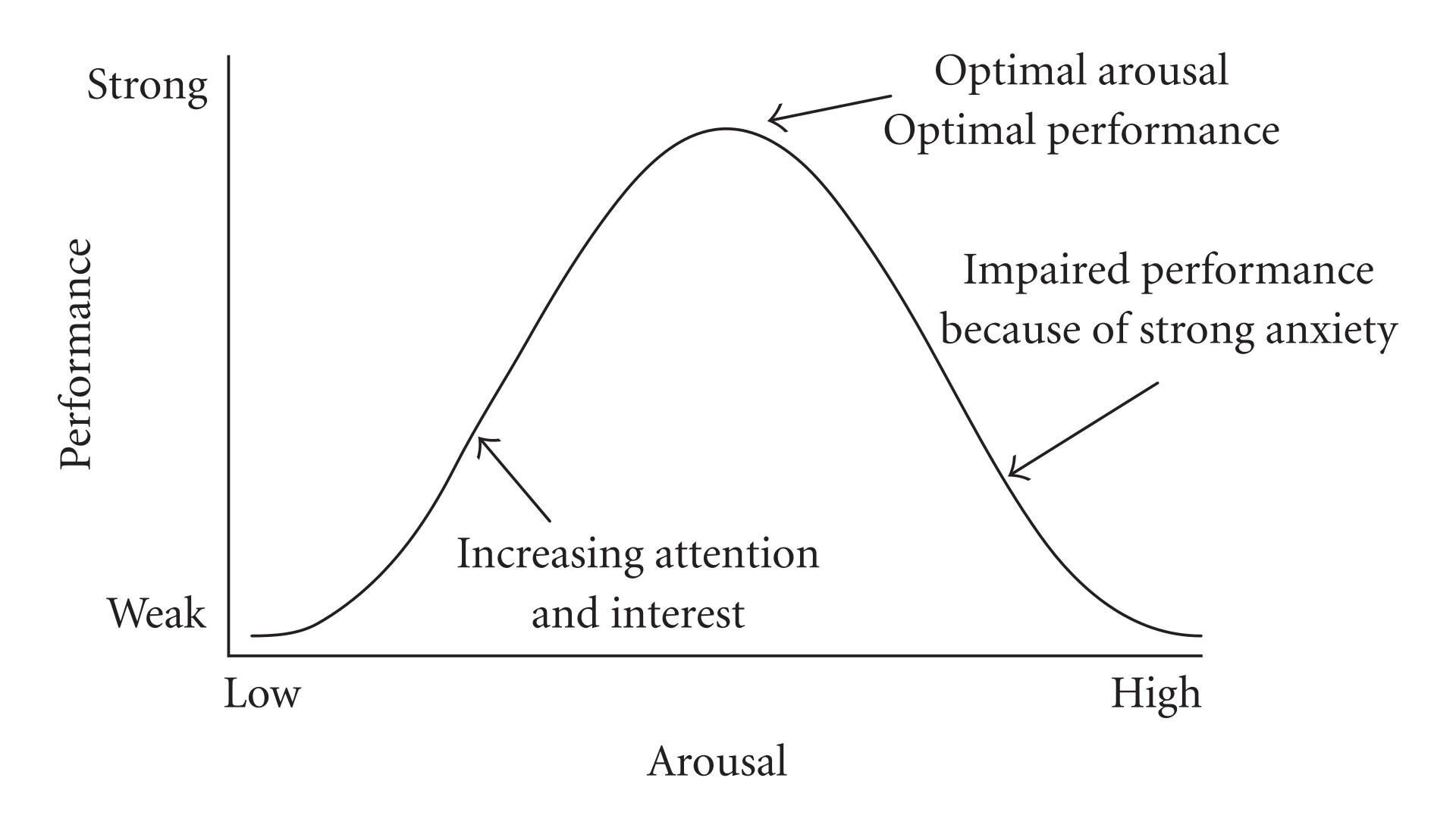
A certain amount of stress response is useful, even when the stakes are not life-or-death. But beyond a certain point, more stress becomes harmful rather than helpful. This is the Yerkes-Dodson effect, for which I developed my stochastic overload model (which I still don’t know if I’ll ever publish, ironically enough, because of my own excessive anxiety). Realizing that anxiety can have benefits can also take some of the bite out of having chronic anxiety, and, ironically, reduce that anxiety a little. The trick is finding ways to break those positive feedback loops.

I think one of the most useful insights to come out of this research is the smoke-detector principle, which is a fundamentally economic concept. It sounds quite simple: When dealing with an uncertain danger, sound the alarm if the expected benefit of doing so exceeds the expected cost.

This has profound implications when risk is highly asymmetric—as it usually is. Running away from a shadow or a noise that probably isn’t a lion carries some cost; you wouldn’t want to do it all the time. But it is surely nowhere near as bad as failing to run away when there is an actual lion. Indeed, it might be fair to say that failing to run away from an actual lion counts as one of the worst possible things that could ever happen to you, and could easily be 100 times as bad as running away when there is nothing to fear.

With this in mind, if you have a system for detecting whether or not there is a lion, how sensitive should you make it? Extremely sensitive. You should in fact try to calibrate it so that 99% of the time you experience the fear and want to run away, there is not a lion. Because the 1% of the time when there is one, it’ll all be worth it.

Yet this is far from a complete explanation of anxiety as we experience it. For one thing, there has never been, in my entire life, even a 1% chance that I’m going to be attacked by a lion. Even standing in front of a lion enclosure at the zoo, my chances of being attacked are considerably less than that—for a zoo that allowed 1% of its customers to be attacked would not stay in business very long.

But for another thing, it isn’t really lions I’m afraid of. The things that make me anxious are generally not things that would be expected to do me bodily harm. Sure, I generally try to avoid walking down dark alleys at night, and I look both ways before crossing the street, and those are activities directly designed to protect me from bodily harm. But I actually don’t feel especially anxious about those things! Maybe I would if I actually had to walk through dark alleys a lot, but I don’t, and in the rare occasion I would, I think I’d feel afraid at the time but fine afterward, rather than experiencing persistent, pervasive, overwhelming anxiety. (Whereas, if I’m anxious about reading emails, and I do manage to read emails, I’m usually still anxious afterward.) When it comes to crossing the street, I feel very little fear at all, even though perhaps I should—indeed, it had been remarked that when it comes to the perils of motor vehicles, human beings suffer from a very dangerous lack of fear. We should be much more afraid than we are—and our failure to be afraid kills thousands of people.

No, the things that make me anxious are invariably social: Meetings, interviews, emails, applications, rejection letters. Also parties, networking events, and back when I needed them, dates. They involve interacting with other people—and in particular being evaluated by other people. I never felt particularly anxious about exams, except maybe a little before my PhD qualifying exam and my thesis defenses; but I can understand those who do, because it’s the same thing: People are evaluating you.

This suggests that anxiety, at least of the kind that most of us experience, isn’t really about danger; it’s about status. We aren’t worried that we will be murdered or tortured or even run over by a car. We’re worried that we will lose our friends, or get fired; we are worried that we won’t get a job, won’t get published, or won’t graduate.

And yet it is striking to me that it often feels just as bad as if we were afraid that we were going to die. In fact, in the most severe instances where anxiety feeds into depression, it can literally make people want to die. How can that be evolutionarily adaptive?

Here it may be helpful to remember that in our ancestral environment, status and survival were oft one and the same. Humans are the most social organisms on Earth; I even sometimes describe us as hypersocial, a whole new category of social that no other organism seems to have achieved. We cooperate with others of our species on a mind-bogglingly grand scale, and are utterly dependent upon vast interconnected social systems far too large and complex for us to truly understand, let alone control.

At this historical epoch, these social systems are especially vast and incomprehensible; but at least for most of us in First World countries, they are also forgiving in a way that is fundamentally alien to our ancestors’ experience. It was not so long ago that a failed hunt or a bad harvest would let your family starve unless you could beseech your community for aid successfully—which meant that your very survival could depend upon being in the good graces of that community. But now we have food stamps, so even if everyone in your town hates you, you still get to eat. Of course some societies are more forgiving (Sweden) than others (the United States); and virtually all societies could be even more forgiving than they are. But even the relatively cutthroat competition of the US today has far less genuine risk of truly catastrophic failure than what most human beings lived through for most of our existence as a species.

I have found this realization helpful—hardly a cure, but helpful, at least: What are you really afraid of? When you feel anxious, your body often tells you that the stakes are overwhelming, life-or-death; but if you stop and think about it, in the world we live in today, that’s almost never true. Failing at one important task at work probably won’t get you fired—and even getting fired won’t really make you starve.

In fact, we might be less anxious if it were! For our bodies’ fear system seems to be optimized for the following scenario: An immediate threat with high chance of success and life-or-death stakes. Spear that wild animal, or jump over that chasm. It will either work or it won’t, you’ll know immediately; it probably will work; and if it doesn’t, well, that may be it for you. So you’d better not fail. (I think it’s interesting how much of our fiction and media involves these kinds of events: The hero would surely and promptly die if he fails, but he won’t fail, for he’s the hero! We often seem more comfortable in that sort of world than we do in the one we actually live in.)

Whereas the life we live in now is one of delayed consequences with low chance of success and minimal stakes. Send out a dozen job applications. Hear back in a week from three that want to interview you. Do those interviews and maybe one will make you an offer—but honestly, probably not. Next week do another dozen. Keep going like this, week after week, until finally one says yes. Each failure actually costs you very little—but you will fail, over and over and over and over.

In other words, we have transitioned from an environment of immediate return to one of delayed return.

The result is that a system which was optimized to tell us never fail or you will die is being put through situations where failure is constantly repeated. I think deep down there is a part of us that wonders, “How are you still alive after failing this many times?” If you had fallen in as many ravines as I have received rejection letters, you would assuredly be dead many times over.

Yet perhaps our brains are not quite as miscalibrated as they seem. Again I come back to the fact that anxiety always seems to be about people and evaluation; it’s different from immediate life-or-death fear. I actually experience very little life-or-death fear, which makes sense; I live in a very safe environment. But I experience anxiety almost constantly—which also makes a certain amount of sense, seeing as I live in an environment where I am being almost constantly evaluated by other people.

One theory posits that anxiety and depression are a dual mechanism for dealing with social hierarchy: You are anxious when your position in the hierarchy is threatened, and depressed when you have lost it. Primates like us do seem to care an awful lot about hierarchies—and I’ve written before about how this explains some otherwise baffling things about our economy.

But I for one have never felt especially invested in hierarchy. At least, I have very little desire to be on top of the hiearchy. I don’t want to be on the bottom (for I know how such people are treated); and I strongly dislike most of the people who are actually on top (for they’re most responsible for treating the ones on the bottom that way). I also have ‘a problem with authority’; I don’t like other people having power over me. But if I were to somehow find myself ruling the world, one of the first things I’d do is try to figure out a way to transition to a more democratic system. So it’s less like I want power, and more like I want power to not exist. Which means that my anxiety can’t really be about fearing to lose my status in the hierarchy—in some sense, I want that, because I want the whole hierarchy to collapse.

If anxiety involved the fear of losing high status, we’d expect it to be common among those with high status. Quite the opposite is the case. Anxiety is more common among people who are more vulnerable: Women, racial minorities, poor people, people with chronic illness. LGBT people have especially high rates of anxiety. This suggests that it isn’t high status we’re afraid of losing—though it could still be that we’re a few rungs above the bottom and afraid of falling all the way down.

It also suggests that anxiety isn’t entirely pathological. Our brains are genuinely responding to circumstances. Maybe they are over-responding, or responding in a way that is not ultimately useful. But the anxiety is at least in part a product of real vulnerabilities. Some of what we’re worried about may actually be real. If you cannot carry yourself with the confidence of a mediocre White man, it may be simply because his status is fundamentally secure in a way yours is not, and he has been afforded a great many advantages you never will be. He never had a Supreme Court ruling decide his rights.

I cannot offer you a cure for anxiety. I cannot even really offer you a complete explanation of where it comes from. But perhaps I can offer you this: It is not your fault. Your brain evolved for a very different world than this one, and it is doing its best to protect you from the very different risks this new world engenders. Hopefully one day we’ll figure out a way to get it calibrated better.
Implications of stochastic overload

Apr 2 JDN 2460037

A couple weeks ago I presented my stochastic overload model, which posits a neurological mechanism for the Yerkes-Dodson effect: Stress increases sympathetic activation, and this increases performance, up to the point where it starts to risk causing neural pathways to overload and shut down.

This week I thought I’d try to get into some of the implications of this model, how it might be applied to make predictions or guide policy.

One thing I often struggle with when it comes to applying theory is what actual benefits we get from a quantitative mathematical model as opposed to simply a basic qualitative idea. In many ways I think these benefits are overrated; people seem to think that putting something into an equation automatically makes it true and useful. I am sometimes tempted to try to take advantage of this, to put things into equations even though I know there is no good reason to put them into equations, simply because so many people seem to find equations so persuasive for some reason. (Studies have even shown that, particularly in disciplines that don’t use a lot of math, inserting a totally irrelevant equation into a paper makes it more likely to be accepted.)

The basic implications of the Yerkes-Dodson effect are already widely known, and utterly ignored in our society. We know that excessive stress is harmful to health and performance, and yet our entire economy seems to be based around maximizing the amount of stress that workers experience. I actually think neoclassical economics bears a lot of the blame for this, as neoclassical economists are constantly talking about “increasing work incentives”—which is to say, making work life more and more stressful. (And let me remind you that there has never been any shortage of people willing to work in my lifetime, except possibly briefly during the COVID pandemic. The shortage has always been employers willing to hire them.)

I don’t know if my model can do anything to change that. Maybe by putting it into an equation I can make people pay more attention to it, precisely because equations have this weird persuasive power over most people.

As far as scientific benefits, I think that the chief advantage of a mathematical model lies in its ability to make quantitative predictions. It’s one thing to say that performance increases with low levels of stress then decreases with high levels; but it would be a lot more useful if we could actually precisely quantify how much stress is optimal for a given person and how they are likely to perform at different levels of stress.

Unfortunately, the stochastic overload model can only make detailed predictions if you have fully specified the probability distribution of innate activation, which requires a lot of free parameters. This is especially problematic if you don’t even know what type of distribution to use, which we really don’t; I picked three classes of distribution because they were plausible and tractable, not because I had any particular evidence for them.

Also, we don’t even have standard units of measurement for stress; we have a vague notion of what more or less stressed looks like, but we don’t have the sort of quantitative measure that could be plugged into a mathematical model. Probably the best units to use would be something like blood cortisol levels, but then we’d need to go measure those all the time, which raises its own issues. And maybe people don’t even respond to cortisol in the same ways? But at least we could measure your baseline cortisol for awhile to get a prior distribution, and then see how different incentives increase your cortisol levels; and then the model should give relatively precise predictions about how this will affect your overall performance. (This is a very neuroeconomic approach.)

So, for now, I’m not really sure how useful the stochastic overload model is. This is honestly something I feel about a lot of the theoretical ideas I have come up with; they often seem too abstract to be usefully applicable to anything.

Maybe that’s how all theory begins, and applications only appear later? But that doesn’t seem to be how people expect me to talk about it whenever I have to present my work or submit it for publication. They seem to want to know what it’s good for, right now, and I never have a good answer to give them. Do other researchers have such answers? Do they simply pretend to?

Along similar lines, I recently had one of my students ask about a theory paper I wrote on international conflict for my dissertation, and after sending him a copy, I re-read the paper. There are so many pages of equations, and while I am confident that the mathematical logic is valid,I honestly don’t know if most of them are really useful for anything. (I don’t think I really believe that GDP is produced by a Cobb-Douglas production function, and we don’t even really know how to measure capital precisely enough to say.) The central insight of the paper, which I think is really important but other people don’t seem to care about, is a qualitative one: International treaties and norms provide an equilibrium selection mechanism in iterated games. The realists are right that this is cheap talk. The liberals are right that it works. Because when there are many equilibria, cheap talk works.

I know that in truth, science proceeds in tiny steps, building a wall brick by brick, never sure exactly how many bricks it will take to finish the edifice. It’s impossible to see whether your work will be an irrelevant footnote or the linchpin for a major discovery. But that isn’t how the institutions of science are set up. That isn’t how the incentives of academia work. You’re not supposed to say that this may or may not be correct and is probably some small incremental progress the ultimate impact of which no one can possibly foresee. You’re supposed to sell your work—justify how it’s definitely true and why it’s important and how it has impact. You’re supposed to convince other people why they should care about it and not all the dozens of other probably equally-valid projects being done by other researchers.

I don’t know how to do that, and it is agonizing to even try. It feels like lying. It feels like betraying my identity. Being good at selling isn’t just orthogonal to doing good science—I think it’s opposite. I think the better you are at selling your work, the worse you are at cultivating the intellectual humility necessary to do good science. If you think you know all the answers, you’re just bad at admitting when you don’t know things. It feels like in order to succeed in academia, I have to act like an unscientific charlatan.

Honestly, why do we even need to convince you that our work is more important than someone else’s? Are there only so many science points to go around? Maybe the whole problem is this scarcity mindset. Yes, grant funding is limited; but why does publishing my work prevent you from publishing someone else’s? Why do you have to reject 95% of the papers that get sent to you? Don’t tell me you’re limited by space; the journals are digital and searchable and nobody reads the whole thing anyway. Editorial time isn’t infinite, but most of the work has already been done by the time you get a paper back from peer review. Of course, I know the real reason: Excluding people is the main source of prestige.

The role of innate activation in stochastic overload

Mar 26 JDN 2460030

Two posts ago I introduced my stochastic overload model, which offers an explanation for the Yerkes-Dodson effect by positing that additional stress increases sympathetic activation, which is useful up until the point where it starts risking an overload that forces systems to shut down and rest.

The central equation of the model is actually quite simple, expressed either as an expectation or as an integral:

Y = E[x + s | x + s < 1] P[x + s < 1]

Y = \int_{0}^{1-s} (x+s) dF(x)

The amount of output produced is the expected value of innate activation plus stress activation, times the probability that there is no overload. Increased stress raises this expectation value (the incentive effect), but also increases the probability of overload (the overload effect).

The model relies upon assuming that the brain starts with some innate level of activation that is partially random. Exactly what sort of Yerkes-Dodson curve you get from this model depends very much on what distribution this innate activation takes.

I’ve so far solved it for three types of distribution.

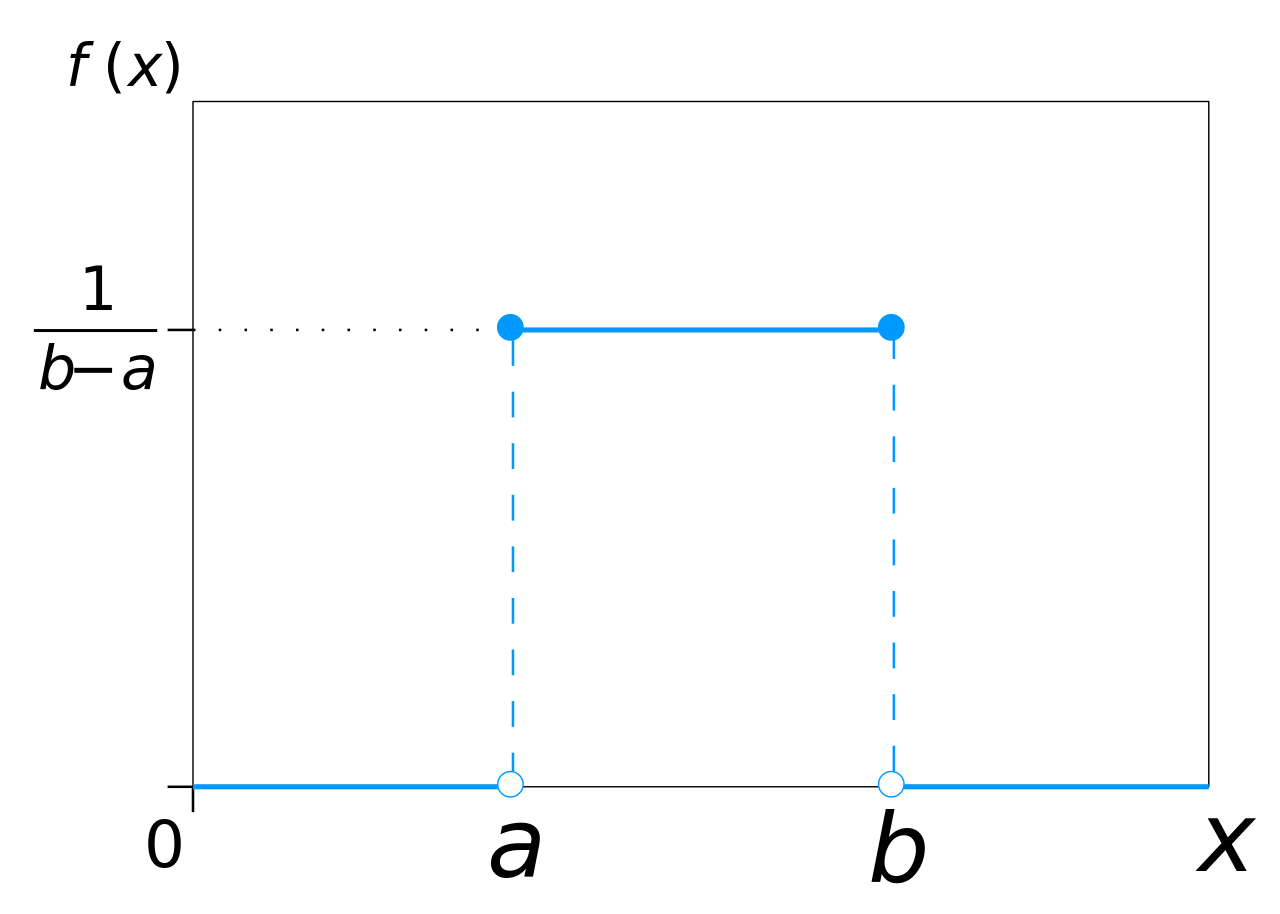
The simplest is a uniform distribution, where within a certain range, any level of activation is equally probable. The probability density function looks like this:

Assume the distribution has support between a and b, where a < b.

When b+s < 1, then overload is impossible, and only the incentive effect occurs; productivity increases linearly with stress.

The expected output is simply the expected value of a uniform distribution from a+s to b+s, which is:

E[x + s] = (a+b)/2+s

Then, once b+s > 1, overload risk begins to increase.

In this range, the probability of avoiding overload is:

P[x + s < 1] = F(1-s) = (1-s-a)/(b-a)

(Note that at b+s=1, this is exactly 1.)

The expected value of x+s in this range is:

E[x + s | x + s < 1] = (1-s)(1+s)/(2(b-a))

Multiplying these two together:

Y = [(1-s)(1+s)(1-s-a)]/[2(b-a)^2]

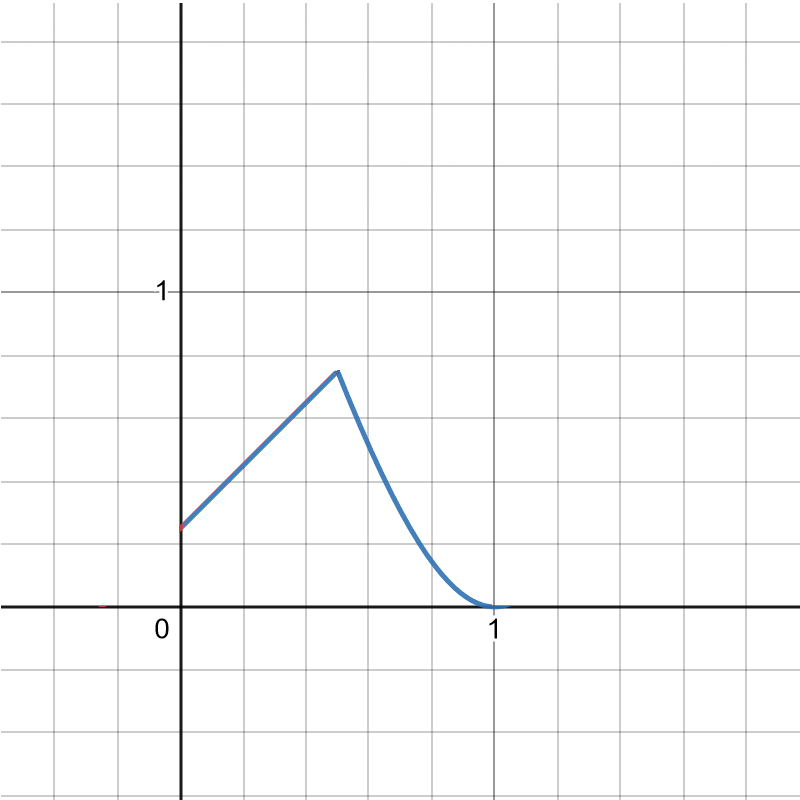
Here is what that looks like for a=0, b=1/2:

It does have the right qualitative features: increasing, then decreasing. But its sure looks weird, doesn’t it? It has this strange kinked shape.

So let’s consider some other distributions.

The next one I was able to solve it for is an exponential distribution, where the most probable activation is zero, and then higher activation always has lower probability than lower activation in an exponential decay:

For this it was actually easiest to do the integral directly (I did it by integrating by parts, but I’m sure you don’t care about all the mathematical steps):

Y = \int_{0}^{1-s} (x+s) dF(x)

Y = (1/λ+s) – (1/ λ + 1)e^(-λ(1-s))

The parameter λdecides how steeply your activation probability decays. Someone with low λ is relatively highly activated all the time, while someone with high λ is usually not highly activated; this seems like it might be related to the personality trait neuroticism.

Here are graphs of what the resulting Yerkes-Dodson curve looks like for several different values of λ:

λ = 0.5:

λ = 1:

λ = 2:

λ = 4:

λ = 8:

The λ = 0.5 person has high activation a lot of the time. They are actually fairly productive even without stress, but stress quickly overwhelms them. The λ = 8 person has low activation most of the time. They are not very productive without stress, but can also bear relatively high amounts of stress without overloading.

(The low-λ people also have overall lower peak productivity in this model, but that might not be true in reality, if λ is inversely correlated with some other attributes that are related to productivity.)

Neither uniform nor exponential has the nice bell-curve shape for innate activation we might have hoped for. There is another class of distributions, beta distributions, which do have this shape, and they are sort of tractable—you need something called an incomplete beta function, which isn’t an elementary function but it’s useful enough that most statistical packages include it.

Beta distributions have two parameters, α and β. They look like this:

Beta distributions are quite useful in Bayesian statistics; if you’re trying to estimate the probability of a random event that either succeeds or fails with a fixed probability (a Bernoulli process), and so far you have observed a successes and b failures, your best guess of its probability at each trial is a beta distribution with α = a+1 and β = b+1.

For beta distributions with parameters α and β, the result comes out to (I is that incomplete beta function I mentioned earlier):

Y = I(1-s, α+1, β) + I(1-s, α, β)

For whole number values of α andβ, the incomplete beta function can be computed by hand (though it is more work the larger they are); here’s an example with α = β = 2.

The innate activation probability looks like this:

And the result comes out like this:

Y = 2(1-s)^3 – 3/2(1-s)^4 + 3s(1-s)^2 – 2s(1-s)^3

This person has pretty high innate activation most of the time, so stress very quickly overwhelms them. If I had chosen a much higher β, I could change that, making them less likely to be innately so activated.

These are the cases I’ve found to be relatively tractable so far. They all have the right qualitative pattern: Increasing stress increases productivity for awhile, then begins decreasing it once overload risk becomes too high. They also show a general pattern where people who are innately highly activated (neurotic?) are much more likely to overload and thus much more sensitive to stress.

The stochastic overload model

The stochastic overload model

Mar 12 JDN 2460016

The next few posts are going to be a bit different, a bit more advanced and technical than usual. This is because, for the first time in several months at least, I am actually working on what could be reasonably considered something like theoretical research.

I am writing it up in the form of blog posts, because actually writing a paper is still too stressful for me right now. This also forces me to articulate my ideas in a clearer and more readable way, rather than dive directly into a morass of equations. It also means that even if I do never actually get around to finishing a paper, the idea is out there, and maybe someone else could make use of it (and hopefully give me some of the credit).

I’ve written previously about the Yerkes-Dodson effect: On cognitively-demanding tasks, increased stress increases performance, but only to a point, after which it begins decreasing it again. The effect is well-documented, but the mechanism is poorly understood.

I am currently on the wrong side of the Yerkes-Dodson curve, which is why I’m too stressed to write this as a formal paper right now. But that also gave me some ideas about how it may work.

I have come up with a simple but powerful mathematical model that may provide a mechanism for the Yerkes-Dodson effect.

This model is clearly well within the realm of a behavioral economic model, but it is also closely tied to neuroscience and cognitive science.

I call it the stochastic overload model.

First, a metaphor: Consider an engine, which can run faster or slower. If you increase its RPMs, it will output more power, and provide more torque—but only up to a certain point. Eventually it hits a threshold where it will break down, or even break apart. In real engines, we often include safety systems that force the engine to shut down as it approaches such a threshold.

I believe that human brains function on a similar principle. Stress increases arousal, which activates a variety of processes via the sympathetic nervous system. This activation improves performance on both physical and cognitive tasks. But it has a downside; especially on cognitively demanding tasks which required sustained effort, I hypothesize that too much sympathetic activation can result in a kind of system overload, where your brain can no longer handle the stress and processes are forced to shut down.

This shutdown could be brief—a few seconds, or even a fraction of a second—or it could be prolonged—hours or days. That might depend on just how severe the stress is, or how much of your brain it requires, or how prolonged it is. For purposes of the model, this isn’t vital. It’s probably easiest to imagine it being a relatively brief, localized shutdown of a particular neural pathway. Then, your performance in a task is summed up over many such pathways over a longer period of time, and by the law of large numbers your overall performance is essentially the average performance of all your brain systems.

That’s the “overload” part of the model. Now for the “stochastic” part.

Let’s say that, in the absence of stress, your brain has a certain innate level of sympathetic activation, which varies over time in an essentially chaotic, unpredictable—stochastic—sort of way. It is never really completely deactivated, and may even have some chance of randomly overloading itself even without outside input. (Actually, a potential role in the model for the personality trait neuroticism is an innate tendency toward higher levels of sympathetic activation in the absence of outside stress.)

Let’s say that this innate activation is x, which follows some kind of known random distribution F(x).

For simplicity, let’s also say that added stress s adds linearly to your level of sympathetic activation, so your overall level of activation is x + s.

For simplicity, let’s say that activation ranges between 0 and 1, where 0 is no activation at all and 1 is the maximum possible activation and triggers overload.

I’m assuming that if a pathway shuts down from overload, it doesn’t contribute at all to performance on the task. (You can assume it’s only reduced performance, but this adds complexity without any qualitative change.)

Since sympathetic activation improves performance, but can result in overload, your overall expected performance in a given task can be computed as the product of two terms:

[expected value of x + s, provided overload does not occur] * [probability overload does not occur]

E[x + s | x + s < 1] P[x + s < 1]

The first term can be thought of as the incentive effect: Higher stress promotes more activation and thus better performance.

The second term can be thought of as the overload effect: Higher stress also increases the risk that activation will exceed the threshold and force shutdown.

This equation actually turns out to have a remarkably elegant form as an integral (and here’s where I get especially technical and mathematical):

\int_{0}^{1-s} (x+s) dF(x)

The integral subsumes both the incentive effect and the overload effect into one term; you can also think of the +s in the integrand as the incentive effect and the 1-s in the limit of integration as the overload effect.

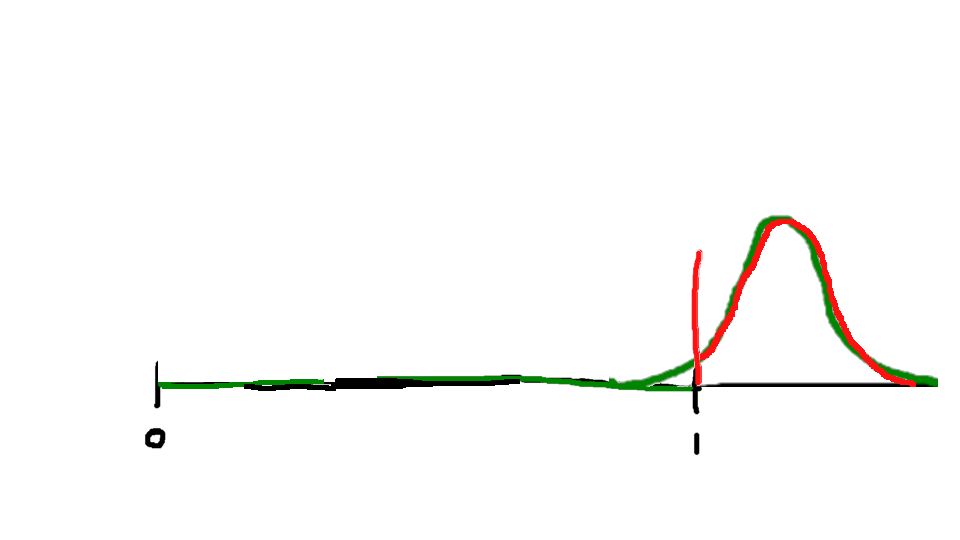
For the uninitated, this is probably just Greek. So let me show you some pictures to help with your intuition. These are all freehand sketches, so let me apologize in advance for my limited drawing skills. Think of this as like Arthur Laffer’s famous cocktail napkin.

Suppose that, in the absence of outside stress, your innate activation follows a distribution like this (this could be a normal or logit PDF; as I’ll talk about next week, logit is far more tractable):

As I start adding stress, this shifts the distribution upward, toward increased activation:

Initially, this will improve average performance.

But at some point, increased stress actually becomes harmful, as it increases the probability of overload.

And eventually, the probability of overload becomes so high that performance becomes worse than it was with no stress at all:

The result is that overall performance, as a function of stress, looks like an inverted U-shaped curve—the Yerkes-Dodson curve:

The precise shape of this curve depends on the distribution that we use for the innate activation, which I will save for next week’s post.

Escaping the wrong side of the Yerkes-Dodson curve

Jul 25 JDN 2459421

I’ve been under a great deal of stress lately. Somehow I ended up needing to finish my dissertation, get married, and move overseas to start a new job all during the same few months—during a global pandemic.

A little bit of stress is useful, but too much can be very harmful. On complicated tasks (basically anything that involves planning or careful thought), increased stress will increase performance up to a point, and then decrease it after that point. This phenomenon is known as the Yerkes-Dodson law.

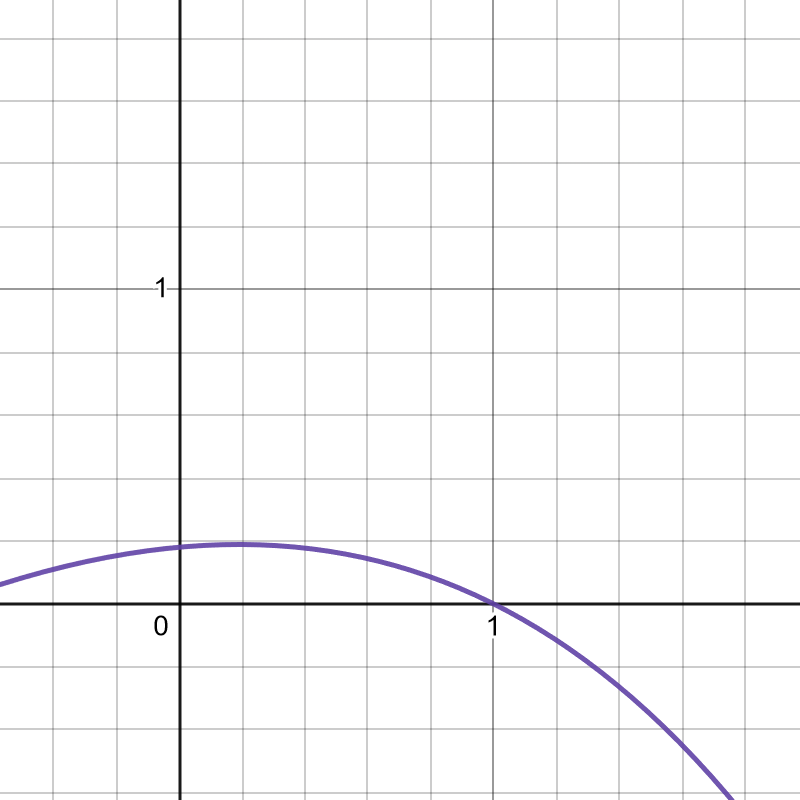
The Yerkes-Dodson curve very closely resembles the Laffer curve, which shows that since extremely low tax rates raise little revenue (obviously), and extremely high tax rates also raise very little revenue (because they cause so much damage to the economy), the tax rate that maximizes government revenue is actually somewhere in the middle. There is a revenue-maximizing tax rate (usually estimated to be about 70%).

Instead of a revenue-maximizing tax rate, the Yerkes-Dodson law says that there is a performance-maximizing stress level. You don’t want to have zero stress, because that means you don’t care and won’t put in any effort. But if your stress level gets too high, you lose your ability to focus and your performance suffers.

Since stress (like taxes) comes with a cost, you may not even want to be at the maximum point. Performance isn’t everything; you might be happier choosing a lower level of performance in order to reduce your own stress.

But once thing is certain: You do not want to be to the right of that maximum. Then you are paying the cost of not only increased stress, but also reduced performance.

And yet I think many of us spent a great deal of our time on the wrong side of the Yerkes-Dodson curve. I certainly feel like I’ve been there for quite awhile now—most of grad school, really, and definitely this past month when suddenly I found out I’d gotten an offer to work in Edinburgh.

My current circumstances are rather exceptional, but I think the general pattern of being on the wrong side of the Yerkes-Dodson curve is not.

Over 80% of Americans report work-related stress, and the US economy loses about half a trillion dollars a year in costs related to stress.

The World Health Organization lists “work-related stress” as one of its top concerns. Over 70% of people in a cross-section of countries report physical symptoms related to stress, a rate which has significantly increased since before the pandemic.

The pandemic is clearly a contributing factor here, but even without it, there seems to be an awful lot of stress in the world. Even back in 2018, over half of Americans were reporting high levels of stress. Why?

For once, I think it’s actually fair to blame capitalism.

One thing capitalism is exceptionally good at is providing strong incentives for work. This is often a good thing: It means we get a lot of work done, so employment is high, productivity is high, GDP is high. But it comes with some important downsides, and an excessive level of stress is one of them.

But this can’t be the whole story, because if markets were incentivizing us to produce as much as possible, that ought to put us near the maximum of the Yerkes-Dodson curve—but it shouldn’t put us beyond it. Maximizing productivity might not be what makes us happiest—but many of us are currently so stressed that we aren’t even maximizing productivity.

I think the problem is that competition itself is stressful. In a capitalist economy, we aren’t simply incentivized to do things well—we are incentivized to do them better than everyone else. Often quite small differences in performance can lead to large differences in outcome, much like how a few seconds can make the difference between an Olympic gold medal and an Olympic “also ran”.

An optimally productive economy would be one that incentivizes you to perform at whatever level maximizes your own long-term capability. It wouldn’t be based on competition, because competition depends too much on what other people are capable of. If you are not especially talented, competition will cause you great stress as you try to compete with people more talented than you. If you happen to be exceptionally talented, competition won’t provide enough incentive!

Here’s a very simple model for you. Your total performance p is a function of two components, your innate ability aand your effort e. In fact let’s just say it’s a sum of the two: p = a + e

People are randomly assigned their level of capability from some probability distribution, and then they choose their effort. For the very simplest case, let’s just say there are two people, and it turns out that person 1 has less innate ability than person 2, so a1 < a2.

There is also a certain amount of inherent luck in any competition. As it says in Ecclesiastes (by far the best book of the Old Testament), “The race is not to the swift or the battle to the strong, nor does food come to the wise or wealth to the brilliant or favor to the learned; but time and chance happen to them all.” So as usual I’ll model this as a contest function, where your probability of winning depends on your total performance, but it’s not a sure thing.

Let’s assume that the value of winning and cost of effort are the same across different people. (It would be simple to remove this assumption, but it wouldn’t change much in the results.) The value of winning I’ll call y, and I will normalize the cost of effort to 1.


Then this is each person’s expected payoff ui:

ui = (ai + ei)/(a1+e1+a2 + e2) V – ei

You choose effort, not ability, so maximize in terms of ei:

(a2 + e2) V = (a1 +e1+a2 + e2)2 = (a1 + e1) V

a1 + e1 = a2 + e2

p1 = p2

In equilibrium, both people will produce exactly the same level of performance—but one of them will be contributing more effort to compensate for their lesser innate ability.

I’ve definitely had this experience in both directions: Effortlessly acing math tests that I knew other people barely passed despite hours of studying, and running until I could barely breathe to keep up with other people who barely seemed winded. Clearly I had too little incentive in math class and too much in gym class—and competition was obviously the culprit.

If you vary the cost of effort between people, or make it not linear, you can make the two not exactly equal; but the overall pattern will remain that the person who has more ability will put in less effort because they can win anyway.

Yet presumably the amount of effort we want to incentivize isn’t less for those who are more talented. If anything, it may be more: Since an hour of work produces more when done by the more talented person, if the cost to them is the same, then the net benefit of that hour of work is higher than the same hour of work by someone less talented.

In a large population, there are almost certainly many people whose talents are similar to your own—but there are also almost certainly many below you and many above you as well. Unless you are properly matched with those of similar talent, competition will systematically lead to some people being pressured to work too hard and others not pressured enough.

But if we’re all stressed, where are the people not pressured enough? We see them on TV. They are celebrities and athletes and billionaires—people who got lucky enough, either genetically (actors who were born pretty, athletes who were born with more efficient muscles) or environmentally (inherited wealth and prestige), to not have to work as hard as the rest of us in order to succeed. Indeed, we are constantly bombarded with images of these fantastically lucky people, and by the availability heuristic our brains come to assume that they are far more plentiful than they actually are.

This dramatically exacerbates the harms of competition, because we come to feel that we are competing specifically with the people who were handed the world on a silver platter. Born without the innate advantages of beauty or endurance or inheritance, there’s basically no chance we could ever measure up; and thus we feel utterly inadequate unless we are constantly working as hard as we possibly can, trying to catch up in a race in which we always fall further and further behind.

How can we break out of this terrible cycle? Well, we could try to replace capitalism with something like the automated luxury communism of Star Trek; but this seems like a very difficult and long-term solution. Indeed it might well take us a few hundred years as Roddenberry predicted.

In the shorter term, we may not be able to fix the economic problem, but there is much we can do to fix the psychological problem.

By reflecting on the full breadth of human experience, not only here and now, but throughout history and around the world, you can come to realize that you—yes, you, if you’re reading this—are in fact among the relatively fortunate. If you have a roof over your head, food on your table, clean water from your tap, and ibuprofen in your medicine cabinet, you are far more fortunate than the average person in Senegal today; your television, car, computer, and smartphone are things that would be the envy even of kings just a few centuries ago. (Though ironically enough that person in Senegal likely has a smartphone, or at least a cell phone!)

Likewise, you can reflect upon the fact that while you are likely not among the world’s most very most talented individuals in any particular field, there is probably something you are much better at than most people. (A Fermi estimate suggests I’m probably in the top 250 behavioral economists in the world. That’s probably not enough for a Nobel, but it does seem to be enough to get a job at the University of Edinburgh.) There are certainly many people who are less good at many things than you are, and if you must think of yourself as competing, consider that you’re also competing with them.

Yet perhaps the best psychological solution is to learn not to think of yourself as competing at all. So much as you can afford to do so, try to live your life as if you were already living in a world that rewards you for making the best of your own capabilities. Try to live your life doing what you really think is the best use of your time—not your corporate overlords. Yes, of course, we must do what we need to in order to survive, and not just survive, but indeed remain physically and mentally healthy—but this is far less than most First World people realize. Though many may try to threaten you with homelessness or even starvation in order to exploit you and make you work harder, the truth is that very few people in First World countries actually end up that way (it couldbe brought to zero, if our public policy were better), and you’re not likely to be among them. “Starving artists” are typically a good deal happier than the general population—because they’re not actually starving, they’ve just removed themselves from the soul-crushing treadmill of trying to impress the neighbors with manicured lawns and fancy SUVs.

Bet five dollars for maximum performance

JDN 2457433

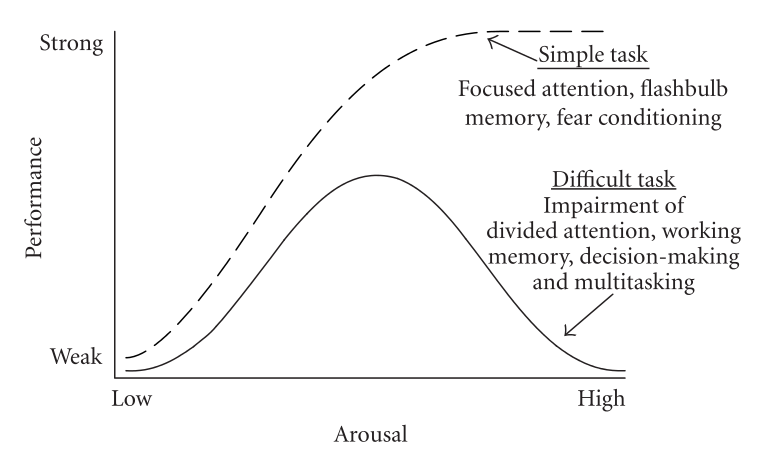
One of the more surprising findings from the study of human behavior under stress is the Yerkes-Dodson curve:

OriginalYerkesDodson
This curve shows how well humans perform at a given task, as a function of how high the stakes are on whether or not they do it properly.

For simple tasks, it says what most people intuitively expect—and what neoclassical economists appear to believe: As the stakes rise, the more highly incentivized you are to do it, and the better you do it.

But for complex tasks, it says something quite different: While increased stakes do raise performance to a point—with nothing at stake at all, people hardly work at all—it is possible to become too incentivized. Formally we say the curve is not monotonic; it has a local maximum.

This is one of many reasons why it’s ridiculous to say that top CEOs should make tens of millions of dollars a year on the rise and fall of their company’s stock price (as a great many economists do in fact say). Even if I believed that stock prices accurately reflect the company’s viability (they do not), and believed that the CEO has a great deal to do with the company’s success, it would still be a case of overincentivizing. When a million dollars rides on a decision, that decision is going to be worse than if the stakes had only been $100. With this in mind, it’s really not surprising that higher CEO pay is correlated with worse company performance. Stock options are terrible motivators, but do offer a subtle way of making wages adjust to the business cycle.

The reason for this is that as the stakes get higher, we become stressed, and that stress response inhibits our ability to use higher cognitive functions. The sympathetic nervous system evolved to make us very good at fighting or running away in the face of danger, which works well should you ever be attacked by a tiger. It did not evolve to make us good at complex tasks under high stakes, the sort of skill we’d need when calculating the trajectory of an errant spacecraft or disarming a nuclear warhead.

To be fair, most of us never have to worry about piloting errant spacecraft or disarming nuclear warheads—indeed, you’re about as likely to get attacked by a tiger even in today’s world. (The rate of tiger attacks in the US is just under 2 per year, and the rate of manned space launches in the US was about 5 per year until the Space Shuttle was terminated.)

There are certain professions, such as pilots and surgeons, where performing complex tasks under life-or-death pressure is commonplace, but only a small fraction of people take such professions for precisely that reason. And if you’ve ever wondered why we use checklists for pilots and there is discussion of also using checklists for surgeons, this is why—checklists convert a single complex task into many simple tasks, allowing high performance even at extreme stakes.

But we do have to do a fair number of quite complex tasks with stakes that are, if not urgent life-or-death scenarios, then at least actions that affect our long-term life prospects substantially. In my tutoring business I encounter one in particular quite frequently: Standardized tests.

Tests like the SAT, ACT, GRE, LSAT, GMAT, and other assorted acronyms are not literally life-or-death, but they often feel that way to students because they really do have a powerful impact on where you’ll end up in life. Will you get into a good college? Will you get into grad school? Will you get the job you want? Even subtle deviations from the path of optimal academic success can make it much harder to achieve career success in the future.

Of course, these are hardly the only examples. Many jobs require us to complete tasks properly on tight deadlines, or else risk being fired. Working in academia infamously requires publishing in journals in time to rise up the tenure track, or else falling off the track entirely. (This incentivizes the production of huge numbers of papers, whether they’re worth writing or not; yes, the number of papers published goes down after tenure, but is that a bad thing? What we need to know is whether the number of good papers goes down. My suspicion is that most if not all of the reduction in publications is due to not publishing things that weren’t worth publishing.)

So if you are faced with this sort of task, what can you do? If you realize that you are faced with a high-stakes complex task, you know your performance will be bad—which only makes your stress worse!

My advice is to pretend you’re betting five dollars on the outcome.

Ignore all other stakes, and pretend you’re betting five dollars. $5.00 USD. Do it right and you get a Lincoln; do it wrong and you lose one.
What this does is ensures that you care enough—you don’t want to lose $5 for no reason—but not too much—if you do lose $5, you don’t feel like your life is ending. We want to put you near that peak of the Yerkes-Dodson curve.

The great irony here is that you most want to do this when it is most untrue. If you actually do have a task for which you’ve bet $5 and nothing else rides on it, you don’t need this technique, and any technique to improve your performance is not particularly worthwhile. It’s when you have a standardized test to pass that you really want to use this—and part of me even hopes that people know to do this whenever they have nuclear warheads to disarm. It is precisely when the stakes are highest that you must put those stakes out of your mind.

Why five dollars? Well, the exact amount is arbitrary, but this is at least about the right order of magnitude for most First World individuals. If you really want to get precise, I think the optimal stakes level for maximum performance is something like 100 microQALY per task, and assuming logarithmic utility of wealth, $5 at the US median household income of $53,600 is approximately 100 microQALY. If you have a particularly low or high income, feel free to adjust accordingly. Literally you should be prepared to bet about an hour of your life; but we are not accustomed to thinking that way, so use $5. (I think most people, if asked outright, would radically overestimate what an hour of life is worth to them. “I wouldn’t give up an hour of my life for $1,000!” Then why do you work at $20 an hour?)

It’s a simple heuristic, easy to remember, and sometimes effective. Give it a try.