Sometimes people have to lose their jobs. This isn’t a bad thing.

Oct 8, JDN 2457670

Eleizer Yudkowsky (founder of the excellent blog forum Less Wrong) has a term he likes to use to distinguish his economic policy views from either liberal, conservative, or even libertarian: “econoliterate”, meaning the sort of economic policy ideas one comes up with when one actually knows a good deal about economics.

In general I think Yudkowsky overestimates this effect; I’ve known some very knowledgeable economists who disagree quite strongly over economic policy, and often following the conventional political lines of liberal versus conservative: Liberal economists want more progressive taxation and more Keynesian monetary and fiscal policy, while conservative economists want to reduce taxes on capital and remove regulations. Theoretically you can want all these things—as Miles Kimball does—but it’s rare. Conservative economists hate minimum wage, and lean on the theory that says it should be harmful to employment; liberal economists are ambivalent about minimum wage, and lean on the empirical data that shows it has almost no effect on employment. Which is more reliable? The empirical data, obviously—and until more economists start thinking that way, economics is never truly going to be a science as it should be.

But there are a few issues where Yudkowsky’s “econoliterate” concept really does seem to make sense, where there is one view held by most people, and another held by economists, regardless of who is liberal or conservative. One such example is free trade, which almost all economists believe in. A recent poll of prominent economists by the University of Chicago found literally zero who agreed with protectionist tariffs.

Another example is my topic for today: People losing their jobs.

Not unemployment, which both economists and almost everyone else agree is bad; but people losing their jobs. The general consensus among the public seems to be that people losing jobs is always bad, while economists generally consider it a sign of an economy that is run smoothly and efficiently.

To be clear, of course losing your job is bad for you; I don’t mean to imply that if you lose your job you shouldn’t be sad or frustrated or anxious about that, particularly not in our current system. Rather, I mean to say that policy which tries to keep people in their jobs is almost always a bad idea.

I think the problem is that most people don’t quite grasp that losing your job and not having a job are not the same thing. People not having jobs who want to have jobs—unemployment—is a bad thing. But losing your job doesn’t mean you have to stay unemployed; it could simply mean you get a new job. And indeed, that is what it should mean, if the economy is running properly.

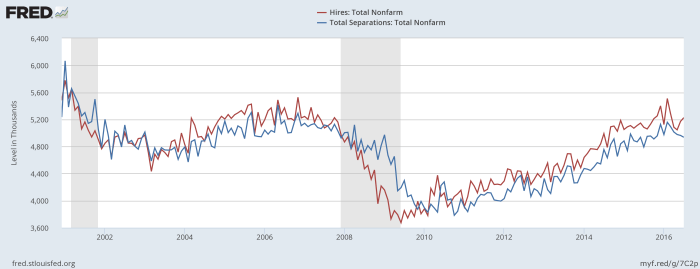
Check out this graph, from FRED:

hires_separations

The red line shows hires—people getting jobs. The blue line shows separations—people losing jobs or leaving jobs. During a recession (the most recent two are shown on this graph), people don’t actually leave their jobs faster than usual; if anything, slightly less. Instead what happens is that hiring rates drop dramatically. When the economy is doing well (as it is right now, more or less), both hires and separations are at very high rates.

Why is this? Well, think about what a job is, really: It’s something that needs done, that no one wants to do for free, so someone pays someone else to do it. Once that thing gets done, what should happen? The job should end. It’s done. The purpose of the job was not to provide for your standard of living; it was to achieve the task at hand. Once it doesn’t need done, why keep doing it?

We tend to lose sight of this, for a couple of reasons. First, we don’t have a basic income, and our social welfare system is very minimal; so a job usually is the only way people have to provide for their standard of living, and they come to think of this as the purpose of the job. Second, many jobs don’t really “get done” in any clear sense; individual tasks are completed, but new ones always arise. After every email sent is another received; after every patient treated is another who falls ill.

But even that is really only true in the short run. In the long run, almost all jobs do actually get done, in the sense that no one has to do them anymore. The job of cleaning up after horses is done (with rare exceptions). The job of manufacturing vacuum tubes for computers is done. Indeed, the job of being a computer—that used to be a profession, young women toiling away with slide rules—is very much done. There are no court jesters anymore, no town criers, and very few artisans (and even then, they’re really more like hobbyists). There are more writers now than ever, and occasional stenographers, but there are no scribes—no one powerful but illiterate pays others just to write things down, because no one powerful is illiterate (and even few who are not powerful, and fewer all the time).

When a job “gets done” in this long-run sense, we usually say that it is obsolete, and again think of this as somehow a bad thing, like we are somehow losing the ability to do something. No, we are gaining the ability to do something better. Jobs don’t become obsolete because we can’t do them anymore; they become obsolete because we don’t need to do them anymore. Instead of computers being a profession that toils with slide rules, they are thinking machines that fit in our pockets; and there are plenty of jobs now for software engineers, web developers, network administrators, hardware designers, and so on as a result.

Soon, there will be no coal miners, and very few oil drillers—or at least I hope so, for the sake of our planet’s climate. There will be far fewer auto workers (robots have already done most of that already), but far more construction workers who install rail lines. There will be more nuclear engineers, more photovoltaic researchers, even more miners and roofers, because we need to mine uranium and install solar panels on rooftops.

Yet even by saying that I am falling into the trap: I am making it sound like the benefit of new technology is that it opens up more new jobs. Typically it does do that, but that isn’t what it’s for. The purpose of technology is to get things done.

Remember my parable of the dishwasher. The goal of our economy is not to make people work; it is to provide people with goods and services. If we could invent a machine today that would do the job of everyone in the world and thereby put us all out of work, most people think that would be terrible—but in fact it would be wonderful.

Or at least it could be, if we did it right. See, the problem right now is that while poor people think that the purpose of a job is to provide for their needs, rich people think that the purpose of poor people is to do jobs. If there are no jobs to be done, why bother with them? At that point, they’re just in the way! (Think I’m exaggerating? Why else would anyone put a work requirement on TANF and SNAP? To do that, you must literally think that poor people do not deserve to eat or have homes if they aren’t, right now, working for an employer. You can couch that in cold economic jargon as “maximizing work incentives”, but that’s what you’re doing—you’re threatening people with starvation if they can’t or won’t find jobs.)

What would happen if we tried to stop people from losing their jobs? Typically, inefficiency. When you aren’t allowed to lay people off when they are no longer doing useful work, we end up in a situation where a large segment of the population is being paid but isn’t doing useful work—and unlike the situation with a basic income, those people would lose their income, at least temporarily, if they quit and tried to do something more useful. There is still considerable uncertainty within the empirical literature on just how much “employment protection” (laws that make it hard to lay people off) actually creates inefficiency and reduces productivity and employment, so it could be that this effect is small—but even so, likewise it does not seem to have the desired effect of reducing unemployment either. It may be like minimum wage, where the effect just isn’t all that large. But it’s probably not saving people from being unemployed; it may simply be shifting the distribution of unemployment so that people with protected jobs are almost never unemployed and people without it are unemployed much more frequently. (This doesn’t have to be based in law, either; while it is made by custom rather than law, it’s quite clear that tenure for university professors makes tenured professors vastly more secure, but at the cost of making employment tenuous and underpaid for adjuncts.)

There are other policies we could make that are better than employment protection, active labor market policies like those in Denmark that would make it easier to find a good job. Yet even then, we’re assuming that everyone needs jobs–and increasingly, that just isn’t true.

So, when we invent a new technology that replaces workers, workers are laid off from their jobs—and that is as it should be. What happens next is what we do wrong, and it’s not even anybody in particular; this is something our whole society does wrong: All those displaced workers get nothing. The extra profit from the more efficient production goes entirely to the shareholders of the corporation—and those shareholders are almost entirely members of the top 0.01%. So the poor get poorer and the rich get richer.

The real problem here is not that people lose their jobs; it’s that capital ownership is distributed so unequally. And boy, is it ever! Here are some graphs I made of the distribution of net wealth in the US, using from the US Census.

Here are the quintiles of the population as a whole:

net_wealth_us

And here are the medians by race:

net_wealth_race

Medians by age:

net_wealth_age

Medians by education:

net_wealth_education

And, perhaps most instructively, here are the quintiles of people who own their homes versus renting (The rent is too damn high!)

net_wealth_rent

All that is just within the US, and already they are ranging from the mean net wealth of the lowest quintile of people under 35 (-$45,000, yes negative—student loans) to the mean net wealth of the highest quintile of people with graduate degrees ($3.8 million). All but the top quintile of renters are poorer than all but the bottom quintile of homeowners. And the median Black or Hispanic person has less than one-tenth the wealth of the median White or Asian person.

If we look worldwide, wealth inequality is even starker. Based on UN University figures, 40% of world wealth is owned by the top 1%; 70% by the top 5%; and 80% by the top 10%. There is less total wealth in the bottom 80% than in the 80-90% decile alone. According to Oxfam, the richest 85 individuals own as much net wealth as the poorest 3.7 billion. They are the 0.000,001%.

If we had an equal distribution of capital ownership, people would be happy when their jobs became obsolete, because it would free them up to do other things (either new jobs, or simply leisure time), while not decreasing their income—because they would be the shareholders receiving those extra profits from higher efficiency. People would be excited to hear about new technologies that might displace their work, especially if those technologies would displace the tedious and difficult parts and leave the creative and fun parts. Losing your job could be the best thing that ever happened to you.

The business cycle would still be a problem; we have good reason not to let recessions happen. But stopping the churn of hiring and firing wouldn’t actually make our society better off; it would keep people in jobs where they don’t belong and prevent us from using our time and labor for its best use.

Perhaps the reason most people don’t even think of this solution is precisely because of the extreme inequality of capital distribution—and the fact that it has more or less always been this way since the dawn of civilization. It doesn’t seem to even occur to most people that capital income is a thing that exists, because they are so far removed from actually having any amount of capital sufficient to generate meaningful income. Perhaps when a robot takes their job, on some level they imagine that the robot is getting paid, when of course it’s the shareholders of the corporations that made the robot and the corporations that are using the robot in place of workers. Or perhaps they imagine that those shareholders actually did so much hard work they deserve to get paid that money for all the hours they spent.

Because pay is for work, isn’t it? The reason you get money is because you’ve earned it by your hard work?

No. This is a lie, told to you by the rich and powerful in order to control you. They know full well that income doesn’t just come from wages—most of their income doesn’t come from wages! Yet this is even built into our language; we say “net worth” and “earnings” rather than “net wealth” and “income”. (Parade magazine has a regular segment called “What People Earn”; it should be called “What People Receive”.) Money is not your just reward for your hard work—at least, not always.

The reason you get money is that this is a useful means of allocating resources in our society. (Remember, money was created by governments for the purpose of facilitating economic transactions. It is not something that occurs in nature.) Wages are one way to do that, but they are far from the only way; they are not even the only way currently in use. As technology advances, we should expect a larger proportion of our income to go to capital—but what we’ve been doing wrong is setting it up so that only a handful of people actually own any capital.

Fix that, and maybe people will finally be able to see that losing your job isn’t such a bad thing; it could even be satisfying, the fulfillment of finally getting something done.

Nuclear power is safe. Why don’t people like it?

Sep 24, JDN 2457656

This post will have two parts, corresponding to each sentence. First, I hope to convince you that nuclear power is safe. Second, I’ll try to analyze some of the reasons why people don’t like it and what we might be able to do about that.

Depending on how familiar you are with the statistics on nuclear power, the idea that nuclear power is safe may strike you as either a completely ridiculous claim or an egregious understatement. If your primary familiarity with nuclear power safety is via the widely-publicized examples of Chernobyl, Three Mile Island, and more recently Fukushima, you may have the impression that nuclear power carries huge, catastrophic risks. (You may also be confusing nuclear power with nuclear weapons—nuclear weapons are indeed the greatest catastrophic risk on Earth today, but equating the two is like equating automobiles and machine guns because both of them are made of metal and contain lubricant, flammable materials, and springs.)

But in fact nuclear energy is astonishingly safe. Indeed, even those examples aren’t nearly as bad as people have been led to believe. Guess how many people died as a result of Three Mile Island, including estimated increased cancer deaths from radiation exposure?

Zero. There are zero confirmed deaths and the consensus estimate of excess deaths caused by the Three Mile Island incident by all causes combined is zero.

What about Fukushima? Didn’t 10,000 people die there? From the tsunami, yes. But the nuclear accident resulted in zero fatalities. If anything, those 10,000 people were killed by coal—by climate change. They certainly weren’t killed by nuclear.

Chernobyl, on the other hand, did actually kill a lot of people. Chernobyl caused 31 confirmed direct deaths, as well as an estimated 4,000 excess deaths by all causes. On the one hand, that’s more than 9/11; on the other hand, it’s about a month of US car accidents. Imagine if people had the same level of panic and outrage at automobiles after a month of accidents that they did at nuclear power after Chernobyl.

The vast majority of nuclear accidents cause zero fatalities; other than Chernobyl, none have ever caused more than 10. Deepwater Horizon killed 11 people, and yet for some reason Americans did not unite in opposition against ever using oil (or even offshore drilling!) ever again.

In fact, even that isn’t fair to nuclear power, because we’re not including the thousands of lives saved every year by using nuclear instead of coal and oil.

Keep in mind, the WHO estimates 10 to 100 million excess deaths due to climate change over the 21st century. That’s an average of 100,000 to 1 million deaths every year. Nuclear power currently produces about 11% of the world’s energy, so let’s do a back-of-the-envelope calculation for how many lives that’s saving. Assuming that additional climate change would be worse in direct proportion to the additional carbon emissions (which is conservative), and assuming that half that energy would be replaced by coal or oil (also conservative, using Germany’s example), we’re looking at about a 6% increase in deaths due to climate change if all those nuclear power plants were closed. That’s 6,000 to 60,000 lives that nuclear power plants save every year.

I also haven’t included deaths due to pollution—note that nuclear power plants don’t pollute air or water whatsoever, and only produce very small amounts of waste that can be quite safely stored. Air pollution in all its forms is responsible for one in eight deaths worldwide. Let me say that again: One in eight of all deaths in the world is caused by air pollution—so this is on the order of 7 million deaths per year, every year. We burn our way to a biannual Holocaust. Most of this pollution is actually caused by burning wood—fireplaces, wood stoves, and bonfires are terrible for the air—and many countries would actually see a substantial reduction in their toxic pollution if they switched to oil or even coal in favor of wood. But a large part of that pollution is caused by coal, and a nontrivial amount is caused by oil. Coal-burning factories and power plants are responsible for about 1 million deaths per year in China alone. Most of that pollution could be prevented if those power plants were nuclear instead.

Factor all that in, and nuclear power currently saves tens if not hundreds of thousands of lives per year, and expanding it to replace all fossil fuels could save millions more. Indeed, a more precise estimate of the benefits of nuclear power published a few years ago in Environmental Science and Technology is that nuclear power plants have saved some 1.8 million human lives since their invention, putting them on a par with penicillin and the polio vaccine.

So, I hope I’ve convinced you of the first proposition: Nuclear power plants are safe—and not just safe, but heroic, in fact one of the greatest life-saving technologies ever invented. So, why don’t people like them?

Unfortunately, I suspect that no amount of statistical data by itself will convince those who still feel a deep-seated revulsion to nuclear power. Even many environmentalists, people who could be nuclear energy’s greatest advocates, are often opposed to it. I read all the way through Naomi Klein’s This Changes Everything and never found even a single cogent argument against nuclear power; she simply takes it as obvious that nuclear power is “more of the same line of thinking that got us in this mess”. Perhaps because nuclear power could be enormously profitable for certain corporations (which is true; but then, it’s also true of solar and wind power)? Or because it also fits this narrative of “raping and despoiling the Earth” (sort of, I guess)? She never really does explain; I’m guessing she assumes that her audience will simply share her “gut feeling” intuition that nuclear power is dangerous and untrustworthy. One of the most important inconvenient truths for environmentalists is that nuclear power is not only safe, it is almost certainly our best hope for stopping climate change.

Perhaps all this is less baffling when we recognize that other heroic technologies are often also feared or despised for similarly bizarre reasons—vaccines, for instance.

First of all, human beings fear what we cannot understand, and while the human immune system is certainly immensely complicated, nuclear power is based on quantum mechanics, a realm of scientific knowledge so difficult and esoteric that it is frequently used as the paradigm example of something that is hard to understand. (As Feynman famously said, “I think I can safely say that nobody understands quantum mechanics.”) Nor does it help that popular treatments of quantum physics typically bear about as much resemblance to the actual content of the theory as the X-Men films do to evolutionary biology, and con artists like Deepak Chopra take advantage of this confusion to peddle their quackery.

Nuclear radiation is also particularly terrifying because it is invisible and silent; while a properly-functioning nuclear power plant emits less ionizing radiation than the Capitol Building and eating a banana poses substantially higher radiation risk than talking on a cell phone, nonetheless there is real danger posed by ionizing radiation, and that danger is particularly terrifying because it takes a form that human senses cannot detect. When you are burned by fire or cut by a knife, you know immediately; but gamma rays could be coursing through you right now and you’d feel no different. (Huge quantities of neutrinos are coursing through you, but fear not, for they’re completely harmless.) The symptoms of severe acute radiation poisoning also take a particularly horrific form: After the initial phase of nausea wears off, you can enter a “walking ghost phase”, where your eventual death is almost certain due to your compromised immune and digestive systems, but your current condition is almost normal. This makes the prospect of death by nuclear accident a particularly vivid and horrible image.

Vividness makes ideas more available to our memory; and thus, by the availability heuristic, we automatically infer that it must be more probable than it truly is. You can think of horrific nuclear accidents like Chernobyl, and all the carnage they caused; but all those millions of people choking to death in China don’t make for a compelling TV news segment (or at least, our TV news doesn’t seem to think so). Vividness doesn’t actually seem to make things more persuasive, but it does make them more memorable.

Yet even if we allow for the possibility that death by radiation poisoning is somewhat worse than death by coal pollution (if I had to choose between the two, okay, maybe I’d go with the coal), surely it’s not ten thousand times worse? Surely it’s not worth sacrificing entire cities full of people to coal in order to prevent a handful of deaths by nuclear energy?

Another reason that has been proposed is a sense that we can control risk from other sources, but a nuclear meltdown would be totally outside our control. Perhaps that is the perception, but if you think about it, it really doesn’t make a lot of sense. If there’s a nuclear meltdown, emergency services will report it, and you can evacuate the area. Yes, the radiation moves at the speed of light; but it also dissipates as the inverse square of distance, so if you just move further away you can get a lot safer quite quickly. (Think about the brightness of a lamp in your face versus across a football field. Radiation works the same way.) The damage is also cumulative, so the radiation risk from a meltdown is only going to be serious if you stay close to the reactor for a sustained period of time. Indeed, it’s much easier to avoid nuclear radiation than it is to avoid air pollution; you can’t just stand behind a concrete wall to shield against air pollution, and moving further away isn’t possible if you don’t know where it’s coming from. Control would explain why we fear cars less than airplanes (which is also statistically absurd), but it really can’t explain why nuclear power scares people more than coal and oil.

Another important factor may be an odd sort of bipartisan consensus: While the Left hates nuclear power because it makes corporations profitable or because it’s unnatural and despoils the Earth or something, the Right hates nuclear power because it requires substantial government involvement and might displace their beloved fossil fuels. (The Right’s deep, deep love of the fossil fuel industry now borders on the pathological. Even now that they are obviously economically inefficient and environmentally disastrous, right-wing parties around the world continue to defend enormous subsidies for oil and coal companies. Corruption and regulatory capture could partly explain this, but only partly. Campaign contributions can’t explain why someone would write a book praising how wonderful fossil fuels are and angrily denouncing anyone who would dare criticize them.) So while the two sides may hate each other in general and disagree on most other issues—including of course climate change itself—they can at least agree that nuclear power is bad and must be stopped.

Where do we go from here, then? I’m not entirely sure. As I said, statistical data by itself clearly won’t be enough. We need to find out what it is that makes people so uniquely terrified of nuclear energy, and we need to find a way to assuage those fears.

And we must do this now. For every day we don’t—every day we postpone the transition to a zero-carbon energy grid—is another thousand people dead.

Zootopia taught us constructive responses to bigotry

Sep 10, JDN 2457642

Zootopia wasn’t just a good movie; Zootopia was a great movie. I’m not just talking about its grosses (over $1 billion worldwide), or its ratings, 8.1 on IMDB, 98% from critics and 93% from viewers on Rotten Tomatoes, 78 from critics and 8.8 from users on Metacritic. No, I’m talking about its impact on the world. This movie isn’t just a fun and adorable children’s movie (though it is that). This movie is a work of art that could have profound positive effects on our society.

Why? Because Zootopia is about bigotry—and more than that, it doesn’t just say “bigotry is bad, bigots are bad”; it provides us with a constructive response to bigotry, and forces us to confront the possibility that sometimes the bigots are us.

Indeed, it may be no exaggeration (though I’m sure I’ll get heat on the Internet for suggesting it) to say that Zootopia has done more to fight bigotry than most social justice activists will achieve in their entire lives. Don’t get me wrong, some social justice activists have done great things; and indeed, I may have to count myself in this “most activists” category, since I can’t point to any major accomplishments I’ve yet made in social justice.

But one of the biggest problems I see in the social justice community is the tendency to exclude and denigrate (in sociology jargon, “other” as a verb) people for acts of bigotry, even quite mild ones. Make one vaguely sexist joke, and you may as well be a rapist. Use racially insensitive language by accident, and clearly you are a KKK member. Say something ignorant about homosexuality, and you may as well be Rick Santorum. It becomes less about actually moving the world forward, and more about reaffirming our tribal unity as social justice activists. We are the pure ones. We never do wrong. All the rest of you are broken, and the only way to fix yourself is to become one of us in every way.

In the process of fighting tribal bigotry, we form our own tribe and become our own bigots.

Zootopia offers us another way. If you haven’t seen it, go rent it on DVD or stream it on Netflix right now. Seriously, this blog post will be here when you get back. I’m not going to play any more games with “spoilers!” though. It is definitely worth seeing, and from this point forward I’m going to presume you have.

The brilliance of Zootopia lies in the fact that it made bigotry what it is—not some evil force that infests us from outside, nor something that only cruel, evil individuals would ever partake in, but thoughts and attitudes that we all may have from time to time, that come naturally, and even in some cases might be based on a kernel of statistical truth. Judy Hopps is prey, she grew up in a rural town surrounded by others of her own species (with a population the size of New York City according to the sign, because this is still sometimes a silly Disney movie). She only knew a handful of predators growing up, yet when she moves to Zootopia suddenly she’s confronted with thousands of them, all around her. She doesn’t know what most predators are like, or how best to deal with them.

What she does know is that her ancestors were terrorized, murdered, and quite literally eaten by the ancestors of predators. Her instinctual fear of predators isn’t something utterly arbitrary; it was written into the fabric of her DNA by her ancestral struggle for survival. She has a reason to hate and fear predators that, on its face, actually seems to make sense.

And when there is a spree of murders, all committed by predators, it feels natural to us that Judy would fall back on her old prejudices; indeed, the brilliance of it is that they don’t immediately feel like prejudices. It takes us a moment to let her off-the-cuff comments at the press conference sink in (and Nick’s shocked reaction surely helps), before we realize that was really bigoted. Our adorable, innocent, idealistic, beloved protagonist is a bigot!

Or rather, she has done something bigoted. Because she is such a sympathetic character, we avoid the implication that she is a bigot, that this is something permanent and irredeemable about her. We have already seen the good in her, so we know that this bigotry isn’t what defines who she is. And in the end, she realizes where she went wrong and learns to do better. Indeed, it is ultimately revealed that the murders were orchestrated by someone whose goal was specifically to trigger those ancient ancestral feuds, and Judy reveals that plot and ultimately ends up falling in love with a predator herself.

What Zootopia is really trying to tell us is that we are all Judy Hopps. Every one of us most likely harbors some prejudiced attitude toward someone. If it’s not Black people or women or Muslims or gays, well, how about rednecks? Or Republicans? Or (perhaps the hardest for me) Trump supporters? If you are honest with yourself, there is probably some group of people on this planet that you harbor attitudes of disdain or hatred toward that nonetheless contains a great many good people who do not deserve your disdain.

And conversely, all bigots are Judy Hopps too, or at least the vast majority of them. People don’t wake up in the morning concocting evil schemes for the sake of being evil like cartoon supervillains. (Indeed, perhaps the greatest thing about Zootopia is that it is a cartoon in the sense of being animated, but it is not a cartoon in the sense of being morally simplistic. Compare Captain Planet, wherein polluters aren’t hardworking coal miners with no better options or even corrupt CEOs out to make an extra dollar to go with their other billion; no, they pollute on purpose, for no reason, because they are simply evil. Now that is a cartoon.) Normal human beings don’t plan to make the world a worse place. A handful of psychopaths might, but even then I think it’s more that they don’t care; they aren’t trying to make the world worse, they just don’t particularly mind if they do, as long as they get what they want. Robert Mugabe and Kim-Jong Un are despicable human beings with the blood of millions on their hands, but even they aren’t trying to make the world worse.

And thus, if your theory of bigotry requires that bigots are inhuman monsters who harm others by their sheer sadistic evil, that theory is plainly wrong. Actually I think when stated outright, hardly anyone would agree with that theory; but the important thing is that we often act as if we do. When someone does something bigoted, we shun them, deride them, push them as far as we can to the fringes of our own social group or even our whole society. We don’t say that your statement was racist; we say you are racist. We don’t say your joke was sexist; we say you are sexist. We don’t say your decision was homophobic; we say you are homophobic. We define bigotry as part of your identity, something as innate and ineradicable as your race or sex or sexual orientation itself.

I think I know why we do this: It is to protect ourselves from the possibility that we ourselves might sometimes do bigoted things. Because only bigots do bigoted things, and we know that we are not bigots.

We laugh at this when someone else does it: “But some of my best friends are Black!” “Happy #CincoDeMayo; I love Hispanics!” But that is the very same psychological defense mechanism we’re using ourselves, albeit in a more extreme application. When we commit an act that is accused of being bigoted, we begin searching for contextual evidence outside that act to show that we are not bigoted. The truth we must ultimately confront is that this is irrelevant: The act can still be bigoted even if we are not overall bigots—for we are all Judy Hopps.

This seems like terrible news, even when delivered by animated animals (or fuzzy muppets in Avenue Q), because we tend to hear it as “We are all bigots.” We hear this as saying that bigotry is inevitable, inescapable, literally written into the fabric of our DNA. At that point, we may as well give up, right? It’s hopeless!

But that much we know can’t be true. It could be (indeed, likely is) true that some amount of bigotry is inevitable, just as no country has ever managed to reach zero homicide or zero disease. But just as rates of homicide and disease have precipitously declined with the advancement of human civilization (starting around industrial capitalism, as I pointed out in a previous post!), so indeed have rates of bigotry, at least in recent times.

For goodness’ sake, it used to be a legal, regulated industry to buy and sell other human beings in the United States! This was seen as normal; indeed many argued that it was economically indispensable.

Is 1865 too far back for you? How about racially segregated schools, which were only eliminated from US law in 1954, a time where my parents were both alive? (To be fair, only barely; my father was a month old.) Yes, even today the racial composition of our schools is far from evenly mixed; but it used to be a matter of law that Black children could not go to school with White children.

Women were only granted the right to vote in the US in 1920. My parents weren’t alive yet, but there definitely are people still alive today who were children when the Nineteenth Amendment was ratified.

Same-sex marriage was not legalized across the United States until last year. My own life plans were suddenly and directly affected by this change.

We have made enormous progress against bigotry, in a remarkably short period of time. It has been argued that social change progresses by the death of previous generations; but that simply can’t be true, because we are moving much too fast for that! Attitudes toward LGBT people have improved dramatically in just the last decade.

Instead, it must be that we are actually changing people’s minds. Not everyone’s, to be sure; and often not as quickly as we’d like. But bit by bit, we tear bigotry down, like people tearing off tiny pieces of the Berlin Wall in 1989.

It is important to understand what we are doing here. We are not getting rid of bigots; we are getting rid of bigotry. We want to convince people, “convert” them if you like, not shun them or eradicate them. And we want to strive to improve our own behavior, because we know it will not always be perfect. By forgiving others for their mistakes, we can learn to forgive ourselves for our own.

It is only by talking about bigoted actions and bigoted ideas, rather than bigoted people, that we can hope to make this progress. Someone can’t change who they are, but they can change what they believe and what they do. And along those same lines, it’s important to be clear about detailed, specific actions that people can take to make themselves and the world better.

Don’t just say “Check your privilege!” which at this point is basically a meaningless Applause Light. Instead say “Here are some articles I think you should read on police brutality, including this one from The American Conservative. And there’s a Black Lives Matter protest next weekend, would you like to join me there to see what we do?” Don’t just say “Stop being so racist toward immigrants!”; say “Did you know that about a third of undocumented immigrants are college students on overstayed visas? If we deport all these people, won’t that break up families?” Don’t try to score points. Don’t try to show that you’re the better person. Try to understand, inform, and persuade. You are talking to Judy Hopps, for we are all Judy Hopps.

And when you find false beliefs or bigoted attitudes in yourself, don’t deny them, don’t suppress them, don’t make excuses for them—but also don’t hate yourself for having them. Forgive yourself for your mistake, and then endeavor to correct it. For we are all Judy Hopps.

The replication crisis, and the future of science

Aug 27, JDN 2457628 [Sat]

After settling in a little bit in Irvine, I’m now ready to resume blogging, but for now it will be on a reduced schedule. I’ll release a new post every Saturday, at least for the time being.

Today’s post was chosen by Patreon vote, though only one person voted (this whole Patreon voting thing has not been as successful as I’d hoped). It’s about something we scientists really don’t like to talk about, but definitely need to: We are in the middle of a major crisis of scientific replication.

Whenever large studies are conducted attempting to replicate published scientific results, their ability to do so is almost always dismal.

Psychology is the one everyone likes to pick on, because their record is particularly bad. Only 39% of studies were really replicated with the published effect size, though a further 36% were at least qualitatively but not quantitatively similar. Yet economics has its own replication problem, and even medical research is not immune to replication failure.

It’s important not to overstate the crisis; the majority of scientific studies do at least qualitatively replicate. We are doing better than flipping a coin, which is better than one can say of financial forecasters.
There are three kinds of replication, and only one of them should be expected to give near-100% results. That kind is reanalysiswhen you take the same data and use the same methods, you absolutely should get the exact same results. I favor making reanalysis a routine requirement of publication; if we can’t get your results by applying your statistical methods to your data, then your paper needs revision before we can entrust it to publication. A number of papers have failed on reanalysis, which is absurd and embarrassing; the worst offender was probably Rogart-Reinhoff, which was used in public policy decisions around the world despite having spreadsheet errors.

The second kind is direct replication—when you do the exact same experiment again and see if you get the same result within error bounds. This kind of replication should work something like 90% of the time, but in fact works more like 60% of the time.

The third kind is conceptual replication—when you do a similar experiment designed to test the same phenomenon from a different perspective. This kind of replication should work something like 60% of the time, but actually only works about 20% of the time.

Economists are well equipped to understand and solve this crisis, because it’s not actually about science. It’s about incentives. I facepalm every time I see another article by an aggrieved statistician about the “misunderstanding” of p-values; no, scientist aren’t misunderstanding anything. They know damn well how p-values are supposed to work. So why do they keep using them wrong? Because their jobs depend on doing so.

The first key point to understand here is “publish or perish”; academics in an increasingly competitive system are required to publish their research in order to get tenure, and frequently required to get tenure in order to keep their jobs at all. (Or they could become adjuncts, who are paid one-fifth as much.)

The second is the fundamentally defective way our research journals are run (as I have discussed in a previous post). As private for-profit corporations whose primary interest is in raising more revenue, our research journals aren’t trying to publish what will genuinely advance scientific knowledge. They are trying to publish what will draw attention to themselves. It’s a similar flaw to what has arisen in our news media; they aren’t trying to convey the truth, they are trying to get ratings to draw advertisers. This is how you get hours of meaningless fluff about a missing airliner and then a single chyron scroll about a war in Congo or a flood in Indonesia. Research journals haven’t fallen quite so far because they have reputations to uphold in order to attract scientists to read them and publish in them; but still, their fundamental goal is and has always been to raise attention in order to raise revenue.

The best way to do that is to publish things that are interesting. But if a scientific finding is interesting, that means it is surprising. It has to be unexpected or unusual in some way. And above all, it has to be positive; you have to have actually found an effect. Except in very rare circumstances, the null result is never considered interesting. This adds up to making journals publish what is improbable.

In particular, it creates a perfect storm for the abuse of p-values. A p-value, roughly speaking, is the probability you would get the observed result if there were no effect at all—for instance, the probability that you’d observe this wage gap between men and women in your sample if in the real world men and women were paid the exact same wages. The standard heuristic is a p-value of 0.05; indeed, it has become so enshrined that it is almost an explicit condition of publication now. Your result must be less than 5% likely to happen if there is no real difference. But if you will only publish results that show a p-value of 0.05, then the papers that get published and read will only be the ones that found such p-values—which renders the p-values meaningless.

It was never particularly meaningful anyway; as we Bayesians have been trying to explain since time immemorial, it matters how likely your hypothesis was in the first place. For something like wage gaps where we’re reasonably sure, but maybe could be wrong, the p-value is not too unreasonable. But if the theory is almost certainly true (“does gravity fall off as the inverse square of distance?”), even a high p-value like 0.35 is still supportive, while if the theory is almost certainly false (“are human beings capable of precognition?”—actual study), even a tiny p-value like 0.001 is still basically irrelevant. We really should be using much more sophisticated inference techniques, but those are harder to do, and don’t provide the nice simple threshold of “Is it below 0.05?”

But okay, p-values can be useful in many cases—if they are used correctly and you see all the results. If you have effect X with p-values 0.03, 0.07, 0.01, 0.06, and 0.09, effect X is probably a real thing. If you have effect Y with p-values 0.04, 0.02, 0.29, 0.35, and 0.74, effect Y is probably not a real thing. But I’ve just set it up so that these would be published exactly the same. They each have two published papers with “statistically significant” results. The other papers never get published and therefore never get seen, so we throw away vital information. This is called the file drawer problem.

Researchers often have a lot of flexibility in designing their experiments. If their only goal were to find truth, they would use this flexibility to test a variety of scenarios and publish all the results, so they can be compared holistically. But that isn’t their only goal; they also care about keeping their jobs so they can pay rent and feed their families. And under our current system, the only way to ensure that you can do that is by publishing things, which basically means only including the parts that showed up as statistically significant—otherwise, journals aren’t interested. And so we get huge numbers of papers published that tell us basically nothing, because we set up such strong incentives for researchers to give misleading results.

The saddest part is that this could be easily fixed.

First, reduce the incentives to publish by finding other ways to evaluate the skill of academics—like teaching for goodness’ sake. Working papers are another good approach. Journals already get far more submissions than they know what to do with, and most of these papers will never be read by more than a handful of people. We don’t need more published findings, we need better published findings—so stop incentivizing mere publication and start finding ways to incentivize research quality.

Second, eliminate private for-profit research journals. Science should be done by government agencies and nonprofits, not for-profit corporations. (And yes, I would apply this to pharmaceutical companies as well, which should really be pharmaceutical manufacturers who make cheap drugs based off of academic research and carry small profit margins.) Why? Again, it’s all about incentives. Corporations have no reason to want to find truth and every reason to want to tilt it in their favor.

Third, increase the number of tenured faculty positions. Instead of building so many new grand edifices to please your plutocratic donors, use your (skyrocketing) tuition money to hire more professors so that you can teach more students better. You can find even more funds if you cut the salaries of your administrators and football coaches. Come on, universities; you are the one industry in the world where labor demand and labor supply are the same people a few years later. You have no excuse for not having the smoothest market clearing in the world. You should never have gluts or shortages.

Fourth, require pre-registration of research studies (as some branches of medicine already do). If the study is sound, an optimal rational agent shouldn’t care in the slightest whether it had a positive or negative result, and if our ape brains won’t let us think that way, we need to establish institutions to force it to happen. They shouldn’t even see the effect size and p-value before they make the decision to publish it; all they should care about is that the experiment makes sense and the proper procedure was conducted.
If we did all that, the replication crisis could be almost completely resolved, as the incentives would be realigned to more closely match the genuine search for truth.

Alas, I don’t see universities or governments or research journals having the political will to actually make such changes, which is very sad indeed.

Why are movies so expensive? Did they used to be? Do they need to be?

August 10, JDN 2457611

One of the better arguments in favor of copyright involves film production. Films are extraordinarily expensive to produce; without copyright, how would they recover their costs? $100 million is a common budget these days.

It is commonly thought that film budgets used to be much smaller, so I looked at some data from The Numbers on over 5,000 films going back to 1915, and inflation-adjusted the budgets using the CPI. (I learned some interesting LibreOffice Calc functions in the process of merging the data; also LibreOffice crashed a few times trying to make the graphs, so that’s fun. I finally realized it had copied over all the 10,000 hyperlinks from the HTML data set.)

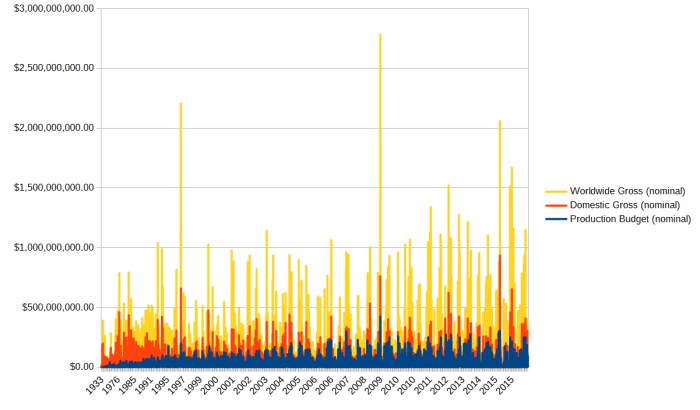
If you just look at the nominal figures, there does seem to be some sort of upward trend:

Movie_Budgets_nominal

But once you do the proper inflation adjustment, this trend basically disappears:

Movie_Budgets_adjusted

In real terms, the grosses of some early movies are quite large. Adjusted to 2015 dollars, Gone with the Wind grossed $6.659 billion—still the highest ever. In 1937, Snow White and the Seven Dwarfs grossed over $3.043 billion in 2015 dollars. In 1950, Cinderella made it to $2.592 billion in today’s money. (Horrifyingly, The Birth of a Nation grossed $258 million in today’s money.)

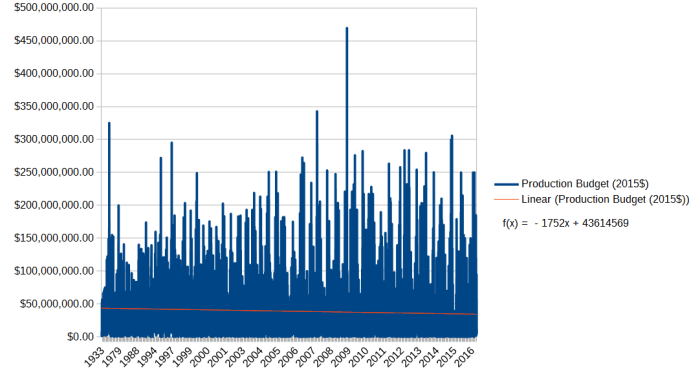
Nor is there any evidence that movie production has gotten more expensive. The linear trend is actually negative, though with a very small slope that is not statistically significant. On average, the real budget of a movie falls by $1752 per year.

Movie_Budgets_trend

While the two most expensive movies came out recently (Pirates of the Caribbean: At World’s End and Avatar), the third most expensive was released in 1963 (Cleopatra). The really hugely expensive movies do seem to cluster relatively recently—but then so do the really cheap films, some of which have budgets under $10,000. It may just be that more movies are produced in general, and overall the cost of producing a film doesn’t seem to have changed in real terms. The best return on investment is My Date with Drew, released in 2005, which had a budget of $1,100 but grossed $181,000, giving it an ROI of 16,358%. The highest real profit was of course Gone with the Wind, which made an astonishing $6.592 billion, though Titanic, Avatar, Aliens and Terminator 2 combined actually beat it with a total profit of $6.651 billion, which may explain why James Cameron can now basically make any movie he wants and already has four sequels lined up for Avatar.

The biggest real loss was 1970’s Waterloo, which made back only $18 million of its $153 million budget, losing $135 million and having an ROI of -87.7%. This was not quite as bad an ROI as 2002’s The Adventures of Pluto Nash, which had an ROI of -92.91%.

But making movies has always been expensive, at least for big blockbusters. (The $8,900 budget of Primer is something I could probably put on credit cards if I had to.) It’s nothing new to spend $100 million in today’s money.

When considering the ethics and economics of copyright, it’s useful to think about what Michele Boldrin calls “pizzaright”: you can’t copy my pizza, or you are guilty of pizzaright infringement. Many of the arguments for copyright are so general—this is a valuable service, it carries some risk of failure, it wouldn’t be as profitable without the monopoly, so fewer companies might enter the business—that they would also apply to pizza. Yet somehow nobody thinks that pizzaright should be a thing. If there is a justification for copyrights, it must come from the special circumstances of works of art (broadly conceived, including writing, film, music, etc.), and the only one that really seems strong enough is the high upfront cost of certain types of art—and indeed, the only ones that really seem to fit that are films and video games.

Painting, writing, and music just aren’t that expensive. People are willing to create these things for very little money, and can do so more or less on their own, especially nowadays. If the prices are reasonable, people will still want to buy from the creators directly—and sure enough, widespread music piracy hasn’t killed music, it has only killed the corporate record industry. But movies and video games really can easily cost $100 million to make, so there’s a serious concern of what might happen if they couldn’t use copyright to recover their costs.

The question for me is, did we really need copyright to fund these budgets?

Let’s take a look at how Star Wars made its money. $6.249 billion came from box office revenue, while $873 million came from VHS and DVD sales; those would probably be substantially reduced if not for copyright. But even before The Force Awakens was released, the Star Wars franchise had already made some $12 billion in toy sales alone. “Merchandizing, merchandizing, where the real money from the movie is made!”

Did they need intellectual property to do that? Well, yes—but all they needed was trademark. Defenders of “intellectual property” like to use that term because it elides fundamental distinctions between the three types: trademark, copyright, and patent.
Trademark is unproblematic. You can’t lie about who you are or where you products came from when you’re selling something. So if you are claiming to sell official Star Wars merchandise, you’d better be selling official Star Wars merchandise, and trademark protects that.

Copyright is problematic, but may be necessary in some cases. Copyright protects the content of the movies from being copied or modified without Lucasfilm’s permission. So now rather than simply protecting against the claim that you represent Lucasfilm, we are protecting against people buying the movie, copying it, and reselling the copies—even though that is a real economic service they are providing, and is in no way fraudulent as long as they are clear about the fact that they made the copies.

Patent is, frankly, ridiculous. The concept of “owning” ideas is absurd. You came up with a good way to do something? Great! Go do it then. But don’t expect other people to pay you simply for the privilege of hearing your good idea. Of course I want to financially support researchers, but there are much, much better ways of doing that, like government grants and universities. Patents only raise revenue for research that sells, first of all—so vaccines and basic research can’t be funded that way, even though they are the most important research by far. Furthermore, there’s nothing to guarantee that the person who actually invented the idea is the one who makes the profit from it—and in our current system where corporations can own patents (and do own almost 90% of patents), it typically isn’t. Even if it were, the whole concept of owning ideas is nonsensical, and it has driven us to the insane extremes of corporations owning patents on human DNA. The best argument I’ve heard for patents is that they are a second-best solution that incentivizes transparency and avoids trade secrets from becoming commonplace; but in that case they should definitely be short, and we should never extend them. Companies should not be able to make basically cosmetic modifications and renew the patent, and expiring patents should be a cause for celebration.

Hollywood actually formed in Los Angeles precisely to escape patents, but of course they love copyright and trademark. So do they like “intellectual property”?

Could blockbuster films be produced profitably using only trademark, in the absence of copyright?

Clearly Star Wars would have still turned a profit. But not every movie can do such merchandizing, and when movies start getting written purely for merchandizing it can be painful to watch.

The real question is whether a film like Gone with the Wind or Avatar could still be made, and make a reasonable profit (if a much smaller one).

Well, there’s always porn. Porn raises over $400 million per year in revenue, despite having essentially unenforceable copyright. They too are outraged over piracy, yet somehow I don’t think porn will ever cease to exist. A top porn star can make over $200,000 per year.Then there are of course independent films that never turn a profit at all, yet people keep making them.

So clearly it is possible to make some films without copyright protection, and something like Gone with the Wind needn’t cost $100 million to make. The only reason it cost as much as it did (about $66 million in today’s money) was that movie stars could command huge winner-takes-all salaries, which would no longer be true if copyright went away. And don’t tell me people wouldn’t be willing to be movie stars for $200,000 a year instead of $1.8 million (what Clark Gable made for Gone with the Wind, adjusted for inflation).

Yet some Hollywood blockbuster budgets are genuinely necessary. The real question is whether we could have Avatar without copyright. Not having films like Avatar is something I would count as a substantial loss to our society; we would lose important pieces of our art and culture.

So, where did all that money go? I don’t have a breakdown for Avatar in particular, but I do have a full budget breakdown for The Village. Of its $71.7 million, $33.5 million was “above the line”, which basically means the winner-takes-all superstar salaries for the director, producer, and cast. That amount could be dramatically reduced with no real cost to society—let’s drop it to say $3 million. Shooting costs were $28.8 million, post-production was $8.4 million, and miscellaneous expenses added about $1 million; all of those would be much harder to reduce (they mainly go to technical staff who make reasonable salaries, not to superstars), so let’s assume the full amount is necessary. That’s about $38 million in real cost to produce. Avatar had a lot more (and better) post-production, so let’s go ahead and multiply the post-production budget by an order of magnitude to $84 million. Our new total budget is $113.8 million.
That sounds like a lot, and it is; but this could be made back without copyright. Avatar sold over 14.5 million DVDs and over 8 million Blu-Rays. Conservatively assuming that the price elasticity of demand is zero (which is ridiculous—assuming the monopoly pricing is optimal it should be -1), if those DVDs were sold for $2 each and the Blu-Rays were sold for $5 each, with 50% of those prices being profit, this would yield a total profit of $14.5 million from DVDs and $20 million from Blu-Rays. That’s already $34.5 million. With realistic assumptions about elasticity of demand, cutting the prices this much (DVDs down from an average of $16, Blu-Rays down from an average of $20) would multiply the number of DVDs sold by at least 5 and the number of Blu-Rays sold by at least 3, which would get us all the way up to $132 million—enough to cover our new budget. (Of course this is much less than they actually made, which is why they set the prices they did—but that doesn’t mean it’s optimal from society’s perspective.)

But okay, suppose I’m wrong about the elasticity, and dropping the price from $16 to $2 for a DVD somehow wouldn’t actually increase the number purchased. What other sources of revenue would they have? Well, box office tickets would still be a thing. They’d have to come down in price, but given the high-quality high-fidelity versions that cinemas require—making them quite hard to pirate—they would still get decent money from each cinema. Let’s say the price drops by 90%—all cinemas are now $1 cinemas!—and the sales again somehow remain exactly the same (rather than dramatically increasing as they actually would). What would Avatar’s worldwide box office gross be then? $278 million. They could give the DVDs away for free and still turn a profit.

And that’s Avatar, one of the most expensive movies ever made. By cutting out the winner-takes-all salaries and huge corporate profits, the budget can be substantially reduced, and then what real costs remain can be quite well covered by box office and DVD sales at reasonable prices. If you imagine that piracy somehow undercuts everything until you have to give away things for free, you might think this is impossible; but in reality pirated versions are of unreliable quality, people do want to support artists and they are willing to pay something for their entertainment. They’re just tired of paying monopoly prices to benefit the shareholders of Viacom.

Would this end the era of the multi-millionaire movie star? Yes, I suppose it might. But it would also put about $10 billion per year back in the pockets of American consumers—and there’s little reason to think it would take away future Avatars, much less future Gone with the Winds.

We need to be honest about free trade’s costs, and clearer about its benefits

August 6, JDN 2457607

I discussed in a post awhile ago the fact that economists overwhelmingly favor free trade but most people don’t. There are some deep psychological reasons for this, particularly the loss aversion which makes people experience losses about twice as much as they experience gains. Free trade requires change; it creates some jobs and destroys others. Those forced transitions can be baffling and painful.

The good news is that views on trade in the US are actually getting more positive in recent years—which makes Trump that much more baffling. I honestly can’t make much sense of the fact that candidates who are against free trade have been so big in this election (and let’s face it, even Bernie Sanders is largely against free trade!), in light of polls showing that free trade is actually increasingly popular.

Partly this can be explained by the fact that people are generally more positive about free trade in general than they are about particular trade agreements, and understandably so, as free trade agreements often include some really awful provisions that in no way advance free trade. But that doesn’t really explain the whole effect here. Maybe it’s a special interest effect: People who hate trade are much more passionate about hating trade than people who like trade are passionate about liking trade. If that’s the case, then this is what we need to change.

Today I’d like to focus on what we as economists and the economically literate more generally can do to help people understand what free trade is and why it is so important. This means two things:

First, of course, we must be clearer about the benefits of free trade. Many economists seem to think that it is simply so obvious that they don’t even bother to explain it, and end up seeming like slogan-chanting ideologues. “Free trade! Free trade! Free trade!”

Above all, we need to talk about how it was primarily through free trade that global extreme poverty is now at the lowest level it has ever been. This benefit needs to be repeated over and over, and anyone who argues for protectionism needs to be confronted with the millions of people they will throw back into poverty. Most people don’t even realize that global poverty is declining, so first of all, they need to be shown that it is.

American ideas are often credited with fighting global poverty, but that’s not so convincing, since most of the improvement in poverty has happened in China (not exactly a paragon of free markets, much less liberal democracy); what really seems to have made the difference is American dollars, spent in free trade. Imports to the US from China have risen from $3.8 billion in 1985 to $483 billion in 2015. Extreme poverty in China fell from 61% of the population in 1990 to 4% in 2015. Coincidence? I think not. Indeed, that $483 billion is just about $1 per day for every man, woman, and child in China—and the UN extreme poverty line is $1.25 per person per day.

We need to be talking about the jobs that are created by trade—if need be, making TV commercials interviewing workers at factories who make products for export. “Most of our customers are in Japan,” they might say. “Without free trade, I’d be out of a job.” Interview business owners saying things like, “Two years ago we opened up sales to China. Now I need to double my workforce just to keep up with demand.” Unlike a lot of other economic policies where the benefits are diffuse and hard to keep track of, free trade is one where you can actually point to specific people and see that they are now better off because they make more selling exports. From there, we just need to point out that imports and exports are two sides of the same transaction—so if you like exports, you’d better have imports.

We need to make it clear that the economic gains from trade are just as real as the losses from transition, even if they may not be as obvious. William Poole put it very well in this article on attitudes toward free trade:

Economists are sometimes charged with insensitivity over job losses, when in fact most of us are extremely sensitive to such losses. What good economics tells us is that saving jobs in one industry does not save jobs in the economy as a whole. We urge people to be as sensitive to the jobs indirectly lost as a consequence of trade restriction as to those lost as a consequence of changing trade patterns.

Second, just as importantly, we must be honest about the costs of free trade. We need to stop eliding the distinction between net aggregate benefits and benefits for everyone everywhere. There are winners and losers, and we need to face up to that.

For example, we need to stop saying thinks like “Free trade will not send jobs to Mexico and China.” No, it absolutely will, and has, and does—and that is part of what it’s for. Because people in Mexico and China are people, and they deserve to have better jobs just as much as we do. Sending jobs to China is not a bug; it’s a feature. China needs jobs particularly badly.

Then comes the next part: “But if our jobs get sent to China, what will we do?” Better jobs, created here by the economic benefits of free trade. No longer will American workers toil in factories assembling parts; instead they will work in brightly-lit offices designing those parts on CAD software.

Of course this raises another problem: What happens to people who were qualified to toil in factories, but aren’t qualified to design parts on CAD software? Well, they’ll need to learn. And we should be paying for that education (though in large part, we are; altogether US federal, state, and local governments spend over $1 trillion a year on education).

And what if they can’t learn, can’t find another job somewhere else? What if they’re just not cut out for the kind of work we need in a 21st century economy? Then here comes my most radical statement of all: Then they shouldn’t have to.

The whole point of expanding economic efficiency—which free trade most certainly does—is to create more stuff. But if you create more stuff, you then have the opportunity to redistribute that stuff, in such a way that no one is harmed by that transition. This is what we have been failing to do in the United States. We need to set up our unemployment and pension systems so that people who lose their jobs due to free trade are not harmed by it, but instead feel like it is an opportunity to change careers or retire. We should have a basic income so that even people who can’t work at all can still live with dignity. This redistribution will not happen automatically; it is a policy choice we must make.


In theory there is a way around it, which is often proposed as an alternative to a basic income; it is called a job guarantee. Simply giving everyone free money for some reason makes people uncomfortable (never could quite fathom why; Donald Trump inherits capital income from his father, that’s fine, but we all inherit shared capital income as a nation, that’s a handout?), so instead we give everyone a job, so they can earn their money!

Well, here’s the thing: They won’t actually be earning it—or else it’s not a job guarantee. If you just want an active labor-market program to retrain workers and match them with jobs, that sounds great; Denmark has had great success with such things, and after all #ScandinaviaIsBetter. But no matter how good your program is, some people are going to not have any employable skills, or have disabilities too severe to do any productive work, or simply be too lazy to actually work. And now you’ve got a choice to make: Do you give those people jobs, or not?

If you don’t, it’s not a job guarantee. If you do, they’re not earning it anymore. Either employment is tied to actual productivity, or it isn’t; if you are guaranteed a certain wage no matter what you do, then some people are going to get that wage for doing nothing. As The Economist put it:

However, there are two alternatives: give people money with no strings attached (through a guaranteed basic income, unemployment insurance, disability payments, and so forth), or just make unemployed people survive on whatever miserable scraps they can cobble together.

If it’s really a job guarantee, we would still need to give jobs to people who can’t work or simply won’t. How is this different from a basic income? Well, it isn’t, except you added all these extra layers of bureaucracy so that you could feel like you weren’t just giving a handout. You’ve added additional costs for monitoring and administration, as well as additional opportunities for people to slip through the cracks. Either you are going to leave some people in poverty, or you are going to give money to people who don’t work—so why not give money to people who don’t work?

Another cost we need to be honest about is ecological. In our rush to open free trade, we are often lax in ensuring that this trade will not accelerate environmental degradation and climate change. This is often justified in the name of helping the world’s poorest people; but they will be hurt far more when their homes are leveled by hurricanes than by waiting a few more years to get the trade agreement right. That’s one where Poole actually loses me:

Few Americans favor a world trading system in which U.S. policies on environmental and other conditions could be controlled by foreign governments through their willingness to accept goods exported by the United States.

Really? You think we should be able to force other countries to accept our goods, regardless of whether they consider them ecologically sustainable? You think most Americans think that? It’s easy to frame it as other people imposing on us, but trade restrictions on ecologically harmful goods are actually a very minimal—indeed, almost certainly insufficient—regulation against environmental harm. Oil can still kill a lot of people even if it never crosses borders (or never crosses in liquid form—part of the point is you can’t stop the gaseous form). We desperately need global standards on ecological sustainability, and while we must balance environmental regulations with economic efficiency, currently that balance is tipped way too far against the environment—and millions will die if it remains this way.

This is the kernel of truth in otherwise economically-ignorant environmentalist diatribes like Naomi Klein’s This Changes Everything; free trade in principle doesn’t say anything about being environmentally unsustainable, but free trade in practice has often meant cutting corners and burning coal. Where we currently have diesel-powered container ships built in coal-powered factories and Klein wants no container ships and perhaps even no factories, what we really need are nuclear-powered container ships and solar-powered factories. Klein points out cases where free trade agreements have shut down solar projects that tried to create local jobs—but neither side seems to realize that a good free trade agreement would expand that solar project to create global jobs. Instead of building solar panels in Canada to sell only in Canada, we’d build solar panels in Canada to sell in China and India—and build ten times as many. That is what free trade could be, if we did it right.

The facts will not speak for themselves, so we must speak for them

August 3, JDN 2457604

I finally began to understand the bizarre and terrifying phenomenon that is the Donald Trump Presidential nomination when I watched this John Oliver episode:

https://www.youtube.com/watch?v=U-l3IV_XN3c

These lines in particular, near the end, finally helped me put it all together:

What is truly revealing is his implication that believing something to be true is the same as it being true. Because if anything, that was the theme of the Republican Convention this week; it was a four-day exercise in emphasizing feelings over facts.

The facts against Donald Trump are absolutely overwhelming. He is not even a competent business man, just a spectacularly manipulative one—and even then, it’s not clear he made any more money than he would have just keeping his inheritance in a diversified stock portfolio. His casinos were too fraudulent for Atlantic City. His university was fraudulent. He has the worst honesty rating Politifact has ever given a candidate. (Bernie Sanders, Barack Obama, and Hillary Clinton are statistically tied for some of the best.)

More importantly, almost every policy he has proposed or even suggested is terrible, and several of them could be truly catastrophic.

Let’s start with economic policy: His trade policy would set back decades of globalization and dramatically increase global poverty, while doing little or nothing to expand employment in the US, especially if it sparks a trade war. His fiscal policy would permanently balloon the deficit by giving one of the largest tax breaks to the rich in history. His infamous wall would probably cost about as much as the federal government currently spends on all basic scientific research combined, and his only proposal for funding it fundamentally misunderstands how remittances and trade deficits work. He doesn’t believe in climate change, and would roll back what little progress we have made at reducing carbon emissions, thereby endangering millions of lives. He could very likely cause a global economic collapse comparable to the Great Depression.

His social policy is equally terrible: He has proposed criminalizing abortion, (in express violation of Roe v. Wade) which even many pro-life people find too extreme. He wants to deport all Muslims and ban Muslims from entering, which not just a direct First Amendment violation but also literally involves jackbooted soldiers breaking into the homes of law-abiding US citizens to kidnap them and take them out of the country. He wants to deport 11 million undocumented immigrants, the largest deportation in US history.

Yet it is in foreign policy above all that Trump is truly horrific. He has explicitly endorsed targeting the families of terrorists, which is a war crime (though not as bad as what Ted Cruz wanted to do, which is carpet-bombing cities). Speaking of war crimes, he thinks our torture policy wasn’t severe enough, and doesn’t even care if it is ineffective. He has made the literally mercantilist assertion that the purpose of military alliances is to create trade surpluses, and if European countries will not provide us with trade surpluses (read: tribute), he will no longer commit to defending them, thereby undermining decades of global stability that is founded upon America’s unwavering commitment to defend our allies. And worst of all, he will not rule out the first-strike deployment of nuclear weapons.

I want you to understand that I am not exaggerating when I say that a Donald Trump Presidency carries a nontrivial risk of triggering global nuclear war. Will this probably happen? No. It has a probability of perhaps 1%. But a 1% chance of a billion deaths is not a risk anyone should be prepared to take.


All of these facts scream at us that Donald Trump would be a catastrophe for America and the world. Why, then, are so many people voting for him? Why do our best election forecasts give him a good chance of winning the election?

Because facts don’t speak for themselves.

This is how the left, especially the center-left, has dropped the ball in recent decades. We joke that reality has a liberal bias, because so many of the facts are so obviously on our side. But meanwhile the right wing has nodded and laughed, even mockingly called us the “reality-based community”, because they know how to manipulate feelings.

Donald Trump has essentially no other skills—but he has that one, and it is enough. He knows how to fan the flames of anger and hatred and point them at his chosen targets. He knows how to rally people behind meaningless slogans like “Make America Great Again” and convince them that he has their best interests at heart.

Indeed, Trump’s persuasiveness is one of his many parallels with Adolf Hitler; I am not yet prepared to accuse Donald Trump of seeking genocide, yet at the same time I am not yet willing to put it past him. I don’t think it would take much of a spark at this point to trigger a conflagration of hatred that launches a genocide against Muslims in the United States, and I don’t trust Trump not to light such a spark.

Meanwhile, liberal policy wonks are looking on in horror, wondering how anyone could be so stupid as to believe him—and even publicly basically calling people stupid for believing him. Or sometimes we say they’re not stupid, they’re just racist. But people don’t believe Donald Trump because they are stupid; they believe Donald Trump because he is persuasive. He knows the inner recesses of the human mind and can harness our heuristics to his will. Do not mistake your unique position that protects you—some combination of education, intellect, and sheer willpower—for some inherent superiority. You are not better than Trump’s followers; you are more resistant to Trump’s powers of persuasion. Yes, statistically, Trump voters are more likely to be racist; but racism is a deep-seated bias in the human mind that to some extent we all share. Trump simply knows how to harness it.

Our enemies are persuasive—and therefore we must be as well. We can no longer act as though facts will automatically convince everyone by the power of pure reason; we must learn to stir emotions and rally crowds just as they do.

Or rather, not just as they do—not quite. When we see lies being so effective, we may be tempted to lie ourselves. When we see people being manipulated against us, we may be tempted to manipulate them in return. But in the long run, we can’t afford to do that. We do need to use reason, because reason is the only way to ensure that the beliefs we instill are true.

Therefore our task must be to make people see reason. Let me be clear: Not demand they see reason. Not hope they see reason. Not lament that they don’t. This will require active investment on our part. We must actually learn to persuade people in such a manner that their minds become more open to reason. This will mean using tools other than reason, but it will also mean treading a very fine line, using irrationality only when rationality is insufficient.

We will be tempted to take the easier, quicker path to the Dark Side, but we must resist. Our goal must be not to make people do what we want them to—but to do what they would want to if they were fully rational and fully informed. We will need rhetoric; we will need oratory; we may even need some manipulation. But as we fight our enemy, we must be vigilant not to become them.

This means not using bad arguments—strawmen and conmen—but pointing out the flaws in our opponents’ arguments even when they seem obvious to us—bananamen. It means not overstating our case about free trade or using implausible statistical results simply because they support our case.

But it also means not understating our case, not hiding in page 17 of an opaque technical report that if we don’t do something about climate change right now millions of people will die. It means not presenting our ideas as “political opinions” when they are demonstrated, indisputable scientific facts. It means taking the media to task for their false balance that must find a way to criticize a Democrat every time they criticize a Republican: Sure, he is a pathological liar and might trigger global economic collapse or even nuclear war, but she didn’t secure her emails properly. If you objectively assess the facts and find that Republicans lie three times as often as Democrats, maybe that’s something you should be reporting on instead of trying to compensate for by changing your criteria.

Speaking of the media, we should be pressuring them to include a regular—preferably daily, preferably primetime—segment on climate change, because yes, it is that important. How about after the weather report every day, you show a climate scientist explaining why we keep having record-breaking summer heat and more frequent natural disasters? If we suffer a global ecological collapse, this other stuff you’re constantly talking about really isn’t going to matter—that is, if it mattered in the first place. When ISIS kills 200 people in an attack, you don’t just report that a bunch of people died without examining the cause or talking about responses. But when a typhoon triggered by climate change kills 7,000, suddenly it’s just a random event, an “act of God” that nobody could have predicted or prevented. Having an appropriate caution about whether climate change caused any particular disaster should not prevent us from drawing the very real links between more carbon emissions and more natural disasters—and sometimes there’s just no other explanation.

It means demanding fact-checks immediately, not as some kind of extra commentary that happens after the debate, but as something the moderator says right then and there. (You have a staff, right? And they have Google access, right?) When a candidate says something that is blatantly, demonstrably false, they should receive a warning. After three warnings, their mic should be cut for that question. After ten, they should be kicked off the stage for the remainder of the debate. Donald Trump wouldn’t have lasted five minutes. But instead, they not only let him speak, they spent the next week repeating what he said in bold, exciting headlines. At least CNN finally realized that their headlines could actually fact-check Trump’s statements rather than just repeat them.
Above all, we will need to understand why people think the way they do, and learn to speak to them persuasively and truthfully but without elitism or condescension. This is one I know I’m not very good at myself; sometimes I get so frustrated with people who think the Earth is 6,000 years old (over 40% of Americans) or don’t believe in climate change (35% don’t think it is happening at all, another 30% don’t think it’s a big deal) that I come off as personally insulting them—and of course from that point forward they turn off. But irrational beliefs are not proof of defective character, and we must make that clear to ourselves as well as to others. We must not say that people are stupid or bad; but we absolutely must say that they are wrong. We must also remember that despite our best efforts, some amount of reactance will be inevitable; people simply don’t like having their beliefs challenged.

Yet even all this is probably not enough. Many people don’t watch mainstream media, or don’t believe it when they do (not without reason). Many people won’t even engage with friends or family members who challenge their political views, and will defriend or even disown them. We need some means of reaching these people too, and the hardest part may be simply getting them to listen to us in the first place. Perhaps we need more grassroots action—more protest marches, or even activists going door to door like Jehovah’s Witnesses. Perhaps we need to establish new media outlets that will be as widely accessible but held to a higher standard.

But we must find a way–and we have little time to waste.

Lukewarm support is a lot better than opposition

July 23, JDN 2457593

Depending on your preconceptions, this statement may seem either eminently trivial or offensively wrong: Lukewarm support is a lot better than opposition.

I’ve always been in the “trivial” camp, so it has taken me awhile to really understand where people are coming from when they say things like the following.

From a civil rights activist blogger (“POC” being “person of color” in case you didn’t know):

Many of my POC friends would actually prefer to hang out with an Archie Bunker-type who spits flagrantly offensive opinions, rather than a colorblind liberal whose insidious paternalism, dehumanizing tokenism, and cognitive indoctrination ooze out between superficially progressive words.

From the Daily Kos:

Right-wing racists are much more honest, and thus easier to deal with, than liberal racists.

From a Libertarian blogger:

I can deal with someone opposing me because of my politics. I can deal with someone who attacks me because of my religious beliefs. I can deal with open hostility. I know where I stand with people like that.

They hate me or my actions for (insert reason here). Fine, that is their choice. Let’s move onto the next bit. I’m willing to live and let live if they are.

But I don’t like someone buttering me up because they need my support, only to drop me the first chance they get. I don’t need sweet talk to distract me from the knife at my back. I don’t need someone promising the world just so they can get a boost up.

In each of these cases, people are expressing a preference for dealing with someone who actively opposes them, rather than someone who mostly supports them. That’s really weird.

The basic fact that lukewarm support is better than opposition is basically a mathematical theorem. In a democracy or anything resembling one, if you have the majority of population supporting you, even if they are all lukewarm, you win; if you have the majority of the population opposing you, even if the remaining minority is extremely committed to your cause, you lose.

Yes, okay, it does get slightly more complicated than that, as in most real-world democracies small but committed interest groups actually can pressure policy more than lukewarm majorities (the special interest effect); but even then, you are talking about the choice between no special interests and a special interest actively against you.

There is a valid question of whether it is more worthwhile to get a small, committed coalition, or a large, lukewarm coalition; but at the individual level, it is absolutely undeniable that supporting you is better for you than opposing you, full stop. I mean that in the same sense that the Pythagorean theorem is undeniable; it’s a theorem, it has to be true.

If you had the opportunity to immediately replace every single person who opposes you with someone who supports you but is lukewarm about it, you’d be insane not to take it. Indeed, this is basically how all social change actually happens: Committed supporters persuade committed opponents to become lukewarm supporters, until they get a majority and start winning policy votes.

If this is indeed so obvious and undeniable, why are there so many people… trying to deny it?

I came to realize that there is a deep psychological effect at work here. I could find very little in the literature describing this effect, which I’m going to call heretic effect (though the literature on betrayal aversion, several examples of which are linked in this sentence, is at least somewhat related).

Heretic effect is the deeply-ingrained sense human beings tend to have (as part of the overall tribal paradigm) that one of the worst things you can possibly do is betray your tribe. It is worse than being in an enemy tribe, worse even than murdering someone. The one absolutely inviolable principle is that you must side with your tribe.

This is one of the biggest barriers to police reform, by the way: The Blue Wall of Silence is the result of police officers identifying themselves as a tight-knit tribe and refusing to betray one of their own for anything. I think the best option for convincing police officers to support reform is to reframe violations of police conduct as themselves betrayals—the betrayal is not the IA taking away your badge, the betrayal is you shooting an unarmed man because he was Black.

Heretic effect is a particular form of betrayal aversion, where we treat those who are similar to our tribe but not quite part of it as the very worst sort of people, worse than even our enemies, because at least our enemies are not betrayers. In fact it isn’t really betrayal, but it feels like betrayal.

I call it “heretic effect” because of the way that exclusivist religions (including all the Abrahamaic religions, and especially Christianity and Islam) focus so much of their energy on rooting out “heretics”, people who almost believe the same as you do but not quite. The Spanish Inquisition wasn’t targeted at Buddhists or even Muslims; it was targeted at Christians who slightly disagreed with Catholicism. Why? Because while Buddhists might be the enemy, Protestants were betrayers. You can still see this in the way that Muslim societies treat “apostates”, those who once believed in Islam but don’t anymore. Indeed, the very fact that Christianity and Islam are at each other’s throats, rather than Hinduism and atheism, shows that it’s the people who almost agree with you that really draw your hatred, not the people whose worldview is radically distinct.

This is the effect that makes people dislike lukewarm supporters; like heresy, lukewarm support feels like betrayal. You can clearly hear that in the last quote: “I don’t need sweet talk to distract me from the knife at my back.” Believe it or not, Libertarians, my support for replacing the social welfare state with a basic income, decriminalizing drugs, and dramatically reducing our incarceration rate is not deception. Nor do I think I’ve been particularly secretive about my desire to make taxes more progressive and environmental regulations stronger, the things you absolutely don’t agree with. Agreeing with you on some things but not on other things is not in fact the same thing as lying to you about my beliefs or infiltrating and betraying your tribe.

That said, I do sort of understand why it feels that way. When I agree with you on one thing (decriminalizing cannabis, for instance), it sends you a signal: “This person thinks like me.” You may even subconsciously tag me as a fellow Libertarian. But then I go and disagree with you on something else that’s just as important (strengthening environmental regulations), and it feels to you like I have worn your Libertarian badge only to stab you in the back with my treasonous environmentalism. I thought you were one of us!

Similarly, if you are a social justice activist who knows all the proper lingo and is constantly aware of “checking your privilege”, and I start by saying, yes, racism is real and terrible, and we should definitely be working to fight it, but then I question something about your language and approach, that feels like a betrayal. At least if I’d come in wearing a Trump hat you could have known which side I was really on. (And indeed, I have had people unfriend me or launch into furious rants at me for questioning the orthodoxy in this way. And sure, it’s not as bad as actually being harassed on the street by bigots—a thing that has actually happened to me, by the way—but it’s still bad.)

But if you can resist this deep-seated impulse and really think carefully about what’s happening here, agreeing with you partially clearly is much better than not agreeing with you at all. Indeed, there’s a fairly smooth function there, wherein the more I agree with your goals the more our interests are aligned and the better we should get along. It’s not completely smooth, because certain things are sort of package deals: I wouldn’t want to eliminate the social welfare system without replacing it with a basic income, whereas many Libertarians would. I wouldn’t want to ban fracking unless we had established a strong nuclear infrastructure, but many environmentalists would. But on the whole, more agreement is better than less agreement—and really, even these examples are actually surface-level results of deeper disagreement.

Getting this reaction from social justice activists is particularly frustrating, because I am on your side. Bigotry corrupts our society at a deep level and holds back untold human potential, and I want to do my part to undermine and hopefully one day destroy it. When I say that maybe “privilege” isn’t the best word to use and warn you about not implicitly ascribing moral responsibility across generations, this is not me being a heretic against your tribe; this is a strategic policy critique. If you are writing a letter to the world, I’m telling you to leave out paragraph 2 and correcting your punctuation errors, not crumpling up the paper and throwing it into a fire. I’m doing this because I want you to win, and I think that your current approach isn’t working as well as it should. Maybe I’m wrong about that—maybe paragraph 2 really needs to be there, and you put that semicolon there on purpose—in which case, go ahead and say so. If you argue well enough, you may even convince me; if not, this is the sort of situation where we can respectfully agree to disagree. But please, for the love of all that is good in the world, stop saying that I’m worse than the guys in the KKK hoods. Resist that feeling of betrayal so that we can have a constructive critique of our strategy. Don’t do it for me; do it for the cause.

“The cake is a lie”: The fundamental distortions of inequality

July 13, JDN 2457583

Inequality of wealth and income, especially when it is very large, fundamentally and radically distorts outcomes in a capitalist market. I’ve already alluded to this matter in previous posts on externalities and marginal utility of wealth, but it is so important I think it deserves to have its own post. In many ways this marks a paradigm shift: You can’t think about economics the same way once you realize it is true.

To motivate what I’m getting at, I’ll expand upon an example from a previous post.

Suppose there are only two goods in the world; let’s call them “cake” (K) and “money” (M). Then suppose there are three people, Baker, who makes cakes, Richie, who is very rich, and Hungry, who is very poor. Furthermore, suppose that Baker, Richie and Hungry all have exactly the same utility function, which exhibits diminishing marginal utility in cake and money. To make it more concrete, let’s suppose that this utility function is logarithmic, specifically: U = 10*ln(K+1) + ln(M+1)

The only difference between them is in their initial endowments: Baker starts with 10 cakes, Richie starts with $100,000, and Hungry starts with $10.

Therefore their starting utilities are:

U(B) = 10*ln(10+1)= 23.98

U(R) = ln(100,000+1) = 11.51

U(H) = ln(10+1) = 2.40

Thus, the total happiness is the sum of these: U = 37.89

Now let’s ask two very simple questions:

1. What redistribution would maximize overall happiness?
2. What redistribution will actually occur if the three agents trade rationally?

If multiple agents have the same diminishing marginal utility function, it’s actually a simple and deep theorem that the total will be maximized if they split the wealth exactly evenly. In the following blockquote I’ll prove the simplest case, which is two agents and one good; it’s an incredibly elegant proof:

Given: for all x, f(x) > 0, f'(x) > 0, f”(x) < 0.

Maximize: f(x) + f(A-x) for fixed A

f'(x) – f'(A – x) = 0

f'(x) = f'(A – x)

Since f”(x) < 0, this is a maximum.

Since f'(x) > 0, f is monotonic; therefore f is injective.

x = A – x

QED

This can be generalized to any number of agents, and for multiple goods. Thus, in this case overall happiness is maximized if the cakes and money are both evenly distributed, so that each person gets 3 1/3 cakes and $33,336.66.

The total utility in that case is:

3 * (10 ln(10/3+1) + ln(33,336.66+1)) = 3 * (14.66 + 10.414) = 3 (25.074) =75.22

That’s considerably better than our initial distribution (almost twice as good). Now, how close do we get by rational trade?

Each person is willing to trade up until the point where their marginal utility of cake is equal to their marginal utility of money. The price of cake will be set by the respective marginal utilities.

In particular, let’s look at the trade that will occur between Baker and Richie. They will trade until their marginal rate of substitution is the same.

The actual algebra involved is obnoxious (if you’re really curious, here are some solved exercises of similar trade problems), so let’s just skip to the end. (I rushed through, so I’m not actually totally sure I got it right, but to make my point the precise numbers aren’t important.)
Basically what happens is that Richie pays an exorbitant price of $10,000 per cake, buying half the cakes with half of his money.

Baker’s new utility and Richie’s new utility are thus the same:
U(R) = U(B) = 10*ln(5+1) + ln(50,000+1) = 17.92 + 10.82 = 28.74
What about Hungry? Yeah, well, he doesn’t have $10,000. If cakes are infinitely divisible, he can buy up to 1/1000 of a cake. But it turns out that even that isn’t worth doing (it would cost too much for what he gains from it), so he may as well buy nothing, and his utility remains 2.40.

Hungry wanted cake just as much as Richie, and because Richie has so much more Hungry would have gotten more happiness from each new bite. Neoclassical economists promised him that markets were efficient and optimal, and so he thought he’d get the cake he needs—but the cake is a lie.

The total utility is therefore:

U = U(B) + U(R) + U(H)

U = 28.74 + 28.74 + 2.40

U = 59.88

Note three things about this result: First, it is more than where we started at 37.89—trade increases utility. Second, both Richie and Baker are better off than they were—trade is Pareto-improving. Third, the total is less than the optimal value of 75.22—trade is not utility-maximizing in the presence of inequality. This is a general theorem that I could prove formally, if I wanted to bore and confuse all my readers. (Perhaps someday I will try to publish a paper doing that.)

This result is incredibly radical—it basically goes against the core of neoclassical welfare theory, or at least of all its applications to real-world policy—so let me be absolutely clear about what I’m saying, and what assumptions I had to make to get there.

I am saying that if people start with different amounts of wealth, the trades they would willfully engage in, acting purely under their own self interest, would not maximize the total happiness of the population. Redistribution of wealth toward equality would increase total happiness.

First, I had to assume that we could simply redistribute goods however we like without affecting the total amount of goods. This is wildly unrealistic, which is why I’m not actually saying we should reduce inequality to zero (as would follow if you took this result completely literally). Ironically, this is an assumption that most neoclassical welfare theory agrees with—the Second Welfare Theorem only makes any sense in a world where wealth can be magically redistributed between people without any harmful economic effects. If you weaken this assumption, what you find is basically that we should redistribute wealth toward equality, but beware of the tradeoff between too much redistribution and too little.

Second, I had to assume that there’s such a thing as “utility”—specifically, interpersonally comparable cardinal utility. In other words, I had to assume that there’s some way of measuring how much happiness each person has, and meaningfully comparing them so that I can say whether taking something from one person and giving it to someone else is good or bad in any given circumstance.

This is the assumption neoclassical welfare theory generally does not accept; instead they use ordinal utility, on which we can only say whether things are better or worse, but never by how much. Thus, their only way of determining whether a situation is better or worse is Pareto efficiency, which I discussed in a post a couple years ago. The change from the situation where Baker and Richie trade and Hungry is left in the lurch to the situation where all share cake and money equally in socialist utopia is not a Pareto-improvement. Richie and Baker are slightly worse off with 25.07 utilons in the latter scenario, while they had 28.74 utilons in the former.

Third, I had to assume selfishness—which is again fairly unrealistic, but again not something neoclassical theory disagrees with. If you weaken this assumption and say that people are at least partially altruistic, you can get the result where instead of buying things for themselves, people donate money to help others out, and eventually the whole system achieves optimal utility by willful actions. (It depends just how altruistic people are, as well as how unequal the initial endowments are.) This actually is basically what I’m trying to make happen in the real world—I want to show people that markets won’t do it on their own, but we have the chance to do it ourselves. But even then, it would go a lot faster if we used the power of government instead of waiting on private donations.

Also, I’m ignoring externalities, which are a different type of market failure which in no way conflicts with this type of failure. Indeed, there are three basic functions of government in my view: One is to maintain security. The second is to cancel externalities. The third is to redistribute wealth. The DOD, the EPA, and the SSA, basically. One could also add macroeconomic stability as a fourth core function—the Fed.

One way to escape my theorem would be to deny interpersonally comparable utility, but this makes measuring welfare in any way (including the usual methods of consumer surplus and GDP) meaningless, and furthermore results in the ridiculous claim that we have no way of being sure whether Bill Gates is happier than a child starving and dying of malaria in Burkina Faso, because they are two different people and we can’t compare different people. Far more reasonable is not to believe in cardinal utility, meaning that we can say an extra dollar makes you better off, but we can’t put a number on how much.

And indeed, the difficulty of even finding a unit of measure for utility would seem to support this view: Should I use QALY? DALY? A Likert scale from 0 to 10? There is no known measure of utility that is without serious flaws and limitations.

But it’s important to understand just how strong your denial of cardinal utility needs to be in order for this theorem to fail. It’s not enough that we can’t measure precisely; it’s not even enough that we can’t measure with current knowledge and technology. It must be fundamentally impossible to measure. It must be literally meaningless to say that taking a dollar from Bill Gates and giving it to the starving Burkinabe would do more good than harm, as if you were asserting that triangles are greener than schadenfreude.

Indeed, the whole project of welfare theory doesn’t make a whole lot of sense if all you have to work with is ordinal utility. Yes, in principle there are policy changes that could make absolutely everyone better off, or make some better off while harming absolutely no one; and the Pareto criterion can indeed tell you that those would be good things to do.

But in reality, such policies almost never exist. In the real world, almost anything you do is going to harm someone. The Nuremburg trials harmed Nazi war criminals. The invention of the automobile harmed horse trainers. The discovery of scientific medicine took jobs away from witch doctors. Inversely, almost any policy is going to benefit someone. The Great Leap Forward was a pretty good deal for Mao. The purges advanced the self-interest of Stalin. Slavery was profitable for plantation owners. So if you can only evaluate policy outcomes based on the Pareto criterion, you are literally committed to saying that there is no difference in welfare between the Great Leap Forward and the invention of the polio vaccine.

One way around it (that might actually be a good kludge for now, until we get better at measuring utility) is to broaden the Pareto criterion: We could use a majoritarian criterion, where you care about the number of people benefited versus harmed, without worrying about magnitudes—but this can lead to Tyranny of the Majority. Or you could use the Difference Principle developed by Rawls: find an ordering where we can say that some people are better or worse off than others, and then make the system so that the worst-off people are benefited as much as possible. I can think of a few cases where I wouldn’t want to apply this criterion (essentially they are circumstances where autonomy and consent are vital), but in general it’s a very good approach.

Neither of these depends upon cardinal utility, so have you escaped my theorem? Well, no, actually. You’ve weakened it, to be sure—it is no longer a statement about the fundamental impossibility of welfare-maximizing markets. But applied to the real world, people in Third World poverty are obviously the worst off, and therefore worthy of our help by the Difference Principle; and there are an awful lot of them and very few billionaires, so majority rule says take from the billionaires. The basic conclusion that it is a moral imperative to dramatically reduce global inequality remains—as does the realization that the “efficiency” and “optimality” of unregulated capitalism is a chimera.

Should we give up on growth?

JDN 2457572

Recently I read this article published by the Post Carbon Institute, “How to Shrink the Economy without Crashing It”, which has been going around environmentalist circles. (I posted on Facebook that I’d answer it in more detail, so here goes.)

This is the far left view on climate change, which is wrong, but not nearly as wrong as even the “mainstream” right-wing view that climate change is not a serious problem and we should continue with business as usual. Most of the Republicans who ran for President this year didn’t believe in using government action to fight climate change, and Donald Trump doesn’t even believe it exists.
This core message of the article is clearly correct:

We know this because Global Footprint Network, which methodically tracks the relevant data, informs us that humanity is now using 1.5 Earths’ worth of resources.

We can temporarily use resources faster than Earth regenerates them only by borrowing from the future productivity of the planet, leaving less for our descendants. But we cannot do this for long.

To be clear, “using 1.5 Earths” is not as bad as it sounds; spending is allow to exceed income at times, as long as you have reason to think that future income will exceed future spending, and this is true not just of money but also of natural resources. You can in fact “borrow from the future”, provided you do actually have a plan to pay it back. And indeed there has been some theoretical work by environmental economists suggesting that we are rightly still in the phase of net ecological dissaving, and won’t enter the phase of net ecological saving until the mid-21st century when our technology has made us two or three times as productive. This optimal path is defined by a “weak sustainability” condition where total real wealth never falls over time, so any natural wealth depleted is replaced by at least as much artificial wealth.

Of course some things can’t be paid back; while forests depleted can be replanted, if you drive species to extinction, only very advanced technology could restore them. And we are driving thousands of species to extinction every single year. Even if we should be optimally dissaving, we are almost certainly depleting natural resources too fast, and depleting natural resources that will be difficult if not impossible to later restore. In that sense, the Post Carbon Institute is right: We must change course toward ecological sustainability.

Unfortunately, their specific ideas of how to do so leave much to be desired. Beyond ecological sustainability, they really argue for two propositions: one is radical but worth discussing, but the other is totally absurd.

The absurd claim is that we should somehow force the world to de-urbanize and regress into living in small farming villages. To show this is a bananaman and not a strawman, I quote:

8. Re-localize. One of the difficulties in the transition to renewable energy is that liquid fuels are hard to substitute. Oil drives nearly all transportation currently, and it is highly unlikely that alternative fuels will enable anything like current levels of mobility (electric airliners and cargo ships are non-starters; massive production of biofuels is a mere fantasy). That means communities will be obtaining fewer provisions from far-off places. Of course trade will continue in some form: even hunter-gatherers trade. Re-localization will merely reverse the recent globalizing trade trend until most necessities are once again produced close by, so that we—like our ancestors only a century ago—are once again acquainted with the people who make our shoes and grow our food.

9. Re-ruralize. Urbanization was the dominant demographic trend of the 20th century, but it cannot be sustained. Indeed, without cheap transport and abundant energy, megacities will become increasingly dysfunctional. Meanwhile, we’ll need lots more farmers. Solution: dedicate more societal resources to towns and villages, make land available to young farmers, and work to revitalize rural culture.

First of all: Are electric cargo ships non-starters? The Ford-class aircraft carrier is electric, specifically nuclear. Nuclear-powered cargo ships would raise a number of issues in terms of practicality, safety, and regulation, but they aren’t fundamentally infeasible. Massive efficient production of biofuels is a fantasy as long as the energy to do it is provided by coal power, but not if it’s provided by nuclear. Perhaps this author’s concept of “infeasible” really just means “infeasible if I can’t get over my irrational fear of nuclear power”. Even electric airliners are not necessarily out of the question; NASA has been experimenting with electric aircraft.

The most charitable reading I can give of this (in my terminology of argument “men”, I’m trying to make a banana out of iron), is as promoting slightly deurbanizing and going back to more like say the 1950s United States, with 64% of people in cities instead of 80% today. Even then this makes less than no sense, as higher urbanization is associated with lower per-capita ecological impact, which frankly shouldn’t even be surprising because cities have such huge economies of scale. Instead of everyone needing a car to get around in the suburbs, we can all share a subway system in the city. If that subway system is powered by a grid of nuclear, solar, and wind power, it could produce essentially zero carbon emissions—which is absolutely impossible for rural or suburban transportation. Urbanization is also associated with slower population growth (or even population decline), and indeed the reason population growth is declining is that rising standard of living and greater urbanization have reduced birth rates and will continue to do so as poor countries reach higher levels of development. Far from being a solution to ecological unsustainability, deurbanization would make it worse.

And that’s not even getting into the fact that you would have to force urban white-collar workers to become farmers, because if we wanted to be farmers we already would be (the converse is not as true), and now you’re actually talking about some kind of massive forced labor-shift policy like the Great Leap Forward. Normally I’m annoyed when people accuse environmentalists of being totalitarian communists, but in this case, I think the accusation might be onto something.

Moving on, the radical but not absurd claim is that we must turn away from economic growth and even turn toward economic shrinkage:

One way or another, the economy (and here we are talking mostly about the economies of industrial nations) must shrink until it subsists on what Earth can provide long-term.

[…]

If nothing is done deliberately to reverse growth or pre-adapt to inevitable economic stagnation and contraction, the likely result will be an episodic, protracted, and chaotic process of collapse continuing for many decades or perhaps centuries, with innumerable human and non-human casualties.

I still don’t think this is right, but I understand where it’s coming from, and like I said it’s worth talking about.

The biggest mistake here lies in assuming that GDP is directly correlated to natural resource depletion, so that the only way to reduce natural resource depletion is to reduce GDP. This is not even remotely true; indeed, countries vary almost as much in their GDP-per-carbon-emission ratio as they do in their per-capita GDP. As usual, #ScandinaviaIsBetter; Norway and Sweden produce about $8,000 in GDP per ton of carbon, while the US produces only about $2,000 per ton. Both poor and rich countries can be found among both the inefficient and the efficient. Saudi Arabia is very rich and produces about $900 per ton, while Liberia is exceedingly poor and produces about $800 per ton. I already mentioned how Norway produces $8,000 per ton, and they are as rich as Saudi Arabia. Yet above them is Mali, which produces almost $11,000 per ton, and is as poor as Liberia. Other notable facts: France is head and shoulders above the UK and Germany at almost $6000 per ton instead of $4300 and $3600 respectively—because France runs almost entirely on nuclear power.

So the real conclusion to draw from this is not that we need to shrink GDP, but that we need to make GDP more like how they do it in Norway or at least how they do it in France, rather than how we do in the US, and definitely not how they do it in Saudi Arabia. Total world emissions are currently about 36 billion tons per year, producing about $108 trillion in GDP, averaging about $3,000 of GDP per ton of carbon emissions. If we could raise the entire world to the ecological efficiency of Norway, we could double world GDP and still be producing less CO2 than we currently are. Turning the entire planet into a bunch of Norways would indeed raise CO2 output, by about a factor of 2; but it would raise standard of living by a factor of 5, and indeed bring about a utopian future with neither war nor hunger. Compare this to the prospect of cutting world GDP in half, but producing it as inefficiently as in Saudi Arabia: This would actually increase global CO2 emissions, almost as much as turning every country into Norway.

But ultimately we will in fact need to slow down or even end economic growth. I ran a little model for you, which shows a reasonable trajectory for global economic growth.

This graph shows the growth rate in productivity slowly declining, along with a much more rapidly declining GDP growth:

Solow_growth

This graph shows the growth trajectory for total real capital and GDP:

Solow_capital

And finally, this is the long-run trend for GDP graphed on a log scale:

Solow_logGDP

The units are arbitrary, though it’s not unreasonable to imagine them as being years and hundreds of dollars in per-capita GDP. If that is indeed what you imagine them to be, my model shows us the Star Trek future: In about 300 years, we rise from a per-capita GDP of $10,000 to one of $165,000—from a world much like today to a world where everyone is a millionaire.

Notice that the growth rate slows down a great deal fairly quickly; by the end of 100 years (i.e., the end of the 21st century), growth has slowed from its peak over 10% to just over 2% per year. By the end of the 300-year period, the growth rate is a crawl of only 0.1%.

Of course this model is very simplistic, but I chose it for a very specific reason: This is not a radical left-wing environmentalist model involving “limits to growth” or “degrowth”. This is the Solow-Swan model, the paradigm example of neoclassical models of economic growth. It is sometimes in fact called simply “the neoclassical growth model”, because it is that influential. I made one very small change from the usual form, which was to assume that the rate of productivity growth would decline exponentially over time. Since productivity growth is exogenous to the model, this is a very simple change to make; it amounts to saying that productivity-enhancing technology is subject to diminishing returns, which fits recent data fairly well but could be totally wrong if something like artificial intelligence or neural enhancement ever takes off.

I chose this because many environmentalists seem to think that economists have this delusional belief that we can maintain a rate of economic growth equal to today indefinitely. David Attenborough famously said “Anyone who believes in indefinite growth in anything physical, on a physically finite planet, is either mad – or an economist.”

Another physicist argued that if we increase energy consumption 2.3% per year for 400 years, we’d literally boil the Earth. Yes, we would, and no economist I know of believes that this is what will happen. Economic growth doesn’t require energy growth, and we do not think growth can or should continue indefinitely—we just think it can and should continue a little while longer. We don’t think that a world standard of living 1000 times as good as Norway is going to happen; we think that a world standard of living equal to Norway is worth fighting for.

Indeed, we are often the ones trying to explain to leaders that they need to adapt to slower growth rates—this is particularly a problem in China, where nationalism and groupthink seems to have convinced many people in China that 7% annual growth is the result of some brilliant unique feature of the great Chinese system, when it is in fact simply the expected high growth rate for an economy that is very poor and still catching up by establishing a capital base. (It’s not so much what they are doing right now, as what they were doing wrong before. Just as you feel a lot better when you stop hitting yourself in the head, countries tend to grow quite fast after they transition out of horrifically terrible economic policy—and it doesn’t get much more terrible than Mao.) Even a lot of the IMF projections are now believed to be too optimistic, because they didn’t account for how China was fudging the numbers and rapidly depleting natural resources.

Some of the specific policies recommended in the article are reasonable, while others go to far.

1. Energy: cap, reduce, and ration it. Energy is what makes the economy go, and expanded energy consumption is what makes it grow. Climate scientists advocate capping and reducing carbon emissions to prevent planetary disaster, and cutting carbon emissions inevitably entails reducing energy from fossil fuels. However, if we aim to shrink the size of the economy, we should restrain not just fossil energy, but all energy consumption. The fairest way to do that would probably be with tradable energy quotas.

I strongly support cap-and-trade on fossil fuels, but I can’t support it on energy in general, unless we get so advanced that we’re seriously concerned about significantly altering the entropy of the universe. Solar power does not have negative externalities, and therefore should not be taxed or capped.

The shift to renewable energy sources is a no-brainer, and I know of no ecologist and few economists who would disagree.

This one is rich, coming from someone who goes on to argue for nonsensical deurbanization:

However, this is a complicated process. It will not be possible merely to unplug coal power plants, plug in solar panels, and continue with business as usual: we have built our immense modern industrial infrastructure of cities, suburbs, highways, airports, and factories to take advantage of the unique qualities and characteristics of fossil fuels.

How will we make our industrial infrastructure run off a solar grid? Urbanization. When everything is in one place, you can use public transportation and plug everything into the grid. We could replace the interstate highway system with a network of maglev lines, provided that almost everyone lived in major cities that were along those lines. We can’t do that if people move out of cities and go back to being farmers.

Here’s another weird one:

Without continued economic growth, the market economy probably can’t function long. This suggests we should run the transformational process in reverse by decommodifying land, labor, and money.

“Decommodifying money”? That’s like skinning leather or dehydrating water. The whole point of money is that it is a maximally fungible commodity. I support the idea of a land tax to provide a basic income, which could go a long way to decommodifying land and labor; but you can’t decommodify money.

The next one starts off sounding ridiculous, but then gets more reasonable:

4. Get rid of debt. Decommodifying money means letting it revert to its function as an inert medium of exchange and store of value, and reducing or eliminating the expectation that money should reproduce more of itself. This ultimately means doing away with interest and the trading or manipulation of currencies. Make investing a community-mediated process of directing capital toward projects that are of unquestioned collective benefit. The first step: cancel existing debt. Then ban derivatives, and tax and tightly regulate the buying and selling of financial instruments of all kinds.

No, we’re not going to get rid of debt. But should we regulate it more? Absolutely. A ban on derivatives is strong, but shouldn’t be out of the question; it’s not clear that even the most useful derivatives (like interest rate swaps and stock options) bring more benefit than they cause harm.

The next proposal, to reform our monetary system so that it is no longer based on debt, is one I broadly agree with, though you need to be clear about how you plan to do that. Positive Money’s plan to make central banks democratically accountable, establish full-reserve banking, and print money without trying to hide it in arcane accounting mechanisms sounds pretty good to me. Going back to the gold standard or something would be a terrible idea. The article links to a couple of “alternative money theorists”, but doesn’t explain further.

Sooner or later, we absolutely will need to restructure our macroeconomic policy so that 4% or even 2% real growth is no longer the expectation in First World countries. We will need to ensure that constant growth isn’t necessary to maintain stability and full employment.

But I believe we can do that, and in any case we do not want to stop global growth just yet—far from it. We are now on the verge of ending world hunger, and if we manage to do it, it will be from economic growth above all else.