We do seem to have better angels after all

Jun 18 JDN 2460114

A review of The Darker Angels of Our Nature

(I apologize for not releasing this on Sunday; I’ve been traveling lately and haven’t found much time to write.)

Since its release, I have considered Steven Pinker’s The Better Angels of our Nature among a small elite category of truly great books—not simply good because enjoyable, informative, or well-written, but great in its potential impact on humanity’s future. Others include The General Theory of Employment, Interest, and Money, On the Origin of Species, and Animal Liberation.

But I also try to expose myself as much as I can to alternative views. I am quite fearful of the echo chambers that social media puts us in, where dissent is quietly hidden from view and groupthink prevails.

So when I saw that a group of historians had written a scathing critique of The Better Angels, I decided I surely must read it and get its point of view. This book is The Darker Angels of Our Nature.

The Darker Angels is written by a large number of different historians, and it shows. It’s an extremely disjointed book; it does not present any particular overall argument, various sections differ wildly in scope and tone, and sometimes they even contradict each other. It really isn’t a book in the usual sense; it’s a collection of essays whose only common theme is that they disagree with Steven Pinker.

In fact, even that isn’t quite true, as some of the best essays in The Darker Angels are actually the ones that don’t fundamentally challenge Pinker’s contention that global violence has been on a long-term decline for centuries and is now near its lowest in human history. These essays instead offer interesting insights into particular historical eras, such as medieval Europe, early modern Russia, and shogunate Japan, or they add additional nuances to the overall pattern, like the fact that, compared to medieval times, violence in Europe seems to have been less in the Pax Romana (before) and greater in the early modern period (after), showing that the decline in violence was not simple or steady, but went through fluctuations and reversals as societies and institutions changed. (At this point I feel I should note that Pinker clearly would not disagree with this—several of the authors seem to think he would, which makes me wonder if they even read The Better Angels.)

Others point out that the scale of civilization seems to matter, that more is different, and larger societies and armies more or less automatically seem to result in lower fatality rates by some sort of scaling or centralization effect, almost like the square-cube law. That’s very interesting if true; it would suggest that in order to reduce violence, you don’t really need any particular mode of government, you just need something that unites as many people as possible under one banner. The evidence presented for it was too weak for me to say whether it’s really true, however, and there was really no theoretical mechanism proposed whatsoever.

Some of the essays correct genuine errors Pinker made, some of which look rather sloppy. Pinker clearly overestimated the death tolls of the An Lushan Rebellion, the Spanish Inquisition, and Aztec ritual executions, probably by using outdated or biased sources. (Though they were all still extremely violent!) His depiction of indigenous cultures does paint with a very broad brush, and fails to recognize that some indigenous societies seem to have been quite peaceful (though others absolutely were tremendously violent).

One of the best essays is about Pinker’s cavalier attitude toward mass incarceration, which I absolutely do consider a deep flaw in Pinker’s view. Pinker presents increased incarceration rates along with decreased crime rates as if they were an unalloyed good, while I can at best be ambivalent about whether the benefit of decreasing crime is worth the cost of greater incarceration. Pinker seems to take for granted that these incarcerations are fair and impartial, when we have a great deal of evidence that they are strongly biased against poor people and people of color.

There’s another good essay about the Enlightenment, which Pinker seems to idealize a little too much (especially in his other book Enlightenment Now). There was no sudden triumph of reason that instantly changed the world. Human knowledge and rationality gradually improved over a very long period of time, with no obvious turning point and many cases of backsliding. The scientific method isn’t a simple, infallible algorithm that suddenly appeared in the brain of Galileo or Bayes, but a whole constellation of methods and concepts of rationality that took centuries to develop and is in fact still developing. (Much as the Tao that can be told is not the eternal Tao, the scientific method that can be written in a textbook is not the true scientific method.)

Several of the essays point out the limitations of historical and (especially) archaeological records, making it difficult to draw any useful inferences about rates of violence in the past. I agree that Pinker seems a little too cavalier about this; the records really are quite sparse and it’s not easy to fill in the gaps. Very small samples can easily distort homicide rates; since only about 1% of deaths worldwide are homicide, if you find 20 bodies, whether or not one of them was murdered is the difference between peaceful Japan and war-torn Colombia.

On the other hand, all we really can do is make the best inferences we have with the available data, and for the time periods in which we do have detailed records—surely true since at least the 19th century—the pattern of declining violence is very clear, and even the World Wars look like brief fluctuations rather than fundamental reversals. Contrary to popular belief, the World Wars do not appear to have been especially deadly on a per-capita basis, compared to various historic wars. The primary reason so many people died in the World Wars was really that there just were more people in the world. A few of the authors don’t seem to consider this an adequate reason, but ask yourself this: Would you rather live in a society of 100 in which 10 people are killed, or a society of 1 billion in which 1 million are killed? In the former case your chances of being killed are 10%; in the latter, 0.1%. Clearly, per-capita measures of violence are the correct ones.

Some essays seem a bit beside the point, like one on “environmental violence” which quite aptly details the ongoing—terrifying—degradation of our global ecology, but somehow seems to think that this constitutes violence when it obviously doesn’t. There is widespread violence against animals, certainly; slaughterhouses are the obvious example—and unlike most people, I do not consider them some kind of exception we can simply ignore. We do in fact accept levels of cruelty to pigs and cows that we would never accept against dogs or horses—even the law makes such exceptions. Moreover, plenty of habitat destruction is accompanied by killing of the animals who lived in that habitat. But ecological degradation is not equivalent to violence. (Nor is it clear to me that our treatment of animals is more violent overall today than in the past; I guess life is probably worse for a beef cow today than it was in the medieval era, but either way, she was going to be killed and eaten. And at least we no longer do cat-burning.) Drilling for oil can be harmful, but it is not violent. We can acknowledge that life is more peaceful now than in the past without claiming that everything is better now—in fact, one could even say that overall life isn’t better, but I think they’d be hard-pressed to argue that.

These are the relatively good essays, which correct minor errors or add interesting nuances. There are also some really awful essays in the mix.

A common theme of several of the essays seems to be “there are still bad things, so we can’t say anything is getting better”; they will point out various forms of violence that undeniably still exist, and treat this as a conclusive argument against the claim that violence has declined. Yes, modern slavery does exist, and it is a very serious problem; but it clearly is not the same kind of atrocity that the Atlantic slave trade was. Yes, there are still murders. Yes, there are still wars. Probably these things will always be with us to some extent; but there is a very clear difference between 500 homicides per million people per year and 50—and it would be better still if we could bring it down to 5.

There’s one essay about sexual violence that doesn’t present any evidence whatsoever to contradict the claim that rates of sexual violence have been declining while rates of reporting and prosecution have been increasing. (These two trends together often result in reported rapes going up, but most experts agree that actual rapes are going down.) The entire essay is based on anecdote, innuendo, and righteous anger.

There are several essays that spend their whole time denouncing neoliberal capitalism (not even presenting any particularly good arguments against it, though such arguments do exist), seeming to equate Pinker’s view with some kind of Rothbardian anarcho-capitalism when in fact Pinker is explictly in favor of Nordic-style social democracy. (One literally dismisses his support for universal healthcare as “Well, he is Canadian”.) But Pinker has on occasion said good things about capitalism, so clearly, he is an irredeemable monster.

Right in the introduction—which almost made me put the book down—is an astonishingly ludicrous argument, which I must quote in full to show you that it is not out of context:

What actually is violence (nowhere posed or answered in The Better Angels)? How do people perceive it in different time-place settings? What is its purpose and function? What were contemporary attitudes toward violence and how did sensibilities shift over time? Is violence always ‘bad’ or can there be ‘good’ violence, violence that is regenerative and creative?

The Darker Angels of Our Nature, p.16

Yes, the scare quotes on ‘good’ and ‘bad’ are in the original. (Also the baffling jargon “time-place settings” as opposed to, say, “times and places”.) This was clearly written by a moral relativist. Aside from questioning whether we can say anything about anything, the argument seems to be that Pinker’s argument is invalid because he didn’t precisely define every single relevant concept, even though it’s honestly pretty obvious what the world “violence” means and how he is using it. (If anything, it’s these authors who don’t seem to understand what the word means; they keep calling things “violence” that are indeed bad, but obviously aren’t violence—like pollution and cyberbullying. At least talk of incarceration as “structural violence” isn’t obvious nonsense—though it is still clearly distinct from murder rates.)

But it was by reading the worst essays that I think I gained the most insight into what this debate is really about. Several of the essays in The Darker Angels thoroughly and unquestioningly share the following inference: if a culture is superior, then that culture has a right to impose itself on others by force. On this, they seem to agree with the imperialists: If you’re better, that gives you a right to dominate everyone else. They rightly reject the claim that cultures have a right to imperialistically dominate others, but they cannot deny the inference, and so they are forced to deny that any culture can ever be superior to another. The result is that they tie themselves in knots trying to justify how greater wealth, greater happiness, less violence, and babies not dying aren’t actually good things. They end up talking nonsense about “violence that is regenerative and creative”.

But we can believe in civilization without believing in colonialism. And indeed that is precisely what I (along with Pinker) believe: That democracy is better than autocracy, that free speech is better than censorship, that health is better than illness, that prosperity is better than poverty, that peace is better than war—and therefore that Western civilization is doing a better job than the rest. I do not believe that this justifies the long history of Western colonial imperialism. Governing your own country well doesn’t give you the right to invade and dominate other countries. Indeed, part of what makes colonial imperialism so terrible is that it makes a mockery of the very ideals of peace, justice, and freedom that the West is supposed to represent.

I think part of the problem is that many people see the world in zero-sum terms, and believe that the West’s prosperity could only be purchased by the rest of the world’s poverty. But this is untrue. The world is nonzero-sum. My happiness does not come from your sadness, and my wealth does not come from your poverty. In fact, even the West was poor for most of history, and we are far more prosperous now that we have largely abandoned colonial imperialism than we ever were in imperialism’s heyday. (I do occasionally encounter British people who seem vaguely nostalgic for the days of the empire, but real median income in the UK has doubled just since 1977. Inequality has also increased during that time, which is definitely a problem; but the UK is undeniably richer now than it ever was at the peak of the empire.)

In fact it could be that the West is richer now because of colonalism than it would have been without it. I don’t know whether or not this is true. I suspect it isn’t, but I really don’t know for sure. My guess would be that colonized countries are poorer, but colonizer countries are not richer—that is, colonialism is purely destructive. Certain individuals clearly got richer by such depredation (Leopold II, anyone?), but I’m not convinced many countries did.

Yet even if colonialism did make the West richer, it clearly cannot explain most of the wealth of Western civilization—for that wealth simply did not exist in the world before. All these bridges and power plants, laptops and airplanes weren’t lying around waiting to be stolen. Surely, some of the ingredients were stolen—not least, the land. Had they been bought at fair prices, the result might have been less wealth for us (then again it might not, for wealthier trade partners yield greater exports). But this does not mean that the products themselves constitute theft, nor that the wealth they provide is meaningless. Perhaps we should find some way to pay reparations; undeniably, we should work toward greater justice in the future. But we do not need to give up all we have in order to achieve that justice.

There is a law of conservation of energy. It is impossible to create energy in one place without removing it from another. There is no law of conservation of prosperity. Making the world better in one place does not require making it worse in another.

Progress is real. Yes, it is flawed, uneven, and it has costs of its own; but it is real. If we want to have more of it, we best continue to believe in it. And The Better Angels of Our Nature does have some notable flaws, but it still retains its place among truly great books.

We ignorant, incompetent gods

May 21 JDN 2460086

A review of Homo Deus

The real problem of humanity is the following: We have Paleolithic emotions, medieval institutions and godlike technology.

E.O. Wilson

Homo Deus is a very good read—and despite its length, a quick one; as you can see, I read it cover to cover in a week. Yuval Noah Harari’s central point is surely correct: Our technology is reaching a threshold where it grants us unprecedented power and forces us to ask what it means to be human.

Biotechnology and artificial intelligence are now advancing so rapidly that advancements in other domains, such as aerospace and nuclear energy, seem positively mundane. Who cares about making flight or electricity a bit cleaner when we will soon have the power to modify ourselves or we’ll all be replaced by machines?

Indeed, we already have technology that would have seemed to ancient people like the powers of gods. We can fly; we can witness or even control events thousands of miles away; we can destroy mountains; we can wipeout entire armies in an instant; we can even travel into outer space.

Harari rightly warns us that our not-so-distant descendants are likely to have powers that we would see as godlike: Immortality, superior intelligence, self-modification, the power to create life.

And where it is scary to think about what they might do with that power if they think the way we do—as ignorant and foolish and tribal as we are—Harari points out that it is equally scary to think about what they might do if they don’t think the way we do—for then, how do they think? If their minds are genetically modified or even artificially created, who will they be? What values will they have, if not ours? Could they be better? What if they’re worse?

It is of course difficult to imagine values better than our own—if we thought those values were better, we’d presumably adopt them. But we should seriously consider the possibility, since presumably most of us believe that our values today are better than what most people’s values were 1000 years ago. If moral progress continues, does it not follow that people’s values will be better still 1000 years from now? Or at least that they could be?

I also think Harari overestimates just how difficult it is to anticipate the future. This may be a useful overcorrection; the world is positively infested with people making overprecise predictions about the future, often selling them for exorbitant fees (note that Harari was quite well-compensated for this book as well!). But our values are not so fundamentally alien from those of our forebears, and we have reason to suspect that our descendants’ values will be no more different from ours.

For instance, do you think that medieval people thought suffering and death were good? I assure you they did not. Nor did they believe that the supreme purpose in life is eating cheese. (They didn’t even believe the Earth was flat!) They did not have the concept of GDP, but they could surely appreciate the value of economic prosperity.

Indeed, our world today looks very much like a medieval peasant’s vision of paradise. Boundless food in endless variety. Near-perfect security against violence. Robust health, free from nearly all infectious disease. Freedom of movement. Representation in government! The land of milk and honey is here; there they are, milk and honey on the shelves at Walmart.

Of course, our paradise comes with caveats: Not least, we are by no means free of toil, but instead have invented whole new kinds of toil they could scarcely have imagined. If anything I would have to guess that coding a robot or recording a video lecture probably isn’t substantially more satisfying than harvesting wheat or smithing a sword; and reconciling receivables and formatting spreadsheets is surely less. Our tasks are physically much easier, but mentally much harder, and it’s not obvious which of those is preferable. And we are so very stressed! It’s honestly bizarre just how stressed we are, given the abudance in which we live; there is no reason for our lives to have stakes so high, and yet somehow they do. It is perhaps this stress and economic precarity that prevents us from feeling such joy as the medieval peasants would have imagined for us.

Of course, we don’t agree with our ancestors on everything. The medieval peasants were surely more religious, more ignorant, more misogynistic, more xenophobic, and more racist than we are. But projecting that trend forward mostly means less ignorance, less misogyny, less racism in the future; it means that future generations should see the world world catch up to what the best of us already believe and strive for—hardly something to fear. The values that I believe are surely not what we as a civilization act upon, and I sorely wish they were. Perhaps someday they will be.

I can even imagine something that I myself would recognize as better than me: Me, but less hypocritical. Strictly vegan rather than lacto-ovo-vegetarian, or at least more consistent about only buying free range organic animal products. More committed to ecological sustainability, more willing to sacrifice the conveniences of plastic and gasoline. Able to truly respect and appreciate all life, even humble insects. (Though perhaps still not mosquitoes; this is war. They kill more of us than any other animal, including us.) Not even casually or accidentally racist or sexist. More courageous, less burnt out and apathetic. I don’t always live up to my own ideals. Perhaps someday someone will.

Harari fears something much darker, that we will be forced to give up on humanist values and replace them with a new techno-religion he calls Dataism, in which the supreme value is efficient data processing. I see very little evidence of this. If it feels like data is worshipped these days, it is only because data is profitable. Amazon and Google constantly seek out ever richer datasets and ever faster processing because that is how they make money. The real subject of worship here is wealth, and that is nothing new. Maybe there are some die-hard techno-utopians out there who long for us all to join the unified oversoul of all optimized data processing, but I’ve never met one, and they are clearly not the majority. (Harari also uses the word ‘religion’ in an annoyingly overbroad sense; he refers to communism, liberalism, and fascism as ‘religions’. Ideologies, surely; but religions?)

Harari in fact seems to think that ideologies are strongly driven by economic structures, so maybe he would even agree that it’s about profit for now, but thinks it will become religion later. But I don’t really see history fitting this pattern all that well. If monotheism is directly tied to the formation of organized bureaucracy and national government, then how did Egypt and Rome last so long with polytheistic pantheons? If atheism is the natural outgrowth of industrialized capitalism, then why are Africa and South America taking so long to get the memo? I do think that economic circumstances can constrain culture and shift what sort of ideas become dominant, including religious ideas; but there clearly isn’t this one-to-one correspondence he imagines. Moreover, there was never Coalism or Oilism aside from the greedy acquisition of these commodities as part of a far more familiar ideology: capitalism.

He also claims that all of science is now, or is close to, following a united paradigm under which everything is a data processing algorithm, which suggests he has not met very many scientists. Our paradigms remain quite varied, thank you; and if they do all have certain features in common, it’s mainly things like rationality, naturalism and empiricism that are more or less inherent to science. It’s not even the case that all cognitive scientists believe in materialism (though it probably should be); there are still dualists out there.

Moreover, when it comes to values, most scientists believe in liberalism. This is especially true if we use Harari’s broad sense (on which mainline conservatives and libertarians are ‘liberal’ because they believe in liberty and human rights), but even in the narrow sense of center-left. We are by no means converging on a paradigm where human life has no value because it’s all just data processing; maybe some scientists believe that, but definitely not most of us. If scientists ran the world, I can’t promise everything would be better, but I can tell you that Bush and Trump would never have been elected and we’d have a much better climate policy in place by now.

I do share many of Harari’s fears of the rise of artificial intelligence. The world is clearly not ready for the massive economic disruption that AI is going to cause all too soon. We still define a person’s worth by their employment, and think of ourselves primarily as collection of skills; but AI is going to make many of those skills obsolete, and may make many of us unemployable. It would behoove us to think in advance about who we truly are and what we truly want before that day comes. I used to think that creative intellectual professions would be relatively secure; ChatGPT and Midjourney changed my mind. Even writers and artists may not be safe much longer.

Harari is so good at sympathetically explaining other views he takes it to a fault. At times it is actually difficult to know whether he himself believes something and wants you to, or if he is just steelmanning someone else’s worldview. There’s a whole section on ‘evolutionary humanism’ where he details a worldview that is at best Nietschean and at worst Nazi, but he makes it sound so seductive. I don’t think it’s what he believes, in part because he has similarly good things to say about liberalism and socialism—but it’s honestly hard to tell.

The weakest part of the book is when Harari talks about free will. Like most people, he just doesn’t get compatibilism. He spends a whole chapter talking about how science ‘proves we have no free will’, and it’s just the same old tired arguments hard determinists have always made.

He talks about how we can make choices based on our desires, but we can’t choose our desires; well of course we can’t! What would that even mean? If you could choose your desires, what would you choose them based on, if not your desires? Your desire-desires? Well, then, can you choose your desire-desires? What about your desire-desire-desires?

What even is this ultimate uncaused freedom that libertarian free will is supposed to consist in? No one seems capable of even defining it. (I’d say Kant got the closest: He defined it as the capacity to act based upon what ought rather than what is. But of course what we believe about ‘ought’ is fundamentally stored in our brains as a particular state, a way things are—so in the end, it’s an ‘is’ we act on after all.)

Maybe before you lament that something doesn’t exist, you should at least be able to describe that thing as a coherent concept? Woe is me, that 2 plus 2 is not equal to 5!

It is true that as our technology advances, manipulating other people’s desires will become more and more feasible. Harari overstates the case on so-called robo-rats; they aren’t really mind-controlled, it’s more like they are rewarded and punished. The rat chooses to go left because she knows you’ll make her feel good if she does; she’s still freely choosing to go left. (Dangling a carrot in front of a horse is fundamentally the same thing—and frankly, paying a wage isn’t all that different.) The day may yet come where stronger forms of control become feasible, and woe betide us when it does. Yet this is no threat to the concept of free will; we already knew that coercion was possible, and mind control is simply a more precise form of coercion.

Harari reports on a lot of interesting findings in neuroscience, which are important for people to know about, but they do not actually show that free will is an illusion. What they do show is that free will is thornier than most people imagine. Our desires are not fully unified; we are often ‘of two minds’ in a surprisingly literal sense. We are often tempted by things we know are wrong. We often aren’t sure what we really want. Every individual is in fact quite divisible; we literally contain multitudes.

We do need a richer account of moral responsibility that can deal with the fact that human beings often feel multiple conflicting desires simultaneously, and often experience events differently than we later go on to remember them. But at the end of the day, human consciousness is mostly unified, our choices are mostly rational, and our basic account of moral responsibility is mostly valid.

I think for now we should perhaps be less worried about what may come in the distant future, what sort of godlike powers our descendants may have—and more worried about what we are doing with the godlike powers we already have. We have the power to feed the world; why aren’t we? We have the power to save millions from disease; why don’t we? I don’t see many people blindly following this ‘Dataism’, but I do see an awful lot blinding following a 19th-century vision of capitalism.

And perhaps if we straighten ourselves out, the future will be in better hands.

Reckoning costs in money distorts them

May 7 JDN 2460072

Consider for a moment what it means when an economic news article reports “rising labor costs”. What are they actually saying?

They’re saying that wages are rising—perhaps in some industry, perhaps in the economy as a whole. But this is not a cost. It’s a price. As I’ve written about before, the two are fundamentally distinct.

The cost of labor is measured in effort, toil, and time. It’s the pain of having to work instead of whatever else you’d like to do with your time.

The price of labor is a monetary amount, which is delivered in a transaction.

This may seem perfectly obvious, but it has important and oft-neglected implications. A cost, one paid, is gone. That value has been destroyed. We hope that it was worth it for some benefit we gained. A price, when paid, is simply transferred: One person had that money before, now someone else has it. Nothing was gained or lost.

So in fact when reports say that “labor costs have risen”, what they are really saying is that income is being transferred from owners to workers without any change in real value taking place. They are framing as a loss what is fundamentally a zero-sum redistribution.

In fact, it is disturbingly common to see a fundamentally good redistribution of income framed in the press as a bad outcome because of its expression as “costs”; the “cost” of chocolate is feared to go up if we insist upon enforcing bans on forced labor—when in fact it is only the price that goes up, and the cost actually goes down: chocolate would no longer include complicity in an atrocity. The real suffering of making chocolate would be thereby reduced, not increased. Even when they aren’t literally enslaved, those workers are astonishingly poor, and giving them even a few more cents per hour would make a real difference in their lives. But God forbid we pay a few cents more for a candy bar!

If labor costs were to rise, that would mean that work had suddenly gotten harder, or more painful; or else, that some outside circumstance had made it more difficult to work. Having a child increases your labor costs—you now have the opportunity cost of not caring for the child. COVID increased the cost of labor, by making it suddenly dangerous just to go outside in public. That could also increase prices—you may demand a higher wage, and people do seem to have demanded higher wages after COVID. But these are two separate effects, and you can have one without the other. In fact, women typically see wage stagnation or even reduction after having kids (but men largely don’t), despite their real opportunity cost of labor having obviously greatly increased.

On an individual level, it’s not such a big mistake to equate price and cost. If you are buying something, its cost to you basically just is its price, plus a little bit of transaction cost for actually finding and buying it. But on a societal level, it makes an enormous difference. It distorts our policy priorities and can even lead to actively trying to suppress things that are beneficial—such as rising wages.

This false equivalence between price and costs seems to be at least as common among economists as it is among laypeople. Economists will often justify it on the grounds that in an ideal perfect competitive market the two would be in some sense equated. But of course we don’t live in that ideal perfect market, and even if we did, they would only beproportional at the margin, not fundamentally equal across the board. It would still be obviously wrong to characterize the total value or cost of work by the price paid for it; only the last unit of effort would be priced so that marginal value equals price equals marginal cost. The first 39 hours of your work would cost you less than what you were paid, and produce more than you were paid; only that 40th hour would set the three equal.

Once you account for all the various market distortions in the world, there’s no particular relationship between what something costs—in terms of real effort and suffering—and its price—in monetary terms. Things can be expensive and easy, or cheap and awful. In fact, they often seem to be; for some reason, there seems to be a pattern where the most terrible, miserable jobs (e.g. coal mining) actually pay the leastand the easiest, most pleasant jobs (e.g. stock trading) pay the most. Some jobs that benefit society pay well (e.g. doctors) and others pay terribly or not at all (e.g. climate activists). Some actions that harm the world get punished (e.g. armed robbery) and others get rewarded with riches (e.g. oil drilling). In the real world, whether a job is good or bad and whether it is paid well or poorly seem to be almost unrelated.

In fact, sometimes they seem even negatively related, where we often feel tempted to “sell out” and do something destructive in order to get higher pay. This is likely due to Berkson’s paradox: If people are willing to do jobs if they are either high-paying or beneficial to humanity, then we should expect that, on average, most of the high-paying jobs people do won’t be beneficial to humanity. Even if there were inherently no correlation or a small positive one, people’s refusal to do harmful low-paying work removes those jobs from our sample and results in a negative correlation in what remains.

I think that the best solution, ultimately, is to stop reckoning costs in money entirely. We should reckon them in happiness.

This is of course much more difficult than simply using prices; it’s not easy to say exactly how many QALY are sacrificed in the extraction of cocoa beans or the drilling of offshore oil wells. But if we actually did find a way to count them, I strongly suspect we’d find that it was far more than we ought to be willing to pay.

A very rough approximation, surely flawed but at least a start, would be to simply convert all payments into proportions of their recipient’s income: For full-time wages, this would result in basically everyone being counted the same, as 1 hour of work if you work 40 hours per week, 50 weeks per year is precisely 0.05% of your annual income. So we could say that whatever is equivalent to your hourly wage constitutes 50 microQALY.

This automatically implies that every time a rich person pays a poor person, QALY increase, while every time a poor person pays a rich person, QALY decrease. This is not an error in the calculation. It is a fact of the universe. We ignore it only at out own peril. All wealth redistributed downward is a benefit, while all wealth redistributed upward is a harm. That benefit may cause some other harm, or that harm may be compensated by some other benefit; but they are still there.

This would also put some things in perspective. When HSBC was fined £70 million for its crimes, that can be compared against its £1.5 billion in net income; if it were an individual, it would have been hurt about 50 milliQALY, which is about what I would feel if I lost $2000. Of course, it’s not a person, and it’s not clear exactly how this loss was passed through to employees or shareholders; but that should give us at least some sense of how small that loss was for them. They probably felt it… a little.

When Trump was ordered to pay a $1.3 million settlement, based on his $2.5 billion net wealth (corresponding to roughly $125 million in annual investment income), that cost him about 10 milliQALY; for me that would be about $500.

At the other extreme, if someone goes from making $1 per day to making $1.50 per day, that’s a 50% increase in their income—500 milliQALY per year.

For those who have no income at all, this becomes even trickier; for them I think we should probably use their annual consumption, since everyone needs to eat and that costs something, though likely not very much. Or we could try to measure their happiness directly, trying to determine how much it hurts to not eat enough and work all day in sweltering heat.

Properly shifting this whole cultural norm will take a long time. For now, I leave you with this: Any time you see a monetary figure, ask yourself: “How much is that worth to them?” The world will seem quite different once you get in the habit of that.

What happens when a bank fails

Mar 19 JDN 2460023

As of March 9, Silicon Valley Bank (SVB) has failed and officially been put into receivership under the FDIC. A bank that held $209 billion in assets has suddenly become insolvent.

This is the second-largest bank failure in US history, after Washington Mutual (WaMu) in 2008. In fact it will probably have more serious consequences than WaMu, for two reasons:

1. WaMu collapsed as part of the Great Recession, so there was already a lot of other things going on and a lot of policy responses already in place.

2. WaMu was mostly a conventional commercial bank that held deposits and loans for consumers, so its assets were largely protected by the FDIC, and thus its bankruptcy didn’t cause contagion the spread out to the rest of the system. (Other banks—shadow banks—did during the crash, but not so much WaMu.) SVB mostly served tech startups, so a whopping 89% of its deposits were not protected by FDIC insurance.

You’ve likely heard of many of the companies that had accounts at SVB: Roku, Roblox, Vimeo, even Vox. Stocks of the US financial industry lost $100 billion in value in two days.

The good news is that this will not be catastrophic. It probably won’t even trigger a recession (though the high interest rates we’ve been having lately potentially could drive us over that edge). Because this is commercial banking, it’s done out in the open, with transparency and reasonably good regulation. The FDIC knows what they are doing, and even though they aren’t covering all those deposits directly, they intend to find a buyer for the bank who will, and odds are good that they’ll be able to cover at least 80% of the lost funds.

In fact, while this one is exceptionally large, bank failures are not really all that uncommon. There have been nearly 100 failures of banks with assets over $1 billion in the US alone just since the 1970s. The FDIC exists to handle bank failures, and generally does the job well.

Then again, it’s worth asking whether we should really have a banking system in which failures are so routine.

The reason banks fail is kind of a dark open secret: They don’t actually have enough money to cover their deposits.

Banks loan away most of their cash, and rely upon the fact that most of their depositors will not want to withdraw their money at the same time. They are required to keep a certain ratio in reserves, but it’s usually fairly small, like 10%. This is called fractional-reserve banking.

As long as less than 10% of deposits get withdrawn at any given time, this works. But if a bunch of depositors suddenly decide to take out their money, the bank may not have enough to cover it all, and suddenly become insolvent.

In fact, the fear that a bank might become insolvent can actually cause it to become insolvent, in a self-fulfilling prophecy. Once depositors get word that the bank is about to fail, they rush to be the first to get their money out before it disappears. This is a bank run, and it’s basically what happened to SVB.

The FDIC was originally created to prevent or mitigate bank runs. Not only did they provide insurance that reduced the damage in the event of a bank failure; by assuring depositors that their money would be recovered even if the bank failed, they also reduced the chances of a bank run becoming a self-fulfilling prophecy.


Indeed, SVB is the exception that proves the rule, as they failed largely because their assets were mainly not FDIC insured.

Fractional-reserve banking effectively allows banks to create money, in the form of credit that they offer to borrowers. That credit gets deposited in other banks, which then go on to loan it out to still others; the result is that there is more money in the system than was ever actually printed by the central bank.

In most economies this commercial bank money is a far larger quantity than the central bank money actually printed by the central bank—often nearly 10 to 1. This ratio is called the money multiplier.

Indeed, it’s not a coincidence that the reserve ratio is 10% and the multiplier is 10; the theoretical maximum multiplier is always the inverse of the reserve ratio, so if you require reserves of 10%, the highest multiplier you can get is 10. Had we required 20% reserves, the multiplier would drop to 5.

Most countries have fractional-reserve banking, and have for centuries; but it’s actually a pretty weird system if you think about it.

Back when we were on the gold standard, fractional-reserve banking was a way of cheating, getting our money supply to be larger than the supply of gold would actually allow.

But now that we are on a pure fiat money system, it’s worth asking what fractional-reserve banking actually accomplishes. If we need more money, the central bank could just print more. Why do we delegate that task to commercial banks?

David Friedman of the Cato Institute had some especially harsh words on this, but honestly I find them hard to disagree with:

Before leaving the subject of fractional reserve systems, I should mention one particularly bizarre variant — a fractional reserve system based on fiat money. I call it bizarre because the essential function of a fractional reserve system is to reduce the resource cost of producing money, by allowing an ounce of reserves to replace, say, five ounces of currency. The resource cost of producing fiat money is zero; more precisely, it costs no more to print a five-dollar bill than a one-dollar bill, so the cost of having a larger number of dollars in circulation is zero. The cost of having more bills in circulation is not zero but small. A fractional reserve system based on fiat money thus economizes on the cost of producing something that costs nothing to produce; it adds the disadvantages of a fractional reserve system to the disadvantages of a fiat system without adding any corresponding advantages. It makes sense only as a discreet way of transferring some of the income that the government receives from producing money to the banking system, and is worth mentioning at all only because it is the system presently in use in this country.

Our banking system evolved gradually over time, and seems to have held onto many features that made more sense in an earlier era. Back when we had arbitrarily tied our central bank money supply to gold, creating a new money supply that was larger may have been a reasonable solution. But today, it just seems to be handing the reins over to private corporations, giving them more profits while forcing the rest of society to bear more risk.

The obvious alternative is full-reserve banking, where banks are simply required to hold 100% of their deposits in reserve and the multiplier drops to 1. This idea has been supported by a number of quite prominent economists, including Milton Friedman.

It’s not just a right-wing idea: The left-wing organization Positive Money is dedicated to advocating for a full-reserve banking system in the UK and EU. (The ECB VP’s criticism of the proposal is utterly baffling to me: it “would not create enough funding for investment and growth.” Um, you do know you can print more money, right? Hm, come to think of it, maybe the ECB doesn’t know that, because they think inflation is literally Hitler. There are legitimate criticisms to be had of Positive Money’s proposal, but “There won’t be enough money under this fiat money system” is a really weird take.)

There’s a relatively simple way to gradually transition from our current system to a full-reserve sytem: Simply increase the reserve ratio over time, and print more central bank money to keep the total money supply constant. If we find that it seems to be causing more problems than it solves, we could stop or reverse the trend.

Krugman has pointed out that this wouldn’t really fix the problems in the banking system, which actually seem to be much worse in the shadow banking sector than in conventional commercial banking. This is clearly right, but it isn’t really an argument against trying to improve conventional banking. I guess if stricter regulations on conventional banking push more money into the shadow banking system, that’s bad; but really that just means we should be imposing stricter regulations on the shadow banking system first (or simultaneously).

We don’t need to accept bank runs as a routine part of the financial system. There are other ways of doing things.

Where is the money going in academia?

Feb 19 JDN 2459995

A quandary for you:

My salary is £41,000.

Annual tuition for a full-time full-fee student in my department is £23,000.

I teach roughly the equivalent of one full-time course (about 1/2 of one and 1/4 of two others; this is typically counted as “teaching 3 courses”, but if I used that figure, it would underestimate the number of faculty needed).

Each student takes about 5 or 6 courses at a time.

Why do I have 200 students?

If you multiply this out, the 200 students I teach, divided by the 6 instructors they have at one time, times the £23,000 they are paying… I should be bringing in over £760,000 for the university. Why am I paid only 5% of that?

Granted, there are other costs a university must bear aside from paying instructors. There are facilities, and administration, and services. And most of my students are not full-fee paying; that £23,000 figure really only applies to international students.

Students from Scotland pay only £1,820, but there aren’t very many of them, and public funding is supposed to make up that difference. Even students from the rest of the UK pay £9,250. And surely the average tuition paid has got to be close to that? Yet if we multiply that out, £9,000 times 200 divided by 6, we’re still looking at £300,000. So I’m still getting only 14%.

Where is the rest going?

This isn’t specific to my university by any means. It seems to be a global phenomenon. The best data on this seems to be from the US.

According to salary.com, the median salary for an adjunct professor in the US is about $63,000. This actually sounds high, given what I’ve heard from other entry-level faculty. But okay, let’s take that as our figure. (My pay is below this average, though how much depends upon the strength of the pound against the dollar. Currently the pound is weak, so quite a bit.)

Yet average tuition for out-of-state students at public college is $23,000 per year.

This means that an adjunct professor in the US with 200 students takes in $760,000 but receives $63,000. Where does that other $700,000 go?

If you think that it’s just a matter of paying for buildings, service staff, and other costs of running a university, consider this: It wasn’t always this way.

Since 1970, inflation-adjusted salaries for US academic faculty at public universities have risen a paltry 3.1%. In other words, basically not at all.

This is considerably slower than the growth of real median household income, which has risen almost 40% in that same time.

Over the same interval, nominal tuition has risen by over 2000%; adjusted for inflation, this is a still-staggering increase of 250%.

In other words, over the last 50 years, college has gotten three times as expensive, but faculty are still paid basically the same. Where is all this extra money going?

Part of the explanation is that public funding for colleges has fallen over time, and higher tuition partly makes up the difference. But private school tuition has risen just as fast, and their faculty salaries haven’t kept up either.

In their annual budget report, the University of Edinburgh proudly declares that their income increased by 9% last year. Let me assure you, my salary did not. (In fact, inflation-adjusted, my salary went down.) And their EBITDA—earnings before interest, taxes, depreciation, and amortization—was £168 million. Of that, £92 million was lost to interest and depreciation, but they don’t pay taxes at all, so their real net income was about £76 million. In the report, they include price changes of their endowment and pension funds to try to make this number look smaller, ending up with only £37 million, but that’s basically fiction; these are just stock market price drops, and they will bounce back.

Using similar financial alchemy, they’ve been trying to cut our pensions lately, because they say they “are too expensive” (because the stock market went down—nevermind that it’ll bounce back in a year or two). Fortunately, the unions are fighting this pretty hard. I wish they’d also fight harder to make them put people like me on the tenure track.

Had that £76 million been distributed evenly between all 5,000 of us faculty, we’d each get an extra £15,600.

Well, then, that solves part of the mystery in perhaps the most obvious, corrupt way possible: They’re literally just hoarding it.

And Edinburgh is far from the worst offender here. No, that would be Harvard, who are sitting on over $50 billion in assets. Since they have 21,000 students, that is over $2 million per student. With even a moderate return on its endowment, Harvard wouldn’t need to charge tuition at all.

But even then, raising my salary to £56,000 wouldn’t explain why I need to teach 200 students. Even that is still only 19% of the £300,000 those students are bringing in. But hey, then at least the primary service for which those students are here for might actually account for one-fifth of what they’re paying!

Now let’s considers administrators. Median salary for a university administrator in the US is about $138,000—twice what adjunct professors make.


Since 1970, that same time interval when faculty salaries were rising a pitiful 3% and tuition was rising a staggering 250%, how much did chancellors’ salaries increase? Over 60%.

Of course, the number of administrators is not fixed. You might imagine that with technology allowing us to automate a lot of administrative tasks, the number of administrators could be reduced over time. If that’s what you thought happened, you would be very, very wrong. The number of university administrators in the US has more than doubled since the 1980s. This is far faster growth than the number of students—and quite frankly, why should the number of administrators even grow with the number of students? There is a clear economy of scale here, yet it doesn’t seem to matter.

Combine those two facts: 60% higher pay times twice as many administrators means that universities now spend at least 3 times as much on administration as they did 50 years ago. (Why, that’s just about the proportional increase in tuition! Coincidence? I think not.)

Edinburgh isn’t even so bad in this regard. They have 6,000 administrative staff versus 5,000 faculty. If that already sounds crazy—more admins than instructors?—consider that the University of Michigan has 7,000 faculty but 19,000 administrators.

Michigan is hardly exceptional in this regard: Illinois UC has 2,500 faculty but nearly 8,000 administrators, while Ohio State has 7,300 faculty and 27,000 administrators. UCLA is even worse, with only 4,000 faculty but 26,000 administrators—a ratio of 6 to 1. It’s not the UC system in general, though: My (other?) alma mater of UC Irvine somehow supports 5,600 faculty with only 6,400 administrators. Yes, that’s right; compared to UCLA, UCI has 40% more faculty but 76% fewer administrators. (As far as students? UCLA has 47,000 while UCI has 36,000.)

At last, I think we’ve solved the mystery! Where is all the money in academia going? Administrators.

They keep hiring more and more of them, and paying them higher and higher salaries. Meanwhile, they stop hiring tenure-track faculty and replace them with adjuncts that they can get away with paying less. And then, whatever they manage to save that way, they just squirrel away into the endowment.

A common right-wing talking point is that more institutions should be “run like a business”. Well, universities seem to have taken that to heart. Overpay your managers, underpay your actual workers, and pocket the savings.

Home price targeting

Jan 29 JDN 2459973

One of the largest divides in opinion between economists and the general population concerns the question of rent control. While the general public mostly supports rent control (and often votes for it in referenda), economists almost universally oppose it. It’s hard to get a consensus among economists on almost anything, and yet here we have one; but people don’t seem to care.

Why? I think it’s because high rents are a genuine and serious problem, which economists have invested remarkably little effort in trying to solve. Housing prices are one of the chief drivers of long-term inflation, and with most people spending over a third of their income on housing, even relatively small increases in housing prices can cause a lot of suffering.

One thing we do know is that rent control does not work as a long-term solution. Maybe in response to some short-term shock it would make sense. Maybe you do it for awhile as you wait for better long-term solutions to take effect. But simply putting an arbitrary cap on prices will create shortages in the long run—and it is not a coincidence that cities with strict rent control have the worst housing shortages and the greatest rates of homelessness. Rent control doesn’t even do a good job of helping the people who need it most.

Price ceilings in general are just… not a good idea. If people are selling something at a price that you think is too high and you just insist that they aren’t allowed to, they don’t generally sell at a lower price—they just don’t sell at all. There are a few exceptions; in a very monopolistic market, a well-targeted price ceiling might actually work. And short-run housing supply is inelastic enough that rent control isn’t the worst kind of price ceiling. But as a general strategy, price ceilings just aren’t an effective way of making things cheaper.

This is why we so rarely use them as a policy intervention. When the Federal Reserve wants to achieve a certain interest rate on bonds, do they simply demand that people buy the bonds at that price? No. They adjust the supply of bonds in the market until the market price goes to what they want it to be.

Prices aren’t set in a vacuum by the fiat of evil corporations. They are an equilibrium outcome of a market system. There are things you can do to intervene and shift that equilibrium, but if you just outlaw certain prices, it will result in a new equilibrium—it won’t simply be the same amount sold at the new price you wanted.

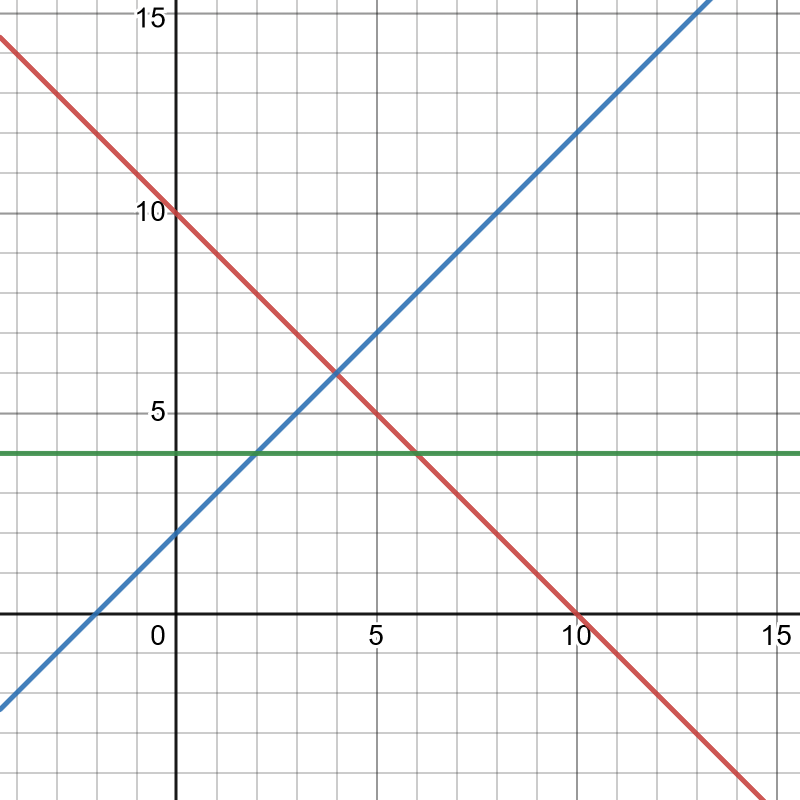
Maybe some graphs would help explain this. In each graph, the red line is the demand and the blue line is the supply.

Here is what the market looks like before intervention: The price is $6. We’ll say that’s too high; people can’t afford it.

[no_intervention.png]

Now suppose we impose a price ceiling at $4 (the green line). You aren’t allowed to charge more than $4. What will happen? Companies will charge $4. But they will also produce and sell a smaller quantity than before.

Far better would be to increase the supply of the good, shifting to a new supply curve (the purple line). Then you would reduce the price and increase the amount of the good available.

[supply_intervention.png]

This is precisely what we do with government bonds when we want to raise interest rates. (A greater supply of bonds makes their prices lower, which makes their yields higher.) And when we want to lower interest rates, we do the opposite.

Of course, with bonds, it’s easy to control the supply; it’s all just numbers in a network. Increasing the supply of housing is a much greater undertaking; you actually need to build new housing. But ultimately, the only way to ensure that housing is available and affordable for everyone is in fact to build more housing.

There are various ways we might accomplish that; one of the simplest would be to simply relax zoning restrictions that make it difficult to build high-density housing in cities. Those are bad laws anyway; they only benefit a small number of people a little bit while harming a large number of people a lot. (The problem is that the people they benefit are the local homeowners who show up to city council meetings.)

But we could do much more. I propose that we really use interest-rate targeting as our model and introduce home price targeting. I want the federal government to exercise eminent domain and order the construction of new high-density housing in any city that has rents above a certain threshold—if you like, the same threshold you were thinking of setting the rent control at.

Is this an extreme solution? Perhaps. But housing affordability is an extreme problem. And I keep hearing from the left wing that economists aren’t willing to consider “radical enough” solutions to housing (by which they always seem to mean the tried-and-failed strategy of rent control). So here’s a radical solution for you. If cities refuse to build enough housing for their people, make them do it. Buy up and bulldoze their “lovely” “historic” suburban neighborhoods that are ludicrous wastes of land (and also environmentally damaging), and replace them with high-rise apartments. (Get rid of the golf courses while you’re at it.)

This would be expensive, of course; we have to pay to build all those new apartments. But hardly so expensive as living in a society where people can’t afford to live where they want.

In fact, estimates suggest that we are losing over one trillion dollars per year in unrealized productivity because people can’t afford to live in the highest-rent cities. Average income per worker in the US has been reduced by nearly $7000 per year because of high housing prices. So that’s the budget you should be comparing against. Keeping things as they are is like taxing our whole population about 9%. (And it’s probably regressive, so more than that for poor people.)

Would this destroy the “charm” of the city? I dunno, maybe a little. But if the only thing your city had going for it was some old houses that are clearly not an efficient use of space, that’s pretty sad. And it is quite possible to build a city at high density and have it still be beautiful and a major draw for tourists; Paris is a lot denser than far-less-picturesque Houston. (Though I’ll admit, Houston is far more affordable than Paris. It’s not just about density.) And is the “charm” of your city really worth making it so unaffordable that people can’t move there without risking becoming homeless?

There are a lot of details to be worked out: How serious must things get before the federal government steps in? (Wherever we draw the line, San Francisco is surely well past it.) It takes a long time to build houses and let prices adjust, so how do we account for that time-lag? Where does the money come from, actually? Debt? Taxes? But these could all be resolved.

Of course, it’s a pipe dream; we’re never going to implement this policy, because homeowners dread the idea of their home values going down (even though it would actually make their property taxes cheaper!). I’d even be willing to consider some kind of program that would let people refinance underwater mortgages to write off the lost equity, if that’s what it takes to actually build enough housing.

Because there is really only one thing that’s ever going to solve the (global!) housing crises:

Build more homes.

What is it with EA and AI?

Jan 1 JDN 2459946

Surprisingly, most Effective Altruism (EA) leaders don’t seem to think that poverty alleviation should be our top priority. Most of them seem especially concerned about long-term existential risk, such as artificial intelligence (AI) safety and biosecurity. I’m not going to say that these things aren’t important—they certainly are important—but here are a few reasons I’m skeptical that they are really the most important the way that so many EA leaders seem to think.

1. We don’t actually know how to make much progress at them, and there’s only so much we can learn by investing heavily in basic research on them. Whereas, with poverty, the easy, obvious answer turns out empirically to be extremely effective: Give them money.

2. While it’s easy to multiply out huge numbers of potential future people in your calculations of existential risk (and this is precisely what people do when arguing that AI safety should be a top priority), this clearly isn’t actually a good way to make real-world decisions. We simply don’t know enough about the distant future of humanity to be able to make any kind of good judgments about what will or won’t increase their odds of survival. You’re basically just making up numbers. You’re taking tiny probabilities of things you know nothing about and multiplying them by ludicrously huge payoffs; it’s basically the secular rationalist equivalent of Pascal’s Wager.

2. AI and biosecurity are high-tech, futuristic topics, which seem targeted to appeal to the sensibilities of a movement that is still very dominated by intelligent, nerdy, mildly autistic, rich young White men. (Note that I say this as someone who very much fits this stereotype. I’m queer, not extremely rich and not entirely White, but otherwise, yes.) Somehow I suspect that if we asked a lot of poor Black women how important it is to slightly improve our understanding of AI versus giving money to feed children in Africa, we might get a different answer.

3. Poverty eradication is often characterized as a “short term” project, contrasted with AI safety as a “long term” project. This is (ironically) very short-sighted. Eradication of poverty isn’t just about feeding children today. It’s about making a world where those children grow up to be leaders and entrepreneurs and researchers themselves. The positive externalities of economic development are staggering. It is really not much of an exaggeration to say that fascism is a consequence of poverty and unemployment.

4. Currently the main thing that most Effective Altruism organizations say they need most is “talent”; how many millions of person-hours of talent are we leaving on the table by letting children starve or die of malaria?

5. Above all, existential risk can’t really be what’s motivating people here. The obvious solutions to AI safety and biosecurity are not being pursued, because they don’t fit with the vision that intelligent, nerdy, young White men have of how things should be. Namely: Ban them. If you truly believe that the most important thing to do right now is reduce the existential risk of AI and biotechnology, you should support a worldwide ban on research in artificial intelligence and biotechnology. You should want people to take all necessary action to attack and destroy institutions—especially for-profit corporations—that engage in this kind of research, because you believe that they are threatening to destroy the entire world and this is the most important thing, more important than saving people from starvation and disease. I think this is really the knock-down argument; when people say they think that AI safety is the most important thing but they don’t want Google and Facebook to be immediately shut down, they are either confused or lying. Honestly I think maybe Google and Facebook should be immediately shut down for AI safety reasons (as well as privacy and antitrust reasons!), and I don’t think AI safety is yet the most important thing.

Why aren’t people doing that? Because they aren’t actually trying to reduce existential risk. They just think AI and biotechnology are really interesting, fascinating topics and they want to do research on them. And I agree with that, actually—but then they need stop telling people that they’re fighting to save the world, because they obviously aren’t. If the danger were anything like what they say it is, we should be halting all research on these topics immediately, except perhaps for a very select few people who are entrusted with keeping these forbidden secrets and trying to find ways to protect us from them. This may sound radical and extreme, but it is not unprecedented: This is how we handle nuclear weapons, which are universally recognized as a global existential risk. If AI is really as dangerous as nukes, we should be regulating it like nukes. I think that in principle it could be that dangerous, and may be that dangerous someday—but it isn’t yet. And if we don’t want it to get that dangerous, we don’t need more AI researchers, we need more regulations that stop people from doing harmful AI research! If you are doing AI research and it isn’t directly involved specifically in AI safety, you aren’t saving the world—you’re one of the people dragging us closer to the cliff! Anything that could make AI smarter but doesn’t also make it safer is dangerous. And this is clearly true of the vast majority of AI research, and frankly to me seems to also be true of the vast majority of research at AI safety institutes like the Machine Intelligence Research Institute.

Seriously, look through MIRI’s research agenda: It’s mostly incredibly abstract and seems completely beside the point when it comes to preventing AI from taking control of weapons or governments. It’s all about formalizing Bayesian induction. Thanks to you, Skynet can have a formally computable approximation to logical induction! Truly we are saved. Only two of their papers, on “Corrigibility” and “AI Ethics”, actually struck me as at all relevant to making AI safer. The rest is largely abstract mathematics that is almost literally navel-gazing—it’s all about self-reference. Eliezer Yudkowsky finds self-reference fascinating and has somehow convinced an entire community that it’s the most important thing in the world. (I actually find some of it fascinating too, especially the paper on “Functional Decision Theory”, which I think gets at some deep insights into things like why we have emotions. But I don’t see how it’s going to save the world from AI.)

Don’t get me wrong: AI also has enormous potential benefits, and this is a reason we may not want to ban it. But if you really believe that there is a 10% chance that AI will wipe out humanity by 2100, then get out your pitchforks and your EMP generators, because it’s time for the Butlerian Jihad. A 10% chance of destroying all humanity is an utterly unacceptable risk for any conceivable benefit. Better that we consign ourselves to living as we did in the Neolithic than risk something like that. (And a globally-enforced ban on AI isn’t even that; it’s more like “We must live as we did in the 1950s.” How would we survive!?) If you don’t want AI banned, maybe ask yourself whether you really believe the risk is that high—or are human brains just really bad at dealing with small probabilities?

I think what’s really happening here is that we have a bunch of guys (and yes, the EA and especially AI EA-AI community is overwhelmingly male) who are really good at math and want to save the world, and have thus convinced themselves that being really good at math is how you save the world. But it isn’t. The world is much messier than that. In fact, there may not be much that most of us can do to contribute to saving the world; our best options may in fact be to donate money, vote well, and advocate for good causes.

Let me speak Bayesian for a moment: The prior probability that you—yes, you, out of all the billions of people in the world—are uniquely positioned to save it by being so smart is extremely small. It’s far more likely that the world will be saved—or doomed—by people who have power. If you are not the head of state of a large country or the CEO of a major multinational corporation, I’m sorry; you probably just aren’t in a position to save the world from AI.

But you can give some money to GiveWell, so maybe do that instead?

Charity shouldn’t end at home

It so happens that this week’s post will go live on Christmas Day. I always try to do some kind of holiday-themed post around this time of year, because not only Christmas, but a dozen other holidays from various religions all fall around this time of year. The winter solstice seems to be a very popular time for holidays, and has been since antiquity: The Romans were celebrating Saturnalia 2000 years ago. Most of our ‘Christmas’ traditions are actually derived from Yuletide.

These holidays certainly mean many different things to different people, but charity and generosity are themes that are very common across a lot of them. Gift-giving has been part of the season since at least Saturnalia and remains as vital as ever today. Most of those gifts are given to our friends and loved ones, but a substantial fraction of people also give to strangers in the form of charitable donations: November and December have the highest rates of donation to charity in the US and the UK, with about 35-40% of people donating during this season. (Of course this is complicated by the fact that December 31 is often the day with the most donations, probably from people trying to finish out their tax year with a larger deduction.)

My goal today is to make you one of those donors. There is a common saying, often attributed to the Bible but not actually present in it: “Charity begins at home”.

Perhaps this is so. There’s certainly something questionable about the Effective Altruism strategy of “earning to give” if it involves abusing and exploiting the people around you in order to make more money that you then donate to worthy causes. Certainly we should be kind and compassionate to those around us, and it makes sense for us to prioritize those close to us over strangers we have never met. But while charity may begin at home, it must not end at home.

There are so many global problems that could benefit from additional donations. While global poverty has been rapidly declining in the early 21st century, this is largely because of the efforts of donors and nonprofit organizations. Official Development Assitance has been roughly constant since the 1970s at 0.3% of GNI among First World countries—well below international targets set decades ago. Total development aid is around $160 billion per year, while private donations from the United States alone are over $480 billion. Moreover, 9% of the world’s population still lives in extreme poverty, and this rate has actually slightly increased the last few years due to COVID.

There are plenty of other worthy causes you could give to aside from poverty eradication, from issues that have been with us since the dawn of human civilization (the Humane Society International for domestic animal welfare, the World Wildlife Federation for wildlife conservation) to exotic fat-tail sci-fi risks that are only emerging in our own lifetimes (the Machine Intelligence Research Institute for AI safety, the International Federation of Biosafety Associations for biosecurity, the Union of Concerned Scientists for climate change and nuclear safety). You could fight poverty directly through organizations like UNICEF or GiveDirectly, fight neglected diseases through the Schistomoniasis Control Initiative or the Against Malaria Foundation, or entrust an organization like GiveWell to optimize your donations for you, sending them where they think they are needed most. You could give to political causes supporting civil liberties (the American Civil Liberties Union) or protecting the rights of people of color (the North American Association of Colored People) or LGBT people (the Human Rights Campaign).

I could spent a lot of time and effort trying to figure out the optimal way to divide up your donations and give them to causes such as this—and then convincing you that it’s really the right one. (And there is even a time and place for that, because seemingly-small differences can matter a lot in this.) But instead I think I’m just going to ask you to pick something. Give something to an international charity with a good track record.

I think we worry far too much about what is the best way to give—especially people in the Effective Altruism community, of which I’m sort of a marginal member—when the biggest thing the world really needs right now is just more people giving more. It’s true, there are lots of worthless or even counter-productive charities out there: Please, please do not give to the Salvation Army. (And think twice before donating to your own church; if you want to support your own community, okay, go ahead. But if you want to make the world better, there are much better places to put your money.)

But above all, give something. Or if you already give, give more. Most people don’t give at all, and most people who give don’t give enough.

Inequality-adjusted GDP and median income

Dec 11 JDN 2459925

There are many problems with GDP as a measure of a nation’s prosperity. For one, GDP ignores natural resources and ecological degradation; so a tree is only counted in GDP once it is cut down. For another, it doesn’t value unpaid work, so caring for a child only increases GDP if you are a paid nanny rather than the child’s parents.

But one of the most obvious problems is the use of an average to evaluate overall prosperity, without considering the level of inequality.

Consider two countries. In Alphania, everyone has an income of about $50,000. In Betavia, 99% of people have an income of $1,000 and 1% have an income of $10 million. What is the per-capita GDP of each country? Alphania’s is $50,000 of course; but Betavia’s is $100,990. Does it really make sense to say that Betavia is a more prosperous country? Maybe it has more wealth overall, but its huge inequality means that it is really not at a high level of development. It honestly sounds like an awful place to live.

A much more sensible measure would be something like median income: How much does a typical person have? In Alphania this is still $50,000; but in Betavia it is only $1,000.

Yet even this leaves out most of the actual distribution; by definition a median is only determined by what is the 50th percentile. We could vary all other incomes a great deal without changing the median.

A better measure would be some sort of inequality-adjusted per-capita GDP, which rescales GDP based on the level of inequality in a country. But we would need a good way of making that adjustment.

I contend that the most sensible way would be to adopt some kind of model of marginal utility of income, and then figure out what income would correspond to the overall average level of utility.

In other words, average over the level of happiness that people in a country get from their income, and then figure out what level of income would correspond to that level of happiness. If we magically gave everyone the same amount of money, how much would they need to get in order for the average happiness in the country to remain the same?

This is clearly going to be less than the average level of income, because marginal utility of income is decreasing; a dollar is not worth as much in real terms to a rich person as it is to a poor person. So if we could somehow redistribute all income evenly while keeping the average the same, that would actually increase overall happiness (though, for many reasons, we can’t simply do that).

For example, suppose that utility of income is logarithmic: U = ln(I).

This means that the marginal utility of an additional dollar is inversely proportional to how many dollars you already have: U'(I) = 1/I.

It also means that a 1% gain or loss in your income feels about the same regardless of how much income you have: ln((1+r)Y) = ln(Y) + ln(1+r). This seems like a quite reasonable, maybe even a bit conservative, assumption; I suspect that losing 1% of your income actually hurts more when you are poor than when you are rich.

Then the inequality adjusted GDP Y is a value such that ln(Y) is equal to the overall average level of utility: E[U] = ln(Y), so Y = exp(E[U]).

This sounds like a very difficult thing to calculate. But fortunately, the distribution of actual income seems to quite closely follow a log-normal distribution. This means that when we take the logarithm of income to get utility, we just get back a very nice, convenient normal distribution!

In fact, it turns out that for a log-normal distribution, the following holds: exp(E[ln(Y)]) = median(Y)

The income which corresponds to the average utility turns out to simply be the median income! We went looking for a better measure than median income, and ended up finding out that median income was the right measure all along.

This wouldn’t hold for most other distributions; and since real-world economies don’t perfectly follow a log-normal distribution, a more precise estimate would need to be adjusted accordingly. But the approximation is quite good for most countries we have good data on, so even for the ones we don’t, median income is likely a very good estimate.

The ranking of countries by median income isn’t radically different from the ranking by per-capita GDP; rich countries are still rich and poor countries are still poor. But it is different enough to matter.

Luxembourg is in 1st place on both lists. Scandinavian countries and the US are in the top 10 in both cases. So it’s fair to say that #ScandinaviaIsBetter for real, and the US really is so rich that our higher inequality doesn’t make our median income lower than the rest of the First World.

But some countries are quite different. Ireland looks quite good in per-capita GDP, but quite bad in median income. This is because a lot of the GDP in Ireland is actually profits by corporations that are only nominally headquartered in Ireland and don’t actually employ very many people there.

The comparison between the US, the UK, and Canada seems particularly instructive. If you look at per-capita GDP PPP, the US looks much richer at $75,000 compared to Canada’s $57,800 (a difference of 29% or 26 log points). But if you look at median personal income, they are nearly equal: $19,300 in the US and $18,600 in Canada (3.7% or 3.7 log points).

On the other hand, in per-capita GDP PPP, the UK looks close to Canada at $55,800 (3.6% or 3.6 lp); but in median income it is dramatically worse, at only $14,800 (26% or 23 lp). So Canada and the UK have similar overall levels of wealth, but life for a typical Canadian is much better than life for a typical Briton because of the higher inequality in Britain. And the US has more wealth than Canada, but it doesn’t meaningfully improve the lifestyle of a typical American relative to a typical Canadian.

Housing prices are out of control

Oct 2 JDN 2459855

This is a topic I could have done for quite awhile now, and will surely address again in the future; it’s a slow-burn crisis that has covered most of the world for a generation.

In most of the world’s cities, housing prices are now the highest they have ever been, even adjusted for inflation. The pandemic made this worse, but it was already bad.

This is of course very important, because housing is usually the largest expenditure for most families.

Changes in housing prices are directly felt in people’s lifestyles, especially when they are renting. Homeownership rates vary a lot between countries, so the impact of this is quite different in different places.

There’s also an important redistributive effect: When housing prices go up, people who own homes get richer, while people who rent homes get poorer. Since people who own homes tend to be richer to begin with (and landlordsare typically richest of all), rising housing prices directly increase wealth inequality.

The median price of a house in the US, even adjusted for inflation, is nearly twice what it was in 1993.

This wasn’t a slow and steady climb; housing prices moved with inflation for most of the 1980s and 1990s, and then surged upward just before the 2008 crash. Then they plummeted for a few years, before reversing course and surging even higher than they were at their 2007 peak:

https://fred.stlouisfed.org/series/CSUSHPINSA

[housing_prices_US_2.png]

https://fred.stlouisfed.org/series/USSTHPI

This is not a uniquely American problem. The UK shows almost the same pattern:

https://fred.stlouisfed.org/series/HPIUKA

But it’s also not the same pattern everywhere. In China, housing prices have been rising steadily, and didn’t crash in 2008:

https://fred.stlouisfed.org/series/QCNN628BIS

In France, housing prices have been relatively stable, and are no higher now than they were in the 1990s:

https://fred.stlouisfed.org/series/CP0410FRM086NEST

Meanwhile, in Japan, housing prices surged in the 1970s, 1980s, and 1990s, ending up four times what they had been in the 1960s; then they suddenly leveled off and haven’t changed since:

https://fred.stlouisfed.org/series/JPNCPIHOUMINMEI

It’s also worse in some cities than others. In San Francisco, housing now costs three times what it did in the 1990s, even adjusting for inflation:

https://fred.stlouisfed.org/series/SFXRSA

Meanwhile, in Detroit, housing is only about 25% more expensive now than it was in the 1990s:

https://fred.stlouisfed.org/series/ATNHPIUS19804Q

This variation tells me that policy matters. This isn’t some inevitable result of population growth or technological change. Those could still be important factors, but they can’t explain the strong varation between countries or even between cities within the same country. (Yes, San Francisco has seen more population growth than Detroit—but not that much more.)

Part of the problem, I think, is that most policymakers don’t actually want housing to be more affordable. They might say they do, they might occasionally feel some sympathy for people who get evicted or live on the streets; but in general, they want housing prices to be higher, because that gives them more property tax revenue. The wealthy benefit from rising housing prices, while the poor are harmed. Since the interests of the wealthy are wildly overrepresented in policy, policy is made to increase housing prices, not decrease them. This is likely especially true in housing, because even the upper-middle class mostly benefits from rising housing prices. It’s only the poor and lower-middle class who are typically harmed.

This is why I don’t really want to get into suggesting policies that could fix this. We know what would fix this: Build more housing. Lots of it. Everywhere. Increase supply, and the price will go down. And we should keep doing it until housing is not just back where it was, but cheaper—much cheaper. Buying a house shouldn’t be a luxury afforded only to the upper-middle class; it should be something everyone does several times in their life and doesn’t have to worry too much about. Buying a house should be like buying a car; not cheap, exactly, but you don’t have to be rich to do it. Because everyone needs housing. So everyone should have housing.

But that isn’t going to happen, because the people who make the decisions about this don’t want it to happen.

So the real question becomes: What do we do about that?