We do not benefit from economic injustice.

JDN 2457461

Recently I think I figured out why so many middle-class White Americans express so much guilt about global injustice: A lot of people seem to think that we actually benefit from it. Thus, they feel caught between a rock and a hard place; conquering injustice would mean undermining their own already precarious standard of living, while leaving it in place is unconscionable.

The compromise, is apparently to feel really, really guilty about it, constantly tell people to “check their privilege” in this bizarre form of trendy autoflagellation, and then… never really get around to doing anything about the injustice.

(I guess that’s better than the conservative interpretation, which seems to be that since we benefit from this, we should keep doing it, and make sure we elect big, strong leaders who will make that happen.)

So let me tell you in no uncertain words: You do not benefit from this.

If anyone does—and as I’ll get to in a moment, that is not even necessarily true—then it is the billionaires who own the multinational corporations that orchestrate these abuses. Billionaires and billionaires only stand to gain from the exploitation of workers in the US, China, and everywhere else.

How do I know this with such certainty? Allow me to explain.

First of all, it is a common perception that prices of goods would be unattainably high if they were not produced on the backs of sweatshop workers. This perception is mistaken. The primary effect of the exploitation is simply to raise the profits of the corporation; there is a secondary effect of raising the price a moderate amount; and even this would be overwhelmed by the long-run dynamic effect of the increased consumer spending if workers were paid fairly.

Let’s take an iPad, for example. The price of iPads varies around the world in a combination of purchasing power parity and outright price discrimination; but the top model almost never sells for less than $500. The raw material expenditure involved in producing one is about $370—and the labor expenditure? Just $11. Not $110; $11. If it had been $110, the price could still be kept under $500 and turn a profit; it would simply be much smaller. That is, even if prices are really so elastic that Americans would refuse to buy an iPad at any more than $500 that would still mean Apple could still afford to raise the wages they pay (or rather, their subcontractors pay) workers by an order of magnitude. A worker who currently works 50 hours a week for $10 per day could now make $10 per hour. And the price would not have to change; Apple would simply lose profit, which is why they don’t do this. In the absence of pressure to the contrary, corporations will do whatever they can to maximize profits.

Now, in fact, the price probably would go up, because Apple fans are among the most inelastic technology consumers in the world. But suppose it went up to $600, which would mean a 1:1 absorption of these higher labor expenditures into price. Does that really sound like “Americans could never afford this”? A few people right on the edge might decide they couldn’t buy it at that price, but it wouldn’t be very many—indeed, like any well-managed monopoly, Apple knows to stop raising the price at the point where they start losing more revenue than they gain.

Similarly, half the price of an iPhone is pure profit for Apple, and only 2% goes into labor. Once again, wages could be raised by an order of magnitude and the price would not need to change.

Apple is a particularly obvious example, but it’s quite simple to see why exploitative labor cannot be the source of improved economic efficiency. Paying workers less does not make them do better work. Treating people more harshly does not improve their performance. Quite the opposite: People work much harder when they are treated well. In addition, at the levels of income we’re talking about, small improvements in wages would result in substantial improvements in worker health, further improving performance. Finally, substitution effect dominates income effect at low incomes. At very high incomes, income effect can dominate substitution effect, so higher wages might result in less work—but it is precisely when we’re talking about poor people that it makes the least sense to say they would work less if you paid them more and treated them better.

At most, paying higher wages can redistribute existing wealth, if we assume that the total amount of wealth does not increase. So it’s theoretically possible that paying higher wages to sweatshop workers would result in them getting some of the stuff that we currently have (essentially by a price mechanism where the things we want get more expensive, but our own wages don’t go up). But in fact our wages are most likely too low as well—wages in the US have become unlinked from productivity, around the time of Reagan—so there’s reason to think that a more just system would improve our standard of living also. Where would all the extra wealth come from? Well, there’s an awful lot of room at the top.

The top 1% in the US own 35% of net wealth, about as much as the bottom 95%. The 400 billionaires of the Forbes list have more wealth than the entire African-American population combined. (We’re double-counting Oprah—but that’s it, she’s the only African-American billionaire in the US.) So even assuming that the total amount of wealth remains constant (which is too conservative, as I’ll get to in a moment), improving global labor standards wouldn’t need to pull any wealth from the middle class; it could get plenty just from the top 0.01%.

In surveys, most Americans are willing to pay more for goods in order to improve labor standards—and the amounts that people are willing to pay, while they may seem small (on the order of 10% to 20% more), are in fact clearly enough that they could substantially increase the wages of sweatshop workers. The biggest problem is that corporations are so good at covering their tracks that it’s difficult to know whether you are really supporting higher labor standards. The multiple layers of international subcontractors make things even more complicated; the people who directly decide the wages are not the people who ultimately profit from them, because subcontractors are competitive while the multinationals that control them are monopsonists.

But for now I’m not going to deal with the thorny question of how we can actually regulate multinational corporations to stop them from using sweatshops. Right now, I just really want to get everyone on the same page and be absolutely clear about cui bono. If there is a benefit at all, it’s not going to you and me.

Why do I keep saying “if”? As so many people will ask me: “Isn’t it obvious that if one person gets less money, someone else must get more?” If you’ve been following my blog at all, you know that the answer is no.

On a single transaction, with everything else held constant, that is true. But we’re not talking about a single transaction. We’re talking about a system of global markets. Indeed, we’re not really talking about money at all; we’re talking about wealth.

By paying their workers so little that those workers can barely survive, corporations are making it impossible for those workers to go out and buy things of their own. Since the costs of higher wages are concentrated in one corporation while the benefits of higher wages are spread out across society, there is a Tragedy of the Commons where each corporation acting in its own self-interest undermines the consumer base that would have benefited all corporations (not to mention people who don’t own corporations). It does depend on some parameters we haven’t measured very precisely, but under a wide range of plausible values, it works out that literally everyone is worse off under this system than they would have been under a system of fair wages.

This is not simply theoretical. We have empirical data about what happened when companies (in the US at least) stopped using an even more extreme form of labor exploitation: slavery.

Because we were on the classical gold standard, GDP growth in the US in the 19th century was extremely erratic, jumping up and down as high as 10 lp and as low as -5 lp. But if you try to smooth out this roller-coaster business cycle, you can see that our growth rate did not appear tobe slowed by the ending of slavery:

US_GDP_growth_1800s


Looking at the level of real per capita GDP (on a log scale) shows a continuous growth trend as if nothing had changed at all:

US_GDP_per_capita_1800s

In fact, if you average the growth rates (in log points, averaging makes sense) from 1800 to 1860 as antebellum and from 1865 to 1900 as postbellum, you find that the antebellum growth rate averaged 1.04 lp, while the postbellum growth rate averaged 1.77 lp. Over a period of 50 years, that’s the difference between growing by a factor of 1.7 and growing by a factor of 2.4. Of course, there were a lot of other factors involved besides the end of slavery—but at the very least it seems clear that ending slavery did not reduce economic growth, which it would have if slavery were actually an efficient economic system.

This is a different question from whether slaveowners were irrational in continuing to own slaves. Purely on the basis of individual profit, it was most likely rational to own slaves. But the broader effects on the economic system as a whole were strongly negative. I think that part of why the debate on whether slavery is economically inefficient has never been settled is a confusion between these two questions. One side says “Slavery damaged overall economic growth.” The other says “But owning slaves produced a rate of return for investors as high as manufacturing!” Yeah, those… aren’t answering the same question. They are in fact probably both true. Something can be highly profitable for individuals while still being tremendously damaging to society.

I don’t mean to imply that sweatshops are as bad as slavery; they are not. (Though there is still slavery in the world, and some sweatshops tread a fine line.) What I’m saying is that showing that sweatshops are profitable (no doubt there) or even that they are better than most of the alternatives for their workers (probably true in most cases) does not show that they are economically efficient. Sweatshops are beneficent exploitationthey make workers better off, but in an obviously unjust way. And they only make workers better off compared to the current alternatives; if they were replaced with industries paying fair wages, workers would obviously be much better off still.

And my point is, so would we. While the prices of goods would increase slightly in the short run, in the long run the increased consumer spending by people in Third World countries—which soon would cease to be Third World countries, as happened in Korea and Japan—would result in additional trade with us that would raise our standard of living, not lower it. The only people it is even plausible to think would be harmed are the billionaires who own our multinational corporations; and yet even they might stand to benefit from the improved efficiency of the global economy.

No, you do not benefit from sweatshops. So stop feeling guilty, stop worrying so much about “checking your privilege”—and let’s get out there and do something about it.
Is America uniquely… mean?

JDN 2457454

I read this article yesterday which I found both very resonant and very disturbing: At least among First World countries, the United States really does seem uniquely, for lack of a better word, mean.

The formal psychological terminology is social dominance orientation; the political science term is authoritarianism. In economics, we notice the difference due to its effect on income inequality. But all of these concepts are capturing part of a deeper underlying reality that in the age of Trump I am finding increasingly hard to deny. The best predictor of support for Trump is authoritarianism.

Of course I’ve already talked about our enormous military budget; but then Tennessee had to make their official state rifle a 50-caliber weapon capable of destroying light tanks. There is something especially dominant, aggressive, and violent about American culture.

We are certainly not unique in the world as a whole—actually I think the amount of social dominance orientation, authoritarianism, and inequality in the US is fairly similar to the world average. We are unique in our gun ownership, but our military spending proportional to GDP is not particularly high by world standards—we’re just an extremely rich country. But in all these respects we are a unique outlier among First World countries; in many ways we resemble a rich authoritarian petrostate like Qatar rather than a European social democracy like France or the UK. (At least we’re not Saudi Arabia?)

More than other First World cultures, Americans believe in hierarchy; they believe that someone should be on top and other people should be on the bottom. More than that, they believe that people “like us” should be on top and people “not like us” should be on the bottom, however that is defined—often in terms of race or religion, but not necessarily.

Indeed, one of the things I find most baffling about this is that it is often more important to people that others be held down than that they themselves be lifted up. This is the only way I can make sense of the fact that people who have watched their wages be drained into the pockets of billionaires for a generation can think that the most important things to do right now are block out illegal immigrants and deport Muslims.

It seems to be that people become convinced that their own status, whatever it may be, is deserved: If they are rich, it is obviously because they are so brilliant and hard-working (something Trump clearly believes about himself, being a textbook example of Narcissistic Personality Disorder); if they are poor, it is obviously because they are so incompetent and lazy. Thus, being lifted up doesn’t make sense; why would you give me things I don’t deserve?

But then when they see people who are different from them, they know automatically that those people must be by definition inferior, as all who are Not of Our Tribe are by definition inferior. And therefore, any of them who are rich gained their position through corruption or injustice, and all of them who are poor deserve their fate for being so inferior. Thus, it is most vital to ensure that these Not of Our Tribe are held down from reaching high positions they so obviously do not deserve.

I’m fairly sure that most of this happens at a very deep unconscious level; it calls upon ancient evolutionary instincts to love our own tribe, to serve the alpha male, to fear and hate those of other tribes. These instincts may well have served us 200,000 years ago (then again, they may just have been the best our brains could manage at the time); but they are becoming a dangerous liability today.

As E.O. Wilson put it: “The real problem of humanity is the following: we have paleolithic emotions; medieval institutions; and god-like technology.”

Yet this cannot be a complete explanation, for there is variation in these attitudes. A purely instinctual theory should say that all human cultures have this to an essentially equal degree; but I started this post by pointing out that the United States appears to have a particularly large amount relative to Europe.

So, there must be something in the cultures or institutions of different nations that makes them either enhance or suppress this instinctual tribalism. There must be something that Europe is doing right, the US is doing wrong, and Saudi Arabia is doing very, very wrong.
Well, the obvious one that sticks out at me is religion. It seems fairly obvious to me that Sweden is less religious than the US, which is less religious than Saudi Arabia.

Data does back me up on this. Religiosity isn’t easy to measure, but we have methods of doing so. If we ask people in various countries if religion is very important in their lives, the percentage of people who say yes gives us an indication of how religious that country is.

In Saudi Arabia, 93% say yes. In the United States, 65% say yes. In Sweden, only 17% say yes.

Religiosity tends to be highest in the poorest countries, but the US is an outlier, far too rich for our religion (or too religious for our wealth).

Religiosity also tends to be highest in countries with high inequality—this time, the US fits right in.

The link between religion and inequality is quite clear. It’s harder to say which way the causation runs. Perhaps high inequality makes people cling more to religion as a comfort, and getting rid of religion would only mean taking that comfort away. Or, perhaps religion actually makes people believe more in social dominance, and thus is part of what keeps that high inequality in place. It could also be a feedback loop, in which higher inequality leads to higher religiosity which leads to higher inequality.

That said, I think we actually have some evidence that causality runs from religion to inequality, rather than the other way around. The secularization of France took place around the same time as the French Revolution that overthrew the existing economic system and replaced it with one that had substantially less inequality. Iran’s government became substantially more based on religion in the latter half of the 20th century, and their inequality soared thereafter.

Above all, Donald Trump dominates the evangelical vote, which makes absolutely no sense if religion is a comfort against inequality—but perfect sense if religion solidifies the tendency of people to think in terms of hierarchy and authoritarianism.

This also makes sense in terms of the content of religion, especially Abrahamaic religion; read the Bible and the Qur’an, and you will see that their primary goal seems to be to convince you that some people, namely people who believe in this book, are just better than other people, and we should be in charge because God says so. (And you wouldn’t try to argue with God, would you?) They really make no particular effort to convince you that God actually exists; they spend all their argumentative effort on what God wants you to do and who God wants you to put in charge—and for some strange reason it always seems to be the same guys who are writing down “God’s words” in the book! What a coincidence!

If religion is indeed the problem, or a large part of the problem, what can we do about it? That’s the most difficult part. We’ve been making absolutely conclusive rational arguments against religion since literally 300 years before Jesus was even born (there has never been a time in human history in which it was rational for an educated person to believe in Christianity or Islam, for the religions did not come into existence until well after the arguments to refute them were well-known!), and the empirical evidence against theism has only gotten stronger ever since; so that clearly isn’t enough.

I think what we really need to do at this point is confront the moral monopoly that religion has asserted for itself. The “Moral Majority” was neither, but its name still sort of makes sense to us because we so strongly associate being moral with being religious. We use terms like “Christian” and “generous” almost interchangeably. And whenever you get into a debate about religion, shortly after you have thoroughly demolished any shred of empirical credibility religion still had left, you can basically guarantee that the response will be: “But without God, how can you know right from wrong?”

What is perhaps most baffling about this concept of morality so commonplace in our culture is that not only is the command of a higher authority that rewards and punishes you not the highest level of moral development—it is literally the lowest. Of the six stages of moral thinking Kohlberg documented in children, the reward and punishment orientation exemplified by the Bible and the Qur’an is the very first. I think many of these people really truly haven’t gotten past level 1, which is why when you start trying to explain how you base your moral judgments on universal principles of justice and consequences (level 6) they don’t seem to have any idea what you’re talking about.

Perhaps this is a task for our education system (philosophy classes in middle school?), perhaps we need something more drastic than that, or perhaps it is enough that we keep speaking about it in public. But somehow we need to break up the monopoly that religion has on moral concepts, so that people no longer feel ashamed to say that something is morally wrong without being able to cite a particular passage from a particular book from the Iron Age. Perhaps once we can finally make people realize that morality does not depend on religion, we can finally free them from the grip of religion—and therefore from the grip of authoritarianism and social dominance.

If this is right, then the reason America is so mean is that we are so Christian—and people need to realize that this is not a paradoxical statement.

Will robots take our jobs?

JDN 2457451
I briefly discussed this topic before, but I thought it deserved a little more depth. Also, the SF author in me really likes writing this sort of post where I get to speculate about futures that are utopian, dystopian, or (most likely) somewhere in between.

The fear is quite widespread, but how realistic is it? Will robots in fact take all our jobs?

Most economists do not think so. Robert Solow famously quipped, “You can see the computer age everywhere but in the productivity statistics.” (It never quite seemed to occur to him that this might be a flaw in the way we measure productivity statistics.)

By the usual measure of labor productivity, robots do not appear to have had a large impact. Indeed, their impact appears to have been smaller than almost any other major technological innovation.

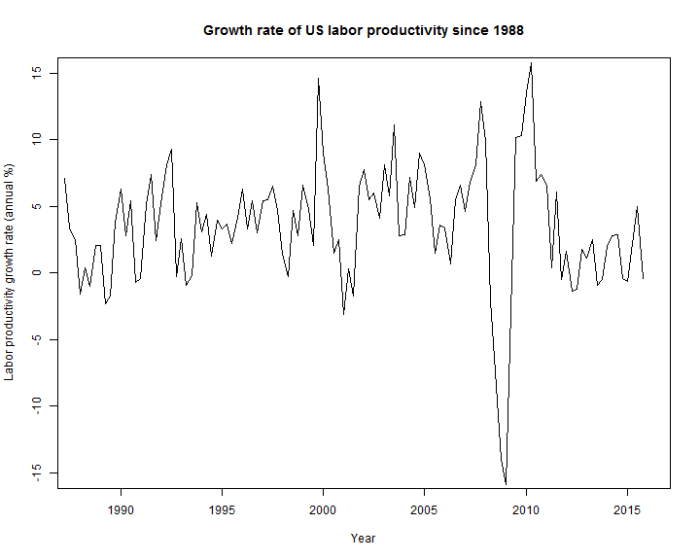
Using BLS data (which was formatted badly and thus a pain to clean, by the way—albeit not as bad as the World Bank data I used on my master’s thesis, which was awful), I made this graph of the growth rate of labor productivity as usually measured:

Productivity_growth

The fluctuations are really jagged due to measurement errors, so I also made an annually smoothed version:

Productivity_growth_smooth

Based on this standard measure, productivity has grown more or less steadily during my lifetime, fluctuating with the business cycle around a value of about 3.5% per year (3.4 log points). If anything, the growth rate seems to be slowing down; in recent years it’s been around 1.5% (1.5 lp).

This was clearly the time during which robots became ubiquitous—autonomous robots did not emerge until the 1970s and 1980s, and robots became widespread in factories in the 1980s. Then there’s the fact that computing power has been doubling every 1.5 years during this period, which is an annual growth rate of 59% (46 lp). So why hasn’t productivity grown at anywhere near that rate?

I think the main problem is that we’re measuring productivity all wrong. We measure it in terms of money instead of in terms of services. Yes, we try to correct for inflation; but we fail to account for the fact that computers have allowed us to perform literally billions of services every day that could not have been performed without them. You can’t adjust that away by plugging into the CPI or the GDP deflator.

Think about it: Your computer provides you the services of all the following:

  1. A decent typesetter and layout artist
  2. A truly spectacular computer (remember, that used to be a profession!)
  3. A highly skilled statistician (who takes no initiative—you must tell her what calculations to do)
  4. A painting studio
  5. A photographer
  6. A video camera operator
  7. A professional orchestra of the highest quality
  8. A decent audio recording studio
  9. Thousands of books, articles, and textbooks
  10. Ideal seats at every sports stadium in the world

And that’s not even counting things like social media and video games that can’t even be readily compared to services that were provided before computers.

If you added up the value of all of those jobs, the amount you would have had to pay in order to hire all those people to do all those things for you before computers existed, your computer easily provides you with at least $1 million in professional services every year. Put another way, your computer has taken jobs that would have provided $1 million in wages. You do the work of a hundred people with the help of your computer.

This isn’t counted in our productivity statistics precisely because it’s so efficient. If we still had to pay that much for all these services, it would be included in our GDP and then our GDP per worker would properly reflect all this work that is getting done. But then… whom would we be paying? And how would we have enough to pay that? Capitalism isn’t actually set up to handle this sort of dramatic increase in productivity—no system is, really—and thus the market price for work has almost no real relation to the productive capacity of the technology that makes that work possible.

Instead it has to do with scarcity of work—if you are the only one in the world who can do something (e.g. write Harry Potter books), you can make an awful lot of money doing that thing, while something that is far more important but can be done by almost anyone (e.g. feed babies) will pay nothing or next to nothing. At best we could say it has to do with marginal productivity, but marginal in the sense of your additional contribution over and above what everyone else could already do—not in the sense of the value actually provided by the work that you are doing. Anyone who thinks that markets automatically reward hard work or “pay you what you’re worth” clearly does not understand how markets function in the real world.

So, let’s ask again: Will robots take our jobs?

Well, they’ve already taken many jobs already. There isn’t even a clear high-skill/low-skill dichotomy here; robots are just as likely to make pharmacists obsolete as they are truck drivers, just as likely to replace surgeons as they are cashiers.

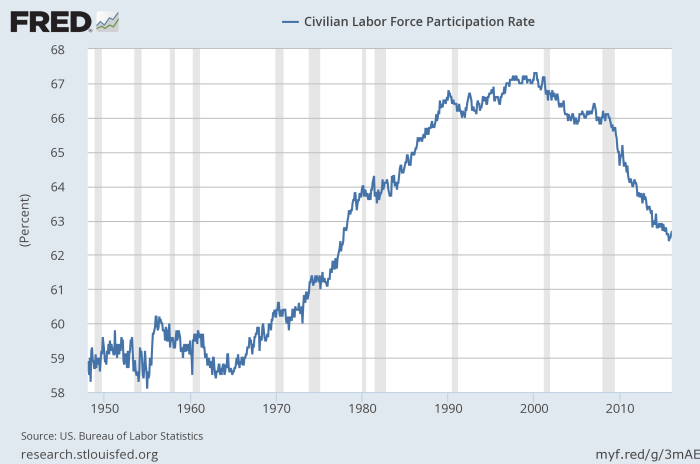
Labor force participation is declining, though slowly:

Labor_force_participation

Yet I think this also underestimates the effect of technology. As David Graeber points out, most of the new jobs we’ve been creating seem to be for lack of a better term bullshit jobs—jobs that really don’t seem like they need to be done, other than to provide people with something to do so that we can justify paying them salaries.

As he puts it:

Again, an objective measure is hard to find, but one easy way to get a sense is to ask: what would happen were this entire class of people to simply disappear? Say what you like about nurses, garbage collectors, or mechanics, it’s obvious that were they to vanish in a puff of smoke, the results would be immediate and catastrophic. A world without teachers or dock-workers would soon be in trouble, and even one without science fiction writers or ska musicians would clearly be a lesser place. It’s not entirely clear how humanity would suffer were all private equity CEOs, lobbyists, PR researchers, actuaries, telemarketers, bailiffs or legal consultants to similarly vanish. (Many suspect it might markedly improve.)

The paragon of all bullshit jobs is sales. Sales is a job that simply should not exist. If something is worth buying, you should be able to present it to the market and people should choose to buy it. If there are many choices for a given product, maybe we could have some sort of independent product rating agencies that decide which ones are the best. But sales means trying to convince people to buy your product—you have an absolutely overwhelming conflict of interest that makes your statements to customers so utterly unreliable that they are literally not even information anymore. The vast majority of advertising, marketing, and sales is thus, in a fundamental sense, literally noise. Sales contributes absolutely nothing to our economy, and because we spend so much effort on it and advertising occupies so much of our time and attention, takes a great deal away. But sales is one of our most steadily growing labor sectors; once we figure out how to make things without people, we employ the people in trying to convince customers to buy the new things we’ve made. Sales is also absolutely miserable for many of the people who do it, as I know from personal experience in two different sales jobs that I had to quit before the end of the first week.

Fortunately we have not yet reached the point where sales is the fastest growing labor sector. Currently the fastest-growing jobs fall into three categories: Medicine, green energy, and of course computers—but actually mostly medicine. Yet even this is unlikely to last; one of the easiest ways to reduce medical costs would be to replace more and more medical staff with automated systems. A nursing robot may not be quite as pleasant as a real professional nurse—but if by switching to robots the hospital can save several million dollars a year, they’re quite likely to do so.

Certain tasks are harder to automate than others—particularly anything requiring creativity and originality is very hard to replace, which is why I believe that in the 2050s or so there will be a Revenge of the Humanities Majors as all the supposedly so stable and forward-thinking STEM jobs disappear and the only jobs that are left are for artists, authors, musicians, game designers and graphic designers. (Also, by that point, very likely holographic designers, VR game designers, and perhaps even neurostim artists.) Being good at math won’t mean anything anymore—frankly it probably shouldn’t right now. No human being, not even great mathematical savants, is anywhere near as good at arithmetic as a pocket calculator. There will still be a place for scientists and mathematicians, but it will be the creative aspects of science and math that persist—design of experiments, development of new theories, mathematical intuition to develop new concepts. The grunt work of cleaning data and churning through statistical models will be fully automated.

Most economists appear to believe that we will continue to find tasks for human beings to perform, and this improved productivity will simply raise our overall standard of living. As any ECON 101 textbook will tell you, “scarcity is a fundamental fact of the universe, because human needs are unlimited and resources are finite.”

In fact, neither of those claims are true. Human needs are not unlimited; indeed, on Maslow’s hierarchy of needs First World countries have essentially reached the point where we could provide the entire population with the whole pyramid, guaranteed, all the time—if we were willing and able to fundamentally reform our economic system.

Resources are not even finite; what constitutes a “resource” depends on technology, as does how accessible or available any given source of resources will be. When we were hunter-gatherers, our only resources were the plants and animals around us. Agriculture turned seeds and arable land into a vital resource. Whale oil used to be a major scarce resource, until we found ways to use petroleum. Petroleum in turn is becoming increasingly irrelevant (and cheap) as solar and wind power mature. Soon the waters of the oceans themselves will be our power source as we refine the deuterium for fusion. Eventually we’ll find we need something for interstellar travel that we used to throw away as garbage (perhaps it will in fact be dilithium!) I suppose that if the universe is finite or if FTL is impossible, we will be bound by what is available in the cosmic horizon… but even that is not finite, as the universe continues to expand! If the universe is open (as it probably is) and one day we can harness the dark energy that seethes through the ever-expanding vacuum, our total energy consumption can grow without bound just as the universe does. Perhaps we could even stave off the heat death of the universe this way—we after all have billions of years to figure out how.

If scarcity were indeed this fundamental law that we could rely on, then more jobs would always continue to emerge, producing whatever is next on the list of needs ordered by marginal utility. Life would always get better, but there would always be more work to be done. But in fact, we are basically already at the point where our needs are satiated; we continue to try to make more not because there isn’t enough stuff, but because nobody will let us have it unless we do enough work to convince them that we deserve it.

We could continue on this route, making more and more bullshit jobs, pretending that this is work that needs done so that we don’t have to adjust our moral framework which requires that people be constantly working for money in order to deserve to live. It’s quite likely in fact that we will, at least for the foreseeable future. In this future, robots will not take our jobs, because we’ll make up excuses to create more.

But that future is more on the dystopian end, in my opinion; there is another way, a better way, the world could be. As technology makes it ever easier to produce as much wealth as we need, we could learn to share that wealth. As robots take our jobs, we could get rid of the idea of jobs as something people must have in order to live. We could build a new economic system: One where we don’t ask ourselves whether children deserve to eat before we feed them, where we don’t expect adults to spend most of their waking hours pushing papers around in order to justify letting them have homes, where we don’t require students to take out loans they’ll need decades to repay before we teach them history and calculus.

This second vision is admittedly utopian, and perhaps in the worst way—perhaps there’s simply no way to make human beings actually live like this. Perhaps our brains, evolved for the all-too-real scarcity of the ancient savannah, simply are not plastic enough to live without that scarcity, and so create imaginary scarcity by whatever means they can. It is indeed hard to believe that we can make so fundamental a shift. But for a Homo erectus in 500,000 BP, the idea that our descendants would one day turn rocks into thinking machines that travel to other worlds would be pretty hard to believe too.

Will robots take our jobs? Let’s hope so.

Why is our diet so unhealthy?

JDN 2457447

One of the most baffling facts about the world, particularly to a development economist, is that the leading causes of death around the world broadly cluster into two categories: Obesity, in First World countries, and starvation, in Third World countries. At first glance, it seems like the rich are eating too much and there isn’t enough left for the poor.

Yet in fact it’s not quite so simple as that, because in fact obesity is most common among the poor in First World countries, and in Third World countries obesity rates are rising rapidly and co-existing with starvation. It is becoming recognized that there are many different kinds of obesity, and that a past history of starvation is actually a major risk factor in future obesity.

Indeed, the really fundamental problem is malnutrition—people are not necessarily eating too much or too little, they are eating the wrong things. So, my question is: Why?

It is widely thought that foods which are nutritious are also unappetizing, and conversely that foods which are delicious are unhealthy. There is a clear kernel of truth here, as a comparison of Brussels sprouts versus ice cream will surely indicate. But this is actually somewhat baffling. We are an evolved organism; one would think that natural selection would shape us so that we enjoy foods which are good for us and avoid foods which are bad for us.

I think it did, actually; the problem is, we have changed our situation so drastically by means of culture and technology that evolution hasn’t had time to catch up. We have evolved significantly since the dawn of civilization, but we haven’t had any time to evolve since one event in particular: The Green Revolution. Indeed, many people are still alive today who were born while the Green Revolution was still underway.

The Green Revolution is the culmination of a long process of development in agriculture and industrialization, but it would be difficult to overstate its importance as an epoch in the history of our species. We now have essentially unlimited food.

Not literally unlimited, of course; we do still need land, and water, and perhaps most notably energy (oil-driven machines are a vital part of modern agriculture). But we can produce vastly more food than was previously possible, and food supply is no longer a binding constraint on human population. Indeed, we already produce enough food to feed 10 billion people. People who say that some new agricultural technology will end world hunger don’t understand what world hunger actually is. Food production is not the problem—distribution of wealth is the problem.

I often speak about the possibility of reaching post-scarcity in the future; but we have essentially already done so in the domain of food production. If everyone ate what would be optimally healthy, and we distributed food evenly across the world, there would be plenty of food to go around and no such thing as obesity or starvation.

So why hasn’t this happened? Well, the main reason, like I said, is distribution of wealth.

But that doesn’t explain why so many people who do have access to good foods nonetheless don’t eat them.

The first thing to note is that healthy food is more expensive. It isn’t a huge difference by First World standards—about $550 per year extra per person. But when we compare the cost of a typical nutritious diet to that of a typical diet, the nutritious diet is significantly more expensive. Worse yet, this gap appears to be growing over time.

But why is this the case? It’s actually quite baffling on its face. Nutritious foods are typically fruits and vegetables that one can simply pluck off plants. Unhealthy foods are typically complex processed foods that require machines and advanced technology. There should be “value added”, at least in the economic sense; additional labor must go in, additional profits must come out. Why is it cheaper?

In a word? Subsidies.

Somehow, huge agribusinesses have convinced governments around the world that they deserve to be paid extra money, either simply for existing or based on how much they produce. Of course, when I say “somehow”, I of course mean lobbying.

In the US, these subsidies overwhelmingly go toward corn, followed by cotton, followed by soybeans.

In fact, they don’t actually even go to corn as you would normally think of it, like sweet corn or corn on the cob. No, they go to feed corn—really awful stuff that includes the entire plant, is barely even recognizable as corn, and has its “quality” literally rated by scales and sieves. No living organism was ever meant to eat this stuff.

Humans don’t, of course. Cows do. But they didn’t evolve for this stuff either; they can’t digest it properly, and it’s because of this terrible food we force-feed them that they need so many antibiotics.

Thus, these corn subsides are really primarily beef subsidies—they are a means of externalizing the cost of beef production and keeping the price of hamburgers artificially low. In all, 2/3 of US agricultural subsidies ultimately go to meat production. I haven’t been able to find any really good estimates, but as a ballpark figure it seems that meat would cost about twice as much if we didn’t subsidize it.

Fortunately a lot of these subsidies have been decreased under the Obama administration, particularly “direct payments” which are sort of like a basic income, but for agribusinesses. (That is not what basic incomes are for.) You can see the decline in US corn subsidies here.

Despite all this, however, subsidies cannot explain obesity. Removing them would have only a small effect.

An often overlooked consideration is that nutritious food can be more expensive for a family even if the actual pricetag is the same.

Why? Because kids won’t eat it.

To raise kids on a nutritious diet, you have to feed them small amounts of good food over a long period of time, until they acquire the taste. In order to do this, you need to be prepared to waste a lot of food, and that costs money. It’s cheaper to simply feed them something unhealthy, like ice cream or hot dogs, that you know they’ll eat.

And this brings me to what I think is the real ultimate cause of our awful diet: We evolved for a world of starvation, and our bodies cannot cope with abundance.

It’s important to be clear about what we mean by “unhealthy food”; people don’t enjoy consuming lead and arsenic. Rather, we enjoy consuming fat and sugar. Contrary to what fad diets will tell you, fat and sugar are not inherently bad for human health; indeed, we need a certain amount of fat and sugar in order to survive. What we call “unhealthy food” is actually food that we desperately need—in small quantities.

Under the conditions in which we evolved, fat and sugar were extremely scarce. Eating fat meant hunting a large animal, which required the cooperation of the whole tribe (a quite literal Stag Hunt) and carried risk of life and limb, not to mention simply failing and getting nothing. Eating sugar meant finding fruit trees and gathering fruit from them—and fruit trees are not all that common in nature. These foods also spoil quite quickly, so you eat them right away or not at all.

As such, we evolved to really crave these things, to ensure that we would eat them whenever they are available. Since they weren’t available all that often, this was just about right to ensure that we managed to eat enough, and rarely meant that we ate too much.


But now fast-forward to the Green Revolution. They aren’t scarce anymore. They’re everywhere. There are whole buildings we can go to with shelves upon shelves of them, which we ourselves can claim simply by swiping a little plastic card through a reader. We don’t even need to understand how that system of encrypted data networks operates, or what exactly is involved in maintaining our money supply (and most people clearly don’t); all we need to do is perform the right ritual and we will receive an essentially unlimited abundance of fat and sugar.

Even worse, this food is in processed form, so we can extract the parts that make it taste good, while separating them from the parts that actually make it nutritious. If fruits were our main source of sugar, that would be fine. But instead we get it from corn syrup and sugarcane, and even when we do get it from fruit, we extract the sugar instead of eating the whole fruit.

Natural selection had no particular reason to give us that level of discrimination; since eating apples and oranges was good for us, we evolved to like the taste of apples and oranges. There wasn’t a sufficient selection pressure to make us actually eat the whole fruit as opposed to extracting the sugar, because extracting the sugar was not an option available to our ancestors. But it is available to us now.

Vegetables, on the other hand, are also more abundant now, but were already fairly abundant. Indeed, it may be significant that we’ve had enough time to evolve since agriculture, but not enough time since fertilizer. Agriculture allowed us to make plenty of wheat and carrots; but it wasn’t until fertilizer that we could make enough hamburgers for people to eat them regularly. It could be that our hunter-gatherer ancestors actually did crave carrots in much the same way they and we crave sugar; but since agriculture we have no further reason to do so because carrots have always been widely available.

One thing I do still find a bit baffling: Why are so many green vegetables so bitter? It would be one thing if they simply weren’t as appealing as fat and sugar; but it honestly seems like a lot of green vegetables, such as broccoli, spinach, and Brussels sprouts, are really quite actively aversive, at least until you acquire the taste for them. Given how nutritious they are, it seems like there should have been a selective pressure in favor of liking the taste of green vegetables; but there wasn’t. I wonder if it’s actually coevolution—if perhaps broccoli has been evolving to not be eaten as quickly as we were evolving to eat it. This wouldn’t happen with apples and oranges, because in an evolutionary sense apples and oranges “want” to be eaten; they spread their seeds in the droppings of animals. But for any given stalk of broccoli, becoming lunch is definitely bad news.

Yet even this is pretty weird, because broccoli has definitely evolved substantially since agriculture—indeed, broccoli as we know it would not exist otherwise. Ancestral Brassica oleracea was bred to become cabbage, broccoli, cauliflower, kale, Brussels sprouts, collard greens, savoy, kohlrabi and kai-lan—and looks like none of them.

It looks like I still haven’t solved the mystery. In short, we get fat because kids hate broccoli; but why in the world do kids hate broccoli?

We all know lobbying is corrupt. What can we do about it?

JDN 2457439

It’s so well-known as to almost seem cliche: Our political lobbying system is clearly corrupt.

Juan Cole, a historian and public intellectual from the University of Michigan, even went so far as to say that the United States is the most corrupt country in the world. He clearly went too far, or else left out a word; the US may well be the most corrupt county in the First World, though most rankings say Italy. In any case, the US is definitely not the most corrupt country in the whole world; no, that title goes to Somalia and/or North Korea.

Still, lobbying in the US is clearly a major source of corruption. Indeed, economists who study corruption often have trouble coming up with a sound definition of “corruption” that doesn’t end up including lobbying, despite the fact that lobbying is quite legal. Bribery means giving politicians money to get them to do things for you. Lobbying means giving politicians money and asking them to do things. In the letter of the law, that makes all the difference.

One thing that does make a difference is that lobbyists are required to register who they are and record their campaign contributions (unless of course they launder—I mean reallocate—them through a Super PAC of course). Many corporate lobbyists claim that it’s not that they go around trying to find politicians to influence, but rather politicians who call them up demanding money.

One of the biggest problems with lobbying is what’s called the revolving doorpoliticians are often re-hired as lobbyists, or lobbyists as politicians, based on the personal connections formed in the lobbying process—or possibly actual deals between lobbying companies over legislation, though if done explicitly that would be illegal. Almost 400 lobbyists working right now used to be legislators; almost 3,000 more worked as Congressional staff. Many lobbyists will do a tour as a Congressional staffer as a resume-builder, like an internship.

Studies have shown that lobbying does have an impact on policy—in terms of carving out tax loopholes it offers a huge return on investment.

Our current systems to disinventize the revolving door are not working. While there is reason to think that establishing a “cooling-off period” of a few years could make a difference, under current policy we already have some cooling-off periods and it’s clearly not enough.

So, now that we know the problem, let’s start talking about solutions.

Option 1: Ban campaign contributions

One possibility would be to eliminate campaign contributions entirely, which we could do by establishing a law that nobody can ever give money or in-kind favors to politicians ever under any circumstances. It would still be legal to meet with politicians and talk to them about issues, but if you take a Senator out for dinner we’d have to require that the Senator pay for their own food and transportation, lest wining-and-dining still be an effective means of manipulation. Then all elections would have to be completely publicly financed. This is a radical solution, but it would almost certainly work. MoveOn has a petition you can sign if you like this solution, and there’s a site called public-campaign-financing.org that will tell you how it could realistically be implemented (beware, their webmaster appears to be a time traveler from the 1990s who thinks that automatic music and tiled backgrounds constitute good web design).

There are a couple of problems with this solution, however:

First, it would be declared Unconstitutional by the Supreme Court. Under the (literally Orwellian) dicta that “corporations are people” and “money is speech” established in Citizens United vs. FEC, any restrictions on donating money to politicians constitute restrictions on free speech, and are therefore subject to strict scrutiny.

Second, there is actually a real restriction on freedom here, not because money is speech, but because money facilitates speech. Since eliminating all campaign donations would require total public financing of elections, we would need some way of deciding which candidates to finance publicly, because obviously you can’t give the same amount of money to everyone in the country or even everyone who decides to run. It simply doesn’t make sense to provide the same campaign financing for Hillary Clinton that you would for Vermin Supreme. But then, however this mechanism works, it could readily be manipulated to give even more advantages to the two major parties (not that they appear to need any more). If you’re fine with having exactly two parties to choose from, then providing funding for their, say, top 5 candidates in each primary, and then for their nominee in the general election, would work. But I for one would like to have more options than that, and that means devising some mechanism for funding third parties that have a realistic shot (like Ralph Nader or Ross Perot) but not those who don’t (like the aforementioned Vermin Supreme)—but at the same time we need to make sure that it’s not biased or self-fulfilling.

So let’s suppose we don’t eliminate campaign contributions completely. What else could we do that would curb corruption?

Option 2: Donation caps and “Democracy Credits”

I particularly like this proposal, self-titled the American Anti-Corruption Act (beware self-titled laws: USA PATRIOT ACT, anyone?), which would require full transparency—yes, even you, Super PACs—and place reasonable caps on donations so that large amounts of funds must be raised from large numbers of people rather than from a handful of people with a huge amount of money. It also includes an interesting proposal called “Democracy Credits” (again, the titles are a bit heavy-handed), which are basically an independent monetary system, used only to finance elections, and doled out exactly equally to all US citizens to spend on the candidates they like. The credits would then be exchangeable for real money, but only by the candidates themselves. This is a great idea, but sadly I doubt anyone in our political system is likely to go for it.

Actually, I would like to see these “Democracy Credits” used as votes—whoever gets the most credits wins the election, automatically. This is not quite as good as range voting, because it is not cloneproof or independent of irrelevant alternatives (briefly put, if you run two candidates that are exactly alike, their votes get split and they both lose, even if everyone likes them; and similarly, if you add a new candidate that doesn’t win you can still affect who does end up winning. Range voting is basically the only system that doesn’t have these problems, aside from a few really weird “voting” systems like “random ballot”). But still, it would be much better than our current plurality “first past the post” system, and would give third-party candidates a much fairer shot at winning elections. Indeed, it is very similar to CTT monetary voting, which is provably optimal in certain (idealized) circumstances. Of course, that’s even more of a pipe dream.

The donation caps are realistic, however; we used to have them, in fact, before Citizens United vs. FEC. Perhaps future Supreme Court decisions can overturn it and restore some semblance of balance in our campaign finance system.

Option 3: Treat campaign contributions as a conflict of interest

Jack Abramoff, a former lobbyist who was actually so corrupt he got convicted for it, has somewhat ironically made another proposal for how to reduce corrupting in the lobbying system. I suppose he would know, though I must wonder what incentives he has to actually do this properly (and corrupt people are precisely the sort of people with whom you should definitely be looking at the monetary incentives).

Abramoff would essentially use Option 1, but applied only to individuals and corporations with direct interests in the laws being made. As Gawker put it, “If you get money or perks from elected officials, […] you shouldn’t be permitted to give them so much as one dollar.” The way it avoids requiring total public financing is by saying that if you don’t get perks, you can still donate.

His plan would also extend the “cooling off” idea to its logical limit—once you work for Congress, you can never work for a lobbying organization for the rest of your life, and vice versa. That seems like a lot of commitment to ask of twentysomething Congressional interns (“If you take this job, unemployed graduate, you can never ever take that other job!”), but I suppose if it works it might be worth it.

He also wants to establish term limits for Congress, which seems pretty reasonable to me. If we’re going to have term limits for the Executive branch, why not the other branches as well? They could be longer, but if term limits are necessary at all we should use them consistently.

Abramoff also says we should repeal the 17th Amendment, because apparently making our Senators less representative of the population will somehow advance democracy. Best I can figure, he’s coming from an aristocratic attitude here, this notion that we should let “better people” make the important decisions if we want better decisions. And this sounds seductive, given how many really bad decisions people make in this world. But of course which people were the better people was precisely the question representative democracy was intended to answer. At least if Senators are chosen by state legislatures there’s a sort of meta-representation going on, which is obviously better than no representation at all; but still, adding layers of non-democracy by definition cannot make a system more democratic.

But Abramoff really goes off the rails when he proposes making it a conflict of interest to legislate about your own state.Pork-barrel spending”, as it is known, or earmarks as they are formally called, are actually a tiny portion of our budget (about 0.1% of our GDP) and really not worth worrying about. Sure, sometimes a Senator gets a bridge built that only three people will ever use, but it’s not that much money in the scheme of things, and there’s no harm in keeping our construction workers at work. The much bigger problem would be if legislators could no longer represent their own constituents in any way, thus defeating the basic purpose of having a representative legislature. (There is a thorny question about how much a Senator is responsible for their own state versus the country as a whole; but clearly their responsibility to their own state is not zero.)

Even aside from that ridiculous last part, there’s a serious problem with this idea of “no contributions from anyone who gets perks”: What constitutes a “perk”? Is a subsidy for solar power a perk for solar companies, or a smart environmental policy (can it be both?)? Does paying for road construction “affect” auto manufacturers in the relevant sense? What about policies that harm particular corporations? Since a carbon tax would hurt oil company profits, are oil companies allowed to lobby against it on the ground that it is the opposite of a “perk”?

Voting for representatives who will do things you want is kind of the point of representative democracy. (No, New York Post, it is not “pandering” to support women’s rights and interestswomen are the majority of our population. If there is one group of people that our government should represent, it is women.) Taken to its logical extreme, this policy would mean that once the government ever truly acts in the public interest, all campaign contributions are henceforth forever banned. I presume that’s not actually what Abramoff intends, but he offers no clear guidelines on how we would distinguish a special interest to be excluded from donations as opposed to a legitimate public interest that creates no such exclusion. Could we flesh this out in the actual legislative process? Is this something courts would decide?

In all, I think the best reform right now is to put the cap back on campaign contributions. It’s simple to do, and we had it before and it seemed to work (mostly). We could also combine that with longer cooling-off periods, perhaps three or five years instead of only one, and potentially even term limits for Congress. These reforms would certainly not eliminate corruption in the lobbying system, but they would most likely reduce it substantially, without stepping on fundamental freedoms.

Of course I’d really like to see those “Democracy Credits”; but that’s clearly not going to happen.

How I wish we measured percentage change

JDN 2457415

For today’s post I’m taking a break from issues of global policy to discuss a bit of a mathematical pet peeve. It is an opinion I share with many economists—for instance Miles Kimball has a very nice post about it, complete with some clever analogies to music.

I hate when we talk about percentages in asymmetric terms.

What do I mean by this? Well, here are a few examples.

If my stock portfolio loses 10% one year and then gains 11% the following year, have I gained or lost money? I’ve lost money. Only a little bit—I’m down 0.1%—but still, a loss.

In 2003, Venezuela suffered a depression of -26.7% growth one year, and then an economic boom of 36.1% growth the following year. What was their new GDP, relative to what it was before the depression? Very slightly less than before. (99.8% of its pre-recession value, to be precise.) You would think that falling 27% and rising 36% would leave you about 9% ahead; in fact it leaves you behind.

Would you rather live in a country with 11% inflation and have constant nominal pay, or live in a country with no inflation and take a 10% pay cut? You should prefer the inflation; in that case your real income only falls by 9.9%, instead of 10%.

We often say that the real interest rate is simply the nominal interest rate minus the rate of inflation, but that’s actually only an approximation. If you have 7% inflation and a nominal interest rate of 11%, your real interest rate is not actually 4%; it is 3.74%. If you have 2% inflation and a nominal interest rate of 0%, your real interest rate is not actually -2%; it is -1.96%.

This is what I mean by asymmetric:

Rising 10% and falling 10% do not cancel each other out. To cancel out a fall of 10%, you must actually rise 11.1%.

Gaining 20% and losing 20% do not cancel each other out. To cancel out a loss of 20%, you need a gain of 25%.

Is it starting to bother you yet? It sure bothers me.

Worst of all is the fact that the way we usually measure percentages, losses are bounded at 100% while gains are unbounded. To cancel a loss of 100%, you’d need a gain of infinity.

There are two basic ways of solving this problem: The simple way, and the good way.

The simple way is to just start measuring percentages symmetrically, by including both the starting and ending values in the calculation and averaging them.
That is, instead of using this formula:

% change = 100% * (new – old)/(old)

You use this one:

% change = 100% * (new – old)/((new + old)/2)

In this new system, percentage changes are symmetric.

Suppose a country’s GDP rises from $5 trillion to $6 trillion.

In the old system we’d say it has risen 20%:

100% * ($6 T – $5 T)/($5 T) = 20%

In the symmetric system, we’d say it has risen 18.2%:

100% * ($6 T – $5 T)/($5.5 T) = 18.2%

Suppose it falls back to $5 trillion the next year.

In the old system we’d say it has only fallen 16.7%:

100% * ($5 T – $6 T)/($6 T) = -16.7%

But in the symmetric system, we’d say it has fallen 18.2%.

100% * ($5 T – $6 T)/($5.5 T) = -18.2%

In the old system, the gain of 20% was somehow canceled by a loss of 16.7%. In the symmetric system, the gain of 18.2% was canceled by a loss of 18.2%, just as you’d expect.

This also removes the problem of losses being bounded but gains being unbounded. Now both losses and gains are bounded, at the rather surprising value of 200%.

Formally, that’s because of these limits:
lim_{x rightarrow infty} {(x-1) over {(x+1)/2}} = 2

lim_{x rightarrow infty} {(0-x) over {(x+0)/2}} = -2

It might be easier to intuit these limits with an example. Suppose something explodes from a value of 1 to a value of 10,000,000. In the old system, this means it rose 1,000,000,000%. In the symmetric system, it rose 199.9999%. Like the speed of light, you can approach 200%, but never quite get there.

100% * (10^7 – 1)/(5*10^6 + 0.5) = 199.9999%

Gaining 200% in the symmetric system is gaining an infinite amount. That’s… weird, to say the least. Also, losing everything is now losing… 200%?

This is simple to explain and compute, but it’s ultimately not the best way.

The best way is to use logarithms.

As you may vaguely recall from math classes past, logarithms are the inverse of exponents.

Since 2^4 = 16, log_2 (16) = 4.

The natural logarithm ln() is the most fundamental for deep mathematical reasons I don’t have room to explain right now. It uses the base e, a transcendental number that starts 2.718281828459045…

To the uninitiated, this probably seems like an odd choice—no rational number has a natural logarithm that is itself a rational number (well, other than 1, since ln(1) = 0).

But perhaps it will seem a bit more comfortable once I show you that natural logarithms are remarkably close to percentages, particularly for the small changes in which percentages make sense.

We define something called log points such that the change in log points is 100 times the natural logarithm of the ratio of the two:

log points = 100 * ln(new / old)

This is symmetric because of the following property of logarithms:

ln(a/b) = – ln(b/a)

Let’s return to the country that saw its GDP rise from $5 trillion to $6 trillion.

The logarithmic change is 18.2 log points:

100 * ln($6 T / $5 T) = 100 * ln(1.2) = 18.2

If it falls back to $5 T, the change is -18.2 log points:

100 * ln($5 T / $6 T) = 100 * ln(0.833) = -18.2

Notice how in the symmetric percentage system, it rose and fell 18.2%; and in the logarithmic system, it rose and fell 18.2 log points. They are almost interchangeable, for small percentages.

In this graph, the old value is assumed to be 1. The horizontal axis is the new value, and the vertical axis is the percentage change we would report by each method.

percentage_change_small

The green line is the usual way we measure percentages.

The red curve is the symmetric percentage method.

The blue curve is the logarithmic method.

For percentages within +/- 10%, all three methods are about the same. Then both new methods give about the same answer all the way up to changes of +/- 40%. Since most real changes in economics are within that range, the symmetric method and the logarithmic method are basically interchangeable.

However, for very large changes, even these two methods diverge, and in my opinion the logarithm is to be preferred.

percentage_change_large

The symmetric percentage never gets above 200% or below -200%, while the logarithm is unbounded in both directions.

If you lose everything, the old system would say you have lost 100%. The symmetric system would say you have lost 200%. The logarithmic system would say you have lost infinity log points. If infinity seems a bit too extreme, think of it this way: You have in fact lost everything. No finite proportional gain can ever bring it back. A loss that requires a gain of infinity percent seems like it should be called a loss of infinity percent, doesn’t it? Under the logarithmic system it is.

If you gain an infinite amount, the old system would say you have gained infinity percent. The logarithmic system would also say that you have gained infinity log points. But the symmetric percentage system would say that you have gained 200%. 200%? Counter-intuitive, to say the least.

Log points also have another very nice property that neither the usual system nor the symmetric percentage system have: You can add them.

If you gain 25 log points, lose 15 log points, then gain 10 log points, you have gained 20 log points.

25 – 15 + 10 = 20

Just as you’d expect!

But if you gain 25%, then lose 15%, and then gain 10%, you have gained… 16.9%.

(1 + 0.25)*(1 – 0.15)*(1 + 0.10) = 1.169

If you gain 25% symmetric, lose 15% symmetric, then gain 10% symmetric, that calculation is really a pain. To find the value y that is p symmetric percentage points from the starting value x, you end up needing to solve this equation:

p = 100 * (y – x)/((x+y)/2)

This can be done; it comes out like this:

y = (200 + p)/(200 – p) * x

(This also gives a bit of insight into why it is that the bounds are +/- 200%.)

So by chaining those, we can in fact find out what happens after gaining 25%, losing 15%, then gaining 10% in the symmetric system:

(200 + 25)/(200 – 25)*(200 – 15)/(200 + 15)*(200 + 10)/(200 – 10) = 1.223

Then we can put that back into the symmetric system:

100% * (1.223 – 1)/((1+1.223)/2) = 20.1%

So after all that work, we find out that you have gained 20.1% symmetric. We could almost just add them—because they are so similar to log points—but we can’t quite.

Log points actually turn out to be really convenient, once you get the hang of them. The problem is that there’s a conceptual leap for most people to grasp what a logarithm is in the first place.

In particular, the hardest part to grasp is probably that a doubling is not 100 log points.

It is in fact 69 log points, because ln(2) = 0.69.

(Doubling in the symmetric percentage system is gaining 67%—much closer to the log points than to the usual percentage system.)

Calculation of the new value is a bit more difficult than in the usual system, but not as difficult as in the symmetric percentage system.

If you have a change of p log points from a starting point of x, the ending point y is:

y = e^{p/100} * x

The fact that you can add log points ultimately comes from the way exponents add:

e^{p1/100} * e^{p2/100} = e^{(p1+p2)/100}

Suppose US GDP grew 2% in 2007, then 0% in 2008, then fell 8% in 2009 and rose 4% in 2010 (this is approximately true). Where was it in 2010 relative to 2006? Who knows, right? It turns out to be a net loss of 2.4%; so if it was $15 T before it’s now $14.63 T. If you had just added, you’d think it was only down 2%; you’d have underestimated the loss by $70 billion.

But if it had grown 2 log points, then 0 log points, then fell 8 log points, then rose 4 log points, the answer is easy: It’s down 2 log points. If it was $15 T before, it’s now $14.70 T. Adding gives the correct answer this time.

Thus, instead of saying that the stock market fell 4.3%, we should say it fell 4.4 log points. Instead of saying that GDP is up 1.9%, we should say it is up 1.8 log points. For small changes it won’t even matter; if inflation is 1.4%, it is in fact also 1.4 log points. Log points are a bit harder to conceptualize; but they are symmetric and additive, which other methods are not.

Is this a matter of life and death on a global scale? No.

But I can’t write about those every day, now can I?

The challenges of a global basic income

JDN 2457404

In the previous post I gave you the good news. Now for the bad news.

So we are hoping to implement a basic income of $3,000 per person per year worldwide, eliminating poverty once and for all.

There is no global government to implement this system. There is no global income tax to be collected or refunded. The United Nations and the World Bank, for all the good work that they do, are nowhere near powerful enough (or well-funded enough) to accomplish this feat.

Worse, the people we need to help the most, not coincidentally, live in the countries that are worst-managed. They are surrounded not only by squalor, but also by corruption, war, ethnic tension. Most of the people are underfed, uneducated, and dying from diseases such as malaria and schistomoniasis that we could treat in a day for pocket change. Their infrastructure is either crumbling or nonexistent. Their water is unsafe to drink. And worst of all, many of their governments don’t care. Tyrants like Robert Mugabe, Kim Jong-un, King Salman (of our lovely ally Saudi Arabia), and Isayas Afewerki care nothing for the interests of the people they rule, and are interested only in maximizing their own wealth and power. If we arranged to provide grants to these countries in an amount sufficient to provide the basic income, there’s no reason to think they’d actually provide it; they’d simply deposit the check in their own personal bank accounts, and use it to buy ever more extravagant mansions or build ever greater monuments to themselves. They really do seem to follow a utility function based entirely upon their own consumption; witness your neoclassical rational agent and despair.

There are ways for international institutions and non-governmental organizations to intervene to help people in these countries, and indeed many have done so to considerable effect. As bad as things are, they are much better than they used to be, and they promise to be even better tomorrow. But there is only so much they can do without the force of law at their backs, without the power to tax incomes and print currency.

We will therefore need a new kind of institutional framework, if not a true world government then something very much like it. Establishing this new government will not be easy, and worst of all I see no way to do it other than military force. Tyrants will not give up their power willingly; it will need to be taken from them. We will need to capture and imprison tyrants like Robert Mugabe and Kim Jong Un in the same way that we once did to mob bosses like John Dillinger and Al Capone, for ultimately a tyrant is nothing but a mob boss with an army.Unless we can find some way to target them precisely and smoothly replace their regimes with democracies, this will mean nothing less than war, and it could kill thousands, even millions of people—but millions of people are already dying, and will continue to die as long as we leave these men in power. Sanctions might help (though sanctions kill people too), and perhaps a few can be persuaded to step down, but the rest must be overthrown, by some combination of local revolutions and international military coalitions. The best model I’ve seen for how this might be pulled off is Libya, where Qaddafi was at last removed by an international military force supporting a local revolution—but even Libya is not exactly sunshine and rainbows right now. One of the first things we need to do is seriously plan a strategy for removing repressive dictators with a minimum of collateral damage.

To many, I suspect this sounds like imperialism, colonialism redux. Didn’t so many imperialistic powers say that they were doing it to help the local population? Yes, they did; and one of the facts that we must face up to is that it was occasionally true. Or if helping the local population was not their primary motivation, it was nonetheless a consequence. Countries colonized by the British Empire in particular are now the most prosperous, free nations in the world: The United States, Canada, Australia. South Africa and India might seem like exceptions (GDP PPP per capita of $12,400 and $5,500 respectively) but they really aren’t, compared to what they were before—or even compared to what is next to them today: Angola has a per capita GDP PPP of $7,546 while Bangladesh has only $2,991. Zimbabwe is arguably an exception (per capita GDP PPP of $1,773), but their total economic collapse occurred after the British left. To include Zimbabwe in this basic income program would literally triple the income of most of their population. But to do that, we must first get through Robert Mugabe.

Furthermore, I believe that we can avoid many of the mistakes of the past. We don’t have to do exactly the same thing that countries used to do when they invaded each other and toppled governments. Of course we should not enslave, subjugate, or murder the local population—one would hope that would go without saying, but history shows it doesn’t. We also shouldn’t annex the territory and claim it as our own, nor should we set up puppet governments that are only democratic as long as it serves our interests. (And make no mistake, we have done this, all too recently.) The goal must really be to help the people of countries like Zimbabwe and Eritrea establish their own liberal democracy, including the right to make policies we don’t like—or even policies we think are terrible ideas. If we can do so without war, of course we should. But right now what is usually called “pacifism” leaves millions of people to starve while we do nothing.

The argument that we have previously supported (or even continue to support, ahem, Saudi Arabia) many of these tyrants is sort of beside the point. Yes, that is clearly true; and yes, that is clearly terrible. But do you think that if we simply leave the situation alone they’ll go away? We should never have propped up Saddam Hussein or supported the mujihadeen who became the Taliban; and yes, I do think we could have known that at the time. But once they are there, what do you propose to do now? Wait for them to die? Hope they collapse on their own? Give our #thoughtsandprayers to revolutionaries? When asked what you think we should do, “We shouldn’t have done X” is not a valid response.

Imagine there is a mob boss who had kidnapped several families and is holding them in a warehouse. Suppose that at some point the police supported the mob boss in some way; in a deal to undermine a worse rival mafia family, they looked the other way on some things he did, or even gave him money that he used to strengthen his mob. (With actual police, the former is questionable, but actually done all the time; the latter would be definitely illegal. In the international analogy, both are ubiquitous.) Even suppose that the families who were kidnapped were previously from a part of town that the police would regularly shake down for petty crimes and incessant stop-and-frisks. The police definitely have a lot to answer for in all this; their crimes should not be forgotten. But how does it follow in any way that the police should not intervene to rescue the families from the warehouse? Suppose we even know that the warehouse is heavily guarded, and the resulting firefight may kill some of the hostages we are hoping to save. This gives us reason to negotiate, or to find the swiftest, most precise means to deploy the SWAT teams; but does it give us reason to do nothing?

Once again I think Al Capone is the proper analogy; when the FBI captured Al Capone, they didn’t bomb Chicago to the ground, nor did they attempt to enslave the population of Illinois. They thought of themselves as targeting one man and his lieutenants and re-establishing order and civil government to a free people; that is what we must do in Eritrea and Zimbabwe. (In response to all this, no doubt someone will say: “You just want the US to be the world’s police.” Well, no, I want an international coalition; but yes, given our military and economic hegemony, the US will take a very important role. Above all, yes, I want the world to have police. Why don’t you?)

For everything we did wrong in the recent wars in Afghanistan and Iraq, I think we actually did this part right: Afghanistan’s GDP PPP per capita has risen over 70% since 2002, and Iraq’s is now 17% higher than its pre-war peak. It’s a bit early to say whether we have really established stable liberal democracies there, and the Iraq War surely contributed to the rise of Daesh; but when the previous condition was the Taliban and Saddam Hussein it’s hard not to feel that things are at least somewhat improving. In a generation or two maybe we really will say “Iraq” in the same breath as “Korea” as one of the success stories of prosperous democracies set up after US wars. Or maybe it will all fall apart; it’s hard to say at this point.

So, we must find a way to topple the tyrants. Once that is done, we will need to funnel huge amounts of resources—at least one if not two orders of magnitude larger than our current level of foreign aid into building infrastructure, educating people, and establishing sound institutions. Our current “record high” foreign aid is less than 0.3% of world’s GDP. We have a model for this as well: It’s what we did in West Germany and Japan after WW2, as well as what we did in South Korea after the Korean War. It is not a coincidence that Germany soon regained its status as a world power while Japan and Korea were the first of the “Asian Tigers”, East Asian nations that rose up to join us at a First World standard of living.

Will all of this be expensive? Absolutely. By assuming $3,000 per person per year I am already figuring in an expenditure of $21 trillion per year, indefinitely. This would be the most expensive project upon which humanity has ever embarked. But it could also be the most important—an end to poverty, everywhere, forever. And we have that money, we’re simply using it for other things. At purchasing power parity the world spends over $100 trillion per year. Using 20% of the world’s income to eliminate poverty forever doesn’t seem like such a bad deal to me. (It’s not like it would disappear; it would be immediately spent back into the economy anyway. We might even see growth as a result.)

When dealing with events on this scale, it’s easy to get huge numbers that sound absurd. But even if we assumed that only the US, Europe, and China supported this program, it would only take 37% of our combined income—roughly what we currently spend on housing.

Whenever people complain, “We spend billions of dollars a year on aid, and we haven’t solved world hunger!” the proper answer is, “That’s right; we should be spending trillions.”

The possibilities of a global basic income

JDN 2457401

This post is sort of a Patreon Readers’ Choice; it had a tied score with the previous post. If ties keep happening, I may need to devise some new scheme, lest I end up writing so many Readers’ Choice posts I don’t have time for my own topics (I suppose there are worse fates).

The idea of a global basic income is one I have alluded to many times, but never directly focused on.

As I wrote this I realized it’s actually two posts. I have good news and bad news.
First, the good news.

A national basic income is a remarkably simple, easy policy to make: When the tax code comes around for revision that year, you get Congress to vote in a very large refundable credit, disbursed monthly, that goes to everyone—that is a basic income. To avoid ballooning the budget deficit, you would also want to eliminate a bunch of other deductions and credits, and might want to raise the tax rates as well—but these are all things that we have done before many times. Different administrations almost always add some deductions and remove others, raise some rates and lower others. By this simple intervention, we could end poverty in America immediately and forever. The most difficult part of this whole process is convincing a majority of both houses of Congress to support it. (And even that may not be as difficult as it seems, for a basic income is one of the few economic policies that appeals to both Democrats, Libertarians, and even some Republicans.)

Similar routine policy changes could be applied in other First World countries. A basic income could be established by a vote of Parliament in the UK, a vote of the Senate and National Assembly in France, a vote of the Riksdag in Sweden, et cetera; indeed, Switzerland is already planning a referendum on the subject this year. The benefits of a national basic income policy are huge, the costs are manageable, the implementation is trivial. Indeed, the hardest thing to understand about all of this is why we haven’t done it already.

But the benefits of a national basic income are of course limited to the nation(s) in which it is applied. If Switzerland votes in its proposal to provide $30,000 per person per year (that’s at purchasing power parity, but it’s almost irrelevant whether I use nominal or PPP figures, because Swiss prices are so close to US prices), that will help a lot of people in Switzerland—but it won’t do much for people in Germany or Italy, let alone people in Ghana or Nicaragua. It could do a little bit for other countries, if the increased income for the poor and lower-middle class results in increased imports to Switzerland. But Switzerland especially is a very small player in global trade. A US basic income is more likely to have global effects, because the US by itself accounts for 9% of the world’s exports and 13% of the world’s imports. Some nations, particularly in Latin America, depend almost entirely upon the US to buy their exports.

But even so, national basic incomes in the entire First World would not solve the problem of global poverty. To do that, we would need a global basic income, one that applies to every human being on Earth.

The first question to ask is whether this is feasible at all. Do we even have enough economic output in the world to do this? If we tried would we simply trigger a global economic collapse?

Well,if you divide all the world’s income, adjusted for purchasing power, evenly across all the world’s population, the result is about $15,000 per person per year. This is about the standard of living of the average (by which I mean median) person in Lebanon, Brazil, or Botswana. It’s a little better than the standard of living in China, South Africa, or Peru. This is about half of what the middle class of the First World are accustomed to, but it is clearly enough to not only survive, but actually make some kind of decent living. I think most people would be reasonably happy with this amount of income, if it were stable and secure—and by construction, the majority of the world’s population would be better off if all incomes were equalized in this way.

Of course, we can’t actually do that. All the means we have for redistributing income to that degree would require sacrificing economic efficiency in various ways. It is as if we were carrying water in buckets with holes in the bottom; the amount we give at the end is a lot less than the amount we took at the start.

Indeed, the efficiency costs of redistribution rise quite dramatically as the amount redistributed increases.

I have yet to see a convincing argument for why we could not simply tax the top 1% at a 90% marginal rate and use all of that income for public goods without any significant loss in economic efficiency—this is after all more or less what we did here in the United States in the 1960s, when we had a top marginal rate over 90% and yet per capita GDP growth was considerably higher than it is today. A great many economists seem quite convinced that taxing top incomes in this way would create some grave disincentive against innovation and productivity, yet any time anything like this has been tried such disincentives have conspicuously failed to emerge. (Why, it’s almost as if the rich aren’t that much smarter and more hard-working than we are!)

I am quite sure, on the other hand, that if we literally set up the tax system so that all income gets collected by the government and then doled out to everyone evenly, this would be economically disastrous. Under that system, your income is basically independent of the work you do. You could work your entire life to create a brilliant invention that adds $10 billion to the world economy, and your income would rise by… 0.01%, the proportion that your invention added to the world economy. Or you could not do that, indeed do nothing at all, be a complete drain upon society, and your income would be about $1.50 less each year. It’s not hard to understand why a lot of people might work considerably less hard in such circumstances; if you are paid exactly the same whether you are an entrepreneur, a software engineer, a neurosurgeon, a teacher, a garbage collector, a janitor, a waiter, or even simply a couch potato, it’s hard to justify spending a lot of time and effort acquiring advanced skills and doing hard work. I’m sure there are some people, particularly in creative professions such as art, music, and writing—and indeed, science—who would continue to work, but even so the garbage would not get picked up, the hamburgers would never get served, and the power lines would never get fixed. The result would be that trying to give everyone the same income would dramatically reduce the real income available to distribute, so that we all ended up with say $5,000 per year or even $1,000 per year instead of $15,000.

Indeed, absolute equality is worse than the system of income distribution under Soviet Communism, which still provided at least some incentives to work—albeit often not to work in the most productive or efficient way.

So let’s suppose that we only have the income of the top 1% to work with. It need not be literally that we take income only from the top 1%; we could spread the tax burden wider than that, and there may even be good reasons to do so. But I think this gives us a good back-of-the-envelope estimate of how much money we would realistically have to work with in funding a global basic income. It’s actually surprisingly hard to find good figures on the global income share of the top 1%; there’s one figure going around which is not simply wrong it’s ridiculous, claiming that the income threshold for the top 1% worldwide is only $34,000. Why is it ridiculous? Because the United States comprises 4.5% of the world’s population, and half of Americans make more money than that. This means that we already have at least 2% of the world’s population making at least that much, in the United States alone. Add in people from Europe, Japan, etc. and you easily find that this must be the income of about the top 5%, maybe even only the top 10%, worldwide. Exactly where it lies depends on the precise income distributions of various countries.

But here’s what I do know; the global Gini coefficient is about 0.40, and the US Gini coefficient is about 0.45; thus, roughly speaking, income inequality on a global scale recapitulates income inequality in the US. The top 1% in the US receive about 20% of the income. So let’s say that the top 1% worldwide probably also receive somewhere around 20% of the income. We were only using it to estimate the funds available for a basic income anyway.

This would mean that our basic income could be about $3,000 per person per year at purchasing power parity. That probably doesn’t sound like a lot, and I suppose it isn’t; but the UN poverty threshold is $2 per person per day, which is $730 per person per day. Thus, our basic income is over four times what it would take to eliminate global poverty by the UN threshold.

Now in fact I think that this threshold is probably too low; but is it four times too low? We are accustomed to such a high standard of living in the First World that it’s easy to forget that people manage to survive on far, far less than we have. I think in fact our problem here is not so much poverty per se as it is inequality and financial insecurity. We live in a state of “insecure affluence”; we have a great deal (think for a moment about your shelter, transportation, computer, television, running water, reliable electricity, abundant food—and if you are reading this you probably have all these things), but we constantly fear that we may lose it at any moment, and not without reason. (My family actually lost the house I grew up in as a result of predatory banking and the financial crisis.) We are taught all our lives that the only way to protect this abundance is by means of a hyper-competitive, winner-takes-allcutthroat capitalist economy that never lets us ever become comfortable in appreciating that abundance, for it could be taken from us at any time.

I think the apotheosis of what it is to live in insecure affluence is renting an apartment in LA or New York—you must have a great deal going for you to be able to live in the city at all, but you are a renter, an interloper; the apartment, like so much of your existence, is never fully secure, never fully yours. Perhaps the icing on the cake is if you’re doing it for grad school (as I was a year ago), this bizarre system in which we live near poverty for several years not in spite but because of the fact that we are so hard-working, intelligent and educated. (And it never ceases to baffle me that economists who lived through that can still believe in the Life-Cycle Spending Hypothesis.)

Being below the poverty line in a First World country is a kind of poverty, but it’s a very different kind than being below the poverty line in a Third World country. (I think we need a new term to distinguish it, and maybe “insecure affluence” or “economic insecurity” is the right one.) A national basic income could be set considerably higher than the global basic income (since we’re giving it to far fewer people), so we might actually be able to set $15,000 nationally—but to do that worldwide would use up literally all the money in the world.

Raising the minimum income worldwide to $3,000 per person per year would transform the lives of billions of people. It would, in a very real sense, end poverty, worldwide, immediately and forever.

And that’s the good news. Stay tuned for the bad news.

What would an interplanetary economy look like?

JDN 2457397

Today’s post is the second Reader’s Choice topic, chosen by a vote of my Patreons.

Remember, you too can vote on future topics if you pledge at least $10 per month.

Actually, there was a tie between two topics; since I was in an SF mood today, I decided to do this one as the official Reader’s Choice post. The second, “The challenges and possibilities of a global basic income”, I’ll do as a later post. (If I don’t get around to that before the next vote, you can of course always vote for it again.)

Will we ever colonize outer space? Many people thought we’d be there by now.

In Blade Runner, released in 1982, Roy was built and deployed to the outer colonies in 2015, which you may remember as the year that just ended.

Predictions of the future are often wrong, but predictions from the 20th century of the 21st century seem to be consistently overoptimistic about technology. In a past Idiot Free Zone post, I hypothesize that this is due to the confusion between exponential and logistic growth.

Paul Krugman is also a big fan of SF (it is actually about as likely that I’d run into Krugman at Worldcon as at an economics conference), and he wrote a paper on the possibility of interstellar trade way back in 1978. I think he’s kind of satirizing economic theorists actually; he uses sophisticated mathematics to address a problem that doesn’t exist in the real world—just like they do.

I think we will eventually at least reach the point of interplanetary colonization, if not actually interstellar. To begin, let me emphasize that vital distinction. Mars is currently about 60 million kilometers away at its closest approach. The core of the Alpha Centauri system is 4.24 light-years away, which is about 40 trillion kilometers. The distance from Ann Arbor to Toledo is about 84 kilometers. Thus, the difficulty of going to Alpha Centauri is about as much higher than that of going to Mars as the difficulty of going to Mars is compared to going from Ann Arbor to Toledo—each a factor of 700,000 times the distance.

With current technology, we can send robots to Mars (how cool is that? We did get some of the future we were promised). A typical trip takes about half a year. It costs us about $2.5 billion to do that, though India somehow managed to at least make Mars orbit for $75 million. Even if we use the $2.5 billion figure, that still means our current economic output the US and Europe alone could support hundreds of missions per year if we were willing to pay for it. (Devote the entire US military budget to NASA and we could land a new robot on Mars every day.) Interplanetary travel is most definitely feasible.

Interstellar travel on the other hand, is still far out of reach. In principle we are limited by the speed of light; in fact, it’s a good deal worse than that. The fastest we have ever gotten a spacecraft leaving the Solar System is about 60,000 km/h; at that speed it would take almost one billion hours to get to Alpha Centauri, which is over 100,000 years. We will need substantial breakthroughs in spacecraft propulsion before we can even consider sending anything to even the nearest stars. (I wouldn’t give up hope completely, however; in 1901 someone could just as well have criticized H.G. Wells’ The First Men in the Moon on the grounds that no one will ever invent a propulsion system powerful enough to reach the moon.)

By the time we manage interstellar travel, our technology will be so much more advanced it’s hard to even imagine what things will be like. But interplanetary travel we could probably do right now.

So let’s suppose we do in fact establish colonies on other planets—most likely Mars and Mercury, as well as several moons of Jupiter and Saturn. What would our economy look like once we did?

For a decidedly Game of Thrones take on this situation, see The Expanse. Their scientific accuracy is quite good (although they still have sound in space!); so far, their economic accuracy seems pretty good as well, but so far I haven’t seen enough yet to be sure.
One thing I think The Expanse does get right is that asteroid mining is a vital part of the interplanetary trade network. The thing that’s currently keeping us from colonizing other planets is a lack of economic incentives to bear the enormous cost of space travel. Asteroid mining is one thing that might actually provide those incentives, if we can leap just a few more technological hurdles in terms of mining robots and spacecraft propulsion.

Many asteroids contain metals such as silver, gold and platinum at concentrations 20 times as great as anything found on the surface of the Earth. The amount of iron and nickel they contain is even larger; we could supply the entire iron production of the Earth (3.2 billion tonnes) with a single asteroid, 16 Psyche, for the next million years. That one asteroid over 2e19 kg of nearly pure iron-nickel, which is 200 quadrillion tonnes. Many asteroids also contain large concentrations of other useful and rare metals, such as lithium and neodymium.

It is unlikely we would actually try to colonize asteroids (they do in The Expanse, but I’m not sure I buy it). None are large enough to support an atmosphere (kind of by definition), so we’d have to build space stations large enough for permanent habitation. With such ludicrous amounts of iron all around us, that might be possible; but would it be cost-effective? I think it’s more likely that we would have temporary habitats, able to support people for several months or maybe a few years, and people would basically do “tours of duty” working in the asteroids, and then return home. This is similar to how we use space stations right now; you can live there for a long time—the standing record is over a year—but nobody lives their whole life there. It might be a sort of “seasonal” work, where the seasons are decided by large-scale orbital mechanics rather than local planetary axial tilt. (We might have to start doing “seasonal adjustments” to statistics based on this!) Provided that the workers are paid a substantial portion of the spoils—by no means a certainty, as we all know from sweatshops around the world—this work could easily be lucrative enough that you become a millionaire after a tour or two and then retire.

But they might well return home to Mars, since the orbital transfer from the asteroid belt to Mars is considerably easier (it has what we call a lower “delta-v”) than the same transfer all the way back to Earth, and the launch and landing are even easier still. Mars does support an atmosphere—currently very thin and not breathable, but that could change with terraforming. It is also large enough to spread out with room for many homes, greenhouses, power plants, etc., and has enough gravity to at least keep human bodies as a basic level of functioning without too much additional support. (Mars’ gravity is about 40% that of Earth’s.)

Of course, most of the products we make are going to be used on Earth—most of everything is going to be used on Earth, probably for centuries to come. It’s possible that we’ll end up like the British Empire did where the colonies are more populous than the source, but it will take a long time for that to happen. (Moreover, the primary reason—cheap, fertile agricultural land—will not apply unless we happen upon a habitable planet or get very good at terraforming.) This means we will need to ship something from Mars to Earth. But since the delta-v is exceptionally high, we’ll want to ship as little as possible. I think this means that we will do most of the refinement and even manufacturing on Mars, and then ship prefabricated components to Earth. Any process that removes mass will be done on Mars, to minimize the amount of mass that needs to make the trip to Earth.

And what will Earth provide in return? As we import this huge quantity of metal (or metal components), what will we export in return?
Well, one possibility is that we won’t—at first, we (by which I mean “our corporations”) will simply retain ownership of the entire supply chain and do all the accounting as though production were being done entirely on Earth. We won’t think of it as “trade”, just as corporations engaging in a series of prospecting and mining ventures. At least at first.

Yet this will become increasingly unwieldy, just as it became unwieldy for the British Empire to retain control of all its colonies and collect their taxes for the Crown. Communication between Mars, Earth, and the asteroid belt will be relatively fast—a few hours delay at worst—but travel will be very slow and very expensive. Local institutions will form and assert themselves, and may eventually topple the corporate managers, expropriate their assets, and create new governments. The corporations could see the rebellion coming a year in advance from the transmissions, and still be powerless to stop it because the ships will take too long to arrive.

Once new local governments form, we will start thinking of it as “trade”. So what will we be trading? To some extent people on Mars might simply accept Earth currency (perhaps US Dollars, or Euros, or as I like to imagine some unified currency, perhaps the Atlantic Union Dollar); but only if they can then use that Earth currency to buy things they actually need. What will they actually need?

Food, for one. Some amount of food production will be done on Mars by necessity—you can’t survive if you depend entirely on imported food to survive. But it will be expensive, and most likely nutrient-dense but tasteless and monotonous genetically-engineered vegetable products. People will get tired of eating bricks of processed Aresoy(TM) for the 17,000th time and will crave real food; Earth will respond by selling them frozen steaks at $12,000 per kilogram. Probably only luxury foods will be imported, actually; why spend $11,900 for a hamburger when you can spend $12,000 for filet mignon? Nominal income on Mars will be huge—millionaires will be ubiquitous. At purchasing power parity, it may not be so impressive, once you account for the ridiculous cost of food and housing. It’ll be like living in Silicon Valley—on steroids.

Water, perhaps. This one is not as obvious as it may seem. While Earth does have the largest concentration of liquid water (except for a couple of moons of the gas giants), there is plenty of ice in them thar asteroids. It will most likely be cheaper (albeit not cheap) to obtain water by capturing and melting down asteroid ice than to ship it all the way from Earth.

But I think the most important Earth export will beculture. The main products that Martians will want to buy from us will be books, movies, songs, video games, hologram simulations. They will be blueprints, patents, 3D printer schematics. Those who travel to Mars will be bold, adventurous, many of them loners and misfits—but deep down they will still sometimes long for the comforts of the books they read as children, the songs they listened to as teenagers. The beautiful thing about selling culture is that it can be transported almost for free—just add it to the radio transmissions you were already sending. Mars will also produce its own culture, of course, but the much smaller population and constant struggle for survival will mean that most of the cultural flow will be outward from Earth to the colonies rather than the reverse. The Internet won’t work normally between Earth and Mars due to the time delay, but there will be something like it, a local MarsNet that caches material from the Internet on a delay of a few hours and then shares it with the colony. You won’t download webpages in real time, you’ll request them a day in advance. You won’t send instant messages, but sending email will be hardly any different. (Instead of Nigerian princes we’ll start getting scam spam about Martian mining entrepreneurs.) Whoever owns this communication monopoly will become fantastically rich, perhaps even more so than the mining companies themselves—because the mining companies have overhead.

Overall, the increased availability of previously-scarce metals like gold, lithium, and neodymium will make new technologies possible and also widely available, including battery technologies that might finally allow Earth to wean itself off of carbon emissions. (Unfortunately, our current means of spacecraft launch are all very carbon-intensive. We will need to invent nuclear engines that don’t leave fallout so that we can launch with them from the ground.) Like all trade, the mutual imports and exports between Earth and Mars will benefit both societies.

But unless we change course dramatically as a society, interplanetary trade will make one problem even worse, and that is inequality. I am having trouble foreseeing an interplanetary trade system that doesn’t involve making the middlemen who own the shipping and networking companies rich even beyond the wildest dreams of today’s plutocrats. We will witness the birth of humanity’s first trillionaires, individual men (and let’s face it, probably men, unless we figure out gender equality too) who own as much as not just entire countries, but as entire large First World countries. The GDP of France today is $2.8 trillion per year; the CEO of Aresoy or MarsNet could well make more than that on dividends. Of course, that provides him a great incentive to start the project now—but what will it mean for our societies when one person can buy a spaceship as casually as we would buy a cup of coffee?

How we can best help refugees

JDN 2457376

Though the debate seems to have simmered down a little over the past few weeks, the fact remains that we are in the middle of a global refugee crisis. There are 4 million refugees from Syria alone, part of 10 million refugees worldwide from various conflicts.

The ongoing occupation of the terrorist group / totalitarian state Daesh (also known as Islamic State, ISIS and ISIL, but like John Kerry, I like to use Daesh precisely because they seem to hate it) has displaced almost 14 million people, 3.3 million of them refugees from Syria.

Most of these refugees have fled to Lebanon, Jordan, Turkey, and, Iraq, for the obvious reason that these countries are both geographically closest and culturally best equipped to handle them.
There is another reason, however: Some of the other countries in the region, notably Saudi Arabia, have taken no refugees at all. In an upcoming post I intend to excoriate Saudi Arabia for a number of reasons, but this one is perhaps the most urgent. Their response? They simply deny it outright, claiming they’ve taken millions of refugees and somehow nobody noticed.

Turkey and Lebanon are stretched to capacity, however; they simply do not have the resources to take on more refugees. This gives the other nations of the world only two morally legitimate options:

1. We could take more refugees ourselves.

2. We could supply funding and support to Turkey and Lebanon for them to take on more refugees.

Most of the debate has centered around option (1), and in particular around Obama’s plan to take on about 10,000 refugees to the United States, which Ted Cruz calls “lunacy” (to be fair, if it takes one to know one…).

This debate has actually served more to indict the American population for paranoia and xenophobia than anything else. The fact that 17 US states—including some with Democrat governors—have unilaterally declared that they will not accept refugees (despite having absolutely no Constitutional authority to make such a declaration) is truly appalling.

Even if everything that the xenophobic bigots say were true—even if we really were opening ourselves to increased risk of terrorism and damaging our economy and subjecting ourselves to mass unemployment—we would still have a moral duty as human beings to help these people.

And of course almost all of it is false.

Only a tiny fraction of refugees are terrorists, indeed very likely smaller than the fraction of the native population or the fraction of those who arrive on legal visas, meaning that we would actually be diluting our risk of terrorism by accepting more refugees. And as you may recall from my post on 9/11, our risk of terrorism is already so small that the only thing we have to fear is fear itself.

There is a correlation between terrorism and refugees, but it’s almost entirely driven by the opposite effect: terrorism causes refugee crises.

The net aggregate economic effect of immigration is most likely positive. The effect on employment is more ambiguous; immigration does appear to create a small increase in unemployment in the short run as all those new people try to find jobs, and there is some evidence that it may reduce wages for local low-skill workers. But the employment effect is small temporary, and there is a long-run boost in overall productivity. However, it may not have much effect on overall growth: the positive correlation between immigration and economic growth is primarily due to the fact that higher growth triggers more immigration.

And of course, it’s important to keep in mind that the reason wages are depressed at all is that people come from places where wages are even lower, so they improve their standard of living, but may also reduce the standard of living of some of the workers who were already here. The paradigmatic example is immigrants who leave a wage of $4 per hour in Mexico, arrive in California, and end up reducing wages in California from $10 to $8. While this certainly hurts some people who went from $10 to $8, it’s so narrow-sighted as to border on racism to ignore the fact that it also raised other people from $4 to $8. The overall effect is not simply to redistribute wealth from some to others, but actually to create more wealth. If there are things we can do to prevent low-skill wages from falling, perhaps we should; but systematically excluding people who need work is not the way to do that.

Accepting 10,000 more refugees would have a net positive effect on the American economy—though given our huge population and GDP, probably a negligible one. It has been pointed out that Germany’s relatively open policy advances the interests of Germany as much as it does those of the refugees; but so what? They are doing the right thing, even if it’s not for entirely altruistic reasons. One of the central insights of economics is that the universe is nonzero-sum; helping someone else need not mean sacrificing your own interests, and when it doesn’t, the right thing to do should be a no-brainer. Instead of castigating Germany for doing what needs to be done for partially selfish reasons, we should be castigating everyone else for not even doing what’s in their own self-interest because they are so bigoted and xenophobic they’d rather harm themselves than help someone else. (Also, it does not appear to be in Angela Merkel’s self-interest to take more refugees; she is spending a lot of political capital to make this happen.)

We could follow Germany’s example, and Obama’s plan would move us in that direction.

But the fact remains that we could go through with Obama’s plan, indeed double, triple, quadruple it—and still not make a significant dent in the actual population of refugees who need help. When 1,500,000 people need help and the most powerful nation in the world offers to help 10,000, that isn’t an act of great openness and generosity; it’s almost literally the least we could do. 10,000 is only 0.7% of 1.5 million; even if we simply accepted an amount of refugees proportional to our own population it would be more like 70,000. If we instead accepted an amount of refugees proportional to our GDP we should be taking on closer to 400,000.

This is why in fact I think option (2) may be the better choice.

There actually are real cultural and linguistic barriers to assimilation for Syrian people in the United States, barriers which are much lower in Turkey and Lebanon. Immigrant populations always inevitably assimilate eventually, but there is a period of transition which is painful for both immigrants and locals, often lasting a decade or more. On top of this there is the simple logistical cost of moving all those people that far; crossing the border into Lebanon is difficult enough without having to raft across the Mediterranean, let alone being airlifted or shipped all the way across the Atlantic afterward. The fact that many refugees are willing to bear such a cost serves to emphasize their desperation; but it also suggests that there may be alternatives that would work out better for everyone.

The United States has a large population at 322 million; but Turkey (78 million) has about a quarter of our population and Jordan (8 million) and Lebanon (6 million) are about the size of our largest cities.

Our GDP, on the other hand, is vastly larger. At $18 trillion, we have 12 times the GDP of Turkey ($1.5 T), and there are individual American billionaires with wealth larger than the GDPs of Lebanon ($50 B) and Jordan ($31 B).

This means that while we have an absolute advantage in population, we have a comparative advantage in wealth—and the benefits of trade depend on comparative advantage. It therefore makes sense for us to in a sense “trade” wealth for population; in exchange for taking on fewer refugees, we would offer to pay a larger share of the expenses involved in housing, feeding, and ultimately assimilating those refugees.

Another thing we could offer (and have a comparative as well as absolute advantage in) is technology. These surprisingly-nice portable shelters designed by IKEA are an example of how First World countries can contribute to helping refugees without necessarily accepting them into their own borders (as well as an example of why #Scandinaviaisbetter). We could be sending equipment and technicians to provide electricity, Internet access, or even plumbing to the refugee camps. We could ship them staple foods or even MREs. (On the other hand, I am not impressed by the tech entrepreneurs whose “solutions” apparently involve selling more smartphone apps.)

The idea of actually taking on 400,000 or even 70,000 additional people into the United States is daunting even for those of us who strongly believe in helping the refugees—in the former case we’re adding another Cleveland, and even in the latter we’d be almost doubling Dearborn. But if we estimate the cost of simply providing money to support the refugee camps, the figures come out a lot less demanding.
Charities are currently providing money on the order of millions—which is to say on the order of single dollars per person. GBP 887,000 sounds like a lot of money until you realize it’s less than $0.50 per Syrian refugee.

Suppose we were to grant $5,000 per refugee per year. That’s surely more than enough. The UN is currently asking for $6.5 billion, which is only about $1,500 per refugee.

Yet to supply that much for all 4 million refugees would cost us only $20 billion per year, a mere 0.1% of our GDP. (Or if you like, a mere 3% of our military budget, which is probably smaller than what the increase would be if we stepped up our military response to Daesh.)

I say we put it to a vote among the American people: Are you willing to accept a flat 0.1% increase in income tax in order to help the refugees? (Would you even notice?) This might create an incentive to become a refugee when you’d otherwise have tried to stay in Syria, but is that necessarily a bad thing? Daesh, like any state, depends upon its tax base to function, so encouraging emigration undermines Daesh taxpayer by taxpayer. We could make it temporary and tied to the relief efforts—or, more radically, we could not do that, and use it as a starting point to build an international coalition for a global basic income.

Right now a global $5,000 per person per year would not be feasible (that would be almost half of the world’s GDP); but something like $1,000 would be, and would eliminate world hunger immediately and dramatically reduce global poverty. The US alone could in fact provide a $1,000 global basic income, though it would cost $7.2 trillion, which is over 40% of our $18.1 trillion GDP—not beyond our means, but definitely stretching them to the limit. Yet simply by including Europe ($18.5 T), China ($12.9 T), Japan ($4.2 T), India ($2.2 T), and Brazil ($1.8 T), we’d reduce the burden among the whole $57.7 trillion coalition to 12.5% of GDP. That’s roughly what we already spend on Medicare and Social Security. Not a small amount, to be sure; but this would get us within arm’s reach of permanently ending global poverty.

Think of the goodwill we’d gain around the world; think of how much it would undermine Daesh’s efforts to recruit followers if everyone knew that just across the border is a guaranteed paycheck from that same United States that Daesh keeps calling the enemy. This isn’t necessarily contradictory to a policy of accepting more refugees, but it would be something we could implement immediately, with minimal cost to ourselves.

And I’m sure there’d be people complaining that we were only doing it to make ourselves look good and stabilize the region economically, and it will all ultimately benefit us eventually—which is very likely true. But again, I say: So what? Would you rather we do the right thing and benefit from it, or do the wrong thing just so we dare not help ourselves?