Extrapolating the INE

Apr 6 JDN 2460772

I was only able to find sufficient data to calculate the Index of Necessary Expenditure back to 1990. But I found a fairly consistent pattern that the INE grew at a rate about 20% faster than the CPI over that period, so I decided to take a look at what longer-term income growth looks like if we extrapolate that pattern back further in time.

The result is this graph:

Using the CPI, real per-capita GDP in the US (in 2024 dollars) has grown from $25,760 in 1950 to $85,779 today—increasing by a factor of 3.33. Even accounting for increased inequality and the fact that more families have two income earners, that’s still a substantial increase.

But using the extrapolated INE, real per-capita GDP has only grown from $43,622 in 1950 to $85,779 today—increasing by only a factor of 1.97. This is a much smaller increase, especially when we adjusted for increased inequality and increased employment for women.

Even without the extrapolation, it’s still clear that real INE-adjusted incomes have were basically stagnant in the 2000s, increased rather slowly in the 2020s, and then actually dropped in 2022 after a bunch of government assistance ended. What looked, under the CPI, like steadily increasing real income was actually more like treading water.

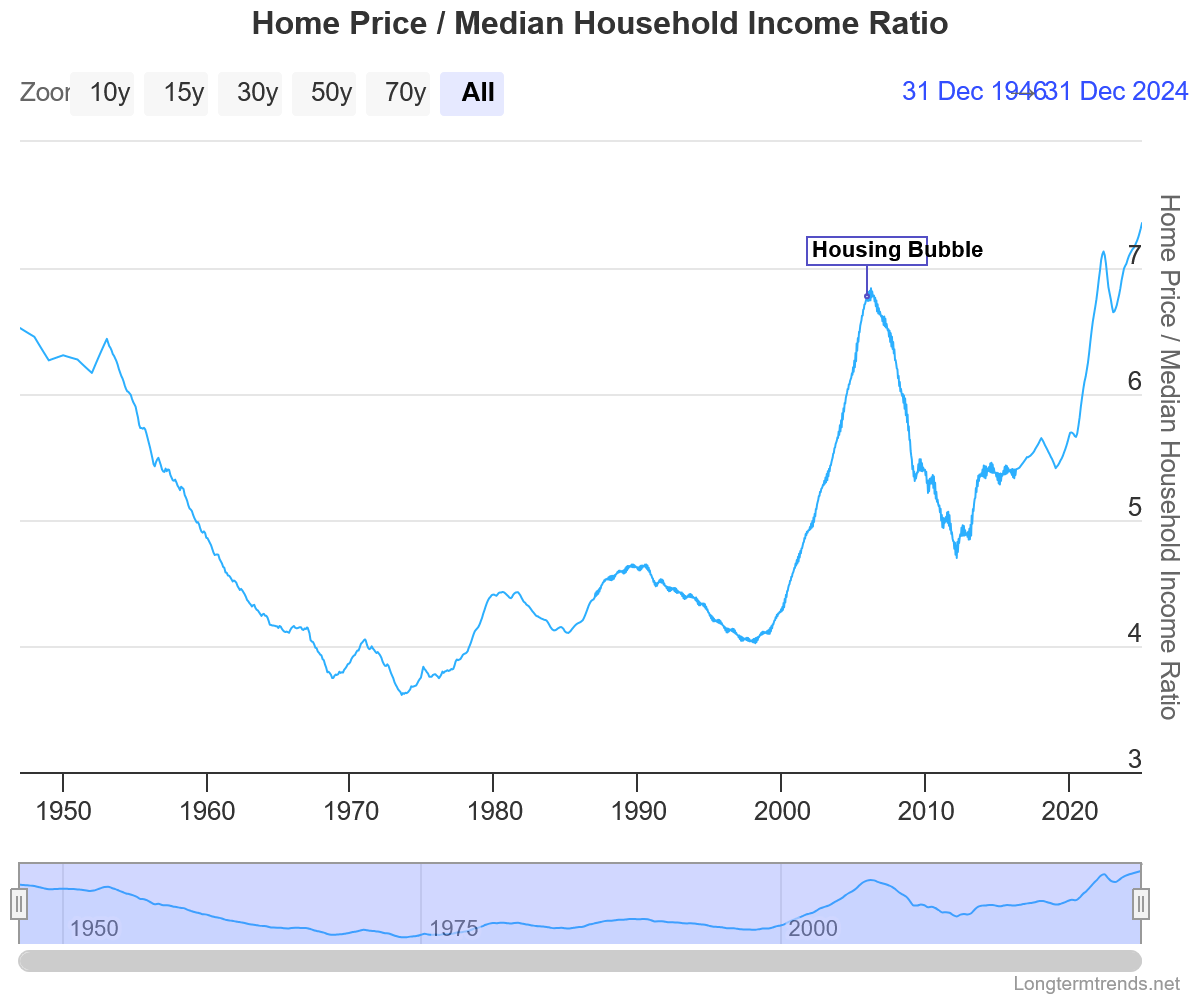
Should we trust this extrapolation? It’s a pretty simplistic approach, I admit. But I think it is plausible when we consider this graph of the ratio between median income and median housing price:

This ratio was around 6 in the 1950s, then began to fall until in the 1970s it stabilized around 4. It began to slowly creep back up, but then absolutely skyrocketed in the 2000s before the 2008 crash. Now it has been rising again, and is now above 7, the highest it has been since the Second World War. (Does this mean we’re due for another crash? I’d bet as much.)

What does this mean? It means that a typical family used to be able to afford a typical house with only four years of their total income—and now would require seven. In that sense, homes are now 75% more expensive today than they were in the 1970s.

Similar arguments can be made for the rising costs of education and healthcare; while many prices have not grown much (gasoline) or even fallen (jewelry and technology), these necessities have continued to grow more and more expensive, not simply in nominal terms, but even compared to the median income.

This is further evidence that our standard measures of “inflation” and “real income” are fundamentally inadequate. They simply aren’t accurately reflecting the real cost of living for most American families. Even in many times when it seemed “inflation” was low and “real income” was growing, in fact it was growing harder and harder to afford vital necessities such as housing, education, and healthcare.

This economic malaise may have been what contributed to the widespread low opinion of Biden’s economy. While the official figures looked good, people’s lives weren’t actually getting better.

Yet this is still no excuse for those who voted for Trump; even the policies he proudly announced he would do—like tariffs and deportations—have clearly made these problems worse, and this was not only foreseeable but actually foreseen by the vast majority of the world’s economists. Then there are all the things he didn’t even say he would do but is now doing, like cozying up to Putin, alienating our closest allies, and discussing “methods” for achieving an unconstitutional third term.

Indeed, it honestly feels quite futile to even reflect upon what was wrong with our economy even when things seemed to be running smoothly, because now things are rapidly getting worse, and showing no sign of getting better in any way any time soon.

Why does everyone work full-time?

Jun 30 JDN 2460492

Over 70% of US workers work “full-time”, that is, at least 40 hours a week. The average number of hours worked per week is 33.8, and the average number of overtime hours is only 3.6. So basically, about 2/3 of workers work almost exactly 40 hours per week.

We’re accustomed to this situation, so it may not seem strange to you. But stop and think for a moment: What are the odds that across every industry, exactly 40 hours per week is the most efficient arrangement?

Indeed, there is mounting evidence that in many industries, 40 hours is too much, and something like 5 or even 30 would actually be more efficient. Yet we continue to work 40-hour weeks.

This looks like a corner solution: Rather than choosing an optimal amount, we’re all up against some kind of constraint.


What’s the constraint? Well, the government requires (for most workers) that anything above 40 hours per week must be paid as overtime, that is, at a higher wage rate. So it looks like we would all be working more than 40 hours per week, but we hit the upper limit due to these regulations.

Does this mean we would be better off without the regulations? Clearly not. As I just pointed out, the evidence is mounting that 40 hours is too much, not too little. But why, then, would we all be trying to work so many hours?

I believe this is yet another example of hyper-competition, where competition drives us to an inefficient outcome.

Employers value employees who work a lot of hours. Indeed, I contend that they do so far more than makes any rational sense; they seem to care more about how many hours you work than about the actual quality or quantity of your output. Maybe this is because hours worked is easier to measure, or because it seems like a fairer estimate of your effort; but for whatever reason, employers really seem to reward employees who work a lot of hours, regardless of almost everything else.

In the absence of a limit on hours worked, then, employers are going to heap rewards on whoever works the most hours, and so people will be pressured to work more and more hours. Then we would all work ourselves to death, and it’s not even clear that this would be good for GDP.

Indeed, this seems to be what happened, before the 40-hour work week became the standard. In the 1800s, the average American worked over 60 hours per week. It wasn’t until the 1940s that 40-hour weeks became the norm.

But speaking of norms, that also seems to be a big factor here. The truth is, overtime isn’t really that expensive, and employers could be smarter about rewarding good work rather than more hours. But once a norm establishes itself in a society, it can be very hard to change. And right now, the norm is that 40 hours is a “normal” “standard” “full” work week—any more is above and beyond, and any less is inferior.

This is a problem, because a lot of people can’t work 40-hour weeks. Our standard for what makes someone “disabled” isn’t that you can’t work at all; it’s that you can’t work as much as society expects. I wonder how many people are currently living on disability who could have been working part-time, but there just weren’t enough part-time jobs available. The employment rate among people with a disability is only 41%, compared to 77% of the general population.

And it’s not that we need to work this much. Our productivity is now staggeringly high: We produce more than five times as much wealth per hour of work than we did as recently as the 1940s. So in theory, we should be able to live just as well while working one-fifth as much… but that’s clearly not what happened.

Keynes accurately predicted our high level of productivity; but he wrongly predicted that we would work less, when instead we just kept right on working almost as hard as before.

Indeed, it doesn’t even seem like we live five times as well while working just as much. Many things are better now—healthcare, entertainment, and of course electronics—but somehow, we really don’t feel like we are living better lives than our ancestors.

The Economic Policy Institute offers an explanation for this phenomenon: Our pay hasn’t kept up with our productivity.


Up until about 1980, productivity and pay rose in lockstep. But then they started to diverge, and they never again converged. Productivity continued to soar, while real wages only barely increased. The result is that since then, productivity has grown by 64%, and hourly pay has only grown 15%.

This is definitely part of the problem, but I think there’s more to it as well. Housing and healthcare have become so utterly unaffordable in this country that it really doesn’t matter that our cars are nice and our phones are dirt cheap. We are theoretically wealthier now, but most of that extra wealth goes into simply staying healthy and having a home. Our consumption has been necessitized.

If we can solve these problems, maybe people won’t feel a need to work so many hours. Or, maybe competition will continue to pressure them to work those hours… but at least we’ll actually feel richer when we do it.

Medical progress, at least, is real

May 26 JDN 2460457

The following vignettes are about me.

Well, one of them is about me as I actually am. The others are about the person I would have been, if someone very much like me, with the same medical conditions, had been born in a particular place and time. Someone in these times and places probably had actual experiences like this, though of course we’ll never know who they were.

976 BC, the hilled lands near the mouth of the river:

Since I was fourteen years old, I have woken up almost every day in pain. Often it is mild, but occasionally it is severe. It often seems to be worse when I encounter certain plants, or if I awaken too early, or if I exert myself too much, or if a storm is coming. No one knows why. The healers have tried every herb and tincture imaginable in their efforts to cure me, but nothing has worked. The priests believe it is a curse from the gods, but at least they appreciate my ability to sometimes predict storms. I am lucky to even remain alive, as I am of little use to the tribe. I will most likely remain this way the rest of my life.

24 AD, Rome:

Since I was fourteen years old, I have woken up almost every day in pain. Often it is mild, but occasionally it is severe. It often seems to be worse when I encounter certain plants, or if I awaken too early, or if I exert myself too much, or if a storm is coming. No one knows why. The healers have tried every herb and tincture imaginable in their efforts to cure me, but nothing has worked. The priests believe it is a curse from the gods, but at least they appreciate my ability to sometimes predict storms. I am lucky that my family was rich enough to teach me reading and mathematics, as I would be of little use for farm work, but can at least be somewhat productive as a scribe and a tutor. I will most likely remain this way the rest of my life.

1024 AD, England:

Since I was fourteen years old, I have woken up almost every day in pain. Often it is mild, but occasionally it is severe. It often seems to be worse when I encounter certain plants, or if I awaken too early, or if I exert myself too much, or if a storm is coming. No one knows why. The healers have tried every herb and tincture imaginable in their efforts to cure me, but nothing has worked. The priests believe it is a curse imposed upon me by some witchcraft, but at least they appreciate my ability to sometimes predict storms. I am lucky that my family was rich enough to teach me reading and mathematics, as I would be of little use for farm work, but can at least be somewhat productive as a scribe and a tutor. I will most likely remain this way the rest of my life.

2024 AD, Michigan:

Since I was fourteen years old, I have woken up almost every day in pain. Often it is mild, but occasionally it is severe. It often seems to be worse when I encounter certain pollens, fragrances, or chemicals, or if I awaken too early, or if I exert myself too much, or when the air pressure changes before a storm. Brain scans detected no gross abnormalities. I have been diagnosed with chronic migraine, but this is more a description of my symptoms than an explanation. I have tried over a dozen different preventative medications; most of them didn’t work at all, some of them worked but gave me intolerable side effects. (One didn’t work at all and put me in the hospital with a severe allergic reaction.) I’ve been more successful with acute medications, which at least work as advertised, but I have to ration them carefully to avoid rebound effects. And the most effective acute medication is a subcutaneous injection that makes me extremely nauseated unless I also take powerful anti-emetics along with it. I have had the most success with botulinum toxin injections, so I will be going back to that soon; but I am also looking into transcranial magnetic stimulation. Currently my condition is severe enough that I can’t return to full-time work, but I am hopeful that with future treatment I will be able to someday. For now, I can at least work as a writer and a tutor. Hopefully things get better soon.

3024 AD, Aegir 7, Ran System:

For a few months when I was fourteen years old, I woke up nearly every day in pain. Often it was mild, but occasionally it was severe. It often seemed to be worse when I encountered certain pollens, fragrances or chemicals, or if I awakened too early, or if I exerted myself too much, or when the air pressure changed before a storm. Brain scans detected no gross abnormalities, only subtle misfiring patterns. Genetic analysis confirmed I had chronic migraine type IVb, and treatment commenced immediately. Acute medications suppressed the pain while I underwent gene therapy and deep-effect transcranial magnetic stimulation. After three months of treatment, I was cured. That was an awful few months, but it’s twenty years behind me now. I can scarcely imagine how it might have impaired my life if it had gone on that whole time.

What is the moral of this story?

Medical progress is real.

Many people often doubt that society has made real progress. And in a lot of ways, maybe it hasn’t. Human nature is still the same, and so many of the problems we suffer have remained the same.

Economically, of course we have had tremendous growth in productivity and output, but it doesn’t really seem to have made us much happier. We have all this stuff, but we’re still struggling and miserable as a handful at the top become spectacularly, disgustingly rich.

Social progress seems to have gone better: Institutions have improved, more of the world is democratic than ever before, and women and minorities are better represented and better protected from oppression. Rates of violence have declined to some of their lowest levels in history. But even then, it’s pretty clear that we have a long, long way to go.

But medical progress is undeniable. We live longer, healthier lives than at any other point in history. Our infant and child mortality rates have plummeted. Even chronic conditions that seem intractable today (such as my chronic migraines) still show signs of progress; in a few generations they should be cured—in surely far less than the thousand years I’ve considered here.

Like most measures of progress, this change wasn’t slow and gradual over thousands of years; it happened remarkably suddenly. Humans went almost 200,000 years without any detectable progress in medicine, using basically the same herbs and tinctures (and a variety of localized and ever-changing superstitions) the entire time. Some of it worked (the herbs and tinctures, at least), but mostly it didn’t. Then, starting around the 18th century, as the Enlightenment took hold and Industrial Revolution ramped up, everything began to change.

We began to test our medicine and see if it actually worked. (Yes, amazingly, somehow, nobody had actually ever thought to do that before—not in anything resembling a scientific way.) And when we learned that most of it didn’t, we began to develop new methods, and see if those worked; and when they didn’t either, we tried new things instead—until, finally, eventually, we actually found medicines that actually did something, medicines worthy of the name. Our understanding of anatomy and biology greatly improved as well, allowing us to make better predictions about the effects our medicines would have. And after a few hundred years of that—a few hundred, out of two hundred thousand years of our species—we actually reached the point where most medicine is effective and a variety of health conditions are simply curable or preventable, including diseases like malaria and polio that had once literally plagued us.

Scientific medicine brought humanity into a whole new era of existence.

I could have set the first vignette 10,000 years ago without changing it. But the final vignette I could probably have set only 200 years from now. I’m actually assuming remarkable stagnation by putting it in the 31st century; but presumably technological advancement will slow at one point, perhaps after we’ve more or less run out of difficult challenges to resolve. (Then again, for all I know, maybe my 31st century counterpart will be an emulated consciousness, and his chronic pain will be resolved in 17.482 seconds by a code update.)

Indeed, the really crazy thing about all this is that there are still millions of people who don’t believe in scientific medicine, who want to use “homeopathy” or “naturopathy” or “acupuncture” or “chiropractic” or whatever else—who basically want to go back to those same old herbs and tinctures that maybe sometimes kinda worked but probably not and nobody really knows. (I have a cousin who is a chiropractor. I try to be polite about it, but….) They point out the various ways that scientific medicine has failed—and believe me, I am painfully aware of those failures—but then where the obvious solution is to improve scientific medicine, they instead want to turn the whole ship around, and go back to what we had before, which was obviously a million times worse.

And don’t tell me it’s harmless: One, it’s a completewaste of resources that could instead have been used for actual scientific medicine. (9% of all out-of-pocket spending on healthcare in the US is on “alternative medicine”—which is to say, on pointless nonsense.) Two, when you have a chronic illness and people keep shoving nonsense treatments in your face, you start to feel blamed for your condition: “Why haven’t you tried [other incredibly stupid idea that obviously won’t work]? You’re so closed-minded! Maybe your illness isn’t really that bad, or you’d be more desperate!” If “alternative medicine” didn’t exist, maybe these people could help me cope with the challenges of living with a chronic illness, or even just sympathize with me, instead of constantly shoving stupid nonsense in my face.

Not everything about the future looks bright.

In particular, I am pessimistic about the near-term future of artificial intelligence, which I think will cause a lot more problems than it solves and does have a small—but not negligible—risk of causing a global catastrophe.

I’m also not very optimistic about climate change; I don’t think it will wipe out our civilization or anything so catastrophic, but I do think it’s going to kill millions of people and we’ve done too little, too late to prevent that. We’re now doing about what we should have been doing in the 1980s.

But I am optimistic about scientific medicine. Every day, new discoveries are made. Every day, new treatments are invented. Yes, there is a lot we haven’t figured out how to cure yet; but people are working on it.

And maybe they could do it faster if we stopped wasting time on stuff that obviously won’t work.

The rise and plateau of China’s economy

Sep 3 JDN 2460191

It looks like China’s era of extremely rapid economic growth may be coming to an end. Consumer confidence in China cratered this year (and, in typical authoritarian fashion, the agency responsible just quietly stopped publishing the data after that). Current forecasts have China’s economy growing only about 4-5% this year, which would be very impressive for a First World country—but far below the 6%, 7%, even 8% annual growth rates China had in recent years.

Some slowdown was quite frankly inevitable. A surprising number of people—particularly those in or from China—seem to think that China’s ultra-rapid growth was something special about China that could be expected to continue indefinitely.

China’s growth does look really impressive, in isolation:

But in fact this is a pattern we’ve seen several times now (admittedly mostly in Asia): A desperately poor Third World country finally figures out how to get its act together, and suddenly has extremely rapid growth for awhile until it manages to catch up and become a First World country.

It happened in South Korea:

It happened in Japan:

It happened in Taiwan:

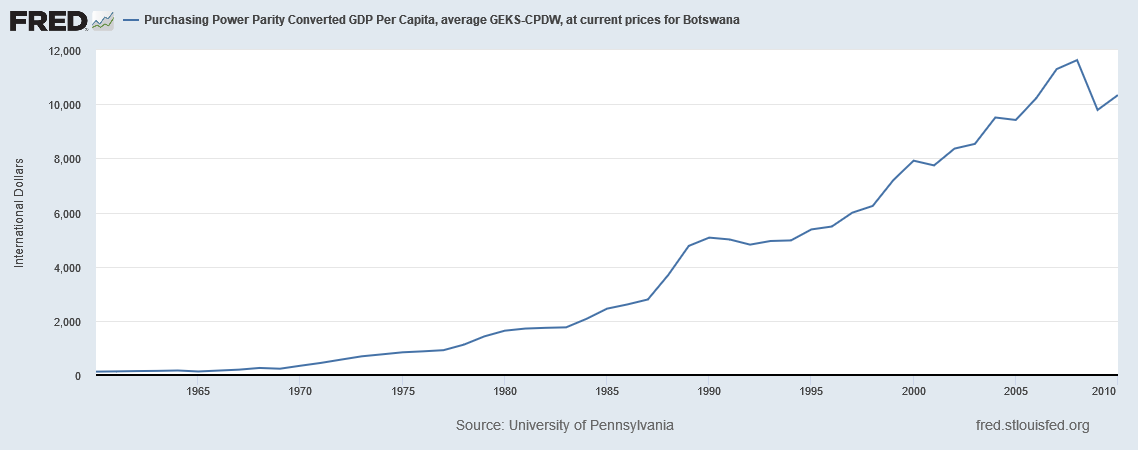
It even seems to be happening in Botswana:

And this is a good thing! These are the great success stories of economic development. If we could somehow figure out how to do this all over the world, it might literally be the best thing that ever happened. (It would solve so many problems!)

Here’s a more direct comparison across all these countries (as well as the US), on a log scale:

From this you can pretty clearly see two things.

First, as countries get richer, their growth tends to slow down gradually. By the time Japan, Korea, and Taiwan reached the level that the US had been at back in 1950, their growth slowed to a crawl. But that was okay, because they had already become quite rich.

And second, China is nothing special: Yes, their growth rate is faster than the US, because the US is already so rich. But they are following the same pattern as several other countries. In fact they’ve actually fallen behind Botswana—they used to be much richer than Botswana, and are now slightly poorer.

So while there are many news articles discussing why China’s economy is slowing down, and some of them may even have some merit (they really seem to have screwed up their COVID response, for instance, and their terrible housing price bubble just burst); but the ultimate reason is really that 7% annual economic growth is just not sustainable. It will slow down. When and how remains in question—but it will happen.

Thus, I am not particularly worried about the fact that China’s growth has slowed down. Or at least, I wouldn’t be, if China were governed well and had prepared for this obvious eventuality the way that Korea and Japan did. But what does worry me is that they seem unprepared for this. Their authoritarian government seems to have depended upon sky-high economic growth to sustain support for their regime. The cracks are now forming in that dam, and something terrible could happen when it bursts.

Things may even be worse than they look, because we know that the Chinese government often distorts or omits statistics when they become inconvenient. That can only work for so long: Eventually the reality on the ground will override whatever lies the government is telling.

There are basically two ways this could go: They could reform their government to something closer to a liberal democracy, accept that growth will slow down and work toward more shared prosperity, and then take their place as a First World country like Japan did. Or they could try to cling to their existing regime, gripping ever tighter until it all slips out of their fingers in a potentially catastrophic collapse. Unfortunately, they seem to be opting for the latter.

I hope I’m wrong. I hope that China will find its way toward a future of freedom and prosperity.

But at this point, it doesn’t look terribly likely.

Statisticacy

Jun 11 JDN 2460107

I wasn’t able to find a dictionary that includes the word “statisticacy”, but it doesn’t trigger my spell-check, and it does seem to have the same form as “numeracy”: numeric, numerical, numeracy, numerate; statistic, statistical, statisticacy, statisticate. It definitely still sounds very odd to my ears. Perhaps repetition will eventually make it familiar.

For the concept is clearly a very important one. Literacy and numeracy are no longer a serious problem in the First World; basically every adult at this point knows how to read and do addition. Even worldwide, 90% of men and 83% of women can read, at least at a basic level—which is an astonishing feat of our civilization by the way, well worthy of celebration.

But I have noticed a disturbing lack of, well, statisticacy. Even intelligent, educated people seem… pretty bad at understanding statistics.

I’m not talking about sophisticated econometrics here; of course most people don’t know that, and don’t need to. (Most economists don’t know that!) I mean quite basic statistical knowledge.

A few years ago I wrote a post called “Statistics you should have been taught in high school, but probably weren’t”; that’s the kind of stuff I’m talking about.

As part of being a good citizen in a modern society, every adult should understand the following:

1. The difference between a mean and a median, and why average income (mean) can increase even though most people are no richer (median).

2. The difference between increasing by X% and increasing by X percentage points: If inflation goes from 4% to 5%, that is an increase of 20% ((5/4-1)*100%), but only 1 percentage point (5%-4%).

3. The meaning of standard error, and how to interpret error bars on a graph—and why it’s a huge red flag if there aren’t any error bars on a graph.

4. Basic probabilistic reasoning: Given some scratch paper, a pen, and a calculator, everyone should be able to work out the odds of drawing a given blackjack hand, or rolling a particular number on a pair of dice. (If that’s too easy, make it a poker hand and four dice. But mostly that’s just more calculation effort, not fundamentally different.)

5. The meaning of exponential growth rates, and how they apply to economic growth and compound interest. (The difference between 3% interest and 6% interest over 30 years is more than double the total amount paid.)

I see people making errors about this sort of thing all the time.

Economic news that celebrates rising GDP but wonders why people aren’t happier (when real median income has been falling since 2019 and is only 7% higher than it was in 1999, an annual growth rate of 0.2%).

Reports on inflation, interest rates, or poll numbers that don’t clearly specify whether they are dealing with percentages or percentage points. (XKCD made fun of this.)

Speaking of poll numbers, any reporting on changes in polls that isn’t at least twice the margin of error of the polls in question. (There’s also a comic for this; this time it’s PhD Comics.)

People misunderstanding interest rates and gravely underestimating how much they’ll pay for their debt (then again, this is probably the result of strategic choices on the part of banks—so maybe the real failure is regulatory).

And, perhaps worst of all, the plague of science news articles about “New study says X”. Things causing and/or cancer, things correlated with personality types, tiny psychological nudges that supposedly have profound effects on behavior.

Some of these things will even turn out to be true; actually I think this one on fibromyalgia, this one on smoking, and this one on body image are probably accurate. But even if it’s a properly randomized experiment—and especially if it’s just a regression analysis—a single study ultimately tells us very little, and it’s irresponsible to report on them instead of telling people the extensive body of established scientific knowledge that most people still aren’t aware of.

Basically any time an article is published saying “New study says X”, a statisticate person should ignore it and treat it as random noise. This is especially true if the finding seems weird or shocking; such findings are far more likely to be random flukes than genuine discoveries. Yes, they could be true, but one study just doesn’t move the needle that much.

I don’t remember where it came from, but there is a saying about this: “What is in the textbooks is 90% true. What is in the published literature is 50% true. What is in the press releases is 90% false.” These figures are approximately correct.

If their goal is to advance public knowledge of science, science journalists would accomplish a lot more if they just opened to a random page in a mainstream science textbook and started reading it on air. Admittedly, I can see how that would be less interesting to watch; but then, their job should be to find a way to make it interesting, not to take individual studies out of context and hype them up far beyond what they deserve. (Bill Nye did this much better than most science journalists.)

I’m not sure how much to blame people for lacking this knowledge. On the one hand, they could easily look it up on Wikipedia, and apparently choose not to. On the other hand, they probably don’t even realize how important it is, and were never properly taught it in school even though they should have been. Many of these things may even be unknown unknowns; people simply don’t realize how poorly they understand. Maybe the most useful thing we could do right now is simply point out to people that these things are important, and if they don’t understand them, they should get on that Wikipedia binge as soon as possible.

And one last thing: Maybe this is asking too much, but I think that a truly statisticate person should be able to solve the Monty Hall Problem and not be confused by the result. (Hint: It’s very important that Monty Hall knows which door the car is behind, and would never open that one. If he’s guessing at random and simply happens to pick a goat, the correct answer is 1/2, not 2/3. Then again, it’s never a bad choice to switch.)

Scalability and inequality

May 15 JDN 2459715

Why are some molecules (e.g. DNA) billions of times larger than others (e.g. H2O), but all atoms are within a much narrower range of sizes (only a few hundred)?

Why are some animals (e.g. elephants) millions of times as heavy as other (e.g. mice), but their cells are basically the same size?

Why does capital income vary so much more (factors of thousands or millions) than wages (factors of tens or hundreds)?

These three questions turn out to have much the same answer: Scalability.

Atoms are not very scalable: Adding another proton to a nucleus causes interactions with all the other protons, which makes the whole atom unstable after a hundred protons or so. But molecules, particularly organic polymers such as DNA, are tremendously scalable: You can add another piece to one end without affecting anything else in the molecule, and keep on doing that more or less forever.

Cells are not very scalable: Even with the aid of active transport mechanisms and complex cellular machinery, a cell’s functionality is still very much limited by its surface area. But animals are tremendously scalable: The same exponential growth that got you from a zygote to a mouse only needs to continue a couple years longer and it’ll get you all the way to an elephant. (A baby elephant, anyway; an adult will require a dozen or so years—remarkably comparable to humans, in fact.)

Labor income is not very scalable: There are only so many hours in a day, and the more hours you work the less productive you’ll be in each additional hour. But capital income is perfectly scalable: We can add another digit to that brokerage account with nothing more than a few milliseconds of electronic pulses, and keep doing that basically forever (due to the way integer storage works, above 2^63 it would require special coding, but it can be done; and seeing as that’s over 9 quintillion, it’s not likely to be a problem any time soon—though I am vaguely tempted to write a short story about an interplanetary corporation that gets thrown into turmoil by an integer overflow error).

This isn’t just an effect of our accounting either. Capital is scalable in a way that labor is not. When your contribution to production is owning a factory, there’s really nothing to stop you from owning another factory, and then another, and another. But when your contribution is working at a factory, you can only work so hard for so many hours.

When a phenomenon is highly scalable, it can take on a wide range of outcomes—as we see in molecules, animals, and capital income. When it’s not, it will only take on a narrow range of outcomes—as we see in atoms, cells, and labor income.

Exponential growth is also part of the story here: Animals certainly grow exponentially, and so can capital when invested; even some polymers function that way (e.g. under polymerase chain reaction). But I think the scalability is actually more important: Growing rapidly isn’t so useful if you’re going to immediately be blocked by a scalability constraint. (This actually relates to the difference between r- and K- evolutionary strategies, and offers further insight into the differences between mice and elephants.) Conversely, even if you grow slowly, given enough time, you’ll reach whatever constraint you’re up against.

Indeed, we can even say something about the probability distribution we are likely to get from random processes that are scalable or non-scalable.

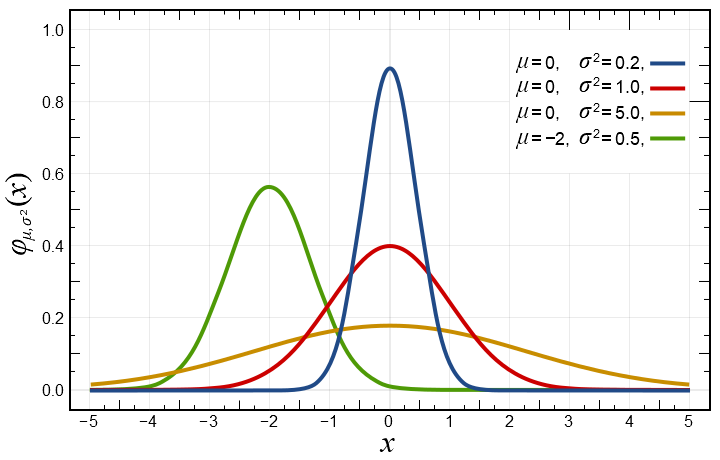
A non-scalable random process will generally converge toward the familiar normal distribution, a “bell curve”:

[Image from Wikipedia: By Inductiveload – self-made, Mathematica, Inkscape, Public Domain, https://commons.wikimedia.org/w/index.php?curid=3817954]

The normal distribution has most of its weight near the middle; most of the population ends up near there. This is clearly the case for labor income: Most people are middle class, while some are poor and a few are rich.

But a scalable random process will typically converge toward quite a different distribution, a Pareto distribution:

[Image from Wikipedia: By Danvildanvil – Own work, CC BY-SA 3.0, https://commons.wikimedia.org/w/index.php?curid=31096324]

A Pareto distribution has most of its weight near zero, but covers an extremely wide range. Indeed it is what we call fat tailed, meaning that really extreme events occur often enough to have a meaningful effect on the average. A Pareto distribution has most of the people at the bottom, but the ones at the top are really on top.

And indeed, that’s exactly how capital income works: Most people have little or no capital income (indeed only about half of Americans and only a third(!) of Brits own any stocks at all), while a handful of hectobillionaires make utterly ludicrous amounts of money literally in their sleep.

Indeed, it turns out that income in general is pretty close to distributed normally (or maybe lognormally) for most of the income range, and then becomes very much Pareto at the top—where nearly all the income is capital income.

This fundamental difference in scalability between capital and labor underlies much of what makes income inequality so difficult to fight. Capital is scalable, and begets more capital. Labor is non-scalable, and we only have to much to give.

It would require a radically different system of capital ownership to really eliminate this gap—and, well, that’s been tried, and so far, it hasn’t worked out so well. Our best option is probably to let people continue to own whatever amounts of capital, and then tax the proceeds in order to redistribute the resulting income. That certainly has its own downsides, but they seem to be a lot more manageable than either unfettered anarcho-capitalism or totalitarian communism.

The alienation of labor

Apr 10 JDN 2459680

Marx famously wrote that capitalism “alienates labor”. Much ink has been spilled over interpreting exactly what he meant by that, but I think the most useful and charitable reading goes something like the following:

When you make something for yourself, it feels fully yours. The effort you put into it feels valuable and meaningful. Whether you’re building a house to live in it or just cooking an omelet to eat it, your labor is directly reflected in your rewards, and you have a clear sense of purpose and value in what you are doing.

But when you make something for an employer, it feels like theirs, not yours. You have been instructed by your superiors to make a certain thing a certain way, for reasons you may or may not understand (and may or may not even agree with). Once you deliver the product—which may be as concrete as a carburetor or as abstract as an accounting report—you will likely never see it again; it will be used or not by someone else somewhere else whom you may not even ever get the chance to meet. Such labor feels tedious, effortful, exhausting—and also often empty, pointless, and meaningless.

On that reading, Marx isn’t wrong. There really is something to this. (I don’t know if this is really Marx’s intended meaning or not, and really I don’t much care—this is a valid thing and we should be addressing it, whether Marx meant to or not.)

There is a little parable about this, which I can’t quite remember where I heard:

Three men are moving heavy stones from one place to another. A traveler passes by and asks them, “What are you doing?”

The first man sighs and says, “We do whatever the boss tells us to do.”

The second man shrugs and says, “We pick up the rocks here, we move them over there.”

The third man smiles and says, “We’re building a cathedral.”

The three answers are quite different—yet all three men may be telling the truth as they see it.

The first man is fully alienated from his labor: he does whatever the boss says, following instructions that he considers arbitrary and mechanical. The second man is partially alienated: he knows the mechanics of what he is trying to accomplish, which may allow him to improve efficiency in some way (e.g. devise better ways to transport the rocks faster or with less effort), but he doesn’t understand the purpose behind it all, so ultimately his work still feels meaningless. But the third man is not alienated: he understands the purpose of his work, and he values that purpose. He sees that what he is doing is contributing to a greater whole that he considers worthwhile. It’s not hard to imagine that the third man will be the happiest, and the first will be the unhappiest.

There really is something about the capitalist wage-labor structure that can easily feed into this sort of alienation. You get a job because you need money to live, not because you necessarily value whatever the job does. You do as you are told so that you can keep your job and continue to get paid.

Some jobs are much more alienating than others. Most teachers and nurses see their work as a vocation, even a calling—their work has deep meaning for them and they value its purpose. At the other extreme there are corporate lawyers and derivatives traders, who must on some level understand that their work contributes almost nothing to the world (may in fact actively cause harm), but they continue to do the work because it pays them very well.

But there are many jobs in between which can be experienced both ways. Working in retail can be an agonizing grind where you must face a grueling gauntlet of ungrateful customers day in and day out—or it can be a way to participate in your local community and help your neighbors get the things they need. Working in manufacturing can be a mechanical process of inserting tab A into slot B and screwing it into place over, and over, and over again—or it can be a chance to create something, convert raw materials into something useful and valuable that other people can cherish.

And while individual perspective and framing surely matter here—those three men were all working in the same quarry, building the same cathedral—there is also an important objective component as well. Working as an artisan is not as alienating as working on an assembly line. Hosting a tent at a farmer’s market is not as alienating as working the register at Walmart. Tutoring an individual student is more purposeful than recording video lectures for a MOOC. Running a quirky local book store is more fulfilling than stocking shelves at Barnes & Noble.

Moreover, capitalism really does seem to push us more toward the alienating side of the spectrum. Assembly lines are far more efficient than artisans, so we make most of our products on assembly lines. Buying food at Walmart is cheaper and more convenient than at farmer’s markets, so more people shop there. Hiring one video lecturer for 10,000 students is a lot cheaper than paying 100 in-person lecturers, let alone 1,000 private tutors. And Barnes & Noble doesn’t drive out local book stores by some nefarious means: It just provides better service at lower prices. If you want a specific book for a good price right now, you’re much more likely to find it at Barnes & Noble. (And even more likely to find it on Amazon.)

Finding meaning in your work is very important for human happiness. Indeed, along with health and social relationships, it’s one of the biggest determinants of happiness. For most people in First World countries, it seems to be more important than income (though income certainly does matter).

Yet the increased efficiency and productivity upon which our modern standard of living depends seems to be based upon a system of production—in a word, capitalism—that systematically alienates us from meaning in our work.

This puts us in a dilemma: Do we keep things as they are, accepting that we will feel an increasing sense of alienation and ennui as our wealth continues to grow and we get ever-fancier toys to occupy our meaningless lives? Or do we turn back the clock, returning to a world where work once again has meaning, but at the cost of making everyone poorer—and some people desperately so?

Well, first of all, to some extent this is a false dichotomy. There are jobs that are highly meaningful but also highly productive, such as teaching and engineering. (Even recording a video lecture is a lot more fulfilling than plenty of jobs out there.) We could try to direct more people into jobs like these. There are jobs that are neither particularly fulfilling nor especially productive, like driving trucks, washing floors and waiting tables. We could redouble our efforts into automating such jobs out of existence. There are meaningless jobs that are lucrative only by rent-seeking, producing little or no genuine value, like the aforementioned corporate lawyers and derivatives traders. These, quite frankly, could simply be banned—or if there is some need for them in particular circumstances (I guess someone should defend corporations when they get sued; but they far more often go unjustly unpunished than unjustly punished!), strictly regulated and their numbers and pay rates curtailed.

Nevertheless, we still have decisions to make, as a society, about what we value most. Do we want a world of cheap, mostly adequate education, that feels alienating even to the people producing it? Then MOOCs are clearly the way to go; pennies on the dollar for education that could well be half as good! Or do we want a world of high-quality, personalized teaching, by highly-qualified academics, that will help students learn better and feel more fulfilling for the teachers? More pointedly—are we willing to pay for that higher-quality education, knowing it will be more expensive?

Moreover, in the First World at least, our standard of living is… pretty high already? Like seriously, what do we really need that we don’t already have? We could always imagine more, of course—a bigger house, a nicer car, dining at fancier restaurants, and so on. But most of us have roofs over our heads, clothes on our backs, and food on our tables.

Economic growth has done amazing things for us—but maybe we’re kind of… done? Maybe we don’t need to keep growing like this, and should start redirecting our efforts away from greater efficiency and toward greater fulfillment. Maybe there are economic possibilities we haven’t been considering.

Note that I specifically mean First World countries here. In Third World countries it’s totally different—they need growth, lots of it, as fast as possible. Fulfillment at work ends up being a pretty low priority when your children are starving and dying of malaria.

But then, you may wonder: If we stop buying cheap plastic toys to fill the emptiness in our hearts, won’t that throw all those Chinese factory workers back into poverty?

In the system as it stands? Yes, that’s a real concern. A sudden drop in consumption spending in general, or even imports in particular, in First World countries could be economically devastating for millions of people in Third World countries.

But there’s nothing inherent about this arrangement. There are less-alienating ways of working that can still provide a decent standard of living, and there’s no fundamental reason why people around the world couldn’t all be doing them. If they aren’t, it’s in the short run because they don’t have the education or the physical machinery—and in the long run it’s usually because their government is corrupt and authoritarian. A functional democratic government can get you capital and education remarkably fast—it certainly did in South Korea, Taiwan, and Japan.

Automation is clearly a big part of the answer here. Many people in the First World seem to suspect that our way of life depends upon the exploited labor of impoverished people in Third World countries, but this is largely untrue. Most of that work could be done by robots and highly-skilled technicians and engineers; it just isn’t because that would cost more. Yes, that higher cost would mean some reduction in standard of living—but it wouldn’t be nearly as dramatic as many people seem to think. We would have slightly smaller houses and slightly older cars and slightly slower laptops, but we’d still have houses and cars and laptops.

So I don’t think we should all cast off our worldly possessions just yet. Whether or not it would make us better off, it would cause great harm to countries that depend on their exports to us. But in the long run, I do think we should be working to achieve a future for humanity that isn’t so obsessed with efficiency and growth, and instead tries to provide both a decent standard of living and a life of meaning and purpose.

If you stop destroying jobs, you will stop economic growth

Dec 30 JDN 2458483

One thing that endlessly frustrates me (and probably most economists) about the public conversation on economics is the fact that people seem to think “destroying jobs” is bad. Indeed, not simply a downside to be weighed, but a knock-down argument: If something “destroys jobs”, that’s a sufficient reason to opposite it, whether it be a new technology, an environmental regulation, or a trade agreement. So then we tie ourselves up in knots trying to argue that the policy won’t really destroy jobs, or it will create more than it destroys—but it will destroy jobs, and we don’t actually know how many it will create.

Destroying jobs is good. Destroying jobs is the only way that economic growth ever happens.

I realize I’m probably fighting an uphill battle here, so let me start at the beginning: What do I mean when I say “destroying jobs”? What exactly is a “job”, anyway?
At its most basic level, a job is something that needs done. It’s a task that someone wants to perform, but is unwilling or unable to perform on their own, and is therefore willing to give up some of what they have in order to get someone else to do it for them.

Capitalism has blinded us to this basic reality. We have become so accustomed to getting the vast majority of our goods via jobs that we come to think of having a job as something intrinsically valuable. It is not. Working at a job is a downside. It is something to be minimized.

There is a kind of work that is valuable: Creative, fulfilling work that you do for the joy of it. This is what we are talking about when we refer to something as a “vocation” or even a “hobby”. Whether it’s building ships in bottles, molding things from polymer clay, or coding video games for your friends, there is a lot of work in the world that has intrinsic value. But these things aren’t jobs. No one will pay them to do these things—or need to; you’ll do them anyway.

The value we get from jobs is actually obtained from goods: Everything from houses to underwear to televisions to antibiotics. The reason you want to have a job is that you want the money from that job to give you access to markets for all the goods that are actually valuable to you.

Jobs are the input—the cost—of producing all of those goods. The more jobs it takes to make a good, the more expensive that good is. This is not a rule-of-thumb statement of what usually or typically occurs. This is the most fundamental definition of cost. The more people you have to pay to do something, the harder it was to do that thing. If you can do it with fewer people (or the same people working with less effort), you should. Money is the approximation; money is the rule-of-thumb. We use money as an accounting mechanism to keep track of how much effort was put into accomplishing something. But what really matters is the “sweat of our laborers, the genius of our scientists, the hopes of our children”.

Economic growth means that we produce more goods at less cost.

That is, we produce more goods with fewer jobs.

All new technologies destroy jobs—if they are worth anything at all. The entire purpose of a new technology is to let us do things faster, better, easier—to let us have more things with less work.

This has been true since at least the dawn of the Industrial Revolution.

The Luddites weren’t wrong that automated looms would destroy weaver jobs. They were wrong to think that this was a bad thing. Of course, they weren’t crazy. Their livelihoods were genuinely in jeopardy. And this brings me to what the conversation should be about when we instead waste time talking about “destroying jobs”.

Here’s a slogan for you: Kill the jobs. Save the workers.

We shouldn’t be disappointed to lose a job; we should think of that as an opportunity to give a worker a better life. For however many years, you’ve been toiling to do this thing; well, now it’s done. As a civilization, we have finally accomplished the task that you and so many others set out to do. We have not “replaced you with a machine”; we have built a machine that now frees you from your toil and allows you to do something better with your life. Your purpose in life wasn’t to be a weaver or a coal miner or a steelworker; it was to be a friend and a lover and a parent. You can now get more chance to do the things that really matter because you won’t have to spend all your time working some job.

When we replaced weavers with looms, plows with combine harvesters, computers-the-people with computers-the-machines (a transformation now so complete most people don’t even seem to know that the word used to refer to a person—the award-winning film Hidden Figures is about computers-the-people), tollbooth operators with automated transponders—all these things meant that the job was now done. For the first time in the history of human civilization, nobody had to do that job anymore. Think of how miserable life is for someone pushing a plow or sitting in a tollbooth for 10 hours a day; aren’t you glad we don’t have to do that anymore (in this country, anyway)?

And the same will be true if we replace radiologists with AI diagnostic algorithms (we will; it’s probably not even 10 years away), or truckers with automated trucks (we will; I give it 20 years), or cognitive therapists with conversational AI (we might, but I’m more skeptical), or construction workers with building-printers (we probably won’t anytime soon, but it would be nice), the same principle applies: This is something we’ve finally accomplished as a civilization. We can check off the box on our to-do list and move on to the next thing.

But we shouldn’t simply throw away the people who were working on that noble task as if they were garbage. Their job is done—they did it well, and they should be rewarded. Yes, of course, the people responsible for performing the automation should be rewarded: The engineers, programmers, technicians. But also the people who were doing the task in the meantime, making sure that the work got done while those other people were spending all that time getting the machine to work: They should be rewarded too.

Losing your job to a machine should be the best thing that ever happened to you. You should still get to receive most of your income, and also get the chance to find a new job or retire.

How can such a thing be economically feasible? That’s the whole point: The machines are more efficient. We have more stuff now. That’s what economic growth is. So there’s literally no reason we can’t give every single person in the world at least as much wealth as we did before—there is now more wealth.

There’s a subtler argument against this, which is that diverting some of the surplus of automation to the workers who get displaced would reduce the incentives to create automation. This is true, so far as it goes. But you know what else reduces the incentives to create automation? Political opposition. Luddism. Naive populism. Trade protectionism.

Moreover, these forces are clearly more powerful, because they attack the opportunity to innovate: Trade protection can make it illegal to share knowledge with other countries. Luddist policies can make it impossible to automate a factory.

Whereas, sharing the wealth would only reduce the incentive to create automation; it would still be possible, simply less lucrative. Instead of making $40 billion, you’d only make $10 billion—you poor thing. I sincerely doubt there is a single human being on Earth with a meaningful contribution to make to humanity who would make that contribution if they were paid $40 billion but not if they were only paid $10 billion.

This is something that could be required by regulation, or negotiated into labor contracts. If your job is eliminated by automation, for the next year you get laid off but still paid your full salary. Then, your salary is converted into shares in the company that are projected to provide at least 50% of your previous salary in dividends—forever. By that time, you should be able to find another job, and as long as it pays at least half of what your old job did, you will be better off. Or, you can retire, and live off that 50% plus whatever else you were getting as a pension.

From the perspective of the employer, this does make automation a bit less attractive: The up-front cost in the first year has been increased by everyone’s salary, and the long-term cost has been increased by all those dividends. Would this reduce the number of jobs that get automated, relative to some imaginary ideal? Sure. But we don’t live in that ideal world anyway; plenty of other obstacles to innovation were in the way, and by solving the political conflict, this will remove as many as it adds. We might actually end up with more automation this way; and even if we don’t, we will certainly end up with less political conflict as well as less wealth and income inequality.

Fighting the zero-sum paradigm

Dec 2 JDN 2458455

It should be obvious at this point that there are deep, perhaps even fundamental, divides between the attitudes and beliefs of different political factions. It can be very difficult to even understand, much less sympathize, with the concerns of people who are racist, misogynistic, homophobic, xenophobic, and authoritarian.
But at the end of the day we still have to live in the same country as these people, so we’d better try to understand how they think. And maybe, just maybe, that understanding will help us to change them.

There is one fundamental belief system that I believe underlies almost all forms of extremism. Right now right-wing extremism is the major threat to global democracy, but left-wing extremism subscribes to the same core paradigm (consistent with Horseshoe Theory).

I think the best term for this is the zero-sum paradigm. The idea is quite simple: There is a certain amount of valuable “stuff” (money, goods, land, status, happiness) in the world, and the only political question is who gets how much.

Thus, any improvement in anyone’s life must, necessarily, come at someone else’s expense. If I become richer, you become poorer. If I become stronger, you become weaker. Any improvement in my standard of living is a threat to your status.

If this belief were true, it would justify, or at least rationalize, all sorts of destructive behavior: Any harm I can inflict upon someone else will yield a benefit for me, by some fundamental conservation law of the universe.

Viewed in this light, beliefs like patriarchy and White supremacy suddenly become much more comprehensible: Why would you want to spend so much effort hurting women and Black people? Because, by the fundamental law of zero-sum, any harm to women is a benefit to men, and any harm to Black people is a benefit to White people. The world is made of “teams”, and you are fighting for your own against all the others.

And I can even see why such an attitude is seductive: It’s simple and easy to understand. And there are many circumstances where it can be approximately true.
When you are bargaining with your boss over a wage, one dollar more for you is one dollar less for your boss.
When your factory outsources production to China, one more job for China is one less job for you.

When we vote for President, one more vote for the Democrats is one less vote for the Republicans.

But of course the world is not actually zero-sum. Both you and your boss would be worse off if your job were to disappear; they need your work and you need their money. For every job that is outsourced to China, another job is created in the United States. And democracy itself is such a profound public good that it basically overwhelms all others.

In fact, it is precisely when a system is running well that the zero-sum paradigm becomes closest to true. In the space of all possible allocations, it is the efficient ones that behave in something like a zero-sum way, because when the system is efficient, we are already producing as much as we can.

This may be part of why populist extremism always seems to assert itself during periods of global prosperity, as in the 1920s and today: It is precisely when the world is running at its full capacity that it feels most like someone else’s gain must come at your loss.

Yet if we live according to the zero-sum paradigm, we will rapidly destroy the prosperity that made that paradigm seem plausible. A trade war between the US and China would put millions out of work in both countries. A real war with conventional weapons would kill millions. A nuclear war would kill billions.

This is what we must convey: We must show people just how good things are right now.

This is not an easy task; when people want to believe the world is falling apart, they can very easily find excuses to do so. You can point to the statistics showing a global decline in homicide, but one dramatic shooting on the TV news will wipe that all away. You can show the worldwide rise in real incomes across the board, but that won’t console someone who just lost their job and blames outsourcing or immigrants.

Indeed, many people will be offended by the attempt—the mere suggestion that the world is actually in very good shape and overall getting better will be perceived as an attempt to deny or dismiss the problems and injustices that still exist.

I encounter this especially from the left: Simply pointing out the objective fact that the wealth gap between White and Black households is slowly closing is often taken as a claim that racism no longer exists or doesn’t matter. Congratulating the meteoric rise in women’s empowerment around the world is often paradoxically viewed as dismissing feminism instead of lauding it.

I think the best case against progress can be made with regard to global climate change: Carbon emissions are not falling nearly fast enough, and the world is getting closer to the brink of truly catastrophic ecological damage. Yet even here the zero-sum paradigm is clearly holding us back; workers in fossil-fuel industries think that the only way to reduce carbon emissions is to make their families suffer, but that’s simply not true. We can make them better off too.

Talking about injustice feels righteous. Talking about progress doesn’t. Yet I think what the world needs most right now—the one thing that might actually pull us back from the brink of fascism or even war—is people talking about progress.

If people think that the world is full of failure and suffering and injustice, they will want to tear down the whole system and start over with something else. In a world that is largely democratic, that very likely means switching to authoritarianism. If people think that this is as bad as it gets, they will be willing to accept or even instigate violence in order to change to almost anything else.

But if people realize that in fact the world is full of success and prosperity and progress, that things are right now quite literally better in almost every way for almost every person in almost every country than they were a hundred—or even fifty—years ago, they will not be so eager to tear the system down and start anew. Centrism is often mocked (partly because it is confused with false equivalence), but in a world where life is improving this quickly for this many people, “stay the course” sounds awfully attractive to me.
That doesn’t mean we should ignore the real problems and injustices that still exist, of course. There is still a great deal of progress left to be made.  But I believe we are more likely to make progress if we acknowledge and seek to continue the progress we have already made, than if we allow ourselves to fall into despair as if that progress did not exist.

Will China’s growth continue forever?

July 23, JDN 2457958

It’s easy to make the figures sound alarming, especially if you are a xenophobic American:

Annual GDP growth in the US is currently 2.1%, while annual GDP growth in China is 6.9%. At markte exchange rates, US GDP is currently $18.6 trillion, while China’s GDP is $11.2 trillion. If these growth rates continue, that means that China’s GDP will surpass ours in just 12 years.

Looking instead at per-capita GDP (and now using purchasing-power-parity, which is a much better measure for standard of living), the US is currently at $53,200 per person per year while China is at $14,400 per person per year. Since 2010 US per-capita GDP PPP has been growing at about 1.2%, while China’s has been growing at 7.1%. At that rate, China will surpass the US in standard of living in only 24 years.

And then if you really want to get scared, you start thinking about what happens if this growth continues for 20, or 30, or 50 years. At 50 years of these growth rates, US GDP will just about triple; but China’s GDP would increase by almost a factor of thirty. US per-capita GDP will increase to about $150,000, while China’s per-capita GDP will increase all the way to $444,000.

But while China probably will surpass the US in total nominal GDP within say 15 years, the longer-horizon predictions are totally unfounded. In fact, there is reason to believe that China will never surpass the US in standard of living, at least within the foreseeable future. Sure, some sort of global catastrophe could realign the world’s fortunes (climate change being a plausible candidate) and over very long time horizons all sorts of things can happen; but barring catastrophe and looking within the next few generations, there’s little reason to think that the average person in China will actually be better off than the average person in the United States. Indeed, while that $150,000 figure is actually remarkably plausible, that $444,000 figure is totally nonsensical. I project that in 2065, per-capita GDP in the US will indeed be about $150,000, but per-capita GDP in China will be more like $100,000.

That’s still a dramatic improvement over today for both countries, and something worth celebrating; but the panic that the US must be doing something wrong and China must be doing something right, that China is “eating our lunch” in Trump’s terminology, is simply unfounded.

Why am I so confident of this? Because, for all the proud proclamations of Chinese officials and panicked reports of American pundits, China’s rapid growth rates are not unprecedented. We have seen this before.

Look at South Korea. As I like to say, the discipline of development economics is basically the attempt to determine what happened in South Korea 1950-2000 and how to make it happen everywhere.

In 1960, South Korea’s nominal per-capita GDP was only $944. In 2016, it was $25,500. That takes them from solidly Third World underdeveloped status into very nearly First World highly-developed status in just two generations. This was an average rate of growth of 6.0%. But South Korea didn’t grow steadily at 6.0% for that entire period. Their growth fluctuated wildly (small countries tend to do that; they are effectively undiversified assets), but also overall trended downward.

The highest annual growth rate in South Korea over that time period was an astonishing 20.8%. Over twenty percent per year. Now that is growth you would feel. Imagine going from an income of $10,000 to an income of $12,000, in just one year. Imagine your entire country doing this. In its best years, South Korea was achieving annual growth rates in income comparable to the astronomical investment returns of none other than Warren Buffett (For once, we definitely had r < g). Even if you smooth out over the boom-and-bust volatility South Korea went through during that period, they were still averaging growth rates over 7.5% in the 1970s.

I wasn’t alive then, but I wouldn’t be surprised if Americans back then were panicking about South Korea’s growth too. Maybe not, since South Korea was and remains a close US ally, and their success displayed the superiority of capitalism over Communism (boy did it ever: North Korea’s per capita GDP also started at about $900 in 1960, and is still today… only about $1000!); but you could have made the same pie-in-the-sky forecasts of Korea taking over the world if you’d extrapolated their growth rates forward.

South Korea’s current growth rate, on the other hand? 2.9%. Not so shocking now!

Moreover, this is a process we understand theoretically as well as empirically. The Solow model is now well-established as the mainstream neoclassical model of economic growth, and it directly and explicitly predicts this sort of growth pattern, where a country that starts very poor will initially grow extremely fast as they build a capital base and reverse-engineer technology from more advanced countries, but then over a couple of generations their growth will slow down and eventually level off once they reach a high level of economic development.

Indeed, the basic reason is quite simple: A given proportional growth is easier to do when you start small. (There’s more to it than that, involving capital degradation and diminishing marginal returns, but at its core, that’s the basic idea.)

I think I can best instill this realization in you by making another comparison between the US and China: How much income are we adding in absolute terms?

US per-capita GDP of $53,200 is growing at 1.2% per year; that means we’re adding $640 per person per year. China per-capita GDP of $14,400 is growing at 7.1% per year; that means they’re adding $1,020 per year. So while it sounds like they are growing almost six times faster, they’re actually only adding about 40% more real income per person each year than we are. It’s just a larger proportion to them.

Indeed, China is actually doing relatively well on this scale. Many developing countries that are growing “fast” are actually adding less income per person in absolute terms than many highly-developed countries. India’s per capita GDP is growing at 5.8% per year, but adding only $340 per person per year. Ethiopia’s income per person is growing by 4.9%—which is only $75 per person per year. Compare this to the “slow” growth of the UK, where 1.0% annual growth is still $392 per person per year, or France, where “stagnant” growth of 0.8% is still $293 per person per year.

Back when South Korea was growing at 20%, that was still on the order of $200 per person per year. Their current 2.9%, on the other hand, is actually $740 per person per year. We often forget just how poor many poor countries truly are; what sounds like a spectacular growth rate still may not be all that much in absolute terms.

Here’s a graph (on a log scale) of GDP per capita in the US, Japan, China, and Korea, from World Bank data since 1960. I’d prefer to use GDP PPP, but the World Bank data doesn’t go back far enough.

As you can see, there is a general pattern of growth at a decreasing rate; it’s harder to see in China because they are earlier in the process; but there’s good reason to think that they will follow the same pattern.

If anything, I think the panic about Japan in the 1990s may have been more justifiable (not that it was terribly justified either). As you can see on the graph, in terms of nominal GDP per capita, Japan actually did briefly surpass the United States in the 1990s. Of course, the outcome of that was not a global war or Japan ruling the world or something; it was… the Nintendo Wii and the Toyota Prius.

Of course, that doesn’t stop people from writing news articles and even publishing economic papers about how this time is different, not like all the other times we saw the exact same pattern. Many Chinese officials appear to believe that China is special, that they can continue to grow at extremely high rates indefinitely without the constraints that other countries would face. But for once economic theory and economic data are actually in very good agreement: These high growth rates will not last forever. They will slow down, and that’s not such a bad thing. By the time they do, China will have greatly raised their standard of living to something very close to our own. Hundreds of millions of people have already been lifted out of abject poverty; continued growth could benefit hundreds of millions more.

The far bigger problem would be if the government refuses to accept that growth must slow down, and begins trying to force impossible levels of growth or altering the economic data to make it appear as though growth has occurred that hasn’t. We already know that the People’s Republic of China has a track record of doing this sort of thing: we know they have manipulated some data, though we think only in small ways, and the worst example of an attempt at forcing economic growth in human history was in China, the so-called “Great Leap Forward” that killed 20 million people. The danger is not that China will grow this fast forever, nor that they will slow down soon enough, but that they will slow down and their government will refuse to admit it.