Why are all our Presidents war criminals?

JDN 2457443

Today I take on a topic that we really don’t like to talk about. It creates grave cognitive dissonance in our minds, forcing us to deeply question the moral character of our entire nation.

Yet it is undeniably a fact:

Most US Presidents are war criminals.

There is a long tradition of war crimes by US Presidents which includes Obama, Bush, Nixon, and above all Johnson and Truman.

Barack Obama has ordered so-called “double-tap” drone strikes, which kill medics and first responders, in express violation of the Geneva Convention.

George W. Bush orchestrated a global program of torture and indefinite detention.

Bill Clinton ordered “extraordinary renditions” in which suspects were detained without trial and transferred to other countries for interrogation, where we knew they would most likely be tortured.

I actually had trouble finding any credible accusations of war crimes by George H.W. Bush (there are definitely accusations, but none of them are credible—seriously, people are listening to Manuel Noriega?), even as Director of the CIA. He might not be a war criminal.

Ronald Reagan supported a government in Guatemala that was engaged in genocide. He knew this was happening and did not seem to care. This was only one of many tyrannical, murderous regimes supported by Reagan’s administration. In fact, Ronald Reagan was successfully convicted of war crimes by the International Court of Justice. Chomsky isn’t wrong about this one. Ronald Reagan was a convicted war criminal.

Jimmy Carter is a major exception to the rule; not only are there no credible accusations of war crimes against him, he has actively fought to pursue war crimes investigations against Israel and even publicly discussed the war crimes of George W. Bush.

I also wasn’t able to find any credible accusations of war crimes by Gerald Ford, so he might be clean.

But then we get to Richard Nixon, who deployed chemical weapons against civilians in Vietnam. (Calling Agent Orange “herbicide” probably shouldn’t matter morally—but it might legally, as tactical “herbicides” are not always war crimes.) But Nixon does deserve some credit for banning biological weapons.

Indeed, most of the responsibility for war crimes in Vietnam falls upon Johnson. The US deployed something very close to a “total war” strategy involving carpet bombing—more bombs were dropped by the US in Vietnam than by all countries in WW2—as well as napalm and of course chemical weapons; basically it was everything short of nuclear weapons. Kennedy and Johnson also substantially expanded the US biological weapons program.

Speaking of weapons of mass destruction, I’m not sure if it was actually illegal to expand the US nuclear arsenal as dramatically as Kennedy did, but it definitely should have been. Kennedy brought our nuclear arsenal up to its greatest peak, a horrifying 30,000 deployable warheads—more than enough to wipe out human civilization, and possibly enough to destroy the entire human race.

While Eisenhower was accused of the gravest war crime on this list, namely the genocide of over 1 million people in Germany, most historians do not consider this accusation credible. Rather, his war crimes were committed as Supreme Allied Commander, in the form of carpet bombing, especially of Tokyo, which killed as many as 200,000 people, and of Dresden, which had no apparent military significance and even held a number of Allied POWs.

But then we get to Truman, the coup de grace, the only man in history to order the use of nuclear weapons in warfare. Truman gave the order to deploy nuclear weapons against civilians. He was the only person in the history of the world to ever give such an order. It wasn’t Hitler; it wasn’t Stalin. It was Harry S. Truman.

Then of course there’s Roosevelt’s internment of over 100,000 Japanese Americans. It really pales in comparison to Truman’s order to vaporize an equal number of Japanese civilians in the blink of an eye.

I think it will suffice to end the list here, though I could definitely go on. I think Truman is a really good one to focus on, for two reasons that pull quite strongly in opposite directions.

1. The use of nuclear weapons against civilians is among the gravest possible crimes. It may be second to genocide, but then again it may not, as genocide does not risk the destruction of the entire human race. If we only had the option of outlawing one thing in war, and had to allow everything else, we would have no choice but to ban the use of nuclear weapons against civilians.

2. Truman’s decision may have been justified. To this day is still hotly debated whether the atomic bombings were justifiable; mainstream historians have taken both sides. On Debate.org, the vote is almost exactly divided—51% yes, 49% no. Many historians believe that had Truman not deployed nuclear weapons, there would have been an additional 5 million deaths as a result of the continuation of the war.

Perhaps now you can see why this matter makes me so ambivalent.

There is a part of me that wants to take an absolute hard line against war crimes, and say that they must never be tolerated, that even otherwise good Presidents like Clinton and Obama deserve to be tried at the Hague for what they have done. (Truman and Eisenhower are dead, so it’s too late for them.)

But another part of me wonders what would happen if we did this. What if the world really is so dangerous that we have no choice but to allow our leaders to commit horrible atrocities in order to defend us?

There are easy cases—Bush’s torture program didn’t even result in very much useful intelligence, so it was simply a pointless degradation of our national character. The same amount of effort invested in more humane intelligence gathering would very likely have provided more reliable information. And in any case, terrorism is such a minor threat in the scheme of things that the effort would be better spent on improving environmental regulations or auto safety.

Similarly, there’s no reason to engage in “extraordinary rendition” to a country that tortures people when you could simply conduct a legitimate trial in absentia and then arrest the convicted terrorist with special forces and imprison him in a US maximum-security prison until his execution. (Or even carry out the execution directly by the special forces; as long as the trial is legitimate, I see no problem with that.) At that point, the atrocities are being committed simply to avoid inconvenience.

But especially when we come to the WW2 examples, where the United States—nay, the world—was facing a genuine threat of being conquered by genocidal tyrants, I do begin to wonder if “victory by any means necessary” is a legitimate choice.

There is a way to cut the Gordian knot here, and say that yes, these are crimes, and should be punished; but yes, they were morally justified. Then, the moral calculus any President must undergo when contemplating such an atrocity is that he himself will be tried and executed if he goes through with it. If your situation is truly so dire that you are willing to kill 100,000 civilians, perhaps you should be willing to go down with the ship. (Roger Fisher made a similar argument when he suggested implanting the nuclear launch codes inside the body of a US military officer. If you’re not willing to tear one man apart with a knife, why are you willing to vaporize an entire city?)

But if your actions really were morally justified… what sense does it make to punish you for them? And if we hold up this threat of punishment, could it cause a President to flinch when we really need him to take such drastic action?

Another possibility to consider is that perhaps our standards for war crimes really are too strict, and some—not all, but some—of the actions I just listed are in fact morally justifiable and should be made legal under international law. Perhaps the US government is right to fight the UN convention against cluster munitions; maybe we need cluster bombs to successfully defend national security. Perhaps it should not be illegal to kill the combat medics who directly serve under the command of enemy military forces—as opposed to civilian first-responders or Medecins Sans Frontieres. Perhaps our tolerance for civilian casualties is unrealistically low, and it is impossible to fight a war in the real world without killing a large number of civilians.

Then again, perhaps not. Perhaps we are too willing to engage in war in the first place, too accustomed to deploying military force as our primary response to international conflict. Perhaps the prospect of facing a war crimes tribunal in a couple of years should be an extra layer of deterrent against any President ordering yet another war—by some estimates we have been at war 93% of the time since our founding as a nation, and it is a well-documented fact that we have by far the highest military spending in the world. Why is it that so many Americans see diplomacy as foolish, see compromise as weakness?

Perhaps the most terrifying thing is not that so many US Presidents are war criminals; it is that so many Americans don’t seem to have any problem with that.

We all know lobbying is corrupt. What can we do about it?

JDN 2457439

It’s so well-known as to almost seem cliche: Our political lobbying system is clearly corrupt.

Juan Cole, a historian and public intellectual from the University of Michigan, even went so far as to say that the United States is the most corrupt country in the world. He clearly went too far, or else left out a word; the US may well be the most corrupt county in the First World, though most rankings say Italy. In any case, the US is definitely not the most corrupt country in the whole world; no, that title goes to Somalia and/or North Korea.

Still, lobbying in the US is clearly a major source of corruption. Indeed, economists who study corruption often have trouble coming up with a sound definition of “corruption” that doesn’t end up including lobbying, despite the fact that lobbying is quite legal. Bribery means giving politicians money to get them to do things for you. Lobbying means giving politicians money and asking them to do things. In the letter of the law, that makes all the difference.

One thing that does make a difference is that lobbyists are required to register who they are and record their campaign contributions (unless of course they launder—I mean reallocate—them through a Super PAC of course). Many corporate lobbyists claim that it’s not that they go around trying to find politicians to influence, but rather politicians who call them up demanding money.

One of the biggest problems with lobbying is what’s called the revolving doorpoliticians are often re-hired as lobbyists, or lobbyists as politicians, based on the personal connections formed in the lobbying process—or possibly actual deals between lobbying companies over legislation, though if done explicitly that would be illegal. Almost 400 lobbyists working right now used to be legislators; almost 3,000 more worked as Congressional staff. Many lobbyists will do a tour as a Congressional staffer as a resume-builder, like an internship.

Studies have shown that lobbying does have an impact on policy—in terms of carving out tax loopholes it offers a huge return on investment.

Our current systems to disinventize the revolving door are not working. While there is reason to think that establishing a “cooling-off period” of a few years could make a difference, under current policy we already have some cooling-off periods and it’s clearly not enough.

So, now that we know the problem, let’s start talking about solutions.

Option 1: Ban campaign contributions

One possibility would be to eliminate campaign contributions entirely, which we could do by establishing a law that nobody can ever give money or in-kind favors to politicians ever under any circumstances. It would still be legal to meet with politicians and talk to them about issues, but if you take a Senator out for dinner we’d have to require that the Senator pay for their own food and transportation, lest wining-and-dining still be an effective means of manipulation. Then all elections would have to be completely publicly financed. This is a radical solution, but it would almost certainly work. MoveOn has a petition you can sign if you like this solution, and there’s a site called public-campaign-financing.org that will tell you how it could realistically be implemented (beware, their webmaster appears to be a time traveler from the 1990s who thinks that automatic music and tiled backgrounds constitute good web design).

There are a couple of problems with this solution, however:

First, it would be declared Unconstitutional by the Supreme Court. Under the (literally Orwellian) dicta that “corporations are people” and “money is speech” established in Citizens United vs. FEC, any restrictions on donating money to politicians constitute restrictions on free speech, and are therefore subject to strict scrutiny.

Second, there is actually a real restriction on freedom here, not because money is speech, but because money facilitates speech. Since eliminating all campaign donations would require total public financing of elections, we would need some way of deciding which candidates to finance publicly, because obviously you can’t give the same amount of money to everyone in the country or even everyone who decides to run. It simply doesn’t make sense to provide the same campaign financing for Hillary Clinton that you would for Vermin Supreme. But then, however this mechanism works, it could readily be manipulated to give even more advantages to the two major parties (not that they appear to need any more). If you’re fine with having exactly two parties to choose from, then providing funding for their, say, top 5 candidates in each primary, and then for their nominee in the general election, would work. But I for one would like to have more options than that, and that means devising some mechanism for funding third parties that have a realistic shot (like Ralph Nader or Ross Perot) but not those who don’t (like the aforementioned Vermin Supreme)—but at the same time we need to make sure that it’s not biased or self-fulfilling.

So let’s suppose we don’t eliminate campaign contributions completely. What else could we do that would curb corruption?

Option 2: Donation caps and “Democracy Credits”

I particularly like this proposal, self-titled the American Anti-Corruption Act (beware self-titled laws: USA PATRIOT ACT, anyone?), which would require full transparency—yes, even you, Super PACs—and place reasonable caps on donations so that large amounts of funds must be raised from large numbers of people rather than from a handful of people with a huge amount of money. It also includes an interesting proposal called “Democracy Credits” (again, the titles are a bit heavy-handed), which are basically an independent monetary system, used only to finance elections, and doled out exactly equally to all US citizens to spend on the candidates they like. The credits would then be exchangeable for real money, but only by the candidates themselves. This is a great idea, but sadly I doubt anyone in our political system is likely to go for it.

Actually, I would like to see these “Democracy Credits” used as votes—whoever gets the most credits wins the election, automatically. This is not quite as good as range voting, because it is not cloneproof or independent of irrelevant alternatives (briefly put, if you run two candidates that are exactly alike, their votes get split and they both lose, even if everyone likes them; and similarly, if you add a new candidate that doesn’t win you can still affect who does end up winning. Range voting is basically the only system that doesn’t have these problems, aside from a few really weird “voting” systems like “random ballot”). But still, it would be much better than our current plurality “first past the post” system, and would give third-party candidates a much fairer shot at winning elections. Indeed, it is very similar to CTT monetary voting, which is provably optimal in certain (idealized) circumstances. Of course, that’s even more of a pipe dream.

The donation caps are realistic, however; we used to have them, in fact, before Citizens United vs. FEC. Perhaps future Supreme Court decisions can overturn it and restore some semblance of balance in our campaign finance system.

Option 3: Treat campaign contributions as a conflict of interest

Jack Abramoff, a former lobbyist who was actually so corrupt he got convicted for it, has somewhat ironically made another proposal for how to reduce corrupting in the lobbying system. I suppose he would know, though I must wonder what incentives he has to actually do this properly (and corrupt people are precisely the sort of people with whom you should definitely be looking at the monetary incentives).

Abramoff would essentially use Option 1, but applied only to individuals and corporations with direct interests in the laws being made. As Gawker put it, “If you get money or perks from elected officials, […] you shouldn’t be permitted to give them so much as one dollar.” The way it avoids requiring total public financing is by saying that if you don’t get perks, you can still donate.

His plan would also extend the “cooling off” idea to its logical limit—once you work for Congress, you can never work for a lobbying organization for the rest of your life, and vice versa. That seems like a lot of commitment to ask of twentysomething Congressional interns (“If you take this job, unemployed graduate, you can never ever take that other job!”), but I suppose if it works it might be worth it.

He also wants to establish term limits for Congress, which seems pretty reasonable to me. If we’re going to have term limits for the Executive branch, why not the other branches as well? They could be longer, but if term limits are necessary at all we should use them consistently.

Abramoff also says we should repeal the 17th Amendment, because apparently making our Senators less representative of the population will somehow advance democracy. Best I can figure, he’s coming from an aristocratic attitude here, this notion that we should let “better people” make the important decisions if we want better decisions. And this sounds seductive, given how many really bad decisions people make in this world. But of course which people were the better people was precisely the question representative democracy was intended to answer. At least if Senators are chosen by state legislatures there’s a sort of meta-representation going on, which is obviously better than no representation at all; but still, adding layers of non-democracy by definition cannot make a system more democratic.

But Abramoff really goes off the rails when he proposes making it a conflict of interest to legislate about your own state.Pork-barrel spending”, as it is known, or earmarks as they are formally called, are actually a tiny portion of our budget (about 0.1% of our GDP) and really not worth worrying about. Sure, sometimes a Senator gets a bridge built that only three people will ever use, but it’s not that much money in the scheme of things, and there’s no harm in keeping our construction workers at work. The much bigger problem would be if legislators could no longer represent their own constituents in any way, thus defeating the basic purpose of having a representative legislature. (There is a thorny question about how much a Senator is responsible for their own state versus the country as a whole; but clearly their responsibility to their own state is not zero.)

Even aside from that ridiculous last part, there’s a serious problem with this idea of “no contributions from anyone who gets perks”: What constitutes a “perk”? Is a subsidy for solar power a perk for solar companies, or a smart environmental policy (can it be both?)? Does paying for road construction “affect” auto manufacturers in the relevant sense? What about policies that harm particular corporations? Since a carbon tax would hurt oil company profits, are oil companies allowed to lobby against it on the ground that it is the opposite of a “perk”?

Voting for representatives who will do things you want is kind of the point of representative democracy. (No, New York Post, it is not “pandering” to support women’s rights and interestswomen are the majority of our population. If there is one group of people that our government should represent, it is women.) Taken to its logical extreme, this policy would mean that once the government ever truly acts in the public interest, all campaign contributions are henceforth forever banned. I presume that’s not actually what Abramoff intends, but he offers no clear guidelines on how we would distinguish a special interest to be excluded from donations as opposed to a legitimate public interest that creates no such exclusion. Could we flesh this out in the actual legislative process? Is this something courts would decide?

In all, I think the best reform right now is to put the cap back on campaign contributions. It’s simple to do, and we had it before and it seemed to work (mostly). We could also combine that with longer cooling-off periods, perhaps three or five years instead of only one, and potentially even term limits for Congress. These reforms would certainly not eliminate corruption in the lobbying system, but they would most likely reduce it substantially, without stepping on fundamental freedoms.

Of course I’d really like to see those “Democracy Credits”; but that’s clearly not going to happen.

“Polarization” is not symmetric

I titled the previous post using the word “polarization”, because that’s the simplest word we have for this phenomenon; but its connotations really aren’t right. “Polarization” suggests that both sides have gotten more extreme, and as a result they are now more fiercely in conflict. In fact what has happened is that Democrats have more or less stayed where they were, while Republicans have veered off into insane far-right crypto-fascist crazyland.

If you don’t believe my graph from ThinkProgress, take it from The Washington Post.

Even when pollsters try to spin it so that maybe the Democrats have also polarized, the dimensions upon which Democrats have gotten “more extreme” are not being bigoted toward women, racial minorities, immigrants, and gay people. So while the Republicans have in fact gotten more extreme, Democrats have simply gotten less bigoted.

Yes, I suppose you can technically say that this means we’ve gotten “more extremely liberal on social issues”; but we live in a world in which “liberal on social issues” means “you don’t hate and oppress people based on who they are”. Democrats did not take on some crazy far-left social view like, I don’t know, legalizing marriage between humans and dogs. They just stopped being quite so racist, sexist, and homophobic.

It’s on issues where there is no obvious moral imperative that it makes sense to talk about whether someone has become more extreme to the left or the right.

Many economic issues are of this character; one could certainly go too far left economically if one were to talk about nationalizing the auto industry (because it worked so well in East Germany!) or repossessing and redistributing all farmland (what could possibly go wrong?). But Bernie Sanders’ “radical socialism” sounds a lot like FDR’s New Deal—which worked quite well, and is largely responsible for the rise of the American middle class.

Meanwhile, Donald Trump’s economic policy proposals (if you can even call them that) are so radical and so ad hoc that they would turn back the clock on decades of economic development and international trade. He wants to wage a trade war with China that would throw the US into recession and send millions of people in China back into poverty. And that’s not even including the human rights violations required to implement the 11 million deportations of immigrants that Trump has been clamoring for since day one.

Or how about national defense? There is room for reasonable disagreement here, and there definitely is a vein of naive leftist pacifism that tells us to simply stay out of it when other countries are invaded by terrorists or commit genocide.

FDR’s view on national defense can be found in his “Day of Infamy” speech after Pearl Harbor

The attack yesterday on the Hawaiian Islands has caused severe damage to American naval and military forces. I regret to tell you that very many American lives have been lost. In addition, American ships have been reported torpedoed on the high seas between San Francisco and Honolulu.

Yesterday the Japanese Government also launched an attack against Malaya.
Last night Japanese forces attacked Hong Kong.
Last night Japanese forces attacked Guam.
Last night Japanese forces attacked the Philippine Islands.
Last night the Japanese attacked Wake Island.
And this morning the Japanese attacked Midway Island.

Japan has therefore undertaken a surprise offensive extending throughout the Pacific area. The facts of yesterday and today speak for themselves. The people of the United States have already formed their opinions and well understand the implications to the very life and safety of our nation.

As Commander-in-Chief of the Army and Navy I have directed that all measures be taken for our defense, that always will our whole nation remember the character of the onslaught against us.

No matter how long it may take us to overcome this premeditated invasion, the American people, in their righteous might, will win through to absolute victory.

When Hillary Clinton lived through a similar event—9/11—this was her response:

We will also stand united behind our President as he and his advisors plan the necessary actions to demonstrate America’s resolve and commitment. Not only to seek out an exact punishment on the perpetrators, but to make very clear that not only those who harbor terrorists, but those who in any way aid or comfort them whatsoever will now face the wrath of our country. And I hope that that message has gotten through to everywhere it needs to be heard. You are either with America in our time of need or you are not.

We also stand united behind our resolve — as this resolution so clearly states — to recover and rebuild in the aftermath of these tragic acts. You know, New York was not an accidental choice for these madmen, these terrorists, and these instruments of evil. They deliberately chose to strike at a city, which is a global city — it is the city of the Twenty First century, it epitomizes who we are as Americans. And so this in a very real sense was an attack on America, on our values, on our power, and on who we are as a people. And I know — because I know America — that America will stand behind New York. That America will offer whatever resources, aid, comfort, support that New Yorkers and New York require. Because the greatest rebuke we can offer to those who attack our way of life is to demonstrate clearly that we are not cowed in any way whatsoever.

Sounds pretty similar to me.

Now, compare Eisenhower’s statements on the military to Ted Cruz’s.

First Eisenhower, his famous “Cross of Iron” speech

The best would be this: a life of perpetual fear and tension; a burden of arms draining the wealth and the labor of all peoples; a wasting of strength that defies the American system or the Soviet system or any system to achieve true abundance and happiness for the peoples of this earth.

Every gun that is made, every warship launched, every rocket fired signifies, in the final sense, a theft from those who hunger and are not fed, those who are cold and are not clothed.

This world in arms in not spending money alone.

It is spending the sweat of its laborers, the genius of its scientists, the hopes of its children.

The cost of one modern heavy bomber is this: a modern brick school in more than 30 cities.

It is two electric power plants, each serving a town of 60,000 population.

It is two fine, fully equipped hospitals.

It is some 50 miles of concrete highway.

We pay for a single fighter with a half million bushels of wheat.

We pay for a single destroyer with new homes that could have housed more than 8,000 people.

This, I repeat, is the best way of life to be found on the road the world has been taking.

This is not a way of life at all, in any true sense. Under the cloud of threatening war, it is humanity hanging from a cross of iron.

That is the most brilliant exposition of the opportunity cost of military spending I’ve ever heard. Let me remind you that Eisenhower was a Republican and a five-star general (we don’t even have those anymore; we stop at four stars except in major wars). He was not a naive pacifist, but a soldier who understood the real cost of war.

Now, Ted Cruz, in his political campaign videos:

Instead we will have a President who will make clear we will utterly destroy ISIS.We will carpet bomb them into oblivion. I don’t know if sand can glow in the dark, but we’re gonna find out. And we’re gonna make abundantly clear to any militant on the face of the planet, that if you go and join ISIS, if you wage jihad and declare war on America, you are signing your death warrant.


Under President Obama and Secretary Clinton the world is more dangerous, and America is less safe. If I’m elected to serve as commander-in-chief, we won’t cower in the face of evil. America will lead. We will rebuild our military, we will kill the terrorists, and every Islamic militant will know, if you wage jihad against us, you’re signing your death warrant.
And under no circumstances will I ever apologize for America.

In later debates Cruz tried to soften this a bit, but it ended up making him sound like he doesn’t understand what words mean. He tried to redefine “carpet bombing” to mean “precision missile strikes” (but of course, precision missile strikes are what we’re already doing). He tried to walk back the “sand can glow in the dark” line, but it’s pretty clear that the only way that line makes sense is if you intend to deploy nuclear weapons. (I’m pretty sure he didn’t mean bioluminescent phytoplankton.) He gave a speech declaring his desire to commit mass murder, and is now trying to Humpty Dumpty his way out of the outrage it provoked.

This is how far the Republican Party has fallen.

Medicaid expansion and the human cost of political polarization

JDN 2457422

As of this writing, there are still 22 of our 50 US states that have refused to expand Medicaid under the Affordable Care Act. Several other states (including Michigan) expanded Medicaid, but on an intentionally slowed timetable. The way the law was written, these people are not eligible for subsidized private insurance (because it was assumed they’d be on Medicaid!), so there are almost 3 million people without health insurance because of the refused expansions.

Why? Would expanding Medicaid on the original timetable be too arduous to accomplish? If so, explain why 13 states managed to do it on time.

Would expanding Medicaid be expensive, and put a strain on state budgets? No, the federal government will pay 90% of the cost until 2020. Some states claim that even the 10% is unbearable, but when you figure in the reduced strain on emergency rooms and public health, expanding Medicaid would most likely save state money, especially with the 90% federal funding.

To really understand why so many states are digging in their heels, I’ve made you a little table. It includes three pieces of information about each state: The first column is whether it accepted Medicaid immediately (“Yes”), accepted it with delays or conditions, or hasn’t officially accepted it yet but is negotiating to do so (“Maybe”), or refused it completely (“No”). The second column is the political party of the state governor. The third column is the majority political party of the state legislatures (“D” for Democrat, “R” for Republican, “I” for Independent, or “M” for mixed if one house has one majority and the other house has the other).

State Medicaid? Governor Legislature
Alabama No R R
Alaska Maybe I R
Arizona Yes R R
Arkansas Maybe R R
California Yes D D
Colorado Yes D M
Connecticut Yes D D
Delaware Yes D D
Florida No R R
Georgia No R R
Hawaii Yes D D
Idaho No R R
Illinois Yes R D
Indiana Maybe R R
Iowa Maybe R M
Kansas No R R
Kentucky Yes R M
Lousiana Maybe D R
Maine No R M
Maryland Yes R D
Massachusetts Yes R D
Michigan Maybe R R
Minnesota No D M
Mississippi No R R
Missouri No D M
Montana Maybe D M
Nebraska No R R
Nevada Yes R R
New Hampshire Maybe D R
New Jersey Yes R D
New Mexico Yes R M
New York Yes D D
North Carolina No R R
North Dakota Yes R R
Ohio Yes R R
Oklahoma No R R
Oregon Yes D D
Pennsylvania Maybe D R
Rhode Island Yes D D
South Carolina No R R
South Dakota Maybe R R
Tennessee No R R
Texas No R R
Utah No R R
Vermont Yes D D
Virginia Maybe D R
Washington Yes D D
West Virginia Yes D R
Wisconsin No R R
Wyoming Maybe R R

I have taken the liberty of some color-coding.

The states highlighted in red are states that refused the Medicaid expansion which have Republican governors and Republican majorities in both legislatures; that’s Alabama, Florida, Georgia, Idaho, Kansas, Mississippi, Nebraska, North Carolina, Oklahoma, South Carolina, Tennessee, Texas, Utah, and Wisconsin.

The states highlighted in purple are states that refused the Medicaid expansion which have mixed party representation between Democrats and Republicans; that’s Maine, Minnesota, and Missouri.

And I would have highlighted in blue the states that refused the Medicaid expansion which have Democrat governors and Democrat majorities in both legislatures—but there aren’t any.

There were Republican-led states which said “Yes” (Arizona, Nevada, North Dakota, and Ohio). There were Republican-led states which said “Maybe” (Arkansas, Indiana, Michigan, South Dakota, and Wyoming).

Mixed states were across the board, some saying “Yes” (Colorado, Illinois, Kentucky, Maryland, Massachusetts, New Jersey, New Mexico, and West Virginia), some saying “Maybe” (Alaska, Iowa, Lousiana, Montana, New Hampshire, Pennsylvania, and Virginia), and a few saying “No” (Maine, Minnesota, and Missouri).

But every single Democrat-led state said “Yes”. California, Connecticut, Delaware, Hawaii, New York, Oregon, Rhode Island, Vermont, and Washington. There aren’t even any Democrat-led states that said “Maybe”.

Perhaps it is simplest to summarize this in another table. Each row is a party configuration (“Democrat, Republican”, or “mixed”); the column is a Medicaid decision (“Yes”, “Maybe”, or “No”); in each cell is the count of how many states that fit that description:

Yes Maybe No
Democrat 9 0 0
Republican 4 5 14
Mixed 8 7 3

Shall I do a chi-square test? Sure, why not? A chi-square test of independence produces a p-value of 0.00001. This is not a coincidence. Being a Republican-led state is strongly correlated with rejecting the Medicaid expansion.

Indeed, because the elected officials were there first, I can say that there is Granger causality from being a Republican-led state to rejecting the Medicaid expansion. Based on the fact that mixed states were much less likely to reject Medicaid than Republican states, I could even estimate a dose-response curve on how having more Republicans makes you more likely to reject Medicaid.

Republicans did this, is basically what I’m getting at here.

Obamacare itself was legitimately controversial (though the Republicans never quite seemed to grasp that they needed a counterproposal for their argument to make sense), but once it was passed, accepting the Medicaid expansion should have been a no-brainer. The federal government is giving you money in order to give healthcare to poor people. It will not be expensive for your state budget; in fact it will probably save you money in the long run. It will help thousands or millions of your constituents. Its impact on the federal budget is negligible.

But no, 14 Republican-led states couldn’t let themselves get caught implementing a Democrat’s policy, especially if it would actually work. If it failed catastrophically, they could say “See? We told you so.” But if it succeeded, they’d have to admit that their opponents sometimes have good ideas. (You know, just like the Democrats did, when they copied most of Mitt Romney’s healthcare system.)

As a result of their stubbornness, almost 3 million Americans don’t have healthcare. Some of those people will die as a result—economists estimate about 7,000 people, to be precise. Hundreds of thousands more will suffer. All needlessly.

When 3,000 people are killed in a terrorist attack, Republicans clamor to kill millions in response with carpet bombing and nuclear weapons.

But when 7,000 people will die without healthcare, Republicans say we can’t afford it.

The possibilities of a global basic income

JDN 2457401

This post is sort of a Patreon Readers’ Choice; it had a tied score with the previous post. If ties keep happening, I may need to devise some new scheme, lest I end up writing so many Readers’ Choice posts I don’t have time for my own topics (I suppose there are worse fates).

The idea of a global basic income is one I have alluded to many times, but never directly focused on.

As I wrote this I realized it’s actually two posts. I have good news and bad news.
First, the good news.

A national basic income is a remarkably simple, easy policy to make: When the tax code comes around for revision that year, you get Congress to vote in a very large refundable credit, disbursed monthly, that goes to everyone—that is a basic income. To avoid ballooning the budget deficit, you would also want to eliminate a bunch of other deductions and credits, and might want to raise the tax rates as well—but these are all things that we have done before many times. Different administrations almost always add some deductions and remove others, raise some rates and lower others. By this simple intervention, we could end poverty in America immediately and forever. The most difficult part of this whole process is convincing a majority of both houses of Congress to support it. (And even that may not be as difficult as it seems, for a basic income is one of the few economic policies that appeals to both Democrats, Libertarians, and even some Republicans.)

Similar routine policy changes could be applied in other First World countries. A basic income could be established by a vote of Parliament in the UK, a vote of the Senate and National Assembly in France, a vote of the Riksdag in Sweden, et cetera; indeed, Switzerland is already planning a referendum on the subject this year. The benefits of a national basic income policy are huge, the costs are manageable, the implementation is trivial. Indeed, the hardest thing to understand about all of this is why we haven’t done it already.

But the benefits of a national basic income are of course limited to the nation(s) in which it is applied. If Switzerland votes in its proposal to provide $30,000 per person per year (that’s at purchasing power parity, but it’s almost irrelevant whether I use nominal or PPP figures, because Swiss prices are so close to US prices), that will help a lot of people in Switzerland—but it won’t do much for people in Germany or Italy, let alone people in Ghana or Nicaragua. It could do a little bit for other countries, if the increased income for the poor and lower-middle class results in increased imports to Switzerland. But Switzerland especially is a very small player in global trade. A US basic income is more likely to have global effects, because the US by itself accounts for 9% of the world’s exports and 13% of the world’s imports. Some nations, particularly in Latin America, depend almost entirely upon the US to buy their exports.

But even so, national basic incomes in the entire First World would not solve the problem of global poverty. To do that, we would need a global basic income, one that applies to every human being on Earth.

The first question to ask is whether this is feasible at all. Do we even have enough economic output in the world to do this? If we tried would we simply trigger a global economic collapse?

Well,if you divide all the world’s income, adjusted for purchasing power, evenly across all the world’s population, the result is about $15,000 per person per year. This is about the standard of living of the average (by which I mean median) person in Lebanon, Brazil, or Botswana. It’s a little better than the standard of living in China, South Africa, or Peru. This is about half of what the middle class of the First World are accustomed to, but it is clearly enough to not only survive, but actually make some kind of decent living. I think most people would be reasonably happy with this amount of income, if it were stable and secure—and by construction, the majority of the world’s population would be better off if all incomes were equalized in this way.

Of course, we can’t actually do that. All the means we have for redistributing income to that degree would require sacrificing economic efficiency in various ways. It is as if we were carrying water in buckets with holes in the bottom; the amount we give at the end is a lot less than the amount we took at the start.

Indeed, the efficiency costs of redistribution rise quite dramatically as the amount redistributed increases.

I have yet to see a convincing argument for why we could not simply tax the top 1% at a 90% marginal rate and use all of that income for public goods without any significant loss in economic efficiency—this is after all more or less what we did here in the United States in the 1960s, when we had a top marginal rate over 90% and yet per capita GDP growth was considerably higher than it is today. A great many economists seem quite convinced that taxing top incomes in this way would create some grave disincentive against innovation and productivity, yet any time anything like this has been tried such disincentives have conspicuously failed to emerge. (Why, it’s almost as if the rich aren’t that much smarter and more hard-working than we are!)

I am quite sure, on the other hand, that if we literally set up the tax system so that all income gets collected by the government and then doled out to everyone evenly, this would be economically disastrous. Under that system, your income is basically independent of the work you do. You could work your entire life to create a brilliant invention that adds $10 billion to the world economy, and your income would rise by… 0.01%, the proportion that your invention added to the world economy. Or you could not do that, indeed do nothing at all, be a complete drain upon society, and your income would be about $1.50 less each year. It’s not hard to understand why a lot of people might work considerably less hard in such circumstances; if you are paid exactly the same whether you are an entrepreneur, a software engineer, a neurosurgeon, a teacher, a garbage collector, a janitor, a waiter, or even simply a couch potato, it’s hard to justify spending a lot of time and effort acquiring advanced skills and doing hard work. I’m sure there are some people, particularly in creative professions such as art, music, and writing—and indeed, science—who would continue to work, but even so the garbage would not get picked up, the hamburgers would never get served, and the power lines would never get fixed. The result would be that trying to give everyone the same income would dramatically reduce the real income available to distribute, so that we all ended up with say $5,000 per year or even $1,000 per year instead of $15,000.

Indeed, absolute equality is worse than the system of income distribution under Soviet Communism, which still provided at least some incentives to work—albeit often not to work in the most productive or efficient way.

So let’s suppose that we only have the income of the top 1% to work with. It need not be literally that we take income only from the top 1%; we could spread the tax burden wider than that, and there may even be good reasons to do so. But I think this gives us a good back-of-the-envelope estimate of how much money we would realistically have to work with in funding a global basic income. It’s actually surprisingly hard to find good figures on the global income share of the top 1%; there’s one figure going around which is not simply wrong it’s ridiculous, claiming that the income threshold for the top 1% worldwide is only $34,000. Why is it ridiculous? Because the United States comprises 4.5% of the world’s population, and half of Americans make more money than that. This means that we already have at least 2% of the world’s population making at least that much, in the United States alone. Add in people from Europe, Japan, etc. and you easily find that this must be the income of about the top 5%, maybe even only the top 10%, worldwide. Exactly where it lies depends on the precise income distributions of various countries.

But here’s what I do know; the global Gini coefficient is about 0.40, and the US Gini coefficient is about 0.45; thus, roughly speaking, income inequality on a global scale recapitulates income inequality in the US. The top 1% in the US receive about 20% of the income. So let’s say that the top 1% worldwide probably also receive somewhere around 20% of the income. We were only using it to estimate the funds available for a basic income anyway.

This would mean that our basic income could be about $3,000 per person per year at purchasing power parity. That probably doesn’t sound like a lot, and I suppose it isn’t; but the UN poverty threshold is $2 per person per day, which is $730 per person per day. Thus, our basic income is over four times what it would take to eliminate global poverty by the UN threshold.

Now in fact I think that this threshold is probably too low; but is it four times too low? We are accustomed to such a high standard of living in the First World that it’s easy to forget that people manage to survive on far, far less than we have. I think in fact our problem here is not so much poverty per se as it is inequality and financial insecurity. We live in a state of “insecure affluence”; we have a great deal (think for a moment about your shelter, transportation, computer, television, running water, reliable electricity, abundant food—and if you are reading this you probably have all these things), but we constantly fear that we may lose it at any moment, and not without reason. (My family actually lost the house I grew up in as a result of predatory banking and the financial crisis.) We are taught all our lives that the only way to protect this abundance is by means of a hyper-competitive, winner-takes-allcutthroat capitalist economy that never lets us ever become comfortable in appreciating that abundance, for it could be taken from us at any time.

I think the apotheosis of what it is to live in insecure affluence is renting an apartment in LA or New York—you must have a great deal going for you to be able to live in the city at all, but you are a renter, an interloper; the apartment, like so much of your existence, is never fully secure, never fully yours. Perhaps the icing on the cake is if you’re doing it for grad school (as I was a year ago), this bizarre system in which we live near poverty for several years not in spite but because of the fact that we are so hard-working, intelligent and educated. (And it never ceases to baffle me that economists who lived through that can still believe in the Life-Cycle Spending Hypothesis.)

Being below the poverty line in a First World country is a kind of poverty, but it’s a very different kind than being below the poverty line in a Third World country. (I think we need a new term to distinguish it, and maybe “insecure affluence” or “economic insecurity” is the right one.) A national basic income could be set considerably higher than the global basic income (since we’re giving it to far fewer people), so we might actually be able to set $15,000 nationally—but to do that worldwide would use up literally all the money in the world.

Raising the minimum income worldwide to $3,000 per person per year would transform the lives of billions of people. It would, in a very real sense, end poverty, worldwide, immediately and forever.

And that’s the good news. Stay tuned for the bad news.

Free trade, fair trade, or what?

JDN 2457271 EDT 11:34.

As I mentioned in an earlier post, almost all economists are opposed to protectionism. In a survey of 264 AEA economists, 87% opposed tariffs to protect US workers against foreign competition.

(By the way, 58% said they usually vote Democrat and only 23% said they usually vote Republican. Given that economists are overwhelmingly middle-age rich White males—only 12% of tenured faculty economists are women and the median income of economists is over $90,000—that’s saying something. Dare I suggest it’s saying that Democrat economic policy is usually better?)

There are a large number of published research papers showing large positive effects of free trade agreements, such as this paper, and this paper, and this paper, and this paper. It’s hard to find any good papers showing any significant negative effects. This is probably why the consensus is so strong; the empirical evidence is overwhelming.

Yet protectionism is very popular among the general public. The majority of both Democrat and Republican voters believe that free trade agreements have harmed the United States. For decades, protectionism has always been the politically popular answer.

To be fair, it’s actually possible to think that free trade harms the US but still support free trade; actually there are some economists who argue that free trade has harmed the US, but has benefited other countries like China and India so much more that it is worth it, making free trade an act of global altruism and good will (for the opposite view, here’s a pretty good article about how “free trade” in principle is often mercantilism in practice, and by no means altruistic). As Krugman talks about, there is some evidence that income inequality in the First World has been exacerbated by globalization—but it’s clearly not the primary reason for rising inequality.

What’s going on here? Are economists ignoring the negative impacts of free trade because it doesn’t fit their elegant mathematical models? Is the general public ignorant of how trade actually works? Does the way free trade works, or its interaction with human psychology, inherently obscure its benefits while emphasizing its harms?

Yes. All of the above.

One of the central mistakes of neoclassical economics is the tendency to over-aggregate. Instead of looking at the impact on individuals, it’s much easier to look at the impact on aggregated abstractions like trade flows and GDP. To some extent this is inevitable—there are simply too many people in the world to keep track of them all. But we need to be aware of what welose when we aggregate, and we need to test the robustness of our theories by applying different models of aggregation (such as comparing “how does this affect Americans” with “how does this affect the First World middle class”).

It is absolutely unambiguous that free trade increases trade flows and GDP, and for small countries these benefits can be mind-bogglingly huge. A key part of the amazing success story of economic development that is Korea is that they dramatically increased their openness to global trade.

The reason for this is absolutely fundamental to economics, and in grasping it in 1776 Adam Smith basically founded the field: Voluntary trade benefits both parties.

As most economists would put it today, comparative advantage leads to Pareto-improving gains from trade. Or as I’d tend to put it, more succinctly yet just as thoroughly based in modern game theory: Trade is nonzero-sum.

When you sell a product to someone, it is because the money they’re offering you is worth more to you than the product—and because the product is worth more to them than the money. You each lose something you value less and gain something you value more—so you are both better off.

This mutual benefit occurs whether you are individuals, corporations, or nations. It’s a fundamental principle of economics that underlies the operation of markets at every scale.

This is what I think most people don’t understand when they say they want to “stop sending jobs overseas”. If by that all you mean is ensuring that there aren’t incentives to offshore and outsource, that’s quite reasonable. Even some degree of incentive to keep businesses in the US might make sense, to avoid a race-to-the-bottom in global wages. But I get the sense that it is more than this, that people have a general notion that jobs are zero-sum and if we hire a million people in China that means a million people must lose their jobs in the US. This is not simply wrong, it is fundamentally wrong; it misses the entire point of economics. If there is one core principle that defines economics, I think it would be that the universe is nonzero-sum; gains for some can also be gains for others. There is not a fixed amount of stuff in the world that we distribute; we can make more stuff. Handled properly, a trade that results in a million people hired in China can mean an extra million people hired in the US.

Once you introduce a competitive market, things get more complicated, because there aren’t just winners—there are also losers. When you have competitors, someone can buy from them instead of you, and the two of them benefit, but you are harmed. By the standard methods of calculating benefits and harms (which admittedly leave much to be desired), we can show quite clearly that in general, on average, the benefits outweigh the harms.

But of course we don’t live “in general, on average”. Despite the overwhelming, unambiguous benefit to the economy as a whole, there is some evidence that free trade can produce a good deal of harm to specific individuals.

Suppose you live in the US and your job is to assemble iPads. You’re good at it, you like it, it pays pretty well. But now Apple says that they want to “reduce labor costs” (they are in fact doing nothing of the sort; to really reduce labor costs in a deep economic sense you’d have to make work easier, more productive, or more fun—the wage and the cost are fundamentally different things), so they outsource production to Foxconn in China, who pay wages 1/30 of what you were being paid.

The net result of this change to the economy as a whole is almost certainly positive—the price of iPads goes down, we all get to have iPads. (There’s a meme going around claiming that the price of an iPad would be almost $15,000 if it were made in the US; no, it would cost about $1000 even if our productivity were no higher and Apple could keep their current profit margin intact, both of which are clearly overestimates. But since it’s currently selling for about $500, that’s still a big difference.) Apple makes more profits, which is why they did it—and we do have to count that in our GDP. Most importantly, workers in China get employed in safe, high-skill jobs instead of working in coal mines, subsistence farming, or turning to drugs and prostitution. More stuff, more profits, better jobs for some of the world’s poorest workers. These are all good things, and overall they outweigh the harm of you losing your job.

Well, from a global perspective, anyway. I doubt they outweigh the harm from your perspective. You still lost a good job; you’re now unemployed, and may have skills so specific that they can’t be transferred to anything else. You’ll need to retrain, which means going back to school or else finding one of those rare far-sighted companies that actually trains their workers. Since the social welfare system in the US is such a quagmire of nonsensical programs, you may be ineligible for support, or eligible in theory and unable to actually get it in practice. (Recently I got a notice from Medicaid that I need to prove again that my income is sufficiently low. Apparently it’s because I got hired at a temporary web development gig, which paid me a whopping $700 over a few weeks—why, that’s almost the per-capita GDP of Ghana, so clearly I am a high-roller who doesn’t need help affording health insurance. I wonder how much they spend sending out these notices.)

If we had a basic income—I know I harp on this a lot, but seriously, it solves almost every economic problem you can think of—losing your job wouldn’t make you feel so desperate, and owning a share in GDP would mean that the rising tide actually would lift all boats. This might make free trade more popular.

But even with ideal policies (which we certainly do not have), the fact remains that human beings are loss-averse. We care more about losses than we do about gains. The pain you feel from losing $100 is about the same as the joy you feel from gaining $200. The pain you feel from losing your job is about twice as intense as the joy you feel from finding a new one.

Because of loss aversion, the constant churn of innovation and change, the “creative destruction” that Schumpeter considered the defining advantage of capitalism—well, it hurts. The constant change and uncertainty is painful, and we want to run away from it.

But the truth is, we can’t. There’s no way to stop the change in the global economy, and most of our attempts to insulate ourselves from it only end up hurting us more. This, I think, is the fundamental reason why protectionism is popular among the general public but not economists: The general public sees protectionism as a way of holding onto the past, while economists recognize that it is simply a way of damaging the future. That constant churning of people gaining and losing jobs isn’t a bug, it’s a feature—it’s the reason that capitalism is so efficient in the first place.

There are a few ways we can reduce the pain of this churning, but we need to focus on that—reducing the pain—rather than trying to stop the churning itself. We should provide social welfare programs that allow people to survive while they are unemployed. We should use active labor market policies to train new workers and match them with good jobs. We may even want to provide some sort of subsidy or incentive to companies that don’t outsource—a small one, to make sure they don’t do so needlessly, but not a large one, so they’ll still do it when it’s actually necessary.

But the one thing we must not do is stop creating jobs overseas. And yes, that is what we are doing, creating jobs. We are not sending jobs that already exist, we are creating new ones. In the short run we also destroy some jobs here, but if we do it right we can replace them—and usually we do okay.

If we stop creating jobs in India and China and around the world, millions of people will starve.

Yes, it is as stark as that. Millions of lives depend upon continued open trade. We in the United States are a manufacturing, technological and agricultural superpower—we could wall ourselves off from the world and only see a few percentage points shaved off of GDP. But a country like Nicaragua or Ghana or Vietnam doesn’t have that option; if they cut off trade, people start dying.

This is actually the main reason why our trade agreements are often so unfair; we are in by far the stronger bargaining position, so we can make them cut their tariffs on textiles even as we maintain our subsidies on agriculture. We are Mr. Bumble dishing out gruel and they are Oliver Twist begging for another bite.

We can’t afford to stop free trade. We can’t even afford to significantly slow it down. A global economy is the best hope we have for global peace and global prosperity.

That is not to say that we should leave trade completely unregulated; trade policy can and should be used to enforce human rights standards. That enormous asymmetry in bargaining power doesn’t have to be used to maximize profits; it can be used to advance human rights.

This is not as simple as saying we should never trade with nations that have bad human rights records, by the way. First of all that would require we cut off Saudi Arabia and China, which is totally unrealistic and would impoverish millions of people; second it doesn’t actually solve the problem. Instead we should use sanctions, tariffs, and trade agreements to provide incentives to improve human rights, rewarding governments that do and punishing governments that don’t. We could have a sliding tariff that decreases every time you show improvement in human rights standards. Think of it like behavioral reinforcement; reward good behavior and you’ll get more of it.

We do need to have sweatshops—but as Krugman has come around to realizing, we can make sweatshops safer. We can put pressure on other countries to treat their workers better, pay them more—and actually make the global economy more efficient, because right now their wages are held down below the efficient level by the power that corporations wield over them. We should not demand that they pay the same they would here in the First World—that’s totally unrealistic, given the difference in productivity—but we should demand that they pay what their workers actually deserve.

Similar incentives should apply to individual corporations, which these days are as powerful as some governments. For example, as part of a zero-tolerance program against forced labor, any company caught using or outsourcing to forced labor should have its profits garnished for damages and the executives who made the decision imprisoned. Sometimes #Scandinaviaisnotbetter; IKEA was involved in such outsourcing during the Cold War, and it is currently being litigated just how much they knew and what they could have done about it. If they knew and did nothing, some IKEA executive should be going to prison. If that seems extreme, let me remind you what they did: They used slaves.

My standard for penalizing human rights violations, whether by corporations or governments, is basically like this: Follow the decision-making up the chain of command, stopping only when the next-higher executive can clearly show to the preponderance of evidence that they were kept out of the loop. If no executive can provide sufficient evidence, the highest-ranking executive at the time the crime was committed will be held responsible. If you don’t want to be held responsible for crimes committed by people who work for you, it’s your responsibility to bring them to justice. Negligence in oversight will not be exonerating because you didn’t know; it will be incriminating because you should have. When your bank is caught laundering money for terrorists and drug lords, it isn’t enough to have your chief of compliance resign; he should be imprisoned—and if his superiors knew about it, so should they.

In fact maybe the focus should be on corporations, because we have the legal authority to do that. When dealing with other countries, there are United Nations rules and simply the de facto power of large trade flows and national standing armies. With Saudi Arabia or China, there’s a very real chance that they’ll simply tell us where we can shove it; but if we get that same kind of response from HSBC or Goldman Sachs (which, actually, we did), we can start taking out handcuffs (that, we did not do—but I think we should have).

We can also use consumer pressure to change the behavior of corporations, such as Fair Trade. There’s some debate about just how effective these things are, but the comparison that is often made between Fair Trade and tariffs is ridiculous; this is a change in consumer behavior, not a change in government policy. There is absolutely no loss of freedom. Choosing not to buy something does not constitute coercion against someone else. Maybe there are more efficient ways to spend money (like donating it directly to the best global development charities), but if you start going down that road you quickly turn into Peter Singer and start saying that wearing nicer shoes means you’re committing murder. By all means, let’s empirically study different methods of fighting poverty and focus on the ones that work best; but there’s a perverse smugness to criticisms of Fair Trade that says to me this isn’t actually about that at all. Instead, I think most people who criticize Fair Trade don’t support the idea of altruism at all—they’re far-right Randian libertarians who honestly believe that selfishness is the highest form of human morality. (It is in fact the second-lowest, according to Kohlberg.) Maybe it will turn out that Fair Trade is actually ineffective at fighting poverty, but it’s clear that an unregulated free market isn’t good at that either. Those aren’t the only options, and the best way to find out which methods work is to give them a try. Consumer pressure clearly can work in some cases, and it’s a low-cost zero-regulation solution. They say the road to Hell is paved with good intentions—but would you rather we have bad intentions instead?

By these two methods we could send a clear message to multinational corporations that if they want to do business in the US—and trust me, they do—they have to meet certain standards of human rights. This in turn will make those corporations put pressure on their suppliers, all the way down the supply chain, to uphold the standards lest they lose their contracts. With some companies upholding labor standards in Third World countries, others will be forced to, as workers refuse to work for companies that don’t. This could make life better for many millions of people.

But this whole plan only works on one condition: We need to have trade.

What is socialism?

JDN 2457265 EDT 10:47

Last night I was having a political discussion with some friends (as I am wont to do), and it became a little heated, though never uncongenial. A key point of contention was the fact that Bernie Sanders is a socialist, and what exactly that entails.

One of my friends was arguing that this makes him far-left, and thus it is fair when the news media often likes to make a comparison between Sanders on the left and Trump on the right. Donald Trump is actually oddly liberal on some issues, but his attitudes on racial purity, nativism, military unilateralism, and virtually unlimited executive power are literally fascist. Even his “liberal” views are more like the kind of populism that fascists have often used to win support in the past: Don’t you hate being disenfranchised? Give me absolute power and I’ll fix everything for you! Don’t like how our democracy has become corrupt? Don’t worry, I’ll get rid of it! (The democracy, that is.) While he certainly doesn’t align well with the Republican Party platform, I think it’s quite fair to say that Donald Trump is a far-right candidate.

Bernie Sanders, however, is not a far-left candidate. He is a center-left candidate. His views are basically consonant with the Labour Party of the UK and the Social Democratic Party of Germany. He has spoken often about the Scandinavian model (because, well, #Scandinaviaisbetter—Denmark, Sweden, and Norway are some of the happiest places on Earth). When we talk about Bernie Sanders we aren’t talking about following Cuba and the Soviet Union; we’re talking about following Norway and Sweden. As Jon Stewart put it, he isn’t a “crazy-pants cuckoo bird” as some would have you think.

But he’s a socialist, right? Well… sort of—we have to be very clear what that means.

The word “socialism” has been used to mean many things; it has been a cover for genocidal fascism (“National Socialism”) and tyrannical Communism (“Union of Soviet Socialist Republics”). It has become a pejorative thrown at Social Security, Medicare, banking regulations—basically any policy left of Milton Friedman. So apparently it means something between Medicare and the Holocaust.

Social democracy is often classified as a form of socialism—but one can actually make a pretty compelling case that social democracy is not socialism, but in fact a form of capitalism.

If we want a simple, consistent definition of “socialism”, I think I would put it thus: Socialism is a system in which the majority of economic activity is directly controlled by the government. Most, if not all, industries are nationalized; production and distribution are handled by centrally-planned quotas instead of market supply and demand. Under this definition, the USSR, Venezuela, Cuba, and (at least until recently) China are socialist—and under this definition, socialism is a very bad idea. The best-case scenario is inefficiency; the worst-case scenario is mass murder.

Social democracy, the position that Bernie Sanders espouses (and I basically agree wit), is as follows: Social democracy is a system in which markets are taxed and regulated by a democratically-elected government to ensure that they promote general welfare, public goods are provided by the government, and transfer programs are used to reduce poverty and inequality.

Let’s also try to define “capitalism”: Capitalism is a system in which the majority of economic activity is handled by private sector markets.

Under the Scandinavian model, the majority of economic activity is handled by private sector markets, which are in turn regulated and taxed to promote the general welfare—that is, at least on these definitions, Scandinavia is both capitalist and social democratic.

In fact, so is the United States; while our taxes are lower and our regulations weaker, we still have substantial taxes and regulations. We do have transfer programs like WIC, SNAP, and Social Security that attempt to redistribute wealth and reduce poverty.

We could define “socialism” more broadly to mean any government intervention in the economy, in which case Bernie Sander is a socialist and so is… almost everyone else, including most economists.

The majority of the most eminent American economists are in favor of social democracy. I don’t intend this as an argument from authority, but rather to give a sense of the scientific consensus. The consensus in economics is by no means as strong as that in biology or physics (or climatology, ahem), but there is still broad agreement on many issues.

In a survey of 264 members of the American Economics Association [pdf link], 77% opposed government ownership of enterprise (14% mixed feelings, 8% favor) but 71% favored redistribution of wealth in some form (7% mixed feelings, 20% opposed). That’s social democracy is a nutshell. 67% favored public schools (14% mixed feelings, 17% opposed); 75% favored Keynesian monetary policy (12% mixed feelings, 12% opposed); 51% favored Keynesian fiscal policy (19% mixed feelings, 30% opposed). 58% opposed tighter immigration restrictions (16% mixed feelings, 25% opposed). 79% support anti-discrimination laws. 68% favor gun control.

The major departure from left-wing views that the majority of economists make is a near-universal opposition to protectionism, with 86.8% opposed, 7.6% with mixed feelings, and only 5.3% in favor. It seems I am not the only economist to cringe when politicians say they want to “stop sending jobs overseas”, which they do left and right. This view is quite popular; but the evidence says that it is wrong. Protectionism is not the answer; you make your trading partners poorer, they retaliate with their own protections, and you both end up worse off. We need open trade. I’ll save the details on why open trade is so important for a later post.

One issue that economists are very divided on right now is minimum wage; 47.3% favor minimum wage, 38.3% oppose it, and 14.4% have mixed feelings. This division likely reflects the ambiguity of empirical results on the employment effect of minimum wage, which have a wide margin of error but effect sizes that cluster around zero. Economists are also somewhat divided on military aid, with 36.8% in favor, 33% opposed, and 29.9% with mixed feelings. This I attribute more to the fact that military aid, like most military action, can be justified in principle but is typically unjustified in practice. And indeed perhaps “mixed feelings” is the most reasonable view to have on war and its instruments.

Since Bernie Sanders strongly supports raising minimum wage and some of his statements verge on protectionism, I do have to place him to the left of the economic consensus. A lot of economists would probably disagree on the particulars of his tax plans and such. But his core policies are entirely in line with that consensus, and being a social democrat is absolutely part of that. Compare this to the Republicans, who keep trying to out-crazy each other (apparently Scott Walker thinks we should not only build a wall against Mexico, but also against Canada?) and want policies that were abandoned decades ago by mainstream economists (like the gold standard, or a balanced-budget amendment), or simply would never be taken seriously by mainstream economists at all (the aforementioned border wall, eliminating all environmental regulation, or ending all transfer payments and social welfare programs). Even the things they supposedly agree on I’m not sure they do; when economists say they want “deregulation” Republicans seem to think that means “no rules at all” when in fact it’s supposed to mean “simple, transparent rules that can be tightly and fairly enforced”. (I think we need a new term for it, though there is a slogan I like: “Deregulate with a scalpel, not a chainsaw.”) Obama has done a very good job of deregulating in the sense that economists intend, and I think in general most economists view him positively as a leader who made the best of a bad situation.

In any case, the broad consensus of American economists (and I think most economists around the world) is that some form of capitalist social democracy is the best system we have so far. There is dispute about particular policies—how much should the tax rates be, should we tax income, consumption, real estate, capital, etc.; how large should the transfers be; what regulations should be added or removed—but the basic concept of a market economy with a government that taxes, transfers, and regulates is not in serious dispute.

Indeed, social democracy is the economic system of the free world.

Even using the conservative Heritage Foundation’s data, the correlation between tax burden and economic freedom—that’s economic freedom—is small but positive. (I’m excluding missing data, as well as Timor-Leste because it has a “tax burden” larger than its GDP due to weird accounting of its tourism-based economy, and North Korea because they lie to us and they theoretically have “zero taxes” but that’s clearly not true; the Heritage Foundation reports them as 100% taxes, but that’s also clearly not true either.) See for yourself:

Graph: Heritage Foundation Economic Freedom Index and tax burden

Why is this? Do taxes automatically make you more free? No, they make you less free, because you have to pay for things you didn’t choose to buy (which I admit and the Heritage Foundation includes in their index). But taxes are how you manage a free economy. You need to control monetary policy somehow, which means adding and removing money. The way that social democracies do this is by spending on public goods and transfers to add money, and taxing income, consumption, or assets to remove money. Even if you tie your money to the gold standard, you still need to pay for public goods like military and police; and with a fixed money supply that means spending must be matched by taxes.

There are other ways to do this. You could be like Zimbabwe and print as much money as you feel like. You could be like Venezuela, and have government-owned industries form the majority of your economy. Or, actually, you could not do it; you could fail to manage your country’s economy and leave it wallowing in poverty, like Ghana. All of the countries I just listed have lower tax burdens than the United States.

Within the framework of social democracy, there are higher taxes so that spending and transfers can be higher, which means that more public goods are provided and poverty is lower, which means that real equality of opportunity and thus, real economic freedom, are higher. It’s not that raising taxes automatically makes people more free; rather, the kind of policies that make people more free tend to be the kind of social-democratic policies that involve relatively high taxes.

Worldwide, US is 12th in terms of economic freedom and 62nd in terms of tax burden. We currently stand at 24%. That’s quite low for a First World country, but still relatively high by world standards. The highest tax burden is in Eritrea at 50%; the lowest is in Kuwait at an astonishing 0.7% (I don’t even know how that’s possible). Neither is a really wonderful place to live (though Kuwait is better).

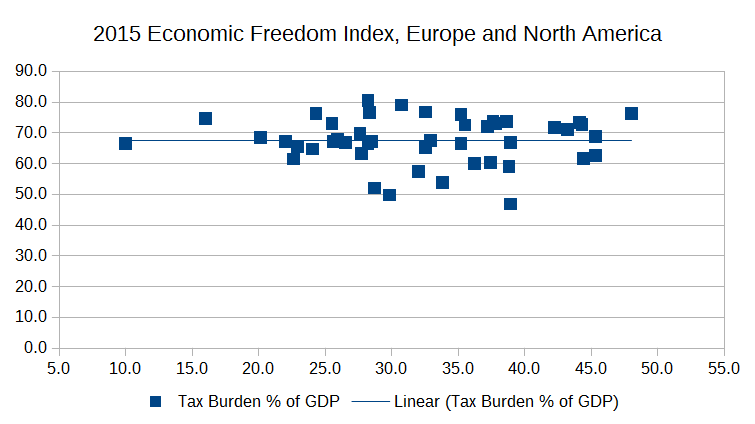
Indeed, if you restrict the sample to North America and Europe, the correlation basically disappears; all the countries are fairly free, all the taxes are fairly high, and within that the two aren’t very much related. (It’s been a long time since I’ve seen a trendline that flat, actually!)

Graph: Heritage Foundation Economic Freedom Index and tax burden, Europe and North America

Switzerland, Canada, and Denmark all have higher economic freedom scores than the United States, as well as higher tax burdens; but on the other hand, Greece, Spain, and Austria have higher tax burdens but lower freedom scores. All of them are variations on social democracy.

Is that socialism? I’m really not sure. Why does it matter, really?

Why did we ever privatize prisons?

JDN 2457103 EDT 10:24.

Since the Reagan administration (it’s always Reagan), the United States has undergone a spree of privatization of public services, in which services that are ordinarily performed by government agencies are instead contracted out to private companies. Enormous damage to our society has been done by this sort of privatization, from healthcare to parking meters.

This process can vary in magnitude.

The weakest form, which is relatively benign, is for the government to buy specific services like food service or equipment manufacturing from companies that already provide them to consumers. There’s no particular reason for the government to make their own toothpaste or wrenches rather than buy them from corporations like Proctor & Gamble and Sears. Toothpaste is toothpaste and wrenches are wrenches.

The moderate form is for the government to contract services to specific companies that may involve government-specific features like security clearances or powerful military weapons. This is already raising a lot of problems: When Northrop-Grumman makes our stealth bombers, and Boeing builds our nuclear ICBMs, these are publicly-traded, for-profit corporations manufacturing some of the deadliest weapons ever created—weapons that could literally destroy human civilization in a matter of minutes. Markets don’t work well in the presence of externalities, and weapons by definition are almost nothing but externalities; their entire function is to cause harm—typically, death—to people without their consent. While this violence may sometimes be justified, it must never be taken lightly; and we are right to be uncomfortable with the military-industrial complex whose shareholders profit from death and destruction. (Eisenhower tried to warn us!) Still, there are some good arguments to be made for this sort of privatization, since many of these corporations already have high-tech factories and skilled engineers that they can easily repurpose, and competitive bids between different corporations can keep the price down. (Of course, with no-bid contracts that no longer applies; and it certainly hasn’t stopped us from spending nearly as much on the military as the rest of the world combined.)

What I’d really like to focus on today is the strongest form of privatization, in which basic government services are contracted out to private companies. This is what happens when you attempt to privatize soldiers, SWAT teams, and prisons—all of which the United States has done since Reagan.

I say “attempt” to privatize because in a very real sense the privatization of these services is incoherent—they are functions so basic to government that simply to do them makes you, de facto, part of the government. (Or, if done without government orders, it would be organized crime.) All you’ve really done by “privatizing” these services is reduced their transparency and accountability, as well as siphoning off a portion of the taxpayer money in the form of profits for shareholders.

The benefits of privatization, when they exist, are due to competition and consumer freedom. The foundation of a capitalist economy is the ability to say “I’ll take my business elsewhere.” (This is why the notion that a bank can sell your loan to someone else is the opposite of a free market; forcing you to write a check to someone you never made a contract with is antithetical to everything the free market stands for.) Actually the closest thing to a successful example of privatized government services is the United States Postal Service, which collects absolutely no tax income. They do borrow from the government and receive subsidies for some of their services—but so does General Motors. Frankly I think the Postal Service has a better claim to privatization than GM, which you may recall only exists today because of a massive government bailout with a net cost to the US government of $11 billion. All the Postal Service does differently is act as a tightly-regulated monopoly that provides high-quality service to everyone at low prices and pays good wages and pensions, all without siphoning profits to shareholders. (They really screwed up my mail forwarding lately, but they are still one of the best postal systems in the world.) It is in many ways the best of both worlds, the efficiency of capitalism with the humanity of socialism.

The Corrections Corporation of America, on the other hand, is the exact opposite, the worst of both worlds, the inefficiency of socialism with the inhumanity of capitalism. It is not simply corrupt but frankly inherently corrupt—there is simply no way you can have a for-profit prison system that isn’t corrupt. Maybe it can be made less corrupt or more corrupt, but the mere fact that shareholders are earning profits from incarcerating prisoners is fundamentally antithetical to a free and just society.

I really can’t stress this enough: Privatizing soldiers and prisons makes no sense at all. It doesn’t even make sense in a world of infinite identical psychopaths; nothing in neoclassical economic theory in any way supports these privatizations. Neoclassical theory is based upon the presumption of a stable government that enforces property rights, a government that provides as much service as necessary exactly at cost and is not attempting to maximize any notion of its own “profit”.

That’s ridiculous, of course—much like the neoclassical rational agent—and more recent work has been done in public choice theory about the various interest groups that act against each other in government, including lobbyists for private corporations—but public choice theory is above all a theory of government failure. It is a theory of why governments don’t work as well as we would like them to—the main question is how we can suppress the influence of special interest groups to advance the public good. Privatization of prisons means creating special interest groups where none existed, making the government less directed at the public good.

Privatizing government services is often described as “reducing the size of government”, usually interpreted in the most narrow sense to mean the tax burden. But Big Government doesn’t mean you pay 22% of GDP instead of 18% of GDP; Big Government means you can be arrested and imprisoned without trial. Even using the Heritage Foundation’s metrics, the correlation between tax burden and overall freedom is positive. Tyrannical societies don’t bother with taxes; they own the oil refineries directly (Venezuela), or print money whenever they want (Zimbabwe), or build the whole society around doing what they want (North Korea).

The incarceration rate is a much better measure of a society’s freedom than the tax rate will ever be—and the US isn’t doing so well in that regard; indeed we have by some measures the highest incarceration rate in the world. Fortunately we do considerably better when it comes to things like free speech and freedom of religion—indeed we are still above average in overall freedom. Though we do imprison more of our people than China, I’m not suggesting that China has a freer society. But why do we imprison so many people?

Well, it seems to have something to do with privatization of prisons. Indeed, there is a strong correlation between the privatization of US prisons and the enormous explosion of incarceration in the United States. In fact privatized prisons don’t even reduce the tax burden, because privatization does not decrease demand and “privatized” prisons must still be funded by taxes. Prisons do not have customers who choose between different competing companies and shop for the highest quality and lowest price—prisoners go to the prison they are assigned to and they can’t leave (which is really the whole point). Even competition at the purchase end doesn’t make much sense, since the government can’t easily transfer all the prisoners to a new company. Maybe they could transfer ownership of the prison to a different company, but even then the transition costs would be substantial, and besides, there are only a handful of prison corporations that corner most of the (so-called) market.

There is simply no economic basis for privatization of prisons. Nothing in either neoclassical theory or more modern cognitive science in any way supports the idea. So the real question is: Why did we ever privatize prisons?

Basically there is only one reason: Ideology. The post-Reagan privatization spree was not actually based on economics—it was based on economic ideology. Either because they actually believed it, or by the Upton Sinclair Principle, a large number of economists adopted a radical far-right ideology that government basically should not exist—that the more we give more power to corporations and less power to elected officials the better off we will be.

They defended this ideology on vaguely neoclassical grounds, mumbling something about markets being more efficient; but this isn’t even like cutting off the wings of the airplane because we’re assuming frictionless vacuum—it’s like cutting off the engines of the airplane because we simply hate engines and are looking for any excuse to get rid of them. There is absolutely nothing in neoclassical economic theory that says it would be efficient or really beneficial in any way to privatize prisons. It was all about taking power away from the elected government and handing it over to for-profit corporations.

This is a bit of consciousness-raising I’m trying to do: Any time you hear someone say that something should be apolitical, I want you to substitute the word undemocratic. When they say that judges shouldn’t be elected so that they can be apolitical—they mean undemocratic. When they say that the Federal Reserve should be independent of politics—they mean independent of voting. They want to take decision power away from the public at large and concentrate it more in the hands of an elite. People who say this sort of thing literally do not believe in democracy.

To be fair, there may actually be good reasons to not believe in democracy, or at least to believe that democracy should be constrained by a constitution and a system of representation. Certain rights are inalienable, regardless of what the voting public may say, which is why we need a constitution that protects those rights above all else. (In theory… there’s always the PATRIOT ACT, speaking of imprisoning people without trial.) Moreover, most people are simply not interested enough—or informed enough—to vote on every single important decision the government makes. It makes sense for us to place this daily decision-making power in the hands of an elite—but it must be an elite we choose.

And yes, people often vote irrationally. One of the central problems in the United States today is that almost half the population consistently votes against rational government and their own self-interest on the basis of a misguided obsession with banning abortion, combined with a totally nonsensical folk theory of economics in which poor people are poor because they are lazy, the government inherently destroys whatever wealth it touches, and private-sector “job creators” simply hand out jobs to other people because they have extra money lying around. Then of course there’s—let’s face it—deep-seated bigotry toward women, racial minorities, and LGBT people. (The extreme hatred toward Obama and suspicion that he isn’t really born in the US really can’t be explained any other way.) In such circumstances it may be tempting to say that we should give up on democracy and let expert technocrats take charge; but in the absence of democratic safeguards, technocracy is little more than another name for oligarchy. Maybe it’s enough that the President appoints the Federal Reserve chair and the Supreme Court? I’m not so sure. Ben Bernanke definitely handled the Second Depression better than Congress did, I’ll admit; but I’m not sure Alan Greenspan would have in his place, and given his babbling lately about returning to Bretton Woods I’m pretty sure Paul Volcker wouldn’t have. (If you don’t see what’s wrong with going back to Bretton Woods, which was basically a variant of the gold standard, you should read what Krugman has to say about the gold standard.) So basically we got lucky and our monetary quasi-tyrant was relatively benevolent and wise. (Or maybe Bernanke was better because Obama appointed him, while Reagan appointed Greenspan. Carter appointed Volcker, oddly enough; but Reagan reappointed him. It’s always Reagan.) And if you could indeed ensure that tyrants would always be benevolent and wise, tyranny would be a great system—but you can’t.

Democracy doesn’t always lead to the best outcomes, but that’s really not what it’s for. Rather, democracy is for preventing the worst outcomes—no large-scale famine has ever occurred under a mature democracy, nor has any full-scale genocide. Democracies do sometimes forcibly “relocate” populations (particularly indigenous populations, as the US did under Andrew Jackson), and we should not sugar-coat that; people are forced out of their homes and many die. It could even be considered something close to genocide. But no direct and explicit mass murder of millions has ever occurred under a democratic government—no, the Nazis were not democratically elected—and that by itself is a fully sufficient argument for democracy. It could be true that democracies are economically inefficient (they are economically efficient), unbearably corrupt (they are less corrupt), and full of ignorant idiotic hicks (they have higher average educational attainment), and democracy would still be better simply because it prevents famine and genocide. As Churchill said, “Democracy is the worst system, except for all the others.”

Indeed, I think the central reason why American democracy isn’t working well right now is that it’s not very democratic; a two-party system with a plurality “first-past-the-post” vote is literally the worst possible voting system that can still technically be considered democracy. Any worse than that and you only have one party. If we had a range voting system (which is mathematically optimal) and say a dozen parties (they have about a dozen parties in France), people would be able to express their opinions more clearly and in more detail, with less incentive for strategic voting. We probably wouldn’t have such awful turnout at that point, and after realizing that they actually had such a strong voice, maybe people would even start educating themselves about politics in order to make better decisions.

Privatizing prisons and soldiers takes us in exactly the opposite direction: It makes our government deeply less democratic, fundamentally less accountable to voters. It hands off the power of life and death to institutions whose sole purpose for existence is their own monetary gain. We should never have done it—and we must undo it as soon as we possibly can.

How is the economy doing?

JDN 2457033 EST 12:22.

Whenever you introduce yourself to someone as an economist, you will typically be asked a single question: “How is the economy doing?” I’ve already experienced this myself, and I don’t have very many dinner parties under my belt.

It’s an odd question, for a couple of reasons: First, I didn’t say I was a macroeconomic forecaster. That’s a very small branch of economics—even a small branch of macroeconomics. Second, it is widely recognized among economists that our forecasters just aren’t very good at what they do. But it is the sort of thing that pops into people’s minds when they hear the word “economist”, so we get asked it a lot.

Why are our forecasts so bad? Some argue that the task is just inherently too difficult due to the chaotic system involved; but they used to say that about weather forecasts, and yet with satellites and computer models our forecasts are now far more accurate than they were 20 years ago. Others have argued that “politics always dominates over economics”, as though politics were somehow a fundamentally separate thing, forever exogenous, a parameter in our models that cannot be predicted. I have a number of economic aphorisms I’m trying to popularize; the one for this occasion is: “Nothing is exogenous.” (Maybe fundamental constants of physics? But actually many physicists think that those constants can be derived from even more fundamental laws.) My most common is “It’s the externalities, stupid.”; next is “It’s not the incentives, it’s the opportunities.”; and the last is “Human beings are 90% rational. But woe betide that other 10%.” In fact, it’s not quite true that all our macroeconomic forecasters are bad; a few, such as Krugman, are actually quite good. The Klein Award is given each year to the best macroeconomic forecasters, and the same names pop up too often for it to be completely random. (Sadly, one of the most common is Citigroup, meaning that our banksters know perfectly well what they’re doing when they destroy our economy—they just don’t care.) So in fact I think our failures of forecasting are not inevitable or permanent.

And of course that’s not what I do at all. I am a cognitive economist; I study how economic systems behave when they are run by actual human beings, rather than by infinite identical psychopaths. I’m particularly interested in what I call the tribal paradigm, the way that people identify with groups and act in the interests of those groups, how much solidarity people feel for each other and why, and what role ideology plays in that identification. I’m hoping to one day formally model solidarity and make directly testable predictions about things like charitable donations, immigration policies and disaster responses.

I do have a more macroeconomic bent than most other cognitive economists; I’m not just interested in how human irrationality affects individuals or corporations, I’m also interested in how it affects society as a whole. But unlike most macroeconomists I care more about inequality than unemployment, and hardly at all about inflation. Unless you start getting 40% inflation per year, inflation really isn’t that harmful—and can you imagine what 40% unemployment would be like? (Also, while 100% inflation is awful, 100% unemployment would be no economy at all.) If we’re going to have a “misery index“, it should weight unemployment at least 10 times as much as inflation—and it should also include terms for poverty and inequality. Frankly maybe we should just use poverty, since I’d be prepared to accept just about any level of inflation, unemployment, or even inequality if it meant eliminating poverty. This is of course is yet another reason why a basic income is so great! An anti-poverty measure can really only be called a failure if it doesn’t actually reduce poverty; the only way that could happen with a basic income is if it somehow completely destabilized the economy, which is extremely unlikely as long as the basic income isn’t something ridiculous like $100,000 per year.

I could probably talk about my master’s thesis; the econometric models are relatively arcane, but the basic idea of correlating the income concentration of the top 1% of 1% and the level of corruption is something most people can grasp easily enough.

Of course, that wouldn’t be much of an answer to “How is the economy doing?”; usually my answer is to repeat what I’ve last read from mainstream macroeconomic forecasts, which is usually rather banal—but maybe that’s the idea? Most small talk is pretty banal I suppose (I never was very good at that sort of thing). It sounds a bit like this: No, we’re not on the verge of horrible inflation—actually inflation is currently too low. (At this point someone will probably bring up the gold standard, and I’ll have to explain that the gold standard is an unequivocally terrible idea on so, so many levels. The gold standard caused the Great Depression.) Unemployment is gradually improving, and actually job growth is looking pretty good right now; but wages are still stagnant, which is probably what’s holding down inflation. We could have prevented the Second Depression entirely, but we didn’t because Republicans are terrible at managing the economy—all of the 10 most recent recessions and almost 80% of the recessions in the last century were under Republican presidents. Instead the Democrats did their best to implement basic principles of Keynesian macroeconomics despite Republican intransigence, and we muddled through. In another year or two we will actually be back at an unemployment rate of 5%, which the Federal Reserve considers “full employment”. That’s already problematic—what about that other 5%?—but there’s another problem as well: Much of our reduction in unemployment has come not from more people being employed but instead by more people dropping out of the labor force. Our labor force participation rate is the lowest it’s been since 1978, and is still trending downward. Most of these people aren’t getting jobs; they’re giving up. At best we may hope that they are people like me, who gave up on finding work in order to invest in their own education, and will return to the labor force more knowledgeable and productive one day—and indeed, college participation rates are also rising rapidly. And no, that doesn’t mean we’re becoming “overeducated”; investment in education, so-called “human capital”, is literally the single most important factor in long-term economic output, by far. Education is why we’re not still in the Stone Age. Physical capital can be replaced, and educated people will do so efficiently. But all the physical capital in the world will do you no good if nobody knows how to use it. When everyone in the world is a millionaire with two PhDs and all our work is done by robots, maybe then you can say we’re “overeducated”—and maybe then you’d still be wrong. Being “too educated” is like being “too rich” or “too happy”.

That’s usually enough to placate my interlocutor. I should probably count my blessings, for I imagine that the first confrontation you get at a dinner party if you say you are a biologist involves a Creationist demanding that you “prove evolution”. I like to think that some mathematical biologists—yes, that’s a thing—take their request literally and set out to mathematically prove that if allele distributions in a population change according to a stochastic trend then the alleles with highest expected fitness have, on average, the highest fitness—which is what we really mean by “survival of the fittest”. The more formal, the better; the goal is to glaze some Creationist eyes. Of course that’s a tautology—but so is literally anything that you can actually prove. Cosmologists probably get similar demands to “prove the Big Bang”, which sounds about as annoying. I may have to deal with gold bugs, but I’ll take them over Creationists any day.

What do other scientists get? When I tell people I am a cognitive scientist (as a cognitive economist I am sort of both an economist and a cognitive scientist after all), they usually just respond with something like “Wow, you must be really smart.”; which I suppose is true enough, but always strikes me as an odd response. I think they just didn’t know enough about the field to even generate a reasonable-sounding question, whereas with economists they always have “How is the economy doing?” handy. Political scientists probably get “Who is going to win the election?” for the same reason. People have opinions about economics, but they don’t have opinions about cognitive science—or rather, they don’t think they do. Actually most people have an opinion about cognitive science that is totally and utterly ridiculous, more on a par with Creationists than gold bugs: That is, most people believe in a soul that survives after death. This is rather like believing that after your computer has been smashed to pieces and ground back into the sand from whence it came, all the files you had on it are still out there somewhere, waiting to be retrieved. No, they’re long gone—and likewise your memories and your personality will be long gone once your brain has rotted away. Yes, we have a soul, but it’s made of lots of tiny robots; when the tiny robots stop working the soul is no more. Everything you are is a result of the functioning of your brain. This does not mean that your feelings are not real or do not matter; they are just as real and important as you thought they were. What it means is that when a person’s brain is destroyed, that person is destroyed, permanently and irrevocably. This is terrifying and difficult to accept; but it is also most definitely true. It is as solid a fact as any in modern science. Many people see a conflict between evolution and religion; but the Pope has long since rendered that one inert. No, the real conflict, the basic fact that undermines everything religion is based upon, is not in biology but in cognitive science. It is indeed the Basic Fact of Cognitive Science: We are our brains, no more and no less. (But I suppose it wouldn’t be polite to bring that up at dinner parties.)

The “You must be really smart.” response is probably what happens to physicists and mathematicians. Quantum mechanics confuses basically everyone, so few dare go near it. The truly bold might try to bring up Schrodinger’s Cat, but are unlikely to understand the explanation of why it doesn’t work. General relativity requires thinking in tensors and four-dimensional spaces—perhaps they’ll be asked the question “What’s inside a black hole?”, which of course no physicist can really answer; the best answer may actually be, “What do you mean, inside?” And if a mathematician tries to explain their work in lay terms, it usually comes off as either incomprehensible or ridiculous: Stokes’ Theorem would be either “the integral of a differential form over the boundary of some orientable manifold is equal to the integral of its exterior derivative over the whole manifold” or else something like “The swirliness added up inside an object is equal to the swirliness added up around the edges.”

Economists, however, always seem to get this one: “How is the economy doing?”

Right now, the answer is this: “It’s still pretty bad, but it’s getting a lot better. Hopefully the new Congress won’t screw that up.”

What just happened in that election?

JDN 2456970 PST 11:12.

My head is still spinning from the election results on Tuesday. Republicans gained a net of 12 seats to secure their majority in the House. Even worse, Republicans gained at least 7 seats in the Senate (note that each Senate seat should count for 4.35 House seats because there are 100 Senators and 435 Representatives) and may gain two more depending on how runoffs go. This gives them a majority in both houses of Congress. So people like Republicans then? Maybe they’re fed up with Obama and dissatisfied with his handling of the economy (even though it has actually been spectacular given what he had to work with).
But then when we look at actual ballot proposals, the ones that passed were mostly liberal issues. California passed proposition 47, which will reduce sentences for minor drug and theft crimes and substantially reduce our incidence of incarceration. (There’s no sign of releasing current prisoners, unfortunately; but at least we won’t be adding as many new ones.) Marijuana was legalized—fully legalized, for all purposes—in Alaska, Oregon, and DC, further reducing incarceration. At last, the US may finally stop being the incarceration capitol of the world! We currently hold the title in both per-capita and total incarceration, so there can be no dispute. (Technically the Seychelles has a higher per-capita rate, but come on, they don’t count as a real country; they have a population smaller than Ann Arbor—or for that matter the annual throughput of Riker’s Island.)

The proposals to allow wolf hunting in Michigan failed, for which many wolves would thank you if they could. Minimum wages were raised in five states, four of which are Republican-leaning states. The most extreme minimum wage hike was in San Francisco, where the minimum wage is going to be raised as high as $18 over the next four years. So people basically agree with Democrats on policy, but decided to hand the Senate over to Republicans.

I think the best explanation for what happened is the voting demographics. When we have a Senate election, we aren’t sampling randomly from the American population; we’re pulling from specific states, and specific populations within those states. Geography played a huge role in these election results. So did age; the voting population was much older on average than the general population, because most young people simply didn’t vote. I know some of these young people, who tell me things like “I’m not voting because I won’t be part of that system!” Apparently their level of understanding of social change approaches that of the Lonely Island song “I Threw it on the Ground”. Not voting isn’t rebellion, it’s surrender. (I’m not sure who said that first, but it’s clearly right.) Rebellion would be voting for a radical third-party candidate, or running as one yourself. Rebellion would be leading rallies to gather support—that is, votes—for that candidate. Alternatively, you could say that rebellion is too risky and simply aim for reform, in which case you’d vote for Democrats as I did.

Your failure to vote did not help change that system. On the contrary, it was because of your surrender that we got two houses of Congress controlled by Republicans who have veered so far to the right they are bordering on fascism and feudalism. It is strange living in a society where the “mainstream” has become so extremist. You end up feeling like a radical far-left Marxist when in fact you agree—as I do—with the core policies of FDR or even Eisenhower. You have been told that the right is capitalism and the left is socialism; this is wrong. The left is capitalism; the right is feudalism. When I tell you I want a basic income funded by a progressive income tax, I am agreeing with Milton Friedman.

This must be how it feels to be a secularist in an Islamist theocracy like Iran. Now that Colorado has elected a state legislator who is so extreme that he literally has performed exorcisms to make people not gay or transgender (his name is apparently Gordon Klingenschmitt), I fear we’re dangerously on the verge of a theocracy of our own.

Of course, I shouldn’t just blame the people who didn’t vote; I should also blame the people who did vote, and voted for candidates who are completely insane. Even though it’s just a state legislature, tens of thousands of people voted for that guy in Colorado; tens of thousands of Americans were okay with the fact that he thinks gay and transgender people have demons inside us that need to be removed by exorcism. Even in Iran theocracy is astonishingly popular. People are voting for these candidates, and we must find out why and change their minds. We must show them that the people they are voting for are not going to make good decisions that benefit America, they are going to make selfish decisions that benefit themselves or their corporate cronies, or even just outright bad decisions that hurt everyone. As an example of the latter (which is arguably worse), there is literally no benefit to discrimination against women or racial minorities or LGBT people. It’s just absolute pure deadweight loss that causes massive harm without any benefit at all. It’s deeply, deeply irrational, and one of the central projects of cognitive economics must be figuring out what makes people discriminate and figuring out how to make them stop.

To be fair, some of the candidates that were elected are not so extreme. Tom Cotton of Arkansas (whose name is almost offensively down-homey rural American; I don’t think I could name a character that in a novel without people thinking it was satire) supported the state minimum wage increase and is sponsoring a bill that would ban abortions after 20 weeks, which is actually pretty reasonable, rather than at conception, which is absurd.

Thom Tillis of North Carolina is your standard old rich White male corporate stooge, but I don’t see anything in his platform that is particularly terrifying. David Perdue of Georgia is the same; he’s one of those business owners who thinks he knows how to run the economy because he can own a business while it makes money. (Even if he did have something to do with the profitability of the business—which is not entirely clear—that’s still like a fighter pilot saying he’s a great aerospace engineer.) Cory Gardner is similar (not old, but rich White male corporate stooge), but he’s scary simply because he came from the Colorado state legislature, where they just installed that exorcist guy.

Thad Cochran of Mississippi was re-elected, so he was already there; he generally votes along whatever lines the Republican leadership asks him to, so he is not so much a villain as a henchman. Shelley Moore Capito of West Virginia also seems to basically vote whatever the party says.

Joni Ernst of Iowa is an interesting character; despite being a woman, she basically agrees with all the standard Republican positions, including those that are obviously oppressive of women. She voted for an abortion ban at conception, which is totally different from what Cotton wants. She even takes the bizarre confederalist view of Paul Ryan that a federal minimum wage is “big government” but a state minimum wage is just fine. The one exception is that she supports reform of sexual harassment policy in the military, probably because she experienced it herself.

But I’m supposed to be an economist, so what do I think is going to happen to the economy? (Of course, don’t forget, the economy is made of people. One of the best things that can ever happen to an economy is the empowerment of women, racial minorities, and LGBT people, all of which are now in jeopardy under a Republican Congress.)

The best-case scenario is “not much”; the obstructionism continues, and despite an utterly useless government the market repairs itself as it will always do eventually. Job growth will continue at its slow but steady pace, GDP will get back to potential trend. Inequality will continue to increase as it has been doing for about 30 years now. In a couple years there will be another election and hopefully Republicans will lose their majority.

The worst-case scenario is “Republicans get what they want”. The budget will finally be balanced—by cutting education, infrastructure, and social services. Then they’ll unbalance it again by cutting taxes on the rich and starting a couple more wars, because that kind of government spending doesn’t count. (They are weaponized Keynesians all.) They’ll restrict immigration even though immigration is what the First World needs right now (not to mention the fact that the people coming here need it even more). They’ll impose draconian regulations on abortion, they’ll stop or reverse the legalization of marijuana and same-sex marriage.

Democrats must not cave in to demands for “compromise” and “bipartisanship”. If the Republicans truly believed in those things, they wouldn’t have cost the economy $24 billion and downgraded the credit rating of the US government by their ridiculous ploy to shut down the government. They wouldn’t have refused to deal until the sequester forced nonsensical budget cuts. They wouldn’t make it a central part of their platform to undermine or repeal the universal healthcare system that they invented just so that Democrats can’t take credit for it. They have become so committed to winning political arguments at any cost that they are willing to do real harm to America and its people in order to do it. They are overcome by the tribal paradigm, and we all suffer for it.

No, the Republicans in Congress today are like 3-year-olds who throw a tantrum when they don’t get everything exactly their way. You can’t negotiate with these people, you can’t compromise with them. I wish you could, I really do. I’ve heard of days long gone when Congress actually accomplished things, but I have only vague recollections, for I was young in the Clinton era. (I do remember times under Bush II when Congress did things, but they were mostly bad things.) Maybe if we’re firm enough or persuasive enough some of them will even come around. But the worst thing Democrats could do right now is start caving to Republican demands thinking that it will restore unity to our government—because that unity would come only at the price of destroying people’s lives.

Unfortunately I fear that Democrats will appease Republicans in this way, because they’ve been doing that so far. In the campaign, hardly any of the Democrats mentioned Obama’s astonishing economic record or the numerous benefits of Obamacare—which by the way is quite popular among its users, at least more so than getting rid of it entirely (most people want to fix it, not eliminate it). Most of the Democratic candidates barely ran a campaign deserving of the name.

To be clear: Do not succumb to the tribal paradigm yourself. Do not think that everyone who votes Republican is a bad person—the vast majority are good people who were misled. Do not even assume that every Republican politician is evil; a few obviously are (see also Dick Cheney), but most are actually not so much evil as blinded by the ideology of their tribe. I believe that Paul Ryan and Rand Paul think that what they do is in the best interests of America; the problem is not their intentions but their results and their unwillingness to learn from those results. We do need to find ways to overcome partisanship and restore unity and compromise—but we must not simply bow to their demands in order to do that.

Democrats: Do not give in. Stand up for your principles. Every time you give in to their obstructionism, you are incentivizing that obstructionism. And maybe next election you could actually talk about the good things your party does for people—or the bad things their party does—instead of running away from your own party and apologizing for everything?