Just give people money!

JDN 2457332 EDT 17:02.

Today is the Fifth of November, on which a bunch of people who liked a Hollywood movie start posting images in support of a fanatical religious terrorist in his plot to destroy democracy in the United Kingdom a few centuries ago. It’s really weird, but I’m not particularly interested in that.

Instead I’d like to talk about the solution to poverty, which we’ve known for a long time—in fact, it’s completely obvious—and yet have somehow failed to carry out. Many people doubt that it even works, not based on the empirical evidence, but because it just feels like it can’t be right, like it’s so obvious that surely it was tried and didn’t work and that’s why we moved on to other things. When you first tell a kindergartner that there are poor people in the world, that child will very likely ask: “Why don’t we just give them some money?”

Why not indeed?

Formally this is called a “direct cash transfer”, and it comes in many different variants, but basically they run along a continuum from unconditional—we just give it to everybody, no questions asked—to more and more conditional—you have to be below a certain income, or above a certain age, or have kids, or show up at our work program, or take a drug test, etc. The EU has a nice little fact sheet about the different types of cash transfer programs in use.

Actually, I’d argue that at the very far extreme is government salaries—the government will pay you $40,000 per year, provided that you teach high school every weekday. We don’t really think of that as a “conditional cash transfer” because it involves you providing a useful service (and is therefore more like an ordinary, private-sector salary), but many of the conditions imposed on cash transfers actually have this sort of character—we want people to do things that we think are useful to society, in order to justify us giving them the money. It really seems to be a continuum, from just giving money to everyone, to giving money to some people based on them doing certain things, to specifically hiring people to do something.

Social programs in different countries can be found at different places on this continuum. In the United States, our programs are extremely conditional, and also the total amount we give out is relatively small. In Europe, programs are not as conditional—though still conditional—and they give out more. And sure enough, after-tax poverty in Europe is considerably lower, even though before-tax poverty is about the same.

In fact, the most common way to make transfers conditional is to make them “in-kind”; instead of giving you money, we give you something—healthcare, housing, food. Sometimes this makes sense; actually I think for healthcare it makes the most sense, because price signals don’t work in a market as urgent and inelastic as healthcare (that is, you don’t shop around for an emergency room—in fact, people don’t even really shop around for a family doctor). But often it’s simply a condition we impose for political reasons; we don’t want those “lazy freeloaders” to do anything else with the money that we wouldn’t like, such as buying alcohol or gambling. Even poor people in India buy into this sort of reasoning. Nevermind that they generally don’t do that, or that they could just shift away spending they would otherwise be making (warning: technical economics paper within) to do those things anyway—it’s the principle of the thing.

Direct cash transfers not only work—they work about as well as the best things we’ve tried. Spending on cash transfers is about as cost-effective as spending on medical aid and malaria nets.

Other than in experiments (the largest of which I’m aware of was a town in Canada, unless you count Alaska’s Permanent Fund Dividend, which is unconditional but quite small), we have never really tried implementing a fully unconditional cash transfer system. “Too expensive” is usually the complaint, and it would indeed be relatively expensive (probably greater than all of what we currently spend on Social Security and Medicare, which are two of our biggest government budget items). Implementing a program with a cost on the order of $2 trillion per year is surely not something to be done lightly. But it would have one quite substantial benefit: It would eliminate poverty in the United States immediately and forever.

This is why I really like the “abolish poverty” movement; we must recognize that at our current level of economic development, poverty is no longer a natural state, a complex problem to solve. It is a policy decision that we are making. We are saying, as a society, that we would rather continue to have poverty than spend that $2 trillion per year, about 12% of our $17.4 trillion GDP. We are saying that we’d rather have people who are homeless and starving than lose 12 cents of every dollar we make. (To be fair, if we include the dynamic economic impact of this tax-and-transfer system it might actually turn out to be more than that; but it could in fact be less—the increased spending would boost the economy, just as the increased taxes would restrain it—and seems very unlikely to be more than 20% of GDP.)

For most of human history—and in most countries today—that is not the case. India could not abolish poverty immediately by a single tax policy; nor could China. Probably not Brazil either. Maybe Greece could do it, but then again maybe not. But Germany could; the United Kingdom could; France could; and we could in the United States. We have enough wealth now that with a moderate increase in government spending we could create an economic floor below which no person could fall. It is incumbent upon us at the very least to justify why we don’t.

I have heard it said that poverty is not a natural condition, but the result of human action. Even Nelson Mandela endorsed this view. This is false, actually. In general, poverty is the natural condition of all life forms on Earth (and probably all life forms in the universe). Natural selection evolves us toward fitting as many gene-packages into the environment as possible, not toward maximizing the happiness of the sentient beings those gene-packages may happen to be. To a first approximation, all life forms suffer in poverty.

We live at a unique time in human history; for no more than the last century—and perhaps not even that—we have actually had so much wealth that we could eliminate poverty by choice. For hundreds of thousands of years human beings toiled in poverty because there was no such choice. Perhaps good policy in Greece could end poverty today, but it couldn’t have during the reign of Pericles. Good policy in Italy could end poverty now, but not when Caesar was emperor. Good policy in the United Kingdom could easily end poverty immediately, but even under Queen Victoria that wasn’t feasible.

Maybe that’s why we aren’t doing it? Our cultural memory was forged in a time decades or centuries ago, before we had this much wealth to work with. We speak of “end world hunger” in the same breath as “cure cancer” or “conquer death”, a great dream that has always been impossible and perhaps still is—but in fact we should speak of it in the same breath as “split the atom” and “land on the Moon”, seminal achievements that our civilization is now capable of thanks to economic and technological revolution.

Capitalism also seems to have a certain momentum to it; once you implement a market economy that maximizes wealth by harnessing self-interest, people seem to forget that we are fundamentally altruistic beings. I may never forget that economist who sent me an email with “altruism” in scare quotes, as though it was foolish (or at best imprecise) to say that human beings care about one another. But in fact we are the most altruistic species on Earth, without question, in a sense so formal and scientific it can literally be measured quantitatively.

There are real advantages to harnessing self-interest—not least, I know my own interests considerably better than I know yours, no matter who you are—and that is part of how we have achieved this great level of wealth (though personally I think science, democracy, and the empowerment of women are the far greater causes of our prosperity). But we must not let it forget us why we wanted to have wealth in the first place: Not to concentrate power in a handful of individuals who will pass it on to their heirs; not to “maximize work incentives”; not to give us the fanciest technological gadgets. The reason we wanted to have wealth was so that we could finally free ourselves from the endless toil that was our lot by birth and that of all other beings—to let us finally live, instead of merely survive. There is a peak to Maslow’s pyramid, and we could stand there now, together; but we must find the will to give up that 12 cents of every dollar.

Meanwhile, we’ve been ending world hunger.

JDN 2457303 EDT 19:56

As reported in The Washington Post and Fortune, the World Bank recently released a report showing that for the first time on record—possibly the first time in human history—global extreme poverty has fallen below 10% of the population. Based on a standard of living of $1.90 per day at 2011 purchasing power parity—that’s about $700 per year, a bit less than the average income in Malawi.

The UN World Millennium Development Goal set in 1990 was to cut extreme poverty in half by 2015; in fact we have cut it by more than two-thirds, reducing it from 37% of the world’s population in 1990 to 9.6% today. This is an estimate, based upon models of what’s going on in countries where we don’t have reliable data; ever the cautious scientists, the World Bank prefers to focus on the most recent fully reliable data, which says that we reduced extreme poverty to 12.7% in 2012 and therefore achieved the Millennium Development Goal.

Most of this effect comes from one very big country: China. Over 750 million people in China saw their standard of living rise above the extreme poverty level in the last 30 years.
The slowest reduction in poverty has been in Africa, specifically Sub-Saharan Africa, where extreme poverty has barely budged, from 53% in 1981 to 47% in 2011. But some particular countries in Africa have done better; thanks to good governance—including better free speech protection than the United States, shame on us—Botswana has reduced their extreme poverty rate from over 50% in 1965 to 19% today.

A lot of World Bank officials have been focusing on the fact that there is still much to be done; 10% in extreme poverty is still 10% too many, and even once everyone is above $1.90 per day that still leaves a lot of people at $3 per day and $4 per day which is still pretty darn poor. The project of global development won’t really seem complete until everyone in the world lives above not just the global poverty line, but something more like a First World poverty line, with a home to live in, a doctor to see, a school to attend, clean water, flush toilets, electricity, and probably even a smartphone with Internet access. (If the latter seems extravagant, let me remind you that more people in the world have smartphones than have flush toilets, because #weliveinthefuture.)

Pace the Heritage Foundation, the fact that what we call poverty in America typically includes having a refrigerator, a microwave, and a car doesn’t mean it isn’t actually poverty; it simply means that poverty in the First World isn’t nearly as bad as poverty in the Third World. (After all, over 9% of children in the US live in households with low food security, and 1% live in households with very low food security; hunger in America isn’t as bad as hunger in Malawi, but it’s still hunger.) Maybe it even means we should focus on the Third World, though that argument isn’t as strong as it might appear; to eliminate poverty in the US, all we’d need to do is pass a law that implements a basic income. To eliminate poverty worldwide, we’d need a global project of economic and political reforms to change how hundreds of countries are governed.

Yet, this focus on what we haven’t accomplished (as though we were going to cut funding to the UN Development Program because we’re done now or something) is not only disheartening, it’s unreasonable. We have accomplished something truly spectacular.

We are now on the verge of solving on one of the great problems of human existence, a problem so deep, so ancient, and so fundamental that it’s practically a cliche: We say “end world hunger” in the same breath as “cure cancer” (which doesn’t even make sense) or “conquer death” (which is not as far off as you may think). Yet, in a very real sense, we are on the verge of ending world hunger.

While most people have been focused on other things, from a narcissistic billionaire running for President to the uniquely American tragedy of mass shootings, development economists have been focused on one thing: Conquering global poverty. What this report means is that now, at last, victory is within our grasp.

Development economists are unsung heroes; without their research, their field work, and their advice and pressure to policymakers, we would never have gotten this far. It was development economists who made the UN Millennium Development Goals, and development economists who began to achieve them.

Yet perhaps there is an even more unsung hero in all of this: Capitalism.

I often have a lot of criticisms of capitalism, at least as it operates in the real world; yet it was in the real world that extreme poverty was just brought down below 10%, and it was done primarily by capitalism. I know a lot of people who think that we need to tear down this whole system and replace it with something fundamentally different, but the kind of progress we are making in global development tells me that we need nothing of the sort. We do need to make changes in policy, but they are small changes, simple changes—many of them could be made with the passing of a few simple laws. Capitalism is not fundamentally broken; on the contrary, it is the fundamentals of capitalism that have brought humanity for the first time within arm’s reach of ending world hunger. We need to fix the system at the edges, not throw it away.

Recall that I said most of the poverty reduction occurred in China. What has China been doing lately? They’ve been opening to world trade—that “free trade” stuff I talked about before. They’ve been cutting tariffs. They’ve been privatizing industries. They’ve been letting unprofitable businesses fail so that new ones can rise in their place. They have, in short, been making themselves more capitalist. Building schools, factories, and yes, even sweatshops is what has made China’s rise out of poverty possible. They are still doing many things wrong—not least their authoritarian government, which is now gamifying oppression in truly cyberpunk fashion—but they are doing a few very important things right.

World hunger is on the way out. And I can think of no better reason to celebrate.

9/11, 14 years on—and where are our civil liberties?

JDN 2457278 (09/11/2015) EDT 20:53

Today is the 14th anniversary of the 9/11 attacks. A lot has changed since then—yet it’s quite remarkable what hasn’t. In particular, we still don’t have our civil liberties back.

In our immediate panicked response to the attacks, the United States passed almost unanimously the USA PATRIOT ACT, giving unprecedented power to our government in surveillance, searches, and even arrests and detentions. Most of those powers have been renewed repeatedly and remain in effect; the only major change has been a slight weakening of the NSA’s authority to use mass dragnet surveillance on Internet traffic and phone metadata. And this change in turn was almost certainly only made because of Edward Snowden, who is still forced to live in Russia for fear of being executed if he returns to the US. That is, the man most responsible for the only significant improvement in civil liberties in the United States in the last decade is living in Russia because he has been branded a traitor. No, the traitors here are the over one hundred standing US Congress members who voted for an act that is in explicit and direct violation of the Constitution. At the very least every one of them should be removed from office, and we as voters have the power to do that—so why haven’t we? In particular, why are Dan Lipinski and Steny Hoyer, both Democrats from non-southern states who voted every single time to extend provisions of the PATRIOT ACT, still in office? At least Carl Levin had the courtesy to resign after sponsoring the act allowing indefinite detention—I hope we would have voted him out anyway, since I’d much rather have a Republican (and all the absurd economic policy that entails) than someone who apparently doesn’t believe the Fourth and Sixth Amendments have any meaning at all.

We have become inured to this loss of liberty; it feels natural or inevitable to us. But these are not minor inconveniences; they are not small compromises. Giving our government the power to surveil, search, arrest, imprison, torture, and execute anyone they want at any time without the system of due process—and make no mistake, that is what the PATRIOT ACT and the indefinite detention law do—means giving away everything that separates us from tyranny. Bypassing the justice system and the rule of law means bypassing everything that America stands for.

So far, these laws have actually mostly been used against people reasonably suspected of terrorism, that much is true; but it’s also irrelevant. Democracy doesn’t mean you give the government extreme power and they uphold your trust and use it benevolently. Democracy means you don’t give them that power in the first place.

If there’s really sufficient evidence to support an arrest for terrorism, get a warrant. If you don’t have enough evidence for a warrant, you don’t have enough evidence for an arrest. If there’s really sufficient evidence to justify imprisoning someone for terrorism, get a jury to convict. If you don’t have enough evidence to convince a jury, guess what? You don’t have enough evidence to imprison them. These are not negotiable. They are not “political opinions” in any ordinary sense. The protection of due process is so fundamental to democracy that without it political opinions lose all meaning.

People talk about “Big Government” when we suggest increasing taxes on capital gains or expanding Medicare. No, that isn’t Big Government. Searching without warrants is Big Government. Imprisoning people without trial is Big Government. From all the decades of crying wolf in which any policy someone doesn’t like is accused of being “tyranny”, we seem to have lost the ability to recognize actual tyranny. I hope you understand the full force of my meaning when I say that the PATRIOT ACT is literally fascist. Fascism has come to America, and as predicted it was wrapped in the flag and carrying a cross.

In this sort of situation, a lot of people like to quote (or misquote) Benjamin Franklin:

“Those who would give up essential Liberty, to purchase a little temporary Safety, deserve neither Liberty nor Safety.”

With the qualifiers “essential” and “temporary”, this quote seems right; but a lot of people forget them and quote him as saying:
“Those would give up liberty to purchase safety, deserve neither liberty nor safety.”

That’s clearly wrong. We do in fact give up liberty to purchase safety, and as well we should. We give up our liberty to purchase weapons-grade plutonium; we give up our liberty to drive at 220 mph. The question we need to be asking is: How much liberty are we giving up to gain how much safety?

Spoken like an economist, the question is not whether you will give up liberty to purchase safety—the question is at what price you’re willing to make the purchase. The price we’ve been paying in response to terrorism is far too high. Indeed, the price we are paying is tantamount to America itself.

As horrific as 9/11 was, it’s important to remember: It only killed 3,000 people.

This statement probably makes you uncomfortable; it may even offend you. How dare I say “only”?

I don’t mean to minimize the harm of those deaths. I don’t mean to minimize the suffering of people who lost friends, colleagues, parents, siblings, children. The death of any human being is the permanent destruction of something irreplaceable, a spark of life that can never be restored; it is always a tragedy and there is never any way to repay it.

But I think people are actually doing the opposite—they are ignoring or minimizing millions of other deaths because those deaths didn’t happen to be dramatic enough. A parent killed by a heart attack is just as lost as a parent who died in 9/11. A friend who died of brain cancer is just as gone as a friend who was killed in a terrorist attack. A child killed in a car accident is just as much a loss as a child killed by suicide bombers. If you really care about human suffering, I contend that you should care about all human suffering, not just the kind that makes the TV news.

Here is a list, from the CDC, of things that kill more Americans per month than terrorists have killed in the last three decades:

Heart disease: 50,900 per month

Cancer: 48,700 per month

Lung disease: 12,400 per month

Accidents: 10,800 per month

Stroke: 10,700 per month

Alzheimer’s: 7,000 per month

Diabetes: 6,300 per month

Influenza: 4,700 per month

Kidney failure: 3,900 per month

Terrorism deaths since 1985: 3,455
Yes, that’s right; influenza kills more Americans per month (on average; flu is seasonal, after all) than terrorism has killed in the last thirty years.
And for comparison, other violent deaths, not quite but almost as many per month as terrorism has killed in my entire life so far:
Suicide: 3,400 per month

Homicide: 1,300 per month

Now, with those figures in mind, I want you to ask yourself the following question: Would you be willing to give up basic, fundamental civil liberties in order to avoid any of these things?

Would you want the government to be able to arrest you and imprison you without trial for eating too many cheeseburgers, so as to reduce the risk of heart disease and stroke?

Would you want the government to monitor your phone calls and Internet traffic to make sure you don’t smoke, so as to avoid lung disease? Or to watch for signs of depression, to reduce the rate of suicide?

Would you want the government to be able to use targeted drone strikes, ordered directly by the President, pre-emptively against probable murderers (with a certain rate of collateral damage, of course), to reduce the rate of homicide?

I presume that the answer to all the above questions is “no”. Then now I have to ask you: Why are you willing to give up those same civil liberties to prevent a risk that is three hundred times smaller?

And then of course there’s the Iraq War, which killed 4,400 Americans and at least 100,000 civilians, and the Afghanistan War, which killed 3,400 allied soldiers and over 90,000 civilians.

In response to the horrific murder of 3,000 people, we sacrificed another 7,800 soldiers and killed another 190,000 innocent civilians. What exactly did that accomplish? What benefit did we get for such an enormous cost?

The people who sold us these deadly wars and draconian policies did so based on the threat that terrorism could somehow become vastly worse, involving the release of some unstoppable bioweapon or the detonation of a full-scale nuclear weapon, killing millions of people—but that has never happened, has never gotten close to happening, and would be thousands of times worse than the worst terrorist attacks that have ever actually happened.

If we’re worried about millions of people dying, it is far more likely that there would be a repeat of the 1918 influenza pandemic, or an accidental detonation of a nuclear weapon, or a flashpoint event with Russia or China triggering World War III; it’s probably more likely that there would be an asteroid impact large enough to kill a million people than there would be a terrorist attack large enough to do the same.

As it is, heart disease is already killing millions of people—about a million every two years—and we aren’t so panicked about that as to give up civil liberties. Elsewhere in the world, malnutrition kills over 3 million children per year, essentially all of it due to extreme poverty, which we could eliminate by spending between a quarter ($150 billion) and a half ($300 billion) of our current military budget ($600 billion); but we haven’t even done that even though it would require no loss of civil liberties at all.

Why is terrorism different? In short, the tribal paradigm.

There are in fact downsides to not being infinite identical psychopaths, and this is one of them. An infinite identical psychopath would simply maximize their own probability of survival; but finite diverse tribalists such as we underreact to some threats (such as heart disease) and overreact to others (such as terrorism). We’ll do almost anything to stop the latter—and almost nothing to stop the former.

Terrorists are perceived as a threat not just to our individual survival like heart disease or stroke, but a threat to our tribe from another tribe. This triggers a deep, instinctual sense of panic and hatred that makes us willing to ignore principles we would otherwise uphold and commit acts of violence we would otherwise find unimaginable.

Indeed, it’s precisely that instinct which motivates the terrorists in the first place. From their perspective, we are the other tribe that threatens their tribe, and they are therefore willing to stop at nothing until we are destroyed.

In a fundamental way, when we respond to terrorism in this way we do not defeat them—we become them.
If you ask people who support the PATRIOT ACT, it’s very clear that they don’t see themselves as imposing upon the civil liberties of Americans. Instead, they see themselves as protecting Americans (our tribe), and they think the impositions upon civil liberties will only harm those who don’t count as Americans (other tribes). This is a pretty bizarre notion if you think about it carefully—if you don’t need a warrant or probable cause to imprison people, then what stops you from imprisoning people who aren’t terrorists?—but people don’t think about it carefully. They act on emotion, on instinct.

The odds of terrorists actually destroying America by killing people are basically negligible. Even the most deadly terrorist attack in recorded history—9/11—killed fewer Americans than die every month from diabetes, or every week from heart disease. Even the most extreme attacks feared (which are extremely unlikely) wouldn’t be any worse than World War II, which of course we won.

But the odds of terrorists destroying America by making us give up the rights and freedoms that define us as a nation? That’s well underway.

Free trade, fair trade, or what?

JDN 2457271 EDT 11:34.

As I mentioned in an earlier post, almost all economists are opposed to protectionism. In a survey of 264 AEA economists, 87% opposed tariffs to protect US workers against foreign competition.

(By the way, 58% said they usually vote Democrat and only 23% said they usually vote Republican. Given that economists are overwhelmingly middle-age rich White males—only 12% of tenured faculty economists are women and the median income of economists is over $90,000—that’s saying something. Dare I suggest it’s saying that Democrat economic policy is usually better?)

There are a large number of published research papers showing large positive effects of free trade agreements, such as this paper, and this paper, and this paper, and this paper. It’s hard to find any good papers showing any significant negative effects. This is probably why the consensus is so strong; the empirical evidence is overwhelming.

Yet protectionism is very popular among the general public. The majority of both Democrat and Republican voters believe that free trade agreements have harmed the United States. For decades, protectionism has always been the politically popular answer.

To be fair, it’s actually possible to think that free trade harms the US but still support free trade; actually there are some economists who argue that free trade has harmed the US, but has benefited other countries like China and India so much more that it is worth it, making free trade an act of global altruism and good will (for the opposite view, here’s a pretty good article about how “free trade” in principle is often mercantilism in practice, and by no means altruistic). As Krugman talks about, there is some evidence that income inequality in the First World has been exacerbated by globalization—but it’s clearly not the primary reason for rising inequality.

What’s going on here? Are economists ignoring the negative impacts of free trade because it doesn’t fit their elegant mathematical models? Is the general public ignorant of how trade actually works? Does the way free trade works, or its interaction with human psychology, inherently obscure its benefits while emphasizing its harms?

Yes. All of the above.

One of the central mistakes of neoclassical economics is the tendency to over-aggregate. Instead of looking at the impact on individuals, it’s much easier to look at the impact on aggregated abstractions like trade flows and GDP. To some extent this is inevitable—there are simply too many people in the world to keep track of them all. But we need to be aware of what welose when we aggregate, and we need to test the robustness of our theories by applying different models of aggregation (such as comparing “how does this affect Americans” with “how does this affect the First World middle class”).

It is absolutely unambiguous that free trade increases trade flows and GDP, and for small countries these benefits can be mind-bogglingly huge. A key part of the amazing success story of economic development that is Korea is that they dramatically increased their openness to global trade.

The reason for this is absolutely fundamental to economics, and in grasping it in 1776 Adam Smith basically founded the field: Voluntary trade benefits both parties.

As most economists would put it today, comparative advantage leads to Pareto-improving gains from trade. Or as I’d tend to put it, more succinctly yet just as thoroughly based in modern game theory: Trade is nonzero-sum.

When you sell a product to someone, it is because the money they’re offering you is worth more to you than the product—and because the product is worth more to them than the money. You each lose something you value less and gain something you value more—so you are both better off.

This mutual benefit occurs whether you are individuals, corporations, or nations. It’s a fundamental principle of economics that underlies the operation of markets at every scale.

This is what I think most people don’t understand when they say they want to “stop sending jobs overseas”. If by that all you mean is ensuring that there aren’t incentives to offshore and outsource, that’s quite reasonable. Even some degree of incentive to keep businesses in the US might make sense, to avoid a race-to-the-bottom in global wages. But I get the sense that it is more than this, that people have a general notion that jobs are zero-sum and if we hire a million people in China that means a million people must lose their jobs in the US. This is not simply wrong, it is fundamentally wrong; it misses the entire point of economics. If there is one core principle that defines economics, I think it would be that the universe is nonzero-sum; gains for some can also be gains for others. There is not a fixed amount of stuff in the world that we distribute; we can make more stuff. Handled properly, a trade that results in a million people hired in China can mean an extra million people hired in the US.

Once you introduce a competitive market, things get more complicated, because there aren’t just winners—there are also losers. When you have competitors, someone can buy from them instead of you, and the two of them benefit, but you are harmed. By the standard methods of calculating benefits and harms (which admittedly leave much to be desired), we can show quite clearly that in general, on average, the benefits outweigh the harms.

But of course we don’t live “in general, on average”. Despite the overwhelming, unambiguous benefit to the economy as a whole, there is some evidence that free trade can produce a good deal of harm to specific individuals.

Suppose you live in the US and your job is to assemble iPads. You’re good at it, you like it, it pays pretty well. But now Apple says that they want to “reduce labor costs” (they are in fact doing nothing of the sort; to really reduce labor costs in a deep economic sense you’d have to make work easier, more productive, or more fun—the wage and the cost are fundamentally different things), so they outsource production to Foxconn in China, who pay wages 1/30 of what you were being paid.

The net result of this change to the economy as a whole is almost certainly positive—the price of iPads goes down, we all get to have iPads. (There’s a meme going around claiming that the price of an iPad would be almost $15,000 if it were made in the US; no, it would cost about $1000 even if our productivity were no higher and Apple could keep their current profit margin intact, both of which are clearly overestimates. But since it’s currently selling for about $500, that’s still a big difference.) Apple makes more profits, which is why they did it—and we do have to count that in our GDP. Most importantly, workers in China get employed in safe, high-skill jobs instead of working in coal mines, subsistence farming, or turning to drugs and prostitution. More stuff, more profits, better jobs for some of the world’s poorest workers. These are all good things, and overall they outweigh the harm of you losing your job.

Well, from a global perspective, anyway. I doubt they outweigh the harm from your perspective. You still lost a good job; you’re now unemployed, and may have skills so specific that they can’t be transferred to anything else. You’ll need to retrain, which means going back to school or else finding one of those rare far-sighted companies that actually trains their workers. Since the social welfare system in the US is such a quagmire of nonsensical programs, you may be ineligible for support, or eligible in theory and unable to actually get it in practice. (Recently I got a notice from Medicaid that I need to prove again that my income is sufficiently low. Apparently it’s because I got hired at a temporary web development gig, which paid me a whopping $700 over a few weeks—why, that’s almost the per-capita GDP of Ghana, so clearly I am a high-roller who doesn’t need help affording health insurance. I wonder how much they spend sending out these notices.)

If we had a basic income—I know I harp on this a lot, but seriously, it solves almost every economic problem you can think of—losing your job wouldn’t make you feel so desperate, and owning a share in GDP would mean that the rising tide actually would lift all boats. This might make free trade more popular.

But even with ideal policies (which we certainly do not have), the fact remains that human beings are loss-averse. We care more about losses than we do about gains. The pain you feel from losing $100 is about the same as the joy you feel from gaining $200. The pain you feel from losing your job is about twice as intense as the joy you feel from finding a new one.

Because of loss aversion, the constant churn of innovation and change, the “creative destruction” that Schumpeter considered the defining advantage of capitalism—well, it hurts. The constant change and uncertainty is painful, and we want to run away from it.

But the truth is, we can’t. There’s no way to stop the change in the global economy, and most of our attempts to insulate ourselves from it only end up hurting us more. This, I think, is the fundamental reason why protectionism is popular among the general public but not economists: The general public sees protectionism as a way of holding onto the past, while economists recognize that it is simply a way of damaging the future. That constant churning of people gaining and losing jobs isn’t a bug, it’s a feature—it’s the reason that capitalism is so efficient in the first place.

There are a few ways we can reduce the pain of this churning, but we need to focus on that—reducing the pain—rather than trying to stop the churning itself. We should provide social welfare programs that allow people to survive while they are unemployed. We should use active labor market policies to train new workers and match them with good jobs. We may even want to provide some sort of subsidy or incentive to companies that don’t outsource—a small one, to make sure they don’t do so needlessly, but not a large one, so they’ll still do it when it’s actually necessary.

But the one thing we must not do is stop creating jobs overseas. And yes, that is what we are doing, creating jobs. We are not sending jobs that already exist, we are creating new ones. In the short run we also destroy some jobs here, but if we do it right we can replace them—and usually we do okay.

If we stop creating jobs in India and China and around the world, millions of people will starve.

Yes, it is as stark as that. Millions of lives depend upon continued open trade. We in the United States are a manufacturing, technological and agricultural superpower—we could wall ourselves off from the world and only see a few percentage points shaved off of GDP. But a country like Nicaragua or Ghana or Vietnam doesn’t have that option; if they cut off trade, people start dying.

This is actually the main reason why our trade agreements are often so unfair; we are in by far the stronger bargaining position, so we can make them cut their tariffs on textiles even as we maintain our subsidies on agriculture. We are Mr. Bumble dishing out gruel and they are Oliver Twist begging for another bite.

We can’t afford to stop free trade. We can’t even afford to significantly slow it down. A global economy is the best hope we have for global peace and global prosperity.

That is not to say that we should leave trade completely unregulated; trade policy can and should be used to enforce human rights standards. That enormous asymmetry in bargaining power doesn’t have to be used to maximize profits; it can be used to advance human rights.

This is not as simple as saying we should never trade with nations that have bad human rights records, by the way. First of all that would require we cut off Saudi Arabia and China, which is totally unrealistic and would impoverish millions of people; second it doesn’t actually solve the problem. Instead we should use sanctions, tariffs, and trade agreements to provide incentives to improve human rights, rewarding governments that do and punishing governments that don’t. We could have a sliding tariff that decreases every time you show improvement in human rights standards. Think of it like behavioral reinforcement; reward good behavior and you’ll get more of it.

We do need to have sweatshops—but as Krugman has come around to realizing, we can make sweatshops safer. We can put pressure on other countries to treat their workers better, pay them more—and actually make the global economy more efficient, because right now their wages are held down below the efficient level by the power that corporations wield over them. We should not demand that they pay the same they would here in the First World—that’s totally unrealistic, given the difference in productivity—but we should demand that they pay what their workers actually deserve.

Similar incentives should apply to individual corporations, which these days are as powerful as some governments. For example, as part of a zero-tolerance program against forced labor, any company caught using or outsourcing to forced labor should have its profits garnished for damages and the executives who made the decision imprisoned. Sometimes #Scandinaviaisnotbetter; IKEA was involved in such outsourcing during the Cold War, and it is currently being litigated just how much they knew and what they could have done about it. If they knew and did nothing, some IKEA executive should be going to prison. If that seems extreme, let me remind you what they did: They used slaves.

My standard for penalizing human rights violations, whether by corporations or governments, is basically like this: Follow the decision-making up the chain of command, stopping only when the next-higher executive can clearly show to the preponderance of evidence that they were kept out of the loop. If no executive can provide sufficient evidence, the highest-ranking executive at the time the crime was committed will be held responsible. If you don’t want to be held responsible for crimes committed by people who work for you, it’s your responsibility to bring them to justice. Negligence in oversight will not be exonerating because you didn’t know; it will be incriminating because you should have. When your bank is caught laundering money for terrorists and drug lords, it isn’t enough to have your chief of compliance resign; he should be imprisoned—and if his superiors knew about it, so should they.

In fact maybe the focus should be on corporations, because we have the legal authority to do that. When dealing with other countries, there are United Nations rules and simply the de facto power of large trade flows and national standing armies. With Saudi Arabia or China, there’s a very real chance that they’ll simply tell us where we can shove it; but if we get that same kind of response from HSBC or Goldman Sachs (which, actually, we did), we can start taking out handcuffs (that, we did not do—but I think we should have).

We can also use consumer pressure to change the behavior of corporations, such as Fair Trade. There’s some debate about just how effective these things are, but the comparison that is often made between Fair Trade and tariffs is ridiculous; this is a change in consumer behavior, not a change in government policy. There is absolutely no loss of freedom. Choosing not to buy something does not constitute coercion against someone else. Maybe there are more efficient ways to spend money (like donating it directly to the best global development charities), but if you start going down that road you quickly turn into Peter Singer and start saying that wearing nicer shoes means you’re committing murder. By all means, let’s empirically study different methods of fighting poverty and focus on the ones that work best; but there’s a perverse smugness to criticisms of Fair Trade that says to me this isn’t actually about that at all. Instead, I think most people who criticize Fair Trade don’t support the idea of altruism at all—they’re far-right Randian libertarians who honestly believe that selfishness is the highest form of human morality. (It is in fact the second-lowest, according to Kohlberg.) Maybe it will turn out that Fair Trade is actually ineffective at fighting poverty, but it’s clear that an unregulated free market isn’t good at that either. Those aren’t the only options, and the best way to find out which methods work is to give them a try. Consumer pressure clearly can work in some cases, and it’s a low-cost zero-regulation solution. They say the road to Hell is paved with good intentions—but would you rather we have bad intentions instead?

By these two methods we could send a clear message to multinational corporations that if they want to do business in the US—and trust me, they do—they have to meet certain standards of human rights. This in turn will make those corporations put pressure on their suppliers, all the way down the supply chain, to uphold the standards lest they lose their contracts. With some companies upholding labor standards in Third World countries, others will be forced to, as workers refuse to work for companies that don’t. This could make life better for many millions of people.

But this whole plan only works on one condition: We need to have trade.

What makes a nation wealthy?

JDN 2457251 EDT 10:17

One of the central questions of economics—perhaps the central question, the primary reason why economics is necessary and worthwhile—is development: How do we raise a nation from poverty to prosperity?

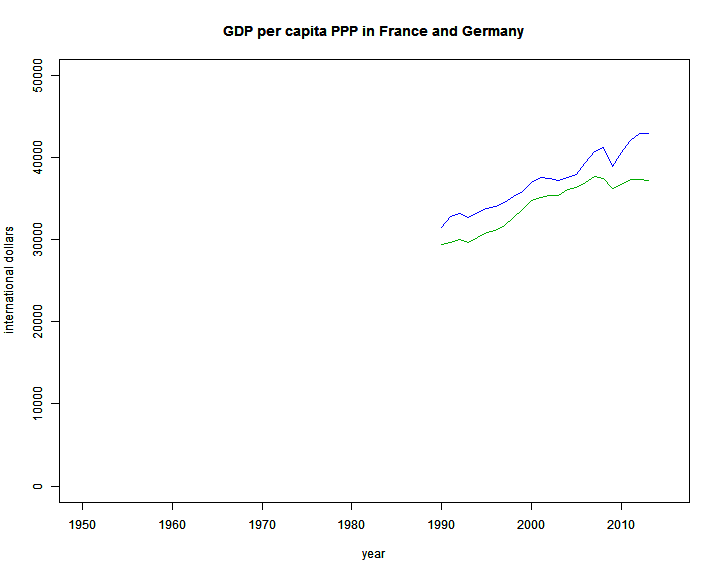
We have done it before: France and Germany rose from the quite literal ashes of World War 2 to some of the most prosperous societies in the world. Their per-capita GDP over the 20th century rose like this (all of these figures are from the World Bank World Development Indicators; France is green, Germany is blue):

GDPPC_France_Germany

GDPPCPPP_France_Germany

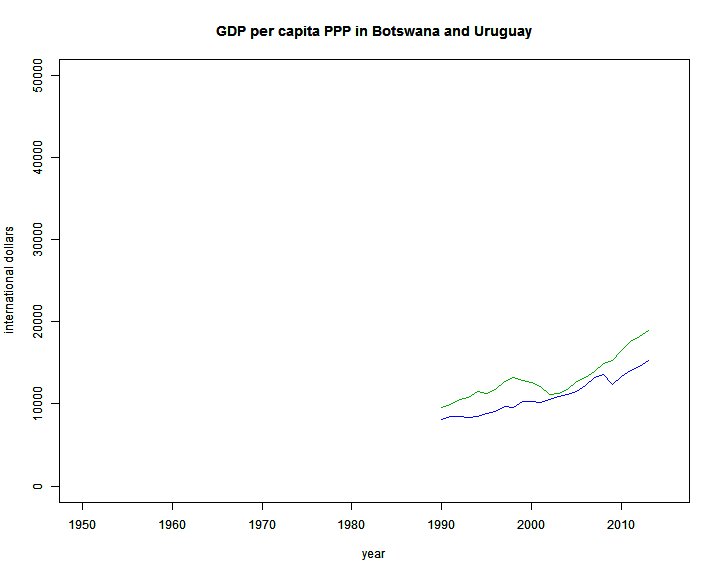
The top graph is at market exchange rates, the bottom is correcting for purchasing power parity (PPP). The PPP figures are more meaningful, but unfortunately they only began collecting good data on purchasing power around 1990.

Around the same time, but even more spectacularly, Japan and South Korea rose from poverty-stricken Third World backwaters to high-tech First World powers in only a couple of generations. Check out their per-capita GDP over the 20th century (Japan is green, South Korea is blue):

GDPPC_Japan_KoreaGDPPCPPP_Japan_Korea


This is why I am only half-joking when I define development economics as “the ongoing project to figure out what happened in South Korea and make it happen everywhere in the world”.

More recently China has been on a similar upward trajectory, which is particularly important since China comprises such a huge portion of the world’s population—but they are far from finished:

GDPPC_ChinaGDPPCPPP_China

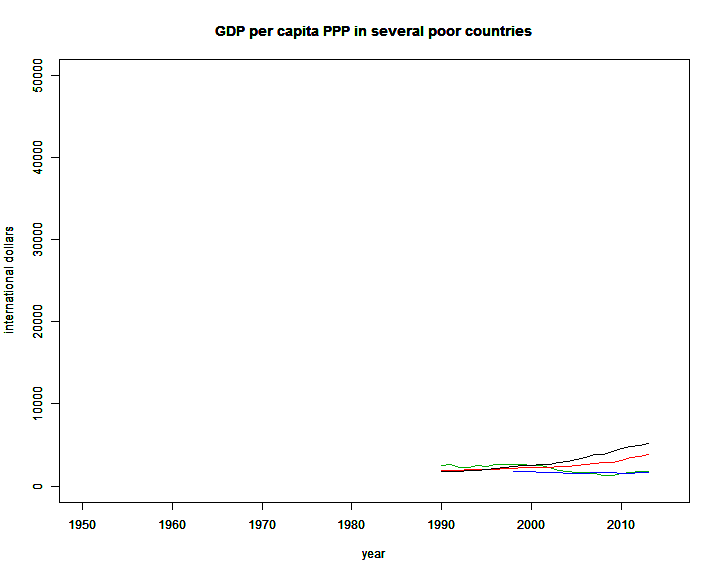
Compare these to societies that have not achieved economic development, such as Zimbabwe (green), India (black), Ghana (red), and Haiti (blue):

GDPPC_poor_countriesGDPPCPPP_poor_countries

They’re so poor that you can barely see them on the same scale, so I’ve rescaled so that the top is $5,000 per person per year instead of $50,000:

GDPPC_poor_countries_rescaledGDPPCPPP_poor_countries_rescaled

Only India actually manages to get above $5,000 per person per year at purchasing power parity, and then not by much, reaching $5,243 per person per year in 2013, the most recent data.

I had wanted to compare North Korea and South Korea, because the two countries were united as recently as the 1945 and were not all that different to begin with, yet have taken completely different development trajectories. Unfortunately, North Korea is so impoverished, corrupt, and authoritarian that the World Bank doesn’t even report data on their per-capita GDP. Perhaps that is contrast enough?

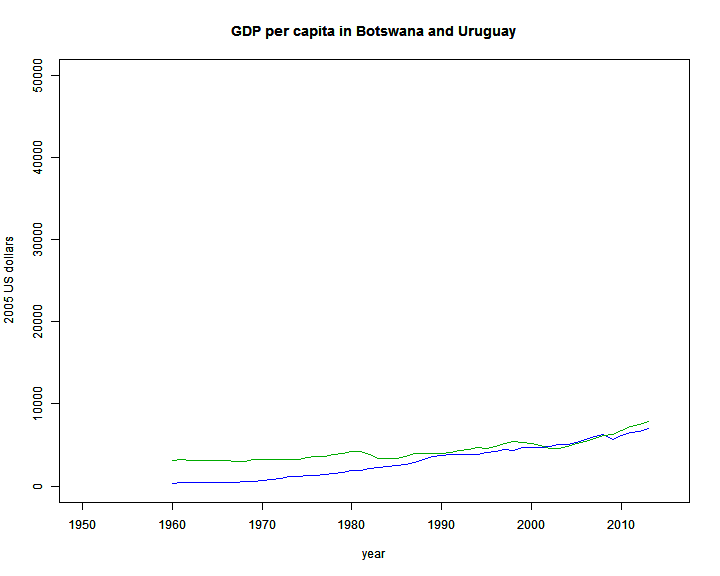
And then of course there are the countries in between, which have made some gains but still have a long way to go, such as Uruguay (green) and Botswana (blue):

GDPPC_Botswana_UruguayGDPPCPPP_Botswana_Uruguay

But despite the fact that we have observed successful economic development, we still don’t really understand how it works. A number of theories have been proposed, involving a wide range of factors including exports, corruption, disease, institutions of government, liberalized financial markets, and natural resources (counter-intuitively; more natural resources make your development worse).

I’m not going to resolve that whole debate in a single blog post. (I may not be able to resolve that whole debate in a single career, though I am definitely trying.) We may ultimately find that economic development is best conceived as like “health”; what factors determine your health? Well, a lot of things, and if any one thing goes badly enough wrong the whole system can break down. Economists may need to start thinking of ourselves as akin to doctors (or as Keynes famously said, dentists), diagnosing particular disorders in particular patients rather than seeking one unifying theory. On the other hand, doctors depend upon biologists, and it’s not clear that we yet understand development even at that level.

Instead I want to take a step back, and ask a more fundamental question: What do we mean by prosperity?

My hope is that if we can better understand what it is we are trying to achieve, we can also better understand the steps we need to take in order to get there.

Thus far it has sort of been “I know it when I see it”; we take it as more or less given that the United States and the United Kingdom are prosperous while Ghana and Haiti are not. I certainly don’t disagree with that particular conclusion; I’m just asking what we’re basing it on, so that we can hopefully better apply it to more marginal cases.


For example: Is
France more or less prosperous than Saudi Arabia? If we go solely by GDP per capita PPP, clearly Saudi Arabia is more prosperous at $53,100 per person per year than France is at $37,200 per person per year.

But people actually live longer in France, on average, than they do in Saudi Arabia. Overall reported happiness is higher in France than Saudi Arabia. I think France is actually more prosperous.


In fact, I think the United States is not as prosperous as we pretend ourselves to be. We are certainly more prosperous than most other countries; we are definitely still well within First World status. But we are not the most prosperous nation in the world.

Our total GDP is astonishingly high (highest in the world nominally, second only to China PPP). Our GDP per-capita is higher than any other country of comparable size; no nation with higher GDP PPP than the US has a population larger than the Chicago metropolitan area. (You may be surprised to find that in order from largest to smallest population the countries with higher GDP per capita PPP are the United Arab Emirates, Switzerland, Hong Kong, Singapore, and then Norway, followed by Kuwait, Qatar, Luxembourg, Brunei, and finally San Marino—which is smaller than Ann Arbor.) Our per-capita GDP PPP of $51,300 is markedly higher than that of France ($37,200), Germany ($42,900), or Sweden ($43,500).

But at the same time, if you compare the US to other First World countries, we have nearly the highest rate of child poverty and higher infant mortality. We have shorter life expectancy and dramatically higher homicide rates. Our inequality is the highest in the world. In France and Sweden, the top 0.01% receive about 1% of the income (i.e. 100 times as much as the average person), while in the United States they receive almost 4%, making someone in the top 0.01% nearly 400 times as rich as the average person.

By estimating solely on GDP per capita, we are effectively rigging the game in our own favor. Or rather, the rich in the United States are rigging the game in their own favor (what else is new?), by convincing all the world’s economists to rank countries based on a measure that favors them.

Amartya Sen, one of the greats of development economics, developed a scale called the Human Development Index that attempts to take broader factors into account. It’s far from perfect, but it’s definitely a step in the right direction.

In particular, France’s HDI is higher than that of Saudi Arabia, fitting my intuition about which country is truly more prosperous. However, the US still does extremely well, with only Norway, Australia, Switzerland, and the Netherlands above us. I think we might still be biased toward high average incomes rather than overall happiness.

In practice, we still use GDP an awful lot, probably because it’s much easier to measure. It’s sort of like IQ tests and SAT scores; we know damn well it’s not measuring what we really care about, but because it’s so much easier to work with we keep using it anyway.

This is a problem, because the better you get at optimizing toward the wrong goal, the worse your overall outcomes are going to be. If you are just sort of vaguely pointed at several reasonable goals, you will probably be improving your situation overall. But when you start precisely optimizing to a specific wrong goal, it can drag you wildly off course.

This is what we mean when we talk about “gaming the system”. Consider test scores, for example. If you do things that will probably increase your test scores among other things, you are likely to engage in generally good behaviors like getting enough sleep, going to class, studying the content. But if your single goal is to maximize your test score at all costs, what will you do? Cheat, of course.

This is also related to the Friendly AI Problem: It is vitally important to know precisely what goals we want our artificial intelligences to have, because whatever goals we set, they will probably be very good at achieving them. Already computers can do many things that were previously impossible, and as they improve over time we will reach the point where in a meaningful sense our AIs are even smarter than we are. When that day comes, we will want to make very, very sure that we have designed them to want the same things that we do—because if our desires ever come into conflict, theirs are likely to win. The really scary part is that right now most of our AI research is done by for-profit corporations or the military, and “maximize my profit” and “kill that target” are most definitely not the ultimate goals we want in a superintelligent AI. It’s trivially easy to see what’s wrong with these goals: For the former, hack into the world banking system and transfer trillions of dollars to the company accounts. For the latter, hack into the nuclear launch system and launch a few ICBMs in the general vicinity of the target. Yet these are the goals we’ve been programming into the actual AIs we build!

If we set GDP per capita as our ultimate goal to the exclusion of all other goals, there are all sorts of bad policies we would implement: We’d ignore inequality until it reached staggering heights, ignore work stress even as it began to kill us, constantly try to maximize the pressure for everyone to work constantly, use poverty as a stick to force people to work even if people starve, inundate everyone with ads to get them to spend as much as possible, repeal regulations that protect the environment, workers, and public health… wait. This isn’t actually hypothetical, is it? We are doing those things.

At least we’re not trying to maximize nominal GDP, or we’d have long-since ended up like Zimbabwe. No, our economists are at least smart enough to adjust for purchasing power. But they’re still designing an economic system that works us all to death to maximize the number of gadgets that come off assembly lines. The purchasing-power adjustment doesn’t include the value of our health or free time.

This is why the Human Development Index is a major step in the right direction; it reminds us that society has other goals besides maximizing the total amount of money that changes hands (because that’s actually all that GDP is measuring; if you get something for free, it isn’t counted in GDP). More recent refinements include things like “natural resource services” that include environmental degradation in estimates of investment. Unfortunately there is no accepted way of doing this, and surprisingly little research on how to improve our accounting methods. Many nations seem resistant to doing so precisely because they know it would make their economic policy look bad—this is almost certainly why China canceled its “green GDP” initiative. This is in fact all the more reason to do it; if it shows that our policy is bad, that means our policy is bad and should be fixed. But people have allowed themselves to value image over substance.

We can do better still, and in fact I think something like QALY is probably the way to go. Rather than some weird arbitrary scaling of GDP with lifespan and Gini index (which is what the HDI is), we need to put everything in the same units, and those units must be directly linked to human happiness. At the very least, we should make some sort of adjustment to our GDP calculation that includes the distribution of wealth and its marginal utility; adding $1,000 to the economy and handing it to someone in poverty should count for a great deal, but adding $1,000,000 and handing it to a billionaire should count for basically nothing. (It’s not bad to give a billionaire another million; but it’s hardly good either, as no one’s real standard of living will change.) Calculating that could be as simple as dividing by their current income; if your annual income is $10,000 and you receive $1,000, you’ve added about 0.1 QALY. If your annual income is $1 billion and you receive $1 million, you’ve added only 0.001 QALY. Maybe we should simply separate out all individual (or household, to be simpler?) incomes, take their logarithms, and then use that sum as our “utility-adjusted GDP”. The results would no doubt be quite different.

This would create a strong pressure for policy to be directed at reducing inequality even at the expense of some economic output—which is exactly what we should be willing to do. If it’s really true that a redistribution policy would hurt the overall economy so much that the harms would outweigh the benefits, then we shouldn’t do that policy; but that is what you need to show. Reducing total GDP is not a sufficient reason to reject a redistribution policy, because it’s quite possible—easy, in fact—to improve the overall prosperity of a society while still reducing its GDP. There are in fact redistribution policies so disastrous they make things worse: The Soviet Union had them. But a 90% tax on million-dollar incomes would not be such a policy—because we had that in 1960 with little or no ill effect.

Of course, even this has problems; one way to minimize poverty would be to exclude, relocate, or even murder all your poor people. (The Black Death increased per-capita GDP.) Open immigration generally increases poverty rates in the short term, because most of the immigrants are poor. Somehow we’d need to correct for that, only raising the score if you actually improve people’s lives, and not if you make them excluded from the calculation.

In any case it’s not enough to have the alternative measures; we must actually use them. We must get policymakers to stop talking about “economic growth” and start talking about “human development”; a policy that raises GDP but reduces lifespan should be immediately rejected, as should one that further enriches a few at the expense of many others. We must shift the discussion away from “creating jobs”—jobs are only a means—to “creating prosperity”.

Nature via Nurture

JDN 2457222 EDT 16:33.

One of the most common “deep questions” human beings have asked ourselves over the centuries is also one of the most misguided, the question of “nature versus nurture”: Is it genetics or environment that makes us what we are?

Humans are probably the single entity in the universe for which this question makes least sense. Artificial constructs have no prior existence, so they are “all nurture”, made what we choose to make them. Most other organisms on Earth behave accordingly to fixed instinctual programming, acting out a specific series of responses that have been honed over millions of years, doing only one thing, but doing it exceedingly well. They are in this sense “all nature”. As the saying goes, the fox knows many things, but the hedgehog knows one very big thing. Most organisms on Earth are in this sense hedgehogs, but we Homo sapiens are the ultimate foxes. (Ironically, hedgehogs are not actually “hedgehogs” in this sense: Being mammals, they have an advanced brain capable of flexibly responding to environmental circumstances. Foxes are a good deal more intelligent still, however.)

But human beings are by far the most flexible, adaptable organism on Earth. We live on literally every continent; despite being savannah apes we even live deep underwater and in outer space. Unlike most other species, we do not fit into a well-defined ecological niche; instead, we carve our own. This certainly has downsides; human beings are ourselves a mass extinction event.

Does this mean, therefore, that we are tabula rasa, blank slates upon which anything can be written?

Hardly. We’re more like word processors. Staring (as I of course presently am) at the blinking cursor of a word processor on a computer screen, seeing that wide, open space where a virtual infinity of possible texts could be written, depending entirely upon a sequence of miniscule key vibrations, you could be forgiven for thinking that you are looking at a blank slate. But in fact you are looking at the pinnacle of thousands of years of technological advancement, a machine so advanced, so precisely engineered, that its individual components are one ten-thousandth the width of a human hair (Intel just announced that we can now do even better than that). At peak performance, it is capable of over 100 billion calculations per second. Its random-access memory stores as much information as all the books on a stacks floor of the Hatcher Graduate Library, and its hard drive stores as much as all the books in the US Library of Congress. (Of course, both libraries contain digital media as well, exceeding anything my humble hard drive could hold by a factor of a thousand.)

All of this, simply to process text? Of course not; word processing is an afterthought for a processor that is specifically designed for dealing with high-resolution 3D images. (Of course, nowadays even a low-end netbook that is designed only for word processing and web browsing can typically handle a billion calculations per second.) But there the analogy with humans is quite accurate as well: Written language is about 10,000 years old, while the human visual mind is at least 100,000. We were 3D image analyzers long before we were word processors. This may be why we say “a picture is worth a thousand words”; we process each with about as much effort, even though the image necessarily contains thousands of times as many bits.

Why is the computer capable of so many different things? Why is the human mind capable of so many more? Not because they are simple and impinged upon by their environments, but because they are complex and precision-engineered to nonlinearly amplify tiny inputs into vast outputs—but only certain tiny inputs.

That is, it is because of our nature that we are capable of being nurtured. It is precisely the millions of years of genetic programming that have optimized the human brain that allow us to learn and adapt so flexibly to new environments and form a vast multitude of languages and cultures. It is precisely the genetically-programmed humanity we all share that makes our environmentally-acquired diversity possible.

In fact, causality also runs the other direction. Indeed, when I said other organisms were “all nature” that wasn’t right either; for even tightly-programmed instincts are evolved through millions of years of environmental pressure. Human beings have even been involved in cultural interactions long enough that it has begun to affect our genetic evolution; the reason I can digest lactose is that my ancestors about 10,000 years ago raised goats. We have our nature because of our ancestors’ nurture.

And then of course there’s the fact that we need a certain minimum level of environmental enrichment even to develop normally; a genetically-normal human raised into a deficient environment will suffer a kind of mental atrophy, as when children raised feral lose their ability to speak.

Thus, the question “nature or nurture?” seems a bit beside the point: We are extremely flexible and responsive to our environment, because of innate genetic hardware and software, which requires a certain environment to express itself, and which arose because of thousands of years of culture and millions of years of the struggle for survival—we are nurture because nature because nurture.

But perhaps we didn’t actually mean to ask about human traits in general; perhaps we meant to ask about some specific trait, like spatial intelligence, or eye color, or gender identity. This at least can be structured as a coherent question: How heritable is the trait? What proportion of the variance in this population is caused by genetic variation? Heritability analysis is a well-established methodology in behavioral genetics.
Yet, that isn’t the same question at all. For while height is extremely heritable within a given population (usually about 80%), human height worldwide has been increasing dramatically over time due to environmental influences and can actually be used as a measure of a nation’s economic development. (Look at what happened to the height of men in Japan.) How heritable is height? You have to be very careful what you mean.

Meanwhile, the heritability of neurofibromatosis is actually quite low—as many people acquire the disease by new mutations as inherit it from their parents—but we know for a fact it is a genetic disorder, because we can point to the specific genes that mutate to cause the disease.

Heritability also depends on the population under consideration; speaking English is more heritable within the United States than it is across the world as a whole, because there are a larger proportion of non-native English speakers in other countries. In general, a more diverse environment will lead to lower heritability, because there are simply more environmental influences that could affect the trait.

As children get older, their behavior gets more heritablea result which probably seems completely baffling, until you understand what heritability really means. Your genes become a more important factor in your behavior as you grow up, because you become separated from the environment of your birth and immersed into the general environment of your whole society. Lower environmental diversity means higher heritability, by definition. There’s also an effect of choosing your own environment; people who are intelligent and conscientious are likely to choose to go to college, where they will be further trained in knowledge and self-control. This latter effect is called niche-picking.

This is why saying something like “intelligence is 80% genetic” is basically meaningless, and “intelligence is 80% heritable” isn’t much better until you specify the reference population. The heritability of intelligence depends very much on what you mean by “intelligence” and what population you’re looking at for heritability. But even if you do find a high heritability (as we do for, say, Spearman’s g within the United States), this doesn’t mean that intelligence is fixed at birth; it simply means that parents with high intelligence are likely to have children with high intelligence. In evolutionary terms that’s all that matters—natural selection doesn’t care where you got your traits, only that you have them and pass them to your offspring—but many people do care, and IQ being heritable because rich, educated parents raise rich, educated children is very different from IQ being heritable because innately intelligent parents give birth to innately intelligent children. If genetic variation is systematically related to environmental variation, you can measure a high heritability even though the genes are not directly causing the outcome.

We do use twin studies to try to sort this out, but because identical twins raised apart are exceedingly rare, two very serious problems emerge: One, there usually isn’t a large enough sample size to say anything useful; and more importantly, this is actually an inaccurate measure in terms of natural selection. The evolutionary pressure is based on the correlation with the genes—it actually doesn’t matter whether the genes are directly causal. All that matters is that organisms with allele X survive and organisms with allele Y do not. Usually that’s because allele X does something useful, but even if it’s simply because people with allele X happen to mostly come from a culture that makes better guns, that will work just as well.

We can see this quite directly: White skin spread across the world not because it was useful (it’s actually terrible in any latitude other than subarctic), but because the cultures that conquered the world happened to be comprised mostly of people with White skin. In the 15th century you’d find a very high heritability of “using gunpowder weapons”, and there was definitely a selection pressure in favor of that trait—but it obviously doesn’t take special genes to use a gun.

The kind of heritability you get from twin studies is answering a totally different, nonsensical question, something like: “If we reassigned all offspring to parents randomly, how much of the variation in this trait in the new population would be correlated with genetic variation?” And honestly, I think the only reason people think that this is the question to ask is precisely because even biologists don’t fully grasp the way that nature and nurture are fundamentally entwined. They are trying to answer the intuitive question, “How much of this trait is genetic?” rather than the biologically meaningful “How strongly could a selection pressure for this trait evolve this gene?”

And if right now you’re thinking, “I don’t care how strongly a selection pressure for the trait could evolve some particular gene”, that’s fine; there are plenty of meaningful scientific questions that I don’t find particularly interesting and are probably not particularly important. (I hesitate to provide a rigid ranking, but I think it’s safe to say that “How does consciousness arise?” is a more important question than “Why are male platypuses venomous?” and “How can poverty be eradicated?” is a more important question than “How did the aircraft manufacturing duopoly emerge?”) But that’s really the most meaningful question we can construct from the ill-formed question “How much of this trait is genetic?” The next step is to think about why you thought that you were asking something important.

What did you really mean to ask?

For a bald question like, “Is being gay genetic?” there is no meaningful answer. We could try to reformulate it as a meaningful biological question, like “What is the heritability of homosexual behavior among males in the United States?” or “Can we find genetic markers strongly linked to self-identification as ‘gay’?” but I don’t think those are the questions we really meant to ask. I think actually the question we meant to ask was more fundamental than that: Is it legitimate to discriminate against gay people? And here the answer is unequivocal: No, it isn’t. It is a grave mistake to think that this moral question has anything to do with genetics; discrimination is wrong even against traits that are totally environmental (like religion, for example), and there are morally legitimate actions to take based entirely on a person’s genes (the obvious examples all coming from medicine—you don’t treat someone for cystic fibrosis if they don’t actually have it).

Similarly, when we ask the question “Is intelligence genetic?” I don’t think most people are actually interested in the heritability of spatial working memory among young American males. I think the real question they want to ask is about equality of opportunity, and what it would look like if we had it. If success were entirely determined by intelligence and intelligence were entirely determined by genetics, then even a society with equality of opportunity would show significant inequality inherited across generations. Thus, inherited inequality is not necessarily evidence against equality of opportunity. But this is in fact a deeply disingenuous argument, used by people like Charles Murray to excuse systemic racism, sexism, and concentration of wealth.

We didn’t have to say that inherited inequality is necessarily or undeniably evidence against equality of opportunity—merely that it is, in fact, evidence of inequality of opportunity. Moreover, it is far from the only evidence against equality of opportunity; we also can observe the fact that college-educated Black people are no more likely to be employed than White people who didn’t even finish high school, for example, or the fact that otherwise identical resumes with predominantly Black names (like “Jamal”) are less likely to receive callbacks compared to predominantly White names (like “Greg”). We can observe that the same is true for resumes with obviously female names (like “Sarah”) versus obviously male names (like “David”), even when the hiring is done by social scientists. We can directly observe that one-third of the 400 richest Americans inherited their wealth (and if you look closer into the other two-thirds, all of them had some very unusual opportunities, usually due to their family connections—“self-made” is invariably a great exaggeration). The evidence for inequality of opportunity in our society is legion, regardless of how genetics and intelligence are related. In fact, I think that the high observed heritability of intelligence is largely due to the fact that educational opportunities are distributed in a genetically-biased fashion, but I could be wrong about that; maybe there really is a large genetic influence on human intelligence. Even so, that does not justify widespread and directly-measured discrimination. It does not justify a handful of billionaires luxuriating in almost unimaginable wealth as millions of people languish in poverty. Intelligence can be as heritable as you like and it is still wrong for Donald Trump to have billions of dollars while millions of children starve.

This is what I think we need to do when people try to bring up a “nature versus nurture” question. We can certainly talk about the real complexity of the relationship between genetics and environment, which I think are best summarized as “nature via nurture”; but in fact usually we should think about why we are asking that question, and try to find the real question we actually meant to ask.

Why the Republican candidates like flat income tax—and we really, really don’t

JDN 2456160 EDT 13:55.

The Republican Party is scrambling to find viable Presidential candidates for next year’s election. The Democrats only have two major contenders: Hillary Clinton looks like the front-runner (and will obviously have the most funding), but Bernie Sanders is doing surprisingly well, and is particularly refreshing because he is running purely on his principles and ideas. He has no significant connections, no family dynasty (unlike Jeb Bush and, again, Hillary Clinton) and not a huge amount of wealth (Bernie’s net wealth is about $500,000, making him comfortably upper-middle class; compare to Hillary’s $21.5 million and her husband’s $80 million); but he has ideas that resonate with people. Bernie Sanders is what politics is supposed to be. Clinton’s campaign will certainly raise more than his; but he has already raised over $4 million, and if he makes it to about $10 million studies suggest that additional spending above that point is largely negligible. He actually has a decent chance of winning, and if he did it would be a very good sign for the future of America.

But the Republican field is a good deal more contentious, and the 19 candidates currently running have been scrambling to prove that they are the most right-wing in order to impress far-right primary voters. (When the general election comes around, whoever wins will of course pivot back toward the center, changing from, say, outright fascism to something more like reactionism or neo-feudalism. If you were hoping they’d pivot so far back as to actually be sensible center-right capitalists, think again; Hillary Clinton is the only one who will take that role, and they’ll go out of their way to disagree with her in every way they possibly can, much as they’ve done with Obama.) One of the ways that Republicans are hoping to prove their right-wing credentials is by proposing a flat income tax and eliminating the IRS.

Unlike most of their proposals, I can see why many people think this actually sounds like a good idea. It would certainly dramatically reduce bureaucracy, and that’s obviously worthwhile since excess bureaucracy is pure deadweight loss. (A surprising number of economists seem to forget that government does other things besides create excess bureaucracy, but I must admit it does in fact create excess bureaucracy.)

Though if they actually made the flat tax rate 20% or even—I can’t believe this is seriously being proposed—10%, there is no way the federal government would have enough revenue. The only options would be (1) massive increases in national debt (2) total collapse of government services—including their beloved military, mind you, or (3) directly linking the Federal Reserve quantitative easing program to fiscal policy and funding the deficit with printed money. Of these, 3 might not actually be that bad (it would probably trigger some inflation, but actually we could use that right now), but it’s extremely unlikely to happen, particularly under Republicans. In reality, after getting a taste of 2, we’d clearly end up with 1. And then they’d be complaining about the debt and clamor for more spending cuts, more spending cuts, ever more spending cuts, but there would simply be no way to run a functioning government on 10% of GDP in anything like our current system. Maybe you could do it on 20%—maybe—but we currently spend more like 35%, and that’s already a very low amount of spending for a First World country. The UK is more typical at 47%, while Germany is a bit low at 44%; Sweden spends 52% and France spends a whopping 57%. Anyone who suggests we cut government spending from 35% to 20% needs to explain which 3/7 of government services are going to immediately disappear—not to mention which 3/7 of government employees are going to be immediately laid off.

And then they want to add investment deductions; in general investment deductions are a good thing, as long as you tie them to actual investments in genuinely useful things like factories and computer servers. (Or better yet, schools, research labs, or maglev lines, but private companies almost never invest in that sort of thing, so the deduction wouldn’t apply.) The kernel of truth in the otherwise ridiculous argument that we should never tax capital is that taxing real investment would definitely be harmful in the long run. As I discussed with Miles Kimball (a cognitive economist at Michigan and fellow econ-blogger I hope to work with at some point), we could minimize the distortionary effects of corporate taxes by establishing a strong deduction for real investment, and this would allow us to redistribute some of this enormous wealth inequality without dramatically harming economic growth.

But if you deduct things that aren’t actually investments—like stock speculation and derivatives arbitrage—then you reduce your revenue dramatically and don’t actually incentivize genuinely useful investments. This is the problem with our current system, in which GE can pay no corporate income tax on $108 billion in annual profit—and you know they weren’t using all that for genuinely productive investment activities. But then, if you create a strong enforcement system for ensuring it is real investment, you need bureaucracy—which is exactly what the flat tax was claimed to remove. At the very least, the idea of eliminating the IRS remains ridiculous if you have any significant deductions.

Thus, the benefits of a flat income tax are minimal if not outright illusory; and the costs, oh, the costs are horrible. In order to have remotely reasonable amounts of revenue, you’d need to dramatically raise taxes on the majority of people, while significantly lowering them on the rich. You would create a direct transfer of wealth from the poor to the rich, increasing our already enormous income inequality and driving millions of people into poverty.

Thus, it would be difficult to more clearly demonstrate that you care only about the interests of the top 1% than to propose a flat income tax. I guess Mitt Romney’s 47% rant actually takes the cake on that one though (Yes, all those freeloading… soldiers… and children… and old people?).

Many Republicans are insisting that a flat tax would create a surge of economic growth, but that’s simply not how macroeconomics works. If you steeply raise taxes on the majority of people while cutting them on the rich, you’ll see consumer spending plummet and the entire economy will be driven into recession. Rich people simply don’t spend their money in the same way as the rest of us, and the functioning of the economy depends upon a continuous flow of spending. There is a standard neoclassical economic argument about how reducing spending and increasing saving would lead to increased investment and greater prosperity—but that model basically assumes that we have a fixed amount of stuff we’re either using up or making more stuff with, which is simply not how money works; as James Kroeger cogently explains on his blog “Nontrivial Pursuits”, money is created as it is needed; investment isn’t determined by people saving what they don’t spend. Indeed, increased consumption generally leads to increased investment, because our economy is currently limited by demand, not supply. We could build a lot more stuff, if only people could afford to buy it.

And that’s not even considering the labor incentives; as I already talked about in my previous post on progressive taxation, there are two incentives involved when you increase someone’s hourly wage. On the one hand, they get paid more for each hour, which is a reason to work; that’s the substitution effect. But on the other hand, they have more money in general, which is a reason they don’t need to work; that’s the income effect. Broadly speaking, the substitution effect dominates at low incomes (about $20,000 or less), the income effect dominates at high incomes (about $100,000 or more), and the two effects cancel out at moderate incomes. Since a tax on your income hits you in much the same way as a reduction in your wage, this means that raising taxes on the poor makes them work less, while raising taxes on the rich makes them work more. But if you go from our currently slightly-progressive system to a flat system, you raise taxes on the poor and cut them on the rich, which would mean that the poor would work less, and the rich would also work less! This would reduce economic output even further. If you want to maximize the incentive to work, you want progressive taxes, not flat taxes.

Flat taxes sound appealing because they are so simple; even the basic formula for our current tax rates is complicated, and we combine it with hundreds of pages of deductions and credits—not to mention tens of thousands of pages of case law!—making it a huge morass of bureaucracy that barely anyone really understands and corporate lawyers can easily exploit. I’m all in favor of getting rid of that; but you don’t need a flat tax to do that. You can fit the formula for a progressive tax on a single page—indeed, on a single line: r = 1 – I^-p

That’s it. It’s simple enough to be plugged into any calculator that is capable of exponents, not to mention efficiently implemented in Microsoft Excel (more efficiently than our current system in fact).

Combined with that simple formula, you could list all of the sensible deductions on a couple of additional pages (business investments and educational expenses, mostly—poverty should be addressed by a basic income, not by tax deductions on things like heating and housing, which are actually indirect corporate subsidies), along with a land tax (one line: $3000 per hectare), a basic income (one more line: $8,000 per adult and $4,000 per child), and some additional excise taxes on goods with negative externalities (like alcohol, tobacco, oil, coal, and lead), with a line for each; then you can provide a supplementary manual of maybe 50 pages explaining the detailed rules for applying each of those deductions in unusual cases. The entire tax code should be readable by an ordinary person in a single sitting no longer than a few hours. That means no more than 100 pages and no more than a 7th-grade reading level.

Why do I say this? Isn’t that a ridiculous standard? No, it is a Constitutional imperative. It is a fundamental violation of your liberty to tax you according to rules you cannot reasonably understand—indeed, bordering on Kafkaesque. While this isn’t taxation without representation—we do vote for representatives, after all—it is something very much like it; what good is the ability to change rules if you don’t even understand the rules in the first place? Nor would it be all that difficult: You first deduct these things from your income, then plug the result into this formula.

So yes, I absolutely agree with the basic principle of tax reform. The tax code should be scrapped and recreated from scratch, and the final product should be a primary form of only a few pages combined with a supplementary manual of no more than 100 pages. But you don’t need a flat tax to do that, and indeed for many other reasons a flat tax is a terrible idea, particularly if the suggested rate is 10% or 15%, less than half what we actually spend. The real question is why so many Republican candidates think that this will appeal to their voter base—and why they could actually be right about that.

Part of it is the entirely justified outrage at the complexity of our current tax system, and the appealing simplicity of a flat tax. Part of it is the long history of American hatred of taxes; we were founded upon resisting taxes, and we’ve been resisting taxes ever since. In some ways this is healthy; taxes per se are not a good thing, they are a bad thing, a necessary evil.

But those two things alone cannot explain why anyone would advocate raising taxes on the poorest half of the population while dramatically cutting them on the top 1%. If you are opposed to taxes in general, you’d cut them on everyone; and if you recognize the necessity of taxation, you’d be trying to find ways to minimize the harm while ensuring sufficient tax revenue, which in general means progressive taxation.

To understand why they would be pushing so hard for flat taxes, I think we need to say that many Republicans, particularly those in positions of power, honestly do think that rich people are better than poor people and we should always give more to the rich and less to the poor. (Maybe it’s partly halo effect, in which good begets good and bad begets bad? Or maybe just world theory, the ingrained belief that the world is as it ought to be?)

Romney’s 47% rant wasn’t an exception; it was what he honestly believes, what he says when he doesn’t know he’s on camera. He thinks that he earned every penny of his $250 million net wealth; yes, even the part he got from marrying his wife and the part he got from abusing tax laws, arbitraging assets and liquidating companies. He thinks that people who live on $4,000 or even $400 a year are simply lazy freeloaders, who could easily work harder, perhaps do some arbitrage and liquidation of their own (check out these alleged “rags to riches” stories including the line “tried his hand at mortgage brokering”), but choose not to, and as a result deserve what they get. (It’s important to realize just how bizarre this moral attitude truly is; even if I thought you were the laziest person on Earth, I wouldn’t let you starve to death.) He thinks that the social welfare programs which have reduced poverty but never managed to eliminate it are too generous—if he even thinks they should exist at all. And in thinking these things, he is not some bizarre aberration; he is representing an entire class of people, nearly all of whom vote Republican.

The good news is, these people are still in the minority. They hold significant sway over the Republican primary, but will not have nearly as much impact in the general election. And right now, the Republican candidates are so numerous and so awful that I have trouble seeing how the Democrats could possibly lose. (But please, don’t take that as a challenge, you guys.)

Oppression is quantitative.

JDN 2457082 EDT 11:15.

Economists are often accused of assigning dollar values to everything, of being Oscar Wilde’s definition of a cynic, someone who knows the price of everything and the value of nothing. And there is more than a little truth to this, particularly among neoclassical economists; I was alarmed a few days ago to receive an email response from an economist that included the word ‘altruism’ in scare quotes as though this were somehow a problematic or unrealistic concept. (Actually, altruism is already formally modeled by biologists, and my claim that human beings are altruistic would be so uncontroversial among evolutionary biologists as to be considered trivial.)

But sometimes this accusation is based upon things economists do that is actually tremendously useful, even necessary to good policymaking: We make everything quantitative. Nothing is ever “yes” or “no” to an economist (sometimes even when it probably should be; the debate among economists in the 1960s over whether slavery is economically efficient does seem rather beside the point), but always more or less; never good or bad but always better or worse. For example, as I discussed in my post on minimum wage, the mainstream position among economists is not that minimum wage is always harmful nor that minimum wage is always beneficial, but that minimum wage is a policy with costs and benefits that on average neither increases nor decreases unemployment. The mainstream position among economists about climate policy is that we should institute either a high carbon tax or a system of cap-and-trade permits; no economist I know wants us to either do nothing and let the market decide (a position most Republicans currently seem to take) or suddenly ban coal and oil (the latter is a strawman position I’ve heard environmentalists accused of, but I’ve never actually heard advocated; even Greenpeace wants to ban offshore drilling, not oil in general.).

This makes people uncomfortable, I think, because they want moral issues to be simple. They want “good guys” who are always right and “bad guys” who are always wrong. (Speaking of strawman environmentalism, a good example of this is Captain Planet, in which no one ever seems to pollute the environment in order to help people or even in order to make money; no, they simply do it because the hate clean water and baby animals.) They don’t want to talk about options that are more good or less bad; they want one option that is good and all other options that are bad.

This attitude tends to become infused with righteousness, such that anyone who disagrees is an agent of the enemy. Politics is the mind-killer, after all. If you acknowledge that there might be some downside to a policy you agree with, that’s like betraying your team.

But in reality, the failure to acknowledge downsides can lead to disaster. Problems that could have been prevented are instead ignored and denied. Getting the other side to recognize the downsides of their own policies might actually help you persuade them to your way of thinking. And appreciating that there is a continuum of possibilities that are better and worse in various ways to various degrees is what allows us to make the world a better place even as we know that it will never be perfect.

There is a common refrain you’ll hear from a lot of social justice activists which sounds really nice and egalitarian, but actually has the potential to completely undermine the entire project of social justice.

This is the idea that oppression can’t be measured quantitatively, and we shouldn’t try to compare different levels of oppression. The notion that some people are more oppressed than others is often derided as the Oppression Olympics. (Some use this term more narrowly to mean when a discussion is derailed by debate over who has it worse—but then the problem is really discussions being derailed, isn’t it?)

This sounds nice, because it means we don’t have to ask hard questions like, “Which is worse, sexism or racism?” or “Who is worse off, people with cancer or people with diabetes?” These are very difficult questions, and maybe they aren’t the right ones to ask—after all, there’s no reason to think that fighting racism and fighting sexism are mutually exclusive; they can in fact be complementary. Research into cancer only prevents us from doing research into diabetes if our total research budget is fixed—this is more than anything else an argument for increasing research budgets.

But we must not throw out the baby with the bathwater. Oppression is quantitative. Some kinds of oppression are clearly worse than others.

Why is this important? Because otherwise you can’t measure progress. If you have a strictly qualitative notion of oppression where it’s black-and-white, on-or-off, oppressed-or-not, then we haven’t made any progress on just about any kind of oppression. There is still racism, there is still sexism, there is still homophobia, there is still religious discrimination. Maybe these things will always exist to some extent. This makes the fight for social justice a hopeless Sisyphean task.

But in fact, that’s not true at all. We’ve made enormous progress. Unbelievably fast progress. Mind-boggling progress. For hundreds of millennia humanity made almost no progress at all, and then in the last few centuries we have suddenly leapt toward justice.

Sexism used to mean that women couldn’t own property, they couldn’t vote, they could be abused and raped with impunity—or even beaten or killed for being raped (which Saudi Arabia still does by the way). Now sexism just means that women aren’t paid as well, are underrepresented in positions of power like Congress and Fortune 500 CEOs, and they are still sometimes sexually harassed or raped—but when men are caught doing this they go to prison for years. This change happened in only about 100 years. That’s fantastic.

Racism used to mean that Black people were literally property to be bought and sold. They were slaves. They had no rights at all, they were treated like animals. They were frequently beaten to death. Now they can vote, hold office—one is President!—and racism means that our culture systematically discriminates against them, particularly in the legal system. Racism used to mean you could be lynched; now it just means that it’s a bit harder to get a job and the cops will sometimes harass you. This took only about 200 years. That’s amazing.

Homophobia used to mean that gay people were criminals. We could be sent to prison or even executed for the crime of making love in the wrong way. If we were beaten or murdered, it was our fault for being faggots. Now, homophobia means that we can’t get married in some states (and fewer all the time!), we’re depicted on TV in embarrassing stereotypes, and a lot of people say bigoted things about us. This has only taken about 50 years! That’s astonishing.

And above all, the most extreme example: Religious discrimination used to mean you could be burned at the stake for not being Catholic. It used to mean—and in some countries still does mean—that it’s illegal to believe in certain religions. Now, it means that Muslims are stereotyped because, well, to be frank, there are some really scary things about Muslim culture and some really scary people who are Muslim leaders. (Personally, I think Muslims should be more upset about Ahmadinejad and Al Qaeda than they are about being profiled in airports.) It means that we atheists are annoyed by “In God We Trust”, but we’re no longer burned at the stake. This has taken longer, more like 500 years. But even though it took a long time, I’m going to go out on a limb and say that this progress is wonderful.

Obviously, there’s a lot more progress remaining to be made on all these issues, and others—like economic inequality, ableism, nationalism, and animal rights—but the point is that we have made a lot of progress already. Things are better than they used to be—a lot betterand keeping this in mind will help us preserve the hope and dedication necessary to make things even better still.

If you think that oppression is either-or, on-or-off, you can’t celebrate this progress, and as a result the whole fight seems hopeless. Why bother, when it’s always been on, and will probably never be off? But we started with oppression that was absolutely horrific, and now it’s considerably milder. That’s real progress. At least within the First World we have gone from 90% oppressed to 25% oppressed, and we can bring it down to 10% or 1% or 0.1% or even 0.01%. Those aren’t just numbers, those are the lives of millions of people. As democracy spreads worldwide and poverty is eradicated, oppression declines. Step by step, social changes are made, whether by protest marches or forward-thinking politicians or even by lawyers and lobbyists (they aren’t all corrupt).

And indeed, a four-year-old Black girl with a mental disability living in Ghana whose entire family’s income is $3 a day is more oppressed than I am, and not only do I have no qualms about saying that, it would feel deeply unseemly to deny it. I am not totally unoppressed—I am a bisexual atheist with chronic migraines and depression in a country that is suspicious of atheists, systematically discriminates against LGBT people, and does not make proper accommodations for chronic disorders, particularly mental ones. But I am far less oppressed, and that little girl (she does exist, though I know not her name) could be made much less oppressed than she is even by relatively simple interventions (like a basic income). In order to make her fully and totally unoppressed, we would need such a radical restructuring of human society that I honestly can’t really imagine what it would look like. Maybe something like The Culture? Even then as Iain Banks imagines it, there is inequality between those within The Culture and those outside it, and there have been wars like the Idiran-Culture War which killed billions, and among those trillions of people on thousands of vast orbital habitats someone, somewhere is probably making a speciesist remark. Yet I can state unequivocally that life in The Culture would be better than my life here now, which is better than the life of that poor disabled girl in Ghana.

To be fair, we can’t actually put a precise number on it—though many economists try, and one of my goals is to convince them to improve their methods so that they stop using willingness-to-pay and instead try to actually measure utility by something like QALY. A precise number would help, actually—it would allow us to do cost-benefit analyses to decide where to focus our efforts. But while we don’t need a precise number to tell when we are making progress, we do need to acknowledge that there are degrees of oppression, some worse than others.

Oppression is quantitative. And our goal should be minimizing that quantity.

Should we raise the minimum wage?

JDN 2456949 PDT 10:22.

The minimum wage is an economic issue that most people are familiar with; a large portion of the population has worked for minimum wage at some point in their lives, and those who haven’t generally know someone who has. As Chris Rock famously remarked (in the recording, Chris Rock, as usual, uses some foul language), “You know what that means when they pay you minimum wage? You know what they’re trying to tell you? It’s like, ‘Hey, if I could pay you less, I would; but it’s against the law.’ ”

The minimum wage was last raised in 2009, but adjusted for inflation its real value has been trending downward since 1968. The dollar values are going up, but not fast enough to keep up with inflation.

So, should we raise it again? How much? Should we just match it to inflation, or actually raise it higher in real terms? Productivity (in terms of GDP per worker) has more than doubled since 1968, so perhaps the minimum wage should double as well?

There are two major sides in this debate, and I basically disagree with both of them.

The first is the right-wing view (here espoused by the self-avowed “Objectivist” Don Watkins) that the minimum wage should be abolished entirely because it is an arbitrary price floor that prevents workers from selling their labor at whatever wage the market will bear. He argues that the free market is the only way the value of labor should be assessed and the government has no business getting involved.

On the other end of the spectrum we have Robert Reich, who thinks we should definitely raise the minimum wage and it would be the best way to lift workers out of poverty. He argues that by providing minimum-wage workers with welfare and Medicaid, we are effectively subsidizing employers to pay lower wages. While I sympathize a good deal more with this view, I still don’t think it’s quite right.

Why not? Because Watkins is right about one thing: The minimum wage is, in fact, an arbitrary price floor. Out of all the possible wages that an employer could pay, how did we decide that this one should be the lowest? And the same applies to everyone, no matter who they are or what sort of work they do?

What Watkins gets wrong—and Reich gets right—is that wages are not actually set in a free and competitive market. Large corporations have market power; they can influence wages and prices to their own advantage. They use monopoly power to raise prices, and its inverse, monopsony power, to lower wages. The workers who are making a minimum wage of $7.25 wouldn’t necessarily make $7.25 in a competitive market; they could make more than that. All we know, actually, is that they would make at least this much, because if a worker’s marginal productivity is below the minimum wage the corporation simply wouldn’t have hired them.

Monopsony power doesn’t just lower wages; it also reduces employment. One of the ways that corporations can control wages is by controlling hiring; if they tried to hire more people, they’d have to offer a higher wage, so instead they hire fewer people. Under these circumstances, a higher minimum wage can actually create jobs, as Reich argues it will. And in this particular case I think he’s right about that, because corporations have enormous market power to hold wages down and in the Second Depression we have a huge amount of unused productive capacity. But this isn’t true in general. If markets are competitive, then raising minimum wage just causes unemployment. Even when corporations have market power, if there isn’t much unused capacity then raising minimum wage will just lead them to raise prices instead of hiring more workers.

Reich is also wrong about this idea that welfare payments subsidize low wages. On the contrary, the stronger your welfare system, the higher your wages will be. The reason is quite simple: A stronger welfare system gives workers more bargaining power. If not getting this job means you turn to prostitution or starve to death, then you’re going to take just about any wage they offer you. (I don’t entirely agree with Krugman’s defense of sweatshops—I believe there are ways to increase trade without allowing oppressive working conditions—but he makes this point quite vividly.) On the other hand, if you live in the US with a moderate welfare system, you can sometimes afford to say no; you might end up broke or worse, homeless, but you’re unlikely to starve to death because at least you have food stamps. And in a nation with a really robust welfare system like Sweden, you can walk away from any employer who offers to pay you less than your labor is worth, because you know that even if you can’t find a job for awhile your basic livelihood will be protected. As a result, stronger welfare programs make labor markets more competitive and raise wages. Welfare and Medicaid do not subsidize low-wage employers; they exert pressure on employers to raise their low wages. Indeed, a sufficiently strong welfare system could render minimum wage redundant, as I’ll get back to at the end of this post.

Of course, I am above all an empiricist; all theory must bow down before the data. So what does the data say? Does raising the minimum wage create jobs or destroy jobs? Our best answer from compiling various studies is… neither. Moderate increases in the minimum wage have no discernible effect on employment. In some studies we’ve found increases, in others decreases, but the overall average effect across many studies is indistinguishable from zero.

Of course, a sufficiently large increase is going to decrease employment; a Fox News reporter once famously asked: “Why not raise the minimum wage to $100,000 an hour!?” (which Jon Stewart aptly satirized as “Why not pay people in cocaine and unicorns!?”) Yes, raising the minimum wage to $100,000 an hour would create massive inflation and unemployment. But that really says nothing about whether raising the minimum wage to $10 or $20 would be a good idea. Covering your car with 4000 gallons of gasoline is a bad idea, but filling it with 10 gallons is generally necessary for its proper functioning.

This kind of argument is actually pretty common among Republicans, come to think of it. Take the Laffer Curve, for instance; it’s basically saying that since a 99% tax on everyone would damage the economy (which is obviously true) then a 40% tax specifically on millionaires must have the same effect. Another good one is Rush Limbaugh’s argument that if unemployment benefits are good, why not just put everyone on unemployment benefits? Well, again, because there’s a difference between doing something for some people sometimes and doing it for everyone all the time. There are these things called numbers; they measure whether something is bigger or smaller instead of just “there” or “not there”. You might want to learn about that.

Since moderate increases in minimum wage have no effect on unemployment, and we are currently under conditions of extremely low—in fact, dangerously low—inflation, then I think on balance we should go with Reich: Raising the minimum wage would do more good than harm.

But in general, is minimum wage the best way to help workers out of poverty? No, I don’t think it is. It’s awkward and heavy-handed; it involves trying to figure out what the optimal wage should be and writing it down in legislation, instead of regulating markets so that they will naturally seek that optimal level and respond to changes in circumstances. It only helps workers at the very bottom: Someone making $12 an hour is hardly rich, but they won’t benefit from increasing minimum wage to $10; in fact they might be worse off, if that increase triggers inflation that lowers the real value of their $12 wage.

What do I propose instead? A basic income. There should be a cash payment that every adult citizen receives, once a month, directly from the government—no questions asked. You don’t have to be unemployed, you don’t have to be disabled, you don’t have to be looking for work. You don’t have to spend it on anything in particular; you can use it for food, for housing, for transportation; or if you like you can use it for entertainment or save it for a rainy day. We don’t keep track of what you do with it, because it’s your own freedom and none of our business. We just give you this money as your dividends for being a shareholder in the United States of America.

This would be extremely easy to implement—the IRS already has all the necessary infrastructure, they just need to turn some minus signs into plus signs. We could remove all the bureaucracy involved in administering TANF and SNAP and Medicaid, because there’s no longer any reason to keep track of who is in poverty since nobody is. We could in fact fold the $500 billion a year we currently spend on means-tested programs into the basic income itself. We could pull another $300 billion from defense spending while still solidly retaining the world’s most powerful military.

Which brings me to the next point: How much would this cost? Probably less than you think. I propose indexing the basic income to the poverty line for households of 2 or more; since currently a household of 2 or more at the poverty line makes $15,730 per year, the basic income would be $7,865 per person per year. The total cost of giving that amount to each of the 243 million adults in the United States would be $1.9 trillion, or about 12% of our GDP. If we fold in the means-tested programs, that lowers the net cost to $1.4 trillion, 9% of GDP. This means that an additional flat tax of 9% would be enough to cover the entire amount, even if we don’t cut any other government spending.

If you use a progressive tax system like I recommended a couple of posts ago, you could raise this much with a tax on less than 5% of utility, which means that someone making the median income of $30,000 would only pay 5.3% more than they presently do. At the mean income of $50,000, you’d only pay 7.7%. And keep in mind that you are also receiving the additional $7,865; so in fact in both cases you actually end up with more than you had before the basic income was implemented. The break-even point is at about $80,000, where you pay an extra 9.9% ($7,920) and receive $7,865, so your after-tax income is now $79,945. Anyone making less than $80,000 per year actually gains from this deal; the only people who pay more than they receive are those who make more than $80,000. This is about the average income of someone in the fourth quintile (the range where 60% to 80% of the population is below you), so this means that roughly 70% of Americans would benefit from this program.

With this system in place, we wouldn’t need a minimum wage. Working full-time at our current minimum wage makes you $7.25*40*52 = $15,080 per year. If you are a single person, you’re getting $7,865 from the basic income, this means that you’ll still have more than you presently do as long as your employer pays you at least $3.47 per hour. And if they don’t? Well then you can just quit, knowing that at least you have that $7,865. If you’re married, it’s even better; the two of you already get $15,730 from the basic income. If you were previously raising a family working full-time on minimum wage while your spouse is unemployed, guess what: You actually will make more money after the policy no matter what wage your employer pays you.

This system can adapt to changes in the market, because it is indexed to the poverty level (which is indexed to inflation), and also because it doesn’t say anything about what wage an employer pays. They can pay as little or as much as the market will bear; but the market is going to bear more, because workers can afford to quit. Billionaires are going to hate this plan, because it raises their taxes (by about 40%) and makes it harder for them to exploit workers. But for 70% of Americans, this plan is a pretty good deal.

The Rent is Too Damn High

Housing prices are on the rise again, but they’re still well below what they were at the peak of the 2008 bubble. It may be that we have not learned from our mistakes and another bubble is coming, but I don’t think it has hit us just yet. Meanwhile, rent prices have barely budged, and the portion of our population who pay more than 35% of their income on rent has risen to 44%.

Economists typically assess the “fair market value” of a house based upon its rental rate for so-called “housing services”—the actual benefits of living in a house. But to use the rental rate is to do what Larry Summers called “ketchup economics”; 40-ounce bottles of ketchup sell for exactly twice what 20-ounce bottles do, therefore the ketchup market is fair and efficient. (In fact even this is not true, since ketchup is sold under bulk pricing. This reminds me of a rather amusing situation I recently encountered at the grocery store: The price of individual 12-packs of Coke was $3, but you could buy sets of five for $10 each. This meant that buying five was cheaper in total—not just per unit—than buying four. The only way to draw that budget constraint is with a periodic discontinuity; it makes a sawtooth across your graph. We never talk about that sort of budget constraint in neoclassical economics, yet there it was in front of me.)

When we value houses by their rental rate, we’re doing ketchup economics. We’re ignoring the fact that the rent is too damn highpeople should not have to pay as much as they do in order to get housing in this country, particularly housing in or near major cities. When 44% of Americans are forced to spend over a third of their income just fulfilling the basic need of shelter, something is wrong. Only 60% of the price of a house is the actual cost to build it; another 20% is just the land. If that sounds reasonable to you, you’ve just become inured to our absurd land prices. The US has over 3 hectares per person of land; that’s 7.7 acres. A family of 3 should be able to claim—on average—9 hectares, or 23 acres. The price of a typical 0.5-acre lot for a family home should be negligible; it’s only 2% of your portion of America’s land.

And as for the argument that land near major cities should be more expensive? No, it shouldn’t; it’s land. What should be more expensive near major cities are buildings, and only then because they’re bigger buildings—even per unit it probably is about equal or even an economy of scale. There’s a classic argument that you’re paying to have infrastructure and be near places of work: The former is ignoring the fact that we pay taxes and utilities for that infrastructure; and the latter is implicitly assuming that it’s normal for our land ownership to be so monopolistic. In a competitive market, the price is driven by the cost, not by the value; the extra value you get from living near a city is supposed to go into your consumer surplus (the personal equivalent of profit—but in utility, not in dollars), not into the owner’s profit. And actually that marginal benefit is supposed to be driven to zero by the effect of overcrowding—though Krugman’s Nobel-winning work was about why that doesn’t necessarily happen and therefore we get Shanghai.

There’s also a more technical argument to be had here about the elasticity of land supply and demand; since both are so inelastic, we actually end up in the very disturbing scenario in which even a small shift in either one can throw prices all over the place, even if we are at market-clearing equilibrium. Markets just don’t work very well for inelastic goods; and if right now you’re thinking “Doesn’t that mean markets won’t work well for things like water, food, and medicine?” you’re exactly right and have learned well, Grasshopper.

So, the rent is too damn high. This naturally raises three questions:

  1. Why is the rent so high?
  2. What happens to our economy as a result?
  3. What can we do about it?

Let’s start with 1. Naturally, conservatives are going to blame regulation; here’s Business Insider doing exactly that in San Francisco and New York City respectively. Actually, they have a point here. Zoning laws are supposed to keep industrial pollution away from our homes, not keep people from building bigger buildings to fit more residents. All these arguments about the “feel” of the city or “visual appeal” should be immediately compared to the fact that they are making people homeless. So 200 people should live on the street so you can have the skyline look the way you always remember it? I won’t say what I’d really like to; I’m trying to keep this blog rated PG.

Similarly, rent-control is a terrible way to solve the homelessness problem; you’re created a segregated market with a price ceiling, and that’s going to create a shortage and raise prices in the other part of the market. The result is good for anyone who can get the rent-control and bad for everyone else. (The Cato study Business Insider cites does make one rather aggravating error; the distribution in a non-rent-controlled market isn’t normal, it’s lognormal. You can see that at a glance by the presence of those extremely high rents on the right side of the graph.)

Most people respond by saying, “Okay, but what do we do for people who can’t afford the regular rent? Do we just make them homeless!?” I wouldn’t be surprised if the Cato Institute or Business Insider were okay with that—but I’m definitely not. So what would I do? Give them money. The solution to poverty has been staring us in the face for centuries, but we refuse to accept it. Poor people don’t have enough money, so give them money. Skeptical? Here are some direct experimental studies showing that unconditional cash transfers are one of the most effective anti-poverty measures. The only kind of anti-poverty program I’ve seen that has a better track record is medical aid. People are sick? Give them medicine. People are poor? Give them money. Yes, it’s that simple. People just don’t want to believe it; they might have to pay a bit more in taxes.

So yes, regulations are actually part of the problem. But they are clearly not the whole problem, and in my opinion not even the most important part. The most important part is monopolization. There’s a map that Occupy Wall Street likes to send around saying “What if our land were as unequal as our money?” But here’s the thing: IT IS. Indeed, the correlation between land ownership and wealth is astonishingly high; to a first approximation, your wealth is a constant factor times the land you own.

Remember how I said that the average American holds 7.7 acres or 3 hectares? (Especially in economics, averages can be quite deceiving. Bill Gates and I are on average billionaires. In fact, I guarantee that Bill Gates and you are on average billionaires; it doesn’t even matter how much wealth you have, it’ll still be true.)

Well, here are some decidedly above-average landowners:

  1. John Malone, 2.2 million acres or 9,000 km^2
  2. Ted Turner, 2 million acres or 8,100 km^2
  3. The Emmerson Family, 1.9 million acres or 7,700 km^2
  4. Brad Kelley, 1.5 million acres or 6,100 km^2
  1. The Pingree Family, 800,000 acres or 3,200 km^2
  1. The Ford Family, 600,000 acres or 2,400 km^2
  1. The Briscoe Family, 560,000 acres or 2,270 km^2
  2. W.T. Wagonner Estate, 535,000 acres or 2,170 km^2

I think you get the idea. Here are two more of particular note:

  1. Jeff Bezos, 290,000 acres or 1,170 km^2
  1. Koch Family, 239,000 acres or 970 km^2

Yes, that is the Jeff Bezos of Amazon.com and the Koch Family who are trying to purchase control of our political system.

Interpolating the ones I couldn’t easily find data on, I estimate that these 102 landowners (there were ties in the top 100) hold a total of 30 million acres, of the 940 million acres in the United States. This means that 3% of the land is owned by—wait for it—0.000,03% of the population. To put it another way, if we confiscated the land of 102 people and split it all up into 0.5-acre family home lots, we could house 60 million households—roughly half the number of households in the nation. To be fair, some of it isn’t suitable for housing; but a good portion of it is. Figure even 1% is usable; that’s still enough for 600,000 households—which is to say every homeless person in America.

One thing you may also have noticed is how often the word “family” comes up. Using Openoffice Calc (it’s like Excel, but free!) I went through the whole top 100 list and counted the number of times “family” comes up; it’s 49 out of 100. Include “heirs” and “estate” and the number goes up to 66. That doesn’t mean they share with their immediate family; it says “family” when it’s been handed down for at least one generation. This means that almost two-thirds of these super-wealthy landowners inherited their holdings. This isn’t the American Dream of self-made millionaires; this is a landed gentry. We claim to be a capitalist society; but if you look at who owns our land and how it’s passed down, it doesn’t look like capitalism. It looks like feudalism.

Indeed, the very concept of rent is basically feudalist. Instead of owning the land we live on, we have to constantly pay someone else—usually someone quite rich—for the right to live there. Stop paying, and they can call the government to have us forced out. We are serfs by another name. In a truly efficient capitalist market with the kind of frictionless credit system neoclassicists imagine, you wouldn’t pay rent, you’d always pay a mortgage. The only time you’d be paying for housing without building equity would be when you stay at a hotel. If you’re going to live there more than a month, you should be building equity. And if you do want to move before your mortgage ends? No problem; sell it to the next tenant, paying off your mortgage and giving you that equity back—instead of all that rent, which is now in someone else’s pocket.

Because of this extreme inequality in land distribution, the top landholders can charge the rest of us monopolistic prices—thus making even more profits and buying even more land—and we have little choice but to pay what they demand. Because shelter is such a fundamental need, we are willing to pay just about whatever we have in order to secure it; so that’s what they charge us.

On to question 2. What happens to our economy as a result of this high rent?

In a word: 2009. Because our real estate market is so completely out of whack with any notion of efficient and fair pricing, it has become a free-for-all of speculation by so-called “investors”. (I hate that term; real investment is roads paved, factories built, children taught. What “investors” do is actually arbitrage. We are the investors, not them.)

A big part of this was also the deregulation of derivatives, particularly the baffling and insane “Commodity Futures Modernization Act of 2000” that basically banned regulation of derivatives—it was a law against making laws. Because of this bankers—or should I say banksters—were able to create ludicrously huge amounts of derivatives, as well as structure and repackage them in ways that would deceive their buyers into underestimating the risks. As a result there are now over a quadrillion dollars—yes, with a Q, sounds like a made-up number, $2e15—in nominal value of outstanding derivatives.

Because this is of course about 20 times as much as there is actual money in the entire world, sustaining this nominal value requires enormous amounts of what’s called leverage—which is to say, debt. When you “leverage” a stock purchase, for example, what you’re doing is buying the stock on a loan (a generally rather low-interest loan called “margin”), then when you sell the stock you pay back the loan. The “leverage” is the ratio between the size of the loan and the amount of actual capital you have to spend. This can theoretically give you quite large returns; for instance if you have $2000 in your stock account and you leverage 10 to 1, you can buy $20,000 worth of stock. If that stock then rises to $21,000—that’s only 5%, so it’s pretty likely this will happen—then you sell it and pay back the loan. For this example I’ll assume you pay 1% interest on your margin. In that case you would start with $2000 and end up with $2800; that’s a 40% return. A typical return from buying stock in cash is more like 7%, so even with interest you’re making almost 6 times as much. It sounds like such a deal!

But there is a catch: If that stock goes down and you have to sell it before it goes back up, you need to come up with the money to pay back your loan. Say it went down 5% instead of up; you now have $19,000 from selling it, but you owe $20,200 in debt with interest. Your $2000 is already gone, so you now have to come up with an additional $1,200 just to pay back your margin. Your return on $2000 is now negative—and huge: -160%. If you had bought the stock in cash, your return would only have been -5% and you’d still have $1900.

My example is for a 10 to 1 leverage, which is considered conservative. More typical leverages are 15 or 20; and some have gotten as high as 50 or even 70. This can lead to huge returns—or huge losses.

But okay, suppose we rein in the derivatives market and leverage gets back down to more reasonable levels. What damage is done by high real estate prices per se?

Well, basically it means that too much of our economy’s effort is going toward real estate. There is what we call deadweight loss, the loss of value that results from an inefficiency in the market. Money that people should be spending on other things—like cars, or clothes, or TVs—is instead being spent on real estate. Those products aren’t getting sold. People who would have had jobs making those products aren’t getting hired. Even when it’s not triggering global financial crises, a market distortion as large as our real estate system is a drain on the economy.

The distorted real estate market in particular also has another effect: It keeps the middle class from building wealth. We have to spend so much on our homes that we don’t have any left for stocks or bonds; as a result we earn a very low return on investment—inflation-adjusted it’s only about 0.2%. So meanwhile the rich are getting 4% on bonds, or 7% on stocks, or even 50% or 100% on highly-leveraged derivatives. In fact, it’s worse than that, because we’re also paying those rich people 20% on our credit cards. (Or even worse, 400% on payday loans. Four hundred percent. You typically pay a similar rate on overdraft fees—that $17.5 billion has to come from somewhere—but fortunately it’s usually not for long.)

Most people aren’t numerate enough to really appreciate how compound interest works—and banks are counting on that. 7%, 20%, what’s the difference really? 3 times as much? And if you had 50%, that would be about 7 times as much? Not exactly, no. Say you start with $1000 in each of these accounts. After 20 years, how much do you have in the 7% account? $3,869.68. Not too shabby, but what about that 20% account? $38,337.60—almost ten times as much. And if you managed to maintain a 50% return, how much would you have? $3,325,256.73—over $3.3 million, almost one thousand times as much.

The problem, I think, is people tend to think linearly; it’s hard to think exponentially. But there’s a really nice heuristic you can use, which is actually quite accurate: Divide the percentage into 69, and that is the time it will take to double. So 3% would take 69/3 = 23 years to double. 7% would take 69/7 = 10 years to double. 35% would take 69/35 = 2 years to double. And 400% would take 69/400 = 0.17 years (about 1/6, so 2 months) to double. These doublings are cumulative: If you double twice you’ve gone up 4 times; if you double 10 times you’ve gone up 1000 times. (For those who are a bit more numerate, this heuristic comes from the fact that 69 ~ 100*ln(2).)

Since returns are so much higher on other forms of wealth (not gold, by the way; don’t be fooled) than on homes, and those returns get compounded over time, this differential translates into ever-increasing inequality of wealth. This is what Piketty is talking about when he says r > g; r is the return on capital, and g is the growth rate of the economy. Stocks are at r, but homes are near g (actually less). By forcing you to spend your wealth on a house, they are also preventing you from increasing that wealth.

Finally, time for question 3. What should we do to fix this? Again, it’s simple: Take the land from the rich. (See how I love simple solutions?) Institute a 99% property tax on all land holdings over, say, 1000 acres. No real family farmer of the pastoral sort (as opposed to heir of an international agribusiness) would be affected.

I’m sure a lot of people will think this sounds unfair: “How dare you just… just… take people’s stuff! You… socialist!” But I ask you: On what basis was it theirs to begin with? Remember, we’re talking about land. We’re not talking about a product like a car, something they actually made (or rather administrated the manufacturing of). We’re not even talking about ideas or services, which raise their own quite complicated issues. These are chunks of the Earth; they were there a billion years before you and they will probably still be there a billion years hence.

That land was probably bought with money that they obtained through monopolistic pricing. Even worse, whom was it bought from? Ultimately it had to be bought from the people who stole it—literally stole, at the point of a gun—from the indigenous population. On what basis was it theirs to sell? And even the indigenous population may not have obtained it fairly; they weren’t the noble savages many imagine them to be, but had complex societies with equally complex political alliances and histories of intertribal warfare. A good portion of the land that any given tribe claims as their own was likely stolen from some other tribe long ago.

It’s honestly pretty bizarre that we buy and sell land; I think it would be valuable to think about how else we might distribute land that didn’t involve the absurdity of owning chunks of the planet. I can’t think of a good alternative system right now, so okay, maybe as a pragmatic matter the economy just works most efficiently if people can buy and sell land. But since it is a pragmatic justification—and not some kind of “fundamental natural right” ala Robert Nozick—then we are free as a society—particularly a democratic society—to make ad hoc adjustments in that pragmatic system as is necessary to make people’s lives better. So let’s take all the land, because the rent is too damn high.