For labor day, thoughts on socialism

Planned Post 255: Sep 9 JDN 2458371

This week includes Labor Day, the holiday where we are perhaps best justified in taking the whole day off from work and doing nothing. Labor Day is sort of the moderate social democratic counterpart to the explicitly socialist holiday May Day.

The right wing in this country has done everything in their power to expand the definition of “socialism”, which is probably why most young people now have positive views of socialism. There was a time when FDR was seen as an alternative to socialism; but now I’m pretty sure he’d just be called a socialist.

Because of this, I am honestly not sure whether I should be considered a socialist. I definitely believe in the social democratic welfare state epitomized by Scandinavia, but I definitely don’t believe in total collectivization of all means of production.

I am increasingly convinced that shareholder capitalism is a terrible system (the renowned science fiction author Charles Stross actually gave an excellent talk on this subject), but I would not want to abandon free markets.
The best answer might be worker-owned cooperatives. The empirical data is actually quite consistent in showing worker co-ops to be as efficient if not more efficient than conventional corporations, and by construction their pay systems produce less inequality than corporations.

Indeed, I think there is reason to believe that a worker co-op is a much more natural outcome for free markets under a level playing field than a conventional corporation, and the main reason we have corporations is actually that capitalism arose out of (and in response to) feudalism.

Think about it: Why should most things be owned by the top 1%? (Okay, not quite “most”: to be fair, the top 1% only owns 40% of all US net wealth.) Why is 80% of the value of the stock market held by the top 10% of the population?

Most things aren’t done by the top 1%. There are a handful of individuals (namely, scientists who make seminal breakthroughs: Charles Darwin, Marie Curie, Albert Einstein, Rosalind Franklin, Alan Turing, Jonas Salk) who are so super-productive that they might conceivably deserve billionaire-level compensation—but they are almost never the ones who are actually billionaires. If markets were really distributing capital to those who would use it most productively, there’s no reason to think that inequality would be so self-sustaining—much less self-enhancing as it currently seems to be.

But when you realize that capitalism emerged out of a system where the top 1% (or less) already owned most things, and did so by a combination of “divine right” ideology and direct, explicit violence, this inequality becomes a lot less baffling. We never had a free market on a level playing field. The closest we’ve ever gotten has always been through social-democratic reforms (like the New Deal and Scandinavia).

How does this result in corporations? Well, when all the wealth is held by a small fraction of individuals, how do you start a business? You have to borrow money from the people who have it. Borrowing makes you beholden to your creditors, and puts you at great risk if your venture fails (especially back in the days when there were debtor’s prisons—and we’re starting to go back that direction!). Equity provides an alternative: In exchange for giving them the downside risk if your venture fails, you also give your creditors—now shareholders—the upside risk if your venture succeeds. But at the end of the day when your business has succeeded, where did most of the profits go? Into the hands of the people who already had money to begin with, who did nothing to actually contribute to society. The world would be better off if those people had never existed and their wealth had simply been shared with everyone else.

Compare this to what would happen if we all started with similar levels of wealth. (How much would each of us have? Total US wealth of about $44 trillion, spread among a population of 328 million, is about $130,000 each. I don’t know about you, but I think I could do quite a bit with that.) When starting a business, you wouldn’t go heavily into debt or sign away ownership of your company to some billionaire; you’d gather a group of dedicated partners, each of whom would contribute money and effort into building the business. As you added on new workers, it would make sense to pool their assets, and give them a share of the company as well. The natural structure for your business would be not a shareholder corporation, but a worker-owned cooperative.

I think on some level the super-rich actually understand this. If you look closely at the sort of policies they fight for, they really aren’t capitalist. They don’t believe in free, unfettered markets where competition reigns. They believe in monopoly, lobbying, corruption, nepotism, and above all, low taxes. (There’s actually nothing in the basic principles of capitalism that says taxes should be low. Taxes should be as high as they need to be to cover public goods—no higher, and no lower.) They don’t want to provide nationalized healthcare, not because they believe that private healthcare competition is more efficient (no one who looks at the data for even a few minutes can honestly believe that—US healthcare is by far the most expensive in the world), but because they know that it would give their employees too much freedom to quit and work elsewhere. Donald Trump doesn’t want a world where any college kid with a brilliant idea and a lot of luck can overthrow his empire; he wants a world where everyone owes him and his family personal favors that he can call in to humiliate them and exert his power. That’s not capitalism—it’s feudalism.

Crowdfunding also provides an interesting alternative; we might even call it the customer-owned cooperative. Kickstarter and Patreon provide a very interesting new economic model—still entirely within the realm of free markets—where customers directly fund production and interact with producers to decide what will be produced. This might turn out to be even more efficient—and notice that it would run a lot more smoothly if we had all started with a level playing field.

Establishing such a playing field, of course, requires a large amount of redistribution of wealth. Is this socialism? If you insist. But I think it’s more accurate to describe it as reparations for feudalism (not to mention colonialism). We aren’t redistributing what was fairly earned in free markets; we are redistributing what was stolen, so that from now on, wealth can be fairly earned in free markets.

Why is redistribution of wealth so difficult to achieve in the US?

Jan 28 JDN 2458147

Income and wealth in equality is much higher in the US than in other First World countries. Within the OECD, only Mexico, Turkey, and Chile have higher income inequality than we do. Over 60% of Americans agree that the distribution of wealth in the US is unfair. Furthermore, the majority of Americans support the use of taxes and transfers to directly redistribute wealth from the rich to the poor.

Why, then, is it so hard to actually get any meaningful wealth redistribution in the United States?

Part of it is surely partisan differences: While about 70% of Democrats favor redistributive taxes, about 70% of Republicans oppose them. So one would not expect a move toward redistribution when Republicans control all three branches of government, and indeed we have seen quite the opposite. (Then again, one would also not expect a government shutdown under one-party rule, and yet that is what we have.)

But even most Republicans say they would like to see a much more equal distribution of wealth than the one we actually have. In fact, when I as an inequality economist look at the distribution of wealth people say they want, it looks a little too equal! Even Denmark and Sweden aren’t that egalitarian! I know more or less how to get from here to Denmark; but from here to “Equalden” looks like an awful long way. So if this is really the distribution of wealth people want, we need to be doing a huge amount of wealth redistribution—but we’re hardly doing any at all.

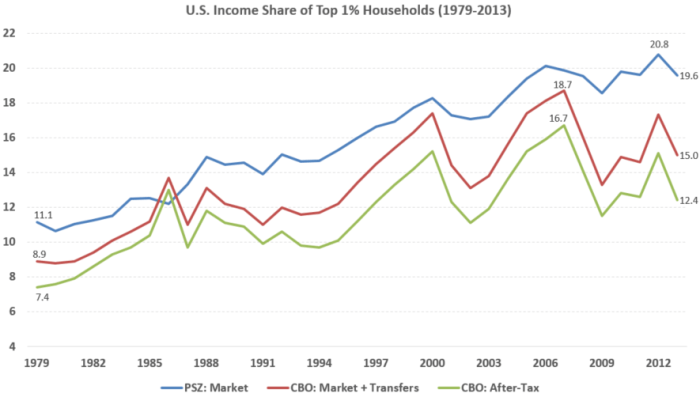
Indeed, we didn’t actually see all that much redistribution of wealth when Democrats more or less controlled all three branches in the period from 2008-2010. We may have seen a little bit shortly thereafter, and tax policy typically does come with a delay of a year or two. But as you can see in this graph, the Great Recession did more to reduce the top 1% income share than any tax policy changes:

US_top_income_share_1pct

The biggest changes made to our tax code under Obama were actually the handling of capital gains; the increase of the top rate on capital gains from 15% to 20%, plus the 3.8% capital surtax from the Affordable Care Act raised the tax bill for the top 0.1% by tens of billions of dollars. Surprisingly, Trump’s tax cuts don’t actually remove these provisions, though they did dramatically cut the corporate tax rate, which will probably have a similar effect on the income distribution.

To be honest, I’m not as disappointed with Trump’s tax cuts as I thought I would be. Some genuinely good ideas (like the reduction of the mortgage interest deduction, tighter restrictions on carried interest, and increase of the personal standard deduction) and some reasonable but debatable ideas (like cuts to the corporate tax rate, switching to a territorial corporate tax system, limits to deductions on corporate debt payments, removal of the deduction of state taxes, and extensions of 529 savings plans to private primary and secondary schools) were mixed in with the absolutely ludicrous and terrible ideas (like eliminating the Obamacare mandate, doubling the estate tax threshold, cutting the alcohol tax, and allowing offshore drilling in Alaska [One of these things is not like the other ones….]). Some of the terrible ideas, like ending the deduction of student loan interest and tuition waivers, were actually removed in the final version of the bill. Of course, you won’t be surprised when I tell you that the overall US tax system became a lot less progressive as a result of this bill. And even if cutting the corporate tax while raising the capital gains tax is probably a good idea (as I and many economists believe), cutting the corporate tax without raising the capital gains tax probably isn’t.

(An aside: For how much they claim to be “tough on crime”, it’s always kind of baffling to see how often Republicans like to cut alcohol taxes and pollution regulations, which are pretty much the only things that have ever been empirically shown to actually reduce crime. There is some evidence that maybe more policing also helps, but if so, it does so in a far less cost-effective way—indeed, the direct cost of alcohol taxes and pollution taxes is negative. Even if they didn’t work at all, they’d still be worth it just because they raise revenue. I begin to suspect that Republicans don’t actually want to reduce crime, because they know they can use the fear of crime to win votes; they simply want to appear tough on crime, and so they press as hard as they can for more policing and incarceration in the country that already has the highest incarceration rate in the world. This may be a more general phenomenon: While Democrats want to actually solve problems, Republicans want to appear to solve problems while actually exacerbating them, thus insuring their own job security. Compare how Bush kept talking about Osama bin laden while invading Iraq, and Obama actually killed Osama bin Laden. Is this too cynical? Can anything be too cynical in the era of Trump? There were 50,000 Russian bots on Twitter trying to tilt our election! Mueller’s FBI investigation is already implicating several of Trump’s top officials! Everything that seemed like paranoia or cynicism just a few years ago is turning out to be entirely true.)

This is what seems to happen: Year after year, we raise some taxes, then we cut some taxes. Then when raise some taxes, then we cut some taxes. The tax system gets a little more progressive for a few years and inequality begins to fall, and then those changes are removed and inequality begins to rise again. Back and forth and round and round we go.

Is there some way to lock in these tax changes for a longer period of time? The only way I can see would be a change in voter behavior: Keep voting in Democrats to all branches of government consistently for 20 years, and then maybe we would see a serious reduction in income and wealth inequality. Or at least stop voting in Republicans; aside from the Democrats, there are some third parties that would also support redistribution, like the Green Party. And yes, it really is about voting behavior: As prevalent as gerrymandering has become, as terrible as the Electoral College is, as widespread as voter suppression has gotten, Trump only won because 63 million Americans voted for him. Even after everything he’s done, Trumps’ approval rating is still about 39%. As long as there are enough people in this country whose partisan loyalty so strongly outweighs any rational assessment of policy, we are going to continue to see such travesties continue.

It would certainly help if our voting system were fairer, so that third parties had a better chance at taking seats. But it’s also difficult to see how that could happen any time soon. For now, the best I can come up with is trying to show people two things:

First, most Americans favor redistribution of wealth. You’re not alone in wanting that. It’s not some fringe opinion.

Second, there is a real difference between Democrats and Republicans on this issue. The canard “The two parties are the same” is the most untrue it has been in at least twenty years.

I would even understand if there are other issues you consider more important than wealth redistribution. Ecological sustainability is the most defensible—you can’t eat GNP—though that would push you even harder toward the left. Among things that might push you right, I can understand being concerned about higher taxes hurting economic growth, and while I think the view that abortion is murder is ludicrous, given that as your belief I can understand why you would want to prioritize fighting abortion. (If I thought we were murdering millions of babies every year, I’d be pretty mad too! Of course, you should be glad, then, that the US abortion rate has been falling. Right? You know about that, right?)

What I don’t get, however, is people who thought that voting for Donald Trump would help working people. I don’t understand how you can see someone who epitomizes everything that is wrong with the billionaire rentier class and think, “Yeah, he seems like he’s definitely a populist. That guy who was born insanely rich and made even more mind-boggling amounts of money by lying and screwing people over is definitely going to look out for folks like me.”

If I understood that, maybe I would know where to go from here. But people’s political beliefs can be astonishingly intransigent to evidence. Politics is the mind-killer.

This is one of the worst wildfire seasons in American history. But it won’t be for long.

Oct 22, JDN 2458049

At least 38 people have now been killed by the wildfires that are still ongoing in California; in addition, 5700 buildings have been destroyed and 190,000 acres of land burned. The State of California keeps an updated map of all the fires that are ongoing and how well-controlled they are; it’s not a pretty sight.

While the particular details are extreme, this is not an isolated incident. This year alone, wildfires have destroyed over 8 million acres of land in the US. In 2015, that figure was 10 million acres.

Property damage for this year’s wildfires in California is estimated at over $65 billion. That’s more than what Trump recently added to the military budget, and getting close to our total spending on food stamps.

There is a very clear upward trend in the scale and intensity of wildfires just over the last 50 years, and the obvious explanation is climate change. As climate change gets worse, these numbers are projected to increase between 30% and 50% by the 2040s. We still haven’t broken the record of fire damage in 1910, but as the upward trend continues we might soon enough.

It’s important to keep the death tolls in perspective; much as with hurricanes, our evacuation protocols and first-response agencies do their jobs very well, and as a result we’ve been averaging only about 10 wildfire deaths per year over the whole United States for the last century. In a country of over 300 million people, that’s really an impressively small number. That number has also been trending upward, however, so we shouldn’t get complacent.

Climate change isn’t the only reason these fires are especially damaging. It also matters where you build houses. We have been expanding our urban sprawl into fire-prone zones, and that is putting a lot of people in danger. Since 1990, over 60% of new homes were built in “wildland-urban interface areas” that are at higher risk.

Why are we doing this? Because housing prices in urban centers are too expensive for people to live there, but that is where most of the jobs are. So people have little choice but to live in exurbs and suburbs closer to the areas where fires are worst. That’s right: The fires are destroying homes and killing people because the rent is too damn high.

We need to find a solution to this problem of soaring housing prices. And since housing is such a huge proportion of our total expenditure—we spend more on housing than we do on all government spending combined—this would have an enormous impact on our entire economy. If you compare the income of a typical American today to most of the world’s population, or even to a typical American a century ago, we should feel extremely rich, but we don’t—largely because we spend so much of it just on keeping a roof over our heads.

Real estate is also a major driver of economic inequality. Wealth inequality is highest in urban centers where homeownership is rare. The large wealth gaps between White and non-White Americans can be in large part attributed to policies that made homeownership much more difficult for non-White people. Housing value inequality and overall wealth inequality are very strongly correlated. The high inequality in housing prices is making it far more difficult for people to move from poor regions to rich regions, holding back one of the best means we had for achieving more equal incomes.

Moreover, the rise in capital income share since the 1970s is driven almost entirely by real estate, rather than actual physical capital. The top 10% richest housing communities constitute over 52% of the total housing wealth in the US.

There is a lot of debate about what exactly causes these rising housing prices. No doubt, there are many factors contributing, from migration patterns to zoning regulations to income inequality in general. In a later post, I’ll get into why I think many of the people who think they are fighting the problem are actually making it worse, and suggest some ideas for what they should be doing instead.

Think of this as a moral recession

August 27, JDN 2457993

The Great Depression was, without doubt, the worst macroeconomic event of the last 200 years. Over 30 million people became unemployed. Unemployment exceeded 20%. Standard of living fell by as much as a third in the United States. Political unrest spread across the world, and the collapsing government of Germany ultimately became the Third Reich and triggered the Second World War If we ignore the world war, however, the effect on mortality rates was surprisingly small. (“Other than that, Mrs. Lincoln, how was the play?”)

And yet, how long do you suppose it took for economic growth to repair the damage? 80 years? 50 years? 30 years? 20 years? Try ten to fifteen. By 1940, the US, US, Germany, and Japan all had a per-capita GDP at least as high as in 1930. By 1945, every country in Europe had a per-capita GDP at least as high as they did before the Great Depression.

The moral of this story is this: Recessions are bad, and can have far-reaching consequences; but ultimately what really matters in the long run is growth.

Assuming the same growth otherwise, a country that had a recession as large as the Great Depression would be about 70% as rich as one that didn’t.

But over 100 years, a country that experienced 3% growth instead of 2% growth would be over two and a half times richer.

Therefore, in terms of standard of living only, if you were given the choice between having a Great Depression but otherwise growing at 3%, and having no recessions but growing at 2%, your grandchildren will be better off if you chose the former. (Of course, given the possibility of political unrest or even war, the depression could very well end up worse.)

With that in mind, I want you to think of the last few years—and especially the last few months—as a moral recession. Donald Trump being President of the United States is clearly a step backward for human civilization, and it seems to have breathed new life into some of the worst ideologies our society has ever harbored, from extreme misogyny, homophobia, right-wing nationalism, and White supremacism to outright Neo-Nazism. When one of the central debates in our public discourse is what level of violence is justifiable against Nazis under what circumstances, something has gone terribly, terribly wrong.

But much as recessions are overwhelmed in the long run by economic growth, there is reason to be confident that this moral backslide is temporary and will be similarly overwhelmed by humanity’s long-run moral progress.

What moral progress, you ask? Let’s remind ourselves.

Just 100 years ago, women could not vote in the United States.

160 years ago, slavery was legal in 15 US states.

Just 3 years ago, same-sex marriage was illegal in 14 US states. Yes, you read that number correctly. I said three. There are gay couples graduating high school and getting married now who as freshmen didn’t think they would be allowed to get married.

That’s just the United States. What about the rest of the world?

100 years ago, almost all of the world’s countries were dictatorships. Today, half of the world’s countries are democracies. Indeed, thanks to India, the majority of the world’s population now lives under democracy.

35 years ago, the Soviet Union still ruled most of Eastern Europe and Northern Asia with an iron fist (or should I say “curtain”?).

30 years ago, the number of human beings in extreme poverty—note I said number, not just rate; the world population was two-thirds what it is today—was twice as large as it is today.

Over the last 65 years, the global death rate due to war has fallen from 250 per million to just 10 per million.

The global literacy rate has risen from 40% to 80% in just 50 years.

World life expectancy has increased by 6 years in just the last 20 years.

We are living in a golden age. Do not forget that.

Indeed, if there is anything that could destroy all these astonishing achievements, I think it would be our failure to appreciate them.

If you listen to what these Neo-Nazi White supremacists say about their grievances, they sound like the spoiled children of millionaires (I mean, they elected one President, after all). They are outraged because they only get 90% of what they want instead of 100%—or even outraged not because they didn’t get what they wanted but because someone else they don’t know also did.

If you listen to the far left, their complaints don’t make much more sense. If you didn’t actually know any statistics, you’d think that life is just as bad for Black people in America today as it was under Jim Crow or even slavery. Well, it’s not even close. I’m not saying racism is gone; it’s definitely still here. But the civil rights movement has made absolutely enormous strides, from banning school segregation and housing redlining to reforming prison sentences and instituting affirmative action programs. Simply the fact that “racist” is now widely considered a terrible thing to be is a major accomplishment in itself. A typical Black person today, despite having only about 60% of the income of a typical White person, is still richer than a typical White person was just 50 years ago. While the 71% high school completion rate Black people currently have may not sound great, it’s much higher than the 50% rate that the whole US population had as recently as 1950.

Yes, there are some things that aren’t going very well right now. The two that I think are most important are climate change and income inequality. As both the global mean temperature anomaly and the world top 1% income share continue to rise, millions of people will suffer and die needlessly from diseases of poverty and natural disasters.

And of course if Neo-Nazis manage to take hold of the US government and try to repeat the Third Reich, that could be literally the worst thing that ever happened. If it triggered a nuclear war, it unquestionably would be literally the worst thing that ever happened. Both these events are unlikely—but not nearly as unlikely as they should be. (Five Thirty Eight interviewed several nuclear experts who estimated a probability of imminent nuclear war at a horrifying five percent.) So I certainly don’t want to make anyone complacent about these very grave problems.

But I worry also that we go too far the other direction, and fail to celebrate the truly amazing progress humanity has made thus far. We hear so often that we are treading water, getting nowhere, or even falling backward, that we begin to feel as though the fight for moral progress is utterly hopeless. If all these centuries of fighting for justice really had gotten us nowhere, the only sensible thing to do at this point would be to give up. But on the contrary, we have made enormous progress in an incredibly short period of time. We are on the verge of finally winning this fight. The last thing we want to do now is give up.

The right (and wrong) way to buy stocks

July 9, JDN 2457944

Most people don’t buy stocks at all. Stock equity is the quintessential form of financial wealth, and 42% of financial net wealth in the United States is held by the top 1%, while the bottom 80% owns essentially none.

Half of American households do not have any private retirement savings at all, and are depending either on employee pensions or Social Security for their retirement plans.

This is not necessarily irrational. In order to save for retirement, one must first have sufficient income to live on. Indeed, I got very annoyed at a “financial planning seminar” for grad students I attended recently, trying to scare us about the fact that almost none of us had any meaningful retirement savings. No, we shouldn’t have meaningful retirement savings, because our income is currently much lower than what we can expect to get once we graduate and enter our professions. It doesn’t make sense for someone scraping by on a $20,000 per year graduate student stipend to be saving up for retirement, when they can quite reasonably expect to be making $70,000-$100,000 per year once they finally get that PhD and become a professional economist (or sociologist, or psychologist or physicist or statistician or political scientist or material, mechanical, chemical, or aerospace engineer, or college professor in general, etc.). Even social workers, historians, and archaeologists make a lot more money than grad students. If you are already in the workforce and only expect to be getting small raises in the future, maybe you should start saving for retirement in your 20s. If you’re a grad student, don’t bother. It’ll be a lot easier to save once your income triples after graduation. (Personally, I keep about $700 in stocks mostly to get a feel for what it is like owning and trading stocks that I will apply later, not out of any serious expectation to support a retirement fund. Even at Warren Buffet-level returns I wouldn’t make more than $200 a year this way.)

Total US retirement savings are over $25 trillion, which… does actually sound low to me. In a country with a GDP now over $19 trillion, that means we’ve only saved a year and change of total income. If we had a rapidly growing population this might be fine, but we don’t; our population is fairly stable. People seem to be relying on economic growth to provide for their retirement, and since we are almost certainly at steady-state capital stock and fairly near full employment, that means waiting for technological advancement.

So basically people are hoping that we get to the Wall-E future where the robots will provide for us. And hey, maybe we will; but assuming that we haven’t abandoned capitalism by then (as they certainly haven’t in Wall-E), maybe you should try to make sure you own some assets to pay for robots with?

But okay, let’s set all that aside, and say you do actually want to save for retirement. How should you go about doing it?

Stocks are clearly the way to go. A certain proportion of government bonds also makes sense as a hedge against risk, and maybe you should even throw in the occasional commodity future. I wouldn’t recommend oil or coal at this point—either we do something about climate change and those prices plummet, or we don’t and we’ve got bigger problems—but it’s hard to go wrong with corn or steel, and for this one purpose it also can make sense to buy gold as well. Gold is not a magical panacea or the foundation of all wealth, but its price does tend to correlate negatively with stock returns, so it’s not a bad risk hedge.

Don’t buy exotic derivatives unless you really know what you’re doing—they can make a lot of money, but they can lose it just as fast—and never buy non-portfolio assets as a financial investment. If your goal is to buy something to make money, make it something you can trade at the click of a button. Buy a house because you want to live in that house. Buy wine because you like drinking wine. Don’t buy a house in the hopes of making a financial return—you’ll have leveraged your entire portfolio 10 to 1 while leaving it completely undiversified. And the problem with investing in wine, ironically, is its lack of liquidity.

The core of your investment portfolio should definitely be stocks. The biggest reason for this is the equity premium; equities—that is, stocks—get returns so much higher than other assets that it’s actually baffling to most economists. Bond returns are currently terrible, while stock returns are currently fantastic. The former is currently near 0% in inflation-adjusted terms, while the latter is closer to 16%. If this continues for the next 10 years, that means that $1000 put in bonds would be worth… $1000, while $1000 put in stocks would be worth $4400. So, do you want to keep the same amount of money, or quadruple your money? It’s up to you.

Higher risk is generally associated with higher return, because rational investors will only accept additional risk when they get some additional benefit from it; and stocks are indeed riskier than most other assets, but not that much riskier. For this to be rational, people would need to be extremely risk-averse, to the point where they should never drive a car or eat a cheeseburger. (Of course, human beings are terrible at assessing risk, so what I really think is going on is that people wildly underestimate the risk of driving a car and wildly overestimate the risk of buying stocks.)

Next, you may be asking: How does one buy stocks? This doesn’t seem to be something people teach in school.

You will need a brokerage of some sort. There are many such brokerages, but they are basically all equivalent except for the fees they charge. Some of them will try to offer you various bells and whistles to justify whatever additional cut they get of your trades, but they are almost never worth it. You should choose one that has a low a trade fee as possible, because even a few dollars here and there can add up surprisingly quickly.

Fortunately, there is now at least one well-established reliable stock brokerage available to almost anyone that has a standard trade fee of zero. They are called Robinhood, and I highly recommend them. If they have any downside, it is ironically that they make trading too easy, so you can be tempted to do it too often. Learn to resist that urge, and they will serve you well and cost you nothing.

Now, which stocks should you buy? There are a lot of them out there. The answer I’m going to give may sound strange: All of them. You should buy all the stocks.

All of them? How can you buy all of them? Wouldn’t that be ludicrously expensive?

No, it’s quite affordable in fact. In my little $700 portfolio, I own every single stock in the S&P 500 and the NASDAQ. If I get a little extra money to save, I may expand to own every stock in Europe and China as well.

How? A clever little arrangement called an exchange-traded fund, or ETF for short. An ETF is actually a form of mutual fund, where the fund purchases shares in a huge array of stocks, and adjusts what they own to precisely track the behavior of an entire stock market (such as the S&P 500). Then what you can buy is shares in that mutual fund, which are usually priced somewhere between $100 and $300 each. As the price of stocks in the market rises, the price of shares in the mutual fund rises to match, and you can reap the same capital gains they do.

A major advantage of this arrangement, especially for a typical person who isn’t well-versed in stock markets, is that it requires almost no attention at your end. You can buy into a few ETFs and then leave your money to sit there, knowing that it will grow as long as the overall stock market grows.

But there is an even more important advantage, which is that it maximizes your diversification. I said earlier that you shouldn’t buy a house as an investment, because it’s not at all diversified. What I mean by this is that the price of that house depends only on one thing—that house itself. If the price of that house changes, the full change is reflected immediately in the value of your asset. In fact, if you have 10% down on a mortgage, the full change is reflected ten times over in your net wealth, because you are leveraged 10 to 1.

An ETF is basically the opposite of that. Instead of its price depending on only one thing, it depends on a vast array of things, averaging over the prices of literally hundreds or thousands of different corporations. When some fall, others will rise. On average, as long as the economy continues to grow, they will rise.

The result is that you can get the same average return you would from owning stocks, while dramatically reducing the risk you bear.

To see how this works, consider the past year’s performance of Apple (AAPL), which has done very well, versus Fitbit (FIT), which has done very poorly, compared with the NASDAQ as a whole, of which they are both part.

AAPL has grown over 50% (40 log points) in the last year; so if you’d bought $1000 of their stock a year ago it would be worth $1500. FIT has fallen over 60% (84 log points) in the same time, so if you’d bought $1000 of their stock instead, it would be worth only $400. That’s the risk you’re taking by buying individual stocks.

Whereas, if you had simply bought a NASDAQ ETF a year ago, your return would be 35%, so that $1000 would be worth $1350.

Of course, that does mean you don’t get as high a return as you would if you had managed to choose the highest-performing stock on that index. But you’re unlikely to be able to do that, as even professional financial forecasters are worse than random chance. So, would you rather take a 50-50 shot between gaining $500 and losing $600, or would you prefer a guaranteed $350?

If higher return is not your only goal, and you want to be socially responsible in your investments, there are ETFs for that too. Instead of buying the whole stock market, these funds buy only a section of the market that is associated with some social benefit, such as lower carbon emissions or better representation of women in management. On average, you can expect a slightly lower return this way; but you are also helping to make a better world. And still your average return is generally going to be better than it would be if you tried to pick individual stocks yourself. In fact, certain classes of socially-responsible funds—particularly green tech and women’s representation—actually perform better than conventional ETFs, probably because most investors undervalue renewable energy and, well, also undervalue women. Women CEOs perform better at lower prices; why would you not want to buy their companies?

In fact ETFs are not literally guaranteed—the market as a whole does move up and down, so it is possible to lose money even by buying ETFs. But because the risk is so much lower, your odds of losing money are considerably reduced. And on average, an ETF will, by construction, perform exactly as well as the average performance of a randomly-chosen stock from that market.

Indeed, I am quite convinced that most people don’t take enough risk on their investment portfolios, because they confuse two very different types of risk.

The kind you should be worried about is idiosyncratic risk, which is risk tied to a particular investment—the risk of having chosen the Fitbit instead of Apple. But a lot of the time people seem to be avoiding market risk, which is the risk tied to changes in the market as a whole. Avoiding market risk does reduce your chances of losing money, but it does so at the cost of reducing your chances of making money even more.

Idiosyncratic risk is basically all downside. Yeah, you could get lucky; but you could just as well get unlucky. Far better if you could somehow average over that risk and get the average return. But with diversification, that is exactly what you can do. Then you are left only with market risk, which is the kind of risk that is directly tied to higher average returns.

Young people should especially be willing to take more risk in their portfolios. As you get closer to retirement, it becomes important to have more certainty about how much money will really be available to you once you retire. But if retirement is still 30 years away, the thing you should care most about is maximizing your average return. That means taking on a lot of market risk, which is then less risky overall if you diversify away the idiosyncratic risk.

I hope now that I have convinced you to avoid buying individual stocks. For most people most of the time, this is the advice you need to hear. Don’t try to forecast the market, don’t try to outperform the indexes; just buy and hold some ETFs and leave your money alone to grow.

But if you really must buy individual stocks, either because you think you are savvy enough to beat the forecasters or because you enjoy the gamble, here’s some additional advice I have for you.

My first piece of advice is that you should still buy ETFs. Even if you’re willing to risk some of your wealth on greater gambles, don’t risk all of it that way.

My second piece of advice is to buy primarily large, well-established companies (like Apple or Microsoft or Ford or General Electric). Their stocks certainly do rise and fall, but they are unlikely to completely crash and burn the way that young companies like Fitbit can.

My third piece of advice is to watch the price-earnings ratio (P/E for short). Roughly speaking, this is the number of years it would take for the profits of this corporation to pay off the value of its stock. If they pay most of their profits in dividends, it is approximately how many years you’d need to hold the stock in order to get as much in dividends as you paid for the shares.

Do you want P/E to be large or small? You want it to be small. This is called value investing, but it really should just be called “investing”. The alternatives to value investing are actually not investment but speculation and arbitrage. If you are actually investing, you are buying into companies that are currently undervalued; you want them to be cheap.

Of course, it is not always easy to tell whether a company is undervalued. A common rule-of-thumb is that you should aim for a P/E around 20 (20 years to pay off means about 5% return in dividends); if the P/E is below 10, it’s a fantastic deal, and if it is above 30, it might not be worth the price. But reality is of course more complicated than this. You don’t actually care about current earnings, you care about future earnings, and it could be that a company which is earning very little now will earn more later, or vice-versa. The more you can learn about a company, the better judgment you can make about their future profitability; this is another reason why it makes sense to buy large, well-known companies rather than tiny startups.

My final piece of advice is not to trade too frequently. Especially with something like Robinhood where trades are instant and free, it can be tempting to try to ride every little ripple in the market. Up 0.5%? Sell! Down 0.3%? Buy! And yes, in principle, if you could perfectly forecast every such fluctuation, this would be optimal—and make you an almost obscene amount of money. But you can’t. We know you can’t. You need to remember that you can’t. You should only trade if one of two things happens: Either your situation changes, or the company’s situation changes. If you need the money, sell, to get the money. If you have extra savings, buy, to give those savings a good return. If something bad happened to the company and their profits are going to fall, sell. If something good happened to the company and their profits are going to rise, buy. Otherwise, hold. In the long run, those who hold stocks longer are better off.
Financial fraud is everywhere

Jun 4, JDN 2457909
When most people think of “crime”, they probably imagine petty thieves, pickpockets, drug dealers, street thugs. In short, we think of crime as something poor people do. And certainly, that kind of crime is more visible, and typically easier to investigate and prosecute. It may be more traumatic to be victimized by it (though I’ll get back to that in a moment).

The statistics on this matter are some of the fuzziest I’ve ever come across, so estimates could be off by as much as an order of magnitude. But there is some reason to believe that, within most highly-developed countries, financial fraud may actually be more common than any other type of crime. It is definitely among the most common, and the only serious contenders for exceeding it are other forms of property crime such as petty theft and robbery.

It also appears that financial fraud is the one type of crime that isn’t falling over time. Violent crime and property crime are both at record lows; the average American’s probability of being victimized by a thief or a robber in any given year has fallen from 35% to 11% in the last 25 years. But the rate of financial fraud appears to be roughly constant, and the rate of high-tech fraud in particular is definitely rising. (This isn’t too surprising, given that the technology required is becoming cheaper and more widely available.)

In the UK, the rate of credit card fraud rose during the Great Recession, fell a little during the recovery, and has been holding steady since 2010; it is estimated that about 5% of people in the UK suffer credit card fraud in any given year.

About 1% of US car loans are estimated to contain fraudulent information (such as overestimated income or assets). As there are over $1 trillion in outstanding US car loans, that amounts to about $5 billion in fraud losses every year.

Using DOJ data, Statistic Brain found that over 12 million Americans suffer credit card fraud any given year; based on the UK data, this is probably an underestimate. They also found that higher household income had only a slight effect of increasing the probability of suffering such fraud.

The Office for Victims of Crime estimates that total US losses due to financial fraud are between $40 billion and $50 billion per year—which is to say, the GDP of Honduras or the military budget of Japan. The National Center for Victims of Crime estimated that over 10% of Americans suffer some form of financial fraud in any given year.

Why is fraud so common? Well, first of all, it’s profitable. Indeed, it appears to be the only type of crime that is. Most drug dealers live near the poverty line. Most bank robberies make off with less than $10,000.

But Bernie Madoff made over $50 billion before he was caught. Of course he was an exceptional case; the median Ponzi scheme only makes off with… $2.1 million. That’s over 200 times the median bank robbery.

Second, I think financial fraud allows the perpetrator a certain psychological distance from their victims. Just as it’s much easier to push a button telling a drone to launch a missile than to stab someone to death, it’s much easier to move some numbers between accounts than to point a gun at someone’s head and demand their wallet. Construal level theory is all about how making something seem psychologically more “distant” can change our attitudes toward it; toward things we perceive as “distant”, we think more abstractly, we accept more risks, and we are more willing to engage in violence to advance a cause. (It also makes us care less about outcomes, which may be a contributing factor in the collective apathy toward climate change.)

Perhaps related to this psychological distance, we also generally have a sense that fraud is not as bad as violent crime. Even judges and juries often act as though white-collar criminals aren’t real criminals. Often the argument seems to be that the behavior involved in committing financial fraud is not so different, after all, from the behavior of for-profit business in general; are we not all out to make an easy buck?

But no, it is not the same. (And if it were, this would be more an indictment of capitalism than it is a justification for fraud. So this sort of argument makes a lot more sense coming from socialists than it does from capitalists.)

One of the central justifications for free markets lies in the assumption that all parties involved are free, autonomous individuals acting under conditions of informed consent. Under those conditions, it is indeed hard to see why we have a right to interfere, as long as no one else is being harmed. Even if I am acting entirely out of my own self-interest, as long as I represent myself honestly, it is hard to see what I could be doing that is morally wrong. But take that away, as fraud does, and the edifice collapses; there is no such thing as a “right to be deceived”. (Indeed, it is quite common for Libertarians to say they allow any activity “except by force or fraud”, never quite seeming to realize that without the force of government we would all be surrounded by unending and unstoppable fraud.)

Indeed, I would like to present to you for consideration the possibility that large-scale financial fraud is worse than most other forms of crime, that someone like Bernie Madoff should be viewed as on a par with a rapist or a murderer. (To its credit, our justice system agrees—Madoff was given the maximum sentence of 150 years in maximum security prison.)

Suppose you were given the following terrible choice: Either you will be physically assaulted and beaten until several bones are broken and you fall unconscious—or you will lose your home and all the money you put into it. If the choice were between death and losing your home, obviously, you’d lose your home. But when it is a question of injury, that decision isn’t so obvious to me. If there is a risk of being permanently disabled in some fashion—particularly mentally disabled, as I find that especially terrifying—then perhaps I accept losing my home. But if it’s just going to hurt a lot and I’ll eventually recover, I think I prefer the beating. (Of course, if you don’t have health insurance, recovering from a concussion and several broken bones might also mean losing your home—so in that case, the dilemma is a no-brainer.) So when someone commits financial fraud on the scale of hundreds of thousands of dollars, we should consider them as having done something morally comparable to beating someone until they have broken bones.

But now let’s scale things up. What if terrorist attacks, or acts of war by a foreign power, had destroyed over one million homes, killed tens of thousands of Americans by one way or another, and cut the wealth of the median American family in half? Would we not count that as one of the greatest acts of violence in our nation’s history? Would we not feel compelled to take some overwhelming response—even be tempted toward acts of brutal vengeance? Yet that is the scale of the damage done by the Great Recession—much, if not all, preventable if our regulatory agencies had not been asleep at the wheel, lulled into a false sense of security by the unending refrain of laissez-faire. Most of the harm was done by actions that weren’t illegal, yes; but some of actually was illegal (20% of direct losses are attributable to fraud), and most of the rest should have been illegal but wasn’t. The repackaging and selling of worthless toxic assets as AAA bonds may not legally have been “fraud”, but morally I don’t see how it was different. With this in mind, the actions of our largest banks are not even comparable to murder—they are comparable to invasion or terrorism. No mere individual shooting here; this is mass murder.

I plan to make this a bit of a continuing series. I hope that by now I’ve at least convinced you that the problem of financial fraud is a large and important one; in later posts I’ll go into more detail about how it is done, who is doing it, and what perhaps can be done to stop them.

Can we have property rights without violence?

Apr 23, JDN 2457867

Most likely, you have by now heard of the incident on a United Airlines flight, where a man was beaten and dragged out of a plane because the airline decided that they needed more seats than they had. In case you somehow missed all the news articles and memes, the Wikipedia page on the incident is actually fairly good.

There is a lot of gossip about the passenger’s history, which the flight crew couldn’t possibly have known and is therefore irrelevant. By far the best take I’ve seen on the ethical and legal implications of the incident can be found on Naked Capitalism, so if you do want to know more about it I highly recommend starting there. Probably the worst take I’ve read is on The Pilot Wife Life, but I suppose if you want a counterpoint there you go.

I really have little to add on this particular incident; instead my goal here is to contextualize it in a broader discussion of property rights in general.

Despite the fact that what United’s employees and contractors did was obviously unethical and very likely illegal, there are still a large number of people defending their actions. Aiming for a Woodman if not an Ironman, the most coherent defense I’ve heard offered goes something like this:

Yes, what United did in this particular case was excessive. But it’s a mistake to try to make this illegal, because any regulation that did so would necessarily impose upon fundamental property rights. United owns the airplane; they can set the rules for who is allowed to be on that airplane. And once they set those rules, they need to be able to enforce them. Sometimes, however distasteful it may be, that enforcement will require violence. But property rights are too important to give up. Would you want to live in a society where anyone could just barge into your home and you were not allowed to use force to remove them?

Understood in this context, United contractors calling airport security to get a man dragged off of a plane isn’t an isolated act of violence for no reason; it is part of a broader conflict between the protection of property rights and the reduction of violence. “Stand your ground” laws, IMF “structural adjustment” policies, even Trump’s wall against immigrants can be understood as part of this broader conflict.

One very far-left approach to resolving such a conflict—as taken by the Paste editorial “You’re not mad at United Airlines; you’re mad at America”—is to fall entirely on the side of nonviolence, and say essentially that any system which allows the use of violence to protect property rights is fundamentally corrupt and illegitimate.

I can see why such a view is tempting. It’s simple, for one thing, and that’s always appealing. But if you stop and think carefully about the consequences of this hardline stance, it becomes clear that such a system would be unsustainable. If we could truly never use violence ever to protect any property rights, that would mean that property law in general could no longer be enforced. People could in fact literally break into your home and steal your furniture, and you’d have no recourse, because the only way to stop them would involve either using violence yourself or calling the police, who would end up using violence. Property itself would lose all its meaning—and for those on the far-left who think that sounds like a good thing, I want you to imagine what the world would look like if the only things you could ever use were the ones you could physically hold onto, where you’d leave home never knowing whether your clothes or your food would still be there when you came back. A world without property sounds good if you are imagining that the insane riches of corrupt billionaires would collapse; but if you stop and think about coming home to no food and no furniture, perhaps it doesn’t sound so great. And while it does sound nice to have a world where no one is homeless because they can always find a place to sleep, that may seem less appealing if your home is the one that a dozen homeless people decide to squat in.

The Tragedy of the Commons would completely destroy any such economic system; the only way to sustain it would be either to produce such an enormous abundance of wealth that no amount of greed could ever overtake it, or, more likely, somehow re-engineer human brains so that greed no longer exists. I’m not aware of any fundamental limits on greed; as long as social status increases monotonically with wealth, there will be people who try to amass as much wealth as they possibly can, far beyond what any human being could ever actually consume, much less need. How do I know this? Because they already exist; we call them “billionaires”. A billionaire, essentially by definition, is a hoarder of wealth who owns more than any human being could consume. If someone happens upon a billion dollars and immediately donates most of it to charity (as J.K. Rowling did), they can escape such a categorization; and if they use the wealth to achieve grand visionary ambitions—and I mean real visions, not like Steve Jobs but like Elon Musk—perhaps they can as well. Saving the world from climate change and colonizing Mars are the sort of projects that really do take many billions of dollars to achieve. (Then again, shouldn’t our government be doing these things?) And if they just hold onto the wealth or reinvest it to make even more, a billionaire is nothing less than a hoarder, seeking gratification and status via ownership itself.

Indeed, I think the maximum amount of wealth one could ever really need is probably around $10 million in today’s dollars; with that amount, even a very low-risk investment portfolio could supply enough income to live wherever you want, wear whatever you want, drive whatever you want, eat whatever you want, travel whenever you want. At even a 5% return, that’s $500,000 per year to spend without ever working or depleting your savings. At 10%, you’d get a million dollars a year for sitting there and doing nothing. And yet there are people with one thousand times as much wealth as this.

But not all property is of this form. I was about to say “the vast majority” is not, but actually that’s not true; a large proportion of wealth is in fact in the form of capital hoarded by the rich. Indeed, about 50% of the world’s wealth is owned by the richest 1%. (To be fair, the world’s top 1% is a broader category than one might think; the top 1% in the world is about the top 5% in the US; based on census data, that puts the cutoff at about $250,000 in net wealth.) But the majority of people have wealth in some form, and would stand to suffer if property rights were not enforced at all.

So we might be tempted to the other extreme, as the far-right seems to be, and say that any force is justified in the protection of fundamental property rights—that if vagrants step onto my land, I am well within my rights to get out my shotgun. (You know, hypothetically; not that I own a shotgun, or, for that matter, any land.) This seems to appeal especially to those who nostalgize the life on the frontier, “living off the land” (often losing family members to what now seem like trivial bacterial illnesses), “self-sufficient” (with generous government subsidies), in the “unspoiled wilderness” (from which the Army had forcibly removed Native Americans). Westerns have given us this sense that frontier life offers a kind of freedom and adventure that this urbane civilization lacks. And I suppose I am a fan of at least one Western, since one should probably count Firefly.

Yet of course this is madness; no civilization could survive if it really allowed people to just arbitrarily “defend” whatever property claims they decided to make. Indeed, it’s really just the flip side of the coin; as we’ve seen in Somalia (oh, by the way, we’re deploying troops there again), not protecting property and allowing universal violence to defend any perceived property largely amount to the same thing. If anything, the far-left fantasy seems more appealing; at least then we would not be subject to physical violence, and could call upon the authorities to protect us from that. In the far-right fantasy, we could accidentally step on what someone else claims to be his land and end up shot in the head.

So we need to have rules about who can use violence to defend what property and why. And that, of course, is complicated. We can start by having a government that defines property claims and places limits on their enforcement; but that still leaves the question of which sort of property claims and enforcement mechanisms the government should allow.

I think the principle should essentially be minimum force. We do need to protect property rights, yes; but if there is a way of doing so without committing violence, that’s the way we should do it. And if we do need to use violence, we should use as little as possible.

In theory we already do this: We have “rules of engagement” for the military and “codes of conduct” for police. But in practice, these rules are rarely enforced; they only get applied to really extreme violations, and sometimes not even then. The idea seems to be that enforcing strict rules on our soldiers and police officers constitutes disloyalty, even treason. We should “let them do their jobs”. This is the norm that must change. Those rules are their jobs. If they break those rules, they aren’t doing their jobs—they’re doing something else, something that endangers the safety and security of our society. The disloyalty is not in investigating and enforcing rules against police misconduct—the disloyalty is in police misconduct. If you want to be a cop but you’re not willing to follow the rules, you don’t actually want to be a cop—you want to be a bully with a gun and a badge.

And of course, one need not be a government agency in order to use excessive force. Many private corporations have security forces of their own, which frequently abuse and assault people. Most terrifying of all, there are whole corporations of “private military contractors”—let’s call them what they are: mercenaries—like Academi, formerly known as Blackwater. The whole reason these corporations even exist is to evade regulations on military conduct, and that is why they must be eliminated.

In the United case, there was obviously a nonviolent answer; all they had to do was offer to pay people to give up their seats, and bid up the price until enough people left. Someone would have left eventually; there clearly was a market-clearing price. That would have cost $2,000, maybe $5,000 at the most—a lot better than the $255 million lost in United’s stock value as a result of the bad PR.

If a homeless person decides to squat in your house, yes, perhaps you’d be justified in calling the police to remove them. Clearly you’re under no obligation to provide them room and board indefinitely. But there may be better solutions: Is there a homeless shelter in the area? Could you give them a ride there, or at least bus fare?

When immigrants cross our borders, may we turn them away? Now, here’s one where I’m pretty strongly tempted to go all the way and say we have no right whatsoever to stop them. There are no requirements for being born into citizenship, after all—so on what grounds do we add requirements to acquire citizenship? Is there something in the water of the Great Lakes and the Mississippi River that, when you drink it for 18 years (processed by municipal water systems of course; what are we, barbarians?), automatically makes you into a patriotic American? Does one become more law-abiding, or less capable of cruelty or fanaticism, by being brought into the world on one side of an imaginary line in the sand? If there are going to be requirements for citizenship, shouldn’t they be applied to everyone, and not just people who were born in the wrong place?

Yes, when we have no other choice, we must be prepared to use violence to defend property—because otherwise, there’s no such thing as property. But more often than not, we use violence when we didn’t need to, or use much more violence than was actually necessary. The principle that violence can be justified in defense of property does not entail that any violence is always justified in defense of property.

Markets value rich people more

Feb 26, JDN 2457811

Competitive markets are optimal at maximizing utility, as long as you value rich people more.

That is literally a theorem in neoclassical economics. I had previously thought that this was something most economists didn’t realize; I had delusions of grandeur that maybe I could finally convince them that this is the case. But no, it turns out this is actually a well-known finding; it’s just that somehow nobody seems to care. Or if they do care, they never talk about it. For all the thousands of papers and articles about the distortions created by minimum wage and capital gains tax, you’d think someone could spare the time to talk about the vastly larger fundamental distortions created by the structure of the market itself.

It’s not as if this is something completely hopeless we could never deal with. A basic income would go a long way toward correcting this distortion, especially if coupled with highly progressive taxes. By creating a hard floor and a soft ceiling on income, you can reduce the inequality that makes these distortions so large.

The basics of the theorem are quite straightforward, so I think it’s worth explaining them here. It’s extremely general; it applies anywhere that goods are allocated by market prices and different individuals have wildly different amounts of wealth.

Suppose that each person has a certain amount of wealth W to spend. Person 1 has W1, person 2 has W2, and so on. They all have some amount of happiness, defined by a utility function, which I’ll assume is only dependent on wealth; this is a massive oversimplification of course, but it wouldn’t substantially change my conclusions to include other factors—it would just make everything more complicated. (In fact, including altruistic motives would make the whole argument stronger, not weaker.) Thus I can write each person’s utility as a function U(W). The rate of change of this utility as wealth increases, the marginal utility of wealth, is denoted U'(W).

By the law of diminishing marginal utility, the marginal utility of wealth U'(W) is decreasing. That is, the more wealth you have, the less each new dollar is worth to you.

Now suppose people are buying goods. Each good C provides some amount of marginal utility U'(C) to the person who buys it. This can vary across individuals; some people like Pepsi, others Coke. This marginal utility is also decreasing; a house is worth a lot more to you if you are living in the street than if you already have a mansion. Ideally we would want the goods to go to the people who want them the most—but as you’ll see in a moment, markets systematically fail to do this.

If people are making their purchases rationally, each person’s willingness-to-pay P for a given good C will be equal to their marginal utility of that good, divided by their marginal utility of wealth:

P = U'(C)/U'(W)

Now consider this from the perspective of society as a whole. If you wanted to maximize utility, you’d equalize marginal utility across individuals (by the Extreme Value Theorem). The idea is that if marginal utility is higher for one person, you should give that person more, because the benefit of what you give them will be larger that way; and if marginal utility is lower for another person, you should give that person less, because the benefit of what you give them will be smaller. When everyone is equal, you are at the maximum.

But market prices don’t actually do this. Instead they equalize over willingness-to-pay. So if you’ve got two individuals 1 and 2, instead of having this:

U'(C1) = U'(C2)

you have this:

P1 = P2

which translates to:

U'(C1)/U'(W1) = U'(C2)/U'(W2)

If the marginal utilities were the same, U'(W1) = U'(W2), we’d be fine; these would give the same results. But that would only happen if W1 = W2, that is, if the two individuals had the same amount of wealth.

Now suppose we were instead maximizing weighted utility, where each person gets a weighting factor A based on how “important” they are or something. If your A is higher, your utility matters more. If we maximized this new weighted utility, we would end up like this:

A1*U'(C1) = A2*U'(C2)

Because person 1’s utility counts for more, their marginal utility also counts for more. This seems very strange; why are we valuing some people more than others? On what grounds?

Yet this is effectively what we’ve already done by using market prices.
Just set:
A = 1/U'(W)

Since marginal utility of wealth is decreasing, 1/U'(W) is higher precisely when W is higher.

How much higher? Well, that depends on the utility function. The two utility functions I find most plausible are logarithmic and harmonic. (Actually I think both apply, one to other-directed spending and the other to self-directed spending.)

If utility is logarithmic:

U = ln(W)

Then marginal utility is inversely proportional:

U'(W) = 1/W

In that case, your value as a human being, as spoken by the One True Market, is precisely equal to your wealth:

A = 1/U'(W) = W

If utility is harmonic, matters are even more severe.

U(W) = 1-1/W

Marginal utility goes as the inverse square of wealth:

U'(W) = 1/W^2

And thus your value, according to the market, is equal to the square of your wealth:

A = 1/U'(W) = W^2

What are we really saying here? Hopefully no one actually believes that Bill Gates is really morally worth 400 trillion times as much as a starving child in Malawi, as the calculation from harmonic utility would imply. (Bill Gates himself certainly doesn’t!) Even the logarithmic utility estimate saying that he’s worth 20 million times as much is pretty hard to believe.

But implicitly, the market “believes” that, because when it decides how to allocate resources, something that is worth 1 microQALY to Bill Gates (about the value a nickel dropped on the floor to you or I) but worth 20 QALY (twenty years of life!) to the Malawian child, will in either case be priced at $8,000, and since the child doesn’t have $8,000, it will probably go to Mr. Gates. Perhaps a middle-class American could purchase it, provided it was worth some 0.3 QALY to them.

Now consider that this is happening in every transaction, for every good, in every market. Goods are not being sold to the people who get the most value out of them; they are being sold to the people who have the most money.

And suddenly, the entire edifice of “market efficiency” comes crashing down like a house of cards. A global market that quite efficiently maximizes willingness-to-pay is so thoroughly out of whack when it comes to actually maximizing utility that massive redistribution of wealth could enormously increase human welfare, even if it turned out to cut our total output in half—if utility is harmonic, even if it cut our total output to one-tenth its current value.

The only way to escape this is to argue that marginal utility of wealth is not decreasing, or at least decreasing very, very slowly. Suppose for instance that utility goes as the 0.9 power of wealth:

U(W) = W^0.9

Then marginal utility goes as the -0.1 power of wealth:

U'(W) = 0.9 W^(-0.1)

On this scale, Bill Gates is only worth about 5 times as much as the Malawian child, which in his particular case might actually be too small—if a trolley is about to kill either Bill Gates or 5 Malawian children, I think I save Bill Gates, because he’ll go on to save many more than 5 Malawian children. (Of course, substitute Donald Trump or Charles Koch and I’d let the trolley run over him without a second thought if even a single child is at stake, so it’s not actually a function of wealth.) In any case, a 5 to 1 range across the whole range of human wealth is really not that big a deal. It would introduce some distortions, but not enough to justify any redistribution that would meaningfully reduce overall output.

Of course, that commits you to saying that $1 to a Malawian child is only worth about $1.50 to you or I and $5 to Bill Gates. If you can truly believe this, then perhaps you can sleep at night accepting the outcomes of neoclassical economics. But can you, really, believe that? If you had the choice between an intervention that would give $100 to each of 10,000 children in Malawi, and another that would give $50,000 to each of 100 billionaires, would you really choose the billionaires? Do you really think that the world would be better off if you did?

We don’t have precise measurements of marginal utility of wealth, unfortunately. At the moment, I think logarithmic utility is the safest assumption; it’s about the slowest decrease that is consistent with the data we have and it is very intuitive and mathematically tractable. Perhaps I’m wrong and the decrease is even slower than that, say W^(-0.5) (then the market only values billionaires as worth thousands of times as much as starving children). But there’s no way you can go as far as it would take to justify our current distribution of wealth. W^(-0.1) is simply not a plausible value.

And this means that free markets, left to their own devices, will systematically fail to maximize human welfare. We need redistribution—a lot of redistribution. Don’t take my word for it; the math says so.

Student debt crisis? What student debt crisis?

Dec 18, JDN 2457741
As of this writing, I have over $99,000 in student loans. This is a good thing. It means that I was able to pay for my four years of college, and two years of a master’s program, in order to be able to start this coming five years of a PhD. When I have concluded these eleven years of postgraduate education and incurred six times the world per-capita income in debt, what then will become of me? Will I be left to live on the streets, destitute and overwhelmed by debt?

No. I’ll have a PhD. The average lifetime income of individuals with PhDs in the United States is $3.4 million. Indeed, the median annual income for economists in the US is almost exactly what I currently owe in debt—so if I save well, I could very well pay it off in just a few years. With an advanced degree in economics like mine, or similarly high-paying fields such as physics, medicine, and law one can expect the higher end of that scale, $4 million or more; with a degree in a less-lucrative field such as art, literature, history, or philosophy, one would have to settle for “only” say $3 million. The average lifetime income in the US for someone without any college education is only $1.2 million. So even in literature or history, a PhD is worth about $2 million in future income.

On average, an additional year of college results in a gain in lifetime future earnings of about 15% to 20%. Even when you adjust for interest rates and temporal discounting, this is a rate of return that would make any stock trader envious.

Fitting the law of diminishing returns, the rates of return on education in poor countries are even larger, often mind-bogglingly huge; the increase in lifetime income from a year of college education in Botswana was estimated at 38%. This implies that someone who graduates from college in Botswana earns four times as much money as someone who only finished high school.

We who pay $100,000 to receive an additional $2 to $3 million can hardly be called unfortunate.

Indeed, we are mind-bogglingly fortunate; we have been given an opportunity to better ourselves and the society we live in that is all but unprecedented in human history granted only to a privileged few even today. Right now, only about half of adults in the most educated countries in the world (Canada, Russia, Israel, Japan, Luxembourg, South Korea, and the United States) ever go to college. Only 30% of Americans ever earn a bachelor’s degree, and as recently as 1975 that figure was only 20%. Worldwide, the majority of people never graduate from high school. The average length of schooling in developing countries today is six yearsthat is, sixth grade—and this is an enormous improvement from the two years of average schooling found in developing countries in 1950.

If we look a bit further back in history, the improvements in education are even more staggering. In the United States in 1910, only 13.5% of people graduated high school, and only 2.7% completed a bachelor’s degree. There was no student debt crisis then, to be sure—because there were no college students.

Indeed, I have been underestimating the benefits of education thus far, because education is both a public and private good. The figures I’ve just given have been only the private financial return on education—the additional income received by an individual because they went to college. But there is also a non-financial return, such as the benefits of working in a more appealing or exciting career and the benefits of learning for its own sake. The reason so many people do go into history and literature instead of economics and physics very likely has to do with valuing these other aspects of education as highly as or even more highly than financial income, and it is entirely rational for people to do so. (An interesting survey question I’ve alas never seen asked: “How much money would we have to give you right now to convince you to quit working in philosophy for the rest of your life?”)

Yet even more important is the public return on education, the increased productivity and prosperity of our society as a result of greater education—and these returns are enormous. For every $1 spent on education in the US, the economy grows by an estimated $1.50. Public returns on college education worldwide are on the order of 10%-20% per year of education. This is over and above the 15-20% return already being made by the individuals going to school. This means that raising the average level of education in a country by just one year raises that country’s income by between 25% and 40%.

Indeed, perhaps the simplest way to understand the enormous social benefits of education is to note the strong correlation between education level and income level. This graph comes from the UN Human Development Report Data Explorer; it plots the HDI education index (which ranges from 0, least educated, to 1, most educated) and the per-capita GDP at purchasing power parity (on a log scale, so that each increment corresponds to a proportional increase in GDP); as you can see, educated countries tend to be rich countries, and vice-versa.

hdi_education_income_labeled

Of course, income drives education just as education drives income. But more detailed econometric studies generally (though not without some controversy) show the same basic result: The more educated a country’s people become, the richer that country becomes.

And indeed, the United States is a spectacularly rich country. The figure of “$1 trillion in college debt” sounds alarming (and has been used to such effect in many a news article, ranging from the New York Daily News, Slate, and POLITICO to USA Today and CNN all the way to Bloomberg, MarketWatch, and Business Insider, and even getting support from the Consumer Financial Protection Bureau and The Federal Reserve Bank of New York).

But the United States has a total GDP of over $18.6 trillion, and total net wealth somewhere around $84 trillion. Is it really so alarming that our nation’s most important investment would result in debt of less than two percent of our total nation’s wealth? Democracy Now asks who is getting rich off of $1.3 trillion in student debt? All of us—the students especially.

In fact, the probability of defaulting on student loans is inversely proportional to the amount of loans a student has. Students with over $100,000 in student debt default only 18% of the time, while students with less than $5,000 in student debt default 34% of the time. This should be shocking to those who think that we have a crisis of too much student debt; if student debt were an excess burden that is imposed upon us for little gain, default rates should rise as borrowing amounts increase, as we observe, for example, with credit cards: there is a positive correlation between carrying higher balances and being more likely to default. (This also raises doubts about the argument that higher debt loads should carry higher interest rates—why, if the default rate doesn’t go up?) But it makes perfect sense if you realize that college is an investment—indeed, almost certainly both the most profitable and the most socially responsible investment most people will ever have the opportunity to make. More debt means you had access to more credit to make a larger investment—and therefore your payoff was greater and you were more likely to be able to repay the debt.

Yes, job prospects were bad for college graduates right after the Great Recession—because it was right after the Great Recession, and job prospects were bad for everyone. Indeed, the unemployment rate for people with college degrees was substantially lower than for those without college degrees, all the way through the Second Depression. The New York Times has a nice little gadget where you can estimate the unemployment rate for college graduates; my hint for you is that I just said it’s lower, and I still guessed too high. There was variation across fields, of course; unsurprisingly computer science majors did extremely well and humanities majors did rather poorly. Underemployment was a big problem, but again, clearly because of the recession, not because going to college was a mistake. In fact, unemployment for college graduates (about 9%) has always been so much lower than unemployment for high school dropouts that the maximum unemployment rate for young college graduates is less than the minimum unemployment rate for young high school graduates (10%) over the entire period since the year 2000. Young high school dropouts have fared even worse; their minimum unemployment rate since 2000 was 18%, while their maximum was a terrifying Great Depression-level of 32%. Education isn’t just a good investment—it’s an astonishingly good investment.

There are a lot of things worth panicking about, now that Trump has been elected President. But student debt isn’t one of them. This is a very smart investment, made with a reasonable portion of our nation’s wealth. If you have student debt like I do, make sure you have enough—or otherwise you might not be able to pay it back.

Sometimes people have to lose their jobs. This isn’t a bad thing.

Oct 8, JDN 2457670

Eleizer Yudkowsky (founder of the excellent blog forum Less Wrong) has a term he likes to use to distinguish his economic policy views from either liberal, conservative, or even libertarian: “econoliterate”, meaning the sort of economic policy ideas one comes up with when one actually knows a good deal about economics.

In general I think Yudkowsky overestimates this effect; I’ve known some very knowledgeable economists who disagree quite strongly over economic policy, and often following the conventional political lines of liberal versus conservative: Liberal economists want more progressive taxation and more Keynesian monetary and fiscal policy, while conservative economists want to reduce taxes on capital and remove regulations. Theoretically you can want all these things—as Miles Kimball does—but it’s rare. Conservative economists hate minimum wage, and lean on the theory that says it should be harmful to employment; liberal economists are ambivalent about minimum wage, and lean on the empirical data that shows it has almost no effect on employment. Which is more reliable? The empirical data, obviously—and until more economists start thinking that way, economics is never truly going to be a science as it should be.

But there are a few issues where Yudkowsky’s “econoliterate” concept really does seem to make sense, where there is one view held by most people, and another held by economists, regardless of who is liberal or conservative. One such example is free trade, which almost all economists believe in. A recent poll of prominent economists by the University of Chicago found literally zero who agreed with protectionist tariffs.

Another example is my topic for today: People losing their jobs.

Not unemployment, which both economists and almost everyone else agree is bad; but people losing their jobs. The general consensus among the public seems to be that people losing jobs is always bad, while economists generally consider it a sign of an economy that is run smoothly and efficiently.

To be clear, of course losing your job is bad for you; I don’t mean to imply that if you lose your job you shouldn’t be sad or frustrated or anxious about that, particularly not in our current system. Rather, I mean to say that policy which tries to keep people in their jobs is almost always a bad idea.

I think the problem is that most people don’t quite grasp that losing your job and not having a job are not the same thing. People not having jobs who want to have jobs—unemployment—is a bad thing. But losing your job doesn’t mean you have to stay unemployed; it could simply mean you get a new job. And indeed, that is what it should mean, if the economy is running properly.

Check out this graph, from FRED:

hires_separations

The red line shows hires—people getting jobs. The blue line shows separations—people losing jobs or leaving jobs. During a recession (the most recent two are shown on this graph), people don’t actually leave their jobs faster than usual; if anything, slightly less. Instead what happens is that hiring rates drop dramatically. When the economy is doing well (as it is right now, more or less), both hires and separations are at very high rates.

Why is this? Well, think about what a job is, really: It’s something that needs done, that no one wants to do for free, so someone pays someone else to do it. Once that thing gets done, what should happen? The job should end. It’s done. The purpose of the job was not to provide for your standard of living; it was to achieve the task at hand. Once it doesn’t need done, why keep doing it?

We tend to lose sight of this, for a couple of reasons. First, we don’t have a basic income, and our social welfare system is very minimal; so a job usually is the only way people have to provide for their standard of living, and they come to think of this as the purpose of the job. Second, many jobs don’t really “get done” in any clear sense; individual tasks are completed, but new ones always arise. After every email sent is another received; after every patient treated is another who falls ill.

But even that is really only true in the short run. In the long run, almost all jobs do actually get done, in the sense that no one has to do them anymore. The job of cleaning up after horses is done (with rare exceptions). The job of manufacturing vacuum tubes for computers is done. Indeed, the job of being a computer—that used to be a profession, young women toiling away with slide rules—is very much done. There are no court jesters anymore, no town criers, and very few artisans (and even then, they’re really more like hobbyists). There are more writers now than ever, and occasional stenographers, but there are no scribes—no one powerful but illiterate pays others just to write things down, because no one powerful is illiterate (and even few who are not powerful, and fewer all the time).

When a job “gets done” in this long-run sense, we usually say that it is obsolete, and again think of this as somehow a bad thing, like we are somehow losing the ability to do something. No, we are gaining the ability to do something better. Jobs don’t become obsolete because we can’t do them anymore; they become obsolete because we don’t need to do them anymore. Instead of computers being a profession that toils with slide rules, they are thinking machines that fit in our pockets; and there are plenty of jobs now for software engineers, web developers, network administrators, hardware designers, and so on as a result.

Soon, there will be no coal miners, and very few oil drillers—or at least I hope so, for the sake of our planet’s climate. There will be far fewer auto workers (robots have already done most of that already), but far more construction workers who install rail lines. There will be more nuclear engineers, more photovoltaic researchers, even more miners and roofers, because we need to mine uranium and install solar panels on rooftops.

Yet even by saying that I am falling into the trap: I am making it sound like the benefit of new technology is that it opens up more new jobs. Typically it does do that, but that isn’t what it’s for. The purpose of technology is to get things done.

Remember my parable of the dishwasher. The goal of our economy is not to make people work; it is to provide people with goods and services. If we could invent a machine today that would do the job of everyone in the world and thereby put us all out of work, most people think that would be terrible—but in fact it would be wonderful.

Or at least it could be, if we did it right. See, the problem right now is that while poor people think that the purpose of a job is to provide for their needs, rich people think that the purpose of poor people is to do jobs. If there are no jobs to be done, why bother with them? At that point, they’re just in the way! (Think I’m exaggerating? Why else would anyone put a work requirement on TANF and SNAP? To do that, you must literally think that poor people do not deserve to eat or have homes if they aren’t, right now, working for an employer. You can couch that in cold economic jargon as “maximizing work incentives”, but that’s what you’re doing—you’re threatening people with starvation if they can’t or won’t find jobs.)

What would happen if we tried to stop people from losing their jobs? Typically, inefficiency. When you aren’t allowed to lay people off when they are no longer doing useful work, we end up in a situation where a large segment of the population is being paid but isn’t doing useful work—and unlike the situation with a basic income, those people would lose their income, at least temporarily, if they quit and tried to do something more useful. There is still considerable uncertainty within the empirical literature on just how much “employment protection” (laws that make it hard to lay people off) actually creates inefficiency and reduces productivity and employment, so it could be that this effect is small—but even so, likewise it does not seem to have the desired effect of reducing unemployment either. It may be like minimum wage, where the effect just isn’t all that large. But it’s probably not saving people from being unemployed; it may simply be shifting the distribution of unemployment so that people with protected jobs are almost never unemployed and people without it are unemployed much more frequently. (This doesn’t have to be based in law, either; while it is made by custom rather than law, it’s quite clear that tenure for university professors makes tenured professors vastly more secure, but at the cost of making employment tenuous and underpaid for adjuncts.)

There are other policies we could make that are better than employment protection, active labor market policies like those in Denmark that would make it easier to find a good job. Yet even then, we’re assuming that everyone needs jobs–and increasingly, that just isn’t true.

So, when we invent a new technology that replaces workers, workers are laid off from their jobs—and that is as it should be. What happens next is what we do wrong, and it’s not even anybody in particular; this is something our whole society does wrong: All those displaced workers get nothing. The extra profit from the more efficient production goes entirely to the shareholders of the corporation—and those shareholders are almost entirely members of the top 0.01%. So the poor get poorer and the rich get richer.

The real problem here is not that people lose their jobs; it’s that capital ownership is distributed so unequally. And boy, is it ever! Here are some graphs I made of the distribution of net wealth in the US, using from the US Census.

Here are the quintiles of the population as a whole:

net_wealth_us

And here are the medians by race:

net_wealth_race

Medians by age:

net_wealth_age

Medians by education:

net_wealth_education

And, perhaps most instructively, here are the quintiles of people who own their homes versus renting (The rent is too damn high!)

net_wealth_rent

All that is just within the US, and already they are ranging from the mean net wealth of the lowest quintile of people under 35 (-$45,000, yes negative—student loans) to the mean net wealth of the highest quintile of people with graduate degrees ($3.8 million). All but the top quintile of renters are poorer than all but the bottom quintile of homeowners. And the median Black or Hispanic person has less than one-tenth the wealth of the median White or Asian person.

If we look worldwide, wealth inequality is even starker. Based on UN University figures, 40% of world wealth is owned by the top 1%; 70% by the top 5%; and 80% by the top 10%. There is less total wealth in the bottom 80% than in the 80-90% decile alone. According to Oxfam, the richest 85 individuals own as much net wealth as the poorest 3.7 billion. They are the 0.000,001%.

If we had an equal distribution of capital ownership, people would be happy when their jobs became obsolete, because it would free them up to do other things (either new jobs, or simply leisure time), while not decreasing their income—because they would be the shareholders receiving those extra profits from higher efficiency. People would be excited to hear about new technologies that might displace their work, especially if those technologies would displace the tedious and difficult parts and leave the creative and fun parts. Losing your job could be the best thing that ever happened to you.

The business cycle would still be a problem; we have good reason not to let recessions happen. But stopping the churn of hiring and firing wouldn’t actually make our society better off; it would keep people in jobs where they don’t belong and prevent us from using our time and labor for its best use.

Perhaps the reason most people don’t even think of this solution is precisely because of the extreme inequality of capital distribution—and the fact that it has more or less always been this way since the dawn of civilization. It doesn’t seem to even occur to most people that capital income is a thing that exists, because they are so far removed from actually having any amount of capital sufficient to generate meaningful income. Perhaps when a robot takes their job, on some level they imagine that the robot is getting paid, when of course it’s the shareholders of the corporations that made the robot and the corporations that are using the robot in place of workers. Or perhaps they imagine that those shareholders actually did so much hard work they deserve to get paid that money for all the hours they spent.

Because pay is for work, isn’t it? The reason you get money is because you’ve earned it by your hard work?

No. This is a lie, told to you by the rich and powerful in order to control you. They know full well that income doesn’t just come from wages—most of their income doesn’t come from wages! Yet this is even built into our language; we say “net worth” and “earnings” rather than “net wealth” and “income”. (Parade magazine has a regular segment called “What People Earn”; it should be called “What People Receive”.) Money is not your just reward for your hard work—at least, not always.

The reason you get money is that this is a useful means of allocating resources in our society. (Remember, money was created by governments for the purpose of facilitating economic transactions. It is not something that occurs in nature.) Wages are one way to do that, but they are far from the only way; they are not even the only way currently in use. As technology advances, we should expect a larger proportion of our income to go to capital—but what we’ve been doing wrong is setting it up so that only a handful of people actually own any capital.

Fix that, and maybe people will finally be able to see that losing your job isn’t such a bad thing; it could even be satisfying, the fulfillment of finally getting something done.