Bet five dollars for maximum performance

JDN 2457433

One of the more surprising findings from the study of human behavior under stress is the Yerkes-Dodson curve:
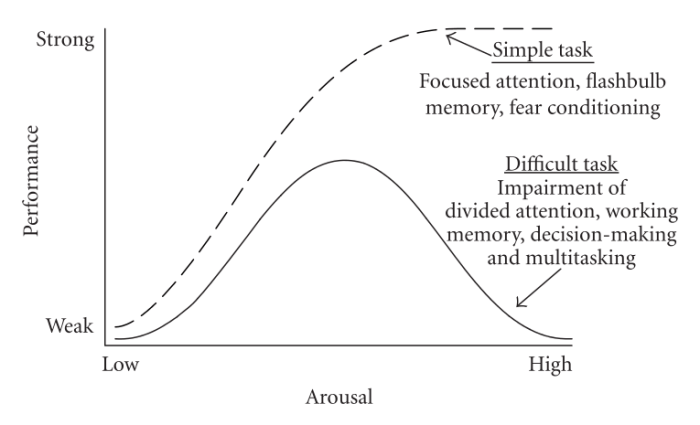
OriginalYerkesDodson
This curve shows how well humans perform at a given task, as a function of how high the stakes are on whether or not they do it properly.

For simple tasks, it says what most people intuitively expect—and what neoclassical economists appear to believe: As the stakes rise, the more highly incentivized you are to do it, and the better you do it.

But for complex tasks, it says something quite different: While increased stakes do raise performance to a point—with nothing at stake at all, people hardly work at all—it is possible to become too incentivized. Formally we say the curve is not monotonic; it has a local maximum.

This is one of many reasons why it’s ridiculous to say that top CEOs should make tens of millions of dollars a year on the rise and fall of their company’s stock price (as a great many economists do in fact say). Even if I believed that stock prices accurately reflect the company’s viability (they do not), and believed that the CEO has a great deal to do with the company’s success, it would still be a case of overincentivizing. When a million dollars rides on a decision, that decision is going to be worse than if the stakes had only been $100. With this in mind, it’s really not surprising that higher CEO pay is correlated with worse company performance. Stock options are terrible motivators, but do offer a subtle way of making wages adjust to the business cycle.

The reason for this is that as the stakes get higher, we become stressed, and that stress response inhibits our ability to use higher cognitive functions. The sympathetic nervous system evolved to make us very good at fighting or running away in the face of danger, which works well should you ever be attacked by a tiger. It did not evolve to make us good at complex tasks under high stakes, the sort of skill we’d need when calculating the trajectory of an errant spacecraft or disarming a nuclear warhead.

To be fair, most of us never have to worry about piloting errant spacecraft or disarming nuclear warheads—indeed, you’re about as likely to get attacked by a tiger even in today’s world. (The rate of tiger attacks in the US is just under 2 per year, and the rate of manned space launches in the US was about 5 per year until the Space Shuttle was terminated.)

There are certain professions, such as pilots and surgeons, where performing complex tasks under life-or-death pressure is commonplace, but only a small fraction of people take such professions for precisely that reason. And if you’ve ever wondered why we use checklists for pilots and there is discussion of also using checklists for surgeons, this is why—checklists convert a single complex task into many simple tasks, allowing high performance even at extreme stakes.

But we do have to do a fair number of quite complex tasks with stakes that are, if not urgent life-or-death scenarios, then at least actions that affect our long-term life prospects substantially. In my tutoring business I encounter one in particular quite frequently: Standardized tests.

Tests like the SAT, ACT, GRE, LSAT, GMAT, and other assorted acronyms are not literally life-or-death, but they often feel that way to students because they really do have a powerful impact on where you’ll end up in life. Will you get into a good college? Will you get into grad school? Will you get the job you want? Even subtle deviations from the path of optimal academic success can make it much harder to achieve career success in the future.

Of course, these are hardly the only examples. Many jobs require us to complete tasks properly on tight deadlines, or else risk being fired. Working in academia infamously requires publishing in journals in time to rise up the tenure track, or else falling off the track entirely. (This incentivizes the production of huge numbers of papers, whether they’re worth writing or not; yes, the number of papers published goes down after tenure, but is that a bad thing? What we need to know is whether the number of good papers goes down. My suspicion is that most if not all of the reduction in publications is due to not publishing things that weren’t worth publishing.)

So if you are faced with this sort of task, what can you do? If you realize that you are faced with a high-stakes complex task, you know your performance will be bad—which only makes your stress worse!

My advice is to pretend you’re betting five dollars on the outcome.

Ignore all other stakes, and pretend you’re betting five dollars. $5.00 USD. Do it right and you get a Lincoln; do it wrong and you lose one.
What this does is ensures that you care enough—you don’t want to lose $5 for no reason—but not too much—if you do lose $5, you don’t feel like your life is ending. We want to put you near that peak of the Yerkes-Dodson curve.

The great irony here is that you most want to do this when it is most untrue. If you actually do have a task for which you’ve bet $5 and nothing else rides on it, you don’t need this technique, and any technique to improve your performance is not particularly worthwhile. It’s when you have a standardized test to pass that you really want to use this—and part of me even hopes that people know to do this whenever they have nuclear warheads to disarm. It is precisely when the stakes are highest that you must put those stakes out of your mind.

Why five dollars? Well, the exact amount is arbitrary, but this is at least about the right order of magnitude for most First World individuals. If you really want to get precise, I think the optimal stakes level for maximum performance is something like 100 microQALY per task, and assuming logarithmic utility of wealth, $5 at the US median household income of $53,600 is approximately 100 microQALY. If you have a particularly low or high income, feel free to adjust accordingly. Literally you should be prepared to bet about an hour of your life; but we are not accustomed to thinking that way, so use $5. (I think most people, if asked outright, would radically overestimate what an hour of life is worth to them. “I wouldn’t give up an hour of my life for $1,000!” Then why do you work at $20 an hour?)

It’s a simple heuristic, easy to remember, and sometimes effective. Give it a try.
The power of exponential growth

JDN 2457390

There’s a famous riddle: If the water in a lakebed doubles in volume every day, and the lakebed started filling on January 1, and is half full on June 17, when will it be full?

The answer is of course June 18—if it doubles every day, it will go from half full to full in a single day.

But most people assume that half the work takes about half the time, so they usually give answers in December. Others try to correct, but don’t go far enough, and say something like October.

Human brains are programmed to understand linear processes. We expect things to come in direct proportion: If you work twice as hard, you expect to get twice as much done. If you study twice as long, you expect to learn twice as much. If you pay twice as much, you expect to get twice as much stuff.

We tend to apply this same intuition to situations where it does not belong, processes that are not actually linear but exponential. As a result, when we extrapolate the slow growth early in the process, we wildly underestimate the total growth in the long run.

For example, suppose we have two countries. Arcadia has a GDP of $100 billion per year, and they grow at 4% per year. Berkland has a GDP of $200 billion, and they grow at 2% per year. Assuming that they maintain these growth rates, how long will it take for Arcadia’s GDP to exceed Berkland’s?

If we do this intuitively, we might sort of guess that at 4% you’d add 100% in 25 years, and at 2% you’d add 100% in 50 years; so it should be something like 75 years, because then Arcadia will have added $300 million while Berkland added $200 million. You might even just fudge the numbers in your head and say “about a century”.

In fact, it is only 35 years. You could solve this exactly by setting (100)(1.04^x) = (200)(1.02^x); but I have an intuitive method that I think may help you to estimate exponential processes in the future.

Divide the percentage into 69. (For some numbers it’s easier to use 70 or 72; remember, these are just to be approximate. The exact figure is 100*ln(2) = 69.3147… and then it wouldn’t be the percentage p but 100*ln(1+p/100); try plotting those and you’ll see why using p works.) This is the time it will take to double.

So at 4%, Arcadia will double in about 17.5 years, quadrupling in 35 years. At 2%, Berkland will double in about 35 years. Thus, in 35 years, Arcadia will quadruple and Berkland will double, so their GDPs will be equal.

Economics is full of exponential processes: Compound interest is exponential, and over moderately long periods GDP and population both tend to grow exponentially. (In fact they grow logistically, which is similar to exponential until it gets very large and begins to slow down. If you smooth out our recessions, you can get a sense that since the 1940s, US GDP growth has slowed down from about 4% per year to about 2% per year.) It is therefore quite important to understand how exponential growth works.

Let’s try another one. If one account has $1 million, growing at 5% per year, and another has $1,000, growing at 10% per year, how long will it take for the second account to have more money in it?

69/5 is about 14, so the first account doubles in 14 years. 69/10 is about 7, so the second account doubles in 7 years. A factor of 1000 is about 10 doublings (2^10 = 1024), so the second account needs to have doubled 10 times more than the first account. Since it doubles twice as often, this means that it must have doubled 20 times while the other doubled 10 times. Therefore, it will take about 140 years.

In fact, it takes 141—so our quick approximation is actually remarkably good.

This example is instructive in another way; 141 years is a pretty long time, isn’t it? You can’t just assume that exponential growth is “as fast as you want it to be”. Once people realize that exponential growth is very fast, they often overcorrect, assuming that exponential growth automatically means growth that is absurdly—or arbitrarily—fast. (XKCD made a similar point in this comic.)

I think the worst examples of this mistake are among Singularitarians. They—correctly—note that computing power has become exponentially greater and cheaper over time, doubling about every 18 months, which has been dubbed Moore’s Law. They assume that this will continue into the indefinite future (this is already problematic; the growth rate seems to be already slowing down). And therefore they conclude there will be a sudden moment, a technological singularity, at which computers will suddenly outstrip humans in every way and bring about a new world order of artificial intelligence basically overnight. They call it a “hard takeoff”; here’s a direct quote:

But many thinkers in this field including Nick Bostrom and Eliezer Yudkowsky worry that AI won’t work like this at all. Instead there could be a “hard takeoff”, a huge subjective discontinuity in the function mapping AI research progress to intelligence as measured in ability-to-get-things-done. If on January 1 you have a toy AI as smart as a cow, one which can identify certain objects in pictures and navigate a complex environment, and on February 1 it’s proved the Riemann hypothesis and started building a ring around the sun, that was a hard takeoff.

Wait… what? For someone like me who understands exponential growth, the last part is a baffling non sequitur. If computers start half as smart as us and double every 18 months, in 18 months, they will be as smart as us. In 36 months, they will be twice as smart as us. Twice as smart as us literally means that two people working together perfectly can match them—certainly a few dozen working realistically can. We’re not in danger of total AI domination from that. With millions of people working against the AI, we should be able to keep up with it for at least another 30 years. So are you assuming that this trend is continuing or not? (Oh, and by the way, we’ve had AIs that can identify objects and navigate complex environments for a couple years now, and so far, no ringworld around the Sun.)

That same essay make a biological argument, which misunderstands human evolution in a way that is surprisingly subtle yet ultimately fundamental:

If you were to come up with a sort of objective zoological IQ based on amount of evolutionary work required to reach a certain level, complexity of brain structures, etc, you might put nematodes at 1, cows at 90, chimps at 99, homo erectus at 99.9, and modern humans at 100. The difference between 99.9 and 100 is the difference between “frequently eaten by lions” and “has to pass anti-poaching laws to prevent all lions from being wiped out”.

No, actually, what makes humans what we are is not that we are 1% smarter than chimpanzees.

First of all, we’re actually more like 200% smarter than chimpanzees, measured by encephalization quotient; they clock in at 2.49 while we hit 7.44. If you simply measure by raw volume, they have about 400 mL to our 1300 mL, so again roughly 3 times as big. But that’s relatively unimportant; with Moore’s Law, tripling only takes about 2.5 years.

But even having triple the brain power is not what makes humans different. It was a necessary condition, but not a sufficient one. Indeed, it was so insufficient that for about 200,000 years we had brains just as powerful as we do now and yet we did basically nothing in technological or economic terms—total, complete stagnation on a global scale. This is a conservative estimate of when we had brains of the same size and structure as we do today.

What makes humans what we are? Cooperation. We are what we are because we are together.
The capacity of human intelligence today is not 1300 mL of brain. It’s more like 1.3 gigaliters of brain, where a gigaliter, a billion liters, is about the volume of the Empire State Building. We have the intellectual capacity we do not because we are individually geniuses, but because we have built institutions of research and education that combine, synthesize, and share the knowledge of billions of people who came before us. Isaac Newton didn’t understand the world as well as the average third-grader in the 21st century does today. Does the third-grader have more brain? Of course not. But they absolutely do have more knowledge.

(I recently finished my first playthrough of Legacy of the Void, in which a central point concerns whether the Protoss should detach themselves from the Khala, a psychic union which combines all their knowledge and experience into one. I won’t spoil the ending, but let me say this: I can understand their hesitation, for it is basically our equivalent of the Khala—first literacy, and now the Internet—that has made us what we are. It would no doubt be the Khala that made them what they are as well.)

Is AI still dangerous? Absolutely. There are all sorts of damaging effects AI could have, culturally, economically, militarily—and some of them are already beginning to happen. I even agree with the basic conclusion of that essay that OpenAI is a bad idea because the cost of making AI available to people who will abuse it or create one that is dangerous is higher than the benefit of making AI available to everyone. But exponential growth not only isn’t the same thing as instantaneous takeoff, it isn’t even compatible with it.

The next time you encounter an example of exponential growth, try this. Don’t just fudge it in your head, don’t overcorrect and assume everything will be fast—just divide the percentage into 69 to see how long it will take to double.

Nature via Nurture

JDN 2457222 EDT 16:33.

One of the most common “deep questions” human beings have asked ourselves over the centuries is also one of the most misguided, the question of “nature versus nurture”: Is it genetics or environment that makes us what we are?

Humans are probably the single entity in the universe for which this question makes least sense. Artificial constructs have no prior existence, so they are “all nurture”, made what we choose to make them. Most other organisms on Earth behave accordingly to fixed instinctual programming, acting out a specific series of responses that have been honed over millions of years, doing only one thing, but doing it exceedingly well. They are in this sense “all nature”. As the saying goes, the fox knows many things, but the hedgehog knows one very big thing. Most organisms on Earth are in this sense hedgehogs, but we Homo sapiens are the ultimate foxes. (Ironically, hedgehogs are not actually “hedgehogs” in this sense: Being mammals, they have an advanced brain capable of flexibly responding to environmental circumstances. Foxes are a good deal more intelligent still, however.)

But human beings are by far the most flexible, adaptable organism on Earth. We live on literally every continent; despite being savannah apes we even live deep underwater and in outer space. Unlike most other species, we do not fit into a well-defined ecological niche; instead, we carve our own. This certainly has downsides; human beings are ourselves a mass extinction event.

Does this mean, therefore, that we are tabula rasa, blank slates upon which anything can be written?

Hardly. We’re more like word processors. Staring (as I of course presently am) at the blinking cursor of a word processor on a computer screen, seeing that wide, open space where a virtual infinity of possible texts could be written, depending entirely upon a sequence of miniscule key vibrations, you could be forgiven for thinking that you are looking at a blank slate. But in fact you are looking at the pinnacle of thousands of years of technological advancement, a machine so advanced, so precisely engineered, that its individual components are one ten-thousandth the width of a human hair (Intel just announced that we can now do even better than that). At peak performance, it is capable of over 100 billion calculations per second. Its random-access memory stores as much information as all the books on a stacks floor of the Hatcher Graduate Library, and its hard drive stores as much as all the books in the US Library of Congress. (Of course, both libraries contain digital media as well, exceeding anything my humble hard drive could hold by a factor of a thousand.)

All of this, simply to process text? Of course not; word processing is an afterthought for a processor that is specifically designed for dealing with high-resolution 3D images. (Of course, nowadays even a low-end netbook that is designed only for word processing and web browsing can typically handle a billion calculations per second.) But there the analogy with humans is quite accurate as well: Written language is about 10,000 years old, while the human visual mind is at least 100,000. We were 3D image analyzers long before we were word processors. This may be why we say “a picture is worth a thousand words”; we process each with about as much effort, even though the image necessarily contains thousands of times as many bits.

Why is the computer capable of so many different things? Why is the human mind capable of so many more? Not because they are simple and impinged upon by their environments, but because they are complex and precision-engineered to nonlinearly amplify tiny inputs into vast outputs—but only certain tiny inputs.

That is, it is because of our nature that we are capable of being nurtured. It is precisely the millions of years of genetic programming that have optimized the human brain that allow us to learn and adapt so flexibly to new environments and form a vast multitude of languages and cultures. It is precisely the genetically-programmed humanity we all share that makes our environmentally-acquired diversity possible.

In fact, causality also runs the other direction. Indeed, when I said other organisms were “all nature” that wasn’t right either; for even tightly-programmed instincts are evolved through millions of years of environmental pressure. Human beings have even been involved in cultural interactions long enough that it has begun to affect our genetic evolution; the reason I can digest lactose is that my ancestors about 10,000 years ago raised goats. We have our nature because of our ancestors’ nurture.

And then of course there’s the fact that we need a certain minimum level of environmental enrichment even to develop normally; a genetically-normal human raised into a deficient environment will suffer a kind of mental atrophy, as when children raised feral lose their ability to speak.

Thus, the question “nature or nurture?” seems a bit beside the point: We are extremely flexible and responsive to our environment, because of innate genetic hardware and software, which requires a certain environment to express itself, and which arose because of thousands of years of culture and millions of years of the struggle for survival—we are nurture because nature because nurture.

But perhaps we didn’t actually mean to ask about human traits in general; perhaps we meant to ask about some specific trait, like spatial intelligence, or eye color, or gender identity. This at least can be structured as a coherent question: How heritable is the trait? What proportion of the variance in this population is caused by genetic variation? Heritability analysis is a well-established methodology in behavioral genetics.
Yet, that isn’t the same question at all. For while height is extremely heritable within a given population (usually about 80%), human height worldwide has been increasing dramatically over time due to environmental influences and can actually be used as a measure of a nation’s economic development. (Look at what happened to the height of men in Japan.) How heritable is height? You have to be very careful what you mean.

Meanwhile, the heritability of neurofibromatosis is actually quite low—as many people acquire the disease by new mutations as inherit it from their parents—but we know for a fact it is a genetic disorder, because we can point to the specific genes that mutate to cause the disease.

Heritability also depends on the population under consideration; speaking English is more heritable within the United States than it is across the world as a whole, because there are a larger proportion of non-native English speakers in other countries. In general, a more diverse environment will lead to lower heritability, because there are simply more environmental influences that could affect the trait.

As children get older, their behavior gets more heritablea result which probably seems completely baffling, until you understand what heritability really means. Your genes become a more important factor in your behavior as you grow up, because you become separated from the environment of your birth and immersed into the general environment of your whole society. Lower environmental diversity means higher heritability, by definition. There’s also an effect of choosing your own environment; people who are intelligent and conscientious are likely to choose to go to college, where they will be further trained in knowledge and self-control. This latter effect is called niche-picking.

This is why saying something like “intelligence is 80% genetic” is basically meaningless, and “intelligence is 80% heritable” isn’t much better until you specify the reference population. The heritability of intelligence depends very much on what you mean by “intelligence” and what population you’re looking at for heritability. But even if you do find a high heritability (as we do for, say, Spearman’s g within the United States), this doesn’t mean that intelligence is fixed at birth; it simply means that parents with high intelligence are likely to have children with high intelligence. In evolutionary terms that’s all that matters—natural selection doesn’t care where you got your traits, only that you have them and pass them to your offspring—but many people do care, and IQ being heritable because rich, educated parents raise rich, educated children is very different from IQ being heritable because innately intelligent parents give birth to innately intelligent children. If genetic variation is systematically related to environmental variation, you can measure a high heritability even though the genes are not directly causing the outcome.

We do use twin studies to try to sort this out, but because identical twins raised apart are exceedingly rare, two very serious problems emerge: One, there usually isn’t a large enough sample size to say anything useful; and more importantly, this is actually an inaccurate measure in terms of natural selection. The evolutionary pressure is based on the correlation with the genes—it actually doesn’t matter whether the genes are directly causal. All that matters is that organisms with allele X survive and organisms with allele Y do not. Usually that’s because allele X does something useful, but even if it’s simply because people with allele X happen to mostly come from a culture that makes better guns, that will work just as well.

We can see this quite directly: White skin spread across the world not because it was useful (it’s actually terrible in any latitude other than subarctic), but because the cultures that conquered the world happened to be comprised mostly of people with White skin. In the 15th century you’d find a very high heritability of “using gunpowder weapons”, and there was definitely a selection pressure in favor of that trait—but it obviously doesn’t take special genes to use a gun.

The kind of heritability you get from twin studies is answering a totally different, nonsensical question, something like: “If we reassigned all offspring to parents randomly, how much of the variation in this trait in the new population would be correlated with genetic variation?” And honestly, I think the only reason people think that this is the question to ask is precisely because even biologists don’t fully grasp the way that nature and nurture are fundamentally entwined. They are trying to answer the intuitive question, “How much of this trait is genetic?” rather than the biologically meaningful “How strongly could a selection pressure for this trait evolve this gene?”

And if right now you’re thinking, “I don’t care how strongly a selection pressure for the trait could evolve some particular gene”, that’s fine; there are plenty of meaningful scientific questions that I don’t find particularly interesting and are probably not particularly important. (I hesitate to provide a rigid ranking, but I think it’s safe to say that “How does consciousness arise?” is a more important question than “Why are male platypuses venomous?” and “How can poverty be eradicated?” is a more important question than “How did the aircraft manufacturing duopoly emerge?”) But that’s really the most meaningful question we can construct from the ill-formed question “How much of this trait is genetic?” The next step is to think about why you thought that you were asking something important.

What did you really mean to ask?

For a bald question like, “Is being gay genetic?” there is no meaningful answer. We could try to reformulate it as a meaningful biological question, like “What is the heritability of homosexual behavior among males in the United States?” or “Can we find genetic markers strongly linked to self-identification as ‘gay’?” but I don’t think those are the questions we really meant to ask. I think actually the question we meant to ask was more fundamental than that: Is it legitimate to discriminate against gay people? And here the answer is unequivocal: No, it isn’t. It is a grave mistake to think that this moral question has anything to do with genetics; discrimination is wrong even against traits that are totally environmental (like religion, for example), and there are morally legitimate actions to take based entirely on a person’s genes (the obvious examples all coming from medicine—you don’t treat someone for cystic fibrosis if they don’t actually have it).

Similarly, when we ask the question “Is intelligence genetic?” I don’t think most people are actually interested in the heritability of spatial working memory among young American males. I think the real question they want to ask is about equality of opportunity, and what it would look like if we had it. If success were entirely determined by intelligence and intelligence were entirely determined by genetics, then even a society with equality of opportunity would show significant inequality inherited across generations. Thus, inherited inequality is not necessarily evidence against equality of opportunity. But this is in fact a deeply disingenuous argument, used by people like Charles Murray to excuse systemic racism, sexism, and concentration of wealth.

We didn’t have to say that inherited inequality is necessarily or undeniably evidence against equality of opportunity—merely that it is, in fact, evidence of inequality of opportunity. Moreover, it is far from the only evidence against equality of opportunity; we also can observe the fact that college-educated Black people are no more likely to be employed than White people who didn’t even finish high school, for example, or the fact that otherwise identical resumes with predominantly Black names (like “Jamal”) are less likely to receive callbacks compared to predominantly White names (like “Greg”). We can observe that the same is true for resumes with obviously female names (like “Sarah”) versus obviously male names (like “David”), even when the hiring is done by social scientists. We can directly observe that one-third of the 400 richest Americans inherited their wealth (and if you look closer into the other two-thirds, all of them had some very unusual opportunities, usually due to their family connections—“self-made” is invariably a great exaggeration). The evidence for inequality of opportunity in our society is legion, regardless of how genetics and intelligence are related. In fact, I think that the high observed heritability of intelligence is largely due to the fact that educational opportunities are distributed in a genetically-biased fashion, but I could be wrong about that; maybe there really is a large genetic influence on human intelligence. Even so, that does not justify widespread and directly-measured discrimination. It does not justify a handful of billionaires luxuriating in almost unimaginable wealth as millions of people languish in poverty. Intelligence can be as heritable as you like and it is still wrong for Donald Trump to have billions of dollars while millions of children starve.

This is what I think we need to do when people try to bring up a “nature versus nurture” question. We can certainly talk about the real complexity of the relationship between genetics and environment, which I think are best summarized as “nature via nurture”; but in fact usually we should think about why we are asking that question, and try to find the real question we actually meant to ask.

Drift-diffusion decision-making: The stock market in your brain

JDN 2456173 EDT 17:32.

Since I’ve been emphasizing the “economics” side of things a lot lately, I decided this week to focus more on the “cognitive” side. Today’s topic comes from cutting-edge research in cognitive science and neuroeconomics, so we still haven’t ironed out all the details.

The question we are trying to answer is an incredibly basic one: How do we make decisions? Given the vast space of possible behaviors human beings can engage in, how do we determine which ones we actually do?

There are actually two phases of decision-making.

The first phase is alternative generation, in which we come up with a set of choices. Some ideas occur to us, others do not; some are familiar and come to mind easily, others only appear after careful consideration. Techniques like brainstorming exist to help us with this task, but none of them are really very good; one of the most important bottlenecks in human cognition is the individual capacity to generate creative alternatives. The task is mind-bogglingly complex; the number of possible choices you could make at any given moment is already vast, and with each passing moment the number of possible behavioral sequences grows exponentially. Just think about all the possible sentences I could type write now, and then think about how incredibly narrow a space of possible behavioral options it is to assume that I’m typing sentences.

Most of the world’s innovation can ultimately be attributed to better alternative generation; particular with regard to social systems, but in many cases even with regard to technologies, the capability existed for decades or even centuries but the idea simply never occurred to anyone. (You can see this by looking at the work of Heron of Alexandria and Leonardo da Vinci; the capacity to build these machines existed, and a handful of individuals were creative enough to actually try it, but it never occurred to anyone that there could be enormous, world-changing benefits to expanding these technologies for mass production.)

Unfortunately, we basically don’t understand alternative generation at all. It’s an almost complete gap in our understanding of human cognition. It actually has a lot to do with some of the central unsolved problems of cognitive science and artificial intelligence; if we could create a computer that is capable of creative thought, we would basically make human beings obsolete once and for all. (Oddly enough, physical labor is probably where human beings would still be necessary the longest; robots aren’t yet very good at climbing stairs or lifting irregularly-shaped objects, much less giving haircuts or painting on canvas.)

The second part is what most “decision-making” research is actually about, and I’ll call it alternative selection. Once you have a list of two, three or four viable options—rarely more than this, as I’ll talk about more in a moment—how do you go about choosing the one you’ll actually do?

This is a topic that has undergone considerable research, and we’re beginning to make progress. The leading models right now are variants of drift-diffusion (hence the title of the post), and these models have the very appealing property that they are neurologically plausible, predictively accurate, and yet close to rationally optimal.

Drift-diffusion models basically are, as I said in the subtitle, a stock market in your brain. Picture the stereotype of the trading floor of the New York Stock Exchange, with hundreds of people bustling about, shouting “Buy!” “Sell!” “Buy!” with the price going up with every “Buy!” and down with every “Sell!”; in reality the NYSE isn’t much like that, and hasn’t been for decades, because everyone is staring at a screen and most of the trading is automated and occurs in microseconds. (It’s kind of like how if you draw a cartoon of a doctor, they will invariably be wearing a head mirror, but if you’ve actually been to a doctor lately, they don’t actually wear those anymore.)

Drift-diffusion, however, is like that. Let’s say we have a decision to make, “Yes” or “No”. Thousands of neurons devoted to that decision start firing, some saying “Yes”, exciting other “Yes” neurons and inhibiting “No” neurons, while others say “No”, exciting other “No” neurons and inhibiting other “Yes” neurons. New information feeds in, triggering some to “Yes” and others to “No”. The resulting process behaves like a random walk, specifically a trend random walk, where the intensity of the trend is determined by whatever criteria you are feeding into the decision. The decision will be made when a certain threshold is reached, say, 95% agreement among all neurons.

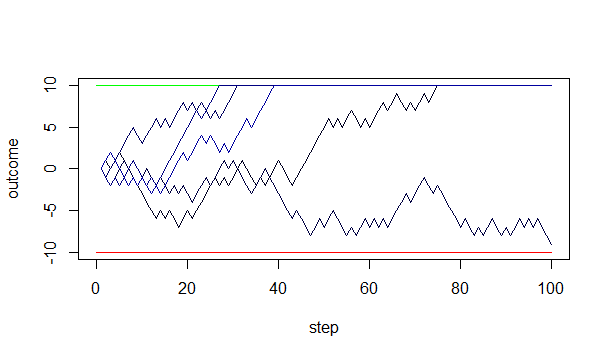
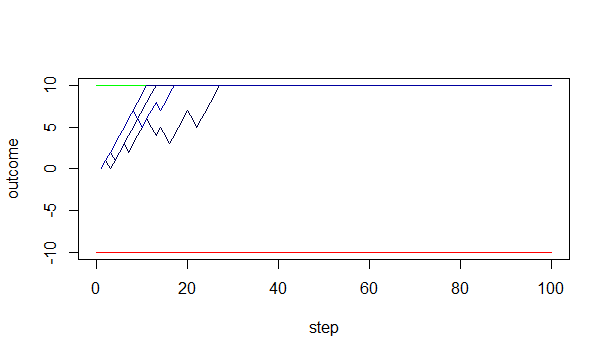
I wrote a little R program to demonstrate drift-diffusion models; the images I’ll be showing are R plots from that program. The graphs represent the aggregated “opinion” of all the deciding neurons; as you go from left to right, time passes, and the opinions “drift” toward one side or the other. For these graphs, the top of the graph represents the better choice.

It may actually be easiest to understand if you imagine that we are choosing a belief; new evidence accumulates that pushes us toward the correct answer (top) or the incorrect answer (bottom), because even a true belief will have some evidence that seems to be against it. You encounter this evidence more or less randomly (or do you?), and which belief you ultimately form will depend upon both how strong the evidence is and how thoughtful you are in forming your beliefs.

If the evidence is very strong (or in general, the two choices are very different), the trend will be very strong, and you’ll almost certainly come to a decision very quickly:

   strong_bias

If the evidence is weaker (the two choices are very similar), the trend will be much weaker, and it will take much longer to make a decision:

weak_bias

One way to make a decision faster would be to have a weaker threshold, like 75% agreement instead of 95%; but this has the downside that it can result in making the wrong choice. Notice how some of the paths go down to the bottom, which in this case is the worse choice:

low_threshold

But if there is actually no difference between the two options, a low threshold is good, because you don’t spend time waffling over a pointless decision. (I know that I’ve had a problem with that in real life, spending too long making a decision that ultimately is of minor importance; my drift thresholds are too high!) With a low threshold, you get it over with:

indifferent

With a high threshold, you can go on for ages:

ambivalent

This is the difference between indifferent about a decision and being ambivalent. If you are indifferent, you are dealing with two small amounts of utility and it doesn’t really matter which one you choose. If you are ambivalent, you are dealing with two large amounts of utility and it’s very important to get it right—but you aren’t sure which one to choose. If you are indifferent, you should use a low threshold and get it over with; but if you are ambivalent, it actually makes sense to keep your threshold high and spend a lot of time thinking about the problem in order to be sure you get it right.

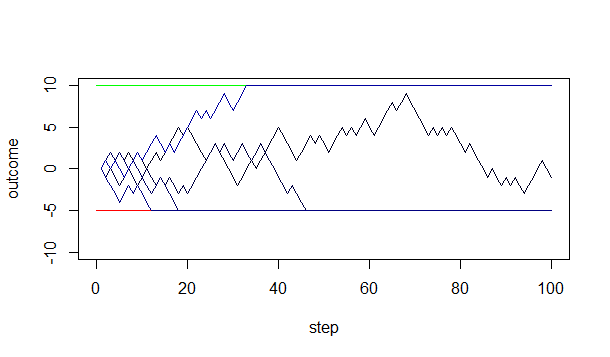
It’s also possible to set a higher threshold for one option than the other; I think this is actually what we’re doing when we exhibit many cognitive biases like confirmation bias. If the decision you’re making is between keeping your current beliefs and changing them to something else, your diffusion space actually looks more like this:

confirmation_bias

You’ll only make the correct choice (top) if you set equal thresholds (meaning you reason fairly instead of exhibiting cognitive biases) and high thresholds (meaning you spend sufficient time thinking about the question). If I may change to a sports metaphor, people tend to move the goalposts—the team “change your mind” has to kick a lot further than the team “keep your current belief”.

We can also extend drift-diffusion models to changing your mind (or experiencing regret such as “buyer’s remorse“) if we assume that the system doesn’t actually cut off once it reaches a threshold; the threshold makes us take the action, but then our neurons keep on arguing it out in the background. We may hover near the threshold or soar off into absolute certainty—but on the other hand we may waffle all the way back to the other decision:

regret

There are all sorts of generalizations and extensions of drift-diffusion models, but these basic ones should give you a sense of how useful they are. More importantly, they are accurate; drift-diffusion models produce very sharp mathematical predictions about human behavior, and in general these predictions are verified in experiments.

The main reason we started using drift-diffusion models is that they account very well for the fact that decisions become more accurate when we spend more time on them. The way they do that is quite elegant: Under harsher time pressure, we use lower thresholds, which speeds up the process but also introduces more errors. When we don’t have time pressure, we use high thresholds and take a long time, but almost always make the right decision.

Under certain (rather narrow) circumstances, drift-diffusion models can actually be equivalent to the optimal Bayesian model. These models can also be extended for use in purchasing choices, and one day we will hopefully have a stock-market-in-the-brain model of actual stock market decisions!

Drift-diffusion models are based on decisions between two alternatives with only one relevant attribute under consideration, but they are being expanded to decisions with multiple attributes and decisions with multiple alternatives; the fact that this is difficult is in my opinion not a bug but a feature—decisions with multiple alternatives and attributes are actually difficult for human beings to make. The fact that drift-diffusion models have difficulty with the very situations that human beings have difficulty with provides powerful evidence that drift-diffusion models are accurately representing the processes that go on inside a human brain. I’d be worried if it were too easy to extend the models to complex decisions—it would suggest that our model is describing a more flexible decision process than the one human beings actually use. Human decisions really do seem to be attempts to shoehorn two-choice single-attribute decision methods onto more complex problems, and a lot of mistakes we make are attributable to that.

In particular, the phenomena of analysis paralysis and the paradox of choice are easily explained this way. Why is it that when people are given more alternatives, they often spend far more time trying to decide and often end up less satisfied than they were before? This makes sense if, when faced with a large number of alternatives, we spend time trying to compare them pairwise on every attribute, and then get stuck with a whole bunch of incomparable pairwise comparisons that we then have to aggregate somehow. If we could simply assign a simple utility value to each attribute and sum them up, adding new alternatives should only increase the time required by a small amount and should never result in a reduction in final utility.

When I have an important decision to make, I actually assemble a formal utility model, as I did recently when deciding on a new computer to buy (it should be in the mail any day now!). The hardest part, however, is assigning values to the coefficients in the model; just how much am I willing to spend for an extra gigabyte of RAM, anyway? How exactly do those CPU benchmarks translate into dollar value for me? I can clearly tell that this is not the native process of my mental architecture.

No, alas, we seem to be stuck with drift-diffusion, which is nearly optimal for choices with two alternatives on a single attribute, but actually pretty awful for multiple-alternative multiple-attribute decisions. But perhaps by better understanding our suboptimal processes, we can rearrange our environment to bring us closer to optimal conditions—or perhaps, one day, change the processes themselves!

The Cognitive Science of Morality Part II: Molly Crockett

JDN 2457140 EDT 20:16.

This weekend has been very busy for me, so this post is going to be shorter than most—which is probably a good thing anyway, since my posts tend to run a bit long.

In an earlier post I discussed the Weinberg Cognitive Science Conference and my favorite speaker in the lineup, Joshua Greene. After a brief interlude from Capybara Day, it’s now time to talk about my second-favorite speaker, Molly Crockett. (Is it just me, or does the name “Molly” somehow seem incongruous with a person of such prestige?)

Molly Crockett is a neuroeconomist, though you’d never hear her say that. She doesn’t think of herself as an economist at all, but purely as a neuroscientist. I suspect this is because when she hears the word “economist” she thinks of only mainstream neoclassical economists, and she doesn’t want to be associated with such things.

Still, what she studies is clearly neuroeconomics—I in fact first learned of her work by reading the textbook Neuroeconomics, though I really got interested in her work after watching her TED Talk. It’s one of the better TED talks (they put out so many of them now that the quality is mixed at best); she talks about news reporting on neuroscience, how it is invariably ridiculous and sensationalist. This is particularly frustrating because of how amazing and important neuroscience actually is.

I could almost forgive the sensationalism if they were talking about something that’s actually fantastically boring, like, say, tax codes, or financial regulations. Of course, even then there is the Oliver Effect: You can hide a lot of evil by putting it in something boring. But Dodd-Frank is 2300 pages long; I read an earlier draft that was only (“only”) 600 pages, and it literally contained a three-page section explaining how to define the word “bank”. (Assuming direct proportionality, I would infer that there is now a twelve-page section defining the word “bank”. Hopefully not?) It doesn’t get a whole lot more snoozeworthy than that. So if you must be a bit sensationalist in order to get people to see why eliminating margin requirements and the swaps pushout rule are terrible, terrible ideas, so be it.

But neuroscience is not boring, and so sensationalism only means that news outlets are making up exciting things that aren’t true instead of saying the actually true things that are incredibly exciting.

Here, let me express without sensationalism what Molly Crockett does for a living: Molly Crockett experimentally determines how psychoactive drugs modulate moral judgments. The effects she observes are small, but they are real; and since these experiments are done using small doses for a short period of time, if these effects scale up they could be profound. This is the basic research component—when it comes to technological fruition it will be literally A Clockwork Orange. But it may be A Clockwork Orange in the best possible way: It could be, at last, a medical cure for psychopathy, a pill to make us not just happier or healthier, but better. We are not there yet by any means, but this is clearly the first step: Molly Crockett is to A Clockwork Orange roughly as Michael Faraday is to the Internet.

In one of the experiments she talked about at the conference, Crockett found that serotonin reuptake inhibitors enhance harm aversion. Serotonin reuptake inhibitors are very commonly used drugs—you are likely familiar with one called Prozac. So basically what this study means is that Prozac makes people more averse to causing pain in themselves or others. It doesn’t necessarily make them more altruistic, let alone more ethical; but it does make them more averse to causing pain. (To see the difference, imagine a 19th-century field surgeon dealing with a wounded soldier; there is no anesthetic, but an amputation must be made. Sometimes being ethical requires causing pain.)

The experiment is actually what Crockett calls “the honest Milgram Experiment“; under Milgram, the experimenters told their subjects they would be causing shocks, but no actual shocks were administered. Under Crockett, the shocks are absolutely 100% real (though they are restricted to a much lower voltage of course). People are given competing offers that contain an amount of money and a number of shocks to be delivered, either to you or to the other subject. They decide how much it’s worth to them to bear the shocks—or to make someone else bear them. It’s a classic willingness-to-pay paradigm, applied to the Milgram Experiment.

What Crockett found did not surprise me, nor do I expect it will surprise you if you imagine yourself in the same place; but it would totally knock the socks off of any neoclassical economist. People are much more willing to bear shocks for money than they are to give shocks for money. They are what Crockett terms hyper-altruistic; I would say that they are exhibiting an apparent solidarity coefficient greater than 1. They seem to be valuing others more than they value themselves.

Normally I’d say that this makes no sense at all—why would you value some random stranger more than yourself? Equally perhaps, and obviously only a psychopath would value them not at all; but more? And there’s no way you can actually live this way in your daily life; you’d give away all your possessions and perhaps even starve yourself to death. (I guess maybe Jesus lived that way.) But Crockett came up with a model that explains it pretty well: We are morally risk-averse. If we knew we were dealing with someone very strong who had no trouble dealing with shocks, we’d be willing to shock them a fairly large amount. But we might actually be dealing with someone very vulnerable who would suffer greatly; and we don’t want to take that chance.

I think there’s some truth to that. But her model leaves something else out that I think is quite important: We are also averse to unfairness. We don’t like the idea of raising one person while lowering another. (Obviously not so averse as to never do it—we do it all the time—but without a compelling reason we consider it morally unjustified.) So if the two subjects are in roughly the same condition (being two undergrads at Oxford, they probably are), then helping one while hurting the other is likely to create inequality where none previously existed. But if you hurt yourself in order to help yourself, no such inequality is created; all you do is raise yourself up, provided that you do believe that the money is good enough to be worth the shocks. It’s actually quite Rawslian; lifting one person up while not affecting the other is exactly the sort of inequality you’re allowed to create according to the Difference Principle.

There’s also the fact that the subjects can’t communicate; I think if I could make a deal to share the money afterward, I’d feel better about shocking someone more in order to get us both more money. So perhaps with communication people would actually be willing to shock others more. (And the sensation headline would of course be: “Talking makes people hurt each other.”)

But all of these ideas are things that could be tested in future experiments! And maybe I’ll do those experiments someday, or Crockett, or one of her students. And with clever experimental paradigms we might find out all sorts of things about how the human mind works, how moral intuitions are structured, and ultimately how chemical interventions can actually change human moral behavior. The potential for both good and evil is so huge, it’s both wondrous and terrifying—but can you deny that it is exciting?

And that’s not even getting into the Basic Fact of Cognitive Science, which undermines all concepts of afterlife and theistic religion. I already talked about it before—as the sort of thing that I sort of wish I could say when I introduce myself as a cognitive scientist—but I think it bears repeating.

As Patricia Churchland said on the Colbert Report: Colbert asked, “Are you saying I have no soul?” and she answered, “Yes.” I actually prefer Daniel Dennett’s formulation: “Yes, we have a soul, but it’s made of lots of tiny robots.”

We don’t have a magical, supernatural soul (whatever that means); we don’t have an immortal soul that will rise into Heaven or be reincarnated in someone else. But we do have something worth preserving: We have minds that are capable of consciousness. We love and hate, exalt and suffer, remember and imagine, understand and wonder. And yes, we are born and we die. Once the unique electrochemical pattern that defines your consciousness is sufficiently degraded, you are gone. Nothing remains of what you were—except perhaps the memories of others, or things you have created. But even this legacy is unlikely to last forever. One day it is likely that all of us—and everything we know, and everything we have built, from the Great Pyramids to Hamlet to Beethoven’s Ninth to Principia Mathematica to the US Interstate Highway System—will be gone. I don’t have any consolation to offer you on that point; I can’t promise you that anything will survive a thousand years, much less a million. There is a chance—even a chance that at some point in the distant future, whatever humanity has become will find a way to reverse the entropic decay of the universe itself—but nothing remotely like a guarantee. In all probability you, and I, and all of this will be gone someday, and that is absolutely terrifying.

But it is also undeniably true. The fundamental link between the mind and the brain is one of the basic facts of cognitive science; indeed I like to call it The Basic Fact of Cognitive Science. We know specifically which kinds of brain damage will make you unable to form memories, comprehend language, speak language (a totally different area), see, hear, smell, feel anger, integrate emotions with logic… do I need to go on? Everything that you are is done by your brain—because you are your brain.

Now why can’t the science journalists write about that? Instead we get “The Simple Trick That Can Boost Your Confidence Immediately” and “When it Comes to Picking Art, Men & Women Just Don’t See Eye to Eye.” HuffPo is particularly awful of course; the New York Times is better, but still hardly as good as one might like. They keep trying to find ways to make it exciting—but so rarely seem to grasp how exciting it already is.

Happy Capybara Day! Or the power of culture

JDN 2457131 EDT 14:33.

Did you celebrate Capybara Day yesterday? You didn’t? Why not? We weren’t able to find any actual capybaras this year, but maybe next year we’ll be able to plan better and find a capybara at a zoo; unfortunately the nearest zoo with a capybara appears to be in Maryland. But where would we be without a capybara to consult annually on the stock market?

Right now you are probably rather confused, perhaps wondering if I’ve gone completely insane. This is because Capybara Day is a holiday of my own invention, one which only a handful of people have even heard about.

But if you think we’d never have a holiday so bizarre, think again: For all I did was make some slight modifications to Groundhog Day. Instead of consulting a groundhog about the weather every February 2, I proposed that we consult a capybara about the stock market every April 17. And if you think you have some reason why groundhogs are better at predicting the weather (perhaps because they at least have some vague notion of what weather is) than capybaras are at predicting the stock market (since they have no concept of money or numbers), think about this: Capybara Day could produce extremely accurate predictions, provided only that people actually believed it. The prophecy of rising or falling stock prices could very easily become self-fulfilling. If it were a cultural habit of ours to consult capybaras about the stock market, capybaras would become good predictors of the stock market.

That might seem a bit far-fetched, but think about this: Why is there a January Effect? (To be fair, some researchers argue that there isn’t, and the apparent correlation between higher stock prices and the month of January is simply an illusion, perhaps the result of data overfitting.)

But I think it probably is real, and moreover has some very obvious reasons behind it. In this I’m in agreement with Richard Thaler, a founder of cognitive economics who wrote about such anomalies in the 1980s. December is a time when two very culturally-important events occur: The end of the year, during which many contracts end, profits are assessed, and tax liabilities are determined; and Christmas, the greatest surge of consumer spending and consumer debt.

The first effect means that corporations are very likely to liquidate assets—particularly assets that are running at a loss—in order to minimize their tax liabilities for the year, which will drive down prices. The second effect means that consumers are in search of financing for extravagant gift purchases, and those who don’t run up credit cards may instead sell off stocks. This is if anything a more rational way of dealing with the credit constraint, since interest rates on credit cards are typically far in excess of stock returns. But this surge of selling due to credit constraints further depresses prices.

In January, things return to normal; assets are repurchased, debt is repaid. This brings prices back up to where they were, which results in a higher than normal return for January.

Neoclassical economists are loath to admit that such a seasonal effect could exist, because it violates their concept of how markets work—and to be fair, the January Effect is actually weak enough to be somewhat ambiguous. But actually it doesn’t take much deviation from neoclassical models to explain the effect: Tax policies and credit constraints are basically enough to do it, so you don’t even need to go that far into understanding human behavior. It’s perfectly rational to behave this way given the distortions that are created by taxes and credit limits, and the arbitrage opportunity is one that you can only take advantage of if you have large amounts of credit and aren’t worried about minimizing your tax liabilities. It’s important to remember just how strong the assumptions of models like CAPM truly are; in addition to the usual infinite identical psychopaths, CAPM assumes there are no taxes, no transaction costs, and unlimited access to credit. I’d say it’s amazing that it works at all, but actually, it doesn’t—check out this graph of risk versus return and tell me if you think CAPM is actually giving us any information at all about how stock markets behave. It frankly looks like you could have drawn a random line through a scatter plot and gotten just as good a fit. Knowing how strong its assumptions are, we would not expect CAPM to work—and sure enough, it doesn’t.

Of course, that leaves the question of why our tax policy would be structured in this way—why make the year end on December 31 instead of some other date? And for that, you need to go back through hundreds of years of history, the Gregorian calendar, which in turn was influenced by Christianity, and before that the Julian calendar—in other words, culture.

Culture is one of the most powerful forces that influences human behavior—and also one of the strangest and least-understood. Economic theory is basically silent on the matter of culture. Typically it is ignored entirely, assumed to be irrelevant against the economic incentives that are the true drivers of human action. (There’s a peculiar emotion many neoclassical economists express that I can best describe as self-righteous cynicism, the attitude that we alone—i.e., economists—understand that human beings are not the noble and altruistic creatures many imagine us to be, nor beings of art and culture, but simply cold, calculating machines whose true motives are reducible to profit incentives—and all who think otherwise are being foolish and naïve; true enlightenment is understanding that human beings are infinite identical psychopaths. This is the attitude epitomized by the economist who once sent me an email with “altruism” written in scare quotes.)

Occasionally culture will be invoked as an external (in jargon, exogenous) force, to explain some aspect of human behavior that is otherwise so totally irrational that even invoking nonsensical preferences won’t make it go away. When a suicide bomber blows himself up in a crowd of people, it’s really pretty hard to explain that in terms of rational profit incentives—though I have seen it tried. (It could be self-interest at a larger scale, like families or nations—but then, isn’t that just the tribal paradigm I’ve been arguing for all along?)

But culture doesn’t just motivate us to do extreme or wildly irrational things. It motivates us all the time, often in quite beneficial ways; we wait in line, hold doors for people walking behind us, tip waiters who serve us, and vote in elections, not because anyone pressures us directly to do so (unlike say Australia we do not have compulsory voting) but because it’s what we feel we ought to do. There is a sense of altruism—and altruism provides the ultimate justification for why it is right to do these things—but the primary motivator in most cases is culture—that’s what people do, and are expected to do, around here.

Indeed, even when there is a direct incentive against behaving a certain way—like criminal penalties against theft—the probability of actually suffering a direct penalty is generally so low that it really can’t be our primary motivation. Instead, the reason we don’t cheat and steal is that we think we shouldn’t, and a major part of why we think we shouldn’t is that we have cultural norms against it.

We can actually observe differences in cultural norms across countries in the laboratory. In this 2008 study by Massimo Castro (PDF) comparing British and Italian people playing an economic game called the public goods game in which you can pay a cost yourself to benefit the group as a whole, it was found not only that people were less willing to benefit groups of foreigners than groups of compatriots, British people were overall more generous than Italian people. This 2010 study by Gachter et. al. (actually Joshua Greene talked about it last week) compared how people play the game in various cities, they found three basic patterns: In Western European and American cities such as Zurich, Copenhagen and Boston, cooperation started out high and remained high throughout; people were just cooperative in general. In Asian cities such as Chengdu and Seoul, cooperation started out low, but if people were punished for not cooperating, cooperation would improve over time, eventually reaching about the same place as in the highly cooperative cities. And in Mediterranean cities such as Istanbul, Athens, and Riyadh, cooperation started low and stayed low—even when people could be punished for not cooperating, nobody actually punished them. (These patterns are broadly consistent with the World Bank corruption ratings of these regions, by the way; Western Europe shows very low corruption, while Asia and the Mediterranean show high corruption. Of course this isn’t all that’s going on—and Asia isn’t much less corrupt than the Middle East, while this experiment might make you think so.)

Interestingly, these cultural patterns showed Melbourne as behaving more like an Asian city than a Western European one—perhaps being in the Pacific has worn off on Australia more than they realize.

This is very preliminary, cutting-edge research I’m talking about, so be careful about drawing too many conclusions. But in general we’ve begun to find some fairly clear cultural differences in economic behavior across different societies. While this would not be at all surprising to a sociologist or anthropologist, it’s the sort of thing that economists have insisted for years is impossible.

This is the frontier of cognitive economics, in my opinion. We know that culture is a very powerful motivator of our behavior, and it is time for us to understand how it works—and then, how it can be changed. We know that culture can be changed—cultural norms do change over time, sometimes remarkably rapidly; but we have only a faint notion of how or why they change. Changing culture has the power to do things that simply changing policy cannot, however; policy requires enforcement, and when the enforcement is removed the behavior will often disappear. But if a cultural norm can be imparted, it could sustain itself for a thousand years without any government action at all.

Love is rational

JDN 2457066 PST 15:29.

Since I am writing this the weekend of Valentine’s Day (actually by the time it is published it will be Valentine’s Day) and sitting across from my boyfriend, it seems particularly appropriate that today’s topic should be love. As I am writing it is in fact Darwin Day, so it is fitting that evolution will be a major topic as well.

Usually we cognitive economists are the ones reminding neoclassical economists that human beings are not always rational. Today however I must correct a misconception in the opposite direction: Love is rational, or at least it can be, should be, and typically is.

Lately I’ve been reading The Logic of Life which actually makes much the same point, about love and many other things. I had expected it to be a dogmatic defense of economic rationality—published in 2008 no less, which would make it the scream of a dying paradigm as it carries us all down with it—but I was in fact quite pleasantly surprised. The book takes a nuanced position on rationality very similar to my own, and actually incorporates many of the insights from neuroeconomics and cognitive economics. I think Harford would basically agree with me that human beings are 90% rational (but woe betide the other 10%).

We have this romantic (Romantic?) notion in our society that love is not rational, it is “beyond” rationality somehow. “Love is blind”, they say; and this is often used as a smug reply to the notion that rationality is the proper guide to live our lives.

The argument would seem to follow: “Love is not rational, love is good, therefore rationality is not always good.”

But then… the argument would follow? What do you mean, follow? Follow logically? Follow rationally? Something is clearly wrong if we’ve constructed a rational argument intended to show that we should not live our lives by rational arguments.

And the problem of course is the premise that love is not rational. Whatever made you say that?

It’s true that love is not directly volitional, not in the way that it is volitional to move your arm upward or close your eyes or type the sentence “Jackdaws ate my big sphinx of quartz.” You don’t exactly choose to love someone, weighing the pros and cons and making a decision the way you might choose which job offer to take or which university to attend.

But then, you don’t really choose which university you like either, now do you? You choose which to attend. But your enjoyment of that university is not a voluntary act. And similarly you do in fact choose whom to date, whom to marry. And you might well consider the pros and cons of such decisions. So the difference is not as large as it might at first seem.

More importantly, to say that our lives should be rational is not the same as saying they should be volitional. You simply can’t live your life as completely volitional, no matter how hard you try. You simply don’t have the cognitive resources to maintain constant awareness of every breath, every heartbeat. Yet there is nothing irrational about breathing or heartbeats—indeed they are necessary for survival and thus a precondition of anything rational you might ever do.

Indeed, in many ways it is our subconscious that is the most intelligent part of us. It is not as flexible as our conscious mind—that is why our conscious mind is there—but the human subconscious is unmatched in its efficiency and reliability among literally all known computational systems in the known universe. Walk across a room and it will solve reverse kinematics in real time. Throw a ball and it will solve three-dimensional nonlinear differential equations as well. Look at a familiar face and it will immediately identify it among a set of hundreds of faces with near-perfect accuracy regardless of the angle, lighting conditions, or even hairstyle. To see that I am not exaggerating the immense difficulty of these tasks, look at how difficult it is to make robots that can walk on two legs or throw balls. Face recognition is so difficult that it is still an unsolved problem with an extensive body of ongoing research.

And love, of course, is the subconscious system that has been most directly optimized by natural selection. Our very survival has depended upon it for millions of years. Indeed, it’s amazing how often it does seem to fail given those tight optimization constraints; I think this is for two reasons. First, natural selection optimizes for inclusive fitness, which is not the same thing as optimizing for happiness—what’s good for your genes may not be good for you per se. Many of the ways that love hurts us seem to be based around behaviors that probably did on average spread more genes on the African savannah. Second, the task of selecting an optimal partner is so mind-bogglingly complex that even the most powerful computational system in the known universe still can only do it so well. Imagine trying to construct a formal decision model that would tell you whom you should marry—all the variables you’d need to consider, the cost of sampling each of those variables sufficiently, the proper weightings on all the different terms in the utility function. Perhaps the wonder is that love is as rational as it is.

Indeed, love is evidence-based—and when it isn’t, this is cause for concern. The evidence is most often presented in small ways over long periods of time—a glance, a kiss, a gift, a meeting canceled to stay home and comfort you. Some ways are larger—a career move postponed to keep the family together, a beautiful wedding, a new house. We aren’t formally calculating the Bayesian probability at each new piece of evidence—though our subconscious brains might be, and whatever they’re doing the results aren’t far off from that mathematical optimum.

The notion that you will never “truly know” if others love you is no more epistemically valid or interesting than the notion that you will never “truly know” if your shirt is grue instead of green or if you are a brain in a vat. Perhaps we’ve been wrong about gravity all these years, and on April 27, 2016 it will suddenly reverse direction! No, it won’t, and I’m prepared to literally bet the whole world on that (frankly I’m not sure I have a choice). To be fair, the proposition that your spouse of twenty years or your mother loves you is perhaps not that certain—but it’s pretty darn certain. Perhaps the proper comparison is the level of certainty that climate change is caused by human beings, or even less, the level of certainty that your car will not suddenly veer off the road and kill you. The latter is something that actually happens—but we all drive every day assuming it won’t. By the time you marry someone, you can and should be that certain that they love you.

Love without evidence is bad love. The sort of unrequited love that builds in secret based upon fleeing glimpses, hours of obsessive fantasy, and little or no interaction with its subject isn’t romantic—it’s creepy and psychologically unhealthy. The extreme of that sort of love is what drove John Hinckley Jr. to shoot Ronald Reagan in order to impress Jodie Foster.

I don’t mean to make you feel guilty if you have experienced such a love—most of us have at one point or another—but it disgusts me how much our society tries to elevate that sort of love as the “true love” to which we should all aspire. We encourage people—particularly teenagers—to conceal their feelings for a long time and then release them in one grand surprise gesture of affection, which is just about the opposite of what you should actually be doing. (Look at Love Actually, which is just about the opposite of what its title says.) I think a great deal of strife in our society would be eliminated if we taught our children how to build relationships gradually over time instead of constantly presenting them with absurd caricatures of love that no one can—or should—follow.

I am pleased to see that our cultural norms on that point seem to be changing. A corporation as absurdly powerful as Disney is both an influence upon and a barometer of our social norms, and the trope in the most recent Disney films (like Frozen and Maleficent) is that true love is not the fiery passion of love at first sight, but the deep bond between family members that builds over time. This is a much healthier concept of love, though I wouldn’t exclude romantic love entirely. Romantic love can be true love, but only by building over time through a similar process.

Perhaps there is another reason people are uncomfortable with the idea that love is rational; by definition, rational behaviors respond to incentives. And since we tend to conceive of incentives as a purely selfish endeavor, this would seem to imply that love is selfish, which seems somewhere between painfully cynical and outright oxymoronic.

But while love certainly does carry many benefits for its users—being in love will literally make you live longer, by quite a lot, an effect size comparable to quitting smoking or exercising twice a week—it also carries many benefits for its recipients as well. Love is in fact the primary means by which evolution has shaped us toward altruism; it is the love for our family and our tribe that makes us willing to sacrifice so much for them. Not all incentives are selfish; indeed, an incentive is really just something that motivates you to action. If you could truly convince me that a given action I took would have even a reasonable chance of ending world hunger, I would do almost anything to achieve it; I can scarcely imagine a greater incentive, even though I would be harmed and the benefits would incur to people I have never met.

Love evolved because it advanced the fitness of our genes, of course. And this bothers many people; it seems to make our altruism ultimately just a different form of selfishness I guess, selfishness for our genes instead of ourselves. But this is a genetic fallacy, isn’t it? Yes, evolution by natural selection is a violent process, full of death and cruelty and suffering (as Darwin said, red in tooth and claw); but that doesn’t mean that its outcome—namely ourselves—is so irredeemable. We are, in fact, altruistic, regardless of where that altruism came from. The fact that it advanced our genes can actually be comforting in a way, because it reminds us that the universe is nonzero-sum and benefiting others does not have to mean harming ourselves.

One question I like to ask when people suggest that some scientific fact undermines our moral status in this way is: “Well, what would you prefer?” If the causal determinism of neural synapses undermines our free will, then what should we have been made of? Magical fairy dust? If we were, fairy dust would be a real phenomenon, and it would obey laws of nature, and you’d just say that the causal determinism of magical fairy dust undermines free will all over again. If the fact that our altruistic emotions evolved by natural selection to advance our inclusive fitness makes us not truly altruistic, then where should have altruism come from? A divine creator who made us to love one another? But then we’re just following our programming! You can always make this sort of argument, which either means that live is necessarily empty of meaning, that no possible universe could ever assuage our ennui—or, what I believe, that life’s meaning does not come from such ultimate causes. It is not what you are made of or where you come from that defines what you are. We are best defined by what we do.

It seems to depend how you look at it: Romantics are made of stardust and the fabric of the cosmos, while cynics are made of the nuclear waste expelled in the planet-destroying explosions of dying balls of fire. Romantics are the cousins of all living things in one grand family, while cynics are apex predators evolved from millions of years of rape and murder. Both of these views are in some sense correct—but I think the real mistake is in thinking that they are incompatible. Human beings are both those things, and more; we are capable of both great compassion and great cruelty—and also great indifference. It is a mistake to think that only the dark sides—or for that matter only the light sides—of us are truly real.

Love is rational; love responds to incentives; love is an evolutionary adaptation. Love binds us together; love makes us better; love leads us to sacrifice for one another.

Love is, above all, what makes us not infinite identical psychopaths.

How is the economy doing?

JDN 2457033 EST 12:22.

Whenever you introduce yourself to someone as an economist, you will typically be asked a single question: “How is the economy doing?” I’ve already experienced this myself, and I don’t have very many dinner parties under my belt.

It’s an odd question, for a couple of reasons: First, I didn’t say I was a macroeconomic forecaster. That’s a very small branch of economics—even a small branch of macroeconomics. Second, it is widely recognized among economists that our forecasters just aren’t very good at what they do. But it is the sort of thing that pops into people’s minds when they hear the word “economist”, so we get asked it a lot.

Why are our forecasts so bad? Some argue that the task is just inherently too difficult due to the chaotic system involved; but they used to say that about weather forecasts, and yet with satellites and computer models our forecasts are now far more accurate than they were 20 years ago. Others have argued that “politics always dominates over economics”, as though politics were somehow a fundamentally separate thing, forever exogenous, a parameter in our models that cannot be predicted. I have a number of economic aphorisms I’m trying to popularize; the one for this occasion is: “Nothing is exogenous.” (Maybe fundamental constants of physics? But actually many physicists think that those constants can be derived from even more fundamental laws.) My most common is “It’s the externalities, stupid.”; next is “It’s not the incentives, it’s the opportunities.”; and the last is “Human beings are 90% rational. But woe betide that other 10%.” In fact, it’s not quite true that all our macroeconomic forecasters are bad; a few, such as Krugman, are actually quite good. The Klein Award is given each year to the best macroeconomic forecasters, and the same names pop up too often for it to be completely random. (Sadly, one of the most common is Citigroup, meaning that our banksters know perfectly well what they’re doing when they destroy our economy—they just don’t care.) So in fact I think our failures of forecasting are not inevitable or permanent.

And of course that’s not what I do at all. I am a cognitive economist; I study how economic systems behave when they are run by actual human beings, rather than by infinite identical psychopaths. I’m particularly interested in what I call the tribal paradigm, the way that people identify with groups and act in the interests of those groups, how much solidarity people feel for each other and why, and what role ideology plays in that identification. I’m hoping to one day formally model solidarity and make directly testable predictions about things like charitable donations, immigration policies and disaster responses.

I do have a more macroeconomic bent than most other cognitive economists; I’m not just interested in how human irrationality affects individuals or corporations, I’m also interested in how it affects society as a whole. But unlike most macroeconomists I care more about inequality than unemployment, and hardly at all about inflation. Unless you start getting 40% inflation per year, inflation really isn’t that harmful—and can you imagine what 40% unemployment would be like? (Also, while 100% inflation is awful, 100% unemployment would be no economy at all.) If we’re going to have a “misery index“, it should weight unemployment at least 10 times as much as inflation—and it should also include terms for poverty and inequality. Frankly maybe we should just use poverty, since I’d be prepared to accept just about any level of inflation, unemployment, or even inequality if it meant eliminating poverty. This is of course is yet another reason why a basic income is so great! An anti-poverty measure can really only be called a failure if it doesn’t actually reduce poverty; the only way that could happen with a basic income is if it somehow completely destabilized the economy, which is extremely unlikely as long as the basic income isn’t something ridiculous like $100,000 per year.

I could probably talk about my master’s thesis; the econometric models are relatively arcane, but the basic idea of correlating the income concentration of the top 1% of 1% and the level of corruption is something most people can grasp easily enough.

Of course, that wouldn’t be much of an answer to “How is the economy doing?”; usually my answer is to repeat what I’ve last read from mainstream macroeconomic forecasts, which is usually rather banal—but maybe that’s the idea? Most small talk is pretty banal I suppose (I never was very good at that sort of thing). It sounds a bit like this: No, we’re not on the verge of horrible inflation—actually inflation is currently too low. (At this point someone will probably bring up the gold standard, and I’ll have to explain that the gold standard is an unequivocally terrible idea on so, so many levels. The gold standard caused the Great Depression.) Unemployment is gradually improving, and actually job growth is looking pretty good right now; but wages are still stagnant, which is probably what’s holding down inflation. We could have prevented the Second Depression entirely, but we didn’t because Republicans are terrible at managing the economy—all of the 10 most recent recessions and almost 80% of the recessions in the last century were under Republican presidents. Instead the Democrats did their best to implement basic principles of Keynesian macroeconomics despite Republican intransigence, and we muddled through. In another year or two we will actually be back at an unemployment rate of 5%, which the Federal Reserve considers “full employment”. That’s already problematic—what about that other 5%?—but there’s another problem as well: Much of our reduction in unemployment has come not from more people being employed but instead by more people dropping out of the labor force. Our labor force participation rate is the lowest it’s been since 1978, and is still trending downward. Most of these people aren’t getting jobs; they’re giving up. At best we may hope that they are people like me, who gave up on finding work in order to invest in their own education, and will return to the labor force more knowledgeable and productive one day—and indeed, college participation rates are also rising rapidly. And no, that doesn’t mean we’re becoming “overeducated”; investment in education, so-called “human capital”, is literally the single most important factor in long-term economic output, by far. Education is why we’re not still in the Stone Age. Physical capital can be replaced, and educated people will do so efficiently. But all the physical capital in the world will do you no good if nobody knows how to use it. When everyone in the world is a millionaire with two PhDs and all our work is done by robots, maybe then you can say we’re “overeducated”—and maybe then you’d still be wrong. Being “too educated” is like being “too rich” or “too happy”.

That’s usually enough to placate my interlocutor. I should probably count my blessings, for I imagine that the first confrontation you get at a dinner party if you say you are a biologist involves a Creationist demanding that you “prove evolution”. I like to think that some mathematical biologists—yes, that’s a thing—take their request literally and set out to mathematically prove that if allele distributions in a population change according to a stochastic trend then the alleles with highest expected fitness have, on average, the highest fitness—which is what we really mean by “survival of the fittest”. The more formal, the better; the goal is to glaze some Creationist eyes. Of course that’s a tautology—but so is literally anything that you can actually prove. Cosmologists probably get similar demands to “prove the Big Bang”, which sounds about as annoying. I may have to deal with gold bugs, but I’ll take them over Creationists any day.

What do other scientists get? When I tell people I am a cognitive scientist (as a cognitive economist I am sort of both an economist and a cognitive scientist after all), they usually just respond with something like “Wow, you must be really smart.”; which I suppose is true enough, but always strikes me as an odd response. I think they just didn’t know enough about the field to even generate a reasonable-sounding question, whereas with economists they always have “How is the economy doing?” handy. Political scientists probably get “Who is going to win the election?” for the same reason. People have opinions about economics, but they don’t have opinions about cognitive science—or rather, they don’t think they do. Actually most people have an opinion about cognitive science that is totally and utterly ridiculous, more on a par with Creationists than gold bugs: That is, most people believe in a soul that survives after death. This is rather like believing that after your computer has been smashed to pieces and ground back into the sand from whence it came, all the files you had on it are still out there somewhere, waiting to be retrieved. No, they’re long gone—and likewise your memories and your personality will be long gone once your brain has rotted away. Yes, we have a soul, but it’s made of lots of tiny robots; when the tiny robots stop working the soul is no more. Everything you are is a result of the functioning of your brain. This does not mean that your feelings are not real or do not matter; they are just as real and important as you thought they were. What it means is that when a person’s brain is destroyed, that person is destroyed, permanently and irrevocably. This is terrifying and difficult to accept; but it is also most definitely true. It is as solid a fact as any in modern science. Many people see a conflict between evolution and religion; but the Pope has long since rendered that one inert. No, the real conflict, the basic fact that undermines everything religion is based upon, is not in biology but in cognitive science. It is indeed the Basic Fact of Cognitive Science: We are our brains, no more and no less. (But I suppose it wouldn’t be polite to bring that up at dinner parties.)

The “You must be really smart.” response is probably what happens to physicists and mathematicians. Quantum mechanics confuses basically everyone, so few dare go near it. The truly bold might try to bring up Schrodinger’s Cat, but are unlikely to understand the explanation of why it doesn’t work. General relativity requires thinking in tensors and four-dimensional spaces—perhaps they’ll be asked the question “What’s inside a black hole?”, which of course no physicist can really answer; the best answer may actually be, “What do you mean, inside?” And if a mathematician tries to explain their work in lay terms, it usually comes off as either incomprehensible or ridiculous: Stokes’ Theorem would be either “the integral of a differential form over the boundary of some orientable manifold is equal to the integral of its exterior derivative over the whole manifold” or else something like “The swirliness added up inside an object is equal to the swirliness added up around the edges.”

Economists, however, always seem to get this one: “How is the economy doing?”

Right now, the answer is this: “It’s still pretty bad, but it’s getting a lot better. Hopefully the new Congress won’t screw that up.”

How do we measure happiness?

JDN 2457028 EST 20:33.

No, really, I’m asking. I strongly encourage my readers to offer in the comments any ideas they have about the measurement of happiness in the real world; this has been a stumbling block in one of my ongoing research projects.

In one sense the measurement of happiness—or more formally utility—is absolutely fundamental to economics; in another it’s something most economists are astonishingly afraid of even trying to do.

The basic question of economics has nothing to do with money, and is really only incidentally related to “scarce resources” or “the production of goods” (though many textbooks will define economics in this way—apparently implying that a post-scarcity economy is not an economy). The basic question of economics is really this: How do we make people happy?

This must always be the goal in any economic decision, and if we lose sight of that fact we can make some truly awful decisions. Other goals may work sometimes, but they inevitably fail: If you conceive of the goal as “maximize GDP”, then you’ll try to do any policy that will increase the amount of production, even if that production comes at the expense of stress, injury, disease, or pollution. (And doesn’t that sound awfully familiar, particularly here in the US? 40% of Americans report their jobs as “very stressful” or “extremely stressful”.) If you were to conceive of the goal as “maximize the amount of money”, you’d print money as fast as possible and end up with hyperinflation and total economic collapse ala Zimbabwe. If you were to conceive of the goal as “maximize human life”, you’d support methods of increasing population to the point where we had a hundred billion people whose lives were barely worth living. Even if you were to conceive of the goal as “save as many lives as possible”, you’d find yourself investing in whatever would extend lifespan even if it meant enormous pain and suffering—which is a major problem in end-of-life care around the world. No, there is one goal and one goal only: Maximize happiness.

I suppose technically it should be “maximize utility”, but those are in fact basically the same thing as long as “happiness” is broadly conceived as eudaimoniathe joy of a life well-lived—and not a narrow concept of just adding up pleasure and subtracting out pain. The goal is not to maximize the quantity of dopamine and endorphins in your brain; the goal is to achieve a world where people are safe from danger, free to express themselves, with friends and family who love them, who participate in a world that is just and peaceful. We do not want merely the illusion of these things—we want to actually have them. So let me be clear that this is what I mean when I say “maximize happiness”.

The challenge, therefore, is how we figure out if we are doing that. Things like money and GDP are easy to measure; but how do you measure happiness?
Early economists like Adam Smith and John Stuart Mill tried to deal with this question, and while they were not very successful I think they deserve credit for recognizing its importance and trying to resolve it. But sometime around the rise of modern neoclassical economics, economists gave up on the project and instead sought a narrower task, to measure preferences.

This is often called technically ordinal utility, as opposed to cardinal utility; but this terminology obscures the fundamental distinction. Cardinal utility is actual utility; ordinal utility is just preferences.

(The notion that cardinal utility is defined “up to a linear transformation” is really an eminently trivial observation, and it shows just how little physics the physics-envious economists really understand. All we’re talking about here is units of measurement—the same distance is 10.0 inches or 25.4 centimeters, so is distance only defined “up to a linear transformation”? It’s sometimes argued that there is no clear zero—like Fahrenheit and Celsius—but actually it’s pretty clear to me that there is: Zero utility is not existing. So there you go, now you have Kelvin.)

Preferences are a bit easier to measure than happiness, but not by as much as most economists seem to think. If you imagine a small number of options, you can just put them in order from most to least preferred and there you go; and we could imagine asking someone to do that, or—the technique of revealed preferenceuse the choices they make to infer their preferences by assuming that when given the choice of X and Y, choosing X means you prefer X to Y.

Like much of neoclassical theory, this sounds good in principle and utterly collapses when applied to the real world. Above all: How many options do you have? It’s not easy to say, but the number is definitely huge—and both of those facts pose serious problems for a theory of preferences.

The fact that it’s not easy to say means that we don’t have a well-defined set of choices; even if Y is theoretically on the table, people might not realize it, or they might not see that it’s better even though it actually is. Much of our cognitive effort in any decision is actually spent narrowing the decision space—when deciding who to date or where to go to college or even what groceries to buy, simply generating a list of viable options involves a great deal of effort and extremely complex computation. If you have a true utility function, you can satisficechoosing the first option that is above a certain threshold—or engage in constrained optimizationchoosing whether to continue searching or accept your current choice based on how good it is. Under preference theory, there is no such “how good it is” and no such thresholds. You either search forever or choose a cutoff arbitrarily.

Even if we could decide how many options there are in any given choice, in order for this to form a complete guide for human behavior we would need an enormous amount of information. Suppose there are 10 different items I could have or not have; then there are 10! = 3.6 million possible preference orderings. If there were 100 items, there would be 100! = 9e157 possible orderings. It won’t do simply to decide on each item whether I’d like to have it or not. Some things are complements: I prefer to have shoes, but I probably prefer to have $100 and no shoes at all rather than $50 and just a left shoe. Other things are substitutes: I generally prefer eating either a bowl of spaghetti or a pizza, rather than both at the same time. No, the combinations matter, and that means that we have an exponentially increasing decision space every time we add a new option. If there really is no more structure to preferences than this, we have an absurd computational task to make even the most basic decisions.

This is in fact most likely why we have happiness in the first place. Happiness did not emerge from a vacuum; it evolved by natural selection. Why make an organism have feelings? Why make it care about things? Wouldn’t it be easier to just hard-code a list of decisions it should make? No, on the contrary, it would be exponentially more complex. Utility exists precisely because it is more efficient for an organism to like or dislike things by certain amounts rather than trying to define arbitrary preference orderings. Adding a new item means assigning it an emotional value and then slotting it in, instead of comparing it to every single other possibility.

To illustrate this: I like Coke more than I like Pepsi. (Let the flame wars begin?) I also like getting massages more than I like being stabbed. (I imagine less controversy on this point.) But the difference in my mind between massages and stabbings is an awful lot larger than the difference between Coke and Pepsi. Yet according to preference theory (“ordinal utility”), that difference is not meaningful; instead I have to say that I prefer the pair “drink Pepsi and get a massage” to the pair “drink Coke and get stabbed”. There’s no such thing as “a little better” or “a lot worse”; there is only what I prefer over what I do not prefer, and since these can be assigned arbitrarily there is an impossible computational task before me to make even the most basic decisions.

Real utility also allows you to make decisions under risk, to decide when it’s worth taking a chance. Is a 50% chance of $100 worth giving up a guaranteed $50? Probably. Is a 50% chance of $10 million worth giving up a guaranteed $5 million? Not for me. Maybe for Bill Gates. How do I make that decision? It’s not about what I prefer—I do in fact prefer $10 million to $5 million. It’s about how much difference there is in terms of my real happiness—$5 million is almost as good as $10 million, but $100 is a lot better than $50. My marginal utility of wealth—as I discussed in my post on progressive taxation—is a lot steeper at $50 than it is at $5 million. There’s actually a way to use revealed preferences under risk to estimate true (“cardinal”) utility, developed by Von Neumann and Morgenstern. In fact they proved a remarkably strong theorem: If you don’t have a cardinal utility function that you’re maximizing, you can’t make rational decisions under risk. (In fact many of our risk decisions clearly aren’t rational, because we aren’t actually maximizing an expected utility; what we’re actually doing is something more like cumulative prospect theory, the leading cognitive economic theory of risk decisions. We overrespond to extreme but improbable events—like lightning strikes and terrorist attacks—and underrespond to moderate but probable events—like heart attacks and car crashes. We play the lottery but still buy health insurance. We fear Ebola—which has never killed a single American—but not influenza—which kills 10,000 Americans every year.)

A lot of economists would argue that it’s “unscientific”—Kenneth Arrow said “impossible”—to assign this sort of cardinal distance between our choices. But assigning distances between preferences is something we do all the time. Amazon.com lets us vote on a 5-star scale, and very few people send in error reports saying that cardinal utility is meaningless and only preference orderings exist. In 2000 I would have said “I like Gore best, Nader is almost as good, and Bush is pretty awful; but of course they’re all a lot better than the Fascist Party.” If we had simply been able to express those feelings on the 2000 ballot according to a range vote, either Nader would have won and the United States would now have a three-party system (and possibly a nationalized banking system!), or Gore would have won and we would be a decade ahead of where we currently are in preventing and mitigating global warming. Either one of these things would benefit millions of people.

This is extremely important because of another thing that Arrow said was “impossible”—namely, “Arrow’s Impossibility Theorem”. It should be called Arrow’s Range Voting Theorem, because simply by restricting preferences to a well-defined utility and allowing people to make range votes according to that utility, we can fulfill all the requirements that are supposedly “impossible”. The theorem doesn’t say—as it is commonly paraphrased—that there is no fair voting system; it says that range voting is the only fair voting system. A better claim is that there is no perfect voting system, which is true if you mean that there is no way to vote strategically that doesn’t accurately reflect your true beliefs. The Myerson-Satterthwaithe Theorem is then the proper theorem to use; if you could design a voting system that would force you to reveal your beliefs, you could design a market auction that would force you to reveal your optimal price. But the least expressive way to vote in a range vote is to pick your favorite and give them 100% while giving everyone else 0%—which is identical to our current plurality vote system. The worst-case scenario in range voting is our current system.

But the fact that utility exists and matters, unfortunately doesn’t tell us how to measure it. The current state-of-the-art in economics is what’s called “willingness-to-pay”, where we arrange (or observe) decisions people make involving money and try to assign dollar values to each of their choices. This is how you get disturbing calculations like “the lives lost due to air pollution are worth $10.2 billion.”

Why are these calculations disturbing? Because they have the whole thing backwards—people aren’t valuable because they are worth money; money is valuable because it helps people. It’s also really bizarre because it has to be adjusted for inflation. Finally—and this is the point that far too few people appreciate—the value of a dollar is not constant across people. Because different people have different marginal utilities of wealth, something that I would only be willing to pay $1000 for, Bill Gates might be willing to pay $1 million for—and a child in Africa might only be willing to pay $10, because that is all he has to spend. This makes the “willingness-to-pay” a basically meaningless concept independent of whose wealth we are spending.

Utility, on the other hand, might differ between people—but, at least in principle, it can still be added up between them on the same scale. The problem is that “in principle” part: How do we actually measure it?

So far, the best I’ve come up with is to borrow from public health policy and use the QALY, or quality-adjusted life year. By asking people macabre questions like “What is the maximum number of years of your life you would give up to not have a severe migraine every day?” (I’d say about 20—that’s where I feel ambivalent. At 10 I definitely would; at 30 I definitely wouldn’t.) or “What chance of total paralysis would you take in order to avoid being paralyzed from the waist down?” (I’d say about 20%.) we assign utility values: 80 years of migraines is worth giving up 20 years to avoid, so chronic migraine is a quality of life factor of 0.75. Total paralysis is 5 times as bad as paralysis from the waist down, so if waist-down paralysis is a quality of life factor of 0.90 then total paralysis is 0.50.

You can probably already see that there are lots of problems: What if people don’t agree? What if due to framing effects the same person gives different answers to slightly different phrasing? Some conditions will directly bias our judgments—depression being the obvious example. How many years of your life would you give up to not be depressed? Suicide means some people say all of them. How well do we really know our preferences on these sorts of decisions, given that most of them are decisions we will never have to make? It’s difficult enough to make the actual decisions in our lives, let alone hypothetical decisions we’ve never encountered.

Another problem is often suggested as well: How do we apply this methodology outside questions of health? Does it really make sense to ask you how many years of your life drinking Coke or driving your car is worth?
Well, actually… it better, because you make that sort of decision all the time. You drive instead of staying home, because you value where you’re going more than the risk of dying in a car accident. You drive instead of walking because getting there on time is worth that additional risk as well. You eat foods you know aren’t good for you because you think the taste is worth the cost. Indeed, most of us aren’t making most of these decisions very well—maybe you shouldn’t actually drive or drink that Coke. But in order to know that, we need to know how many years of your life a Coke is worth.

As a very rough estimate, I figure you can convert from willingness-to-pay to QALY by dividing by your annual consumption spending Say you spend annually about $20,000—pretty typical for a First World individual. Then $1 is worth about 50 microQALY, or about 26 quality-adjusted life-minutes. Now suppose you are in Third World poverty; your consumption might be only $200 a year, so $1 becomes worth 5 milliQALY, or 1.8 quality-adjusted life-days. The very richest individuals might spend as much as $10 million on consumption, so $1 to them is only worth 100 nanoQALY, or 3 quality-adjusted life-seconds.

That’s an extremely rough estimate, of course; it assumes you are in perfect health, all your time is equally valuable and all your purchasing decisions are optimized by purchasing at marginal utility. Don’t take it too literally; based on the above estimate, an hour to you is worth about $2.30, so it would be worth your while to work for even $3 an hour. Here’s a simple correction we should probably make: if only a third of your time is really usable for work, you should expect at least $6.90 an hour—and hey, that’s a little less than the US minimum wage. So I think we’re in the right order of magnitude, but the details have a long way to go.

So let’s hear it, readers: How do you think we can best measure happiness?