Debunking the Simulation Argument

Oct 23, JDN 2457685

Every subculture of humans has words, attitudes, and ideas that hold it together. The obvious example is religions, but the same is true of sports fandoms, towns, and even scientific disciplines. (I would estimate that 40-60% of scientific jargon, depending on discipline, is not actually useful, but simply a way of exhibiting membership in the tribe. Even physicists do this: “quantum entanglement” is useful jargon, but “p-brane” surely isn’t. Statisticians too: Why say the clear and understandable “unequal variance” when you could show off by saying “heteroskedasticity”? In certain disciplines of the humanities this figure can rise as high as 90%: “imaginary” as a noun leaps to mind.)

One particularly odd idea that seems to define certain subcultures of very intelligent and rational people is the Simulation Argument, originally (and probably best) propounded by Nick Bostrom:

This paper argues that at least one of the following propositions is true: (1) the human species is very likely to go extinct before reaching a “posthuman” stage; (2) any posthuman civilization is extremely unlikely to run a significant number of simulations of their evolutionary history (or variations thereof); (3) we are almost certainly living in a computer simulation.

In this original formulation by Bostrom, the argument actually makes some sense. It can be escaped, because it makes some subtle anthropic assumptions that need to be considered more carefully (in short, there could be ancestor-simulations but we could still know we aren’t in one); but it deserves to be taken seriously. Indeed, I think proposition (2) is almost certainly true, and proposition (1) might be as well; thus I have no problem accepting the disjunction.

Of course, the typical form of the argument isn’t nearly so cogent. In popular outlets as prestigious as the New York Times, Scientific American and the New Yorker, the idea is simply presented as “We are living in a simulation.” The only major outlet I could find that properly presented Bostrom’s disjunction was PBS. Indeed, there are now some Silicon Valley billionaires who believe the argument, or at least think it merits enough attention to be worth funding research into how we might escape the simulation we are in. (Frankly, even if we were inside a simulation, it’s not clear that “escaping” would be something worthwhile or even possible.)

Yet most people, when presented with this idea, think it is profoundly silly and a waste of time.

I believe this is the correct response. I am 99.9% sure we are not living in a simulation.

But it’s one thing to know that an argument is wrong, and quite another to actually show why; in that respect the Simulation Argument is a lot like the Ontological Argument for God:

However, as Bertrand Russell observed, it is much easier to be persuaded that ontological arguments are no good than it is to say exactly what is wrong with them.

To resolve this problem, I am writing this post (at the behest of my Patreons) to provide you now with a concise and persuasive argument directly against the Simulation Argument. No longer will you have to rely on your intuition that it can’t be right; you actually will have compelling logical reasons to reject it.

Note that I will not deny the core principle of cognitive science that minds are computational and therefore in principle could be simulated in such a way that the “simulations” would be actual minds. That’s usually what defenders of the Simulation Argument assume you’re denying, and perhaps in many cases it is; but that’s not what I’m denying. Yeah, sure, minds are computational (probably). There’s still no reason to think we’re living in a simulation.

To make this refutation, I should definitely address the strongest form of the argument, which is Nick Bostrom’s original disjunction. As I already noted, I believe that the disjunction is in fact true; at least one of those propositions is almost certainly correct, and perhaps two of them.

Indeed, I can tell you which one: Proposition (2). That is, I see no reason whatsoever why an advanced “posthuman” species would want to create simulated universes remotely resembling our own.


First of all, let’s assume that we do make it that far and posthumans do come into existence. I really don’t have sufficient evidence to say this is so, and the combination of millions of racists and thousands of nuclear weapons does not bode particularly well for that probability. But I think there is at least some good chance that this will happen—perhaps 10%?—so, let’s concede that point for now, and say that yes, posthumans will one day exist.

To be fair, I am not a posthuman, and cannot say for certain what beings of vastly greater intelligence and knowledge than I might choose to do. But since we are assuming that they exist as the result of our descendants more or less achieving everything we ever hoped for—peace, prosperity, immortality, vast knowledge—one thing I think I can safely extrapolate is that they will be moral. They will have a sense of ethics and morality not too dissimilar from our own. It will probably not agree in every detail—certainly not with what ordinary people believe, but very likely not with what even our greatest philosophers believe. It will most likely be better than our current best morality—closer to the objective moral truth that underlies reality.

I say this because this is the pattern that has emerged throughout the advancement of civilization thus far, and the whole reason we’re assuming posthumans might exist is that we are projecting this advancement further into the future. Humans have, on average, in the long run, become more intelligent, more rational, more compassionate. We have given up entirely on ancient moral concepts that we now recognize to be fundamentally defective, such as “witchcraft” and “heresy”; we are in the process of abandoning others for which some of us see the flaws but others don’t, such as “blasphemy” and “apostasy”. We have dramatically expanded the rights of women and various minority groups. Indeed, we have expanded our concept of which beings are morally relevant, our “circle of concern”, from only those in our tribe on outward to whole nations, whole races of people—and for some of us, as far as all humans or even all vertebrates. Therefore I expect us to continue to expand this moral circle, until it encompasses all sentient beings in the universe. Indeed, on some level I already believe that, though I know I don’t actually live in accordance with that theory—blame me if you will for my weakness of will, but can you really doubt the theory? Does it not seem likely that this it the theory to which our posthuman descendants will ultimately converge?

If that is the case, then posthumans would never make a simulation remotely resembling the universe I live in.

Maybe not me in particular, for I live relatively well—though I must ask why the migraines were really necessary. But among humans in general, there are many millions who live in conditions of such abject squalor and suffering that to create a universe containing them can only be counted as the gravest of crimes, morally akin to the Holocaust.

Indeed, creating this universe must, by construction, literally include the Holocaust. Because the Holocaust happened in this universe, you know.

So unless you think that our posthuman descendants are monstersdemons really, immortal beings of vast knowledge and power who thrive on the death and suffering of other sentient beings, you cannot think that they would create our universe. They might create a universe of some sort—but they would not create this one. You may consider this a corollary of the Problem of Evil, which has always been one of the (many) knockdown arguments against the existence of God as depicted in any major religion.

To deny this, you must twist the simulation argument quite substantially, and say that only some of us are actual people, sentient beings instantiated by the simulation, while the vast majority are, for lack of a better word, NPCs. The millions of children starving in southeast Asia and central Africa aren’t real, they’re just simulated, so that the handful of us who are real have a convincing environment for the purposes of this experiment. Even then, it seems monstrous to deceive us in this way, to make us think that millions of children are starving just to see if we’ll try to save them.

Bostrom presents it as obvious that any species of posthumans would want to create ancestor-simulations, and to make this seem plausible he compares to the many simulations we already create with our current technology, which we call “video games”. But this is such a severe equivocation on the word “simulation” that it frankly seems disingenuous (or for the pun perhaps I should say dissimulation).

This universe can’t possibly be a simulation in the sense that Halo 4 is a simulation. Indeed, this is something that I know with near-perfect certainty, for I am a sentient being (“Cogito ergo sum” and all that). There is at least one actual sentient person here—me—and based on my observations of your behavior, I know with quite high probability that there are many others as well—all of you.

Whereas, if I thought for even a moment there was even a slight probability that Halo 4 contains actual sentient beings that I am murdering, I would never play the game again; indeed I think I would smash the machine, and launch upon a global argumentative crusade to convince everyone to stop playing violent video games forevermore. If I thought that these video game characters that I explode with virtual plasma grenades were actual sentient people—or even had a non-negligible chance of being such—then what I am doing would be literally murder.

So whatever else the posthumans would be doing by creating our universe inside some vast computer, it is not “simulation” in the sense of a video game. If they are doing this for amusement, they are monsters. Even if they are doing it for some higher purpose such as scientific research, I strongly doubt that it can be justified; and I even more strongly doubt that it could be justified frequently. Perhaps once or twice in the whole history of the civilization, as a last resort to achieve some vital scientific objective when all other methods have been thoroughly exhausted. Furthermore it would have to be toward some truly cosmic objective, such as forestalling the heat death of the universe. Anything less would not justify literally replicating thousands of genocides.

But the way Bostrom generates a nontrivial probability of us living in a simulation is by assuming that each posthuman civilization will create many simulations similar to our own, so that the prior probability of being in a simulation is so high that it overwhelms the much higher likelihood that we are in the real universe. (This a deeply Bayesian argument; of that part, I approve. In Bayesian reasoning, the likelihood is the probability that we would observe the evidence we do given that the theory is true, while the prior is the probability that the theory is true, before we’ve seen any evidence. The probability of the theory actually being true is proportional to the likelihood multiplied by the prior.) But if the Foundation IRB will only approve the construction of a Synthetic Universe in order to achieve some cosmic objective, then the prior probability is something like 2/3, or 9/10; and thus it is no match whatsoever for the some 10^12 evidence in favor of this being actual reality.

Just what is this so compelling likelihood? That brings me to my next point, which is a bit more technical, but important because it’s really where the Simulation Argument truly collapses.

How do I know we aren’t in a simulation?

The fundamental equations of the laws of nature do not have closed-form solutions.

Take a look at the Schrodinger Equation, the Einstein field equations, the Navier-Stokes Equations, even Maxwell’s Equations (which are relatively well-behaved all things considered). These are second-order partial differential equations all, extremely complex to solve. They are all defined over continuous time and space, which has uncountably many points in every interval (though there are some physicists who believe that spacetime may be discrete on the order of 10^-44 seconds.) Not one of them has a general closed-form solution, by which I mean a formula that you could just plug in numbers for the parameters on one side of the equation and output an answer on the other. (x^3 + y^3 = 3 is not a closed-form solution, but y = (3 – x^3)^(1/3) is.) They have such exact solutions in certain special cases, but in general we can only solve them approximately, if at all.

This is not particularly surprising if you assume we’re in the actual universe. I have no particular reason to think that the fundamental laws underlying reality should be of a form that is exactly solvable to minds like my own, or even solvable at all in any but a trivial sense. (They must be “solvable” in the sense of actually resulting in something in particular happening at any given time, but that’s all.)

But it is extremely surprising if you assume we’re in a universe that is simulated by posthumans. If posthumans are similar to us, but… more so I guess, then when they set about to simulate a universe, they should do so in a fashion not too dissimilar from how we would do it. And how would we do it? We’d code in a bunch of laws into a computer in discrete time (and definitely not with time-steps of 10^-44 seconds either!), and those laws would have to be encoded as functions, not equations. There could be many inputs in many different forms, perhaps even involving mathematical operations we haven’t invented yet—but each configuration of inputs would have to yield precisely one output, if the computer program is to run at all.

Indeed, if they are really like us, then their computers will probably only be capable of one core operation—conditional bit flipping, 1 to 0 or 0 to 1 depending on some state—and the rest will be successive applications of that operation. Bit shifts are many bit flips, addition is many bit shifts, multiplication is many additions, exponentiation is many multiplications. We would therefore expect the fundamental equations of the simulated universe to have an extremely simple functional form, literally something that can be written out as many successive steps of “if A, flip X to 1” and “if B, flip Y to 0”. It could be a lot of such steps mind you—existing programs require billions or trillions of such operations—but one thing it could never be is a partial differential equation that cannot be solved exactly.

What fans of the Simulation Argument seem to forget is that while this simple set of operations is extremely general, capable of generating quite literally any possible computable function (Turing proved that), it is not capable of generating any function that isn’t computable, much less any equation that can’t be solved into a function. So unless the laws of the universe can actually be reduced to computable functions, it’s not even possible for us to be inside a computer simulation.

What is the probability that all the fundamental equations of the universe can be reduced to computable functions? Well, it’s difficult to assign a precise figure of course. I have no idea what new discoveries might be made in science or mathematics in the next thousand years (if I did, I would make a few and win the Nobel Prize). But given that we have been trying to get closed-form solutions for the fundamental equations of the universe and failing miserably since at least Isaac Newton, I think that probability is quite small.

Then there’s the fact that (again unless you believe some humans in our universe are NPCs) there are 7.3 billion minds (and counting) that you have to simulate at once, even assuming that the simulation only includes this planet and yet somehow perfectly generates an apparent cosmos that even behaves as we would expect under things like parallax and redshift. There’s the fact that whenever we try to study the fundamental laws of our universe, we are able to do so, and never run into any problems of insufficient resolution; so apparently at least this planet and its environs are being simulated at the scale of nanometers and femtoseconds. This is a ludicrously huge amount of data, and while I cannot rule out the possibility of some larger universe existing that would allow a computer large enough to contain it, you have a very steep uphill battle if you want to argue that this is somehow what our posthuman descendants will consider the best use of their time and resources. Bostrom uses the video game comparison to make it sound like they are just cranking out copies of Halo 917 (“Plasma rifles? How quaint!”) when in fact it amounts to assuming that our descendants will just casually create universes of 10^50 particles running over space intervals of 10^-9 meters and time-steps of 10^-15 seconds that contain billions of actual sentient beings and thousands of genocides, and furthermore do so in a way that somehow manages to make the apparent fundamental equations inside those universes unsolvable.

Indeed, I think it’s conservative to say that the likelihood ratio is 10^12—observing what we do is a trillion times more likely if this is the real universe than if it’s a simulation. Therefore, unless you believe that our posthuman descendants would have reason to create at least a billion simulations of universes like our own, you can assign a probability that we are in the actual universe of at least 99.9%.

As indeed I do.

Alien invasions: Could they happen, and could we survive?

July 30, JDN 2457600

alien-invasion

It’s not actually the top-grossing film in the US right now (that would be The Secret Life of Pets), but Independence Day: Resurgence made a quite respectable gross of $343 million worldwide, giving it an ROI of 108% over its budget of $165 million. It speaks to something deep in our minds—and since most of the money came from outside the US, apparently not just Americans, though it is a deeply American film—about the fear, but perhaps also the excitement, of a possible alien invasion.

So, how likely are alien invasions anyway?

Well, first of all, how likely are aliens?

One of the great mysteries of astronomy is the Fermi Paradox: Everything we know about astronomy, biology, and probability tells us that there should be, somewhere out in the cosmos, a multitude of extraterrestrial species, and some of them should even be intelligent enough to form civilizations and invent technology. So why haven’t we found any clear evidence of any of them?

Indeed, the Fermi Paradox became even more baffling in just the last two years, as we found literally thousands of new extrasolar planets, many of them quite likely to be habitable. More extrasolar planets have been found since 2014 than in all previous years of human civilization. Perhaps this is less surprising when we remember that no extrasolar planets had ever been confirmed before 1992—but personally I think that just makes it this much more amazing that we are lucky enough to live in such a golden age of astronomy.

The Drake equation was supposed to tell us how probable it is that we should encounter an alien civilization, but the equation isn’t much use to us because so many of its terms are so wildly uncertain. Maybe we can pin down how many planets there are soon, but we still don’t know what proportion of planets can support life, what proportion of those actually have life, or above all what proportion of ecosystems ever manage to evolve a technological civilization or how long such a civilization is likely to last. All possibilities from “they’re everywhere but we just don’t notice or they actively hide from us” to “we are actually the only ones in the last million years” remain on the table.

But let’s suppose that aliens do exist, and indeed have technology sufficient to reach our solar system. Faster-than-light capability would certainly do it, but it isn’t strictly necessary; with long lifespans, cryonic hibernation, or relativistic propulsion aliens could reasonably expect to travel at least between nearby stars within their lifetimes. The Independence Day aliens appear to have FTL travel, but interestingly it makes the most sense if they do not have FTL communication—it took them 20 years to get the distress call because it was sent at lightspeed. (Or perhaps the ansible was damaged in the war, and they fell back to a lightspeed emergency system?) Otherwise I don’t quite get why it would take the Queen 20 years to deploy her personal battlecruiser after the expeditionary force she sent was destroyed—maybe she was just too busy elsewhere to bother with our backwater planet? What did she want from our planet again?

That brings me to my next point: Just what motivation would aliens have for attacking us? We often take it for granted that if aliens exist, and have the capability to attack us, they would do so. But that really doesn’t make much sense. Do they just enjoy bombarding primitive planets? I guess it’s possible they’re all sadistic psychopaths, but it seems like any civilization stable enough to invent interstellar travel has got to have some kind of ethical norms. Maybe they see us as savages or even animals, and are therefore willing to kill us—but that still means they need a reason.

Another idea, taken seriously in V and less so in Cowboys & Aliens, is that there is some sort of resource we have that they want, and they’re willing to kill us to get it. This is probably such a common trope because it has been a common part of human existence; we are very familiar with people killing other people in order to secure natural resources such as gold, spices, or oil. (Indeed, to some extent it continues to this day.)

But this actually doesn’t make a lot of sense on an interstellar scale. Certainly water (V) and gold (Cowboys & Aliens) are not things they would have even the slightest reason to try to claim from an inhabited planet, as comets are a better source of water and asteroids are a better source of gold. Indeed, almost nothing inorganic could really be cost-effective to obtain from an inhabited planet; far easier to just grab it from somewhere that won’t fight back, and may even have richer veins and lower gravity.

It’s possible they would want something organic—lumber or spices, I guess. But I’m not sure why they’d want those things, and it seems kind of baffling that they wouldn’t just trade if they really want them. I’m sure we’d gladly give up a great deal of oregano and white pine in exchange for nanotechnology and FTL. I guess I could see this happening because they assume we’re too stupid to be worth trading with, or they can’t establish reliable means of communication. But one of the reasons why globalization has succeeded where colonialism failed is that trade is a lot more efficient than theft, and I find it unlikely that aliens this advanced would have failed to learn that lesson.

Media that imagines they’d enslave us makes even less sense; slavery is wildly inefficient, and they probably have such ludicrously high productivity that they are already coping with a massive labor glut. (I suppose maybe they send off unemployed youths to go conquer random planets just to give them something to do with their time? Helps with overpopulation too.)

I actually thought Independence Day: Resurgence did a fairlygood job of finding a resource that is scarce enough to be worth fighting over while also not being something we would willingly trade. Spoiler alert, I suppose:

Molten cores. Now, I haven’t the foggiest what one does with molten planet cores that somehow justifies the expenditure of all that energy flying between solar systems and digging halfway through planets with gigantic plasma drills, but hey, maybe they are actually tremendously useful somehow. They certainly do contain huge amounts of energy, provided you can extract it efficiently. Moreover, they are scarce; of planets we know about, most of them do not have molten cores. Earth, Venus, and Mercury do, and we think Mars once did; but none of the gas giants do, and even if they did, it’s quite plausible that the Queen’s planet-cracker drill just can’t drill that far down. Venus sounds like a nightmare to drill, so really the only planet I’d expect them to extract before Earth would be Mercury. And maybe they figured they needed both cores to justify the trip, in which case it would make sense to hit the inhabited planet first so we don’t have time to react and prepare our defenses. (I can’t imagine we’d take giant alien ships showing up and draining Mercury’s core lying down.) I’m imagining the alien economist right now, working out the cost-benefit analysis of dealing with Venus’s superheated atmosphere and sulfuric acid clouds compared to the cost of winning a war against primitive indigenous apes with nuclear missiles: Well, doubling our shield capacity is cheaper than covering the whole ship in sufficient anticorrosive, so I guess we’ll go hit the ape planet. (They established in the first film that their shields can withstand direct hits from nukes—the aliens came prepared.)

So, maybe killing us for our resources isn’t completely out of the question, but it seems unlikely.

Another possibility is religious fanaticism: Every human culture has religion in some form, so why shouldn’t the aliens? And if they do, it’s likely radically different from anything we believe. If they become convinced that our beliefs are not simply a minor nuisance but an active threat to the holy purity of the galaxy, they could come to our system on a mission to convert or destroy at any cost; and since “convert” seems very unlikely, “destroy” would probably become their objective pretty quickly. It wouldn’t have to make sense in terms of a cost-benefit analysis—fanaticism doesn’t have to make sense at all. The good news here is that any culture fanatical enough to randomly attack other planets simply for believing differently from them probably won’t be cohesive enough to reach that level of technology. (Then again, we somehow managed a world with both ISIS and ICBMs.)

Personally I think there is a far more likely scenario for alien invasions, and that is benevolent imperialism.

Why do I specify “benevolent”? Because if they aren’t interested in helping us, there’s really no reason for them to bother with us in the first place. But if their goal is to uplift our civilization, the only way they can do that is by interacting with us.

Now, note that I use the word “benevolent”, not the word “beneficent”. I think they would have to desire to make our lives better—but I’m not so convinced they actually would make our lives better. In our own history, human imperialism was rarely benevolent in the first place, but even where it was, it was even more rarely actually beneficent. Their culture would most likely be radically different from our own, and what they think of as improvements might seem to us strange, pointless, or even actively detrimental. But don’t you see that the QLX coefficient is maximized if you convert all your mountains into selenium extractors? (This is probably more or less how Native Americans felt when Europeans started despoiling their land for things called “coal” and “money”.) They might even try to alter us biologically to be more similar to them: But haven’t you always wanted tentacles? Hands are so inefficient!

Moreover, even if their intentions were good and their methods of achieving them were sound, it’s still quite likely that we would violently resist. I don’t know if humans are a uniquely rebellious species—let’s hope not, lest the aliens be shocked into overreacting when we rebel—but in general humans do not like being ruled over and forced to do things, even when those rulers are benevolent and the things they are forced to do are worth doing.

So, I think the most likely scenario for a war between humans and aliens is that they come in and start trying to radically reorganize our society, and either because their demands actually are unreasonable, or at least because we think they are, we rebel against their control.

Then what? Could we actually survive?

The good news is: Yes, we probably could.

If aliens really did come down trying to extract our molten core or something, the movies are all wrong: We’d have basically no hope. It really makes no sense at all that we could win a full-scale conflict with a technologically superior species if they were willing to exterminate us. Indeed, if what they were after didn’t depend upon preserving local ecology, their most likely mode of attack is to arrive in the system and immediately glass the planet. Nuclear weapons are already available to us for that task; if they’re more advanced they might have antimatter bombs, relativistic kinetic warheads, or even something more powerful still. We might be all dead before we even realized what was happening, or they might destroy 90% of us right away and mop up the survivors later with little difficulty.

If they wanted something that required ecological stability (I shall henceforth dub this the “oregano scenario”), yet weren’t willing to trade for some reason, then they wouldn’t unleash full devastation, and we’d have the life-dinner principle on our side: The hare runs for his life, but the fox only runs for her dinner. So if the aliens are trying to destroy us to get our delicious spices, we have a certain advantage from the fact that we are willing to win at essentially any cost, while at some point that alien economist is going to run the numbers and say, “This isn’t cost-effective. Let’s cut our losses and hit another system instead.”

If they wanted to convert us to their religion, well, we’d better hope enough people convert, because otherwise they’re going to revert to, you guessed it, glass the planet. At least this means they would probably at least try to communicate first, so we’d have some time to prepare; but it’s unlikely that even if their missionaries spent decades trying to convert us we could seriously reduce our disadvantage in military technology during that time. So really, our best bet is to adopt the alien religion. I guess what I’m really trying to say here is “All Hail Xemu.”

But in the most likely scenario that their goal is actually to make our lives better, or at least better as they see it, they will not be willing to utilize their full military capability against us. They might use some lethal force, especially if they haven’t found reliable means of nonlethal force on sufficient scale; but they aren’t going to try to slaughter us outright. Maybe they kill a few dissenters to set an example, or fire into a crowd to disperse a riot. But they are unlikely to level a city, and they certainly wouldn’t glass the entire planet.

Our best bet would probably actually be nonviolent resistance, as this has a much better track record against benevolent imperialism. Gandhi probably couldn’t have won a war against Britain, but he achieved India’s independence because he was smart enough to fight on the front of public opinion. Likewise, even with one tentacle tied behind their backs by their benevolence, the aliens would still probably be able to win any full-scale direct conflict; but if our nonviolent resistance grew strong enough, they might finally take the hint and realize we don’t want their so-called “help”.

So, how about someone makes that movie? Aliens come to our planet, not to kill us, but to change us, make us “better” according to their standards. QLX coefficients are maximized, and an intrepid few even get their tentacles installed. But the Resistance arises, and splits into two factions: One tries to use violence, and is rapidly crushed by overwhelming firepower, while the other uses nonviolent resistance. Ultimately the Resistance grows strong enough to overthrow the alien provisional government, and they decide to cut their losses and leave our planet. Then, decades later, we go back to normal, and wonder if we made the right decision, or if maybe QLX coefficients really were the most important thing after all.

[The image is released under a CC0 copyleft from Pixabay.]

Should we give up on growth?

JDN 2457572

Recently I read this article published by the Post Carbon Institute, “How to Shrink the Economy without Crashing It”, which has been going around environmentalist circles. (I posted on Facebook that I’d answer it in more detail, so here goes.)

This is the far left view on climate change, which is wrong, but not nearly as wrong as even the “mainstream” right-wing view that climate change is not a serious problem and we should continue with business as usual. Most of the Republicans who ran for President this year didn’t believe in using government action to fight climate change, and Donald Trump doesn’t even believe it exists.
This core message of the article is clearly correct:

We know this because Global Footprint Network, which methodically tracks the relevant data, informs us that humanity is now using 1.5 Earths’ worth of resources.

We can temporarily use resources faster than Earth regenerates them only by borrowing from the future productivity of the planet, leaving less for our descendants. But we cannot do this for long.

To be clear, “using 1.5 Earths” is not as bad as it sounds; spending is allow to exceed income at times, as long as you have reason to think that future income will exceed future spending, and this is true not just of money but also of natural resources. You can in fact “borrow from the future”, provided you do actually have a plan to pay it back. And indeed there has been some theoretical work by environmental economists suggesting that we are rightly still in the phase of net ecological dissaving, and won’t enter the phase of net ecological saving until the mid-21st century when our technology has made us two or three times as productive. This optimal path is defined by a “weak sustainability” condition where total real wealth never falls over time, so any natural wealth depleted is replaced by at least as much artificial wealth.

Of course some things can’t be paid back; while forests depleted can be replanted, if you drive species to extinction, only very advanced technology could restore them. And we are driving thousands of species to extinction every single year. Even if we should be optimally dissaving, we are almost certainly depleting natural resources too fast, and depleting natural resources that will be difficult if not impossible to later restore. In that sense, the Post Carbon Institute is right: We must change course toward ecological sustainability.

Unfortunately, their specific ideas of how to do so leave much to be desired. Beyond ecological sustainability, they really argue for two propositions: one is radical but worth discussing, but the other is totally absurd.

The absurd claim is that we should somehow force the world to de-urbanize and regress into living in small farming villages. To show this is a bananaman and not a strawman, I quote:

8. Re-localize. One of the difficulties in the transition to renewable energy is that liquid fuels are hard to substitute. Oil drives nearly all transportation currently, and it is highly unlikely that alternative fuels will enable anything like current levels of mobility (electric airliners and cargo ships are non-starters; massive production of biofuels is a mere fantasy). That means communities will be obtaining fewer provisions from far-off places. Of course trade will continue in some form: even hunter-gatherers trade. Re-localization will merely reverse the recent globalizing trade trend until most necessities are once again produced close by, so that we—like our ancestors only a century ago—are once again acquainted with the people who make our shoes and grow our food.

9. Re-ruralize. Urbanization was the dominant demographic trend of the 20th century, but it cannot be sustained. Indeed, without cheap transport and abundant energy, megacities will become increasingly dysfunctional. Meanwhile, we’ll need lots more farmers. Solution: dedicate more societal resources to towns and villages, make land available to young farmers, and work to revitalize rural culture.

First of all: Are electric cargo ships non-starters? The Ford-class aircraft carrier is electric, specifically nuclear. Nuclear-powered cargo ships would raise a number of issues in terms of practicality, safety, and regulation, but they aren’t fundamentally infeasible. Massive efficient production of biofuels is a fantasy as long as the energy to do it is provided by coal power, but not if it’s provided by nuclear. Perhaps this author’s concept of “infeasible” really just means “infeasible if I can’t get over my irrational fear of nuclear power”. Even electric airliners are not necessarily out of the question; NASA has been experimenting with electric aircraft.

The most charitable reading I can give of this (in my terminology of argument “men”, I’m trying to make a banana out of iron), is as promoting slightly deurbanizing and going back to more like say the 1950s United States, with 64% of people in cities instead of 80% today. Even then this makes less than no sense, as higher urbanization is associated with lower per-capita ecological impact, which frankly shouldn’t even be surprising because cities have such huge economies of scale. Instead of everyone needing a car to get around in the suburbs, we can all share a subway system in the city. If that subway system is powered by a grid of nuclear, solar, and wind power, it could produce essentially zero carbon emissions—which is absolutely impossible for rural or suburban transportation. Urbanization is also associated with slower population growth (or even population decline), and indeed the reason population growth is declining is that rising standard of living and greater urbanization have reduced birth rates and will continue to do so as poor countries reach higher levels of development. Far from being a solution to ecological unsustainability, deurbanization would make it worse.

And that’s not even getting into the fact that you would have to force urban white-collar workers to become farmers, because if we wanted to be farmers we already would be (the converse is not as true), and now you’re actually talking about some kind of massive forced labor-shift policy like the Great Leap Forward. Normally I’m annoyed when people accuse environmentalists of being totalitarian communists, but in this case, I think the accusation might be onto something.

Moving on, the radical but not absurd claim is that we must turn away from economic growth and even turn toward economic shrinkage:

One way or another, the economy (and here we are talking mostly about the economies of industrial nations) must shrink until it subsists on what Earth can provide long-term.

[…]

If nothing is done deliberately to reverse growth or pre-adapt to inevitable economic stagnation and contraction, the likely result will be an episodic, protracted, and chaotic process of collapse continuing for many decades or perhaps centuries, with innumerable human and non-human casualties.

I still don’t think this is right, but I understand where it’s coming from, and like I said it’s worth talking about.

The biggest mistake here lies in assuming that GDP is directly correlated to natural resource depletion, so that the only way to reduce natural resource depletion is to reduce GDP. This is not even remotely true; indeed, countries vary almost as much in their GDP-per-carbon-emission ratio as they do in their per-capita GDP. As usual, #ScandinaviaIsBetter; Norway and Sweden produce about $8,000 in GDP per ton of carbon, while the US produces only about $2,000 per ton. Both poor and rich countries can be found among both the inefficient and the efficient. Saudi Arabia is very rich and produces about $900 per ton, while Liberia is exceedingly poor and produces about $800 per ton. I already mentioned how Norway produces $8,000 per ton, and they are as rich as Saudi Arabia. Yet above them is Mali, which produces almost $11,000 per ton, and is as poor as Liberia. Other notable facts: France is head and shoulders above the UK and Germany at almost $6000 per ton instead of $4300 and $3600 respectively—because France runs almost entirely on nuclear power.

So the real conclusion to draw from this is not that we need to shrink GDP, but that we need to make GDP more like how they do it in Norway or at least how they do it in France, rather than how we do in the US, and definitely not how they do it in Saudi Arabia. Total world emissions are currently about 36 billion tons per year, producing about $108 trillion in GDP, averaging about $3,000 of GDP per ton of carbon emissions. If we could raise the entire world to the ecological efficiency of Norway, we could double world GDP and still be producing less CO2 than we currently are. Turning the entire planet into a bunch of Norways would indeed raise CO2 output, by about a factor of 2; but it would raise standard of living by a factor of 5, and indeed bring about a utopian future with neither war nor hunger. Compare this to the prospect of cutting world GDP in half, but producing it as inefficiently as in Saudi Arabia: This would actually increase global CO2 emissions, almost as much as turning every country into Norway.

But ultimately we will in fact need to slow down or even end economic growth. I ran a little model for you, which shows a reasonable trajectory for global economic growth.

This graph shows the growth rate in productivity slowly declining, along with a much more rapidly declining GDP growth:

Solow_growth

This graph shows the growth trajectory for total real capital and GDP:

Solow_capital

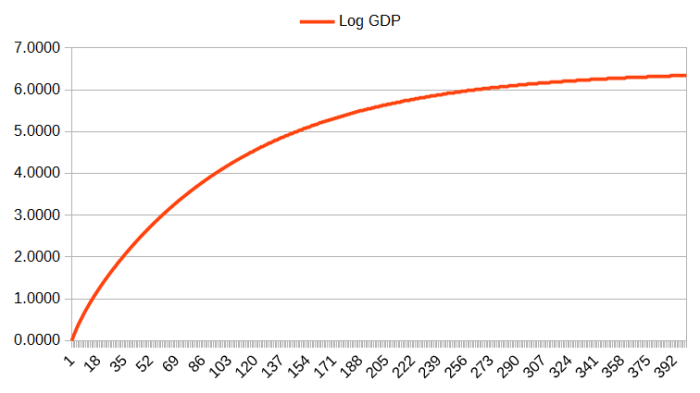
And finally, this is the long-run trend for GDP graphed on a log scale:

Solow_logGDP

The units are arbitrary, though it’s not unreasonable to imagine them as being years and hundreds of dollars in per-capita GDP. If that is indeed what you imagine them to be, my model shows us the Star Trek future: In about 300 years, we rise from a per-capita GDP of $10,000 to one of $165,000—from a world much like today to a world where everyone is a millionaire.

Notice that the growth rate slows down a great deal fairly quickly; by the end of 100 years (i.e., the end of the 21st century), growth has slowed from its peak over 10% to just over 2% per year. By the end of the 300-year period, the growth rate is a crawl of only 0.1%.

Of course this model is very simplistic, but I chose it for a very specific reason: This is not a radical left-wing environmentalist model involving “limits to growth” or “degrowth”. This is the Solow-Swan model, the paradigm example of neoclassical models of economic growth. It is sometimes in fact called simply “the neoclassical growth model”, because it is that influential. I made one very small change from the usual form, which was to assume that the rate of productivity growth would decline exponentially over time. Since productivity growth is exogenous to the model, this is a very simple change to make; it amounts to saying that productivity-enhancing technology is subject to diminishing returns, which fits recent data fairly well but could be totally wrong if something like artificial intelligence or neural enhancement ever takes off.

I chose this because many environmentalists seem to think that economists have this delusional belief that we can maintain a rate of economic growth equal to today indefinitely. David Attenborough famously said “Anyone who believes in indefinite growth in anything physical, on a physically finite planet, is either mad – or an economist.”

Another physicist argued that if we increase energy consumption 2.3% per year for 400 years, we’d literally boil the Earth. Yes, we would, and no economist I know of believes that this is what will happen. Economic growth doesn’t require energy growth, and we do not think growth can or should continue indefinitely—we just think it can and should continue a little while longer. We don’t think that a world standard of living 1000 times as good as Norway is going to happen; we think that a world standard of living equal to Norway is worth fighting for.

Indeed, we are often the ones trying to explain to leaders that they need to adapt to slower growth rates—this is particularly a problem in China, where nationalism and groupthink seems to have convinced many people in China that 7% annual growth is the result of some brilliant unique feature of the great Chinese system, when it is in fact simply the expected high growth rate for an economy that is very poor and still catching up by establishing a capital base. (It’s not so much what they are doing right now, as what they were doing wrong before. Just as you feel a lot better when you stop hitting yourself in the head, countries tend to grow quite fast after they transition out of horrifically terrible economic policy—and it doesn’t get much more terrible than Mao.) Even a lot of the IMF projections are now believed to be too optimistic, because they didn’t account for how China was fudging the numbers and rapidly depleting natural resources.

Some of the specific policies recommended in the article are reasonable, while others go to far.

1. Energy: cap, reduce, and ration it. Energy is what makes the economy go, and expanded energy consumption is what makes it grow. Climate scientists advocate capping and reducing carbon emissions to prevent planetary disaster, and cutting carbon emissions inevitably entails reducing energy from fossil fuels. However, if we aim to shrink the size of the economy, we should restrain not just fossil energy, but all energy consumption. The fairest way to do that would probably be with tradable energy quotas.

I strongly support cap-and-trade on fossil fuels, but I can’t support it on energy in general, unless we get so advanced that we’re seriously concerned about significantly altering the entropy of the universe. Solar power does not have negative externalities, and therefore should not be taxed or capped.

The shift to renewable energy sources is a no-brainer, and I know of no ecologist and few economists who would disagree.

This one is rich, coming from someone who goes on to argue for nonsensical deurbanization:

However, this is a complicated process. It will not be possible merely to unplug coal power plants, plug in solar panels, and continue with business as usual: we have built our immense modern industrial infrastructure of cities, suburbs, highways, airports, and factories to take advantage of the unique qualities and characteristics of fossil fuels.

How will we make our industrial infrastructure run off a solar grid? Urbanization. When everything is in one place, you can use public transportation and plug everything into the grid. We could replace the interstate highway system with a network of maglev lines, provided that almost everyone lived in major cities that were along those lines. We can’t do that if people move out of cities and go back to being farmers.

Here’s another weird one:

Without continued economic growth, the market economy probably can’t function long. This suggests we should run the transformational process in reverse by decommodifying land, labor, and money.

“Decommodifying money”? That’s like skinning leather or dehydrating water. The whole point of money is that it is a maximally fungible commodity. I support the idea of a land tax to provide a basic income, which could go a long way to decommodifying land and labor; but you can’t decommodify money.

The next one starts off sounding ridiculous, but then gets more reasonable:

4. Get rid of debt. Decommodifying money means letting it revert to its function as an inert medium of exchange and store of value, and reducing or eliminating the expectation that money should reproduce more of itself. This ultimately means doing away with interest and the trading or manipulation of currencies. Make investing a community-mediated process of directing capital toward projects that are of unquestioned collective benefit. The first step: cancel existing debt. Then ban derivatives, and tax and tightly regulate the buying and selling of financial instruments of all kinds.

No, we’re not going to get rid of debt. But should we regulate it more? Absolutely. A ban on derivatives is strong, but shouldn’t be out of the question; it’s not clear that even the most useful derivatives (like interest rate swaps and stock options) bring more benefit than they cause harm.

The next proposal, to reform our monetary system so that it is no longer based on debt, is one I broadly agree with, though you need to be clear about how you plan to do that. Positive Money’s plan to make central banks democratically accountable, establish full-reserve banking, and print money without trying to hide it in arcane accounting mechanisms sounds pretty good to me. Going back to the gold standard or something would be a terrible idea. The article links to a couple of “alternative money theorists”, but doesn’t explain further.

Sooner or later, we absolutely will need to restructure our macroeconomic policy so that 4% or even 2% real growth is no longer the expectation in First World countries. We will need to ensure that constant growth isn’t necessary to maintain stability and full employment.

But I believe we can do that, and in any case we do not want to stop global growth just yet—far from it. We are now on the verge of ending world hunger, and if we manage to do it, it will be from economic growth above all else.

Actually, our economic growth has been fairly ecologically sustainable lately!

JDN 2457538

Environmentalists have a reputation for being pessimists, and it is not entirely undeserved. While as Paul Samuelson said, all Street indexes have predicted nine out of the last five recessions, environmentalists have predicted more like twenty out of the last zero ecological collapses.

Some fairly serious scientists have endorsed predictions of imminent collapse that haven’t panned out, and many continue to do so. This Guardian article should be hilarious to statisticians, as it literally takes trends that are going one direction, maps them onto a theory that arbitrarily decides they’ll suddenly reverse, and then says “the theory fits the data”. This should be taught in statistics courses as a lesson in how not to fit models. More data distortion occurs in this Scientific American article, which contains the phrase “food per capita is decreasing”; well, that’s true if you just look at the last couple of years, but according to FAOSTAT, food production per capita in 2012 (the most recent data in FAOSTAT) was higher than literally every other year on record except 2011. So if you allow for even the slightest amount of random fluctuation, it’s very clear that food per capita is increasing, not decreasing.

global_food.png

So many people predicting imminent collapse of human civilization. And yet, for some reason, all the people predicting this go about their lives as if it weren’t happening! Why, it’s almost as if they don’t really believe it, and just say it to get attention. Nobody gets on the news by saying “Civilization is doing fine; things are mostly getting better.”

There’s a long history of these sorts of gloom and doom predictions; perhaps the paradigm example is Thomas Malthus in 1779 predicting the imminent destruction of civilization by inevitable famine—just in time for global infant mortality rates to start plummeting and economic output to surge beyond anyone’s wildest dreams.

Still, when I sat down to study this it was remarkable to me just how good the outlook is for future sustainability. The Index of Sustainable Economic Welfare was created essentially in an attempt to show how our economic growth is largely an illusion driven by our rapacious natural resource consumption, but it has since been discontinued, perhaps because it didn’t show that. Using the US as an example, I reconstructed the index as best I could from World Bank data, and here’s what came out for the period since 1990:

ISEW

The top line is US GDP as normally measured. The bottom line is the ISEW. The gap between those lines expands on a linear scale, but not on a logarithmic scale; that is to say, GDP and ISEW grow at almost exactly the same rate, so ISEW is always a constant (and large) proportion of GDP. By construction it is necessarily smaller (it basically takes GDP and subtracts out from it), but the fact that it is growing at the same rate shows that our economic growth is not being driven by depletion of natural resources or the military-industrial complex; it’s being driven by real improvements in education and technology.

The Human Development Index has grown in almost every country (albeit at quite different rates) since 1990. Global poverty is the lowest it has ever been. We are living in a golden age of prosperity. This is such a golden age for our civilization, our happiness rating maxed out and now we’re getting +20% production and extra gold from every source. (Sorry, gamer in-joke.)

Now, it is said that pride cometh before a fall; so perhaps our current mind-boggling improvements in human welfare have only been purchased on borrowed time as we further drain our natural resources.

There is some cause for alarm: We’re literally running out of fish, and groundwater tables are falling rapidly. Due to poor land use deserts are expanding. Huge quantities of garbage now float in our oceans. And of course, climate change is poised to kill millions of people. Arctic ice will melt every summer starting in the next few years.

And yet, global carbon emissions have not been increasing the last few years, despite strong global economic growth. We need to be reducing emissions, not just keeping them flat (in a previous post I talked about some policies to do that); but even keeping them flat while still raising standard of living is something a lot of environmentalists kept telling us we couldn’t possibly do. Despite constant talk of “overpopulation” and a “population bomb”, population growth rates are declining and world population is projected to level off around 9 billion. Total solar power production in the US expanded by a factor of 40 in just the last 10 years.

Of course, I don’t deny that there are serious environmental problems, and we need to make policies to combat them; but we are doing that. Humanity is not mindlessly plunging headlong into an abyss; we are taking steps to improve our future.

And in fact I think environmentalists deserve a lot of credit for that! Raising awareness of environmental problems has made most Americans recognize that climate change is a serious problem. Further pressure might make them realize it should be one of our top priorities (presently most Americans do not).

And who knows, maybe the extremist doomsayers are necessary to set the Overton Window for the rest of us. I think we of the center-left (toward which reality has a well-known bias) often underestimate how much we rely upon the radical left to pull the discussion away from the radical right and make us seem more reasonable by comparison. It could well be that “climate change will kill tens of millions of people unless we act now to institute a carbon tax and build hundreds of nuclear power plants” is easier to swallow after hearing “climate change will destroy humanity unless we act now to transform global capitalism to agrarian anarcho-socialism.” Ultimately I wish people could be persuaded simply by the overwhelming scientific evidence in favor of the carbon tax/nuclear power argument, but alas, humans are simply not rational enough for that; and you must go to policy with the public you have. So maybe irrational levels of pessimism are a worthwhile corrective to the irrational levels of optimism coming from the other side, like the execrable sophistry of “in praise of fossil fuels” (yes, we know our economy was built on coal and oil—that’s the problem. We’re “rolling drunk on petroleum”; when we’re trying to quit drinking, reminding us how much we enjoy drinking is not helpful.).

But I worry that this sort of irrational pessimism carries its own risks. First there is the risk of simply giving up, succumbing to learned helplessness and deciding there’s nothing we can possibly do to save ourselves. Second is the risk that we will do something needlessly drastic (like the a radical socialist revolution) that impoverishes or even kills millions of people for no reason. The extreme fear that we are on the verge of ecological collapse could lead people to take a “by any means necessary” stance and end up with a cure worse than the disease. So far the word “ecoterrorism” has mainly been applied to what was really ecovandalism; but if we were in fact on the verge of total civilizational collapse, I can understand why someone would think quite literal terrorism was justified (actually the main reason I don’t is that I just don’t see how it could actually help). Just about anything is worth it to save humanity from destruction.

Why is Tatooine poor?

JDN 2457513—May 4, 2016

May the Fourth be with you.

In honor of International Star Wars Day, this post is going to be about Star Wars!

[I wanted to include some images from Star Wars, but here are the copyright issues that made me decide it ultimately wasn’t a good idea.]

But this won’t be as frivolous as it may sound. Star Wars has a lot of important lessons to teach us about economics and other social sciences, and its universal popularity gives us common ground to start with. I could use Zimbabwe and Botswana as examples, and sometimes I do; but a lot of people don’t know much about Zimbabwe and Botswana. A lot more people know about Tatooine and Naboo, so sometimes it’s better to use those instead.

In fact, this post is just a small sample of a much larger work to come; several friends of mine who are social scientists in different fields (I am of course the economist, and we also have a political scientist, a historian, and a psychologist) are writing a book about this; we are going to use Star Wars as a jumping-off point to explain some real-world issues in social science.

So, my topic for today, which may end up forming the basis for a chapter of the book, is quite simple:
Why is Tatooine poor?

First, let me explain why this is such a mystery to begin with. We’re so accustomed to poverty being in the world that we expect to see it, we think of it as normal—and for most of human history, that was probably the correct attitude to have. Up until at least the Industrial Revolution, there simply was no way of raising the standard of living of most people much beyond bare subsistence. A wealthy few could sometimes live better, and most societies have had such an elite; but it was never more than about 1% of the population—and sometimes as little as 0.01%. They could have distributed wealth more evenly than they did, but there simply wasn’t that much to go around.

The “prosperous” “democracy” of Periclean Athens for example was really an aristocratic oligarchy, in which the top 1%—the ones who could read and write, and hence whose opinions we read—owned just about everything (including a fair number of the people—slavery). Their “democracy” was a voting system that only applied to a small portion of the population.

But now we live in a very different age, the Information Age, where we are absolutely basking in wealth thanks to enormous increases in productivity. Indeed, the standard of living of an Athenian philosopher was in many ways worse than that of a single mother on Welfare in the United States today; certainly the single mom has far better medicine, communication, and transportation than the philosopher, but she may even have better nutrition and higher education. Really the only things I can think of that the philosopher has more of are jewelry and real estate. The single mom also surely spends a lot more time doing housework, but a good chunk of her work is automated (dishwasher, microwave, washing machine), while the philosopher simply has slaves for that sort of thing. The smartphone in her pocket (81% of poor households in the US have a cellphone, and about half of these are smartphones) and the car in her driveway (75% of poor households in the US own at least one car) may be older models in disrepair, but they would still be unimaginable marvels to that ancient philosopher.

How is it, then, that we still have poverty in this world? Even if we argued that the poverty line in First World countries is too high because they have cars and smartphones (not an argument I agree with by the way—given our enormous productivity there’s no reason everyone shouldn’t have a car and a smartphone, and the main thing that poor people still can’t afford is housing), there are still over a billion people in the world today who live on less than $2 per day in purchasing-power-adjusted real income. That is poverty, no doubt about it. Indeed, it may in fact be a lower standard of living than most human beings had when we were hunter-gatherers. It may literally be a step downward from the Paleolithic.

Here is where Tatooine may give us some insights.

Productivity in the Star Wars universe is clearly enormous; indeed the proportional gap between Star Wars and us appears to be about the same as the proportional gap between us and hunter-gatherer times. The Death Star II had a diameter of 160 kilometers. Its cost is listed as “over 1 trillion credits”, but that’s almost meaningless because we have no idea what the exchange rate is or how the price of spacecraft varies relative to the price of other goods. (Spacecraft actually seem to be astonishingly cheap; in A New Hope it seems to be that a drink is a couple of credits while 10,000 credits is almost enough to buy an inexpensive starship. Basically their prices seem to be similar to ours for most goods, but spaceships are so cheap they are priced like cars instead of like, well, spacecraft.)

So let’s look at it another way: How much metal would it take to build such a thing, and how much would that cost in today’s money?

We actually see quite a bit of the inner structure of the Death Star II in Return of the Jedi, so I can hazard a guess that about 5% of the volume of the space station is taken up by solid material. Who knows what it’s actually made out of, but for a ballpark figure let’s assume it’s high-grade steel. The volume of a 160 km diameter sphere is 4*pi*r^3 = 4*(3.1415)*(80,000)^3 = 6.43 quadrillion cubic meters. If 5% is filled with material, that’s 320 trillion cubic meters. High-strength steel has a density of about 8000 kg/m^3, so that’s 2.6 quintillion kilograms of steel. A kilogram of high-grade steel costs about $2, so we’re looking at $5 quintillion as the total price just for the raw material of the Death Star II. That’s $5,000,000,000,000,000,000. I’m not even including the labor (droid labor, that is) and transportation costs (oh, the transportation costs!), so this is a very conservative estimate.

To get a sense of how ludicrously much money this is, the population of Coruscant is said to be over 1 trillion people, which is just about plausible for a city that covers an entire planet. The population of the entire galaxy is supposed to be about 400 quadrillion.

Suppose that instead of building the Death Star II, Emperor Palpatine had decided to give a windfall to everyone on Coruscant. How much would he have given each person (in our money)? $5 million.

Suppose instead he had offered the windfall to everyone in the galaxy? $12.50 per person. That’s 50 million worlds with an average population of 8 billion each. Instead of building the Death Star II, Palpatine could have bought the whole galaxy lunch.

Put another way, the cost I just estimated for the Death Star II is about 60 million times the current world GDP. So basically if the average world in the Empire produced as much as we currently produce on Earth, there would still not be enough to build that thing. In order to build the Death Star II in secret, it must be a small portion of the budget, maybe 5% tops. In order for only a small number of systems to revolt, the tax rates can’t be more than say 50%, if that; so total economic output on the average world in the Empire must in fact be more like 50 times what it is on Earth today, for a comparable average population. This puts their per-capita GDP somewhere around $500,000 per person per year.

So, economic output is extremely high in the Star Wars universe. Then why is Tatooine poor? If there’s enough output to make basically everyone a millionaire, why haven’t they?

In a word? Power.

Political power is of course very unequally distributed in the Star Wars universe, especially under the Empire but also even under the Old Republic and New Republic.

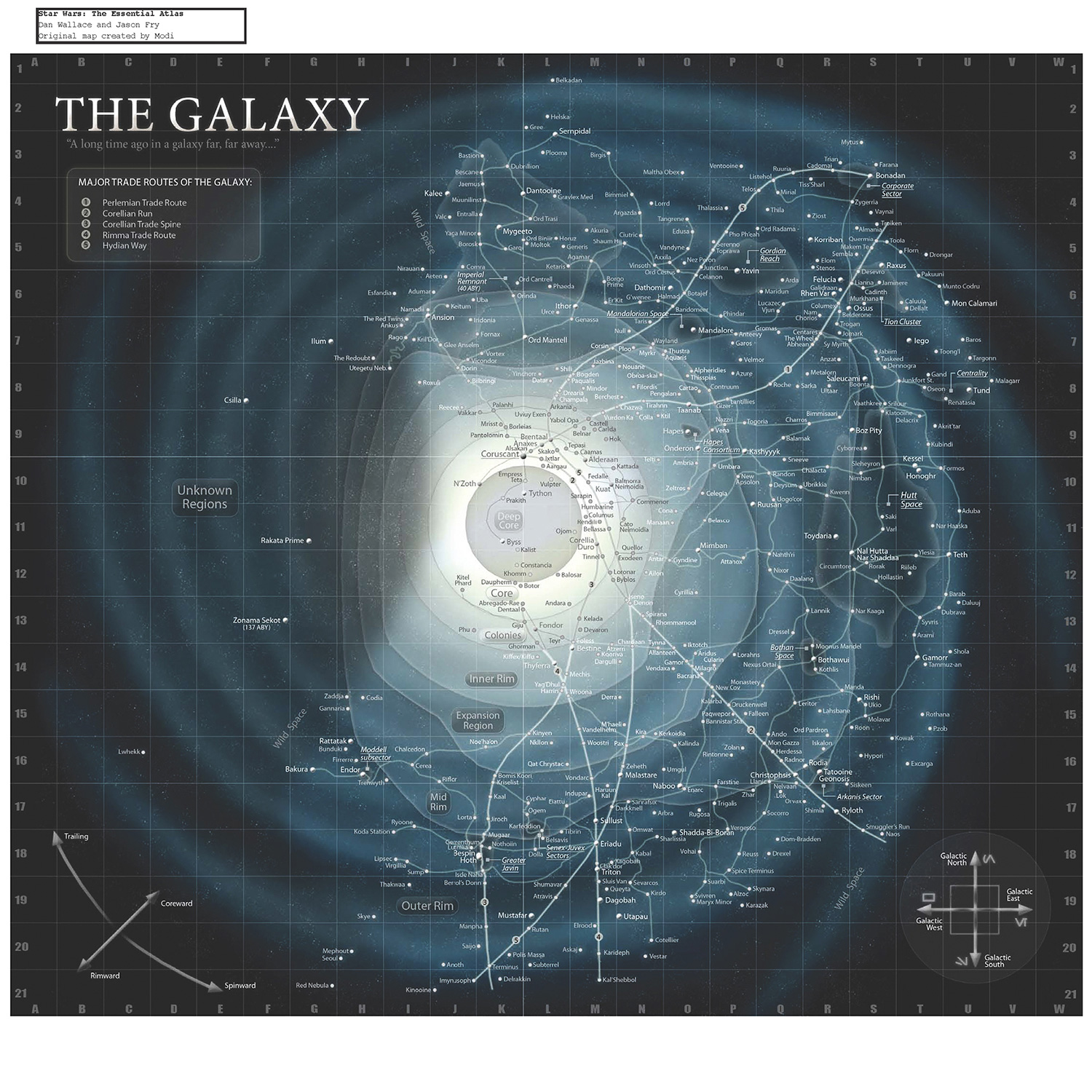
Core Worlds like Coruscant appear to have fairly strong centralized governments, and at least until the Emperor seized power and dissolved the Senate (as Tarkin announces in A New Hope) they also seemed to have fairly good representation in the Galactic Senate (though how you make a functioning Senate with millions of member worlds I have no idea—honestly, maybe they didn’t). As a result, Core Worlds are prosperous. Actually, even Naboo seems to be doing all right despite being in the Mid Rim, because of their strong and well-managed constitutional monarchy (“elected queen” is not as weird as it sounds—Sweden did that until the 16th century). They often talk about being a “democracy” even though they’re technically a constitutional monarchy—but the UK and Norway do the same thing with if anything less justification.

But Outer Rim Worlds like Tatooine seem to be out of reach of the central galactic government. (Oh, by the way, what hyperspace route drops you off at Tatooine if you’re going from Naboo to Coruscant? Did they take a wrong turn in addition to having engine trouble? “I knew we should have turned left at Christophsis!”) They even seem to be out of range of the monetary system (“Republic credits are no good out here,” said Watto in The Phantom Menace.), which is pretty extreme. That doesn’t usually happen—if there is a global hegemon, usually their money is better than gold. (“good as gold” isn’t strong enough—US money is better than gold, and that’s why people will accept negative real interest rates to hold onto it.) I guarantee you that if you want to buy something with a US $20 bill in Somalia or Zimbabwe, someone will take it. They might literally take it—i.e. steal it from you, and the government may not do anything to protect you—but it clearly will have value.

So, the Outer Rim worlds are extremely isolated from the central government, and therefore have their own local institutions that operate independently. Tatooine in particular appears to be controlled by the Hutts, who in turn seem to have a clan-based system of organized crime, similar to the Mafia. We never get much detail about the ins and outs of Hutt politics, but it seems pretty clear that Jabba is particularly powerful and may actually be the de facto monarch of a sizeable region or even the whole planet.

Jabba’s government is at the very far extreme of what Daron Acemoglu calls extractive regimes (I’ve been reading his tome Why Nations Fail, and while I agree with its core message, honestly it’s not very well-written or well-argued), systems of government that exist not to achieve overall prosperity or the public good, but to enrich a small elite few at the expense of everyone else. The opposite is inclusive regimes, under which power is widely shared and government exists to advance the public good. Real-world systems are usually somewhere in between; the US is still largely inclusive, but we’ve been getting more extractive over the last few decades and that’s a big problem.

Jabba himself appears to be fantastically wealthy, although even his huge luxury hover-yacht (…thing) is extremely ugly and spartan inside. I infer that he could have made it look however he wanted, and simply has baffling tastes in decor. The fact that he seems to be attracted to female humanoids is already pretty baffling, given the obvious total biological incompatibility; so Jabba is, shall we say, a weird dude. Eccentricity is quite common among despots of extractive regimes, as evidenced by Muammar Qaddafi’s ostentatious outfits, Idi Amin’s love of oranges and Kentucky Fried Chicken, and Kim Jong-Un’s fear of barbers and bond with Dennis Rodman. Maybe we would all be this eccentric if we had unlimited power, but our need to fit in with the rest of society suppresses it.

It’s difficult to put a figure on just how wealthy Jabba is, but it isn’t implausible to say that he has a million times as much as the average person on Tatooine, just as Bill Gates has a million times as much as the average person in the US. Like Qaddafi, before he was killed he probably feared that establishing more inclusive governance would only reduce his power and wealth and spread it to others, even if it did increase overall prosperity.
It’s not hard to make the figures work out so that is so. Suppose that for every 1% of the economy that is claimed by a single rentier despot, overall economic output drops by the same 1%. Then for concreteness, suppose that at optimal efficiency, the whole economy could produce $1 trillion. The amount of money that the despot can claim is determined by the portion he tries to claim, p, times the total amount that the economy will produce, which is (1-p) trillion dollars. So the despot’s wealth will be maximized when p(1-p) is maximized, which is p = 1/2; so the despot would maximize his own wealth at $250 billion if he claimed half of the economy, even though that also means that the economy produces half as much as it could. If he loosened his grip and claimed a smaller share, millions of his subjects would benefit; but he himself would lose more money than he gained. (You can also adjust these figures so that the “optimal” amount for the despot to claim is larger or smaller than half, depending on how severely the rent-seeking disrupts overall productivity.)

It’s important to note that it is not simply geography (galactography?) that makes Tatooine poor. Their sparse, hot desert may be less productive agriculturally, but that doesn’t mean that Tatooine is doomed to poverty. Indeed, today many of the world’s richest countries (such as Qatar) are in deserts, because they produce huge quantities of oil.

I doubt that oil would actually be useful in the Old Republic or the Empire, but energy more generally seems like something you’d always need. Tatooine has enormous flat desert plains and two suns, meaning that its potential to produce solar energy has to be huge. They couldn’t export the energy directly of course, but they could do so indirectly—the cheaper energy could allow them to build huge factories and produce starships at a fraction of the cost that other planets do. They could then sell these starships as exports and import water from planets where it is abundant like Naboo, instead of trying to produce their own water locally through those silly (and surely inefficient) moisture vaporators.

But Jabba likely has fought any efforts to invest in starship production, because it would require a more educated workforce that’s more likely to unionize and less likely to obey his every command. He probably has established a high tariff on water imports (or even banned them outright), so that he can maintain control by rationing the water supply. (Actually one thing I would have liked to see in the movies was Jabba being periodically doused by slaves with vats of expensive imported water. It would not only show an ostentatious display of wealth for a desert culture, but also serve the much more mundane function of keeping his sensitive gastropod skin from dangerously drying out. That’s why salt kills slugs, after all.) He also probably suppressed any attempt to establish new industries of any kind of Tatooine, fearing that with new industry could come a new balance of power.

The weirdest part to me is that the Old Republic didn’t do something about it. The Empire, okay, sure; they don’t much care about humanitarian concerns, so as long as Tatooine is paying its Imperial taxes and staying out of the Emperor’s way maybe he leaves them alone. But surely the Republic would care that this whole planet of millions if not billions of people is being oppressed by the Hutts? And surely the Republic Navy is more than a match for whatever pitiful military forces Jabba and his friends can muster, precisely because they haven’t established themselves as the shipbuilding capital of the galaxy? So why hasn’t the Republic deployed a fleet to Tatooine to unseat the Hutts and establish democracy? (It could be over pretty fast; we’ve seen that one good turbolaser can destroy Jabba’s hover-yacht—and it looks big enough to target from orbit.)

But then, we come full circle, back to the real world: Why hasn’t the US done the same thing in Zimbabwe? Would it not actually work? We sort of tried it in Libya—a lot of people died, and results are still pending I guess. But doesn’t it seem like we should be doing something?

The Expanse gets the science right—including the economics

JDN 2457502

Despite constantly working on half a dozen projects at once (literally—preparing to start my PhD, writing this blog, working at my day job, editing a novel, preparing to submit a nonfiction book, writing another nonfiction book with three of my friends as co-authors, and creating a card game—that’s seven actually), I do occasionally find time to do things for fun. One I’ve been doing lately is catching up on The Expanse on DVR (I’m about halfway through the first season so far).

If you’re not familiar with The Expanse, it has been fairly aptly described as Battlestar Galactica meets Game of Thrones, though I think that particular comparison misrepresents the tone and attitudes of the series, because both BG and GoT are so dark and cynical (“It’s a nice day… for a… red wedding!”). I think “Star Trek meets Game of Thrones” might be better actually—the extreme idealism of Star Trek would cancel out the extreme cynicism of Game of Thrones, with the result being a complex mix of idealism and cynicism that more accurately reflects the real world (a world where Mahatma Gandhi and Adolf Hitler lived at the same time). That complex, nuanced world (or should I say worlds?) is where The Expanse takes place. ST is also more geopolitical than BG and The Expanse is nothing if not geopolitical.

But The Expanse is not just psychologically realistic—it is also scientifically and economically realistic. It may in fact be the hardest science fiction I have ever encountered, and is definitely the hardest science fiction I’ve seen in a television show. (There are a few books that might be slightly harder, as well as some movies based on them.)

The only major scientific inaccuracy I’ve been able to find so far is the use of sound effects in space, and actually even these can be interpreted as reflecting an omniscient narrator perspective that would hear any sounds that anyone would hear, regardless of what planet or ship they might be on. The sounds the audience hears all seem to be sounds that someone would hear—there’s simply no particular person who would hear all of them. When people are actually thrown into hard vacuum, we don’t hear them make any noise.

Like Firefly (and for once I think The Expanse might actually be good enough to deserve that comparison), there is no FTL, no aliens, no superhuman AI. Human beings are bound within our own solar system, and travel between planets takes weeks or months depending on your energy budget. They actually show holograms projecting the trajectory of various spacecraft and the trajectories actually make good sense in terms of orbital mechanics. Finally screenwriters had the courage to give us the terrifying suspense and inevitability of an incoming nuclear missile rounding a nearby asteroid and intercepting your trajectory, where you have minutes to think about it but not nearly enough delta-v to get out of its blast radius. That is what space combat will be like, if we ever have space combat (as awesome as it is to watch, I strongly hope that we will not ever actually do it). Unlike what Star Trek would have you believe, space is not a 19th century ocean.

They do have stealth in space—but it requires technology that even to them is highly advanced. Moreover it appears to only work for relatively short periods and seems most effective against civilian vessels that would likely lack state-of-the-art sensors, both of which make it a lot more plausible.

Computers are more advanced in the 2200s then they were in the 2000s, but not radically so, at most a million times faster, about what we gained since the 1980s. I’m guessing a smartphone in The Expanse runs at a few petaflops. Essentially they’re banking on Moore’s Law finally dying sometime in the mid 21st century, but then, so am I. Perhaps a bit harder to swallow is that no one has figured out good enough heuristics to match human cognition; but then, human cognition is very tightly optimized.

Spacecraft don’t have artificial gravity except for the thrust of their engines, and people float around as they should when ships are freefalling. They actually deal with the fact that Mars and Ceres have lower gravity than Earth, and the kinds of health problems that result from this. (One thing I do wish they’d done is had the Martian cruiser set a cruising acceleration of Mars-g—about 38% Earth-g—that would feel awkward and dizzying to their Earther captives. Instead they basically seem to assume that Martians still like to use Earth-g for space transit, but that does make some sense in terms of both human health and simply transit time.) It doesn’t seem like people move around quite awkwardly enough in the very low gravity of Ceres—which should be only about 3% Earth-g—but they do establish that electromagnetic boots are ubiquitous and that could account for most of this.

They fight primarily with nuclear missiles and kinetic weapons, and the damage done by nuclear missiles is appropriately reduced by the fact that vacuum doesn’t transmit shockwaves. (Nuclear missiles would still be quite damaging in space by releasing large amounts of wide-spectrum radiation; but they wouldn’t cause the total devastation they do within atmosphere.) Oddly they decided not to go with laser weapons as far as I can tell, which actually seems to me like they’ve underestimated advancement; laser weapons have a number of advantages that would be particularly useful in space, once we can actually make them affordable and reliable enough for widespread deployment. There could also be a three-tier system, where missiles are used at long range, railguns at medium range, and lasers at short range. (Yes, short range—the increased speed of lasers would be only slight compared to a good railgun, and would be more than offset by the effect of diffraction. At orbital distances, a laser is a shotgun.) Then again, it could well work out that railguns are just better—depending on how vessels are structured, puncturing their hulls with kinetic rounds could well be more useful than burning them up with infrared lasers.

But I think what really struck me about the realism of The Expanse is how it even makes the society realistic (in a way that, say, Firefly really doesn’t—we wanted a Western and we got a Western!).

The only major offworld colonies are Mars and Ceres, both of which seem to be fairly well-established, probably originally colonized as much as a century ago. Different societies have formed on each world; Earth has largely united under the United Nations (one of the lead characters is an undersecretary for the UN), but meanwhile Mars has split off into its own independent nation (“Martian” is now an ethnicity like “German” rather than meaning “extraterrestrial”), and the asteroid belt colonists, while formally still under Earth’s government, think of themselves as a different culture (“Belters”) and are seeking independence. There are some fairly obvious—but deftly managed rather than heavy-handed—parallels between the Belter independence movement and real-world independence movements, particularly Palestine (it’s hard not to think of the PLO when they talk about the OPA). Both Mars and the Belt have their own languages, while Earth’s languages have largely coalesced around English as the language of politics and commerce. (If the latter seems implausible, I remind you that the majority of the Internet and all international air traffic control are in English.) English is the world’s lingua franca (which is a really bizarre turn of phrase because it’s the Latin for French).

There is some of the conniving and murdering of Game of Thrones, but it is at a much more subdued level, and all of the major factions display both merits and flaws. There is no clear hero and no clear villain, just conflict and misunderstanding between a variety of human beings each with their own good and bad qualities. There does seem to be a sense that the most idealistic characters suffer for their idealism much as the Starks often do, but unlike the Starks they usually survive and learn from the experience. Indeed, some of the most cynical also seem to suffer for their cynicism—in the episode I just finished, the grizzled UN Colonel assumed the worst of his adversary and ended up branded “the butcher of Anderson Station”.

Cost of living on Ceres is extraordinarily high because of the limited living space (the apartments look a lot like the tiny studios of New York or San Francisco), and above all the need to constantly import air and water from Earth. A central plot point in the first episode is that a ship carrying comet ice—i.e., water—to Ceres is lost in a surprise attack by unknown adversaries with advanced technology, and the result is a deepening of an already dire water shortage, exacerbating the Belter’s craving for rebellion.

Air and water are recyclable, so it wouldn’t be that literally every drink and every breath needs to be supplied from outside—indeed that would clearly be cost-prohibitive. But recycling is never perfect, and Ceres also appears to have a growing population, both of which would require a constant input of new resources to sustain. It makes perfect sense that the most powerful people on Ceres are billionaire tycoons who own water and air transport corporations.

The police on Ceres (of which another lead character is a detective) are well-intentioned but understaffed, underfunded and moderately corrupt, similar to what we seem to find in large inner-city police departments like the NYPD and LAPD. It felt completely right when they responded to an attempt to kill a police officer with absolutely overwhelming force and little regard for due process and procedure—for this is what real-world police departments almost always do.

But why colonize the asteroid belt at all? Mars is a whole planet, there is plenty there—and in The Expanse they are undergoing terraforming at a very plausible rate (there’s a moving scene where a Martian says to an Earther, “We’re trying to finish building our garden before you finish paving over yours.”). Mars has as much land as Earth, and it has water, abundant metals, and CO2 you could use to make air.Even just the frontier ambition could be enough to bring us to Mars.

But why go to Ceres? The explanation The Expanse offers is a very sensible one: Mining, particularly so-called “rare earth metals”. Gold and platinum might have been profitable to mine at first, but once they became plentiful the market would probably collapse or at least drop off to a level where they aren’t particularly expensive or interesting—because they aren’t useful for very much. But neodymium, scandium, and prometheum are all going to be in extremely high demand in a high-tech future based on nuclear-powered spacecraft, and given that we’re already running out of easily accessible deposits on Earth, by the 2200s there will probably be basically none left. The asteroid belt, however, will have plenty for centuries to come.

As a result Ceres is organized like a mining town, or perhaps an extractive petrostate (metallostate?); but due to lightspeed interplanetary communication—very important in the series—and some modicum of free speech it doesn’t appear to have attained more than a moderate level of corruption. This also seems realistic; the “end-of-history” thesis is often overstated, but the basic idea that some form of democracy and welfare-state capitalism is fast becoming the only viable model of governance does seem to be true, and that is almost certainly the model of governance we would export to other planets. In such a system corruption can only get so bad before it is shown on the mass media and people won’t take it anymore.

The show doesn’t deal much with absolute dollar (or whatever currency) numbers, which is probably wise; but nominal incomes on Ceres are likely extremely high even though the standard of living is quite poor, because the tiny living space and need to import air and water would make prices (literally?) astronomical. Most people on Ceres seem to have grown up there, but the initial attraction could have been something like the California Gold Rush, where rumors of spectacularly high incomes clashed with similarly spectacular expenses incurred upon arrival. “Become a millionaire!” “Oh, by the way, your utility bill this month is $112,000.”

Indeed, even the poor on Ceres don’t seem that poor, which is a very nice turn toward realism that a lot of other science fiction shows seem unprepared to make. In Firefly, the poor are poor—they can barely afford food and clothing, and have no modern conveniences whatsoever. (“Jaynestown”, perhaps my favorite episode, depicts this vividly.) But even the poor in the US today are rarely that poor; our minimalistic and half-hearted welfare state has a number of cracks one can fall through, but as long as you get the benefits you’re supposed to get you should be able to avoid starvation and homelessness. Similarly I find it hard to believe that any society with high enough productivity to routinely build interstellar spacecraft the way we build container ships would not have at least the kind of welfare state that provides for the most basic needs. Chronic dehydration is probably still a problem for Belters, because water would be too expensive to subsidize in this way; but they all seem to have fairly nice clothes, home appliances, and smartphones, and that seems right to me. At one point a character loses his arm, and the “cheap” solution is a cybernetic prosthetic—the “expensive” one would be to grow him a new arm. As today but perhaps even more so, poverty in The Expanse is really about inequality—the enormous power granted to those who have millions of times as much as others. (Another show that does this quite well, though is considerably softer as far as the physics, is Continuum. If I recall correctly, Alec Sadler in 2079 is literally a trillionaire.)

Mars also appears to be a democracy, and actually quite a thriving one. In many ways Mars appears to be surpassing Earth economically and technologically. This suggests that Mars was colonized with our best and brightest, but not necessarily; Australians have done quite well for themselves despite being founded as a penal colony. Mars colonization would also have a way of justifying their frontier idealism that no previous frontiers have granted: No indigenous people to displace, no local ecology to despoil, and no gifts from the surrounding environment. You really are working entirely out of your own hard work and know-how (and technology and funding from Earth of course) to establish a truly new world on the open and unspoiled frontier. You’re not naive or a hypocrite, it’s the real truth. That kind of realistic idealism could make the Martian Dream a success in ways even the American Dream never quite was.

In all it is a very compelling series, and should appeal to people like me who crave geopolitical nuance in fiction. But it also has its moments of huge space battles with exploding star cruisers, so there’s that.

What is the processing power of the human brain?

JDN 2457485

Futurists have been predicting that AI will “surpass humans” any day now for something like 50 years. Eventually they’ll be right, but it will be more or less purely by chance, since they’ve been making the same prediction longer than I’ve been alive. (Similarity, whenever someone projects the date at which immortality will be invented, it always seems to coincide with just slightly before the end of the author’s projected life expectancy.) Any technology that is “20 years away” will be so indefinitely.

There are a lot of reasons why this prediction keeps failing so miserably. One is an apparent failure to grasp the limitations of exponential growth. I actually think the most important is that a lot of AI fans don’t seem to understand how human cognition actually works—that it is primarily social cognition, where most of the processing has already been done and given to us as cached results, some of them derived centuries before we were born. We are smart enough to run a civilization with airplanes and the Internet not because any individual human is so much smarter than any other animal, but because all humans together are—and other animals haven’t quite figured out how to unite their cognition in the same way. We’re about 3 times smarter than any other animal as individuals—and several billion times smarter when we put our heads together.

A third reason is that even if you have sufficient computing power, that is surprisingly unimportant; what you really need are good heuristics to make use of your computing power efficiently. Any nontrivial problem is too complex to brute-force by any conceivable computer, so simply increasing computing power without improving your heuristics will get you nowhere. Conversely, if you have really good heuristics like the human brain does, you don’t even need all that much computing power. A chess grandmaster was once asked how many moves ahead he can see on the board, and he replied: “I only see one move ahead. The right one.” In cognitive science terms, people asked him how much computing power he was using, expecting him to say something far beyond normal human capacity, and he replied that he was using hardly any—it was all baked into the heuristics he had learned from years of training and practice.

Making an AI capable of human thought—a true artificial person—will require a level of computing power we can already reach (as long as we use huge supercomputers), but that is like having the right material. To really create the being we will need to embed the proper heuristics. We are trying to make David, and we have finally mined enough marble—now all we need is Michelangelo.

But another reason why so many futurists have failed in their projections is that they have wildly underestimated the computing power of the human brain. Reading 1980s cyberpunk is hilarious in hindsight; Neuromancer actually quite accurately projected the number of megabytes that would flow through the Internet at any given moment, but somehow thought that a few hundred megaflops would be enough to copy human consciousness. The processing power of the human brain is actually on the order of a few petaflops. So, you know, Gibson was only off by a factor of a few million.

We can now match petaflops—the world’s fastest supercomputer is actually about 30 petaflops. Of course, it cost half a month of China’s GDP to build, and requires 24 megawatts to run and cool, which is about the output of a mid-sized solar power station. The human brain consumes only about 400 kcal per day, which is about 20 watts—roughly the consumption of a typical CFL lightbulb. Even if you count the rest of the human body as necessary to run the human brain (which I guess is sort of true), we’re still clocking in at about 100 watts—so even though supercomputers can now process at the same speed, our brains are almost a million times as energy-efficient.

How do I know it’s a few petaflops?

Earlier this year a study was published showing that a conservative lower bound for the total capacity of human memory is about 4 bits per synapse, where previously some scientists thought that each synapse might carry only 1 bit (I’ve always suspected it was more like 10 myself).

So then we need to figure out how many synapses we have… which turns out to be really difficult actually. They are in a constant state of flux, growing, shrinking, and moving all the time; and when we die they fade away almost immediately (reason #3 I’m skeptical of cryonics). We know that we have about 100 billion neurons, and each one can have anywhere between 100 and 15,000 synapses with other neurons. The average seems to be something like 5,000 (but highly skewed in a power-law distribution), so that’s about 500 trillion synapses. If each one is carrying 4 bits to be as conservative as possible, that’s a total storage capacity of about 2 quadrillion bits, which is about 0.2 petabytes.

Of course, that’s assuming that our brains store information the same way as a computer—every bit flipped independently, each bit stored forever. Not even close. Human memory is constantly compressing and decompressing data, using a compression scheme that’s lossy enough that we not only forget things, we can systematically misremember and even be implanted with false memories. That may seem like a bad thing, and in a sense it is; but if the compression scheme is that lossy, it must be because it’s also that efficient—that our brains are compressing away the vast majority of the data to make room for more. Our best lossy compression algorithms for video are about 100:1; but the human brain is clearly much better than that. Our core data format for long-term memory appears to be narrative; more or less we store everything not as audio or video (that’s short-term memory, and quite literally so), but as stories.

How much compression can you get by storing things as narrative? Think about The Lord of the Rings. The extended edition of the films runs to 6 discs of movie (9 discs of other stuff), where a Blu-Ray disc can store about 50 GB. So that’s 300 GB. Compressed into narrative form, we have the books (which, if you’ve read them, are clearly not optimally compressed—no, we do not need five paragraphs about the trees, and I’m gonna say it, Tom Bombadil is totally superfluous and Peter Jackson was right to remove him), which run about 500,000 words altogether. If the average word is 10 letters (normally it’s less than that, but this is Tolkien we’re talking about), each word will take up about 10 bytes (because in ASCII or Unicode a letter is a byte). So altogether the total content of the entire trilogy, compressed into narrative, can be stored in about 5 million bytes, that is, 5 MB. So the compression from HD video to narrative takes us all the way from 300 GB to 5 MB, which is a factor of 60,000. Sixty thousand. I believe that this is the proper order of magnitude for the compression capability of the human brain.

Even more interesting is the fact that the human brain is almost certainly in some sense holographic storage; damage to a small part of your brain does not produce highly selective memory loss as if you had some bad sectors of your hard drive, but rather an overall degradation of your total memory processing as if you in some sense stored everything everywhere—that is, holographically. How exactly this is accomplished by the brain is still very much an open question; it’s probably not literally a hologram in the quantum sense, but it definitely seems to function like a hologram. (Although… if the human brain is a quantum computer that would explain an awful lot—it especially helps with the binding problem. The problem is explaining how a biological system at 37 C can possibly maintain the necessary quantum coherences.) The data storage capacity of holograms is substantially larger than what can be achieved by conventional means—and furthermore has similar properties to human memory in that you can more or less always add more, but then what you had before gradually gets degraded. Since neural nets are much closer to the actual mechanics of the brain as we know them, understanding human memory will probably involve finding ways to simulate holographic storage with neural nets.

With these facts in mind, the amount of information we can usefully take in and store is probably not 0.2 petabytes—it’s probably more like 10 exabytes. The human brain can probably hold just about as much as the NSA’s National Cybersecurity Initiative Data Center in Utah, which is itself more or less designed to contain the Internet. (The NSA is at once awesome and terrifying.)

But okay, maybe that’s not fair if we’re comparing human brains to computers; even if you can compress all your data by a factor of 100,000, that isn’t the same thing as having 100,000 times as much storage.

So let’s use that smaller figure, 0.2 petabytes. That’s how much we can store; how much can we process?

The next thing to understand is that our processing architecture is fundamentally difference from that of computers.

Computers generally have far more storage than they have processing power, because they are bottlenecked through a CPU that can only process 1 thing at once (okay, like 8 things at once with a hyperthreaded quad-core; as you’ll see in a moment this is a trivial difference). So it’s typical for a new computer these days to have processing power in gigaflops (It’s usually reported in gigahertz, but that’s kind of silly; hertz just tells you clock cycles, while what you really wanted to know is calculations—and that you get from flops. They’re generally pretty comparable numbers though.), while they have storage in terabytes—meaning that it would take about 1000 seconds (about 17 minutes) for the computer to process everything in its entire storage once. In fact it would take a good deal longer than that, because there are further bottlenecks in terms of memory access, especially from hard-disk drives (RAM and solid-state drives are faster, but would still slow it down to a couple of hours).

The human brain, by contrast, integrates processing and memory into the same system. There is no clear distinction between “memory synapses” and “processing synapses”, and no single CPU bottleneck that everything has to go through. There is however something like a “clock cycle” as it turns out; synaptic firings are synchronized across several different “rhythms”, the fastest of which is about 30 Hz. No, not 30 GHz, not 30 MHz, not even 30 kHz; 30 hertz. Compared to the blazing speed of billions of cycles per second that goes on in our computers, the 30 cycles per second our brains are capable of may seem bafflingly slow. (Even more bafflingly slow is the speed of nerve conduction, which is not limited by the speed of light as you might expect, but is actually less than the speed of sound. When you trigger the knee-jerk reflex doctors often test, it takes about a tenth of a second for the reflex to happen—not because your body is waiting for anything, but because it simply takes that long for the signal to travel to your spinal cord and back.)

The reason we can function at all is because of our much more efficient architecture; instead of passing everything through a single bottleneck, we do all of our processing in parallel. All of those 100 billion neurons with 500 trillion synapses storing 2 quadrillion bits work simultaneously. So whereas a computer does 8 things at a time, 3 billion times per second, a human brain does 2 quadrillion things at a time, 30 times per second. Provided that the tasks can be fully parallelized (vision, yes; arithmetic, no), a human brain can therefore process 60 quadrillion bits per second—which turns out to be just over 6 petaflops, somewhere around 6,000,000,000,000,000 calculations per second.

So, like I said, a few petaflops.

The Parable of the Dishwasher

JDN 2456478

Much like free trade, technological unemployment is an issue where the consensus opinion among economists diverges quite sharply from that of the general population.

Enough people think that “robots taking our jobs” is something bad that I’ve seen a fair number of memes like this:

EVERY TIME you use the Self Checkout you are ELIMINATING JOBS!

But like almost all economists, I think that self-checkouts, robots, and automation in general are a pretty good thing. They do have a few downsides, chiefly in terms of forcing us to make transitions that are costly and painful; but in general I want more robots, not fewer.

To help turn you toward this view, I offer a parable.

Suppose we have a family, the (stereo)typical American family with a father, a mother, and two kids, a boy named Joe and a girl named Sue.

The kids do chores for their allowance, and split them as follows: Joe always does the dishes, and Sue always vacuums the carpet. They both spend about 1 hour per week and they both get paid $10 a week.

But one day, Dad decides to buy a dishwasher. This dramatically cuts down the time it takes Joe to do the dishes; where he used to spend 1 hour washing dishes, now he can load the dishwasher and get it done in 5 minutes.

  1. Mom suggests they just sell back the dishwasher to get rid of the problem.
  2. Dad says that Joe should now only be paid for the 5 minutes he works each week, so he would now be paid $0.83 per week. (He’s not buying a lot of video games on that allowance.)
  3. Joe protests that he gets the same amount of work done, so he should be paid the same $10 for doing it.
  4. Sue says it would be unfair for her to have to work so much more than Joe, and has a different solution: They’ll trade off the two sets of chores each week, and they should of course get paid the same amount of money for getting the same amount of work done—$10 per kid per week, for an average of 32.5 minutes of work each.

Which of those solutions sounds the most sensible to you?

Mom’s solution is clearly the worst, right? It’s the Luddite solution, the one that throws away technological progress and makes everything less efficient. Yet that is the solution being offered by people who say “Don’t use the self-checkout machine!” Indeed, anyone who speaks of the virtues of “hard work” is really speaking Mom’s language here; they should be talking about the virtues of getting things done. The purpose of washing dishes is to have clean dishes, not to “work hard”. And likewise, when we construct bridges or make cars or write books or solve equations, our goal should be to get that thing done—not to fulfill some sense of moral obligation to prove our worthiness through hard work.

Joe’s solution is what neoclassical economics says should happen—higher productivity should yield higher wages, so the same amount of production should yield the same pay. This seems like it could work, but empirically it rarely happens. There’s also something vaguely unfair about it; if productivity increases in your industry but not in someone else’s, you get to cut your work hours dramatically while they are stuck working just as hard as before.

Dad’s “solution” is clearly terrible, and makes no sense at all. Yet this is what we actually tend to observe—capital owners appropriate all (or nearly all) the benefits of the new technology, and workers get displaced or get ever-smaller wages. (I talked about that in a recent post.)

It’s Sue’s solution that really seems to make the most sense, isn’t it? When one type of work becomes more efficient, people should shift into different types of labor so that people can work fewer hours—and wages should rise enough that incomes remain the same. “Baumol’s disease” is not a disease—it is the primary means by which capitalism raises human welfare. (That’s why I prefer to use the term “Baumol Effect” instead.)

One problem with this in practice is that sometimes people can’t switch into other industries. That’s a little hard to imagine in this case, but let’s stipulate that for some reason Joe can’t do the vacuuming. Maybe he has some sort of injury that makes it painful to use the vacuum cleaner, but doesn’t impair his ability to wash dishes. Or maybe he has a severe dust allergy, so bad that the dust thrown up by the vacuum cleaner sends him into fits of coughing.

In that case I think we’re back to Joe’s solution; he should get paid the same for getting the same amount of work done. I’m actually tempted to say that Sue should get paid more, to compensate her for the unfairness; but in the real world there is a pretty harsh budget constraint there, so we need to essentially pretend that Dad only has $20 per week to give out in allowances. A possible compromise would be to raise Sue up to $12 and cut Joe down to $8; Joe will probably still be better off than he was, because he has that extra 55 minutes of free time each week for which he only had to “pay” $2. This also makes the incentives work out better—Joe doesn’t have a reason to malinger and exaggerate his dust allergy just to get out of doing the vacuuming, since he would actually get paid more if he were willing to do the vacuuming; but if his allergy really is that bad, he can still do okay otherwise. (There’s a lesson here for the proper structure of Social Security Disability, methinks.)

But you know what really seems like the best solution? Buy a Roomba.

Buy a Roomba, make it Sue’s job to spend 5 minutes a week keeping the Roomba working at vacuuming the carpet, and continue paying both kids $10 per week. Give them both 55 minutes more per week to hang out with their friends or play video games. Whether you think of this $10 as a “higher wage” for higher productivity or simply an allowance they get anyway—a basic income—ultimately doesn’t matter all that much. The point is that everyone gets enough money and nobody has to work very much, because the robots do everything.

And now, hopefully you see why I think we need more robots, not fewer.

Of course, like any simple analogy, this isn’t perfect; it may be difficult to reduce the hours in some jobs or move more people into them. There are a lot of additional frictions and complications that go into the real-world problem of achieving equitable labor markets. But I hope I’ve gotten across the basic idea that robots are not the problem, and could in fact be the solution–not just to our current labor market woes, but to the very problem of wage labor itself.

My ultimate goal is a world where “work” itself is fundamentally redefined—so that it always means the creative sense “This painting is some of my best work.” and not the menial sense “Sweeping this floor is so much work!”; so that human beings do things because we want to do them, because they are worth doing, and not because some employer is holding our food and housing hostage if we don’t.

But that will require our whole society to rethink a lot of our core assumptions about work, jobs, and economics in general. We’re so invested in this idea that “hard work” is inherently virtuous that we forgot the purpose of an economy was to get things done. Work is not a benefit; work is a cost. Costs are to be reduced. Puritanical sexual norms have been extremely damaging to American society, but time will tell if Puritanical work ethic actually does more damage to our long-term future.

The real Existential Risk we should be concerned about

JDN 2457458

There is a rather large subgroup within the rationalist community (loosely defined because organizing freethinkers is like herding cats) that focuses on existential risks, also called global catastrophic risks. Prominent examples include Nick Bostrom and Eliezer Yudkowsky.

Their stated goal in life is to save humanity from destruction. And when you put it that way, it sounds pretty darn important. How can you disagree with wanting to save humanity from destruction?

Well, there are actually people who do (the Voluntary Human Extinction movement), but they are profoundly silly. It should be obvious to anyone with even a basic moral compass that saving humanity from destruction is a good thing.

It’s not the goal of fighting existential risk that bothers me. It’s the approach. Specifically, they almost all seem to focus on exotic existential risks, vivid and compelling existential risks that are the stuff of great science fiction stories. In particular, they have a rather odd obsession with AI.

Maybe it’s the overlap with Singularitarians, and their inability to understand that exponentials are not arbitrarily fast; if you just keep projecting the growth in computing power as growing forever, surely eventually we’ll have a computer powerful enough to solve all the world’s problems, right? Well, yeah, I guess… if we can actually maintain the progress that long, which we almost certainly can’t, and if the problems turn out to be computationally tractable at all (the fastest possible computer that could fit inside the observable universe could not brute-force solve the game of Go, though a heuristic AI did just beat one of the world’s best players), and/or if we find really good heuristic methods of narrowing down the solution space… but that’s an awful lot of “if”s.

But AI isn’t what we need to worry about in terms of saving humanity from destruction. Nor is it asteroid impacts; NASA has been doing a good job watching for asteroids lately, and estimates the current risk of a serious impact (by which I mean something like a city-destroyer or global climate shock, not even a global killer) at around 1/10,000 per year. Alien invasion is right out; we can’t even find clear evidence of bacteria on Mars, and the skies are so empty of voices it has been called a paradox. Gamma ray bursts could kill us, and we aren’t sure about the probability of that (we think it’s small?), but much like brain aneurysms, there really isn’t a whole lot we can do to prevent them.

There is one thing that we really need to worry about destroying humanity, and one other thing that could potentially get close over a much longer timescale. The long-range threat is ecological collapse; as global climate change gets worse and the oceans become more acidic and the aquifers are drained, we could eventually reach the point where humanity cannot survive on Earth, or at least where our population collapses so severely that civilization as we know it is destroyed. This might not seem like such a threat, since we would see this coming decades or centuries in advance—but we are seeing it coming decades or centuries in advance, and yet we can’t seem to get the world’s policymakers to wake up and do something about it. So that’s clearly the second-most important existential risk.

But the most important existential risk, by far, no question, is nuclear weapons.

Nuclear weapons are the only foreseeable, preventable means by which humanity could be destroyed in the next twenty minutes.

Yes, that is approximately the time it takes an ICBM to hit its target after launch. There are almost 4,000 ICBMs currently deployed, mostly by the US and Russia. Once we include submarine-launched missiles and bombers, the total number of global nuclear weapons is over 15,000. I apologize for terrifying you by saying that these weapons could be deployed in a moment’s notice to wipe out most of human civilization within half an hour, followed by a global ecological collapse and fallout that would endanger the future of the entire human race—but it’s the truth. If you’re not terrified, you’re not paying attention.

I’ve intentionally linked the Union of Concerned Scientists as one of those sources. Now they are people who understand existential risk. They don’t talk about AI and asteroids and aliens (how alliterative). They talk about climate change and nuclear weapons.

We must stop this. We must get rid of these weapons. Next to that, literally nothing else matters.

“What if we’re conquered by tyrants?” It won’t matter. “What if there is a genocide?” It won’t matter. “What if there is a global economic collapse?” None of these things will matter, if the human race wipes itself out with nuclear weapons.

To speak like an economist for a moment, the utility of a global nuclear war must be set at negative infinity. Any detectable reduction in the probability of that event must be considered worth paying any cost to achieve. I don’t care if it costs $20 trillion and results in us being taken over by genocidal fascists—we are talking about the destruction of humanity. We can spend $20 trillion (actually the US as a whole does every 14 months!). We can survive genocidal fascists. We cannot survive nuclear war.

The good news is, we shouldn’t actually have to pay that sort of cost. All we have to do is dismantle our nuclear arsenal, and get other countries—particularly Russia—to dismantle theirs. In the long run, we will increase our wealth as our efforts are no longer wasted maintaining doomsday machines.

The main challenge is actually a matter of game theory. The surprisingly-sophisticated 1990s cartoon show the Animaniacs basically got it right when they sang: “We’d beat our swords into liverwurst / Down by the East Riverside / But no one wants to be the first!”

The thinking, anyway, is that this is basically a Prisoner’s Dilemma. If the US disarms and Russia doesn’t, Russia can destroy the US. Conversely, if Russia disarms and the US doesn’t, the US can destroy Russia. If neither disarms, we’re left where we are. Whether or not the other country disarms, you’re always better off not disarming. So neither country disarms.

But I contend that it is not, in fact, a Prisoner’s Dilemma. It could be a Stag Hunt; if that’s the case, then only multilateral disarmament makes sense, because the best outcome is if we both disarm, but the worst outcome is if we disarm and they don’t. Once we expect them to disarm, we have no temptation to renege on the deal ourselves; but if we think there’s a good chance they won’t, we might not want to either. Stag Hunts have two stable Nash equilibria; one is where both arm, the other where both disarm.

But in fact, I think it may be simply the trivial game.

There aren’t actually that many possible symmetric two-player nonzero-sum games (basically it’s a question of ordering 4 possibilities, and it’s symmetric, so 12 possible games), and one that we never talk about (because it’s sort of boring) is the trivial game: If I do the right thing and you do the right thing, we’re both better off. If you do the wrong thing and I do the right thing, I’m better off. If we both do the wrong thing, we’re both worse off. So, obviously, we both do the right thing, because we’d be idiots not to. Formally, we say that cooperation is a strictly dominant strategy. There’s no dilemma, no paradox; the self-interested strategy is the optimal strategy. (I find it kind of amusing that laissez-faire economics basically amounts to assuming that all real-world games are the trivial game.)

That is, I don’t think the US would actually benefit from nuking Russia, even if we could do so without retaliation. Likewise, I don’t think Russia would actually benefit from nuking the US. One of the things we’ve discovered—the hardest way possible—through human history is that working together is often better for everyone than fighting. Russia could nuke NATO, and thereby destroy all of their largest trading partners, or they could continue trading with us. Even if they are despicable psychopaths who think nothing of committing mass murder (Putin might be, but surely there are people under his command who aren’t?), it’s simply not in Russia’s best interest to nuke the US and Europe. Likewise, it is not in our best interest to nuke them.

Nuclear war is a strange game: The only winning move is not to play.

So I say, let’s stop playing. Yes, let’s unilaterally disarm, the thing that so many policy analysts are terrified of because they’re so convinced we’re in a Prisoner’s Dilemma or a Stag Hunt. “What’s to stop them from destroying us, if we make it impossible for us to destroy them!?” I dunno, maybe basic human decency, or failing that, rationality?

Several other countries have already done this—South Africa unilaterally disarmed, and nobody nuked them. Japan refused to build nuclear weapons in the first place—and I think it says something that they’re the only people to ever have them used against them.

Our conventional military is plenty large enough to defend us against all realistic threats, and could even be repurposed to defend against nuclear threats as well, by a method I call credible targeted conventional response. Instead of building ever-larger nuclear arsenals to threaten devastation in the world’s most terrifying penis-measuring contest, you deploy covert operatives (perhaps Navy SEALS in submarines, or double agents, or these days even stealth drones) around the world, with the standing order that if they have reason to believe a country initiated a nuclear attack, they will stop at nothing to hunt down and kill the specific people responsible for that attack. Not the country they came from; not the city they live in; those specific people. If a leader is enough of a psychopath to be willing to kill 300 million people in another country, he’s probably enough of a psychopath to be willing to lose 150 million people in his own country. He likely has a secret underground bunker that would allow him to survive, at least if humanity as a whole does. So you should be threatening the one thing he does care about—himself. You make sure he knows that if he pushes that button, you’ll find that bunker, drop in from helicopters, and shoot him in the face.

The “targeted conventional response” should be clear by now—you use non-nuclear means to respond, and you target the particular leaders responsible—but let me say a bit more about the “credible” part. The threat of mutually-assured destruction is actually not a credible one. It’s not what we call in game theory a subgame perfect Nash equilibrium. If you know that Russia has launched 1500 ICBMs to destroy every city in America, you actually have no reason at all to retaliate with your own 1500 ICBMs, and the most important reason imaginable not to. Your people are dead either way; you can’t save them. You lose. The only question now is whether you risk taking the rest of humanity down with you. If you have even the most basic human decency, you will not push that button. You will not “retaliate” in useless vengeance that could wipe out human civilization. Thus, your threat is a bluff—it is not credible.

But if your response is targeted and conventional, it suddenly becomes credible. It’s exactly reversed; you now have every reason to retaliate, and no reason not to. Your covert operation teams aren’t being asked to destroy humanity; they’re being tasked with finding and executing the greatest mass murderer in history. They don’t have some horrific moral dilemma to resolve; they have the opportunity to become the world’s greatest heroes. Indeed, they’d very likely have the whole world (or what’s left of it) on their side; even the population of the attacking country would rise up in revolt and the double agents could use the revolt as cover. Now you have no reason to even hesitate; your threat is completely credible. The only question is whether you can actually pull it off, and if we committed the full resources of the United States military to preparing for this possibility, I see no reason to doubt that we could. If a US President can be assassinated by a lone maniac (and yes, that is actually what happened), then the world’s finest covert operations teams can assassinate whatever leader pushed that button.

This is a policy that works both unilaterally and multilaterally. We could even assemble an international coalition—perhaps make the UN “peacekeepers” put their money where their mouth is and train the finest special operatives in the history of the world tasked with actually keeping the peace.

Let’s not wait for someone else to save humanity from destruction. Let’s be the first.

Will robots take our jobs?

JDN 2457451
I briefly discussed this topic before, but I thought it deserved a little more depth. Also, the SF author in me really likes writing this sort of post where I get to speculate about futures that are utopian, dystopian, or (most likely) somewhere in between.

The fear is quite widespread, but how realistic is it? Will robots in fact take all our jobs?

Most economists do not think so. Robert Solow famously quipped, “You can see the computer age everywhere but in the productivity statistics.” (It never quite seemed to occur to him that this might be a flaw in the way we measure productivity statistics.)

By the usual measure of labor productivity, robots do not appear to have had a large impact. Indeed, their impact appears to have been smaller than almost any other major technological innovation.

Using BLS data (which was formatted badly and thus a pain to clean, by the way—albeit not as bad as the World Bank data I used on my master’s thesis, which was awful), I made this graph of the growth rate of labor productivity as usually measured:

Productivity_growth

The fluctuations are really jagged due to measurement errors, so I also made an annually smoothed version:

Productivity_growth_smooth

Based on this standard measure, productivity has grown more or less steadily during my lifetime, fluctuating with the business cycle around a value of about 3.5% per year (3.4 log points). If anything, the growth rate seems to be slowing down; in recent years it’s been around 1.5% (1.5 lp).

This was clearly the time during which robots became ubiquitous—autonomous robots did not emerge until the 1970s and 1980s, and robots became widespread in factories in the 1980s. Then there’s the fact that computing power has been doubling every 1.5 years during this period, which is an annual growth rate of 59% (46 lp). So why hasn’t productivity grown at anywhere near that rate?

I think the main problem is that we’re measuring productivity all wrong. We measure it in terms of money instead of in terms of services. Yes, we try to correct for inflation; but we fail to account for the fact that computers have allowed us to perform literally billions of services every day that could not have been performed without them. You can’t adjust that away by plugging into the CPI or the GDP deflator.

Think about it: Your computer provides you the services of all the following:

  1. A decent typesetter and layout artist
  2. A truly spectacular computer (remember, that used to be a profession!)
  3. A highly skilled statistician (who takes no initiative—you must tell her what calculations to do)
  4. A painting studio
  5. A photographer
  6. A video camera operator
  7. A professional orchestra of the highest quality
  8. A decent audio recording studio
  9. Thousands of books, articles, and textbooks
  10. Ideal seats at every sports stadium in the world

And that’s not even counting things like social media and video games that can’t even be readily compared to services that were provided before computers.

If you added up the value of all of those jobs, the amount you would have had to pay in order to hire all those people to do all those things for you before computers existed, your computer easily provides you with at least $1 million in professional services every year. Put another way, your computer has taken jobs that would have provided $1 million in wages. You do the work of a hundred people with the help of your computer.

This isn’t counted in our productivity statistics precisely because it’s so efficient. If we still had to pay that much for all these services, it would be included in our GDP and then our GDP per worker would properly reflect all this work that is getting done. But then… whom would we be paying? And how would we have enough to pay that? Capitalism isn’t actually set up to handle this sort of dramatic increase in productivity—no system is, really—and thus the market price for work has almost no real relation to the productive capacity of the technology that makes that work possible.

Instead it has to do with scarcity of work—if you are the only one in the world who can do something (e.g. write Harry Potter books), you can make an awful lot of money doing that thing, while something that is far more important but can be done by almost anyone (e.g. feed babies) will pay nothing or next to nothing. At best we could say it has to do with marginal productivity, but marginal in the sense of your additional contribution over and above what everyone else could already do—not in the sense of the value actually provided by the work that you are doing. Anyone who thinks that markets automatically reward hard work or “pay you what you’re worth” clearly does not understand how markets function in the real world.

So, let’s ask again: Will robots take our jobs?

Well, they’ve already taken many jobs already. There isn’t even a clear high-skill/low-skill dichotomy here; robots are just as likely to make pharmacists obsolete as they are truck drivers, just as likely to replace surgeons as they are cashiers.

Labor force participation is declining, though slowly:

Labor_force_participation

Yet I think this also underestimates the effect of technology. As David Graeber points out, most of the new jobs we’ve been creating seem to be for lack of a better term bullshit jobs—jobs that really don’t seem like they need to be done, other than to provide people with something to do so that we can justify paying them salaries.

As he puts it:

Again, an objective measure is hard to find, but one easy way to get a sense is to ask: what would happen were this entire class of people to simply disappear? Say what you like about nurses, garbage collectors, or mechanics, it’s obvious that were they to vanish in a puff of smoke, the results would be immediate and catastrophic. A world without teachers or dock-workers would soon be in trouble, and even one without science fiction writers or ska musicians would clearly be a lesser place. It’s not entirely clear how humanity would suffer were all private equity CEOs, lobbyists, PR researchers, actuaries, telemarketers, bailiffs or legal consultants to similarly vanish. (Many suspect it might markedly improve.)

The paragon of all bullshit jobs is sales. Sales is a job that simply should not exist. If something is worth buying, you should be able to present it to the market and people should choose to buy it. If there are many choices for a given product, maybe we could have some sort of independent product rating agencies that decide which ones are the best. But sales means trying to convince people to buy your product—you have an absolutely overwhelming conflict of interest that makes your statements to customers so utterly unreliable that they are literally not even information anymore. The vast majority of advertising, marketing, and sales is thus, in a fundamental sense, literally noise. Sales contributes absolutely nothing to our economy, and because we spend so much effort on it and advertising occupies so much of our time and attention, takes a great deal away. But sales is one of our most steadily growing labor sectors; once we figure out how to make things without people, we employ the people in trying to convince customers to buy the new things we’ve made. Sales is also absolutely miserable for many of the people who do it, as I know from personal experience in two different sales jobs that I had to quit before the end of the first week.

Fortunately we have not yet reached the point where sales is the fastest growing labor sector. Currently the fastest-growing jobs fall into three categories: Medicine, green energy, and of course computers—but actually mostly medicine. Yet even this is unlikely to last; one of the easiest ways to reduce medical costs would be to replace more and more medical staff with automated systems. A nursing robot may not be quite as pleasant as a real professional nurse—but if by switching to robots the hospital can save several million dollars a year, they’re quite likely to do so.

Certain tasks are harder to automate than others—particularly anything requiring creativity and originality is very hard to replace, which is why I believe that in the 2050s or so there will be a Revenge of the Humanities Majors as all the supposedly so stable and forward-thinking STEM jobs disappear and the only jobs that are left are for artists, authors, musicians, game designers and graphic designers. (Also, by that point, very likely holographic designers, VR game designers, and perhaps even neurostim artists.) Being good at math won’t mean anything anymore—frankly it probably shouldn’t right now. No human being, not even great mathematical savants, is anywhere near as good at arithmetic as a pocket calculator. There will still be a place for scientists and mathematicians, but it will be the creative aspects of science and math that persist—design of experiments, development of new theories, mathematical intuition to develop new concepts. The grunt work of cleaning data and churning through statistical models will be fully automated.

Most economists appear to believe that we will continue to find tasks for human beings to perform, and this improved productivity will simply raise our overall standard of living. As any ECON 101 textbook will tell you, “scarcity is a fundamental fact of the universe, because human needs are unlimited and resources are finite.”

In fact, neither of those claims are true. Human needs are not unlimited; indeed, on Maslow’s hierarchy of needs First World countries have essentially reached the point where we could provide the entire population with the whole pyramid, guaranteed, all the time—if we were willing and able to fundamentally reform our economic system.

Resources are not even finite; what constitutes a “resource” depends on technology, as does how accessible or available any given source of resources will be. When we were hunter-gatherers, our only resources were the plants and animals around us. Agriculture turned seeds and arable land into a vital resource. Whale oil used to be a major scarce resource, until we found ways to use petroleum. Petroleum in turn is becoming increasingly irrelevant (and cheap) as solar and wind power mature. Soon the waters of the oceans themselves will be our power source as we refine the deuterium for fusion. Eventually we’ll find we need something for interstellar travel that we used to throw away as garbage (perhaps it will in fact be dilithium!) I suppose that if the universe is finite or if FTL is impossible, we will be bound by what is available in the cosmic horizon… but even that is not finite, as the universe continues to expand! If the universe is open (as it probably is) and one day we can harness the dark energy that seethes through the ever-expanding vacuum, our total energy consumption can grow without bound just as the universe does. Perhaps we could even stave off the heat death of the universe this way—we after all have billions of years to figure out how.

If scarcity were indeed this fundamental law that we could rely on, then more jobs would always continue to emerge, producing whatever is next on the list of needs ordered by marginal utility. Life would always get better, but there would always be more work to be done. But in fact, we are basically already at the point where our needs are satiated; we continue to try to make more not because there isn’t enough stuff, but because nobody will let us have it unless we do enough work to convince them that we deserve it.

We could continue on this route, making more and more bullshit jobs, pretending that this is work that needs done so that we don’t have to adjust our moral framework which requires that people be constantly working for money in order to deserve to live. It’s quite likely in fact that we will, at least for the foreseeable future. In this future, robots will not take our jobs, because we’ll make up excuses to create more.

But that future is more on the dystopian end, in my opinion; there is another way, a better way, the world could be. As technology makes it ever easier to produce as much wealth as we need, we could learn to share that wealth. As robots take our jobs, we could get rid of the idea of jobs as something people must have in order to live. We could build a new economic system: One where we don’t ask ourselves whether children deserve to eat before we feed them, where we don’t expect adults to spend most of their waking hours pushing papers around in order to justify letting them have homes, where we don’t require students to take out loans they’ll need decades to repay before we teach them history and calculus.

This second vision is admittedly utopian, and perhaps in the worst way—perhaps there’s simply no way to make human beings actually live like this. Perhaps our brains, evolved for the all-too-real scarcity of the ancient savannah, simply are not plastic enough to live without that scarcity, and so create imaginary scarcity by whatever means they can. It is indeed hard to believe that we can make so fundamental a shift. But for a Homo erectus in 500,000 BP, the idea that our descendants would one day turn rocks into thinking machines that travel to other worlds would be pretty hard to believe too.

Will robots take our jobs? Let’s hope so.