Lukewarm support is a lot better than opposition

July 23, JDN 2457593

Depending on your preconceptions, this statement may seem either eminently trivial or offensively wrong: Lukewarm support is a lot better than opposition.

I’ve always been in the “trivial” camp, so it has taken me awhile to really understand where people are coming from when they say things like the following.

From a civil rights activist blogger (“POC” being “person of color” in case you didn’t know):

Many of my POC friends would actually prefer to hang out with an Archie Bunker-type who spits flagrantly offensive opinions, rather than a colorblind liberal whose insidious paternalism, dehumanizing tokenism, and cognitive indoctrination ooze out between superficially progressive words.

From the Daily Kos:

Right-wing racists are much more honest, and thus easier to deal with, than liberal racists.

From a Libertarian blogger:

I can deal with someone opposing me because of my politics. I can deal with someone who attacks me because of my religious beliefs. I can deal with open hostility. I know where I stand with people like that.

They hate me or my actions for (insert reason here). Fine, that is their choice. Let’s move onto the next bit. I’m willing to live and let live if they are.

But I don’t like someone buttering me up because they need my support, only to drop me the first chance they get. I don’t need sweet talk to distract me from the knife at my back. I don’t need someone promising the world just so they can get a boost up.

In each of these cases, people are expressing a preference for dealing with someone who actively opposes them, rather than someone who mostly supports them. That’s really weird.

The basic fact that lukewarm support is better than opposition is basically a mathematical theorem. In a democracy or anything resembling one, if you have the majority of population supporting you, even if they are all lukewarm, you win; if you have the majority of the population opposing you, even if the remaining minority is extremely committed to your cause, you lose.

Yes, okay, it does get slightly more complicated than that, as in most real-world democracies small but committed interest groups actually can pressure policy more than lukewarm majorities (the special interest effect); but even then, you are talking about the choice between no special interests and a special interest actively against you.

There is a valid question of whether it is more worthwhile to get a small, committed coalition, or a large, lukewarm coalition; but at the individual level, it is absolutely undeniable that supporting you is better for you than opposing you, full stop. I mean that in the same sense that the Pythagorean theorem is undeniable; it’s a theorem, it has to be true.

If you had the opportunity to immediately replace every single person who opposes you with someone who supports you but is lukewarm about it, you’d be insane not to take it. Indeed, this is basically how all social change actually happens: Committed supporters persuade committed opponents to become lukewarm supporters, until they get a majority and start winning policy votes.

If this is indeed so obvious and undeniable, why are there so many people… trying to deny it?

I came to realize that there is a deep psychological effect at work here. I could find very little in the literature describing this effect, which I’m going to call heretic effect (though the literature on betrayal aversion, several examples of which are linked in this sentence, is at least somewhat related).

Heretic effect is the deeply-ingrained sense human beings tend to have (as part of the overall tribal paradigm) that one of the worst things you can possibly do is betray your tribe. It is worse than being in an enemy tribe, worse even than murdering someone. The one absolutely inviolable principle is that you must side with your tribe.

This is one of the biggest barriers to police reform, by the way: The Blue Wall of Silence is the result of police officers identifying themselves as a tight-knit tribe and refusing to betray one of their own for anything. I think the best option for convincing police officers to support reform is to reframe violations of police conduct as themselves betrayals—the betrayal is not the IA taking away your badge, the betrayal is you shooting an unarmed man because he was Black.

Heretic effect is a particular form of betrayal aversion, where we treat those who are similar to our tribe but not quite part of it as the very worst sort of people, worse than even our enemies, because at least our enemies are not betrayers. In fact it isn’t really betrayal, but it feels like betrayal.

I call it “heretic effect” because of the way that exclusivist religions (including all the Abrahamaic religions, and especially Christianity and Islam) focus so much of their energy on rooting out “heretics”, people who almost believe the same as you do but not quite. The Spanish Inquisition wasn’t targeted at Buddhists or even Muslims; it was targeted at Christians who slightly disagreed with Catholicism. Why? Because while Buddhists might be the enemy, Protestants were betrayers. You can still see this in the way that Muslim societies treat “apostates”, those who once believed in Islam but don’t anymore. Indeed, the very fact that Christianity and Islam are at each other’s throats, rather than Hinduism and atheism, shows that it’s the people who almost agree with you that really draw your hatred, not the people whose worldview is radically distinct.

This is the effect that makes people dislike lukewarm supporters; like heresy, lukewarm support feels like betrayal. You can clearly hear that in the last quote: “I don’t need sweet talk to distract me from the knife at my back.” Believe it or not, Libertarians, my support for replacing the social welfare state with a basic income, decriminalizing drugs, and dramatically reducing our incarceration rate is not deception. Nor do I think I’ve been particularly secretive about my desire to make taxes more progressive and environmental regulations stronger, the things you absolutely don’t agree with. Agreeing with you on some things but not on other things is not in fact the same thing as lying to you about my beliefs or infiltrating and betraying your tribe.

That said, I do sort of understand why it feels that way. When I agree with you on one thing (decriminalizing cannabis, for instance), it sends you a signal: “This person thinks like me.” You may even subconsciously tag me as a fellow Libertarian. But then I go and disagree with you on something else that’s just as important (strengthening environmental regulations), and it feels to you like I have worn your Libertarian badge only to stab you in the back with my treasonous environmentalism. I thought you were one of us!

Similarly, if you are a social justice activist who knows all the proper lingo and is constantly aware of “checking your privilege”, and I start by saying, yes, racism is real and terrible, and we should definitely be working to fight it, but then I question something about your language and approach, that feels like a betrayal. At least if I’d come in wearing a Trump hat you could have known which side I was really on. (And indeed, I have had people unfriend me or launch into furious rants at me for questioning the orthodoxy in this way. And sure, it’s not as bad as actually being harassed on the street by bigots—a thing that has actually happened to me, by the way—but it’s still bad.)

But if you can resist this deep-seated impulse and really think carefully about what’s happening here, agreeing with you partially clearly is much better than not agreeing with you at all. Indeed, there’s a fairly smooth function there, wherein the more I agree with your goals the more our interests are aligned and the better we should get along. It’s not completely smooth, because certain things are sort of package deals: I wouldn’t want to eliminate the social welfare system without replacing it with a basic income, whereas many Libertarians would. I wouldn’t want to ban fracking unless we had established a strong nuclear infrastructure, but many environmentalists would. But on the whole, more agreement is better than less agreement—and really, even these examples are actually surface-level results of deeper disagreement.

Getting this reaction from social justice activists is particularly frustrating, because I am on your side. Bigotry corrupts our society at a deep level and holds back untold human potential, and I want to do my part to undermine and hopefully one day destroy it. When I say that maybe “privilege” isn’t the best word to use and warn you about not implicitly ascribing moral responsibility across generations, this is not me being a heretic against your tribe; this is a strategic policy critique. If you are writing a letter to the world, I’m telling you to leave out paragraph 2 and correcting your punctuation errors, not crumpling up the paper and throwing it into a fire. I’m doing this because I want you to win, and I think that your current approach isn’t working as well as it should. Maybe I’m wrong about that—maybe paragraph 2 really needs to be there, and you put that semicolon there on purpose—in which case, go ahead and say so. If you argue well enough, you may even convince me; if not, this is the sort of situation where we can respectfully agree to disagree. But please, for the love of all that is good in the world, stop saying that I’m worse than the guys in the KKK hoods. Resist that feeling of betrayal so that we can have a constructive critique of our strategy. Don’t do it for me; do it for the cause.
Expensive cheap things, cheap expensive things

July 20, JDN 2457590

My posts recently have been fairly theoretical and mathematically intensive, so I thought I’d take a break from that today and offer you a much simpler, more practical post that you could use right away to improve your own finances.

Cognitive economists are so accustomed to using the word “heuristic” in contrast with words like “optimal” and “rational” that we tend to treat them as something bad. If only we didn’t have these darn heuristics, we could be those perfect rational agents the neoclassicists keep telling us about!

But in fact this is almost completely backwards: Heuristics are the reason human beings are capable of rational thought, unlike, well, anything else in the known universe. To be fair, many animals are capable of some limited rationality, often more than most people realize, but still far less than our own—and what rationality they have is born of the same evolutionary heuristics we use. Computers and robots are now approaching something that could be called rationality, but they still have a long way to go before they’ll really be acting rationally rather than perfectly following precise instructions—and of course we made them, modeled after our own thought processes. Current robots are logical, but not rational. The difference between logic and rationality is rather like that between intelligence and wisdom. Logic dictates that coffee is a berry; rationality says you may not enjoy it in your fruit salad. Robots are still at the point where they’d put coffee in our fruit salads if we told them to include a random mix of berries.

Heuristics are what allows us to make rational decisions 90% of the time. We might wish for something that would make us rational 100% of the time, but no known method exists; the best we can do is learn better heuristics to raise our percentage to perhaps 92% or 95%. With no heuristics at all, we would be 0% rational, not 100%.

So today I’m going to offer you a new heuristic, which I think might help you give your choices that little 2% boost. Expensive cheap things, cheap expensive things.

This is a little mantra to repeat to yourself whenever you have a purchasing decision to make—which, in a consumerist economy like ours, is surely several times a day. The precise definition of “cheap” and “expensive” will vary according to your income (to a billionaire, my lifetime income is a pittance; to someone at the UN poverty level, my annual income is an unimaginable bounty of riches). But for a typical middle-class American, “cheap” can be approximately defined by a Jackson heuristic—anything less than $20 is cheap—and “expensive” by a Benjamin heuristic—anything over $100 is expensive. It doesn’t need to be hard-edged either; you should apply this heuristic more thoroughly for purchases of $10,000 (i.e. cars) than you do for purchase of $1,000, and still more so for purchase of $100,000 (houses).

Expensive cheap things, cheap expensive things; what do I mean by that?

If you are going to buy something cheap, you can choose the expensive variety if you like. If you have the choice of a $1 toothbrush, a $5 toothbrush, and a $10 toothbrush, and you really do like the $10 toothbrush, don’t agonize over it—just buy the damn $10 toothbrush. Obviously there’s no reason to do that if the $1 toothbrush is really just as good for your needs; but if there’s any difference in quality you care about, it is almost certainly worth it to buy the better one.

If you are going to buy something expensive, you should choose the cheap variety if you can. If you have the choice of a $14,000 car, a $15,000 car, and a $16,000 car, you should buy the $14,000 car, unless the other cars are massively superior. You should basically be aiming for the cheapest bare-minimum choice that allows you to meet your needs. (I should be careful using cars as my example, because many old used cars that seem “cheap” are actually more expensive to fuel and maintain than it would cost to simply buy a newer model—but assume you’ve factored in a good estimate of the maintenance cost. You should almost never buy cars that aren’t at least a year old, however—first-year depreciation is huge. Let someone else lease it for a year before it you buy it.)

Why do I say this? Many people find the result counter-intuitive: I just told you to spend 900% more on toothbrushes, but insisted that you scrounge to save 12.5% on a car. Even if we adjust for the asymmetry using log points, I told you to indulge 230 log points of toothbrush for a tiny gain, while insisted you bear no-frills bare-minimum to save 13 log points of car.

I have also saved you $1,991. That’s why.

Intuitively we tend to think in terms of proportional prices—this car is 12.5% cheaper than that car, this toothbrush is 900% more expensive than that toothbrush. But you don’t spend money in proportions. You spend it in absolute amounts. So when you decide to make a purchase, you need to train yourself to think in terms of the absolute difference in price—paying $9 more versus paying $2000 more.

Businesses are counting on you not to think this way; that car dealer is surely going to point out that the $16,000 model has a sunroof and upgraded tire rims and whatever, and it’s only 14% more! But unless you would seriously be willing to pay $2,000 to get a sunroof and upgraded tire rims installed later, you should not upgrade to the $16,000 model. Don’t let them bamboozle you with “it’s a $5,000 value!”; it might well be a $5,000 price to do elsewhere, but that’s not the same thing. Only you can decide whether it’s of sufficient value to you.

There’s another reason this heuristic can be useful, which is that it will tend to pressure you into buying experiences instead of objects—and it is a well-established pattern in cognitive economics that experiences are a more cost-effective source of happiness than objects. “Expensive cheap things, cheap expensive things” doesn’t necessarily pressure toward buying experiences, as one could certainly load up on useless $20 gadgets or spend $5,000 on a luxurious vacation to Paris. But as a general pattern (and heuristics are all about general patterns!) you’re more likely to spend $20 on a dinner or $5,000 on a car. Some of the cheapest things people buy, like dining out with friends, are some of the greatest sources of happiness—you are, in a real sense, buying friendship. Some of the most expensive things people buy, like real estate, are precisely the sort of thing you should be willing to skimp on, because they really won’t bring you happiness. Larger houses are not statistically associated with higher happiness.

Indeed, part of the great crisis of real estate prices (which is a phenomenon across all First World cities, and surprisingly worse in Canada than the US, though worse still in California in particular) probably comes from people not applying this sort of heuristic. “This house is $240,000, but that one is only 10% more and look how much nicer it is!” That’s $24,000. You can buy that nicer house, or you can buy a second car. Or you can have an extra year of your child’s college fund. That is what that 10% actually means. I’m sure this isn’t the primary reason why housing in the US is so ludicrously expensive, but it may be a contributing factor. (Krugman argued similarly during the housing crash.)

Like any heuristic, “Expensive cheap things, cheap expensive things” will sometimes fail you, and if you think carefully you can probably outperform it. But I’ve found it’s a good habit to get into; it has helped me save money more than just about anything else I’ve tried.

Asymmetric nominal rigidity, or why everything is always “on sale”

July 9, JDN 2457579

The next time you’re watching television or shopping, I want you to count the number of items that are listed as “on sale” versus the number that aren’t. (Also, be careful to distinguish labels like “Low Price!” and “Great Value!” that are dressed up like “on sale” labels but actually indicate the usual price.) While “on sale” is presented as though it’s something rare and special, in reality anywhere from a third to half of all products are on sale at any given time. At some retailers (such as Art Van Furniture and Jos. A. Bank clothing), literally almost everything is almost always on sale.

There is a very good explanation for this in terms of cognitive economics. It is a special case of a more general phenomenon of asymmetric nominal rigidity. Asymmetric nominal rigidity is the tendency of human beings to be highly resistant to (rigidity) changes in actual (nominal) dollar prices, but only in the direction that hurts them (asymmetric). Ultimately this is an expression of the far deeper phenomenon of loss aversion, where losses are felt much more than gains.

Usually we actually talk about downward nominal wage rigidity, which is often cited as a reason why depressions can get so bad. People are extremely resistant to having their wages cut, even if there is a perfectly good reason to do so, and even if the economy is under deflation so that their real wage is not actually falling. It doesn’t just feel unpleasant; it feels unjust. People feel betrayed when they see the numbers on their paycheck go down, and they are willing to bear substantial costs to retaliate against that injustice—typically, they quit or go on strike. This reduces spending, which then exacerbates the deflation, which requires more wage cuts—and down we go into the spiral of depression, unless the government intervenes with monetary and fiscal policy.

But what does this have to do with everything being on sale? Well, for every downward wage rigidity, there is an upward price rigidity. When things become more expensive, people stop buying them—even if they could still afford them, and often even if the price increase is quite small. Again, they feel in some sense betrayed by the rising price (though not to the same degree as they feel betrayed by falling wages, due to their closer relationship to their employer). Responses to price increases are about twice as strong as responses to price decreases, just as losses are felt about twice as much as gains.

Businesses have figured this out—in some ways faster than economists did—and use it to their advantage; and thus so many things are “on sale”.

Actually, “on sale” serves two functions, which can be distinguished according to their marketing strategies. Businesses like Jos. A. Bank where almost everything is on sale are primarily exploiting anchoring—they want people to think of the listed “retail price” as the default price, and then the “sale price” that everyone actually pays feels lower as a result. If they “drop” the price of something from $300 to $150 feels like the company is doing you a favor; whereas if they had just priced it at $150 to begin with, you wouldn’t get any warm fuzzy feelings from that. This works especially well for products that people don’t purchase very often and aren’t accustomed to comparing—which is why you see it in furniture stores and high-end clothing retailers, not in grocery stores and pharmacies.

But even when people are accustomed to shopping around and are familiar with what the price ordinarily would be, sales serve a second function, because of asymmetric nominal rigidity: They escape that feeling of betrayal that comes from raising prices.

Here’s how it works: Due to the thousand natural shocks that flesh is heir to, there will always be some uncertainty in the prices you will want to set in the future. Future prices may go up, they may go down; and people spend their lives trying to predict this sort of thing and rarely outperform chance. But if you just raise and lower your prices as the winds blow (as most neoclassical economists generally assume you will), you will alienate your customers. Just as a ratchet works by turning the bolt more in one direction than the other, this sort of roller-coaster pricing would attract a small number of customers with each price decrease, then repel a larger number with each increase, until after a few cycles of rise and fall you would run out of customers. This is the real source of price rigidities, not that silly nonsense about “menu costs”. Especially in the Information Age, it costs almost nothing to change the number on the label—but change it wrong and it may cost you the customer.

One response would simply be to set your price at a reasonable estimate of the long-term optimal average price, but this leaves a lot of money on the table, as some times it will be too low (your inventory sells out and you make less profit than you could have), and even worse, other times it will be too high (customers refuse to buy your product). If only there were a way to change prices without customers feeling so betrayed!

Well, it turns out, there is, and it’s called “on sale”. You have a new product that you want to sell. You start by setting the price of the product at about the highest price you would ever need to sell it in the foreseeable future. Then, unless right now happens to be a time where demand is high and prices should also be high, you immediately put it on sale, and have the marketing team drum up some excuse about wanting to draw attention to your exciting new product. You put a deadline on that sale, which may be explicit (“Ends July 30”) or vague (“For a Limited Time!” which is technically always true—you merely promise that your sale will not last until the heat death of the universe), but clearly indicates to customers that you are not promising to keep this price forever.

Then, when demand picks up and you want to raise the price, you can! All you have to do is end the sale, which if you left the deadline vague can be done whenever you like. Even if you set explicit deadlines (which will make customers even more comfortable with the changes, and also give them a sense of urgency that may lead to more impulse buying), you can just implement a new sale each time the last one runs out, varying the discount according to market conditions. Customers won’t retaliate, because they won’t feel betrayed; you said fair and square the sale wouldn’t last forever. They will still buy somewhat less, of course; that’s the Law of Demand. But they won’t overcompensate out of spite and outrage; they’ll just buy the amount that is their new optimal purchase amount at this new price.

Coupons are a lot like sales, but they’re actually even more devious; they allow for a perfectly legal form of price discrimination. Businesses know that only certain types of people clip coupons; roughly speaking, people who are either very poor or very frugal—either way, people who are very responsive to prices. Coupons allow them to set a lower price for those groups of people, while setting a higher price for other people whose demand is more inelastic. A similar phenomenon is going on with student and senior discounts; students and seniors get lower prices because they typically have less income than other adults (though why there is so rarely a youth discount, only a student discount, I’m actually not sure—controlling for demographics, students are in general richer than non-students).

Once you realize this is what’s happening, what should you do as a customer? Basically, try to ignore whether or not a label says “on sale”. Look at the actual number of the price, and try to compare it to prices you’ve paid in the past for that product, as well as of course how much value the product is worth to you. If indeed this is a particularly low price and the product is durable, you may well be wise to purchase more and stock up for the future. But you should try to train yourself to react the same way to “On sale, now $49.99” as you would to simply “$49.99”. (Making your reaction exactly the same is probably impossible, but the closer you can get the better off you are likely to be.) Always compare prices from multiple sources for any major purchase (Amazon makes this easier than ever before), and compare actual prices you would pay—with discounts, after taxes, including shipping. The rest is window dressing.

If you get coupons or special discounts, of course use them—but only if you were going to make the purchase anyway, or were just barely on the fence about it. Rarely is it actually rational for you to buy something you wouldn’t have bought just because it’s on sale for 50% off, let alone 10% off. It’s far more likely that you’d either want to buy it anyway, or still have no reason to buy it even at the new price. Businesses are of course hoping you’ll overcompensate for the discount and buy more than you would have otherwise. Foil their plans, and thereby make your life better and our economy more efficient.

Two terms in marginal utility of wealth

JDN 2457569

This post is going to be a little wonkier than most; I’m actually trying to sort out my thoughts and draw some public comment on a theory that has been dancing around my head for awhile. The original idea of separating terms in marginal utility of wealth was actually suggested by my boyfriend, and from there I’ve been trying to give it some more mathematical precision to see if I can come up with a way to test it experimentally. My thinking is also influenced by a paper Miles Kimball wrote about the distinction between happiness and utility.

There are lots of ways one could conceivably spend money—everything from watching football games to buying refrigerators to building museums to inventing vaccines. But insofar as we are rational (and we are after all about 90% rational), we’re going to try to spend our money in such a way that its marginal utility is approximately equal across various activities. You’ll buy one refrigerator, maybe two, but not seven, because the marginal utility of refrigerators drops off pretty fast; instead you’ll spend that money elsewhere. You probably won’t buy a house that’s twice as large if it means you can’t afford groceries anymore. I don’t think our spending is truly optimal at maximizing utility, but I think it’s fairly good.

Therefore, it doesn’t make much sense to break down marginal utility of wealth into all these different categories—cars, refrigerators, football games, shoes, and so on—because we already do a fairly good job of equalizing marginal utility across all those different categories. I could see breaking it down into a few specific categories, such as food, housing, transportation, medicine, and entertainment (and this definitely seems useful for making your own household budget); but even then, I don’t get the impression that most people routinely spend too much on one of these categories and not enough on the others.

However, I can think of two quite different fundamental motives behind spending money, which I think are distinct enough to be worth separating.

One way to spend money is on yourself, raising your own standard of living, making yourself more comfortable. This would include both football games and refrigerators, really anything that makes your life better. We could call this the consumption motive, or maybe simply the self-directed motive.

The other way is to spend it on other people, which, depending on your personality can take either the form of philanthropy to help others, or as a means of self-aggrandizement to raise your own relative status. It’s also possible to do both at the same time in various combinations; while the Gates Foundation is almost entirely philanthropic and Trump Tower is almost entirely self-aggrandizing, Carnegie Hall falls somewhere in between, being at once a significant contribution to our society and an obvious attempt to bring praise and adulation to himself. I would also include spending on Veblen goods that are mainly to show off your own wealth and status in this category. We can call this spending the philanthropic/status motive, or simply the other-directed motive.

There is some spending which combines both motives: A car is surely useful, but a Ferrari is mainly for show—but then, a Lexus or a BMW could be either to show off or really because you like the car better. Some form of housing is a basic human need, and bigger, fancier houses are often better, but the main reason one builds mansions in Beverly Hills is to demonstrate to the world that one is fabulously rich. This complicates the theory somewhat, but basically I think the best approach is to try to separate a sort of “spending proportion” on such goods, so that say $20,000 of the Lexus is for usefulness and $15,000 is for show. Empirically this might be hard to do, but theoretically it makes sense.

One of the central mysteries in cognitive economics right now is the fact that while self-reported happiness rises very little, if at all, as income increases, a finding which was recently replicated even in poor countries where we might not expect it to be true, nonetheless self-reported satisfaction continues to rise indefinitely. A number of theories have been proposed to explain this apparent paradox.

This model might just be able to account for that, if by “happiness” we’re really talking about the self-directed motive, and by “satisfaction” we’re talking about the other-directed motive. Self-reported happiness seems to obey a rule that $100 is worth as much to someone with $10,000 as $25 is to someone with $5,000, or $400 to someone with $20,000.

Self-reported satisfaction seems to obey a different rule, such that each unit of additional satisfaction requires a roughly equal proportional increase in income.

By having a utility function with two terms, we can account for both of these effects. Total utility will be u(x), happiness h(x), and satisfaction s(x).

u(x) = h(x) + s(x)

To obey the above rule, happiness must obey harmonic utility, like this, for some constants h0 and r:

h(x) = h0 – r/x

Proof of this is straightforward, though to keep it simple I’ve hand-waved why it’s a power law:

Given

h'(2x) = 1/4 h'(x)

Let

h'(x) = r x^n

h'(2x) = r (2x)^n

r (2x)^n = 1/4 r x^n

n = -2

h'(x) = r/x^2

h(x) = – r x^(-1) + C

h(x) = h0 – r/x

Miles Kimball also has some more discussion on his blog about how a utility function of this form works. (His statement about redistribution at the end is kind of baffling though; sure, dollar for dollar, redistributing wealth from the middle class to the poor would produce a higher gain in utility than redistributing wealth from the rich to the middle class. But neither is as good as redistributing from the rich to the poor, and the rich have a lot more dollars to redistribute.)

Satisfaction, however, must obey logarithmic utility, like this, for some constants s0 and k.

The x+1 means that it takes slightly less proportionally to have the same effect as your wealth increases, but it allows the function to be equal to s0 at x=0 instead of going to negative infinity:

s(x) = s0 + k ln(x)

Proof of this is very simple, almost trivial:

Given

s'(x) = k/x

s(x) = k ln(x) + s0

Both of these functions actually have a serious problem that as x approaches zero, they go to negative infinity. For self-directed utility this almost makes sense (if your real consumption goes to zero, you die), but it makes no sense at all for other-directed utility, and since there are causes most of us would willingly die for, the disutility of dying should be large, but not infinite.

Therefore I think it’s probably better to use x +1 in place of x:

h(x) = h0 – r/(x+1)

s(x) = s0 + k ln(x+1)

This makes s0 the baseline satisfaction of having no other-directed spending, though the baseline happiness of zero self-directed spending is actually h0 – r rather than just h0. If we want it to be h0, we could use this form instead:

h(x) = h0 + r x/(x+1)

This looks quite different, but actually only differs by a constant.

Therefore, my final answer for the utility of wealth (or possibly income, or spending? I’m not sure which interpretation is best just yet) is actually this:

u(x) = h(x) + s(x)

h(x) = h0 + r x/(x+1)

s(x) = s0 + k ln(x+1)

Marginal utility is then the derivatives of these:

h'(x) = r/(x+1)^2

s'(x) = k/(x+1)

Let’s assign some values to the constants so that we can actually graph these.

Let h0 = s0 = 0, so our baseline is just zero.

Furthermore, let r = k = 1, which would mean that the value of $1 is the same whether spent either on yourself or on others, if $1 is all you have. (This is probably wrong, actually, but it’s the simplest to start with. Shortly I’ll discuss what happens as you vary the ratio k/r.)

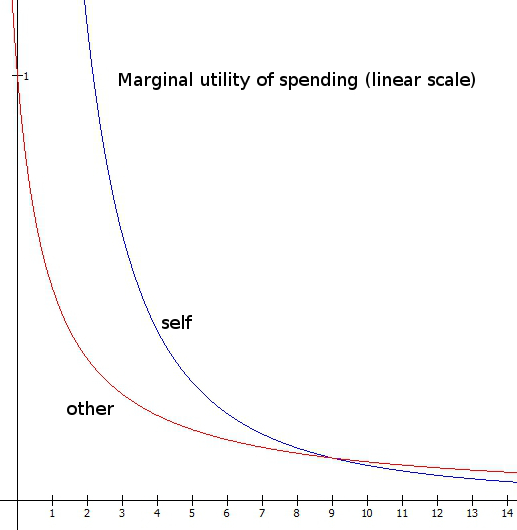
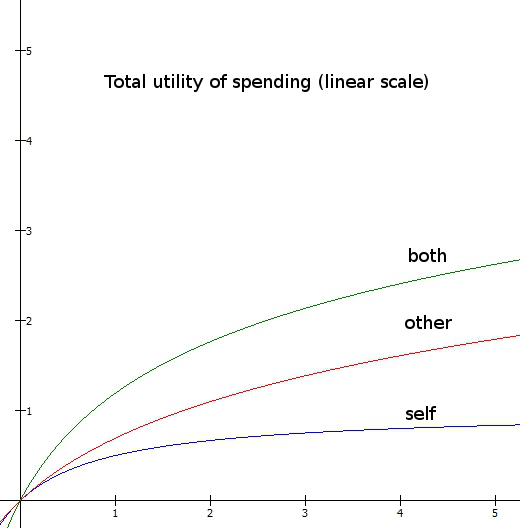
Here is the result graphed on a linear scale:

Utility_linear

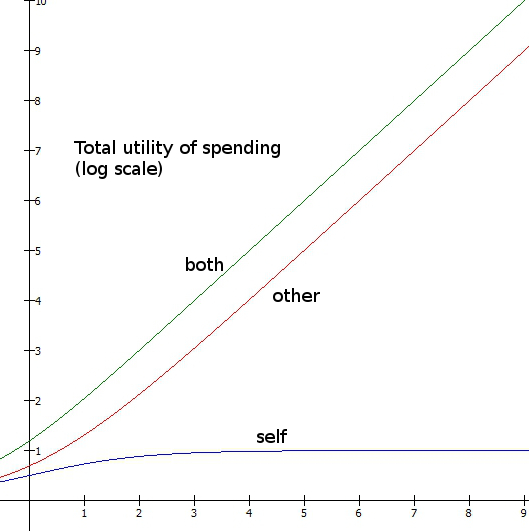
And now, graphed with wealth on a logarithmic scale:

Utility_log

As you can see, self-directed marginal utility drops off much faster than other-directed marginal utility, so the amount you spend on others relative to yourself rapidly increases as your wealth increases. If that doesn’t sound right, remember that I’m including Veblen goods as “other-directed”; when you buy a Ferrari, it’s not really for yourself. While proportional rates of charitable donation do not increase as wealth increases (it’s actually a U-shaped pattern, largely driven by poor people giving to religious institutions), they probably should (people should really stop giving to religious institutions! Even the good ones aren’t cost-effective, and some are very, very bad.). Furthermore, if you include spending on relative power and status as the other-directed motive, that kind of spending clearly does proportionally increase as wealth increases—gotta keep up with those Joneses.

If r/k = 1, that basically means you value others exactly as much as yourself, which I think is implausible (maybe some extreme altruists do that, and Peter Singer seems to think this would be morally optimal). r/k < 1 would mean you should never spend anything on yourself, which not even Peter Singer believes. I think r/k = 10 is a more reasonable estimate.

For any given value of r/k, there is an optimal ratio of self-directed versus other-directed spending, which can vary based on your total wealth.

Actually deriving what the optimal proportion would be requires a whole lot of algebra in a post that probably already has too much algebra, but the point is, there is one, and it will depend strongly on the ratio r/k, that is, the overall relative importance of self-directed versus other-directed motivation.

Take a look at this graph, which uses r/k = 10.

Utility_marginal

If you only have 2 to spend, you should spend it entirely on yourself, because up to that point the marginal utility of self-directed spending is always higher. If you have 3 to spend, you should spend most of it on yourself, but a little bit on other people, because after you’ve spent about 2.2 on yourself there is more marginal utility for spending on others than on yourself.

If your available wealth is W, you would spend some amount x on yourself, and then W-x on others:

u(x) = h(x) + s(W-x)

u(x) = r x/(x+1) + k ln(W – x + 1)

Then you take the derivative and set it equal to zero to find the local maximum. I’ll spare you the algebra, but this is the result of that optimization:

x = – 1 – r/(2k) + sqrt(r/k) sqrt(2 + W + r/(4k))

As long as k <= r (which more or less means that you care at least as much about yourself as about others—I think this is true of basically everyone) then as long as W > 0 (as long as you have some money to spend) we also have x > 0 (you will spend at least something on yourself).

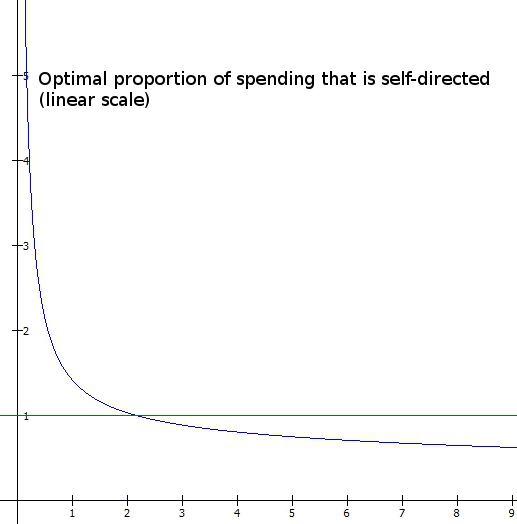
Below a certain threshold (depending on r/k), the optimal value of x is greater than W, which means that, if possible, you should be receiving donations from other people and spending them on yourself. (Otherwise, just spend everything on yourself). After that, x < W, which means that you should be donating to others. The proportion that you should be donating smoothly increases as W increases, as you can see on this graph (which uses r/k = 10, a figure I find fairly plausible):

Utility_donation

While I’m sure no one literally does this calculation, most people do seem to have an intuitive sense that you should donate an increasing proportion of your income to others as your income increases, and similarly that you should pay a higher proportion in taxes. This utility function would justify that—which is something that most proposed utility functions cannot do. In most models there is a hard cutoff where you should donate nothing up to the point where your marginal utility is equal to the marginal utility of donating, and then from that point forward you should donate absolutely everything. Maybe a case can be made for that ethically, but psychologically I think it’s a non-starter.

I’m still not sure exactly how to test this empirically. It’s already quite difficult to get people to answer questions about marginal utility in a way that is meaningful and coherent (people just don’t think about questions like “Which is worth more? $4 to me now or $10 if I had twice as much wealth?” on a regular basis). I’m thinking maybe they could play some sort of game where they have the opportunity to make money at the game, but must perform tasks or bear risks to do so, and can then keep the money or donate it to charity. The biggest problem I see with that is that the amounts would probably be too small to really cover a significant part of anyone’s total wealth, and therefore couldn’t cover much of their marginal utility of wealth function either. (This is actually a big problem with a lot of experiments that use risk aversion to try to tease out marginal utility of wealth.) But maybe with a variety of experimental participants, all of whom we get income figures on?

“But wait, there’s more!”: The clever tricks of commercials

JDN 2457565

I’m sure you’ve all seen commercials like this dozens of times:

A person is shown (usually in black-and-white) trying to use an ordinary consumer product, and failing miserably. Often their failure can only be attributed to the most abject incompetence, but the narrator will explain otherwise: “Old product is so hard to use. Who can handle [basic household activity] and [simple instructions]?”

“Struggle no more!” he says (it’s almost always a masculine narrator), and the video turns to full color as the same person is shown using the new consumer product effortlessly. “With innovative high-tech new product, you can do [basic household activity] with ease in no time!”

“Best of all, new product, a $400 value, can be yours for just five easy payments of $19.95. That’s five easy payments of $19.95!”

And then, here it comes: “But wait. There’s more! Order within the next 15 minutes and you will get two new products, for the same low price. That’s $800 in value for just five easy payments of $19.95! And best of all, your satisfaction is guaranteed! If you don’t like new product, return it within 30 days for your money back!” (A much quieter, faster voice says: “Just pay shipping and handling.”)

Call 555-1234. That’s 555-1234.

“CALL NOW!”

Did you ever stop and think about why so many commercials follow this same precise format?

In short, because it works. Indeed, it works a good deal better than simply presenting the product’s actual upsides and downsides and reporting a sensible market price—even if that sensible market price is lower than the “five easy payments of $19.95”.

We owe this style of marketing to one Ron Popeil; Ron Popeil was a prolific inventor, but none of his inventions have had so much impact as the market methods he used to sell them.

Let’s go through step by step. Why is the person using the old product so incompetent? Surely they could sell their product without implying that we don’t know how to do basic household activities like boiling pasta and cutting vegetables?

Well, first of all, many of these products do nothing but automate such simple household activities (like the famous Veg-O-Matic which cuts vegetables and “It slices! It dices!”), so if they couldn’t at least suggest that this is a lot of work they’re saving us, we’d have no reason to want their product.

But there’s another reason as well: Watching someone else fumble with basic household appliances is funny, as any fan of the 1950s classic I Love Lucy would attest (in fact, it may not be a coincidence that the one fumbling with the vegetables is often a woman who looks a lot like Lucy), and meta-analysis of humor in advertising has shown that it draws attention and triggers positive feelings.

Why use black-and-white for the first part? The switch to color enhances the feeling of contrast, and the color video is more appealing. You wouldn’t consciously say “Wow, that slicer changed the tomatoes from an ugly grey to a vibrant red!” but your subconscious mind is still registering that association.

Then they will hit you with appealing but meaningless buzzwords. For technology it will be things like “innovative”, “ground-breaking”, “high-tech” and “state-of-the-art”, while for foods and nutritional supplements it will be things like “all-natural”, “organic”, “no chemicals”, and “just like homemade”. It will generally be either so vague as to be unverifiable (what constitutes “innovative”?), utterly tautological (all carbon-based substances are “organic” and this term is not regulated), or transparently false but nonetheless not specific enough to get them in trouble (“just like homemade” literally can’t be true if you’re buying it from a TV ad). These give you positive associations without forcing the company to commit to making a claim they could actually be sued for breaking. It’s the same principle as the Applause Lights that politicians bring to every speech: “Three cheers for moms!” “A delicious slice of homemade apple pie!” “God Bless America!”

Occasionally you’ll also hear buzzwords that do have some meaning, but often not nearly as strong as people imagine: “Patent pending” means that they applied for the patent and it wasn’t summarily rejected—but not that they’ll end up getting it approved. “Certified organic” means that the USDA signed off on the farming standards, which is better than nothing but leaves a lot of wiggle room for animal abuse and irresponsible environmental practices.

And then we get to the price. They’ll quote some ludicrous figure for its “value”, which may be a price that no one has ever actually paid for a product of this kind, then draw a line through it and replace it with the actual price, which will be far lower.

Indeed, not just lower: The actual price is almost always $19.99 or $19.95. If the product is too expensive to make for them to sell it at $19.95, they will sell it at several payments of $19.95, and emphasize that these are “easy” payments, as though the difficulty of writing the check were a major factor in people’s purchasing decisions. (That actually is a legitimate concern for micropayments, but not for buying kitchen appliances!) They’ll repeat the price because repetition improves memory and also makes statements more persuasive.

This is what we call psychological pricing, and it’s one of those enormous market distortions that once you realize it’s there, you see it everywhere and start to wonder how our whole market system hasn’t collapsed on itself from the sheer weight of our overwhelming irrationality. The price of a product sold on TV will almost always be just slightly less than $20.

In general, most prices will take the form of $X.95 or $X.99; Costco even has a code system they use in the least significant digit. Continuous substances like gasoline can even be sold at fractional pennies, and so they’ll usually be at $X.X99, being not even one penny less. It really does seem to work; despite being an eminently trivial difference from the round number, and typically rounded up from what it actually should have been, it just feels like less to see $19.95 rather than $20.00.

Moreover, I have less data to support this particular hypothesis, but I think that $20 in particular is a very specific number, because $19.95 pops up so very, very often. I think most Americans have what we might call a “Jackson heuristic”, which is as follows: If something costs less than a Jackson (a $20 bill, though hopefully they’ll put Harriet Tubman on soon, so “Tubman heuristic”), you’re allowed to buy it on impulse without thinking too hard about whether it’s worth it. But if it costs more than a Jackson, you need to stop and think about it, weigh the alternatives before you come to a decision. Since these TV ads are almost always aiming for the thoughtless impulse buy, they try to scrape in just under the Jackson heuristic.

Of course, inflation will change the precise figure over time; in the 1980s it was probably a Hamilton heuristic, in the 1970s a Lincoln heuristic, in the 1940s a Washington heuristic. Soon enough it will be a Grant heuristic and then a Benjamin heuristic. In fact it’s probably something like “The closest commonly-used cash denomination to half a milliQALY”, but nobody does that calculation consciously; the estimate is made automatically without thinking. This in turn is probably figured because you could literally do that once a day every single day for only about 20% of your total income, and if you hold it to once a week you’re under 3% of your income. So if you follow the Jackson heuristic on impulse buys every week or so, your impulse spending is a “statistically insignificant” proportion of your income. (Why do we use that anyway? And suddenly we realize: The 95% confidence level is itself nothing more than a heuristic.)

Then they take advantage of our difficulty in discounting time rationally, by spreading it into payments; “five easy payments of $19.95” sounds a lot more affordable than “$100”, but they are in fact basically the same. (You save $0.25 by the payment plan, maybe as much as a few dollars if your cashflow is very bad and thus you have a high temporal discount rate.)

And then, finally, “But wait. There’s more!” They offer you another of the exact same product, knowing full well you’ll probably have no use for the second one. They’ll multiply their previous arbitrary “value” by 2 to get an even more ludicrous number. Now it sounds like they’re doing you a favor, so you’ll feel obliged to do one back by buying the product. Gifts often have this effect in experiments: People are significantly more motivated to answer a survey if you give them a small gift beforehand, even if they get to keep it without taking the survey.

They’ll tell you to call in the next 15 minutes so that you feel like part of an exclusive club (when in reality you could probably call at any time and get the same deal). This also ensures that you’re staying in impulse-buy mode, since if you wait longer to think, you’ll miss the window!

They will offer a “money-back guarantee” to give you a sense of trust in the product, and this would be a rational response, except for that little disclaimer: “Just pay shipping and handling.” For many products, especially nutritional supplements (which cost basically nothing to make), the “handling” fee is high enough that they don’t lose much money, if any, even if you immediately send it back for a refund. Besides, they know that hardly anyone actually bothers to return products. Retailers are currently in a panic about “skyrocketing” rates of product returns that are still under 10%.

Then, they’ll repeat their phone number, followed by a remarkably brazen direct command: “Call now!” Personally I tend to bristle at direct commands, even from legitimate authorities; but apparently I’m unusual in that respect, and most people will in fact obey direct commands from random strangers as long as they aren’t too demanding. A famous demonstration of this you could try yourself if you’re feeling like a prankster is to walk into a room, point at someone, and say “You! Stand up!” They probably will. There’s a whole literature in social psychology about what makes people comply with commands of this sort.

And all, to make you buy a useless gadget you’ll try to use once and then leave in a cupboard somewhere. What untold billions of dollars in wealth are wasted this way?

What is the price of time?

JDN 2457562

If they were asked outright, “What is the price of time?” most people would find that it sounds nonsensical, like I’ve asked you “What is the diameter of calculus?” or “What is the electric charge of justice?” (It’s interesting that we generally try to assign meaning to such nonsensical questions, and they often seem strangely profound when we do; a good deal of what passes for “profound wisdom” is really better explained as this sort of reaction to nonsense. Deepak Chopra, for instance.)

But there is actually a quite sensible economic meaning of this question, and answering it turns out to have many important implications for how we should run our countries and how we should live our lives.

What we are really asking for is temporal discounting; we want to know how much more money today is worth compared to tomorrow, and how much more money tomorrow is worth compared to two days from now.

If you say that they are exactly the same, your discount rate (your “price of time”) is zero; if that is indeed how you feel, may I please borrow your entire net wealth at 0% interest for the next thirty years? If you like we can even inflation-index the interest rate so it always produces a real interest rate of zero, thus protecting you from potential inflation risk.
What? You don’t like my deal? You say you need that money sooner? Then your discount rate is not zero. Similarly, it can’t be negative; if you actually valued money tomorrow more than money today, you’d gladly give me my loan.

Money today is worth more to you than money tomorrow—the only question is how much more.

There’s a very simple theorem which says that as long as your temporal discounting doesn’t change over time, so it is dynamically consistent, it must have a very specific form. I don’t normally use math this advanced in my blog, but this one is so elegant I couldn’t resist. I’ll encase it in blockquotes so you can skim over it if you must.

The value of $1 today relative to… today is of course 1; f(0) = 1.

If you are dynamically consistent, at any time t you should discount tomorrow relative to today the same as you discounted today relative to yesterday, so for all t, f(t+1)/f(t) = f(t)/f(t-1)
Thus, f(t+1)/f(t) is independent of t, and therefore equal to some constant, which we can call r:

f(t+1)/f(t) = r, which implies f(t+1) = r f(t).

Starting at f(0) = 1, we have:

f(0) = 1, f(1) = r, f(2) = r^2

We can prove that this pattern continues to hold by mathematical induction.

Suppose the following is true for some integer k; we already know it works for k = 1:

f(k) = r^k

Let t = k:

f(k+1) = r f(k)

Therefore:

f(k+1) = r^(k+1)

Which by induction proves that for all integers n:

f(n) = r^n

The name of the variable doesn’t matter. Therefore:

f(t) = r^t

Whether you agree with me that this is beautiful, or you have no idea what I just said, the take-away is the same: If your discount rate is consistent over time, it must be exponential. There must be some constant number 0 < r < 1 such that each successive time period is worth r times as much as the previous. (You can also generalize this to the case of continuous time, where instead of r^t you get e^(-r t). This requires even more advanced math, so I’ll spare you.)

Most neoclassical economists would stop right there. But there are two very big problems with this argument:

(1) It doesn’t tell us the value r should actually be, only that it should be a constant.

(2) No actual human being thinks of time this way.

There is still ongoing research as to exactly how real human beings discount time, but one thing is quite clear from the experiments: It certainly isn’t exponential.

From about 2000 to 2010, the consensus among cognitive economists was that humans discount time hyperbolically; that is, our discount function looks like this:

f(t) = 1/(1 + r t)

In the 1990s there were a couple of experiments supporting hyperbolic discounting. There is even some theoretical work trying to show that this is actually optimal, given a certain kind of uncertainty about the future, and the argument for exponential discounting relies upon certainty we don’t actually have. Hyperbolic discounting could also result if we were reasoning as though we are given a simple interest rate, rather than a compound interest rate.

But even that doesn’t really seem like humans think, now does it? It’s already weird enough for someone to say “Should I take out this loan at 5%? Well, my discount rate is 7%, so yes.” But I can at least imagine that happening when people are comparing two different interest rates (“Should I pay down my student loans, or my credit cards?”). But I can’t imagine anyone thinking, “Should I take out this loan at 5% APR which I’d need to repay after 5 years? Well, let’s check my discount function, 1/(1+0.05 (5)) = 0.8, multiplied by 1.05^5 = 1.28, the product of which is 1.02, greater than 1, so no, I shouldn’t.” That isn’t how human brains function.

Moreover, recent experiments have shown that people often don’t seem to behave according to what hyperbolic discounting would predict.

Therefore I am very much in the other camp of cognitive economists, who say that we don’t have a well-defined discount function. It’s not exponential, it’s not hyperbolic, it’s not “quasi-hyperbolic” (yes that is a thing); we just don’t have one. We reason about time by simple heuristics. You can’t make a coherent function out of it because human beings… don’t always reason coherently.

Some economists seem to have an incredible amount of trouble accepting that; here we have one from the University of Chicago arguing that hyperbolic discounting can’t possibly exist, because then people could be Dutch-booked out of all their money; but this amounts to saying that human behavior cannot ever be irrational, lest all our money magically disappear. Yes, we know hyperbolic discounting (and heuristics) allow for Dutch-booking; that’s why they’re irrational. If you really want to know the formal assumption this paper makes that is wrong, it assumes that we have complete markets—and yes, complete markets essentially force you to be perfectly rational or die, because the slightest inconsistency in your reasoning results in someone convincing you to bet all your money on a sure loss. Why was it that we wanted complete markets, again? (Oh, yes, the fanciful Arrow-Debreu model, the magical fairy land where everyone is perfectly rational and all markets are complete and we all have perfect information and the same amount of wealth and skills and the same preferences, where everything automatically achieves a perfect equilibrium.)

There was a very good experiment on this, showing that rather than discount hyperbolically, behavior is better explained by a heuristic that people judge which of two options is better by a weighted sum of the absolute distance in time plus the relative distance in time. Now that sounds like something human beings might actually do. “$100 today or $110 tomorrow? That’s only 1 day away, but it’s also twice as long. I’m not waiting.” “$100 next year, or $110 in a year and a day? It’s only 1 day apart, and it’s only slightly longer, so I’ll wait.”

That might not actually be the precise heuristic we use, but it at least seems like one that people could use.

John Duffy, whom I hope to work with at UCI starting this fall, has been working on another experiment to test a different heuristic, based on the work of Daniel Kahneman, saying essentially that we have a fast, impulsive, System 1 reasoning layer and a slow, deliberative, System 2 reasoning layer; the result is that our judgments combine both “hand to mouth” where our System 1 essentially tries to get everything immediately and spend whatever we can get our hands on, and a more rational assessment by System 2 that might actually resemble an exponential discount rate. In the 5-minute judgment, System 1’s voice is overwhelming; but if we’re already planning a year out, System 1 doesn’t even care anymore and System 2 can take over. This model also has the nice feature of explaining why people with better self-control seem to behave more like they use exponential discounting,[PDF link] and why people do on occasion reason more or less exponentially, while I have literally never heard anyone try to reason hyperbolically, only economic theorists trying to use hyperbolic models to explain behavior.

Another theory is that discounting is “subadditive”, that is, if you break up a long time interval into many short intervals, people will discount it more, because it feels longer that way. Imagine a century. Now imagine a year, another year, another year, all the way up to 100 years. Now imagine a day, another day, another day, all the way up to 365 days for the first year, and then 365 days for the second year, and that on and on up to 100 years. It feels longer, doesn’t it? It is of course exactly the same. This can account for some weird anomalies in choice behavior, but I’m not convinced it’s as good as the two-system model.

Another theory is that we simply have a “present bias”, which we treat as a sort of fixed cost that we incur regardless of what the payments are. I like this because it is so supremely simple, but there’s something very fishy about it, because in this experiment it was just fixed at $4, and that can’t be right. It must be fixed at some proportion of the rewards, or something like that; or else we would always exhibit near-perfect exponential discounting for large amounts of money, which is more expensive to test (quite directly), but still seems rather unlikely.

Why is this important? This post is getting long, so I’ll save it for future posts, but in short, the ways that we value future costs and benefits, both as we actually do, and as we ought to, have far-reaching implications for everything from inflation to saving to environmental sustainability.

The difference between price, cost, and value

JDN 2457559

This topic has been on the voting list for my Patreons for several months, but it never quite seems to win the vote. Well, this time it did. I’m glad, because I was tempted to do it anyway.

“Price”, “cost”, and “value”; the words are often used more or less interchangeably, not only by regular people but even by economists. I’ve read papers that talked about “rising labor costs” when what they clearly meant was rising wages—rising labor prices. I’ve read papers that tried to assess the projected “cost” of climate change by using the prices of different commodity futures. And hardly a day goes buy that I don’t see a TV commercial listing one (purely theoretical) price, cutting it in half (to the actual price), and saying they’re now giving you “more value”.

As I’ll get to, there are reasons to think they would be approximately the same for some purposes. Indeed, they would be equal, at the margin, in a perfectly efficient market—that may be why so many economists use them this way, because they implicitly or explicitly assume efficient markets. But they are fundamentally different concepts, and it’s dangerous to equate them casually.

Price

Price is exactly what you think it is: The number of dollars you must pay to purchase something. Most of the time when we talk about “cost” or “value” and then give a dollar figure, we’re actually talking about some notion of price.

Generally we speak in terms of nominal prices, which are the usual concept of prices in actual dollars paid, but sometimes we do also speak in terms of real prices, which are relative prices of different things once you’ve adjusted for overall inflation. “Inflation-adjusted price” can be a somewhat counter-intuitive concept; if a good’s (nominal) price rises, but by less than most other prices have risen, its real price has actually fallen.

You also need to be careful about just what price you’re looking at. When we look at labor prices, for example, we need to consider not only cash wages, but also fringe benefits and other compensation such as stock options. But other than that, prices are fairly straightforward.

Cost

Cost is probably not at all what you think it is. The real cost of something has nothing to do with money; saying that a candy bar “costs $2” or a computer “costs $2,000” is at best a somewhat sloppy shorthand and at worst a fundamental distortion of what cost is and why it matters. No, those are prices. The cost of a candy bar is the toil of children in cocoa farms in Cote d’Ivoire. The cost of a computer is the ecological damage and displaced indigenous people caused by coltan mining in Congo.

The cost of something is the harm that it does to human well-being (or for that matter to the well-being of any sentient being). It is not measured in money but in “the sweat of our laborers, the genius of our scientists, the hopes of our children” (to quote Eisenhower, who understood real cost better than most economists). There is also opportunity cost, the real cost we pay not by what we did, but by what we didn’t do—what we could have done instead.

This is important precisely because while costs should always be reduced when possible, prices can in fact be too low—and indeed, artificially low prices of goods due to externalities are probably the leading reason why humanity bears so many excess real costs. If the price of that chocolate bar accurately reflected the suffering of those African children (perhaps by—Gasp! Paying them a fair wage?), and the price of that computer accurately reflected the ecological damage of those coltan mines (a carbon tax, at least?), you might not want to buy them anymore; in which case, you should not have bought them. In fact, as I’ll get to once I discuss value, there is reason to think that even if you would buy them at a price that accurately reflected the dollar value of the real cost to their producers, we would still buy more than we should.

There is a point at which we should still buy things even though people get hurt making them; if you deny this, stop buying literally anything ever again. We don’t like to think about it, but any product we buy did cause some person, in some place, some degree of discomfort or unpleasantness in production. And many quite useful products will in fact cause death to a nonzero number of human beings.

For some products this is only barely true—it’s hard to feel bad for bestselling authors and artists who sell their work for millions, for whatever toil they may put into their work, whatever their elevated suicide rate (which is clearly endogenous; people aren’t randomly assigned to be writers), they also surely enjoy it a good deal of the time, and even if they didn’t, their work sells for millions. But for many products it is quite obviously true: A certain proportion of roofers, steelworkers, and truck drivers will die doing their jobs. We can either accept that, recognizing that it’s worth it to have roofs, steel, and trucking—and by extension, industrial capitalism, and its whole babies not dying thing—or we can give up on the entire project of human civilization, and go back to hunting and gathering; even if we somehow managed to avoid the direct homicide most hunter-gatherers engage in, far more people would simply die of disease or get eaten by predators.

Of course, we should have safety standards; but the benefits of higher safety must be carefully weighed against the potential costs of inefficiency, unemployment, and poverty. Safety regulations can reduce some real costs and increase others, even if they almost always increase prices. A good balance is struck when real cost is minimized, where any additional regulation would increase inefficiency more than it improves safety.

Actually OSHA are unsung heroes for their excellent performance at striking this balance, just as EPA are unsung heroes for their balance in environmental regulations (and that whole cutting crime in half business). If activists are mad at you for not banning everything bad and business owners are mad at you for not letting them do whatever they want, you’re probably doing it right. Would you rather people saved from fires, or fires prevented by good safety procedures? Would you rather murderers imprisoned, or boys who grow up healthy and never become murderers? If an ounce of prevention is worth a pound of cure, why does everyone love firefighters and hate safety regulators?So let me take this opportunity to say thank you, OSHA and EPA, for doing the jobs of firefighters and police way better than they do, and unlike them, never expecting to be lauded for it.

And now back to our regularly scheduled programming. Markets are supposed to reflect costs in prices, which is why it’s not totally nonsensical to say “cost” when you mean “price”; but in fact they aren’t very good at that, for reasons I’ll get to in a moment.

Value

Value is how much something is worth—not to sell it (that’s the price again), but to use it. One of the core principles of economics is that trade is nonzero-sum, because people can exchange goods that they value differently and thereby make everyone better off. They can’t price them differently—the buyer and the seller must agree upon a price to make the trade. But they can value them differently.

To see how this works, let’s look at a very simple toy model, the simplest essence of trade: Alice likes chocolate ice cream, but all she has is a gallon of vanilla ice cream. Bob likes vanilla ice cream, but all he has is a gallon of chocolate ice cream. So Alice and Bob agree to trade their ice cream, and both of them are happier.

We can measure value in “willingness-to-pay” (WTP), the highest price you’d willingly pay for something. That makes value look more like a price; but there are several reasons we must be careful when we do that. The obvious reason is that WTP is obviously going to vary based on overall inflation; since $5 isn’t worth as much in 2016 as it was in 1956, something with a WTP of $5 in 1956 would have a much higher WTP in 2016. The not-so-obvious reason is that money is worth less to you the more you have, so we also need to take into account the effect of wealth, and the marginal utility of wealth. The more money you have, the more money you’ll be willing to pay in order to get the same amount of real benefit. (This actually creates some very serious market distortions in the presence of high income inequality, which I may make the subject of a post or even a paper at some point.) Similarly there is “willingness-to-accept” (WTA), the lowest price you’d willingly accept for it. In theory these should be equal; in practice, WTA is usually slightly higher than WTP in what’s called endowment effect.

So to make our model a bit more quantitative, we could suppose that Alice values vanilla at $5 per gallon and chocolate at $10 per gallon, while Bob also values vanilla at $5 per gallon but only values chocolate at $4 per gallon. (I’m using these numbers to point out that not all the valuations have to be different for trade to be beneficial, as long as some are.) Therefore, if Alice sells her vanilla ice cream to Bob for $5, both will (just barely) accept that deal; and then Alice can buy chocolate ice cream from Bob for anywhere between $4 and $10 and still make both people better off. Let’s say they agree to also sell for $5, so that no net money is exchanged and it is effectively the same as just trading ice cream for ice cream. In that case, Alice has gained $5 in consumer surplus (her WTP of $10 minus the $5 she paid) while Bob has gained $1 in producer surplus (the $5 he received minus his $4 WTP). The total surplus will be $6 no matter what price they choose, which we can compute directly from Alice’s WTP of $10 minus Bob’s WTA of $4. The price ultimately decides how that total surplus is distributed between the two parties, and in the real world it would very likely be the result of which one is the better negotiator.

The enormous cost of our distorted understanding

(See what I did there?) If markets were perfectly efficient, prices would automatically adjust so that, at the margin, value is equal to price is equal to cost. What I mean by “at the margin” might be clearer with an example: Suppose we’re selling apples. How many apples do you decide to buy? Well, the value of each successive apple to you is lower, the more apples you have (the law of diminishing marginal utility, which unlike most “laws” in economics is actually almost always true). At some point, the value of the next apple will be just barely above what you have to pay for it, so you’ll stop there. By a similar argument, the cost of producing apples increases the more apples you produce (the law of diminishing returns, which is a lot less reliable, more like the Pirate Code), and the producers of apples will keep selling them until the price they can get is only just barely larger than the cost of production. Thus, in the theoretical limit of infinitely-divisible apples and perfect rationality, marginal value = price = marginal cost. In such a world, markets are perfectly efficient and they maximize surplus, which is the difference between value and cost.

But in the real world of course, none of those assumptions are true. No product is infinitely divisible (though the gasoline in a car is obviously a lot more divisible than the car itself). No one is perfectly rational. And worst of all, we’re not measuring value in the same units. As a result, there is basically no reason to think that markets are optimizing anything; their optimization mechanism is setting two things equal that aren’t measured the same way, like trying to achieve thermal equilibrium by matching the temperature of one thing in Celsius to the temperature of other things in Fahrenheit.

An implicit assumption of the above argument that didn’t even seem worth mentioning was that when I set value equal to price and set price equal to cost, I’m setting value equal to cost; transitive property of equality, right? Wrong. The value is equal to the price, as measured by the buyer. The cost is equal to the price, as measured by the seller.

If the buyer and seller have the same marginal utility of wealth, no problem; they are measuring in the same units. But if not, we convert from utility to money and then back to utility, using a different function to convert each time. In the real world, wealth inequality is massive, so it’s wildly implausible that we all have anything close to the same marginal utility of wealth. Maybe that’s close enough if you restrict yourself to middle-class people in the First World; so when a tutoring client pays me, we might really be getting close to setting marginal value equal to marginal cost. But once you include corporations that are owned by billionaires and people who live on $2 per day, there’s simply no way that those price-to-utility conversions are the same at each end. For Bill Gates, a million dollars is a rounding error. For me, it would buy a house, give me more flexible work options, and keep me out of debt, but not radically change the course of my life. For a child on a cocoa farm in Cote d’Ivoire, it could change her life in ways she can probably not even comprehend.

The market distortions created by this are huge; indeed, most of the fundamental flaws in capitalism as we know it are ultimately traceable to this. Why do Americans throw away enough food to feed all the starving children in Africa? Marginal utility of wealth. Why are Silicon Valley programmers driving the prices for homes in San Francisco higher than most Americans will make in their lifetimes? Marginal utility of wealth. Why are the Koch brothers spending more on this year’s elections than the nominal GDP of the Gambia? Marginal utility of wealth. It’s the sort of pattern that once you see it suddenly seems obvious and undeniable, a paradigm shift a bit like the heliocentric model of the solar system. Forget trade barriers, immigration laws, and taxes; the most important market distortions around the world are all created by wealth inequality. Indeed, the wonder is that markets work as well as they do.

The real challenge is what to do about it, how to reduce this huge inequality of wealth and therefore marginal utility of wealth, without giving up entirely on the undeniable successes of free market capitalism. My hope is that once more people fully appreciate the difference between price, cost, and value, this paradigm shift will be much easier to make; and then perhaps we can all work together to find a solution.

The many varieties of argument “men”

JDN 2457552

After several long, intense, and very likely controversial posts in a row, I decided to take a break with a post that is short and fun.

You have probably already heard of a “strawman” argument, but I think there are many more “materials” an argument can be made of which would be useful terms to have, so I have proposed a taxonomy of similar argument “men”. Perhaps this will help others in the future to more precisely characterize where arguments have gone wrong and how they should have gone differently.

For examples of each, I’m using a hypothetical argument about the gold standard, based on the actual arguments I refute in my previous post on the subject.

This is an argument actually given by a proponent of the gold standard, upon which my “men” shall be built:

1) A gold standard is key to achieving a period of sustained, 4% real economic growth.

The U.S. dollar was created as a defined weight of gold and silver in 1792. As detailed in the booklet, The 21st Century Gold Standard (available free at http://agoldenage.com), I co-authored with fellow Forbes.com columnist Ralph Benko, a dollar as good as gold endured until 1971 with the relatively brief exceptions of the War of 1812, the Civil War and Reconstruction, and 1933, the year President Franklin Roosevelt suspended dollar/gold convertibility until January 31, 1934 when the dollar/gold link was re-established at $35 an ounce, a 40% devaluation from the prior $20.67 an ounce. Over that entire 179 years, the U.S. economy grew at a 3.9% average annual rate, including all of the panics, wars, industrialization and a myriad other events. During the post World War II Bretton Woods gold standard, the U.S. economy also grew on average 4% a year.

By contrast, during the 40-years since going off gold, U.S. economic growth has averaged an anemic 2.8% a year. The only 40-year periods in which the economic growth was slower were those ending in the Great Depression, from 1930 to 1940.

2) A gold standard reduces the risk of recessions and financial crises.

Critics of the gold standard point out, correctly, that it would prohibit the Federal Reserve from manipulating interest rates and the value of the dollar in hopes of stimulating demand. In fact, the idea that a paper dollar would lead to a more stable economy was one of the key selling points for abandoning the gold standard in 1971.

However, this power has done far more harm than good. Under the paper dollar, recessions have become more severe and financial crises more frequent. During the post World War II gold standard, unemployment averaged less than 5% and never rose above 7% during a calendar year. Since going off gold, unemployment has averaged more than 6%, and has been above 8% now for nearly 3.5 years.

And now, the argument men:

Fallacious (Bad) Argument Men

These argument “men” are harmful and irrational; they are to be avoided, and destroyed wherever they are found. Maybe in some very extreme circumstances they would be justifiable—but only in circumstances where it is justifiable to be dishonest and manipulative. You can use a strawman argument to convince a terrorist to let the hostages go; you can’t use one to convince your uncle not to vote Republican.

Strawman: The familiar fallacy in which instead of trying to address someone else’s argument, you make up your own fake version of that argument which is easier to defeat. The image is of making an effigy of your opponent out of straw and beating on the effigy to avoid confronting the actual opponent.

You can’t possibly think that going to the gold standard would make the financial system perfect! There will still be corrupt bankers, a banking oligopoly, and an unpredictable future. The gold standard would do nothing to remove these deep flaws in the system.

Hitman: An even worse form of the strawman, in which you misrepresent not only your opponent’s argument, but your opponent themselves, using your distortion of their view as an excuse for personal attacks against their character.

Oh, you would favor the gold standard, wouldn’t you? A rich, middle-aged White man, presumably straight and nominally Christian? You have all the privileges in life, so you don’t care if you take away the protections that less-fortunate people depend upon. You don’t care if other people become unemployed, so long as you don’t have to bear inflation reducing the real value of your precious capital assets.

Conman: An argument for your own view which you don’t actually believe, but expect to be easier to explain or more persuasive to this particular audience than the true reasons for your beliefs.

Back when we were on the gold standard, it was the era of “Robber Barons”. Poverty was rampant. If we go back to that system, it will just mean handing over all the hard-earned money of working people to billionaire capitalists.

Vaporman: Not even an argument, just a forceful assertion of your view that takes the place or shape of an argument.

The gold standard is madness! It makes no sense at all! How can you even think of going back to such a ridiculous monetary system?

Honest (Acceptable) Argument Men

These argument “men” are perfectly acceptable, and should be the normal expectation in honest discourse.

Woodman: The actual argument your opponent made, addressed and refuted honestly using sound evidence.

There is very little evidence that going back to the gold standard would in any way improve the stability of the currency or the financial system. While long-run inflation was very low under the gold standard, this fact obscures the volatility of inflation, which was extremely high; bouts of inflation were followed by bouts of deflation, swinging the value of the dollar up or down as much as 15% in a single year. Nor is there any evidence that the gold standard prevented financial crises, as dozens of financial crises occurred under the gold standard, if anything more often than they have since the full-fiat monetary system established in 1971.

Bananaman: An actual argument your opponent made that you honestly refute, which nonetheless is so ridiculous that it seems like a strawman, even though it isn’t. Named in “honor” of Ray Comfort’s Banana Argument. Of course, some bananas are squishier than others, and the only one I could find here was at least relatively woody–though still recognizable as a banana:

You said “A gold standard is key to achieving a period of sustained, 4% real economic growth.” based on several distorted, misunderstood, or outright false historical examples. The 4% annual growth in total GDP during the early part of the United States was due primarily to population growth, not a rise in real standard of living, while the rapid growth during WW2 was obviously due to the enormous and unprecedented surge in government spending (and by the way, we weren’t even really on the gold standard during that period). In a blatant No True Scotsman fallacy, you specifically exclude the Great Depression from the “true gold standard” so that you don’t have to admit that the gold standard contributed significantly to the severity of the depression.

Middleman: An argument that synthesizes your view and your opponent’s view, in an attempt to find a compromise position that may be acceptable, if not preferred, by all.

Unlike the classical gold standard, the Bretton Woods gold standard in place from 1945 to 1971 was not obviously disastrous. If you want to go back to a system of international exchange rates fixed by gold similar to Bretton Woods, I would consider that a reasonable position to take.

Virtuous (Good) Argument Men

These argument “men” go above and beyond the call of duty; rather than simply seek to win arguments honestly, they actively seek the truth behind the veil of opposing arguments. These cannot be expected in all circumstances, but they are to be aspired to, and commended when found.

Ironman: Your opponent’s actual argument, but improved, with some of its flaws shored up. The same basic thinking as your opponent, but done more carefully, filling in the proper gaps.

The gold standard might not reduce short-run inflation, but it would reduce longrun inflation, making our currency more stable over long periods of time. We would be able to track long-term price trends in goods such as housing and technology much more easily, and people would have an easier time psychologically grasping the real prices of goods as they change during their lifetime. No longer would we hear people complain, “How can you want a minimum wage of $15? As a teenager in 1955, I got paid $3 an hour and I was happy with that!” when that $3 in 1955, adjusted for inflation, is $26.78 in today’s money.

Steelman: Not the argument your opponent made, but the one they should have made. The best possible argument you are aware of that would militate in favor of their view, the one that sometimes gives you pause about your own opinions, the real and tangible downside of what you believe in.

Tying currency to gold or any other commodity may not be very useful directly, but it could serve one potentially vital function, which is as a commitment mechanism to prevent the central bank from manipulating the currency to enrich themselves or special interests. It may not be the optimal commitment mechanism, but it is a psychologically appealing one for many people, and is also relatively easy to define and keep track of. It is also not subject to as much manipulation as something like nominal GDP targeting or a Taylor Rule, which could be fudged by corrupt statisticians. And while it might cause moderate volatility, it can also protect against the most extreme forms of volatility such as hyperinflation. In countries with very corrupt governments, a gold standard might actually be a good idea, if you could actually enforce it, because it would at least limit the damage that can be done by corrupt central bank officials. Had such a system been in place in Zimbabwe in the 1990s, the hyperinflation might have been prevented. The US is not nearly as corrupt as Zimbabwe, so we probably do not need a gold standard; but it may be wise to recommend the use of gold standards or similar fixed-exchange currencies in Third World countries so that corrupt leaders cannot abuse the monetary system to gain at the expense of their people.

The unending madness of the gold standard

JDN 2457545

If you work in economics in any capacity (much like “How is the economy doing?” you don’t even really need to be in macroeconomics), you will encounter many people who believe in the gold standard. Many of these people will be otherwise quite intelligent and educated; they often understand economics better than most people (not that this is saying a whole lot). Yet somehow they continue to hold—and fiercely defend—this incredibly bizarre and anachronistic view of macroeconomics.

They even bring it up at the oddest times; I recently encountered someone who wrote a long and rambling post arguing for drug legalization (which I largely agree with, by the way) and concluded it with #EndTheFed, not seeming to grasp the total and utter irrelevance of this juxtaposition. It seems like it was just a conditioned response, or maybe the sort of irrelevant but consistent coda originally perfected by Cato and his “Carthago delenda est. “Foederale Reservatum delendum est. Hey, maybe that’s why they’re called the Cato Institute.

So just how bizarre is the gold standard? Well, let’s look at what sort of arguments they use to defend it. I’ll use Charles Kadlic, prominent Libertarian blogger on Forbes, as an example, with his “Top Ten Reasons That You Should Support the ‘Gold Commission’”:

  1. A gold standard is key to achieving a period of sustained, 4% real economic growth.
  2. A gold standard reduces the risk of recessions and financial crises.
  3. A gold standard would restore rising living standards to the middle-class.
  4. A gold standard would restore long-term price stability.
  5. A gold standard would stop the rise in energy prices.
  6. A gold standard would be a powerful force for restoring fiscal balance to federal state and local governments.
  7. A gold standard would help save Medicare and Social Security.
  8. A gold standard would empower Main Street over Wall Street.
  9. A gold standard would increase the liberty of the American people.
  10. Creation of a gold commission will provide the forum to chart a prudent path toward a 21st century gold standard.

Number 10 can be safely ignored, as clearly Kadlic just ran out of reasons and to make a round number tacked on the implicit assumption of the entire article, namely that this ‘gold commission’ would actually realistically lead us toward a gold standard. (Without it, the other 9 reasons are just non sequitur.)

So let’s look at the other 9, shall we? Literally none of them are true. Several are outright backward.

You know a policy is bad when even one of its most prominent advocates can’t even think of a single real benefit it would have. A lot of quite bad policies do have perfectly real benefits, they’re just totally outweighed by their costs: For example, cutting the top income tax rate to 20% probably would actually contribute something to economic growth. Not a lot, and it would cut a swath through the federal budget and dramatically increase inequality—but it’s not all downside. Yet Kadlic couldn’t actually even think of one benefit of the gold standard that actually holds up. (I actually can do his work for him: I do know of one benefit of the gold standard, but as I’ll get to momentarily it’s quite small and can easily be achieved in better ways.)

First of all, it’s quite clear that the gold standard did not increase economic growth. If you cherry-pick your years properly, you can make it seem like Nixon leaving the gold standard hurt growth, but if you look at the real long-run trends in economic growth it’s clear that we had really erratic growth up until about the 1910s (the surge of government spending in WW1 and the establishment of the Federal Reserve), at which point went through a temporary surge recovering from the Great Depression and then during WW2, and finally, if you smooth out the business cycle, our growth rates have slowly trended downward as growth in productivity has gradually slowed down.

Here’s GDP growth from 1800 to 1900, when we were on the classical gold standard:

US_GDP_growth_1800s

Here’s GDP growth from 1929 to today, using data from the Bureau of Economic Analysis:

US_GDP_growth_BEA

Also, both of these are total GDP growth (because that is what Kadlic said), which means that part of what you’re seeing here is population growth rather than growth in income per person. Here’s GDP per person in the 1800s:

US_GDP_growth_1800s

If you didn’t already know, I bet you can’t guess where on those graphs we left the gold standard, which you’d clearly be able to do if the gold standard had this dramatic “double your GDP growth” kind of effect. I can’t immediately rule out some small benefit to the gold standard just from this data, but don’t worry; more thorough economic studies have done that. Indeed, it is the mainstream consensus among economists today that the gold standard is what caused the Great Depression.

Indeed, there’s a whole subfield of historical economics research that basically amounts to “What were they thinking?” trying to explain why countries stayed on the gold standard for so long when it clearly wasn’t working. Here’s a paper trying to argue it was a costly signal of your “rectitude” in global bond markets, but I find much more compelling the argument that it was psychological: Their belief in the gold standard was simply too strong, so confirmation bias kept holding them back from what needed to be done. They were like my aforementioned #EndTheFed acquaintance.

Then we get to Kadlic’s second point: Does the gold standard reduce the risk of financial crises? Let’s also address point 4, which is closely related: Does the gold standard improve price stability? Tell that to 1929.

In fact, financial crises were more common on the classical gold standard; the period of pure fiat monetary policy was so stable that it was called the Great Moderation, until the crash in 2008 screwed it all up—and that crash occurred essentially outside the standard monetary system, in the “shadow banking system” of unregulated and virtually unlimited derivatives. Had we actually forced banks to stay within the light of the standard banking system, the Great Moderation might have continued indefinitely.

As for “price stability”, that’s sort of true if you look at the long run, because prices were as likely to go down as they were to go up. But that isn’t what we mean by “price stability”. A system with good price stability will have a low but positive and steady level of inflation, and will therefore exhibit some long-run increases in price levels; it won’t have prices jump up and down erratically and end up on average the same.

For jump up and down is what prices did on the gold standard, as you can see from FRED:

US_inflation_longrun

This is something we could have predicted in advance; the price of any given product jumps up and down over time, and gold is just one product among many. Tying prices to gold makes no more sense than tying them to any other commodity.

As for stopping the rise in energy prices, energy prices aren’t rising. Even if they were (and they could at some point), the only way the gold standard would stop that is by triggering deflation (and therefore recession) in the rest of the economy.

Regarding number 6, I don’t see how the fiscal balance of federal and state governments is improved by periodic bouts of deflation that make their debt unpayable.

As for number 7, saving Medicare and Social Security, their payments out are tied to inflation and their payments in are tied to nominal GDP, so overall inflation has very little effect on their long-term stability. In any case, the problem with Medicare is spiraling medical costs (which Obamacare has done a lot to fix), and the problem with Social Security is just the stupid arbitrary cap on the income subject to payroll tax; the gold standard would do very little to solve either of those problems, though I guess it would make the nominal income cap less binding by triggering deflation, which is just about the worst way to avoid a price ceiling I’ve ever heard.

Regarding 8 and 9, I don’t even understand why Kadlic thinks that going to a gold standard would empower individuals over banks (does it seem like individuals were empowered over banks in the “Robber Baron Era”?), or what in the world it has to do with giving people more liberty (all that… freedom… you lose… when the Fed… stabilizes… prices?), so I don’t even know where to begin on those assertions. You know what empowers people over banks? The Consumer Financial Protection Bureau. You know what would enhance liberty? Ending mass incarceration. Libertarians fight tooth and nail against the former; sometimes they get behind the latter, but sometimes they don’t; Gary Johnson for some bizarre reason believes in privatization of prisons, which are directly linked to the surge in US incarceration.

The only benefit I’ve been able to come up with for the gold standard is as a commitment mechanism, something the Federal Reserve could do to guarantee its future behavior and thereby reduce the fear that it will suddenly change course on its past promises. This would make forward guidance a lot more effective at changing long-term interest rates, because people would have reason to believe that the Fed means what it says when it projects its decisions 30 years out.

But there are much simpler and better commitment mechanisms the Fed could use. They could commit to a Taylor Rule or nominal GDP targeting, both of which mainstream economists have been clamoring for for decades. There are some definite downsides to both proposals, but also some important upsides; and in any case they’re both obviously better than the gold standard and serve the same forward guidance function.

Indeed, it’s really quite baffling that so many people believe in the gold standard. It cries out for some sort of psychological explanation, as to just what cognitive heuristic is failing when otherwise-intelligent and highly-educated people get monetary policy so deeply, deeply wrong. A lot of them don’t even to seem grasp when or how we left the gold standard; it really happened when FDR suspended gold convertibility in 1933. After that on the Bretton Woods system only national governments could exchange money for gold, and the Nixon shock that people normally think of as “ending the gold standard” was just the final nail in the coffin, and clearly necessary since inflation was rapidly eating through our gold reserves.

A lot of it seems to come down to a deep distrust of government, especially federal government (I still do not grok why the likes of Ron Paul think state governments are so much more trustworthy than the federal government); the Federal Reserve is a government agency (sort of) and is therefore not to be trusted—and look, it has federal right there in the name.

But why do people hate government so much? Why do they think politicians are much less honest than they actually are? Part of it could have to do with the terrifying expansion of surveillance and weakening of civil liberties in the face of any perceived outside threat (Sedition Act, PATRIOT ACT, basically the same thing), but often the same people defending those programs are the ones who otherwise constantly complain about Big Government. Why do polls consistently show that people don’t trust the government, but want it to do more?

I think a lot of this comes down to the vague meaning of the word “government” and the associations we make with particular questions about it. When I ask “Do you trust the government?” you think of the NSA and the Vietnam War and Watergate, and you answer “No.” But when I ask “Do you want the government to do more?” you think of the failure at Katrina, the refusal to expand Medicaid, the pitiful attempts at reducing carbon emissions, and you answer “Yes.” When I ask if you like the military, your conditioned reaction is to say the patriotic thing, “Yes.” But if I ask whether you like the wars we’ve been fighting lately, you think about the hundreds of thousands of people killed and the wanton destruction to achieve no apparent actual objective, and you say “No.” Most people don’t come to these polls with thought-out opinions they want to express; the questions evoke emotional responses in them and they answer accordingly. You can also evoke different responses by asking “Should we cut government spending?” (People say “Yes.”) versus asking “Should we cut military spending, Social Security, or Medicare?” (People say “No.”) The former evokes a sense of abstract government taking your tax money; the latter evokes the realization that this money is used for public services you value.

So, the gold standard has acquired positive emotional vibes, and the Fed has acquired negative emotional vibes.

The former is fairly easy to explain: “good as gold” is an ancient saying, and “the gold standard” is even a saying we use in general to describe the right way of doing something (“the gold standard in prostate cancer treatment”). Humans have always had a weird relationship with gold; something about its timeless and noncorroding shine mesmerizes us. That’s why you occasionally get proposals for a silver standard, but no one ever seems to advocate an oil standard, an iron standard, or a lumber standard, which would make about as much sense.

The latter is a bit more difficult to explain: What did the Fed ever do to you? But I think it might have something to do with the complexity of sound monetary policy, and the resulting air of technocratic mystery surrounding it. Moreover, the Fed actively cultivates this image, by using “open-market operations” and “quantitative easing” to “target interest rates”, instead of just saying, “We’re printing money.” There may be some good reasons to do it this way, but a lot of it really does seem to be intended to obscure the truth from the uninitiated and perpetuate the myth that they are almost superhuman. “It’s all very complicated, you see; you wouldn’t understand.” People are hoarding their money, so there’s not enough money in circulation, so prices are falling, so you’re printing more money and trying to get it into circulation. That’s really not that complicated. Indeed, if it were, we wouldn’t be able to write a simple equation like a Taylor Rule or nominal GDP targeting in order to automate it!

The reason so many people become gold bugs after taking a couple of undergraduate courses in economics, then, is that this teaches them enough that they feel they have seen through the veil; the curtain has been pulled open and the all-powerful Wizard revealed to be an ordinary man at a control panel. (Spoilers? The movie came out in 1939. Actually, it was kind of about the gold standard.) “What? You’ve just been printing money all this time? But that is surely madness!” They don’t actually understand why printing money is actually a perfectly sensible thing to do on many occasions, and it feels to them a lot like what would happen if they just went around printing money (counterfeiting) or what a sufficiently corrupt government could do if they printed unlimited amounts (which is why they keep bringing up Zimbabwe). They now grasp what is happening, but not why. A little learning is a dangerous thing.

Now as for why Paul Volcker wants to go back to Bretton Woods? That, I cannot say. He’s definitely got more than a little learning. At least he doesn’t want to go back to the classical gold standard.

The powerful persistence of bigotry

JDN 2457527

Bigotry has been a part of human society since the beginning—people have been hating people they perceive as different since as long as there have been people, and maybe even before that. I wouldn’t be surprised to find that different tribes of chimpanzees or even elephants hold bigoted beliefs about each other.

Yet it may surprise you that neoclassical economics has basically no explanation for this. There is a long-standing famous argument that bigotry is inherently irrational: If you hire based on anything aside from actual qualifications, you are leaving money on the table for your company. Because women CEOs are paid less and perform better, simply ending discrimination against women in top executive positions could save any typical large multinational corporation tens of millions of dollars a year. And yet, they don’t! Fancy that.

More recently there has been work on the concept of statistical discrimination, under which it is rational (in the sense of narrowly-defined economic self-interest) to discriminate because categories like race and gender may provide some statistically valid stereotype information. For example, “Black people are poor” is obviously not true across the board, but race is strongly correlated with wealth in the US; “Asians are smart” is not a universal truth, but Asian-Americans do have very high educational attainment. In the absence of more reliable information that might be your best option for making good decisions. Of course, this creates a vicious cycle where people in the positive stereotype group are better off and have more incentive to improve their skills than people in the negative stereotype group, thus perpetuating the statistical validity of the stereotype.

But of course that assumes that the stereotypes are statistically valid, and that employers don’t have more reliable information. Yet many stereotypes aren’t even true statistically: If “women are bad drivers”, then why do men cause 75% of traffic fatalities? Furthermore, in most cases employers have more reliable information—resumes with education and employment records. Asian-Americans are indeed more likely to have bachelor’s degrees than Latino Americans, but when it say right on Mr. Lorenzo’s resume that he has a B.A. and on Mr. Suzuki’s resume that he doesn’t, that racial stereotype no longer provides you with any further information. Yet even if the resumes are identical, employers will be more likely to hire a White applicant than a Black applicant, and more likely to hire a male applicant than a female applicant—we have directly tested this in experiments. In an experiment where employers had direct performance figures in front of them, they were still more likely to choose the man when they had the same scores—and sometimes even when the woman had a higher score!

Even our assessments of competence are often biased, probably subconsciously; given the same essay to review, most reviewers find more spelling errors and are more concerned about those errors if they are told that the author is Black. If they thought the author was White, they thought of the errors as “minor mistakes” by a student with “otherwise good potential”; but if they thought the author was Black, they “can’t believe he got into this school in the first place”. These reviewers were reading the same essay. The alleged author’s race was decided randomly. Most if not all of these reviewers were not consciously racist. Subconscious racial biases are all over the place; almost everyone exhibits some subconscious racial bias.

No, discrimination isn’t just rational inference based on valid (if unfortunate and self-reinforcing) statistical trends. There is a significant component of just outright irrational bigotry.

We’re seeing this play out in North Carolina; due to their arbitrary discrimination against lesbian, gay, bisexual and especially transgender people, they are now hemorrhaging jobs as employers pull out, and their federal funding for student loans is now in jeopardy due to the obvious Title IX violation. This is obviously not in the best interest of the people of North Carolina (even the ones who aren’t LGBT!); and it’s all being justified on the grounds of an epidemic of sexual assaults by people pretending to be trans that doesn’t even exist. It turns out that more Republican Senators have been arrested for sexual misconduct in bathrooms than transgender people—and while the number of transgender people in the US is surprisingly hard to measure, it’s clearly a lot larger than the number of Republican Senators!

In fact, discrimination is even more irrational than it may seem, because empirically the benefits of discrimination (such as they are—short-term narrow economic self-interest) fall almost entirely on the rich while the harms fall mainly on the poor, yet poor people are much more likely to be racist! Since income and education are highly correlated, education accounts for some of this effect. This is reason to be hopeful, for as educational attainment has soared, we have found that racism has decreased.

But education doesn’t seem to explain the full effect. One theory to account this is what’s called last-place aversiona highly pernicious heuristic where people are less concerned about their own absolute status than they are about not having the worst status. In economic experiments, people are usually more willing to give money to people worse off than them than to those better off than them—unless giving it to the worse-off would make those people better off than they themselves are. I think we actually need to do further study to see what happens if it would make those other people exactly as well-off as they are, because that turns out to be absolutely critical to whether people would be willing to support a basic income. In other words, do people count “tied for last”? Would they rather play a game where everyone gets $100, or one where they get $50 but everyone else only gets $10?

I would hope that humanity is better than that—that we would want to play the $100 game, which is analogous to a basic income. But when I look at the extreme and persistent inequality that has plagued human society for millennia, I begin to wonder if perhaps there really are a lot of people who think of the world in such zero-sum, purely relative terms, and care more about being better than others than they do about doing well themselves. Perhaps the horrific poverty of Sub-Saharan Africa and Southeast Asia is, for many First World people, not a bug but a feature; we feel richer when we know they are poorer. Scarcity seems to amplify this zero-sum thinking; racism gets worse whenever we have economic downturns. Precisely because discrimination is economically inefficient, this can create a vicious cycle where poverty causes bigotry which worsens poverty.

There is also something deeper going on, something evolutionary; bigotry is part of what I call the tribal paradigm, the core aspect of human psychology that defines identity in terms of in-groups which are good and out-groups which are bad. We will probably never fully escape the tribal paradigm, but this is not a reason to give up hope; we have made substantial progress in reducing bigotry in many places. What seems to happen is that people learn to expand their mental tribe, so that it encompasses larger and larger groups—not just White Americans but all Americans, or not just Americans but all human beings. Peter Singer calls this the Expanding Circle (also the title of his book on it). We may one day be able to make our tribe large enough to encompass all sentient beings in the universe; at that point, it’s just fine if we are only interested in advancing the interests of those in our tribe, because our tribe would include everyone. Yet I don’t think any of us are quite there yet, and some people have a really long way to go.

But with these expanding tribes in mind, perhaps I can leave you with a fact that is as counter-intuitive as it is encouraging, and even easier still to take out of context: Racism was better than what came before it. What I mean by this is not that racism is good—of course it’s terrible—but that in order to be racism, to define the whole world into a small number of “racial groups”, people already had to enormously expand their mental tribe from where it started. When we evolved on the African savannah millions of years ago, our tribe was 150 people; to this day, that’s about the number of people we actually feel close to and interact with on a personal level. We could have stopped there, and for millennia we did. But over time we managed to expand beyond that number, to a village of 1,000, a town of 10,000, a city of 100,000. More recently we attained mental tribes of whole nations, in some case hundreds of millions of people. Racism is about that same scale, if not a bit larger; what most people (rather arbitrarily, and in a way that changes over time) call “White” constitutes about a billion people. “Asian” (including South Asian) is almost four billion. These are astonishingly huge figures, some seven orders of magnitude larger than what we originally evolved to handle. The ability to feel empathy for all “White” people is just a little bit smaller than the ability to feel empathy for all people period. Similarly, while today the gender in “all men are created equal” is jarring to us, the idea at the time really was an incredibly radical broadening of the moral horizon—Half the world? Are you mad?

Therefore I am confident that one day, not too far from now, the world will take that next step, that next order of magnitude, which many of us already have (or try to), and we will at last conquer bigotry, and if not eradicate it entirely then force it completely into the most distant shadows and deny it its power over our society.