The unsung success of Bidenomics

Aug 13 JDN 2460170

I’m glad to see that the Biden administration is finally talking about “Bidenomics”. We tend to give too much credit or blame for economic performance to the President—particularly relative to Congress—but there are many important ways in which a Presidential administration can shift the priorities of public policy in particular directions, and Biden has clearly done that.

The economic benefits for people of color seem to have been particularly large. The unemployment gap between White and Black workers in the US is now only 2.7 percentage points, while just a few years ago it was over 4pp and at the worst of the Great Recession it surpassed 7pp. During lockdown, unemployment for Black people hit nearly 17%; it is now less than 6%.

The (misnamed, but we’re stuck with it) Inflation Reduction Act in particular has been an utter triumph.

In the past year, real private investment in manufacturing structures (essentially, new factories) has risen from $56 billion to $87 billion—an over 50% increase, which puts it the highest it has been since the turn of the century. The Inflation Reduction Act appears to be largely responsible for this change.

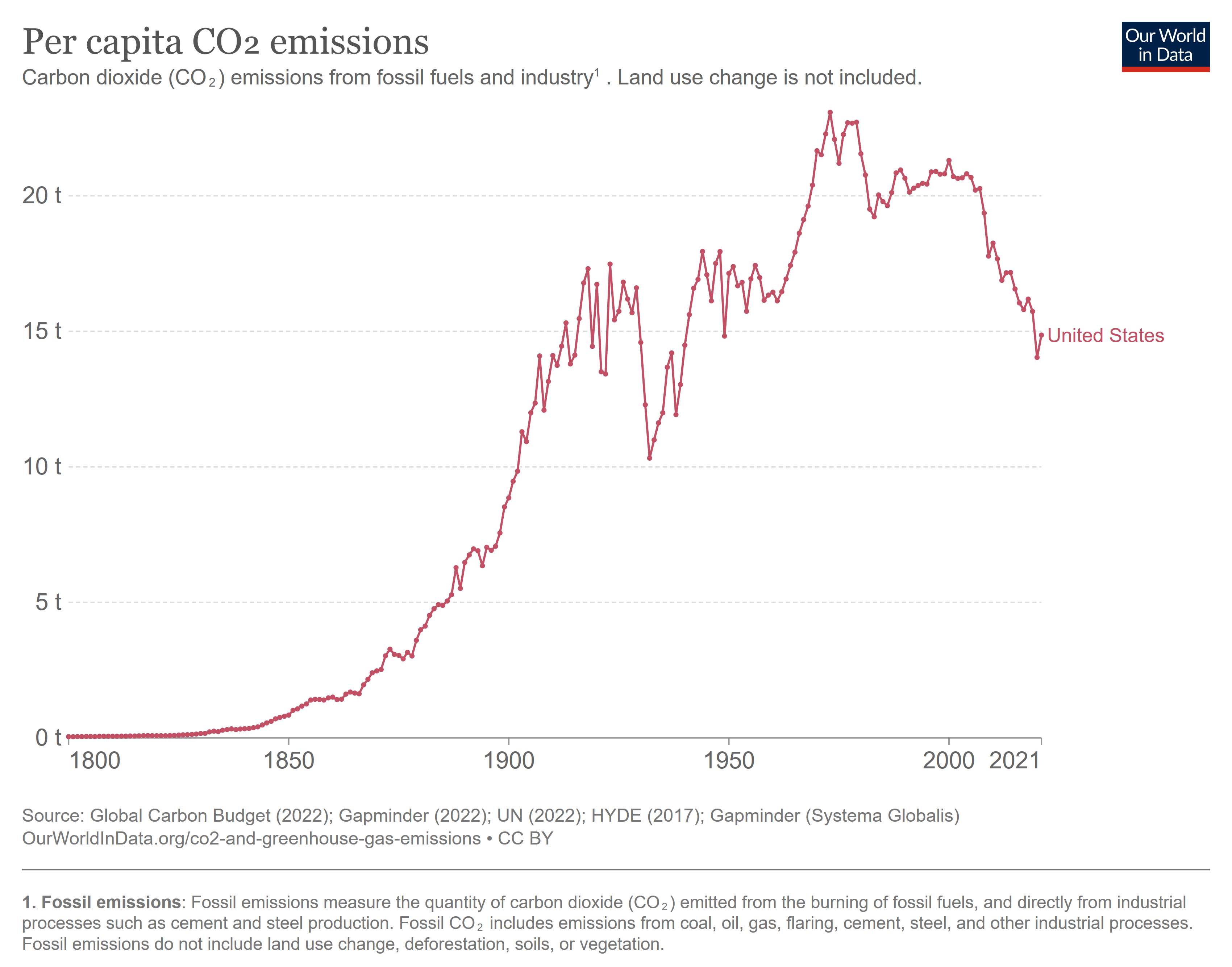
Not many people seem to know this, but the US has also been on the right track with regard to carbon emissions: Per-capita carbon emissions in the US have been trending downward since about 2000, and are now lower than they were in the 1950s. The Inflation Reduction act now looks poised to double down on that progress, as it has been forecasted to reduce our emissions all the way down to 40% below their early-2000s peak.

Somehow, this success doesn’t seem to be getting across. The majority of Americans incorrectly believe that we are in a downturn. Biden’s approval rating is still only 40%, barely higher than Trump’s was. When it comes to political beliefs, most American voters appear to be utterly impervious to facts.

Most Americans do correctly believe that inflation is still a bit high (though many seem to think it’s higher than it is); this is weird, seeing as inflation is normally high when the economy is growing rapidly, and gets too low when we are in a recession. This seems to be Halo Effect, rather than any genuine understanding of macroeconomics: downturns are bad and inflation is bad, so they must go together—when in fact, quite the opposite is the case.

People generally feel better about their own prospects than they do about the economy as a whole:

Sixty-four percent of Americans say the economy is worse off compared to 2020, while seventy-three percent of Americans say the economy is worse off compared to five years ago. About two in five of Americans say they feel worse off from five years ago generally (38%) and a similar number say they feel worse off compared to 2020 (37%).

(Did you really have to write out ‘seventy-three percent’? I hate that convention. 73% is so much clearer and quicker to read.)

I don’t know what the Biden administration should do about this. Trying to sell themselves harder might backfire. (And I’m pretty much the last person in the world you should ask for advice about selling yourself.) But they’ve been doing really great work for the US economy… and people haven’t noticed. Thousands of factories are being built, millions of people are getting jobs, and the collective response has been… “meh”.

Will hydrogen make air travel sustainable?

Apr 9 JDN 2460042

Air travel is currently one of the most carbon-intensive activities anyone can engage in. Per passenger kilometer, airplanes emit about 8 times as much carbon as ships, 4 times as much as trains, and 1.5 times as much as cars. Living in a relatively eco-friendly city without a car and eating a vegetarian diet, I produce much less carbon than most First World citizens—except when I fly across the Atlantic a couple of times a year.

Until quite recently, most climate scientists believed that this was basically unavoidable, that simply sustaining the kind of power output required to keep an airliner in the air would always require carbon-intensive jet fuel. But in just the past few years, major breakthroughs have been made in using hydrogen propulsion.

The beautiful thing about hydrogen is that burning it simply produces water—no harmful pollution at all. It’s basically the cleanest possible fuel.


The simplest approach, which is actually quite old, but until recently didn’t seem viable, is the use of liquid hydrogen as airplane fuel.

We’ve been using liquid hydrogen as a rocket fuel for decades; so we knew it had enough energy density. (Actually its energy density is higher than conventional jet fuel.)

The problem with liquid hydrogen is that it must be kept extremely cold—it boils at 20 Kelvin. And once liquid hydrogen boils into gas, it builds up pressure very fast and easily permeates through most materials, so it’s extremely hard to contain. This makes it very difficult and expensive to handle.

But this isn’t the only way to use hydrogen, and may turn out to not be the best one.

There are now prototype aircraft that have flown using hydrogen fuel cells. These fuel cells can be fed with hydrogen gas—so no need to cool below 20 Kelvin. But then they can’t directly run the turbines; instead, these planes use electric turbines which are powered by the fuel cell.

Basically these are really electric aircraft. But whereas a lithium battery would be far too heavy, a hydrogen fuel cell is light enough for aviation use. In fact, hydrogen gas up to a certain pressure is lighter than air (it was often used for zeppelins, though, uh, occasionally catastrophically), so potentially the planes could use their own fuel tanks for buoyancy, landing “heavier” than they took off. (On the other hand it might make more sense to pressurize the hydrogen beyond that point, so that it will still be heavier than air—but perhaps still lighter than jet fuel!)

Of course, the technology is currently too untested and too expensive to be used on a wide scale. But this is how all technologies begin. It’s of course possible that we won’t be able to solve the engineering problems that currently make hydrogen-powered aircraft unaffordable; but several aircraft manufacturers are now investing in hydrogen research—suggesting that they at least believe there is a good chance we will.

There’s also the issue of where we get all the hydrogen. Hydrogen is extremely abundant—literally the most abundant baryonic matter in the universe—but most of what’s on Earth is locked up in water or hydrocarbons. Most of the hydrogen we currently make is produced by processing hydrocarbons (particularly methane), but that produces carbon emissions, so it wouldn’t solve the problem.

A better option is electrolysis: Using electricity to separate water into hydrogen and oxyen. But this requires a lot of energy—and necessarily, more energy than you can get out of burning the hydrogen later, since burning it basically is just putting the hydrogen and oxygen back together to make water.

Yet all is not lost, for while energy density is absolutely vital for an aircraft fuel, it’s not so important for a ground-based power plant. As an ultimate fuel source, hydrogen is a non-starter. But as an energy storage medium, it could be ideal.

The idea is this: We take the excess energy from wind and solar power plants, and use that energy to electrolyze water into hydrogen and oxygen. We then store that hydrogen and use it for fuel cells to run aircraft (and potentially other things as well). This ensures that the extra energy that renewable sources can generate in peak times doesn’t go to waste, and also provides us with what we need to produce clean-burning hydrogen fuel.

The basic technology for doing all this already exists. The current problem is cost. Under current conditions, it’s far more expensive to make hydrogen fuel than to make conventional jet fuel. Since fuel is one of the largest costs for airlines, even small increases in fuel prices matter a lot for the price of air travel; and these are not even small differences. Currently hydrogen costs over 10 times as much per kilogram, and its higher energy density isn’t enough to make up for that. For hydrogen aviation to be viable, that ratio needs to drop to more like 2 or 3—maybe even all the way to 1, since hydrogen is also more expensive to store than jet fuel (the gas needs high-pressure tanks, the liquid needs cryogenic cooling systems).

This means that, for the time being, it’s still environmentally responsible to reduce your air travel. Fly less often, always fly economy (more people on the plane means less carbon per passenger), and buy carbon offsets (they’re cheaper than you may think).

But in the long run, we may be able to have our cake and eat it too: If hydrogen aviation does become viable, we may not need to give up the benefits of routine air travel in order to reduce our carbon emissions.

Good news on the climate, for a change

Aug 7 JDN 2459799

In what is surely the biggest political surprise of the decade—if not the century—Joe Manchin suddenly changed his mind and signed onto a budget reconciliation bill that will radically shift US climate policy. He was the last vote needed for the bill to make it through the Senate via reconciliation (as he often is, because he’s pretty much a DINO).

Because the Senate is ridiculous, there are still several layers of procedure the bill must go through before it can actually pass. But since the parliamentarian was appointed by a Democrat and the House had already passed an even stronger climate bill, it looks like at least most of it will make it through. The reconciliation process means we only need a bare majority, so even if all the Republicans vote against it—which they very likely will—it can still get through, with Vice President Harris’s tiebreaking vote. (Because our Senate is 50-50, Harris is on track to cast the most tie-breaking votes of any US Vice President by the end of her term.) Reconciliation also can’t be filibustered.

While it includes a lot of expenditures, particularly tax credits for clean energy and electric cars, the bill includes tax increases and closed loopholes so that it will actually decrease the deficit and likely reduce inflation—which Manchin said was a major reason he was willing to support it. But more importantly, it promises to reduce US carbon emissions by a staggering 40% by 2030.

The US currently produces about 15 tons of CO2 equivalent per person per year, so reducing that by 40% would drop it to only 9 tons per person per year. This would move us from nearly as bad as Saudi Arabia to nearly as good as Norway. It still won’t mean we are doing as well as France or the UK—but at least we’ll no longer be dragging down the rest of the First World.

And this isn’t a pie-in-the-sky promise: Independent forecasts suggest that these policies may really be able to reduce our emissions that much that fast. It’s honestly a little hard for me to believe; but that’s what the experts are saying.

Manchin wants to call it the Inflation Reduction Act, but it probably won’t actually reduce inflation very much. But some economists—even quite center-right ones—think it may actually reduce inflation quite a bit, and we basically all agree that it at least won’t increase inflation very much. Since the effects on inflation are likely to be small, we really don’t have to worry about them: whatever it does to inflation, the important thing is that this bill reduces carbon emissions.

Honestly, it’ll be kind of disgusting if this actually does work—because it’s so easy. This bill will have almost no downside. Its macroeconomic effects will be minor, maybe even positive. There was no reason it needed to be this hard-fought. Even if it didn’t have tax increases to offset it—which it absolutely does—the total cost of this bill over the next ten years would be less than six months of military spending, so cutting military spending by 5% would cover it. We have cured our unbearable headaches by finally realizing we could stop hitting ourselves in the head. (And the Republicans want us to keep hitting ourselves and will do whatever they can to make that happen.)

So, yes, it’s very sad that it took us this long. And even 60% of our current emissions is still too much emissions for a stable climate. But let’s take a moment to celebrate, because this is a genuine victory—and we haven’t had a lot of those in awhile.

Capitalism isn’t bad for the environment

Sep 27 JDN 2459120

There are certainly many legitimate criticisms to be made against capitalism, particularly unregulated, unfettered capitalism. But many of the criticisms the left likes to offer against capitalism really don’t hold water, and one of them is the assertion that capitalism is bad for the environment.

The world’s most polluted cities are largely in India and China. In fact, as China has opened up to world markets and become more capitalist, it has become more ecologically efficient, in the sense of producing far less greenhouse emission per dollar of GDP.

Indeed, the entire world has been getting more efficient on this metric: We now produce about twice as much GDP per ton of CO2 emitted than we did in 1990.

Pollution in the Soviet Union was horrific; even today, many of the world’s most polluted places are in the former Soviet Union. Much of the ecological damage was hidden while the USSR was still in place, but once it collapsed, the damage that Soviet policy had done to the environment became obvious.

If you sort countries by their per-capita greenhouse emissions, the worst offenders are Kuwait, Brunei, Qatar, Oman, and Bahrain—small, oil-producing countries in the Middle East. The US and Canada also do pretty badly, and are certainly quite capitalist; but so do Libya, Kazakhstan, and Turkmenistan, not exactly known for their devotion to free markets.

I think this in fact too generous to socialist countries. We really should adjust for GDP per capita. It’s easy to produce zero pollution: Just let everyone starve to death. And if that sounds extreme, consider that millions of people literally did starve to death under Stalin and Mao. It’s a fair question whether we really need the high standard of living we have become accustomed to in the First World; perhaps we could afford to cut back. But clearly some kind of adjustment is necessary: A country is obviously doing better if they can produce more GDP for the same carbon emissions.

Therefore, let’s see what happens when we rank countries by kilograms of CO2 emissions per dollar of GDP. The highest polluters are then the Central African Republic, Belize, Libya, Gambia, Eritrea, Niger, Grenada, Palau… not a First World country among them. CAR produces a horrifying 126 tons of CO2 per $10,000 of GDP. The US is near the world average at about 3.0 tons of CO2 per $10,000 of GDP, and as usual Scandinavia Is Better with about 1 ton of CO2 per $10,000 of GDP. China does worse than the US, at about 4.0 tons of CO2 per $10,000 of GDP. Russia and most of the former Soviet Union does substantially worse, generally around 5.0 tons of CO2 per $10,000 of GDP.

Then again, these figures use production-based accounting; perhaps we should be using consumption-based accounting, so that First World countries can’t simply offshore their emissions. The data is less complete and probably less reliable, but it’s still pretty clear that the highest per-capita emissions are in small oil-exporting countries in the Middle East, like Qatar and Brunei.

Moreover, on consumption-based accounting, the highest emissions per dollar of GDP are in Mongolia, Namibia, Ukraine, South Africa, and Kazakhstan. The US actually does better at 2.6 tons of CO2 per $10,000 of GDP, while Scandinavia is still at about 1 ton of CO2 per $10,000 of GDP. China closes the gap, but still does worse than the US, at about 3.0 tons of CO2 per $10,000 of GDP.

No matter how you slice it, the US just isn’t the world’s worst polluter, and we only look like we are in the top 10 because we are so fabulously rich. If it were generally true that higher wealth always comes with proportionally higher pollution, then perhaps capitalism could be blamed for producing all this pollution—though then we’d have a difficult tradeoff to make between reducing pollution and increasing wealth. But in fact there is wide variation in the ecological efficiency of an economy; nuclearize your energy grid like France did and you can cut your emissions in half. Do whatever Scandanavia does and you can do even better.

Now I suppose it would be fair to say that France and Scandinavia are less capitalist than the United States; they certainly have much stronger social welfare states (including universal healthcare) and more redistribution of wealth. But they’re still quite capitalist. They have robust free-market economies, thousands of for-profit corporations, and plenty of billionaires. France has 41 billionaires among 65 million people, just a slightly lower rate of billionaires-per-capita than the US. Sweden has 31 billionaires among 10 million people, a substantially higher rate of billionaires-per-capita than the US. It may be that the optimal level of capitalism for environmental sustainability is not 100%; but it doesn’t seem to be anywhere near 0% either. National Review overstates the case a little (I mean, they are National Review), but I don’t think they are wrong when they say that socialism is bad for the environment.

Indeed, it seems quite important that France and Scandinavia are democratic (by some measures the most democratic places in the world), while China and Russia are authoritarian. It’s not hard to see why democracy would be good for the environment: It solves the Tragedy of the Commons by including the interests of everyone who is impacted by pollution. Policies that produce really catastrophic pollution tend to get leaders voted out.

The rather surprising result is that empirically there doesn’t appear to be a strong effect of democracy on environmental sustainability either. There’s some evidence that it helps, but it seems to depend upon a lot of factors, and on some measures democracy may actually make matters worse. I honestly don’t have a good explanation for this; I would have expected a really strong benefit, since the theoretical argument is quite strong: Voters have strong reasons to want clean air and water, while dictators don’t (especially water, which they can easily pay to import).


Perhaps capitalism is bad for the environment, but democracy is good, and the two sort of cancel out? But there isn’t even much reason theoretically to think that capitalism would be worse for the environment. Private ownership yields private stewardship, and poisoning your employees and customers is not good business. Yes, some forms of pollution spread out far enough that they become a Tragedy of the Commons; but it’s actually hard to find clear examples where pollution spreads far enough to be a Tragedy of the Commons for a corporation but doesn’t spread far enough to be a Tragedy of the Commons for a whole country. Some multinational corporations are large enough that they probably have more reason to care about the environment than many small countries—Walmart’s total revenue is nearly 15 times higher than Brunei’s total GDP. Indeed, one of the few upsides of concentrated oligopolies is that they are less likely to pollute!

I can understand why it’s tempting to blame capitalism for the degradation of the environment. Indeed, if the argument could stick, it would be a really compelling reason to dismantle capitalism—we simply cannot continue to degrade the environment at the rate we have been for much longer. But empirically it just doesn’t work; whatever determines a country’s ecological sustainability or lack thereof, it’s something subtler than capitalism versus socialism—or even democracy versus authoritarianism.

How we measure efficiency affects our efficiency

Jun 21 JDN 2459022

Suppose we are trying to minimize carbon emissions, and we can afford one of the two following policies to improve fuel efficiency:

  1. Policy A will replace 10,000 cars that average 25 MPG with hybrid cars that average 100 MPG.
  2. Policy B will replace 5,000 diesel trucks that average 5 MPG with turbocharged, aerodynamic diesel trucks that average 10 MPG.

Assume that both cars and trucks last about 100,000 miles (in reality this of course depends on a lot of factors), and diesel and gas pollute about the same amount per gallon (this isn’t quite true, but it’s close). Which policy should we choose?

It seems obvious: Policy A, right? 10,000 vehicles, each increasing efficiency by 75 MPG or a factor of 4, instead of 5,000 vehicles, each increasing efficiency by only 5 MPG or a factor of 2.

And yet—in fact the correct answer is definitely policy B, because the use of MPG has distorted our perception of what constitutes efficiency. We should have been using the inverse: gallons per hundred miles.

  1. Policy A will replace 10,000 cars that average 4 GPHM with cars that average 1 GPHM.
  2. Policy B will replace 5,000 trucks that average 20 GPHM with trucks that average 10 GPHM.

This means that policy A will save (10,000)(100,000/100)(4-1) = 30 million gallons, while policy B will save (5,000)(100,000/100)(20-10) = 50 million gallons.

A gallon of gasoline produces about 9 kg of CO2 when burned. This means that by choosing the right policy here, we’ll have saved 450,000 tons of CO2—or by choosing the wrong one we would only have saved 270,000.

The simple choice of which efficiency measure to use when making our judgment—GPHM versus MPG—has had a profound effect on the real impact of our choices.

Let’s try applying the same reasoning to charities. Again suppose we can choose one of two policies.

  1. Policy C will move $10 million that currently goes to local community charities which can save one QALY for $1 million to medical-research charities that can save one QALY for $50,000.
  2. Policy D will move $10 million that currently goes to direct-transfer charities which can save one QALY for $1000 to anti-malaria net charities that can save one QALY for $800.

Policy C means moving funds from charities that are almost useless ($1 million per QALY!?) to charities that meet a basic notion of cost-effectiveness (most public health agencies in the First World have a standard threshold of about $50,000 or $100,000 per QALY).

Policy D means moving funds from charities that are already highly cost-effective to other charities that are only a bit more cost-effective. It almost seems pedantic to even concern ourselves with the difference between $1000 per QALY and $800 per QALY.

It’s the same $10 million either way. So, which policy should we pick?

If the lesson you took from the MPG example is that we should always be focused on increasing the efficiency of the least efficient, you’ll get the wrong answer. The correct answer is based on actually using the right measure of efficiency.

Here, it’s not dollars per QALY we should care about; it’s QALY per million dollars.

  1. Policy C will move $10 million from charities which get 1 QALY per million dollars to charities which get 20 QALY per million dollars.
  2. Policy D will move $10 million from charities which get 1000 QALY per million dollars to charities which get 1250 QALY per million dollars.

Multiply that out, and policy C will gain (10)(20-1) = 190 QALY, while policy D will gain (10)(1250-1000) = 2500 QALY. Assuming that “saving a life” means about 50 QALY, this is the difference between saving 4 lives and saving 50 lives.

My intuition actually failed me on this one; before I actually did the math, I had assumed that it would be far more important to move funds from utterly useless charities to ones that meet a basic standard. But it turns out that it’s actually far more important to make sure that the funds being targeted at the most efficient charities are really the most efficient—even apparently tiny differences matter a great deal.

Of course, if we can move that $10 million from the useless charities to the very best charities, that’s the best of all; it would save (10)(1250-1) = 12,490 QALY. This is nearly 250 lives.

In the fuel economy example, there’s no feasible way to upgrade a semitrailer to get 100 MPG. If we could, we totally should; but nobody has any idea how to do that. Even an electric semi probably won’t be that efficient, depending on how the grid produces electricity. (Obviously if the grid were all nuclear, wind, and solar, it would be; but very few places are like that.)

But when we’re talking about charities, this is just money; it is by definition fungible. So it is absolutely feasible in an economic sense to get all the money currently going towards nearly-useless charities like churches and museums and move that money directly toward high-impact charities like anti-malaria nets and vaccines.

Then again, it may not be feasible in a practical or political sense. Someone who currently donates to their local church may simply not be motivated by the same kind of cosmopolitan humanitarianism that motivates Effective Altruism. They may care more about supporting their local community, or be motivated by genuine religious devotion. This isn’t even inherently a bad thing; nobody is a cosmopolitan in everything they do, nor should we be—we have good reasons to care more about our own friends, family, and community than we do about random strangers in foreign countries thousands of miles away. (And while I’m fairly sure Jesus himself would have been an Effective Altruist if he’d been alive today, I’m well aware that most Christians aren’t—and this doesn’t make them “false Christians”.) There might be some broader social or cultural change that could make this happen—but it’s not something any particular person can expect to accomplish.

Whereas, getting people who are already Effective Altruists giving to efficient charities to give to a slightly more efficient charity is relatively easy: Indeed, it’s basically the whole purpose for which GiveWell exists. And there are analysts working at GiveWell right now whose job it is to figure out exactly which charities yield the most QALY per dollar and publish that information. One person doing that job even slightly better can save hundreds or even thousands of lives.

Indeed, I’m seriously considering applying to be one myself—it sounds both more pleasant and more important than anything I’d be likely to get in academia.

How I’d run an airline

Mar 1 JDN 2458910

I’m traveling this week, so I have less time for blogging than usual and airlines are very much on my mind. So I thought I’d write a short post about things I would change if I were to run my own airline.

1. Instead of overpriced first-class seats, offer the option of seats with more space for a proportional amount. First class prices are almost never worth it, and people seem to be figuring that out: Use of first class is in decline. But sitting in that middle seat is so miserable, why not simply eliminate it? I think a lot of people would be willing to pay 50% more for 50% more space.

2. Offer every passenger two free checked bags, but charge for the carry-on. Carry-on bags are far more awkward and disruptive, and slow down boarding and deboarding much more, than checked bags. The airline should be trying to incentivize passengers to use checked baggage as much as possible. I’d still give each passenger a free personal item (like a purse, backpack or laptop bag), and some people would still want a carry-on bag (e.g. for cameras that can be damaged by radiation); but most people really don’t need to have a roller bag as a carry-on.

3. Power outlets in every seat. This is a trivial amount of cost in terms of manufacturing and electricity, compared to what an airplane already requires; but it makes flying much more convenient for your passengers, and thereby allows you to demand higher prices. This is a no-brainer. (Some airlines, like Delta, already do this.)

4. Assign seats and load the plane based on the seating positions. The first boarding group should be the people who sit furthest in the back, so that no one needs to pass seated passengers in order to find their own seat. Ideally window seats would be filled before aisle seats, but since people like to board and sit together, that might not be feasible. But at the very least we can make boarding faster by seating the back rows first.

5. Give pilots and flight attendants reasonable hours and plenty of vacation time. Airline pilots around the world are dangerously overworked and sleep-deprived. This is dangerous for customers, and if it leads to crashes or lawsuits it can be very expensive for the airlines too. Having an aircraft idle overnight really isn’t that great a cost, especially since red-eye flights command lower prices and are thus less profitable for the airline. Working fewer hours makes people more productive per hour—often to the point of making them more productive overall.

6. Explain why you need to put on your own oxygen mask first. Standard airplane safety instructions always include the line “Put on your mask before assisting others.” But since they almost never explain why, I strongly suspect that in a real emergency a lot of parents try to put on their children’s masks first and thereby needlessly endanger themselves. Wording these instructions might be tricky, because any talk of such things is bound to scare people, but the core idea is this: Hypoxia will cause delirium or unconsciousness long before it will cause permanent brain damage or death. You want to first make sure you aren’t incapacitated, and then you can help save others. If you put on your mask first, your kid may get confused or pass out, but you’ll be able to help them and they’ll be fine. If you put on your kid’s mask first, you may get confused or pass out, and your kid won’t be able to help you. Then unless someone else saves you, you may die pointlessly because you didn’t follow instructions. Depending on altitude and how severe the hull breach is, you have about 30 seconds before you lose consciousness. But your kid has at least three minutes before you need to worry about permanent brain damage, and probably as many as fifteen before they’d die.

7. Include carbon offsets in the ticket price, and advertise this aggressively. Despite the fact that airplanes are a major source of carbon emissions, carbon offsets are actually remarkably cheap compared to the cost of airline tickets. Adding offsets would typically raise the price of a ticket by about $30, which on a $300 ticket is unlikely to shock people. And by advertising the carbon-neutrality of your airline, you can probably get a lot of customers who are willing to pay more, potentially even more than the additional cost of the carbon offsets themselves. This could be a win-win for the airline and the environment.

8. Invest heavily in research on more efficient jet engines. The second-biggest cost for an airline is fuel expenditure. (First is the wages of the crew.) If you can install more efficient engines on your aircraft, you can both reduce your environmental impact and dramatically lower your cost. Current state-of-the-art engines can reduce fuel consumption by as much as 20%; future research could improve this even further.

9. Include snacks at every seat before passengers even board. Putting a bag of pretzels and a water bottle at every seat would be trivially easy, and would allow passengers the opportunity to be eating while the plane takes off—and chewing reduces the discomfort of changing air pressure. If the worry is that people will try to put their tray tables down (which is genuinely unsafe during takeoff), install electronic locks that prevent tray tables from being lowered except when authorized.

10. Install seats that don’t recline. The additional comfort for the passenger reclining is far smaller than the reduced comfort for the passenger behind them. Combine that with the additional cost of maintaining the seats and the additional risk of injury during rough landings, and the answer is obvious: Seats shouldn’t recline.

11. Offer better food. Charging less for airplane food honestly isn’t feasible: Because space and weight are at such a premium, it really is that expensive to store and transport food on an aircraft. But the cost comes mostly from the bulk and weight of the food; it really doesn’t much matter what kind of food it is. To that end, airlines should offer high-quality food that people feel more comfortable paying such high prices for. A steak weighs about the same as a hamburger, and champagne has about the same density as Sprite.

12. Reduce, or even eliminate, fees to change flights. Yes, it’s expensive to have empty seats on a moving airplane. But most flights can be filled by standby passengers, and those that can’t often weren’t full anyway. It’s actually fairly rare for a cancellation to result in an empty seat that would otherwise have been full. And the additional goodwill you get from making life easier for your passengers will make up the difference. (Southwest figured this out; other airlines don’t yet seem to have caught on.)

Would these changes revolutionize air travel? No. But I do think they’d make it a bit more pleasant, without greatly reducing the profits of the airline.

Green New Deal Part 2: How do we get to net-zero carbon emissions?

Apr 14 JDN 2458588

I said in my post last week that the Green New Deal has “easy parts”, “hard parts”, and “very hard parts”, and discussed one of the “easy parts”: increased investment in infrastructure. Next week I’ll talk about another “easy part”, guaranteeing education and healthcare.

Today is the most important “hard part”: Reducing our net carbon emissions to zero—or even less.

“Meeting 100 percent of the power demand in the United States through clean, renewable, and zero-emission energy sources.”

“Overhauling transportation systems in the United States to eliminate pollution and greenhouse gas emissions from the transportation sector as much as is technologically feasible, including through investment in – (i) zero-emission vehicle infrastructure and manufacturing; (ii) clean, affordable, and accessible public transportation; and (iii) high-speed rail.”

“Spurring massive growth in clean manufacturing in the United States and removing pollution and greenhouse gas emissions from manufacturing and industry as much as is technologically feasible.”

“Working collaboratively with farmers and ranchers in the United States to eliminate pollution and greenhouse gas emissions from the agricultural sector as much as is technologically feasible.”

There have been huge expansions in solar and wind power generation, which are now cheaper than coal, nuclear, and hydroelectric, on a par with natural gas, and only outcompeted by geothermal. As a result of this dramatic increase in renewable energy production, electric power is no longer the largest source of carbon emissions in the United States; it is now second to transportation.
Policy clearly matters here: While total US carbon emissions were trending downward during the Obama administration, they began trending back upward once Trump took office. Even under Obama, they were not trending down fast enough to realistically meet the Paris Agreement targets. Only 14 states are on track to meet those targets, and they are all hard-Blue states except for Virginia and North Carolina. Unsurprisingly, the most carbon-efficient states are New York and California; yet even our emissions (about 9 tonnes per person per year, about twice the world average) are still far too high.
Of course the US is not alone in failing to meet the targets; in the EU, only three countries (Sweden, France, and Germany) are on track to hit the Paris targets. How did they do it? Germany has managed to do it mainly by expanding wind power, but for most countries, the fastest route to zero-carbon electricity is clearly nuclear power.
Germany has been foolishly phasing out their nuclear capacity, but it’s still 11% of their generation; Sweden’s grid is 40% nuclear; and France has a whopping 72% of their grid on nuclear (no other country comes close). The US grid is about 20% nuclear, which isn’t bad; but if California for instance had not phased out half of our nuclear generation since 2001, we could have taken out 15,000 GWh/yr of natural gas generation instead. At least we did basically eliminate coal and oil power in California, so that’s good.
How much would it cost to convert the entire US electricity grid to renewables and nuclear by 2050? Estimates vary widely, but a good ballpark figure is about $20 trillion.
Let’s not kid ourselves: That is a lot. It’s almost an entire year of the whole US economy. It would be enough to establish a permanent fund to end world hunger almost ten times over. Inflation-adjusted, it’s five times the total amount spent by the US in the Second World War.
Completely re-doing our entire electricity generation system is a project on a scale we’ve really never attempted before. It would be very difficult and very expensive.
But is it feasible? Yes, it’s entirely feasible. Assuming our real GDP grows at a paltry 2% per year between now and 2050, the total economic output of the United States during that period will be almost $1 quadrillion. $20 trillion is only 2% of that. Since the top 1% get about 20% of the income, this means that we could raise enough revenue for this project by simply raising the tax rate on the top 1% by 10 percentage points—which would still make the top income tax rate substantially lower than what we had as recently as the 1970s.
Unfortunately, converting the electricity grid is only part of the story. We also need to make radical changes in our transportation system—switching from airplanes to high-speed rail, and converting cars either to electric cars or public transit systems. Trains are really the best bet, but rail systems have a high up-front cost to build.
Even state-of-the-art high-speed rail systems just can’t be a jet airliner for speed. The best high-speed rail systems can cruise at about 250 kph, while a cruising Boeing 737 can easily exceed 800 kph. We’re just going to have to get used to our long-distance trips taking longer. Even 250 kph is a lot better than the 100 kph you’d probably average driving (not counting stops), which is also about the speed that most current US trains get—far worse than what they have in Europe or even China.
Then we have to deal with the other sources of carbon emissions, like manufacturing and agriculture. It’s simply not realistic to expect that we will actually produce zero carbon emissions; instead our goal needs to be net zero, which means we’ll need some way of pulling carbon out of the air.
To some extent, this is easier than it sounds: Reforestation is a very easy, efficient way of pulling carbon out of the air. Unfortunately it is also very slow, and can only be done in appropriate climates. To really pull enough carbon out of the air fast enough, we’re going to need industrial carbon sequestration or some form of geoengineering—right now iron seeding looks like the most promising candidate, but it could only compensate for about 1/6 of current carbon emissions. Solar geoengineering could do more—but at a very high cost, since we’re talking about pumping poisonous chemicals into the air in order to block out sunlight.
The reason we need to do this is essentially that we have waited too long: Had we started the process of converting the whole grid to renewables in the 1970s like we should have, we wouldn’t need such desperate measures now. But we didn’t, so here we are.
Estimates of how much it will cost to do all this vary even more widely, to the point where I’m hesitant to even put a number on it. But it seems likely that in addition to the $20 trillion for the electric grid, it will probably be something like another $30 trillion to do everything else that is necessary. But the global damage from climate change is estimated to be as much as $3.3 trillion per yearso a total of over $100 trillion over 30 years. Spending $50 trillion to save $100 trillion doesn’t sound like such a bad deal, does it?

Forget the Doughnut. Meet the Wedge.

Mar 11 JDN 2458189

I just finished reading Kate Raworth’s book Doughnut Economics: Seven Ways to Think Like a 21st-Century Economist; Raworth also has a whole website dedicated to the concept of the Doughnut as a way of rethinking economics.

The book is very easy to read, and manages to be open to a wide audience with only basic economics knowledge without feeling patronizing or condescending. Most of the core ideas are fundamentally sound, though Raworth has a way of making it sound like she is being revolutionary even when most mainstream economists already agree with the core ideas.

For example, she makes it sound like it is some sort of dogma among neoclassical economists that GDP growth must continue at the same pace forever. As I discussed in an earlier post, the idea that growth will slow down is not radical in economics—it is basically taken for granted in the standard neoclassical growth models.

Even the core concept of the Doughnut isn’t all that radical. It’s based on the recognition that economic development is necessary to end poverty, but resources are not unlimited. Then combine that with two key assumptions: GDP growth requires growth in energy consumption, and growth in energy consumption requires increased carbon emissions. Then, the goal should be to stay within a certain range: We want to be high enough to not have poverty, but low enough to not exceed our carbon budget.

Why a doughnut? That’s… actually a really good question. The concept Raworth presents is a fundamentally one-dimensional object; there’s no reason for it to be doughnut-shaped. She could just as well have drawn it on a single continuum, with poverty at one end, unsustainability at the other end, and a sweet spot in the middle. The doughnut shape adds some visual appeal, but no real information.

But the fundamental assumptions that GDP requires energy and energy requires carbon emissions are simply false—especially the second one. Always keep one thing in mind whenever you’re reading something by environmentalists telling you we need to reduce economic output to save the Earth: Nuclear power does not produce carbon emissions.

This is how the environmentalist movement has shot itself—and the world—in the foot for the last 50 years. They continually refuse to admit that nuclear power is the best hope we have for achieving both economic development and ecological sustainability. They have let their political biases cloud their judgment on what is actually best for humanity’s future.

I will give Raworth some credit for not buying into the pipe dream that we can somehow transition rapidly to an entirely solar and wind-based power grid—renewables only produce 6% of world energy (the most they ever have), while nuclear produces 10%. And nuclear power certainly has its downsides, particularly in its high cost of construction. It may in fact be the case that we need to reduce economic output somewhat, particularly in the very richest countries, and if so, we need to find a way to do that without causing social and political collapse.

The Dougnut is a one-dimensional object glorified by a two-dimensional diagram.

So let me present you with an actual two-dimensional object, which I call the Wedge.

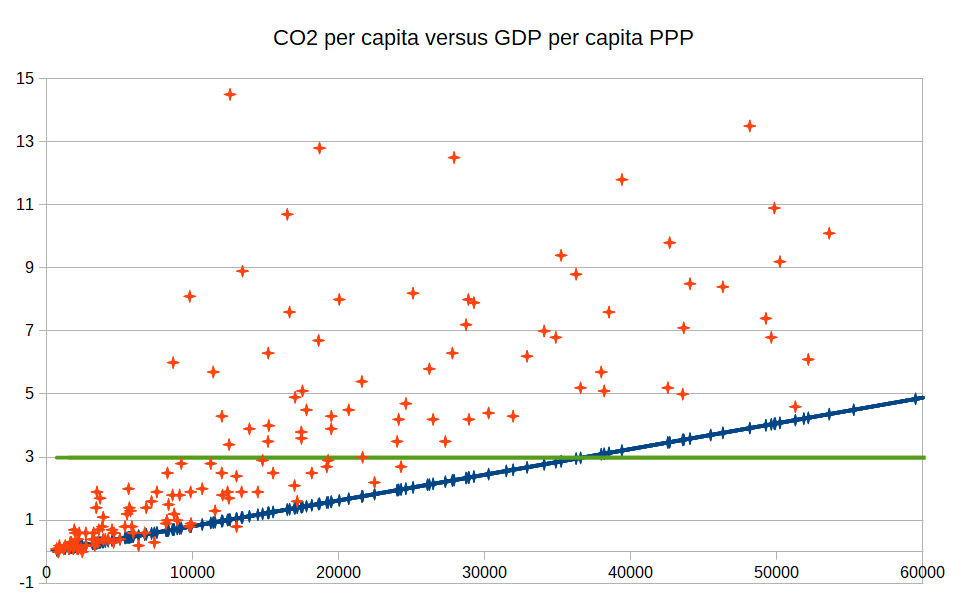
On this graph, the orange dots plot actual GDP per capita (at purchasing power parity) on the X axis against actual CO2 emissions per capita on the Y-axis. The green horizonal line is a CO2 emission target of 3 tonnes per person per year based on reports from the International Panel on Climate Change.

Wedge_full

As you can see, most countries are above the green line. That’s bad. We need the whole world below that green line. The countries that are below the line are largely poor countries, with a handful of middle-income countries mixed in.

But it’s the blue diagonal line that really makes this graph significant, what makes it the Wedge. That line uses Switzerland’s level of efficiency to estimate a frontier of what’s possible. Switzerland’s ratio of GDP to CO2 is the best in the world, among countries where the data actually looks reliable. A handful of other countries do better in the data, but for some (Macau) it’s obviously due to poor counting of indirect emissions and for others (Rwanda, Chad, Burundi) we just don’t have good data at all. I think Switzerland’s efficiency level of $12,000 per ton of CO2 is about as good as can be reasonably expected for most countries over the long run.

Our goal should be to move as far right on the graph as we can (toward higher levels of economic development), but always staying inside this Wedge: Above the green line, our CO2 emissions are too high. Below the blue line may not be technologically feasible (though of course it’s worth a try). We want to aim for the point of the wedge, where GDP is as high as possible but emissions are still below safe targets.

Zooming in on the graph gives a better view of the Wedge.
Wedge_zoomed

The point of the Wedge is about $38,000 per person per year. This is not as rich as the US, but it’s definitely within the range of highly-developed countries. This is about the same standard of living as Italy, Spain, or South Korea. In fact, all three of these countries exceed their targets; the closest I was able to find to a country actually hitting the point of the wedge was Latvia, at $27,300 and 3.5 tonnes per person per year. Uruguay also does quite well at $22,400 and 2.2 tonnes per person per year.

Some countries are within the Wedge; a few, like Uruguay, quite close to the point, and many, like Colombia and Bangladesh, that are below and to the left. For these countries, a “stay the course” policy is the way to go: If they keep up what they are doing, they can continue to experience economic growth without exceeding their emission targets.


But the most important thing about the graph is not actually the Wedge itself: It’s all the countries outside the Wedge, and where they are outside the Wedge.

There are some countries, like Sweden, France, and Switzerland, that are close to the blue line but still outside the Wedge because they are too far to the right. These are countries for whom “degrowth” policies might actually make sense: They are being as efficient in their use of resources as may be technologically feasible, but are simply producing too much output. They need to find a way to scale back their economies without causing social and political collapse. My suggestion, for what it’s worth, is progressive taxation. In addition to carbon taxes (which are a no-brainer), make income taxes so high that they start actually reducing GDP, and do so without fear, since that’s part of the point; then redistribute all the income as evenly as possible so that lower total income comes with much lower inequality and the eradication of poverty. Most of the country will then be no worse off than they were, so social and political unrest seems unlikely. Call it “socialism” if you like, but I’m not suggesting collectivization of industry or the uprising of the proletariat; I just want everyone to adopt the income tax rates the US had in the 1950s.

But most countries are not even close to the blue line; they are well above it. In all these countries, the goal should not be to reduce economic output, but to increase the carbon efficiency of that output. Increased efficiency has no downside (other than the transition cost to implement it): It makes you better off ecologically without making you worse off economically. Bahrain has about the same GDP per capita as Sweden but produces over five times the per-capita carbon emissions. Simply by copying Sweden they could reduce their emissions by almost 19 tonnes per person per year, which is more than the per-capita output of the US (and we’re hardly models of efficiency)—at absolutely no cost in GDP.

Then there are countries like Mongolia, which produces only $12,500 in GDP but 14.5 tonnes of CO2 per person per year. Mongolia is far above and to the left of the point of the Wedge, meaning that they could both increase their GDP and decrease their emissions by adopting the model of more efficient countries. Telling these countries that “degrowth” is the answer is beyond perverse—cut Mongolia’s GDP by 2/3 and you would throw them into poverty without even bringing carbon emissions down to target.

We don’t need to overthrow capitalism or even give up on GDP growth in general. We need to focus on carbon, carbon, carbon: All economic policy from this point forward should be made with CO2 reduction in mind. If that means reducing GDP, we may have to accept that; but often it won’t. Switching to nuclear power and public transit would dramatically reduce emissions but need have no harmful effect on economic output—in fact, the large investment required could pull a country out of recession.

Don’t worry about the Doughnut. Aim for the point of the Wedge.

I’m not sure environmentalists understand what the word “consumption” means to economists.

Feb 25 JDN 2458175

Several times now I’ve heard environmentalists repeat variants of this line: “Capitalist economies depend on consumption; therefore capitalism is incompatible with environmental sustainability.”

A recent example comes from this article on QZ arguing that “conscious consumerism” isn’t viable for protecting the environment:

In short, consumption is the backbone of the American economy—which means individual conscious consumerism is basically bound to fail. “70% of GDP in the US is based on household consumption. So all the systems, the market, the institutions, everything is calibrated to maximize consumption,” Brown told me in a later interview. “The whole marketing industry and advertising invents new needs we didn’t know we had.”

Consumption. You keep using that word… I do not think it means what you think it means.

To be clear, let me say that I basically agree that “conscious consumerism” isn’t good enough. There are a few big things you can do to reduce your carbon footprint, like moving to California (or better yet, Scandinavia), becoming vegetarian, driving a hybrid car (or not driving at all), and not flying on airplanes. Aside from that, your consumer choices are not going to have a large impact. There is a huge amount of greenwashing that goes on—products that present themselves as eco-friendly which really aren’t. And these things by themselves are not enough. A 2012 study by the European Roundtable on Sustainable Consumption and Production found little or no difference in long-run carbon footprint between people who claim to be “green consumers” and people who don’t.

Moreover, there is a strong positive correlation between a country’s GDP and its carbon footprint. The list of countries with the highest carbon emissions looks a lot like the list of countries with the highest GDP.

But there is still substantial variation in the ratio of GDP to carbon emissions. Scandinavia does extremely well, at over $5,000 per ton (as does France, thanks to nuclear energy), while most European countries make about $3,000 per ton, the US is at about $2,000 per ton, and the very most carbon-intensive economies like China, the UAE, and South Africa only make about $1,000 per ton. China produces more carbon emissions per capita than Denmark despite having only one-third the standard of living (at purchasing power parity). Emissions also vary a great deal by states within the US; California’s per-capita emissions are comparable to France’s, while Wyoming’s are worse than the UAE’s.

This brings me to my main point, which is that economists don’t mean the same thing by the word “consumption” that environmentalists do. The environmentalist meaning might be closer to common usage: When something is consumed, we think of it as being destroyed, despoiled, degraded. (It’s even an archaic euphemism for tuberculosis.) So I can see why you would think that if our economy is 70% “consumption” that must make capitalism terrible for the environment: An economy that is 70% destruction, despoliation, and degradation does sound pretty bad.

But when economists use the word “consumption”, what we actually mean is private household expenditure. Our economy is 70% “consumption” in the sense that 70% of the dollars spent in GDP are spent by private individuals as opposed to corporations or the government. Of the $19.7 trillion of US GDP, $13.6 trillion was personal consumption expenditures. That’s actually 69%, but it’s okay to round up to 70%. The rest is made up of $3.4 trillion in government spending, $3.3 trillion in private investment, and a loss of $0.6 trillion from our trade deficit.

There’s no particular connection between private household expenditure and destruction, despoliation, or degradation. In fact, the most destructive form of GDP is obviously military spending, which is not counted as “consumption” in the National Income and Product Accounts but rather as “government expenditure”. Military spending is almost pure waste from an ecological perspective; it consumes mind-boggling amounts of fossil fuels in addition to causing death and destruction. The US military produces almost as much total carbon emissions as the entire country of Denmark.

In fact, the vast majority of private household expenditure in highly-developed countries is in the form of services—over $9.2 trillion in the US. The top four categories for expenditure on services in the US are housing/utilities, healthcare, finance, and food service. I can at least see how housing and utilities would be related to ecological impact—concrete and steel are very carbon-intensive, as is electricity if you’re not using nuclear or renewables. But healthcare, finance, and food service? When environmentalists point to the fact that 70% of our economy is consumption as evidence of the fundamental unsustainability of capitalism, this amounts to asserting that the reason we can’t prevent global warming is that there are so many nurses, accountants, and waiters.

Of course, most people don’t quite grasp what economists mean when we use the word “consumption”, so it makes for a nice talking point for environmentalists. You can conjure images of degradation and destruction while citing the respected authority of the National Income and Product Accounts. If you were already left-wing otherwise (as most environmentalists are), you can make it seem as though the problem is capitalism itself, the very structure of an economy built upon “consuming” the Earth.

In reality, there is enormous variation between countries in terms of their carbon efficiency, and in fact the most carbon-efficient nations are all those that have the highest degrees of political and economic freedom—which is to say, social democracies. One can debate whether social democracies like Denmark and Sweden are “truly capitalist”, but they definitely have free-market economies with large private sectors. On a global and historical scale, there’s really not that much difference between Denmark and the United States (compare to the USSR, or China, or Burkina Faso, or Medieval Japan, or Classical Rome). And if the US isn’t capitalist, who is?

My advice? Don’t talk about consumption at all. Talk about carbon emissions. Don’t ignore variation in GDP/carbon ratios: If the world copied China, we’d all have a per-capita income of $15,500 and emissions of 7.6 tons of carbon per person per year; but if the world copied Denmark, we’d all have a per-capita income of $51,000 and emissions of 6.8 tons of carbon per person per year. (Granted, even 6.8 is still too high; the targets I’ve seen say we need to be at about 3.0 by 2030. But Denmark has also been trending downward in emissions, so we could copy them on that too.) Reducing our standard of living wouldn’t save us if it meant being like China, and maintaining it wouldn’t hurt us if it meant being like Denmark.

I definitely agree that focusing on consumer choices isn’t good enough. Focus on policy. Carbon taxes, bans on unconventional extraction (e.g. offshore drilling, fracking), heavy investment in solar and nuclear energy, large reforestation projects, research into soil sequestration and ocean seeding. Demand these things from all politicians of all parties at all levels of government always. Don’t take no for an answer—because millions of people will die if we don’t stop climate change.

But I don’t think nurses, accountants, and waiters are the problem—and it doesn’t hurt for people to become vegetarian and buy hybrid cars.

When are we going to get serious about climate change?

Oct 8, JDN 24578035

Those two storms weren’t simply natural phenomena. We had a hand in creating them.

The EPA doesn’t want to talk about the connection, and we don’t have enough statistical power to really be certain, but there is by now an overwhelming scientific consensus that global climate change will increase hurricane intensity. The only real question left is whether it is already doing so.

The good news is that global carbon emissions are no longer rising. They have been essentially static for the last few years. The bad news is that this is almost certainly too little, too late.

The US is not on track to hit our 2025 emission target; we will probably exceed it by at least 20%.

But the real problem is that the targets themselves are much too high. Most countries have pledged to drop emissions only about 8-10% below their 1990s levels.

Even with the progress we have made, we are on track to exceed the global carbon budget needed to keep warming below 2 C by the year 2040. We have been reducing emission intensity by about 0.8% per year—we need to be reducing it by at least 3% per year and preferably faster. Highly-developed nations should be switching to nuclear energy as quickly as possible; an equitable global emission target requires us to reduce our emissions by 80% by 2050.

At the current rate of improvement, we will overshoot the 2 C warming target and very likely the 3C target as well.

Why aren’t we doing better? There is of course the Tragedy of the Commons to consider: Each individual country acting in its own self-interest will continue to pollute more, as this is the cheapest and easiest way to maintain industrial development. But then if all countries do so, the result is a disaster for us all.
But this explanation is too simple. We have managed to achieve some international cooperation on this issue. The Kyoto protocol has worked; emissions among Kyoto member nations have been reduced by more than 20% below 1990 levels, far more than originally promised. The EU in particular has taken a leadership role in reducing emissions, and has a serious shot at hitting their target of 40% reduction by 2030.

That is a truly astonishing scale of cooperation; the EU has a population of over 500 million people and spans 28 nations. It would seem like doing that should get us halfway to cooperating across all nations and all the world’s people.

But there is a vital difference between the EU and the world as a whole: The tribal paradigm. Europeans certainly have their differences: The UK and France still don’t really get along, everyone’s bitter with Germany about that whole Hitler business, and as the acronym PIIGS emphasizes, the peripheral countries have never quite felt as European as the core Schengen members. But despite all this, there has been a basic sense of trans-national (meta-national?) unity among Europeans for a long time.
For one thing, today Europeans see each other as the same race. That wasn’t always the case. In Medieval times, ethnic categories were as fine as “Cornish” and “Liverpudlian”. (To be fair, there do still exist a handful of Cornish nationalists.) Starting around the 18th cenutry, Europeans began to unite under the heading of “White people”, a classification that took on particular significance during the trans-Atlantic slave trade. But even in the 19th century, “Irish” and “Sicilian” were seen as racial categories. It wasn’t until the 20th century that Europeans really began to think of themselves as one “kind of people”, and not coincidentally it was at the end of the 20th century that the European Union finally took hold.

There is another region that has had a similar sense of unification: Latin America. Again, there are conflicts: There are a lot of nasty stereotypes about Puerto Ricans among Cubans and vice-versa. But Latinos, by and large, think of each other as the same “kind of people”, distinct from both Europeans and the indigenous population of the Americas.

I don’t think it is coincidental that the lowest carbon emission intensity (carbon emissions / GDP PPP) in the world is in Latin America, followed closely by Europe.
And if you had to name right now the most ethnically divided region in the world, what would you say? The Middle East, of course. And sure enough, they have the worst carbon emission intensity. (Of course, oil is an obvious confounding variable here, likely contributing to both.)

Indeed, the countries with the lowest ethnic fractionalization ratings tend to be in Europe and Latin America, and the highest tend to be in the Middle East and Africa.

Even within the United States, political polarization seems to come with higher carbon emissions. When we think of Democrats and Republicans as different “kinds of people”, we become less willing to cooperate on finding climate policy solutions.

This is not a complete explanation, of course. China has a low fractionalization rating but a high carbon intensity, and extremely high overall carbon emissions due to their enormous population. Africa’s carbon intensity isn’t as high as you’d think just from their terrible fractionalization, especially if you exclude Nigeria which is a major oil producer.

But I think there is nonetheless a vital truth here: One of the central barriers to serious long-term solutions to climate change is the entrenchment of racial and national identity. Solving the Tragedy of the Commons requires cooperation, we will only cooperate with those we trust, and we will only trust those we consider to be the same “kind of people”.

You can even hear it in the rhetoric: If “we” (Americans) give up our carbon emissions, then “they” (China) will take advantage of us. No one seems to worry about Alabama exploiting California—certainly no Republican would—despite the fact that in real economic terms they basically do. But people in Alabama are Americans; in other words, they count as actual people. People in China don’t count. If anything, people in California are supposed to be considered less American than people in Alabama, despite the fact that vastly more Americans live in California than Alabama. This mirrors the same pattern where we urban residents are somehow “less authentic” even though we outnumber the rural by four to one.
I don’t know how to mend this tribal division; I very much wish I did. But I do know that simply ignoring it isn’t going to work. We can talk all we want about carbon taxes and cap-and-trade, but as long as most of the world’s people are divided into racial, ethnic, and national identities that they consider to be in zero-sum conflict with one another, we are never going to achieve the level of cooperation necessary for a real permanent solution to climate change.

The temperatures and the oceans rise. United we must stand, or divided we shall fall.