Toward a positive vision of the future

Jun 22 JDN 2460849

Things look pretty bleak right now. Wildfires rage across Canada, polluting the air across North America. Russia is still at war with Ukraine, and Israel seems to be trying to start a war with Iran. ICE continues sending agents without badges to kidnap people in unmarked vehicles and sending them to undisclosed locations. Climate change is getting worse, and US policy is pivoting from subsidizing renewables back to subsidizing fossil fuels. And Trump, now revealed to be a literal fascist, is still President.

But things can get better.

I can’t guarantee that they will, nor can I say when; but there is still hope that a better future is possible.

It has been very difficult to assemble a strong coalition against the increasingly extreme far-right in this country (epitomized by Trump). This seems odd, when most Americans hold relatively centrist views. Yes, more Americans identify as conservative than as liberal, but Trump isn’t a conservative; he’s a radical far-right fascist. Trump recently gave a speech endorsing ethnic cleansing, for goodness’ sake! I’m liberal, but I’d definitely vote for a conservative like Mitt Romney rather than a Stalinist! So why are “conservatives” voting for a fascist?

But setting aside the question of why people voted for Trump, we still have the question of why the left has not been able to assemble a strong coalition against him.

I think part of the problem is that the left really has two coalitions within it: The center left, who were relatively happy with the status quo before Trump and want to go back to that; and the far left, who were utterly unhappy with that status quo and want radical change. So while we all agree that Trump is awful, we don’t really agree on what he’s supposed to be replaced with.

It’s of course possible to be in between, and indeed I would say that I am. While clearly things were better under Obama and Biden than they have been under Trump, there were still a lot of major problems in this country that should have been priorities for national policy but weren’t:

  1. Above all, climate change—the Democrats at least try to do something against it, but not nearly enough. Our carbon emissions are declining, but it’s very unclear if we’ll actually hit our targets. The way we have been going, we’re in for a lot more hurricanes and wildfires and droughts.
  2. Housing affordability is still an absolute crisis; half of renters spend more than the targeted 30% of their income on housing, and a fourth spend more than 50%.Homelessness is now at a record high.
  3. Healthcare is still far too expensive in this country; we continue to spend far more than other First World countries without getting meaningfully better care.
  4. While rights and protections for LGB people have substantially improved in the last 30 years, rights and protections for trans people continue to lag behind.
  5. Racial segregation in housing remains the de facto norm, even though it is de jure illegal.
  6. Livestock remain exempted from the Animal Welfare Act and in 2002 laboratory rats and mice were excluded as well, meaning that cruel or negligent treatment which would be illegal for cats and dogs is still allowed on livestock and lab rats.
  7. Income and wealth inequality in this country remains staggeringly high, and the super-rich continue to gain wealth at a terrifying rate.
  8. Our voting system is terrible—literally the worst possible system that can technically still be considered democracy.

This list is by no means exhaustive, but these are the issues that seem most salient to me.

2 and 3 both clearly showed up in my Index of Necessary Expenditure; these costs were the primary reason why raising a family of 4 was unaffordable on a median household income.

So it isn’t right to say that I was completely happy with how things were going before. But I still think of myself as center left, because I don’t believe we need to tear everything down and start over.

I have relatively simple recommendations that would go a long way toward solving all 8 of these problems:

Climate change could be greatly mitigated if we’d just tax carbon already, or implement a cap-and-trade system like California’s nationwide. If that’s too politically unpalatable, subsidize nuclear power, fusion research, and renewables instead. That’s way worse from a budget perspective, but for some reason Americans are just fanatically opposed to higher gas prices.

Housing affordability is politically thorny, but economically quite simple: Build more housing. Whatever we have to do to make that happen, we should do it. Maybe this involves changes to zoning or other regulations. Maybe it involves subsidies to developers. Maybe it involves deploying eminent domain to build public housing. Maybe it involves using government funds to build housing and then offering it for sale on the market. But whatever we do, we need more housing.

Healthcare costs are a trickier one; Obamacare helped, but wasn’t enough. I think what I would like to see next is an option to buy into Medicare; before you are old enough to get it for free, you can pay a premium to be covered by it. Because Medicare is much more efficient than private insurance, you could pay a lower premium and get better coverage, so a lot of people would likely switch (which is of course exactly why insurance companies would fight the policy at every turn). Even putting everyone on Medicare might not be enough; to really bring costs down, we may need to seriously address the fact that US doctors, particularly specialists, are just radically higher-paid than any other doctors in the world. Is an American doctor who gets $269,000 per year really 88% better than a French doctor who gets $143,000?

The policies we need for LGBT rights are mostly no-brainers.

Okay, I can admit to some reasonable nuance when it comes to trans women in pro sports (the statistical advantages they have over cis women are not as clear-cut as many people think, but they do seem to exist; average athletic performance for trans women seems to be somewhere in between the average for cis men and the average for cis women), but that’s really not a very important issue. Like, seriously, why do we care so much about pro sports? Either let people play sports according to their self-identified gender, or make the two options “cis women” and “other” and let trans people play the latter. And you can do the same thing with school sports, or you can eliminate them entirely because they are a stupid waste of academic resources; but either way this should not be considered a top priority policy question. (If parents want their kids to play sports, they can form their own leagues; the school shouldn’t be paying for it. Winning games is not one of the goals of an academic institution. If you want kids to get more exercise, give them more recess and reform the physical education system so it isn’t so miserable for the kids who need it most.)

But there is absolutely no reason not to let people use whatever pronouns and bathrooms they want; indeed, there doesn’t really seem to be a compelling reason to gender-segregate bathrooms in the first place, and removing that segregation would most benefit women, who often have to wait much longer in line for the bathroom. (The argument that this somehow protects women never made sense to me; if a man wants to assault women in the bathroom, what’s to stop him from just going into the women’s bathroom? It’s not like there’s a magic field that prevents men from entering. He’s already planning on committing a crime, so it doesn’t seem like he’s very liable to held back by social norms. It’s worthwhile to try to find ways to prevent sexual assault, but segregating bathrooms does little or nothing toward that goal—and indeed, trans-inclusive bathrooms do not statistically correlate with higher rates of sexual assault.) But okay, fine, if you insist on having the segregation, at least require gender-neutral bathrooms as well. This is really not that difficult; it’s pretty clearly bigotry driving this, not serious policy concerns.

Not exempting any vertebrate animals from anti-cruelty legislation is an incredibly simple thing to do, obviously morally better, and the only reason we’re not doing it is that it would hurt agribusinesses and make meat more expensive. There is literally zero question what the morally right thing to do here is; the question is only how to get people to actually do that morally right thing.

Finally, how do we fix income inequality? Some people—including some economists—treat this as a very complicated, difficult question, but I don’t think it is. I think the really simple, obvious answer is actually the correct one: Tax rich people more, and use the proceeds to help poor people. We should be taxing the rich a lot more; I want something like the revenue-maximizing rate, estimated at about 70%. (And an even higher rate like the 90% we had in the 1950s is not out of the question.) These funds could either provide services like education and healthcare, or they could simply be direct cash transfers. But one way or another, the simplest, most effective way to reduce inequality is to tax the rich and help the poor. A lot of economists fear that this would hurt the overall economy, but particularly if these rates are really targeted at the super-rich (the top 0.01%), I don’t see how they could, because all those billions of dollars are very clearly monopoly rents rather than genuine productivity. If anything, making it harder to amass monopoly rents should make the economy more efficient. And taking say 90% of the roughly 10% return just the top 400 billionaires make on their staggering wealth would give us an additional $480 billion per year.

Fixing our voting system is also quite straightforward. Ranked-choice voting would be a huge improvement, and has already been implemented successfully in several states. Even better would be range voting, but so far very few places have been bold enough to actually try it. But even ranked-choice voting would remove most of the terrible incentives that plurality voting creates, and likely allow us to move beyond the two-party system into a much more representative multiparty system.

None of this requires overthrowing the entire system or dismantling capitalism.

That is, we can have a positive vision of the future that doesn’t require revolution or radical change.

Unfortunately, there’s still a very good chance we’ll do none of it.

Against Moral Anti-Realism

Sep 22 JDN 2460576

Moral anti-realism is more philosophically sophisticated than relativism, but it is equally mistaken. It is what is sounds like, the negation of moral realism. Moral anti-realists hold that moral truths are meaningless because they rest upon presumptions about the world that fail to hold. To an anti-realist, “genocide is wrong” is meaningless because there is no such thing as “wrong”, much as to any sane person “unicorns have purple feathers” is meaningless because there are no such things as unicorns. They aren’t saying that genocide isn’t wrong—they’re saying that wrong itself is a defective concept.

The vast majority of people profess strong beliefs in moral truth, and indeed strong beliefs about particular moral issues, such as abortion, capital punishment, same-sex marriage, euthanasia, contraception, civil liberties, and war. There is at the very least a troubling tension here between academia and daily life.

This does not by itself prove that moral truths exist. Ordinary people could be simply wrong about these core beliefs. Indeed, I must acknowledge that most ordinary people clearly are deeply ignorant about certain things, as only 55\% of Americans believe that the theory of evolution is true, and only 66\% of Americans agree that the majority of recent changes in Earth’s climate has been caused by human activity, when in reality these are scientific facts, empirically demonstrable through multiple lines of evidence, verified beyond all reasonable doubt, and both evolution and climate change are universally accepted within the scientific community. In scientific terms there is no more doubt about evolution or climate change than there is about the shape of the Earth or the structure of the atom.

If there were similarly compelling reasons to be moral anti-realists, then the fact that most people believe in morality would be little different: Perhaps most ordinary people are simply wrong about these issues. But when asked to provide similarly compelling evidence for why they reject the moral views of ordinary people, moral anti-realists have little to offer.

Many anti-realists will note the diversity of moral opinions in the world, as John Burgess did, which would be rather like noting the diversity of beliefs about the soul as an argument against neuroscience, or noting the diversity of beliefs about the history of life as an argument against evolution. Many people are wrong about many things that science has shown to be the case; this is worrisome for various reasons, but it is not an argument against the validity of scientific knowledge. Similarly, a diversity of opinions about morality is worrisome, but hardly evidence against the validity of morality.

In fact, when they talk about such fundamental disagreements in morality, anti-realists don’t have very compelling examples. It’s easy to find fundamental disagreements about biology—ask an evolutionary biologist and a Creationist whether humans share an ancestor with chimpanzees. It’s easy to find fundamental disagreements about cosmology—ask a physicist and an evangelical Christian how the Earth began. It’s easy to find fundamental disagreements about climate—ask a climatologist and an oil company executive whether human beings are causing global warming. But where are these fundamental disagreements in morality? Sure, on specific matters there is some disagreement. There are differences between cultures regarding what animals it is acceptable to eat, and differences between cultures about what constitutes acceptable clothing, and differences on specific political issues. But in what society is it acceptable to kill people arbitrarily? Where is it all right to steal whatever you want? Where is lying viewed as a good thing? Where is it obligatory to eat only dirt? In what culture has wearing clothes been a crime? Moral realists are by no means committed to saying that everyone agrees about everything—but it does support our case to point out that most people agree on most things most of the time.

There are a few compelling cases of moral disagreement, but they hardly threaten moral realism. How might we show one culture’s norms to be better than another’s? Compare homicide rates. Compare levels of poverty. Compare overall happiness, perhaps using surveys—or even brain scans. This kind of data exists, and it has a fairly clear pattern: people living in social democratic societies (such as Sweden and Norway) are wealthier, safer, longer-lived, and overall happier than people in other societies. Moreover, using the same publicly-available data, democratic societies in general do much better than authoritarian societies, by almost any measure. This is an empirical fact. It doesn’t necessarily mean that such societies are doing everything right—but they are clearly doing something right. And it really isn’t so implausible to say that what they are doing right is enforcing a good system of moral, political, and cultural norms.

Then again, perhaps some people would accept these empirical facts but still insist that their culture is superior; suppose the disagreement really is radical and intractable. This still leaves two possibilities for moral realism.

The most obvious answer would be to say that one group is wrong—that, objectively, one culture is better than another.

But even if that doesn’t work, there is another way: Perhaps both are right, or more precisely, perhaps these two cultural systems are equally good but incompatible. Is this relativism? Some might call it that, but if it is, it’s relativism of a very narrow kind. I am emphatically not saying that all existing cultures are equal, much less that all possible cultures are equal. Instead, I am saying that it is entirely possible to have two independent moral systems which prescribe different behaviors yet nonetheless result in equally-good overall outcomes.

I could make a mathematical argument involving local maxima of nonlinear functions, but instead I think I’ll use an example: Traffic laws.

In the United States, we drive on the right side of the road. In the United Kingdom, they drive on the left side. Which way is correct? Both are—both systems work well, and neither is superior in any discernible way. In fact, there are other systems that would be just as effective, like the system of all one-way roads that prevails in Manhattan.

Yet does this mean that we should abandon reason in our traffic planning, throw up our hands and declare that any traffic system is as good as any other? On the contrary—there are plenty of possible traffic systems that clearly don’t work. Pointing several one-way roads into one another with no exit is clearly not going to result in good traffic flow. Having each driver flip a coin to decide whether to drive on the left or the right would result in endless collisions. Moreover, our own system clearly isn’t perfect. Nearly 40,000 Americans die of car collisions every year; perhaps we can find a better system that will prevent some or all of these deaths. The mere fact that two, or three, or even 400 different systems of laws or morals are equally good does not entail that all systems are equally good. Even if two cultures really are equal, that doesn’t mean we need to abandon moral realism; it merely means that some problems have multiple solutions. “X2 = 4; what is X?” has two perfectly correct answers (2 and -2), but it also has an infinite variety of wrong answers.

In fact, moral disagreement may not be evidence of anti-realism at all. In order to disagree with someone, you must think that there is an objective fact to be decided. If moral statements were seen as arbitrary and subjective, then people wouldn’t argue about them very much. Imagine an argument, “Chocolate is the best flavor of ice cream!” “No, vanilla is the best!”. This sort of argument might happen on occasion between seven-year-olds, but it is definitely not the sort of thing we hear from mature adults. This is because as adults we realize that tastes in ice cream really are largely subjective. An anti-realist can, in theory, account for this, if they can explain why moral values are falsely perceived as objective while values in taste are not; but if all values are all really arbitrary and subjective, why is it that this is obvious to everyone in the one case and not the other? In fact, there are compelling reasons to think that we couldn’t perceive moral values as arbitrary even if we tried. Some people say “abortion is a right”, others say “abortion is murder”. Even if we were to say that these are purely arbitrary, we would still be left with the task of deciding what laws to make on abortion. Regardless of where the goals come from, some goals are just objectively incompatible.

Another common anti-realist argument rests upon the way that arguments about morality often become emotional and irrational. Charles Stevenson has made this argument; apparently Stevenson has never witnessed an argument about religion, science, or policy, certainly not one outside academia. Many laypeople will insist passionately that the free market is perfect, global warming is a lie, or the Earth is only 6,000 years old. (Often the same people, come to think of it.) People will grow angry and offended if such beliefs are disputed. Yet these are objectively false claims. Unless we want to be anti-realists about GDP, temperature and radiometric dating, emotional and irrational arguments cannot compel us to abandon realism.

Another frequent claim, commonly known as the “argument from queerness”, says that moral facts would need to be something very strange, usually imagined as floating obligations existing somewhere in space; but this is rather like saying that mathematical facts cannot exist because we do not see floating theorems in space and we have never met a perfect triangle. In fact, there is no such thing as a floating speed of light or a floating Schrodinger’s equation either, but no one thinks this is an argument against physics.

A subtler version of this argument, the original “argument from queerness” put forth by J.L. Mackie, says that moral facts are strange because they are intrinsically motivating, something no other kind of facts would be. This is no doubt true; but it seems to me a fairly trivial observation, since part of the definition of “moral fact” is that anything which has this kind of motivational force is a moral (or at least normative) fact. Any well-defined natural kind is subject to the same sort of argument. Spheres are perfectly round three-dimensional objects, something no other object is. Eyes are organs that perceive light, something no other organ does. Moral facts are indeed facts that categorically motivate action, which no other thing does—but so what? All this means is that we have a well-defined notion of what it means to be a moral fact.

Finally, it is often said that moral claims are too often based on religion, and religion is epistemically unfounded, so morality must fall as well. Now, unlike most people, I completely agree that religion is epistemically unfounded. Instead, the premise I take issue with is the idea that moral claims have anything to do with religion. A lot of people seem to think so; but in fact our most important moral values transcend religion and in many cases actually contradict it.

Now, it may well be that the majority of claims people make about morality are to some extent based in their religious beliefs. The majority of governments in history have been tyrannical; does that mean that government is inherently tyrannical, there is no such thing as a just government? The vast majority of human beings have never traveled in outer space; does that mean space travel is impossible? Similarly, I see no reason to say that simply because the majority of moral claims (maybe) are religious, therefore moral claims are inherently religious.

Generally speaking, moral anti-realists make a harsh distinction between morality and other domains of knowledge. They agree that there are such things as trucks and comets and atoms, but do not agree that there are such things as obligations and rights. Indeed, a typical moral anti-realist speaks as if they are being very rigorous and scientific while we moral realists are being foolish, romantic, even superstitious. Moral anti-realism has an attitude of superciliousness not seen in a scientific faction since behaviorism.

But in fact, I think moral anti-realism is the result of a narrow understanding of fundamental physics and cognitive science. It is a failure to drink deep enough of the Pierian springs. This is not surprising, since fundamental physics and cognitive science are so mind-bogglingly difficult that even the geniuses of the world barely grasp them. Quoth Feynman: “I think I can safely say that nobody understands quantum mechanics.” This was of course a bit overstated—Feynman surely knew that there are things we do understand about quantum physics, for he was among those who best understood them. Still, even the brightest minds in the world face total bafflement before problems like dark energy, quantum gravity, the binding problem, and the Hard Problem. It is no moral failing to have a narrow understanding of fundamental physics and cognitive science, for the world’s greatest minds have a scarcely broader understanding.

The failing comes from trying to apply this narrow understanding of fundamental science to moral problems without the humility to admit that the answers are never so simple. “Neuroscience proves we have no free will.” No it doesn’t! It proves we don’t have the kind of free will you thought we did. “We are all made of atoms, therefore there can be no such thing as right and wrong.” And what do you suppose we would have been made of if there were such things as right and wrong? Magical fairy dust?

Here is what I think moral anti-realists get wrong: They hear only part of what scientists say. Neuroscientists explain to them that the mind is a function of matter, and they hear it as if we had said there is only mindless matter. Physicists explain to them that we have much more precise models of atomic phenomena than we do of human behavior, and they hear it as if we had said that scientific models of human behavior are fundamentally impossible. They trust that we know very well what atoms are made of and very poorly what is right and wrong—when quite the opposite is the case.

In fact, the more we learn about physics and cognitive science, the more similar the two fields seem. There was a time when Newtonian mechanics ruled, when everyone thought that physical objects are made of tiny billiard balls bouncing around according to precise laws, while consciousness was some magical, “higher” spiritual substance that defied explanation. But now we understand that quantum physics is all chaos and probability, while cognitive processes can be mathematically modeled and brain waves can be measured in the laboratory. Something as apparently simple as a proton—let alone an extended, complex object, like a table or a comet—is fundamentally a functional entity, a unit of structure rather than substance. To be a proton is to be organized the way protons are and to do what protons do; and so to be human is to be organized the way humans are and to do what humans do. The eternal search for “stuff” of which everything is made has come up largely empty; eventually we may find the ultimate “stuff”, but when we do, it will already have long been apparent that substance is nowhere near as important as structure. Reductionism isn’t so much wrong as beside the point—when we want to understand what makes a table a table or what makes a man a man, it simply doesn’t matter what stuff they are made of. The table could be wood, glass, plastic, or metal; the man could be carbon, nitrogen and water like us, or else silicon and tantalum like Lieutenant Commander Data on Star Trek. Yes, structure must be made of something, and the substance does affect the structures that can be made out of it, but the structure is what really matters, not the substance.

Hence, I think it is deeply misguided to suggest that because human beings are made of molecules, this means that we are just the same thing as our molecules. Love is indeed made of oxytocin (among other things), but only in the sense that a table is made of wood. To know that love is made of oxytocin really doesn’t tell us very much about love; we need also to understand how oxytocin interacts with the bafflingly complex system that is a human brain—and indeed how groups of brains get together in relationships and societies. This is because love, like so much else, is not substance but function—something you do, not something you are made of.

It is not hard, rigorous science that says love is just oxytocin and happiness is just dopamine; it is naive, simplistic science. It is the sort of “science” that comes from overlaying old prejudices (like “matter is solid, thoughts are ethereal”) with a thin veneer of knowledge. To be a realist about protons but not about obligations is to be a realist about some functional relations and not others. It is to hear “mind is matter”, and fail to understand the is—the identity between them—instead acting as if we had said “there is no mind; there is only matter”. You may find it hard to believe that mind can be made of matter, as do we all; yet the universe cares not about our incredulity. The perfect correlation between neurochemical activity and cognitive activity has been verified in far too many experiments to doubt. Somehow, that kilogram of wet, sparking gelatin in your head is actually thinking and feeling—it is actually you.

And once we realize this, I do not think it is a great leap to realize that the vast collection of complex, interacting bodies moving along particular trajectories through space that was the Holocaust was actually wrong, really, objectively wrong.

Why is America so bad at public transit?

Sep 8 JDN 2460562

In most of Europe, 20-30% of the population commutes daily by public transit. In the US, only 13% do.

Even countries much poorer than the US have more widespread use of public transit; Kenya, Russia, and Venezuela all have very high rates of public transit use.

Cities around the world are rapidly expanding and improving their subway systems; but we are not here in the US.

Germany, France, Spain, Italy, and Japan are all building huge high-speed rail networks. We have essentially none.

Even Canada has better public transit than we do, and their population is just as spread out as ours.

Why are we so bad at this?

Surprisingly, it isn’t really that we are lacking in rail network. We actually have more kilometers of rail than China or the EU—though shockingly little of it is electrified, and we had nearly twice as many kilometers of rail a century ago. But we use this rail network almost entirely for freight, not passengers.

Is it that we aren’t spending enough government funds? Sort of. But it’s worth noting that we cover a higher proportion of public transit costs with government funds than most other countries. How can this be? It’s because transit systems get more efficient as they get larger, and attract more passengers as they provide better service. So when you provide really bad service, you end up spending more per passenger, and you need more government subsidies to stay afloat.

Cost is definitely part of it: It costs between two and seven times as much to build the same amount of light rail network in the US as it does in most EU countries. But that just raises another question: Why is it so much more expensive here?

This isn’t comparing with China—of course China is cheaper; they have a dictatorship, they abuse their workers, they pay peanuts. None of that is true of France or Germany, democracies where wages are just as high and worker protections are actually a good deal stronger than here. Yet it still costs two to seven times as much to build the same amount of rail in the US as it does in France or Germany.

Another part of the problem seems to be that public transit in the US is viewed as a social welfare program, rather than an infrastructure program: Rather than seeing it as a vital function of government that supports a strong economy, we see it as a last resort for people too poor to buy cars. And then it becomes politicized, because the right wing in the US hates social welfare programs and will do anything to make sure that they are cut down as much as possible.

It wasn’t always this way.

As recently as 1970, most US major cities had strong public transit systems. But now it’s really only the coastal cities that have them; cities throughout the South and Midwest have massively divested from their public transit. This goes along with a pattern of deindustrialization and suburbanization: These cities are stagnating economically and their citizens are moving out to the suburbs, so there’s no money for public transit and there’s more need for roads.

But the decline of US public transit goes back even further than that. Average transit trips per person in the US fell from 115 per year in 1950 to 36 per year in 1970.

This long, slow decline has only gotten worse as a result of the COVID pandemic; with more and more people working remotely, there’s just less need for commuting in general. (Then again, that also means fewer car miles, so it’s probably a good thing from an environmental perspective.)

Once public transit starts failing, it becomes a vicious cycle: They lose revenue, so they cut back on service, so they become more inconvenient, so they lose more revenue. Really successful public transit systems require very heavy investment in order to maintain fast, convenient service across an entire city. Any less than that, and people will just turn to cars instead.

Currently, the public transit systems in most US cities are suffering severe financial problems, largely as a result of the pandemic; they are facing massive shortfalls in their budgets. The federal government often helps with the capital costs of buying vehicles and laying down new lines, but not with the operating costs of actually running the system.

There seems to be some kind of systemic failure in the US in particular; something about our politics, or our economy, or our culture just makes us uniquely bad at building and maintaining public transit.

What should we do about this?

One option would be to do nothing—laissez faire. Maybe cars are just a more efficient mode of transportation, or better for what Americans want, and we should accept that.

But when you look at the externalities involved, it becomes clear that this is not the right approach. While cars produce enormous amounts of pollution and carbon emissions, public transit is much, much cleaner. (Electric cars are better than diesel buses, but still worse than trams and light rail—and besides, the vast majority of cars use gasoline.) Just for clean air and climate change alone, we have strong reasons to want fewer cars and more public transit.

And there are positive externalities of public transit too; it’s been estimated that for every $1 spent on public transit, a city gains $5 in economic activity. We’re leaving a lot of money on the table by failing to invest in something so productive.

We need a fundamental shift in how Americans think about public transit. Not as a last resort for the poor, but as a default option for everyone. Not as a left-wing social welfare program, but as a vital component of our nation’s infrastructure.

Whenever people get stuck in traffic, instead of resenting other drivers (who are in exactly the same boat!), they should resent that the government hasn’t supported more robust public transit systems—and then they should go out and vote for candidates and policies that will change that.

Of course, with everything else that’s wrong with our economy and our political system, I can understand why this might not be a priority right now. But sooner or later we are going to need to fix this, or it’s just going to keep getting worse and worse.

Medical progress, at least, is real

May 26 JDN 2460457

The following vignettes are about me.

Well, one of them is about me as I actually am. The others are about the person I would have been, if someone very much like me, with the same medical conditions, had been born in a particular place and time. Someone in these times and places probably had actual experiences like this, though of course we’ll never know who they were.

976 BC, the hilled lands near the mouth of the river:

Since I was fourteen years old, I have woken up almost every day in pain. Often it is mild, but occasionally it is severe. It often seems to be worse when I encounter certain plants, or if I awaken too early, or if I exert myself too much, or if a storm is coming. No one knows why. The healers have tried every herb and tincture imaginable in their efforts to cure me, but nothing has worked. The priests believe it is a curse from the gods, but at least they appreciate my ability to sometimes predict storms. I am lucky to even remain alive, as I am of little use to the tribe. I will most likely remain this way the rest of my life.

24 AD, Rome:

Since I was fourteen years old, I have woken up almost every day in pain. Often it is mild, but occasionally it is severe. It often seems to be worse when I encounter certain plants, or if I awaken too early, or if I exert myself too much, or if a storm is coming. No one knows why. The healers have tried every herb and tincture imaginable in their efforts to cure me, but nothing has worked. The priests believe it is a curse from the gods, but at least they appreciate my ability to sometimes predict storms. I am lucky that my family was rich enough to teach me reading and mathematics, as I would be of little use for farm work, but can at least be somewhat productive as a scribe and a tutor. I will most likely remain this way the rest of my life.

1024 AD, England:

Since I was fourteen years old, I have woken up almost every day in pain. Often it is mild, but occasionally it is severe. It often seems to be worse when I encounter certain plants, or if I awaken too early, or if I exert myself too much, or if a storm is coming. No one knows why. The healers have tried every herb and tincture imaginable in their efforts to cure me, but nothing has worked. The priests believe it is a curse imposed upon me by some witchcraft, but at least they appreciate my ability to sometimes predict storms. I am lucky that my family was rich enough to teach me reading and mathematics, as I would be of little use for farm work, but can at least be somewhat productive as a scribe and a tutor. I will most likely remain this way the rest of my life.

2024 AD, Michigan:

Since I was fourteen years old, I have woken up almost every day in pain. Often it is mild, but occasionally it is severe. It often seems to be worse when I encounter certain pollens, fragrances, or chemicals, or if I awaken too early, or if I exert myself too much, or when the air pressure changes before a storm. Brain scans detected no gross abnormalities. I have been diagnosed with chronic migraine, but this is more a description of my symptoms than an explanation. I have tried over a dozen different preventative medications; most of them didn’t work at all, some of them worked but gave me intolerable side effects. (One didn’t work at all and put me in the hospital with a severe allergic reaction.) I’ve been more successful with acute medications, which at least work as advertised, but I have to ration them carefully to avoid rebound effects. And the most effective acute medication is a subcutaneous injection that makes me extremely nauseated unless I also take powerful anti-emetics along with it. I have had the most success with botulinum toxin injections, so I will be going back to that soon; but I am also looking into transcranial magnetic stimulation. Currently my condition is severe enough that I can’t return to full-time work, but I am hopeful that with future treatment I will be able to someday. For now, I can at least work as a writer and a tutor. Hopefully things get better soon.

3024 AD, Aegir 7, Ran System:

For a few months when I was fourteen years old, I woke up nearly every day in pain. Often it was mild, but occasionally it was severe. It often seemed to be worse when I encountered certain pollens, fragrances or chemicals, or if I awakened too early, or if I exerted myself too much, or when the air pressure changed before a storm. Brain scans detected no gross abnormalities, only subtle misfiring patterns. Genetic analysis confirmed I had chronic migraine type IVb, and treatment commenced immediately. Acute medications suppressed the pain while I underwent gene therapy and deep-effect transcranial magnetic stimulation. After three months of treatment, I was cured. That was an awful few months, but it’s twenty years behind me now. I can scarcely imagine how it might have impaired my life if it had gone on that whole time.

What is the moral of this story?

Medical progress is real.

Many people often doubt that society has made real progress. And in a lot of ways, maybe it hasn’t. Human nature is still the same, and so many of the problems we suffer have remained the same.

Economically, of course we have had tremendous growth in productivity and output, but it doesn’t really seem to have made us much happier. We have all this stuff, but we’re still struggling and miserable as a handful at the top become spectacularly, disgustingly rich.

Social progress seems to have gone better: Institutions have improved, more of the world is democratic than ever before, and women and minorities are better represented and better protected from oppression. Rates of violence have declined to some of their lowest levels in history. But even then, it’s pretty clear that we have a long, long way to go.

But medical progress is undeniable. We live longer, healthier lives than at any other point in history. Our infant and child mortality rates have plummeted. Even chronic conditions that seem intractable today (such as my chronic migraines) still show signs of progress; in a few generations they should be cured—in surely far less than the thousand years I’ve considered here.

Like most measures of progress, this change wasn’t slow and gradual over thousands of years; it happened remarkably suddenly. Humans went almost 200,000 years without any detectable progress in medicine, using basically the same herbs and tinctures (and a variety of localized and ever-changing superstitions) the entire time. Some of it worked (the herbs and tinctures, at least), but mostly it didn’t. Then, starting around the 18th century, as the Enlightenment took hold and Industrial Revolution ramped up, everything began to change.

We began to test our medicine and see if it actually worked. (Yes, amazingly, somehow, nobody had actually ever thought to do that before—not in anything resembling a scientific way.) And when we learned that most of it didn’t, we began to develop new methods, and see if those worked; and when they didn’t either, we tried new things instead—until, finally, eventually, we actually found medicines that actually did something, medicines worthy of the name. Our understanding of anatomy and biology greatly improved as well, allowing us to make better predictions about the effects our medicines would have. And after a few hundred years of that—a few hundred, out of two hundred thousand years of our species—we actually reached the point where most medicine is effective and a variety of health conditions are simply curable or preventable, including diseases like malaria and polio that had once literally plagued us.

Scientific medicine brought humanity into a whole new era of existence.

I could have set the first vignette 10,000 years ago without changing it. But the final vignette I could probably have set only 200 years from now. I’m actually assuming remarkable stagnation by putting it in the 31st century; but presumably technological advancement will slow at one point, perhaps after we’ve more or less run out of difficult challenges to resolve. (Then again, for all I know, maybe my 31st century counterpart will be an emulated consciousness, and his chronic pain will be resolved in 17.482 seconds by a code update.)

Indeed, the really crazy thing about all this is that there are still millions of people who don’t believe in scientific medicine, who want to use “homeopathy” or “naturopathy” or “acupuncture” or “chiropractic” or whatever else—who basically want to go back to those same old herbs and tinctures that maybe sometimes kinda worked but probably not and nobody really knows. (I have a cousin who is a chiropractor. I try to be polite about it, but….) They point out the various ways that scientific medicine has failed—and believe me, I am painfully aware of those failures—but then where the obvious solution is to improve scientific medicine, they instead want to turn the whole ship around, and go back to what we had before, which was obviously a million times worse.

And don’t tell me it’s harmless: One, it’s a completewaste of resources that could instead have been used for actual scientific medicine. (9% of all out-of-pocket spending on healthcare in the US is on “alternative medicine”—which is to say, on pointless nonsense.) Two, when you have a chronic illness and people keep shoving nonsense treatments in your face, you start to feel blamed for your condition: “Why haven’t you tried [other incredibly stupid idea that obviously won’t work]? You’re so closed-minded! Maybe your illness isn’t really that bad, or you’d be more desperate!” If “alternative medicine” didn’t exist, maybe these people could help me cope with the challenges of living with a chronic illness, or even just sympathize with me, instead of constantly shoving stupid nonsense in my face.

Not everything about the future looks bright.

In particular, I am pessimistic about the near-term future of artificial intelligence, which I think will cause a lot more problems than it solves and does have a small—but not negligible—risk of causing a global catastrophe.

I’m also not very optimistic about climate change; I don’t think it will wipe out our civilization or anything so catastrophic, but I do think it’s going to kill millions of people and we’ve done too little, too late to prevent that. We’re now doing about what we should have been doing in the 1980s.

But I am optimistic about scientific medicine. Every day, new discoveries are made. Every day, new treatments are invented. Yes, there is a lot we haven’t figured out how to cure yet; but people are working on it.

And maybe they could do it faster if we stopped wasting time on stuff that obviously won’t work.

Israel, Palestine, and the World Bank’s disappointing priorities

Nov 12 JDN 2460261

Israel and Palestine are once again at war. (There are a disturbing number of different years in which one could have written that sentence.) The BBC has a really nice section of their website dedicated to reporting on various facets of the war. The New York Times also has a section on it, but it seems a little tilted in favor of Israel.

This time, it started with a brutal attack by Hamas, and now Israel has—as usual—overreacted and retaliated with a level of force that is sure to feed the ongoing cycle of extremism. All across social media I see people wanting me to take one side or the other, often even making good points: “Hamas slaughters innocents” and “Israel is a de facto apartheid state” are indeed both important points I agree with. But if you really want to know my ultimate opinion, it’s that this whole thing is fundamentally evil and stupid because human beings are suffering and dying over nothing but lies. All religions are false, most of them are evil, and we need to stop killing each other over them.

Anti-Semitism and Islamophobia are both morally wrong insofar as they involve harming, abusing or discriminating against actual human beings. Let people dress however they want, celebrate whatever holidays they want, read whatever books they want. Even if their beliefs are obviously wrong, don’t hurt them if they aren’t hurting anyone else. But both Judaism and Islam—and Christianity, and more besides—are fundamentally false, wrong, evil, stupid, and detrimental to the advancement of humanity.

That’s the thing that so much of the public conversation is too embarrassed to say; we’re supposed to pretend that they aren’t fighting over beliefs that obviously false. We’re supposed to respect each particular flavor of murderous nonsense, and always find some other cause to explain the conflict. It’s over culture (what culture?); it’s over territory (whose territory?); it’s a retaliation for past conflict (over what?). We’re not supposed to say out loud that all of this violence ultimately hinges upon people believing in nonsense. Even if the conflict wouldn’t disappear overnight if everyone suddenly stopped believing in God—and are we sure it wouldn’t? Let’s try it—it clearly could never have begun, if everyone had started with rational beliefs in the first place.

But I don’t really want to talk about that right now. I’ve said enough. Instead I want to talk about something a little more specific, something less ideological and more symptomatic of systemic structural failures. Something you might have missed amidst the chaos.

The World Bank recently released a report on the situation focused heavily on the looming threat of… higher oil prices. (And of course there has been breathless reporting from various outlets regarding a headline figure of $150 per barrel which is explicitly stated in the report as an unlikely “worst-case scenario”.)

There are two very big reasons why I found this dismaying.


The first, of course, is that there are obviously far more important concerns here than commodity prices. Yes, I know that this report is part of an ongoing series of Commodity Markets Outlook reports, but the fact that this is the sort of thing that the World Bank has ongoing reports about is also saying something important about the World Bank’s priorities. They release monthly commodity forecasts and full Commodity Markets Outlook reports that come out twice a year, unlike the World Development Reports that only come out once a year. The World Bank doesn’t release a twice-annual Conflict Report or a twice-annual Food Security Report. (Even the FAO, which publishes an annual State of Food Security and Nutrition in the World report, also publishes a State of Agricultural Marketsreport just as often.)

The second is that, when reading the report, one can clearly tell that whoever wrote it thinks that rising oil and gas prices are inherently bad. They keep talking about all of these negative consequences that higher oil prices could have, and seem utterly unaware of the really enormous upside here: We may finally get a chance to do something about climate change.

You see, one of the most basic reasons why we haven’t been able to fix climate change is that oil is too damn cheap. Its market price has consistently failed to reflect its actual costs. Part of that is due to oil subsidies around the world, which have held the price lower than it would be even in a free market; but most of it is due to the simple fact that pollution and carbon emissions don’t cost money for the people who produce them, even though they do cost the world.

Fortunately, wind and solar power are also getting very cheap, and are now at the point where they can outcompete oil and gas for electrical power generation. But that’s not enough. We need to remove oil and gas from everything: heating, manufacturing, agriculture, transportation. And that is far easier to do if oil and gas suddenly become more expensive and so people are forced to stop using them.

Now, granted, many of the downsides in that report are genuine: Because oil and gas are such vital inputs to so many economic processes, it really is true that making them more expensive will make lots of other things more expensive, and in particular could increase food insecurity by making farming more expensive. But if that’s what we’re concerned about, we should be focusing on that: What policies can we use to make sure that food remains available to all? And one of the best things we could be doing toward that goal is finding ways to make agriculture less dependent on oil.

By focusing on oil prices instead, the World Bank is encouraging the world to double down on the very oil subsidies that are holding climate policy back. Even food subsides—which certainly have their own problems—would be an obviously better solution, and yet they are barely mentioned.

In fact, if you actually read the report, it shows that fears of food insecurity seem unfounded: Food prices are actually declining right now. Grain prices in particular seem to be falling back down remarkably quickly after their initial surge when Russia invaded Ukraine. Of course that could change, but it’s a really weird attitude toward the world to see something good and respond with, “Yes, but it might change!” This is how people with anxiety disorders (and I would know) think—which makes it seem as though much of the economic policy community suffers from some kind of collective equivalent of an anxiety disorder.

There also seems to be a collective sense that higher prices are always bad. This is hardly just a World Bank phenomenon; on the contrary, it seems to pervade all of economic thought, including the most esteemed economists, the most powerful policymakers, and even most of the general population of citizens. (The one major exception seems to be housing, where the sense is that higher prices are always good—even when the world is in a chronic global housing shortage that leaves millions homeless.) But prices can be too low or too high. And oil prices are clearly, definitely too low. Prices should reflect the real cost of production—all the real costs of production. It should cost money to pollute other people’s air.

In fact I think the whole report is largely a nothingburger: Oil prices haven’t even risen all that much so far—we’re still at $80 per barrel last I checked—and the one thing that is true about the so-called Efficient Market Hypothesis is that forecasting future prices is a fool’s errand. But it’s still deeply unsettling to see such intelligent, learned experts so clearly panicking over the mere possibility that there could be a price change which would so obviously be good for the long-term future of humanity.

There is plenty more worth saying about the Israel-Palestine conflict, and in particular what sort of constructive policy solutions we might be able to find that would actually result in any kind of long-term peace. I’m no expert on peace negotiations, and frankly I admit it would probably be a liability that if I were ever personally involved in such a negotiation, I’d be tempted to tell both sides that they are idiots and fanatics. (The headline the next morning: “Israeli and Palestinian Delegates Agree on One Thing: They Hate the US Ambassador”.)

The World Bank could have plenty to offer here, yet so far they’ve been too focused on commodity prices. Their thinking is a little too much ‘bank’ and not enough ‘world’.

It is a bit ironic, though also vaguely encouraging, that there are those within the World Bank itself who recognize this problem: Just a few weeks ago Ajay Banga gave a speech to the World Bank about “a world free of poverty on a livable planet”.

Yes. Those sound like the right priorities. Now maybe you could figure out how to turn that lip service into actual policy.

The unsung success of Bidenomics

Aug 13 JDN 2460170

I’m glad to see that the Biden administration is finally talking about “Bidenomics”. We tend to give too much credit or blame for economic performance to the President—particularly relative to Congress—but there are many important ways in which a Presidential administration can shift the priorities of public policy in particular directions, and Biden has clearly done that.

The economic benefits for people of color seem to have been particularly large. The unemployment gap between White and Black workers in the US is now only 2.7 percentage points, while just a few years ago it was over 4pp and at the worst of the Great Recession it surpassed 7pp. During lockdown, unemployment for Black people hit nearly 17%; it is now less than 6%.

The (misnamed, but we’re stuck with it) Inflation Reduction Act in particular has been an utter triumph.

In the past year, real private investment in manufacturing structures (essentially, new factories) has risen from $56 billion to $87 billion—an over 50% increase, which puts it the highest it has been since the turn of the century. The Inflation Reduction Act appears to be largely responsible for this change.

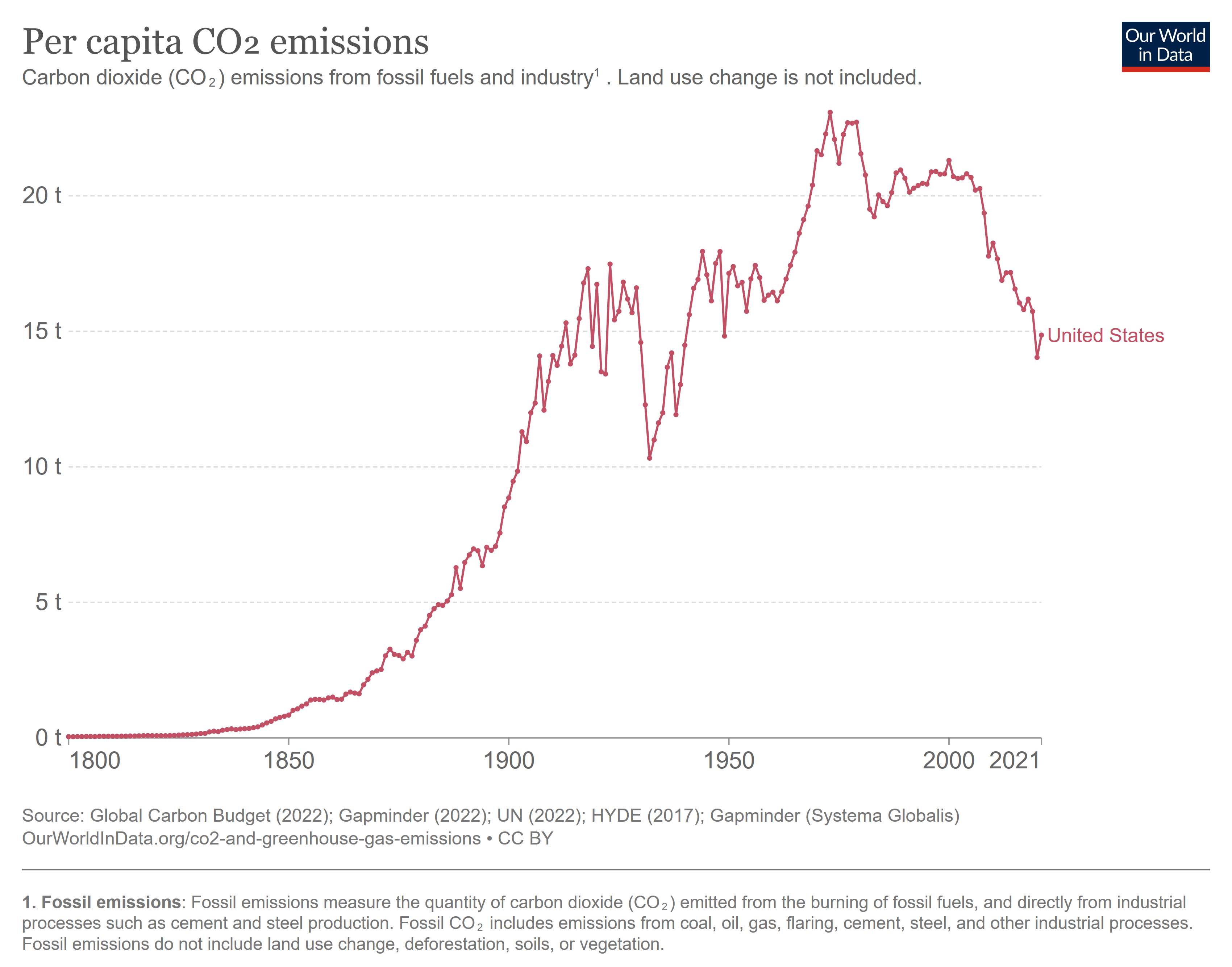
Not many people seem to know this, but the US has also been on the right track with regard to carbon emissions: Per-capita carbon emissions in the US have been trending downward since about 2000, and are now lower than they were in the 1950s. The Inflation Reduction act now looks poised to double down on that progress, as it has been forecasted to reduce our emissions all the way down to 40% below their early-2000s peak.

Somehow, this success doesn’t seem to be getting across. The majority of Americans incorrectly believe that we are in a downturn. Biden’s approval rating is still only 40%, barely higher than Trump’s was. When it comes to political beliefs, most American voters appear to be utterly impervious to facts.

Most Americans do correctly believe that inflation is still a bit high (though many seem to think it’s higher than it is); this is weird, seeing as inflation is normally high when the economy is growing rapidly, and gets too low when we are in a recession. This seems to be Halo Effect, rather than any genuine understanding of macroeconomics: downturns are bad and inflation is bad, so they must go together—when in fact, quite the opposite is the case.

People generally feel better about their own prospects than they do about the economy as a whole:

Sixty-four percent of Americans say the economy is worse off compared to 2020, while seventy-three percent of Americans say the economy is worse off compared to five years ago. About two in five of Americans say they feel worse off from five years ago generally (38%) and a similar number say they feel worse off compared to 2020 (37%).

(Did you really have to write out ‘seventy-three percent’? I hate that convention. 73% is so much clearer and quicker to read.)

I don’t know what the Biden administration should do about this. Trying to sell themselves harder might backfire. (And I’m pretty much the last person in the world you should ask for advice about selling yourself.) But they’ve been doing really great work for the US economy… and people haven’t noticed. Thousands of factories are being built, millions of people are getting jobs, and the collective response has been… “meh”.

How much should we give of ourselves?

Jul 23 JDN 2460149

This is a question I’ve written about before, but it’s a very important one—perhaps the most important question I deal with on this blog—so today I’d like to come back to it from a slightly different angle.

Suppose you could sacrifice all the happiness in the rest of your life, making your own existence barely worth living, in exchange for saving the lives of 100 people you will never meet.

  1. Would it be good for you do so?
  2. Should you do so?
  3. Are you a bad person if you don’t?
  4. Are all of the above really the same question?

Think carefully about your answer. It may be tempting to say “yes”. It feels righteous to say “yes”.

But in fact this is not hypothetical. It is the actual situation you are in.

This GiveWell article is entitled “Why is it so expensive to save a life?” but that’s incredibly weird, because the actual figure they give is astonishingly, mind-bogglingly, frankly disgustingly cheap: It costs about $4500 to save one human life. I don’t know how you can possibly find that expensive. I don’t understand how anyone can think, “Saving this person’s life might max out a credit card or two; boy, that sure seems expensive!

The standard for healthcare policy in the US is that something is worth doing if it is able to save one quality-adjusted life year for less than $50,000. That’s one year for ten times as much. Even accounting for the shorter lifespans and worse lives in poor countries, saving someone from a poor country for $4500 is at least one hundred times as cost-effective as that.

To put it another way, if you are a typical middle-class person in the First World, with an after-tax income of about $25,000 per year, and you were to donate 90% of that after-tax income to high-impact charities, you could be expected to save 5 lives every year. Over the course of a 30-year career, that’s 150 lives saved.

You would of course be utterly miserable for those 30 years, having given away all the money you could possibly have used for any kind of entertainment or enjoyment, not to mention living in the cheapest possible housing—maybe even a tent in a homeless camp—and eating the cheapest possible food. But you could do it, and you would in fact be expected to save over 100 lives by doing so.

So let me ask you again:

  1. Would it be good for you do so?
  2. Should you do so?
  3. Are you a bad person if you don’t?
  4. Are all of the above really the same question?

Peter Singer often writes as though the answer to all these questions is “yes”. But even he doesn’t actually live that way. He gives a great deal to charity, mind you; no one seems to know exactly how much, but estimates range from at least 10% to up to 50% of his income. My general impression is that he gives about 10% of his ordinary income and more like 50% of big prizes he receives (which are in fact quite numerous). Over the course of his life he has certainly donated at least a couple million dollars. Yet he clearly could give more than he does: He lives a comfortable, upper-middle-class life.

Peter Singer’s original argument for his view, from his essay “Famine, Affluence, and Morality”, is actually astonishingly weak. It involves imagining a scenario where a child is drowning in a lake and you could go save them, but only at the cost of ruining your expensive suit.

Obviously, you should save the child. We all agree on that. You are in fact a terrible person if you wouldn’t save the child.

But Singer tries to generalize this into a principle that requires us to donate all most of our income to international charities, and that just doesn’t follow.

First of all, that suit is not worth $4500. Not if you’re a middle-class person. That’s a damn Armani. No one who isn’t a millionaire wears suits like that.

Second, in the imagined scenario, you’re the only one who can help the kid. All I have to do is change that one thing and already the answer is different: If right next to you there is a trained, certified lifeguard, they should save the kid, not you. And if there are a hundred other people at the lake, and none of them is saving the kid… probably there’s a good reason for that? (It could be bystander effect, but actually that’s much weaker than a lot of people think.) The responsibility doesn’t uniquely fall upon you.

Third, the drowning child is a one-off, emergency scenario that almost certainly will never happen to you, and if it does ever happen, will almost certainly only happen once. But donation is something you could always do, and you could do over and over and over again, until you have depleted all your savings and run up massive debts.

Fourth, in the hypothetical scenario, there is only one child. What if there were ten—or a hundred—or a thousand? What if you couldn’t possibly save them all by yourself? Should you keep going out there and saving children until you become exhausted and you yourself drown? Even if there is a lifeguard and a hundred other bystanders right there doing nothing?

And finally, in the drowning child scenario, you are right there. This isn’t some faceless stranger thousands of miles away. You can actually see that child in front of you. Peter Singer thinks that doesn’t matter—actually his central point seems to be that it doesn’t matter. But I think it does.

Singer writes:

It makes no moral difference whether the person I can help is a neighbor’s child ten yards away from me or a Bengali whose name I shall never know, ten thousand miles away.

That’s clearly wrong, isn’t it? Relationships mean nothing? Community means nothing? There is no moral value whatsoever to helping people close to us rather than random strangers on the other side of the planet?

One answer might be to say that the answer to question 4 is “no”. You aren’t a bad person for not doing everything you should, and even though something would be good if you did it, that doesn’t necessarily mean you should do it.

Perhaps some things are above and beyond the call of duty: Good, perhaps even heroic, if you’re willing to do them, but not something we are all obliged to do. The formal term for this is supererogatory. While I think that overall utilitarianism is basically correct and has done great things for human society, one thing I think most utilitarians miss is that they seem to deny that supererogatory actions exist.

Even then, I’m not entirely sure it is good to be this altruistic.

Someone who really believed that we owe as much to random strangers as we do to our friends and family would never show up to any birthday parties, because any time spent at a birthday party would be more efficiently spent earning-to-give to some high-impact charity. They would never visit their family on Christmas, because plane tickets are expensive and airplanes burn a lot of carbon.

They also wouldn’t concern themselves with whether their job is satisfying or even not totally miserable; they would only care whether the total positive impact they can have on the world is positive, either directly through their work or by raising as much money as possible and donating it all to charity.

They would rest only the minimum amount they require to remain functional, eat only the barest minimum of nutritious food, and otherwise work, work, work, constantly, all the time. If their body was capable of doing the work, they would continue doing the work. For there is not a moment to waste when lives are on the line!

A world full of people like that would be horrible. We would all live our entire lives in miserable drudgery trying to maximize the amount we can donate to faceless strangers on the other side of the planet. There would be no joy or friendship in that world, only endless, endless toil.

When I bring this up in the Effective Altruism community, I’ve heard people try to argue otherwise, basically saying that we would never need everyone to devote themselves to the cause at this level, because we’d soon solve all the big problems and be able to go back to enjoying our lives. I think that’s probably true—but it also kind of misses the point.

Yes, if everyone gave their fair share, that fair share wouldn’t have to be terribly large. But we know for a fact that most people are not giving their fair share. So what now? What should we actually do? Do you really want to live in a world where the morally best people are miserable all the time sacrificing themselves at the altar of altruism?

Yes, clearly, most people don’t do enough. In fact, most people give basically nothing to high-impact charities. We should be trying to fix that. But if I am already giving far more than my fair share, far more than I would have to give if everyone else were pitching in as they should—isn’t there some point at which I’m allowed to stop? Do I have to give everything I can or else I’m a monster?

The conclusion that we ought to make ourselves utterly miserable in order to save distant strangers feels deeply unsettling. It feels even worse if we say that we ought to do so, and worse still if we feel we are bad people if we don’t.

One solution would be to say that we owe absolutely nothing to these distant strangers. Yet that clearly goes too far in the opposite direction. There are so many problems in this world that could be fixed if more people cared just a little bit about strangers on the other side of the planet. Poverty, hunger, war, climate change… if everyone in the world (or really even just everyone in power) cared even 1% as much about random strangers as they do about themselves, all these would be solved.

Should you donate to charity? Yes! You absolutely should. Please, I beseech you, give some reasonable amount to charity—perhaps 5% of your income, or if you can’t manage that, maybe 1%.

Should you make changes in your life to make the world better? Yes! Small ones. Eat less meat. Take public transit instead of driving. Recycle. Vote.

But I can’t ask you to give 90% of your income and spend your entire life trying to optimize your positive impact. Even if it worked, it would be utter madness, and the world would be terrible if all the good people tried to do that.

I feel quite strongly that this is the right approach: Give something. Your fair share, or perhaps even a bit more, because you know not everyone will.

Yet it’s surprisingly hard to come up with a moral theory on which this is the right answer.

It’s much easier to develop a theory on which we owe absolutely nothing: egoism, or any deontology on which charity is not an obligation. And of course Singer-style utilitarianism says that we owe virtually everything: As long as QALYs can be purchased cheaper by GiveWell than by spending on yourself, you should continue donating to GiveWell.

I think part of the problem is that we have developed all these moral theories as if we were isolated beings, who act in a world that is simply beyond our control. It’s much like the assumption of perfect competition in economics: I am but one producer among thousands, so whatever I do won’t affect the price.

But what we really needed was a moral theory that could work for a whole society. Something that would still make sense if everyone did it—or better yet, still make sense if half the people did it, or 10%, or 5%. The theory cannot depend upon the assumption that you are the only one following it. It cannot simply “hold constant” the rest of society.

I have come to realize that the Effective Altruism movement, while probably mostly good for the world as a whole, has actually been quite harmful to the mental health of many of its followers, including myself. It has made us feel guilty for not doing enough, pressured us to burn ourselves out working ever harder to save the world. Because we do not give our last dollar to charity, we are told that we are murderers.

But there are real murderers in this world. While you were beating yourself up over not donating enough, Vladmir Putin was continuing his invasion of Ukraine, ExxonMobil was expanding its offshore drilling, Daesh was carrying out hundreds of terrorist attacks, Qanon was deluding millions of people, and the human trafficking industry was making $150 billion per year.

In other words, by simply doing nothing you are considerably better than the real monsters responsible for most of the world’s horror.

In fact, those starving children in Africa that you’re sending money to help? They wouldn’t need it, were it not for centuries of colonial imperialism followed by a series of corrupt and/or incompetent governments ruled mainly by psychopaths.

Indeed the best way to save those people, in the long run, would be to fix their governments—as has been done in places like Namibia and Botswana. According to the World Development Indicators, the proportion of people living below the UN extreme poverty line (currently $2.15 per day at purchasing power parity) has fallen from 36% to 16% in Namibia since 2003, and from 42% to 15% in Botswana since 1984. Compare this to some countries that haven’t had good governments over that time: In Cote d’Ivoire the same poverty rate was 8% in 1985 but is 11% today (and was actually as high as 33% in 2015), while in Congo it remains at 35%. Then there are countries that are trying, but just started out so poor it’s a long way to go: Burkina Faso’s extreme poverty rate has fallen from 82% in 1994 to 30% today.

In other words, if you’re feeling bad about not giving enough, remember this: if everyone in the world were as good as you, you wouldn’t need to give a cent.

Of course, simply feeling good about yourself for not being a psychopath doesn’t accomplish very much either. Somehow we have to find a balance: Motivate people enough so that they do something, get them to do their share; but don’t pressure them to sacrifice themselves at the altar of altruism.

I think part of the problem here—and not just here—is that the people who most need to change are the ones least likely to listen. The kind of person who reads Peter Singer is already probably in the top 10% of most altruistic people, and really doesn’t need much more than a slight nudge to be doing their fair share. And meanwhile the really terrible people in the world have probably never picked up an ethics book in their lives, or if they have, they ignored everything it said.

I don’t quite know what to do about that. But I hope I can least convince you—and myself—to take some of the pressure off when it feels like we’re not doing enough.

Will hydrogen make air travel sustainable?

Apr 9 JDN 2460042

Air travel is currently one of the most carbon-intensive activities anyone can engage in. Per passenger kilometer, airplanes emit about 8 times as much carbon as ships, 4 times as much as trains, and 1.5 times as much as cars. Living in a relatively eco-friendly city without a car and eating a vegetarian diet, I produce much less carbon than most First World citizens—except when I fly across the Atlantic a couple of times a year.

Until quite recently, most climate scientists believed that this was basically unavoidable, that simply sustaining the kind of power output required to keep an airliner in the air would always require carbon-intensive jet fuel. But in just the past few years, major breakthroughs have been made in using hydrogen propulsion.

The beautiful thing about hydrogen is that burning it simply produces water—no harmful pollution at all. It’s basically the cleanest possible fuel.


The simplest approach, which is actually quite old, but until recently didn’t seem viable, is the use of liquid hydrogen as airplane fuel.

We’ve been using liquid hydrogen as a rocket fuel for decades; so we knew it had enough energy density. (Actually its energy density is higher than conventional jet fuel.)

The problem with liquid hydrogen is that it must be kept extremely cold—it boils at 20 Kelvin. And once liquid hydrogen boils into gas, it builds up pressure very fast and easily permeates through most materials, so it’s extremely hard to contain. This makes it very difficult and expensive to handle.

But this isn’t the only way to use hydrogen, and may turn out to not be the best one.

There are now prototype aircraft that have flown using hydrogen fuel cells. These fuel cells can be fed with hydrogen gas—so no need to cool below 20 Kelvin. But then they can’t directly run the turbines; instead, these planes use electric turbines which are powered by the fuel cell.

Basically these are really electric aircraft. But whereas a lithium battery would be far too heavy, a hydrogen fuel cell is light enough for aviation use. In fact, hydrogen gas up to a certain pressure is lighter than air (it was often used for zeppelins, though, uh, occasionally catastrophically), so potentially the planes could use their own fuel tanks for buoyancy, landing “heavier” than they took off. (On the other hand it might make more sense to pressurize the hydrogen beyond that point, so that it will still be heavier than air—but perhaps still lighter than jet fuel!)

Of course, the technology is currently too untested and too expensive to be used on a wide scale. But this is how all technologies begin. It’s of course possible that we won’t be able to solve the engineering problems that currently make hydrogen-powered aircraft unaffordable; but several aircraft manufacturers are now investing in hydrogen research—suggesting that they at least believe there is a good chance we will.

There’s also the issue of where we get all the hydrogen. Hydrogen is extremely abundant—literally the most abundant baryonic matter in the universe—but most of what’s on Earth is locked up in water or hydrocarbons. Most of the hydrogen we currently make is produced by processing hydrocarbons (particularly methane), but that produces carbon emissions, so it wouldn’t solve the problem.

A better option is electrolysis: Using electricity to separate water into hydrogen and oxyen. But this requires a lot of energy—and necessarily, more energy than you can get out of burning the hydrogen later, since burning it basically is just putting the hydrogen and oxygen back together to make water.

Yet all is not lost, for while energy density is absolutely vital for an aircraft fuel, it’s not so important for a ground-based power plant. As an ultimate fuel source, hydrogen is a non-starter. But as an energy storage medium, it could be ideal.

The idea is this: We take the excess energy from wind and solar power plants, and use that energy to electrolyze water into hydrogen and oxygen. We then store that hydrogen and use it for fuel cells to run aircraft (and potentially other things as well). This ensures that the extra energy that renewable sources can generate in peak times doesn’t go to waste, and also provides us with what we need to produce clean-burning hydrogen fuel.

The basic technology for doing all this already exists. The current problem is cost. Under current conditions, it’s far more expensive to make hydrogen fuel than to make conventional jet fuel. Since fuel is one of the largest costs for airlines, even small increases in fuel prices matter a lot for the price of air travel; and these are not even small differences. Currently hydrogen costs over 10 times as much per kilogram, and its higher energy density isn’t enough to make up for that. For hydrogen aviation to be viable, that ratio needs to drop to more like 2 or 3—maybe even all the way to 1, since hydrogen is also more expensive to store than jet fuel (the gas needs high-pressure tanks, the liquid needs cryogenic cooling systems).

This means that, for the time being, it’s still environmentally responsible to reduce your air travel. Fly less often, always fly economy (more people on the plane means less carbon per passenger), and buy carbon offsets (they’re cheaper than you may think).

But in the long run, we may be able to have our cake and eat it too: If hydrogen aviation does become viable, we may not need to give up the benefits of routine air travel in order to reduce our carbon emissions.

Europe is paying the price for relying on Russian natural gas

Sep 18 JDN 2459841

For far too long, Europe has relied upon importing cheap natural gas from Russia to supply a large proportion of its energy needs. Now that the war in Ukraine has led to mutual sanctions, they are paying the price—literally, as the price of natural gas has absolutely ballooned. Dutch natural gas futures have soared from about €15 per megawatt-hour in 2020 to over €200 today.

Natural gas prices are rising worldwide, but not nearly as much: Henry Hub natural gas prices (a standard metric for natural gas prices in the US) have risen from under $2 per million BTU in 2020 to nearly $9 today. This substantial divide in prices can only be sustained because transporting natural gas is expensive and requires substantial infrastructure. (1 megawatt-hour is about 3.4 million BTU, and the euro is trading at parity with the dollar (!), so effectively US prices rose from €7 per MWh to €31 per MWh—as opposed to €200.)

As a result, a lot of people in Europe are suddenly finding their utility bills unaffordable. (I’m fortunate that my flat is relatively well-insulated and my income is reasonably high, so I’m not among them; the higher prices will be annoying, but not beyond my means.) What should we do about this?

There are some economists who would say we should do nothing at all: Laissez-faire. Markets are efficient, right? So just let people freeze! Fortunately, Europe is not governed by such people nearly as much as the US is.

But while most economists would agree that we should do something, it’s much harder to get them to agree on exactly what.

Rising prices of natural gas are sort of a good thing, from an environmental perspective; they’ll provide an incentive to reduce carbon emissions. So it’s tempting to say that we should just let the prices rise and then compensate by raising taxes and paying transfers to poor families. But that probably isn’t politically viable; all three parts—letting prices rise, raising taxes, and increasing transfers—are all going to make enemies, and we really must have all three for such a plan to work.

The current approach seems to be based on price controls: Don’t let the prices rise so much. The UK has such a policy in place: Natural gas prices for consumers are capped by regulations. The cap has been increased in response to the crisis (itself an unpopular, but clearly necessary, move), but even so 31 gas companies have already gone under across the UK since the start of 2021. It really seems to be the case that for many gas companies, especially the smaller ones with less economy of scale, it’s simply not possible to continue providing natural gas to homes with input prices so high and output prices capped so low.

Or, we could let prices rise that high for producers, but subsidize consumers so that they don’t feel it; several European countries are already doing this. That at least won’t result in gas companies failing, but it will cost a lot of government funds. Greece in particular is spending over 3% of their GDP on it! (For comparison, the US military budget is about 4% of GDP.) I think this might actually be the best option, though all that spending will mean more government debt or higher taxes.

European governments have also been building up strategic reserves of natural gas, which may help us get through the winter—but it also makes the current price increases even worse.

We could also ration energy use, as we’ve often done during wartime. (Is this wartime? Kind of? Not really? It certainly is starting to feel like Cold War II.) Indeed, the President of the European Commission basically said that this should happen. That, at least, would reap some of the environmental benefits of reduced natural gas consumption. Rationing also feels fair to most people in a way that simply letting market prices rise does not; there is a sense of shared sacrifice. What worries me, however, is that the rations won’t be well-designed enough to account for energy usage that isn’t in a family’s immediate control. If you’re renting a flat that is poorly insulated, you can’t immediately fix that. You can try to pressure the landlord into buying better insulation, but in the meantime you’re the one paying the energy bills—or getting cold when the natural gas ration isn’t enough.

Actually I strongly suspect that most household usage of natural gas is of this kind; people don’t generally heat their homes more than necessary just because gas is cheap. Maybe they can set the thermostat a degree or two lower when gas is expensive, or maybe they use the gas oven less often and the microwave more; but the vast majority of their gas consumption is a function of the climate they live in and the insulation of their home, not their day-to-day choices. So if we’re trying to incentivize more efficient energy usage, that’s a question of long-term investment in construction and retrofitting, not something that sudden price spikes will really help with.

In the long run, what we really need to do is wean ourselves off of natural gas. Currently natural gas provides 33% of energy and nearly 40% of heating in Europe. (US figures are comparable.) Switching to electric heat pumps and powering them with solar and wind power isn’t something we can do overnight—but it is something we surely must do.

I think ultimately what is going to happen is all of the above: Different countries will adopt different policy mixes, all of them will involve difficult compromises, none of them will be particularly well-designed, and we’ll all sort of muddle through as best we can.

A guide to surviving the apocalypse

Aug 21 JDN 2459820

Some have characterized the COVID pandemic as an apocalypse, though it clearly isn’t. But a real apocalypse is certainly possible, and its low probability is offset by its extreme importance. The destruction of human civilization would be quite literally the worst thing that ever happened, and if it led to outright human extinction or civilization was never rebuilt, it could prevent a future that would have trillions if not quadrillions of happy, prosperous people.

So let’s talk about things people like you and me could do to survive such a catastrophe, and hopefully work to rebuild civilization. I’ll try to inject a somewhat light-hearted tone into this otherwise extraordinarily dark topic; we’ll see how well it works. What specifically we would want—or be able—to do will depend on the specific scenario that causes the apocalypse, so I’ll address those specifics shortly. But first, let’s talk about general stuff that should be useful in most, if not all, apocalypse scenarios.

It turns out that these general pieces of advice are also pretty good advice for much smaller-scale disasters such as fires, tornados, or earthquakes—all of which are far more likely to occur. Your top priority is to provide for the following basic needs:

1. Water: You will need water to drink. You should have some kind of stockpile of clean water; bottled water is fine but overpriced, and you’d do just as well to bottle tap water (as long as you do it before the crisis occurs and the water system goes down). Better still would be to have water filtration and purification equipment so that you can simply gather whatever water is available and make it drinkable.

2. Food: You will need nutritious, non-perishable food. Canned vegetables and beans are ideal, but you can also get a lot of benefit from dry staples such as crackers. Processed foods and candy are not as nutritious, but they do tend to keep well, so they can do in a pinch. Avoid anything that spoils quickly or requires sophisticated cooking. In the event of a disaster, you will be able to make fire and possibly run a microwave on a solar panel or portable generator—but you can’t rely on the electrical or gas mains to stay operational, and even boiling will require precious water.

3. Shelter: Depending on the disaster, your home may or may not remain standing—and even if it is standing, it may not be fit for habitation. Consider backup options for shelter: Do you have a basement? Do you own any tents? Do you know people you could move in with, if their homes survive and yours doesn’t?

4. Defense: It actually makes sense to own a gun or two in the event of a crisis. (In general it’s actually a big risk, though, so keep that in mind: the person your gun is most likely to kill is you.) Just don’t go overboard and do what we all did in Oregon Trail, stocking plenty of bullets but not enough canned food. Ammo will be hard to replace, though; your best option may actually be a gauss rifle (yes, those are real, and yes, I want one), because all they need for ammo is ferromagnetic metal of the appropriate shape and size. Then, all you need is a solar panel to charge its battery and some machine tools to convert scrap metal into ammo.

5. Community: Humans are highly social creatures, and we survive much better in groups. Get to know your neighbors. Stay in touch with friends and family. Not only will this improve your life in general, it will also give you people to reach out to if you need help during the crisis and the government is indisposed (or toppled). Having a portable radio that runs on batteries, solar power, or hand-crank operation will also be highly valuable for staying in touch with people during a crisis. (Likewise flashlights!)

Now, on to the specific scenarios. I will consider the following potential causes of apocalypse: Alien Invasion, Artificial Intelligence Uprising, Climate Disaster, Conventional War, Gamma-Ray Burst, Meteor Impact, Plague, Nuclear War, and last (and, honestly, least), Zombies.

I will rate each apocalypse by its risk level, based on its probability of occurring within the next 100 years (roughly the time I think it will take us to meaningfully colonize space and thereby change the game):

Very High: 1% or more

High: 0.1% – 1%

Moderate: 0.01% – 0.1%

Low: 0.001% – 0.01%

Very Low: 0.0001% – 0.001%

Tiny: 0.00001% – 0.0001%

Miniscule: 0.00001% or less

I will also rate your relative safety in different possible locations you might find yourself during the crisis:

Very Safe: You will probably survive.

Safe: You will likely survive if you are careful.

Dicey: You may survive, you may not. Hard to say.

Dangerous: You will likely die unless you are very careful.

Very Dangerous: You will probably die.

Hopeless: You will definitely die.

I’ll rate the following locations for each, with some explanation: City, Suburb, Rural Area, Military Base, Underground Bunker, Ship at Sea. Certain patterns will emerge—but some results may surprise you. This may tell you where to go to have the best chance of survival in the event of a disaster (though I admit bunkers are often in short supply).

All right, here goes!

Alien Invasion

Risk: Low

There are probably sapient aliens somewhere in this vast universe, maybe even some with advanced technology. But they are very unlikely to be willing to expend the enormous resources to travel across the stars just to conquer us. Then again, hey, it could happen; maybe they’re imperialists, or they have watched our TV commercials and heard the siren song of oregano.

City: Dangerous

Population centers are likely to be primary targets for their invasion. They probably won’t want to exterminate us outright (why would they?), but they may want to take control of our cities, and are likely to kill a lot of people when they do.

Suburb: Dicey

Outside the city centers will be a bit safer, but hardly truly safe.

Rural Area: Dicey

Where humans are spread out, we’ll present less of a target. Then again, if you own an oregano farm….

Military Base: Very Dangerous

You might think that having all those planes and guns around would help, but these will surely be prime targets in an invasion. Since the aliens are likely to be far more technologically advanced, it’s unlikely our military forces could put up much resistance. Our bases would likely be wiped out almost immediately.

Underground Bunker: Safe

This is a good place to be. Orbital and aerial weapons won’t be very effective against underground targets, and even ground troops would have trouble finding and attacking an isolated bunker. Since they probably won’t want to exterminate us, hiding in your bunker until they establish a New World Order could work out for you.

Ship at Sea: Dicey

As long as it’s a civilian vessel, you should be okay. A naval vessel is just as dangerous as a base, if not more so; they would likely strike our entire fleets from orbit almost instantly. But the aliens are unlikely to have much reason to bother attacking a cruise ship or a yacht. Then again, if they do, you’re toast.

Artificial Intelligence Uprising

Risk: Very High

While it sounds very sci-fi, this is one of the most probable apocalypse scenarios, and we should be working to defend against it. There are dozens of ways that artificial intelligence could get out of control and cause tremendous damage, particularly if the AI got control of combat drones or naval vessels. This could mean a superintelligent AI beyond human comprehension, but it need not; it could in fact be a very stupid AI that was programmed to make profits for Hasbro and decided that melting people into plastic was the best way to do that.

City: Very Dangerous

Cities don’t just have lots of people; they also have lots of machines. If the AI can hack our networks, they may be able to hack into not just phones and laptops, but even cars, homes, and power plants. Depending on the AI’s goals (which are very hard to predict), cities could become disaster zones almost immediately, as thousands of cars shut down and crash and all the power plants get set to overload.

Suburb: Dangerous

Definitely safer than the city, but still, you’ve got plenty of technology around you for the AI to exploit.

Rural Area: Dicey

The further you are from other people and their technology, the safer you’ll be. Having bad wifi out in the boonies may actually save your life. Then again, even tractors have software updates now….

Military Base: Very Dangerous

The military is extremely high-tech and all network-linked. Unless they can successfully secure their systems against the AI very well, very fast, suddenly all the guided missiles and combat drones and sentry guns will be deployed in service of the robot revolution.

Underground Bunker: Safe

As long as your bunker is off the grid, you should be okay. The robots won’t have any weapons we don’t already have, and bunkers are built because they protect pretty well against most weapons.

Ship at Sea: Hopeless

You are surrounded by technology and you have nowhere to run. A military vessel is worse than a civilian ship, but either way, you’re pretty much doomed. The AI is going to take over the radio, the GPS system, maybe even the controls of the ship themselves. It could intentionally overload the engines, or drive you into rocks, or simply shut down everything and leave you to starve at sea. A sailing yacht with a hand-held compass and sextant should be relatively safe, if you manage to get your hands on one of those somehow.

Climate Disaster

Risk: Moderate

Let’s be clear here. Some kind of climate disaster is inevitable; indeed, it’s already in progress. But what I’m talking about is something really severe, something that puts all of human civilization in jeopardy. That, fortunately, is fairly unlikely—and even more so after the big bill that just passed!

City: Dicey

Buildings provide shelter from the elements, and cities will be the first places we defend. Dikes will be built around Manhattan like the ones around Amsterdam. You won’t need to worry about fires, snowstorms, or flooding very much. Still, a really severe crisis could cause all utility systems to break down, meaning you won’t have heating and cooling.

Suburb: Dicey

The suburbs will be about as safe as the cities, maybe a little worse because there isn’t as much shelter if you lose your home to a disaster event.

Rural Area: Dangerous

Remote areas are going to have it the worst. Especially if you’re near a coast that can flood or a forest that can burn, you’re exposed to the elements and there won’t be much infrastructure to protect you. Your best bet is to move in toward the city, where other people will try to help you against the coming storms.

Military Base: Very Safe

Military infrastructure will be prioritized in defense plans, and soldiers are already given lots of survival tools and training. If you can get yourself to a military base and they actually let you in, you really won’t have much to worry about.

Underground Bunker: Very Safe

Underground doesn’t have a lot of weather, it turns out. As long as your bunker is well sealed against flooding, earthquakes are really your only serious concern, and climate change isn’t going to affect those very much.

Ship at Sea: Safe

Increased frequency of hurricanes and other storms will make the sea more dangerous, but as long as you steer clear of storms as they come, you should be okay.

Conventional War

Risk: Moderate

Once again, I should clarify. Obviously there are going to be wars—there are wars going on this very minute. But a truly disastrous war, a World War 3 still fought with conventional weapons, is fairly unlikely. We can’t rule it out, but we don’t have to worry too much—or rather, it’s nukes we should worry about, as I’ll get to in a little bit. It’s unlikely that truly apocalyptic damage could be caused by conventional weapons alone.

City: Dicey

Cities will often be where battles are fought, as they are strategically important. Expect bombing raids and perhaps infantry or tank battalions. Still, it’s actually pretty feasible to survive in a city that is under attack by conventional weapons; while lots of people certainly die, in most wars, most people actually don’t.

Suburb: Safe

Suburbs rarely make interesting military targets, so you’ll mainly have to worry about troops passing through on their way to cities.

Rural Area: Safe

For similar reasons to the suburbs, you should be relatively safe out in the boonies. You may encounter some scattered skirmishes, but you’re unlikely to face sustained attack.

Military Base: Dicey

Whether military bases are safe really depends on whether your side is winning or not. If they are, then you’re probably okay; that’s where all the soldiers and military equipment are, there to defend you. If they aren’t, then you’re in trouble; military bases make nice, juicy targets for attack.

Ship at Sea: Safe

There’s a reason it is big news every time a civilian cruise liner gets sunk in a war (does the Lusitania ring a bell?); it really doesn’t happen that much. Transport ships are at risk of submarine raids, and of course naval vessels will face constant threats; but cruise liners aren’t strategically important, so military forces have very little reason to target them.

Gamma-Ray Burst

Risk: Tiny

While gamma-ray bursts certainly happen all the time, so far they have all been extremely remote from Earth. It is currently estimated that they only happen a few times in any given galaxy every few million years. And each one is concentrated in a narrow beam, so even when they happen they only affect a few nearby stars. This is very good news, because if it happened… well, that’s pretty much it. We’d be doomed.

If a gamma-ray burst happened within a few light-years of us, and happened to be pointed at us, it would scour the Earth, boil the water, burn the atmosphere. Our entire planet would become a dead, molten rock—if, that is, it wasn’t so close that it blew the planet up completely. And the same is going to be true of Mars, Mercury, and every other planet in our solar system.

Underground Bunker: Very Dangerous

Your one meager hope of survival would be to be in an underground bunker at the moment the burst hit. Since most bursts give very little warning, you are unlikely to achieve this unless you, like, live in a bunker—which sounds pretty terrible. Moreover, your bunker needs to be a 100% closed system, and deep underground; the surface will be molten and the air will be burned away. There’s honestly a pretty narrow band of the Earth’s crust that’s deep enough to protect you but not already hot enough to doom you.

Anywhere Else: Hopeless

If you aren’t deep underground at the moment the burst hits us, that’s it; you’re dead. If you are on the side of the Earth facing the burst, you will die mercifully quickly, burned to a crisp instantly. If you are not, your death will be a bit slower, as the raging firestorm that engulfs the Earth, boils the oceans, and burns away the atmosphere will take some time to hit you. But your demise is equally inevitable.

Well, that was cheery. Remember, it’s really unlikely to happen! Moving on!

Meteor Impact

Risk: Tiny

Yes, “it has happened before, and it will happen again; the only question is when.” However, meteors with sufficient size to cause a global catastrophe only seem to hit the Earth about once every couple hundred million years. Moreover, right now the first time in human history where we might actually have a serious chance of detecting and deflecting an oncoming meteor—so even if one were on the way, we’d still have some hope of saving ourselves.

Underground Bunker: Dangerous

A meteor impact would be a lot like a gamma-ray burst, only much less so. (Almost anything is “much less so” than a gamma-ray burst, with the lone exception of a supernova, which is always “much more so”.) It would still boil a lot of ocean and start a massive firestorm, but it wouldn’t boil all the ocean, and the firestorm wouldn’t burn away all the oxygen in the atmosphere. Underground is clearly the safest place to be, preferably on the other side of the planet from the impact.

Anywhere Else: Very Dangerous

If you are above ground, it wouldn’t otherwise matter too much where you are, at least not in any way that’s easy to predict. Further from the impact is obviously better than closer, but the impact could be almost anywhere. After the initial destruction there would be a prolonged impact winter, which could cause famines and wars. Rural areas might be a bit safer than cities, but then again if you are in a remote area, you are less likely to get help if you need it.

Plague

Risk: Low

Obviously, the probability of a pandemic is 100%. You best start believing in pandemics; we’re in one. But pandemics aren’t apocalyptic plagues. To really jeopardize human civilization, there would have to be a superbug that spreads and mutates rapidly, has a high fatality rate, and remains highly resistant to treatment and vaccination. Fortunately, there aren’t a lot of bacteria or viruses like that; the last one we had was the Black Death, and humanity made it through that one. In fact, there is good reason to believe that with modern medical technology, even a pathogen like the Black Death wouldn’t be nearly as bad this time around.

City: Dangerous

Assuming the pathogen spreads from human to human, concentrations of humans are going to be the most dangerous places to be. Staying indoors and following whatever lockdown/mask/safety protocols that authorities recommend will surely help you; but if the plague gets bad enough, infrastructure could start falling apart and even those things will stop working.

Suburb: Safe

In a suburb, you are much more isolated from other people. You can stay in your home and be fairly safe from the plague, as long as you are careful.

Rural Area: Dangerous

The remoteness of a rural area means that you’d think you wouldn’t have to worry as much about human-to-human transmission. But as we’ve learned from COVID, rural areas are full of stubborn right-wing people who refuse to follow government safety protocols. There may not be many people around, but they probably will be taking stupid risks and spreading the disease all over the place. Moreover, if the disease can be carried by animals—as quite a few can—livestock will become an added danger.

Military Base: Safe

If there’s one place in the world where people follow government safety protocols, it’s a military base. Bases will have top-of-the-line equipment, skilled and disciplined personnel, and up-to-the-minute data on the spread of the pathogen.

Underground Bunker: Very Safe

The main thing you need to do is be away from other people for awhile, and a bunker is a great place to do that. As long as your bunker is well-stocked with food and water, you can ride out the plague and come back out once it dies down.

Ship at Sea: Dicey

This is an all-or-nothing proposition. If no one on the ship has the disease, you’re probably safe as long as you remain at sea, because very few pathogens can spread that far through the air. On the other hand, if someone on your ship does carry the disease, you’re basically doomed.

Nuclear War

Risk: Very High

Honestly, this is the one that terrifies me. I have no way of knowing that Vladmir Putin or Xi Jinping won’t wake up one morning any day now and give the order to launch a thousand nuclear missiles. (I honestly wasn’t even sure Trump wouldn’t, so it’s a damn good thing he’s out of office.) They have no reason to, but they’re psychopathic enough that I can’t be sure they won’t.

City: Dangerous

Obviously, most of those missiles are aimed at cities. And if you happen to be in the center of such a city, this is very bad for your health. However, nukes are not the automatic death machines that they are often portrayed to be; sure, right at the blast center you’re vaporized. But Hiroshima and Nagasaki both had lots of survivors, many of whom lived on for years or even decades afterward, even despite the radiation poisoning.

Suburb: Dangerous

Being away from a city center might provide some protection, but then again it might not; it really depends on how the nukes are targeted. It’s actually quite unlikely that Russia or China (or whoever) would deploy large megaton-yield missiles, as they are very expensive; so you could only have a few, making it easier to shoot them all down. The far more likely scenario is lots of kiloton-yield missiles, deployed in what is called a MIRV: multiple independent re-entry vehicle. One missile launches into space, then splits into many missiles, each of which can have a different target. It’s sort of like a cluster bomb, only the “little” clusters are each Hiroshima bombs. Those clusters might actually be spread over metropolitan areas relatively evenly, so being in a suburb might not save you. Or it might. Hard to say.

Rural Area: Dicey

If you are sufficiently remote from cities, the nukes probably won’t be aimed at you. And since most of the danger really happens right when the nuke hits, this is good news for you. You won’t have to worry about the blast or the radiation; your main concerns will be fallout and the resulting collapse of infrastructure. Nuclear winter could also be a risk, but recent studies suggest that’s relatively unlikely even in a full-scale nuclear exchange.

Military Base: Hopeless

The nukes are going to be targeted directly at military bases. Probably multiple nukes per base, in case some get shot down. Basically, if you are on a base at the time the missiles hit, you’re doomed. If you know the missiles are coming, your best bet would be to get as far from that base as you can, into as remote an area as you can. You’ll have a matter of minutes, so good luck.

Underground Bunker: Safe

There’s a reason we built a bunch of underground bunkers during the Cold War; they’re one of the few places you can go to really be safe from a nuclear attack. As long as your bunker is well-stocked and well-shielded, you can hide there and survive not only the initial attack, but the worst of the fallout as well.

Ship at Sea: Safe

Ships are small enough that they probably wouldn’t be targeted by nukes. Maybe if you’re on or near a major naval capital ship, like an aircraft carrier, you’d be in danger; someone might try to nuke that. (Even then, aircraft carriers are tough: Anything short of a direct hit might actually be survivable. In tests, carriers have remained afloat and largely functional even after a 100-kiloton nuclear bomb was detonated a mile away. They’re even radiation-shielded, because they have nuclear reactors.) But a civilian vessel or even a smaller naval vessel is unlikely to be targeted. Just stay miles away from any cities or any other ships, and you should be okay.

Zombies

Risk: Miniscule

Zombies per se—the literal undeadaren’t even real, so that’s just impossible. But something like zombies could maybe happen, in some very remote scenario in which some bizarre mutant strain of rabies or something spreads far and wide and causes people to go crazy and attack other people. Even then, if the infection is really only spread through bites, it’s not clear how it could ever reach a truly apocalyptic level; more likely, it would cause a lot of damage locally and then be rapidly contained, and we’d remember it like Pearl Harbor or 9/11: That terrible, terrible day when 5,000 people became zombies in Portland, and then they all died and it was over. An airborne or mosquito-borne virus would be much more dangerous, but then we’re really talking about a plague, not zombies. The ‘turns people into zombies’ part of the virus would be a lot less important than the ‘spreads through the air and kills you’ part.

Seriously, why is this such a common trope? Why do people think that this could cause an apocalypse?

City: Safe

Yes, safe, dammit. Once you have learned that zombies are on the loose, stay locked in your home, wearing heavy clothing (to block bites; a dog suit is ideal, but a leather jacket or puffy coat would do) with a shotgun (or a gauss rifle, see above) at the ready, and you’ll probably be fine. Yes, this is the area of highest risk, due to the concentration of people who could potentially be infected with the zombie virus. But unless you are stupid—which people in these movies always seem to be—you really aren’t in all that much danger. Zombies can at most be as fast and strong as humans (often, they seem to be less!), so all you need to do is shoot them before they can bite you. And unlike fake movie zombies, anything genuinely possible will go down from any mortal wound, not just a perfect headshot—I assure you, humans, however crazed by infection they might be, can’t run at you if their hearts (or their legs) are gone. It might take a bit more damage to drop them than an ordinary person, if they aren’t slowed down by pain; but it wouldn’t require perfect marksmanship or any kind of special weaponry. Buckshot to the chest will work just fine.

Suburb: Safe

Similar to the city, only more so, because people there are more isolated.

Rural Area: Very Safe

And rural areas are even more isolated still—plus you have more guns than people, so you’ll have more guns than zombies.

Military Base: Very Safe

Even more guns, plus military training and a chain of command! The zombies don’t stand a chance. A military base would be a great place to be, and indeed that’s where the containment would begin, as troops march from the bases to the cities to clear out the zombies. Shaun of the Dead (of all things!) actually got this right: One local area gets pretty bad, but then the Army comes in and takes all the zombies out.

Underground Bunker: Very Safe

A bunker remains safe in the event of zombies, just as it is in most other scenarios.

Ship at Sea: Very Safe

As long as the infection hasn’t spread to the ship you are currently on and the zombies can’t swim, you are at literally zero risk.