How do we stop overspending on healthcare?

Dec 10 JDN 2460290

I don’t think most Americans realize just how much more the US spends on healthcare than other countries. This is true not simply in absolute terms—of course it is, the US is rich and huge—but in relative terms: As a portion of GDP, our healthcare spending is a major outlier.

Here’s a really nice graph from Healthsystemtracker.org that illustrates it quite nicely: Almost all other First World countries share a simple linear relationship between their per-capita GDP and their per-capita healthcare spending. But one of these things is not like the other ones….

The outlier in the other direction is Ireland, but that’s because their GDP is wildly inflated by Leprechaun Economics. (Notice that it looks like Ireland is by far the richest country in the sample! This is clearly not the case in reality.) With a corrected estimate of their true economic output, they are also quite close to the line.

Since US GDP per capita ($70,181) is in between that of Denmark ($64,898) and Norway ($80,496) both of which have very good healthcare systems (#ScandinaviaIsBetter), we would expect that US spending on healthcare would similarly be in between. But while Denmark spends $6,384 per person per year on healthcare and Norway spends $7,065 per person per year, the US spends $12,914.

That is, the US spends nearly twice as much as it should on healthcare.

The absolute difference between what we should spend and what we actually spend is nearly $6,000 per person per year. Multiply that out by the 330 million people in the US, and…

The US overspends on healthcare by nearly $2 trillion per year.

This might be worth it, if health in the US were dramatically better than health in other countries. (In that case I’d be saying that other countries spend too little.) But plainly it is not.

Probably the simplest and most comparable measure of health across countries is life expectancy. US life expectancy is 76 years, and has increased over time. But if you look at the list of countries by life expectancy, the US is not even in the top 50. Our life expectancy looks more like middle-income countries such as Algeria, Brazil, and China than it does like Norway or Sweden, who should be our economic peers.

There are of course many things that factor into life expectancy aside from healthcare: poverty and homicide are both much worse in the US than in Scandinavia. But then again, poverty is much worse in Algeria, and homicide is much worse in Brazil, and yet they somehow manage to nearly match the US in life expectancy (actually exceeding it in some recent years).

The US somehow manages to spend more on healthcare than everyone else, while getting outcomes that are worse than any country of comparable wealth—and even some that are far poorer.

This is largely why there is a so-called “entitlements crisis” (as many a libertarian think tank is fond of calling it). Since libertarians want to cut Social Security most of all, they like to lump it in with Medicare and Medicaid as an “entitlement” in “crisis”; but in fact we only need a few minor adjustments to the tax code to make sure that Social Security remains solvent for decades to come. It’s healthcare spending that’s out of control.

Here, take a look.

This is the ratio of Social Security spending to GDP from 1966 to the present. Notice how it has been mostly flat since the 1980s, other than a slight increase in the Great Recession.

This is the ratio of Medicare spending to GDP over the same period. Even ignoring the first few years while it was ramping up, it rose from about 0.6% in the 1970s to almost 4% in 2020, and only started to decline in the last few years (and it’s probably too early to say whether that will continue).

Medicaid has a similar pattern: It rose steadily from 0.2% in 1966 to over 3% today—and actually doesn’t even show any signs of leveling off.

If you look at Medicare and Medicaid together, they surged from just over 1% of GDP in 1970 to nearly 7% today:

Put another way: in 1982, Social Security was 4.8% of GDP while Medicare and Medicaid combined were 2.4% of GDP. Today, Social Security is 4.9% of GDP while Medicare and Medicaid are 6.8% of GDP.

Social Security spending barely changed at all; healthcare spending more than doubled. If we reduced our Medicare and Medicaid spending as a portion of GDP back to what it was in 1982, we would save 4.4% of GDP—that is, 4.4% of over $25 trillion per year, so $1.1 trillion per year.

Of course, we can’t simply do that; if we cut benefits that much, millions of people would suddenly lose access to healthcare they need.

The problem is not that we are spending frivolously, wasting the money on treatments no one needs. On the contrary, both Medicare and Medicaid carefully vet what medical services they are willing to cover, and if anything probably deny services more often than they should.

No, the problem runs deeper than this.

Healthcare is too expensive in the United States.

We simply pay more for just about everything, and especially for specialist doctors and hospitals.

In most other countries, doctors are paid like any other white-collar profession. They are well off, comfortable, certainly, but few of them are truly rich. But in the US, we think of doctors as an upper-class profession, and expect them to be rich.

Median doctor salaries are $98,000 in France and $138,000 in the UK—but a whopping $316,000 in the US. Germany and Canada are somewhere in between, at $183,000 and $195,000 respectively.

Nurses, on the other hand, are paid only a little more in the US than in Western Europe. This means that the pay difference between doctors and nurses is much higher in the US than most other countries.

US prices on brand-name medication are frankly absurd. Our generic medications are typically cheaper than other countries, but our brand name pills often cost twice as much. I noticed this immediately on moving to the UK: I had always been getting generics before, because the brand name pills cost ten times as much, but when I moved here, suddenly I started getting all brand-name medications (at no cost to me), because the NHS was willing to buy the actual brand name products, and didn’t have to pay through the nose to do so.

But the really staggering differences are in hospitals.

Let’s compare the prices of a few inpatient procedures between the US and Switzerland. Switzerland, you should note, is a very rich country that spends a lot on healthcare and has nearly the world’s highest life expectancy. So it’s not like they are skimping on care. (Nor is it that prices in general are lower in Switzerland; on the contrary, they are generally higher.)

A coronary bypass in Switzerland costs about $33,000. In the US, it costs $76,000.

A spinal fusion in Switzerland costs about $21,000. In the US? $52,000.

Angioplasty in Switzerland: $9.000. In the US? $32,000.

Hip replacement: Switzerland? $16,000. The US? $28,000.

Knee replacement: Switzerland? $19,000. The US? $27,000.

Cholecystectomy: Switzerland? $8,000. The US? $16,000.

Appendectomy: Switzerland? $7,000. The US? $13,000.

Caesarian section: Switzerland? $8,000. The US? $11,000.

Hospital prices are even lower in Germany and Spain, whose life expectancies are not as high as Switzerland—but still higher than the US.

These prices are so much lower that in fact if you were considering getting surgery for a chronic condition in the US, don’t. Buy plane tickets to Europe and get the procedure done there. Spend an extra few thousand dollars on a nice European vacation and you’d still end up saving money. (Obviously if you need it urgently you have no choice but to use your nearest hospital.) I know that if I ever need a knee replacement (which, frankly, is likely, given my height), I’m gonna go to Spain and thereby save $22,000 relative to what it would cost in the US. That’s a difference of a car.

Combine this with the fact that the US is the only First World country without universal healthcare, and maybe you can see why we’re also the only country in the world where people are afraid to call an ambulance because they don’t think they can afford it. We are also the only country in the world with a medical debt crisis.

Where is all this extra money going?

Well, a lot of it goes to those doctors who are paid three times as much as in France. That, at least, seems defensible: If we want the best doctors in the world maybe we need to pay for them. (Then again, do we have the best doctors in the world? If so, why is our life expectancy so mediocre?)

But a significant portion is going to shareholders.

You probably already knew that there are pharmaceutical companies that rake in huge profits on those overpriced brand-name medications. The top five US pharma companies took in net earnings of nearly $82 billion last year. Pharmaceutical companies typically take in much higher profit margins than other companies: a typical corporation makes about 8% of its revenue in profit, while pharmaceutical companies average nearly 14%.

But you may not have realized that a surprisingly large proportion of hospitals are for-profit businesseseven though they make most of their revenue from Medicare and Medicaid.

I was surprised to find that the US is not unusual in that; in fact, for-profit hospitals exist in dozens of countries, and the fraction of US hospital capacity that is for-profit isn’t even particularly high by world standards.

What is especially large is the profits of US hospitals. 7 healthcare corporations in the US all posted net incomes over $1 billion in 2021.

Even nonprofit US hospitals are tremendously profitable—as oxymoronic as that may sound. In fact, mean operating profit is higher among nonprofit hospitals in the US than for-profit hospitals. So even the hospitals that aren’t supposed to be run for profit… pretty much still are. They get tax deductions as if they were charities—but they really don’t act like charities.

They are basically nonprofit in name only.

So fixing this will not be as simple as making all hospitals nonprofit. We must also restructure the institutions so that nonprofit hospitals are genuinely nonprofit, and no longer nonprofit in name only. It’s normal for a nonprofit to have a little bit of profit or loss—nobody can make everything always balance perfectly—but these hospitals have been raking in huge profits and keeping it all in cash instead of using it to reduce prices or improve services. In the study I linked above, those 2,219 “nonprofit” hospitals took in operating profits averaging $43 million each—for a total of $95 billion.

Between pharmaceutical companies and hospitals, that’s a total of over $170 billion per year just in profit. (That’s more than we spend on food stamps, even after surge due to COVID.) This is pure grift. It must be stopped.

But that still doesn’t explain why we’re spending $2 trillion more than we should! So after all, I must leave you with a question:

What is America doing wrong? Why is our healthcare so expensive?

Voting Your Dollars

May 28 JDN 2460093

It’s no secret that Americans don’t like to pay taxes. It’s almost a founding principle of our country, really, going all the way back to the Boston Tea Party. This is likely part of why the US has one of the lowest tax-to-GDP ratios in the First World; our taxes are barely half what they pay in Scandinavia. And this in turn surely contributes to our ongoing budget issues and our stingy social welfare spending. (Speaking of budget issues: As of this writing, the debt ceiling debacle is still unresolved.)

Why don’t Americans like to pay taxes? Why does no one really like to pay taxes (though some seem more willing than others)?

It surely has something to do with the fact that taxes are so coercive: You have to pay them, you get no choice. And you also have very little choice as to how that money is used; yes, you can vote for politicians who will in theory at some point enact budgets that might possibly reflect the priorities they expressed in their campaigns—but the actual budget invariably ends up quite far removed from the campaign promises you could vote based on.

What if we could give you more choice? We can’t let people choose how much to pay—then most people would choose to pay less and we’d be in even more trouble. (If you want to pay more than you’re required to, the IRS will actually let you right now. You can just refuse your refund.) But perhaps we could let people choose where the money goes?

I call this program Vote Your Dollars. I would initially limit it to a small fraction of the budget, tied to a tax increase: Say, raise taxes enough to increase revenue by 5% and use that 5% for the program.

Under Vote Your Dollars, on your tax return, you are given a survey, asking you how you want to divide up your additional money toward various categories. I think they should be fairly broad categories, such as ‘healthcare’, ‘social security’, ‘anti-poverty programs’, ‘defense’, ‘foreign aid’. If we make them too specific, it would be more work for the voters and also more likely to lead to foolish allocations. We want them to basically reflect a voter’s priorities, rather than ask them to make detailed economic management decisions. Most voters are not qualified to properly allocate a budget; the goal here is to get people to weight how much they care about different programs.

As only a small portion of the budget, Vote Your Dollars would initially have very little real fiscal impact. Money is fungible, so any funds that were expected to go somewhere else than where voters put them could easily be reallocated as needed. But I suspect that most voters would fail to appreciate this effect, and thus actually feel like they have more control than they really do. (If voters understood fungibility and inframarginal transfers, they’d never have supported food stamps over just giving poor people cash.)

Moreover, it would still provide useful information, namely: What happens when voters are given this power? Do they make decisions that seem to make sense and reflect their interests and beliefs? Does the resulting budget actually seem like one that could be viable? Could it even be better than what we currently have in some ways?

I suspect that the result would be better than most economists and political scientists imagine. There seems to be a general sense that voters are too foolish or apathetic to usefully participate in politics, which of course would raise the very big question: Why does democracy work?

I don’t think that most voters would choose a perfect budget; indeed, I already said I wouldn’t trust them with the fine details of how to allocate the funds. But I do think most people have at least some reasonable idea of how important they think healthcare is relative to defense, and it would be good to at least gather that information in a more direct way.

If it goes well and Vote Your Dollars seems to result in reasonable budgets even for that extra 5%, we could start expanding it to a larger portion of the overall budget. Try 10% for the next election, then 15% for the next. There should always be some part that remains outside direct voter control, because voters would almost certainly underspend on certain categories (such as administration and national debt payments) and likely overspend on others.

This would allow us to increase taxes—which we clearly must do, because we need to improve government services, but we don’t want to go further into debt—while giving voters more choice, and thus making taxes feel less coercive. Being forced to pay a certain amount each year might not sting as much if you get to say where a significant portion of that money goes.

To give voters even more control over their money, I think I would also include a provision whereby you can deduct the full amount of your charitable contributions to certain high-impact charities (we would need to come up with a good list, but clear examples include UNICEF, Oxfam, and GiveWell) from your tax payment. Currently, you deduct charitable contributions from your income, which means you don’t pay taxes on those donations; but you still end up with less money after donating than you did before. If we let you deduct the full amount, then you would have the same amount after donating, and effectively the government would pay the full cost of your donation. Presumably this would lead to people donating a great deal; this might hurt tax revenues, but its overall positive impact on the world would be so large that it is obviously worth it. By the time we have given enough to UNICEF to meaningfully impact the US federal budget, we have ended world hunger.

Of course, it’s very unlikely that anything like Vote Your Dollars would ever be implemented. There are already ways we could make paying taxes less painful that we haven’t done—such as sending you a bill, as they do in Denmark, rather than making you file a tax form. And we could already increase revenue with very little real cost by simply expanding the IRS and auditing rich people more. These simple, obvious reforms have been repeatedly obstructed by powerful lobbies, who personally benefit from the current system even though it’s obviously a bad system. I guess I can’t think of anyone in particular who would want to lobby against Vote Your Dollars, but I feel like Republicans might just because they want taxes to hurt as much as possible so that they have an excuse to cut spending.

But still, I thought I’d put the idea out there.

What would a better job market look like?

Sep 13 JDN 2459106

I probably don’t need to tell you this, but getting a job is really hard. Indeed, much harder than it seems like it ought to be.

Having all but completed my PhD, I am now entering the job market. The job market for economists is quite different from the job market most people deal with, and these differences highlight some potential opportunities for improving job matching in our whole economy—which, since employment is such a large part of our lives, could have wide-ranging benefits for our society.

The most obvious difference is that the job market for economists is centralized: Job postings are made through the American Economic Association listing of Job Openings for Economists (often abbrievated AEA JOE); in a typical year about 4,000 jobs are posted there. All of them have approximately the same application deadline, near the end of the year. Then, after applying to various positions, applicants get interviewed in rapid succession, all at the annual AEA conference. Then there is a matching system, where applicants get to send two “signals” indicating their top choices and then offers are made.

This year of course is different, because of COVID-19. The conference has been canceled, with all of its presentations moved online; interviews will also be conducted online. Perhaps more worrying, the number of postings has been greatly reduced, and based on past trends may be less than half of the usual number. (The number of applicants may also be reduced, but it seems unlikely to drop as much as the number of postings does.)

There are a number of flaws in even this system. First, it’s too focused on academia; very few private-sector positions use the AEA JOE system, and almost no government positions do. So those of us who are not so sure we want to stay in academia forever end up needing to deal with both this system and the conventional system in parallel. Second, I don’t understand why they use this signaling system and not a deferred-acceptance matching algorithm. I should be able to indicate more about my preferences than simply what my top two choices are—particularly when most applicants apply to over 100 positions. Third, it isn’t quite standardized enough—some positions do have earlier deadlines or different application materials, so you can’t simply put together one application packet and send it to everyone at once.

Still, it’s quite obvious that this system is superior to the decentralized job market that most people deal with. Indeed, this becomes particularly obvious when one is participating in both markets at once, as I am. The decentralized market has a wide range of deadlines, where upon seeing an application you may need to submit to it within that week, or you may have several months to respond. Nearly all applications require a resume, but different institutions will expect different content on it. Different applications may require different materials: Cover letters, references, writing samples, and transcripts are all things that some firms will want and others won’t.

Also, this is just my impression from a relatively small sample, but I feel like the AEA JOE listings are more realistic, in the following sense: They don’t all demand huge amounts of prior experience, and those that do ask for prior experience are either high-level positions where that’s totally reasonable, or are willing to substitute education for experience. For private-sector job openings you basically have to subtract three years from whatever amount of experience they say they require, because otherwise you’d never have anywhere you could apply to. (Federal government jobs are a weird case here; they all say they require a lot of experience at a specific government pay grade, but from talking with those who have dealt with the system before, they are apparently willing to make lots of substitutions—private-sector jobs, education, and even hobbies can sometimes substitute.)

I think this may be because the decentralized market has to some extent unraveled. The job market is the epitome of a matching market; unraveling in a matching market occurs when there is fierce competition for a small number of good candidates or, conversely, a small number of good openings. Each firm has the incentive to make a binding offer earlier than the others, with a short deadline so that candidates don’t have time to shop around. As firms compete with each other, they start making deadlines earlier and earlier until candidates feel like they are in a complete crapshoot: An offer made on Monday might be gone by Friday, and you have no way of knowing if you should accept it now or wait for a better one to come along. This is a Tragedy of the Commons: Given what other firms are doing, each firm benefits from making an earlier binding offer. But once they all make early offers, that benefit disappears and the result just makes the whole system less efficient.

The centralization of the AEA JOE market prevents this from happening: Everyone has common deadlines and does their interviews at the same time. Each institution may be tempted to try to break out of the constraints of the centralized market, but they know that if they do, they will be punished by receiving fewer applicants.

The fact that the centralized market is more efficient is likely a large part of why economics PhDs have the lowest unemployment rate of any PhD graduates and nearly the lowest unemployment rate of any job sector whatsoever. In some sense we should expect this: If anyone understands how to make employment work, it should be economists. Noah Smith wrote in 2013 (and I suppose I took it to heart): “If you get a PhD, get an economics PhD.” I think PhD graduates are the right comparison group here: If we looked at the population as a whole, employment rates and salaries for economists look amazing, but that isn’t really fair since it’s so much harder to become an economist than it is to get most other jobs. But I don’t think it’s particularly easier to get a PhD in physics or biochemistry than to get one in economics, and yet economists still have a lower unemployment rate than physicists or biochemists. (Though it’s worth noting that any PhD—yes, even in the humanities—will give you a far lower risk of unemployment than the general population.) The fact that we have AEA JOE and they don’t may be a major factor here.


So, here’s my question: Why don’t we do this in more job markets? It would be straightforward enough to do this for all PhD graduates, at least—actually my understanding is that some other disciplines do have centralized markets similar to the one in economics, but I’m not sure how common this is.

The federal government could relatively easily centralize its own job market as well; maybe not for positions that need to be urgently filled, but anything that can wait several months would be worth putting into a centralized system that has deadlines once or twice a year.

But what about the private sector, which after all is where most people work? Could we centralize that system as well?

It’s worth noting the additional challenges that immediately arise: Many positions need to be filled immediately, and centralization would make that impossible. There are thousands of firms that would need to be coordinated (there are at least 100,000 firms in the US with 100 or more employees). There are millions of different jobs to be filled, requiring a variety of different skills. In an average month over 5 million jobs are filled in the United States.

Most people want a job near where they live, so part of the solution might be to centralize only jobs within a certain region, such as a particular metro area. But if we are limited to open positions of a particular type within a particular city, there might not be enough openings at any given time to be worth centralizing. And what about applicants who don’t care so much about geography? Should they be applying separately to each regional market?

Yet even with all this in mind, I think some degree of centralization would be feasible and worthwhile. If nothing else, I think standardizing deadlines and application materials could make a significant difference—it’s far easier to apply to many places if they all use the same application and accept them at the same time.

Another option would be to institute widespread active labor market policies, which are a big part of why #ScandinaviaIsBetter. Denmark especially invests heavily in such programs, which provide training and job matching for unemployed citizens. It is no coincidence that Denmark has kept their unemployment rate under 7% even through the worst of the Great Recession. The US unemployment rate fluctuates wildly with the business cycle, while most of Europe has steadier but higher unemployment. Indeed, the lowest unemployment rates in France over the last 30 years have exceeded the highest rates in Denmark over the same period. Denmark spends a lot on their active labor market programs, but I think they’re getting their money’s worth.

Such a change would make our labor markets more efficient, matching people to jobs that fit them better, increasing productivity and likely decreasing turnover. Wages probably wouldn’t change much, but working in a better job for the same wage is still a major improvement in your life. Indeed, job satisfaction is one of the strongest predictors of life satisfaction, which isn’t too surprising given how much of our lives we spend at work.

I’m not sure environmentalists understand what the word “consumption” means to economists.

Feb 25 JDN 2458175

Several times now I’ve heard environmentalists repeat variants of this line: “Capitalist economies depend on consumption; therefore capitalism is incompatible with environmental sustainability.”

A recent example comes from this article on QZ arguing that “conscious consumerism” isn’t viable for protecting the environment:

In short, consumption is the backbone of the American economy—which means individual conscious consumerism is basically bound to fail. “70% of GDP in the US is based on household consumption. So all the systems, the market, the institutions, everything is calibrated to maximize consumption,” Brown told me in a later interview. “The whole marketing industry and advertising invents new needs we didn’t know we had.”

Consumption. You keep using that word… I do not think it means what you think it means.

To be clear, let me say that I basically agree that “conscious consumerism” isn’t good enough. There are a few big things you can do to reduce your carbon footprint, like moving to California (or better yet, Scandinavia), becoming vegetarian, driving a hybrid car (or not driving at all), and not flying on airplanes. Aside from that, your consumer choices are not going to have a large impact. There is a huge amount of greenwashing that goes on—products that present themselves as eco-friendly which really aren’t. And these things by themselves are not enough. A 2012 study by the European Roundtable on Sustainable Consumption and Production found little or no difference in long-run carbon footprint between people who claim to be “green consumers” and people who don’t.

Moreover, there is a strong positive correlation between a country’s GDP and its carbon footprint. The list of countries with the highest carbon emissions looks a lot like the list of countries with the highest GDP.

But there is still substantial variation in the ratio of GDP to carbon emissions. Scandinavia does extremely well, at over $5,000 per ton (as does France, thanks to nuclear energy), while most European countries make about $3,000 per ton, the US is at about $2,000 per ton, and the very most carbon-intensive economies like China, the UAE, and South Africa only make about $1,000 per ton. China produces more carbon emissions per capita than Denmark despite having only one-third the standard of living (at purchasing power parity). Emissions also vary a great deal by states within the US; California’s per-capita emissions are comparable to France’s, while Wyoming’s are worse than the UAE’s.

This brings me to my main point, which is that economists don’t mean the same thing by the word “consumption” that environmentalists do. The environmentalist meaning might be closer to common usage: When something is consumed, we think of it as being destroyed, despoiled, degraded. (It’s even an archaic euphemism for tuberculosis.) So I can see why you would think that if our economy is 70% “consumption” that must make capitalism terrible for the environment: An economy that is 70% destruction, despoliation, and degradation does sound pretty bad.

But when economists use the word “consumption”, what we actually mean is private household expenditure. Our economy is 70% “consumption” in the sense that 70% of the dollars spent in GDP are spent by private individuals as opposed to corporations or the government. Of the $19.7 trillion of US GDP, $13.6 trillion was personal consumption expenditures. That’s actually 69%, but it’s okay to round up to 70%. The rest is made up of $3.4 trillion in government spending, $3.3 trillion in private investment, and a loss of $0.6 trillion from our trade deficit.

There’s no particular connection between private household expenditure and destruction, despoliation, or degradation. In fact, the most destructive form of GDP is obviously military spending, which is not counted as “consumption” in the National Income and Product Accounts but rather as “government expenditure”. Military spending is almost pure waste from an ecological perspective; it consumes mind-boggling amounts of fossil fuels in addition to causing death and destruction. The US military produces almost as much total carbon emissions as the entire country of Denmark.

In fact, the vast majority of private household expenditure in highly-developed countries is in the form of services—over $9.2 trillion in the US. The top four categories for expenditure on services in the US are housing/utilities, healthcare, finance, and food service. I can at least see how housing and utilities would be related to ecological impact—concrete and steel are very carbon-intensive, as is electricity if you’re not using nuclear or renewables. But healthcare, finance, and food service? When environmentalists point to the fact that 70% of our economy is consumption as evidence of the fundamental unsustainability of capitalism, this amounts to asserting that the reason we can’t prevent global warming is that there are so many nurses, accountants, and waiters.

Of course, most people don’t quite grasp what economists mean when we use the word “consumption”, so it makes for a nice talking point for environmentalists. You can conjure images of degradation and destruction while citing the respected authority of the National Income and Product Accounts. If you were already left-wing otherwise (as most environmentalists are), you can make it seem as though the problem is capitalism itself, the very structure of an economy built upon “consuming” the Earth.

In reality, there is enormous variation between countries in terms of their carbon efficiency, and in fact the most carbon-efficient nations are all those that have the highest degrees of political and economic freedom—which is to say, social democracies. One can debate whether social democracies like Denmark and Sweden are “truly capitalist”, but they definitely have free-market economies with large private sectors. On a global and historical scale, there’s really not that much difference between Denmark and the United States (compare to the USSR, or China, or Burkina Faso, or Medieval Japan, or Classical Rome). And if the US isn’t capitalist, who is?

My advice? Don’t talk about consumption at all. Talk about carbon emissions. Don’t ignore variation in GDP/carbon ratios: If the world copied China, we’d all have a per-capita income of $15,500 and emissions of 7.6 tons of carbon per person per year; but if the world copied Denmark, we’d all have a per-capita income of $51,000 and emissions of 6.8 tons of carbon per person per year. (Granted, even 6.8 is still too high; the targets I’ve seen say we need to be at about 3.0 by 2030. But Denmark has also been trending downward in emissions, so we could copy them on that too.) Reducing our standard of living wouldn’t save us if it meant being like China, and maintaining it wouldn’t hurt us if it meant being like Denmark.

I definitely agree that focusing on consumer choices isn’t good enough. Focus on policy. Carbon taxes, bans on unconventional extraction (e.g. offshore drilling, fracking), heavy investment in solar and nuclear energy, large reforestation projects, research into soil sequestration and ocean seeding. Demand these things from all politicians of all parties at all levels of government always. Don’t take no for an answer—because millions of people will die if we don’t stop climate change.

But I don’t think nurses, accountants, and waiters are the problem—and it doesn’t hurt for people to become vegetarian and buy hybrid cars.

What is the point of democracy?

Apr 9, JDN 2457853

[This topic was chosen by Patreon vote.]

“Democracy” is the sort of word that often becomes just an Applause Light (indeed it was the original example Less Wrong used). Like “freedom” and “liberty” (and for much the same reasons), it’s a good thing, that much we know; but it’s often unclear what is even meant by the word, much less why it should be so important to us.

From another angle, it is strangely common for economists and political scientists to argue that democracy is not all that important; they at least tend to use a precise formal definition of “democracy”, but are oddly quick to dismiss it as pointless or even harmful when it doesn’t line up precisely with their models of an efficient economy or society. I think the best example of this is the so-called “Downs paradox”, where political scientists were so steeped in the tradition of defining all rationality as psychopathic self-interest that they couldn’t even explain why it would occur to anyone to vote. (And indeed, rumor has it that most economists don’t bother to vote, much less campaign politically—which perhaps begins to explain why our economic policy is so terrible.)

Yet especially for Americans in the Trump era, I think it is vital to understand what “democracy” is supposed to mean, and why it is so important.

So, first of all, what is democracy? It is nothing more or less than government by popular vote.

This comes in degrees, of course: The purest direct democracy would have the entire population vote on even the most mundane policies and decisions. You could actually manage something like a monastery or a social club in such a fashion, but this is clearly unworkable on any large scale. Even once you get to hundreds of people, much less thousands or millions, it becomes unviable. The closest example I’ve seen is Switzerland, where there are always numerous popular referenda on ballots that are voted on by entire regions or the entire country—and even then, Switzerland does have representatives that make many of the day-to-day decisions.

So in practice all large-scale democratic systems are some degree of representative democracy, or republic, where some especially decisions may be made by popular vote, but most policies are made by elected representatives, staff appointed by those representatives, or even career civil servants who are appointed in a nominally apolitical process not so different from private-sector hiring. In the most extreme cases such civil servants can become so powerful that you get a deep state, where career bureaucrats exercise more power than elected officials—at that point I think you have actually lost the right to really call yourself a “democracy” and have become something more like a technocracy.
Yet of course a country can get even more undemocratic than that, and many are, governed by an aristocracy or oligarchy that vests power in a small number of wealthy and powerful individuals, or monarchy or autocracy that gives near-absolute power to a single individual.

Thus, there is a continuum of most to least democratic, with popular vote at one end, followed by elected representatives, followed by appointed civil servants, followed by a handful of oligarchs, and ultimately the most undemocratic system is an autocracy controlled by a single individual.

I also think it’s worth mentioning that constitutional monarchies with strong parliamentary systems, like the United Kingdom and Norway, are also “democracies” in the sense I intend. Yes, technically they have these hereditary monarchs—but in practice, the vast majority of the state’s power is vested in the votes of its people. Indeed, if we separate out parliamentary constitutional monarchy from presidential majoritarian democracy and compare them, the former might actually turn out to be better. Certainly, some of the world’s most prosperous nations are governed that way.

As I’ve already acknowledge, the very far extreme of pure direct democracy is unfeasible. But why would we want to get closer to that end? Why be like Switzerland or Denmark rather than like Turkey or Russia—or for that matter why be like California rather than like Mississippi?
Well, if you know anything about the overall welfare of these states, it almost seems obvious—Switzerland and Denmark are richer, happier, safer, healthier, more peaceful, and overall better in almost every way than Turkey and Russia. The gap between California and Mississippi is not as large, but it is larger than most people realize. Median household income in California is $64,500; in Mississippi it is only $40,593. Both are still well within the normal range of a highly-developed country, but that effectively makes California richer than Luxembourg but Mississippi poorer than South Korea. But perhaps the really stark comparison to make is life expectancy: Life expectancy at birth in California is almost 81 years, while in Mississippi it’s only 75.

Of course, there are a lot of other differences between states besides how much of their governance is done by popular referendum. Simply making Mississippi decide more things by popular vote would not turn it into California—much less would making Turkey more democratic turn it into Switzerland. So we shouldn’t attribute these comparisons entirely to differences in democracy. Indeed, a pair of two-way comparisons is only in the barest sense a statistical argument; we should be looking at dozens if not hundreds of comparisons if we really want to see the effects of democracy. And we should of course be trying to control for other factors, adjust for country fixed-effects, and preferably use natural experiments or instrumental variables to tease out causality.

Yet such studies have in fact been done. Stronger degrees of democracy appear to improve long-run economic growth, as well as reduce corruption, increase free trade, protect peace, and even improve air quality.

Subtler analyses have compared majoritarian versus proportional systems (where proportional seems, to me, at least, more democratic), as well as different republican systems with stronger or weaker checks and balances (stronger is clearly better, though whether that is “more democratic” is at least debatable). The effects of democracy on income distribution are more complicated, probably because there have been some highly undemocratic socialist regimes.

So, the common belief that democracy is good seems to be pretty well supported by the data. But why is democracy good? Is it just a practical matter of happening to get better overall results? Could it one day be overturned by some superior system such as technocracy or a benevolent autocratic AI?

Well, I don’t want to rule out the possibility of improving upon existing systems of government. Clearly new systems of government have in fact emerged over the course of history—Greek “democracy” and Roman “republic” were both really aristocracy, and anything close to universal suffrage didn’t really emerge on a large scale until the 20th century. So the 21st (or 22nd) century could well devise a superior form of government we haven’t yet imagined.
However, I do think there is good reason to believe that any new system of government that actually manages to improve upon democracy will still resemble democracy, because there are three key features democracy has that other systems of government simply can’t match. It is these three features that make democracy so important and so worth fighting for.

1. Everyone’s interests are equally represented.

Perhaps no real system actually manages to represent everyone’s interests equally, but the more democratic a system is, the better it will conform to this ideal. A well-designed voting system can aggregate the interests of an entire population and choose the course of action that creates the greatest overall benefit.

Markets can also be a good system for allocating resources, but while markets represent everyone’s interests, they do so highly unequally. Rich people are quite literally weighted more heavily in the sum.

Most systems of government do even worse, by completely silencing the voices of the majority of the population. The notion of a “benevolent autocracy” is really a conceit; what makes you think you could possibly keep the autocrat benevolent?

This is also why any form of disenfranchisement is dangerous and a direct attack upon democracy. Even if people are voting irrationally, against their own interests and yours, by silencing their voice you are undermining the most fundamental tenet of democracy itself. All voices must be heard, no exceptions. That is democracy’s fundamental strength.

2. The system is self-correcting.

This may more accurately describe a constitutional republican system with strong checks and balances, but that is what most well-functioning democracies have and it is what I recommend. If you conceive of “more democracy” as meaning that people can vote their way into fascism by electing a sufficiently charismatic totalitarian, then I do not want us to have “more democracy”. But just as contracts and regulations that protect you can make you in real terms more free because you can now safely do things you otherwise couldn’t risk, I consider strong checks and balances that maintain the stability of a republic against charismatic fascists to be in a deeper sense more democratic. This is ultimately semantic; I think I’ve made it clear enough that I want strong checks and balances.

With such checks and balances in place, democracies may move slower than autocracies; they may spend more time in deliberation or even bitter, polarized conflict. But this also means that their policies do not lurch from one emperor’s whim to another, and they are stable against being overtaken by corruption or fascism. Their policies are stable and predictable; their institutions are strong and resilient.

No other system of government yet devised by humans has this kind of stability, which may be why democracies are gradually taking over the world. Charismatic fascism fails when the charismatic leader dies; hereditary monarchy collapses when the great-grandson of the great king is incompetent; even oligarchy and aristocracy, which have at least some staying power, ultimately fall apart when the downtrodden peasants ultimately revolt. But democracy abides, for where monarchy and aristocracy are made of families and autocracy and fascism are made of a single man, democracy is made of principles and institutions. Democracy is evolutionarily stable, and thus in Darwinian terms we can predict it will eventually prevail.

3. The coercion that government requires is justified.

All government is inherently coercive. Libertarians are not wrong about this. Taxation is coercive. Regulation is coercive. Law is coercive. (The ones who go on to say that all government is “death threats” or “slavery” are bonkers, mind you. But it is in fact coercive.)

The coercion of government is particularly terrible if that coercion is coming from a system like an autocracy, where the will of the people is minimally if at all represented in the decisions of policymakers. Then that is a coercion imposed from outside, a coercion in the fullest sense, one person who imposes their will upon another.

But when government coercion comes from a democracy, it takes on a fundamentally different meaning. Then it is not they who coerce us—it is we who coerce ourselves. Now, why in the world would you coerce yourself? It seems ridiculous, doesn’t it?

Not if you know any game theory. There are in fall all sorts of reasons why one might want to coerce oneself, and two in particular become particularly important for the justification of democratic government.

The first and most important is collective action: There are many situations in which people all working together to accomplish a goal can be beneficial to everyone, but nonetheless any individual person who found a way to shirk their duty and not contribute could benefit even more. Anyone who has done a group project in school with a couple of lazy students in it will know this experience: You end up doing all the work, but they still get a good grade at the end. If everyone had taken the rational, self-interested action of slacking off, everyone in the group would have failed the project.

Now imagine that the group project we’re trying to achieve is, say, defending against an attack by Imperial Japan. We can’t exactly afford to risk that project falling through. So maybe we should actually force people to support it—in the form of taxes, or even perhaps a draft (as ultimately we did in WW2). Then it is no longer rational to try to shirk your duty, so everyone does their duty, the project gets done, and we’re all better off. How do we decide which projects are important enough to justify such coercion? We vote, of course. This is the most fundamental justification of democratic government.

The second that is relevant for government is commitment. There are many circumstances in which we want to accomplish something in the future, and from a long-run perspective it makes sense to achieve that goal—but then when the time comes to take action, we are tempted to procrastinate or change our minds. How can we resolve such a dilemma? Well, one way is to tie our own hands—to coerce ourselves into carrying out the necessary task we are tempted to avoid or delay.

This applies to many types of civil and criminal law, particularly regarding property ownership. Murder is a crime that most people would not commit even if it were completely legal. But shoplifting? I think if most people knew there would be no penalty for petty theft and retail fraud they would be tempted into doing it at least on occasion. I doubt it would be frequent enough to collapse our entire economic system, but it would introduce a lot of inefficiency, and make almost everything more expensive. By having laws in place that punish us for such behavior, we have a way of defusing such temptations, at least for most people most of the time. This is not as important for the basic functioning of government as is collective action, but I think it is still important enough to be worthy of mention.

Of course, there will always be someone who disagrees with any given law, regardless of how sensible and well-founded that law may be. And while in some sense “we all” agreed to pay these taxes, when the IRS actually demands that specific dollar amount from you, it may well be an amount that you would not have chosen if you’d been able to set our entire tax system yourself. But this is a problem of aggregation that I think may be completely intractable; there’s no way to govern by consensus, because human beings just can’t achieve consensus on the scale of millions of people. Governing by popular vote and representation is the best alternative we’ve been able to come up with. If and when someone devises a system of government that solves that problem and represents the public will even better than voting, then we will have a superior alternative to democracy.

Until then, it is as Churchill said: “Democracy is the worst form of government, except for all the others.”

Sometimes people have to lose their jobs. This isn’t a bad thing.

Oct 8, JDN 2457670

Eleizer Yudkowsky (founder of the excellent blog forum Less Wrong) has a term he likes to use to distinguish his economic policy views from either liberal, conservative, or even libertarian: “econoliterate”, meaning the sort of economic policy ideas one comes up with when one actually knows a good deal about economics.

In general I think Yudkowsky overestimates this effect; I’ve known some very knowledgeable economists who disagree quite strongly over economic policy, and often following the conventional political lines of liberal versus conservative: Liberal economists want more progressive taxation and more Keynesian monetary and fiscal policy, while conservative economists want to reduce taxes on capital and remove regulations. Theoretically you can want all these things—as Miles Kimball does—but it’s rare. Conservative economists hate minimum wage, and lean on the theory that says it should be harmful to employment; liberal economists are ambivalent about minimum wage, and lean on the empirical data that shows it has almost no effect on employment. Which is more reliable? The empirical data, obviously—and until more economists start thinking that way, economics is never truly going to be a science as it should be.

But there are a few issues where Yudkowsky’s “econoliterate” concept really does seem to make sense, where there is one view held by most people, and another held by economists, regardless of who is liberal or conservative. One such example is free trade, which almost all economists believe in. A recent poll of prominent economists by the University of Chicago found literally zero who agreed with protectionist tariffs.

Another example is my topic for today: People losing their jobs.

Not unemployment, which both economists and almost everyone else agree is bad; but people losing their jobs. The general consensus among the public seems to be that people losing jobs is always bad, while economists generally consider it a sign of an economy that is run smoothly and efficiently.

To be clear, of course losing your job is bad for you; I don’t mean to imply that if you lose your job you shouldn’t be sad or frustrated or anxious about that, particularly not in our current system. Rather, I mean to say that policy which tries to keep people in their jobs is almost always a bad idea.

I think the problem is that most people don’t quite grasp that losing your job and not having a job are not the same thing. People not having jobs who want to have jobs—unemployment—is a bad thing. But losing your job doesn’t mean you have to stay unemployed; it could simply mean you get a new job. And indeed, that is what it should mean, if the economy is running properly.

Check out this graph, from FRED:

hires_separations

The red line shows hires—people getting jobs. The blue line shows separations—people losing jobs or leaving jobs. During a recession (the most recent two are shown on this graph), people don’t actually leave their jobs faster than usual; if anything, slightly less. Instead what happens is that hiring rates drop dramatically. When the economy is doing well (as it is right now, more or less), both hires and separations are at very high rates.

Why is this? Well, think about what a job is, really: It’s something that needs done, that no one wants to do for free, so someone pays someone else to do it. Once that thing gets done, what should happen? The job should end. It’s done. The purpose of the job was not to provide for your standard of living; it was to achieve the task at hand. Once it doesn’t need done, why keep doing it?

We tend to lose sight of this, for a couple of reasons. First, we don’t have a basic income, and our social welfare system is very minimal; so a job usually is the only way people have to provide for their standard of living, and they come to think of this as the purpose of the job. Second, many jobs don’t really “get done” in any clear sense; individual tasks are completed, but new ones always arise. After every email sent is another received; after every patient treated is another who falls ill.

But even that is really only true in the short run. In the long run, almost all jobs do actually get done, in the sense that no one has to do them anymore. The job of cleaning up after horses is done (with rare exceptions). The job of manufacturing vacuum tubes for computers is done. Indeed, the job of being a computer—that used to be a profession, young women toiling away with slide rules—is very much done. There are no court jesters anymore, no town criers, and very few artisans (and even then, they’re really more like hobbyists). There are more writers now than ever, and occasional stenographers, but there are no scribes—no one powerful but illiterate pays others just to write things down, because no one powerful is illiterate (and even few who are not powerful, and fewer all the time).

When a job “gets done” in this long-run sense, we usually say that it is obsolete, and again think of this as somehow a bad thing, like we are somehow losing the ability to do something. No, we are gaining the ability to do something better. Jobs don’t become obsolete because we can’t do them anymore; they become obsolete because we don’t need to do them anymore. Instead of computers being a profession that toils with slide rules, they are thinking machines that fit in our pockets; and there are plenty of jobs now for software engineers, web developers, network administrators, hardware designers, and so on as a result.

Soon, there will be no coal miners, and very few oil drillers—or at least I hope so, for the sake of our planet’s climate. There will be far fewer auto workers (robots have already done most of that already), but far more construction workers who install rail lines. There will be more nuclear engineers, more photovoltaic researchers, even more miners and roofers, because we need to mine uranium and install solar panels on rooftops.

Yet even by saying that I am falling into the trap: I am making it sound like the benefit of new technology is that it opens up more new jobs. Typically it does do that, but that isn’t what it’s for. The purpose of technology is to get things done.

Remember my parable of the dishwasher. The goal of our economy is not to make people work; it is to provide people with goods and services. If we could invent a machine today that would do the job of everyone in the world and thereby put us all out of work, most people think that would be terrible—but in fact it would be wonderful.

Or at least it could be, if we did it right. See, the problem right now is that while poor people think that the purpose of a job is to provide for their needs, rich people think that the purpose of poor people is to do jobs. If there are no jobs to be done, why bother with them? At that point, they’re just in the way! (Think I’m exaggerating? Why else would anyone put a work requirement on TANF and SNAP? To do that, you must literally think that poor people do not deserve to eat or have homes if they aren’t, right now, working for an employer. You can couch that in cold economic jargon as “maximizing work incentives”, but that’s what you’re doing—you’re threatening people with starvation if they can’t or won’t find jobs.)

What would happen if we tried to stop people from losing their jobs? Typically, inefficiency. When you aren’t allowed to lay people off when they are no longer doing useful work, we end up in a situation where a large segment of the population is being paid but isn’t doing useful work—and unlike the situation with a basic income, those people would lose their income, at least temporarily, if they quit and tried to do something more useful. There is still considerable uncertainty within the empirical literature on just how much “employment protection” (laws that make it hard to lay people off) actually creates inefficiency and reduces productivity and employment, so it could be that this effect is small—but even so, likewise it does not seem to have the desired effect of reducing unemployment either. It may be like minimum wage, where the effect just isn’t all that large. But it’s probably not saving people from being unemployed; it may simply be shifting the distribution of unemployment so that people with protected jobs are almost never unemployed and people without it are unemployed much more frequently. (This doesn’t have to be based in law, either; while it is made by custom rather than law, it’s quite clear that tenure for university professors makes tenured professors vastly more secure, but at the cost of making employment tenuous and underpaid for adjuncts.)

There are other policies we could make that are better than employment protection, active labor market policies like those in Denmark that would make it easier to find a good job. Yet even then, we’re assuming that everyone needs jobs–and increasingly, that just isn’t true.

So, when we invent a new technology that replaces workers, workers are laid off from their jobs—and that is as it should be. What happens next is what we do wrong, and it’s not even anybody in particular; this is something our whole society does wrong: All those displaced workers get nothing. The extra profit from the more efficient production goes entirely to the shareholders of the corporation—and those shareholders are almost entirely members of the top 0.01%. So the poor get poorer and the rich get richer.

The real problem here is not that people lose their jobs; it’s that capital ownership is distributed so unequally. And boy, is it ever! Here are some graphs I made of the distribution of net wealth in the US, using from the US Census.

Here are the quintiles of the population as a whole:

net_wealth_us

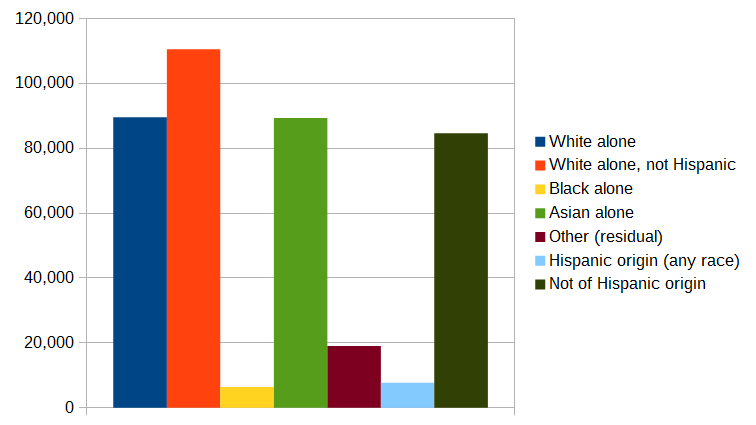
And here are the medians by race:

net_wealth_race

Medians by age:

net_wealth_age

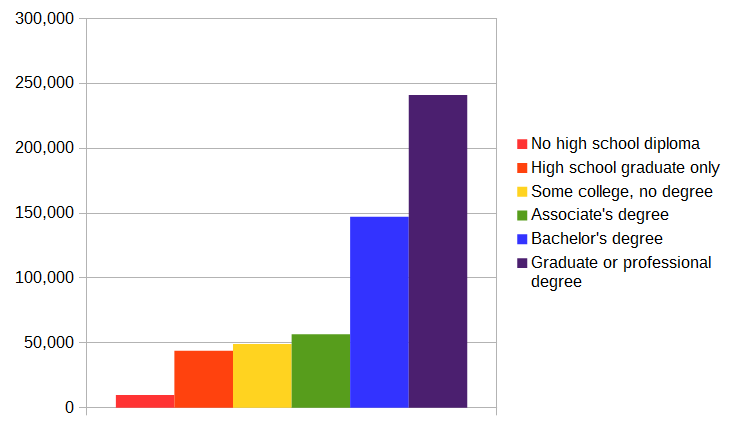
Medians by education:

net_wealth_education

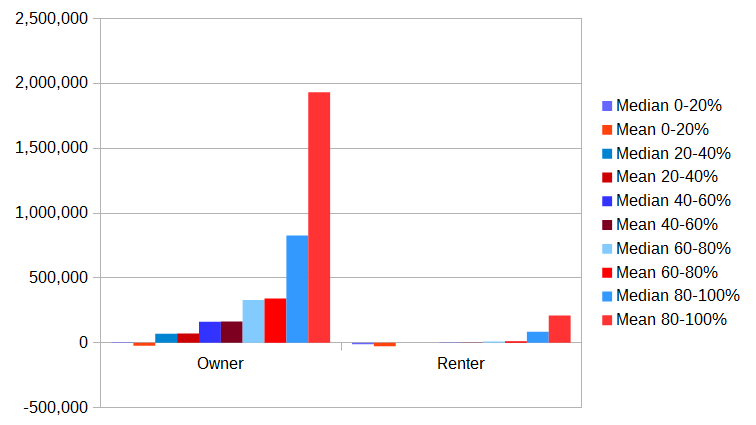
And, perhaps most instructively, here are the quintiles of people who own their homes versus renting (The rent is too damn high!)

net_wealth_rent

All that is just within the US, and already they are ranging from the mean net wealth of the lowest quintile of people under 35 (-$45,000, yes negative—student loans) to the mean net wealth of the highest quintile of people with graduate degrees ($3.8 million). All but the top quintile of renters are poorer than all but the bottom quintile of homeowners. And the median Black or Hispanic person has less than one-tenth the wealth of the median White or Asian person.

If we look worldwide, wealth inequality is even starker. Based on UN University figures, 40% of world wealth is owned by the top 1%; 70% by the top 5%; and 80% by the top 10%. There is less total wealth in the bottom 80% than in the 80-90% decile alone. According to Oxfam, the richest 85 individuals own as much net wealth as the poorest 3.7 billion. They are the 0.000,001%.

If we had an equal distribution of capital ownership, people would be happy when their jobs became obsolete, because it would free them up to do other things (either new jobs, or simply leisure time), while not decreasing their income—because they would be the shareholders receiving those extra profits from higher efficiency. People would be excited to hear about new technologies that might displace their work, especially if those technologies would displace the tedious and difficult parts and leave the creative and fun parts. Losing your job could be the best thing that ever happened to you.

The business cycle would still be a problem; we have good reason not to let recessions happen. But stopping the churn of hiring and firing wouldn’t actually make our society better off; it would keep people in jobs where they don’t belong and prevent us from using our time and labor for its best use.

Perhaps the reason most people don’t even think of this solution is precisely because of the extreme inequality of capital distribution—and the fact that it has more or less always been this way since the dawn of civilization. It doesn’t seem to even occur to most people that capital income is a thing that exists, because they are so far removed from actually having any amount of capital sufficient to generate meaningful income. Perhaps when a robot takes their job, on some level they imagine that the robot is getting paid, when of course it’s the shareholders of the corporations that made the robot and the corporations that are using the robot in place of workers. Or perhaps they imagine that those shareholders actually did so much hard work they deserve to get paid that money for all the hours they spent.

Because pay is for work, isn’t it? The reason you get money is because you’ve earned it by your hard work?

No. This is a lie, told to you by the rich and powerful in order to control you. They know full well that income doesn’t just come from wages—most of their income doesn’t come from wages! Yet this is even built into our language; we say “net worth” and “earnings” rather than “net wealth” and “income”. (Parade magazine has a regular segment called “What People Earn”; it should be called “What People Receive”.) Money is not your just reward for your hard work—at least, not always.

The reason you get money is that this is a useful means of allocating resources in our society. (Remember, money was created by governments for the purpose of facilitating economic transactions. It is not something that occurs in nature.) Wages are one way to do that, but they are far from the only way; they are not even the only way currently in use. As technology advances, we should expect a larger proportion of our income to go to capital—but what we’ve been doing wrong is setting it up so that only a handful of people actually own any capital.

Fix that, and maybe people will finally be able to see that losing your job isn’t such a bad thing; it could even be satisfying, the fulfillment of finally getting something done.

No, Scandinavian countries aren’t parasites. They’re just… better.

Oct 1, JDN 2457663

If you’ve been reading my blogs for awhile, you likely have noticed me occasionally drop the hashtag #ScandinaviaIsBetter; I am in fact quite enamored of the Scandinavian (or Nordic more generally) model of economic and social policy.

But this is not a consensus view (except perhaps within Scandinavia itself), and I haven’t actually gotten around to presenting a detailed argument for just what it is that makes these countries so great.

I was inspired to do this by discussion with a classmate of mine (who shall remain nameless) who emphatically disagreed; he actually seems to think that American economic policy is somewhere near optimal (and to be fair, it might actually be near optimal, in the broad space of all possible economic policies—we are not Maoist China, we are not Somalia, we are not a nuclear wasteland). He couldn’t disagree with the statistics on how wealthy and secure and happy Scandinavian countries are, so instead he came up with this: “They are parasites.”

What he seemed to mean by this is that somehow Scandinavian countries achieve their success by sapping wealth from other countries, perhaps the rest of Europe, perhaps the world more generally. On this view, it’s not that Norway and Denmark aren’t rich because they economic policy basically figured out; no, they are somehow draining those riches from elsewhere.

This could scarcely be further from the truth.

But first, consider a couple of countries that are parasites, at least partially: Luxembourg and Singapore.

Singapore has an enormous trade surplus: 5.5 billion SGD per month, which is $4 billion per month, so almost $50 billion per year. They also have a positive balance of payments of $61 billion per year. Singapore’s total GDP is about $310 billion, so these are not small amounts. What does this mean? It means that Singapore is taking in a lot more money than they are spending out. They are effectively acting as mercantilists, or if you like as a profit-seeking corporation.

Moreover, Singapore is totally dependent on trade: their exports are over $330 billion per year, and their imports are over $280 billion. You may recognize each of these figures as comparable to the entire GDP of the country. Yes, their total trade is 200% of GDP. They aren’t really so much a country as a gigantic trading company.

What about Luxembourg? Well, they have a trade deficit of 420 million Euros per month, which is about $560 million per year. Their imports total about $2 billion per year, and their exports about $1.5 billion. Since Luxembourg’s total GDP is $56 billion, these aren’t unreasonably huge figures (total trade is about 6% of GDP); so Luxembourg isn’t a parasite in the sense that Singapore is.

No, what makes Luxembourg a parasite is the fact that 36% of their GDP is due to finance. Compare the US, where 12% of our GDP is finance—and we are clearly overfinancialized. Over a third of Luxembourg’s income doesn’t involve actually… doing anything. They hold onto other people’s money and place bets with it. Even insofar as finance can be useful, it should be only very slightly profitable, and definitely not more than 10% of GDP. As Stiglitz and Krugman agree (and both are Nobel Laureate economists), banking should be boring.

Do either of these arguments apply to Scandinavia? Let’s look at trade first. Denmark’s imports total about 42 billion DKK per month, which is about $70 billion per year. Their exports total about $90 billion per year. Denmark’s total GDP is $330 billion, so these numbers are quite reasonable. What are their main sectors? Manufacturing, farming, and fuel production. Notably, not finance.

Similar arguments hold for Sweden and Norway. They may be small countries, but they have diversified economies and strong production of real economic goods. Norway is probably overly dependent on oil exports, but they are specifically trying to move away from that right now. Even as it is, only about $90 billion of their $150 billion exports are related to oil, and exports in general are only about 35% of GDP, so oil is about 20% of Norway’s GDP. Compare that to Saudi Arabia, of which has 90% of its exports related to oil, accounting for 45% of GDP. If oil were to suddenly disappear, Norway would lose 20% of their GDP, dropping their per-capita GDP… all the way to the same as the US. (Terrifying!) But Saudi Arabia would suffer a total economic collapse, and their per capita-GDP would fall from where it is now at about the same as the US to about the same as Greece.

And at least oil actually does things. Oil exporting countries aren’t parasites so much as they are drug dealers. The world is “rolling drunk on petroleum”, and until we manage to get sober we’re going to continue to need that sweet black crude. Better we buy it from Norway than Saudi Arabia.

So, what is it that makes Scandinavia so great? Why do they have the highest happiness ratings, the lowest poverty rates, the best education systems, the lowest unemployment rates, the best social mobility and the highest incomes? To be fair, in most of these not literally every top spot is held by a Scandinavian country; Canada does well, Germany does well, the UK does well, even the US does well. Unemployment rates in particular deserve further explanation, because a lot of very poor countries report surprisingly low unemployment rates, such as Cambodia and Laos.

It’s also important to recognize that even great countries can have serious flaws, and the remnants of the feudal system in Scandinavia—especially in Sweden—still contribute to substantial inequality of wealth and power.

But in general, I think if you assembled a general index of overall prosperity of a country (or simply used one that already exists like the Human Development Index), you would find that Scandinavian countries are disproportionately represented at the very highest rankings. This calls out for some sort of explanation.

Is it simply that they are so small? They are certainly quite small; Norway and Denmark each have fewer people than the core of New York City, and Sweden has slightly more people than the Chicago metropolitan area. Put them all together, add in Finland and Iceland (which aren’t quite Scandinavia), and all together you have about the population of the New York City Combined Statistical Area.

But some of the world’s smallest countries are also its poorest. Samoa and Kiribati each have populations comparable to the city of Ann Arbor and per-capita GDPs 1/10 that of the US. Eritrea is the same size as Norway, and 70 times poorer. Burundi is slightly larger than Sweden, and has a per-capita GDP PPP of only $3.14 per day.

There’s actually a good statistical reason to expect that the smallest countries should vary the most in their incomes; you’re averaging over a smaller sample so you get more variance in the estimate. But this doesn’t explain why Norway is rich and Eritrea is poor. Incomes aren’t assigned randomly. This might be a reason to try comparing Norway to specifically New York City or Los Angeles rather than to the United States as a whole (Norway still does better, in case you were wondering—especially compared to LA); but it’s not a reason to say that Norway’s wealth doesn’t really count.

Is it because they are ethnically homogeneous? Yes, relatively speaking; but perhaps not as much as you imagine. 14% of Sweden’s population is immigrants, of which 64% are from outside the EU. 10% of Denmark’s population is comprised of immigrants, of which 66% came from non-Western countries. Immigrants are 13% of Norway’s population, of which half are from non-Western countries.

That’s certainly more ethnically homogeneous than the United States; 13% of our population is immigrants, which may sound comparable, but almost all non-immigrants in Scandinavia are of indigenous Nordic descent, all “White” by the usual classification. Meanwhile the United States is 64% non-Hispanic White, 16% Hispanic, 12% Black, 5% Asian, and 1% Native American or Pacific Islander.

Scandinavian countries are actually by some measures less homogeneous than the US in terms of religion, however; only 4% of Americans are not Christian (78.5%), atheist (16.1%), or Jewish (1.7%), and only 0.6% are Muslim. As much as In Sweden, on the other hand, 60% of the population is nominally Lutheran, but 80% is atheist, and 5% of the population is Muslim. So if you think of Christian/Muslim as the sharp divide (theologically this doesn’t make a whole lot of sense, but it seems to be the cultural norm in vogue), then Sweden has more religious conflict to worry about than the US does.

Moreover, there are some very ethnically homogeneous countries that are in horrible shape. North Korea is almost completely ethnically homogeneous, for example, as is Haiti. There does seem to be a correlation between higher ethnic diversity and lower economic prosperity, but Canada and the US are vastly more diverse than Japan and South Korea yet significantly richer. So clearly ethnicity is not the whole story here.

I do think ethnic homogeneity can partly explain why Scandinavian countries have the good policies they do; because humans are tribal, ethnic homogeneity engenders a sense of unity and cooperation, a notion that “we are all in this together”. That egalitarian attitude makes people more comfortable with some of the policies that make Scandinavia what it is, which I will get into at the end of this post.

What about culture? Is there something about Nordic ideas, those Viking traditions, that makes Scandinavia better? Miles Kimball has argued this; he says we need to import “hard work, healthy diets, social cohesion and high levels of trust—not Socialism”. And truth be told, it’s hard to refute this assertion, since it’s very difficult to isolate and control for cultural variables even though we know they are important.

But this difficulty in falsification is a reason to be cautious about such a hypothesis; it should be a last resort when all the more testable theories have been ruled out. I’m not saying culture doesn’t matter; it clearly does. But unless you can test it, “culture” becomes a theory that can explain just about anything—which means that it really explains nothing.

The “social cohesion and high levels of trust” part actually can be tested to some extent—and it is fairly well supported. High levels of trust are strongly correlated with economic prosperity. But we don’t really need to “import” that; the US is already near the top of the list in countries with the highest levels of trust.

I can’t really disagree with “good diet”, except to say that almost everywhere eats a better diet than the United States. The homeland of McDonald’s and Coca-Cola is frankly quite dystopian when it comes to rates of heart disease and diabetes. Given our horrible diet and ludicrously inefficient healthcare system, the only reason we live as long as we do is that we are an extremely rich country (so we can afford to pay the most for healthcare, for certain definitions of “afford”), and almost no one here smokes anymore. But good diet isn’t so much Scandinavian as it is… un-American.

But as for “hard work”, he’s got it backwards; the average number of work hours per week is 33 in Denmark and Norway, compared to 38 in the US. Among full-time workers in the US, the average number of hours per week is a whopping 47. Working hours in the US are much more intensive than anywhere in Europe, including Scandinavia. Though of course we are nowhere near the insane work addiction suffered by most East Asian countries; lately South Korea and Japan have been instituting massive reforms to try to get people to stop working themselves to death. And not surprisingly, work-related stress is a leading cause of death in the United States. If anything, we need to import some laziness, or at least a sense of work-life balance. (Indeed, I’m fairly sure that the only reason he said “hard work” is that it’s a cultural Applause Light in the US; being against hard work is like being against the American Flag or homemade apple pie. At this point, “we need more hard work” isn’t so much an assertion as it is a declaration of tribal membership.)

But none of these things adequately explains why poverty and inequality is so much lower in Scandinavia than it is in the United States, and there’s really a quite simple explanation.

Why is it that #ScandinaviaIsBetter? They’re not afraid to make rich people pay higher taxes so they can help poor people.

In the US, this idea of “redistribution of wealth” is anathema, even taboo; simply accusing a policy of being “redistributive” or “socialist” is for many Americans a knock-down argument against that policy. In Denmark, “socialist” is a meaningful descriptor; some policies are “socialist”, others “capitalist”, and these aren’t particularly weighted terms; it’s like saying here that a policy is “Keynesian” or “Monetarist”, or if that’s too obscure, saying that it’s “liberal” or “conservative”. People will definitely take sides, and it is a matter of political importance—but it’s inside the Overton Window. It’s not almost unthinkable as it is here.

If culture has an effect here, it likely comes from Scandinavia’s long traditions of egalitarianism. Going at least back to the Vikings, in theory at least (clearly not always in practice), people—or at least fellow Scandinavians—were considered equal participants in society, no one “better” or “higher” than anyone else. Even today, it is impolite in Denmark to express pride at your own accomplishments; there’s a sense that you are trying to present yourself as somehow more deserving than others. Honestly this attitude seems unhealthy to me, though perhaps preferable to the unrelenting narcissism of American society; but insofar as culture is making Scandinavia better, it’s almost certainly because this thoroughgoing sense of egalitarianism underlies all their economic policy. In the US, the rich are brilliant and the poor are lazy; in Denmark, the rich are fortunate and the poor are unlucky. (Which theory is more accurate? Donald Trump. I rest my case.)

To be clear, Scandinavia is not communist; and they are certainly not Stalinist. They don’t believe in total collectivization of industry, or complete government control over the economy. They don’t believe in complete, total equality, or even a hard cap on wealth: Stefan Persson is an 11-figure billionaire. Does he pay high taxes, living in Sweden? Yes he does, considerably higher than he’d pay in the US. He seems to be okay with that. Why, it’s almost like his marginal utility of wealth is now negligible.

Scandinavian countries also don’t try to micromanage your life in the way often associated with “socialism”–in fact I’d say they do it less than we do in the US. Here we have Republicans who want to require drug tests for food stamps even though that literally wastes money and helps no one; there they just provide a long list of government benefits for everyone free of charge. They just held a conference in Copenhagen to discuss the possibility of transitioning many of these benefits into a basic income; and basic income is the least intrusive means of redistributing wealth.

In fact, because Scandinavian countries tax differently, it’s not necessarily the case that people always pay higher taxes there. But they pay more transparent taxes, and taxes with sharper incidence. Denmark’s corporate tax rate is only 22% compared to 35% in the US; but their top personal income tax bracket is 59% while ours is only 39.6% (though it can rise over 50% with some state taxes). Denmark also has a land value tax and a VAT, both of which most economists have clamored for for generations. (The land value tax I totally agree with; the VAT I’m a little more ambivalent about.) Moreover, filing your taxes in Denmark is not a month-long stress marathon of gathering paperwork, filling out forms, and fearing that you’ll get something wrong and be audited as it is in the US; they literally just send you a bill. You can contest it, but most people don’t. You just pay it and you’re done.

Now, that does mean the government is keeping track of your income; and I might think that Americans would never tolerate such extreme surveillance… and then I remember that PRISM is a thing. Apparently we’re totally fine with the NSA reading our emails, but God forbid the IRS just fill out our 1040s for us (that they are going to read anyway). And there’s no surveillance involved in requiring retail stores to incorporate sales tax into listed price like they do in Europe instead of making us do math at the cash register like they do here. It’s almost like Americans are trying to make taxes as painful as possible.

Indeed, I think Scandanavian socialism is a good example of how high taxes are a sign of a free society, not an authoritarian one. Taxes are a minimal incursion on liberty. High taxes are how you fund a strong government and maintain extensive infrastructure and public services while still being fair and following the rule of law. The lowest tax rates in the world are in North Korea, which has ostensibly no taxes at all; the government just confiscates whatever they decide they want. Taxes in Venezuela are quite low, because the government just owns all the oil refineries (and also uses multiple currency exchange rates to arbitrage seigniorage). US taxes are low by First World standards, but not by world standards, because we combine a free society with a staunch opposition to excessive taxation. Most of the rest of the free world is fine with paying a lot more taxes than we do. In fact, even using Heritage Foundation data, there is a clear positive correlation between higher tax rates and higher economic freedom:
Graph: Heritage Foundation Economic Freedom Index and tax burden

What’s really strange, though, is that most Americans actually support higher taxes on the rich. They often have strange or even incoherent ideas about what constitutes “rich”; I have extended family members who have said they think $100,000 is an unreasonable amount of money for someone to make, yet somehow are totally okay with Donald Trump making $300,000,000. The chant “we are the 99%” has always been off by a couple orders of magnitude; the plutocrat rentier class is the top 0.01%, not the top 1%. The top 1% consists mainly of doctors and lawyers and engineers; the top 0.01%, to a man—and they are nearly all men, in fact White men—either own corporations or work in finance. But even adjusting for all this, it seems like at least a bare majority of Americans are all right with “redistributive” “socialist” policies—as long as you don’t call them that.

So I suppose that’s sort of what I’m trying to do; don’t think of it as “socialism”. Think of it as #ScandinaviaIsBetter.

The high cost of frictional unemployment

Sep 3, JDN 2457635

I had wanted to open this post with an estimate of the number of people in the world, or at least in the US, who are currently between jobs. It turns out that such estimates are essentially nonexistent. The Bureau of Labor Statistics maintains a detailed database of US unemployment; they don’t estimate this number. We have this concept in macroeconomics of frictional unemployment, the unemployment that results from people switching jobs; but nobody seems to have any idea how common it is.

I often hear a ballpark figure of about 4-5%, which is related to a notion that “full employment” should really be about 4-5% unemployment because otherwise we’ll trigger horrible inflation or something. There is almost no evidence for this. In fact, the US unemployment rate has gotten as low as 2.5%, and before that was stable around 3%. This was during the 1950s, the era of the highest income tax rates ever imposed in the United States, a top marginal rate of 92%. Coincidence? Maybe. Obviously there were a lot of other things going on at the time. But it sure does hurt the argument that high income taxes “kill jobs”, don’t you think?

Indeed, it may well be that the rate of frictional unemployment varies all the time, depending on all sorts of different factors. But here’s what we do know: Frictional unemployment is a serious problem, and yet most macroeconomists basically ignore it.

Talk to most macroeconomists about “unemployment”, and they will assume you mean either cyclical unemployment (the unemployment that results from recessions and bad fiscal and monetary policy responses to them), or structural unemployment (the unemployment that results from systematic mismatches between worker skills and business needs). If you specifically mention frictional unemployment, the response is usually that it’s no big deal and there’s nothing we can do about it anyway.

Yet at least when we aren’t in a recession, frictional employment very likely accounts for the majority of unemployment, and thus probably the majority of misery created by unemployment. (Not necessarily, since it probably doesn’t account for much long-term unemployment, which is by far the worst.) And it is quite clear to me that there are things we can do about it—they just might be difficult and/or expensive.

Most of you have probably changed jobs at least once. Many of you have, like me, moved far away to a new place for school or work. Think about how difficult that was. There is the monetary cost, first of all; you need to pay for the travel of course, and then usually leases and paychecks don’t line up properly for a month or two (for some baffling and aggravating reason, UCI won’t actually pay me my paychecks until November, despite demanding rent starting the last week of July!). But even beyond that, you are torn from your social network and forced to build a new one. You have to adapt to living in a new place which may have differences in culture and climate. Bureaucracy often makes it difficult to change over documentation of such as your ID and your driver’s license.

And that’s assuming that you already found a job before you moved, which isn’t always an option. Many people move to new places and start searching for jobs when they arrive, which adds an extra layer of risk and difficulty above and beyond the transition itself.

With all this in mind, the wonder is that anyone is willing to move at all! And this is probably a large part of why people are so averse to losing their jobs even when it is clearly necessary; the frictional unemployment carries enormous real costs. (That and loss aversion, of course.)

What could we do, as a matter of policy, to make such transitions easier?

Well, one thing we could do is expand unemployment insurance, which reduces the cost of losing your job (which, despite the best efforts of Republicans in Congress, we ultimately did do in the Second Depression). We could expand unemployment insurance to cover voluntary quits. Right now, quitting voluntarily makes you forgo all unemployment benefits, which employers pay for in the form of insurance premiums; so an employer is much better off making your life miserable until you quit than they are laying you off. They could also fire you for cause, if they can find a cause (and usually there’s something they could trump up enough to get rid of you, especially if you’re not prepared for the protracted legal battle of a wrongful termination lawsuit). The reasoning of our current system appears to be something like this: Only lazy people ever quit jobs, and why should we protect lazy people? This is utter nonsense and it needs to go. Many states already have no-fault divorce and no-fault auto collision insurance; it’s time for no-fault employment termination.

We could establish a basic income of course; then when you lose your job your income would go down, but to a higher floor where you know you can meet certain basic needs. We could provide subsidized personal loans, similar to the current student loan system, that allow people to bear income gaps without losing their homes or paying exorbitant interest rates on credit cards.

We could use active labor market programs to match people with jobs, or train them with the skills needed for emerging job markets. Denmark has extensive active labor market programs (they call it “flexicurity”), and Denmark’s unemployment rate was 2.4% before the Great Recession, hit a peak of 6.2%, and has now recovered to 4.2%. What Denmark calls a bad year, the US calls a good year—and Greece fantasizes about as something they hope one day to achieve. #ScandinaviaIsBetter once again, and Norway fits this pattern also, though to be fair Sweden’s unemployment rate is basically comparable to the US or even slightly worse (though it’s still nothing like Greece).

Maybe it’s actually all right that we don’t have estimates of the frictional unemployment rate, because the goal really isn’t to reduce the number of people who are unemployed; it’s to reduce the harm caused by unemployment. Most of these interventions would very likely increase the rate frictional unemployment, as people who always wanted to try to find better jobs but could never afford to would now be able to—but they would dramatically reduce the harm caused by that unemployment.

This is a more general principle, actually; it’s why we should basically stop taking seriously this argument that social welfare benefits destroy work incentives. That may well be true; so what? Maximizing work incentives was never supposed to be a goal of public policy, as far as I can tell. Maximizing human welfare is the goal, and the only way a welfare program could reduce work incentives is by making life better for people who aren’t currently working, and thereby reducing the utility gap between working and not working. If your claim is that the social welfare program (and its associated funding mechanism, i.e. taxes, debt, or inflation) would make life sufficiently worse for everyone else that it’s not worth it, then say that (and for some programs that might actually be true). But in and of itself, making life better for people who don’t work is a benefit to society. Your supposed downside is in fact an upside. If there’s a downside, it must be found elsewhere.

Indeed, I think it’s worth pointing out that slavery maximizes work incentives. If you beat or kill people who don’t work, sure enough, everyone works! But that is not even an efficient economy, much less a just society. To be clear, I don’t think most people who say they want to maximize work incentives would actually support slavery, but that is the logical extent of the assertion. (Also, many Libertarians, often the first to make such arguments, do have a really bizarre attitude toward slavery; taxation is slavery, regulation is slavery, conscription is slavery—the last not quite as ridiculous—but actual forced labor… well, that really isn’t so bad, especially if the contract is “voluntary”. Fortunately some Libertarians are not so foolish.) If your primary goal is to make people work as much as possible, slavery would be a highly effective way to achieve that goal. And that really is the direction you’re heading when you say we shouldn’t do anything to help starving children lest their mothers have insufficient incentive to work.

More people not working could have a downside, if it resulted in less overall production of goods. But even in the US, one of the most efficient labor markets in the world, the system of job matching is still so ludicrously inefficient that people have to send out dozens if not hundreds of applications to jobs they barely even want, and there are still 1.4 times as many job seekers as there are openings (at the trough of the Great Recession, the ratio was 6.6 to 1). There’s clearly a lot of space here to improve the matching efficiency, and simply giving people more time to search could make a big difference there. Total output might decrease for a little while during the first set of transitions, but afterward people would be doing jobs they want, jobs they care about, jobs they’re good at—and people are vastly more productive under those circumstances. It’s quite likely that total employment would decrease, but productivity would increase so much that total output increased.

Above all, people would be happier, and that should have been our goal all along.

We need to be honest about free trade’s costs, and clearer about its benefits

August 6, JDN 2457607

I discussed in a post awhile ago the fact that economists overwhelmingly favor free trade but most people don’t. There are some deep psychological reasons for this, particularly the loss aversion which makes people experience losses about twice as much as they experience gains. Free trade requires change; it creates some jobs and destroys others. Those forced transitions can be baffling and painful.

The good news is that views on trade in the US are actually getting more positive in recent years—which makes Trump that much more baffling. I honestly can’t make much sense of the fact that candidates who are against free trade have been so big in this election (and let’s face it, even Bernie Sanders is largely against free trade!), in light of polls showing that free trade is actually increasingly popular.

Partly this can be explained by the fact that people are generally more positive about free trade in general than they are about particular trade agreements, and understandably so, as free trade agreements often include some really awful provisions that in no way advance free trade. But that doesn’t really explain the whole effect here. Maybe it’s a special interest effect: People who hate trade are much more passionate about hating trade than people who like trade are passionate about liking trade. If that’s the case, then this is what we need to change.

Today I’d like to focus on what we as economists and the economically literate more generally can do to help people understand what free trade is and why it is so important. This means two things:

First, of course, we must be clearer about the benefits of free trade. Many economists seem to think that it is simply so obvious that they don’t even bother to explain it, and end up seeming like slogan-chanting ideologues. “Free trade! Free trade! Free trade!”

Above all, we need to talk about how it was primarily through free trade that global extreme poverty is now at the lowest level it has ever been. This benefit needs to be repeated over and over, and anyone who argues for protectionism needs to be confronted with the millions of people they will throw back into poverty. Most people don’t even realize that global poverty is declining, so first of all, they need to be shown that it is.

American ideas are often credited with fighting global poverty, but that’s not so convincing, since most of the improvement in poverty has happened in China (not exactly a paragon of free markets, much less liberal democracy); what really seems to have made the difference is American dollars, spent in free trade. Imports to the US from China have risen from $3.8 billion in 1985 to $483 billion in 2015. Extreme poverty in China fell from 61% of the population in 1990 to 4% in 2015. Coincidence? I think not. Indeed, that $483 billion is just about $1 per day for every man, woman, and child in China—and the UN extreme poverty line is $1.25 per person per day.

We need to be talking about the jobs that are created by trade—if need be, making TV commercials interviewing workers at factories who make products for export. “Most of our customers are in Japan,” they might say. “Without free trade, I’d be out of a job.” Interview business owners saying things like, “Two years ago we opened up sales to China. Now I need to double my workforce just to keep up with demand.” Unlike a lot of other economic policies where the benefits are diffuse and hard to keep track of, free trade is one where you can actually point to specific people and see that they are now better off because they make more selling exports. From there, we just need to point out that imports and exports are two sides of the same transaction—so if you like exports, you’d better have imports.

We need to make it clear that the economic gains from trade are just as real as the losses from transition, even if they may not be as obvious. William Poole put it very well in this article on attitudes toward free trade:

Economists are sometimes charged with insensitivity over job losses, when in fact most of us are extremely sensitive to such losses. What good economics tells us is that saving jobs in one industry does not save jobs in the economy as a whole. We urge people to be as sensitive to the jobs indirectly lost as a consequence of trade restriction as to those lost as a consequence of changing trade patterns.

Second, just as importantly, we must be honest about the costs of free trade. We need to stop eliding the distinction between net aggregate benefits and benefits for everyone everywhere. There are winners and losers, and we need to face up to that.

For example, we need to stop saying thinks like “Free trade will not send jobs to Mexico and China.” No, it absolutely will, and has, and does—and that is part of what it’s for. Because people in Mexico and China are people, and they deserve to have better jobs just as much as we do. Sending jobs to China is not a bug; it’s a feature. China needs jobs particularly badly.

Then comes the next part: “But if our jobs get sent to China, what will we do?” Better jobs, created here by the economic benefits of free trade. No longer will American workers toil in factories assembling parts; instead they will work in brightly-lit offices designing those parts on CAD software.

Of course this raises another problem: What happens to people who were qualified to toil in factories, but aren’t qualified to design parts on CAD software? Well, they’ll need to learn. And we should be paying for that education (though in large part, we are; altogether US federal, state, and local governments spend over $1 trillion a year on education).

And what if they can’t learn, can’t find another job somewhere else? What if they’re just not cut out for the kind of work we need in a 21st century economy? Then here comes my most radical statement of all: Then they shouldn’t have to.

The whole point of expanding economic efficiency—which free trade most certainly does—is to create more stuff. But if you create more stuff, you then have the opportunity to redistribute that stuff, in such a way that no one is harmed by that transition. This is what we have been failing to do in the United States. We need to set up our unemployment and pension systems so that people who lose their jobs due to free trade are not harmed by it, but instead feel like it is an opportunity to change careers or retire. We should have a basic income so that even people who can’t work at all can still live with dignity. This redistribution will not happen automatically; it is a policy choice we must make.


In theory there is a way around it, which is often proposed as an alternative to a basic income; it is called a job guarantee. Simply giving everyone free money for some reason makes people uncomfortable (never could quite fathom why; Donald Trump inherits capital income from his father, that’s fine, but we all inherit shared capital income as a nation, that’s a handout?), so instead we give everyone a job, so they can earn their money!

Well, here’s the thing: They won’t actually be earning it—or else it’s not a job guarantee. If you just want an active labor-market program to retrain workers and match them with jobs, that sounds great; Denmark has had great success with such things, and after all #ScandinaviaIsBetter. But no matter how good your program is, some people are going to not have any employable skills, or have disabilities too severe to do any productive work, or simply be too lazy to actually work. And now you’ve got a choice to make: Do you give those people jobs, or not?

If you don’t, it’s not a job guarantee. If you do, they’re not earning it anymore. Either employment is tied to actual productivity, or it isn’t; if you are guaranteed a certain wage no matter what you do, then some people are going to get that wage for doing nothing. As The Economist put it:

However, there are two alternatives: give people money with no strings attached (through a guaranteed basic income, unemployment insurance, disability payments, and so forth), or just make unemployed people survive on whatever miserable scraps they can cobble together.

If it’s really a job guarantee, we would still need to give jobs to people who can’t work or simply won’t. How is this different from a basic income? Well, it isn’t, except you added all these extra layers of bureaucracy so that you could feel like you weren’t just giving a handout. You’ve added additional costs for monitoring and administration, as well as additional opportunities for people to slip through the cracks. Either you are going to leave some people in poverty, or you are going to give money to people who don’t work—so why not give money to people who don’t work?

Another cost we need to be honest about is ecological. In our rush to open free trade, we are often lax in ensuring that this trade will not accelerate environmental degradation and climate change. This is often justified in the name of helping the world’s poorest people; but they will be hurt far more when their homes are leveled by hurricanes than by waiting a few more years to get the trade agreement right. That’s one where Poole actually loses me:

Few Americans favor a world trading system in which U.S. policies on environmental and other conditions could be controlled by foreign governments through their willingness to accept goods exported by the United States.

Really? You think we should be able to force other countries to accept our goods, regardless of whether they consider them ecologically sustainable? You think most Americans think that? It’s easy to frame it as other people imposing on us, but trade restrictions on ecologically harmful goods are actually a very minimal—indeed, almost certainly insufficient—regulation against environmental harm. Oil can still kill a lot of people even if it never crosses borders (or never crosses in liquid form—part of the point is you can’t stop the gaseous form). We desperately need global standards on ecological sustainability, and while we must balance environmental regulations with economic efficiency, currently that balance is tipped way too far against the environment—and millions will die if it remains this way.

This is the kernel of truth in otherwise economically-ignorant environmentalist diatribes like Naomi Klein’s This Changes Everything; free trade in principle doesn’t say anything about being environmentally unsustainable, but free trade in practice has often meant cutting corners and burning coal. Where we currently have diesel-powered container ships built in coal-powered factories and Klein wants no container ships and perhaps even no factories, what we really need are nuclear-powered container ships and solar-powered factories. Klein points out cases where free trade agreements have shut down solar projects that tried to create local jobs—but neither side seems to realize that a good free trade agreement would expand that solar project to create global jobs. Instead of building solar panels in Canada to sell only in Canada, we’d build solar panels in Canada to sell in China and India—and build ten times as many. That is what free trade could be, if we did it right.

How not to do financial transaction tax

JDN 2457520

I strongly support the implementation of a financial transaction tax; like a basic income, it’s one of those economic policy ideas that are so brilliantly simple it’s honestly a little hard to believe how incredibly effective they are at making the world a better place. You mean we might be able to end stock market crashes just by implementing this little tax that most people will never even notice, and it will raise enough revenue to pay for food stamps? Yes, a financial transaction tax is that good.

So, keep that in mind when I say this:

TruthOut’s proposal for a financial transaction tax is somewhere between completely economically illiterate and outright insane.

They propose a 10% transaction tax on stocks and a 1% transaction tax on notional value of derivatives, then offer a “compromise” of 5% on stocks and 0.5% on derivatives. They make a bunch of revenue projections based on these that clearly amount to nothing but multiplying the current amount of transactions by the tax rate, which is so completely wrong we now officially have a left-wing counterpart to trickle-down voodoo economics.

Their argument is basically like this (I’m paraphrasing): “If we have to pay 5% sales tax on groceries, why shouldn’t you have to pay 5% on stocks?”

But that’s not how any of this works.

Demand for most groceries is very inelastic, especially in the aggregate. While you might change which groceries you’ll buy depending on their respective prices, and you may buy in bulk or wait for sales, over a reasonably long period (say a year) across a large population (say all of Michigan or all of the US), total amount of spending on groceries is extremely stable. People only need a certain amount of food, and they generally buy that amount and then stop.

So, if you implement a 5% sales tax that applies to groceries (actually sales tax in most states doesn’t apply to most groceries, but honestly it probably should—offset the regressiveness by providing more social services), people would just… spend about 5% more on groceries. Probably a bit less than that, actually, since suppliers would absorb some of the tax; but demand is much less elastic for groceries than supply, so buyers would bear most of the incidence of the tax. (It does not matter how the tax is collected; see my tax incidence series for further explanation of why.)

Other goods like clothing and electronics are a bit more elastic, so you’d get some deadweight loss from the sales tax; but at a typical 5% to 10% in the US this is pretty minimal, and even the hefty 20% or 30% VATs in some European countries only have a moderate effect. (Denmark’s 180% sales tax on cars seems a bit excessive to me, but it is Pigovian to disincentivize driving, so it also has very little deadweight loss.)

But what would happen if you implemented a 5% transaction tax on stocks? The entire stock market would immediately collapse.

A typical return on stocks is between 5% and 15% per year. As a rule of thumb, let’s say about 10%.

If you pay 5% sales tax and trade once per year, tax just cut your return in half.

If you pay 5% sales tax and trade twice per year, tax destroyed your return completely.

Even if you only trade once every five years, a 5% sales tax means that instead of your stocks being worth 61% more after those 5 years they are only worth 53% more. Your annual return has been reduced from 10% to 8.9%.

But in fact there are many perfectly legitimate reasons to trade as often as monthly, and a 5% tax would make monthly trading completely unviable.

Even if you could somehow stop everyone from pulling out all their money just before the tax takes effect, you would still completely dry up the stock market as a source of funding for all but the most long-term projects. Corporations would either need to finance their entire operations out of cash or bonds, or collapse and trigger a global depression.

Derivatives are even more extreme. The notional value of derivatives is often ludicrously huge; we currently have over a quadrillion dollars in notional value of outstanding derivatives. Assume that say 10% of those are traded every year, and we’re talking $100 trillion in notional value of transactions. At 0.5% you’re trying to take in a tax of $500 billion. That sounds fantastic—so much money!—but in fact what you should be thinking about is that’s a really strong avoidance incentive. You don’t think banks will find a way to restructure their trading practices—or stop trading altogether—to avoid this tax?

Honestly, maybe a total end to derivatives trading would be tolerable. I certainly think we need to dramatically reduce the amount of derivatives trading, and much of what is being traded—credit default swaps, collateralized debt obligations, synthetic collateralized debt obligations, etc.—really should not exist and serves no real function except to obscure fraud and speculation. (Credit default swaps are basically insurance you can buy on other people’s companies. There’s a reason you’re not allowed to buy insurance on other people’s stuff!) Interest rate swaps aren’t terrible (when they’re not being used to perpetrate the largest white-collar crime in history), but they also aren’t necessary. You might be able to convince me that commodity futures and stock options are genuinely useful, though even these are clearly overrated. (Fun fact: Futures markets have been causing financial crises since at least Classical Rome.) Exchange-traded funds are technically derivatives, and they’re just fine (actually ETFs are very low-risk, because they are inherently diversified—which is why you should probably be buying them); but actually their returns are more like stocks, so the 0.5% might not be insanely high in that case.

But stocks? We kind of need those. Equity financing has been the foundation of capitalism since the very beginning. Maybe we could conceivably go to a fully debt-financed system, but it would be a radical overhaul of our entire financial system and is certainly not something to be done lightly.

Indeed, TruthOut even seems to think we could apply the same sales tax rate to bonds, which means that debt financing would also collapse, and now we’re definitely talking about global depression. How exactly is anyone supposed to finance new investments, if they can’t sell stock or bonds? And a 5% tax on the face value of stock or bonds, for all practical purposes, is saying that you can’t sell stock or bonds. It would make no one want to buy them.

Wealthy investors buying of stocks and bonds is essentially no different than average folks buying food, clothing or other real “goods and services.”

Yes it is. It is fundamentally different.

People buy goods to use them. People buy stocks to make money selling them.

This seems perfectly obvious, but it is a vital distinction that seems to be lost on TruthOut.

When you buy an apple or a shoe or a phone or a car, you care how much it costs relative to how useful it is to you; if we make it a bit more expensive, that will make you a bit less likely to buy it—but probably not even one-to-one so that a 5% tax would reduce purchases by 5%; it would probably be more like a 2% reduction. Demand for goods is inelastic. Taxing them will raise a lot of revenue and not reduce the quantity purchased very much.

But when you buy a stock or a bond or an interest rate swap, you care how much it costs relative to what you will be able to sell it for—you care about not its utility but its return. So a 5% tax will reduce the amount of buying and selling by substantially more than 5%—it could well be 50% or even 100%. Demand for financial assets is elastic. Taxing them will not raise much revenue but will substantially reduce the quantity purchased.

Now, for some financial assets, we want to reduce the quantity purchased—the derivatives market is clearly too big, and high-frequency trading that trades thousands of times per second can do nothing but destabilize the financial system. Joseph Stiglitz supports a small financial transaction tax precisely because it would substantially reduce high-frequency trading, and he’s a Nobel Laureate as you may recall. Naturally, he was excluded from the SEC hearings on the subject, because reasons. But the figures Stiglitz is talking about (and I agree with) are on the order of 0.1% for stocks and 0.01% for derivatives—50 times smaller than what TruthOut is advocating.

At the end, they offer another “compromise”:

Okay, half it again, to a 2.5 percent tax on stocks and bonds and a 0.25 percent on derivative trades. That certainly won’t discourage stock and bond trading by the rich (not that that is an all bad idea either).

Yes it will. By a lot. That’s the whole point.

A financial transaction tax is a great idea whose time has come; let’s not ruin its reputation by setting it at a preposterous value. Just as a $15 minimum wage is probably a good idea but a $250 minimum wage is definitely a terrible idea, a 0.1% financial transaction tax could be very beneficial but a 5% financial transaction tax would clearly be disastrous.