What really happened in Greece

JDN 2457506

I said I’d get back to this issue, so here goes.

Let’s start with what is uncontroversial: Greece is in trouble.

Their per-capita GDP PPP has fallen from a peak of over $32,000 in 2007 to a trough of just over $24,000 in 2013, and only just began to recover over the last 2 years. That’s a fall of 29 log points. Put another way, the average person in Greece has about the same real income now that they had in the year 2000—a decade and a half of economic growth disappeared.

Their unemployment rate surged from about 7% in 2007 to almost 28% in 2013. It remains over 24%. That is, almost one quarter of all adults in Greece are seeking jobs and not finding them. The US has not seen an unemployment rate that high since the Great Depression.

Most shocking of all, over 40% of the population in Greece is now below the national poverty line. They define poverty as 60% of the inflation-adjusted average income in 2009, which works out to 665 Euros per person ($756 at current exchange rates) per month, or about $9000 per year. They also have an absolute poverty line, which 14% of Greeks now fall below, but only 2% did before the crash.

So now, let’s talk about why.

There’s a standard narrative you’ve probably heard many times, which goes something like this:

The Greek government spent too profligately, heaping social services on the population without the tax base to support them. Unemployment insurance was too generous; pensions were too large; it was too hard to fire workers or cut wages. Thus, work incentives were too weak, and there was no way to sustain a high GDP. But they refused to cut back on these social services, and as a result went further and further into debt until it finally became unsustainable. Now they are cutting spending and raising taxes like they needed to, and it will eventually allow them to repay their debt.

Here’s a fellow of the Cato Institute spreading this narrative on the BBC. Here’s ABC with a five bullet-point list: Pension system, benefits, early retirement, “high unemployment and work culture issues” (yes, seriously), and tax evasion. Here the Telegraph says that Greece “went on a spending spree” and “stopped paying taxes”.

That story is almost completely wrong. Almost nothing about it is true. Cato and the Telegraph got basically everything wrong. The only one ABC got right was tax evasion.

Here’s someone else arguing that Greece has a problem with corruption and failed governance; there is something to be said for this, as Greece is fairly corrupt by European standards—though hardly by world standards. For being only a generation removed from an authoritarian military junta, they’re doing quite well actually. They’re about as corrupt as a typical upper-middle income country like Libya or Botswana; and Botswana is widely regarded as the shining city on a hill of transparency as far as Sub-Saharan Africa is concerned. So corruption may have made things worse, but it can’t be the whole story.

First of all, social services in Greece were not particularly extensive compared to the rest of Europe.

Before the crisis, Greece’s government spending was about 44% of GDP.

That was about the same as Germany. It was slightly more than the UK. It was less than Denmark and France, both of which have government spending of about 50% of GDP.

Greece even tried to cut spending to pay down their debt—it didn’t work, because they simply ended up worsening the economic collapse and undermining the tax base they needed to do that.

Europe has fairly extensive social services by world standards—but that’s a major part of why it’s the First World. Even the US, despite spending far less than Europe on social services, still spends a great deal more than most countries—about 36% of GDP.

Second, if work incentives were a problem, you would not have high unemployment. People don’t seem to grasp what the word unemployment actually means, which is part of why I can’t stand it when news outlets just arbitrarily substitute “jobless” to save a couple of syllables. Unemployment does not mean simply that you don’t have a job. It means that you don’t have a job and are trying to get one.

The word you’re looking for to describe simply not having a job is nonemployment, and that’s such a rarely used term my spell-checker complains about it. Yet economists rarely use this term precisely because it doesn’t matter; a high nonemployment rate is not a symptom of a failing economy but a result of high productivity moving us toward the post-scarcity future (kicking and screaming, evidently). If the problem with Greece were that they were too lazy and they retire too early (which is basically what ABC was saying in slightly more polite language), there would be high nonemployment, but there would not be high unemployment. “High unemployment and work culture issues” is actually a contradiction.

Before the crisis, Greece had an employment-to-population ratio of 49%, meaning a nonemployment rate of 51%. If that sounds ludicrously high, you’re not accustomed to nonemployment figures. During the same time, the United States had an employment-to-population ratio of 52% and thus a nonemployment rate of 48%. So the number of people in Greece who were voluntarily choosing to drop out of work before the crisis was just slightly larger than the number in the US—and actually when you adjust for the fact that the US is full of young immigrants and Greece is full of old people (their median age is 10 years older than ours), it begins to look like it’s we Americans who are lazy. (Actually, it’s that we are studious—the US has an extremely high rate of college enrollment and the best colleges in the world. Full-time students are nonemployed, but they are certainly not unemployed.)

But Greece does have an enormously high debt, right? Yes—but it was actually not as bad before the crisis. Their government debt surged from 105% of GDP to almost 180% today. 105% of GDP is about what we have right now in the US; it’s less than what we had right after WW2. This is a little high, but really nothing to worry about, especially if you’ve incurred the debt for the right reasons. (The famous paper by Rogart and Reinhoff arguing that 90% of GDP is a horrible point of no return was literally based on math errors.)

Moreover, Ireland and Spain suffered much the same fate as Greece, despite running primary budget surpluses.

So… what did happen? If it wasn’t their profligate spending that put them in this mess, what was it?

Well, first of all, there was the Second Depression, a worldwide phenomenon triggered by the collapse of derivatives markets in the United States. (You want unsustainable debt? Try 20 to 1 leveraged CDO-squareds and one quadrillion dollars in notional value. Notional value isn’t everything, but it’s a lot.) So it’s mainly our fault, or rather the fault of our largest banks. As far as us voters, it’s “our fault” in the way that if your car gets stolen it’s “your fault” for not locking the doors and installing a LoJack. We could have regulated against this and enforced those regulations, but we didn’t. (Fortunately, Dodd-Frank looks like it might be working.)

Greece was hit particularly hard because they are highly dependent on trade, particularly in services like tourism that are highly sensitive to the business cycle. Before the crash they imported 36% of GDP and exported 23% of GDP. Now they import 35% of GDP and export 33% of GDP—but it’s a much smaller GDP. Their exports have only slightly increased while their imports have plummeted. (This has reduced their “trade deficit”, but that has always been a silly concept. I guess it’s less silly if you don’t control your own currency, but it’s still silly.)

Once the crash happened, the US had sovereign monetary policy and the wherewithal to actually use that monetary policy effectively, so we weathered the crash fairly well, all things considered. Our unemployment rate barely went over 10%. But Greece did not have sovereign monetary policy—they are tied to the Euro—and that severely limited their options for expanding the money supply as a result of the crisis. Raising spending and cutting taxes was the best thing they could do.

But the bank(st?)ers and their derivatives schemes caused the Greek debt crisis a good deal more directly than just that. Part of the condition of joining the Euro was that countries must limit their fiscal deficit to no more than 3% of GDP (which is a totally arbitrary figure with no economic basis in case you were wondering). Greece was unwilling or unable to do so, but wanted to look like they were following the rules—so they called up Goldman Sachs and got them to make some special derivatives that Greece could use to continue borrowing without looking like they were borrowing. The bank could have refused; they could have even reported it to the European Central Bank. But of course they didn’t; they got their brokerage fee, and they knew they’d sell it off to some other bank long before they had to worry about whether Greece could ever actually repay it. And then (as I said I’d get back to in a previous post) they paid off the credit rating agencies to get them to rate these newfangled securities as low-risk.

In other words, Greece is not broke; they are being robbed.

Like homeowners in the US, Greece was offered loans they couldn’t afford to pay, but the banks told them they could, because the banks had lost all incentive to actually bother with the question of whether loans can be repaid. They had “moved on”; their “financial innovation” of securitization and collateralized debt obligations meant that they could collect origination fees and brokerage fees on loans that could never possibly be repaid, then sell them off to some Greater Fool down the line who would end up actually bearing the default. As long as the system was complex enough and opaque enough, the buyers would never realize the garbage they were getting until it was too late. The entire concept of loans was thereby broken: The basic assumption that you only loan money you expect to be repaid no longer held.

And it worked, for awhile, until finally the unpayable loans tried to create more money than there was in the world, and people started demanding repayment that simply wasn’t possible. Then the whole scheme fell apart, and banks began to go under—but of course we saved them, because you’ve got to save the banks, how can you not save the banks?

Honestly I don’t even disagree with saving the banks, actually. It was probably necessary. What bothers me is that we did nothing to save everyone else. We did nothing to keep people in their homes, nothing to stop businesses from collapsing and workers losing their jobs. Precisely because of the absurd over-leveraging of the financial system, the cost to simply refinance every mortgage in America would have been less than the amount we loaned out in bank bailouts. The banks probably would have done fine anyway, but if they didn’t, so what? The banks exist to serve the people—not the other way around.

We can stop this from happening again—here in the US, in Greece, in the rest of Europe, everywhere. But in order to do that we must first understand what actually happened; we must stop blaming the victims and start blaming the perpetrators.
Tax Incidence Revisited, Part 1: The downside of taxes

JDN 2457345 EST 22:02

As I was writing this, it was very early (I had to wake up at 04:30) and I was groggy, because we were on an urgent road trip to Pennsylvania for the funeral of my aunt who died quite suddenly a few days ago. I have since edited this post more thoroughly to minimize the impact of my sleep deprivation upon its content. Actually maybe this is a good thing; the saying goes, “write drunk, edit sober” and sleep deprivation and alcohol have remarkably similar symptoms, probably because alcohol is GABA-ergic and GABA is involved in sleep regulation.

Awhile ago I wrote a long post on tax incidence, but the primary response I got was basically the online equivalent of a perplexed blank stare. Struck once again by the Curse of Knowledge, I underestimated the amount of background knowledge necessary to understand my explanation. But tax incidence is very important for public policy, so I really would like to explain it.

Therefore I am now starting again, slower, in smaller pieces. Today’s piece is about the downsides of taxation in general, why we don’t just raise taxes as high as we feel like and make the government roll in dough.

To some extent this is obvious; if income tax were 100%, why would anyone bother working for a salary? You might still work for fulfillment, or out of a sense of duty, or simply because you enjoy what you do—after all, most artists and musicians are hardly in it for the money. But many jobs are miserable and not particularly fulfilling, yet still need to get done. How many janitors or bus drivers work purely for the sense of fulfillment it gives them? Mostly they do it to pay the bills—and if income tax were 100%, it wouldn’t anymore. The formal economy would basically collapse, and then nobody would end up actually paying that 100% tax—so the government would actually get very little revenue, if any.

At the other end of the scale, it’s kind of obvious that if your taxes are all 0% you don’t get any revenue. This is actually more feasible than it may sound; provided you spend only a very small amount (say, 4% of GDP, though that’s less than any country actually spends—maybe you could do 6% like Bangladesh) and you can still get people to accept your currency, you could, in principle, have a government that funds its spending entirely by means of printing money, and could do this indefinitely. In practice, that has never been done, and the really challenging part is getting people to accept your money if you don’t collect taxes in it. One of the more counter-intuitive aspects of modern monetary theory (or perhaps I should capitalize it, Modern Monetary Theory, though the part I agree with is not that different from standard Keynesian theory) is that taxation is the primary mechanism by which money acquires its value.

And then of course with intermediate tax rates such as 20%, 30%, and 50% that actual countries actually use, we do get some positive amount of revenue.

Everything I’ve said so far may seem pretty obvious. Yeah, usually taxes raise revenue, but if you taxed at 0% or 100% they wouldn’t; so what?

Well, this leads to quite an important result. Assuming that tax revenue is continuous (which isn’t quite true, but since we can collect taxes in fractions of a percent and pay in pennies, it’s pretty close), it follows directly from the Extreme Value Theorem that there is in fact a revenue-maximizing tax rate. Both below and above that tax rate, the government takes in less total money. These theorems don’t tell us what the revenue-maximizing rate is; but they tell us that it must exist, somewhere between 0% and 100%.

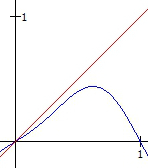
Indeed, it follows that there is what we call the Laffer Curve, a graph of tax revenue as a function of tax rate, and it is in fact a curve, as opposed to the straight line it would be if taxes had no effect on the rest of the economy.

Very roughly, it looks something like this (the blue curve is my sketch of the real-world Laffer curve, while the red line is what it would be if taxes had no distortionary effects):

Laffer_curve

Now, the Laffer curve has been abused many times; in particular, it’s been used to feed into the “trickle-down” “supply-sideReaganomics that has been rightly derided as “voodoo economics” by serious economists. Jeb Bush (or should I say, Jeb!) and Marco Rubio would have you believe that we are on the right edge of the Laffer curve, and we could actually increase tax revenue by cutting taxes, particularly on capital gains and incomes at the top 1%; that’s obviously false. We tried that, it didn’t work. Even theoretically we probably should have known that it wouldn’t; but now that we’ve actually done the experiment and it failed, there should be no serious doubt anymore.

No, we are on the left side of the Laffer curve, where increasing taxes increases revenue, much as you’d intuitively expect. It doesn’t quite increase one-to-one, because adding more taxes does make the economy less efficient; but from where we currently stand, a 1% increase in taxes leads to about a 0.9% increase in revenue (actually estimated as between 0.78% and 0.99%).

Denmark may be on the right side of the Laffer curve, where they could raise more revenue by decreasing tax rates (even then I’m not so sure). But Denmark’s tax rates are considerably higher than ours; while in the US we pay about 27% of GDP in taxes, folks in Denmark pay 49% of GDP in taxes.

The fact remains, however, that there is a Laffer curve, and no serious economist would dispute this. Increasing taxes does in fact create distortions in the economy, and as a result raising tax rates does not increase revenue in a one-to-one fashion. When calculating the revenue from a new tax, you must include not only the fact that the government will get an increased portion, but also that the total amount of income will probably decrease.

Now, I must say probably, because it does depend on what exactly you are taxing. If you tax something that is perfectly inelastic—the same amount of it is going to be made and sold no matter what—then total income will remain exactly the same after the tax. It may be distributed differently, but the total won’t change. This is one of the central justifications for a land tax; land is almost perfectly inelastic, so taxing it allows us to raise revenue without reducing total income.

In fact, there are certain kinds of taxes which increase total income, which makes them basically no-brainer taxes that should always be implemented if at all feasible. These are Pigovian taxes, which are taxes on products with negative externalities; when a product causes harm to other people (the usual example is pollution of air and water), taxing that product equal to the harm caused provides a source of government revenue that also increases the efficiency of the economy as a whole. If we had a tax on carbon emissions that was used to fund research into sustainable energy, this would raise our total GDP in the long run. Taxes on oil and natural gas are not “job killing”; they are job creating. This is why we need a carbon tax, a higher gasoline tax, and a financial transaction tax (to reduce harmful speculation); it’s also why we already have high taxes on alcohol and tobacco.

The alcohol tax is one of the great success stories of Pigouvian taxation.The alcohol tax is actually one of the central factors holding our crime rate so low right now. Another big factor is overall economic growth and anti-poverty programs. The most important factor, however, is lead, or rather the lack thereof; environmental regulations reducing pollutants like lead and mercury from the environment are the leading factor in reducing crime rates over the last generation. Yes, that’s right—our fall in crime had little to do with state police, the FBI, the DEA, or the ATF; our most effective crime-fighting agency is the EPA. This is really not that surprising, as a cognitive economist. Most crime is impulsive and irrational, or else born of economic desperation. Rational crime that it would make sense to punish harshly as a deterrent is quite rare (well, except for white-collar crime, which of course we don’t punish harshly enough—I know I harp on this a lot, but HSBC laundered money for terrorists). Maybe crime would be more common if we had no justice system in place at all, but making our current system even harsher accomplishes basically nothing. Far better to tax the alcohol that leads good people to bad decisions.

It also matters whom you tax, though one of my goals in this tax incidence series is to explain why that doesn’t mean quite what most people think it does. The person who writes the check to the government is not necessarily the person who really pays the tax. The person who really pays is the one whose net income ends up lower after the tax is implemented. Often these are the same person; but often they aren’t, for fundamental reasons I’m hoping to explain.

For now, it’s worth pointing out that a tax which primarily hits the top 1% is going to have a very different impact on the economy than one which hits the entire population. Because of the income and substitution effects, poor people tend to work less as their taxes go up, but rich people tend to work more. Even within income brackets, a tax that hits doctors and engineers is going to have a different effect than a tax that hits bankers and stock traders, and a tax that hits teachers is going to have a different effect than a tax that hits truck drivers. A tax on particular products or services will reduce demand for those products or services, which is good if that’s what you’re trying to do (such as alcohol) but not so good if it isn’t.

So, yes, there are cases where raising taxes can actually increase, or at least not reduce, total income. These are the exception, however; as a general rule, in a Pirate Code sort of way, taxes reduce total income. It’s not simply that income goes down for everyone but the government (which would again be sort of obvious); income goes down for everyone including the government. The difference is simply lost, wasted away by a loss in economic efficiency. We call that difference deadweight loss, and for a poorly-designed tax it can actually far exceed the revenue received.

I think an extreme example may help to grasp the intuition: Suppose we started taxing cars at 200,000%, so that a typical new car costs something like $40 million with taxes. (That’s not a Lamborghini, mind you; that’s a Honda Accord.) What would happen? Nobody is going to buy cars anymore. Overnight, you’ve collapsed the entire auto industry. Dozens of companies go bankrupt, thousands of employees get laid off, the economy immediately falls into recession. And after all that, your car tax will raise no revenue at all, because not a single car will sell. It’s just pure deadweight loss.

That’s an intentionally extreme example; most real-world taxes in fact create less deadweight loss than they raise in revenue. But most real-world taxes do in fact create deadweight loss, and that’s a good reason to be concerned about any new tax.

In general, higher taxes create lower total income, or equivalently higher deadweight loss. All other things equal, lower taxes are therefore better.

What most Americans don’t seem to quite grasp is that all other things are not equal. That tax revenue is central to the proper functioning of our government and our monetary system. We need a certain amount of taxes in order to ensure that we can maintain a stable currency and still pay for things like Medicare, Social Security, and the Department of Defense (to name our top three budget items).

Alternatively, we could not spend so much on those things, and that is a legitimate question of public policy. I personally think that Medicare and Social Security are very good things (and I do have data to back that up—Medicare saves thousands of lives), but they aren’t strictly necessary for basic government functioning; we could get rid of them, it’s just that it would be a bad idea. As for the defense budget, some kind of defense budget is necessary for national security, but I don’t think I’m going out on a very big limb here when I say that one country making 40% of all world military spending probably isn’t.

We can’t have it both ways; if you want Medicare, Social Security, and the Department of Defense, you need to have taxes. “Cutting spending” always means cutting spending on something—so what is it you want to cut? A lot of people seem to think that we waste a huge amount of money on pointless bureaucracy, pork-barrel spending, or foreign aid; but that’s simply not true. All government administration is less than 1% of the budget, and most of it is necessary; earmarks are also less than 1%; foreign aid is also less than 1%. Since our deficit is about 15% of spending, we could eliminate all of those things and we’d barely put a dent in it.

Americans don’t like taxes; I understand that. It’s basically one of our founding principles, in fact, though “No taxation without representation” seems to have mutated of late into simply “No taxation”, or maybe “Read my lips, no new taxes!” It’s never pleasant to see that chunk taken out of your paycheck before you even get it. (Though one thing I hope to explain in this series is that these figures are really not very meaningful; there’s no particular reason to think you’d have made the same gross salary if those taxes hadn’t been present.)

There are in fact sound economic reasons to keep taxes low. The Laffer Curve is absolutely a real thing, even though most of its applications are wrong. But sometimes we need taxes to be higher, and that’s a tradeoff we have to make.We need to have a serious public policy discussion about where our priorities lie, not keep trading sound-bytes about “cutting wasteful spending” and “job-killing tax hikes”.

Elasticity and the Law of Supply

JDN 2457292 EDT 16:16.

Today’s post is kind of a mirror image of the previous post earlier this week; I was talking about demand before, and now I’m talking about supply. (In the next post, I’ll talk about how the two work together to determine the actual price of goods.)

Just as there is an elasticity of demand which describes how rapidly the quantity demanded changes with changes in price, likewise there is an elasticity of supply which describes how much the quantity supplied changes with changes in price.

The elasticity of supply is defined as the proportional change in quantity supplied divided by the proportional change in price; so for example if the number of cars produced increases 10% when the price of cars increases by 5%, the elasticity of supply of cars would be 10%/5% = 2.

Goods that have high elasticity of supply will rapidly flood the market if the price increases even a small amount; goods that have low elasticity of supply will sell at about the same rate as ever even if the price increases dramatically.

Generally, the more initial investment of capital a good requires, the lower its elasticity of supply is going to be.

If most of the cost of production is in the actual marginal cost of producing each new gizmo, then elasticity of supply will be high, because it’s easy to produce more or produce less as the market changes.

But if most of the cost is in building machines or inventing technologies or training employees which already has to be done in order to make any at all, while the cost of each individual gizmo is unimportant, the elasticity of supply will be low, because there’s no sense letting all that capital you invested go to waste.
We can see these differences in action by comparing different sources of electric power.

Photovoltaic solar power has a high elasticity of supply, because building new solar panels is cheap and fast. As the price of solar energy fluctuates, the amount of solar panel produced changes rapidly. Technically this is actually a “fixed capital” cost, but it’s so modular that you can install as little or as much solar power capacity as you like, which makes it behave a lot more like a variable cost than a fixed cost. As a result, a 1% increase in the price paid for solar power increases the amount supplied by a whopping 2.7%, a supply elasticity of 2.7.

Oil has a moderate elasticity of supply, because finding new oil reserves is expensive but feasible. A lot of oil in the US is produced by small wells; 18% of US oil is produced by wells that put out less than 10 barrels per day. Those small wells can be turned on and off as the price of oil changes, and new ones can be built if it becomes profitable. As a result, investment in oil production is very strongly correlated with oil prices. Still, overall production of oil changes only moderate amounts; in the US it had been steadily decreasing since 1970 until very recently when new technologies and weakened regulations resulted in a rapid increase to near-1970s levels. We sort of did hit peak oil; but it’s never quite that simple.

Nuclear fission has a very low elasticity of supply, because building a nuclear reactor is extremely expensive and requires highly advanced expertise. Building a nuclear power plant costs upward of $35 billion. Once a reactor is built, the cost of generating more power is relatively trivial; three-fourths of the cost a nuclear power plant will ever pay is paid simply to build it (or to pay back the debt incurred by doing so). Even if the price of uranium plummets or the price of oil skyrockets, it would take a long time before more nuclear power plants would be built in response.

Elasticity of supply is generally a lot larger in the long run than in the short run. Over a period of a few days or months, many types of production can’t be changed significantly. If you have a corn field, you grow as much corn as you can this season; even if the price rose substantially you couldn’t actually grow any more than your field will allow. But over a period of a year to a few years, most types of production can be changed; continuing with the corn example, you could buy new land to plant corn next season.

The Law of Supply is actually a lot closer to a true law than the Law of Demand. A negative elasticity of supply is almost unheard of; at worst elasticity of supply can sometimes drop close to zero. It really is true that elasticity of supply is almost always positive.

Land has an elasticity near zero; it’s extremely expensive (albeit not impossible; Singapore does it rather frequently) to actually create new land. As a result there’s really no good reason to ever raise the price of land; higher land prices don’t incentivize new production, they just transfer wealth to landowners. That’s why a land tax is such a good idea; it would transfer some of that wealth away from landowners and let us use it for public goods like infrastructure or research, or even just give it to the poor. A few countries actually have tried this; oddly enough, they include Singapore and Denmark, two of the few places in the world where the elasticity of land supply is appreciably above zero!

Real estate in general (which is what most property taxes are imposed on) is much trickier: In the short run it seems to have a very low elasticity, because building new houses or buildings takes a lot of time and money. But in the long run it actually has a high elasticity of supply, because there is a lot of profit to be made in building new structures if you can fund projects 10 or 15 years out. The short-run elasticity is something like 0.2, meaning a 1% increase in price only yields a 0.2% increase in supply; but the long-run elasticity may be as high as 8, meaning that a 1% increase in price yields an 8% increase in supply. This is why property taxes and rent controls seem like a really good idea at the time but actually probably have the effect of making housing more expensive. The economics of real estate has a number of fundamental differences from the economics of most other goods.

Many important policy questions ultimately hinge upon the elasticity of supply: If elasticity is high, then taxing or regulating something is likely to cause large distortions of the economy, while if elasticity is low, taxes and regulations can be used to support public goods or redistribute wealth without significant distortion to the economy. On the other hand, if elasticity is high, markets generally function well on their own, while if elasticity is low, prices can get far out of whack. As a general rule of thumb, government intervention in markets is most useful and most necessary when elasticity is low.

The Warren Rule is a good start

JDN 2457243 EDT 10:40.

As far back as 2010, Elizabeth Warren proposed a simple regulation on the reporting of CEO compensation that was then built into Dodd-Frank—but the SEC has resisted actually applying that rule for five years; only now will it actually take effect (and by “now” I mean over the next two years). For simplicity I’ll refer to that rule as the Warren Rule, though I don’t see a lot of other people doing that (most people don’t give it a name at all).

Two things are important to understand about this rule, which both undercut its effectiveness and make all the right-wing whinging about it that much more ridiculous.

1. It doesn’t actually place any limits on CEO compensation or employee salaries; it merely requires corporations to consistently report the ratio between them. Specifically, the rule says that every publicly-traded corporation must report the ratio between the “total compensation” of their CEO and the median salary (with benefits) of their employees; wisely, it includes foreign workers (with a few minor exceptions—lobbyists fought for more but fortunately Warren stood firm), so corporations can’t simply outsource everything but management to make it look like they pay their employees more. Unfortunately, it does not include contractors, which is awful; expect to see corporations working even harder to outsource their work to “contractors” who are actually employees without benefits (not that they weren’t already). The greatest victory here will be for economists, who now will have more reliable data on CEO compensation; and for consumers, who will now find it more salient just how overpaid America’s CEOs really are.

2. While it does wisely cover “total compensation”, that isn’t actually all the money that CEOs receive for owning and operating corporations. It includes salaries, bonuses, benefits, and newly granted stock options—it does not include the value of stock options previously exercised or dividends received from stock the CEO already owns.

TIME screwed this up; they took at face value when Larry Page reported a $1 “total compensation”, which technically is true by how “total compensation” is defined; he received a $1 token salary and no new stock awards. But Larry Page has net wealth of over $38 billion; about half of that is Google stock, so even if we ignore all others, on Google’s PE ratio of about 25, Larry Page received at least $700 million in Google retained earnings alone. (In my personal favorite unit of wealth, Page receives about 3 romneys a year in retained earnings.) No, TIME, he is not the lowest-paid CEO in the world; he has simply structured his income so that it comes entirely from owning shares instead of receiving a salary. Most top CEOs do this, so be wary when it says a Fortune 500 CEO received only $2 million, and completely ignore it when it says a CEO received only $1. Probably in the former case and definitely in the latter, their real money is coming from somewhere else.

Of course, the complaints about how this is an unreasonable demand on businesses are totally absurd. Most of them keep track of all this data anyway; it’s simply a matter of porting it from one spreadsheet to another. (I also love the argument that only “idiosyncratic investors” will care; yeah, what sort of idiot would care about income inequality or be concerned how much of their investment money is going directly to line a single person’s pockets?) They aren’t complaining because it will be a large increase in bureaucracy or a serious hardship on their businesses; they’re complaining because they think it might work. Corporations are afraid that if they have to publicly admit how overpaid their CEOs are, they might actually be pressured to pay them less. I hope they’re right.

CEO pay is set in a very strange way; instead of being based on an estimate of how much they are adding to the company, a CEO’s pay is typically set as a certain margin above what the average CEO is receiving. But then as the process iterates and everyone tries to be above average, pay keeps rising, more or less indefinitely. Anyone with a basic understanding of statistics could have seen this coming, but somehow thousands of corporations didn’t—or else simply didn’t care.

Most people around the world want the CEO-to-employee pay ratio to be dramatically lower than it is. Indeed, unrealistically lower, in my view. Most countries say only 6 to 1, while Scandinavia says only 2 to 1. I want you to think about that for a moment; if the average employee at a corporation makes $50,000, people in Scandinavia think the CEO should only make $100,000, and people elsewhere think the CEO should only make $300,000? I’m honestly not sure what would happen to our economy if we made such a rule. There would be very little incentive to want to become a CEO; why bear all that fierce competition and get blamed for everything to make only twice as much as you would as an average employee?

On the other hand, most CEOs don’t actually do all that much; CEO pay is basically uncorrelated with company performance. Maybe it would be better if they weren’t paid very much, or even if we didn’t have them at all. But under our current system, capping CEO pay also caps the pay of basically everyone else; the CEO is almost always the highest-paid individual in any corporation.

I guess that’s really the problem. We need to find ways to change the overall attitude of our society that higher authority necessarily comes with higher pay; that isn’t a rational assessment of marginal productivity, it’s a recapitulation of our primate instincts for a mating hierarchy. He’s the alpha male, of course he gets all the bananas.

The president of a university should make next to nothing compared to the top scientists at that university, because the president is a useless figurehead and scientists are the foundation of universities—and human knowledge in general. Scientists are actually the one example I can think of where one individual trulycan be one million times as productive as another—though even then I don’t think that justifies paying them one million times as much.

Most corporations should be structured so that managers make moderate incomes and the highest incomes go to engineers and designers, the people who have the highest skills and do the most important work. A car company without managers seems like an interesting experiment in employee ownership. A car company without engineers seems like an oxymoron.

Finally, people who work in finance should make very low incomes, because they don’t actually do very much. Bank tellers are probably paid about what they should be; stock traders and hedge fund managers should be paid like bank tellers. (Or rather, there shouldn’t be stock traders and hedge funds as we know them; this is all pure waste. A really efficient financial system would be extremely simple, because finance actually is very simple—people who have money loan it to people who need it, and in return receive more money later. Everything else is just elaborations on that, and most of these elaborations are really designed to obscure, confuse, and manipulate.)

Oddly enough, the place where we do this best is the nation as a whole; the President of the United States would be astonishingly low-paid if we thought of him as a CEO. Only about $450,000 including expense accounts, for a “corporation” with revenue of nearly $3 trillion? (Suppose instead we gave the President 1% of tax revenue; that would be $30 billion per year. Think about how absurdly wealthy our leaders would be if we gave them stock options, and be glad that we don’t do that.)

But placing a hard cap at 2 or even 6 strikes me as unreasonable. Even during the 1950s the ratio was about 20 to 1, and it’s been rising ever since. I like Robert Reich’s proposal of a sliding scale of corporate taxes; I also wouldn’t mind a hard cap at a higher figure, like 50 or 100. Currently the average CEO makes about 350 times as much as the average employee, so even a cap of 100 would substantially reduce inequality.
A pay ratio cap could actually be a better alternative to a minimum wage, because it can adapt to market conditions. If the economy is really so bad that you must cut the pay of most of your workers, well, you’d better cut your own pay as well. If things are going well and you can afford to raise your own pay, your workers should get a share too. We never need to set some arbitrary amount as the minimum you are allowed to pay someone—but if you want to pay your employees that little, you won’t be paid very much yourself.

The biggest reason to support the Warren Rule, however, is awareness. Most people simply have no idea of how much CEOs are actually paid. When asked to estimate the ratio between CEO and employee pay, most people around the world underestimate by a full order of magnitude.

Here are some graphs from a sampling of First World countries. I used data from this paper in Perspectives on Psychological Sciencethe fact that it’s published in a psychology journal tells you a lot about the academic turf wars involved in cognitive economics.

The first shows the absolute amount of average worker pay (not adjusted for purchasing power) in each country. Notice how the US is actually near the bottom, despite having one of the strongest overall economies and not particularly high purchasing power:

worker_pay

The second shows the absolute amount of average CEO pay in each country; I probably don’t even need to mention how the US is completely out of proportion with every other country.

CEO_pay

And finally, the ratio of the two. One of these things is not like the other ones…

CEO_worker_ratio

So obviously the ratio in the US is far too high. But notice how even in Poland, the ratio is still 28 to 1. In order to drop to the 6 to 1 ratio that most people seem to think would be ideal, we would need to dramatically reform even the most equal nations in the world. Denmark and Norway should particularly think about whether they really believe that 2 to 1 is the proper ratio, since they are currently some of the most equal (not to mention happiest) nations in the world, but their current ratios are still 48 and 58 respectively. You can sustain a ratio that high and still have universal prosperity; every adult citizen in Norway is a millionaire in local currency. (Adjusting for purchasing power, it’s not quite as impressive; instead the guaranteed wealth of a Norwegian citizen is “only” about $100,000.)

Most of the world’s population simply has no grasp of how extreme economic inequality has become. Putting the numbers right there in people’s faces should help with this, though if the figures only need to be reported to investors that probably won’t make much difference. But hey, it’s a start.

The sunk-cost fallacy

JDN 2457075 EST 14:46.

I am back on Eastern Time once again, because we just finished our 3600-km road trek from Long Beach to Ann Arbor. I seem to move an awful lot; this makes me a bit like Schumpeter, who moved an average of every two years his whole adult life. Schumpeter and I have much in common, in fact, though I have no particular interest in horses.

Today’s topic is the sunk-cost fallacy, which was particularly salient as I had to box up all my things for the move. There were many items that I ended up having to throw away because it wasn’t worth moving them—but this was always painful, because I couldn’t help but think of all the work or money I had put into them. I threw away craft projects I had spent hours working on and collections of bottlecaps I had gathered over years—because I couldn’t think of when I’d use them, and ultimately the question isn’t how hard they were to make in the past, it’s what they’ll be useful for in the future. But each time it hurt, like I was giving up a little part of myself.

That’s the sunk-cost fallacy in a nutshell: Instead of considering whether it will be useful to us later and thus worth having around, we naturally tend to consider the effort that went into getting it. Instead of making our decisions based on the future, we make them based on the past.

Come to think of it, the entire Marxist labor theory of value is basically one gigantic sunk-cost fallacy: Instead of caring about the usefulness of a product—the mainstream utility theory of value—we are supposed to care about the labor that went into making it. To see why this is wrong, imagine someone spends 10,000 hours carving meaningless symbols into a rock, and someone else spends 10 minutes working with chemicals but somehow figures out how to cure pancreatic cancer. Which one would you pay more for—particularly if you had pancreatic cancer?

This is one of the most common irrational behaviors humans do, and it’s worth considering why that might be. Most people commit the sunk-cost fallacy on a daily basis, and even those of us who are aware of it will still fall into it if we aren’t careful.

This often seems to come from a fear of being wasteful; I don’t know of any data on this, but my hunch is that the more environmentalist you are, the more often you tend to run into the sunk-cost fallacy. You feel particularly bad wasting things when you are conscious of the damage that waste does to our planetary ecosystem. (Which is not to say that you should not be environmentalist; on the contrary, most of us should be a great deal more environmentalist than we are. The negative externalities of environmental degradation are almost unimaginably enormous—climate change already kills 150,000 people every year and is projected to kill tens if not hundreds of millions people over the 21st century.)

I think sunk-cost fallacy is involved in a lot of labor regulations as well. Most countries have employment protection legislation that makes it difficult to fire people for various reasons, ranging from the basically reasonable (discrimination against women and racial minorities) to the totally absurd (in some countries you can’t even fire people for being incompetent). These sorts of regulations are often quite popular, because people really don’t like the idea of losing their jobs. When faced with the possibility of losing your job, you should be thinking about what your future options are; but many people spend a lot of time thinking about the past effort they put into this one. I think there is also some endowment effect and loss aversion at work as well: You value your job more simply because you already have it, so you don’t want to lose it even for something better.

Yet these regulations are widely regarded by economists as inefficient; and for once I am inclined to agree. While I certainly don’t want people being fired frivolously or for discriminatory reasons, sometimes companies really do need to lay off workers because there simply isn’t enough demand for their products. When a factory closes down, we think about the jobs that are lost—but we don’t think about the better jobs they can now do instead.

I favor a system like what they have in Denmark (I’m popularizing a hashtag about this sort of thing: #Scandinaviaisbetter): We don’t try to protect your job, we try to protect you. Instead of regulations that make it hard to fire people, Denmark has a generous unemployment insurance system, strong social welfare policies, and active labor market policies that help people retrain and find new and better jobs. One thing I think Denmark might want to consider is restrictions on cyclical layoffs—in a recession there is pressure to lay off workers, but that can create a vicious cycle that makes recessions worse. Denmark was hit considerably harder by the Great Recession than France, for example; where France’s unemployment rose from 7.5% to 9.6%, Denmark’s rose from an astonishing 3.1% all the way up to 7.6%.

Then again, sometimes what looks like a sunk-cost fallacy actually isn’t—and I think this gives us insight into how we might have evolved such an apparently silly heuristic in the first place.

Why would you care about what you did in the past when deciding what to do in the future? Well there’s one reason in particular: Credible commitment. There are many cases in life where you’d like to be able to plan to do something in the future, but when the time comes to actually do it you’ll be tempted not to follow through.

This sort of thing happens all the time: When you take out a loan, you plan to pay it back—but when you need to actually make payments it sure would be nice if you didn’t have to. If you’re trying to slim down, you go on a diet—but doesn’t that cookie look delicious? You know you should quit smoking for your health—but what’s one more cigarette, really? When you get married, you promise to be faithful—but then sometimes someone else comes along who seems so enticing! Your term paper is due in two weeks, so you really should get working on it—but your friends are going out for drinks tonight, why not start the paper tomorrow?

Our true long-term interests are often misaligned with our short-term temptations. This often happens because of hyperbolic discounting, which is a bit technical; but the basic idea is that you tend to rate the importance of an event in inverse proportion to its distance in time. That turns out to be irrational, because as you get closer to the event, your valuations will change disproportionately. The optimal rational choice would be exponential discounting, where you value each successive moment a fixed percentage less than the last—since that percentage doesn’t change, your valuations will always stay in line with one another. But basically nobody really uses exponential discounting in real life.

We can see this vividly in experiments: If we ask people whether they would you rather receive $100 today, or $110 a week from now, they often go with $100 today. But if you ask them whether they would rather receive $100 in 52 weeks or $110 in 53 weeks, almost everyone chooses the $110. The value of a week apparently depends on how far away it is! (The $110 is clearly the rational choice by the way. Discounting 10% per week makes no sense at all—unless you literally believe that $1,000 today is as good as $140,000 a year from now.)

To solve this problem, it can be advantageous to make commitments—either enforced by direct measures such as legal penalties, or even simply by making promises that we feel guilty breaking. That’s why cold turkey is often the most effective way to quit a drug. Physiologically that makes no sense, because gradual cessation clearly does reduce withdrawal symptoms. But psychologically it does, because cold turkey allows you to make a hardline commitment to never again touch the stuff. The majority of successful smokers report using cold turkey, though there is still ongoing research on whether properly-orchestrated gradual reduction can be more effective. Likewise, vague notions like “I’ll eat better and exercise more” are virtually useless, while specific prescriptions like “I will do 20 minutes of exercise every day and stop eating red meat” are much more effective—the latter allows you to make a promise to yourself that can be broken, and since you feel bad breaking it you are motivated to keep it.

In the presence of such commitments, the past does matter, at least insofar as you made commitments to yourself or others in the past. If you promised never to smoke another cigarette, or never to cheat on your wife, or never to eat meat again, you actually have a good reason—and a good chance—to never do those things. This is easy to confuse with a sunk cost; when you think about the 20 years you’ve been married or the 10 years you’ve been vegetarian, you might be thinking of the sunk cost you’ve incurred over that time, or you might be thinking of the promises you’ve made and kept to yourself and others. In the former case you are irrationally committing a sunk-cost fallacy; in the latter you are rationally upholding a credible commitment.

This is most likely why we evolved in such a way as to commit sunk-cost fallacies. The ability to enforce commitments on ourselves and others was so important that it was worth it to overcompensate and sometimes let us care about sunk costs. Because commitments and sunk costs are often difficult to distinguish, it would have been more costly to evolve better ways of distinguish them than it was to simply make the mistake.

Perhaps people who are outraged by being laid off aren’t actually committing a sunk-cost fallacy at all; perhaps they are instead assuming the existence of a commitment where none exists. “I gave this company 20 good years, and now they’re getting rid of me?” But the truth is, you gave the company nothing. They never committed to keeping you (unless they signed a contract, but that’s different; if they are violating a contract, of course they should be penalized for that). They made you a trade, and when that trade ceases to be advantageous they will stop making it. Corporations don’t think of themselves as having any moral obligations whatsoever; they exist only to make profit. It is certainly debatable whether it was a good idea to set up corporations in this way; but unless and until we change that system it is important to keep it in mind. You will almost never see a corporation do something out of kindness or moral obligation; that’s simply not how corporations work. At best, they do nice things to enhance their brand reputation (Starbucks, Whole Foods, Microsoft, Disney, Costco). Some don’t even bother doing that, letting people hate as long as they continue to buy (Walmart, BP, DeBeers). Actually the former model seems to be more successful lately, which bodes well for the future; but be careful to recognize that few if any of these corporations are genuinely doing it out of the goodness of their hearts. Human beings are often altruistic; corporations are specifically designed not to be.

And there were some things I did promise myself I would keep—like old photos and notebooks that I want to keep as memories—so those went in boxes. Other things were obviously still useful—clothes, furniture, books. But for the rest? It was painful, but I thought about what I could realistically use them for, and if I couldn’t think of anything, they went into the trash.