A more nuanced “Carousel of Progress”

Aug 11 JDN 2458707

I recently got back from a trip to Disney World; while most of the attractions are purely fictional and designed only to entertain, a few are factual and designed to inform and persuade. One of these is the “Carousel of Progress”.

The Carousel of Progress consists of a series of animatronic stages, each representing the lifestyle of a particular historical era. They follow the same family over time, showing what their life is like in each era. When it was originally built, the eras shown were 1900s, 1920s, 1940s, and 1960s; but over time they have updated the “present day” stage, and now they are 1900s, 1920s, 1940s, and 1990s. The aim of the attraction is to show how technology has made our lives better.

The family they show is upper-middle class; this makes sense, as most of the audience probably is as well. But to really understand the progress we have made, we need to also consider the full range of incomes.

In this post I will go through a similar sequence of eras, comparing the lifestyles of not just the middle class, but also the rich and the poor.

In what follows, I’ve tried to create that, using the best approximate figures on standard of living I could find from each era. The numbers are given in my best guess of the inflation-adjusted standard of living; obviously they’re much more precise in the 1980s to today than they are for earlier eras.

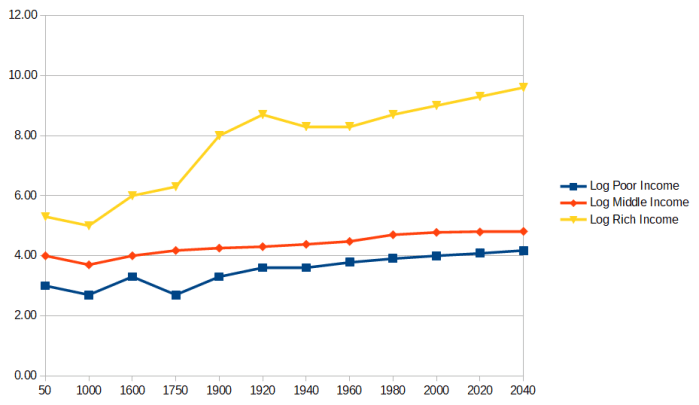
I’ve summarized all these income estimates in the graph below (note the log scale):
 

Carousel_of_Progress

This means that, after a bumpy ride through the Middle Ages and the Industrial Revolution, we did actually raise the floor—the poor today are about as well off as the middle class in ancient times. But we raised the ceiling an awful lot faster; the rich today are something like a thousand times as rich as the rich in ancient times.


50 AD: Roman Empire

Rich: Patrician

Life is good! My seaside villa is one of the finest in Rome, and my industrious slaves fulfill my every need. At my personal zoo I recently acquired a lion and an elephant. I dine on only the finest foods, including wine from my personal vineyard. An aqueduct feeds directly into my personal baths. The war in Gallia seems to be going well; I look forward to my share of the spoils.

Wealth: $4 million

Income: $200,000

Middle class: Plebeian

Things could be worse. My family has a roof over our heads and bread on our table, so I’m grateful for that. But working all day on the farm is exhausting, and we can’t afford servants to help. My oldest son is a gladiator, though so far he has not attained the highest ranks of the profession. My youngest son was recently drafted into military service in Gallia; I pray for his safety.

Wealth: $10,000

Income: $10,000

Poor: Proletarian

Wealth: $0

Income: $1,000

Living in a hovel I don’t even own with my four children and begging on the streets isn’t an easy life, but at least I’m not a slave. Most of our food is provided by public services. With the war raging in Gallia, one of our small blessings is that we are actually too poor to be drafted into service.

1000 AD: Medieval England

Rich: Duke

While living in a castle is nice, I sometimes wish an end to the frequent raids and border skirmishes that made these high walls necessary. Still, I can’t complain; I own plenty of land, and have plenty of serfs to work it. I am in good favor with the king, and so His Majesty’s army has helped protect my lands against invasion. I have all the feasts, wine, and women a man could ask for.

Wealth: $2 million

Income: $100,000

Middle class: Knight

I can’t complain. It is an honor to be a knight in His Majesty’s army, and I am proud that my family was able to earn enough wealth to buy me a horse, a sword, and the training necessary to reach this rank. I own a little bit of land, but my lord has called upon me for a new campaign, I’m hoping to buy a larger estate with the spoils I earn from it. My family has plenty of food to eat, though if the well runs dry I’m not sure where we’ll get more water.

Wealth: $5,000

Income: $5,000

Poor: Serf

Live grows harder by the day, it seems. My lord keeps demanding more and more work from us, but already the land is producing as much as it can bear. Though we are responsible for planting and harvesting the wheat, often the bread never makes it to my family’s table.

Wealth: $0

Income: $500

1600 AD: Renaissance Venice

Rich: Noble

With the advent of global trade and colonization, wealth has flooded into Venice, and I have had the chance to claim some portion of that flood. I dress in the finest silks, and eat exotic foods from lands as distant as India and China. Servants fulfill my every need. How could life be better?

Wealth: $10 million

Income: $1 million

Middle class: Merchant

I am a proud member of the trader’s guild. Though it our trade ships that carry wealth from across the seas, we often find that wealth passing on up to the nobles, leaving little for ourselves. Still, I have my own land, my own house, and plenty of food for my family.

Wealth: $10,000

Income: $10,000

Poor: The Pebbles

I had a good job working in construction until recently, but I was laid off. I could no longer afford my rent, so now I live on the streets. I feel as though I work constantly but never can find a way to get ahead.

Wealth: $0

Income: $2,000

1750 AD: Pre-Revolutionary France

Rich: Noble

Viva la France! Life is better than ever. Servants do all my work, while the wealth produced by my fields and factories all goes to me. I barely even pay any taxes on my grand estates.

Wealth: $20 million

Income: $2 million

Middle class: Bourgeoisie

I live reasonably well, all things considered. My family has a home and enough food to eat. Still, taxes are becoming increasingly onerous even as the nobles become increasingly detached from the needs of common people like us. Still, we may as well accept it; I doubt things will change any time soon.

Wealth: $15,000

Income: $15,000

Poor: Peasant

Life is hard. I work all day on the farm to make wheat, and then the nobles tax it all away. We have to make our own clothes even as the nobles luxuriate in silks from around the world.

Wealth: $0

Income: $500

1900 AD: United States

Rich

My coal mine has been a roaring success! I am now one of the richest men who has ever lived. I even have my own horseless carriage. Servants are getting more expensive these days, though; even though I’m richer than my grandfather I can’t afford as many servants.

Wealth: $1 billion

Income: $100 million

Middle class

“Well, the robins are back. That’s a sure sign of spring. What year is it? Oh, just before the turn of the century. And believe me, things couldn’t be any better than they are today. Yes sir, we got all the latest things: gas lamps, a telephone, and the latest design in cast iron stoves. That reservoir keeps five gallons of water hot all day on just three buckets of coal. Sure beats chopping wood! And isn’t our new ice box a beauty. Holds 50 pounds of ice. Milk doesn’t sour as quick as is used to. Our dog Rover here keeps the water in the drip pan from overflowing. You know, it wasn’t too long ago we had to carry water from a well. But thanks to progress, we’ve got a pump right here in the kitchen. ‘Course we keep a bucket of water handy to prime it with. Yes sir, we’ve got everything to make life easier. Mother! I was reading about a fellow named Tom Edison, who’s working on an idea for snap on electric lights.”

Wealth: $18,000

Income: $18,000

Poor

I live on the streets most of the time. I eat food out of the garbage. What little money I have is earned by begging. I’m not proud, but it’s all I can do to survive.

Wealth: $0

Income: $2,000

1920 AD: United States

Rich

Life is sweet. My electric company is raking in the dough these days; seems they can hardly find enough copper to lay all the new cables we need to supply all the folks buying into our grid. I have four automobiles now—all top of the line of course. The times, they are a-changin’: Can you believe they gave women the vote? Eh, well, I suppose they can hardly vote worse than us men do already.

Wealth: $5 billion

Income: $500 million

Middle class

“Whew! Hottest summer we’ve had in years. Well, we’ve progressed a long way since the turn of the century 20 years ago. But no one realized then that this would be the age of electricity. Everyone’s using it: farmers, factories, whole towns. With electric streetlights we don’t worry so much about the youngsters being out after dark. And what a difference in our home. We can run as many wires as we need in any direction for Mother’s new electrical servants: electric sewing machine, coffee percolator, toaster, waffle iron, refrigerator, and they all go to work at the click of a switch. Take it easy! You’ll blow a fuse! Queenie! Leave ’em alone. Well, the days of lugging heavy irons from the old cookstove to an ironing board are gone forever. With an electric iron and electric lights, Mother now has time to enjoy her embroidery in the cool of the evening. Right, Mother?”

Wealth: $20,000

Income: $20,000

Poor

Life on the streets is still hard, but at least they’ve got these new soup kitchens to feed me and my family, and with running water in the city we can sometimes get clean water to drink. That newfangled electricity stuff is supposed to be the bee’s knees, but we sure can’t afford it.

Wealth: $0

Income: $4,000

1940 AD: United States

Rich

My steel company is doing extremely well, particularly with the war in Europe raising the price of steel. We just bought our very own airplane; isn’t that marvelous? With Britain under siege and France already fallen to the Krauts, I think we’re gonna end up in the war soon—FDR certainly has been making noises to that effect. If I were poor, I’d be worried about my sons getting drafted; but I’m sure we won’t have to worry about that. No, I’m just looking forward to my stock returns when they start churning out tanks instead of cars in Detroit!

Wealth: $2 billion

Income: $200 million

Middle class

“Well it’s autumn again and the kids are back in school. Thank goodness! Here we are in the frantic forties and the music is better than ever. And it’s amazing how our new kitchen wonders are helping to take over the hard work. Everything is improving. Electric range is better. Refrigerators are bigger and make lots more ice cubes. But my favorite is the electric dishwasher. Now Mother spends less time in the kitchen and I don’t have to dry the dishes anymore. Oh, I spend a lot of time here. Have to. Now that television has arrived, Grandma and Grandpa have taken over my den. Television has changed our lives. It’s brought a whole new world of culture into our home.”

Wealth: $24,000

Income: $24,000

Poor

The Depression was hard on everybody, but I think it was hardest on us poors. This New Deal business seems to be helping out a lot, though; on one of the new construction projects I was able to find work for the first time in months. I’m worried we’re going to be brought into the war soon, but if I get drafted at least that means three squares a day.

Wealth: $0

Income: $4,000

1960 AD: United States

Rich

Running an oil company is not for the faint of heart; they keep adding more onerous regulations every year. Still, profits are bigger than ever. I just wish Uncle Sam would stop taking such a big cut; Commies, all of them. I can barely afford upkeep on my yacht these days with all the taxes.

Wealth: $2 billion

Income: $200 million

Middle class

We just got a color TV at home, and we’ve been watching around the clock. We get all four channels! And my new T-bird is a real beauty; paid a fortune for her, but worth every penny. Society is improving, too; with Rosa Parks and whatnot, I’m guessing things are about to get a lot better for colored folks especially. After that, I’m thinking it’ll be the gays’ turn next; I wonder how long that will take.

Wealth: $30,000

Income: $30,000

Poor

Life is still hard, but I think it’s better now than it’s ever been, even for poor folks like me. Thanks to Welfare, I’m not even as poor as I could be. It’s tough to make ends meet, but at least I can afford a place to live and food to eat. And I’m pretty healthy too: Antibiotics and vaccines mean that we are finally safe from some terrible diseases, like polio. It seems crazy: Just a generation ago the President had a disease that now even folks like me are protected from.

Wealth: $0

Income: $6,000

1980 AD: United States

Rich

They told me I was crazy to invest in these “personal computing machines”, but I saw the writing on the wall. Computers are the future, man. They’re gonna be everywhere, and do everything. We’re gonna have robots and flying cars, and if I have anything to say about it, I’m gonna own the factories that make them.

Wealth: $5 billion

Income: $500 million

Middle class

We have our own PC now. I use it for work, but my kids use it mostly for computer games. I still can’t beat my daughter at Pong, but I can at least hold my own at Pac-Man these days. I hear that programming skills are going to be in high demand soon, so I’ve been trying to teach the kids BASIC.

Wealth: $50,000

Income: $50,000

Poor

Nixon’s Welfare “reform” really hit my family hard. If I don’t find work soon, they’re going to cut my benefits; but if I could find work, what would I need benefits for? Jimmy Carter made some things better, but it doesn’t look like he’ll be re-elected. Can you believe that old actor Ronald Reagan is running?

Wealth: $0

Income: $8,000

2000 AD: United States

Rich

I sure played my cards right in the stock market, buying those tech firms just before the Internet boom really hit. Now I have my own jet and I’m thinking of buying a yacht. Maybe I’ll diversify into real estate; it looks like housing prices are heading north.

Wealth: $10 billion

Income: $1 billion

Middle class

Our home has almost doubled in value since we bought it; we took some of that out as a home equity loan, which helped us buy laptops for our kids. It’s amazing what they can do now; we used to have a big clunky desktop, and these little laptops would run circles around it. We also installed a 56k modem; I’m a little worried about what effect the Internet will have on the kids, but it seems like that’s where everything is going.

Wealth: $60,000

Income: $60,000

Poor

I hate working in fast food, but it beats not working at all. I really wish they’d raise minimum wage though; once you figure in inflation, we’re actually making less than people did ten years ago. I think I qualify for Welfare or something, but the paperwork has gotten so crazy I couldn’t even deal with it. I’m just trying to get by on what I make at the burger joint.

Wealth: $0

Income: $10,000

2020 AD: United States, Present Day

Rich

I knew my app startup would be a success, but even I couldn’t have predicted we’d make it this far. Bought out by Apple for $40 billion? I could hardly have dreamed it myself. I am living the high life; I’ve got my own helicopter now, and a yacht 50 feet long (#lifestyle #swag!). I just upgraded my Google Glass to the new model; it is awesome AF. I think I might move out of the Bay Area and get myself a mansion in Beverly Hills.

Wealth: $20 billion

Income: $2 billion

Middle class

Why is rent so expensive? And how am I ever going to pay off these student loans? After college I managed to land an office job because I’m pretty good with Excel, but it’s still tough to make ends meet. Smartphones are cool and all, but it would be nice to actually own my own home. I think my parents had planned for me to inherit theirs, but we lost it in the subprime crash. Eh, things could be worse. #FirstWorldProblems.

Wealth: $62,000

Income: $62,000

Poor

Things were really bad a few years ago, but they seem to be picking up a little now; I’ve been able to find a job, at least. But it doesn’t pay well; I can’t barely afford rent. I don’t have what they call “marketable skills”, I guess. I should have gone back to school, probably, but I didn’t want to have to deal with student loans. Maybe things will be better once Trump finally gets out of office.

Wealth: $0

Income: $12,000

2040 AD: United States, Cyberpunk Future

Rich

I guess I picked out the right crypto to buy, because it gave me enough to buy my own AI company and now I’m rolling in it. My new helicopter is one of those twin-turbofan models that runs on fuel cells—I was sick of paying carbon tax to fuel up the old kerosene model. I just got cybernetic implants: No phone to carry around, nothing to get lost! I hear they’re working on going to neural interface soon, so we won’t even need to wave our hands around to use them.

Wealth: $40 billion

Income: $4 billion

Middle-class

I used to have a nice job in data analysis, but they automated most of it and outsourced the rest. Now I work for a different corp doing customer service, because that’s the only thing humans seem to still be good for. I have to admit the corps have done some good things for us, though; my daughter was born blind but now she’s got artificial eyes. (Of course, how will we ever pay off those medical debts?) And I really wish someone had done something about climate change sooner; summers these days are absolutely unbearable.

Wealth: $65,000

Income: $65,000

Poor

Wealth: $0

Income: $15,000

I lost my trucking job to a robot, can you believe that? But how am I supposed to compete with 22 hours of daily uptime? Basic income is just about all the money I have. I haven’t been able to find steady work in years. I should have gone to college and studied CS, probably; it seems like salaries in AI get higher every year.
How much wealth is there in the world?

July 14 JDN 2458679

How much wealth is there in the world? If we split it all evenly, how much would each of us have?

It’s a surprisingly complicated question: What counts as wealth? Presumably we include financial assets, real estate, commodities—anything that can be sold on a market. But what about natural resources? Shouldn’t we somehow value clean air and water? What about human capital—health, knowledge, skills, and expertise that make us able to work better?

I’m going to stick with tradeable assets for now, because I’m interested in questions of redistribution. If we were to add up all the wealth in the United States, or all the wealth in the world, and split it all evenly, how much would each person get? Even then, there are questions about how to price assets: Do we current market prices, or what was actually paid for them in the past? How much do we depreciate? How do we count debt that was used to buy non-financial assets (such as student loans)?

The Federal Reserve reports an official estimate of the US capital stock at $56.2 trillion (in 2011 dollars). Assuming that a third of income is capital income, that means that of our GDP of $18.9 trillion (in 2012 dollars), this would make the rate of return on capital 11%. That rate of return strikes me as pretty clearly too high. This must be an underestimate of our capital stock.

The 2015 Global Wealth Report estimates total US wealth as $63.5 trillion, and total world wealth as $153.2 trillion. This was for 2014, so using the US GDP growth rate of about 2% and the world GDP growth rate of 3.6%, the current wealth stocks should be about $70 trillion and $183 trillion respectively.

This gives a much more plausible rate of return: One third of the US GDP of $19.6 trillion (in 2014 dollars) is $6.53 trillion, yielding a rate of return of about 9%.

One third of the world GDP of $78 trillion is $26 trillion, yielding a rate of return of about 14%. This seems a bit high, but we’re including a lot of countries with very little capital that we would expect to have very high rates of return, so it might be right.

Credit Suisse releases estimates of total wealth that are supposed to include non-financial assets as well, though these are even more uncertain than financial assets. They estimate total US wealth as $98 trillion and total world wealth as $318 trillion.

There’s a lot of uncertainty around all of these figures, but I think these are close enough to get a sense of what sort of redistribution might be possible.

If the US wealth stock is about $70 trillion and our population is about 330 million, that means that the average wealth of an American is $200,000. If our wealth stock is instead about $98 trillion, the average wealth of an American is about $300,000.

Since the average number of people in a US household is 2.5, this means that average household wealth is somewhere between $500,000 and $750,000. This is actually a bit less than I thought; I would have guessed that the mythical “average American household” is a millionaire. (Of course, even Credit Suisse might be underestimating our wealth stock.)

If the world wealth stock is about $180 trillion and the population is about 7.7 billion, global average wealth per person is about $23,000. If instead the global wealth stock is about $320 trillion, the average wealth of a human being is about $42,000.

Both of these are far above the median wealth, which is much more representative of what a typical person has. Median wealth per adult in the US is about $65,000; worldwide it’s only about $4,200.

This means that if we were to somehow redistribute all wealth in the United States, half the population would gain an average of somewhere between $140,000 and $260,000, or on a percentage basis, the median American would see their wealth increase by 215% to 400%. If we were to instead somehow redistribute all wealth in the world, half the population would gain an average of $19,000 to $38,000; the median individual would see their wealth increase by 450% to 900%.

Of course, we can’t literally redistribute all the wealth in the world. Even if we could somehow organize it logistically—a tall order to be sure—such a program would introduce all sorts of inefficiencies and perverse incentives. That would really be socialism: We would be allocating wealth entirely based on a government policy and not at all by the market.

But suppose instead we decided to redistribute some portion of all this wealth. How about 10%? That seems like a small enough amount to avoid really catastrophic damage to the economy. Yes, there would be some inefficiencies introduced, but this could be done with some form of wealth taxes that wouldn’t require completely upending capitalism.

Suppose we did this just within the US. 10% of US wealth, redistributed among the whole population, would increase median wealth by between $20,000 and $30,000, or between 30% and 45%. That’s already a pretty big deal. And this is definitely feasible; the taxation infrastructure is all already in place. We could essentially buy the poorest half of the population a new car on the dime of the top half.

If instead we tried to do this worldwide, we would need to build the fiscal capacity first; the infrastructure to tax wealth effectively is not in place in most countries. But supposing we could do that, we could increase median wealth worldwide by between $2,000 and $4,000, or between 50% and 100%. Of course, this would mean that many of us in the US would lose a similar amount; but I think it’s still quite remarkable that we could as much as double the wealth of most of the world’s population by redistributing only 10% of the total wealth. That’s how much wealth inequality there is in the world.

“Robots can’t take your job if you’re already retired.”

July 7 JDN 2458672

There is a billboard on I-405 near where I live, put up by some financial advisor company, with that slogan on it: “Robots can’t take your job if you’re already retired.”

First, let me say this: Don’t hire a financial advisor firm; you really don’t need one. 90% of actively-managed funds perform worse than simple index funds. Buy all the stocks and let them sit. You won’t be able to retire sooner because you paid someone else to do the same thing you could have done yourself.

Yet, there is some wisdom in this statement: The best answer to technological unemployment is to make it so people don’t need to be employed. As an individual, all you could really do there is try to save up and retire early. But as a society, there is a lot more we could do.

The goal should essentially to make everyone retired, or if not everyone, then whatever portion of the population has been displaced by automation. A pension for everyone sounds a lot like a basic income.

People are strangely averse to redistribution of wealth as such (perhaps because they don’t know, or don’t want to think about, how much of our existing wealth was gained by force?), so we may not want to call our basic income a basic income.

Instead, we will call it capital income. People seem astonishingly comfortable with Jeff Bezos making more income in a minute than his median employee makes in a year, as long as it’s capital income instead of “welfare” or “redistribution of wealth”.

The basic income will instead be called something like the Perpetual Dividend of the United States, the dividends each US citizen receives for being a shareholder in the United States of America. I know this kind of terminology works, because the Permanent Fund Dividend in Alaska is a successful and enormously popular basic income. Even conservatives in Alaska dare not suggest eliminating the PFD.
And in fact it could literally be capital income: While public ownership of factories generally does not go well (see: the entire history of socialism and communism), the most sensible way to raise revenue for this program would be to tax income gained by owners of robotic factories, which, even if on the books as salary or stock options or whatever, is at its core capital income. If we wanted to make that connection even more transparent, we could tax in the form of non-voting shares in corporations, so that instead of paying a conventional corporate tax, corporations simply had to pay a portion of their profits directly to the public fund.

I’m not quite sure why people are so much more uncomfortable with redistribution of wealth than they are with the staggering levels of wealth inequality that make it so obviously necessary. Maybe it’s the feeling of “robbing Peter to pay Paul”, or “running out of other people’s money”? But obviously a basic income won’t just be free money from nowhere. We would be collecting it in taxes, the same way we fund all other government spending. Even printing money would mean paying in the form of inflation (and we definitely should not print enough money to cover a whole basic income!)

I think it may simply be that people aren’t cognizant enough of the magnitude of wealth inequality. I’m hoping that my posts on the extremes of wealth and poverty might help a bit with that. The richest people on Earth make about $10 billion per year—that’s $10,000,000,000—simply for owning things. The poorest people on Earth struggle to survive on less than $500 per year—often working constantly throughout their waking hours. Even if we believe that billionaires work harder (obviously false) or contribute more to society (certainly debatable) than other people, do we really believe that some people deserve to make 20 million times as much as others? It’s one thing to think that being a successful entrepreneur should make you rich. It’s another to believe that it should make you so rich you could buy a house for every homeless person in America.
Automation is already making this inequality worse, and there is reason to think it will continue to do so. In our current system, when the owner of a corporation automates production, he then gets to claim all the output from the robots, where previously he had to pay wages to the workers—and that’s why he does the automation, because it makes him more profit. Even if overall productivity increases, the fruits of that new production always get concentrated at the top. Unless we can find a way to change that system, we’re going to need to redistribute some of that wealth.

But if we have to call it something else, so be it. Let’s all be shareholders in America.

Just how poor is poor?

June 2 JDN 2458637

In last week’s post I told you about the richest of the rich, the billionaires with ten, eleven, or even twelve-figure net wealth. My concern about them is only indirect: I care that we have concentrated so many of the resources of our society into this handful of people instead of spreading it around where it would do more good. But it is not inherently bad for billionaires to exist; all other things equal, people having more wealth is good.

Today my topic is the poorest of the poor. Their status is inherently bad. No one deserves it, and while for much of history we may have been powerless to prevent it, we are no longer. We could help these people—quite substantially quite cheaply, as you’ll see—and we are simply choosing not to. Perhaps you as an individual are not making this choice; perhaps, like me, you vote for candidates who support international aid and donate to top-rated international charities. But as a society, we are making this choice. Voters in the First World could all agree—or even 51% agree—that this problem really should be fixed, and we could fix it.

If asked, most people would say they care about world hunger, but either they are deeply ignorant about the solutions we now have availble to us, or they can’t really care about world hunger, or they would have voted for politicians who were committed to actually implementing the spending necessary to fix it. Maybe people would prefer to fix world hunger as long as it didn’t cost them a cent; but ask them to pay even a little bit, and suddenly they’re not so sure.

At current prices, the official UN threshold for “extreme poverty” is $1.90 in real consumption per person per day. I want to be absolutely clear about this: This is adjusted for inflation and local purchasing power. They account for all consumption, including hunting, fishing, gathering, and goods made at home or obtained through bartering. This is not an artifact of failing to adjust for prices or not including goods that aren’t bought with money. These people really do live on less than $700 per year.

Shockingly, they are not all in Third World countries. While the majority of what we call “poverty” in the United States is well above the standard of living of UN “extreme poverty”, there are exceptions to this; there are about 5 million people in the US who are genuinely so poor that they are accurately categorized as at or near that $1.90 per day threshold.

This is such a shocking and horrifying truth that many people will try to deny it, as at least one libertarian think-tank did in a propagandistic screed. No, the UN isn’t lying; it’s really that bad. Extreme poverty in the US could be fixed so quickly, so easily that the fact that it remains in place can only be called an atrocity. Change a few numbers in the IRS code, work out a payment distribution system to reach people without bank accounts using cash or mobile payments, and by the end of the year you would have ended extreme poverty in the United States with no more than a few billion dollars diverted—which is to say, an amount that Jeff Bezos himself could afford to pay, or an amount that could be raised by a single percentage point of capital gains tax applied to billionaires only.
Even so, life is probably better for a homeless person on the street in New York City than it is for a child with malaria whose parents died in civil war in Congo. The New Yorker has access to clean water via drinking fountains, basic sanitation via public toilets (particularly in government buildings, since private businesses often specifically try to exclude the homeless), and basic nutrition via food banks and soup kitchens. The Congolese child has none of these things.

Life for the very poorest is a constant struggle for survival, against disease, malnutrition, dehydration, and parasites. Forget having a refrigerator or a microwave (as most of the poor in the US do, and rightly so—these things are really cheap here); they often have little clothing and no reliable shelter. The idea of going to a school or seeing a doctor sounds like a pipe dream. Surprisingly, there is a good chance that they or someone they know has a smartphone; if so it is likely their most prized possession. Though in Congo in particular, smartphones are relatively rare, which is ironic because the most critical raw material for smartphones—tantalum—is quite prevalent in Congo and a major source of conflict there.

Such a hard life is also typically a short one. The average life expectancy in Congo is less than 65 years. This is mainly due to the fact that almost 15% of children will die before the age of five, though fortunately infant and child mortality in Congo is rapidly declining (though that means it used to be worse than this!).

A disease that is merely inconvenient in a rich country is often fatal in a poor one; malaria is the classic example of this. Malaria remains the cause of over one million deaths per year, but essentially no one dies of malaria in First World countries. It can be treated with quinine, which costs no more than $3 per pill. But when your total consumption is $1.50 per day, a $3 pill is still prohibitively expensive. While in rich countries antibiotic-resistant tuberculosis is a real danger, for the world’s poorest people it doesn’t much matter if the bacteria are resistant to antibiotics, because nobody can afford antibiotics.

What could we do to save these people? A great deal, as it turns out.

Ending extreme poverty worldwide wouldn’t be as easy as ending it in the United States; there’s no central taxation authority that would let us simply change a few numbers and then start writing checks.
We could implement changes through either official development aid or by supporting specific vetted non-governmental organizations, but each of these options carries drawbacks. Development aid can be embezzled by corrupt governments. NGOs can go bankrupt or have their assets expropriated.

Yet even with such challenges in mind, the total cost to end extreme poverty—not all poverty, but extreme poverty—worldwide is probably less than $200 billion per year. This is not a small sum, but it is well within our means. This is less than a third of the US military budget (not counting non-DoD military spending!), or about half what the US spends on gasoline.

Frankly I think we could safely divert that $200 billion directly from military spending without losing any national security. 21st century warfare is much less about blowing up targets and much more about winning hearts and minds. Ending world hunger would win an awful lot of hearts and minds, methinks. Obviously we can’t eliminate all military spending; those first two or three aircraft carrier battle groups really are keeping us and our allies safer. Did we really need eleven?

But all right, suppose we did need to raise additional tax revenue to fund this program. How much would taxes have to go up? Let’s say that only First World countries pay, which we can approximate using the GDP of the US and the EU (obviously we could also include Canada and Australia, but we might not want to include some of Eastern Europe, so that roughly balances out). Add up the $19 trillion of European Union GDP and $21 trillion of US GDP together and you get $40 trillion per year; $200 billion is only 0.5% of that. We would only need to raise taxes by half a percentage point to fund this program. Even if we didn’t make the tax progressive (and why wouldn’t we?), a typical family making $60,000 per year would only need to pay an extra $300 per year.

Why aren’t we doing this?

This is a completely serious question. Feel free to read it in an exasperated voice. I honestly would like to know why the world is willing to leave so many people in so much suffering when we could save them for such little cost.

What would a new macroeconomics look like?

Dec 9 JDN 2458462

In previous posts I have extensively criticized the current paradigm of macroeconomics. But it’s always easier to tear the old edifice down than to build a better one in its place. So in this post I thought I’d try to be more constructive: What sort of new directions could macroeconomics take?

The most important change we need to make is to abandon the assumption of dynamic optimization. This will be a very hard sell, as most macroeconomists have become convinced that the Lucas Critique means we need to always base everything on the dynamic optimization of a single representative agent. I don’t think this was actually what Lucas meant (though maybe we should ask him; he’s still at Chicago), and I certainly don’t think it is what he should have meant. He had a legitimate point about the way macroeconomics was operating at that time: It was ignoring the feedback loops that occur when we start trying to change policies.

Goodhart’s Law is probably a better formulation: Once you make an indicator into a target, you make it less effective as an indicator. So while inflation does seem to be negatively correlated with unemployment, that doesn’t mean we should try to increase inflation to extreme levels in order to get rid of unemployment; sooner or later the economy is going to adapt and we’ll just have both inflation and unemployment at the same time. (Campbell’s Law provides a specific example that I wish more people in the US understood: Test scores would be a good measure of education if we didn’t use them to target educational resources.)

The reason we must get rid of dynamic optimization is quite simple: No one behaves that way.

It’s often computationally intractable even in our wildly oversimplified models that experts spend years working on—now you’re imagining that everyone does this constantly?

The most fundamental part of almost every DSGE model is the Euler equation; this equation comes directly from the dynamic optimization. It’s supposed to predict how people will choose to spend and save based upon their plans for an infinite sequence of future income and spending—and if this sounds utterly impossible, that’s because it is. Euler equations don’t fit the data at all, and even extreme attempts to save them by adding a proliferation of additional terms have failed. (It reminds me very much of the epicycles that astronomers used to add to the geocentric model of the universe to try to squeeze in weird results like Mars, before they had the heliocentric model.)

We should instead start over: How do people actually choose their spending? Well, first of all, it’s not completely rational. But it’s also not totally random. People spend on necessities before luxuries; they try to live within their means; they shop for bargains. There is a great deal of data from behavioral economics that could be brought to bear on understanding the actual heuristics people use in deciding how to spend and save. There have already been successful policy interventions using this knowledge, like Save More Tomorrow.

The best thing about this is that it should make our models simpler. We’re no longer asking each agent in the model to solve an impossible problem. However people actually make these decisions, we know it can be done, because it is being done. Most people don’t really think that hard, even when they probably should; so the heuristics really can’t be that complicated. My guess is that you can get a good fit—certainly better than an Euler equation—just by assuming that people set a target for how much they’re going to save (which is also probably pretty small for most people), and then spend the rest.

The second most important thing we need to add is inequality. Some people are much richer than others; this is a very important fact about economics that we need to understand. Yet it has taken the economics profession decades to figure this out, and even now I’m only aware of one class of macroeconomic models that seriously involves inequality, the Heterogeneous Agent New Keynesian (HANK) models which didn’t emerge until the last few years (the earliest publication I can find is 2016!). And these models are monsters; they are almost always computationally intractable and have a huge number of parameters to estimate.

Understanding inequality will require more parameters, that much is true. But if we abandon dynamic optimization, we won’t need as many as the HANK models have, and most of the new parameters are actually things we can observe, like the distribution of wages and years of schooling.

Observability of parameters is a big deal. Another problem with the way the Lucas Critique has been used is that we’ve been told we need to be using “deep structural parameters” like the temporal elasticity of substitution and the coefficient of relative risk aversion—but we have no idea what those actually are. We can’t observe them, and all of our attempts to measure them indirectly have yielded inconclusive or even inconsistent results. This is probably because these parameters are based on assumptions about human rationality that are simply not realistic. Most people probably don’t have a well-defined temporal elasticity of substitution, because their day-to-day decisions simply aren’t consistent enough over time for that to make sense. Sometimes they eat salad and exercise; sometimes they loaf on the couch and drink milkshakes. Likewise with risk aversion: many moons ago I wrote about how people will buy both insurance and lottery tickets, which no one with a consistent coefficient of relative risk aversion would ever do.

So if we are interested in deep structural parameters, we need to base those parameters on behavioral experiments so that we can understand actual human behavior. And frankly I don’t think we need deep structural parameters; I think this is a form of greedy reductionism, where we assume that the way to understand something is always to look at smaller pieces. Sometimes the whole is more than the sum of its parts. Economists obviously feel a lot of envy for physics; but they don’t seem to understand that aerodynamics would never have (ahem) gotten off the ground if we had first waited for an exact quantum mechanical solution of the oxygen atom (which we still don’t have, by the way). Macroeconomics may not actually need “microfoundations” in the strong sense that most economists intend; it needs to be consistent with small-scale behavior, but it doesn’t need to be derived from small-scale behavior.

This means that the new paradigm in macroeconomics does not need to be computationally intractable. Using heuristics instead of dynamic optimization and worrying less about microfoundations will make the models simpler; adding inequality need not make them so much more complicated.

For labor day, thoughts on socialism

Planned Post 255: Sep 9 JDN 2458371

This week includes Labor Day, the holiday where we are perhaps best justified in taking the whole day off from work and doing nothing. Labor Day is sort of the moderate social democratic counterpart to the explicitly socialist holiday May Day.

The right wing in this country has done everything in their power to expand the definition of “socialism”, which is probably why most young people now have positive views of socialism. There was a time when FDR was seen as an alternative to socialism; but now I’m pretty sure he’d just be called a socialist.

Because of this, I am honestly not sure whether I should be considered a socialist. I definitely believe in the social democratic welfare state epitomized by Scandinavia, but I definitely don’t believe in total collectivization of all means of production.

I am increasingly convinced that shareholder capitalism is a terrible system (the renowned science fiction author Charles Stross actually gave an excellent talk on this subject), but I would not want to abandon free markets.
The best answer might be worker-owned cooperatives. The empirical data is actually quite consistent in showing worker co-ops to be as efficient if not more efficient than conventional corporations, and by construction their pay systems produce less inequality than corporations.

Indeed, I think there is reason to believe that a worker co-op is a much more natural outcome for free markets under a level playing field than a conventional corporation, and the main reason we have corporations is actually that capitalism arose out of (and in response to) feudalism.

Think about it: Why should most things be owned by the top 1%? (Okay, not quite “most”: to be fair, the top 1% only owns 40% of all US net wealth.) Why is 80% of the value of the stock market held by the top 10% of the population?

Most things aren’t done by the top 1%. There are a handful of individuals (namely, scientists who make seminal breakthroughs: Charles Darwin, Marie Curie, Albert Einstein, Rosalind Franklin, Alan Turing, Jonas Salk) who are so super-productive that they might conceivably deserve billionaire-level compensation—but they are almost never the ones who are actually billionaires. If markets were really distributing capital to those who would use it most productively, there’s no reason to think that inequality would be so self-sustaining—much less self-enhancing as it currently seems to be.

But when you realize that capitalism emerged out of a system where the top 1% (or less) already owned most things, and did so by a combination of “divine right” ideology and direct, explicit violence, this inequality becomes a lot less baffling. We never had a free market on a level playing field. The closest we’ve ever gotten has always been through social-democratic reforms (like the New Deal and Scandinavia).

How does this result in corporations? Well, when all the wealth is held by a small fraction of individuals, how do you start a business? You have to borrow money from the people who have it. Borrowing makes you beholden to your creditors, and puts you at great risk if your venture fails (especially back in the days when there were debtor’s prisons—and we’re starting to go back that direction!). Equity provides an alternative: In exchange for giving them the downside risk if your venture fails, you also give your creditors—now shareholders—the upside risk if your venture succeeds. But at the end of the day when your business has succeeded, where did most of the profits go? Into the hands of the people who already had money to begin with, who did nothing to actually contribute to society. The world would be better off if those people had never existed and their wealth had simply been shared with everyone else.

Compare this to what would happen if we all started with similar levels of wealth. (How much would each of us have? Total US wealth of about $44 trillion, spread among a population of 328 million, is about $130,000 each. I don’t know about you, but I think I could do quite a bit with that.) When starting a business, you wouldn’t go heavily into debt or sign away ownership of your company to some billionaire; you’d gather a group of dedicated partners, each of whom would contribute money and effort into building the business. As you added on new workers, it would make sense to pool their assets, and give them a share of the company as well. The natural structure for your business would be not a shareholder corporation, but a worker-owned cooperative.

I think on some level the super-rich actually understand this. If you look closely at the sort of policies they fight for, they really aren’t capitalist. They don’t believe in free, unfettered markets where competition reigns. They believe in monopoly, lobbying, corruption, nepotism, and above all, low taxes. (There’s actually nothing in the basic principles of capitalism that says taxes should be low. Taxes should be as high as they need to be to cover public goods—no higher, and no lower.) They don’t want to provide nationalized healthcare, not because they believe that private healthcare competition is more efficient (no one who looks at the data for even a few minutes can honestly believe that—US healthcare is by far the most expensive in the world), but because they know that it would give their employees too much freedom to quit and work elsewhere. Donald Trump doesn’t want a world where any college kid with a brilliant idea and a lot of luck can overthrow his empire; he wants a world where everyone owes him and his family personal favors that he can call in to humiliate them and exert his power. That’s not capitalism—it’s feudalism.

Crowdfunding also provides an interesting alternative; we might even call it the customer-owned cooperative. Kickstarter and Patreon provide a very interesting new economic model—still entirely within the realm of free markets—where customers directly fund production and interact with producers to decide what will be produced. This might turn out to be even more efficient—and notice that it would run a lot more smoothly if we had all started with a level playing field.

Establishing such a playing field, of course, requires a large amount of redistribution of wealth. Is this socialism? If you insist. But I think it’s more accurate to describe it as reparations for feudalism (not to mention colonialism). We aren’t redistributing what was fairly earned in free markets; we are redistributing what was stolen, so that from now on, wealth can be fairly earned in free markets.

We are in a golden age of corporate profits

Sep 2 JDN 245836

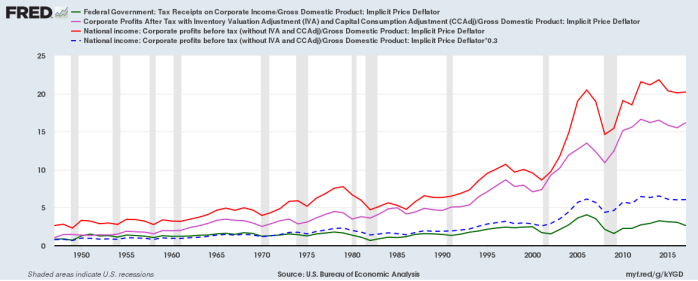
Take a good look at this graph, from the Federal Reserve Economic Database:

corporate_profits
The red line is corporate profits before tax. It is, unsurprisingly, the largest. The purple line is corporate profits after tax, with the standard adjustments for inventory depletion and capital costs. The green line is revenue from the federal corporate tax. Finally, I added a dashed blue line which multiplies before-tax profits by 30% to compare more directly with tax revenues. All these figures are annual, inflation-adjusted using the GDP deflator. The units are hundreds of billions of 2012 dollars.

The first thing you should notice is that the red and purple lines are near the highest they have ever been. Before-tax profits are over $2 trillion. After-tax profits are over $1.6 trillion.

Yet, corporate tax revenues are not the highest they have ever been. In 2006, they were over $400 billion; yet this year they don’t even reach $300 billion. The obvious reason for this is that we have been cutting corporate taxes. The more important reason is that corporations have gotten very good at avoiding whatever corporate taxes we charge.

On the books, we used to have a corporate tax rate of about 35%, which Trump just cut to 21%. But if you look at my dashed line, you can see that corporations haven’t actually paid more than 30% of their profits in taxes since 1970—and back then, the rate on the books was almost 50%.

Corporations have always avoided taxes. The effective tax rate—tax revenue divided by profits—is always much lower than the rate on the books. In 1951, the statutory tax rate was 50.75%; the effective rate was 47%. In 1970, the statutory rate was 49.2%; the effective rate was 31%. In 1993, the statutory rate was 35%; the effective rate was 26%. On average, corporations paid about 2/3 to 3/4 of what the statutory rate said.

corporate_tax_rate

You can even see how the effective rate trended steadily downward, much faster than the statutory rate. Corporations got better and better at finding and creating loopholes to let them avoid taxes. In 1950, the statutory rate was 38%—and sure enough, the effective rate was… 38%. Under Truman, corporations actually paid what they said they paid. Compare that to 1987, under Reagan, when the statutory rate was 40%—but the effective rate was only 26%.

Yet even with that downward trend, something happened under George W. Bush that widened the gap even further. While the statutory rate remained fixed at 35%, the effective rate plummeted from 26% in 2000 to 16% in 2002. The effective rate never again rose above 19%, and in 2009 it hit a minimum of just over 10%—less than one-third the statutory tax rate. It was trending upward, making it as “high” as 15%, until Trump’s tax cuts hit; in 2017 it was 13%, and it is projected to be even lower this year.

This is why it has always been disingenuous to compare our corporate tax rates with other countries and complain that they are too high. Our effective corporate tax rates have been in line with most other highly-developed countries for a long time now. The idea of “cutting rates and removing loopholes” sounds good in principle—but never actually seems to happen. George W. Bush’s “tax reforms” which were supposed to do this added so many loopholes that the effective tax rate plummeted.

I’m actually fairly ambivalent about corporate taxes in general. Their incidence really isn’t well-understood, though as Krugman has pointed out, so much of corporate profit is now monopoly rent that we can reasonably expect most of the incidence to fall on shareholders. What I’d really like to see happen is a repeal of the corporate tax combined with an increase in capital gains taxes. But we haven’t been increasing capital gains taxes; we’ve just been cutting corporate taxes.

The result has been a golden age for corporate profits. Make higher profits than ever before, and keep almost all of them without paying taxes! Nevermind that the deficit is exploding and our infrastructure is falling apart. America was founded in part on a hatred of taxes, so I guess we’re still carrying on that proud tradition.

Slides from my presentation at Worldcon

Whether you are a regular reader curious about my Worldcon talk, or a Worldcon visitor interested in seeing the slides, The slides from my presentation, “How do we get to the Federation from here?” can be found here.

Is a job guarantee better than a basic income?

Aug 5 JDN 2458336

In previous posts I’ve written about both the possibilities and challenges involved in creating a universal basic income. Today I’d like to address what I consider the most serious counter-argument against a basic income, an alternative proposal known as a job guarantee.

Whereas a basic income is literally just giving everyone free money, a job guarantee entails offering everyone who wants to work a job paid by the government. They’re not necessarily contradictory, but I’ve noticed a clear pattern: While basic income proponents are generally open to the idea of a job guarantee on the side, job guarantee proponents are often vociferously opposed to a basic income—even calling it “sinister”. I think the reason for this is that we see jobs as irrelevant, so we’re okay with throwing them in if you feel you must, while they see jobs as essential, so they meet any attempt to remove them with overwhelming resistance.

Where a basic income is extremely simple and could be implemented by a single act of the legislature, a job guarantee is considerably more complicated. The usual proposal for a job guarantee involves federal funding but local implementation, which is how most of our social welfare system is implemented—and why social welfare programs are so much better in liberal states like California than in conservative states like Mississippi, because California actually believes in what it’s implementing and Mississippi doesn’t. Anyone who wants a job guarantee needs to take that aspect seriously: In the places where poverty is worst, you’re offering control over the policy to the very governments that made poverty worst—and whether it is by malice or incompetence, what makes you think that won’t continue?

Another argument that I think job guarantee proponents don’t take seriously enough is the concern about “make-work”. They insist that a job guarantee is not “make-work”, but real work that’s just somehow not being done. They seem to think that there are a huge number of jobs that we could just create at the snap of a finger, which would be both necessary and useful on the one hand, and a perfect match for the existing skills of the unemployed population on the other hand. If that were the case, we would already be creating those jobs. It doesn’t even require a particularly strong faith in capitalism to understand this: If there is a profit to be made at hiring people to do something, there is probably already a business hiring people to do that. I don’t think of myself as someone with an overriding faith in capitalism, but a lot of the socialist arguments for job guarantees make me feel that way by comparison: They seem to think that there’s this huge untapped reserve of necessary work that the market is somehow failing to provide, and I’m just not seeing it.

There are public goods projects which aren’t profitable but would still be socially beneficial, like building rail lines and cleaning up rivers. But proponents of a job guarantee don’t seem to understand that these are almost all highly specialized jobs at our level of technology. We don’t need a bunch of people with shovels. We need engineers and welders and ecologists.

If you propose using people with shovels where engineers would be more efficient, that is make-work, whether you admit it or not. If you’re making people work in a less-efficient way in order to create jobs, then the jobs you are creating are fake jobs that aren’t worth creating. The line is often credited to Milton Friedman, but actually said first by William Aberhart in 1935:

Taking up the policy of a public works program as a solution for unemployment, it was criticized as a plan that took no account of the part that machinery played in modern construction, with a road-making machine instanced as an example. He saw, said Mr. Aberhart, work in progress at an airport and was told that the men were given picks and shovels in order to lengthen the work, to which he replied why not give them spoons and forks instead of picks and shovels if the object was to lengthen out the task.

I’m all for spending more on building rail lines and cleaning up rivers, but that’s not an anti-poverty program. The people who need the most help are precisely the ones who are least qualified to work on these projects: Children, old people, people with severe disabilities. Job guarantee proponents either don’t understand this fact or intentionally ignore it. If you aren’t finding jobs for 7-year-olds with autism and 70-year-olds with Parkinson’s disease, this program will not end poverty. And if you are, I find it really hard to believe that these are real, productive jobs and not useless “make-work”. A basic income would let the 7-year-olds stay in school and the 70-year-olds live in retirement homes—and keep them both out of poverty.

Another really baffling argument for a job guarantee over basic income is that a basic income would act as a wage subsidy, encouraging employers to reduce wages. That’s not how a basic income works. Not at all. A basic income would provide a pure income effect, necessarily increasing wage demands. People would not be as desperate for work, so they’d be more comfortable turning down unreasonable wage offers. A basic income would also incentivize some people to leave the labor force by retiring or going back to school; the reduction in labor supply would further increase wages. The Earned Income Tax Credit is in many respects similar to a wage subsidy. While superficially it might seem similar, a basic income would have the exact opposite effect.

One reasonable argument against a basic income is the possibility that it could cause inflation. This is something that can’t really be tested with small-scale experiments, so we really won’t know for sure until we try it. But there is reason to think that the inflation would be small, as the people removed from the labor force will largely be the ones who are least-productive to begin with. There is a growing body of empirical evidence suggesting that inflationary effects of a basic income would be small. For example, data on cash transfer programs in Mexico show only a small inflationary effect despite large reductions in poverty. The whole reason a basic income looks attractive is that automation technology is now so advanced is that we really don’t need everyone to be working anymore. Productivity is so high now that a policy of universal 40-hour work weeks just doesn’t make sense in the 21st century.

Probably the best argument for a job guarantee over a basic income concerns cost. A basic income is very expensive, there’s no doubt about that; and a job guarantee could be much cheaper. That is something I take very seriously: Saving $1.5 trillion a year is absolutely a good reason. Indeed, I don’t really object to this argument; the calculations are correct. I merely think that a basic income is enough better that its higher cost is justifiable. A job guarantee can eliminate unemployment, but not poverty.

But the argument for a job guarantee that most people seem to be find most compelling concerns meaning. The philosopher John Danaher expressed this one most cogently. Unemployment is an extremely painful experience for most people, far beyond what could be explained simply by their financial circumstances. Most people who win large sums of money in the lottery cut back their hours, but continue working—so work itself seems to have some value. What seems to happen is that when people lose the chance to work, they feel that they have lost a vital source of meaning in their lives.

Yet this raises two more questions:

First, would a job guarantee actually solve that problem?
Second, are there ways we could solve it under a basic income?

With regard to the first question, I want to re-emphasize the fact that a large proportion of these guaranteed jobs necessarily cannot be genuinely efficient production. If efficient production would have created these jobs, we would most likely already have created them. Our society does not suffer from an enormous quantity of necessary work that could be done with the skills already possessed by the unemployed population, which is somehow not getting done—indeed, it is essentially impossible for a capitalist economy with a highly-liquid financial system to suffer such a malady. If the work is so valuable, someone will probably take out a loan to hire someone to do it. If that’s not happening, either the unemployed people don’t have the necessary skills, or the work really can’t be all that productive. There are some public goods projects that would be beneficial but aren’t being done, but that’s a different problem, and the match between the public goods projects that need done and the skills of the unemployed population is extremely poor. Displaced coal miners aren’t useful for maintaining automated photovoltaic factories. Truckers who get replaced by robot trucks won’t be much good for building maglev rails.

With this in mind, it’s not clear to me that people would really be able to find much meaning in a guaranteed job. You can’t be fired, so the fact that you have the job doesn’t mean anyone is impressed by the quality of your work. Your work wasn’t actually necessary, or the private sector would already have hired someone to do it. The government went out of its way to find a job that precisely matched what you happen to be good at, regardless of whether that job was actually accomplishing anything to benefit society. How is that any better than not working at all? You are spending hours of drudgery to accomplish… what, exactly? If our goal was simply to occupy people’s time, we could do that with Netflix or video games.

With regard to the second question, note that a basic income is quite different from other social welfare programs in that everyone gets it. So it’s very difficult to attach a social stigma to receiving basic income payments—it would require attaching the stigma to literally everyone. Much of the lost meaning, I suspect, from being unemployed comes from the social stigma attached.

Now, it’s still possible to attach social stigma to people who only get the basic income—there isn’t much we can do to prevent that. But in the worst-case scenario, this means unemployed people get the same stigma as before but more money. Moreover, it’s much harder to detect a basic income recipient than, say, someone who eats at a soup kitchen or buys food using EBT; since it goes in your checking account, all everyone else sees is you spending money from your debit card, just like everyone else. People who know you personally would probably know; but people who know you personally are also less likely to destroy your well-being by imposing a high stigma. Maybe they’ll pressure you to get off the couch and get a job, but they’ll do so because they genuinely want to help you, not because they think you are “one of those lazy freeloaders”.

And, as BIEN points out, think about retired people: They don’t seem to be so unhappy. Being on basic income is more like being retired than like being unemployed. It’s something everyone gets, not some special handout for “those people”. It’s permanent, so it’s not like you need to scramble to get a job before it goes away. You just get money automatically, so you don’t have to navigate a complex bureaucracy to get it. Controlling for income, retired people don’t seem to be any less happy than working people—so maybe work doesn’t actually provide all that much meaning after all.

I guess I can’t rule out the possibility that people need jobs to find meaning in their lives, but I both hope and believe that this is not generally the case. You can find meaning in your family, your friends, your community, your hobbies. You can still work even if you don’t need to work for a living: Build a shed, mow your lawn, tune up your car, upgrade your computer, write a story, learn a musical instrument, or try your hand at painting.

If you need to be taking orders from a corporation five days a week in order to have meaning in your life, you have bigger problems. I think what has happened to many people is that employment has so drained their lives of the real sources of meaning that they cling to it as the only thing they have left. But in fact work is not the cure to your ennui—it is the cause of it. Finally being free of the endless toil that has plagued humanity since the dawn of our species will give you the chance to reconnect with what really matters in life. Show your children that you love them in person, to their faces, instead of in this painfully indirect way of “providing for” them by going to work every day. Find ways to apply your skills in volunteering or creating works of art, instead of in endless drudgery for the profit of some faceless corporation.

The asymmetric impact of housing prices

Jul 22 JDN 2458323

In several previous posts I’ve talked about the international crisis of high housing prices. Today, I want to talk about some features of housing that make high housing prices particularly terrible, in a way that other high prices would not be.

First, there is the fact that some amount of housing is a basic necessity, and houses are not easily divisible. So even if the houses being built are bigger than you need, you still need some kind of house, and you can’t buy half a house; the best you could really do would be to share it with someone else, and that introduces all sorts of other complications.

Second, t here is a deep asymmetry here. While rising housing prices definitely hurt people who want to buy houses, they benefit hardly anyone.


If you bought a house for $200,000 and then all housing prices doubled so it would now sell for $400,000, are you richer? You might feel richer. You might even have access to home equity loans that would give you more real liquidity. But are you actually richer?

I contend you are not, because the only way for you to access that wealth would be to sell your home, and then you’d need to buy another home, and that other home would also be twice as expensive. The amount of money you can get for your house may have increased, but the amount of house you can get for your house is exactly the same.

Conversely, suppose that housing prices fell by half, and now that house only sells for $100,000. Are you poorer? You still have your house. Even if your mortgage isn’t paid off, it’s still the same mortgage. Your payments haven’t changed. And once again, the amount of house you can get for your house will remain the same. In fact, if you are willing to accept a deed in lieu of foreclosure (it’s bad for your credit, of course), you can walk away from that underwater house and buy a new one that’s just as good with lower payments than what you are currently making. You may actually be richer because the price of your house fell.

Relative housing prices matter, certainly. If you own a $400,000 house and move to a city where housing prices have fallen to $100,000, you are definitely richer. And if you own a $100,000 house and move to a city where housing prices have risen to $400,000, you are definitely poorer. These two effects necessarily cancel out in the aggregate.

But do absolute housing prices matter for homeowners? It really seems to me that they don’t. The people who care about absolute housing prices are not homeowners; they are people trying to enter the market for the first time.
And this means that lower housing prices are almost always better. If you could buy a house for $1,000, we would live in a paradise where it was basically impossible to be homeless. (When social workers encountered someone who was genuinely homeless, they could just buy them a house then and there.) If every home cost $10 million, those who bought homes before the price surge would be little better off than they are, but the rest of us would live on the streets.

Psychologically, people very strongly resist falling housing prices. Even in very weak housing markets, most people will flatly refuse to sell their house for less than they paid for it. As a result, housing prices usually rise with inflation, but don’t usually fall in response to deflation. Rents also display similar rigidity over time. But in reality, lower prices are almost always better for almost everyone.

There is a group of people who are harmed by low housing prices, but it is a very small group of people, most of whom are already disgustingly rich: The real estate industry. Yes, if you build new housing, or flip houses, or buy and sell houses on speculation, you will be harmed by lower housing prices. Of these, literally the only one I care about even slightly is developers; and I only care about developers insofar as they are actually doing their job building housing that people need. If falling prices hurt developers, it would be because the supply of housing was so great that everyone who needs a house could have one.

There is a subtler nuance here, which is that some people may be buying more expensive housing as a speculative saving vehicle, hoping that they can cash out on their house when they retire. To that, I really only have one word of advice: Don’t. Don’t contribute to another speculative housing bubble that could cause another Great Recession. A house is not even a particularly safe investment, because it’s completely undiversified. Buy stocks. Buy all the stocks. Buy a house because you want that house, not because you hope to make money off of it.

And if the price of your house does fall someday? Don’t panic. You may be no worse off, and other people are probably much better off.