What we could, what we should, and what we must

May 27 JDN 2458266

In one of the most famous essays in all of ethical philosophy, Peter Singer famously argued that we are morally obligated to give so much to charity that we would effectively reduce ourselves to poverty only slightly better than what our donations sought to prevent. His argument is a surprisingly convincing one, especially for such a radical proposition. Indeed, one of the core activities of the Effective Altruism movement has basically been finding ways to moderate Singer’s argument without giving up on its core principles, because it’s so obvious both that we ought to do much more to help people around the world and that there’s no way we’re ever going to do what that argument actually asks of us.

The most cost-effective charities in the world can save a human life for an average cost of under $4,000. The maneuver that Singer basically makes is quite simple: If you know that you could save someone’s life for $4,000, you have $4,000 to spend, and instead you spend that $4,000 on something else, aren’t you saying that whatever you did spend it on was more important than saving that person’s life? And is that really something you believe?

But if you think a little more carefully, it becomes clear that things are not quite so simple. You aren’t being paid $4,000 to kill someone, first of all. If you were willing to accept $4,000 as sufficient payment to commit a murder, you would be, quite simply, a monster. Implicitly the “infinite identical psychopath” of neoclassical rational agent models would be willing to do such a thing, but very few actual human beings—even actual psychopaths—are that callous.

Obviously, we must refrain from murdering people, even for amounts far in excess of $4,000. If you were offered the chance to murder someone for $4 billion dollars, I can understand why you would be tempted to do such a thing. Think of what you could do with all that money! Not only would you and everyone in your immediate family be independently wealthy for life, you could donate billions of dollars to charity and save as much as a million lives. What’s one life for a million? Even then, I have a strong intuition that you shouldn’t commit this murder—but I have never been able to find a compelling moral argument for why. The best I’ve been able to come up with a sort of Kantian notion: What if everyone did this?

Since the most plausible scenario is that the $4 billion comes from existing wealth, all those murders would simply be transferring wealth around, from unknown sources. If you stipulate where the wealth comes from, the dilemma can change quite a bit.

Suppose for example the $4 billion is confiscated from Bashar Al-Assad. That would be in itself a good thing, lessening the power of a genocidal tyrant. So we need to add that to the positive side of the ledger. It is probably worth killing one innocent person just to undermine Al-Assad’s power; indeed, the US Air Force certainly seems to think so, as they average more than one civilian fatality every day in airstrikes.

Now suppose the wealth was extracted by clever financial machinations that took just a few dollars out of every bank account in America. This would be in itself a bad thing, but perhaps not a terrible thing, especially since we’re planning on giving most of it to UNICEF. Those people should have given it anyway, right? This sounds like a pretty good movie, actually; a cyberpunk Robin Hood basically.

Next, suppose it was obtained by stealing the life savings of a million poor people in Africa. Now the method of obtaining the money is so terrible that it’s not clear that funneling it through UNICEF would compensate, even if you didn’t have to murder someone to get it.

Finally, suppose that the wealth is actually created anew—not printed money from the Federal Reserve, but some new technology that will increase the world’s wealth by billions of dollars yet requires the death of an innocent person to create. In this scenario, the murder has become something more like the inherent risk in human subjects biomedical research, and actually seems justifiable. And indeed, that fits with the Kantian answer, for if we all had the chance to kill one person in order to create something that would increase the wealth of the world by $4 billion, we could turn this planet into a post-scarcity utopia within a generation for fewer deaths than are currently caused by diabetes.

Anyway, my point here is that the detailed context of a decision actually matters a great deal. We can’t simply abstract away from everything else in the world and ask whether the money is worth the life.

When we consider this broader context with regard to the world’s most cost-effective charities, it becomes apparent that a small proportion of very dedicated people giving huge proportions of their income to charity is not the kind of world we want to see.

If I actually gave so much that I equalized my marginal utility of wealth to that of a child dying of malaria in Ghana, I would have to donate over 95% of my income—and well before that point, I would be homeless and impoverished. This actually seems penny-wise and pound-foolish even from the perspective of total altruism: If I stop paying rent, it gets a lot harder for me to finish my doctorate and become a development economist. And even if I never donated another dollar, the world would be much better off with one more good development economist than with even another $23,000 to the Against Malaria Foundation. Once you factor in the higher income I’ll have (and proportionately higher donations I’ll make), it’s obviously the wrong decision for me to give 95% of $25,000 today rather than 10% of $70,000 every year for the next 20 years after I graduate.

But the optimal amount for me to donate from that perspective is whatever the maximum would be that I could give without jeopardizing my education and career prospects. This is almost certainly more than I am presently giving. Exactly how much more is actually not all that apparent: It’s not enough to say that I need to be able to pay rent, eat three meals a day, and own a laptop that’s good enough for programming and statistical analysis. There’s also a certain amount that I need for leisure, to keep myself at optimal cognitive functioning for the next several years. Do I need that specific video game, that specific movie? Surely not—but if I go the next ten years without ever watching another movie or playing another video game, I’m probably going to be in trouble psychologically. But what exactly is the minimum amount to keep me functioning well? And how much should I be willing to spend attending conferences? Those can be important career-building activities, but they can also be expensive wastes of time.

Singer acts as though jeopardizing your career prospects is no big deal, but this is clearly wrong: The harm isn’t just to your own well-being, but also to your productivity and earning power that could have allowed you to donate more later. You are a human capital asset, and you are right to invest in yourself. Exactly how much you should invest in yourself is a much harder question.
Such calculations are extremely difficult to do. There are all sorts of variables I simply don’t know, and don’t have any clear way of finding out. It’s not a good sign for an ethical theory when even someone with years of education and expertise on specifically that topic still can’t figure out the answer. Ethics is supposed to be something we can apply to everyone.

So I think it’s most helpful to think in those terms: What could we apply to everyone? What standard of donation would be high enough if we could get everyone on board?

World poverty is rapidly declining. The direct poverty gap at the UN poverty line of $1.90 per day is now only $80 billion. Realistically, we couldn’t simply close that gap precisely (there would also be all sorts of perverse incentives if we tried to do it that way). But the standard estimate that it would take about $300 billion per year in well-targeted spending to eliminate world hunger is looking very good.

How much would each person, just those in the middle class or above within the US or the EU, have to give in order to raise this much?
89% of US income is received by the top 60% of households (who I would say are unambiguously “middle class or above”). Income inequality is not as extreme within the EU, so the proportion of income received by the top 60% seems to be more like 75%.

89% of US GDP plus 75% of EU GDP is all together about $29 trillion per year. This means that in order to raise $300 billion, each person in the middle class or above would need to donate just over one percent of their income.

Not 95%. Not 25%. Not even 10%. Just 1%. That would be enough.

Of course, more is generally better—at least until you start jeopardizing your career prospects. So by all means, give 2% or 5% or even 10%. But I really don’t think it’s helpful to make people feel guilty about not giving 95% when all we really needed was for everyone to give 1%.

There is an important difference between what we could do, what we should do, and what we must do.

What we must do are moral obligations so strong they are essentially inviolable: We must not murder people. There may be extreme circumstances where exceptions can be made (such as collateral damage in war), and we can always come up with hypothetical scenarios that would justify almost anything, but for the vast majority of people the vast majority of time, these ethical rules are absolutely binding.

What we should do are moral obligations that are strong enough to be marks against your character if you break them, but not so absolutely binding that you have to be a monster not to follow them. This is where I put donating at least 1% of your income. (This is also where I put being vegetarian, but perhaps that is a topic for another time.) You really ought to do it, and you are doing something wrongful if you don’t—but most people don’t, and you are not a terrible person if you don’t.

This latter category is in part socially constructed, based on the norms people actually follow. Today, slavery is obviously a grave crime, and to be a human trafficker who participates in it you must be a psychopath. But two hundred years ago, things were somewhat different: Slavery was still wrong, yes, but it was quite possible to be an ordinary person who was generally an upstanding citizen in most respects and yet still own slaves. I would still condemn people who owned slaves back then, but not nearly as forcefully as I would condemn someone who owned slaves today. Two hundred years from now, perhaps vegetarianism will move up a category: The norm will be that everyone eats only plants, and someone who went out of their way to kill and eat a pig would have to be a psychopath. Eating meat is already wrong today—but it will be more wrong in the future. I’d say the same about donating 1% of your income, but actually I’m hoping that by two hundred years from now there will be no more poverty left to eradicate, and donation will no longer be necessary.

Finally, there is what we could do—supererogatory, even heroic actions of self-sacrifice that would make the world a better place, but cannot be reasonably expected of us. This is where donating 95% or even 25% of your income would fall. Yes, absolutely, that would help more people than donating 1%; but you don’t owe the world that much. It’s not wrong for you to contribute less than this. You don’t need to feel guilty for not giving this much.

But I do want to make you feel guilty if you don’t give at least 1%. Don’t tell me you can’t. You can. If your income is $30,000 per year, that’s $300 per year. If you needed that much for a car repair, or dental work, or fixing your roof, you’d find a way to come up with it. No one in the First World middle class is that liquidity-constrained. It is true that half of Americans say they couldn’t come up with $400 in an emergency, but I frankly don’t believe it. (I believe it for the bottom 25% or so, who are actually poor; but not half of Americans.) If you have even one credit card that’s not maxed out, you can do this—and frankly even if a card is maxed out, you can probably call them and get them to raise your limit. There is something you could cut out of your spending that would allow you to get back 1% of your annual income. I don’t know what it is, necessarily: Restaurants? Entertainment? Clothes? But I’m not asking you to give a third of your income—I’m asking you to give one penny out of every dollar.

I give considerably more than that; my current donation target is 8% and I’m planning on raising it to 10% or more once I get a high-paying job. I live on a grad student salary which is less than the median personal income in the US. So I know it can be done. But I am very intentionally not asking you to give this much; that would be above and beyond the call of duty. I’m only asking you to give 1%.
You know what? Let’s repeal Obamacare. Here’s my replacement.

Feb 18 JDN 2458168

By all reasonable measures, Obamacare has been a success. Healthcare costs are down but coverage rates are up. It reduced both the federal deficit and after-tax income inequality.

But Republicans have hated it the whole time, and in particular the individual mandate provision has always been unpopular. Under the Trump administration, the individual mandate has now been repealed.

By itself, this can only be disastrous. It threatens to undermine all the successes of the entire Obamacare system. Without the individual mandate, covering pre-existing conditions means that people can simply wait to get insurance until they need it—at which point it’s not insurance anymore. The risks stop being shared and end up concentrated on whoever gets sick, then we go back to people going bankrupt because they were unlucky enough to get cancer. The individual mandate was vital to making Obamacare work.

But I do actually understand why the individual mandate is unpopular: Nobody likes being forced into buying anything.

John Roberts ruled that the individual mandate was Constitutional on the grounds that it is economically equivalent to a tax. This is absolutely correct, and I applaud his sound reasoning.

That said, the individual mandate is not in fact psychologically equivalent to a tax.

Psychologically, being forced to specifically buy something or face punishment feels a lot more coercive than simply owing a certain amount of money that the government will use to buy something. Roberts is right; economically, these two things are equivalent. The same real goods get purchased, at the same people’s expense; the accounts balance in the same way. But it feels different.

And it would feel different to me too, if I were required to actually shop for that particular avionic component on that Apache helicopter my taxes paid for, or if I had to write a check for that particular section of Highway 405 that my taxes helped maintain. Yes, I know that I give the government a certain amount of money that they spent on salaries for US military personnel; but I’d find it pretty weird if they required me to actually hand over the money in cash to some specific Marine. (On the other hand, this sort of thing might actually give people a more visceral feel for the benefits of taxes, much as microfinance agencies like to show you the faces of particular people as you give them loans, whether or not those people are actually the ones getting your money.)

There’s another reason it feels different as well: We have framed the individual mandate as a penalty, as a loss. Human beings are loss averse; losing $10 feels about twice as bad as not getting $10. That makes the mandate more unpleasant, hence more unpopular.

What could we do instead? Well, obviously, we could implement a single-payer healthcare system like we already have in Medicare, like they have in Canada and the UK, or like they have in Scandinavia (#ScandinaviaIsBetter). And that’s really what we should do.

But since that doesn’t seem to be on the table right now, here’s my compromise proposal. Okay, yes, let’s repeal Obamacare. No more individual mandate. No fines for not having health insurance.

Here’s what we would do instead: You get a bonus refundable tax credit for having health insurance.

We top off the income tax rate to adjust so that revenue ends up the same.

Say goodbye to the “individual mandate” and welcome the “health care bonus rebate”.

Most of you reading this are economically savvy enough to realize that’s the same thing. If I tax you $100, then refund $100 if you have health insurance, that’s completely equivalent to charging you a fine of $100 if you don’t have health insurance.

But it doesn’t feel the same to most people. A fine feels like a punishment, like a loss. It hurts more than a mere foregone bonus, and it contains an element of disapproval and public shame.

Whereas, we forgo refundable tax credits all the time. You’ve probably forgone dozens of refundable tax credits you could have gotten, either because you didn’t know about them or because you realized they weren’t worth it to you.

Now instead of the government punishing you for such a petty crime as not having health insurance, the government is rewarding you for the responsible civic choice of having health insurance. We have replaced a mean, vindictive government with a friendly, supportive government.

Positive reinforcement is more reliable anyway. (Any child psychologist will tell you that while punishment is largely ineffective and corporal punishment is outright counterproductive, reward systems absolutely do work.) Uptake of health insurance should be at least as good as before, but the policy will be much more popular.

It’s a very simple change to make. It could be done in a single tax bill. Economically, it makes no difference at all. But psychologically—and politically—it could make all the difference in the world.

Why is redistribution of wealth so difficult to achieve in the US?

Jan 28 JDN 2458147

Income and wealth in equality is much higher in the US than in other First World countries. Within the OECD, only Mexico, Turkey, and Chile have higher income inequality than we do. Over 60% of Americans agree that the distribution of wealth in the US is unfair. Furthermore, the majority of Americans support the use of taxes and transfers to directly redistribute wealth from the rich to the poor.

Why, then, is it so hard to actually get any meaningful wealth redistribution in the United States?

Part of it is surely partisan differences: While about 70% of Democrats favor redistributive taxes, about 70% of Republicans oppose them. So one would not expect a move toward redistribution when Republicans control all three branches of government, and indeed we have seen quite the opposite. (Then again, one would also not expect a government shutdown under one-party rule, and yet that is what we have.)

But even most Republicans say they would like to see a much more equal distribution of wealth than the one we actually have. In fact, when I as an inequality economist look at the distribution of wealth people say they want, it looks a little too equal! Even Denmark and Sweden aren’t that egalitarian! I know more or less how to get from here to Denmark; but from here to “Equalden” looks like an awful long way. So if this is really the distribution of wealth people want, we need to be doing a huge amount of wealth redistribution—but we’re hardly doing any at all.

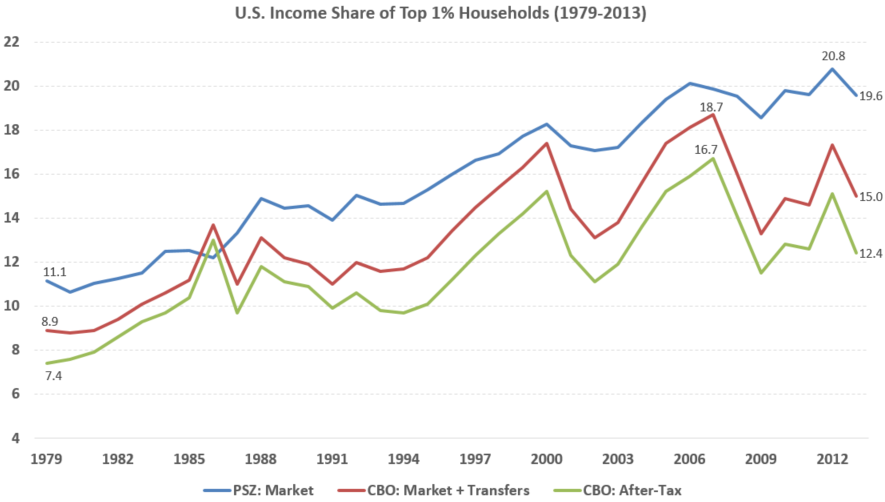
Indeed, we didn’t actually see all that much redistribution of wealth when Democrats more or less controlled all three branches in the period from 2008-2010. We may have seen a little bit shortly thereafter, and tax policy typically does come with a delay of a year or two. But as you can see in this graph, the Great Recession did more to reduce the top 1% income share than any tax policy changes:

US_top_income_share_1pct

The biggest changes made to our tax code under Obama were actually the handling of capital gains; the increase of the top rate on capital gains from 15% to 20%, plus the 3.8% capital surtax from the Affordable Care Act raised the tax bill for the top 0.1% by tens of billions of dollars. Surprisingly, Trump’s tax cuts don’t actually remove these provisions, though they did dramatically cut the corporate tax rate, which will probably have a similar effect on the income distribution.

To be honest, I’m not as disappointed with Trump’s tax cuts as I thought I would be. Some genuinely good ideas (like the reduction of the mortgage interest deduction, tighter restrictions on carried interest, and increase of the personal standard deduction) and some reasonable but debatable ideas (like cuts to the corporate tax rate, switching to a territorial corporate tax system, limits to deductions on corporate debt payments, removal of the deduction of state taxes, and extensions of 529 savings plans to private primary and secondary schools) were mixed in with the absolutely ludicrous and terrible ideas (like eliminating the Obamacare mandate, doubling the estate tax threshold, cutting the alcohol tax, and allowing offshore drilling in Alaska [One of these things is not like the other ones….]). Some of the terrible ideas, like ending the deduction of student loan interest and tuition waivers, were actually removed in the final version of the bill. Of course, you won’t be surprised when I tell you that the overall US tax system became a lot less progressive as a result of this bill. And even if cutting the corporate tax while raising the capital gains tax is probably a good idea (as I and many economists believe), cutting the corporate tax without raising the capital gains tax probably isn’t.

(An aside: For how much they claim to be “tough on crime”, it’s always kind of baffling to see how often Republicans like to cut alcohol taxes and pollution regulations, which are pretty much the only things that have ever been empirically shown to actually reduce crime. There is some evidence that maybe more policing also helps, but if so, it does so in a far less cost-effective way—indeed, the direct cost of alcohol taxes and pollution taxes is negative. Even if they didn’t work at all, they’d still be worth it just because they raise revenue. I begin to suspect that Republicans don’t actually want to reduce crime, because they know they can use the fear of crime to win votes; they simply want to appear tough on crime, and so they press as hard as they can for more policing and incarceration in the country that already has the highest incarceration rate in the world. This may be a more general phenomenon: While Democrats want to actually solve problems, Republicans want to appear to solve problems while actually exacerbating them, thus insuring their own job security. Compare how Bush kept talking about Osama bin laden while invading Iraq, and Obama actually killed Osama bin Laden. Is this too cynical? Can anything be too cynical in the era of Trump? There were 50,000 Russian bots on Twitter trying to tilt our election! Mueller’s FBI investigation is already implicating several of Trump’s top officials! Everything that seemed like paranoia or cynicism just a few years ago is turning out to be entirely true.)

This is what seems to happen: Year after year, we raise some taxes, then we cut some taxes. Then when raise some taxes, then we cut some taxes. The tax system gets a little more progressive for a few years and inequality begins to fall, and then those changes are removed and inequality begins to rise again. Back and forth and round and round we go.

Is there some way to lock in these tax changes for a longer period of time? The only way I can see would be a change in voter behavior: Keep voting in Democrats to all branches of government consistently for 20 years, and then maybe we would see a serious reduction in income and wealth inequality. Or at least stop voting in Republicans; aside from the Democrats, there are some third parties that would also support redistribution, like the Green Party. And yes, it really is about voting behavior: As prevalent as gerrymandering has become, as terrible as the Electoral College is, as widespread as voter suppression has gotten, Trump only won because 63 million Americans voted for him. Even after everything he’s done, Trumps’ approval rating is still about 39%. As long as there are enough people in this country whose partisan loyalty so strongly outweighs any rational assessment of policy, we are going to continue to see such travesties continue.

It would certainly help if our voting system were fairer, so that third parties had a better chance at taking seats. But it’s also difficult to see how that could happen any time soon. For now, the best I can come up with is trying to show people two things:

First, most Americans favor redistribution of wealth. You’re not alone in wanting that. It’s not some fringe opinion.

Second, there is a real difference between Democrats and Republicans on this issue. The canard “The two parties are the same” is the most untrue it has been in at least twenty years.

I would even understand if there are other issues you consider more important than wealth redistribution. Ecological sustainability is the most defensible—you can’t eat GNP—though that would push you even harder toward the left. Among things that might push you right, I can understand being concerned about higher taxes hurting economic growth, and while I think the view that abortion is murder is ludicrous, given that as your belief I can understand why you would want to prioritize fighting abortion. (If I thought we were murdering millions of babies every year, I’d be pretty mad too! Of course, you should be glad, then, that the US abortion rate has been falling. Right? You know about that, right?)

What I don’t get, however, is people who thought that voting for Donald Trump would help working people. I don’t understand how you can see someone who epitomizes everything that is wrong with the billionaire rentier class and think, “Yeah, he seems like he’s definitely a populist. That guy who was born insanely rich and made even more mind-boggling amounts of money by lying and screwing people over is definitely going to look out for folks like me.”

If I understood that, maybe I would know where to go from here. But people’s political beliefs can be astonishingly intransigent to evidence. Politics is the mind-killer.

Did the World Bank modify its ratings to manipulate the outcome of an election in Chile?

Jan 21 JDN 2458140

(By the way, my birthday is January 19. I can’t believe I’m turning 30.)

This is a fairly obscure news item, so you may have missed it. It should be bigger news than it is.
I can’t fault the New York Times for having its front page focus mainly on the false missile alert that was issued to some people in Hawaii; a false alarm of nuclear attack definitely is the most important thing that could be going on in the world, short of course of actual nuclear war.

CNN, on the other hand, is focused entirely on Trump. When I first wrote this post, they were also focused on Trump, mainly interested in asking whether Trump’s comments about “immigrants from shithole countries” was racist. My answer: Yes, but not because he said the countries were “shitholes”. That was crude, yes, but not altogether inaccurate. Countries like Syria, Afghanistan, and Sudan are, by any objective measure, terrible places. His comments were racist because they attributed that awfulness to the people leaving these countries. But in fact we have a word for immigrants who flee terrible places seeking help and shelter elsewhere: Refugees. We call those people refugees. There are over 10 million refugees in the world today, most of them from Syria.

So anyway, here’s the news item you should have heard about but probably didn’t: The Chief Economist of the World Bank (Paul Romer, who coincidentally I mentioned in my post about DSGE models) has opened an investigation into the possibility that the World Bank’s ratings of economic freedom were intentionally manipulated in order to tilt a Presidential election in Chile.

The worst part is, it may have worked: Chile’s “Doing Business” rating consistently fell under President Michelle Bachelet and rose under President Sebastian Piñera, and Piñera won the most recent election. Was that the reason he won? Who knows? I’m still not entirely clear on how we ended up with President Trump. But it very likely contributed.

The World Bank is supposed to be an impartial institution representing the interests of global economic development. I’m not naive; I recognize that no human institution is perfect, and there will always be competing political and economic interests within any complex institution. Development economists are subject to cognitive biases just like anyone else. If this was the work of a handful of economic analysts (or if Romer turns out to be wrong and the changes in statistical methodology were totally reasonable), so be it; let’s make sure that the bias is corrected and the analysts involved are punished.

But I fear that the rot may run deeper than this. The World Bank is effectively a form of unelected international government. It has been accused of inherent pro-capitalist (or even racist) bias due to the fact that Western governments are overrepresented in its governance, but I actually consider that accusation unfair: There are very good reasons to make sure that your international institutions are managed by liberal democracies, and turns out that most of the world’s liberal democracies are Western. The fact that the US, France, Germany, and the UK make most of the decisions is entirely sensible: Those are in fact the countries we should want making global decisions.

China is not underrepresented, because China is not a democracy and doesn’t deserve to be represented. They are already more represented in the World Bank than they should be, because representing the PRC is not actually representing the interests of the people of China. Russia and Saudi Arabia are undeniably overrepresented. India is underrepresented; they should be complaining. Some African democracies, such as Namibia and Botswana, would also have a legitimate claim to underrepresentation. But I don’t lose any sleep over the fact that Zimbabwe and Iran aren’t getting votes in the World Bank. If and when those countries actually start representing their people, then we can talk about giving them representation in world government. I don’t see how refusing to give international authority to dictators and theocrats constitutes racism or pro-capitalist bias.

That said, there are other reasons to think that the World Bank might actually have some sort of pro-capitalist bias. The World Bank was instrumental in forming the Washington Consensus, which opened free trade and increase economic growth worldwide, but also exposed many poor countries to risk from deregulated financial markets and undermined social safety nets through fiscal austerity programs. They weren’t wrong to want more free trade, and many of their reforms did make sense; but they were at best wildly overconfident in their policy prescriptions, and at worst willing to sacrifice people in poor countries at the altar of bank profits. World poverty has in fact fallen by about half since 1990, and the World Bank has a lot to do with that. But things may have gone faster and smoother if they hadn’t insisted on removing so many financial regulations so quickly without clear forecasts of what would happen. I don’t share Jason Hickel’s pessimistic view that the World Bank’s failures were intentional acts toward an ulterior agenda, but I can see how it begins to look that way when they keep failing the same ways over and over again. (I instead invoke Hanlon’s razor: “Never attribute to malice that which is adequately explained by stupidity.”)

There are also reports of people facing retaliation for criticizing World Bank projects, including those within the World Bank who raise ethical concerns. If this was politically-motivated data manipulation, there may have been people who saw it happening, but were afraid to say anything for fear of being fired or worse.

And Chile in particular has reason to be suspicious. The World Bank suddenly started giving loans to Chile when Augusto Pinochet took power (the CIA denies supporting the coup, by the way—though, given the source, I can understand why one would take that with a grain of salt), and did so under the explicit reasoning that an authoritarian capitalist regime was somehow “more trustworthy” than a democratic socialist regime. Even in the narrow sense of financial creditworthiness that seems difficult to defend; the World Bank knew almost nothing about what kind of government Pinochet was going to create, and in fact despite the so-called “Miracle of Chile”, rapid economic growth in Chile didn’t really happen until the 1990s, after Chile became a democratic capitalist regime.

What I’m really getting at here is that the World Bank has a lot to answer for. I am prepared to believe that most of these actions were honest mistakes or ideological blinders, rather than corruption or cruelty; but even so, when millions of lives are at stake, even honest mistakes aren’t so forgivable. They should be looking for ways to improve their internal governance to make sure that mistakes are caught and corrected quickly. They should be constantly vigilant for biases—either intentional or otherwise—that might seep into their research. Error should be met with immediate correction and public apology; malfeasance should be met with severe punishment.

Perhaps Romer’s investigation actually signals a shift toward such a policy. If so, this is a very good thing. If only we had done this, say, thirty years ago.

“DSGE or GTFO”: Macroeconomics took a wrong turn somewhere

Dec 31, JDN 2458119

The state of macro is good,” wrote Oliver Blanchard—in August 2008. This is rather like the turkey who is so pleased with how the farmer has been feeding him lately, the day before Thanksgiving.

It’s not easy to say exactly where macroeconomics went wrong, but I think Paul Romer is right when he makes the analogy between DSGE (dynamic stochastic general equilbrium) models and string theory. They are mathematically complex and difficult to understand, and people can make their careers by being the only ones who grasp them; therefore they must be right! Nevermind if they have no empirical support whatsoever.

To be fair, DSGE models are at least a little better than string theory; they can at least be fit to real-world data, which is better than string theory can say. But being fit to data and actually predicting data are fundamentally different things, and DSGE models typically forecast no better than far simpler models without their bold assumptions. You don’t need to assume all this stuff about a “representative agent” maximizing a well-defined utility function, or an Euler equation (that doesn’t even fit the data), or this ever-proliferating list of “random shocks” that end up taking up all the degrees of freedom your model was supposed to explain. Just regressing the variables on a few years of previous values of each other (a “vector autoregression” or VAR) generally gives you an equally-good forecast. The fact that these models can be made to fit the data well if you add enough degrees of freedom doesn’t actually make them good models. As Von Neumann warned us, with enough free parameters, you can fit an elephant.

But really what bothers me is not the DSGE but the GTFO (“get the [expletive] out”); it’s not that DSGE models are used, but that it’s almost impossible to get published as a macroeconomic theorist using anything else. Defenders of DSGE typically don’t even argue anymore that it is good; they argue that there are no credible alternatives. They characterize their opponents as “dilettantes” who aren’t opposing DSGE because we disagree with it; no, it must be because we don’t understand it. (Also, regarding that post, I’d just like to note that I now officially satisfy the Athreya Axiom of Absolute Arrogance: I have passed my qualifying exams in a top-50 economics PhD program. Yet my enmity toward DSGE has, if anything, only intensified.)

Of course, that argument only makes sense if you haven’t been actively suppressing all attempts to formulate an alternative, which is precisely what DSGE macroeconomists have been doing for the last two or three decades. And yet despite this suppression, there are alternatives emerging, particularly from the empirical side. There are now empirical approaches to macroeconomics that don’t use DSGE models. Regression discontinuity methods and other “natural experiment” designs—not to mention actual experiments—are quickly rising in popularity as economists realize that these methods allow us to actually empirically test our models instead of just adding more and more mathematical complexity to them.

But there still seems to be a lingering attitude that there is no other way to do macro theory. This is very frustrating for me personally, because deep down I think what I would like to do as a career is macro theory: By temperament I have always viewed the world through a very abstract, theoretical lens, and the issues I care most about—particularly inequality, development, and unemployment—are all fundamentally “macro” issues. I left physics when I realized I would be expected to do string theory. I don’t want to leave economics now that I’m expected to do DSGE. But I also definitely don’t want to do DSGE.

Fortunately with economics I have a backup plan: I can always be an “applied micreconomist” (rather the opposite of a theoretical macroeconomist I suppose), directly attached to the data in the form of empirical analyses or even direct, randomized controlled experiments. And there certainly is plenty of work to be done along the lines of Akerlof and Roth and Shiller and Kahneman and Thaler in cognitive and behavioral economics, which is also generally considered applied micro. I was never going to be an experimental physicist, but I can be an experimental economist. And I do get to use at least some theory: In particular, there’s an awful lot of game theory in experimental economics these days. Some of the most exciting stuff is actually in showing how human beings don’t behave the way classical game theory predicts (particularly in the Ultimatum Game and the Prisoner’s Dilemma), and trying to extend game theory into something that would fit our actual behavior. Cognitive science suggests that the result is going to end up looking quite different from game theory as we know it, and with my cognitive science background I may be particularly well-positioned to lead that charge.

Still, I don’t think I’ll be entirely satisfied if I can’t somehow bring my career back around to macroeconomic issues, and particularly the great elephant in the room of all economics, which is inequality. Underlying everything from Marxism to Trumpism, from the surging rents in Silicon Valley and the crushing poverty of Burkina Faso, to the Great Recession itself, is inequality. It is, in my view, the central question of economics: Who gets what, and why?

That is a fundamentally macro question, but you can’t even talk about that issue in DSGE as we know it; a “representative agent” inherently smooths over all inequality in the economy as though total GDP were all that mattered. A fundamentally new approach to macroeconomics is needed. Hopefully I can be part of that, but from my current position I don’t feel much empowered to fight this status quo. Maybe I need to spend at least a few more years doing something else, making a name for myself, and then I’ll be able to come back to this fight with a stronger position.

In the meantime, I guess there’s plenty of work to be done on cognitive biases and deviations from game theory.

What exactly is “gentrification”? How should we deal with it?

Nov 26, JDN 2458083

“Gentrification” is a word that is used in a variety of mutually-inconsistent ways. If you compare the way social scientists use it to the way journalists use it, for example, they are almost completely orthogonal.

The word “gentrification” is meant to invoke the concept of a feudal gentry—a hereditary landed class that extracts rents from the rest of the population while contributing little or nothing themselves.

If indeed that is what we are talking about, then obviously this is bad. Moreover, it’s not an entirely unfounded fear; there are some remarkably strong vestiges of feudalism in the developed world, even in the United States where we never formally had a tradition of feudal titles. There really is a significant portion of the world’s wealth held by a handful of billionaire landowner families.

But usually when people say “gentrification” they mean something much broader. Almost any kind of increase in urban real estate prices gets characterized as “gentrification” by at least somebody, and herein lies the problem.

In fact, the kind of change that is most likely to get characterized as “gentrification” isn’t even the rising real estate prices we should be most worried about. People aren’t concerned when the prices of suburban homes double in 20 years. You might think that things that are already too expensive getting more expensive would be the main concern, but on the contrary, people are most likely to cry “gentrification” when housing prices rise in poor areas where housing is cheap.

One of the most common fears about gentrification is that it will displace local residents. In fact, the best quasi-experimental studies show little or no displacement effect. It’s actually mainly middle-class urbanites who get displaced by rising rents. Poor people typically own their homes, and actually benefit from rising housing prices. Young upwardly-mobile middle-class people move to cities to rent apartments near where they work, and tend to assume that’s how everyone lives, but it’s not. Rising rents in a city are far more likely to push out its grad students than they are poor families that have lived there for generations. Part of why displacement does not occur may be because of policies specifically implemented to fight it, such as subsidized housing and rent control. If that’s so, let’s keep on subsidizing housing (though rent control will always be a bad idea).

Nor is gentrification actually a very widespread phenomenon. The majority of poor neighborhoods remain poor indefinitely. In most studies, only about 30% of neighborhoods classified as “gentrifiable” actually end up “gentrifying”. Less than 10% of the neighborhoods that had high poverty rates in 1970 had low poverty rates in 2010.

Most people think gentrification reduces crime, but in the short run the opposite is the case. Robbery and larceny are higher in gentrifying neighborhoods. Criminals are already there, and suddenly they get much more valuable targets to steal from, so they do.

There is also a general perception that gentrification involves White people pushing Black people out, but this is also an overly simplistic view. First of all, a lot of gentrification is led by upwardly-mobile Black and Latino people. Black people who live in gentrified neighborhoods seem to be better off than Black people who live in non-gentrified neighborhoods; though selection bias may contribute to this effect, it can’t be all that strong, or we’d observe a much stronger displacement effect. Moreover, some studies have found that gentrification actually tends to increase the racial diversity of neighborhoods, and may actually help fight urban self-segregation, though it does also tend to increase racial polarization by forcing racial mixing.

What should we conclude from all this? I think the right conclusion is we are asking the wrong question.

Rising housing prices in poor areas aren’t inherently good or inherently bad, and policies designed specifically to increase or decrease housing prices are likely to have harmful side effects. What we need to be focusing on is not houses or neighborhoods but people. Poverty is definitely a problem, for sure. Therefore we should be fighting poverty, not “gentrification”. Directly transfer wealth from the rich to the poor, and then let the housing market fall where it may.

There is still some role for government in urban planning more generally, regarding things like disaster preparedness, infrastructure development, and transit systems. It may even be worthwhile to design regulations or incentives that directly combat racial segregation at the neighborhood level, for, as the Schelling Segregation Model shows, it doesn’t take a large amount of discriminatory preference to have a large impact on socioeconomic outcomes. But don’t waste effort fighting “gentrification”; directly design policies that will incentivize desegregation.

Rising rent as a proportion of housing prices is still bad, and the fundamental distortions in our mortgage system that prevent people from buying houses are a huge problem. But rising housing prices are most likely to be harmful in rich neighborhoods, where housing is already overpriced; in poor neighborhoods where housing is cheap, rising prices might well be a good thing.
In fact, I have a proposal to rapidly raise homeownership across the United States, which is almost guaranteed to work, directly corrects an enormous distortion in financial markets, and would cost about as much as the mortgage interest deduction (which should probably be eliminated, as most economists agree). Give each US adult a one-time grant voucher which gives them $40,000 that can only be spent as a down payment on purchasing a home. Each time someone turns 18, they get a voucher. You only get one over your lifetime, so use it wisely (otherwise the policy could become extremely expensive); but this is an immediate direct transfer of wealth that also reduces your credit constraint. I know I for one would be house-hunting right now if I were offered such a voucher. The mortgage interest deduction means nothing to me, because I can’t afford a down payment. Where the mortgage interest deduction is regressive, benefiting the rich more than the poor, this policy gives everyone the same amount, like a basic income.

In the short run, this policy would probably be expensive, as we’d have to pay out a large number of vouchers at once; but with our current long-run demographic trends, the amortized cost is basically the same as the mortgage interest deduction. And the US government especially should care about the long-run amortized cost, as it is an institution that has lasted over 200 years without ever missing a payment and can currently borrow at negative real interest rates.

How rich are we, really?

Oct 29, JDN 2458056

The most commonly-used measure of a nation’s wealth is its per-capita GDP, which is simply a total of all spending in a country divided by its population. More recently we adjust for purchasing power, giving us GDP per capita at purchasing power parity (PPP).

By this measure, the United States always does well. At most a dozen countries are above us, most of them by a small amount, and all of them are quite small countries. (For fundamental statistical reasons, we should expect both the highest and lowest average incomes to be in the smallest countries.)

But this is only half the story: It tells us how much income a country has, but not how that income is distributed. We should adjust for inequality.

How can we do this? I have devised a method that uses the marginal utility of wealth plus a measure of inequality called the Gini coefficient to work out an estimate of the average utility, instead of the average income.

I then convert back into a dollar figure. This figure is the income everyone would need to have under perfect equality, in order to give the same real welfare as the current system. That is, if we could redistribute wealth in such a way to raise everyone above this value up to it, and lower everyone above this value down to it, the total welfare of the country would not change. This provides a well-founded ranking of which country’s people are actually better off overall, accounting for both overall income and the distribution of that income.

The estimate is sensitive to the precise form I use for marginal utility, so I’ll show you comparisons for three different cases.

The “conservative” estimate uses a risk aversion parameter of 1, which means that utility is logarithmic in income. The real value of a dollar is inversely proportional to the number of dollars you already have.

The medium estimate uses a risk aversion parameter of 2, which means that the real value of a dollar is inversely proportional to the square of the number of dollars you already have.

And then the “liberal” estimate uses a risk aversion parameter of 3, which means that the real value of a dollar is inversely proportional to the cube of the number of dollars you already have.

I’ll compare ten countries, which I think are broadly representative of classes of countries in the world today.

The United States, the world hegemon which needs no introduction.

China, rising world superpower and world’s most populous country.

India, world’s largest democracy and developing economy with a long way to go.

Norway, as representative of the Scandinavian social democracies.

Germany, as representative of continental Europe.

Russia, as representative of the Soviet Union and the Second World bloc.

Saudi Arabia, as representative of the Middle East petrostates.

Botswana, as representative of African developing economies.

Zimbabwe, as representative of failed Sub-Saharan African states.

Brazil, as representative of Latin American developing economies.
The ordering of these countries by GDP per-capita PPP is probably not too surprising:

  1. Norway 69,249
  2. United States 57,436
  3. Saudi Arabia 55,158
  4. Germany 48,111
  5. Russia 26,490
  6. Botswana 17,042
  7. China 15,399
  8. Brazil 15,242
  9. India 6,616
  10. Zimbabwe 1,970

Norway is clearly the richest, the US, Saudi Arabia, and Germany are quite close, Russia is toward the upper end, Botswana, China, and Brazil are close together in the middle, and then India and especially Zimbabwe are extremely poor.

But now let’s take a look at the inequality in each country, as measured by the Gini coefficient (which ranges from 0, perfect equality, to 1, total inequality).

  1. Botswana 0.605
  2. Zimbabwe 0.501
  3. Brazil 0.484
  4. United States 0.461
  5. Saudi Arabia 0.459
  6. China 0.422
  7. Russia 0.416
  8. India 0.351
  9. Germany 0.301
  10. Norway 0.259

The US remains (alarmingly) close to Saudi Arabia by this measure. Most of the countries are between 40 and 50. But Botswana is astonishingly unequal, while Germany and Norway are much more equal.

With that in mind, let’s take a look at the inequality-adjusted per-capita GDP. First, the conservative estimate, with a parameter of 1:

  1. Norway 58700
  2. United States 42246
  3. Saudi Arabia 40632
  4. Germany 39653
  5. Russia 20488
  6. China 11660
  7. Botswana 11138
  8. Brazil 11015
  9. India 5269
  10. Zimbabwe 1405

So far, ordering of nations is almost the same compared to what we got with just per-capita GDP. But notice how Germany has moved up closer to the US and Botswana actually fallen behind China.

Now let’s try a parameter of 2, which I think is the closest to the truth:

  1. Norway 49758
  2. Germany 32683
  3. United States 31073
  4. Saudi Arabia 29931
  5. Russia 15581
  6. China 8829
  7. Brazil 7961
  8. Botswana 7280
  9. India 4197
  10. Zimbabwe 1002

Now we have seen some movement. Norway remains solidly on top, but Germany has overtaken the United States and Botswana has fallen behind not only China, but also Brazil. Russia remains in the middle, and India and Zimbawbe remain on the bottom.

Finally, let’s try a parameter of 3.

  1. Norway 42179
  2. Germany 26937
  3. United States 22855
  4. Saudi Arabia 22049
  5. Russia 11849
  6. China 6685
  7. Brazil 5753
  8. Botswana 4758
  9. India 3343
  10. Zimbabwe 715

Norway has now pulled far and away ahead of everyone else. Germany is substantially above the United States. China has pulled away from Brazil, and Botswana has fallen almost all the way to the level of India. Zimbabwe, as always, is at the very bottom.

Let’s compare this to another measure of national well-being, the Inequality-Adjusted Human Development Index (which goes from 0, the worst, to 1 the best). This index combines education, public health, and income, and adjusts for inequality. It seems to be a fairly good measure of well-being, but it’s very difficult to compile data for, so a lot of countries are missing (including Saudi Arabia); plus the precise weightings on everything are very ad hoc.

  1. Norway 0.898
  2. Germany 0.859
  3. United States 0.796
  4. Russia 0.725
  5. China 0.543
  6. Brazil 0.531
  7. India 0.435
  8. Botswana 0.433
  9. Zimbabwe 0.371

Other than putting India above Botswana, this ordering is the same as what we get from my (much easier to calculate and theoretically more well-founded) index with either a parameter of 2 or 3.

What’s more, my index can be directly interpreted: The average standard of living in the US is as if everyone were making $31,073 per year. What exactly is an IHDI index of 0.796 supposed to mean? We’re… 79.6% of the way to the best possible country?

In any case, there’s a straightforward (if not terribly surprising) policy implication here: Inequality is a big problem.

In particular, inequality in the US is clearly too high. Despite an overall income that is very high, almost 18 log points higher than Germany, our overall standard of living is actually about 5 log points lower due to our higher level of inequality. While our average income is only 19 log points lower than Norway, our actual standard of living is 47 log points lower.

Inequality in Botswana also means that their recent astonishing economic growth is not quite as impressive as it at first appeared. Many people are being left behind. While in raw income they appear to be 10 log points ahead of China and only 121 log points behind the US, once you adjust for their very high inequality they are 19 log points behind China, and 145 log points behind the US.

Of course, some things don’t change. Norway is still on top, and Zimbabwe is still on the bottom.

This is one of the worst wildfire seasons in American history. But it won’t be for long.

Oct 22, JDN 2458049

At least 38 people have now been killed by the wildfires that are still ongoing in California; in addition, 5700 buildings have been destroyed and 190,000 acres of land burned. The State of California keeps an updated map of all the fires that are ongoing and how well-controlled they are; it’s not a pretty sight.

While the particular details are extreme, this is not an isolated incident. This year alone, wildfires have destroyed over 8 million acres of land in the US. In 2015, that figure was 10 million acres.

Property damage for this year’s wildfires in California is estimated at over $65 billion. That’s more than what Trump recently added to the military budget, and getting close to our total spending on food stamps.

There is a very clear upward trend in the scale and intensity of wildfires just over the last 50 years, and the obvious explanation is climate change. As climate change gets worse, these numbers are projected to increase between 30% and 50% by the 2040s. We still haven’t broken the record of fire damage in 1910, but as the upward trend continues we might soon enough.

It’s important to keep the death tolls in perspective; much as with hurricanes, our evacuation protocols and first-response agencies do their jobs very well, and as a result we’ve been averaging only about 10 wildfire deaths per year over the whole United States for the last century. In a country of over 300 million people, that’s really an impressively small number. That number has also been trending upward, however, so we shouldn’t get complacent.

Climate change isn’t the only reason these fires are especially damaging. It also matters where you build houses. We have been expanding our urban sprawl into fire-prone zones, and that is putting a lot of people in danger. Since 1990, over 60% of new homes were built in “wildland-urban interface areas” that are at higher risk.

Why are we doing this? Because housing prices in urban centers are too expensive for people to live there, but that is where most of the jobs are. So people have little choice but to live in exurbs and suburbs closer to the areas where fires are worst. That’s right: The fires are destroying homes and killing people because the rent is too damn high.

We need to find a solution to this problem of soaring housing prices. And since housing is such a huge proportion of our total expenditure—we spend more on housing than we do on all government spending combined—this would have an enormous impact on our entire economy. If you compare the income of a typical American today to most of the world’s population, or even to a typical American a century ago, we should feel extremely rich, but we don’t—largely because we spend so much of it just on keeping a roof over our heads.

Real estate is also a major driver of economic inequality. Wealth inequality is highest in urban centers where homeownership is rare. The large wealth gaps between White and non-White Americans can be in large part attributed to policies that made homeownership much more difficult for non-White people. Housing value inequality and overall wealth inequality are very strongly correlated. The high inequality in housing prices is making it far more difficult for people to move from poor regions to rich regions, holding back one of the best means we had for achieving more equal incomes.

Moreover, the rise in capital income share since the 1970s is driven almost entirely by real estate, rather than actual physical capital. The top 10% richest housing communities constitute over 52% of the total housing wealth in the US.

There is a lot of debate about what exactly causes these rising housing prices. No doubt, there are many factors contributing, from migration patterns to zoning regulations to income inequality in general. In a later post, I’ll get into why I think many of the people who think they are fighting the problem are actually making it worse, and suggest some ideas for what they should be doing instead.

Think of this as a moral recession

August 27, JDN 2457993

The Great Depression was, without doubt, the worst macroeconomic event of the last 200 years. Over 30 million people became unemployed. Unemployment exceeded 20%. Standard of living fell by as much as a third in the United States. Political unrest spread across the world, and the collapsing government of Germany ultimately became the Third Reich and triggered the Second World War If we ignore the world war, however, the effect on mortality rates was surprisingly small. (“Other than that, Mrs. Lincoln, how was the play?”)

And yet, how long do you suppose it took for economic growth to repair the damage? 80 years? 50 years? 30 years? 20 years? Try ten to fifteen. By 1940, the US, US, Germany, and Japan all had a per-capita GDP at least as high as in 1930. By 1945, every country in Europe had a per-capita GDP at least as high as they did before the Great Depression.

The moral of this story is this: Recessions are bad, and can have far-reaching consequences; but ultimately what really matters in the long run is growth.

Assuming the same growth otherwise, a country that had a recession as large as the Great Depression would be about 70% as rich as one that didn’t.

But over 100 years, a country that experienced 3% growth instead of 2% growth would be over two and a half times richer.

Therefore, in terms of standard of living only, if you were given the choice between having a Great Depression but otherwise growing at 3%, and having no recessions but growing at 2%, your grandchildren will be better off if you chose the former. (Of course, given the possibility of political unrest or even war, the depression could very well end up worse.)

With that in mind, I want you to think of the last few years—and especially the last few months—as a moral recession. Donald Trump being President of the United States is clearly a step backward for human civilization, and it seems to have breathed new life into some of the worst ideologies our society has ever harbored, from extreme misogyny, homophobia, right-wing nationalism, and White supremacism to outright Neo-Nazism. When one of the central debates in our public discourse is what level of violence is justifiable against Nazis under what circumstances, something has gone terribly, terribly wrong.

But much as recessions are overwhelmed in the long run by economic growth, there is reason to be confident that this moral backslide is temporary and will be similarly overwhelmed by humanity’s long-run moral progress.

What moral progress, you ask? Let’s remind ourselves.

Just 100 years ago, women could not vote in the United States.

160 years ago, slavery was legal in 15 US states.

Just 3 years ago, same-sex marriage was illegal in 14 US states. Yes, you read that number correctly. I said three. There are gay couples graduating high school and getting married now who as freshmen didn’t think they would be allowed to get married.

That’s just the United States. What about the rest of the world?

100 years ago, almost all of the world’s countries were dictatorships. Today, half of the world’s countries are democracies. Indeed, thanks to India, the majority of the world’s population now lives under democracy.

35 years ago, the Soviet Union still ruled most of Eastern Europe and Northern Asia with an iron fist (or should I say “curtain”?).

30 years ago, the number of human beings in extreme poverty—note I said number, not just rate; the world population was two-thirds what it is today—was twice as large as it is today.

Over the last 65 years, the global death rate due to war has fallen from 250 per million to just 10 per million.

The global literacy rate has risen from 40% to 80% in just 50 years.

World life expectancy has increased by 6 years in just the last 20 years.

We are living in a golden age. Do not forget that.

Indeed, if there is anything that could destroy all these astonishing achievements, I think it would be our failure to appreciate them.

If you listen to what these Neo-Nazi White supremacists say about their grievances, they sound like the spoiled children of millionaires (I mean, they elected one President, after all). They are outraged because they only get 90% of what they want instead of 100%—or even outraged not because they didn’t get what they wanted but because someone else they don’t know also did.

If you listen to the far left, their complaints don’t make much more sense. If you didn’t actually know any statistics, you’d think that life is just as bad for Black people in America today as it was under Jim Crow or even slavery. Well, it’s not even close. I’m not saying racism is gone; it’s definitely still here. But the civil rights movement has made absolutely enormous strides, from banning school segregation and housing redlining to reforming prison sentences and instituting affirmative action programs. Simply the fact that “racist” is now widely considered a terrible thing to be is a major accomplishment in itself. A typical Black person today, despite having only about 60% of the income of a typical White person, is still richer than a typical White person was just 50 years ago. While the 71% high school completion rate Black people currently have may not sound great, it’s much higher than the 50% rate that the whole US population had as recently as 1950.

Yes, there are some things that aren’t going very well right now. The two that I think are most important are climate change and income inequality. As both the global mean temperature anomaly and the world top 1% income share continue to rise, millions of people will suffer and die needlessly from diseases of poverty and natural disasters.

And of course if Neo-Nazis manage to take hold of the US government and try to repeat the Third Reich, that could be literally the worst thing that ever happened. If it triggered a nuclear war, it unquestionably would be literally the worst thing that ever happened. Both these events are unlikely—but not nearly as unlikely as they should be. (Five Thirty Eight interviewed several nuclear experts who estimated a probability of imminent nuclear war at a horrifying five percent.) So I certainly don’t want to make anyone complacent about these very grave problems.

But I worry also that we go too far the other direction, and fail to celebrate the truly amazing progress humanity has made thus far. We hear so often that we are treading water, getting nowhere, or even falling backward, that we begin to feel as though the fight for moral progress is utterly hopeless. If all these centuries of fighting for justice really had gotten us nowhere, the only sensible thing to do at this point would be to give up. But on the contrary, we have made enormous progress in an incredibly short period of time. We are on the verge of finally winning this fight. The last thing we want to do now is give up.

Several of the world’s largest banks are known to have committed large-scale fraud. Why have we done so little about it?

July 16, JDN 2457951

In 2014, JPMorgan Chase paid a settlement of $614 million for fraudulent mortgage lending contributing to the crisis; but this was spare change compared to the $16.5 billion Bank of America paid in settlements for their fradulent mortgages.

In 2015, Citibank paid $700 million in restitution and $35 million in penalties for fraudulent advertising of “payment protection” services.

In 2016, Wells Fargo paid $190 in settlements for defrauding their customers with fake accounts.

Even PayPal has paid $25 million in settlements over abuses of their “PayPal Credit” system.
In 2016, Goldman Sachs paid $5.1 billion in settlements over their fraudulent sales of mortgage-backed securities.
But the worst offender of course is HSBC, which has paid $2.5 billion in settlements over fraud, as well as $1.9 billion in settlements for laundering money for terrorists. The US Justice Department has kept their money-laundering protections classified because they’re so bad that simply revealing them to the public could result in vast amounts of criminal abuse.
These are some of the world’s largest banks. JPMorgan Chase alone owns 8.0% of all investment banking worldwide; Goldman Sachs owns 6.6%; Citi owns 4.9%; Wells Fargo 2.5%; and HSBC 1.8%. That means that between them, these five corporations—all proven to have engaged in large-scale fraud—own almost one-fourth of all the world’s investment banking assets.

What shocks me the most about this is that hardly anyone seems to care. It’s seen as “normal”, as “business as usual” that a quarter of the world’s investment banking system is owned by white-collar criminals. When the issue is even brought up, often the complaint seems to be that the government is being somehow overzealous. The Economist even went so far as to characterize the prosecution of Wall Street fraud as a “shakedown”. Apparently the idea that our world’s most profitable companies shouldn’t be able to launder money for terrorists is just ridiculous. These are rich people; you expect them to follow rules? What is this, some kind of democracy?

Is this just always how it has been? Has corruption always been so thoroughly infused with finance that we don’t even know how to separate them? Has the oligarchy of the top 0.01% become so strong that we can’t even bring ourselves to challenge them when they commit literal treason? For, in case you’ve forgotten, that is what money-laundering for terrorists is: HSBC gave aid and comfort to the enemies of the free world. Like “freedom” and “terrorism”, the word “treason” has been so overused that we begin to forget its meaning; but one of the groups that HSBC gladly loaned money to is an organization that has financed Hezbollah and Al-Qaeda. These are people that American and British soldiers have died fighting against, and when a British bank was found colluding with them, the penalty was… a few weeks of profits, no personal responsibility, and not a single day of prison time. The settlement was in fact less than the profits gained from the criminal enterprise, so this wasn’t even a fine; it was a tax. Our response to treason was to impose a tax.

And this of course was not the result of some newfound leniency in American government in general. No, we are still the nation that imprisons 700 out of every 100,000 people, the nation with more prisoners than any other nation on Earth. Our police officers still kill young Black men with impunity, including at least three dozen unarmed Black men every year, many of them for no apparent reason at all. (The precise number is still unknown, as the police refuse to keep an official database of all the citizens they kill.) Decades of “law and order” politicians promising to stop the “rising crime” (that is actually falling) have made the United States very close to a police state, especially in poor neighborhoods that are primarily inhabited by Black and Hispanic people. We don’t even have an especially high crime rate, except for gun homicides (and that because we have so many guns, also more than any other nation on Earth). We are, if anything, an especially vindictive society, cruel, unforgiving, and violent towards those we perceive as transgressors.

Except, that is, when the criminals are rich. Even the racial biases seem to go away in such circumstances; there is no reasonable doubt as to the guilt of O.J. Simpson or Bill Cosby, but Simpson only ended up in prison years later on a completely unrelated offense, and after Cosby’s mistrial it’s unclear if he’ll ever see any prison time. I don’t see how either man could have been less punished for his crimes had he been White; but can anyone seriously doubt that both men would be punished more had they not been rich?

I do not think that capitalism is an irredeemable system. I think that, in themselves, free markets are very useful, and we should not remove or restrict them unnecessarily. But capitalism isn’t supposed to be a system where the rich can do whatever they want and the poor have to accept it. Capitalism is supposed to be a system where everyone is free to do as they choose, unless they are harming others—and the rules are supposed to be the same for everyone. A free market is not one where you can buy the right to take away other people’s freedom.

Is this just some utopian idealism? It would surely be utopian to imagine a world where fraud never happens, that much is true. Someone, somewhere, will always be defrauding someone else. But a world where fraud is punished most of the time? Where our most powerful institutions are still subject to the basic rule of law? Is that a pipe dream as well?