How to respond to dog whistles

Oct 21 JDN 2458413

Political messaging has grown extremely sophisticated. The dog whistle technique is particularly powerful one: it allows you to say the same thing to two different groups and have them each hear what they wanted to hear. The term comes from the gadget used in training canines, which emits sounds at a frequency which humans can’t hear but dogs can. Similar concepts have been around for a long time, but the word wasn’t used for this specific meaning until the 1990s.

There was once a time when politicians could literally say different things to different groups, but mass media has made that effectively impossible. When Mitt Romney tried to do this, it destroyed his (already weak) campaign. So instead they find ways to convey two different meanings, while saying the same words.

Classic examples of this include “law and order” and “states’ rights”, which have always carried hidden racist connotations, yet on their face sound perfectly reasonable. “Family values” is another one.

Trump is particularly inelegant at this; his dog whistles often seem to drop into the audible frequency range, as when he called undocumented immigrants (or possibly gang members?) “animals” and tweeted about “caravans” of immigrants, and above all when he said “they’re bringing drugs, they’re bringing crime, they’re rapists”. (Frankly, does that even count as a dog whistle?) He’s a little less obvious in his deployment of “globalist” as a probable anti-Semitic slur.

How should we respond to this kind of coded language?

It’s not as simple as you might think. It’s not always easy to tell what is a dog whistle. Someone talking about crime could be trying to insinuate something about minorities… or, they could just be talking about crime. Someone complaining about immigration could be trying to dehumanize immigrants… or, they could just want a change in our border policy. Accusations of “globalism” could be coded anti-Semitism… or they could just be nationalism.
It’s also easy to accuse someone of using dog whistles even if they probably aren’t: It is now commonplace for the right wing to argue that “common-sense gun control” means confiscating all handguns (when it in fact means universal background checks, mandatory safety classes, and perhaps assault weapon bans and magazine limits, all of which are quite popular even among gun owners), or to argue that “safe, legal, and rare” is just a Trojan horse for unrestricted free abortion (when in fact “safe, legal, and rare” is the overwhelming majority view among Americans). Indeed, it’s quite probable that many of the things that the left wing has taken as dog whistles by Trump were actually overreactions—Trump is bigoted, but not especially so by the standards of old White Republican men. The best reasons to want Trump out of office involve his authoritarianism, his corruption, and his incompetence, not his bigotry. Foreign policy and climate change should be issues that overwhelm basically everything else—these are millions of lives on the line—and they are the two issues that Trump gets most decisively wrong.

The fact that it can be difficult to tell which statements are dog-whistles is not a bug but a feature: It provides plausible deniability.

If you can structure your speech so that it will be heard by your base as supporting a strong ideological platform, but when the words are analyzed they will be innocuous enough that no one can directly prove your extremism, you can have your cake and eat it too. Even if journalists go on to point out the dog whistles in your speech, moderates on your side of the fence might not hear the same dog whistles, and then just become convinced that the journalists are overreacting. And they might even be overreacting.

Instead, I think there are two things we need to do, which are distinct but complementary.’

1. Ask for clarification.

Whether you are in a personal conversation with a friend who is spouting talking points, or a journalist interviewing a politician running for office, there will come opportunities where you can directly respond to a potential dog whistle.
Do not accuse them of using a dog whistle—even if you are confident that they are. That will only make them defensive, and make you appear to be the aggressor. Instead, ask them firmly, but calmly:

“What exactly do you mean by that statement?”

If they ignore the question or try to evade it, ask again, a little more firmly. If they evade again, ask again. Keep asking until they answer you or literally force you to shut up. Be confident, but calm and poised. Now they look like the aggressor—and above all, they sound like they have something to hide.

Note also that if it turns out not to be a dog whistle, they will likely not be offended by your request and will have a perfectly reasonable clarification. For example:

“What did you mean when you said you’re worried about Muslim immigrants?”

“Well, I mean that Muslim societies often have very regressive norms surrounding gender and LGBT rights, and many Muslim immigrants have difficulty assimilating into our liberal values. I think we need to spend more effort finding ways to integrate Muslims into our community and disabuse them of harmful cultural norms.”

“What did you mean when you said you are worried about law and order?”

“I mean that gang violence in several of our inner cities is really out of control, and we need to be working on both investing more in policing and finding better methods of crime prevention in order to keep these communities safe.”

“What ‘states’ rights’ are you particularly concerned about, Senator?”

“I don’t like that the federal government thinks it can impose laws against marijuana based on an absurdly broad reading of the Interstate Commerce Clause. I don’t think it’s right that legitimate businesses in California and Colorado have to operate entirely in cash because federal regulations won’t let them put their money into banks without fear of having it confiscated.”

You may even find that you still disagree with the clarified statement, but hopefully it can be a reasonable disagreement, rather than a direct conflict over fundamental values.

2. State your own positive case.

This is one you can probably do even if you don’t actually get the opportunity to engage directly with people on the other side.

I was actually surprised to learn this, but apparently the empirical data shows that including messages of social justice in your political platform makes it more popular, even among moderates.
This means that we don’t have to respond to innuendo with innuendo—we can come out and say that we think a given policy is bad because it will hurt women or Black people. Economic populism is good too, but we don’t need to rely entirely upon that.

To be clear, we should not say that the policy is designed to hurt women or Black people—even if we think that is likely to be true—for at least two reasons: First, we can’t actually prove that, except in very rare cases, so it makes our argument inherently more tendentious; and second, it makes our whole mode of argumentation more aggressive and less charitable. We should always at least consider the possibility that our opponent’s intentions are noble, and unless the facts utterly force us to abandon that view it should probably be our working assumption.

This means that we don’t even necessarily have to come out and challenge dog whistles. We just need to make a better positive case ourselves. While they are making vague, ambiguous claims about “cleaning up our cities” and “making America great”, we can lay out explicit policy plans for reducing unemployment, poverty, and carbon emissions.

Hillary Clinton almost did this—but she didn’t do it well enough. She relied too heavily on constituents being willing to read detailed plans on her website, instead of summarizing them in concise, pithy talking points to put in headlines. Her line “Because we’re going to put a lot of coal miners and coal companies out of business, right?” was indeed taken out of context—but she should have pushed harder by making an actual slogan, like “End coal burning—save coal communities.” (I literally came up with that in five minutes. She had hundreds of professional campaign staff working for her and they couldn’t do better?) The media did butcher her statements—but she didn’t correct them by putting slogans on yard signs or giving stump speeches in Appalachia.

Indeed, the news media didn’t do her any favors—they spent literally more time talking about her emails than every actual policy issued combined, and not by a small margin. But we can’t rely on the news media—and we don’t have to, in the age of blogs and social media. Instead of assuming that everyone already agrees with us and we will win because we deserve to, we need to be doing what actually works at conveying our message and making sure that we win by the largest margin possible.
What really works against bigotry

Sep 30 JDN 2458392

With Donald Trump in office, I think we all need to be thinking carefully about what got us to this point, how we have apparently failed in our response to bigotry. It’s good to see that Kavanaugh’s nomination vote has been delayed pending investigations, but we can’t hope to rely on individual criminal accusations to derail every potentially catastrophic candidate. The damage that someone like Kavanaugh would do to the rights of women, racial minorities, and LGBT people is too severe to risk. We need to attack this problem at its roots: Why are there so many bigoted leaders, and so many bigoted voters willing to vote for them?

The problem is hardly limited to the United States; we are witnessing a global crisis of far-right ideology, as even the UN has publicly recognized.

I think the left made a very dangerous wrong turn with the notion of “call-out culture”. There is now empirical data to support me on this. Publicly calling people racist doesn’t make them less racist—in fact, it usually makes them more racist. Angrily denouncing people doesn’t change their minds—it just makes you feel righteous. Our own accusatory, divisive rhetoric is part of the problem: By accusing anyone who even slightly deviates from our party line (say, by opposing abortion in some circumstances, as 75% of Americans do?) of being a fascist, we slowly but surely push more people toward actual fascism.

Call-out culture encourages a black-and-white view of the world, where there are “good guys” (us) and “bad guys” (them), and our only job is to fight as hard as possible against the “bad guys”. It frees us from the pain of nuance, complexity, and self-reflection—at only the cost of giving up any hope of actually understanding the real causes or solving the problem. Bigotry is not something that “other” people have, which you, fine upstanding individual, could never suffer from. We are all Judy Hopps.

This is not to say we should do nothing—indeed, that would be just as bad if not worse. The rise of neofascism has been possible largely because so many people did nothing. Knowing that there is bigotry in all of us shouldn’t stop us from recognizing that some people are far worse than others, or paralyze us against constructively improving ourselves and our society. See the shades of gray without succumbing to the Fallacy of Gray.

The most effective interventions at reducing bigotry are done in early childhood; obviously, it’s far too late for that when it comes to people like Trump and Kavanaugh.

But there are interventions that can work at reducing bigotry among adults. We need to first understand where the bigotry comes from—and it doesn’t always come from the same source. We need to be willing to look carefully—yes, even sympathetically—at people with bigoted views so that we can understand them.

There are deep, innate systems in the human brain that make bigotry come naturally to us. Even people on the left who devote their lives to combating discrimination against women, racial minorities and LGBT people can still harbor bigoted attitudes toward other groups—such as rural people or Republicans. If you think that all Republicans are necessarily racist, that’s not a serious understanding of what motivates Republicans—that’s just bigotry on your part. Trump is racist. Pence is racist. One could argue that voting for them constitutes, in itself, a racist act. But that does not mean that every single Republican voter is fundamentally and irredeemably racist.

It’s also important to have conversations face-to-face. I must admit that I am personally terrible at this; despite training myself extensively in etiquette and public speaking to the point where most people perceive me as charismatic, even charming, deep down I am still a strong introvert. I dislike talking in person, and dread talking over the phone. I would much prefer to communicate entirely in written electronic communication—but the data is quite clear on this: Face-to-face conversations work better at changing people’s minds. It may be awkward and uncomfortable, but by being there in person, you limit their ability to ignore you or dismiss you; you aren’t a tweet from the void, but an actual person, sitting there in front of them.

Speak with friends and family members. This, I know, can be especially awkward and painful. In the last few years I have lost connections with friends who were once quite close to me as a result of difficult political conversations. But we must speak up, for silence becomes complicity. And speaking up really can work.

Don’t expect people to change their entire worldview overnight. Focus on small, concrete policy ideas. Don’t ask them to change who they are; ask them to change what they believe. Ask them to justify and explain their beliefs—and really listen to them when they do. Be open to the possibility that you, too might be wrong about something.

If they say “We should deport all illegal immigrants!”, point out that whenever we try this, a lot of fields go unharvested for lack of workers, and ask them why they are so concerned about illegal immigrants. If they say “Illegal immigrants come here and commit crimes!” point them to the statistical data showing that illegal immigrants actually commit fewer crimes on average than native-born citizens (probably because they are more afraid of what happens if they get caught).

If they are concerned about Muslim immigrants influencing our culture in harmful ways, first, acknowledge that there are legitimate concerns about Islamic cultural values (particularly toward women and LGBT people)—but then point out that over 90% of Muslim-Americans are proud to be American, and that welcoming people is much more effective at getting them to assimilate into our culture than keeping them out and treating them as outsiders.

If they are concerned about “White people getting outnumbered”, first point out that White people are still over 70% of the US population, and in most rural areas there are only a tiny fraction of non-White people. Point out that Census projections showing the US will be majority non-White by 2045 are based on naively extrapolating current trends, and we really have no idea what the world will look like almost 30 years from now. Next, ask them why they worry about being “outnumbered”; get them to consider that perhaps racial demographics don’t have to be a matter of zero-sum conflict.

After you’ve done this, you will feel frustrated and exhausted, and the relationship between you and the person you’re trying to convince will be strained. You will probably feel like you have accomplished absolutely nothing to change their mind—but you are wrong. Even if they don’t acknowledge any change in their beliefs, the mere fact that you sat down and asked them to justify what they believe, and presented calm, reasonable, cogent arguments against those beliefs will have an effect. It will be a small effect, difficult for you to observe in that moment. But it will still be an effect.

Think about the last time you changed your mind about something important. (I hope you can remember such a time; none of us were born being right about everything!) Did it happen all at once? Was there just one, single knock-down argument that convinced you? Probably not. (On some mathematical and scientific questions I’ve had that experience: Oh, wow, yeah, that proof totally demolishes what I believed. Well, I guess I was wrong. But most beliefs aren’t susceptible to such direct proof.) More likely, you were presented with arguments from a variety of sources over a long span of time, gradually chipping away at what you thought you knew. In the moment, you might not even have admitted that you thought any differently—even to yourself. But as the months or years went by, you believed something quite different at the end than you had at the beginning.

Your goal should be to catalyze that process in other people. Don’t take someone who is currently a frothing neo-Nazi and expect them to start marching with Black Lives Matter. Take someone who is currently a little bit uncomfortable about immigration, and calm their fears. Don’t take someone who thinks all poor people are subhuman filth and try to get them to support a basic income. Take someone who is worried about food stamps adding to our national debt, and show them how it is a small portion of our budget. Don’t take someone who thinks global warming was made up by the Chinese and try to get them to support a ban on fossil fuels. Take someone who is worried about gas prices going up as a result of carbon taxes and show them that carbon offsets would add only about $100 per person per year while saving millions of lives.

And if you’re ever on the other side, and someone has just changed your mind, even a little bit—say so. Thank them for opening your eyes. I think a big part of why we don’t spend more time trying to honestly persuade people is that so few people acknowledge us when we do.

We must stop Kavanaugh now!

Post 257: Sep 16 JDN 2458378

I realized that this post can’t afford to wait a week. It’s too urgent.

It’s the best news I’ve heard in a long time: Paul Manafort has pled guilty and is cooperating with the investigation. This is a good day for Mueller, a bad day for Trump—and a great day for America.

Manafort himself has been involved in international corruption for decades. It’s a shame that he will now be getting off light on some of his crimes. But prosecutors would only do that if he had information to share with them that was of commensurate value—and I’m willing to bet that means he has information to implicate the Donald himself. Trump is right to be afraid.

Of course, we are still a long way from impeaching Trump, let alone removing him from office, much less actually restoring normalcy and legitimacy to our executive branch. We are still in a long, dark tunnel—but perhaps at last we are beginning to glimpse the light at the other end.

We should let Mueller and the federal prosecutors do their jobs; so far, they’ve done them quite well. In the meantime, instead of speculating about just how deep this rabbit hole of corruption goes (come on, we know Trump is corrupt; the only question is how much and with whom), it would be better to focus our attention on ensuring that Trump cannot leave a lasting legacy of destruction in his wake.

Priority number one is stopping Brett Kavanaugh. Kavanaugh may seem like just another right-wing justice (after Scalia, how much worse can it get, really?), but no, he really is worse than that. He barely even pretends to respect the Constitution or past jurisprudence, and has done an astonishingly poor job of hiding his political agenda or his personal devotion to Trump. The most fundamental flaw of the US Supreme Court is the near-impossibility of removing a justice once appointed; that makes it absolutely vital that we stop his appointment from being confirmed.

It isn’t just Roe v. Wade that will be overturned if he gets on the court (that, at least, I can understand why a substantial proportion of Americans would approve—abortion is a much more complicated issue than either pro-life or pro-choice demagogues would have you believe, as the Stanford Encyclopedia of Philosophy agrees). Kavanaugh looks poised to tear apart a wide variety of protections for civil rights, environmental sustainability, and labor protections. Sadly, our current Republican Party has become so craven, so beholden to party above country and all else, that they will most likely vote to advance, and ultimately, confirm, his nomination. And America, and all the world, will suffer for it, for decades to come.

If this happens, whom should we blame? Well, first of all, Trump and Kavanaugh themselves, of course. Second, the Republicans who confirmed Kavanaugh. Third, everyone who voted for Trump. But fourth? Everyone who didn’t vote for Clinton. Everyone who said, “She’s just as bad”, or “The two parties are the same”, or “He can’t possibly win”, or “We need real change”, and either sat home or voted for a third party—every one of those people has a little bit of blood on their hands. If the US Supreme Court spends the next 30 years tearing away the rights of women, racial minorities, LGBT people, and the working class, it will be at least a little bit their fault. When the asbestos returns to our buildings, the ozone layer resumes its decay, and all the world’s coastlines flood ever higher, they will bear at least some responsibility. All their claimed devotion to a morally purer “true” left wing will mean absolutely nothing—for it was only our “cynical” “corrupt” “neoliberal” pragmatism that even tried to hold the line. It is not enough to deserve to win—you must actually win.

But it’s not too late. Not yet. We can still make our voices heard. If you have any doubt about whether your Senator will vote against Kavanaugh (living in California, I frankly don’t—say what you will about Dianne Feinstein and Kamala Harris, they have made their opposition to Kavanaugh abundantly clear at every opportunity), write or call that Senator and tell them why they must.

The confirmation vote is this Thursday, September 20. Make your voice heard by then, or it may be too late.

The extreme efficiency of environmental regulation—and the extreme inefficiency of war

Apr 8 JDN 2458217

Insofar as there has been any coherent policy strategy for the Trump administration, it has largely involved three things:

  1. Increase investment in military, incarceration, and immigration enforcement
  2. Redistribute wealth from the poor and middle class to the rich
  3. Remove regulations that affect business, particularly environmental regulations

The human cost of such a policy strategy is difficult to overstate. Literally millions of people will die around the world if such policies continue. This is almost the exact opposite of what our government should be doing.

This is because military is one of the most wasteful and destructive forms of government investment, while environmental regulation is one of the most efficient and beneficial. The magnitude of these differences is staggering.

First of all, it is not clear that the majority of US military spending provides any marginal benefit. It could quite literally be zero. The US spends more on military than the next ten countries combined.

I think it’s quite reasonable to say that the additional defense benefit becomes negligible once you exceed the sum of spending from all plausible enemies. China, Russia, and Saudi Arabia together add up to about $350 billion per year. Current US spending is $610 billion per year. (And this calculation, by the way, requires them all to band together, while simultaneously all our NATO allies completely abandon us.) That means we could probably cut $260 billion per year without losing anything.

What about the remaining $350 billion? I could be extremely generous here, and assume that nuclear weapons, alliances, economic ties, and diplomacy all have absolutely no effect, so that without our military spending we would be invaded and immediately lose, and that if we did lose a war with China or Russia it would be utterly catastrophic and result in the deaths of 10% of the US population. Since in this hypothetical scenario we are only preventing the war by the barest margin, each year of spending only adds 1 year to the lives of the war’s potential victims. That means we are paying some $350 billion per year to add 1 year to the lives of 32 million people. That is a cost of about $11,000 per QALY. If it really is saving us from being invaded, that doesn’t sound all that unreasonable. And indeed, I don’t favor eliminating all military spending.

Of course, the marginal benefit of additional spending is still negligible—and UN peacekeeping is about twice as cost-effective as US military action, even if we had to foot the entire bill ourselves.

Alternatively, I could consider only the actual, documented results of our recent military action, which has resulted in over 280,000 deaths in Iraq and 110,000 in Afghanistan, all for little or no apparent gain. Life expectancy in these countries is about 70 in Iraq and 60 in Afghanistan. Quality of life there is pretty awful, but people are also greatly harmed by war without actually dying in it, so I think a fair conversion factor is about 60 QALY per death. That’s a loss of 23.4 MQALY. The cost of the Iraq War was about $1.1 trillion, while the cost of the Afghanistan War was about a further $1.1 trillion. This means that we paid $94,000 per lost QALY. If this is right, we paid enormous amounts to destroy lives and accomplished nothing at all.

Somewhere in between, we could assume that cutting the military budget greatly would result in the US being harmed in a manner similar to World War 2, which killed about 500,000 Americans. Paying $350 billion per year to gain 500,000 QALY per year is a price of $700,000 per QALY. I think this is about right; we are getting some benefit, but we are spending an enormous amount to get it.

Now let’s compare that to the cost-effectiveness of environmental regulation.

Since 1990, the total cost of implementing the regulations in the Clean Air Act was about $65 billion. That’s over 28 years, so less than $2.5 billion per year. Compare that to the $610 billion per year we spend on the military.

Yet the Clean Air Act saves over 160,000 lives every single year. And these aren’t lives extended one more year as they were in the hypothetical scenario where we are just barely preventing a catastrophic war; most of these people are old, but go on to live another 20 years or more. That means we are gaining 3.2 MQALY for a price of $2.5 billion. This is a price of only $800 per QALY.

From 1970 to 1990, the Clean Air Act cost more to implement: about $520 billion (so, you know, less than one year of military spending). But its estimated benefit was to save over 180,000 lives per year, and its estimated economic benefit was $22 trillion.

Look at those figures again, please. Even under very pessimistic assumptions where we would be on the verge of war if not for our enormous spending, we’re spending at least $11,000 and probably more like $700,000 on the military for each QALY gained. But environmental regulation only costs us about $800 per QALY. That’s a factor of at least 14 and more likely 1000. Environmental regulation is probably about one thousand times as cost-effective as military spending.

And I haven’t even included the fact that there is a direct substitution here: Climate change is predicted to trigger thousands if not millions of deaths due to military conflict. Even if national security were literally the only thing we cared about, it would probably still be more cost-effective to invest in carbon emission reduction rather than building yet another aircraft carrier. And if, like me, you think that a child who dies from asthma is just as important as one who gets bombed by China, then the cost-benefit analysis is absolutely overwhelming; every $60,000 spent on war instead of environmental protection is a statistical murder.

This is not even particularly controversial among economists. There is disagreement about specific environmental regulations, but the general benefits of fighting climate change and keeping air and water clean are universally acknowledged. There is disagreement about exactly how much military spending is necessary, but you’d be hard-pressed to find an economist who doesn’t think we could cut our military substantially with little or no risk to security.

Is grade inflation a real problem?

Mar 4 JDN 2458182

You can’t spend much time teaching at the university level and not hear someone complain about “grade inflation”. Almost every professor seems to believe in it, and yet they must all be participating in it, if it’s really such a widespread problem.

This could be explained as a collective action problem, a Tragedy of the Commons: If the incentives are always to have the students with the highest grades—perhaps because of administrative pressure, or in order to get better reviews from students—then even if all professors would prefer a harsher grading scheme, no individual professor can afford to deviate from the prevailing norms.

But in fact I think there is a much simpler explanation: Grade inflation doesn’t exist.

In economic growth theory, economists make a sharp distinction between inflation—increase in prices without change in underlying fundamentals—and growth—increase in the real value of output. I contend that there is no such thing as grade inflation—what we are in fact observing is grade growth.
Am I saying that students are actually smarter now than they were 30 years ago?

Yes. That’s exactly what I’m saying.

But don’t take it from me. Take it from the decades of research on the Flynn Effect: IQ scores have been rising worldwide at a rate of about 0.3 IQ points per year for as long as we’ve been keeping good records. Students today are about 10 IQ points smarter than students 30 years ago—a 2018 IQ score of 95 is equivalent to a 1988 score of 105, which is equivalent to a 1958 score of 115. There is reason to think this trend won’t continue indefinitely, since the effect is mainly concentrated at the bottom end of the distribution; but it has continued for quite some time already.

This by itself would probably be enough to explain the observed increase in grades, but there’s more: College students are also a self-selected sample, admitted precisely because they were believed to be the smartest individuals in the application pool. Rising grades at top institutions are easily explained by rising selectivity at top schools: Harvard now accepts 5.6% of applicants. In 1942, Harvard accepted 92% of applicants. The odds of getting in have fallen from 9:1 in favor to 19:1 against. Today, you need a 4.0 GPA, a 36 ACT in every category, glowing letters of recommendation, and hundreds of hours of extracurricular activities (or a family member who donated millions of dollars, of course) to get into Harvard. In the 1940s, you needed a high school diploma and a B average.

In fact, when educational researchers have tried to quantitatively study the phenomenon of “grade inflation”, they usually come back with the result that they simply can’t find it. The US department of education conducted a study in 1995 showing that average university grades had declined since 1965. Given that the Flynn effect raised IQ by almost 10 points during that time, maybe we should be panicking about grade deflation.

It really wouldn’t be hard to make that case: “Back in my day, you could get an A just by knowing basic algebra! Now they want these kids to take partial derivatives?” “We used to just memorize facts to ace the exam; but now teachers keep asking for reasoning and critical thinking?”

More recently, a study in 2013 found that grades rose at the high school level, but fell at the college level, and showed no evidence of losing any informativeness as a signaling mechanism. The only recent study I could find showing genuinely compelling evidence for grade inflation was a 2017 study of UK students estimating that grades are growing about twice as fast as the Flynn effect alone would predict. Most studies don’t even consider the possibility that students are smarter than they used to be—they just take it for granted that any increase in average grades constitutes grade inflation. Many of them don’t even control for the increase in selectivity—here’s one using the fact that Harvard’s average rose from 2.7 to 3.4 from 1960 to 2000 as evidence of “grade inflation” when Harvard’s acceptance rate fell from almost 30% to only 10% during that period.

Indeed, the real mystery is why so many professors believe in grade inflation, when the evidence for it is so astonishingly weak.

I think it’s availability heuristic. Who are professors? They are the cream of the crop. They aced their way through high school, college, and graduate school, then got hired and earned tenure—they were one of a handful of individuals who won a fierce competition with hundreds of competitors at each stage. There are over 320 million people in the US, and only 1.3 million college faculty. This means that college professors represent about the top 0.4% of high-scoring students.

Combine that with the fact that human beings assort positively (we like to spend time with people who are similar to us) and use availability heuristic (we judge how likely something is based on how many times we have seen it).

Thus, when a professor compares to her own experience of college, she is remembering her fellow top-scoring students at elite educational institutions. She is recalling the extreme intellectual demands she had to meet to get where she is today, and erroneously assuming that these are representative of most the population of her generation. She probably went to school at one of a handful of elite institutions, even if she now teaches at a mid-level community college: three quarters of college faculty come from the top one quarter of graduate schools.

And now she compares to the students she has to teach, most of whom would not be able to meet such demands—but of course most people in her generation couldn’t either. She frets for the future of humanity only because not everyone is a genius like her.

Throw in the Curse of Knowledge: The professor doesn’t remember how hard it was to learn what she has learned so far, and so the fact that it seems easy now makes her think it was easy all along. “How can they not know how to take partial derivatives!?” Well, let’s see… were you born knowing how to take partial derivatives?

Giving a student an A for work far inferior to what you’d have done in their place isn’t unfair. Indeed, it would clearly be unfair to do anything less. You have years if not decades of additional education ahead of them, and you are from self-selected elite sample of highly intelligent individuals. Expecting everyone to perform as well as you would is simply setting up most of the population for failure.

There are potential incentives for grade inflation that do concern me: In particular, a lot of international student visas and scholarship programs insist upon maintaining a B or even A- average to continue. Professors are understandably loathe to condemn a student to having to drop out or return to their home country just because they scored 81% instead of 84% on the final exam. If we really intend to make C the average score, then students shouldn’t lose funding or visas just for scoring a B-. Indeed, I have trouble defending any threshold above outright failing—which is to say, a minimum score of D-. If you pass your classes, that should be good enough to keep your funding.

Yet apparently even this isn’t creating too much upward bias, as students who are 10 IQ points smarter are still getting about the same scores as their forebears. We should be celebrating that our population is getting smarter, but instead we’re panicking over “easy grading”.

But kids these days, am I right?

Stop telling people they need to vote. Tell them they need to cast informed votes.

Feb 11 JDN 2458161

I just spent last week’s post imploring you to defend the norms of democracy. This week, I want to talk about a norm of democracy that I actually think needs an adjustment.

Right now, there is a very strong norm that simply says: VOTE.

“It is our civic duty to vote.” “You are unpatriotic if you don’t vote.” “Voting is a moral obligation.” Etc.

The goal here is laudable: We want people to express the altruistic motivation that will drive them to escape the so-called Downs Paradox and actually go vote to make democracy work.

But the norm is missing something quite important. It’s not actually such a great thing if everyone just goes out and votes, because most people are seriously, disturbingly uninformed about politics.

The norm shouldn’t be that you must vote. The norm should be that you must cast an informed vote.

Best if you vote informed, but if you won’t get informed, then better if you don’t vote at all. Adding random noise or bias toward physical attractiveness and height does not improve electoral outcomes.

How uninformed are voters?

Most voters don’t understand even basic facts about the federal budget, like the fact that Medicare and Social Security spending are more than defense spending, or the fact that federal aid and earmarks are tiny portions of the budget. A couple years ago I had to debunk a meme that was claiming that we spend a vastly larger portion of the budget on defense than we actually do.

It gets worse: Only a quarter of Americans can even name all three branches of government. Almost half couldn’t identify the Bill of Rights. We literally required them to learn this in high school. By law they were supposed to know this.

But of course I’m not one of the ignorant ones, right? In a classic case of Dunning-Kruger Effect, nobody ever thinks they are. When asked to predict if they would pass the civics exam required to obtain citizenship, 89% of voters surveyed predicted they would. When they took it, only 17% actually passed it. (For the record, I took it and got a perfect score. You can try it yourself here.)

More informed voters already tend to be more politically engaged. But they are almost evenly divided between Democrats and Republicans, which means (especially with the way the Electoral College works) that elections are primarily determined by low-information voters. Low-information voters were decisive for Trump in a way that is unprecedented for as far back as we have data on voter knowledge (which, sadly, is not all that far back).

To be fair, more information is no panacea; humans are very good at rationalizing beliefs that they hold for tribal reasons. People who follow political news heavily typically have more distorted views on some political issues, because they only hear one side and they think they know but they don’t. To truly be more informed voters we must seek out information from reliable, nonpartisan sources, and listen to a variety of sources with differing views. Get your ideas about climate change from NPR or the IPCC, not from Huffington Post—and certainly not from Fox News. But still, maybe it’s worth reading National Review or Reason on occasion. Even when they are usually wrong, it is good for you to expose yourself to views from the other side—because sometimes they can be right. (Reason recently published an excellent article on the huge waste of government funds on building stadiums, for example, and National Review made some really good points against the New Mexico proposal to mandate college applications for high school graduates.)

And of course even those of us who are well-informed obviously have lots of other things we don’t know. Given my expertise in economics and my level of political engagement, I probably know more about politics than 99% of American voters; but I still can’t name more than a handful of members of Congress or really any state legislators aside from the ones who ran for my own district. I can’t even off the top of my head recall who heads the Orange County Water District, even though they literally decide whether I get to drink and take a shower. I’m not asking voters to know everything there is to know about politics, as no human being could possibly do such a thing. I’m merely asking that they know enough basic information to make an informed decision about who to vote for.

Moreover, I think this is a unique time in history where changing this norm has really become viable. We are living in a golden age of information access—almost literally anything you could care to know about politics, you could find in a few minutes of Google searching. I didn’t know who ran my water district, but I looked it up, and I do now: apparently Stephen R. Sheldon. I can’t name that many members of Congress, but I don’t vote for that many members of Congress, and I do carefully research each candidate running in my district when it comes time to vote. (In the next California state legislature election, Mimi Walters has got to go—she has consistently failed to stand against Trump, choosing her party over her constituency.)

This means that if you are uninformed about politics and yet still vote, you chose to do that. You aren’t living in a world where it’s extremely expensive or time-consuming to learn about politics. It is spectacularly easy to learn about politics if you actually want to; if you didn’t learn, it was because you chose not to learn. And if even this tiny cost is too much for you, then how about this? If you don’t have time to get informed, you don’t have time to vote.

Voting electronically would also help with this. People could, in the privacy of their own homes, look up information on candidates while their ballots are right there in front of them. While mail-in voter fraud actually does exist (unlike in-person voter fraud, which basically doesn’t), there are safeguards already in widespread use in Internet-based commerce that we could institute on electronic voting to provide sufficient protection. Basically, all we need to do is public-key signing: issue every voter a private key to sign their votes, which are then decrypted at the county office using a database of public keys. If public keys were stolen, that could compromise secret-ballot anonymity, but it would not allow anyone to actually change votes. Voters could come in person to collect their private keys when they register to vote, at their convenience weeks or months before the election. Of course, we’d have to make it user-friendly enough that people who aren’t very good with computers would understand the system. We could always leave open the option of in-person voting for anyone who prefers that.

Of course, establishing this norm would most likely reduce voter turnout, even if it did successfully increase voter knowledge. But we don’t actually need everyone to vote. We need everyone’s interests accurately represented. If you aren’t willing to get informed, then casting your vote isn’t representing your interests anyway, so why bother?

False equivalence is not centrism

False equivalence is not centrism

Feb 4 JDN 2458154

Turning and turning in the widening gyre

The falcon cannot hear the falconer;

Things fall apart; the centre cannot hold;

Mere anarchy is loosed upon the world,

The blood-dimmed tide is loosed, and everywhere

The ceremony of innocence is drowned;

The best lack all conviction, while the worst

Are full of passionate intensity.

~ W.B. Yeats, The Second Coming


Centrism is not very popular these days, but I believe this is because neither its alleged adherents nor its alleged opponents actually have a clear understanding of what centrism is supposed to be. Most of what is called “centrism” in this polarized era (the US is now more politically polarized than it has been in decades) is actually false equivalence.

Most people who express pride in their “centrism” adopt a heuristic which basically amounts to taking the two positions that are most loudly proclaimed in public and averaging them. One side says “Kill all puppies”, the other side says “Don’t kill puppies”, and they proudly and self-righteously declare that the only sensible policy is to kill precisely 50% of the puppies. Anyone who says “the two parties are the same” or “liberals deny science too” is guilty of this false equivalence—and it’s all too common.

But this is not what centrism is supposed to be. A good centrist isn’t someone who looks at their existing Overton Window and chooses the mean value. A good centrist is someone who understands and appreciates Horseshoe Theory. Horseshoe Theory says that the political spectrum is not actually a straight line from left to right; it’s more of a horseshoe shape, where the far-left and the far-right curl down and toward one another. A good centrist is someone who values the top of the horseshoe, more strongly than they value whatever particular policies might move you toward the left or the right edge.

What does the top of the horseshoe represent? Democracy.

A good centrist is someone who really, truly believes in defending democracy.

What the far-left and the far-right have in common is authoritarianism:

For those on either edge of the horseshoe, people who disagree with (the collectivization of all wealth/the superiority of my master race) aren’t simply wrong, they are evil. Persuading them to vote my way is a waste of time. Freedom of speech is dangerous, because it allows them to spread their evil ideas. It would be better to suppress freedom of speech, so that only people who know the truth (read: agree with me) are allowed to speak.

Along similar lines, Slate Star Codex recently published an excellent blog post on how people seem to separate into two very broad political worldviews: There are Mistake Theorists, who think that most of the world’s problems are due to honest ignorance and error; and there are Conflict Theorists, who think that most of the world’s problems are due to the malign influence of evil enemy factions. The far-left and the far-right are overwhelmingly composed of Conflict Theorists. A good centrist is a Mistake Theorist through and through.

Being a good centrist means fighting to defend the institutions that make freedom possible. Here is a whole list of policies that neither the far-left nor the far-right particularly values that we as centrists must:

  1. Voting rights: We must fight against voter suppression and disenfranchisement wherever it occurs. We must stand up to defend the principle “one person, one vote” wherever necessary.
  2. Equality under the law: We must protect the rights of everyone to have equal representation and equal standing as citizens—including, but by no means limited to, women, racial minorities, LGBT people, and people with disabilities.

  3. Election reform: We must find ways to undermine gerrymandering, the Electoral College, and the campaign finance system that allows corporations and wealthy individuals to exert disproportionate influence.

  4. Freedom of speech: We must protect the right of everyone to speak, including those whose views we find abhorrent. Our efforts should be focused most on those who have the least representation in our discourse.

  5. Individual privacy: We must fight against the creeping rise of the surveillance state and the use of extra-legal means of intelligence gathering, particularly in domestic spying. We should be outraged that the House of Representatives voted to extend the NSA’s warrantless wiretap authority after what Edward Snowden revealed about the NSA.

  6. Demilitarization and deincarceration: We must fight to contain or reverse the expansion of military and penal force that has given the United States not only a military larger than the next ten countries combined, but also the world’s highest rate of incarceration.

On some of these issues we might find agreement with the left or (less likely) the right—but even when we don’t, we must press forward. In particular, the goal of equality under the law often aligns with the goal of left-wing social justice—but there are cases where it doesn’t, cases where hatred of White straight men or a craving for vengeance against past injustice drives the left to demand things that would violate this principle. And the atavistic joy of punching Nazis in the face must never overwhelm our sacred commitment to the principles of free speech.

This doesn’t mean we can’t also adopt detailed policy views that align with the left or the right (or both). I for one support single-payer healthcare (left), progressive taxation (left), renewable energy (left), open borders (left), zoning reform (right), reductions in corporate taxes (right), free trade (right, or so I thought?), and a basic income (both—yet strangely we can’t seem to make it happen).

But being a good centrist means that these detailed policy prescriptions are always less important to you than the core principles of democracy itself. When they find out that the rest of the country is against them on something, a leftist or a rightist starts looking for ways to undermine the public will and get the policy they want. A centrist accepts that they have been outvoted and starts looking for ways to persuade the majority that they are mistaken.

Centrism is about defending the guardrails of democracy. False equivalence is not centrism; it is an obstacle to centrism. It prevents us from seeing when one side has clearly damaged those guardrails much more than the other. So let me come out and say it: At this historical juncture, in the United States, the right wing is a far greater threat to the core principles of democracy than the left. This is not to say that the left is inherently incapable of threatening democracy, or never will do so in the future; but it is to say that right here, right now, it’s the right wing we should be worried about. Punching Nazis will never be as threatening to the core of freedom as warrantless wiretaps or the discrediting of the mainstream press.

Why is redistribution of wealth so difficult to achieve in the US?

Jan 28 JDN 2458147

Income and wealth in equality is much higher in the US than in other First World countries. Within the OECD, only Mexico, Turkey, and Chile have higher income inequality than we do. Over 60% of Americans agree that the distribution of wealth in the US is unfair. Furthermore, the majority of Americans support the use of taxes and transfers to directly redistribute wealth from the rich to the poor.

Why, then, is it so hard to actually get any meaningful wealth redistribution in the United States?

Part of it is surely partisan differences: While about 70% of Democrats favor redistributive taxes, about 70% of Republicans oppose them. So one would not expect a move toward redistribution when Republicans control all three branches of government, and indeed we have seen quite the opposite. (Then again, one would also not expect a government shutdown under one-party rule, and yet that is what we have.)

But even most Republicans say they would like to see a much more equal distribution of wealth than the one we actually have. In fact, when I as an inequality economist look at the distribution of wealth people say they want, it looks a little too equal! Even Denmark and Sweden aren’t that egalitarian! I know more or less how to get from here to Denmark; but from here to “Equalden” looks like an awful long way. So if this is really the distribution of wealth people want, we need to be doing a huge amount of wealth redistribution—but we’re hardly doing any at all.

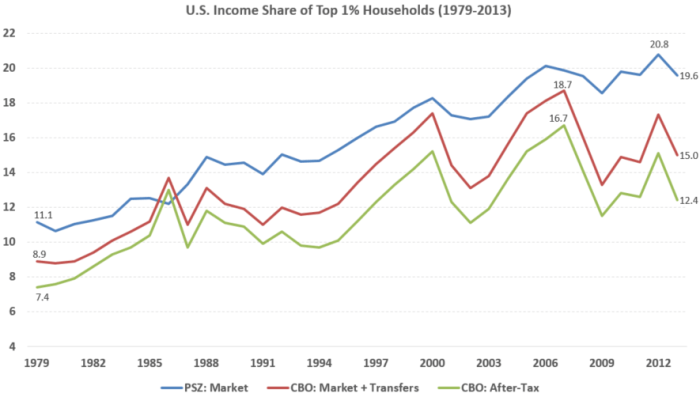
Indeed, we didn’t actually see all that much redistribution of wealth when Democrats more or less controlled all three branches in the period from 2008-2010. We may have seen a little bit shortly thereafter, and tax policy typically does come with a delay of a year or two. But as you can see in this graph, the Great Recession did more to reduce the top 1% income share than any tax policy changes:

US_top_income_share_1pct

The biggest changes made to our tax code under Obama were actually the handling of capital gains; the increase of the top rate on capital gains from 15% to 20%, plus the 3.8% capital surtax from the Affordable Care Act raised the tax bill for the top 0.1% by tens of billions of dollars. Surprisingly, Trump’s tax cuts don’t actually remove these provisions, though they did dramatically cut the corporate tax rate, which will probably have a similar effect on the income distribution.

To be honest, I’m not as disappointed with Trump’s tax cuts as I thought I would be. Some genuinely good ideas (like the reduction of the mortgage interest deduction, tighter restrictions on carried interest, and increase of the personal standard deduction) and some reasonable but debatable ideas (like cuts to the corporate tax rate, switching to a territorial corporate tax system, limits to deductions on corporate debt payments, removal of the deduction of state taxes, and extensions of 529 savings plans to private primary and secondary schools) were mixed in with the absolutely ludicrous and terrible ideas (like eliminating the Obamacare mandate, doubling the estate tax threshold, cutting the alcohol tax, and allowing offshore drilling in Alaska [One of these things is not like the other ones….]). Some of the terrible ideas, like ending the deduction of student loan interest and tuition waivers, were actually removed in the final version of the bill. Of course, you won’t be surprised when I tell you that the overall US tax system became a lot less progressive as a result of this bill. And even if cutting the corporate tax while raising the capital gains tax is probably a good idea (as I and many economists believe), cutting the corporate tax without raising the capital gains tax probably isn’t.

(An aside: For how much they claim to be “tough on crime”, it’s always kind of baffling to see how often Republicans like to cut alcohol taxes and pollution regulations, which are pretty much the only things that have ever been empirically shown to actually reduce crime. There is some evidence that maybe more policing also helps, but if so, it does so in a far less cost-effective way—indeed, the direct cost of alcohol taxes and pollution taxes is negative. Even if they didn’t work at all, they’d still be worth it just because they raise revenue. I begin to suspect that Republicans don’t actually want to reduce crime, because they know they can use the fear of crime to win votes; they simply want to appear tough on crime, and so they press as hard as they can for more policing and incarceration in the country that already has the highest incarceration rate in the world. This may be a more general phenomenon: While Democrats want to actually solve problems, Republicans want to appear to solve problems while actually exacerbating them, thus insuring their own job security. Compare how Bush kept talking about Osama bin laden while invading Iraq, and Obama actually killed Osama bin Laden. Is this too cynical? Can anything be too cynical in the era of Trump? There were 50,000 Russian bots on Twitter trying to tilt our election! Mueller’s FBI investigation is already implicating several of Trump’s top officials! Everything that seemed like paranoia or cynicism just a few years ago is turning out to be entirely true.)

This is what seems to happen: Year after year, we raise some taxes, then we cut some taxes. Then when raise some taxes, then we cut some taxes. The tax system gets a little more progressive for a few years and inequality begins to fall, and then those changes are removed and inequality begins to rise again. Back and forth and round and round we go.

Is there some way to lock in these tax changes for a longer period of time? The only way I can see would be a change in voter behavior: Keep voting in Democrats to all branches of government consistently for 20 years, and then maybe we would see a serious reduction in income and wealth inequality. Or at least stop voting in Republicans; aside from the Democrats, there are some third parties that would also support redistribution, like the Green Party. And yes, it really is about voting behavior: As prevalent as gerrymandering has become, as terrible as the Electoral College is, as widespread as voter suppression has gotten, Trump only won because 63 million Americans voted for him. Even after everything he’s done, Trumps’ approval rating is still about 39%. As long as there are enough people in this country whose partisan loyalty so strongly outweighs any rational assessment of policy, we are going to continue to see such travesties continue.

It would certainly help if our voting system were fairer, so that third parties had a better chance at taking seats. But it’s also difficult to see how that could happen any time soon. For now, the best I can come up with is trying to show people two things:

First, most Americans favor redistribution of wealth. You’re not alone in wanting that. It’s not some fringe opinion.

Second, there is a real difference between Democrats and Republicans on this issue. The canard “The two parties are the same” is the most untrue it has been in at least twenty years.

I would even understand if there are other issues you consider more important than wealth redistribution. Ecological sustainability is the most defensible—you can’t eat GNP—though that would push you even harder toward the left. Among things that might push you right, I can understand being concerned about higher taxes hurting economic growth, and while I think the view that abortion is murder is ludicrous, given that as your belief I can understand why you would want to prioritize fighting abortion. (If I thought we were murdering millions of babies every year, I’d be pretty mad too! Of course, you should be glad, then, that the US abortion rate has been falling. Right? You know about that, right?)

What I don’t get, however, is people who thought that voting for Donald Trump would help working people. I don’t understand how you can see someone who epitomizes everything that is wrong with the billionaire rentier class and think, “Yeah, he seems like he’s definitely a populist. That guy who was born insanely rich and made even more mind-boggling amounts of money by lying and screwing people over is definitely going to look out for folks like me.”

If I understood that, maybe I would know where to go from here. But people’s political beliefs can be astonishingly intransigent to evidence. Politics is the mind-killer.

What about a tax on political contributions?

Jan 7, JDN 2458126

In my previous post, I argued that an advertising tax could reduce advertising, raise revenue, and produce almost no real economic distortion. Now I’m going to generalize this idea to an even bolder proposal: What if we tax political contributions?

Donations to political campaigns are very similar to advertising. A contest function framework also makes a lot of sense: Increased spending improves your odds of winning, but it doesn’t actually produce any real goods.

Suppose there’s some benefit B that I get if a given politician wins an election. That benefit could include direct benefits to me, as well as altruistic benefits to other citizens I care about, or even my concern for the world as a whole. But presumably, I do benefit in some fashion from my favored politician winning—otherwise, why are they my favored politician?

In this very simple model, let’s assume that there are only two parties and two donors (obviously in the real world there are more parties and vastly more donors; but it doesn’t fundamentally change the argument). Say I will donate x and the other side will donate y.

Assuming that donations are all that matter, the probability my party will win the election is x/(x+y).

Fortunately that isn’t the case. A lot of things matter, some that should (policy platforms, experience, qualifications, character) and some that shouldn’t (race, gender, age, height—part of why Trump won may in fact be that he is tall; he’s about 6’1”.). So let’s put all the other factors that affect elections into a package and call that F.

The probability that my candidate wins is then x/(x+y) + F, where F can be positive or negative. If F is positive, it means that my candidate is more likely to win, while if it’s negative, it means my candidate is less likely to win. (If you want to be pedantic, the probability of winning has to be capped at 0 and 1, but this doesn’t fundamentally change the argument, and only matters for candidates that are obvious winners or obvious losers regardless of how much anyone donates.)

The donation costs me money, x. The cost in utility of that money depends on my utility function, so for now I’ll just call it a cost function C(x).
Then my net benefit is:
B*[x/(x+y)+F] – C(x)

I can maximize this by a first-order condition. Notice how the F just drops out. I like F to be large, but it doesn’t affect my choice of x.

B*y/(x+y)^2 = C'(x)

Turning that into an exact value requires knowing my cost function and my opponent’s cost function (which need not be the same, in general; unlike the advertising case, it’s not a matter of splitting fungible profits between us), but it’s actually possible to stop here. We can already tell that there is a well-defined solution: There’s a certain amount of donation x that maximizes my expected utility, given the amount y that the other side has donated. Moreover, with a little bit of calculus you can show that the optimal amount of x is strictly increasing in y, which makes intuitive sense: The more they give, the more you need to give in order to keep up. Since x is increasing in y and y is increasing in x, there is a Nash equilibrium: At some amount x and y we each are giving the optimal amount from our perspective.

We can get a precise answer if we assume that the amount of the donations is small compared to my overall wealth, so I will be approximately risk-neutral; then we can just say C(x) = x, and C'(x) = 1:

B*y/(x+y)^2 = 1
Then we get essentially the same result we did for the advertising:

x = y = B/4

According to this, I should be willing to donate up to one-fourth the benefit I’d get from my candidate winning in donations. This actually sounds quite high; I think once you take into account the fact that lots of other people are donating and political contributions aren’t that effective at winning elections, the optimal donation is actually quite a bit smaller—though perhaps still larger than most people give.

If we impose a tax rate r on political contributions, nothing changes. The cost to me of donating is still the same, and as long as the tax is proportional, the ratio x/(x+y) and the probability x/(x+y) + F will remain exactly the same as before. Therefore, I will continue to donate the same amount, as will my opponent, and each candidate will have the same probability of winning as before. The only difference is that some of the money (r of the money, to be precise) will go to the government instead of the politicians.

The total amount of donations will not change. The probability of each candidate winning will not change. All that will happen is money will be transferred from politicians to the government. If this tax revenue is earmarked for some socially beneficial function, this will obviously be an improvement in welfare.

The revenue gained is not nearly as large an amount of money as is spent on advertising (which tells you something about American society), but it’s still quite a bit: Since we currently spend about $5 billion per year on federal elections, a tax rate of 50% could raise about $2.5 billion.

But in fact this seriously under-estimates the benefits of such a tax. This simple model assumes that political contributions only change which candidate wins; but that’s actually not the main concern. (If F is large enough, it can offset any possible donations.)
The real concern is how political contributions affect the choices politicians make once they get into office. While outright quid-pro-quo bribery is illegal, it’s well-known that many corporations and wealthy individuals will give campaign donations with the reasonable expectation of influencing what sort of policies will be made.

You don’t think Goldman Sachs gives millions of dollars each election out of the goodness of their hearts, do you? And they give to both major parties, which really only makes sense if their goal is not to make a particular candidate win, but to make sure that whoever wins feels indebted to Goldman Sachs. (I guess it could also be to prevent third parties from winning—but they hardly ever win anyway, so that wouldn’t be a smart investment from the bank’s perspective.)

Lynda Powell at the University of Rochester has documented the many subtle but significant ways that these donations have influenced policy. Campaign donations aren’t as important as party platforms, but a lot of subtle changes across a wide variety of policies add up to large differences in outcomes.

A political contribution tax would reduce these influences. If politicians’ sole goal were to win, the tax would have no effect. But it seems quite likely that politicians enjoy various personal benefits from lobbying and campaign contributions: Fine dinners, luxurious vacations, and so on. And insofar as that is influencing politicians’ behavior, it is both obviously corrupt and clearly reduced by a political contribution tax. How large an effect this would be is difficult to say; but the direction of the effect is clearly the one we want.

Taxing donations would also allow us to protect the right to give to campaigns (which does seem to be a limited kind of civil liberty, even though the precise interpretation “money is speech” is Orwellian), while reducing corruption and allowing us to keep close track on donations that are made. Taxing a money stream, even a small amount, is often one of the best ways to incentivize close monitoring of that money stream.

With a subtle change, the tax could even be made to bias in favor of populism: All you need to do is exempt small donations from the tax. If say the first $1000 per person per year is exempt from taxation, then the imposition of the tax will reduce the effectiveness of million-dollar contributions from Goldman Sachs and the Koch brothers without having any effect on $50 donations from people like you and me. That would technically be “distorting” elections—but it seems like it might be a distortion worth making.

Of course, this is probably even less likely to happen than the advertising tax.

How can we stop rewarding psychopathy?

Oct 1, JDN 24578028

A couple of weeks ago The New York Times ran an interesting article about how entrepreneurs were often juvenile delinquents, who then often turn into white-collar criminals. They didn’t quite connect the dots, though; they talked about the relevant trait driving this behavior as “rule-breaking”, when it is probably better defined as psychopathy. People like Martin Shkreli aren’t just “rule-breakers”; they are psychopaths. While only about 1% of humans in general are psychopaths, somewhere between 3% and 4% of business executives are psychopaths. I was unable to find any specific data assessing the prevalence of psychopathy among politicians, but if you just read the Hare checklist, it’s not hard to see that psychopathic traits are overrepresented among politicians as well.

This is obviously the result of selection bias; as a society, we are systematically appointing psychopaths to positions of wealth and power. Why are we doing this? How can we stop?

One very important factor here that may be especially difficult to deal with is desire. We generally think that in a free society, people should be allowed to seek out the sort of life they want to live. But one of the reasons that psychopaths are more likely to become rich and powerful is precisely that they want it more.

To most of us, being rich is probably something we want, but not the most important thing to us. We’d accept being poor if it meant we could be happy, surrounded by friends and family who love us, and made a great contribution to society. We would like to be rich, but it’s more important that we be good people. But to many psychopaths, being rich is the one single thing they care about. All those other considerations are irrelevant.

With power, matters are even more extreme: Most people actually seem convinced that they don’t want power at all. They associate power with corruption and cruelty (because, you know, so many of the people in power are psychopaths!), and they want no part of it.

So the saying goes: “Power tends to corrupt, and absolute power corrupts absolutely.” Does it, now? Did power corrupt George Washington and Abraham Lincoln? Did it corrupt Mahatma Gandhi and Nelson Mandela? I’m not saying that any of these men were without flaws, even serious ones—but was it power that made them so? Who would they have been, and more importantly, what would they have done, if they hadn’t had power? Would the world really have been better off if Abraham Lincoln and Nelson Mandela had stayed out of politics? I don’t think so.

Part of what we need, therefore, is to convince good people that wanting power is not inherently bad. Power just means the ability to do things; it’s what you do that matters. You should want power—the power to right wrongs, mend injustices, uplift humanity’s future. Thinking that the world would be better if you were in charge not only isn’t a bad thing—it is quite likely to be true. If you are not a psychopath, then the world would probably be better off if you were in charge of it.

Of course, that depends partly on what “in charge of the world” even means; it’s not like we have a global government, after all. But even suppose you were granted the power of an absolute dictatorship over all of humanity; what would you do with that power? My guess is that you’d probably do what I would do: Start by using that power to correct the greatest injustices, then gradually cede power to a permanent global democracy. That wouldn’t just be a good thing; it would be quite literally and without a doubt the best thing that ever happened. Of course, it would be all the better if we never built such a dictatorship in the first place; but mainly that’s because of the sort of people who tend to become dictators. A benevolent dictatorship really would be a wonderful thing; the problem is that dictators almost never remain benevolent. Dictatorship is simply too enticing to psychopaths.

And what if you don’t think you’re competent enough in policy to make such decisions? Simple: You don’t make them yourself, you delegate them to responsible and trustworthy people to make them for you. Recognizing your own limitations is one of the most important differences between a typical leader and a good leader.

Desire isn’t the only factor here, however. Even though psychopaths tend to seek wealth and power with more zeal than others, there are still a lot of good people trying to seek wealth and power. We need to look very carefully at the process of how we select our leaders.

Let’s start with the private sector. How are managers chosen? Mainly, by managers above them. What criteria do they use? Mostly, they use similarity. Managers choose other managers who are “like them”—middle-aged straight White men with psychopathic tendencies.

This is something that could be rectified with regulation; we could require businesses to choose a more diverse array of managers that is more representative of the population at large. While this would no doubt trigger many complaints of “government interference” and “inefficiency”, in fact it almost certainly would increase the long-term profitability of most corporations. Study after study after study shows that increased diversity, particularly including more equal representation of women, results in better business performance. A recent MIT study found that switching from an all-male or all-female management population to a 50-50 male/female split could increase profits by as much as forty percent. The reason boards of directors aren’t including more diversity is that they ultimately care more about protecting their old boys’ club (and increasing their own compensation, of course) than they do about maximizing profits for their shareholders.

I think it would actually be entirely reasonable to include regulations about psychopathy in particular; designate certain industries (such as lobbying and finance; I would not include medicine, as psychopaths actually seem to make pretty good neurosurgeons!) as “systematically vital” and require psychopathy screening tests as part of their licensing process. This is no small matter, and definitely does represent an incursion into civil liberties; but given the enormous potential benefits, I don’t think it can be dismissed out of hand. We do license professions; why shouldn’t at least a minimal capacity for empathy and ethical behavior be part of that licensing process?

Where the civil liberty argument becomes overwhelming is in politics. I don’t think we can justify any restrictions on who should be allowed to run for office. Frankly, I think even the age limits should be struck from the Constitution; you should be allowed to run for President at 18 if you want. Requiring psychological tests for political office borders on dystopian.

That means we need to somehow reform either the campaign system, the voting system, or the behavior of voters themselves.

Of course, we should reform all three. Let’s start with the voting system itself, as that is the simplest: We should be using range voting, and we should abolish the Electoral College. Districts should be replaced by proportional representation through reweighted range voting, eliminating gerrymandering once and for all without question.

The campaign system is trickier. We could start by eliminating or tightly capping private and corporate campaign donations, and replace them with a system similar to the “Democracy Vouchers” being tested in Seattle. The basic idea is simple and beautiful: Everyone gets an equal amount of vouchers to give to whatever candidates they like, and then all the vouchers can be redeemed for campaign financing from public funds. It’s like everyone giving a donation (or monetary voting), but everyone has the same amount of “money”.

This would not solve all the problems, however. There is still an oligopoly of news media distorting our political discourse. There is still astonishingly bad journalism even in our most respected outlets, like the way the New York Times was obsessed with Comey’s letter and CNN’s wall-to-wall coverage of totally unfounded speculation about a missing airliner.

Then again, CNN’s ratings skyrocketed during that period. This shows that the problems run much deeper than a handful of bad journalists or corrupt media companies. These companies are, to a surprisingly large degree, just trying to cater to what their audience has said it wants, just “giving the people what they want”.

Our fundamental challenge, therefore, is to change what the people want. We have to somehow convince the public at large—or at least a big enough segment of the public at large—that they don’t really want TV news that spends hours telling them nothing and they don’t really want to elect the candidate who is the tallest or has the nicest hair. And we have to get them to actually change the way they behave accordingly.

When it comes to that part, I have no idea what to do. A voting population that is capable of electing Donald Trump—Electoral College nonsense notwithstanding, he won sixty million votes—is one that I honestly have no idea how to interface with at all. But we must try.