The asymmetric impact of housing prices

Jul 22 JDN 2458323

In several previous posts I’ve talked about the international crisis of high housing prices. Today, I want to talk about some features of housing that make high housing prices particularly terrible, in a way that other high prices would not be.

First, there is the fact that some amount of housing is a basic necessity, and houses are not easily divisible. So even if the houses being built are bigger than you need, you still need some kind of house, and you can’t buy half a house; the best you could really do would be to share it with someone else, and that introduces all sorts of other complications.

Second, t here is a deep asymmetry here. While rising housing prices definitely hurt people who want to buy houses, they benefit hardly anyone.


If you bought a house for $200,000 and then all housing prices doubled so it would now sell for $400,000, are you richer? You might feel richer. You might even have access to home equity loans that would give you more real liquidity. But are you actually richer?

I contend you are not, because the only way for you to access that wealth would be to sell your home, and then you’d need to buy another home, and that other home would also be twice as expensive. The amount of money you can get for your house may have increased, but the amount of house you can get for your house is exactly the same.

Conversely, suppose that housing prices fell by half, and now that house only sells for $100,000. Are you poorer? You still have your house. Even if your mortgage isn’t paid off, it’s still the same mortgage. Your payments haven’t changed. And once again, the amount of house you can get for your house will remain the same. In fact, if you are willing to accept a deed in lieu of foreclosure (it’s bad for your credit, of course), you can walk away from that underwater house and buy a new one that’s just as good with lower payments than what you are currently making. You may actually be richer because the price of your house fell.

Relative housing prices matter, certainly. If you own a $400,000 house and move to a city where housing prices have fallen to $100,000, you are definitely richer. And if you own a $100,000 house and move to a city where housing prices have risen to $400,000, you are definitely poorer. These two effects necessarily cancel out in the aggregate.

But do absolute housing prices matter for homeowners? It really seems to me that they don’t. The people who care about absolute housing prices are not homeowners; they are people trying to enter the market for the first time.
And this means that lower housing prices are almost always better. If you could buy a house for $1,000, we would live in a paradise where it was basically impossible to be homeless. (When social workers encountered someone who was genuinely homeless, they could just buy them a house then and there.) If every home cost $10 million, those who bought homes before the price surge would be little better off than they are, but the rest of us would live on the streets.

Psychologically, people very strongly resist falling housing prices. Even in very weak housing markets, most people will flatly refuse to sell their house for less than they paid for it. As a result, housing prices usually rise with inflation, but don’t usually fall in response to deflation. Rents also display similar rigidity over time. But in reality, lower prices are almost always better for almost everyone.

There is a group of people who are harmed by low housing prices, but it is a very small group of people, most of whom are already disgustingly rich: The real estate industry. Yes, if you build new housing, or flip houses, or buy and sell houses on speculation, you will be harmed by lower housing prices. Of these, literally the only one I care about even slightly is developers; and I only care about developers insofar as they are actually doing their job building housing that people need. If falling prices hurt developers, it would be because the supply of housing was so great that everyone who needs a house could have one.

There is a subtler nuance here, which is that some people may be buying more expensive housing as a speculative saving vehicle, hoping that they can cash out on their house when they retire. To that, I really only have one word of advice: Don’t. Don’t contribute to another speculative housing bubble that could cause another Great Recession. A house is not even a particularly safe investment, because it’s completely undiversified. Buy stocks. Buy all the stocks. Buy a house because you want that house, not because you hope to make money off of it.

And if the price of your house does fall someday? Don’t panic. You may be no worse off, and other people are probably much better off.

The injustice of positional goods

July 15 JDN 2458315

At Disneyland, you can now buy a special pass that will let you skip ahead in line. On several airlines including American, Delta, Spirit, and Southwest, you can pay extra to be allowed to board before other passengers (which has been particularly salient for me on the many flights I’ve been taking this summer). This is only an extreme form of a long-standing phenomenon: Since the beginning of commercial ship and train travel, there have been first-class and second-class tickets.

I don’t have any formal survey data on the matter, but just about everyone I have spoken to about such policies is at least vaguely uncomfortable with them, if not totally outraged. The exception is other economists, who typically don’t express any concern whatsoever. “People are willing to pay for this service because they value it,” they say; “so what’s the problem?”

On this one, I think the economists are wrong and everyone else is right. There is something different about this sort of service.

Part of the difference between first-class and second-class is in actual quality of services that actually incur additional costs (I hate to break it to you, but legroom on an aircraft is just such an example; every inch of legroom on each seat is another row of seats they can’t have, which is another $2000 or so they don’t get in revenue on each and every flight). But part of it is something else, something that costs the company literally nothing.

This makes early boarding a clearer example. What are you buying when you pay for early boarding? On most airlines, it’s not even a better seat; your seat is pre-assigned (Southwest is an exception). We could say you are paying for extra time, but that’s not really even true; the plane leaves at the same time for everyone. From your perspective, you are paying for convenience; you get to settle in on the plane, maybe get started working or whatever, before everyone else. Maybe you’d rather wait on the plane than wait in the airport (though frankly I’m not sure why; the airport has restaurants and comfortable restrooms).

What you are really buying is position. Early boarding is a positional good. Every person who gets bumped forward in the queue is someone else who is bumped backward. The net benefit for all customers as a whole is precisely zero, as is the cost for the company to provide it—and yet, it still has a positive price! This is impressive economic alchemy: The airline has managed to take something with zero marginal cost and zero marginal benefit, and still make money off of it. They have transmuted the lead of something costless and worthless into the gold of profit.

They achieve this by pitting customers against one another. In a post awhile back I talked about rent-seeking, such as lobbying and advertising. Usually it’s the corporations doing the rent-seeking, but early boarding and queue-jumping are examples of corporations intentionally generating a circumstances where they can obtain revenue from the rent-seeking of others.

To be fair, there might be some welfare gains to be had from auctioning off order in a queue. Some people have genuinely higher costs of time than others (a cardiac surgeon’s time is particularly important, for example), and an auction could potentially order people who have very high cost of time first.

But this argument is much weaker than it may at first appear, because people also have very different marginal utility of wealth, and indeed I think the correlation between your willingness to pay for time and your total wealth is considerably higher than the correlation between your willingness-to-pay for time and your actual real cost in terms of pain and suffering.

This is a more general problem, as I’ve discussed in previous posts; but I think it’s especially acute in the case of time, because real cost of time doesn’t actually vary all that much between most people. The reason poor people take buses and rich people take limousines isn’t because poor people don’t care about their time; it’s because they can’t afford limousines. A cardiac surgeon and an economist could very well have the same salary and the same willingness-to-pay for time, but people rarely die when an economist turns up an hour late. (It’s not that our work isn’t important—actually a good development economist can save far more lives than any cardiac surgeon—but it’s not nearly so urgent.) Also, consider the fact that teachers and social workers generally contribute a good deal more to society than derivatives traders (and thus, from a social welfare perspective, their time should be considered more valuable), but they are far less likely to pay for first-class seats. In fact, a first-come, first-served method actually seems better than an auction from a social welfare perspective: If your time is really important to you, you’re more likely to go out of your way to check in as soon as you can. That costly signal provides a sorting mechanism which relies directly upon real costs of time, rather than indirectly via monetary willingness-to-pay.

And of course when it comes to Disneyland, this argument utterly fails; I see little reason to think that a cardiac surgeon’s vacation time is substantially more valuable to society. (Don’t get me wrong; surgeons need and deserve vacation time—but if they get too much, their performance actually suffers!) So maybe paying for a place in queue isn’t completely rent-seeking, but it’s pretty close.

That is why paying for positional goods feels unjust to most people: Because it is. Charging a price for positional goods is a means of extracting profit from customers without providing any (net) real service. It’s a way of applying price discrimination without even having much monopoly power. If another airline doesn’t let you pay to skip ahead in the queue, you have a slightly lower expected wait time on that other airline, but any revenue they lose from charging a bit less for economy tickets can be easily made up by charging more for the front of the line.

For example, if the first 10% of the line on airline A is decided by selling spots, while airline B chooses at random, and the average time waiting in line to board is 30 minutes, the expected wait times are as follows. Fly airline A and don’t buy a spot: 16.5 minutes. Fly airline A and buy a spot: 1.5 minutes. Fly airline B: 15 minutes. Those 10% are paying for, on average, 13.5 minutes; but you’re only gaining 1.5 minutes. Of course, there are more people waiting that extra 1.5 minutes than saving those 13.5 minutes (9 times as many, in fact). If the per-minute willingness-to-pay were exactly the same, the airline would break even; but they know of course that the willingness-to-pay of that top 10% is considerably higher than that of most of the bottom 90%. If they have any market power at all (which they generally do, by being the only airline serving certain routes, offering loyalty benefits, etc.), they can squeeze out even more profit.

They may even sometimes go out of their way to make life miserable for those who don’t pay extra, increasing the incentive to pay extra. This requires some market power to pull off, but as I said, they often have that. Most airlines don’t offer power outlets at every seat, for example. This is not a serious question of installation cost or even power consumption. We’re talking about a few hundred dollars on an aircraft that costs hundreds of millions of dollars, or a few kilowatts from a system that can generate over one hundred megawatts (of course most of it is used for propulsion, but adding an alternator that would generate an extra few kilowatts of electrical power would still not be difficult or expensive). This is a way of making life worse for the economy-class passengers so they have a stronger incentive to pay for upgraded tickets.

It’s not always easy to tell what is a positional good: First-class seats are ambiguous, for example. But I think a good heuristic is to ask, “Could everyone benefit from this?” If the answer is “No, even in principle”, then you are definitely dealing with a positional good. Not everyone can be first in line at Disneyland. Not everyone can board the plane first. In theory at least, everyone could be provided the same legroom and meal service as a first-class ticket (it would be expensive, but not impossible), so that is at least in part not a positional good.

The “pay-to-win” effect of some video game downloadable content (DLC) is also a positional good, which we can see by the above heuristic: If everyone pays to have the best gun in the game, there’s no point in having the best gun in the game. This is why gamers are rightfully outraged by “pay-to-win” effects, but typically have no objection to paying for DLC that provides them with extra game content (such as new characters, locations, or missions) or cosmetic upgrades (hats, decorations, and “skins”). Personally I tend to think that most DLC is overpriced, and succeeds at being so due to a kind of monopoly power (Mass Effect DLC doesn’t work on Skyrim or vice-versa) but I certainly don’t object to the basic idea of charging additional money for additional content. The reason we object to “pay-to-win” is not that winning the game is so important; it’s that this business model is so obviously a form of rent extraction. (It’s interesting that gamers in China don’t seem to be as bothered by “pay-to-win” as gamers in the US; this runs counter to the standard narrative that American people are competitive capitalists and Chinese people are collectivist socialists, don’t you think?)

There may be some circumstances in which we have no choice but to allow corporations to charge prices for positional goods—especially if we can’t tell whether we are dealing with a positional good or not. But it would not be very difficult to draft legislation that would at least reduce such business practices: We could simply use my “Could everyone benefit?” heuristic. If a business charges money for something that even in principle they could not possibly provide all of their customers, they are charging a price for a positional good, and should be penalized. The benefits of such a policy would be relatively small, but the costs would be even smaller. If we are really concerned about letting cardiac surgeons board aircraft faster (we should really be concerned about deboarding faster—and especially faster security screening!), we could make such a rule that applies to particular classes of high-urgency professions; we don’t need to allow airlines to extract millions of dollars in rent by pitting their customers against each other.

Most trade barriers are not tariffs

Jul 8 JDN 2458309

When we talk about “protectionism” or “trade barriers”, what usually comes to mind is tariffs: taxes imposed on imports or exports. But especially now that international trade organizations have successfully reduced tariffs around the world, most trade barriers are not of this form at all.

Especially in highly-developed countries, but really almost everywhere, the most common trade barriers are what is simply but inelegantly called non-tariff barriers to trade: this includes licenses, quotas, subsidies, bailout guarantees, labeling requirements, and even some environmental regulations.

Non-tariff barriers are much more complicated to deal with, for at least three reasons.

First, with the exception of quotas and subsidies, non-tariff barriers are not easily quantifiable. We can easily put a number on the value of a tariff (though its impact is somewhat subtler than that), but this is not so easy for the effect of a bailout guarantee or a labeling requirement.

Second, non-tariff barriers are often much harder to detect. It’s obvious enough that imposing a tax on imported steel will reduce our imports of steel; but it requires a deeper understanding of the trade system to understand why bailing out domestic banks would distort financial flows, interest rates and exchange rates (even though the impact of this may actually be larger—the effect on global trade of US bank bailouts was between $35 billion and $110 billion).

Third, some trade barriers are either justifiable or simply inevitable. Simply having customs screening at the border is a non-tariff barrier, but it is widely regarded as a justifiable security measure (and I agree, by the way, even though I am generally in favor of much more open borders). Requiring strict labor and environmental standards on the production of products both domestic and imported is highly beneficial, but also imposes a trade barrier. In a broader sense, differences in language and culture could even be regarded as trade barriers (they certainly increase the real cost of trade), but it’s not clear that we could eliminate such things even if we wanted to.

This requires us to look very closely at almost every major government policy, to see how it might be distorting world trade. Some policies won’t meaningfully distort trade at all; these are not trade barriers. Others will distort trade, but are beneficial enough in other ways that they are still worth it; these are justifiable trade barriers. Still others will distort trade so much that they cannot be justified despite their other benefits. Finally, some policies will be put in place more or less explicitly to distort trade, usually in the form of protectionism to prop up domestic industries.

Protectionist policies are of course the first things to get rid of. Honestly, it baffles me that people even want to impose them in the first place. For some reason they think of exports as the benefit and imports as the cost, when it’s really the other way around; when we impose protectionism, we go out of our way to make it harder to get cars and iPhones so that we can stop other countries from taking our green paper. This seems to be tied to the fact that people think of jobs as something desirable, when really it’s wealth that’s desirable, and jobs are just one way of getting wealth—in some sense the most expensive way. Our macroeconomic policy obsesses over inflation, which is almost literally meaningless (as long as it is not too unpredictable, really nothing would change if inflation were raised from 2% to 4% or even 10%) and unemployment, which is at best an imperfect indicator of what we really should care about, namely the welfare of our people. A world of full employment with poverty wages is much worse than a world of high unemployment where a basic income provides for everyone’s needs. It is true that in our current system, unemployment is closely tied to a lot of very bad outcomes—but I maintain that this is largely because unemployment entails losing your income and your healthcare.

Some regulations that appear benign may actually be harmful because of their effects on trade. Yet I should also point out that it’s possible to go too far the other direction, and start tearing down all regulations in the name of reducing trade barriers. We particularly seem to do this in the financial industry, where “deregulation” seems to be on everyone’s lips until it causes a crisis, then we impose some regulations that fix the worst problems, things look good for awhile—and then we go back around and everyone starts talking about “deregulation” again. Meanwhile, the same people who talk about “freedom” as an excuse for removing financial safeguards are the ones who lock up children at the border. I think this is something that needs to be reframed: Which regulations are you removing? Just what, exactly, are you making legal that wasn’t before? Legalizing murder would be “deregulation”.

Trade policy, therefore, is a very delicate balance, between removing distortions and protecting legitimate public interests, between the needs of your own country and the world as a whole. This is why we need this whole apparatus of international trade institutions; it’s not a simple matter.

But I will say this: It would probably help if people educated themselves a bit more about how trade actually works before voting in politicians who promise to “save their jobs” from foreign competition.

The housing shortage is an international phenomenon

Jul 1 JDN 2458301

My posts for the next couple of weeks are going to be shorter, since I am in Europe and will be either on vacation (at the time I write this) or busy with a conference and a workshop (by the time this post goes live).

For today, I’d just like to point out that the crisis of extremely high housing prices is not unique to California or even the United States. In some respects it may even be worse elsewhere.

San Francisco remains especially bad; the median price for a home in San Francisco is a horrifying $1.6 million.

But London (where I am at the time of writing) is also terrible; the median price for a home in London recently fell to 430,000 pounds (about $600,000 at current exchange rates). The most expensive flat—not house, flat—sold a couple years ago for the mind-boggling sum of 150 million pounds (about $200 million). If I had $200 million, I would definitely not use it to buy a flat. At that point it would literally be cheaper to buy a yacht with a helipad, park it in the harbor, and commute by helicopter. Here’s a yacht with a helipad for only $20 million, and a helicopter to go with it for $6 million. That leaves $174 million; keep $20 million in stocks to be independently wealthy for the rest of your life, and then donate the remaining $154 million to charity.

The median price of a house in Vancouver stands at 1.1 million Canadian dollars, about $830,000 US.

A global comparison finds that on a per-square-meter basis, the most expensive real estate in the world is in Monaco, where $1 million US will only buy you 15 square meters. The remaining cities in the top 10 are Hong Kong, London, Singapore, Geneva, New York, Sydney, Paris, Moscow, and Shanghai.

There is astonishing variation in the level of housing prices, even within countries. Some of the most affordable markets in the US (like San Antonio and Oklahoma City) cost as little as $80 per square foot; that means that $1 million would buy you 1,160 square meters. That’s not an error; real estate in Monaco is literally 77 times more expensive than real estate in Oklahoma City. 15 square meters is a studio apartment; 1,160 square meters is a small mansion. Just comparing within the US, the price per square foot in San Francisco is over $1,120, 14 times as high as Oklahoma City. $1 million in San Francisco will buy you about 80 square meters, which is at least a two or three-bedroom house.

This says to me that policy choices matter. It may not be possible to make San Francisco as cheap as Oklahoma City—most people would definitely rather live in San Francisco, so demand is always going to be higher there. But I don’t think it’s very plausible to say that housing is just inherently 14 times as expensive to construct as housing in Oklahoma City. If it’s really that much more expensive to construct (and that may not even be the issue—this could be more a matter of oligopoly than high costs), it must be at least in part because of something the local and state governments are doing differently. Cross-national comparisons underscore that point even further: The geography of Hong Kong and Taiwan is not that different, but housing prices in Taiwan are not nearly as high.

What exactly are different cities (and countries) doing differently that has such large effects on housing prices? That’s something I’ll try to figure out in future posts.

The inherent atrocity of “border security”

Jun 24 JDN 2458294

By now you are probably aware of the fact that a new “zero tolerance” border security policy under the Trump administration has resulted in 2,000 children being forcibly separated from their parents by US government agents. If you weren’t, here are a variety of different sources all telling the same basic story of large-scale state violence and terror.

Make no mistake: This is an atrocity. The United Nations has explicitly condemned this human rights violation—to which Trump responded by making an unprecedented threat of withdrawing unilaterally from the UN Human Rights Council.

#ThisIsNotNormal, and Trump was everything we feared—everything we warned—he would be: Corrupt, incompetent, cruel, and authoritarian.

Yet Trump’s border policy differs mainly in degree, not kind, from existing US border policy. There is much more continuity here than most of us would like to admit.

The Trump administration has dramatically increased “interior removals”, the most obviously cruel acts, where ICE agents break into the houses of people living in the US and take them away. Don’t let the cold language fool you; this is literally people with guns breaking into your home and kidnapping members of your family. This is characteristic of totalitarian governments, not liberal democracies.

And yet, the Obama administration actually holds the record for most deportations (though only because they included “at-border deportations” which other administrations did not). A major policy change by George W. Bush started this whole process of detaining people at the border instead of releasing them and requiring them to return for later court dates.

I could keep going back; US border enforcement has gotten more and more aggressive as time goes on. US border security staffing has quintupled since just 1990. There was a time when the United States was a land of opportunity that welcomed “your tired, your poor, your huddled masses”; but that time is long past.

And this, in itself, is a human rights violation. Indeed, I am convinced that border security itself is inherently a human rights violation, always and everywhere; future generations will not praise us for being more restrained than Trump’s abject and intentional cruelty, but condemn us for acting under the same basic moral framework that justified it.

There is an imaginary line in the sand just a hundred miles south of where I sit now. On one side of the line, a typical family makes $66,000 per year. On the other side, a typical family makes only $20,000. On one side of the line, life expectancy is 81 years; on the other, 77. This means that over their lifetime, someone on this side of the line can expect to make over one million dollars more than they would if they had lived on the other side. Step across this line, get a million dollars; it sounds ridiculous, but it’s an empirical fact.

This would be bizarre enough by itself; but now consider that on that line there are fences, guard towers, and soldiers who will keep you from crossing it. If you have appropriate papers, you can cross; but if you don’t, they will arrest and detain you, potentially for months. This is not how we treat you if you are carrying contraband or have a criminal record. This is how we treat you if you don’t have a passport.

How can we possibly reconcile this with the principles of liberal democracy? Philosophers have tried, to be sure. Yet they invariably rely upon some notion that the people who want to cross our border are coming from another country where they were already granted basic human rights and democratic representation—which is almost never the case. People who come here from the UK or the Netherlands or generally have the proper visas. Even people who come here from China usually have visas—though China is by no means a liberal democracy. It’s people who come here from Haiti and Nicaragua who don’t—and these are some of the most corrupt and impoverished nations in the world.

As I said in an earlier post, I was not offended that Trump characterized countries like Haiti and Syria as “shitholes”. By any objective standard, that is accurate; these countries are terrible, terrible places to live. No, what offends me is that he thinks this gives us a right to turn these people away, as though the horrible conditions of their country somehow “rub off” on them and make them less worthy as human beings. On the contrary, we have a word for people who come from “shithole” countries seeking help, and that word is “refugee”.

Under international law, “refugee” has a very specific legal meaning, under which most immigrants do not qualify. But in a broader moral sense, almost every immigrant is a refugee. People don’t uproot themselves and travel thousands of miles on a whim. They are coming here because conditions in their home country are so bad that they simply cannot tolerate them anymore, and they come to us desperately seeking our help. They aren’t asking for handouts of free money—illegal immigrants are a net gain for our fiscal system, paying more in taxes than they receive in benefits. They are looking for jobs, and willing to accept much lower wages than the workers already here—because those wages are still dramatically higher than what they had where they came from.

Of course, that does potentially mean they are competing with local low-wage workers, doesn’t it? Yes—but not as much as you might think. There is only a very weak relationship between higher immigration and lower wages (some studies find none at all!), even at the largest plausible estimates, the gain in welfare for the immigrants is dramatically higher than the loss in welfare for the low-wage workers who are already here. It’s not even a question of valuing them equally; as long as you value an immigrant at least one tenth as much as a native-born citizen, the equation comes out favoring more immigration.

This is for two reasons: One, most native-born workers already are unwilling to do the jobs that most immigrants do, such as picking fruit and laying masonry; and two, increased spending by immigrants boosts the local economy enough to compensate for any job losses.


But even aside from the economic impacts, what is the moral case for border security?

I have heard many people argue that “It’s our home, we should be able to decide who lives here.” First of all, there are some major differences between letting someone live in your home and letting someone come into your country. I’m not saying we should allow immigrants to force themselves into people’s homes, only that we shouldn’t arrest them when they try cross the border.

But even if I were to accept the analogy, if someone were fleeing oppression by an authoritarian government and asked to live in my home, I would let them. I would help hide them from the government if they were trying to escape persecution. I would even be willing to house people simply trying to escape poverty, as long as it were part of a well-organized program designed to ensure that everyone actually gets helped and the burden on homeowners and renters was not too great. I wouldn’t simply let homeless people come live here, because that creates all sorts of coordination problems (I can only fit so many, and how do I prioritize which ones?); but I’d absolutely participate in a program that coordinates placement of homeless families in apartments provided by volunteers. (In fact, maybe I should try to petition for such a program, as Southern California has a huge homelessness rate due to our ridiculous housing prices.)

Many people seem to fear that immigrants will bring crime, but actually they reduce crime rates. It’s really kind of astonishing how much less crime immigrants commit than locals. My hypothesis is that immigrants are a self-selected sample; the kind of person willing to move thousands of miles isn’t the kind of person who commits a lot of crimes.
I understand wanting to keep out terrorists and drug smugglers, but there are already plenty of terrorists and drug smugglers here in the US; if we are unwilling to set up border security between California and Nevada, I don’t see why we should be setting it up between California and Baja California. But okay, fine, we can keep the customs agents who inspect your belongings when you cross the border. If someone doesn’t have proper documentation, we can even detain and interrogate them—for a few hours, not a few months. The goal should be to detect dangerous criminals and nothing else. Once we are confident that you have not committed any felonies, we should let you through—frankly, we should give you a green card. We should only be willing to detain someone at the border for the same reasons we would be willing to detain a citizen who already lives here—that is, probable cause for an actual crime. (And no, you don’t get to count “illegal border crossing” as a crime, because that’s begging the question. By the same logic I could justify detaining people for jaywalking.)

A lot of people argue that restricting immigration is necessary to “preserve local culture”; but I’m not even sure that this is a goal sufficiently important to justify arresting and detaining people, and in any case, that’s really not how culture works. Culture is not advanced by purism and stagnation, but by openness and cross-pollination. From anime to pizza, many of our most valued cultural traditions would not exist without interaction across cultural boundaries. Introducing more Spanish speakers into the US may make us start saying no problemo and vamonos, but it’s not going to destroy liberal democracy. If you value culture, you should value interactions across different societies.

Most importantly, think about what you are trying to justify. Even if we stop doing Trump’s most extreme acts of cruelty, we are still talking about using military force to stop people from crossing an imaginary line. ICE basically treats people the same way the SS did. “Papers, please” isn’t something we associate with free societies—it’s characteristic of totalitarianism. We are so accustomed to border security (or so ignorant of its details) that we don’t see it for the atrocity it so obviously is.

National borders function something very much like feudal privilege. We have our “birthright”, which grants us all sorts of benefits and special privileges—literally tripling our incomes and extending our lives. We did nothing to earn this privilege. If anything, we show ourselves to be less deserving (e.g. by committing more crimes). And we use the government to defend our privilege by force.

Are people born on the other side of the line less human? Are they less morally worthy? On what grounds do we point guns at them and lock them away for the “crime” of wanting to live here?

What Trump is doing right now is horrific. But it is not that much more horrific than what we were already doing. My hope is that this will finally open our eyes to the horrors that we had been participating in all along.

The evolution of human cooperation

Jun 17 JDN 2458287

If alien lifeforms were observing humans (assuming they didn’t turn out the same way—which they actually might, for reasons I’ll get to shortly), the thing that would probably baffle them the most about us is how we organize ourselves into groups. Each individual may be part of several groups at once, and some groups are closer-knit than others; but the most tightly-knit groups exhibit extremely high levels of cooperation, coordination, and self-sacrifice.

They might think at first that we are eusocial, like ants or bees; but upon closer study they would see that our groups are not very strongly correlated with genetic relatedness. We are somewhat more closely related to those in our groups than to those outsides, usually; but it’s a remarkably weak effect, especially compared to the extremely high relatedness of worker bees in a hive. No, to a first approximation, these groups are of unrelated humans; yet their level of cooperation is equal to if not greater than that exhibited by the worker bees.

However, the alien anthropologists would find that it is not that humans are simply predisposed toward extremely high altruism and cooperation in general; when two humans groups come into conflict, they are capable of the most extreme forms of violence imaginable. Human history is full of atrocities that combine the indifferent brutality of nature red in tooth and claw with the boundless ingenuity of a technologically advanced species. Yet except for a small proportion perpetrated by individual humans with some sort of mental pathology, these atrocities are invariably committed by one unified group against another. Even in genocide there is cooperation.

Humans are not entirely selfish. But nor are they paragons of universal altruism (though some of them aspire to be). Humans engage in a highly selective form of altruism—virtually boundless for the in-group, almost negligible for the out-group. Humans are tribal.

Being a human yourself, this probably doesn’t strike you as particularly strange. Indeed, I’ve mentioned it many times previously on this blog. But it is actually quite strange, from an evolutionary perspective; most organisms are not like this.

As I said earlier, there is actually reason to think that our alien anthropologist would come from a species with similar traits, simply because such cooperation may be necessary to achieve a full-scale technological civilization, let alone the capacity for interstellar travel. But there might be other possibilities; perhaps they come from a eusocial species, and their large-scale cooperation is within an extremely large hive.

It’s true that most organisms are not entirely selfish. There are various forms of cooperation within and even across species. But these usually involve only close kin, and otherwise involve highly stable arrangements of mutual benefit. There is nothing like the large-scale cooperation between anonymous unrelated individuals that is exhibited by all human societies.

How would such an unusual trait evolve? It must require a very particular set of circumstances, since it only seems to have evolved in a single species (or at most a handful of species, since other primates and cetaceans display some of the same characteristics).

Once evolved, this trait is clearly advantageous; indeed it turned a local apex predator into a species so successful that it can actually intentionally control the evolution of other species. Humans have become a hegemon over the entire global ecology, for better or for worse. Cooperation gave us a level of efficiency in producing the necessities of survival so great that at this point most of us spend our time working on completely different tasks. If you are not a farmer or a hunter or a carpenter (and frankly, even if you are a farmer with a tractor, a hunter with a rifle, or a carpenter with a table saw), you are doing work that would simply not have been possible without very large-scale human cooperation.

This extremely high fitness benefit only makes the matter more puzzling, however: If the benefits are so great, why don’t more species do this? There must be some other requirements that other species were unable to meet.

One clear requirement is high intelligence. As frustrating as it may be to be a human and watch other humans kill each other over foolish grievances, this is actually evidence of how smart humans are, biologically speaking. We might wish we were even smarter still—but most species don’t have the intelligence to make it even as far as we have.

But high intelligence is likely not sufficient. We can’t be sure of that, since we haven’t encountered any other species with equal intelligence; but what we do know is that even Homo sapiens didn’t coordinate on anything like our current scale for tens of thousands of years. We may have had tribal instincts, but if so they were largely confined to a very small scale. Something happened, about 50,000 years ago or so—not very long ago in evolutionary time—that allowed us to increase that scale dramatically.

Was this a genetic change? It’s difficult to say. There could have been some subtle genetic mutation, something that wouldn’t show up in the fossil record. But more recent expansions in human cooperation to the level of the nation-state and beyond clearly can’t be genetic; they were much too fast for that. They must be a form of cultural evolution: The replicators being spread are ideas and norms—memes—rather than genes.

So perhaps the very early shift toward tribal cooperation was also a cultural one. Perhaps it began not as a genetic mutation but as an idea—perhaps a metaphor of “universal brotherhood” as we often still hear today. The tribes that believed this ideas prospered; the tribes that didn’t were outcompeted or even directly destroyed.

This would explain why it had to be an intelligent species. We needed brains big enough to comprehend metaphors and generalize concepts. We needed enough social cognition to keep track of who was in the in-group and who was in the out-group.

If it was indeed a cultural shift, this should encourage us. (And since the most recent changes definitely were cultural, that is already quite encouraging.) We are not limited by our DNA to only care about a small group of close kin; we are capable of expanding our scale of unity and cooperation far beyond.
The real question is whether we can expand it to everyone. Unfortunately, there is some reason to think that this may not be possible. If our concept of tribal identity inherently requires both an in-group and an out-group, then we may never be able to include everyone. If we are only unified against an enemy, never simply for our own prosperity, world peace may forever remain a dream.

But I do have a work-around that I think is worth considering. Can we expand our concept of the out-group to include abstract concepts? With phrases like “The War on Poverty” and “The War on Terror”, it would seem in fact that we can. It feels awkward; it is somewhat imprecise—but then, so was the original metaphor of “universal brotherhood”. Our brains are flexible enough that they don’t actually seem to need the enemy to be a person; it can also be an idea. If this is right, then we can actually include everyone in our in-group, as long as we define the right abstract out-group. We can choose enemies like poverty, violence, cruelty, and despair instead of other nations or ethnic groups. If we must continue to fight a battle, let it be a battle against the pitiless indifference of the universe, rather than our fellow human beings.

Of course, the real challenge will be getting people to change their existing tribal identities. In the moment, these identities seem fundamentally intractable. But that can’t really be the case—for these identities have changed over historical time. Once-important categories have disappeared; new ones have arisen in their place. Someone in 4th century Constantinople would find the conflict between Democrats and Republicans as baffling as we would find the conflict between Trinitarians and Arians. The ongoing oppression of Native American people by White people would be unfathomable to someone of the 11th century Onondaga, who could scarcely imagine an enemy more different than the Seneca west of them. Even the conflict between Russia and NATO would probably seem strange to someone living in France in 1943, for whom Germany was the enemy and Russia was at least the enemy of the enemy—and many of those people are still alive.

I don’t know exactly how these tribal identities change (I’m working on it). It clearly isn’t as simple as convincing people with rational arguments. In fact, part of how it seems to work is that someone will shift their identity slowly enough that they can’t perceive the shift themselves. People rarely seem to appreciate, much less admit, how much their own minds have changed over time. So don’t ever expect to change someone’s identity in one sitting. Don’t even expect to do it in one year. But never forget that identities do change, even within an individual’s lifetime.

Self-fulfilling norms

Post 242: Jun 10 JDN 2458280

Imagine what it would be like to live in a country with an oppressive totalitarian dictator. For millions of people around the world, this is already reality. For us in the United States, it’s becoming more terrifyingly plausible all the time.

You would probably want to get rid of this dictator. And even if you aren’t in the government yourself, there are certainly things you could do to help with that: Join protests, hide political dissenters in your basement, publish refutations of the official propaganda on the Internet. But all of these things carry great risks. How do you know whether it’s worth the risk?

Well, a very important consideration in that reasoning is how many other people agree with you. In the extreme case where everyone but the dictator agrees with you, overthrowing him should be no problem. In the other extreme case where nobody agrees with you, attempting to overthrow him will inevitably result in being imprisoned and tortured as a political prisoner. Everywhere in between, your probability of success increases as the number of people who agree with you increases.

But how do you know how many people agree with you? You can’t just ask them—simply asking someone “Do you support the dictator?” is a dangerous thing to do in a totalitarian society. Simply by asking around, you could get yourself into a lot of trouble. And if people think you might be asking on behalf of the government, they’re always going to say they support the dictator whether or not they do.

If you believe that enough people would support you, you will take action against the dictator. But if you don’t believe that, you won’t take the chance. Now, consider the fact that many other people are in the same position: They too would only take action if they believed others would.

You are now in what’s called a coordination game. The best decision for you depends upon what everyone else decides. There are two equilibrium outcomes of this game: In one, you all keep your mouths shut and the dictator continues to oppress you. In the other, you all rise up together and overthrow the dictator. But if you take an action out of equilibrium, that could be very bad for you: If you rise up against the dictator without support, you’ll be imprisoned and tortured. If you support the dictator while others try to overthrow him, you might be held responsible for some of his crimes once the coup d’etat is complete.

And what about people who do support the dictator? They might still be willing to go along with overthrowing him, if they saw the writing on the wall. But if they think the dictator can still win, they will stand with him. So their beliefs, also, are vital in deciding whether to try to overthrow the dictator.

This results in a self-fulfilling norm. The dictator can be overthrown, if and only if enough people believe that the dictator can be overthrown.

There are much more mundane examples of of self-fulfilling norms. Most of our traffic laws are actually self-fulfilling norms as much as they are real laws; enforcement is remarkably weak, particularly when you compare it to the rate of compliance. Most of us have driven faster than the speed limit or run a red light on occasion; but how often do you drive on the wrong side of the road, or stop on green and go on red? It is best to drive on the right side of the road if, and only if, everyone believes it is best to drive on the right side of the road. That’s a self-fulfilling norm.

Self-fulfilling norms are a greatly underappreciated force in global history. We often speak as though historical changes are made by “great men”—powerful individuals who effect chance through their charisma or sheer force of will. But that power didn’t exist in a vacuum. For good (Martin Luther King) or for ill (Adolf Hitler), “great men” only have their power because they can amass followers. The reason they can amass followers is that a large number of people already agree with them—but are too afraid to speak up, because they are trapped in a self-fulfilling norm. The primary function of a great leader is to announce—at great personal risk—views that they believe others already hold. If indeed they are correct, then they can amass followers by winning the coordination game. If they are wrong, they may suffer terribly at the hands of a populace that hates them.

There is persuasion involved, but typically it’s not actually persuading people to believe that something is right; it’s persuading people to actually take action, convincing them that there is really enough chance of succeeding that it is worth the risk. Because of the self-fulfilling norm, this is a very all-or-nothing affair; do it right and you win, but do it wrong and your whole movement collapses. You essentially need to know exactly what battles you can win, so that you only fight those battles.

The good news is that information technology may actually make this easier. Honest assessment of people’s anonymous opinions is now easier than ever. Large-scale coordination of activity with relative security is now extremely easy, as we saw in the Arab Spring. This means that we are entering an era of rapid social change, where self-fulfilling norms will rise and fall at a rate never before seen.

In the best-case scenario, this means we get rid of all the bad norms and society becomes much better.

In the worst-case scenario, we may find out that most people actually believe in the bad norms, and this makes those norms all the more entrenched.

Only time will tell.

Fake skepticism

Jun 3 JDN 2458273

“You trust the mainstream media?” “Wake up, sheeple!” “Don’t listen to what so-called scientists say; do your own research!”

These kinds of statements have become quite ubiquitous lately (though perhaps the attitudes were always there, and we only began to hear them because of the Internet and social media), and are often used to defend the most extreme and bizarre conspiracy theories, from moon-landing denial to flat Earth. The amazing thing about these kinds of statements is that they can be used to defend literally anything, as long as you can find some source with less than 100% credibility that disagrees with it. (And what source has 100% credibility?)

And that, I think, should tell you something. An argument that can prove anything is an argument that proves nothing.

Reversed stupidity is not intelligence. The fact that the mainstream media, or the government, or the pharmaceutical industry, or the oil industry, or even gangsters, fanatics, or terrorists believes something does not make it less likely to be true.

In fact, the vast majority of beliefs held by basically everyone—including the most fanatical extremists—are true. I could list such consensus true beliefs for hours: “The sky is blue.” “2+2=4.” “Ice is colder than fire.”

Even if a belief is characteristic of a specifically evil or corrupt organization, that does not necessarily make it false (though it usually is evidence of falsehood in a Bayesian sense). If only terrible people belief X, then maybe you shouldn’t believe X. But if both good and bad people believe X, the fact that bad people believe X really shouldn’t matter to you.

People who use this kind of argument often present themselves as being “skeptics”. They imagine that they have seen through the veil of deception that blinds others.

In fact, quite the opposite is the case: This is fake skepticism. These people are not uniquely skeptical; they are uniquely credulous. If you think the Earth is flat because you don’t trust the mainstream scientific community, that means you do trust someone far less credible than the mainstream scientific community.

Real skepticism is difficult. It requires concerted effort and investigation, and typically takes years. To really seriously challenge the expert consensus in a field, you need to become an expert in that field. Ideally, you should get a graduate degree in that field and actually start publishing your heterodox views. Failing that, you should at least be spending hundreds or thousands of hours doing independent research. If you are unwilling or unable to do that, you are not qualified to assess the validity of the expert consensus.

This does not mean the expert consensus is always right—remarkably often, it isn’t. But it means you aren’t allowed to say it’s wrong, because you don’t know enough to assess that.

This is not elitism. This is not an argument from authority. This is a basic respect for the effort and knowledge that experts spend their lives acquiring.

People don’t like being told that they are not as smart as other people—even though, with any variation at all, that’s got to be true for a certain proportion of people. But I’m not even saying experts are smarter than you. I’m saying they know more about their particular field of expertise.

Do you walk up to construction workers on the street and critique how they lay concrete? When you step on an airplane, do you explain to the captain how to read an altimeter? When you hire a plumber, do you insist on using the snake yourself?

Probably not. And why not? Because you know these people have training; they do this for a living. Yeah, well, scientists do this for a living too—and our training is much longer. To be a plumber, you need a high school diploma and an apprenticeship that usually lasts about four years. To be a scientist, you need a PhD, which means four years of college plus an additional five or six years of graduate school.

To be clear, I’m not saying you should listen to experts speaking outside their expertise. Some of the most idiotic, arrogant things ever said by human beings have been said by physicists opining on biology or economists ranting about politics. Even within a field, some people have such narrow expertise that you can’t really trust them even on things that seem related—like macroeconomists with idiotic views on trade, or ecologists who clearly don’t understand evolution.

This is also why one of the great challenges of being a good interdisciplinary scientist is actually obtaining enough expertise in both fields you’re working in; it isn’t literally twice the work (since there is overlap—or you wouldn’t be doing it—and you do specialize in particular interdisciplinary subfields), but it’s definitely more work, and there are definitely a lot of people on each side of the fence who may never take you seriously no matter what you do.

How do you tell who to trust? This is why I keep coming back to the matter of expert consensus. The world is much too complicated for anyone, much less everyone, to understand it all. We must be willing to trust the work of others. The best way we have found to decide which work is trustworthy is by the norms and institutions of the scientific community itself. Since 97% of climatologists say that climate change is caused by humans, they’re probably right. Since 99% of biologists believe humans evolved by natural selection, that’s probably what happened. Since 87% of economists oppose tariffs, tariffs probably aren’t a good idea.

Can we be certain that the consensus is right? No. There is precious little in this universe that we can be certain about. But as in any game of chance, you need to play the best odds, and my money will always be on the scientific consensus.

What we could, what we should, and what we must

May 27 JDN 2458266

In one of the most famous essays in all of ethical philosophy, Peter Singer famously argued that we are morally obligated to give so much to charity that we would effectively reduce ourselves to poverty only slightly better than what our donations sought to prevent. His argument is a surprisingly convincing one, especially for such a radical proposition. Indeed, one of the core activities of the Effective Altruism movement has basically been finding ways to moderate Singer’s argument without giving up on its core principles, because it’s so obvious both that we ought to do much more to help people around the world and that there’s no way we’re ever going to do what that argument actually asks of us.

The most cost-effective charities in the world can save a human life for an average cost of under $4,000. The maneuver that Singer basically makes is quite simple: If you know that you could save someone’s life for $4,000, you have $4,000 to spend, and instead you spend that $4,000 on something else, aren’t you saying that whatever you did spend it on was more important than saving that person’s life? And is that really something you believe?

But if you think a little more carefully, it becomes clear that things are not quite so simple. You aren’t being paid $4,000 to kill someone, first of all. If you were willing to accept $4,000 as sufficient payment to commit a murder, you would be, quite simply, a monster. Implicitly the “infinite identical psychopath” of neoclassical rational agent models would be willing to do such a thing, but very few actual human beings—even actual psychopaths—are that callous.

Obviously, we must refrain from murdering people, even for amounts far in excess of $4,000. If you were offered the chance to murder someone for $4 billion dollars, I can understand why you would be tempted to do such a thing. Think of what you could do with all that money! Not only would you and everyone in your immediate family be independently wealthy for life, you could donate billions of dollars to charity and save as much as a million lives. What’s one life for a million? Even then, I have a strong intuition that you shouldn’t commit this murder—but I have never been able to find a compelling moral argument for why. The best I’ve been able to come up with a sort of Kantian notion: What if everyone did this?

Since the most plausible scenario is that the $4 billion comes from existing wealth, all those murders would simply be transferring wealth around, from unknown sources. If you stipulate where the wealth comes from, the dilemma can change quite a bit.

Suppose for example the $4 billion is confiscated from Bashar Al-Assad. That would be in itself a good thing, lessening the power of a genocidal tyrant. So we need to add that to the positive side of the ledger. It is probably worth killing one innocent person just to undermine Al-Assad’s power; indeed, the US Air Force certainly seems to think so, as they average more than one civilian fatality every day in airstrikes.

Now suppose the wealth was extracted by clever financial machinations that took just a few dollars out of every bank account in America. This would be in itself a bad thing, but perhaps not a terrible thing, especially since we’re planning on giving most of it to UNICEF. Those people should have given it anyway, right? This sounds like a pretty good movie, actually; a cyberpunk Robin Hood basically.

Next, suppose it was obtained by stealing the life savings of a million poor people in Africa. Now the method of obtaining the money is so terrible that it’s not clear that funneling it through UNICEF would compensate, even if you didn’t have to murder someone to get it.

Finally, suppose that the wealth is actually created anew—not printed money from the Federal Reserve, but some new technology that will increase the world’s wealth by billions of dollars yet requires the death of an innocent person to create. In this scenario, the murder has become something more like the inherent risk in human subjects biomedical research, and actually seems justifiable. And indeed, that fits with the Kantian answer, for if we all had the chance to kill one person in order to create something that would increase the wealth of the world by $4 billion, we could turn this planet into a post-scarcity utopia within a generation for fewer deaths than are currently caused by diabetes.

Anyway, my point here is that the detailed context of a decision actually matters a great deal. We can’t simply abstract away from everything else in the world and ask whether the money is worth the life.

When we consider this broader context with regard to the world’s most cost-effective charities, it becomes apparent that a small proportion of very dedicated people giving huge proportions of their income to charity is not the kind of world we want to see.

If I actually gave so much that I equalized my marginal utility of wealth to that of a child dying of malaria in Ghana, I would have to donate over 95% of my income—and well before that point, I would be homeless and impoverished. This actually seems penny-wise and pound-foolish even from the perspective of total altruism: If I stop paying rent, it gets a lot harder for me to finish my doctorate and become a development economist. And even if I never donated another dollar, the world would be much better off with one more good development economist than with even another $23,000 to the Against Malaria Foundation. Once you factor in the higher income I’ll have (and proportionately higher donations I’ll make), it’s obviously the wrong decision for me to give 95% of $25,000 today rather than 10% of $70,000 every year for the next 20 years after I graduate.

But the optimal amount for me to donate from that perspective is whatever the maximum would be that I could give without jeopardizing my education and career prospects. This is almost certainly more than I am presently giving. Exactly how much more is actually not all that apparent: It’s not enough to say that I need to be able to pay rent, eat three meals a day, and own a laptop that’s good enough for programming and statistical analysis. There’s also a certain amount that I need for leisure, to keep myself at optimal cognitive functioning for the next several years. Do I need that specific video game, that specific movie? Surely not—but if I go the next ten years without ever watching another movie or playing another video game, I’m probably going to be in trouble psychologically. But what exactly is the minimum amount to keep me functioning well? And how much should I be willing to spend attending conferences? Those can be important career-building activities, but they can also be expensive wastes of time.

Singer acts as though jeopardizing your career prospects is no big deal, but this is clearly wrong: The harm isn’t just to your own well-being, but also to your productivity and earning power that could have allowed you to donate more later. You are a human capital asset, and you are right to invest in yourself. Exactly how much you should invest in yourself is a much harder question.
Such calculations are extremely difficult to do. There are all sorts of variables I simply don’t know, and don’t have any clear way of finding out. It’s not a good sign for an ethical theory when even someone with years of education and expertise on specifically that topic still can’t figure out the answer. Ethics is supposed to be something we can apply to everyone.

So I think it’s most helpful to think in those terms: What could we apply to everyone? What standard of donation would be high enough if we could get everyone on board?

World poverty is rapidly declining. The direct poverty gap at the UN poverty line of $1.90 per day is now only $80 billion. Realistically, we couldn’t simply close that gap precisely (there would also be all sorts of perverse incentives if we tried to do it that way). But the standard estimate that it would take about $300 billion per year in well-targeted spending to eliminate world hunger is looking very good.

How much would each person, just those in the middle class or above within the US or the EU, have to give in order to raise this much?
89% of US income is received by the top 60% of households (who I would say are unambiguously “middle class or above”). Income inequality is not as extreme within the EU, so the proportion of income received by the top 60% seems to be more like 75%.

89% of US GDP plus 75% of EU GDP is all together about $29 trillion per year. This means that in order to raise $300 billion, each person in the middle class or above would need to donate just over one percent of their income.

Not 95%. Not 25%. Not even 10%. Just 1%. That would be enough.

Of course, more is generally better—at least until you start jeopardizing your career prospects. So by all means, give 2% or 5% or even 10%. But I really don’t think it’s helpful to make people feel guilty about not giving 95% when all we really needed was for everyone to give 1%.

There is an important difference between what we could do, what we should do, and what we must do.

What we must do are moral obligations so strong they are essentially inviolable: We must not murder people. There may be extreme circumstances where exceptions can be made (such as collateral damage in war), and we can always come up with hypothetical scenarios that would justify almost anything, but for the vast majority of people the vast majority of time, these ethical rules are absolutely binding.

What we should do are moral obligations that are strong enough to be marks against your character if you break them, but not so absolutely binding that you have to be a monster not to follow them. This is where I put donating at least 1% of your income. (This is also where I put being vegetarian, but perhaps that is a topic for another time.) You really ought to do it, and you are doing something wrongful if you don’t—but most people don’t, and you are not a terrible person if you don’t.

This latter category is in part socially constructed, based on the norms people actually follow. Today, slavery is obviously a grave crime, and to be a human trafficker who participates in it you must be a psychopath. But two hundred years ago, things were somewhat different: Slavery was still wrong, yes, but it was quite possible to be an ordinary person who was generally an upstanding citizen in most respects and yet still own slaves. I would still condemn people who owned slaves back then, but not nearly as forcefully as I would condemn someone who owned slaves today. Two hundred years from now, perhaps vegetarianism will move up a category: The norm will be that everyone eats only plants, and someone who went out of their way to kill and eat a pig would have to be a psychopath. Eating meat is already wrong today—but it will be more wrong in the future. I’d say the same about donating 1% of your income, but actually I’m hoping that by two hundred years from now there will be no more poverty left to eradicate, and donation will no longer be necessary.

Finally, there is what we could do—supererogatory, even heroic actions of self-sacrifice that would make the world a better place, but cannot be reasonably expected of us. This is where donating 95% or even 25% of your income would fall. Yes, absolutely, that would help more people than donating 1%; but you don’t owe the world that much. It’s not wrong for you to contribute less than this. You don’t need to feel guilty for not giving this much.

But I do want to make you feel guilty if you don’t give at least 1%. Don’t tell me you can’t. You can. If your income is $30,000 per year, that’s $300 per year. If you needed that much for a car repair, or dental work, or fixing your roof, you’d find a way to come up with it. No one in the First World middle class is that liquidity-constrained. It is true that half of Americans say they couldn’t come up with $400 in an emergency, but I frankly don’t believe it. (I believe it for the bottom 25% or so, who are actually poor; but not half of Americans.) If you have even one credit card that’s not maxed out, you can do this—and frankly even if a card is maxed out, you can probably call them and get them to raise your limit. There is something you could cut out of your spending that would allow you to get back 1% of your annual income. I don’t know what it is, necessarily: Restaurants? Entertainment? Clothes? But I’m not asking you to give a third of your income—I’m asking you to give one penny out of every dollar.

I give considerably more than that; my current donation target is 8% and I’m planning on raising it to 10% or more once I get a high-paying job. I live on a grad student salary which is less than the median personal income in the US. So I know it can be done. But I am very intentionally not asking you to give this much; that would be above and beyond the call of duty. I’m only asking you to give 1%.

The vector geometry of value change

Post 239: May 20 JDN 2458259

This post is one of those where I’m trying to sort out my own thoughts on an ongoing research project, so it’s going to be a bit more theoretical than most, but I’ll try to spare you the mathematical details.

People often change their minds about things; that should be obvious enough. (Maybe it’s not as obvious as it might be, as the brain tends to erase its prior beliefs as wastes of data storage space.)

Most of the ways we change our minds are fairly minor: We get corrected about Napoleon’s birthdate, or learn that George Washington never actually chopped down any cherry trees, or look up the actual weight of an average African elephant and are surprised.

Sometimes we change our minds in larger ways: We realize that global poverty and violence are actually declining, when we thought they were getting worse; or we learn that climate change is actually even more dangerous than we thought.

But occasionally, we change our minds in an even more fundamental way: We actually change what we care about. We convert to a new religion, or change political parties, or go to college, or just read some very compelling philosophy books, and come out of it with a whole new value system.

Often we don’t anticipate that our values are going to change. That is important and interesting in its own right, but I’m going to set it aside for now, and look at a different question: What about the cases where we know our values are going to change?
Can it ever be rational for someone to choose to adopt a new value system?

Yes, it can—and I can put quite tight constraints on precisely when.

Here’s the part where I hand-wave the math, but imagine for a moment there are only two goods in the world that anyone would care about. (This is obviously vastly oversimplified, but it’s easier to think in two dimensions to make the argument, and it generalizes to n dimensions easily from there.) Maybe you choose a job caring only about money and integrity, or design policy caring only about security and prosperity, or choose your diet caring only about health and deliciousness.

I can then represent your current state as a vector, a two dimensional object with a length and a direction. The length describes how happy you are with your current arrangement. The direction describes your values—the direction of the vector characterizes the trade-off in your mind of how much you care about each of the two goods. If your vector is pointed almost entirely parallel with health, you don’t much care about deliciousness. If it’s pointed mostly at integrity, money isn’t that important to you.

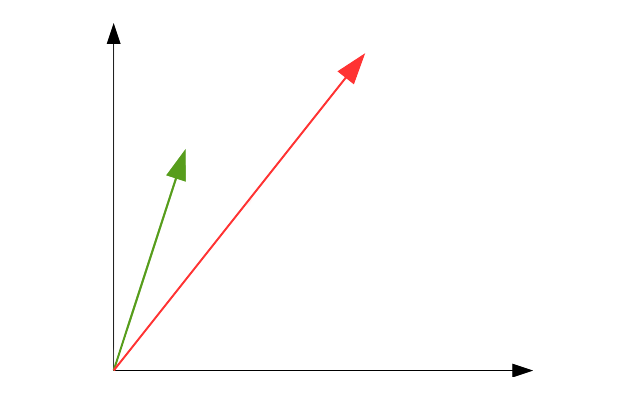
This diagram shows your current state as a green vector.

vector1

Now suppose you have the option of taking some action that will change your value system. If that’s all it would do and you know that, you wouldn’t accept it. You will be no better off, and your value system will be different, which is bad from your current perspective. So here, you would not choose to move to the red vector:

vector2

But suppose that the action would change your value system, and make you better off. Now the red vector is longer than the green vector. Should you choose the action?

vector3

It’s not obvious, right? From the perspective of your new self, you’ll definitely be better off, and that seems good. But your values will change, and maybe you’ll start caring about the wrong things.

I realized that the right question to ask is whether you’ll be better off from your current perspective. If you and your future self both agree that this is the best course of action, then you should take it.

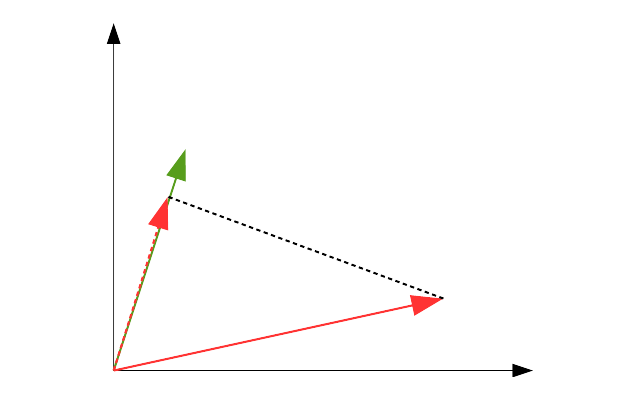
The really cool part is that (hand-waving the math again) it’s possible to work this out as a projection of the new vector onto the old vector. A large change in values will be reflected as a large angle between the two vectors; to compensate for that you need a large change in length, reflecting a greater improvement in well-being.

If the projection of the new vector onto the old vector is longer than the old vector itself, you should accept the value change.

vector4
If the projection of the new vector onto the old vector is shorter than the old vector, you should not accept the value change.

vector5

This captures the trade-off between increased well-being and changing values in a single number. It fits the simple intuitions that being better off is good, and changing values more is bad—but more importantly, it gives us a way of directly comparing the two on the same scale.

This is a very simple model with some very profound implications. One is that certain value changes are impossible in a single step: If a value change would require you to take on values that are completely orthogonal or diametrically opposed to your own, no increase in well-being will be sufficient.

It doesn’t matter how long I make this red vector, the projection onto the green vector will always be zero. If all you care about is money, no amount of integrity will entice you to change.

vector6

But a value change that was impossible in a single step can be feasible, even easy, if conducted over a series of smaller steps. Here I’ve taken that same impossible transition, and broken it into five steps that now make it feasible. By offering a bit more money for more integrity, I’ve gradually weaned you into valuing integrity above all else:

vector7

This provides a formal justification for the intuitive sense many people have of a “moral slippery slope” (commonly regarded as a fallacy). If you make small concessions to an argument that end up changing your value system slightly, and continue to do so many times, you could end up with radically different beliefs at the end, even diametrically opposed to your original beliefs. Each step was rational at the time you took it, but because you changed yourself in the process, you ended up somewhere you would not have wanted to go.

This is not necessarily a bad thing, however. If the reason you made each of those changes was actually a good one—you were provided with compelling evidence and arguments to justify the new beliefs—then the whole transition does turn out to be a good thing, even though you wouldn’t have thought so at the time.

This also allows us to formalize the notion of “inferential distance”: the inferential distance is the number of steps of value change required to make someone understand your point of view. It’s a function of both the difference in values and the difference in well-being between their point of view and yours.

Another key insight is that if you want to persuade someone to change their mind, you need to do it slowly, with small changes repeated many times, and you need to benefit them at each step. You can only persuade someone to change their minds if they will end up better off than they were at each step.

Is this an endorsement of wishful thinking? Not if we define “well-being” in the proper way. It can make me better off in a deep sense to realize that my wishful thinking was incorrect, so that I realize what must be done to actually get the good things I thought I already had.  It’s not necessary to appeal to material benefits; it’s necessary to appeal to current values.

But it does support the notion that you can’t persuade someone by belittling them. You won’t convince people to join your side by telling them that they are defective and bad and should feel guilty for being who they are.

If that seems obvious, well, maybe you should talk to some of the people who are constantly pushing “White privilege”. If you focused on how reducing racism would make people—even White people—better off, you’d probably be more effective. In some cases there would be direct material benefits: Racism creates inefficiency in markets that reduces overall output. But in other cases, sure, maybe there’s no direct benefit for the person you’re talking to; but you can talk about other sorts of benefits, like what sort of world they want to live in, or how proud they would feel to be part of the fight for justice. You can say all you want that they shouldn’t need this kind of persuasion, they should already believe and do the right thing—and you might even be right about that, in some ultimate sense—but do you want to change their minds or not? If you actually want to change their minds, you need to meet them where they are, make small changes, and offer benefits at each step.

If you don’t, you’ll just keep on projecting a vector orthogonally, and you’ll keep ending up with zero.