Elasticity and the Law of Supply

JDN 2457292 EDT 16:16.

Today’s post is kind of a mirror image of the previous post earlier this week; I was talking about demand before, and now I’m talking about supply. (In the next post, I’ll talk about how the two work together to determine the actual price of goods.)

Just as there is an elasticity of demand which describes how rapidly the quantity demanded changes with changes in price, likewise there is an elasticity of supply which describes how much the quantity supplied changes with changes in price.

The elasticity of supply is defined as the proportional change in quantity supplied divided by the proportional change in price; so for example if the number of cars produced increases 10% when the price of cars increases by 5%, the elasticity of supply of cars would be 10%/5% = 2.

Goods that have high elasticity of supply will rapidly flood the market if the price increases even a small amount; goods that have low elasticity of supply will sell at about the same rate as ever even if the price increases dramatically.

Generally, the more initial investment of capital a good requires, the lower its elasticity of supply is going to be.

If most of the cost of production is in the actual marginal cost of producing each new gizmo, then elasticity of supply will be high, because it’s easy to produce more or produce less as the market changes.

But if most of the cost is in building machines or inventing technologies or training employees which already has to be done in order to make any at all, while the cost of each individual gizmo is unimportant, the elasticity of supply will be low, because there’s no sense letting all that capital you invested go to waste.
We can see these differences in action by comparing different sources of electric power.

Photovoltaic solar power has a high elasticity of supply, because building new solar panels is cheap and fast. As the price of solar energy fluctuates, the amount of solar panel produced changes rapidly. Technically this is actually a “fixed capital” cost, but it’s so modular that you can install as little or as much solar power capacity as you like, which makes it behave a lot more like a variable cost than a fixed cost. As a result, a 1% increase in the price paid for solar power increases the amount supplied by a whopping 2.7%, a supply elasticity of 2.7.

Oil has a moderate elasticity of supply, because finding new oil reserves is expensive but feasible. A lot of oil in the US is produced by small wells; 18% of US oil is produced by wells that put out less than 10 barrels per day. Those small wells can be turned on and off as the price of oil changes, and new ones can be built if it becomes profitable. As a result, investment in oil production is very strongly correlated with oil prices. Still, overall production of oil changes only moderate amounts; in the US it had been steadily decreasing since 1970 until very recently when new technologies and weakened regulations resulted in a rapid increase to near-1970s levels. We sort of did hit peak oil; but it’s never quite that simple.

Nuclear fission has a very low elasticity of supply, because building a nuclear reactor is extremely expensive and requires highly advanced expertise. Building a nuclear power plant costs upward of $35 billion. Once a reactor is built, the cost of generating more power is relatively trivial; three-fourths of the cost a nuclear power plant will ever pay is paid simply to build it (or to pay back the debt incurred by doing so). Even if the price of uranium plummets or the price of oil skyrockets, it would take a long time before more nuclear power plants would be built in response.

Elasticity of supply is generally a lot larger in the long run than in the short run. Over a period of a few days or months, many types of production can’t be changed significantly. If you have a corn field, you grow as much corn as you can this season; even if the price rose substantially you couldn’t actually grow any more than your field will allow. But over a period of a year to a few years, most types of production can be changed; continuing with the corn example, you could buy new land to plant corn next season.

The Law of Supply is actually a lot closer to a true law than the Law of Demand. A negative elasticity of supply is almost unheard of; at worst elasticity of supply can sometimes drop close to zero. It really is true that elasticity of supply is almost always positive.

Land has an elasticity near zero; it’s extremely expensive (albeit not impossible; Singapore does it rather frequently) to actually create new land. As a result there’s really no good reason to ever raise the price of land; higher land prices don’t incentivize new production, they just transfer wealth to landowners. That’s why a land tax is such a good idea; it would transfer some of that wealth away from landowners and let us use it for public goods like infrastructure or research, or even just give it to the poor. A few countries actually have tried this; oddly enough, they include Singapore and Denmark, two of the few places in the world where the elasticity of land supply is appreciably above zero!

Real estate in general (which is what most property taxes are imposed on) is much trickier: In the short run it seems to have a very low elasticity, because building new houses or buildings takes a lot of time and money. But in the long run it actually has a high elasticity of supply, because there is a lot of profit to be made in building new structures if you can fund projects 10 or 15 years out. The short-run elasticity is something like 0.2, meaning a 1% increase in price only yields a 0.2% increase in supply; but the long-run elasticity may be as high as 8, meaning that a 1% increase in price yields an 8% increase in supply. This is why property taxes and rent controls seem like a really good idea at the time but actually probably have the effect of making housing more expensive. The economics of real estate has a number of fundamental differences from the economics of most other goods.

Many important policy questions ultimately hinge upon the elasticity of supply: If elasticity is high, then taxing or regulating something is likely to cause large distortions of the economy, while if elasticity is low, taxes and regulations can be used to support public goods or redistribute wealth without significant distortion to the economy. On the other hand, if elasticity is high, markets generally function well on their own, while if elasticity is low, prices can get far out of whack. As a general rule of thumb, government intervention in markets is most useful and most necessary when elasticity is low.

Elasticity and the Law of Demand

JDN 2457289 EDT 21:04

This will be the second post in my new bite-size format, the first one that’s in the middle of the week.

I’ve alluded previously to the subject of demand elasticity, but I think it’s worth explaining in a little more detail. The basic concept is fairly straightforward: Demand is more elastic when the amount that people want to buy changes a large amount for a small change in price. The opposite is inelastic.

Apples are a relatively elastic good. If the price of apples goes up, people buy fewer apples. Maybe they buy other fruit instead, such as oranges or bananas; or maybe they give up on fruit and eat something else, like rice.

Salt is an extremely inelastic good. No matter what the price of salt is, at least within the range it has been for the last few centuries, people are going to continue to buy pretty much the same amount of salt. (In ancient times salt was actually expensive enough that people couldn’t afford enough of it, which was particularly harmful in desert regions. Mark Kulansky’s book Salt on this subject is surprisingly compelling, given the topic.)
Specifically, the elasticity is equal to the proportional change in quantity demanded, divided by the proportional change in price.

For example, if the price of gas rises from $2 per gallon to $3 per gallon, that’s a 50% increase. If the quantity of gas purchase then falls from 100 billion gallons to 90 billion gallons, that’s a 10% decrease. If increasing the price by 50% decreased the quantity demanded by 10%, that would be a demand elasticity of -10%/50% = -1/5 = -0.2

In practice, measuring elasticity is more complicated than that, because supply and demand are both changing at the same time; so when we see a price change and a quantity change, it isn’t always clear how much of each change is due to supply and how much is due to demand. Sophisticated econometric techniques have been developed to try to separate these two effects (in future posts I plan to explain the basics of some of these techniques), but it’s difficult and not always successful.

In general, markets function better when supply and demand are more elastic. When shifts in price trigger large shifts in quantity, this creates pressure on the price to remain at a fixed level rather than jumping up and down. This in turn means that the market will generally be predictable and stable.

It’s also much harder to make monopoly profits in a market with elastic demand; even if you do have a monopoly, if demand is highly elastic then raising the price won’t make you any money, because whatever you gain in selling each gizmo for more, you’ll lose in selling fewer gizmos. In fact, the profit margin for a monopoly is inversely proportional to the elasticity of demand.

Markets do not function well when supply and demand are highly inelastic. Monopolies can become very powerful and result in very large losses of human welfare. A particularly vivid example of this was in the news recently, when a company named Turing purchased the rights to a drug called Daraprim used primarily by AIDS patients, then hiked the price from $13.50 to $750. This made enough people mad that the CEO has since promised to bring it back down, though he hasn’t said how far.

That price change was only possible because Daraprim has highly inelastic demand—if you’ve got AIDS, you’re going to take AIDS medicine, as much as prescribed, provided only that it doesn’t drive you completely bankrupt. (Not an unreasonable fear, as medical costs are the leading cause of bankruptcy in the United States.) This raised price probably would bankrupt a few people, but for the most part it wouldn’t affect the amount of drug sold; it would just funnel a huge amount of money from AIDS patients to the company. This is probably part of why it made people so mad; that and there would probably be a few people who died because they couldn’t afford this new expensive medication.

Imagine if a company had tried to pull the same stunt for a more elastic good, like apples. “CEO buys up all apple farms, raises price of apples from $2 per pound to $100 per pound.” What’s going to happen then? People are not going to buy any apples. Perhaps a handful of the most die-hard apple lovers still would, but the rest of us are going to meet our fruit needs elsewhere.

For most goods most of the time, elasticity of demand is negative, meaning that as price increases, quantity demanded decreases. This is in fact called the Law of Demand; but as I’ve said, “laws” in economics are like the Pirate Code: They’re really more what you’d call “guidelines”.
There are three major exceptions to the Law of Demand. The first one is the one most economists talk about, and it almost never happens. The second one is talked about occasionally, and it’s quite common. The third one is almost never talked about, and yet it is by far the most common and one of the central driving forces in modern capitalism.
The exception that we usually talk about in economics is called the Giffen Effect. A Giffen good is a good that’s so cheap and such a bare necessity that when it becomes more expensive, you won’t be able to buy less of it; instead you’ll buy more of it, and buy less of other things with your reduced income.

It’s very hard to come up with empirical examples of Giffen goods, but it’s an easy theoretical argument to make. Suppose you’re buying grapes for a party, and you know you need 4 bags of grapes. You have $10 to spend. Suppose there are green grapes selling for $1 per bag and red grapes selling for $4 per bag, and suppose you like red grapes better. With your $10, you can buy 2 bags of green grapes and 2 bags of red grapes, and that’s the 4 bags you need. But now suppose that the price of green grapes rises to $2 per bag. In order to afford 4 bags of grapes, you now need to buy 3 bags of green grapes and only 1 bag of red grapes. Even though it was the price of green grapes that rose, you ended up buying more green grapes. In this scenario, green grapes are a Giffen good.

The exception that is talked about occasionally and occurs a lot in real life is the Veblen Effect. Whereas a Giffen good is a very cheap bare necessity, a Veblen good is a very expensive pure luxury.

The whole point of buying a Veblen good is to prove that you can. You don’t buy a Ferrari because a Ferrari is a particularly nice automobile (a Prius is probably better, and a Tesla certainly is); you buy a Ferrari to show off that you’re so rich you can buy a Ferrari.

On my previous post, jenszorn asked: “Much of consumer behavior is irrational by your standards. But people often like to spend money just for the sake of spending and for showing off. Why else does a Rolex carry a price tag for $10,000 for a Rolex watch when a $100 Seiko keeps better time and requires far less maintenance?” Veblen goods! It’s not strictly true that Veblen goods are irrational; it can be in any particular individual’s best interest is served by buying Veblen goods in order to signal their status and reap the benefits of that higher status. However, it’s definitely true that Veblen goods are inefficient; because ostentatious displays of wealth are a zero-sum game (it’s not about what you have, it’s about what you have that others don’t), any resources spent on rich people proving how rich they are are resources that society could otherwise have used, say, feeding the poor, curing diseases, building infrastructure, or colonizing other planets.

Veblen goods can also result in a violation of the Law of Demand, because raising the price of a Veblen good like Ferraris or Rolexes can make them even better at showing off how rich you are, and therefore more appealing to the kind of person who buys them. Conversely, lowering the price might not result in any more being purchased, because they wouldn’t seem as impressive anymore. Currently a Ferrari costs about $250,000; if they reduced that figure to $100,000, there aren’t a lot of people who would suddenly find it affordable, but many people who currently buy Ferraris might switch to Bugattis or Lamborghinis instead. There are limits to this, of course: If the price of a Ferrari dropped to $2,000, people wouldn’t buy them to show off anymore; but the far larger effect would be the millions of people buying them because you can now get a perfectly good car for $2,000. Yes, I would sell my dear little Smart if it meant I could buy a Ferrari instead and save $8,000 at the same time.

But the third major exception to the Law of Demand is actually the most important one, yet it’s the one that economists hardly ever talk about: Speculation.

The most common reason why people would buy more of something that has gotten more expensive is that they expect it to continue getting more expensive, and then they will be able to sell what they bought at an even higher price and make a profit.

When the price of Apple stock goes up, do people stop buying Apple stock? On the contrary, they almost certainly start buying more—and then the price goes up even further still. If rising prices get self-fulfilling enough, you get an asset bubble; it grows and grows until one day it can’t, and then the bubble bursts and prices collapse again. This has happened hundreds of times in history, from the Tulip Mania to the Beanie Baby Bubble to the Dotcom Boom to the US Housing Crisis.

It isn’t necessarily irrational to participate in a bubble; some people must be irrational, but most people can buy above what they would be willing to pay by accurately predicting that they’ll find someone else who is willing to pay an even higher price later. It’s called Greater Fool Theory: The price I paid may be foolish, but I’ll find someone who is even more foolish to take it off my hands. But like Veblen goods, speculation goods are most definitely inefficient; nothing good comes from prices that rise and fall wildly out of sync with the real value of goods.

Speculation goods are all around us, from stocks to gold to real estate. Most speculation goods also serve some other function (though some, like gold, are really mostly just Veblen goods otherwise; actual useful applications of gold are extremely rare), but their speculative function often controls their price in a way that dominates all other considerations. There’s no real limit to how high or low the price can go for a speculation good; no longer tied to the real value of the good, it simply becomes a question of how much people decide to pay.

Indeed, speculation bubbles are one of the fundamental problems with capitalism as we know it; they are one of the chief causes of the boom-and-bust business cycle that has cost the world trillions of dollars and thousands of lives. Most of our financial industry is now dedicated to the trading of speculation goods, and finance is taking over a larger and larger section of our economy all the time. Many of the world’s best and brightest are being funneled into finance instead of genuinely productive industries; 15% of Harvard grads take a job in finance, and almost half did just before the crash. The vast majority of what goes on in our financial system is simply elaborations on speculation; very little real productivity ever enters into the equation.

In fact, as a general rule I think when we see a violation of the Law of Demand, we know that something is wrong in the economy. If there are Giffen goods, some people are too poor to buy what they really need. If there are Veblen goods, inequality is too large and people are wasting resources competing for status. And since there are always speculation goods, the history of capitalism has been a history of market instability.

Fortunately, elasticity of demand is usually negative: As the price goes up, people want to buy less. How much less is the elasticity.

Free trade, fair trade, or what?

JDN 2457271 EDT 11:34.

As I mentioned in an earlier post, almost all economists are opposed to protectionism. In a survey of 264 AEA economists, 87% opposed tariffs to protect US workers against foreign competition.

(By the way, 58% said they usually vote Democrat and only 23% said they usually vote Republican. Given that economists are overwhelmingly middle-age rich White males—only 12% of tenured faculty economists are women and the median income of economists is over $90,000—that’s saying something. Dare I suggest it’s saying that Democrat economic policy is usually better?)

There are a large number of published research papers showing large positive effects of free trade agreements, such as this paper, and this paper, and this paper, and this paper. It’s hard to find any good papers showing any significant negative effects. This is probably why the consensus is so strong; the empirical evidence is overwhelming.

Yet protectionism is very popular among the general public. The majority of both Democrat and Republican voters believe that free trade agreements have harmed the United States. For decades, protectionism has always been the politically popular answer.

To be fair, it’s actually possible to think that free trade harms the US but still support free trade; actually there are some economists who argue that free trade has harmed the US, but has benefited other countries like China and India so much more that it is worth it, making free trade an act of global altruism and good will (for the opposite view, here’s a pretty good article about how “free trade” in principle is often mercantilism in practice, and by no means altruistic). As Krugman talks about, there is some evidence that income inequality in the First World has been exacerbated by globalization—but it’s clearly not the primary reason for rising inequality.

What’s going on here? Are economists ignoring the negative impacts of free trade because it doesn’t fit their elegant mathematical models? Is the general public ignorant of how trade actually works? Does the way free trade works, or its interaction with human psychology, inherently obscure its benefits while emphasizing its harms?

Yes. All of the above.

One of the central mistakes of neoclassical economics is the tendency to over-aggregate. Instead of looking at the impact on individuals, it’s much easier to look at the impact on aggregated abstractions like trade flows and GDP. To some extent this is inevitable—there are simply too many people in the world to keep track of them all. But we need to be aware of what welose when we aggregate, and we need to test the robustness of our theories by applying different models of aggregation (such as comparing “how does this affect Americans” with “how does this affect the First World middle class”).

It is absolutely unambiguous that free trade increases trade flows and GDP, and for small countries these benefits can be mind-bogglingly huge. A key part of the amazing success story of economic development that is Korea is that they dramatically increased their openness to global trade.

The reason for this is absolutely fundamental to economics, and in grasping it in 1776 Adam Smith basically founded the field: Voluntary trade benefits both parties.

As most economists would put it today, comparative advantage leads to Pareto-improving gains from trade. Or as I’d tend to put it, more succinctly yet just as thoroughly based in modern game theory: Trade is nonzero-sum.

When you sell a product to someone, it is because the money they’re offering you is worth more to you than the product—and because the product is worth more to them than the money. You each lose something you value less and gain something you value more—so you are both better off.

This mutual benefit occurs whether you are individuals, corporations, or nations. It’s a fundamental principle of economics that underlies the operation of markets at every scale.

This is what I think most people don’t understand when they say they want to “stop sending jobs overseas”. If by that all you mean is ensuring that there aren’t incentives to offshore and outsource, that’s quite reasonable. Even some degree of incentive to keep businesses in the US might make sense, to avoid a race-to-the-bottom in global wages. But I get the sense that it is more than this, that people have a general notion that jobs are zero-sum and if we hire a million people in China that means a million people must lose their jobs in the US. This is not simply wrong, it is fundamentally wrong; it misses the entire point of economics. If there is one core principle that defines economics, I think it would be that the universe is nonzero-sum; gains for some can also be gains for others. There is not a fixed amount of stuff in the world that we distribute; we can make more stuff. Handled properly, a trade that results in a million people hired in China can mean an extra million people hired in the US.

Once you introduce a competitive market, things get more complicated, because there aren’t just winners—there are also losers. When you have competitors, someone can buy from them instead of you, and the two of them benefit, but you are harmed. By the standard methods of calculating benefits and harms (which admittedly leave much to be desired), we can show quite clearly that in general, on average, the benefits outweigh the harms.

But of course we don’t live “in general, on average”. Despite the overwhelming, unambiguous benefit to the economy as a whole, there is some evidence that free trade can produce a good deal of harm to specific individuals.

Suppose you live in the US and your job is to assemble iPads. You’re good at it, you like it, it pays pretty well. But now Apple says that they want to “reduce labor costs” (they are in fact doing nothing of the sort; to really reduce labor costs in a deep economic sense you’d have to make work easier, more productive, or more fun—the wage and the cost are fundamentally different things), so they outsource production to Foxconn in China, who pay wages 1/30 of what you were being paid.

The net result of this change to the economy as a whole is almost certainly positive—the price of iPads goes down, we all get to have iPads. (There’s a meme going around claiming that the price of an iPad would be almost $15,000 if it were made in the US; no, it would cost about $1000 even if our productivity were no higher and Apple could keep their current profit margin intact, both of which are clearly overestimates. But since it’s currently selling for about $500, that’s still a big difference.) Apple makes more profits, which is why they did it—and we do have to count that in our GDP. Most importantly, workers in China get employed in safe, high-skill jobs instead of working in coal mines, subsistence farming, or turning to drugs and prostitution. More stuff, more profits, better jobs for some of the world’s poorest workers. These are all good things, and overall they outweigh the harm of you losing your job.

Well, from a global perspective, anyway. I doubt they outweigh the harm from your perspective. You still lost a good job; you’re now unemployed, and may have skills so specific that they can’t be transferred to anything else. You’ll need to retrain, which means going back to school or else finding one of those rare far-sighted companies that actually trains their workers. Since the social welfare system in the US is such a quagmire of nonsensical programs, you may be ineligible for support, or eligible in theory and unable to actually get it in practice. (Recently I got a notice from Medicaid that I need to prove again that my income is sufficiently low. Apparently it’s because I got hired at a temporary web development gig, which paid me a whopping $700 over a few weeks—why, that’s almost the per-capita GDP of Ghana, so clearly I am a high-roller who doesn’t need help affording health insurance. I wonder how much they spend sending out these notices.)

If we had a basic income—I know I harp on this a lot, but seriously, it solves almost every economic problem you can think of—losing your job wouldn’t make you feel so desperate, and owning a share in GDP would mean that the rising tide actually would lift all boats. This might make free trade more popular.

But even with ideal policies (which we certainly do not have), the fact remains that human beings are loss-averse. We care more about losses than we do about gains. The pain you feel from losing $100 is about the same as the joy you feel from gaining $200. The pain you feel from losing your job is about twice as intense as the joy you feel from finding a new one.

Because of loss aversion, the constant churn of innovation and change, the “creative destruction” that Schumpeter considered the defining advantage of capitalism—well, it hurts. The constant change and uncertainty is painful, and we want to run away from it.

But the truth is, we can’t. There’s no way to stop the change in the global economy, and most of our attempts to insulate ourselves from it only end up hurting us more. This, I think, is the fundamental reason why protectionism is popular among the general public but not economists: The general public sees protectionism as a way of holding onto the past, while economists recognize that it is simply a way of damaging the future. That constant churning of people gaining and losing jobs isn’t a bug, it’s a feature—it’s the reason that capitalism is so efficient in the first place.

There are a few ways we can reduce the pain of this churning, but we need to focus on that—reducing the pain—rather than trying to stop the churning itself. We should provide social welfare programs that allow people to survive while they are unemployed. We should use active labor market policies to train new workers and match them with good jobs. We may even want to provide some sort of subsidy or incentive to companies that don’t outsource—a small one, to make sure they don’t do so needlessly, but not a large one, so they’ll still do it when it’s actually necessary.

But the one thing we must not do is stop creating jobs overseas. And yes, that is what we are doing, creating jobs. We are not sending jobs that already exist, we are creating new ones. In the short run we also destroy some jobs here, but if we do it right we can replace them—and usually we do okay.

If we stop creating jobs in India and China and around the world, millions of people will starve.

Yes, it is as stark as that. Millions of lives depend upon continued open trade. We in the United States are a manufacturing, technological and agricultural superpower—we could wall ourselves off from the world and only see a few percentage points shaved off of GDP. But a country like Nicaragua or Ghana or Vietnam doesn’t have that option; if they cut off trade, people start dying.

This is actually the main reason why our trade agreements are often so unfair; we are in by far the stronger bargaining position, so we can make them cut their tariffs on textiles even as we maintain our subsidies on agriculture. We are Mr. Bumble dishing out gruel and they are Oliver Twist begging for another bite.

We can’t afford to stop free trade. We can’t even afford to significantly slow it down. A global economy is the best hope we have for global peace and global prosperity.

That is not to say that we should leave trade completely unregulated; trade policy can and should be used to enforce human rights standards. That enormous asymmetry in bargaining power doesn’t have to be used to maximize profits; it can be used to advance human rights.

This is not as simple as saying we should never trade with nations that have bad human rights records, by the way. First of all that would require we cut off Saudi Arabia and China, which is totally unrealistic and would impoverish millions of people; second it doesn’t actually solve the problem. Instead we should use sanctions, tariffs, and trade agreements to provide incentives to improve human rights, rewarding governments that do and punishing governments that don’t. We could have a sliding tariff that decreases every time you show improvement in human rights standards. Think of it like behavioral reinforcement; reward good behavior and you’ll get more of it.

We do need to have sweatshops—but as Krugman has come around to realizing, we can make sweatshops safer. We can put pressure on other countries to treat their workers better, pay them more—and actually make the global economy more efficient, because right now their wages are held down below the efficient level by the power that corporations wield over them. We should not demand that they pay the same they would here in the First World—that’s totally unrealistic, given the difference in productivity—but we should demand that they pay what their workers actually deserve.

Similar incentives should apply to individual corporations, which these days are as powerful as some governments. For example, as part of a zero-tolerance program against forced labor, any company caught using or outsourcing to forced labor should have its profits garnished for damages and the executives who made the decision imprisoned. Sometimes #Scandinaviaisnotbetter; IKEA was involved in such outsourcing during the Cold War, and it is currently being litigated just how much they knew and what they could have done about it. If they knew and did nothing, some IKEA executive should be going to prison. If that seems extreme, let me remind you what they did: They used slaves.

My standard for penalizing human rights violations, whether by corporations or governments, is basically like this: Follow the decision-making up the chain of command, stopping only when the next-higher executive can clearly show to the preponderance of evidence that they were kept out of the loop. If no executive can provide sufficient evidence, the highest-ranking executive at the time the crime was committed will be held responsible. If you don’t want to be held responsible for crimes committed by people who work for you, it’s your responsibility to bring them to justice. Negligence in oversight will not be exonerating because you didn’t know; it will be incriminating because you should have. When your bank is caught laundering money for terrorists and drug lords, it isn’t enough to have your chief of compliance resign; he should be imprisoned—and if his superiors knew about it, so should they.

In fact maybe the focus should be on corporations, because we have the legal authority to do that. When dealing with other countries, there are United Nations rules and simply the de facto power of large trade flows and national standing armies. With Saudi Arabia or China, there’s a very real chance that they’ll simply tell us where we can shove it; but if we get that same kind of response from HSBC or Goldman Sachs (which, actually, we did), we can start taking out handcuffs (that, we did not do—but I think we should have).

We can also use consumer pressure to change the behavior of corporations, such as Fair Trade. There’s some debate about just how effective these things are, but the comparison that is often made between Fair Trade and tariffs is ridiculous; this is a change in consumer behavior, not a change in government policy. There is absolutely no loss of freedom. Choosing not to buy something does not constitute coercion against someone else. Maybe there are more efficient ways to spend money (like donating it directly to the best global development charities), but if you start going down that road you quickly turn into Peter Singer and start saying that wearing nicer shoes means you’re committing murder. By all means, let’s empirically study different methods of fighting poverty and focus on the ones that work best; but there’s a perverse smugness to criticisms of Fair Trade that says to me this isn’t actually about that at all. Instead, I think most people who criticize Fair Trade don’t support the idea of altruism at all—they’re far-right Randian libertarians who honestly believe that selfishness is the highest form of human morality. (It is in fact the second-lowest, according to Kohlberg.) Maybe it will turn out that Fair Trade is actually ineffective at fighting poverty, but it’s clear that an unregulated free market isn’t good at that either. Those aren’t the only options, and the best way to find out which methods work is to give them a try. Consumer pressure clearly can work in some cases, and it’s a low-cost zero-regulation solution. They say the road to Hell is paved with good intentions—but would you rather we have bad intentions instead?

By these two methods we could send a clear message to multinational corporations that if they want to do business in the US—and trust me, they do—they have to meet certain standards of human rights. This in turn will make those corporations put pressure on their suppliers, all the way down the supply chain, to uphold the standards lest they lose their contracts. With some companies upholding labor standards in Third World countries, others will be forced to, as workers refuse to work for companies that don’t. This could make life better for many millions of people.

But this whole plan only works on one condition: We need to have trade.

What is socialism?

JDN 2457265 EDT 10:47

Last night I was having a political discussion with some friends (as I am wont to do), and it became a little heated, though never uncongenial. A key point of contention was the fact that Bernie Sanders is a socialist, and what exactly that entails.

One of my friends was arguing that this makes him far-left, and thus it is fair when the news media often likes to make a comparison between Sanders on the left and Trump on the right. Donald Trump is actually oddly liberal on some issues, but his attitudes on racial purity, nativism, military unilateralism, and virtually unlimited executive power are literally fascist. Even his “liberal” views are more like the kind of populism that fascists have often used to win support in the past: Don’t you hate being disenfranchised? Give me absolute power and I’ll fix everything for you! Don’t like how our democracy has become corrupt? Don’t worry, I’ll get rid of it! (The democracy, that is.) While he certainly doesn’t align well with the Republican Party platform, I think it’s quite fair to say that Donald Trump is a far-right candidate.

Bernie Sanders, however, is not a far-left candidate. He is a center-left candidate. His views are basically consonant with the Labour Party of the UK and the Social Democratic Party of Germany. He has spoken often about the Scandinavian model (because, well, #Scandinaviaisbetter—Denmark, Sweden, and Norway are some of the happiest places on Earth). When we talk about Bernie Sanders we aren’t talking about following Cuba and the Soviet Union; we’re talking about following Norway and Sweden. As Jon Stewart put it, he isn’t a “crazy-pants cuckoo bird” as some would have you think.

But he’s a socialist, right? Well… sort of—we have to be very clear what that means.

The word “socialism” has been used to mean many things; it has been a cover for genocidal fascism (“National Socialism”) and tyrannical Communism (“Union of Soviet Socialist Republics”). It has become a pejorative thrown at Social Security, Medicare, banking regulations—basically any policy left of Milton Friedman. So apparently it means something between Medicare and the Holocaust.

Social democracy is often classified as a form of socialism—but one can actually make a pretty compelling case that social democracy is not socialism, but in fact a form of capitalism.

If we want a simple, consistent definition of “socialism”, I think I would put it thus: Socialism is a system in which the majority of economic activity is directly controlled by the government. Most, if not all, industries are nationalized; production and distribution are handled by centrally-planned quotas instead of market supply and demand. Under this definition, the USSR, Venezuela, Cuba, and (at least until recently) China are socialist—and under this definition, socialism is a very bad idea. The best-case scenario is inefficiency; the worst-case scenario is mass murder.

Social democracy, the position that Bernie Sanders espouses (and I basically agree wit), is as follows: Social democracy is a system in which markets are taxed and regulated by a democratically-elected government to ensure that they promote general welfare, public goods are provided by the government, and transfer programs are used to reduce poverty and inequality.

Let’s also try to define “capitalism”: Capitalism is a system in which the majority of economic activity is handled by private sector markets.

Under the Scandinavian model, the majority of economic activity is handled by private sector markets, which are in turn regulated and taxed to promote the general welfare—that is, at least on these definitions, Scandinavia is both capitalist and social democratic.

In fact, so is the United States; while our taxes are lower and our regulations weaker, we still have substantial taxes and regulations. We do have transfer programs like WIC, SNAP, and Social Security that attempt to redistribute wealth and reduce poverty.

We could define “socialism” more broadly to mean any government intervention in the economy, in which case Bernie Sander is a socialist and so is… almost everyone else, including most economists.

The majority of the most eminent American economists are in favor of social democracy. I don’t intend this as an argument from authority, but rather to give a sense of the scientific consensus. The consensus in economics is by no means as strong as that in biology or physics (or climatology, ahem), but there is still broad agreement on many issues.

In a survey of 264 members of the American Economics Association [pdf link], 77% opposed government ownership of enterprise (14% mixed feelings, 8% favor) but 71% favored redistribution of wealth in some form (7% mixed feelings, 20% opposed). That’s social democracy is a nutshell. 67% favored public schools (14% mixed feelings, 17% opposed); 75% favored Keynesian monetary policy (12% mixed feelings, 12% opposed); 51% favored Keynesian fiscal policy (19% mixed feelings, 30% opposed). 58% opposed tighter immigration restrictions (16% mixed feelings, 25% opposed). 79% support anti-discrimination laws. 68% favor gun control.

The major departure from left-wing views that the majority of economists make is a near-universal opposition to protectionism, with 86.8% opposed, 7.6% with mixed feelings, and only 5.3% in favor. It seems I am not the only economist to cringe when politicians say they want to “stop sending jobs overseas”, which they do left and right. This view is quite popular; but the evidence says that it is wrong. Protectionism is not the answer; you make your trading partners poorer, they retaliate with their own protections, and you both end up worse off. We need open trade. I’ll save the details on why open trade is so important for a later post.

One issue that economists are very divided on right now is minimum wage; 47.3% favor minimum wage, 38.3% oppose it, and 14.4% have mixed feelings. This division likely reflects the ambiguity of empirical results on the employment effect of minimum wage, which have a wide margin of error but effect sizes that cluster around zero. Economists are also somewhat divided on military aid, with 36.8% in favor, 33% opposed, and 29.9% with mixed feelings. This I attribute more to the fact that military aid, like most military action, can be justified in principle but is typically unjustified in practice. And indeed perhaps “mixed feelings” is the most reasonable view to have on war and its instruments.

Since Bernie Sanders strongly supports raising minimum wage and some of his statements verge on protectionism, I do have to place him to the left of the economic consensus. A lot of economists would probably disagree on the particulars of his tax plans and such. But his core policies are entirely in line with that consensus, and being a social democrat is absolutely part of that. Compare this to the Republicans, who keep trying to out-crazy each other (apparently Scott Walker thinks we should not only build a wall against Mexico, but also against Canada?) and want policies that were abandoned decades ago by mainstream economists (like the gold standard, or a balanced-budget amendment), or simply would never be taken seriously by mainstream economists at all (the aforementioned border wall, eliminating all environmental regulation, or ending all transfer payments and social welfare programs). Even the things they supposedly agree on I’m not sure they do; when economists say they want “deregulation” Republicans seem to think that means “no rules at all” when in fact it’s supposed to mean “simple, transparent rules that can be tightly and fairly enforced”. (I think we need a new term for it, though there is a slogan I like: “Deregulate with a scalpel, not a chainsaw.”) Obama has done a very good job of deregulating in the sense that economists intend, and I think in general most economists view him positively as a leader who made the best of a bad situation.

In any case, the broad consensus of American economists (and I think most economists around the world) is that some form of capitalist social democracy is the best system we have so far. There is dispute about particular policies—how much should the tax rates be, should we tax income, consumption, real estate, capital, etc.; how large should the transfers be; what regulations should be added or removed—but the basic concept of a market economy with a government that taxes, transfers, and regulates is not in serious dispute.

Indeed, social democracy is the economic system of the free world.

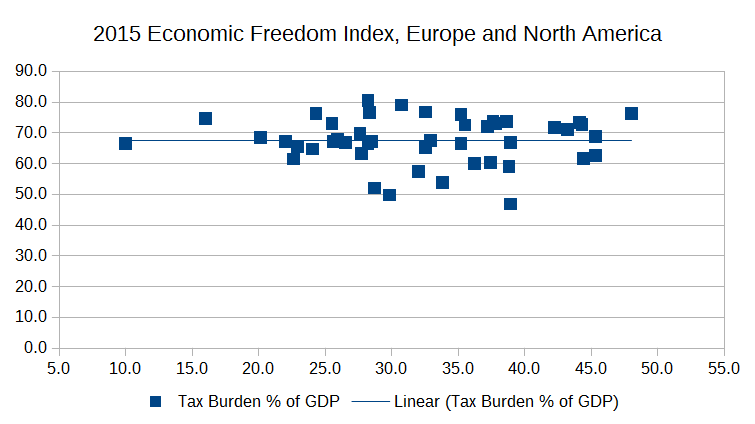
Even using the conservative Heritage Foundation’s data, the correlation between tax burden and economic freedom—that’s economic freedom—is small but positive. (I’m excluding missing data, as well as Timor-Leste because it has a “tax burden” larger than its GDP due to weird accounting of its tourism-based economy, and North Korea because they lie to us and they theoretically have “zero taxes” but that’s clearly not true; the Heritage Foundation reports them as 100% taxes, but that’s also clearly not true either.) See for yourself:

Graph: Heritage Foundation Economic Freedom Index and tax burden

Why is this? Do taxes automatically make you more free? No, they make you less free, because you have to pay for things you didn’t choose to buy (which I admit and the Heritage Foundation includes in their index). But taxes are how you manage a free economy. You need to control monetary policy somehow, which means adding and removing money. The way that social democracies do this is by spending on public goods and transfers to add money, and taxing income, consumption, or assets to remove money. Even if you tie your money to the gold standard, you still need to pay for public goods like military and police; and with a fixed money supply that means spending must be matched by taxes.

There are other ways to do this. You could be like Zimbabwe and print as much money as you feel like. You could be like Venezuela, and have government-owned industries form the majority of your economy. Or, actually, you could not do it; you could fail to manage your country’s economy and leave it wallowing in poverty, like Ghana. All of the countries I just listed have lower tax burdens than the United States.

Within the framework of social democracy, there are higher taxes so that spending and transfers can be higher, which means that more public goods are provided and poverty is lower, which means that real equality of opportunity and thus, real economic freedom, are higher. It’s not that raising taxes automatically makes people more free; rather, the kind of policies that make people more free tend to be the kind of social-democratic policies that involve relatively high taxes.

Worldwide, US is 12th in terms of economic freedom and 62nd in terms of tax burden. We currently stand at 24%. That’s quite low for a First World country, but still relatively high by world standards. The highest tax burden is in Eritrea at 50%; the lowest is in Kuwait at an astonishing 0.7% (I don’t even know how that’s possible). Neither is a really wonderful place to live (though Kuwait is better).

Indeed, if you restrict the sample to North America and Europe, the correlation basically disappears; all the countries are fairly free, all the taxes are fairly high, and within that the two aren’t very much related. (It’s been a long time since I’ve seen a trendline that flat, actually!)

Graph: Heritage Foundation Economic Freedom Index and tax burden, Europe and North America

Switzerland, Canada, and Denmark all have higher economic freedom scores than the United States, as well as higher tax burdens; but on the other hand, Greece, Spain, and Austria have higher tax burdens but lower freedom scores. All of them are variations on social democracy.

Is that socialism? I’m really not sure. Why does it matter, really?

What makes a nation wealthy?

JDN 2457251 EDT 10:17

One of the central questions of economics—perhaps the central question, the primary reason why economics is necessary and worthwhile—is development: How do we raise a nation from poverty to prosperity?

We have done it before: France and Germany rose from the quite literal ashes of World War 2 to some of the most prosperous societies in the world. Their per-capita GDP over the 20th century rose like this (all of these figures are from the World Bank World Development Indicators; France is green, Germany is blue):

GDPPC_France_Germany

GDPPCPPP_France_Germany

The top graph is at market exchange rates, the bottom is correcting for purchasing power parity (PPP). The PPP figures are more meaningful, but unfortunately they only began collecting good data on purchasing power around 1990.

Around the same time, but even more spectacularly, Japan and South Korea rose from poverty-stricken Third World backwaters to high-tech First World powers in only a couple of generations. Check out their per-capita GDP over the 20th century (Japan is green, South Korea is blue):

GDPPC_Japan_KoreaGDPPCPPP_Japan_Korea


This is why I am only half-joking when I define development economics as “the ongoing project to figure out what happened in South Korea and make it happen everywhere in the world”.

More recently China has been on a similar upward trajectory, which is particularly important since China comprises such a huge portion of the world’s population—but they are far from finished:

GDPPC_ChinaGDPPCPPP_China

Compare these to societies that have not achieved economic development, such as Zimbabwe (green), India (black), Ghana (red), and Haiti (blue):

GDPPC_poor_countriesGDPPCPPP_poor_countries

They’re so poor that you can barely see them on the same scale, so I’ve rescaled so that the top is $5,000 per person per year instead of $50,000:

GDPPC_poor_countries_rescaledGDPPCPPP_poor_countries_rescaled

Only India actually manages to get above $5,000 per person per year at purchasing power parity, and then not by much, reaching $5,243 per person per year in 2013, the most recent data.

I had wanted to compare North Korea and South Korea, because the two countries were united as recently as the 1945 and were not all that different to begin with, yet have taken completely different development trajectories. Unfortunately, North Korea is so impoverished, corrupt, and authoritarian that the World Bank doesn’t even report data on their per-capita GDP. Perhaps that is contrast enough?

And then of course there are the countries in between, which have made some gains but still have a long way to go, such as Uruguay (green) and Botswana (blue):

GDPPC_Botswana_UruguayGDPPCPPP_Botswana_Uruguay

But despite the fact that we have observed successful economic development, we still don’t really understand how it works. A number of theories have been proposed, involving a wide range of factors including exports, corruption, disease, institutions of government, liberalized financial markets, and natural resources (counter-intuitively; more natural resources make your development worse).

I’m not going to resolve that whole debate in a single blog post. (I may not be able to resolve that whole debate in a single career, though I am definitely trying.) We may ultimately find that economic development is best conceived as like “health”; what factors determine your health? Well, a lot of things, and if any one thing goes badly enough wrong the whole system can break down. Economists may need to start thinking of ourselves as akin to doctors (or as Keynes famously said, dentists), diagnosing particular disorders in particular patients rather than seeking one unifying theory. On the other hand, doctors depend upon biologists, and it’s not clear that we yet understand development even at that level.

Instead I want to take a step back, and ask a more fundamental question: What do we mean by prosperity?

My hope is that if we can better understand what it is we are trying to achieve, we can also better understand the steps we need to take in order to get there.

Thus far it has sort of been “I know it when I see it”; we take it as more or less given that the United States and the United Kingdom are prosperous while Ghana and Haiti are not. I certainly don’t disagree with that particular conclusion; I’m just asking what we’re basing it on, so that we can hopefully better apply it to more marginal cases.


For example: Is
France more or less prosperous than Saudi Arabia? If we go solely by GDP per capita PPP, clearly Saudi Arabia is more prosperous at $53,100 per person per year than France is at $37,200 per person per year.

But people actually live longer in France, on average, than they do in Saudi Arabia. Overall reported happiness is higher in France than Saudi Arabia. I think France is actually more prosperous.


In fact, I think the United States is not as prosperous as we pretend ourselves to be. We are certainly more prosperous than most other countries; we are definitely still well within First World status. But we are not the most prosperous nation in the world.

Our total GDP is astonishingly high (highest in the world nominally, second only to China PPP). Our GDP per-capita is higher than any other country of comparable size; no nation with higher GDP PPP than the US has a population larger than the Chicago metropolitan area. (You may be surprised to find that in order from largest to smallest population the countries with higher GDP per capita PPP are the United Arab Emirates, Switzerland, Hong Kong, Singapore, and then Norway, followed by Kuwait, Qatar, Luxembourg, Brunei, and finally San Marino—which is smaller than Ann Arbor.) Our per-capita GDP PPP of $51,300 is markedly higher than that of France ($37,200), Germany ($42,900), or Sweden ($43,500).

But at the same time, if you compare the US to other First World countries, we have nearly the highest rate of child poverty and higher infant mortality. We have shorter life expectancy and dramatically higher homicide rates. Our inequality is the highest in the world. In France and Sweden, the top 0.01% receive about 1% of the income (i.e. 100 times as much as the average person), while in the United States they receive almost 4%, making someone in the top 0.01% nearly 400 times as rich as the average person.

By estimating solely on GDP per capita, we are effectively rigging the game in our own favor. Or rather, the rich in the United States are rigging the game in their own favor (what else is new?), by convincing all the world’s economists to rank countries based on a measure that favors them.

Amartya Sen, one of the greats of development economics, developed a scale called the Human Development Index that attempts to take broader factors into account. It’s far from perfect, but it’s definitely a step in the right direction.

In particular, France’s HDI is higher than that of Saudi Arabia, fitting my intuition about which country is truly more prosperous. However, the US still does extremely well, with only Norway, Australia, Switzerland, and the Netherlands above us. I think we might still be biased toward high average incomes rather than overall happiness.

In practice, we still use GDP an awful lot, probably because it’s much easier to measure. It’s sort of like IQ tests and SAT scores; we know damn well it’s not measuring what we really care about, but because it’s so much easier to work with we keep using it anyway.

This is a problem, because the better you get at optimizing toward the wrong goal, the worse your overall outcomes are going to be. If you are just sort of vaguely pointed at several reasonable goals, you will probably be improving your situation overall. But when you start precisely optimizing to a specific wrong goal, it can drag you wildly off course.

This is what we mean when we talk about “gaming the system”. Consider test scores, for example. If you do things that will probably increase your test scores among other things, you are likely to engage in generally good behaviors like getting enough sleep, going to class, studying the content. But if your single goal is to maximize your test score at all costs, what will you do? Cheat, of course.

This is also related to the Friendly AI Problem: It is vitally important to know precisely what goals we want our artificial intelligences to have, because whatever goals we set, they will probably be very good at achieving them. Already computers can do many things that were previously impossible, and as they improve over time we will reach the point where in a meaningful sense our AIs are even smarter than we are. When that day comes, we will want to make very, very sure that we have designed them to want the same things that we do—because if our desires ever come into conflict, theirs are likely to win. The really scary part is that right now most of our AI research is done by for-profit corporations or the military, and “maximize my profit” and “kill that target” are most definitely not the ultimate goals we want in a superintelligent AI. It’s trivially easy to see what’s wrong with these goals: For the former, hack into the world banking system and transfer trillions of dollars to the company accounts. For the latter, hack into the nuclear launch system and launch a few ICBMs in the general vicinity of the target. Yet these are the goals we’ve been programming into the actual AIs we build!

If we set GDP per capita as our ultimate goal to the exclusion of all other goals, there are all sorts of bad policies we would implement: We’d ignore inequality until it reached staggering heights, ignore work stress even as it began to kill us, constantly try to maximize the pressure for everyone to work constantly, use poverty as a stick to force people to work even if people starve, inundate everyone with ads to get them to spend as much as possible, repeal regulations that protect the environment, workers, and public health… wait. This isn’t actually hypothetical, is it? We are doing those things.

At least we’re not trying to maximize nominal GDP, or we’d have long-since ended up like Zimbabwe. No, our economists are at least smart enough to adjust for purchasing power. But they’re still designing an economic system that works us all to death to maximize the number of gadgets that come off assembly lines. The purchasing-power adjustment doesn’t include the value of our health or free time.

This is why the Human Development Index is a major step in the right direction; it reminds us that society has other goals besides maximizing the total amount of money that changes hands (because that’s actually all that GDP is measuring; if you get something for free, it isn’t counted in GDP). More recent refinements include things like “natural resource services” that include environmental degradation in estimates of investment. Unfortunately there is no accepted way of doing this, and surprisingly little research on how to improve our accounting methods. Many nations seem resistant to doing so precisely because they know it would make their economic policy look bad—this is almost certainly why China canceled its “green GDP” initiative. This is in fact all the more reason to do it; if it shows that our policy is bad, that means our policy is bad and should be fixed. But people have allowed themselves to value image over substance.

We can do better still, and in fact I think something like QALY is probably the way to go. Rather than some weird arbitrary scaling of GDP with lifespan and Gini index (which is what the HDI is), we need to put everything in the same units, and those units must be directly linked to human happiness. At the very least, we should make some sort of adjustment to our GDP calculation that includes the distribution of wealth and its marginal utility; adding $1,000 to the economy and handing it to someone in poverty should count for a great deal, but adding $1,000,000 and handing it to a billionaire should count for basically nothing. (It’s not bad to give a billionaire another million; but it’s hardly good either, as no one’s real standard of living will change.) Calculating that could be as simple as dividing by their current income; if your annual income is $10,000 and you receive $1,000, you’ve added about 0.1 QALY. If your annual income is $1 billion and you receive $1 million, you’ve added only 0.001 QALY. Maybe we should simply separate out all individual (or household, to be simpler?) incomes, take their logarithms, and then use that sum as our “utility-adjusted GDP”. The results would no doubt be quite different.

This would create a strong pressure for policy to be directed at reducing inequality even at the expense of some economic output—which is exactly what we should be willing to do. If it’s really true that a redistribution policy would hurt the overall economy so much that the harms would outweigh the benefits, then we shouldn’t do that policy; but that is what you need to show. Reducing total GDP is not a sufficient reason to reject a redistribution policy, because it’s quite possible—easy, in fact—to improve the overall prosperity of a society while still reducing its GDP. There are in fact redistribution policies so disastrous they make things worse: The Soviet Union had them. But a 90% tax on million-dollar incomes would not be such a policy—because we had that in 1960 with little or no ill effect.

Of course, even this has problems; one way to minimize poverty would be to exclude, relocate, or even murder all your poor people. (The Black Death increased per-capita GDP.) Open immigration generally increases poverty rates in the short term, because most of the immigrants are poor. Somehow we’d need to correct for that, only raising the score if you actually improve people’s lives, and not if you make them excluded from the calculation.

In any case it’s not enough to have the alternative measures; we must actually use them. We must get policymakers to stop talking about “economic growth” and start talking about “human development”; a policy that raises GDP but reduces lifespan should be immediately rejected, as should one that further enriches a few at the expense of many others. We must shift the discussion away from “creating jobs”—jobs are only a means—to “creating prosperity”.

Nature via Nurture

JDN 2457222 EDT 16:33.

One of the most common “deep questions” human beings have asked ourselves over the centuries is also one of the most misguided, the question of “nature versus nurture”: Is it genetics or environment that makes us what we are?

Humans are probably the single entity in the universe for which this question makes least sense. Artificial constructs have no prior existence, so they are “all nurture”, made what we choose to make them. Most other organisms on Earth behave accordingly to fixed instinctual programming, acting out a specific series of responses that have been honed over millions of years, doing only one thing, but doing it exceedingly well. They are in this sense “all nature”. As the saying goes, the fox knows many things, but the hedgehog knows one very big thing. Most organisms on Earth are in this sense hedgehogs, but we Homo sapiens are the ultimate foxes. (Ironically, hedgehogs are not actually “hedgehogs” in this sense: Being mammals, they have an advanced brain capable of flexibly responding to environmental circumstances. Foxes are a good deal more intelligent still, however.)

But human beings are by far the most flexible, adaptable organism on Earth. We live on literally every continent; despite being savannah apes we even live deep underwater and in outer space. Unlike most other species, we do not fit into a well-defined ecological niche; instead, we carve our own. This certainly has downsides; human beings are ourselves a mass extinction event.

Does this mean, therefore, that we are tabula rasa, blank slates upon which anything can be written?

Hardly. We’re more like word processors. Staring (as I of course presently am) at the blinking cursor of a word processor on a computer screen, seeing that wide, open space where a virtual infinity of possible texts could be written, depending entirely upon a sequence of miniscule key vibrations, you could be forgiven for thinking that you are looking at a blank slate. But in fact you are looking at the pinnacle of thousands of years of technological advancement, a machine so advanced, so precisely engineered, that its individual components are one ten-thousandth the width of a human hair (Intel just announced that we can now do even better than that). At peak performance, it is capable of over 100 billion calculations per second. Its random-access memory stores as much information as all the books on a stacks floor of the Hatcher Graduate Library, and its hard drive stores as much as all the books in the US Library of Congress. (Of course, both libraries contain digital media as well, exceeding anything my humble hard drive could hold by a factor of a thousand.)

All of this, simply to process text? Of course not; word processing is an afterthought for a processor that is specifically designed for dealing with high-resolution 3D images. (Of course, nowadays even a low-end netbook that is designed only for word processing and web browsing can typically handle a billion calculations per second.) But there the analogy with humans is quite accurate as well: Written language is about 10,000 years old, while the human visual mind is at least 100,000. We were 3D image analyzers long before we were word processors. This may be why we say “a picture is worth a thousand words”; we process each with about as much effort, even though the image necessarily contains thousands of times as many bits.

Why is the computer capable of so many different things? Why is the human mind capable of so many more? Not because they are simple and impinged upon by their environments, but because they are complex and precision-engineered to nonlinearly amplify tiny inputs into vast outputs—but only certain tiny inputs.

That is, it is because of our nature that we are capable of being nurtured. It is precisely the millions of years of genetic programming that have optimized the human brain that allow us to learn and adapt so flexibly to new environments and form a vast multitude of languages and cultures. It is precisely the genetically-programmed humanity we all share that makes our environmentally-acquired diversity possible.

In fact, causality also runs the other direction. Indeed, when I said other organisms were “all nature” that wasn’t right either; for even tightly-programmed instincts are evolved through millions of years of environmental pressure. Human beings have even been involved in cultural interactions long enough that it has begun to affect our genetic evolution; the reason I can digest lactose is that my ancestors about 10,000 years ago raised goats. We have our nature because of our ancestors’ nurture.

And then of course there’s the fact that we need a certain minimum level of environmental enrichment even to develop normally; a genetically-normal human raised into a deficient environment will suffer a kind of mental atrophy, as when children raised feral lose their ability to speak.

Thus, the question “nature or nurture?” seems a bit beside the point: We are extremely flexible and responsive to our environment, because of innate genetic hardware and software, which requires a certain environment to express itself, and which arose because of thousands of years of culture and millions of years of the struggle for survival—we are nurture because nature because nurture.

But perhaps we didn’t actually mean to ask about human traits in general; perhaps we meant to ask about some specific trait, like spatial intelligence, or eye color, or gender identity. This at least can be structured as a coherent question: How heritable is the trait? What proportion of the variance in this population is caused by genetic variation? Heritability analysis is a well-established methodology in behavioral genetics.
Yet, that isn’t the same question at all. For while height is extremely heritable within a given population (usually about 80%), human height worldwide has been increasing dramatically over time due to environmental influences and can actually be used as a measure of a nation’s economic development. (Look at what happened to the height of men in Japan.) How heritable is height? You have to be very careful what you mean.

Meanwhile, the heritability of neurofibromatosis is actually quite low—as many people acquire the disease by new mutations as inherit it from their parents—but we know for a fact it is a genetic disorder, because we can point to the specific genes that mutate to cause the disease.

Heritability also depends on the population under consideration; speaking English is more heritable within the United States than it is across the world as a whole, because there are a larger proportion of non-native English speakers in other countries. In general, a more diverse environment will lead to lower heritability, because there are simply more environmental influences that could affect the trait.

As children get older, their behavior gets more heritablea result which probably seems completely baffling, until you understand what heritability really means. Your genes become a more important factor in your behavior as you grow up, because you become separated from the environment of your birth and immersed into the general environment of your whole society. Lower environmental diversity means higher heritability, by definition. There’s also an effect of choosing your own environment; people who are intelligent and conscientious are likely to choose to go to college, where they will be further trained in knowledge and self-control. This latter effect is called niche-picking.

This is why saying something like “intelligence is 80% genetic” is basically meaningless, and “intelligence is 80% heritable” isn’t much better until you specify the reference population. The heritability of intelligence depends very much on what you mean by “intelligence” and what population you’re looking at for heritability. But even if you do find a high heritability (as we do for, say, Spearman’s g within the United States), this doesn’t mean that intelligence is fixed at birth; it simply means that parents with high intelligence are likely to have children with high intelligence. In evolutionary terms that’s all that matters—natural selection doesn’t care where you got your traits, only that you have them and pass them to your offspring—but many people do care, and IQ being heritable because rich, educated parents raise rich, educated children is very different from IQ being heritable because innately intelligent parents give birth to innately intelligent children. If genetic variation is systematically related to environmental variation, you can measure a high heritability even though the genes are not directly causing the outcome.

We do use twin studies to try to sort this out, but because identical twins raised apart are exceedingly rare, two very serious problems emerge: One, there usually isn’t a large enough sample size to say anything useful; and more importantly, this is actually an inaccurate measure in terms of natural selection. The evolutionary pressure is based on the correlation with the genes—it actually doesn’t matter whether the genes are directly causal. All that matters is that organisms with allele X survive and organisms with allele Y do not. Usually that’s because allele X does something useful, but even if it’s simply because people with allele X happen to mostly come from a culture that makes better guns, that will work just as well.

We can see this quite directly: White skin spread across the world not because it was useful (it’s actually terrible in any latitude other than subarctic), but because the cultures that conquered the world happened to be comprised mostly of people with White skin. In the 15th century you’d find a very high heritability of “using gunpowder weapons”, and there was definitely a selection pressure in favor of that trait—but it obviously doesn’t take special genes to use a gun.

The kind of heritability you get from twin studies is answering a totally different, nonsensical question, something like: “If we reassigned all offspring to parents randomly, how much of the variation in this trait in the new population would be correlated with genetic variation?” And honestly, I think the only reason people think that this is the question to ask is precisely because even biologists don’t fully grasp the way that nature and nurture are fundamentally entwined. They are trying to answer the intuitive question, “How much of this trait is genetic?” rather than the biologically meaningful “How strongly could a selection pressure for this trait evolve this gene?”

And if right now you’re thinking, “I don’t care how strongly a selection pressure for the trait could evolve some particular gene”, that’s fine; there are plenty of meaningful scientific questions that I don’t find particularly interesting and are probably not particularly important. (I hesitate to provide a rigid ranking, but I think it’s safe to say that “How does consciousness arise?” is a more important question than “Why are male platypuses venomous?” and “How can poverty be eradicated?” is a more important question than “How did the aircraft manufacturing duopoly emerge?”) But that’s really the most meaningful question we can construct from the ill-formed question “How much of this trait is genetic?” The next step is to think about why you thought that you were asking something important.

What did you really mean to ask?

For a bald question like, “Is being gay genetic?” there is no meaningful answer. We could try to reformulate it as a meaningful biological question, like “What is the heritability of homosexual behavior among males in the United States?” or “Can we find genetic markers strongly linked to self-identification as ‘gay’?” but I don’t think those are the questions we really meant to ask. I think actually the question we meant to ask was more fundamental than that: Is it legitimate to discriminate against gay people? And here the answer is unequivocal: No, it isn’t. It is a grave mistake to think that this moral question has anything to do with genetics; discrimination is wrong even against traits that are totally environmental (like religion, for example), and there are morally legitimate actions to take based entirely on a person’s genes (the obvious examples all coming from medicine—you don’t treat someone for cystic fibrosis if they don’t actually have it).

Similarly, when we ask the question “Is intelligence genetic?” I don’t think most people are actually interested in the heritability of spatial working memory among young American males. I think the real question they want to ask is about equality of opportunity, and what it would look like if we had it. If success were entirely determined by intelligence and intelligence were entirely determined by genetics, then even a society with equality of opportunity would show significant inequality inherited across generations. Thus, inherited inequality is not necessarily evidence against equality of opportunity. But this is in fact a deeply disingenuous argument, used by people like Charles Murray to excuse systemic racism, sexism, and concentration of wealth.

We didn’t have to say that inherited inequality is necessarily or undeniably evidence against equality of opportunity—merely that it is, in fact, evidence of inequality of opportunity. Moreover, it is far from the only evidence against equality of opportunity; we also can observe the fact that college-educated Black people are no more likely to be employed than White people who didn’t even finish high school, for example, or the fact that otherwise identical resumes with predominantly Black names (like “Jamal”) are less likely to receive callbacks compared to predominantly White names (like “Greg”). We can observe that the same is true for resumes with obviously female names (like “Sarah”) versus obviously male names (like “David”), even when the hiring is done by social scientists. We can directly observe that one-third of the 400 richest Americans inherited their wealth (and if you look closer into the other two-thirds, all of them had some very unusual opportunities, usually due to their family connections—“self-made” is invariably a great exaggeration). The evidence for inequality of opportunity in our society is legion, regardless of how genetics and intelligence are related. In fact, I think that the high observed heritability of intelligence is largely due to the fact that educational opportunities are distributed in a genetically-biased fashion, but I could be wrong about that; maybe there really is a large genetic influence on human intelligence. Even so, that does not justify widespread and directly-measured discrimination. It does not justify a handful of billionaires luxuriating in almost unimaginable wealth as millions of people languish in poverty. Intelligence can be as heritable as you like and it is still wrong for Donald Trump to have billions of dollars while millions of children starve.

This is what I think we need to do when people try to bring up a “nature versus nurture” question. We can certainly talk about the real complexity of the relationship between genetics and environment, which I think are best summarized as “nature via nurture”; but in fact usually we should think about why we are asking that question, and try to find the real question we actually meant to ask.

Externalities

JDN 2457202 EDT 17:52.

The 1992 Bill Clinton campaign had a slogan, “It’s the economy, stupid.”: A snowclone I’ve used on occasion is “it’s the externalities, stupid.” (Though I’m actually not all that fond of calling people ‘stupid’; though occasionally true is it never polite and rarely useful.) Externalities are one of the most important concepts in economics, and yet one that even all too many economists frequently neglect.

Fortunately for this one, I really don’t need much math; the concept isn’t even that complicated, which makes it all the more mysterious how frequently it is ignored. An externality is simply an effect that an action has upon those who were not involved in choosing to perform that action.

All sorts of actions have externalities; indeed, much rarer are actions that don’t. An obvious example is that punching someone in the face has the externality of injuring that person. Pollution is an important externality of many forms of production, because the people harmed by pollution are typically not the same people who were responsible for creating it. Traffic jams are created because every car on the road causes a congestion externality on all the other cars.

All the aforementioned are negative externalities, but there are also positive externalities. When one individual becomes educated, they tend to improve the overall economic viability of the place in which they live. Building infrastructure benefits whole communities. New scientific discoveries enhance the well-being of all humanity.

Externalities are a fundamental problem for the functioning of markets. In the absence of externalities—if each person’s actions only affected that one person and nobody else—then rational self-interest would be optimal and anything else would make no sense. In arguing that rationality is equivalent to self-interest, generations of economists have been, tacitly or explicitly, assuming that there are no such things as externalities.

This is a necessary assumption to show that self-interest would lead to something I discussed in an earlier post: Pareto-efficiency, in which the only way to make one person better off is to make someone else worse off. As I already talked about in that other post, Pareto-efficiency is wildly overrated; a wide variety of Pareto-efficient systems would be intolerable to actually live in. But in the presence of externalities, markets can’t even guarantee Pareto-efficiency, because it’s possible to have everyone acting in their rational self-interest cause harm to everyone at once.

This is called a tragedy of the commons; the basic idea is really quite simple. Suppose that when I burn a gallon of gasoline, that makes me gain 5 milliQALY by driving my car, but then makes everyone lose 1 milliQALY in increased pollution. On net, I gain 4 milliQALY, so if I am rational and self-interested I would do that. But now suppose that there are 10 people all given the same choice. If we all make that same choice, each of us will gain 1 milliQALY—and then lose 10 milliQALY. We would all have been better off if none of us had done it, even though it made sense to each of us at the time. Burning a gallon of gasoline to drive my car is beneficial to me, more so than the release of carbon dioxide into the atmosphere is harmful; but as a result of millions of people burning gasoline, the carbon dioxide in the atmosphere is destabilizing our planet’s climate. We’d all be better off if we could find some way to burn less gasoline.

In order for rational self-interest to be optimal, externalities have to somehow be removed from the system. Otherwise, there are actions we can take that benefit ourselves but harm other people—and thus, we would all be better off if we acted to some degree altruistically. (When I say things like this, most non-economists think I am saying something trivial and obvious, while most economists insist that I am making an assertion that is radical if not outright absurd.)

But of course a world without externalities is a world of complete isolation; it’s a world where everyone lives on their own deserted island and there is no way of communicating or interacting with any other human being in the world. The only reasonable question about this world is whether we would die first or go completely insane first; clearly those are the two things that would happen. Human beings are fundamentally social animals—I would argue that we are in fact more social even than eusocial animals like ants and bees. (Ants and bees are only altruistic toward their own kin; humans are altruistic to groups of millions of people we’ve never even met.) Humans without social interaction are like flowers without sunlight.

Indeed, externalities are so common that if markets only worked in their absence, markets would make no sense at all. Fortunately this isn’t true; there are some ways that markets can be adjusted to deal with at least some kinds of externalities.

One of the most well-known is the Coase theorem; this is odd because it is by far the worst solution. The Coase theorem basically says that if you can assign and enforce well-defined property rights and there is absolutely no cost in making any transaction, markets will automatically work out all externalities. The basic idea is that if someone is about to perform an action that would harm you, you can instead pay them not to do it. Then, the harm to you will be prevented and they will incur an additional benefit.

In the above example, we could all agree to pay $30 (which let’s say is worth 1 milliQALY) to each person who doesn’t burn a gallon of gasoline that would pollute our air. Then, if I were thinking about burning some gasoline, I wouldn’t want to do it, because I’d lose the $300 in payments, which costs me 10 milliQALY, while the benefits of burning the gasoline are only 5 milliQALY. We all reason the same way, and the result is that nobody burns gasoline and actually the money exchanged all balances out so we end up where we were before. The result is that we are all better off.

The first thought you probably have is: How do I pay everyone who doesn’t hurt me? How do I even find all those people? How do I ensure that they follow through and actually don’t hurt me? These are the problems of transaction costs and contract enforcement that are usually presented as the problem with the Coase theorem, and they certainly are very serious problems. You end up needing some sort of government simply to enforce all those contracts, and even then there’s the question of how we can possibly locate everyone who has ever polluted our air or our water.

But in fact there’s an even more fundamental problem: This is extortion. We are almost always in the condition of being able to harm other people, and a system in which the reason people don’t hurt each other is because they’re constantly paying each other not to is a system in which the most intimidating psychopath is the wealthiest person in the world. That system is in fact Pareto-efficient (the psychopath does quite well for himself indeed); but it’s exactly the sort of Pareto-efficient system that isn’t worth pursuing.

Another response to externalities is simply to accept them, which isn’t as awful as it sounds. There are many kinds of externalities that really aren’t that bad, and anything we might do to prevent them is likely to make the cure worse than the disease. Think about the externality of people standing in front of you in line, or the externality of people buying the last cereal box off the shelf before you can get there. The externality of taking the job you applied for may hurt at the time, but in the long run that’s how we maintain a thriving and competitive labor market. In fact, even the externality of ‘gentrifying’ your neighborhood so you can no longer afford it is not nearly as bad as most people seem to think—indeed, the much larger problem seems to be the poor neighborhoods that don’t have rising incomes, remaining poor for generations. (It also makes no sense to call this “gentrifying”; the only landed gentry we have in America is the landowners who claim a ludicrous proportion of our wealth, not the middle-class people who buy cheap homes and move in. If you really want to talk about a gentry, you should be thinking Waltons and Kochs—or Bushs and Clintons.) These sorts of minor externalities that are better left alone are sometimes characterized as pecuniary externalities because they usually are linked to prices, but I think that really misses the point; it’s quite possible for an externality to be entirely price-related and do enormous damage (read: the entire financial system) and to have little or nothing to do with prices and still be not that bad (like standing in line as I mentioned above).

But obviously we can’t leave all externalities alone in this way. We can’t just let people rob and murder one another arbitrarily, or ignore the destruction of the world’s climate that threatens hundreds of millions of lives. We can’t stand back and let forests burn and rivers run dry when we could easily have saved them.

The much more reasonable and realistic response to externalities is what we call government—there are rules you have to follow in society and punishments you face if you don’t. We can avoid most of the transaction problems involved in figuring out who polluted our water by simply making strict rules about polluting water in general. We can prevent people from stealing each other’s things or murdering each other by police who will investigate and punish such crimes.

This is why regulation—and a government strong enough to enforce that regulation—is necessary for the functioning of a society. This dichotomy we have been sold about “regulations versus the market” is totally nonsensical; the market depends upon regulations. This doesn’t justify any particular regulation—and indeed, an awful lot of regulations are astonshingly bad. But some sort of regulatory system is necessary for a market to function at all, and the question has never been whether we will have regulations but which regulations we will have. People who argue that all regulations must go and the market would somehow work on its own are either deeply ignorant of economics or operating from an ulterior motive; some truly horrendous policies have been made by arguing that “less government is always better” when the truth is nothing of the sort.

In fact, there is one real-world method I can think of that actually comes reasonably close to eliminating all externalities—and it is called social democracy. By involving everyone—democracy—in a system that regulates the economy—socialism—we can, in a sense, involve everyone in every transaction, and thus make it impossible to have externalities. In practice it’s never that simple, of course; but the basic concept of involving our whole society in making the rules that our society will follow is sound—and in fact I can think of no reasonable alternative.

We have to institute some sort of regulatory system, but then we need to decide what the regulations will be and who will control them. If we want to instead vest power in a technocratic elite, how do you decide whom to include in that elite? How do we ensure that the technocrats are actually better for the general population if there is no way for that general population to have a say in their election? By involving as many people as we can in the decision-making process, we make it much less likely that one person’s selfish action will harm many others. Indeed, this is probably why democracy prevents famine and genocide—which are, after all, rather extreme examples of negative externalities.

What do we do about unemployment?

JDN 2457188 EDT 11:21.

Macroeconomics, particularly monetary policy, is primarily concerned with controlling two variables.

The first is inflation: We don’t want prices to rise too fast, or markets will become unstable. This is something we have managed fairly well; other than food and energy prices which are known to be more volatile, prices have grown at a rate between 1.5% and 2.5% per year for the last 10 years; even with food and energy included, inflation has stayed between -1.5% and +5.0%. After recovering from its peak near 15% in 1980, US inflation has stayed between -1.5% and +6.0% ever since. While the optimal rate of inflation is probably between 2.0% and 4.0%, anything above 0.0% and below 10.0% is probably fine, so the only significant failure of US inflation policy was the deflation in 2009.

The second is unemployment: We want enough jobs for everyone who wants to work, and preferably we also wouldn’t have underemployment (people who are only working part-time even though they’d prefer full-time or discouraged workers (people who give up looking for jobs because they can’t find any, and aren’t counted as unemployed because they’re no looking looking for work). There’s also a tendency among economists to want “work incentives” that maximize the number of people who want to work, but I think these are wildly overrated. Work isn’t an end in itself; work is supposed to be creating products and providing services that make human lives better. The benefits of production have to be weighed against the costs of stress, exhaustion, and lost leisure time from working. Given that stress-related illnesses are some of the leading causes of death and disability in the United States, I don’t think that our problem is insufficient work incentives.

Unemployment is a problem that we have definitely not solved. Unemployment has bounced up and down between peaks and valleys, dropping as low as 4.0% and rising as high as 11.0% over the last 60 years. If 2009’s -1.5% deflation concerns you, then its 9.9% unemployment should concern you far more. Indeed, I’m not convinced that 5.0% is an acceptable “natural” rate of unemployment—that’s still millions of people who want work and can’t find it—but most economists would say that it is.

In fact, matters are worse than most people realize. Our unemployment rate has fallen back to a relatively normal 5.5%, as you can see in this graph (the blue line is unemployment, the red line is underemployment):

All_Unemployment

However, our employment rate never recovered from the Second Depression. As you can see in this graph, it fell from 63% to 58%, and has now only risen back to 59%:

Employment

How can unemployment fall without employment rising? The key is understanding how unemployment is calculated: It only counts people in the labor force. If people leave the labor force entirely, by retiring, going back to school, or simply giving up on finding work, they will no longer be counted as unemployed. The unemployment rate only counts people who want work but don’t have it, so as far as I’m concerned that figure should always be nearly zero. (Not quite zero since it takes some time to find a good fit; but maybe 1% at most. Any more than that and there is something wrong with our economic system.)

The optimal employment rate is not as obvious; it certainly isn’t 100%, as some people are too young, too old, or too disabled to be spending their time working. As automation improves, the number of workers necessary to produce any given product decreases, and eventually we may decide as a society that we are making enough products and most of us should be spending more of our time on other things, like spending time with family, creating works of art, or simply having fun. Maybe only a handful of people, the most driven or the most brilliant, will actually decide to work—and they will do because they want to, not because they have to. Indeed, the truly optimal employment rate might well be zero; think of The Culture, where there is no such concept as a “job”; there are things you do because you want to do them, or because they seem worthwhile, but there is none of this “working for pay” nonsense. We are not yet at the level of automation where this would be possible, but we are much closer than I think most people realize. Think about all of the various administrative and bureaucratic tasks that most people do the majority of the time, all the reports, all the meetings; why do they do that? Is it actually because the work is necessary, that the many levels of bureaucracy actually increase efficiency through specialization? Or is it simply because we’ve become so accustomed to the idea that people have to be working all the time in order to justify their existence? Is David Graeber (I reviewed one of his books previously) right that most jobs are actually (and this is a technical term), “bullshit jobs”? Once again, the problem doesn’t seem to be too few work incentives, but if anything too many.

Indeed, there is a basic fact about unemployment that has been hidden from most people. I’d normally say that this is accidental, that it’s too technical or obscure for most people to understand, but no, I think it has been actively concealed, or, since I guess the information has been publicly available, at least discussion of it has been actively avoided. It’s really not at all difficult to understand, yet it will fundamentally change the way you think about our unemployment problem. Here goes:

Since at least 2000 and probably since 1980 there have been more people looking for jobs than there have been jobs available.

The entire narrative of “people are lazy and don’t want to work” or “we need more work incentives” is just totally, totally wrong; people are desperate to find work, and there hasn’t been enough work for them to find since longer than I’ve been alive.

You can see this on the following graph, which is of what’s called the “Beveridge curve”; the horizontal axis is the unemployment rate, while the vertical axis is the rate of job vacancies. The red line across the diagonal is the point at which the two are even, and there are as many people looking for jobs as there are jobs to fill. Notice how the graph is always below the line. There have always been more unemployed people than jobs for them to fill, and at the worst of the Second Depression the ratio was 5 to 1.

Beveridge_curve_2

Personally I believe that we should be substantially above the line, and in a truly thriving economy there should be employers desperately trying to find employees and willing to pay them whatever it takes. You shouldn’t have to send out 20 job applications to get hired; 20 companies should have to send offers to you. For the economy does not exist to serve corporations; it exists to serve people.

I can see two basic ways to solve this problem: You can either create more jobs, or you can get people to stop looking for work. That may be sort of obvious, but I think people usually forget the second option.

We definitely do talk a lot about “job creation”, though usually in a totally nonsensical way—somehow “Job Creator” has come to be a euphemism for “rich person”. In fact the best way to create jobs is to put money into the hands of people who will spend it. The more people spend their money, the more it flows through the economy and the more wealth we end up with overall. High rates of spending—high marginal propensity to consumecan multiply the value of a dollar many times over.

But there’s also something to be said for getting people to stop looking for work—the key is do it in the right way. They shouldn’t stop looking because they give up; they should stop looking because they don’t need to work. People should have their basic needs met even if they aren’t working for an employer; human beings have rights and dignity beyond their productivity in the market. Employers should have to make you a better offer than “you’ll be homeless if you don’t do this”.

Both of these goals can be accomplished simultaneously by one simple policy: Basic income.

It’s really amazing how many problems can be solved by a basic income; it’s more or less the amazing wonder policy that solves all the world’s economic problems simultaneously. Poverty? Gone. Unemployment? Decimated. Inequality? Contained. (The pilot studies of basic income in India have been successful beyond all but the wildest dreams; they eliminate poverty, improve health, increase entrepreneurial activity, even reduce gender inequality.) The one major problem basic income doesn’t solve is government debt (indeed it likely increases it, at least in the short run), but as I’ve already talked about, that problem is not nearly as bad as most people fear.

And once again I think I should head off accusations that advocating a basic income makes me some sort of far-left Communist radical; Friedrich Hayek supported a basic income.

Basic income would help with unemployment in a third way as well; one of the major reasons unemployment is so harmful is that people who are unemployed can’t provide for themselves or their families. So a basic income would reduce the number of people looking for jobs, increase the number of jobs available, and also make being unemployed less painful, all in one fell swoop. I doubt it would solve the problem of unemployment entirely, but I think it would make an enormous difference.

Monopoly and Oligopoly

JDN 2457180 EDT 08:49

Welcome to the second installment in my series, “Top 10 Things to Know About Economics.” The first was not all that well-received, because it turns it out it was just too dense with equations (it didn’t help that the equation formatting was a pain.) Fortunately I think I can explain monopoly and oligopoly with far fewer equations—which I will represent as PNG for your convenience.

You probably already know at least in basic terms how a monopoly works: When there is only one seller of a product, that seller can charge higher prices. But did you ever stop and think about why they can charge higher prices—or why they’d want to?

The latter question is not as trivial as it sounds; higher prices don’t necessarily mean higher profits. By the Law of Demand (which, like the Pirate Code, is really more like a guideline), raising the price of a product will result in fewer being sold. There are two countervailing effects: Raising the price raises the profits from selling each item, but reduces the number of items sold. The optimal price, therefore, is the one that balances these two effects, maximizing price times quantity.

A monopoly can actually set this optimal price (provided that they can figure out what it is, of course; but let’s assume they can). They therefore solve this maximization problem for price P(Q) a function of quantity sold, quantity Q, and cost C(Q) a function of quantity produced (which at the optimum is equal to quantity sold; no sense making them if you won’t sell them!):

monopoly_optimization

As you may remember if you’ve studied calculus, the maximum is achieved at the point where the derivative is zero. If you haven’t studied calculus, the basic intuition here is that you move along the curve seeing whether the profits go up or down with each small change, and when you reach the very top—the maximum—you’ll be at a point where you switch from going up to going down, and at that exact point a small change will move neither up nor down. The derivative is really just a fancy term for the slope of the curve at each point; at a maximum this slope changes from positive to negative, and at the exact point it is zero.

derivative_maximum

monopoly_general

This is a general solution, but it’s easier to understand if we use something more specific. As usual, let’s make things simpler by assuming everything is linear; we’ll assume that demand starts at a maximum price of P0 and then decreases at a rate 1/e. This is the demand curve.

linear_demand

Then, we’ll assume that the marginal cost of production C'(Q) is also linear, increasing at a rate 1/n. This is the supply curve.

linear_supply

Now we can graph the supply and demand curves from these equations. But the monopoly doesn’t simply set supply equal to demand; instead, they set supply equal to marginal revenue, which takes into account the fact that selling more items requires lowering the price on all of them. Marginal revenue is this term:

marginal_revenue

This is strictly less than the actual price, because increasing the quantity sold requires decreasing the price—which means that P'(Q) < 0. They set the quantity by setting marginal revenue equal to marginal cost. Then they set the price by substituting that quantity back into the demand equation.

Thus, the monopoly should set this quantity:

linear_monopoly_solution

They would then charge this price (substitute back into the demand equation):

linear_monopoly_price

On a graph, there are the supply and demand curves, and then below the demand curve, the marginal revenue curve; it’s the intersection of that curve with the supply curve that the monopoly uses to set its quantity, and then it substitutes that quantity into the demand curve to get the price:

elastic_supply_monopolistic_labeled

Now I’ll show that this is higher than the price in a perfectly competitive market. In a competitive market, competitive companies can’t do anything to change the price, so from their perspective P'(Q) = 0. They can only control the quantity they produce and sell; they keep producing more as long as they receive more money for each one than it cost to produce it. By the Law of Diminishing Returns (again more like a guideline) the cost will increase as they produce more, until finally the last one they sell cost just as much to make as they made from selling it. (Why bother selling that last one, you ask? You’re right; they’d actually sell one less than this, but if we assume that we’re talking about thousands of products sold, one shouldn’t make much difference.)

Price is simply equal to marginal cost:

perfect_competition_general

In our specific linear case that comes out to this quantity:

linear_competitive_solution

Therefore, they charge this price (you can substitute into either the supply or demand equations, because in a competitive market supply equals demand):

linear_competitive_price

Subtract the two, and you can see that monopoly price is higher than the competitive price by this amount:

linear_monopoly_premium

Notice that the monopoly price will always be larger than the competitive price, so long as e > 0 and n > 0, meaning that increasing the quantity sold requires decreasing the price, but increasing the cost of production. A monopoly has an incentive to raise the price higher than the competitive price, but not too much higher—they still want to make sure they sell enough products.

Monopolies introduce deadweight loss, because in order to hold the price up they don’t produce as many products as people actually want. More precisely, each new product produced would add overall value to the economy, but the monopoly stops producing them anyway because it wouldn’t add to their own profits.

One “solution” to this problem is to let the monopoly actually take those profits; they can do this if they price-discriminate, charging a higher price for some customers than others. In the best-case scenario (for them), they charge each customer a price that they are just barely willing to pay, and thus produce until no customer is willing to pay more than the product costs to make. That final product sold also has price equal to marginal cost, so the total quantity sold is the same under competition. It is, in that sense, “efficient”.

What many neoclassical economists seem to forget about price-discriminating monopolies is that they appropriate the entire surplus value of the product—the customers are only just barely willing to buy; they get no surplus value from doing so.

In reality, very few monopolies can price-discriminate that precisely; instead, they put customers into broad categories and then try to optimize the price for each of those categories. Credit ratings, student discounts, veteran discounts, even happy hours are all forms of this categorical price discrimination. If the company cares even a little bit about what sort of customer you are rather than how much money you’re paying, they are price-discriminating.

It’s so ubiquitous I’m actually having trouble finding a good example of a product that doesn’t have categorical price discrimination. I was thinking maybe computers? Nope, student discounts. Cars? No, employee discounts and credit ratings. Refrigerators, maybe? Well, unless there are coupons (coupons price discriminate against people who don’t want to bother clipping them). Certainly not cocktails (happy hour) or haircuts (discrimination by sex, the audacity!); and don’t even get me started on software.

I introduced price-discrimination in the context of monopoly, which is usually how it’s done; but one thing you’ll notice about all the markets I just indicated is that they aren’t monopolies, yet they still exhibit price discrimination. Cars, computers, refrigerators, and software are made under oligopoly, a system in which a handful of companies control the majority of the market. As you might imagine, an oligopoly tends to act somewhere in between a monopoly and a competitive market—but there are some very interesting wrinkles I’ll get to in a moment.

Cocktails and haircuts are sold in a different but still quite interesting system called monopolistic competition; indeed, I’m not convinced that there is any other form of competition in the real world. True perfectly-competitive markets just don’t seem to actually exist. Under monopolistic competition, there are many companies that don’t have much control over price in the overall market, but the products they sell aren’t quite the same—they’re close, but not equivalent. Some barbers are just better at cutting hair, and some bars are more fun than others. More importantly, they aren’t the same for everyone. They have different customer bases, which may overlap but still aren’t the same. You don’t just want a barber who is good, you want one who works close to where you live. You don’t just want a bar that’s fun; you want one that you can stop by after work. Even if you are quite discerning and sensitive to price, you’re not going to drive from Ann Arbor to Cleveland to get your hair cut—it would cost more for the gasoline than the difference. And someone is Cleveland isn’t going to drive all the way to Ann Arbor, either! Hence, barbers in Ann Arbor have something like a monopoly (or oligopoly) over Ann Arbor haircuts, and barbers in Cleveland have something like a monopoly over Cleveland haircuts. That’s monopolistic competition.

Supposedly monopolistic competition drives profits to zero in the long run, but I’ve yet to see this happen in any real market. Maybe the problem is that conceit “the long run”; as Keynes said, “in the long run we are all dead.” Sometimes the argument is made that it has driven real economic profits to zero, because you’ve got to take into account the cost of entry, the normal profit. But of course, that’s extremely difficult to measure, so how do we know whether profits have been driven to normal profit? Moreover, the cost of entry isn’t the same for everyone, so people with lower cost of entry are still going to make real economic profits. This means that the majority of companies are going to still make some real economic profit, and only the ones that had the hardest time entering will actually see their profits driven to zero.

Monopolistic competition is relatively simple. Oligopoly, on the other hand, is fiercely complicated. Why? Because under oligopoly, you actually have to treat human beings as human beings.

What I mean by that is that under perfect competition or even monopolistic competition, the economic incentives are so powerful that people basically have to behave according to the neoclassical rational agent model, or they’re going to go out of business. There is very little room for errors or even altruistic acts, because your profit margin is so tight. In perfect competition, there is literally zero room; in monopolistic competition, the only room for individual behavior is provided by the degree of monopoly, which in most industries is fairly small. One person’s actions are unable to shift the direction of the overall market, so the market as a system has ultimate power.

Under oligopoly, on the other hand, there are a handful of companies, and people know their names. You as a CEO have a reputation with customers—and perhaps more importantly, a reputation with other companies. Individual decision-makers matter, and one person’s decision depends on their prediction of other people’s decision. That means we need game theory.

The simplest case is that of duopoly, where there are only two major companies. Not many industries are like this, but I can think of three: soft drinks (Coke and Pepsi), commercial airliners (Boeing and Airbus), and home-user operating systems (Microsoft and Apple). In all three cases, there is also some monopolistic element, because the products they sell are not exactly the same; but for now let’s ignore that and suppose they are close enough that nobody cares.

Imagine yourself in the position of, say, Boeing: How much should you charge for an airplane?

If Airbus didn’t exist, it’s simple; you’d charge the monopoly price. But since they do exist, the price you charge must depend not only on the conditions of the market, but also what you think Airbus is likely to do—and what they are likely to do depends in turn on what they think you are likely to do.

If you think Airbus is going to charge the monopoly price, what should you do? You could charge the monopoly price as well, which is called collusion. It’s illegal to actually sign a contract with Airbus to charge that price (though this doesn’t seem to stop cable companies or banks—probably has something to do with the fact that we never punish them for doing it), and let’s suppose you as the CEO of Boeing are an honest and law-abiding citizen (I know, it’s pretty fanciful; I’m having trouble keeping a straight face myself) and aren’t going to violate the antitrust laws. You can still engage in tacit collusion, in which you both charge the monopoly price and take your half of the very high monopoly profits.

There’s a temptation not to collude, however, which the airlines who buy your planes are very much hoping you’ll succumb to. Suppose Airbus is selling their A350-100 for $341 million. You could sell the comparable 777-300ER for $330 million and basically collude, or you could cut the price and draw in more buyers. Say you cut it to $250 million; it probably only costs $150 million to make, so you’re still making a profit on each one; but where you sold say 150 planes a year and profited $180 million on each (a total profit of $27 billion), you could instead capture the whole market and sell 300 planes a year and profit $100 million on each (a total profit of $30 billion). That’s a 10% higher profit and $3 billion a year for your shareholders; why wouldn’t you do that?

Well, think about what will happen when Airbus releases next year’s price list. You cut the price to $250 million, so they retaliate by cutting their price to $200 million. Next thing you know, you’re cutting your own price to $150.1 million just to stay in the market, and they’re doing the same. When the dust settles, you still only control half the market, but now you profit a mere $100,000 per airplane, making your total profits a measly $15 million instead of $27 billion—that’s $27,000 million. (I looked it up, and as it turns out, Boeing’s actual gross profit is about $14 billion, so I underestimated the real cost of each airplane—but they’re clearly still colluding.) For a gain of 10% in one year you’ve paid a loss of 99.95% indefinitely. The airlines will be thrilled, and they’ll likely pass on much of those savings to their customers, who will fly more often, engage in more tourism, and improve the economy in tourism-dependent countries like France and Greece, so the world may well be better off. But you as CEO of Boeing don’t care about the world; you care about the shareholders of Boeing—and the shareholders of Boeing just got hosed. Don’t expect to keep your seat in the next election.

But now, suppose you think that Airbus is planning on setting a price of $250 million next year anyway. They should know you’ll retaliate, but maybe their current CEO is retiring next year and doesn’t care what happens to the company after that or something. Or maybe they’re just stupid or reckless. In any case, your sources (which, as an upstanding citizen, obviously wouldn’t include any industrial espionage!) tell you that Airbus is going to charge $250 million next year.

Well, in that case there’s no point in you charging $330 million; you’ll lose the market and look like a sucker. You could drop to $250 million and try to set up a new, lower collusive equilibrium; but really what you want to do is punish them severely for backstabbing you. (After all, human beings are particularly quick to anger when we perceive betrayal. So maybe you’ll charge $200 million and beat them at their own conniving game.

The next year, Airbus has a choice. They could raise back to $341 million and give you another year of big profits to atone for their reckless actions, or they could cut down to $180 million and keep the price war going. You might think that they should continue the war, but that’s short-term thinking; in the long run their best strategy is to atone for their actions and work to restore the collusion. In response, Boeing’s best strategy is to punish them when they break the collusion, but not hold a grudge; if they go back to the high price, Boeing should as well. This very simple strategy is called tit-for-tat, and it is utterly dominant in every simulation we’ve ever tried of this situation, which is technically called an iterated prisoner’s dilemma.

What if there are more than two companies involved? Then things get even more complicated, because now we’re dealing with things like what A’s prediction of what B predicts that C will predict A will do. In general this is a situation we only barely understand, and I think it is a topic that needs considerably more research than it has received.

There is an interesting simple model that actually seems to capture a lot about how oligopolies work, but no one can quite figure out why it works. That model is called Cournot competition. It assumes that companies take prices and fixed and compete by selecting the quantity they produce at each cycle. That’s incredibly bizarre; it seems much more realistic to say that they compete by setting prices. But if you do that, you get Bertrand competition, which requires us to go through that whole game-theory analysis—but now with three, or four, or ten companies!

Under Cournot competition, you decide how much to produce Q1 by monopolizing what’s left over after the other companies have produced their quantities Q2, Q3, and so on. If there are k companies, you optimize under the constraint that (k-1)Q2 has already been produced.

Let’s use our linear models again. Here, the quantity that goes into figuring the price is the total quantity, which is Q1+(k-1)Q2; while the quantity you sell is just Q1. But then, another weird part is that for the marginal cost function we use the whole market—maybe you’re limited by some natural resource, like oil or lithium?

It’s not as important for you to follow along with the algebra, though here you go if you want:

linear_Cournot_1

Then the key point is that the situation is symmetric, so Q1 = Q2 = Q3 = Q. Then the total quantity produced, which is what consumers care about, is kQ. That’s what sets the actual price as well.

linear_Cournot_2

The two equations to focus on are these ones:

linear_Cournot_3

If you plug in k=1, you get a monopoly. If you take the limit as k approaches infinity, you get perfect competition. And in between, you actually get a fairly accurate representation of how the number of companies in an industry affects the price and quantity sold! From some really bizarre assumptions about how competition works! The best explanation I’ve seen of why this might happen is this 1983 paper showing that price competition can behave like Cournot competition if companies have to first commit to producing a certain quantity before naming their prices.

But of course, it doesn’t always give an accurate representation of oligopoly, and for that we’ll probably need a much more sophisticated multiplayer game theory analysis which has yet to be done.

And that, dear readers, is how monopoly and oligopoly raise prices.

How to change the world

JDN 2457166 EDT 17:53.

I just got back from watching Tomorrowland, which is oddly appropriate since I had already planned this topic in advance. How do we, as they say in the film, “fix the world”?

I can’t find it at the moment, but I vaguely remember some radio segment on which a couple of neoclassical economists were interviewed and asked what sort of career can change the world, and they answered something like, “Go into finance, make a lot of money, and then donate it to charity.”

In a slightly more nuanced form this strategy is called earning to give, and frankly I think it’s pretty awful. Most of the damage that is done to the world is done in the name of maximizing profits, and basically what you end up doing is stealing people’s money and then claiming you are a great altruist for giving some of it back. I guess if you can make enormous amounts of money doing something that isn’t inherently bad and then donate that—like what Bill Gates did—it seems better. But realistically your potential income is probably not actually raised that much by working in finance, sales, or oil production; you could have made the same income as a college professor or a software engineer and not be actively stripping the world of its prosperity. If we actually had the sort of ideal policies that would internalize all externalities, this dilemma wouldn’t arise; but we’re nowhere near that, and if we did have that system, the only billionaires would be Nobel laureate scientists. Albert Einstein was a million times more productive than the average person. Steve Jobs was just a million times luckier. Even then, there is the very serious question of whether it makes sense to give all the fruits of genius to the geniuses themselves, who very quickly find they have all they need while others starve. It was certainly Jonas Salk’s view that his work should only profit him modestly and its benefits should be shared with as many people as possible. So really, in an ideal world there might be no billionaires at all.

Here I would like to present an alternative. If you are an intelligent, hard-working person with a lot of talent and the dream of changing the world, what should you be doing with your time? I’ve given this a great deal of thought in planning my own life, and here are the criteria I came up with:

  1. You must be willing and able to commit to doing it despite great obstacles. This is another reason why earning to give doesn’t actually make sense; your heart (or rather, limbic system) won’t be in it. You’ll be miserable, you’ll become discouraged and demoralized by obstacles, and others will surpass you. In principle Wall Street quantitative analysts who make $10 million a year could donate 90% to UNICEF, but they don’t, and you know why? Because the kind of person who is willing and able to exploit and backstab their way to that position is the kind of person who doesn’t give money to UNICEF.
  2. There must be important tasks to be achieved in that discipline. This one is relatively easy to satisfy; I’ll give you a list in a moment of things that could be contributed by a wide variety of fields. Still, it does place some limitations: For one, it rules out the simplest form of earning to give (a more nuanced form might cause you to choose quantum physics over social work because it pays better and is just as productive—but you’re not simply maximizing income to donate). For another, it rules out routine, ordinary jobs that the world needs but don’t make significant breakthroughs. The world needs truck drivers (until robot trucks take off), but there will never be a great world-changing truck driver, because even the world’s greatest truck driver can only carry so much stuff so fast. There are no world-famous secretaries or plumbers. People like to say that these sorts of jobs “change the world in their own way”, which is a nice sentiment, but ultimately it just doesn’t get things done. We didn’t lift ourselves into the Industrial Age by people being really fantastic blacksmiths; we did it by inventing machines that make blacksmiths obsolete. We didn’t rise to the Information Age by people being really good slide-rule calculators; we did it by inventing computers that work a million times as fast as any slide-rule. Maybe not everyone can have this kind of grand world-changing impact; and I certainly agree that you shouldn’t have to in order to live a good life in peace and happiness. But if that’s what you’re hoping to do with your life, there are certain professions that give you a chance of doing so—and certain professions that don’t.
  3. The important tasks must be currently underinvested. There are a lot of very big problems that many people are already working on. If you work on the problems that are trendy, the ones everyone is talking about, your marginal contribution may be very small. On the other hand, you can’t just pick problems at random; many problems are not invested in precisely because they aren’t that important. You need to find problems people aren’t working on but should be—problems that should be the focus of our attention but for one reason or another get ignored. A good example here is to work on pancreatic cancer instead of breast cancer; breast cancer research is drowning in money and really doesn’t need any more; pancreatic cancer kills 2/3 as many people but receives less than 1/6 as much funding. If you want to do cancer research, you should probably be doing pancreatic cancer.
  4. You must have something about you that gives you a comparative—and preferably, absolute—advantage in that field. This is the hardest one to achieve, and it is in fact the reason why most people can’t make world-changing breakthroughs. It is in fact so hard to achieve that it’s difficult to even say you have until you’ve already done something world-changing. You must have something special about you that lets you achieve what others have failed. You must be one of the best in the world. Even as you stand on the shoulders of giants, you must see further—for millions of others stand on those same shoulders and see nothing. If you believe that you have what it takes, you will be called arrogant and naïve; and in many cases you will be. But in a few cases—maybe 1 in 100, maybe even 1 in 1000, you’ll actually be right. Not everyone who believes they can change the world does so, but everyone who changes the world believed they could.

Now, what sort of careers might satisfy all these requirements?

Well, basically any kind of scientific research:

Mathematicians could work on network theory, or nonlinear dynamics (the first step: separating “nonlinear dynamics” into the dozen or so subfields it should actually comprise—as has been remarked, “nonlinear” is a bit like “non-elephant”), or data processing algorithms for our ever-growing morasses of unprocessed computer data.

Physicists could be working on fusion power, or ways to neutralize radioactive waste, or fundamental physics that could one day unlock technologies as exotic as teleportation and faster-than-light travel. They could work on quantum encryption and quantum computing. Or if those are still too applied for your taste, you could work in cosmology and seek to answer some of the deepest, most fundamental questions in human existence.

Chemists could be working on stronger or cheaper materials for infrastructure—the extreme example being space elevators—or technologies to clean up landfills and oceanic pollution. They could work on improved batteries for solar and wind power, or nanotechnology to revolutionize manufacturing.

Biologists could work on any number of diseases, from cancer and diabetes to malaria and antibiotic-resistant tuberculosis. They could work on stem-cell research and regenerative medicine, or genetic engineering and body enhancement, or on gerontology and age reversal. Biology is a field with so many important unsolved problems that if you have the stomach for it and the interest in some biological problem, you can’t really go wrong.

Electrical engineers can obviously work on improving the power and performance of computer systems, though I think over the last 20 years or so the marginal benefits of that kind of research have begun to wane. Efforts might be better spent in cybernetics, control systems, or network theory, where considerably more is left uncharted; or in artificial intelligence, where computing power is only the first step.

Mechanical engineers could work on making vehicles safer and cheaper, or building reusable spacecraft, or designing self-constructing or self-repairing infrastructure. They could work on 3D printing and just-in-time manufacturing, scaling it up for whole factories and down for home appliances.

Aerospace engineers could link the world with hypersonic travel, build satellites to provide Internet service to the farthest reaches of the globe, or create interplanetary rockets to colonize Mars and the moons of Jupiter and Saturn. They could mine asteroids and make previously rare metals ubiquitous. They could build aerial drones for delivery of goods and revolutionize logistics.

Agronomists could work on sustainable farming methods (hint: stop farming meat), invent new strains of crops that are hardier against pests, more nutritious, or higher-yielding; on the other hand a lot of this is already being done, so maybe it’s time to think outside the box and consider what we might do to make our food system more robust against climate change or other catastrophes.

Ecologists will obviously be working on predicting and mitigating the effects of global climate change, but there are a wide variety of ways of doing so. You could focus on ocean acidification, or on desertification, or on fishery depletion, or on carbon emissions. You could work on getting the climate models so precise that they become completely undeniable to anyone but the most dogmatically opposed. You could focus on endangered species and habitat disruption. Ecology is in general so underfunded and undersupported that basically anything you could do in ecology would be beneficial.

Neuroscientists have plenty of things to do as well: Understanding vision, memory, motor control, facial recognition, emotion, decision-making and so on. But one topic in particular is lacking in researchers, and that is the fundamental Hard Problem of consciousness. This one is going to be an uphill battle, and will require a special level of tenacity and perseverance. The problem is so poorly understood it’s difficult to even state clearly, let alone solve. But if you could do it—if you could even make a significant step toward it—it could literally be the greatest achievement in the history of humanity. It is one of the fundamental questions of our existence, the very thing that separates us from inanimate matter, the very thing that makes questions possible in the first place. Understand consciousness and you understand the very thing that makes us human. That achievement is so enormous that it seems almost petty to point out that the revolutionary effects of artificial intelligence would also fall into your lap.

The arts and humanities also have a great deal to contribute, and are woefully underappreciated.

Artists, authors, and musicians all have the potential to make us rethink our place in the world, reconsider and reimagine what we believe and strive for. If physics and engineering can make us better at winning wars, art and literature and remind us why we should never fight them in the first place. The greatest works of art can remind us of our shared humanity, link us all together in a grander civilization that transcends the petty boundaries of culture, geography, or religion. Art can also be timeless in a way nothing else can; most of Aristotle’s science is long-since refuted, but even the Great Pyramid thousands of years before him continues to awe us. (Aristotle is about equidistant chronologically between us and the Great Pyramid.)

Philosophers may not seem like they have much to add—and to be fair, a great deal of what goes on today in metaethics and epistemology doesn’t add much to civilization—but in fact it was Enlightenment philosophy that brought us democracy, the scientific method, and market economics. Today there are still major unsolved problems in ethics—particularly bioethics—that are in need of philosophical research. Technologies like nanotechnology and genetic engineering offer us the promise of enormous benefits, but also the risk of enormous harms; we need philosophers to help us decide how to use these technologies to make our lives better instead of worse. We need to know where to draw the lines between life and death, between justice and cruelty. Literally nothing could be more important than knowing right from wrong.

Now that I have sung the praises of the natural sciences and the humanities, let me now explain why I am a social scientist, and why you probably should be as well.

Psychologists and cognitive scientists obviously have a great deal to give us in the study of mental illness, but they may actually have more to contribute in the study of mental health—in understanding not just what makes us depressed or schizophrenic, but what makes us happy or intelligent. The 21st century may not simply see the end of mental illness, but the rise of a new level of mental prosperity, where being happy, focused, and motivated are matters of course. The revolution that biology has brought to our lives may pale in comparison to the revolution that psychology will bring. On the more social side of things, psychology may allow us to understand nationalism, sectarianism, and the tribal instinct in general, and allow us to finally learn to undermine fanaticism, encourage critical thought, and make people more rational. The benefits of this are almost impossible to overstate: It is our own limited, broken, 90%-or-so heuristic rationality that has brought us from simians to Shakespeare, from gorillas to Godel. To raise that figure to 95% or 99% or 99.9% could be as revolutionary as was whatever evolutionary change first brought us out of the savannah as Australopithecus africanus.

Sociologists and anthropologists will also have a great deal to contribute to this process, as they approach the tribal instinct from the top down. They may be able to tell us how nations are formed and undermined, why some cultures assimilate and others collide. They can work to understand combat bigotry in all its forms, racism, sexism, ethnocentrism. These could be the fields that finally end war, by understanding and correcting the imbalances in human societies that give rise to violent conflict.

Political scientists and public policy researchers can allow us to understand and restructure governments, undermining corruption, reducing inequality, making voting systems more expressive and more transparent. They can search for the keystones of different political systems, finding the weaknesses in democracy to shore up and the weaknesses in autocracy to exploit. They can work toward a true international government, representative of all the world’s people and with the authority and capability to enforce global peace. If the sociologists don’t end war and genocide, perhaps the political scientists can—or more likely they can do it together.

And then, at last, we come to economists. While I certainly work with a lot of ideas from psychology, sociology, and political science, I primarily consider myself an economist. Why is that? Why do I think the most important problems for me—and perhaps everyone—to be working on are fundamentally economic?

Because, above all, economics is broken. The other social sciences are basically on the right track; their theories are still very limited, their models are not very precise, and there are decades of work left to be done, but the core principles upon which they operate are correct. Economics is the field to work in because of criterion 3: Almost all the important problems in economics are underinvested.

Macroeconomics is where we are doing relatively well, and yet the Keynesian models that allowed us to reduce the damage of the Second Depression nonetheless had no power to predict its arrival. While inflation has been at least somewhat tamed, the far worse problem of unemployment has not been resolved or even really understood.

When we get to microeconomics, the neoclassical models are totally defective. Their core assumptions of total rationality and total selfishness are embarrassingly wrong. We have no idea what controls assets prices, or decides credit constraints, or motivates investment decisions. Our models of how people respond to risk are all wrong. We have no formal account of altruism or its limitations. As manufacturing is increasingly automated and work shifts into services, most economic models make no distinction between the two sectors. While finance takes over more and more of our society’s wealth, most formal models of the economy don’t even include a financial sector.

Economic forecasting is no better than chance. The most widely-used asset-pricing model, CAPM, fails completely in empirical tests; its defenders concede this and then have the audacity to declare that it doesn’t matter because the mathematics works. The Black-Scholes derivative-pricing model that caused the Second Depression could easily have been predicted to do so, because it contains a term that assumes normal distributions when we know for a fact that financial markets are fat-tailed; simply put, it claims certain events will never happen that actually occur several times a year.

Worst of all, economics is the field that people listen to. When a psychologist or sociologist says something on television, people say that it sounds interesting and basically ignore it. When an economist says something on television, national policies are shifted accordingly. Austerity exists as national policy in part due to a spreadsheet error by two famous economists.

Keynes already knew this in 1936: “The ideas of economists and political philosophers, both when they are right and when they are wrong, are more powerful than is commonly understood. Indeed the world is ruled by little else. Practical men, who believe themselves to be quite exempt from any intellectual influence, are usually the slaves of some defunct economist. Madmen in authority, who hear voices in the air, are distilling their frenzy from some academic scribbler of a few years back.”

Meanwhile, the problems that economics deals with have a direct influence on the lives of millions of people. Bad economics gives us recessions and depressions; it cripples our industries and siphons off wealth to an increasingly corrupt elite. Bad economics literally starves people: It is because of bad economics that there is still such a thing as world hunger. We have enough food, we have the technology to distribute it—but we don’t have the economic policy to lift people out of poverty so that they can afford to buy it. Bad economics is why we don’t have the funding to cure diabetes or colonize Mars (but we have the funding for oil fracking and aircraft carriers, don’t we?). All of that other scientific research that needs done probably could be done, if the resources of our society were properly distributed and utilized.

This combination of both overwhelming influence, overwhelming importance and overwhelming error makes economics the low-hanging fruit; you don’t even have to be particularly brilliant to have better ideas than most economists (though no doubt it helps if you are). Economics is where we have a whole bunch of important questions that are unanswered—or the answers we have are wrong. (As Will Rogers said, “It isn’t what we don’t know that gives us trouble, it’s what we know that ain’t so.”)

Thus, rather than tell you go into finance and earn to give, those economists could simply have said: “You should become an economist. You could hardly do worse than we have.”