The possibilities of a global basic income

JDN 2457401

This post is sort of a Patreon Readers’ Choice; it had a tied score with the previous post. If ties keep happening, I may need to devise some new scheme, lest I end up writing so many Readers’ Choice posts I don’t have time for my own topics (I suppose there are worse fates).

The idea of a global basic income is one I have alluded to many times, but never directly focused on.

As I wrote this I realized it’s actually two posts. I have good news and bad news.
First, the good news.

A national basic income is a remarkably simple, easy policy to make: When the tax code comes around for revision that year, you get Congress to vote in a very large refundable credit, disbursed monthly, that goes to everyone—that is a basic income. To avoid ballooning the budget deficit, you would also want to eliminate a bunch of other deductions and credits, and might want to raise the tax rates as well—but these are all things that we have done before many times. Different administrations almost always add some deductions and remove others, raise some rates and lower others. By this simple intervention, we could end poverty in America immediately and forever. The most difficult part of this whole process is convincing a majority of both houses of Congress to support it. (And even that may not be as difficult as it seems, for a basic income is one of the few economic policies that appeals to both Democrats, Libertarians, and even some Republicans.)

Similar routine policy changes could be applied in other First World countries. A basic income could be established by a vote of Parliament in the UK, a vote of the Senate and National Assembly in France, a vote of the Riksdag in Sweden, et cetera; indeed, Switzerland is already planning a referendum on the subject this year. The benefits of a national basic income policy are huge, the costs are manageable, the implementation is trivial. Indeed, the hardest thing to understand about all of this is why we haven’t done it already.

But the benefits of a national basic income are of course limited to the nation(s) in which it is applied. If Switzerland votes in its proposal to provide $30,000 per person per year (that’s at purchasing power parity, but it’s almost irrelevant whether I use nominal or PPP figures, because Swiss prices are so close to US prices), that will help a lot of people in Switzerland—but it won’t do much for people in Germany or Italy, let alone people in Ghana or Nicaragua. It could do a little bit for other countries, if the increased income for the poor and lower-middle class results in increased imports to Switzerland. But Switzerland especially is a very small player in global trade. A US basic income is more likely to have global effects, because the US by itself accounts for 9% of the world’s exports and 13% of the world’s imports. Some nations, particularly in Latin America, depend almost entirely upon the US to buy their exports.

But even so, national basic incomes in the entire First World would not solve the problem of global poverty. To do that, we would need a global basic income, one that applies to every human being on Earth.

The first question to ask is whether this is feasible at all. Do we even have enough economic output in the world to do this? If we tried would we simply trigger a global economic collapse?

Well,if you divide all the world’s income, adjusted for purchasing power, evenly across all the world’s population, the result is about $15,000 per person per year. This is about the standard of living of the average (by which I mean median) person in Lebanon, Brazil, or Botswana. It’s a little better than the standard of living in China, South Africa, or Peru. This is about half of what the middle class of the First World are accustomed to, but it is clearly enough to not only survive, but actually make some kind of decent living. I think most people would be reasonably happy with this amount of income, if it were stable and secure—and by construction, the majority of the world’s population would be better off if all incomes were equalized in this way.

Of course, we can’t actually do that. All the means we have for redistributing income to that degree would require sacrificing economic efficiency in various ways. It is as if we were carrying water in buckets with holes in the bottom; the amount we give at the end is a lot less than the amount we took at the start.

Indeed, the efficiency costs of redistribution rise quite dramatically as the amount redistributed increases.

I have yet to see a convincing argument for why we could not simply tax the top 1% at a 90% marginal rate and use all of that income for public goods without any significant loss in economic efficiency—this is after all more or less what we did here in the United States in the 1960s, when we had a top marginal rate over 90% and yet per capita GDP growth was considerably higher than it is today. A great many economists seem quite convinced that taxing top incomes in this way would create some grave disincentive against innovation and productivity, yet any time anything like this has been tried such disincentives have conspicuously failed to emerge. (Why, it’s almost as if the rich aren’t that much smarter and more hard-working than we are!)

I am quite sure, on the other hand, that if we literally set up the tax system so that all income gets collected by the government and then doled out to everyone evenly, this would be economically disastrous. Under that system, your income is basically independent of the work you do. You could work your entire life to create a brilliant invention that adds $10 billion to the world economy, and your income would rise by… 0.01%, the proportion that your invention added to the world economy. Or you could not do that, indeed do nothing at all, be a complete drain upon society, and your income would be about $1.50 less each year. It’s not hard to understand why a lot of people might work considerably less hard in such circumstances; if you are paid exactly the same whether you are an entrepreneur, a software engineer, a neurosurgeon, a teacher, a garbage collector, a janitor, a waiter, or even simply a couch potato, it’s hard to justify spending a lot of time and effort acquiring advanced skills and doing hard work. I’m sure there are some people, particularly in creative professions such as art, music, and writing—and indeed, science—who would continue to work, but even so the garbage would not get picked up, the hamburgers would never get served, and the power lines would never get fixed. The result would be that trying to give everyone the same income would dramatically reduce the real income available to distribute, so that we all ended up with say $5,000 per year or even $1,000 per year instead of $15,000.

Indeed, absolute equality is worse than the system of income distribution under Soviet Communism, which still provided at least some incentives to work—albeit often not to work in the most productive or efficient way.

So let’s suppose that we only have the income of the top 1% to work with. It need not be literally that we take income only from the top 1%; we could spread the tax burden wider than that, and there may even be good reasons to do so. But I think this gives us a good back-of-the-envelope estimate of how much money we would realistically have to work with in funding a global basic income. It’s actually surprisingly hard to find good figures on the global income share of the top 1%; there’s one figure going around which is not simply wrong it’s ridiculous, claiming that the income threshold for the top 1% worldwide is only $34,000. Why is it ridiculous? Because the United States comprises 4.5% of the world’s population, and half of Americans make more money than that. This means that we already have at least 2% of the world’s population making at least that much, in the United States alone. Add in people from Europe, Japan, etc. and you easily find that this must be the income of about the top 5%, maybe even only the top 10%, worldwide. Exactly where it lies depends on the precise income distributions of various countries.

But here’s what I do know; the global Gini coefficient is about 0.40, and the US Gini coefficient is about 0.45; thus, roughly speaking, income inequality on a global scale recapitulates income inequality in the US. The top 1% in the US receive about 20% of the income. So let’s say that the top 1% worldwide probably also receive somewhere around 20% of the income. We were only using it to estimate the funds available for a basic income anyway.

This would mean that our basic income could be about $3,000 per person per year at purchasing power parity. That probably doesn’t sound like a lot, and I suppose it isn’t; but the UN poverty threshold is $2 per person per day, which is $730 per person per day. Thus, our basic income is over four times what it would take to eliminate global poverty by the UN threshold.

Now in fact I think that this threshold is probably too low; but is it four times too low? We are accustomed to such a high standard of living in the First World that it’s easy to forget that people manage to survive on far, far less than we have. I think in fact our problem here is not so much poverty per se as it is inequality and financial insecurity. We live in a state of “insecure affluence”; we have a great deal (think for a moment about your shelter, transportation, computer, television, running water, reliable electricity, abundant food—and if you are reading this you probably have all these things), but we constantly fear that we may lose it at any moment, and not without reason. (My family actually lost the house I grew up in as a result of predatory banking and the financial crisis.) We are taught all our lives that the only way to protect this abundance is by means of a hyper-competitive, winner-takes-allcutthroat capitalist economy that never lets us ever become comfortable in appreciating that abundance, for it could be taken from us at any time.

I think the apotheosis of what it is to live in insecure affluence is renting an apartment in LA or New York—you must have a great deal going for you to be able to live in the city at all, but you are a renter, an interloper; the apartment, like so much of your existence, is never fully secure, never fully yours. Perhaps the icing on the cake is if you’re doing it for grad school (as I was a year ago), this bizarre system in which we live near poverty for several years not in spite but because of the fact that we are so hard-working, intelligent and educated. (And it never ceases to baffle me that economists who lived through that can still believe in the Life-Cycle Spending Hypothesis.)

Being below the poverty line in a First World country is a kind of poverty, but it’s a very different kind than being below the poverty line in a Third World country. (I think we need a new term to distinguish it, and maybe “insecure affluence” or “economic insecurity” is the right one.) A national basic income could be set considerably higher than the global basic income (since we’re giving it to far fewer people), so we might actually be able to set $15,000 nationally—but to do that worldwide would use up literally all the money in the world.

Raising the minimum income worldwide to $3,000 per person per year would transform the lives of billions of people. It would, in a very real sense, end poverty, worldwide, immediately and forever.

And that’s the good news. Stay tuned for the bad news.

Just give people money!

JDN 2457332 EDT 17:02.

Today is the Fifth of November, on which a bunch of people who liked a Hollywood movie start posting images in support of a fanatical religious terrorist in his plot to destroy democracy in the United Kingdom a few centuries ago. It’s really weird, but I’m not particularly interested in that.

Instead I’d like to talk about the solution to poverty, which we’ve known for a long time—in fact, it’s completely obvious—and yet have somehow failed to carry out. Many people doubt that it even works, not based on the empirical evidence, but because it just feels like it can’t be right, like it’s so obvious that surely it was tried and didn’t work and that’s why we moved on to other things. When you first tell a kindergartner that there are poor people in the world, that child will very likely ask: “Why don’t we just give them some money?”

Why not indeed?

Formally this is called a “direct cash transfer”, and it comes in many different variants, but basically they run along a continuum from unconditional—we just give it to everybody, no questions asked—to more and more conditional—you have to be below a certain income, or above a certain age, or have kids, or show up at our work program, or take a drug test, etc. The EU has a nice little fact sheet about the different types of cash transfer programs in use.

Actually, I’d argue that at the very far extreme is government salaries—the government will pay you $40,000 per year, provided that you teach high school every weekday. We don’t really think of that as a “conditional cash transfer” because it involves you providing a useful service (and is therefore more like an ordinary, private-sector salary), but many of the conditions imposed on cash transfers actually have this sort of character—we want people to do things that we think are useful to society, in order to justify us giving them the money. It really seems to be a continuum, from just giving money to everyone, to giving money to some people based on them doing certain things, to specifically hiring people to do something.

Social programs in different countries can be found at different places on this continuum. In the United States, our programs are extremely conditional, and also the total amount we give out is relatively small. In Europe, programs are not as conditional—though still conditional—and they give out more. And sure enough, after-tax poverty in Europe is considerably lower, even though before-tax poverty is about the same.

In fact, the most common way to make transfers conditional is to make them “in-kind”; instead of giving you money, we give you something—healthcare, housing, food. Sometimes this makes sense; actually I think for healthcare it makes the most sense, because price signals don’t work in a market as urgent and inelastic as healthcare (that is, you don’t shop around for an emergency room—in fact, people don’t even really shop around for a family doctor). But often it’s simply a condition we impose for political reasons; we don’t want those “lazy freeloaders” to do anything else with the money that we wouldn’t like, such as buying alcohol or gambling. Even poor people in India buy into this sort of reasoning. Nevermind that they generally don’t do that, or that they could just shift away spending they would otherwise be making (warning: technical economics paper within) to do those things anyway—it’s the principle of the thing.

Direct cash transfers not only work—they work about as well as the best things we’ve tried. Spending on cash transfers is about as cost-effective as spending on medical aid and malaria nets.

Other than in experiments (the largest of which I’m aware of was a town in Canada, unless you count Alaska’s Permanent Fund Dividend, which is unconditional but quite small), we have never really tried implementing a fully unconditional cash transfer system. “Too expensive” is usually the complaint, and it would indeed be relatively expensive (probably greater than all of what we currently spend on Social Security and Medicare, which are two of our biggest government budget items). Implementing a program with a cost on the order of $2 trillion per year is surely not something to be done lightly. But it would have one quite substantial benefit: It would eliminate poverty in the United States immediately and forever.

This is why I really like the “abolish poverty” movement; we must recognize that at our current level of economic development, poverty is no longer a natural state, a complex problem to solve. It is a policy decision that we are making. We are saying, as a society, that we would rather continue to have poverty than spend that $2 trillion per year, about 12% of our $17.4 trillion GDP. We are saying that we’d rather have people who are homeless and starving than lose 12 cents of every dollar we make. (To be fair, if we include the dynamic economic impact of this tax-and-transfer system it might actually turn out to be more than that; but it could in fact be less—the increased spending would boost the economy, just as the increased taxes would restrain it—and seems very unlikely to be more than 20% of GDP.)

For most of human history—and in most countries today—that is not the case. India could not abolish poverty immediately by a single tax policy; nor could China. Probably not Brazil either. Maybe Greece could do it, but then again maybe not. But Germany could; the United Kingdom could; France could; and we could in the United States. We have enough wealth now that with a moderate increase in government spending we could create an economic floor below which no person could fall. It is incumbent upon us at the very least to justify why we don’t.

I have heard it said that poverty is not a natural condition, but the result of human action. Even Nelson Mandela endorsed this view. This is false, actually. In general, poverty is the natural condition of all life forms on Earth (and probably all life forms in the universe). Natural selection evolves us toward fitting as many gene-packages into the environment as possible, not toward maximizing the happiness of the sentient beings those gene-packages may happen to be. To a first approximation, all life forms suffer in poverty.

We live at a unique time in human history; for no more than the last century—and perhaps not even that—we have actually had so much wealth that we could eliminate poverty by choice. For hundreds of thousands of years human beings toiled in poverty because there was no such choice. Perhaps good policy in Greece could end poverty today, but it couldn’t have during the reign of Pericles. Good policy in Italy could end poverty now, but not when Caesar was emperor. Good policy in the United Kingdom could easily end poverty immediately, but even under Queen Victoria that wasn’t feasible.

Maybe that’s why we aren’t doing it? Our cultural memory was forged in a time decades or centuries ago, before we had this much wealth to work with. We speak of “end world hunger” in the same breath as “cure cancer” or “conquer death”, a great dream that has always been impossible and perhaps still is—but in fact we should speak of it in the same breath as “split the atom” and “land on the Moon”, seminal achievements that our civilization is now capable of thanks to economic and technological revolution.

Capitalism also seems to have a certain momentum to it; once you implement a market economy that maximizes wealth by harnessing self-interest, people seem to forget that we are fundamentally altruistic beings. I may never forget that economist who sent me an email with “altruism” in scare quotes, as though it was foolish (or at best imprecise) to say that human beings care about one another. But in fact we are the most altruistic species on Earth, without question, in a sense so formal and scientific it can literally be measured quantitatively.

There are real advantages to harnessing self-interest—not least, I know my own interests considerably better than I know yours, no matter who you are—and that is part of how we have achieved this great level of wealth (though personally I think science, democracy, and the empowerment of women are the far greater causes of our prosperity). But we must not let it forget us why we wanted to have wealth in the first place: Not to concentrate power in a handful of individuals who will pass it on to their heirs; not to “maximize work incentives”; not to give us the fanciest technological gadgets. The reason we wanted to have wealth was so that we could finally free ourselves from the endless toil that was our lot by birth and that of all other beings—to let us finally live, instead of merely survive. There is a peak to Maslow’s pyramid, and we could stand there now, together; but we must find the will to give up that 12 cents of every dollar.

What do we do about unemployment?

JDN 2457188 EDT 11:21.

Macroeconomics, particularly monetary policy, is primarily concerned with controlling two variables.

The first is inflation: We don’t want prices to rise too fast, or markets will become unstable. This is something we have managed fairly well; other than food and energy prices which are known to be more volatile, prices have grown at a rate between 1.5% and 2.5% per year for the last 10 years; even with food and energy included, inflation has stayed between -1.5% and +5.0%. After recovering from its peak near 15% in 1980, US inflation has stayed between -1.5% and +6.0% ever since. While the optimal rate of inflation is probably between 2.0% and 4.0%, anything above 0.0% and below 10.0% is probably fine, so the only significant failure of US inflation policy was the deflation in 2009.

The second is unemployment: We want enough jobs for everyone who wants to work, and preferably we also wouldn’t have underemployment (people who are only working part-time even though they’d prefer full-time or discouraged workers (people who give up looking for jobs because they can’t find any, and aren’t counted as unemployed because they’re no looking looking for work). There’s also a tendency among economists to want “work incentives” that maximize the number of people who want to work, but I think these are wildly overrated. Work isn’t an end in itself; work is supposed to be creating products and providing services that make human lives better. The benefits of production have to be weighed against the costs of stress, exhaustion, and lost leisure time from working. Given that stress-related illnesses are some of the leading causes of death and disability in the United States, I don’t think that our problem is insufficient work incentives.

Unemployment is a problem that we have definitely not solved. Unemployment has bounced up and down between peaks and valleys, dropping as low as 4.0% and rising as high as 11.0% over the last 60 years. If 2009’s -1.5% deflation concerns you, then its 9.9% unemployment should concern you far more. Indeed, I’m not convinced that 5.0% is an acceptable “natural” rate of unemployment—that’s still millions of people who want work and can’t find it—but most economists would say that it is.

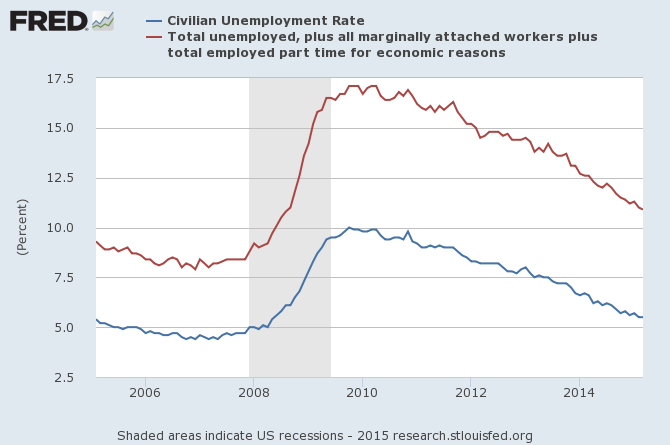
In fact, matters are worse than most people realize. Our unemployment rate has fallen back to a relatively normal 5.5%, as you can see in this graph (the blue line is unemployment, the red line is underemployment):

All_Unemployment

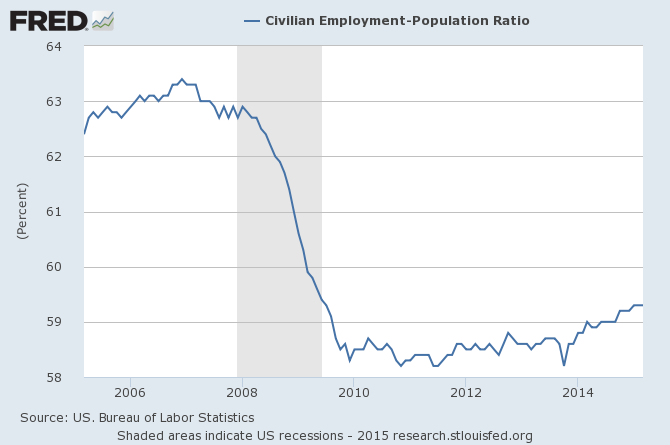
However, our employment rate never recovered from the Second Depression. As you can see in this graph, it fell from 63% to 58%, and has now only risen back to 59%:

Employment

How can unemployment fall without employment rising? The key is understanding how unemployment is calculated: It only counts people in the labor force. If people leave the labor force entirely, by retiring, going back to school, or simply giving up on finding work, they will no longer be counted as unemployed. The unemployment rate only counts people who want work but don’t have it, so as far as I’m concerned that figure should always be nearly zero. (Not quite zero since it takes some time to find a good fit; but maybe 1% at most. Any more than that and there is something wrong with our economic system.)

The optimal employment rate is not as obvious; it certainly isn’t 100%, as some people are too young, too old, or too disabled to be spending their time working. As automation improves, the number of workers necessary to produce any given product decreases, and eventually we may decide as a society that we are making enough products and most of us should be spending more of our time on other things, like spending time with family, creating works of art, or simply having fun. Maybe only a handful of people, the most driven or the most brilliant, will actually decide to work—and they will do because they want to, not because they have to. Indeed, the truly optimal employment rate might well be zero; think of The Culture, where there is no such concept as a “job”; there are things you do because you want to do them, or because they seem worthwhile, but there is none of this “working for pay” nonsense. We are not yet at the level of automation where this would be possible, but we are much closer than I think most people realize. Think about all of the various administrative and bureaucratic tasks that most people do the majority of the time, all the reports, all the meetings; why do they do that? Is it actually because the work is necessary, that the many levels of bureaucracy actually increase efficiency through specialization? Or is it simply because we’ve become so accustomed to the idea that people have to be working all the time in order to justify their existence? Is David Graeber (I reviewed one of his books previously) right that most jobs are actually (and this is a technical term), “bullshit jobs”? Once again, the problem doesn’t seem to be too few work incentives, but if anything too many.

Indeed, there is a basic fact about unemployment that has been hidden from most people. I’d normally say that this is accidental, that it’s too technical or obscure for most people to understand, but no, I think it has been actively concealed, or, since I guess the information has been publicly available, at least discussion of it has been actively avoided. It’s really not at all difficult to understand, yet it will fundamentally change the way you think about our unemployment problem. Here goes:

Since at least 2000 and probably since 1980 there have been more people looking for jobs than there have been jobs available.

The entire narrative of “people are lazy and don’t want to work” or “we need more work incentives” is just totally, totally wrong; people are desperate to find work, and there hasn’t been enough work for them to find since longer than I’ve been alive.

You can see this on the following graph, which is of what’s called the “Beveridge curve”; the horizontal axis is the unemployment rate, while the vertical axis is the rate of job vacancies. The red line across the diagonal is the point at which the two are even, and there are as many people looking for jobs as there are jobs to fill. Notice how the graph is always below the line. There have always been more unemployed people than jobs for them to fill, and at the worst of the Second Depression the ratio was 5 to 1.

Beveridge_curve_2

Personally I believe that we should be substantially above the line, and in a truly thriving economy there should be employers desperately trying to find employees and willing to pay them whatever it takes. You shouldn’t have to send out 20 job applications to get hired; 20 companies should have to send offers to you. For the economy does not exist to serve corporations; it exists to serve people.

I can see two basic ways to solve this problem: You can either create more jobs, or you can get people to stop looking for work. That may be sort of obvious, but I think people usually forget the second option.

We definitely do talk a lot about “job creation”, though usually in a totally nonsensical way—somehow “Job Creator” has come to be a euphemism for “rich person”. In fact the best way to create jobs is to put money into the hands of people who will spend it. The more people spend their money, the more it flows through the economy and the more wealth we end up with overall. High rates of spending—high marginal propensity to consumecan multiply the value of a dollar many times over.

But there’s also something to be said for getting people to stop looking for work—the key is do it in the right way. They shouldn’t stop looking because they give up; they should stop looking because they don’t need to work. People should have their basic needs met even if they aren’t working for an employer; human beings have rights and dignity beyond their productivity in the market. Employers should have to make you a better offer than “you’ll be homeless if you don’t do this”.

Both of these goals can be accomplished simultaneously by one simple policy: Basic income.

It’s really amazing how many problems can be solved by a basic income; it’s more or less the amazing wonder policy that solves all the world’s economic problems simultaneously. Poverty? Gone. Unemployment? Decimated. Inequality? Contained. (The pilot studies of basic income in India have been successful beyond all but the wildest dreams; they eliminate poverty, improve health, increase entrepreneurial activity, even reduce gender inequality.) The one major problem basic income doesn’t solve is government debt (indeed it likely increases it, at least in the short run), but as I’ve already talked about, that problem is not nearly as bad as most people fear.

And once again I think I should head off accusations that advocating a basic income makes me some sort of far-left Communist radical; Friedrich Hayek supported a basic income.

Basic income would help with unemployment in a third way as well; one of the major reasons unemployment is so harmful is that people who are unemployed can’t provide for themselves or their families. So a basic income would reduce the number of people looking for jobs, increase the number of jobs available, and also make being unemployed less painful, all in one fell swoop. I doubt it would solve the problem of unemployment entirely, but I think it would make an enormous difference.

Why the Republican candidates like flat income tax—and we really, really don’t

JDN 2456160 EDT 13:55.

The Republican Party is scrambling to find viable Presidential candidates for next year’s election. The Democrats only have two major contenders: Hillary Clinton looks like the front-runner (and will obviously have the most funding), but Bernie Sanders is doing surprisingly well, and is particularly refreshing because he is running purely on his principles and ideas. He has no significant connections, no family dynasty (unlike Jeb Bush and, again, Hillary Clinton) and not a huge amount of wealth (Bernie’s net wealth is about $500,000, making him comfortably upper-middle class; compare to Hillary’s $21.5 million and her husband’s $80 million); but he has ideas that resonate with people. Bernie Sanders is what politics is supposed to be. Clinton’s campaign will certainly raise more than his; but he has already raised over $4 million, and if he makes it to about $10 million studies suggest that additional spending above that point is largely negligible. He actually has a decent chance of winning, and if he did it would be a very good sign for the future of America.

But the Republican field is a good deal more contentious, and the 19 candidates currently running have been scrambling to prove that they are the most right-wing in order to impress far-right primary voters. (When the general election comes around, whoever wins will of course pivot back toward the center, changing from, say, outright fascism to something more like reactionism or neo-feudalism. If you were hoping they’d pivot so far back as to actually be sensible center-right capitalists, think again; Hillary Clinton is the only one who will take that role, and they’ll go out of their way to disagree with her in every way they possibly can, much as they’ve done with Obama.) One of the ways that Republicans are hoping to prove their right-wing credentials is by proposing a flat income tax and eliminating the IRS.

Unlike most of their proposals, I can see why many people think this actually sounds like a good idea. It would certainly dramatically reduce bureaucracy, and that’s obviously worthwhile since excess bureaucracy is pure deadweight loss. (A surprising number of economists seem to forget that government does other things besides create excess bureaucracy, but I must admit it does in fact create excess bureaucracy.)

Though if they actually made the flat tax rate 20% or even—I can’t believe this is seriously being proposed—10%, there is no way the federal government would have enough revenue. The only options would be (1) massive increases in national debt (2) total collapse of government services—including their beloved military, mind you, or (3) directly linking the Federal Reserve quantitative easing program to fiscal policy and funding the deficit with printed money. Of these, 3 might not actually be that bad (it would probably trigger some inflation, but actually we could use that right now), but it’s extremely unlikely to happen, particularly under Republicans. In reality, after getting a taste of 2, we’d clearly end up with 1. And then they’d be complaining about the debt and clamor for more spending cuts, more spending cuts, ever more spending cuts, but there would simply be no way to run a functioning government on 10% of GDP in anything like our current system. Maybe you could do it on 20%—maybe—but we currently spend more like 35%, and that’s already a very low amount of spending for a First World country. The UK is more typical at 47%, while Germany is a bit low at 44%; Sweden spends 52% and France spends a whopping 57%. Anyone who suggests we cut government spending from 35% to 20% needs to explain which 3/7 of government services are going to immediately disappear—not to mention which 3/7 of government employees are going to be immediately laid off.

And then they want to add investment deductions; in general investment deductions are a good thing, as long as you tie them to actual investments in genuinely useful things like factories and computer servers. (Or better yet, schools, research labs, or maglev lines, but private companies almost never invest in that sort of thing, so the deduction wouldn’t apply.) The kernel of truth in the otherwise ridiculous argument that we should never tax capital is that taxing real investment would definitely be harmful in the long run. As I discussed with Miles Kimball (a cognitive economist at Michigan and fellow econ-blogger I hope to work with at some point), we could minimize the distortionary effects of corporate taxes by establishing a strong deduction for real investment, and this would allow us to redistribute some of this enormous wealth inequality without dramatically harming economic growth.

But if you deduct things that aren’t actually investments—like stock speculation and derivatives arbitrage—then you reduce your revenue dramatically and don’t actually incentivize genuinely useful investments. This is the problem with our current system, in which GE can pay no corporate income tax on $108 billion in annual profit—and you know they weren’t using all that for genuinely productive investment activities. But then, if you create a strong enforcement system for ensuring it is real investment, you need bureaucracy—which is exactly what the flat tax was claimed to remove. At the very least, the idea of eliminating the IRS remains ridiculous if you have any significant deductions.

Thus, the benefits of a flat income tax are minimal if not outright illusory; and the costs, oh, the costs are horrible. In order to have remotely reasonable amounts of revenue, you’d need to dramatically raise taxes on the majority of people, while significantly lowering them on the rich. You would create a direct transfer of wealth from the poor to the rich, increasing our already enormous income inequality and driving millions of people into poverty.

Thus, it would be difficult to more clearly demonstrate that you care only about the interests of the top 1% than to propose a flat income tax. I guess Mitt Romney’s 47% rant actually takes the cake on that one though (Yes, all those freeloading… soldiers… and children… and old people?).

Many Republicans are insisting that a flat tax would create a surge of economic growth, but that’s simply not how macroeconomics works. If you steeply raise taxes on the majority of people while cutting them on the rich, you’ll see consumer spending plummet and the entire economy will be driven into recession. Rich people simply don’t spend their money in the same way as the rest of us, and the functioning of the economy depends upon a continuous flow of spending. There is a standard neoclassical economic argument about how reducing spending and increasing saving would lead to increased investment and greater prosperity—but that model basically assumes that we have a fixed amount of stuff we’re either using up or making more stuff with, which is simply not how money works; as James Kroeger cogently explains on his blog “Nontrivial Pursuits”, money is created as it is needed; investment isn’t determined by people saving what they don’t spend. Indeed, increased consumption generally leads to increased investment, because our economy is currently limited by demand, not supply. We could build a lot more stuff, if only people could afford to buy it.

And that’s not even considering the labor incentives; as I already talked about in my previous post on progressive taxation, there are two incentives involved when you increase someone’s hourly wage. On the one hand, they get paid more for each hour, which is a reason to work; that’s the substitution effect. But on the other hand, they have more money in general, which is a reason they don’t need to work; that’s the income effect. Broadly speaking, the substitution effect dominates at low incomes (about $20,000 or less), the income effect dominates at high incomes (about $100,000 or more), and the two effects cancel out at moderate incomes. Since a tax on your income hits you in much the same way as a reduction in your wage, this means that raising taxes on the poor makes them work less, while raising taxes on the rich makes them work more. But if you go from our currently slightly-progressive system to a flat system, you raise taxes on the poor and cut them on the rich, which would mean that the poor would work less, and the rich would also work less! This would reduce economic output even further. If you want to maximize the incentive to work, you want progressive taxes, not flat taxes.

Flat taxes sound appealing because they are so simple; even the basic formula for our current tax rates is complicated, and we combine it with hundreds of pages of deductions and credits—not to mention tens of thousands of pages of case law!—making it a huge morass of bureaucracy that barely anyone really understands and corporate lawyers can easily exploit. I’m all in favor of getting rid of that; but you don’t need a flat tax to do that. You can fit the formula for a progressive tax on a single page—indeed, on a single line: r = 1 – I^-p

That’s it. It’s simple enough to be plugged into any calculator that is capable of exponents, not to mention efficiently implemented in Microsoft Excel (more efficiently than our current system in fact).

Combined with that simple formula, you could list all of the sensible deductions on a couple of additional pages (business investments and educational expenses, mostly—poverty should be addressed by a basic income, not by tax deductions on things like heating and housing, which are actually indirect corporate subsidies), along with a land tax (one line: $3000 per hectare), a basic income (one more line: $8,000 per adult and $4,000 per child), and some additional excise taxes on goods with negative externalities (like alcohol, tobacco, oil, coal, and lead), with a line for each; then you can provide a supplementary manual of maybe 50 pages explaining the detailed rules for applying each of those deductions in unusual cases. The entire tax code should be readable by an ordinary person in a single sitting no longer than a few hours. That means no more than 100 pages and no more than a 7th-grade reading level.

Why do I say this? Isn’t that a ridiculous standard? No, it is a Constitutional imperative. It is a fundamental violation of your liberty to tax you according to rules you cannot reasonably understand—indeed, bordering on Kafkaesque. While this isn’t taxation without representation—we do vote for representatives, after all—it is something very much like it; what good is the ability to change rules if you don’t even understand the rules in the first place? Nor would it be all that difficult: You first deduct these things from your income, then plug the result into this formula.

So yes, I absolutely agree with the basic principle of tax reform. The tax code should be scrapped and recreated from scratch, and the final product should be a primary form of only a few pages combined with a supplementary manual of no more than 100 pages. But you don’t need a flat tax to do that, and indeed for many other reasons a flat tax is a terrible idea, particularly if the suggested rate is 10% or 15%, less than half what we actually spend. The real question is why so many Republican candidates think that this will appeal to their voter base—and why they could actually be right about that.

Part of it is the entirely justified outrage at the complexity of our current tax system, and the appealing simplicity of a flat tax. Part of it is the long history of American hatred of taxes; we were founded upon resisting taxes, and we’ve been resisting taxes ever since. In some ways this is healthy; taxes per se are not a good thing, they are a bad thing, a necessary evil.

But those two things alone cannot explain why anyone would advocate raising taxes on the poorest half of the population while dramatically cutting them on the top 1%. If you are opposed to taxes in general, you’d cut them on everyone; and if you recognize the necessity of taxation, you’d be trying to find ways to minimize the harm while ensuring sufficient tax revenue, which in general means progressive taxation.

To understand why they would be pushing so hard for flat taxes, I think we need to say that many Republicans, particularly those in positions of power, honestly do think that rich people are better than poor people and we should always give more to the rich and less to the poor. (Maybe it’s partly halo effect, in which good begets good and bad begets bad? Or maybe just world theory, the ingrained belief that the world is as it ought to be?)

Romney’s 47% rant wasn’t an exception; it was what he honestly believes, what he says when he doesn’t know he’s on camera. He thinks that he earned every penny of his $250 million net wealth; yes, even the part he got from marrying his wife and the part he got from abusing tax laws, arbitraging assets and liquidating companies. He thinks that people who live on $4,000 or even $400 a year are simply lazy freeloaders, who could easily work harder, perhaps do some arbitrage and liquidation of their own (check out these alleged “rags to riches” stories including the line “tried his hand at mortgage brokering”), but choose not to, and as a result deserve what they get. (It’s important to realize just how bizarre this moral attitude truly is; even if I thought you were the laziest person on Earth, I wouldn’t let you starve to death.) He thinks that the social welfare programs which have reduced poverty but never managed to eliminate it are too generous—if he even thinks they should exist at all. And in thinking these things, he is not some bizarre aberration; he is representing an entire class of people, nearly all of whom vote Republican.

The good news is, these people are still in the minority. They hold significant sway over the Republican primary, but will not have nearly as much impact in the general election. And right now, the Republican candidates are so numerous and so awful that I have trouble seeing how the Democrats could possibly lose. (But please, don’t take that as a challenge, you guys.)

What if you couldn’t own land?

JDN 2457145 EDT 20:49.

Today’s post we’re on the socialism scale somewhere near the The Guess Who, but not quite all the way to John Lennon. I’d like to questions one of the fundamental tenets of modern capitalism, but not the basic concept of private ownership itself:

What if you couldn’t own land?

Many things that you can own were more-or-less straightforwardly created by someone. A car, a computer, a television, a pair of shoes; for today let’s even take for granted intellectual property like books, movies, and songs; at least those things (“things”) were actually made by someone.

But land? We’re talking about chunks of the Earth here. They were here billions of years before us, and in all probability will be here billions of years after we’re gone. There’s no need to incentivize its creation; the vast majority of land was already here and did not need to be created. (I do have to say “the vast majority”, because in places like Japan, Hong Kong, and the Netherlands real estate has become so scarce that people do literally build land out into the sea. But this is something like 0.0001% of the world’s land.)

What we want to incentivize is land development; we want it to be profitable to build buildings and irrigate deserts, and yes, even cut down forests sometimes (though then there should be a carbon tax with credits for forested land to ensure that there isn’t too much incentive). Yet our current property tax system doesn’t do this very well; if you build bigger buildings, you end up paying more property taxes. Yes, you may also make some profit on the buildings—but it’s risky, and you may not get enough benefit to justify the added property taxes.

Moreover, we want to allocate land—we want some way of deciding who is allowed to use what land where and when (and perhaps why). Allowing land to be bought and sold is one way to do that, but it is not the only way.

Indeed, land ownership suffers from a couple of truly glaring flaws as an allocation system:

      1. It creates self-perpetuating inequality. Because land grows in value over time (due to population growth and urbanization, among other things), those who currently own land end up getting an ever-growing quantity of wealth while those who do not own land do not, and very likely end up having to pay ever-growing rents to the landlords. (I like calling them “landlords”; it really drives home the fact that our landholding system is still basically the same as it was under feudalism.) In fact, the recent rise in the share of income that goes to owners of capital rather than workers is almost entirely attributable to the rise in the price of real estate. As that post rightly recognizes, this does nothing to undermine Piketty’s central message of rising inequality due to capital income (pace The Washington Post); it merely tells us to focus on real estate instead of other forms of capital.
      2. It has no non-arbitrary allocation. If we want to decide who owns a car, we can ask questions like, “Who built it? Did someone buy it from them? Did they pay a fair price?”; if we want to decide who owns a book, we can ask questions like, “Who wrote it? Did they sell it to a publisher? What was the royalty rate?” That is, there is a clear original owner, and there is a sense of whether the transfer of ownership can be considered fair. But if we want to decide who owns a chunk of land, basically all we can ask is, “What does the deed say?” The owner is the owner because they are the owner; there’s no sense in which that ownership is fair. We certainly can’t go back to the original creation of the land, because that was due to natural forces gigayears ago. If we keep tracing the ownership backward, we will eventually end up with some guy (almost certainly a man, a White man in fact) with a gun who pointed that gun at other people and said, “This is mine.” This is true of basically all the land in the world (aside from those little bits of Japan and such); it was already there, and the only reason someone got to own it was because they said so and had a bigger gun. And a flag, perhaps: “Do you have a flag?” I suppose, in theory at least, there are a few ways of allocating land which seem less arbitrary: One would be to give everyone an equal amount. But this is practically very difficult: What do you do when the population changes? If you have 2% annual population growth, do you carve off 2% of everybody’s lot each year? Another would be to let people squat land, and automatically own the land that they live on—but again practical difficulties quickly become enormous. In any case, these two methods bear about as much resemblance to our actual allocation of land as a squirrel does to a Tyrannosaurus.

So, what else might we use? The system that makes the most sense to me is that we would own all land as a society. In practical terms this would mean that all land is Federal land, and if you want to use it for something, you need to pay rent to the government. There are many different ways the government could set the rent, but the most sensible might be to charge a flat rate per hectare regardless of where the land is or what it’s being used for, because that would maximize the incentive to develop the land. It would also make the rent fall entirely on the landowner, because the rent would be perfectly inelasticmeaning that you can’t change the quantity you make based on the price, because you aren’t making it; it’s just already sitting there.

Of course, this idea is obviously politically impossible in our current environment—or indeed any foreseeable political environment. I’m just fantasizing here, right?

Well, not quite. There is one thing we could do that would be economically quite similar to government-only land ownership; it’s called a land tax. The idea is incredibly simple: you just collect a flat tax per hectare of land. Economists have known that a land tax is efficient at providing revenue and reducing inequality since at least Adam Smith. So maybe ownership of land isn’t actually foundational to capitalism, after all; maybe we’ve just never fully gotten over feudalism. (I basically agree with Adam Smith, and for doing so I am often called a socialist.) The beautiful thing about a land tax is that it has a tax incidence in which the owners of the land end up bearing the full brunt of the tax.

Tax incidence is something it’s very important to understand; it would be on my list of the top ten economic principles that people should learn. We often have fierce political debates over who will actually write the check: Should employers pay the health insurance premium, or should employees? Will buyers pay sales tax, or sellers? Should we tax corporate profits or personal capital gains?

Please understand that I am not exaggerating when I say that these sorts of questions are totally irrelevant. It simply does not matter who actually writes the check; what matters is who bears the cost. Making the employer pay the health insurance premium doesn’t make the slightest difference if all they’re going to do is cut wages by the exact same amount. You can see the irrelevance of the fact that sellers pay sales tax every time you walk into a store—you always end up paying the price plus the tax, don’t you? (I found that the base price of most items was the same between Long Beach and Ann Arbor, but my total expenditure was always 3% more because of the 9% sales tax versus the 6%.) How do we determine who actually pays the tax? It depends on the elasticity—how easily can you change your behavior in order to avoid the tax? Can you find a different job because the health insurance premiums are too high? No? Then you’re probably paying that premium, even if your employer writes the check. If you can find a new job whenever you want, your employer might have to pay it for you even if you write the check.

The incidence of corporate taxes and taxes on capital gains are even more complicated, because it could affect the behavior of corporations in many different ways; indeed, many economists argue that the corporate tax simply results in higher unemployment or lower wages for workers. I don’t think that’s actually true, but I honestly can’t rule it out completely, precisely because corporate taxes are so complicated. You need to know all sorts of things about the structure of stock markets, and the freedom of trade, and the mobility of immigration… it’s a complete and total mess.

It’s because of tax incidence that a land tax makes so much sense; there’s no way for the landowner to escape it, other than giving up the land entirely. In particular, they can’t charge more for rent without being out-competed (unless landowners are really good at colluding—which might be true for large developers, but not individual landlords). Their elasticity is so low that they’re forced to bear the full cost of the tax.

If the land tax were high enough, it could eliminate the automatic growth in wealth that comes from holding land, and thereby reducing long-run inequality dramatically. The revenue could be used for my other favorite fiscal policy, the basic income—and real estate is a big enough part of our nation’s wealth that it’s actually entirely realistic to fund an $8,000 per person per year basic income entirely on land tax revenue. The total value of US land is about $14 trillion, and an $8,000 basic income for 320 million people would cost about $2.6 trillion; that’s only 19%. You’d actually want to make it a flat tax per hectare, so how much would that be? Well, 60% of US land is privately owned at present (no sense taxing the land the government already owns), and total US land area is about 9 million square kilometers, so to raise $2.5 trillion you’d need a tax of $289,000 per square kilometer, or $2,890 per hectare. If you own a hectare—which is bigger than most single-family lots—you’d only pay $2,890 per year in land tax, well within what most middle-class families could handle. But if you own 290,000 acres like Jeff Bezos, (that’s 117,000 hectares) you’re paying $338 million per year. Since Jeff Bezos has about $38 billion in net wealth, he can actually afford to pay that ($338 million per year is about one-tenth of what Jeff Bezos makes automatically on dividends), though he might consider selling off some of the land to avoid the taxes, which is exactly the sort of incentive we wanted to create.

Indeed, when I contemplate this policy I’m struck by the fact that it has basically no downside—usually in public policy you’re forced to make hard compromises and tradeoffs, but a land tax plus basic income is a system that carries almost no downsides at all. It won’t disincentivize investment, it won’t disincentivize working, it will dramatically reduce inequality, it will save the government a great deal of money on social welfare spending, and best of all it will eliminate poverty immediately and forever. The only people it would hurt at all are extremely rich, and they wouldn’t even be hurt very much, while it would benefit millions of people including some of the most needy.

Why aren’t we doing this already!?

In honor of Pi Day, I for one welcome our new robot overlords

JDN 2457096 EDT 16:08

Despite my preference to use the Julian Date Number system, it has not escaped my attention that this weekend was Pi Day of the Century, 3/14/15. Yesterday morning we had the Moment of Pi: 3/14/15 9:26:53.58979… We arguably got an encore that evening if we allow 9:00 PM instead of 21:00.

Though perhaps it is a stereotype and/or cheesy segue, pi and associated mathematical concepts are often associated with computers and robots. Robots are an increasing part of our lives, from the industrial robots that manufacture our cars to the precision-timed satellites that provide our GPS navigation. When you want to know how to get somewhere, you pull out your pocket thinking machine and ask it to commune with the space robots who will guide you to your destination.

There are obvious upsides to these robots—they are enormously productive, and allow us to produce great quantities of useful goods at astonishingly low prices, including computers themselves, creating a positive feedback loop that has literally lowered the price of a given amount of computing power by a factor of one trillion in the latter half of the 20th century. We now very much live in the early parts of a cyberpunk future, and it is due almost entirely to the power of computer automation.

But if you know your SF you may also remember another major part of cyberpunk futures aside from their amazing technology; they also tend to be dystopias, largely because of their enormous inequality. In the cyberpunk future corporations own everything, governments are virtually irrelevant, and most individuals can barely scrape by—and that sounds all too familiar, doesn’t it? This isn’t just something SF authors made up; there really are a number of ways that computer technology can exacerbate inequality and give more power to corporations.

Why? The reason that seems to get the most attention among economists is skill-biased technological change; that’s weird because it’s almost certainly the least important. The idea is that computers can automate many routine tasks (no one disputes that part) and that routine tasks tend to be the sort of thing that uneducated workers generally do more often than educated ones (already this is looking fishy; think about accountants versus artists). But educated workers are better at using computers and the computers need people to operate them (clearly true). Hence while uneducated workers are substitutes for computers—you can use the computers instead—educated workers are complements for computers—you need programmers and engineers to make the computers work. As computers get cheaper, their substitutes also get cheaper—and thus wages for uneducated workers go down. But their complements get more valuable—and so wages for educated workers go up. Thus, we get more inequality, as high wages get higher and low wages get lower.

Or, to put it more succinctly, robots are taking our jobs. Not all our jobs—actually they’re creating jobs at the top for software programmers and electrical engineers—but a lot of our jobs, like welders and metallurgists and even nurses. As the technology improves more and more jobs will be replaced by automation.

The theory seems plausible enough—and in some form is almost certainly true—but as David Card has pointed out, this fails to explain most of the actual variation in inequality in the US and other countries. Card is one of my favorite economists; he is also famous for completely revolutionizing the economics of minimum wage, showing that prevailing theory that minimum wages must hurt employment simply doesn’t match the empirical data.

If it were just that college education is getting more valuable, we’d see a rise in income for roughly the top 40%, since over 40% of American adults have at least an associate’s degree. But we don’t actually see that; in fact contrary to popular belief we don’t even really see it in the top 1%. The really huge increases in income for the last 40 years have been at the top 0.01%—the top 1% of 1%.

Many of the jobs that are now automated also haven’t seen a fall in income; despite the fact that high-frequency trading algorithms do what stockbrokers do a thousand times better (“better” at making markets more unstable and siphoning wealth from the rest of the economy that is), stockbrokers have seen no such loss in income. Indeed, they simply appropriate the additional income from those computer algorithms—which raises the question why welders couldn’t do the same thing. And indeed, I’ll get to in a moment why that is exactly what we must do, that the robot revolution must also come with a revolution in property rights and income distribution.

No, the real reasons why technology exacerbates inequality are twofold: Patent rents and the winner-takes-all effect.

In an earlier post I already talked about the winner-takes-all effect, so I’ll just briefly summarize it this time around. Under certain competitive conditions, a small fraction of individuals can reap a disproportionate share of the rewards despite being only slightly more productive than those beneath them. This often happens when we have network externalities, in which a product becomes more valuable when more people use it, thus creating a positive feedback loop that makes the products which are already successful wildly so and the products that aren’t successful resigned to obscurity.

Computer technology—more specifically, the Internet—is particularly good at creating such situations. Facebook, Google, and Amazon are all examples of companies that (1) could not exist without Internet technology and (2) depend almost entirely upon network externalities for their business model. They are the winners who take all; thousands of other software companies that were just as good or nearly so are now long forgotten. The winners are not always the same, because the system is unstable; for instance MySpace used to be much more important—and much more profitable—until Facebook came along.

But the fact that a different handful of upper-middle-class individuals can find themselves suddenly and inexplicably thrust into fame and fortune while the rest of us toil in obscurity really isn’t much comfort, now is it? While technically the rise and fall of MySpace can be called “income mobility”, it’s clearly not what we actually mean when we say we want a society with a high level of income mobility. We don’t want a society where the top 10% can by little more than chance find themselves becoming the top 0.01%; we want a society where you don’t have to be in the top 10% to live well in the first place.

Even without network externalities the Internet still nurtures winner-takes-all markets, because digital information can be copied infinitely. When it comes to sandwiches or even cars, each new one is costly to make and costly to transport; it can be more cost-effective to choose the ones that are made near you even if they are of slightly lower quality. But with books (especially e-books), video games, songs, or movies, each individual copy costs nothing to create, so why would you settle for anything but the best? This may well increase the overall quality of the content consumers get—but it also ensures that the creators of that content are in fierce winner-takes-all competition. Hence J.K. Rowling and James Cameron on the one hand, and millions of authors and independent filmmakers barely scraping by on the other. Compare a field like engineering; you probably don’t know a lot of rich and famous engineers (unless you count engineers who became CEOs like Bill Gates and Thomas Edison), but nor is there a large segment of “starving engineers” barely getting by. Though the richest engineers (CEOs excepted) are not nearly as rich as the richest authors, the typical engineer is much better off than the typical author, because engineering is not nearly as winner-takes-all.

But the main topic for today is actually patent rents. These are a greatly underappreciated segment of our economy, and they grow more important all the time. A patent rent is more or less what it sounds like; it’s the extra money you get from owning a patent on something. You can get that money either by literally renting it—charging license fees for other companies to use it—or simply by being the only company who is allowed to manufacture something, letting you sell it at monopoly prices. It’s surprisingly difficult to assess the real value of patent rents—there’s a whole literature on different econometric methods of trying to tackle this—but one thing is clear: Some of the largest, wealthiest corporations in the world are built almost entirely upon patent rents. Drug companies, R&D companies, software companies—even many manufacturing companies like Boeing and GM obtain a substantial portion of their income from patents.

What is a patent? It’s a rule that says you “own” an idea, and anyone else who wants to use it has to pay you for the privilege. The very concept of owning an idea should trouble you—ideas aren’t limited in number, you can easily share them with others. But now think about the fact that most of these patents are owned by corporationsnot by inventors themselves—and you’ll realize that our system of property rights is built around the notion that an abstract entity can own an idea—that one idea can own another.

The rationale behind patents is that they are supposed to provide incentives for innovation—in exchange for investing the time and effort to invent something, you receive a certain amount of time where you get to monopolize that product so you can profit from it. But how long should we give you? And is this really the best way to incentivize innovation?

I contend it is not; when you look at the really important world-changing innovations, very few of them were done for patent rents, and virtually none of them were done by corporations. Jonas Salk was indignant at the suggestion he should patent the polio vaccine; it might have made him a billionaire, but only by letting thousands of children die. (To be fair, here’s a scholar arguing that he probably couldn’t have gotten the patent even if he wanted to—but going on to admit that even then the patent incentive had basically nothing to do with why penicillin and the polio vaccine were invented.)

Who landed on the moon? Hint: It wasn’t Microsoft. Who built the Hubble Space Telescope? Not Sony. The Internet that made Google and Facebook possible was originally invented by DARPA. Even when corporations seem to do useful innovation, it’s usually by profiting from the work of individuals: Edison’s corporation stole most of its good ideas from Nikola Tesla, and by the time the Wright Brothers founded a company their most important work was already done (though at least then you could argue that they did it in order to later become rich, which they ultimately did). Universities and nonprofits brought you the laser, light-emitting diodes, fiber optics, penicillin and the polio vaccine. Governments brought you liquid-fuel rockets, the Internet, GPS, and the microchip. Corporations brought you, uh… Viagra, the Snuggie, and Furbies. Indeed, even Google’s vaunted search algorithms were originally developed by the NSF. I can think of literally zero examples of a world-changing technology that was actually invented by a corporation in order to secure a patent. I’m hesitant to say that none exist, but clearly the vast majority of seminal inventions have been created by governments and universities.

This has always been true throughout history. Rome’s fire departments were notorious for shoddy service—and wholly privately-owned—but their great aqueducts that still stand today were built as government projects. When China invented paper, turned it into money, and defended it with the Great Wall, it was all done on government funding.

The whole idea that patents are necessary for innovation is simply a lie; and even the idea that patents lead to more innovation is quite hard to defend. Imagine if instead of letting Google and Facebook patent their technology all the money they receive in patent rents were instead turned into tax-funded research—frankly is there even any doubt that the results would be better for the future of humanity? Instead of better ad-targeting algorithms we could have had better cancer treatments, or better macroeconomic models, or better spacecraft engines.

When they feel their “intellectual property” (stop and think about that phrase for awhile, and it will begin to seem nonsensical) has been violated, corporations become indignant about “free-riding”; but who is really free-riding here? The people who copy music albums for free—because they cost nothing to copy, or the corporations who make hundreds of billions of dollars selling zero-marginal-cost products using government-invented technology over government-funded infrastructure? (Many of these companies also continue receive tens or hundreds of millions of dollars in subsidies every year.) In the immortal words of Barack Obama, “you didn’t build that!”

Strangely, most economists seem to be supportive of patents, despite the fact that their own neoclassical models point strongly in the opposite direction. There’s no logical connection between the fixed cost of inventing a technology and the monopoly rents that can be extracted from its patent. There is some connection—albeit a very weak one—between the benefits of the technology and its monopoly profits, since people are likely to be willing to pay more for more beneficial products. But most of the really great benefits are either in the form of public goods that are unenforceable even with patents (go ahead, try enforcing on that satellite telescope on everyone who benefits from its astronomical discoveries!) or else apply to people who are so needy they can’t possibly pay you (like anti-malaria drugs in Africa), so that willingness-to-pay link really doesn’t get you very far.

I guess a lot of neoclassical economists still seem to believe that willingness-to-pay is actually a good measure of utility, so maybe that’s what’s going on here; if it were, we could at least say that patents are a second-best solution to incentivizing the most important research.

But even then, why use second-best when you have best? Why not devote more of our society’s resources to governments and universities that have centuries of superior track record in innovation? When this is proposed the deadweight loss of taxation is always brought up, but somehow the deadweight loss of monopoly rents never seems to bother anyone. At least taxes can be designed to minimize deadweight loss—and democratic governments actually have incentives to do that; corporations have no interest whatsoever in minimizing the deadweight loss they create so long as their profit is maximized.

I’m not saying we shouldn’t have corporations at all—they are very good at one thing and one thing only, and that is manufacturing physical goods. Cars and computers should continue to be made by corporations—but their technologies are best invented by government. Will this dramatically reduce the profits of corporations? Of course—but I have difficulty seeing that as anything but a good thing.

Why am I talking so much about patents, when I said the topic was robots? Well, it’s typically because of the way these patents are assigned that robots taking people’s jobs becomes a bad thing. The patent is owned by the company, which is owned by the shareholders; so when the company makes more money by using robots instead of workers, the workers lose.

If when a robot takes your job, you simply received the income produced by the robot as capital income, you’d probably be better off—you get paid more and you also don’t have to work. (Of course, if you define yourself by your career or can’t stand the idea of getting “handouts”, you might still be unhappy losing your job even though you still get paid for it.)

There’s a subtler problem here though; robots could have a comparative advantage without having an absolute advantage—that is, they could produce less than the workers did before, but at a much lower cost. Where it cost $5 million in wages to produce $10 million in products, it might cost only $3 million in robot maintenance to produce $9 million in products. Hence you can’t just say that we should give the extra profits to the workers; in some cases those extra profits only exist because we are no longer paying the workers.

As a society, we still want those transactions to happen, because producing less at lower cost can still make our economy more efficient and more productive than it was before. Those displaced workers can—in theory at least—go on to other jobs where they are needed more.

The problem is that this often doesn’t happen, or it takes such a long time that workers suffer in the meantime. Hence the Luddites; they don’t want to be made obsolete even if it does ultimately make the economy more productive.

But this is where patents become important. The robots were probably invented at a university, but then a corporation took them and patented them, and is now selling them to other corporations at a monopoly price. The manufacturing company that buys the robots now has to spend more in order to use the robots, which drives their profits down unless they stop paying their workers.

If instead those robots were cheap because there were no patents and we were only paying for the manufacturing costs, the workers could be shareholders in the company and the increased efficiency would allow both the employers and the workers to make more money than before.

What if we don’t want to make the workers into shareholders who can keep their shares after they leave the company? There is a real downside here, which is that once you get your shares, why stay at the company? We call that a “golden parachute” when CEOs do it, which they do all the time; but most economists are in favor of stock-based compensation for CEOs, and once again I’m having trouble seeing why it’s okay when rich people do it but not when middle-class people do.

Another alternative would be my favorite policy, the basic income: If everyone knows they can depend on a basic income, losing your job to a robot isn’t such a terrible outcome. If the basic income is designed to grow with the economy, then the increased efficiency also raises everyone’s standard of living, as economic growth is supposed to do—instead of simply increasing the income of the top 0.01% and leaving everyone else where they were. (There is a good reason not to make the basic income track economic growth too closely, namely the business cycle; you don’t want the basic income payments to fall in a recession, because that would make the recession worse. Instead they should be smoothed out over multiple years or designed to follow a nominal GDP target, so that they continue to rise even in a recession.)

We could also combine this with expanded unemployment insurance (explain to me again why you can’t collect unemployment if you weren’t working full-time before being laid off, even if you wanted to be or you’re a full-time student?) and active labor market policies that help people re-train and find new and better jobs. These policies also help people who are displaced for reasons other than robots making their jobs obsolete—obviously there are all sorts of market conditions that can lead to people losing their jobs, and many of these we actually want to happen, because they involve reallocating the resources of our society to more efficient ends.

Why aren’t these sorts of policies on the table? I think it’s largely because we don’t think of it in terms of distributing goods—we think of it in terms of paying for labor. Since the worker is no longer laboring, why pay them?

This sounds reasonable at first, but consider this: Why give that money to the shareholder? What did they do to earn it? All they do is own a piece of the company. They may not have contributed to the goods at all. Honestly, on a pay-for-work basis, we should be paying the robot!

If it bothers you that the worker collects dividends even when he’s not working—why doesn’t it bother you that shareholders do exactly the same thing? By definition, a shareholder is paid according to what they own, not what they do. All this reform would do is make workers into owners.

If you justify the shareholder’s wealth by his past labor, again you can do exactly the same to justify worker shares. (And as I said above, if you’re worried about the moral hazard of workers collecting shares and leaving, you should worry just as much about golden parachutes.)

You can even justify a basic income this way: You paid taxes so that you could live in a society that would protect you from losing your livelihood—and if you’re just starting out, your parents paid those taxes and you will soon enough. Theoretically there could be “welfare queens” who live their whole lives on the basic income, but empirical data shows that very few people actually want to do this, and when given opportunities most people try to find work. Indeed, even those who don’t, rarely seem to be motivated by greed (even though, capitalists tell us, “greed is good”); instead they seem to be de-motivated by learned helplessness after trying and failing for so long. They don’t actually want to sit on the couch all day and collect welfare payments; they simply don’t see how they can compete in the modern economy well enough to actually make a living from work.

One thing is certain: We need to detach income from labor. As a society we need to get over the idea that a human being’s worth is decided by the amount of work they do for corporations. We need to get over the idea that our purpose in life is a job, a career, in which our lives are defined by the work we do that can be neatly monetized. (I admit, I suffer from the same cultural blindness at times, feeling like a failure because I can’t secure the high-paying and prestigious employment I want. I feel this clear sense that my society does not value me because I am not making money, and it damages my ability to value myself.)

As robots do more and more of our work, we will need to redefine the way we live by something else, like play, or creativity, or love, or compassion. We will need to learn to see ourselves as valuable even if nothing we do ever sells for a penny to anyone else.

A basic income can help us do that; it can redefine our sense of what it means to earn money. Instead of the default being that you receive nothing because you are worthless unless you work, the default is that you receive enough to live on because you are a human being of dignity and a citizen. This is already the experience of people who have substantial amounts of capital income; they can fall back on their dividends if they ever can’t or don’t want to find employment. A basic income would turn us all into capital owners, shareholders in the centuries of established capital that has been built by our forebears in the form of roads, schools, factories, research labs, cars, airplanes, satellites, and yes—robots.
Oppression is quantitative.

JDN 2457082 EDT 11:15.

Economists are often accused of assigning dollar values to everything, of being Oscar Wilde’s definition of a cynic, someone who knows the price of everything and the value of nothing. And there is more than a little truth to this, particularly among neoclassical economists; I was alarmed a few days ago to receive an email response from an economist that included the word ‘altruism’ in scare quotes as though this were somehow a problematic or unrealistic concept. (Actually, altruism is already formally modeled by biologists, and my claim that human beings are altruistic would be so uncontroversial among evolutionary biologists as to be considered trivial.)

But sometimes this accusation is based upon things economists do that is actually tremendously useful, even necessary to good policymaking: We make everything quantitative. Nothing is ever “yes” or “no” to an economist (sometimes even when it probably should be; the debate among economists in the 1960s over whether slavery is economically efficient does seem rather beside the point), but always more or less; never good or bad but always better or worse. For example, as I discussed in my post on minimum wage, the mainstream position among economists is not that minimum wage is always harmful nor that minimum wage is always beneficial, but that minimum wage is a policy with costs and benefits that on average neither increases nor decreases unemployment. The mainstream position among economists about climate policy is that we should institute either a high carbon tax or a system of cap-and-trade permits; no economist I know wants us to either do nothing and let the market decide (a position most Republicans currently seem to take) or suddenly ban coal and oil (the latter is a strawman position I’ve heard environmentalists accused of, but I’ve never actually heard advocated; even Greenpeace wants to ban offshore drilling, not oil in general.).

This makes people uncomfortable, I think, because they want moral issues to be simple. They want “good guys” who are always right and “bad guys” who are always wrong. (Speaking of strawman environmentalism, a good example of this is Captain Planet, in which no one ever seems to pollute the environment in order to help people or even in order to make money; no, they simply do it because the hate clean water and baby animals.) They don’t want to talk about options that are more good or less bad; they want one option that is good and all other options that are bad.

This attitude tends to become infused with righteousness, such that anyone who disagrees is an agent of the enemy. Politics is the mind-killer, after all. If you acknowledge that there might be some downside to a policy you agree with, that’s like betraying your team.

But in reality, the failure to acknowledge downsides can lead to disaster. Problems that could have been prevented are instead ignored and denied. Getting the other side to recognize the downsides of their own policies might actually help you persuade them to your way of thinking. And appreciating that there is a continuum of possibilities that are better and worse in various ways to various degrees is what allows us to make the world a better place even as we know that it will never be perfect.

There is a common refrain you’ll hear from a lot of social justice activists which sounds really nice and egalitarian, but actually has the potential to completely undermine the entire project of social justice.

This is the idea that oppression can’t be measured quantitatively, and we shouldn’t try to compare different levels of oppression. The notion that some people are more oppressed than others is often derided as the Oppression Olympics. (Some use this term more narrowly to mean when a discussion is derailed by debate over who has it worse—but then the problem is really discussions being derailed, isn’t it?)

This sounds nice, because it means we don’t have to ask hard questions like, “Which is worse, sexism or racism?” or “Who is worse off, people with cancer or people with diabetes?” These are very difficult questions, and maybe they aren’t the right ones to ask—after all, there’s no reason to think that fighting racism and fighting sexism are mutually exclusive; they can in fact be complementary. Research into cancer only prevents us from doing research into diabetes if our total research budget is fixed—this is more than anything else an argument for increasing research budgets.

But we must not throw out the baby with the bathwater. Oppression is quantitative. Some kinds of oppression are clearly worse than others.

Why is this important? Because otherwise you can’t measure progress. If you have a strictly qualitative notion of oppression where it’s black-and-white, on-or-off, oppressed-or-not, then we haven’t made any progress on just about any kind of oppression. There is still racism, there is still sexism, there is still homophobia, there is still religious discrimination. Maybe these things will always exist to some extent. This makes the fight for social justice a hopeless Sisyphean task.

But in fact, that’s not true at all. We’ve made enormous progress. Unbelievably fast progress. Mind-boggling progress. For hundreds of millennia humanity made almost no progress at all, and then in the last few centuries we have suddenly leapt toward justice.

Sexism used to mean that women couldn’t own property, they couldn’t vote, they could be abused and raped with impunity—or even beaten or killed for being raped (which Saudi Arabia still does by the way). Now sexism just means that women aren’t paid as well, are underrepresented in positions of power like Congress and Fortune 500 CEOs, and they are still sometimes sexually harassed or raped—but when men are caught doing this they go to prison for years. This change happened in only about 100 years. That’s fantastic.

Racism used to mean that Black people were literally property to be bought and sold. They were slaves. They had no rights at all, they were treated like animals. They were frequently beaten to death. Now they can vote, hold office—one is President!—and racism means that our culture systematically discriminates against them, particularly in the legal system. Racism used to mean you could be lynched; now it just means that it’s a bit harder to get a job and the cops will sometimes harass you. This took only about 200 years. That’s amazing.

Homophobia used to mean that gay people were criminals. We could be sent to prison or even executed for the crime of making love in the wrong way. If we were beaten or murdered, it was our fault for being faggots. Now, homophobia means that we can’t get married in some states (and fewer all the time!), we’re depicted on TV in embarrassing stereotypes, and a lot of people say bigoted things about us. This has only taken about 50 years! That’s astonishing.

And above all, the most extreme example: Religious discrimination used to mean you could be burned at the stake for not being Catholic. It used to mean—and in some countries still does mean—that it’s illegal to believe in certain religions. Now, it means that Muslims are stereotyped because, well, to be frank, there are some really scary things about Muslim culture and some really scary people who are Muslim leaders. (Personally, I think Muslims should be more upset about Ahmadinejad and Al Qaeda than they are about being profiled in airports.) It means that we atheists are annoyed by “In God We Trust”, but we’re no longer burned at the stake. This has taken longer, more like 500 years. But even though it took a long time, I’m going to go out on a limb and say that this progress is wonderful.

Obviously, there’s a lot more progress remaining to be made on all these issues, and others—like economic inequality, ableism, nationalism, and animal rights—but the point is that we have made a lot of progress already. Things are better than they used to be—a lot betterand keeping this in mind will help us preserve the hope and dedication necessary to make things even better still.

If you think that oppression is either-or, on-or-off, you can’t celebrate this progress, and as a result the whole fight seems hopeless. Why bother, when it’s always been on, and will probably never be off? But we started with oppression that was absolutely horrific, and now it’s considerably milder. That’s real progress. At least within the First World we have gone from 90% oppressed to 25% oppressed, and we can bring it down to 10% or 1% or 0.1% or even 0.01%. Those aren’t just numbers, those are the lives of millions of people. As democracy spreads worldwide and poverty is eradicated, oppression declines. Step by step, social changes are made, whether by protest marches or forward-thinking politicians or even by lawyers and lobbyists (they aren’t all corrupt).

And indeed, a four-year-old Black girl with a mental disability living in Ghana whose entire family’s income is $3 a day is more oppressed than I am, and not only do I have no qualms about saying that, it would feel deeply unseemly to deny it. I am not totally unoppressed—I am a bisexual atheist with chronic migraines and depression in a country that is suspicious of atheists, systematically discriminates against LGBT people, and does not make proper accommodations for chronic disorders, particularly mental ones. But I am far less oppressed, and that little girl (she does exist, though I know not her name) could be made much less oppressed than she is even by relatively simple interventions (like a basic income). In order to make her fully and totally unoppressed, we would need such a radical restructuring of human society that I honestly can’t really imagine what it would look like. Maybe something like The Culture? Even then as Iain Banks imagines it, there is inequality between those within The Culture and those outside it, and there have been wars like the Idiran-Culture War which killed billions, and among those trillions of people on thousands of vast orbital habitats someone, somewhere is probably making a speciesist remark. Yet I can state unequivocally that life in The Culture would be better than my life here now, which is better than the life of that poor disabled girl in Ghana.

To be fair, we can’t actually put a precise number on it—though many economists try, and one of my goals is to convince them to improve their methods so that they stop using willingness-to-pay and instead try to actually measure utility by something like QALY. A precise number would help, actually—it would allow us to do cost-benefit analyses to decide where to focus our efforts. But while we don’t need a precise number to tell when we are making progress, we do need to acknowledge that there are degrees of oppression, some worse than others.

Oppression is quantitative. And our goal should be minimizing that quantity.

Should we raise the minimum wage?

JDN 2456949 PDT 10:22.

The minimum wage is an economic issue that most people are familiar with; a large portion of the population has worked for minimum wage at some point in their lives, and those who haven’t generally know someone who has. As Chris Rock famously remarked (in the recording, Chris Rock, as usual, uses some foul language), “You know what that means when they pay you minimum wage? You know what they’re trying to tell you? It’s like, ‘Hey, if I could pay you less, I would; but it’s against the law.’ ”

The minimum wage was last raised in 2009, but adjusted for inflation its real value has been trending downward since 1968. The dollar values are going up, but not fast enough to keep up with inflation.

So, should we raise it again? How much? Should we just match it to inflation, or actually raise it higher in real terms? Productivity (in terms of GDP per worker) has more than doubled since 1968, so perhaps the minimum wage should double as well?

There are two major sides in this debate, and I basically disagree with both of them.

The first is the right-wing view (here espoused by the self-avowed “Objectivist” Don Watkins) that the minimum wage should be abolished entirely because it is an arbitrary price floor that prevents workers from selling their labor at whatever wage the market will bear. He argues that the free market is the only way the value of labor should be assessed and the government has no business getting involved.

On the other end of the spectrum we have Robert Reich, who thinks we should definitely raise the minimum wage and it would be the best way to lift workers out of poverty. He argues that by providing minimum-wage workers with welfare and Medicaid, we are effectively subsidizing employers to pay lower wages. While I sympathize a good deal more with this view, I still don’t think it’s quite right.

Why not? Because Watkins is right about one thing: The minimum wage is, in fact, an arbitrary price floor. Out of all the possible wages that an employer could pay, how did we decide that this one should be the lowest? And the same applies to everyone, no matter who they are or what sort of work they do?

What Watkins gets wrong—and Reich gets right—is that wages are not actually set in a free and competitive market. Large corporations have market power; they can influence wages and prices to their own advantage. They use monopoly power to raise prices, and its inverse, monopsony power, to lower wages. The workers who are making a minimum wage of $7.25 wouldn’t necessarily make $7.25 in a competitive market; they could make more than that. All we know, actually, is that they would make at least this much, because if a worker’s marginal productivity is below the minimum wage the corporation simply wouldn’t have hired them.

Monopsony power doesn’t just lower wages; it also reduces employment. One of the ways that corporations can control wages is by controlling hiring; if they tried to hire more people, they’d have to offer a higher wage, so instead they hire fewer people. Under these circumstances, a higher minimum wage can actually create jobs, as Reich argues it will. And in this particular case I think he’s right about that, because corporations have enormous market power to hold wages down and in the Second Depression we have a huge amount of unused productive capacity. But this isn’t true in general. If markets are competitive, then raising minimum wage just causes unemployment. Even when corporations have market power, if there isn’t much unused capacity then raising minimum wage will just lead them to raise prices instead of hiring more workers.

Reich is also wrong about this idea that welfare payments subsidize low wages. On the contrary, the stronger your welfare system, the higher your wages will be. The reason is quite simple: A stronger welfare system gives workers more bargaining power. If not getting this job means you turn to prostitution or starve to death, then you’re going to take just about any wage they offer you. (I don’t entirely agree with Krugman’s defense of sweatshops—I believe there are ways to increase trade without allowing oppressive working conditions—but he makes this point quite vividly.) On the other hand, if you live in the US with a moderate welfare system, you can sometimes afford to say no; you might end up broke or worse, homeless, but you’re unlikely to starve to death because at least you have food stamps. And in a nation with a really robust welfare system like Sweden, you can walk away from any employer who offers to pay you less than your labor is worth, because you know that even if you can’t find a job for awhile your basic livelihood will be protected. As a result, stronger welfare programs make labor markets more competitive and raise wages. Welfare and Medicaid do not subsidize low-wage employers; they exert pressure on employers to raise their low wages. Indeed, a sufficiently strong welfare system could render minimum wage redundant, as I’ll get back to at the end of this post.

Of course, I am above all an empiricist; all theory must bow down before the data. So what does the data say? Does raising the minimum wage create jobs or destroy jobs? Our best answer from compiling various studies is… neither. Moderate increases in the minimum wage have no discernible effect on employment. In some studies we’ve found increases, in others decreases, but the overall average effect across many studies is indistinguishable from zero.

Of course, a sufficiently large increase is going to decrease employment; a Fox News reporter once famously asked: “Why not raise the minimum wage to $100,000 an hour!?” (which Jon Stewart aptly satirized as “Why not pay people in cocaine and unicorns!?”) Yes, raising the minimum wage to $100,000 an hour would create massive inflation and unemployment. But that really says nothing about whether raising the minimum wage to $10 or $20 would be a good idea. Covering your car with 4000 gallons of gasoline is a bad idea, but filling it with 10 gallons is generally necessary for its proper functioning.

This kind of argument is actually pretty common among Republicans, come to think of it. Take the Laffer Curve, for instance; it’s basically saying that since a 99% tax on everyone would damage the economy (which is obviously true) then a 40% tax specifically on millionaires must have the same effect. Another good one is Rush Limbaugh’s argument that if unemployment benefits are good, why not just put everyone on unemployment benefits? Well, again, because there’s a difference between doing something for some people sometimes and doing it for everyone all the time. There are these things called numbers; they measure whether something is bigger or smaller instead of just “there” or “not there”. You might want to learn about that.

Since moderate increases in minimum wage have no effect on unemployment, and we are currently under conditions of extremely low—in fact, dangerously low—inflation, then I think on balance we should go with Reich: Raising the minimum wage would do more good than harm.

But in general, is minimum wage the best way to help workers out of poverty? No, I don’t think it is. It’s awkward and heavy-handed; it involves trying to figure out what the optimal wage should be and writing it down in legislation, instead of regulating markets so that they will naturally seek that optimal level and respond to changes in circumstances. It only helps workers at the very bottom: Someone making $12 an hour is hardly rich, but they won’t benefit from increasing minimum wage to $10; in fact they might be worse off, if that increase triggers inflation that lowers the real value of their $12 wage.

What do I propose instead? A basic income. There should be a cash payment that every adult citizen receives, once a month, directly from the government—no questions asked. You don’t have to be unemployed, you don’t have to be disabled, you don’t have to be looking for work. You don’t have to spend it on anything in particular; you can use it for food, for housing, for transportation; or if you like you can use it for entertainment or save it for a rainy day. We don’t keep track of what you do with it, because it’s your own freedom and none of our business. We just give you this money as your dividends for being a shareholder in the United States of America.

This would be extremely easy to implement—the IRS already has all the necessary infrastructure, they just need to turn some minus signs into plus signs. We could remove all the bureaucracy involved in administering TANF and SNAP and Medicaid, because there’s no longer any reason to keep track of who is in poverty since nobody is. We could in fact fold the $500 billion a year we currently spend on means-tested programs into the basic income itself. We could pull another $300 billion from defense spending while still solidly retaining the world’s most powerful military.

Which brings me to the next point: How much would this cost? Probably less than you think. I propose indexing the basic income to the poverty line for households of 2 or more; since currently a household of 2 or more at the poverty line makes $15,730 per year, the basic income would be $7,865 per person per year. The total cost of giving that amount to each of the 243 million adults in the United States would be $1.9 trillion, or about 12% of our GDP. If we fold in the means-tested programs, that lowers the net cost to $1.4 trillion, 9% of GDP. This means that an additional flat tax of 9% would be enough to cover the entire amount, even if we don’t cut any other government spending.

If you use a progressive tax system like I recommended a couple of posts ago, you could raise this much with a tax on less than 5% of utility, which means that someone making the median income of $30,000 would only pay 5.3% more than they presently do. At the mean income of $50,000, you’d only pay 7.7%. And keep in mind that you are also receiving the additional $7,865; so in fact in both cases you actually end up with more than you had before the basic income was implemented. The break-even point is at about $80,000, where you pay an extra 9.9% ($7,920) and receive $7,865, so your after-tax income is now $79,945. Anyone making less than $80,000 per year actually gains from this deal; the only people who pay more than they receive are those who make more than $80,000. This is about the average income of someone in the fourth quintile (the range where 60% to 80% of the population is below you), so this means that roughly 70% of Americans would benefit from this program.

With this system in place, we wouldn’t need a minimum wage. Working full-time at our current minimum wage makes you $7.25*40*52 = $15,080 per year. If you are a single person, you’re getting $7,865 from the basic income, this means that you’ll still have more than you presently do as long as your employer pays you at least $3.47 per hour. And if they don’t? Well then you can just quit, knowing that at least you have that $7,865. If you’re married, it’s even better; the two of you already get $15,730 from the basic income. If you were previously raising a family working full-time on minimum wage while your spouse is unemployed, guess what: You actually will make more money after the policy no matter what wage your employer pays you.

This system can adapt to changes in the market, because it is indexed to the poverty level (which is indexed to inflation), and also because it doesn’t say anything about what wage an employer pays. They can pay as little or as much as the market will bear; but the market is going to bear more, because workers can afford to quit. Billionaires are going to hate this plan, because it raises their taxes (by about 40%) and makes it harder for them to exploit workers. But for 70% of Americans, this plan is a pretty good deal.