The inherent atrocity of “border security”

Jun 24 JDN 2458294

By now you are probably aware of the fact that a new “zero tolerance” border security policy under the Trump administration has resulted in 2,000 children being forcibly separated from their parents by US government agents. If you weren’t, here are a variety of different sources all telling the same basic story of large-scale state violence and terror.

Make no mistake: This is an atrocity. The United Nations has explicitly condemned this human rights violation—to which Trump responded by making an unprecedented threat of withdrawing unilaterally from the UN Human Rights Council.

#ThisIsNotNormal, and Trump was everything we feared—everything we warned—he would be: Corrupt, incompetent, cruel, and authoritarian.

Yet Trump’s border policy differs mainly in degree, not kind, from existing US border policy. There is much more continuity here than most of us would like to admit.

The Trump administration has dramatically increased “interior removals”, the most obviously cruel acts, where ICE agents break into the houses of people living in the US and take them away. Don’t let the cold language fool you; this is literally people with guns breaking into your home and kidnapping members of your family. This is characteristic of totalitarian governments, not liberal democracies.

And yet, the Obama administration actually holds the record for most deportations (though only because they included “at-border deportations” which other administrations did not). A major policy change by George W. Bush started this whole process of detaining people at the border instead of releasing them and requiring them to return for later court dates.

I could keep going back; US border enforcement has gotten more and more aggressive as time goes on. US border security staffing has quintupled since just 1990. There was a time when the United States was a land of opportunity that welcomed “your tired, your poor, your huddled masses”; but that time is long past.

And this, in itself, is a human rights violation. Indeed, I am convinced that border security itself is inherently a human rights violation, always and everywhere; future generations will not praise us for being more restrained than Trump’s abject and intentional cruelty, but condemn us for acting under the same basic moral framework that justified it.

There is an imaginary line in the sand just a hundred miles south of where I sit now. On one side of the line, a typical family makes $66,000 per year. On the other side, a typical family makes only $20,000. On one side of the line, life expectancy is 81 years; on the other, 77. This means that over their lifetime, someone on this side of the line can expect to make over one million dollars more than they would if they had lived on the other side. Step across this line, get a million dollars; it sounds ridiculous, but it’s an empirical fact.

This would be bizarre enough by itself; but now consider that on that line there are fences, guard towers, and soldiers who will keep you from crossing it. If you have appropriate papers, you can cross; but if you don’t, they will arrest and detain you, potentially for months. This is not how we treat you if you are carrying contraband or have a criminal record. This is how we treat you if you don’t have a passport.

How can we possibly reconcile this with the principles of liberal democracy? Philosophers have tried, to be sure. Yet they invariably rely upon some notion that the people who want to cross our border are coming from another country where they were already granted basic human rights and democratic representation—which is almost never the case. People who come here from the UK or the Netherlands or generally have the proper visas. Even people who come here from China usually have visas—though China is by no means a liberal democracy. It’s people who come here from Haiti and Nicaragua who don’t—and these are some of the most corrupt and impoverished nations in the world.

As I said in an earlier post, I was not offended that Trump characterized countries like Haiti and Syria as “shitholes”. By any objective standard, that is accurate; these countries are terrible, terrible places to live. No, what offends me is that he thinks this gives us a right to turn these people away, as though the horrible conditions of their country somehow “rub off” on them and make them less worthy as human beings. On the contrary, we have a word for people who come from “shithole” countries seeking help, and that word is “refugee”.

Under international law, “refugee” has a very specific legal meaning, under which most immigrants do not qualify. But in a broader moral sense, almost every immigrant is a refugee. People don’t uproot themselves and travel thousands of miles on a whim. They are coming here because conditions in their home country are so bad that they simply cannot tolerate them anymore, and they come to us desperately seeking our help. They aren’t asking for handouts of free money—illegal immigrants are a net gain for our fiscal system, paying more in taxes than they receive in benefits. They are looking for jobs, and willing to accept much lower wages than the workers already here—because those wages are still dramatically higher than what they had where they came from.

Of course, that does potentially mean they are competing with local low-wage workers, doesn’t it? Yes—but not as much as you might think. There is only a very weak relationship between higher immigration and lower wages (some studies find none at all!), even at the largest plausible estimates, the gain in welfare for the immigrants is dramatically higher than the loss in welfare for the low-wage workers who are already here. It’s not even a question of valuing them equally; as long as you value an immigrant at least one tenth as much as a native-born citizen, the equation comes out favoring more immigration.

This is for two reasons: One, most native-born workers already are unwilling to do the jobs that most immigrants do, such as picking fruit and laying masonry; and two, increased spending by immigrants boosts the local economy enough to compensate for any job losses.


But even aside from the economic impacts, what is the moral case for border security?

I have heard many people argue that “It’s our home, we should be able to decide who lives here.” First of all, there are some major differences between letting someone live in your home and letting someone come into your country. I’m not saying we should allow immigrants to force themselves into people’s homes, only that we shouldn’t arrest them when they try cross the border.

But even if I were to accept the analogy, if someone were fleeing oppression by an authoritarian government and asked to live in my home, I would let them. I would help hide them from the government if they were trying to escape persecution. I would even be willing to house people simply trying to escape poverty, as long as it were part of a well-organized program designed to ensure that everyone actually gets helped and the burden on homeowners and renters was not too great. I wouldn’t simply let homeless people come live here, because that creates all sorts of coordination problems (I can only fit so many, and how do I prioritize which ones?); but I’d absolutely participate in a program that coordinates placement of homeless families in apartments provided by volunteers. (In fact, maybe I should try to petition for such a program, as Southern California has a huge homelessness rate due to our ridiculous housing prices.)

Many people seem to fear that immigrants will bring crime, but actually they reduce crime rates. It’s really kind of astonishing how much less crime immigrants commit than locals. My hypothesis is that immigrants are a self-selected sample; the kind of person willing to move thousands of miles isn’t the kind of person who commits a lot of crimes.
I understand wanting to keep out terrorists and drug smugglers, but there are already plenty of terrorists and drug smugglers here in the US; if we are unwilling to set up border security between California and Nevada, I don’t see why we should be setting it up between California and Baja California. But okay, fine, we can keep the customs agents who inspect your belongings when you cross the border. If someone doesn’t have proper documentation, we can even detain and interrogate them—for a few hours, not a few months. The goal should be to detect dangerous criminals and nothing else. Once we are confident that you have not committed any felonies, we should let you through—frankly, we should give you a green card. We should only be willing to detain someone at the border for the same reasons we would be willing to detain a citizen who already lives here—that is, probable cause for an actual crime. (And no, you don’t get to count “illegal border crossing” as a crime, because that’s begging the question. By the same logic I could justify detaining people for jaywalking.)

A lot of people argue that restricting immigration is necessary to “preserve local culture”; but I’m not even sure that this is a goal sufficiently important to justify arresting and detaining people, and in any case, that’s really not how culture works. Culture is not advanced by purism and stagnation, but by openness and cross-pollination. From anime to pizza, many of our most valued cultural traditions would not exist without interaction across cultural boundaries. Introducing more Spanish speakers into the US may make us start saying no problemo and vamonos, but it’s not going to destroy liberal democracy. If you value culture, you should value interactions across different societies.

Most importantly, think about what you are trying to justify. Even if we stop doing Trump’s most extreme acts of cruelty, we are still talking about using military force to stop people from crossing an imaginary line. ICE basically treats people the same way the SS did. “Papers, please” isn’t something we associate with free societies—it’s characteristic of totalitarianism. We are so accustomed to border security (or so ignorant of its details) that we don’t see it for the atrocity it so obviously is.

National borders function something very much like feudal privilege. We have our “birthright”, which grants us all sorts of benefits and special privileges—literally tripling our incomes and extending our lives. We did nothing to earn this privilege. If anything, we show ourselves to be less deserving (e.g. by committing more crimes). And we use the government to defend our privilege by force.

Are people born on the other side of the line less human? Are they less morally worthy? On what grounds do we point guns at them and lock them away for the “crime” of wanting to live here?

What Trump is doing right now is horrific. But it is not that much more horrific than what we were already doing. My hope is that this will finally open our eyes to the horrors that we had been participating in all along.

Sympathy for the incel

Post 237: May 6 JDN 2458245

If you’ve been following the news surrounding the recent terrorist attack in Toronto, you may have encountered the word “incel” for the first time via articles in NPR, Vox, USA Today, or other sources linking the attack to the incel community.

If this was indeed your first exposure to the concept of “incel”, I think you are getting a distorted picture of their community, which is actually a surprisingly large Internet subculture. Finding out about incel this way would be like finding out about Islam from 9/11. (Actually, I’m fairly sure a lot of Americans did learn that way, which is awful.) The incel community is remarkably large one—hundreds of thousands of members at least, and quite likely millions.

While a large proportion subscribe to a toxic and misogynistic ideology, a similarly large proportion do not; while the ideology has contributed to terrorism and other violence, the vast majority of members of the community are not violent.

Note that the latter sentence is also entirely true of Islam. So if you are sympathetic toward Muslims and want to protect them from abuse and misunderstanding, I maintain that you should want to do the same for incels, and for basically the same reasons.

I want to make something abundantly clear at the outset:

This attack was terrorism. I am in no way excusing or defending the use of terrorism. Once someone crosses the line and starts attacking random civilians, I don’t care what their grievances were; the best response to their behavior involves snipers on rooftops. I frankly don’t even understand the risks police are willing to take in order to capture these people alive—especially considering how trigger-happy they are when it comes to random Black men. If you start shooting (or bombing, or crashing vehicles into) civilians, the police should shoot you. It’s that simple.

I do not want to evoke sympathy for incel-motivated terrorism. I want to evoke sympathy for the hundreds of thousands of incels who would never support terrorism and are now being publicly demonized.

I also want to make it clear that I am not throwing in my hat with the likes of Robin Hanson (who is also well-known as a behavioral economist, blogger, science fiction fan, Less Wrong devotee, and techno-utopian—so I feel a particular need to clarify my differences with him) when he defends something he calls in purposefully cold language “redistribution of sex” (that one is from right after the attack, but he has done this before, in previous blog posts).

Hanson has drunk Robert Nozick‘s Kool-Aid, and thinks that redistribution of wealth via taxation is morally equivalent to theft or even slavery. He is fond of making comparisons between redistribution of wealth and other forms of “redistribution” that obviously would be tantamount to theft and slavery, and asking “What’s the difference?” when in fact the difference is glaringly obvious to everyone but him. He is also fond of saying that “inequality between households within a nation” is a small portion of inequality, and then wondering aloud why we make such a big deal out of it. The answer here is also quite obvious: First of all, it’s not that small a portion of inequality—it’s a third of global income inequality by most measures, it’s increasing while across-nation inequality is decreasing, and the absolute magnitude of within-nation inequality is staggering: there are households with incomes over one million times that of other households within the same nation. (Where are the people who have had sex one hundred billion times, let alone the ones who had sex forty billion times in one year? Because here’s the man who has one hundred billion dollars and made almost $40 billion in one year.) Second, within-nation inequality is extremely simple to fix by public policy; just change a few numbers in the tax code—in fact, just change them back to what they were in the 1950s. Cross-national inequality is much more complicated (though I believe it can be solved, eventually) and some forms of what he’s calling “inequality” (like “inequality across periods of human history” or “inequality of innate talent”) don’t seem amenable to correction under any conceivable circumstances.

Hanson has lots of just-so stories about the evolutionary psychology of why “we don’t care” about cross-national inequality (gee, I thought maybe devoting my career to it was a pretty good signal otherwise?) or inequality in access to sex (which is thousands of times smaller than income inequality), but no clear policy suggestions for how these other forms of inequality could be in any way addressed. This whole idea of “redistribution of sex”; what does that mean, exactly? Legalized or even subsidized prostitution or sex robots would be one thing; I can see pros and cons there at least. But without clarification, it sounds like he’s endorsing the most extremist misogynist incels who think that women should be rightfully compelled to have sex with sexually frustrated men—which would be quite literally state-sanctioned rape. I think really Hanson isn’t all that interested in incels, and just wants to make fun of silly “socialists” who would dare suppose that maybe Jeff Bezos doesn’t need his 120 billion dollars as badly as some of the starving children in Africa could benefit from them, or that maybe having a tax system similar to Sweden or Denmark (which consistently rate as some of the happiest, most prosperous nations on Earth) sounds like a good idea. He takes things that are obviously much worse than redistributive taxation, and compares them to redistributive taxation to make taxation seem worse than it is.

No, I do not support “redistribution of sex”. I might be able to support legalized prostitution, but I’m concerned about the empirical data suggesting that legalized prostitution correlates with increased human sex trafficking. I think I would also support legalized sex robots, but for reasons that will become clear shortly, I strongly suspect they would do little to solve the problem, even if they weren’t ridiculously expensive. Beyond that, I’ve said enough about Hanson; Lawyers, Guns & Money nicely skewers Hanson’s argument, so I’ll not bother with it any further.
Instead, I want to talk about the average incel, one of hundreds of thousands if not millions of men who feels cast aside by society because he is socially awkward and can’t get laid. I want to talk about him because I used to be very much like him (though I never specifically identified as “incel”), and I want to talk about him because I think that he is genuinely suffering and needs help.

There is a moderate wing of the incel community, just as there is a moderate wing of the Muslim community. The moderate wing of incels is represented by sites like Love-Shy.com that try to reach out to people (mostly, but not exclusively young heterosexual men) who are lonely and sexually frustrated and often suffering from social anxiety or other mood disorders. Though they can be casually sexist (particularly when it comes to stereotypes about differences between men and women), they are not virulently misogynistic and they would never support violence. Moreover, they provide a valuable service in offering social support to men who otherwise feel ostracized by society. I disagree with a lot of things these groups say, but they are providing valuable benefits to their members and aren’t hurting anyone else. Taking out your anger against incel terrorists on Love-Shy.com is like painting graffiti on a mosque in response to 9/11 (which, of course, people did).

To some extent, I can even understand the more misogynistic (but still non-violent) wings of the incel community. I don’t want to defend their misogyny, but I can sort of understand where it might come from.

You see, men in our society (and most societies) are taught from a very young age that their moral worth as human beings is based primarily on one thing in particular: Sexual prowess. If you are having a lot of sex with a lot of women, you are a good and worthy man. If you are not, you are broken and defective. (Donald Trump has clearly internalized this narrative quite thoroughly—as have a shockingly large number of his supporters.)

This narrative is so strong and so universal, in fact, that I wouldn’t be surprised if it has a genetic component. It actually makes sense as a matter of evolutionary psychology than males would evolve to think this way; in an evolutionary sense it’s true that a male’s ultimate worth—that is, fitness, the one thing natural selection cares about—is defined by mating with a maximal number of females. But even if it has a genetic component, there is enough variation in this belief that I am confident that social norms can exaggerate or suppress it. One thing I can’t stand about popular accounts of evolutionary psychology is how they leap from “plausible evolutionary account” to “obviously genetic trait” all the way to “therefore impossible to change or compensate for”. My myopia and astigmatism are absolutely genetic; we can point to some of the specific genes. And yet my glasses compensate for them perfectly, and for a bit more money I could instead get LASIK surgery that would correct them permanently. Never think for a moment that “genetic” implies “immutable”.

Because of this powerful narrative, men who are sexually frustrated get treated like garbage by other men and even women. They feel ostracized and degraded. Often, they even feel worthless. If your worth as a human being is defined by how many women you have sex with, and you aren’t having sex with any, it follows that your worth is zero. No wonder, then, that so many become overcome with despair.
The incel community provides an opportunity to escape that despair. If you are told that you are not defective, but instead there is something wrong with society that keeps you down, you no longer have to feel worthless. It’s not that you don’t deserve to have sex, it’s that you’ve been denied what you deserve. When the only other narrative you’ve been given is that you are broken and worthless, I can see why “society is screwing you over” is an appealing counter-narrative. Indeed, it’s not even that far off from the truth.

The moderate wing of the incel community even offers some constructive solutions: They offer support to help men improve themselves, overcome their own social anxiety, and ultimately build fulfilling sexual relationships.

The extremist wing gets this all wrong: Instead of blaming the narrative that sex equals worth, they blame women—often, all women—for somehow colluding to deny them access to the sex they so justly deserve. They often link themselves to the “pick-up artist” community who try to manipulate women into having sex.

And then in the most extreme cases, they may even decide to turn their anger into violence.

But really I don’t think most of these men actually want sex at all, which is part of why I don’t think sex robots would be particularly effective.

Rather, to clarify: They want sex, as most of us do—but that’s not what they need. A simple lack of sex can be compensated reasonably well by pornography and masturbation. (Let me state this outright: Pornography and masturbation are fundamental human rights. Porn is free speech, and masturbation is part of the fundamental right of bodily autonomy. The fact that increased access to porn reduces incidence of sexual assault is nice, but secondary; porn is freedom.) Obviously it would be more satisfying to have a real sexual relationship, but with such substitutes available, a mere lack of sex does not cause suffering.

The need that these men are feeling is companionship. It is love. It is understanding. These are things that can’t be replaced, even partially, by sex robots or Internet porn.

Why do they conflate the two? Again, because society has taught them to do so. This one is clearly cultural, as it varies quite considerably between nations; it’s not nearly as bad in Southern Europe for example.
In American society (and many, but not all others), men are taught three things: First, expression of any emotion except for possibly anger, and especially expression of affection, is inherently erotic. Second, emotional vulnerability jeopardizes masculinity. Third, erotic expression must be only between men and women in a heterosexual relationship.

In principle, it might be enough to simply drop the third proposition: This is essentially what happens in the LGBT community. Gay men still generally suffer from the suspicion that all emotional expression is erotic, but have long-since abandoned their fears of expressing eroticism with other men. Often they’ve also given up on trying to sustain norms of masculinity as well. So gay men can hug each other and cry in front of each other, for example, without breaking norms within the LGBT community; the sexual subtext is often still there, but it’s considered unproblematic. (Gay men typically aren’t even as concerned about sexual infidelity as straight men; over 40% of gay couples are to some degree polyamorous, compared to 5% of straight couples.) It may also be seen as a loss of masculinity, but this too is considered unproblematic in most cases. There is a notable exception, which is the substantial segment of gay men who pride themselves upon hypermasculinity (generally abbreviated “masc”); and indeed, within that subcommunity you often see a lot of the same toxic masculinity norms that are found in the society as large.

That is also what happened in Classical Greece and Rome, I think: These societies were certainly virulently misogynistic in their own way, but their willingness to accept erotic expression between men opened them to accepting certain kinds of emotional expression between men as well, as long as it was not perceived as a threat to masculinity per se.

But when all three of those norms are in place, men find that the only emotional outlet they are even permitted to have while remaining within socially normative masculinity is a woman who is a romantic partner. Family members are allowed certain minimal types of affection—you can hug your mom, as long as you don’t seem too eager—but there is only one person in the world that you are allowed to express genuine emotional vulnerability toward, and that is your girlfriend. If you don’t have one? Get one. If you can’t get one? Well, sorry, pal, you’re just out of luck. Deal with it, or you’re not a real man.

But really what I’d like to get rid of is the first two propositions: Emotional expression should not be considered inherently sexual. Expressing emotional vulnerability should not be taken as a capitulation of your masculinity—and if I really had my druthers, the whole idea of “masculinity” would disappear or become irrelevant. This is the way that society is actually holding incels down: Not by denying them access to sex—the right to refuse sex is also a fundamental human right—but by denying them access to emotional expression and treating them like garbage because they are unable to have sex.

My sense is that what most incels are really feeling is not a dearth of sexual expression; it’s a dearth of emotional expression. But precisely because social norms have forced them into getting the two from the same place, they have conflated them. Further evidence in favor of this proposition? A substantial proportion of men who hire prostitutes spend a lot of the time they paid for simply talking.

I think what most of these men really need is psychotherapy. I’m not saying that to disparage them; I myself am a regular consumer of psychotherapy, which is one of the most cost-effective medical interventions known to humanity. I feel a need to clarify this because there is so much stigma on mental illness that saying someone is mentally ill and needs therapy can be taken as an insult; but I literally mean that a lot of these men are mentally ill and need therapy. Many of them exhibit significant signs of social anxiety, depression, or bipolar disorder.

Even for those who aren’t outright mentally ill, psychotherapy might be able to help them sort out some of these toxic narratives they’ve been fed by society, get them to think a little more carefully about what it means to be a good man and whether the “man” part is even so important. A good therapist could tease out the fabric of their tangled cognition and point out that when they say they want sex, it really sounds like they want self-worth, and when they say they want a girlfriend it really sounds like they want someone to talk to.

Such a solution won’t work on everyone, and it won’t work overnight on anyone. But the incel community did not emerge from a vacuum; it was catalyzed by a great deal of genuine suffering. Remove some of that suffering, and we might just undermine the most dangerous parts of the incel community and prevent at least some future violence.

No one owes sex to anyone. But maybe we do, as a society, owe these men a little more sympathy?
The extreme efficiency of environmental regulation—and the extreme inefficiency of war

Apr 8 JDN 2458217

Insofar as there has been any coherent policy strategy for the Trump administration, it has largely involved three things:

  1. Increase investment in military, incarceration, and immigration enforcement
  2. Redistribute wealth from the poor and middle class to the rich
  3. Remove regulations that affect business, particularly environmental regulations

The human cost of such a policy strategy is difficult to overstate. Literally millions of people will die around the world if such policies continue. This is almost the exact opposite of what our government should be doing.

This is because military is one of the most wasteful and destructive forms of government investment, while environmental regulation is one of the most efficient and beneficial. The magnitude of these differences is staggering.

First of all, it is not clear that the majority of US military spending provides any marginal benefit. It could quite literally be zero. The US spends more on military than the next ten countries combined.

I think it’s quite reasonable to say that the additional defense benefit becomes negligible once you exceed the sum of spending from all plausible enemies. China, Russia, and Saudi Arabia together add up to about $350 billion per year. Current US spending is $610 billion per year. (And this calculation, by the way, requires them all to band together, while simultaneously all our NATO allies completely abandon us.) That means we could probably cut $260 billion per year without losing anything.

What about the remaining $350 billion? I could be extremely generous here, and assume that nuclear weapons, alliances, economic ties, and diplomacy all have absolutely no effect, so that without our military spending we would be invaded and immediately lose, and that if we did lose a war with China or Russia it would be utterly catastrophic and result in the deaths of 10% of the US population. Since in this hypothetical scenario we are only preventing the war by the barest margin, each year of spending only adds 1 year to the lives of the war’s potential victims. That means we are paying some $350 billion per year to add 1 year to the lives of 32 million people. That is a cost of about $11,000 per QALY. If it really is saving us from being invaded, that doesn’t sound all that unreasonable. And indeed, I don’t favor eliminating all military spending.

Of course, the marginal benefit of additional spending is still negligible—and UN peacekeeping is about twice as cost-effective as US military action, even if we had to foot the entire bill ourselves.

Alternatively, I could consider only the actual, documented results of our recent military action, which has resulted in over 280,000 deaths in Iraq and 110,000 in Afghanistan, all for little or no apparent gain. Life expectancy in these countries is about 70 in Iraq and 60 in Afghanistan. Quality of life there is pretty awful, but people are also greatly harmed by war without actually dying in it, so I think a fair conversion factor is about 60 QALY per death. That’s a loss of 23.4 MQALY. The cost of the Iraq War was about $1.1 trillion, while the cost of the Afghanistan War was about a further $1.1 trillion. This means that we paid $94,000 per lost QALY. If this is right, we paid enormous amounts to destroy lives and accomplished nothing at all.

Somewhere in between, we could assume that cutting the military budget greatly would result in the US being harmed in a manner similar to World War 2, which killed about 500,000 Americans. Paying $350 billion per year to gain 500,000 QALY per year is a price of $700,000 per QALY. I think this is about right; we are getting some benefit, but we are spending an enormous amount to get it.

Now let’s compare that to the cost-effectiveness of environmental regulation.

Since 1990, the total cost of implementing the regulations in the Clean Air Act was about $65 billion. That’s over 28 years, so less than $2.5 billion per year. Compare that to the $610 billion per year we spend on the military.

Yet the Clean Air Act saves over 160,000 lives every single year. And these aren’t lives extended one more year as they were in the hypothetical scenario where we are just barely preventing a catastrophic war; most of these people are old, but go on to live another 20 years or more. That means we are gaining 3.2 MQALY for a price of $2.5 billion. This is a price of only $800 per QALY.

From 1970 to 1990, the Clean Air Act cost more to implement: about $520 billion (so, you know, less than one year of military spending). But its estimated benefit was to save over 180,000 lives per year, and its estimated economic benefit was $22 trillion.

Look at those figures again, please. Even under very pessimistic assumptions where we would be on the verge of war if not for our enormous spending, we’re spending at least $11,000 and probably more like $700,000 on the military for each QALY gained. But environmental regulation only costs us about $800 per QALY. That’s a factor of at least 14 and more likely 1000. Environmental regulation is probably about one thousand times as cost-effective as military spending.

And I haven’t even included the fact that there is a direct substitution here: Climate change is predicted to trigger thousands if not millions of deaths due to military conflict. Even if national security were literally the only thing we cared about, it would probably still be more cost-effective to invest in carbon emission reduction rather than building yet another aircraft carrier. And if, like me, you think that a child who dies from asthma is just as important as one who gets bombed by China, then the cost-benefit analysis is absolutely overwhelming; every $60,000 spent on war instead of environmental protection is a statistical murder.

This is not even particularly controversial among economists. There is disagreement about specific environmental regulations, but the general benefits of fighting climate change and keeping air and water clean are universally acknowledged. There is disagreement about exactly how much military spending is necessary, but you’d be hard-pressed to find an economist who doesn’t think we could cut our military substantially with little or no risk to security.

And so begins the trade war Trump promised us.

Mar 18 JDN 2458196

President Trump (a phrase I will never quite feel comfortable saying) has used an obscure loophole in US trade law to impose huge tariffs on steel and aluminum. The loophole is based on the idea that certain goods are vital for national security, and therefore imposing tariffs on them is in some sense the proper role of the Commander in Chief. It’s a pretty flimsy justification in general (if it’s really so important, why can’t Congress do it?), and particularly so in this case: Most of our steel and aluminum comes from Canada, and we are still totally dependent on imports for bauxite to make aluminum. Trump did finally cave in on allowing NAFTA members to be exempt, so Canada won’t be paying the tariff. The only country that could plausibly be considered an enemy that will be meaningfully affected by the tariffs is (ironically) Russia.

The European Union has threatened to respond with their own comparable tariffs—meaning that a trade war has officially begun. The last time the US started a major trade war was in 1930—which you may recognize as the start of the Great Depression. There’s a meme going around saying that 1928 was the last time the Republican Party controlled the whole US government; that isn’t actually true. Republicans have controlled all three branches as recently as 2006. Of course, the late 2000s weren’t a great time for the US economy either, so make of that what you will.

Does this mean we’re headed toward another Great Depression? I don’t think so. Our monetary policy is vastly better now than it was then. But are we headed toward another recession? That seems quite likely. By standard measures, the stock market is overvalued. The unemployment rate is now at 4%. We are basically at the ceiling right now; the only place to go is down.

Of course, maybe we will stay here awhile. We don’t have to go down, necessarily. If Obama were still President and Yellen were still Fed Chair, I might believe that. But the level of corruption, incompetence, and ideological rigidity in Trump’s economic policy is something I’ve not seen in the United States within my lifetime.

Peter Navarro, Trump’s Director of the White House Trade Council, has described his own role in an incredibly chilling way:

“This is the president’s vision. My function, really, as an economist is to try to provide the underlying analytics that confirm his intuition. And his intuition is always right in these matters. […] The owner, the coach, and the quarterback are all the president. The rest of us are all interchangeable parts.”

Well, there you have it. It’s just as the saying goes: There are liberal professional economists, conservative professional economists, and professional conservative economists. Peter Navarro has officially and proudly declared himself a professional conservative economist. He seems proud to admit that his only function is to rationalize what Trump already believes.

We really shouldn’t be surprised that Trump brought us into a trade war. Frankly, it was one of his campaign promises. When he was announcing the tariffs, he declared, “Trade wars are good, and easy to win.” In fact, trade war is much like real war, in that the only winning move is not to play.

What really worries me about all this isn’t how it will affect the US. Maybe it’ll trigger another recession, sure; but we’ve had lots of those, and we make it through eventually. (Recession might even be good for our carbon emissions, as we’re well above the Wedge.) The US economy is very strong, and can withstand a lot of mistakes. Even on a bad day we’re still the richest country in the world.

What worries me is how it will affect other countries. It’ll start with countries that export steel and aluminum, like India, China and Brazil. But as tariffs and counter-tariffs proliferate, more and more exports will be brought into the trade war. Trade is one of the most powerful tools we have for fighting global poverty, and we are now pulling the plug.

Of course, hurting China was part of Trump’s goal, so I doubt he’ll feel much remorse if the trade war results in millions of people in China thrown back into poverty. People who voted for him on the grounds that he would keep the dirty foreigners down may well be celebrating such an outcome.

There will be pain. But most of it will be felt elsewhere from here. “But those were Foreign children and it didn’t really matter.”

Stop telling people they need to vote. Tell them they need to cast informed votes.

Feb 11 JDN 2458161

I just spent last week’s post imploring you to defend the norms of democracy. This week, I want to talk about a norm of democracy that I actually think needs an adjustment.

Right now, there is a very strong norm that simply says: VOTE.

“It is our civic duty to vote.” “You are unpatriotic if you don’t vote.” “Voting is a moral obligation.” Etc.

The goal here is laudable: We want people to express the altruistic motivation that will drive them to escape the so-called Downs Paradox and actually go vote to make democracy work.

But the norm is missing something quite important. It’s not actually such a great thing if everyone just goes out and votes, because most people are seriously, disturbingly uninformed about politics.

The norm shouldn’t be that you must vote. The norm should be that you must cast an informed vote.

Best if you vote informed, but if you won’t get informed, then better if you don’t vote at all. Adding random noise or bias toward physical attractiveness and height does not improve electoral outcomes.

How uninformed are voters?

Most voters don’t understand even basic facts about the federal budget, like the fact that Medicare and Social Security spending are more than defense spending, or the fact that federal aid and earmarks are tiny portions of the budget. A couple years ago I had to debunk a meme that was claiming that we spend a vastly larger portion of the budget on defense than we actually do.

It gets worse: Only a quarter of Americans can even name all three branches of government. Almost half couldn’t identify the Bill of Rights. We literally required them to learn this in high school. By law they were supposed to know this.

But of course I’m not one of the ignorant ones, right? In a classic case of Dunning-Kruger Effect, nobody ever thinks they are. When asked to predict if they would pass the civics exam required to obtain citizenship, 89% of voters surveyed predicted they would. When they took it, only 17% actually passed it. (For the record, I took it and got a perfect score. You can try it yourself here.)

More informed voters already tend to be more politically engaged. But they are almost evenly divided between Democrats and Republicans, which means (especially with the way the Electoral College works) that elections are primarily determined by low-information voters. Low-information voters were decisive for Trump in a way that is unprecedented for as far back as we have data on voter knowledge (which, sadly, is not all that far back).

To be fair, more information is no panacea; humans are very good at rationalizing beliefs that they hold for tribal reasons. People who follow political news heavily typically have more distorted views on some political issues, because they only hear one side and they think they know but they don’t. To truly be more informed voters we must seek out information from reliable, nonpartisan sources, and listen to a variety of sources with differing views. Get your ideas about climate change from NPR or the IPCC, not from Huffington Post—and certainly not from Fox News. But still, maybe it’s worth reading National Review or Reason on occasion. Even when they are usually wrong, it is good for you to expose yourself to views from the other side—because sometimes they can be right. (Reason recently published an excellent article on the huge waste of government funds on building stadiums, for example, and National Review made some really good points against the New Mexico proposal to mandate college applications for high school graduates.)

And of course even those of us who are well-informed obviously have lots of other things we don’t know. Given my expertise in economics and my level of political engagement, I probably know more about politics than 99% of American voters; but I still can’t name more than a handful of members of Congress or really any state legislators aside from the ones who ran for my own district. I can’t even off the top of my head recall who heads the Orange County Water District, even though they literally decide whether I get to drink and take a shower. I’m not asking voters to know everything there is to know about politics, as no human being could possibly do such a thing. I’m merely asking that they know enough basic information to make an informed decision about who to vote for.

Moreover, I think this is a unique time in history where changing this norm has really become viable. We are living in a golden age of information access—almost literally anything you could care to know about politics, you could find in a few minutes of Google searching. I didn’t know who ran my water district, but I looked it up, and I do now: apparently Stephen R. Sheldon. I can’t name that many members of Congress, but I don’t vote for that many members of Congress, and I do carefully research each candidate running in my district when it comes time to vote. (In the next California state legislature election, Mimi Walters has got to go—she has consistently failed to stand against Trump, choosing her party over her constituency.)

This means that if you are uninformed about politics and yet still vote, you chose to do that. You aren’t living in a world where it’s extremely expensive or time-consuming to learn about politics. It is spectacularly easy to learn about politics if you actually want to; if you didn’t learn, it was because you chose not to learn. And if even this tiny cost is too much for you, then how about this? If you don’t have time to get informed, you don’t have time to vote.

Voting electronically would also help with this. People could, in the privacy of their own homes, look up information on candidates while their ballots are right there in front of them. While mail-in voter fraud actually does exist (unlike in-person voter fraud, which basically doesn’t), there are safeguards already in widespread use in Internet-based commerce that we could institute on electronic voting to provide sufficient protection. Basically, all we need to do is public-key signing: issue every voter a private key to sign their votes, which are then decrypted at the county office using a database of public keys. If public keys were stolen, that could compromise secret-ballot anonymity, but it would not allow anyone to actually change votes. Voters could come in person to collect their private keys when they register to vote, at their convenience weeks or months before the election. Of course, we’d have to make it user-friendly enough that people who aren’t very good with computers would understand the system. We could always leave open the option of in-person voting for anyone who prefers that.

Of course, establishing this norm would most likely reduce voter turnout, even if it did successfully increase voter knowledge. But we don’t actually need everyone to vote. We need everyone’s interests accurately represented. If you aren’t willing to get informed, then casting your vote isn’t representing your interests anyway, so why bother?

Why is redistribution of wealth so difficult to achieve in the US?

Jan 28 JDN 2458147

Income and wealth in equality is much higher in the US than in other First World countries. Within the OECD, only Mexico, Turkey, and Chile have higher income inequality than we do. Over 60% of Americans agree that the distribution of wealth in the US is unfair. Furthermore, the majority of Americans support the use of taxes and transfers to directly redistribute wealth from the rich to the poor.

Why, then, is it so hard to actually get any meaningful wealth redistribution in the United States?

Part of it is surely partisan differences: While about 70% of Democrats favor redistributive taxes, about 70% of Republicans oppose them. So one would not expect a move toward redistribution when Republicans control all three branches of government, and indeed we have seen quite the opposite. (Then again, one would also not expect a government shutdown under one-party rule, and yet that is what we have.)

But even most Republicans say they would like to see a much more equal distribution of wealth than the one we actually have. In fact, when I as an inequality economist look at the distribution of wealth people say they want, it looks a little too equal! Even Denmark and Sweden aren’t that egalitarian! I know more or less how to get from here to Denmark; but from here to “Equalden” looks like an awful long way. So if this is really the distribution of wealth people want, we need to be doing a huge amount of wealth redistribution—but we’re hardly doing any at all.

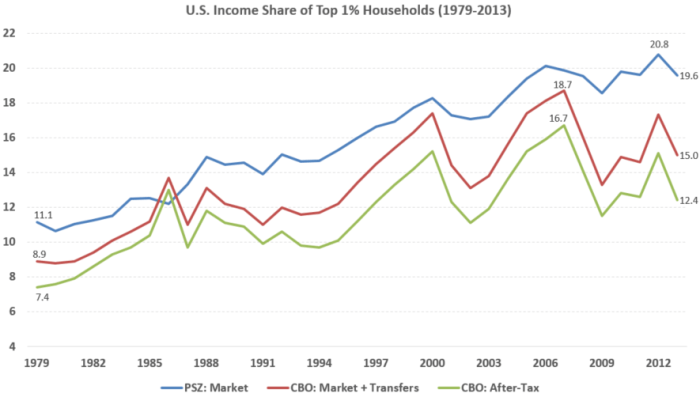
Indeed, we didn’t actually see all that much redistribution of wealth when Democrats more or less controlled all three branches in the period from 2008-2010. We may have seen a little bit shortly thereafter, and tax policy typically does come with a delay of a year or two. But as you can see in this graph, the Great Recession did more to reduce the top 1% income share than any tax policy changes:

US_top_income_share_1pct

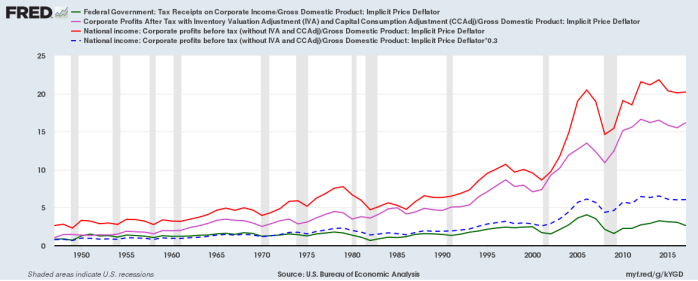
The biggest changes made to our tax code under Obama were actually the handling of capital gains; the increase of the top rate on capital gains from 15% to 20%, plus the 3.8% capital surtax from the Affordable Care Act raised the tax bill for the top 0.1% by tens of billions of dollars. Surprisingly, Trump’s tax cuts don’t actually remove these provisions, though they did dramatically cut the corporate tax rate, which will probably have a similar effect on the income distribution.

To be honest, I’m not as disappointed with Trump’s tax cuts as I thought I would be. Some genuinely good ideas (like the reduction of the mortgage interest deduction, tighter restrictions on carried interest, and increase of the personal standard deduction) and some reasonable but debatable ideas (like cuts to the corporate tax rate, switching to a territorial corporate tax system, limits to deductions on corporate debt payments, removal of the deduction of state taxes, and extensions of 529 savings plans to private primary and secondary schools) were mixed in with the absolutely ludicrous and terrible ideas (like eliminating the Obamacare mandate, doubling the estate tax threshold, cutting the alcohol tax, and allowing offshore drilling in Alaska [One of these things is not like the other ones….]). Some of the terrible ideas, like ending the deduction of student loan interest and tuition waivers, were actually removed in the final version of the bill. Of course, you won’t be surprised when I tell you that the overall US tax system became a lot less progressive as a result of this bill. And even if cutting the corporate tax while raising the capital gains tax is probably a good idea (as I and many economists believe), cutting the corporate tax without raising the capital gains tax probably isn’t.

(An aside: For how much they claim to be “tough on crime”, it’s always kind of baffling to see how often Republicans like to cut alcohol taxes and pollution regulations, which are pretty much the only things that have ever been empirically shown to actually reduce crime. There is some evidence that maybe more policing also helps, but if so, it does so in a far less cost-effective way—indeed, the direct cost of alcohol taxes and pollution taxes is negative. Even if they didn’t work at all, they’d still be worth it just because they raise revenue. I begin to suspect that Republicans don’t actually want to reduce crime, because they know they can use the fear of crime to win votes; they simply want to appear tough on crime, and so they press as hard as they can for more policing and incarceration in the country that already has the highest incarceration rate in the world. This may be a more general phenomenon: While Democrats want to actually solve problems, Republicans want to appear to solve problems while actually exacerbating them, thus insuring their own job security. Compare how Bush kept talking about Osama bin laden while invading Iraq, and Obama actually killed Osama bin Laden. Is this too cynical? Can anything be too cynical in the era of Trump? There were 50,000 Russian bots on Twitter trying to tilt our election! Mueller’s FBI investigation is already implicating several of Trump’s top officials! Everything that seemed like paranoia or cynicism just a few years ago is turning out to be entirely true.)

This is what seems to happen: Year after year, we raise some taxes, then we cut some taxes. Then when raise some taxes, then we cut some taxes. The tax system gets a little more progressive for a few years and inequality begins to fall, and then those changes are removed and inequality begins to rise again. Back and forth and round and round we go.

Is there some way to lock in these tax changes for a longer period of time? The only way I can see would be a change in voter behavior: Keep voting in Democrats to all branches of government consistently for 20 years, and then maybe we would see a serious reduction in income and wealth inequality. Or at least stop voting in Republicans; aside from the Democrats, there are some third parties that would also support redistribution, like the Green Party. And yes, it really is about voting behavior: As prevalent as gerrymandering has become, as terrible as the Electoral College is, as widespread as voter suppression has gotten, Trump only won because 63 million Americans voted for him. Even after everything he’s done, Trumps’ approval rating is still about 39%. As long as there are enough people in this country whose partisan loyalty so strongly outweighs any rational assessment of policy, we are going to continue to see such travesties continue.

It would certainly help if our voting system were fairer, so that third parties had a better chance at taking seats. But it’s also difficult to see how that could happen any time soon. For now, the best I can come up with is trying to show people two things:

First, most Americans favor redistribution of wealth. You’re not alone in wanting that. It’s not some fringe opinion.

Second, there is a real difference between Democrats and Republicans on this issue. The canard “The two parties are the same” is the most untrue it has been in at least twenty years.

I would even understand if there are other issues you consider more important than wealth redistribution. Ecological sustainability is the most defensible—you can’t eat GNP—though that would push you even harder toward the left. Among things that might push you right, I can understand being concerned about higher taxes hurting economic growth, and while I think the view that abortion is murder is ludicrous, given that as your belief I can understand why you would want to prioritize fighting abortion. (If I thought we were murdering millions of babies every year, I’d be pretty mad too! Of course, you should be glad, then, that the US abortion rate has been falling. Right? You know about that, right?)

What I don’t get, however, is people who thought that voting for Donald Trump would help working people. I don’t understand how you can see someone who epitomizes everything that is wrong with the billionaire rentier class and think, “Yeah, he seems like he’s definitely a populist. That guy who was born insanely rich and made even more mind-boggling amounts of money by lying and screwing people over is definitely going to look out for folks like me.”

If I understood that, maybe I would know where to go from here. But people’s political beliefs can be astonishingly intransigent to evidence. Politics is the mind-killer.

Did the World Bank modify its ratings to manipulate the outcome of an election in Chile?

Jan 21 JDN 2458140

(By the way, my birthday is January 19. I can’t believe I’m turning 30.)

This is a fairly obscure news item, so you may have missed it. It should be bigger news than it is.
I can’t fault the New York Times for having its front page focus mainly on the false missile alert that was issued to some people in Hawaii; a false alarm of nuclear attack definitely is the most important thing that could be going on in the world, short of course of actual nuclear war.

CNN, on the other hand, is focused entirely on Trump. When I first wrote this post, they were also focused on Trump, mainly interested in asking whether Trump’s comments about “immigrants from shithole countries” was racist. My answer: Yes, but not because he said the countries were “shitholes”. That was crude, yes, but not altogether inaccurate. Countries like Syria, Afghanistan, and Sudan are, by any objective measure, terrible places. His comments were racist because they attributed that awfulness to the people leaving these countries. But in fact we have a word for immigrants who flee terrible places seeking help and shelter elsewhere: Refugees. We call those people refugees. There are over 10 million refugees in the world today, most of them from Syria.

So anyway, here’s the news item you should have heard about but probably didn’t: The Chief Economist of the World Bank (Paul Romer, who coincidentally I mentioned in my post about DSGE models) has opened an investigation into the possibility that the World Bank’s ratings of economic freedom were intentionally manipulated in order to tilt a Presidential election in Chile.

The worst part is, it may have worked: Chile’s “Doing Business” rating consistently fell under President Michelle Bachelet and rose under President Sebastian Piñera, and Piñera won the most recent election. Was that the reason he won? Who knows? I’m still not entirely clear on how we ended up with President Trump. But it very likely contributed.

The World Bank is supposed to be an impartial institution representing the interests of global economic development. I’m not naive; I recognize that no human institution is perfect, and there will always be competing political and economic interests within any complex institution. Development economists are subject to cognitive biases just like anyone else. If this was the work of a handful of economic analysts (or if Romer turns out to be wrong and the changes in statistical methodology were totally reasonable), so be it; let’s make sure that the bias is corrected and the analysts involved are punished.

But I fear that the rot may run deeper than this. The World Bank is effectively a form of unelected international government. It has been accused of inherent pro-capitalist (or even racist) bias due to the fact that Western governments are overrepresented in its governance, but I actually consider that accusation unfair: There are very good reasons to make sure that your international institutions are managed by liberal democracies, and turns out that most of the world’s liberal democracies are Western. The fact that the US, France, Germany, and the UK make most of the decisions is entirely sensible: Those are in fact the countries we should want making global decisions.

China is not underrepresented, because China is not a democracy and doesn’t deserve to be represented. They are already more represented in the World Bank than they should be, because representing the PRC is not actually representing the interests of the people of China. Russia and Saudi Arabia are undeniably overrepresented. India is underrepresented; they should be complaining. Some African democracies, such as Namibia and Botswana, would also have a legitimate claim to underrepresentation. But I don’t lose any sleep over the fact that Zimbabwe and Iran aren’t getting votes in the World Bank. If and when those countries actually start representing their people, then we can talk about giving them representation in world government. I don’t see how refusing to give international authority to dictators and theocrats constitutes racism or pro-capitalist bias.

That said, there are other reasons to think that the World Bank might actually have some sort of pro-capitalist bias. The World Bank was instrumental in forming the Washington Consensus, which opened free trade and increase economic growth worldwide, but also exposed many poor countries to risk from deregulated financial markets and undermined social safety nets through fiscal austerity programs. They weren’t wrong to want more free trade, and many of their reforms did make sense; but they were at best wildly overconfident in their policy prescriptions, and at worst willing to sacrifice people in poor countries at the altar of bank profits. World poverty has in fact fallen by about half since 1990, and the World Bank has a lot to do with that. But things may have gone faster and smoother if they hadn’t insisted on removing so many financial regulations so quickly without clear forecasts of what would happen. I don’t share Jason Hickel’s pessimistic view that the World Bank’s failures were intentional acts toward an ulterior agenda, but I can see how it begins to look that way when they keep failing the same ways over and over again. (I instead invoke Hanlon’s razor: “Never attribute to malice that which is adequately explained by stupidity.”)

There are also reports of people facing retaliation for criticizing World Bank projects, including those within the World Bank who raise ethical concerns. If this was politically-motivated data manipulation, there may have been people who saw it happening, but were afraid to say anything for fear of being fired or worse.

And Chile in particular has reason to be suspicious. The World Bank suddenly started giving loans to Chile when Augusto Pinochet took power (the CIA denies supporting the coup, by the way—though, given the source, I can understand why one would take that with a grain of salt), and did so under the explicit reasoning that an authoritarian capitalist regime was somehow “more trustworthy” than a democratic socialist regime. Even in the narrow sense of financial creditworthiness that seems difficult to defend; the World Bank knew almost nothing about what kind of government Pinochet was going to create, and in fact despite the so-called “Miracle of Chile”, rapid economic growth in Chile didn’t really happen until the 1990s, after Chile became a democratic capitalist regime.

What I’m really getting at here is that the World Bank has a lot to answer for. I am prepared to believe that most of these actions were honest mistakes or ideological blinders, rather than corruption or cruelty; but even so, when millions of lives are at stake, even honest mistakes aren’t so forgivable. They should be looking for ways to improve their internal governance to make sure that mistakes are caught and corrected quickly. They should be constantly vigilant for biases—either intentional or otherwise—that might seep into their research. Error should be met with immediate correction and public apology; malfeasance should be met with severe punishment.

Perhaps Romer’s investigation actually signals a shift toward such a policy. If so, this is a very good thing. If only we had done this, say, thirty years ago.

“DSGE or GTFO”: Macroeconomics took a wrong turn somewhere

Dec 31, JDN 2458119

The state of macro is good,” wrote Oliver Blanchard—in August 2008. This is rather like the turkey who is so pleased with how the farmer has been feeding him lately, the day before Thanksgiving.

It’s not easy to say exactly where macroeconomics went wrong, but I think Paul Romer is right when he makes the analogy between DSGE (dynamic stochastic general equilbrium) models and string theory. They are mathematically complex and difficult to understand, and people can make their careers by being the only ones who grasp them; therefore they must be right! Nevermind if they have no empirical support whatsoever.

To be fair, DSGE models are at least a little better than string theory; they can at least be fit to real-world data, which is better than string theory can say. But being fit to data and actually predicting data are fundamentally different things, and DSGE models typically forecast no better than far simpler models without their bold assumptions. You don’t need to assume all this stuff about a “representative agent” maximizing a well-defined utility function, or an Euler equation (that doesn’t even fit the data), or this ever-proliferating list of “random shocks” that end up taking up all the degrees of freedom your model was supposed to explain. Just regressing the variables on a few years of previous values of each other (a “vector autoregression” or VAR) generally gives you an equally-good forecast. The fact that these models can be made to fit the data well if you add enough degrees of freedom doesn’t actually make them good models. As Von Neumann warned us, with enough free parameters, you can fit an elephant.

But really what bothers me is not the DSGE but the GTFO (“get the [expletive] out”); it’s not that DSGE models are used, but that it’s almost impossible to get published as a macroeconomic theorist using anything else. Defenders of DSGE typically don’t even argue anymore that it is good; they argue that there are no credible alternatives. They characterize their opponents as “dilettantes” who aren’t opposing DSGE because we disagree with it; no, it must be because we don’t understand it. (Also, regarding that post, I’d just like to note that I now officially satisfy the Athreya Axiom of Absolute Arrogance: I have passed my qualifying exams in a top-50 economics PhD program. Yet my enmity toward DSGE has, if anything, only intensified.)

Of course, that argument only makes sense if you haven’t been actively suppressing all attempts to formulate an alternative, which is precisely what DSGE macroeconomists have been doing for the last two or three decades. And yet despite this suppression, there are alternatives emerging, particularly from the empirical side. There are now empirical approaches to macroeconomics that don’t use DSGE models. Regression discontinuity methods and other “natural experiment” designs—not to mention actual experiments—are quickly rising in popularity as economists realize that these methods allow us to actually empirically test our models instead of just adding more and more mathematical complexity to them.

But there still seems to be a lingering attitude that there is no other way to do macro theory. This is very frustrating for me personally, because deep down I think what I would like to do as a career is macro theory: By temperament I have always viewed the world through a very abstract, theoretical lens, and the issues I care most about—particularly inequality, development, and unemployment—are all fundamentally “macro” issues. I left physics when I realized I would be expected to do string theory. I don’t want to leave economics now that I’m expected to do DSGE. But I also definitely don’t want to do DSGE.

Fortunately with economics I have a backup plan: I can always be an “applied micreconomist” (rather the opposite of a theoretical macroeconomist I suppose), directly attached to the data in the form of empirical analyses or even direct, randomized controlled experiments. And there certainly is plenty of work to be done along the lines of Akerlof and Roth and Shiller and Kahneman and Thaler in cognitive and behavioral economics, which is also generally considered applied micro. I was never going to be an experimental physicist, but I can be an experimental economist. And I do get to use at least some theory: In particular, there’s an awful lot of game theory in experimental economics these days. Some of the most exciting stuff is actually in showing how human beings don’t behave the way classical game theory predicts (particularly in the Ultimatum Game and the Prisoner’s Dilemma), and trying to extend game theory into something that would fit our actual behavior. Cognitive science suggests that the result is going to end up looking quite different from game theory as we know it, and with my cognitive science background I may be particularly well-positioned to lead that charge.

Still, I don’t think I’ll be entirely satisfied if I can’t somehow bring my career back around to macroeconomic issues, and particularly the great elephant in the room of all economics, which is inequality. Underlying everything from Marxism to Trumpism, from the surging rents in Silicon Valley and the crushing poverty of Burkina Faso, to the Great Recession itself, is inequality. It is, in my view, the central question of economics: Who gets what, and why?

That is a fundamentally macro question, but you can’t even talk about that issue in DSGE as we know it; a “representative agent” inherently smooths over all inequality in the economy as though total GDP were all that mattered. A fundamentally new approach to macroeconomics is needed. Hopefully I can be part of that, but from my current position I don’t feel much empowered to fight this status quo. Maybe I need to spend at least a few more years doing something else, making a name for myself, and then I’ll be able to come back to this fight with a stronger position.

In the meantime, I guess there’s plenty of work to be done on cognitive biases and deviations from game theory.

Why risking nuclear war should be a war crime

Nov 19, JDN 2458078

“What is the value of a human life?” is a notoriously difficult question, probably because people keep trying to answer it in terms of dollars, and it rightfully offends our moral sensibilities to do so. We shouldn’t be valuing people in terms of dollars—we should be valuing dollars in terms of their benefits to people.

So let me ask a simpler question: Does the value of an individual human life increase, decrease, or stay the same, as we increase the number of people in the world?

A case can be made that it should stay the same: Why should my value as a person depend upon how many other people there are? Everything that I am, I still am, whether there are a billion other people or a thousand.

But in fact I think the correct answer is that it decreases. This is for two reasons: First, anything that I can do is less valuable if there are other people who can do it better. This is true whether we’re talking about writing blog posts or ending world hunger. Second, and most importantly, if the number of humans in the world gets small enough, we begin to face danger of total permanent extinction.

If the value of a human life is constant, then 1,000 deaths is equally bad whether it happens in a population of 10,000 or a population of 10 billion. That doesn’t seem right, does it? It seems more reasonable to say that losing ten percent should have a roughly constant effect; in that case losing 1,000 people in a population of 10,000 is equally bad as losing 1 billion in a population of 10 billion. If that seems too strong, we could choose some value in between, and say perhaps that losing 1,000 out of 10,000 is equally bad as losing 1 million out of 1 billion. This would mean that the value of 1 person’s life today is about 1/1,000 of what it was immediately after the Toba Event.

Of course, with such uncertainty, perhaps it’s safest to assume constant value. This seems the fairest, and it is certainly a reasonable approximation.

In any case, I think it should be obvious that the inherent value of a human life does not increase as you add more human lives. Losing 1,000 people out of a population of 7 billion is not worse than losing 1,000 people out of a population of 10,000. That way lies nonsense.

Yet if we agree that the value of a human life is not increasing, this has a very important counter-intuitive consequence: It means that increasing the risk of a global catastrophe is at least as bad as causing a proportional number of deaths. Specifically, it implies that a 1% risk of global nuclear war is worse than killing 10 million people outright.

The calculation is simple: If the value of a human life is a constant V, then the expected utility (admittedly, expected utility theory has its flaws) from killing 10 million people is -10 million V. But the expected utility from a 1% risk of global nuclear war is 1% times -V times the expected number of deaths from such a nuclear war—and I think even 2 billion is a conservative estimate. (0.01)(-2 billion) V = -20 million V.

This probably sounds too abstract, or even cold, so let me put it another way. Suppose we had the choice between two worlds, and these were the only worlds we could choose from. In world A, there are 100 leaders who each make choices that result in 10 million deaths. In world B, there are 100 leaders who each make choices that result in a 1% chance of nuclear war. Which world should we choose?

The choice is a terrible one, to be sure.

In world A, 1 billion people die.

Yet what happens in world B?

If the risks are independent, we can’t just multiply by 100 to get a guarantee of nuclear war. The actual probability is 1-(1-0.01)^100 = 63%. Yet even so, (0.63)(2 billion) = 1.26 billion. The expected number of deaths is higher in world B. Indeed, the most likely scenario is that 2 billion people die.

Yet this is probably too conservative. The risks are most likely positively correlated; two world leaders who each take a 1% chance of nuclear war probably do so in response to one another. Therefore maybe adding up the chances isn’t actually so unreasonable—for all practical intents and purposes, we may be best off considering nuclear war in world B as guaranteed to happen. In that case, world B is even worse.

And that is all assuming that the nuclear war is relatively contained. Major cities are hit, then a peace treaty is signed, and we manage to rebuild human civilization more or less as it was. This is what most experts on the issue believe would happen; but I for one am not so sure. The nuclear winter and total collapse of institutions and infrastructure could result in a global apocalypse that would result in human extinctionnot 2 billion deaths but 7 billion, and an end to all of humanity’s projects once and forever This is the kind of outcome we should be prepared to do almost anything to prevent.

What does this imply for global policy? It means that we should be far more aggressive in punishing any action that seems to bring the world closer to nuclear war. Even tiny increases in risk, of the sort that would ordinarily be considered negligible, are as bad as murder. A measurably large increase is as bad as genocide.

Of course, in practice, we have to be able to measure something in order to punish it. We can’t have politicians imprisoned over 0.000001% chances of nuclear war, because such a chance is so tiny that there would be no way to attain even reasonable certainty that such a change had even occurred, much less who was responsible.

Even for very large chances—and in this context, 1% is very large—it would be highly problematic to directly penalize increasing the probability, as we have no consistent, fair, objective measure of that probability.

Therefore in practice what I think we must do is severely and mercilessly penalize certain types of actions that would be reasonably expected to increase the probability of catastrophic nuclear war.

If we had the chance to start over from the Manhattan Project, maybe simply building a nuclear weapon should be considered a war crime. But at this point, nuclear proliferation has already proceeded far enough that this is no longer a viable option. At least the US and Russia for the time being seem poised to maintain their nuclear arsenals, and in fact it’s probably better for them to keep maintaining and updating them rather than leaving decades-old ICBMs to rot.

What can we do instead?

First, we probably need to penalize speech that would tend to incite war between nuclear powers. Normally I am fiercely opposed to restrictions on speech, but this is nuclear war we’re talking about. We can’t take any chances on this one. If there is even a slight chance that a leader’s rhetoric might trigger a nuclear conflict, they should be censored, punished, and probably even imprisoned. Making even a veiled threat of nuclear war is like pointing a gun at someone’s head and threatening to shoot them—only the gun is pointed at everyone’s head simultaneously. This isn’t just yelling “fire” in a crowded theater; it’s literally threatening to burn down every theater in the world at once.

Such a regulation must be designed to allow speech that is necessary for diplomatic negotiations, as conflicts will invariably arise between any two countries. We need to find a way to draw the line so that it’s possible for a US President to criticize Russia’s intervention in the Ukraine or for a Chinese President to challenge US trade policy, without being accused of inciting war between nuclear powers. But one thing is quite clear: Wherever we draw that line, President Trump’s statement about “fire and fury” definitely crosses it. This is a direct threat of nuclear war, and it should be considered a war crime. That reason by itself—let alone his web of Russian entanglements and violations of the Emoluments Clause—should be sufficient to not only have Trump removed from office, but to have him tried at the Hague. Impulsiveness and incompetence are no excuse when weapons of mass destruction are involved.

Second, any nuclear policy that would tend to increase first-strike capability rather than second-strike capability should be considered a violation of international law. In case you are unfamiliar with such terms: First-strike capability consists of weapons such as ICBMs that are only viable to use as the opening salvo of an attack, because their launch sites can be easily located and targeted. Second-strike capability consists of weapons such as submarines that are more concealable, so it’s much more likely that they could wait for an attack to happen, confirm who was responsible and how much damage was done, and then retaliate afterward.
Even that retaliation would be difficult to justify: It’s effectively answering genocide with genocide, the ultimate expression of “an eye for an eye” writ large upon humanity’s future. I’ve previously written about my Credible Targeted Conventional Response strategy that makes it both more ethical and more credible to respond to a nuclear attack with a non-nuclear retaliation. But at least second-strike weapons are not inherently only functional at starting a nuclear war. A first-strike weapon can theoretically be fired in response to a surprise attack, but only before the attack hits you—which gives you literally minutes to decide the fate of the world, most likely with only the sketchiest of information upon which to base your decision. Second-strike weapons allow deliberation. They give us a chance to think carefully for a moment before we unleash irrevocable devastation.

All the launch codes should of course be randomized onetime pads for utmost security. But in addition to the launch codes themselves, I believe that anyone who wants to launch a nuclear weapon should be required to type, letter by letter (no copy-pasting), and then have the machine read aloud, Oppenheimer’s line about Shiva, “Now I am become Death, the destroyer of worlds.” Perhaps the passphrase should conclude with something like “I hereby sentence millions of innocent children to death by fire, and millions more to death by cancer.” I want it to be as salient as possible in the heads of every single soldier and technician just exactly how many innocent people they are killing. And if that means they won’t turn the key—so be it. (Indeed, I wouldn’t mind if every Hellfire missile required a passphrase of “By the authority vested in me by the United States of America, I hereby sentence you to death or dismemberment.” Somehow I think our drone strike numbers might go down. And don’t tell me they couldn’t; this isn’t like shooting a rifle in a firefight. These strikes are planned days in advance and specifically designed to be unpredictable by their targets.)

If everyone is going to have guns pointed at each other, at least in a second-strike world they’re wearing body armor and the first one to pull the trigger won’t automatically be the last one left standing.

Third, nuclear non-proliferation treaties need to be strengthened into disarmament treaties, with rapid but achievable timelines for disarmament of all nuclear weapons, starting with the nations that have the largest arsenals. Random inspections of the disarmament should be performed without warning on a frequent schedule. Any nation that is so much as a day late on their disarmament deadlines needs to have its leaders likewise hauled off to the Hague. If there is any doubt at all in your mind whether your government will meet its deadlines, you need to double your disarmament budget. And if your government is too corrupt or too bureaucratic to meet its deadlines even if they try, well, you’d better shape up fast. We’ll keep removing and imprisoning your leaders until you do. Once again, nothing can be left to chance.

We might want to maintain some small nuclear arsenal for the sole purpose of deflecting asteroids from colliding with the Earth. If so, that arsenal should be jointly owned and frequently inspected by both the United States and Russia—not just the nuclear superpowers, but also the only two nations with sufficient rocket launch capability in any case. The launch of the deflection missiles should require joint authorization from the presidents of both nations. But in fact nuclear weapons are probably not necessary for such a deflection; nuclear rockets would probably be a better option. Vaporizing the asteroid wouldn’t accomplish much, even if you could do it; what you actually want to do is impart as much sideways momentum as possible.

What I’m saying probably sounds extreme. It may even seem unjust or irrational. But look at those numbers again. Think carefully about the value of a human life. When we are talking about a risk of total human extinction, this is what rationality looks like. Zero tolerance for drug abuse or even terrorism is a ridiculous policy that does more harm than good. Zero tolerance for risk of nuclear war may be the only hope for humanity’s ongoing survival.

Throughout the vastness of the universe, there are probably billions of civilizations—I need only assume one civilization for every hundred galaxies. Of the civilizations that were unwilling to adopt zero tolerance policies on weapons of mass destruction and bear any cost, however unthinkable, to prevent their own extinction, there is almost boundless diversity, but they all have one thing in common: None of them will exist much longer. The only civilizations that last are the ones that refuse to tolerate weapons of mass destruction.

This is one of the worst wildfire seasons in American history. But it won’t be for long.

Oct 22, JDN 2458049

At least 38 people have now been killed by the wildfires that are still ongoing in California; in addition, 5700 buildings have been destroyed and 190,000 acres of land burned. The State of California keeps an updated map of all the fires that are ongoing and how well-controlled they are; it’s not a pretty sight.

While the particular details are extreme, this is not an isolated incident. This year alone, wildfires have destroyed over 8 million acres of land in the US. In 2015, that figure was 10 million acres.

Property damage for this year’s wildfires in California is estimated at over $65 billion. That’s more than what Trump recently added to the military budget, and getting close to our total spending on food stamps.

There is a very clear upward trend in the scale and intensity of wildfires just over the last 50 years, and the obvious explanation is climate change. As climate change gets worse, these numbers are projected to increase between 30% and 50% by the 2040s. We still haven’t broken the record of fire damage in 1910, but as the upward trend continues we might soon enough.

It’s important to keep the death tolls in perspective; much as with hurricanes, our evacuation protocols and first-response agencies do their jobs very well, and as a result we’ve been averaging only about 10 wildfire deaths per year over the whole United States for the last century. In a country of over 300 million people, that’s really an impressively small number. That number has also been trending upward, however, so we shouldn’t get complacent.

Climate change isn’t the only reason these fires are especially damaging. It also matters where you build houses. We have been expanding our urban sprawl into fire-prone zones, and that is putting a lot of people in danger. Since 1990, over 60% of new homes were built in “wildland-urban interface areas” that are at higher risk.

Why are we doing this? Because housing prices in urban centers are too expensive for people to live there, but that is where most of the jobs are. So people have little choice but to live in exurbs and suburbs closer to the areas where fires are worst. That’s right: The fires are destroying homes and killing people because the rent is too damn high.

We need to find a solution to this problem of soaring housing prices. And since housing is such a huge proportion of our total expenditure—we spend more on housing than we do on all government spending combined—this would have an enormous impact on our entire economy. If you compare the income of a typical American today to most of the world’s population, or even to a typical American a century ago, we should feel extremely rich, but we don’t—largely because we spend so much of it just on keeping a roof over our heads.

Real estate is also a major driver of economic inequality. Wealth inequality is highest in urban centers where homeownership is rare. The large wealth gaps between White and non-White Americans can be in large part attributed to policies that made homeownership much more difficult for non-White people. Housing value inequality and overall wealth inequality are very strongly correlated. The high inequality in housing prices is making it far more difficult for people to move from poor regions to rich regions, holding back one of the best means we had for achieving more equal incomes.

Moreover, the rise in capital income share since the 1970s is driven almost entirely by real estate, rather than actual physical capital. The top 10% richest housing communities constitute over 52% of the total housing wealth in the US.

There is a lot of debate about what exactly causes these rising housing prices. No doubt, there are many factors contributing, from migration patterns to zoning regulations to income inequality in general. In a later post, I’ll get into why I think many of the people who think they are fighting the problem are actually making it worse, and suggest some ideas for what they should be doing instead.