Reflections on the Charlie Kirk assassination

Sep 28 JDN 2460947

No doubt you are well aware that Charlie Kirk was shot and killed on September 10. His memorial service was held on September 21, and filled a stadium in Arizona.

There have been a lot of wildly different takes on this event. It’s enough to make you start questioning your own sanity. So while what I have to say may not be that different from what Krugman (or for that matter Jacobin) had to say, I still thought I would try to contribute to the small part of the conversation that’s setting the record straight.

First of all, let me say that this is clearly a political assassination, and as a matter of principle, that kind of thing should not be condoned in a democracy.

The whole point of a democratic system is that we don’t win by killing or silencing our opponents, we win by persuading or out-voting them. As long as someone is not engaging in speech acts that directly command or incite violence (like, say, inciting people to attack the Capitol), they should be allowed to speak in peace; even abhorrent views should be not be met with violence.

Free speech isn’t just about government censorship (though that is also a major problem right now); it’s a moral principle that underlies the foundation of liberal democracy. We don’t resolve conflicts with violence unless absolutely necessary.

So I want to be absolutely clear about this: Killing Charlie Kirk was not acceptable, and the assassin should be tried in a court of law and, if duly convicted, imprisoned for a very long time.

Second of all, we still don’t know the assassin’s motive, so stop speculating until we do.

At first it looked like the killer was left-wing. Then it looked like maybe he was right-wing. Now it looks like maybe he’s left-wing again. Maybe his views aren’t easily categorized that way; maybe he’s an anarcho-capitalist, or an anarcho-communist, or a Scientologist. I won’t say it doesn’t matter; it clearly does matter. But we simply do not know yet.

There is an incredibly common and incredibly harmful thing that people do after any major crime: They start spreading rumors and speculating about things that we actually know next to nothing about. Stop it. Don’t contribute to that.


The whole reason we have a court system is to actually figure out the real truth, which takes a lot of time and effort. The courts are one American institution that’s actually still functioning pretty well in this horrific cyberpunk/Trumpistan era; let them do their job.

It could be months or years before we really fully understand what happened here. Accept that. You don’t need to know the answer right now, and it’s far more dangerous to think you know the answer when you actually don’t.

But finally, I need to point out that Charlie Kirk was an absolutely abhorrent, despicable husk of a human being and no one should be honoring him.

First of all, he himself advocated for political violence against his opponents. I won’t say anyone deserves what happened to him—but if anyone did, it would be him, because he specifically rallied his followers to do exactly this sort of thing to other people.

He was also bigoted in almost every conceivable way: Racist, sexist, ableist, homophobic, and of course transphobic. He maintained a McCarthy-esque list of college professors that he encouraged people to harass for being too left-wing. He was a covert White supremacist, and only a little bit covert. He was not covert at all about his blatant sexism and misogyny that seems like it came from the 1950s instead of the 2020s.

He encouraged his—predominantly White, male, straight, cisgender, middle-class—audience to hate every marginalized group you can think of: women, people of color, LGBT people, poor people, homeless people, people with disabilities. Not content to merely be an abhorrent psychopath himself, he actively campaigned against the concept of empathy.

Charlie Kirk deserves no honors. The world is better off without him. He made his entire career out of ruining the lives of innocent people and actively making the world a worse place.

It was wrong to kill Charlie Kirk. But if you’re sad he’s gone, what is wrong with you!?

I can’t not talk about tariffs right now

Apr 13 JDN 2460779

On the one hand, I’m sure every economics blog on the Internet is already talking about this, including Paul Krugman who knows the subject way better than I ever will (and literally won a Nobel Prize for his work on it). And I have other things I’d rather be writing about, like the Index of Necessary Expenditure. But on the other hand, when something this big happens in economics, it just feels like there’s really no alternative: I have to talk about tariffs right now.

What is a tariff, anyway?

This feels like a really basic question, but it also seems like a lot of people don’t really understand tariffs, or didn’t when they voted for Trump.

A tariff, quite simply, is an import tax. It’s a tax that you impose on imported goods (either a particular kind, or from a particular country, or just across the board). On paper, it is generally paid by the company importing the goods, but as I wrote about in my sequence on tax incidence, that doesn’t matter. What matters is how prices change in response to the tax, and this means that in real terms, prices will go up.

In fact, in some sense that’s the goal of a protectionist tariff, because you’re trying to fix the fact that local producers can’t compete on the global market. So you compensate by making international firms pay higher taxes, so that the local producers can charge higher prices and still compete. So anyone who is saying that tariffs won’t raise prices is either ignorant or lying: Raising prices is what tariffs do.

Why are people so surprised?

The thing that surprises me about all this, (a bit ironically) is how surprised people seem to be. Trump ran his whole campaign promising two things: Deport all the immigrants, and massive tariffs on all trade. Most of his messaging was bizarre and incoherent, but on those two topics he was very consistent. So why in the world are people—including stock traders, who are supposedly savvy on these things—so utterly shocked that he has actually done precisely what he promised he would do?

What did people think Trump meant when he said these things? Did they assume he was bluffing? Did they think cooler heads in his administration would prevail (if so, whose?)?

But I will admit that even I am surprised at just how big the tariffs are. I knew they would be big, but I did not expect them to be this big.

How big?

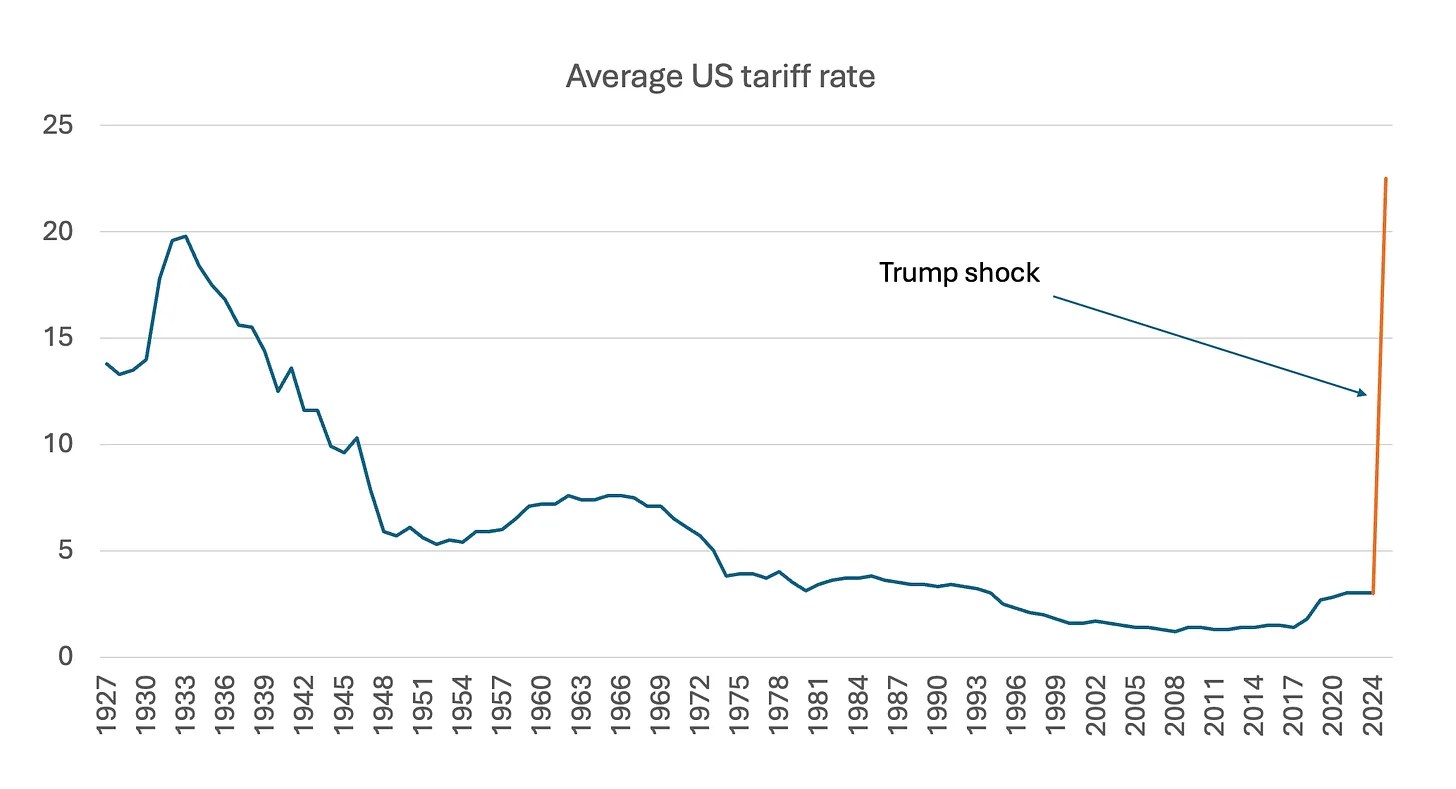
Well, take a look at this graph:

The average tariff rate on US imports will now be higher than it was at the peak in 1930 with the Smoot-Hawley Act. Moreover, Smoot-Hawley was passed during a time when protectionist tariffs were already in place, while Trump’s tariffs come at a time when tariffs had previously been near zero—so the change is dramatically more sudden.

This is worse than Smoot-Hawley.

For the uninitiated, Smoot-Hawley was a disaster. Several countries retaliated with their own tariffs, and the resulting trade war clearly exacerbated the Great Depression, not only in the US but around the world. World trade dropped by an astonishing 66% over the next few years. It’s still debated as to how much of the depression was caused by the tariffs; most economists believe that the gold standard was the bigger culprit. But it definitely made it worse.

Politically, the aftermath cost the Republicans (including Smoot and Hawley themselves) several seats in Congress. (I guess maybe the silver lining here is we can hope this will do the same?)

And I would now like to remind you that these tariffs are bigger than Smoot-Hawley’s and were implemented more suddenly.

Unlike in 1930, we are not currently in a depression—though nor is our economy as hunky-dory as a lot of pundits seem to think, once we consider things like the Index of Necessary Expenditure. But stock markets do seem to be crashing, and if trade drops as much as it did in the 1930s—and why wouldn’t it?—we may very well end up in another depression.

And it’s not as if we didn’t warn you all. Economists across the political spectrum have been speaking out against Trump’s tariffs from the beginning, and nobody listened to us.

So basically the mood of all economists right now is:

How will AI affect inequality?

Oct 15 JDN 2460233

Will AI make inequality worse, or better? Could it do a bit of both? Does it depend on how we use it?

This is of course an extremely big question. In some sense it is the big economic question of the 21st century. The difference between the neofeudalist cyberpunk dystopia of Neuromancer and the social democratic utopia of Star Trek just about hinges on whether AI becomes a force for higher or lower inequality.

Krugman seems quite optimistic: Based on forecasts by Goldman Sachs, AI seems poised to automate more high-paying white-collar jobs than low-paying blue-collar ones.

But, well, it should be obvious that Goldman Sachs is not an impartial observer here. They do have reasons to get their forecasts right—their customers are literally invested in those forecasts—but like anyone who immensely profits from the status quo, they also have a broader agenda of telling the world that everything is going great and there’s no need to worry or change anything.

And when I look a bit closer at their graphs, it seems pretty clear that they aren’t actually answering the right question. They estimate an “exposure to AI” coefficient (somehow; their methodology is not clearly explained and lots of it is proprietary), and if it’s between 10% and 49% they call it “complementary” while if it’s 50% or above they call it “replacement”.

But that is not how complements and substitutes work. It isn’t a question of “how much of the work can be done by machine” (whatever that means). It’s a question of whether you will still need the expert human.

It could be that the machine does 90% of the work, but you still need a human being there to tell it what to do, and that would be complementary. (Indeed, this basically is how finance works right now, and I see no reason to think it will change any time soon.) Conversely, it could be that the machine only does 20% of the work, but that was the 20% that required expert skill, and so a once comfortable high-paying job can now be replaced by low-paid temp workers. (This is more or less what’s happening at Amazon warehouses: They are basically managed by AI, but humans still do most of the actual labor, and get paid peanuts for it.)

For their category “computer and mathematical”, they call it “complementary”, and I agree: We are still going to need people who can code. We’re still going to need people who know how to multiply matrices. We’re still going to need people who understand search algorithms. Indeed, if the past is any indicator, we’re going to need more and more of those people, and they’re going to keep getting paid higher and higher salaries. Someone has to make the AI, after all.

Yet I’m not quite so sure about the “mathematical” part in many cases. We may not need people who can solve differential equations, actually: maybe a few to design the algorithms, but honestly even then, a software program with a simple finite-difference algorithm can often solve much more interesting problems than one with a full-fledged differential equation solver, because one of the dirty secrets of differential equations is that for some of the most important ones (like the Navier-Stokes Equations), we simply do not know how to solve them. Once you have enough computing power, you often can stop trying to be clever and just brute-force the damn thing.

Yet for “transportation and material movement”—that is, trucking—Goldman Sachs confidently forecasts mostly “no automation” with a bit of “complementary”. Yet this year—not at some distant point in the future, not in some sci-fi novel, this year in the actual world—the Governor of California already vetoed a bill that would have required automated trucks to have human drivers. The trucks aren’t on the roads yet—but if we already are making laws about them, they’re going to be, soon. (State legislatures are not known for their brilliant foresight or excessive long-term thinking.) And if the law doesn’t require them to have human drivers, they probably won’t; which means that hundreds of thousands of long-haul truckers will suddenly be out of work.

It’s also important to differentiate between different types of jobs that may fall under the same category or industry.

Neurosurgeons are not going anywhere, and improved robotics will only allow them to perform better, safer laparoscopic surgeries. Nor are nurses going anywhere, because some things just need an actual person physically there with the patient. But general practictioners, psychotherapists, and even radiologists are already seeing many of their tasks automated. So is “medicine” being automated or not? That depends what sort of medicine you mean. And yet it clearly means an increase in inequality, because it’s the middle-paying jobs (like GPs) that are going away, while the high-paying jobs (like neurosurgeons) and the low-paying jobs (like nurses) that remain.

Likewise, consider “legal services”, which is one of the few industries that Goldman Sachs thinks will be substantially replaced by AI. Are high-stakes trial lawyers like Sam Bernstein getting replaced? Clearly not. Nor would I expect most corporate lawyers to disappear. Human lawyers will still continue to perform at least a little bit better than AI law systems, and the rich will continue to use them, because a few million dollars for a few percentage points better odds of winning is absolutely worth it when billions of dollars are on the line. So which law services are going to get replaced by AI? First, routine legal questions, like how to renew your work visa or set up a living will—it’s already happening. Next, someone will probably decide that public defenders aren’t worth the cost and start automating the legal defenses of poor people who get accused of crimes. (And to be honest, it may not be much worse than how things currently are in the public defender system.) The advantage of such a change is that it will most likely bring court costs down—and that is desperately needed. But it may also tilt the courts even further in favor of the rich. It may also make it even harder to start a career as a lawyer, cutting off the bottom of the ladder.

Or consider “management”, which Goldman Sachs thinks will be “complementary”. Are CEOs going to get replaced by AI? No, because the CEOs are the ones making that decision. Certainly this is true for any closely-held firm: No CEO is going to fire himself. Theoretically, if shareholders and boards of directors pushed hard enough, they might be able to get a CEO of a publicly-traded corporation ousted in favor of an AI, and if the world were really made of neoclassical rational agents, that might actually happen. But in the real world, the rich have tremendous solidarity for each other (and only each other), and very few billionaires are going to take aim at other billionaires when it comes time to decide whose jobs should be replaced. Yet, there are a lot of levels of management below the CEO and board of directors, and many of those are already in the process of being replaced: Instead of relying on the expert judgment of a human manager, it’s increasingly common to develop “performance metrics”, feed them into an algorithm, and use that result to decide who gets raises and who gets fired. It all feels very “objective” and “impartial” and “scientific”—and usually ends up being both dehumanizing and ultimately not even effective at increasing profits. At some point, many corporations are going to realize that their middle managers aren’t actually making any important decisions anymore, and they’ll feed that into the algorithm, and it will tell them to fire the middle managers.

Thus, even though we think of “medicine”, “law”, and “management” as high-paying careers, the effect of AI is largely going to be to increase inequality within those industries. It isn’t the really high-paid doctors, managers, and lawyers who are going to get replaced.

I am therefore much less optimistic than Krugman about this. I do believe there are many ways that technology, including artificial intelligence, could be used to make life better for everyone, and even perhaps one day lead us into a glorious utopian future.

But I don’t see most of the people who have the authority to make important decisions for our society actually working towards such a future. They seem much more interested in maximizing their own profits or advancing narrow-minded ideologies. (Or, as most right-wing political parties do today: Advancing narrow-minded ideologies about maximizing the profits of rich people.) And if we simply continue on the track we’ve been on, our future is looking a lot more like Neuromancer than it is like Star Trek.

The United Kingdom in transition

Oct 30 JDN 2459883

When I first decided to move to Edinburgh, I certainly did not expect it to be such a historic time. The pandemic was already in full swing, but I thought that would be all. But this year I was living in the UK when its leadership changed in two historic ways:

First, there was the death of Queen Elizabeth II, and the coronation of King Charles III.

Second, there was the resignation of Boris Johnson, the appointment of Elizabeth Truss, and then, so rapidly I feel like I have whiplash, the resignation of Elizabeth Truss.

In other words, I have seen the end of the longest-reigning monarch and the rise and fall of the shortest-reigning prime minister in the history of the United Kingdom. The three hundred-year history of the United Kingdom.

The prior probability of such a 300-year-historic event happening during my own 3-year term in the UK is approximately 1%. Yet, here we are. A new king, one of a handful of genuine First World monarchs to be coronated in the 21st century. The others are the Netherlands, Belgium, Spain, Monaco, Andorra, and Luxembourg; none of these have even a third the population of the UK, and if we include every Commonwealth Realm (believe it or not, “realm” is in fact still the official term), Charles III is now king of a supranational union with a population of over 150 million people—half the size of the United States. (Yes, he’s your king too, Canada!) Note that Charles III is not king of the entire Commonwealth of Nations, which includes now-independent nations such as India, Pakistan, and South Africa; that successor to the British Empire contains 54 nations and has a population of over 2 billion.

I still can’t quite wrap my mind around this idea of having a king. It feels even more ancient and anachronistic than the 400-year-old university I work at. Of course I knew that we had a queen before, and that she was old and would presumably die at some point and probably be replaced; but that wasn’t really salient information to me until she actually did die and then there was a ten-mile-long queue to see her body and now next spring they will be swearing in this new guy as the monarch of the fourteen realms. It now feels like I’m living in one of those gritty satirical fractured fairy tales. Maybe it’s an urban fantasy setting; it feels a lot like Shrek, to be honest.

Yet other than feeling surreal, none of this has affected my life all that much. I haven’t even really felt the effects of inflation: Groceries and restaurant meals seem a bit more expensive than they were when we arrived, but it’s well within what our budget can absorb; we don’t have a car here, so we don’t care about petrol prices; and we haven’t even been paying more than usual in natural gas because of the subsidy programs. Actually it’s probably been good for our household finances that the pound is so weak and the dollar is so strong. I have been much more directly affected by the university union strikes: being temporary contract junior faculty (read: expendable), I am ineligible to strike and hence had to cross a picket line at one point.

Perhaps this is what history has always felt like for most people: The kings and queens come and go, but life doesn’t really change. But I honestly felt more directly affected by Trump living in the US than I did by Truss living in the UK.

This may be in part because Elizabeth Truss was a very unusual politician; she combined crazy far-right economic policy with generally fairly progressive liberal social policy. A right-wing libertarian, one might say. (As Krugman notes, such people are astonishingly rare in the electorate.) Her socially-liberal stance meant that she wasn’t trying to implement horrific hateful policies against racial minorities or LGBT people the way that Trump was, and for once her horrible economic policies were recognized immediately as such and quickly rescinded. Unlike Trump, Truss did not get the chance to appoint any supreme court justices who could go on to repeal abortion rights.

Then again, Truss couldn’t have appointed any judges if she’d wanted to. The UK Supreme Court is really complicated, and I honestly don’t understand how it works; but from what I do understand, the Prime Minister appoints the Lord Chancellor, the Lord Chancellor forms a commission to appoint the President of the Supreme Court, and the President of the Supreme Court forms a commission to appoint new Supreme Court judges. But I think the monarch is considered the ultimate authority and can veto any appointment along the way. (Or something. Sometimes I get the impression that no one truly understands the UK system, and they just sort of go with doing things as they’ve always been done.) This convoluted arrangement seems to grant the court considerably more political independence than its American counterpart; also, unlike the US Supreme Court, the UK Supreme Court is not allowed to explicitly overturn primary legislation. (Fun fact: The Lord Chancellor is also the Keeper of the Great Seal of the Realm, because Great Britain hasn’t quite figured out that the 13th century ended yet.)

It’s sad and ironic that it was precisely by not being bigoted and racist that Truss ensured she would not have sufficient public support for her absurd economic policies. There’s a large segment of the population of both the US and UK—aptly, if ill-advisedly, referred to by Clinton as “deplorables”—who will accept any terrible policy as long as it hurts the right people. But Truss failed to appeal to that crucial demographic, and so could find no one to support her. Hence, her approval rating fell to a dismal 10%, and she was outlasted by a head of lettuce.

At the time of writing, the new prime minister has not yet been announced, but the smart money is on Rishi Sunak. (I mean that quite literally; he’s leading in prediction markets.) He’s also socially liberal but fiscally conservative, but unlike Truss he seems to have at least some vague understanding of how economics works. Sunak is also popular in a way Truss never was (though that popularity has been declining recently). So I think we can expect to get new policies which are in the same general direction as what Truss wanted—lower taxes on the rich, more privatization, less spent on social services—but at least Sunak is likely to do so in a way that makes the math(s?) actually add up.

All of this is unfortunate, but largely par for the course for the last few decades. It compares quite favorably to the situation in the US, where somehow a large chunk of Americans either don’t believe that an insurrection attempt occurred, are fine with it, or blame the other side, and as the guardrails of democracy continue breaking, somehow gasoline prices appear to be one of the most important issues in the midterm election.

You know what? Living through history sucks. I don’t want to live in “interesting times” anymore.

I finally have a published paper.

Jun 12 JDN 2459773

Here it is, my first peer-reviewed publication: “Imperfect Tactic Collusion and Asymmetric Price Transmission”, in the Journal of Economic Behavior and Organization.

Due to the convention in economics that authors are displayed alphabetically, I am listed third of four, and will be typically collapsed into “Bulutay et. al.”. I don’t actually think it should be “Julius et. al.”; I think Dave Hales did the most important work, and I wanted it to be “Hales et. al.”; but anything non-alphabetical is unusual in economics, and it would have taken a strong justification to convince the others to go along with it. This is a very stupid norm (and I attribute approximately 20% of Daron Acemoglu’s superstar status to it), but like any norm, it is difficult to dislodge.

I thought I would feel different when this day finally came. I thought I would feel joy, or at least satisfaction. I had been hoping that satisfaction would finally spur me forward in resubmitting my single-author paper, “Experimental Public Goods Games with Progressive Taxation”, so I could finally get a publication that actually does have “Julius (2022)” (or, at this rate, 2023, 2024…?). But that motivating satisfaction never came.

I did feel some vague sense of relief: Thank goodness, this ordeal is finally over and I can move on. But that doesn’t have the same motivating force; it doesn’t make me want to go back to the other papers I can now hardly bear to look at.

This reaction (or lack thereof?) could be attributed to circumstances: I have been through a lot lately. I was already overwhelmed by finishing my dissertation and going on the job market, and then there was the pandemic, and I had to postpone my wedding, and then when I finally got a job we had to suddenly move abroad, and then it was awful finding a place to live, and then we actually got married (which was lovely, but still stressful), and it took months to get my medications sorted with the NHS, and then I had a sudden resurgence of migraines which kept me from doing most of my work for weeks, and then I actually caught COVID and had to deal with that for a few weeks too. So it really isn’t too surprising that I’d be exhausted and depressed after all that.

Then again, it could be something deeper. I didn’t feel this way about my wedding. That genuinely gave me the joy and satisfaction that I had been expecting; I think it really was the best day of my life so far. So it isn’t as if I’m incapable of these feelings under my current state.

Rather, I fear that I am becoming more permanently disillusioned with academia. Now that I see how the sausage is made, I am no longer so sure I want to be one of the people making it. Publishing that paper didn’t feel like I had accomplished something, or even made some significant contribution to human knowledge. In fact, the actual work of publication was mostly done by my co-authors, because I was too overwhelmed by the job market at the time. But what I did have to do—and what I’ve tried to do with my own paper—felt like a miserable, exhausting ordeal.

More and more, I’m becoming convinced that a single experiment tells us very little, and we are being asked to present each one as if it were a major achievement when it’s more like a single brick in a wall.

But whatever new knowledge our experiments may have gleaned, that part was done years ago. We could have simply posted the draft as a working paper on the web and moved on, and the world would know just as much and our lives would have been a lot easier.

Oh, but then it would not have the imprimatur of peer review! And for our careers, that means absolutely everything. (Literally, when they’re deciding tenure, nothing else seems to matter.) But for human knowledge, does it really mean much? The more referee reports I’ve read, the more arbitrary they feel to me. This isn’t an objective assessment of scientific merit; it’s the half-baked opinion of a single randomly chosen researcher who may know next to nothing about the topic—or worse, have a vested interest in defending a contrary paradigm.

Yes, of course, what gets through peer review is of considerably higher quality than any randomly-selected content on the Internet. (The latter can be horrifically bad.) But is this not also true of what gets submitted for peer review? In fact, aren’t many blogs written by esteemed economists (say, Krugman? Romer? Nate Silver?) of considerably higher quality as well, despite having virtually none of the gatekeepers? I think Krugman’s blog is nominally edited by the New York Times, and Silver has a whole staff at FiveThirtyEight (they’re hiring, in fact!), but I’m fairly certain Romer just posts whatever he wants like I do. Of course, they had to establish their reputations (Krugman and Romer each won a Nobel). But still, it seems like maybe peer-review isn’t doing the most important work here.

Even blogs by far less famous economists (e.g. Miles Kimball, Brad DeLong) are also very good, and probably contribute more to advancing the knowledge of the average person than any given peer-reviewed paper, simply because they are more readable and more widely read. What we call “research” means going from zero people knowing a thing to maybe a dozen people knowing it; “publishing” means going from a dozen to at most a thousand; to go from a thousand to a billion, we call that “education”.

They all matter, of course; but I think we tend to overvalue research relative to education. A world where a few people know something is really not much better than a world where nobody does, while a world where almost everyone knows something can be radically superior. And the more I see just how far behind the cutting edge of research most economists are—let alone most average people—the more apparent it becomes to me that we are investing far too much in expanding that cutting edge (and far, far too much in gatekeeping who gets to do that!) and not nearly enough in disseminating that knowledge to humanity.

I think maybe that’s why finally publishing a paper felt so anticlimactic for me. I know that hardly anyone will ever actually read the damn thing. Just getting to this point took far more effort than it should have; dozens if not hundreds of hours of work, months of stress and frustration, all to satisfy whatever arbitrary criteria the particular reviewers happened to use so that we could all clear this stupid hurdle and finally get that line on our CVs. (And we wonder why academics are so depressed?) Far from being inspired to do the whole process again, I feel as if I have finally emerged from the torture chamber and may at last get some chance for my wounds to heal.

Even publishing fiction was not this miserable. Don’t get me wrong; it was miserable, especially for me, as I hate and fear rejection to the very core of my being in a way most people do not seem to understand. But there at least the subjectivity and arbitrariness of the process is almost universally acknowledged. Agents and editors don’t speak of your work being “flawed” or “wrong”; they don’t even say it’s “unimportant” or “uninteresting”. They say it’s “not a good fit” or “not what we’re looking for right now”. (Journal editors sometimes make noises like that too, but there’s always a subtext of “If this were better science, we’d have taken it.”) Unlike peer reviewers, they don’t come back with suggestions for “improvements” that are often pointless or utterly infeasible.

And unlike peer reviewers, fiction publishers acknowledge their own subjectivity and that of the market they serve. Nobody really thinks that Fifty Shades of Grey was good in any deep sense; but it was popular and successful, and that’s all the publisher really cares about. As a result, failing to be the next Fifty Shades of Grey ends up stinging a lot less than failing to be the next article in American Economic Review. Indeed, I’ve never had any illusions that my work would be popular among mainstream economists. But I once labored under the belief that it would be more important that it is true; and I guess I now consider that an illusion.

Moreover, fiction writers understand that rejection hurts; I’ve been shocked how few academics actually seem to. Nearly every writing conference I’ve ever been to has at least one seminar on dealing with rejection, often several; at academic conferences, I’ve literally never seen one. There seems to be a completely different mindset among academics—at least, the successful, tenured ones—about the process of peer review, what it means, even how it feels. When I try to talk with my mentors about the pain of getting rejected, they just… don’t get it. They offer me guidance on how to deal with anger at rejection, when that is not at all what I feel—what I feel is utter, hopeless, crushing despair.

There is a type of person who reacts to rejection with anger: Narcissists. (Look no further than the textbook example, Donald Trump.) I am coming to fear that I’m just not narcissistic enough to be a successful academic. I’m not even utterly lacking in narcissism: I am almost exactly average for a Millennial on the Narcissistic Personality Inventory. I score fairly high on Authority and Superiority (I consider myself a good leader and a highly competent individual) but very low on Exploitativeness and Self-Sufficiency (I don’t like hurting people and I know no man is an island). Then again, maybe I’m just narcissistic in the wrong way: I score quite low on “grandiose narcissism”, but relatively high on “vulnerable narcissism”. I hate to promote myself, but I find rejection devastating. This combination seems to be exactly what doesn’t work in academia. But it seems to be par for the course among writers and poets. Perhaps I have the mind of a scientist, but I have the soul of a poet. (Send me through the wormhole! Please? Please!?)
Maybe we should forgive student debt after all.

May 8 JDN 2459708

President Biden has been promising some form of student debt relief since the start of his campaign, though so far all he has actually implemented is a series of no-interest deferments and some improvements to the existing forgiveness programs. (This is still significant—it has definitely helped a lot of people with cashflow during the pandemic.) Actual forgiveness for a large segment of the population remains elusive, and if it does happen, it’s unclear how extensive it will be in either intensity (amount forgiven) or scope (who is eligible).

I personally had been fine with this; while I have a substantial loan balance myself, I also have a PhD in economics, which—theoretically—should at some point entitle me to sufficient income to repay those loans.

Moreover, until recently I had been one of the few left-wing people I know to not be terribly enthusiastic about loan forgiveness. It struck me as a poor use of those government funds, because $1.75 trillion is an awful lot of money, and college graduates are a relatively privileged population. (And yes, it is valid to consider this a question of “spending”, because the US government is the least liquidity-constrained entity on Earth. In lieu of forgiving $1.75 trillion in debt, they could borrow $1.75 trillion in debt and use it to pay for whatever they want, and their ultimate budget balance would be basically the same in each case.)

But I say all this in the past tense because Krugman’s recent column has caused me to reconsider. He gives two strong reasons why debt forgiveness may actually be a good idea.

The first is that Congress is useless. Thanks to gerrymandering and the 40% or so of our population who keeps electing Republicans no matter how crazy they get, it’s all but impossible to pass useful legislation. The pandemic relief programs were the exception that proves the rule: Somehow those managed to get through, even though in any other context it’s clear that Congress would never have approved any kind of (non-military) program that spent that much money or helped that many poor people.

Student loans are the purview of the Department of Education, which is entirely under control of the Executive Branch, and therefore, ultimately, the President of the United States. So Biden could forgive student loans by executive order and there’s very little Congress could do to stop him. Even if that $1.75 trillion could be better spent, if it wasn’t going to be anyway, we may as well use it for this.

The second is that “college graduates” is too broad a category. Usually I’m on guard for this sort of thing, but in this case I faltered, and did not notice the fallacy of composition so many labor economists were making by lumping all college grads into the same economic category. Yes, some of us are doing well, but many are not. Within-group inequality matters.

A key insight here comes from carefully analyzing the college wage premium, which is the median income of college graduates, divided by the median income of high school graduates. This is an estimate of the overall value of a college education. It’s pretty large, as a matter of fact: It amounts to something like a doubling of your income, or about $1 million over one’s whole lifespan.

From about 1980-2000, wage inequality grew about as fast as today, and the college wage premium grew even faster. So it was plausible—if not necessarily correct—to believe that the wage inequality reflected the higher income and higher productivity of college grads. But since 2000, wage inequality has continued to grow, while the college wage premium has been utterly stagnant. Thus, higher inequality can no longer (if it ever could) be explained by the effects of college education.

Now some college graduates are definitely making a lot more money—such as those who went into finance. But it turns out that most are not. As Krugman points out, the 95th percentile of male college grads has seen a 25% increase in real (inflation-adjusted) income in the last 20 years, while the median male college grad has actually seen a slight decrease. (I’m not sure why Krugman restricted to males, so I’m curious how it looks if you include women. But probably not radically different?)

I still don’t think student loan forgiveness would be the best use of that (enormous sum of) money. But if it’s what’s politically feasible, it definitely could help a lot of people. And it would be easy enough to make it more progressive, by phasing out forgiveness for graduates with higher incomes.

And hey, it would certainly help me, so maybe I shouldn’t argue too strongly against it?

Keynesian economics: It works, bitches

Jan 23 JDN 2459613

(I couldn’t resist; for the uninitiated, my slightly off-color title is referencing this XKCD comic.)

When faced with a bad recession, Keynesian economics prescribes the following response: Expand the money supply. Cut interest rates. Increase government spending, but decrease taxes. The bigger the recession, the more we should do all these things—especially increasing spending, because interest rates will often get pushed to zero, creating what’s called a liquidity trap.

Take a look at these two FRED graphs, both since the 1950s.
The first is interest rates (specifically the Fed funds effective rate):

The second is the US federal deficit as a proportion of GDP:

Interest rates were pushed to zero right after the 2008 recession, and didn’t start coming back up until 2016. Then as soon as we hit the COVID recession, they were dropped back to zero.

The deficit looks even more remarkable. At the 2009 trough of the recession, the deficit was large, nearly 10% of GDP; but then it was quickly reduced back to normal, to between 2% and 4% of GDP. And that initial surge is as much explained by GDP and tax receipts falling as by spending increasing.

Yet in 2020 we saw something quite different: The deficit became huge. Literally off the chart, nearly 15% of GDP. A staggering $2.8 trillion. We’ve not had a deficit that large as a proportion of GDP since WW2. We’ve never had a deficit that large in real billions of dollars.

Deficit hawks came out of the woodwork to complain about this, and for once I was worried they might actually be right. Their most credible complaint was that it would trigger inflation, and they weren’t wrong about that: Inflation became a serious concern for the first time in decades.

But these recessions were very large, and when you actually run the numbers, this deficit was the correct magnitude for what Keynesian models tell us to do. I wouldn’t have thought our government had the will and courage to actually do it, but I am very glad to have been wrong about that, for one very simple reason:

It worked.

In 2009, we didn’t actually fix the recession. We blunted it; we stopped it from getting worse. But we never really restored GDP, we just let it get back to its normal growth rate after it had plummeted, and eventually caught back up to where we had been.

2021 went completely differently. With a much larger deficit, we fixed this recession. We didn’t just stop the fall; we reversed it. We aren’t just back to normal growth rates—we are back to the same level of GDP, as if the recession had never happened.

This contrast is quite obvious from the GDP of US GDP:

In 2008 and 2009, GDP slumps downward, and then just… resumes its previous trend. It’s like we didn’t do anything to fix the recession, and just allowed the overall strong growth of our economy to carry us through.

The pattern in 2020 is completely different. GDP plummets downward—much further, much faster than in the Great Recession. But then it immediately surges back upward. By the end of 2021, it was above its pre-recession level, and looks to be back on its growth trend. With a recession this deep, if we’d just waited like we did last time, it would have taken four or five years to reach this point—we actually did it in less than one.

I wrote earlier about how this is a weird recession, one that actually seems to fit Real Business Cycle theory. Well, it was weird in another way as well: We fixed it. We actually had the courage to do what Keynes told us to do in 1936, and it worked exactly as it was supposed to.

Indeed, to go from unemployment almost 15% in April of 2020 to under 4% in December of 2021 is fast enough I feel like I’m getting whiplash. We have never seen unemployment drop that fast. Krugman is fond of comparing this to “morning in America”, but that’s really an understatement. Pitch black one moment, shining bright the next: this isn’t a sunrise, it’s pulling open a blackout curtain.

And all of this while the pandemic is still going on! The omicron variant has brought case numbers to their highest levels ever, though fortunately death rates so far are still below last year’s peak.

I’m not sure I have the words to express what a staggering achievement of economic policy it is to so rapidly and totally repair the economic damage caused by a pandemic while that pandemic is still happening. It’s the equivalent of repairing an airplane that is not only still in flight, but still taking anti-aircraft fire.

Why, it seems that Keynes fellow may have been onto something, eh?

Stupid problems, stupid solutions

Oct 17 JDN 2459505

Krugman thinks we should Mint The Coin: Mint a $1 trillion platinum coin and then deposit it at the Federal Reserve, thus creating, by fiat, the money to pay for the current budget without increasing the national debt.

This sounds pretty stupid. Quite frankly, it is stupid. But sometimes stupid problems require stupid solutions. And the debt ceiling is an incredibly stupid problem.

Let’s be clear about this: Congress already passed the budget. They had a right to vote it down—that is indeed their Constitutional responsibility. But they passed it. And now that the budget is passed, including all its various changes to taxes and spending, it necessarily requires a certain amount of debt increase to make it work.

There’s really no reason to have a debt ceiling at all. This is an arbitrary self-imposed credit constraint on the US government, which is probably the single institution in the world that least needs to worry about credit constraints. The US is currently borrowing at extremely low interest rates, and has never defaulted in 200 years. There is no reason it should be worrying about taking on additional debt, especially when it is being used to pay for important long-term investments such as infrastructure and education.

But if we’re going to have a debt ceiling, it should be a simple formality. Congress does the calculation to see how much debt will be needed, and if it accepts that amount, passes the budget and raises the debt ceiling as necessary. If for whatever reason they don’t want to incur the additional debt, they should make changes to the budget accordingly—not pass the budget and then act shocked when they need to raise the debt ceiling.

In fact, there is a pretty good case to be made that the debt ceiling is a violation of the Fourteenth Amendment, which states in Section 4: “The validity of the public debt of the United States, authorized by law, including debts incurred for payment of pensions and bounties for services in suppressing insurrection or rebellion, shall not be questioned.” This was originally intended to ensure the validity of Civil War debt, but it has been interpreted by the Supreme Court to mean that all US public debt legally incurred is valid and thus render the debt ceiling un-Constitutional.

Of course, actually sending it to the Supreme Court would take a long time—too long to avoid turmoil in financial markets if the debt ceiling is not raised. So perhaps Krugman is right: Perhaps it’s time to Mint The Coin and fight stupid with stupid.

What if we taxed market share?

Apr 18 JDN 2459321

In one of his recent columns, Paul Krugman lays out the case for why corporate tax cuts have been so ineffective at reducing unemployment or increasing economic growth. The central insight is that only a small portion of corporate tax incidence actually seems to fall on real capital investment. First, most corporate tax avoidance is via accounting fictions, not real changes in production; second, most forms of investment and loan interest are tax-deductible; and the third is what I want to focus on today: Corporations today have enormous monopoly power, and taxing monopoly profits is Pigouvian; it doesn’t reduce efficiency, it actually increases it.

Of course, in our current system, we don’t directly tax monopoly profits. We tax profits in general, many—by some estimates, most—of which are monopoly (or oligopoly) profits. But some profits aren’t monopoly profits, while some monopolies are staggeringly powerful—and we’re taxing them all the same. (In fact, the really big monopolies seem to be especially good at avoiding taxes: I guarantee you pay a higher tax rate than Apple or Boeing.)

It’s difficult to precisely measure how much of a corporation’s profits are due to their monopoly power. But there is something that’s quite easy to measure that would be a good proxy for this: market share.

We could tax each corporation’s profits in direct proportion—or even literally equal to—its market share in a suitably defined market. It shouldn’t be too broad (“electronics” would miss Apple’s dominance in smartphones and laptops specifically) or too narrow (“restaurants on Broadway Ave.” would greatly overestimate the market share of many small businesses); this could pose some practical difficulties, but I think it can be done.


And what if a corporation produces in many industries? I offer a bold proposal: Use the maximum. If a corporation controls 10% of one market, 20% of another, and 60% of another, tax all of their profits at the rate of 60%.

If they want to avoid that outcome, well, I guess they’ll have to spin off their different products into different corporations that can account their profits separately. Behold: Self-enforcing antitrust.

Of course, we need to make sure that when corporations split, they actually split—it can’t just be the same CEO and board for 40 “different corporations” that all coordinate all their actions and produce subtle variations on the same product. At that point the correct response is for the FTC to sue them all for illegal collusion.

This would also disincentivize mergers and acquisitions—the growth of which is a major reason why we got into this mess of concentrated oligopolies in the first place.

This policy could be extremely popular, because it directly and explicitly targets big business. Small businesses—even those few that actually are C corporations—would see their taxes dramatically reduced, while trillion-dollar multinationals would suddenly find that they can no longer weasel out of the taxes every other company is paying.

Indeed, if we somehow managed to achieve a perfectly-competitive market where no firm had any significant market share, this corporate tax would effectively disappear. So any time some libertarian tries to argue that corporate taxes are interfering with perfect free market competition, we could point out that this is literally impossible—if we had perfect competition, this corporate tax wouldn’t do anything.

In fact, the total tax revenue would be proportional to the Herfindahl–Hirschman Index, a commonly-used measure of market concentration in oligopoly markets. A monopoly would pay 100% tax, so no one would ever want to be a monopoly; they’d immediately split into two firms so that they could pay a tax rate of 50%. And depending on other characteristics of the market, they might want to split even further than that.

I’ll spare you the algebra, but total profits in a Cournot equilibrium [PDF] with n firms are proportional to n/(n+1)^2, but with a tax rate of 1/n, this makes the after-tax profits proportional to (n-1)/(n+1)^2; this is actually maximized at n = 3. So in this (admittedly oversimplified) case, they’d actually prefer to split into 3 firms. And the difference between a monopoly and a trinopoly is quite significant.

Like any tax, this would create some incentive to produce less; but this could be less than the incentive against expanding monopoly power. A Cournot economy with 3 firms, even with this tax, would produce 50% more and sell at a lower price than a monopoly in the same market.

And once a market is highly competitive, the tax would essentially feel like a constant to each firm; if you are only 1% of the market, even doubling your production to make yourself 2% of the market would only increase your tax rate by 1 percentage point.

Indeed, if we really want to crack down on corporate tax avoidance, we could even charge this tax on sales rather than profits. You can’t avoid that by offshoring production; as long as you’re selling products in the US, you’ll be paying taxes in the US. Firms in a highly-competitive industry would still only pay a percentage point or two of tax, which is totally within a reasonable profit margin. The only firms that would find themselves suddenly unable to pay would be the huge multinationals that control double-digit percentages of the market. They wouldn’t just have an incentive to break up; they’d have no choice but to do so in order to survive.

We are in a golden age of corporate profits

Sep 2 JDN 245836

Take a good look at this graph, from the Federal Reserve Economic Database:

corporate_profits
The red line is corporate profits before tax. It is, unsurprisingly, the largest. The purple line is corporate profits after tax, with the standard adjustments for inventory depletion and capital costs. The green line is revenue from the federal corporate tax. Finally, I added a dashed blue line which multiplies before-tax profits by 30% to compare more directly with tax revenues. All these figures are annual, inflation-adjusted using the GDP deflator. The units are hundreds of billions of 2012 dollars.

The first thing you should notice is that the red and purple lines are near the highest they have ever been. Before-tax profits are over $2 trillion. After-tax profits are over $1.6 trillion.

Yet, corporate tax revenues are not the highest they have ever been. In 2006, they were over $400 billion; yet this year they don’t even reach $300 billion. The obvious reason for this is that we have been cutting corporate taxes. The more important reason is that corporations have gotten very good at avoiding whatever corporate taxes we charge.

On the books, we used to have a corporate tax rate of about 35%, which Trump just cut to 21%. But if you look at my dashed line, you can see that corporations haven’t actually paid more than 30% of their profits in taxes since 1970—and back then, the rate on the books was almost 50%.

Corporations have always avoided taxes. The effective tax rate—tax revenue divided by profits—is always much lower than the rate on the books. In 1951, the statutory tax rate was 50.75%; the effective rate was 47%. In 1970, the statutory rate was 49.2%; the effective rate was 31%. In 1993, the statutory rate was 35%; the effective rate was 26%. On average, corporations paid about 2/3 to 3/4 of what the statutory rate said.

corporate_tax_rate

You can even see how the effective rate trended steadily downward, much faster than the statutory rate. Corporations got better and better at finding and creating loopholes to let them avoid taxes. In 1950, the statutory rate was 38%—and sure enough, the effective rate was… 38%. Under Truman, corporations actually paid what they said they paid. Compare that to 1987, under Reagan, when the statutory rate was 40%—but the effective rate was only 26%.

Yet even with that downward trend, something happened under George W. Bush that widened the gap even further. While the statutory rate remained fixed at 35%, the effective rate plummeted from 26% in 2000 to 16% in 2002. The effective rate never again rose above 19%, and in 2009 it hit a minimum of just over 10%—less than one-third the statutory tax rate. It was trending upward, making it as “high” as 15%, until Trump’s tax cuts hit; in 2017 it was 13%, and it is projected to be even lower this year.

This is why it has always been disingenuous to compare our corporate tax rates with other countries and complain that they are too high. Our effective corporate tax rates have been in line with most other highly-developed countries for a long time now. The idea of “cutting rates and removing loopholes” sounds good in principle—but never actually seems to happen. George W. Bush’s “tax reforms” which were supposed to do this added so many loopholes that the effective tax rate plummeted.

I’m actually fairly ambivalent about corporate taxes in general. Their incidence really isn’t well-understood, though as Krugman has pointed out, so much of corporate profit is now monopoly rent that we can reasonably expect most of the incidence to fall on shareholders. What I’d really like to see happen is a repeal of the corporate tax combined with an increase in capital gains taxes. But we haven’t been increasing capital gains taxes; we’ve just been cutting corporate taxes.

The result has been a golden age for corporate profits. Make higher profits than ever before, and keep almost all of them without paying taxes! Nevermind that the deficit is exploding and our infrastructure is falling apart. America was founded in part on a hatred of taxes, so I guess we’re still carrying on that proud tradition.