In Nozicem

Nov 2 JDN 2460982

(I wasn’t sure how to convert Robert Nozick’s name into Latin. I decided it’s a third-declension noun, Nozix, Nozicis. But my name already is Latin, so if one of his followers ever wants to write a response to this post that also references In Catalinam, they’ll know how to decline it; the accusative is Julium, if you please.)

This post is not at all topical. I have been too busy working on video game jams (XBOX Game Camp Detroit, and then the Epic Mega Jam, for which you can view my submission, The Middle of Nowhere, here!) to keep up with the news, and honestly I think I am psychologically better off for it.

Rather, this is a post I’ve been meaning to write for a long time, but never quite got around to.

It is about Robert Nozick, and why he was a bad philosopher, a bad person, and a significant source of harm to our society as a whole.

Nozick had a successful career at Harvard, and even became president of the American Philosophical Association. So it may seem that I am going out on quite a limb by saying he’s a bad philosopher.

But the philosophy for which he is best known, the thing that made his career, is not simply obviously false—it is evil. It is the sort of thing that one can only write if one is either a complete psychopath, utterly ignorant of history, or arguing in bad faith (or some combination of these).

It is summarized in this pithy quote that makes less moral sense than the philosophy of the Joker in The Dark Knight:

Taxation of earnings from labor is on a par with forced labor. Seizing the results of someone’s labor is equivalent to seizing hours from him and directing him to carry on various activities.

Anarchy, State, and Utopia (p.169)

I apologize in advance for my language, but I must say it:

NO IT FUCKING ISN’T.

At worst—at the absolute worst, when a government is utterly corrupt and tyrannical, provides no legitimate services whatsoever, contributes in no way to public goods, offers no security, and exists entirely to enrich its ruling class—which by the way is worse than almost any actual government that has ever existed, even including totalitarian dictators and feudal absolute monarchies—at worst, taxation is like theft.

Taxation, like theft, takes your wealth, not your labor.


Wealth is not labor.

Even wealth earned by wage income is not labor—and most wealth isn’t earned by wage income. Elon Musk is now halfway to a trillion dollars, and it’s not because he works a million times harder than you. (Nor is he a million times smarter than you, or even ten—perhaps not even one.) The majority of wealth—and the vast majority of top 1%, top 0.1%, and top 0.01% wealth—is capital that begets more capital, continuously further enriching those who could live just fine without ever working another day in their lives. Billionaire wealth is honestly so pathological at this point that it would be pathetic if it weren’t so appalling.

Even setting aside the historical brutality of slavery as it was actually implemented—especially in the United States, where slaves were racialized and commodified in a way that historically slaves usually weren’t—there is a very obvious, very bright, very hard line between taking someone’s wealth and forcing them to work.

Even a Greek prisoner of war who was bought by a Roman patrician to tutor his children—the sort of slave that actually had significant autonomy and lived better than an average person in Roman society—was fundamentally unfree in a way that no one has ever been made unfree by having to pay income tax. (And the Roman patrician who owned him and (ahem) paid taxes was damn well aware of how much more free he was than his slave.)

Whether you are taxed at 2% or 20% or 90%, you are still absolutely free to use your time however you please. Yes, if you assume a fixed amount of work at a fixed wage, and there are no benefits to you from the taxation (which is really not something we can assume, because having a good or bad government radically affects what your economy as a whole will be like), you will have less stuff, and if you insist for some reason that you must have the same amount of stuff, then you would have to work more.

But even then, you would merely have to work more somewhere—anywhere—in order to make up the shortfall. You could keep your current job, or get another one, or start your own business. And you could at any time decide that you don’t need all that extra stuff and don’t want to work more, and simply choose to not work more. You are, in other words, still free.

At worst, the government has taken your stuff. It has made you poorer. But absolutely not, in no way, shape or form, has it made you a slave.

Yes, there is the concept of “wage slavery”, but “wage slavery” isn’t actually slavery, and the notion that people aren’t really, truly free unless they can provide for basic needs entails the need for a strong, redistributive government, which is the exact opposite of what Robert Nozick and his shockingly large body of followers have been arguing for since the 1970s.

I could have been sympathetic to Nozick if his claim had been this:

Taxation of earnings from labor is on a par with [theft]. Seizing the results of someone’s labor is equivalent to seizing [goods he has purchased with his own earnings].

Or even this:

[Military conscription] is on a par with forced labor. [After all, you are] seizing hours from him and directing him to carry on various activities.

Even then, there are some very clear reasons why we might be willing to accept taxation or even conscription from a legitimate liberal democratic government even though a private citizen doing the same fundamental activity would obviously be illegal and immoral.

Indeed, it’s not clear that theft is always immoral; there is always the Les Miserables exception where someone desperately poor steals food to feed themselves, and a liberal democratic government taxing its citizens in order to provide food stamps seems even more ethically defensible than that.

And that, my friends, is precisely why Nozick wasn’t satisfied with it.

Precisely because there is obvious nuance here that can readily justify at least some degree of not only taxation for national security and law enforcement, but also taxation for public goods and even redistribution of wealth, Nozick could not abide the analogies that actually make sense. He had to push beyond them to an analogy that is transparently absurd, in order to argue for his central message that government is justifiable for national security and law enforcement only, and all other government functions are inherently immoral. Forget clean water and air. Forget safety regulations in workplaces—or even on toys. Forget public utilities—all utilities must be privatized and unregulated. And above all—above all—forget ever taking any money from the rich to help the poor, because that would be monstrous.

If you support food stamps, in Nozick’s view, there should be a statue of you in Mississippi, because you are a defender of slavery.

Indeed, many of his followers have gone beyond that, and argued using the same core premises that all government is immoral, and the only morally justifiable system is anarcho-capitalism—which, I must confess, I have always had trouble distinguishing from feudalism with extra steps.

Nozick’s response to this kind of argument basically seemed to be that he thought anarcho-capitalism will (somehow, magically) automatically transition into his favored kind of minarchist state, and so it’s actually a totally fine intermediate goal. (A fully privatized military and law enforcement system! What could possibly go wrong? It’s not like private prisons are already unconscionably horrible even in an otherwise mostly-democratic system or anything!)

Nozick wanted to absolve himself—and the rich, especially the rich, whom he seemed to love more than life itself—from having to contribute to society, from owing anything to any other human being.

Rather than be moved by our moral appeals that millions of innocent people are suffering and we could so easily alleviate that suffering by tiny, minuscule, barely-perceptible harms to those who are already richer than anyone could possibly deserve to be, he tried to turn the tables: “No, you are immoral. What you want is slavery.

And in so doing, he created a thin, but shockingly resilient, intellectual veneer to the most craven selfishness and the most ideologically blinkered hyper-capitalism. He made it respectable to oppose even the most basic ways that governments can make human life better; by verbal alchemy he transmuted plain evil into its own new moral crusade.

Indeed, perhaps the only reason his philosophy was ever taken seriously is that the rich and powerful found it very, very, useful.

Freedom and volition

Oct 13 JDN 2460597

Introduction

What freedom do we have to choose some actions over others, and how are we responsible for what we do? Without some kind of freedom and responsibility, morality becomes meaningless—what does it matter what we ought to do if what we will do is completely inevitable? Morality becomes a trivial exercise, trying to imagine fanciful worlds in which things were not only other than they are, but other than they ever could be.

Many people think that science and morality are incompatible precisely because science requires determinism—the causal unity of the universe, wherein all effects have causes and all systems obey conservation laws. This seems to limit our capacity for freedom, since all our actions are determined by physical causes, and could (in principle) be predicted far in advance from the state of the universe around us. In fact, quantum mechanics isn’t necessarily deterministic (though in my preferred version, the Bohm interpretation, it is), but a small amount of randomness at the level of atoms and molecules doesn’t seem to add much in the way of human freedom.

The fear is that determinism undermines human agency; if we are part of a closed causal system, how can we be free to make our own choices? In fact, this is a mistake. Determinism isn’t the right question to be asking at all. There are really four possibilities to consider:

  • Acausalism: Actions are uncaused but inevitable; everything is ultimately random and meaningless.
  • Libertarianism: Actions are uncaused and free; we are the masters of our own destiny, independent of the laws of nature.
  • Fatalism: Actions are caused and inevitable; the universe is a clockwork machine of which we are components.
  • Compatibilism: Actions are caused but free; we are rational participants in the universe’s causal mechanism.

Acausalism

Hardly anyone holds to acausalism, but it is a logically coherent position. Perhaps the universe is ultimately random, meaningless—our actions are done neither by the laws of nature nor by our own wills, but simply by the random flutterings of molecular motion. In such a universe, we are not ultimately responsible for our actions, but nor can we stop ourselves from pretending that we are, for everything we think, say, and do is determined only by the roll of the dice. This is a hopeless, terrifying approach to reality, and it would drive one to suicide but for the fact that if it is true, suicide, just like everything else, must ultimately be decided by chance.

Libertarianism

Most people, if asked—including evolutionary biologists—seem to believe something like libertarianism. (This is metaphysical libertarianism, the claim that free will is real and intrinsically uncaused; it is not to be confused with political Libertarianism.) As human beings we have an intuitive sense that we are not like the rest of the universe. Leaves fall, but people climb; everything decays, but we construct. If this is right, then morality is unproblematic: Moral rules apply to agents with this sort of deep free will, and not to other things.

But libertarian free will runs into serious metaphysical problems. If I am infected by a virus, do I choose to become sick? If I am left without food, do I choose to starve? If I am hit by a car, do I choose to be injured? Anyone can see that this is not the case: No one chooses these things—they happen, as a result of the laws of nature—physics, chemistry, biology.

Yet, so much of our lives is determined by these kinds of events: How can Stephen Hawking be said to have chosen life as a physicist and not a basketball player when he spent his whole adult life crippled by amytropic lateral sclerosis? He could not possibly have been a professional basketball player, no matter how badly he might have desired to be. Perhaps he could have been an artist or a philosopher—but still, his options were severely limited by his biology.

Indeed, it is worse than this, for we do not choose our parents, our culture, our genes; yet all of these things strongly influence who we are. I have myopia and migraines not because I wanted to, not because I did something to cause it to happen, but because I was born this way—and while myopia isn’t a serious problem with eyeglasses, migraines have adversely affected my life in many ways, and while treatment has helped me enormously, a full cure remains elusive. Culture influences us even more: It is entirely beyond my control that I speak English and live in an upper-middle-class American family; though I’m fairly happy with this result, I was never given a choice in the matter. All of these things have influenced what schools I’ve attended, what friends I’ve made, even what ideas I have considered. My brain itself is a physical system bound to the determinism of the universe. Therefore, in what sense can anything I do be considered free?

Fatalism

This reasoning leads quickly to fatalism, the notion that because everything we do is controlled by laws of nature, nothing we do is free, and we cannot rightly be held responsible for any of our actions. If this is true, then we still can’t stop ourselves from acting the way we do. People who murder will murder, people who punish murderers will punish murderers—it’s all inevitable. There may be slightly more hope in fatalism than acausalism, since it suggests that everything we do is done in some sense for a purpose, if not any purpose we would recognize or understand. Still, the thought that death and suffering, larceny and rape, starvation and genocide, are in all instances inevitable—this is the sort of idea that will keep a thoughtful person awake at night.

By way of reconciling determinism with libertarian free will, some thinkers (such as Michael Shermer) have suggested that free will is a “useful fiction”.

But the very concept of anything being useful depends upon at least a minimal degree of free will—the ability to choose actions based upon their usefulness. A fiction can only be useful if beliefs affect actions. If there even is such a thing as a “useful fiction” (I’m quite dubious of the notion), free will is certainly not an example, for in order for anything to ever be useful we must have at least some degree of free will. The best one could say under fatalism would be something like “some people happen to believe in free will and can’t change that”; but that doesn’t make free will true, it just makes many people incorrigibly wrong.

Yet the inference to fatalism is not, itself, inevitable; it doesn’t follow from the fact that much or even most of what we do is beyond our control that all we do is beyond our control. Indeed, it makes intuitive sense to say that we are in control of certain things—what we eat, what we say, how we move our bodies. We feel at least that we are in control of these things, and we can operate quite effectively on this presumption.

On the other hand, different levels of analysis yield different results. At the level of the brain, at the level of biochemistry, and especially at the level of quantum physics, there is little difference between what we choose to do and what merely happens to us. In a powerful enough microscope, being hit by a car and punching someone in the face look the same: It’s all protons and electrons interacting by exchanging photons.

Compatibilism

But free will is not inherently opposed to causality. In order to exercise free will, we must act not from chance, but from character; someone whose actions are random is not choosing freely, and conversely someone can freely choose to be completely predictable. It can be rational to choose some degree of randomness, but it cannot be rational to choose total randomness. As John Baer convincingly argues, at least some degree of causal determinacy is necessary for free will—hence, libertarianism is not viable, and a lack of determinism would lead only to acausalism. In the face of this knowledge, compatibilism is the obvious choice.

One thing that humans do that only a few other things do—some animals, perhaps computers if we’re generous—is reason; we consider alternatives and select the one we consider best. When water flows down a hill, it never imagines doing otherwise. When asteroids collide, they don’t consider other options. Yet we humans behave quite differently; we consider possibilities, reflect on our desires, seek to choose the best option. This process we call volition, and it is central to our experience of choice and freedom.

Another thing we do that other things don’t—except animals again, but definitely not computers this time—is feel emotion; we love and hurt, feel joy and sorrow. It is our emotions that motivate our actions, give them purpose. Water flowing downhill not only doesn’t choose to do so, it doesn’t care whether it does so. Sometimes things happen to us that we do not choose, but we always care.

This is what I mean when I say “free will”: experiences, beliefs, and actions are part of the same causal system. What we are affects what we think, what we think affects what we do. What we do affects what we are, and the system feeds back into itself. From this realization I can make sense of claims that people are good and bad, that acts are right and wrong; and without it I don’t think we could make sense of anything at all.

It’s not that we have some magical soul that lives outside our bodies; we are our bodies. Our brains are our souls. (I call this the Basic Fact of Cognitive Science: We are our brains.) Nor is it that neuron firings somehow “make” our thoughts and feelings as some kind of extra bonus; the patterns of neuron firings and the information that they process are our thoughts and feelings. Free will isn’t some mystical dualism; it is a direct consequence of the fact that we have capacities for conscious volition. Yes, our actions can be ultimately explained by the patterns in our brains. Of course they can! The patterns in our brains comprise our personalities, our beliefs, our memories, our desires.

Yes, the software of human consciousness is implemented on the hardware of the human brain. Why should we have expected something different? Whatever stuff makes consciousness, it is still stuff, and it obeys the laws that stuff obeys. We can imagine that we might be made of invisible fairy dust, but if that were so, then invisible fairy dust would need to be a real phenomenon and hence obey physical laws like the conservation of energy. Cognition is not opposed to physics; it is a subset of physics. Just as a computer obeys Turing’s laws if you program it but also Newton’s laws if you throw it, so humans are both mental and physical beings.

In fact, the intuitive psychology of free will is among the most powerfully and precisely predictive scientific theories ever devised, right alongside Darwinian evolution and quantum physics.

Consider the following experiment, conducted about twenty years ago. In November of 2006, I planned a road trip with several of my friends from our home in Ann Arbor to the Secular Student Alliance conference in Boston that was coming in April 2007. Months in advance, we researched hotels, we registered for the conference, we planned out how much we would need to spend. When the time came, we gathered in my car and drove the 1300 kilometers to the conference. Now, stop and think for a moment: How did I know, in November 2006, that in April 2007, on a particular date and time, E.O. Wilson would be in a particular room and so would I? Because that’s what the schedule said. Consider for a moment these two extremely complicated extended bodies in space, each interacting with thousands of other such bodies continuously; no physicist could possibly have gathered enough data to predict six months in advance that the two bodies would each travel hundreds of kilometers over the Earth’s surface in order to meet within 10 meters of one another, remain there for roughly an hour, and then split apart and henceforth remain hundreds of kilometers apart. Yet our simple intuitive psychology could, and did, make just that prediction correctly. Of course in the face of incomplete data, no theory is perfect, and the prediction could have been wrong. Indeed because Boston is exceedingly difficult to navigate (we got lost), the prediction that I and Steven Pinker would be in the same room at the same time the previous evening turned out not to be accurate. But even this is something that intuitive psychology could have taken into account better than any other scientific theory we have. Neither quantum physics nor stoichiometric chemistry nor evolutionary biology could have predicted that we’d get lost, nor recommend that if we ever return to Boston we should bring a smartphone with a GPS uplink; yet intuitive psychology can.

Moreover, intuitive psychology explicitly depends upon rational volition. If you had thought that I didn’t want to go to the conference, or that I was mistaken about the conference’s location, then you would have predicted that I would not occupy that spatial location at that time; and had these indeed been the case, that prediction would have been completely accurate. And yet, these predictions insist upon such entities as desires (wanting to go) and beliefs (being mistaken) that eliminativists, behaviorists, and epiphenomenalists have been insisting for years are pseudoscientific. Quite the opposite is the case: Eliminativism, behaviorism, and epiphenomenalism are pseudosciences.

Understanding the constituent parts of a process does not make the process an illusion. Rain did not stop falling when we developed mathematical models of meteorology. Fire did not stop being hot when we formalized statistical dynamics. Thunder did not stop being loud when we explained the wave properties of sound. Advances in computer technology have now helped us realize how real information processing can occur in systems made of physical parts that obey physical laws; it isn’t too great a stretch to think that human minds operate on similar principles. Just as the pattern of electrical firings in my computer really is Windows, the pattern of electrochemical firings in my brain really is my consciousness.

There is a kind of naive theology called “God of the gaps”; it rests upon the notion that whenever a phenomenon cannot be explained by science, this leaves room for God as an explanation. This theology is widely rejected by philosophers, because it implies that whenever science advances, religion must retreat. Libertarianism and fatalism rest upon the presumption of something quite similar, what I would call “free will of the gaps”. As cognitive science advances, we will discover more and more about the causation of human mental states; if this is enough to make us doubt free will, then “free will” was just another name for ignorance of cognitive science. I defend a much deeper sense of free will than this, one that is not at all threatened by scientific advancement.

Yes, our actions are caused—caused by what we think about the world! We are responsible for what we do not because it lacks causation, but because it has causation, specifically causation in our own beliefs, desires, and intentions. These beliefs, desires, and intentions are themselves implemented upon physical hardware, and we don’t fully understand how this implementation operates; but nonetheless the hardware is real and the phenomena are real, at least as real as such things as rocks, rivers, clouds, trees, dogs, and televisions, all of which are also complex functional ensembles of many smaller, simpler parts.

Conclusion

Libertarianism is largely discredited; we don’t have the mystical sort of free will that allows us to act outside of causal laws. But this doesn’t mean that we must accept fatalism; compatibilism is the answer. We have discovered many surprising things about cognitive science, and we will surely need to discover many more; but the fundamental truth of rational volition remains untarnished.

We know, to a high degree of certainty, that human beings are capable of volitional action. I contend that this is all the freedom we need—perhaps even all we could ever have. When a comet collides with Jupiter, and we ask “Why?”, the only sensible answer involves happenstance and laws of physics. When a leaf falls from a tree, and we ask “Why?”, we can do better, talking about evolutionary adaptations in the phylogenetic history of trees. But when a human being robs a bank, starts a war, feeds a child, or writes a book, and we ask “Why?”, we can move away from simple causes and talk about reasons—desires, intentions, beliefs; reasons, unlike mere causes, can make more or less sense, be more or less justified.

Psychological and neurological experiments have shown that volition is more complicated than we usually think—it can be strongly affected by situational factors, and it has more to do with inhibiting and selecting actions than with generating them, what Sukhvinder Obhi and Patrick Haggard call “not free will but free won’t”; yet still we have volitional control over many of our actions, and hence responsibility for them. In simple tasks, there is brain activity that predicts our behavior several seconds before we actually consciously experience the decision—but this is hardly surprising, since the brain needs to use processing power to actually generate a decision. Deliberation requires processing, not all of which can be conscious. It’s a little surprising that the activity can predict the decision in advance of the conscious experience of volition, but it can’t predict the decision perfectly, even in very simple tasks. (And in true real-life tasks, like choosing a college or a spouse, it basically can’t predict at all.) This shows that the conscious volition is doing something—perhaps inhibiting undesired behaviors or selecting desired ones. No compatibilist needs to be committed to the claim that subconscious urges have nothing to do with our decisions—since at least Freud that kind of free will has been clearly discredited.

Indeed, evolutionary psychology would be hard-pressed to explain an illusion of free will that isn’t free will. It simply doesn’t make sense for conscious volition to evolve unless it does something that affects our behavior in some way. Illusions are a waste of brain matter, which in turn is a waste of metabolic energy. (The idea that we would want to have free will in order to feel like life is worth living is profoundly silly: If our beliefs didn’t affect our behavior, our survival would be unrelated to whether we thought life was worth living!) You can make excuses and say that conscious experience is just an epiphenomenon upon neurological processes—an effect but not a cause—but there is no such thing as an “epiphenomenon” in physics as we know it. The smoke of a flame can smother that flame; the sound of a train is a sonic pressure wave that shakes the metal of the track. Anything that moves has energy, and energy is conserved. Epiphenomenalism would require new laws of physics, by which consciousness can be created ex nihilo, a new entity that requires no energy to make and “just happens” whenever certain matter is arranged in the right way.

Windows is not an “epiphenomenon” upon the electrons running through my computer’s processor core; the functional arrangement of those electrons is Windows—it implements Windows. I don’t see why we can’t say the same thing about my consciousness—that it is a software implementation by the computational hardware of my brain. Epiphenomenalists will often insist that they are being tough-minded scientists accepting the difficult facts while the rest of us are being silly and mystical; but they are talking about mysterious new physics and I’m talking about software-hardware interaction—so really, who is being mystical here?

In the future it may be possible to predict people’s behavior relatively accurately based on their brain activity—but so what? This only goes to show that the brain is the source of our decisions, which is precisely what compatibilism says. One can easily predict that rain will fall from clouds of a certain composition; but rain still falls from clouds. The fact that I can sometimes predict your behavior doesn’t make your behavior any less volitional; it only makes me a better psychologist (and for that matter a more functional human being). Moreover, detailed predictions of long-term behaviors will probably always remain impossible, due to the deep computational complexity involved. (If it were simple to predict who you’d marry, why would your brain expend so much effort working on the problem?)

For all these reasons, I say: Yes, we do have free will.

Subsidies can’t make things unaffordable

May 12 2458616

In last week’s post I talked about a supposed benefit of subsidies that almost never materializes. In this week, I’m going to talk about a supposed harm of subsidies that is literally impossible.

The American Enterprise Institute (a libertarian think-tank) has been sending around a graph of price increases over the last 20 years by sector, showing what everyone already intuitively knows: healthcare and education have gotten wildly more expensive, while high-tech products have gotten extremely cheap. Actually I was a surprised how little they found housing prices had increased (enough to make me wonder what metric they are using for housing prices).

They argue that it is government intervention which has created these rising prices:

Blue lines = prices subject to free market forces. Red lines = prices subject to regulatory capture by government.

Along similar lines, Grey Gordon and Aaron Hedlund published a book chapter presenting evidence that student loans and federal subsidies are responsible for increases in college tuition. They are professional economists, so I feel like I ought to take their argument seriously… but it’s really hard to do, because it’s such a silly concept at the most basic level. I could nitpick their assumptions about elasticity of demand and monopoly power, but the whole argument just doesn’t pass the smell test.

Subsidies always make things more affordable for the person being subsidized.

It’s possible for subsidies to create other distortions, and make things more expensive for those who aren’t subsidized. But it’s literally impossible for subsidies to make something unaffordable to the person being subsidized.

That result is absolutely fundamental, and it comes directly from the Law of Supply and Law of Demand.

Subsidies

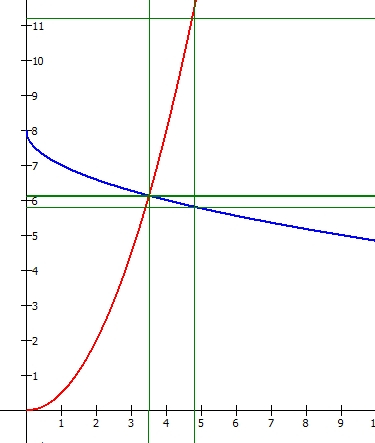
On this graph, the blue line is the demand curve. The red line is the supply curve. The thick green line is where they intersect, at the competitive equilibrium price. In this case, that equilibrium means we sell 6 units at a price of $3 each.

The thin green lines show what happen if we introduce a subsidy. Here the subsidy is $3. The sticker price can be read off of the supply curve: It will rise to $4. But the actual price paid by consumers is read off the demand curve: It will fall to $1. Total sales will rise to 8 units. The total cost to the government is then 8($3) = $24.

These exact numbers are of course specific to the example I chose. But the overall direction is not.

We can go ahead and draw this with all sorts of different supply and demand curves, and we’ll keep getting the same result.

Here’s one where I didn’t even make the curves linear:

Subsidies_2

In this case, a subsidy of $5.40 raises the sticker price from $6.10 to $11.20, only reducing the price for consumers to $5.80, while increasing the quantity sold from 3.5 to 4.8. The total cost of the subsidy is $25.92. The price effects are very different in magnitude from the previous example, and yet all the directions are exactly the same—and they will continue to be the same, however you draw the curves.

And here’s yet another example:

Subsidies_3

Here, a subsidy of $2.30 raises the sticker price from $4 to $5.30, lowers the cost to consumers to $3, increases the quantity sold from 4 to 7 units, and costs $16.10.

If you’re still not convinced, try drawing some more of the same diagrams yourself. As long as you make the supply curve slope upward and the demand curve slope downward, you’ll keep getting the same results.
A subsidy will always do four things:

  1. Increase the sticker price, benefiting sellers.
  2. Decrease the price that subsidized consumers actually pay, benefiting those consumers.
  3. Increase the quantity sold.
  4. Cost the government money.

The intuition here is quite simple: If I give you free money every time you buy a thing, you’ll buy more of that thing (3) because it costs you less to do so (2). Because you buy more of the thing, the price will go up (1), but not enough to cancel out the reduced cost to you (or else you’d stop). Since I’m giving you free money, that will cost me money (4). This intuition is fully general: It doesn’t matter what kind of product we are talking about, you’re never going to buy less or have to pay more for each one because I gave you free money.

The size of each effect depends upon elasticity of demand and supply, in basically the same way as tax incidence. The more inelastic side of the market is harmed less by the tax and also benefits less from the subsidy. For any given change in quantity, more inelastic markets raise more tax revenue and cost more subsidy spending.

If we allow elasticities of demand or supply to be zero or infinite (which is almost never the case in real life), then some of these effects might be zero. But they will never go the opposite direction, not as long as the supply curve slopes upward and the demand curve slopes downward.

I suspect that education has relatively inelastic demand and relatively elastic supply, which would mean that the subsidies are actually largely felt by the consumer, not the seller. But that’s actually a legitimate economic question: I might be overestimating the elasticity of supply.

There are other legitimate economic questions here as well, such as how much benefit we get out of a given subsidy versus other ways we might spend that money, and how subsidies may hurt others in the same market who aren’t subsidized.

What is not a legitimate question is the one that these libertarian think-tanks seem to be asking, which is “If you give people money, will they end up with less stuff?” No, they won’t. That’s not how any of this works.

And I’m pretty sure the people in these think-tanks are smart enough to know that. They might be blinded by their anti-government ideology, but I actually suspect it’s more sinister than that: They know that what they are saying isn’t true, but they consider it a “noble lie”: A falsehood told to the common folk in the service of a higher good.

They are clever enough to not simply state the lie outright, but instead imply it through misleading presentation of real facts. Yes, it’s true that subsidies will raise the sticker price—so they can say that this was all they were asserting. But not only is that obvious and trivial: It wouldn’t even support the argument they are obviously trying to make. Nobody cares about the sticker price. They care about what people actually pay. And a subsidy, by construction, as a law of economics, cannot possibly increase the amount paid by the buyer who is subsidized.

What they obviously want you to think is that the reason healthcare and education are so unaffordable is because the government has been subsidizing them. But this is basically the opposite of the truth: These things became unaffordable for various reasons, and the government stepped in to subsidize them in order to stop the bleeding. Is that a permanent solution? No, it’s not. But it does actually help keep them affordable for the time being—and it could not have done otherwise. There’s simply no way to give someone free money and make them poorer. (Of course, fully socialized healthcare and education might be permanent solutions, so if the libertarians aren’t careful what they wish for….)

The high cost of frictional unemployment

Sep 3, JDN 2457635

I had wanted to open this post with an estimate of the number of people in the world, or at least in the US, who are currently between jobs. It turns out that such estimates are essentially nonexistent. The Bureau of Labor Statistics maintains a detailed database of US unemployment; they don’t estimate this number. We have this concept in macroeconomics of frictional unemployment, the unemployment that results from people switching jobs; but nobody seems to have any idea how common it is.

I often hear a ballpark figure of about 4-5%, which is related to a notion that “full employment” should really be about 4-5% unemployment because otherwise we’ll trigger horrible inflation or something. There is almost no evidence for this. In fact, the US unemployment rate has gotten as low as 2.5%, and before that was stable around 3%. This was during the 1950s, the era of the highest income tax rates ever imposed in the United States, a top marginal rate of 92%. Coincidence? Maybe. Obviously there were a lot of other things going on at the time. But it sure does hurt the argument that high income taxes “kill jobs”, don’t you think?

Indeed, it may well be that the rate of frictional unemployment varies all the time, depending on all sorts of different factors. But here’s what we do know: Frictional unemployment is a serious problem, and yet most macroeconomists basically ignore it.

Talk to most macroeconomists about “unemployment”, and they will assume you mean either cyclical unemployment (the unemployment that results from recessions and bad fiscal and monetary policy responses to them), or structural unemployment (the unemployment that results from systematic mismatches between worker skills and business needs). If you specifically mention frictional unemployment, the response is usually that it’s no big deal and there’s nothing we can do about it anyway.

Yet at least when we aren’t in a recession, frictional employment very likely accounts for the majority of unemployment, and thus probably the majority of misery created by unemployment. (Not necessarily, since it probably doesn’t account for much long-term unemployment, which is by far the worst.) And it is quite clear to me that there are things we can do about it—they just might be difficult and/or expensive.

Most of you have probably changed jobs at least once. Many of you have, like me, moved far away to a new place for school or work. Think about how difficult that was. There is the monetary cost, first of all; you need to pay for the travel of course, and then usually leases and paychecks don’t line up properly for a month or two (for some baffling and aggravating reason, UCI won’t actually pay me my paychecks until November, despite demanding rent starting the last week of July!). But even beyond that, you are torn from your social network and forced to build a new one. You have to adapt to living in a new place which may have differences in culture and climate. Bureaucracy often makes it difficult to change over documentation of such as your ID and your driver’s license.

And that’s assuming that you already found a job before you moved, which isn’t always an option. Many people move to new places and start searching for jobs when they arrive, which adds an extra layer of risk and difficulty above and beyond the transition itself.

With all this in mind, the wonder is that anyone is willing to move at all! And this is probably a large part of why people are so averse to losing their jobs even when it is clearly necessary; the frictional unemployment carries enormous real costs. (That and loss aversion, of course.)

What could we do, as a matter of policy, to make such transitions easier?

Well, one thing we could do is expand unemployment insurance, which reduces the cost of losing your job (which, despite the best efforts of Republicans in Congress, we ultimately did do in the Second Depression). We could expand unemployment insurance to cover voluntary quits. Right now, quitting voluntarily makes you forgo all unemployment benefits, which employers pay for in the form of insurance premiums; so an employer is much better off making your life miserable until you quit than they are laying you off. They could also fire you for cause, if they can find a cause (and usually there’s something they could trump up enough to get rid of you, especially if you’re not prepared for the protracted legal battle of a wrongful termination lawsuit). The reasoning of our current system appears to be something like this: Only lazy people ever quit jobs, and why should we protect lazy people? This is utter nonsense and it needs to go. Many states already have no-fault divorce and no-fault auto collision insurance; it’s time for no-fault employment termination.

We could establish a basic income of course; then when you lose your job your income would go down, but to a higher floor where you know you can meet certain basic needs. We could provide subsidized personal loans, similar to the current student loan system, that allow people to bear income gaps without losing their homes or paying exorbitant interest rates on credit cards.

We could use active labor market programs to match people with jobs, or train them with the skills needed for emerging job markets. Denmark has extensive active labor market programs (they call it “flexicurity”), and Denmark’s unemployment rate was 2.4% before the Great Recession, hit a peak of 6.2%, and has now recovered to 4.2%. What Denmark calls a bad year, the US calls a good year—and Greece fantasizes about as something they hope one day to achieve. #ScandinaviaIsBetter once again, and Norway fits this pattern also, though to be fair Sweden’s unemployment rate is basically comparable to the US or even slightly worse (though it’s still nothing like Greece).

Maybe it’s actually all right that we don’t have estimates of the frictional unemployment rate, because the goal really isn’t to reduce the number of people who are unemployed; it’s to reduce the harm caused by unemployment. Most of these interventions would very likely increase the rate frictional unemployment, as people who always wanted to try to find better jobs but could never afford to would now be able to—but they would dramatically reduce the harm caused by that unemployment.

This is a more general principle, actually; it’s why we should basically stop taking seriously this argument that social welfare benefits destroy work incentives. That may well be true; so what? Maximizing work incentives was never supposed to be a goal of public policy, as far as I can tell. Maximizing human welfare is the goal, and the only way a welfare program could reduce work incentives is by making life better for people who aren’t currently working, and thereby reducing the utility gap between working and not working. If your claim is that the social welfare program (and its associated funding mechanism, i.e. taxes, debt, or inflation) would make life sufficiently worse for everyone else that it’s not worth it, then say that (and for some programs that might actually be true). But in and of itself, making life better for people who don’t work is a benefit to society. Your supposed downside is in fact an upside. If there’s a downside, it must be found elsewhere.

Indeed, I think it’s worth pointing out that slavery maximizes work incentives. If you beat or kill people who don’t work, sure enough, everyone works! But that is not even an efficient economy, much less a just society. To be clear, I don’t think most people who say they want to maximize work incentives would actually support slavery, but that is the logical extent of the assertion. (Also, many Libertarians, often the first to make such arguments, do have a really bizarre attitude toward slavery; taxation is slavery, regulation is slavery, conscription is slavery—the last not quite as ridiculous—but actual forced labor… well, that really isn’t so bad, especially if the contract is “voluntary”. Fortunately some Libertarians are not so foolish.) If your primary goal is to make people work as much as possible, slavery would be a highly effective way to achieve that goal. And that really is the direction you’re heading when you say we shouldn’t do anything to help starving children lest their mothers have insufficient incentive to work.

More people not working could have a downside, if it resulted in less overall production of goods. But even in the US, one of the most efficient labor markets in the world, the system of job matching is still so ludicrously inefficient that people have to send out dozens if not hundreds of applications to jobs they barely even want, and there are still 1.4 times as many job seekers as there are openings (at the trough of the Great Recession, the ratio was 6.6 to 1). There’s clearly a lot of space here to improve the matching efficiency, and simply giving people more time to search could make a big difference there. Total output might decrease for a little while during the first set of transitions, but afterward people would be doing jobs they want, jobs they care about, jobs they’re good at—and people are vastly more productive under those circumstances. It’s quite likely that total employment would decrease, but productivity would increase so much that total output increased.

Above all, people would be happier, and that should have been our goal all along.

Lukewarm support is a lot better than opposition

July 23, JDN 2457593

Depending on your preconceptions, this statement may seem either eminently trivial or offensively wrong: Lukewarm support is a lot better than opposition.

I’ve always been in the “trivial” camp, so it has taken me awhile to really understand where people are coming from when they say things like the following.

From a civil rights activist blogger (“POC” being “person of color” in case you didn’t know):

Many of my POC friends would actually prefer to hang out with an Archie Bunker-type who spits flagrantly offensive opinions, rather than a colorblind liberal whose insidious paternalism, dehumanizing tokenism, and cognitive indoctrination ooze out between superficially progressive words.

From the Daily Kos:

Right-wing racists are much more honest, and thus easier to deal with, than liberal racists.

From a Libertarian blogger:

I can deal with someone opposing me because of my politics. I can deal with someone who attacks me because of my religious beliefs. I can deal with open hostility. I know where I stand with people like that.

They hate me or my actions for (insert reason here). Fine, that is their choice. Let’s move onto the next bit. I’m willing to live and let live if they are.

But I don’t like someone buttering me up because they need my support, only to drop me the first chance they get. I don’t need sweet talk to distract me from the knife at my back. I don’t need someone promising the world just so they can get a boost up.

In each of these cases, people are expressing a preference for dealing with someone who actively opposes them, rather than someone who mostly supports them. That’s really weird.

The basic fact that lukewarm support is better than opposition is basically a mathematical theorem. In a democracy or anything resembling one, if you have the majority of population supporting you, even if they are all lukewarm, you win; if you have the majority of the population opposing you, even if the remaining minority is extremely committed to your cause, you lose.

Yes, okay, it does get slightly more complicated than that, as in most real-world democracies small but committed interest groups actually can pressure policy more than lukewarm majorities (the special interest effect); but even then, you are talking about the choice between no special interests and a special interest actively against you.

There is a valid question of whether it is more worthwhile to get a small, committed coalition, or a large, lukewarm coalition; but at the individual level, it is absolutely undeniable that supporting you is better for you than opposing you, full stop. I mean that in the same sense that the Pythagorean theorem is undeniable; it’s a theorem, it has to be true.

If you had the opportunity to immediately replace every single person who opposes you with someone who supports you but is lukewarm about it, you’d be insane not to take it. Indeed, this is basically how all social change actually happens: Committed supporters persuade committed opponents to become lukewarm supporters, until they get a majority and start winning policy votes.

If this is indeed so obvious and undeniable, why are there so many people… trying to deny it?

I came to realize that there is a deep psychological effect at work here. I could find very little in the literature describing this effect, which I’m going to call heretic effect (though the literature on betrayal aversion, several examples of which are linked in this sentence, is at least somewhat related).

Heretic effect is the deeply-ingrained sense human beings tend to have (as part of the overall tribal paradigm) that one of the worst things you can possibly do is betray your tribe. It is worse than being in an enemy tribe, worse even than murdering someone. The one absolutely inviolable principle is that you must side with your tribe.

This is one of the biggest barriers to police reform, by the way: The Blue Wall of Silence is the result of police officers identifying themselves as a tight-knit tribe and refusing to betray one of their own for anything. I think the best option for convincing police officers to support reform is to reframe violations of police conduct as themselves betrayals—the betrayal is not the IA taking away your badge, the betrayal is you shooting an unarmed man because he was Black.

Heretic effect is a particular form of betrayal aversion, where we treat those who are similar to our tribe but not quite part of it as the very worst sort of people, worse than even our enemies, because at least our enemies are not betrayers. In fact it isn’t really betrayal, but it feels like betrayal.

I call it “heretic effect” because of the way that exclusivist religions (including all the Abrahamaic religions, and especially Christianity and Islam) focus so much of their energy on rooting out “heretics”, people who almost believe the same as you do but not quite. The Spanish Inquisition wasn’t targeted at Buddhists or even Muslims; it was targeted at Christians who slightly disagreed with Catholicism. Why? Because while Buddhists might be the enemy, Protestants were betrayers. You can still see this in the way that Muslim societies treat “apostates”, those who once believed in Islam but don’t anymore. Indeed, the very fact that Christianity and Islam are at each other’s throats, rather than Hinduism and atheism, shows that it’s the people who almost agree with you that really draw your hatred, not the people whose worldview is radically distinct.

This is the effect that makes people dislike lukewarm supporters; like heresy, lukewarm support feels like betrayal. You can clearly hear that in the last quote: “I don’t need sweet talk to distract me from the knife at my back.” Believe it or not, Libertarians, my support for replacing the social welfare state with a basic income, decriminalizing drugs, and dramatically reducing our incarceration rate is not deception. Nor do I think I’ve been particularly secretive about my desire to make taxes more progressive and environmental regulations stronger, the things you absolutely don’t agree with. Agreeing with you on some things but not on other things is not in fact the same thing as lying to you about my beliefs or infiltrating and betraying your tribe.

That said, I do sort of understand why it feels that way. When I agree with you on one thing (decriminalizing cannabis, for instance), it sends you a signal: “This person thinks like me.” You may even subconsciously tag me as a fellow Libertarian. But then I go and disagree with you on something else that’s just as important (strengthening environmental regulations), and it feels to you like I have worn your Libertarian badge only to stab you in the back with my treasonous environmentalism. I thought you were one of us!

Similarly, if you are a social justice activist who knows all the proper lingo and is constantly aware of “checking your privilege”, and I start by saying, yes, racism is real and terrible, and we should definitely be working to fight it, but then I question something about your language and approach, that feels like a betrayal. At least if I’d come in wearing a Trump hat you could have known which side I was really on. (And indeed, I have had people unfriend me or launch into furious rants at me for questioning the orthodoxy in this way. And sure, it’s not as bad as actually being harassed on the street by bigots—a thing that has actually happened to me, by the way—but it’s still bad.)

But if you can resist this deep-seated impulse and really think carefully about what’s happening here, agreeing with you partially clearly is much better than not agreeing with you at all. Indeed, there’s a fairly smooth function there, wherein the more I agree with your goals the more our interests are aligned and the better we should get along. It’s not completely smooth, because certain things are sort of package deals: I wouldn’t want to eliminate the social welfare system without replacing it with a basic income, whereas many Libertarians would. I wouldn’t want to ban fracking unless we had established a strong nuclear infrastructure, but many environmentalists would. But on the whole, more agreement is better than less agreement—and really, even these examples are actually surface-level results of deeper disagreement.

Getting this reaction from social justice activists is particularly frustrating, because I am on your side. Bigotry corrupts our society at a deep level and holds back untold human potential, and I want to do my part to undermine and hopefully one day destroy it. When I say that maybe “privilege” isn’t the best word to use and warn you about not implicitly ascribing moral responsibility across generations, this is not me being a heretic against your tribe; this is a strategic policy critique. If you are writing a letter to the world, I’m telling you to leave out paragraph 2 and correcting your punctuation errors, not crumpling up the paper and throwing it into a fire. I’m doing this because I want you to win, and I think that your current approach isn’t working as well as it should. Maybe I’m wrong about that—maybe paragraph 2 really needs to be there, and you put that semicolon there on purpose—in which case, go ahead and say so. If you argue well enough, you may even convince me; if not, this is the sort of situation where we can respectfully agree to disagree. But please, for the love of all that is good in the world, stop saying that I’m worse than the guys in the KKK hoods. Resist that feeling of betrayal so that we can have a constructive critique of our strategy. Don’t do it for me; do it for the cause.

What happened in Flint?

JDN 2457419

By now you’ve probably heard about the water crisis in Flint, where for almost two years highly dangerous levels of lead were in the city water system, poisoning thousands of people—including over 8,000 children. Many of these children will suffer permanent brain damage. We can expect a crime spike in the area once they get older; reduction in lead exposure may explain as much as half of the decline in crime in the United States—and increase in lead exposure will likely have the opposite effect. At least 10 people have already died.

A state of emergency has now been declared. Governor Snyder of Michigan will be asked to testify in Congress—and what he says had better be good. We have emails showing that he knew about the lead problems as early as February 2015, and as far as we can tell he did absolutely nothing until it all became public.

President Obama has said that the crisis was “inexplicable and inexcusable”. Inexcusable, certainly—but inexplicable? Hardly.

Indeed, this is a taste of the world that Republicans and Libertarians want us to live in, a world where corporations can do whatever they want and get away with it; a world where you can pollute any river, poison any population, and as long as you did it to help rich people get richer no one will stop you.

Every time someone says that our environmental regulations are “too harsh” or “stifle business” or are based on “environmentalist alarmism”, I want you to think of lead in the water in Flint.

Every time someone says that we need to “cut wasteful government spending” and “get government out of the way of business”, I want you to think of lead in the water in Flint.

This was not a natural disaster, a so-called “act of God” beyond human control. This was not some “inexplicable” event beyond our power to predict or understand.

This was a policy decision.

The worst thing about this is that people are taking exactly the wrong lesson. I’ve already seen a meme going around saying “government water/free market water” and showing Flint’s poisoned water next to (supposedly) pristine bottled water. I even saw one tweet with the audacity to assert that teacher pensions were the reason why Flint was so cash-starved that they had no choice but to accept poisoned water. The spin doctors are already at work trying to convince you that this proves that government is the problem and free markets are the solution.

But that is exactly the opposite lesson you should be taking from this.

This was not a case of excessive government intervention. This was a case of total government inaction. This was not the overbearing “nanny state” of social democracy they tell you to fear. This was the passive, ineffectual “starve the beast” government you have been promised by the likes of Reagan.

There were indeed substantial failures by governments at every level. But these failures were always in the form of doing too little, of ignoring the problem; and the original reason why Flint moved away from the municipal water supply was to reduce government spending.

(There were also failures of journalism; but does anyone think this means we should get rid of journalism?)

Nevermind that any sane person would say that clean water should be a top priority, one of the last things you’d even consider cutting spending on. Flint’s government found a way to save a few million dollars (which will now cost several billion to repair—insofar as it is even possible), so they did it. Institutionalized racism very likely contributed to their willingness to sacrifice so many people for so little money (would you poison someone for $100? Snyder and his “emergency manager” Earley apparently would).

I say “they”, and I keep saying the “government” did this; but in fact this was not a government action in the usual sense of a democratically-elected mayor and city council. The decision was made by a so-called “emergency manager”, personally appointed by the Governor and accountable to no one else. This is supposed to be a temporary office to solve emergencies, just like the dictator was in Rome until Julius Caesar decided he didn’t like that “temporary” part. Since it’s basically the same office with the same problems, I suggest we drop the “emergency manager” euphemism and start calling these people what they are—dictators.

This is actually a remarkable First World demonstration of the Sen Hypothesis: Famines don’t occur under democracies, because people who are represented in government don’t allow themselves to be starved. Similarly, people who are represented in government are much less likely to allow their water to be poisoned. It’s not that democratic governments never do anything wrong—but their wrongness is bounded by their accountability to public opinion. Every time we weaken democracy in the name of expediency or “efficiency”, we weaken that barrier against catastrophe.

MoveOn has a petition to impeach Snyder and arrest him on criminal charges. I’ve signed it, and I suggest you do as well. This perversion of democracy and depraved indifference must not stand.

The good news is that humans are altruistic after all, and many people are already doing things to help. You can help, too.

Means, medians, and inequality denial

JDN 2457324 EDT 21:45

You may have noticed a couple of big changes in the blog today. The first is that I’ve retitled it “Human Economics” to emphasize the positive, and the second is that I’ve moved it to my domain http://patrickjuli.us which is a lot shorter and easier to type. I’ll be making two bite-sized posts a week, just as I have been piloting for the last few weeks.

Earlier today I was dismayed to see a friend link to this graph by the American Enterprise Institute (a well-known Libertarian think-tank):

middleclass1

Look! The “above $100,000” is the only increasing category! That means standard of living in the US is increasing! There’s no inequality problem!

The AEI has an agenda to sell you, which is that the free market is amazing and requires absolutely no intervention, and government is just a bunch of big bad meanies who want to take your hard-earned money and give it away to lazy people. They chose very carefully what data to use for this plot in order to make it look like inequality isn’t increasing.

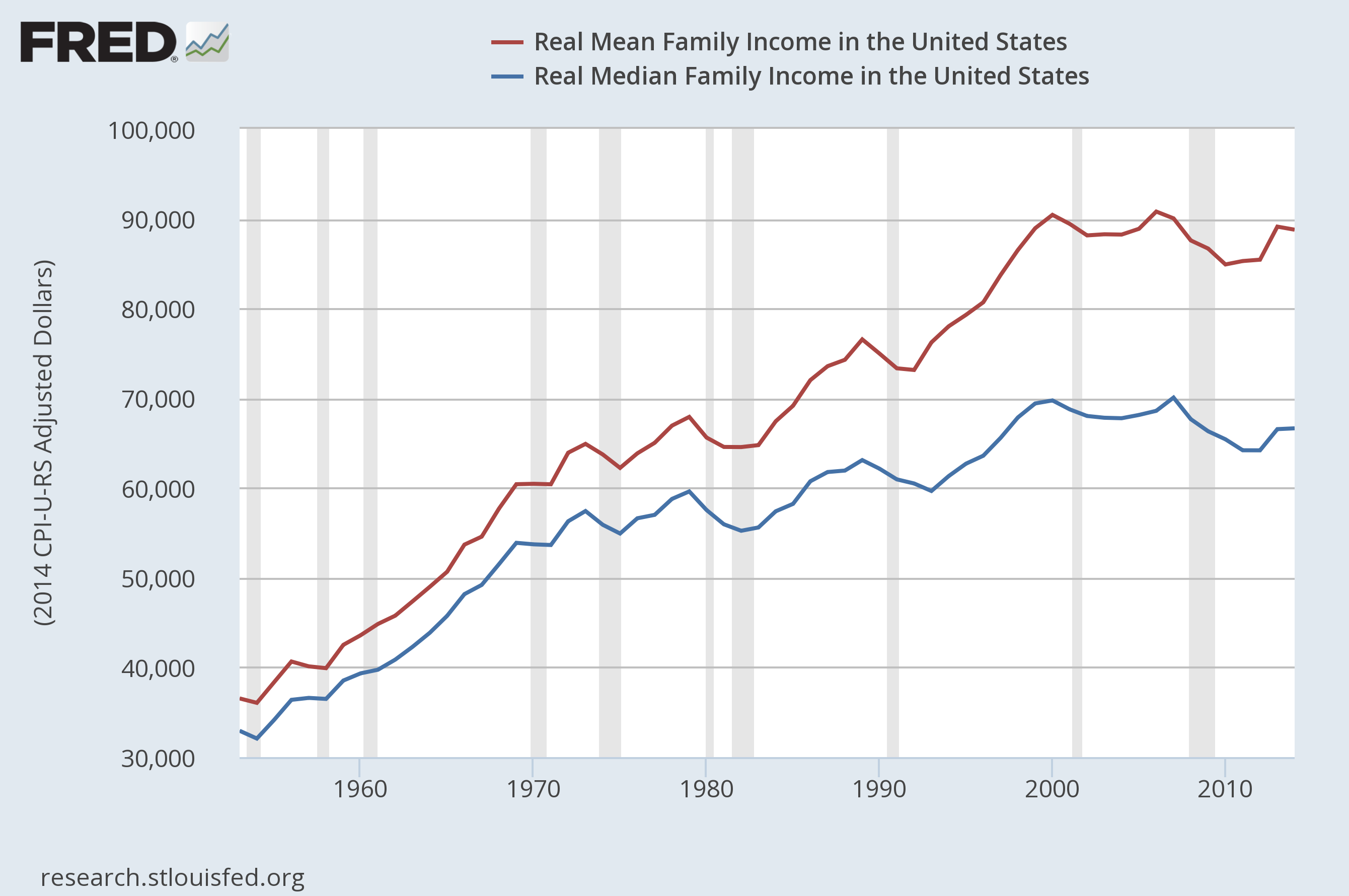
Here’s a more impartial way of looking at the situation, the most obvious, pre-theoretical way of looking at inequality: What has happened to mean income versus median income?

As a refresher from intro statistics, the mean is what you get by adding up the total money and dividing by the number of people; the median is what a person in the exact middle has. So for example if there are three people in a room, one makes $20,000, the second makes $50,000, and the third is Bill Gates making $10,000,000,000, then the mean income is $3,333,333,356 but the median income is $50,000. In a distribution similar to the power-law distribution that incomes generally fall into, the mean is usually higher than the median, and how much higher is a measure of how much inequality there is. (In my example, the mean is much higher, because there’s huge inequality with Bill Gates in the room.) This confuses people, because when people say “the average”, they usually intend the mean; but when they say “the average person”, they usually intend the median. The average person in my three-person example makes $50,000, but the average income is $3.3 billion.

So if we look at mean income versus median income in the US over time, this is what we see:

median_mean

In 1953, mean household income was $36,535 and median household income was $32,932. Mean income was therefore 10.9% higher than median income.

In 2013, mean household income was $88,765 and median income was $66,632. Mean household income was therefore 33.2% higher than median income.

That, my dear readers, is a substantial increase in inequality. To be fair, it’s also a substantial increase in standard of living; these figures are already adjusted for inflation, so the average family really did see their standard of living roughly double during that period.

But this also isn’t the whole story.

First, notice that real median household income is actually about 5% lower now than it was in 2007. Real mean household income is also lower than its peak in 2006, but only by about 2%. This is why in a real sense we are still in the Second Depression; income for most people has not retained its pre-recession peak.

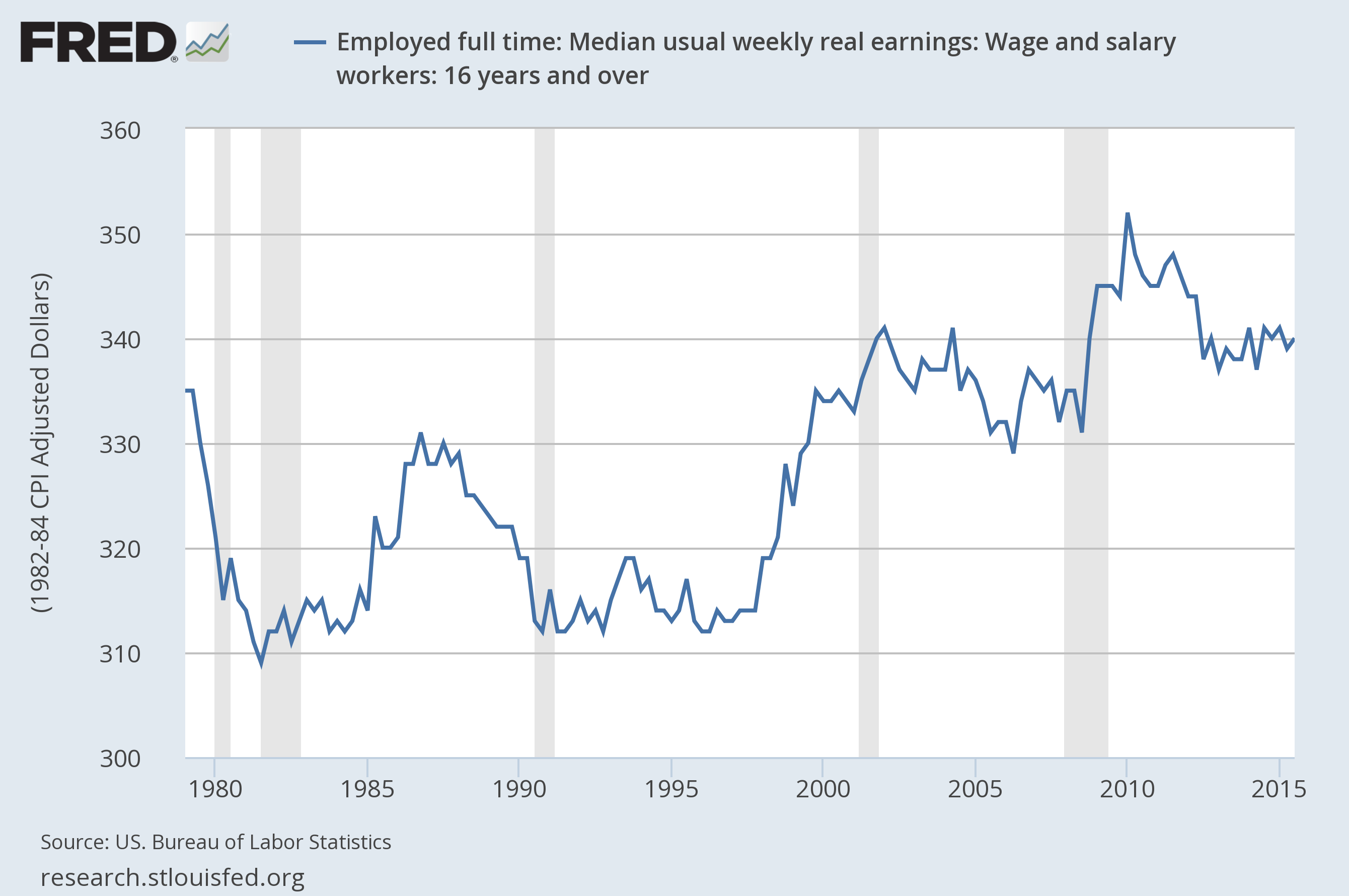
Furthermore, real median earnings for full-time employees have not meaningfully increased over the last 35 years; in 1982 dollars, they were $335 in 1979 and they are $340 now:

median_earnings

At first I thought this was because people were working more hours, but that doesn’t seem to be true; average weekly hours of work have fallen from 38.2 to 33.6:

weekly_hours

The main reason seems to be actually that women are entering the workforce, so more households have multiple full-time incomes; while only 43% of women were in the labor force in 1970, almost 57% are now.

women_labor_force

I must confess to a certain confusion on this point, however, as the difference doesn’t seem to be reflected in any of the measures of personal income. Median personal income was about 41% of median family income in 1974, and now it’s about 43%. I’m not sure exactly what’s going on here.

personal_household

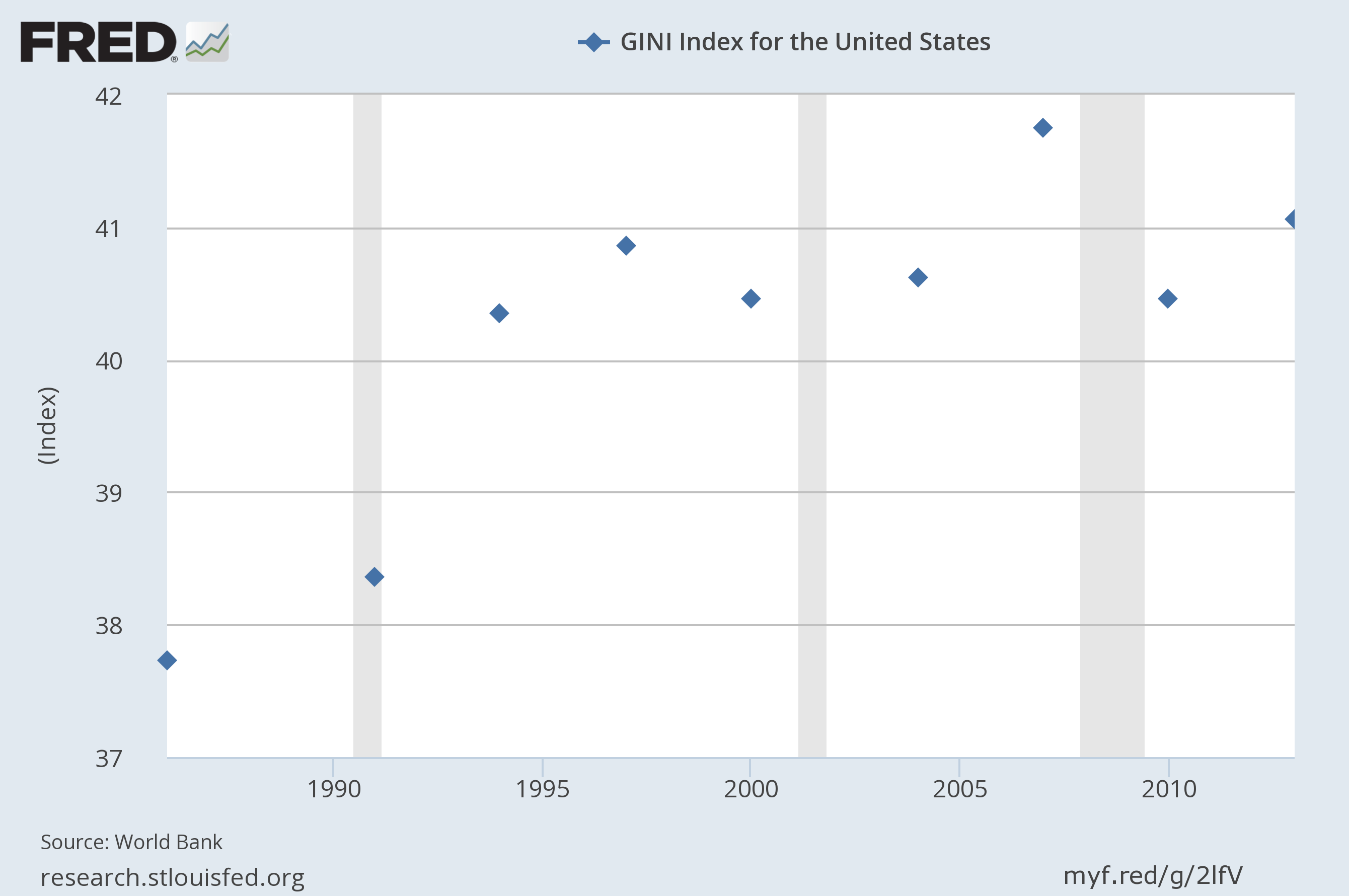
The Gini index, a standard measure of income inequality, is only collected every few years, yet shows a clear rising trend from 37% in 1986 to 41% in 2013:

GINI

But perhaps the best way to really grasp our rising inequality is to look at the actual proportions of income received by each portion of the population.

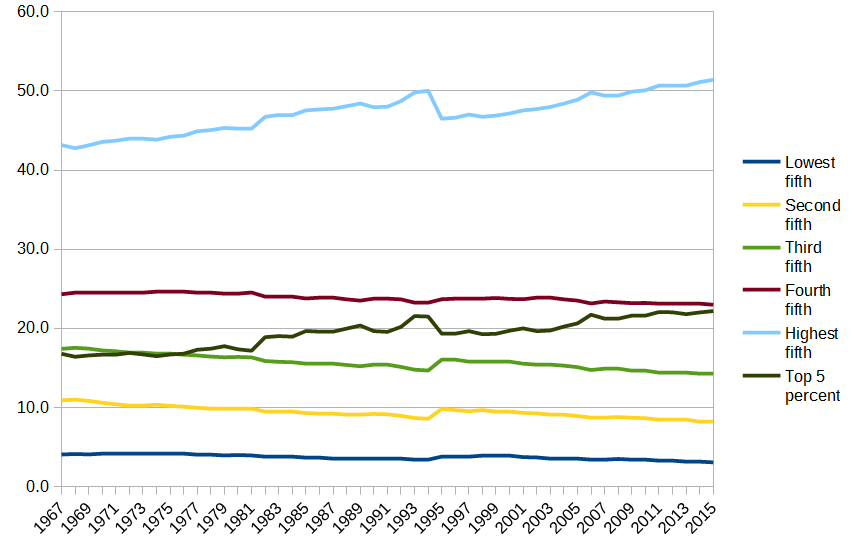
This is what it looks like if you use US Census data, broken down by groups of 20% and the top 5%; notice how since 1977 the top 5% have taken in more than the 40%-60% bracket, and they are poised to soon take in more than the 60%-80% bracket as well:

income_quintiles

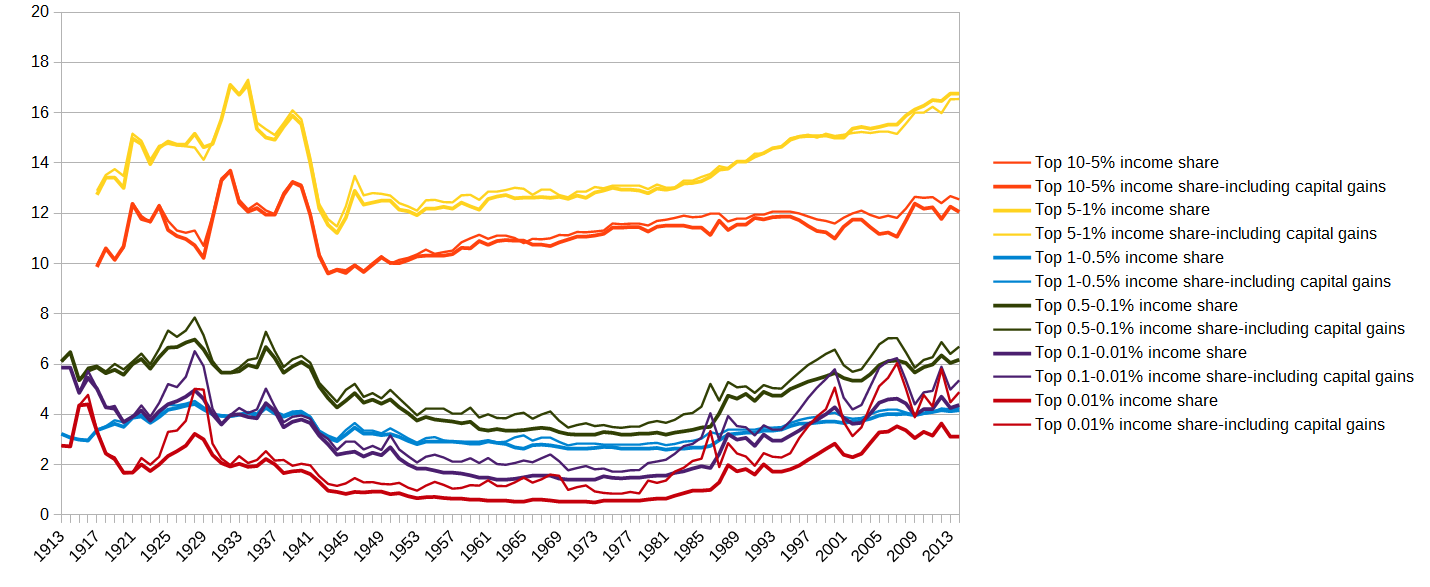
The result is even more striking if you use the World Top Incomes Database. You can watch the share of income rise for the top 10%, 5%, 1%, 0.1%, and 0.01%:

top_income_shares

But in fact it’s even worse than it sounds. What I’ve just drawn double-counts a lot of things; it includes the top 0.01% in the top 0.1%, which is in turn included in the top 1%, and so on. If you exclude these, so that we’re only looking at the people in the top 10% but not the top 5%, the people in the top 5% but not the top 1%, and so on, something even more disturbing happens:

top_income_shares_adjusted

While the top 10% does see some gains, the top 5% gains faster, and the gains accrue even faster as you go up the chain.

Since 1970, the top 10%-5% share grew 10%. The top 0.01% share grew 389%.

Year

Top 10-5% share

Top 10-5% share incl. cap. gains

Top 5-1% share

Top 5-1% share incl cap. gains

Top 1-0.5% share

Top 1-0.5% share incl. cap. gains

Top 0.5-0.1% share

Top 0.5-0.1% share incl. cap. gains

Top 0.1-0.01% share

Top 0.1-0.01% share incl. cap. gains

Top 0.01% share

Top 0.01% share incl. cap. gains

1970

11.13

10.96

12.58

12.64

2.65

2.77

3.22

3.48

1.41

1.78

0.53

1

2014

12.56

12.06

16.78

16.55

4.17

4.28

6.18

6.7

4.38

5.36

3.12

4.89

Relative gain

12.8%

10.0%

33.4%

30.9%

57.4%

54.5%

91.9%

92.5%

210.6%

201.1%

488.7%

389.0%

To be clear, these are relative gains in shares. Including capital gains, the share of income received by the top 10%-5% grew from 10.96% to 12.06%, a moderate increase. The share of income received by the top 0.01% grew from 1.00% to 4.89%, a huge increase. (Yes, the top 0.01% now receive almost 5% of the income, making them on average almost 500 times richer than the rest of us.)

The pie has been getting bigger, which is a good thing. But the rich are getting an ever-larger piece of that pie, and the piece the very rich get is expanding at an alarming rate.

It’s certainly a reasonable question what is causing this rise in inequality, and what can or should be done about it. By people like the AEI try to pretend it doesn’t even exist, and that’s not economic policy analysis; that’s just plain denial.

Schools of Thought

If you’re at all familiar with the schools of thought in economics, you may wonder where I stand. Am I a Keynesian? Or perhaps a post-Keynesian? A New Keynesian? A neo-Keynesian (not to be confused)? A neo-paleo-Keynesian? Or am I a Monetarist? Or a Modern Monetary Theorist? Or perhaps something more heterodox, like an Austrian or a Sraffian or a Marxist?

No, I am none of those things. I guess if you insist on labeling, you could call me a “cognitivist”; and in terms of policy I tend to agree with the Keynesians, but I also like the Modern Monetary Theorists.

But really I think this sort of labeling of ‘schools of thought’ is exactly the problem. There shouldn’t be schools of thought; the universe only works one way. When you don’t know the answer, you should have the courage to admit you don’t know. And once we actually have enough evidence to know something, people need to stop disagreeing about it. If you continue to disagree with what the evidence has shown, you’re not a ‘school of thought’; you’re just wrong.

The whole notion of ‘schools of thought’ smacks of cultural relativism; asking what the ‘Keynesian’ answer to a question is (and if you take enough economics classes I guarantee you will be asked exactly that) is rather like asking what religious beliefs prevail in a particular part of the world. It might be worth asking for some historical reason, but it’s not a question about economics; it’s a question about economic beliefs. This is the difference between asking how people believe the universe was created, and actually being a cosmologist. True, schools of thought aren’t as geographically localized as religions; but they do say the words ‘saltwater’ and ‘freshwater’ for a reason. I’m not all that interested in the Shinto myths versus the Hindu myths; I want to be a cosmologist.

At best, schools of thought are a sign of a field that hasn’t fully matured. Perhaps there were Newtonians and Einsteinians in 1910; but by 1930 there were just Einsteinians and bad physicists. Are there ‘schools of thought’ in physics today? Well, there are string theorists. But string theory hasn’t been a glorious success of physics advancement; on the contrary, it’s been a dead end from which the field has somehow failed to extricate itself for almost 50 years.

So where does that put us in economics? Well, some of the schools of thought are clearly dead ends, every bit as unfounded as string theory but far worse because they have direct influences on policy. String theory hasn’t ever killed anyone; bad economics definitely has. (How, you ask? Exposure to hazardous chemicals that were deregulated; poverty and starvation due to cuts to social welfare programs; and of course the Second Depression. I could go on.)

The worst offender is surely Austrian economics and its crazy cousin Randian libertarianism. Ayn Rand literally ruled a cult; Friedrich Hayek never took it quite that far, but there is certainly something cultish about Austrian economists. They insist that economics must be derived a priori, without recourse to empirical evidence (or at least that’s what they say when you point out that all the empirical evidence is against them). They are fond of ridiculous hyperbole about an inevitable slippery slope between raising taxes on capital gains and turning into Stalin’s Soviet Union, as well as rhetorical questions I find myself answering opposite to how they want (like “For are taxes not simply another form of robbery?” and “Once we allow the government to regulate what man can do, will they not continue until they control all aspects of our lives?”). They even co-opt and distort cognitivist concepts like herd instinct and asymmetric information; somehow Austrians think that asymmetric information is an argument for why markets are more efficient than government, even though Akerlof’s point was that asymmetric information is why we need regulations.

Marxists are on the opposite end of the political spectrum, but their ideas are equally nonsensical. (Marx himself was a bit more reasonable, but even he recognized they were going too far: “All I know is that I am not a Marxist.”) They have this whole “labor theory of value” thing where the value of something is the amount of work you have to put into it. This would mean that labor-saving innovations are pointless, because they devalue everything; it would also mean that putting an awful lot of work into something useless would nevertheless somehow make it enormously valuable. Really, it would never be worth doing much of anything, because the value you get out of something is exactly equal to the work you put in. Marxists also tend to think that what the world needs is a violent revolution to overthrow the bondage of capitalism; this is an absolutely terrible idea. During the transition it would be one of the bloodiest conflicts in history; afterward you’d probably get something like the Soviet Union or modern-day Venezuela. Even if you did somehow establish your glorious Communist utopia, you’d have destroyed so much productive capacity in the process that you’d make everyone poor. Socialist reforms make sense—and have worked well in Europe, particularly Scandinavia. But socialist revolution is a a good way to get millions of innocent people killed.

Sraffians are also quite silly; they have this bizarre notion that capital must be valued as “dated labor”, basically a formalized Marxism. I’ll admit, it’s weird how neoclassicists try to value labor as “human capital”; frankly it’s a bit disturbing how it echoes slavery. (And if you think slavery is dead, think again; it’s dead in the First World, but very much alive elsewhere.) But the solution to that problem is not to pretend that capital is a form of labor; it’s to recognize that capital and labor are different. Capital can be owned, sold, and redistributed; labor cannot. Labor is done by human beings, who have intrinsic value and rights; capital is made of inanimate matter, which does not. (This is what makes Citizens United so outrageous; “corporations are people” and “money is speech” are such fundamental distortions of democratic principles that they are literally Orwellian. We’re not that far from “freedom is slavery” and “war is peace”.)

Neoclassical economists do better, at least. They do respond to empirical data, albeit slowly. Their models are mathematically consistent. They rarely take account of human irrationality or asymmetric information, but when they do they rightfully recognize them as obstacles to efficient markets. But they still model people as infinite identical psychopaths, and they still divide themselves into schools of thought. Keynesians and Monetarists are particularly prominent, and Modern Monetary Theorists seem to be the next rising star. Each of these schools gets some things right and other things wrong, and that’s exactly why we shouldn’t make ourselves beholden to a particular tribe.

Monetarists follow Friedman, who said, “inflation is always and everywhere a monetary phenomenon.” This is wrong. You can definitely cause inflation without expanding your money supply; just ramp up government spending as in World War 2 or suffer a supply shock like we did when OPEC cut the oil supply. (In both cases, the US money supply was still tied to gold by the Bretton Woods system.) But they are right about one thing: To really have hyperinflation ala Weimar or Zimbabwe, you probably have to be printing money. If that were all there is to Monetarism, I can invert another Friedmanism: We’re all Monetarists now.

Keynesians are basically right about most things; in particular, they are the only branch of neoclassicists who understand recessions and know how to deal with them. The world’s most famous Keynesian is probably Krugman, who has the best track record of economic predictions in the popular media today. Keynesians much better appreciate the fact that humans are irrational; in fact, cognitivism can be partly traced to Keynes, who spoke often of the “animal spirits” that drive human behavior (Akerlof’s most recent book is called Animal Spirits). But even Keynesians have their sacred cows, like the Phillips Curve, the alleged inverse correlation between inflation and unemployment. This is fairly empirically accurate if you look just at First World economies after World War 2 and exclude major recessions. But Keynes himself said, “Economists set themselves too easy, too useless a task if in tempestuous seasons they can only tell us that when the storm is long past the ocean is flat again.” The Phillips Curve “shifts” sometimes, and it’s not always clear why—and empirically it’s not easy to tell the difference between a curve that shifts a lot and a relationship that just isn’t there. There is very little evidence for a “natural rate of unemployment”. Worst of all, it’s pretty clear that the original policy implications of the Phillips Curve are all wrong; you can’t get rid of unemployment just by ramping up inflation, and that way really does lie Zimbabwe.

Finally, Modern Monetary Theorists understand money better than everyone else. They recognize that a sovereign government doesn’t have to get its money “from somewhere”; it can create however much money it needs. The whole narrative that the US is “out of money” isn’t just wrong, it’s incoherent; if there is one entity in the world that can never be out of money, it’s the US government, who print the world’s reserve currency. The panicked fears of quantitative easing causing hyperinflation aren’t quite as crazy; if the economy were at full capacity, printing $4 trillion over 5 years (yes, we did that) would absolutely cause some inflation. Since that’s only about 6% of US GDP, we might be back to 8% or even 10% inflation like the 1970s, but we certainly would not be in Zimbabwe. Moreover, we aren’t at full capacity; we needed to expand the money supply that much just to maintain prices where they are. The Second Depression is the Red Queen: It took all the running we could do to stay in one place. Modern Monetary Theorists also have some very good ideas about taxation; they point out that since the government only takes out the same thing it puts in—its own currency—it doesn’t make sense to say they are “taking” something (let alone “confiscating” it as Austrians would have you believe). Instead, it’s more like they are pumping it, taking money in and forcing it back out continuously. And just as pumping doesn’t take away water but rather makes it flow, taxation and spending doesn’t remove money from the economy but rather maintains its circulation. Now that I’ve said what they get right, what do they get wrong? Basically they focus too much on money, ignoring the real economy. They like to use double-entry accounting models, perfectly sensible for money, but absolutely nonsensical for real value. The whole point of an economy is that you can get more value out than you put in. From the Homo erectus who pulls apples from the trees to the software developer who buys a mansion, the reason they do it is that the value they get out (the gatherer gets to eat, the programmer gets to live in a mansion) is higher than the value they put in (the effort to climb the tree, the skill to write the code). If, as Modern Monetary Theorists are wont to do, you calculated a value for the human capital of the gatherer and the programmer equal to the value of the goods they purchase, you’d be missing the entire point.