The high cost of frictional unemployment

Sep 3, JDN 2457635

I had wanted to open this post with an estimate of the number of people in the world, or at least in the US, who are currently between jobs. It turns out that such estimates are essentially nonexistent. The Bureau of Labor Statistics maintains a detailed database of US unemployment; they don’t estimate this number. We have this concept in macroeconomics of frictional unemployment, the unemployment that results from people switching jobs; but nobody seems to have any idea how common it is.

I often hear a ballpark figure of about 4-5%, which is related to a notion that “full employment” should really be about 4-5% unemployment because otherwise we’ll trigger horrible inflation or something. There is almost no evidence for this. In fact, the US unemployment rate has gotten as low as 2.5%, and before that was stable around 3%. This was during the 1950s, the era of the highest income tax rates ever imposed in the United States, a top marginal rate of 92%. Coincidence? Maybe. Obviously there were a lot of other things going on at the time. But it sure does hurt the argument that high income taxes “kill jobs”, don’t you think?

Indeed, it may well be that the rate of frictional unemployment varies all the time, depending on all sorts of different factors. But here’s what we do know: Frictional unemployment is a serious problem, and yet most macroeconomists basically ignore it.

Talk to most macroeconomists about “unemployment”, and they will assume you mean either cyclical unemployment (the unemployment that results from recessions and bad fiscal and monetary policy responses to them), or structural unemployment (the unemployment that results from systematic mismatches between worker skills and business needs). If you specifically mention frictional unemployment, the response is usually that it’s no big deal and there’s nothing we can do about it anyway.

Yet at least when we aren’t in a recession, frictional employment very likely accounts for the majority of unemployment, and thus probably the majority of misery created by unemployment. (Not necessarily, since it probably doesn’t account for much long-term unemployment, which is by far the worst.) And it is quite clear to me that there are things we can do about it—they just might be difficult and/or expensive.

Most of you have probably changed jobs at least once. Many of you have, like me, moved far away to a new place for school or work. Think about how difficult that was. There is the monetary cost, first of all; you need to pay for the travel of course, and then usually leases and paychecks don’t line up properly for a month or two (for some baffling and aggravating reason, UCI won’t actually pay me my paychecks until November, despite demanding rent starting the last week of July!). But even beyond that, you are torn from your social network and forced to build a new one. You have to adapt to living in a new place which may have differences in culture and climate. Bureaucracy often makes it difficult to change over documentation of such as your ID and your driver’s license.

And that’s assuming that you already found a job before you moved, which isn’t always an option. Many people move to new places and start searching for jobs when they arrive, which adds an extra layer of risk and difficulty above and beyond the transition itself.

With all this in mind, the wonder is that anyone is willing to move at all! And this is probably a large part of why people are so averse to losing their jobs even when it is clearly necessary; the frictional unemployment carries enormous real costs. (That and loss aversion, of course.)

What could we do, as a matter of policy, to make such transitions easier?

Well, one thing we could do is expand unemployment insurance, which reduces the cost of losing your job (which, despite the best efforts of Republicans in Congress, we ultimately did do in the Second Depression). We could expand unemployment insurance to cover voluntary quits. Right now, quitting voluntarily makes you forgo all unemployment benefits, which employers pay for in the form of insurance premiums; so an employer is much better off making your life miserable until you quit than they are laying you off. They could also fire you for cause, if they can find a cause (and usually there’s something they could trump up enough to get rid of you, especially if you’re not prepared for the protracted legal battle of a wrongful termination lawsuit). The reasoning of our current system appears to be something like this: Only lazy people ever quit jobs, and why should we protect lazy people? This is utter nonsense and it needs to go. Many states already have no-fault divorce and no-fault auto collision insurance; it’s time for no-fault employment termination.

We could establish a basic income of course; then when you lose your job your income would go down, but to a higher floor where you know you can meet certain basic needs. We could provide subsidized personal loans, similar to the current student loan system, that allow people to bear income gaps without losing their homes or paying exorbitant interest rates on credit cards.

We could use active labor market programs to match people with jobs, or train them with the skills needed for emerging job markets. Denmark has extensive active labor market programs (they call it “flexicurity”), and Denmark’s unemployment rate was 2.4% before the Great Recession, hit a peak of 6.2%, and has now recovered to 4.2%. What Denmark calls a bad year, the US calls a good year—and Greece fantasizes about as something they hope one day to achieve. #ScandinaviaIsBetter once again, and Norway fits this pattern also, though to be fair Sweden’s unemployment rate is basically comparable to the US or even slightly worse (though it’s still nothing like Greece).

Maybe it’s actually all right that we don’t have estimates of the frictional unemployment rate, because the goal really isn’t to reduce the number of people who are unemployed; it’s to reduce the harm caused by unemployment. Most of these interventions would very likely increase the rate frictional unemployment, as people who always wanted to try to find better jobs but could never afford to would now be able to—but they would dramatically reduce the harm caused by that unemployment.

This is a more general principle, actually; it’s why we should basically stop taking seriously this argument that social welfare benefits destroy work incentives. That may well be true; so what? Maximizing work incentives was never supposed to be a goal of public policy, as far as I can tell. Maximizing human welfare is the goal, and the only way a welfare program could reduce work incentives is by making life better for people who aren’t currently working, and thereby reducing the utility gap between working and not working. If your claim is that the social welfare program (and its associated funding mechanism, i.e. taxes, debt, or inflation) would make life sufficiently worse for everyone else that it’s not worth it, then say that (and for some programs that might actually be true). But in and of itself, making life better for people who don’t work is a benefit to society. Your supposed downside is in fact an upside. If there’s a downside, it must be found elsewhere.

Indeed, I think it’s worth pointing out that slavery maximizes work incentives. If you beat or kill people who don’t work, sure enough, everyone works! But that is not even an efficient economy, much less a just society. To be clear, I don’t think most people who say they want to maximize work incentives would actually support slavery, but that is the logical extent of the assertion. (Also, many Libertarians, often the first to make such arguments, do have a really bizarre attitude toward slavery; taxation is slavery, regulation is slavery, conscription is slavery—the last not quite as ridiculous—but actual forced labor… well, that really isn’t so bad, especially if the contract is “voluntary”. Fortunately some Libertarians are not so foolish.) If your primary goal is to make people work as much as possible, slavery would be a highly effective way to achieve that goal. And that really is the direction you’re heading when you say we shouldn’t do anything to help starving children lest their mothers have insufficient incentive to work.

More people not working could have a downside, if it resulted in less overall production of goods. But even in the US, one of the most efficient labor markets in the world, the system of job matching is still so ludicrously inefficient that people have to send out dozens if not hundreds of applications to jobs they barely even want, and there are still 1.4 times as many job seekers as there are openings (at the trough of the Great Recession, the ratio was 6.6 to 1). There’s clearly a lot of space here to improve the matching efficiency, and simply giving people more time to search could make a big difference there. Total output might decrease for a little while during the first set of transitions, but afterward people would be doing jobs they want, jobs they care about, jobs they’re good at—and people are vastly more productive under those circumstances. It’s quite likely that total employment would decrease, but productivity would increase so much that total output increased.

Above all, people would be happier, and that should have been our goal all along.

Asymmetric nominal rigidity, or why everything is always “on sale”

July 9, JDN 2457579

The next time you’re watching television or shopping, I want you to count the number of items that are listed as “on sale” versus the number that aren’t. (Also, be careful to distinguish labels like “Low Price!” and “Great Value!” that are dressed up like “on sale” labels but actually indicate the usual price.) While “on sale” is presented as though it’s something rare and special, in reality anywhere from a third to half of all products are on sale at any given time. At some retailers (such as Art Van Furniture and Jos. A. Bank clothing), literally almost everything is almost always on sale.

There is a very good explanation for this in terms of cognitive economics. It is a special case of a more general phenomenon of asymmetric nominal rigidity. Asymmetric nominal rigidity is the tendency of human beings to be highly resistant to (rigidity) changes in actual (nominal) dollar prices, but only in the direction that hurts them (asymmetric). Ultimately this is an expression of the far deeper phenomenon of loss aversion, where losses are felt much more than gains.

Usually we actually talk about downward nominal wage rigidity, which is often cited as a reason why depressions can get so bad. People are extremely resistant to having their wages cut, even if there is a perfectly good reason to do so, and even if the economy is under deflation so that their real wage is not actually falling. It doesn’t just feel unpleasant; it feels unjust. People feel betrayed when they see the numbers on their paycheck go down, and they are willing to bear substantial costs to retaliate against that injustice—typically, they quit or go on strike. This reduces spending, which then exacerbates the deflation, which requires more wage cuts—and down we go into the spiral of depression, unless the government intervenes with monetary and fiscal policy.

But what does this have to do with everything being on sale? Well, for every downward wage rigidity, there is an upward price rigidity. When things become more expensive, people stop buying them—even if they could still afford them, and often even if the price increase is quite small. Again, they feel in some sense betrayed by the rising price (though not to the same degree as they feel betrayed by falling wages, due to their closer relationship to their employer). Responses to price increases are about twice as strong as responses to price decreases, just as losses are felt about twice as much as gains.

Businesses have figured this out—in some ways faster than economists did—and use it to their advantage; and thus so many things are “on sale”.

Actually, “on sale” serves two functions, which can be distinguished according to their marketing strategies. Businesses like Jos. A. Bank where almost everything is on sale are primarily exploiting anchoring—they want people to think of the listed “retail price” as the default price, and then the “sale price” that everyone actually pays feels lower as a result. If they “drop” the price of something from $300 to $150 feels like the company is doing you a favor; whereas if they had just priced it at $150 to begin with, you wouldn’t get any warm fuzzy feelings from that. This works especially well for products that people don’t purchase very often and aren’t accustomed to comparing—which is why you see it in furniture stores and high-end clothing retailers, not in grocery stores and pharmacies.

But even when people are accustomed to shopping around and are familiar with what the price ordinarily would be, sales serve a second function, because of asymmetric nominal rigidity: They escape that feeling of betrayal that comes from raising prices.

Here’s how it works: Due to the thousand natural shocks that flesh is heir to, there will always be some uncertainty in the prices you will want to set in the future. Future prices may go up, they may go down; and people spend their lives trying to predict this sort of thing and rarely outperform chance. But if you just raise and lower your prices as the winds blow (as most neoclassical economists generally assume you will), you will alienate your customers. Just as a ratchet works by turning the bolt more in one direction than the other, this sort of roller-coaster pricing would attract a small number of customers with each price decrease, then repel a larger number with each increase, until after a few cycles of rise and fall you would run out of customers. This is the real source of price rigidities, not that silly nonsense about “menu costs”. Especially in the Information Age, it costs almost nothing to change the number on the label—but change it wrong and it may cost you the customer.

One response would simply be to set your price at a reasonable estimate of the long-term optimal average price, but this leaves a lot of money on the table, as some times it will be too low (your inventory sells out and you make less profit than you could have), and even worse, other times it will be too high (customers refuse to buy your product). If only there were a way to change prices without customers feeling so betrayed!

Well, it turns out, there is, and it’s called “on sale”. You have a new product that you want to sell. You start by setting the price of the product at about the highest price you would ever need to sell it in the foreseeable future. Then, unless right now happens to be a time where demand is high and prices should also be high, you immediately put it on sale, and have the marketing team drum up some excuse about wanting to draw attention to your exciting new product. You put a deadline on that sale, which may be explicit (“Ends July 30”) or vague (“For a Limited Time!” which is technically always true—you merely promise that your sale will not last until the heat death of the universe), but clearly indicates to customers that you are not promising to keep this price forever.

Then, when demand picks up and you want to raise the price, you can! All you have to do is end the sale, which if you left the deadline vague can be done whenever you like. Even if you set explicit deadlines (which will make customers even more comfortable with the changes, and also give them a sense of urgency that may lead to more impulse buying), you can just implement a new sale each time the last one runs out, varying the discount according to market conditions. Customers won’t retaliate, because they won’t feel betrayed; you said fair and square the sale wouldn’t last forever. They will still buy somewhat less, of course; that’s the Law of Demand. But they won’t overcompensate out of spite and outrage; they’ll just buy the amount that is their new optimal purchase amount at this new price.

Coupons are a lot like sales, but they’re actually even more devious; they allow for a perfectly legal form of price discrimination. Businesses know that only certain types of people clip coupons; roughly speaking, people who are either very poor or very frugal—either way, people who are very responsive to prices. Coupons allow them to set a lower price for those groups of people, while setting a higher price for other people whose demand is more inelastic. A similar phenomenon is going on with student and senior discounts; students and seniors get lower prices because they typically have less income than other adults (though why there is so rarely a youth discount, only a student discount, I’m actually not sure—controlling for demographics, students are in general richer than non-students).

Once you realize this is what’s happening, what should you do as a customer? Basically, try to ignore whether or not a label says “on sale”. Look at the actual number of the price, and try to compare it to prices you’ve paid in the past for that product, as well as of course how much value the product is worth to you. If indeed this is a particularly low price and the product is durable, you may well be wise to purchase more and stock up for the future. But you should try to train yourself to react the same way to “On sale, now $49.99” as you would to simply “$49.99”. (Making your reaction exactly the same is probably impossible, but the closer you can get the better off you are likely to be.) Always compare prices from multiple sources for any major purchase (Amazon makes this easier than ever before), and compare actual prices you would pay—with discounts, after taxes, including shipping. The rest is window dressing.

If you get coupons or special discounts, of course use them—but only if you were going to make the purchase anyway, or were just barely on the fence about it. Rarely is it actually rational for you to buy something you wouldn’t have bought just because it’s on sale for 50% off, let alone 10% off. It’s far more likely that you’d either want to buy it anyway, or still have no reason to buy it even at the new price. Businesses are of course hoping you’ll overcompensate for the discount and buy more than you would have otherwise. Foil their plans, and thereby make your life better and our economy more efficient.

Should we give up on growth?

JDN 2457572

Recently I read this article published by the Post Carbon Institute, “How to Shrink the Economy without Crashing It”, which has been going around environmentalist circles. (I posted on Facebook that I’d answer it in more detail, so here goes.)

This is the far left view on climate change, which is wrong, but not nearly as wrong as even the “mainstream” right-wing view that climate change is not a serious problem and we should continue with business as usual. Most of the Republicans who ran for President this year didn’t believe in using government action to fight climate change, and Donald Trump doesn’t even believe it exists.
This core message of the article is clearly correct:

We know this because Global Footprint Network, which methodically tracks the relevant data, informs us that humanity is now using 1.5 Earths’ worth of resources.

We can temporarily use resources faster than Earth regenerates them only by borrowing from the future productivity of the planet, leaving less for our descendants. But we cannot do this for long.

To be clear, “using 1.5 Earths” is not as bad as it sounds; spending is allow to exceed income at times, as long as you have reason to think that future income will exceed future spending, and this is true not just of money but also of natural resources. You can in fact “borrow from the future”, provided you do actually have a plan to pay it back. And indeed there has been some theoretical work by environmental economists suggesting that we are rightly still in the phase of net ecological dissaving, and won’t enter the phase of net ecological saving until the mid-21st century when our technology has made us two or three times as productive. This optimal path is defined by a “weak sustainability” condition where total real wealth never falls over time, so any natural wealth depleted is replaced by at least as much artificial wealth.

Of course some things can’t be paid back; while forests depleted can be replanted, if you drive species to extinction, only very advanced technology could restore them. And we are driving thousands of species to extinction every single year. Even if we should be optimally dissaving, we are almost certainly depleting natural resources too fast, and depleting natural resources that will be difficult if not impossible to later restore. In that sense, the Post Carbon Institute is right: We must change course toward ecological sustainability.

Unfortunately, their specific ideas of how to do so leave much to be desired. Beyond ecological sustainability, they really argue for two propositions: one is radical but worth discussing, but the other is totally absurd.

The absurd claim is that we should somehow force the world to de-urbanize and regress into living in small farming villages. To show this is a bananaman and not a strawman, I quote:

8. Re-localize. One of the difficulties in the transition to renewable energy is that liquid fuels are hard to substitute. Oil drives nearly all transportation currently, and it is highly unlikely that alternative fuels will enable anything like current levels of mobility (electric airliners and cargo ships are non-starters; massive production of biofuels is a mere fantasy). That means communities will be obtaining fewer provisions from far-off places. Of course trade will continue in some form: even hunter-gatherers trade. Re-localization will merely reverse the recent globalizing trade trend until most necessities are once again produced close by, so that we—like our ancestors only a century ago—are once again acquainted with the people who make our shoes and grow our food.

9. Re-ruralize. Urbanization was the dominant demographic trend of the 20th century, but it cannot be sustained. Indeed, without cheap transport and abundant energy, megacities will become increasingly dysfunctional. Meanwhile, we’ll need lots more farmers. Solution: dedicate more societal resources to towns and villages, make land available to young farmers, and work to revitalize rural culture.

First of all: Are electric cargo ships non-starters? The Ford-class aircraft carrier is electric, specifically nuclear. Nuclear-powered cargo ships would raise a number of issues in terms of practicality, safety, and regulation, but they aren’t fundamentally infeasible. Massive efficient production of biofuels is a fantasy as long as the energy to do it is provided by coal power, but not if it’s provided by nuclear. Perhaps this author’s concept of “infeasible” really just means “infeasible if I can’t get over my irrational fear of nuclear power”. Even electric airliners are not necessarily out of the question; NASA has been experimenting with electric aircraft.

The most charitable reading I can give of this (in my terminology of argument “men”, I’m trying to make a banana out of iron), is as promoting slightly deurbanizing and going back to more like say the 1950s United States, with 64% of people in cities instead of 80% today. Even then this makes less than no sense, as higher urbanization is associated with lower per-capita ecological impact, which frankly shouldn’t even be surprising because cities have such huge economies of scale. Instead of everyone needing a car to get around in the suburbs, we can all share a subway system in the city. If that subway system is powered by a grid of nuclear, solar, and wind power, it could produce essentially zero carbon emissions—which is absolutely impossible for rural or suburban transportation. Urbanization is also associated with slower population growth (or even population decline), and indeed the reason population growth is declining is that rising standard of living and greater urbanization have reduced birth rates and will continue to do so as poor countries reach higher levels of development. Far from being a solution to ecological unsustainability, deurbanization would make it worse.

And that’s not even getting into the fact that you would have to force urban white-collar workers to become farmers, because if we wanted to be farmers we already would be (the converse is not as true), and now you’re actually talking about some kind of massive forced labor-shift policy like the Great Leap Forward. Normally I’m annoyed when people accuse environmentalists of being totalitarian communists, but in this case, I think the accusation might be onto something.

Moving on, the radical but not absurd claim is that we must turn away from economic growth and even turn toward economic shrinkage:

One way or another, the economy (and here we are talking mostly about the economies of industrial nations) must shrink until it subsists on what Earth can provide long-term.

[…]

If nothing is done deliberately to reverse growth or pre-adapt to inevitable economic stagnation and contraction, the likely result will be an episodic, protracted, and chaotic process of collapse continuing for many decades or perhaps centuries, with innumerable human and non-human casualties.

I still don’t think this is right, but I understand where it’s coming from, and like I said it’s worth talking about.

The biggest mistake here lies in assuming that GDP is directly correlated to natural resource depletion, so that the only way to reduce natural resource depletion is to reduce GDP. This is not even remotely true; indeed, countries vary almost as much in their GDP-per-carbon-emission ratio as they do in their per-capita GDP. As usual, #ScandinaviaIsBetter; Norway and Sweden produce about $8,000 in GDP per ton of carbon, while the US produces only about $2,000 per ton. Both poor and rich countries can be found among both the inefficient and the efficient. Saudi Arabia is very rich and produces about $900 per ton, while Liberia is exceedingly poor and produces about $800 per ton. I already mentioned how Norway produces $8,000 per ton, and they are as rich as Saudi Arabia. Yet above them is Mali, which produces almost $11,000 per ton, and is as poor as Liberia. Other notable facts: France is head and shoulders above the UK and Germany at almost $6000 per ton instead of $4300 and $3600 respectively—because France runs almost entirely on nuclear power.

So the real conclusion to draw from this is not that we need to shrink GDP, but that we need to make GDP more like how they do it in Norway or at least how they do it in France, rather than how we do in the US, and definitely not how they do it in Saudi Arabia. Total world emissions are currently about 36 billion tons per year, producing about $108 trillion in GDP, averaging about $3,000 of GDP per ton of carbon emissions. If we could raise the entire world to the ecological efficiency of Norway, we could double world GDP and still be producing less CO2 than we currently are. Turning the entire planet into a bunch of Norways would indeed raise CO2 output, by about a factor of 2; but it would raise standard of living by a factor of 5, and indeed bring about a utopian future with neither war nor hunger. Compare this to the prospect of cutting world GDP in half, but producing it as inefficiently as in Saudi Arabia: This would actually increase global CO2 emissions, almost as much as turning every country into Norway.

But ultimately we will in fact need to slow down or even end economic growth. I ran a little model for you, which shows a reasonable trajectory for global economic growth.

This graph shows the growth rate in productivity slowly declining, along with a much more rapidly declining GDP growth:

Solow_growth

This graph shows the growth trajectory for total real capital and GDP:

Solow_capital

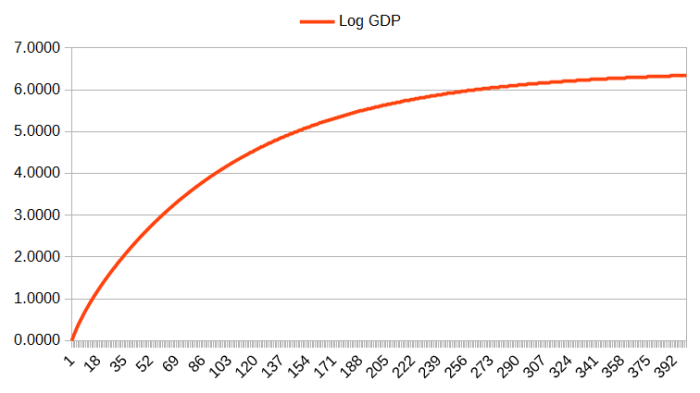
And finally, this is the long-run trend for GDP graphed on a log scale:

Solow_logGDP

The units are arbitrary, though it’s not unreasonable to imagine them as being years and hundreds of dollars in per-capita GDP. If that is indeed what you imagine them to be, my model shows us the Star Trek future: In about 300 years, we rise from a per-capita GDP of $10,000 to one of $165,000—from a world much like today to a world where everyone is a millionaire.

Notice that the growth rate slows down a great deal fairly quickly; by the end of 100 years (i.e., the end of the 21st century), growth has slowed from its peak over 10% to just over 2% per year. By the end of the 300-year period, the growth rate is a crawl of only 0.1%.

Of course this model is very simplistic, but I chose it for a very specific reason: This is not a radical left-wing environmentalist model involving “limits to growth” or “degrowth”. This is the Solow-Swan model, the paradigm example of neoclassical models of economic growth. It is sometimes in fact called simply “the neoclassical growth model”, because it is that influential. I made one very small change from the usual form, which was to assume that the rate of productivity growth would decline exponentially over time. Since productivity growth is exogenous to the model, this is a very simple change to make; it amounts to saying that productivity-enhancing technology is subject to diminishing returns, which fits recent data fairly well but could be totally wrong if something like artificial intelligence or neural enhancement ever takes off.

I chose this because many environmentalists seem to think that economists have this delusional belief that we can maintain a rate of economic growth equal to today indefinitely. David Attenborough famously said “Anyone who believes in indefinite growth in anything physical, on a physically finite planet, is either mad – or an economist.”

Another physicist argued that if we increase energy consumption 2.3% per year for 400 years, we’d literally boil the Earth. Yes, we would, and no economist I know of believes that this is what will happen. Economic growth doesn’t require energy growth, and we do not think growth can or should continue indefinitely—we just think it can and should continue a little while longer. We don’t think that a world standard of living 1000 times as good as Norway is going to happen; we think that a world standard of living equal to Norway is worth fighting for.

Indeed, we are often the ones trying to explain to leaders that they need to adapt to slower growth rates—this is particularly a problem in China, where nationalism and groupthink seems to have convinced many people in China that 7% annual growth is the result of some brilliant unique feature of the great Chinese system, when it is in fact simply the expected high growth rate for an economy that is very poor and still catching up by establishing a capital base. (It’s not so much what they are doing right now, as what they were doing wrong before. Just as you feel a lot better when you stop hitting yourself in the head, countries tend to grow quite fast after they transition out of horrifically terrible economic policy—and it doesn’t get much more terrible than Mao.) Even a lot of the IMF projections are now believed to be too optimistic, because they didn’t account for how China was fudging the numbers and rapidly depleting natural resources.

Some of the specific policies recommended in the article are reasonable, while others go to far.

1. Energy: cap, reduce, and ration it. Energy is what makes the economy go, and expanded energy consumption is what makes it grow. Climate scientists advocate capping and reducing carbon emissions to prevent planetary disaster, and cutting carbon emissions inevitably entails reducing energy from fossil fuels. However, if we aim to shrink the size of the economy, we should restrain not just fossil energy, but all energy consumption. The fairest way to do that would probably be with tradable energy quotas.

I strongly support cap-and-trade on fossil fuels, but I can’t support it on energy in general, unless we get so advanced that we’re seriously concerned about significantly altering the entropy of the universe. Solar power does not have negative externalities, and therefore should not be taxed or capped.

The shift to renewable energy sources is a no-brainer, and I know of no ecologist and few economists who would disagree.

This one is rich, coming from someone who goes on to argue for nonsensical deurbanization:

However, this is a complicated process. It will not be possible merely to unplug coal power plants, plug in solar panels, and continue with business as usual: we have built our immense modern industrial infrastructure of cities, suburbs, highways, airports, and factories to take advantage of the unique qualities and characteristics of fossil fuels.

How will we make our industrial infrastructure run off a solar grid? Urbanization. When everything is in one place, you can use public transportation and plug everything into the grid. We could replace the interstate highway system with a network of maglev lines, provided that almost everyone lived in major cities that were along those lines. We can’t do that if people move out of cities and go back to being farmers.

Here’s another weird one:

Without continued economic growth, the market economy probably can’t function long. This suggests we should run the transformational process in reverse by decommodifying land, labor, and money.

“Decommodifying money”? That’s like skinning leather or dehydrating water. The whole point of money is that it is a maximally fungible commodity. I support the idea of a land tax to provide a basic income, which could go a long way to decommodifying land and labor; but you can’t decommodify money.

The next one starts off sounding ridiculous, but then gets more reasonable:

4. Get rid of debt. Decommodifying money means letting it revert to its function as an inert medium of exchange and store of value, and reducing or eliminating the expectation that money should reproduce more of itself. This ultimately means doing away with interest and the trading or manipulation of currencies. Make investing a community-mediated process of directing capital toward projects that are of unquestioned collective benefit. The first step: cancel existing debt. Then ban derivatives, and tax and tightly regulate the buying and selling of financial instruments of all kinds.

No, we’re not going to get rid of debt. But should we regulate it more? Absolutely. A ban on derivatives is strong, but shouldn’t be out of the question; it’s not clear that even the most useful derivatives (like interest rate swaps and stock options) bring more benefit than they cause harm.

The next proposal, to reform our monetary system so that it is no longer based on debt, is one I broadly agree with, though you need to be clear about how you plan to do that. Positive Money’s plan to make central banks democratically accountable, establish full-reserve banking, and print money without trying to hide it in arcane accounting mechanisms sounds pretty good to me. Going back to the gold standard or something would be a terrible idea. The article links to a couple of “alternative money theorists”, but doesn’t explain further.

Sooner or later, we absolutely will need to restructure our macroeconomic policy so that 4% or even 2% real growth is no longer the expectation in First World countries. We will need to ensure that constant growth isn’t necessary to maintain stability and full employment.

But I believe we can do that, and in any case we do not want to stop global growth just yet—far from it. We are now on the verge of ending world hunger, and if we manage to do it, it will be from economic growth above all else.

The unending madness of the gold standard

JDN 2457545

If you work in economics in any capacity (much like “How is the economy doing?” you don’t even really need to be in macroeconomics), you will encounter many people who believe in the gold standard. Many of these people will be otherwise quite intelligent and educated; they often understand economics better than most people (not that this is saying a whole lot). Yet somehow they continue to hold—and fiercely defend—this incredibly bizarre and anachronistic view of macroeconomics.

They even bring it up at the oddest times; I recently encountered someone who wrote a long and rambling post arguing for drug legalization (which I largely agree with, by the way) and concluded it with #EndTheFed, not seeming to grasp the total and utter irrelevance of this juxtaposition. It seems like it was just a conditioned response, or maybe the sort of irrelevant but consistent coda originally perfected by Cato and his “Carthago delenda est. “Foederale Reservatum delendum est. Hey, maybe that’s why they’re called the Cato Institute.

So just how bizarre is the gold standard? Well, let’s look at what sort of arguments they use to defend it. I’ll use Charles Kadlic, prominent Libertarian blogger on Forbes, as an example, with his “Top Ten Reasons That You Should Support the ‘Gold Commission’”:

  1. A gold standard is key to achieving a period of sustained, 4% real economic growth.
  2. A gold standard reduces the risk of recessions and financial crises.
  3. A gold standard would restore rising living standards to the middle-class.
  4. A gold standard would restore long-term price stability.
  5. A gold standard would stop the rise in energy prices.
  6. A gold standard would be a powerful force for restoring fiscal balance to federal state and local governments.
  7. A gold standard would help save Medicare and Social Security.
  8. A gold standard would empower Main Street over Wall Street.
  9. A gold standard would increase the liberty of the American people.
  10. Creation of a gold commission will provide the forum to chart a prudent path toward a 21st century gold standard.

Number 10 can be safely ignored, as clearly Kadlic just ran out of reasons and to make a round number tacked on the implicit assumption of the entire article, namely that this ‘gold commission’ would actually realistically lead us toward a gold standard. (Without it, the other 9 reasons are just non sequitur.)

So let’s look at the other 9, shall we? Literally none of them are true. Several are outright backward.

You know a policy is bad when even one of its most prominent advocates can’t even think of a single real benefit it would have. A lot of quite bad policies do have perfectly real benefits, they’re just totally outweighed by their costs: For example, cutting the top income tax rate to 20% probably would actually contribute something to economic growth. Not a lot, and it would cut a swath through the federal budget and dramatically increase inequality—but it’s not all downside. Yet Kadlic couldn’t actually even think of one benefit of the gold standard that actually holds up. (I actually can do his work for him: I do know of one benefit of the gold standard, but as I’ll get to momentarily it’s quite small and can easily be achieved in better ways.)

First of all, it’s quite clear that the gold standard did not increase economic growth. If you cherry-pick your years properly, you can make it seem like Nixon leaving the gold standard hurt growth, but if you look at the real long-run trends in economic growth it’s clear that we had really erratic growth up until about the 1910s (the surge of government spending in WW1 and the establishment of the Federal Reserve), at which point went through a temporary surge recovering from the Great Depression and then during WW2, and finally, if you smooth out the business cycle, our growth rates have slowly trended downward as growth in productivity has gradually slowed down.

Here’s GDP growth from 1800 to 1900, when we were on the classical gold standard:

US_GDP_growth_1800s

Here’s GDP growth from 1929 to today, using data from the Bureau of Economic Analysis:

US_GDP_growth_BEA

Also, both of these are total GDP growth (because that is what Kadlic said), which means that part of what you’re seeing here is population growth rather than growth in income per person. Here’s GDP per person in the 1800s:

US_GDP_growth_1800s

If you didn’t already know, I bet you can’t guess where on those graphs we left the gold standard, which you’d clearly be able to do if the gold standard had this dramatic “double your GDP growth” kind of effect. I can’t immediately rule out some small benefit to the gold standard just from this data, but don’t worry; more thorough economic studies have done that. Indeed, it is the mainstream consensus among economists today that the gold standard is what caused the Great Depression.

Indeed, there’s a whole subfield of historical economics research that basically amounts to “What were they thinking?” trying to explain why countries stayed on the gold standard for so long when it clearly wasn’t working. Here’s a paper trying to argue it was a costly signal of your “rectitude” in global bond markets, but I find much more compelling the argument that it was psychological: Their belief in the gold standard was simply too strong, so confirmation bias kept holding them back from what needed to be done. They were like my aforementioned #EndTheFed acquaintance.

Then we get to Kadlic’s second point: Does the gold standard reduce the risk of financial crises? Let’s also address point 4, which is closely related: Does the gold standard improve price stability? Tell that to 1929.

In fact, financial crises were more common on the classical gold standard; the period of pure fiat monetary policy was so stable that it was called the Great Moderation, until the crash in 2008 screwed it all up—and that crash occurred essentially outside the standard monetary system, in the “shadow banking system” of unregulated and virtually unlimited derivatives. Had we actually forced banks to stay within the light of the standard banking system, the Great Moderation might have continued indefinitely.

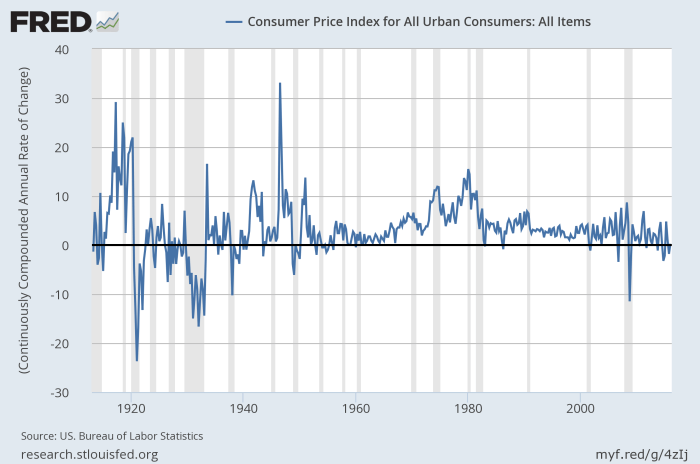
As for “price stability”, that’s sort of true if you look at the long run, because prices were as likely to go down as they were to go up. But that isn’t what we mean by “price stability”. A system with good price stability will have a low but positive and steady level of inflation, and will therefore exhibit some long-run increases in price levels; it won’t have prices jump up and down erratically and end up on average the same.

For jump up and down is what prices did on the gold standard, as you can see from FRED:

US_inflation_longrun

This is something we could have predicted in advance; the price of any given product jumps up and down over time, and gold is just one product among many. Tying prices to gold makes no more sense than tying them to any other commodity.

As for stopping the rise in energy prices, energy prices aren’t rising. Even if they were (and they could at some point), the only way the gold standard would stop that is by triggering deflation (and therefore recession) in the rest of the economy.

Regarding number 6, I don’t see how the fiscal balance of federal and state governments is improved by periodic bouts of deflation that make their debt unpayable.

As for number 7, saving Medicare and Social Security, their payments out are tied to inflation and their payments in are tied to nominal GDP, so overall inflation has very little effect on their long-term stability. In any case, the problem with Medicare is spiraling medical costs (which Obamacare has done a lot to fix), and the problem with Social Security is just the stupid arbitrary cap on the income subject to payroll tax; the gold standard would do very little to solve either of those problems, though I guess it would make the nominal income cap less binding by triggering deflation, which is just about the worst way to avoid a price ceiling I’ve ever heard.

Regarding 8 and 9, I don’t even understand why Kadlic thinks that going to a gold standard would empower individuals over banks (does it seem like individuals were empowered over banks in the “Robber Baron Era”?), or what in the world it has to do with giving people more liberty (all that… freedom… you lose… when the Fed… stabilizes… prices?), so I don’t even know where to begin on those assertions. You know what empowers people over banks? The Consumer Financial Protection Bureau. You know what would enhance liberty? Ending mass incarceration. Libertarians fight tooth and nail against the former; sometimes they get behind the latter, but sometimes they don’t; Gary Johnson for some bizarre reason believes in privatization of prisons, which are directly linked to the surge in US incarceration.

The only benefit I’ve been able to come up with for the gold standard is as a commitment mechanism, something the Federal Reserve could do to guarantee its future behavior and thereby reduce the fear that it will suddenly change course on its past promises. This would make forward guidance a lot more effective at changing long-term interest rates, because people would have reason to believe that the Fed means what it says when it projects its decisions 30 years out.

But there are much simpler and better commitment mechanisms the Fed could use. They could commit to a Taylor Rule or nominal GDP targeting, both of which mainstream economists have been clamoring for for decades. There are some definite downsides to both proposals, but also some important upsides; and in any case they’re both obviously better than the gold standard and serve the same forward guidance function.

Indeed, it’s really quite baffling that so many people believe in the gold standard. It cries out for some sort of psychological explanation, as to just what cognitive heuristic is failing when otherwise-intelligent and highly-educated people get monetary policy so deeply, deeply wrong. A lot of them don’t even to seem grasp when or how we left the gold standard; it really happened when FDR suspended gold convertibility in 1933. After that on the Bretton Woods system only national governments could exchange money for gold, and the Nixon shock that people normally think of as “ending the gold standard” was just the final nail in the coffin, and clearly necessary since inflation was rapidly eating through our gold reserves.

A lot of it seems to come down to a deep distrust of government, especially federal government (I still do not grok why the likes of Ron Paul think state governments are so much more trustworthy than the federal government); the Federal Reserve is a government agency (sort of) and is therefore not to be trusted—and look, it has federal right there in the name.

But why do people hate government so much? Why do they think politicians are much less honest than they actually are? Part of it could have to do with the terrifying expansion of surveillance and weakening of civil liberties in the face of any perceived outside threat (Sedition Act, PATRIOT ACT, basically the same thing), but often the same people defending those programs are the ones who otherwise constantly complain about Big Government. Why do polls consistently show that people don’t trust the government, but want it to do more?

I think a lot of this comes down to the vague meaning of the word “government” and the associations we make with particular questions about it. When I ask “Do you trust the government?” you think of the NSA and the Vietnam War and Watergate, and you answer “No.” But when I ask “Do you want the government to do more?” you think of the failure at Katrina, the refusal to expand Medicaid, the pitiful attempts at reducing carbon emissions, and you answer “Yes.” When I ask if you like the military, your conditioned reaction is to say the patriotic thing, “Yes.” But if I ask whether you like the wars we’ve been fighting lately, you think about the hundreds of thousands of people killed and the wanton destruction to achieve no apparent actual objective, and you say “No.” Most people don’t come to these polls with thought-out opinions they want to express; the questions evoke emotional responses in them and they answer accordingly. You can also evoke different responses by asking “Should we cut government spending?” (People say “Yes.”) versus asking “Should we cut military spending, Social Security, or Medicare?” (People say “No.”) The former evokes a sense of abstract government taking your tax money; the latter evokes the realization that this money is used for public services you value.

So, the gold standard has acquired positive emotional vibes, and the Fed has acquired negative emotional vibes.

The former is fairly easy to explain: “good as gold” is an ancient saying, and “the gold standard” is even a saying we use in general to describe the right way of doing something (“the gold standard in prostate cancer treatment”). Humans have always had a weird relationship with gold; something about its timeless and noncorroding shine mesmerizes us. That’s why you occasionally get proposals for a silver standard, but no one ever seems to advocate an oil standard, an iron standard, or a lumber standard, which would make about as much sense.

The latter is a bit more difficult to explain: What did the Fed ever do to you? But I think it might have something to do with the complexity of sound monetary policy, and the resulting air of technocratic mystery surrounding it. Moreover, the Fed actively cultivates this image, by using “open-market operations” and “quantitative easing” to “target interest rates”, instead of just saying, “We’re printing money.” There may be some good reasons to do it this way, but a lot of it really does seem to be intended to obscure the truth from the uninitiated and perpetuate the myth that they are almost superhuman. “It’s all very complicated, you see; you wouldn’t understand.” People are hoarding their money, so there’s not enough money in circulation, so prices are falling, so you’re printing more money and trying to get it into circulation. That’s really not that complicated. Indeed, if it were, we wouldn’t be able to write a simple equation like a Taylor Rule or nominal GDP targeting in order to automate it!

The reason so many people become gold bugs after taking a couple of undergraduate courses in economics, then, is that this teaches them enough that they feel they have seen through the veil; the curtain has been pulled open and the all-powerful Wizard revealed to be an ordinary man at a control panel. (Spoilers? The movie came out in 1939. Actually, it was kind of about the gold standard.) “What? You’ve just been printing money all this time? But that is surely madness!” They don’t actually understand why printing money is actually a perfectly sensible thing to do on many occasions, and it feels to them a lot like what would happen if they just went around printing money (counterfeiting) or what a sufficiently corrupt government could do if they printed unlimited amounts (which is why they keep bringing up Zimbabwe). They now grasp what is happening, but not why. A little learning is a dangerous thing.

Now as for why Paul Volcker wants to go back to Bretton Woods? That, I cannot say. He’s definitely got more than a little learning. At least he doesn’t want to go back to the classical gold standard.

The credit rating agencies to be worried about aren’t the ones you think

JDN 2457499

John Oliver is probably the best investigative journalist in America today, despite being neither American nor officially a journalist; last week he took on the subject of credit rating agencies, a classic example of his mantra “If you want to do something evil, put it inside something boring.” (note that it’s on HBO, so there is foul language):

As ever, his analysis of the subject is quite good—it’s absurd how much power these agencies have over our lives, and how little accountability they have for even assuring accuracy.

But I couldn’t help but feel that he was kind of missing the point. The credit rating agencies to really be worried about aren’t Equifax, Experian, and Transunion, the ones that assess credit ratings on individuals. They are Standard & Poor’s, Moody’s, and Fitch (which would have been even easier to skewer the way John Oliver did—perhaps we can get them confused with Standardly Poor, Moody, and Filch), the agencies which assess credit ratings on institutions.

These credit rating agencies have almost unimaginable power over our society. They are responsible for rating the risk of corporate bonds, certificates of deposit, stocks, derivatives such as mortgage-backed securities and collateralized debt obligations, and even municipal and government bonds.

S&P, Moody’s, and Fitch don’t just rate the creditworthiness of Goldman Sachs and J.P. Morgan Chase; they rate the creditworthiness of Detroit and Greece. (Indeed, they played an important role in the debt crisis of Greece, which I’ll talk about more in a later post.)

Moreover, they are proven corrupt. It’s a matter of public record.

Standard and Poor’s is the worst; they have been successfully sued for fraud by small banks in Pennsylvania and by the State of New Jersey; they have also settled fraud cases with the Securities and Exchange Commission and the Department of Justice.

Moody’s has also been sued for fraud by the Department of Justice, and all three have been prosecuted for fraud by the State of New York.

But in fact this underestimates the corruption, because the worst conflicts of interest aren’t even illegal, or weren’t until Dodd-Frank was passed in 2010. The basic structure of this credit rating system is fundamentally broken; the agencies are private, for-profit corporations, and they get their revenue entirely from the banks that pay them to assess their risk. If they rate a bank’s asset as too risky, the bank stops paying them, and instead goes to another agency that will offer a higher rating—and simply the threat of doing so keeps them in line. As a result their ratings are basically uncorrelated with real risk—they failed to predict the collapse of Lehman Brothers or the failure of mortgage-backed CDOs, and they didn’t “predict” the European debt crisis so much as cause it by their panic.

Then of course there’s the fact that they are obviously an oligopoly, and furthermore one that is explicitly protected under US law. But then it dawns upon you: Wait… US law? US law decides the structure of credit rating agencies that set the bond rates of entire nations? Yes, that’s right. You’d think that such ratings would be set by the World Bank or something, but they’re not; in fact here’s a paper published by the World Bank in 2004 about how rather than reform our credit rating system, we should instead tell poor countries to reform themselves so they can better impress the private credit rating agencies.

In fact the whole concept of “sovereign debt risk” is fundamentally defective; a country that borrows in its own currency should never have to default on debt under any circumstances. National debt is almost nothing like personal or corporate debt. Their fears should be inflation and unemployment—their monetary policy should be set to minimize the harm of these two basic macroeconomic problems, understanding that policies which mitigate one may enflame the other. There is such a thing as bad fiscal policy, but it has nothing to do with “running out of money to pay your debt” unless you are forced to borrow in a currency you can’t control (as Greece is, because they are on the Euro—their debt is less like the US national debt and more like the debt of Puerto Rico, which is suffering an ongoing debt crisis you may not have heard about). If you borrow in your own currency, you should be worried about excessive borrowing creating inflation and devaluing your currency—but not about suddenly being unable to repay your creditors. The whole concept of giving a sovereign nation a credit rating makes no sense. You will be repaid on time and in full, in nominal terms; if inflation or currency exchange has devalued the currency you are repaid in, that’s sort of like a partial default, but it’s a fundamentally different kind of “default” than simply not paying back the money—and credit ratings have no way of capturing that difference.

In particular, it makes no sense for interest rates on government bonds to go up when a country is suffering some kind of macroeconomic problem.

The basic argument for why interest rates go up when risk is higher is that lenders expect to be paid more by those who do pay to compensate for what they lose from those who don’t pay. This is already much more problematic than most economists appreciate; I’ve been meaning to write a paper on how this system creates self-fulfilling prophecies of default and moral hazard from people who pay their debts being forced to subsidize those who don’t. But it at least makes some sense.

But if a country is a “high risk” in the sense of macroeconomic instability undermining the real value of their debt, we want to ensure that they can restore macroeconomic stability. But we know that when there is a surge in interest rates on government bonds, instability gets worse, not better. Fiscal policy is suddenly shifted away from real production into higher debt payments, and this creates unemployment and makes the economic crisis worse. As Paul Krugman writes about frequently, these policies of “austerity” cause enormous damage to national economies and ultimately benefit no one because they destroy the source of wealth that would have been used to repay the debt.

By letting credit rating agencies decide the rates at which governments must borrow, we are effectively treating national governments as a special case of corporations. But corporations, by design, act for profit and can go bankrupt. National governments are supposed to act for the public good and persist indefinitely. We can’t simply let Greece fail as we might let a bank fail (and of course we’ve seen that there are serious downsides even to that). We have to restructure the sovereign debt system so that it benefits the development of nations rather than detracting from it. The first step is removing the power of private for-profit corporations in the US to decide the “creditworthiness” of entire countries. If we need to assess such risks at all, they should be done by international institutions like the UN or the World Bank.

But right now people are so stuck in the idea that national debt is basically the same as personal or corporate debt that they can’t even understand the problem. For after all, one must repay one’s debts.

Why Millennials feel “entitled”

JDN 2457064

I’m sure you’ve already heard this plenty of times before, but just in case here are a few particularly notable examples: “Millennials are entitled.” “Millennials are narcissistic.” “Millennials expect instant gratification.

Fortunately there are some more nuanced takes as well: One survey shows that we are perceived as “entitled” and “self-centered” but also “hardworking” and “tolerant”. This article convincingly argues that Baby Boomers show at least as much ‘entitlement’ as we do. Another article points out that young people have been called these sorts of names for decades—though actually the proper figure is centuries.

Though some of the ‘defenses’ leave a lot to be desired: “OK, admittedly, people do live at home. But that’s only because we really like our parents. And why shouldn’t we?” Uh, no, that’s not it. Nor is it that we’re holding off on getting married. The reason we live with our parents is that we have no money and can’t pay for our own housing. And why aren’t we getting married? Because we can’t afford to pay for a wedding, much less buy a home and start raising kids. (Since the time I drafted this for Patreon and it went live, yet another article hand-wringing over why we’re not getting married was publishedin Scientific American, of all places.)

Are we not buying cars because we don’t like cars? No, we’re not buying cars because we can’t afford to pay for them.

The defining attributes of the Millennial generation are that we are young (by definition) and broke (with very few exceptions). We’re not uniquely narcissistic or even tolerant; younger generations always have these qualities.

But there may be some kernel of truth here, which is that we were promised a lot more than we got.

Educational attainment in the United States is the highest it has ever been. Take a look at this graph from the US Department of Education:

Percentage of 25- to 29-year-olds who completed a bachelor’s or higher degree, by race/ethnicity: Selected years, 1990–2014

education_attainment_race

More young people of every demographic except American Indians now have college degrees (and those figures fluctuate a lot because of small samples—whether my high school had an achievement gap for American Indians depended upon how I self-identified on the form, because there were only two others and I was tied for the highest GPA).

Even the IQ of Millennials is higher than that of our parents’ generation, which is higher than their parents’ generation; (measured) intelligence rises over time in what is called the Flynn Effect. IQ tests have to be adjusted to be harder by about 3 points every 10 years because otherwise the average score would stop being 100.

As your level of education increases, your income tends to go up and your unemployment tends to go down. In 2014, while people with doctorates or professional degrees had about 2% unemployment and made a median income of $1590 per week, people without even high school diplomas had about 9% unemployment and made a median income of only $490 per week. The Bureau of Labor Statistics has a nice little bar chart of these differences:

education_employment_earnings

Now the difference is not quite as stark. With the most recent data, the unemployment rate is 6.7% for people without a high school diploma and 2.5% for people with a bachelor’s degree or higher.

But that’s for the population as a whole. What about the population of people 18 to 35, those of us commonly known as Millennials?

Well, first of all, our unemployment rate overall is much higher. With the most recent data, unemployment among people ages 20-24 is a whopping 9.4%. For ages 25 to 34 it gets better, 5.3%; but it’s still much worse than unemployment at ages 35-44 (4.0%), 45-54 (3.6%), or 55+ (3.2%). Overall, unemployment among Millennials is about 6.7% while unemployment among Baby Boomers is about 3.2%, half as much. (Gen X is in between, but a lot closer to the Boomers at around 3.8%.)

It was hard to find data specifically breaking it down by both age and education at the same time, but the hunt was worth it.

Among people age 20-24 not in school:

Without a high school diploma, 328,000 are unemployed, out of 1,501,000 in the labor force. That’s an unemployment rate of 21.9%. Not a typo, that’s 21.9%.

With only a high school diploma, 752,000 are unemployed, out of 5,498,000 in the labor force. That’s an unemployment rate of 13.7%.

With some college but no bachelor’s degree, 281,000 are unemployed, out of 3,620,000 in the labor force. That’s an unemployment rate of 7.7%.

With a bachelor’s degree, 90,000 are unemployed, out of 2,313,000 in the labor force. That’s an unemployment rate of 3.9%.

What this means is that someone 24 or under needs to have a bachelor’s degree in order to have the same overall unemployment rate that people from Gen X have in general, and even with a bachelor’s degree, people under 24 still have a higher unemployment rate than what Baby Boomers simply have by default. If someone under 24 doesn’t even have a high school diploma, forget it; their unemployment rate is comparable to the population unemployment rate at the trough of the Great Depression.

In other words, we need to have college degrees just to match the general population older than us, of whom only 20% have a college degree; and there is absolutely nothing a Millennial can do in terms of education to ever have the tiny unemployment rate (about 1.5%) of Baby Boomers with professional degrees. (Be born White, be in perfect health, have a professional degree, have rich parents, and live in a city with very high employment, and you just might be able to pull it off.)

So, why do Millennials feel like a college degree should “entitle” us to a job?

Because it does for everyone else.

Why do we feel “entitled” to a higher standard of living than the one we have?
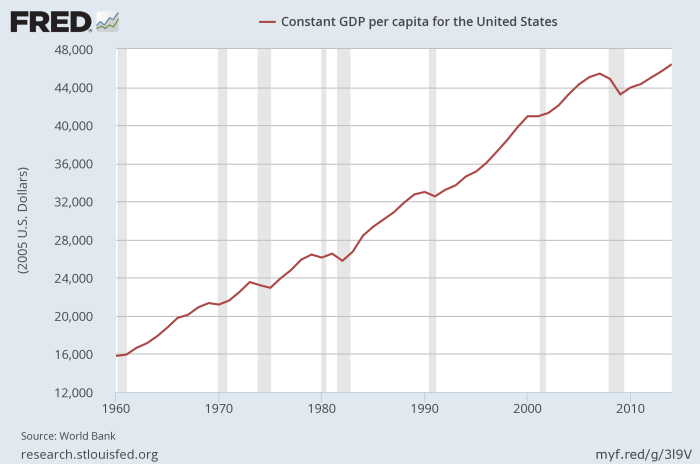
Take a look at this graph of GDP per capita in the US:

US_GDP_per_capita

You may notice a rather sudden dip in 2009, around the time most Millennials graduated from college and entered the labor force. On the next graph, I’ve added a curve approximating what it would look like if the previous trend had continued:

US_GDP_per_capita_trend

(There’s a lot on this graph for wonks like me. You can see how the unit-root hypothesis seemed to fail in the previous four recessions, where economic output rose back up to potential; but it clearly held in this recession, and there was a permanent loss of output. It also failed in the recession before that. So what’s the deal? Why do we recover from some recessions and take a permanent blow from others?)

If the Great Recession hadn’t happened, instead of per-capita GDP being about $46,000 in 2005 dollars, it would instead be closer to $51,000 in 2005 dollars. In today’s money, that means our current $56,000 would be instead closer to $62,000. If we had simply stayed on the growth trajectory we were promised, we’d be almost 10 log points richer (11% for the uninitiated).

So, why do Millennials feel “entitled” to things we don’t have? In a word, macroeconomics.

People anchored their expectations of what the world would be like on forecasts. The forecasts said that the skies were clear and economic growth would continue apace; so naturally we assumed that this was true. When the floor fell out from under our economy, only a few brilliant and/or lucky economists saw it coming; even people who were paying quite close attention were blindsided. We were raised in a world where economic growth promised rising standard of living and steady employment for the rest of our lives. And then the storm hit, and we were thrown into a world of poverty and unemployment—and especially poverty and unemployment for us.

We are angry about how we had been promised more than we were given, angry about how the distribution of what wealth we do have gets ever more unequal. We are angry that our parents’ generation promised what they could not deliver, and angry that it was their own blind worship of the corrupt banking system that allowed the crash to happen.

And because we are angry and demand a fairer share, they have the audacity to call us “narcissistic”.

Why is it so hard to get a job?

JDN 2457411

The United States is slowly dragging itself out of the Second Depression.

Unemployment fell from almost 10% to about 5%.

Core inflation has been kept between 0% and 2% most of the time.

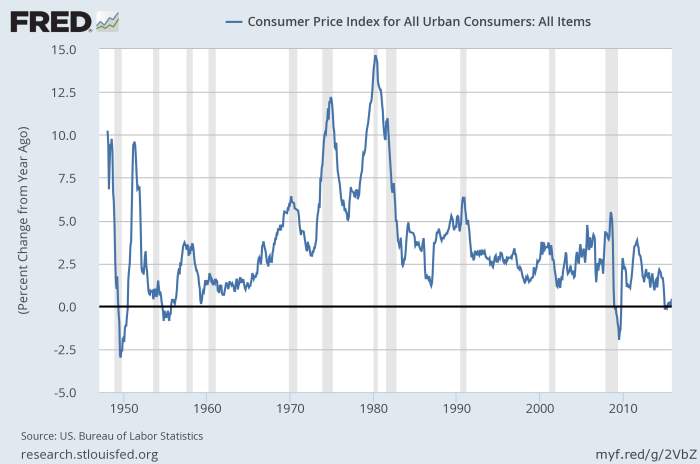
Overall inflation has been within a reasonable range:

US_inflation

Real GDP has returned to its normal growth trend, though with a permanent loss of output relative to what would have happened without the Great Recession.

US_GDP_growth

Consumption spending is also back on trend, tracking GDP quite precisely.

The Federal Reserve even raised the federal funds interest rate above the zero lower bound, signaling a return to normal monetary policy. (As I argued previously, I’m pretty sure that was their main goal actually.)

Employment remains well below the pre-recession peak, but is now beginning to trend upward once more.

The only thing that hasn’t recovered is labor force participation, which continues to decline. This is how we can have unemployment go back to normal while employment remains depressed; people leave the labor force by retiring, going back to school, or simply giving up looking for work. By the formal definition, someone is only unemployed if they are actively seeking work. No, this is not new, and it is certainly not Obama rigging the numbers. This is how we have measured unemployment for decades.

Actually, it’s kind of the opposite: Since the Clinton administration we’ve also kept track of “broad unemployment”, which includes people who’ve given up looking for work or people who have some work but are trying to find more. But we can’t directly compare it to anything that happened before 1994, because the BLS didn’t keep track of it before then. All we can do is estimate based on what we did measure. Based on such estimation, it is likely that broad unemployment in the Great Depression may have gotten as high as 50%. (I’ve found that one of the best-fitting models is actually one of the simplest; assume that broad unemployment is 1.8 times narrow unemployment. This fits much better than you might think.)

So, yes, we muddle our way through, and the economy eventually heals itself. We could have brought the economy back much sooner if we had better fiscal policy, but at least our monetary policy was good enough that we were spared the worst.

But I think most of us—especially in my generation—recognize that it is still really hard to get a job. Overall GDP is back to normal, and even unemployment looks all right; but why are so many people still out of work?

I have a hypothesis about this: I think a major part of why it is so hard to recover from recessions is that our system of hiring is terrible.

Contrary to popular belief, layoffs do not actually substantially increase during recessions. Quits are substantially reduced, because people are afraid to leave current jobs when they aren’t sure of getting new ones. As a result, rates of job separation actually go down in a recession. Job separation does predict recessions, but not in the way most people think. One of the things that made the Great Recession different from other recessions is that most layoffs were permanent, instead of temporary—but we’re still not sure exactly why.

Here, let me show you some graphs from the BLS.

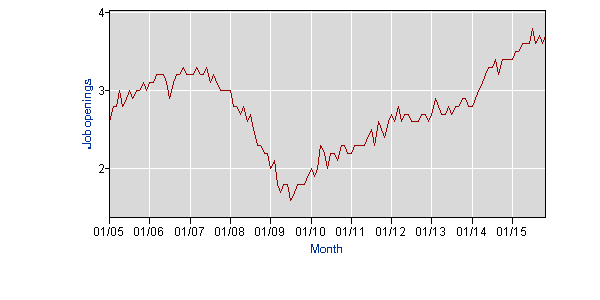
This graph shows job openings from 2005 to 2015:

job_openings

This graph shows hires from 2005 to 2015:

job_hires

Both of those show the pattern you’d expect, with openings and hires plummeting in the Great Recession.

But check out this graph, of job separations from 2005 to 2015:

job_separations

Same pattern!

Unemployment in the Second Depression wasn’t caused by a lot of people losing jobs. It was caused by a lot of people not getting jobs—either after losing previous ones, or after graduating from school. There weren’t enough openings, and even when there were openings there weren’t enough hires.

Part of the problem is obviously just the business cycle itself. Spending drops because of a financial crisis, then businesses stop hiring people because they don’t project enough sales to justify it; then spending drops even further because people don’t have jobs, and we get caught in a vicious cycle.

But we are now recovering from the cyclical downturn; spending and GDP are back to their normal trend. Yet the jobs never came back. Something is wrong with our hiring system.

So what’s wrong with our hiring system? Probably a lot of things, but here’s one that’s been particularly bothering me for a long time.
As any job search advisor will tell you, networking is essential for career success.

There are so many different places you can hear this advice, it honestly gets tiring.

But stop and think for a moment about what that means. One of the most important determinants of what job you will get is… what people you know?

It’s not what you are best at doing, as it would be if the economy were optimally efficient.
It’s not even what you have credentials for, as we might expect as a second-best solution.

It’s not even how much money you already have, though that certainly is a major factor as well.

It’s what people you know.

Now, I realize, this is not entirely beyond your control. If you actively participate in your community, attend conferences in your field, and so on, you can establish new contacts and expand your network. A major part of the benefit of going to a good college is actually the people you meet there.

But a good portion of your social network is more or less beyond your control, and above all, says almost nothing about your actual qualifications for any particular job.

There are certain jobs, such as marketing, that actually directly relate to your ability to establish rapport and build weak relationships rapidly. These are a tiny minority. (Actually, most of them are the sort of job that I’m not even sure needs to exist.)

For the vast majority of jobs, your social skills are a tiny, almost irrelevant part of the actual skill set needed to do the job well. This is true of jobs from writing science fiction to teaching calculus, from diagnosing cancer to flying airliners, from cleaning up garbage to designing spacecraft. Social skills are rarely harmful, and even often provide some benefit, but if you need a quantum physicist, you should choose the recluse who can write down the Dirac equation by heart over the well-connected community leader who doesn’t know what an integral is.

At the very least, it strains credibility to suggest that social skills are so important for every job in the world that they should be one of the defining factors in who gets hired. And make no mistake: Networking is as beneficial for landing a job at a local bowling alley as it is for becoming Chair of the Federal Reserve. Indeed, for many entry-level positions networking is literally all that matters, while advanced positions at least exclude candidates who don’t have certain necessary credentials, and then make the decision based upon who knows whom.

Yet, if networking is so inefficient, why do we keep using it?

I can think of a couple reasons.

The first reason is that this is how we’ve always done it. Indeed, networking strongly pre-dates capitalism or even money; in ancient tribal societies there were certainly jobs to assign people to: who will gather berries, who will build the huts, who will lead the hunt. But there were no colleges, no certifications, no resumes—there was only your position in the social structure of the tribe. I think most people simply automatically default to a networking-based system without even thinking about it; it’s just the instinctual System 1 heuristic.

One of the few things I really liked about Debt: The First 5000 Years was the discussion of how similar the behavior of modern CEOs is to that of ancient tribal chieftans, for reasons that make absolutely no sense in terms of neoclassical economic efficiency—but perfect sense in light of human evolution. I wish Graeber had spent more time on that, instead of many of these long digressions about international debt policy that he clearly does not understand.

But there is a second reason as well, a better reason, a reason that we can’t simply give up on networking entirely.

The problem is that many important skills are very difficult to measure.

College degrees do a decent job of assessing our raw IQ, our willingness to persevere on difficult tasks, and our knowledge of the basic facts of a discipline (as well as a fantastic job of assessing our ability to pass standardized tests!). But when you think about the skills that really make a good physicist, a good economist, a good anthropologist, a good lawyer, or a good doctor—they really aren’t captured by any of the quantitative metrics that a college degree provides. Your capacity for creative problem-solving, your willingness to treat others with respect and dignity; these things don’t appear in a GPA.

This is especially true in research: The degree tells how good you are at doing the parts of the discipline that have already been done—but what we really want to know is how good you’ll be at doing the parts that haven’t been done yet.

Nor are skills precisely aligned with the content of a resume; the best predictor of doing something well may in fact be whether you have done so in the past—but how can you get experience if you can’t get a job without experience?

These so-called “soft skills” are difficult to measure—but not impossible. Basically the only reliable measurement mechanisms we have require knowing and working with someone for a long span of time. You can’t read it off a resume, you can’t see it in an interview (interviews are actually a horribly biased hiring mechanism, particularly biased against women). In effect, the only way to really know if someone will be good at a job is to work with them at that job for awhile.

There’s a fundamental information problem here I’ve never quite been able to resolve. It pops up in a few other contexts as well: How do you know whether a novel is worth reading without reading the novel? How do you know whether a film is worth watching without watching the film? When the information about the quality of something can only be determined by paying the cost of purchasing it, there is basically no way of assessing the quality of things before we purchase them.

Networking is an attempt to get around this problem. To decide whether to read a novel, ask someone who has read it. To decide whether to watch a film, ask someone who has watched it. To decide whether to hire someone, ask someone who has worked with them.

The problem is that this is such a weak measure that it’s not much better than no measure at all. I often wonder what would happen if businesses were required to hire people based entirely on resumes, with no interviews, no recommendation letters, and any personal contacts treated as conflicts of interest rather than useful networking opportunities—a world where the only thing we use to decide whether to hire someone is their documented qualifications. Could it herald a golden age of new economic efficiency and job fulfillment? Or would it result in widespread incompetence and catastrophic collapse? I honestly cannot say.

How Reagan ruined America

JDN 2457408

Or maybe it’s Ford?

The title is intentionally hyperbolic; despite the best efforts of Reagan and his ilk, America does yet survive. Indeed, as Obama aptly pointed out in his recent State of the Union, we appear to be on an upward trajectory once more. And as you’ll see in a moment, many of the turning points actually seem to be Gerald Ford, though it was under Reagan that the trends really gained steam.

But I think it’s quite remarkable just how much damage Reaganomics did to the economy and society of the United States. It’s actually a turning point in all sorts of different economic policy measures; things were going well from the 1940s to the 1970s, and then suddenly in the 1980s they take a turn for the worse.

The clearest example is inequality. From the World Top Incomes Database, here’s the graph I featured on my Patreon page of income shares in the United States:

top_income_shares_pretty.png

Inequality was really bad during the Roaring Twenties (no surprise to anyone who has read The Great Gatsby), then after the turmoil of the Great Depression, the New Deal, and World War 2, inequality was reduced to a much lower level.

During this period, what I like to call the Golden Age of American Capitalism:

Instead of almost 50% in the 1920s, the top 10% now received about 33%.

Instead of over 20% in the 1920s, the top 1% now received about 10%.

Instead of almost 5% in the 1920s, the top 0.01% now received about 1%.

This pattern continued to hold, remarkably stable, until 1980. Then, it completely unraveled. Income shares of the top brackets rose, and continued to rise, ever since (fluctuating with the stock market of course). Now, we’re basically back right where we were in the 1920s; the top 10% gets 50%, the top 1% gets 20%, and the top 0.01% gets 4%.

Not coincidentally, we see the same pattern if we look at the ratio of CEO pay to average worker pay, as shown here in a graph from the Economic Policy Institute:

Snapshot_CEO_pay_main

Up until 1980, the ratio in pay between CEOs and their average workers was steady around 20 to 1. From that point forward, it began to rise—and rise, and rise. It continued to rise under every Presidential administration, and actually hit its peak in 2000, under Bill Clinton, at an astonishing 411 to 1 ratio. In the 2000s it fell to about 250 to 1 (hurray?), and has slightly declined since then to about 230 to 1.

By either measure, we can see a clear turning point in US inequality—it was low and stable, until Reagan came along, when it began to explode.

Part of this no doubt is the sudden shift in tax rates. The top marginal tax rates on income were over 90% from WW2 to the 1960s; then JFK reduced them to 70%, which is probably close to the revenue-maximizing rate. There they stayed, until—you know the refrain—along came Reagan, and by the end of his administration he had dropped the top marginal rate to 28%. It then was brought back up to about 35%, where it has basically remained, sometimes getting as high as 40%.

US_income_tax_rates

Another striking example is the ratio between worker productivity and wages. The Economic Policy Institute has a very detailed analysis of this, but I think their graph by itself is quite striking:

productivity_wages

Starting around the 1970s, and then rapidly accelerating from the 1980s onward, we see a decoupling of productivity from wages. Productivity has continued to rise at more or less the same rate, but wages flatten out completely, even falling for part of the period.

For those who still somehow think Republicans are fiscally conservative, take a look at this graph of the US national debt:

US_federal_debt

We were at a comfortable 30-40% of GDP range, actually slowly decreasing—until Reagan. We got back on track to reduce the debt during the mid-1990s—under Bill Clinton—and then went back to raising it again once George W. Bush got in office. It ballooned as a result of the Great Recession, and for the past few years Obama has been trying to bring it back under control.

Of course, national debt is not nearly as bad as most people imagine it to be. If Reagan had only raised the national debt in order to stop unemployment, that would have been fine—but he did not.

Unemployment had never been above 10% since World War 2 (and in fact reached below 4% in the 1960s!) and yet all the sudden hit almost 11%, shortly after Reagan:
US_unemployment
Let’s look at that graph a little closer. Right now the Federal Reserve uses 5% as their target unemployment rate, the supposed “natural rate of unemployment” (a lot of economists use this notion, despite there being almost no empirical support for it whatsoever). If I draw red lines at 5% unemployment and at 1981, the year Reagan took office, look at what happens.

US_unemployment_annotated

For most of the period before 1981, we spent most of our time below the 5% line, jumping above it during recessions and then coming back down; for most of the period after 1981, we spent most of our time above the 5% line, even during economic booms.

I’ve drawn another line (green) where the most natural break appears, and it actually seems to be the Ford administration; so maybe I can’t just blame Reagan. But something happened in the last quarter of the 20th century that dramatically changed the shape of unemployment in America.

Inflation is at least ambiguous; it was pretty bad in the 1940s and 1950s, and then settled down in the 1960s for awhile before picking up in the 1970s, and actually hit its worst just before Reagan took office:

US_inflation

Then there’s GDP growth.

US_GDP_growth

After World War 2, our growth rate was quite volatile, rising as high as 8% (!) in some years, but sometimes falling to zero or slightly negative. Rates over 6% were common during booms. On average GDP growth was quite good, around 4% per year.

In 1981—the year Reagan took office—we had the worst growth rate in postwar history, an awful -1.9%. Coming out of that recession we had very high growth of about 7%, but then settled into the new normal: More stable growth rates, yes, but also much lower. Never again did our growth rate exceed 4%, and on average it was more like 2%. In 2009, Reagan’s record recession was broken with the Great Recession, a drop of almost 3% in a single year.

GDP per capita tells a similar story, of volatile but fast growth before Reagan followed by stable but slow growth thereafter:

US_GDP_per_capita

Of course, it wouldn’t be fair to blame Reagan for all of this. A lot of things have happened in the late 20th century, after all. In particular, the OPEC oil crisis is probably responsible for many of these 1970s shocks, and when Nixon moved us at last off the Bretton Woods gold standard, it was probably the right decision, but done at a moment of crisis instead of as the result of careful planning.

Also, while the classical gold standard was terrible, the Bretton Woods system actually had some things to recommend it. It required strict capital controls and currency exchange regulations, but the period of highest economic growth and lowest inequality in the United States—the period I’m calling the Golden Age of American Capitalism—was in fact the same period as the Bretton Woods system.

Some of these trends started before Reagan, and all of them continued in his absence—many of them worsening as much or more under Clinton. Reagan took office during a terrible recession, and either contributed to the recovery or at least did not prevent it.

The President only has very limited control over the economy in any case; he can set a policy agenda, but Congress must actually implement it, and policy can take years to show its true effects. Yet given Reagan’s agenda of cutting top tax rates, crushing unions, and generally giving large corporations whatever they want, I think he bears at least some responsibility for turning our economy in this very bad direction.

Thus ends our zero-lower-bound interest rate policy

JDN 2457383

Not with a bang, but with a whimper.

If you are reading the blogs as they are officially published, it will have been over a week since the Federal Reserve ended its policy of zero interest rates. (If you are reading this as a Patreon Blog from the Future, it will only have been a few days.)

The official announcement was made on December 16. The Federal Funds Target Rate will be raised from 0%-0.25% to 0.25%-0.5%. That one-quarter percentage point—itself no larger than the margin of error the Fed allots itself—will make all the difference.

As pointed out in the New York Times, this is the first time nominal interest rates have been raised in almost a decade. But the Fed had been promising it for some time, and thus a major reason they did it was to preserve their own credibility. They also say they think inflation is about to hit the 2% target, though it hasn’t yet (and I was never clear on why 2% was the target in the first place).

Actually, overall inflation is currently near zero. What is at 2% is what’s called “core inflation”, which excludes particularly volatile products such as oil and food. The idea is that we want to set monetary policy based upon long-run trends in the economy as a whole, not based upon sudden dips and surges in oil prices. But right now we are in the very odd scenario of the Fed raising interest rates in order to stop inflation even as the total amount most people need to spend to maintain their standard of living is the same as it was a year ago.

As MSNBC argues, it is essentially an announcement that the Second Depression is over and the economy has now returned to normal. Of course, simply announcing such a thing does not make it true.

Personally, I think this move is largely symbolic. The difference between 0% and 0.25% is unimportant for most practical purposes.

If you owe $100,000 over 30 years at 0% interest, you will pay $277.78 per month, totaling of course $100,000. If your interest rate were raised to 0.25% interest, you would instead owe $288.35 per month, totaling $103,807.28. Even over 30 years, that 0.25% interest raises your total expenditure by less than 4%.

Over shorter terms it’s even less important. If you owe $20,000 over 5 years at 0% interest, you will pay $333.33 per month totaling $20,000. At 0.25%, you would pay $335.46 per month totaling $20,127.34, a mere 0.6% more.

Moreover, if a bank was willing to take out a loan at 0%, they’ll probably still be at 0.25%.

Where it would have the largest impact is in more exotic financial instruments, like zero-amortization or negative-amortization bonds. A zero-amortization bond at 0% is literally free money forever (assuming you can keep rolling it over). A zero-amortization bond at 0.25% means you must at least pay 0.25% of the money back each year. A negative-amortization bond at 0% makes no sense mathematically (somehow you pay back less than 0% at each payment?), while a negative-amortization bond at 0.25% only doesn’t make sense practically. If both zero and negative-amortization seem really bizarre and impossible to justify, that’s because they are. They should not exist. Most exotic financial instruments have no reason to exist, aside from the fact that they can be used to bamboozle people into giving money to the financial corporations that create them. (Which reminds me, I need to see The Big Short. But of course I have to see Star Wars: The Force Awakens first; one must have priorities.)

So, what will happen as a result of this change in interest rates? Probably not much. Inflation might go down a little—which means we might have overall deflation, and that would be bad—and the rate of increase in credit might drop slightly. In the worst-case scenario, unemployment starts to rise again, the Fed realizes their mistake, and interest rates will be dropped back to zero.

I think it’s more instructive to look at why they did this—the symbolic significance behind it.

The zero lower bound is weird. It makes a lot of economists very uncomfortable. The usual rules for how monetary and fiscal policy work break down, because the equation hits up against a constraint—a corner solution, more technically. Krugman often talks about how many of the usual ideas about how interest rates and government spending work collapse at the zero-lower-bound. We have models of this sort of thing that are pretty good, but they’re weird and counter-intuitive, so policymakers never seem to actually use them.

What is the zero lower bound, you ask? Exactly what it says on the tin. There is a lower bound on how low you can set an interest rate, and for all practical purposes that limit is zero. If you start trying to set an interest rate of -5%, people won’t be willing to loan out money and will instead hoard cash. (Interestingly, a central bank with a strong currency, such as that of the US, UK, or EU, can actually set small negative nominal interest rates—because people consider their bonds safer than cash, so they’ll pay for the safety. The ECB, Europe’s Fed, actually did so for awhile.)

The zero-lower-bound actually applies to prices in general, not just interest rates. If a product is so worthless to you that you don’t even want it if it’s free, it’s very rare for anyone to actually pay you to take it—partly because there might be nothing to stop you from taking a huge amount of it and forcing them to pay you ridiculous amounts of money. “How much is this paperclip?” “-$0.75.” “I’ll have 50 billion, please.” In a few rare cases, they might be able to pay you to take it an amount that’s less than what it costs you to store and transport. Also, if they benefit from giving it to you, companies will give you things for free—think ads and free samples. But basically, if people won’t even take something for free, that thing simply doesn’t get sold.

But if we are in a recession, we really don’t want loans to stop being made altogether. So if people are unwilling to take out loans at 0% interest, we’re in trouble. Generally what we have to do is rely on inflation to reduce the real value of money over time, thus creating a real interest rate that’s negative even though the nominal interest rate remains stuck at 0%. But what if inflation is very low? Then there’s nothing you can do except find a way to raise inflation or increase demand for credit. This means relying upon unconventional methods like quantitative easing (trying to cause inflation), or preferably using fiscal policy to spend a bunch of money and thereby increase demand for credit.

What the Fed is basically trying to do here is say that we are no longer in that bad situation. We can now set interest rates where they actually belong, rather than forcing them as low as they’ll go and hoping inflation will make up the difference.

It’s actually similar to how if you take a test and score 100%, there’s no way of knowing whether you just barely got 100%, or if you would have still done as well if the test were twice as hard—but if you score 99%, you actually scored 99% and would have done worse if the test were harder. In the former case you were up against a constraint; in the latter it’s your actual value. The Fed is essentially announcing that we really want interest rates near 0%, as opposed to being bound at 0%—and the way they do that is by setting a target just slightly above 0%.

So far, there doesn’t seem to have been much effect on markets. And frankly, that’s just what I’d expect.

How about we listen to the Nobel Laureate when we set our taxes?

JDN 2457321 EDT 11:20

I know I’m going out on a limb here, but I think it would generally be a good thing if we based our tax system on the advice of Nobel Laureate economists. Joseph Stiglitz wrote a tax policy paper for the Roosevelt Institution last year that describes in detail how our tax system could be reformed to simultaneously restore economic growth, reduce income inequality, promote environmental sustainability, and in the long run even balance the budget. What’s more, he did the math (I suppose Nobel Laureate economists are known for that), and it looks like his plan would actually work.

The plan is good enough that I think it’s worth going through in some detail.

He opens by reminding us that our “debt crisis” is of our own making, the result of politicians (and voters) who don’t understand economics:

“But we should be clear that these crises – which have resulted in a government shutdown and a near default on the national debt – are not economic but political. The U.S. is not like Greece, unable to borrow to fund its debt and deficit. Indeed, the U.S. has been borrowing at negative real interest rates.”

Stiglitz pulls no punches against bad policies, and isn’t afraid to single out conservatives:

“We also show that some of the so-called reforms that conservatives propose would be counterproductive – they could simultaneously reduce growth and economic welfare and increase unemployment and inequality. It would be better to have no reform than these reforms.”

A lot of the news media keep trying to paint Bernie Sanders as a far-left radical candidate (like this article in Politico calling his hometown the “People’s Republic of Burlington”), because he says things like this: “in recent years, over 99 percent of all new income generated in the economy has gone to the top 1 percent.”

But the following statement was not said by Bernie Sanders, it was said by Joseph Stiglitz, who I will remind you one last time is a world-renowned Nobel Laureate economist:

“The weaknesses in the labor market are reflected in low wages and stagnating incomes. That helps explain why 95 percent of the increase in incomes in the three years after the recovery officially began went to the upper 1 percent. For most Americans, there has been no recovery.”

It was also Stiglitz who said this:

“The American Dream is, in reality, a myth. The U.S. has some of the worst inequality across generations (social mobility) among wealthy nations. The life prospects of a young American are more dependent on the income and education of his parents than in other advanced countries.”

In this country, we have reached the point where policies supported by the analysis of world-renowned economists is considered far-left radicalism, while the “mainstream conservative” view is a system of tax policy that is based on pure fantasy, which has been called “puppies and rainbows” by serious policy analysts and “voodoo economics” by yet another Nobel Laureate economist. A lot of very smart people don’t understand what’s happening in our political system, and want “both sides” to be “equally wrong”, but that is simply not the case: Basic facts of not just social science (e.g. Keynesian monetary policy), but indeed natural science (evolutionary biology, anthropogenic climate change) are now considered “political controversies” because the right wing doesn’t want to believe them.

But let’s get back to the actual tax plan Stiglitz is proposing. He is in favor of raising some taxes and lowering others, spending more on some things and less on other things. His basic strategy is actually quite simple: Raise taxes with low multipliers and cut taxes with high multipliers. Raise spending with high multipliers and cut spending with low multipliers.

“While in general taxes take money out of the system, and therefore have a deflationary bias, some taxes have a larger multiplier than others, i.e. lead to a greater reduction in aggregate demand per dollar of revenue raised. Taxes on the rich and superrich, who save a large fraction of their income, have the least adverse effect on aggregate demand. Taxes on lower income individuals have the most adverse effect on aggregate demand.”

In other words, by making the tax system more progressive, we can directly stimulate economic growth while still increasing the amount of tax revenue we raise. And of course we have plenty of other moral and economic reasons to prefer progressive taxation.

Stiglitz tears apart the “job creator” myth:

“It is important to dispel a misunderstanding that one often hears from advocates of lower taxes for the rich and corporations, which contends that the rich are the job producers, and anything that reduces their income will reduce their ability and incentive to create jobs. First, at the current time, it is not lack of funds that is holding back investment. It is not even a weak and dysfunctional financial sector. America’s large corporations are sitting on more than $2 trillion in cash. What is holding back investment, especially by large corporations, is the lack of demand for their products.”

Stiglitz talks about two principles of taxation to follow:

First is the Generalized Henry George Principle, that we should focus taxes on things that are inelastic, meaning their supply isn’t likely to change much with the introduction of a tax. Henry George favored taxing land, which is quite inelastic indeed. The reason we do this is to reduce the economic distortions created by a tax; the goal is to collect revenue without changing the number of real products that are bought and sold. We need to raise revenue and we want to redistribute income, but we want to do it without creating unnecessary inefficiencies in the rest of the economy.

Second is the Generalized Polluter Pays Principle, that we should tax things that have negative externalities—effects on other people that are harmful. When a transaction causes harm to others who were not party to the transaction, we should tax that transaction in an amount equal to the harm that it would cause, and then use that revenue to offset the damage. In effect, if you hurt someone else, you should have to pay to clean up your own mess. This makes obvious moral sense, but it also makes good economic sense; taxing externalities can improve economic efficiency and actually make everyone better off. The obvious example is again pollution (the original Polluter Pays Principle), but there are plenty of other examples as well.

Stiglitz of course supports taxes on pollution and carbon emissions, which really should be a no-brainer. They aren’t just good for the environment, they would directly increase economic efficiency. The only reason we don’t have comprehensive pollution taxes (or something similar like cap-and-trade) is again the political pressure of right-wing interests.

Stiglitz focuses in particular on the externalities of the financial system, the boom-and-bust cycle of bubble, crisis, crash that has characterized so much of our banking system for generations. With a few exceptions, almost every major economic crisis has been preceded by some sort of breakdown of the financial system (and typically widespread fraud by the way). It is not much exaggeration to say that without Wall Street there would be no depressions. Externalities don’t get a whole lot bigger than that.

Stiglitz proposes a system of financial transaction taxes that are designed to create incentives against the most predatory practices in finance, especially the high-frequency trading in which computer algorithms steal money from the rest of the economy thousands of times per second. Even a 0.01% tax on each financial transaction would probably be enough to eliminate this particular activity.

He also suggests the implementation of “bonus taxes” which disincentivize paying bonuses, which could basically be as simple as removing the deductions placed during the Clinton administration (in a few years are we going to have to say “the first Clinton administration”?) that exempt “performance-based pay” from most forms of income tax. All pay is performance-based, or supposed to be. There should be no special exemption for bonuses and stock options.

Stiglitz also proposes a “bank rescue fund” which would be something like an expansion of the FDIC insurance that banks are already required to have, but designed as catastrophe insurance for the whole macroeconomy. Instead of needing bailed out from general government funds, banks would only be bailed out from a pool of insurance funds they paid in themselves. This could work, but honestly I think I’d rather reduce the moral hazard even more by saying that we will never again bail out banks directly, but instead bail out consumers and real businesses. This would probably save banks anyway (most people don’t default on debts if they can afford to pay them), and if it doesn’t, I don’t see why we should care. The only reason banks exist is to support the real economy; if we can support the real economy without them, they deserve to die. That basic fact seems to have been lost somewhere along the way, and we keep talking about how to save or stabilize the financial system as if it were valuable unto itself.

Stiglitz also proposes much stricter regulations on credit cards, which would require them to charge much lower transaction fees and also pay a portion of their transaction revenue in taxes. I think it’s fair to ask whether we need credit cards at all, or if there’s some alternative banking system that would allow people to make consumer purchases without paying 20% annual interest. (It seems like there ought to be, doesn’t it?)

Next Stiglitz gets to his proposal to reform the corporate income tax. Like many of us, he is sick of corporations like Apple and GE with ten and eleven-figure profits paying little or no taxes by exploiting a variety of loopholes. He points out some of the more egregious ones, like the “step up of basis at death” which allows inherited capital to avoid taxation (personally, I think both morally and economically the optimal inheritance tax rate is 100%!), as well as the various loopholes on offshore accounting which allow corporations to design and sell their products in the US, even manufacture them here, and pay taxes as if all their work were done in the Cayman Islands. He also points out that the argument that corporate taxes disincentivize investment is ridiculous, because most investment is financed by corporate bonds which are tax-deductible.

Stiglitz departs from most other economists in that he actually proposes raising the corporate tax rate itself. Most economists favor cutting the rate on paper, then closing the loopholes to ensure that the new rate is actually paid. Stiglitz says this is not enough, and we must both close the loopholes and increase the rate.

I’m actually not sure I agree with him on this; the incidence of corporate taxes is not very well-understood, and I think there’s a legitimate worry that taxing Apple will make iPhones more expensive without actually taking any money from Tim Cook. I think it would be better to get rid of the corporate tax entirely and then dramatically raise the marginal rates on personal income, including not only labor income but also all forms of capital income. Instead of taxing Apple hoping it will pass through to Tim Cook, I say we just tax Tim Cook. Directly tax his $4 million salary and $70 million in stock options.

Stiglitz does have an interesting proposal to introduce “rent-seeking” taxes that specifically apply to corporations which exercise monopoly or oligopoly power. If you can actually get this to work, it’s very clever; you could actually create a market incentive for corporations to support their own competition—and not in the sense of collusion but in the sense of actually trying to seek out more competitive markets in order to avoid the monopoly tax. Unfortunately, Stiglitz is a little vague on how we’d actually pull that off.

One thing I do agree with Stiglitz on is the use of refundable tax credits to support real investment. Instead of this weird business about not taxing dividends and capital gains in the hope that maybe somehow this will support real investment, we actually give tax credits specifically to companies that build factories or hire more workers.

Stiglitz also does a good job of elucidating the concept of “corporate welfare”, officially called “tax expenditures”, in which subsidies for corporations are basically hidden in the tax code as rebates or deductions. This is actually what Obama was talking about when he said “spending in the tax code”, (he did not invent the concept of tax expenditures), but since he didn’t explain himself well even Jon Stewart accused him of Orwellian Newspeak. Economically a refundable tax rebate of $10,000 is exactly the same thing as a subsidy of $10,000. There are some practical and psychological differences, but there are no real economic differences. If you’re still confused about tax expenditures, the Center for American Progress has a good policy memo on the subject.

Stiglitz also has some changes to make to the personal income tax, all of which I think are spot-on. First we increase the marginal rates, particularly at the very top. Next we equalize rates on all forms of income, including capital income. Next, we remove most, if not all, of the deductions that allow people to avoid paying the rate it says on paper. Finally, we dramatically simplify the tax code so that the majority of people can file a simplified return which basically just says, “This is my income. This is the tax rate for that income. This is what I owe.” You wouldn’t have to worry about itemizing your student loans or mortgage payments or whatever else; just tally up your income and look up your rate. As he points out, this would save a lot of people a lot of stress and also remove a lot of economic distortions.

He talks about how we can phase out the mortgage-interest deduction in particular, because it’s clearly inefficient and regressive but it’s politically popular and dropping it suddenly could lead to another crisis in housing prices.

Stiglitz has a deorbit for anyone who thinks capital income should not be taxed:

“There is, moreover, no justification for taxing those who work hard to earn a living at a higher rate than those who derive their income from speculation.”

By equalizing rates on labor and capital income, he estimates we could raise an additional $130 billion per year—just shy of what it would take to end world hunger. (Actually some estimates say it would be more than enough, others that it would be about half what we need. It’s definitely in the ballpark, however.)

Stiglitz actually proposes making a full deduction of gross household income at $100,000, meaning that the vast majority of Americans would pay no income tax at all. This is where he begins to lose me, because it necessarily means we aren’t going to raise enough revenue by income taxes alone.

He proposes to make up the shortfall by introducing a value-added tax, a VAT. I have to admit a lot of countries have these (including most of Europe) and seem to do all right with them; but I never understood why they are so popular among economists. They are basically sales taxes, and it’s very hard to make any kind of sales tax meaningfully progressive. In fact, they are typically regressive, because rich people spend a smaller proportion of their income than poor people do. Unless we specifically want to disincentivize buying things (and a depression is not the time to do that!), I don’t see why we would want to switch to a sales tax.

At the end of the paper Stiglitz talks about the vital difference between short-term spending cuts and long-term fiscal sustainability:

“Thus, policies that promote output and employment today also contribute to future growth – particularly if they lead to more investment. Thus, austerity measures that take the form of cutbacks in spending on infrastructure, technology, or education not only weaken the economy today, but weaken it in the future, both directly (through the obvious impacts, for example, on the capital stock) but also indirectly, through the diminution in human capital that arises out of employment or educational experience. […] Mindless “deficit fetishism” is likely to be counterproductive. It will weaken the economy and prove counterproductive to raising revenues because the main reason that we are in our current fiscal position is the weak economy.”

It amazes me how many people fail to grasp this. No one would say that paying for college is fiscally irresponsible, because we know that all that student debt will be repaid by your increased productivity and income later on; yet somehow people still think that government subsidies for education are fiscally irresponsible. No one would say that it is a waste of money for a research lab to buy new equipment in order to have a better chance at making new discoveries, yet somehow people still think it is a waste of money for the government to fund research. The most legitimate form of this argument is “crowding-out”, the notion that the increased government spending will be matched by an equal or greater decrease in private spending; but the evidence shows that many public goods—like education, research, and infrastructure—are currently underfunded, and if there is any crowding-out, it is much smaller than the gain produced by the government investment. Crowding-out is theoretically possible but empirically rare.

Above all, now is not the time to fret about deficits. Now is the time to fret about unemployment. We need to get more people working; we need to create jobs for those who are already seeking them, better jobs for those who have them but want more, and opportunities for people who have given up searching for work to keep trying. To do that, we need spending, and we will probably need deficits. That’s all right; once the economy is restored to full capacity then we can adjust our spending to balance the budget (or we may not even need to, if we devise taxes correctly).

Of course, I fear that most of these policies will fall upon deaf ears; but Stiglitz calls us to action:

“We can reform our tax system in ways that will strengthen the economy today, address current economic and social problems, and strengthen our economy for the future. The economic agenda is clear. The question is, will the vested interests which have played such a large role in creating the current distorted system continue to prevail? Do we have the political will to create a tax system that is fair and serves the interests of all Americans?”