If we had range voting, who would win this election?

July 16, JDN 2457586

The nomination of Donald Trump is truly a terrible outcome, and may be unprecedented in American history. One theory of its causation, taken by many policy elites (reviewed here by the Brookings Institution), is that this is a sign of “too much democracy”, a sentiment such elites often turn to, as The Economist did in the wake of the Great Recession. Even Salon has published such a theory. Yet as Michael Lind of the New York Times recognized, the problem is clearly not too much democracy but too little. “Too much democracy” is not an outright incoherent notion—it is something that I think in principle could exist—but I have never encountered it. Every time someone claims a system is too democratic, I have found that deeper digging shows that what they really mean is that it doesn’t privilege their interests enough.

Part of the problem, I think, is that even democracy as we know it in the real world is really not all that democratic, especially not in the United States, where it is totally dominated by a plurality vote system that forces us to choose between two parties. Most of the real decision-making happens in Senate committees, and when votes are important they are really most important in primaries. To be clear, I’m not saying that votes don’t count in the US or you shouldn’t vote; they do count, and you should vote. But anyone saying this system is “too democratic” clearly has no idea just how much more democratic it could be.

Indeed, there is one simple change that would both greatly expand democracy, weaken the two-party system, and undermine Trump in one fell swoop, and it is called range voting. I’ve sung the praises of range voting many times before, but some anvils need to be dropped; I guess it’s just this thing I have when a system is mathematically proven superior.

Today I’d like to run a little thought experiment: What would happen if we had used range voting this election? I’m going to use actual poll data, rather than making up hypotheticals like The New York Times did when they tried to make this same argument using Condorcet voting. (Condorcet voting is basically range voting lite, for people who don’t believe in cardinal utility.)

Of course, no actual range voting has been conducted, so I have to extrapolate. So here’s my simple, but I think reasonably reliable, methodology: I’m going to use aggregated favorability ratings from Real Clear Politics (except for Donald Trump, whom Real Clear Politics didn’t include for some reason; for him I’m using Washington Post poll numbers, which are comparable for Clinton). Sadly I couldn’t find good figures on favorability ratings for Jill Stein and Gary Johnson, though I’d very much like to; so sadly I had to exclude them. Had I included them, it’s quite possible one of them could have won, which would make my point even more strongly.

I score the ratings as follows: Every “unfavorable” rating counts as a 0. Every “favorable” rating counts as a 1. Other ratings will be ignored, and I’ll add 10% “unfavorable” ratings to every candidate as a “soft quorum” (here’s an explanation of why we want to do this). Technically this is really approval voting, which is a special case of range voting where you can only vote 0 or 1.

All right, here goes.

Candidate Favorable Unfavorable Overall score
Bernie Sanders 48.4% 37.9% 50.5%
Joe Biden 47.4% 36.6% 50.4%
Elizabeth Warren 36.0% 32.0% 46.2%
Ben Carson 37.8% 42.0% 42.1%
Marco Rubio 36.3% 40.3% 41.9%
Hillary Clinton 39.6% 55.3% 37.7%
Scott Walker 23.5% 29.3% 37.4%
Chris Christie 29.8% 44.5% 35.3%
Mike Huckabee 27.0% 40.7% 34.7%
Rand Paul 25.7% 41.0% 33.5%
Jeb Bush 30.8% 52.4% 33.0%
Mike O’Malley 17.5% 27.0% 32.1%
Bobby Jindal 18.7% 30.3% 31.7%
Rick Santorum 24.0% 42.0% 31.6%
Rick Perry 21.0% 39.3% 29.9%
Jim Webb 10.3% 15.0% 29.2%
Donald Trump 29.0% 70.0% 26.6%

Joe Biden and Elizabeth Warren aren’t actually running, but it would be great if they did (and of course people like them, what’s not to like?). Ben Carson does surprisingly well, which I confess is baffling; he’s a nice enough guy, I guess, but he’s also crazypants. Hopefully if he’d campaigned longer, his approval ratings would have fallen as people heard him talk, much like Sarah Palin and for the same reasons—but note that even if this didn’t happen, he still wouldn’t have won. Marco Rubio was always the least-scary Republican option, so it’s nice to see him come up next. And then of course we have Hillary Clinton, who will actually be our next President. (6th place ain’t so bad?)

But look, there, who is that up at the top? Why, it’s Bernie Sanders.

Let me be clear about this: Using our current poll numbers—I’m not assuming that people become more aware of him, or more favorable to him, I’m just using the actual figures we have from polls of the general American population right now—if we had approval voting, and probably if we had more expressive range voting, Bernie Sanders would win the election.

Moreover, where is Donald Trump? The very bottom. He is literally the most hated candidate, and couldn’t even beat Jim Webb or Rick Perry under approval voting.

Trump didn’t win the hearts and minds of the American people, he knew how to work the system. He knew how to rally the far-right base of the Republican Party in order to secure the nomination, and he knew that the Republican leadership would fall in line and continue their 25-year-long assault on Hillary Clinton’s character once he had.

This disaster was created by our plurality voting system. If we’d had a more democratic voting system, Bernie Sanders would be narrowly beating Joe Biden. But instead Hillary Clinton is narrowly beating Donald Trump.

Trump is not the product of too much democracy, but too little.

“The cake is a lie”: The fundamental distortions of inequality

July 13, JDN 2457583

Inequality of wealth and income, especially when it is very large, fundamentally and radically distorts outcomes in a capitalist market. I’ve already alluded to this matter in previous posts on externalities and marginal utility of wealth, but it is so important I think it deserves to have its own post. In many ways this marks a paradigm shift: You can’t think about economics the same way once you realize it is true.

To motivate what I’m getting at, I’ll expand upon an example from a previous post.

Suppose there are only two goods in the world; let’s call them “cake” (K) and “money” (M). Then suppose there are three people, Baker, who makes cakes, Richie, who is very rich, and Hungry, who is very poor. Furthermore, suppose that Baker, Richie and Hungry all have exactly the same utility function, which exhibits diminishing marginal utility in cake and money. To make it more concrete, let’s suppose that this utility function is logarithmic, specifically: U = 10*ln(K+1) + ln(M+1)

The only difference between them is in their initial endowments: Baker starts with 10 cakes, Richie starts with $100,000, and Hungry starts with $10.

Therefore their starting utilities are:

U(B) = 10*ln(10+1)= 23.98

U(R) = ln(100,000+1) = 11.51

U(H) = ln(10+1) = 2.40

Thus, the total happiness is the sum of these: U = 37.89

Now let’s ask two very simple questions:

1. What redistribution would maximize overall happiness?
2. What redistribution will actually occur if the three agents trade rationally?

If multiple agents have the same diminishing marginal utility function, it’s actually a simple and deep theorem that the total will be maximized if they split the wealth exactly evenly. In the following blockquote I’ll prove the simplest case, which is two agents and one good; it’s an incredibly elegant proof:

Given: for all x, f(x) > 0, f'(x) > 0, f”(x) < 0.

Maximize: f(x) + f(A-x) for fixed A

f'(x) – f'(A – x) = 0

f'(x) = f'(A – x)

Since f”(x) < 0, this is a maximum.

Since f'(x) > 0, f is monotonic; therefore f is injective.

x = A – x

QED

This can be generalized to any number of agents, and for multiple goods. Thus, in this case overall happiness is maximized if the cakes and money are both evenly distributed, so that each person gets 3 1/3 cakes and $33,336.66.

The total utility in that case is:

3 * (10 ln(10/3+1) + ln(33,336.66+1)) = 3 * (14.66 + 10.414) = 3 (25.074) =75.22

That’s considerably better than our initial distribution (almost twice as good). Now, how close do we get by rational trade?

Each person is willing to trade up until the point where their marginal utility of cake is equal to their marginal utility of money. The price of cake will be set by the respective marginal utilities.

In particular, let’s look at the trade that will occur between Baker and Richie. They will trade until their marginal rate of substitution is the same.

The actual algebra involved is obnoxious (if you’re really curious, here are some solved exercises of similar trade problems), so let’s just skip to the end. (I rushed through, so I’m not actually totally sure I got it right, but to make my point the precise numbers aren’t important.)
Basically what happens is that Richie pays an exorbitant price of $10,000 per cake, buying half the cakes with half of his money.

Baker’s new utility and Richie’s new utility are thus the same:
U(R) = U(B) = 10*ln(5+1) + ln(50,000+1) = 17.92 + 10.82 = 28.74
What about Hungry? Yeah, well, he doesn’t have $10,000. If cakes are infinitely divisible, he can buy up to 1/1000 of a cake. But it turns out that even that isn’t worth doing (it would cost too much for what he gains from it), so he may as well buy nothing, and his utility remains 2.40.

Hungry wanted cake just as much as Richie, and because Richie has so much more Hungry would have gotten more happiness from each new bite. Neoclassical economists promised him that markets were efficient and optimal, and so he thought he’d get the cake he needs—but the cake is a lie.

The total utility is therefore:

U = U(B) + U(R) + U(H)

U = 28.74 + 28.74 + 2.40

U = 59.88

Note three things about this result: First, it is more than where we started at 37.89—trade increases utility. Second, both Richie and Baker are better off than they were—trade is Pareto-improving. Third, the total is less than the optimal value of 75.22—trade is not utility-maximizing in the presence of inequality. This is a general theorem that I could prove formally, if I wanted to bore and confuse all my readers. (Perhaps someday I will try to publish a paper doing that.)

This result is incredibly radical—it basically goes against the core of neoclassical welfare theory, or at least of all its applications to real-world policy—so let me be absolutely clear about what I’m saying, and what assumptions I had to make to get there.

I am saying that if people start with different amounts of wealth, the trades they would willfully engage in, acting purely under their own self interest, would not maximize the total happiness of the population. Redistribution of wealth toward equality would increase total happiness.

First, I had to assume that we could simply redistribute goods however we like without affecting the total amount of goods. This is wildly unrealistic, which is why I’m not actually saying we should reduce inequality to zero (as would follow if you took this result completely literally). Ironically, this is an assumption that most neoclassical welfare theory agrees with—the Second Welfare Theorem only makes any sense in a world where wealth can be magically redistributed between people without any harmful economic effects. If you weaken this assumption, what you find is basically that we should redistribute wealth toward equality, but beware of the tradeoff between too much redistribution and too little.

Second, I had to assume that there’s such a thing as “utility”—specifically, interpersonally comparable cardinal utility. In other words, I had to assume that there’s some way of measuring how much happiness each person has, and meaningfully comparing them so that I can say whether taking something from one person and giving it to someone else is good or bad in any given circumstance.

This is the assumption neoclassical welfare theory generally does not accept; instead they use ordinal utility, on which we can only say whether things are better or worse, but never by how much. Thus, their only way of determining whether a situation is better or worse is Pareto efficiency, which I discussed in a post a couple years ago. The change from the situation where Baker and Richie trade and Hungry is left in the lurch to the situation where all share cake and money equally in socialist utopia is not a Pareto-improvement. Richie and Baker are slightly worse off with 25.07 utilons in the latter scenario, while they had 28.74 utilons in the former.

Third, I had to assume selfishness—which is again fairly unrealistic, but again not something neoclassical theory disagrees with. If you weaken this assumption and say that people are at least partially altruistic, you can get the result where instead of buying things for themselves, people donate money to help others out, and eventually the whole system achieves optimal utility by willful actions. (It depends just how altruistic people are, as well as how unequal the initial endowments are.) This actually is basically what I’m trying to make happen in the real world—I want to show people that markets won’t do it on their own, but we have the chance to do it ourselves. But even then, it would go a lot faster if we used the power of government instead of waiting on private donations.

Also, I’m ignoring externalities, which are a different type of market failure which in no way conflicts with this type of failure. Indeed, there are three basic functions of government in my view: One is to maintain security. The second is to cancel externalities. The third is to redistribute wealth. The DOD, the EPA, and the SSA, basically. One could also add macroeconomic stability as a fourth core function—the Fed.

One way to escape my theorem would be to deny interpersonally comparable utility, but this makes measuring welfare in any way (including the usual methods of consumer surplus and GDP) meaningless, and furthermore results in the ridiculous claim that we have no way of being sure whether Bill Gates is happier than a child starving and dying of malaria in Burkina Faso, because they are two different people and we can’t compare different people. Far more reasonable is not to believe in cardinal utility, meaning that we can say an extra dollar makes you better off, but we can’t put a number on how much.

And indeed, the difficulty of even finding a unit of measure for utility would seem to support this view: Should I use QALY? DALY? A Likert scale from 0 to 10? There is no known measure of utility that is without serious flaws and limitations.

But it’s important to understand just how strong your denial of cardinal utility needs to be in order for this theorem to fail. It’s not enough that we can’t measure precisely; it’s not even enough that we can’t measure with current knowledge and technology. It must be fundamentally impossible to measure. It must be literally meaningless to say that taking a dollar from Bill Gates and giving it to the starving Burkinabe would do more good than harm, as if you were asserting that triangles are greener than schadenfreude.

Indeed, the whole project of welfare theory doesn’t make a whole lot of sense if all you have to work with is ordinal utility. Yes, in principle there are policy changes that could make absolutely everyone better off, or make some better off while harming absolutely no one; and the Pareto criterion can indeed tell you that those would be good things to do.

But in reality, such policies almost never exist. In the real world, almost anything you do is going to harm someone. The Nuremburg trials harmed Nazi war criminals. The invention of the automobile harmed horse trainers. The discovery of scientific medicine took jobs away from witch doctors. Inversely, almost any policy is going to benefit someone. The Great Leap Forward was a pretty good deal for Mao. The purges advanced the self-interest of Stalin. Slavery was profitable for plantation owners. So if you can only evaluate policy outcomes based on the Pareto criterion, you are literally committed to saying that there is no difference in welfare between the Great Leap Forward and the invention of the polio vaccine.

One way around it (that might actually be a good kludge for now, until we get better at measuring utility) is to broaden the Pareto criterion: We could use a majoritarian criterion, where you care about the number of people benefited versus harmed, without worrying about magnitudes—but this can lead to Tyranny of the Majority. Or you could use the Difference Principle developed by Rawls: find an ordering where we can say that some people are better or worse off than others, and then make the system so that the worst-off people are benefited as much as possible. I can think of a few cases where I wouldn’t want to apply this criterion (essentially they are circumstances where autonomy and consent are vital), but in general it’s a very good approach.

Neither of these depends upon cardinal utility, so have you escaped my theorem? Well, no, actually. You’ve weakened it, to be sure—it is no longer a statement about the fundamental impossibility of welfare-maximizing markets. But applied to the real world, people in Third World poverty are obviously the worst off, and therefore worthy of our help by the Difference Principle; and there are an awful lot of them and very few billionaires, so majority rule says take from the billionaires. The basic conclusion that it is a moral imperative to dramatically reduce global inequality remains—as does the realization that the “efficiency” and “optimality” of unregulated capitalism is a chimera.

What Brexit means for you, Britain, and the world

July 6, JDN 2457576

It’s a stupid portmanteau, but it has stuck, so I guess I’ll suck it up and use the word “Brexit” to refer to the narrowly-successful referendum declaring that the United Kingdom will exit the European Union.

In this post I’ll try to answer one of the nagging questions that was the most googled question in the UK after the vote was finished: “What does it mean to leave the EU?”

First of all, let’s answer the second-most googled question: “What is the EU?”

The European Union is one of those awkward international institutions, like the UN, NATO, and the World Bank, that doesn’t really have a lot of actual power, but is meant to symbolize international unity and ultimately work toward forming a more cohesive international government. This is probably how people felt about national government maybe 500 years ago, when feudalism was the main system of government and nation-states hadn’t really established themselves yet. Oh, sure, there’s a King of England and all that; but what does he really do? The real decisions are all made by the dukes and the earls and whatnot. Likewise today, the EU and NATO don’t really do all that much; the real decisions are made by the UK and the US.

The biggest things that the EU does are all economic; it creates a unified trade zone called the single market that is meant to allow free movement of people and goods between countries in Europe with little if any barrier. The ultimate goal was actually to make it as unified as internal trade within the United States, but it never quite made it that far. More realistically, it’s like NAFTA, but more so, and with ten times as many countries (yet, oddly enough, almost exactly the same number of people). Starting in 1999, the EU also created the Euro, a unified national currency, which to this day remains one of the world’s strongest, most stable currencies—right up there with the dollar and the pound.

Wait, the pound? Yes, the pound. While the UK entered the EU, they did not enter the Eurozone, and therefore retained their own national currency rather than joining the Euro. One of the first pieces of fallout from Brexit was a sudden drop in the pound’s value as investors around the world got skittish about the UK’s ability to support its current level of trade.
There are in fact several layers of “EU-ness”, if you will, several levels of commitment to the project of the European Union. The strongest commitment is from the Inner Six, the six founding countries (Belgium, France, the Netherlands, Luxembourg, Italy, and Germany), followed by the aforementioned Eurozone, followed by the Schengen Area (which bans passport controls among citizens of member countries), followed by the EU member states as a whole, followed by candidate states (such as Turkey), which haven’t joined yet but are trying to. The UK was never all that fully committed to the EU to begin with; they aren’t even in the Schengen Area, much less the Eurozone. So by this vote, the UK is essentially saying that they’d dipped their toes in the water, and it was too cold, so they’re going home.

Despite the fear of many xenophobic English people (yes, specifically English—Scotland and Northern Ireland overwhelmingly voted against leaving the EU), the EU already had very little control over the UK. Though I suppose they will now have even less.

Countries in the Eurozone were subject to a lot more control, via the European Central Bank controlling their money supply. The strong Euro is great for countries like Germany and France… and one of the central problems facing countries like Portugal and Greece. Strong currencies aren’t always a good thing—they cause trade deficits. And Greece has so little influence over European monetary policy that it’s essentially as if they were pegged to someone else’s currency. But the UK really can’t use this argument, because they’ve stayed on the pound all along.

The real question is what’s going to happen to the UK’s participation in the single market. I can outline four possible scenarios, from best to worst:

  1. Brexit doesn’t actually happen: Parliament could use (some would say “abuse”) their remaining authority to override the referendum and keep the UK in the EU. After a brief period of uncertainty, everything returns to normal. Probably the best outcome, but fairly unlikely, and rather undemocratic. Probability: 10%
  2. The single market is renegotiated, making Brexit more bark than bite: At this point, a more likely way for the UK to stop the bleeding would be to leave the EU formally, but renegotiate all the associated treaties and trade agreements so that most of the EU rules about free trade, labor standards, environmental regulations, and so on actually remain in force. This would result in a brief recession in the UK as policies take time to be re-established and markets are overwhelmed by uncertainty, but its long-term economic trajectory would remain the same. The result would be similar to the current situation in Norway, and hey, #ScandinaviaIsBetter. Probability: 40%
  3. Brexit is fully carried out, but the UK remains whole: If UKIP attains enough of a mandate and a majority coalition in Parliament, they could really push through their full agenda of withdrawing from European trade. If this happens, the UK would withdraw from the single market and could implement any manner of tariffs, quotas, and immigration restrictions. Hundreds of thousands of Britons living in Europe and Europeans living in Britain would be displaced. Trade between the UK and EU would dry up. Krugman argues that it won’t be as bad as the most alarmist predictions, but it will still be pretty bad—and he definitely should know, since this is the sort of thing he got a Nobel for. The result would be a severe recession, with an immediate fall in UK GDP of somewhere between 2% and 4%, and a loss of long-run potential GDP between 6% and 8%. (For comparison, the Great Recession in the US was a loss of about 5% of GDP over 2 years.) The OECD has run a number of models on this, and the Bank of England is especially worried because they have little room to lower interest rates to fight such a recession. Their best bet would probably be to print an awful lot of pounds, but with the pound already devalued and so much national pride wrapped up in the historical strength of the pound, that seems unlikely. The result would therefore be a loss of about $85 billion in wealth immediately and more like $200 billion per year in the long run—for basically no reason. Sadly, this is the most likely scenario. Probability: 45%
  4. Balkanization of the UK: As I mentioned earlier, Scotland and Northern Ireland overwhelmingly voted against Brexit, and want no part of it. As a result, they have actually been making noises about leaving the UK if the UK decides to leave the EU. The First Minister of Scotland has proposed an “independence referendum” on Scotland leaving the UK in order to stay in the EU, and a grassroots movement in Northern Ireland is pushing for unification of all of Ireland in order to stay in the EU with the Republic of Ireland. This sort of national shake-up is basically unprecedented; parts of one state breaking off in order to stay in a larger international union? The closest example I can think of is West Germany and East Germany splitting to join NATO and the Eastern Bloc respectively, and I think we all know how well that went for East Germany. But really this is much more radical than that. NATO was a military alliance, not an economic union; nuclear weapons understandably make people do drastic things. Moreover, Germany hadn’t unified in the first place until Bismark in 1871, and thus was less than a century old when it split again. Scotland joined England to form the United Kingdom in 1707, three centuries ago, at a time when the United States didn’t even exist—indeed, George Washington hadn’t even been born. Scotland leaving the UK to stay with the EU would be like Texas leaving the US to stay in NAFTA—nay, more like Massachusetts doing that, because Scotland was a founding member of the UK and Texas didn’t become a state until 1845. While Scotland might actually be better off this way than if they go along with Brexit (and England of course even worse), this Balkanization would cast a dark shadow over all projects of international unification for decades to come, at a level far beyond what any mere Brexit could do. It would essentially mean declaring that all national unity is up for grabs, there is no such thing as a permanently unified state. I never thought I would see such a policy even being considered, much less passed; but I can’t be sure it won’t happen. My best hope is that Scotland can use this threat to keep the UK in the EU, or at least in the single market—but what if UKIP calls their bluff? Probability: 5%

Options 2 and 3 are the most likely, and actually there are intermediate cases between them; they could only implement immigration restrictions but not tariffs, for example, and that would lessen the economic fallout but still displace hundreds of thousands of people. They could only remove a few of the most stringent EU regulations, but still keep most of the good ones; that wouldn’t be so bad. Or they could be idiots and remove the good regulations (like environmental sustainability and freedom of movement) while keeping the more questionable ones (like the ban on capital controls).

Only time will tell, and the most important thing to keep in mind here is that trade is nonzero-sum. If and when England loses that $200 billion per year in trade, where will it go? Nowhere. It will disappear. That wealth—about enough to end world hunger—will simply never be created, because xenophobia reintroduced inefficiencies into the global market. Yes, it might not all disappear—Europe’s scramble for import sources and export markets could lead to say $50 billion per year in increased US trade, for example, because we’re the obvious substitute—but the net effect on the whole world will almost certainly be negative. The world will become poorer, and Britain will feel it the most.

Still, like most economists there is another emotion I’m feeling besides “What have they done!? This is terrible!”; there’s another part of my brain saying, “Wow, this is an amazing natural experiment in free trade!” Maybe the result will be bad enough to make people finally wake up about free trade, but not bad enough to cause catastrophic damage. If nothing else, it’ll give economists something to work on for years.

Should we give up on growth?

JDN 2457572

Recently I read this article published by the Post Carbon Institute, “How to Shrink the Economy without Crashing It”, which has been going around environmentalist circles. (I posted on Facebook that I’d answer it in more detail, so here goes.)

This is the far left view on climate change, which is wrong, but not nearly as wrong as even the “mainstream” right-wing view that climate change is not a serious problem and we should continue with business as usual. Most of the Republicans who ran for President this year didn’t believe in using government action to fight climate change, and Donald Trump doesn’t even believe it exists.
This core message of the article is clearly correct:

We know this because Global Footprint Network, which methodically tracks the relevant data, informs us that humanity is now using 1.5 Earths’ worth of resources.

We can temporarily use resources faster than Earth regenerates them only by borrowing from the future productivity of the planet, leaving less for our descendants. But we cannot do this for long.

To be clear, “using 1.5 Earths” is not as bad as it sounds; spending is allow to exceed income at times, as long as you have reason to think that future income will exceed future spending, and this is true not just of money but also of natural resources. You can in fact “borrow from the future”, provided you do actually have a plan to pay it back. And indeed there has been some theoretical work by environmental economists suggesting that we are rightly still in the phase of net ecological dissaving, and won’t enter the phase of net ecological saving until the mid-21st century when our technology has made us two or three times as productive. This optimal path is defined by a “weak sustainability” condition where total real wealth never falls over time, so any natural wealth depleted is replaced by at least as much artificial wealth.

Of course some things can’t be paid back; while forests depleted can be replanted, if you drive species to extinction, only very advanced technology could restore them. And we are driving thousands of species to extinction every single year. Even if we should be optimally dissaving, we are almost certainly depleting natural resources too fast, and depleting natural resources that will be difficult if not impossible to later restore. In that sense, the Post Carbon Institute is right: We must change course toward ecological sustainability.

Unfortunately, their specific ideas of how to do so leave much to be desired. Beyond ecological sustainability, they really argue for two propositions: one is radical but worth discussing, but the other is totally absurd.

The absurd claim is that we should somehow force the world to de-urbanize and regress into living in small farming villages. To show this is a bananaman and not a strawman, I quote:

8. Re-localize. One of the difficulties in the transition to renewable energy is that liquid fuels are hard to substitute. Oil drives nearly all transportation currently, and it is highly unlikely that alternative fuels will enable anything like current levels of mobility (electric airliners and cargo ships are non-starters; massive production of biofuels is a mere fantasy). That means communities will be obtaining fewer provisions from far-off places. Of course trade will continue in some form: even hunter-gatherers trade. Re-localization will merely reverse the recent globalizing trade trend until most necessities are once again produced close by, so that we—like our ancestors only a century ago—are once again acquainted with the people who make our shoes and grow our food.

9. Re-ruralize. Urbanization was the dominant demographic trend of the 20th century, but it cannot be sustained. Indeed, without cheap transport and abundant energy, megacities will become increasingly dysfunctional. Meanwhile, we’ll need lots more farmers. Solution: dedicate more societal resources to towns and villages, make land available to young farmers, and work to revitalize rural culture.

First of all: Are electric cargo ships non-starters? The Ford-class aircraft carrier is electric, specifically nuclear. Nuclear-powered cargo ships would raise a number of issues in terms of practicality, safety, and regulation, but they aren’t fundamentally infeasible. Massive efficient production of biofuels is a fantasy as long as the energy to do it is provided by coal power, but not if it’s provided by nuclear. Perhaps this author’s concept of “infeasible” really just means “infeasible if I can’t get over my irrational fear of nuclear power”. Even electric airliners are not necessarily out of the question; NASA has been experimenting with electric aircraft.

The most charitable reading I can give of this (in my terminology of argument “men”, I’m trying to make a banana out of iron), is as promoting slightly deurbanizing and going back to more like say the 1950s United States, with 64% of people in cities instead of 80% today. Even then this makes less than no sense, as higher urbanization is associated with lower per-capita ecological impact, which frankly shouldn’t even be surprising because cities have such huge economies of scale. Instead of everyone needing a car to get around in the suburbs, we can all share a subway system in the city. If that subway system is powered by a grid of nuclear, solar, and wind power, it could produce essentially zero carbon emissions—which is absolutely impossible for rural or suburban transportation. Urbanization is also associated with slower population growth (or even population decline), and indeed the reason population growth is declining is that rising standard of living and greater urbanization have reduced birth rates and will continue to do so as poor countries reach higher levels of development. Far from being a solution to ecological unsustainability, deurbanization would make it worse.

And that’s not even getting into the fact that you would have to force urban white-collar workers to become farmers, because if we wanted to be farmers we already would be (the converse is not as true), and now you’re actually talking about some kind of massive forced labor-shift policy like the Great Leap Forward. Normally I’m annoyed when people accuse environmentalists of being totalitarian communists, but in this case, I think the accusation might be onto something.

Moving on, the radical but not absurd claim is that we must turn away from economic growth and even turn toward economic shrinkage:

One way or another, the economy (and here we are talking mostly about the economies of industrial nations) must shrink until it subsists on what Earth can provide long-term.

[…]

If nothing is done deliberately to reverse growth or pre-adapt to inevitable economic stagnation and contraction, the likely result will be an episodic, protracted, and chaotic process of collapse continuing for many decades or perhaps centuries, with innumerable human and non-human casualties.

I still don’t think this is right, but I understand where it’s coming from, and like I said it’s worth talking about.

The biggest mistake here lies in assuming that GDP is directly correlated to natural resource depletion, so that the only way to reduce natural resource depletion is to reduce GDP. This is not even remotely true; indeed, countries vary almost as much in their GDP-per-carbon-emission ratio as they do in their per-capita GDP. As usual, #ScandinaviaIsBetter; Norway and Sweden produce about $8,000 in GDP per ton of carbon, while the US produces only about $2,000 per ton. Both poor and rich countries can be found among both the inefficient and the efficient. Saudi Arabia is very rich and produces about $900 per ton, while Liberia is exceedingly poor and produces about $800 per ton. I already mentioned how Norway produces $8,000 per ton, and they are as rich as Saudi Arabia. Yet above them is Mali, which produces almost $11,000 per ton, and is as poor as Liberia. Other notable facts: France is head and shoulders above the UK and Germany at almost $6000 per ton instead of $4300 and $3600 respectively—because France runs almost entirely on nuclear power.

So the real conclusion to draw from this is not that we need to shrink GDP, but that we need to make GDP more like how they do it in Norway or at least how they do it in France, rather than how we do in the US, and definitely not how they do it in Saudi Arabia. Total world emissions are currently about 36 billion tons per year, producing about $108 trillion in GDP, averaging about $3,000 of GDP per ton of carbon emissions. If we could raise the entire world to the ecological efficiency of Norway, we could double world GDP and still be producing less CO2 than we currently are. Turning the entire planet into a bunch of Norways would indeed raise CO2 output, by about a factor of 2; but it would raise standard of living by a factor of 5, and indeed bring about a utopian future with neither war nor hunger. Compare this to the prospect of cutting world GDP in half, but producing it as inefficiently as in Saudi Arabia: This would actually increase global CO2 emissions, almost as much as turning every country into Norway.

But ultimately we will in fact need to slow down or even end economic growth. I ran a little model for you, which shows a reasonable trajectory for global economic growth.

This graph shows the growth rate in productivity slowly declining, along with a much more rapidly declining GDP growth:

Solow_growth

This graph shows the growth trajectory for total real capital and GDP:

Solow_capital

And finally, this is the long-run trend for GDP graphed on a log scale:
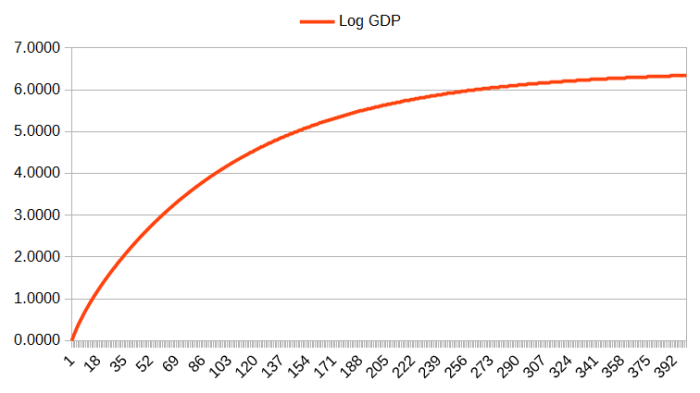
Solow_logGDP

The units are arbitrary, though it’s not unreasonable to imagine them as being years and hundreds of dollars in per-capita GDP. If that is indeed what you imagine them to be, my model shows us the Star Trek future: In about 300 years, we rise from a per-capita GDP of $10,000 to one of $165,000—from a world much like today to a world where everyone is a millionaire.

Notice that the growth rate slows down a great deal fairly quickly; by the end of 100 years (i.e., the end of the 21st century), growth has slowed from its peak over 10% to just over 2% per year. By the end of the 300-year period, the growth rate is a crawl of only 0.1%.

Of course this model is very simplistic, but I chose it for a very specific reason: This is not a radical left-wing environmentalist model involving “limits to growth” or “degrowth”. This is the Solow-Swan model, the paradigm example of neoclassical models of economic growth. It is sometimes in fact called simply “the neoclassical growth model”, because it is that influential. I made one very small change from the usual form, which was to assume that the rate of productivity growth would decline exponentially over time. Since productivity growth is exogenous to the model, this is a very simple change to make; it amounts to saying that productivity-enhancing technology is subject to diminishing returns, which fits recent data fairly well but could be totally wrong if something like artificial intelligence or neural enhancement ever takes off.

I chose this because many environmentalists seem to think that economists have this delusional belief that we can maintain a rate of economic growth equal to today indefinitely. David Attenborough famously said “Anyone who believes in indefinite growth in anything physical, on a physically finite planet, is either mad – or an economist.”

Another physicist argued that if we increase energy consumption 2.3% per year for 400 years, we’d literally boil the Earth. Yes, we would, and no economist I know of believes that this is what will happen. Economic growth doesn’t require energy growth, and we do not think growth can or should continue indefinitely—we just think it can and should continue a little while longer. We don’t think that a world standard of living 1000 times as good as Norway is going to happen; we think that a world standard of living equal to Norway is worth fighting for.

Indeed, we are often the ones trying to explain to leaders that they need to adapt to slower growth rates—this is particularly a problem in China, where nationalism and groupthink seems to have convinced many people in China that 7% annual growth is the result of some brilliant unique feature of the great Chinese system, when it is in fact simply the expected high growth rate for an economy that is very poor and still catching up by establishing a capital base. (It’s not so much what they are doing right now, as what they were doing wrong before. Just as you feel a lot better when you stop hitting yourself in the head, countries tend to grow quite fast after they transition out of horrifically terrible economic policy—and it doesn’t get much more terrible than Mao.) Even a lot of the IMF projections are now believed to be too optimistic, because they didn’t account for how China was fudging the numbers and rapidly depleting natural resources.

Some of the specific policies recommended in the article are reasonable, while others go to far.

1. Energy: cap, reduce, and ration it. Energy is what makes the economy go, and expanded energy consumption is what makes it grow. Climate scientists advocate capping and reducing carbon emissions to prevent planetary disaster, and cutting carbon emissions inevitably entails reducing energy from fossil fuels. However, if we aim to shrink the size of the economy, we should restrain not just fossil energy, but all energy consumption. The fairest way to do that would probably be with tradable energy quotas.

I strongly support cap-and-trade on fossil fuels, but I can’t support it on energy in general, unless we get so advanced that we’re seriously concerned about significantly altering the entropy of the universe. Solar power does not have negative externalities, and therefore should not be taxed or capped.

The shift to renewable energy sources is a no-brainer, and I know of no ecologist and few economists who would disagree.

This one is rich, coming from someone who goes on to argue for nonsensical deurbanization:

However, this is a complicated process. It will not be possible merely to unplug coal power plants, plug in solar panels, and continue with business as usual: we have built our immense modern industrial infrastructure of cities, suburbs, highways, airports, and factories to take advantage of the unique qualities and characteristics of fossil fuels.

How will we make our industrial infrastructure run off a solar grid? Urbanization. When everything is in one place, you can use public transportation and plug everything into the grid. We could replace the interstate highway system with a network of maglev lines, provided that almost everyone lived in major cities that were along those lines. We can’t do that if people move out of cities and go back to being farmers.

Here’s another weird one:

Without continued economic growth, the market economy probably can’t function long. This suggests we should run the transformational process in reverse by decommodifying land, labor, and money.

“Decommodifying money”? That’s like skinning leather or dehydrating water. The whole point of money is that it is a maximally fungible commodity. I support the idea of a land tax to provide a basic income, which could go a long way to decommodifying land and labor; but you can’t decommodify money.

The next one starts off sounding ridiculous, but then gets more reasonable:

4. Get rid of debt. Decommodifying money means letting it revert to its function as an inert medium of exchange and store of value, and reducing or eliminating the expectation that money should reproduce more of itself. This ultimately means doing away with interest and the trading or manipulation of currencies. Make investing a community-mediated process of directing capital toward projects that are of unquestioned collective benefit. The first step: cancel existing debt. Then ban derivatives, and tax and tightly regulate the buying and selling of financial instruments of all kinds.

No, we’re not going to get rid of debt. But should we regulate it more? Absolutely. A ban on derivatives is strong, but shouldn’t be out of the question; it’s not clear that even the most useful derivatives (like interest rate swaps and stock options) bring more benefit than they cause harm.

The next proposal, to reform our monetary system so that it is no longer based on debt, is one I broadly agree with, though you need to be clear about how you plan to do that. Positive Money’s plan to make central banks democratically accountable, establish full-reserve banking, and print money without trying to hide it in arcane accounting mechanisms sounds pretty good to me. Going back to the gold standard or something would be a terrible idea. The article links to a couple of “alternative money theorists”, but doesn’t explain further.

Sooner or later, we absolutely will need to restructure our macroeconomic policy so that 4% or even 2% real growth is no longer the expectation in First World countries. We will need to ensure that constant growth isn’t necessary to maintain stability and full employment.

But I believe we can do that, and in any case we do not want to stop global growth just yet—far from it. We are now on the verge of ending world hunger, and if we manage to do it, it will be from economic growth above all else.

The difference between price, cost, and value

JDN 2457559

This topic has been on the voting list for my Patreons for several months, but it never quite seems to win the vote. Well, this time it did. I’m glad, because I was tempted to do it anyway.

“Price”, “cost”, and “value”; the words are often used more or less interchangeably, not only by regular people but even by economists. I’ve read papers that talked about “rising labor costs” when what they clearly meant was rising wages—rising labor prices. I’ve read papers that tried to assess the projected “cost” of climate change by using the prices of different commodity futures. And hardly a day goes buy that I don’t see a TV commercial listing one (purely theoretical) price, cutting it in half (to the actual price), and saying they’re now giving you “more value”.

As I’ll get to, there are reasons to think they would be approximately the same for some purposes. Indeed, they would be equal, at the margin, in a perfectly efficient market—that may be why so many economists use them this way, because they implicitly or explicitly assume efficient markets. But they are fundamentally different concepts, and it’s dangerous to equate them casually.

Price

Price is exactly what you think it is: The number of dollars you must pay to purchase something. Most of the time when we talk about “cost” or “value” and then give a dollar figure, we’re actually talking about some notion of price.

Generally we speak in terms of nominal prices, which are the usual concept of prices in actual dollars paid, but sometimes we do also speak in terms of real prices, which are relative prices of different things once you’ve adjusted for overall inflation. “Inflation-adjusted price” can be a somewhat counter-intuitive concept; if a good’s (nominal) price rises, but by less than most other prices have risen, its real price has actually fallen.

You also need to be careful about just what price you’re looking at. When we look at labor prices, for example, we need to consider not only cash wages, but also fringe benefits and other compensation such as stock options. But other than that, prices are fairly straightforward.

Cost

Cost is probably not at all what you think it is. The real cost of something has nothing to do with money; saying that a candy bar “costs $2” or a computer “costs $2,000” is at best a somewhat sloppy shorthand and at worst a fundamental distortion of what cost is and why it matters. No, those are prices. The cost of a candy bar is the toil of children in cocoa farms in Cote d’Ivoire. The cost of a computer is the ecological damage and displaced indigenous people caused by coltan mining in Congo.

The cost of something is the harm that it does to human well-being (or for that matter to the well-being of any sentient being). It is not measured in money but in “the sweat of our laborers, the genius of our scientists, the hopes of our children” (to quote Eisenhower, who understood real cost better than most economists). There is also opportunity cost, the real cost we pay not by what we did, but by what we didn’t do—what we could have done instead.

This is important precisely because while costs should always be reduced when possible, prices can in fact be too low—and indeed, artificially low prices of goods due to externalities are probably the leading reason why humanity bears so many excess real costs. If the price of that chocolate bar accurately reflected the suffering of those African children (perhaps by—Gasp! Paying them a fair wage?), and the price of that computer accurately reflected the ecological damage of those coltan mines (a carbon tax, at least?), you might not want to buy them anymore; in which case, you should not have bought them. In fact, as I’ll get to once I discuss value, there is reason to think that even if you would buy them at a price that accurately reflected the dollar value of the real cost to their producers, we would still buy more than we should.

There is a point at which we should still buy things even though people get hurt making them; if you deny this, stop buying literally anything ever again. We don’t like to think about it, but any product we buy did cause some person, in some place, some degree of discomfort or unpleasantness in production. And many quite useful products will in fact cause death to a nonzero number of human beings.

For some products this is only barely true—it’s hard to feel bad for bestselling authors and artists who sell their work for millions, for whatever toil they may put into their work, whatever their elevated suicide rate (which is clearly endogenous; people aren’t randomly assigned to be writers), they also surely enjoy it a good deal of the time, and even if they didn’t, their work sells for millions. But for many products it is quite obviously true: A certain proportion of roofers, steelworkers, and truck drivers will die doing their jobs. We can either accept that, recognizing that it’s worth it to have roofs, steel, and trucking—and by extension, industrial capitalism, and its whole babies not dying thing—or we can give up on the entire project of human civilization, and go back to hunting and gathering; even if we somehow managed to avoid the direct homicide most hunter-gatherers engage in, far more people would simply die of disease or get eaten by predators.

Of course, we should have safety standards; but the benefits of higher safety must be carefully weighed against the potential costs of inefficiency, unemployment, and poverty. Safety regulations can reduce some real costs and increase others, even if they almost always increase prices. A good balance is struck when real cost is minimized, where any additional regulation would increase inefficiency more than it improves safety.

Actually OSHA are unsung heroes for their excellent performance at striking this balance, just as EPA are unsung heroes for their balance in environmental regulations (and that whole cutting crime in half business). If activists are mad at you for not banning everything bad and business owners are mad at you for not letting them do whatever they want, you’re probably doing it right. Would you rather people saved from fires, or fires prevented by good safety procedures? Would you rather murderers imprisoned, or boys who grow up healthy and never become murderers? If an ounce of prevention is worth a pound of cure, why does everyone love firefighters and hate safety regulators?So let me take this opportunity to say thank you, OSHA and EPA, for doing the jobs of firefighters and police way better than they do, and unlike them, never expecting to be lauded for it.

And now back to our regularly scheduled programming. Markets are supposed to reflect costs in prices, which is why it’s not totally nonsensical to say “cost” when you mean “price”; but in fact they aren’t very good at that, for reasons I’ll get to in a moment.

Value

Value is how much something is worth—not to sell it (that’s the price again), but to use it. One of the core principles of economics is that trade is nonzero-sum, because people can exchange goods that they value differently and thereby make everyone better off. They can’t price them differently—the buyer and the seller must agree upon a price to make the trade. But they can value them differently.

To see how this works, let’s look at a very simple toy model, the simplest essence of trade: Alice likes chocolate ice cream, but all she has is a gallon of vanilla ice cream. Bob likes vanilla ice cream, but all he has is a gallon of chocolate ice cream. So Alice and Bob agree to trade their ice cream, and both of them are happier.

We can measure value in “willingness-to-pay” (WTP), the highest price you’d willingly pay for something. That makes value look more like a price; but there are several reasons we must be careful when we do that. The obvious reason is that WTP is obviously going to vary based on overall inflation; since $5 isn’t worth as much in 2016 as it was in 1956, something with a WTP of $5 in 1956 would have a much higher WTP in 2016. The not-so-obvious reason is that money is worth less to you the more you have, so we also need to take into account the effect of wealth, and the marginal utility of wealth. The more money you have, the more money you’ll be willing to pay in order to get the same amount of real benefit. (This actually creates some very serious market distortions in the presence of high income inequality, which I may make the subject of a post or even a paper at some point.) Similarly there is “willingness-to-accept” (WTA), the lowest price you’d willingly accept for it. In theory these should be equal; in practice, WTA is usually slightly higher than WTP in what’s called endowment effect.

So to make our model a bit more quantitative, we could suppose that Alice values vanilla at $5 per gallon and chocolate at $10 per gallon, while Bob also values vanilla at $5 per gallon but only values chocolate at $4 per gallon. (I’m using these numbers to point out that not all the valuations have to be different for trade to be beneficial, as long as some are.) Therefore, if Alice sells her vanilla ice cream to Bob for $5, both will (just barely) accept that deal; and then Alice can buy chocolate ice cream from Bob for anywhere between $4 and $10 and still make both people better off. Let’s say they agree to also sell for $5, so that no net money is exchanged and it is effectively the same as just trading ice cream for ice cream. In that case, Alice has gained $5 in consumer surplus (her WTP of $10 minus the $5 she paid) while Bob has gained $1 in producer surplus (the $5 he received minus his $4 WTP). The total surplus will be $6 no matter what price they choose, which we can compute directly from Alice’s WTP of $10 minus Bob’s WTA of $4. The price ultimately decides how that total surplus is distributed between the two parties, and in the real world it would very likely be the result of which one is the better negotiator.

The enormous cost of our distorted understanding

(See what I did there?) If markets were perfectly efficient, prices would automatically adjust so that, at the margin, value is equal to price is equal to cost. What I mean by “at the margin” might be clearer with an example: Suppose we’re selling apples. How many apples do you decide to buy? Well, the value of each successive apple to you is lower, the more apples you have (the law of diminishing marginal utility, which unlike most “laws” in economics is actually almost always true). At some point, the value of the next apple will be just barely above what you have to pay for it, so you’ll stop there. By a similar argument, the cost of producing apples increases the more apples you produce (the law of diminishing returns, which is a lot less reliable, more like the Pirate Code), and the producers of apples will keep selling them until the price they can get is only just barely larger than the cost of production. Thus, in the theoretical limit of infinitely-divisible apples and perfect rationality, marginal value = price = marginal cost. In such a world, markets are perfectly efficient and they maximize surplus, which is the difference between value and cost.

But in the real world of course, none of those assumptions are true. No product is infinitely divisible (though the gasoline in a car is obviously a lot more divisible than the car itself). No one is perfectly rational. And worst of all, we’re not measuring value in the same units. As a result, there is basically no reason to think that markets are optimizing anything; their optimization mechanism is setting two things equal that aren’t measured the same way, like trying to achieve thermal equilibrium by matching the temperature of one thing in Celsius to the temperature of other things in Fahrenheit.

An implicit assumption of the above argument that didn’t even seem worth mentioning was that when I set value equal to price and set price equal to cost, I’m setting value equal to cost; transitive property of equality, right? Wrong. The value is equal to the price, as measured by the buyer. The cost is equal to the price, as measured by the seller.

If the buyer and seller have the same marginal utility of wealth, no problem; they are measuring in the same units. But if not, we convert from utility to money and then back to utility, using a different function to convert each time. In the real world, wealth inequality is massive, so it’s wildly implausible that we all have anything close to the same marginal utility of wealth. Maybe that’s close enough if you restrict yourself to middle-class people in the First World; so when a tutoring client pays me, we might really be getting close to setting marginal value equal to marginal cost. But once you include corporations that are owned by billionaires and people who live on $2 per day, there’s simply no way that those price-to-utility conversions are the same at each end. For Bill Gates, a million dollars is a rounding error. For me, it would buy a house, give me more flexible work options, and keep me out of debt, but not radically change the course of my life. For a child on a cocoa farm in Cote d’Ivoire, it could change her life in ways she can probably not even comprehend.

The market distortions created by this are huge; indeed, most of the fundamental flaws in capitalism as we know it are ultimately traceable to this. Why do Americans throw away enough food to feed all the starving children in Africa? Marginal utility of wealth. Why are Silicon Valley programmers driving the prices for homes in San Francisco higher than most Americans will make in their lifetimes? Marginal utility of wealth. Why are the Koch brothers spending more on this year’s elections than the nominal GDP of the Gambia? Marginal utility of wealth. It’s the sort of pattern that once you see it suddenly seems obvious and undeniable, a paradigm shift a bit like the heliocentric model of the solar system. Forget trade barriers, immigration laws, and taxes; the most important market distortions around the world are all created by wealth inequality. Indeed, the wonder is that markets work as well as they do.

The real challenge is what to do about it, how to reduce this huge inequality of wealth and therefore marginal utility of wealth, without giving up entirely on the undeniable successes of free market capitalism. My hope is that once more people fully appreciate the difference between price, cost, and value, this paradigm shift will be much easier to make; and then perhaps we can all work together to find a solution.

Selling debt goes against everything the free market stands for

JDN 2457555

I don’t think most people—or even most economists—have any concept of just how fundamentally perverse and destructive our financial system has become, and a large chunk of it ultimately boils down to one thing: Selling debt.

Certainly collateralized debt obligations (CDOs), and their meta-form, CDO2s (pronounced “see-dee-oh squareds”), are nothing more than selling debt, and along with credit default swaps (CDS; they are basically insurance, but without those pesky regulations against things like fraud and conflicts of interest) they were directly responsible for the 2008 financial crisis and the ensuing Great Recession and Second Depression.

But selling debt continues in a more insidious way, underpinning the entire debt collection industry which raises tens of billions of dollars per year by harassment, intimidation and extortion, especially of the poor and helpless. Frankly, I think what’s most shocking is how little money they make, given the huge number of people they harass and intimidate.

John Oliver did a great segment on debt collections (with a very nice surprise at the end):

But perhaps most baffling to me is the number of people who defend the selling of debt on the grounds that it is a “free market” activity which must be protected from government “interference in personal liberty”. To show this is not a strawman, here’s the American Enterprise Institute saying exactly that.

So let me say this in no uncertain terms: Selling debt goes against everything the free market stands for.

One of the most basic principles of free markets, one of the founding precepts of capitalism laid down by no less than Adam Smith (and before him by great political philosophers like John Locke), is the freedom of contract. This is the good part of capitalism, the part that makes sense, the reason we shouldn’t tear it all down but should instead try to reform it around the edges.

Indeed, the freedom of contract is so fundamental to human liberty that laws can only be considered legitimate insofar as they do not infringe upon it without a compelling public interest. Freedom of contract is right up there with freedom of speech, freedom of the press, freedom of religion, and the right of due process.

The freedom of contract is the right to make agreements, including financial agreements, with anyone you please, and under conditions that you freely and rationally impose in a state of good faith and transparent discussion. Conversely, it is the right not to make agreements with those you choose not to, and to not be forced into agreements under conditions of fraud, intimidation, or impaired judgment.

Freedom of contract is the basis of my right to take on debt, provided that I am honest about my circumstances and I can find a lender who is willing to lend to me. So taking on debt is a fundamental part of freedom of contract.

But selling debt is something else entirely. Far from exercising the freedom of contract, it violates it. When I take out a loan from bank A, and then they turn around and sell that loan to bank B, I suddenly owe money to bank B, but I never agreed to do that. I had nothing to do with their decision to work with bank B as opposed to keeping the loan or selling it to bank C.

Current regulations prohibit banks from “changing the terms of the loan”, but in practice they change them all the time—they can’t change the principal balance, the loan term, or the interest rate, but they can change the late fees, the payment schedule, and lots of subtler things about the loan that can still make a very big difference. Indeed, as far as I’m concerned they have changed the terms of the loan—one of the terms of the loan was that I was to pay X amount to bank A, not that I was to pay X amount to bank B. I may or may not have good reasons not to want to pay bank B—they might be far less trustworthy than bank A, for instance, or have a far worse social responsibility record—and in any case it doesn’t matter; it is my choice whether or not I want anything to do with bank B, whatever my reasons might be.

I take this matter quite personally, for it is by the selling of debt that, in moral (albeit not legal) terms, a British bank stole my parents’ house. Indeed, not just any British bank; it was none other than HSBC, the money launderers for terrorists.

When they first obtained their mortgage, my parents did not actually know that HSBC was quite so evil as to literally launder money for terrorists, but they did already know that they were involved in a great many shady dealings, and even specifically told their lender that they did not want the loan sold, and if it was to be sold, it was absolutely never to be sold to HSBC in particular. Their mistake (which was rather like the “mistake” of someone who leaves their car unlocked and has it stolen, or forgets to arm the home alarm system and suffers a burglary) was not to get this written into the formal contract, rather than simply made as a verbal agreement with the bankers. Such verbal contracts are enforceable under the law, at least in theory; but that would require proof of the verbal contract (and what proof could we provide?), and also probably have cost as much as the house in litigation fees.

Oh, by the way, they were given a subprime interest rate of 8% despite being middle-class professionals with good credit, no doubt to maximize the broker’s closing commission. Most banks reserved such behavior for racial minorities, but apparently this one was equal-opportunity in the worst way.Perhaps my parents were naive to trust bankers any further than they could throw them.

As a result, I think you know what happened next: They sold the loan to HSBC.

Now, had it ended there, with my parents unwittingly forced into supporting a bank that launders money for terrorists, that would have been bad enough. But it assuredly did not.

By a series of subtle and manipulative practices that poked through one loophole after another, HSBC proceeded to raise my parents’ payments higher and higher. One particularly insidious tactic they used was to sit on the checks until just after the due date passed, so they could charge late fees on the payments, then they recapitalized the late fees. My parents caught on to this particular trick after a few months, and started mailing the checks certified so they would be date-stamped; and lo and behold, all the payments were suddenly on time! By several other similarly devious tactics, all of which were technically legal or at least not provable, they managed to raise my parents’ monthly mortgage payments by over 50%.

Note that it was a fixed-rate, fixed-term mortgage. The initial payments—what should have been always the payments, that’s the point of a fixed-rate fixed-term mortgage—were under $2000 per month. By the end they were paying over $3000 per month. HSBC forced my parents to overpay on a mortgage an amount equal to the US individual poverty line, or the per-capita GDP of Peru.

They tried to make the payments, but after being wildly over budget and hit by other unexpected expenses (including defects in the house’s foundation that they had to pay to fix, but because of the “small” amount at stake and the overwhelming legal might of the construction company, no lawyer was willing to sue over), they simply couldn’t do it anymore, and gave up. They gave the house to the bank with a deed in lieu of foreclosure.

And that is the story of how a bank that my parents never agreed to work with, never would have agreed to work with, indeed specifically said they would not work with, still ended up claiming their house—our house, the house I grew up in from the age of 12. Legally, I cannot prove they did anything against the law. (I mean, other than laundered money for terrorists.) But morally, how is this any less than theft? Would we not be victimized less had a burglar broken into our home, vandalized the walls and stolen our furniture?

Indeed, that would probably be covered under our insurance! Where can I buy insurance against the corrupt and predatory financial system? Where are my credit default swaps to pay me when everything goes wrong?

And all of this could have been prevented, if banks simply weren’t allowed to violate our freedom of contract by selling their loans to other banks.

Indeed, the Second Depression could probably have been likewise prevented. Without selling debt, there is no securitization. Without securitization, there is far less leverage. Without leverage, there are not bank failures. Without bank failures, there is no depression. A decade of global economic growth was lost because we allowed banks to sell debt whenever they please.

I have heard the counter-arguments many times:

“But what if banks need the liquidity?” Easy. They can take out their own loans with those other banks. If bank A finds they need more cashflow, they should absolutely feel free to take out a loan from bank B. They can even point to their projected revenues from the mortgage payments we owe them, as a means of repaying that loan. But they should not be able to involve us in that transaction. If you want to trust HSBC, that’s your business (you’re an idiot, but it’s a free country). But you have no right to force me to trust HSBC.

“But banks might not be willing to make those loans, if they knew they couldn’t sell or securitize them!” THAT’S THE POINT. Banks wouldn’t take on all these ridiculous risks in their lending practices that they did (“NINJA loans” and mortgages with payments larger than their buyers’ annual incomes), if they knew they couldn’t just foist the debt off on some Greater Fool later on. They would only make loans they actually expect to be repaid. Obviously any loan carries some risk, but banks would only take on risks they thought they could bear, as opposed to risks they thought they could convince someone else to bear—which is the definition of moral hazard.

“Homes would be unaffordable if people couldn’t take out large loans!” First of all, I’m not against mortgages—I’m against securitization of mortgages. Yes, of course, people need to be able to take out loans. But they shouldn’t be forced to pay those loans to whoever their bank sees fit. If indeed the loss of subprime securitized mortgages made it harder for people to get homes, that’s a problem; but the solution to that problem was never to make it easier for people to get loans they can’t afford—it is clearly either to reduce the price of homes or increase the incomes of buyers. Subsidized housing construction, public housing, changes in zoning regulation, a basic income, lower property taxes, an expanded earned-income tax credit—these are the sort of policies that one implements to make housing more affordable, not “go ahead and let banks exploit people however they want”.

Remember, a regulation against selling debt would protect the freedom of contract. It would remove a way for private individuals and corporations to violate that freedom, like regulations against fraud, intimidation, and coercion. It should be uncontroversial that no one has any right to force you to do business with someone you would not voluntarily do business with, certainly not in a private transaction between for-profit corporations. Maybe that sort of mandate makes sense in rare circumstances by the government, but even then it should really be implemented as a tax, not a mandate to do business with a particular entity. The right to buy what you choose is the foundation of a free market—and implicit in it is the right not to buy what you do not choose.

There are many regulations on debt that do impose upon freedom of contract: As horrific as payday loans are, if someone really honestly knowingly wants to take on short-term debt at 400% APR I’m not sure it’s my business to stop them. And some people may really be in such dire circumstances that they need money that urgently and no one else will lend to them. Insofar as I want payday loans regulated, it is to ensure that they are really lending in good faith—as many surely are not—and ultimately I want to outcompete them by providing desperate people with more reasonable loan terms. But a ban on securitization is like a ban on fraud; it is the sort of law that protects our rights.

Moral responsibility does not inherit across generations

JDN 2457548

In last week’s post I made a sharp distinction between believing in human progress and believing that colonialism was justified. To make this argument, I relied upon a moral assumption that seems to me perfectly obvious, and probably would to most ethicists as well: Moral responsibility does not inherit across generations, and people are only responsible for their individual actions.

But is in fact this principle is not uncontroversial in many circles. When I read utterly nonsensical arguments like this one from the aptly-named Race Baitr saying that White people have no role to play in the liberation of Black people apparently because our blood is somehow tainted by the crimes our ancestors, it becomes apparent to me that this principle is not obvious to everyone, and therefore is worth defending. Indeed, many applications of the concept of “White Privilege” seem to ignore this principle, speaking as though racism is not something one does or participates in, but something that one is simply by being born with less melanin. Here’s a Salon interview specifically rejecting the proposition that racism is something one does:

For white people, their identities rest on the idea of racism as about good or bad people, about moral or immoral singular acts, and if we’re good, moral people we can’t be racist – we don’t engage in those acts. This is one of the most effective adaptations of racism over time—that we can think of racism as only something that individuals either are or are not “doing.”

If racism isn’t something one does, then what in the world is it? It’s all well and good to talk about systems and social institutions, but ultimately systems and social institutions are made of human behaviors. If you think most White people aren’t doing enough to combat racism (which sounds about right to me!), say that—don’t make some bizarre accusation that simply by existing we are inherently racist. (Also: We? I’m only 75% White, so am I only 75% inherently racist?) And please, stop redefining the word “racism” to mean something other than what everyone uses it to mean; “White people are snakes” is in fact a racist sentiment (and yes, one I’ve actually heard–indeed, here is the late Muhammad Ali comparing all White people to rattlesnakes, and Huffington Post fawning over him for it).

Racism is clearly more common and typically worse when performed by White people against Black people—but contrary to the claims of some social justice activists the White perpetrator and Black victim are not part of the definition of racism. Similarly, sexism is more common and more severe committed by men against women, but that doesn’t mean that “men are pigs” is not a sexist statement (and don’t tell me you haven’t heard that one). I don’t have a good word for bigotry by gay people against straight people (“heterophobia”?) but it clearly does happen on occasion, and similarly cannot be defined out of existence.

I wouldn’t care so much that you make this distinction between “racism” and “racial prejudice”, except that it’s not the normal usage of the word “racism” and therefore confuses people, and also this redefinition clearly is meant to serve a political purpose that is quite insidious, namely making excuses for the most extreme and hateful prejudice as long as it’s committed by people of the appropriate color. If “White people are snakes” is not racism, then the word has no meaning.

Not all discussions of “White Privilege” are like this, of course; this article from Occupy Wall Street actually does a fairly good job of making “White Privilege” into a sensible concept, albeit still not a terribly useful one in my opinion. I think the useful concept is oppression—the problem here is not how we are treating White people, but how we are treating everyone else. What privilege gives you is the freedom to be who you are.”? Shouldn’t everyone have that?

Almost all the so-called “benefits” or “perks” associated with privilege” are actually forgone harms—they are not good things done to you, but bad things not done to you. But benefitting from racist systems doesn’t mean that everything is magically easy for us. It just means that as hard as things are, they could always be worse.” No, that is not what the word “benefit” means. The word “benefit” means you would be worse off without it—and in most cases that simply isn’t true. Many White people obviously think that it is true—which is probably a big reason why so many White people fight so hard to defend racism, you know; you’ve convinced them it is in their self-interest. But, with rare exceptions, it is not; most racial discrimination has literally zero long-run benefit. It’s just bad. Maybe if we helped people appreciate that more, they would be less resistant to fighting racism!

The only features of “privilege” that really make sense as benefits are those that occur in a state of competition—like being more likely to be hired for a job or get a loan—but one of the most important insights of economics is that competition is nonzero-sum, and fairer competition ultimately means a more efficient economy and thus more prosperity for everyone.

But okay, let’s set that aside and talk about this core question of what sort of responsibility we bear for the acts of our ancestors. Many White people clearly do feel deep shame about what their ancestors (or people the same color as their ancestors!) did hundreds of years ago. The psychological reactance to that shame may actually be what makes so many White people deny that racism even exists (or exists anymore)—though a majority of Americans of all races do believe that racism is still widespread.

We also apply some sense of moral responsibility applied to whole races quite frequently. We speak of a policy “benefiting White people” or “harming Black people” and quickly elide the distinction between harming specific people who are Black, and somehow harming “Black people” as a group. The former happens all the time—the latter is utterly nonsensical. Similarly, we speak of a “debt owed by White people to Black people” (which might actually make sense in the very narrow sense of economic reparations, because people do inherit money! They probably shouldn’t, that is literally feudalist, but in the existing system they in fact do), which makes about as much sense as a debt owed by tall people to short people. As Walter Michaels pointed out in The Trouble with Diversity (which I highly recommend), because of this bizarre sense of responsibility we are often in the habit of “apologizing for something you didn’t do to people to whom you didn’t do it (indeed to whom it wasn’t done)”. It is my responsibility to condemn colonialism (which I indeed do), to fight to ensure that it never happens again; it is not my responsibility to apologize for colonialism.

This makes some sense in evolutionary terms; it’s part of the all-encompassing tribal paradigm, wherein human beings come to identify themselves with groups and treat those groups as the meaningful moral agents. It’s much easier to maintain the cohesion of a tribe against the slings and arrows (sometimes quite literal) of outrageous fortune if everyone believes that the tribe is one moral agent worthy of ultimate concern.

This concept of racial responsibility is clearly deeply ingrained in human minds, for it appears in some of our oldest texts, including the Bible: “You shall not bow down to them or worship them; for I, the Lord your God, am a jealous God, punishing the children for the sin of the parents to the third and fourth generation of those who hate me,” (Exodus 20:5)

Why is inheritance of moral responsibility across generations nonsensical? Any number of reasons, take your pick. The economist in me leaps to “Ancestry cannot be incentivized.” There’s no point in holding people responsible for things they can’t control, because in doing so you will not in any way alter behavior. The Stanford Encyclopedia of Philosophy article on moral responsibility takes it as so obvious that people are only responsible for actions they themselves did that they don’t even bother to mention it as an assumption. (Their big question is how to reconcile moral responsibility with determinism, which turns out to be not all that difficult.)

An interesting counter-argument might be that descent can be incentivized: You could use rewards and punishments applied to future generations to motivate current actions. But this is actually one of the ways that incentives clearly depart from moral responsibilities; you could incentivize me to do something by threatening to murder 1,000 children in China if I don’t, but even if it was in fact something I ought to do, it wouldn’t be those children’s fault if I didn’t do it. They wouldn’t deserve punishment for my inaction—I might, and you certainly would for using such a cruel incentive.

Moreover, there’s a problem with dynamic consistency here: Once the action is already done, what’s the sense in carrying out the punishment? This is why a moral theory of punishment can’t merely be based on deterrence—the fact that you could deter a bad action by some other less-bad action doesn’t make the less-bad action necessarily a deserved punishment, particularly if it is applied to someone who wasn’t responsible for the action you sought to deter. In any case, people aren’t thinking that we should threaten to punish future generations if people are racist today; they are feeling guilty that their ancestors were racist generations ago. That doesn’t make any sense even on this deterrence theory.

There’s another problem with trying to inherit moral responsibility: People have lots of ancestors. Some of my ancestors were most likely rapists and murderers; most were ordinary folk; a few may have been great heroes—and this is true of just about anyone anywhere. We all have bad ancestors, great ancestors, and, mostly, pretty good ancestors. 75% of my ancestors are European, but 25% are Native American; so if I am to apologize for colonialism, should I be apologizing to myself? (Only 75%, perhaps?) If you go back enough generations, literally everyone is related—and you may only have to go back about 4,000 years. That’s historical time.

Of course, we wouldn’t be different colors in the first place if there weren’t some differences in ancestry, but there is a huge amount of gene flow between different human populations. The US is a particularly mixed place; because most Black Americans are quite genetically mixed, it is about as likely that any randomly-selected Black person in the US is descended from a slaveowner as it is that any randomly-selected White person is. (Especially since there were a large number of Black slaveowners in Africa and even some in the United States.) What moral significance does this have? Basically none! That’s the whole point; your ancestors don’t define who you are.

If these facts do have any moral significance, it is to undermine the sense most people seem to have that there are well-defined groups called “races” that exist in reality, to which culture responds. No; races were created by culture. I’ve said this before, but it bears repeating: The “races” we hold most dear in the US, White and Black, are in fact the most nonsensical. “Asian” and “Native American” at least almost make sense as categories, though Chippewa are more closely related to Ainu than Ainu are to Papuans. “Latino” isn’t utterly incoherent, though it includes as much Aztec as it does Iberian. But “White” is a club one can join or be kicked out of, while “Black” is the majority of genetic diversity.

Sex is a real thing—while there are intermediate cases of course, broadly speaking humans, like most metazoa, are sexually dimorphic and come in “male” and “female” varieties. So sexism took a real phenomenon and applied cultural dynamics to it; but that’s not what happened with racism. Insofar as there was a real phenomenon, it was extremely superficial—quite literally skin deep. In that respect, race is more like class—a categorization that is itself the result of social institutions.

To be clear: Does the fact that we don’t inherit moral responsibility from our ancestors absolve us from doing anything to rectify the inequities of racism? Absolutely not. Not only is there plenty of present discrimination going on we should be fighting, there are also inherited inequities due to the way that assets and skills are passed on from one generation to the next. If my grandfather stole a painting from your grandfather and both our grandfathers are dead but I am now hanging that painting in my den, I don’t owe you an apology—but I damn well owe you a painting.

The further we become from the past discrimination the harder it gets to make reparations, but all hope is not lost; we still have the option of trying to reset everyone’s status to the same at birth and maintaining equality of opportunity from there. Of course we’ll never achieve total equality of opportunity—but we can get much closer than we presently are.

We could start by establishing an extremely high estate tax—on the order of 99%—because no one has a right to be born rich. Free public education is another good way of equalizing the distribution of “human capital” that would otherwise be concentrated in particular families, and expanding it to higher education would make it that much better. It even makes sense, at least in the short run, to establish some affirmative action policies that are race-conscious and sex-conscious, because there are so many biases in the opposite direction that sometimes you must fight bias with bias.

Actually what I think we should do in hiring, for example, is assemble a pool of applicants based on demographic quotas to ensure a representative sample, and then anonymize the applications and assess them on merit. This way we do ensure representation and reduce bias, but don’t ever end up hiring anyone other than the most qualified candidate. But nowhere should we think that this is something that White men “owe” to women or Black people; it’s something that people should do in order to correct the biases that otherwise exist in our society. Similarly with regard to sexism: Women exhibit just as much unconscious bias against other women as men do. This is not “men” hurting “women”—this is a set of unconscious biases found in almost everywhere and social structures almost everywhere that systematically discriminate against people because they are women.

Perhaps by understanding that this is not about which “team” you’re on (which tribe you’re in), but what policy we should have, we can finally make these biases disappear, or at least fade so small that they are negligible.

The unending madness of the gold standard

JDN 2457545

If you work in economics in any capacity (much like “How is the economy doing?” you don’t even really need to be in macroeconomics), you will encounter many people who believe in the gold standard. Many of these people will be otherwise quite intelligent and educated; they often understand economics better than most people (not that this is saying a whole lot). Yet somehow they continue to hold—and fiercely defend—this incredibly bizarre and anachronistic view of macroeconomics.

They even bring it up at the oddest times; I recently encountered someone who wrote a long and rambling post arguing for drug legalization (which I largely agree with, by the way) and concluded it with #EndTheFed, not seeming to grasp the total and utter irrelevance of this juxtaposition. It seems like it was just a conditioned response, or maybe the sort of irrelevant but consistent coda originally perfected by Cato and his “Carthago delenda est. “Foederale Reservatum delendum est. Hey, maybe that’s why they’re called the Cato Institute.

So just how bizarre is the gold standard? Well, let’s look at what sort of arguments they use to defend it. I’ll use Charles Kadlic, prominent Libertarian blogger on Forbes, as an example, with his “Top Ten Reasons That You Should Support the ‘Gold Commission’”:

  1. A gold standard is key to achieving a period of sustained, 4% real economic growth.
  2. A gold standard reduces the risk of recessions and financial crises.
  3. A gold standard would restore rising living standards to the middle-class.
  4. A gold standard would restore long-term price stability.
  5. A gold standard would stop the rise in energy prices.
  6. A gold standard would be a powerful force for restoring fiscal balance to federal state and local governments.
  7. A gold standard would help save Medicare and Social Security.
  8. A gold standard would empower Main Street over Wall Street.
  9. A gold standard would increase the liberty of the American people.
  10. Creation of a gold commission will provide the forum to chart a prudent path toward a 21st century gold standard.

Number 10 can be safely ignored, as clearly Kadlic just ran out of reasons and to make a round number tacked on the implicit assumption of the entire article, namely that this ‘gold commission’ would actually realistically lead us toward a gold standard. (Without it, the other 9 reasons are just non sequitur.)

So let’s look at the other 9, shall we? Literally none of them are true. Several are outright backward.

You know a policy is bad when even one of its most prominent advocates can’t even think of a single real benefit it would have. A lot of quite bad policies do have perfectly real benefits, they’re just totally outweighed by their costs: For example, cutting the top income tax rate to 20% probably would actually contribute something to economic growth. Not a lot, and it would cut a swath through the federal budget and dramatically increase inequality—but it’s not all downside. Yet Kadlic couldn’t actually even think of one benefit of the gold standard that actually holds up. (I actually can do his work for him: I do know of one benefit of the gold standard, but as I’ll get to momentarily it’s quite small and can easily be achieved in better ways.)

First of all, it’s quite clear that the gold standard did not increase economic growth. If you cherry-pick your years properly, you can make it seem like Nixon leaving the gold standard hurt growth, but if you look at the real long-run trends in economic growth it’s clear that we had really erratic growth up until about the 1910s (the surge of government spending in WW1 and the establishment of the Federal Reserve), at which point went through a temporary surge recovering from the Great Depression and then during WW2, and finally, if you smooth out the business cycle, our growth rates have slowly trended downward as growth in productivity has gradually slowed down.

Here’s GDP growth from 1800 to 1900, when we were on the classical gold standard:

US_GDP_growth_1800s

Here’s GDP growth from 1929 to today, using data from the Bureau of Economic Analysis:

US_GDP_growth_BEA

Also, both of these are total GDP growth (because that is what Kadlic said), which means that part of what you’re seeing here is population growth rather than growth in income per person. Here’s GDP per person in the 1800s:

US_GDP_growth_1800s

If you didn’t already know, I bet you can’t guess where on those graphs we left the gold standard, which you’d clearly be able to do if the gold standard had this dramatic “double your GDP growth” kind of effect. I can’t immediately rule out some small benefit to the gold standard just from this data, but don’t worry; more thorough economic studies have done that. Indeed, it is the mainstream consensus among economists today that the gold standard is what caused the Great Depression.

Indeed, there’s a whole subfield of historical economics research that basically amounts to “What were they thinking?” trying to explain why countries stayed on the gold standard for so long when it clearly wasn’t working. Here’s a paper trying to argue it was a costly signal of your “rectitude” in global bond markets, but I find much more compelling the argument that it was psychological: Their belief in the gold standard was simply too strong, so confirmation bias kept holding them back from what needed to be done. They were like my aforementioned #EndTheFed acquaintance.

Then we get to Kadlic’s second point: Does the gold standard reduce the risk of financial crises? Let’s also address point 4, which is closely related: Does the gold standard improve price stability? Tell that to 1929.

In fact, financial crises were more common on the classical gold standard; the period of pure fiat monetary policy was so stable that it was called the Great Moderation, until the crash in 2008 screwed it all up—and that crash occurred essentially outside the standard monetary system, in the “shadow banking system” of unregulated and virtually unlimited derivatives. Had we actually forced banks to stay within the light of the standard banking system, the Great Moderation might have continued indefinitely.

As for “price stability”, that’s sort of true if you look at the long run, because prices were as likely to go down as they were to go up. But that isn’t what we mean by “price stability”. A system with good price stability will have a low but positive and steady level of inflation, and will therefore exhibit some long-run increases in price levels; it won’t have prices jump up and down erratically and end up on average the same.

For jump up and down is what prices did on the gold standard, as you can see from FRED:

US_inflation_longrun

This is something we could have predicted in advance; the price of any given product jumps up and down over time, and gold is just one product among many. Tying prices to gold makes no more sense than tying them to any other commodity.

As for stopping the rise in energy prices, energy prices aren’t rising. Even if they were (and they could at some point), the only way the gold standard would stop that is by triggering deflation (and therefore recession) in the rest of the economy.

Regarding number 6, I don’t see how the fiscal balance of federal and state governments is improved by periodic bouts of deflation that make their debt unpayable.

As for number 7, saving Medicare and Social Security, their payments out are tied to inflation and their payments in are tied to nominal GDP, so overall inflation has very little effect on their long-term stability. In any case, the problem with Medicare is spiraling medical costs (which Obamacare has done a lot to fix), and the problem with Social Security is just the stupid arbitrary cap on the income subject to payroll tax; the gold standard would do very little to solve either of those problems, though I guess it would make the nominal income cap less binding by triggering deflation, which is just about the worst way to avoid a price ceiling I’ve ever heard.

Regarding 8 and 9, I don’t even understand why Kadlic thinks that going to a gold standard would empower individuals over banks (does it seem like individuals were empowered over banks in the “Robber Baron Era”?), or what in the world it has to do with giving people more liberty (all that… freedom… you lose… when the Fed… stabilizes… prices?), so I don’t even know where to begin on those assertions. You know what empowers people over banks? The Consumer Financial Protection Bureau. You know what would enhance liberty? Ending mass incarceration. Libertarians fight tooth and nail against the former; sometimes they get behind the latter, but sometimes they don’t; Gary Johnson for some bizarre reason believes in privatization of prisons, which are directly linked to the surge in US incarceration.

The only benefit I’ve been able to come up with for the gold standard is as a commitment mechanism, something the Federal Reserve could do to guarantee its future behavior and thereby reduce the fear that it will suddenly change course on its past promises. This would make forward guidance a lot more effective at changing long-term interest rates, because people would have reason to believe that the Fed means what it says when it projects its decisions 30 years out.

But there are much simpler and better commitment mechanisms the Fed could use. They could commit to a Taylor Rule or nominal GDP targeting, both of which mainstream economists have been clamoring for for decades. There are some definite downsides to both proposals, but also some important upsides; and in any case they’re both obviously better than the gold standard and serve the same forward guidance function.

Indeed, it’s really quite baffling that so many people believe in the gold standard. It cries out for some sort of psychological explanation, as to just what cognitive heuristic is failing when otherwise-intelligent and highly-educated people get monetary policy so deeply, deeply wrong. A lot of them don’t even to seem grasp when or how we left the gold standard; it really happened when FDR suspended gold convertibility in 1933. After that on the Bretton Woods system only national governments could exchange money for gold, and the Nixon shock that people normally think of as “ending the gold standard” was just the final nail in the coffin, and clearly necessary since inflation was rapidly eating through our gold reserves.

A lot of it seems to come down to a deep distrust of government, especially federal government (I still do not grok why the likes of Ron Paul think state governments are so much more trustworthy than the federal government); the Federal Reserve is a government agency (sort of) and is therefore not to be trusted—and look, it has federal right there in the name.

But why do people hate government so much? Why do they think politicians are much less honest than they actually are? Part of it could have to do with the terrifying expansion of surveillance and weakening of civil liberties in the face of any perceived outside threat (Sedition Act, PATRIOT ACT, basically the same thing), but often the same people defending those programs are the ones who otherwise constantly complain about Big Government. Why do polls consistently show that people don’t trust the government, but want it to do more?

I think a lot of this comes down to the vague meaning of the word “government” and the associations we make with particular questions about it. When I ask “Do you trust the government?” you think of the NSA and the Vietnam War and Watergate, and you answer “No.” But when I ask “Do you want the government to do more?” you think of the failure at Katrina, the refusal to expand Medicaid, the pitiful attempts at reducing carbon emissions, and you answer “Yes.” When I ask if you like the military, your conditioned reaction is to say the patriotic thing, “Yes.” But if I ask whether you like the wars we’ve been fighting lately, you think about the hundreds of thousands of people killed and the wanton destruction to achieve no apparent actual objective, and you say “No.” Most people don’t come to these polls with thought-out opinions they want to express; the questions evoke emotional responses in them and they answer accordingly. You can also evoke different responses by asking “Should we cut government spending?” (People say “Yes.”) versus asking “Should we cut military spending, Social Security, or Medicare?” (People say “No.”) The former evokes a sense of abstract government taking your tax money; the latter evokes the realization that this money is used for public services you value.

So, the gold standard has acquired positive emotional vibes, and the Fed has acquired negative emotional vibes.

The former is fairly easy to explain: “good as gold” is an ancient saying, and “the gold standard” is even a saying we use in general to describe the right way of doing something (“the gold standard in prostate cancer treatment”). Humans have always had a weird relationship with gold; something about its timeless and noncorroding shine mesmerizes us. That’s why you occasionally get proposals for a silver standard, but no one ever seems to advocate an oil standard, an iron standard, or a lumber standard, which would make about as much sense.

The latter is a bit more difficult to explain: What did the Fed ever do to you? But I think it might have something to do with the complexity of sound monetary policy, and the resulting air of technocratic mystery surrounding it. Moreover, the Fed actively cultivates this image, by using “open-market operations” and “quantitative easing” to “target interest rates”, instead of just saying, “We’re printing money.” There may be some good reasons to do it this way, but a lot of it really does seem to be intended to obscure the truth from the uninitiated and perpetuate the myth that they are almost superhuman. “It’s all very complicated, you see; you wouldn’t understand.” People are hoarding their money, so there’s not enough money in circulation, so prices are falling, so you’re printing more money and trying to get it into circulation. That’s really not that complicated. Indeed, if it were, we wouldn’t be able to write a simple equation like a Taylor Rule or nominal GDP targeting in order to automate it!

The reason so many people become gold bugs after taking a couple of undergraduate courses in economics, then, is that this teaches them enough that they feel they have seen through the veil; the curtain has been pulled open and the all-powerful Wizard revealed to be an ordinary man at a control panel. (Spoilers? The movie came out in 1939. Actually, it was kind of about the gold standard.) “What? You’ve just been printing money all this time? But that is surely madness!” They don’t actually understand why printing money is actually a perfectly sensible thing to do on many occasions, and it feels to them a lot like what would happen if they just went around printing money (counterfeiting) or what a sufficiently corrupt government could do if they printed unlimited amounts (which is why they keep bringing up Zimbabwe). They now grasp what is happening, but not why. A little learning is a dangerous thing.

Now as for why Paul Volcker wants to go back to Bretton Woods? That, I cannot say. He’s definitely got more than a little learning. At least he doesn’t want to go back to the classical gold standard.

Actually, our economic growth has been fairly ecologically sustainable lately!

JDN 2457538

Environmentalists have a reputation for being pessimists, and it is not entirely undeserved. While as Paul Samuelson said, all Street indexes have predicted nine out of the last five recessions, environmentalists have predicted more like twenty out of the last zero ecological collapses.

Some fairly serious scientists have endorsed predictions of imminent collapse that haven’t panned out, and many continue to do so. This Guardian article should be hilarious to statisticians, as it literally takes trends that are going one direction, maps them onto a theory that arbitrarily decides they’ll suddenly reverse, and then says “the theory fits the data”. This should be taught in statistics courses as a lesson in how not to fit models. More data distortion occurs in this Scientific American article, which contains the phrase “food per capita is decreasing”; well, that’s true if you just look at the last couple of years, but according to FAOSTAT, food production per capita in 2012 (the most recent data in FAOSTAT) was higher than literally every other year on record except 2011. So if you allow for even the slightest amount of random fluctuation, it’s very clear that food per capita is increasing, not decreasing.

global_food.png

So many people predicting imminent collapse of human civilization. And yet, for some reason, all the people predicting this go about their lives as if it weren’t happening! Why, it’s almost as if they don’t really believe it, and just say it to get attention. Nobody gets on the news by saying “Civilization is doing fine; things are mostly getting better.”

There’s a long history of these sorts of gloom and doom predictions; perhaps the paradigm example is Thomas Malthus in 1779 predicting the imminent destruction of civilization by inevitable famine—just in time for global infant mortality rates to start plummeting and economic output to surge beyond anyone’s wildest dreams.

Still, when I sat down to study this it was remarkable to me just how good the outlook is for future sustainability. The Index of Sustainable Economic Welfare was created essentially in an attempt to show how our economic growth is largely an illusion driven by our rapacious natural resource consumption, but it has since been discontinued, perhaps because it didn’t show that. Using the US as an example, I reconstructed the index as best I could from World Bank data, and here’s what came out for the period since 1990:

ISEW

The top line is US GDP as normally measured. The bottom line is the ISEW. The gap between those lines expands on a linear scale, but not on a logarithmic scale; that is to say, GDP and ISEW grow at almost exactly the same rate, so ISEW is always a constant (and large) proportion of GDP. By construction it is necessarily smaller (it basically takes GDP and subtracts out from it), but the fact that it is growing at the same rate shows that our economic growth is not being driven by depletion of natural resources or the military-industrial complex; it’s being driven by real improvements in education and technology.

The Human Development Index has grown in almost every country (albeit at quite different rates) since 1990. Global poverty is the lowest it has ever been. We are living in a golden age of prosperity. This is such a golden age for our civilization, our happiness rating maxed out and now we’re getting +20% production and extra gold from every source. (Sorry, gamer in-joke.)

Now, it is said that pride cometh before a fall; so perhaps our current mind-boggling improvements in human welfare have only been purchased on borrowed time as we further drain our natural resources.

There is some cause for alarm: We’re literally running out of fish, and groundwater tables are falling rapidly. Due to poor land use deserts are expanding. Huge quantities of garbage now float in our oceans. And of course, climate change is poised to kill millions of people. Arctic ice will melt every summer starting in the next few years.

And yet, global carbon emissions have not been increasing the last few years, despite strong global economic growth. We need to be reducing emissions, not just keeping them flat (in a previous post I talked about some policies to do that); but even keeping them flat while still raising standard of living is something a lot of environmentalists kept telling us we couldn’t possibly do. Despite constant talk of “overpopulation” and a “population bomb”, population growth rates are declining and world population is projected to level off around 9 billion. Total solar power production in the US expanded by a factor of 40 in just the last 10 years.

Of course, I don’t deny that there are serious environmental problems, and we need to make policies to combat them; but we are doing that. Humanity is not mindlessly plunging headlong into an abyss; we are taking steps to improve our future.

And in fact I think environmentalists deserve a lot of credit for that! Raising awareness of environmental problems has made most Americans recognize that climate change is a serious problem. Further pressure might make them realize it should be one of our top priorities (presently most Americans do not).

And who knows, maybe the extremist doomsayers are necessary to set the Overton Window for the rest of us. I think we of the center-left (toward which reality has a well-known bias) often underestimate how much we rely upon the radical left to pull the discussion away from the radical right and make us seem more reasonable by comparison. It could well be that “climate change will kill tens of millions of people unless we act now to institute a carbon tax and build hundreds of nuclear power plants” is easier to swallow after hearing “climate change will destroy humanity unless we act now to transform global capitalism to agrarian anarcho-socialism.” Ultimately I wish people could be persuaded simply by the overwhelming scientific evidence in favor of the carbon tax/nuclear power argument, but alas, humans are simply not rational enough for that; and you must go to policy with the public you have. So maybe irrational levels of pessimism are a worthwhile corrective to the irrational levels of optimism coming from the other side, like the execrable sophistry of “in praise of fossil fuels” (yes, we know our economy was built on coal and oil—that’s the problem. We’re “rolling drunk on petroleum”; when we’re trying to quit drinking, reminding us how much we enjoy drinking is not helpful.).

But I worry that this sort of irrational pessimism carries its own risks. First there is the risk of simply giving up, succumbing to learned helplessness and deciding there’s nothing we can possibly do to save ourselves. Second is the risk that we will do something needlessly drastic (like the a radical socialist revolution) that impoverishes or even kills millions of people for no reason. The extreme fear that we are on the verge of ecological collapse could lead people to take a “by any means necessary” stance and end up with a cure worse than the disease. So far the word “ecoterrorism” has mainly been applied to what was really ecovandalism; but if we were in fact on the verge of total civilizational collapse, I can understand why someone would think quite literal terrorism was justified (actually the main reason I don’t is that I just don’t see how it could actually help). Just about anything is worth it to save humanity from destruction.

Why it matters that torture is ineffective

JDN 2457531

Like “longest-ever-serving Speaker of the House sexually abuses teenagers” and “NSA spy program is trying to monitor the entire telephone and email system”, the news that the US government systematically tortures suspects is an egregious violation that goes to the highest levels of our government—that for some reason most Americans don’t particularly seem to care about.

The good news is that President Obama signed an executive order in 2009 banning torture domestically, reversing official policy under the Bush Administration, and then better yet in 2014 expanded the order to apply to all US interests worldwide. If this is properly enforced, perhaps our history of hypocrisy will finally be at its end. (Well, not if Trump wins…)

Yet as often seems to happen, there are two extremes in this debate and I think they’re both wrong.
The really disturbing side is “Torture works and we have to use it!” The preferred mode of argumentation for this is the “ticking time bomb scenario”, in which we have some urgent disaster to prevent (such as a nuclear bomb about to go off) and torture is the only way to stop it from happening. Surely then torture is justified? This argument may sound plausible, but as I’ll get to below, this is a lot like saying, “If aliens were attacking from outer space trying to wipe out humanity, nuclear bombs would probably be justified against them; therefore nuclear bombs are always justified and we can use them whenever we want.” If you can’t wait for my explanation, The Atlantic skewers the argument nicely.

Yet the opponents of torture have brought this sort of argument on themselves, by staking out a position so extreme as “It doesn’t matter if torture works! It’s wrong, wrong, wrong!” This kind of simplistic deontological reasoning is very appealing and intuitive to humans, because it casts the world into simple black-and-white categories. To show that this is not a strawman, here are several different people all making this same basic argument, that since torture is illegal and wrong it doesn’t matter if it works and there should be no further debate.

But the truth is, if it really were true that the only way to stop a nuclear bomb from leveling Los Angeles was to torture someone, it would be entirely justified—indeed obligatory—to torture that suspect and stop that nuclear bomb.

The problem with that argument is not just that this is not our usual scenario (though it certainly isn’t); it goes much deeper than that:

That scenario makes no sense. It wouldn’t happen.

To use the example the late Antonin Scalia used from an episode of 24 (perhaps the most egregious Fictional Evidence Fallacy ever committed), if there ever is a nuclear bomb planted in Los Angeles, that would literally be one of the worst things that ever happened in the history of the human race—literally a Holocaust in the blink of an eye. We should be prepared to cause extreme suffering and death in order to prevent it. But not only is that event (fortunately) very unlikely, torture would not help us.

Why? Because torture just doesn’t work that well.

It would be too strong to say that it doesn’t work at all; it’s possible that it could produce some valuable intelligence—though clear examples of such results are amazingly hard to come by. There are some social scientists who have found empirical results showing some effectiveness of torture, however. We can’t say with any certainty that it is completely useless. (For obvious reasons, a randomized controlled experiment in torture is wildly unethical, so none have ever been attempted.) But to justify torture it isn’t enough that it could work sometimes; it has to work vastly better than any other method we have.

And our empirical data is in fact reliable enough to show that that is not the case. Torture often produces unreliable information, as we would expect from the game theory involved—your incentive is to stop the pain, not provide accurate intel; the psychological trauma that torture causes actually distorts memory and reasoning; and as a matter of fact basically all the useful intelligence obtained in the War on Terror was obtained through humane interrogation methods. As interrogation experts agree, torture just isn’t that effective.

In principle, there are four basic cases to consider:

1. Torture is vastly more effective than the best humane interrogation methods.

2. Torture is slightly more effective than the best humane interrogation methods.

3. Torture is as effective as the best humane interrogation methods.

4. Torture is less effective than the best humane interrogation methods.

The evidence points most strongly to case 4, which would mean that torture is a no-brainer; if it doesn’t even work as well as other methods, it’s absurd to use it. You’re basically kicking puppies at that point—purely sadistic violence that accomplishes nothing. But the data isn’t clear enough for us to rule out case 3 or even case 2. There is only one case we can strictly rule out, and that is case 1.

But it was only in case 1 that torture could ever be justified!

If you’re trying to justify doing something intrinsically horrible, it’s not enough that it has some slight benefit.

People seem to have this bizarre notion that we have only two choices in morality:

Either we are strict deontologists, and wrong actions can never be justified by good outcomes ever, in which case apparently vaccines are morally wrong, because stabbing children with needles is wrong. Tto be fair, some people seem to actually believe this; but then, some people believe the Earth is less than 10,000 years old.

Or alternatively we are the bizarre strawman concept most people seem to have of utilitarianism, under which any wrong action can be justified by even the slightest good outcome, in which case all you need to do to justify slavery is show that it would lead to a 1% increase in per-capita GDP. Sadly, there honestly do seem to be economists who believe this sort of thing. Here’s one arguing that US chattel slavery was economically efficient, and some of the more extreme arguments for why sweatshops are good can take on this character. Sweatshops may be a necessary evil for the time being, but they are still an evil.

But what utilitarianism actually says (and I consider myself some form of nuanced rule-utilitarian, though actually I sometimes call it “deontological consequentialism” to emphasize that I mean to synthesize the best parts of the two extremes) is not that the ends always justify the means, but that the ends can justify the means—that it can be morally good or even obligatory to do something intrinsically bad (like stabbing children with needles) if it is the best way to accomplish some greater good (like saving them from measles and polio). But the good actually has to be greater, and it has to be the best way to accomplish that good.

To see why this later proviso is important, consider the real-world ethical issues involved in psychology experiments. The benefits of psychology experiments are already quite large, and poised to grow as the science improves; one day the benefits of cognitive science to humanity may be even larger than the benefits of physics and biology are today. Imagine a world without mood disorders or mental illness of any kind; a world without psychopathy, where everyone is compassionate; a world where everyone is achieving their full potential for happiness and self-actualization. Cognitive science may yet make that world possible—and I haven’t even gotten into its applications in artificial intelligence.

To achieve that world, we will need a great many psychology experiments. But does that mean we can just corral people off the street and throw them into psychology experiments without their consent—or perhaps even their knowledge? That we can do whatever we want in those experiments, as long as it’s scientifically useful? No, it does not. We have ethical standards in psychology experiments for a very good reason, and while those ethical standards do slightly reduce the efficiency of the research process, the reduction is small enough that the moral choice is obviously to retain the ethics committees and accept the slight reduction in research efficiency. Yes, randomly throwing people into psychology experiments might actually be slightly better in purely scientific terms (larger and more random samples)—but it would be terrible in moral terms.

Along similar lines, even if torture works about as well or even slightly better than other methods, that’s simply not enough to justify it morally. Making a successful interrogation take 16 days instead of 17 simply wouldn’t be enough benefit to justify the psychological trauma to the suspect (and perhaps the interrogator!), the risk of harm to the falsely accused, or the violation of international human rights law. And in fact a number of terrorism suspects were waterboarded for months, so even the idea that it could shorten the interrogation is pretty implausible. If anything, torture seems to make interrogations take longer and give less reliable information—case 4.

A lot of people seem to have this impression that torture is amazingly, wildly effective, that a suspect who won’t crack after hours of humane interrogation can be tortured for just a few minutes and give you all the information you need. This is exactly what we do not find empirically; if he didn’t crack after hours of talk, he won’t crack after hours of torture. If you literally only have 30 minutes to find the nuke in Los Angeles, I’m sorry; you’re not going to find the nuke in Los Angeles. No adversarial interrogation is ever going to be completed that quickly, no matter what technique you use. Evacuate as many people to safe distances or underground shelters as you can in the time you have left.

This is why the “ticking time-bomb” scenario is so ridiculous (and so insidious); that’s simply not how interrogation works. The best methods we have for “rapid” interrogation of hostile suspects take hours or even days, and they are humane—building trust and rapport is the most important step. The goal is to get the suspect to want to give you accurate information.

For the purposes of the thought experiment, okay, you can stipulate that it would work (this is what the Stanford Encyclopedia of Philosophy does). But now all you’ve done is made the thought experiment more distant from the real-world moral question. The closest real-world examples we’ve ever had involved individual crimes, probably too small to justify the torture (as bad as a murdered child is, think about what you’re doing if you let the police torture people). But by the time the terrorism to be prevented is large enough to really be sufficient justification, it (1) hasn’t happened in the real world and (2) surely involves terrorists who are sufficiently ideologically committed that they’ll be able to resist the torture. If such a situation arises, of course we should try to get information from the suspects—but what we try should be our best methods, the ones that work most consistently, not the ones that “feel right” and maybe happen to work on occasion.

Indeed, the best explanation I have for why people use torture at all, given its horrible effects and mediocre effectiveness at best is that it feels right.

When someone does something terrible (such as an act of terrorism), we rightfully reduce our moral valuation of them relative to everyone else. If you are even tempted to deny this, suppose a terrorist and a random civilian are both inside a burning building and you only have time to save one. Of course you save the civilian and not the terrorist. And that’s still true even if you know that once the terrorist was rescued he’d go to prison and never be a threat to anyone else. He’s just not worth as much.

In the most extreme circumstances, a person can be so terrible that their moral valuation should be effectively zero: If the only person in a burning building is Stalin, I’m not sure you should save him even if you easily could. But it is a grave moral mistake to think that a person’s moral valuation should ever go negative, yet I think this is something that people do when confronted with someone they truly hate. The federal agents torturing those terrorists didn’t merely think of them as worthless—they thought of them as having negative worth. They felt it was a positive good to harm them. But this is fundamentally wrong; no sentient being has negative worth. Some may be so terrible as to have essentially zero worth; and we are often justified in causing harm to some in order to save others. It would have been entirely justified to kill Stalin (as a matter of fact he died of heart disease and old age), to remove the continued threat he posed; but to torture him would not have made the world a better place, and actually might well have made it worse.

Yet I can see how psychologically it could be useful to have a mechanism in our brains that makes us hate someone so much we view them as having negative worth. It makes it a lot easier to harm them when necessary, makes us feel a lot better about ourselves when we do. The idea that any act of homicide is a tragedy but some of them are necessary tragedies is a lot harder to deal with than the idea that some people are just so evil that killing or even torturing them is intrinsically good. But some of the worst things human beings have ever done ultimately came from that place in our brains—and torture is one of them.