Fear not the deficit

JDN 2456984 PST 12:20.

The deficit! It’s big and scary! And our national debt is rising by the second, says a “debt clock” that is literally just linearly extrapolating the trend. You don’t actually think that there are economists marking down every single dollar the government spends and uploading it immediately, do you? We’ve got better things to do. Conservatives will froth at the mouth over how Obama is the “biggest government spender in world history“, which is true if you just look at the dollar amounts, but of course it is; Obama is the president of the richest country in world history. If the government continues to tax at the same rate and spend what it taxes, government spending will be a constant proportion of GDP (which isn’t quite true, but it’s pretty close; there are ups and downs but for the last 40 years or so federal spending is generally in the range 30% to 35% of GDP), and the GDP of the United States is huge, and far beyond that of any other nation not only today, but ever. This is particularly true if you use nominal dollars, but it’s even true if you use inflation-adjusted real GDP. No other nation even gets close to US GDP, which is about to reach $17 trillion a year (unless you count the whole European Union as a nation, in which case it’s a dead heat).

China recently passed us if you use purchasing-power-parity, but that really doesn’t mean much, because purchasing-power-parity, or PPP, is a measure of standard of living, not a measure of a nation’s total economic power. If you want to know how well people in a country live, you use GDP per capita (that is, per person) PPP. But if you want to know a country’s capacity to influence the world economy, what matters is so-called real GDP, which is adjusted for inflation and international exchange rates. The difference is that PPP will tell you how many apples a person can buy, but real GDP will tell you how many aircraft carriers a government can build. The US is still doing quite well in that department, thank you; we have 10 of the world’s 20 active aircraft carriers, which is to say as many as everyone else combined. The US has 4% of the world’s population and 24% of the world’s economic output.

In particular, GDP in the US has been growing rather steadily since the Great Recession, and we are now almost recovered from the Second Depression and back to our equilibrium level of unemployment and economic growth. As the economy grows, government spending grows alongside it. Obama has actually presided over a decrease in the proportion of government spending relative to GDP, largely because of all this political pressure to reduce the deficit and stop the growth of the national debt. Under Obama the deficit has dropped dramatically.

But what is the deficit, anyway? And how can the deficit be decreasing if the debt clock keeps ticking up?

The government deficit is simply the difference between total government spending and total government revenue. If the government spends $3.90 trillion and takes in $3.30 trillion, the deficit is going to be $0.60 trillion, or $600 billion. In the rare case that you take in more than you spend, the deficit would be negative; we call that a surplus instead. (This almost never happens.)

Because of the way the US government is financed, the deficit corresponds directly to the national debt, which is the sum of all outstanding loans to the government. Every time the government spends more than it takes in, it makes up the difference by taking out a loan, in the form of a Treasury bond. As long as the deficit is larger than zero, the debt will increase. Think of the debt as where you are, and the deficit as how fast you’re going; you can be slowing down, but you’ll continue to move forward as long as you have some forward momentum.

Who is giving us these loans? You can look at the distribution of bondholders here. About a third of the debt is owned by the federal government itself, which makes it a very bizarre notion of “debt” indeed. Of the rest, 21% is owned by states or the Federal Reserve, so that’s also a pretty weird kind of debt. Only 55% of the total debt is owned by the public, and of those 39% are people and corporations within the United States. That means that only 33% of the national debt is actually owned by foreign people, corporations, or governments. What we actually owe to China is about $1.4 trillion. That’s a lot of money (it’s literally enough to make an endowment that would end world hunger forever), but our total debt is almost $18 trillion, so that’s only 8%.

When most people see these huge figures they panic: “Oh my god, we owe $18 trillion! How will we ever repay that!” Well, first of all, our GDP is $17 trillion, so we only owe a little over one year of income. (I wish I only owed one year of income in student loans….)

But in fact we don’t really owe it at all, and we don’t need to ever repay it. Chop off everything that’s owned by US government institutions (including the Federal Reserve, which is only “quasi-governmental”), and the figure drops down to $9.9 trillion. If by we you mean American individuals and corporations, then obviously we don’t owe back the debt that’s owned by ourselves, so take that off; now you’re looking at $6 trillion. That’s only about 4 months of total US economic output, or less than two years of government revenue.

And it gets better! The government doesn’t need to somehow come up with that money; they don’t even have to raise it in taxes. They can print that money, because the US government has a sovereign currency and the authority to print as much as we want. Really, we have the sovereign currency, because the US dollar is the international reserve currency, the currency that other nations hold in order to make exchanges in foreign markets. Other countries buy our money because it’s a better store of value than their own. Much better, in fact; the US has the most stable inflation rate in the world, and has literally never undergone hyperinflation. Better yet, the last time we had prolonged deflation was the Great Depression. This system is self-perpetuating, because being the international reserve currency also stabilizes the value of your money.

This is why it’s so aggravating to me when people say things like “the government can’t afford that” or “the government is broke” or “that money needs to come from somewhere”. No, the government can’t be broke! No, the money doesn’t have to come from somewhere! The US government is the somewhere from which the world’s money comes. If there is one institution in the world that can never, ever be broke, it is the US government. This gives our government an incredible amount of power—combine that with our aforementioned enormous GDP and fleet of aircraft carriers, and you begin to see why the US is considered a global hegemon.

To be clear: I’m not suggesting we eliminate all taxes and just start printing money to pay for everything. Taxes are useful, and we should continue to have them—ideally we would make them more progressive than they presently are. But it’s important to understand why taxes are useful; it’s really not that they are “paying for” government services. It’s actually more that they are controlling the money supply. The government creates money by spending, then removes money by taxing; in this way we maintain a stable growth of the money supply that allows us to keep the economy running smoothly and maintain inflation at a comfortable level. Taxes also allow the government to redistribute income from those who have it and save it to those who need it and will spend it—which is all the more reason for them to be progressive. But in theory we could eliminate all taxes without eliminating government services; it’s just that this would cause a surge in inflation. It’s a bad idea, but by no means impossible.

When we have a deficit, the national debt increases. This is not a bad thing. This is a fundamental misconception that I hope to disabuse you of: Government debt is not like household debt or corporate debt. When people say things like “we need to stop spending outside our means” or “we shouldn’t put wars on the credit card”, they are displaying a fundamental misunderstanding of what government debt is. The government simply does not operate under the same kind of credit constraints as you and I.

First, the government controls its own interest rates, and they are always very low—typically the lowest in the entire economy. That already gives it a lot more power over its debt than you or I have over our own.

Second, the government has no reason to default, because they can always print more money. That’s probably why bondholders tolerate the fact that the government sets its own interest rates; sure, it only pays 0.5%, but it definitely pays that 0.5%.

Third, government debt plays a role in the functioning of global markets; one of the reasons why China is buying up so much of our debt is so that they can keep the dollar high in value and thus maintain their trade surplus. (This is why whenever someone says something like, “The government needs to stop going further into debt, just like how I tightened my belt and paid off my mortgage!” I generally reply, “So when was the last time someone bought your debt in order to prop up your currency?”) This is also why we can’t get rid of our trade deficit and maintain a “strong dollar” at the same time; anyone who wants to do that may feel patriotic, but they are literally talking nonsense. The stronger the dollar, the higher the trade deficit.

Fourth, as I already hinted at above, the government doesn’t actually need debt at all. Government debt, like taxation, is not actually a source of funding; it is a tool of monetary policy. (If you’re going to quote one sentence from this post, it should be the previous; that basically sums up what I’m saying.) Even without raising taxes or cutting spending, the government could choose not to issue bonds, and instead print cash. You could make a sophisticated economic argument for how this is really somehow “issuing debt with indefinite maturity at 0% interest”; okay, fine. But it’s not what most people think of when they think of debt. (In fact, sophisticated economic arguments can go quite the opposite way: there’s a professor at Harvard I may end up working with—if I get into Harvard for my PhD of course—who argues that the federal debt and deficit are literally meaningless because they can be set arbitrarily by policy. I think he goes too far, but I see his point.) This is why many economists were suggesting that in order to get around ridiculous debt-ceiling intransigence Obama could simply Mint the Coin.

Government bonds aren’t really for the benefit of the government, they’re for the benefit of society. They allow the government to ensure that there is always a perfectly safe investment that people can buy into which will anchor interest rates for the rest of the economy. If we ever did actually pay off all the Treasury bonds, the consequences could be disastrous.

Fifth, the government does not have a credit limit; they can always issue more debt (unless Congress is filled with idiots who won’t raise the debt ceiling!). The US government is the closest example in the world to what neoclassical economists call a perfect credit market. A perfect credit market is like an ideal rational agent; these sort of things only exist in an imaginary world of infinite identical psychopaths. A perfect credit market would have perfect information, zero transaction cost, zero default risk, and an unlimited quantity of debt; with no effort at all you could take out as much debt as you want and everyone would know that you are always guaranteed to pay it back. This is in most cases an utterly absurd notion—but in the case of the US government it’s actually pretty close.

Okay, now that I’ve deluged you with reasons why the national debt is fundamentally different from a household mortgage or corporate bond, let’s get back to talking about the deficit. As I mentioned earlier, the deficit is almost always positive; the government is almost always spending more money than it takes in. Most people think that is a bad thing; it is not.

It would be bad for a corporation to always run a deficit, because then it would never make a profit. But the government is not a for-profit corporation. It would be bad for an individual to always run a deficit, because eventually they would go bankrupt. But the government is not an individual.

In fact, the government running a deficit is necessary for both corporations to make profits and individuals to gain net wealth! The government is the reason why our monetary system is nonzero-sum.

This is actually so easy to see that most people who learn about it react with shock, assuming that it can’t be right. There can’t be some simple and uncontroversial equation that shows that government deficits are necessary for profits and savings. Actually, there is; and the fact that we don’t talk about this more should tell you something about the level of sophistication in our economic discourse.

Individuals do work, get paid wages W. (This also includes salaries and bonuses; it’s all forms of labor income.) They also get paid by government spending, G, and pay taxes, T. Let’s pretend that all taxing and spending goes to people and not corporations. This is pretty close to true, especially since corporations as big as Boeing frequently pay nothing in taxes. Corporate subsidies, while ridiculous, are also a small portion of spending—no credible estimate is above $300 billion a year, or less than 10% of the budget. (Without that assumption the equation has a couple more terms, but the basic argument doesn’t change.) People use their money to buy consumption goods, C. What they don’t spend they save, S.

S = (W + G – T) – C

I’m going to rearrange this for reasons that will soon become clear:

S = (W – C) + (G – T)

I’ll also subtract investment I from both sides, again for reasons that will become clear:

S – I = (W – C – I) + (G – T)

Corporations hire workers and pay them W. They make consumption goods which are then sold for C. They also sell to foreign companies and buy from foreign companies, exporting X and importing M. Since we have a trade deficit, this means that X < M. Finally, they receive investment I that comes in the form of banks creating money through loans (yes, banks can create money). Most of our monetary policy is in the form of trying to get banks to create more money by changing interest rates. Only when desperate do we actually create the money directly (I’m not sure why we do it this way). In any case, this yields a total net profit P.

P = C + I – W + (X – M)

Now, if the economy is functioning well, we want profits and savings to both be positive—both people and corporations will have more money on average next year then they had this year. This means that S > 0 and P > 0. We also don’t want the banks loaning out more money than people save—otherwise people go ever further into debt—so we actually want S > I, or S – I > 0. If S – I > 0, people are paying down their debts and gaining net wealth. If S – I < 0, people are going further into debt and losing net wealth. In a well-functioning economy we want people to be gaining net wealth.

In order to have P > 0, because X – M < 0 we need to have C + I > W. People have to spend more on consumption and investment than they are paid in wages—have to, absolutely have to, as a mathematical law—in order for corporations to make a profit.

But then if C + I > W, W – C – I < 0, which means that the first term of the savings equation is negative. In order for savings to be positive, it must be—again as a mathematical law—that G – T > 0, which means that government spending exceeds taxes. In order for both corporations to profit and individuals to save at the same time, the government must run a deficit.

There is one other way, actually, and that’s for X – M to be positive, meaning you run a trade surplus. But right now we don’t, and moreover, the world as a whole necessarily cannot. For the world as a whole, X = M. This will remain true at least until we colonize other planets. This means that in order for both corporate profits and individual savings to be positive worldwide, overall governments worldwide must spend more than they take in. It has to be that way, otherwise the equations simply don’t balance.

You can also look at it another way by adding the equations for S – I and P:

S – I + P = (G – T) + (X – M)

Finally, you can also derive this a third way. This is your total GDP which we usually call Y (“yield”, I think?); it’s equal to consumption plus investment plus government spending, plus net exports:

Y = C + I + G + (X – M)

It’s also equal to consumption plus profit plus saving plus taxes:

Y = C + P + S + T

So those two things must be the same:

C + S + T + P = C + I + G + (X – M)

Canceling and rearranging we get:

(S – I) + P = (G – T) + (X – M)

The sum of saving minus investment (which we can sort of think of as “net saving”) plus profit is equal to the sum of the government deficit and the trade surplus. (Usually you don’t see P in this sectoral balances equation because no distinction is made between consumers and corporations and P is absorbed into S.)

From the profit equation:

W = C + I + (X – M) – P

Put that back into our GDP equation:

Y = W + P + G

GDP is wages plus profits plus government spending.

That’s a lot of equations; simple equations, but yes, equations. Lots of people are scared by equations. So here, let me try to boil it down to a verbal argument. When people save and corporations make profits, money gets taken out of circulation. If no new money is added, the money supply will decrease as a result; this shrinks the economy (mathematically it must absolutely shrink it in nominal terms; theoretically it could cause deflation and not reduce real output, but in practice real output always goes down because deflation causes its own set of problems). New money can be created by banks, but the mechanism of creation requires that people go further into debt. This is unstable, and eventually people can’t borrow anymore and the whole financial system comes crashing down. The better way, then, is for the government to create new money. Yes, as we currently do things, this means the government will go further into debt; but that’s all right, because the government can continue to increase its debt indefinitely without having to worry about hitting a ceiling and making everything fall apart. We could also just print money instead, and in fact I think in many cases this is what we should do—but for whatever reason people always freak out when you suggest such a thing, invariably mentioning Zimbabwe. (And yes, Zimbabwe is in awful shape; but they didn’t just print money to cover a reasonable amount of deficit spending. They printed money to line their own pockets, and it was thousands of times more than what I’m suggesting. Also Zimbabwe has a much smaller economy; $1 trillion is 5% of US GDP, but it’s 8,000% of Zimbabwe’s. I’m suggesting we print maybe 4% of GDP; at the peak of the hyperinflation they printed something more like 100,000%.)

One last thing before I go. If investment suddenly drops, net saving will go up. If the government deficit and trade deficit remain constant, profits must go down. This drives firms into bankruptcy, driving wages down as well. This makes GDP fall—and you get a recession. A similar effect would occur if consumption suddenly drops. In both cases people will be trying to increase their net wealth, but in fact they won’t be able to—this is what’s called the paradox of thrift. You actually want to increase the government deficit under these circumstances, because then you will both add to GDP directly and allow profits and wages to go back up and raise GDP even further. Because GDP has gone down, tax income will go down, so if you insist on balancing the budget, you’ll cut spending and only make things worse.

Raising the government deficit generally increases economic growth. From these simple equations it looks like you could raise GDP indefinitely, but these are nominal figures—actual dollar amounts—so after a certain point all you’d be doing is creating inflation. Where exactly that point is depends on how your economy is performing relative to its potential capacity. In a recession you are far below capacity, so that’s just the time to spend. You’d only want a budget surplus if you actually thought you were above long-run capacity, because you’re depleting natural resources or causing too much inflation or something like that. And indeed, we hardly ever see budget surpluses.

So that, my dear reader, is why we don’t need to fear the deficit. Government debt is nothing like other forms of debt; profits and savings depend upon the government spending more than it takes in; deficits are highly beneficial during recessions; and the US government is actually in a unique position to never worry about defaulting on its debt.
Why immigration is good

JDN 2456977 PST 12:31.

The big topic in policy news today is immigration. After years of getting nothing done on the issue, Obama has finally decided to bypass Congress and reform our immigration system by executive order. Republicans are threatening to impeach him if he does. His decision to go forward without Congressional approval may have something to do with the fact that Republicans just took control of both houses of Congress. Naturally, Fox News is predicting economic disaster due to the expansion of the welfare state. (When is that not true?) A more legitimate critique comes from the New York Times, who point out how this sudden shift demonstrates a number of serious problems in our political system and how it is financed.

So let’s talk about immigration, and why it is almost always a good thing for a society and its economy. There are a couple of downsides, but they are far outweighed by the upsides.

I’ll start with the obvious: Immigration is good for the immigrants. That’s why they’re doing it. Uprooting yourself from your home and moving thousands of miles isn’t easy under the best circumstances (like I when I moved from Michigan to California for grad school); now imagine doing it when you are in crushing poverty and you have to learn a whole new language and culture once you arrive. People are only willing to do this when the stakes are high. The most extreme example is of course the children refugees from Latin America, who are finally getting some of the asylum they so greatly deserve, but even the “ordinary” immigrants coming from Mexico are leaving a society racked with poverty, endemic with corruption, and bathed in violence—most recently erupting in riots that have set fire to government buildings. These people are desperate; they are crossing our border despite the fences and guns because they feel they have no other choice. As a fundamental question of human rights, it is not clear to me that we even have the right to turn these people away. Forget the effect on our economy; forget the rate of assimilation; what right do we have to say to these people that their suffering should go on because they were born on the wrong side of an arbitrary line?

There are wealthier immigrants—many of them here, in fact, for grad school—whose circumstances are not so desperate; but hardly anyone even considers turning them away, because we want their money and their skills in our society. Americans who fear brain drain have it all backwards; the United States is where the brains drain to. This trend may be reversing more recently as our right-wing economic policy pulls funding away from education and science, but it would likely only reach the point where we export as many intelligent people as we import; we’re not talking about creating a deficit here, only reducing our world-dominating surplus. And anyway I’m not so concerned about those people; yes, the world needs them, but they don’t need much help from the world.

My concern is for our tired, our poor, our huddled masses yearning to breathe free. These are the people we are thinking about turning away—and these are the people who most desperately need us to take them in. That alone should be enough reason to open our borders, but apparently it isn’t for most people, so let’s talk about some of the ways that America stands to gain from such a decision.

First of all, immigration increases economic growth. Immigrants don’t just take in money; they also spend it back out, which further increases output and creates jobs. Immigrants are more likely than native citizens to be entrepreneurs, perhaps because taking the chance to start a business isn’t so scary after you’ve already taken the chance to travel thousands of miles to a new country. Our farming system is highly dependent upon cheap immigrant labor (that’s a little disturbing, but if as far as the US economy, we get cheap food by hiring immigrants on farms). On average, immigrants are younger than our current population, so they are more likely to work and less likely to retire, which has helped save the US from the economic malaise that afflicts nations like Japan where the aging population is straining the retirement system. More open immigration wouldn’t just increase the number of immigrants coming here to do these things; it would also make the immigrants who are already here more productive by opening up opportunities for education and entrepreneurship. Immigration could speed the recovery from the Second Depression and maybe even revitalize our dying Rust Belt cities.

Now, what about the downsides? By increasing the supply of labor faster than they increase the demand for labor, immigrants could reduce wages. There is some evidence that immigrants reduce wages, particularly for low-skill workers. This effect is rather small, however; in many studies it’s not even statistically significant (PDF link). A 10% increase in low-skill immigrants leads to about a 3% decrease in low-skill wages (PDF link). The total economy grows, but wages decrease at the bottom, so there is a net redistribution of wealth upward.

Immigration is one of the ways that globalization increases within-nation inequality even as it decreases between-nation inequality; you move the poor people to rich countries, and they become less poor than they were, but still poorer than most of the people in those rich countries, which increases the inequality there. On average the world becomes better off, but it can seem bad for the rich countries, especially the people in rich countries who were already relatively poor. Because they distribute wealth by birthright, national borders actually create something analogous to the privilege of feudal lords, albeit to a much larger segment of the population. (Much larger: Here’s a right-wing site trying to argue that the median American is in the top 1% of income by world standards; neat trick, because Americans comprise 4% of the world population—so our top half makes up 2% of the world’s population by themselves. Yet somehow apparently that 2% of the population is the top 1%? Also, the US isn’t the only rich country; have you heard of, say, Europe?)

There’s also a lot of variation in the literature as to the size—or even direction—of the effect of immigration on low-skill wages. But since the theory makes sense and the preponderance of the evidence is toward a moderate reduction in wages for low-skill native workers, let’s assume that this is indeed the case.

First of all I have to go back to my original point: These immigrants are getting higher wages than they would have in the countries they left. (That part is usually even true of the high-skill immigrants.) So if you’re worried about low wages for low-skill workers, why are you only worried about that for workers who were born on this side of the fence? There’s something deeply nationalistic—if not outright racist—inherent in the complaint that Americans will have lower pay or lose their jobs when Mexicans come here. Don’t Mexicans also deserve jobs and higher pay?

Aside from that, do we really want to preserve higher wages at the cost of economic efficiency? Are high wages an end in themselves? It seems to me that what we’re really concerned about is welfare—we want the people of our society to live better lives. High wages are one way to do that, but not the only way; a basic income could reverse that upward redistribution of wealth, taking the economic benefits of the immigration that normally accrue toward the top and giving them to the bottom. As I already talked about in an earlier post, a basic income is a lot more efficient than trying to mess around with wages. Markets are very powerful; we shouldn’t always accept what they do, but we should also be careful when we interfere with them. If the market is trying to drive certain wages down, that means that there is more desire to do that kind of work then there is work of that kind that needs done. The wage change creates a market incentive for people to switch to more productive kinds of work. We should also be working to create opportunities to make that switch—funding free education, for instance—because an incentive without an opportunity is a bit like pointing a gun at someone’s head and ordering them to give birth to a unicorn.

So on the one hand we have the increase in local inequality and the potential reduction in low-skill wages; those are basically the only downsides. On the other hand, we have increases in short-term and long-term economic growth, lower global inequality, more spending, more jobs, a younger population with less strain on the retirement system, more entrepreneurship, and above all, the enormous lifelong benefits to the immigrants themselves that motivated them to move in the first place. It seems pretty obvious to me: we can enact policies to reduce the downsides, but above all we must open our borders.

What just happened in that election?

JDN 2456970 PST 11:12.

My head is still spinning from the election results on Tuesday. Republicans gained a net of 12 seats to secure their majority in the House. Even worse, Republicans gained at least 7 seats in the Senate (note that each Senate seat should count for 4.35 House seats because there are 100 Senators and 435 Representatives) and may gain two more depending on how runoffs go. This gives them a majority in both houses of Congress. So people like Republicans then? Maybe they’re fed up with Obama and dissatisfied with his handling of the economy (even though it has actually been spectacular given what he had to work with).
But then when we look at actual ballot proposals, the ones that passed were mostly liberal issues. California passed proposition 47, which will reduce sentences for minor drug and theft crimes and substantially reduce our incidence of incarceration. (There’s no sign of releasing current prisoners, unfortunately; but at least we won’t be adding as many new ones.) Marijuana was legalized—fully legalized, for all purposes—in Alaska, Oregon, and DC, further reducing incarceration. At last, the US may finally stop being the incarceration capitol of the world! We currently hold the title in both per-capita and total incarceration, so there can be no dispute. (Technically the Seychelles has a higher per-capita rate, but come on, they don’t count as a real country; they have a population smaller than Ann Arbor—or for that matter the annual throughput of Riker’s Island.)

The proposals to allow wolf hunting in Michigan failed, for which many wolves would thank you if they could. Minimum wages were raised in five states, four of which are Republican-leaning states. The most extreme minimum wage hike was in San Francisco, where the minimum wage is going to be raised as high as $18 over the next four years. So people basically agree with Democrats on policy, but decided to hand the Senate over to Republicans.

I think the best explanation for what happened is the voting demographics. When we have a Senate election, we aren’t sampling randomly from the American population; we’re pulling from specific states, and specific populations within those states. Geography played a huge role in these election results. So did age; the voting population was much older on average than the general population, because most young people simply didn’t vote. I know some of these young people, who tell me things like “I’m not voting because I won’t be part of that system!” Apparently their level of understanding of social change approaches that of the Lonely Island song “I Threw it on the Ground”. Not voting isn’t rebellion, it’s surrender. (I’m not sure who said that first, but it’s clearly right.) Rebellion would be voting for a radical third-party candidate, or running as one yourself. Rebellion would be leading rallies to gather support—that is, votes—for that candidate. Alternatively, you could say that rebellion is too risky and simply aim for reform, in which case you’d vote for Democrats as I did.

Your failure to vote did not help change that system. On the contrary, it was because of your surrender that we got two houses of Congress controlled by Republicans who have veered so far to the right they are bordering on fascism and feudalism. It is strange living in a society where the “mainstream” has become so extremist. You end up feeling like a radical far-left Marxist when in fact you agree—as I do—with the core policies of FDR or even Eisenhower. You have been told that the right is capitalism and the left is socialism; this is wrong. The left is capitalism; the right is feudalism. When I tell you I want a basic income funded by a progressive income tax, I am agreeing with Milton Friedman.

This must be how it feels to be a secularist in an Islamist theocracy like Iran. Now that Colorado has elected a state legislator who is so extreme that he literally has performed exorcisms to make people not gay or transgender (his name is apparently Gordon Klingenschmitt), I fear we’re dangerously on the verge of a theocracy of our own.

Of course, I shouldn’t just blame the people who didn’t vote; I should also blame the people who did vote, and voted for candidates who are completely insane. Even though it’s just a state legislature, tens of thousands of people voted for that guy in Colorado; tens of thousands of Americans were okay with the fact that he thinks gay and transgender people have demons inside us that need to be removed by exorcism. Even in Iran theocracy is astonishingly popular. People are voting for these candidates, and we must find out why and change their minds. We must show them that the people they are voting for are not going to make good decisions that benefit America, they are going to make selfish decisions that benefit themselves or their corporate cronies, or even just outright bad decisions that hurt everyone. As an example of the latter (which is arguably worse), there is literally no benefit to discrimination against women or racial minorities or LGBT people. It’s just absolute pure deadweight loss that causes massive harm without any benefit at all. It’s deeply, deeply irrational, and one of the central projects of cognitive economics must be figuring out what makes people discriminate and figuring out how to make them stop.

To be fair, some of the candidates that were elected are not so extreme. Tom Cotton of Arkansas (whose name is almost offensively down-homey rural American; I don’t think I could name a character that in a novel without people thinking it was satire) supported the state minimum wage increase and is sponsoring a bill that would ban abortions after 20 weeks, which is actually pretty reasonable, rather than at conception, which is absurd.

Thom Tillis of North Carolina is your standard old rich White male corporate stooge, but I don’t see anything in his platform that is particularly terrifying. David Perdue of Georgia is the same; he’s one of those business owners who thinks he knows how to run the economy because he can own a business while it makes money. (Even if he did have something to do with the profitability of the business—which is not entirely clear—that’s still like a fighter pilot saying he’s a great aerospace engineer.) Cory Gardner is similar (not old, but rich White male corporate stooge), but he’s scary simply because he came from the Colorado state legislature, where they just installed that exorcist guy.

Thad Cochran of Mississippi was re-elected, so he was already there; he generally votes along whatever lines the Republican leadership asks him to, so he is not so much a villain as a henchman. Shelley Moore Capito of West Virginia also seems to basically vote whatever the party says.

Joni Ernst of Iowa is an interesting character; despite being a woman, she basically agrees with all the standard Republican positions, including those that are obviously oppressive of women. She voted for an abortion ban at conception, which is totally different from what Cotton wants. She even takes the bizarre confederalist view of Paul Ryan that a federal minimum wage is “big government” but a state minimum wage is just fine. The one exception is that she supports reform of sexual harassment policy in the military, probably because she experienced it herself.

But I’m supposed to be an economist, so what do I think is going to happen to the economy? (Of course, don’t forget, the economy is made of people. One of the best things that can ever happen to an economy is the empowerment of women, racial minorities, and LGBT people, all of which are now in jeopardy under a Republican Congress.)

The best-case scenario is “not much”; the obstructionism continues, and despite an utterly useless government the market repairs itself as it will always do eventually. Job growth will continue at its slow but steady pace, GDP will get back to potential trend. Inequality will continue to increase as it has been doing for about 30 years now. In a couple years there will be another election and hopefully Republicans will lose their majority.

The worst-case scenario is “Republicans get what they want”. The budget will finally be balanced—by cutting education, infrastructure, and social services. Then they’ll unbalance it again by cutting taxes on the rich and starting a couple more wars, because that kind of government spending doesn’t count. (They are weaponized Keynesians all.) They’ll restrict immigration even though immigration is what the First World needs right now (not to mention the fact that the people coming here need it even more). They’ll impose draconian regulations on abortion, they’ll stop or reverse the legalization of marijuana and same-sex marriage.

Democrats must not cave in to demands for “compromise” and “bipartisanship”. If the Republicans truly believed in those things, they wouldn’t have cost the economy $24 billion and downgraded the credit rating of the US government by their ridiculous ploy to shut down the government. They wouldn’t have refused to deal until the sequester forced nonsensical budget cuts. They wouldn’t make it a central part of their platform to undermine or repeal the universal healthcare system that they invented just so that Democrats can’t take credit for it. They have become so committed to winning political arguments at any cost that they are willing to do real harm to America and its people in order to do it. They are overcome by the tribal paradigm, and we all suffer for it.

No, the Republicans in Congress today are like 3-year-olds who throw a tantrum when they don’t get everything exactly their way. You can’t negotiate with these people, you can’t compromise with them. I wish you could, I really do. I’ve heard of days long gone when Congress actually accomplished things, but I have only vague recollections, for I was young in the Clinton era. (I do remember times under Bush II when Congress did things, but they were mostly bad things.) Maybe if we’re firm enough or persuasive enough some of them will even come around. But the worst thing Democrats could do right now is start caving to Republican demands thinking that it will restore unity to our government—because that unity would come only at the price of destroying people’s lives.

Unfortunately I fear that Democrats will appease Republicans in this way, because they’ve been doing that so far. In the campaign, hardly any of the Democrats mentioned Obama’s astonishing economic record or the numerous benefits of Obamacare—which by the way is quite popular among its users, at least more so than getting rid of it entirely (most people want to fix it, not eliminate it). Most of the Democratic candidates barely ran a campaign deserving of the name.

To be clear: Do not succumb to the tribal paradigm yourself. Do not think that everyone who votes Republican is a bad person—the vast majority are good people who were misled. Do not even assume that every Republican politician is evil; a few obviously are (see also Dick Cheney), but most are actually not so much evil as blinded by the ideology of their tribe. I believe that Paul Ryan and Rand Paul think that what they do is in the best interests of America; the problem is not their intentions but their results and their unwillingness to learn from those results. We do need to find ways to overcome partisanship and restore unity and compromise—but we must not simply bow to their demands in order to do that.

Democrats: Do not give in. Stand up for your principles. Every time you give in to their obstructionism, you are incentivizing that obstructionism. And maybe next election you could actually talk about the good things your party does for people—or the bad things their party does—instead of running away from your own party and apologizing for everything?

Is marginal productivity fair?

JDN 2456963 PDT 11:11.

The standard economic equilibrium that is the goal of any neoclassical analysis is based on margins, rather than totals; what matters is not how much you have in all, but how much you get from each new one. This may be easier to understand with specific examples: The price of a product isn’t set by the total utility that you get from using that product; it’s set by the marginal utility that you get from each new unit. The wage of a worker isn’t set by their total value to the company; it’s set by the marginal value they provide with each additional hour of work. Formally, it’s not the value of the function f(x), it’s the derivative of the function, f'(x). (If you don’t know calculus, don’t worry about that last part; it isn’t that important to understand the basic concept.)

This is the standard modern explanation for Adam Smith’s “diamond-water paradox“: Why are diamonds so much more expensive than water, even though water is much more useful? Well, we have plenty of water, so the marginal utility of water isn’t very high; what are you really going to do with that extra liter? But we don’t have a lot of diamonds, so even though diamonds in general aren’t that useful, getting an extra diamond has a lot of benefit. (The units are a bit weird, as George Stigler once used to argue that Smith’s paradox is “meaningless”; but that’s silly. Let’s fix the units at “per kilogram”; a kilogram of diamonds is far, far more expensive than a kilogram of water.)

This explanation is obviously totally wrong, by the way; that’s not why diamonds are expensive. The marginal-utility argument makes sense for cars (or at least ordinary Fords and Toyotas, for reasons you’ll see in a minute), but it doesn’t explain diamonds. Diamonds are expensive for two reasons: First, the absolutely insane monopoly power of the De Beers cartel; as you might imagine, water would be really expensive too if it were also controlled by a single cartel with the power to fix prices and crush competitors. (For awhile De Beers executives had a standing warrant for their arrest in the United States; recently they pled guilty and paid fines—because, as we all know, rich people never go to prison.) And you can clearly see how diamond prices plummeted when the cartel was weakened in the 1980s. But Smith was writing long before DeBeers, and even now that De Beers only controls 40% of the market so we have an oligopoly instead of a monopoly (it’s a step in the right direction I guess), diamonds are still far more expensive than water. The real reason why diamonds are expensive is that diamonds are a Veblen good; you don’t buy diamonds because you actually want to use diamonds (maybe once in awhile, if you want to make a diamond saw or something). You buy diamonds in order to show off how rich you are. And if your goal is to show how rich you are, higher prices are good; you want it to be really expensive, you’re more likely to buy it if it’s really expensive. That’s why the marginal utility argument doesn’t work for Porsches and Ferraris; they’re Veblen goods too. If the price of a Ferrari suddenly dropped to $10,000, people would realize pretty quickly that they are hard to maintain, have very poor suspensions, and get awful gas mileage. It’s not like you can actually drive at 150 mph without getting some serious speeding tickets. (I guess they look nice?) But if the price of a Prius dropped to $10,000, everyone would buy one. For some people diamonds are also a speculation good; they hope to buy them at one price and sell them at a higher price. This is also how most trading in the stock market works, which is why I’m dubious of how well the stock market actually supports real investment. When we’re talking about Veblen goods and speculation goods, the sky is the limit; any price that someone can pay is a price they might sell at.

But all of that is a bit tangential. It’s worth thinking about all the ways that neoclassical theory doesn’t comport with reality, all the cases where price and marginal value become unhinged. But for today I’m going to give the neoclassicists the benefit of the doubt: Suppose it were true. Suppose that markets really were perfectly efficient and everything were priced at its marginal value. Would that even be a good thing?

I tend to focus most of my arguments on why a given part of our economic system deviates from optimal efficiency, because once you can convince economists of that they are immediately willing to try to fix it. But what if we had optimal efficiency? Most economists would say that we’re done, we’ve succeeded, everything is good now. (I am suddenly reminded of the Lego song, “Everything is Awesome.”) This notion is dangerously wrong.

A system could be perfectly efficient and still be horrifically unfair. This is particularly important when we’re talking about labor markets. A diamond or a bottle of water doesn’t have feelings; it doesn’t care what price you sell it at. More importantly it doesn’t have rights. People have feelings; people have rights. (And once again I’m back to Citizens United; a rat is more of a person than any corporation. We should stop calling them “rats” and “fat cats”, for this is an insult to the rodent and feline communities. No, only a human psychopath could ever be quite so corrupt.)

Of course when you sell a product, the person selling it cares how much you pay, but that will either trace back to someone’s labor—and labor markets are still the issue—or it won’t, in which case as far as I’m concerned it really doesn’t matter. If you make money simply by owning things, our society is giving you an enormous gift simply by allowing that capital income to exist; press the issue much more and we’d be well within our rights to confiscate every dime. Unless and until capital ownership is shared across the entire population and we can use it to create a post-scarcity society, capital income will be a necessary evil at best.

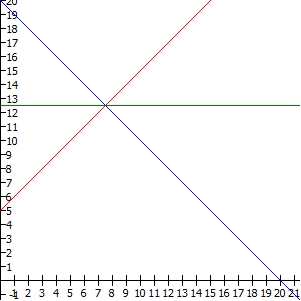
So let’s talk about labor markets. If you’ve taken any economics, you have probably seen a great many diagrams like this:

supply_demand2

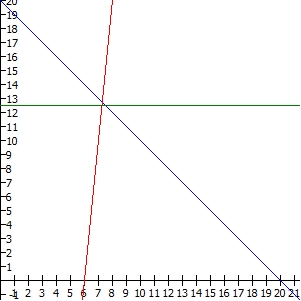
The red line is labor supply, the blue line is labor demand. At the intersection is our glorious efficient market equilibrium, in this case at 7.5 hours of work per day (the x-axis) and $12.50 an hour (the y-axis). The green line is the wage, $12.50 per hour. But let’s stop and think for a moment about what this diagram really means.

What decides that red labor supply line? Do people just arbitrarily decide that they’re going to work 4 hours a day if they get paid $9 an hour, but 8 hours a day if they get paid $13 an hour? No, this line is meant to represent the marginal real cost of working. It’s the monetized value of your work effort and the opportunity cost of what else you could have been doing with your time. It rises because the more hours you work, the more stress it causes you and the more of your life it takes up. Working 4 hours a day, you probably had that time available anyway. Working 8 hours a day, you can fit it in. Working 12 hours a day, now you have no leisure at all. Working 16 hours a day, now you’re having trouble fitting in basic needs like food and sleep. Working 20 hours a day, you eat at work, you don’t get enough sleep, and you’re going to burn yourself out in no time. Why is it a straight line? Because we assume linear relationships to make the math easier. (No, really; that is literally the only reason. We call them “supply and demand curves” but almost always draw and calculate them as straight lines.)

Now let’s consider the blue labor demand line. Is this how much the “job creators” see fit to bestow upon you? No, it’s the marginal value of productivity. The first hour you work each day, you are focused and comfortable, and you can produce a lot of output. The second hour you’re just a little bit fatigued, so you can produce a bit less. By the time you get to hour 8, you’re exhausted, and producing noticeably less output. And if they pushed you past 16 hours, you’d barely produce anything at all. They multiply the amount of products you produce by the price at which they can sell those products, and that’s their demand for your labor. And once again we assume it’s a straight line just to make the math easier.

From this diagram you can calculate what is called employer surplus and worker surplus. Employer surplus is basically the same thing as profit. (It’s not exactly the same for some wonky technical reasons, but for our purposes they may as well be the same.) Worker surplus is a subtler concept; it’s the amount of money you receive minus the monetized value of your cost of working. So if that first hour of work was really easy and you were willing to do it for anything over $5, we take that $5 as your monetized cost of working (your “marginal willingness-to-accept“). Then if you are being paid $12.50 an hour, we infer that you must have gained $7.50 worth of utility from that exchange. (“$7.50 of utility” is a very weird concept, for reasons I’ll get into more in a later post; but it is actually the standard means of estimating utility in neoclassical economics. That’s one of the things I hope to change, actually.)

When you add these up for all the hours worked, the result becomes an integral, which is a formal mathematical way of saying “the area between those two lines”. In this case they are triangles of equal size, so we can just use the old standby A = 1/2*b*h. The area of each triangle is 1/2*7.5*7.5 = $28.13. From each day you work, you make $28.13 in consumer surplus and your employer makes $28.13 in profit.

And that seems fair, doesn’t it? You split it right down the middle. Both of you are better off than you were, and the economic benefits are shared equally. If this were really how labor markets work, that seems like how things ought to be.

But nothing in the laws of economics says that the two areas need to be equal. We tend to draw them that way out of an aesthetic desire for symmetry. But in general they are not, and in some cases they can be vastly unequal.

This happens if we have wildly different elasticities, which is a formal term for the relative rates of change of two things. An elasticity of labor supply of 1 would mean that for a 1% increase in wage you’re willing to work 1% more hours, while an elasticity of 10 would mean that for a 1% increase in wage you’re willing to work 10% more hours. Elasticities can also be negative; a labor demand elasticity of -1 would mean that for a 1% increase in wage your employer is willing to hire you for 1% fewer hours. In the graph above, the elasticity of labor supply is exactly 1. The elasticity of labor demand varies along the curve, but at the equilibrium it is about -1.6. The fact that the profits are shared equally is related to the fact that these two elasticities are close in magnitude but opposite in sign.

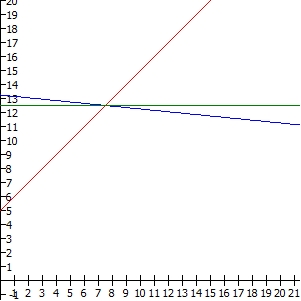
But now consider this equilibrium, in which I’ve raised the labor elasticity to 10. Notice that the wage and number of hours haven’t change; it’s still 7.5 hours at $12.50 per hour. But now the profits are shared quite unequally indeed; while the employer still gets $28.13, the value for the worker is only 1/2*7.5*0.75 = $2.81. In real terms this means we’ve switched from a job that starts off easy but quickly gets harder to a job that is hard to start with but never gets much harder than that.

elastic_supply

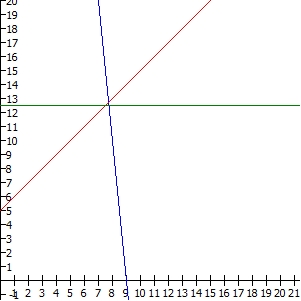
On the other hand what if the supply elasticity is only 0.1? Now the worker surplus isn’t even a triangle; it’s a trapezoid. The area of this trapezoid is 6*12.5+1/2*1.5*12.5 = $84.38. This job starts off easy and fun—so much so that you’d do it for free—but then after 6 hours a day it quickly becomes exhausting and you need to stop.

inelastic_supply

If we had to guess what these jobs are, my suggestion is that maybe the first one is a research assistant, the second one is a garbage collector, and the third one is a video game tester. And thus, even though they are paid about the same (I think that’s true in real life? They all make about $15 an hour or $30k a year), we all agree that the video game tester job is better than the research assistant job which is better than the garbage collector job—which is exactly what the worker surplus figures are saying.

What about the demand side? Here’s where it gets really unfair. Going back to our research assistant with a supply elasticity of 1, suppose they’re not really that good a researcher. Their output isn’t wrong, but it’s also not very interesting. They can do the basic statistics, but they aren’t very creative and they don’t have a deep intuition for the subject. This might produce a demand elasticity 10 times larger. The worker surplus remains the same, but the employer surplus is much lower. The triangle has an area 1/2*7.5*0.75 = $2.81.

elastic_demand

Now suppose that they are the best research assistant ever; let’s say we have a young Einstein. Everything he touches turns to gold, but even Einstein needs his beauty sleep (he actually did sleep about 10 hours a day, which is something I’ve always been delighted to have in common with him), so the total number of work hours still caps out at 7.5. It is entirely possible for the wage equilibrium to be exactly the same as it was for the lousy researcher, making the graph look like this:

inelastic_demand

You can’t even see the top of the triangle on this scale; it’s literally off the chart. The worker had a lower bound at zero, but there’s no comparable upper bound. (I suppose you could argue the lower bound shouldn’t be there either, since there are kinds of work you’d be willing to do even if you had to pay to do them—like, well, testing video games.) The top of the triangle is actually at about $90, as it turns out, so the area of employer surplus is 1/2*(90-12.5)*7.5 = $290.63. For every day he works, the company gets almost $300, but Einstein himself only gets $28.13 after you include what it costs him to work. (His gross pay is just wage*hours of course, so that’s $93.75.) The total surplus produced is $318.76. Einstein himself only gets a measly 8.9% of that.

So here we have three research assistants, who have very different levels of productivity, getting the same pay. But isn’t pay supposed to reflect productivity? Sort of; it’s supposed to reflect marginal productivity. Because Einstein gets worn out and produces at the same level as the mediocre researcher after 7.5 hours of work, since that’s where the equilibrium is that’s what they both get paid.

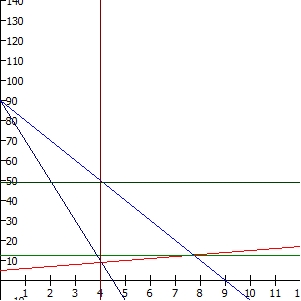
Now maybe Einstein should hold back; he could exercise some monopolistic power over his amazing brain. By only offering to work 4 hours a day, he can force the company to pay him at his marginal productivity for 4 hours a day, which turns out to be $49 an hour. Now he makes a gross pay of $196, with a worker surplus of $171.

monopoly_power

This diagram is a bit harder to read, so let me walk you through it. The light red and blue lines are the same as before. The darker blue line is the marginal revenue per hour for Einstein, once he factors in the fact that working more hours will mean accepting a lower wage. The optimum for him is when that marginal revenue curve crosses his marginal cost curve, which is the red supply curve. That decides how many hours he will work, namely 4. But that’s not the wage he gets; to find that, we move up vertically along the dark red line until we get the company’s demand curve. That tells us what wage the company is willing to pay for the level of marginal productivity Einstein has at 4 hours per day of work—which is the $49 wage he ends up making shown by the dark green line. The lighter lines show what happens if we have a competitive labor market, while the darker lines show what happens if Einstein exercises monopoly power.

The company still does pretty well on this deal; they now make an employer surplus of $82. Now, of the total $253 of economic surplus being made, Einstein takes 69%. It’s his brain, so him taking most of the benefit seems fair.

But you should notice something: This result is inefficient! There’s a whole triangle between 4 and 7.5 hours that nobody is getting; it’s called the deadweight loss. In this case it is $65.76, the difference between the total surplus in the efficient equilibrium and the inefficient equilibrium. In real terms, this means that research doesn’t get done because Einstein held back in order to demand a higher wage. That’s research that should be done—its benefit exceeds its cost—but nobody is doing it. Well now, maybe that doesn’t seem so fair after all. It seems selfish of him to not do research that needs done just so he can get paid more for what he does.

If Einstein has monopoly power, he gets a fair share but the market is inefficient. Removing Einstein’s monopoly power by some sort of regulation would bring us back to efficiency, but it would give most of his share to the company instead. Neither way seems right.

How do we solve this problem? I’m honestly not sure. First of all, we rarely know the actual supply and demand elasticities, and when we do it’s generally after painstaking statistical work to determine the aggregate elasticities, which aren’t even what we’re talking about here. These are individual workers.

Notice that the problem isn’t due to imperfect information; the company knows full well that Einstein is a golden goose, but they aren’t going to pay him any more than they have to.

We could just accept it, I suppose. As long as the productive work gets done, we could shrug our shoulders and not worry about the fact that corporations are capturing most of the value from the hard work of our engineers and scientists. That seems to be the default response, perhaps because it’s the easiest. But it sure doesn’t seem fair to me.

One solution might be for the company to voluntarily pay Einstein more, or offer him some sort of performance bonus. I wouldn’t rule out this possibility entirely, but this would require the company to be unusually magnanimous. This won’t happen at most corporations. It might happen for researchers at a university, where the administrators are fellow academics. Or it might happen to a corporate executive because other corporate executives feel solidarity for their fellow corporate executives.

That sort of solidarity is most likely why competition hasn’t driven down executive salaries. Theoretically shareholders would have an incentive to choose boards of directors who are willing to work for $20 an hour and elect CEOs who are willing to work for $30 an hour; but in practice old rich White guys feel solidarity with other old rich White guys, and even if there isn’t any direct quid pro quo there is still a general sense that because we are “the same kind of people” we should all look out for each other—and that’s how you get $50 million salaries. And then of course there’s the fact that even publicly-traded companies often have a handful of shareholders who control enough of the shares to win any vote.

In some industries, we don’t need to worry about this too much because productivity probably doesn’t really vary that much; just how good can a fry cook truly be? But this is definitely an issue for a lot of scientists and engineers, particularly at entry-level positions. Some scientists are an awful lot better than other scientists, but they still get paid the same.

Much more common however is the case where the costs of working vary. Some people may have few alternatives, so their opportunity cost is low, driving their wage down; but that doesn’t mean they actually deserve a lower wage. Or they may be disabled, making it harder to work long hours; but even though they work so much harder their pay is the same, so their net benefit is much smaller. Even though they aren’t any more productive, it still seems like they should be paid more to compensate them for that extra cost of working. At the other end are people who start in a position of wealth and power; they have a high opportunity cost because they have so many other options, so it may take very high pay to attract them; but why do they deserve to be paid more just because they have more to start with?

Another option would be some sort of redistribution plan, where we tax the people who are getting a larger share and give it to those who are getting a smaller share. The problem here arises in how exactly you arrange the tax. A theoretical “lump sum tax” where we just figure out the right amount of money and say “Person A: Give $217 to person B! No, we won’t tell you why!” would be optimally efficient because there’s no way it can distort markets if nobody sees it coming; but this is not something we can actually do in the real world. (It also seems a bit draconian; the government doesn’t even tax activities, they just demand arbitrary sums of money?) We’d have to tax profits, or sales, or income; and all of these could potentially introduce distortions and make the market less efficient.

We could offer some sort of publicly-funded performance bonus, and for scientists actually we do; it’s called the Nobel Prize. If you are truly the best of the best of the best as Einstein was, you may have a chance at winning the Nobel and getting $1.5 million. But of course that has to be funded somehow, and it only works for the very very top; it doesn’t make much difference to Jane Engineer who is 20% more productive than her colleagues.

I don’t find any of these solutions satisfying. This time I really can’t offer a good solution. But I think it’s important to keep the problem in mind. It’s important to always remember that “efficient” does not mean “fair”, and being paid at marginal productivity isn’t the same as being paid for overall productivity.

 Who are the job creators?

JDN 2456956 PDT 11:30.

For about 20 years now, conservatives have opposed any economic measures that might redistribute wealth from the rich as hurting “job creators” and thereby damaging the economy. This has become so common that the phrase “job creator” has become a euphemism for “rich person”; indeed, when Paul Ryan was asked to define “rich” he stumbled over himself and ended up with “job creators”. A few years ago, John Boehner gave a speech saying that ‘the job creators are on strike’. During his presidential campaign, Mitt Romney said Obama was ‘waging war on job creators’.

If you get the impression that the “job creator” narrative is used more often now than ever, you’re not imagining things; the term was used almost as many times in a single month of Obama’s presidency than it was in George W. Bush’s entire second term.

This narrative is not just wrong; it’s utterly ludicrous. The vision seems to be something like this: Out there somewhere, beyond the view of ordinary mortals, there lives a race of beings known as Job Creators. Ours is not to judge them, not to influence them; ours is only to appease them so that they might look upon us with favor and bestow upon us our much-needed Jobs. Without these Jobs, we will surely die, and so all other concerns are secondary: We must appease the Job Creators.

Businesses don’t create jobs because they feel like it, or because they love us, or because we have gone through the appropriate appeasement rituals. They don’t create jobs because their taxes are low or because they have extra money lying around. They create jobs because they see profit in it. They create jobs because the marginal revenue of hiring an additional worker exceeds the marginal cost.

And of course they’ll gladly destroy jobs for the exact same reasons; if they think the marginal cost exceeds the marginal revenue, out come the pink slips. If demand for the product has fallen, if the raw materials have become more expensive, or if new technology has allowed some of the labor to be cheaply automated, workers will be laid off in the interests of the company. In fact, sometimes it won’t even be in the interests of the company; corporate executives are lately in the habit of using layoffs and stock buybacks to artificially boost the value of their stock options so they can exercise them, pocket the money, and run away as the company comes crashing to the ground. Because of market deregulation and the ridiculous theory of “shareholder value” (as though shareholders are the only ones who matter!), our stock market has changed from a system of value creation to a system of value extraction.

What actually creates jobs? Demand. If the demand for their product exceeds the company’s capacity to produce it, they will hire more people in order to produce more of the product. The marginal revenue has to go up, or companies will have no reason to hire new workers. (The marginal cost could also go down, but then you get low-paying jobs, which isn’t really what we’re aiming for.) They will continue hiring more people up until the point at which it costs more to hire someone than they’d make from selling the products that person could make for them.

What if they don’t have enough money? They’ll borrow it. As long as they know they are going to make a profit from that worker, they will gladly borrow money in order to hire them. Indeed, corporations do this sort of thing all the time. If banks stop lending, that’s a big problem—it’s called a credit crunch—and it’s a major part of just about any financial crisis. But that isn’t because rich people don’t have enough money, it’s because our banking system is fundamentally defective and corrupt. Yes, fixing the banking system would create jobs in a number of different ways. (The biggest three I can think of: There would be more credit for real businesses to fund investment, more credit for individuals to increase demand, and labor effort that is currently wasted on useless financial speculation would be once again returned to real production.) But that’s not what Paul Ryan and his ilk are talking about—indeed, Paul Ryan seems to think that we should undo the meager reforms we’ve already made. Unless we fundamentally change the financial system, the way to create jobs would be to create demand.

And what decides demand? Well, a lot of things I suppose; preferences, technologies, cultural norms, fads, advertising, and so on. But when you’re looking at short-run changes like the business cycle, the driving factor in most cases is actually quite simple: How much money does the middle class have to spend? The middle class is where most of the consumer spending comes from, and if the middle class has money to spend we will buy products. If we don’t have money to spend—we’re out of work, or we have too much debt to pay—then we won’t buy products. It’s not that we suddenly stopped wanting products; the utility value of those products to us is unchanged. The problem is that we simply can’t afford them anymore. This is what happens in a recession: After some sort of shock to the economy, the middle class stops being able to spend, which reduces demand. That causes corporations to lay off workers, which creates unemployment, which reduces demand even further. To correct for the lost demand, prices are supposed to go down (deflation); but this doesn’t actually work, for two reasons.

First, people absolutely hate seeing their wages go down; even if there is a legitimate economic reason, people still have a sense that they are being exploited by their employers (and sometimes they are). This is called downward nominal wage rigidity.

Second, when prices go down, the real value of debt doesn’t go down; it goes up. Your loans are denominated in dollars, not apples; so reducing the price of apples means that you actually owe more apples than you did before. Since debt is usually one of the big things holding back spending by the middle class in the first place, deflation doesn’t correct the imbalance; it makes it worse. This is called debt deflation. Maybe we shouldn’t call it that, since the problem isn’t the prices, it’s the debt. In 2008, the first thing that happened wasn’t that prices in general went down, which is what we normally mean by “deflation”; it was that housing prices went down, and so suddenly people owed vastly more on their mortgages than they had before, and many of them couldn’t afford to pay. It wasn’t a drop in prices so much as a rise in the real value of debt. (I actually think one of the reasons there is no successful comprehensive theory of the cause of business cycles is that there isn’t a single comprehensive cause of business cycles. It’s usually some form of financial crisis followed by debt deflation—and these are the ones to be worried about, 1929 and 2008—but that isn’t always what happens. In 2001, we actually had an unanticipated negative real economic shock—the 9/11 attacks. In 1973 we had a different kind of real economic shock when OPEC raised oil prices at the same time as the US hit peak oil. We should probably be distinguishing between financial recession and real recession.)

Notice how in this entire discussion of what drives aggregate demand, I have never mentioned rich people getting free money; I haven’t even mentioned tax rates. If you have the simplistic view “taxes are bad” (or the totally insane, yet still common, view “taxation is slavery”), then you’re going to look for excuses to lower taxes whenever you can. If you specifically love rich people more than poor people, you’re going to look for excuses to lower taxes on the rich and raise them on the poor (and there is really no other way to interpret Mitt Romney’s infamous “47%” comments). But none of this has anything to do with aggregate demand and job creation. It is pure ideology and has no basis in economics.

Indeed, there’s little reason to think that a tax on corporate profits or capital income would change hiring decisions at all. When we talk about the potential distortions of income taxes, we really have to be talking about labor income, because labor can actually be disincentivized. Say you’re making $15 an hour and not paying any taxes, but your tax rate is suddenly raised to 40%. You can see that after taxes your real wage is now only $9, and maybe you’ll decide that it’s just not worth it to work those hours. This is because you pay a real cost to work—it’s hard, it’s stressful, it’s frustrating, it takes up time.

Capital income can’t be disincentivized. You can have relative incentives, if you tax certain kinds of capital more than others. But if you tax all capital income at the same rate, the incentives remain exactly as they were before: Seek the highest return on investment. Your only costs were financial, and your only benefits are financial. Yes, you’ll be unhappy that your after-tax return on investment has gone down; but it won’t change your investment decisions. If you previously had the choice between investment A yielding 5% return and investment B yielding a 10% return, you’d choose B. Now you pay a 40% tax on capital income; you now have a choice between a 3% real return on A and a 6% real return on B—you’re still going to choose B. That’s probably why high marginal tax rates on income don’t reduce job growth—because most high incomes are capital incomes of one form or another; even when a CEO reports ordinary income it’s really a due to profits and stock options, it’s not like he was paid a wage for work he did.

To be fair, it does get more complicated when you include borrowing and interest rates (now you have the option of lending your money at interest or borrowing more from someone else, which may be taxed differently), and because it’s so easy to move money across borders you can have a relative incentive even when tax rates within a given nation are all the same. Don’t take this literally as saying that you can do whatever you want with taxes on capital income. But in fact you can do quite a lot, because you can change the real rate of return and have no incentive effect as long as you don’t change the relative rate of return. That’s different from wages, for which the real value of the wage can have a direct effect on employers and employees. (The only way to have the same effect on workers would be to somehow lower the real cost of working—make working easier or more fun—which actually sounds like a great idea if you can do it.) The people who are constantly telling us that workers need to tighten their belts but we mustn’t dare tax the “job creators” have the whole situation exactly backwards.

There’s something else I should bring up as well. In everything I’ve said above, I have taken as given the assumption that we need jobs. For many people, probably most Americans in fact, this is an unquestioned assumption, seemingly so obvious as to be self-evident; of course we need jobs, right? But no, actually, we don’t; what we need is production and distribution of wealth. We need to make food and clothing and houses—those are truly basic needs. We could even say we “need” (or at least want) to make televisions and computers and cars. As individuals and as a society we benefit from having these goods. And in our present capitalist economy, the way that we produce and distribute goods is through a system of jobs—you are paid to make goods, and then you can use that money to buy other goods. Don’t get me wrong; this system works pretty well, and for the most part I want to make small adjustments and reforms around the edges rather than throw the whole thing out. Thus far, other systems have not worked as well; when we have attempted to centrally plan production and distribution, the best-case scenario has been inefficiency and the worst-case scenario has been mass starvation.

But we should also be open to the possibility of other systems that are better than capitalism. We should be open to the possibility of a culture like, well, The Culture (and if you haven’t read any Iain Banks novels you should; I’d probably start with Player of Games), in which artificial intelligence and automation allows central planning to finally achieve efficient production and distribution. We should be open to the possibility of a culture like the Federation (and don’t tell me you haven’t seen Star Trek!), in which resources are so plentiful that anyone can have whatever they want, and people work not because they have to, but because they want to—it gives them meaning and purpose in their lives. Fanciful? Perhaps. But lightspeed worldwide communication and landing robots on other planets would have seemed pretty fanciful a century ago.
Capitalism is really an Industrial Era system. It was designed in, and for, a world in which the most important determinants of production are machines, raw materials, and labor hours. But we don’t live in that world anymore. The most important determinants of production are now ideas; software, research, patents, copyrights. Microsoft, Google, and Amazon don’t make things at all, they make ideas; Sony, IBM, Apple, and Toshiba make things, but those things are primarily for the production and dissemination of ideas. Ideas are just as valuable as things—if not more so—but they obey different rules.

Capitalism was designed for a world of rival, excludable goods with increasing marginal cost. Rival, meaning that if one person has it, someone else can’t have it anymore. We speak of piracy as “stealing”, but that’s totally wrong; if you steal something I have, I don’t have it anymore. If you pirate something I have, I still have it. If I gave you my computer, I wouldn’t have it anymore; but I can give you the ideas in this blog post and then we’ll both have them. Excludable, meaning that there is a way to prevent someone else from getting it if you don’t want them to. And increasing marginal cost, meaning that the more you make, the more it costs to make each one. Under these conditions, you get a very nice equilibrium that is efficient under competition.

But ideas are nonrival, they have nearly zero marginal cost, and we are increasingly finding that they aren’t even very excludable; DRM is astonishingly ineffective. Under these conditions, your nice efficient equilibrium completely evaporates. There can be many different equilibria, or no equilibrium at all; and the results are almost always inefficient. We have shoehorned capitalism onto an economy that it was not designed to deal with. Capitalism was designed for the Industrial Era; but we are now in the Information Era.

Indeed, you can see this in all our neoclassical growth models: K is physical capital—machines—and L is labor, and sometimes it is augmented with N—natural resources. But these typically only explain about 50% of the variation in economic output, so we add an extra term, A, which goes by many names: “productivity”, “efficiency”, “technology”; I think the most informative one is actually “the Solow residual”. It’s the residual; it’s the part we can’t explain, dare I say, the part capitalism isn’t designed to explain. It is, in short, made of ideas. One of my thesis papers is actually about this “total factor productivity”, and how a major component of it is made up of one class of ideas in particular: Corruption. Corruption isn’t a thing, some object in space. It’s a cultural norm, a systemic idea that permeates the thoughts and actions of the whole society. It affects what we do, whom we trust, how the rules are made, and how well we follow those rules. You can even think of capitalism as an idea, a system, a culture—and a good part of “productivity” can be accounted for by “market orientation”, which is to say how capitalist a nation is. I would like to see someday a new model that actually includes these factors as terms in the equation, instead of throwing them all together in the mysterious A that we don’t understand.

With this in mind, we should be asking ourselves whether we need jobs at all, because jobs are a system designed for the production of physical goods in the Industrial Era. Now that we live in the Information Era and most of our production is in the form of ideas, do we still need jobs? Does everyone need a job? If you’re trying to make cars for a million people, it may not take a million people to do it, but it’s going to take thousands. But if you’re trying to design a car for a million people, or make a computer game about cars for a million people to play, that can be done with a lot fewer people. Ideas can be made by a few and then disseminated to the world. General Motors has 200,000 employees (and used to have about twice as many in the 1970s); Blizzard Entertainment has less than 5,000. It’s not because they produce for fewer people; GM sells about 3 million cars a year, and Starcraft sold over 11 million copies. Starcraft came out in 1998, so I added up how many cars GM sold in the US since 1998: 61 million. That’s still 3.28 employees per thousand cars sold, but only 0.45 employees per thousand computer games sold.

Still, I don’t have a detailed account of what this new jobless economic system might look like. For now, it’s probably best if people have jobs. But if we really want to create jobs, we need to increase aggregate demand. That most likely means either reducing debt or giving more money to consumers. It certainly doesn’t have anything to do with tax cuts for the rich.

And really, this is pretty obvious; if you stop and think for a minute about why businesses create jobs, you realize that it has to do with demand for products, not how nice the government treats them or how much extra cash they have laying around. I actually have trouble believing that the people who say “job creators” unironically actually believe the words they are saying. Do they honestly think that rich people create jobs out of sheer brilliance and benevolence, but are constrained by how much money they have and “go on strike” if the government doesn’t kowtow to them?

The only way I can see that they could actually believe this sort of thing would be if they read so much Ayn Rand that it totally infested their brains and rendered them incapable of thinking outside that framework. Perhaps Krugman is right, and Rand Paul really does believe that he is John Galt. Maybe they really do honestly believe that this is how economics works—in which case it’s no wonder that our economy is in trouble. Indeed, the marvel is that it works at all.

Should we raise the minimum wage?

JDN 2456949 PDT 10:22.

The minimum wage is an economic issue that most people are familiar with; a large portion of the population has worked for minimum wage at some point in their lives, and those who haven’t generally know someone who has. As Chris Rock famously remarked (in the recording, Chris Rock, as usual, uses some foul language), “You know what that means when they pay you minimum wage? You know what they’re trying to tell you? It’s like, ‘Hey, if I could pay you less, I would; but it’s against the law.’ ”

The minimum wage was last raised in 2009, but adjusted for inflation its real value has been trending downward since 1968. The dollar values are going up, but not fast enough to keep up with inflation.

So, should we raise it again? How much? Should we just match it to inflation, or actually raise it higher in real terms? Productivity (in terms of GDP per worker) has more than doubled since 1968, so perhaps the minimum wage should double as well?

There are two major sides in this debate, and I basically disagree with both of them.

The first is the right-wing view (here espoused by the self-avowed “Objectivist” Don Watkins) that the minimum wage should be abolished entirely because it is an arbitrary price floor that prevents workers from selling their labor at whatever wage the market will bear. He argues that the free market is the only way the value of labor should be assessed and the government has no business getting involved.

On the other end of the spectrum we have Robert Reich, who thinks we should definitely raise the minimum wage and it would be the best way to lift workers out of poverty. He argues that by providing minimum-wage workers with welfare and Medicaid, we are effectively subsidizing employers to pay lower wages. While I sympathize a good deal more with this view, I still don’t think it’s quite right.

Why not? Because Watkins is right about one thing: The minimum wage is, in fact, an arbitrary price floor. Out of all the possible wages that an employer could pay, how did we decide that this one should be the lowest? And the same applies to everyone, no matter who they are or what sort of work they do?

What Watkins gets wrong—and Reich gets right—is that wages are not actually set in a free and competitive market. Large corporations have market power; they can influence wages and prices to their own advantage. They use monopoly power to raise prices, and its inverse, monopsony power, to lower wages. The workers who are making a minimum wage of $7.25 wouldn’t necessarily make $7.25 in a competitive market; they could make more than that. All we know, actually, is that they would make at least this much, because if a worker’s marginal productivity is below the minimum wage the corporation simply wouldn’t have hired them.

Monopsony power doesn’t just lower wages; it also reduces employment. One of the ways that corporations can control wages is by controlling hiring; if they tried to hire more people, they’d have to offer a higher wage, so instead they hire fewer people. Under these circumstances, a higher minimum wage can actually create jobs, as Reich argues it will. And in this particular case I think he’s right about that, because corporations have enormous market power to hold wages down and in the Second Depression we have a huge amount of unused productive capacity. But this isn’t true in general. If markets are competitive, then raising minimum wage just causes unemployment. Even when corporations have market power, if there isn’t much unused capacity then raising minimum wage will just lead them to raise prices instead of hiring more workers.

Reich is also wrong about this idea that welfare payments subsidize low wages. On the contrary, the stronger your welfare system, the higher your wages will be. The reason is quite simple: A stronger welfare system gives workers more bargaining power. If not getting this job means you turn to prostitution or starve to death, then you’re going to take just about any wage they offer you. (I don’t entirely agree with Krugman’s defense of sweatshops—I believe there are ways to increase trade without allowing oppressive working conditions—but he makes this point quite vividly.) On the other hand, if you live in the US with a moderate welfare system, you can sometimes afford to say no; you might end up broke or worse, homeless, but you’re unlikely to starve to death because at least you have food stamps. And in a nation with a really robust welfare system like Sweden, you can walk away from any employer who offers to pay you less than your labor is worth, because you know that even if you can’t find a job for awhile your basic livelihood will be protected. As a result, stronger welfare programs make labor markets more competitive and raise wages. Welfare and Medicaid do not subsidize low-wage employers; they exert pressure on employers to raise their low wages. Indeed, a sufficiently strong welfare system could render minimum wage redundant, as I’ll get back to at the end of this post.

Of course, I am above all an empiricist; all theory must bow down before the data. So what does the data say? Does raising the minimum wage create jobs or destroy jobs? Our best answer from compiling various studies is… neither. Moderate increases in the minimum wage have no discernible effect on employment. In some studies we’ve found increases, in others decreases, but the overall average effect across many studies is indistinguishable from zero.

Of course, a sufficiently large increase is going to decrease employment; a Fox News reporter once famously asked: “Why not raise the minimum wage to $100,000 an hour!?” (which Jon Stewart aptly satirized as “Why not pay people in cocaine and unicorns!?”) Yes, raising the minimum wage to $100,000 an hour would create massive inflation and unemployment. But that really says nothing about whether raising the minimum wage to $10 or $20 would be a good idea. Covering your car with 4000 gallons of gasoline is a bad idea, but filling it with 10 gallons is generally necessary for its proper functioning.

This kind of argument is actually pretty common among Republicans, come to think of it. Take the Laffer Curve, for instance; it’s basically saying that since a 99% tax on everyone would damage the economy (which is obviously true) then a 40% tax specifically on millionaires must have the same effect. Another good one is Rush Limbaugh’s argument that if unemployment benefits are good, why not just put everyone on unemployment benefits? Well, again, because there’s a difference between doing something for some people sometimes and doing it for everyone all the time. There are these things called numbers; they measure whether something is bigger or smaller instead of just “there” or “not there”. You might want to learn about that.

Since moderate increases in minimum wage have no effect on unemployment, and we are currently under conditions of extremely low—in fact, dangerously low—inflation, then I think on balance we should go with Reich: Raising the minimum wage would do more good than harm.

But in general, is minimum wage the best way to help workers out of poverty? No, I don’t think it is. It’s awkward and heavy-handed; it involves trying to figure out what the optimal wage should be and writing it down in legislation, instead of regulating markets so that they will naturally seek that optimal level and respond to changes in circumstances. It only helps workers at the very bottom: Someone making $12 an hour is hardly rich, but they won’t benefit from increasing minimum wage to $10; in fact they might be worse off, if that increase triggers inflation that lowers the real value of their $12 wage.

What do I propose instead? A basic income. There should be a cash payment that every adult citizen receives, once a month, directly from the government—no questions asked. You don’t have to be unemployed, you don’t have to be disabled, you don’t have to be looking for work. You don’t have to spend it on anything in particular; you can use it for food, for housing, for transportation; or if you like you can use it for entertainment or save it for a rainy day. We don’t keep track of what you do with it, because it’s your own freedom and none of our business. We just give you this money as your dividends for being a shareholder in the United States of America.

This would be extremely easy to implement—the IRS already has all the necessary infrastructure, they just need to turn some minus signs into plus signs. We could remove all the bureaucracy involved in administering TANF and SNAP and Medicaid, because there’s no longer any reason to keep track of who is in poverty since nobody is. We could in fact fold the $500 billion a year we currently spend on means-tested programs into the basic income itself. We could pull another $300 billion from defense spending while still solidly retaining the world’s most powerful military.

Which brings me to the next point: How much would this cost? Probably less than you think. I propose indexing the basic income to the poverty line for households of 2 or more; since currently a household of 2 or more at the poverty line makes $15,730 per year, the basic income would be $7,865 per person per year. The total cost of giving that amount to each of the 243 million adults in the United States would be $1.9 trillion, or about 12% of our GDP. If we fold in the means-tested programs, that lowers the net cost to $1.4 trillion, 9% of GDP. This means that an additional flat tax of 9% would be enough to cover the entire amount, even if we don’t cut any other government spending.

If you use a progressive tax system like I recommended a couple of posts ago, you could raise this much with a tax on less than 5% of utility, which means that someone making the median income of $30,000 would only pay 5.3% more than they presently do. At the mean income of $50,000, you’d only pay 7.7%. And keep in mind that you are also receiving the additional $7,865; so in fact in both cases you actually end up with more than you had before the basic income was implemented. The break-even point is at about $80,000, where you pay an extra 9.9% ($7,920) and receive $7,865, so your after-tax income is now $79,945. Anyone making less than $80,000 per year actually gains from this deal; the only people who pay more than they receive are those who make more than $80,000. This is about the average income of someone in the fourth quintile (the range where 60% to 80% of the population is below you), so this means that roughly 70% of Americans would benefit from this program.

With this system in place, we wouldn’t need a minimum wage. Working full-time at our current minimum wage makes you $7.25*40*52 = $15,080 per year. If you are a single person, you’re getting $7,865 from the basic income, this means that you’ll still have more than you presently do as long as your employer pays you at least $3.47 per hour. And if they don’t? Well then you can just quit, knowing that at least you have that $7,865. If you’re married, it’s even better; the two of you already get $15,730 from the basic income. If you were previously raising a family working full-time on minimum wage while your spouse is unemployed, guess what: You actually will make more money after the policy no matter what wage your employer pays you.

This system can adapt to changes in the market, because it is indexed to the poverty level (which is indexed to inflation), and also because it doesn’t say anything about what wage an employer pays. They can pay as little or as much as the market will bear; but the market is going to bear more, because workers can afford to quit. Billionaires are going to hate this plan, because it raises their taxes (by about 40%) and makes it harder for them to exploit workers. But for 70% of Americans, this plan is a pretty good deal.

What are the limits to growth?

JDN 2456941 PDT 12:25.

Paul Krugman recently wrote a column about the “limits to growth” community, and as usual, it’s good stuff; his example of how steamships substituted more ships for less fuel is quite compelling. But there’s a much stronger argument to made against “limits to growth”, and I thought I’d make it here.

The basic idea, most famously propounded by Jay Forrester but still with many proponents today (and actually owing quite a bit to Thomas Malthus), is this: There’s only so much stuff in the world. If we keep adding more people and trying to give people higher standards of living, we’re going to exhaust all the stuff, and then we’ll be in big trouble.

This argument seems intuitively reasonable, but turns out to be economically naïve. It can take several specific forms, from the basically reasonable to the utterly ridiculous. On the former end is “peak oil”, the point at which we reach a maximum rate of oil extraction. We’re actually past that point in most places, and it won’t be long before the whole world crosses that line. So yes, we really are running out of oil, and we need to transition to other fuels as quickly as possible. On the latter end is the original Mathusian argument (we now have much more food per person worldwide than they did in Malthus’s time—that’s why ending world hunger is a realistic option now), and, sadly, the argument Mark Buchanan made a few days ago. No, you don’t always need more energy to produce more economic output—as Krugman’s example cleverly demonstrates. You can use other methods to improve your energy efficiency, and that doesn’t necessarily require new technology.

Here’s the part that Krugman missed: Even if we need more energy, there’s plenty of room at the top. The total amount of sunlight that hits the Earth is about 1.3 kW/m^2, and the Earth has a surface area of about 500 million km^2, which is 5e14 m^2. That means that if we could somehow capture all the sunlight that hits the Earth, we’d have 6.5e17 W, which is 5.7e18 kilowatt-hours per year. Total world energy consumption is about 140,000 terawatt-hours per year, which is 1.4e14 kilowatt-hours per year. That means we could increase energy consumption by a factor of one thousand just using Earth-based solar power (Covering the oceans with synthetic algae? A fleet of high-altitude balloons covered in high-efficiency solar panels?). That’s not including fission power, which is already economically efficient, or fusion power, which has passed break-even and may soon become economically feasible as well. Fusion power is only limited by the size of your reactor and your quantity of deuterium, and deuterium is found in ocean water (about 33 milligrams per liter), not to mention permeating all of outer space. If we can figure out how to fuse ordinary hydrogen, well now our fuel is literally the most abundant substance in the universe.

And what if we move beyond the Earth? What if we somehow captured not just the solar energy that hits the Earth, but the totality of solar energy that the Sun itself releases? That figure is about 1e31 joules per day, which is 1e27 kilowatt-hours per day, or seven trillion times as much energy as we currently consume. It is literally enough to annihilate entire planets, which the Sun would certainly do if you put a planet near enough to it. A theoretical construct to capture all this energy is called a Dyson Sphere, and the ability to construct one officially makes you a Type 2 Kardashev Civilization. (We currently stand at about Type 0.7. Building that worldwide solar network would raise us to Type 1.)

Can we actually capture all that energy with our current technology? Of course not. Indeed, we probably won’t have that technology for centuries if not millennia. But if your claim—as Mark Buchanan’s was—is about fundamental physical limits, then you should be talking about Dyson Spheres. If you’re not, then we are really talking about practical economic limits.

Are there practical economic limits to growth? Of course there are; indeed, they are what actually constrains growth in the real world. That’s why the US can’t grow above 2% and China won’t be growing at 7% much longer. (I am rather disturbed by the fact that many of the Chinese nationals I know don’t appreciate this; they seem to believe the propaganda that this rapid growth is something fundamentally better about the Chinese system, rather than the simple economic fact that it’s easier to grow rapidly when you are starting very small. I had a conversation with a man the other day who honestly seemed to think that Macau could sustain its 12% annual GDP growth—driven by gambling, no less! Zero real productivity!—into the indefinite future. Don’t get me wrong, I’m thrilled that China is growing so fast and lifting so many people out of poverty. But no remotely credible economist believes they can sustain this growth forever. The best-case scenario is to follow the pattern of Korea, rising from Third World to First World status in a few generations. Korea grew astonishingly fast from about 1950 to 1990, but now that they’ve made it, their growth rate is only 3%.)

There is also a reasonable argument to be made about the economic tradeoffs involved in fighting climate change and natural resource depletion. While the people of Brazil may like to have more firewood and space for farming, the fact is the rest of need that Amazon in order to breathe. While any given fisherman may be rational in the amount of fish he catches, worldwide we are running out of fish. And while we Americans may love our low gas prices (and become furious when they rise even slightly), the fact is, our oil subsidies are costing hundreds of billions of dollars and endangering millions of lives.

We may in fact have to bear some short-term cost in economic output in order to ensure long-term environmental sustainability (though to return to Krugman, that cost may be a lot less than many people think!). Economic growth does slow down as you reach high standards of living, and it may even continue to slow down as technology begins to reach diminishing returns (though this is much harder to forecast). So yes, in that sense there are limits to growth. But the really fundamental limits aren’t something we have to worry about for at least a thousand years. Right now, it’s just a question of good economic policy.

The moral—and economic—case for progressive taxation

JDN 2456935 PDT 09:44.

Broadly speaking, there are three ways a tax system can be arranged: It can be flat, in which every person pays the same tax rate; it can be regressive, in which people with higher incomes pay lower rates; or it can be progressive, in which case people with higher incomes pay higher rates.

There are certain benefits to a flat tax: Above all, it’s extremely easy to calculate. It’s easy to determine how much revenue a given tax rate will raise; multiply the rate times your GDP. It’s also easy to determine how much a given person should owe; multiply the rate times their income. This also makes the tax withholding process much easier; a fixed proportion can be withheld from all income everyone makes without worrying about how much they made before or are expected to make later. If your goal is minimal bureaucracy, a flat tax does have something to be said for it.

A regressive tax, on the other hand, is just as complicated as a progressive tax but has none of the benefits. It’s unfair because you’re actually taking more from people who can afford the least. (Note that this is true even if the rich actually pay a higher total; the key point, which I will explain in detail shortly, is that a dollar is worth more to you if you don’t have very many.) There is basically no reason you would ever want to have a regressive tax system—and yet, all US states have regressive tax systems. This is mainly because they rely upon sales taxes, which are regressive because rich people spend a smaller portion of what they have. If you make $10,000 per year, you probably spend $9,500 (you may even spend $15,000 and rack up the difference in debt!). If you make $50,000, you probably spend $40,000. But if you make $10 million, you probably only spend $4 million. Since sales taxes only tax on what you spend, the rich effectively pay a lower rate. This could be corrected to some extent by raising the sales tax on luxury goods—say a 20% rate on wine and a 50% rate on yachts—but this is awkward and very few states even try. Not even my beloved California; they fear drawing the ire of wineries and Silicon Valley.

The best option is to make the tax system progressive. Thomas Piketty has been called a “Communist” for favoring strongly progressive taxation, but in fact most Americans—including Republicans—agree that our tax system should be progressive. (Most Americans also favor cutting the Department of Defense rather than Medicare. This then raises the question: Why isn’t Congress doing that? Why aren’t people voting in representatives to Congress who will do that?) Most people judge whether taxes are fair based on what they themselves pay—which is why, in surveys, the marginal rate on the top 1% is basically unrelated to whether people think taxes are too high, even though that one bracket is the critical decision in deciding any tax system—you can raise about 20% of your revenue by hurting about 1% of your people. In a typical sample of 1,000 respondents, only about 10 are in the top 1%. If you want to run for Congress, the implication is clear: Cut taxes on all but the top 1%, raise them enormously on the top 0.1%, 0.01%, and 0.001%, and leave the 1% the same. People will feel that you’ve made the taxes more fair, and you’ve also raised more revenue. In other words, make the tax system more progressive.

The good news on this front is that the US federal tax system is progressive—barely. Actually the US tax system is especially progressive over the whole distribution—by some measures the most progressive in the world—but the problem is that it’s not nearly progressive enough at the very top, where the real money is. The usual measure based on our Gini coefficient ignores the fact that Warren Buffett pays a lower rate than his secretary. The Gini is based on population, and billionaires are a tiny portion of the population—but they are not a tiny portion of the money. Net wealth of the 400 richest people (the top 0.0001%) adds up to about $2 trillion (13% of our $15 trillion GDP, or about 4% of our $54 trillion net wealth). It also matters of course how you spend your tax revenue; even though Sweden’s tax system is no more progressive than ours and their pre-tax inequality is about the same, their spending is much more targeted at reducing inequality.

Progressive taxation is inherently more fair, because the value of a dollar decreases the more you have. We call this diminishing marginal utility of wealth. There is a debate within the cognitive economics literature about just how quickly the marginal utility of wealth decreases. On the low end, Easterlin argues that it drops off extremely fast, becoming almost negligible as low as $75,000 per year. This paper is on the high end, arguing that marginal utility decreases “only” as the logarithm of how much you have. That’s what I’ll use in this post, because it’s the most conservative reasonable estimate. I actually think the truth is somewhere in between, with marginal utility decreasing about exponentially.

Logarithms are also really easy to work with, once you get used to them. So let’s say that the amount of happiness (utility) U you get from an amount of income I is like this: U = ln(I)

Now let’s suppose the IRS comes along and taxes your money at a rate r. We must have r < 1, or otherwise they’re trying to take money you don’t have. We don’t need to have r > 0; r < 0 would just mean that you receive more in transfers than you lose in taxes. For the poor we should have r < 0.

Now your happiness is U = ln((1-r)I).

By the magic of logarithms, this is U = ln(I) + ln(1-r).

If r is between 0 and 1, ln(1-r) is negative and you’re losing happiness. (If r < 0, you’re gaining happiness.) The amount of happiness you lose, ln(1-r), is independent of your income. So if your goal is to take a fixed amount of happiness, you should tax at a fixed rate of income—a flat tax.

But that really isn’t fair, is it? If I’m getting 100 utilons of happiness from my money and you’re only getting 2 utilons from your money, then taking that 1 utilon, while it hurts the same—that’s the whole point of utility—leaves you an awful lot worse off than I. It actually makes the ratio between us worse, going from 50 to 1, all the way up to 99 to 1.

Notice how if we had a regressive tax, it would be obviously unfair—we’d actually take more utility from poor people than rich people. I have 100 utilons, you have 2 utilons; the taxes take 1.5 of yours but only 0.5 of mine. That seems frankly outrageous; but it’s what all US states have.

Most of the money you have is ultimately dependent on your society. Let’s say you own a business and made your wealth selling products; it seems like you deserve to have that wealth, doesn’t it? (Don’t get me started on people who inherited their wealth!) Well, in order to do that, you need to have strong institutions of civil government; you need security against invasion; you need protection of property rights and control of crime; you need a customer base who can afford your products (that’s our problem in the Second Depression); you need workers who are healthy and skilled; you need a financial system that provides reliable credit (also a problem). I’m having trouble finding any good research on exactly what proportion of individual wealth is dependent upon the surrounding society, but let’s just say Bill Gates wouldn’t be spending billions fighting malaria in villages in Ghana if he had been born in a village in Ghana. It doesn’t matter how brilliant or determined or hard-working you are, if you live in a society that can’t support economic activity.

In other words, society is giving you a lot of happiness you wouldn’t otherwise have. Because of this, it makes sense that in order to pay for all that stuff society is doing for you (and maintain a stable monetary system), they would tax you according to how much happiness they’re giving you. Hence we shouldn’t tax your money at a constant rate; we should tax your utility at a constant rate and then convert back to money. This defines a new sort of “tax rate” which I’ll call p. Like our tax rate r, p needs to be less than 1, but it doesn’t need to be greater than 0.

Of the U = ln(I) utility you get from your money, you will get to keep U = (1-p) ln(I). Say it’s 10%; then if I have 100 utilons, they take 10 utilons and leave me with 90. If you have 2 utilons, they take 0.2 and leave you with 1.8. The ratio between us remains the same: 50 to 1.

What does this mean for the actual tax rate? It has to be progressive. Very progressive, as a matter of fact. And in particular, progressive all the way up—there is no maximum tax bracket.

The amount of money you had before is just I.

The amount of money you have now can be found as the amount of money I’ that gives you the right amount of utility. U = ln(I’) = (1-p) ln(I). Take the exponential of both sides: I’ = I^(1-p).

The units on this are a bit weird, “dollars to the 0.8 power”? Oddly, this rarely seems to bother economists when they use Cobb-Douglas functions which are like K^(1/3) L^(2/3). It bothers me though; to really make this tax system in practice you’d need to fix the units of measurement, probably using some subsistence level. Say that’s set at $10,000; instead of saying you make $2 million, we’d say you make 200 subsistence levels.

The tax rate you pay is then r = 1 – I’/I, which is r = 1 – I^-p. As I increases, I^-p decreases, so r gets closer and closer to 1. It never actually hits 1 (that would be a 100% tax rate, which hardly anyone thinks is fair), but for very large income is does get quite close.

Here, let’s use some actual numbers. Suppose as I said we make the subsistence level $10,000. Let’s also set p = 0.1, meaning we tax 10% of your utility. Then, if you make the US median individual income, that’s about $30,000 which would be I = 3. US per-capita GDP of $55,000 would be I = 5.5, and so on. I’ll ignore incomes below the subsistence level for now—basically what you want to do there is establish a basic income so that nobody is below the subsistence level.

I made a table of tax rates and after-tax incomes that would result:

Pre-tax income Tax rate After-tax income
$10,000 0.0% $10,000
$20,000 6.7% $18,661
$30,000 10.4% $26,879
$40,000 12.9% $34,822
$50,000 14.9% $42,567
$60,000 16.4% $50,158
$70,000 17.7% $57,622
$80,000 18.8% $64,980
$90,000 19.7% $72,247
$100,000 20.6% $79,433
$1,000,000 36.9% $630,957
$10,000,000 49.9% $5,011,872
$100,000,000 60.2% $39,810,717
$1,000,000,000 68.4% $316,227,766

What if that’s not enough revenue? We could raise to p = 0.2:

Pre-tax income Tax rate After-tax income
$10,000 0.0% $10,000
$20,000 12.9% $17,411
$30,000 19.7% $24,082
$40,000 24.2% $30,314
$50,000 27.5% $36,239
$60,000 30.1% $41,930
$70,000 32.2% $47,433
$80,000 34.0% $52,780
$90,000 35.6% $57,995
$100,000 36.9% $63,096
$1,000,000 60.2% $398,107
$10,000,000 74.9% $2,511,886
$100,000,000 84.2% $15,848,932
$1,000,000,000 90.0% $100,000,000

The richest 400 people in the US have a combined net wealth of about $2.2 trillion. If we assume that billionaires make about a 10% return on their net wealth, this 90% rate would raise over $200 billion just from those 400 billionaires alone, enough to pay all interest on the national debt. Let me say that again: This tax system would raise enough money from a group of people who could fit in a large lecture hall to provide for servicing the national debt. And it could do so indefinitely, because we are only taxing the interest, not the principal.

And what if that’s still not enough? We could raise it even further, to p = 0.3. Now the tax rates look a bit high for most people, but not absurdly so—and notice how the person at the poverty line is still paying nothing, as it should be. The millionaire is unhappy with 75%, but the billionaire is really unhappy with his 97% rate. But the government now has plenty of money.

Pre-tax income Tax rate After-tax income
$10,000 0.0% $10,000
$20,000 18.8% $16,245
$30,000 28.1% $21,577
$40,000 34.0% $26,390
$50,000 38.3% $30,852
$60,000 41.6% $35,051
$70,000 44.2% $39,045
$80,000 46.4% $42,871
$90,000 48.3% $46,555
$100,000 49.9% $50,119
$1,000,000 74.9% $251,189
$10,000,000 87.4% $1,258,925
$100,000,000 93.7% $6,309,573
$1,000,000,000 96.8% $31,622,777

Is it fair to tax the super-rich at such extreme rates? Well, why wouldn’t it be? They are living fabulously well, and most of their opportunity to do so is dependent upon living in our society. It’s actually not at all unreasonable to think that over 97% of the wealth a billionaire has is dependent upon society in this way—indeed, I think it’s unreasonable to imagine that it’s any less than 99.9%. If you say that the portion a billionaire receives from society is less than 99.9%, you are claiming that it is possible to become a millionaire while living on a desert island. (Remember, 0.1% of $1 billion is $1 million.) Forget the money system; do you really think that anything remotely like a millionaire standard of living is possible from catching your own fish and cutting down your own trees?Another fun fact is that this tax system will not change the ordering of income at all. If you were the 37,824th richest person yesterday, you will be the 37,824th richest person today; you’ll just have a lot less money while you do so. And if you were the 300,120,916th richest person, you’ll still be the 300,120,916th person, and probably still have the same amount of money you did before (or even more, if the basic income is doled out on tax day).

And these figures, remember, are based on a conservative estimate of how quickly the marginal utility of wealth decreases. I’m actually pretty well convinced that it’s much faster than that, in which case even these tax rates may not be progressive enough.

Many economists worry that taxes reduce the incentive to work. If you are taxed at 30%, that’s like having a wage that’s 30% lower. It’s not hard to imagine why someone might not work as much if they were being paid 30% less.

But there are actually two effects here. One is the substitution effect: a higher wage gives you more reason to work. The other is the income effect: having more money means that you can meet your needs without working as much.

For low incomes, the substitution effect dominates; if your pay rises from $12,000 a year to $15,000, you’re probably going to work more, because you get paid more to work and you’re still hardly wealthy enough to rest on your laurels.

For moderate incomes, the effects actually balance quite well; people who make $40,000 work about the same number of hours as people who make $50,000.

For high incomes, the income effect dominates; if your pay rises from $300,000 to $400,000, you’re probably going to work less, because you can pay all your bills while putting in less work.

So if you want to maximize work incentives, what should you do? You want to raise the wages of poor people and lower the wages of rich people. In other words, you want very low—or negative—taxes on the lower brackets, and very high taxes on the upper brackets. If you’re genuinely worried about taxes distorting incentives to work, you should be absolutely in favor of progressive taxation.

In conclusion: Because money is worth less to you the more of it you have, in order to take a fixed proportion of the happiness, we should be taking an increasing proportion of the money. In order to be fair in terms of real utility, taxes should be progressive. And this would actually increase work incentives.

Are humans rational?

JDN 2456928 PDT 11:21.

The central point of contention between cognitive economists and neoclassical economists hinges upon the word “rational”: Are humans rational? What do we mean by “rational”?

Neoclassicists are very keen to insist that they think humans are rational, and often characterize the cognitivist view as saying that humans are irrational. (Daniel Ariely has a habit of feeding this view, titling books things like Predictably Irrational and The Upside of Irrationality.) But I really don’t think this is the right way to characterize the difference.

Daniel Kahneman has a somewhat better formulation (from Thinking, Fast and Slow): “I often cringe when my work is credited as demonstrating that human choices are irrational, when in fact our research only shows that Humans are not well described by the rational-agent model.” (Yes, he capitalizes the word “Humans” throughout, which is annoying; but in general it is a great book.)

The problem is that saying “humans are irrational” has the connotation of a universal statement; it seems to be saying that everything we do, all the time, is always and everywhere utterly irrational. And this of course could hardly be further from the truth; we would not have even survived in the savannah, let alone invented the Internet, if we were that irrational. If we simply lurched about randomly without any concept of goals or response to information in the environment, we would have starved to death millions of years ago.

But at the same time, the neoclassical definition of “rational” obviously does not describe human beings. We aren’t infinite identical psychopaths. Particularly bizarre (and frustrating) is the continued insistence that rationality entails selfishness; apparently economists are getting all their philosophy from Ayn Rand (who barely even qualifies as such), rather than the greats such as Immanuel Kant and John Stuart Mill or even the best contemporary philosophers such as Thomas Pogge and John Rawls. All of these latter would be baffled by the notion that selfless compassion is irrational.

Indeed, Kant argued that rationality implies altruism, that a truly coherent worldview requires assent to universal principles that are morally binding on yourself and every other rational being in the universe. (I am not entirely sure he is correct on this point, and in any case it is clear to me that neither you nor I are anywhere near advanced enough beings to seriously attempt such a worldview. Where neoclassicists envision infinite identical psychopaths, Kant envisions infinite identical altruists. In reality we are finite diverse tribalists.)

But even if you drop selfishness, the requirements of perfect information and expected utility maximization are still far too strong to apply to real human beings. If that’s your standard for rationality, then indeed humans—like all beings in the real world—are irrational.

The confusion, I think, comes from the huge gap between ideal rationality and total irrationality. Our behavior is neither perfectly optimal nor hopelessly random, but somewhere in between.

In fact, we are much closer to the side of perfect rationality! Our brains are limited, so they operate according to heuristics: simplified, approximate rules that are correct most of the time. Clever experiments—or complex environments very different from how we evolved—can cause those heuristics to fail, but we must not forget that the reason we have them is that they work extremely well in most cases in the environment in which we evolved. We are about 90% rational—but woe betide that other 10%.

The most obvious example is phobias: Why are people all over the world afraid of snakes, spiders, falling, and drowning? Because those used to be leading causes of death. In the African savannah 200,000 years ago, you weren’t going to be hit by a car, shot with a rifle bullet or poisoned by carbon monoxide. (You’d probably die of malaria, actually; for that one, instead of evolving to be afraid of mosquitoes we evolved a biological defense mechanism—sickle-cell red blood cells.) Death in general was actually much more likely then, particularly for children.

A similar case can be made for other heuristics we use: We are tribal because the proper functioning of our 100-person tribe used to be the most important factor in our survival. We are racist because people physically different from us were usually part of rival tribes and hence potential enemies. We hoard resources even when our technology allows abundance, because a million years ago no such abundance was possible and every meal might be our last.

When asked how common something is, we don’t calculate a posterior probability based upon Bayesian inference—that’s hard. Instead we try to think of examples—that’s easy. That’s the availability heuristic. And if we didn’t have mass media constantly giving us examples of rare events we wouldn’t otherwise have known about, the availability heuristic would actually be quite accurate. Right now, people think of terrorism as common (even though it’s astoundingly rare) because it’s always all over the news; but if you imagine living in an ancient tribe—or even an medieval village!—anything you heard about that often would almost certainly be something actually worth worrying about. Our level of panic over Ebola is totally disproportionate; but in the 14th century that same level of panic about the Black Death would be entirely justified.

When we want to know whether something is a member of a category, again we don’t try to calculate the actual probability; instead we think about how well it seems to fit a model we have of the paradigmatic example of that category—the representativeness heuristic. You see a Black man on a street corner in New York City at night; how likely is it that he will mug you? Pretty small actually, because there were less than 200,000 crimes in all of New York City last year in a city of 8,000,000 people—meaning the probability any given person committed a crime in the previous year was only 2.5%; the probability on any given day would then be less than 0.01%. Maybe having those attributes raises the probability somewhat, but you can still be about 99% sure that this guy isn’t going to mug you tonight. But since he seemed representative of the category in your mind “criminals”, your mind didn’t bother asking how many criminals there are in the first place—an effect called base rate neglect. Even 200 years ago—let alone 1 million—you didn’t have these sorts of reliable statistics, so what else would you use? You basically had no choice but to assess based upon representative traits.

As you probably know, people have trouble dealing with big numbers, and this is a problem in our modern economy where we actually need to keep track of millions or billions or even trillions of dollars moving around. And really I shouldn’t say it that way, because $1 million ($1,000,000) is an amount of money an upper-middle class person could have in a retirement fund, while $1 billion ($1,000,000,000) would make you in the top 1000 richest people in the world, and $1 trillion ($1,000,000,000,000) is enough to end world hunger for at least the next 15 years (it would only take about $1.5 trillion to do it forever, by paying only the interest on the endowment). It’s important to keep this in mind, because otherwise the natural tendency of the human mind is to say “big number” and ignore these enormous differences—it’s called scope neglect. But how often do you really deal with numbers that big? In ancient times, never. Even in the 21st century, not very often. You’ll probably never have $1 billion, and even $1 million is a stretch—so it seems a bit odd to say that you’re irrational if you can’t tell the difference. I guess technically you are, but it’s an error that is unlikely to come up in your daily life.

Where it does come up, of course, is when we’re talking about national or global economic policy. Voters in the United States today have a level of power that for 99.99% of human existence no ordinary person has had. 2 million years ago you may have had a vote in your tribe, but your tribe was only 100 people. 2,000 years ago you may have had a vote in your village, but your village was only 1,000 people. Now you have a vote on the policies of a nation of 300 million people, and more than that really: As goes America, so goes the world. Our economic, cultural, and military hegemony is so total that decisions made by the United States reverberate through the entire human population. We have choices to make about war, trade, and ecology on a far larger scale than our ancestors could have imagined. As a result, the heuristics that served us well millennia ago are now beginning to cause serious problems.

[As an aside: This is why the “Downs Paradox” is so silly. If you’re calculating the marginal utility of your vote purely in terms of its effect on you—you are a psychopath—then yes, it would be irrational for you to vote. And really, by all means: psychopaths, feel free not to vote. But the effect of your vote is much larger than that; in a nation of N people, the decision will potentially affect N people. Your vote contributes 1/N to a decision that affects N people, making the marginal utility of your vote equal to N*1/N = 1. It’s constant. It doesn’t matter how big the nation is, the value of your vote will be exactly the same. The fact that your vote has a small impact on the decision is exactly balanced by the fact that the decision, once made, will have such a large effect on the world. Indeed, since larger nations also influence other nations, the marginal effect of your vote is probably larger in large elections, which means that people are being entirely rational when they go to greater lengths to elect the President of the United States (58% turnout) rather than the Wayne County Commission (18% turnout).]

So that’s the problem. That’s why we have economic crises, why climate change is getting so bad, why we haven’t ended world hunger. It’s not that we’re complete idiots bumbling around with no idea what we’re doing. We simply aren’t optimized for the new environment that has been recently thrust upon us. We are forced to deal with complex problems unlike anything our brains evolved to handle. The truly amazing part is actually that we can solve these problems at all; most lifeforms on Earth simply aren’t mentally flexible enough to do that. Humans found a really neat trick (actually in a formal evolutionary sense a goodtrick, which we know because it also evolved in cephalopods): Our brains have high plasticity, meaning they are capable of adapting themselves to their environment in real-time. Unfortunately this process is difficult and costly; it’s much easier to fall back on our old heuristics. We ask ourselves: Why spend 10 times the effort to make it work 99% of the time when you can make it work 90% of the time so much easier?

Why? Because it’s so incredibly important that we get these things right.

The Asymmetry that Rules the World

JDN 2456921 PDT 13:30.

One single asymmetry underlies millions of problems and challenges the world has always faced. No, it’s not Christianity versus Islam (or atheism). No, it’s not the enormous disparities in wealth between the rich and the poor, though you’re getting warmer.

It is the asymmetry of information—the fundamental fact that what you know and what I know are not the same. If this seems so obvious as to be unworthy of comment, maybe you should tell that to the generations of economists who have assumed perfect information in all of their models.

It’s not clear that information asymmetry could ever go away—even in the utopian post-scarcity economy of the Culture, one of the few sacred rules is the sanctity of individual thought. The closest to an information-symmetric world I can think of is the Borg, and with that in mind we may ask whether we want such a thing after all. It could even be argued that total information symmetry is logically impossible, because once you make two individuals know and believe exactly the same things, you don’t have two individuals anymore, you just have one. (And then where do we draw the line? It’s that damn Ship of Theseus again—except of course the problem was never the ship, but defining the boundaries of Theseus himself.)

Right now you may be thinking: So what? Why is asymmetric information so important? Well, as I mentioned in an earlier post, the Myerson-Satterthwaithe Theorem proves—mathematically proves, as certain as 2+2=4—that in the presence of asymmetric information, there is no market mechanism that guarantees Pareto-efficiency.

You can’t square that circle; because information is asymmetric, there’s just no way to make a free market that insures Pareto efficiency. This result is so strong that it actually makes you begin to wonder if we should just give up on economics entirely! If there’s no way we can possibly make a market that works, why bother at all?

But this is not the appropriate response. First of all, Pareto-efficiency is overrated; there are plenty of bad systems that are Pareto-efficient, and even some good systems that aren’t quite Pareto-efficient.

More importantly, even if there is no perfect market system, there clearly are better and worse market systems. Life is better here in the US than it is in Venezuela. Life in Sweden is arguably a bit better still (though not in every dimension). Life in Zambia and North Korea is absolutely horrific. Clearly there are better and worse ways to run a society, and the market system is a big part of that. The quality—and sometimes quantity—of life of billions of people can be made better or worse by the decisions we make in managing our economic system. Asymmetric information cannot be conquered, but it can be tamed.

This is actually a major subject for cognitive economics: How can we devise systems of regulation that minimize the damage done by asymmetric information? Akerlof’s Nobel was for his work on this subject, especially his famous paper “The Market for Lemons” in which he showed how product quality regulations could increase efficiency using the example of lemon cars. What he showed was, in short, that libertarian deregulation is stupid; removing regulations on product safety and quality doesn’t increase efficiency, it reduces it. (This is of course only true if the regulations are good ones; but despite protests from the supplement industry I really don’t see how “this bottle of pills must contain what it claims to contain” is an illegitimate regulation.)

Unfortunately, the way we currently write regulations leaves much to be desired: Basically, lobbyists pay hundreds of staffers to make hundreds of pages that no human being can be expected to read, and then hands them to Congress with a wink and a reminder of last year’s campaign contributions, who passes them without question. (Can you believe the US is one of the least corrupt governments in the world? Yup, that’s how bad it is out there.) As a result, we have a huge morass of regulations that nobody really understands, and there is a whole “industry” of people whose job it is to decode those regulations and use them to the advantage of whoever is paying them—lawyers. The amount of deadweight loss introduced into our economy is almost incalculable; if I had to guess, I’d have to put it somewhere in the trillions of dollars per year. At the very least, I can tell you that the $200 billion per year spent by corporations on litigation is all deadweight loss due to bad regulation. That is an industry that should not exist—I cannot stress this enough. We’ve become so accustomed to the idea that regulations are this complicated that people have to be paid six-figure salaries to understand them that we never stopped to think whether this made any sense. The US Constitution was originally printed on 6 pages.

The tax code should contain one formula for setting tax brackets with one or two parameters to adjust to circumstances, and then a list of maybe two dozen goods with special excise taxes for their externalities (like gasoline and tobacco). In reality it is over 70,000 pages.

Laws should be written with a clear and general intent, and then any weird cases can be resolved in court—because there will always be cases you couldn’t anticipate. Shakespeare was onto something when he wrote, “First, kill all the lawyers.” (I wouldn’t kill them; I’d fire them and make them find a job doing something genuinely useful, like engineering or management.)

All told, I think you could run an entire country with less than 100 pages of regulations. Furthermore, these should be 100 pages that are taught to every high school student, because after all, we’re supposed to be following them. How are we supposed to follow them if we don’t even know them? There’s a principle called ignorantia non excusat—ignorance does not excuse—which is frankly Kafkaesque. If you can be arrested for breaking a law you didn’t even know existed, in what sense can we call this a free society? (People make up strawman counterexamples: “Gee, officer, I didn’t know it was illegal to murder people!” But all you need is a standard of reasonable knowledge and due diligence, which courts already use to make decisions.)

So, in that sense, I absolutely favor deregulation. But my reasons are totally different from libertarians: I don’t want regulations to stop constraining businesses, I want regulations to be so simple and clear that no one can get around them. In the system I envision, you wouldn’t be able to sell fraudulent derivatives, because on page 3 it would clearly say that fraud is illegal and punishable in proportion to the amount of money involved.

But until that happens—and let’s face it, it’s gonna be awhile—we’re stuck with these ridiculous regulations, and that introduces a whole new type of asymmetric information. This is the way that regulations can make our economy less efficient; they distort what we can do not just by making it illegal, but by making it so we don’t know what is illegal.

The wealthy and powerful can hire people to explain—or evade—the regulations, while the rest of us are forced to live with them. You’ve felt this in a small way if you’ve ever gotten a parking ticket and didn’t know why. Asymmetric information strikes again.