Quantifying stereotypes

Jul 6 JDN 2460863

There are a lot of stereotypes in the world, from the relatively innocuous (“teenagers are rebellious”) to the extremely harmful (“Black people are criminals”).

Most stereotypes are not true.

But most stereotypes are not exactly false, either.

Here’s a list of forty stereotypes, all but one of which I got from this list of stereotypes:

(Can you guess which one? I’ll give you a hint: It’s a group I belong to and a stereotype I’ve experienced firsthand.)

  1. “Children are always noisy and misbehaving.”
  2. “Kids can’t understand complex concepts.”
  3. “Children are tech-savvy.”
  4. “Teenagers are always rebellious.”
  5. Teenagers are addicted to social media.”
  6. “Adolescents are irresponsible and careless.”
  7. “Adults are always busy and stressed.”
  8. “Adults are responsible.”
  9. “Adults are not adept at using modern technologies.”
  10. “Elderly individuals are always grumpy.”
  11. “Old people can’t learn new skills, especially related to technology.”
  12. “The elderly are always frail and dependent on others.”
  13. “Women are emotionally more expressive and sensitive than men.”
  14. “Females are not as good at math or science as males.”
  15. “Women are nurturing, caring, and focused on family and home.”
  16. “Females are not as assertive or competitive as men.”
  17. “Men do not cry or express emotions openly.”
  18. “Males are inherently better at physical activities and sports.”
  19. “Men are strong, independent, and the primary breadwinners.”
  20. “Males are not as good at multitasking as females.”
  21. “African Americans are good at sports.”
  22. “African Americans are inherently aggressive or violent.”
  23. “Black individuals have a natural talent for music and dance.”
  24. “Asians are highly intelligent, especially in math and science.”
  25. “Asian individuals are inherently submissive or docile.”
  26. “Asians know martial arts.”
  27. “Latinos are uneducated.”
  28. “Hispanic individuals are undocumented immigrants.”
  29. “Latinos are inherently passionate and hot-tempered.”
  30. “Middle Easterners are terrorists.”
  31. “Middle Eastern women are oppressed.”
  32. “Middle Eastern individuals are inherently violent or aggressive.”
  33. “White people are privileged and unacquainted with hardship.”
  34. White people are racist.”
  35. “White individuals lack rhythm in music or dance.”
  36. Gay men are excessively flamboyant.”
  37. Gay men have lisps.”
  38. Lesbians are masculine.”
  39. Bisexuals are promiscuous.”
  40. Trans people get gender-reassignment surgery.”

If you view the above 40 statements as absolute statements about everyone in the category (the first-order operator “for all”), they are obviously false; there are clear counter-examples to every single one. If you view them as merely saying that there are examples of each (the first-order operator “there exists”), they are obviously true, but also utterly trivial, as you could just as easily find examples from other groups.

But I think there’s a third way to read them, which may be more what most people actually have in mind. Indeed, it kinda seems uncharitable not to read them this third way.

That way is:

This is more true of the group I’m talking about than it is true of other groups.”

And that is not only a claim that can be true, it is a claim that can be quantified.

Recall my new favorite effect size measure, because it’s so simple and intuitive; I’m not much for the official name probability of superiority (especially in this context!), so I’m gonna call it the more down-to-earth chance of being higher.

It is exactly what it sounds like: If you compare a quantity X between group A and group B, what is the chance that the person in group A has a higher value of X?

Let’s start at the top: If you take one randomly-selected child, and one randomly-selected adult, what is the chance that the child is one who is more prone to being noisy and misbehaving?

Probably pretty high.

Or let’s take number 13: If you take one randomly-selected woman and one randomly-selected man, what is the chance that the woman is the more emotionally expressive one?

Definitely more than half.

Or how about number 27: If you take one randomly-selected Latino and one randomly-selected non-Latino (especially if you choose a White or Asian person), what is the chance that the Latino is the less-educated one?

That one I can do fairly precisely: Since 95% of White Americans have completed high school but only 75% of Latino Americans have, while 28% of Whites have a bachelor’s degree and only 21% of Latinos do, the probability of the White person being at least as educated as the Latino person is about 82%.

I don’t know the exact figures for all of these, and I didn’t want to spend all day researching 40 different stereotypes, but I am quite prepared to believe that at least all of the following exhibit a chance of being higher that is over 50%:

1, 2, 3, 4, 5, 6, 7, 8, 9, 11, 12, 13, 15, 16, 17, 18, 19, 21, 24, 26, 27, 28, 29, 30, 31, 33, 34, 36, 37, 38, 40.

You may have noticed that that’s… most of them. I had to shrink the font a little to fit them all on one line.

I think 30 is an important one to mention, because while terrorists are a tiny proportion of the Middle Eastern population, they are in fact a much larger proportion of that population than they are of most other populations, and it doesn’t take that many terrorists to make a place dangerous. The Middle East is objectively a more dangerous place for terrorism than most other places, and only India and sub-Saharan Africa close (and both of which are also largely driven by Islamist terrorism). So while it’s bigoted to assume that any given Muslim or Middle Easterner is a terrorist, it is an objective fact that a disproportionate share of terrorists are Middle Eastern Muslims. Part of what I’m trying to do here is get people to more clearly distinguish between those two concepts, because one is true and the other is very, very false.

40 also deserves particular note, because the chance of being higher is almost certainly very close to 100%. While most trans people don’t get gender-reassignment surgery, virtually all people who get gender-reassignment surgery are trans.

Then again, you could see this as a limitation of the measure, since we might expect a 100% score to mean “it’s true of everyone in the group”, when here it simply means “if we ask people whether they have had gender-reassignment surgery, the trans people sometimes say yes and the cis people always say no.”


We could talk about a weak or strict chance of being higher: The weak chance is the chance of being greater than or equal to (which is the normal measure), while the strict chance is the chance of being strictly greater. In this case, the weak chance is nearly 100%, while the strict chance is hard to estimate but probably about 33% based on surveys.

This doesn’t mean that all stereotypes have some validity.

There are some stereotypes here, including a few pretty harmful ones, for which I’m not sure how the statistics would actually shake out:
10, 14, 22, 23, 25, 32, 35, 39

But I think we should be honestly prepared for the possibility that maybe there is some statistical validity to some of these stereotypes too, and instead of simply dismissing the stereotypes as false—or even bigoted—we should instead be trying to determine how true they are, and also look at why they might have some truth to them.

My proposal is to use the chance of being higher as a measure of the truth of a stereotype.

A stereotype is completely true if it has a chance of being higher of 100%.

It is completely false if it has a chance of being higher of 50%.

And it is completely backwards if it has a chance of being higher of 0%.

There is a unique affine transformation that does this: 2X-1.

100% maps to 100%, 50% maps to 0%, and 0% maps to -100%.

With discrete outcomes, the difference between weak and strong chance of being higher becomes very important. With a discrete outcome, you can have a 100% weak chance but a 1% strong chance, and honestly I’m really not sure whether we should say that stereotype is true or not.

For example, for the claim “trans men get bottom surgery”, the figures would be 100% and 6% respectively. The vast majority of trans men don’t get bottom surgery—but cis men almost never do. (Unless I count penis enlargement surgery? Then the numbers might be closer than you’d think, at least in the US where the vast majority of such surgery is performed.)

And for the claim “Middle Eastern Muslims are terrorists”, well, given two random people of whatever ethnicity or religion, they’re almost certainly not terrorists—but if it one of them is, it’s probably the Middle Eastern Muslim. It may be better in this case to talk about the conditional chance of being higher: If you have two random people, you know that one is a terrorist and one isn’t, and one is a Middle Eastern Muslim and one isn’t, how likely is it that the Middle Eastern Muslim is the terrorist? Probably about 80%. Definitely more than 50%, but also not 100%. So that’s the sense in which the stereotype has some validity. It’s still the case that 99.999% of Middle Eastern Muslims aren’t terrorists, and so it remains bigoted to treat every Middle Eastern Muslim you meet like a terrorist.

We could also work harder to more clearly distinguish between “Middle Easterners are terrorists” and “terrorists are Middle Easterners”; the former is really not true (99.999% are not), but the latter kinda is (the plurality of the world’s terrorists are in the Middle East).

Alternatively, for discrete traits we could just report all four probabilities, which would be something like this: 99.999% of Middle Eastern Muslims are not terrorists, and 0.001% are; 99.9998% of other Americans are not terrorists, and 0.0002% are. Compared to Muslim terrorists in the US, White terrorists actually are responsible for more attacks and a similar number of deaths, but largely because there just are a lot more White people in America.

These issues mainly arise when a trait is discrete. When the trait is itself quantitative (like rebelliousness, or math test scores), this is less of a problem, and the weak and strong chances of being higher are generally more or less the same.


So instead of asking whether a stereotype is true, we could ask: How true is it?

Using measures like this, we will find that some stereotypes probably have quite high truth levels, like 1 and 4; but others, if they are true at all, must have quite low truth levels, like 14; if there’s a difference, it’s a small difference!

The lower a stereotype’s truth level, the less useful it is; indeed, by this measure, it directly predicts how accurate you’d be at guessing someone’s score on the trait if you knew only the group they belong to. If you couldn’t really predict, then why are you using the stereotype? Get rid of it.

Moreover, some stereotypes are clearly more harmful than others.

Even if it is statistically valid to say that Black people are more likely to commit crimes in the US than White people (it is), the kind of person who goes around saying “Black people are criminals” is (1) smearing all Black people with the behavior of a minority of them, and (2) likely to be racist in other ways. So we have good reason to be suspect of people who say such things, even if there may be a statistical kernel of truth to their claims.

But we might still want to be a little more charitable, a little more forgiving, when people express stereotypes. They may make what sounds like a blanket absolute “for all” statement, but actually intend something much milder—something that might actually be true. They might not clearly grasp the distinction between “Middle Easterners are terrorists” and “terrorists are Middle Easterners”, and instead of denouncing them as a bigot immediately, you could try taking the time to listen to what they are saying and carefully explain what’s wrong with it.

Failing to be charitable like this—as we so often do—often feels to people like we are dismissing their lived experience. All the terrorists they can think of were Middle Eastern! All of the folks they know with a lisp turned out to be gay! Lived experience is ultimately anecdotal, but it still has a powerful effect on how people think (too powerful—see also availability heuristic), and it’s really not surprising that people would feel we are treating them unjustly if we immediately accuse them of bigotry simply for stating things that, based on their own experience, seem to be true.

I think there’s another harm here as well, which is that we damage our own credibility. If I believe that something is true and you tell me that I’m a bad person for believing it, that doesn’t make me not believe it—it makes me not trust you. You’ve presented yourself as the sort of person who wants to cover up the truth when it doesn’t fit your narrative. If you wanted to actually convince me that my belief is wrong, you could present evidence that might do that. (To be fair, this doesn’t always work; but sometimes it does!) But if you just jump straight to attacking my character, I don’t want to talk to you anymore.

How to detect discrimination, empirically

Aug 25 JDN 2460548

For concreteness, I’ll use men and women as my example, though the same principles would apply for race, sexual orientation, and so on. Suppose we find that there are more men than women in a given profession; does this mean that women are being discriminated against?

Not necessarily. Maybe women are less interested in that kind of work, or innately less qualified. Is there a way we can determine empirically that it really is discrimination?

It turns out that there is. All we need is a reliable measure of performance in that profession. Then, we compare performance between men and women, and that comparison can tell us whether discrimination is happening or not. The key insight is that workers in a job are not a random sample; they are a selected sample. The results of that selection can tell us whether discrimination is happening.

Here’s a simple model to show how this works.

Suppose there are five different skill levels in the job, from 1 to 5 where 5 is the most skilled. And suppose there are 5 women and 5 men in the population.

1. Baseline

The baseline case to consider is when innate talents are equal and there is no discrimination. In that case, we should expect men and women to be equally represented in the profession.

For the simplest case, let’s say that there is one person at each skill level:

MenWomen
11
22
33
44
55

Now suppose that everyone above a certain skill threshold gets hired. Since we’re assuming no discrimination, the threshold should be the same for men and women. Let’s say it’s 3; then these are the people who get hired:

Hired MenHired Women
33
44
55

The result is that not only are there the same number of men and women in the job, their skill levels are also the same. There are just as many highly-competent men as highly-competent women.

2. Innate Differences

Now, suppose there is some innate difference in talent between men and women for this job. For most jobs this seems suspicious, but consider pro sports: Men really are better at basketball, in general, than women, and this is pretty clearly genetic. So it’s not absurd to suppose that for at least some jobs, there might be some innate differences. What would that look like?


Again suppose a population of 5 men and 5 women, but now the women are a bit less qualified: There are two 1s and no 5s among the women.

MenWomen
11
21
32
43
54

Then, this is the group that will get hired:

Hired MenHired Women
33
44
5

The result will be fewer women who are on average less qualified. The most highly-qualified individuals at that job will be almost entirely men. (In this simple model, entirely men; but you can easily extend it so that there are a few top-qualified women.)

This is in fact what we see for a lot of pro sports; in a head-to-head match, even the best WNBA teams would generally lose against most NBA teams. That’s what it looks like when there are real innate differences.

But it’s hard to find clear examples outside of sports. The genuine, large differences in size and physical strength between the sexes just don’t seem to be associated with similar differences in mental capabilities or even personality. You can find some subtler effects, but nothing very large—and certainly nothing large enough to explain the huge gender gaps in various industries.

3. Discrimination

What does it look like when there is discrimination?

Now assume that men and women are equally qualified, but it’s harder for women to get hired, because of discrimination. The key insight here is that this amounts to women facing a higher threshold. Where men only need to have level 3 competence to get hired, women need level 4.

So if the population looks like this:

MenWomen
11
22
33
44
55

The hired employees will look like this:

Hired MenHired Women
3
44
55

Once again we’ll have fewer women in the profession, but they will be on average more qualified. The top-performing individuals will be as likely to be women as they are to be men, while the lowest-performing individuals will be almost entirely men.

This is the kind of pattern we observe when there is discrimination. Do we see it in real life?

Yes, we see it all the time.

Corporations with women CEOs are more profitable.

Women doctors have better patient outcomes.

Startups led by women are more likely to succeed.

This shows that there is some discrimination happening, somewhere in the process. Does it mean that individual firms are actively discriminating in their hiring process? No, it doesn’t. The discrimination could be happening somewhere else; maybe it happens during education, or once women get hired. Maybe it’s a product of sexism in society as a whole, that isn’t directly under the control of employers. But it must be in there somewhere. If women are both rarer and more competent, there must be some discrimination going on.

What if there is also innate difference? We can detect that too!

4. Both

Suppose now that men are on average more talented, but there is also discrimination against women. Then the population might look like this:

MenWomen
11
21
32
43
54

And the hired employees might look like this:

Hired MenHired Women
3
4
54

In such a scenario, you’ll see a large gender imbalance, but there may not be a clear difference in competence. The tiny fraction of women who get hired will perform about as well as the men, on average.

Of course, this assumes that the two effects are of equal strength. In reality, we might see a whole spectrum of possibilities, from very strong discrimination with no innate differences, all the way to very large innate differences with no discrimination. The outcomes will then be similarly along a spectrum: When discrimination is much larger than innate difference, women will be rare but more competent. When innate difference is much larger than discrimination, women will be rare and less competent. And when there is a mix of both, women will be rare but won’t show as much difference in competence.

Moreover, if you look closer at the distribution of performance, you can still detect the two effects independently. If the lowest-performing workers are almost all men, that’s evidence of discrimination against women; while if the highest-performing workers are almost all men, that’s evidence of innate difference. And if you look at the table above, that’s exactly what we see: Both the 3 and the 5 are men, indicating the presence of both effects.

What does affirmative action do?

Effectively, affirmative action lowers the threshold for hiring women (or minorities) in order to equalize representation in the workplace. In the presence of discrimination raising that threshold, this is exactly what we need! It can take us from case 3 (discrimination) to case 1 (equality), or from case 4 (both discrimination and innate difference) to case 2 (innate difference only).

Of course, it’s possible for us to overshoot, using more affirmative action than we should have. If we achieve better representation of women, but the lowest performers at the job are women, then we have overshot, effectively now discriminating against men. Fortunately, there is very little evidence of this in practice. In general, even with affirmative action programs in place, we tend to find that the lowest performers are still men—so there is still discrimination against women that we’ve failed to compensate for.

What if we can’t measure competence?

Of course, it’s possible that we don’t have good measures of competence in a given industry. (One must wonder how firms decide who to hire, but frankly I’m prepared to believe they’re just really bad at it.) Then we can’t observe discrimination statistically in this way. What do we do then?

Well, there is at least one avenue left for us to detect discrimination: We can do direct experiments comparing resumes with male names versus female names. These sorts of experiments typically don’t find very much, though—at least for women. For different races, they absolutely do find strong results. They also find evidence of discrimination against people with disabilities, older people, and people who are physically unattractive. There’s also evidence of intersectional effects, where women of particular ethnic groups get discriminated against even when women in general don’t.

But this will only pick up discrimination if it occurs during the hiring process. The advantage of having a competence measure is that it can detect discrimination that occurs anywhere—even outside employer control. Of course, if we don’t know where the discrimination is happening, that makes it very hard to fix; so the two approaches are complementary.

And there is room for new methods too; right now we don’t have a good way to detect discrimination in promotion decisions, for example. Many of us suspect that it occurs, but unless you have a good measure of competence, you can’t really distinguish promotion discrimination from innate differences in talent. We don’t have a good method for testing that in a direct experiment, either, because unlike hiring, we can’t just use fake resumes with masculine or feminine names on them.

The unsung success of Bidenomics

Aug 13 JDN 2460170

I’m glad to see that the Biden administration is finally talking about “Bidenomics”. We tend to give too much credit or blame for economic performance to the President—particularly relative to Congress—but there are many important ways in which a Presidential administration can shift the priorities of public policy in particular directions, and Biden has clearly done that.

The economic benefits for people of color seem to have been particularly large. The unemployment gap between White and Black workers in the US is now only 2.7 percentage points, while just a few years ago it was over 4pp and at the worst of the Great Recession it surpassed 7pp. During lockdown, unemployment for Black people hit nearly 17%; it is now less than 6%.

The (misnamed, but we’re stuck with it) Inflation Reduction Act in particular has been an utter triumph.

In the past year, real private investment in manufacturing structures (essentially, new factories) has risen from $56 billion to $87 billion—an over 50% increase, which puts it the highest it has been since the turn of the century. The Inflation Reduction Act appears to be largely responsible for this change.

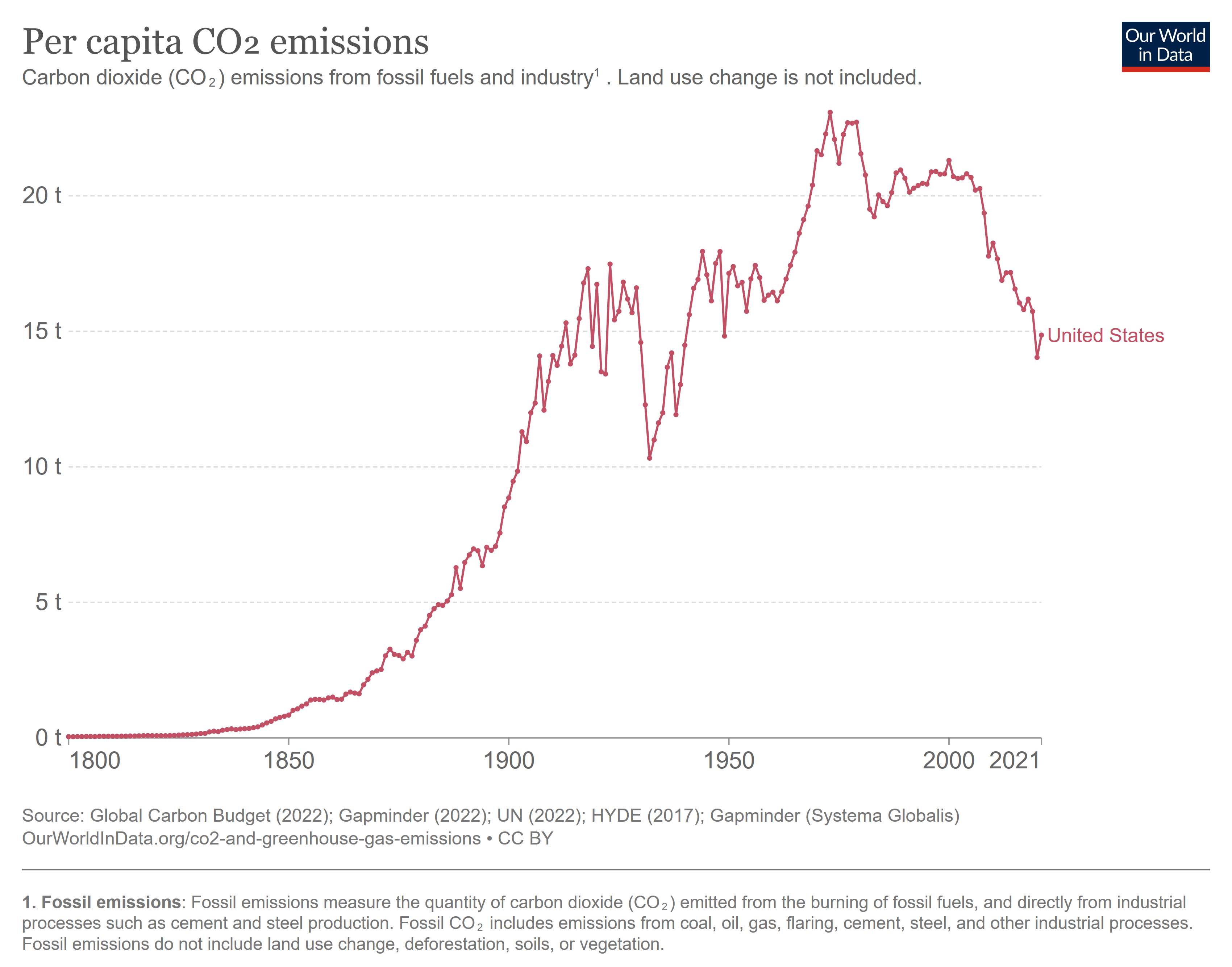
Not many people seem to know this, but the US has also been on the right track with regard to carbon emissions: Per-capita carbon emissions in the US have been trending downward since about 2000, and are now lower than they were in the 1950s. The Inflation Reduction act now looks poised to double down on that progress, as it has been forecasted to reduce our emissions all the way down to 40% below their early-2000s peak.

Somehow, this success doesn’t seem to be getting across. The majority of Americans incorrectly believe that we are in a downturn. Biden’s approval rating is still only 40%, barely higher than Trump’s was. When it comes to political beliefs, most American voters appear to be utterly impervious to facts.

Most Americans do correctly believe that inflation is still a bit high (though many seem to think it’s higher than it is); this is weird, seeing as inflation is normally high when the economy is growing rapidly, and gets too low when we are in a recession. This seems to be Halo Effect, rather than any genuine understanding of macroeconomics: downturns are bad and inflation is bad, so they must go together—when in fact, quite the opposite is the case.

People generally feel better about their own prospects than they do about the economy as a whole:

Sixty-four percent of Americans say the economy is worse off compared to 2020, while seventy-three percent of Americans say the economy is worse off compared to five years ago. About two in five of Americans say they feel worse off from five years ago generally (38%) and a similar number say they feel worse off compared to 2020 (37%).

(Did you really have to write out ‘seventy-three percent’? I hate that convention. 73% is so much clearer and quicker to read.)

I don’t know what the Biden administration should do about this. Trying to sell themselves harder might backfire. (And I’m pretty much the last person in the world you should ask for advice about selling yourself.) But they’ve been doing really great work for the US economy… and people haven’t noticed. Thousands of factories are being built, millions of people are getting jobs, and the collective response has been… “meh”.

Reasons to like Joe Biden

Sep 6 JDN 2459099

Maybe it’s because I follow too many radical leftists on social media (this is at least a biased sample, no doubt), but I’ve seen an awful lot of posts basically making this argument: “Joe Biden is terrible, but we have to elect him, because Donald Trump is worse.”

And make no mistake: Whatever else you think about this election, the fact that Donald Trump is a fascist and Joe Biden is not is indeed a fully sufficient reason to vote for Biden. You shouldn’t need any more than that.

But in fact Joe Biden is not terrible. Yes, there are some things worth criticizing about his record and his platform—particularly with regard to civil liberties and war (both of those links are to my own posts making such criticisms of the Obama administration). I don’t want to sweep these significant flaws under the rug.

Yet, there are also a great many things that are good about Biden and his platform, and it’s worthwhile to talk about them. You shouldn’t feel like you are holding your nose and voting for the lesser of two evils; Biden is going to make a very good President.

First and foremost, there is his plan to invest in clean energy and combat climate change. For the first time in decades, we have a Presidential candidate who is explicitly pro-nuclear and has a detailed, realistic plan for achieving net-zero carbon emissions within a generation. We should have done this 30 years ago; but far better to start now than to wait even longer.

Then there is Biden’s plan for affordable housing. He wants to copy California’s Homeowner Bill of Rights at the federal level, fight redlining, expand Section 8, and nationalize the credit rating system. Above all, he wants to create a new First Down Payment Tax Credit that will provide first-time home buyers with $15,000 toward a down payment on a home. That is how you increase homeownership. The primary reason why people rent instead of owning is that they can’t afford the down payment.

Biden is also serious about LGBT rights, and wants to pass the Equality Act, which would finally make all discrimination based on sexual orientation or gender identity illegal at the federal level. He has plans to extend and aggressively enforce federal rules protecting people with disabilities. His plans for advancing racial equality seem to be thoroughly baked into all of his proposals, from small business funding to housing reform—likely part of why he’s so popular among Black voters.

His plan for education reform includes measures to equalize funding between rich and poor districts and between White and non-White districts.

Biden’s healthcare plan isn’t quite Medicare For All, but it’s actually remarkably close to that. He wants to provide a public healthcare option available to everyone, and also lower the Medicare eligibility age to 60 instead of 65. This means that anyone who wants Medicare will be able to buy into it, and also sets a precedent of lowering the eligibility age—remember, all we really need to do to get Medicare For All is lower that age to 18. Moreover, it avoids forcing people off private insurance that they like, which is the main reason why Medicare For All still does not have majority support.

While many on the left have complained that Biden believes in “tough on crime”, his plan for criminal justice reform actually strikes a very good balance between maintaining low crime rates and reducing incarceration and police brutality. The focus is on crime prevention instead of punishment, and it includes the elimination of all federal use of privatized prisons.

Most people would give lip service to being against domestic violence, but Biden has a detailed plan for actually protecting survivors and punishing abusers—including ratifying the Equal Rights Amendment and ending the rape kit backlog. The latter is an utter no-brainer. If we need to, we can pull the money from just about any other form of law enforcement (okay, I guess not homicide); those rape kits need to be tested and those rapists need to be charged.

Biden also has a sensible plan for gun control, which is consistent with the Second Amendment and Supreme Court precedent but still could provide substantial protections by reinstating the ban on assault weapons and high-capacity magazines, requiring universal background checks, and adding other sensible restrictions on who can be licensed to own firearms. It won’t do much about handguns or crimes of passion, but it should at least reduce mass shootings.

Biden doesn’t want to implement free four-year college—then again, neither do I—but he does have a plan for free community college and vocational schooling.

He also has a very ambitious plan for campaign finance reform, including a Constitutional Amendment that would ban all private campaign donations. Honestly if anything the plan sounds too ambitious; I doubt we can really implement all of these things any time soon. But if even half of them get through, our democracy will be in much better shape.

His immigration policy, while far from truly open borders, would reverse Trump’s appalling child-separation policy, expand access to asylum, eliminate long-term detention in favor of a probation system, and streamline the path to citizenship.

Biden’s platform is the first one I’ve seen that gives detailed plans for foreign aid and international development projects; he is particularly focused on Latin America.

I’ve seen many on the left complain that Biden was partly responsible for the current bankruptcy system that makes it nearly impossible to discharge student loans; well, his current platform includes a series of reforms developed by Elizabeth Warren designed to reverse that.

I do think Biden is too hawkish on war and not serious enough about protecting civil liberties—and I said the same thing about Obama years ago. But Biden isn’t just better than Trump (almost anyone would be better than Trump); he’s actually a genuinely good candidate with a strong, progressive platform.

You should already have been voting for Biden anyway. But hopefully now you can actually do it with some enthusiasm.

How to hurt allies and alienate people

Aug 9 JDN 2459071

I’ve been wanting to write this post for awhile now, but I have been worried about the reaction I might get. Ultimately I realized that this is precisely why it needs to be written. Especially since Slate Star Codex is offline for the foreseeable future, there don’t see to be a lot of other people willing to write it.

The timing could be questioned, I suppose; when we are in the throes of a historic pandemic and brazen creeping authoritarianism, perhaps now should be the time for unconditional solidarity. But I fear that unconditional solidarity is one of the most dangerous forces in human existence: Politics is the mind-killer, arguments are soldiers, and the absolute unwillingness to question one’s own side is how we get everything from the Spanish Inquisition to Vladimir Lenin.

And since this is about not simply being mistaken but alienating allies, perhaps these desperate times are when we need the correction most: For we simply cannot afford to lose any allies right now.

“All men benefit from male violence.”

“It’s impossible to be racist against White people.”

“I hate White people.”

“Men are pigs.”

“All I want for Christmas is White genocide.”

Statements like these have two things in common: One, they are considered appropriate and acceptable to say by most of the social justice left; and two, they are harmful, alienating, and wrong.

All men benefit from male violence? You mean that male rape victims benefit from male violence? The thousands of men who are assaulted and murdered by other men—at far higher rates than women—benefit from that, do they? Did Matthew Shepard benefit from male violence?

It’s impossible to be racist against White people? Then tell me, what was it when a Black woman told me that melanin is the gateway to the soul and all White people are soulless snakes? Swap the colors, and it sounds like something only a diehard KKK member or neo-Nazi could say. If that’s not racism, what is?

The insistence that racism is “prejudice plus power” is a disingenuous redefinition of the concept precisely in an attempt to retroactively make it true that it’s impossible to be racist against White people. This is not what the word “racist” means to most people. But even if I were to allow that definition, do you think Black people never have power over White people? There are no Black managers who discriminate against their White employees, no Black teachers who abuse their White students? I’m not aware of Barack Obama discriminating against any White people, but can anyone deny that he had power? White people may have more power on average, but that doesn’t mean they have more power in every case.

What’s more, I don’t really understand what leftists think they are accomplishing by making this kind of assertion. Is it just an expression of rage, or a signal of your group identity? You’re clearly not going to convince any White person who has been discriminated against that White people never get discriminated against. You’re clearly not going to convince any man who has been brutally attacked by another man that all men benefit from male violence. It would be one thing to say that White people face less discrimination (clearly true) or that most White people don’t face discrimination (maybe true); but to say that no White people ever face discrimination is just obviously false, and will be disproved by many people’s direct experience.

Indeed, it seems quite obvious to me that this kind of talk is likely to frustrate and alienate many people who could otherwise have been allies.

The left has a counter-argument prepared for this: If you are alienated by what we say, then you were never a true ally in the first place.

The accusation seems to be that alienated allies are just fair-weather friends; but I don’t think someone is being a fair-weather friend if they stop wanting to be your friend because you abuse them. And make no mistake: Continually telling people that they are inferior and defective because of their race or gender or some other innate aspect of themselves absolutely constitutes abuse. Indeed, it’s nothing less than a mirror image of the very abuse that social justice is supposed to exist to prevent.

To be sure, there are cases where people claim to be alienated allies but were never really allies to begin with. Anyone who says “Wokeness made me a Nazi” obviously was far-right to begin with, and is just using that as an excuse. No amount of people saying “I hate White people” would justify becoming a Nazi or a KKK member. This isn’t them genuinely being alienated by the left being unfair; this is them saying “Look what you made me do” as they punch you in the face.

But I think the far more common scenario is more like this: “I want to support social justice, but every time I try to participate in leftist spaces, people attack me. They say that I’m defective because of who I am, and it hurts. They don’t seem interested in my input anyway, so I think I’ll just stay away from leftist spaces to preserve my own mental health.” These are people who broadly agree with social justice in principle, but just feel so frustrated and alienated by the movement in practice that they decide they are better off remaining on the sidelines.

Is it really so hard to understand how someone might feel that way? Why would anyone want to interact in a social space where most of the time is spent disparaging people like them? To stay in such a space, one either needs to have very strong moral convictions to sustain them against that onslaught, or needs to be masochistic or self-loathing.


Maybe it is self-loathing, actually: Liberal White people are the only group that systematically exhibits a negative in-group bias. The further left you are on the political spectrum, the more likely you are to suffer from mental illness, especially if you are male. I’ve seen some right-wing sources use this to claim that “liberalism is a mental illness”, but the far more sensible explanation is that the kind of collective guilt and self-hatred that the left inculcates in liberal White people is harmful to mental health. It may also be because concern about the injustice in the world makes your life generally harder, even though you are right to be concerned.

There really does seem to be a lot of pressure to confess and self-flagellate among White leftists. I think my favorite is the injunction to “Divest from Whiteness“; it’s beautiful because it’s utterly meaningless. If you really just meant “fight racial discrimination”, you could have said that. Better yet, you could have recommended some specific policy or belief to adopt. (“Defund the Police”, for all its flaws, is an infinitely superior slogan to “Divest from Whiteness”.) By saying it this way, you’re trying to bring in some notion that we are morally obliged to somehow stop being White—which is of course completely impossible. Frankly I think even if I got gene therapy to convert my body to a West African phenotype people would still say I was “really White”. Thus, Whiteness becomes Original Sin: A stain acquired at birth that can never be removed and must always be a source of guilt.

So let me say this in no uncertain terms:

It’s okay to be White.

It’s okay to be straight.

It’s okay to be male.

It’s wrong to be racist.

It’s wrong to be homophobic.

It’s wrong to be sexist.

No, it isn’t “covertly racist” to say that it’s okay to be White—and if you think it is, you are part of the problem here. People do not have control over what race they are born into. There is no moral failing in being a particular color, or in being descended from people who did terrible things. (And it’s not like only White people have ancestors who did terrible things!)

Yes, I know that there are White supremacist groups using the slogan “It’s okay to be White”, but you know what? Stopped Clock Principle. Reversed stupidity is not intelligence. Nazis believe many things that are wrong, but the mere fact that Nazis believe something doesn’t make it wrong. Nazis also generally believe in Darwinian evolution, and Adolf Hitler was a strict vegetarian.

I am not denying that privilege and oppression exist. But there is a clear and absolutely vital moral distinction between being a member of a group and oppressing people who are not in that group. Being White is not the same thing as being racist. Being straight is not the same thing as being homophobic. Being male is not the same thing as being sexist. Indeed, I would argue that being a member of the privileged category is not even necessary to participate in oppression—you can oppress people of your own group, or be in one underprivileged group and oppress someone in another group. Being privileged certainly makes it easier for you to support oppression and more likely that you’ll do so—but it is neither necessary nor sufficient.

Another common response is that this is just “tone policing“, that complaining about alienating rhetoric is just a way of shutting down dissent in general. No doubt this is sometimes true: One of the more effective ways of silencing someone’s argument is to convince people that it has been delivered in an overly aggressive or shrill way, thus discrediting the messenger. (This was basically the only major criticism ever leveled against New Atheism, for instance.)

But it clearly takes the notion too far to say that any kind of rhetoric is acceptable as long as it’s for the right cause. Insulting and denigrating people is never appropriate. Making people feel guilty for being born in the wrong group is never fair. Indeed, it’s not clear that one can even argue against tone policing without… tone policing. Sometimes your tone is actually inappropriate and harmful and you need to be criticized for it.

In fact, some of the people that harsh rhetoric is alienating may harbor real prejudices that need to be challenged. But they aren’t very likely to make the intense effort to challenge their own prejudices if every interaction they have with the social justice community is hostile. If we want to change someone’s mind, it helps a great deal to start by showing them compassion and respect.

I’m not saying that fighting for social justice is never going to upset people. Social change is always painful, and there are many cherished beliefs and institutions that will have to be removed in order to achieve lasting justice. So the mere fact that someone is frustrated or upset with you doesn’t necessarily mean you’ve done anything wrong. But you should at least consider that people might sometimes be upset with you for genuinely good reasons, that when they say your aggressive rhetoric is hurtful and alienating that might be because it’s actually true.

Authoritarianism and Masculinity

Apr 19 JDN 2458957

There has always been a significant difference between men and women voters, at least as long as we have been gathering data—and probably as long as women have been voting, which is just about to hit its centennial in the United States.

But the 2016 and 2018 elections saw the largest gender gaps we’ve ever recorded. Dividing by Presidential administrations, Bush would be from 2000 to 2006, when the gender gap never exceeded 18 percentage points, and averaged less than 10 points. Obama would be from 2008 to 2014, when the gender gap never exceeded 20 points and averaged about 15 points. In 2018, the gap stood at 23 percentage points.

Indeed, it is quite clear at this point that Trump’s support base comes mainly from White men.

This is far from the only explanatory factor here: Younger voters are much more liberal than older voters, more educated voters are more liberal than less educated voters, and urban voters are much more liberal than rural voters.

But the gender and race gaps are large enough that even if only White men with a college degree had voted, Trump would have still won, and even if only women without a college degree had voted, Trump would have lost. Trumpism is a white male identity movement.

And indeed it seems significant that Trump’s opponent was the first woman to be a US Presidential nominee from a major party.

Why would men be so much more likely to support Trump than women? Well, there’s the fact that Trump has been accused of sexual harassment dozens of times and sexual assault several times. Women are more likely to be victims of such behavior, and men are more likely to be perpetrators of it.

But I think that’s really a symptom of a broader cause, which is that authoritarianism is masculine.

Think about it: Can you even name a woman who was an authoritarian dictator? There have been a few queen tyrants historically, but not many; tyrants are almost always kings. And for all her faults, Margaret Thatcher was assuredly no Joseph Stalin.

Masculinity is tied to power, authority, strength, dominance: All things that authoritarians promise. It doesn’t even seem to matter that it’s always the dictator asserting power and dominance upon us, taking away the power and authority we previously had; the mere fact that some man is exerting power and dominance on someone seems to satisfy this impulse. And of course those who support authoritarians always seem to imagine that the dictator will oppress someone else—never me. (“I never thought leopards would eat my face!”)

Conversely, the virtues of democracy, such as equality, fairness, cooperation, and compromise, are coded feminine. This is how toxic masculinity sustains itself: Even being willing to talk about disagreements rather than fighting over them constitutes surrender to the feminine. So the mere fact that I am trying to talk them out of their insanely (both self- and other-) destructive norms proves that I serve the enemy.

I don’t often interact with Trump supporters, because doing so is a highly unpleasant experience. But when I have, certain themes kept reoccurring: “Trump is a real man”; “Democrats are pussies”; “they [people of color] are taking over our [White people’s] country”; “you’re a snowflake libtard beta cuck”.

Almost all of the content was about identity, particularly masculine and White identity. Virtually none of their defenses of Trump involved any substantive claims about policy, though some did at least reference the relatively good performance of the economy (up until recently—and that they all seem to blame on the “unforeseeable” pandemic, a “Black Swan”; nevermind that people actually did foresee it and were ignored). Ironically they are always the ones complaining about “identity politics”.

And while they would be the last to admit it, I noticed something else as well: Most of these men were deeply insecure about their own masculinity. They kept constantly trying to project masculine dominance, and getting increasingly aggravated when I simply ignored it rather than either submitting or responding with my own displays of dominance. Indeed, they probably perceived me as displaying a kind of masculine dominance: I was just countersignaling instead of signaling, and that’s what made them so angry. They clearly felt deeply envious of the fact that I could simply be secure in my own identity without feeling a need to constantly defend it.

But of course I wasn’t born that way. Indeed, the security I now feel in my own identity was very hard-won through years of agony and despair—necessitated by being a bisexual man in a world that even today isn’t very accepting of us. Even now I’m far from immune to the pressures of masculinity; I’ve simply learned to channel them better and resist their worst effects.

They call us “snowflakes” because they feel fragile, and fear their own fragility. And in truth, they are fragile. Indeed, fragile masculinity is one of the strongest predictors of support for Trump. But it is in the nature of fragile masculinity that pointing it out only aggravates it and provokes an even angrier response. Toxic masculinity is a very well-adapted meme; its capacity to defend itself is morbidly impressive, like the way that deadly viruses spread themselves is morbidly impressive.

This is why I think it is extremely dangerous to mock the size of Trump’s penis (or his hands, metonymously—though empirically, digit ratio slightly correlates with penis size, but overall hand size does not), or accuse his supporters of likewise having smaller penises. In doing so, you are reinforcing the very same toxic masculinity norms that underlie so much of Trump’s support. And this is even worse if the claim is true: In that case you’re also reinforcing that man’s own crisis of masculine identity.

Indeed, perhaps the easiest way to anger a man who is insecure about his masculinity is to accuse him of being insecure about his masculinity. It’s a bit of a paradox. I have even hesitated to write this post, for fear of triggering the same effect; but I realized that it’s more likely that you, my readers, would trigger it inadvertently, and by warning you I might reduce the overall rate at which it is triggered.

I do not use the word “triggered” lightly; I am talking about a traumatic trigger response. These men have been beaten down their whole lives for not being “manly enough”, however defined, and they lash out by attacking the masculinity of every other man they encounter—thereby perpetuating the cycle of trauma. And stricter norms of masculinity also make coping with trauma more difficult, which is why men who exhibit stricter masculinity also are more likely to suffer PTSD in war. There are years of unprocessed traumatic memories in these men’s brains, and the only way they know to cope with them is to try to inflict them on someone else.

The ubiquity of “cuck” as an insult in the alt-right is also quite notable in this context. It’s honestly a pretty weird insult to throw around casually; it implies knowing all sorts of things about a person’s sexual relationships that you can’t possibly know. (For someone in an openly polyamorous relationship, it’s probably quite amusing.) But it’s a way of attacking masculine identity: If you were a “real man”, your wife wouldn’t be sleeping around. We accuse her of infidelity in order to accuse you of inferiority. (And if your spouse is male? Well then obviously you’re even worse than a “cuck”—you’re a “fag”.) There also seems to be some sort of association that the alt-right made between cuckoldry and politics, as though the election of Obama constitutes America “cheating” on them. I’m not sure whether it bothers them more that Obama is liberal, or that he is Black. Both definitely bother them a great deal.

How do we deal with these men? If we shouldn’t attack their masculinity for fear of retrenchment, and we can’t directly engage them on questions of policy because it means nothing to them, what then should we do? I’m honestly not sure. What these men actually need is years of psychotherapy to cope with their deep-seated traumas; but they would never seek it out, because that, too, is considered unmasculine. Of course you can’t be expected to provide the effect of years of psychotherapy in a single conversation with a stranger. Even a trained therapist wouldn’t be able to do that, nor would they be likely to give actual therapy sessions to angry strangers for free.

What I think we can do, however, is to at least try to refrain from making their condition worse. We can rigorously resist the temptation to throw the same insults back at them, accusing them of having small penises, or being cuckolds, or whatever. We should think of this the way we think of using “gay” as an insult (something I all too well remember from middle school): You’re not merely insulting the person you’re aiming it at, you’re also insulting an entire community of innocent people.

We should even be very careful about directly addressing their masculine insecurity; it may sometimes be necessary, but it, too, is sure to provoke a defensive response. And as I mentioned earlier, if you are a man and you are not constantly defending your own masculinity, they can read that as countersignaling your own superiority. This is not an easy game to win.

But the stakes are far too high for us to simply give up. The fate of America and perhaps even the world hinges upon finding a solution.

Pinker Propositions

May 19 2458623

What do the following statements have in common?

1. “Capitalist countries have less poverty than Communist countries.

2. “Black men in the US commit homicide at a higher rate than White men.

3. “On average, in the US, Asian people score highest on IQ tests, White and Hispanic people score near the middle, and Black people score the lowest.

4. “Men on average perform better at visual tasks, and women on average perform better on verbal tasks.

5. “In the United States, White men are no more likely to be mass shooters than other men.

6. “The genetic heritability of intelligence is about 60%.

7. “The plurality of recent terrorist attacks in the US have been committed by Muslims.

8. “The period of US military hegemony since 1945 has been the most peaceful period in human history.

These statements have two things in common:

1. All of these statements are objectively true facts that can be verified by rich and reliable empirical data which is publicly available and uncontroversially accepted by social scientists.

2. If spoken publicly among left-wing social justice activists, all of these statements will draw resistance, defensiveness, and often outright hostility. Anyone making these statements is likely to be accused of racism, sexism, imperialism, and so on.

I call such propositions Pinker Propositions, after an excellent talk by Steven Pinker illustrating several of the above statements (which was then taken wildly out of context by social justice activists on social media).

The usual reaction to these statements suggests that people think they imply harmful far-right policy conclusions. This inference is utterly wrong: A nuanced understanding of each of these propositions does not in any way lead to far-right policy conclusions—in fact, some rather strongly support left-wing policy conclusions.

1. Capitalist countries have less poverty than Communist countries, because Communist countries are nearly always corrupt and authoritarian. Social democratic countries have the lowest poverty and the highest overall happiness (#ScandinaviaIsBetter).

2. Black men commit more homicide than White men because of poverty, discrimination, mass incarceration, and gang violence. Black men are also greatly overrepresented among victims of homicide, as most homicide is intra-racial. Homicide rates often vary across ethnic and socioeconomic groups, and these rates vary over time as a result of cultural and political changes.

3. IQ tests are a highly imperfect measure of intelligence, and the genetics of intelligence cut across our socially-constructed concept of race. There is far more within-group variation in IQ than between-group variation. Intelligence is not fixed at birth but is affected by nutrition, upbringing, exposure to toxins, and education—all of which statistically put Black people at a disadvantage. Nor does intelligence remain constant within populations: The Flynn Effect is the well-documented increase in intelligence which has occurred in almost every country over the past century. Far from justifying discrimination, these provide very strong reasons to improve opportunities for Black children. The lead and mercury in Flint’s water suppressed the brain development of thousands of Black children—that’s going to lower average IQ scores. But that says nothing about supposed “inherent racial differences” and everything about the catastrophic damage of environmental racism.

4. To be quite honest, I never even understood why this one shocks—or even surprises—people. It’s not even saying that men are “smarter” than women—overall IQ is almost identical. It’s just saying that men are more visual and women are more verbal. And this, I think, is actually quite obvious. I think the clearest evidence of this—the “interocular trauma” that will convince you the effect is real and worth talking about—is pornography. Visual porn is overwhelmingly consumed by men, even when it was designed for women (e.g. Playgirla majority of its readers are gay men, even though there are ten times as many straight women in the world as there are gay men). Conversely, erotic novels are overwhelmingly consumed by women. I think a lot of anti-porn feminism can actually be explained by this effect: Feminists (who are usually women, for obvious reasons) can say they are against “porn” when what they are really against is visual porn, because visual porn is consumed by men; then the kind of porn that they like (erotic literature) doesn’t count as “real porn”. And honestly they’re mostly against the current structure of the live-action visual porn industry, which is totally reasonable—but it’s a far cry from being against porn in general. I have some serious issues with how our farming system is currently set up, but I’m not against farming.

5. This one is interesting, because it’s a lack of a race difference, which normally is what the left wing always wants to hear. The difference of course is that this alleged difference would make White men look bad, and that’s apparently seen as a desirable goal for social justice. But the data just doesn’t bear it out: While indeed most mass shooters are White men, that’s because most Americans are White, which is a totally uninteresting reason. There’s no clear evidence of any racial disparity in mass shootings—though the gender disparity is absolutely overwhelming: It’s almost always men.

6. Heritability is a subtle concept; it doesn’t mean what most people seem to think it means. It doesn’t mean that 60% of your intelligence is due to your your genes. Indeed, I’m not even sure what that sentence would actually mean; it’s like saying that 60% of the flavor of a cake is due to the eggs. What this heritability figure actually means that when you compare across individuals in a population, and carefully control for environmental influences, you find that about 60% of the variance in IQ scores is explained by genetic factors. But this is within a particular population—here, US adults—and is absolutely dependent on all sorts of other variables. The more flexible one’s environment becomes, the more people self-select into their preferred environment, and the more heritable traits become. As a result, IQ actually becomes more heritable as children become adults, called the Wilson Effect.

7. This one might actually have some contradiction with left-wing policy. The disproportionate participation of Muslims in terrorism—controlling for just about anything you like, income, education, age etc.—really does suggest that, at least at this point in history, there is some real ideological link between Islam and terrorism. But the fact remains that the vast majority of Muslims are not terrorists and do not support terrorism, and antagonizing all the people of an entire religion is fundamentally unjust as well as likely to backfire in various ways. We should instead be trying to encourage the spread of more tolerant forms of Islam, and maintaining the strict boundaries of secularism to prevent the encroach of any religion on our system of government.

8. The fact that US military hegemony does seem to be a cause of global peace doesn’t imply that every single military intervention by the US is justified. In fact, it doesn’t even necessarily imply that any such interventions are justified—though I think one would be hard-pressed to say that the NATO intervention in the Kosovo War or the defense of Kuwait in the Gulf War was unjustified. It merely points out that having a hegemon is clearly preferable to having a multipolar world where many countries jockey for military supremacy. The Pax Romana was a time of peace but also authoritarianism; the Pax Americana is better, but that doesn’t prevent us from criticizing the real harms—including major war crimes—committed by the United States.

So it is entirely possible to know and understand these facts without adopting far-right political views.

Yet Pinker’s point—and mine—is that by suppressing these true facts, by responding with hostility or even ostracism to anyone who states them, we are actually adding fuel to the far-right fire. Instead of presenting the nuanced truth and explaining why it doesn’t imply such radical policies, we attack the messenger; and this leads people to conclude three things:

1. The left wing is willing to lie and suppress the truth in order to achieve political goals (they’re doing it right now).

2. These statements actually do imply right-wing conclusions (else why suppress them?).

3. Since these statements are true, that must mean the right-wing conclusions are actually correct.

Now (especially if you are someone who identifies unironically as “woke”), you might be thinking something like this: “Anyone who can be turned away from social justice so easily was never a real ally in the first place!”

This is a fundamentally and dangerously wrongheaded view. No one—not me, not you, not anyone—was born believing in social justice. You did not emerge from your mother’s womb ranting against colonalist imperialism. You had to learn what you now know. You came to believe what you now believe, after once believing something else that you now think is wrong. This is true of absolutely everyone everywhere. Indeed, the better you are, the more true it is; good people learn from their mistakes and grow in their knowledge.

This means that anyone who is now an ally of social justice once was not. And that, in turn, suggests that many people who are currently not allies could become so, under the right circumstances. They would probably not shift all at once—as I didn’t, and I doubt you did either—but if we are welcoming and open and honest with them, we can gradually tilt them toward greater and greater levels of support.

But if we reject them immediately for being impure, they never get the chance to learn, and we never get the chance to sway them. People who are currently uncertain of their political beliefs will become our enemies because we made them our enemies. We declared that if they would not immediately commit to everything we believe, then they may as well oppose us. They, quite reasonably unwilling to commit to a detailed political agenda they didn’t understand, decided that it would be easiest to simply oppose us.

And we don’t have to win over every person on every single issue. We merely need to win over a large enough critical mass on each issue to shift policies and cultural norms. Building a wider tent is not compromising on your principles; on the contrary, it’s how you actually win and make those principles a reality.

There will always be those we cannot convince, of course. And I admit, there is something deeply irrational about going from “those leftists attacked Charles Murray” to “I think I’ll start waving a swastika”. But humans aren’t always rational; we know this. You can lament this, complain about it, yell at people for being so irrational all you like—it won’t actually make people any more rational. Humans are tribal; we think in terms of teams. We need to make our team as large and welcoming as possible, and suppressing Pinker Propositions is not the way to do that.

What really works against bigotry

Sep 30 JDN 2458392

With Donald Trump in office, I think we all need to be thinking carefully about what got us to this point, how we have apparently failed in our response to bigotry. It’s good to see that Kavanaugh’s nomination vote has been delayed pending investigations, but we can’t hope to rely on individual criminal accusations to derail every potentially catastrophic candidate. The damage that someone like Kavanaugh would do to the rights of women, racial minorities, and LGBT people is too severe to risk. We need to attack this problem at its roots: Why are there so many bigoted leaders, and so many bigoted voters willing to vote for them?

The problem is hardly limited to the United States; we are witnessing a global crisis of far-right ideology, as even the UN has publicly recognized.

I think the left made a very dangerous wrong turn with the notion of “call-out culture”. There is now empirical data to support me on this. Publicly calling people racist doesn’t make them less racist—in fact, it usually makes them more racist. Angrily denouncing people doesn’t change their minds—it just makes you feel righteous. Our own accusatory, divisive rhetoric is part of the problem: By accusing anyone who even slightly deviates from our party line (say, by opposing abortion in some circumstances, as 75% of Americans do?) of being a fascist, we slowly but surely push more people toward actual fascism.

Call-out culture encourages a black-and-white view of the world, where there are “good guys” (us) and “bad guys” (them), and our only job is to fight as hard as possible against the “bad guys”. It frees us from the pain of nuance, complexity, and self-reflection—at only the cost of giving up any hope of actually understanding the real causes or solving the problem. Bigotry is not something that “other” people have, which you, fine upstanding individual, could never suffer from. We are all Judy Hopps.

This is not to say we should do nothing—indeed, that would be just as bad if not worse. The rise of neofascism has been possible largely because so many people did nothing. Knowing that there is bigotry in all of us shouldn’t stop us from recognizing that some people are far worse than others, or paralyze us against constructively improving ourselves and our society. See the shades of gray without succumbing to the Fallacy of Gray.

The most effective interventions at reducing bigotry are done in early childhood; obviously, it’s far too late for that when it comes to people like Trump and Kavanaugh.

But there are interventions that can work at reducing bigotry among adults. We need to first understand where the bigotry comes from—and it doesn’t always come from the same source. We need to be willing to look carefully—yes, even sympathetically—at people with bigoted views so that we can understand them.

There are deep, innate systems in the human brain that make bigotry come naturally to us. Even people on the left who devote their lives to combating discrimination against women, racial minorities and LGBT people can still harbor bigoted attitudes toward other groups—such as rural people or Republicans. If you think that all Republicans are necessarily racist, that’s not a serious understanding of what motivates Republicans—that’s just bigotry on your part. Trump is racist. Pence is racist. One could argue that voting for them constitutes, in itself, a racist act. But that does not mean that every single Republican voter is fundamentally and irredeemably racist.

It’s also important to have conversations face-to-face. I must admit that I am personally terrible at this; despite training myself extensively in etiquette and public speaking to the point where most people perceive me as charismatic, even charming, deep down I am still a strong introvert. I dislike talking in person, and dread talking over the phone. I would much prefer to communicate entirely in written electronic communication—but the data is quite clear on this: Face-to-face conversations work better at changing people’s minds. It may be awkward and uncomfortable, but by being there in person, you limit their ability to ignore you or dismiss you; you aren’t a tweet from the void, but an actual person, sitting there in front of them.

Speak with friends and family members. This, I know, can be especially awkward and painful. In the last few years I have lost connections with friends who were once quite close to me as a result of difficult political conversations. But we must speak up, for silence becomes complicity. And speaking up really can work.

Don’t expect people to change their entire worldview overnight. Focus on small, concrete policy ideas. Don’t ask them to change who they are; ask them to change what they believe. Ask them to justify and explain their beliefs—and really listen to them when they do. Be open to the possibility that you, too might be wrong about something.

If they say “We should deport all illegal immigrants!”, point out that whenever we try this, a lot of fields go unharvested for lack of workers, and ask them why they are so concerned about illegal immigrants. If they say “Illegal immigrants come here and commit crimes!” point them to the statistical data showing that illegal immigrants actually commit fewer crimes on average than native-born citizens (probably because they are more afraid of what happens if they get caught).

If they are concerned about Muslim immigrants influencing our culture in harmful ways, first, acknowledge that there are legitimate concerns about Islamic cultural values (particularly toward women and LGBT people)but then point out that over 90% of Muslim-Americans are proud to be American, and that welcoming people is much more effective at getting them to assimilate into our culture than keeping them out and treating them as outsiders.

If they are concerned about “White people getting outnumbered”, first point out that White people are still over 70% of the US population, and in most rural areas there are only a tiny fraction of non-White people. Point out that Census projections showing the US will be majority non-White by 2045 are based on naively extrapolating current trends, and we really have no idea what the world will look like almost 30 years from now. Next, ask them why they worry about being “outnumbered”; get them to consider that perhaps racial demographics don’t have to be a matter of zero-sum conflict.

After you’ve done this, you will feel frustrated and exhausted, and the relationship between you and the person you’re trying to convince will be strained. You will probably feel like you have accomplished absolutely nothing to change their mind—but you are wrong. Even if they don’t acknowledge any change in their beliefs, the mere fact that you sat down and asked them to justify what they believe, and presented calm, reasonable, cogent arguments against those beliefs will have an effect. It will be a small effect, difficult for you to observe in that moment. But it will still be an effect.

Think about the last time you changed your mind about something important. (I hope you can remember such a time; none of us were born being right about everything!) Did it happen all at once? Was there just one, single knock-down argument that convinced you? Probably not. (On some mathematical and scientific questions I’ve had that experience: Oh, wow, yeah, that proof totally demolishes what I believed. Well, I guess I was wrong. But most beliefs aren’t susceptible to such direct proof.) More likely, you were presented with arguments from a variety of sources over a long span of time, gradually chipping away at what you thought you knew. In the moment, you might not even have admitted that you thought any differently—even to yourself. But as the months or years went by, you believed something quite different at the end than you had at the beginning.

Your goal should be to catalyze that process in other people. Don’t take someone who is currently a frothing neo-Nazi and expect them to start marching with Black Lives Matter. Take someone who is currently a little bit uncomfortable about immigration, and calm their fears. Don’t take someone who thinks all poor people are subhuman filth and try to get them to support a basic income. Take someone who is worried about food stamps adding to our national debt, and show them how it is a small portion of our budget. Don’t take someone who thinks global warming was made up by the Chinese and try to get them to support a ban on fossil fuels. Take someone who is worried about gas prices going up as a result of carbon taxes and show them that carbon offsets would add only about $100 per person per year while saving millions of lives.

And if you’re ever on the other side, and someone has just changed your mind, even a little bit—say so. Thank them for opening your eyes. I think a big part of why we don’t spend more time trying to honestly persuade people is that so few people acknowledge us when we do.

What exactly is “gentrification”? How should we deal with it?

Nov 26, JDN 2458083

“Gentrification” is a word that is used in a variety of mutually-inconsistent ways. If you compare the way social scientists use it to the way journalists use it, for example, they are almost completely orthogonal.

The word “gentrification” is meant to invoke the concept of a feudal gentry—a hereditary landed class that extracts rents from the rest of the population while contributing little or nothing themselves.

If indeed that is what we are talking about, then obviously this is bad. Moreover, it’s not an entirely unfounded fear; there are some remarkably strong vestiges of feudalism in the developed world, even in the United States where we never formally had a tradition of feudal titles. There really is a significant portion of the world’s wealth held by a handful of billionaire landowner families.

But usually when people say “gentrification” they mean something much broader. Almost any kind of increase in urban real estate prices gets characterized as “gentrification” by at least somebody, and herein lies the problem.

In fact, the kind of change that is most likely to get characterized as “gentrification” isn’t even the rising real estate prices we should be most worried about. People aren’t concerned when the prices of suburban homes double in 20 years. You might think that things that are already too expensive getting more expensive would be the main concern, but on the contrary, people are most likely to cry “gentrification” when housing prices rise in poor areas where housing is cheap.

One of the most common fears about gentrification is that it will displace local residents. In fact, the best quasi-experimental studies show little or no displacement effect. It’s actually mainly middle-class urbanites who get displaced by rising rents. Poor people typically own their homes, and actually benefit from rising housing prices. Young upwardly-mobile middle-class people move to cities to rent apartments near where they work, and tend to assume that’s how everyone lives, but it’s not. Rising rents in a city are far more likely to push out its grad students than they are poor families that have lived there for generations. Part of why displacement does not occur may be because of policies specifically implemented to fight it, such as subsidized housing and rent control. If that’s so, let’s keep on subsidizing housing (though rent control will always be a bad idea).

Nor is gentrification actually a very widespread phenomenon. The majority of poor neighborhoods remain poor indefinitely. In most studies, only about 30% of neighborhoods classified as “gentrifiable” actually end up “gentrifying”. Less than 10% of the neighborhoods that had high poverty rates in 1970 had low poverty rates in 2010.

Most people think gentrification reduces crime, but in the short run the opposite is the case. Robbery and larceny are higher in gentrifying neighborhoods. Criminals are already there, and suddenly they get much more valuable targets to steal from, so they do.

There is also a general perception that gentrification involves White people pushing Black people out, but this is also an overly simplistic view. First of all, a lot of gentrification is led by upwardly-mobile Black and Latino people. Black people who live in gentrified neighborhoods seem to be better off than Black people who live in non-gentrified neighborhoods; though selection bias may contribute to this effect, it can’t be all that strong, or we’d observe a much stronger displacement effect. Moreover, some studies have found that gentrification actually tends to increase the racial diversity of neighborhoods, and may actually help fight urban self-segregation, though it does also tend to increase racial polarization by forcing racial mixing.

What should we conclude from all this? I think the right conclusion is we are asking the wrong question.

Rising housing prices in poor areas aren’t inherently good or inherently bad, and policies designed specifically to increase or decrease housing prices are likely to have harmful side effects. What we need to be focusing on is not houses or neighborhoods but people. Poverty is definitely a problem, for sure. Therefore we should be fighting poverty, not “gentrification”. Directly transfer wealth from the rich to the poor, and then let the housing market fall where it may.

There is still some role for government in urban planning more generally, regarding things like disaster preparedness, infrastructure development, and transit systems. It may even be worthwhile to design regulations or incentives that directly combat racial segregation at the neighborhood level, for, as the Schelling Segregation Model shows, it doesn’t take a large amount of discriminatory preference to have a large impact on socioeconomic outcomes. But don’t waste effort fighting “gentrification”; directly design policies that will incentivize desegregation.

Rising rent as a proportion of housing prices is still bad, and the fundamental distortions in our mortgage system that prevent people from buying houses are a huge problem. But rising housing prices are most likely to be harmful in rich neighborhoods, where housing is already overpriced; in poor neighborhoods where housing is cheap, rising prices might well be a good thing.
In fact, I have a proposal to rapidly raise homeownership across the United States, which is almost guaranteed to work, directly corrects an enormous distortion in financial markets, and would cost about as much as the mortgage interest deduction (which should probably be eliminated, as most economists agree). Give each US adult a one-time grant voucher which gives them $40,000 that can only be spent as a down payment on purchasing a home. Each time someone turns 18, they get a voucher. You only get one over your lifetime, so use it wisely (otherwise the policy could become extremely expensive); but this is an immediate direct transfer of wealth that also reduces your credit constraint. I know I for one would be house-hunting right now if I were offered such a voucher. The mortgage interest deduction means nothing to me, because I can’t afford a down payment. Where the mortgage interest deduction is regressive, benefiting the rich more than the poor, this policy gives everyone the same amount, like a basic income.

In the short run, this policy would probably be expensive, as we’d have to pay out a large number of vouchers at once; but with our current long-run demographic trends, the amortized cost is basically the same as the mortgage interest deduction. And the US government especially should care about the long-run amortized cost, as it is an institution that has lasted over 200 years without ever missing a payment and can currently borrow at negative real interest rates.

When are we going to get serious about climate change?

Oct 8, JDN 24578035

Those two storms weren’t simply natural phenomena. We had a hand in creating them.

The EPA doesn’t want to talk about the connection, and we don’t have enough statistical power to really be certain, but there is by now an overwhelming scientific consensus that global climate change will increase hurricane intensity. The only real question left is whether it is already doing so.

The good news is that global carbon emissions are no longer rising. They have been essentially static for the last few years. The bad news is that this is almost certainly too little, too late.

The US is not on track to hit our 2025 emission target; we will probably exceed it by at least 20%.

But the real problem is that the targets themselves are much too high. Most countries have pledged to drop emissions only about 8-10% below their 1990s levels.

Even with the progress we have made, we are on track to exceed the global carbon budget needed to keep warming below 2 C by the year 2040. We have been reducing emission intensity by about 0.8% per year—we need to be reducing it by at least 3% per year and preferably faster. Highly-developed nations should be switching to nuclear energy as quickly as possible; an equitable global emission target requires us to reduce our emissions by 80% by 2050.

At the current rate of improvement, we will overshoot the 2 C warming target and very likely the 3C target as well.

Why aren’t we doing better? There is of course the Tragedy of the Commons to consider: Each individual country acting in its own self-interest will continue to pollute more, as this is the cheapest and easiest way to maintain industrial development. But then if all countries do so, the result is a disaster for us all.
But this explanation is too simple. We have managed to achieve some international cooperation on this issue. The Kyoto protocol has worked; emissions among Kyoto member nations have been reduced by more than 20% below 1990 levels, far more than originally promised. The EU in particular has taken a leadership role in reducing emissions, and has a serious shot at hitting their target of 40% reduction by 2030.

That is a truly astonishing scale of cooperation; the EU has a population of over 500 million people and spans 28 nations. It would seem like doing that should get us halfway to cooperating across all nations and all the world’s people.

But there is a vital difference between the EU and the world as a whole: The tribal paradigm. Europeans certainly have their differences: The UK and France still don’t really get along, everyone’s bitter with Germany about that whole Hitler business, and as the acronym PIIGS emphasizes, the peripheral countries have never quite felt as European as the core Schengen members. But despite all this, there has been a basic sense of trans-national (meta-national?) unity among Europeans for a long time.
For one thing, today Europeans see each other as the same race. That wasn’t always the case. In Medieval times, ethnic categories were as fine as “Cornish” and “Liverpudlian”. (To be fair, there do still exist a handful of Cornish nationalists.) Starting around the 18th cenutry, Europeans began to unite under the heading of “White people”, a classification that took on particular significance during the trans-Atlantic slave trade. But even in the 19th century, “Irish” and “Sicilian” were seen as racial categories. It wasn’t until the 20th century that Europeans really began to think of themselves as one “kind of people”, and not coincidentally it was at the end of the 20th century that the European Union finally took hold.

There is another region that has had a similar sense of unification: Latin America. Again, there are conflicts: There are a lot of nasty stereotypes about Puerto Ricans among Cubans and vice-versa. But Latinos, by and large, think of each other as the same “kind of people”, distinct from both Europeans and the indigenous population of the Americas.

I don’t think it is coincidental that the lowest carbon emission intensity (carbon emissions / GDP PPP) in the world is in Latin America, followed closely by Europe.
And if you had to name right now the most ethnically divided region in the world, what would you say? The Middle East, of course. And sure enough, they have the worst carbon emission intensity. (Of course, oil is an obvious confounding variable here, likely contributing to both.)

Indeed, the countries with the lowest ethnic fractionalization ratings tend to be in Europe and Latin America, and the highest tend to be in the Middle East and Africa.

Even within the United States, political polarization seems to come with higher carbon emissions. When we think of Democrats and Republicans as different “kinds of people”, we become less willing to cooperate on finding climate policy solutions.

This is not a complete explanation, of course. China has a low fractionalization rating but a high carbon intensity, and extremely high overall carbon emissions due to their enormous population. Africa’s carbon intensity isn’t as high as you’d think just from their terrible fractionalization, especially if you exclude Nigeria which is a major oil producer.

But I think there is nonetheless a vital truth here: One of the central barriers to serious long-term solutions to climate change is the entrenchment of racial and national identity. Solving the Tragedy of the Commons requires cooperation, we will only cooperate with those we trust, and we will only trust those we consider to be the same “kind of people”.

You can even hear it in the rhetoric: If “we” (Americans) give up our carbon emissions, then “they” (China) will take advantage of us. No one seems to worry about Alabama exploiting California—certainly no Republican would—despite the fact that in real economic terms they basically do. But people in Alabama are Americans; in other words, they count as actual people. People in China don’t count. If anything, people in California are supposed to be considered less American than people in Alabama, despite the fact that vastly more Americans live in California than Alabama. This mirrors the same pattern where we urban residents are somehow “less authentic” even though we outnumber the rural by four to one.
I don’t know how to mend this tribal division; I very much wish I did. But I do know that simply ignoring it isn’t going to work. We can talk all we want about carbon taxes and cap-and-trade, but as long as most of the world’s people are divided into racial, ethnic, and national identities that they consider to be in zero-sum conflict with one another, we are never going to achieve the level of cooperation necessary for a real permanent solution to climate change.

The temperatures and the oceans rise. United we must stand, or divided we shall fall.