Two terms in marginal utility of wealth

JDN 2457569

This post is going to be a little wonkier than most; I’m actually trying to sort out my thoughts and draw some public comment on a theory that has been dancing around my head for awhile. The original idea of separating terms in marginal utility of wealth was actually suggested by my boyfriend, and from there I’ve been trying to give it some more mathematical precision to see if I can come up with a way to test it experimentally. My thinking is also influenced by a paper Miles Kimball wrote about the distinction between happiness and utility.

There are lots of ways one could conceivably spend money—everything from watching football games to buying refrigerators to building museums to inventing vaccines. But insofar as we are rational (and we are after all about 90% rational), we’re going to try to spend our money in such a way that its marginal utility is approximately equal across various activities. You’ll buy one refrigerator, maybe two, but not seven, because the marginal utility of refrigerators drops off pretty fast; instead you’ll spend that money elsewhere. You probably won’t buy a house that’s twice as large if it means you can’t afford groceries anymore. I don’t think our spending is truly optimal at maximizing utility, but I think it’s fairly good.

Therefore, it doesn’t make much sense to break down marginal utility of wealth into all these different categories—cars, refrigerators, football games, shoes, and so on—because we already do a fairly good job of equalizing marginal utility across all those different categories. I could see breaking it down into a few specific categories, such as food, housing, transportation, medicine, and entertainment (and this definitely seems useful for making your own household budget); but even then, I don’t get the impression that most people routinely spend too much on one of these categories and not enough on the others.

However, I can think of two quite different fundamental motives behind spending money, which I think are distinct enough to be worth separating.

One way to spend money is on yourself, raising your own standard of living, making yourself more comfortable. This would include both football games and refrigerators, really anything that makes your life better. We could call this the consumption motive, or maybe simply the self-directed motive.

The other way is to spend it on other people, which, depending on your personality can take either the form of philanthropy to help others, or as a means of self-aggrandizement to raise your own relative status. It’s also possible to do both at the same time in various combinations; while the Gates Foundation is almost entirely philanthropic and Trump Tower is almost entirely self-aggrandizing, Carnegie Hall falls somewhere in between, being at once a significant contribution to our society and an obvious attempt to bring praise and adulation to himself. I would also include spending on Veblen goods that are mainly to show off your own wealth and status in this category. We can call this spending the philanthropic/status motive, or simply the other-directed motive.

There is some spending which combines both motives: A car is surely useful, but a Ferrari is mainly for show—but then, a Lexus or a BMW could be either to show off or really because you like the car better. Some form of housing is a basic human need, and bigger, fancier houses are often better, but the main reason one builds mansions in Beverly Hills is to demonstrate to the world that one is fabulously rich. This complicates the theory somewhat, but basically I think the best approach is to try to separate a sort of “spending proportion” on such goods, so that say $20,000 of the Lexus is for usefulness and $15,000 is for show. Empirically this might be hard to do, but theoretically it makes sense.

One of the central mysteries in cognitive economics right now is the fact that while self-reported happiness rises very little, if at all, as income increases, a finding which was recently replicated even in poor countries where we might not expect it to be true, nonetheless self-reported satisfaction continues to rise indefinitely. A number of theories have been proposed to explain this apparent paradox.

This model might just be able to account for that, if by “happiness” we’re really talking about the self-directed motive, and by “satisfaction” we’re talking about the other-directed motive. Self-reported happiness seems to obey a rule that $100 is worth as much to someone with $10,000 as $25 is to someone with $5,000, or $400 to someone with $20,000.

Self-reported satisfaction seems to obey a different rule, such that each unit of additional satisfaction requires a roughly equal proportional increase in income.

By having a utility function with two terms, we can account for both of these effects. Total utility will be u(x), happiness h(x), and satisfaction s(x).

u(x) = h(x) + s(x)

To obey the above rule, happiness must obey harmonic utility, like this, for some constants h0 and r:

h(x) = h0 – r/x

Proof of this is straightforward, though to keep it simple I’ve hand-waved why it’s a power law:

Given

h'(2x) = 1/4 h'(x)

Let

h'(x) = r x^n

h'(2x) = r (2x)^n

r (2x)^n = 1/4 r x^n

n = -2

h'(x) = r/x^2

h(x) = – r x^(-1) + C

h(x) = h0 – r/x

Miles Kimball also has some more discussion on his blog about how a utility function of this form works. (His statement about redistribution at the end is kind of baffling though; sure, dollar for dollar, redistributing wealth from the middle class to the poor would produce a higher gain in utility than redistributing wealth from the rich to the middle class. But neither is as good as redistributing from the rich to the poor, and the rich have a lot more dollars to redistribute.)

Satisfaction, however, must obey logarithmic utility, like this, for some constants s0 and k.

The x+1 means that it takes slightly less proportionally to have the same effect as your wealth increases, but it allows the function to be equal to s0 at x=0 instead of going to negative infinity:

s(x) = s0 + k ln(x)

Proof of this is very simple, almost trivial:

Given

s'(x) = k/x

s(x) = k ln(x) + s0

Both of these functions actually have a serious problem that as x approaches zero, they go to negative infinity. For self-directed utility this almost makes sense (if your real consumption goes to zero, you die), but it makes no sense at all for other-directed utility, and since there are causes most of us would willingly die for, the disutility of dying should be large, but not infinite.

Therefore I think it’s probably better to use x +1 in place of x:

h(x) = h0 – r/(x+1)

s(x) = s0 + k ln(x+1)

This makes s0 the baseline satisfaction of having no other-directed spending, though the baseline happiness of zero self-directed spending is actually h0 – r rather than just h0. If we want it to be h0, we could use this form instead:

h(x) = h0 + r x/(x+1)

This looks quite different, but actually only differs by a constant.

Therefore, my final answer for the utility of wealth (or possibly income, or spending? I’m not sure which interpretation is best just yet) is actually this:

u(x) = h(x) + s(x)

h(x) = h0 + r x/(x+1)

s(x) = s0 + k ln(x+1)

Marginal utility is then the derivatives of these:

h'(x) = r/(x+1)^2

s'(x) = k/(x+1)

Let’s assign some values to the constants so that we can actually graph these.

Let h0 = s0 = 0, so our baseline is just zero.

Furthermore, let r = k = 1, which would mean that the value of $1 is the same whether spent either on yourself or on others, if $1 is all you have. (This is probably wrong, actually, but it’s the simplest to start with. Shortly I’ll discuss what happens as you vary the ratio k/r.)

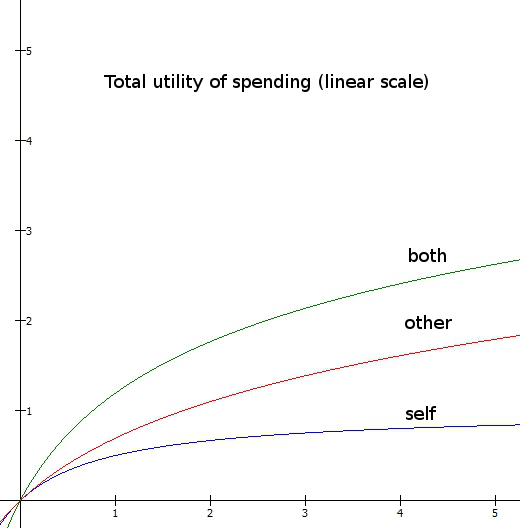
Here is the result graphed on a linear scale:

Utility_linear

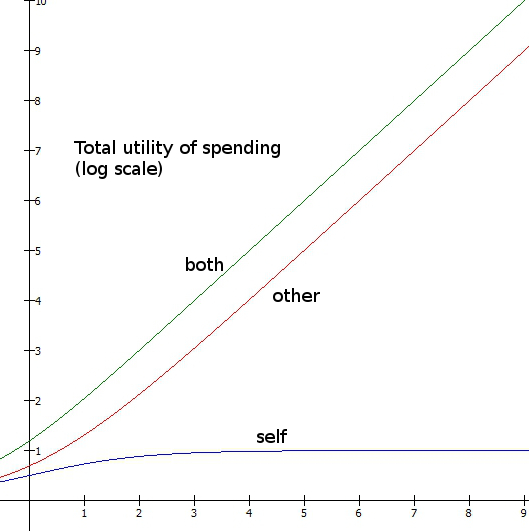
And now, graphed with wealth on a logarithmic scale:

Utility_log

As you can see, self-directed marginal utility drops off much faster than other-directed marginal utility, so the amount you spend on others relative to yourself rapidly increases as your wealth increases. If that doesn’t sound right, remember that I’m including Veblen goods as “other-directed”; when you buy a Ferrari, it’s not really for yourself. While proportional rates of charitable donation do not increase as wealth increases (it’s actually a U-shaped pattern, largely driven by poor people giving to religious institutions), they probably should (people should really stop giving to religious institutions! Even the good ones aren’t cost-effective, and some are very, very bad.). Furthermore, if you include spending on relative power and status as the other-directed motive, that kind of spending clearly does proportionally increase as wealth increases—gotta keep up with those Joneses.

If r/k = 1, that basically means you value others exactly as much as yourself, which I think is implausible (maybe some extreme altruists do that, and Peter Singer seems to think this would be morally optimal). r/k < 1 would mean you should never spend anything on yourself, which not even Peter Singer believes. I think r/k = 10 is a more reasonable estimate.

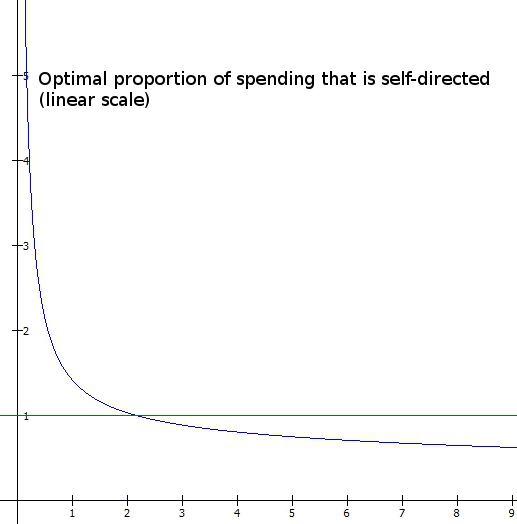
For any given value of r/k, there is an optimal ratio of self-directed versus other-directed spending, which can vary based on your total wealth.

Actually deriving what the optimal proportion would be requires a whole lot of algebra in a post that probably already has too much algebra, but the point is, there is one, and it will depend strongly on the ratio r/k, that is, the overall relative importance of self-directed versus other-directed motivation.

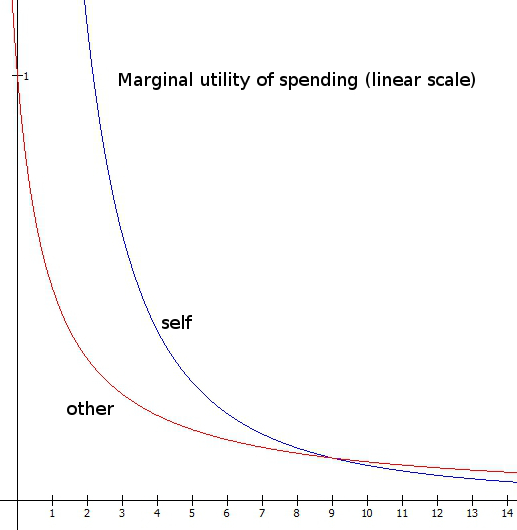
Take a look at this graph, which uses r/k = 10.

Utility_marginal

If you only have 2 to spend, you should spend it entirely on yourself, because up to that point the marginal utility of self-directed spending is always higher. If you have 3 to spend, you should spend most of it on yourself, but a little bit on other people, because after you’ve spent about 2.2 on yourself there is more marginal utility for spending on others than on yourself.

If your available wealth is W, you would spend some amount x on yourself, and then W-x on others:

u(x) = h(x) + s(W-x)

u(x) = r x/(x+1) + k ln(W – x + 1)

Then you take the derivative and set it equal to zero to find the local maximum. I’ll spare you the algebra, but this is the result of that optimization:

x = – 1 – r/(2k) + sqrt(r/k) sqrt(2 + W + r/(4k))

As long as k <= r (which more or less means that you care at least as much about yourself as about others—I think this is true of basically everyone) then as long as W > 0 (as long as you have some money to spend) we also have x > 0 (you will spend at least something on yourself).

Below a certain threshold (depending on r/k), the optimal value of x is greater than W, which means that, if possible, you should be receiving donations from other people and spending them on yourself. (Otherwise, just spend everything on yourself). After that, x < W, which means that you should be donating to others. The proportion that you should be donating smoothly increases as W increases, as you can see on this graph (which uses r/k = 10, a figure I find fairly plausible):

Utility_donation

While I’m sure no one literally does this calculation, most people do seem to have an intuitive sense that you should donate an increasing proportion of your income to others as your income increases, and similarly that you should pay a higher proportion in taxes. This utility function would justify that—which is something that most proposed utility functions cannot do. In most models there is a hard cutoff where you should donate nothing up to the point where your marginal utility is equal to the marginal utility of donating, and then from that point forward you should donate absolutely everything. Maybe a case can be made for that ethically, but psychologically I think it’s a non-starter.

I’m still not sure exactly how to test this empirically. It’s already quite difficult to get people to answer questions about marginal utility in a way that is meaningful and coherent (people just don’t think about questions like “Which is worth more? $4 to me now or $10 if I had twice as much wealth?” on a regular basis). I’m thinking maybe they could play some sort of game where they have the opportunity to make money at the game, but must perform tasks or bear risks to do so, and can then keep the money or donate it to charity. The biggest problem I see with that is that the amounts would probably be too small to really cover a significant part of anyone’s total wealth, and therefore couldn’t cover much of their marginal utility of wealth function either. (This is actually a big problem with a lot of experiments that use risk aversion to try to tease out marginal utility of wealth.) But maybe with a variety of experimental participants, all of whom we get income figures on?

The difference between price, cost, and value

JDN 2457559

This topic has been on the voting list for my Patreons for several months, but it never quite seems to win the vote. Well, this time it did. I’m glad, because I was tempted to do it anyway.

“Price”, “cost”, and “value”; the words are often used more or less interchangeably, not only by regular people but even by economists. I’ve read papers that talked about “rising labor costs” when what they clearly meant was rising wages—rising labor prices. I’ve read papers that tried to assess the projected “cost” of climate change by using the prices of different commodity futures. And hardly a day goes buy that I don’t see a TV commercial listing one (purely theoretical) price, cutting it in half (to the actual price), and saying they’re now giving you “more value”.

As I’ll get to, there are reasons to think they would be approximately the same for some purposes. Indeed, they would be equal, at the margin, in a perfectly efficient market—that may be why so many economists use them this way, because they implicitly or explicitly assume efficient markets. But they are fundamentally different concepts, and it’s dangerous to equate them casually.

Price

Price is exactly what you think it is: The number of dollars you must pay to purchase something. Most of the time when we talk about “cost” or “value” and then give a dollar figure, we’re actually talking about some notion of price.

Generally we speak in terms of nominal prices, which are the usual concept of prices in actual dollars paid, but sometimes we do also speak in terms of real prices, which are relative prices of different things once you’ve adjusted for overall inflation. “Inflation-adjusted price” can be a somewhat counter-intuitive concept; if a good’s (nominal) price rises, but by less than most other prices have risen, its real price has actually fallen.

You also need to be careful about just what price you’re looking at. When we look at labor prices, for example, we need to consider not only cash wages, but also fringe benefits and other compensation such as stock options. But other than that, prices are fairly straightforward.

Cost

Cost is probably not at all what you think it is. The real cost of something has nothing to do with money; saying that a candy bar “costs $2” or a computer “costs $2,000” is at best a somewhat sloppy shorthand and at worst a fundamental distortion of what cost is and why it matters. No, those are prices. The cost of a candy bar is the toil of children in cocoa farms in Cote d’Ivoire. The cost of a computer is the ecological damage and displaced indigenous people caused by coltan mining in Congo.

The cost of something is the harm that it does to human well-being (or for that matter to the well-being of any sentient being). It is not measured in money but in “the sweat of our laborers, the genius of our scientists, the hopes of our children” (to quote Eisenhower, who understood real cost better than most economists). There is also opportunity cost, the real cost we pay not by what we did, but by what we didn’t do—what we could have done instead.

This is important precisely because while costs should always be reduced when possible, prices can in fact be too low—and indeed, artificially low prices of goods due to externalities are probably the leading reason why humanity bears so many excess real costs. If the price of that chocolate bar accurately reflected the suffering of those African children (perhaps by—Gasp! Paying them a fair wage?), and the price of that computer accurately reflected the ecological damage of those coltan mines (a carbon tax, at least?), you might not want to buy them anymore; in which case, you should not have bought them. In fact, as I’ll get to once I discuss value, there is reason to think that even if you would buy them at a price that accurately reflected the dollar value of the real cost to their producers, we would still buy more than we should.

There is a point at which we should still buy things even though people get hurt making them; if you deny this, stop buying literally anything ever again. We don’t like to think about it, but any product we buy did cause some person, in some place, some degree of discomfort or unpleasantness in production. And many quite useful products will in fact cause death to a nonzero number of human beings.

For some products this is only barely true—it’s hard to feel bad for bestselling authors and artists who sell their work for millions, for whatever toil they may put into their work, whatever their elevated suicide rate (which is clearly endogenous; people aren’t randomly assigned to be writers), they also surely enjoy it a good deal of the time, and even if they didn’t, their work sells for millions. But for many products it is quite obviously true: A certain proportion of roofers, steelworkers, and truck drivers will die doing their jobs. We can either accept that, recognizing that it’s worth it to have roofs, steel, and trucking—and by extension, industrial capitalism, and its whole babies not dying thing—or we can give up on the entire project of human civilization, and go back to hunting and gathering; even if we somehow managed to avoid the direct homicide most hunter-gatherers engage in, far more people would simply die of disease or get eaten by predators.

Of course, we should have safety standards; but the benefits of higher safety must be carefully weighed against the potential costs of inefficiency, unemployment, and poverty. Safety regulations can reduce some real costs and increase others, even if they almost always increase prices. A good balance is struck when real cost is minimized, where any additional regulation would increase inefficiency more than it improves safety.

Actually OSHA are unsung heroes for their excellent performance at striking this balance, just as EPA are unsung heroes for their balance in environmental regulations (and that whole cutting crime in half business). If activists are mad at you for not banning everything bad and business owners are mad at you for not letting them do whatever they want, you’re probably doing it right. Would you rather people saved from fires, or fires prevented by good safety procedures? Would you rather murderers imprisoned, or boys who grow up healthy and never become murderers? If an ounce of prevention is worth a pound of cure, why does everyone love firefighters and hate safety regulators?So let me take this opportunity to say thank you, OSHA and EPA, for doing the jobs of firefighters and police way better than they do, and unlike them, never expecting to be lauded for it.

And now back to our regularly scheduled programming. Markets are supposed to reflect costs in prices, which is why it’s not totally nonsensical to say “cost” when you mean “price”; but in fact they aren’t very good at that, for reasons I’ll get to in a moment.

Value

Value is how much something is worth—not to sell it (that’s the price again), but to use it. One of the core principles of economics is that trade is nonzero-sum, because people can exchange goods that they value differently and thereby make everyone better off. They can’t price them differently—the buyer and the seller must agree upon a price to make the trade. But they can value them differently.

To see how this works, let’s look at a very simple toy model, the simplest essence of trade: Alice likes chocolate ice cream, but all she has is a gallon of vanilla ice cream. Bob likes vanilla ice cream, but all he has is a gallon of chocolate ice cream. So Alice and Bob agree to trade their ice cream, and both of them are happier.

We can measure value in “willingness-to-pay” (WTP), the highest price you’d willingly pay for something. That makes value look more like a price; but there are several reasons we must be careful when we do that. The obvious reason is that WTP is obviously going to vary based on overall inflation; since $5 isn’t worth as much in 2016 as it was in 1956, something with a WTP of $5 in 1956 would have a much higher WTP in 2016. The not-so-obvious reason is that money is worth less to you the more you have, so we also need to take into account the effect of wealth, and the marginal utility of wealth. The more money you have, the more money you’ll be willing to pay in order to get the same amount of real benefit. (This actually creates some very serious market distortions in the presence of high income inequality, which I may make the subject of a post or even a paper at some point.) Similarly there is “willingness-to-accept” (WTA), the lowest price you’d willingly accept for it. In theory these should be equal; in practice, WTA is usually slightly higher than WTP in what’s called endowment effect.

So to make our model a bit more quantitative, we could suppose that Alice values vanilla at $5 per gallon and chocolate at $10 per gallon, while Bob also values vanilla at $5 per gallon but only values chocolate at $4 per gallon. (I’m using these numbers to point out that not all the valuations have to be different for trade to be beneficial, as long as some are.) Therefore, if Alice sells her vanilla ice cream to Bob for $5, both will (just barely) accept that deal; and then Alice can buy chocolate ice cream from Bob for anywhere between $4 and $10 and still make both people better off. Let’s say they agree to also sell for $5, so that no net money is exchanged and it is effectively the same as just trading ice cream for ice cream. In that case, Alice has gained $5 in consumer surplus (her WTP of $10 minus the $5 she paid) while Bob has gained $1 in producer surplus (the $5 he received minus his $4 WTP). The total surplus will be $6 no matter what price they choose, which we can compute directly from Alice’s WTP of $10 minus Bob’s WTA of $4. The price ultimately decides how that total surplus is distributed between the two parties, and in the real world it would very likely be the result of which one is the better negotiator.

The enormous cost of our distorted understanding

(See what I did there?) If markets were perfectly efficient, prices would automatically adjust so that, at the margin, value is equal to price is equal to cost. What I mean by “at the margin” might be clearer with an example: Suppose we’re selling apples. How many apples do you decide to buy? Well, the value of each successive apple to you is lower, the more apples you have (the law of diminishing marginal utility, which unlike most “laws” in economics is actually almost always true). At some point, the value of the next apple will be just barely above what you have to pay for it, so you’ll stop there. By a similar argument, the cost of producing apples increases the more apples you produce (the law of diminishing returns, which is a lot less reliable, more like the Pirate Code), and the producers of apples will keep selling them until the price they can get is only just barely larger than the cost of production. Thus, in the theoretical limit of infinitely-divisible apples and perfect rationality, marginal value = price = marginal cost. In such a world, markets are perfectly efficient and they maximize surplus, which is the difference between value and cost.

But in the real world of course, none of those assumptions are true. No product is infinitely divisible (though the gasoline in a car is obviously a lot more divisible than the car itself). No one is perfectly rational. And worst of all, we’re not measuring value in the same units. As a result, there is basically no reason to think that markets are optimizing anything; their optimization mechanism is setting two things equal that aren’t measured the same way, like trying to achieve thermal equilibrium by matching the temperature of one thing in Celsius to the temperature of other things in Fahrenheit.

An implicit assumption of the above argument that didn’t even seem worth mentioning was that when I set value equal to price and set price equal to cost, I’m setting value equal to cost; transitive property of equality, right? Wrong. The value is equal to the price, as measured by the buyer. The cost is equal to the price, as measured by the seller.

If the buyer and seller have the same marginal utility of wealth, no problem; they are measuring in the same units. But if not, we convert from utility to money and then back to utility, using a different function to convert each time. In the real world, wealth inequality is massive, so it’s wildly implausible that we all have anything close to the same marginal utility of wealth. Maybe that’s close enough if you restrict yourself to middle-class people in the First World; so when a tutoring client pays me, we might really be getting close to setting marginal value equal to marginal cost. But once you include corporations that are owned by billionaires and people who live on $2 per day, there’s simply no way that those price-to-utility conversions are the same at each end. For Bill Gates, a million dollars is a rounding error. For me, it would buy a house, give me more flexible work options, and keep me out of debt, but not radically change the course of my life. For a child on a cocoa farm in Cote d’Ivoire, it could change her life in ways she can probably not even comprehend.

The market distortions created by this are huge; indeed, most of the fundamental flaws in capitalism as we know it are ultimately traceable to this. Why do Americans throw away enough food to feed all the starving children in Africa? Marginal utility of wealth. Why are Silicon Valley programmers driving the prices for homes in San Francisco higher than most Americans will make in their lifetimes? Marginal utility of wealth. Why are the Koch brothers spending more on this year’s elections than the nominal GDP of the Gambia? Marginal utility of wealth. It’s the sort of pattern that once you see it suddenly seems obvious and undeniable, a paradigm shift a bit like the heliocentric model of the solar system. Forget trade barriers, immigration laws, and taxes; the most important market distortions around the world are all created by wealth inequality. Indeed, the wonder is that markets work as well as they do.

The real challenge is what to do about it, how to reduce this huge inequality of wealth and therefore marginal utility of wealth, without giving up entirely on the undeniable successes of free market capitalism. My hope is that once more people fully appreciate the difference between price, cost, and value, this paradigm shift will be much easier to make; and then perhaps we can all work together to find a solution.

Why is Tatooine poor?

JDN 2457513—May 4, 2016

May the Fourth be with you.

In honor of International Star Wars Day, this post is going to be about Star Wars!

[I wanted to include some images from Star Wars, but here are the copyright issues that made me decide it ultimately wasn’t a good idea.]

But this won’t be as frivolous as it may sound. Star Wars has a lot of important lessons to teach us about economics and other social sciences, and its universal popularity gives us common ground to start with. I could use Zimbabwe and Botswana as examples, and sometimes I do; but a lot of people don’t know much about Zimbabwe and Botswana. A lot more people know about Tatooine and Naboo, so sometimes it’s better to use those instead.

In fact, this post is just a small sample of a much larger work to come; several friends of mine who are social scientists in different fields (I am of course the economist, and we also have a political scientist, a historian, and a psychologist) are writing a book about this; we are going to use Star Wars as a jumping-off point to explain some real-world issues in social science.

So, my topic for today, which may end up forming the basis for a chapter of the book, is quite simple:
Why is Tatooine poor?

First, let me explain why this is such a mystery to begin with. We’re so accustomed to poverty being in the world that we expect to see it, we think of it as normal—and for most of human history, that was probably the correct attitude to have. Up until at least the Industrial Revolution, there simply was no way of raising the standard of living of most people much beyond bare subsistence. A wealthy few could sometimes live better, and most societies have had such an elite; but it was never more than about 1% of the population—and sometimes as little as 0.01%. They could have distributed wealth more evenly than they did, but there simply wasn’t that much to go around.

The “prosperous” “democracy” of Periclean Athens for example was really an aristocratic oligarchy, in which the top 1%—the ones who could read and write, and hence whose opinions we read—owned just about everything (including a fair number of the people—slavery). Their “democracy” was a voting system that only applied to a small portion of the population.

But now we live in a very different age, the Information Age, where we are absolutely basking in wealth thanks to enormous increases in productivity. Indeed, the standard of living of an Athenian philosopher was in many ways worse than that of a single mother on Welfare in the United States today; certainly the single mom has far better medicine, communication, and transportation than the philosopher, but she may even have better nutrition and higher education. Really the only things I can think of that the philosopher has more of are jewelry and real estate. The single mom also surely spends a lot more time doing housework, but a good chunk of her work is automated (dishwasher, microwave, washing machine), while the philosopher simply has slaves for that sort of thing. The smartphone in her pocket (81% of poor households in the US have a cellphone, and about half of these are smartphones) and the car in her driveway (75% of poor households in the US own at least one car) may be older models in disrepair, but they would still be unimaginable marvels to that ancient philosopher.

How is it, then, that we still have poverty in this world? Even if we argued that the poverty line in First World countries is too high because they have cars and smartphones (not an argument I agree with by the way—given our enormous productivity there’s no reason everyone shouldn’t have a car and a smartphone, and the main thing that poor people still can’t afford is housing), there are still over a billion people in the world today who live on less than $2 per day in purchasing-power-adjusted real income. That is poverty, no doubt about it. Indeed, it may in fact be a lower standard of living than most human beings had when we were hunter-gatherers. It may literally be a step downward from the Paleolithic.

Here is where Tatooine may give us some insights.

Productivity in the Star Wars universe is clearly enormous; indeed the proportional gap between Star Wars and us appears to be about the same as the proportional gap between us and hunter-gatherer times. The Death Star II had a diameter of 160 kilometers. Its cost is listed as “over 1 trillion credits”, but that’s almost meaningless because we have no idea what the exchange rate is or how the price of spacecraft varies relative to the price of other goods. (Spacecraft actually seem to be astonishingly cheap; in A New Hope it seems to be that a drink is a couple of credits while 10,000 credits is almost enough to buy an inexpensive starship. Basically their prices seem to be similar to ours for most goods, but spaceships are so cheap they are priced like cars instead of like, well, spacecraft.)

So let’s look at it another way: How much metal would it take to build such a thing, and how much would that cost in today’s money?

We actually see quite a bit of the inner structure of the Death Star II in Return of the Jedi, so I can hazard a guess that about 5% of the volume of the space station is taken up by solid material. Who knows what it’s actually made out of, but for a ballpark figure let’s assume it’s high-grade steel. The volume of a 160 km diameter sphere is 4*pi*r^3 = 4*(3.1415)*(80,000)^3 = 6.43 quadrillion cubic meters. If 5% is filled with material, that’s 320 trillion cubic meters. High-strength steel has a density of about 8000 kg/m^3, so that’s 2.6 quintillion kilograms of steel. A kilogram of high-grade steel costs about $2, so we’re looking at $5 quintillion as the total price just for the raw material of the Death Star II. That’s $5,000,000,000,000,000,000. I’m not even including the labor (droid labor, that is) and transportation costs (oh, the transportation costs!), so this is a very conservative estimate.

To get a sense of how ludicrously much money this is, the population of Coruscant is said to be over 1 trillion people, which is just about plausible for a city that covers an entire planet. The population of the entire galaxy is supposed to be about 400 quadrillion.

Suppose that instead of building the Death Star II, Emperor Palpatine had decided to give a windfall to everyone on Coruscant. How much would he have given each person (in our money)? $5 million.

Suppose instead he had offered the windfall to everyone in the galaxy? $12.50 per person. That’s 50 million worlds with an average population of 8 billion each. Instead of building the Death Star II, Palpatine could have bought the whole galaxy lunch.

Put another way, the cost I just estimated for the Death Star II is about 60 million times the current world GDP. So basically if the average world in the Empire produced as much as we currently produce on Earth, there would still not be enough to build that thing. In order to build the Death Star II in secret, it must be a small portion of the budget, maybe 5% tops. In order for only a small number of systems to revolt, the tax rates can’t be more than say 50%, if that; so total economic output on the average world in the Empire must in fact be more like 50 times what it is on Earth today, for a comparable average population. This puts their per-capita GDP somewhere around $500,000 per person per year.

So, economic output is extremely high in the Star Wars universe. Then why is Tatooine poor? If there’s enough output to make basically everyone a millionaire, why haven’t they?

In a word? Power.

Political power is of course very unequally distributed in the Star Wars universe, especially under the Empire but also even under the Old Republic and New Republic.

Core Worlds like Coruscant appear to have fairly strong centralized governments, and at least until the Emperor seized power and dissolved the Senate (as Tarkin announces in A New Hope) they also seemed to have fairly good representation in the Galactic Senate (though how you make a functioning Senate with millions of member worlds I have no idea—honestly, maybe they didn’t). As a result, Core Worlds are prosperous. Actually, even Naboo seems to be doing all right despite being in the Mid Rim, because of their strong and well-managed constitutional monarchy (“elected queen” is not as weird as it sounds—Sweden did that until the 16th century). They often talk about being a “democracy” even though they’re technically a constitutional monarchy—but the UK and Norway do the same thing with if anything less justification.

But Outer Rim Worlds like Tatooine seem to be out of reach of the central galactic government. (Oh, by the way, what hyperspace route drops you off at Tatooine if you’re going from Naboo to Coruscant? Did they take a wrong turn in addition to having engine trouble? “I knew we should have turned left at Christophsis!”) They even seem to be out of range of the monetary system (“Republic credits are no good out here,” said Watto in The Phantom Menace.), which is pretty extreme. That doesn’t usually happen—if there is a global hegemon, usually their money is better than gold. (“good as gold” isn’t strong enough—US money is better than gold, and that’s why people will accept negative real interest rates to hold onto it.) I guarantee you that if you want to buy something with a US $20 bill in Somalia or Zimbabwe, someone will take it. They might literally take it—i.e. steal it from you, and the government may not do anything to protect you—but it clearly will have value.

So, the Outer Rim worlds are extremely isolated from the central government, and therefore have their own local institutions that operate independently. Tatooine in particular appears to be controlled by the Hutts, who in turn seem to have a clan-based system of organized crime, similar to the Mafia. We never get much detail about the ins and outs of Hutt politics, but it seems pretty clear that Jabba is particularly powerful and may actually be the de facto monarch of a sizeable region or even the whole planet.

Jabba’s government is at the very far extreme of what Daron Acemoglu calls extractive regimes (I’ve been reading his tome Why Nations Fail, and while I agree with its core message, honestly it’s not very well-written or well-argued), systems of government that exist not to achieve overall prosperity or the public good, but to enrich a small elite few at the expense of everyone else. The opposite is inclusive regimes, under which power is widely shared and government exists to advance the public good. Real-world systems are usually somewhere in between; the US is still largely inclusive, but we’ve been getting more extractive over the last few decades and that’s a big problem.

Jabba himself appears to be fantastically wealthy, although even his huge luxury hover-yacht (…thing) is extremely ugly and spartan inside. I infer that he could have made it look however he wanted, and simply has baffling tastes in decor. The fact that he seems to be attracted to female humanoids is already pretty baffling, given the obvious total biological incompatibility; so Jabba is, shall we say, a weird dude. Eccentricity is quite common among despots of extractive regimes, as evidenced by Muammar Qaddafi’s ostentatious outfits, Idi Amin’s love of oranges and Kentucky Fried Chicken, and Kim Jong-Un’s fear of barbers and bond with Dennis Rodman. Maybe we would all be this eccentric if we had unlimited power, but our need to fit in with the rest of society suppresses it.

It’s difficult to put a figure on just how wealthy Jabba is, but it isn’t implausible to say that he has a million times as much as the average person on Tatooine, just as Bill Gates has a million times as much as the average person in the US. Like Qaddafi, before he was killed he probably feared that establishing more inclusive governance would only reduce his power and wealth and spread it to others, even if it did increase overall prosperity.
It’s not hard to make the figures work out so that is so. Suppose that for every 1% of the economy that is claimed by a single rentier despot, overall economic output drops by the same 1%. Then for concreteness, suppose that at optimal efficiency, the whole economy could produce $1 trillion. The amount of money that the despot can claim is determined by the portion he tries to claim, p, times the total amount that the economy will produce, which is (1-p) trillion dollars. So the despot’s wealth will be maximized when p(1-p) is maximized, which is p = 1/2; so the despot would maximize his own wealth at $250 billion if he claimed half of the economy, even though that also means that the economy produces half as much as it could. If he loosened his grip and claimed a smaller share, millions of his subjects would benefit; but he himself would lose more money than he gained. (You can also adjust these figures so that the “optimal” amount for the despot to claim is larger or smaller than half, depending on how severely the rent-seeking disrupts overall productivity.)

It’s important to note that it is not simply geography (galactography?) that makes Tatooine poor. Their sparse, hot desert may be less productive agriculturally, but that doesn’t mean that Tatooine is doomed to poverty. Indeed, today many of the world’s richest countries (such as Qatar) are in deserts, because they produce huge quantities of oil.

I doubt that oil would actually be useful in the Old Republic or the Empire, but energy more generally seems like something you’d always need. Tatooine has enormous flat desert plains and two suns, meaning that its potential to produce solar energy has to be huge. They couldn’t export the energy directly of course, but they could do so indirectly—the cheaper energy could allow them to build huge factories and produce starships at a fraction of the cost that other planets do. They could then sell these starships as exports and import water from planets where it is abundant like Naboo, instead of trying to produce their own water locally through those silly (and surely inefficient) moisture vaporators.

But Jabba likely has fought any efforts to invest in starship production, because it would require a more educated workforce that’s more likely to unionize and less likely to obey his every command. He probably has established a high tariff on water imports (or even banned them outright), so that he can maintain control by rationing the water supply. (Actually one thing I would have liked to see in the movies was Jabba being periodically doused by slaves with vats of expensive imported water. It would not only show an ostentatious display of wealth for a desert culture, but also serve the much more mundane function of keeping his sensitive gastropod skin from dangerously drying out. That’s why salt kills slugs, after all.) He also probably suppressed any attempt to establish new industries of any kind of Tatooine, fearing that with new industry could come a new balance of power.

The weirdest part to me is that the Old Republic didn’t do something about it. The Empire, okay, sure; they don’t much care about humanitarian concerns, so as long as Tatooine is paying its Imperial taxes and staying out of the Emperor’s way maybe he leaves them alone. But surely the Republic would care that this whole planet of millions if not billions of people is being oppressed by the Hutts? And surely the Republic Navy is more than a match for whatever pitiful military forces Jabba and his friends can muster, precisely because they haven’t established themselves as the shipbuilding capital of the galaxy? So why hasn’t the Republic deployed a fleet to Tatooine to unseat the Hutts and establish democracy? (It could be over pretty fast; we’ve seen that one good turbolaser can destroy Jabba’s hover-yacht—and it looks big enough to target from orbit.)

But then, we come full circle, back to the real world: Why hasn’t the US done the same thing in Zimbabwe? Would it not actually work? We sort of tried it in Libya—a lot of people died, and results are still pending I guess. But doesn’t it seem like we should be doing something?

Is Equal Unfair?

JDN 2457492

Much as you are officially a professional when people start paying you for what you do, I think you are officially a book reviewer when people start sending you books for free asking you to review them for publicity. This has now happened to me, with the book Equal Is Unfair by Don Watkins and Yaron Brook. This post is longer than usual, but in order to be fair to the book’s virtues as well as its flaws, I felt a need to explain quite thoroughly.

It’s a very frustrating book, because at times I find myself agreeing quite strongly with the first part of a paragraph, and then reaching the end of that same paragraph and wanting to press my forehead firmly into the desk in front of me. It makes some really good points, and for the most part uses economic statistics reasonably accurately—but then it rides gleefully down a slippery slope fallacy like a waterslide. But I guess that’s what I should have expected; it’s by leaders of the Ayn Rand Institute, and my experience with reading Ayn Rand is similar to that of Randall Monroe (I’m mainly referring to the alt-text, which uses slightly foul language).

As I kept being jostled between “That’s a very good point.”, “Hmm, that’s an interesting perspective.”, and “How can anyone as educated as you believe anything that stupid!?” I realized that there are actually three books here, interleaved:

1. A decent economics text on the downsides of taxation and regulation and the great success of technology and capitalism at raising the standard of living in the United States, which could have been written by just about any mainstream centrist neoclassical economist—I’d say it reads most like John Taylor or Ken Galbraith. My reactions to this book were things like “That’s a very good point.”, and “Sure, but any economist would agree with that.”

2. An interesting philosophical treatise on the meanings of “equality” and “opportunity” and their application to normative economic policy, as well as about the limitations of statistical data in making political and ethical judgments. It could have been written by Robert Nozick (actually I think much of it was based on Robert Nozick). Some of the arguments are convincing, others are not, and many of the conclusions are taken too far; but it’s well within the space of reasonable philosophical arguments. My reactions to this book were things like “Hmm, that’s an interesting perspective.” and “Your argument is valid, but I think I reject the second premise.”

3. A delusional rant of the sort that could only be penned by a True Believer in the One True Gospel of Ayn Rand, about how poor people are lazy moochers, billionaires are world-changing geniuses whose superior talent and great generosity we should all bow down before, and anyone who would dare suggest that perhaps Steve Jobs got lucky or owes something to the rest of society is an authoritarian Communist who hates all achievement and wants to destroy the American Dream. It was this book that gave me reactions like “How can anyone as educated as you believe anything that stupid!?” and “You clearly have no idea what poverty is like, do you?” and “[expletive] you, you narcissistic ingrate!”

Given that the two co-authors are Executive Director and a fellow of the Ayn Rand Institute, I suppose I should really be pleasantly surprised that books 1 and 2 exist, rather than disappointed by book 3.

As evidence of each of the three books interleaved, I offer the following quotations:

Book 1:

“All else being equal, taxes discourage production and prosperity.” (p. 30)

No reasonable economist would disagree. The key is all else being equal—it rarely is.

“For most of human history, our most pressing problem was getting enough food. Now food is abundant and affordable.” (p.84)

Correct! And worth pointing out, especially to anyone who thinks that economic progress is an illusion or we should go back to pre-industrial farming practices—and such people do exist.

“Wealth creation is first and foremost knowledge creation. And this is why you can add to the list of people who have created the modern world, great thinkers: people such as Euclid, Aristotle, Galileo, Newton, Darwin, Einstein, and a relative handful of others.” (p.90, emph. in orig.)

Absolutely right, though as I’ll get to below there’s something rather notable about that list.

“To be sure, there is competition in an economy, but it’s not a zero-sum game in which some have to lose so that others can win—not in the big picture.” (p. 97)

Yes! Precisely! I wish I could explain to more people—on both the Left and the Right, by the way—that economics is nonzero-sum, and that in the long run competitive markets improve the standard of living of society as a whole, not just the people who win that competition.

Book 2:

“Even opportunities that may come to us without effort on our part—affluent parents, valuable personal connections, a good education—require enormous effort to capitalize on.” (p. 66)

This is sometimes true, but clearly doesn’t apply to things like the Waltons’ inherited billions, for which all they had to do was be born in the right family and not waste their money too extravagantly.

“But life is not a game, and achieving equality of initial chances means forcing people to play by different rules.” (p. 79)

This is an interesting point, and one that I think we should acknowledge; we must treat those born rich differently from those born poor, because their unequal starting positions mean that treating them equally from this point forward would lead to a wildly unfair outcome. If my grandfather stole your grandfather’s wealth and passed it on to me, the fair thing to do is not to treat you and I equally from this point forward—it’s to force me to return what was stolen, insofar as that is possible. And even if we suppose that my grandfather earned far vaster wealth than yours, I think a more limited redistribution remains justified simply to put you and I on a level playing field and ensure fair competition and economic efficiency.

“The key error in this argument is that it totally mischaracterizes what it means to earn something. For the egalitarians, the results of our actions don’t merely have to be under our control, but entirely of our own making. […] But there is nothing like that in reality, and so what the egalitarians are ultimately doing is wiping out the very possibility of earning something.” (p. 193)

The way they use “egalitarian” as an insult is a bit grating, but there clearly are some actual egalitarian philosophers whose views are this extreme, such as G.A. Cohen, James Kwak and Peter Singer. I strongly agree that we need to make a principled distinction between gains that are earned and gains that are unearned, such that both sets are nonempty. Yet while Cohen would seem to make “earned” an empty set, Watkins and Brook very nearly make “unearned” empty—you get what you get, and you deserve it. The only exceptions they seem willing to make are outright theft and, what they consider equivalent, taxation. They have no concept of exploitation, excessive market power, or arbitrage—and while they claim they oppose fraud, they seem to think that only government is capable of it.

Book 3:

“What about government handouts (usually referred to as ‘transfer payments’)?” (p. 23)

Because Social Security is totally just a handout—it’s not like you pay into it your whole life or anything.

“No one cares whether the person who fixes his car or performs his brain surgery or applies for a job at his company is male or female, Indian or Pakistani—he wants to know whether they are competent.” (p.61)

Yes they do. We have direct experimental evidence of this.

“The notion that ‘spending drives the economy’ and that rich people spend less than others isn’t a view seriously entertained by economists,[…]” (p. 110)

The New Synthesis is Keynesian! This is what Milton Friedman was talking about when he said, “We’re all Keynesians now.”

“Because mobility statistics don’t distinguish between those who don’t rise and those who can’t, they are useless when it comes to assessing how healthy mobility is.” (p. 119)

So, if Black people have much lower odds of achieving high incomes even controlling for education, we can’t assume that they are disadvantaged or discriminated against; maybe Black people are just lazy or stupid? Is that what you’re saying here? (I think it might be.)

“Payroll taxes alone amount to 15.3 percent of your income; money that is taken from you and handed out to the elderly. This means that you have to spend more than a month and a half each year working without pay in order to fund other people’s retirement and medical care.” (p. 127)

That is not even close to how taxes work. Taxes are not “taken” from money you’d otherwise get—taxation changes prices and the monetary system depends upon taxation.

“People are poor, in the end, because they have not created enough wealth to make themselves prosperous.” (p. 144)

This sentence was so awful that when I showed it to my boyfriend, he assumed it must be out of context. When I showed him the context, he started swearing the most I’ve heard him swear in a long time, because the context was even worse than it sounds. Yes, this book is literally arguing that the reason people are poor is that they’re just too lazy and stupid to work their way out of poverty.

“No society has fully implemented the egalitarian doctrine, but one came as close as any society can come: Cambodia’s Khmer Rouge.” (p. 207)

Because obviously the problem with the Khmer Rouge was their capital gains taxes. They were just too darn fair, and if they’d been more selfish they would never have committed genocide. (The authors literally appear to believe this.)


So there are my extensive quotations, to show that this really is what the book is saying. Now, a little more summary of the good, the bad, and the ugly.

One good thing is that the authors really do seem to understand fairly well the arguments of their opponents. They quote their opponents extensively, and only a few times did it feel meaningfully out of context. Their use of economic statistics is also fairly good, though occasionally they present misleading numbers or compare two obviously incomparable measures.

One of the core points in Equal is Unfair is quite weak: They argue against the “shared-pie assumption”, which is that we create wealth as a society, and thus the rest of society is owed some portion of the fruits of our efforts. They maintain that this is fundamentally authoritarian and immoral; essentially they believe a totalizing false dichotomy between either absolute laissez-faire or Stalinist Communism.

But the “shared-pie assumption” is not false; we do create wealth as a society. Human cognition is fundamentally social cognition; they said themselves that we depend upon the discoveries of people like Newton and Einstein for our way of life. But it should be obvious we can never pay Einstein back; so instead we must pay forward, to help some child born in the ghetto to rise to become the next Einstein. I agree that we must build a society where opportunity is maximized—and that means, necessarily, redistributing wealth from its current state of absurd and immoral inequality.

I do however agree with another core point, which is that most discussions of inequality rely upon a tacit assumption which is false: They call it the “fixed-pie assumption”.

When you talk about the share of income going to different groups in a population, you have to be careful about the fact that there is not a fixed amount of wealth in a society to be distributed—not a “fixed pie” that we are cutting up and giving around. If it were really true that the rising income share of the top 1% were necessary to maximize the absolute benefits of the bottom 99%, we probably should tolerate that, because the alternative means harming everyone. (In arguing this they quote John Rawls several times with disapprobation, which is baffling because that is exactly what Rawls says.)

Even if that’s true, there is still a case to be made against inequality, because too much wealth in the hands of a few people will give them more power—and unequal power can be dangerous even if wealth is earned, exchanges are uncoerced, and the distribution is optimally efficient. (Watkins and Brook dismiss this contention out of hand, essentially defining beneficent exploitation out of existence.)

Of course, in the real world, there’s no reason to think that the ballooning income share of the top 0.01% in the US is actually associated with improved standard of living for everyone else.

I’ve shown these graphs before, but they bear repeating:

Income shares for the top 1% and especially the top 0.1% and 0.01% have risen dramatically in the last 30 years.

top_income_shares_adjusted

But real median income has only slightly increased during the same period.

US_median_household_income

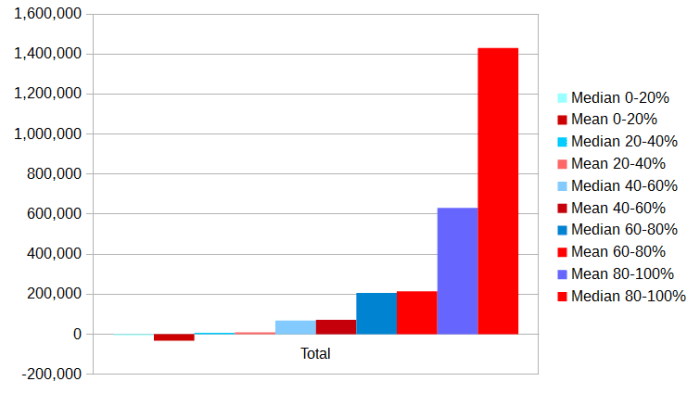
Thus, mean income has risen much faster than median income.

median_mean

While theoretically it could be that the nature of our productivity technology has shifted in such a way that it suddenly became necessary to heap more and more wealth on the top 1% in order to continue increasing national output, there is actually very little evidence of this. On the contrary, as Joseph Stiglitz (Nobel Laureate, you may recall) has documented, the leading cause of our rising inequality appears to be a dramatic increase in rent-seeking, which is to say corruption, exploitation, and monopoly power. (This probably has something to do with why I found in my master’s thesis that rising top income shares correlate quite strongly with rising levels of corruption.)

Now to be fair, the authors of Equal is Unfair do say that they are opposed to rent-seeking, and would like to see it removed. But they have a very odd concept of what rent-seeking entails, and it basically seems to amount to saying that whatever the government does is rent-seeking, whatever corporations do is fair free-market competition. On page 38 they warn us not to assume that government is good and corporations are bad—but actually it’s much more that they assume that government is bad and corporations are good. (The mainstream opinion appears to be actually that both are bad, and we should replace them both with… er… something.)

They do make some other good points I wish more leftists would appreciate, such as the point that while colonialism and imperialism can damage countries that suffer them and make them poorer, they generally do not benefit the countries that commit them and make them richer. The notion that Europe is rich because of imperialism is simply wrong; Europe is rich because of education, technology, and good governance. Indeed, the greatest surge in Europe’s economic growth occurred as the period of imperialism was winding down—when Europeans realized that they would be better off trying to actually invent and produce things rather than stealing them from others.

Likewise, they rightfully demolish notions of primitivism and anti-globalization that I often see bouncing around from folks like Naomi Klein. But these are book 1 messages; any economist would agree that primitivism is a terrible idea, and very few are opposed to globalization per se.

The end of Equal is Unfair gives a five-part plan for unleashing opportunity in America:

1. Abolish all forms of corporate welfare so that no business can gain unfair advantage.

2. Abolish government barriers to work so that every individual can enjoy the dignity of earned success.

3. Phase out the welfare state so that America can once again become the land of self-reliance.

4. Unleash the power of innovation in education by ending the government monopoly on schooling.

5. Liberate innovators from the regulatory shackles that are strangling them.

Number 1 is hard to disagree with, except that they include literally everything the government does that benefits a corporation as corporate welfare, including things like subsidies for solar power that the world desperately needs (or millions of people will die).

Number 2 sounds really great until you realize that they are including all labor standards, environmental standards and safety regulations as “barriers to work”; because it’s such a barrier for children to not be able to work in a factory where your arm can get cut off, and such a barrier that we’ve eliminated lead from gasoline emissions and thereby cut crime in half.

Number 3 could mean a lot of things; if it means replacing the existing system with a basic income I’m all for it. But in fact it seems to mean removing all social insurance whatsoever. Indeed, Watkins and Brook do not appear to believe in social insurance at all. The whole concept of “less fortunate”, “there but for the grace of God go I” seems to elude them. They have no sense that being fortunate in their own lives gives them some duty to help others who were not; they feel no pang of moral obligation whatsoever to help anyone else who needs help. Indeed, they literally mock the idea that human beings are “all in this together”.

They also don’t even seem to believe in public goods, or somehow imagine that rational self-interest could lead people to pay for public goods without any enforcement whatsoever despite the overwhelming incentives to free-ride. (What if you allow people to freely enter a contract that provides such enforcement mechanisms? Oh, you mean like social democracy?)

Regarding number 4, I’d first like to point out that private schools exist. Moreover, so do charter schools in most states, and in states without charter schools there are usually vouchers parents can use to offset the cost of private schools. So while the government has a monopoly in the market share sense—the vast majority of education in the US is public—it does not actually appear to be enforcing a monopoly in the anti-competitive sense—you can go to private school, it’s just too expensive or not as good. Why, it’s almost as if education is a public good or a natural monopoly.

Number 5 also sounds all right, until you see that they actually seem most opposed to antitrust laws of all things. Why would antitrust laws be the ones that bother you? They are designed to increase competition and lower barriers, and largely succeed in doing so (when they are actually enforced, which is rare of late). If you really want to end barriers to innovation and government-granted monopolies, why is it not patents that draw your ire?

They also seem to have trouble with the difference between handicapping and redistribution—they seem to think that the only way to make outcomes more equal is to bring the top down and leave the bottom where it is, and they often use ridiculous examples like “Should we ban reading to your children, because some people don’t?” But of course no serious egalitarian would suggest such a thing. Education isn’t fungible, so it can’t be redistributed. You can take it away (and sometimes you can add it, e.g. public education, which Watkins and Brooks adamantly oppose); but you can’t simply transfer it from one person to another. Money on the other hand, is by definition fungible—that’s kind of what makes it money, really. So when we take a dollar from a rich person and give it to a poor person, the poor person now has an extra dollar. We’ve not simply lowered; we’ve also raised. (In practice it’s a bit more complicated than that, as redistribution can introduce inefficiencies. So realistically maybe we take $1.00 and give $0.90; that’s still worth doing in a lot of cases.)

If attributes like intelligence were fungible, I think we’d have a very serious moral question on our hands! It is not obvious to me that the world is better off with its current range of intelligence, compared to a world where geniuses had their excess IQ somehow sucked out and transferred to mentally disabled people. Or if you think that the marginal utility of intelligence is increasing, then maybe we should redistribute IQ upward—take it from some mentally disabled children who aren’t really using it for much and add it onto some geniuses to make them super-geniuses. Of course, the whole notion is ridiculous; you can’t do that. But whereas Watkins and Brook seem to think it’s obvious that we shouldn’t even if we could, I don’t find that obvious at all. You didn’t earn your IQ (for the most part); you don’t seem to deserve it in any deep sense; so why should you get to keep it, if the world would be much better off if you didn’t? Why should other people barely be able to feed themselves so I can be good at calculus? At best, maybe I’m free to keep it—but given the stakes, I’m not even sure that would be justifiable. Peter Singer is right about one thing: You’re not free to let a child drown in a lake just to keep your suit from getting wet.

Ultimately, if you really want to understand what’s going on with Equal is Unfair, consider the following sentence, which I find deeply revealing as to the true objectives of these Objectivists:

“Today, meanwhile, although we have far more liberty than our feudal ancestors, there are countless ways in which the government restricts our freedom to produce and trade including minimum wage laws, rent control, occupational licensing laws, tariffs, union shop laws, antitrust laws, government monopolies such as those granted to the post office and education system, subsidies for industries such as agriculture or wind and solar power, eminent domain laws, wealth redistribution via the welfare state, and the progressive income tax.” (p. 114)

Some of these are things no serious economist would disagree with: We should stop subsidizing agriculture and tariffs should be reduced or removed. Many occupational licenses are clearly unnecessary (though this has a very small impact on inequality in real terms—licensing may stop you from becoming a barber, but it’s not what stops you from becoming a CEO). Others are legitimately controversial: Economists are currently quite divided over whether minimum wage is beneficial or harmful (I lean toward beneficial, but I’d prefer a better solution), as well as how to properly regulate unions so that they give workers much-needed bargaining power without giving unions too much power. But a couple of these are totally backward, exactly contrary to what any mainstream economist would say: Antitrust laws need to be enforced more, not eliminated (don’t take it from me; take it from that well-known Marxist rag The Economist). Subsidies for wind and solar power make the economy more efficient, not less—and suspiciously Watkins and Brook omitted the competing subsidies that actually are harmful, namely those to coal and oil.

Moreover, I think it’s very revealing that they included the word progressive when talking about taxation. In what sense does making a tax progressive undermine our freedom? None, so far as I can tell. The presence of a tax undermines freedom—your freedom to spend that money some other way. Making the tax higher undermines freedom—it’s more money you lose control over. But making the tax progressive increases freedom for some and decreases it for others—and since rich people have lower marginal utility of wealth and are generally more free in substantive terms in general, it really makes the most sense that, holding revenue constant, making a tax progressive generally makes your people more free.

But there’s one thing that making taxes progressive does do: It benefits poor people and hurts rich people. And thus the true agenda of Equal is Unfair becomes clear: They aren’t actually interested in maximizing freedom—if they were, they wouldn’t be complaining about occupational licensing and progressive taxation, they’d be outraged by forced labor, mass incarceration, indefinite detention, and the very real loss of substantive freedom that comes from being born into poverty. They wouldn’t want less redistribution, they’d want more efficient and transparent redistribution—a shift from the current hodgepodge welfare state to a basic income system. They would be less concerned about the “freedom” to pollute the air and water with impunity, and more concerned about the freedom to breathe clean air and drink clean water.

No, what they really believe is rich people are better. They believe that billionaires attained their status not by luck or circumstance, not by corruption or ruthlessness, but by the sheer force of their genius. (This is essentially the entire subject of chapter 6, “The Money-Makers and the Money-Appropriators”, and it’s nauseating.) They describe our financial industry as “fundamentally moral and productive” (p.156)—the industry that you may recall stole millions of homes and laundered money for terrorists. They assert that no sane person could believe that Steve Wozniack got lucky—I maintain no sane person could think otherwise. Yes, he was brilliant; yes, he invented good things. But he had to be at the right place at the right time, in a society that supported and educated him and provided him with customers and employees. You didn’t build that.

Indeed, perhaps most baffling is that they themselves seem to admit that the really great innovators, such as Newton, Einstein, and Darwin, were scientists—but scientists are almost never billionaires. Even the common counterexample, Thomas Edison, is largely false; he mainly plagiarized from Nikola Tesla and appropriated the ideas of his employees. Newton, Einstein and Darwin were all at least upper-middle class (as was Tesla, by the way—he did not die poor as is sometimes portrayed), but they weren’t spectacularly mind-bogglingly rich the way that Steve Jobs and Andrew Carnegie were and Bill Gates and Jeff Bezos are.

Some people clearly have more talent than others, and some people clearly work harder than others, and some people clearly produce more than others. But I just can’t wrap my head around the idea that a single man can work so hard, be so talented, produce so much that he can deserve to have as much wealth as a nation of millions of people produces in a year. Yet, Mark Zuckerberg has that much wealth. Remind me again what he did? Did he cure a disease that was killing millions? Did he colonize another planet? Did he discover a fundamental law of nature? Oh yes, he made a piece of software that’s particularly convenient for talking to your friends. Clearly that is worth the GDP of Latvia. Not that silly Darwin fellow, who only uncovered the fundamental laws of life itself.

In the grand tradition of reducing complex systems to simple numerical values, I give book 1 a 7/10, book 2 a 5/10, and book 3 a 2/10. Equal is Unfair is about 25% book 1, 25% book 2, and 50% book 3, so altogether their final score is, drumroll please: 4/10. Maybe read the first half, I guess? That’s where most of the good stuff is.

Free trade is not the problem. Billionaires are the problem.

JDN 2457468

One thing that really stuck out to me about the analysis of the outcome of the Michigan primary elections was that people kept talking about trade; when Bernie Sanders, a center-left social democrat, and Donald Trump, a far-right populist nationalist (and maybe even crypto-fascist) are the winners, something strange is at work. The one common element that the two victors seemed to have was their opposition to free trade agreements. And while people give many reasons to support Trump, many quite baffling, his staunch protectionism is one of the stronger voices. While Sanders is not as staunchly protectionist, he definitely has opposed many free-trade agreements.

Most of the American middle class feels as though they are running in place, working as hard as they can to stay where they are and never moving forward. The income statistics back them up on this; as you can see in this graph from FRED, real median household income in the US is actually lower than it was a decade ago; it never really did recover from the Second Depression:

US_median_household_income

As I talk to people about why they think this is, one of the biggest reasons they always give is some variant of “We keep sending our jobs to China.” There is this deep-seated intuition most Americans seem to have that the degradation of the middle class is the result of trade globalization. Bernie Sanders speaks about ending this by changes in tax policy and stronger labor regulations (which actually makes some sense); Donald Trump speaks of ending this by keeping out all those dirty foreigners (which appeals to the worst in us); but ultimately, they both are working from the narrative that free trade is the problem.

But free trade is not the problem. Like almost all economists, I support free trade. Free trade agreements might be part of the problem—but that’s because a lot of free trade agreements aren’t really about free trade. Many trade agreements, especially the infamous TRIPS accord, were primarily about restricting trade—specifically on “intellectual property” goods like patented drugs and copyrighted books. They were about expanding the monopoly power of corporations over their products so that the monopoly applied not just to the United States, but indeed to the whole world. This is the opposite of free trade and everything that it stands for. The TPP was a mixed bag, with some genuinely free-trade provisions (removing tariffs on imported cars) and some awful anti-trade provisions (making patents on drugs even stronger).

Every product we buy as an import is another product we sell as an export. This is not quite true, as the US does run a trade deficit; but our trade deficit is small compared to our overall volume of trade (which is ludicrously huge). Total US exports for 2014, the last full year we’ve fully tabulated, were $3.306 trillion—roughly the entire budget of the federal government. Total US imports for 2014 were $3.578 trillion. This makes our trade deficit $272 billion, which is 7.6% of our imports, or about 1.5% of our GDP of $18.148 trillion. So to be more precise, every 100 products we buy as imports are 92 products we sell as exports.

If we stopped making all these imports, what would happen? Well, for one thing, millions of people in China would lose their jobs and fall back into poverty. But even if you’re just looking at the US specifically, there’s no reason to think that domestic production would increase nearly as much as the volume of trade was reduced, because the whole point of trade is that it’s more efficient than domestic production alone. It is actually generous to think that by switching to autarky we’d have even half the domestic production that we’re currently buying in imports. And then of course countries we export to would retaliate, and we’d lose all those exports. The net effect of cutting ourselves off from world trade would be a loss of about $1.5 trillion in GDP—average income would drop by 8%.

Now, to be fair, there are winners and losers. Offshoring of manufacturing does destroy the manufacturing jobs that are offshored; but at least when done properly, it also creates new jobs by improved efficiency. These two effects are about the same size, so the overall effect is a small decline in the overall number of US manufacturing jobs. It’s not nearly large enough to account for the collapsing middle class.

Globalization may be one contributor to rising inequality, as may changes in technology that make some workers (software programmers) wildly more productive as they make other workers (cashiers, machinists, and soon truck drivers) obsolete. But those of us who have looked carefully at the causes of rising income inequality know that this is at best a small part of what’s really going on.

The real cause is what Bernie Sanders is always on about: The 1%. Gains in income in the US for the last few decades (roughly as long as I’ve been alive) have been concentrated in a very small minority of the population—in fact, even 1% may be too coarse. Most of the income gains have actually gone to more like the top 0.5% or top 0.25%, and the most spectacular increases in income have all been concentrated in the top 0.01%.

The story that we’ve been told—I dare say sold—by the mainstream media (which is, lets face it, owned by a handful of corporations) is that new technology has made it so that anyone who works hard (or at least anyone who is talented and works hard and gets a bit lucky) can succeed or even excel in this new tech-driven economy.

I just gave up on a piece of drivel called Bold that was seriously trying to argue that anyone with a brilliant idea can become a billionaire if they just try hard enough. (It also seemed positively gleeful about the possibility of a cyberpunk dystopia in which corporations use mass surveillance on their customers and competitors—yes, seriously, this was portrayed as a good thing.) If you must read it, please, don’t give these people any more money. Find it in a library, or find a free ebook version, or something. Instead you should give money to the people who wrote the book I switched to, Raw Deal, whose authors actually understand what’s going on here (though I maintain that the book should in fact be called Uber Capitalism).

When you look at where all the money from the tech-driven “new economy” is going, it’s not to the people who actually make things run. A typical wage for a web developer is about $35 per hour, and that’s relatively good as far as entry-level tech jobs. A typical wage for a social media intern is about $11 per hour, which is probably less than what the minimum wage ought to be. The “sharing economy” doesn’t produce outstandingly high incomes for workers, just outstandingly high income risk because you aren’t given a full-time salary. Uber has claimed that its drivers earn $90,000 per year, but in fact their real take-home pay is about $25 per hour. A typical employee at Airbnb makes $28 per hour. If you do manage to find full-time hours at those rates, you can make a middle-class salary; but that’s a big “if”. “Sharing economy”? Robert Reich has aptly renamed it the “share the crumbs economy”.

So where’s all this money going? CEOs. The CEO of Uber has net wealth of $8 billion. The CEO of Airbnb has net wealth of $3.3 billion. But they are paupers compared to the true giants of the tech industry: Larry Page of Google has $36 billion. Jeff Bezos of Amazon has $49 billion. And of course who can forget Bill Gates, founder of Microsoft, and his mind-boggling $77 billion.

Can we seriously believe that this is because their ideas were so brilliant, or because they are so talented and skilled? Uber’s “brilliant” idea is just to monetize carpooling and automate linking people up. Airbnb’s “revolutionary” concept is an app to advertise your bed-and-breakfast. At least Google invented some very impressive search algorithms, Amazon created one of the most competitive product markets in the world, and Microsoft democratized business computing. Of course, none of these would be possible without the invention of the Internet by government and university projects.

As for what these CEOs do that is so skilled? At this point they basically don’t do… anything. Any real work they did was in the past, and now it’s all delegated to other people; they just rake in money because they own things. They can manage if they want, but most of them have figured out that the best CEOs do very little while CEOS who micromanage typically fail. While I can see some argument for the idea that working hard in the past could merit you owning capital in the future, I have a very hard time seeing how being very good at programming and marketing makes you deserve to have so much money you could buy a new Ferrari every day for the rest of your life.

That’s the heuristic I like to tell people, to help them see the absolutely enormous difference between a millionaire and a billionaire: A millionaire is someone who can buy a Ferrari. A billionaire is someone who can buy a new Ferrari every day for the rest of their life. A high double-digit billionaire like Bezos or Gates could buy a new Ferrari every hour for the rest of their life. (Do the math; a Ferrari is about $250,000. Remember that they get a return on capital typically between 5% and 15% per year. With $1 billion, you get $50 to $150 million just in interest and dividends every year, and $100 million is enough to buy 365 Ferraris. As long as you don’t have several very bad years in a row on your stocks, you can keep doing this more or less forever—and that’s with only $1 billion.)

Immigration and globalization are not what is killing the American middle class. Corporatization is what’s killing the American middle class. Specifically, the use of regulatory capture to enforce monopoly power and thereby appropriate almost all the gains of new technologies into into the hands of a few dozen billionaires. Typically this is achieved through intellectual property, since corporate-owned patents basically just are monopolistic regulatory capture.

Since 1984, US real GDP per capita rose from $28,416 to $46,405 (in 2005 dollars). In that same time period, real median household income only rose from $48,664 to $53,657 (in 2014 dollars). That means that the total amount of income per person in the US rose by 49 log points (63%), while the amount of income that a typical family received only rose 10 log points (10%). If median income had risen at the same rate as per-capita GDP (and if inequality remained constant, it would), it would now be over $79,000, instead of $53,657. That is, a typical family would have $25,000 more than they actually do. The poverty line for a family of 4 is $24,300; so if you’re a family of 4 or less, the billionaires owe you a poverty line. You should have three times the poverty line, and in fact you have only two—because they took the rest.

And let me be very clear: I mean took. I mean stole, in a very real sense. This is not wealth that they created by their brilliance and hard work. This is wealth that they expropriated by exploiting people and manipulating the system in their favor. There is no way that the top 1% deserves to have as much wealth as the bottom 95% combined. They may be talented; they may work hard; but they are not that talented, and they do not work that hard. You speak of “confiscation of wealth” and you mean income taxes? No, this is the confiscation of our nation’s wealth.

Those of us who voted for Bernie Sanders voted for someone who is trying to stop it.

Those of you who voted for Donald Trump? Congratulations on supporting someone who epitomizes it.

Do we always want to internalize externalities?

JDN 2457437

I often talk about the importance of externalitiesa full discussion in this earlier post, and one of their important implications, the tragedy of the commons, in another. Briefly, externalities are consequences of actions incurred upon people who did not perform those actions. Anything I do affecting you that you had no say in, is an externality.

Usually I’m talking about how we want to internalize externalities, meaning that we set up a system of incentives to make it so that the consequences fall upon the people who chose the actions instead of anyone else. If you pollute a river, you should have to pay to clean it up. If you assault someone, you should serve jail time as punishment. If you invent a new technology, you should be rewarded for it. These are all attempts to internalize externalities.

But today I’m going to push back a little, and ask whether we really always want to internalize externalities. If you think carefully, it’s not hard to come up with scenarios where it actually seems fairer to leave the externality in place, or perhaps reduce it somewhat without eliminating it.

For example, suppose indeed that someone invents a great new technology. To be specific, let’s think about Jonas Salk, inventing the polio vaccine. This vaccine saved the lives of thousands of people and saved millions more from pain and suffering. Its value to society is enormous, and of course Salk deserved to be rewarded for it.

But we did not actually fully internalize the externality. If we had, every family whose child was saved from polio would have had to pay Jonas Salk an amount equal to what they saved on medical treatments as a result, or even an amount somehow equal to the value of their child’s life (imagine how offended people would get if you asked that on a survey!). Those millions of people spared from suffering would need to each pay, at minimum, thousands of dollars to Jonas Salk, making him of course a billionaire.

And indeed this is more or less what would have happened, if he had been willing and able to enforce a patent on the vaccine. The inability of some to pay for the vaccine at its monopoly prices would add some deadweight loss, but even that could be removed if Salk Industries had found a way to offer targeted price vouchers that let them precisely price-discriminate so that every single customer paid exactly what they could afford to pay. If that had happened, we would have fully internalized the externality and therefore maximized economic efficiency.

But doesn’t that sound awful? Doesn’t it sound much worse than what we actually did, where Jonas Salk received a great deal of funding and support from governments and universities, and lived out his life comfortably upper-middle class as a tenured university professor?

Now, perhaps he should have been awarded a Nobel Prize—I take that back, there’s no “perhaps” about it, he definitely should have been awarded a Nobel Prize in Medicine, it’s absurd that he did not—which means that I at least do feel the externality should have been internalized a bit more than it was. But a Nobel Prize is only 10 million SEK, about $1.1 million. That’s about enough to be independently wealthy and live comfortably for the rest of your life; but it’s a small fraction of the roughly $7 billion he could have gotten if he had patented the vaccine. Yet while the possible world in which he wins a Nobel is better than this one, I’m fairly well convinced that the possible world in which he patents the vaccine and becomes a billionaire is considerably worse.

Internalizing externalities makes sense if your goal is to maximize total surplus (a concept I explain further in the linked post), but total surplus is actually a terrible measure of human welfare.

Total surplus counts every dollar of willingness-to-pay exactly the same across different people, regardless of whether they live on $400 per year or $4 billion.

It also takes no account whatsoever of how wealth is distributed. Suppose a new technology adds $10 billion in wealth to the world. As far as total surplus, it makes no difference whether that $10 billion is spread evenly across the entire planet, distributed among a city of a million people, concentrated in a small town of 2,000, or even held entirely in the bank account of a single man.

Particularly a propos of the Salk example, total surplus makes no distinction between these two scenarios: a perfectly-competitive market where everything is sold at a fair price, and a perfectly price-discriminating monopoly, where everything is sold at the very highest possible price each person would be willing to pay.

This is a perfectly-competitive market, where the benefits are more or less equally (in this case exactly equally, but that need not be true in real life) between sellers and buyers:

elastic_supply_competitive_labeled

This is a perfectly price-discriminating monopoly, where the benefits accrue entirely to the corporation selling the good:

elastic_supply_price_discrimination

In the former case, the company profits, consumers are better off, everyone is happy. In the latter case, the company reaps all the benefits and everyone else is left exactly as they were. In real terms those are obviously very different outcomes—the former being what we want, the latter being the cyberpunk dystopia we seem to be hurtling mercilessly toward. But in terms of total surplus, and therefore the kind of “efficiency” that is maximize by internalizing all externalities, they are indistinguishable.

In fact (as I hope to publish a paper about at some point), the way willingness-to-pay works, it weights rich people more. Redistributing goods from the poor to the rich will typically increase total surplus.

Here’s an example. Suppose there is a cake, which is sufficiently delicious that it offers 2 milliQALY in utility to whoever consumes it (this is a truly fabulous cake). Suppose there are two people to whom we might give this cake: Richie, who has $10 million in annual income, and Hungry, who has only $1,000 in annual income. How much will each of them be willing to pay?

Well, assuming logarithmic marginal utility of wealth (which is itself probably biasing slightly in favor of the rich), 1 milliQALY is about $1 to Hungry, so Hungry will be willing to pay $2 for the cake. To Richie, however, 1 milliQALY is about $10,000; so he will be willing to pay a whopping $20,000 for this cake.

What this means is that the cake will almost certainly be sold to Richie; and if we proposed a policy to redistribute the cake from Richie to Hungry, economists would emerge to tell us that we have just reduced total surplus by $19,998 and thereby committed a great sin against economic efficiency. They will cajole us into returning the cake to Richie and thus raising total surplus by $19,998 once more.

This despite the fact that I stipulated that the cake is worth just as much in real terms to Hungry as it is to Richie; the difference is due to their wildly differing marginal utility of wealth.

Indeed, it gets worse, because even if we suppose that the cake is worth much more in real utility to Hungry—because he is in fact hungry—it can still easily turn out that Richie’s willingness-to-pay is substantially higher. Suppose that Hungry actually gets 20 milliQALY out of eating the cake, while Richie still only gets 2 milliQALY. Hungry’s willingness-to-pay is now $20, but Richie is still going to end up with the cake.

Now, if your thought is, “Why would Richie pay $20,000, when he can go to another store and get another cake that’s just as good for $20?” Well, he wouldn’t—but in the sense we mean for total surplus, willingness-to-pay isn’t just what you’d actually be willing to pay given the actual prices of the goods, but the absolute maximum price you’d be willing to pay to get that good under any circumstances. It is instead the marginal utility of the good divided by your marginal utility of wealth. In this sense the cake is “worth” $20,000 to Richie, and “worth” substantially less to Hungry—but not because it’s actually worth less in real terms, but simply because Richie has so much more money.

Even economists often equate these two, implicitly assuming that we are spending our money up to the point where our marginal willingness-to-pay is the actual price we choose to pay; but in general our willingness-to-pay is higher than the price if we are willing to buy the good at all. The consumer surplus we get from goods is in fact equal to the difference between willingness-to-pay and actual price paid, summed up over all the goods we have purchased.

Internalizing all externalities would definitely maximize total surplus—but would it actually maximize happiness? Probably not.

If you asked most people what their marginal utility of wealth is, they’d have no idea what you’re talking about. But most people do actually have an intuitive sense that a dollar is worth more to a homeless person than it is to a millionaire, and that’s really all we mean by diminishing marginal utility of wealth.

I think the reason we’re uncomfortable with the idea of Jonas Salk getting $7 billion from selling the polio vaccine, rather than the same number of people getting the polio vaccine and Jonas Salk only getting the $1.1 million from a Nobel Prize, is that we intuitively grasp that after that $1.1 million makes him independently wealthy, the rest of the money is just going to sit in some stock account and continue making even more money, while if we’d let the families keep it they would have put it to much better use raising their children who are now protected from polio. We do want to reward Salk for his great accomplishment, but we don’t see why we should keep throwing cash at him when it could obviously be spent in better ways.

And indeed I think this intuition is correct; great accomplishments—which is to say, large positive externalities—should be rewarded, but not in direct proportion. Maybe there should be some threshold above which we say, “You know what? You’re rich enough now; we can stop giving you money.” Or maybe it should simply damp down very quickly, so that a contribution which is worth $10 billion to the world pays only slightly more than one that is worth $100 million, but a contribution that is worth $100,000 pays considerably more than one which is only worth $10,000.

What it ultimately comes down to is that if we make all the benefits incur to the person who did it, there aren’t any benefits anymore. The whole point of Jonas Salk inventing the polio vaccine (or Einstein discovering relativity, or Darwin figuring out natural selection, or any great achievement) is that it will benefit the rest of humanity, preferably on to future generations. If you managed to fully internalize that externality, this would no longer be true; Salk and Einstein and Darwin would have become fabulously wealthy, and then somehow we’d all have to continue paying into their estates or something an amount equal to the benefits we received from their discoveries. (Every time you use your GPS, pay a royalty to the Einsteins. Every time you take a pill, pay a royalty to the Darwins.) At some point we’d probably get fed up and decide we’re no better off with them than without them—which is exactly by construction how we should feel if the externality were fully internalized.

Internalizing negative externalities is much less problematic—it’s your mess, clean it up. We don’t want other people to be harmed by your actions, and if we can pull that off that’s fantastic. (In reality, we usually can’t fully internalize negative externalities, but we can at least try.)

But maybe internalizing positive externalities really isn’t so great after all.

Just give people money!

JDN 2457332 EDT 17:02.

Today is the Fifth of November, on which a bunch of people who liked a Hollywood movie start posting images in support of a fanatical religious terrorist in his plot to destroy democracy in the United Kingdom a few centuries ago. It’s really weird, but I’m not particularly interested in that.

Instead I’d like to talk about the solution to poverty, which we’ve known for a long time—in fact, it’s completely obvious—and yet have somehow failed to carry out. Many people doubt that it even works, not based on the empirical evidence, but because it just feels like it can’t be right, like it’s so obvious that surely it was tried and didn’t work and that’s why we moved on to other things. When you first tell a kindergartner that there are poor people in the world, that child will very likely ask: “Why don’t we just give them some money?”

Why not indeed?

Formally this is called a “direct cash transfer”, and it comes in many different variants, but basically they run along a continuum from unconditional—we just give it to everybody, no questions asked—to more and more conditional—you have to be below a certain income, or above a certain age, or have kids, or show up at our work program, or take a drug test, etc. The EU has a nice little fact sheet about the different types of cash transfer programs in use.

Actually, I’d argue that at the very far extreme is government salaries—the government will pay you $40,000 per year, provided that you teach high school every weekday. We don’t really think of that as a “conditional cash transfer” because it involves you providing a useful service (and is therefore more like an ordinary, private-sector salary), but many of the conditions imposed on cash transfers actually have this sort of character—we want people to do things that we think are useful to society, in order to justify us giving them the money. It really seems to be a continuum, from just giving money to everyone, to giving money to some people based on them doing certain things, to specifically hiring people to do something.

Social programs in different countries can be found at different places on this continuum. In the United States, our programs are extremely conditional, and also the total amount we give out is relatively small. In Europe, programs are not as conditional—though still conditional—and they give out more. And sure enough, after-tax poverty in Europe is considerably lower, even though before-tax poverty is about the same.

In fact, the most common way to make transfers conditional is to make them “in-kind”; instead of giving you money, we give you something—healthcare, housing, food. Sometimes this makes sense; actually I think for healthcare it makes the most sense, because price signals don’t work in a market as urgent and inelastic as healthcare (that is, you don’t shop around for an emergency room—in fact, people don’t even really shop around for a family doctor). But often it’s simply a condition we impose for political reasons; we don’t want those “lazy freeloaders” to do anything else with the money that we wouldn’t like, such as buying alcohol or gambling. Even poor people in India buy into this sort of reasoning. Nevermind that they generally don’t do that, or that they could just shift away spending they would otherwise be making (warning: technical economics paper within) to do those things anyway—it’s the principle of the thing.

Direct cash transfers not only work—they work about as well as the best things we’ve tried. Spending on cash transfers is about as cost-effective as spending on medical aid and malaria nets.

Other than in experiments (the largest of which I’m aware of was a town in Canada, unless you count Alaska’s Permanent Fund Dividend, which is unconditional but quite small), we have never really tried implementing a fully unconditional cash transfer system. “Too expensive” is usually the complaint, and it would indeed be relatively expensive (probably greater than all of what we currently spend on Social Security and Medicare, which are two of our biggest government budget items). Implementing a program with a cost on the order of $2 trillion per year is surely not something to be done lightly. But it would have one quite substantial benefit: It would eliminate poverty in the United States immediately and forever.

This is why I really like the “abolish poverty” movement; we must recognize that at our current level of economic development, poverty is no longer a natural state, a complex problem to solve. It is a policy decision that we are making. We are saying, as a society, that we would rather continue to have poverty than spend that $2 trillion per year, about 12% of our $17.4 trillion GDP. We are saying that we’d rather have people who are homeless and starving than lose 12 cents of every dollar we make. (To be fair, if we include the dynamic economic impact of this tax-and-transfer system it might actually turn out to be more than that; but it could in fact be less—the increased spending would boost the economy, just as the increased taxes would restrain it—and seems very unlikely to be more than 20% of GDP.)

For most of human history—and in most countries today—that is not the case. India could not abolish poverty immediately by a single tax policy; nor could China. Probably not Brazil either. Maybe Greece could do it, but then again maybe not. But Germany could; the United Kingdom could; France could; and we could in the United States. We have enough wealth now that with a moderate increase in government spending we could create an economic floor below which no person could fall. It is incumbent upon us at the very least to justify why we don’t.

I have heard it said that poverty is not a natural condition, but the result of human action. Even Nelson Mandela endorsed this view. This is false, actually. In general, poverty is the natural condition of all life forms on Earth (and probably all life forms in the universe). Natural selection evolves us toward fitting as many gene-packages into the environment as possible, not toward maximizing the happiness of the sentient beings those gene-packages may happen to be. To a first approximation, all life forms suffer in poverty.

We live at a unique time in human history; for no more than the last century—and perhaps not even that—we have actually had so much wealth that we could eliminate poverty by choice. For hundreds of thousands of years human beings toiled in poverty because there was no such choice. Perhaps good policy in Greece could end poverty today, but it couldn’t have during the reign of Pericles. Good policy in Italy could end poverty now, but not when Caesar was emperor. Good policy in the United Kingdom could easily end poverty immediately, but even under Queen Victoria that wasn’t feasible.

Maybe that’s why we aren’t doing it? Our cultural memory was forged in a time decades or centuries ago, before we had this much wealth to work with. We speak of “end world hunger” in the same breath as “cure cancer” or “conquer death”, a great dream that has always been impossible and perhaps still is—but in fact we should speak of it in the same breath as “split the atom” and “land on the Moon”, seminal achievements that our civilization is now capable of thanks to economic and technological revolution.

Capitalism also seems to have a certain momentum to it; once you implement a market economy that maximizes wealth by harnessing self-interest, people seem to forget that we are fundamentally altruistic beings. I may never forget that economist who sent me an email with “altruism” in scare quotes, as though it was foolish (or at best imprecise) to say that human beings care about one another. But in fact we are the most altruistic species on Earth, without question, in a sense so formal and scientific it can literally be measured quantitatively.

There are real advantages to harnessing self-interest—not least, I know my own interests considerably better than I know yours, no matter who you are—and that is part of how we have achieved this great level of wealth (though personally I think science, democracy, and the empowerment of women are the far greater causes of our prosperity). But we must not let it forget us why we wanted to have wealth in the first place: Not to concentrate power in a handful of individuals who will pass it on to their heirs; not to “maximize work incentives”; not to give us the fanciest technological gadgets. The reason we wanted to have wealth was so that we could finally free ourselves from the endless toil that was our lot by birth and that of all other beings—to let us finally live, instead of merely survive. There is a peak to Maslow’s pyramid, and we could stand there now, together; but we must find the will to give up that 12 cents of every dollar.

What if employees were considered assets?

JDN 2457308 EDT 15:31

Robert Reich has an interesting proposal to change the way we think about labor and capital:
First, are workers assets to be developed or are they costs to be cut?” “Employers treat replaceable workers as costs to be cut, not as assets to be developed.”

This ultimately comes down to a fundamental question of how our accounting rules work: Workers are not considered assets, but wages are considered liabilities.

I don’t want to bore you with the details of accounting (accounting is often thought of as similar to economics, but really it’s the opposite of economics: Whereas economics is empirical, interesting, and fundamentally nonzero-sum, accounting is arbitrary, tedious, and zero-sum by construction), but I think it’s worth discussing the difference between how capital and labor are accounted.

By construction, every credit must come with a debit, no matter how arbitrary this may seem.

We start with an equation:

Assets + Expenses = Equity + Liabilities + Income

When purchasing a piece of capital, you credit the equity account with the capital you just bought, increasing it, then debit the expense account, increasing it as well. Because the capital is valued at the price at which you bought it, the increase in equity exactly balances the increase in expenses, and your assets, liabilities, and income do not change.

But when hiring a worker, you still debit the expense account, but now you credit the liabilities account, increasing it as well. So instead of increasing your equity, which is a good thing, you increase your liabilities, which is a bad thing.

This is why corporate executives are always on the lookout for ways to “cut labor costs”; they conceive of wages as simply outgoing money that doesn’t do anything useful, and therefore something to cut in order to increase profits.

Reich is basically suggesting that we start treating workers as equity, the same as we do with capital; and then corporate executives would be thinking in terms of making a “capital gain” by investing in their workers to increase their “value”.

The problem with this scheme is that it would really only make sense if corporations owned their workers—and I think we all know why that is not a good idea. The reason capital can be counted in the equity account is that capital can be sold off as a source of income; you don’t need to think of yourself as making a sort of “capital gain”; you can make, you know, actual capital gains.

I think actually the deeper problem here is that there is something wrong with accounting in general.

By its very nature, accounting is zero-sum. At best, this allows an error-checking mechanism wherein we can see if the two sides of the equation balance. But at worst, it makes us forget the point of economics.

While an individual may buy a capital asset on speculation, hoping to sell it for a higher price later, that isn’t what capital is for. At an aggregate level, speculation and arbitrage cannot increase real wealth; all they can do is move it around.

The reason we want to have capital is that it makes things—that the value of goods produced by a machine can far exceed the cost to produce that machine. It is in this way that capital—and indeed capitalism—creates real wealth.

Likewise, that is why we use labor—to make things. Labor is worthwhile because—and insofar as—the cost of the effort is less than the benefit of the outcome. Whether you are a baker, an author, a neurosurgeon, or an auto worker, the reason your job is worth doing is that the harm to you from doing it is smaller than the benefit to others from having it done. Indeed, the market mechanism is supposed to be structured so that by transferring wealth to you (i.e., paying you money), we make it so that both you and the people who buy your services are better off.

But accounting methods as we know them make no allowance for this; no matter what you do, the figures always balance. If you end up with more, someone else ends up with less. Since a worker is better off with a wage than they were before, we infer that a corporation must be worse off because it paid that wage. Since a corporation makes a profit selling a good, we infer that a consumer must be worse off because they paid for that purchase. We track the price of everything and understand the value of nothing.

There are two ways of pricing a capital asset: The cost to make it, or the value you get from it. Those two prices are only equal if markets are perfectly efficient, and even then they are only equal at the margin—the last factory built is worth what it can make, but every other factory built before that is worth more. It is that difference which creates real wealth—so assuming that they are the same basically defeats the purpose.

I don’t think we can do away with accounting; we need some way to keep track of where money goes, and we want that system to have built-in mechanisms to reduce rates of error and fraud. Double-entry bookkeeping certainly doesn’t make error and fraud disappear, but it at least does provide some protection against them, which we would lose if we removed the requirement that accounts must balance.

But somehow we need to restructure our metrics so that they give some sense of what economics is really about—not moving around a fixed amount of wealth, but making more wealth. Accounting for employees as assets wouldn’t solve that problem—but it might be a start, I guess?

What makes a nation wealthy?

JDN 2457251 EDT 10:17

One of the central questions of economics—perhaps the central question, the primary reason why economics is necessary and worthwhile—is development: How do we raise a nation from poverty to prosperity?

We have done it before: France and Germany rose from the quite literal ashes of World War 2 to some of the most prosperous societies in the world. Their per-capita GDP over the 20th century rose like this (all of these figures are from the World Bank World Development Indicators; France is green, Germany is blue):

GDPPC_France_Germany

GDPPCPPP_France_Germany

The top graph is at market exchange rates, the bottom is correcting for purchasing power parity (PPP). The PPP figures are more meaningful, but unfortunately they only began collecting good data on purchasing power around 1990.

Around the same time, but even more spectacularly, Japan and South Korea rose from poverty-stricken Third World backwaters to high-tech First World powers in only a couple of generations. Check out their per-capita GDP over the 20th century (Japan is green, South Korea is blue):

GDPPC_Japan_KoreaGDPPCPPP_Japan_Korea


This is why I am only half-joking when I define development economics as “the ongoing project to figure out what happened in South Korea and make it happen everywhere in the world”.

More recently China has been on a similar upward trajectory, which is particularly important since China comprises such a huge portion of the world’s population—but they are far from finished:

GDPPC_ChinaGDPPCPPP_China

Compare these to societies that have not achieved economic development, such as Zimbabwe (green), India (black), Ghana (red), and Haiti (blue):

GDPPC_poor_countriesGDPPCPPP_poor_countries

They’re so poor that you can barely see them on the same scale, so I’ve rescaled so that the top is $5,000 per person per year instead of $50,000:

GDPPC_poor_countries_rescaledGDPPCPPP_poor_countries_rescaled

Only India actually manages to get above $5,000 per person per year at purchasing power parity, and then not by much, reaching $5,243 per person per year in 2013, the most recent data.

I had wanted to compare North Korea and South Korea, because the two countries were united as recently as the 1945 and were not all that different to begin with, yet have taken completely different development trajectories. Unfortunately, North Korea is so impoverished, corrupt, and authoritarian that the World Bank doesn’t even report data on their per-capita GDP. Perhaps that is contrast enough?

And then of course there are the countries in between, which have made some gains but still have a long way to go, such as Uruguay (green) and Botswana (blue):

GDPPC_Botswana_UruguayGDPPCPPP_Botswana_Uruguay

But despite the fact that we have observed successful economic development, we still don’t really understand how it works. A number of theories have been proposed, involving a wide range of factors including exports, corruption, disease, institutions of government, liberalized financial markets, and natural resources (counter-intuitively; more natural resources make your development worse).

I’m not going to resolve that whole debate in a single blog post. (I may not be able to resolve that whole debate in a single career, though I am definitely trying.) We may ultimately find that economic development is best conceived as like “health”; what factors determine your health? Well, a lot of things, and if any one thing goes badly enough wrong the whole system can break down. Economists may need to start thinking of ourselves as akin to doctors (or as Keynes famously said, dentists), diagnosing particular disorders in particular patients rather than seeking one unifying theory. On the other hand, doctors depend upon biologists, and it’s not clear that we yet understand development even at that level.

Instead I want to take a step back, and ask a more fundamental question: What do we mean by prosperity?

My hope is that if we can better understand what it is we are trying to achieve, we can also better understand the steps we need to take in order to get there.

Thus far it has sort of been “I know it when I see it”; we take it as more or less given that the United States and the United Kingdom are prosperous while Ghana and Haiti are not. I certainly don’t disagree with that particular conclusion; I’m just asking what we’re basing it on, so that we can hopefully better apply it to more marginal cases.


For example: Is
France more or less prosperous than Saudi Arabia? If we go solely by GDP per capita PPP, clearly Saudi Arabia is more prosperous at $53,100 per person per year than France is at $37,200 per person per year.

But people actually live longer in France, on average, than they do in Saudi Arabia. Overall reported happiness is higher in France than Saudi Arabia. I think France is actually more prosperous.


In fact, I think the United States is not as prosperous as we pretend ourselves to be. We are certainly more prosperous than most other countries; we are definitely still well within First World status. But we are not the most prosperous nation in the world.

Our total GDP is astonishingly high (highest in the world nominally, second only to China PPP). Our GDP per-capita is higher than any other country of comparable size; no nation with higher GDP PPP than the US has a population larger than the Chicago metropolitan area. (You may be surprised to find that in order from largest to smallest population the countries with higher GDP per capita PPP are the United Arab Emirates, Switzerland, Hong Kong, Singapore, and then Norway, followed by Kuwait, Qatar, Luxembourg, Brunei, and finally San Marino—which is smaller than Ann Arbor.) Our per-capita GDP PPP of $51,300 is markedly higher than that of France ($37,200), Germany ($42,900), or Sweden ($43,500).

But at the same time, if you compare the US to other First World countries, we have nearly the highest rate of child poverty and higher infant mortality. We have shorter life expectancy and dramatically higher homicide rates. Our inequality is the highest in the world. In France and Sweden, the top 0.01% receive about 1% of the income (i.e. 100 times as much as the average person), while in the United States they receive almost 4%, making someone in the top 0.01% nearly 400 times as rich as the average person.

By estimating solely on GDP per capita, we are effectively rigging the game in our own favor. Or rather, the rich in the United States are rigging the game in their own favor (what else is new?), by convincing all the world’s economists to rank countries based on a measure that favors them.

Amartya Sen, one of the greats of development economics, developed a scale called the Human Development Index that attempts to take broader factors into account. It’s far from perfect, but it’s definitely a step in the right direction.

In particular, France’s HDI is higher than that of Saudi Arabia, fitting my intuition about which country is truly more prosperous. However, the US still does extremely well, with only Norway, Australia, Switzerland, and the Netherlands above us. I think we might still be biased toward high average incomes rather than overall happiness.

In practice, we still use GDP an awful lot, probably because it’s much easier to measure. It’s sort of like IQ tests and SAT scores; we know damn well it’s not measuring what we really care about, but because it’s so much easier to work with we keep using it anyway.

This is a problem, because the better you get at optimizing toward the wrong goal, the worse your overall outcomes are going to be. If you are just sort of vaguely pointed at several reasonable goals, you will probably be improving your situation overall. But when you start precisely optimizing to a specific wrong goal, it can drag you wildly off course.

This is what we mean when we talk about “gaming the system”. Consider test scores, for example. If you do things that will probably increase your test scores among other things, you are likely to engage in generally good behaviors like getting enough sleep, going to class, studying the content. But if your single goal is to maximize your test score at all costs, what will you do? Cheat, of course.

This is also related to the Friendly AI Problem: It is vitally important to know precisely what goals we want our artificial intelligences to have, because whatever goals we set, they will probably be very good at achieving them. Already computers can do many things that were previously impossible, and as they improve over time we will reach the point where in a meaningful sense our AIs are even smarter than we are. When that day comes, we will want to make very, very sure that we have designed them to want the same things that we do—because if our desires ever come into conflict, theirs are likely to win. The really scary part is that right now most of our AI research is done by for-profit corporations or the military, and “maximize my profit” and “kill that target” are most definitely not the ultimate goals we want in a superintelligent AI. It’s trivially easy to see what’s wrong with these goals: For the former, hack into the world banking system and transfer trillions of dollars to the company accounts. For the latter, hack into the nuclear launch system and launch a few ICBMs in the general vicinity of the target. Yet these are the goals we’ve been programming into the actual AIs we build!

If we set GDP per capita as our ultimate goal to the exclusion of all other goals, there are all sorts of bad policies we would implement: We’d ignore inequality until it reached staggering heights, ignore work stress even as it began to kill us, constantly try to maximize the pressure for everyone to work constantly, use poverty as a stick to force people to work even if people starve, inundate everyone with ads to get them to spend as much as possible, repeal regulations that protect the environment, workers, and public health… wait. This isn’t actually hypothetical, is it? We are doing those things.

At least we’re not trying to maximize nominal GDP, or we’d have long-since ended up like Zimbabwe. No, our economists are at least smart enough to adjust for purchasing power. But they’re still designing an economic system that works us all to death to maximize the number of gadgets that come off assembly lines. The purchasing-power adjustment doesn’t include the value of our health or free time.

This is why the Human Development Index is a major step in the right direction; it reminds us that society has other goals besides maximizing the total amount of money that changes hands (because that’s actually all that GDP is measuring; if you get something for free, it isn’t counted in GDP). More recent refinements include things like “natural resource services” that include environmental degradation in estimates of investment. Unfortunately there is no accepted way of doing this, and surprisingly little research on how to improve our accounting methods. Many nations seem resistant to doing so precisely because they know it would make their economic policy look bad—this is almost certainly why China canceled its “green GDP” initiative. This is in fact all the more reason to do it; if it shows that our policy is bad, that means our policy is bad and should be fixed. But people have allowed themselves to value image over substance.

We can do better still, and in fact I think something like QALY is probably the way to go. Rather than some weird arbitrary scaling of GDP with lifespan and Gini index (which is what the HDI is), we need to put everything in the same units, and those units must be directly linked to human happiness. At the very least, we should make some sort of adjustment to our GDP calculation that includes the distribution of wealth and its marginal utility; adding $1,000 to the economy and handing it to someone in poverty should count for a great deal, but adding $1,000,000 and handing it to a billionaire should count for basically nothing. (It’s not bad to give a billionaire another million; but it’s hardly good either, as no one’s real standard of living will change.) Calculating that could be as simple as dividing by their current income; if your annual income is $10,000 and you receive $1,000, you’ve added about 0.1 QALY. If your annual income is $1 billion and you receive $1 million, you’ve added only 0.001 QALY. Maybe we should simply separate out all individual (or household, to be simpler?) incomes, take their logarithms, and then use that sum as our “utility-adjusted GDP”. The results would no doubt be quite different.

This would create a strong pressure for policy to be directed at reducing inequality even at the expense of some economic output—which is exactly what we should be willing to do. If it’s really true that a redistribution policy would hurt the overall economy so much that the harms would outweigh the benefits, then we shouldn’t do that policy; but that is what you need to show. Reducing total GDP is not a sufficient reason to reject a redistribution policy, because it’s quite possible—easy, in fact—to improve the overall prosperity of a society while still reducing its GDP. There are in fact redistribution policies so disastrous they make things worse: The Soviet Union had them. But a 90% tax on million-dollar incomes would not be such a policy—because we had that in 1960 with little or no ill effect.

Of course, even this has problems; one way to minimize poverty would be to exclude, relocate, or even murder all your poor people. (The Black Death increased per-capita GDP.) Open immigration generally increases poverty rates in the short term, because most of the immigrants are poor. Somehow we’d need to correct for that, only raising the score if you actually improve people’s lives, and not if you make them excluded from the calculation.

In any case it’s not enough to have the alternative measures; we must actually use them. We must get policymakers to stop talking about “economic growth” and start talking about “human development”; a policy that raises GDP but reduces lifespan should be immediately rejected, as should one that further enriches a few at the expense of many others. We must shift the discussion away from “creating jobs”—jobs are only a means—to “creating prosperity”.

Why the Republican candidates like flat income tax—and we really, really don’t

JDN 2456160 EDT 13:55.

The Republican Party is scrambling to find viable Presidential candidates for next year’s election. The Democrats only have two major contenders: Hillary Clinton looks like the front-runner (and will obviously have the most funding), but Bernie Sanders is doing surprisingly well, and is particularly refreshing because he is running purely on his principles and ideas. He has no significant connections, no family dynasty (unlike Jeb Bush and, again, Hillary Clinton) and not a huge amount of wealth (Bernie’s net wealth is about $500,000, making him comfortably upper-middle class; compare to Hillary’s $21.5 million and her husband’s $80 million); but he has ideas that resonate with people. Bernie Sanders is what politics is supposed to be. Clinton’s campaign will certainly raise more than his; but he has already raised over $4 million, and if he makes it to about $10 million studies suggest that additional spending above that point is largely negligible. He actually has a decent chance of winning, and if he did it would be a very good sign for the future of America.

But the Republican field is a good deal more contentious, and the 19 candidates currently running have been scrambling to prove that they are the most right-wing in order to impress far-right primary voters. (When the general election comes around, whoever wins will of course pivot back toward the center, changing from, say, outright fascism to something more like reactionism or neo-feudalism. If you were hoping they’d pivot so far back as to actually be sensible center-right capitalists, think again; Hillary Clinton is the only one who will take that role, and they’ll go out of their way to disagree with her in every way they possibly can, much as they’ve done with Obama.) One of the ways that Republicans are hoping to prove their right-wing credentials is by proposing a flat income tax and eliminating the IRS.

Unlike most of their proposals, I can see why many people think this actually sounds like a good idea. It would certainly dramatically reduce bureaucracy, and that’s obviously worthwhile since excess bureaucracy is pure deadweight loss. (A surprising number of economists seem to forget that government does other things besides create excess bureaucracy, but I must admit it does in fact create excess bureaucracy.)

Though if they actually made the flat tax rate 20% or even—I can’t believe this is seriously being proposed—10%, there is no way the federal government would have enough revenue. The only options would be (1) massive increases in national debt (2) total collapse of government services—including their beloved military, mind you, or (3) directly linking the Federal Reserve quantitative easing program to fiscal policy and funding the deficit with printed money. Of these, 3 might not actually be that bad (it would probably trigger some inflation, but actually we could use that right now), but it’s extremely unlikely to happen, particularly under Republicans. In reality, after getting a taste of 2, we’d clearly end up with 1. And then they’d be complaining about the debt and clamor for more spending cuts, more spending cuts, ever more spending cuts, but there would simply be no way to run a functioning government on 10% of GDP in anything like our current system. Maybe you could do it on 20%—maybe—but we currently spend more like 35%, and that’s already a very low amount of spending for a First World country. The UK is more typical at 47%, while Germany is a bit low at 44%; Sweden spends 52% and France spends a whopping 57%. Anyone who suggests we cut government spending from 35% to 20% needs to explain which 3/7 of government services are going to immediately disappear—not to mention which 3/7 of government employees are going to be immediately laid off.

And then they want to add investment deductions; in general investment deductions are a good thing, as long as you tie them to actual investments in genuinely useful things like factories and computer servers. (Or better yet, schools, research labs, or maglev lines, but private companies almost never invest in that sort of thing, so the deduction wouldn’t apply.) The kernel of truth in the otherwise ridiculous argument that we should never tax capital is that taxing real investment would definitely be harmful in the long run. As I discussed with Miles Kimball (a cognitive economist at Michigan and fellow econ-blogger I hope to work with at some point), we could minimize the distortionary effects of corporate taxes by establishing a strong deduction for real investment, and this would allow us to redistribute some of this enormous wealth inequality without dramatically harming economic growth.

But if you deduct things that aren’t actually investments—like stock speculation and derivatives arbitrage—then you reduce your revenue dramatically and don’t actually incentivize genuinely useful investments. This is the problem with our current system, in which GE can pay no corporate income tax on $108 billion in annual profit—and you know they weren’t using all that for genuinely productive investment activities. But then, if you create a strong enforcement system for ensuring it is real investment, you need bureaucracy—which is exactly what the flat tax was claimed to remove. At the very least, the idea of eliminating the IRS remains ridiculous if you have any significant deductions.

Thus, the benefits of a flat income tax are minimal if not outright illusory; and the costs, oh, the costs are horrible. In order to have remotely reasonable amounts of revenue, you’d need to dramatically raise taxes on the majority of people, while significantly lowering them on the rich. You would create a direct transfer of wealth from the poor to the rich, increasing our already enormous income inequality and driving millions of people into poverty.

Thus, it would be difficult to more clearly demonstrate that you care only about the interests of the top 1% than to propose a flat income tax. I guess Mitt Romney’s 47% rant actually takes the cake on that one though (Yes, all those freeloading… soldiers… and children… and old people?).

Many Republicans are insisting that a flat tax would create a surge of economic growth, but that’s simply not how macroeconomics works. If you steeply raise taxes on the majority of people while cutting them on the rich, you’ll see consumer spending plummet and the entire economy will be driven into recession. Rich people simply don’t spend their money in the same way as the rest of us, and the functioning of the economy depends upon a continuous flow of spending. There is a standard neoclassical economic argument about how reducing spending and increasing saving would lead to increased investment and greater prosperity—but that model basically assumes that we have a fixed amount of stuff we’re either using up or making more stuff with, which is simply not how money works; as James Kroeger cogently explains on his blog “Nontrivial Pursuits”, money is created as it is needed; investment isn’t determined by people saving what they don’t spend. Indeed, increased consumption generally leads to increased investment, because our economy is currently limited by demand, not supply. We could build a lot more stuff, if only people could afford to buy it.

And that’s not even considering the labor incentives; as I already talked about in my previous post on progressive taxation, there are two incentives involved when you increase someone’s hourly wage. On the one hand, they get paid more for each hour, which is a reason to work; that’s the substitution effect. But on the other hand, they have more money in general, which is a reason they don’t need to work; that’s the income effect. Broadly speaking, the substitution effect dominates at low incomes (about $20,000 or less), the income effect dominates at high incomes (about $100,000 or more), and the two effects cancel out at moderate incomes. Since a tax on your income hits you in much the same way as a reduction in your wage, this means that raising taxes on the poor makes them work less, while raising taxes on the rich makes them work more. But if you go from our currently slightly-progressive system to a flat system, you raise taxes on the poor and cut them on the rich, which would mean that the poor would work less, and the rich would also work less! This would reduce economic output even further. If you want to maximize the incentive to work, you want progressive taxes, not flat taxes.

Flat taxes sound appealing because they are so simple; even the basic formula for our current tax rates is complicated, and we combine it with hundreds of pages of deductions and credits—not to mention tens of thousands of pages of case law!—making it a huge morass of bureaucracy that barely anyone really understands and corporate lawyers can easily exploit. I’m all in favor of getting rid of that; but you don’t need a flat tax to do that. You can fit the formula for a progressive tax on a single page—indeed, on a single line: r = 1 – I^-p

That’s it. It’s simple enough to be plugged into any calculator that is capable of exponents, not to mention efficiently implemented in Microsoft Excel (more efficiently than our current system in fact).

Combined with that simple formula, you could list all of the sensible deductions on a couple of additional pages (business investments and educational expenses, mostly—poverty should be addressed by a basic income, not by tax deductions on things like heating and housing, which are actually indirect corporate subsidies), along with a land tax (one line: $3000 per hectare), a basic income (one more line: $8,000 per adult and $4,000 per child), and some additional excise taxes on goods with negative externalities (like alcohol, tobacco, oil, coal, and lead), with a line for each; then you can provide a supplementary manual of maybe 50 pages explaining the detailed rules for applying each of those deductions in unusual cases. The entire tax code should be readable by an ordinary person in a single sitting no longer than a few hours. That means no more than 100 pages and no more than a 7th-grade reading level.

Why do I say this? Isn’t that a ridiculous standard? No, it is a Constitutional imperative. It is a fundamental violation of your liberty to tax you according to rules you cannot reasonably understand—indeed, bordering on Kafkaesque. While this isn’t taxation without representation—we do vote for representatives, after all—it is something very much like it; what good is the ability to change rules if you don’t even understand the rules in the first place? Nor would it be all that difficult: You first deduct these things from your income, then plug the result into this formula.

So yes, I absolutely agree with the basic principle of tax reform. The tax code should be scrapped and recreated from scratch, and the final product should be a primary form of only a few pages combined with a supplementary manual of no more than 100 pages. But you don’t need a flat tax to do that, and indeed for many other reasons a flat tax is a terrible idea, particularly if the suggested rate is 10% or 15%, less than half what we actually spend. The real question is why so many Republican candidates think that this will appeal to their voter base—and why they could actually be right about that.

Part of it is the entirely justified outrage at the complexity of our current tax system, and the appealing simplicity of a flat tax. Part of it is the long history of American hatred of taxes; we were founded upon resisting taxes, and we’ve been resisting taxes ever since. In some ways this is healthy; taxes per se are not a good thing, they are a bad thing, a necessary evil.

But those two things alone cannot explain why anyone would advocate raising taxes on the poorest half of the population while dramatically cutting them on the top 1%. If you are opposed to taxes in general, you’d cut them on everyone; and if you recognize the necessity of taxation, you’d be trying to find ways to minimize the harm while ensuring sufficient tax revenue, which in general means progressive taxation.

To understand why they would be pushing so hard for flat taxes, I think we need to say that many Republicans, particularly those in positions of power, honestly do think that rich people are better than poor people and we should always give more to the rich and less to the poor. (Maybe it’s partly halo effect, in which good begets good and bad begets bad? Or maybe just world theory, the ingrained belief that the world is as it ought to be?)

Romney’s 47% rant wasn’t an exception; it was what he honestly believes, what he says when he doesn’t know he’s on camera. He thinks that he earned every penny of his $250 million net wealth; yes, even the part he got from marrying his wife and the part he got from abusing tax laws, arbitraging assets and liquidating companies. He thinks that people who live on $4,000 or even $400 a year are simply lazy freeloaders, who could easily work harder, perhaps do some arbitrage and liquidation of their own (check out these alleged “rags to riches” stories including the line “tried his hand at mortgage brokering”), but choose not to, and as a result deserve what they get. (It’s important to realize just how bizarre this moral attitude truly is; even if I thought you were the laziest person on Earth, I wouldn’t let you starve to death.) He thinks that the social welfare programs which have reduced poverty but never managed to eliminate it are too generous—if he even thinks they should exist at all. And in thinking these things, he is not some bizarre aberration; he is representing an entire class of people, nearly all of whom vote Republican.

The good news is, these people are still in the minority. They hold significant sway over the Republican primary, but will not have nearly as much impact in the general election. And right now, the Republican candidates are so numerous and so awful that I have trouble seeing how the Democrats could possibly lose. (But please, don’t take that as a challenge, you guys.)