How we can actually solve the housing shortage

Sep 16 JDN 2458378

In previous posts I’ve talked about the housing crisis facing most of the world’s major cities. (Even many cities in Africa are now facing a housing crisis!) In this post, I’m going to look at the empirical data to see if we can find a way to solve this crisis.

Most of the answer, it turns out, is really not that complicated: Build more housing.

There is a little bit more to it than that, but only a little bit. The basic problem is simply that there are more households than there are houses to hold them.

One of the biggest hurdles to fixing the housing crisis comes ironically from the left, in resistance to so-called “gentrification”. Local resistance to new construction is one of the greatest obstacles to keeping housing affordable. State and federal regulations are generally quite sensible: No industrial waste near the playgrounds. It’s the local regulations that make new housing so difficult.

I can understand why people fight “gentrification”: They see new housing going in as housing prices increase, and naturally assume that new houses cause higher prices. But it’s really the other way around: High prices cause new construction, which brings prices down. By its nature, new housing is almost always more expensive than existing housing. Building new housing still brings down the overall price of housing, even when the new housing is expensive. Building luxury condos does make existing apartments more affordable—and not building anything most certainly does not.

California’s housing crisis is particularly severe: California has been building less than half the units needed to sustain its current population trend since the crash in 2008. It’s worst of all in the Bay Area, where 500,000 jobs were added since 2009—and only 50,000 homes. California also has a big problem with delays in the permit process: Typically it takes as long as three or four years between approval and actual breaking ground.

We are seeing this in Oakland currently: The government has approved an actually reasonable amount of housing for once (vastly more than what they usually do), and as a result they may have a chance at keeping Oakland affordable even as it grows its population and economy. And yet we still get serious journalists saying utter nonsense like “The building boom and resulting gentrification are squeezing the city’s most vulnerable.” Building booms don’t cause gentrification. Building booms are the best response to gentrification. When you say things like that, you sound to an economist like you’re saying “Pizza is so expensive; we need to stop people from making pizza!”

Homeowners who want to increase their property values may actually be rational—if incredibly selfish and monopolistic—in trying to block new construction. But activists who oppose “gentrification” need to stop shooting themselves in the foot by fighting the very same development that would have made housing cheaper.

The simplest thing we can do is make it easier to build housing. Streamline the permit process, provide subsidies, remove unnecessary regulations. Housing is one of the few markets where I can actually see a lot of unnecessary regulations. We don’t need to require parking; we should provide better public transit instead. And while requiring solar panels (as the whole state is now doing) sounds nice, it makes everything a lot more expensive—and by only requiring it on new housing, you are effectively saying you don’t want any new housing. I love solar panels, but what you should be doing is subsidizing solar panels, not requiring them. Does that cost the state budget more? Yes. Raise taxes on something else (a particularly good idea: electricity consumption) if you have to. But by mandating solar panels without any subsidies to support them, you are effectively putting a tax on new housing—which is exactly what California does not need.

It’s still a good idea to create incentives to build not simply housing, but affordable housing. There are ways to do this as well. Denver did an excellent job in creating an Affordable Housing Fund that they immediately spent in converting vacant apartments into affordable housing units.

There are also good reasons to try to fight foreign ownership of housing (and really, speculative ownership of housing in general). There is a strong correlation between current account deficits and housing appreciation, which makes sense if foreign investors are buying up our housing and making it more expensive. If Trump could actually reduce our trade deficit, that would drive down our current account deficit and quite likely make our housing more affordable. Of course, he has absolutely no idea how to do that.

Victor Duggan has a pretty good plan for lowering housing prices in Ireland which includes a land tax (as I’ve discussed previously) and a tax on foreign ownership of real estate. I disagree with him about the “Help-to-Buy” program, however; I actually think that was a fine idea, since the goal is not simply to keep housing cheap but to get people into houses. That wealth transfer is going to raise prices at the producer side—increasing production—but not at the consumer side—because people get compensated by the tax rebate. The net result should be more housing without more cost for buyers. You could have done the same thing by subsidizing construction, but I actually like the idea of putting the money directly in the pockets of homeowners. The tax incidence shouldn’t be much different in the long run, but it makes for a much more appealing and popular program.

For labor day, thoughts on socialism

Planned Post 255: Sep 9 JDN 2458371

This week includes Labor Day, the holiday where we are perhaps best justified in taking the whole day off from work and doing nothing. Labor Day is sort of the moderate social democratic counterpart to the explicitly socialist holiday May Day.

The right wing in this country has done everything in their power to expand the definition of “socialism”, which is probably why most young people now have positive views of socialism. There was a time when FDR was seen as an alternative to socialism; but now I’m pretty sure he’d just be called a socialist.

Because of this, I am honestly not sure whether I should be considered a socialist. I definitely believe in the social democratic welfare state epitomized by Scandinavia, but I definitely don’t believe in total collectivization of all means of production.

I am increasingly convinced that shareholder capitalism is a terrible system (the renowned science fiction author Charles Stross actually gave an excellent talk on this subject), but I would not want to abandon free markets.
The best answer might be worker-owned cooperatives. The empirical data is actually quite consistent in showing worker co-ops to be as efficient if not more efficient than conventional corporations, and by construction their pay systems produce less inequality than corporations.

Indeed, I think there is reason to believe that a worker co-op is a much more natural outcome for free markets under a level playing field than a conventional corporation, and the main reason we have corporations is actually that capitalism arose out of (and in response to) feudalism.

Think about it: Why should most things be owned by the top 1%? (Okay, not quite “most”: to be fair, the top 1% only owns 40% of all US net wealth.) Why is 80% of the value of the stock market held by the top 10% of the population?

Most things aren’t done by the top 1%. There are a handful of individuals (namely, scientists who make seminal breakthroughs: Charles Darwin, Marie Curie, Albert Einstein, Rosalind Franklin, Alan Turing, Jonas Salk) who are so super-productive that they might conceivably deserve billionaire-level compensation—but they are almost never the ones who are actually billionaires. If markets were really distributing capital to those who would use it most productively, there’s no reason to think that inequality would be so self-sustaining—much less self-enhancing as it currently seems to be.

But when you realize that capitalism emerged out of a system where the top 1% (or less) already owned most things, and did so by a combination of “divine right” ideology and direct, explicit violence, this inequality becomes a lot less baffling. We never had a free market on a level playing field. The closest we’ve ever gotten has always been through social-democratic reforms (like the New Deal and Scandinavia).

How does this result in corporations? Well, when all the wealth is held by a small fraction of individuals, how do you start a business? You have to borrow money from the people who have it. Borrowing makes you beholden to your creditors, and puts you at great risk if your venture fails (especially back in the days when there were debtor’s prisons—and we’re starting to go back that direction!). Equity provides an alternative: In exchange for giving them the downside risk if your venture fails, you also give your creditors—now shareholders—the upside risk if your venture succeeds. But at the end of the day when your business has succeeded, where did most of the profits go? Into the hands of the people who already had money to begin with, who did nothing to actually contribute to society. The world would be better off if those people had never existed and their wealth had simply been shared with everyone else.

Compare this to what would happen if we all started with similar levels of wealth. (How much would each of us have? Total US wealth of about $44 trillion, spread among a population of 328 million, is about $130,000 each. I don’t know about you, but I think I could do quite a bit with that.) When starting a business, you wouldn’t go heavily into debt or sign away ownership of your company to some billionaire; you’d gather a group of dedicated partners, each of whom would contribute money and effort into building the business. As you added on new workers, it would make sense to pool their assets, and give them a share of the company as well. The natural structure for your business would be not a shareholder corporation, but a worker-owned cooperative.

I think on some level the super-rich actually understand this. If you look closely at the sort of policies they fight for, they really aren’t capitalist. They don’t believe in free, unfettered markets where competition reigns. They believe in monopoly, lobbying, corruption, nepotism, and above all, low taxes. (There’s actually nothing in the basic principles of capitalism that says taxes should be low. Taxes should be as high as they need to be to cover public goods—no higher, and no lower.) They don’t want to provide nationalized healthcare, not because they believe that private healthcare competition is more efficient (no one who looks at the data for even a few minutes can honestly believe that—US healthcare is by far the most expensive in the world), but because they know that it would give their employees too much freedom to quit and work elsewhere. Donald Trump doesn’t want a world where any college kid with a brilliant idea and a lot of luck can overthrow his empire; he wants a world where everyone owes him and his family personal favors that he can call in to humiliate them and exert his power. That’s not capitalism—it’s feudalism.

Crowdfunding also provides an interesting alternative; we might even call it the customer-owned cooperative. Kickstarter and Patreon provide a very interesting new economic model—still entirely within the realm of free markets—where customers directly fund production and interact with producers to decide what will be produced. This might turn out to be even more efficient—and notice that it would run a lot more smoothly if we had all started with a level playing field.

Establishing such a playing field, of course, requires a large amount of redistribution of wealth. Is this socialism? If you insist. But I think it’s more accurate to describe it as reparations for feudalism (not to mention colonialism). We aren’t redistributing what was fairly earned in free markets; we are redistributing what was stolen, so that from now on, wealth can be fairly earned in free markets.

We are in a golden age of corporate profits

Sep 2 JDN 245836

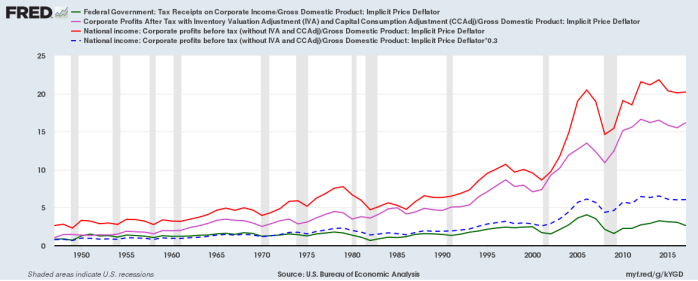
Take a good look at this graph, from the Federal Reserve Economic Database:

corporate_profits
The red line is corporate profits before tax. It is, unsurprisingly, the largest. The purple line is corporate profits after tax, with the standard adjustments for inventory depletion and capital costs. The green line is revenue from the federal corporate tax. Finally, I added a dashed blue line which multiplies before-tax profits by 30% to compare more directly with tax revenues. All these figures are annual, inflation-adjusted using the GDP deflator. The units are hundreds of billions of 2012 dollars.

The first thing you should notice is that the red and purple lines are near the highest they have ever been. Before-tax profits are over $2 trillion. After-tax profits are over $1.6 trillion.

Yet, corporate tax revenues are not the highest they have ever been. In 2006, they were over $400 billion; yet this year they don’t even reach $300 billion. The obvious reason for this is that we have been cutting corporate taxes. The more important reason is that corporations have gotten very good at avoiding whatever corporate taxes we charge.

On the books, we used to have a corporate tax rate of about 35%, which Trump just cut to 21%. But if you look at my dashed line, you can see that corporations haven’t actually paid more than 30% of their profits in taxes since 1970—and back then, the rate on the books was almost 50%.

Corporations have always avoided taxes. The effective tax rate—tax revenue divided by profits—is always much lower than the rate on the books. In 1951, the statutory tax rate was 50.75%; the effective rate was 47%. In 1970, the statutory rate was 49.2%; the effective rate was 31%. In 1993, the statutory rate was 35%; the effective rate was 26%. On average, corporations paid about 2/3 to 3/4 of what the statutory rate said.

corporate_tax_rate

You can even see how the effective rate trended steadily downward, much faster than the statutory rate. Corporations got better and better at finding and creating loopholes to let them avoid taxes. In 1950, the statutory rate was 38%—and sure enough, the effective rate was… 38%. Under Truman, corporations actually paid what they said they paid. Compare that to 1987, under Reagan, when the statutory rate was 40%—but the effective rate was only 26%.

Yet even with that downward trend, something happened under George W. Bush that widened the gap even further. While the statutory rate remained fixed at 35%, the effective rate plummeted from 26% in 2000 to 16% in 2002. The effective rate never again rose above 19%, and in 2009 it hit a minimum of just over 10%—less than one-third the statutory tax rate. It was trending upward, making it as “high” as 15%, until Trump’s tax cuts hit; in 2017 it was 13%, and it is projected to be even lower this year.

This is why it has always been disingenuous to compare our corporate tax rates with other countries and complain that they are too high. Our effective corporate tax rates have been in line with most other highly-developed countries for a long time now. The idea of “cutting rates and removing loopholes” sounds good in principle—but never actually seems to happen. George W. Bush’s “tax reforms” which were supposed to do this added so many loopholes that the effective tax rate plummeted.

I’m actually fairly ambivalent about corporate taxes in general. Their incidence really isn’t well-understood, though as Krugman has pointed out, so much of corporate profit is now monopoly rent that we can reasonably expect most of the incidence to fall on shareholders. What I’d really like to see happen is a repeal of the corporate tax combined with an increase in capital gains taxes. But we haven’t been increasing capital gains taxes; we’ve just been cutting corporate taxes.

The result has been a golden age for corporate profits. Make higher profits than ever before, and keep almost all of them without paying taxes! Nevermind that the deficit is exploding and our infrastructure is falling apart. America was founded in part on a hatred of taxes, so I guess we’re still carrying on that proud tradition.

Slides from my presentation at Worldcon

Whether you are a regular reader curious about my Worldcon talk, or a Worldcon visitor interested in seeing the slides, The slides from my presentation, “How do we get to the Federation from here?” can be found here.

Is a job guarantee better than a basic income?

Aug 5 JDN 2458336

In previous posts I’ve written about both the possibilities and challenges involved in creating a universal basic income. Today I’d like to address what I consider the most serious counter-argument against a basic income, an alternative proposal known as a job guarantee.

Whereas a basic income is literally just giving everyone free money, a job guarantee entails offering everyone who wants to work a job paid by the government. They’re not necessarily contradictory, but I’ve noticed a clear pattern: While basic income proponents are generally open to the idea of a job guarantee on the side, job guarantee proponents are often vociferously opposed to a basic income—even calling it “sinister”. I think the reason for this is that we see jobs as irrelevant, so we’re okay with throwing them in if you feel you must, while they see jobs as essential, so they meet any attempt to remove them with overwhelming resistance.

Where a basic income is extremely simple and could be implemented by a single act of the legislature, a job guarantee is considerably more complicated. The usual proposal for a job guarantee involves federal funding but local implementation, which is how most of our social welfare system is implemented—and why social welfare programs are so much better in liberal states like California than in conservative states like Mississippi, because California actually believes in what it’s implementing and Mississippi doesn’t. Anyone who wants a job guarantee needs to take that aspect seriously: In the places where poverty is worst, you’re offering control over the policy to the very governments that made poverty worst—and whether it is by malice or incompetence, what makes you think that won’t continue?

Another argument that I think job guarantee proponents don’t take seriously enough is the concern about “make-work”. They insist that a job guarantee is not “make-work”, but real work that’s just somehow not being done. They seem to think that there are a huge number of jobs that we could just create at the snap of a finger, which would be both necessary and useful on the one hand, and a perfect match for the existing skills of the unemployed population on the other hand. If that were the case, we would already be creating those jobs. It doesn’t even require a particularly strong faith in capitalism to understand this: If there is a profit to be made at hiring people to do something, there is probably already a business hiring people to do that. I don’t think of myself as someone with an overriding faith in capitalism, but a lot of the socialist arguments for job guarantees make me feel that way by comparison: They seem to think that there’s this huge untapped reserve of necessary work that the market is somehow failing to provide, and I’m just not seeing it.

There are public goods projects which aren’t profitable but would still be socially beneficial, like building rail lines and cleaning up rivers. But proponents of a job guarantee don’t seem to understand that these are almost all highly specialized jobs at our level of technology. We don’t need a bunch of people with shovels. We need engineers and welders and ecologists.

If you propose using people with shovels where engineers would be more efficient, that is make-work, whether you admit it or not. If you’re making people work in a less-efficient way in order to create jobs, then the jobs you are creating are fake jobs that aren’t worth creating. The line is often credited to Milton Friedman, but actually said first by William Aberhart in 1935:

Taking up the policy of a public works program as a solution for unemployment, it was criticized as a plan that took no account of the part that machinery played in modern construction, with a road-making machine instanced as an example. He saw, said Mr. Aberhart, work in progress at an airport and was told that the men were given picks and shovels in order to lengthen the work, to which he replied why not give them spoons and forks instead of picks and shovels if the object was to lengthen out the task.

I’m all for spending more on building rail lines and cleaning up rivers, but that’s not an anti-poverty program. The people who need the most help are precisely the ones who are least qualified to work on these projects: Children, old people, people with severe disabilities. Job guarantee proponents either don’t understand this fact or intentionally ignore it. If you aren’t finding jobs for 7-year-olds with autism and 70-year-olds with Parkinson’s disease, this program will not end poverty. And if you are, I find it really hard to believe that these are real, productive jobs and not useless “make-work”. A basic income would let the 7-year-olds stay in school and the 70-year-olds live in retirement homes—and keep them both out of poverty.

Another really baffling argument for a job guarantee over basic income is that a basic income would act as a wage subsidy, encouraging employers to reduce wages. That’s not how a basic income works. Not at all. A basic income would provide a pure income effect, necessarily increasing wage demands. People would not be as desperate for work, so they’d be more comfortable turning down unreasonable wage offers. A basic income would also incentivize some people to leave the labor force by retiring or going back to school; the reduction in labor supply would further increase wages. The Earned Income Tax Credit is in many respects similar to a wage subsidy. While superficially it might seem similar, a basic income would have the exact opposite effect.

One reasonable argument against a basic income is the possibility that it could cause inflation. This is something that can’t really be tested with small-scale experiments, so we really won’t know for sure until we try it. But there is reason to think that the inflation would be small, as the people removed from the labor force will largely be the ones who are least-productive to begin with. There is a growing body of empirical evidence suggesting that inflationary effects of a basic income would be small. For example, data on cash transfer programs in Mexico show only a small inflationary effect despite large reductions in poverty. The whole reason a basic income looks attractive is that automation technology is now so advanced is that we really don’t need everyone to be working anymore. Productivity is so high now that a policy of universal 40-hour work weeks just doesn’t make sense in the 21st century.

Probably the best argument for a job guarantee over a basic income concerns cost. A basic income is very expensive, there’s no doubt about that; and a job guarantee could be much cheaper. That is something I take very seriously: Saving $1.5 trillion a year is absolutely a good reason. Indeed, I don’t really object to this argument; the calculations are correct. I merely think that a basic income is enough better that its higher cost is justifiable. A job guarantee can eliminate unemployment, but not poverty.

But the argument for a job guarantee that most people seem to be find most compelling concerns meaning. The philosopher John Danaher expressed this one most cogently. Unemployment is an extremely painful experience for most people, far beyond what could be explained simply by their financial circumstances. Most people who win large sums of money in the lottery cut back their hours, but continue working—so work itself seems to have some value. What seems to happen is that when people lose the chance to work, they feel that they have lost a vital source of meaning in their lives.

Yet this raises two more questions:

First, would a job guarantee actually solve that problem?
Second, are there ways we could solve it under a basic income?

With regard to the first question, I want to re-emphasize the fact that a large proportion of these guaranteed jobs necessarily cannot be genuinely efficient production. If efficient production would have created these jobs, we would most likely already have created them. Our society does not suffer from an enormous quantity of necessary work that could be done with the skills already possessed by the unemployed population, which is somehow not getting done—indeed, it is essentially impossible for a capitalist economy with a highly-liquid financial system to suffer such a malady. If the work is so valuable, someone will probably take out a loan to hire someone to do it. If that’s not happening, either the unemployed people don’t have the necessary skills, or the work really can’t be all that productive. There are some public goods projects that would be beneficial but aren’t being done, but that’s a different problem, and the match between the public goods projects that need done and the skills of the unemployed population is extremely poor. Displaced coal miners aren’t useful for maintaining automated photovoltaic factories. Truckers who get replaced by robot trucks won’t be much good for building maglev rails.

With this in mind, it’s not clear to me that people would really be able to find much meaning in a guaranteed job. You can’t be fired, so the fact that you have the job doesn’t mean anyone is impressed by the quality of your work. Your work wasn’t actually necessary, or the private sector would already have hired someone to do it. The government went out of its way to find a job that precisely matched what you happen to be good at, regardless of whether that job was actually accomplishing anything to benefit society. How is that any better than not working at all? You are spending hours of drudgery to accomplish… what, exactly? If our goal was simply to occupy people’s time, we could do that with Netflix or video games.

With regard to the second question, note that a basic income is quite different from other social welfare programs in that everyone gets it. So it’s very difficult to attach a social stigma to receiving basic income payments—it would require attaching the stigma to literally everyone. Much of the lost meaning, I suspect, from being unemployed comes from the social stigma attached.

Now, it’s still possible to attach social stigma to people who only get the basic income—there isn’t much we can do to prevent that. But in the worst-case scenario, this means unemployed people get the same stigma as before but more money. Moreover, it’s much harder to detect a basic income recipient than, say, someone who eats at a soup kitchen or buys food using EBT; since it goes in your checking account, all everyone else sees is you spending money from your debit card, just like everyone else. People who know you personally would probably know; but people who know you personally are also less likely to destroy your well-being by imposing a high stigma. Maybe they’ll pressure you to get off the couch and get a job, but they’ll do so because they genuinely want to help you, not because they think you are “one of those lazy freeloaders”.

And, as BIEN points out, think about retired people: They don’t seem to be so unhappy. Being on basic income is more like being retired than like being unemployed. It’s something everyone gets, not some special handout for “those people”. It’s permanent, so it’s not like you need to scramble to get a job before it goes away. You just get money automatically, so you don’t have to navigate a complex bureaucracy to get it. Controlling for income, retired people don’t seem to be any less happy than working people—so maybe work doesn’t actually provide all that much meaning after all.

I guess I can’t rule out the possibility that people need jobs to find meaning in their lives, but I both hope and believe that this is not generally the case. You can find meaning in your family, your friends, your community, your hobbies. You can still work even if you don’t need to work for a living: Build a shed, mow your lawn, tune up your car, upgrade your computer, write a story, learn a musical instrument, or try your hand at painting.

If you need to be taking orders from a corporation five days a week in order to have meaning in your life, you have bigger problems. I think what has happened to many people is that employment has so drained their lives of the real sources of meaning that they cling to it as the only thing they have left. But in fact work is not the cure to your ennui—it is the cause of it. Finally being free of the endless toil that has plagued humanity since the dawn of our species will give you the chance to reconnect with what really matters in life. Show your children that you love them in person, to their faces, instead of in this painfully indirect way of “providing for” them by going to work every day. Find ways to apply your skills in volunteering or creating works of art, instead of in endless drudgery for the profit of some faceless corporation.

The asymmetric impact of housing prices

Jul 22 JDN 2458323

In several previous posts I’ve talked about the international crisis of high housing prices. Today, I want to talk about some features of housing that make high housing prices particularly terrible, in a way that other high prices would not be.

First, there is the fact that some amount of housing is a basic necessity, and houses are not easily divisible. So even if the houses being built are bigger than you need, you still need some kind of house, and you can’t buy half a house; the best you could really do would be to share it with someone else, and that introduces all sorts of other complications.

Second, t here is a deep asymmetry here. While rising housing prices definitely hurt people who want to buy houses, they benefit hardly anyone.


If you bought a house for $200,000 and then all housing prices doubled so it would now sell for $400,000, are you richer? You might feel richer. You might even have access to home equity loans that would give you more real liquidity. But are you actually richer?

I contend you are not, because the only way for you to access that wealth would be to sell your home, and then you’d need to buy another home, and that other home would also be twice as expensive. The amount of money you can get for your house may have increased, but the amount of house you can get for your house is exactly the same.

Conversely, suppose that housing prices fell by half, and now that house only sells for $100,000. Are you poorer? You still have your house. Even if your mortgage isn’t paid off, it’s still the same mortgage. Your payments haven’t changed. And once again, the amount of house you can get for your house will remain the same. In fact, if you are willing to accept a deed in lieu of foreclosure (it’s bad for your credit, of course), you can walk away from that underwater house and buy a new one that’s just as good with lower payments than what you are currently making. You may actually be richer because the price of your house fell.

Relative housing prices matter, certainly. If you own a $400,000 house and move to a city where housing prices have fallen to $100,000, you are definitely richer. And if you own a $100,000 house and move to a city where housing prices have risen to $400,000, you are definitely poorer. These two effects necessarily cancel out in the aggregate.

But do absolute housing prices matter for homeowners? It really seems to me that they don’t. The people who care about absolute housing prices are not homeowners; they are people trying to enter the market for the first time.
And this means that lower housing prices are almost always better. If you could buy a house for $1,000, we would live in a paradise where it was basically impossible to be homeless. (When social workers encountered someone who was genuinely homeless, they could just buy them a house then and there.) If every home cost $10 million, those who bought homes before the price surge would be little better off than they are, but the rest of us would live on the streets.

Psychologically, people very strongly resist falling housing prices. Even in very weak housing markets, most people will flatly refuse to sell their house for less than they paid for it. As a result, housing prices usually rise with inflation, but don’t usually fall in response to deflation. Rents also display similar rigidity over time. But in reality, lower prices are almost always better for almost everyone.

There is a group of people who are harmed by low housing prices, but it is a very small group of people, most of whom are already disgustingly rich: The real estate industry. Yes, if you build new housing, or flip houses, or buy and sell houses on speculation, you will be harmed by lower housing prices. Of these, literally the only one I care about even slightly is developers; and I only care about developers insofar as they are actually doing their job building housing that people need. If falling prices hurt developers, it would be because the supply of housing was so great that everyone who needs a house could have one.

There is a subtler nuance here, which is that some people may be buying more expensive housing as a speculative saving vehicle, hoping that they can cash out on their house when they retire. To that, I really only have one word of advice: Don’t. Don’t contribute to another speculative housing bubble that could cause another Great Recession. A house is not even a particularly safe investment, because it’s completely undiversified. Buy stocks. Buy all the stocks. Buy a house because you want that house, not because you hope to make money off of it.

And if the price of your house does fall someday? Don’t panic. You may be no worse off, and other people are probably much better off.

The injustice of positional goods

July 15 JDN 2458315

At Disneyland, you can now buy a special pass that will let you skip ahead in line. On several airlines including American, Delta, Spirit, and Southwest, you can pay extra to be allowed to board before other passengers (which has been particularly salient for me on the many flights I’ve been taking this summer). This is only an extreme form of a long-standing phenomenon: Since the beginning of commercial ship and train travel, there have been first-class and second-class tickets.

I don’t have any formal survey data on the matter, but just about everyone I have spoken to about such policies is at least vaguely uncomfortable with them, if not totally outraged. The exception is other economists, who typically don’t express any concern whatsoever. “People are willing to pay for this service because they value it,” they say; “so what’s the problem?”

On this one, I think the economists are wrong and everyone else is right. There is something different about this sort of service.

Part of the difference between first-class and second-class is in actual quality of services that actually incur additional costs (I hate to break it to you, but legroom on an aircraft is just such an example; every inch of legroom on each seat is another row of seats they can’t have, which is another $2000 or so they don’t get in revenue on each and every flight). But part of it is something else, something that costs the company literally nothing.

This makes early boarding a clearer example. What are you buying when you pay for early boarding? On most airlines, it’s not even a better seat; your seat is pre-assigned (Southwest is an exception). We could say you are paying for extra time, but that’s not really even true; the plane leaves at the same time for everyone. From your perspective, you are paying for convenience; you get to settle in on the plane, maybe get started working or whatever, before everyone else. Maybe you’d rather wait on the plane than wait in the airport (though frankly I’m not sure why; the airport has restaurants and comfortable restrooms).

What you are really buying is position. Early boarding is a positional good. Every person who gets bumped forward in the queue is someone else who is bumped backward. The net benefit for all customers as a whole is precisely zero, as is the cost for the company to provide it—and yet, it still has a positive price! This is impressive economic alchemy: The airline has managed to take something with zero marginal cost and zero marginal benefit, and still make money off of it. They have transmuted the lead of something costless and worthless into the gold of profit.

They achieve this by pitting customers against one another. In a post awhile back I talked about rent-seeking, such as lobbying and advertising. Usually it’s the corporations doing the rent-seeking, but early boarding and queue-jumping are examples of corporations intentionally generating a circumstances where they can obtain revenue from the rent-seeking of others.

To be fair, there might be some welfare gains to be had from auctioning off order in a queue. Some people have genuinely higher costs of time than others (a cardiac surgeon’s time is particularly important, for example), and an auction could potentially order people who have very high cost of time first.

But this argument is much weaker than it may at first appear, because people also have very different marginal utility of wealth, and indeed I think the correlation between your willingness to pay for time and your total wealth is considerably higher than the correlation between your willingness-to-pay for time and your actual real cost in terms of pain and suffering.

This is a more general problem, as I’ve discussed in previous posts; but I think it’s especially acute in the case of time, because real cost of time doesn’t actually vary all that much between most people. The reason poor people take buses and rich people take limousines isn’t because poor people don’t care about their time; it’s because they can’t afford limousines. A cardiac surgeon and an economist could very well have the same salary and the same willingness-to-pay for time, but people rarely die when an economist turns up an hour late. (It’s not that our work isn’t important—actually a good development economist can save far more lives than any cardiac surgeon—but it’s not nearly so urgent.) Also, consider the fact that teachers and social workers generally contribute a good deal more to society than derivatives traders (and thus, from a social welfare perspective, their time should be considered more valuable), but they are far less likely to pay for first-class seats. In fact, a first-come, first-served method actually seems better than an auction from a social welfare perspective: If your time is really important to you, you’re more likely to go out of your way to check in as soon as you can. That costly signal provides a sorting mechanism which relies directly upon real costs of time, rather than indirectly via monetary willingness-to-pay.

And of course when it comes to Disneyland, this argument utterly fails; I see little reason to think that a cardiac surgeon’s vacation time is substantially more valuable to society. (Don’t get me wrong; surgeons need and deserve vacation time—but if they get too much, their performance actually suffers!) So maybe paying for a place in queue isn’t completely rent-seeking, but it’s pretty close.

That is why paying for positional goods feels unjust to most people: Because it is. Charging a price for positional goods is a means of extracting profit from customers without providing any (net) real service. It’s a way of applying price discrimination without even having much monopoly power. If another airline doesn’t let you pay to skip ahead in the queue, you have a slightly lower expected wait time on that other airline, but any revenue they lose from charging a bit less for economy tickets can be easily made up by charging more for the front of the line.

For example, if the first 10% of the line on airline A is decided by selling spots, while airline B chooses at random, and the average time waiting in line to board is 30 minutes, the expected wait times are as follows. Fly airline A and don’t buy a spot: 16.5 minutes. Fly airline A and buy a spot: 1.5 minutes. Fly airline B: 15 minutes. Those 10% are paying for, on average, 13.5 minutes; but you’re only gaining 1.5 minutes. Of course, there are more people waiting that extra 1.5 minutes than saving those 13.5 minutes (9 times as many, in fact). If the per-minute willingness-to-pay were exactly the same, the airline would break even; but they know of course that the willingness-to-pay of that top 10% is considerably higher than that of most of the bottom 90%. If they have any market power at all (which they generally do, by being the only airline serving certain routes, offering loyalty benefits, etc.), they can squeeze out even more profit.

They may even sometimes go out of their way to make life miserable for those who don’t pay extra, increasing the incentive to pay extra. This requires some market power to pull off, but as I said, they often have that. Most airlines don’t offer power outlets at every seat, for example. This is not a serious question of installation cost or even power consumption. We’re talking about a few hundred dollars on an aircraft that costs hundreds of millions of dollars, or a few kilowatts from a system that can generate over one hundred megawatts (of course most of it is used for propulsion, but adding an alternator that would generate an extra few kilowatts of electrical power would still not be difficult or expensive). This is a way of making life worse for the economy-class passengers so they have a stronger incentive to pay for upgraded tickets.

It’s not always easy to tell what is a positional good: First-class seats are ambiguous, for example. But I think a good heuristic is to ask, “Could everyone benefit from this?” If the answer is “No, even in principle”, then you are definitely dealing with a positional good. Not everyone can be first in line at Disneyland. Not everyone can board the plane first. In theory at least, everyone could be provided the same legroom and meal service as a first-class ticket (it would be expensive, but not impossible), so that is at least in part not a positional good.

The “pay-to-win” effect of some video game downloadable content (DLC) is also a positional good, which we can see by the above heuristic: If everyone pays to have the best gun in the game, there’s no point in having the best gun in the game. This is why gamers are rightfully outraged by “pay-to-win” effects, but typically have no objection to paying for DLC that provides them with extra game content (such as new characters, locations, or missions) or cosmetic upgrades (hats, decorations, and “skins”). Personally I tend to think that most DLC is overpriced, and succeeds at being so due to a kind of monopoly power (Mass Effect DLC doesn’t work on Skyrim or vice-versa) but I certainly don’t object to the basic idea of charging additional money for additional content. The reason we object to “pay-to-win” is not that winning the game is so important; it’s that this business model is so obviously a form of rent extraction. (It’s interesting that gamers in China don’t seem to be as bothered by “pay-to-win” as gamers in the US; this runs counter to the standard narrative that American people are competitive capitalists and Chinese people are collectivist socialists, don’t you think?)

There may be some circumstances in which we have no choice but to allow corporations to charge prices for positional goods—especially if we can’t tell whether we are dealing with a positional good or not. But it would not be very difficult to draft legislation that would at least reduce such business practices: We could simply use my “Could everyone benefit?” heuristic. If a business charges money for something that even in principle they could not possibly provide all of their customers, they are charging a price for a positional good, and should be penalized. The benefits of such a policy would be relatively small, but the costs would be even smaller. If we are really concerned about letting cardiac surgeons board aircraft faster (we should really be concerned about deboarding faster—and especially faster security screening!), we could make such a rule that applies to particular classes of high-urgency professions; we don’t need to allow airlines to extract millions of dollars in rent by pitting their customers against each other.

The housing shortage is an international phenomenon

Jul 1 JDN 2458301

My posts for the next couple of weeks are going to be shorter, since I am in Europe and will be either on vacation (at the time I write this) or busy with a conference and a workshop (by the time this post goes live).

For today, I’d just like to point out that the crisis of extremely high housing prices is not unique to California or even the United States. In some respects it may even be worse elsewhere.

San Francisco remains especially bad; the median price for a home in San Francisco is a horrifying $1.6 million.

But London (where I am at the time of writing) is also terrible; the median price for a home in London recently fell to 430,000 pounds (about $600,000 at current exchange rates). The most expensive flat—not house, flat—sold a couple years ago for the mind-boggling sum of 150 million pounds (about $200 million). If I had $200 million, I would definitely not use it to buy a flat. At that point it would literally be cheaper to buy a yacht with a helipad, park it in the harbor, and commute by helicopter. Here’s a yacht with a helipad for only $20 million, and a helicopter to go with it for $6 million. That leaves $174 million; keep $20 million in stocks to be independently wealthy for the rest of your life, and then donate the remaining $154 million to charity.

The median price of a house in Vancouver stands at 1.1 million Canadian dollars, about $830,000 US.

A global comparison finds that on a per-square-meter basis, the most expensive real estate in the world is in Monaco, where $1 million US will only buy you 15 square meters. The remaining cities in the top 10 are Hong Kong, London, Singapore, Geneva, New York, Sydney, Paris, Moscow, and Shanghai.

There is astonishing variation in the level of housing prices, even within countries. Some of the most affordable markets in the US (like San Antonio and Oklahoma City) cost as little as $80 per square foot; that means that $1 million would buy you 1,160 square meters. That’s not an error; real estate in Monaco is literally 77 times more expensive than real estate in Oklahoma City. 15 square meters is a studio apartment; 1,160 square meters is a small mansion. Just comparing within the US, the price per square foot in San Francisco is over $1,120, 14 times as high as Oklahoma City. $1 million in San Francisco will buy you about 80 square meters, which is at least a two or three-bedroom house.

This says to me that policy choices matter. It may not be possible to make San Francisco as cheap as Oklahoma City—most people would definitely rather live in San Francisco, so demand is always going to be higher there. But I don’t think it’s very plausible to say that housing is just inherently 14 times as expensive to construct as housing in Oklahoma City. If it’s really that much more expensive to construct (and that may not even be the issue—this could be more a matter of oligopoly than high costs), it must be at least in part because of something the local and state governments are doing differently. Cross-national comparisons underscore that point even further: The geography of Hong Kong and Taiwan is not that different, but housing prices in Taiwan are not nearly as high.

What exactly are different cities (and countries) doing differently that has such large effects on housing prices? That’s something I’ll try to figure out in future posts.

What we could, what we should, and what we must

May 27 JDN 2458266

In one of the most famous essays in all of ethical philosophy, Peter Singer famously argued that we are morally obligated to give so much to charity that we would effectively reduce ourselves to poverty only slightly better than what our donations sought to prevent. His argument is a surprisingly convincing one, especially for such a radical proposition. Indeed, one of the core activities of the Effective Altruism movement has basically been finding ways to moderate Singer’s argument without giving up on its core principles, because it’s so obvious both that we ought to do much more to help people around the world and that there’s no way we’re ever going to do what that argument actually asks of us.

The most cost-effective charities in the world can save a human life for an average cost of under $4,000. The maneuver that Singer basically makes is quite simple: If you know that you could save someone’s life for $4,000, you have $4,000 to spend, and instead you spend that $4,000 on something else, aren’t you saying that whatever you did spend it on was more important than saving that person’s life? And is that really something you believe?

But if you think a little more carefully, it becomes clear that things are not quite so simple. You aren’t being paid $4,000 to kill someone, first of all. If you were willing to accept $4,000 as sufficient payment to commit a murder, you would be, quite simply, a monster. Implicitly the “infinite identical psychopath” of neoclassical rational agent models would be willing to do such a thing, but very few actual human beings—even actual psychopaths—are that callous.

Obviously, we must refrain from murdering people, even for amounts far in excess of $4,000. If you were offered the chance to murder someone for $4 billion dollars, I can understand why you would be tempted to do such a thing. Think of what you could do with all that money! Not only would you and everyone in your immediate family be independently wealthy for life, you could donate billions of dollars to charity and save as much as a million lives. What’s one life for a million? Even then, I have a strong intuition that you shouldn’t commit this murder—but I have never been able to find a compelling moral argument for why. The best I’ve been able to come up with a sort of Kantian notion: What if everyone did this?

Since the most plausible scenario is that the $4 billion comes from existing wealth, all those murders would simply be transferring wealth around, from unknown sources. If you stipulate where the wealth comes from, the dilemma can change quite a bit.

Suppose for example the $4 billion is confiscated from Bashar Al-Assad. That would be in itself a good thing, lessening the power of a genocidal tyrant. So we need to add that to the positive side of the ledger. It is probably worth killing one innocent person just to undermine Al-Assad’s power; indeed, the US Air Force certainly seems to think so, as they average more than one civilian fatality every day in airstrikes.

Now suppose the wealth was extracted by clever financial machinations that took just a few dollars out of every bank account in America. This would be in itself a bad thing, but perhaps not a terrible thing, especially since we’re planning on giving most of it to UNICEF. Those people should have given it anyway, right? This sounds like a pretty good movie, actually; a cyberpunk Robin Hood basically.

Next, suppose it was obtained by stealing the life savings of a million poor people in Africa. Now the method of obtaining the money is so terrible that it’s not clear that funneling it through UNICEF would compensate, even if you didn’t have to murder someone to get it.

Finally, suppose that the wealth is actually created anew—not printed money from the Federal Reserve, but some new technology that will increase the world’s wealth by billions of dollars yet requires the death of an innocent person to create. In this scenario, the murder has become something more like the inherent risk in human subjects biomedical research, and actually seems justifiable. And indeed, that fits with the Kantian answer, for if we all had the chance to kill one person in order to create something that would increase the wealth of the world by $4 billion, we could turn this planet into a post-scarcity utopia within a generation for fewer deaths than are currently caused by diabetes.

Anyway, my point here is that the detailed context of a decision actually matters a great deal. We can’t simply abstract away from everything else in the world and ask whether the money is worth the life.

When we consider this broader context with regard to the world’s most cost-effective charities, it becomes apparent that a small proportion of very dedicated people giving huge proportions of their income to charity is not the kind of world we want to see.

If I actually gave so much that I equalized my marginal utility of wealth to that of a child dying of malaria in Ghana, I would have to donate over 95% of my income—and well before that point, I would be homeless and impoverished. This actually seems penny-wise and pound-foolish even from the perspective of total altruism: If I stop paying rent, it gets a lot harder for me to finish my doctorate and become a development economist. And even if I never donated another dollar, the world would be much better off with one more good development economist than with even another $23,000 to the Against Malaria Foundation. Once you factor in the higher income I’ll have (and proportionately higher donations I’ll make), it’s obviously the wrong decision for me to give 95% of $25,000 today rather than 10% of $70,000 every year for the next 20 years after I graduate.

But the optimal amount for me to donate from that perspective is whatever the maximum would be that I could give without jeopardizing my education and career prospects. This is almost certainly more than I am presently giving. Exactly how much more is actually not all that apparent: It’s not enough to say that I need to be able to pay rent, eat three meals a day, and own a laptop that’s good enough for programming and statistical analysis. There’s also a certain amount that I need for leisure, to keep myself at optimal cognitive functioning for the next several years. Do I need that specific video game, that specific movie? Surely not—but if I go the next ten years without ever watching another movie or playing another video game, I’m probably going to be in trouble psychologically. But what exactly is the minimum amount to keep me functioning well? And how much should I be willing to spend attending conferences? Those can be important career-building activities, but they can also be expensive wastes of time.

Singer acts as though jeopardizing your career prospects is no big deal, but this is clearly wrong: The harm isn’t just to your own well-being, but also to your productivity and earning power that could have allowed you to donate more later. You are a human capital asset, and you are right to invest in yourself. Exactly how much you should invest in yourself is a much harder question.
Such calculations are extremely difficult to do. There are all sorts of variables I simply don’t know, and don’t have any clear way of finding out. It’s not a good sign for an ethical theory when even someone with years of education and expertise on specifically that topic still can’t figure out the answer. Ethics is supposed to be something we can apply to everyone.

So I think it’s most helpful to think in those terms: What could we apply to everyone? What standard of donation would be high enough if we could get everyone on board?

World poverty is rapidly declining. The direct poverty gap at the UN poverty line of $1.90 per day is now only $80 billion. Realistically, we couldn’t simply close that gap precisely (there would also be all sorts of perverse incentives if we tried to do it that way). But the standard estimate that it would take about $300 billion per year in well-targeted spending to eliminate world hunger is looking very good.

How much would each person, just those in the middle class or above within the US or the EU, have to give in order to raise this much?
89% of US income is received by the top 60% of households (who I would say are unambiguously “middle class or above”). Income inequality is not as extreme within the EU, so the proportion of income received by the top 60% seems to be more like 75%.

89% of US GDP plus 75% of EU GDP is all together about $29 trillion per year. This means that in order to raise $300 billion, each person in the middle class or above would need to donate just over one percent of their income.

Not 95%. Not 25%. Not even 10%. Just 1%. That would be enough.

Of course, more is generally better—at least until you start jeopardizing your career prospects. So by all means, give 2% or 5% or even 10%. But I really don’t think it’s helpful to make people feel guilty about not giving 95% when all we really needed was for everyone to give 1%.

There is an important difference between what we could do, what we should do, and what we must do.

What we must do are moral obligations so strong they are essentially inviolable: We must not murder people. There may be extreme circumstances where exceptions can be made (such as collateral damage in war), and we can always come up with hypothetical scenarios that would justify almost anything, but for the vast majority of people the vast majority of time, these ethical rules are absolutely binding.

What we should do are moral obligations that are strong enough to be marks against your character if you break them, but not so absolutely binding that you have to be a monster not to follow them. This is where I put donating at least 1% of your income. (This is also where I put being vegetarian, but perhaps that is a topic for another time.) You really ought to do it, and you are doing something wrongful if you don’t—but most people don’t, and you are not a terrible person if you don’t.

This latter category is in part socially constructed, based on the norms people actually follow. Today, slavery is obviously a grave crime, and to be a human trafficker who participates in it you must be a psychopath. But two hundred years ago, things were somewhat different: Slavery was still wrong, yes, but it was quite possible to be an ordinary person who was generally an upstanding citizen in most respects and yet still own slaves. I would still condemn people who owned slaves back then, but not nearly as forcefully as I would condemn someone who owned slaves today. Two hundred years from now, perhaps vegetarianism will move up a category: The norm will be that everyone eats only plants, and someone who went out of their way to kill and eat a pig would have to be a psychopath. Eating meat is already wrong today—but it will be more wrong in the future. I’d say the same about donating 1% of your income, but actually I’m hoping that by two hundred years from now there will be no more poverty left to eradicate, and donation will no longer be necessary.

Finally, there is what we could do—supererogatory, even heroic actions of self-sacrifice that would make the world a better place, but cannot be reasonably expected of us. This is where donating 95% or even 25% of your income would fall. Yes, absolutely, that would help more people than donating 1%; but you don’t owe the world that much. It’s not wrong for you to contribute less than this. You don’t need to feel guilty for not giving this much.

But I do want to make you feel guilty if you don’t give at least 1%. Don’t tell me you can’t. You can. If your income is $30,000 per year, that’s $300 per year. If you needed that much for a car repair, or dental work, or fixing your roof, you’d find a way to come up with it. No one in the First World middle class is that liquidity-constrained. It is true that half of Americans say they couldn’t come up with $400 in an emergency, but I frankly don’t believe it. (I believe it for the bottom 25% or so, who are actually poor; but not half of Americans.) If you have even one credit card that’s not maxed out, you can do this—and frankly even if a card is maxed out, you can probably call them and get them to raise your limit. There is something you could cut out of your spending that would allow you to get back 1% of your annual income. I don’t know what it is, necessarily: Restaurants? Entertainment? Clothes? But I’m not asking you to give a third of your income—I’m asking you to give one penny out of every dollar.

I give considerably more than that; my current donation target is 8% and I’m planning on raising it to 10% or more once I get a high-paying job. I live on a grad student salary which is less than the median personal income in the US. So I know it can be done. But I am very intentionally not asking you to give this much; that would be above and beyond the call of duty. I’m only asking you to give 1%.

Sympathy for the incel

Post 237: May 6 JDN 2458245

If you’ve been following the news surrounding the recent terrorist attack in Toronto, you may have encountered the word “incel” for the first time via articles in NPR, Vox, USA Today, or other sources linking the attack to the incel community.

If this was indeed your first exposure to the concept of “incel”, I think you are getting a distorted picture of their community, which is actually a surprisingly large Internet subculture. Finding out about incel this way would be like finding out about Islam from 9/11. (Actually, I’m fairly sure a lot of Americans did learn that way, which is awful.) The incel community is remarkably large one—hundreds of thousands of members at least, and quite likely millions.

While a large proportion subscribe to a toxic and misogynistic ideology, a similarly large proportion do not; while the ideology has contributed to terrorism and other violence, the vast majority of members of the community are not violent.

Note that the latter sentence is also entirely true of Islam. So if you are sympathetic toward Muslims and want to protect them from abuse and misunderstanding, I maintain that you should want to do the same for incels, and for basically the same reasons.

I want to make something abundantly clear at the outset:

This attack was terrorism. I am in no way excusing or defending the use of terrorism. Once someone crosses the line and starts attacking random civilians, I don’t care what their grievances were; the best response to their behavior involves snipers on rooftops. I frankly don’t even understand the risks police are willing to take in order to capture these people alive—especially considering how trigger-happy they are when it comes to random Black men. If you start shooting (or bombing, or crashing vehicles into) civilians, the police should shoot you. It’s that simple.

I do not want to evoke sympathy for incel-motivated terrorism. I want to evoke sympathy for the hundreds of thousands of incels who would never support terrorism and are now being publicly demonized.

I also want to make it clear that I am not throwing in my hat with the likes of Robin Hanson (who is also well-known as a behavioral economist, blogger, science fiction fan, Less Wrong devotee, and techno-utopian—so I feel a particular need to clarify my differences with him) when he defends something he calls in purposefully cold language “redistribution of sex” (that one is from right after the attack, but he has done this before, in previous blog posts).

Hanson has drunk Robert Nozick‘s Kool-Aid, and thinks that redistribution of wealth via taxation is morally equivalent to theft or even slavery. He is fond of making comparisons between redistribution of wealth and other forms of “redistribution” that obviously would be tantamount to theft and slavery, and asking “What’s the difference?” when in fact the difference is glaringly obvious to everyone but him. He is also fond of saying that “inequality between households within a nation” is a small portion of inequality, and then wondering aloud why we make such a big deal out of it. The answer here is also quite obvious: First of all, it’s not that small a portion of inequality—it’s a third of global income inequality by most measures, it’s increasing while across-nation inequality is decreasing, and the absolute magnitude of within-nation inequality is staggering: there are households with incomes over one million times that of other households within the same nation. (Where are the people who have had sex one hundred billion times, let alone the ones who had sex forty billion times in one year? Because here’s the man who has one hundred billion dollars and made almost $40 billion in one year.) Second, within-nation inequality is extremely simple to fix by public policy; just change a few numbers in the tax code—in fact, just change them back to what they were in the 1950s. Cross-national inequality is much more complicated (though I believe it can be solved, eventually) and some forms of what he’s calling “inequality” (like “inequality across periods of human history” or “inequality of innate talent”) don’t seem amenable to correction under any conceivable circumstances.

Hanson has lots of just-so stories about the evolutionary psychology of why “we don’t care” about cross-national inequality (gee, I thought maybe devoting my career to it was a pretty good signal otherwise?) or inequality in access to sex (which is thousands of times smaller than income inequality), but no clear policy suggestions for how these other forms of inequality could be in any way addressed. This whole idea of “redistribution of sex”; what does that mean, exactly? Legalized or even subsidized prostitution or sex robots would be one thing; I can see pros and cons there at least. But without clarification, it sounds like he’s endorsing the most extremist misogynist incels who think that women should be rightfully compelled to have sex with sexually frustrated men—which would be quite literally state-sanctioned rape. I think really Hanson isn’t all that interested in incels, and just wants to make fun of silly “socialists” who would dare suppose that maybe Jeff Bezos doesn’t need his 120 billion dollars as badly as some of the starving children in Africa could benefit from them, or that maybe having a tax system similar to Sweden or Denmark (which consistently rate as some of the happiest, most prosperous nations on Earth) sounds like a good idea. He takes things that are obviously much worse than redistributive taxation, and compares them to redistributive taxation to make taxation seem worse than it is.

No, I do not support “redistribution of sex”. I might be able to support legalized prostitution, but I’m concerned about the empirical data suggesting that legalized prostitution correlates with increased human sex trafficking. I think I would also support legalized sex robots, but for reasons that will become clear shortly, I strongly suspect they would do little to solve the problem, even if they weren’t ridiculously expensive. Beyond that, I’ve said enough about Hanson; Lawyers, Guns & Money nicely skewers Hanson’s argument, so I’ll not bother with it any further.
Instead, I want to talk about the average incel, one of hundreds of thousands if not millions of men who feels cast aside by society because he is socially awkward and can’t get laid. I want to talk about him because I used to be very much like him (though I never specifically identified as “incel”), and I want to talk about him because I think that he is genuinely suffering and needs help.

There is a moderate wing of the incel community, just as there is a moderate wing of the Muslim community. The moderate wing of incels is represented by sites like Love-Shy.com that try to reach out to people (mostly, but not exclusively young heterosexual men) who are lonely and sexually frustrated and often suffering from social anxiety or other mood disorders. Though they can be casually sexist (particularly when it comes to stereotypes about differences between men and women), they are not virulently misogynistic and they would never support violence. Moreover, they provide a valuable service in offering social support to men who otherwise feel ostracized by society. I disagree with a lot of things these groups say, but they are providing valuable benefits to their members and aren’t hurting anyone else. Taking out your anger against incel terrorists on Love-Shy.com is like painting graffiti on a mosque in response to 9/11 (which, of course, people did).

To some extent, I can even understand the more misogynistic (but still non-violent) wings of the incel community. I don’t want to defend their misogyny, but I can sort of understand where it might come from.

You see, men in our society (and most societies) are taught from a very young age that their moral worth as human beings is based primarily on one thing in particular: Sexual prowess. If you are having a lot of sex with a lot of women, you are a good and worthy man. If you are not, you are broken and defective. (Donald Trump has clearly internalized this narrative quite thoroughly—as have a shockingly large number of his supporters.)

This narrative is so strong and so universal, in fact, that I wouldn’t be surprised if it has a genetic component. It actually makes sense as a matter of evolutionary psychology than males would evolve to think this way; in an evolutionary sense it’s true that a male’s ultimate worth—that is, fitness, the one thing natural selection cares about—is defined by mating with a maximal number of females. But even if it has a genetic component, there is enough variation in this belief that I am confident that social norms can exaggerate or suppress it. One thing I can’t stand about popular accounts of evolutionary psychology is how they leap from “plausible evolutionary account” to “obviously genetic trait” all the way to “therefore impossible to change or compensate for”. My myopia and astigmatism are absolutely genetic; we can point to some of the specific genes. And yet my glasses compensate for them perfectly, and for a bit more money I could instead get LASIK surgery that would correct them permanently. Never think for a moment that “genetic” implies “immutable”.

Because of this powerful narrative, men who are sexually frustrated get treated like garbage by other men and even women. They feel ostracized and degraded. Often, they even feel worthless. If your worth as a human being is defined by how many women you have sex with, and you aren’t having sex with any, it follows that your worth is zero. No wonder, then, that so many become overcome with despair.
The incel community provides an opportunity to escape that despair. If you are told that you are not defective, but instead there is something wrong with society that keeps you down, you no longer have to feel worthless. It’s not that you don’t deserve to have sex, it’s that you’ve been denied what you deserve. When the only other narrative you’ve been given is that you are broken and worthless, I can see why “society is screwing you over” is an appealing counter-narrative. Indeed, it’s not even that far off from the truth.

The moderate wing of the incel community even offers some constructive solutions: They offer support to help men improve themselves, overcome their own social anxiety, and ultimately build fulfilling sexual relationships.

The extremist wing gets this all wrong: Instead of blaming the narrative that sex equals worth, they blame women—often, all women—for somehow colluding to deny them access to the sex they so justly deserve. They often link themselves to the “pick-up artist” community who try to manipulate women into having sex.

And then in the most extreme cases, they may even decide to turn their anger into violence.

But really I don’t think most of these men actually want sex at all, which is part of why I don’t think sex robots would be particularly effective.

Rather, to clarify: They want sex, as most of us do—but that’s not what they need. A simple lack of sex can be compensated reasonably well by pornography and masturbation. (Let me state this outright: Pornography and masturbation are fundamental human rights. Porn is free speech, and masturbation is part of the fundamental right of bodily autonomy. The fact that increased access to porn reduces incidence of sexual assault is nice, but secondary; porn is freedom.) Obviously it would be more satisfying to have a real sexual relationship, but with such substitutes available, a mere lack of sex does not cause suffering.

The need that these men are feeling is companionship. It is love. It is understanding. These are things that can’t be replaced, even partially, by sex robots or Internet porn.

Why do they conflate the two? Again, because society has taught them to do so. This one is clearly cultural, as it varies quite considerably between nations; it’s not nearly as bad in Southern Europe for example.
In American society (and many, but not all others), men are taught three things: First, expression of any emotion except for possibly anger, and especially expression of affection, is inherently erotic. Second, emotional vulnerability jeopardizes masculinity. Third, erotic expression must be only between men and women in a heterosexual relationship.

In principle, it might be enough to simply drop the third proposition: This is essentially what happens in the LGBT community. Gay men still generally suffer from the suspicion that all emotional expression is erotic, but have long-since abandoned their fears of expressing eroticism with other men. Often they’ve also given up on trying to sustain norms of masculinity as well. So gay men can hug each other and cry in front of each other, for example, without breaking norms within the LGBT community; the sexual subtext is often still there, but it’s considered unproblematic. (Gay men typically aren’t even as concerned about sexual infidelity as straight men; over 40% of gay couples are to some degree polyamorous, compared to 5% of straight couples.) It may also be seen as a loss of masculinity, but this too is considered unproblematic in most cases. There is a notable exception, which is the substantial segment of gay men who pride themselves upon hypermasculinity (generally abbreviated “masc”); and indeed, within that subcommunity you often see a lot of the same toxic masculinity norms that are found in the society as large.

That is also what happened in Classical Greece and Rome, I think: These societies were certainly virulently misogynistic in their own way, but their willingness to accept erotic expression between men opened them to accepting certain kinds of emotional expression between men as well, as long as it was not perceived as a threat to masculinity per se.

But when all three of those norms are in place, men find that the only emotional outlet they are even permitted to have while remaining within socially normative masculinity is a woman who is a romantic partner. Family members are allowed certain minimal types of affection—you can hug your mom, as long as you don’t seem too eager—but there is only one person in the world that you are allowed to express genuine emotional vulnerability toward, and that is your girlfriend. If you don’t have one? Get one. If you can’t get one? Well, sorry, pal, you’re just out of luck. Deal with it, or you’re not a real man.

But really what I’d like to get rid of is the first two propositions: Emotional expression should not be considered inherently sexual. Expressing emotional vulnerability should not be taken as a capitulation of your masculinity—and if I really had my druthers, the whole idea of “masculinity” would disappear or become irrelevant. This is the way that society is actually holding incels down: Not by denying them access to sex—the right to refuse sex is also a fundamental human right—but by denying them access to emotional expression and treating them like garbage because they are unable to have sex.

My sense is that what most incels are really feeling is not a dearth of sexual expression; it’s a dearth of emotional expression. But precisely because social norms have forced them into getting the two from the same place, they have conflated them. Further evidence in favor of this proposition? A substantial proportion of men who hire prostitutes spend a lot of the time they paid for simply talking.

I think what most of these men really need is psychotherapy. I’m not saying that to disparage them; I myself am a regular consumer of psychotherapy, which is one of the most cost-effective medical interventions known to humanity. I feel a need to clarify this because there is so much stigma on mental illness that saying someone is mentally ill and needs therapy can be taken as an insult; but I literally mean that a lot of these men are mentally ill and need therapy. Many of them exhibit significant signs of social anxiety, depression, or bipolar disorder.

Even for those who aren’t outright mentally ill, psychotherapy might be able to help them sort out some of these toxic narratives they’ve been fed by society, get them to think a little more carefully about what it means to be a good man and whether the “man” part is even so important. A good therapist could tease out the fabric of their tangled cognition and point out that when they say they want sex, it really sounds like they want self-worth, and when they say they want a girlfriend it really sounds like they want someone to talk to.

Such a solution won’t work on everyone, and it won’t work overnight on anyone. But the incel community did not emerge from a vacuum; it was catalyzed by a great deal of genuine suffering. Remove some of that suffering, and we might just undermine the most dangerous parts of the incel community and prevent at least some future violence.

No one owes sex to anyone. But maybe we do, as a society, owe these men a little more sympathy?